MUFON Monthly Sighting Statistics!! AUGUST 2024

MUFON Monthly Sighting Statistics -- AUGUST 2024
|
|
|
MUFON Monthly Sighting Statistics!! AUGUST 2024
MUFON Monthly Sighting Statistics -- AUGUST 2024
|
|
|
Planetary Researchers Create Cloud Atlas of Mars
The images in the Martian Cloud Atlas have been captured by the High Resolution Stereo Camera (HRSC) instrument on ESA’s Mars Express spacecraft.
Lee waves on Mars are created by the wind encountering obstacles and build up on the ‘leeward’ or downwind side.
Image credit: ESA / DLR / FU Berlin.
Due to the elliptical orbit of Mars Express, its HRSC camera can not only take surface observations from low altitude to map the planet at the highest possible resolution, but also capture observations from higher altitudes at lower resolution, covering much larger parts of the surface with a typical field of view from limb to limb.
These high-altitude observations are ideal for observing atmospheric phenomena on Mars.
After more than 20 years of the Mars Express mission, an extensive amount of image data on atmospheric phenomena on Mars has been accumulated, which has a great potential for scientific exploitation.
“Clouds on Mars are just as diverse and fascinating as those we see in our skies on Earth, with some features unique to the Red Planet,” said Dr. Daniela Tirsch, a researcher at the German Aerospace Centre (DLR).

Elongated dust clouds aren’t found on Earth
ESA/DLR/FU Berlin/A. Cowart
“One of my favorite phenomena are the beautiful ‘cloud streets’ — linear rows of fleecy clouds that develop around the huge volcanic Tharsis rise and the northern lowlands in northern spring and summer.”
“While they resemble cumulus clouds on Earth, they are formed under different atmospheric conditions.”
“We also see impressive dust clouds that can spread hundreds of km — a phenomenon we luckily don’t experience on Earth.”

This image displays two atmospheric phenomena: the white curved lines are gravity wave clouds, while the brown areas are dust lifted from the ground by wind. The color shift visible in the dust lifting event might be indicative of very fast winds, a phenomenon currently under investigation by other members of the team.
Credit: ESA/DLR/FU Berlin.

This elongated cloud has formed as a result of wind encountering the Arsia Mons mountains. It forms almost every day during a specific season, from early morning until noon.
Credit: ESA/DLR/FU Berlin/A. Cowart.

An example of cloud streets over Vastitas Borealis, a large area near the North Pole mostly devoid of craters. .
Credit: ESA/DLR/FU Berlin/A. Cowart

Lee waves are a special type of cloud created by the wind encountering obstacles and build up on the 'leeward' or downwind side. The geometries of the lee waves depend on the shape of the obstacles.
Credit: ESA/DLR/FU Berlin.

Lee waves are a special type of cloud created by the wind encountering obstacles and build up on the 'leeward' or downwind side. The geometries of the lee waves depend on the shape of the obstacles.
Credit: ESA/DLR/FU Berlin.
Dust plays a major role in the atmosphere and climate of Mars.
Rare upwelling events can leave beige, dust-laden blobs hanging in the planet’s atmosphere.
Large differences in temperature and air pressure at certain seasons can result in stronger-than-usual winds that lift large amounts of dust from the Martian surface
Dust clouds spreading from the tops of giant volcanoes take on the appearance of eruption clouds, although they are no longer active.
Large spiral dust storms and cyclone systems can also be observed each year near the Martian north pole.
Studying these phenomena is crucial to scientists in understanding the atmosphere and air mass circulation on Mars.
Rippling ‘gravity clouds’ are one of the most common formations on both Mars and the Earth.
They are seen at mid-latitudes in winter for both hemispheres, as well as over the Tharsis volcanic plateau in southern winter.
Lee waves, a special type of gravity clouds, can build up on the downwind side of ridges, mountains and other obstacles to create repeating ridge formations.
Some types of clouds studied are specific to locations and seasons; others like ‘twilight clouds’ can appear in the early morning at any place or time of year.
The new atlas will provide valuable insights into the physical nature and appearance of clouds and storms, the time of their occurrence and their location.
This knowledge will help better understand the atmospheric dynamics and the climate cycles on Mars, as well as providing input for studies of the climate on other planets such as Earth and Venus.
“As Mars Express has been extended by ESA until at least 2026, this will enable us keep filling this database and refine even further our understanding of Mars atmosphere,” Dr. Tirsch said.
CIA’s Mind-Control Project MK-Ultra Scientist Jumped to His Death from the 13th Floor of a Manhattan Hotel Room: Was He Pushed?

CIA scientist Frank Olson, who was part of the CIA’s mind-control project MK-Ultra, fell from his Manhattan hotel room and died on the sidewalk. His death remains one of the most mysterious to this day, as he knew some of the CIA’s darkest secrets. In 1994, his son exhumed his body, searching for evidence of foul play.
Frank Olson was 43 years old when he died on November 28, 1953. He was a scientist, a CIA officer, and one of the few people who knew about the CIA’s Project MK-Ultra. This project focused on mind control experiments, including using LSD to see if it could be used against U.S. enemies. The U.S. feared that the Soviet Union was ahead in developing mind control techniques.
Olson was deeply involved in the project, making him part of an elite group. However, this also made him a security risk if he ever revealed what he knew about the top-secret program.
A week before his death, Olson was unknowingly given LSD during a retreat with CIA and Army colleagues. While others at the meeting were also drugged, Olson had a much stronger reaction. He became anxious, had trouble focusing, and couldn’t sleep. He even forgot how to spell. At some point, he told his wife, “I’ve made a terrible mistake,” though she never learned what he meant.
“My uncle Frank Olson died sometime around 2:30 a.m. on Nov. 28, 1953 when he “jumped or fell” from his room on the 13th floor of the Statler Hotel in New York City,” writes Paul Vidich, author of The Coldest Warrior.
Frank Olson was a highly skilled Army scientist who worked at Fort Detrick in Frederick, Maryland, a top-secret U.S. Army facility that researched biological warfare agents. He had gone to New York to see a security-cleared psychiatrist in the company of a CIA escort.
Olson’s sealed casket was delivered to his wife two days after his death. She was advised not to view the body because they said he had severe facial injuries. Olson was buried the next day, and she received a quick pension soon after. For 22 years, that was all the family knew.
In June 1975, new information surfaced. A report by the Rockefeller Commission, which was investigating illegal CIA activities, mentioned an army scientist who was unknowingly given LSD and died after falling from a New York hotel window. The case caught the family’s attention. After checking with the CIA, the Army confirmed that the scientist was Frank Olson. Major newspapers reported the story with headlines like “Suicide Revealed.”
Just 10 days later, the family was invited to the Oval Office, where the president personally apologized for Olson’s death. Within a year, the family received a $750,000 settlement in exchange for releasing all claims against the U.S. government. (Source)

The questions surrounding Frank Olson’s death could have ended if his sons, Eric and Nils, had accepted the official story. But in 1994, they chose to exhume their father’s body and have a second autopsy done.
James E. Starrs, a professor of law and forensic science, led the investigation. He didn’t find clear evidence of murder, but also didn’t find the “multiple cuts” expected if Olson had crashed through a closed hotel window, as the official story claimed. (Source)
Starrs suggested it’s possible someone could have broken the window afterward to make it look like Olson had jumped. He expressed doubt that someone could jump through a small window in the dark, over obstacles like a radiator and window sill.
Starrs added, “I’m skeptical that anyone could clear a radiator, a 31-inch high window sill, pass through a 3-by-5-foot window opening obscured by a drawn shade, all in the darkness of a hotel room at night.”
Over the years, information has slowly come out about Frank Olson’s work. He was the Acting Chief of the Special Operations Division at Fort Detrick and worked closely with the CIA’s Research and Development team. With his high security clearance, Olson knew about secret projects like “Artichoke,” a mind control program that used harsh interrogation techniques.

But why would someone drug a trusted colleague like Olson? That question has remained unanswered for 6 decades.
On November 18, 1953, Olson attended a retreat at a cabin on Deep Creek Lake in Maryland. CIA and Army scientists from the technical services and chemical corps divisions were there, according to author Stephen Kinzer. They drank Cointreau that had been secretly spiked with LSD, and 20 minutes later, it was clear they had been drugged. Olson seemed to be more affected than the others. Ten days later, while seeking medical help in New York, he fell from a hotel window in the middle of the night.
The Olson family was later told that the scientists were drugged as part of an experiment. The goal was to see if a scientist, if captured and drugged, would reveal secret information.
This revised narrative shed new light on earlier events. Olson’s rushed burial and the expedited pension approval were meant to stop the family from asking questions. Later, the speedy presidential apology, the $750,000 payment, and their waiver of claims conspired to continue the cover-up.
Frank Olson’s death has become a symbol of our interest in the darkest secrets of the Cold War. It also highlights the questionable powers the CIA gave itself in the name of national security. Even 66 years later, the case remains unclear and still draws a lot of attention.
Errol Morris examined the case in his 2018 Netflix series Wormwood. In 2019, former New York Times reporter Stephen Kinzer also wrote about it in his bestseller Poisoner-In-Chief, a biography of Sidney Gottlieb, Olson’s CIA boss.
Eric Olson never accepted that explanation, however. On August 8, 2002, Eric called reporters to his home to announce that he had reached a new conclusion about what had happened to his father.
“The death of Frank Olson on 28 November 1953 was a murder, not a suicide,” he declared. “Frank Olson did not die because he was an experimental guinea pig who experienced a ‘bad trip’. He died because of concern that he would divulge information concerning a highly classified CIA interrogation program in the early 1950s, and concerning the use of biological weapons.”
Without proof, however, Eric Olson’s suspicions will forever remain just that.
Paul Vidich writes:
Olson’s death remains officially classified as “undetermined,” but all the evidence that has emerged over several decades points toward murder and none of it points away. Like a black hole, existence is proven by evidence that points to existence and not by direct observation. Among the things that have become known:
-Three months before his death Olson spent two weeks with his brother-in-law (my father) reroofing a family cabin in the Adirondacks. My father saw a man who was in a deep moral crisis. He wasn’t suicidal. He was a man who had begun reading the Bible to find answers to disturbing questions.
-On Feb. 23, 1954 (three months after Olson’s death), the CIA and the Department of Justice signed a Memorandum of Understanding that allowed the CIA to withhold information relating to criminal activity if disclosure compromised intelligence sources and methods. In 1975, Senator Bella Abzug questioned Lawrence Houston, CIA general counsel at the time of Olson’s death, and an author of the memo. She asked, with specific reference to Olson, “In other words, the Memorandum of Understanding, in your judgment, gave authority to the CIA to make decisions to give immunity to individuals who happened to work for the CIA for all kinds of crimes, including murder.” Houston answered, “Yes.”
-Mossad, which started using “targeted killings” in 1962, for decades included the death of Frank Olson in its assassination training program as an example of the perfect murder—“perfect” due to the skill with which it had been made to look like a suicide.
AI Repairs Three UFO Photos Over Iraq, Iceland, Hungary, UAP Sighting News. In 4k HD.
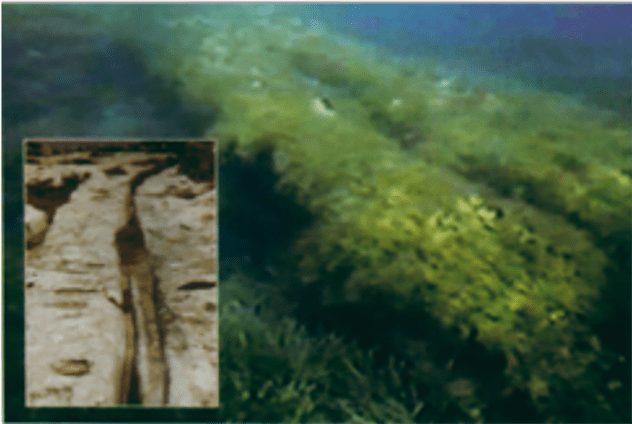
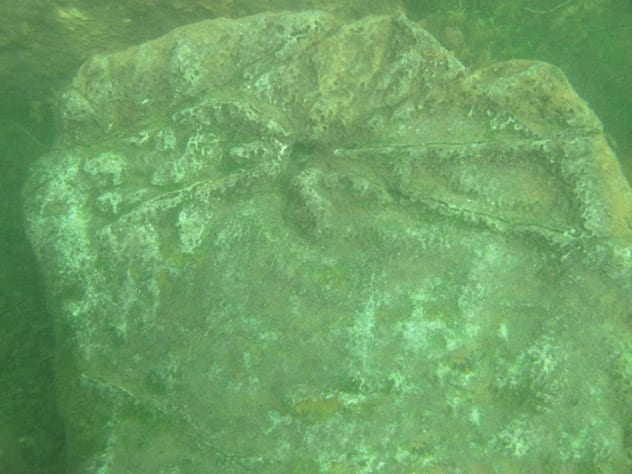
Top 10 Underwater Ruins Of Lost Civilizations
8 Alien Abductions That Suggest Underwater Alien Activity
Most of us, whether we believe in the accounts or not, are aware of claims of alien abductions. Strange and bizarre tales of strange entities taking people from their cars, lonely roads, and even their own beds in order to perform experiments in strange locations, usually assumed to be a spacecraft somewhere in outer space.
However, as strange as those accounts might be, one intriguing detail that surfaces in regression sessions more than we might think is of going “under the water”. What’s more, many apparent abductees also speak of being taken not to a spaceship in outer space, but to a secret facility somewhere deep beneath the waters of our very own planet.
Husband and wife Betty and Barney Hill claimed to have been abducted on a lonely road in New Hampshire in September 1961. And their claims were met with intrigue from some and outright ridicule from others. There were several investigations of the case, though. As well as a string of hypnotic regression sessions. Opinion remains divided as to the credibility of the account still today.
Under one of these regression sessions – and of interest to us here—Betty makes reference to the strange craft she and her husband had just boarded “entering the water”. She even asks herself out loud (while under hypnosis) if theses strange objects actually went underwater.
It is a detail that has largely been missed aside from some several eagle-eyed UFO researchers. If Betty, and her husband, were taken under the water after entering the strange otherworldly craft, then it changes, if only slightly, the nature of the encounter.[1]
Betty Andreasson claimed she had not only been abducted on one occasion but on several. And what’s more, these encounters went back to when she was a young child. One of these early encounters took place in 1950 when Andreasson was taken from her home. She would soon, though, find herself placed on a wheel-like vehicle that seemed to fly of its own accord. The next thing she knew it entered the waters somewhere off the coast of the United States.
Even stranger, this underwater vehicle took her to a large aquatic base. One there, she was taken through what she would later describe as a “museum of life”. She would claim this held examples of human beings in strange glass containers from all different eras of history.
As we might imagine, this encounter as well as others made by Andreasson are treated with a pinch of salt by many. However, several notable UFO researchers have examined and investigated her claims, which remain some of the most debated in the UFO community.[2]

Perhaps one of the lesser-known claims of alien abduction is that of Katharina Wilson. She would speak in-depth of her experiences in the book Alien Jigsaw. When writing of one encounter, she makes claims such as heading “downward at a very steep angle” towards the water. The next thing she knew, there was “water all around us”.
She was, though, protected from it, and soon realized she was in a strange glass-like tunnel or tube. What’s more, this tunnel was heading downward deep under the sea.
Perhaps even stranger, she would further claim that on another very similar occasion when the strange object she was on board finally surfaced from the water, she was transferred to a military “navy vessel”. This would, if we assume the accounts to be authentic, suggest at least some partial involvement of the military in alien abduction cases.
What you might make of Wilson’s claims is, of course, up to you.[3]

Although there is a discrepancy on the dates of the incident (with some sources stating 1956 while others quote 1965), the alien abduction encounter of Orlando Jorge Ferraudi is one of the most intriguing on record.
According to Ferraudi, he was approached by a 7-foot humanoid figure in a shiny “tight-fitting overall” while night-fishing on a beach in Argentina. He was then taken on board a disc-shaped craft and flown under the surface of the water. He would eventually be taken under the Gulf of Mexico and to a “giant underwater dome”. Ferraudi would further state that this underwater facility looked like a “giant igloo”. It was, his hosts informed him, a “base to recondition our ships”.
They would also inform him that genetic experiments had been taking place with humans in such facilities for thousands of years. What’s more, the Earth was seen as a “zoo-like planet” to other alien races throughout the universe. Even more bizarre, all life on Earth was, in some way, part of these genetic experiments, and all had their origins on other worlds.[4]
The alleged alien abduction of Linda Cortile is perhaps one of the more well-known of such cases, mainly as it was investigated by veteran UFO researcher, Budd Hopkins. However, it is one specific part of the abduction that is of interest to us here.
Unbeknown to Hopkins when he first took on the case of Linda Cortile – who claimed she was abducted from her high-rise New York apartment in November 1989 – was that several people had witnessed the incident from the ground below.
On the evening in question, two security guards—known as “Richard” and “Dan”—were driving near the Brooklyn Bridge. Their passenger was eventually revealed to be the security-general of the United Nations, Javier Perez de Cuellar. As they were driving, for no obvious reason, the car engine died. When they got out to investigate, they were shocked to see Cortile, along with three strange figures, floating through the air. What’s more, they were heading toward a disc-shaped object. Once inside, the craft made a sharp turn and crashed into the waters of the East River. In an instant it was out of sight below the surface.
Several months before the two security guards came forward with their information, Cortile (under hypnotic regression) had made some intriguing statements. She claimed to Hopkins that the UFO she was in had come to a sudden stop “under the water”. What’s more, she could see out through a window. She would recall seeing general garbage such as soft drinks bottles on the bed of the water. Was she recalling her journey to the depths of the East River?[5]
While driving with a friend and their family on the outskirts of Miami in 1979, Filiberto Cardenas was subject to one of the strangest abduction encounters on record. After exiting the vehicle to see why the car engine had suddenly stopped, Cardenas noticed a huge disc-like craft overhead. The next thing he knew, a beam of light had struck him and was lifting him toward the craft. His friend and those in the car witnessed the entire thing and reported him missing.
After a two-hour search Cardenas was eventually found, dazed and confused in the middle of a busy highway around 10 miles from his car. Following a medical test, he was allowed to return home. However, when he sought hypnotic regression several months later, he would recall what had happened following his capture by the strange beam.
After several strange experiments by bizarre humanoid creatures on board the disc-shaped craft, he was placed inside a smaller vehicle. This then appeared to launch and guide itself. It would head toward the water, breaking the surface and entering an underwater tunnel. Cardenas would eventually find himself in a “large hangar” somewhere under the sea.
What perhaps makes Cardenas’ account even more intriguing is that he was given several predictions of upcoming world events by his hosts, some of which would prove to be eerily accurate.[6]

In her book Connections, Anna Jamerson would describe several apparent alien abduction encounters. And although they were not as direct as some on our list, the details she would offer are very suggestive of underwater activity.
For example, one encounter she writes of speaks of how she was in a strange craft when she noticed a “huge ocean liner coming at me, bow first”. The next thing she knew it appeared the ocean liner was above her. Or more to the point, she had been taken under the surface of the water below it.
Perhaps the most startling detail, though, is when she writes of being in such a craft before entering a “long tunnel with soft sides”. What’s more, there appeared to be green light at the end of it. Were the “soft sides” actually water around the tunnel, like the glass-like tunnels described by Katharina Wilson?
These revelations were made under hypnotic regression. However, at this crucial point, the therapist conducting the session directed her away from the green light. This means that Jamerson, like the rest of us, remains ignorant of what the encounter might have actually been, or where it took place.[7]
The disappearance of Fred Valentich in 1978 could fill an entire volume in its own right. Perhaps not least as it remains unsolved over 40 years later. There remains debate still today as to just what happened to the young pilot from the southeast of Australia. It is, though, a case that UFO researchers have long claimed to be one of alien abduction. And one that possibly involved an underwater base somewhere under the waters of the Bass Strait.
It was while Valentich was flying over this mysterious stretch of water that he radioed the control tower. He would state there was an unknown object flying over the top of him, and it was obvious he was panicked. Several minutes after the first transmission, he claimed that whatever the object was “it was not an airplane”. Then, he simply vanished. The last sound the control tower heard was a chilling screeching of metal-on-metal.
A huge search of the region went ahead, but no sign of Valentich or his plane ever surfaced. Of even more interest, several witnesses in the region reported seeing a strange object around the same time as Valentich’s radio calls. One of the most intriguing was that of Roy Manifold, who would even capture a photo of the strange object. It was, though, the claims of his son, Jason, that were of most interest. He would state that after his father had returned inside, he remained where he was, listening to a plane somewhere in the distance. Then, “as if someone had turned it off” the plane went suddenly silent?
Was Valentich a victim of alien abduction? And if so, was he taken to one of the strange facilities that many researchers believe are deep under the surface of the Earth’s oceans?[8]
10 UFO Encounters That Involve Alien Humanoid Entities
7 Compelling Documentaries on the Breakaway Civilization

The concept of a "Breakaway Civilization" has been a subject of fascination and speculation for several decades, blending elements of advanced technology, hidden societies, and covert operations. Often linked to discussions about UFOs, secret space programs, and black budgets, this theory proposes that a segment of humanity has achieved an unprecedented level of technological advancement and operates independently of mainstream society.
These documentaries delve into various aspects of the Breakaway Civilization hypothesis, providing viewers with a range of perspectives and in-depth analysis. By exploring these films, one can gain a deeper understanding of the complex ideas and evidence that support this intriguing theory.
"The Phenomenon" (2020) is a highly regarded documentary that takes a serious and evidence-based approach to the subject of UFOs. This film delves into the mystery and cover-up surrounding UFO sightings and encounters. Featuring interviews with high-ranking government officials and NASA astronauts, it seeks to provide credible information on this global phenomenon.
The documentary covers incidents from the early 20th century to present-day sightings. It includes shocking testimony and notable interviews that aim to offer viewers an informed perspective on these encounters. The film underscores the growing acknowledgment of UFOs by official agencies, including the Pentagon.
One of the most intriguing aspects of "The Phenomenon" is its wide range of credible witnesses. Their testimonies lend weight to the argument that UFO sightings are not just a fringe topic, but a legitimate subject of investigation deserving serious attention.

"Ancient Aliens: The Evidence" is a documentary series that delves into the controversial theory that extraterrestrials have visited Earth for millions of years. From the age of the dinosaurs to ancient Egypt, this series explores various forms of alleged evidence supporting this hypothesis.
Investigators from the series examine ancient texts, architecture, and artifacts. They propose that some of these discoveries are too advanced for the known technologies of the time, suggesting possible extraterrestrial influence.
The documentary covers a broad range of topics, including early cave drawings, ancient structures like the pyramids, and other historical sites. These elements are presented as potential evidence of early contact between humans and alien visitors.
It also delves into various scientific and pseudoscientific theories to support the possibility of advanced ancient civilizations with extraterrestrial connections. Critics argue these interpretations often lack empirical support.
For viewers interested in alternative history theories and speculative archaeology, "Ancient Aliens: The Evidence" provides an intriguing perspective. It combines archival footage, expert interviews, and detailed analysis to present its case.
(Note: The external link provided is for illustrative purposes, and it is recommended to verify the correctness of the link from a reliable source.)
The Montauk Project: Experiments in Time dives into a series of alleged government experiments at Montauk Air Force Base in Long Island. These experiments are rumored to involve time travel, mind control, and alternate dimensions.
Based on the book by Preston B. Nichols and Peter Moon, the documentary explores the controversial claims that have captivated conspiracy theorists and sci-fi enthusiasts alike.
Preston B. Nichols and Duncan Cameron appear in the film, recounting their experiences and the supposed events that took place at the base. They provide detailed stories of secretive operations and bizarre phenomena.
The film also examines the influence of these supposed experiments on popular culture, notably inspiring the Netflix series Stranger Things. This connection has sparked renewed interest in the Montauk Project's alleged activities.
The Montauk Project remains a subject of fascination, blending elements of science fiction and conspiracy theory. Whether one views it as fact or fiction, it continues to be a compelling narrative for those interested in government secrets and extraordinary technologies.

One of the most persistent conspiracy theories surrounds the 1969 moon landing. Skeptics argue that NASA faked the Apollo 11 mission to win the space race against the Soviet Union.
Several documentaries explore this topic in depth, providing various pieces of alleged evidence and expert testimonials.
"Moon Landing - The World's Greatest Hoax?" dives into questions about the authenticity of the moon landing footage and photographs. This documentary suggests that shadows and lighting inconsistencies point to a staged event.
Another notable documentary is "Truth Behind the Moon Landing" which dissects popular conspiracy theories. It examines claims such as the fluttering American flag, the lack of stars in the lunar sky, and the supposed presence of a film crew on the moon.
In 1978, the film "Capricorn One" dramatized the concept of a faked space mission, albeit with a Mars expedition instead of the moon. This movie fueled public imagination and provided a fictional but engaging exploration of what a cover-up might involve.
Despite numerous scientific refutations, the moon landing hoax theory remains a topic of popular debate. These documentaries offer compelling viewpoints for those interested in exploring the controversy further.

"Secret Space Program: Unveiled" explores the idea of advanced, covert space operations conducted by a hidden faction within the government. This documentary delves into theories around black budget projects which allegedly fund these secret missions.
Richard Dolan suggests the existence of a "Breakaway Civilization" that operates beyond the public's knowledge. This elite group purportedly has access to advanced technologies and extraterrestrial information. The film examines the implications of such operations on society and global power dynamics.
The documentary also investigates the declassified Project Horizon, a 1950s U.S. Army plan to establish a moon base. This project feeds into the larger narrative of secret operations and the potential for military and technological advancements far beyond public awareness.
With interviews and rare footage, "Secret Space Program: Unveiled" provides a compelling look at what might be occurring behind closed doors. Richard Dolan's insights and meticulous research offer viewers a thought-provoking perspective on one of the most debated topics within the realm of UFO and conspiracy theories.

Operation Highjump, officially known as The United States Navy Antarctic Developments Program, 1946-1947, remains a fascinating subject. Led by Admiral Richard E. Byrd, the mission aimed to establish a research base in Antarctica.
There are intriguing theories suggesting that the operation's true goal was to investigate and possibly neutralize secret Nazi bases in Antarctica. These theories often involve rumors of advanced Nazi technology, including UFOs.
One of the key documentaries exploring these claims is "The Secret Land" (1948). This film delves into the official narrative of the mission while sparking curiosity about what might have been discovered. It won an Academy Award for its portrayal of the expedition.
Another notable documentary is "Operation Highjump: The Black Vault". This work provides detailed insights into the mission and examines the persistent rumors surrounding it. It’s a critical watch for anyone interested in post-World War II military history and the mysterious events in Antarctica.

The Roswell Incident is one of the most famous and debated UFO cases in modern history. In July 1947, a crash occurred near Roswell, New Mexico, leading to speculation about extraterrestrial life.
Initially, the U.S. Army suggested it was a weather balloon but many believed it was a cover-up for an alien spacecraft.
Witnesses claimed to have seen alien bodies at the scene. Over the years, various reports emerged, both supporting and debunking the alien theory. The 1997 report by the Air Force titled "Case Closed: Final Report on the Roswell Crash" suggested the bodies were dummies used in military programs.
Despite these explanations, the Roswell Incident continues to intrigue both skeptics and believers. The story has been the subject of numerous documentaries, books, and films.
One notable documentary that delves into this mystery is "The Roswell Incident" (1994), which examines the evidence and theories surrounding the case.
For more information on "The Roswell Incident" documentary, visit IMDB.
The concept of a breakaway civilization has roots in post-war developments and speculative interpretations of technological advancements. This section examines both the origins and influences that shape the narrative of this elusive idea.
The idea of a breakaway civilization first gained traction in speculative literature and conspiracy theories. Prominent authors and researchers like Richard Dolan have explored the possibility of secret human communities with advanced technologies set apart from mainstream society. This theory postulates that certain elites or groups may possess knowledge and technological advances far beyond the public's awareness.
Discussions often highlight UFO phenomena, suggesting these sightings could be human-made, resulting from secret technological projects. This contrasts with the extraterrestrial hypothesis, positioning the breakaway civilization as a plausible alternative. Early 20th-century science fiction also contributed to this narrative, envisioning hidden societies with superior technology and agendas diverging from the known world.
The aftermath of World War II significantly influenced the breakaway civilization hypothesis. Operations like Paperclip, where Allied forces integrated former Nazi scientists into their technology programs, fuel speculation that some technologies were kept secret. The Cold War further intensified these rumors, with both superpowers possibly developing clandestine technologies.
Architectural undertakings like the creation of Area 51 and secretive aerospace projects added credibility to the idea. Additionally, the rapid advancements in aerospace, computing, and military technologies during this period lead some to believe that a hidden tier of technological progress exists, accessible only to a select few. This reinforces the breakaway civilization narrative, suggesting a divide between public knowledge and elite secrets.

Key individuals contributing to the breakaway civilization theory comprise researchers and authors who have investigated these ideas, as well as insiders and whistleblowers who claim firsthand experience.
Richard Dolan is a prominent researcher known for his work on the breakaway civilization theory. He asserts the existence of a covert society with advanced technology, hidden from public view. Dolan's books and talks have attracted significant attention.
Jason Jorjani, noted for his provocative hypotheses, suggests that post-WWII Nazi scientists integrated with the military-industrial complex, contributing to rapid technological advancements. His ideas, though controversial, push the conversation forward.
Whitley Strieber, an author and host of "Unknown Country," provides platforms for discussions on hidden civilizations and unexplored technologies. His contributions have broadened the understanding and sparked wider interest in this area.
Participants such as Dr. Steven Greer have brought insider knowledge to the discussion. Greer, a former emergency physician, turned whistleblower, claims that extraterrestrial technology is controlled by clandestine groups, affecting global security and economics.
Another key figure is Richard Doty, a former special agent for the Air Force Office of Special Investigations. Doty's revelations about classified government programs and extraterrestrial encounters support the notion of a hidden, technologically advanced faction.
Some insiders have continually claimed that this parallel civilization utilizes suppressed technologies. Their testimonies offer a glimpse into potential operations and objectives of these concealed groups, enhancing our grasp of the breakaway civilization discussion.
Technological advancements play a pivotal role in the concept of a breakaway civilization. They are exemplified by innovations in advanced aerospace technologies and energy and propulsion systems.
The notion of a breakaway civilization inherently includes the development of aerospace technologies that surpass conventional wisdom. Research into this field often highlights hypersonic travel and anti-gravity propulsion.
There are claims about the existence of secret space programs, which may involve highly classified spacecraft capable of reaching extraordinary speeds and altitudes. Such technologies, if real, could potentially enable off-world colonies or deep space exploration beyond current human capabilities.
Energy and propulsion innovations are critical to the sustainability and mobility of a breakaway civilization. The focus here includes the development of zero-point energy and fusion power.
These cutting-edge energy sources promise immense power output with minimal environmental impact. Such advancements could not only revolutionize energy consumption on Earth but also provide necessary propulsion for long-term interstellar travel. This opens new possibilities for remote habitation and resource exploitation far from our planet.
Polaris Dawn-missie succesvol gelanceerd: eerste commerciële ruimtewandeling op komst?
De Polaris Dawn-missie van SpaceX is succesvol gelanceerd. Vandaag om 9.38 uur Belgische tijd stond de lancering van de missie gepland, waarbij mogelijk de eerste commerciële ruimtewandeling ooit zou plaatsvinden. Door het slechte weer kon de Falcon 9-raket niet vertrekken. Om 11.24 uur is de missie na driemaal uitstel dan toch succesvol gelanceerd.
De Falcon 9 van SpaceX werd gelanceerd vanop de ruimtebasis op Cape Caneveral in de Amerikaanse staat Florida. Polaris Dawn wordt de eerste missie waarbij privépassagiers zich buiten het ruimteschip kunnen begeven, enkel beschermd door hun ruimtepak.
Aan boord zijn vier mensen, onder wie zakenman en tevens commandant Jared Isaacman, die de missie betaalt. Hij maakte in 2021 al een commerciële ruimtevlucht, de eerste missie met alleen burgers aan boord. Zijn reisgenoten nu zijn piloot Scott “Kidd” Poteet, Sarah Gillis en Anna Menon. Die twee laatste zijn medewerkers van SpaceX.
De eerste lancering stond gepland op 27 augustus, maar de missie werd al tweemaal uitgesteld vanwege technische problemen en weersomstandigheden. SpaceX liet deze ochtend via een bericht op X weten dat ook de geplande lancering vanochtend om 9.38 uur Belgische tijd werd uitgesteld, maar dat vandaag om 11.24 uur Belgische tijd (5.23 uur plaatselijke tijd) een vierde poging zou plaatsvinden. Die vierde poging werd niet uitgesteld en de Falcon 9-raket werd met succes de ruimte ingeschoten.
De zesdaagse missie richt zich onder meer op het testen van nieuwe technologieën, waaronder het futuristische ruimtepak dat op de derde dag van de missie tijdens een korte ruimtewandeling door Isaacman en astronaut Sarah Gillis getest zal worden.
De twee zullen dan uit een open luik van hun Crew Dragon-ruimteschip stappen en een ruimtewandeling maken. Ze zullen elk om beurt voor vijftien tot twintig minuten naar buiten gaan, terwijl ze blijven vasthangen aan het ruimteschip. Deze ‘wandeling’ op 700 km hoogte dient als voorbereiding op toekomstige maan- en Marsmissies van SpaceX.
Naast de ruimtewandeling zijn ook experimenten gepland te onderzoeken hoe straling in de ruimte het menselijk lichaam beïnvloedt. De hele missie zou ongeveer vijf dagen duren en vormt een belangrijke stap in de voorbereiding op mogelijke commerciële ruimtereizen.
Ruimtetoeristen bereiken hoogte van 1.400 kilometer boven de Aarde: “Verste dat mensen hebben gereisd sinds de Apollomissies”De Polaris Dawn-missie van SpaceX heeft een hoogte van 1.400 kilometer bereikt. Dat laat het ruimtevaartbedrijf weten op socialemediasite X. Daarmee is de Falcon 9-raket met aan boord vier privébemanningsleden, het verst gereisd sinds de bemande maanmissies van vijftig jaar geleden.
De Falcon 9-raket van SpaceX werd gisteren iets voor de middag gelanceerd. Aan boord zijn vier mensen, onder wie zakenman en tevens commandant Jared Isaacman, die de missie betaalt. Hij maakte in 2021 al een commerciële ruimtevlucht, de eerste missie met alleen burgers aan boord. Zijn reisgenoten nu zijn piloot Scott “Kidd” Poteet, Sarah Gillis en Anna Menon. Die twee laatste zijn medewerkers van SpaceX.
De zesdaagse missie richt zich onder meer op het testen van nieuwe technologieën, waaronder het futuristische ruimtepak dat op de derde dag van de missie tijdens een korte ruimtewandeling door Isaacman en astronaut Sarah Gillis getest zal worden.
Het universum bestond al vóór de oerknal, zo beweert een onderzoek
door Janine

ESA
Niet iedereen gelooft dat het universum met de oerknal is ontstaan. Voor sommigen waren er zelfs twee oerknallen, terwijl voor anderen het universum heen en weer beweegt tussen fases van uitdijing en inkrimping zonder te worden gereduceerd tot singulariteiten. Dit is ongetwijfeld een fascinerend perspectief, hoewel moeilijk te bewijzen, dat een ander beeld oplevert vergeleken met de meest wijdverspreide theorie van vandaag. Toch hebben sommige onderzoekers recentelijk bewijs gevonden van geheim leven in het universum vóór de oerknal, dat verband houdt met zwarte gaten en donkere materie. Laten we eens kijken waar het over gaat.
Donkere materie is lange tijd het onderwerp geweest van diepgaande studies: we weten dat het bestaat, maar we kunnen het op geen enkele manier “zien”, behalve via enkele van de effecten ervan op de omringende materie. In feite zendt, absorbeert of reflecteert donkere materie geen elektromagnetische straling, maar heeft toch wel effecten op de zwaartekracht en de rotatiesnelheid van sterrenstelsels. Het is daarom een soort materie die we alleen kunnen bestuderen via de effecten ervan, op een manier die sterk lijkt op wat er gebeurt met zwarte gaten.
En juist deze principiële overeenkomst is niet onopgemerkt gebleven: een recente studie gepubliceerd in de Journal of Cosmology and Astroparticle Physics heeft de hypothese naar voren gebracht dat donkere materie zou kunnen worden gevormd door primordiale zwarte gaten. Maar wanneer zouden deze zwarte gaten zich hebben gevormd? Voor onderzoekers bestaat er geen twijfel: vóór de oerknal.

EHT Collaboration/Wikimedia Commons - CC BY 4.0
Vanaf hier keren we terug naar de kosmologische theorie die we in de inleiding noemden, omdat de associatie tussen oorspronkelijke zwarte gaten en donkere materie het bewijs zou kunnen vormen van de Big Bounce. Volgens deze theorie was het ontstaan van het heelal daarom niet een singulariteit gevolgd door een fase van snelle uitdijing, in een proces dat we kennen als de oerknal, maar een oscillerend patroon van uitdijingen en inkrimpingen.
Volgens onderzoekers kromp het heelal ruim 13 miljard jaar geleden tot een oneindig kleine omvang voordat het weer uitdijde, wat leidde tot een toename van de dichtheid van de materie, wat op zijn beurt bijdroeg aan de vorming van oorspronkelijke zwarte gaten. We hebben het over hemellichamen die de massa van een asteroïde hebben en een oneindig kleine diameter, maar toch groot genoeg zodat Hawkingstraling ze niet volledig wegvaagt. Zeker niet in 13 miljard jaar. Maar wat betekent dit allemaal voor het universum, voor de natuurkunde en voor donkere materie?
Het aantonen dat donkere materie uit vele kleine oorspronkelijke zwarte gaten bestaat, zou een impuls kunnen geven aan de studie van dit overheersende component van het universum. Aan de andere kant zouden we kunnen stoppen met het zoeken naar deeltjes die alleen via de zwaartekracht met materie interactie hebben, en op zoek kunnen gaan naar kleine zwarte gaten verspreid over het universum: sommige doen al iets soortgelijks. En dit is niet het enige gevolg: volgens de onderzoekers komen de eigenschappen van een oscillerend universum zoals geschetst overeen met de kromming van de ruimte en de kosmische achtergrondstraling in zijn vroege stadia. Maar zo eenvoudig is het niet.
Om hun theorie te testen zal het internationale team dat aan het onderzoek heeft gewerkt zwaartekrachtgolven moeten detecteren die zijn gevormd in de vorige fase van samentrekking van het universum. Tot op heden is het onmogelijk om dit te doen, tenminste met de instrumenten die momenteel beschikbaar zijn, maar wie weet in de toekomst. Misschien kunnen de Laser Interferometer Space Antenna, of LISA, en de Einstein Telescope ons al een antwoord op deze vraag geven. En een revolutie teweegbrengen in alles wat we wisten over de oorsprong van het universum.
Alien Abduction or Truth? The Charles Hickson Case That Passed the Polygraph Test

One of the most compelling stories of alien abduction took place on the night of October 11, 1973, in Pascagoula, Mississippi. Two men, Charles Hickson and Calvin Parker, experienced a bizarre and traumatic event that would go on to become one of the most famous UFO cases in American history. What sets this case apart from other similar reports is that both men passed polygraph tests, providing a degree of credibility to their account. The Pascagoula incident remains one of the most intriguing alien abduction stories to date.
On that fateful evening, Hickson, a 42-year-old Korean War veteran and shipyard foreman, and his friend Calvin Parker, a 19-year-old welder, were fishing along the Pascagoula River. As they enjoyed the quiet night, they were suddenly startled by a strange zipping sound and two flashing blue lights. Turning around, they saw an oval-shaped, hovering object, approximately 30-40 feet across and 8-10 feet high, descend towards them. The craft appeared to defy the laws of gravity, hovering just above the ground.
Before the two men could react, three strange creatures emerged from the craft. The beings were described as having no necks, coarse, wrinkled skin, and standing around five feet tall. Their movements were mechanical, and they glided toward Hickson and Parker. The men later reported being paralyzed, unable to move but fully conscious, as they were floated aboard the hovering craft.
Inside the spacecraft, both men claimed to have undergone a terrifying examination. Hickson described an “electronic eye” that scanned his body, while Parker recalled being laid on a table, subjected to a thorough physical examination by a more human-like, feminine creature. Both men said they were given telepathic reassurances not to be afraid, but the experience left them traumatized.
After being released from the spacecraft, Hickson and Parker were left standing at the river’s edge, completely shaken. Still in shock, the men initially hesitated to report the incident, but eventually decided to contact local authorities. They first called Keesler Air Force Base, only to be told that UFO encounters were no longer within their jurisdiction. With nowhere else to turn, they went to the Jackson County Sheriff’s Office.
Skeptical at first, the sheriff’s deputies interviewed the men separately and even placed them in a room wired for sound, hoping to catch them in a lie. However, their conversation, recorded when they thought they were alone, only reinforced the deputies’ belief that the men were genuinely terrified by something unexplainable.
The story quickly gained national attention. News outlets across the country reported on the Pascagoula abduction, and Hickson, in particular, became a media sensation. Despite the attention, both men maintained the truth of their account, never deviating from their original story.
A key moment in the investigation was the administration of polygraph tests, which both men passed. Charles Hickson’s polygraph test was conducted by a New Orleans firm on October 30, 1973, just weeks after the incident. The examiner stated that Hickson was truthful in his belief that he had been abducted by extraterrestrial beings.
Skeptics have pointed out that passing a polygraph test does not definitively prove the truth of an event. Instead, it shows that the person being tested believes they are telling the truth. However, the fact that both Hickson and Parker passed their polygraph tests adds a layer of complexity to the case, as they demonstrated strong conviction in the accuracy of their bizarre experience.
Hickson, more open to sharing his story, appeared on popular talk shows like The Tonight Show with Johnny Carson and To Tell the Truth. Despite the public interest, Parker shied away from the limelight, choosing a quieter life, though he never contradicted his earlier statements.
In the years that followed, other witnesses came forward to support the men’s claims. For example, Mike Cataldo, a retired Navy officer, later reported seeing a strange, hovering object in the sky the same night near the Pascagoula River. Cataldo’s account described an object with flashing lights, spinning in the sky, and disappearing after hovering for about 30 seconds.
Despite the corroborative testimonies, skeptics, including renowned UFO debunkers like Philip Klass, challenged Hickson and Parker’s story. Klass pointed to inconsistencies in Hickson’s descriptions of the creatures, noting that his accounts changed over time. Others suggested that the men had entered a state of sleep paralysis and hallucinated the entire experience.
Skeptics have tried to explain the incident in various ways. Joe Nickell, a prominent paranormal investigator, suggested that Hickson and Parker might have entered a hypnagogic state, a condition where a person experiences sleep paralysis and vivid hallucinations. This could explain the sensations of paralysis and the strange visual and auditory experiences the men reported.
Additionally, some investigators raised concerns about the polygraph tests. They noted that the polygraph examiner was relatively inexperienced, and Hickson had refused to take another test conducted by a more seasoned expert. These factors have led some to question the legitimacy of the tests and the overall story.
The Pascagoula alien abduction case remains one of the most perplexing UFO encounters in American history. With both men passing polygraph tests, numerous eyewitnesses coming forward, and their consistent storytelling over the years, the incident continues to baffle investigators. Charles Hickson passed away in 2011, and Calvin Parker in 2023, yet their experience still ignites debate among believers and skeptics alike.
Was it a genuine alien abduction, a shared hallucination, or something else entirely? The Pascagoula incident leaves us with more questions than answers, but it stands as one of the most convincing cases in the annals of UFO lore, made even more compelling by the fact that its key witnesses passed a polygraph test, indicating that—at least in their minds—their terrifying experience was very real.
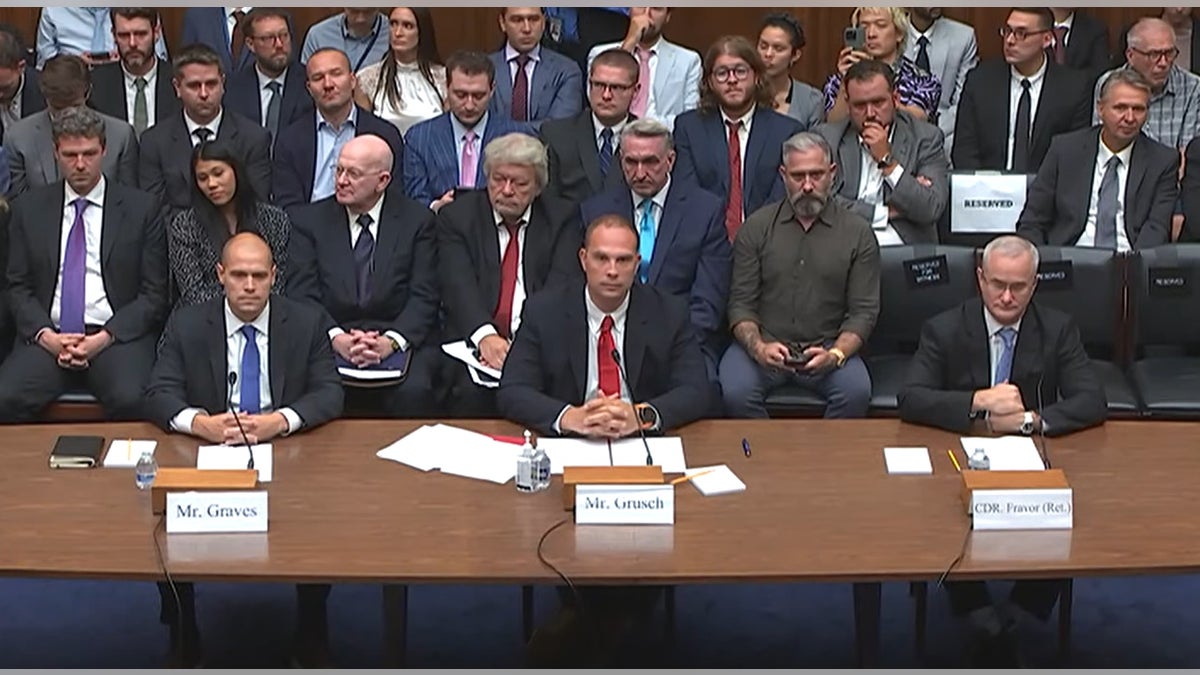
Underwater UFOs display capability that ‘jeopardizes US maritime security,’ ex-Navy officer says
Europese ruimtesonde "ontdekt" dat er leven mogelijk is op aardeGeruststellend nieuws: de aarde is bewoonbaar. Dat heeft de Europese ruimtesonde Juice bevestigd toen hij op 20 augustus langs de planeet scheerde op weg naar Jupiter, zo deelde de Europese ruimtevaartorganisatie ESA dinsdag mee.
Instrumenten van de ruimtesonde gingen tijdens de vlucht langs de aarde na of de noodzakelijke voorwaarden voor leven aanwezig zijn. Ze vonden niet alleen water, maar ook koolstof, waterstof, stikstof, zuurstof, fosfor en zwavel, de meest voorkomende elementen in levende organismes.
Belangrijker dan de "ontdekking" op zich, is de bevestiging dat de instrumenten van Juice werken. "We zijn uiteraard niet verrast door de resultaten, het zou heel zorgwekkend zijn geweest indien we hadden ontdekt dat er geen leven mogelijk is op aarde", zegt projectwetenschapper Olivier Witasse. "Maar de resultaten bewijzen dat de instrumenten goed zullen werken bij Jupiter, waar ze zullen onderzoeken of er op de ijsmanen leven mogelijk is of is geweest."
Juice (kort voor Jupiter Icy Moons Explorer) werd in april 2023 gelanceerd. De aankomst bij Jupiter is in 2031 gepland. Daar zal de sonde drie van de zowat honderd manen van de planeet - Ganymedes, Callisto en Europa - bestuderen, omdat zij onder hun ijskorst mogelijk oceanen met vloeibaar water bevatten.
De flyby langs de aarde en de maan in augustus diende om met behulp van de zwaartekracht de snelheid en richting van het ruimteschip aan te passen. In 2026 en 2029 zal de sonde normaal opnieuw langs de aarde komen.
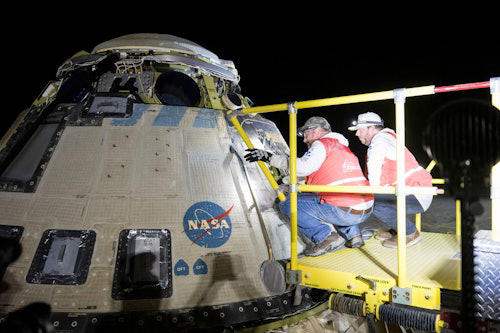
Starliner Suffers New Problems While Coming Back to EarthOn Saturday morning, NASA's plagued Starliner spacecraft finally made it back to the ground.
The capsule landed in the New Mexico desert after spending just over three months in space. But thanks to technical issues worrying NASA officials, it left behind the agency's two stranded astronauts Butch Wilmore and Suni Williams, bookending a disastrous first crewed flight attempt.
The pair will have to wait for their ride back, on a SpaceX Crew Dragon spacecraft, until February.
Signals on the capsule's return were mixed. On the one hand, according to NASA’s commercial crew program manager Steve Stich, it pulled off a "bullseye landing." On the other, the agency admitted that a new thruster had failed during its descent. The capsule also experienced a temporary blackout of Starliner's guidance system during reentry.
It's an awkward situation for the space agency: would Starliner have been able to ferry NASA's missing crew members in the end?
"I think we made the right decision not to have Butch and Suni on board," Stich told reporters on Saturday. "All of us feel happy about the successful landing. But then there’s a piece of us, all of us, that we wish it would have been the way we had planned it."
While approaching the International Space Station in early June, five of Starliner's 28 control thrusters gave up, forcing Wilmore and Williams to take over manual control.
Subsequent investigations concluded that the thrusters had overheated, causing a Teflon "poppet" seal to expand and restrict the flow of the oxidizer.
Several helium leaks added to Boeing's growing headache at the time, worrying NASA officials.
The capsule didn't fare much better following undocking procedures on Friday. One of its 12 control jets on the crew module — a different set unrelated to the other malfunctioning service module thrusters — failed to ignite. And a glitch caused the spacecraft's navigation system to go down briefly during reentry as well.
It's still unclear whether Boeing will try to launch its plagued Starliner again. Analysts suggest the aerospace giant may dump the entire project, which has already lost the company well over a billion dollars, instead.
"It’s unclear if or when the company will have another opportunity to bring astronauts to space," Bank of America aerospace and defense analyst Ron Epstein told the New York Times. "We would not be surprised if Boeing were to divest the manned spaceflight business."
More on Starliner: Retired NASA Engineer Warns Boeing's Starliner Could Lose Control During Return and Crash in Populated Area
The post Starliner Suffers New Problems While Coming Back to Earth appeared first on Futurism.
So, Would Starliner Have Safely Brought Its Astronauts Home?Starliner is finally home. But its crew — astronauts Butch Wilmore and Suni Williams — are not. Could Starliner have safely carried them?
The Boeing spacecraft’s initial 8-day flight ballooned into a months-long saga shortly after launch. The aerospace company and NASA, who are collaborating for the agency’s Commercial Crew Program to bring low-cost astronaut rides to and from space, had tense discussions. Boeing argued their spacecraft was sound enough to return the crew. NASA was uncomfortable signing off. Starliner therefore landed shortly past midnight Eastern time early Saturday without Wilmore and Williams.
But in hindsight, would it have been fine?
Steve Stich, manager of NASA’s Commercial Crew Program, doesn’t beat about the bush on this point: “It would have been a safe successful landing with the crew onboard, had we have had Butch and Suni onboard.”
These comments came during a media conference NASA held after landing — noticeably without Boeing officials, who did not participate in the event. Stich explained that “if there was a crew onboard, it would have flown the same back-away sequence, and the same orbit return, and executed the same entry.”
This of course was not a given since not long after Starliner entered orbit around Earth on June 5, it leaked helium and five thrusters malfunctioned. Out of an abundance of caution — or according to many even a modicum of it — NASA did not want to send the astronauts home once they looked over the data with Boeing. It was not an easy decision and as Stich noted in an earlier meeting that “the teams were very split.” Boeing thought it would be fine — NASA “saw limitations” in the data.
Moving forward, this uneventful landing doesn’t mean Starliner is now certified to get back in the game. Starliner’s launch in June was its critical Crew Flight Test, which would have certified Starliner as an astronaut ferry provider for NASA — had nothing gone awry. Of course, plenty went wrong and it was a huge hitch for Wilmore and Williams who will now return to Earth in February 2025 at the earliest, onboard a SpaceX Crew Dragon capsule set to launch to the International Space Station later this month.
“I’d say it’s probably too early to think about what the next flight looks like. We want to look at the data,” Stich said.
Amidst Boeing’s absence at the conference, Stich said the company is still a major partner. The major goal of the Commercial Crew Program is to get Starliner to the point where it’s greenlit for crew rotation. But the next steps aren’t yet clear.
“We will review the data and determine the next steps for the program,” Mark Nappi, vice president and program manager of Boeing’s Commercial Crew Program, said in a statement Boeing published after Starliner landed.
“It will take time to determine the path forward,” Stich said. “Today we saw the vehicle perform well.”
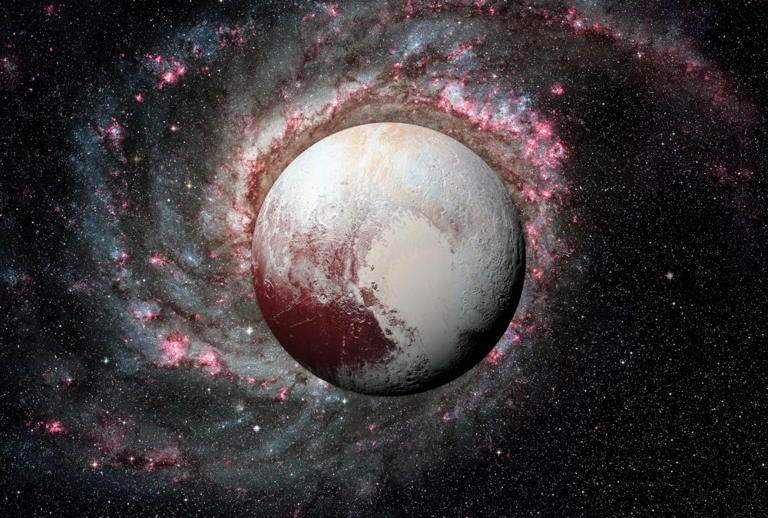
Mysterious objects spotted in the outer solar system beyond PlutoRecent observations using the ultra-widefield prime focus camera of the Subaru Telescope have shown that there may be a population of small astronomical objects further out in the Kuiper Belt still waiting to be discovered.
According to the experts, the findings are essential for a better understanding of the formation of the solar system.
The research was made possible through an international collaboration between the Subaru Telescope and the New Horizons spacecraft traveling through the outer solar system.
NASA's New Horizons spacecraft was launched in 2006 in order to observe the surfaces of outer solar system bodies up close for the first time in our history. The spacecraft successfully completed a flyby of the Pluto system (2015), and later on (2019) it made a flyby of one of the Kuiper Belt objects, (486958) Arrokoth.
Although there were four other spacecraft which have flown to the outer solar system, New Horizons is the only one that has flown through the Kuiper Belt.
When examining Kuiper Belt objects from the ground, we can only observe them at small solar phase angles (the angle between the sun, the object, and the observer).
However, when looking at an object in the outer solar system from a spacecraft in the Kuiper Belt, these objects can be observed at different phase angles and their reflection characteristics can be utilized to estimate their surface properties.
Is there a new population of Kuiper Belt objects located at 70–90 au? "If this is confirmed, it would be a major discovery. The primordial solar nebula was much larger than previously thought, and this may have implications for studying the planet formation process in our solar system," Yoshida explained.
"This is a groundbreaking discovery revealing something unexpected, new, and exciting in the distant reaches of the solar system; this discovery probably would not have been possible without the world-class capabilities of the Subaru observatory," added New Horizons mission principal investigator Alan Stern.
In order to determine the precise orbits of these objects, the scientists are continuing observations with HSC.
"I think the discovery of distant objects and the determination of their orbital distribution are important as a stepping stone to understanding the formation history of the solar system, comparing it with exoplanetary systems, and understanding universal planet formation," Yoshida said.
New Horizons is currently traveling further out, at approximately 60 au from the Sun, hoping to discover many more distant objects.
Scientists finally solve mystery behind Bermuda Triangle disappearancesThe Bermuda Triangle is one of urban legend’s favourite locations.
For decades, the section of the north Atlantic ocean has sparked fear and fascination as the alleged site, and source, of dozens of mysterious disappearances.
More than 50 ships and 20 airplanes are said to have vanished in the region, which stretches roughly from the Florida coast to Bermuda to the Greater Antilles islands.
This amounts to an average of four planes and 20 boats disappearing without a trace in the zone every year, the Week notes.
Naturally, conspiracy theories have abounded as to the causes of these tragic and unexplained instances, with aliens and even Atlantis blamed for the phenomena.
However, experts have offered more credible hypotheses and, in 2017, Australian scientist Karl Kruszelnicki claimed to have “solved” the enduring mystery once and for all.
He dismissed any suggestion that the supernatural was at play here and instead pointed the finger of blame simply at human error, bad weather and high traffic volumes.
“It is close to the equator, near a wealthy part of the world, America, therefore you have a lot of traffic,” he told news.com.au.
Indeed, the Bermuda Triangle (also known as the “Devil’s Triangle”), is one of the most heavily travelled shipping lanes in the world, with vessels passing through to reach ports in the US, Europe and the Caribbean.
And whilst the disappearance of any plane or ship is a tragedy, in fact, “the number of planes that go missing in the Bermuda Triangle is the same as anywhere in the world on a percentage basis,” Dr Kruszelnicki said, quoting insurance company Lloyds of London and the US Coast Guard.
Put simply, travelling through this infamous area is no riskier than going through other busy parts of the world.
And yet, sceptics will continue to cling to more interesting theories, including that rogue waves are behind the disappearances.
Scientists put forward this hypothesis in the Channel 5 documentary ‘The Bermuda Triangle Enigma’, claiming that conditions in the zone are just right for “massive rogue waves”.
“There are storms to the south and north, which come together,” University of Southampton oceanographer Simon Boxall explained. “And if there are additional ones from Florida, it can be a potentially deadly formation of rogue waves.”
Rogue waves of this type could reach around 30 metres (100 feet) tall, which would be on par with the largest wave ever recorded – a 100-foot tsunami triggered by an earthquake and landslide in Alaska’s Lituya Bay in 1958, HuffPost reports.
Reports of unexplained occurrences in the Bermuda Triangle date to the mid-19th century when some ships were discovered completely abandoned for no apparent reason, while others transmitted no distress signals but were never seen or heard from again, , according to the Encyclopedia Britannica.
Perhaps the most famous incident linked to the area is the disappearance of Flight 19, which occurred in December 1945 and saw five US Navy Avenger torpedo bombers vanish during a training mission.
After setting off from Fort Lauderdale, Florida, the planes reportedly experienced compass malfunctions and became disoriented, leading to their disappearance.
And yet, Kruszelnicki dismissed suggestions, posited in 1964, that the incident proves that the Bermuda Triangle “is the scene of disappearances that total far beyond the laws of chance.”
He noted that Flight 19 took off in poor weather conditions, with 15-metre (49-foot) waves crashing down below the aircraft.
Kruszelnicki added that the only truly experienced pilot in the flight was its leader, Lieutenant Charles Taylor, and his human error may well have played a part in the tragedy.
“[He] arrived with a hangover, flew off without a watch, and had a history of getting lost and ditching his plane twice before,” the scientist explained.
Furthermore, radio transcripts recorded before the patrol vanished revealed that Lt Taylor had lost his bearings and ordered the patrol to fly east – unwittingly taking them further over the deep waters of the Atlantic.
Ultimately, it doesn’t matter what the experts say. For some people, legends like that of the Bermuda Triangle will always hold appeal.
After all, mystery and intrigue are a lot more enticing than the prosaic truth: that humans make mistakes and you can't trust the weather.
VIDEOS
Largest Dark Matter Detector is Narrowing Down Dark Matter Candidate

In 2012, two previous dark matter detection experiments—the Large Underground Xenon (LUX) and ZonEd Proportional scintillation in Liquid Noble gases (ZEPLIN)—came together to form the LUX-ZEPLIN (LZ) experiment. Since it commenced operations, this collaboration has conducted the most sensitive search ever mounted for Weakly Interacting Massive Particles (WIMPs) – one of the leading Dark Matter candidates. This collaboration includes around 250 scientists from 39 institutions in the U.S., U.K., Portugal, Switzerland, South Korea, and Australia.
On Monday, August 26th, the latest results from the LUX-ZEPLIN project were shared at two scientific conferences. These results were celebrated by scientists at the University of Albany‘s Department of Physics, including Associate Professors Cecilia Levy and Matthew Szydagis (two members of the experiment). This latest result is nearly five times more sensitive than the previous result and found no evidence of WIMPs above a mass of 9 GeV/c2. These are the best-ever limits on WIMPS and a crucial step toward finding the mysterious invisible mass that makes up 85% of the Universe.
Led by the Department of Energy’s (DoE) Lawrence Berkeley National Laboratory, the LZ experiment is located at the Sanford Underground Research Facility in South Dakota, about 1,500 meters (nearly a mile) beneath the surface. The experiment relies on an ultra-sensitive detector made of 10 tonnes (11 U.S. tons) of liquid xenon to hunt for the elusive signals caused by WIMP-nucleus interactions. While direct detections are yet to be made, these latest results have helped scientists narrow the search.
As Levy explained in a recent UofA press release:
“Dark matter interacts very, very rarely with normal matter, but we don’t know exactly how rarely. The way we measure it is through this cross-section or how probable an interaction is within our detector. Depending on the mass of a dark matter particle, which we don’t know yet, an interaction within the detector is more or less probable. What the new LZ results tell us is that dark matter interacts with normal matter even more rarely than we thought, and the only instrument in the world that is sensitive enough to measure that is LZ.”
The existence and nature of Dark Matter are among the greatest mysteries in modern astrophysics. Originally proposed to explain the rotational curves of galaxies, the existence of Dark Matter is vital to the most widely accepted cosmological model – the Lambda Cold Dark Matter (LCDM) model. Unfortunately, according to the prevailing theories, DM only interacts with normal (aka. “luminous”) matter via gravity, the weakest of the four fundamental forces. Detecting these interactions requires incredibly sensitive instruments and an environment free of electromagnetic energy (including heat and light).
While no direct detections have been made, the latest results from LZ have narrowed the range of possibilities for one of the leading DM candidates. As Szydagis said:
“It’s often misunderstood what is meant by the phrase ‘world’s best dark matter experiment’ since no one has made a conclusive, unambiguous discovery yet. However, new, stricter null results like LZ’s are still extremely valuable for science. UAlbany, as one part of the multinational collaboration that is LZ, has been making important contributions ensuring the robustness of LZ’s results, going back to the very beginning of the experiment.”
Although DM remains “invisible” to us, the presence of its gravitational pull is fundamental to our understanding of the Universe. For example, the formation and movement of galaxies are attributed to DM, and its existence is vital for explaining the large-scale structure and evolution of the Universe. If DM does not exist, then our understanding of gravity – as described by Einstein’s Theory of General Relativity – is essentially wrong and needs revision. However, General Relativity has been experimentally validated again and again over the past century.
Therefore, narrowing the search for its constituent particle is vital to proving that our foundational theories about the Universe are correct. As Levy noted, UAlbany scientists have been making integral contributions to LZ for over a decade, and their work is far from done! “Working on LZ is always so exciting, even if we still have not made a discovery yet,” she said. “We all know that if it were easy, someone else would have done it already! I think right now what we need to take out of this result is that LZ is a great team of scientists, our detector is working superbly, our analysis is extremely robust, and we are nowhere near done taking data.”
Further Reading:
Using A Space Elevator To Get Resources Off the Queen of the Asteroid Belt

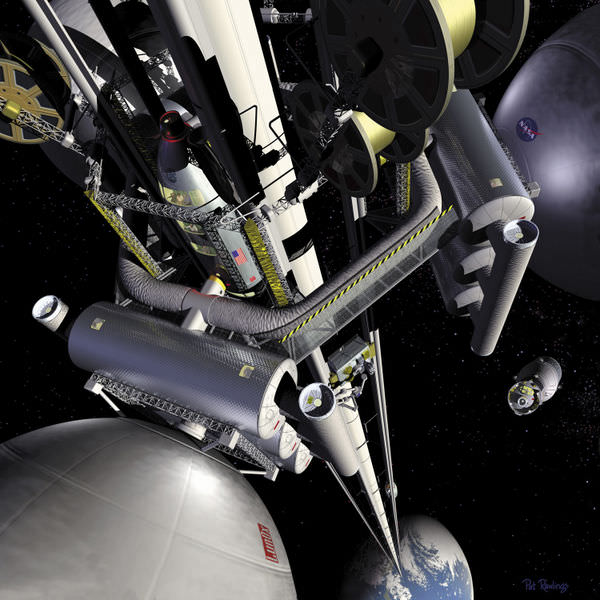
Here at UT, we’ve had several stories that describe the concept of a space elevator. They are designed to make it easier to get objects off Earth and into space. That, so far, has proven technically or economically infeasible, as no material is strong enough to support the structure passively, and it’s too energy-intensive to support it actively. However, it could be more viable on other worlds, such as the Moon. But what about worlds farther afield? A student team from the University of Colorado at Colorado Springs looked at the use case of a space elevator on Ceres and found that it could be done with existing technology.
Before we discuss why anyone would want to put a space elevator on Ceres, let’s first examine the technologies that would make it possible. Every space elevator design has three different components: an anchor, a tether, and a counterweight. Each would require its own technologies.
The anchor is simple enough; it’s how the system interfaces with Ceres. The surface of Ceres is primarily made of clay, which is relatively good for anchoring technologies. Luckily, the force the anchor needs to withstand is only around 300N, which is much lower than the force on Earth, given Ceres’ small mass. There have already been asteroid anchoring technologies for other missions that can provide up to 500N of force resistance, so an anchor on Ceres should prove no real challenge.
Fraser describes the general idea of a space elevator.The tether is where the technology falls short on Earth – no material known to science can withstand the forces exerted on the tether of a passively controlled space elevator when it is tied to Earth. However, the closest we can come, something space elevator enthusiasts mention as almost a holy grail, is carbon nanotubes. In the analysis for the space elevator on Ceres, they once again came out ahead. However, the limitation of actually physically creating a long tether will still plague any space elevator design on Ceres.
The counterweight is much simpler, as it can be just a big, dumb mass. However, its mass is proportional to the necessary length of cable—the heavier the mass, the shorter the cable. So, the tradeoff between having a heavier counterweight and a shorter cable is another design consideration when considering these systems.
Calculations from the team show that, with only a little more technological development, all three main systems could be ready for installation on Ceres itself. But what advantages does it have? It could be helpful as a launching point for accessing other asteroids in the asteroid belt. Ceres also has water relatively near the surface, which is helpful for all kinds of human exploration, either as rocket fuel or biological systems. It’s also well placed to quickly get things back to Earth using Jupiter as a gravity assist.
Isaac Arthur goes into a deeper description of space elevators and their advantages.But before it can provide any of those advantages, someone is going to have to pay for it. Estimates of the overall cost of the system total about $5.2 billion — not too far out of the range of larger-scale space exploration projects. But more than most countries are likely willing to pony up for a grand infrastructure project that hasn’t yet proven its benefit.
So, for now, any space elevator will remain in the realm of science fiction. But research like this and other ongoing technological improvements is how we will eventually push forward to that future. Whether it’s a space elevator on Ceres, on the Moon, or some other novel launch technology, someday humans will need a better way to get off Earth rather than burning dead living organisms. Hopefully, that day will come sooner rather than later.
Learn More:
Lead Image: