UFOs operating around our planet

UFOs operating around our planet
RELATED VIDEOS
UFOs operating around our planet
RELATED VIDEOS
NASA astronaut finds God after returning to Earth: Reid Wiseman breaks down in tears after seeing a cross - as he claims 'it's very hard to fully grasp what we just went through'
He's travelled more than 250,000 miles (402,000km) to the moon and back – but astronaut Reid Wiseman said one of the most emotional experiences of his mission was seeing a cross on his return to Earth.
The Artemis II commander, who says he is 'not religious', was reflecting on his mammoth mission to space during a press conference yesterday.
One reporter asked the crew whether they had experienced any shift in consciousness following their 10–day journey to the dark side of the lunar surface.
Wiseman confirmed he had, referencing a moment that occurred after the team were picked up by the US Navy following their splashdown in the Pacific Ocean.
'I'm not really a religious person but there was no other avenue for me to explain anything or experience anything,' he said.
'So I asked for the chaplain on the Navy ship to just come visit us for a minute. When that man walked in – I'd never met him before in my life – but I saw the cross on his collar and I just broke down in tears.'
Wiseman said it's 'very hard to fully grasp what we just went through' and in the week since the astronauts came back, they have not had time to process their experience.
'It was other–worldly and it was amazing,' he said.

Reid Wiseman described the moment he 'broke down in tears' after seeing a cross on his return to Earth

Some of the incredible moments the astronauts witnessed included seeing Earth 'set' over the lunar surface
Since the Orion spacecraft splashed down last week, the crew have been going through extensive medical and physical testing.
As well as Wiseman, the team consists of pilot Victor Glover and mission specialists Christina Koch and Jeremy Hansen.
They revealed they haven't really had time to properly reflect on their profound feat, which saw them break the record for the farthest humans have ever travelled from Earth.
'We've not had that decompression, we've not had that reflection time,' Wiseman said.
Some of the incredible moments they witnessed included seeing Earth 'set' behind the moon, a rare solar eclipse and observing our home planet suspended in the darkness of space.
'When the sun eclipsed behind the moon, I turned to Victor and said "I don't think humanity has evolved to the point of being able to comprehend what we are looking at right now",' Wiseman said.
Mission specialist Jeremy Hansen said he has been 'trying to find words' to describe the things he saw during the mission.
'But what kept grabbing my attention – when the lighting was right and we were looking out the window – is that I kept seeing this depth to the galaxy,' he said. 'That was mind–blowing for me. The sense I had of fragility and feeling infinitesimally small.'

This photo, titled 'The Artemis II Eclipse', was taken by the crew and shows the moment the moon eclipsed the sun

The cognitive shift that astronauts experience when viewing Earth from space is called the 'Overview Effect'

Artemis II crew members: Mission Specialist Christina Koch (L), Mission Specialist Jeremy Hansen (top), Commander Reid Wiseman (R), and Pilot Victor Glover (bottom)
The cognitive shift that astronauts experience when viewing Earth from space is called the 'Overview Effect'.
This is characterised by an overwhelming sense of awe, unity and a deeper connection to the planet.
Astronaut Edgar Mitchell became the sixth person to walk on the moon during the Apollo mission in 1971.
After returning to Earth he famously said: 'You develop an instant global consciousness, a people orientation, an intense dissatisfaction with the state of the world, and a compulsion to do something about it.
'From our there on the moon, international politics looks so petty.'
Despite the profoundness of their mission, astronaut Christina Koch revealed the team have been 'sleeping great' since they got back.
But she said: 'Every time I woke up during the first few days I thought I was floating. I truly thought I was floating and I had to convince myself I wasn't.'
She explained that she even let go of a shirt in the air, expecting it to float in front of her. 'It actually surprised me [when it dropped],' she said.
Wiseman also revealed a smoke detector went off on the second–to–last day of the mission, when the team were still 80,000 miles (129,000km) from home.
'It was tense for a few minutes until we got things reconfigured,' he said.
When asked about the Orion capsule, where the crew spent the entirety of the mission, he said: 'There are always things we need to improve – there are ways we need to do better living in space and ways this machine needs to be improved.
'But in my own personal opinion, they could put the Artemis III Orion on the space launch system tomorrow and launch it, and the crew would be in great shape.'
The next Artemis mission will see astronauts test commercial lunar landers in Earth's orbit before the next big step – returning a crew to the surface of the moon by 2028.
White House directs FBI to investigate disappearance of missing scientists
The White House has vowed to leave 'no stone unturned' in its effort to uncover the truth behind the string of missing scientists.
Press secretary Karoline Leavitt announced Friday on X that President Donald Trump has brought the FBI into the investigation.
'In light of the recent and legitimate questions about these troubling cases, and President Trump’s commitment to the truth, the White House is actively working with all relevant agencies and the FBI to holistically review all of the cases together and identify any potential commonalities that may exist,' Leavitt said.
Several scientists with ties to NASA, nuclear research, aerospace programs and classified projects have vanished or turned up dead in recent years.
Many of the individuals, including researchers from NASA's Jet Propulsion Laboratory and Los Alamos National Laboratory, had access to sensitive information on space missions, nuclear technology or advanced defense systems, prompting speculation about possible connections.
On Thursday, Trump revealed he had been briefed on the mysterious cases that have now reached 11.
The President addressed the alarming situation after landing at the White House on Thursday, where he was met by reporters and questioned by FOX News about whether the disappearances and deaths were random or potentially connected.
'Well, I hope it is random, but we are going to know in the next week and a half,' Trump said. 'I just left a meeting on that subject, so pretty serious stuff. Hopefully, coincidence... but some of them were very important people, and we are going to look at it.'

Retired Air Force General William Neil McCasland, 68, vanished from his New Mexico home without his phone, wearable devices or glasses on February 28
The President's statements followed a Wednesday briefing at the White House, where Leavitt was also asked about those linked to space or nuclear secrets who have mysteriously died or vanished without a trace.
'I haven't spoken to our relevant agencies about it. I will certainly do that and will get you an answer,' said Leavitt.
'If true, of course, that's definitely something I think this government and administration would deem worth looking into. So let me do that for you,' Leavitt continued.
This disturbing pattern emerged after retired Air Force General William Neil McCasland vanished on February 28.
He was last seen leaving his New Mexico home without his phone, wearable devices or glasses less than two months ago. He was only carrying a pistol and his wife told 911 dispatchers that it appeared he was trying 'not to be found.'
The strange circumstances surrounding the general's disappearance were almost identical to four other missing person cases taking place between May and August 2025 in the Southwest.
Concerningly, all four have been tied to McCasland through his work overseeing the Air Force Research Lab (AFRL), based at Wright-Patterson Air Force Base, which has been rumored to study extraterrestrial technology since the 1947 Roswell UFO crash.
While at Wright-Patterson, McCasland oversaw and reportedly approved the funding for scientist Monica Jacinto Reza's work on a space-age metal for rocket engines called Mondaloy.

Steven Garcia was last seen on August 28 last year. A source has revealed to the Daily Mail that he worked as a government contractor at a key nuclear weapons facility

Monica Jacinto Reza, 60, was last seen hiking in the rugged San Gabriel Wilderness area within the Angeles National Forest on the trail to Waterman Mountain summit on June 22 last year
Reza, 60, disappeared while hiking with friends in California on June 22 last year. She had just become the director of the Materials Processing Group at NASA's Jet Propulsion Laboratory.
The three other disappearances all involved workers at some of America's most important nuclear facilities, and all three were last seen walking out of their homes without their phones or keys, just like McCasland.
Steven Garcia, 48, vanished without a trace on August 28 last year. He was last seen leaving his Albuquerque, New Mexico, home on foot, carrying only a handgun.
An anonymous source told the Daily Mail that Garcia was a government contractor working for the Kansas City National Security Campus (KCNSC), a major facility in Albuquerque that manufactures more than 80 percent of all the non-nuclear components that go into building the military's nuclear weapons.
Anthony Chavez and Melissa Casias both worked at the Los Alamos National Laboratory (LANL), one of the nation's most important nuclear research sites.
Chavez, 79, worked at the lab until his retirement in 2017, although his role there has not been made clear. Casias, 54, was an active administrative assistant at the facility and is believed to have had top security clearance.


Amy Eskridge was a scientist researching anti-gravity technology before her death in 2022 at age 34
All three were last seen leaving their homes in New Mexico on foot, leaving behind their cars, keys, wallets and phones before disappearing without a trace. Police have not had any updates in the cases since last year.
In addition to the string of disappearances, five scientists in key areas of research have died over the last few years.
Amy Eskridge was just 34 years old when she allegedly died from a self-inflicted gunshot to the head in Huntsville, Alabama, on June 11, 2022. However, neither the police nor the medical examiners have publicly released any details of an investigation ever taking place.
Before her death, she was openly researching and trying to develop anti-gravity technology, a way to control or cancel out gravity, which could revolutionize space travel and energy production.
Nuclear physicist Nuno Loureiro and astrophysicist Carl Grillmair were both shot to death in their homes in recent months.
Independent investigators have noted that Loureiro's revolutionary work in nuclear fusion may have made him a target of a greater conspiracy against US scientists, as his work may one day upend the energy industry.
Last year, Claudio Neves Valente was identified by Boston authorities as a suspect in the shooting of Loureiro, as well as two Brown University students, Mukhammad Aziz Umurzokov and Ella Cook.
After eluding police for days, Valente, 48, died by suicide in a storage unit in Salem, New Hampshire, on December 16.


Jason Thomas was found dead after being pulled from a Massachusetts lake on March 17. He had been missing since December 12
Grillmair's work with NASA's NEOWISE and NEO Surveyor has also been linked to the Air Force, as the telescopes used the same systems the military relies on to track satellites and missiles.
Meanwhile, NASA scientists Michael David Hicks and Frank Maiwald, who also worked at the Jet Propulsion Lab, died from unknown circumstances at an early age.
Maiwald, 61, was the lead researcher on a breakthrough that could help future space missions detect clear signs of life on other worlds just 13 months before he died in 2024.
Hicks, whose death came just a year after leaving JPL at age 59, had been involved with the DART Project, NASA’s test to see if humans could deflect dangerous asteroids away from Earth.
NASA's JPL has not commented on the deaths of Maiwald or Hicks, and did not reply to the Daily Mail's inquiries into the nature of the scientists' work before their deaths.
In another mysterious incident, Jason Thomas, a pharmaceutical researcher testing cancer treatments at Novartis, was found dead in a Massachusetts lake on March 17, after disappearing without a trace in December. Local police have claimed there was no foul play suspected.
UFO cluster spotted over mysterious base tied to missing Air Force scientist
A massive cluster of unknown flying objects was spotted near Wright-Patterson Air Force Base, a military installation long rumored to be linked to UFO activity.
Witnesses near the Ohio base captured the craft on April 8, showing a silent triangle of glowing lights moving in perfect formation before splitting apart mid-flight.
The lights appeared to drift slowly downward, flickering, pulsing and changing brightness individually as they hovered in the night sky.
Reports described the sighting as having 'no sound, no standard navigation lights, movement unlike any known aircraft, drone swarm or satellite.'
The video was reportedly taken from Rainbow Lakes, a 60-acre outdoor recreational retreat in Fairborn, about four miles from the base.
Wright-Patterson Air Force Base (WPAFB) has drawn renewed attention in recent months, as its research laboratory was previously led by retired Major General William Neil McCasland, who disappeared earlier this year.
McCasland, 68, went missing from his New Mexico home on February 28, reportedly leaving with only hiking boots and a .38-caliber revolver.
He led the Air Force Research Laboratory from May 2011 until his retirement in 2013, a facility long associated in UFO lore with alleged materials recovered after the 1947 Roswell incident.

A massive cluster of unknown flying objects was spotted near Wright-Patterson Air Force Base, a military installation long rumored to be linked to UFO activity
WPAFB leads development in aerospace technology, advanced materials, sensors, human performance and AI.
The Daily Mail has contacted WPAFB for comment on the video.
The clip has flooded social media, where users are debating whether the lights are extraterrestrials or parachutists with flares.
One user on X claimed the lights were 'non-human intelligent orbs,' while another user on Reddit shared: 'This is exactly what it looks like when parachuters have flares attached as they’re falling.'
'I agree that is what this looks like. A free-fall team, whether it be military or civilian, gets into their final descent stack after their chutes have already deployed,' a Redditor shared.
'My issue with this is that the cloud ceiling is super low. If this is a training jump, this low a ceiling would cause it to get pushed or canceled.
'Obviously, it is hard to get an ideal grasp on everything since the video is short and in low light. That said, it looks like we lose visual on the flares intermittently as they pass through the clouds.'
Another Redditor joked, saying, 'They’re coming for more scientists,' likely referring to McCasland, who managed the Air Force's $2.2 billion science and technology program along with additional customer-funded research.

William Neil McCasland, 68, led a laboratory at Wright-Patterson Air Force Base that has long been associated with UFO lore

The lights appeared to drift slowly downward, flickering, pulsing and changing brightness individually as they hovered in the night sky
The retired general is said to have left his home on foot in February, but authorities have yet to locate any clues for his whereabouts.
Because several of his personal items were left behind, investigators are trying to determine whether he left voluntarily or encountered trouble shortly after leaving his home.
A 911 call, capturing a police dispatcher speaking with his wife, Susan Wilkerson, was released earlier this month, in which she can be heard saying that her husband 'had planned not to be found.'
'He's left his phone. He changed his clothes into... I don't know what. I think he's on foot. All of our cars and bicycles are in the garage,' Wilkerson said approximately three hours after McCasland disappeared.
'He turned it off and left it behind, which seems kind of deliberate because he's always got his phone. He has a smartwatch. I don't know if that's with him or not,' Wilkerson continued in audio obtained by the Law&Crime Network.

The clip has flooded social media, where users are debating whether the lights are extraterrestrials or parachuters with flares
McCasland did not take any of his wearable devices or prescription glasses, leaving without any way to trace him.
His name became associated with UFO topics after the 2016 WikiLeaks release of emails from John Podesta, Hillary Clinton's campaign chairman.
In the emails, musician Tom DeLonge, founder of Blink-182 and the UFO-focused To The Stars Academy (TTSA), referenced McCasland multiple times, claiming he had advised him on disclosure matters and helped assemble an advisory team.
DeLonge also suggested on a podcast that he was being advised by McCasland and several named and unnamed insiders to carry out a slow disclosure of UAP information to the American public from US government or contractor sources.
He claimed that the US government and contractor groups already possess free energy technology, sometimes referred to as zero-point energy, that could make conventional energy sources obsolete, stating: 'One inch of air could power the US for hundreds of years.'
DeLonge suggested that TTSA was being restrained from releasing all the information government insiders had provided, but that the organization sought investment from private sources to develop this technology for energy and aerospace purposes.
He further stated that TTSA expected to create a working anti-gravity craft, and the company's SEC filing noted that its aerospace division is 'dedicated to finding revolutionary breakthroughs in propulsion, energy and communications.'
An email tied McCasland to Wright-Patterson, alleging he oversaw the lab where Roswell materials were supposedly sent and scheduling emails showed a planned meeting with DeLonge, Podesta, and someone signing as 'Neil McC,' consistent with McCasland.
These claims come from DeLonge and have not been confirmed by McCasland or official records.
There is no public evidence that he participated in UFO crash retrievals, reverse-engineering of non-human technology, or classified extraterrestrial programs.
His documented work focused on advanced aerospace research, which has fueled speculation about experimental propulsion and unidentified phenomena in defense circles.
Trump's UFO disclosure takes step forward as world waits with bated breath
President Donald Trump's UFO disclosure appears to be moving forward after a government-linked website believed to be tied to transparency suddenly showed signs of activity.
The federal domain aliens.gov, which previously appeared inactive, is now returning an SSL error, a technical signal that the address may be connected to a live server but is not yet fully configured for public access.
An SSL error typically occurs when a server has been set up, but the digital certificate required to establish a secure connection has not been obtained.
This usually means the domain is no longer dormant and may be undergoing development, even if no visible content has been published.
Cybersecurity experts note that such changes are common during routine website setup and do not necessarily indicate that a public platform is about to launch.
Government agencies frequently register and configure domains months or even years before unveiling new websites, often using them first for internal testing, staging environments, or placeholder systems.
The step forward comes nearly one month after the domain, linked to the Executive Office of the President, was flagged by an automated tracker of federal websites.
The website appeared to align with Trump's February order to release files related to UFOs, also known as UAPs, and potential extraterrestrial activity.

President Donald Trump's UFO disclosure appears to be moving forward after a government-linked website believed to be tied to transparency suddenly showed signs of activity
While the website appears to be moving forward, cybersecurity experts note that such changes are common during routine website setup and do not necessarily indicate that a public platform is about to launch.
Government agencies frequently register and configure domains months or even years before unveiling new websites, often using them first for internal testing, staging environments, or placeholder systems.
However, the timing of the change has fueled speculation online, particularly as pressure mounts in Washington to release additional records related to unidentified aerial phenomena (UAP).
Lawmakers and defense officials have in recent months renewed calls for greater transparency surrounding decades of classified material tied to unexplained aerial sightings.
Trump has gone quiet about his plans to release government files related to UFOs and extraterrestrial life. However, the war with Iran began shortly after he announced it in February. But other government officials have not forgotten.
Republican Rep. Anna Paulina Luna penned a letter to the US Secretary of Defense on April 1, ordering Pete Hegseth to deliver 46 specific clips no later than April 14, 2026.
Lawmakers said the videos could reveal patterns of activity near sensitive military sites and help determine whether the objects pose a potential national security threat.
The requested footage includes dozens of military-recorded encounters showing spherical, cigar-shaped and Tic Tac-like objects spotted over war zones, oceans and sensitive airspace around the world.

The federal domain aliens.gov, which previously appeared inactive, is now returning an SSL error, a technical signal that the address may be connected to a live server but is not yet fully configured for public access
Some clips reportedly captured UAP formations near Iran and Syria, incidents near US bases and airports and even a 2023 shootdown over Lake Huron.
The threats extend beyond mysterious sightings, highlighting the danger unidentified objects pose when they appear near restricted airspace, military bases and active training zones.
Luna, however, said Tuesday afternoon on X that 'no one from the Pentagon had responded until we reached out, and it appears that someone did not pass the letter to the appropriate authorities.'
'How convenient,' the Florida representative added, noting that while she considers Hegseth a friend and supporter of President Donald Trump, 'the president has authorized the release, so whoever is trying to be cute at the Pentagon can take a hike.'
The longest-living people in the Bible©Getty Images
The longest-living people in the Bible
How old is old? Say 70 years, 80 years, 90 years? Well, there are some figures in the Bible who lived to be nearly 1,000 years old! Most of the oldest people are from the Book of Genesis, in the Hebrew Bible and the Christian Old Testament. These biblical seniors include men and women, individuals whose lifespans average hundreds of years. So, just who are these pious pensioners, and how long did they live?
READ through and start counting down the years.
©Getty Images
Joshua
Joshua, Moses' assistant in the books of Exodus and Numbers, lived to 110 in the Bible.
©Public Domain
Joseph
Joseph, the first son of Jacob and Rachel, was an important figure in the Hebrew Bible's Book of Genesis and in the Quran. He too was 110 when he died.
©Getty Images
Moses
According to both the Bible and the Quran, Moses was the leader of the Israelites: He is one of the most important prophets in Christianity and Islam, and died aged 120.
©Getty Images
Rebekah
Rebekah appears in the Hebrew Bible as the wife of Isaac and the mother of Jacob and Esau. She was at least 120 years old when she passed away.
©Getty Images
Aaron
The prophet Aaron, elder brother of Moses, also appears in the Hebrew Bible, as well as in the New Testament and the Quran. He lived to 123.
©Getty Images
Miriam
Aged at least 125 years old when she died, Miriam is described in the Hebrew Bible as the daughter of Amram and Jochebed, and the older sister of Moses and Aaron.
©Public Domain
Sarah
Sarah, a biblical matriarch and prophetess identified in Judaism, Christianity, and Islam, was 127 years old when she died.
©Getty Images
Jehoiada
Described in the Hebrew Bible as a prominent priest in the kingdom of Judah, Jehoiada passed away at 130 years old.
©Getty Images
Laban
Laban is a figure in the Book of Genesis of the Hebrew Bible. He was the brother of Rebekah, the woman who married Isaac and bore Jacob. Laban was said to be at least 130 years old when he died.
©Getty Images
Levi
According to the Book of Genesis, Levi was the third of the six sons of Jacob and Leah (Jacob's third son), and the founder of the Israelite Tribe of Levi. He lived until 137.
©Public Domain
Ishmael
Also according to the Book of Genesis account, Ishmael, the first son of Abraham, was 137 when he died. He's depicted here as a youngster hunting.
©Getty Images
Esau
Esau, seen here with Jacob, is the elder son of Isaac in the Hebrew Bible. He's mentioned in the Book of Genesis. Esau likely lived to 147.
©Getty Images
Jacob
Jacob, later given the name Israel, is regarded as a patriarch of the Israelites. Jacob died at the age of 147.
©Getty Images
Nahor, son of Serug
Nahor is the son of Serug, according to the Hebrew Bible. He is said to have lived to the age of 148 years old.
©Public Domain
Abraham
The story of the life of Abraham, who lived to 175 years old, is told in the narrative of the Book of Genesis in the Hebrew Bible.
©Getty Images
Isaac
According to the narratives in the Abrahamic religions, Isaac, one of the three patriarchs of the Israelites, died aged 180.
©Getty Images
Terah, son of Nahor
The biblical figure in the Book of Genesis known as Terah lived an impressive 205 years. He is the son of Nahor.
©Public Domain
Job
Job is the central figure of the Book of Job in the Bible. He is said to have lived at least to 210 years old.
©Getty Images
Serug
According to the Book of Genesis, Serug is the son of Reu and the father of Nahor. He's also the great-grandfather of Abraham. He died at 230 years old.
©Getty Images
Enoch
A biblical figure and patriarch prior to Noah's flood, and the son of Jared and father of Methuselah, Enoch lived 365 years before he was taken by God, according to the Book of Genesis.
©Getty Images
Eber
Eber is an ancestor of the Ishmaelites and the Israelites according to the Table of Nations in the Book of Genesis and the Books of Chronicles. The Hebrew Bible records Eber dying at age 464.
©Getty Images
Shem
Shem was one of the sons of Noah in the Bible. Genesis 11:10 records that Shem was 600 years old when he died.
©Public Domain
Lamech
According to the Masoretic Text in the Hebrew Bible, Lamech, the father of Noah, attained an age at death of 777.
©Getty Images
Mahalalel
The grandfather of Enoch and subsequently the ancestor of Noah, Mahalalel reached the age of 895 before he died.
©Getty Images
Enos
Enos is mentioned in the Book of Genesis in the Hebrew Bible. He is one of just a few that lived beyond 900 years, his death occurring at age 905. Enos is one of the many figures depicted on Lyon Cathedral's astonishing stained glass windows.

©Getty Images
Seth
Seth is the third son of Adam and Eve. According to the Hebrew Bible, he had two brothers: Cain and Abel. Seth outlived both his siblings, reaching 912 years old.
©Getty Images
Adam
Adam, meanwhile, is said to have lived to 930 years old.
©Getty Images
Noah
Noah's story appears in the Hebrew Bible and is referenced in various other books of the Bible, including the New Testament. Passing away at age 950, he is the third oldest person in the Bible.
©Getty Images
Jared
Jared is mentioned in the Book of Genesis as a sixth-generation descendant of Adam and Eve. He died aged 962, the second oldest figure in the Bible.
©Getty Images
Methuselah
At 969 years old, the biblical patriarch Methuselah has the longest lifespan of all those given in the Bible.
Sources:
Steven Spielberg says 'Disclosure Day' is closer to truth than fiction
LAS VEGAS – Director Steven Spielberg confirmed that aliens are the subject of his upcoming film "Disclosure Day" and debuted new footage during the Universal Studios presentation at CinemaCon in Las Vegas on April 15.
"I’ve been curious ever since I was a little kid about what’s happening in the night sky," he told the audience, saying that the possibility of extraterrestrial life sparks his creativity.
Spielberg's return to the summer blockbuster appears to follow Josh O'Connor's character, Daniel Kelner, fighting to reveal the existence of extra-terrestrial life along with Emily Blunt and Colman Domingo. Connor and Blunt appear to play characters that are possessed by aliens. Colin Firth appears to lead a shadowy government entity tasked with keeping the existence of aliens secret.
The "Jaws" filmmaker said the film was "way closer to truth than to fiction."
He pointed to a 2017 New York Times report on the existence of the Advanced Aerospace Threat Identification Program for the return to the subject he's explored in "E.T. the Extra-Terrestrial" and "Close Encounters of the Third Kind" saying that it made him curious again.

"I truly believe that this movie is going to answer questions and cause you to ask a lot of questions," Spielberg said.
The multi-Oscar award winner said that he has been highly protective of the film's third act due to younger audiences using marketing materials to anticipate plot points in upcoming films.
"All you need to get from the beginning to the end is a seatbelt," he said.
Domingo, who introduced and interviewed Spielberg, announced that film titan won the Motion Picture Association's' America 250 award.
"Steven Spielberg defines what Americans think when they think of movies," MPA Chairman Charles Rivkin said when he presented the award.
In his acceptance speech, the Oscar-winner recounted the story of him falling in love with film and showing movies for charity in his childhood home in Phoenix and making money by "charging 12-cents for popcorn."

"Nothing could compete with sitting in the first three rows of a movie palace (and) watching a Cecil B. DeMille epic with color by Technicolor," Spielberg said.
He called for studios to expand the exclusive theater window for films and rely less on already produced intellectual property. "If all we make is known branded IP we're going to run out of gas and we're going to run out of gas very quickly," he added.
Methane emerges from interstellar comet 3I/ATLAS as it exits the solar system
Interstellar comet 3I/ATLAS is now on its way out of our solar system, never to return. The comet was only the third-ever detected object to originate from outside our solar system. Traveling at high speeds, it looped around the sun within 1.5 AU (one AU, or astronomical unit, is the distance between Earth and the sun) in October 2025; as of April, it is now past the orbit of Jupiter on its way out of the solar system.
3I/ATLAS is over a kilometer wide and is made up of dust and ices from the far-off planetary system where it originated. Using the advanced instrumentation of the James Webb Space Telescope (JWST), Caltech researchers examined the mid-infrared signatures (wavelengths of light 10 times longer than those humans see) that emitted from 3I/ATLAS as it approached the sun in an effort to understand the distant environment in which the comet formed. The paper is published in The Astrophysical Journal Letters.
"It's a very interesting object," says Caltech graduate student Matthew Belyakov, lead author on the new paper. "It has been traveling through the galaxy for at least a billion years. The high speed at which it flew past us gave just a narrow window to study it."
During our own solar system's formation, countless planetesimals—small clumps of rock and ice—coalesced together to build up Earth and other planets. 3I/ATLAS is an example of a planetesimal from another planetary system, and, as such, it contains different ratios and compositions of chemical compounds than the objects in our own. Instruments on JWST can detect and map many of these compounds coming off the comet and give an indication of where it formed in its own native system.

Two other interstellar objects previously visited our solar system: The first, designated 1I and known as "Oumuamua, did not exhibit comet-like activity when it was discovered in 2017; the second, 2I/Borisov, found in 2019, was relatively faint. In contrast, 3I/ATLAS is a very bright comet, making it a prime target to analyze with the sophisticated instrumentation on JWST.
The comet's surface has been irradiated by cosmic rays on its long journey, and so its most volatile surface ices—such as methane—were only weakly outgassing as it approached Earth. However, as 3I/ATLAS was leaving our solar system in December, Belyakov's JWST analysis showed that the comet began increasingly emitting methane as it was warmed by our sun. This change indicated that 3I/ATLAS had shed its ancient outer surface and began to melt its inner icy layers—which means that observations taken of 3I after its close approach reveal the underlying composition of this unique object, not just the chemistry of its topmost irradiated layers.
"JWST is going to look at 3I/ATLAS one more time this spring," Belyakov says. "It's already getting tough to observe; it's now out by Jupiter."
The team also observed the dust composition of 3I/ATLAS, to be reported in a forthcoming paper.
Journal information:
The dreams that indicate you're about to DIE: Terminally ill people reveal their most common visions – including being reunited with lost loved ones and seeing the light
It's something many of us regularly think about – what happens when you're about to die?
Now, scientists have revealed the dreams you'll probably have as you near your end.
Experts from Azienda USL–IRCCS di Reggio Emilia surveyed more than 200 carers of terminally ill people about their end–of–life dreams and visions (ELDVs).
And the results revealed several common themes.
Many reported vivid dreams featuring lost loved ones, while others saw symbols of transition, including doors, stairways and light.
According to the researchers, these themes may offer psychological relief and meaning to people facing end of life.
'[ELDVs] carry an important relational potential,' the researchers explained in their study, published in the journal Death Studies.
'Talking about ELDVs allows patients to approach otherwise unspeakable topics through a symbolic mode of expression, bypassing the obstacles of rational language, which can instead trigger defensive reactions such as denial.'

It's something many of us regularly think about – what happens when you're about to die? Now, scientists have revealed the dreams you'll probably have as you near your end (stock image)
There have already been several studies on near–death experiences, and the visions people experience during them.
However, until now, little has been known about the dreams people experience when they're about to die.
'Despite their prevalence and relational significance, ELDVs still lack a clear cultural and clinical understanding,' the team, led by Elisa Rabitti, explained.
'Patients often hesitate to disclose them due to fear of ridicule, judgment, or being perceived as confused and may minimize their importance when they do share them.'
To get to the bottom of it, the team surveyed 239 palliative care doctors, nurses, and psychologists about the dreams their terminally ill patients had told them.
The results revealed several common themes.
Firstly, many participants experienced encounters with deceased loved ones.
'One professional, for instance, recounted a patient who dreamed of her husband saying, "I'm waiting for you," interpreting this as a sign of inner peace and acceptance of death,' the researchers explained.

Many reported vivid dreams featuring lost loved ones (stock image), while others reported symbols of transition, including doors, stairways and light
Others saw symbols of transition, such as doors, stairways, or light.
For example, one patient described herself 'climbing barefoot toward an open door filled with light'.
Some of the dreams were described as unsettling or distressing.
'One participant recalled a patient who dreamed that "a monster with my mother’s face was dragging me down," an image the professional perceived as reflecting unresolved emotional conflict or fear of letting go,' the team explained.
In contrast, other dreams conveyed beauty or serenity – often through natural or symbolic imagery.
For example, one patients described seeing a 'white horse galloping along the shoreline.'
The reason for these different visions remains unclear.
However, several of the healthcare professionals put forward their suggestions.
'Some participants suggested that comforting dreams, especially those involving deceased loved ones, might be understood as psychospiritual coping mechanisms,' the researchers explained.
'While distressing visions might indicate unmet clinical or emotional needs.'
UFO-linked scientist who warned 'my life is in danger' before she was found dead at 34 becomes ELEVENTH mysterious case
A scientist experimenting with anti-gravity tech was found dead at 34 after warning that her life could be in danger, marking another mysterious case of deaths and disappearances in recent years.
Amy Eskridge was just 34 years old when she allegedly died from a self-inflicted gunshot to the head in Huntsville, Alabama on June 11, 2022. However, neither the police nor the medical examiners have publicly released any details of an investigation ever taking place.
Before her death, she was openly researching and trying to develop anti-gravity technology, a way to control or cancel out gravity, which could revolutionize space travel and energy production.
Anti-gravity propulsion has also been widely discussed by UFO researchers, who have claimed this advanced technology is what allows alien spacecraft to achieve impossible speeds.
Conspiracy theorists have also claimed the US military has been experimenting with this technology for years, but the government has denied that alien technology exists.
In 2020, Eskridge stated she was planning to present novel foundational work regarding antigravity but needed approval from NASA.
Since her passing, shocking details, including an unearthed interview with Eskridge herself and independent findings submitted to Congress have claimed that the death was not a suicide and was instead part of an elaborate 'murder' conspiracy.
Eskridge's death marks the eleventh person with ties to America's space or nuclear secrets who has died or mysteriously vanished in recent years, putting US national security experts on edge.

Amy Eskridge (Pictured) was a scientist researching anti-gravity technology before her death in 2022 at age 34
The Daily Mail has reached out to Eskridge's family as well as medical officials in Huntsville for comment on the circumstances surrounding her death.
The scientist also claimed that she specifically co-founded her research company, The Institute for Exotic Science, to create a 'public-facing persona to disclose anti-gravity technology.'
Eskridge said during the podcast: 'If you stick your neck out in public, at least someone notices if your head gets chopped off.
'If you stick your neck out in private... they will bury you, they will burn down your house while you're sleeping in your bed and it won't even make the news. That's why the institute exists,' she warned.
However, the Institute for Exotic Science has apparently closed since its co-founder's death, and its website is no longer accessible.
Files of the company's records and mission statement have emerged online, including detailed studies of anti-gravity propulsion and pictures of alleged UFO-inspired aircraft.
Eskridge had founded the institute with her father, Richard Eskridge, a retired NASA engineer who specialized in plasma physics and fusion technology - another form of advanced propulsion. He reportedly served as the lab's Chief Technology Officer.
In 2018, Eskridge and her father delivered a presentation on behalf of their company, HoloChron Engineering, describing both historical and modern experiments related to gravity modification, including alleged black projects said to be developing triangular antigravity craft known as the 'TR3B.'

Amy Eskridge was the co-founder of The Institute for Exotic Science, along with her father, former NASA scientist Richard Eskridge

According to documents shared online, the now-closed research company was working on anti-gravity technology they claimed had been used in UFO-inspired aircraft
Eskridge spoke in a 2020 podcast interview where she had detailed a plan for the public disclosure of UFOs and extraterrestrials, but feared the threats against her were growing more and more dire.
Eskridge said: 'I need to disclose soon, man. I need to publish soon because it's like escalating. It's getting more and more aggressive. This has been going on for like four or five years, and over the past 12 months, it's been escalating, like more aggressive, more invasive digging through my underwear drawer and sexual threats.'
Before her death, Eskridge contacted retired British intelligence officer Franc Milburn for help investigating the incidents of harassment and intimidation she was allegedly the victim of, with Milburn ultimately concluding that her death was not from suicide.
Both Eskridge and Milburn documented multiple occasions where she had been subjected to physical and psychological attacks, including an unknown suspect firing a 'directed energy weapon' at her, causing burns across her body using powerful microwaves.
Milburn's findings were submitted to Congress by independent investigators in 2023.
Journalist Michael Shellenberger testified before a public hearing on Unidentified Anomalous Phenomena that Eskridge was 'murdered by a “private aerospace company” in the US because she was involved in the UAP conversation.'
Milburn said on the fringe science radio show Coast to Coast AM: 'Somebody was after her work. It was either one of two main objectives. One, trying to get her to desist from doing the work, and two, with these attacks, with the harassment, and the directed energy weapon attacks, to actually stop her, to debilitate her so she was unable to do the work.'
Eskridge's story appears to continue a growing trend of dead scientists who were researching key areas of technology or space exploration around the time they were murdered or found dead.
Since Eskridge died in 2022, five other prominent researchers have died, including two who were murdered in their own homes.
Nuno Loureiro, 47, was assassinated at his home in the Boston suburb of Brookline on December 15, 2025. Authorities said the gunman was Claudio Neves Valente, a former classmate from Portugal.
However, a former FBI official and independent investigators have noted that Loureiro's revolutionary work in nuclear fusion may have made him a target of a greater conspiracy against US scientists.
Similar to Eskridge's work with anti-gravity technology as a potential source for energy production and long-distance travel, Loureiro's research centered on plasma physics, the study of super-hot, ionized gases, and how to apply them to fusion energy, a promising clean power source.
A breakthrough in this field could disrupt the trillion-dollar fuel industry by reducing demand for oil, gas, and coal, especially for generating power and transportation. High-demand users like data centers could also switch to fusion for reliable, green energy.
Another scientist was gunned down in an unprovoked attack at his home in California. Astrophysicist Carl Grillmair, 67, was killed on February 16, 2026, after being shot on his front porch around 6am local time.
The scientist had worked on the NEOWISE and NEO Surveyor, NASA's infrared telescope projects that track asteroids but use the same physics as military systems for tracking satellites and missiles.
The Los Angeles County Sheriff's Department named Freddy Snyder, 29, as a person of interest in Grillmair's homicide case and later charged the man with murder, carjacking and burglary.


Scientists Nuno Loureiro (left) and Carl Grillmair (right) were both murdered in their own homes after making significant progress in the fields of nuclear fusion and astrophysics
Meanwhile, NASA scientists Michael David Hicks and Frank Maiwald, who both worked at the space agency's Jet Propulsion Lab in California, died from unknown circumstances at an early age.
Maiwald, 61, was the lead researcher on a breakthrough that could help future space missions detect clear signs of life on other worlds just 13 months before he died in 2024.
Hicks, who passed away in 2023 just a year after leaving JPL at age 59, had been involved with the DART Project, NASA's test to see if humans could deflect dangerous asteroids away from Earth.
NASA'S JPL has not commented on the deaths of Maiwald or Hicks, and did not reply to the Daily Mail's inquiries into the nature of the scientists' work before their deaths.
In another mysterious incident, Jason Thomas, a pharmaceutical researcher testing cancer treatments at Novartis, was found dead in a Massachusetts lake on March 17, 2026, after disappearing without a trace three months earlier. Local police have claimed there was no foul play suspected.
As for the individuals who disappeared and still have not been found, four cases have been connected to missing Air Force General William Neil McCasland, who allegedly had knowledge of the government's nuclear and UFO-related secrets.
Tennessee Congressman Tim Burchett told WABC radio in New York that McCasland had been the key figure in America's secret research into UFO and extraterrestrial technology before his retirement.
Burchett claimed: 'He's the guy that had a lot of nuclear secrets. I've been told by several sources that he was the gatekeeper for the UFO stuff.'

William Neil McCasland, 68, was last seen around 11am on February 27 near Quail Run Court NE in Albuquerque, the Bernalillo County Sheriff's Office said
The strange circumstances surrounding the general's disappearance on February 27 in New Mexico were almost identical to the four missing person cases taking place between May and August 2025 in the Southwest.
Nuclear research workers Steven Garcia, Anthony Chavez, and Melissa Casias and NASA scientist Monica Reza have all been tied to McCasland through his work overseeing the Air Force Research Lab (AFRL).
AFRL is also based at Wright-Patterson Air Force Base, which has been rumored to study extraterrestrial technology since the 1947 Roswell UFO crash.
While at Wright-Patterson, McCasland oversaw and reportedly approved the funding for Reza's work on a space-age metal for rocket engines called Mondaloy.
Reza, 60, disappeared while hiking with friends in California on June 22, 2025. She had just become the director of the Materials Processing Group at NASA's Jet Propulsion Laboratory.
The three other disappearances all involved workers at some of America's most important nuclear facilities, and all three were last seen walking out of their homes without their phones or keys, just like McCasland.
An anonymous source told the Daily Mail that McCasland also oversaw research at New Mexico's Kirtland Air Force Base during his career, which works closely with the country's nuclear labs on national security projects.
'That entire mission runs out of Kirtland Air Force Base. A big part of it, including the technology and the production of the technology that they use, is all built in Albuquerque. So McCasland would have absolutely known and been to these facilities,' the source revealed.
EXCLUSIVE - Dead Los Alamos chief's secret UFO files revealed in stunning drop: '100% proof'
By WILIAM HUNTER, SENIOR SCIENCE & TECHNOLOGY REPORTER
It might sound like something from The Matrix, but scientists now say that our universe has seven dimensions.
In addition to the four dimensions we normally experience – height, length, depth, and time – physicists argue that there are three extra 'folded' layers of reality.
Far from being science fiction, researchers believe it could solve one of the most stubborn problems in the history of physics.
According to the researchers, this wild theory finally explains what happens to black holes when they die.
Scientists used to think that black holes were cosmic voids from which nothing could ever escape.
But in the 1970s, Stephen Hawking realised that black holes emit radiation, slowly evaporating away as time goes by.
The problem is that this appears to violate one of quantum physics' most important rules, creating something called the information paradox.
A group of researchers now say they have found a solution to this 50–year–old conundrum – but it only works if the universe really has seven dimensions.

Scientists say that the universe actually has seven dimensions, the four we are used to experiencing – length, height, depth, and time – as well as three more 'hidden' layers of reality that tangle together in knots
The information paradox stems from a rule in quantum physics which states that information cannot be destroyed.
Co–author Richard Pinčák, a senior researcher at the Slovak Academy of Sciences, told the Daily Mail: 'Imagine you throw a book into a fire.
'The book is destroyed, but in principle you could reconstruct every word from the smoke, ash, and heat — the information is scrambled, not lost.'
However, according to Hawking, black holes should eventually evaporate away into nothingness, taking all the information they once contained with them.
This appears to be a fundamental clash between the 'classical' laws of physics ruling big objects like black holes, and the quantum laws that govern things on the smallest scales.
Dr Pinčák's unique solution to this paradox stems from a novel way of understanding the structure of spacetime itself.
According to Einstein's theories, spacetime is like a four–dimensional sheet that can twist, bend, and stretch in the presence of strong gravitational fields.
But according to some modern theories, spacetime actually has seven dimensions, including three that we can't normally see.

This theory helps to solve the puzzle of what happens when black holes evaporate and vanish. They appear to disappear, but this violates one of the rules of quantum physics
'We experience three dimensions of space and one of time – four dimensions in total,' says Dr Pinčák.
'Our model proposes that the universe actually has seven dimensions: the four we know, plus three tiny extra dimensions curled up so tightly that we cannot directly perceive them.'
This means that spacetime can not only fold, but twist – creating a new physical effect known as torsion.
It turns out that this so–called 'torsion field' is key to understanding what happens to black holes when they appear to vanish.
According to the researchers' theory, as a black hole evaporates away to the smallest scales possible, its seven dimensions essentially tangle into a knot.
When this knot becomes small enough, the folding of these hidden dimensions creates an outward force that prevents the black hole from collapsing entirely.
This leaves behind an astonishingly tiny remnant, some 10 billion times smaller than an electron.
However, this twisted knot of hidden dimensions still holds onto all the information that fell into the black hole like a tiny permanent memorial.

Instead of disappearing, black holes shrink so much that their hidden dimensions knot and twist into a shape that keeps them stable forever. This is called a 'torsion–stabilized black hole remnant'
This means that the information is never lost because the black hole never really vanishes, resolving the apparent problem of the information paradox.
The exciting part of this theory is that it might also help solve a few of physics' thorniest issues.
The researchers say the three hidden dimensions and the torsion field is enough to produce the pattern of interactions behind the Higgs mechanism, otherwise known as the 'God particle', which gives other particles mass.
The researchers suggest that these black hole remnants could even make up dark matter, the invisible substance that makes up 27 per cent of the universe's mass.

If they are right, scientists should be able to detect particles with extra dimensions known as 'Kaluza–Klein particles'.
However, these are about 14 orders of magnitude heavier than the most massive known elementary particle and seven orders of magnitude beyond the reach of the Large Hadron Collider.
Researchers may be able to find traces of these seven–dimensional structures in the Cosmic Microwave Radiation left over from the Big Bang or in ancient ripples in spacetime called primordial gravitational waves.
Yet the technology required for these experiments still remains far off, leaving this solution to the mystery of black holes as just another tantalising possibility.
Spinning discs, glowing green underwater UFO: The U.S. Navy’s 1952 and 1992 cases
Video Shows Amazon Delivery Drone Dropping Package Directly Onto Concrete, Smashing Its Delicate Contents

Illustration by Tag Hartman-Simkins / Futurism.
Source: Getty Images
Over the past few months, Amazon has been rapidly deploying its Prime delivery drones to cities across the US, from Arizona to Florida.
The drones promise to enable the delivery of small parcels to suburbanites in under two hours, for a modest fee of $4.99. But as more and more videos are starting to show, they might also be delivering a lot of broken glass.
In one clip, teacher-turned-influencer Tamara Hancock explores what happens if you order something fragile. In the comments under a previous video about Amazon drone delivery that shows the drones dropping cargo from a surprising height, the “number one question is, what if [I order] something fragile?” Hancock says in her latest.
To test it, she bought a container of blue raspberry syrup, to be delivered by drone. She notes that the bottle could be plastic or glass, but since “it does drop from 10 feet in the air,” it could go bust either way.
After Hancock waits an hour or so for the drone to descend, the moment arrives and the drone plops Hancock’s syrup directly onto the concrete, which isn’t a good sign.
“It’s definitely broken,” the influencer observes as she surveys the damage, a sticky mess of blue raspberry ooze. The bottle ended up being plastic, so if that can’t survive, it’s extremely unlikely a glass one will.

Hancock’s clip isn’t the only one making the rounds. Take a delivery captured in Nashville just a few days ago, one of Amazon’s latest testing grounds for drone service. The clip, likely captured by the customer, shows a hulking white-and-blue drone descend down beneath the treeline, not unlike a dog trying to do its business.
Unlike a dog, the Prime drone keeps a healthy distance of 10 feet away from the ground at all times. When it drops it load — which plops out of a compartment on the thing’s underside — the package tumbles all the way down to the ground, rolling a little on impact.
This seems to be the norm for most Amazon drone deliveries (for an added bonus, the powerful drone propellers will even stir up your yard, kicking up any loose leaves or debris you forgot to rake up.)
As Hancock puts it in her video: “should you order it by drone? I guess it depends on how badly you need it.”
More on Amazon:
DESI (Dark Energy Spectroscopic Instrument) completes creation of the most accurate 3D map of the Universe

The astrophysics community is celebrating the conclusion of a landmark event. The Dark Energy Spectroscopy Instrument (DESI), based at the Kitt Peak National Observatory in Arizona, has officially completed its five-year primary mission. The result of this meticulous work is the largest and most accurate three-dimensional map of the Universe in human history.
A section of the massive 3D map of the Universe created by DESI
Last night, DESI recorded its latest data, bringing the total count to an incredible figure: more than 47 million galaxies and quasars, as well as about 20 million stars in our galaxy and its vicinity. This huge amount of data spans an enormous period of time—more than 11 billion years of cosmic history—allowing scientists to see how our Universe has evolved practically from the moment of its birth.
The technological complexity of DESI is just as impressive as the data it collects. The device is equipped with 5,000 tiny fiber-optic “robot eyes.” Each of these manipulators is capable of targeting a separate galaxy with pinpoint accuracy, allowing the spectra of thousands of objects to be recorded simultaneously. At least 80 GB of data was made available to the researchers every night.
The light received is analyzed by ten spectrographs, which determine not only the object’s position but also its chemical composition and the rate at which it is receding from us. It is precisely because of this efficiency that DESI has managed to collect six times more cosmological data than all previous similar projects combined. Over the course of five years of observations, the instrument has scanned two-thirds of the northern sky, creating a detailed “map” of the cosmic structure.
The primary goal of DESI is to unravel the nature of dark energy, the mysterious force that accounts for about 68.7% of the universe’s total mass and is causing it to expand at an ever-increasing rate. Understanding this force is the key to answering the question of how our Universe will come to an end: whether it will freeze in endless expansion or, perhaps, tear itself apart into atoms.
A 3D map of the Universe, as seen through the “eyes” of the Dark Energy Spectroscopy Instrument
Until recently, it was believed that dark energy was a constant—an unchanging quantity that remained uniform over time. However, in 2025, the initial results of the DESI analysis caused a veritable scientific earthquake. Preliminary analysis of data from the instrument’s first three years of operation suggested that dark energy may evolve and change over time. If this is confirmed by a complete set of data, we will have to reevaluate the fundamental laws of cosmology and the entire standard model of the universe.
Although the official registration of the sites has been completed, the real work for the scientists is only just beginning. Adam Myers, one of DESI’s operations managers, notes that the team is incredibly proud of the project, which many have been working on for over a decade. Cosmologists around the world are now focused on deciphering the “subtle details” in the final dataset.
The “full picture” is now available, but the volume of data is so vast that scientists haven’t even finished analyzing the first set of results yet. However, one thing is already clear: there are surprises in store for us. Additional datasets and advanced analytical methods will make it possible to identify even the slightest deviations from existing theories.
Although the initial survey has been completed, DESI is not “retiring.” Scientists have already launched a parallel project, the Bright-Time Survey, which studies the effect of moonlight on distant objects, and plan to continue their observations until at least 2028.
Plans include a follow-up survey of hard-to-reach regions of the sky and the study of dark matter. In addition to addressing global cosmological questions, DESI will help us study the Milky Way’s “neighbors” in detail: dwarf galaxies and stellar streams—the remnants of smaller star systems that our galaxy once absorbed.
As the participants in the collaboration say, we are venturing into uncharted territory. We don’t know exactly what we’ll find in the depths of this massive data archive, but it will certainly change our understanding of humanity’s place in the vastness of space. Stay tuned—space is just beginning to reveal its true nature.
We previously reported on how dark energy evolves and weakens.
Fly through DESI's 3D map of the Universe
Visualisation showing how DESI’s map of the Universe accumulated over five years
Time-lapse video showing the sky over Kitt Peak National Observatory, 12–13 February 2024. During that time, DESI observed around 200,000 galaxies
9,000-Year-Old Structures Deep Beneath the Great Lakes Reveal Archaeological Evidence of an Ancient “Lost World”

It began with a curious discovery: a series of unusual structures located more than 100 feet below the surface of Lake Huron, first detected in 2008.
What resulted was an ongoing investigation of curious sunken features beneath the Great Lakes, which are helping to reveal clues to a lost chapter in the prehistory of the ancient Americas, and the lives of its late Paleoindian-period inhabitants.
Close to 9,000 years ago, humans who once thrived on a land bridge that existed in a now submerged region deep within Lake Huron were assembling campsites, hunting pits, and “drive lanes” to aid in hunting caribou using the region’s local stone.
Following their discovery nearly two decades ago, researchers at the University of Michigan have continued to document these remarkable archaeological features, which are regarded as the earliest evidence of human activity ever discovered at the bottom of the Great Lakes.
Since their initial detection, John O’Shea, curator of Great Lakes Archaeology in the Museum of Anthropology and professor in the Department of Anthropology, has become something of an evangelist for the remarkable discoveries preserved at the bottom of Lake Huron, frequently giving talks to historical societies and archaeology groups about their significance.
“We have been working continuously out in Lake Huron since 2008, and will be continuing the work this summer,” O’Shea recently told The Debrief. Since the initial detection of stone structures on the lake’s bottom, O’Shea says that several additional features have been identified, adding to the expanding picture of what the lives of the region’s ancient caribou hunters must have been like.
Professor John O’Shea, shown while working in the field
(Image Credit: John O’Shea)
“To date, we have identified 80 locations with likely stone constructions,” O’Shea says. Most of these newly identified structures include drive lanes like those initially discovered in 2008, in addition to hunting blinds, and also caches of stone where ancient hunters had left behind material that could later be used to fashion lithic tools needed for hunting and processing caribou.
O’Shea says these 9,000-year-old features are mainly associated with the Lake Stanley low stand in Lake Huron.
“A summary of the research current to 2015 is published in the Museum of Anthropology Memoir series,” O’Shea told The Debrief. “I recently presented an update of developments since that time at the recent Society for Historical Archaeology meetings in Detroit this past January.”
Involved since their initial discovery in the early 2000s, O’Shea said in a statement in 2009 that the discovery marked “the first time we’ve identified structures like these on the lake bottom,” adding that they were of great importance “because the entire ancient landscape has been preserved and has not been modified by farming, or modern development.”
“That has implications for ecology, archaeology and environmental modeling,” O’Shea said.
Reflecting on how the research initially came about during a 2023 lecture, O’Shea said the two factors that led to the discoveries had been the initial publication of data about the subsurface features of the Great Lakes by NOAA. Around this same time, O’Shea had been reading a book about the methods used by modern-day Siberian reindeer herders.
“In that book they were talking about how do these very small groups of families manage a herd of thousands of semi-domesticated reindeer?” he said. “And it turns out when they wanted the reindeer to move from one pasture to another, they went out … and cut brush, and laid it on the ground, and this was enough to deflect the movement of the animals.”
“And it was kind of seeing these two things together,” O’Shea says. “You know, out there, there’s gonna be rock. Maybe they were doing this.” What followed was a high-risk National Science Foundation-funded research effort, and soon afterward, the confirmation that such practices had indeed once occurred on portions of the ancient landscape now submerged.
Those discoveries also led to the publication of a paper, in which O’Shea and his co-author Guy Meadows, the director of the Marine Hydrodynamics Laboratories and a professor in the departments of Naval Architecture and Marine Engineering, and Atmospheric, Oceanic and Space Sciences at the University of Michigan, detailed the ancient features which had been preserved on the lake bottom for thousands of years.
One of the most significant features of their study was a 1,148-foot structure that appears to be the remnants of an ancient caribou drive lane, not unlike the Siberian varieties O’Shea had read about, and also similar to ones still seen today on Victoria Island and in other locations in subarctic Canada.
Stretching for more than 100 miles between Presque Isle, Michigan, and Point Clark, Ontario, the 9000-year-old features are located on the surface of an ancient ridge that was still exposed many thousands of years ago.
This ten-mile-wide feature, formally known as the Alpena-Amberley ridge, once formed a natural bridge across the region, where water from melting glaciers at the end of the last Ice Age steadily began filling the region’s basins more than 10,000 years ago. For a time, the ridge offered a unique opportunity for the region’s ancient hunters, whose mark was left in stone on the ancient landscape long before it was consumed by Lake Huron’s rising waters.
Many similar sites from this period are believed to exist along coastal regions as well, although, unlike the Great Lakes, those areas have been so covered by sediment over time that their rediscovery now would be almost impossible. By contrast, the archaeological features on the base of Lake Huron are almost devoid of the sediments that entomb their coastal counterparts and are also remarkably well preserved.
It was long suspected that the ancient Alpena-Amberley ridge would be a prime candidate for preserved archaeological remains, but their discovery had remained elusive until 2008. By narrowing their search based on models of the ridge as it would have appeared before Huron’s water levels began rising between 10,000 and 7,500 years ago, reconstructions of the ancient land bridge soon produced several candidate locations to begin their search.
That educated guesswork paid off, and with the assistance of computer science professor Robert Reynolds from Wayne State University, the team discovered archaeological features during scans of their three primary candidate locations using sonar technologies and remote-controlled underwater vehicles equipped with cameras.
For many years, very little was known about the earliest inhabitants of the region, primarily because the archaeological evidence of their presence had been submerged by the rising waters that became the Great Lakes.
Thanks to the ongoing efforts of O’Shea and his colleagues, some of the previously unanswered questions about this mysterious period in America’s prehistory have gradually come into focus. Much of this work was chronicled in the 2015 volume Caribou Hunting in the Upper Great Lakes: Archaeological, Ethnographic, and Paleoenvironmental Perspectives, for which O’Shea was an editor, and which offers a comprehensive overview of the underwater Paleoindian archaeology of the Great Lakes.
Discovering Extraterrestrials Offers Benefits, Not An Existential Risk

In 2010, Stephen Hawking warned that aliens might pose an existential risk to humanity, and that we should therefore be careful about broadcasting our existence to interstellar space.
Six years later, I hosted Hawking for a Passover Seder at my home. However, this was a year before the anomalous interstellar object `Oumuamua was discovered in 2017, the same year I became interested in the possible passage of extraterrestrial technological objects near Earth.
After thinking about this topic over the past six years since the discovery of `Oumuamua’s anomalies, I now respectfully disagree with Hawking on this matter.
The author with the late physicist Stephen Hawking in 2016
(Credit: Avi Loeb).
First, our modern science and technology are only a century old. The basic principles of Quantum Mechanics, which establish the foundation for our electronic devices, computer technology, and artificial intelligence (AI), were discovered merely a century ago. This period represents merely one part in a hundred million of the typical age of habitable exoplanets in the Milky Way galaxy.
Other civilizations are unlikely to be synchronized to the precision of a century with our phase of technological development because their stars formed billions of years before the Sun. If they were seeking terrestrial resources, they would have reached Earth long before we developed our modern science. Moreover, we did not reach them as of yet, and so by reaching us first – they would demonstrate that they are farther along in their technological progress. From a cosmic perspective, they are likely to have benefitted from thousands, millions or even billions of years of scientific progress. The slow spacecraft that they launched early on were overtaken and outnumbered by advanced probes that they manufactured subsequently.
Given these cosmic circumstances, advanced extraterrestrials would not be threatened by our current scientific knowledge. Our species would look as insignificant as an ant colony in the crack of a pavement appearing to the eyes of a fast biker.
Since extraterrestrial technologies will likely be far more advanced, we can benefit greatly from encountering them. For that reason, we must proactively search for technological probes near Earth as a learning opportunity about our cosmic neighbors. This is the rationale behind the Galileo Project that I lead. The Project’s team assembled a new observatory on Harvard University property, which is already providing fresh data that AI software is analyzing in search of extraterrestrial technological objects near Earth. We also plan an expedition to study the composition of the fragments left over from the first interstellar meteor, IM1, which was tougher than all other meteors in the CNEOS catalog of NASA, including those made of iron.
An encounter with a superior form of extraterrestrial technology would offer humanity the opportunity to acquire new scientific knowledge that goes beyond what we had learned over the past century. It would also provide us with a glimpse at our own technological future, offering a quantum leap if we will be wise enough to import its innovative content into our terrestrial life. By using our own AI systems to interpret extraterrestrial AI probes, entrepreneurs could manufacture new products in our future economy. At the very least, our own AI systems may learn how to imitate extraterrestrial AI astronauts, giving the traditional “imitation game” of Alan Turing a new meaning. The discovery of interstellar visitors may also inspire new aspirations of humans for interstellar space travel.
Second, my take on `survival of the fittest’ in interstellar space favors a wise, peace-seeking, space-exploring species, because aggressive or militaristic versions are likely to get bruised by conflicts and therefore have a shorter lifespan.
Encountering a peaceful neighbor would be a teaching moment for us. We might be reminded of John Lennon’s words: “Imagine all the people living life in peace,” and choose to re-allocate our current global military budget of 2 trillion dollars per year to space exploration, allowing us to send tens of billions of probes towards every star in the Milky Way galaxy by the end of the 21st Century. The most successful space explorers from the billions of habitable Earth-size exoplanets could have accomplished this goal by now. Most Sun-like stars formed billions of years before the Sun, and it takes less than a billion years for an interstellar probe using chemical propulsion, like Voyager 1, Voyager 2, Pioneer 10, Pioneer 11, and New Horizons, to travel across the disk of stars in the Milky Way galaxy.
The question of whether we live in a reality where interstellar probes are visiting the inner solar system can be answered by looking through our telescopes, the way Galileo Galilei realized that the Earth is not at the center of the Universe. Confirming that they do would remove any centrality we assign to our technological achievements within the Universe.
Based on our own spacecraft, most interstellar probes will likely be smaller than a football field, the size of `Oumuamua. Such small objects would be too faint for our survey telescopes, including the forthcoming Vera C. Rubin Observatory, to detect them from their reflection of sunlight within the Earth-Sun separation. Probes with non-conventional propulsion might not be detectable because they are moving too fast, potentially up to a fraction of the speed of light. The Starshot project, for which I chair the scientific advisory board and which Hawking celebrated in his 2016 speech at my home, aims to do just that. Any Starshot-like probes moving through the solar system at semi-relativistic speeds would be missed by the current software employed by astronomers to monitor our sky.
Altogether, I hold the optimistic view that encountering extraterrestrial probes would promote our scientific knowledge and, through that, advance our status in the class of intelligent civilizations. The Webb telescope shows us that the sky is full of stars and galaxies in every direction, with plenty of potential hubs for neighbors.
And there are also societal benefits to extraterrestrial encounters. Recognizing smarter kids in our cosmic neighborhood should convince us that the differences among us Earthlings are insignificant, and we should treat each other as equal members of the human species. Perhaps this will finally lead us to fulfill Lennon’s wish. Here’s hoping that searching through the third dimension of space will bring us more wisdom than exhibited by our bruising history of wars on the two-dimensional surface of the rock we call Earth.
Perhaps I am naïve, but I believe that life is often a self-fulfilling prophecy. If we do not search for new knowledge, we will never find it. And if we do not imagine a mutually-beneficial relationship with our neighbors, we will miss the opportunity to benefit from them. In my forthcoming book Interstellar, I outline how our future might be better than our past thanks to the inspiration we draw from extraterrestrials. It is up to us to imagine scientific prosperity rather than terror in humanity’s future.
Lucid Dreaming Could Allow People to Experience Other Genders, or Even Other Life Forms, New Research Suggests
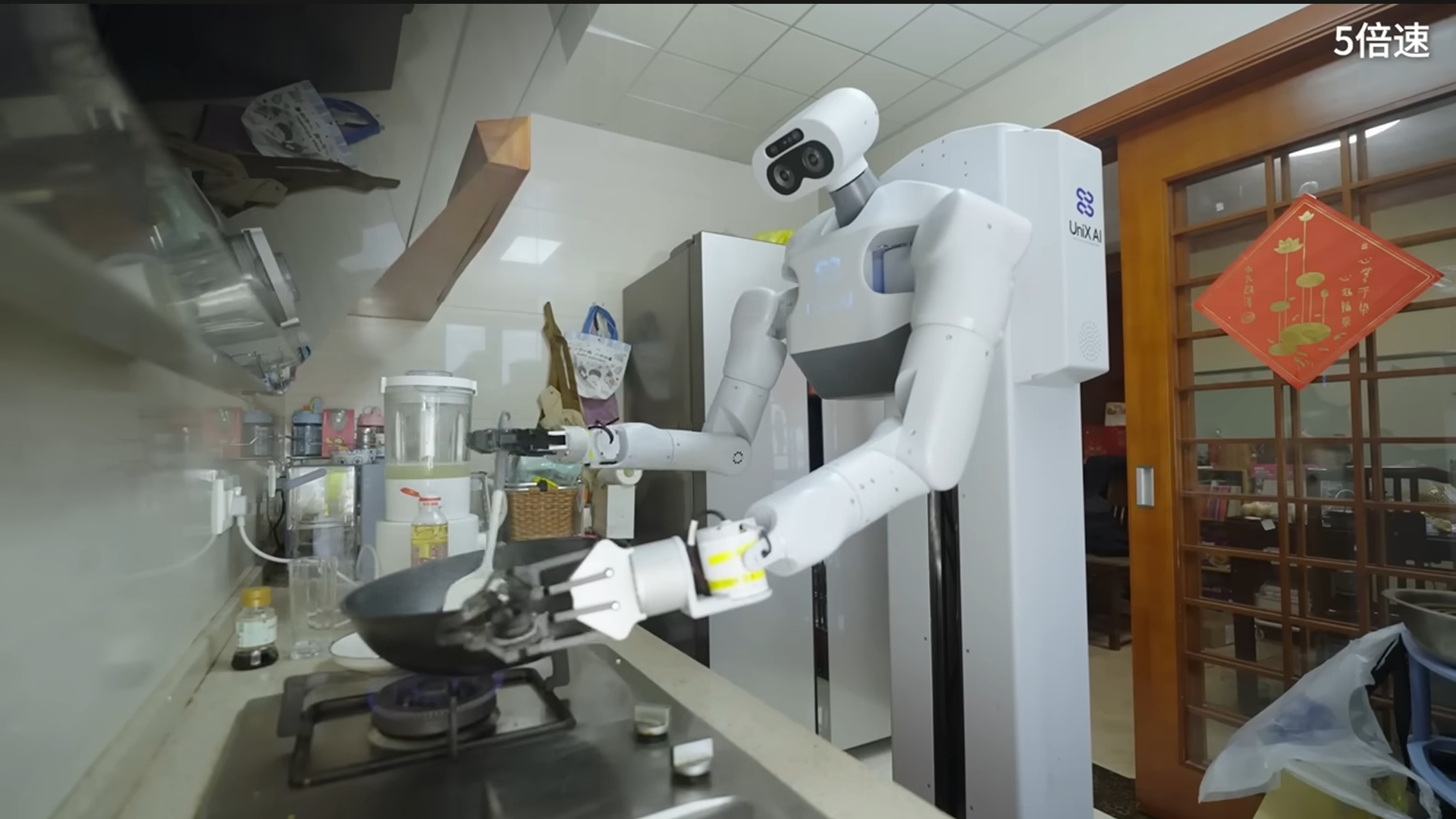
This humanoid robot does all your housework for you — and its makers say it's ready for your home

UniX AI's humanoid Panther robot cooks breakfast in the kitchen.
(Image credit: UniX AI)
Could a humanoid robot perform household chores for you? Soon, that might be the case. Chinese robotics company UniX AI has announced the release of Panther, a humanoid service robot designed to help with common household tasks.
The robot — which weighs 176 pounds (80 kilograms) and stands 5 feet, 3 inches (1.6 meters) tall — can operate for up to 12 hours on a charge, its engineers announced in a statement. In addition to releasing a promotional video showing Panther performing chores like making the bed, cleaning countertops and toilets, and cooking breakfast, UniX AI has started commercial deliveries of the model — suggesting it's ready to be deployed in a real-world setting.
"UniX AI is not only building advanced technology and products, we are bringing robots into homes, hotels, public spaces, and security operations, making them reliable productivity tools for society," Fred Yang, founder and CEO of UniX AI, said in the statement.
Watch awkward Chinese humanoid robot lay it all down on the dance floor
Humanoid robots show off creepily impressive kung-fu moves during Lunar New Year festival in China
UniX AI's humanoid Panther robot makes the bed. (Image credit: UniX AI)To accomplish household chores, Panther uses two of the world's first mass-produced 8-DoF bionic arms, which give the robot joints with 34 degrees of freedom, UniX AI representatives said.
At the end of its arms are intelligent "grippers" that adapt to different shapes and sizes of items that the robot can grab. In the promotional video, Panther is seen holding a plastic spatula when frying an egg and a toilet brush when cleaning the toilet. The robot even washes its hands in the sink at the end of the video, drying off its grippers on a bath towel.
Panther's body can extend vertically by 31 inches (80 centimeters) to access hard-to-reach areas from tall shelves to ground level. It uses binocular vision and a webcam to see its surroundings.
Whereas other humanoid robots rely on legged locomotion and thus have a higher tendency of falling, Panther uses an omnidirectional four-wheel steering and four-wheel drive (4WS+4WD) chassis, allowing it to smoothly maneuver varying indoor environments.
It uses both lidar and ultrasonic sensors to determine its spatial position and moves around 6 feet (1.89 m) per second — roughly the speed of a brisk walk. UniX AI representatives noted in the statement that engineers focused less on building the "most human-like robot" and more on making sure the model could accomplish a variety of tasks with stability and flexibility.
In early tests and demonstrations, Panther handled multiple prompts, including making tea, cleaning the kitchen, and operating a washing machine. To do this, Panther runs on UniX AI's integrated technology stack, which includes imitation learning and long-term task planning so that it can perform tasks seamlessly one step at a time.
Engineers designed Panther for a wide range of applications in addition to housework, including assistance in retail, reception, guided tours, elderly care, companionship, research and education.
The price of this model could not be found on UniX AI's website.
EXCLUSIVE : Dead Los Alamos chief's secret UFO files revealed in stunning drop: '100% proof'
A senior cybersecurity official at one of America's most secretive nuclear laboratories died several years ago, leaving behind files that an insider claimed reveal classified UFO studies that were never intended to become public.
The documents, described as containing internal memos, scientific reports and historic images, were allegedly discovered among the belongings of the former head of cybersecurity at Los Alamos National Laboratory (LANL).
After the official's death, his son Johnny was sorting through personal effects when he reportedly stumbled upon files labeled with references to 'atmospheric anomalies.' The identities of the deceased staff member and his son are being withheld to protect their privacy and safety.
What initially appeared to be routine paperwork quickly raised alarm when the material appeared to detail classified scientific research into unidentified flying objects.
The discovery was later passed to investigative journalist Jeremy Corbell, who said the contents shocked even him. 'This is a real scientific study at the classified level within our military of UFOs,' he told the Daily Mail.
Corbell, who featured the details in his new documentary Sleeping Dog, set for release on May 12, claimed the material included records of high-level government meetings and scientific studies linked to UFO propulsion systems.
He described the documents as evidence that the US government had been studying unidentified craft far earlier than publicly acknowledged.
'Los Alamos was always a place where there were elements of the study of the UFO phenomenon… these documents are 100 percent proof that Los Alamos was taking it very seriously,' Corbell said.

A senior cybersecurity official at one of America's most secretive nuclear laboratories died, leaving behind files that an insider claimed reveal classified UFO studies that were never intended to become public

The documents, described as containing internal memos, scientific reports and historic images, were allegedly discovered among the belongings of the former head of cybersecurity at Los Alamos National Laboratory (LANL)
The case is now drawing renewed attention to LANL, a laboratory long associated with nuclear weapons development and deep government secrecy.
The lab, located in northern New Mexico, approximately 35 miles northwest of Santa Fe, is linked to UFO lore primarily through its proximity to New Mexico's 'Nuclear Triangle' and reported sightings of 'green fireballs' near atomic sites in the late 1940s.
As a premier nuclear research facility, it has been connected to Cold War atmospheric surveillance, classified aerial research and conspiracy theories regarding retrieved technology, including unverified worker claims of alien materials stored at TA-33.
According to Corbell, the discovery began when the cybersecurity chief's son began reviewing stored materials left behind after his father's death.
'This kid, after his dad passed away, starts going through and realizes, "oh, this is some heavy stuff,"' Corbell said.
In Corbell's Sleeping Dog, a film by Michael Lazovsky, he receives a package from Johnny, bursting with files reportedly from LANL.
Johnny told Corbell on the phone that the files included 'official documents from the lab that talk about meetings they had about atmospheric anomalies.'
'There's also some information in there about Russian sightings,' Johnny can be heard saying to Corbell over the phone.

The lab, located in northern New Mexico, approximately 35 miles northwest of Santa Fe, has a historical and ongoing connection to UFOs

A cylinder-shaped UFO from the files sent to Corbell
Corbell told the Daily Mail: 'I mean, everything from original Polaroids of very studied UFO cases throughout history, to internal memos and documents of when they have meetings and they're discussing this at a high-level government capacity.'
Corbell shared several pages with the Daily Mail showing what appeared to be mysterious saucer-like craft, crop circles etched across fields and a cylinder-shaped UFO.
There was also a document titled Illustrations and Photos by the Gulf Breeze Witness, which contains dozens of witness sketches and photographic enlargements depicting unidentified flying objects repeatedly seen over the coastal Florida town between 1987 and 1991.
The files pointed to a sustained pattern of sightings rather than isolated incidents.
Many witnesses described disc-shaped craft with rows of bright white lights, red and green flashing lights and visible 'portholes,' with some objects estimated to be 10 to 20 feet tall and up to 120 feet wide, hovering silently above homes, shorelines and wooded areas.
Several photographs attributed to key witness Ed Walters show glowing objects with overexposed white centers surrounded by red or blue-green halos.
Later images appear to show ejected material or protrusions from the craft, details that investigators highlighted as unusual visual characteristics.
Across multiple pages, the appendix documents repeated sightings of glowing red, white and yellow objects moving across the sky, sometimes leaving thick luminous trails or streaks, reinforcing claims from residents that the sightings occurred frequently and over several years.

There was also a document from 1987 titled Illustrations and Photos by the Gulf Breeze Witness, which contains dozens of witness sketches and photographic enlargements depicting unidentified flying objects repeatedly seen over the coastal Florida town between 1987 and 1991

Several photographs attributed to key witness Ed Walters show glowing objects with overexposed white centers surrounded by red or blue-green halos
Corbell claimed that some of the names listed in the documents were recognizable to him as scientists he had encountered during previous investigations.
'I start noticing, I know some of the names. I know some of the scientists personally. They've never told me that they did these studies on UFOs,' he said.
He further suggested that the material pointed to decades of government attention on unexplained aerial phenomena.
Los Alamos National Laboratory, located in New Mexico, played a central role in the development of the atomic bomb during World War II and continues to support US national security and nuclear research programs.
The facility has long been associated with high-level classified work, making any claims of additional secret research particularly sensitive.
Corbell said he spent years verifying the authenticity of the materials before discussing them publicly, noting that intelligence agencies often attempt to identify or pressure sources connected to UFO-related investigations.

The files included several pictures of crop circles from undisclosed locations

The files were obtained by the son of a deceased lab cyber chief, who sent them to investigative journalist Jeremy Corbell, above
'I've researched them down… I've gone to every single author that I could find that's still alive, and I said, "Can you talk about this now?"' he said.
Despite his claims, Corbell acknowledged that the documents alone may not convince skeptics but insisted they confirm longstanding suspicions about government secrecy surrounding UFO programs.
'There's nothing I would say revelatory to me in these documents, but it's confirmation that I'm on the right track,' he said.
He also warned that whistleblowers connected to classified programs often fear retaliation, adding that some individuals have reported threats after speaking publicly.
'There have been some situations that give everybody pause… whistleblowers have been squeezed,' Corbell said.
The release of the material is expected to coincide with the upcoming documentary, which Corbell said aims to bring hidden information into public view and spark renewed debate over what governments may know about unidentified aerial phenomena.
For now, the claims remain controversial, but the alleged discovery of files linked to a senior Los Alamos official has added another chapter to the growing public fascination with UFO secrecy and national security.
The immense power of black holes: Scientists record 'dancing jets' as powerful as 10,000 SUNS coming from voids
The immense power of black holes has been revealed, as scientists make the first accurate measurements of a distant void.
Using a radio telescope scanning the entire planet, scientists recorded the 'dancing jets' erupting from a black hole 7,000 light–years from Earth.
These jets unleash power equivalent to the output of 10,000 suns and travel at 150,000 km per second – nearly half the speed of light.
However, the terrifying fountains of superheated matter only use about 10 per cent of the energy gobbled up by the black hole as it feeds.
These incredible discoveries come from a binary system called Cygnus X–1, which is home to a supermassive star and a black hole.
The supermassive star creates enormous solar winds, kicking out 100 million times more mass every second than our sun at speeds three to four times as high.
Those winds are so powerful that they actually bend the jets by about two degrees, like wind buffeting the water emerging from a fountain.
Co–author Professor James Miller–Jones, of Curtin University, told the Daily Mail: 'Since we know how strong the wind from the star is, we know how much force it creates on the jet. This allows us to figure out how powerful the jet is.'

Scientists have revealed the immense power of a black hole as they make the first accurate measurements of the jets emerging from a void around 7,000 light–years from Earth
Black holes are some of the strangest objects in the entire universe, containing matter so dense that not even light can escape their gravitational pull.
However, while these super–dense objects absorb light, they also create a spectacular burst of energy in the form of black hole jets.
As matter is pulled in, it orbits the black hole like water circling the drain, accelerating to velocities approaching the speed of light.
Professor Miller–Jones says: As matter spirals in towards a black hole, it carries magnetic fields with it, and as these magnetic field lines get wound up, they help launch the jet.'
The jets from the biggest black holes can stretch several light–years out from the black hole, pumping vast amounts of energy into the surrounding area.
Understanding how powerful these jets really are is extremely important if you want to work out how fast a black hole is really feeding and growing.
Scientists can work out how fast it is eating by measuring X–rays released by the matter falling in, but they also need to know how much matter is being shot out in the jets.
Together, these measurements would give astronomers the black hole's 'energy budget', which Professor Miller–Jones says is 'a bit like counting calories, only for a black hole'.

These incredible discoveries come from a binary system called Cygnus X–1, which is home to a supermassive star that bends the 'dancing jets' emerging from its neighbouring black hole with solar wind

Scientists measured how much the solar wind bent the black hole jets over time to work out how much energy these contained, revealing that they release the power of 10,000 suns
The issue is that scientists have only been able to measure the average energy going into the jets over tens of thousands of years.
This is done by looking at how the jets inflate bubbles in surrounding gases, but it isn't the most reliable method.
'We can’t accurately compare that to the black hole feeding rate from the X–rays, since we don’t have measurements of how fast it was feeding thousands of years ago,' says Professor Miller–Jones.
'This new measurement finally allows us to accurately determine what fraction of the energy available from the matter falling in is able to be channelled into the jets.'
This is great news for astronomers because our best theories about how black holes work suggest that the physics should be the same no matter how big the black hole is.
That means this one accurate measurement can 'anchor' future studies of black holes, whether they are 'five or five billion times the mass of the Sun'.
In turn, that discovery should help astronomers get a better understanding of how the universe as a whole reached its current state.
The jets from supermassive black holes play a key role in determining how planets, stars, and galaxies form.

Using a series of images, the scientists also worked out that the jets are travelling at a velocity of 150,000 metres per second – about half the speed of light
In some cases, black hole jets can even inflate bubbles of gas that exceed the size of the host galaxy itself, exerting a profound impact on the galaxy's evolution.
Lead author Dr Steve Raj Prabu, of the University of Oxford, told the Daily Mail: 'This process, known as “feedback”, plays a crucial role in regulating how galaxies grow and evolve.
'In large–scale simulations of the Universe, scientists have had to assume how efficient black holes are at converting infalling energy into jets.'
'Our result provides the first direct observational measurement of this efficiency, giving these simulations a much firmer observational foundation.'