Naar de inhoud

UFO'S of UAP'S, ASTRONOMIE, RUIMTEVAART, ARCHEOLOGIE, OUDHEIDKUNDE, SF-SNUFJES EN ANDERE ESOTERISCHE WETENSCHAPPEN - DE ALLERLAATSTE NIEUWTJES

UFO's of UAP'S in België en de rest van de wereld
akke.beakke.be
Ontdek de Fascinerende Wereld van UFO's en UAP's: Jouw Bron voor Onthullende Informatie! Ben jij ook gefascineerd door het onbekende? Wil je meer weten over UFO's en UAP's, niet alleen in België, maar over de hele wereld? Dan ben je op de juiste plek! België: Het Kloppend Hart van UFO-onderzoek In België is BUFON (Belgisch UFO-Netwerk) dé autoriteit op het gebied van UFO-onderzoek. Voor betrouwbare en objectieve informatie over deze intrigerende fenomenen, bezoek je zeker onze Facebook-pagina en deze blog. Maar dat is nog niet alles! Ontdek ook het Belgisch UFO-meldpunt en Caelestia, twee organisaties die diepgaand onderzoek verrichten, al zijn ze soms kritisch of sceptisch. Nederland: Een Schat aan Informatie Voor onze Nederlandse buren is er de schitterende website www.ufowijzer.nl, beheerd door Paul Harmans. Deze site biedt een schat aan informatie en artikelen die je niet wilt missen! Internationaal: MUFON - De Wereldwijde Autoriteit Neem ook een kijkje bij MUFON (Mutual UFO Network Inc.), een gerenommeerde Amerikaanse UFO-vereniging met afdelingen in de VS en wereldwijd. MUFON is toegewijd aan de wetenschappelijke en analytische studie van het UFO-fenomeen, en hun maandelijkse tijdschrift, The MUFON UFO-Journal, is een must-read voor elke UFO-enthousiasteling. Bezoek hun website op www.mufon.com voor meer informatie. Samenwerking en Toekomstvisie Sinds 1 februari 2020 is Pieter niet alleen ex-president van BUFON, maar ook de voormalige nationale directeur van MUFON in Vlaanderen en Nederland. Dit creëert een sterke samenwerking met de Franse MUFON Reseau MUFON/EUROP, wat ons in staat stelt om nog meer waardevolle inzichten te delen. Let op: Nepprofielen en Nieuwe Groeperingen Pas op voor een nieuwe groepering die zich ook BUFON noemt, maar geen enkele connectie heeft met onze gevestigde organisatie. Hoewel zij de naam geregistreerd hebben, kunnen ze het rijke verleden en de expertise van onze groep niet evenaren. We wensen hen veel succes, maar we blijven de autoriteit in UFO-onderzoek! Blijf Op De Hoogte! Wil jij de laatste nieuwtjes over UFO's, ruimtevaart, archeologie, en meer? Volg ons dan en duik samen met ons in de fascinerende wereld van het onbekende! Sluit je aan bij de gemeenschap van nieuwsgierige geesten die net als jij verlangen naar antwoorden en avonturen in de sterren! Heb je vragen of wil je meer weten? Aarzel dan niet om contact met ons op te nemen! Samen ontrafelen we het mysterie van de lucht en daarbuiten.

Categorie: Oliver's WebLog ( ENG en NL)

NEW GOVERNMENT UAP REPORT OUTLINES THE DOD’S LATEST INVESTIGATIONS INTO ‘UNIDENTIFIED ANOMALOUS PHENOMENA’

qb4TrbBZ?format=jpg&name=900x900

NEW GOVERNMENT UAP REPORT OUTLINES THE DOD’S LATEST INVESTIGATIONS INTO ‘UNIDENTIFIED ANOMALOUS PHENOMENA’

A newly released government UAP report details the latest findings in the Defense Department’s ongoing investigations into aerial incursions within military airspace, and other incidents involving objects the DOD now calls “unidentified anomalous phenomena.”

Although several weeks late on arrival, the report presents the latest findings on the efforts of the All-domain Anomaly Resolution Office (AARO), which the document characterizes as “the DoD focal point for UAP.”

According to the new assessment, 247 new reports, as well as 119 “that were either since discovered or reported after the preliminary assessment’s time period,” have been accumulated since the publication of the last report on UAP issued by the ODNI in June 2021, spanning a 17 year period.

“This totals 510 UAP reports as of 30 August 2022,” the report’s authors state. “Additional information is provided in the classified version of this report.” Most of the new reporting “originates from U.S. Navy and U.S. Air Force aviators and operators who witnessed UAP during the course of their operational duties,” the report adds.

“AARO and ODNI assess that the observed increase in the UAP reporting rate is partially due to a better understanding of the possible threats that UAP may represent,” the report states, “either as safety of flight hazards or as potential adversary collection platforms, and partially due to reduced stigma surrounding UAP reporting.”

“This increased reporting allows more opportunities to apply rigorous analysis and resolve events,” the report adds.

Although leaving open the possibility that irregularities in the detection capabilities of sensors and other errors in equipment function may account for some UAP reports, “ODNI and AARO operate under the assumption that UAP reports are derived from the observer’s accurate recollection of the event and/or sensors that generally operate correctly and capture enough real data to allow initial assessments,” the report states.

Based on AARO’s analysis and characterization of the 366 reports collected since the issuance of the last ODNI report, it says that “more than half” appear to exhibit “unremarkable characteristics,” with half a dozen attributed to aerial clutter, 26 believed to represent Unmanned Aircraft System (UAS) craft or “UAS-like entities,” and 163 determined as being representative of “balloon or balloon-like entities.”

The report states that such initial characterization of these events “does not mean positively resolved or unidentified” but is intended to enable AARO “to efficiently and effectively leverage resources against the remaining 171 uncharacterized and unattributed UAP reports.” The report also emphasized that “many reports lack enough detailed data to enable attribution of UAP with high certainty” despite the methods employed in collecting and reporting those incidents.

Mirroring themes from the 2021 report, flight safety challenges associated with the presence of UAP over the U.S. and in other airspace remains a concern, characterized as “a safety of flight and collision hazard to air assets” in Thursday’s report. However, the summary notes that AARO and its partner agencies have logged no known collisions with UAP.

New to the DOD’s assessment of concerns related to UAP is what the new report characterizes as potential “health implications” related to the phenomenon, although noting that presently, there are “no encounters with UAP confirmed to contribute directly to adverse health-related effects to the observer(s).”

“Acknowledging that health-related effects may appear at any time after an event occurs, AARO will track any reported health implications related to UAP should they emerge,” the report adds.

The report acknowledges that UAP reporting has increased since the issuance of the 2021 ODNI report, possibly due to the removal of stigmas associated with the topic in years past and the institution of new formalized methods of reporting by military personnel. Fundamentally, in addition to the potential hazards to flight safety that some UAP may represent, AARO is focused on assessing the possibility of adversary collection threats that could be related to many UAP incidents.

The report, an unclassified document based on a classified version that was originally set for arrival on October 31, 2022, was published on the ODNI website on Thursday, with a classified version delivered to Congress yesterday, according to a statement issued by Pentagon Press Secretary Air Force Brigadier General Pat Ryder. It is the second in an ongoing series of periodic updates in coordination with the Office of the Director of National Intelligence (ODNI) on findings related to what the DOD characterizes as unidentified anomalous phenomena.

“The safety of our service personnel, our bases and installations, and the protection of U.S. operations security on land, in the skies, seas, and space are paramount,” Ryder stated. “We take reports of incursions into our designated space, land, sea, or airspaces seriously and examine each one.”

“There is no single explanation that addresses the majority of UAP reports,” said Department of Defense spokesperson Sue Gough in a statement provided to The Debrief in response to queries about the report and the DOD’s position on current findings related to U.S. government UAP investigations.

“We are collecting as much data as we can, following the data where it leads, and will share our findings whenever possible,” Gough said, adding that the DOD would not rush to conclusions in its analysis of incidents involving unidentified phenomena.

“In many cases, observed phenomena are classified as ‘unidentified’ simply because sensors were not able to collect enough information to make a positive attribution,” Gough further clarified, adding that the DOD continues to improve its data collection capabilities in order to help ensure that “sufficient data for our analysis” can be collected when UAP events occur.

Similar inquiries were made with the Office of the Director of National Intelligence by The Debrief, although ODNI Spokesperson Jamie Mason conveyed that the Office could not offer any guidance or additional comments on the UAP report at that time.

In recent days, the National Defense Authorization Act (NDAA) for Fiscal Year (FY) 2023 was signed into law by President Biden. Included within the annual defense bill are provisions aimed at improving government transparency on the UAP issue by providing protections for whistleblowers, in addition to expanding the scope of current investigations by the DOD’s All-domain Anomaly Resolution Office (AARO).

Earlier in December, the Pentagon held a media roundtable that briefly addressed the findings of the DOD’s new All-domain Anomaly Resolution Office (AARO) in advance of the release of the report. In attendance were Ronald Moultrie, Under Secretary of Defense for Intelligence and Security, who also appeared at a Congressional hearing earlier this year that addressed the subject, and Dr. Sean Kirkpatrick, the director of AARO, whose participation marked his first public appearance since taking over the DOD’s new office.

“We have an important and yet challenging mission to lead an interagency effort to document, collect, analyze and when possible, resolve reports of any unidentified anomalous phenomena,” Kirkpatrick said during the briefing, adding that the DOD has “transferred the data and responsibilities from the previous Navy-led UAP task force, and disestablished it.”

“During that transition, we’ve taken the opportunity to expand and standardize and integrate UAP reporting and reevaluate the data we’ve collected,” Kirkpatrick added.

Moultrie also emphasized that the DOD “takes public interest in UAPs seriously,” adding that “we are fully committed to the principles of openness and accountability to the American people. We are committed to sharing as much detail with the public as we can.”

Last November, the DOD announced the establishment of what it then called the Airborne Object Identification and Management Group (AOIMSG), the mission for which had been limited primarily to incidents occurring within military airspace. The scope of the AOIMSG was later broadened in July 2022 following additional direction from Congress, as outlined in wording that appeared in the FY 2022 National Defense Authorization Act (NDAA).

“On July 15, 2022, Deputy Secretary of Defense Kathleen Hicks, in coordination with the Director of National Intelligence (DNI), amended her original direction to the Under Secretary of Defense for Intelligence & Security by renaming and expanding the scope of the Airborne Object Identification and Management Group (AOIMSG) to the All-domain Anomaly Resolution Office (AARO),” read a portion of a July 20, 2022, DOD release.

According to the DOD release, the FY 2022 NDAA “included a provision to establish an office, in coordination with DNI, with responsibilities that were broader than those originally assigned to the AOIMSG.”

Wording within the NDAA also required an annual report on the DOD’s latest findings on UAP to be delivered to Congress by no later than October 31.

Some have noted that the delivery date for the annual report, which according to last year’s NDAA was scheduled to coincide with Halloween, seemingly nods to the long-held flippant attitudes maintained by both the military, and the academic community, toward anomalous aerial phenomena.

Several weeks in advance of the report’s late arrival, an October 28 article by New York Times reporter Julian Barnes also seemingly downplayed the significance of unresolved incidents in the DOD’s current UAP dataset. Citing government officials familiar with the document and its findings who spoke on background, Barnes reported that “surveillance operations by foreign powers and weather balloons or other airborne clutter” could account for most UAP incidents investigated by the DOD in recent years, adding that such sightings have given weight to “theories about visiting space aliens” and espionage by adversaries like China and Russia.

The newly released report, by contrast, while noting that “more than half” of the UAP reports currently collected by AARO seem to display “unremarkable” behavior, nonetheless conveys that a significant number remain that do not appear to have such prosaic characteristics, and remain a focus of AARO’s further investigations.

In her statement provided to The Debrief, Department of Defense spokesperson Sue Gough emphasized that the Pentagon does not downplay UAP incidents and recognizes the current level of public interest in these events, as well as issues of transparency related to them, statements in-line with those expressed by Moultrie and Kirkpatrick earlier in December.

“DoD takes public interest in UAP seriously,” Gough told The Debrief, adding that the Department “is committed to the principles of openness and accountability to the American people which it must balance with its obligation to protect sensitive information, sources and methods.”

  • Micah Hanks is Editor-in-Chief and Co-Founder of The Debrief. Follow his work at micahhanks.com and on Twitter: @MicahHanks. 

{ https://thedebrief.org/category/science/ }

Hoe vind je dit bericht?
Geschreven door peter om 21:40 Stuur door

THE AI ARMS RACE WILL BE THE NEXT GEOPOLITICAL KINGMAKER, EXPERTS WARN

th?id=OVFT.Qs_5ZdeWTzoZITwPjVw1BS&pid=News&w=300&h=186&c=14&rs=2&qlt=90&dpr=1.1

THE AI ARMS RACE WILL BE THE NEXT GEOPOLITICAL KINGMAKER, EXPERTS WARN

In the high-stakes Chess game of international politics, artificial intelligence (AI) has emerged as the board on which future conflicts will be strategized and future societies shaped. In a recent essay published by The RAND Corporation, researchers there examined the current trajectory of AI development and have painted a picture of a world where AI is not merely a tool but a transformative force with the power to redefine global leadership. 

230227WAI_002.jpg?quality=85&w=2400

Illustration by Dan Page for TIME

The race to AI supremacy is not just about technological bragging rights; it’s a strategic maneuver to gain a geopolitical edge. AI’s potential to drive economic growth, revolutionize military capabilities, and enhance cyber operations makes it a critical asset for any nation-state. The United States, long the torchbearer of technological innovation, finds its dominance challenged by China’s ambitious AI strategy. This contest is not just about who can develop more intelligent algorithms; it’s a proxy for ideological, economic, and military power. In other words, a 21st-century Moon-shot.

The current tension between the US and China in the AI domain is a flashpoint for broader geopolitical concerns. China’s “Next Generation Artificial Intelligence Development Plan” is a clear signal of its intent to become the world leader in AI by 2030. Meanwhile, the United States, through initiatives like the American AI Initiative, is striving to maintain its lead. This rivalry is not confined to research labs and tech campuses; it extends to the global stage, where AI capabilities are increasingly seen as a barometer of national power.

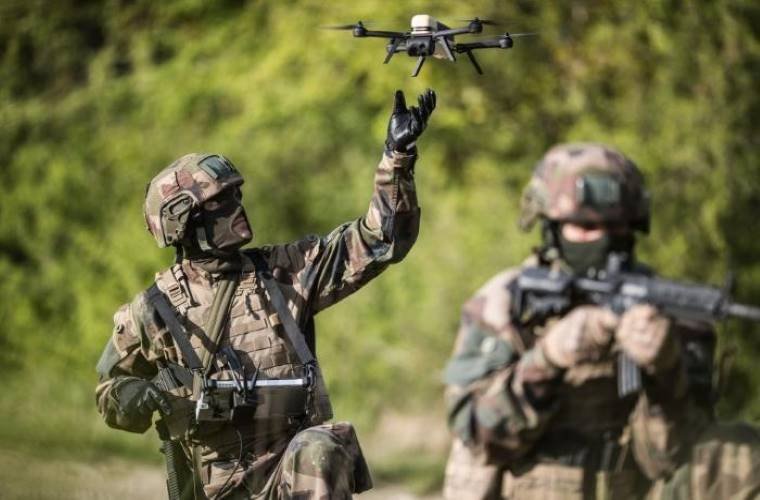
In the military arena, AI is poised to revolutionize warfare. Autonomous drones, AI-driven intelligence analysis, and predictive logistics are just the tip of the iceberg. The United States Department of Defense’s Joint Artificial Intelligence Center (JAIC) and China’s advances in military AI applications indicate a future where AI not only supports but also conducts warfare. 

future threats

French soldiers using a drone in training.

(Image: MOD)

Lt. Gen. Jack Shanahan, the former director of the Pentagon’s Joint Artificial Intelligence Center, said in a 2019 speech that the “integration of AI capabilities” is being pursued by the Department of Defense. Shanahan said that he could imagine a future where AI could be used in determining how to use lethal force after a human makes the decision. 

“I’m not going to go straight to ‘lethal autonomous weapons systems,'” he stated, “but I do want to say we will use artificial intelligence in our weapons systems … to give us a competitive advantage. It’s to save lives and help deter war from happening in the first place.”

The implications are profound and double-edged: AI could help deter conflicts and make conflicts more precise or more impersonal and, potentially, more frequent. The ethical and strategic dilemmas of AI in combat, such as using lethal autonomous weapons systems (LAWS), are concerns that have yet to be fully grappled with on the international stage.

The cyber domain is another battleground that AI is transforming. Cyberattacks can now be more targeted, complex, and challenging to trace back to their origins. AI enhances the ability to exploit vulnerabilities at unprecedented speed and scale. The United States’ Cyber Command and China’s Strategic Support Force are both investing heavily in AI to defend against and conduct cyber operations. Microsoft’s Vice Chair, Brad Smith, wrote in 2020 that large-scale hacks, such as the recent SolarWinds hack, attributed to a nation-state actor, demonstrate the scale of disruption possible when AI augments cyber warfare.

“These types of sophisticated nation-state attacks are increasingly being compounded by another technology trend, which is the opportunity to augment human capabilities with artificial intelligence (AI),” Smith wrote in 2020. “One of the more chilling developments this year has been what appears to be new steps to use AI to weaponize large stolen datasets about individuals and spread targeted disinformation using text messages and encrypted messaging apps. We should all assume that, like the sophisticated attacks from Russia, this too will become a permanent part of the threat landscape.”

Beyond military and cyber applications, AI’s most profound impact may be on society itself. AI is set to reshape economies, with automation promising efficiency gains but also job displacement. The inequalities could stretch the societal fabric that AI is likely to exacerbate. Moreover, AI’s role in information dissemination and consumption has the potential to influence public opinion, with implications for democracy and governance. How nations adapt to these changes, manage the societal implications, and govern the use of AI will be crucial in determining their stability and prosperity.

Looking to the future, AI’s trajectory will intersect with every aspect of human life. In the geopolitical context, AI will determine a nation’s influence and status. Economically, AI will drive innovation and productivity, potentially widening the gap between the “AI-haves” and “AI have-nots.” Militarily, AI will redefine the principles of deterrence and defense, making the next war—if it comes—a battle of algorithms as much as armaments.

The interference of AI in traditional geopolitical dynamics cannot be overstated. It can potentially alter the balance of power by enabling smaller nations with advanced AI capabilities to punch above their weight. Regarding societal development, AI could either be a force for good, democratizing access to information and services, or it could deepen divides and erode privacy and individual freedoms. These concerns surrounding AI’s rise as a geopolitical lever necessitate a robust international governance framework. The world needs a set of rules to ensure that AI development is aligned with human values and global stability. This includes agreements on the militarization of AI, norms for cyber conduct, and frameworks to address the societal impacts of AI.

AI is the new fulcrum of geopolitical power. The United States and China, as the current frontrunners in AI, carry a particular responsibility to lead the way in establishing global norms. The choices we make now will determine whether AI becomes a tool for widespread benefit or a new vector for conflict and division. The future is not just being written in code; it is being coded with the power to transform our world.

see also video with this link

https://youtu.be/ixIMRjn1Q-M

{ https://thedebrief.org/ }

Hoe vind je dit bericht?
Geschreven door peter om 23:49 Stuur door

‘Sensationele vondst': Eerste piramide ontdekt in Kazachstan

Voor het eerst 'Egyptische' piramide ontdekt in Kazachstan

‘Sensationele vondst': Eerste piramide ontdekt in Kazachstan

In een afgelegen gebied op de steppe van Kazachstan is een nog onbekende piramide ontdekt. Het bouwwerk moet ooit sterk hebben geleken op de Egyptische piramides. De piramide die in Kazachstan is gevonden, is alleen een stuk ouder.

Archeologen hebben de piramide vorig jaar ontdekt, maar hielden hun ‘sensationele vondst’ stil. Wetenschappers gaan de komende dagen een nog ongeopende grafkamer van het piramidecomplex verkennen.

Machtige stam

De piramide is meer dan 3000 jaar geleden jaar geleden gebouwd in Saryarka voor een leider van een machtige lokale stam, aldus archeoloog Viktor Novozhenov. Alles wat de onderzoekers gaan aantreffen wordt overgebracht naar het archeologiemuseum van de Staatsuniversiteit van Karaganda.

Voor het eerst 'Egyptische' piramide ontdekt in Kazachstan

Piramide van Djoser (Wikicommons)

“De vorm van dit schitterende bouwwerk doet ons denken aan de beroemde Piramide van Djoser in Egypte,” zei Novozhenov. In de Sovjettijd werden politieke ballingen verscheept naar Karaganda.

Eerste

Er zijn in de regio inmiddels 27 constructies gevonden die dateren van verschillende tijdperken. Het grootste gebouw bestaat uit vijf stenen trappen. De grafkamer is ruim zeven meter breed. Hoewel er eerder al piramides zijn aangetroffen in Egypte, Mexico en China, is dit de eerste die in Kazachstan is gevonden.

De Britse egyptoloog Toby Wilkinson beargumenteerde in The Guardian dat piramides altijd gericht zijn naar de Poolster en op basis van hun vorm kunnen worden gezien als lanceerplatform voor de reis van de farao naar het hiernamaals tussen de sterren. Hij voegde toe dat de oude Egyptenaren hun inspiratie voor de piramides mogelijk uit de ruimte haalden.

[MailOnline]

Hoe vind je dit bericht?
Geschreven door peter om 00:00 Stuur door

Mexican Government Releases Proof of Aliens and Ancient Space Travel

Mexican Government Releases Proof of Aliens and Ancient Space Travel

In what will soon be considered as the Holy Grail of extraterrestrial research, the Mexican government has released ancient documents proving the existence of E.T.’s once and for all.

Mayn-Documents

Newly released Mayan documents, i.e. artifacts, dating back at least 1300-years reveal that the human race is not alone and highly advanced technologies including space travel have likely existed for quite some time.

Not only does this documentation released by the Mexican government show the existence of an explorer race, it may also reveal the roots of mankind.

Some consider the government’s presentation of the information to be a major step forward for humanity as the truth is finally being slowly let out. Hopefully this will prompt other governments around the world to be more forthcoming with such information, turning the tide in the UFO and extraterrestrial research community for good.

Mayan

Sundance winner Juan Carlos Rulfo’s Revelations of the Mayans 2012 and Beyondalso touches on such technology. “Producer Raul Julia-Levy said the documentary-makers were working in cooperation with the Mexican government for what he said was “the good of mankind”. He said the order to collaborate had come directly from the country’s president, Álvaro Colom Caballeros.

“Mexico will release codices, artefacts and significant documents with evidence of Mayan and extraterrestrial contact, and all of their information will be corroborated by archaeologists,” he said. “The Mexican government is not making this statement on their own – everything we say, we’re going to back it up.”

Caballeros himself was conspicuous by his absence from the statement released by Julia-Levy. So far, the minister of tourism for the Mexican state of Campeche, Luis Augusto García Rosado, appears to be the highest-ranking government official to go on record confirming the discovery of extraterrestrial life, but he’s not holding back.

In a statement, Rosado spoke of contact “between the Mayans and extraterrestrials, supported by translations of certain codices, which the government has kept secure in underground vaults for some time”. In a telephone conversation with the Wrap, he also spoke of “landing pads in the jungle that are 3,000 years old”.[2] 

These secrets have been said to be “protected” by the mexican government for as long as 80-years.

Sources:

[1] The Mexican government reveals Mayan documents proving extraterrestrial contacts -Arcturius.org

[2] Mayan documentary to show ‘evidence’ of alien contact in ancient Mexico – TheGuardian.com

[3] Aliens and UFOs Depicted In Mayan Artifacts Released By Mexican Government -ConciusLifeNews.com

{  http://www.conspiracyclub.co/ }

Hoe vind je dit bericht?
Geschreven door peter om 00:42 Stuur door

Russian Prime Minister Confirms The Existence Of Intelligent Extraterrestrial Life

Russian Prime Minister Confirms The Existence Of Intelligent Extraterrestrial Life

1

Russia’s Prime Minister Dmitry Medvedev recently confirmed the existence of intelligent extraterrestrial life in a short interview away from network cameras after an appearance on Russian television. This is extremely significant, as it is a rare occasion when a current serving Prime Minister of a any nation has come forward to share the truth. Keep in mind that Medvedev also served as President of Russia from 2008 to 2012.

Collective Evolution has had this interview translated by multiple sources and can verify it’s credibility with regards to translation. Both of our translations are Russian.

“I tell you the first and last time. Together with a nuclear suitcase the president has a folder, which is top secret and devoted entirely to the report by the Russian secret service which handles the control of extraterrestrials in our country. After the term, the two folders and a small nuclear suitcase are transferred to the new president. How many of them are among us I cannot say because panic might begin.”

He also refers to a Russian documentary if you are interested in the subject titled “The Men in Black.” He is not referring to the hollywood film.

WHAT CAN WE CONCLUDE FROM THESE STATEMENTS?

Prime Minister Medvedev made many interesting remarks, one of them being the fact that the president receives classified information on extraterrestrials visiting the planet at the beginning of his term. From this we can conclude that those responsible and dealing with this subject is not the president or the prime minister. They simply receive a briefing from the countries “secret service.” Interestingly, Medvedev was President from 2008 – 2012, prior to Medvedev, the president was Vladimir Putin from 2000-2008, as well as the prime minister from 2008-20012. So he has been in the ‘know’ for quite some time. It’s more likely that the heads of major ‘secret service’ groups who have entire careers at agencies are privy to more information than a president who serves a much shorter term.

The same has been the case in the United States, with the very first public disclosure of a Untied States “black budget” program by Edward Snowden, credibility to other high ranking individuals within the ‘power structure’ has further increased. Former National Minister of Defence for Canada, Paul Hellyer alluded to trillions of dollars going into black budget projects in which congress and the president are deliberately kept in the dark. The secret seems to be exploding out even more as we head towards 2014.

In my opinion it’s important to note that these statements come after thousands and thousands of UFO files and documentation have been released by dozens of governments world wide, including the Russian Navy and agencies like the NSA. Here is one example of one from the NSA, other examples include much more detailed information. The evidence is widely available for those who are interested in pursuing it. Not too long ago, we presented a list of 12 Government Documents, out of thousands, that take UFOs seriously.

Another interesting comment was the fact that Prime Minister Medvedev alluded to the fact that they receive a nuclear suitcase. There is a lot of evidence that shows how UFOs have been deactivating Nuclear Missiles around the world for a number of years.

Last but not least, he states that a reason for secrecy is the fact that it might spread panic. I can understand that there are those who have kept the secrecy behind UFOs and extraterrestrials because they did not want to panic the population. On the other hand, there is a lot more that could go into the reasoning behind the secrecy of UFOs. Some of these concerns include technological implications, reasons for visitation, and opening humanity up to new concepts that threaten our current ‘power structure’ or paradigm of reality here on Earth. It has financial and economical implications that threaten those who profit off of the current existing paradigm.

Since I began this article with a statement from someone who many people pay attention to in the political world, I will end it with another who many paid attention to in the “academic world.”

At the end of the day your truth is within, what does your heart and soul tell you? I understand the importance of writing about this subject in a way that can reach many. At the same time, we have to move past labels that give people “credibility” and think for ourselves. All of the answers are inside of you, the only problem is that we’ve been programmed for so long that we’ve forgotten how to listen to what our intuition is saying -our heart, our soul. Our minds have been so busy accomplishing the “set out requirements to live a good life” that we have not learned how to get in touch with the real truth within.

A time for change has arrived, alongside our time for choice. Planet Earth is going through quite a transition, and I believe that may have something to do with some of the visitors that have been coming to the planet at this time.

Here is another great video of a speech given by Richard Dolan in front of several former members of the United States Congress.

Credits: Written by Arjun Walia of Collective Evolution, where this was originally featured.

{ http://earthweareone.com/ }

Hoe vind je dit bericht?
Geschreven door peter om 16:51 Stuur door

Ten amazing inventions from ancient times

Ten amazing inventions from ancient times

Dating back thousands of years are numerous examples of ancient technology that leave us awe-struck at the knowledge and wisdom held by people of our past. They were the result of incredible advances in engineering and innovation as new, powerful civilizations emerged and came to dominate the ancient world.  These advances stimulated societies to adopt new ways of living and governance, as well as new ways of understanding their world. However, many ancient inventions were forgotten, lost to the pages of history, only to be re-invented millennia later. Here we feature ten of the best examples of ancient technology and inventions that demonstrate the ingenuity of our ancient ancestors.

1. The ancient invention of the steam engine by the Hero of Alexandria

The ancient invention of the steam engine by the Hero of Alexandria

Heron Alexandrinus, otherwise known as the Hero of Alexandria, was a 1st century Greek mathematician and engineer who is known as the first inventor of the steam engine.  His steam powered device was called the aeolipile, named after Aiolos, God of the winds. The aeolipile consisted of a sphere positioned in such a way that it could rotate around its axis. Nozzles opposite each other would expel steam and both of the nozzles would generate a combined thrust resulting in torque, causing the sphere to spin around its axis. The rotation force sped up the sphere up to the point where the resistance from traction and air brought it to a stable rotation speed. The steam was created by boiling water under the sphere – the boiler was connected to the rotating sphere through a pair of pipes that at the same time served as pivots for the sphere. The replica of Heron’s machine could rotate at 1,500 rounds per minute with a very low pressure of 1.8 pounds per square inch.  The remarkable device was forgotten and never used properly until 1577, when the steam engine was ‘re-invented’ by the philosopher, astronomer and engineer, Taqu al-Din.

2. Is the Assyrian Nimrud lens the oldest telescope in the world?

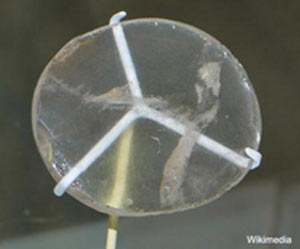
Assyrian Nimrud lens the oldest telescope

The Nimrud lens is a 3,000-year-old piece of rock crystal, which was unearthed by Sir John Layard in 1850 at the Assyrian palace of Nimrud, in modern-day Iraq.  The Nimrud lens (also called the Layard lens) is made from natural rock crystal and is a slightly oval in shape.  It was roughly ground, perhaps on a lapidary wheel. It has a focal point about 11 centimetres from the flat side, and a focal length of about 12 cm.  This would make it equivalent to a 3× magnifying glass (combined with another lens, it could achieve much greater magnification). The surface of the lens has twelve cavities that were opened during grinding, which would have contained naptha or some other fluid trapped in the raw crystal.  Since its discovery over a century ago, scientists and historians have debated its use, with some suggesting it was used as a magnifying glass, and others maintaining it was a burning-glass used to start fires by concentrating sunlight. However, prominent Italian professor Giovanni Pettinato proposed the lens was used by the ancient Assyrians as part of a telescope, which would explain how the Assyrians knew so much about astronomy. According to conventional perspectives, the telescope was invented by Dutch spectacle maker, Hans Lippershey in 1608 AD, and Galileo was the first to point it to the sky and use it to study the cosmos. But even Galileo himself noted that the 'ancients' were aware of telescopes long before him. While lenses were around before the Nimrud lens, Pettinato believes this was one of the first to be used in a telescope. 

3. The Oldest Calendar in Scotland

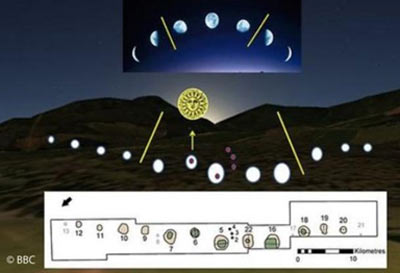
The Oldest Calendar in Scotland

Research carried out last year on an ancient site excavated by the National Trust for Scotland in 2004 revealed that it contained a sophisticated calendar system that is approximately 10,000 years old, making it the oldest calendar ever discovered in the world. The site – at Warren Field, Crathes, Aberdeenshire – contains a 50 metre long row of twelve pits which were created by Stone Age Britons and which were in use from around 8000 BC (the early Mesolithic period) to around 4,000 BC (the early Neolithic). The pits represent the months of the year as well as the lunar phases of the moon. They were formed in a complex arc design in which each lunar month was divided into three roughly ten day weeks – representing the waxing moon, the full moon and the waning moon. It also allowed the observation of the mid-winter sunrise so that the lunar calendar could be recalibrated each year to bring it back in line with the solar year. The entire arc represents a whole year and may also reflect the movements of the moon across the sky.

4. Ancient Roman Concrete was Far Superior to Our Own

Ancient Roman Concrete

Scientists studying the composition of Roman concrete, which has been submerged under the Mediterranean Sea for the last 2,000 years, discovered that it was superior to modern-day concrete in terms of durability and being less environmentally damaging. The Romans made concrete by mixing lime and volcanic rock. For underwater structures, the combination of lime and volcanic ash with seawater instantly triggered a chemical reaction in which the lime incorporated molecules into its structure and reacted with the ash to cement the whole mixture together. Analysis of the concrete found that it produces a significantly different compound to modern day cement, which is an incredibly stable binder. In addition, the ancient concrete contains the ideal crystalline structure of Tobermorite, which has a greater strength and durability than the modern equivalent. Finally, microscopic studies identified other minerals in the ancient concrete which show potential application for high-performance concretes, including the encapsulation of hazardous wastes. "In the middle 20th century, concrete structures were designed to last 50 years," said scientist Paulo Monteiro said. "Yet Roman harbour installations have survived 2,000 years of chemical attack and wave action underwater.”

5. 2000-year-old metal coatings superior to today’s standards

2000-year-old metal coatings superior

Research has shown that artisans and craftsmen 2,000 years ago used a form of ancient technology for applying thin films of metal to statues and other items, which was superior to today’s standards for producing DVDs, solar cells, electronic devices and other products. Fire gilding and silvering are age-old mercury-based processes used to coat the surface items such as jewels, statues and amulets with thin layers of gold or silver. From a technological point of view, what the ancient gilders achieved 2000 years ago, was to make the metal coatings incredibly thin, adherent and uniform, which saved expensive metals and improved its durability, something which has never been achieved to the same standard today.  Apparently without any knowledge about the chemical–physical processes, ancient craftsmen systematically manipulated metals to create spectacular results. They developed a variety of techniques, including using mercury like a glue to apply thin films of metals to objects. The findings demonstrate that there was a far higher level of understanding and knowledge of advanced concepts and techniques in our ancient past than what they are given credit for.

6. The incredible 2000-year-old earthquake detector

The incredible 2000-year-old earthquake detector

Although we still cannot accurately predict earthquakes, we have come a long way in detecting, recording, and measuring seismic shocks. Many don’t realise that this process began nearly 2000 years ago, with the invention of the first seismoscope in 132 AD by a Chinese astronomer, mathematician, engineer, and inventor called Zhang (‘Chang’) Heng.  The device was remarkably accurate in detecting earthquakes from afar, and did not rely on shaking or movement in the location where the device was situated.  Zhang's seismoscope was a giant bronze vessel, resembling a samovar almost 6 feet in diameter. Eight dragons snaked face-down along the outside of the barrel, marking the primary compass directions. In each dragon's mouth was a small bronze ball. Beneath the dragons sat eight bronze toads, with their broad mouths gaping to receive the balls. The sound of the ball striking one of the eight toads would alert observers to the earthquake and would give a rough indication of the earthquake's direction of origin.  In 2005, scientists in Zengzhou, China (which was also Zhang's hometown) managed to replicate Zhang's seismoscope and used it to detect simulated earthquakes based on waves from four different real-life earthquakes in China and Vietnam. The seismoscope detected all of them. As a matter of fact, the data gathered from the tests corresponded accurately with that gathered by modern-day seismometers!

7. Mythical sunstone used as ancient navigational device

Mythical sunstone used as ancient navigational device

An ancient Norse myth described a magical gem used to navigate the seas, which could reveal the position of the sun when hidden behind clouds or even before dawn or after sunset. Now it appears the myth is in fact true. In March 2013, a team of scientists announced that a unique calcite crystal, which was found in the wreck of an Elizabethan ship sunk off the Channel Islands, contains properties consistent with the legendary Viking sunstone and that shards of the crystal can indeed act as a remarkably precise navigational aid.  According to the researchers, the principle behind the sunstone relies on its unusual property of creating a double refraction of sunlight, even when it is obscured by cloud or fog. By turning the crystal in front of the human eye until the darkness of the two shadows are equal, the sun's position can be pinpointed with remarkable accuracy.

8. The Baghdad Battery

The Baghdad Battery

The Baghdad Battery, sometimes referred to as the Parthian Battery, is a clay pot which encapsulates a copper cylinder. Suspended in the centre of this cylinder—but not touching it—is an iron rod. Both the copper cylinder and the iron rod are held in place with an asphalt plug. These artifacts (more than one was found) were discovered during the 1936 excavations of the old village Khujut Rabu, near Baghdad. The village is considered to be about 2000 years old, and was built during the Parthian period (250BC to 224 AD). Although it is not known exactly what the use of such a device would have been, the name ‘Baghdad Battery’, comes from one of the prevailing theories established in 1938 when Wilhelm Konig, the German archaeologist who performed the excavations, examined the battery and concluded that this device was an ancient electric battery. After the Second World War, Willard Gray, an American working at the General Electric High Voltage Laboratory in Pittsfield, built replicas and, filling them with an electrolyte, found that the devices could produce 2 volts of electricity. The question remains, if it really was a battery, what was it used to power?

9. 1,600-year-old goblet shows that the Romans used nanotechnology

1,600-year-old goblet shows that the Romans used nanotechnology

The Lycurgus Cup, as it is known due to its depiction of a scene involving King Lycurgus of Thrace, is a 1,600-year-old jade green Roman chalice that changes colour depending on the direction of the light upon it. It baffled scientists ever since the glass chalice was acquired by the British Museum in the 1950s. They could not work out why the cup appeared jade green when lit from the front but blood red when lit from behind. The mystery was solved in 1990, when researchers in England scrutinized broken fragments under a microscope and discovered that the Roman artisans were nanotechnology pioneers: they had impregnated the glass with particles of silver and gold, ground down until they were as small as 50 nanometres in diameter, less than one-thousandth the size of a grain of table salt. The work was so precise that there is no way that the resulting effect was an accident. In fact, the exact mixture of the metals suggests that the Romans had perfected the use of nanoparticles.  When hit with light, electrons belonging to the metal flecks vibrate in ways that alter the colour depending on the observer’s position.

10. The ancient Antikythera mechanism

The ancient Antikythera mechanism

The Antikythera mechanism was discovered in 1900 during the recovery of a shipwreck off of the Greek island, Antikythera, in waters 60 meters deep. It is a metallic device which consists of a complex combination of gears, and dates back to the 2nd century BCE. The Antikythera mechanism is one of the most amazing mechanical devices discovered from the ancient world.  For decades, scientists have utilized the latest technology in attempts to decipher its functionality; however, due to its complexity, its true purpose and function remained elusive. But in the last few years, a number of scientists appear to have solved the mystery as to precisely how this incredible piece of technology once worked. Peter Lynch, professor of meteorology at University College Dublin, explains: “The mechanism was driven by a handle that turned a linked system of more than 30 gear wheels…The gears were coupled to pointers on the front and back of the mechanism, showing the positions of the sun, moon and planets as they moved through the zodiac. An extendable arm with a pin followed a spiral groove, like a record player stylus. A small sphere, half white and half black, indicated the phase of the moon. Even more impressive was the prediction of solar and lunar eclipses.” Amazingly, the device even included a dial to indicate which of the pan-Hellenic games would take place each year, with the Olympics occurring every fourth year.  Just one small cog out of 30 remains a mystery and it is hoped that further research can place this last piece in the puzzle.

By April Holloway

- See more at: http://www.ancient-origins.net/ancient-technology/ten-amazing-inventions-ancient-times-001539#sthash.AApcDDfp.dpuf

Hoe vind je dit bericht?
Geschreven door peter om 20:22 Stuur door

Mystery Of The Nazca Lines - SOLVED!!

Mystery  Of The Nazca Lines - SOLVED!!

Gepubliceerd op 21 mei 2014          

How the extended Nazca lines connect 2 ancient sites by sacred geometrical proportions.  Google Earth.
Audio's not the best.

  •       Categorie    

  •       Licentie    

    • Standaard YouTube-licentie

SOURCE :  YOUTUBE

Hoe vind je dit bericht?
Geschreven door peter om 23:51 Stuur door

Are New Government Aircraft Responsible for UFO Sightings?

Are New Government Aircraft Responsible for UFO Sightings?

ufo, TR-3b, Tr-6, telos military, triangle, space craft, spaceship, science, technology, military, special operations, black budget, the rundown live, kristan t harris,

Kristan T. Harris | The Rundown Live  tr3bCould most UFO sightings be caused by advanced anti-gravity military aircraft? According to Military.com, a website for U.S. military members, anti-gravity technology may be right around the corner. The aircraft displayed in their video is labeled the TR-3B. The aircraft is triangle-shaped, can move at incredible speeds and is difficult to be detected by radar.  Sightings of this unit are increasing all around the globe.  According to Military.com the unit is not official however...yet.

"It doesn't exist officially...It uses highly pressured mercury accelerated by nuclear energy to produce a plasma that creates a field of anti-gravity around the ship. Conventional thrusters located at the tips of the craft allow it to perform all manner of rapid high-speed maneuvers along all three axes. Interestingly, the plasma generated also reduces radar signature significantly. So it'll be almost invisible on radar & remain undetected. This literally means that it can go to any country it likes without being detected by air traffic control & air defense systems."

Picture14The triangle-shaped aircraft has been shrouded in conspiracy and made famous during the "Phoenix Lights" incident, in which over 700 peope witnessed a boomerang shaped object floating in the sky over Phoenix, Arizona.  Governor Fife Symington III requested information from the commander of Luke Air Force Base, the general of the National Guard, and the head of the Arizona Department of Public Safety. But none of the officials he contacted had an answer.  Frances Barwood, the 1997 Phoenix city councilwoman who launched an investigation into the event, said that of the over 700 witnesses she interviewed, "The government never interviewed even one", which may suggest that the United States Military is responsible for these UFO sightings.   

       TR6_TELOS-SOURCE-theobjectreport.blogspotcom  Another ru{mored unit is the TR-6 Telos. In theory,

The TR6 “TELOS” is designed for use as a transatmospheric, low observable reconnaissance platform with global reach and a long loiter time over target. Employing active electromagnetic, electronic and visual camouflage it is able to penetrate all currently known defensive systems from transorbital height.  The TR6 utilizes five electrogravitic generators for propulsion and is considered a “VTOL” craft not needing a runway. The landing gear is strictly for maneuvering while on the ground. The wings fold for hangar stowage. Currently there are only a handful of hangars in the world that can accept the TR6, with most of them in the US.  The entire airframe acts as a multi-band communications relay capable of directly interfacing with all current US military satellite networks. The skin employs active visual camouflage using a ‘starfield’ lighting pattern along with other active stealth techniques. The TELOS platform is also capable of operating in space as well as docking with military space stations via a ventral docking hatch.
{http://www.southmilwaukeenow.com/}
Hoe vind je dit bericht?
Geschreven door peter om 22:22 Stuur door

Ancient Alien Technology: Who Drilled The Holes In This Million Year Old Stone?

Ancient Alien Technology:  Who Drilled The Holes In This Million Year Old Stone?

stonerussia_small.jpgMessageToEagle.com -  This very curious stone shows evidence of highly sophisticated alien technology. 

The stone is estimated to be millions of years old and yet it has perfectly round holes that were obviously created by someone who had access to advanced drilling  technology. 

The dolerite stone was discovered near the Kitoy River in Russia. A dolerite is a volcanic rock.   While similar to basalt, it contains crystals which can be seen with a hand lens

It is very hard and yet someone used impressive cutting-holes-in-stone technique that reveals our ancestors were familiar with an extremely advanced technology  we have long been unable to use. 

As you can see on the images, the holes are perfectly round. 

artificialstonerussia.jpg

artificialstonerussia2.jpg

Similar stones have been found in different parts of the world. Stones were drilled for architectural, ritualistic or symbolic functions..

In 1996, this tube-drilled piece of granite was on display in the Cairo Museum without any associated identifying information.  The image (below) clearly shows spiral grooves on the visible portions.  

cuttingholes001.jpg

cuttingholes002.jpg

The grooves can be seen to be of regular depth and spacing, and occur in all of the holes in this piece. As the holes overlap, were these grooves caused by abrasive  slurry, they would not be expected to be so consistent. 

"These holes indicate a technology not developed for just this purpose, but for many earlier and easier purposes; generations of development over many projects,  over hundreds of years. The craftsmen who did this had mastery of the principles of drilling round hollow holes in any material, soft or hard: wood, stone, or metal, and could have drilled virtually any naturally occurring material on Earth," said W.M. Flinders Petrie (1853-1942), an English archaeologist and a noted Egyptologist. 

Impressive cutting-holes-in-stone technology was widespread in ancient times. 

The purpose of the stone found at the Kitoy River remains unknown. Who took the time to drill the holes and why? Was the stone part of something bigger or just a  separate important object? What kind of alien technology was used? There are many questions we cannot answer, but it is obvious the stone is artificial in nature.

Copyright © MessageToEagle.com All rights reserved. This material may not be published, broadcast, rewritten or redistributed in whole or part  without the express written permission of MessageToEagle.com.  

Follow MessageToEagle.com for the latest news  on Facebook and Twitter or sign up for our  free daily newsletter!


Read more: http://www.messagetoeagle.com/artificialstoneholes.php#ixzz3HlFOmIEO

{http://www.messagetoeagle.com/index.html}


Hoe vind je dit bericht?
Geschreven door peter om 22:35 Stuur door

New Treasures Recovered From Ancient Antikythera Shipwreck

New Treasures Recovered From Ancient Antikythera Shipwreck

Photo credit:         B. Seymour/ Return to Antikythera 2014

More than a century ago, a group of sponge fishermen were making their way home to the Greek island of Syme when they were caught in a violent storm. After being blown off course, they managed to anchor on a shallow shelf near a small island called Antikythera. After riding out the storm, the crew decided to make good of a bad situation and explored the new area. But what they discovered was of far greater value than a few sea sponges: an ancient shipwreck, buried for millennia beneath ocean sediment.

After a grueling nine months of intense work, a trove of ancient treasures were recovered by the divers, including statues made of bronze and marble, jewelry, furniture and ancient glassware which were all brought to a museum in Greece. Many of the artefacts were fragmented, so archeologists gradually tried to piece them together. At some point, a corroded lump that was thought to belong to one of the statues cracked open, revealing what would later be identified as one of the most complicated antiques in existence: the Antikythera Mechanism.

Image credit: Ze'ev Barkan, Antikythera zodiac, via Flickr. CC by 2.0

This ancient clockwork device is thought to have been constructed around 87 B.C.E, but was lost in 76 B.C.E when the ill-fated cargo ship carrying it sunk. It’s thought that this bronze instrument was a kind of mechanical “computer” used to calculate the positions of astronomical objects. The mechanism was composed of at least 30 different gears, but various pieces are missing today. That’s why a team of divers and archeologists recently returned to the wreck, embarking on a new exploratory project which they hoped would yield new antiquities.

After spending over a month excavating the wreckage, with the help of a $1.3 million exosuit, the team recovered a series of intriguing finds, demonstrating that much of the cargo still remains preserved beneath the sediment. Furthermore, many components of the ship are still attached, such as anchors and rigging rings, proving that some parts are still intact. Bits and pieces of the wreckage are also strewn across a huge area, some 300 meters of seafloor, suggesting that the ship was considerably larger than originally believed, maybe even 50 meters long.

Among the findings were a ceramic table jug, a bronze rigging ring and part of an ornate bed. But the most remarkable treasure by far was a giant, two-meter-long bronze spear. This was probably far too heavy to have been used as a weapon, so the researchers believe it may be part of a statue, perhaps the goddess Athena. Although they didn’t find the missing pieces of the Antikythera Mechanism, the team will return to the wreck next year to search it further. “We have a lot of work to do at this site to uncover its secrets,” archeologist Theotokis Theodoulou said in a news release. 

Image credit: Brett Seymour/ Return to Antikythera 2014.

[Via BBC News and Woods Hole Oceanographic Institution]

Read this next: Robotic Arms and Hands That Can Feel

{http://www.iflscience.com/}

Hoe vind je dit bericht?
Geschreven door peter om 20:23 Stuur door

Meer van UFO'S of UAP'S, ASTRONOMIE, RUIMTEVAART, ARCHEOLOGIE, OUDHEIDKUNDE, SF-SNUFJES EN ANDERE ESOTERISCHE WETENSCHAPPEN - DE ALLERLAATSTE NIEUWTJES

↑ Terug naar de berichten