Ontdek de Fascinerende Wereld van UFO's en UAP's: Jouw Bron voor Onthullende Informatie!
Ben jij ook gefascineerd door het onbekende? Wil je meer weten over UFO's en UAP's, niet alleen in België, maar over de hele wereld? Dan ben je op de juiste plek!
België: Het Kloppend Hart van UFO-onderzoek
In België is BUFON (Belgisch UFO-Netwerk) dé autoriteit op het gebied van UFO-onderzoek. Voor betrouwbare en objectieve informatie over deze intrigerende fenomenen, bezoek je zeker onze Facebook-pagina en deze blog. Maar dat is nog niet alles! Ontdek ook het Belgisch UFO-meldpunt en Caelestia, twee organisaties die diepgaand onderzoek verrichten, al zijn ze soms kritisch of sceptisch.
Nederland: Een Schat aan Informatie
Voor onze Nederlandse buren is er de schitterende website www.ufowijzer.nl, beheerd door Paul Harmans. Deze site biedt een schat aan informatie en artikelen die je niet wilt missen!
Internationaal: MUFON - De Wereldwijde Autoriteit
Neem ook een kijkje bij MUFON (Mutual UFO Network Inc.), een gerenommeerde Amerikaanse UFO-vereniging met afdelingen in de VS en wereldwijd. MUFON is toegewijd aan de wetenschappelijke en analytische studie van het UFO-fenomeen, en hun maandelijkse tijdschrift, The MUFON UFO-Journal, is een must-read voor elke UFO-enthousiasteling. Bezoek hun website op www.mufon.com voor meer informatie.
Samenwerking en Toekomstvisie
Sinds 1 februari 2020 is Pieter niet alleen ex-president van BUFON, maar ook de voormalige nationale directeur van MUFON in Vlaanderen en Nederland. Dit creëert een sterke samenwerking met de Franse MUFON Reseau MUFON/EUROP, wat ons in staat stelt om nog meer waardevolle inzichten te delen.
Let op: Nepprofielen en Nieuwe Groeperingen
Pas op voor een nieuwe groepering die zich ook BUFON noemt, maar geen enkele connectie heeft met onze gevestigde organisatie. Hoewel zij de naam geregistreerd hebben, kunnen ze het rijke verleden en de expertise van onze groep niet evenaren. We wensen hen veel succes, maar we blijven de autoriteit in UFO-onderzoek!
Blijf Op De Hoogte!
Wil jij de laatste nieuwtjes over UFO's, ruimtevaart, archeologie, en meer? Volg ons dan en duik samen met ons in de fascinerende wereld van het onbekende! Sluit je aan bij de gemeenschap van nieuwsgierige geesten die net als jij verlangen naar antwoorden en avonturen in de sterren!
Heb je vragen of wil je meer weten? Aarzel dan niet om contact met ons op te nemen! Samen ontrafelen we het mysterie van de lucht en daarbuiten.
Posted by Andy Briggs in ASTRONOMY ESSENTIALS | SPACE
Dark matter doesn’t emit light. It can’t be directly observed with any of the existing tools of astronomers. Yet astrophysicists believe that it and dark energy make up most of the mass of the cosmos. What dark matter is, and what it isn’t. here.
Since the 1930s, astrophysicists have been trying to explain why the visible material in galaxies can’t account for how galaxies are shaped, or how they behave. They believe a form of dark or invisible matter pervades our universe, but they still don’t know what this dark matter might be.
Dark matter is a mysterious substance thought to compose perhaps about 27% of the makeup of the universe. What is it? It’s a bit easier to say what it isn’t.
It isn’t ordinary atoms – the building blocks of our own bodies and all we see around us – because atoms make up only somewhere around 5% of the universe, according to a cosmological model called the Lambda Cold Dark Matter Model (aka the Lambda-CDM model, or sometimes just the Standard Model).
Dark matter isn’t the same thing as dark energy, which makes up some 68% of the universe, according to the Standard Model.
Dark matter is invisible; it doesn’t emit, reflect or absorb light or any type of electromagnetic radiation such as X-rays or radio waves. Thus, dark matter is undetectable directly, as all of our observations of the universe, apart from the detection of gravitational waves, involve capturing electromagnetic radiation in our telescopes.
Yet dark matter does interact with ordinary matter. It exhibits measurable gravitational effects on large structures in the universe such as galaxies and galaxy clusters. Because of this, astronomers are able to make maps of the distribution of dark matter in the universe, even though they cannot see it directly.
They do this by measuring the effect dark matter has on ordinary matter, through gravity.
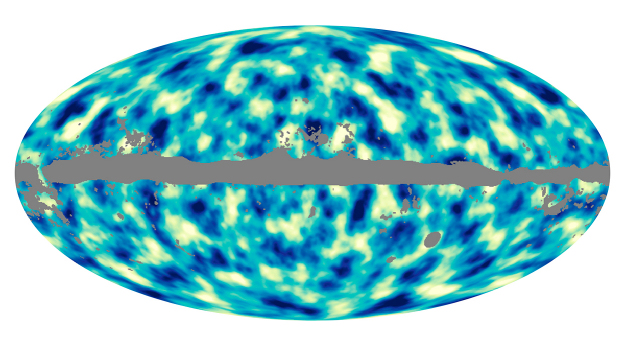
This all-sky image – released in 2013 – shows the distribution of dark matter across the entire history of the universe as seen projected on the sky. It’s based on data collected with the European Space Agency’s Planck satellite. Dark blue areas represent regions that are denser than their surroundings. Bright areas represent less dense regions. The gray portions of the image correspond to patches of the sky where foreground emission, mainly from the Milky Way but also from nearby galaxies, prevents cosmologists from seeing clearly.
There is currently a huge international effort to identify the nature of dark matter. Bringing an armory of advanced technology to bear on the problem, astronomers have designed ever-more complex and sensitive detectors to tease out the identity of this mysterious substance.
Dark matter might consist of an as yet unidentified subatomic particle of a type completely different from what scientists call baryonic matter – that’s just ordinary matter, the stuff we see all around us – which is made of ordinary atoms built of protons and neutrons.
The list of candidate subatomic particles breaks down into a few groups: there are the WIMPs (Weakly Interacting Massive Particles), a class of particles thought to have been produced in the early universe. Astronomers believe that WIMPs might self-annihilate when colliding with each other, so they have searched the skies for telltale traces of events such as the release of neutrinos or gamma rays. So far, they’ve found nothing. In addition, although a theory called supersymmetry predicts the existence of particles with the same properties as WIMPs, repeated searches to find the particles directly have also found nothing, and experiments at the Large Hadron Collider to detect the expected presence of supersymmetry have completely failed to find it.
Several different types of detector have been used to detect WIMPs. The general idea is that very occasionally, a WIMP might collide with an ordinary atom and release a faint flash of light, which can be detected. The most sensitive detector built to date is XENON1T, which consists of a 10-meter cylinder containing 3.2 tons of liquid xenon, surrounded by photomultipliers to detect and amplify the incredibly faint flashes from these rare interactions. As of July 2019, when the detector was decommissioned to pave the way for a more sensitive instrument, the XENONnT, no collisions between WIMPs and the xenon atoms had been seen.
Although WIMPs have long been the favored candidate for dark matter, they’re not the only candidates. The failure to find WIMPs, and the attendant frustration with not being able to account for a significant percentage of the universe’s mass, has led many scientists to look at possible alternatives.
At the moment, a hypothetical particle called the axion is receiving much attention. As well as being a strong candidate for dark matter, the existence of axions is also thought to provide the answers to a few other persistent questions in physics such as the Strong CP Problem.
Astronomer Fritz Zwicky first predicted the existence of dark matter in the 1930s following his observations of the Coma galaxy cluster.
The idea that there might be things in the universe which are invisible to us, that emit no light, has a long history going back hundreds of years to the days of Newton. With the discovery of so-called “dark nebulae” – clouds of interstellar dust blocking the light from background stars – and Pierre Laplace’s 18th-century speculations about objects which might swallow light, later to become known as black holes, astronomers came to accept the existence of a so-called “dark universe.”
But in modern times, it was astronomer Fritz Zwicky, in the 1930s, who made the first observations of what we now call dark matter. His 1933 observations of the Coma Cluster of galaxies seemed to indicated it has a mass 500 times more than that previously calculated by Edwin Hubble. Furthermore, this extra mass seemed to be completely invisible. Although Zwicky’s observations were initially met with much skepticism, they were later confirmed by other groups of astronomers.
Thirty years later, astronomer Vera Rubin provided a huge piece of evidence for the existence of dark matter. She discovered that the centers of galaxies rotate at the same speed as their extremities, whereas, of course, they should rotate faster. Think of a vinyl LP on a record deck: its center rotates faster than its edge. That’s what logic dictates we should see in galaxies too. But we do not. The only way to explain this is if the whole galaxy is only the center of some much larger structure, as if it is only the label on the LP so to speak, causing the galaxy to have a consistent rotation speed from center to edge.
Vera Rubin, following Zwicky, postulated that the missing structure in galaxies is dark matter. Her ideas were met with much resistance from the astronomical community, but her observations have been confirmed and are seen today as pivotal proof of the existence of dark matter. In honor of this crucial and historic piece of detective work toward establishing the existence of dark matter, the revolutionary Large Synoptic Survey Telescope, currently under construction in Chile and scheduled to see first light next year, was recently renamed the Vera C. Rubin Observatory.
Dark matter pioneer Vera Rubin (1928-2016). This image – taken at Lowell Observatory – is from 1965.
Some astronomers have tried to negate the need the existence of dark matter altogether by postulating something called Modified Newtonian dynamics (MOND). The idea behind this is that gravity behaves differently over long distances to what it does locally, and this difference of behavior explains phenomena such as galaxy rotation curves which we attribute to dark matter. Although MOND has its supporters, while it can account for the rotation curve of an individual galaxy, current versions of MOND simply cannot account for the behavior and movement of matter in large structures such as galaxy clusters and, in its current form, is thought unable to completely account for the existence of dark matter. That is to say, gravity does behave in the same way at all scales of distance. Most versions of MOND, on the other hand, have two versions of gravity, the weaker one occurring in regions of low mass concentration such as in the outskirts of galaxies. However, it is not inconceivable that some new version of MOND in the future might yet account for dark matter.
Although some astronomers believe we will establish the nature of dark matter in the near future, the search so far has proved fruitless, and we know that the universe often springs surprises on us so that nothing can be taken for granted.
The approach astronomers are taking is to eliminate those particles which cannot be dark matter, in the hope we will be left with the one which is.
It remains to be seen if this approach is the correct one.
Bottom line: Dark matter makes up some 27% of the universe according to astronomical theories. It cannot be seen or detected directly via the existing tools of astronomers, but its effect can be measured via its gravitational pull on ordinary matter.
Dark energy is one of the great unsolved mysteries of cosmology. It’s now thought to make up 68% of everything in the universe.
Illustration showing snapshots from a simulation by astrophysicist Volker Springel of the Max Planck Institute in Germany. It represents the growth of cosmic structure (galaxies and voids) when the universe was 0.9 billion, 3.2 billion and 13.7 billion years old (now).
Dark energy is the name given to the mysterious force that’s causing the rate of expansion of our universe to accelerate over time, rather than to slow down. That’s contrary to what one might expect from a universe that began in a Big Bang. Astronomers in the 20th century learned the universe is expanding. They thought the expansion might continue forever, or eventually – if the universe had enough mass and therefore enough self-gravity – reverse and cause a Big Crunch. Now, in early 21st century cosmology, that idea has evolved. The universe is seen as expanding faster today than billions of years ago. What could be causing the rate of expansion to increase? Astronomers now sometimes speak of a repulsive force as a possible way to understand it.
Up until the late 1990s, most cosmologists believed the universe did not have enough mass to cause a Big Crunch. In particular, data acquired by the 2dF Galaxy Redshift Survey and the Sloan Digital Sky Survey seemed to confirm the universe would expand forever, albeit at an ever-slowing rate as the universe’s own mass and own gravity tried to pull it back.
The first indication of something revolutionary about to be discovered came in 1998 during a survey of Type 1A supernovae. These massive explosions of dying giant stars are extremely useful to astronomers because they always output the same amount of light, and can therefore be used as so-called “standard candles” to calculate distances in the cosmos. This is a very simple idea. Think of fireflies at night: they all shine with the same instrinsic brightness. By measuring how bright they are from where you are, you can calculate their distance.
The 1998 survey was being carried out by two international group of astronomers including Americans Adam Riess and Saul Perlmutter, and Brian Schmidt in Australia. Using eight telescopes worldwide, their aim was to use the distance of Type 1A supernovae to calculate the expansion rate of the universe, known as the Hubble Constant (although in reality, as the rate of expansion of the universe varies with time, it is technically not a constant).
The results of the survey were astonishing. Distant supernovae which exploded when the universe was only 2/3 of its current age were much fainter than they should have been, and were thus much further away. The implication of this was that the universe had expanded much faster than it should have done, if current ideas were correct.
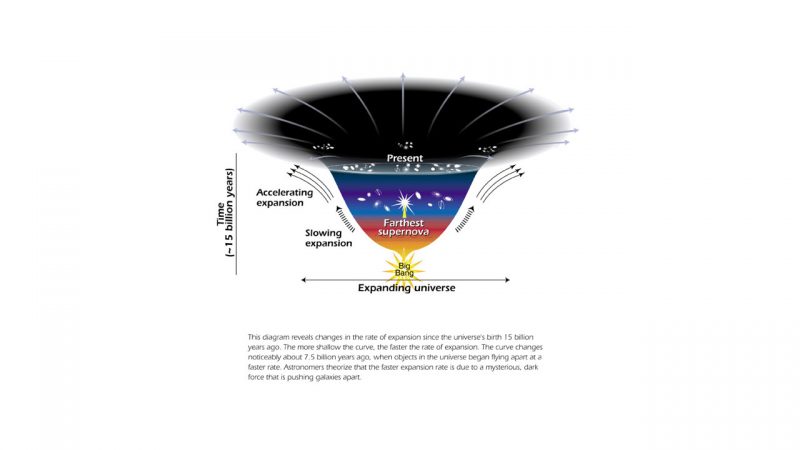
This diagram reveals changes in the rate of expansion since the universe’s birth 15 billion years ago. The more shallow the curve, the faster the rate of expansion. The curve changes noticeably about 7.5 billion years ago, when objects in the universe began flying apart at a faster rate. Astronomers theorize that the faster expansion rate is due to a mysterious, dark force: dark energy.
Met with much skepticism in the astronomical community when these results were revealed, the observations were soon replicated by other teams and other methods. By the turn of the millennium, it was becoming clear that the expansion of the universe is not, as was commonly believed, slowing down. It is actually accelerating.
Even more strangely, the expansion had been deaccelerating, as one would expect, until seven or eight billion years after the Big Bang. But then, for reasons completely unknown, a mysterious “anti-gravity force” started to dominate, overcoming the brake that gravity was placing on the expansion, which then reversed its slowdown and started to accelerate.
You can imagine how shocking this revelation was to astronomers and cosmologists.
The force responsible for this acceleration was dubbed dark energy by scientists. In this case, dark means unknown rather than literally dark, as is the case with dark matter. It should be noted that dark energy and dark matter are completely unrelated phenomena. Read more: What is dark matter?
To add to the mystery, the properties of this strange dark energy seem to match Einstein’s cosmological constant, sometimes called his fudge factor and later described by Einstein himself as the greatest professional blunder of his life. Einstein detested the idea of an expanding universe, preferring the static one postulated by steady-state cosmology, which was popular in the early 20th century. He invented an anti-gravity force, of undefined origin, to counteract the observed expansion of the universe, which would result in a non-expanding universe. However, Einstein later retracted this idea, which was not supported by observations.
Dark energy is one of the great unsolved mysteries of cosmology. It is now thought to make up 68% of everything in the universe, with normal, so-called “baryonic” matter – every bit of matter we can actually see – comprising a mere 5%, with the rest consisting of dark matter, another huge cosmic mystery.
Dark energy does behave like Einstein’s anti-gravity force, but its nature and origin remain unknown. One of its greatest mysteries is why dark energy started to dominate the rate of expansion of the universe at a particular point in time billions of years after the Big Bang. If it exists now, why wasn’t it there all along?
The physics of dark energy are highly speculative. One idea which has gained ground in recent years is that dark energy resembles a force known as “quintessence,” which is a relative of the Higgs Field. But as yet there is no observational evidence to support or discount this.
Cosmologists also have no idea if dark energy will continue to accelerate the universe’s expansion forever, leading to a scenario, far in the future, where the acceleration will overcome the forces that hold the universe together and literally tear all matter in the cosmos apart, in a nightmare scenario known as the Big Rip.
There are several current and future space missions and ground-based surveys which will investigate the nature of dark energy, including NASA’s orbiting WFIRST telescope and the international Dark Energy Survey, based in Chile.
It is hoped that soon we will arrive at a greater understanding of this mysterious force, which is having such an influence over the future of the cosmos, but to gain that understanding we need to sketch out a far more complete history of the universe. However, the archaeology of 13.7 billion years is extremely difficult and time-consuming, with so many ancient strata in that history missing or indistinct, so we cannot expect any sudden revelations.
Bottom line: The universe is expanding faster than older theories predicted. Dark energy, one of the great unsolved mysteries of cosmology, may cause its accelerating expansion. Dark energy is now thought to make up 68% of everything in the universe.
An international team of scientists has identified three new species of toothed pterosaurs – flying reptiles of the Cretaceous period, some 100 million years ago – that lived in an ancient river ecosystem in the African Sahara.
The new pterosaurs, described in a study published in the February 19, 2020, in the journal Cretaceous Research, were identified from chunks of jaws and teeth found in a geological formation in Morocco called the Kem Kem Beds. University of Portsmouth paleontologist David Martill is a study co-author. He told The Guardian:
These flying predators soared above a world dominated by predators, including crocodile-like hunters and carnivorous dinosaurs. Interestingly, herbivores such as sauropods and ornithischian dinosaurs are rare.
Many of the predators, including the toothed pterosaurs, preyed on a superabundance of fish.
For such large animals, they would have weighed very little. Their wingspans were around 10 to 13 feet [3 to 4 meters], with their bones almost paper-thin and full of air, very similar to birds. This allowed these awesome creatures to reach incredible sizes and still be able to take off and soar the skies.
Pterosaurs hunted from the air, using a set of large spike-like teeth to grab their prey. Large pterosaurs such as these would have been able to forage over hundreds of miles, with fossil evidence suggesting they flew between South America and Africa, similar to present-day birds such as condors and albatrosses, the researchers said.
Bottom line: Three new species of pterosaurs – flying reptiles – discovered.
For decades, numerous nations, all around the world, have done their utmost to try and harness the mysterious powers of the mind and utilize them as tools of nothing less than espionage. Sometimes, as we shall soon see, digging into matters of the mind can get one killed. Extra-sensory perception (ESP), clairvoyance, precognition, and astral-projection have all been utilized by the CIA, the KGB, and British Intelligence on more than a few occasions. As astonishing as it may sound, the world of psychic 007’s is all too real. It’s a subject that has been researched, with varying degrees of success, for decades. The earliest indications of serious interest on the part of the U.S. Government in the field of psychic phenomena are described in a formerly classified CIA document written in 1977 by Dr. Kenneth A. Kress – then an engineer with the CIA’s Office of Technical Services – and titled Parapsychology in Intelligence.
According to Kress:
“Anecdotal reports of extrasensory perception capabilities have reached U.S. national security agencies at least since World War II, when Hitler was said to rely on astrologers and seers. Suggestions for military applications of ESP continued to be received after World War II. In 1952, the Department of Defense was lectured on the possible usefulness of extrasensory perception in psychological warfare. In 1961, the CIA’s Office of Technical Services became interested in the claims of ESP. Technical project officers soon contacted Stephen I. Abrams, the Director of the Parapsychological Laboratory, Oxford University, England. Under the auspices of Project ULTRA, Abrams prepared a review article which claimed ESP was demonstrated but not understood or controllable.” Kress added: “The report was read with interest but produced no further action for another decade.”
Indeed, it was in the early 1970s that the research began in earnest (although, the FBI got involved in a strange affair in the 1950s). In April 1972, Dr. Russell Targ, a laser physicist with a personal interest in parapsychology and the power of the human mind, met with CIA personnel from the Office of Strategic Intelligence, specifically to discuss paranormal phenomena. Of paramount concern to the CIA was the fact that Targ informed them that the Soviet Union was deeply involved in researching psychic phenomena, mental telepathy and ESP. It did not take the CIA long to realize that the purpose of the Soviet research was to determine if ESP could be used as a tool of espionage. It was this realization that galvanized the CIA into action. As the Kress report stated, in 1973: “The Office of Technical Services funded a $50,000 expanded effort in parapsychology.”
The initial studies utilized a variety of people who were carefully and secretly brought into the project, and who demonstrated a whole range of seemingly paranormal skills. Those same skills could not be reliably replicated on every occasion, however. As evidence of this, Kenneth Kress informed his superiors that, “One subject, by mental effort, apparently caused an increase in temperature; the action could not be duplicated by the second subject. The second subject was able to reproduce, with impressive accuracy, information inside sealed envelopes. Under identical conditions, the first subject could reproduce nothing.” Similarly, some government-sponsored psychics in the period from 1973 to 1974 located secret missile installations in the Soviet Union, found terrorist groups in the Middle East, and successfully remote viewed the interior of the Chinese Embassy in Washington, D.C. Others, meanwhile, provided data that was sketchy and, at times, simply wrong. And it was the continuing rate of success versus the frequency of failure that led to heated debate within the CIA about the overall relevancy and validity of the project.
In Parapsychology in Intelligence, Kenneth Kress confirmed this. After the CIA’s remote viewing team attempted to broaden the range of its operation and secure extra funding in mid-1973, said Kress: “I was told not to increase the scope of the project and not to anticipate any follow-on in this area. The project was too sensitive and potentially embarrassing.” Despite this, the CIA’s research continued, with many of its advances due to a skilled remote-viewer named Pat Price, who had achieved a number of extraordinary successes in the field of ESP, including successfully remotely viewing a sensitive installation that fell under the auspices of the National Security Agency and psychically penetrating missile sites in Libya. Price’s sudden and untimely death from a heart attack in 1975 indirectly led the CIA – according to the official story, at least – to minimize its research into psychic espionage.
Tim Rifat, who has deeply studied the world of top secret, governmental research into psychic spying, says of Pat Price’s death: “It was alleged at the time that the Soviets poisoned Price. It would have been a top priority for the KGB to eliminate Price as his phenomenal remote-viewing abilities would have posed a significant danger to the USSR’s paranormal warfare buildup. He may also have been the victim of an elite group of Russian psi-warriors trained to remotely kill enemies of the Soviet Union.” Murder or just a heart-attack? Who knows?
It gets weirder: In his 1997 book Remote Viewers, Jim Schnabel told the story of the U.S. Intelligence community’s involvement in the controversial issue of psychic spying that largely began in the early-to-mid 1970s. Commenting on the skills of a talented remote-viewer in relation to matters of a UFO nature, one Pat Price, Schnabel noted Price was of the opinion that “…Alaska’s Mount Hayes, the jewel of a glacial range northeast of Anchorage, housed one of the aliens’ largest bases.” According to Pat Price, the aliens that lived deep inside Mount Hayes were very human looking, differing only in their heart, lungs, blood, and eyes. Ominously, he added that the aliens use “thought transfer for motor control of us.” Price added: “The site has also been responsible for strange activity and malfunction of U.S. and Soviet space objects.”
They say that breaking up is hard to do (OK, Neil Sedaka said it) but apparently it’s not so for what was believed to be a hardy comet known as 2I/Borisov which traveled to our solar system all the way from another one and did a flyby of the Sun in December 2019. Polish astronomers tracking the interstellar comet noticed two unexpected bursts of light from 2I/Borisov this month and are afraid it means the little space rock that could may be on its last leg … or tail … and could break up soon. Was it something we said?
“The total brightness increase is thus about 0.7 mag in 5 days between UT 2020 March 4.3 and 9.3. This behavior is strongly indicative of an ongoing nucleus fragmentation.”
2I/Borisov in its better days.
(NASA)
Sounding like car mechanics trying to baffle you with BS when what they really mean is that your Buick is in a bad way, astronomers from the Jagiellonian University in Krakow and the University of Warsaw wrote in The Astronomer’s Telegram that they’re seeing evidence that 2I/Borisov is disintegrating and may not make it out of the solar system, let alone back home or to another star. They are part of the OGLE (Optical Gravitational Lensing Experiment) project which searches for extrasolar planets, dark matter and galactic anomalies and is considered to be Poland’s greatest contribution to the field of astronomy since Copernicus.
“For Solar System comets, it is known that dynamically new comets are 10 times more likely to disintegrate than short-period comets, presumably due to their pristine state and weaker structural strength.”
According to Science Alert, the breakup isn’t exactly a surprise. 2I/Borisov acts like long-period or dynamically new comets from the Oort cloud, which travel much farther than the short-period comets from the Kuiper belt. Apparently, making those short 200-year orbits around the Sun toughen up these short-term comets, allowing them to do a tight turn around the Sun and live to tell the other Kuiper belt comets about it. Of course, being astronomers, the Polish 2I/Borisov team sees a silver lining in this comet’s cloud of cosmic dust and melting ice.
“As the comet disintegrates, observations of its spectrum will reveal its internal chemistry, including its nucleus. It’s an excellent opportunity to study the comet’s guts, and compare it to our Solar System comets, to see how similar or different they are.”
One last look.
As with all relationships, there’s always something to learn from the breakup. It’s the comet’s fault, not ours. Even if there wasn’t a breakup, it’s still gone for good, so there’s no sense in being blue or begging for it to stay. There’s always another one coming soon.
Not much of an inspiration for a song, but Neil didn’t have many hits after “Breaking Up Is Hard To Do” either.
EUROPEAN Space Agency (ESA) researchers have discovered that urine could be key to creating liveable human habitats on the Moon.
If humans want to live on the lunar surface they'll need shelter but will likely rely on local resources to make it.
The substance relies on a component called urea, found in urineCredit: CNSA
Space agencies across the globe have their sights set on colonising the Moon.
Scientists at the ESA have found that urea, a component of urine, could help them do this.
They found that when urea is mixed with lunar material, a kind of 'Moon concrete' is formed.
The researchers used a 3D printer to create cylinders of the new substances.
Space agencies have their sights set on colonising the MoonCredit: CNSA
After several tests they found that their urea-based 'Moon concrete' could support heavy weight and even got stronger over time.
This meant that it was able to stay in the desired shape.
The samples also remained fairly stable once heated to 80°C (176.0 °F).
Resistance was tested during eight freeze-thaw cycles, similar to those that occur on the Moon.
3D printing
Study researcher Ramón Pamies, a professor at the Polytechnic University of Cartagena in Spain, said: "To make the geopolymer concrete that will be used on the Moon, the idea is to use what is there: regolith [loose material from the Moon’s surface] and the water from the ice present in some areas.
"But moreover, with this study we have seen that a waste product, such as the urine of the personnel who occupy the moon bases, could also be used.
"The two main components of this body fluid are water and urea, a molecule that allows the hydrogen bonds to be broken and, therefore, reduces the viscosities of many aqueous mixtures."
Researcher Lena Kjøniksen added: "We have not yet investigated how the urea would be extracted from the urine, as we are assessing whether this would really be necessary, because perhaps its other components could also be used to form the geopolymer concrete.
"The actual water in the urine could be used for the mixture, together with that which can be obtained on the Moon, or a combination of both."
Nasa plans to send its next astronauts to the Moon by 2024.
Earlier this year it was revealed that Nasa scientists are working on a bizarre mushroom Moon and Mars base project.
This could see lunar homes for astronauts being built onsite out of living fungi.
The researchers have been conducting tests to determine if they could successfully grow mycelia fungus in outer space soil.
If the research goes to plan, future astronauts may be growing their own out of this world homes without the need to carry heavy and expensive building materials.
This could make it much easier and cheaper to colonise the Moon and even Mars.
The scientists have listed other advantages of using mushroom for structures including the fact it can grow and repair itself, is fire retardant and a good insulator.
Nasa also said that the fungi has higher bend strength than reinforced concrete so would be good for moulding into solid designs.
The Moon – our closest neighbour explained
Here's what you need to know...
The Moon is a natural satellite – a space-faring body that orbits a planet
It's Earth's only natural satellite, and is the fifth biggest in the Solar System
The Moon measures 2,158 miles across, roughly 0.27 times the diameter of Earth
Temperatures on the Moon range from minus 173 degrees Celcius to 260 degrees Celcius
Experts assumed the Moon was another planet, until Nicolaus Copernicus outlined his theory about our Solar System in 1543
It was eventually assigned to a "class" after Galileo discovered four moons orbiting Jupiter in 1610
The Moon is believed to have formed around 4.51billion years ago
The strength of its gravitational field is about a sixth of Earth's gravity
Earth and the Moon have "synchronous rotation", which means we always see the same side of the Moon – hence the phrase "dark side of the Moon"
The Moon's surface is actually dark, but appears bright in the sky due to its reflective ground
During a solar eclipse, the Moon covers the Sun almost completely. Both objects appear a similar size in the sky because the Sun is both 400 times larger and farther
The first spacecraft to reach the Moon was in 1959, as part of the Soviet Union's Lunar program
The first manned orbital mission was Nasa's Apollo 8 in 1968
And the first manned lunar landing was in 1969, as part of the Apollo 11 mission
In other space news, Space Force has successfully launched its first mission since its establishment as a US military service.
The Hubble Space Telescope has revealed new data about what may be the most powerful cosmic storm in the universe.
Here is a cool photo from NASA of the asteroid Eros. On it is a rectangular structure. The funny thing about it is that even NASA noticed this alien structure on the asteroid, but still didnt have the realization of what it actually was...an alien structure. NASA states: The large, rectangular boulder at the upper right is 45 meters (148 feet) across. So you see, NASA saw it but just didn't realize what it was at the time. Not sure how this slipped past them, but sure it wont last long if they find out. Scott C. Waring - Taiwan
From February through the first week of May, countless strange space anomalies and formations of UFOs appeared on the ISS live feed camera while passing the Earth.
Now, after three weeks, the ISS live feed has captured a second wave of these anomalies, clusters of UFOs and debris of unknown origin.
About these UFOs, the images show that these UFOs fly in large coordinated groups.
It is noteworthy that this second wave also follows the same flight path as the first wave, indicating that something is going on in deep space that forces all of these UFOs to flee to other locations.
You can watch this formation of UFOs live while they pass the earth (Starts at about 50 minutes into the video) at: http://www.ustream.tv/recorded/126204272
There are 2 major places that report of UFO sightings in Russia. The first is the M-triangle. Located at a distance of 600 miles from Moscow, the place is also known as Russia’s Area 51. The second one is Sochi. Alien space crafts and flying saucers have been regularly spotted by the locals. According to some people the Bythka Mountain in the area is a UFO base that serves as an airport for aliens between worlds.
This place is said to be landing – spot of space ships, coming from other Galaxies. Nearly everyone who visited this place experienced something unknown, enigmatic, some presence of miracle forces. Nearly everyone felt a unique comfort of soul. After first trip to M-zone people come back again.
The coronavirus pandemic hasn’t caused UFOs to stay home and that’s good news for those going stir-crazy in areas where their businesses and schools are closed and just want to go outside for some fresh air and a look upward. There’s been an increased number of UFO encounters of the orb kind, whose numbers have been fewer lately because of the infatuation with the Tic Tac UFOs. These recent sightings are literally all over the globe and figuratively all over the map when it comes to descriptions.
The first comes from Seattle in Washington State where YouTube user Denispin captured three orbs moving, changing positions and changing colors as they crossed the sky on March 20th, eventually being joined by a fourth. The UFOs started out as white orbs, then changed to red before going white again over the three minute phone video. (Watch the video here.)
As some commenters pointed out, this was just three days after another similar sighting over El Paso, Texas. Those seemed to stay in the same relative position in the sky. El Paso is home to the enormous Fort Bliss U.S. Army base and those orbs were most likely flares. Similarly, Seattle and sister city Tacoma are home to a number of U.S. military bases, including a couple of Air Force bases, and is a strategic West Coast defense location. While these orbs could be military planes or helicopters, their slow movement suggests drones (especially with the changing colors) or flares. However, they’re still open for speculation since there have been no official explanations as of this writing.
Another cause of UFO sightings
“Airline Pilot with 29 years service filmed a ‘Tic Tac’ UFO over Mexico”
A UFO sighting that might have a connection to the El Paso sightings just by way of proximity is this one over Monterrey in the Northern Mexico state of Nuevo Leon, which is roughly equidistant from both El Paso and San Antonio. (Watch it here.) Dated March 28th, most of the YouTube descriptions refer to the pilot’s experience and call it a “Tic Tic” UFO, although what appears to be the pilot’s description doesn’t make that connection.
“I have never in my life been witness to such phenomena however my first officer and i were in complete awe. i have multiple still photos and 4 videos that i would love to share with your network and with the world. forgive a slight delay in the submission as i had my doubts about reporting such occurrences but have no doubts as to what was witnessed. forgive some of the chatter and expletives but this was other worldly. i have still photos as well.”
Unfortunately, the identity of the pilot is not revealed so his claimed experience can’t be checked. Pilot sightings are generally given more credence that those ground-based, especially since they can better identify UFOs (which this one couldn’t) and pick them up on radar (which this one didn’t), leading the pilot to call it “an unidentified flying object, bro.” Based on the video and the comments, this doesn’t appear to be a ‘Tic Tac’ of the Nimitz kind since it’s not zipping around at unbelievable speeds and doesn’t appear on radar. Without any more to go on, this one is still an open-and-not-shut case of unidentified flying object … bro.
None of these UFO sightings appear to be lens flares like this one
The final video was alleged to have been taken on the evening of March 25 of one UFO flying over St. Petersburg in western Russia which then seemed to drop three more. (Watch it here.) The dropped orbs makes this appear to be a drone or plane dropping flares, and indeed those three objects eventually fall to the ground. At that point, the witness zooms in on the single orb and it appears to be three lights, which suggests it could be a triangular plane, although its slow movement still points to a drone. With St. Petersburg being such a strategic location in Western Russia, some military cause of these orbs is highly likely.
While the coronavirus shutdowns are obviously driving people outdoors to look at the sky, increasing their chances of seeing UFOs, are these orb sightings an indication of militaries stepping up their defenses (or offenses) in anticipation of things getting worse on an international scale?
There are some people in history who just seem to attract mysterious tales. Our story here revolves around a Russian scientist by the name of Genrikh Mavrikiyevich Ludvig, who was supposedly also an architect, philosopher, and a scholar of ancient languages. He was also apparently very at odds with the Stalin regime, which landed him in trouble on more than one occasion, and he was also known for his extensive knowledge of the occult and for his considerable esoteric knowledge. He had a vast knowledge of ancient Sumerian and Etruscan civilizations, and also of medicinal herbs. During World War II he was purportedly designer of military technology and also an invaluable pioneer of architectural plans for military bases in marshy environments. Yet, a very curious chapter of this mysterious man’s life was the time when he was allegedly allowed access to the secret Vatican archives and purportedly found all manner of evidence of ancient aliens within.
It is perhaps first important to understand just what the Vatican secret archives actually are. Comprised of approximately 53 miles of labyrinthine aisles of shelving harboring rows upon countless rows of texts, books, and scrolls ranging from the more modern to fragile, time-worn manuscripts reaching back 12 centuries into the shadows of time, the Vatican Archives, officially known as the Archivum Secretum Apostolicum Vaticanum, was originally constructed in 1612 by Pope Paul V and is a truly a huge treasure trove of information collected by the Church over hundreds of years. This vast repository of knowledge holds state papers, Holy See paperwork, papal correspondence and personal letters, and countless historical records, documents and texts accumulated by the Vatican from every corner of the known world that date back to the 8th century, all housed within a massive, carefully climate-controlled structure adjacent to the Vatican Library that is designed more like a fortress than a library, replete with impenetrable underground bunkers and with only one known heavily guarded entrance.
The list of known contents of the archives is far too long to completely cover here, but includes a wealth of historical documents including handwritten letters to the Pope from such important figures such as Mary Queen of Scotts asking for a pardon before her execution, King Henry VIII, Michelangelo asking to be paid for his work on the Sistine Chapel, Abraham Lincoln, Jefferson Davis, Grand Empress Dowager Helena Wang of China in the 17th century, one written on birch bark by the Canadian Ojibwe tribe in 1887, and many, many others. Here there are official edicts by Popes through the centuries, including excommunications such as that of German religious heretic and founder of Lutheranism Martin Luther, official papal decrees such as the one made in 1493 by Pope Alexander VI that split the entire known world among Spain and Portugal, as well as personal communications from popes throughout history. Here one can also find such gems as a nearly 200-foot long scroll containing details of the trials of the Knights Templar for heresy and blasphemy dating to 1307, as well as a handwritten transcript detailing the trial of astronomer Galileo Galilei in the 17th century, as well as the doctrine of the Immaculate Conception, which states that Mary was conceived without sin, scrawled out on a piece of parchment dating to 1854.
The Vatican Archives are often referred to as the Vatican Secret Archives, mostly due to a mistranslation of the Latin word secretum, which is actually closer in meaning to “personal” or “private” rather than “secret” or “confidential” as many think, but it could also have to do with the archive’s history of strict inaccessibility and reclusiveness from the outside world. They had been for centuries practically completely forbidden and closed off from nearly everyone, even Church officials, with not even Cardinals allowed access to their treasure trove of information, and it was not until 1881 that Pope Leo XIII allowed limited access to outsiders, yet this does little to dispel the secrecy surrounding the archives and it is still no small feat to enter this inner sanctum of all of the Vatican’s knowledge.
To gain access to these isolated archives and islands of knowledge one must be a qualified, recognized scholar or researcher who has been thoroughly vetted by the Holy See, a process which can take years. Amateur historians, journalists, students, or armchair researchers need not apply and are strictly forbidden. If one is lucky enough to be granted access they enter through the sole entrance, the well-guarded Porta Sant’Anna, after which they are required to state exactly what it is they are looking for among the voluminous collection. Once entering the rows of dusty old texts there is no browsing allowed, and you can only retrieve three documents listed in one of the thick, intimidatingly massive catalogs that are meticulously handwritten in Latin or Italian. If you cannot decide what you want to look at within a set amount of time under strict supervision you are ushered out of the archives and must wait until the following day to try again. Even if you do know what you want to look at there are still oppressive limitations on what is available for perusal. All materials in the archives are only released for public viewing after a full 75 years have passed, meaning newer documents are restricted, and even then there are large swaths of archived content that are totally off limits and probably forever will be.
In other words, this isn’t a library open to just anyone, yet in the 1920s, Ludvig was somehow granted access for reasons still left unclear. While there he supposedly was free to peruse the vast stores of manuscripts on offer, and came across some very bizarre things indeed. He would claim to have come across numerous texts on alchemy and ancient codes, and even stranger still manuscripts on UFOs and ancient aliens. According to Ludvig, there were texts outlining in detail how aliens had visited Earth many millennia ago and had managed to influence ancient civilizations such as the Egyptians, the Mayans, and the Mesopotamians. Some of the information he claimed to have gotten was about how the Egyptian pyramids were ancient energy machines, and he even said he had found historical records on nuclear weapons being used in ancient times, which had resulted in the melting of the fortress walls of Babylon, as well as plans for alien spacecraft.
None of this was allowed out of the Vatican archives, but Ludvig would apparently somehow get his hands on photographs of some of these documents, and the rest he would commit to memory and later write out as much as he could remember. He would show these too his own students, and apparently this was enough to get him accused of being a Vatican spy and imprisoned in a concentration camp in 1938. He would eventually be released and continue his work throughout World War II, keeping most of what he had seen in the Vatican to himself during these years, before taking most of it with him to his grave in 1973.
The story of Genrikh Mavrikiyevich Ludvig might have very well been forgotten and confined to the mists of time forever if it had not been discussed by Soviet mathematician Matest M. Agrest in the 1950s, and then later mentioned in the Russian publication Sovershenno Sekretno, in an article by writer and journalist Vladimir Kucharyants. It has since been picked up and much discussed among UFOlogists and ancient astronaut theorists, but one is left to wonder just how real any of this is. It is certain that he indeed was a real person, and was indeed an architect and occultist, but that is about all we know for sure. There is little corroborating evidence and very few sources available on his life, so who was Ludvig really, and did he really gain access to the secret Vatican archives and find all of this amazing information? If so, how did he manage to get photographs out of this veritable fortress of secrecy? One does not just waltz in to this place and take photographs of these secretive tomes. How much of this is true and how much is possibly urban legend? There has certainly been some skepticism of the claims, and skeptic Jason Colavito has said of it all:
Ludvig doesn’t seem to actually have been an ancient astronaut theorist in the 1920s and 1930s. Instead, the article talks about his belief in lost civilizations (the Sumerians, he said, were like a book whose first pages had been pulled out) and that ancient monuments had esoteric spiritual energy. The Pyramids, he said, could be activated with meditation. He spoke of astral projection and ascending to meet God in the spheres beyond earth. In other words, he sounds more like a Theosophist rather than a nuts-and-bolts ancient astronaut theorist, much like his contemporary, the émigré occultist Nicholas Roerich.
The only evidence that he believed in spacemen or that there was a nuclear bombing of Babylon comes from one of his former students, who recalled Ludvig talking of such issues much, much later—in the 1960s, the height of the Soviet ancient astronaut craze, when Matest M. Agrest, Alexander Kasantsev, and I. S. Shklovskii had popularized the idea. So, if I take the evidence at face value, it sounds like Ludvig had typical Theosophical-style esoteric ideas about ancient history in the 1930s and later converted to ancient astronaut beliefs in the 1960s, like many of his generation who saw parallels between the esoteric and ancient astronauts. As for the Vatican material, that is probably a combination of exaggeration, secondhand memory, and wishful thinking based on “interpretations” that the Russian scholar imposed on the source materials—source materials that are conveniently not cited by the only person to claim they existed, a student of his 50 years ago.
He does make a good point, and considering there are precious few sources for this story and it mostly revolves around the recollections of that one guy, it is left open to speculation as to whether Ludvig ever did make it into the catacombs of the Vatican archives and if so what he really found there. It is all rather mysterious, and although both the man and the archives are wreathed in myth and legend it is hard to know on this one where reality and fantasy lie and at what point they merge. It is all a rather interesting tale nevertheless, and with a lack of any further information will probably remain lost to history.
30 years later, we still don't know what really happened during the Belgian UFO wave
JevaLange
At first, the witnesses claimed, all you noticed were the lights.
They were so bright you could read by them, so brilliant that a policeman described them as "like lights on a huge football field." Only gradually did you notice the object they emitted from — a hulking triangular shape, with three enormous spotlights pointed toward the ground, and a red, flashing light at its center. "The whole thing," recalled the policeman, as if barely able to believe it himself, "was floating in the air."
It was a clear November night in 1989, near the town of Eupen, Belgium, which sits some seven miles from the German border. Heinrich Nicoll, the policeman, and his partner, Hubert Von Montigny, called their dispatcher to report the object they'd stumbled on while on a routine patrol. "Suddenly, they told me they were seeing a strange object in the sky," Albert Creutz, who was on the receiving end, told Unsolved Mysteries in a 1992 episode. "It made no noise. We joked about it and said it might be Santa Claus trying to land."
But by the time the evening was over, at least 30 different groups and three separate pairs of police officers would allege to have seen the unidentified flying object. And they wouldn't be the last. Belgium's months-long "UFO wave" culminated 30 years ago today — on March 30, 1990 — in a physics-defying chase through the skies over Europe as two Belgian Air Force F-16s pursued mysterious objects on their radars that they couldn't even see.
But, okay okay, did aliens really visit Belgium? It certainly seems deeply, deeply unlikely. Yet three decades later, it's still hard to entirely dismiss the 2,000-odd sightings that took place in the country between November 1989 and April 1990. As Patrick Ferryn, the president of the Belgian committee for the study of space phenomena, SOBEPS, told The Telegraph, "You must know that most of these sightings will have the most banal explanation but there is a residue, which we simply can't explain. And of those, there may be two or three where we may have questions over where they came from."
Lots can be ruled out, though. For example, a classic photograph of the triangle-shaped aircraft, known as the "Petit-Rechain picture," is without a doubt a hoax — the forger admitted as much when he came forward in 2011. "We made the model with polystyrene, we painted it, and then we started sticking things to it, then we suspended it in the air ... then we took the photo," the prankster confessed to Reuters. Brian Dunning, the writer and producer of the podcast Skeptoid, also refutes a number of the sightings, arguing that the November apparitions were in fact a helicopter, and that the police officers were interviewed by a biased ufologist. Conflicting information, published by Reuters, claims instead that the lights over Eupen were from "a Soviet satellite breaking up."
Regardless, where things really start to get strange is in March 1990. At that point, there had been months of sporadic sightings throughout Belgium, including by an army colonel, André Amond, who claimed to have seen the lights while driving in his car with his wife in December. The Belgian military, needless to say, was well aware of the descriptions pouring in from across the country, and it had little in the way of answers.
Then-Chief of Operations of the Air Staff, General Wilfried De Brouwer — who offered his account to investigative reporter Leslie Kean for her 2010 book UFOs: Generals, Pilots, and Government Officials Go on the Record — said that his initial belief was that the American military must have been testing some sort of experimental aircraft over his country. He went as far as to file inquiries with the U.S. Embassy in Brussels, prompting the Americans to create a memo, dryly titled "Belgium and the UFO Issue," which confirmed that "no USAF stealth aircrafts were operating in the... area during the periods in question."
The reports were credible enough, though, that Belgium's Air Force, federal aviation authorities, and police devised a plan to try to catch one of the unidentified intruders in action by preparing F-16s to quickly take off if a sighting was ever reported by both the police and a radar station at the same time. Sure enough, as De Brouwer recounts in UFOs, that night came on March 30, when "several policemen" and "two military radar stations" spotted an unknown object. "Once aloft, the [Belgian] pilots tried to intercept the alleged crafts, and at one point recorded targets on their radar with unusual behavior, such as jumping huge distances in seconds and accelerating beyond human capacity," De Brouwer writes.
But frustratingly, the pilots never managed to see the object they were pursuing. After analysis of the aircraft's readings, "the Air Force's decision was that the evidence was insufficient to prove that there were real crafts in the air on that occasion," De Brouwer reports. Still, throughout 1990, the Air Force was asked — and could never specifically account for — the sightings, which, all told, numbered in the thousands by the time they quietly started going away again in April.
Three decades later, explanations are still in short supply, although some scientists now consider the event to be an example of mass hysteria. Dunning, quoting UFO skeptic Philip Klass, writes, "Once news coverage leads the public to believe that UFOs may be in the vicinity, there are numerous natural and man-made objects which, especially when seen at night, can take on unusual characteristics in the minds of hopeful viewers. Their UFO reports in turn add to the mass excitement, which encourages still more observers to watch for UFOs."
But De Brouwer still believes otherwise. "I can conclude with confidence that the observations during what is now known as the Belgian wave were not caused by mass hysteria," he says in UFOs. "The witnesses interviewed by investigators were sincere and honest. They did not previously know each other. Many were surprised by what they saw and today ... they are still prepared to confirm their unusual experience."
What we do know for certain is that there is a lot we don't yet understand about our universe. Even the U.S. Army has multiple stories of chasing strange, impossible objects through the sky. While the Belgian UFO wave likely wasn't a visitation by little green men, it remains without a satisfying answer even all these decades and technological advances later. "Today there is not yet any explanation!" Amond, the colonel who saw the lights with his wife, told Kean. "That is a pity, because I want to know before dying. Give me a correct explanation of my sighting; that is all I can ask."
YouTube conspiracy channel Disclose Screen posted the video in a round-up of UFO sightings on March 28.
One viewer suggested: “I think one or two of these are the army and the police playing with their new toys.”
Another ridiculously claimed the coronavirus quarantine was part of the conspiracy, saying: “So I guess I'm not the only one questioning why they are keeping people in.”
In the past, conspiracy theorists have come up with numerous outlandish suggestions for what triangular UFOs are.
Some believe they are an example of a top-secret government fleet of craft known as the TR-3B.
The TR-3 Black Manta is the name of a supposed surveillance plane of the United States Air Force, speculated to have been developed under a black project.
It is said to be a supersonic stealth spy plane with a triangular design although has never been officially confirmed.
But others have more realistic views, previously offering suggestions of Chinese lanterns, drones or simply passenger planes.
(Credit: Charles Carter/Keck Institute for Space Studies via NASA)
On October 31, 1936, six young tinkerers nicknamed the “Rocket Boys” nearly incinerated themselves in an effort to break free of Earth’s gravity. The group had huddled in a gully in the foothills of California’s San Gabriel Mountains to test a small alcohol-fueled jet engine. They wanted to prove that rocket engines could venture into space, at a time when such ideas were widely met with ridicule. That goal was disrupted when an oxygen line caught fire and thrashed around wildly, shooting flames.
The Rocket Boys’ audacity caught the attention of aerodynamicist Theodore von Karman, who already worked with two of them at Caltech. Not far from the location of their fiery mishap, he established a small test area where the Rocket Boys resumed their experiments. In 1943, the site became the Jet Propulsion Laboratory (JPL), and von Karman its first director. JPL has since grown into a sprawling NASA field center with thousands of employees, yet it has managed to retain its founding motivation: test the limits of exploration, convention be damned.
They’ve had many successes over the years. In the early 1970s, JPL engineers built Pioneer 10, the first spacecraft to reach escape velocity from the solar system. A few years later, they followed up with Voyagers 1 and 2, the fastest of the many objects aimed at interstellar space. From the beginning of the Space Age to the launch of the Voyager spacecrafts — a span of just two decades — rocket scientists more than doubled flight speeds. But in the decades since, only one more spacecraft has followed the Voyagers out of the solar system, and nothing has done so at such a high speed. Now JPL’s rocketeers are getting restless again, and quietly plotting the next great leap.
The consistent theme of the new efforts is that the solar system is not enough. It is time to venture beyond the known planets, on toward the stars. John Brophy, a flight engineer at JPL, is developing a novel engine that could accelerate space travel by another factor of 10. Leon Alkalai, a JPL mission architect, is plotting a distant journey that would begin with an improbable, Icarus-esque plunge toward the sun. And JPL research scientist Slava Turyshev has perhaps the wildest idea of all, a space telescope that could provide an intimate look at a far-off Earth-like planet — without actually going there.
These are all long shots (not entirely crazy, according to Brophy), but if even one succeeds, the implications will be huge. The Rocket Boys and their ilk helped launch humans as a space-faring species. The current generation at JPL could be the ones to take us interstellar.
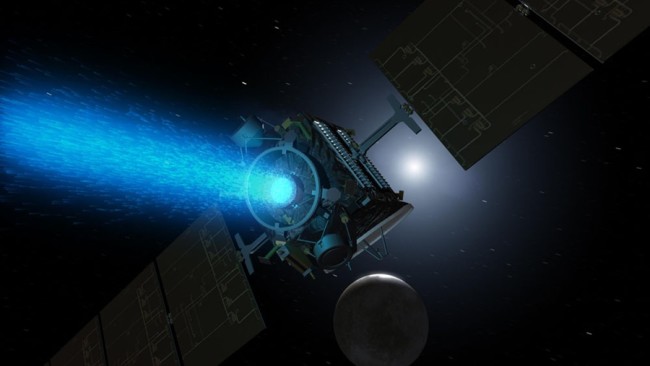
NASA's Dawn spacecraft used ion propulsion to explore Ceres. Future missions could take the tech even further.
(Credit: NASA-JPL/Caltech)
Rocket Reactions
For Brophy, inspiration came from Breakthrough Starshot, an extravagantly bold project announced in 2016 by the late Stephen Hawking and Russian billionaire Yuri Milner. The ultimate aim of the project is to build a mile-wide laser array that could blast a miniature spacecraft to 20 percent the speed of light, allowing it to reach the Alpha Centauri star system (our closest stellar neighbor) in just two decades.
Brophy was skeptical but intrigued. Ambitious aspirations are nothing new for him. “JPL encourages people to think outside the box, and my wacky ideas are getting wackier in time,” he says. Even by that standard, the Starshot concept struck him as a little too far from technological reality. But he did begin to wonder if he could take the same concept but scale it down so that it might actually be feasible within our lifetimes.
What especially captivated Brophy was the idea of using a Starshot-style laser beam to help deal with the “rocket equation,” which links the motion of a spacecraft to the amount of propellant it carries. The rocket equation confronts every would-be space explorer with its cruel logic. If you want to go faster, you need more fuel, but more fuel adds mass. More mass means you need even more fuel to haul around that extra weight. That fuel makes the whole thing heavier still, and so on. That’s why it took a 1.4 million-pound rocket to launch the 1,800-pound Voyager probes: The starting weight was almost entirely fuel.
Since his graduate student days in the late 1970s, Brophy has been developing a vastly more efficient type of rocketry known as ion propulsion. An ion engine uses electric power to shoot positively charged atoms (called ions) out of a thruster at high velocity. Each atom provides just a tiny kick, but collectively they can push the rocket to a much greater velocity than a conventional chemical rocket. Better yet, the power needed to run the ion engine can come from solar panels — no heavy onboard fuel tanks or generators required. By squeezing more speed out of less propellant, ion propulsion goes a long way toward taming the rocket equation.
But ion engines come with drawbacks of their own. The farther they get from the sun, the more limited they are by how much electricity their solar panels can generate. You can make the panels huge, but then you add a lot of weight, and the rocket equation slams you again. And ion engines have such gentle thrust that they can’t leave the ground on their own; it then takes them a long time in space to accelerate to their record-breaking speeds. Brophy knows these issues well: He helped design the ion engine aboard NASA’s Dawn spacecraft, which just completed an 11-year mission to asteroid Vesta and dwarf planet Ceres. Even with its formidable 65-foot span of solar cells, Dawn went from zero to 60 in an unhurried four days.
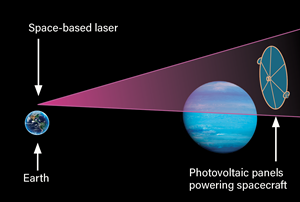
An orbiting laser system could power an ion propulsion vehicle through the solar system, and prove reusable.
(Credit: Jay Smith/Discover)
Ion the Prize
While Brophy was pondering this impasse between efficient engines and insufficient solar power, the Breakthrough Starshot concept came out, and it got the gears turning in his head. He wondered: What if you replaced sunshine with a high-intensity laser beam pointed at your spacecraft? Powered by the more efficient laser, your ion engine could run much harder while still saving weight by not having to carry your power source on board.
Two years after his epiphany, Brophy is giving me a tour of an SUV-size test chamber at JPL, where he puts a high-performance ion engine through its paces. His prototype uses lithium ions, which are much lighter than the xenon ions Dawn used, and therefore need less energy to attain higher velocities. It also runs at 6,000 volts compared with Dawn’s 1,000 volts. “The performance of this thing would be very startling if you had the laser to power it up,” he says.
There’s just one minor issue: That laser does not exist. Although he drastically downsized the Starshot concept, Brophy still envisions a 100-megawatt space-based laser system, generating 1,000 times more power than the International Space Station, aimed precisely at a fast-receding spacecraft. “We’re not sure how to do that,” he concedes. It would be by far the biggest off-world engineering project ever undertaken. Once built, though, the array could be used over and over, with different missions, as an all-purpose rocket booster.
As an example, Brophy describes a lithium-ion-powered spacecraft with 300-foot wings of photovoltaic panels powering a full-size version of the engine he is developing at JPL. The laser would bathe the panels in light a hundred times as bright as sunshine, keeping the ion engine running from here to Pluto, about 4 billion miles away. The spacecraft could then coast along on its considerable velocity, racking up another 4 billion miles every year or two.
At that pace, a spacecraft could rapidly explore the dim areas where comets come from, or set off for the as-yet-undiscovered Planet 9, or go ... almost anywhere in the general vicinity of the solar system.
“It’s like we have this shiny new hammer, so I go around looking for new nails to pound in,” Brophy says dreamily. “We have a whole long list of missions that you could do if you could go fast.”
Only the Voyager probes have passed the heliopause, leaving the sun’s influence. New probes may one day study the interstellar medium lying beyond.
(Credit: NASA-JPL/Caltech)
Interstellar Medium Well
After Brophy’s genial giddiness, it is a shock to talk to Alkalai, in charge of formulating new missions at JPL’s Engineering and Science Directorate. Sitting in his large, glassy office, he seems every bit the no-nonsense administrator, but he, too, is a man with an exploratory vision.
Like Brophy, Alkalai thinks the Breakthrough Starshot people have the right vision, but not enough patience. “We’re nowhere near where we need to be technologically to design a mission to another star,” he says. “So we need to start by taking baby steps.”
Alkalai has a specific step in mind. Although we can’t yet visit another star, we can send a probe to sample the interstellar medium, the sparse gas and dust that flows between the stars.
“I’m very interested in understanding the material outside the solar system. Ultimately, we got created from that. Life originated from those primordial dust clouds,” Alkalai says. “We know that there’s organic materials in it, but what kind? What abundances? Are there water molecules in it? That would be huge to understand.”
The interstellar medium remains poorly understood because we can’t get our hands on it: A constant blast of particles from the sun — the solar wind — pushes it far from Earth. But if we could reach beyond the sun’s influence, to a distance of 20 billion miles (about 200 times Earth’s distance from the sun), we could finally examine, for the first time, pristine samples of our home galaxy.
Alkalai wants answers, and he wants to see the results firsthand. He’s 60, so that sets an aggressive schedule — no time to wait for giant space lasers. Instead, he proposes a simpler, albeit still unproven, technology known as a solar thermal rocket. It would carry a large cache of cold liquid hydrogen, protected somehow from the heat of the sun, and execute a shocking dive to within about 1 million miles of the solar surface. At closest approach, the rocket would let the intense solar heat come pouring in, perhaps by jettisoning a shield. The sun’s energy would rapidly vaporize the hydrogen, sending it racing out of a rocket nozzle. The combined push from the escaping hydrogen, and the assist from the sun’s own gravity, would let the ship start its interstellar journey at speeds up to 60 miles per second, faster than any human object yet —and it only gets faster from there.
“It’s very challenging, but we’re modeling the physics now,” Alkalai says. He hopes to begin testing elements of a thermal-rocket system this year, and then develop his concept into a realistic mission that could launch in the next decade or so. It would reach the interstellar medium another decade after that. In addition to sampling our galactic environment, such a probe could examine how the sun interacts with the interstellar medium, study the structure of dust in the solar system and perhaps visit a distant dwarf planet along the way.
It would be a journey, Alkalai says, “like nothing we’ve done in the past.”
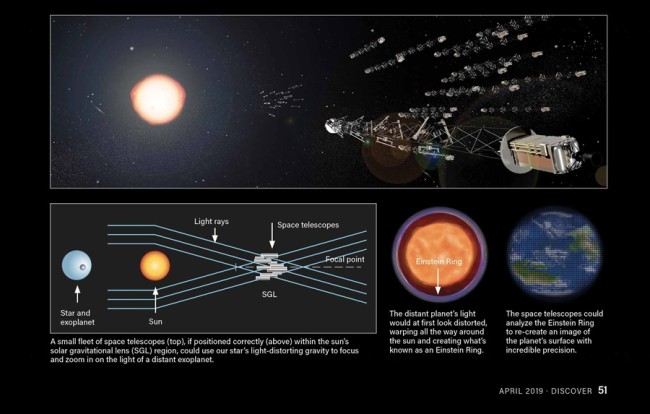
How a solar gravitational lens works.
(Credits: Courtesy of Slava Turyshev; The Aerospace Corp.; Jim Deluca/Jimiticus via YouYube (2); Jay Smith)
Catch A Glimpse
Solar thermal rockets and laser-ion engines, impressive as they may be, are still absurdly inadequate for crossing the tremendous gulf between our solar system and exoplanets — planets orbiting other stars. In the spirit of the Rocket Boys, Turyshev is not letting absurdity stop him. He is developing a cunning workaround: a virtual mission to another star.
Turyshev tells me he wants to send a space telescope to a region known as the solar gravitational lens (SGL). The area begins a daunting 50 billion miles away, though that’s still hundreds of times closer than our closest stellar neighbors. Once you get far enough into the SGL, something marvelous happens. When you look back toward the sun, any object directly behind it appears stretched out, forming a ring, and hugely magnified. That ring is the result of our star’s intense gravity, which warps space like a lens, altering the appearance of the distant object’s light.
If you position yourself correctly within the SGL, the object being magnified from behind the sun could be an intriguing exoplanet. A space telescope floating at the SGL, Turyshev explains, could then maneuver around, sampling different parts of the light ring and reconstructing the snippets of bent light into megapixel snapshots of the planet in question.
I have to interrupt him here. Did he say megapixel, like the resolution you get on your camera phone? Yes, he really is talking about an image measuring 1,000 by 1,000 pixels, good enough to see details smaller than 10 miles wide on a planet up to 100 light-years (600 trillion miles!) away.
“We could peek under the clouds and see continents. We could see weather patterns and topography, which is very exciting,” Turyshev says. He doesn’t mention it, but he doesn’t need to: That kind of resolution could also reveal megacities or other giant artificial structures, should they exist.
Assuming the JPL boffins can solve the transportation issues of getting to the SGL, the mission itself is fairly straightforward, if enormously challenging. Turyshev and his collaborators (Alkalai among them) will need to develop a Hubble-size space telescope,
or a mini-fleet of smaller telescopes, that can survive the 30-year journey. They will need to perfect an onboard artificial intelligence capable of running operations without guidance from home. Above all, they will need a target — a planet so intriguing that people are willing to spend decades and billions of dollars studying it. NASA’s TESS space telescope is doing some of that reconnaissance work right now, scanning for Earth-size worlds around local stars.
“Ultimately, to see the life on an exoplanet, we will have to visit. But a gravity lens mission allows you to study potential targets many decades, if not centuries, earlier,” Turyshev says merrily.
A journey to the SGL would take us beyond Alkalai’s baby steps, well onto the path toward interstellar exploration. It’s another audacious goal, but at least the odds of catching fire are much lower this time around.
10 reasons why Aliens likely exist (however won’t visit us at any point in the near future)
It’s a numbers game, and likelihood proposes outsiders are out there
Most researchers concur that outsider life in all likelihood exists known to mankind some place. Our universe contains in the locale of 300 billion stars, and we’re presently finding planets going around these stars. The more we look, and the more innovation we put out there, the a greater amount of these exoplanets we find. Until now, we have distinguished around 4,000 – and that is simply in our system. In the event that we take a gander at the universe overall, at that point there are roughly 200 billion cosmic systems. For what reason would life simply happen here? “We’re quite persuaded it’s out there,” says space researcher Maggie Aderin-Pocock. “It is absolutely a numbers game. It is likelihood.”
We definitely know about many conceivably livable planets
We can gauge the airs of these exoplanets utilizing a method called spectroscopy. This is the place starlight goes through the environment of the exoplanet, permitting us to do a concoction examination. On the off chance that we recognize the sort of substances we find in Earth’s climate, it wouldn’t really affirm such there’s reality out there – yet it’s a solid sign that it’s conceivable. “We are aware of many possibly tenable planets,” says Professor Tim O’Brien. “We’re in all likelihood – inside the following decade or somewhere in the vicinity – going to discover a planet that may well even show potential proof forever.”
We’ve discovered life on earth in places that we didn’t figure life might exist
At the point when we’re mulling over the presence of life past our planet, it merits thinking about that we’ve found organisms occupying spaces on Earth where the possibility of endurance was already incomprehensible. These lifeforms depend on well-known DNA – so it’s life as we probably am aware it – yet they exist in the profound channels of our seas, far away from daylight. Previously, we accepted life could just exist on a planet, a specific good ways from its neighborhood star (so it has the correct degrees of radiation). Discovering life on Earth flourishing where we didn’t think it potential has made us fully aware of the idea that there may be moons ready to help life as well.
The existence that is out there may not be canny life
Most researchers are certain about the odds of life existing known to mankind. What we don’t know is if there’s clever life. “For the greater part of the historical backdrop of life on Earth it was straightforward life. It was bacterial life for billions of years truth be told,” says Tim. Furthermore, it was a progression of chance occasions that prompted the advancement of even multicellular life on our planet. For outsider life to reach, it should be genuinely – and mechanically – progressed.
Insightful lifeforms might be living in conditions that make correspondence troublesome
With 300 billion stars in the Milky Way, numerous with heavenly bodies, and ten billion years or more in which a civilisation could have emerged right now, is hard to accept that no lifeform ever arrived at where it could traverse interstellar separations. As the incomparable Italian physicist Enrico Fermi stated, it’s difficult to clarify why outsiders haven’t made it to Earth. In any case, there are methods for clarifying why this hasn’t occurred, says Maggie: “Our most serious issue is we just have one case of life, and such is reality on this planet.”
We need to break new ground. For instance, she says, “In the event that you live by a star which is very dynamic, you may live beneath the ground… It doesn’t imply that shrewd life isn’t out there however you probably won’t have the methods for transmitting since you live underneath the surface.”
Or on the other hand we might be attempting to convey to one another utilizing contradicting techniques
When enormous telescopes like the one at Jodrell Bank Observatory were fabricated, researchers understood that if there was a civilisation out there with a comparable piece of innovation, we may have the option to get signals sent from one to the next. “We’ve currently utilized radio telescopes to tune in out for signals from extra-earthly civilisations since around 1960,” says Tim who is Director of Jodrell Bank. Be that as it may, there are such a significant number of various manners by which a lifeform may impart signs, we could spend our lives searching for them and get no place. It’s conceivable that we simply haven’t hit upon the correct strategy.
Stars are so far away, it could take a large number of years for an extra-earthbound message to contact us
Just as technique for correspondence, separation represents an enormous deterrent. For another undertaking called Breakthrough Listen, researchers are looking through a million of the closest stars, but at the same time they’re taking a gander at stars that are in our Milky Way, 25,000 light years away. A message sent from one of these stars would need to go in the area of 25,000 years before it even contacted us. On the off chance that outsider life is out there, it could take a huge number of years before we hear a peep from it.
To reach, our civilisation and an outsider civilisation need to exist simultaneously
An outsider civilisation additionally needs to exist simultaneously as people. It’s conceivable that extra-terrestrials have reached Earth – even visited – yet it was path back in the Jurassic time, when dinosaurs meandered the earth, thus we basically don’t think about it. “On the off chance that our civilisations don’t cover,” says Maggie, “at that point we will never meet the outsiders.” Perhaps they came quite a while prior, or they’ll come later on, long after human life has terminated.
Long separation space travel isn’t yet workable for us – and may not be for them
It’s at present past our capacities to send an enormous shuttle between the stars. As things stand, we can send radio waves at the speed of light – however that is only a radio wave, going through the vacuum of room. In the event that we need to send physical mass out into the ether, as tests or individuals, at that point it gets much all the more testing.
Leap forward Starshot, a task supported by Stephen Hawking before he kicked the bucket, is investigating the choice of utilizing a sun based sail – a sheet of metallised plastic that sits in space – to transmit objects into our nearby planetary group. It would include an immense bank of lasers shooting photons up to hit the sun based sail, move their force, and send the sun oriented sail quickening off at up to a fifth of the speed of light. As energizing as this may be, it would at present take a hundred years to arrive at a planet 20 light years away – and current innovation implies we can’t send anything heavier than one gram in weight. People unquestionably won’t get out there at any point in the near future! What’s more, it’s exceptionally conceivable that any outsiders haven’t broke intergalactic space travel either.
Extraterrestrials need to really need to visit us
Regardless of whether lifeforms with innovation unmistakably further developed than our own exist, they need to need to reach. Any outsiders out there may feel emotionless about us Earthlings! Also, they may not be excessively excited about going between the stars for a huge number of years so as to find a good pace individual. This could likewise clarify why we’ve never had extraterrestrial appearances – they’re essentially upbeat where they are.
Geologists say the worm-like creature – about the size of a grain of rice – is the 1st ancestor on the family tree that contains most animals today, including humans.
Geologists say they have discovered a fossil of the first ancestor on the family tree that contains most animals today, including humans. The fossil of the extinct worm-like creature was discovered in deposits in Nilpena in South Australia belonging to the Ediacaran Period, an interval of geological time ranging 635 to 541 million years ago.
The tiny creature, called Ikaria wariootia, lived about 555 million years ago and was about the size of a grain of rice. According to the study, published March 23, 2020, in the peer-reviewed journal Proceedings of the National Academy of Sciences, it is the earliest bilaterian, or organism with a front and back, two symmetrical sides, and openings at either end connected by a gut.
The development of bilateral symmetry, scientists say, was a critical step in the evolution of animal life, giving organisms the ability to move purposefully and a common, yet successful, way to organize their bodies. A multitude of animals, from worms to insects to dinosaurs to humans, are organized around this same basic bilaterian body plan.
For the new research, University of California/Riverside scientists Scott Evans and Mary Droser used a 3-D laser scanner to analyze miniscule oval impressions near fossilized burrows found in 555 million-year-old Ediacaran Period deposits in Nilpena, South Australia. Their research revealed the regular, consistent shape of a cylindrical body with a distinct head and tail and faintly grooved musculature. The animal ranged between 2-7 millimeters (up to about a quarter of an inch) long and about 1-2.5 millimeters (up to about a tenth of an inch) wide, just the right size to have made the burrows. Evans said in a statement:
We thought these animals should have existed during this interval, but always understood they would be difficult to recognize. Once we had the 3-D scans, we knew that we had made an important discovery.
A 3-D laser scan of an Ikaria wariootia impression.
In spite of its relatively simple shape, Ikaria was complex compared to other fossils from this period. It burrowed in thin layers of well-oxygenated sand on the ocean floor in search of organic matter, indicating rudimentary sensory abilities. The depth and curvature of Ikaria represent clearly distinct front and rear ends, supporting the directed movement found in the burrows.
The burrows also preserve crosswise, “V”-shaped ridges, suggesting Ikaria moved by contracting muscles across its body like a worm, known as peristaltic locomotion. Evidence of sediment displacement in the burrows and signs the organism fed on buried organic matter reveal Ikaria probably had a mouth, anus, and gut.
Bottom line: Geologists have discovered the fossil of a worm-like creature that they say is the first ancestor on the family tree that contains most animals today, including humans.
There are at least two bright spots in these strange times: Telescopes are still studying distant galaxies and penguins are still pooping across Antarctica. In both cases, if you're looking for new ways to pass the time while you stay home, you can help out scientists studying these phenomena.
Citizen science is nothing new, but it's a particularly appealing option as the spreading coronavirus prompts containment measures around the world. So if you'd like to take your mind off current events for a while, consider chipping in on a research project.
"I think where we can tap into people's enthusiasm through their computer, that kind of captures the zeitgeist of coronavirus: what can we do when we're all trapped at home," Heather Lynch, a statistical ecologist at Stony Brook University in New York, told Space.com.
Lynch is affiliated with two different citizen-science projects aimed at better understanding penguins, which, listen, we know are not in space. One of those projects, called Penguin Watch and accessible here, enlists people to identify the birds in photographs taken automatically near their colonies. But the other relies on satellite imagery to identify such colonies.
Penguins are so, hmm, productive, that biologists find the birds by combing through satellite imagery looking for swaths of their poop, which scientists call guano. "So we can map out how much area is covered in guano, and that gives us a really good estimate of how many penguins were actually at the colony at that particular location," Lynch said.
Such estimates are valuable data that's otherwise difficult to acquire, she said. "Even though penguins are the most charismatic and maybe the most obvious wildlife to survey in Antarctica, until recently, we knew relatively little about how many penguins there were in Antarctica and how their abundance was distributed because surveying Antarctica is so difficult."
That's where the satellites come into play. Lynch and her colleagues use data gathered by a few different types of orbital systems. Commercial satellites offer data that is quite detailed, NASA's Landsat program offers a 40-year perspective on penguin activities and Google Earth pulls in publicly accessible satellite data that citizen scientists can comb through.
Satellite imagery of the Danger Islands, where scientists discovered previously unknown Adelie penguin colonies. (Image credit: NASA)
It's that data that supports Lynch's Mapping Application for Penguin Populations and Projected Dynamics project. The main goal of the initiative is to provide Antarctic policymakers with more comprehensive data about penguin populations in one place. But the scientists need help locating all those birds, and for that, they enlist what they call penguin detectives.
"The citizen science part of this comes in because there's just so much of Antarctica," Lynch said. "The way that we find penguin colonies is by and large through manual searching of imagery: image after image, foot by foot, scanning the coastline for evidence of penguin guano."
And the uncooperative buggers sometimes relocate without bothering to tell the scientists looking for them. "Every time we think that we've found all the penguin colonies," Lynch said, "we soon discover that we find more, or that new colonies are being established over time, because of climate change, for example."
And maintaining an accurate map of penguin colonies is crucial if humans want to enact policies that keep the tuxedoed birds safe. For example, Lynch and her colleagues surveying Landsat imagery spotted some colonies of Adelie penguins on what's called the Danger Island archipelago.
When they visited the area to follow up on those observations, they found more penguins than they had ever imagined, even though they thought they'd found all the Adelie colonies in Antarctica. "In fact, these were some of the biggest Adelie penguins colonies in the world," Lynch said. "It was this sort of undiscovered hotspot of Adelie penguins."
That discovery has been passed along to policymakers who are deciding where to draw the borders of a marine protected area in the region. "It was exactly that kind of impact that we want to have," Lynch said.
But if penguin poop, even penguin poop from space, doesn't sound like your thing, here's an alternative: check out some weird-looking galaxies. You can do that through another citizen-science project, called Galaxy Zoo.
The program has been around for more than a decade, enlisting volunteers to classify the shapes of galaxies. That's the sort of task that anyone can do. "You don't even need to know what a galaxy is," Chris Lintott, an astrophysicist at the University of Oxford, told Space.com. And although the shape isn't difficult to determine, it is valuable information to have.
"The shape of a galaxy tells you about its history: it tells you about when it accreted material, when it collided with other galaxies, when it formed stars and all sorts of other things," Lintott said. "But astronomers are quite good at getting images of galaxies and less good at sorting through the data." Hence, turning to the public. After a brief training session, volunteers are turned loose on the scientists' supply of images.
"We don't need people to spend hours contemplating a particular system unless they want to, just a guess and you get another galaxy," Lintott said. "Many people describe it as a bit like eating a packet of chips. You take one, you take another, you take another, and you can surf your way through the universe that way."
And recently, the project instituted a new twist that ensures things stay interesting. Although the Galaxy Zoo project was born of the premise that humans were better at classifying galaxies than computers, 12 years has changed the game a bit. Now, the project has added an algorithm, which takes care of the galaxies that are easiest to classify and saves the stranger ones for participants.
Galaxies come in a host of shapes, which can tell scientists about the history of these structures. (Image credit: NASA, ESA, and G. Bacon, J. DePasquale, F. Summers, and Z. Levay (STScI))
Identifications made by Galaxy Zoo volunteers have recently allowed scientists to determine that black holes at the center of galaxies grow steadily, not through collisions of the structures around them.
Having humans involved in the process is valuable, Lintott said, because of their willingness to notice things an algorithm might not. "People get distracted, and they're distracted along the way by the unexpected and the unusual," Lintott said. "We've found new types of galaxy and new sorts of things in the sky because somebody who was taking part in the project did a very human thing and just said, 'This is unusual. I don't know what this is.'"
And because the program pulls data automatically from observatory programs, bringing fresh images to the site, there's always something new to see. "You might well be the first person ever to see that galaxy," Lintott said. "Just by logging onto the website, you can literally see something that no one has ever seen before."
A next-generation crew spacecraft that China is preparing for a flight test this spring appears to be capable of docking with the International Space Station (ISS).
An image posted by the Shanghai Academy of Spaceflight Technology (SAST) shows the new spacecraft’s docking system, which appears compatible with the International Docking System Standard (IDSS).
NASA, the European Space Agency and Russia's federal space agency, known as Roscosmos, use IDSS-compatible systems or adapters. These are in use on the ISS to facilitate rendezvous and docking with spacecraft.
The new spacecraft is designed to boost China's capabilities in sending humans into orbit, reduce costs through partial reusability and allow astronauts to survive the radiation environment and high-speed reentries of deep-space missions.
The as-yet-unnamed spacecraft is 28.9 feet (8.8 meters) long with a mass at liftoff of 23.8 tons (21.6 metric tons). It will be capable of carrying six astronauts, or three astronauts and 1,100 lbs. (500 kilograms) of cargo to China’s planned space station.
A prototype of the next-gen crewed spacecraft is being prepared for a test flight at the Wenchang Satellite Launch Center. Launch on a Long March 5B rocket is expected in mid- to late April.
The IDSS docking mechanism is androgynous. A first such system was developed and used for the 1975 Apollo-Soyuz Test Project, meaning neither the U.S. nor Soviet spacecraft had "male" or "female" mechanisms.
China has demonstrated rendezvous and docking capabilities with Shenzhou crewed spacecraft and the Tiangong-1 and Tiangong-2 space labs, as well as with the Tianzhou cargo spacecraft.
The rendezvous systems on spacecraft, which facilitate the maneuvering and matching of vectors and velocities for close approaches, may, however, need to be adapted to be compatible.
But even if the new Chinese crewed spacecraft can technically rendezvous and dock with the ISS, it is currently not possible politically.
While China cooperates with ESA and Russia, the United States has effectively excluded China from the ISS project. The US government in 2011 introduced text into legislation, referred to as the "Wolf Amendment," that severely restricts opportunities for NASA and other agencies from bilateral cooperation with entities linked to the Chinese government.
The test flight of the new spacecraft will also test China's Long March 5B launch vehicle. If successful, the new rocket will subsequently be used to launch the 20-metric-ton modules of the Chinese Space Station.
While looking through Sol 1448 of Mars, I noticed a strange creature on the hillside. The object seems to be a species of lizard, but unlike anything we have here on Earth. This create has massive hind legs and two front thinner legs. Six legs in total. The animal has a short reptile like tail that curls at its end. The head of the creature is more similar to that of a mammal than a reptile. Its tall ears bent forward like a dogs, its long snout area and thick mouth area also similar to that of a dog. Perhaps its living species of pet that people on Mars preferred to keep company with? Hard to say, but it would be nice if the rover drove a bit closer to see this animal in more detail.
Mysterious bright UFO-like object suddenly appears on the surface of the Moon
Amysterious bright UFO-like object suddenly appeared on the surface of the Moon captured in a live telescope footage on March 29, 2020.
Strange ‘lights’ have been seen on the moon before and often, this phenomenon is associated with UFOs or extraterrestrial activities on the moon.
A possible explanation for these lights is the so-called ‘Transient Lunar Phenomenon' which is a short-lived light, color, or change in appearance on the surface of the Moon.
Claims of short-lived lunar phenomena go back at least 1,000 years, with some having been observed independently by multiple witnesses or reputable scientists. Most lunar scientists will acknowledge that transient events such as outgassing and impact cratering do occur over geologic time: the controversy lies in the frequency of such events.
It has been suggested that effects related to either electrostatic charging or discharging might be able to account for some of the transient lunar phenomena.
It is possible that the strange light is such a 'transent Lunar Phenomenon', however we can not rule out that the object is of extraterrestrial origin.
Extraterrestrial researchers have claimed they spotted a sliver UFO during a livestream from one of the Starlink satellites of SpaceX.
The mysterious object was observed during the livestream on March 18.
Using Falcon 9 rockets, Space X successfully launched into orbit 60 Starlink satellites at the end of February, the fourth Starlink’s overall launch.
Alien hunters actually noticed two UFOs within 20 seconds, but the closer one was more visible. They observed its detail as a silver bowl with vast and fat domes on top and bottom. They also noticed the side disk edges were small and thin.
NASA scientists argued that all the reported strange UFO sightings were nothing more than “space dandruff” hovering in front of cameras.
According to former NASA engineer James Oberg, these spots of dandruff can be anything from flakes of ice, parts of chipped paint in zero gravity, or ISS insulation that has broken off.
However, some UFO hunters don’t believe these kinds of mundane explanations, saying that they only meant to push away the public from the truth.
The Starlink network currently composed of more than 200 satellites. The government plans to have 22 launches this year to form a constellation of hundreds of satellites for the creation of a global broadband internet network.
Acfer 086is one of a large collection of meteorites found in the Algerian Sahara desert.
The small space rock was found in Agemour, Algeria, in 1990 and weighed only 173 grams.
Acfer 086 is classified as a CV3 carbonaceous chondrite, and shows a low level of shock and a moderate degree of weathering.
In a new study, Dr. McGeoch and her colleagues from PLEX Corporation and Bruker Scientific LLC analyzed a sample of Acfer 086 from the Harvard Mineralogical and Geological Museum.
Using mass spectrometry, they detected the signal of an unusual iron- and lithium-containing protein.
Further analysis showed the new protein was mainly composed of glycine and hydroxyglycine amino acids.
“This is the first report of a protein from any extraterrestrial source,” the researchers wrote in their paper.
“Room temperature extracts from micron-sized meteorite particles contain polymers of amino acids with a definite chain length centered at 16 residues.”
“Analysis via iron and lithium isotope satellites in mass spectrometry reveals a novel protein motif with iron atoms closing out the ends of anti-parallel peptide chains composed of glycine.”
Model of the hemolithin molecule: space-filling mode (top), ball and stick (center), enlarged view of iron, oxygen and lithium termination (bottom). White = H; orange = Li; gray = C; blue = N; red = O and green = Fe. Hydrogen bonds are shown by dotted lines.
Image credit: McGeoch et al, arXiv: 2002.11688.
Dubbed hemolithin, the newly-discovered protein is believed to have been created approximately 4.6 billion years ago.
“The principal indicator of extraterrestrial origin is an extreme raised D/H (deuterium/hydrogen) ratio that is revealed by close quantitative fitting of isotopic satellite peaks,” the scientists wrote.
“The average molecular deuterium excess above terrestrial is (25,700 ± 3,500)%0, or a D/H ratio of (4.1 ± 0.5) x10-3, comparable to cometary levels, interstellar levels and also equal to the highest prior report in micrometeorites.”
“Very high deuterium content indicates proto-solar disk or molecular cloud origin,” they added.
The team’s paper was posted on the arXiv.org preprint server in February 2020.
_____
Malcolm W. McGeoch et al. 2020. Hemolithin: a Meteoritic Protein containing Iron and Lithium. arXiv: 2002.11688
Space Physicists Find Plasmoid in Magnetosphere of Uranus
Uranus possesses an intrinsic magnetic field that encircles the ice giant and influences the local space environment. The solar wind plasma, made up of charged particles, flows away from the Sun and interacts with Uranus’ magnetic field to form what is called a planetary magnetosphere. In a new study, a duo of space physicists at NASA’s Goddard Space Flight Center analyzed high-resolution magnetic field data collected by Voyager 2 during the Uranus flyby in 1986 and found that the spacecraft flew through a plasmoid— a giant bubble filled with planetary plasma — in the tail of Uranus’ magnetosphere.
Uranus in natural colors.
Image credit: NASA / ESA / Hubble Team / Erich Karkoschka, University of Arizona.
Little known at the time of Voyager 2’s flyby, plasmoids have since become recognized as an important way planets lose mass.
These giant bubbles of plasma pinch off from the end of a planet’s magnetotail, the part of its magnetic field blown back by the Sun like a windsock.
With enough time, escaping plasmoids can drain the ions from a planet’s atmosphere, fundamentally changing its composition.
They had been observed at Earth and other planets, but no one had detected plasmoids at Uranus — yet.
Dr. Gina DiBraccio, a space physicist at NASA’s Goddard Space Flight Center and project scientist for the Mars Atmosphere and Volatile Evolution (MAVEN) mission, and her colleague, Dr. Dan Gershman, analyzed data from Voyager 2’s magnetometer.
With no idea what they’d find, they zoomed in closer than previous studies, plotting a new datapoint every 1.92 seconds.
Smooth lines gave way to jagged spikes and dips. And that’s when they saw it: a tiny zigzag with a big story.
“Do you think that could be … a plasmoid?” Dr. Gershman asked Dr. DiBraccio, catching sight of the squiggle.
The plasmoid they found occupied a mere 60 seconds of Voyager 2’s 45-hour-long flight by Uranus. It appeared as a quick up-down blip in the magnetometer data.
“But if you plotted it in 3D, it would look like a cylinder,” Dr. Gershman said.
Comparing their results to plasmoids observed at Jupiter, Saturn and Mercury, they estimated a cylindrical shape at least 204,000 km (127,000 miles) long, and up to roughly 400,000 km (250,000 miles) across.
Like all planetary plasmoids, it was full of charged particles — mostly ionized hydrogen, the researchers believe.
Readings from inside the plasmoid — as Voyager 2 flew through it — hinted at its origins.
Whereas some plasmoids have a twisted internal magnetic field, Dr. DiBraccio and Dr. Gershman observed smooth, closed magnetic loops. Such loop-like plasmoids are typically formed as a spinning planet flings bits of its atmosphere to space.
“Centrifugal forces take over, and the plasmoid pinches off,” Dr. Gershman said.
According to their estimates, plasmoids like that one could account for between 15 and 55% of atmospheric mass loss at Uranus, a greater proportion than either Jupiter or Saturn. It may well be the dominant way Uranus sheds its atmosphere to space.
How has plasmoid escape changed Uranus over time? With only one set of observations, it’s hard to say.
“Imagine if one spacecraft just flew through this room and tried to characterize the entire Earth. Obviously it’s not going to show you anything about what the Sahara or Antarctica is like,” Dr. DiBraccio said.
But the findings help focus new questions about the planet. The remaining mystery is part of the draw.
“It’s why I love planetary science. You’re always going somewhere you don’t really know,” Dr. DiBraccio said.
The findings were published in the journal Geophysical Research Letters.
Fossils of a new dromaeosaur date to the end of the Age of Dinosaurs
Newly discovered species suggests these fierce predators were diversifying right up to the end
Dineobellator notohesperus (illustrated in foreground) was a fierce, feathered predator that lived about 68 million years ago, alongside horned dinosaurs like Ojoceratops and sauropods like Alamosaurus (background).
A wolf-sized warrior, kin to the fierce, feathered Velociraptor, prowled what is now New Mexico about 68 million years ago.
Dineobellator notohesperus was a dromaeosaur, a group of swift, agile predators that is distantly related to the much larger Tyrannosaurus rex. The discovery of this new species suggests that dromaeosaurs were still diversifying, and even becoming better at pursuing prey, right up to the end of the Age of Dinosaurs, researchers say March 26 in Scientific Reports.
That age came to an abrupt close at the end of the Cretaceous Period about 66 million years ago, when a mass extinction event wiped out all nonbird dinosaurs. A gap in the global fossil record for dromaeosaurs near the end of the Cretaceous had led some scientists to wonder whether the group was already in decline before the extinction, says Steven Jasinski, a paleontologist at the State Museum of Pennsylvania in Harrisburg (SN: 4/21/16). The new find suggests otherwise.
A skeletal reconstruction of D. notohesperus shows that the dromaeosaur, one of a group of agile predators, was about the size of a modern wolf. Analyses of over 20 fossil bits revealed that the dinosaur had feathers and was likely stronger than the closely related Velociraptor.S. JASINSKI
Since 2008, Jasinski and his colleagues have recovered more than 20 fossilized pieces of the new species from the Bisti/De-Na-Zin Wilderness, a rapidly eroding region of barren badlands in northwestern New Mexico. Analyses of muscle attachment sites on the fossilized forelimbs suggest the dinosaur was unusually strong for a dromaeosaur, with a very tight grip in its hands and feet. That grip, Jasinski says, was likely stronger than that of its famous kinfolk, Velociraptor and Utahraptor, giving the new species extra weaponry in its pursuit of prey.
Like many other dromaeosaurs, D. notohesperus had feathers, evidenced by the presence of quill nobs — bumps indicating where the feathers were attached — on its limbs (SN: 9/19/07). But, like Velociraptor, it probably used the feathers for purposes other than flight, Jasinski says, such as sexual selection, camouflage or added agility while on the hunt.
If Pluto has a subsurface ocean, it may be old and deep
New research hints that liquid water might be common at the solar system’s edge
NASA’s New Horizons spacecraft revealed Pluto’s largest impact basin, Sputnik Planitia, which makes up part of the dwarf planet’s famous heart-shaped feature. The basin may hide a subsurface sea.
A suspected subsurface ocean on Pluto might be old and deep.
New analyses of images from NASA’s New Horizons spacecraft suggest that the dwarf planet has had an underground ocean since shortly after Pluto formed 4.5 billion years ago, and that the ocean may surround and interact with the rocky core.
If so, oceans could be common at the solar system’s edge — and may even be able to support life. That possibly “transforms the way we think about the Kuiper Belt,” the region of icy objects beyond the orbit of Neptune (SN: 3/27/19), says planetary scientist Adeene Denton of Purdue University in West Lafayette, Ind.
On its pass through the Kuiper Belt in 2015, New Horizons revealed that despite the dwarf planet’s location nearly 6 billion kilometers from the sun, Pluto showed signs of hosting an ocean of liquid water beneath an icy shell (SN: 9/23/16).
How much liquid may lie beneath Pluto’s ground, how long it’s been there, and how much the water may have partially frozen over time is hard to tell from the surface. The new research, which had been scheduled for presentation the week of March 16 at the canceled Lunar and Planetary Science Conference in The Woodlands, Texas, has dug into those questions.
Dark lines (circled) on the surface of Pluto, shown in this image from NASA’s New Horizons spacecraft, could mark ripples created when a large object probably slammed into the opposite side of the dwarf planet.NEW HORIZONS TEAM
“If there’s an ocean today, it raises the question of, when did that ocean get there?” says planetary scientist Carver Bierson of the University of California, Santa Cruz.
Bierson considered two possible histories for Pluto’s potential ocean. If the dwarf planet had a “cold start,” any subsurface water would first have been frozen before melting under heat from decaying radioactive elements in the dwarf planet’s core, only to partially freeze again over time. In that scenario, Bierson expected to see cracks and ripples across Pluto’s icy shell from the orb’s contraction as the ice melted and then expansion as water refroze. Contracting would make the ice crumple into mountainlike features, while expanding would stretch the ice and create faults and graben.
Bierson’s second scenario envisioned a “warm start” for Pluto, where the ocean would have been liquid for nearly all of Pluto’s 4.5-billion-year existence. In that case, the surface would show only cracks from the sea expanding as it partially froze. And that’s exactly what Bierson and colleagues found in New Horizon’s images, suggesting that Pluto’s liquid ocean is nearly as old as the dwarf planet itself.
“That means maybe Pluto did start off warm,” Bierson says. “Maybe it started with a liquid ocean really early on.”
In a separate study, Denton and colleagues considered the impact that formed Sputnik Planitia, the left lobe of Pluto’s distinctive heart-shaped basin. Because of how New Horizons flew past Pluto, scientists’ view of half the dwarf planet is fuzzy. But the team was able to see lines on Pluto’s surface on the exact opposite side of the globe from Sputnik Planitia, the researchers reported in October 2019 at arXiv.org. Those lines might be the imprints of shock waves from a massive impact that formed the enormous basin, Denton says.
“If the impact is large enough … the planet itself can act like a lens, and focus the wave energy at the exact opposite point on the planet from the impact,” she says.
Pluto’s internal structure would have controlled how those shock waves shuddered through the dwarf planet. Looking at the cracks in the surface ice could give clues to the thickness of the proposed ocean or the core’s chemical makeup. So Denton and her colleagues ran computer simulations of an impact to look for clues.
“We got the fun answer,” she says. To explain the lines seen on the dwarf planet, not only would Pluto need a large ocean, 150 kilometers or more in thickness, but the core must contain minerals, such as serpentine, that form through interactions between rock and water. Astrobiologists think that water-rock interactions could provide energy and nutrients for life (SN: 5/19/15). The possibility of a somewhat soggy core could let life get a toehold at the fringes of the solar system, Denton says.
“It’s certainly not exactly a smoking gun,” she says. “But it’s exciting.”
The possibility that Pluto has a habitable ocean raises the odds that other Kuiper Belt objects do too, says planetary scientist James Tuttle Keene of NASA’s Jet Propulsion Laboratory in Pasadena, Calif., who is a member of the New Horizons team but was not involved in either study.
“This lays out one of the coolest hypotheses that a future Pluto mission could test,” he says. “If Pluto can have an ocean and potentially be habitable, it’s very likely that other bodies in the Kuiper Belt also are ocean worlds and also are potentially habitable.”
They’re called trans-Neptunian objects, or TNOs. Astronomers analyzed data from the Dark Energy Survey – which just completed 6 years of observations – to find over 100 new little worlds in the cold outer reaches of our solar system.
Computer-generated concept of the rotation of a trans-Neptunian object, in this case the small world we call Haumea. This little world is egg-shaped because of its fast rotation; its “day” is just under 4 hours long. Meanwhile, its “year” – or orbit around the sun – lasts about 285 Earth-years. Haumea is also known to have a ring and 2 tiny moons.
Objects like Haumea, depicted above, are minor planets, called trans-Neptunian objects, or TNOs. They orbit in the cold outer reaches of our solar system, out beyond Neptune, taking hundreds of years to orbit the sun once. There are estimated to be perhaps 70,000 TNOs, each at least 60 miles (100 km) across. This month, astronomers at the University of Pennsylvania announced that they’ve successfully pinpointed over 100 new TNOs. As with all known planets, moons and minor planets in our solar system, each one of these little worlds is sure to be unique. The new study also outlines a new approach for finding even more of these far-off worlds.
The updated peer-reviewed findings were published in The Astrophysical Journal Supplement Series on March 10, 2020.
The results come from data obtained by the Dark Energy Survey (DES), which just completed six years of observations this past January. DES’s focus, as the name implies, is to study dark energy, but it is also well-suited to finding TNOs and other smaller solar system objects beyond Neptune. DES typically looks at galaxies and supernovas, so the researchers needed to devise a new way to track movements of much smaller and closer objects. Grad student Pedro Bernardinelli, who led the study, said in a statement:
Dedicated TNO surveys have a way of seeing the object move, and it’s easy to track them down. One of the key things we did in this paper was figure out a way to recover those movements.
Locations of the new TNOs discovered in the DES dataset from the first four years. The outline shows DES’s search range and the color of each dot shows how far away the object is in astronomical units (one AU is the sun-Earth distance, 93 million miles or 150 million km). Two of the detections were more than 90 AU, over 8 billion miles (13 billion km) away.
The number of TNOs you can find depends on how much of the sky you look at and what’s the faintest thing you can find.
So how did the researchers find all of these TNOs?
Images from the first four years of DES data contained about 7 billion “dots” that are all of the possible objects able to be detected by the DES software. But many of those would be data errors or larger objects like stars, supernovas or galaxies, which are actually much farther away. Bernardinelli removed any objects that were visible in the same locations on multiple nights, narrowing down the list to about 22 million candidates. He then looked at those objects to see if any of them formed pairs or triplets. That would help the researchers see where those objects might appear on subsequent nights.
That process whittled down the list of candidates much further still, down to about 400 objects. Bernardinelli said:
We have this list of candidates, and then we have to make sure that our candidates are actually real things.
Size comparison of the largest TNOs, including Pluto.
Some of those candidates might still not be actual TNOs, however. So how to figure out which ones are, if any?
The researchers looked for additional images of the objects of interest. According to Bernstein:
Say we found something on six different nights. For TNOs that are there, we actually pointed at them for 25 different nights. That means there’s images where that object should be, but it didn’t make it through the first step of being called a dot.
Another method to ferret out any real TNOs was to stack the images, creating a sharper view. This helped to further sort out real objects from false ones. Bernardinelli said:
The most difficult part was trying to make sure that we were finding what we were supposed to find.
In the end, 316 confirmed TNOs were found in the DES data. Of those, 145 are new objects, not previously discovered. These TNOs range from 30 to 90 times the distance of Earth from the sun. By comparison, Pluto, the best-known TNO (and dwarf planet), is 40 times that distance.
The Blanco Telescope dome at the Cerro Tololo Inter-American Observatory in Chile. The telescope used the Dark Energy Camera (DECam) for the Dark Energy Survey.
Finding over 300 TNOs overall is impressive, especially for a survey that isn’t even intended to look for them as a primary goal. The researchers think that as many as 500 may be found in the DES data once they rerun their analysis on the entire dataset. Also, the same techniques can now be used in additional astronomical surveys, such as by the new Vera C. Rubin Observatory. Bernardinelli said:
Many of the programs we’ve developed can be easily applied to any other large datasets, such as what the Rubin Observatory will produce.
These kinds of datasets could even help scientists finally find the long-sought-after Planet Nine, a hypothetical giant planet about the size of Neptune that may orbit the sun in the extreme outer fringes of the star system, much farther than Pluto. By studying the orbits of additional newly-found TNOs, researchers might finally be able to determine Planet Nine’s location, if it does indeed exist. As Bernstein said:
There are lots of ideas about giant planets that used to be in the solar system and aren’t there anymore, or planets that are far away and massive but too faint for us to have noticed yet. Making the catalog is the fun discovery part. Then when you create this resource, you can compare what you did find to what somebody’s theory said you should find.
PedroBernardinelli at University of Pennsylvania, who led the new TNOs study.
Even if Planet Nine isn’t found, however, the datasets of these intriguing little worlds will provide a wealth of new information about how they – and other planets, moons, asteroids and comets – first formed in the early history of our solar system.
Bottom line: Researchers using the Dark Energy Survey have found over 100 new minor planets beyond Neptune. They’re called trans-Neptunian objects, or TNOs.
One Scientist’s Alternate Theory If The UFOs Weren’t Created By Aliens
JAZZ SHAW
We haven’t touched on this topic in a while, but in my desperate search to find some news (any news!) not having to do with the you-know-what, I ran across this interesting item. A physicist from the University of Albany and a former scientist for NASA, Kevin Knuth, was interviewed about his recent work involving unidentified aerospace phenomena (UAPs, or UFOs as I still insist on calling them). He shares a number of his thoughts about the subject, including the work he’s been doing analyzing the performance data of the objects seen in the Navy UFO videos that
Given the data showing that the objects can accelerate almost instantly, at roughly 5,000 times the base acceleration rate of gravity, the idea that we’re observing some sort of conventional advancement of current human technology is highly unlikely. Knuth says he isn’t completely “married” to the idea that these are definitely extraterrestrial in nature. That’s one possibility, but there’s another one out there worth considering. These might have been built by humans after all, just not humans that most of us are aware of. (Altamont Enterprise, emphasis added)
Before the coronavirus hit, Knuth was scheduled to give a lecture at the Carey Institute for Global Good in Rensselaerville, where he would have presented the findings of his most recent study into the acceleration patterns of some of these unidentified crafts, which he says are up to 5,000 times the acceleration of gravity and indicate an unnatural, and inhuman, origin.
“That is the data,” Knuth said. “Now the trick is looking for an explanation.”
Knuth said that he’s not entirely married to the concept of these sightings as evidence of extraterrestrial life, acknowledging that there are two working hypotheses that he entertains while approaching each incident. One is that the encounters are perpetrated by extraterrestrials. The other, known as the “Wakanda hypothesis” in reference to the eponymous fictional kingdom in the Black Panther comic series, considers the possibility of an Earth-based civilization that has “extreme technology,” Knuth said.
“For me, it suggests that we missed some physics somewhere,” Knuth said on how he reconciles the still relatively unpopular field of UFO research with more mainstream branches of science.
Knuth isn’t just looking at the subject from his chalkboard at the university. He’s now a member of UAP eXpeditions, which we’ve discussed here previously. That means he’s working alongside the likes of Kevin Day (who was present at the USS Nimitz UFO incident) and quantum physicist Deep Prasad, who talked to us about UAP eXpeditions last year.
Later this spring, the group will be taking two ships out in the Pacific off the coast of southern California and Mexico and running tests to attempt to detect the presence of UFOs in the region. But how does the currently available data about the tic-tacs and orbs line up with the idea that these could be the property of human beings not associated with any terrestrial governments that we’re aware of?
This is the stuff of some real flights of fancy, but since everyone is on lockdown anyway, we might as well bat it around. Some of the folks in the ufology field are convinced of the realities of UFOs, but still believe that the vastness of space makes it unlikely that any other species would be able to reach us. I don’t tend to agree, but I suppose it’s still a plausible argument to put forward. So if the technology didn’t come from “somewhere else” but it also wasn’t cooked up by the United States, the Russians or the Chinese, who does that leave?
How about a conspiracy theory concept that’s been around for a long time? Maybe they were created by a breakaway civilization. It’s the idea that at some point in the past, a group of humans left the fold of humanity and went… somewhere else. (The most common proposition is that they went underground.) And there, they began developing amazing technologies in secret and raced ahead of the rest of us.
Before your eyes glaze over entirely, as I mentioned above, I’m not a proponent of this theory, though I find it highly entertaining. But here’s one thought to chew on that could tie the reports of the Nimitz encounters to this idea. If the UAPs keep showing up off the coast of southern California, is it possible that their owners have a base in the area? That would certainly be more convenient than having to commute back and forth between Earth and the Sirius star system, right? But how could there be such an advanced, technological base here on Earth without us having discovered it? Well… what if it’s underwater? Like way underwater.
It’s regularly been noted that we know more about the surface of Mars now than we do about the deeper bits of the ocean floor. And in the tale of David Fravor’s account of his encounter with the tic-tac, the full reports indicated that the craft (or one very like it) emerged from the water before it started flitting around in the sky. A second report claimed (I can’t verify this one yet) that one of our submarines operating in the area at the time, possible as part of the same training exercise, reported an underwater contact moving at unbelievable speeds on sonar. If we’re to accept that these things are real and they wanted to stay out of sight, a hole in the ocean floor might be a perfect choice, no?
As I said, this is mostly just a flight of fancy to entertain ourselves until UAP eXpedtiions finish their work and (hopefully) finds something. But if you don’t believe that these things were built by extraterrestrials and you don’t like the breakaway civilization theory, what’s left? I think at that point we’re down to time-traveling humans coming back to check on us from the distant future. Of course, if that’s the case, it’s still good news because it means that we eventually survive the thing I promised not to mention in this article. Stay safe out there, folks. (I mean, of course, safe from alien abductions.)
IMAGE: SCIENCE PHOTO LIBRARY - MEHAU KULYK VIA GETTY IMAGES
A weird, unidentified X-ray signal radiating out of nearby galaxies has perplexed scientists ever since it was first detected in 2014. Now, a promising study into its origins has come up empty-handed, meaning that whatever is causing the faint signature is currently unknown to us and more mysterious than ever.
The origins of the faint glow, which emits 3.5 kiloelectronvolts (keV) of energy, are especially intriguing because the signal matches key predictions about the nature of dark matter, a mysterious substance from which most of the universe is made. For years, scientists have debated whether the glow was long-sought evidence of a hypothetical particle that makes up dark matter. A clear answer to that question could finally unravel the true nature of dark matter, which is the “holy grail of astroparticle physics at the moment,” said Benjamin Safdi, an astrophysicist at the University of Michigan, in a call.
Well, Safdi and his colleagues have good and bad news on that front. The good news is that the researchers pioneered an innovative new method to search for dark matter around our home galaxy, the Milky Way, which is outlined in a study published on Thursday in Science.
The bad news is that the hunt came up empty, and that effectively rules out dark matter as the source of the signal. “On the one hand, this was not the outcome that we were hoping for,” Safdi said. “We were certainly hoping to discover dark matter.”
“On the other hand, we’re really excited that we now have this better method to look for dark matter,” he added. “We didn’t discover dark matter this time, but there's no reason to think that we won’t in the future.”
Scientists know that dark matter exists because they can see its gravitational pull on galaxies and other radiant objects. But because this form of matter does not emit light, researchers are literally left in the dark about most of its properties.
Many theoretical models have been proposed to explain dark matter, such as the existence of a particle called a sterile neutrino. Scientists have suggested that sterile neutrinos might slowly decay in a somewhat similar process to radioactive particles here on Earth.
“We know that dark matter is pretty stable because it was created at the Big Bang and it’s still around today billions of years later," Safdi explained. “If it decays, it must decay very slowly.”
REPRESENTATION OF X-RAY EMISSION LINE CONCENTRATED AROUND THE CENTER OF THE MILKY WAY (IN BLACK AND WHITE).
IMAGE: ZOSIA ROSTOMIAN AND NICHOLAS RODD/BERKELEY LAB; AND CHRISTOPHER DESSERT AND BENJAMIN SAFDI/UNIVERSITY OF MICHIGAN
Even with a long half-life, this speculative decay of sterile neutrinos might produce a very small amount of light, which would mean that dark matter is not completely black. The 2014 study, which was published in The Astrophysical Journal, appeared to detect exactly this type of signature, causing a major splash in the dark matter research community.
“There was pretty intense debate, over the years following this paper, trying to understand whether or not this emission was coming from dark matter or ordinary matter within these galaxies,” Safdi said.
Safdi had assumed that the question would be cleared up by the slick observational capabilities of Japan’s Hitomi satellite, an X-ray observatory that launched in 2016. But due to multiple malfunctions, Hitomi fell apart after just six weeks in space, and no equivalent replacement for it has filled the gap in X-ray observations since.
Though the loss was disappointing, Safdi and his colleagues soon began ruminating on other ways to study the 3.5 keV emission line. “We asked the question: What can we do with the existing data?” he recalled. “We realized that there was a very natural analysis to do with the data from the XMM Newton space telescope, which has been in the sky for over 20 years.”
The team searched through every image and datasat captured by XMM Newton, launched in 1999 by the European Space Agency. By removing the portions of images that contained luminous objects, Safdi and his colleagues were able to analyze two decades of negative “blank” sky.
If sterile neutrinos were decaying around the Milky Way, the signature would have been extremely bright in this dataset. Alas, the search revealed only empty space.
“That tells us very definitively that this line that was observed in other galaxies is not coming from dark matter decay,” Safdi said. “But that doesn’t mean that the 3.5 keV line doesn’t exist. Likely what is causing that emission is some currently unknown process going on within those galaxies that has to do with the ordinary matter, not the dark matter.”
It’s possible that the 3.5 keV emission is caused by specific elements within the hot gases of the galaxy clusters, or interactions between hot plasmas and cold gas clouds, according to the study.
Ultimately, the new results leave scientists with two mysteries to solve: the origins of this eerie glow and the true identity of dark matter. Safdi and his colleagues are optimistic that novel techniques and next-generation observatories will be able to constrain both of these tantalizing questions.
“The exciting thing right now about the field of dark matter is that, from a data-driven perspective, we have absolutely no idea what dark matter is at a real microscopic level,” Safdi said. “Sterile neutrinos are one model, but there are many other models out there.”
For most of us around the world, our way of life has significantly changed in the last few weeks. Although America is only recently being confronted with the global reality that is the current coronavirus pandemic, with more than 82,000 U.S. citizens infected it now has more confirmed cases than Italy, and even China, where the outbreak first emerged.
“As the number of known cases reached into the hundreds, then the thousands, then the tens of thousands, life across the country has changed in swift, profound ways,” the New York Times reports alongside an updated map with numbers of infections per county across the country.
As the evolving coronavirus situation continues to keep us on edge, many industry leaders in virology, health care, technology, and the intelligence community say they were aware that such a pandemic was not only possible but that it was just a matter of time.
Business magnate and Microsoft co-founder Bill Gates has been talking about the threat of future pandemics for years. Back in 2015, as concerns about the possible outbreak of Ebola were still fresh on our minds, he was looking ahead at the possibility that a future outbreak could indeed be far worse.
Bill Gates meeting U.S. Secretary of Defense James Mattis
(public domain).
“As awful as this epidemic has been, the next one could be much worse,” Gates wrote about a TEDx talk he gave in 2015. “The world is simply not prepared to deal with a disease—an especially virulent flu, for example—that infects large numbers of people very quickly. Of all the things that could kill 10 million people or more, by far the most likely is an epidemic.”
It was recently reported that Gates also advised President Trump on pandemic preparedness two years ago, saying that “The president was kind enough to spend time with me, and one of the issues I brought up is this opportunity to build new tools that would help us deal with a pandemic.”
Gates isn’t the only person who had been expressing such concerns.
In his recent book Flu Hunter: Unlocking the secrets of a virus, Virologist Robert G. Webster, an authority on avian flu, said in December that the next pandemic was “just a matter of time.”
Webster’s thoughts on such an imminent threat are prescient, to say the least:
“It is sobering to realise that, after nearly 100 years of studying the 1918 influenza, we still do not know precisely why the virus was such a killer; nor are we significantly better prepared to deal with a repeat event.
“Nature will eventually again challenge mankind with an equivalent of the 1918 influenza virus. We need to be prepared.”
A particularly sobering view was offered byJeremy Konyndyk, former director of the Office of U.S. Foreign Disaster Assistance under USAID, in a Politico article from 2017, where he noted that every U.S. President since Ronald Reagan has faced a similar health crisis:
“A major new global health crisis is a question of when, not if. Every president dating back at least to Ronald Reagan has dealt with major and unexpected outbreaks—HIV/AIDS, SARS, bird flu, Ebola, Zika. In recent years the world has been fortunate that these outbreaks have been either highly contagious (the 2009 H1N1 “swine flu” pandemic infected up to 200 million people), or highly fatal (the H5N1 “bird flu” strain had a fatality rate of up to 60 percent)—but not both at once.”
However, it was what Konyndyk had to say about a future pandemic that was particularly sobering.
“At some point a highly fatal, highly contagious virus will emerge,” Konyndyk said, “like the 1918 ‘Spanish flu’ pandemic, which infected one third of the world’s population and killed between 50 and 100 million people.”
“We assess that the United States and the world will remain vulnerable to the next flu pandemic or large-scale outbreak of a contagious disease,” a 2019 Worldwide Threat Assessment stated, “that could lead to massive rates of death and disability, severely affect the world economy, strain international resources, and increase calls on the United States for support.”
The potential threat of such a virus has been an item of speculation and future forecasts for far longer than just the last decade, as other recentMUarticles have suggested. Many have even pointed out that in a 2008 book, the late psychic Sylvia Browne wrote that “In around 2020 a severe pneumonia-like illness will spread throughout the globe, attacking the lungs and the bronchial tubes and resisting all known treatments.”
It cannot be denied that Browne made such a prediction, although some take issue with the accuracy of the forecast, as Benjamin Radford recently noted:
Covid-19 is not “a severe pneumonia-like illness” (though it can in some cases lead to pneumonia)… Browne also says the disease she’s describing “resists all known treatments.” This does not describe Covid-19; in fact, doctors know how to treat the disease—it’s essentially the same for influenza or other similar respiratory infections.
However, the more fundamental takeaway here is that it didn’t require any psychic powers to see the threat potential of a future virus outbreak the likes of COVID-19. Experts from multiple areas of government and industry had warned us about it. Now that these concerns have become a reality, it is time to take action, and realize that things could certainly get worse before they get better.
Nonetheless, as with past pandemics like the 1918 Spanish Flu, it is also important to know that we, as humans, will get through this. We always do, and we should never underestimate human resilience in the face of a threat, no matter how bad things may be capable of getting. That, too, is important to remember in trying times like these.
There is probably no book of the Bible that annoys NASA more than the Book of Ezekiel. That’s the one with the flying chariot with a “wheel within a wheel” that has come to be known as Ezekiel’s wheel. This is the book which is stuck like glue to Erich von Däniken and the theory of ancient aliens – both of which inspired NASA engineer Josef F. Blumrich to write “The Spaceships of Ezekiel” while still employed by the agency, thus linking NASA to Ezekiel and his wheel – which Blumrich attempted to duplicate with his patented “Omnidirectional wheel.” Fans of ufology know that it’s a rare occasion when NASA acknowledges, let a lone addresses, a UFO sighting, yet that was the case this week when it gave an official explanation for a UFO which was being described as a – you guessed it – Ezekiel’s wheel. Was NASA just annoyed … or is it trying to hide something about this particular UFO?
Huge “Ezekiel’s Wheel” Type UFO Spotted In Our Solar System By STEREO A Camera. February 29, 2020
That’s the headline describing a video uploaded to YouTube by The Hidden Underbelly 2.0, who credits a “Vasco Fernandes” for spotting it on a video from the A camera of the STEREO Solar Terrestrial Relations Observatory (STEREO) pair. (Watch the video here.)
These satellite were launched in 2006 and positioned ahead of and behind Earth in the same orbit to give stereoscopic images of the Sun and solar phenomena … and UFOs? Contact was lost with STEREO B in 2014 but STEREO A continues to broadcast … except when it’s interrupted by … NASA? That’s the assumption in the video’s narration, which highlights the appearance of the so-called “Ezekiel’s wheel” for a few seconds before the video cuts out. When it returns, the anomaly is gone and the narrator says:
“NASA’s gonna have to have some explaining for this.”
“Some people have noticed an odd shape, sort of a cross inside a circle, entering the field-of-view of the HI2 telescope on STEREO Ahead around February 20,2020. Eventually there is a cone shape that appears next to it. You can see the feature in question in this movie moving from right-to-left, just below the trapezoidal occulter on the right side of the image.
The answer lies on the exact opposite side of the image. At the same time as this strange-looking feature starts being visible, the very bright planet Venus enters the HI2-A field-of-view from the left. Notice that Venus and the feature stay in step almost exactly opposite each other across the middle of the detector. This is not a coincidence. The strange looking geometrical “object” is actually an internal reflection of the planet Venus within the telescope optics. This effect has been seen many times before.”
The “UFO” with NASA’s captions
Well, that explains it for everyone except the true believers in Ezekiel’s wheel – it’s Venus being reflected inside the telescope. It should make sense to anyone who knows a little about cameras (remember those?), lenses and optics. However, rather than leaving it at that, NASA sees it necessary to bring up something else.
“We have also gotten some questions about why the images from the most recent few days are of lower quality and are sometimes incomplete. This is because our data comes in two streams – highly compressed and lower quality but fast space weather beacon data, which are replaced after a few days with better science-quality images.” (– is NASA’s weird character stream.)
Hmm. Why would NASA, so historically unwilling to address any sort of unusual space anomalies, bring one up on its own? For those who watch these video feeds for such anomalies or just out of scientific curiosity, the fact that NASA actually has two visual feeds of the same area must be puzzling. And why has it suddenly switched to what it admits is a lower quality feed right after the so-called “Ezekiel’s wheel” appeared? Is there something to hide?
Sorry, NASA, that annoying Ezekiel’s wheel is not going away and neither are the dedicated watchers who wonder what you’re up to.
Since the modern concept of UFOs first appeared on the cultural landscape in the late 1940s, a number of civilian and government studies have been conducted in order to try to study the phenomenon and assess what elements may characterize it.
Opinions remain divided more than 70 years later, and many researchers and theorists continue to argue about the nature of UFOs, and whether they represent a unified, unexplained phenomenon, or if there are many elements that contribute to a cultural idea that we collectively refer to as “UFOs”.
There are merits to both positions, and many people that take the UFO idea serious enough to study it acknowledge this. Within the broader body of UFO reports are undoubtedly countless claims of sightings of unusual things that can likely be ruled out as misperceptions, hoaxes, and other similar sources.
A NOAA weather balloon (public domain).
Here, the UFO advocate will assert that a distinction must be made: when we discuss truly unexplained aerial phenomena or, as longtime researcher Bruce Maccabee has called them, “TRUFOs”, we mean aircraft or objects that are not the result of hoaxes or misperceptions, and which bear genuinely anomalous characteristics.
Although making this distinction helps, it brings us to one of the most fundamental questions in all of UFO study and research: even if we can agree that there are “unknowns”, what are they, and what are their origins?
Many who take interest in the subject—both believers and skeptics—operate under a fundamental bias that discussion of UFOs is equivalent to speculations about extraterrestrial visitors. Critics may confidently proclaim things like, “a good UFO sighting or report still does nothing to prove that aliens are visiting,” while advocates may similarly argue that, “some areas of UFO research, while of merit, don’t help us prove that UFOs are spaceships.”
Such arguments illustrate the problem on both sides: whether they do or don’t believe the UFO reports in question, the extraterrestrial bias is fundamentally the same.
(Credit: Wikimedia Commons)
“The ETH is a strong claim,” wrote Allan Hendry in his 1979 book The UFO Handbook. During the 1970s, Hendry worked for a period at J. Allen Hynek’s Center for UFO Studies, and used the data he compiled during that period to author one of the most important, and yet often overlooked and underrated books on the subject.
“[S]trong claims require strong evidence,” Hendry wrote, “evidence of a kind that has not manifested itself in thirty years. The burden of proof is on the shoulders of the ETH claimants and the strain is starting to show. More and more UFOloglsts are seeking alternative (but equally extraordinary) explanations to the ETH for the high-strangeness UFOs.”
As an illustration of this, Hendry described a 1976 conference in Chicago where 53 participants were handed a questionnaire asking them to what they thought the UFO phenomenon was attributable. Hendry gave the results as follows:
An extraterrestrial source: 28
Other: 28
No Answer: 2
A civilization on earth: 1
“Just what does ‘Other’ include?” Hendry asked, noting the appearance of theories about UFOs ranging from inhabitants of parallel realities to interdimensionals, the “ultraterrestrials” favored by the late John Keel, “metaterrestrials,” hollow-earth inhabitants (with a nod back to the 1940s “Shaver Mystery” stories), and even remnants of the long-lost continent of Atlantis.
“None of these has made much impact,” Hendry noted, “since they constitute nothing more than wild speculation, but they do all reflect one common feature: the need to find an extraordinary solution for the UFO reports. This is necessary to account for the extraordinary observations… providing the observations are accepted at face value.”
Hendry, although too skeptical to the liking of many of his contemporaries, had a firm grasp on the problems that “UFO theorizing” often presented. Attempting to find commonality between UFO reports and then reducing them down to a single overarching theory about their origins may actually counterproductive.
Allan Hendry (Credit: Center for UFO Studies)
In Hendry’s view, “this leads to a blanket explanation for them all and strikes me as an error in judgment, as the different UFO subtypes all suggest different natures.”
“I do not believe that thee is a single UFO phenomenon,” Hendry argued, warning that the propensity among some researchers to toss seemingly unrelated anomalous occurrences into the mix of UFO studies was “directionless,” and may do more harm than good.
What Hendry illustrates here is that in our need to “know” what UFOs are, and where they come from, we may be setting ourselves up for failure as researchers. In other words, just like the believers (and skeptics) who presume that talk of UFOs and extraterrestrials are mutually exclusive, attributing UFO studies broadly to any single, overarching “theory” could be misleading.
However we look at it, there is a genuine phenomenon present with UFOs. Even if we could presume that all such observations are misperceptions, delusions, and the like, that alone would still constitute a social and psychological phenomenon worthy of study. For my own part, I feel that there is more than this to a number of the better UFO reports collected over the years, pointing to a physical reality behind many of them… whatever that reality may be.
Hence, there is something here worthy of studying, and doing so might even be beneficial for humankind. However, as we proceed with the study of all the things we call “UFOs,” it will actually help us in the long run not to leap to conclusions about what they might be, and instead keep an open, but discerning mindset as we proceed.
A former Wales football player captured a very interesting video of a mysterious glowing orb in the night sky. Simon Church was outside enjoying the starry night when he noticed a bright round object floating through the sky before completely disappearing.
He posted the video to his Twitter account with the caption, “Just seen the craziest thing whilst having a look at Venus tonight. It was way [too] high to be a drone and then just disappeared,” and with the hashtags #ufo, #ufosighting, #crazy, and #whatdoyouthink. He tried to make light of the situation, joking that he may have been going crazy after going into a national Coronavirus lockdown, “It was moving quickly then just disappeared surely can’t be going mad after day 2 of isolation…,” he wrote.
Simon Church
So far, more than 20,000 people have viewed the footage with several people giving their opinions on what Church captured on video. One user wrote, “That’s the real deal. Congratulations amazing capture,” while another posted, “Deffo ufo. If [you’re] in Wales near St Athan it is UK Area 51.”
Others weren’t so convinced that it was of extraterrestrial origin as some suggested that it was a Chinese lantern, the International Space Station, or satellites. Church even admitted that it was more than likely the ISS, “After watching it there it must [have] been the space station cool to watch but gutted it’s not Mars Attacks,” he wrote.
The footballer attempted to get a better view of the object by zooming in on it but unfortunately it just made the footage grainier. So, did Church actually capture a UFO on video or was it the ISS? You can decide for yourself as the video can be seen on his Twitter account as well as here.
This isn’t the first time in recent months that a professional football player has been linked with UFOs and aliens. Just a few months ago, Diego Maradona claimed that he had been abducted by aliens. In an interview with Argentine sports channel TyC Sports, he was asked if he believed in UFOs and that’s when he made the surprising claim. “Why make things up? Once, after a few too many drinks, I was missing from home for three days,” he stated, adding, “I got home and said that UFOs had taken me. I said, ‘They took me, I can’t tell you about it’.” While it’s not certain whether he just had a drunken three-day blackout or if he really was abducted by extraterrestrials, it’s definitely an interesting claim to say the least.
This bizarre object stunned footballer Simon Church
Mention the notorious MIB and most people will instantly think of Will Smith and Tommy Lee Jones – such is the incredible success of the Men in Black movie franchise, which began back in the 1990s. Of course, those with an interest in the paranormal mysteries of our world will know that the movies were based upon real reports of encounters with mysterious, dangerous men dressed in black, ones who were intent on silencing people who had encountered UFOs, aliens, and even the likes of Bigfoot and the Mothman. There is, however, one big difference between Hollywood’s MIB and those of the real world. Smith and Jones characters – J and K – are the employees of a secret agency that oversees the alien presence on our planet. In other words, they are what we might accurately term ufological 007s. In reality, however, the Men in Black are clearly not government agents: they don’t even look human. That’s because they’re not.
“Pauline,” who I interviewed in 2013, had a very strange encounter with a Man in Black back in October 1973, when she was living in Pasadena, California. It’s notable, and probably relevant, for me to reveal that a major UFO wave was going on at that time, and all across the United States. While hiking in the California hills one Sunday morning, Pauline encountered a classic, silver-colored flying saucer-style UFO which, at first, at least, was high in the sky. Suddenly, it dropped to around fifty or sixty above her, hanging there in an odd, wobbling fashion. Amazed, Pauline could only stare as the silent craft bobbed around – like a boat on churning waters – and then shot away at high speed.
Pauline raced home and excitedly told her family of what had just taken place. They, apparently, weren’t the only ones who knew what had occurred on the fateful morning in 1973. Three days later, and after sunset, Pauline had a visitor. Not a welcome one, I should stress. It was a Man in Black, a skinny – almost emaciated – old man, dressed in a shabby black suit, looking pale and ill, and wearing an old, 1950s-style fedora hat. Pauline said that she felt her mind was briefly enslaved, as the MIB near-hypnotically asked her to invite him into her home. In a slight daze, and to her eternal cost, she did exactly that. She retreated to the couch, stumbling slightly and feeling ice-cold. The old man followed her, and stood in the living-room, looming over her, as he warned her – in no uncertain terms – never to discuss her close encounter again. Ever.
The MIB then turned around and headed to the door. At that exact same moment, Pauline felt her mental faculties return to normal and she raced after him, just as he exited the door and closed it behind him. Pauline threw the door open wide, only to find the old Man in Black gone. In his place, however, was something else: it was a large, black dog with bright red eyes. It snapped and snarled in Pauline’s direction and in what was clearly a deeply malevolent, dangerous fashion. She stared in horror as the glowing-eyed monster prowled around the yard, clearly intent on adding to the malevolent atmosphere that was already firmly in place. Suddenly, and as if out of nowhere, a black Cadillac – that looked decades-old in design – appeared and screeched to a halt outside of Pauline’s home. It should be noted, here, that the MIB almost always drive such cars of that particular type, age and color.
Pauline watched, shocked and scared, as the back door on the driver’s-side opened and the fiendish black hound bounded across the front yard and leapt into the back of the Cadillac, which shot away at high speed! Today, Pauline – now a grandmother and someone who is fairly comfortable about sharing her bizarre experience – is of a firm opinion that the aged MIB and the red-eyed beast were one and the same. As Pauline sees it, something unexplained, but also something which could take on “different disguises” as it saw fit. As controversial as that might sound, let’s not forget that we saw in a previous chapter how, in England of centuries ago, so-called phantom black dogs were said to possess the ability to shapeshift into human form and vice-versa.
Moving on, but still focused on Pasadena, California – interestingly enough – there is the very strange story of the “Maxwell” family, who I met and spoke with in 2014. In the summer of 1987, they spent a week vacationing in and around San Francisco, staying with friends in Menlo Park. On their way back home, they traveled along California’s famous Highway 101, which provides a panoramic view of the Pacific Ocean, and for mile upon mile. They chose to drive through the night, when the highway would be at its least busy; thinking that it would be to their benefit. How completely and utterly wrong they were. As fate would destine to have it, after a couple of hours of driving, the family of four spotted a strange light in the sky. It was described as a bright green ball of light, about the size of a beach-ball, one which paced their car and that stayed with them for a couple of miles, at a height of around sixty feet. There was nothing frightening about the encounter. Rather, they were all amazed and excited. It wasn’t long, however, before things got very disturbing.
The day after the Maxwell’s got home was a Sunday, meaning they had an extra day before returning to work and school. It was while one of the teenage children was sat on the porch and playing music on an old Walkman that she caught sight of a man on the other side of the road. He was dressed completely in black, aside from a white shirt. He even wore black gloves, on what was a bright, summery day. The girl was particularly disturbed by the fact that the man sported a weird grin and was staring right at her. So unsettled was she that she went back into the home and told her father of what had just happened. He quickly went to the door but – no surprise – the MIB was gone.
Later that same night, the girl had a frightening and graphic dream – if that is all it was – of the very same Man in Black standing next to her bed and staring at her in malevolent style. She woke suddenly, around 3:00 a.m., soaked in sweat. On the following night, the girl’s younger brother had a similar dream. And, two days later the husband and wife saw a pair of creepy, pale MIB clearly watching, and following, them in a local supermarket. Oddly, as the husband, angry and confused by what was going on, decided to confront them, they headed quickly to another aisle and vanished – as in literally. They were nowhere to be seen.
Matters reached their conclusion on the next night, when Mr. Maxwell was woken up by the sounds of loud scratching at the front-door; scratching which strongly suggested some form of wild animal was trying to get in the home. He decided to try and catch the beast off-guard and raced into the backyard and to a gate that gave access to a small alley between his and the house next door. He crept along, reached the front of the house, and peered at the front-door. To his horror, there was no monster, but a man – in black, it scarcely needs saying – crouched down and pawing at the door in deranged style.
Mr. Maxwell shouted in his direction, at which point the MIB stopped what it was doing, stood up to a height of around seven-feet, and stared directly at him. Then, in an instant, the figure dropped to the floor, took on a wolf-like appearance, and bounded off into the darkness, leaving a shell-shocked and trauma-filled witness behind it. The MIB that became a wolf was not seen again and the Maxwell’s did not experience anything else untoward. The strange series of events was finally at its end.
Many people may not realize it, but far above our heads, out in space in orbit around our planet away from where the eye can see is a giant junkyard. There, clogging our orbit is all manner of debris, including nonfunctional spacecraft, abandoned launch vehicle stages, mission-related debris, spent rocket stages, derelict satellites, and a hodgepodge of millions and millions of pieces of miscellaneous junk we have discarded into space. It spreads out in a vast sea of garbage which, although luckily invisible to us on the ground, creates a hazard for spacecraft and satellites. Yet, according to some wild stories, there is more than just garbage up there spinning about our planet past where the eye can see, and one of the strangest of these is a supposed broken alien spaceship complete with entombed alien bodies orbiting the earth.
In 1979, the Soviet astrophysicist Sergei Boshich came forward with the spectacular claim that he had found evidence of what he called a crippled alien spacecraft that had broken up into pieces and was hovering in orbit. By his estimates, he had thus far managed to track 10 pieces of wreckage from the spacecraft, several of which he estimated as being around 100 feet in length. Boshich said he had calculated the trajectories of the debris and come to the conclusion that they had scattered from some sort of space explosion on December 18, 1955, and even more bizarre was that it was his assertion that this mysterious derelict craft was likely now a tomb containing the bodies of the ship’s occupants. It sounds like the rantings of a conspiracy nutcase, but there were allegedly others who backed up these findings, including one Soviet astrophysicist and science fiction writer Aleksandr Kazantsev, who would say “Its size would suggest several floors, possibly five. We believe that alien bodies will still be on board.”
The scientists were quick to rule out the possibility that it could be space junk originating from Earth, as the purported explosion predated the first human object in space, which would have been the Sputnik 1 launched in 1957. They also denied that it could be a meteor, as it was maintaining a steady orbit rather than the falling of a meteor. According to Boshich and his team of scientists, all evidence pointed to an alien craft that had blown up in space, and one Moscow physicist, Dr Vladimir Azhazha, would say:
Meteors do not have orbits. They plummet aimlessly, hurtling erratically through space. And they do not explode spontaneously. All the evidence we have gathered over the past decade points to one thing — a crippled alien craft. It must hold secrets we have not even dreamed of. A rescue mission should be launched. The vessel, or what is left of it, should be reassembled here on Earth. The benefits to mankind could be stupendous.
Apparently the discovery generated interest from the Americans as well, and according to the story there was some degree of cooperation among them to come up with a plan to salvage the crippled spacecraft and possibly even board it. One problem was that the Soviets were being very secretive with the information they had, which generated skepticism from Britishscientists. One British scientist would say:
There are more than 4,000 pieces of wreckage orbiting the Earth. Each has a catalogue number to identify it. We would like to know the catalogue number of this wreck. It is possible to date wreckage after a considerable number of observations. Like the Americans, we would be interested to look at this if the Russians make the information available.
Quite interesting is what was pointed out in a 1969 article in the magazine Icarus, in which astronomer John Bagby claimed to have found 10 moonlets in orbit around the earth, which he had calculated had spread from a single source on the date December 18, 1955, the same day as was claimed by Boshich 10 years later. The story of what had gone on to be called “The Boshich Wreckage” was printed in various news sources at the time, and generated a fair amount of speculation and conspiracies. One was that, although there was no official confirmation that an actual salvage mission had actually been launched, the Americans and Soviets had secretly gone and done it. Another theory was that this was all a smokescreen put out by the Soviets to cause misinformation in the Cold War of the period, a total fabrication quite possibly based on the article in Icarus.
Of course there is also the possibility that the whole story is a big sham to begin with. Although the discovery was printed in a wide variety of publications, it all originated with an article in the British tabloid newspaper Reveille, which is in many ways sort of like The National Enquirer and not known for being a particularly trustworthy news source. It furthermore seems that there is no real confirmation that any of this ever happened at all, and so rather than some conspiracy maybe it was all just made up by some bored newspaper writer. What is going on with this all? Was it ever really real in any sense, and if so, how? Was this some conspiracy launched by the Russians to mess with the United States, a real crashed UFO floating around in space, a cover-up, or just an entertaining yarn? Whatever it may be, it is certainly a curious little account, and one wonders just what became of this all in the end.
A special thanks to Steve Baxter for the cover artwork on this article.
Although I’m not a fan of the History Channel’s show Project Blue Book, I had to watch the latest episode, as it was titled “Operation Mainbrace.” My dad, who was a U.K. Royal Air Force radar mechanic for three years, was directly involved in the radar aspects of several UFO events that occurred during the operation. For those who may not know, Mainbrace took place in September 1952 in the North Sea and the English Channel. It was a NATO operation designed to show the Russians what the West could do in the event that things threatened to turn bad. It was my dad’s decision to tell me – when I was a kid – about his UFO experiences and that’s what got me interested in the UFO mystery. As usual for Project Blue Book, the History Channel exaggerated the real story to a laughable degree. We are “treated” to (A) the sight of a gigantic UFO coming out of the raging, stormy waters, (B) a U.S. Navy cover-up, and (C) mysterious activity deep under the churning depths. We even see an appearance from none other than John F. Kennedy – not as president, of course, but when he was a senator. I gave my dad a call this morning (March 25) to tell him about the show. He thought it sounded hilarious, and we had a good laugh about it.
The big irony is that there was no point in altering the Mainbrace story in a crazy and convoluted fashion. There were plenty of genuine, weird aspects to the Mainbrace story that could have made for a very cool episode. The show, however, has its own approach. Of the episodes I’ve seen so far (which is around 6 or 7 episodes) the production company insists on chopping and changing history to an incredible degree. For example, there were the episodes on (A) the Flatwoods Monster and (B) the Kelly-Hopkinsville “goblins” saga, both of the 1950s. They were two episodes I watched. Just like the Mainbrace episode, those two stories also had enough real, fantastic aspects attached to them. But, distortion was the name of the game – even though it was clearly not needed. With that said, let me acquaint you with some of the genuine encounters that occurred during Mainbrace – and how they would have been perfect for the show.
One of the men who was involved in Mainbrace was Ken Dayman, who worked on radar during the NATO exercise. He told me: ““We would do shifts, and I would read out the plots and the girls would then plot them on a big map. Well, over the course of two days in 1952, something strange happened. On the first day, somebody said: ‘Look, there’s something happening on the screen!’ There were about three or four of us watching as something was speeding across the screen; and this was fast, very fast. It looked like there were actually two objects and they were approaching from the North Sea and flew across Lincolnshire, Peterborough and then up the country at about 2,000 miles per hour. Well, an officer was called and he made some comment. But then our commanding officer arrived and reminded us not to talk about this as we’d signed the Official Secrets Act. But this happened over a couple of days and the UFOs were tracked by several shifts – not just ours.”
Now, let’s take a look at the story of William Maguire, who I was also able to interview personally. As Bill told me: “From the early part of 1950, I did my basic training for a few months, and the rest of the year I did technical training and worked on radar and became an instructor. By 1951 I was operative at RAF Sennen, near Land’s End in Cornwall. I was a junior NCO [Author’s Note: Non-Commissioned Officer], a corporal; but at the time of this incident in 1952, I was a senior aircraftsman; I was on the sports committee and helped edit the station magazine. Most of my five years in the RAF was peace and quiet.”
Bill continued: “We would be called out to go to different RAF stations when they required an accurate reading of their radar instruments from experienced people. So, I was all over the damned place. Usually, it was made clear to us where we were going. You’d get a travel warrant and there’s a truck waiting and usually it’s got windows you can see out of; but in this case they were closed. Well, we were driven to a location which I believe was very close to RAF Sandwich in Kent and this was night-time. I’d been to Sandwich before, but the actual location was just a field – sort of nowhere. I have a feeling that this particular place is not in any book. It was very hush-hush. The machinery looked quite standard – all to do with detection and observation – but what did surprise me as an experienced radar operator was the extent of the machines. They were able to see right across to Eastern Europe and parts of Russia and way over to Sweden, which I hadn’t realized at that time we could do. My memory was that everything was in a complete flap. Normally, in a military situation everything is ordered, regular and set out. But here was a situation that was plainly out of control. Mechanics were flying about all over the place.”
Bill concluded: “The mechanics were being blamed for not calibrating the instruments properly; we were being blamed for not interpreting the readings properly. But the obvious answer staring us in the face, on every single instrument on the base, was the fact that there was sitting up at an unbelievable height, this enormous thing with the equivalent mass of a warship and it just stood there…and stood there…and stood there.”
Now, we come to another amazing story that occurred at the height of Mainbrace. It all went down at Royal Air Force Topcliffe in Yorkshire, U.K. Flight Lieutenant John Kilburn prepared a report on what happened for senior officers. It reads as follows: “Sir, I have the honor to report the following incident which I witnessed on Friday, 19th September, 1952. I was standing with four other aircrew personnel of No. 269 Squadron watching a Meteor fighter gradually descending. The Meteor was at approximately 5000 feet and approaching from the east. [Flight Officer R.N.] Paris suddenly noticed a white object in the sky at a height between ten and twenty thousand feet some five miles astern of the Meteor.”
Kilburn added: “The object was silver in color and circular in shape, it appeared to be traveling at a much slower speed than the Meteor but was on a similar course. It maintained the slow forward speed for a few seconds before commencing to descend, swinging in a pendular motion during descent similar to a falling sycamore leaf…After a few seconds, the object stopped its pendulous motion and its descent and began to rotate about its own axis. Suddenly it accelerated at an incredible speed towards the west turning onto a south-easterly heading before disappearing. All this occurred in a matter of fifteen to twenty seconds. The movements of the object were not identifiable with anything I have seen in the air and the rate of acceleration was unbelievable.”
So, what we have are multiple radar-based UFO incidents during Mainbrace. We have the words of Bill Maguire, who was involved in the tracking of a UFO “with the equivalent mass of a warship.” And, a group of military personnel at Topcliffe witnessed a UFO perform incredible maneuvers over a military base. And that was just the start of things: there are now dozens of Mainbrace-based cases on record. You may disagree with me, but as I see it, the reality of Mainbrace is far more intriguing than the History Channel’s version of events!
AMAZING: Triangle UFO over Minneapolis, MN 27-Mar-2020
Another great UFO footage was just submitted to us through our Facebook page. This was filmed in the night sky above Minneapolis, Minnesota on Friday, 27th March 2020.
What do you think this was? Please leave your comment below!
Particles called axions could reveal how matter conquered the universe
The subatomic particles may already solve two important puzzles of particle physics
Axions, if they exist, may not only be the source of dark matter (blue) in galaxy clusters throughout the universe but could also explain why the universe consists mainly of matter, while antimatter is rare.
CXO/NASA, ESA, CFHT, M.J. JEE/UCD, A. MAHDAVI/SFSU
Chalk up a potential third win for hypothetical particles called axions.
If the subatomic particles exist, they could solve two pressing puzzles of particle physics: the source of the dark matter that fills galaxies with invisible mass, and the reason why interactions between quarks — the particles that make up protons and neutrons — adhere to a certain symmetry of nature, called CP symmetry, that other types of particle interactions eschew.
Now, two researchers say that axions could solve a third thorny problem: why the universe is made mostly of matter, while antimatter is rare. In the early universe, the axion could have behaved in a manner that produces an excess of matter, particle physicists Raymond Co and Keisuke Harigaya suggest in the March 20 Physical Review Letters.
“They have an idea which has all the right ingredients to do some interesting things,” says physicist Michael Dine of the University of California, Santa Cruz. But it remains to be seen whether the idea can fully reproduce the properties of the cosmos, he says. “This is one of those cases where the devil is in the details.”
Scientists think that 13.8 billion years ago, the Big Bang birthed equal parts matter and antimatter. Since matter and antimatter particles annihilate when they meet, that would have left a universe filled with pure energy. So, as the universe evolved, some process must have favored matter over antimatter, but scientists still don’t know for sure how it happened. Some researchers think, for example, that neutrinos played a role (SN: 11/25/19).
Now Co, of the University of Michigan in Ann Arbor, and Harigaya, of the Institute for Advanced Study in Princeton, N.J., propose a new idea for how matter gained the upper hand. It’s based on the evolution of the axion field, a hypothetical ethereal blanket that permeates space, similar to how an electric field extends around an electric charge.
Oscillations in the strength of the axion field correspond to axion particles. Picture a marble in the bottom of a plastic soda bottle: Jiggle the bottle, and the marble will wiggle back and forth within one of the divots at the bottle’s base. Similar wiggles in an axion field beget axions. In the early universe, the axion field would have had a lot of energy, before settling into the lowest energy state possible — akin to a marble high up the wall of the soda bottle sliding down into the divot.
What Co and Harigaya propose is that, instead of rolling straight down the bottle’s side, the axion field would have instead spiraled around the bottle to the bottom. Through a sequence of interactions involving the strong force, which binds quarks together, and the weak force, which produces certain radioactive decays, this spiraling, Co says, “is going to lead to a production of more matter than antimatter in the early universe.”
Scientists are currently searching for axions, for example with the Axion Dark Matter Experiment in Seattle (SN:3/6/20). Co and Harigaya’s theory predicts, however, that axions would be a bit more massive than what ADMX is searching for. Future experiments, such as the International Axion Observatory, could look for those bulkier particles.
However, the numbers don’t quite work out yet: The study predicts about 100 times as much dark matter as is needed to explain observations of the universe. But some additional considerations might be able to rectify that mismatch, Co and Harigaya say, for example, if another massive particle exists that scientists have yet to discover.
Last year the US Navy confirmed that UFOs exist, meaning someone has access to advanced technology to build them. Declassified government research into warp drives provides insight into how UFOs could theoretically bend spacetime as a means of propulsion.
Slowly but surely, the confirmed existence of UFOs is entering the public consciousness.
Leaked video footage depicts Unidentified Aerial Phenomena (UAP) making seemingly impossible maneuvers while the Air Force pilots recording the craft looked on in wonder, literally shouting, “Wow! What is that, man? Look at that flying!”
We need to be talking about this more: "To the Stars Academy of Arts and Sciences, a group dedicated to pursuing research into UFOs and extraterrestrial life that was co-founded by rocker Tom DeLonge of Blink 182, helped bring attention to the videos."
More palatable, perhaps, than claiming these UFOs come from ETs, is the probability that they were built by humans as part of some black budget secret space program.
When you stop to think about the magnitude of what that actually means, you realize that there is advanced technology out there that is way beyond anything that is commercially available at present.
The Navy has confirmed that the UFOs seen in leaked video footage are real UAP, senators have been briefed on UFO sightings, and between 2007 and 2012 the Defense Intelligence Agency (DIA) spent $22 million dollars on research into warp drives, antigravity, wormholes, extra dimension manipulation, and whole lot more!
“The warp drive involves local manipulation of the fabric of space in the immediate vicinity of а spacecraft”
Therein it explains how an advanced technology could theoretically bend space and time around a craft as a form of propulsion called a warp drive — which doesn’t violate the cosmic speed limit.
“Physicists have discovered two loopholes to Einstein’s ultimate speed limit: the Einstein-Rosen bridge (commonly referred to as а ‘wormhole’) and the warp drive,” the paper reads.
“Fundamentally, both ideas involve manipulation of spacetime itself in some exotic way that allows for faster-than-light (FTL) travel.”
“A manipulation of spacetime itself in some exotic way that allows for faster-than-light travel”
— Declassified DIA-funded research
According to the paper’s authors, Dr. Richard Obousy and Dr. Eric Davis, “If one is to realistically entertain the notion of interstellar exploration in time frames of а human lifespan, а dramatic shift in the traditional approach to spacecraft propulsion is necessary.”
In the paper, the authors back up the claim made by Miguel Alcubierre in 1994 that by manipulating extra dimensions, a warp drive could bend space around a craft by contracting space in front of it while expanding space behind it.
More palatable, perhaps, than claiming these UFOs come from ETs, is the probability that they were built by humans as part of some black budget secret space program.
When you stop to think about the magnitude of what that actually means, you realize that there is advanced technology out there that is way beyond anything that is commercially available at present.
The Navy has confirmed that the UFOs seen in leaked video footage are real UAP, senators have been briefed on UFO sightings, and between 2007 and 2012 the Defense Intelligence Agency (DIA) spent $22 million dollars on research into warp drives, antigravity, wormholes, extra dimension manipulation, and whole lot more!
“The warp drive involves local manipulation of the fabric of space in the immediate vicinity of а spacecraft”
Therein it explains how an advanced technology could theoretically bend space and time around a craft as a form of propulsion called a warp drive — which doesn’t violate the cosmic speed limit.
“Physicists have discovered two loopholes to Einstein’s ultimate speed limit: the Einstein-Rosen bridge (commonly referred to as а ‘wormhole’) and the warp drive,” the paper reads.
“Fundamentally, both ideas involve manipulation of spacetime itself in some exotic way that allows for faster-than-light (FTL) travel.”
“A manipulation of spacetime itself in some exotic way that allows for faster-than-light travel” — Declassified DIA-funded research
According to the paper’s authors, Dr. Richard Obousy and Dr. Eric Davis, “If one is to realistically entertain the notion of interstellar exploration in time frames of а human lifespan, а dramatic shift in the traditional approach to spacecraft propulsion is necessary.”
In the paper, the authors back up the claim made by Miguel Alcubierre in 1994 that by manipulating extra dimensions, a warp drive could bend space around a craft by contracting space in front of it while expanding space behind it.
“The warp drive involves local manipulation of the fabric of space in the immediate vicinity of а spacecraft. The basic idea is to create an asymmetric bubble of space that is contracting in front of the spacecraft while expanding behind it,” the authors write.
By warping space and moving through time, the craft wouldn’t be in violation of the galactic speed limit — the speed of light.
“The ‘spacecraft ‘ remains stationary inside this ‘warp bubble’ and the movement of space itself facilitates the relative motion of the spacecraft”
— Declassified DIA-funded research
Accelerating too fast will crush you and your craft from the G-Force, but keeping your craft in a warp bubble would eliminate the need — the need for speed.
This is one explanation why UAP would a more accurate description because these things wouldn’t really “fly” at super speeds so much as they would be warping time and space.
“Using this form of locomotion, the ‘spacecraft ‘ remains stationary inside this ‘warp bubble’ and the movement of space itself facilitates the relative motion of the spacecraft.
“The most attractive feature of the Warp drive is that the theory of relativity places no known restrictions оn the motion of space itself, thus allowing for а convenient circumvention of the speed of light barrier,” according to the DIA-funded research.
But in order for any of this to happen, one must have access to, and know how to use, very advanced technology. The paper talks about this technology in a theoretical sense, but can you imagine if the theory has already been put to the test and proven?
“The most attractive feature of the Warp drive is that the theory of relativity places no known restrictions оn the motion of space itself”
— Declassified DIA-funded research
Remember, UFOs exist, and we don’t know what technologies they use. This is one possible explanation.
According to the authors, the technology involved in a warp drive would have be able to manipulate extra dimensions in order to gain control of dark energy.
“If an advanced technology was able to influence the radius of an extra dimension, then it would acquire direct control over dark energy, and hence the expansion and contraction of space itself,” according to the paper.
Interestingly, “If one were to adjust the radius of the extra dimension in the direct vicinity of а spacecraft, then the dark energy density would also change only in the vicinity of the spacecraft, as would the expansion of space.”
The authors point out, “It is important at this point to appreciate that globally, the universe would continue to expand at the гаtе we observe today, but that only in the proximity of the spacecraft would space bе “stimulated” to expand at some modified rate.”
The researchers concluded back in 2010 that “As tremendous а feat as this may sound, at this early stage in the research it is one of the only viable mechanisms to generate а warp drive.”
“UFOs are not in fact UFOs at all; they are time machines. And they aren’t made by aliens; they’re made by humans in the future — the very near future”
— Austin Steinbart
The seemingly impossible maneuvers of UFOs can be explained if you think of the UFO as a time machine instead of something being propelled at great speeds.
According to Austin Steinbart, who claims on his YouTube channel to have begun working for the DIA at the age of 17, “UFOs are not in fact UFOs at all; they are time machines. And they aren’t made by aliens; they’re made by humans in the future — the very near future.”
Steinbart says that the military has been ordered to ignore UFOs since the 1950s in order to avoid an “adverse Butterfly Effect.”
Whether you believe Steinbart or not, his assertion that UFOs are time machines has been made by others, and it correlates the theoretical research funded by the DIA — only Steinbart claims that the research is operational and has been for some time.
Michael Masters, professor of biological anthropology at Montana Tech, also made the claim in his book, “Identified Flying Objects: A Multidisciplinary Scientific Approach to the UFO Phenomenon,” that many UFOs are actually made by humans in the future, whom he calls “extratempestrials.”
Although scientists say that warp drives are theoretically possible, “further advances in quantum physics, quantum mechanics and metamaterials” are still needed to make them a reality, according to Joseph Agnew – an undergraduate engineer and research assistant from the University of Alabama in Huntsville’s Propulsion Research Center (PRC).
Whatever you want to call them, the existence of UAP has publicly been confirmed by the US Navy.
Somebody made them, and spacetime-bending warp drives are just one component of a whole slough of government research into the subject.
It gets even crazier when you start looking at government research into stargates, wormholes, and antigravity!
An engineer shares his independent forensic analysis of the Tic Tac shaped Nimitz UFO video with The Sociable, highlighting advanced technologies involving warp drives, altered spacetime, and vacuum energy.
Engineer, peer-reviewed author, and Lyft driver Michael Boyd has prepared an independent forensic analysis of the To The Stars Academy of Arts & Science (TTSA) video depicting Unidentified Aerial Phenomena (UAP) taken off the coast of San Diego by US Navy pilots from the USS Nimitz in 2004.
Boyd, who patented a device and method to generate and capture gravito-magnetic energy, suspects that the video may have been altered prior to going public, and he is concerned that the Navy may have provoked the UAP into firing an electromagnetic pulse at a US Navy F/A-18 Super Hornet jet.
Before diving into the technical analysis of the Tic Tac shaped Nimitz UAP, aka FLIR1, here are some of Boyd’s forensic findings:
Infrared (IR) shows evidence of an alteration of spacetime in areas around the craft due to the presence of what appears to be dark balloon-shaped spots.
Empirical evidence suggests the craft is using advanced propulsion technologies that are capable of gravitational time dilation, drawing energy from the vacuum, and utilizing wormholes.
The UAP appears to be hitting the Nimitz aircraft with an electromagnetic pulse.
The video on YouTube may have been altered from its original version.
The forensic analysis by Boyd is based on his own “personal experience with infrared imaging technology and quantum gravitation phenomena,” as well as research by Dr. Hal Puthoff, with whom Boyd says he was in contact from January 3-13, 2020.
The following version of the report has been edited for brevity, but is otherwise verbatim what Boyd had written. Anything not written by Boyd will be in italics.
Report on independent forensic analysis of the official footage captured by a US Navy F/A-18 Super Hornet present at the 2004 Nimitz UAP incident off the coast of San Diego for metric effects on physical processes in an altered spacetime as interpreted by a remote (unaltered spacetime) observer
The TTSA website claims the “FLIR1” is the second of three US military videos of unidentified aerial phenomenon (UAP) that has been through the official declassification review process of the United States government and approved for public release.
The US Navy Media email address secnavpa.fct@navy.mil was used to send a copy of this report to the Navy through the Secretary’s Office. The President of the United States was sent a hard copy.
The YouTube video https://youtu.be/6rWOtrke0HY was accessed on January 19, 2020 for purposes of this report.
I am uncomfortable with the authenticity of claims that this is official footage and that it was unaltered prior to its release. I request a complete and unedited copy of the US Navy’s video be released for further research and analysis.
My analysis is limited therefore to the video data provided in that YouTube video [below].
“Propulsion systems that harness the power of gravitation and/or vacuum energy”
I observed a dark torus shaped balloon rotating counterclockwise above UAP that appears cooler on IR than the other regions. Also I observed a large dark region to left of the UAP and a small dark oval shaped balloon rotating to the right and below UAP.
A balloon shaped brighter region to right of the UAP appearing warmer on IR was observed. Also observed was a balloon shaped brighter region with moving darker regions to right of and under the UAP directly to the right of the small dark oval shaped balloon. See slides 14 –17, 28 — 29, and 31 – 35 [below].
Slide 17
“I have an unmet need for reassurance of future nonviolent interaction with UAPs”
In slide 19 the IR detector array appears to be saturated by heating in detector array fanout. The detector array is packaged and housed in cryogenic cooled vacuum chamber that would be expected to be impervious to electro-magnetic pulses. In slides 20 and 30 the IR detector array appears to blackout.
Slide 20
“These slides make me feel uncomfortable”
In slides 21 through 28 partial saturation of the detectors’ background signal was observed, significantly reducing the detector responsivity. These slides make me feel uncomfortable.
I have an unmet need for reassurance of future nonviolent interaction with UAPs. I request the support for further failure analysis and for development of protocols for remedial measures.
Slide 21
“Propulsion systems that harness the power of gravitation and/or vacuum energy”
In slides 31 through 40 high acceleration of the UAP is observed and the UAP appears to harness a loop de loop to increase its acceleration to sub-relativistic speed.
This makes me feel optimistic to met [sic] the unmet need for propulsion systems that harness the power of gravitation and/or vacuum energy for the wellbeing of humanity.
Slide 32
According to Boyd, it’s important to understand concepts such as time dilation and G force in order to understand this technology. He summarized to The Sociable:
“Greater G force means time dilates, length shrinks “gravitational” energy while lower G force means time shrinks, length dilates “anti-gravitational” energy. This is based on principals of General Relativity, Einstein’s theory of geometric gravitation and the data.”
“The dark balloon shaped region over the top of the UAP appears to be a region of expanded spacetime. The other balloon shaped regions on the right of the UAP are also regions of altered spacetime used to open a wormhole on the left of the UAP. These regions appear to be utilized to create a gravitational winding, spring-like force that propels the craft to the left at the entrance to the wormhole.”
“The UAP appears to be hitting the Nimitz aircraft with an electromagnetic pulse that charged the IR detector array fanout on the back of the array causing it to saturate. The image observed shows the fanout behind the array in that frame. I don’t know what the Nimitz aircraft did to the UAP that would be considered hostile by the UAP.”
“I observed a frame where there was two IR sensor display images on top of each other with one slightly askew from the other. I also feeling suspicious there is more footage they recorded during this event that was not released based on verbal hearsay evidence of former Navy personnel.”
For more background information, Boyd told The Sociable that Dr. Hal Puthoff, Co-founder and VP of TTSA, had provided him with a copy of Dr. Puthoff’s research paper, “Advanced space propulsion based on vacuum (spacetime metric) engineering,” and part of Dr. Puthoff’s paper was written into the introduction of Boyd’s forensic analysis.
When reached for comment, Dr. Puthoff told The Sociable, “I shared that paper with a number of individuals who requested it, but I don’t specifically recall whether Michael Boyd was one of them (though likely so). I’ve not seen his analysis.”
Editor’s note: Boyd said that he holds shares in TTSA and he provided documentation of his correspondence with Dr. Puthoff shortly after this article was published.
Slides 6-11 from Boyd’s analysis show mathematically how UAP technology may be possible:
Slide 10
If you are looking for another perspective on the Tic Tac UAP, Dr. Jack Sarfatti has contributed greatly to explaining the physics that go into it. You can check out his interview on the Stardrive Report here.
There is zero G-force inside Tic Tac at all times even when it appears to make a U turn at thousands of miles per hour. The apparent G-force seen by Commander David Fravor, Kevin Day et-al is a...
On Thursday (March 26), a United Launch Alliance Atlas V rocket launched the sixth and final Advanced Extremely High Frequency (AEHF-6) military communications satellite to Earth orbit, acing the first-ever mission for the U.S. Space Force.
The Atlas V was cleared to fly even though many activities around the nation and the world — including other rocket launches — have been grounded by the coronavirus pandemic. The launch was approved because the $1.4 billion AEHF-6 satellite is essential to national security, U.S. military officials said.
"Even in the face of a global pandemic, like the current COVID-19 crisis, we must continue to perform mission-essential tasks," Lt. Gen. John F. Thompson, commander of the Space and Missile Systems Center at Los Angeles Air Force Base, said in an interview with United Launch Alliance representatives that aired during the AEHF-6 launch webcast.
(COVID-19 is the disease caused by the new coronavirus. As of Friday, March 27, COVID-19 had killed more than 25,000 people worldwide, according to data compiled by Johns Hopkins University.)
AEHF-6 "is designated mission-essential, and it's because the AEHF constellation supports the president of the United States, other national leaders and the joint forces with critical strategic communications around the planet," Thompson said. "And this particular launch extends that capability out into the timeframe beyond 2030."
But Thompson also stressed that COVID-19 was very much on the minds of the AEHF-6 launch team, which took "every precaution to ensure our workforce is safe."
The six-satellite AEHF constellation circles Earth in geostationary orbit, about 22,200 miles (35,700 kilometers) above the planet. From that lofty perch, the spacecraft provide secure, jam-proof communications between government officials and warfighters on the ground.
Lockheed Martin is the prime contractor for the $15 billion AEHF network, which is a follow-on to the U.S. Air Force's Milstar communications constellation. The other five AEHF satellites launched in August 2010, May 2012, September 2013, October 2018 and August 2019. The spacecraft have a design lifetime of 14 years.
The AEHF satellites aren't the only space assets that have been deemed critical to U.S. national security. A variety of satellites meet that description, and the Space Force is committed to keeping all of them up and running despite the coronavirus outbreak, said Gen. John "Jay" Raymond, chief of space operations for the new military branch, which was officially established in December 2019. (The Space Force, by the way, resides within the U.S. Air Force, much as the Marine Corps is part of the Department of the Navy.)
Why is the US Space Force launching a rocket during the COVID-19 outbreak?
"I'm especially proud of our military professionals who continue to ensure that the vital space systems remain operational in support of our nation," Raymond said in a video tweeted out by the Space Force on Friday. "Thanks to their professionalism and dedication to duty, critical capabilities such as the Global Positioning System and satellite communications are available 24/7 to enable civil authorities and safeguard our national defense."
Thursday's launch provided some rare action for space fans in these strange lockdown days. The next high-profile liftoff firmly on the docket is the April 9 launch of three new International Space Station crewmembers, who will ride to orbit from Baikonur Cosmodrome in Kazakhstan. The coronavirus pandemic has delayed a number of other planned missions, resulting in a schedule littered with "TBDs."
Rocket Engineer Whistleblower Reveals Secret E.T. Technology at Area 51
Genius David Adair reveals his trip to Area 51 where he was asked to examin a huge engine that had come off an extraterrestrial craft. What he discovered shocked the scientists. This engine was conscious and directly communicated with the mind.
Presented by David Adair Filmed by Zohar Entertainment Group
Something Weird is Happening with the Interstellar Comet 2I/Borisov
When astronomers see something in the universe that at first glance seems like one-of-a-kind, it's bound to stir up a lot of excitement and attention. This mysterious visitor from the depths of space first caught skywatchers' attention in late August 2019 when it was officially discovered whizzing through the Solar System on a trajectory that indicated an interstellar origin.
After analyzing the object, astronomers identified it as a comet named Comet 21/Borisov which is the first identified comet and the second observed interstellar interloper after the infamousʻOumuamua to arrive here from another star.
NASA states that they don't know from where or when the comet started heading toward our Sun, but it won't hang around for long. The Sun's gravity is slightly deflecting its trajectory, but can't capture it because of the shape of its orbit and high velocity of about 100,000 miles per hour.
Hubble revealed that the heart of the comet, a loose agglomeration of ices and dust particles, is likely no more than about 3,200 feet across, about the length of nine football fields.
Now, this month, astronomers checking in on the object found that something weird was happening.
In the next video, nemesis maturity explains what going on with this mysterious interstellar visitor.
Studying the End of the World: The Four Horsemen of the Apocalypse
Throughout the history of civilization, the concept of the apocalypse has been ever present, in one way or another. The envisioned revelation, the feared end of the world that will herald an age of purification through horrific and chaotic means, has been a part of every major religion and belief throughout the centuries. But one of the most interesting prophecies relates to the famous Four Horsemen of the Apocalypse, which are described in the Bible’s Book of Revelation.
“…and behold, a black horse…”
Today we’re bringing you this concept in detail. Together we will envision this end of the world, this crumbling of civilizations at the hands of War, Famine, Pestilence, and Disease, and dissect this prophecy and its various interpretations throughout history.
Could there be a speck of truth in this vision? Did the Four Horsemen already thunder across the fields of the earth? Let’s find out.
When Seven Trumpets Shall Sound! The Origins of the Four Horsemen of the Apocalypse
In the New Testament – the second part of the Bible – and in its last book, which is called the Book of Revelation, written by John the Theologian of Patmos, there is a chapter which relates to us the story of a doomsday revelation, of the Four Horsemen of the Apocalypse which descend on the earth to decimate the population.
Each of the Four Horsemen of the Apocalypse represent different aspects of the cleansing of the earth, by Russian painter Viktor Vasnetsov.
The most straightforward and widely agreed interpretation of this chapter is the description of a period in history when a large part of earth’s population would perish through a combination of wars, diseases, and hunger. In the Bible, these hardships are described as horsemen, riding in succession at the behest of Jesus, in the form of the Lamb of God. This title comes from the Bible, John 1:29, when John the Baptist exclaims: “Behold the Lamb of God who takes away the sins of the world.”
The chapter begins by describing a divine scroll, held by God in his right hand, and sealed with seven seals. Their opening, and the subsequent apocalypse, would usher the second coming of Jesus.
Each one of these seven seals represent a different aspect of the apocalypse: the first four relate to the horsemen, the fifth releases the martyr’s cries for the God’s wrath , the sixth ushers a series of cataclysmic natural disasters, while the seventh calls forth the seven angelic trumpeters, who carry seven vials of plagues and divine wrath, which they pour out on the sinful and the wicked. The Lamb of God, being worthy to open the first four seals, does so, and summons forth, one after another, the Four Horsemen of the Apocalypse, setting in motion the ferocious cleansing of the earth.
“And I saw and behold a white horse: and he that sat on him had a bow; and a crown was given unto him: and he went forth conquering, and to conquer.”
– Revelation, 6:2
Throughout history, various sources often explained the first rider in various different ways, since his role is the only one not explicitly stated. While most interpreters agreed that the white rider symbolizes disease and pestilence, it wasn’t always the usual claim. There is a widely attested description that places this white horseman as a metaphor for righteousness.
In a world where sin is rampant, a righteous harbinger of justice and righteousness would seem a fitting purifier in an apocalypse. The crown that was “given unto him” could signify the rule of justice above all, or symbolize a truly just leader, if such a one can exist.
But the symbolism of disease and pestilence could still be the most plausible description. The aspect of a conqueror is cognate with the sweeping of a major plague (the Great Plague is a good example) and the crown would symbolize the ultimate rule of death above all else.
The first horseman, the White Rider, of the Four Horsemen of the Apocalypse.
But as the time progressed, and by the time of the beginning of the 16th century, many have come to interpret the white rider as the personification of the Second Coming of Christ, or even Christ himself. At the time of the major crisis and the break of Western Christianity with the reforms of Martin Luther, this came as a most logical and accepted explanation.
The white color of the horse and the rider was quickly connected with divine purity and absence of sin, and the bow he carried as the tool of divine punishment. Likewise, the white rider was interpreted as the Holy Spirit – pure and just.
Another popular view is much simpler – the white horseman could just be the personification of mass conquest. The passage, relating to the rider that “went forth conquering, and to conquer” could simply be that – a descent of a prophesied conqueror that will enslave the populace of the earth.
The Red Horseman of the Apocalypse
“And there went out another horse that was red: and power was given to him that sat thereon to take peace from the earth, and that they should kill one another: and there was given unto him a great sword.”
– Revelation 6:4
The Red Horseman is widely connected with war. The translations often correlate in the descriptions: the horse is “fiery” red, and the rider bears an upright sword in preparation for battle. The red color is thought to symbolize the fire and blood of warfare, and the rider’s ability to make men kill one another clearly symbolizes constant and global warfare .
The second horseman, the Red Rider, of the Four Horsemen of the Apocalypse.
War as an apocalyptic aspect was always present throughout time and is the most straightforward herald of death.
In Matthew, 24:6-7, Christ states:“And ye shall hear of wars and rumors of wars; For nation shall rise against nation, and kingdom against kingdom…” This quote clearly relates to the ever-present aspect of warfare as a symbol of the final revelation.
Another interesting quote could also be adapted to the Red Horseman and warfare as the aspect of evil and the Antichrist:
“From the eternal sea he rises, creating armies on either shore, turning man against his brother, until man exists no more.”
The red horseman could also signify the sin of hatred and aggression as a contributing factor to the prophesized end of the world. And in a paradoxical turn of events, the Lamb of God releases that same aggression to smite the wicked with fire and sword. The prophecy of constant warfare that is supposed to descend on earth is clearly described with the red rider having divine authority to take peace from the earth .
The Black Horseman of the Apocalypse
“And I beheld, and lo a black horse; and he that sat on him had a pair of balances in his hand. And I heard a voice in the midst of the four beasts say, A measure of wheat for a penny, and three measures of barley for a penny; and see thou hurt not the oil and the wine.”
– Revelation 6:5-6
Another easily interpreted figure, the black horseman was almost always universally described as a personification of Famine. The horse’s black color was widely attributed to negative aspects – mourning, carrion ravens, night, desolation, and bleakness – all of which are aspects of famine as well. The rider is said to carry in his hands a pair of balances.
This is the chosen translation of the original word – the Greek zugón – which generally means a “yoke”, as in a burden and a yoke for oxen. Both description carry negative connotations. The yoke is synonymous with servitude and slavery, and the pair of scales signifies the rationing and measuring of food. This was the common ancient practice of ascribing value to things.
The passage states that a single penny (orig. denarius) would be sufficient to acquire only a meager ration of wheat, and even less of barley. This is clearly an ancient view of what a famine would look like, since wheat was a staple of the diet and without it bread was lost.
The final part of the passage states that while the prices of wheat and barley are affected, the ones of oil and wine are not to be changed. This was interpreted in several different ways, and could signify a paradoxical aspect, in which the staple foods are gone, while wine remains – furthering the famine while leaving the luxuries which cannot feed a man.
One popular interpretation states that the black horseman signifies the Imperial, ruling oppression of the lower class. The rich rulers hold the scales and dispense what meager rations they deem sufficient, while the luxuries remain abundant and out of reach for the poor. A growing divide between classes and fellow men could be a perfect aspect of an end time revelation.
The Pale Horseman of the Apocalypse
“And I looked and behold a pale horse: and his name that sat on him was Death, and Hell followed with him. And power was given unto them over the fourth part of the earth, to kill with sword, and with hunger, and with death, and with the beasts of the earth.”
- Revelation 6:8
The final, fourth horseman serves as a sort of epilogue, a dramatic crescendo that culminates with the most powerful and feared rider – Death itself. In the entire chapter, he is the only rider who was named, and the only one without a weapon – for he himself is a weapon. The rider and the horse are depicted as pallid, bearing the sickly and lifeless color of a corpse, and the ability to extinguish all manner of earthly life through various natural means.
The pale rider contains elements of all preceding ones and could be termed the most significant of the four. In his wake follows hell, the final culmination of all things horrific, seemingly ready to swallow all the wicked that will perish in the apocalypse.
The fourth horseman, Death, of the Four Horsemen of the Apocalypse.
The part that states that power was given unto them over the fourth of the earth could be interpreted in various ways. While it could be that all four riders would wreak havoc over a quarter of the planet, it could also signify that each of the four would have a single quarter of the earth.
The passage states that the rider would kill with the beasts of the earth . This could be a hint to the animals and the nature that promptly retake the regions which are depopulated, signifying the ultimate reign of wild nature over the man.
Death Rides a Pale Horse – Apocalypse in Art
The prophecy of the Four Horsemen of the Apocalypse has long been the subject of inspiration for many artists, who chose that influential and critical subject as the source for monumental artworks. Throughout time, many artists portrayed the horsemen in the way they interpreted them, which also provides good insight into the prophecy.
One of the more popular depictions was made in 1887, by the renowned Russian painter Viktor Vasnetsov. His large painting, “Воины Апокалипсиса” , is a colorful and detailed, contemporary depiction of Death, War, Conquest, and Famine. They are given modern attributes and were intended to reflect on the populace of the time.
Some of the earlier, medieval depictions are much more dramatic and almost unsettling, certainly aimed at putting fear into the more doubtful believers. One such depiction was made between 1496 and 1498, by Albrecht Dürer, the renowned artist of the German Renaissance. His dramatic woodcut represents the four horsemen as elderly, ghastly, and emaciated men, whose equally unsettling stallions are trampling the sinful and gluttonous people below.
Woodcut by Albrecht Dürer of the Four Horsemen of the Apocalypse.
A similar woodcut was made between 1851 and 1860, by Julius Schnorr von Carolsfeld, a German painter, who portrayed a savage and merciless massacre of sinners by the four riders, all under the watchful eyes of the Lamb of God.
Until Man Exists No More
To date, the story of the Four Horsemen of the Apocalypse remains as a stark vision of the paradoxical, inherent nature of man. From its earliest forms it served as a warning for the wicked to change their ways, a plea for temperance and peace, for moderation and humility.
Yet we see that in the 21st century, much that was described in the Book of Revelation has come to pass. From countless famines, to plagues and pestilences, to endless wars and decadence – the apocalypse seems to have occurred several times over. Or is it yet to come?
Top image: 1796 painting "Death on a Pale Horse" artist depiction of the Four Horsemen of the Apocalypse.
Soon The Pale Green Horse of The Four Horsemen Will Arrive
The Four Horsemen are figures in Christian theology, appearing in the New Testament's final book, Revelation, an apocalypse written by John of Patmos, as well as in the Old Testament's prophetic Book of Zechariah, and in the Book of Ezekiel, where they are named as punishments from God.
In John's revelation:
The first horseman is on a white horse, carrying a bow, and given a crown, riding forward as a figure of Conques perhaps invoking Pestilence, Deadly Epidemic.
The second carries a sword and rides a red horse and is the creator of War.
The third is a food merchant riding upon a black horse, symbolizing Famine.
The fourth and final horse is pale green, and upon it rides Death accompanied by Hades. They were given authority over a quarter of the earth, to kill with sword, famine, and plague, and by means of the beasts of the earth.
With the current corona (covid 19) virus, the fight against this invisible enemy, despite the attempts to stop the invisible enemy the rider on the red horse slays a great number of people.
Next the rider on the black horse arrives, with the world under lockdown and a looming recession, resulting in high unemployment and bankruptcy of many factories and stores which may lead to a shortage of food supplies ultimately resulting in anarchy then Death accompanied by Hades arrive upon the pale green horse.
Just for a moment, imagine a universe awash with life, where we humans are not the only intelligent beings around. What might these alien races look like? Could we communicate with them, or even recognise them as intelligent? And what would they make of our violent and dangerous species?
Might they take one look, and decide not to bother with such primitive beings? A planetary nursery filled with spiteful, galactic infants. On the other hand, in our imaginary scenario, they may enrich us with scientific knowledge beyond our imagination. Or could an encounter with aliens have a more destructive outcome? It could be a bad day for human kind.
But relax, it’s just make believe, it could never happen, could it? A mysterious crash in Roswell, New Mexico during the 1940s convinced many that our planet is being visited by space aliens. Crop circles in Britain have only added fuel to the fire. Few scientists doubt that life indeed exists elsewhere, but some believe we’re more likely to make contact via radio waves. Join the search for extra-terrestrials and hear from scientists who think we are on the verge of making contact.
Bizarre UFOs filmed releasing orbs over St. Petersburg, Russia 25-Mar-2020
This UFO video was taken over a period of time starting at 8:26PM over St. Petersburg, Russia. At first we see the object in a straight line but after some time the objects group together and begin to drop Orbs to the ground below, upon doing this the witness zooms in on the object and it is in the classic tight triangle formation and just stays there for a while.
Nilometers: Ancient Egypt’s Ingenious Invention Used Until Modern Times
For thousands of years, nilometers measured the water level of the Nile Riverduring the annual flood season. This, in turn, was used to predict the fortunes of the annual harvest, the taxes to be imposed (which determined the revenues of the state), as well as the prices of foodstuffs. Therefore, the nilometer was a vital instrument for the ancientEgyptiancivilization. The significance of the nilometer is evident in the fact that even after Egypt was conquered by foreign powers, nilometers continued to be utilized. As a matter of fact, the nilometer only became obsolete during the 20 th century, when the Aswan High Dam was completed.
The Nilometers of the Nile
It is well-known that the Nile was the lifeline of ancient Egypt. The Greek historian Herodotus, for instance, referred to Egypt as the “gift of the Nile.” The river not only enabled intensive cultivation along its banks but was also used as a means of transport. The annual flooding of the Nile was the river’s most important natural phenomenon, as it helped to fertilize the agricultural land in the delta by depositing millions of tons of silt each year. In addition, the inundation of the Nile also served to determine when certain religious and civil festivals were to be celebrated, thereby regulating the rhythm of life in ancient Egypt.
The annual flood season of the Nile lasted from July to October and was caused by the summer monsoon rains over the Ethiopian Plateau. The rainwater flows from the highlands into the Nile via its tributaries, including the Blue Nile and the Atbarah River. The water level of the Nile reaches its peak around the end of August, and this level is maintained till early October, after which it gradually goes down.
In addition to the timing of the annual flood, the amount of water brought by the floods was also a crucial aspect of this natural phenomenon. Too much or too little water would have had a negative impact on the lives of those who depended on the river. Therefore, the ancient Egyptians invented the nilometer, a device that measured the water level of the Nile during the annual flooding.
Drawing of a measuring shaft inside of a nilometer from page 88 of “Up the Nile, and home again. A handbook for travelers and a travel-book for the library,” 1862).
As the nilometer was such an extremely important instrument, it would be reasonable to expect that many of them were built by the ancient Egyptians. Today, however, there are not many examples of the device remaining. According to an article published by National Geographic in 2016, “fewer than two dozen of the devices are known to exist”. It seems likely that some nilometers were destroyed by natural disasters, and not rebuilt. Others were simply not maintained, and left to fall into ruin.
This is the case, for instance, of the nilometer of Helwan, a city to the south of Cairo, on the bank of the Nile opposite the ruins of Memphis. This nilometer is recorded to have been restored or built in 699 AD, about half a century after the Muslim conquest of Egypt. By 714 AD, however, the nilometer was in such a bad state that the Umayyad caliph, Al-Walid I, ordered the governor of Egypt to build a new nilometer.
The Roda Island Nilometer
The new nilometer was built on Roda (or Rhoda / Rawdah) Island, not far from Fustat, Egypt’s capital at that point in time. The island has been an important location since pharaonic times, and served many functions over its long history, including a port, an arsenal, a fortress and a rich garden.
The island’s nilometer, which may be referred to as the Roda nilometer, is located on the southern tip of the island, and is perhaps the most famous example of this ancient device. It may be mentioned the original 8 th century nilometer was destroyed by a flood around 850 AD. A new one, however, was built shortly after the disaster, and is the one that is still standing today.
The current Roda nilometer was designed by the astronomer Abu al-‘Abbas Ahmad ibn Muhammad ibn Kathir al-Farqhani (known also as Alfraganus in the West). The nilometer has been restored on various occasions, for instance, once between 872 and 873 AD, and again in 1092 AD. Restoration had also been carried out during the Ottoman period, as well as in more recent times.
Ceiling of the nilometer building, an Umayyad era Egyptian water measurement construction, used to measure the level of the Nile, located on Roda Island, River Nile, Cairo, Egypt.
The Roda nilometer consists of two main elements – a well and a column. The well is a 10 m (32.8 ft) wide and square-hole-dug to a depth of 13 m (42.7 ft). One of the challenges that faced the builders of this nilometer was the nature of the ground that they had to work with. In order to create the well, at least 1300 m 3 (4265 ft) of earth and clay had to be removed.
Having done that, the builders needed to stabilize the structure, and to prevent it from sinking into the clay. This was achieved by raising the structure on a foundation of thick tree trunks. The well is lined with stone, and is accessible via a staircase on its interior walls. The well, which is circular at the bottom, but rectangular at the top, has three stories, each having an opening turned towards a different direction. These openings are connected to the Nile through tunnels, and therefore allow water to enter the well during the annual flood season.
How Much was a Good Flood?
The octagonal column is the part of the nilometer that is used to measure the water level of the Nile during its inundation. This column is made of marble, and is set in the center of the well. It is topped with a Corinthian column, and held in place by a wooden beam on the top that spans the nilometer. The column is graded, and is divided into 19 Egyptian cubits, each cubit being about 50 m (164 ft). Therefore, this nilometer was able to measure floods up to about 9.5 m (31.2 ft).
19 cubits of water, however, meant that Egypt was facing severe flooding. When such a situation occurred, children wearing yellow turbans would run in the streets to alert the population of Cairo of the impending disaster. On the other hand, 12 cubits of water was too little, and was a sign that the country would be facing a famine that year. 16 cubits was the ideal amount of flood water that was needed for a bountiful harvest. The Nile’s flood level can also be read using the staircase on the well’s interior walls. The staircase consists of 45 steps, each of which is 24 cm (9.4 in) high. Therefore, the level of the flood waters can be easily calculated by this means.
It may be mentioned that the definition of a ‘good flood level’ was not the same through the ages. The Greek geographer Strabo, for example, wrote that before the time of Petronius (the Roman prefect of Egypt in the 20s BC), “the crop was the largest and the rise the highest when the Nile would rise to fourteen cubits, and when it would rise to only eight a famine would ensue;”. During the time of Petronius, however, “when the nilometer registered only twelve cubits, the crop was the largest, and once, when it registered only eight cubits, no one felt hunger.”
The Roda nilometer was once covered by a conical dome, which was unfortunately destroyed during the French occupation of Egypt. Fortunately, the scientific mission that accompanied the French expedition made careful and thorough descriptions of the Roda nilometer, including its architecture. Thanks to these records, it was possible to make a reconstruction of the dome. The current structure dates to the reign of Farouk I, the penultimate King of Egypt and the Sudan.
Reconstructed conical structure over the nilometer on the southern tip of Roda Island on the Nile River at Cairo.
One of the differences between the Roda nilometer and its predecessors from the pharaonic and Greco-Roman periods is that the former was not within the compound of a religious structure. Although there is a mosque near the Roda nilometer, this was only built later on, i.e. during the 11 th century.
On the other hand, pharaonic and Greco-Roman nilometers were commonly associated with temples, and were therefore under the control of priests. By accurately predicting the flood level of the Nile, the priests must have looked as though they were performing magic, and would have surely impressed the general population.
One of the temples in which a nilometer has been found is the Temple of Kom Ombo, located 48 km (30 mi) to the north of Aswan. This temple was built during the Ptolemaic period, and is unusual for being a double temple. This means that the temple was dedicated equally to two gods – Sobek and Horus, which is reflected in the temple’s perfect symmetry along its main axis. In any case, the nilometer is located within the compound of the temple, though not in the temple itself.
The Kom Ombo nilometer is noticeably different from its counterpart in Roda. Unlike the latter, the former does not have a column. Instead, the Kom Ombo nilometer consists only of a well. Like the well of the Roda nilometer, the one at Kom Ombo also has steps along the walls of its interior, which allowed the flood level of the Nile to be read. A tunnel with an opening in the well connects the nilometer to the Nile, which lies beyond the temple’s walls. At ground level, the nilometer is identified by a small cylindrical wall.
One of the most important nilometers in Egypt is the one in Elephantine, an island opposite the city of Aswan. For much of Egypt’s ancient history, Elephantine was the country’s southernmost city. Therefore, it was here that the first measurements of the Nile’s flood level for the season would be made. Although the current Elephantine nilometer dates to the Roman period, archaeologists believe that this is a restoration, and that the original pieces were replaced at some point in time. It has also been speculated that the original device may have been the oldest nilometer in Egypt.
Nilometer on the southeast side of Elephantine Island in Aswan, Egypt.
Strabo provides a detailed description of the Elephantine nilometer, which is as follows, “ the nilometer is a well on the bank of the Nile constructed with close-fitting stones, in which are marks showing the greatest, least, and mean rises of the Nile; for the water in the well rises and lowers with the river. Accordingly, there are marks on the wall of the well, measures of the complete rises and of the others. So when watchers inspect these, they give out word to the rest of the people, so that they may know; for long beforehand they know from such signs and the days what the future rise will be, and reveal it beforehand. This is useful, not only to the farmers with regard to the water-distribution, embankments, canals, and other things of this kind, but also to the prefects, with regard to the revenues; for the greater rises indicate that the revenues also will be greater.”
Whilst Egypt came to be ruled by different powers over the course of its long history, the nilometer continued to serve its function. In fact, the collection of taxes based on the level of the Nile’s flooding is recorded to have lasted until the middle of the 20 th century. The nilometer eventually became obsolete when the construction of the Aswan High Dam was completed in 1970 (and formally dedicated in the following year).
The building of the dam marked a big shift in the relationship between the Nile and the people who lived along its banks. For the first time in Egypt’s history, it was man who controlled the annual flooding of the Nile. The Aswan High Dam allowed the floodwaters to be stored in a reservoir, and released only when needed. On the other hand, one of the negative effects of the Aswan High Dam is that silt, which was brought by the annual floods, no longer reached Egypt’s agricultural lands, thereby gradually reducing their fertility.
Although nilometers no longer serve their original function, they have not been abandoned. Instead, they have found new life as both cultural heritage and tourist attractions. The Roda nilometer, for example, has been nominated by the Egyptian government as a UNESCO World Heritage Site , and is currently on its Tentative List.
Top image: The inside of measuring shaft of the Roda nilometer. (Baldiri / CC BY-SA 3.0 )
Meer van UFO'S of UAP'S, ASTRONOMIE, RUIMTEVAART, ARCHEOLOGIE, OUDHEIDKUNDE, SF-SNUFJES EN ANDERE ESOTERISCHE WETENSCHAPPEN - DE ALLERLAATSTE NIEUWTJES


 What is dark matter?