Lets Explore Planet Mercury, I Hope You Are Ready. Oct 25, 2026, UFO UAP Sighting News.

Lets Explore Planet Mercury, I Hope You Are Ready. Oct 25, 2026, UFO UAP Sighting News.
Roswell UFO Witness Describes Alien Bodies, Egg-Shaped Craft in Newly Released Files

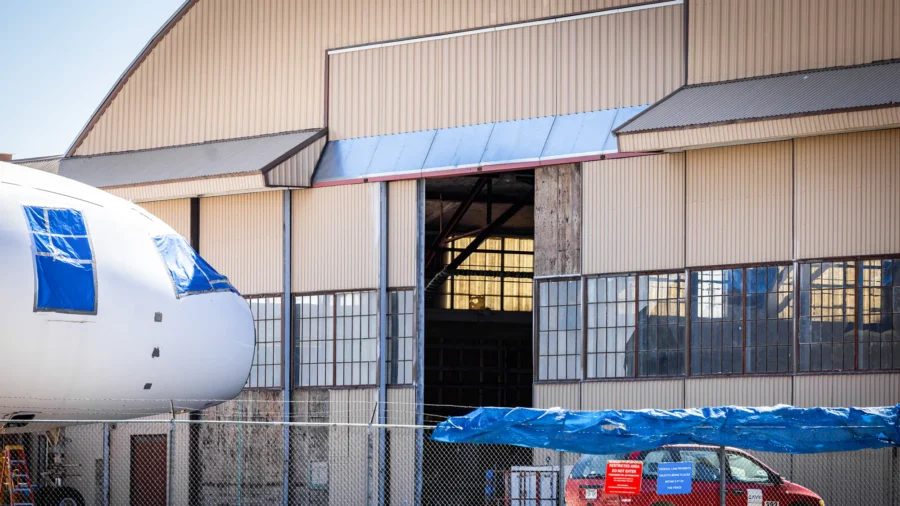
Building 84, storage site for purported UFO crash debris from the ”1947 Roswell incident,“ remains in use for aviation businesses in Roswell, N.M., on Oct. 7, 2026.
(John Fredricks/The Epoch Times)
The Pentagon released its seventh batch of newly declassified UFO files including an eyewitness account of the 1947 Roswell suspected UFO crash describing alien bodies and an egg-shaped craft.
The tranche of documents also contains a report on the Skinwalker Ranch in Utah with more than two dozen sightings of dog-like creatures, trolls, and other phenomena.
The files are part of the Presidential Unsealing and Reporting System for Unidentified Anomalous Phenomena (UAP) Encounters, called PURSUE.
“These files, hidden behind classifications, have long fueled justified speculation—and it’s time the American people see it for themselves,” Secretary of War Pete Hegseth said in a statement.
Among the documents was an affidavit from 2002 believed to be provided by former Roswell Air Base Public Information Officer Walter Haut. In it, Haut describes a staff meeting on July 8, 1947, where officials discussed wreckage collected from a ranch 40 miles from Roswell.
“I am convinced that what I personally observed was some type of craft and its crew from outer space,” Haut said in the affidavit.
Haut describes two debris fields in Lincoln County where he said the crash debris was collected. He also said he and others held samples of wreckage debris and passed it around while sitting at a table.
“It was unlike any material I had or have ever seen in my life,” Haut said. “Pieces which resembled metal foil, paper thin yet extremely strong, and pieces with unusual markings along their length were handled from man to man, each voicing their opinion. No one was able to identify the crash debris.”
The group discussed whether to go public with the discovery, he said. Famously, the first account of the crash made it into the local Roswell Daily Record, which ran the headline “RAAF Captures Flying Saucer On Ranch in Roswell Region.” The military later changed the explanation, saying it was a weather balloon.
Names of Haut’s supervisors in the affidavit were redacted in Friday’s release.
Haut said before he left the base, someone, whose name has been withheld by the Pentagon, took him to Building 84, a hangar on the east side of the tarmac at the Roswell Army Airfield, now known as the Roswell Air Center. Building 84 is now used at the air center for commercial aircraft maintenance.
The building was under heavy guard, he said. Once inside, he was allowed to observe an object just recovered north of town, he said. The object was about 12 to 15 feet long, not quite as wide, and about 6 feet high, with an "egg shape,” he described. Haut also said the surface of the object was metallic-looking with no windows, portholes, wings, tail section, or landing gear.
Tourists view headlines at the International UFO Museum of Roswell, N.M., on Oct. 7, 2026.
John Fredricks/The Epoch Times
"Also from a distance, I was able to see a couple of bodies under a canvas tarpaulin,” Haut stated. “Only the heads extended beyond the covering, and I was not able to make out any features. The heads did appear larger than normal and the contour of the canvas suggested the size of a 10-year-old child.”
Haut said he was told a temporary morgue had been set up to accommodate the bodies.
Roswell UFO Tour operator and researcher Paul Semones said he wasn’t surprised by the information released Friday.
“That’s not new,” Semones told The Epoch Times. “This is stuff that we’ve been arguing about literally for decades.”
The affidavit was first published in 2007 and was intended to be released after Haut’s death in 2005, according to Semones. The document has been published in at least three books on Roswell’s UFO incident.
The Pentagon’s version released Friday redacted several names, but the originally released copy included the names, Semones said.
“The lesson to be learned here is that we have a whole bunch of news media who are encountering it for the first time because the news media isn’t paying attention to what’s going on in the UFO research community,” Semones said. “The world has ignored it but it’s been there.”
The government’s latest release also included reports describing “dog-like bipedal creatures” and “little people” at Skinwalker Ranch in Utah.
Several people have reported seeing dog-like creatures near Skinwalker Ranch in Utah, a declassified report by the Pentagon revealed Oct. 23, 2026.
Department of War
The Skinwalker Ranch investigation, conducted in the spring of 2010 by Bigelow Aerospace Advanced Space Studies (BAASS), a government contractor, documents interviews with over 25 local residents, law enforcement officers, ranchers, business owners, the tribe, and a shaman about strange events in the area.
“All of the people interviewed have had firsthand encounters,” the company said in its report.
Ages of the witnesses ranged from 15 to 77.
Investigators used handheld sensors to collect measurements from the environment. They also sampled the soil and plants, and took photos and other measurements, according to the report.
“Witnesses have reported unidentified balls of light at close range, daytime sightings of ‘dog-like’ creatures running on two legs, unnatural animalistic howling/screaming, ‘little people,’ prehistoric-like birds and a maggot which measured about 8-feet long and 2 to 3 feet in diameter,” the company reported.
Eleven witnesses reported seeing the dog-like creature and orbs of light at different times and locations near the ranch property, BAASS reported.
Several witnesses who described the large “dog” or “wolf” creature told investigators it could walk and run on two legs and was 6 to 7 feet tall when standing on two legs.
“From these interviews, there may be at least three separate types of creatures,” investigators reported.
Four independent eyewitnesses also described seeing a small, hairy, 3-foot-tall “troll” creature with long arms that appeared to run like a chimpanzee or orangutan, according to the report.
Several people also reported seeing large “worm” creatures, a prehistoric “pterodactyl”-like creatures, “little people,” and other anomalies, investigators reported.
Samples were taken of fur found around the ranch, which matched fur from domestic dogs, according to the report.
New UFO files detail sightings of six-foot 'skinwalkers' and 'portal to another world' near America's famous paranormal hotspot
The Pentagon released a new batch of declassified UFO documents on Friday, including an investigation into mysterious creatures roaming near a Utah ranch.
The 2010 report details residents’ claims of encounters with ‘skinwalkers,’ including a dog-like figure with a human-looking nose, alongside towering shadows and unexplained lights.
In Navajo tradition, a skinwalker is a malevolent witch said to be capable of taking animal form.
One man described a hunched creature he estimated was six feet tall and weighed about 250 pounds during an encounter in January 2010.
‘The head was described as looking like a German shepherd dog without the pointed nose,’ the report states. ‘The nose was described to be more similar to a human nose.’
The accounts also include loud howling outside homes, with one witness claiming a supposed skinwalker’s cries caused surrounding coyotes to howl in response.
Other accounts in the newly declassified reports include a portal appearing near a lake, which she said was 'a doorway to another world.'
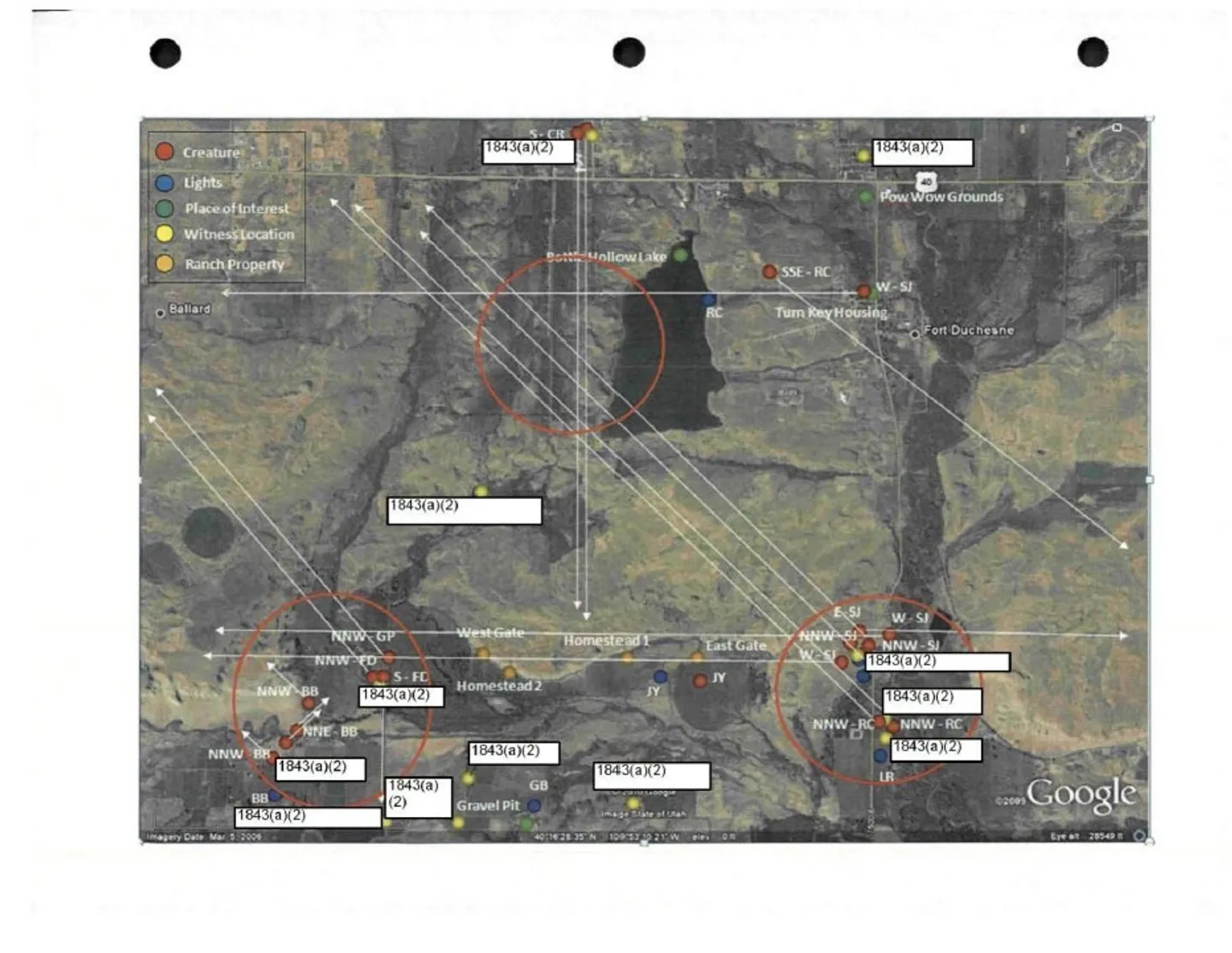
They were collected by Bigelow Aerospace Advanced Space Studies (BAASS), whose personnel visited the Fort Duchesne area in March and April 2010.
Although identifying details are heavily redacted, its map places the investigation around Skinwalker Ranch, a 512-acre property in Utah’s Uintah Basin associated with reports of paranormal activity

The 2010 report details residents’ claims of encounters with ‘skinwalkers,’ including a dog-like figure with a human-looking nose, alongside towering shadows and unexplained lights. Above is a creature spotted in Texas that locals believed was a skinwalker
Although identifying details are heavily redacted, its map places the investigation around Skinwalker Ranch, a 512-acre property in Utah’s Uintah Basin associated with reports of paranormal activity.
The man who described the January encounter said light falling on the figure revealed short black fur mixed with gray, pointed ears and a short tail.
‘It ran like it was leaping,’ investigators recorded.
He also claimed its howl warned people that it was passing through.
The same witness reported another encounter two nights before his March 24 interview.
He said he was inside his home around 8pm when a large shadow raced past the front of the house.
His dogs began barking and chased what he believed was a skinwalker, which he said repeatedly struck a barbed-wire fence.
The man said it moved ‘like a track star’ before fleeing toward an abandoned farmhouse across the road.

The witness in January said the creature ran into his fence, leaving behind fur that investigators tested
He remained indoors during the roughly 30-minute episode, watching from his doorway.
Investigators searched the fence and recovered fur caught on a barb, which they submitted for laboratory analysis.
The findings pointed to an ordinary explanation for the material collected.
Two unidentified fence samples shared the same canine DNA sequence as a control sample taken from a dog on the property.
BAASS said the matching results, similar appearance of the hairs and freely roaming dogs strongly suggested they came from the same animal, although the DNA match alone was not definitive.
A woman also recalled seeing what she believed was a ‘portal’ roughly 20 years before her 2010 interview.
She described a clear, stationary formation about 30 to 40 feet high that rippled like water and resembled a heat shimmer, which she observed from approximately 100 feet away.
The woman said it gave her a peaceful feeling and remained visible when she left.
She told investigators she came to interpret it as a doorway to another world after reading a ‘Skinwalker’ book.
Other interviews concerned different figures, which were not all explicitly identified as skinwalkers.
Witnesses describing the towering shadows said they had heard a ‘growling roar’ outside their home around 11pm on March 22, 2010.
The sound occurred twice, lasting roughly five to 10 seconds each time, according to their account.

BAASS said the matching results, similar appearance of the hairs and freely roaming dogs strongly suggested they came from the same animal, although the DNA match alone was not definitive
Another man recalled a three-foot-long, hairy arm reaching through his bedroom window in winter 2003.
He described four long fingers, no visible thumb and dog-like nails, saying the arm withdrew when he shouted.
A young woman described a hunched, female-looking figure with shoulder-length black hair and ragged clothing jumping between rooftops around 2009.
She said her mother also saw it and called 911, prompting a police response.
The witness identified the figure as what she said was known in Ute culture as the ‘Basket Lady.’
A separate woman reported an eight-foot, hairless creature crouched on a horse shelter in September 2009 before leaping away.
She acknowledged seeing it only briefly from behind. Her four-year-old daughter reportedly compared it to a kangaroo.
The report also records accounts of mysterious balls of light.
One witness described a blue orb hovering near Bottle Hollow Lake before moving toward Skinwalker Ridge.
Another woman recalled seeing a small aqua-blue light hovering in a tree outside her home in February 2010.
It disappeared ‘in the blink of an eye,’ she said.
She described it as dim and said it did not illuminate the tree.
Another account described floating lights that appeared to move behind objects when a witness’s presence was noticed, a behavior he interpreted as an attempt to hide.
Investigators installed motion-triggered cameras and continued gathering testimony, but the report does not establish that the figures were supernatural or determine what caused the lights.
Pentagon drops explosive new UFO files detailing alien corpses and egg-shaped craft
BY Liam Randall - News Reporter

Secret files released by the Pentagon have lifted the lid on a jaw-dropping eyewitness account claiming US officials recovered dead alien bodies and an otherworldly spaceship. The bombshell dossier reveals classified testimony from a military officer who says he was present during the legendary 1947 Roswell incident.
The unnamed witness is widely believed to be base PR officer Walter G Haut, who signed a sealed affidavit in 2002 describing the bizarre wreckage and the chilling creatures hidden inside a heavily guarded hangar known as "Building 84".
"I am convinced that what I personally observed was some type of craft and its crew from outer space," the witness said in the statement kept hidden for decades.

The dossier reveals classified testimony from a military officer who says he was present during the legendary 1947 Roswell incident
(Image: Universal Images Group via Getty Images)
According to the files, the vessel was an egg-shaped metallic craft measuring up to 15ft long and 6ft wide.
It had no wings, windows, landing gear or tail and was made of an unearthly foil described as "paper thin yet extremely strong." Nearby lay the pint-sized corpses of the extraterrestrial flight crew
"From a distance, I was able to see a couple of bodies under a canvas tarpaulin. Only the heads extended beyond the covering, and I was not able to make out any features," Haut said in a previous public statement.

Roswell officials are claimed to have hatched a plan to dupe the public
(Image: AFP via Getty Images)
"The heads did appear larger than normal and the contour of the canvas suggested the size of a ten year old child."
The latest papers claim high-ranking commanders held an emergency crisis meeting at 7.30am on July 8, 1947, passing around shards of the cosmic debris.
"Samples of wreckage were passed around the table. It was unlike any material I had or have ever seen in my life. No one was able to identify the crash debris," the witness said.
Realising the world-shattering nature of the find, officials are claimed to have hatched a plan to dupe the public.
While civilian eyes were fixated on a mess of wreckage found on a ranch northwest of Roswell, the egg craft and the dead space invaders were apparently secretly hauled away from a second site 40 miles north.
Base commander Colonel William Blanchard is then said to have ordered a decoy press release, famously announcing the military had captured a "flying disc" before swiftly walking it back and claiming it was merely a weather balloon.
Base intelligence man Major Jesse Marcel was even pictured clutching tinfoil-like debris, which he later claimed had been swapped for weather kit while he was out of the room.
The release also features reports from a private research firm funded by tycoon Robert Bigelow to study sci-fi military technology, from warp drives to cloaking shields.
It states: "It is substantiated with testimony that several 'crashes' of novel spacecraft have occurred outside of the United States.
"Our concern addresses the level to which other countries have already succeeded in understanding the technical aspects of these craft."
RELATED
Did a comet end the Ice Age and wipe out a civilization? Fact check

Fact Check verdict:
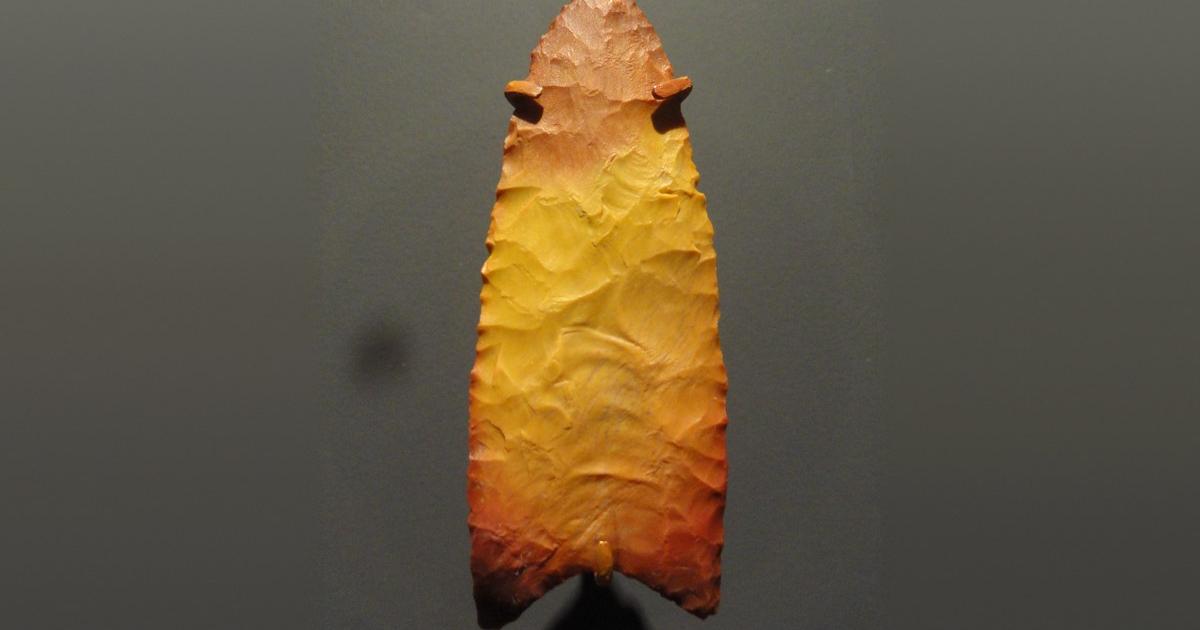
At about 50 Clovis-age sites across North America, excavators have recorded a thin, carbon-rich black layer. The paper that made it famous put it plainly: "The in situ bones of extinct Pleistocene megafauna, along with Clovis tool assemblages, occur below this black layer but not within or above it." The layer is real. What made it is the argument, and the claim splits into parts. The dated cold spell and the Greenland platinum spike are Established. A comet as the cause is Disputed. A comet that ended the Ice Age is Fringe, because the ice record puts that ending 1,200 years later. A civilization wiped out is Unverified.
Start with the clock. In 2006 Sune Rasmussen and colleagues published a time scale built by counting annual layers in Greenland ice cores. It places the onset of the Younger Dryas at 12,896 years before AD 2000, with a maximum counting error of 138 years, and its end at 11,703 years before AD 2000.
The impact case begins with Firestone and 25 co-authors in PNAS in 2007. They reported peaks within the black layer of magnetic grains with iridium, microspherules, charcoal, soot, nanodiamonds and fullerenes holding extraterrestrial helium. Their reading was an impact that "contributed to YD cooling, major ecological reorganization, broad-scale extinctions, and rapid human behavioral shifts at the end of the Clovis Period."
Wendy Wolbach and colleagues widened the case in two 2018 papers. Part 1 argues that Earth met fragments of a disintegrating comet at least 100 km across, reports platinum at 26 sites and finds combustion aerosols in four ice-core sequences "reflecting one of the largest biomass-burning episodes in more than 120,000 y". Part 2 draws on charcoal and soot from 152 lakes, marine cores and land sequences. It argues that wildfires consumed about 10 million square kilometers, around 9% of Earth's biomass, and brought on an "impact winter".
Petaev and colleagues reported in 2013: "We found a large Pt anomaly at the YDB, not accompanied by a prominent Ir anomaly". The ratio "rules out mantle or chondritic sources", they wrote, and "hints for an extraterrestrial source of Pt".
The most striking site is Abu Hureyra, an early village in Syria. Moore and colleagues reported in 2020 that its 12,800-year-old layer "contains peak abundances in meltglass, nanodiamonds, microspherules, and charcoal", with melted grains implying 1,720 to more than 2,200 °C. That, they wrote, "argues against formation of AH meltglass in thatched hut fires". In November 2025 the journal published a correction. It said the supplementary table had "inconsistencies" with the original data sources, and "a discussion has been added that clarifies the geochronological context of the study." The paper stands, corrected.
Critics who have reviewed the case in print say it fails. Vance Holliday and co-authors wrote in 2014 that "No YD boundary (YDB) crater, craters or other direct indicators of an impact are known" and that "Age control is weak to non-existent at 26 of the 29 localities claimed to have evidence for the YDIH."
In 2023 thirteen authors published a "Comprehensive refutation". It notes that the evidence is "nano to microscopic in scale" and that "Very few sites with high levels of any of the purported indicators have accurate and high-precision dating to 12.9 ka." It concludes: "We demonstrate that research in numerous fields has shown the YDIH should be rejected." One co-author was Petaev, who had cautioned in 2013 that the platinum might come from "an Ir-poor iron meteorite that is unlikely to result in an airburst or trigger wide wildfires proposed by the YDB impact hypothesis."
In February 2026 PLOS One retracted two 2025 papers from the group, one on Baffin Bay cores over concerns "regarding referencing, methodology, and data reporting", and one on shocked quartz over "the age model underpinning the results of this study". The corresponding author, Christopher Moore, told Retraction Watch the group remains "confident in the integrity of the data, the methods employed, and the conclusions drawn."
Sweatman, Powell and West replied in 2024 that "Scores of peer-reviewed articles in dozens of peer-reviewed journals from hundreds of researchers" support the hypothesis, and that "The remaining differences in interpretation are part and parcel of science". Holliday's team rebutted them in the same volume.
Timing is where one version of the claim breaks. On the proponents' own account the event began a cooling. The Greenland count puts the end of the Younger Dryas, and of the last glacial period, about 1,200 years later. An event that starts a deep freeze cannot be the event that ends the Ice Age.
Graham Hancock adds people. His book page for America Before asks: "Was an advanced civilization lost to history in the global cataclysm that ended the last Ice Age?" He is fair about the science, noting that "the comet hypothesis remains controversial and a number scientists favour other explanations." The world, he writes, "was plunged into a deep-freeze that lasted 1,200 years", and in that transition "an advanced civilization, hitherto the stuff of myth and legend, was lost to history". His wording places the cataclysm at the start of a long transition, which is closer to the ice record than the popular slogan. The Society for American Archaeology, in a 2022 open letter to Netflix, replied that "we find no archaeological evidence to support the existence of an 'advanced, global Ice Age civilization' of the kind Hancock suggests". It added that "archaeologists would investigate it" if credible evidence appeared. No evidence is weaker than a direct test, so the label is Unverified.
Two things are solid: the dates of the Younger Dryas and the platinum at its onset. One version of the popular claim fails on the dating. The rest is a live dispute between groups still publishing against each other. What delivered that platinum to the Greenland ice, and does the same cause explain the black layer where the mammoth bones stop?
Read in full: Rasmussen et al. 2006, Firestone et al. 2007, Wolbach et al. 2018 part 2, Moore et al. 2020 and its 2025 correction, the two PLOS One retraction notices, the Retraction Watch report, Hancock's book page for America Before, and the Society for American Archaeology letter. Abstract only: Wolbach et al. 2018 part 1, Petaev et al. 2013, Holliday et al. 2014, Holliday et al. 2023, Sweatman et al. 2024. Checked 20 October 2026.
How we label claims: see How we check evidence.
This fact check sits alongside our hub, Göbekli Tepe, the Sphinx and Atlantis: what the evidence says, which covers the Younger Dryas and Göbekli Tepe's Pillar 43.
By Aris Manus
RELATED
{ https://www.ancient-origins.net/news-history-archaeology }
Woman Claims She Saw a LIVE Alien After UFO Crash, Then Military Men Tried to Erase Her Memory


Her involvement with the UFO phenomenon had begun years before she publicly discussed the supposed crash. Haley said that until July 1990, she had rarely thought about extraterrestrials. While visiting her parents in Alabama, she and her mother began discussing a newspaper article concerning UFOs. The conversation reminded her of a strange sighting from childhood, when she, her brother, and a friend had watched a silver, spherical object hanging motionless in the sky.
Haley said the object occasionally appeared bluish when sunlight reflected from its surface. After remaining stationary for some time, it seemed to descend toward nearby woods. The children searched the area, hoping to find what they believed might be a flying saucer, but returned without discovering anything. When she brought up the incident nearly thirty years later, her brother remembered it as well. Their mother suggested that the object might have been a weather balloon or satellite, although she had not personally witnessed it.
Haley later recalled a disturbing experience from the late 1970s or early 1980s in Florence, Alabama. She remembered waking with a vivid image of pale creatures with huge black eyes performing medical procedures in a brightly lit room. She initially dismissed it as a dream but began questioning the memory in 1990 after discussing UFO abductions with her brother. Troubled by recurring images and fears at night, she eventually contacted UFO researcher Budd Hopkins, who referred her to counselor John Carpenter.
In March 1991, Haley traveled to Springfield, Missouri, with her brother for hypnosis sessions with Carpenter. She recalled encountering a pale, white being in the woods that communicated through its black eyes, then seeing a spacecraft and being taken aboard in a beam of light.
In a second session, she described beings performing gynecological procedures and removing an egg from her ovary. She also recalled pain near her right ear and suspected an implant.
Haley initially hoped her experiences had a more ordinary explanation, but Carpenter suggested psychological trauma. Over time, she became convinced something had happened, though many details emerged under hypnosis and were never independently verified.
Read also:
Around the same period, Haley began reporting experiences that she interpreted as surveillance. She claimed unfamiliar vehicles followed her, telephone calls contained strange noises, and locks on exterior doors appeared to have been tampered with. After moving into a newly built home, she said her security system repeatedly malfunctioned, apparently losing stored information. She also recalled her husband being told that FBI personnel had asked questions about him at the hospital where he worked.
One incident particularly disturbed Haley because she suspected it involved someone connected to the American space program. She recalled leaving her university office at lunch and finding an unfamiliar man examining the area around her parked car. Wearing a blue shirt, tie, glasses, and gray trousers, he allegedly ran toward a nearby truck and drove away when she began memorizing its license plate.
Haley said she traced the registration to an employee of a NASA contractor involved in calibrating equipment associated with the Space Shuttle’s external fuel tanks. The incident seemed suspicious to her because it occurred shortly after her first hypnosis sessions. However, her account did not establish that the man was monitoring her because of her UFO experiences or that his employer was involved.
In another incident, an Air Force captain reportedly offered to show her Space Shuttle Endeavour. Haley said his wife, a student in one of her accounting classes at a military base, unexpectedly gave her an Endeavour patch from her husband. When Haley contacted the captain, he offered to arrange a visit during the shuttle’s next appearance at the base. She claimed he asked her to keep the invitation secret and insisted she bring a camera.
Haley grew suspicious and declined the invitation, but claimed the captain approached her again while she was supervising a final exam, repeatedly urging her to leave her students and accompany him to the shuttle. The next day, she read that armed guards protecting the spacecraft were authorized to use deadly force. She feared the invitation had been a trap, though she offered no evidence that anyone intended to harm her.
She also recalled being left in a field near her home after an alleged medical examination by extraterrestrial beings. As she tried to return home, a helicopter landed nearby, and armed men in green uniforms allegedly seized her and took her to a restricted facility supervised by an Air Force officer.
Inside, Haley said she was injected with an unknown substance that left her dizzy and weak. A man in khaki then aggressively questioned her, repeatedly insisting, “You did not see a spaceship.” She maintained that she knew what she had experienced, but said he refused to explain why she was being held.
In a separate incident, she described being restrained in what appeared to be a military hospital by uniformed men and staff in white laboratory coats. She claimed they administered injections and electric shocks in an attempt to alter or erase her memories. She also recalled undergoing X-rays and being placed inside a transparent enclosure, though she did not know why.
The pain in her right ear became another important detail in her account. Haley said she had previously experienced strange Morse-code-like tones in that ear, which she associated with the alleged extraterrestrial medical examination. Following one of the supposed military encounters, she noticed that the sounds had stopped. She suspected that someone had removed an implanted device, but admitted that she did not know whether any object had actually been present.
In another unusual memory, Haley described seeing a tiny alien being questioned by a man in military fatigues while she herself was allegedly receiving electric shocks. She also reported encounters with different types of non-human entities. The most frequently described were small, pale creatures between four and five feet tall, with large black almond-shaped eyes, four fingers, and almost no visible facial features. She believed these beings communicated telepathically and moved with remarkable grace.
However, Haley also recalled a frightening encounter with a reptilian-looking creature. She described it as having scaly brownish skin, long claws, pointed ears, and a head resembling that of a snake. She estimated its height at approximately five and a half feet and claimed she was completely paralyzed during an alleged sexual assault. Her recollection of the incident was fragmented, and she acknowledged that several details remained unclear.
Her testimony also included experiences that went beyond UFO sightings, physical examinations, and military encounters. Beginning in May 1991, Haley claimed she started receiving information telepathically from an unidentified source she called the “silent voice.” She explained that these communications did not arrive as audible speech but as sudden knowledge appearing in her mind. Some messages reportedly involved religious symbols, spiritual development, and the possibility that humanity was entering a new stage of existence.
One of the strangest messages concerned the nature of time. Haley said she was told that time was not linear and could be compared to a Slinky, the familiar coiled toy that stretches, contracts, and overlaps. She understood the message to suggest that different dimensions might exist simultaneously and interact with one another. The source also allegedly encouraged her to avoid fear, anger, guilt, and worry, which she believed helped her cope with the distress surrounding her experiences.
Haley even claimed the silent voice instructed her to write a children’s book about alien abduction. She said the idea came to her one night while brushing her teeth and involved turning an experience from early childhood into a story that might comfort children who believed they were being abducted. Although she was convinced that the messages had helped her emotionally, she acknowledged that she did not know where they originated or whether their information was accurate.
By the time of her 1994 interview, Haley had developed a theory that humanity might be caught between opposing forces. She believed some reported encounters seemed positive while others appeared hostile, suggesting to her the possibility of a struggle between good and evil. She did not claim to have proven this interpretation and admitted that she lacked the information needed to understand the phenomenon fully.
Leah Haley.
Image source: SOTT.net / The UFO Trail.
Her experiences had already attracted attention within the UFO community. In 1993, she published Lost Was the Key, documenting her unusual memories and attempts to investigate them. She later published Unlocking Alien Closets: Abductions, Mind Control and Spirituality in 2003. However, as she continued examining the subject, her understanding of what had happened began to change, particularly regarding the possible involvement of humans in experiences commonly attributed to extraterrestrials.
The most significant development came in 2011, when researcher Jack Brewer published an extensive interview with Haley. By then, she no longer believed that literal extraterrestrial abductions explained her experiences. Instead, she had become convinced that human-directed experimentation, psychological manipulation, and technologies capable of influencing perception might have been responsible for what she and others had interpreted as alien encounters.
Haley explained that she had spent years examining reports, technological developments, and information concerning government research. She believed that the presence of apparent military personnel in many abduction accounts pointed toward a human explanation. Her revised interpretation did not mean that she regarded all her memories as meaningless or that she believed nothing unusual had happened. Rather, she suspected that some of the alien imagery she remembered might have been deliberately produced or manipulated.
Another controversy surrounding Haley’s investigations involved John Carpenter, the researcher who had conducted her hypnosis sessions. Brewer reported that Carpenter had sold case files from approximately 140 alleged abductees, including Haley, to billionaire Robert Bigelow for $14,000. The disclosure raised questions about confidentiality and the treatment of people seeking help for unusual experiences. Haley believed the incident represented a serious violation of trust, although it did not establish whether any of her supposed abductions had actually occurred.
There is also a significant problem with relying on hypnosis to establish the reality of Haley’s extraordinary memories. Research into human memory has shown that hypnotic regression can produce vivid recollections that feel convincing without necessarily corresponding to actual events. Johns Hopkins Medicine cautions that hypnosis is not a reliable method for recovering hidden memories, while studies of memory distortion have demonstrated that suggestion and imagination can contribute to false recollections.
After years of investigating her experiences, Haley concluded that humans, not aliens, were responsible for what she remembered, though she never established that mind-control experiments were involved. More than three decades after her 1994 interview, her case remains unusual for the dramatic shift in her own beliefs.
RELATED
White Dwarfs Are Actually…Yellow, Green, Pink, and Purple?
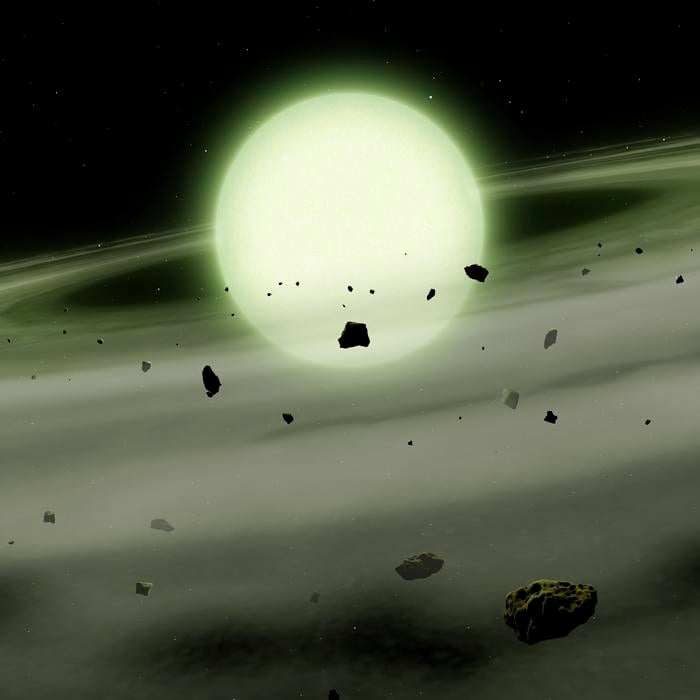
Artist’s illustration of a white dwarf appearing greenish from the sodium-rich planetary debris that enriches its atmosphere.
(Credit: Mark A Garlick/University of Warwick)
The universe hosts a myriad of star types, including supergiants, giants, main sequence, red dwarfs, brown dwarfs, white dwarfs, and neutron stars. What makes these stars stand out are just their sizes, but their colors, as each one hosts a distinct color based on their surface temperature, specifically orange, red, blue, and white based on cooler to hotter temperatures. While the correlation between star colors and surface temperatures has long been known throughout astronomy, what if star colors could change based on specific criteria, including their atmosphere?
Now, a team of researchers led by the University of Warwick might have introduced a new way to literally look at stars, as they revealed new evidence for white dwarfs to exhibit colors other than what their name implies. These findings were recently published in RAS Techniques and Instruments and could provide new insights into the formation and evolution of stars throughout the cosmos. This is because stars are referred to as “perfect radiators”, also called blackbody objects, meaning they absorb all electromagnetic radiation and reflect nothing. In a nutshell, their glow is entirely dependent on temperature.
“As an object gets hotter it will emit more light at optical wavelengths, changing from red to orange (think of a blacksmith working on a piece of hot metal),” Dr. Mark Hollands, who is a postdoctoral researcher at the University of Warwick and the study’s lead author, tells Universe Today. “Eventually these orange hues will become paler, and by 6000K a black body will appear will just appear white as most of its radiation will spread across optical wavelengths. For even hotter temperatures an object will start to glow pale blue as the majority of its light will become emitted in the ultraviolet. This set of red/orange/white/blue are the only colors that are possible for a true blackbody.”
For the study, the researchers used a series of computer models to study 151 white dwarfs with 20 parsecs (65 light-years) from Earth and how white dwarfs might challenge the longstanding understanding of stars being blackbodies. The reason white dwarfs were chosen was due to their extreme characteristics compared to main-sequence stars like our Sun, most notably white dwarfs having much denser atmospheres. The researchers aspired to learn if the presence of certain elements like carbon, calcium, or sodium in their dense atmospheres could influence the glow of white dwarfs.
In the end, the researchers found that a total of five white dwarfs of the 151 sampled showed that a combination of a white dwarf’s dense atmosphere with certain elements could cause these five white dwarfs to glow pink and yellow, specifically two yellow and three pink. This indicates about 3.3 percent of white dwarfs in the cosmos could exhibit different colors aside from white.
A white dwarf whose atmosphere is comprise of carbon appearing pink.
(Credit: Mark A. Garlick/University of Warwick)
“One in thirty might not sound like a huge fraction, but across the entire population of white dwarfs in the Universe, that is still a lot of oddly colored stars out there,” said Dr. Boris Gänsicke, who is a professor in the Department of Physics at the University of Warwick and a co-author on the study. “Yet if we take the median across a representative population of white dwarfs, we found that the average white dwarf really is white."
Regarding the specific elements responsible for altering the white dwarf’s colors, the researchers found that carbon causes white dwarfs to appear pink or purple while cooler white dwarfs with hydrogen and helium tend to be cyan or blue. Additionally, the researchers found that white dwarfs whose atmospheres have debris from their original planetary system are typically green.
As noted, star colors are typically determined by their surface temperatures, with hotter stars to cooler stars ranging in several colors, including blue, blue-white, white, yellowish white, yellow (our Sun), orange, and red. The larger the star, the hotter and bluer it is. But while this study demonstrates there could be exemptions to this longstanding notion, could other stars also exhibit unexpected colors?
“The other class of object that can disobey the rule are brown dwarfs," Dr. Hollands tells Universe Today. "These are substellar objects that are too cool to fuse hydrogen in their cores, but can fuse deuterium instead. Because these are quite cold objects (compared to normal stars) most of their radiation is in the infrared, but some still comes out at optical wavelengths. And because brown dwarfs also can have dense atmospheres, absorption from sodium, potassium, and molecules like titanium oxide can also alter their colors away from blackbody colors. Some astronomers who study brown dwarfs have looked into their appearance in the past and concluded that they can appear violet in color!”
What new insights into white dwarfs and other star colors will researchers make in the coming years and decades? Only time will tell, and this is why we science!
As always, keep doing science & keep looking up!
Pentagon releases 7th batch of UFO files
ISTANBUL
RELATED
New Pentagon materials on UFOs indicate: mysterious "black triangles" were spotted over an important facility in the United States
Two military observers said they saw a black triangular object over a facility in the United States. The Pentagon released a report without video or photos.

Two high-ranking military observers reported that earlier this year they saw a mysterious black triangular object flying at an extremely high speed over an important facility in the western United States. This information is contained in another batch of UFO sighting data released by the Trump administration on Friday, UNN reports, citing The Guardian.
The report submitted to the Department of Defense states that the unidentified object displayed none of the characteristics typical of conventional military aircraft. It disappeared suddenly and silently, literally within a matter of seconds, leaving behind neither exhaust trails nor any other evidence of its existence.
The incident was described by anonymous sources who have "significant operational experience working alongside government agencies." The location of the incident was redacted in the document released on Friday.
According to the observers, the "unidentified anomalous phenomenon" (UAP)—a term that has replaced "UFO" in military, government, and scientific circles—resembled a drone with a delta-shaped wing and a wingspan of between 2.75 and 4.5 meters. They estimated the object's speed at 1,800 miles per hour (approximately 2,900 km/h).
Like hundreds of other reports released by the Pentagon since May—as part of Donald Trump's promise to ensure transparency regarding UFO documents that had remained classified for decades—many details in this material remain vague, uncertain, or completely concealed.
While many previous reports were accompanied by actual photographs or video recordings, the report on "black triangles" contains nine identical images of the same canyon, with small triangular silhouettes crudely superimposed on them—presumably to demonstrate the movement of the object reported by the observers.
"It really looks like nothing more than a black triangular figure superimposed on a landscape image to illustrate the report. I don't think it adds anything substantial to the document itself," said Greg Eghigian, a professor of history and bioethics at Pennsylvania State University and author of the 2024 book "After the Flying Saucers Came: A Global History of the UFO Phenomenon." Following the initial flurry of reports from the Pentagon, they have appeared less frequently in recent months; their volume has also declined significantly since February, when the U.S. president ordered the government to fully disclose the information it possesses about UFOs and the search for extraterrestrial life.
The move came in response to claims made in Congress in 2023 by a former intelligence official. He alleged that successive administrations had concealed relevant data and that the government possessed the wreckage of crashed extraterrestrial spacecraft.
The materials released on Friday contained fewer than 25 text documents—there were no videos or images among them.
Black triangles spotted racing over secret US military bases at 1,800 mph, UFO files reveal

The Pentagon has released another batch of documents, videos, and images, marking the seventh disclosure in the US government’s effort to make Unidentified Flying Object (UFO) records public.
The files include reports of a mysterious black triangular object that three federal agents spotted near a secure US facility.
The object reportedly moved unusually fast, and thermal equipment could not detect its heat signature.
The release also includes a declassified report on alleged paranormal activity at Utah’s Skinwalker Ranch, historical UFO sightings from the 1940s and 1950s, and documents detailing how NASA and the Defence Department coordinated their handling of suspected fragments of space vehicles.
The latest disclosure follows six previous releases after US President Donald Trump signed an executive order earlier this year directing the government to make UFO records available to the public.
“Today, the Department of War is publishing the seventh release of declassified and historical Unidentified Anomalous Phenomena (UAP) files as part of the Presidential Unsealing and Reporting System for UAP Encounters (PURSUE),” Chief Pentagon Spokesman Sean Parnell said.
He added that the Department “will release additional files on a rolling basis” and is actively working on the next release of UAP files.
Unidentified Anomalous Phenomena
These materials were compiled from several US government agencies, including the Pentagon, NASA, the CIA, the FBI, and the Department of Energy.
The Pentagon made the files available on its official UAP website.
Witnesses described silent, matte-black objects with no visible engines, lights or exhaust.
One account described an object covering roughly 1.5 miles in three seconds (1,800 miles per hour), while others reported low-altitude hovering and manoeuvres.
Some officials interviewed about the sightings suggested the US could still be years away from developing technology matching the capabilities described by military witnesses.
Friday’s release also includes previously classified accounts of cylindrical flying objects spotted over Saudi Arabia, Sweden and elsewhere during the 1960s and 1970s.
Many of these records are being made public for the first time.
The release also contains sighting reports and records of investigations into unexplained phenomena.
Some details remain redacted, and the material provides no definitive evidence of extraterrestrial origins.
Pentagon releases new UFO files detailing non-human bodies and mysterious egg-shaped craft inside guarded hangar
The Pentagon has released a new batch of declassified UFO documents, including a shocking eyewitness account detailing how the military recovered the wreckage of a spaceship and alien bodies.
The report made public on Friday included testimony from a military officer, whose name was redacted, who claimed he was present at the famous Roswell UFO incident in 1947 and was shown the spacecraft in a hangar known as 'Building 84.'
The alleged Roswell coverup has been one of the most famous UFO cases in history, with the military initially releasing a statement on July 8, 1947, saying a 'flying disc' had been recovered before changing their story to claim the wreckage came from a weather balloon.
The officer is believed to be Roswell Army Air Force Base Public Information Officer Walter G Haut, who confirmed that the US had recovered an egg-shaped craft and multiple dead bodies from a New Mexico crash site in early July of that year.
'I am convinced that what I personally observed was some type of craft and its crew from outer space,' the witness said in a statement given in 2002 and kept secret by the Pentagon.
The officer added that this wreckage and the aliens were taken to a guarded hangar where he was allowed to see the craft, described as being roughly 12 to 15 feet long and six feet wide with a metallic surface.
It had no windows, wings, tail or landing gear, and was composed of a strange metal foil described as 'paper thin yet extremely strong.'
The bodies were placed under a canvas tarpaulin, but the witness report revealed their heads were larger than normal and they were about the same size as a ten-year-old child, standing approximately four feet in height.

The Roswell UFO incident on July 8, 1947 initially revealed that a flying disc had been found in New Mexico. Pictured is a military official holding what was initially claimed to be the alien craft

The Roswell Army Air Force Base in New Mexico
The bombshell testimony came from a sealed affidavit signed by the witness on December 26, 2002, more than 55 years after the Roswell incident.
The US government has maintained since Roswell that there has never been any physical evidence recovered which proves that UFOs or extraterrestrials exist.
The surviving text in the heavily classified Pentagon document perfectly matches sworn public statements made by Haut, including the unique details only he has claimed after the Roswell crash.
Haut, who died in 2005, provided the same account to the International UFO Museum and Research Center in Roswell shortly before his passing, which was notarized in the presence of a museum visitor.
The report released on Friday detailed how a staff meeting was held on July 8 around 7.30am local time, which included several high-ranking officials, whose names were also removed by the Pentagon.
The meeting revealed that an extensive debris field was discovered in Lincoln County about 75 miles northwest of Roswell.
However, another site that was considered more important was found roughly 40 miles north of town, and included the remains of the egg-shaped craft and the bodies.
'Samples of wreckage were passed around the table. It was unlike any material I had or have ever seen in my life. No one was able to identify the crash debris,' the witness wrote in the document released Friday.

An unidentified military officer at Roswell testified that they saw the craft and alien bodies allegedly recovered from the New Mexico crash site

Former Roswell Army Air Force Base Public Information Officer Walter G Haut is believed to be the witness who provided the statement released by the Pentagon on October 23
According to the declassified file, the group discussed whether the US military to go public with the news of an alien crash landing on Earth.
One suggested plan was to publicize the ranch debris site northwest of Roswell to divert attention from the more important northern site, since civilians and the media were already involved.
Around 9.30am on July 8, the witness was ordered to write down a press release, dictated by the Roswell base commander, Colonel William Blanchard.
In the statement given to the press, the military revealed they had recovered a flying disc from a ranch northwest of Roswell and that Base intelligence officer Major Jesse Marcel would fly the material to military headquarters in Texas for further study.
Marcel is the officer famously seen in the iconic photograph holding the metallic material which the military later claimed was just a weather balloon.
The declassified report and Haut's public statements both revealed that he was then personally taken by Blanchard to see the UFO and alien remains, which were being stored in a facility known as Building 84, or Hangar P-3.
'From a distance, I was able to see a couple of bodies under a canvas tarpaulin. Only the heads extended beyond the covering, and I was not able to make out any features,' Haut stated.
'The heads did appear larger than normal and the contour of the canvas suggested the size of a ten year old child.'
A temporary morgue was constructed to store the bodies at Roswell, but the declassified file did not reveal what happened to the alleged alien remains after Haut visited Building 84.

The military officer provided this statement in 2002, 55 years after the alleged UFO encounter

The Roswell incident was reported by local newspapers before the military changed their story
The report also revealed that Marcel claimed pieces of the UFO taken to Carswell Army Air Field in Texas were switched for debris from a weather balloon and radar kite while the intelligence officer was in a different room on the base.
'I would be allowed to make at least one visit to one of the recovery sites during the military cleanup. I would return to the base with some of the wreckage which I would display in my office,' the witness claimed.
There is no record of what happened to the alleged UFO debris Haut claimed to have collected. The US government has never confirmed that debris was recovered or moved to classified facilities for research.
Friday's release by the Pentagon also included new images of an alleged UFO flying over the western US this year.
According to a report from the FBI made by two special agents, the object was seen around 7.23pm moving over an undisclosed mountain range.
The unnamed agents, apparently working at a secret surveillance station known as 'Observation Post 6' spotted the black triangle using a thermal camera as it was coming over the horizon to the west.
'We estimated the object’s wingspan at approximately nine to 15 feet, its depth at six to nine feet, and its thickness at one to two feet,' the agents revealed in a statement to the FBI.
The agents compared the triangle to a 'delta wing drone' but added that their heat-detecting camera showed the UFO was not hotter in any particular spot which would reveal an engine and did not give off any kind of exhaust trails like a man-made aircraft.

Photos released by the Pentagon show an alleged UFO flying over the western US in 2026

The black triangle was reported to the FBI by a pair of unnamed special agents
The seventh and newest batch of UFO files also contained several reports of UFO sightings from the 1950s and 1960s throughout this world, including over the US, Canada, Italy, Sweden and Germany.
The new tranche also contained monthly progress reports from a private research company to the Defense Intelligence Agency – the Pentagon’s military intelligence service which studies foreign military technology and possible future threats.
Bigelow Aerospace Advanced Space Studies (BAASS) was a subsidiary company set up by Robert Bigelow, the businessman behind Budget Suites of America and Bigelow Aerospace. He has also been known to have a strong personal interest in UFOs and government transparency.
Multiple declassified reports over the last two Pentagon releases have revealed that BAASS was given tens of millions of dollars in funding to study futuristic technology.
These projects included creating space-age materials such as metallic glass, a faster-than-light method of travel known as warp drive, the ability to make objects invisible using a cloaking device and the creation of laser weapons for the military.
The document containing the Roswell report was part of a BAASS report that proposed to study advanced aerospace technologies such as UFOs which could represent future threats from foreign countries, looking ahead roughly to 2050.
The BAASS report claimed: 'It is substantiated with testimony that several ‘crashes’ of novel spacecraft have occurred outside of the United States. Our concern addresses the level to which other countries have already succeeded in understanding the technical aspects of these craft.'
RELATED
Seventh Release of files on Unidentified Anomalous Phenomena (UAP) – Project Capella Detailed (Updated)
A Stubborn Question Answered: New Research Reveals How the Milky Way's Disk Formed
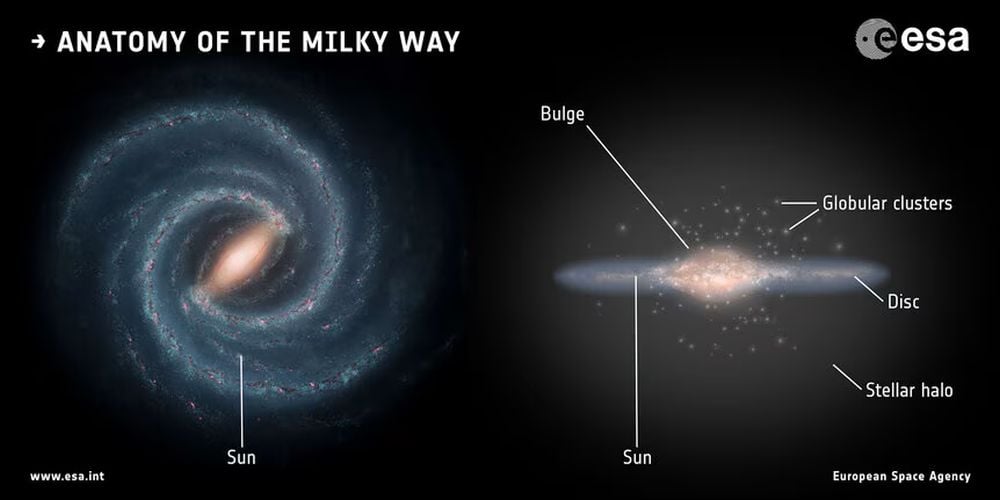
The Milky Way is a spiral galaxy, and its spiral arms are its defining features. But our galaxy has a disk, and it is divided into two parts: a thin disk where young stars form, and a thick disk, which is more diffuse and is home to ancient stars. What process lies behind the formation of these disks is a big question in astronomy..
Image Credit: Left: NASA/JPL-Caltech; Right: ESA; Layout: ESA/ATG medialab
The Milky Way is home to hundreds of billions of stars arranged in a glorious spiral pattern. But beyond the obvious spiral, our galaxy has other physical characteristics. It's divided into a galactic bulge, a galactic disk, and a galactic halo.
The disk is further divided into a thin disk and a thick disk. They're not only structurally different, but their stellar populations and other characteristics are different.
The thin disk contains young stars, and middle-aged stars like our Sun. It holds the spiral arms, where our Solar resides and also holds most of the Milky Way's gas and dust and is where young stars form. It also has higher metallicity, generated by previous generations of stars that have lived and died.
The thick disk is more puffy and diffuse than the thin disk. It holds ancient stars, and almost no new stars form there. It has much lower metallicity than the thin disk, and astronomers sometimes refer to it as a kind of stellar fossil record.
Astronomers wrestle with understanding the formation of these disks, and the Milky Way as a whole. Observations have led to a multiple explanations. In one, stars are born in the thin disk, and over time, encounters with gas clouds, the spiral arms, or even the central bar, perturb some of these stars. Dynamical scattering drives them away from the plane of the thin disk.
Another explanation says that as stars form in the inner disk, the gas they form from settles down into an even thinner disk. In this scenario, each successive generation of stars forms in an increasingly thin disk.
Astronomers have difficulty distinguishing between these competing explanations. It relies on accurate measurements of the ages of individual stars. That's difficult to achieve, especially for the oldest stars.
New research in The Astrophysical Journal Letters used Gaia data to tackle the issue. It's titled "A Two-stage Settling of the Milky Way Disk Revealed by Precise ChronoGal Ages," and the lead author is David Mirabal. Mirabal is a pre-doctoral researcher at the Instituto de Astrofisica de Canarias (IAC).
"The spatial distribution of Galactic disk stars of different ages and metallicities encodes its dynamical evolution history and formation pathways," the authors write in their research letter. "The lack of precise ages for large, representative samples of stars has traditionally been a drawback for securely differentiating among formation scenarios proposed to explain the vertical properties of the Milky Way disk."
This work is based on data in Gaia Data Release 3 (DR3), released in June, 2022. This research is one of multiple papers released by a collaboration of researchers, aimed at deciphering stellar ages in the populations of the thin and thick disks. In this one, the authors employed colour-magnitude diagram fitting of the Gaia data. From that, they derived age-metallicity distributions for the stellar populations. They also studied their vertical profile, their position in either disk.
Earlier in the Universe's history, the gas in the Milky Way was more turbulent and the galaxy was more puffed up vertically, as if it was one thick disk. Stars were born orbiting in the thick disk. As the gas calmed over time and became less turbulent, it cooled down and shrank down, creating a thinner disk inside the thick disk. There was a significant change about 10.8 billion years ago, a couple of billion years after the Big Bang, as the thin disk formed, with the older stars maintaining their orbits in the thick disk.
The existence of a clear break in the process about 10.8 billion years ago is the main argument in this research. The rate of vertical settling changed drastically at around this time.
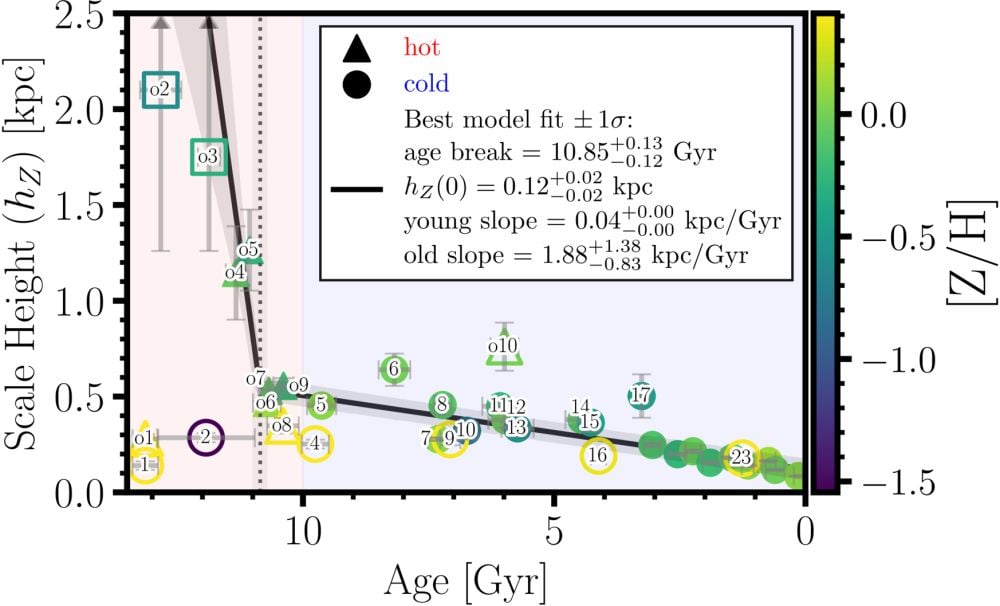
"We find evidence that the scale height decrease rate changed drastically (~10.85) Gyr ago: at older ages, the evolution is very steep, with hZ (vertical scale height) dropping from over 1.26 to ∼0.5 kpc in merely 2 Gyr; subsequently, the thinning is very gradual, with hZ ∼ 0.1 kpc for the youngest populations," the authors write.
So before about 10.85 Gyr ago, the disk flattened rapidly. In only about 2 billion years, it thinned from about 4,100 light years thick down to only about 1,600 light years thick. After that, the thinning was much more gradual, reaching a thickness of only about 400 light years.
This figure from the research is packed with information that wrinkly astrophysicist brains can decipher. For the rest of us, the important part is the sharp drop in hZ, or vertical scale height, about 10.8 billion years ago. This is when the disk stopped thinning so drastically, leaving ancient stars on orbits in the thick disk, well above or below the remaining thin disk.
Image Credit: David Mirabal et al 2026 ApJL 1010 L38
This means the vertical structure of the disk components grew from the thick layer inward, an upside-down scenario. Ancient stars in the thick disk weren't scattered there by interactions with gas clouds, spiral arms, or other things; they were born there when the disk was much thicker overall. As time passed, generations of stars were born in a successively thinner disk.
"The extremely rapid early vertical settling of the disk points to a fundamentally upside-down formation process at early times, when the thick disk component is basically formed," the researchers explain. "Enabled by precise ages and high completeness, our results exhibit two clear, time-dependent evolutionary phases for the Galactic disk, which allow piecing together a comprehensive picture of the physical processes responsible for a two-phase assembly history of the Galactic disk."
This created what we see today. The thick disk has older, metal-poor stars and almost no gas for new star formation. The thin disk has younger stars, is the site of most star formation, and holds most of the gas for new stars.
"We thus strongly support an evolutionary scenario defined by two distinct temporal phases: an initial, highly turbulent epoch that gave birth to the thick disk, and a subsequent more quiescent period of secular evolution and gradual gas settling, which formed the thin disk," the authors write.
“This result resolves a classic problem in astrophysics,” lead author Mirabal said in a press release. “In the simulations, both disc formation models were possible, but there was a lack of observational evidence to determine which one occurred in the Milky Way. This is the first clear observational evidence favouring one of the two models for the Galaxy’s early stage. And it has been possible thanks to the high precision we achieved for the older ages,” he said.
RELATED
How Inversion and NASA Plan to Unlock Interplanetary Aerocapture

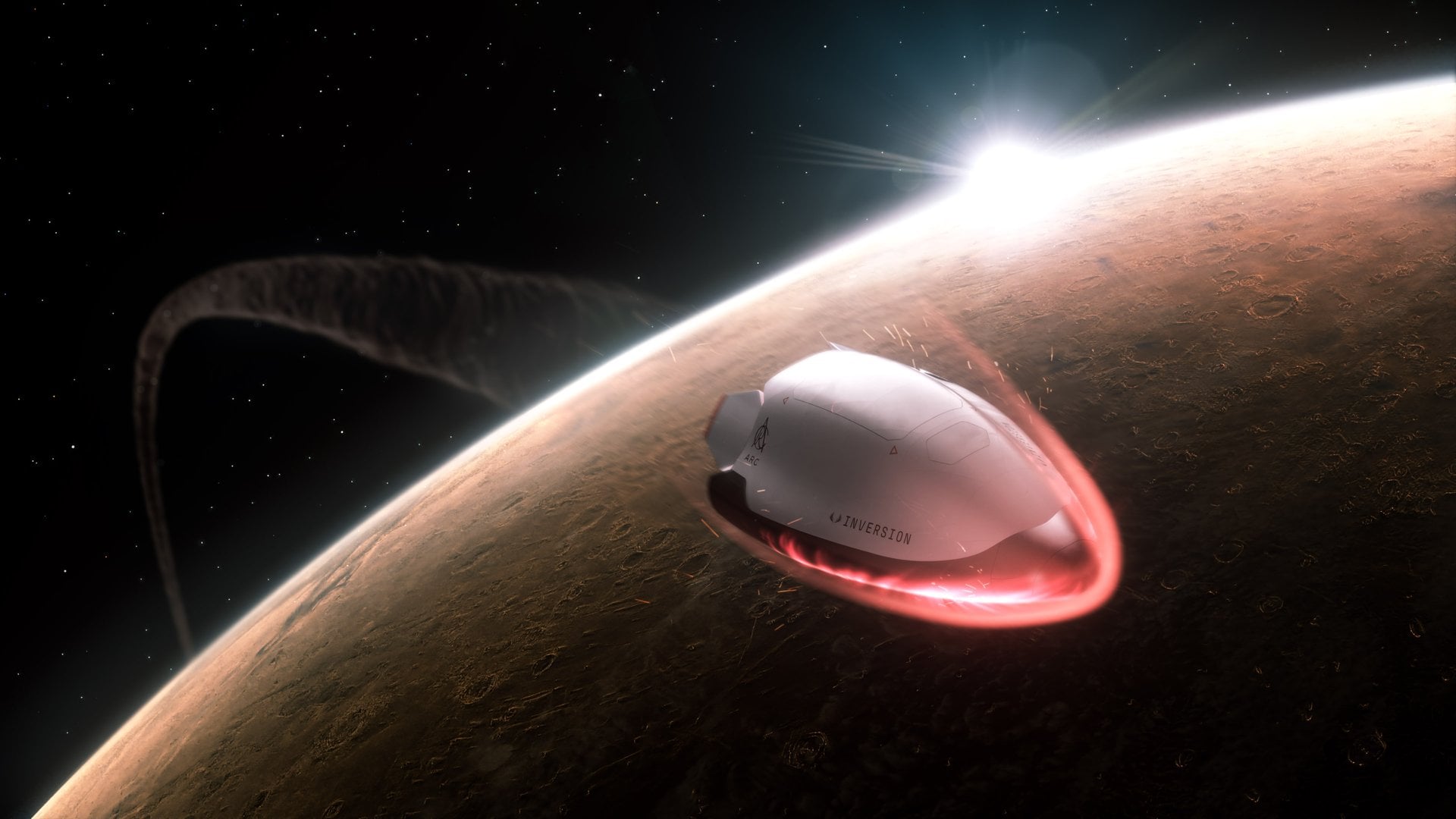
Artist's depiction of the Arc spacecraft performing an aerocapture maneuver.
Credit - Inversion Space
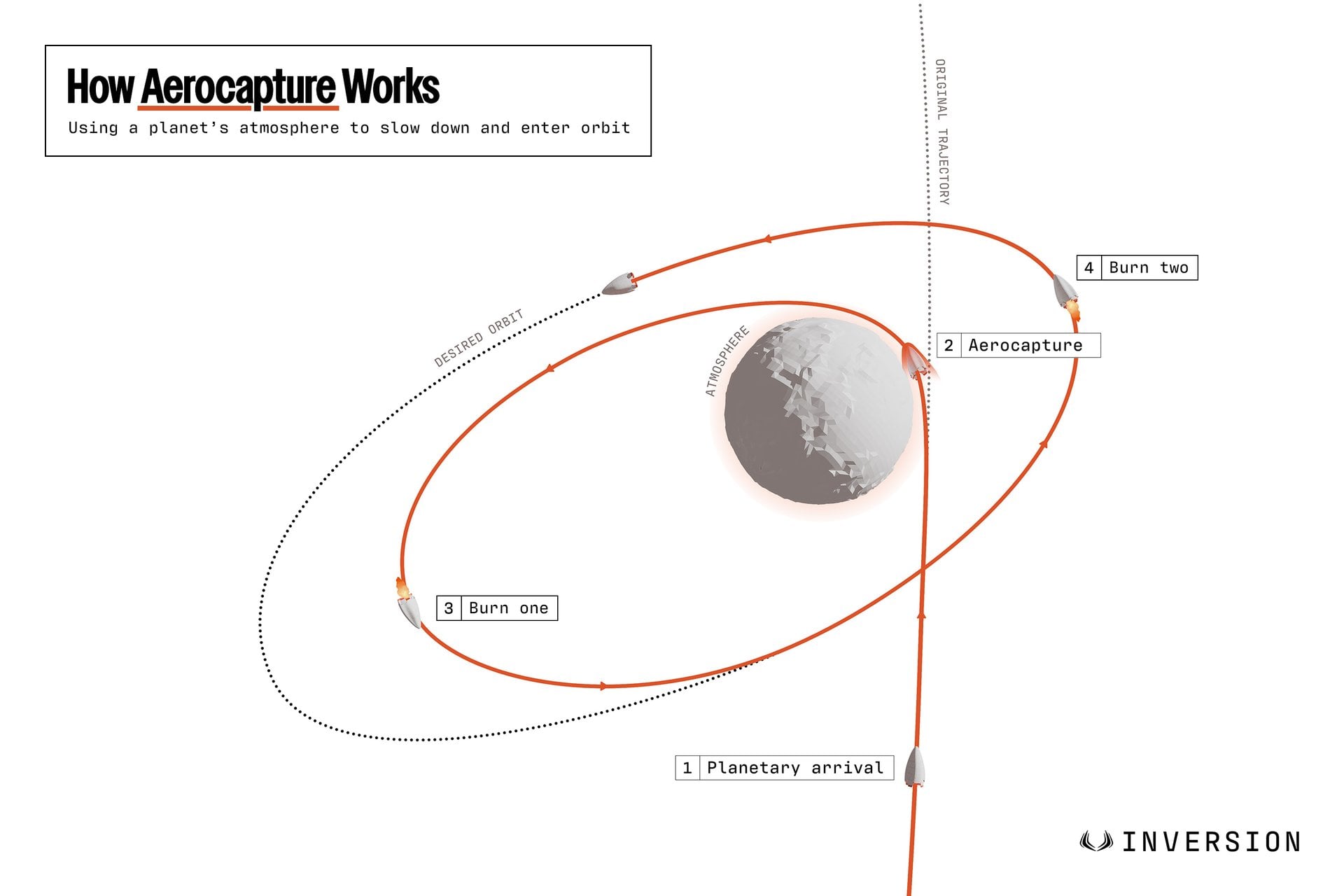
Using a planet’s atmosphere to secure a satellite’s place in orbit, a process known as “aerocapture”, has been the dream of flight engineers for decades. The only problem? It’s really hard to actually do. It requires control systems, thermal management, and orbital mechanics to all coordinate in a dance that allows a spacecraft to not just slow down while passing by another planet (or moon in some cases) but to start to orbit it without the use of lots of additional propellant. For now, that remains a dream, but a recent NASA contract to a California start-up called Inversion is another step towards making it a reality.
Inversion itself was started by former engineers from SpaceX and ABL Space to design orbital reentry vehicles - specifically ones that are designed to deliver mission critical cargo, such as vaccines or biological samples, or key military equipment to an isolated area, that would benefit from the much shorter travel times that orbital flight allows. Their business model would have saved Balto and companion sled dogs a harrowing trip to Nome if it was available 100 years ago.
Currently the company is working on a spacecraft they call Arc, which is designed to be the exact kind of reentry vehicle that enables those mission critical deliveries. Arc is designed to attach to one of the modern launch systems, the release into a Low Earth Orbit, which would enable short trips between almost any two points on the surface of the planet.
Graphic describing the aerocapture process.
Credit - Inversion Space
Arc itself has three different control stages. It has traditional chemical propellants for orbital maneuvering. Once it reaches close to its desired trajectory, it switches to a cold gas system that uses smaller thrusters to optimally position the spacecraft. But where the real magic happens is when it actually begins reentry. At that point, control flaps designed to withstand the thermal and mechanical stresses of reentry at a high speed take over, guiding the spacecraft to exactly the place it intends to be.
The system itself isn’t designed to be reusable. But, according to Inversion’s CEO Justin Fiaschetti, it doesn’t have to be. It uses traditional heat shields and parachutes to slow its descent and is not intended to be refurbished. The key feature the company has to demonstrate is thermal management. The more heat Arc is able to take, the more customers it has for delivery. So the company has been focusing on thermal protection systems and other novel ways of dealing with that problem.
But one other area where that thermal management would come in handy is aerocapture. And Arc’s controllability under such extreme circumstances makes it ideal for that use case. While that would mean the spacecraft would stay in orbit rather than descending to a specific landing point, the physics principles of managing heat and maneuvering during atmospheric entry remain the same.
Video showcasing the Arc craft.
Credit - Inversion YouTube Channel
Assumedly that’s why NASA saw the potential in Arc. The plan isn’t to immediately send the spacecraft to Mars for its first attempt, but simply try an aerocapture on Earth itself. Under the contract, Inversion will study and demonstrate the “mission design, aerodynamics, trajectory analysis, and vehicle definition” according to a Medium post from the company announcing the contract.
According to Fiaschetti, the company’s plan isn’t to have this contract lead to a ten year development cycle typical of early-stage NASA contracts. In an interview with UT, he mentioned wanting to launch a demonstration vehicle as quickly as possible, though the exact timeline of that remained vague, and NASA hasn’t yet signed on to that commitment. But the company has form for delivering quickly - last year they launched Ray, their first prototype spacecraft, only four years after starting as a company.
Obviously the main use cases for aerocapture won’t be Earth - we can launch into pretty much whatever orbit we want on our own planet without the challenge of slowing down. It’s also not particularly useful on the Moon, as there’s no atmosphere to speak of to slow the craft down. But going either farther out or in, such as to Mars, Venus, or, hopefully, Titan, is where that capability would really shine. Admittedly, we might be decades away from seeing that sort of controllable aerocapture technology in use around other worlds, but it has to start somewhere. And in this case, it's starting with a contract.
Learn More:
Planet X Found Cloaked, Solar Material Pulled By it Gave It Away! UFO Sighting News.
Glowing Orbs Over Portland, Oregon Oct 9, 2026, UFO UAP Sighting News.
Sailors See 100 Meter UFO With Orb Fleet 450 Miles Off Nova Scotia, Oct 11, 2026, UAP Sighting News.
Glowing UFOs spotted racing over the Atlantic at 'hypersonic speeds' as sailors describe them vanishing and reappearing
Sailors have reported a mysterious sighting as they crossed the Atlantic this month.
A submission to the National UFO Reporting Center (NUFORC), dated October 11, detailed an encounter with glowing UFOs that the ship's crew said moved at impossible speeds and patterns.
For about 40 minutes, two sailors watched through binoculars as a single orb appeared 12 to 16 miles away, which 'rose and fell rapidly, bearing right and left, periodically shooting at hypersonic speeds, for about 5-10 minutes.'
The report, posted on October 21, claimed that three or four more orbs appeared, which looked the same as the first.
'All twisting and turning, rising and falling together in no set pattern,' the report states.
'Every so often they went somewhere else altogether, at a speed I can only call unreasonable, and then were simply there again.
'We picked up no targets on the radar.'
The NUFORC report included screenshots of the boat's radar, reportedly taken during the encounter, showing nothing on the screens that would suggest objects were in the sky.

A submission to the National UFO Reporting Center (NUFORC), dated October 11, detailed an encounter with glowing UFOs that the ship's crew said moved at impossible speeds and patterns - but did not show up on the boats radar (pictured)
The witness said the encounter began around 3:25am, when the ship’s second mate spotted a strange light low above the horizon, slightly to the left of the vessel’s bow.
The ship was crossing the Atlantic roughly 400 miles south of Nova Scotia, heading east at about 20mph, according to the report.
The witness described clear skies with only a thin crescent moon, saying ‘visibility was great.’
The vessel was not noticeably rocking, and there was ‘no traffic whatsoever’ nearby.
After seeing the first orb, the sailor said: 'The others appeared, 3-4 more. They were like the first in every respect.'
Another startling NUFORC report was submitted last year, featuring a video showing a clear image of what one witness believes was a giant UFO flying over California.
The April 27 video taken by an unnamed resident in Twentynine Palms followed what appears to be a brightly-lit hexagonal craft as it flew over the desert.

The report, posted on October 21, claimed that three or four more orbs appeared, which looked the same as the first. The witness shared screenshots of the radar to show no objects in the sky when they saw the UFOs
The UFO reportedly appeared out of nowhere around 10:27 pm PT while the witness was staying at a remote cabin.
According to the report, the suspected spacecraft was moving very slowly and irregularly, like it was in a daze.
'It seemed to move arbitrarily with no clear path. The movements were jerky and at varying speeds,' the witness wrote in their NUFORC report.
The large object also appeared to pulsate, giving off a bright light from its edges, as it moved through the sky for approximately 15 minutes.
'Tonight is the new moon - so it was definitely not the moon, and in any case was much brighter than even a full moon,' the witness continued.
'The striking thing was its great brightness and irregular shape and path,' they added.

Another startling NUFORC report was submitted last year, featuring a video showing a clear image of what one witness believes was a giant UFO flying over California
As the witness in Twentynine Palms followed the UFO, they added that the strange craft began to change shape - morphing from a six-sided object into a circle.
The person taking the cellphone video was the only witness at the cabin that night, so no one else was able to confirm their story.
However, they declared in their report to NUFORC that they hadn't taken any 'mind-altering substances' during the sighting and had clear vision the entire time.
Officials at NUFORC tried to find an explanation for the sighting, noting that a SpaceX rocket launch had taken place that day, but that Falcon 9 took off from in Florida three hours earlier.
A previous rocket launch created a similar phenomenon over the UK in March.
That bizarre shape was caused by illuminated frozen fuel expelled from the SpaceX rocket, experts revealed.
The light blue spiral is formed when excess fuel that has been released from the fast-spinning rocket turns to ice.
It then reflects sunlight in the upper atmosphere, giving it an otherworldly gleam before becoming water vapor.
World’s first round-trip mission to Mars has launched — why it could be a ‘transformative leap’ for science

On Monday (Oct. 19), Japan’s space agency launched a first-of-its-kindsample-return mission to Mars. The historic endeavor marks another major step toward humanity’s shared goal of understanding — and perhaps eventually colonizing — one of our closest planetary neighbors, experts say.
The Japan Aerospace Exploration Agency’s (JAXA) Martian Moons Exploration (MMX) probe is an international effort, constructed with help from NASA, the European Space Agency (ESA) and others. Over the next few years, it will closely study the Red Planet’s twin moons, Phobos and Deimos. The spacecraft will snap close-up photos of the pair before attempting to land on the larger satellite, Phobos, to scoop up rocky material that will hopefully be carried back to Earth in around five years.
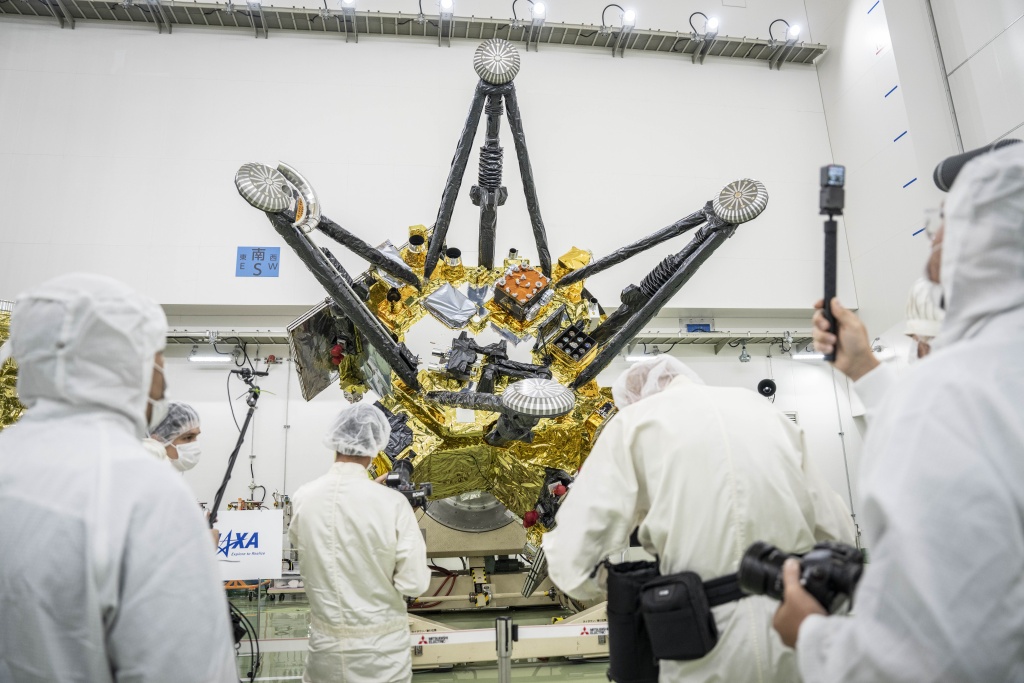
Members of the media film Exploration and Return Modules, making up the Martian Moons eXploration (MMX) spacecraft, at the Tanegashima Space Center in Minamitane, Kagoshima prefecture on August 13, 2026
Yuichi YAMAZAKI / AFP
If the mission is successful, the returned samples will finally settle a decades-old mystery about the origins of both moons. The findings could also help paint a picture of Mars’ ancient history and provide clues about what the early solar system was like.
“This mission marks a transformative leap in our capacity to investigate the Martian system,” Sonia Fornasier, an astronomer at the Paris Observatory who has studied Phobos and Deimos extensively and is a project scientist for MMX’s infrared spectrometer instrument (MIRS), told Live Science. It “ranks very high” among the missions we have sent to the Red Planet so far, she added.
JAXA launched the MMX probe on board an H3 rocket, which lifted off from Tanegashima Space Center in Kagoshima prefecture at 3:41 p.m. EDT Monday (4:41 a.m. Tuesday local time), Live Science’s sister site Space.com reported. (The mission was initially scheduled to launch in 2024, but it was delayed due to initial concerns about the H3 rocket.)
The camper-van-sized spacecraft successfully separated from the rocket’s fairing just over an hour later, and on Wednesday (Oct. 21), JAXA announced that the mission had passed the “initial critical operations phase,” meaning the probe is now locked into its roughly 140 million-mile-long (225 million kilometers) journey to Mars, which will take around 10 months.
“MMX took its first step today,” Naoki Murakami, general manager of Mitsubishi Electric’s space division, which led the design of the MMX probe, said in a postlaunch news conference early Tuesday morning (Oct. 20), according to The Japan Times. “This marks the beginning of a long, five-year journey.”

A Propulsion Module (L) and Exploration and Return Modules (R), making up the Martian Moons eXploration (MMX) spacecraft, are seen at the Tanegashima Space Center in Minamitane, Kagoshima prefecture on August 13, 2026. /VCG
Once the probe arrives at the Red Planet in August 2027, it will insert itself into a “quasi-satellite orbit” around Phobos. In other words, MMX will circle Mars alongside the moon but will not be gravitationally bound to it, similar to around half a dozen “quasi-moons” that currently accompany Earth around the sun.
Sonia Fornasier, Paris ObservatoryThis mission marks a transformative leap in our capacity to investigate the Martian system
After collecting data from a distance for a few months, MMX will swoop down and attempt to land on the surface of Phobos — not once, but twice.
During the first landing, MMX will hover just above the moon and deploy a mini rover, dubbed Idefix, onto the moon’s surface. The wandering robot, built by the French and German space agencies, will have to contend with extremely weak gravity as it trundles across the surface of Phobos: The rover weighs around 55 pounds (25 kilograms) on Earth but will weigh only around half an ounce (15 grams) on Phobos, according to ESA.
Once Idefix has completed its initial assessment of the moon’s surface, the entire MMX probe will set down on Phobos, on top of the spacecraft’s four-legged lander module. Mission scientists hope this goes a lot more smoothly than the attempted landings of Japan’s “Moon Sniper” and Resilience lunar landers, which crash-landed on Earth’s moon in 2024 and 2025, respectively.
Two of the MMX lander’s legs contain built-in sampling devices — one that will drill into Phobos and another that will hoover up surface material. The second device, dubbed the Pneumatic Sampler (or P-Sampler), was built by the Blue Origin-owned private company Honeybee Robotics on behalf of NASA and will collect its material in a “matter of seconds,” Kris Zacny, vice president of the Exploration Technology Group at Honeybee Robotics, said at an Oct. 15 NASA news conference. “You blink, and it’s all done.”
In total, JAXA aims to collect around a third of an ounce (10 grams) of material from Phobos. That would be around twice as much material as the space agency managed to snag on its most recent sample-return mission, Hayabusa2, which collected samples from the “spinning-top” asteroid Ryugu in 2019, finding materials rich in surprising organic compounds.
Once the samples have been acquired, at some point between late 2028 and early 2029, the probe will conduct a series of close flybys of Mars’ smaller moon, Deimos, before beginning the long trip back to Earth in late 2030 — the first return flight ever attempted by a spacecraft sent to Mars.
When the probe returns to Earth in 2031, it will release its samples in a 20-inch-wide (60 centimeters) container that will fall back to our planet’s surface, most likely somewhere in Australia, according to ESA.
Mars’ twin satellites, which were first spotted by American astronomer Asaph Hall in 1877, are nothing like Earth’s constant companion. For starters, they are much smaller; Phobos is around 14 miles (22 km) across, while Deimos is just 7.5 miles (12 km) wide. The duo also have lopsided shapes and are between 12 and 64 times closer to Mars than the moon is to Earth. (Phobos, meaning “fear,” and Deimos, meaning “terror,” are named after the sons of the Greek war god Ares, the counterpart to the Roman war god Mars.)
Phobos is dominated by the 6-mile-wide (10 km) Stickney crater, which was left by an ancient asteroid impact. The larger moon is also slowly falling toward Mars and may eventually be ripped apart before it reaches the Red Planet’s surface.
Other Martian spacecraft, such as the Emirates Mars Mission orbiter, have flown close to the moons, and NASA’s Mars rovers have frequently looked up to see the satellites eclipsing the sun in Mars’ sky (sometimes both at the same time). Yet many mysteries remain about the pair.
“Mars is right in our cosmic backyard, and yet we haven’t explored the planet’s moons,” Nancy Chabot, a space exploration expert at the Johns Hopkins Applied Physics Laboratory in Maryland and the deputy principal investigator of NASA’s MEGANE instrument on board MMX, told Live Science in an email. “MMX will do this!”
The biggest mystery surrounding Phobos and Deimos is their origin. Some researchers suspect the satellites are asteroids, or maybe even comets, that have been captured by Mars’ gravity, while others think the moons emerged from the debris of an ancient impact on the planet’s surface, similar to how Earth’s moon formed.
Neither theory is conclusive, meaning the moons’ origins “remain enigmatic,” Christopher Edwards, a planetary scientist at Northern Arizona University and one of NASA’s participating scientists for MMX, told Live Science.
For example, explaining how Mars captured the moons is “quite hard from an orbital mechanics perspective,” but if they did form from a debris disk from an ancient impact, they should have coalesced into better-defined spheres, Edwards said.
“MMX will solve this debate thanks to the spacecraft observations and the detailed analysis of the samples of Phobos on Earth,” Fornasier said. The data the probe collects from its flybys of Deimos will also allow researchers to generate a “full characterization of this body,” she added.
Fornasier is “particularly excited” by the possibility that the moons are captured asteroids because that would mean they would likely contain “organic and hydrated materials,” which would have a big “astrobiological implication” and would shed light on what the early solar system was like.
Regardless of how the twin moons formed, researchers also stand to learn a lot about Mars and how planets form and evolve.
“Phobos and Deimos are interesting, but not just in their own right,” Tom Statler, an MMX program executive and scientist in NASA’s Planetary Science Division, said at the Oct. 15 news conference. “Their presence is a key piece of the larger story of the Mars system. By uncovering the moons’ origin, we’ll gain new insights into the history of both Mars and Earth.”
If the moons did form via an impact scenario, the samples MMX collects may also contain actual pieces of Mars for researchers to study.
“If these objects are in fact pieces from the Martian surface that have coalesced moons, we’ll collect the best-preserved samples of the Martian surface,” Edwards said. Other fragments of Mars have already reached Earth as meteorites. However, entry into Earth’s atmosphere can transform them.
If Phobos is a chunk of Mars, that would be a real boon to NASA, which canceled its Mars Sample Return program — a mission that would have retrieved samples collected by the Perseverance rover — earlier this year. The agency’s researchers will receive up to 15% of the MMX samples to analyze.
During its three-year stay in the Red Planet’s system, the Japanese probe will also collect lots of data on Mars that could contribute to a wide range of future findings. “MMX will conduct in-depth studies of the Martian atmosphere, with a particular emphasis on dust and water transport mechanisms and the escape processes shaping Mars’ atmospheric dynamics,” Fornasier said.
This atmospheric data could temporarily fill a gap left by the recent death of NASA’s iconic MAVEN spacecraft, which stopped sending data back to Earth late last year.
Analysis of craters on the Martian moons could also provide clues about other events in Mars’ history. For example, some researchers think the Red Planet may have once had rings like Saturn or a larger moon.
Other experts are hopeful that the MMX findings could help lay the groundwork for future missions to explore — and perhaps colonize — Mars. “The samples from MMX will bring forth paradigm-shifting science on the Mars system for generations to come, especially as NASA prepares to send the first humans to Mars,” Nicky Fox, associate administrator for NASA’s Science Mission Directorate, said in a recent statement.
The next sample-return trip to Mars will be China’s Tianwen-3 mission, which is scheduled to launch in 2028 and will aim to land on and retrieve samples directly from the Red Planet’s surface, according to Space.com.

Since landing its first rover on Mars in 1997, NASA has pushed the boundaries of exploration with increasingly larger and more sophisticated robotic explorers. Each mission builds on the lessons learned from the Red Planet, leading to breakthroughs in technology and our understanding of Mars. From the microwave-sized Sojourner to the SUV-sized Perseverance—and even taking flight with the groundbreaking Ingenuity helicopter—these rovers reflect decades of innovation and the drive to answer some of science’s biggest questions.
German AfD party asks government about UFOs, aerial phenomena
![]()
BERLIN
RELATED