Ontdek de Fascinerende Wereld van UFO's en UAP's: Jouw Bron voor Onthullende Informatie!
Ben jij ook gefascineerd door het onbekende? Wil je meer weten over UFO's en UAP's, niet alleen in België, maar over de hele wereld? Dan ben je op de juiste plek!
België: Het Kloppend Hart van UFO-onderzoek
In België is BUFON (Belgisch UFO-Netwerk) dé autoriteit op het gebied van UFO-onderzoek. Voor betrouwbare en objectieve informatie over deze intrigerende fenomenen, bezoek je zeker onze Facebook-pagina en deze blog. Maar dat is nog niet alles! Ontdek ook het Belgisch UFO-meldpunt en Caelestia, twee organisaties die diepgaand onderzoek verrichten, al zijn ze soms kritisch of sceptisch.
Nederland: Een Schat aan Informatie
Voor onze Nederlandse buren is er de schitterende website www.ufowijzer.nl, beheerd door Paul Harmans. Deze site biedt een schat aan informatie en artikelen die je niet wilt missen!
Internationaal: MUFON - De Wereldwijde Autoriteit
Neem ook een kijkje bij MUFON (Mutual UFO Network Inc.), een gerenommeerde Amerikaanse UFO-vereniging met afdelingen in de VS en wereldwijd. MUFON is toegewijd aan de wetenschappelijke en analytische studie van het UFO-fenomeen, en hun maandelijkse tijdschrift, The MUFON UFO-Journal, is een must-read voor elke UFO-enthousiasteling. Bezoek hun website op www.mufon.com voor meer informatie.
Samenwerking en Toekomstvisie
Sinds 1 februari 2020 is Pieter niet alleen ex-president van BUFON, maar ook de voormalige nationale directeur van MUFON in Vlaanderen en Nederland. Dit creëert een sterke samenwerking met de Franse MUFON Reseau MUFON/EUROP, wat ons in staat stelt om nog meer waardevolle inzichten te delen.
Let op: Nepprofielen en Nieuwe Groeperingen
Pas op voor een nieuwe groepering die zich ook BUFON noemt, maar geen enkele connectie heeft met onze gevestigde organisatie. Hoewel zij de naam geregistreerd hebben, kunnen ze het rijke verleden en de expertise van onze groep niet evenaren. We wensen hen veel succes, maar we blijven de autoriteit in UFO-onderzoek!
Blijf Op De Hoogte!
Wil jij de laatste nieuwtjes over UFO's, ruimtevaart, archeologie, en meer? Volg ons dan en duik samen met ons in de fascinerende wereld van het onbekende! Sluit je aan bij de gemeenschap van nieuwsgierige geesten die net als jij verlangen naar antwoorden en avonturen in de sterren!
Heb je vragen of wil je meer weten? Aarzel dan niet om contact met ons op te nemen! Samen ontrafelen we het mysterie van de lucht en daarbuiten.
Berichten van 1 november 2023 tot 30 november 2023
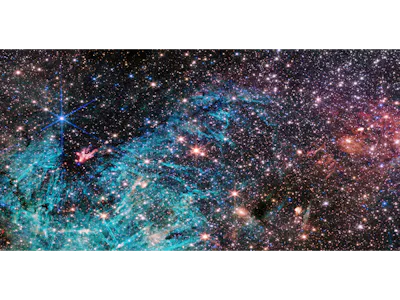
Now I took the original photo and added contrast to it, because it was over exposed...meaning NASA added too much light to blur out the detail. They do that often, but I thought I would share with you a few of the interesting structures I found. Interesting fact about alien structures, since it is an alien culture, its rules of making structures are different from our own, therefore do not expect the expected, but instead look forward to the unexpected.
5,500km Boomerang UAP Passes Sun On Nov 27, 2023, Video, UFO Sighting News.
Date of sighting: Nov 27, 2023, 16:46:53 Location of sighting: Earths Sun Source: Helioviewer.org
I was looking at objects near the sun on Helioviewer. It's a NASA program that is designed for the public and educators to share. I found that in a single frame of the video, there is a huge craft that measures 5,500km across from wing tip to wing tip. Yes you heard me right, it's long and it's a boomerang type UAP shape. As it passes the sun it is unphased by the suns powerful gravity, showing no sign of bending. Also, the UAP seems to be pulling the suns material toward it and creating a stream behind the UAP, much like a ship moving through the ocean and living long lines in its wake from the plankton. A similar shaped UFO was seen by thousands of residence in Phoenix, Arizona on March 13, 1997, where a huge boomerang UFO blocked out the stars in the sky for miles.
It's hard to believe that this craft was caught in only one frame, that means it was traveling faster than anything we have on Earth. I looked at the frames:
16:36:41 frame before
16:46:53 UAP here ++++
16:56:29 frame after
And I found that there was a ten minute per frame rate. This tells us that the UAP was traveling very fast, not only faster than any rocket today, but faster than any comet or meteor ever recorded. It's traveling at partial light speed, about that of 1/10. Which tells me that not only was it fast, but if object can come close to light speed, there must be those that can travel faster than light speed, which is what makes time travel possible. The speed of the object, size and shape all indicate a massive alien ship passed our sun and was in our solar system on Nov 27th, but NASA of course would never mention it, because they believe the public is not intelligent enough to ever discover or find this info in their data bases. Clearly NASA needs to catch up to my speed, because they are falling far behind.
TikTok influencer captures a UFO disappearing in a flash of light
Approximately a week ago, TikTok influencer Gkbarry found herself engrossed in promotional recordings. Amidst her busy schedule, she unintentionally captured a spherical object flying through the sky at a remarkable speed.
To her surprise, the footage not only revealed the sphere but also a substantial flash surrounding the sphere just before it vanished.
Due to the object's fast movement, it was nearly visible in the initial recording. However, upon closer inspection through zooming, both the object and its trajectory became distinctly visible as well as unveiling the flash that occurred moments before its disappearance.
The enhanced zooming, starting at the 0.35-minute mark in the video, provides a clearer view of the mysterious object and the intriguing flash that unfolded during its flight.
US Military Confirms UFO Sightings in Outer Space, Official Reports Reveal!
In the vast expanse above us, a silent drama unfolds. The United States Space Force (USSF), the newest branch of the US Armed Forces, is grappling with an unprecedented challenge — the detection of thousands of unidentified flying objects(UFOs) orbiting our planet. This celestial mystery, once the domain of science fiction, is now a stark reality that poses complex questions for our guardians of the galaxy.
Established in 2019 under the Trump administration, the USSF was tasked with a mission of cosmic proportions: to safeguard America from space-based threats. But as the USSF stares into the abyss of space, the abyss stares back with a puzzle woven in a tapestry of unknowns. These UFOs, or ‘abnormal observables’ as they are termed, are cluttering the Earth’s orbit, making the crucial job of threat identification a Herculean task.
The nature of these ‘abnormal observables’ is as varied as it is perplexing. While some could be dismissed as mundane space debris or meteoroids, others exhibit behaviors that defy conventional understanding. We’re talking about objects that challenge gravity, vanish from radars, accelerate suddenly, and achieve hypersonic speeds without the acoustic signatures like sonic booms. They also demonstrate ‘trans-medium’ travel capabilities, seamlessly transitioning between air, sea, and space — a feature that leaves even seasoned scientists in awe.
This cosmic conundrum isn’t just about identifying what is floating above us; it’s about understanding potential threats. Among these unidentified objects could be covert spy satellites launched by foreign adversaries, such as North Korea’s Malligyong-1. The USSF is also wary of the largely unmonitored ‘cislunar’ orbit — the space between the Earth and the moon, which could harbor unseen dangers.
The challenges are as vast as space itself. As of now, NASA‘s data indicates over 25,000 objects in orbit, a mix of man-made and natural entities. Distinguishing friend from foe, debris from danger, in this crowded orbital dance is no small feat. It’s a task that demands cutting-edge technology, sharp analytical minds, and a significant financial commitment. The USSF’s budget reflects this, with a substantial part dedicated to research, development, testing, and evaluation.
VIDEO:
NASA’s Spectacular CGI Journey Through Tracked Objects in Earth’s Orbit
Looking ahead, the USSF’s plans are as ambitious as they are necessary. The Oracle spacecraft, set to launch in 2026, aims to monitor the cislunar region. It’s a mission that symbolizes the USSF’s proactive approach to these unidentified phenomena — a step towards illuminating the shadows in our celestial neighborhood.
In this new age of space exploration and defense, the USSF’s journey is emblematic of humanity’s eternal quest to understand the unknown. As we gaze upwards, the mysteries of the universe continue to unfold, reminding us that we are but a small part of a vast, intricate cosmic ballet. The USSF’s endeavor is not just a mission of defense; it is a journey into the heart of this grand mystery, a testament to our unyielding spirit of exploration and discovery.
Grote zonnestorm op komst: vannacht kans op noorderlicht boven België en storingen voor gps- en communicatiesystemen
Artikel van Wim De Maeseneer
Wie het noorderlicht wil zien, moet normaal gezien naar het hoge noorden trekken. Maar uitzonderlijk kan het ook in Nederland en zelfs België zichtbaar zijn. Dat was begin deze maand al eens het geval. Maar ook komende nacht en vrijdagnacht is er opnieuw een kans.
Ruimteweerdiensten melden dat er een sterke geomagnetische storm zal woeden. Een plasmawolk van geladen deeltjes van de zon. Die zal naar verwachting deze nacht of morgenvroeg de aarde bereiken.
"Op een schaal van 0 tot 9 verwachten we een zonnestorm van maximaal 8", zegt ruimteweervrouw Petra Vanlommel van het Solar Terrestrial Centre of Excellence in Ukkel.
"Als we effectief 8 halen, dan betekent dat dat de wolk aan geladen deeltjes sterk genoeg is om noorderlicht te veroorzaken dat tot boven België te zien is. Misschien niet met het blote oog, maar zeker met een fototoestel.”
Al zijn de weersvoorspellingen voorlopig niet al te gunstig. "Het wolkendek trekt in de loop van de nacht dicht, al kunnen er lokaal wel opklaringen zijn", zegt weerman Bram Verbruggen. "Ook morgen verwachten we maar weinig opklaringen."
De zonnestorm is het gevolg van drie verschillende uitbarstingen op de zon de voorbije dagen. "Maandag zijn twee plasmawolken uitgestoten die sindsdien op weg zijn naar de aarde. Dinsdag was er nog een derde uitbarsting."
"Die derde plasmawolk gaat de twee andere inhalen en ze als het ware opeten. We noemen dat een kannibaal-plasmawolk. Het is die grote wolk die nu op ons afkomt."
"Er was trouwens nog een vrij grote zonnevlam dinsdag, waarbij ook een zonnewolk werd uitgestoten. Die wolk zal ons morgenavond bereiken. We weten momenteel nog niet hoe hevig die impact zal zijn, maar die kan de storm die woedt versterken en langer laten duren."
Welke gevolgen kunnen we verwachten?
Hoe de plasmawolk er precies uitziet, weten ruimteweerdiensten maar één uur voor de wolk "botst" met de aarde. Dan pas weten we hoe zwaar de zonnestorm zal zijn en welke impact hij zal hebben. Zeker is in elk geval dat onze dampkring zal worden verstoord.
Als de ionosfeer, het bovenste deel van de dampkring, wordt verstoord, kan dat problemen geven voor satellieten, bij radiocommunicatie over lange afstand en voor navigatiesystemen.
"Iemand die met zijn auto onderweg is en de gps gebruikt, gaat daar niets van merken. Het maakt niet echt uit of het huis waar je naartoe gaat, één meter meer naar links of rechts staat. Voor vliegtuigen bijvoorbeeld wel."
Het Solar Terrestrial Centre of Excellence stuurt bij zonnestormen daarom waarschuwingen uit naar de civiele luchtvaart over de hele wereld. "Ik ben vrijdagnacht van wacht en ik hou mijn hart vast. Waarschijnlijk zal ik de hele nacht moeten opblijven om het ruimteweer in de gaten te houden."
Waarom zo veel zonnestormen?
Het stormseizoen op de zon is duidelijk volop aan de gang. De zon is namelijk niet altijd even actief. Gemiddeld om de 11 jaar piekt haar activiteit, en zijn er veel meer stormen en uitbarstingen op de zon.
"Je kan het vergelijken met de seizoenen op aarde, alleen zijn er op de zon maar 2 seizoenen en die duren elk 5,5 jaar", zegt Vanlommel. "Maar net zoals op aarde is de ene zomer de andere niet. En is het de ene zomer al wat warmer dan de andere."
Op dit moment zijn we duidelijk op weg naar een zogenoemd zonnemaximum. Wetenschappers voorspellen dat de piek in 2024 of 2025 zal zijn. Maar volgens sommige onderzoekers zijn er aanwijzingen dat de zon actiever is dan verwacht en dat we sneller de piek gaan bereiken.
Zoals elke religieuze tekst, staat ook de Bijbel open voor interpretatie en is niet per se feitelijk accuraat. Echter blijkt dat sommige delen van de tekst volgens de wetenschap wel op waarheid berusten.
De aarde is rond Hoewel sommige samenzweringstheorieën iets anders beweren, heeft de wetenschap bevestigd dat onze planeet rond is. Dit wordt ook in de Bijbel genoemd: 'Hij troont boven de kring der aarde' (Jesaja 40:22).
En als je op zoek bent naar Bijbelse bevestiging dat de aarde in de ruimte zweeft, zoek dan niet verder dan Job 26:7. Daar staat: 'Hij spreidt de noordelijke hemel uit over lege ruimte; hij hangt de aarde boven niets.'
De waterkringloop, ook wel de hydrologische kringloop genoemd, is een bekend fenomeen. Het blijkt dat de Bijbel het meer dan eens vermeldt. Prediker 1:7 zegt: 'Alle stromen stromen in de zee, maar de zee is nooit vol. Naar de plaats waar de stromen vandaan komen, daar keren ze weer terug.'
Er bestaat een waterkringloop Amos 9:6 vermeldt het ook in één deel: 'Hij roept om de wateren van de zee en giet ze uit over het oppervlak van het land.' En dat doet Job 36:27-28 ook: 'Hij trekt de waterdruppels omhoog, die als regen naar de stromen sijpelen; de wolken gieten hun vocht neer en overvloedige regenbuien vallen op de mensheid.'
Er bestaat een waterkringloop Een ander voorbeeld is te vinden in Psalm 135:7, waar staat: 'Hij laat wolken opstijgen van de uiteinden van de aarde; hij zendt bliksem met de regen en laat de wind uit zijn voorraadschuren komen.'
De zondvloed is waarschijnlijk echt gebeurd De zondvloed en de ark van Noach is een van de meest populaire verhalen uit de Bijbel. En volgens geologisch bewijs zou de zondvloed van Noach echt kunnen hebben plaatsgevonden.
De ark zou hebben gefunctioneerd Volgens Genesis 6:13-22 waren Gods instructies aan Noach als volgt: 'De ark moet 140 meter lang, 23 meter breed en 14 meter hoog zijn.'
De ark zou hebben gefunctioneerd Het blijkt dat de wiskunde correct is. Volgens berekeningen gemaakt door natuurkundestudenten aan de Universiteit van Leicester in 2014, zou de ark daadwerkelijk drijven en solide genoeg zijn om twee paren van elke diersoort te kunnen dragen.
Er zijn talloze sterren aan de hemel Natuurlijk weten we dat het universum veel sterren heeft. En met veel bedoelen we wel een biljoen sterren per melkwegstelsel. En er wordt geschat dat er ongeveer 100 miljard sterrenstelsels in het heelal zijn!
Er zijn talloze sterren aan de hemel De Bijbel vermeldt dit in Jeremia 33:22: 'Ik zal de nakomelingen van mijn dienaar David en de Levieten die voor mij dienen zo ontelbaar als de sterren aan de hemel en zo onmetelijk als het zand aan de kust.
Sterren verschillen onderling De Bijbel vermeldt ook dat de helderheid of grootte van sterren varieert. 'De zon heeft een soort pracht, de maan heeft een andere soort pracht en de sterren weer een andere; elke ster verschilt van pracht.' (Korinthiërs 15:41).
Hemellichamen hebben niet het eeuwige leven We weten nu dat sterren en andere astronomische lichamen sterven. De wetenschap heeft dit bevestigd, maar de Bijbel vermeldt het ook.
Het universum is gemaakt van onzichtbare deeltjes Hebreeën 11:3 luidt: 'Door geloof begrijpen we dat het heelal op Gods bevel werd gevormd, zodat het zichtbare niet werd gemaakt uit het zichtbare.
Het universum is gemaakt van onzichtbare deeltjes It sounds like the Bible is talking about atoms. Protons, neutrons, and electrons on their own are invisible to the naked eye. Atoms make up pretty much everything, including us.
David zou Goliath daadwerkelijk hebben kunnen verslaan Een kleine jongen die een reus verslaat klinkt misschien onwaarschijnlijk, maar het verhaal van David en Goliath in 1 Samuël 17 verteld het net iets anders.
David zou Goliath daadwerkelijk hebben kunnen verslaan Een katapult is misschien niet het krachtigste wapen, maar de stenen uit Elah Valley waren gemaakt van bariumsulfaat, dat extreem massief is en Goliath zou daarmee gemakkelijk uitgeschakeld kunnen worden.
David zou Goliath daadwerkelijk hebben kunnen verslaan Maar er is meer. Als reus leed Goliath waarschijnlijk aan Acromegalie (overproductie van groeihormoon). Dit kan problemen met het gezichtsvermogen veroorzaken en het centrale (perifere) gezichtsvermogen kan beperkt zijn, wat handig zou zijn geweest voor David.
De zon stopte echt met schijnen Er vond namelijk een verduistering plaats. Jozua 10:12 luidt: 'Op de dag dat de Heer de Amorieten aan Israël overgaf, zei Jozua tot de Heer in het bijzijn van Israël: 'Zon, sta stil boven Gibeon, en jij, maan, over de vallei van Ajalon.''
Wezens kunnen niet leven zonder bloed De meesten van ons zijn bekend met het verhaal van Adam en Eva uit de Bijbel. Mensen hebben in feite een vrouwelijke biologische voorouder genaamd Mitochondriale Eva, die voorafgaat aan onze soort: Homo sapiens. Er is echter één ding dat ons alle levende wezens verbindt: bloed.
Wezens kunnen niet leven zonder bloed 'Want het leven van een schepsel is in het bloed, en ik heb het u gegeven om voor uzelf te verzoenen te doen op het altaar; het is het bloed dat verzoening doet voor iemands leven' (Leviticus 17:11).
Ontsmetten is echt belangrijk De pandemie heeft ons allemaal pro's gemaakt in het ontsmetten van onze handen en kleding om verspreiding van ziektekiemen te voorkomen, maar de Bijbel noemde het belang ervan al lang geleden.
De zieken moeten zich isoleren Hoewel er zich later in de geschiedenis behoorlijke quarantaines ontwikkelden, adviseerde de Bijbel al 'de getroffen persoon zeven dagen af te zonderen', en als ze niet beter zijn, 'ze nog zeven dagen te isoleren' (Leviticus 13:1-5).
Leviticus 11:28 zegt bijvoorbeeld: 'Iedereen die hun karkassen ophaalt, moet zijn kleren wassen, en ze zullen tot de avond onrein zijn. Deze dieren zijn onrein voor jullie.'
Sightings of UFOs may challenge our entire worldview, but the facts are too compelling to ignore, and they’re not going away. So, it’s time to wash off the sticky stigma and engage in serious discussion about the evidence, and its implications.
Most UFO sightings are attributable to man-made objects like experimental aircraft or satellites, innocent misidentifications of Venus and other celestial objects, or outright hoaxes. However, we now know that in a minority of cases, there appears to be something else going on: something quite extraordinary and beyond our current comprehension.
According to the U.S. Department of Defense, there are objects of unknown origin, evidently under intelligent control, which behave in ways that seem to challenge our understanding of physics. These objects don’t just “fly” without any apparent lift surfaces or means of propulsion; according to some military testimony, they would appear to be the fastest technological objects on Earth, capable of accelerating so quickly that they should create sonic booms, superheat the air around them into a glowing plasma, and instantly kill any occupants on board.
Instead, they silently maneuver with perfect agility through the atmosphere and, according to some eyewitness reports, underwater, as if basic rules of inertia and friction simply don’t apply to them.
There’s general acknowledgment that these phenomena have been documented in America since at least the late 1940s, and probably much earlier. Hence, many longtime UFO advocates, as well as those newer to the subject, are now asking why it has taken 70 years for government offices to openly regard UFOs as a subject of serious inquiry. This is a question that deserves a lengthy public discussion.
Today, serious researchers are beginning–sometimes grudgingly–to admit that UFOs (or UAPs if you prefer the rebranded version) are a valid area of study, and pockets of scientific enthusiasm are emerging. After the New York Times made the revelation of a secret Pentagon UFO study their front page story, the Department of Defense subsequently admitted that leaked UFO videos were in fact real (and that it has others it’s not showing us). Since that time, a NASA UFO research initiative headed by Princeton’s former chair of astronomy has been launched, former Harvard astronomer Avi Loeb’s Galileo Project wants to determine if the strange phenomena are extraterrestrial. The Pentagon’s All-domain Anomaly Resolution Office is now investigating UFO phenomena across all the branches of the military; the US Navy has revised its protocols to counter stigmas against UFO reporting and encourage sighting reports by pilots (like this one); and there have been briefings in the US Senate and House regarding the more than 650 sightings now being studied by AARO, marking an almost singular point of bipartisanship in a traditionally fractured Congress.
This explosion of interest and influx of expertise, credibility, and funding into UFO research will create a flow of ideas between old-hat UFO researchers and establishment newcomers to the subject. As some scientific communities shift to incorporate the nascently-legitimate subject of UFO research, they may have to accommodate elements of the other’s conceptual frameworks, methodologies, and research agendas, and this will require questioning old assumptions about what sort of evidence actually exists and how to interpret it. Likewise, it is the perfect moment for UFO-interested folks to pause and evaluate their own assumptions about the subject, many of which seem to have been in place since the very beginning of the Flying Saucer craze that in 1947 began simultaneously in bothAmericaandCanada. As career researchers and academics (like me) join the conversation, the contours of the conversation itself will inevitably shift–I think for the better.
HOW I CAME TO THE SUBJECT, AND WHAT I NOTICED AS A NEWCOMER
My own journey down the UFO rabbit hole began one day early in 2019. As I flipped through a catalog from Oxford University Press, one title, in particular, jumped out at me: American Cosmic: UFOs, Religion, Technology by Diana Walsh Pasulka, a tenured professor of religion at the University of North Carolina. What surprised me most was that the blurb in the catalog suggested the author thought that it was not merely the UFO believers that were interesting, but that the phenomenon itself was worth serious attention. I promptly ordered a copy, and once it arrived I spent the next few days absorbed in the most bizarre piece of nonfiction I’d ever read.
The UFO enthusiasts Pasulka spent the most time with–two men she dubbed “James” and “Tyler” to preserve their anonymity–were both experiencers of the phenomenon. However, they weren’t tinfoil-hat-waring obsessives; they were scientists and academics, and not long after her book was published, a prodigious Stanford biomedical scientist named Garry Nolan revealed that he was the man referred to in the text as “James”. Around the same time, members of Reddit, by perusing the Vatican archive visitors’ log for the days Pasulka and “Tyler” visited, discovered that the latter appears to have been Timothy Taylor, founder of Endius.
Screenshot from the Vatican Observatory 2017 Annual Report
(Vatican Observatory).
What I found as I slipped into the deep end of the pool of UFO research was that, first, there is no shallow end. It’s deep ends everywhere you go, and once you clear away the debris of obvious hoaxes and non-evidential sightings, every drop in the pool–that is, every case warranting sustained attention–is a little ocean with its own perplexing depths where nothing is what it at first seems to be. The important facts of each case are often so embedded in the commentaries and interpretations that have grown around them that it’s difficult to consider them separately from the belief systems of the UFO community itself.
QUESTIONING COMMON SENSE WITH RELATION TO UFOS
Like all communities defined by a belief system, over time the most important beliefs become accepted so widely that they eventually feel too obvious even to mention. It’s similar to the way we don’t ever point out that murder isn’t nice; beliefs like these are accepted so widely and deeply that they pass out of consciousness altogether to some deeper place, where they operate out of sight.
We are born into an atmosphere of these powerful but unspoken beliefs, and we adopt them not by reasoning about the evidence for or against them; rather, we simply accept them as part of the foundation of beliefs that we need in order to do any reasoning at all. If reasoning were a game of chess, these beliefs wouldn’t be pieces in the game or moves made by players: they’d be the board.
These beliefs–the ones paradoxically so obvious that they’re invisible–are what some people in my field call ideology. The word is sometimes used pejoratively, but the fact is that everyone has an ideology. Questioning a person’s foundational beliefs can be so uncomfortable that it feels like an existential threat, and we respond defensively, even violently. Likewise, if we encounter any idea that flatly contradicts our foundational beliefs, it will seem patently false and absurd.
These responses to strange new ideas are, of course, mistakes. Different people can have wildly different belief systems. And our familiarity or comfort with a belief is not evidence of its truth.
If we’re concerned with uncovering the actual truth of the world outside our skulls, it’s essential that we sometimes do the very uncomfortable work of identifying and questioning the assumptions about the world that feel most comfortable and sensible to us. It’s the only way to ensure we’re not trapped in an echo chamber, looking for a truth hidden in one of our ideological blind spots.
What I’m proposing we all do regarding our ideas about UFOs is not so much taking a new perspective or “thinking outside the box”, but thinking about the box itself, by turning our eyes away from the problem at hand, to take a look at the constraints, expectations, and assumptions we bring to the problem in the first place, to see how they might be limiting or obstructing our attempts to solve the problem we’ve set within them, and to ask how we might construct a better box. As with most good ideas, the philosopher Friedrich Nietzsche said it best, capturing my suggestion in his dictum that “Whatever wobbles, you should push.”
And this is exactly what I think the UFO community should do right now, in light of the growth of attention and collaboration regarding the topic. Shaking up the community’s ideology, and pushing at the wobbly bits will help identify areas ripe for creative thought, and will make collaboration more smooth and transparent. We may even surprise ourselves once we all lay our ideological cards on the table.
To us take a few first steps in this direction, I’ve identified four assumptions that seem to me to act as a kind of ideological orthodoxy among experiencers and researchers, and even among everyday people who maintain a quiet interest in the subject. These assumptions, I think, have their roots in our shared experience of Western culture and its worldview with relation to UFOs, from our suspicions toward governments to familiar tropes from science fiction stories to Hollywood’s speculative depictions of our intergalactic neighbors. When it comes to asking serious questions about the unknown, though, we need better foundations than these, and building those foundations starts with deconstructing our current ones.
FOUR ASSUMPTIONS ABOUT UFOS WORTH PRODDING
I’ve noticed four basic assumptions prevalent among UFO researchers and enthusiasts, as well as the general public that, as a philosopher, I think deserve some prodding.
ASSUMPTION ONE: THE SUPREMACY OF ETH
The first culture-wide assumption that, as a philosopher, I think deserves a close look is the one that, at first glance, seems most sensible; this is the assumption that the most obvious explanation for real UFOs is also the best one: that they’re extraterrestrial craft, under the control of intelligent extraterrestrial beings. This idea, often called the Extraterrestrial Hypothesis (or ETH for short), seems to come to mind spontaneously for nearly everyone when they think of UFOs (including me). But, after a lot of reflection, as far as I can tell, it’s not our brains’ automatic first choice because there is really strong evidence that ETH is a better explanation than any other. Rather, I think it’s our default assumption because most of us don’t think outside the possibilities presented to us in science fiction.
The consequence is that most of us aren’t even aware that the Extra-Terrestrial Hypothesis (ETH), with its either/or logic of “ if it’s not humans, then it must be ETs”, is certainly not the only plausible explanation for these phenomena. There are other views that deserve serious consideration. One possibility is that there is some natural process that occupies some unknown area of physics, and that can mimic intelligent behavior. This may sound far-fetched, but we already know of other natural phenomena thatseemto behave in inexplicably intelligent ways: unintelligentslime molds can solve mazesand can even reproduce maps of Tokyo’s railway system. Similarly, totally blind evolutionary processes produce biological objects that seem like the product of design by intelligence. Perhaps some UFOs are themselves natural phenomena that simply seem to behave with intelligence. This of course leaves the question of how they defy our understanding of physics, but it’s a start.
Another possibility is that UFOs are a special kind of mental phenomenon that can manifest in visible, external ways. Some Renaissance scientists studying the eye pointed out that it had the same structure as a projector, and reckoned that the eye might sometimes work in reverse, projecting light to create external images, rather than receiving light and turning it into mental images.
Fig 1. Oculus arteficialis from Elementa Opticae et Perspectivae by Jan-FransThysbaert, public domain. Just as a speaker is a microphone that works in reverse, the eye is a projector that works in reverse.
Fig 2. Aerial perspective, by Johann Zahn, Oculus artificialis teledioptricus sive telescopium, 1702, public domain.
We can be confident today that this particular phenomenon isn’t real, but arguably stranger phenomena are now well-established realities. From robots controlled entirely by brain waves to machines that can render our dreams in visible images, technologies are allowing the contents of our minds to have a powerful presence in the world outside our heads. None of this even mentions theories of reality that totally throw into question the distinction between the “internal” and “external” world–ideas like the Simulation Hypothesis and holographic theories of the universe.
Another alternative to the ETH put forward by one of the most credentialed and intellectually rigorous UFO investigators out there, Jacques Vallée, is that reality itself has within it some fundamental mechanism for disrupting our certainty about the world. This mechanism, he theorizes, kicks in at opportune moments to manifest weirdness that is calculated, often humorously, to mystify us into wonder or incomprehension. For Vallée, who calls his theory the “Control System Hypothesis”, reality itself may be a trickster whose purpose is to nudge our collective consciousness in ways that encourage society to develop in particular ways.
As bizarre as this idea sounds, it’s not one that Vallée brought into his research into UFOs, but rather a notion he began to formulate after decades of flying around the world, personally investigating reported encounters and interviewing experiencers. By his own account, he was initially persuaded by the ETH, but case by case, he became convinced that the details simply didn’t add up to an extraterrestrial explanation. He found that, when experiencers were allowed to describe the details of their encounters as they experienced them, rather than simply responding to standard data-collection questions about the size and shape of craft, number, and arrangement of lights, etc., these sane, intelligent experiencers who shunned publicity and sought no personal gain, recalled details that are flatly absurd. The occupants of UFOs disembark for no other apparent reason than to argue with witnesses about what the time is, or to offer bystanders pancakes. Such encounters seem intentionally surreal to Vallée as if they were constructed in order to mystify experiencers with their absurdity.
Another category of (quasi) encounters with UFOs that is rife with the absurd is the category of reported alien abductions. Abduction reports often describe beings who, despite obviously possessing ultra-sophisticated technology, inflict pseudo-medical “examinations” upon abductees using tools and methods that would be laughable for their medieval silliness if they weren’t so traumatizing for those who report these experiences.
The bizarre details of abduction encounters make them easy to dismiss out of hand, but it’s probably a mistake to ignore these reports. Pulitzer Prize-winner and then-chair of psychiatry at Harvard, John Mack, spent over a decade conducting hundreds of hours of interviews with self-identified abductees. In the end, he published collaborations with other psychiatrists, and severalrelatedbooks in which he reached three firm conclusions: 1) the people he interviewed were not crazy, 2) they were not lying, and 3) the only thing they seemed to have in common was the fact that they reported being abducted. Simply put, these sane, otherwise normal people really believed these things had happened to them.
You may, at this point, decide that we have strayed too far from respectable scientific speculation; Mack’s colleagues at Harvard suspected the same of him, and, in an attempt to oust him and formally discredit the incredible conclusions he drew, they descended upon his work with a formal investigation, the first Harvard had ever conducted upon one of its own faculty members. Their investigation alleged that Mack had committed gross professional irresponsibility by “communicat[ing], in any way whatsoever, to a person who has reported a ‘close encounter’ with an extraterrestrial life form that this experience might well have been real”. For fourteen months the team of Harvard professors pored over piles of Mack’s notes, data, and recorded interviews before they were finally forced to conclude that, despite a few methodological criticisms, there was no basis to deny the credibility of his work. Harvard subsequently declared that Mack–a man who publicly argued for the reality of abduction cases– was, and always had been, a member of Harvard’s faculty in good standing and that his scholarship was worthy of one of the greatest universities in the world.
Mack openly acknowledged that the abduction phenomenon is “some kind of psychological, spiritual experience” that is “both literally and physically happening”, and speculated that the events were “originating, perhaps, in another dimension.” He never made the surreal absurdities of abduction encounters a focal point of his study, but he left us with good reasons to believe these experiences were genuine–absurdities and all–which means the absurdity at the heart of many UFO and abduction encounters still requires an explanation. Vallée’s hypothesis seems, to a degree, like an attempt to address some of the questions raised by Mack’s research.
A totally different approach to understanding the incredible and sometimes absurd facts of the UFO phenomenon–an approach I call the “missing concepts” view–would be to consider that, if UFOs are the work of other intelligent beings, they are almost certainly the product of beings who have forms of experience, conceptual categories, and kinds of activities, and aims that would be incomprehensibly foreign to us. Our current relationship to the phenomena may then be akin to a race of intelligent, but totally blind aliens who have found and are trying to understand a human-made kaleidoscope. UFO phenomena, in other words, may be conceptually incomprehensible to us both in how they work, and what their basic purpose is. Our mental toolbox may be missing some of the essential concepts that are necessary for describing the phenomena, even at a rudimentary level, the way intelligent beings without a concept of visual experience simply can’t theorize their way to a good explanation of a kaleidoscope.
Each of these hypotheses—Vallee’s “control system”, the possibility that some are exotic but natural intelligence-mimicking phenomena, that they’re somehow of terrestrial origin, or that UFOs are currently conceptually incomprehensible–all deserve consideration alongside the ETH, and we should be trying to design many other new hypotheses too, along with empirical tests to eliminate them if they don’t fit the evidence. The standard assumption that any legitimate UFOs are extraterrestrial craft shouldn’t simply be discarded, but it should be tested alongside these other hypotheses.
ASSUMPTION TWO: THE UNITY OF THE PHENOMENA OF UFOS
The second assumption that seems to underlie nearly every conversation about UFOs is the belief that these unexplained phenomena are each individual manifestations of a single root phenomenon; that they’re all ultimately the same kind of thing and so, whatever the explanation may be, we only need one explanation. Like all assumptions, this is rarely stated, but I’ve yet to come across anyone who wants to distinguish between types of UFOs for the purpose of attributing unrelated causes to them.
When we’re trying to explain a collection of distinct phenomena spread across space and time, each with its own unique, noteworthy features, the best default assumption is that there are multiple distinct causes at play. The body of documented UFO phenomena includes glowing orbs, military encounters with craft-like objects, accounts of human and humanoid creatures, massive air battles among flying objects of wildly varying descriptions, and celestial apparitions, to name a few. This raises a serious methodological question: how do we draw the boundaries to define UFOs in the first place? How, for instance, are we to distinguish in every case between religious or mystical encounters–like the 1917 events at Fatima, Portugal–and more “normal” UFO encounters, with which they share some important features? This question becomes even more complex when we consider that experiencers can interpret the same details very differently depending on their worldview.
What is needed is for us to develop a rigorous, standardized taxonomy of the different kinds of encounters according to both empirical and subjective elements, and then to consider, for each type, which explanation fits with and explains the data best. There’s no good reason to assume, in the face of so much perplexing evidence, that there’s really only one kind of weird thing going on.
ASSUMPTION THREE: THE CONSISTENCY OF THE GOVERNMENT
Another idea joined at the hip of nearly every discussion about UFOs is the belief that The Government (usually the US) has probably already solved the mystery, and they’re playing dumb. The reasoning is clear: how could a technological superpower with a military spanning the globe not know what’s behind these phenomena, especially given the serious national security implications of strange objects in our airspace?
The heart of this suspicion is an assumption that the government–and here it’s more like The Government–is unified enough that it can harbor within itself a kind of secret society that spans its various branches and bureaus and operates effectively, and in secret. However, take a cursory glance at any major government project (and here, again, I am thinking especially of the US Government); whether it’s an interstate system, national healthcare, public education, taxation, natural disaster response, or even passing an annual budget, one will quickly conclude that our governments very often lack the unity required for accomplish even their most fundamental tasks.
This is just the nature of the beast: a large group comprising various ideologies tasked with pursuing multiple complexes and often competing goals is always at the risk of fracturing from internal stress, at which point it may be unable to accomplish even its day-to-day duties. Any system constantly fighting the tides of such internal stresses is almost certainly incapable of perpetrating a coordinated, decades-long, system-wide coverup of the most important truths humanity has ever known. If we consider that there are also thousands of dogged and competent journalists sniffing for corruption, ethically motivated insiders ready to blow the whistle, and hundreds of other governments with their own messy innards and competing interests, it is possible, at most, to believe that single incidents–maybe even massively important ones–could be concealed if they fell under the purview of a single office or bureau, but the possibility that large numbers of people across multiple, often-quarrelsome governments have cooperatively succeeded at suppressing monumental truths about our place in the universe for decades seems vanishingly small.
We would be better off avoiding attributing such awesome power and competence to our governments, and instead, adopt a more nuanced conception of governments that sees them not as unified wholes, but as loose collections of bureaus that cooperate or share information with one another when it serves their individual interests, but often operate with disregard or outright antagonism toward one another. A more accurate picture of the situation would then emerge, one in which the UFO phenomenon is a very large jigsaw puzzle of which each government likely only possesses a few pieces, which are then scattered across that government’s chain of island-like bureaus and offices, which are not particularly cooperative with each other, and so may not even acknowledge that they have any of the pieces, or that the puzzle is even real.
ASSUMPTION FOUR: THE INEVITABILITY OF DISCLOSURE
There is, however, a growing acknowledgment that the puzzle of UFOs is “real”, and this appears, at least for some within the UFO community, to confirm a long-held belief so important it verges on the prophetic: the belief that many of those in power –usually government officials– already know what is really behind these phenomena, and that a day of Disclosure is coming when the weight of the evidence and public concern about UFOs will become so great that it breaks down the wall of silence. On that day, the government will admit it has known for a long time that UFOs are real and that they’re not terrestrial in origin.
Disclosure is usually conceived as the end result of a grass-roots effort: there will come a moment when the UFO community accumulates enough of its own evidence and public demand for the truth grows strong enough. Then the veil will fall and the government will come clean to the public about what it knows and the world will simply believe because the truth will be so unambiguous that no interpretation is required to understand it.
The fourth assumption I want to interrogate concerns this supposedly-inevitable result of disclosure. The deluge of government revelations is expected by many to be a watershed moment that brings about the global realization that we are not alone in the universe and that we can no longer pretend to occupy its center. This will be a moment of enlightenment that unites humanity with a shared truth that transcends our differences. The utopian vision of disclosure is founded upon a single essential, but hidden, assumption: that there is a kind of evidence so powerful that when it is presented to any sane, reasonable person, they will be convinced and draw the same conclusion. In this case, it is the belief that there’s some kind of evidence that, upon revelation, would overwhelmingly convince the global public that we’re not alone in the universe.
There is, however, no such evidence. In fact, there never could be.
This may seem like an odd claim, and maybe you feel inclined to reply, “Look, I guarantee that if a fleet of UFOs showed up at the White House, the whole world would believe”. But this would only prove that clear evidence doesn’t compel belief the way we tend to think, because, as it turns out, sightings of UFOs have already been reported at the White House on multiple occasions. Similar cases, like the time a UFO forced Chicago’s O’Hare airport to shut down one of its terminals, led to the launch of an investigation by a civilian aviation safety organization in 2006. But events like these just didn’t seem to move the needle of public belief, perhaps because the public is committed to a version of reality that leaves little room to take seriously the hard evidence for phenomena that we don’t already have an explanation for. The result is that we shrug, assume there’s some non-weird explanation we’re missing, and go on with our business.
This is just the very nature of evidence though, regardless of whether it’s everyday people or professional scientists; evidence is neverabsolutelycompelling. Here I am importing a concept from the philosophy of science called “underdetermination.” For philosophers of science, it is a well-known adage that theories are always underdetermined by the evidence. This means that, while a set of evidence might strongly support one theory, there will always be an array of other, totally different theories that could account equally well for that same set of evidence. It follows that, no matter how concrete or well-documented the evidence may be, evidence cannot ever conclusively compel us to accept any particular theory over all of the others.
To illustrate, consider a theory that you almost certainly hold. You don’t believe minotaurs are real. That is, you deny Minotaur Theory (a belief in minotaurs, which we’ll call MT) in favor of No Minotaur Theory (NMT). Now, try to imagine some set of evidence that, if it were shown to you, would force you to abandon NMT and accept MT. You might say that, if a minotaur walked into the room you’re in right now and said “Hi. I’m a minotaur”, you’d give up NMT and accept MT. Maybe you would, but would you have to? Is there no other option? Couldn’t you hold on to NMT, and instead believe that something very serious had gone wrong in your brain? Or that you’d been the unwitting victim of a Darren Brown TV special? Or that someone had dosed your coffee with a potent hallucinogen? Or that you’ve died and gone to some very confusing hell?
As with minotaurs, so it is with UFOs, and everything else. While you might be able to specify the evidence that would convince you to conclude, say, that extraterrestrials are behind some UFO phenomena, there is simply no possible set of evidence that would persuade every rational person, regardless of their belief system, to accept the same conclusion
Those who’ve noticed the American public’s inability to agree on any consensus reality will understand: if flying saucers landed on the promenade of the United Nations headquarters, and lanky gray-skinned humanoids emerged with greetings from Venus, some people would believe what they saw at face value. But millions would also believe it was a hoax perpetrated by global super-elites, or a deep fake operation, or a demonic apparition, and any further evidence would only challenge them to elaborate, and thereby strengthen their beliefs.
It may be worth hoping that government disclosure will one day solve the mystery of UFOs for us all by making the truth clear, especially given how confused and divided we all are. Imagine a moment of reprieve from the turmoil of the world. But believing that it will actually happen is philosophically naive. There’s no topic or evidence with the power to cut through our ideological divisions, and ideological shifts, when they happen, tend to take generations. This is what will happen if solid evidence of UFOs continues to gain public attention, so the UFO community should begin now to reflect on how to frame evidence in ways that appeal to various belief systems so that the growth of public awareness brings more viewpoints and novel ideas into the community.
The UFO community faces a challenging paradox: On the one hand, it must maintain a kind of social unity in the face of skeptics who dismiss the subject out of hand, without considering the evidence. On the other, it must avoid the sort of intellectual unity that demands acceptance of a single viewpoint, and instead seek out new ideas and viewpoints to prevent stagnation and cultivate the diversity of ideas that make for a thriving intellectual ecosystem.
CONCLUSION
For my part, I hope the community flourishes. When it comes to exploring the unexplained, the danger is never that we will entertain too many ideas but too few. I think that reflecting on our assumptions and destabilizing the ideas that feel most familiar and sensible is the best way to spur the kind of broad, collaborative thinking that the community needs as we see more and more public acknowledgment that these exciting and bewildering phenomena are real. Because, whatever else they may be, they are undoubtedly an invitation to joyfully expand our openness to the unknown and to the possible.
Michael Glawson, Ph.D., is a writer, researcher, and consultant with extensive experience. He served as a professor at the University of South Carolina, Georgia State University, and the College of Charleston for over ten years. During his tenure, he taught philosophy courses on logic, technology, and science & religion, as well as ethics courses for medical students, and engineers.
Dr. Glawson hasmade scholarly contributions in philosophy of religion, philosophyof technology, pedagogy, and corporate ethics. As a teacher he co-created one of the United States’ pioneering engineering ethics curricula, which has empowered thousands of STEM students to pursue technical careers while upholding their core values. As a consultant, he developed a corporate ethics curriculum adopted by numerous government agencies and Fortune 500 companies.
Michael is a member of the Scientific Coalition for UAP Studies. In his leisure time he enjoys the company of his partner and his cats, and indulging in the exploration of strange, rare, and old books. You can follow him on Twitter @michaelglawson, reach out to him via email at michaelglawson[at]me[dot]com, or find his work at linktr.ee/michaelglawson.
Herbruikbare raketten van SpaceX veroorzaken nieuw soort "noorderlicht" (en dat baart astronomen zorgen)
Artikel van Wim De Maeseneer
Een felrode, bolvormige gloed aan de nachthemel, die wel 10 minuten lang zichtbaar is met het blote oog. Het fenomeen kreeg de naam "SpaceX auroras", verwijzend naar het ruimtevaartbedrijf van Elon Musk. Want het zijn vooral die raketten die het lichtverschijnsel tegenwoordig veel vaker en beter zichtbaar maken.
Wetenschappers weten al langer dat raketten tijdelijk gaten kunnen veroorzaken in de ionosfeer, de bovenste laag van onze dampkring, op 60 tot 1.000 kilometer hoogte. Die verstoring van de ionosfeer kan een rode gloed geven, vergelijkbaar met wat er gebeurt tijdens het noorderlicht.
Sterrenkundigen van het McDonald Observatorium in Texas hebben nu ontdekt dat hetzelfde gebeurt met de raketten van SpaceX die na de lancering terugkeren naar de aarde. Met dat verschil dat de rode gloed bolvormig is en veel helderder.
"Dat komt omdat de onderste rakettrap, de booster, 90 minuten na de lancering de motoren moet ontsteken om terug te keren", zegt astrofysicus Jeff Baumgarder van de universiteit van Boston, aan spaceweather.com.
"Daarbij komt zo'n 180 liter waterdamp en koolstofdioxide vrij. Dat alles gebeurt op zo'n 300 kilometer hoogte, dicht bij het bovenste deel van de ionosfeer. En dat veroorzaakt een aanzienlijk gat (in de ionosfeer)."
Booster van een Falcon 9-raket van SpaceX landt weer op aarde (21/5/2023)
"We hebben het de eerste keer gespot in februari dit jaar en zien het sindsdien zo'n 2 tot 5 keer per maand", zegt astronoom Stephen Hummel van het McDonald Observatorium in Texas.
Bezorgdheid
Omdat SpaceX bijna elke week wel een raket lanceert, zijn Hummel en andere sterrenkundigen bezorgd. Ze vrezen dat de "SpaceX auroras" hun astronomische waarnemingen te veel zullen verstoren.
Maar er is ook ongerustheid over mogelijke storingen van het gps-signaal en de radiocommunicatie. Net zoals zonnestormen kunnen raketten de ionosfeer zodanig verstoren dat communicatie over lange afstanden, of met satellieten bijvoorbeeld, moeilijk of niet mogelijk wordt.
Na 10 tot 20 minuten sluit zo'n gat in de ionosfeer wel vanzelf weer. Verder zou het lichtverschijnsel geen enkele impact hebben op het leven op aarde.
Bij ons zal de rode gloed trouwens nooit zichtbaar zijn. De gaten vormen zich typisch boven het zuiden van de Verenigde Staten, in de buurt van het Kennedy Space Center in Florida, waar de meeste raketten van SpaceX worden gelanceerd.
There are Myterious Polygons Beneath the Surface of Mars
China’s Zhurong rover was equipped with a ground-penetrating radar system, allowing it to peer beneath Mars’s surface. Researchers have announced new results from the scans of Zhurong’s landing site in Utopia Planitia, saying they identified irregular polygonal wedges located at a depth of about 35 meters all along the robot’s journey. The objects measure from centimeters to tens of meters across. The scientists believe the buried polygons resulted from freeze-thaw cycles on Mars billions of years ago, but they could also be volcanic, from cooling lava flows.
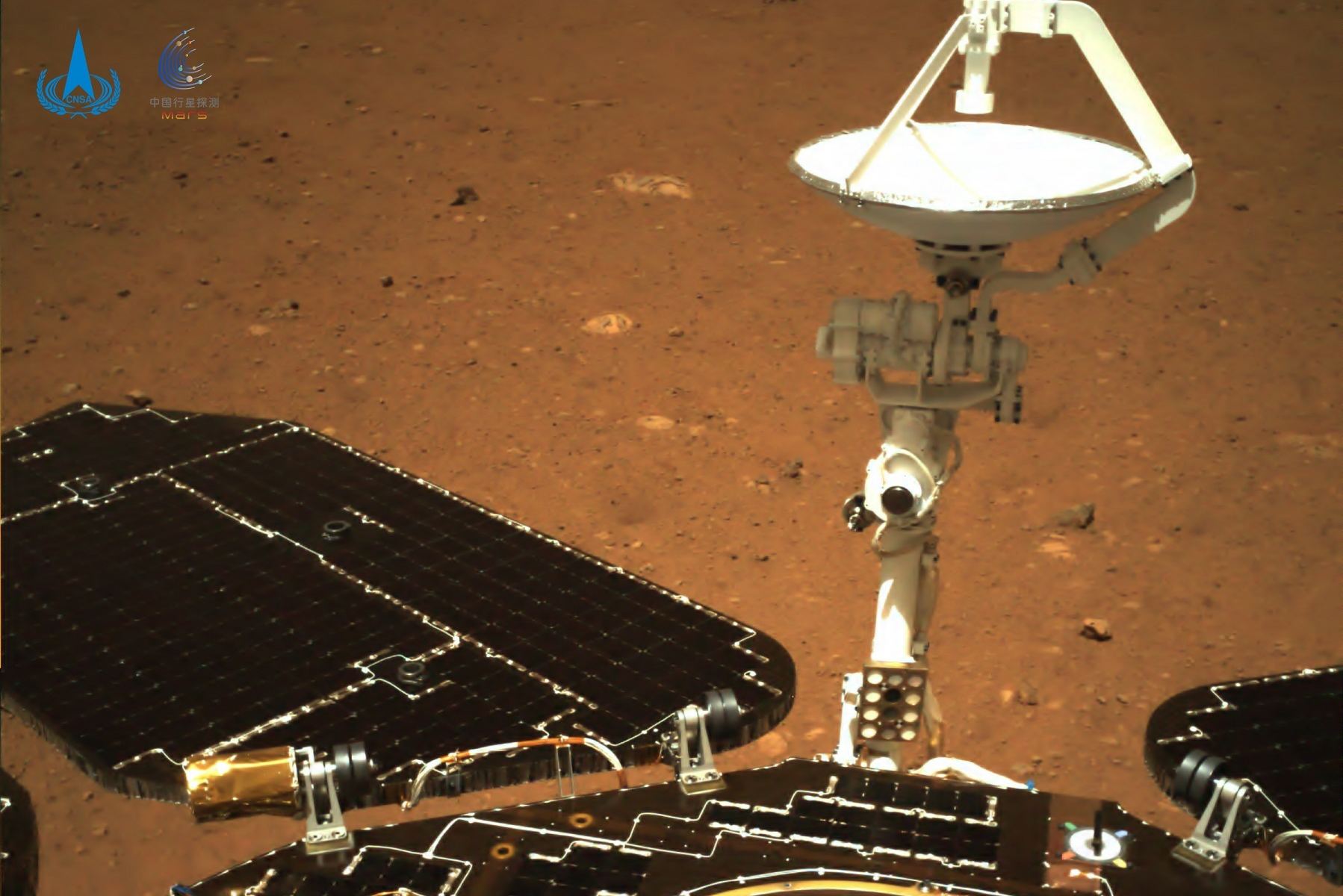
A wireless camera took this ‘group photo’ of China’s Tianwen-1 lander and rover on Mars’ surface. Credit: Chinese Space Agency
The Zhurong rover landed on Mars on May 15, 2021, making China the second country ever to successfully land a rover on Mars. The cute rover, named after a Chinese god of fire, explored its landing site, sent back pictures — including a selfie with its lander, taken by a remote camera – studied the topography of Mars, and conducted measurements with its ground penetrating radar (GPR) instrument. Zhurong had a primary mission lifetime of three Earth months but it operated successfully for just over one Earth year before entering a planned hibernation. However, the rover has not been heard from since May of 2022.
Researchers from the Institute of Geology and Geophysics under the Chinese Academy of Sciences who worked with Zhurong’s data said the GPR provides an important complement to orbital radar explorations from missions such as ESA’s Mars Express and China’s own Tianwen-1 orbiter. They said in-situ GPR surveying can provide critical local details of shallow structures and composition within approximately 100-meter depths along the rover’s traverse.
a, Topographic map of Utopia Planitia, showing the landing sites of the Zhurong rover, the Viking 2 lander and the Perseverance rover. The ?4?km elevation contour is shown. Four local regions (c–f) with polygonal terrain are marked with white squares. b, The Zhurong rover traverse from Sol 11 through Sol 113 (HiRISE image: ESP_073225_2055). Green segments denote the wedges of buried polygons recognized from Fig. 2 (P1–P16). Purple segments denote the interiors of the polygons. c–f, Four representative HiRISE images of polygons in Utopia Planitia whose locations are marked in a: PSP_002202_2250 (c), PSP_006962_2215 (d), PSP_002162_2260 (e) and PSP_003177_2275 (f). Note the range of spatial scales for the sizes of the polygons. The average diameters of polygons shown in c–f are calculated in Extended Data Fig. 6. Credit for HiRISE images: NASA/JPL/University of Arizona.
Utopia Planitia is a large plain within Utopia, the largest recognized impact basin on Mars (also in the Solar System) with an estimated diameter of 3,300 km. In total, the rover traveled 1,921 meters during its lifetime.
The researchers, led by Lei Zhang, wrote in their paper published in Nature, that the rover’s radar detected sixteen polygonal wedges within about 1.2?kilometers distance, which suggests a wide distribution of similar terrain under Utopia Planitia. These detected features probably formed 3.7 – 2.9 billion years ago during the Late Hesperian–Early Amazonian epochs on Mars, “possibly with the cessation of an ancient wet environment. The palaeo-polygonal terrain, either with or without being eroded, was subsequently buried” by later geological processes.
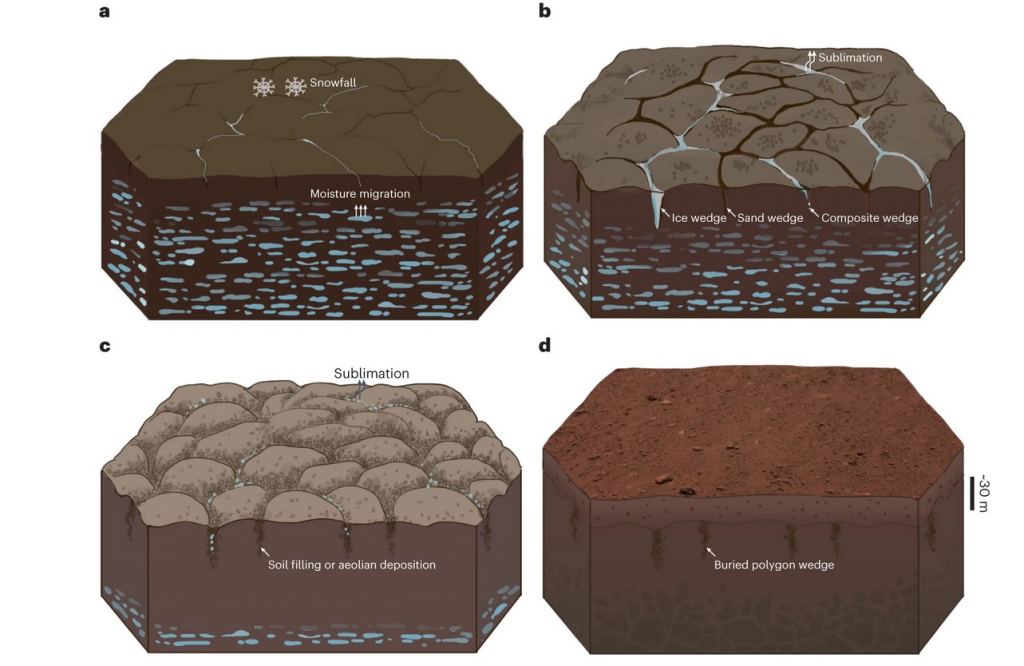
Schematic model of the polygonal terrain formation process at the Zhurong landing site. a, The origination of thermal contraction cracking on the surface. b, The formation of cracks infilled by water ice or soil material, causing three types of polygonal terrain (ice-wedge, composite-wedge and sand-wedge polygons). c, The stabilization of the surface polygonal terrain in the Late Hesperian–Early Amazonian, possibly with the cessation of an ancient wet environment. d, The palaeo-polygonal terrain, either with or without being eroded, was subsequently buried by deposition of the covering materials in the Amazonian. The Mars surface image was acquired by the Navigation and Terrain Camera (NaTeCam). Credit: Zhang et al.
The buried polygonal terrain requires a cold environment, the researchers wrote, that might be related to water/ice freeze–thaw processes in southern Utopia Planitia on early Mars.
“The possible presence of water and ice required for the freeze–thaw process in the wedges may have come from cryogenic suction-induced moisture migration from an underground aquifer on Mars, snowfall from the air or vapor diffusion for pore ice deposition,” the paper explains.
While the new paper indicates that the most likely possible formation mechanisms would be soil contraction from wet sediments that dried, producing mud-cracks, however, contraction from cooling lava could have also produced thermal contraction cracking.
Either way, they note that a huge change in Mars’ climate was responsible for the polygon’s formation.
“The subsurface structure with the covering materials overlying the buried palaeo-polygonal terrain suggests that there was a notable palaeoclimatic transformation some time thereafter,” the researchers said.
During a recent lecture at the University of Michigan that I gave, I was asked why the arrow of cosmic time is characterized by a transition from simplicity to complexity.
I explained that the universe started simply in the form of a nearly uniform soup of elementary particles. As the Universe expanded and cooled, the denser-than-average regions reversed their expansion and collapsed by their self-gravity to make galaxies in which gas fragmented into stars, dust, and planets. The chemistry of life in liquid water on the surface of our planet, the Earth, gave rise to the most complex systems we know.
But it is possible that even more complex entities that represent our future, such as sentient systems with artificial intelligence, were already manufactured on exo-planets. Most stars formed billions of years before the Sun, and their technological clock was initiated long before ours. If their advanced technological descendants arrived in the vicinity of our planet, the Vera C. Rubin Observatory cameras or the Galileo Project could capture them on video soon.
In short, complexity arrived late in cosmic history because the Universe started simple. However, we should not assume that this progression will continue into the future.
Consider the Earth as an example. If our civilization will not be wise enough to preserve itself against existential risks such as a colossal pandemic, global nuclear war, or climate change, then Earth may return to a simpler state without the complexity associated with human technologies. In fact, this ultimate fate may not even be in our hands. Irrespective of how much we engage in preserving our habitat, we may not be able to counteract the astronomical catastrophe of the Sun boiling off all oceans on Earth within a billion years. Subsequently, the Earth’s surface will be sterilized without the complex chemistry of life as we know it. In addition, all the meticulously designed constructions in our cities will be wiped out like an ant nest after heavy rain.
The return to simplicity would extend beyond Earth to the Universe at large. Observations show that cosmic expansion had been speeding up over the past five billion years. Albert Einstein’s theory of gravity allows for an accelerating Universe if the mass density of the vacuum is bigger than half that of matter, which naturally occurs at late cosmic time as matter gets diluted by the cosmic expansion, but the vacuum remains constant. An unchanging vacuum, which constitutes the so-called “cosmological constant,” naturally produces repulsive gravity that would push galaxies away from each other at an ever-increasing speed. If the cosmic mass budget is indeed dominated by a vacuum mass density that will remain constant as the Universe ages by another factor of ten, then all galaxies outside our immediate vicinity will be pushed out of our horizon by the accelerated expansion of space.
In a paper published two decades ago, titled “The Long-Term Future of Extragalactic Astronomy,” I showed that, in fact, all galaxies beyond a redshift of z=1.8 are already outside our horizon right now. The light we will ever receive from them was emitted long ago and does not represent their current state. Any signals sent from now out of those galaxies will be lost in space and never reach us. We will never be able to have a conversation with any sentient beings in the farthest galaxies at z>10 that were imaged recently by the Webb telescope and presented by NASA to President Biden at a White House celebration on July 11, 2022,
Within a finite time, the accelerated expansion of space moves any distant galaxy away from us at a speed that exceeds the speed of light. Even light, representing the fastest speed by which material particles can propagate, is ultimately unable to bridge the inflating gap between distant galaxies and us by the accelerated cosmic expansion.
The situation is similar to observing a friend cross the event horizon of a black hole. From a distance, we would see the image of our adventurous friend heading towards the black hole, getting fainter, and eventually freezing at some final snapshot, as that friend appears to be hovering just above the horizon. The frozen image will be the snapshot of the instant when the friend crossed the horizon. Beyond that point in time, no information can be retrieved about the whereabouts of the friend. Similarly, the image of each distant galaxy will eventually freeze at some finite time in its own frame, and we can collect a limited amount of information from it. In particular, we will never be able to study the evolution of a distant galaxy beyond some finite age in its own frame of reference. The more distant a galaxy is, the earlier its image will freeze, and the less information will be available to us about the way it ages.
Of course, bound systems which are held together by a force stronger than the repulsive force of the cosmological constant, do not participate in the cosmic expansion. This includes electrons bound to atoms by the electromagnetic force, planets bound to stars, as well as galaxies bound together by a stronger gravitational pull than the cosmic repulsion. Which galaxies will remain bound to the Milky Way and not fly away? In a paper I wrote with my former postdoc, Ken Nagamine, we simulated the future evolution of all distant galaxies on a computer. Our simulation indicated that all galaxies outside the local group of galaxies, namely beyond 3 million light years, are not bound to the Milky Way and will be pushed out of our view by cosmic expansion.
As a result, the future of the Universe outside our own galaxy will be the simplest imaginable and consist only of the vacuum. We better enjoy the present-day complexity available for us to see through our telescopes before it will all go away.
Just like any aspect of our life, cosmic complexity is transient and precious and should not be taken for granted. We are all too familiar with the similarities between the state of an infant and that of the elderly. In private life as well as in the cosmos, the arrow of time starts from simplicity, goes through complexity and returns to simplicity.
“From [dust] you were taken, for dust you are, and to dust, you shall return” (Genesis 3:19).
Avi Loeb is the head of the Galileo Project, founding director of Harvard University’s – Black Hole Initiative, director of the Institute for Theory and Computation at the Harvard-Smithsonian Center for Astrophysics, and the former chair of the astronomy department at Harvard University (2011-2020). He chairs the advisory board for the Breakthrough Starshot project, and is a former member of the President’s Council of Advisors onScience and Technology and a former chair of the Board on Physics and Astronomy of the National Academies. He is the bestselling author of “Extraterrestrial:The First Sign of Intelligent Life Beyond Earth” and a co-author of the textbook “Life in the Cosmos”, both published in 2021.
A long-duration aerial mission soon to be carried out by NASA over Antarctica will launch stadium-sized craft in support of a series of record-breaking science missions, the agency announced this week.
The Antarctic Long Duration Balloon (LDB) Campaign, which includes a trio of scientific balloon flights equipped to study a range of different phenomena, will launch at the beginning of December, according to a press release NASA issued on Monday.
The mission will employ a series of massive zero-pressure balloons, which the American space agency says will support five missions in total.
Equipped with open ducts through which gas can escape, thereby eliminating the buildup of pressure within, zero-pressure balloons expand as they accumulate heat from the rising Sun as they are being carried aloft. Conversely, as the Sun sets, heat is lost, which results in a loss of gas, which causes zero-pressure balloons to have a shorter flight duration than other inflatable systems.
However, long-duration missions can be achieved during the polar summer, a period during which the balloons remain in constant sunlight for extended periods.
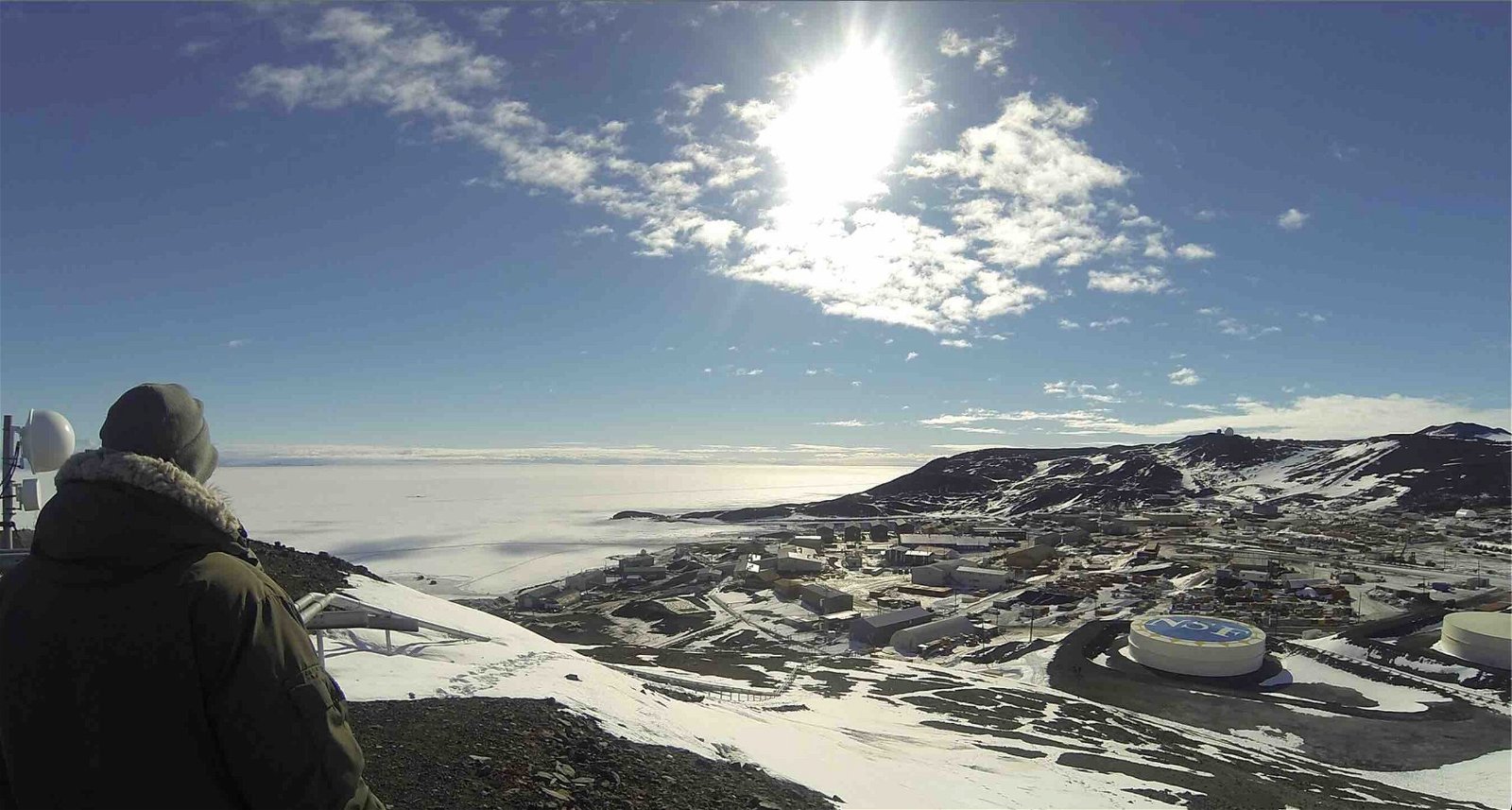
One of the missions aims to break a previous long-duration balloon flight record of just over 55 days. The balloons will launch from NASA’s facility for balloon launches located close to McMurdo Station, the largest community on Earth’s southernmost continent located on the southern edge of Ross Island, Antarctica.
McMurdo Station
(Credit: Air National Guard)
Andrew Hamilton, acting chief of NASA’s Balloon Program Office (BPO), said the annual launch will carry NASA’s stadium-sized balloons to altitudes where stratospheric wind conditions will “provide a unique and valuable opportunity to fly missions in a near-space environment for days or weeks at a time.”
A primary component of the 2023 launch is NASA’s GUSTO mission, or Galactic/Extragalactic ULDB Spectroscopic Terahertz Observatory, which the agency says will conduct measurements of emissions from cosmic material located between stars known as the interstellar medium.
The space agency says the data GUSTO collects during its time in flight above Antarctica will provide scientists with valuable information about the life cycle of interstellar gas that populates the Milky Way. Other phenomena GUSTO will observe over the course of its mission include star formation and destruction, as well as how gases flow near the center of our galaxy.
GUSTO will be armed with a telescope equipped to detect oxygen, carbon, and nitrogen emission lines.
“This unique combination of data will provide the spectral and spatial resolution information needed for Walker and his team to untangle the complexities of the interstellar medium,” read a portion of a NASA mission brief detailing the mission, “and map out large sections of the plane of our Milky Way galaxy and the nearby galaxy known as the Large Magellanic Cloud.”
While GUSTO is the premier science mission that will be undertaken during this year’s flight, several additional science objectives will be carried out during NASA’s annual Antarctic LDB campaign, including the Anti-Electron Sub-Orbital Payload (AESOP-Lite) mission, which will study cosmic ray electrons and positrons.
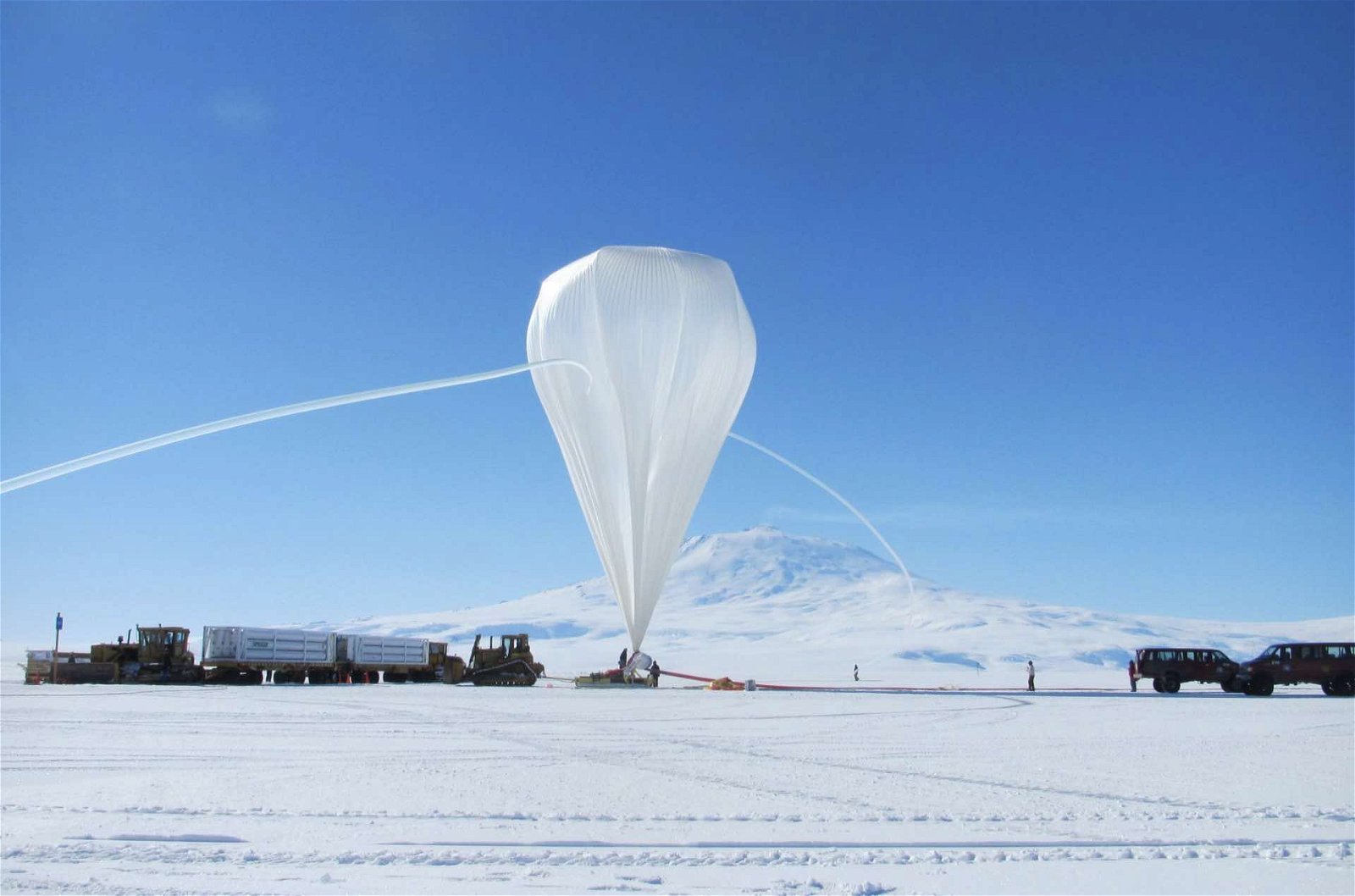
A NASA balloon is prepared near the agency’s launch site near McMurdo station (Credit: NASA)
Additionally, an engineering test flight called the Long durAtion evalUation solaR hand LAunch (LAURA) mission will employ solar panels to help extend the use and duration of the hand launch platform used at NASA’s Antarctic facility for long-duration flights. The experiment will help remedy problems that arise from hand-launched balloons, the flight time of which is impacted significantly by the power systems contained in their payloads, which are used to power the scientific instruments they carry.
Among the hand-launched missions conducted in December will also be NASA’s Anihala (Antarctic Infrasound Hand Launch) mission, which will be a component of the payload equipped with AESOP-Lite that will measure the subtleties of background sound in Earth’s stratosphere. The experiment will offer a unique opportunity to make such observations over a region of the planet where sound produced by human civilization is minimal.
“The annual Antarctic long-duration balloon campaign is the program’s flagship event for long-duration missions,” Hamilton said in a statement.
“The BPO team is excited to provide support to all our missions this year,” he added.
CIA's Secret Unit Conducted UFO Retrieval Missions on 9 Global Crash Sites, Explosive Report Claims
Are we alone in the universe, or is there more to discover?
A secret CIA unit, known as the Office of Global Access (OGA), has retrieved several crashed UFOs worldwide, UK-based Daily Mail reported, based on information from multiple anonymous sources. These insiders claim that at least nine “non-human craft” have been recovered, some damaged from crashes and two remarkably intact, in a secret operation spanning decades.
The OGA, operating under the CIA’s Science and Technology Directorate, reportedly played a pivotal role since 2003 in managing these top-secret missions, the report said. This comes amid growing evidence suggesting the US government may possess advanced, non-human technology.
‘WE ARE NOT ALONE’
David Grusch, a former US intelligence officer, who has testified before Congress, supporting these claims, has reconfirmed it in a recent podcast with Joe Rogan. “The answer is we are not alone. And I know that with 100% certainty. Which as an intel officer you must never say 100%. But all things pointed towards that. Based on the people I talked to like Harry Reid (ex-Senate Majority Leader) and I use him as an example. But I talked to the highest of the high people you can possibly talk to. If you catch my drift. Unless all of them are lying and covering up something else,” he said.
Back in July, US Senate Majority Leader Chuck Schumer sponsored a bill advocating disclosure of “recovered technologies of unknown origin and biological evidence of non-human intelligence,” which passed in the Senate. Insiders shed light to Daily Mail on the OGA’s role, describing a system capable of detecting cloaked UFOs. The report states that special military units are allegedly dispatched to salvage wreckage if these crafts land, crash, or are brought down. The OGA specialises in facilitating secretive global access, allowing the military to navigate restricted areas, including those behind enemy lines.
‘NOT UNDER MILITARY CONTROL’
While most OGA operations involve conventional retrieval missions like nuclear weapons or downed satellites, some allegedly involve UFO retrieval. “The actual physical retrieval is by the military. But it’s not kept under military control, because they have to keep too many records. So they start moving it out fairly quickly into private hands,” one source told the UK publication. Documents from 2016 reveal the OGA as one of 56 CIA offices, with its chief and deputy among the agency’s top officials, according to the report. A 2015 CIA chart places OGA within the ‘Science and Technology’ wing. Established in 2003, OGA integrates analysis, technology, and tradecraft for challenging targets globally.
Former OGA deputy director Doug Wolfe, linked to strategic access programs, initiated the office, as per the report. OGA reportedly coordinates with Special Operations Forces and nuclear experts for UFO retrieval. Despite some denial from US agencies like the Nuclear Emergency Support Team (NEST), insiders insist on the involvement of these entities. Private US aerospace contractors purportedly receive wreckage for analysis, shielded from rigorous government audits under trade secret protections.
Notably, the report highlights the compartmentalisation of information, suggesting many involved may not realise they deal with non-human craft. US whistleblower David Grusch drew parallels with the Manhattan Project, where engineers were unaware they worked on the atomic bomb’s components. Harry Reid, former Senate Majority Leader, indicated Lockheed Martin’s involvement in holding potential alien wreckage. While setting up a UFO investigation office in 2008, Reid faced obstacles accessing alleged programs.
In July, the US Senate voted for Schumer’s bill, aiming to create a review board with presidential-level powers for disclosing recovered technologies. If passed in the House of Representatives, it will be added as an amendment to the annual military spending bill for 2024. “The American public has a right to learn about technologies of unknown origins, non-human intelligence, and unexplainable phenomena,” Schumer said in a July press release announcing the amendment.
Has evidence of aliens been recovered by governments? (Picture: Getty)
The UK’s leading UFO expert says it doesn’t matter whether the US is hiding one alien body or 10 – it would ‘fundamentally change everything’.
Nick Pope, who previously led the Ministry of Defence’s ‘UFO desk’, was responding to claims by whistleblower David Grusch, who alleges the US government has retrieved at least ten extraterrestrial bodies.
Adding to his claims, last week Mr Grusch spoke on the Joe Rogan Experience podcast and said the number of crashes recorded by the US was in ‘double digits’. He added that the number of terrestrial bodies recovered was ‘up there as well, just like with the retrievals’.
Commenting on the claims, Mr Pope said: ‘In one sense, the numbers David Grusch gave don’t matter, because if we have just one crashed UFO and extraterrestrial body, this would fundamentally change everything, in terms of our understanding of the universe.
UK UFO expert Nick Pope (Picture: Getty)
‘I can’t evaluate Grusch’s claims, because when I was investigating UAP for the MoD we never acquired a smoking gun that would prove an extraterrestrial presence, despite having some fascinating and unexplained cases.
‘Neither did we hear about any such smoking gun, so if the US government has acquired craft and bodies, they didn’t tell the UK.
‘In terms of keeping this secret, I don’t think the numbers matter so much as the principle – it’s binary, in the sense that either the authorities will be able to keep a lid on it, or they won’t.’
Mr Grush has made clear he himself has not had any direct encounter with aliens, but has spoken to numerous sources, including a former senator, the late Harry Reid, who confirmed the government had evidence of UAP.
David Charles Grusch speaking before Congress in July (Picture: Getty)
‘The question now is whether or not any of Grusch’s claims can be proven,’ said Mr Pope.
‘Various congressional representatives and committees are reportedly trying to get further information, with a view to verifying this, and the Pentagon’s All-domain Anomaly Resolution Office (AARO) has also asked Grusch to come in and give further details.
‘But there are question marks over how this could be done, as he no longer has an active security clearance, and even if he gets it back, it’s unclear who he could brief, even within Congress, given the alleged levels of classification.
‘Short of bringing forward any of the craft and bodies for independent scientific study, it’s difficult to see how the claims could be verified. Additional corroborative testimony from other whistleblowers might help, but as with Grusch’s claims, this would just be testimony.’
The issue of UAP has rarely been out of the headlines since Mr Grusch made his initial claims in an interview with the Debrief, as calls grow for transparency about unidentified craft in airspace shared with commercial and military aircraft.
Mexico held its own congressional hearing in September, but it took a turn from the serious to the bizarre when journalist and ufologist Jaime Maussan unveiled two small ‘bodies’ said to be non-human beings found in Peru.
While the scientific community has widely dismissed the specimens as a hoax – something Mr Maussan has been found guilty of before – others are not so sure.
However, Lt Ryan Graves, a former US Navy pilot who gave evidence at the Washington congressional hearing and attended Mexican parliament, labelled the unveiling as an ‘unsubstantiated stunt’.
Daily Caller co-founder Tucker Carlson called out the U.S. government Tuesday on his show, questioning its transparency over releasing information about unidentified flying objects (UFOs).
Carlson released his 42nd Twitter episode in which he discussed the issues he has found between the U.S. government and UFOs. Before bringing on Tennessee Republican Rep. Tim Burchett, Carlson questioned why the federal government would allegedly create a “coordinated effort” to hide information about UFOs for the last “80 years.”
“Federal agencies have been lying about UFOs for more than 80 years, this has been a coordinated effort. It is both highly time-consuming and very expensive. Many Americans have been hurt in the process. But what’s the point of this? Would it be a lot easier just to release the facts?” Carlson stated.
“The conventional explanation for why they haven’t been released is that the U.S. government is lying about UFOs because the truth about UFOs is too scary to reveal — that they’re real. And our leaders wouldn’t want to panic the population. But that’s not true. In fact, it’s ridiculous.”
“Terrifying the population is what our government does best and most avidly. Officials regularly gin up irrational fears about COVID or white supremacy or Vladimir Putin or a dozen other topics as part of a pretty obvious control strategy,” Carlson continued. “So why would they lie about UFOs? Well, because they’re covering up a crime, obviously, and it’s their crime.”
Carlson continued to call out the government, begging questions that should be asked by “honest lawmakers” if they were concerned about the issue. The Daily Caller co-founder asked if taxpayer money was ever used to “procure advanced non-human technology,” the possible whereabouts of it, and — if real — whether the public has benefited from it.
However, the “most pressing” question Carlson asked was if the government has had any contact with potential “beings.”
“And then this question, the most pressing of all, has the U.S. government communicated directly with the beings that piloted these craft? Have American officials ever entered into any sort of agreement with them? And if so, what are the terms of that agreement? These are not random questions, they are informed questions. And at this point, Americans have a moral right to know the answers,” Carlson stated.
Burchett was later brought on by the Twitter host to discuss the lack of transparency from the federal government, with Carlson honing in on why the government would allegedly want to hide information in the first place. The Tennessee representative discussed how power, influence, money, and corruption could be the root of the cause, noting that he believes the slow release of information is “intentional.”
Burchett has notably been outspoken regarding issues surrounding UFO sightings and their possible technological capabilities. The Tennessee lawmaker made some hefty claims over the summer on a podcast about the capabilities that he believes UFOs and aliens have, emphasizing that there are some things “we do not control in our military airspace.”
Mars Odyssey Beams Back Magnificent Images of Martian Horizon
In an operation that took mission scientists three months to plan, NASA’s Mars Odyssey orbiter captured a series of panoramic images that showcases the curving Martian landscape below gauzy layers of clouds and dust.
This image of the Martian horizon was captured by the THEMIS camera on NASA’s Mars Odyssey orbiter.
Image credit: NASA / JPL-Caltech / ASU.
“If there were astronauts in orbit over Mars, this is the perspective they would have,” said Mars Odyssey project scientist Jonathon Hill, of Arizona State University.
“No Mars spacecraft has ever had this kind of view before.”
“The reason why the view is so uncommon is because of the challenges involved in creating it.”
They were taken from an altitude of about 400 km (250 miles) — the same altitude at which the space station flies above Earth.
The sensitivity of the THEMIS instrument to warmth enables it to map ice, rock, sand, and dust, along with temperature changes, on the planet’s surface.
It can also measure how much water ice or dust is in the atmosphere, but only in a narrow column directly below the spacecraft.
That’s because THEMIS is fixed in place on the orbiter; it usually points straight down.
The Mars Odyssey scientists wanted a more expansive view of the atmosphere.
Seeing where those layers of water-ice clouds and dust are in relation to each other helps them improve models of Mars’ atmosphere.
“I think of it as viewing a cross-section, a slice through the atmosphere,” said Mars Odyssey project scientist Jeffrey Plaut, of NASA’s Jet Propulsion Laboratory.
“There’s a lot of detail you can’t see from above, which is how THEMIS normally makes these measurements.”
Because THEMIS can’t pivot, adjusting the angle of the camera requires adjusting the position of the whole spacecraft.
In this case, the team needed to rotate the orbiter almost 90 degrees while making sure the Sun would still shine on the spacecraft’s solar panels but not on sensitive equipment that could overheat.
The easiest orientation turned out to be one where the orbiter’s antenna pointed away from Earth.
That meant the team was out of communication with Odyssey for several hours until the operation was complete.
To make the most of their effort, the researchers also captured imagery of the Martian moon Phobos.
This marks the seventh time in 22 years that the orbiter has pointed THEMIS at the moon in order to measure temperature variations across its surface.
“We got a different angle and lighting conditions of Phobos than we’re used to. That makes it a unique part of our Phobos dataset,” Dr. Hill said.
“The new imagery provides insight into the composition and physical properties of the moon.”
Earlier this year, Congress passed something called the UAP Disclosure Act of 2023. The law requires to tell the public what it knows about the countless unidentified flying objects that have been spotted in the skies above Earth over the past 3,000 years.
It's designed to be, and it very well could be a transformative piece of legalization. And it comes at a time when we can say with confidence that the most unlikely sounding theories about UFOs are actually true.
Yes, these things are real. They're not all weather balloons. They're not experimental aircraft from this or any other country. Whatever they are, they are not of human origin. Nor do they behave according to the laws of known physics.
And yes, the US government currently has physical evidence that they exist. That means wreckage of the craft as well as the bodies of the beings that flew them.
Now, the Office of Global Access (OGA), a wing of the Central Intelligence Agency's Science and Technology Directorate, has played a central role since 2003 in orchestrating the collection of what could be alien spacecraft.
This CIA's secret office has conducted UFO retrieval missions on at least nine crash sites around the world, according to Dailymail.
The CIA has a 'system in place that can discern UFOs while they're still cloaked' and special military units are sent to salvage the wreckage and then often hands the wreckage or material over to private aerospace/defense contractors (who are working close with the US government) for analysis.
So the question is, now that the UAP Disclosure Act has passed, when can the rest of us see the information that we paid for and in fact, own? Well, not so fast, it turns out.
Just when it seemed the UAP Disclosure Act was finally going to lift the veil on decades of secrets, two Republican lawmakers voted against the legislation. The two members happen to be especially powerful this term. They are Congressman Mike Rogers of Alabama, who is the chairman of the House Armed Services Committee, and Congressman Mike Turner of Ohio, who is chairman of the House Intel Committee.
Why is this happening and what could be their potential motives?
One of the great secrets of Washington know to everyone inside Washington is that many of the most powerful members of Congress do not work for their constituents, much less for the rest of us, for the country at large. They are instead puppets and they are controlled effectively by the permanent bureaucracy, including through bribery and blackmail.
Some people saying the UAP Disclosure Act was founded to pave the way for controlled UFO disclosure, now that is not going to happen as long as key politicians are controlled and instructed to violate in letter and in spirit federal law and to hide the truth about UFOs from the American public.
But why these key politicians may not want you to know the truth? Just connect the dots and follow the money trail leading to defense contractors!
Pine Gap, Australia: Unraveling the Mysteries in the Desert
Nestled in the remote heart of Australia’s Red Centre, near the iconic town of Alice Springs, lies a facility as enigmatic as it is crucial: Pine Gap. Officially known as the Joint Defence Facility Pine Gap, this installation, a collaboration between the United States and Australian governments, has long been the subject of intrigue and speculation, particularly in the realm of UFOs and extraterrestrial theories.
The Secretive Heart of Surveillance
Established in 1970, Pine Gap’s primary function revolves around satellite surveillance and signals intelligence. Its labyrinth of radomes and advanced equipment plays a pivotal role in global surveillance, making it one of the most important intelligence facilities worldwide. The facility’s strategic location allows it to monitor a vast portion of the Eastern Hemisphere, a crucial asset during the Cold War and beyond.
A Nexus for Extraterrestrial Theories
The shroud of secrecy enveloping Pine Gap has naturally attracted the attention of UFO enthusiasts and alien conspiracy theorists. Some speculate that the facility’s advanced technology is used not just for terrestrial surveillance but to monitor extraterrestrial activity. Theories range from the facility tracking alien spacecraft to it being a clandestine meeting ground for human and alien collaboration.
These theories are bolstered by the global fascination with UFOs and the undying quest to find extraterrestrial life. Pine Gap’s restricted access and classified operations provide a fertile ground for such speculations, despite the lack of concrete evidence to support these claims.
Between Fact and Fiction
The reality of Pine Gap, however, is grounded more in strategic defense than in science fiction. While the facility undoubtedly houses advanced technology capable of monitoring space, there is no credible evidence linking it to extraterrestrial research or encounters. Much like Area 51 in the United States, Pine Gap’s allure lies in its secretive nature and the human propensity for mystery and the unknown.
The Cultural Impact
Pine Gap has cemented its place in popular culture, inspiring references in films, books, and television shows. These often dramatize the facility’s potential links to UFOs and aliens, further embedding it in the public consciousness as a site of otherworldly intrigue.
Conclusion: A Blend of Reality and Myth
Pine Gap remains an enigmatic presence in the Australian desert, its domes silently keeping watch over the skies. While it continues to be a significant player in global surveillance and intelligence, its association with UFOs and aliens remains a fascinating blend of myth and mystery. This blend keeps Pine Gap firmly in the realm of both strategic importance and popular imagination, a place where the lines between reality and science fiction intriguingly blur.
As the world continues to look up at the stars and wonder, facilities like Pine Gap remind us of the endless possibilities that the universe may hold, and the human quest to explore the unknown, whether it be within our own world or beyond.
VIDEO:
Restricted Locations On Earth Only Few Have Explored – LifesBiggestQuestions
The information covered in the video also explore several other well-known secretive or classified facilities and areas around the world, each with its own unique history and set of theories or speculations:
Jiangsu National Security Education Museum, China: This museum, which is closed to foreign visitors, is dedicated to the history of Chinese intelligence and espionage. It features exhibits of spy gadgets, tools, and stories of espionage involving China, underscoring the importance of these practices in national security.
Metro 2, Russia: Allegedly a secret underground metro system in Moscow, said to have been constructed during Stalin’s reign for emergency escape routes and strategic military transport. Its existence has neither been confirmed nor denied by the Russian government.
Area 51, USA: A highly classified US Air Force facility in Nevada, long associated with UFO and alien conspiracy theories. Its secretive nature and history of aviation and weapons testing have fueled these theories, though it’s likely focused on military technology.
The Greenbrier Bunker, USA: A hidden bunker beneath the Greenbrier Resort in West Virginia, intended as a refuge for the U.S. Congress during a nuclear attack. It was kept secret until 1992 and now serves as a data storage facility and tour site.
Mariana Trench: The deepest known point in Earth’s oceans, home to unique species and important for scientific research. It offers insights into the limits of life and deep-sea ecosystems.
Mount Weather Emergency Operations Center, USA: A facility in Virginia for U.S. government and military officials in case of a national disaster. It ensures the continuity of government operations and has led to various conspiracy theories about its capabilities.
Each of these locations or phenomena has its own set of mysteries and speculations, often fueled by their secretive or inaccessible nature. While some are grounded in verified facts, others remain the subject of theories and conjecture, lacking solid evidence.
Dit Himalaya-meer verbergt een behoorlijk duister geheim. In de jaren veertig werd een huiveringwekkende ontdekking gedaan, maar pas in de 21e eeuw werd het mysterie opgelost. Of toch niet? Klik verder en trek je eigen conclusies.
Japanse soldaten De Britse regering stuurde een team van onderzoekers naar Roopkund. Nog een schok: ze kwamen tot de conclusie dat de botten te oud waren om van Japanse soldaten te zijn.
Mysterie Er ontstonden in die tijd veel theorieën, waaronder een aardverschuiving, een epidemie of zelfs rituele zelfmoord als oorzaak van al die sterfgevallen
DNA-testen Uit de overblijfselen werden twee verschillende groepen mensen geïdentificeerd. De ene was een groep nauw verwante individuen, die een familie of een stam geweest konden zijn
Hoe kwamen ze om het leven? De conclusie was dat hagelstenen de doodsoorzaak waren. Een gewelddadige en plotselinge hagelbui zou de groep hebben getroffen en dat blijken ze niet te hebben overleefd.
Lokale legende Een ander volksverhaal gaat over de zwangere vrouw van koning Yasodhwal. Tijdens de bevalling stroomde haar placenta naar Roopkund en doodde daar iedereen.
Route van de trektocht De tocht kan veeleisend zijn, maar het omringende landschap is absoluut adembenemend. Volg ons en krijg toegang tot het laatste celebrity en lifestyle nieuws
As events in our world transpire, humans perceive their occurrence as a linear progression for which we have invented concepts of past, present, and future, which summarizes one of the most mysterious concepts in all of physics: time.
We tend to take for granted the idea that time is a common part of our everyday lives. We can tell the time of day, for instance, or we can make time for having a coffee with a friend. Yet, despite our familiarity with it, we still have a hard time explaining what, precisely, time really is.
In his landmark book A Brief History of Time, the late physicist Stephen Hawking asked a fundamental question about human perception of what we call time: how come we can remember the past but not the future? In other words, what gives rise to our perception of a linear progression of time that only goes in one direction?
The notion that there exists a sort of “arrow of time,” as Hawking called it, actually had three components. The first is what Hawking called psychological time, which has to do with human perception of time, and our ability to perceive the present, and recall the past. The second is entropic time, which deals with the universal tendency for states in nature to trend toward disorder (think of an egg falling to the floor, which can very easily break open, but which you or I would have a hard time reassembling). The third component involves cosmological time, which deals with the expansion of the universe in its current inflationary state, which some models hold will reverse again once into a deflationary state, in which events in time as we perceive it might even appear to occur in reverse order.
Now, a new study by a team of physicists could shed new light on the lingering mystery of the arrow of time in a paper which looks at the various ways that cells and particles could be the source for various phenomena that gives rise to the human concept of time.
Relying primarily on Hawking’s notion of entropic time and the trend toward disordered states in systems in nature, the study, conducted by researchers at the CUNY Graduate Center Initiative for the Theoretical Sciences (ITS), examined the ways that the arrow of time arises from microscopic processes occurring on the microscopic scale.
Christopher Lynn, a postdoctoral fellow in the ITS program and lead author of the paper, says that he and his team began with a pair of fundamental questions: would the strength of the arrow of time be measurable within any given system, and would they be able to detect its point of origin on the micro-scale, “where cells and neurons interact, to the whole system?”
According to Lynn, this is precisely what his team succeeded in doing by first examining how the arrow of time could be “decomposed” through a unique process of breaking down observations into various separate portions of a system and studying the interactions that occurred between them.
According to the ITS research team, they were able to observe various separate pieces of the arrow of time within a single moment, which comprised portions that worked either individually, in pairs or triplets, or in far more complex ways with multiple sets of interactions.
In their experimental study, the researchers observed the function of neurons within the retina of a salamander’s eye. Specifically, they referenced earlier studies that looked at what the neuron response was to various kinds of movies that ranged from single objects moving across a screen to complex scenes in nature.
Based on such observations, the team found that the arrow of time seemed to arise from relatively simple interactions occurring between pairs of neurons rather than complex systems involving larger numbers of them. Most intriguing to the researchers had been that their observations appeared to show that the arrow of time was most significant in response to the random motion of objects in nature.
Lynn and his team believe that the significance of this observation points to new questions about the ways that our individual internal perception of the passage of time correlates with events in the world around us, an element that could be of great interest to neuroscience.
Lynn says such observations could also “lead to answers about whether the arrow of time functions differently in brains that are neuroatypical.”
David Schwab, professor of Physics and Biology at the ITS Graduate Center and principal investigator of the study, says that Lynn and his team’s research into the “decomposition of local irreversibility—also known as the arrow of time—is an elegant, general framework that may provide a novel perspective for exploring many high-dimensional, nonequilibrium systems.”
“Our findings provide the first step toward understanding how the arrow of time that we experience in daily life emerges from these more microscopic details,” Lynn said in a statement.
Ten Incredible Underwater Discoveries That Have Captured Our Imagination
Out of all the amazing archaeological discoveries made each and every day around the world, my favorites have got to be those that emerge from the depths of the ocean. I think there is something about the underwater world that captures our imagination – perhaps it is the curiosity and intrigue about what else may lie beneath the surface, or the idea that entire cities may be hidden on the ocean floor, out of sight and out of reach. Fortunately, underwater discoveries are not always out of reach and every year more incredible findings are made thanks to advancing technology in the field of marine archaeology. Here we present ten remarkable marine discoveries that have captured our imagination.
1. Artifacts Retrieved From Site of First Ever Ancient Naval Battle
In November, 2013, archaeologists announced the recovery of a treasure trove of artifacts off the coast of Sicily from the site of the first ancient naval battle ever discovered, including battering rams, helmets, armor and weapons dating back 2,000 years.
Roman helmet from the Battle of the Egadi Islands.
They are the remnants of the Battle of the Egadi Islands - the last clash from the first Punic War which took place in 241 BC – in which the Romans fought the Carthaginians in a battle that culminated from more than 20 years of warring as the Romans struggled to gain a foothold in the Mediterranean Sea. While the Carthaginians were much more powerful on the water, the Romans lay in wait trapping the Carthaginians and blocking off their sea route in a sudden attack. Up to 50 Carthaginian ships were sunk, killing up to 10,000 men. The Roman victory set them on the road for Europe-wide domination. The priceless horde of artefacts had lain undisturbed on the seabed at a depth of 100 meters (328.08 ft) for more than two millennia.
2. 2,000-Year-Old Intact Roman Medicinal Pill Found In Submerged Shipping Vessel
In June, 2013, a team of Italian scientists conducted a chemical analysis on some ancient Roman medicinal pills discovered in the Relitto del Pozzino, a 2000-year-old submerged shipping vessel which sank off the coast of Tuscany, revealing what exactly the ancient Romans used as medicine.
A front, profile, and rear view of one of the medicinal tablets.
The Roman shipwreck lay near the remains of the Etruscan city of Populonia, which at the time the ship foundered was a key port along sea trade routes between the west and east across the Mediterranean Sea. The Relitto del Pozzino was excavated by the Archaeological Superintendence of Tuscany throughout the 1980s and 90s, revealing a variety of fascinating cargo including lamps originating in Asia minor, Syrian-Palestinian glass bowls, bronze jugs, ceramic vessels for carrying wine and, of particular interest, the remains of a medicine chest containing a surgery hook, a mortar, 136 wooden drug vials and several cylindrical tin vessels, one of which contained five circular medicinal tablets. The tin vessels had remained completely sealed, which kept the pills dry, providing an amazing opportunity to find out exactly what substances were contained within them. The results revealed that the pills contain a number of zinc compounds, as well as iron oxide, starch, beeswax, pine resin and other plant-derived materials. Based on their shape and composition, scientists have suggested that the tablets were used as a type of eye medicine.
3. Incredible Discovery Of Boat Wreck In Croatia Dated To 3,200 Years
In March 2014, marine archaeologist and researcher at the Centre National de la Recherche Scientifique (CNRS) in France, Giulia Boetto, announced the incredible discovery of a boat wreck in Zambratija Cove, Croatia, which was just dated to 1,200 BC. The unique and rare finding is a Bronze Age sewn boat, a type of wooden boat which is literally sewn together using ropes, roots, or willow branches.
Wreck of Zambratija, Istria. Observations on the hull.
The boat measures 7 meters (22.96 ft) in length and 2.5 meters (8.20 ft) in width and is a sewn boat, which was a technique of shipbuilding practiced in the Adriatic until the Roman era. The remains of the boat found in Zambratija Cove are incredibly well-preserved for its age, with stitching still visible in some areas and the frame largely undamaged. The different types of wood used to construct it have been identified as elm, alder, and fir, and tree ring dating is currently underway, which will provide the date the tree was cut to the nearest year. Ms. Boetto said that they hope to finalize a 3D model of the boat and, eventually, a complete reconstruction.
4. Elongated Skulls Found In Maya Underwater Cave
In January, 2014, a flooded sinkhole in southern Mexico that terrifies local villagers was explored by underwater archaeologists, who found the submerged cavern littered with elongated skulls and human bones. The underwater cavern, known as Sac Uayum, is a cenote located in Mexico’s Yucatán Peninsula.
A cenote is a natural pit resulting from the collapse of limestone bedrock that exposes groundwater underneath. They were sometimes used by the ancient Maya for sacrificial offerings. Local legend says that the mysterious cavern is guarded by a feathered, horse-headed serpent. Older residents of the nearby village of Telchaquillo tell stories of people seeing the serpent perching in a tree, leaping up, spinning around three times, and diving into the water. From the first day of diving archaeologists discovered that there may be a very real reason why the villagers fear the place. It appears something terrible took place there and perhaps knowledge of this was passed down over the centuries leading to the development of myths and legends. The team identified more than a dozen human remains. The bones bear no marks that would indicate cause of death, so the people probably weren't sacrificed. According to the researchers, the elongated skulls were intentionally flattened during infancy, a practice that archaeologists are still seeking answers for.
5. Swedish Divers Find 11,000-Year-Old Underwater Relics
Swedish divers made a unique and rare discovery in the Baltic Sea – Stone Age artifacts left by Swedish nomads dating back 11,000 years. Researchers uncovered a number of remnants that are believed to have been discarded in the water by Swedes in the Stone Age, objects which have been preserved thanks to the lack of oxygen and the abundance of gyttja sediment, which is sediment rich in organic matter at the bottom of a eutrophic lake.
It is extremely rare to find evidence from the Stone Age so unspoiled. Buried 16 meters (52.49 ft) below the surface, the team uncovered wood, flint tools, animal horns and ropes. Among the most notable items found include a harpoon carving made from an animal bone, and the bones of an ancient animal called aurochs, the ancestor of domestic cattle, the last of which died off in the early 1600s. Archaeologists are continuing the dig, and are now particularly interested to see whether there is also an ancient burial site in the region.
6. Mysterious 10,000-Year-Old Underwater Ruins In Japan
On the southern coast of Yonaguni, Japan, lie submerged ruins estimated to be around 10,000 years old. The origin of the site is hotly debated - many experts argue that is man-made, while more other scientists insist it was carved out by natural phenomena.
The unique and awe-inspiring site was discovered in 1995 by a diver who strayed too far off the Okinawa shore and was dumb-struck when he stumbled upon the sunken arrangement of monolithic blocks "as if terraced into the side of a mountain". The site consists of huge stone blocks which fit together perfectly, right angled joins, carvings and what appear to be stairways, paved streets, crossroads and plazas. Despite the unusual features displayed at Yonaguni, there remains some scientists, such as Geologist Robert Schoch of Boston University, who have studied the formation and who are adamant that the large blocks formed naturally as a result of tectonic movement.
7. The Controversial Underwater Structures Of Zakynthos
In June 2013, Greek archaeologists announced an amazing finding – an ancient underwater city in the gulf of Alykanas in Zakynthos, Greece. According to the Underwater Antiquities Department, the discovery included huge public buildings, cobblestone paving, bases for pillars and other antiquities. Of particular significance were the 20 stone pillar bases, all of which feature a “34 cm diameter incision”, which were probably meant for wooden columns. Preliminary observations led to the conclusion that the remains belonged to a large ancient public building, probably belonging to an important settlement in the ancient city’s port. However, in a strange twist, a study released in December claimed that the ‘artifacts’ are not remnants of an ancient city at all, but simply a unique natural phenomenon.
Disc and doughnut-shaped structures appeared to be architectural remnants of a city, but scientific analysis showed the formations to actually be a naturally occurring geological phenomenon.
8. The Perfectly Preserved Ancient Chinese Underwater City
The Lion City, otherwise known as Shi Cheng, is an ancient submerged city that lies at the foot of Wu Shi Mountain (Five Lion Mountain), located beneath the spectacular Qiandao Lake (Thousand Island Lake) in China. Officials have taken a renewed interest in the sunken city since discovering it in February 2014, that despite more than 50 years underwater, the entire city has been preserved completely intact, transforming it into a virtual time capsule.
The Lion city in China, similar to the lost city of Atlantis.
The Lion City was built during the Eastern Han Dynasty (25 – 200 AD) and was once the center of politics and economics in the eastern province of Zhejiang. But in 1959, the Chinese government decided a new hydroelectric power station was required - so it built a man-made lake, submerging Shi Cheng under 40 meters (131.23 ft) of water. The Lion City lay undisturbed and forgotten for 53 years, until Qiu Feng, a local official in charge of tourism, decided to see what remained of the city under the deep waters. He was amazed to discover that, protected from wind, rain, and sun, the entire city complete with temples, memorial arches, paved roads, and houses, was completely intact, including wooden beams and stairs.
9. The 5,000-Year-Old Sunken City In Southern Greece
In the Peloponnesus region of southern Greece there is a small village called Pavlopetri, where a nearby ancient city dating back 5,000 years resides. However, this is not an ordinary archaeological site, the city can be found about 4 meters (3.12 ft) underwater and is believed to be the oldest known submerged city in the world. The city is incredibly well designed with roads, two story houses with gardens, temples, a cemetery, and a complex water management system including channels and water pipes.
In the center of the city, was a square or plaza measuring about 40x20 meters ( 131.23 x 65.61 ft) and most of the buildings have been found with up to 12 rooms inside. The design of this city surpasses the design of many cities today. The city is so old that it existed in the period that the famed ancient Greek epic poem ‘Iliad’ was set in. Research in 2009 revealed that the site extends for about 9 acres and evidence shows that it had been inhabited prior to 2800 BC. Scientists estimate that the city was sunk in around 1000 BC due to earthquakes that shifted the land. However, despite this and even after 5,000 years, the arrangement of the city is still clearly visible and at least 15 buildings have been found. The city’s arrangement is so clear that the head of the archaeological team, John Henderson of the University of Nottingham, and his team, have been able to create what they believe is an extremely accurate 3D reconstruction of the city.
The underwater remains and the digitally reconstructed pillars and walls of one of the buildings.
10. Ancient Egyptian city of Heracleion - on the border between myth and reality
The city of Heracleion, home of the temple where Cleopatra was inaugurated, plunged into the Mediterranean Sea off the coast of Egypt nearly 1,200 years ago. It was one of the most important trade centers in the region before it sank more than a millennium ago. For centuries, the city was believed to be a myth, much like the city of Atlantis is viewed today. But in 2001, an underwater archaeologist searching for French warships stumbled across the sunken city. After removing layers of sand and mud, divers uncovered the extraordinarily well preserved city with many of its treasures still intact including, the main temple of Amun-Gerb, giant statues of pharaohs, hundreds of smaller statues of gods and goddesses, a sphinx, 64 ancient ships, 700 anchors, stone blocks with both Greek and Ancient Egyptian inscriptions, dozens of sarcophagi, gold coins and weights made from bronze and stone.
The team discovered a sunken statue of a pharaoh on the Mediterranean sea floor near the great temple of ancient Heracleion.
The Greek historian Herodotus (5th century BC) told us of a great temple that was built where the famous hero Heracles first set foot on to Egypt, and was named after him. He also reported of Helen of Troy’s visit to Heracleion with her lover Paris before the Trojan War. More than four centuries after Herodotus’ visit to Egypt, the geographer Strabo observed that the city of Heracleion, which possessed the temple of Herakles, is located straight to the east of Canopus at the mouth of the Canopic branch of the River Nile. However, until its discovery, Heracleion was just a place of legends.
Top image: Divers studying various underwater discoveries.
Senior military and intelligence personnel have consistently reported the presence of Unidentified Aerial Phenomena (UAP) in proximity to locations linked to nuclear power, weaponry, and technology across the United States for the past 75 years.
However, the U.S. is not the only country in which unknown aerial objects have been observed, and sometimes close to sites of national security significance.
“Canadians report seeing UFOs in the sky at a rate of 3 times a day,” says Chris Rutkowski, a Canadian ufologist and media expert. “There are about 1,000 UFO reports filed in Canada every year, and the number remains high.”
However, amidst this extensive reporting of the phenomena, another question arises: where are the official Canadian records involving UAP observed near nuclear power facilities?
Now, The Canadian Constitution Foundation (CCF), a national and non-partisan charity with the mission to defend constitutionally protected rights and freedoms, is supporting a Canadian freelance investigative journalist, Daniel Otis, in his effort to appeal a decision made by Ontario Power Generation (OPG), involving the denial of access to records pertaining to UAP detected at or near nuclear power plants in Canada.
Daniel Otis’s UAP investigations, reporting on UAP activity, and social-political commentary on the topic have been extensively published in national outlets such as CTV News and Motherboard. Through his reports, Otis plays a vital role in enhancing Canadians’ understanding of how government agencies are addressing these enigmatic phenomena.
In support of his investigative work, Otis has submitted over 200 requests under federal and provincial freedom of information laws to various Canadian agencies, including the Department of National Defense, the Royal Canadian Mounted Police, and the Royal Canadian Air Force. Historically, these agencies have nearly always provided the records requested with information that poses a security risk redacted.
“For more than two years, I have used freedom of information requests to uncover case files, procedures, and briefing material about unidentified objects and lights in Canadian airspace,” Otis says. “While this might seem outlandish at first, I have obtained thousands of pages of relevant material, including 70 years of reports from Canadian pilots, soldiers, and police officers.”
Last year, OPG turned down Otis’s inquiry under Ontario’s Freedom of Information and Privacy Protection Act (FIPPA) for the supply of records concerning Unidentified Aerial Phenomena identified near Ontario’s nuclear power plants.
Otis launched the request based on an anonymous tip he received. Even though the existence of records was acknowledged, OPG initially refused to provide the copies, insisting on an exemption within FIPPA. This exemption states that records need not be disclosed if their revelation could reasonably be expected to seriously threaten an individual’s safety or health.
On March 2, 2023, during a meeting of the House of Commons Standing Committee on Natural Resources, Natural Resources Canada (NRCan) officials were asked by Committee Vice-Chair and Member of Parliament Larry Maguire if the government shared any information it had on UAP or drone reports from nuclear power facilities throughout the country.
“The CNSC can report that there have been no reported drone intrusions or attempted intrusions at Canadian high-security nuclear facilities,” wrote Kathleen Heppell-Masys, Director General Directorate of Security and Safeguards, in a response on March 11.
She added that “All CNSC licensees, including operators of high-security sites such as nuclear power plants and Chalk River Laboratories, are required as conditions of their licenses and under NSC regulations to report on any attempted or actual breaches of security, or attempted or actual acts of sabotage at their sites. This requirement applies to any actual or attempted intrusion of the facilities by ‘drones’ including autonomous, semi-autonomous, and remotely piloted aircraft systems.”
“The excessive secrecy is absurd,” House of Parliament Member Larry Maguire told The Debrief. “It is my sincere hope the Chief Science Advisor’s Sky Canada Project will include specific recommendations on how information can be released into the public domain for further study and investigation.”
“By making information publicly available, it will help scientists and researchers analyze the data and cross reference it with other open-source material. We also need to see a scientific plan and best practices the government could adopt,” Maguire said.
Maguire told The Debrief that he had made his own inquiries about UAP sightings near Canadian nuclear facilities, to which officials provided lackluster responses.
“When I originally asked questions about incidents near nuclear facilities at the Natural Resources Committee, it was clear the department did not have a plan on how to investigate occurrences. Even though the Deputy Minister, who is now the Clerk of the Privy Council, said they would be willing to work with their American counterparts, I have seen no information to suggest it is happening.”
“It should also be noted the department said they had no records of incidences, while OPG is now willing to go to great lengths not to comply with this access to information request.”
After Otis appealed the decision to Ontario’s Information and Privacy Commissioner (IPC), OPG raised several other dubious reasons that it cannot provide even redacted records. The reasons the cited include the constitutional division of powers, the federal Nuclear Safety and Control Act, and other related regulations.
However, OPG’s interpretation of the law is incorrect, as illustrated by the decision of New Brunswick Power, which is governed by the same constitution and federal regime as OPG, to provide Otis with records of UAP sightings at or near its nuclear plant.
“How many UAPs are associated with nuclear sites? It’s actually hard to say,” Rutkowski told The Debrief.
“I was asked a few years ago for a list of UAP near Canadian nuclear sites and it was quite long. But the problem is how to define a nuclear site and what does ‘near’ or ‘over’ one mean?”
One example Rutkowski gives is his Canadian UFO Survey, which he says now has almost 25,000 reports in it spanning more than three decades. “If we search the database for a specific location, such as Pickering, where a nuclear energy generating station is located, we get more than 50 reports! So in one sense, UAP are definitely associated with nuclear sites.”
“Since Pickering is near large population centers and is on an airline flight path, someone in southern Ontario who sees a UAP in the direction of Pickering might only see a light in the general area, not really directly over the nuclear site,” Rutkowski says. “The same is likely true for Chalk River, Bruce Point, etc.
“So, it might also be that UAP are only incidentally associated with nuclear sites.”
Rutkowski says that he has been told of security officials at nuclear sites that have observed unusual aerial phenomena, although such reports “are not routinely reported to me or to civilian organizations so it’s hard to say what they might be. I’d have to say that from experience, many would turn out to be misidentified aircraft or astronomical objects.”
“Nevertheless, I think that Otis’s requests should be given due consideration and that he should have access to UAP reports filed by security personnel working a nuclear sites,” Rutkowski said.
“Ontario’s freedom of information law is clear that the public has a right to access information from public institutions and exemptions must be limited and specific,” says CCF counsel Josh Dehaas.
“Mr. Otis has been more than reasonable in his request,” Dehaas adds. “He simply wants those parts of the documents that are not exempt from disclosure so that he can do his job and inform the public about the UFOs that have been reported at or near OPG’s nuclear plants.”
Presently, Otis is urging Ontario’s Information and Privacy Commissioner to order and oversee the release of redacted records in this case.
“Ontario Power Generation, a multi-billion-dollar provincial Crown corporation, has put the weight of their legal team into fighting my request,” Otis said.
“By simply redacting and releasing records, we could achieve a reasonable outcome that protects sensitive personal and security-related information while providing important data that researchers and the public can use to help unravel the enduring mystery of sightings like these.”
Requests for a comment were sent to Ontario Power Generation by The Debrief, but no responses had been recieved from the company as of the time of publication.
Chrissy Newton is a PR professional and founder of VOCAB Communications. She hosts the Rebelliously Curious podcast, which can be found on The Debrief’s YouTube Channel. Follow her on X: @ChrissyNewton Or chrissynewton.com.
EXCLUSIVE: CIA's secret office has conducted UFO retrieval missions on at least NINE crash sites around the world, whistleblowers reveal
The Office of Global Access (OGA) - a wing of the CIA - has played a central role in collecting alien spacecraft since 2003, sources tell DailyMail.com
At least nine 'non-human craft' have been recovered by the US government – some wrecked from a crash, and two completely intact
The CIA has a 'system in place that can discern UFOs while they're still cloaked' and special military units are sent to salvage the wreckage, sources said
A secretive CIA office has been coordinating the retrieval of crashed UFOs around the world for decades, multiple sources told DailyMail.com.
One source said that at least nine apparent 'non-human craft' have been recovered by the US government – some wrecked from a crash, and two completely intact.
Three sources briefed on those alleged top secret operations told DailyMail.com that the Office of Global Access (OGA), a wing of the Central Intelligence Agency's Science and Technology Directorate, has played a central role since 2003 in orchestrating the collection of what could be alien spacecraft.
The three sources, who spoke on condition of anonymity to avoid reprisals, have all been briefed by individuals involved in those alleged UFO retrieval missions.
Though the shocking claims sound like they come from a science fiction novel, they are part of a growing body of evidence suggesting the US government could indeed be hiding advanced vehicles that were not made by humans.
The Office of Global Access - a wing of the CIA - has played a central role in collecting alien spacecraft since 2003, sources tell DailyMail.com
David Grusch - a former high-ranking intelligence official – is one of three military whistleblowers who testified under oath about UFOs. Grusch claims he has evidence of secret programs involving technology far surpassing the US's capabilities
In July Senate Majority Leader Chuck Schumer co-sponsored a bill to allow disclosure of 'recovered technologies of unknown origin and biological evidence of non-human intelligence'
The same month, Senate Majority Leader Chuck Schumer sponsored an extraordinary bill to allow disclosure of 'recovered technologies of unknown origin and biological evidence of non-human intelligence' – which has now passed in the Senate.
Sources who spoke to DailyMail.com shed light on how the CIA has allegedly coordinated the secret recovery and storage of these alleged crashed or landed UFOs.
Late CIA expert Jeffrey Richelson wrote in his 2016 book, The US Intelligence Community, that the Office of Global Access helped provide 'worldwide collection capability'
'There's at least nine vehicles. There were different circumstances for different ones,' one source briefed by UFO program insiders told DailyMail.com. 'It has to do with the physical condition they're in. If it crashes, there's a lot of damage done. Others, two of them, are completely intact.'
The source said the CIA has a 'system in place that can discern UFOs while they're still cloaked,' and that if the 'non-human' craft land, crash or are brought down to earth, special military units are sent to try to salvage the wreckage.
Another source with knowledge of the OGA's role said that they specialize in allowing the US military to secretly access areas around the world where they would usually be 'denied' – for example behind enemy lines.
'They are basically a facilitator for people to get in and out of countries,' the source said. 'They are very clever at being able to get anywhere in the world they want to.'
Multiple sources briefed on the OGA's activities told DailyMail.com that most of its operations involve more conventional retrieval missions, such as stray nuclear weapons, downed satellites or adversaries' technology.
But they claimed some missions coordinated by the OGA have involved retrieval of UFOs.
'The task at hand is simply to get it into custody and protect the secrecy of it,' one source said. 'The actual physical retrieval is by the military. But it's not kept under military control, because they have to keep too many records. So they start moving it out fairly quickly into private hands.'
Documents published by the National Archives and Records Administration (NARA) in December 2016 showed that the OGA was one of 56 offices in the CIA, with its chief and deputy making up two of a total 286 director-level officials in the spy agency.
An unclassified organizational chart published by the CIA in October 2015 lists the OGA among nine offices in the 'Science and Technology' wing of the agency.
Late CIA expert Jeffrey Richelson wrote in a 2016 book on the agency that the OGA was established in 2003, and cited a CIA description that it 'integrate[s] analysis, technology, and tradecraft to attack the most difficult targets, and to provide worldwide collection capability.'
Doug Wolfe helped set up the CIA's Office of Global Access in 2003 and served as its deputy director. He managed 'unwarned access programs that deliver intelligence from the most challenging denied areas' according to a short biography published by a conference he attended in 2017
Schumer's bill requires all government agencies to turn over evidence of any 'recovered technologies of unknown origin and biological evidence of non-human intelligence' to a panel of experts, who can then choose to make the information public
One source claimed at least nine 'non-human craft' have been recovered by the US government – some wrecked from a crash, and two completely intact. A 3D rendering of a UFO
Wolfe's bio cryptically adds that he 'was responsible for leading and managing strategic, unwarned access programs that deliver intelligence from the most challenging denied areas' and 'served as program manager with responsibility for the end-to-end system acquisition of an innovative new source and method for the IC [Intelligence Community].'
Two sources told DailyMail.com that the OGA coordinates with Special Operations Forces such as SEAL teams or Delta Force under the Pentagon's Joint Special Operations Command (JSOC), or nuclear weapons experts such as the Nuclear Emergency Support Team (NEST), to collect the crashed or landed craft.
But another source, who has briefed members of Congress on alleged crash retrievals, said that NEST had not been involved in any of these operations.
A spokesperson for the agency also denied involvement.
'[NEST] personnel encounter materials from unknown origins on a regular basis,' a spokesperson said. 'In fact, one of NEST's missions is to help determine the origin of nuclear material interdicted outside of regulatory control or used in a nuclear device.
'During its operations, NEST has never encountered any material related to UAP.'
In a written statement, a JSOC spokesperson told DailyMail.com: 'We have nothing for you on this.'
A former SEAL team member told DailyMail.com that they had been on operations coordinated by the CIA to retrieve high-value stray enemy weapons, and that they knew of colleagues who had been on similar operations where they recovered technology that appeared highly advanced – though not necessarily out-of-this-world.
'Absolutely that happens,' the ex-SEAL said. 'Even ordinance or a weapon that we've never seen, we recover and bring it back.'
One source said that the Air Force Special Operations Command's 24th Special Tactics Squadron, based at Pope Field Army Airbase in North Carolina, has also been involved in securing areas for UFO crash retrievals.
Sources said the CIA office then often hands the wreckage or material over to private aerospace contractors for analysis, where it is not subject to rigorous government audits and can be shielded with protections for trade secrets.
'The CIA is the portfolio manager or owner of the UAP [Unidentified Anomalous Phenomena] crash retrieval operation,' one source, who has shared their information with Congress, told DailyMail.com.
'The Department of Energy national labs are materials analysis contractors whenever recovered radioisotopes are involved but not always just radioisotope materials. The aerospace-defense industry are also contractors that specifically do not handle any recovered radioisotopes, but they handle the other non-radioactive material – and intact craft.'
Multiple sources said that many of the people involved in these programs may not even realize they are dealing with non-human craft, due to the intense security and compartmentalization of information in such top secret programs.
UFO whistleblower David Grusch appeared on the Joe Rogan Experience podcast on Wednesday, repeating his claims of a secret US government program that is hiding crashed 'non-human' UFOs
In an interview on Wednesday with podcaster Joe Rogan, whistleblower David Grusch gave an example of engineers in the Manhattan Project of the 1940s not realizing they were working on fuses for the atom bomb that would eventually be dropped on Japan.
Late Senate Majority Leader Harry Reid told the New Yorker in 2021 that top defense company Lockheed Martin was one of the private contractors holding potentially alien wreckage.
'I was told for decades that Lockheed had some of these retrieved materials,' he said.
As majority leader, Reid was one of the 'Gang of Eight', a select group of top lawmakers given access to the country's most closely held secrets too sensitive to share widely in Congress.
But even he was denied access to these alleged programs, he told the magazine.
'I tried to get, as I recall, a classified approval by the Pentagon to have me go look at the stuff. They would not approve that. I don't know what all the numbers were, what kind of classification it was, but they would not give that to me.'
Reid helped set up a new UFO investigation office in the Pentagon in 2008 to probe the regular encounters US military pilots and other armed forces members had with strange objects in the sky and sea.
In June, former top intelligence officer Grusch came forward with claims that while working for the Pentagon's UFO office he discovered the US had a secret program trying to glean new technology from multiple 'non-human' craft it had obtained, dating as far back as the 1930s.
The former National Reconnaissance Office staffer's claims were deemed 'urgent and credible' by the Intelligence Community Inspector General, whom Grusch says he gave documents evidencing his story, and introduced to around 40 witnesses involved in the alleged 'reverse engineering' UFO programs in July 2021.
The OGA is one of 56 offices in the CIA, according to documents published by the National Archives in 2016
The Office of Global Access sits inside the CIA's directorate of Science and Technology, one of five directorates at the agency according to a 2015 unclassified organizational chart
Earlier this year Senate Intelligence Committee ranking member Marco Rubio told TV news station NewsNation that he had spoken to some of these 'first-hand' program insiders, who allegedly worked to glean new technology from potentially alien captured craft.
'There are people that have come forward to share information with our committee over the last couple of years,' Rubio said in the June 26 interview.
'Some of these people still work in the government. A lot of them are very fearful. Fearful for their jobs, fearful for their clearances, fearful of their career. Some of them are fearful of harm coming to them.
'Most of these people, at some point or maybe even currently, have held very high clearances and high positions within our government.
'Some of these claims are things that are beyond the realm of what any of us has ever dealt with.
'If it's even partially true, then somebody's broken the law. There's been some violations. Because these things have to be disclosed to Congress.'
Top lawmakers appear to be taking seriously the claims of UFOs hidden in secret bunkers.
Senate leader Schumer co-sponsored a bill to create a review board with presidential-level powers, with the aim of uncovering and disclosing any non-human craft or even bodies, held by the US government.
Earlier this year Senate Intelligence Committee ranking member Marco Rubio said that he had spoken to some of these 'first-hand' program insiders, who allegedly worked to glean new technology from potentially alien captured craft
Senate leader Schumer co-sponsored a bill to create a review board with presidential-level powers, with the aim of uncovering and disclosing any non-human craft or even bodies, held by the US government
It requires all government agencies to turn over evidence of any 'recovered technologies of unknown origin and biological evidence of non-human intelligence' to a panel of experts, who can then choose to make the information public.
The Senate has voted in favor of Schumer's bill. If passed in the House of Representatives, it will be added as an amendment to the annual military spending bill for 2024.
'The American public has a right to learn about technologies of unknown origins, non-human intelligence, and unexplainable phenomena,' Schumer said in a July press release announcing the amendment.
Missouri Republican congressman Eric Burlison, part of an informal caucus of lawmakers campaigning for greater transparency on UFOs, told DailyMail.com that the sources' claims gave him and his colleagues a lead to follow in their investigations.
'These are the kind of specific programs we've been trying to get the names of,' he said. 'It's been so difficult because we can't get that information with specifics from Grusch or from the [Intelligence Community] Inspector General.
'I can't confirm it's true. But it certainly gives us a trail to follow.
'I think that if it does exist, even if they give us no information beyond that, I think we owe it to the world to disclose that.'
I found this interesting structure and it really looks similar to that of the UK Stonehenge site. Except this mini version on the moon has its top circle of stones still on it. The site measures about 75 meters across, I got that from NASA saying the crater is 1.6km across. It's really not that mini, actually larger than the one in the UK, but both unique and really captures our imagination about what both structures are used for.
This day in UFO history: The Mysterious Todmorden Encounter – Unraveling the Alan Godfrey UFO Abduction Case
In the serene township of Todmorden, nestled within West Yorkshire’s enigmatic landscapes, a perplexing event unfolded that still captivates UFO enthusiasts and skeptics alike. The date was November 28, 1980 – exactly 43 years ago, a night that would etch itself permanently in the annals of UFO history, all thanks to the experiences of one Police Constable, Alan Godfrey.
Godfrey, a respected officer, embarked on what seemed like a routine patrol. His mission was straightforward — investigate the peculiar reports of cattle roaming a local council estate. Little did he know that his night would turn into a subject of extraterrestrial speculation.
As Godfrey navigated the damp streets of Todmorden, his attention was drawn to an anomalous sight — a bright, diamond-shaped object, suspended eerily above the ground. This was no ordinary aerial phenomenon; it was silent, massive, and unlike anything he had ever encountered. Attempting to communicate with his station, Godfrey found his radio unresponsive, adding to the surreal nature of the moment.
The object, described as 20 feet high and 14 feet wide, seemed to be exerting a strange force, affecting the surrounding environment yet making no sound. Godfrey, maintaining his composure, sketched the object in his police notebook, a document that would later become a key piece of evidence in his extraordinary tale.
In a bewildering twist, Godfrey experienced what he later described as a “jump in time.” One moment he was observing the object, and the next, he found himself driving further down the road, unable to account for approximately 30 minutes of his time. This gap in memory, coupled with a split boot and an unexplained red mark on his foot, deepened the mystery.
The intrigue intensified under hypnotic regression. Godfrey recalled a beam of light that rendered him unconscious, followed by waking up in a strange room, surrounded by small beings and a humanoid figure. This narrative, extracted from the depths of his subconscious, painted a picture of a possible extraterrestrial encounter.
The aftermath of this incident was a whirlwind of media attention, skepticism, and personal turmoil for Godfrey. His account, though met with ridicule by some, was also backed by corroborating reports of strange lights by other officers and locals. The incident not only challenged the credibility of a respected police officer but also stirred a national conversation about the possibility of extraterrestrial visitations.
Years have passed since that fateful night in Todmorden, but the enigma of Alan Godfrey’s encounter remains undiminished. Was it a brush with the unknown, a misinterpretation of natural phenomena, or something else entirely? The Todmorden encounter, as it came to be known, continues to be a beacon for UFO researchers and enthusiasts, a reminder of the unfathomable mysteries that might lie beyond our understanding.
As we delve into the depths of the unknown, stories like Godfrey’s serve as compelling narratives, challenging our perceptions and inviting us to ponder the vast, unexplored frontiers of our universe.
In a remarkable disclosure during a recent House Oversight Committee hearing on national security, a past incident involving an unidentified aerial phenomenon (UAP) at Vandenberg Air Force Base was brought to light. This incident, dating back to 2003, has resurfaced in the public domain, shedding new light on the enigmatic world of UAPs.
The Unusual Sighting
According to the testimony presented by Ryan Graves, a retired Navy pilot and the founder of Americans for Safe Aerospace, a group of Boeing contractors working near a launch facility at Vandenberg Air Force Base witnessed an extraordinary event. They reported seeing a gigantic, red, square-shaped object, estimated to be about 100 yards in size. This object emerged from the direction of the ocean, hovering at a low altitude over the facility for approximately 45 seconds before vanishing over the nearby mountains. The time was recorded as approximately 8:45 a.m.
Subsequent Developments
Graves further revealed that within 24 hours of this sighting, there were additional reports of similar occurrences on the base. Some of these reports included descriptions of objects displaying seemingly aggressive maneuvers towards the base’s security personnel. These incidents were not isolated occurrences but were part of a documented pattern, as confirmed by the accounts and records shared by the witnesses with Americans for Safe Aerospace.
The Hearing and Its Implications
This intriguing account was part of a broader discussion during the House Oversight Committee’s hearing. The hearing, focusing on UAPs (formerly known as UFOs), featured testimonies from various individuals, including retired Major David Grusch and former U.S. intelligence officer David Fravor. While some details were withheld, the overall aim of the hearing, as stated by Representative Tim Burchett, was to promote government transparency in dealing with such phenomena.
Reflecting on the Incident
The Vandenberg sighting stands out for its peculiar characteristics and the credible nature of the witnesses involved. The detailed descriptions provided by the contractors, along with the documented evidence, offer a compelling case for further investigation into this and similar incidents. While the UAP phenomenon remains shrouded in mystery, such accounts continue to spark curiosity and demand attention from both the public and scientific communities.
VIDEO:
As our understanding of these phenomena continues to evolve, the Vandenberg incident serves as a reminder of the vast unknowns still present in our skies. The pursuit of knowledge in this field remains a challenging yet fascinating endeavor, as each new sighting provides another piece to an ever-expanding puzzle.
De NASA heeft de indrukwekkende donkere nevel, officieel gecatalogiseerd als SH2-63 en LBN 86, in de ‘Astronomieafbeelding van de Dag‘ in de schijnwerpers gezet
Deze nevel, bijgenaamd de Pijlstaartrognevel vanwege zijn kenmerkende vorm, bestaat uit gas en stof in lichte bruine tinten.
De afbeelding, benadrukt door NASA, is vastgelegd door Vikas Chander, gedurende 20 uur belichting onder de donkere luchten van Chili.
Graancirkels: wat weten we over dit mysterieuze fenomeen?
In de jaren tachtig en negentig doken overal ter wereld graancirkels op, wat angst en intriges over hun oorsprong veroorzaakte. Deze cryptische patronen lijken de afgelopen jaren echter verdwenen.
Laten we de geschiedenis, feiten en theorieën verkennen over dit mysterieuze fenomeen dat een milieukunstvorm inspireerde. Klik door de galerij om aan de slag te gaan.
In de jaren 1960 waren er talrijke UFO-waarnemingen in Queensland, Australië. Mensen beweerden cirkels te hebben ontdekt in moerasriet en rietvelden. Eén zo'n voorval deed zich voor in 1966 toen een aanzienlijke cirkel werd gevonden in het riet van een moeras in Tully, Queensland.
Vergelijkbare vindplaatsen zijn gedocumenteerd in verschillende delen van Australië, zoals Tooligie Hill in South Australia in 1971 en Navarre in Victoria in september 1972.
De oorsprong van graancirkels gaat echter veel verder terug. In 1678 werd van een groep cirkels die in Hertfordshire waren ontdekt, gedacht dat ze het werk van de duivel waren, omdat het onmogelijk leek dat een mens ze had kunnen maken;
Er werden verschillende verklaringen voor hun ontstaan geopperd. Sommigen geloofden dat UFO's verantwoordelijk waren, terwijl anderen een onbekende vorm van energie, mogelijk paranormaal, voorstelden als de schepper.
Verder onderzoek wees uit dat graancirkels in het Verenigd Koninkrijk niet willekeurig verspreid waren. Ze verschenen vaak in de buurt van wegen, bewoonde gebieden en oriëntatiepunten zoals de historische steencirkels van Stonehenge en Avebury.
In 1990 begon een team wetenschappers, de zelfbenoemde "cerealogisten", aan een onderzoek om het mysterie rond deze formaties te ontrafelen. Ze sloegen een kamp op op een heuvel in Wiltshire, uitgerust met detectoren voor warmte, licht en geluid. Hun doel was om elk bewijs vast te leggen van een UFO of een buitenaardse entiteit die verantwoordelijk was voor het maken van de graancirkels.
Operatie Blackbird omvatte samenwerking met de BBC en er werd in het gebied gepatrouilleerd door functionarissen van het Ministerie van Defensie. In de tweede nacht registreerde de bewakingsapparatuur knipperende oranje lichten in het aangrenzende veld. De volgende ochtend werden twee grote cirkels met parallelle lijnen ertussen ontdekt.
Tijdens het onderzoek van de cirkels werden een bordspel en een houten kruisbeeld ontdekt in het midden van één ervan. Onderzoeker Colin Andrews accepteerde de mogelijkheid dat de knipperende oranje lichten waarschijnlijk werden veroorzaakt door de warmtehandtekening van een hoaxer.
Colin Andrews informeerde de pers dat hun onderzoek was gehinderd door een grap, wat een tegenslag veroorzaakte. Hij benadrukte de ernst van hun werk en benadrukte dat de grap van korte duur was.
Volgens berichten hebben samenzweringstheoretici gesuggereerd dat het leger het bedrog heeft uitgevoerd om de onderzoekers minder geloofwaardig te maken.
In 1991 schokten Doug Bower en Dave Chorley de wereld toen ze beweerden dat zij degenen waren achter de graancirkels, beginnend in 1978. Ze lieten het proces zien van het creëren van een graancirkel met behulp van basisgereedschap zoals een houten plank, een touw en een baseballpet met een lus van draad om een rechte lijn aan te houden.
Bower en Chorley verklaarden naar verluidt dat ze beïnvloed waren door de gebeurtenissen in Australië in de jaren 1960. Ze namen de eer op zich voor alle graancirkels in Groot-Brittannië vóór 1987 en voor meer dan 200 graancirkels van 1978 tot 1991.
De onthulling van de cirkels van Bower en Chorley in de jaren 1990 leidde tot een toename van het aantal graancirkels. In 2009 meldde het tijdschrift Smithsonian dat deze geometrische ontwerpen in de loop der jaren groter en ingewikkelder zijn geworden. Anonieme cirkelmakers hebben met hun creaties New Age toeristen aangetrokken.
Volgens de publicatie zijn er sindsdien wereldwijd op verschillende locaties graancirkels waargenomen. In Zuid-Engeland, waar de meeste activiteit plaatsvindt, richten de cirkelmakers zich op koolzaad-, gerst- en tarwevelden.
Er zijn echter sceptici die betwijfelen of graancirkels uitsluitend door mensen zijn gemaakt. Physics World onthult dat biofysici opgezwollen stengels hebben geïnterpreteerd als bewijs dat de gewassen werden blootgesteld aan microgolven toen de cirkels werden gevormd. Deze ontdekking heeft geleid tot gepatenteerde methoden om de groei van gewassen te versnellen.
Na de bekentenis van Bower en Chorley ontstond er een gepassioneerde discussie tussen degenen die geloofden dat mensen verantwoordelijk waren en degenen die beweerden dat hun bekentenis niet elke cirkel kon verklaren.
Studies gepubliceerd in 1999 en 2001 vonden bewijs van straling op gewassen in graancirkelformaties, wat een raadsel is voor degenen die de cirkels toeschrijven aan door mensen gemaakte houten plankontwerpen.
Andere incidenten hebben eenvoudiger verklaringen. In 2002 maakten mensen melding van graancirkels in de buurt van Pike Lake in Saskatchewan, Canada. Later werd echter bevestigd dat deze formaties in feite mesthopen waren die door een nabijgelegen boer waren weggegooid.
Ook de cirkels die in de jaren 1960 in Australië werden waargenomen, zouden kunnen worden toegeschreven aan wallaby's die opium consumeerden. Volgens rapporten betraden deze buideldieren papavervelden die voor medicinale doeleinden werden gecultiveerd, consumeerden ze overmatige hoeveelheden van de gewassen en bewogen ze zich vervolgens in cirkelvormige patronen.
The Incredible Saga of Pat Brown’s Ongoing Alien Abductions Since 1988!
In the realm of UFO sightings and extraterrestrial encounters, few stories resonate as profoundly as that of Pat Brown, an African American woman whose life took an extraordinary turn starting in 1988. Her experiences, marked by both fear and spiritual awakening, offer a unique perspective into the enigmatic world of alien encounters. This article delves into the remarkable journey of Pat Brown, whose experiences challenge the conventional boundaries of reality and open up a dialogue about the possibilities that lie beyond our understanding.
The Beginning of a Mysterious Journey
Living a routine life as a telephone operator in a bustling Los Angeles suburb, Pat Brown’s world was as ordinary as it could be until a visit to her friend Denise in Prescott, Arizona. Skeptical of paranormal phenomena, Pat’s perspective took a sharp turn during this trip. It was here, in Denise’s home, that Pat first encountered beings from another world. Described as slender, iridescent entities that glowed with a whitish hue, these beings entered her room through the walls, marking the onset of Pat’s extraordinary experiences.
A Transformational Encounter
The pivotal moment in Pat’s journey occurred on Christmas Eve of 1992. This encounter was far more intense than her previous experiences. She awoke to find her room filled with gray alien beings. They paralyzed and transported her aboard their spacecraft, an experience that was both terrifying and transformative. This abduction marked a significant shift in her life, leading her to abandon her job as a telephone operator and embark on a new path as a healing massage therapist.
The Spiritual Shift
Despite the fear and confusion brought on by these encounters, Pat’s story took an unexpected turn towards the spiritual. Following a series of abductions, she received a telepathic message offering a ball of golden light for healing. This experience marked a dramatic shift in her encounters, transforming them from episodes of fear to profound spiritual experiences. Pat’s journey suggests a deeper connection between alien encounters and personal spiritual growth.
Redefining the Narrative
Pat Brown’s story is more than just a series of alien encounters; it’s a narrative that challenges our understanding of the universe and our place within it. Her experiences prompt questions about self-exploration, the existence of other dimensions, and the deeper meaning of our existence. Additionally, Pat’s story addresses the misconception that alien encounters are exclusive to certain races, emphasizing that these experiences transcend racial boundaries.
VIDEO:
A Journey of Enlightenment
Pat Brown’s experiences with extraterrestrial beings transform from encounters of fear to enlightening spiritual revelations. Her journey offers a unique insight into the unexplained phenomena of alien encounters, challenging us to think beyond our conventional understanding of reality. As we continue to explore the mysteries of the universe, stories like Pat Brown’s serve as a reminder of the endless possibilities that exist beyond the known world.
NASA Uses Two Worlds to Test Future Mars Helicopter Designs
This video combines two perspectives of the 59th flight of NASA’s Ingenuity Mars Helicopter. Video on the left was captured by the Mastcam-Z on NASA’s Perseverance Mars rover; the black-and-white video on the right was taken by Ingenuity’s downward-pointing Navcam. The flight occurred Sept 16. NASA/JPL-Caltech/ASU/MSSS
Engineers will go beyond the ends of the Earth to find more performance for future Mars helicopters.
For the first time in history, two planets have been home to testing future aircraft designs. On this world, a new rotor that could be used with next-generation Mars helicopters was recently tested at NASA’s Jet Propulsion Laboratory in Southern California, spinning at near-supersonic speeds (0.95 Mach). Meanwhile, the agency’s Ingenuity Mars Helicopter has achieved new altitude and airspeed records on the Red Planet in the name of experimental flight testing.
“Our next-generation Mars helicopter testing has literally had the best of both worlds,” said Teddy Tzanetos, Ingenuity’s project manager and manager for the Mars Sample Recovery Helicopters. “Here on Earth, you have all the instrumentation and hands-on immediacy you could hope for while testing new aircraft components. On Mars, you have the real off-world conditions you could never truly re-create here on Earth.” That includes a whisper-thin atmosphere and significantly less gravity than on Earth.
The next-generation carbon fiber rotor blades being tested on Earth are almost 4 inches (more than 10 centimeters) longer than Ingenuity’s, with greater strength and a different design. NASA thinks these blades could enable bigger, more capable Mars helicopters. The challenge is, as the blade tips approach supersonic speeds, vibration-causing turbulence can quickly get out of hand.
To find a space big enough to create a Martian atmosphere on Earth, engineers looked to JPL’s 25-foot wide, 85-foot-tall (8-meter-by-26-meter) space simulator – a place where Surveyor, Voyager, and Cassini got their first taste of space-like environments. For three weeks in September, a team monitored sensors, meters, and cameras as the blades endured run after run at ever-higher speeds and greater pitch angles.
A dual rotor system for the next generation of Mars helicopters is tested in the 25-Foot Space Simulator at NASA’s Jet Propulsion Laboratory on Sept.15. Longer and stronger than those used on the Ingenuity Mars Helicopter, the carbon-fiber blades reached near-supersonic speeds during testing. NASA/JPL-Caltech
“We spun our blades up to 3,500 rpm, which is 750 revolutions per minute faster than the Ingenuity blades have gone,” said Tyler Del Sesto, Sample Recovery Helicopter deputy test conductor at JPL. “These more efficient blades are now more than a hypothetical exercise. They are ready to fly.”
At around the same time, and about 100 million miles (161 million kilometers) away, Ingenuity was being commanded to try things the Mars Helicopter team never imagined they would get to do.
Fourth Rock Flight Testing
Ingenuity was originally slated to fly no more than five times. With its first flight entering the mission logbook more than two-and-a-half years ago, the helicopter has exceeded its planned 30-day mission by 32 times and has flown 66 times. Every time Ingenuity goes airborne, it covers new ground, offering a perspective no previous planetary mission could achieve. But lately, Team Ingenuity has been taking their solar-powered rotorcraft out for a spin like never before.
“Over the past nine months, we have doubled our max airspeed and altitude, increased our rate of vertical and horizontal acceleration, and even learned to land slower,” said Travis Brown, Ingenuity’s chief engineer at JPL. “The envelope expansion provides invaluable data that can be used by mission designers for future Mars helicopters.”
Limited by available energy and motor-temperature considerations, Ingenuity flights usually last around two to three minutes. Although the helicopter can cover more ground in a single flight by flying faster, flying too fast can confuse the onboard navigation system. The system uses a camera that recognizes rocks and other surface features as they move through its field of view. If those features whiz by too fast, the system can lose its way.
So, to achieve a higher maximum ground speed, the team sends commands for Ingenuity to fly at higher altitudes (instructions are sent to the helicopter before each flight), which keeps features in view longer. Flight 61 established a new altitude record of 78.7 feet (24 meters) as it checked out Martian wind patterns. With Flight 62 Ingenuity set a speed record of 22.3 mph (10 meters per second) – and scouted a location for the Perseverance rover’s science team.
The team has also been experimenting with Ingenuity’s landing speed. The helicopter was designed to contact the surface at a relatively brisk 2.2 mph (1 mps) so its onboard sensors could easily confirm touchdown and shut down the rotors before it could bounce back into the air. A helicopter that lands more slowly could be designed with lighter landing gear. So, on Flights 57, 58, and 59 they gave it a whirl, demonstrating Ingenuity could land at speeds 25% slower than the helicopter was originally designed to land at.
All this Martian Chuck Yeager-ing is not over. In December, after solar conjunction, Ingenuity is expected to perform two high-speed flights during which it will execute a special set of pitch-and-roll angles designed to measure its performance.
“The data will be extremely useful in fine-tuning our aero-mechanical models of how rotorcraft behave on Mars,” said Brown. “On Earth, such testing is usually performed in the first few flights. But that’s not where we’re flying. You have to be a little more careful when you’re operating that far away from the nearest repair shop, because you don’t get any do-overs.”
More About Ingenuity
Ingenuity began its life at Mars as a technology demonstration. It first flew on April 19, 2021, hovering 10 feet (3 meters) for 30 seconds. Four more flights in as many weeks added 499 seconds and saw the helicopter flying horizontally over the surface for 1,171 feet (357 meters). After proving flight was possible on Mars, Ingenuity entered an operations demonstration phase in May 2021 to show how aerial scouting could benefit future exploration of Mars and other worlds.
The Ingenuity Mars Helicopter was built by JPL, which also manages the project for NASA Headquarters. It is supported by NASA’s Science Mission Directorate. NASA’s Ames Research Center in California’s Silicon Valley and NASA’s Langley Research Center in Hampton, Virginia, provided significant flight performance analysis and technical assistance during Ingenuity’s development. AeroVironment Inc., Qualcomm, and SolAero also provided design assistance and major vehicle components. Lockheed Space designed and manufactured the Mars Helicopter Delivery System.
At NASA Headquarters, Dave Lavery is the program executive for the Ingenuity Mars Helicopter.
News Media Contacts
DC Agle Jet Propulsion Laboratory, Pasadena, Calif. 818-393-9011 agle@jpl.nasa.gov
Artist illustration of three solar-powered Mars helicopters from NASA: Ingenuity (upper right), along with the proposed design for Sample Recovery Helicopter to be use on the future NASA-ESA Mars Sample Return Mission (foreground) and a concept for a future Science Helicopter (upper center). (Credit: NASA/JPL-Caltech)
NASA Tests its Next-Generation Mars Helicopter Blades
While NASA’s Ingenuity Mars Helicopter continues to break records for both airspeed and altitude while it explores Jezero Crater on the Red Planet, NASA engineers back on Earth are hard at work testing carbon fiber blades for next-generation Mars helicopters that could exceed the performance of Ingenuity on future missions to Mars, specifically with the planned Mars Sample Return mission that NASA hopes to accomplish sometime in the 2030s.
“Our next-generation Mars helicopter testing has literally had the best of both worlds,” Teddy Tzanetos, who is the project manager for Ingenuity and manager for the Mars Sample Recovery Helicopters, said in an official NASA statement. “Here on Earth, you have all the instrumentation and hands-on immediacy you could hope for while testing new aircraft components. On Mars, you have the real off-world conditions you could never truly re-create here on Earth.”
These off-world conditions on Mars include surface atmospheric pressure and surface gravity that is less than one percent and one-third of Earth’s surface, respectively. It is because of this significantly reduced surface pressure that Ingenuity’s rotations per minute (rpm) are between 2,400 to 2,900 rpm to achieve flight on the Red Planet. This is significantly higher than on Earth, as helicopters typically only need 500 to 600 rpm to achieve flight.
The Ingenuity Mars Helicopter incorporates four carbon fiber blades organized into two counter-rotating rotors, meaning that rotate opposite to each other, spanning 1.2-meters (4-feet) across with the aforementioned rotating speed of between 2,400 to 2,900 rpm (rotations per minute). Additionally, Ingenuity also weighs in at approximately 1.8 kilograms (4 pounds) on Earth, but with Mars having approximately one-third the gravity Ingenuity weighs only 0.68 kilograms (1.5 pounds) on the surface of the Red Planet.
April 2021 video discussing the design and development of Ingenuity.
For the next-generation Mars helicopters, NASA engineers at Jet Propulsion Laboratory (JPL) in Pasadena are constructing blades that are slightly more than 10 centimeters (4 inches) longer than Ingenuity’s blades, along with exhibiting a separate design and increased strength, as well.
“We spun our blades up to 3,500 rpm, which is 750 revolutions per minute faster than the Ingenuity blades have gone,” Tyler Del Sesto, who is the Sample Recovery Helicopter deputy test conductor at JPL, said in an official NASA statement. “These more efficient blades are now more than a hypothetical exercise. They are ready to fly.”
One goal of these next-generation Mars helicopters could be on the joint NASA-ESA Mars Sample Return mission slated to occur sometime in the 2030s. This mission will encompass three parts: sample collection, sample retrieval, and a return mission. It is the sample retrieval mission that will involve the most equipment, including two Ingenuity-class helicopters tasked with collecting samples with a robotic arm that are currently being placed on the surface of Mars in Jezero Crater by NASA’s Perseverance rover.
These sample retrieval helicopters will vary in design from Ingenuity in that they are planned to have a set of four wheels used to drive to the sample upon landing a few meters from them. Upon retrieval, the helicopters will fly to the Sample Retrieval Lander (SRL), which will then load the samples into the Mars Ascent Vehicle (MAV), which will launch the samples to low Martian orbit where they will return to Earth for analysis. Currently, Perseverance has collected a total of 23 samples with the goal of collecting 38 samples in the end.
Artist illustration of the various components that will comprise the Mars Sample Return mission, which is slated for the 2030s. These components include NASA’s Perseverance rover (lower left, and currently on Mars), Sample Retrieval Lander (far right), two Ingenuity-class helicopters, Mars Ascent Vehicle, and the Earth Return Orbiter. (Credit: NASA/JPL-Caltech)
As noted, Ingenuity continues to break records for both altitude and speed as it has completed a total of 66 flights as of this writing, which far exceeds the original plan of five flights over the course of a 30-day mission that began on April 19, 2021. Thus far, Ingenuity has achieved a maximum horizontal distance of 704 meters (2,309.71 feet), which it achieved on its 25th flight on April 3, 2022, and a maximum altitude of 24 meters (78.7 feet), which it achieved on its 61st flight on October 5, 2023.
How will these next-generation Mars helicopters help improve the science and engineering performed on the Red Planet in the coming years and decades? Only time will tell, and this is why we science!
UFO “whistleblower” David Grusch continued his so-called “disclosure” campaign, Tuesday, appearing on an episode of “The Joe Rogan Experience.”
Former Air Force intelligence officer-turned-ufology’s new poster child for UFO disclosure, David Grusch, seemed to tell everyone what they wanted to hear during his latest interview with Joe Rogan. From the early days of UFO recovery, to calling out Congressmen, and making wild claims of “variety” of alien bodies, Grusch really did hit every talking point required by the UFO community.
But was any of it real? For my money, probably not. It’s not that I don’t trust Grusch. I don’t trust anyone or anything involved in the mainstream ufology world, because they’ve never actually done anything to back up a single one of their claims.
Here’s the pattern the UFO community use to keep people paying them to do work “revealing alien technology” that never sees the light of day:
find a poster child, an everyman with credentials who seems believable, to “reveal something shocking” about UFOs to the world;
get that guy to spout every single clause within UFO conspiracies, and add a few just for him;
get a few politicians and famouses to believe his testimony; and
send him on a world tour before retiring him for a younger, more appealing new poster child.
A lot of men think power comes from their words. It doesn’t. Power comes from action. Where is any of the action from the leaders of ufology? Other than the acts of starting organizations and nonprofits to fund their alleged “research.” If you’ve donated to one of these organizations, tell me what you got in return for your cash, other than more questions and zero answers?
Until I see a freaking spaceship land next to the White House, I will continue believing all these UFO celebs are just one giant psyop to distract us from what’s really going on in the world.
Alien Caught In Security Cam, Fresno, California, November 10, 2023, UFO Sighting News.
Date of sighting: Nov 10, 2023
Location of sighting: Fresno, California, USA
This amazing raw cam footage was show to us by UFOvni2012 Youtube Channel. It shows an alien figure with a huge head moving around near some parked cars. The footage clearly shows a figure standing turning and walking off into the shadows. This is absolute proof that aliens walk among us.
Watch as this UFO enters the mouth of the volcano. This is Popocatepetl, the volcano that I have been reporting UFOs near on live cam for over ten years. Again we see another UAP that trys to mimic a meteor as it enters the mouth of the volcano. There is an alien base below this volcano, about 5 miles below the surface area. UFOs are not harmed by heat since most will travel faster than light, which allows time travel to be possible.
UFO Disguised As Meteor Over Chestertown, Kent County, Maryland Nov 24, 2023, UFO Sighting News.
Date of sighting:Nov 24, 2023 Location of sighting: Chestertown, Maryland, USA
This object was recorded yesterday and it's just amazing how big it is. The object is a UFO that is trying to look like a falling meteor. However meteors have tails and this has no tail, no explosion, no other parts broken off. So, the evidence is there, it's a UFO.
Kinda smart of aliens to try to make UFOs look like something else right? Making it look like a meteor, cloud, sundog, ect just confuses the observer, but not me.
Now sure, we have never seen a rainbow on Mars before, mostly because NASA would not bother telling us about such similarities to Earth. But I took the two photos, put them together and yes, it is a full rainbow. When I changed the photos to natural normal Mars color which took away the red filter NASA uses to hide colors, it looked even more vibrant. This is the true Mars, the one NASA doesn't want you to see.
Now rainbows are only created from droplets of water, or moisture of some sort in the atmosphere, NASA would like you to believe there is not enough water on Mars for such an occurrence, and yet, the rover photo doesn't lie. It just records and sends. So, there is a lot more water on Mars than we thought.
Shocking Revelation: Telepathic Extraterrestrials at Ariel School – A UFO Encounter Beyond Belief!
In the realm of UFO sightings, few events have sparked as much intrigue and debate as the Ariel School incident. On a seemingly ordinary day in 1994, in a small school in Zimbabwe, an extraordinary event unfolded that would forever change the lives of those who witnessed it and ignite worldwide curiosity.
A Day Unlike Any Other: The Incident Unfolds
It was September 16, 1994, when 62 schoolchildren at Ariel School in Ruwa, Zimbabwe, experienced something unprecedented. During a morning break, these students reported seeing a mysterious craft landing near their schoolyard, followed by encounters with otherworldly beings. This incident stands out not just for the number of witnesses but for the consistency in their accounts.
The Children’s Testimonies: A Chorus of Consistency
What makes the Ariel School sighting particularly compelling is the coherence among the children’s testimonies. Despite varying minor details, the core of their accounts shared remarkable similarities – descriptions of a silver craft, strange beings with large eyes, and a feeling of telepathic communication. These children, with no apparent reason to fabricate such a story, described their experiences with a sincerity that left researchers, teachers, and parents baffled.
The Ariel School incident quickly garnered international attention, drawing UFO enthusiasts, skeptics, and media from across the globe. For many, this event was a compelling piece of evidence of extraterrestrial visitation, a case study in the ongoing search for proof of life beyond Earth. Skeptics, however, pointed to the power of suggestion and mass hysteria as possible explanations.
Investigative Endeavors: From Cynthia Hind to Dr. John Mack
Notable figures in UFO research, such as Cynthia Hind, Africa’s leading UFO investigator, and Harvard psychiatrist Dr. John Mack, took a keen interest in the case. Dr. Mack, known for his work on alien abduction experiences, conducted extensive interviews with the children, reinforcing the authenticity of their accounts. Yet, his involvement was not without controversy, as some criticized his methods and potential influence on the children’s recollections.
The Enduring Mystery and Its Impact
Decades later, the Ariel School incident remains an enigmatic chapter in the history of UFO sightings. It continues to be a subject of study and speculation, with documentaries and follow-up interviews revisiting the event and its impact on the witnesses. The incident has become a cornerstone case for those arguing for the serious examination of UFO sightings and the possibility of extraterrestrial life.
Reflections and Future Implications
The Ariel School sighting stands as a poignant reminder of the vast unknowns that surround us. It challenges our understanding of the world and encourages open-mindedness in the face of the unexplained. As we continue to explore the cosmos, both scientifically and through personal experiences, incidents like Ariel School keep the dialogue about UFO sightings vibrant and relevant.
The Ariel School UFO incident is not just a story of a momentary encounter; it’s a narrative that challenges our perception of reality and ignites our imagination about the possibilities that lie beyond our planet. It’s a testament to the enduring fascination with UFO sightings and the relentless human quest to understand the unknown.
Weetjes om mee uit te pakken bij vrienden, ook al zullen ze je waarschijnlijk voor gek verklaren. Deze 45 feiten klinken als leugens of nonsens, en toch zijn ze stuk voor stuk waar.
1. New York ligt zuidelijker dan Rome
Je hebt er mogelijk nooit bij stilgestaan, maar in Europa zou New York City zich in het zuiden van het continent bevinden. Zo ligt de Amerikaanse stad zelfs iets zuidelijker dan de Italiaanse hoofdstad Rome. De ligging van New York City zou ongeveer vergelijkbaar zijn met die van Madrid en Napels.
Brussel ligt overigens noordelijker dan om het even welke stad in de Verenigde Staten. Zelfs Quebec en Montreal bevinden zich meer in het zuiden. En Miami ligt zich ongeveer even zuidelijk als Zuid-Libië.
2. Tussen Noord-Korea en Noorwegen ligt slechts één land
Om van Noorwegen naar Noord-Korea te reizen, hoef je eigenlijk maar één land te doorkruisen: Rusland. In het uiterste noorden heeft het land van Kim Jong-un een kleine grens van enkele tientallen kilometers met Rusland. De meest nabijgelegen Russische stad is Vladivostok. In Lapland grenst Rusland voor een klein stukje ook aan Noorwegen.
Andere landen die enkel door Rusland van Noord-Korea gescheiden worden zijn onder andere Finland, Estland, Letland, Wit-Rusland en Oekraïne.
3. Als je met een vinger in je oor krabt, klinkt dat net zoals Pac-Man
Dit is een weetje dat je zelf even moet uittesten. Je zal inderdaad het geluidje van het populaire spelletje uit 1980 herkennen.
4. De naam ‘Jessica’ is door Shakespeare bedacht
William Shakespeare heeft niet alleen op de literatuur z’n stempel gedrukt. Hij bedacht met z’n werk ook enkele namen die vandaag populair zijn. Het beste voorbeeld is Jessica, een naam die historisch geen referentie heeft voor Shakespeare hem introduceerde in The Merchant of Venice. De naam is mogelijk wel afgeleid van de Hebreeuwse mannennaam Iscah.
Ook de naam Miranda zou mogelijk voor het eerst door Shakespeare gebruikt zijn. Al is die naam misschien ook van een Latijns woord afkomstig.
5. Anne Frank en Martin Luther King zijn in hetzelfde jaar geboren
In 1929 zijn twee figuren geboren die elk om hun reden in de geschiedenisboeken staan. Op 15 januari zag Martin Luther King het levenslicht. Hij is een van de beroemdste activisten in Amerika en werd in 1968 vermoord. Anne Frank is op 12 juni geboren en werd bekend dankzij haar dagboek dat ze bijhield terwijl ze tijdens de Tweede Wereldoorlog in Amsterdam was ondergedoken. Ze overleed in februari 1945.
6. Er zit minder tijd tussen het leven van Cleopatra en de uitvinding van de iPhone dan tussen Cleopatra en de eerste piramide
We associëren Cleopatra wel eens verkeerdelijk met de piramiden in Egypte. Ze was wel de koningin van het oude Egypte, maar zelfs voor haar waren de piramiden al verre geschiedenis. De eerste piramide zou rond 2700 voor Christus gebouwd zijn. Cleopatra werd in 69 voor Christus geboren.
De eerste iPhone is in 2007, zo’n 2.078 jaar later, gelanceerd. En dat is dus een slordige 600 jaar minder dan er tussen die eerste piramide en de tijd van Cleopatra verstreken is.
7. Rusland heeft een grotere oppervlakte dan Pluto
Het grootste land ter wereld is Rusland, maar wist je al dat het land groter is dan de totale oppervlakte van Pluto. Ooit was dat de verste bekende planeet uit ons zonnestelsel, maar na discussie over die status is bepaald dat Pluto een dwergplaneet is. Met een oppervlakte van meer dan 17 miljoen vierkante kilometer is Rusland groter dan Pluto.
8.Saoedi-Arabië importeert kamelen uit Australië
Het klinkt onwaarschijnlijk, maar Saoedi-Arabië begon in het begin van deze eeuw met het importeren van kamelen uit Australië. Sinds de negentiende eeuw lopen er ook Down Under kamelen rond, en sindsdien is hun aantal fors toegenomen. Saoedi-Arabië kampte dan weer met een tekort aan kamelen, aangezien het vlees van de dieren er gegeten wordt. Om aan de consumptie te blijven voldoen, moeten ze dus bij Australië aankloppen.
9. Nijlpaardenmelk is echt niet roze
Eén onwaarschijnlijk feit willen we hier toch even ontkrachten. Een hardnekkig gerucht op het internet luidt dat melk van nijlpaarden roze is. Die mythe blijft maar bestaan, mede omdat zelfs National Geographic zich ooit liet vangen en het gerucht via de sociale media verspreidde. Toch is de melk niet echt roze.
Nijlpaarden scheiden wel een soort zweet af dat onder invloed van de zon rood kan kleuren. Wanneer hiervan een beetje in de melk terechtkomt, kan die een rozig tintje krijgen. Maar voor alle duidelijkheid: de melk van een nijlpaard is net zoals andere melk gewoon wit.
10. De volledige naam van Barbie is Barbara Millicent Roberts
Iedereen noemt de bekende pop gewoon Barbie, maar haar officiële naam is Barbara Millicent Robert. En haar vriendje Ken heeft Carson als achternaam.
De cowboy uit Toy Story heet dan weer voluit Woody Pride. En het Koekiemonster uit Sesamstraat heet eigenlijk Sid.
11. Wortels waren vroeger paars
Bij een wortel denken we bijna automatisch aan de kleur oranje. Nochtans waren wortels oorspronkelijk paars. In Nederland werd vanaf het einde van de zestiende eeuw een zoete, oranje variant gekweekt. Deze oranje wortel kreeg vermoedelijk al gauw de voorkeur, omdat dit ook de kleur was het Huis van Oranje en van de strijd om onafhankelijkheid.
Maar voordien waren paarse wortels dus heel normaal, met zelfs variaties in geel en wit. Vandaag zie je restaurants terug uitpakken met deze rijkdom aan kleuren.
12. Een walvissenhart is zo groot dat een volwassen mens door de slagaders zou kunnen zwemmen
Walvissen zijn dieren met een groot hart. Letterlijk dan, want het hart van de kolossen van de oceaan is zo’n anderhalve meter lang, 120 centimeter breed en anderhalve meter hoog. Het weegt bovendien ongeveer 180 kilo.
Bij zo’n gigantisch hart horen ook enorm slagaders. Die zouden zelfs zo breed zijn dat een volwassen mens er doorheen zou kunnen zwemmen. Het hart van deze dieren wordt ook wel eens vergeleken met het formaat van een kleine auto. Het slaat overigens maar acht tot tien keer per minuut, en die hartslag zou onder water tot kilometers ver te horen zijn.
13. Je loopt twee keer meer risico om door een drankautomaat te worden gedood dan door een haai
De meeste haaien jagen helemaal niet op mensen, maar een ontmoeting loopt natuurlijk wel bijna altijd fataal af. Gelukkig is het aantal incidenten met haaien relatief beperkt. Enkele jaren geleden zette The Guardian vijf verrassende zaken op een rij die op basis van statistieken dodelijker zijn voor mensen.
Zo blijken in de Verenigde Staten vier tot zes keer meer mensen te sterven wanneer ze door een drank- of snackautomaat verpletterd worden. De apparaten richtten ook een pak meer verwondingen aan dan haaien.
De andere vier risico’s waar we voor moeten uitkijken: een slangenbeet (20.000 doden per jaar), bliksem (1.000 doden per jaar), verdrinken in bad, … en linkshandig zijn. Zo’n 2.500 linkshandigen sterven jaarlijks wanneer ze een voorwerp voor rechtshandigen moeten gebruiken.
14. Er zit meer tijd tussen de release van Home Alone en nu dan tussen die film en de maanlanding
Dit feit lijkt misschien verrassend aangezien de uitzendingen van Home Alone op het einde van het jaar bijna even standvastig zijn als het feit dat we dan Kerstmis vieren. De eerste film in deze franchise verscheen in 1990, en dat is intussen dus al meer dan 30 jaar geleden. De maanlanding dateert van 1969, met andere woorden ongeveer 21 jaar voor we met Kevin McCallister kennis maakten.
We kunnen er nog een schepje bij doen, want ook voor Home Alone 2 gaat deze rekensom op. Die verscheen in 1992, dus 27 jaar geleden en 23 jaar na de maanlanding. Over een paar jaar mogen we ook Home Alone 3 aan dit lijstje toevoegen.
15. Oxford University is ouder dan het Rijk van de Azteken
Een onwaarschijnlijk, maar historisch correct feit. Laten we beginnen met het rijk der Azteken. Dat bestond tussen 1200 en 1521 in het huidige Mexico. De laatste koning van dit volk kwam om het leven in de strijd met de Spaanse veroveraars, wat ook het einde van het rijk betekende.
De universiteit van Oxford bestaat al sinds 1096. Er zijn in elk geval bewijzen dat er in deze periode al les werd gegeven. Zeker in de loop van de twaalfde eeuw groeide het aantal studenten, omdat Engelse scholieren niet langer aan de universiteit van Parijs mochten studeren.
Enkel de universiteit van Bologna weerhoudt Oxford ervan om zelfs de oudste ter wereld te zijn. De Italiaanse instelling bestaat al sinds 1088. De universiteit van Cambridge werd pas in 1209 opgericht.
16. Frankrijk executeerde nog mensen met de guillotine toen de eerste Star Wars-film uitkwam
Dit feit is zo onwaarschijnlijk dat je er bijna het hoofd bij zou verliezen. De eerste film in de Star Wars-franchise kwam in 1977 in de bioscoopzalen. En dat is ook het jaar waarin Frankrijk voor de laatste keer iemand met de guillotine executeerde. Het apparaat waarmee vooral tijdens de Franse Revolutie bij duizenden ter dood veroordeelden het hoofd werd afgehakt, was ook in de jaren 60 en 70 van de vorige eeuw nog in gebruik. Tussen 1965 en 1977 zouden acht mensen op deze manier geëxecuteerd zijn.
In principe hadden er nadien nog een paar executies kunnen plaatsvinden, want pas in september 1981 schafte Frankrijk de doodstraf af. En de guillotine werd toen veroordeeld tot een plaats in de musea.
17. Het gordeldier baart bijna altijd identieke tweelingen
Gordeldieren zijn niet zo bekend bij het brede publiek, maar eigenlijk zijn het fascinerende wezentjes. Vooral hun voortplanting is interessant, want gordeldieren krijgen heel vaak identieke tweelingen. Sommige gordeldieren krijgen acht tot vijftien jonger per keer. En die groeien heel snel op, want na amper een jaar zijn ze al klaar om zichzelf voort te planten.
18.De eenhoorn is het nationale dier van Schotland
Heel wat landen hebben een nationaal dier dat ook echt een grote rol speelt in de natuur van de staat. Denk maar aan de kangoeroe in Australië, de springbok in Zuid-Afrika of de tijger in India. Maar de Schotten hebben lang geleden gekozen voor … de eenhoorn.
Dat mythische wezen bestaat natuurlijk niet echt, maar misschien is dat net de reden waarom het zo goed bij Schotland past. Eenhoorns worden immers beschouwd als de sterkste van alle dieren, wild en ontembaar.
19. Een aardbei is geen bes, maar bananen, avocado’s en watermeloenen zijn dat wel
Een aardbei, een banaan, een avocado en een watermeloen: welk van deze fruitsoorten is een bes? Onwaarschijnlijk: je zou denken aan een aardbei, maar dat is eigenlijk de enige in het rijtje die we geen bes mogen noemen. Mensen hadden duizenden jaren geleden al de neiging om bepaalde fruitsoorten bessen te noemen. Maar de wetenschap heeft hier pas later een definitie aan gegeven.
Bessen bestaan uit drie verschillende lagen, met in de binnenste laag de zaadjes. Dat is bij een aardbei niet het geval, maar je kunt die structuur wel herkennen in avocado’s, watermeloenen en zelfs bananen.
20. De laatste mammoet stierf duizend jaar na de bouw van de eerste Egyptische piramide
Intussen weten we dat de eerste piramide rond 2700 voor Christus gebouwd is. Toen waren de meeste mammoeten al uitgestorven, op een kleine groep na. In het oosten van Siberië wist een populatie tot 1650 voor Christus te overleven. Het rijk van de Egyptische farao’s bestond toen zelfs al 3.000 jaar. Uiteindelijk stierven ook deze laatste mammoeten, zodat we met zekerheid kunnen stellen dat Cleopatra de dieren nooit gezien heeft.
21. Er zijn in de hele wereld meer valse dan echte flamingo’s
Flamingo’s zijn een hype, die zodanig geëxplodeerd is dat er vandaag meer valse flamingo’s circuleren dan er echte vogels zijn. Zo zouden in het wild iets minder dan twee miljoen flamingo’s leven, terwijl er wereldwijd miljoenen valse exemplaren bestaat.
22. Nintendo bestaat al sinds 1889
Neen, dat is geen schrijffout in de titel. Toen Nintendo in 1989 de Super Nintendo-console uitbracht, bestond het bedrijf exact honderd jaar. In 1889 richtte Fusajiro Yamauchi Nintendo op als bedrijf dat speelkaarten produceerde. Nog voor Nintendo zich definitief op speelgoed begon te focussen, was het bedrijf onder andere bezig met het aanbieden van taxiritten en zelfs hotelletjes waar mensen een kamer konden boeken om seks te hebben.
In de jaren 70 evolueerde Nintendo dan naar een bedrijf dat videospelletjes maakte. Maar de roots van Super Mario liggen dus in een duister verleden waarover het bedrijf het vandaag niet meer zal hebben.
23. Als de zon niet groter was dan een witte bloedcel, dan zou de hele Melkweg even groot zijn als de Verenigde Staten
Deze vergelijking maakt vooral duidelijk hoe nietig onze planeet en onze zon eigenlijk zijn. Als je de zon zou verkleinen tot de schaal van een witte bloedcel en je het volledige sterrenstelsel op dezelfde schaal verkleint, dan zou de Melkweg de omvang van de Verenigde Staten hebben. En dus is onze zon niet meer dan een witte bloedcel in de hele VS.
En dat is enkel ons sterrenstelsel … In het volledige universum zouden er volgens schattingen minstens 100 miljard sterrenstelsel bestaan. En de kans is groot dat we dit cijfer eigenlijk nog mogen verdubbelen.
24. Will Smith is nu ouder dan zijn Uncle Phil was tijdens de eerste aflevering van The Fresh Prince of Bel-Air
Voor iedereen die in de 90s is opgegroeid, blijft The Fresh Prince of Bel-Air een symbolische reeks. Het was ook de doorbraak van Will Smith als wereldberoemd acteur. Onwaarschijnlijk, maar intussen is hij al 51 jaar oud. Dat is ouder dan zijn oom, Uncle Phil, in de allereerste aflevering van de serie. Acteur James Avery, die in 2013 overleed, was 45 jaar toen Will Smith aan zijn deur kwam aanbellen. Actrice Tatyana Ali, die de jongere Ashley speelde, is intussen ook al … 40 jaar!
25. We delen 60% van ons DNA met bananen
Ons lichaam bestaat uit drie miljard genetische bouwsteentjes, of basenparen. Dat maakt dat we maar voor een heel klein stukje verschillen van een andere persoon, en we allemaal voor 99,9% genetisch identiek zijn. Dat betekent ook dat we met andere levende organismen in de natuur veel genetische overeenkomsten hebben. Het meest verrassende is misschien wel dat we voor 60% hetzelfde DNA als een banaan hebben.
Minder verrassend is het feit dat we 96% van ons DNA met dat van chimpansees delen. Bij katten gaat het om 90%, en zelfs een muis heeft voor 85% dezelfde genetische structuur.
26. Voor de Tyrannosaurus Rex is de tijd van de Stegosaurus langer geleden dan de T-Rex voor de mens
We vergeten soms dat de mensheid nog maar heel kort over deze planeet loopt. Zo hebben de dinosaurussen er veel langer over gedaan. De Tyrannosaurus Rex, zowat de bekendste van alle dinosauriërs, leefde zo’n 60 tot 70 miljoen jaar geleden. Daardoor heeft de T-Rex ook een pak uitgestorven soortgenoten nooit gekend.
De Stegosaurus bijvoorbeeld, dat is de dinosaurus met grote puntige platen op zijn rug en een staart met stekels. Deze soort leefde zo’n 150 miljoen jaar geleden, een eeuwigheid dus voor de Tyrannosaurus Rex, die zelfs voor ons bijgevolg nog veel recenter is. De Stegosaurus moest in zijn tijd met een ander roofdier rekening houden: de Allosaurus.
27. Alaska is tegelijkertijd de meest noordelijke, westelijke én oostelijke staat van de VS
Een blik op de wereldkaart maakt meteen duidelijk dat Alaska de meest noordelijke en westelijke staat van de VS is. In theorie moet dit betekenen dat de meest oostelijke staat ergens aan de oostkust moet worden gezocht. En dan zou het meest oostelijke punt in de staat Maine liggen.
In de Stille Oceaan bevindt zich echter de eilandengroep Aleoeten, die officieel bij Alaska hoort. De eilanden strekken zich zover uit dat ze geografisch in de oostelijke hemisfeer liggen. En dus is Alaska eigenlijk ook de meest oostelijke staat van de VS. De meest zuidelijke staat is overigens Hawaï.
28. Pluto maakte sinds zijn ontdekking nog niet één volledige baan rond de zon
Officieel is Pluto intussen geen planeet meer, maar een onwaarschijnlijk feit is dat hij sinds zijn ontdekking in 1930 nog niet één keer volledig rond de zon is kunnen draaien. Pluto doet daar namelijk 248 aardse jaren over. De zon zou je op Pluto overigens niet echt kunnen zien, want de dwergplaneet staat veertig keer verder van z’n ster dan de aarde.
29. Een miljard seconden duren ongeveer 32 jaar
Wanneer je 32 jaar oud bent, zijn ongeveer één miljard seconden in je leven verstreken. Duizend seconden duren zowat 16 minuten, een miljoen seconden komen overeen met elf dagen. En voor duizend miljard seconden heb je ongeveer 32.000 jaar nodig.
30. Honing wordt nooit slecht
Zelfs na die duizend miljard seconden mag je nog steeds van een pot honing eten. Honing wordt namelijk nooit slecht. Het bevat een hoge zuurtegraad die zowat alles doodt dat zich in de honing zou willen nestelen. Enkele andere voedingsmiddelen die hooguit in de verre toekomst een vervaldatum hebben: witte rijst, suiker, zout en sojasaus.
31.Er zijn meer sterren in de ruimte dan zandkorrels op aarde
We weten intussen wel dat we in het hele universum bijzonder klein zijn, maar met deze vergelijking wordt duidelijk hoe klein. Er zouden in het hele heelal tien keer meer sterren zijn er zandkorrels in al onze woestijnen en op alle stranden ter wereld samen liggen. Natuurlijk gaat het om slechts schattingen, want zowel het tellen van zandkorrels als het berekenen van het aantal sterren is onbegonnen werk.
32. Er zijn meer bibliotheken dan McDonald’s-restaurants in de VS
De Verenigde Staten zijn dan wel een voedingsbodem voor grote ketens, toch zijn openbare bibliotheken ook nu nog talrijker. In totaal zijn er ongeveer 17.000 bibliotheken. Vorig jaar waren er ter vergelijking net geen 14.000 McDonald’s-zaken. De hamburgerketen kent overigens al een tijdje een hele lichte terugval in het aantal Amerikaanse restaurants.
Starbucks heeft misschien wel een kans om over een paar jaar meer zaken te hebben dan er in Amerika bibliotheken zijn. Nu al zit de keten aan bijna 15.000 filialen in de VS.
33. Voor iedere mens op aarde zijn er ongeveer 1,6 miljoen mieren
Het is onmogelijk om exact te weten hoeveel mieren er op aarde rondkruipen, maar ze zijn in elk geval met veel, minstens 100 biljoen. In een BBC-documentaire werd dan ook ooit gesteld dat het gewicht van alle mieren samen evenveel zou zijn als dat van alle mensen bij elkaar.
34. Een octopus heeft drie harten
Een octopus is niet alleen uiterlijk een bizar wezen, ook langs de binnenkant zijn de dieren bijzonder. Ze hebben namelijk drie harten: eentje pompt bloed doorheen het lichaam, en de twee andere pompen bloed naar de kieuwen. De reden hiervoor heeft wellicht te maken met de structuur van het bloed. Hun rode bloedcellen bevatten namelijk hemocyanine, dat rijk is aan koper, in plaats hemoglobine, dat rijk is aan ijzer. Dat maakt hun bloed overigens ook blauw!
Aangezien hemocyanine minder efficiënt is in het vervoeren van zuurstof, helpen de drie harten hiervoor te compenseren door bloed aan een hogere druk rond het lichaam te pompen.
35. Elke 5.000 baby’s wordt er eentje zonder anus geboren
Jaarlijks zien een pak baby’s zonder anus het levenslicht. In de meeste gevallen zit er een stukje huid in de weg of is de anus misvormd. Soms hebben deze kinderen nog andere aandoeningen, zoals problemen met de nieren. In de meeste gevallen is een chirurgische ingreep noodzakelijk.
36. Je kunt niet neuriën terwijl je je neus dichtknijpt
Nog eentje op uit te proberen: knijp je neus dicht en probeer te neuriën! Lukt het niet? Dat is normaal, want bij het neuriën sluit je je mond en verplaatst het geluid zich door je neus. Wanneer je die neus dichtknijpt, kan je dus onmogelijk geluid produceren.
37. Op Saturnus en Jupiter regent het soms diamanten
De grote gasplaneten van ons zonnestelsel hebben een bijzonder soort neerslag. Het regent er soms diamanten die groot genoeg zijn om in een ring te worden gedragen. Bij onweer wordt methaan omgezet in roet (koolstof). Dat stort vervolgens naar beneden, terwijl het verhardt. Eerst verandert het in grafiet, later in diamant.
Eigenlijk zijn dit zowat de hagelstenen van deze planeten, maar een lang leven hebben de diamanten niet. Ze smelten uiteindelijk weg in een vloeibare zee rond de hete kern van deze reuzen.
38. Als je een blad 42 keer vouwt, zou het dik genoeg zijn om tot aan de maan te reiken
Natuurlijk valt dit niet met een eenvoudig blaadje papier te bewijzen, maar het is wiskundig wel zo dat papier vouwen exponentieel werkt. Als je een blad twee keer vouwt, is het vier bladzijden dik. Doe je het drie keer is het acht bladzijden dik. Na twintig keer vouwen zou je al aan de top van de Mount Everest zitten. En bij de 42ste keer zit je aan de maan …
39. Als je een gat naar het midden van de aarde boort en er een boek in gooit, duurt het 38 minuten voor het boek de kern bereikt
Lange tijd was het idee dat het 42 minuten en 12 seconden zou duren om de kern van onze planeet te bereiken, maar een realistischer model heeft enkele jaren geleden berekend dat dit vier minuten sneller zou gaan: 38 minuten en 11 seconden. Natuurlijk blijft dit hypothetisch, want het is onmogelijk om een gat naar het centrum van de aarde te boren.
40. Meer dan de helft van ons lichaam is niet menselijk
Het aantal menselijke cellen in ons lichaam beperkt zich tot 43%. De andere cellen zijn bezoekers afkomstig van bacteriën en fungi. Vooral in de geneeskunde is dit belangrijke kennis, omdat het helpt om behandelingen voor allerlei ziekten te ontwikkelen.
41. Pindanoten groeien ondergronds en zijn daarom geen noten
Hoewel het woordje een onderdeel van de term is, zijn pindanoten officieel geen noten. Meer zelfs, we moeten pindanoten eerder als groenten bestempelen. Noten groeien immers aan bomen, terwijl een pindanoot onder de grond groeit.
We kunnen nog een stapje verder gaan, want ook walnoten, cashewnoten, pistachenoten en amandelen zijn in principe geen echte noten. Zij worden beschouwd als de zaadjes van de bomen waar ze aan groeien, wat hen dan weer in de buurt van fruit brengt.
42. Een schildpad kan uit zijn anus ademen
Sommige schildpaddensoorten die in het water leven, hebben tijdens de wintermaanden bijna geen energie nodig. Ze absorberen daarom zuurstof uit het water via oppervlakken van het lichaam waar bloedvaten worden blootgesteld. En dat blijkt vooral rond hun anus sterk het geval te zijn. In wetenschappelijke termen heet dit fenomeen overigens cloacale ademhaling.
43. Er zitten meer atomen in één glas water dan het aantal glazen water in alle oceanen ter wereld
Er zitten bijzonder veel moleculen in een glas water. In totaal zou je ruim duizend meer atomen in een glas water kunnen tellen dan het aantal glazen dat je met al het water uit de oceanen zou kunnen vullen.
44. De kans is bijna 100% dat je volgende glas water een molecule bevat die ooit door het lichaam van een dinosaurus is gepasseerd
Simpel uitgedrukt drinken we allemaal de urine van dinosaurussen. Slechts 0,01% van het water op deze planeet wordt door mensen en dieren opgedronken, en dat water loopt doorheen een cyclus.
Belangrijke opmerking: de dino’s hebben heel lang op deze planeet rondgelopen, de mens is er veel minder lang. Volgens de cyclus betekent dit dus dat ons drinkwater in principe nog geen moleculen kan bevatten die andere mensen ooit hebben opgedronken. Maar de kans is dus groot dat een dinosaurus dat wel gedaan heeft.
45. Op het moment van je geboorte was je heel even de jongste persoon ter wereld
Om af te sluiten nog een logische, maar toch onwaarschijnlijk straffe opmerking: we zijn allemaal ooit de jongste persoon ter wereld geweest. Al is het maar een fractie van een seconde. Volgens de globale statistieken worden er iedere seconde immers vier kinderen geboren. Dat zijn er 250 per minuut, 15.000 per uur en 360.000 per dag. Na 24 uur is een pasgeboren kind dus al lang niet meer een van onze allerjongste aardbewoners.
Het eerste elektrische “vliegende” schip ter wereld dat geschikt is voor passagiers wordt verwacht deel uit te maken van het openbaar vervoer vanStockholm in 2024.
Het futuristische ontwerp is van het Zweedse bedrijf Candela Technology AB.
De CEO van het bedrijf, Gustav Hasselskog, zei in een verklaring: “De P-12 is een platform dat een breed scala aan klanten zal bedienen.
“Of het nu gaat om vloten van het openbaar vervoer, VIP-diensten of particuliere klanten, het zal de manier waarop we reizen over water revolutioneren.”
Verwacht wordt dat de boot die boven het water lijkt te vliegen, zal helpen bij het aanpakken van het probleem van overvolle wegen en trage pendelreizen.
Hasselskog voegde toe: “Vaak is de snelste route over water.”
Het schip is 39 voet lang en kan ongeveer 30 passagiers vervoeren, met behulp van een hydrofoil om boven het water te blijven.
Een paar bladen tillen de boot uit het water en verminderen de weerstand met maximaal 80%, waardoor het stil kan opereren terwijl het een topsnelheid van 46 km/u bereikt, terwijl het tegelijkertijd een kleine golf van slechts 5 cm creëert.
The heart of the Milky Way revealed some of its secrets to theJames Webb Space Telescope(JWST) — and new images could help reveal more about the origin story of the universe.
Just 300 light years from the supermassive black hole that churns in the Milky Way’s center, there’s a hub of about 500,000 stars. JWST saw this place by peering 25,000 light-years from Earth, a relatively short distance by space standards. This proximity allows astronomers to see individual stars, including a nest, and gain data on how massive stars form. The image may help tackle a question of nature versus nurture, offering clues about how a cosmic environment impacts star formation. And some places, like the rose-colored cloud on the image’s right side, have never been seen before in this much detail.
“The galactic center is a crowded, tumultuous place,” Rubén Fedriani, a co-investigator of the project at the Instituto Astrofísica de Andalucía in Spain, said in a statement NASA published on Monday. NASA shares credit for the telescope with the Canadian Space Agency and the European Space Agency.
The Sagittarius C region, seen here in this NIRCam JWST image, is home to approximately 500,000 stars.
NASA, ESA, CSA, STSCI, SAMUEL CROWE (UVA)
WHAT DOES THE IMAGE SHOW?
The star-forming region is called Sagittarius C, not to be confused with the name of the supermassive black hole near it, Sagittarius A*. Despite the neighboring chaos, the star nest is dense and abundant with massive protostars, including one juvenile already 30 times the mass of our Sun.
JWST’s Near-Infrared Camera (NIRCam) was able to peer through some, but not all, of Sagittarius C’s dense gas. In the image, a dark region signals where the material was so thick that NIRCam couldn’t see the background stars behind it. Appropriately, this place is called the infrared-dark cloud. And near where this cloud meets the vivid blue region, there’s a pink pocket. It’s a cluster of massive protostars.
“The cloud the protostars are emerging from is so dense that the light from stars behind it cannot reach Webb, making it appear less crowded when in fact it is one of the most densely packed areas of the image,” both space agencies wrote.
The cyan-colored wisps that take up half of the image are hydrogen, which is protostar-building gas that has struck and turned into charged particles.
SEARCHING FOR ANSWERS
“The image from Webb is stunning,” Samuel Crowe, the observation team’s principal investigator and an undergraduate student at the University of Virginia, said in the NASA statement. “And the science we will get from it is even better.”
Massive stars are critical to the evolution of the universe, since they produce heavy elements in their nuclear cores. This hard-to-see cradle of massive stars near the center of the Milky Way might be better — or worse — at making these special stars than other places in our home galaxy, like its extended spiral arms.
To find the answer, astronomers will continue searching for clues in the galaxy’s chaotic heart.
Since Captain Kirk first ordered the Starship Enterprise to engage the warp drive back in 1967, fans of science fiction have dreamed of traveling to the stars at warp speed. That idea remained in the realm of science fiction until 1994, when Mexican mathematician Miguel Alcubierreproposed a mathematically viable solution for building a real-world faster-than-light warp drive.
Since then, numerous scientists and engineers have taken a swing at their own version of a viable, real-world warp drive, including an attempt to patent one of these “out there” ideas.
Here, The Debrief looks at three of the past most promising warp drive models, along with one brand new physics concept called the “Tri-Space Model,” which may hold the key to making faster-than-light travel possible.
THE ORIGINAL: ALCUBIERRE/WHITE WARP DRIVE
While Alcubierre’s warp drive concept showed that traveling faster than light was mathematically possible, it was widely criticized for its massive power requirements and use of purely theoretical “exotic matter.” Still, many scientists and engineers were intrigued by his work, including former NASA engineer and physicist Dr. Harold G. “Sonny” White.
Hoping to move Alcubierre’s metric from theory into a published, canonical form, White first looked at the idea more closely in 2003.
“I started working in the (NASA) space program in 2000,” White told The Debrief in an interview. “While I was working in the space program, I was thinking about this Advanced Power propulsion. I was thinking about this Alcubierre Warp metric. You know, it was not published in its canonical form. And so, in 2003, I published a paper in the journal General Relativity and Gravitation.”
White immediately noted how Alcubierre’s math worked but also spotted areas he thought his own background in engineering and physics could improve the concept.
“Some things didn’t quite make sense to me, but by putting it into canonical form, helped me figure out ‘how does this concept really work?’, White told The Debrief. “From the process of not being at warp to being at warp… what would that look like when you look at the mathematics? And the only way I could see to answer the question is to put it in the canonical form in 2003, so that’s what I talked about in that paper.”
Theoretical Warp Bubble Structure
(Image Credit LSI)
Years later, White was asked by NASA to present his updated warp concept, leading to his 2011 paper and the warp drive concept now known as the “Acubierre/White Warp Drive.”
“I got asked to give a talk [about the warp drive] to DARPA and NASA at the DARPA 100-year Starship Symposium in 2011,” he told The Debrief. “I did a sensitivity study on the metric. I looked at what happens when you change the parameters and the mathematics.”
Specifically, White looked at the geometry of the classic warp drive model and found something that dramatically reduced the amount of energy required by Alcubierre.
“It basically comes down to how thick you make the toroidal ring and negative vacuum energy density,” he explained. “How thick or thin to make it, topologically? What does that do to the overall energy required? And so, during that work, I had no ‘objective’ objectives, per se, other than just to explore. In the process of doing that, I discovered that by making that ring a little thicker, instead of being like a wedding band wrapped around your finger, it’s a little bit more like a lifesaver, was key.”
In fact, White’s geometric adjustment to the classic model dramatically reduced the amount of exotic matter required to a much more manageable concept.
“By using that optimization technique, I was able to reduce the amount of exotic matter from a Jupiter-sized amount down to something about the size of the Voyager spacecraft,” said White. “So about two metric tons or just under two metric tons.”
As White notes, even a few tons of a theoretical substance like exotic matter is still unachievable by today’s scientists and engineers, but his changes definitely improved the ultimate viability of Alcubierre’s idea.
“Instead of just being mathematically possible in our work, we potentially move it into the category of maybe it’s plausible,” he noted with a lighthearted shrug. “There are now two metric tons of this stuff we’re not quite sure exactly how to make.”
White’s views about the feasibility of warp drives and their related effects have garnered a fair amount of attention from critics over the years. Among them is astrophysicist Ethan Siegel who, while remaining skeptical of White’s claims, has noted that the warp drive concept “remains an interesting possibility and one worthy of continued scientific investigation, but one that you should remain tremendously skeptical about given the current state of affairs.”
THE LENTZ DRIVE
A decade after White updated the original warp drive concept, reducing the need for exotic matter down from a Jupiter-sized amount to a few tons, another scientist named Dr. Eric W. Lentz decided to take a stab at his own warp drive concept. Published in 2021, his paper “Breaking the warp barrier: hyper-fast solitons in Einstein–Maxwell-plasma theory” lays out a whole new warp drive concept. And unlike Alcubierre and White, Lentz believed that his faster-than-light warp drive model could be accomplished in a completely new and different way.
“The Alcubierre solution provided an intuitive picture of what a warp drive would do: contract the space immediately in front of the central region containing the ship or transport, and expand the space immediately behind,” Dr. Lentz explained in an email to The Debrief. “This gives us the picture of the warp drive as a wave of curvature on which a ship will ride to its destination.”
However, Lentz explains, “this picture is not an essential feature of a warp drive.” Instead, he says, a solution proposed by physicist Jose Natario back in 2002 showed that the expansion and contraction weren’t necessary to transport the ship forward. That work, says Lentz, was critical to forming his own theory, one where a warp field could be created using only traditional matter and not exotic matter.
“[Natario] showed that the expansion could be trivial (zero) everywhere and still perform the same task of transporting a ship,” Lentz told The Debrief. This is a significant breakthrough, he says, because it means that exotic matter that warps the space in front of the theoretical passenger, as well as behind them (as depicted in nearly all theoretical warp drive solutions), is no longer needed to achieve faster-than-light travel.
Could dark matter allow physicists a path toward overcoming the challenges of faster-than-light travel?
(Credit: ESO).
“In the Alcubierre solution, the energy density and curvatures are maximally separated, with the energy being restricted to a small torus between the regions of high contraction and expansion,” Lentz told The Debrief, once again evoking the classic image of the Alcubierre Warp model. “The curvatures and sources in my proposal are instead highly correlated, with the regions of high energy density and high expansion and contraction overlapping almost exactly.”
As his published paper explains, “This is the first example of hyper-fast solitons resulting from known and familiar sources, reopening the discussion of superluminal mechanisms rooted in conventional physics.”
Lentz does freely admit that his theory is somewhat novel, even in this highly theoretical arena. “The expansion factor in my proposal is stranger still [than in Natario or Alcubierre], having regions of large expansion and contraction of space surrounding the central region containing a ship.”
Still, the issue of power requirements is not totally solved by Lentz, although he told The Debrief there is some hope in this area.
“There are a number of very effective energy-saving mechanisms for the Alcubierre drive described in the literature,” he explained. “The challenge would be to either modify these mechanisms to operate using only conventional sources, [like his proposed theory which does not require exotic matter] or to innovate novel energy saving techniques.”
In other words, if these proposed energy reduction techniques don’t work on his drive concept due to the lack of exotic matter, a legitimate concern, then an entirely new solution, the likes of which has not yet been proposed, would need to be found. Fortunately, Lentz says, his drive already accomplishes some of that goal since “not all the energy needs to come directly from the reactor, as we expect much of the energy sourcing the bubble to come from the particles’ rest masses.”
Those particles, known in physics as solitons, are at the heart of the Lentz solution to faster-than-light travel and, aside from any theoretical attempts to further reduce energy needs, are something he believes represents the most viable area for future, practical testing. Lentz told The Debrief he sees a handful of reasonable goals going forward, including zeroing in on a viable energy level for a real-world, testable drive concept using only current power generation technology.
“After the energy requirements are low enough and suitable means of creating such solitons has been found, I would want to have the existence of such solitons confirmed in a laboratory setting for a small (~1m radius), slow (~km/s speed), but detectable soliton,” he said. “The target energy level is where a bubble of radius ten meters moving at 1% of the speed of light could be powered by a modern-day fission reactor.”
Although he is obviously enthusiastic about his novel solution to faster-than-light travel without exotic matter, Lentz also told The Debrief he is excited about all of the new, innovative concepts being discussed.
“It has been exciting to see how much progress has been made in this field recently,” he said, “and I think there are many more advances ready to be made. I am looking forward to seeing what the next few years bring.”
APPLIED PHYSICS WARP CONCEPT
Sometimes slower is better, especially when you want to avoid using “exotic matter” to make your theory work. Enter the Applied Physics (APL) Group. Their designs were recently published in the peer-reviewed journal Classical and Quantum Gravity and represent the latest in an increasingly crowded field of warp proposals.
Unlike the Alcubierre and White designs, the APL team shuns exotic matter as a power source. However, sacrifices need to be made. The physical nature of APL’s design means it is constrained by Newtonian physics. In short, while their drive concept is indeed designed to transport humans across the galaxy, it is not capable of breaking the speed of light. Damn.
“There is a common misconception that interstellar travel has to be superluminal,” Gianni Martire told The Debrief last year, “it doesn’t. If we can send a probe to reach another star within ten years, it is still incredibly useful.”
And while Sci-fi fans have the itch to go fast, APL’s warp drive doesn’t have the same energy requirements and, therefore, radiation, which tends to be a massive problem in building a crewed warp-capable vessel. Basically, no one gets cooked to death when they hit Warp Factor 1.
“Before our paper,” Martire says, “saying such things [like warp] was nonsense sci-fi. Now it’s real science.We took a small step into the future, do you feel it?”
THE TRI-SPACE MODEL
It all began in college when a young science fiction buff, future engineer, and Senior Project Leader for The Aerospace Corporation, Gregory Meholic, stumbled upon a curious little pamphlet made by the RAND Corporation.
“It was on Tachyon particles and their potential for faster-than-light travel and motion,” Meholic explained to The Debrief. “And I mean, lots of science fiction uses tachyons as the go-to faster-than-light widget, right?”
That RAND pamphlet was an exploratory work in speculative physics written by Lt. Col. Edward Puscher for the United States Air Force in 1980. It explores the theory regarding a theoretical particle called a tachyon that may exist in a permanent faster-than-light state.
“Basically, it was an algebraic solution to the general and special relativity equations that govern motion near the speed of light,” Meholic explained.
A big kick in the FTL pants for any science fiction fan is Einstien’s Theory of Relativity. The closer you get to light speed, the more your mass increases. As you near the 300,000 kilometers per second mark (the speed of light), you require an infinite amount of energy to hit light speed.
“And this pamphlet basically was trying to show that, first, Tachyons can theoretically exist in a super-liminal realm,” says Meholic. “And second, it provided the logical algebraic follow-outs of special and general relativity to show their characteristics.”
After Meholic read the pamphlet, it tweaked his imagination.
“What occurred to me in reading this was that three possible velocities could be associated with any given point in space: sub-light, light speed, and superluminal travel,” he explained.
So, in a nutshell, Meholic’s Tri-Space Theory breaks up reality into three “realms” that coexist at any point in spacetime. The sub-light realm is everything that moves slower than the speed of light, like your old Honda Accord or that barista at your regular coffee shop. The light-speed realm is the world of the massless photon zipping around at the 300,000 kps speed limit. And then there is the superliminal realm where things like tachyons dwell. Once you go beyond the math curve that brings you to light speed, the math doubles back.
“So when I started to think about this ‘other side of the curve,’ so to speak, what happens in this superluminal realm is really interesting because when you take energy away from the system, you go faster,” says Meholic.
In our realm, sub-light, the more energy you put into travel, the faster you go. In the superliminal realm, beyond the algebraic curve, as Meholic says, the more energy you put into travel, the slower you go, eventually bumping into the crawling 300,000 kps limit, but from the topside. To slow down to the speed of light, a superliminal object would require an infinite amount of energy; almost like a backward theory of relativity.
“And this implies that the rest mass becomes imaginary, which is the whole square root negative one thing…And so, as long as you’re moving faster than light speed, this particular algebraic solution says that tachyon particles could have a real positive mass traveling at these superluminal speeds,” Meholic postulates.
And for science fiction fans who need their ship to get from Earth to Wolf 359 in a hurry, the idea that something can have mass and achieve faster-than-light travel solves the whole cosmic speed limit issue. The Tri-Space Model doesn’t violate the rules because the superliminal object exists outside the sub-light and light-speed realms. No causality issues. No weird time dilations. No accidental time travel. No infinite mass problems. Just open superliminal space.
Sounds fun, but it begs one big question: How?
For an object to exist in superliminal space, it must jump from this realm to the superliminal realm. The idea isn’t to speed up to superliminal speed but to pop into it. And the best way to do that is to convert ordinary dull sub-light matter into a version that can exist in the superliminal realm. So how does someone build the machine to make such a conversion possible? Zero clue.
While Meholic’s idea is still very much speculative, it is unique. It doesn’t require a warp in spacetime or a wormhole or much in the way of new math. It is very similar to dark matter and dark energy; the biggest challenge is that we cannot currently observe the superliminal, so to say a “superliminal realm” exists becomes a matter of theoretical physics.
In sum total, we are still a long way from making the concept of faster-than-light travel anything more than just an entertaining element of science fiction. However, with the work of scientists like these who remain dedicated to its study, this fictional form of travel may indeed one day make its way into the realm of science fact.
Follow and Connect with Christopher Plain on Twitter @plain_fiction.
Grace Eleanor Keeling, bekend als GK Barry, plaatste een clip op haar TikTokaccount terwijl ze buiten sprak over de jeuk en krabben van haar kat. Terwijl ze sprak over de mogelijkheid dat haar huisdier vlooien had, verscheen er een heldere flits aan de hemel achter haar en bewoog snel voordat het weer verdween.
In de reacties leek het erop dat de fans van de 24-jarige zich niet al te veel zorgen maakten over de jeuk van GK’s kat, omdat ze meer bezorgd waren dat ‘E.T. onderweg was om haar op te halen’. Met meer dan 1,5 miljoen weergaven gaven duizenden commentatoren hun mening over wat ze dachten van de ongebruikelijke flits.
Later, na het lezen van alle reacties, zocht GK naar de ‘UFO‘. Ze maakte een screenshot van haar eerdere video terwijl ze vroeg: ‘Wat in hemelsnaam is dit? Is het een UFO?’
10 More Strange Sea Creatures Found by ROVs in the Deep Pacific
The deep Pacific, including the waters of and close to Hawaii, are home to an extraordinary and sometimes bizarre array of marine fauna: these are 10 more odd deep ocean creatures from the Pacific found around Hawaii, the Johnston Atoll, and specific locations such as the North Pioneer Ridge and Mid Karin Guyot.
The UFO Crash At Roswell | Full Documentary
Cover-ups and conspiracies… what really happened that night in Roswell, 1947. Those brave enough, share their personal experiences of this synonymous incident. This documentary re-examines the happenings of the supposed UFO encounter, with accounts from Jesse Marcel, Frankie Rowe and Walter Haut. Was it a weather balloon that crashed in new mexico? Or was it something more.
One Hour Of Mind-Blowing Scientific Hypotheses On Extraterrestrial Life
In this video, we explore humanity's longstanding fascination with the possibility of alien life, tracing back to ancient civilizations. We examine the Fermi Paradox, questioning why we haven't encountered extraterrestrial beings despite high probabilities. The Drake Equation's methodology for estimating the number of potential civilizations in our galaxy is detailed. We also discuss the Kardashev Scale for classifying alien civilizations and the concept of the Great Silence, addressing the lack of alien signals.
Additionally, theories like the Great Filter, Rare Earth, Cosmic Quarantine, and Dark Forest hypotheses are explored, each offering unique perspectives on the existence and detectability of alien life. Finally, the potential of the James Webb Space Telescope in unveiling signs of extraterrestrial existence is highlighted, raising the possibility that discovering alien life might be imminent.
When Did Humans First Consider The Possibility Of Alien Life? When did humans begin contemplating the existence of life beyond Earth and how have historical and cultural perspectives shaped our understanding of extraterrestrial life?
What Is The Historical Background Of The Fermi Paradox? What is the Fermi Paradox and how does it challenge our expectations of extraterrestrial life, given its formulation and historical development?
How does the Drake Equation estimate the number of civilizations in our galaxy? What is the Drake Equation and how does it use various factors to estimate the number of potential alien civilizations in our galaxy?
How Is The Kardashev Scale Used To Classify Alien Civilizations? What is the Kardashev Scale and how does it categorize different levels of civilization based on their energy consumption and technological advancement?
What Is The Great Silence?Why Are There No Signs From Alien Civilizations?
What does the term 'Great Silence' refer to in the search for extraterrestrial life and what are some of the main theories explaining why we haven't found signs of alien civilizations?
What Is The Great Filter Hypothesis, And Can We Survive It? What is the Great Filter Hypothesis in the context of extraterrestrial life and what are its implications for the future of human civilization and our chances of surviving potential cosmic challenges?
What Is The Rare Earth Hypothesis?Is Complex Life Uncommon In The Universe? What does the Rare Earth Hypothesis propose about the rarity of life in the universe and how does it challenge the notion that complex life is common in the cosmos?
What Is The Cosmic Quarantine Hypothesis? Is Planet Earth A “Zoo” For Aliens? What is the Cosmic Quarantine Hypothesis and how does it suggest that Earth might be deliberately isolated or observed by advanced civilizations?
What Is The Dark Forest Hypothesis?Are Aliens Intentionally Avoiding Contact With Us?What is the Dark Forest Hypothesis and how does it explain the potential reasons for aliens avoiding contact with human civilization?
How Could The James Webb Space Telescope Detect Signs of Alien Life? What capabilities does the James Webb Space Telescope have in detecting signs of life on distant planets and what are the scientific community's expectations regarding its role in astrobiology?
Is It Only A Matter Of Time Before We Find Alien Life? What advancements in technology and scientific efforts are bringing us closer to discovering extraterrestrial life, and what could be the implications of such a discovery?
10 Mile Alien Base On Moon, Google Moon Map, UFO Sighting News.
Click to enlarge.
Click to enlarge.
Above photo shows full view of crater and its name in orange letters.
Date of discovery: January 8, 2012 by me,
but republished Nov 24, 2023 Location of discovery: Earth's Moon Google Moon: 49°54'5.25"N 142°37'43.85"E
Since the diameter of De Moraes crater (orange words near base in photo) is about 45-46 km across, we can assume since the alien structure covers 1/3 of that crater, then the alien base is 15-15.3 km across or 9.32 miles or 564.1 yards across.
I was looking over some moon maps as many of you know I like to do and I came across an unusual building near De Moraes crater. This crater is located on the northern part of the moon's far side. This object looks like a moon base of some sorts and has definite shapes that tell us it was designed by aliens. Most likely this object could also move from place to place, landing where convenient. I took three screenshots on my Galaxy Note and the moon map program is downloadable for free called "Moon Maps." It is a 2D atlas that uses Clementine mission photos and Lunar Orbiter mission photos.
Crashed UFO with 'Android' beings inside that were still alive
I recently watched intelligence officer David Grusch's nearly 3-hour UFO discussion with Joe Rogan. In this video, Chris Lehto goes through all his notes, analyzing Grusch's revelations about the secret crash retrieval programs, the double-digit recovered craft, and the government harassment he says he endured when he tried exposing this shocking coverup.
There are double- digit craft numbers and double digit biologics in various forms. Mike Herrera said we've captured two to three is what he said per year. My guess is over 30 years if you capture two to three per year they have about 60 to 90 recoveries, just imagine that.
Not only the US has a UAP task force but behind the scenes they have been engaged with China and Russia who have their own crash retrievals, yet the UFO crashes that have occurred in other countries over the years, like the 1933 UFO crash in Italy.
The UFO that crashed in Italy in 1933 was actually a dish-shaped around 10 to 20 feet craft but no bodies were found at 1933 crash site. It should be mentioned that Pope P. 12th was involved and after the craft was recovered it was sent back to the US by Franklin D Roosevelt.
Or the UFO that crashed off the coast of Perth Australia on 1981. Besides the US, Japan along with France and Australia were involved in the retrieval of the craft.
They hauled up the UFO from the ocean with 2 entities inside that were alive. They were extracted and kept them alive, transferred to Perth then transferred to Hawaii then to Area 51 where the Air Force took control.
Like the 1933 Italy UFO, this UFO also ended up in the US and it is not surprise that this event disappeared from the records.
Talking about some bodies that they found, it is said that they are Androids. Created biologics, but maybe it's not biological in the sense that we think of biologics.
With all the secret UFO retrieval programs over the world, I think they're not sharing it because it will be a huge blow to the governments of the world when the public knows that governments have lied for years about the existence of UFO retrieval programs as well as that they have recovered UFOs not from this world, including entities whether biological or Android.
If you want an in-depth breakdown of this landmark interview's key insights, strap in for unfiltered notes and commentary.
Breaking News: Grusch Confirms UFO Recoveries with ‘Android’ Beings Still Alive Inside!
In a world where the unknown beckons with its mysterious allure, UFO sightings stand as a testament to humanity’s unquenchable curiosity about the cosmos. The recent groundbreaking revelations in the domain of unidentified flying objects have not only captivated the public imagination but have also sparked a renewed interest in extraterrestrial phenomena. This article delves into the depths of these revelations, unearthing insights that challenge our understanding of the universe.
The David Grusch Revelation: A Turning Point in UFO Research
The intelligence officer David Grusch‘s near 3-hour discussion with popular host Joe Rogan marks a pivotal moment in UFO discourse. Grusch’s revelations about secret crash retrieval programs and the recovery of extraterrestrial crafts in double digits have sent shockwaves through the community of UFO enthusiasts and skeptics alike. His account of government harassment faced in the wake of attempting to expose this coverup adds a layer of intrigue to the already complex narrative of UFO sightings.
Global Involvement and Historical Context
It’s not just the United States that’s entangled in the web of UFO mysteries. Countries like China and Russia, along with France, Japan, and Australia, have their own tales of UFO recoveries, suggesting a global engagement in understanding these celestial visitors. Historic incidents like the 1933 UFO crash in Italy and the 1981 incident off the coast of Perth, Australia, highlight a long-standing global interest in these phenomena. These events, coupled with claims of recovered extraterrestrial entities, both biological and android, intensify the enigma surrounding UFO sightings.
The Implications of Disclosure
The implications of governments worldwide admitting to the existence and retrieval of UFOs are vast. Such an admission would not only confirm the presence of otherworldly technology but also challenge the very foundations of our understanding of life and technology. The idea that governments have been withholding information about extraterrestrial life for decades, if not longer, raises questions about transparency and the public’s right to know.
Looking to the Future
As we stand at the precipice of potentially monumental disclosures, the future of UFO research seems more promising than ever. The pursuit of truth in this field is not just about satisfying curiosity; it’s about expanding our knowledge of the universe and our place within it. The ongoing research and discussions surrounding UFO sightings continue to push the boundaries of the known world, inviting us to look beyond and question the reality we’ve come to accept.
VIDEO:
Chris Lehto – Grusch Confirms Double Digit UFO Recoveries!
The revelations about UFO sightings and recoveries challenge us to rethink our understanding of the universe and our place in it. As we continue to unravel the mysteries of these sightings, we move closer to possibly the most significant discovery in human history – the confirmation of extraterrestrial life.
Many a space enthusiast first became interested in the topic when they saw some astounding picture taken by one of the world’s great telescopes and began to get a sense of scale of the universe. This author personally remembers the first time he saw Hubble’s Ultra Deep Field – arguably the image that has changed his life more than any other. Given the massive size of the universe, there are always more incredible pictures to be taken, and now humanity has a new tool for that task. Euclid, the European Space Agency’s dark matter/energy hunter, has released its first set of images – and they are absolutely mesmerizing.
One of the most breathtaking is something equivalent to the famous Ultra Deep Field shot. Except in this case, Euclid decided to concentrate on the Perseus Cluster, a group of over 1,000 galaxies located about 240 million light years away from us. It’s one of the most massive known structures in the universe and will undoubtedly shed some insights into the nature of dark matter and how it affects galaxy formation.
But even more impressively, the shot of the cluster also contains around 100,000 additional galaxies in the background, some as far as 10 billion light years away from us. So look again at those little dots in the background – each of those is a galaxy, and while it might not be quite as big as the Milky Way, it is still likely comprised of hundreds of millions of stars. If that doesn’t provide some sense of scale of the universe, it’s unclear what would be able to.
Video showing off some of the new images from Euclid.Credit – European Space Agency YouTube Channel
Closer to home, there are some images of more familiar-looking objects. One, known as IC 342, is a spiral galaxy that looks suspiciously like the Milky Way if we were able to see it from the top. It’s also known as the “Hidden Galaxy,” but Euclid’s infrared imaging system makes it pop in the newly released picture.
Globular clusters are also of particular interest in hunting for dark matter, and Euclid’s first crop of images contained one of NGC 6397, the second closest globular cluster to Earth. At only 7800 light years distant, it’s only a short hop in astronomical terms, but Euclid has allowed us to see it as never before by capturing an image of the entire cluster in a single observation – no other telescope developed so far can do that.
But possibly one of the author’s personal favorites of this set of images is a new rendition of one of the most famous structures in all of space. Euclid’s capture of the Horsehead Nebula is stunning and ethereal in its sharpness and quality. Part of Euclid’s mission will be to collect information about Jupiter-sized planets being created in this star-forming region. But taking a fantastic picture is a nice bonus, if for no other reason than the aesthetics.
Fraser interviews a Euclid project scientist who goes into details about the plans for the mission.
There are several other fascinating images in the first round, including a type of galaxy called an “irregular dwarf,” which looks more like a diffuse shell of light rather than the spiral or other structures we typically associate with galaxies. ESA also released a video showing a series of captured images, and they probably have more sitting on the telescopes’ data banks as we speak.
However, we might have to wait a little while before they are released. Euclid is currently at the Earth-Sun Lagrange 2 point, and its operators are starting up systems and testing them out. They currently plan on starting full scientific observations in early 2024 and release the data from those observations once a year. With about six years of data expected as part of the mission, expect plenty more stunning photos to come out of this new telescope over the coming years.
Composite image of a series of new pictures from Euclid. Credit – ESA/Euclid/Euclid Consortium/NASA, image processing by J.-C. Cuillandre (CEA Paris-Saclay), G. Anselmi, CC BY-SA 3.0 IGO
How NASA Keeps Ingenuity Going After More than 50 Flights
More information is always better when it comes to publicly funded space exploration projects. So it’s welcome when a NASA engineer takes time out of the assuredly busy work lives to provide an update on everyone’s favorite helicopter on Mars. Ingenuity has been having a rough few months, and a new article entitled “The Long Wait,” posted by Travis Brown, Chief Engineer on the Ingenuity project, on NASA’s website, provides a good amount of detail as to why.
The problems started when Ingenuity took off for flight #52 on April 26th. When the helicopter landed, it was out of range Perseverance, its rover companion, and the helicopter’s radio link back to its controllers on Earth. This was intentional, but it meant that Ingenuity’s minders didn’t know whether the flight had been completed successfully.
Dr. Brown explains why the team would intentionally choose to land the helicopter out of range of Perseverance and details the four main mission priorities for the helicopter’s secondary mission. Unsurprisingly, the number one priority is: don’t mess up Perseverance. The rover is currently collecting interesting samples for the now-endangered Mars Sample Return mission, which, assuming it still goes ahead, will see those samples eventually return to Earth.
Fraser describes Ingenuity’s long silence, among other topics.
If Ingenuity accidentally interferes with that process, needless to say, the NASA brass would be upset. The helicopter’s handlers have decided that the best way for it is to stay well ahead of the rover and let it catch up to them, which is what it was trying to do with Flight #52.
Unfortunately, part of Perseverance’s mission is flexibility, and its own project team can make the call as to where they want the rover to go next. After Ingenuity’s flight, the rover team decided not to stick to the planned path that would take it near the helicopter in a few days but instead take a long way around to do some exciting science elsewhere. When Perseverance did move back into range, 61 days had passed where the helicopter had been patiently waiting for it.
When Ingenuity could finally transmit its images back, the science team was excited as it had landed on a group of pebbles that had never before been seen on the Martian surface. Another flight was planned immediately, with this one intended to scout the immediate area for any other interesting geological features for Perseverance to look at.
NASA released a video to celebrate Ingenuity’s 50th flight. Credit – NASA Jet Propulsion Laboratory YouTube Channel
That’s where the second problem came up. During Ingenuity’s flight #53, a never-before-seen error forced the helicopter to land unexpectedly, what Dr. Brown describes as a time desynchronization between a camera that keeps track of ground features and other sensors tied to its inertial guidance system. Any engineer who has worked with multiple systems can tell you how difficult timing synchronization timing can be, so the guidance system was right to shut the system down for machine safety. Still, it means that Ingenuity was once again grounded without being able to fulfill a potentially interesting mission objective.
While Ingenuity was recovering from its unexpected landing, Perseverance caught up to the helicopter, making it redundant to provide scientific data since the superior instruments on the rover were now on station. Luckily, that freed the helicopter up for a brief flight #54, where it tested its systems out again and then returned to its scouting duties with flight #55 shortly afterward, with no attendant synchronization problems.
Remember that the original mission plan for Ingenuity lasted for 30 days and three flights. It is now on day 979 and has completed 66 flights in total. That is astounding for such a tiny machine on such a remote planet, and congratulations to Dr. Brown and his team. May they be able to overcome many more obstacles and complete many more flights.
Gamma-ray Bursts: Harvesting Knowledge From the Universe's Most Powerful Explosions
The most powerful events in the known universe – gamma-ray bursts (GRBs) – are short-lived outbursts of the highest-energy light. They can erupt with a quintillion (a 10 followed by 18 zeros) times the luminosity of our Sun. Now thought to announce the births of new black holes, they were discovered by accident.
Two neutron stars begin to merge in this artist’s concept, blasting jets of high-speed particles. Collision events like this one create short gamma-ray bursts. Credit: NASA’s Goddard Space Flight Center/ A. Simonnet, Sonoma State University
The backstory takes us to 1963, when the U.S. Air Force launched the Vela satellites to detect gamma rays from banned nuclear weapons tests. The United States had just signed a treaty with the United Kingdom and the Soviet Union to prohibit tests within Earth’s atmosphere, and the Vela satellites ensured all parties’ compliance. Instead, the satellites stumbled upon 16 gamma-ray events. By 1973, scientists could rule out that both Earth and the Sun were the sources of these brilliant eruptions. That’s when astronomers at Los Alamos National Laboratory published the first paper announcing these bursts originate beyond our solar system. Scientists at NASA’s Goddard Space Flight Center quickly confirmed the results through an X-ray detector on the IMP 6 satellite. It would take another two decades and contributions from the Italian Space Agency’s BeppoSax and NASA’s Compton Gamma-Ray Observatory to show that these outbursts occur far beyond our Milky Way galaxy, are evenly distributed across the sky, and are extraordinarily powerful. The closest GRB on record occurred more than 100 million light-years away.
Though discovered by chance, GRBs have proven invaluable for today’s researchers. These flashes of light are rich with insight on phenomena like the end of life of very massive stars or the formation of black holes in distant galaxies.
Still, there are plenty of scientific gems left to discover. In 2017, GRBs were first linked to gravitational waves – ripples in the fabric of space-time – steering us toward a better understanding of the how these events work.
The Long and Short of GRBs
Astronomers separate GRBs into two main classes: short (where the initial burst of gamma rays lasts less than two seconds) and long events (lasting two seconds or longer).
Shorter bursts also produce fewer gamma rays overall, which lead researchers to hypothesize that the two classes originated from different progenitor systems.
Astronomers now associate short bursts with the collision of either two neutron stars or a neutron star and a black hole, resulting in a black hole and a short-lived explosion. Short GRBs are sometimes followed by kilonovae, light produced by the radioactive decay of chemical elements. That decay generates even heavier elements, like gold, silver, and platinum.
Long bursts are linked to the explosive deaths of massive stars. When a high-mass star runs out of nuclear fuel, its core collapses and then rebounds, driving a shock wave outward through the star. Astronomers see this explosion as a supernova. The core may form a either a neutron star or a black hole.
In both classes, the newly born black hole beams jets in opposite directions. The jets, made of particles accelerated to near the speed of light, pierce through and eventually interact with the surrounding material, emitting gamma rays when they do.
As a high-mass star explodes in this artist’s concept, it produces a jet of high-energy particles. We see GRBs when such gets point almost directly at Earth. Credit: NASA/Swift/Cruz deWilde
This broad outline isn’t the last word, though. The more GRBs astronomers study, the more likely they’ll encounter events that challenge current classifications.
In August 2020, NASA’s Fermi Gamma-ray Space Telescope tracked down a second-long burst named GRB 200826A, over 6 billion light-years away. It should have fallen within the short-burst class, triggered by mergers of compact objects. However, other characteristics of this event – like the supernova it created – suggested it originated from the collapse of a massive star. Astronomers think this burst may have fizzled out before it could reach the duration typical of long bursts.
Fermi and NASA’s Neil Gehrels Swift Observatory captured its opposite number, GRB 211211A in December 2021. Located a billion light-years away, the burst lasted for about a minute. While this makes it a long GRB, it was followed by a kilonova, which suggests it was triggered by a merger. Some researchers attribute this burst’s oddities to a neutron star merging with a black hole partner.
As astronomers discover more bursts lasting several hours, there may still be a new class in the making: ultra-long GRBs. The energy created by the death of a high-mass star likely can’t sustain a burst for this long, so scientists must look to different origins.
Some think ultra-long bursts occur from newborn magnetars – neutron stars with rapid rotation rates and magnetic fields a thousand times stronger than average. Others say this new class calls for the power of the universe’s largest stellar residents, blue supergiants. Researchers continue to explore ultra-long GRBs.
Afterglows Shedding New Light
While gamma rays are the most energetic form of light, they certainly aren’t the easiest to spot. Our eyes see only a narrow band of the electromagnetic spectrum. Studying any light outside that range, like gamma rays, hinges tightly on the instruments our scientists and engineers develop. This need for technology, alongside GRBs’ already fleeting nature, made bursts more difficult to study in early years.
The Hubble Space Telescope’s Wide Field Camera 3 revealed the infrared afterglow (circled) of GRB 221009A and its host galaxy, seen nearly edge-on as a sliver of light extending to upper left from the burst.
Credit: NASA, ESA, CSA, STScI, A. Levan (Radboud University); Image Processing: Gladys Kober
GRB afterglows occur when material in the jets interact with surrounding gas.
Afterglows emit radio, infrared, optical, UV, X-ray, as well as gamma-ray light, which provides more data about the original burst. Afterglows also linger for hours to days (or even years) longer than their initial explosion, creating more opportunities for discovery.
Studying afterglows became key to deducing the driving forces behind different bursts. In long bursts, as the afterglow dims, scientists eventually see the source brighten again as the underlying supernova becomes detectable.
Because afterglows last for such a long time and emit light large telescopes can detect, astronomers can pinpoint their locations and identify their host galaxies. This helps them determine more about bursts, including how far away they are.
Although light is the universe’s fastest traveler, it can’t reach us instantaneously. By the time we detect a burst, millions to billions of years may have passed, allowing us to probe some of the early universe through distant afterglows.
Bursting With Discovery
Despite the expansive research conducted so far, our understanding of GRBs is far from complete. Each new discovery adds new facets to scientists’ gamma-ray burst models.
Fermi and Swift discovered one of these revolutionary events in 2022 with GRB 221009A, a burst so bright it temporarily blinded most space-based gamma-ray instruments. A GRB of this magnitude is predicted to occur once every 10,000 years, making it likely the highest-luminosity event witnessed by human civilization. Astronomers accordingly dubbed it the brightest of all time – or the BOAT.
This is one of the nearest long burst ever seen at the time of its discovery, offering scientists a closer look at the inner workings of not only GRBs, but also the structure of the Milky Way. By peering into the BOAT, they’ve discovered radio waves missing in other models and traced X-ray reflections to map out our galaxy’s hidden dust clouds.
NASA’s Neil Gehrels Swift Observatory detected X-rays from the initial flash of GRB 221009A for weeks as dust in our galaxy scattered the light back to us, shown here in arbitrary colors. Credit: NASA/Swift/A. Beardmore (University of Leicester)
GRBs also connect us to one of the universe’s most sought-after messengers. Gravitational waves are invisible distortions of space-time, born from cataclysmic events like neutron-star collisions. Think of space-time as the universe’s all-encompassing blanket, with gravitational waves as ripples wafting through the material.
In 2017, Fermi spotted the gamma-ray flash of a neutron-star merger just 1.7 seconds after gravitational waves were detected from the same source. After traveling 130 million light-years, the gravitational waves reached Earth narrowly before the gamma rays, proving gravitational waves travel at the speed of light.
Scientists had never detected light and gravitational waves’ joint journey all the way to Earth. These messengers combined paint a more vivid picture of merging neutron stars.
With continued research, our ever-evolving knowledge of GRBs could unravel the unseen fabric of our universe. But the actual burst is just the tip of the iceberg. An endless bounty of information looms just beneath the surface, ready for the harvest.
Later dubbed the Oh-My-God particle, the cosmic ray’s energy shocked astrophysicists. Nothing in our Galaxy had the power to produce it, and the particle had more energy than was theoretically possible for cosmic rays traveling to Earth from other galaxies.
Led by the University of Utah and the University of Tokyo, the Telescope Array has since observed more than 30 ultra-high-energy cosmic rays, though none approaching the Oh-My-God-level energy. No observations have yet revealed their origin or how they are able to travel to the Earth.
On May 27, 2021, the Telescope Array experiment detected the second-highest extreme-energy cosmic ray.
At 2.4*1020 eV, the energy of this single subatomic particle is equivalent to dropping a brick on your toe from waist height.
The Telescope Array consists of 507 surface detector stations arranged in a square grid that covers 700 km2 outside of Delta, Utah.
The event triggered 23 detectors at the north-west region of the Telescope Array, splashing across 48 km2.
Its arrival direction appeared to be from the Local Void, an empty area of space bordering the Milky Way Galaxy.
“The particles are so high energy, they shouldn’t be affected by galactic and extra-galactic magnetic fields,” said Dr. John Matthews, Telescope Array co-spokesperson at the University of Utah.
“You should be able to point to where they come from in the sky.”
“But in the case of the Oh-My-God particle and this new particle, you trace its trajectory to its source and there’s nothing high energy enough to have produced it.”
“That’s the mystery of this — what the heck is going on?”
The researchers named it the Amaterasu particle after the Sun goddess in Japanese mythology.
The Oh-My-God and the Amaterasu particles were detected using different observation techniques, confirming that while rare, these ultra-high energy events are real.
“These events seem like they’re coming from completely different places in the sky. It’s not like there’s one mysterious source,” said University of Utah’s Professor John Belz.
“It could be defects in the structure of spacetime, colliding cosmic strings. I mean, I’m just spit-balling crazy ideas that people are coming up with because there’s not a conventional explanation.”
Ultra-high-energy cosmic rays must exceed 5*1019 eV. This means that a single subatomic particle carries the same kinetic energy as a major league pitcher’s fast ball and has tens of millions of times more energy than any human-made particle accelerator can achieve.
Astrophysicists calculated this theoretical limit, known as the Greisen-Zatsepin-Kuzmin (GZK) cutoff, as the maximum energy a proton can hold traveling over long distances before the effect of interactions of the microwave background radiation take their energy.
Known source candidates, such as active galactic nuclei or black holes with accretion disks emitting particle jets, tend to be more than 160 million light-years away from Earth.
The new particle’s 2.4*1020 eV and the Oh-My-God particle’s 3.2*1020 eV easily surpass the cutoff.
The scientists also analyzed cosmic ray composition for clues of its origins: heavier particles, like iron nuclei, have more charge and are more susceptible to bending in a magnetic field than lighter particles made of protons from a hydrogen atom.
The new particle is likely a proton.
Particle physics dictates that a cosmic ray with energy beyond the GZK cutoff is too powerful for the microwave background to distort its path, but back tracing its trajectory points towards empty space.
“Maybe magnetic fields are stronger than we thought, but that disagrees with other observations that show they’re not strong enough to produce significant curvature at these ten-to-the-twentieth electron volt energies. It’s a real mystery,” Professor Belz said.
Robert Bigelow, founder of Bigelow Aerospace Says Out Of Body Experience Can Be Induced," UFO Sighting News.
Here is something I have never seen before, but pertains to the old CIA files of them using remote viewing to see alien activities and structures on other planets and moons in our solar system. Billionaire Robert Bigelow, states that a general told him about some experiments that created out of body experiences using an astronaut G-Lock, which is like a fast spinning arm with a chair. This is real science and it defies all scientific explanations. But one day, science will recognize it and it will no longer be in the shadows.
Meer van UFO'S of UAP'S, ASTRONOMIE, RUIMTEVAART, ARCHEOLOGIE, OUDHEIDKUNDE, SF-SNUFJES EN ANDERE ESOTERISCHE WETENSCHAPPEN - DE ALLERLAATSTE NIEUWTJES


 A few alien structures in NASA moon photo, UFO Sighting News.