Ontdek de Fascinerende Wereld van UFO's en UAP's: Jouw Bron voor Onthullende Informatie!
Ben jij ook gefascineerd door het onbekende? Wil je meer weten over UFO's en UAP's, niet alleen in België, maar over de hele wereld? Dan ben je op de juiste plek!
België: Het Kloppend Hart van UFO-onderzoek
In België is BUFON (Belgisch UFO-Netwerk) dé autoriteit op het gebied van UFO-onderzoek. Voor betrouwbare en objectieve informatie over deze intrigerende fenomenen, bezoek je zeker onze Facebook-pagina en deze blog. Maar dat is nog niet alles! Ontdek ook het Belgisch UFO-meldpunt en Caelestia, twee organisaties die diepgaand onderzoek verrichten, al zijn ze soms kritisch of sceptisch.
Nederland: Een Schat aan Informatie
Voor onze Nederlandse buren is er de schitterende website www.ufowijzer.nl, beheerd door Paul Harmans. Deze site biedt een schat aan informatie en artikelen die je niet wilt missen!
Internationaal: MUFON - De Wereldwijde Autoriteit
Neem ook een kijkje bij MUFON (Mutual UFO Network Inc.), een gerenommeerde Amerikaanse UFO-vereniging met afdelingen in de VS en wereldwijd. MUFON is toegewijd aan de wetenschappelijke en analytische studie van het UFO-fenomeen, en hun maandelijkse tijdschrift, The MUFON UFO-Journal, is een must-read voor elke UFO-enthousiasteling. Bezoek hun website op www.mufon.com voor meer informatie.
Samenwerking en Toekomstvisie
Sinds 1 februari 2020 is Pieter niet alleen ex-president van BUFON, maar ook de voormalige nationale directeur van MUFON in Vlaanderen en Nederland. Dit creëert een sterke samenwerking met de Franse MUFON Reseau MUFON/EUROP, wat ons in staat stelt om nog meer waardevolle inzichten te delen.
Let op: Nepprofielen en Nieuwe Groeperingen
Pas op voor een nieuwe groepering die zich ook BUFON noemt, maar geen enkele connectie heeft met onze gevestigde organisatie. Hoewel zij de naam geregistreerd hebben, kunnen ze het rijke verleden en de expertise van onze groep niet evenaren. We wensen hen veel succes, maar we blijven de autoriteit in UFO-onderzoek!
Blijf Op De Hoogte!
Wil jij de laatste nieuwtjes over UFO's, ruimtevaart, archeologie, en meer? Volg ons dan en duik samen met ons in de fascinerende wereld van het onbekende! Sluit je aan bij de gemeenschap van nieuwsgierige geesten die net als jij verlangen naar antwoorden en avonturen in de sterren!
Heb je vragen of wil je meer weten? Aarzel dan niet om contact met ons op te nemen! Samen ontrafelen we het mysterie van de lucht en daarbuiten.
Verrassende feitjes over Adam en Eva Het verhaal van Adam en Eva is een van de bekendste bijbelverhalen en legde de basis voor de scheppingsleer. Bovendien is het het eerste verhaal waarin het concept van de erfzonde naar voren komt. Waar sommigen mensen het als fictie beschouwen, wat geldt voor veel Bijbelverhalen, zien anderen het als iets dat echt gebeurt is. Of je het nu wel of niet gelooft, in deze galerij kom je interessante en minder bekende feitjes tegen over Adam en Eva.
Er zijn meerdere verhalen over Adam en Eva Het verhaal van Adam en Eva komt inderdaad niet alleen in de bijbel voor. Er zijn soortgelijke scheppingsverhalen te vinden in andere culturen en religies.
Er zijn meerdere verhalen over Adam en Eva Chnemoe, de oude Egyptische god van de vruchtbaarheid, zou mensen uit klei hebben geschapen. Ook van Prometheus, de Griekse god van het vuur, wordt gezegd dat hij op die manier de mens heeft geschapen.
De herkomst traceren Het verhaal is zowel aan het Babylonische scheppingverhaal Enuma Elish ontleent als die van Gilgamesj, een epische held uit Mesopotamië. In het eerste verhaal wordt gezegd dat de mens geschapen zou zijn door het gebruik van stof.
De herkomst traceren In het tweede verhaal creëeren de goden een mannelijke metgezel voor Gilgamesj. De held verliest op een gegeven moment zijn onsterfelijkheid nadat hij voor de truc van een slang is gevallen. Dan stormt er een vrouw binnen die de mannen van een vredig bestaan weerhoudt. Klinkt dit jullie bekend?
Adam had twee vrouwen Adam had een eerdere vrouw genaamd Lilith, die uit de Hof van Eden werd verdreven omdat ze zich tegen haar man verzette. Lilith, een prominent figuur in de joodse mythologie, werd toen een demoon.
Adams tweede vrouw Pas toen werd Eva uit een van Adams botten geschapen. De interpretaties dit deel van het verhaal lopen uiteen. De meesten van ons geloven dat het om een rib ging, zo blijkt ook uit de vertaling van het Hebreeuws.
Het bot van Adam? De term die in de oorspronkelijke tekst wordt gebruikt, is 'tsela'. Hoewel het in de context van Eva's schepping gewoonlijk als 'rib' wordt vertaald, verwijst het in feite naar de zijkant of 'een deel dat uitsteekt ten opzichte van de verticale as van een menselijk lichaam'. Daarom is Eva wellicht geschapen uit een van Adams botten die in het buitenste deel van zijn lichaam zitten.
Het bot van Adam? Sommige onderzoekers wijzen op Adams baculum (penisbot) als oorzaak van de schepping. Zij stellen dat mensen, in tegenstelling tot veel andere zoogdieren, geen baculum hebben en dat Eva daaruit zou zijn geschapen. Als gevolg hiervan zouden volgende generaties mensen zonder baculum geboren worden.
Hadden Adam en Eva navels? Veel kunstenaars hebben er misschien niet bij stilgestaan (of misschien juist wel) dat Adam en Eva ontzettend vaak met navels worden afgebeeld.
Was het de duivel die Eva verleidde? In de joodse theologie bestond Satan aanvankelijk niet. Daardoor kwam de duivel in het oorspronkelijke verhaal niet voor. Het is echter mogelijk dat de slang later met de duivel in verband werd gebracht.
Was het de duivel die Eva verleidde? De islamitische versie van het verhaal is opvallend anders. Allah schepte Adam en beval de engelen om hem te vereren, maar Iblis (ook bekend als Satan) koos ervoor om niet naar hem te luisteren. Uit de Koran blijkt dat de slang inderdaad de belichaming van het kwaad is.
Wat was nou precies de verboden vrucht? De verboden vrucht wordt in de Bijbel niet expliciet beschreven als een appel, in tegenstelling tot wat vaak wordt gedacht.
Wat was nou precies de verboden vrucht? De vrucht wordt niet uitgebreid beschreven. De Hebreeuwse term 'peri' heeft meerdere betekenissen, waaronder vijgen, druiven en zelfs tarwe. Hierdoor zijn meerdere interpretaties mogelijk.
Waarom denken mensen dan dat het een appel was? Dit is te wijten aan een grappige woordspeling uit de 4e eeuw. Het Latijnse woord 'malus' lijkt een dubbele betekenis te hebben: 'kwaad' en 'appel'. Jerome, een geleerde die de bijbel in het Latijn heeft vertaald, gebruikte dit woord om de vrucht van de boom van de kennis van goed en kwaad te beschrijven.
Waarom denken mensen dan dat het een appel was? John Milton, een dichter uit de 17e eeuw, omschreef de verboden vrucht in zijn boek 'Paradise Lost' tweemaal als een appel, waardoor nog meer mensen hierin geloven.
Pijn bij de bevalling wordt toegeschreven aan Eva In Genesis 3:16 staat:"Ik zal uw moeite in uw zwangerschap zeer groot maken; met pijn zult u kinderen baren." Dit stuk uit de bijbel heeft de bevalling er voor vrouwen niet makkelijker op gemaakt.
Pijn bij de bevalling wordt toegeschreven aan Eva Hier zijn echter weer twijfels omtrent de vertaling. In alle andere voorbeelden van de Bijbel wordt de Hebreeuwse term etzev vertaald als 'arbeid', 'zwoegen' of 'werk'. In de context van een bevalling wordt het echter geïnterpreteerd als 'pijn' 'verdriet' of 'angst'.
Islamitische versie van Adam en Eva Zoals gezegd wordt het verhaal van Adam en Eva ook in de Koran beschreven. Er is echter een opmerkelijk verschil: zowel Adam als Eva worden verleid om een vrucht uit de boom te plukken. Daarnaast komt in de islamitische versie het idee van de erfzonde niet voor. Ze aten dus allebei van de boom en werden gestraft voor hun zonde, zonder dat de hele mensheid er voor altijd de dupe van was.
Islamitische versie van Adam en Eva Nadat ze uit het paradijs waren verdreven, brachten ze 200 jaar zonder elkaar door. Ze kwamen elkaar daarna echter weer tegen en kregen twee zonen samen, Qābīl en Hābīl. Net als in het verhaal van Kaïn en Abel vermoordt een van de broers op tragische wijze de ander. Adam en Eva kregen nog veel meer kinderen, twintig tweelingen zelfs!
De pre-adamitische theorie Volgens de theorie werd aangenomen dat niet ieder mens op aarde een nakomeling van Adam en Eva was. Degenen die niet als nakomelingen werden beschouwd, werden als minder belangrijk en gemakshalve als 'minder blank' gezien, wat leidde tot de grondgedachte die volgens sommige mensen slavernij rechtvaardigde.
De locatie van de Hof van Eden Waar de Hof van Eden zich bevindt is al lang een raadsel, waardoor veel mensen nieuwsgierig blijven. De bijbel geeft ons een paar hints.
De locatie van de Hof van Eden In Genesis 2:10 staat: "In de tuin van Eden was de bron van een rivier, die de tuin vochtig hield. Deze rivier splitst zich in vier andere rivieren" (afhankelijk van de vertaling). Dit zijn de rivieren Pison, Gichon, Tigris en de Eufraat.
De locatie van de Hof van Eden Er wordt gedacht dat de Hof van Eden zich mogelijk in Mesopotamië (het huidige Irak en Koeweit) of in het huidige Turkije of Armenië bevond. Waar hij precies lag blijft echter onbekend.
De genen van Adam en Eva Volgens een onderzoek bestond de mitochondriale Eva tussen 100.000 en 230.000 jaar geleden, terwijl de Y-chromosomale Adam ongeveer 75.000 jaar ouder was.
De genen van Adam en Eva Er wordt in dit onderzoek verwezen naar gemeenschappelijke mitochondriale voorouders van de mens van nu. Deze voorouders waren niet aan elkaar gekoppeld en waren ook niet de eerste mensen op aarde.
Atmosphere Pressure Changes Could Explain Mars Methane
One ongoing mystery on Mars is the sporadic detection of atmospheric methane. Since 1999 detections have been made by Earth-based observatories, orbital missions, and on the surface by the Curiosity Rover. However, other missions and observatories have not detected methane at all, and even when detected, the abundances appear to fluctuate seasonally or even daily.
So, where does this intermittent methane come from? A group of scientists have proposed an interesting theory: the methane is being sucked out of the ground by changes in pressure in the Martian atmosphere. The researchers simulated how methane moves underground on Mars through networks of underground fractures and found that seasonal changes can force the methane onto the surface for a short time.
“Our work suggests several key time windows for Curiosity to collect data,” said John Ortiz, a graduate student at Los Alamos National Laboratory who led the research team. “We think these offer the best chance of constraining the timing of methane fluctuations, and (hopefully) down the line bringing us closer to understanding where it comes from on Mars.”
The presence of methane (CH4) in the Martian atmosphere is of great interest to planetary scientists and exobiologists because it could indicate present or past microbial life. Or, it could also be related to nonbiological processes, such as volcanism or hydrothermal activity.
The problem with detecting methane is that it doesn’t last long. Once released into the atmosphere, it can be quickly destroyed by natural atmospheric processes. Therefore, any methane detected in Mars’ atmosphere means it must have been released recently, which only adds to the intrigue.
On Earth, most methane is produced by living creatures such as microorganisms in sedimentary strata, or in the guts of ruminants (cows, sheep, deer, etc.). For methane produced through abiotic or non-living processes, there is a high likelihood it could have been produced millions or even billions of years ago, lying trapped in underground rock formations.
But still, finding methane on Mars is a big deal because of the potential for biological sources, such as methanogenic microbes.
This graphic is the result of an analysis that gives a percentage chance of the methane originating in each grid square centered on Gale Crater. Image Credit: Giuranna et al. (2019)
In 2004, the Mars Express Orbiter (MEO) detected methane in the Martian atmosphere. In 2013 and 2014 Curiosity detected spikes in methane in the atmosphere at Gale Crater. Interestingly, MEO detected a methane spike again, at the same location that Curiosity did, only one day later.
Ortiz and his team wanted to better understand Mars’ methane levels, and used high-performance computing clusters to simulate how methane travels through networks of underground fractures, and then released into the atmosphere when driven by atmospheric pressure fluctuations. They also modeled how methane is adsorbed onto the pores of rocks, which is a temperature-dependent process that may contribute to the methane level fluctuations.
The team said their simulations predicted methane pulses from the ground surface into the atmosphere just before the Martian sunrise in the planet’s northern summer season, which just recently ended. This corroborates previous rover data suggesting that methane levels fluctuated not only seasonally, but also daily. With these insights, the Curiosity rover team can figure out when and where to look for methane, which could aid in the rover’s main goal, searching for signs of life.
“Understanding Mars’ methane variations has been highlighted by NASA’s Curiosity team as the next key step towards figuring out where it comes from,” Ortiz said. “There are several challenges associated with meeting that goal, and a big one is knowing what time of a given sol (Martian day) is best for Curiosity to perform an atmospheric sampling experiment.”
Astronomers spot 18 black holes gobbling up nearby stars
The detections more than double the number of known tidal disruption events in the nearby universe.
Jennifer Chu|MIT News
Star-shredding black holes are everywhere in the sky if you just know how to look for them. That’s one message from a new study by MIT scientists, appearing today in the Astrophysical Journal.
The study’s authors are reporting the discovery of 18 new tidal disruption events (TDEs) — extreme instances when a nearby star is tidally drawn into a black hole and ripped to shreds. As the black hole feasts, it gives off an enormous burst of energy across the electromagnetic spectrum.
Astronomers have detected previous tidal disruption events by looking for characteristic bursts in the optical and X-ray bands. To date, these searches have revealed about a dozen star-shredding events in the nearby universe. The MIT team’s new TDEs more than double the catalog of known TDEs in the universe.
The researchers spotted these previously “hidden” events by looking in an unconventional band: infrared. In addition to giving off optical and X-ray bursts, TDEs can generate infrared radiation, particularly in “dusty” galaxies, where a central black hole is enshrouded with galactic debris. The dust in these galaxies normally absorbs and obscures optical and X-ray light, and any sign of TDEs in these bands. In the process, the dust also heats up, producing infrared radiation that is detectable. The team found that infrared emissions, therefore, can serve as a sign of tidal disruption events.
By looking in the infrared band, the MIT team picked out many more TDEs, in galaxies where such events were previously hidden. The 18 new events occurred in different types of galaxies, scattered across the sky.
“The majority of these sources don’t show up in optical bands,” says lead author Megan Masterson, a graduate student in MIT’s Kavli Institute for Astrophysics and Space Research. “If you want to understand TDEs as a whole and use them to probe supermassive black hole demographics, you need to look in the infrared band.”
Other MIT authors include Kishalay De, Christos Panagiotou, Anna-Christina Eilers, Danielle Frostig, and Robert Simcoe, and MIT assistant professor of physics Erin Kara, along with collaborators from multiple institutions including the Max Planck Institute for Extraterrestrial Physics in Germany.
Heat spike
The team recently detected the closest TDE yet, by searching through infrared observations. The discovery opened a new, infrared-based route by which astronomers can search for actively feeding black holes.
That first detection spurred the group to comb for more TDEs. For their new study, the researchers searched through archival observations taken by NEOWISE — the renewed version of NASA’s Wide-field Infrared Survey Explorer. This satellite telescope launched in 2009 and after a brief hiatus has continued to scan the entire sky for infrared “transients,” or brief bursts.
The team looked through the mission’s archived observations using an algorithm developed by co-author Kishalay De. This algorithm picks out patterns in infrared emissions that are likely signs of a transient burst of infrared radiation. The team then cross-referenced the flagged transients with a catalog of all known nearby galaxies within 200 megaparsecs, or 600 million light years. They found that infrared transients could be traced to about 1,000 galaxies.
They then zoomed in on the signal of each galaxy’s infrared burst to determine whether the signal arose from a source other than a TDE, such as an active galactic nucleus or a supernova. After ruling out these possibilities, the team then analyzed the remaining signals, looking for an infrared pattern that is characteristic of a TDE — namely, a sharp spike followed by a gradual dip, reflecting a process by which a black hole, in ripping apart a star, suddenly heats up the surrounding dust to about 1,000 kelvins before gradually cooling down.
This analysis revealed 18 “clean” signals of tidal disruption events. The researchers took a survey of the galaxies in which each TDE was found, and saw that they occurred in a range of systems, including dusty galaxies, across the entire sky.
“If you looked up in the sky and saw a bunch of galaxies, the TDEs would occur representatively in all of them,” Masteron says. “It’s not that they’re only occurring in one type of galaxy, as people thought based only on optical and X-ray searches.”
“It is now possible to peer through the dust and complete the census of nearby TDEs,” says Edo Berger, professor of astronomy at Harvard University, who was not involved with the study. “A particularly exciting aspect of this work is the potential of follow-up studies with large infrared surveys, and I’m excited to see what discoveries they will yield.”
A dusty solution
The team’s discoveries help to resolve some major questions in the study of tidal disruption events. For instance, prior to this work, astronomers had mostly seen TDEs in one type of galaxy — a “post-starburst” system that had previously been a star-forming factory, but has since settled. This galaxy type is rare, and astronomers were puzzled as to why TDEs seemed to be popping up only in these rarer systems. It so happens that these systems are also relatively devoid of dust, making a TDE’s optical or X-ray emissions naturally easier to detect.
Now, by looking in the infrared band, astronomers are able to see TDEs in many more galaxies. The team’s new results show that black holes can devour stars in a range of galaxies, not only post-starburst systems.
The findings also resolve a “missing energy” problem. Physicists have theoreticially predicted that TDEs should radiate more energy than what has been actually observed. But the MIT team now say that dust may explain the discrepancy. They found that if a TDE occurs in a dusty galaxy, the dust itself could absorb not only optical and X-ray emissions but also extreme ultraviolet radiation, in an amount equivalent to the presumed “missing energy.”
The 18 new detections also are helping astronomers estimate the rate at which TDEs occur in a given galaxy. When they figure the new TDEs in with previous detections, they estimate a galaxy experiences a tidal disruption event once every 50,000 years. This rate comes closer to physicists’ theoretical predictions. With more infrared observations, the team hopes to resolve the rate of TDEs, and the properties of the black holes that power them.
“People were coming up with very exotic solutions to these puzzles, and now we’ve come to the point where we can resolve all of them,” Kara says. “This gives us confidence that we don’t need all this exotic physics to explain what we’re seeing. And we have a better handle on the mechanics behind how a star gets ripped apart and gobbled up by a black hole. We’re understanding these systems better.”
Astronomers Discover 18 New Tidal Disruption Events
A tidal disruption event occurs when a star winds up so close to a supermassive black hole that the tidal forces exceed the star’s self-gravity and shred the star; as the black hole feasts, it gives off an enormous burst of energy across the electromagnetic spectrum.
Masterson et al. identified 18 new tidal disruption events — extreme instances when a nearby star is tidally drawn into a black hole and ripped to shreds.
Image credit: Masterson et al., doi: 10.3847/1538-4357/ad18bb.
“The majority of the new sources don’t show up in optical bands,” said Megan Masterson, a graduate student in MIT’s Kavli Institute for Astrophysics and Space Research.
“If you want to understand tidal disruption events (TDEs) as a whole and use them to probe supermassive black hole demographics, you need to look in the infrared band.”
Masterson and her colleagues recently detected the closest TDE yet, by searching through infrared observations.
The discovery opened a new, infrared-based route by which astronomers can search for actively feeding black holes.
That first detection spurred the group to comb for more TDEs.
For their new study, the researchers searched through archival observations taken by NASA’s NEOWISE mission.
They looked through the mission’s archived observations using an algorithm that picks out patterns in infrared emissions — likely signs of a transient burst of infrared radiation.
They then cross-referenced the flagged transients with a catalog of all known nearby galaxies within 600 million light-years.
They found that infrared transients could be traced to about 1,000 galaxies.
The authors then zoomed in on the signal of each galaxy’s infrared burst to determine whether the signal arose from a source other than a TDE, such as an active galactic nucleus or a supernova.
After ruling out these possibilities, the team then analyzed the remaining signals, looking for an infrared pattern that is characteristic of a TDE — namely, a sharp spike followed by a gradual dip, reflecting a process by which a black hole, in ripping apart a star, suddenly heats up the surrounding dust to about 1,000 K before gradually cooling down.
The team’s analysis revealed 18 clean signals of tidal disruption events.
The authors took a survey of the galaxies in which each TDE was found, and saw that they occurred in a range of systems, including dusty galaxies, across the entire sky.
“If you looked up in the sky and saw a bunch of galaxies, the TDEs would occur representatively in all of them,” Masteron said.
“It’s not that they’re only occurring in one type of galaxy, as people thought based only on optical and X-ray searches.”
“It is now possible to peer through the dust and complete the census of nearby TDEs,” said Harvard University’s Professor Edo Berger.
“A particularly exciting aspect of this work is the potential of follow-up studies with large infrared surveys, and I’m excited to see what discoveries they will yield.”
The new discoveries help to resolve some major questions in the study of TDEs.
For instance, prior to this work, astronomers had mostly seen TDEs in one type of galaxy — a post-starburst system that had previously been a star-forming factory, but has since settled.
This galaxy type is rare, and astronomers were puzzled as to why TDEs seemed to be popping up only in these rarer systems.
It so happens that these systems are also relatively devoid of dust, making a TDE’s optical or X-ray emissions naturally easier to detect.
Now, by looking in the infrared band, astronomers are able to see TDEs in many more galaxies.
The team’s new results show that black holes can devour stars in a range of galaxies, not only post-starburst systems.
The findings also resolve a missing energy problem. Physicists have theoretically predicted that TDEs should radiate more energy than what has been actually observed.
But the authors now say that dust may explain the discrepancy. They found that if a TDE occurs in a dusty galaxy, the dust itself could absorb not only optical and X-ray emissions but also extreme ultraviolet radiation, in an amount equivalent to the presumed ‘missing energy.’
The 18 new detections also are helping astronomers estimate the rate at which TDEs occur in a given galaxy.
When they figure the new TDEs in with previous detections, they estimate a galaxy experiences a tidal disruption event once every 50,000 years.
This rate comes closer to physicists’ theoretical predictions. With more infrared observations, the team hopes to resolve the rate of TDEs, and the properties of the black holes that power them.
“People were coming up with very exotic solutions to these puzzles, and now we’ve come to the point where we can resolve all of them,” said MIT’s Dr. Erin Kara.
“This gives us confidence that we don’t need all this exotic physics to explain what we’re seeing.”
“And we have a better handle on the mechanics behind how a star gets ripped apart and gobbled up by a black hole. We’re understanding these systems better.”
The team’s paper was published in the Astrophysical Journal.
Megan Masterson et al. 2024. A New Population of Mid-infrared-selected Tidal Disruption Events: Implications for Tidal Disruption Event Rates and Host Galaxy Properties. ApJ 961, 211; doi: 10.3847/1538-4357/ad18bb
12 Archaeological Finds That Show the Bible is Real Over the centuries, archaeologists have made discoveries that confirm the historical accuracy of the Bible. From artifacts to cities, here are 12 remarkable finds that provide evidence for the Bible's reliability.
Seal of King Hezekiah Discovered in Jerusalem In 2009, archaeologists uncovered a seal belonging to King Hezekiah, who ruled Jerusalem in the 8th century BC. The artifact features his name and iconography, verifying the king's identity and reign as described in 2 Kings.
This rare discovery substantiates that Hezekiah was a real historical figure, confirming the Bible's account of his rule during a pivotal period. The artifact also validates the scripture's depiction of governmental practices at the time.
Ancient Biblical Scrolls Found Intact in Qumran Caves In 1947, Bedouin shepherds stumbled upon jars in Qumran housing incredibly preserved Dead Sea Scrolls. These manuscripts contain Hebrew texts of every Old Testament book except Esther, verifying the Bible's historical integrity.
The Dead Sea Scrolls provide tangible proof that biblical accounts were recorded accurately, remaining unchanged for over a thousand years. They also open a window into early Judaism and the roots of Christianity.
According to John 5:2-9, Jesus healed a paralyzed man by the pool with five porches in Bethesda. In the 19th century, archaeologists found this large reservoir near Jerusalem's Sheep Gate surrounded by four colonnaded porticoes. Coincidence? I think not.
This discovery of the rare pentagonal pool confirms the existence and recognition of Bethesda during the Second Temple times. It also verifies the setting of this Gospel narrative regarding one of Christ's miracles.
House of King David Reference Found on Ancient Inscription In 1993, archaeologists discovered the earliest extra-biblical reference to the dynasty of King David on the Tel Dan inscription. The fragment explicitly uses the phrase "House of David" validating the biblical King's line.
This artifact provides concrete evidence that David had a ruling family - a fact often disputed by a multitude of scholars worldwide. It confirms that the biblical account of a Davidic line of kings is factual, not mythical.
Ancient Remains of the Coastal City Tyre Unearthed In Ezekiel 26, the prophet predicts the destruction of Tyre at the hands of Nebuchadnezzar. Excavations have revealed sieges, collapsed walls, and ruins - evidence of this demise.
With ancient cities, absence of evidence doesn't mean evidence of absence. In Tyre's case, the unequaled, lasting ruins testify to the Bible's account coming true concerning the city's great collapse.
Siloam Pool Where Jesus Healed Blind Man Identified According to the Gospel of John, Jesus commanded a blind man to wash the mud from his eyes in the Pool of Siloam located southeast of Jerusalem.
In 2004, archaeologists uncovered the remains of this very pool dating back to the Second Temple Period, providing geographical context for the Gospel account.
Inscription Bearing Name of Pontius Pilate Found at Herod's Palace In 1961, Italian archaeologists excavating Herod's palace near Bethlehem uncovered a limestone block bearing the inscription "Pontius Pilate, Prefect of Judea" confirming he governed during the time of Jesus. This artifact cements Pilate as a verifiable biblical figure who sentenced Jesus to crucifixion. It also supports the historical accuracy of crucifixion as a punishment used by the Romans during that period.
This discovery verifies Caesarea as Pilate's center of administration, where he would travel from Jerusalem. As part of Herod the Great's coastal palace, the identification of this stone lintel definitively proves Pilate and Herod both occupied this complex. The artifact's origin from this important site also anchors the pivotal biblical moments between these two rulers in a real geographic location during a volatile political era in Judea's history.
Hometown Proof: Remains of Nazareth Houses Excavated Some historians questioned Nazareth's existence since the New Testament mentions it as Jesus' childhood town. However, house remains were uncovered in 2009 proving a small village existed there in Jesus' time.
This evidence categorically refutes skepticism over whether Nazareth was still inhabited between the 7th century BC and the late 1st century AD when Jesus lived there. It bolsters the scriptural authenticity regarding Christ's upbringing.
Western Wall Ruins Demonstrate Jewish Temple Destruction According to historical sources, the Second Temple fell in 70 AD after a Roman siege. The sole survivor - the Western Wall - still stands in Jerusalem's Old City testifying to this catastrophic biblical event.
The remains of Judaism's holiest site prove its documented destruction, providing visible confirmation regarding this pivotal moment. They also illustrate the Wailing Wall's enduring spiritual significance.
Seaside Town Capernaum is Confirmed as Jesus' Base In the Gospels, Capernaum by the Sea of Galilee serves as Jesus' home base during his ministry. In 1838, American explorer Edward Robinson pinpointed its location, with excavations uncovering fishing equipment, houses, and roads.
Archaeological evidence substantiates Capernaum as a fishing village inhabited from the 2nd century BC to the 11th century AD. This proves Jesus could have made it central for performing miracles and preaching to crowds as recounted in Gospel passages.
Rare Limestone Inscription Confirms Pontius Pilate's Role In 1961, archaeologists recovered a partial inscription bearing "Pontius Pilate, Prefect of Judea" who authorized Jesus' crucifixion per the Bible. This stone lintel was reused in Herod's palace near Bethlehem.
As the only non-biblical reference to Pilate, it puts to rest doubts over his existence and governance in Judea. It also supports the scriptural timeline, placing his rule from 26 to 36 AD aligning with Jesus' death.
Evidence of Christ's Path on Via Dolorosa Street Unearthed The winding Via Dolorosa through Jerusalem's Old City is believed to have been the route Jesus walked, carrying his cross. Excavations revealed flagged paving stones from Hadrian's time.
This discovery dates the pathway to the 1st century AD, coinciding with the Holy Week timeline. The unearthed street spans the entire Via Dolorosa, lending credence that Christ trod this path during his agonizing journey.
Nearby Garden Tomb Offers Evidence Supporting Christ's Burial Just outside Jerusalem's Old City walls, a rock-cut tomb reflecting the 1st-century burial style resides in a garden setting. This site's location and features suggest it is a strong candidate for Jesus' grave.
While its precise authenticity is debated, this tomb's characteristics match John's description. Nearby rock features also point to evidence of crucifixion taking place there, indicating the site's credible link to Jesus' death and burial.
Artifacts Support Biblical Exodus Account of Enslaved Israelites For years skeptics doubted the Biblical Exodus story due to the absence of artifacts in Egypt's archaeological records. However, evidence found confirms slavery practices, brick-making methods, and living conditions align with scriptural accounts.
These small fragments provide subtle clues that echo the biblical story of Hebrew enslavement by Egypt's pharaohs. They present strands in a complex historical tapestry that lends plausibility to the scriptural narrative.
Tangibility from Texts to Towns that Affirms Scripture Spanning thousands of years, these 12 archaeological discoveries shed light on biblical events and figures that reshaped spiritual history. The unearthed ruins, artifacts, and inscriptions make tangible what was once only ink on parchment.
From the monumental Jerusalem temple remains to a fragment bearing Pilate's name, the physical evidence paints a portrait aligned with scriptural accounts - affirming its historical authenticity through the ages.
The legend of Area 51—and why it still fascinates us
Secluded in the Nevada desert, the military base has long been associated with alien and UFO sightings. Here's the real history behind the conspiracy theories.
UFO believers look for suspicious spacecraft during a UFO and Vortex Tour in Sedona, Arizona. This composite image is a combination of six photographs taken in 2017 through night vision goggles.
PHOTOGRAPH BY COMPOSITE JENNIFER EMERLING
Each year, Area 51’s mythology draws tourists from around the world. People come to the air base near Rachel, Nevada, in hopes to catch a glimpse of otherworldly spacecrafts.
The legend of Area 51 has been discredited for years—but some of its history is based on true events. Here’s what you need to know about Area 51.
Where is Area 51?
About 120 miles northwest of Las Vegas, somewhere between mile markers 29 and 30 along Nevada’s “Extraterrestrial Highway” (State Highway 375), lies an unmarked dirt road. Although no buildings are visible from the asphalt, the track leads to Groom Lake or Homey Airport—as it’s called on civilian aviation maps.
For those in the know, this road leads to a military base with many unofficial names: Paradise Ranch; Watertown; Dreamland Resort; Red Square; The Box; and The Ranch; Nevada Test and Training Range; Detachment 3, Air Force Flight Test Centre (Det. 3, AFFTC); and Area 51.
Earthlings are welcome at the restaurant and bar Little A’Le’Inn in Rachel, Nevada—a popular stop on the pilgrimage to Area 51.
The UFO Research Center library opened to the public in 1992 as part of the UFO Museum in Roswell, New Mexico. The library holds an extensive collection of reference materials on the history of extraterrestrial encounters and related phenomena.
The UFO Research Center library opened to the public in 1992 as part of the UFO Museum in Roswell, New Mexico. The library holds an extensive collection of reference materials on the history of extraterrestrial encounters and related phenomena.
Before World War II, the area near Groom Lake was used for silver and lead mining. Once the war began, the military took over the remote area and began conducting research: mainly nuclear and weapons testing.
Why build a secret base in the desert?
About 200,000 people visit the International UFO Museum and Research Center in Roswell, New Mexico each year.
When the CIA started developing spy reconnaissance planes during the Cold War, then-CIA Director Richard Bissell, Jr. realised a private base was needed to build and test prototypes.
In 1955, he and Lockheed aircraft designer Kelly Johnson selected the secluded airfield at Groom Lake to be their headquarters. The Atomic Energy Commission added the base to the existing map of the Nevada Test Site and labeled the site Area 51.
Within eight months, engineers developed the U-2 plane, which could soar at an altitude of 70,000 feet—much higher than any other aircraft at the time. This allowed pilots to fly well above Soviet radar, missiles, and enemy aircraft.
After a U-2 was shot down by a Soviet anti-air missile in 1960, the CIA began developing the next generation of spy plane at Area 51: the titanium-bodied A-12. Nearly undetectable to radar, the A-12 could fly across the continental United States in 70 minutes at 2,200 miles an hour. The plane also was equipped with cameras that could, from an altitude of 90,000 feet, photograph objects just one-foot long on the ground.
Aliens and UFOs become part of Area 51 lore
Area 51 became forever associated with aliens in 1989 after a man claiming to have worked there, Robert Lazar, gave an interview with a Las Vegas news station. Lazar claimed that Area 51 housed and studied alien spacecraft and that his job was to recreate the technology for military use.
The world’s only spaceship-shaped McDonald’s attracts UFO tourists in Roswell, New Mexico.
However, Lazar’s credentials were soon discredited: according to school records Lazar never went to the Massachusetts Institute of Technology or California Institute of Technology, as he claimed. At the time though, engineers at Area 51 were studying and recreating advanced aircraft—just aircraft acquired from other countries, not from outer space.
Nevertheless, with all of the high-tech flights out of Area 51—including more than 2,850 takeoffs by the A-12—reports of unidentifiable flying objects skyrocketed in the area.
An alien face is woven into the chain link fence outside a shopping center in Roswell, New Mexico.
“The aircraft’s titanium body, moving as fast as a bullet, would reflect the sun’s rays in a way that could make anyone think, UFO,” sources told journalist Annie Jacobsen for her 2011 book on Area 51.
Is the truth out there?
The government formally acknowledged the existence of Area 51 for the first time in 2013 when the CIA declassified documents about the development of the U-2 and A-12. Previously, locals knew something odd was happening in the desert but details were scarce and hard to verify.
Area 51 is still an active base—but the purpose it has served since the 1970s is a top-secret mystery. It will be a few more decades, at least, until current work is declassified and available to the public.
Two humans and their backseat stowaway drive to Roswell, New Mexico, famous for a supposed alien spaceship crash in 1947. Some conspiracy theorists believe remains from the Roswell crash were taken to Area 51, a secret military base near Rachel, Nevada, to study.
The site continues to be a pillar of U.S. alien mythology. A 2019 interview with Lazar on a popular podcast inspired a “Storm Area 51” event, in which about 6,000 people showed up in the desert to look for evidence of aliens. (It ultimately morphed into a festival celebrating all things alien.)
Even today, Area 51 draws believers and skeptics who frequent the small but thriving trail of alien-themed museums, restaurants, motels, parades, and festivals—all in hopes of discovering that the truth really is out there.
Photographer Jennifer Emerling has spent time photographing UFO culture in the American West. See more photos from the project on her website Welcome, Earthlings and her Instagram.
Editor's note:This story was originally published on September 20, 2019. It has been updated.
Area 51: A Nexus of Modern Mythology and Advanced Technology
In the heart of the Nevada desert lies a place shrouded in as much mystery as it is in secrecy: Area 51. This highly classified remote detachment of Edwards Air Force Base has been the focal point of numerous conspiracy theories, mainly concerning UFOs and extraterrestrial life. Among the most captivating figures in this saga is Bob Lazar, whose controversial claims have stirred public curiosity and skepticism alike.
The Allure of Area 51
Area 51’s mystique is not just a product of modern folklore; it is rooted in its clandestine history and groundbreaking technological developments. The base’s existence was unacknowledged by the U.S. government until 2013, fueling speculation about its purpose and contents. The secrecy surrounding Area 51 is primarily due to its role as a testing ground for advanced aircraft and surveillance technology during the Cold War.
Bob Lazar: Catalyst of the Area 51 Mythos
Bob Lazar catapulted Area 51 into the public eye in 1989 with his explosive claims. Lazar alleged that he was employed at a subsidiary site near Area 51, known as S-4, where he purportedly worked on reverse engineering extraterrestrial technology. He claimed this technology was harnessed from recovered alien spacecraft and mentioned the use of an element, Moscovium (Element 115), as a power source, an element that was not synthesized until 2003. Lazar’s descriptions of the aircraft’s interiors and his assertion of alien involvement in human affairs over millennia added layers to the Area 51 narrative.
Skepticism and Scrutiny
While Lazar’s assertions have been influential, they have not escaped scrutiny. Investigations into his educational and professional background raised questions, with no records supporting his claims of studying at MIT and Caltech. Lazar countered this by suggesting a government cover-up of his identity. Despite his story’s inconsistencies, he remains a prominent and divisive figure in the discussion of Area 51 and UFOs.
Area 51 in Popular Culture
Area 51’s intrigue has transcended into popular culture, notably depicted in films like “Independence Day.” The portrayal of Area 51 as a storage site for alien technology and spacecraft in the movie further entrenched its association with extraterrestrial phenomena in the public imagination.
Advanced Technology and Aircraft Testing
Beyond the tales of alien technology, Area 51’s true significance lies in its role as a testing site for groundbreaking aviation technology. Projects like the U-2 spy plane, A-12, and the F-117 Nighthawk stealth fighter were all developed and tested here. The base has been pivotal in advancing the United States’ aerial and reconnaissance capabilities, particularly during the tense periods of the Cold War.
The Expansion of Area 51
Recent satellite imagery indicates that Area 51 has expanded since the end of the Cold War. This suggests its ongoing importance in military and aerospace development, likely focusing on new types of drone aircraft and possibly other advanced technologies.
VIDEO:
Area 51: Aliens, UFOs, Bob Lazar & Advanced Technology
Area 51 remains an enigmatic symbol at the intersection of fact and fiction. While it continues to be a hotbed for conspiracy theories and extraterrestrial folklore, its real contributions to technology and national security are undeniable. The base stands as a testament to human ingenuity and the endless pursuit of technological advancement, even as it keeps fueling our imagination about the unknown and the unexplained. As long as its full history and current operations remain concealed, Area 51 will continue to captivate and mystify as a true ‘Dreamland’.
Hoe veel verschillen wij van eerdere mensensoorten? Gefeliciteerd Homo sapiens! We zijn erin geslaagd om niet uit te sterven en hebben het goed gedaan, in tegenstelling tot andere archaïsche mensensoorten. In tegenstelling tot wat vaak wordt gedacht, verliep onze evolutie niet lineair. In feite leefden er in dezelfde periode andere mensensoorten naast ons. Wij Homo sapiens vermengden ons zelfs met sommigen van hen. Toch waren wij uiteindelijk de enige overlevenden.
Maar wat onderscheidt deze vroege mensensoorten van ons? Klik door de galerij om meer te ontdekken.
Australopithecus afarensis Het geslacht Australopithecus is een bekende voorouder van de moderne mens. Onder hen werd de soort Australopithecus afarensis beroemd toen Lucy werd ontdekt, een skelet dat werd gevonden in 1974. (afbeelding).
Australopithecus afarensis De Australopithecus afarensis leefde ongeveer 3 tot 3,7 miljoen jaar geleden in Oost-Afrika. Ze hadden een tenger postuur en kleine hersenen. Hun lengte varieerde van 96 cm tot 165 cm en hun gewicht van 25-64 kg.
Australopithecus afarensis Fossielen van de Australopithecus afarensis werden ontdekt in Kenia, Ethiopië en Tanzania. Deze soort was voornamelijk vegetariër.
Homo habilis De Homo habilis, de vroegste mensensoort die tot het geslacht "homo" behoort, stamt af van de Australopithecus. De Homo habilis kwam voor in Zuid- en Oost-Afrika en leefde ongeveer 1,4 tot 2,3 miljoen jaar geleden.
Homo habilis Vergeleken met de Australopithecus zagen ze er meer gepolijst en gebogen uit, maar toch bleven ze kleiner dan de huidige mens, met een gemiddeld gewicht van ongeveer 34 kg.
Homo habilis In tegenstelling tot hun voorgangers at de Homo habilis vlees. Ze kregen erkenning voor hun vaardigheden in het maken van gereedschap, waardoor ze hun naam kregen. Het betekent letterlijk "handige mens".
Homo rudolfensis Er werd slechts één schedel opgegraven in het Turkana-bekken in Kenia, en later een onderkaak in Malawi, beide zeldzame fossielen van deze oude mensensoort. De gevonden schedel levert het bewijs van grotere hersenen vergeleken met de Homo habilis.
Homo rudolfensis Er is nog steeds een wetenschappelijke discussie gaande over de classificatie van Homo rudolfensis binnen het homo genus. Sommigen beweren dat het een Australopithecus met grotere hersenen kan zijn geweest. Deze soort bestond ongeveer 1,7 miljoen jaar geleden en viel samen met Homo habilis en Homo erectus.
Homo erectus In tegenstelling tot het vorige voorbeeld zijn er veel fossielen van de Homo erectus, die dateren van 110.000 tot 1,89 miljoen jaar geleden. De Homo erectus was de mensensoort die het langst overleefde!
Homo erectus Ze hadden een groter lichaam en kleinere tanden dan de Homo habilis en leken meer op de moderne mens. Ze hadden echter langere benen en kortere armen dan wij.
Homo erectus De Homo erectus, die ongeveer 68 kg woog, was ongeveer net zo groot als wij en was tussen de 150 cm en 180 cm. Ze waren de eerste mens die zich buiten Afrika waagden.
Homo ergaster De Homo ergaster bewoonde Oost- en Zuidelijk Afrika van 1,4 tot 1,9 miljoen jaar geleden. Net als bij de Homo rudolfensis is er een voortdurende wetenschappelijke discussie gaande over de vraag of de Homo ergaster een aparte soort is of een ondersoort van de Homo erectus.
Homo ergaster Homo ergaster en Homo erectus leefden in dezelfde periode naast elkaar op aarde. De Homo ergaster had een magerder postuur dan de Homo erectus, maar ze aten hetzelfde, hadden dezelfde levensstijl en gebruikten allebei gereedschap.
Homo floresiensis De Homo floresiensis werd in 2003 door wetenschappers gevonden in de Liang Bua-grot op het eiland Flores, in Indonesië. Aangenomen wordt dat deze oude mensensoort ongeveer 50.000 tot 100.000 jaar geleden bestond.
Homo floresiensis Ze waren veel kleiner dan de huidige mens, maar toch waren het bekwame jagers. Archeologen ontdekten jachtgereedschap dat werd gebruikt om een uitgestorven olifantensoort, de stegodon, te vangen. Onderzoekers suggereren dat deze mensen, waarvan wordt aangenomen dat ze afstammen van de Homo erectus, zich hebben aangepast aan het leven op een eiland door tot dwergen te evolueren.
Homo heidelbergensis De Homo heidelbergensis bewoonde verschillende gebieden over de hele wereld van 200.000 tot 600.000 jaar geleden. Fossielen suggereren dat ze oostelijk en zuidelijk Afrika, Europa en mogelijk China hebben verkend.
Homo heidelbergensis Zij waren de eerste mensensoort die in staat was om in koudere omgevingen te leven. Ze hadden dan ook aanleg voor het maken van vuur, het ontdekken en bouwen van schuilplaatsen en het maken van gereedschap en wapens zoals speren.
Homo antecessor De eerste fossielen van de Homo antecessor werden tussen 1994 en 1996 opgegraven in Atapuerca, Spanje. Deskundigen hebben hun leeftijd vastgesteld op 800.000 tot 1,2 miljoen jaar.
Homo antecessor De Homo antecessor vertoonde, in tegenstelling tot andere voorouders, overeenkomsten met de moderne mens, zoals hun gezichtsstructuur en jachtgewoonten.
Homo naledi In 2015 werden in het grottenstelsel van Rising Star in Zuid-Afrika in totaal 1.550 fossielen ontdekt. Deze fossielen behoorden toe aan een soort die bekend staat als Homo naledi. Wetenschappers schatten dat deze soort tussen 236.000 en 335.000 jaar geleden bestond.
Homo neanderthalensis De Neanderthalers, mogelijk de bekendste oude mensensoort, leefden ongeveer 24.000 tot 200.000 jaar igeleden. Ze worden vaak afgeschilderd als "holbewoners" en er wordt aangenomen dat ze de meest verwante uitgestorven voorouders van onze soort zijn.
Homo neanderthalensis Neanderthalers waren kleiner dan de moderne mens, maar ze hadden een sterk postuur. Ze woonden in Eurazië tijdens de ijstijden en pasten zich aan het koude klimaat aan. Neanderthalers blonken uit in het maken van geavanceerde wapens, gereedschappen, kleding en het bouwen van schuilplaatsen.
Homo neanderthalensis Neanderthalers waren niet alleen intelligenter dan andere soorten, maar ze hadden ook grotere hersenen. Bovendien vertoonden ze culturele uitingen zoals rituele begrafenissen, kunst en muziekinstrumenten.
Homo neanderthalensis Hoewel de Neanderthalers uitgestorven zijn, bestaat hun genetisch materiaal nog steeds bij moderne niet-Afrikaanse mensen door kruisingen.
Denisovamens In 2010 werden de overblijfselen van deze bijzondere mensensoort ontdekt in een Siberische grot. Er wordt geschat dat ze ongeveer 400.000 jaar geleden leefden.
Denisovamens Er wordt gedacht dat de Denisovamens zich van de Neanderthalers hebben afgescheiden en niet naar Europa, maar naar Azië zijn gemigreerd. Ze vermengden zich ook met de huidige mens en zijn mogelijk de laatste archaïsche mensensoort die uitstierf.
Homo longi In 1933 werd in Harbin, in het noordoosten van China, een schedel ontdekt. Deze schedel, die bekend staat als de "Drakenman", was groter dan de moderne mens en had duidelijke kenmerken zoals vierkante oogkassen en prominente wenkbrauwranden.
Homo longi In 2021 erkenden wetenschappers het uiteindelijk als een afzonderlijke mensensoort. Het fossiel wordt geschat op ongeveer 146.000 jaar oud. De classificatie van Homo longi als soort is echter nog steeds omstreden, waarbij sommige wetenschappers suggereren dat hij tot de Denisovamens behoort.
Samengevat. Chinese wetenschappers hebben een nieuw materiaal gemaakt dat lijkt op de huid van drie dieren: de kameleon, glaskikker en baardagaam. Het materiaal dat de naam Chimera meekreeg, zou naar eigen zeggen dingen onzichtbaar maken voor bijvoorbeeld radar en camera’s.
Deze uitvinding kan gebruikt worden om dingen te verbergen in een militaire omgeving, of in de natuur om dieren te bestuderen zonder ze te storen. Het is een grote stap vooruit in het maken van dingen die onzichtbaar zijn.
In het nieuws. Onderzoekers van twee universiteiten in China hebben dit bedacht. Ze gebruikten ideeën van drie verschillende dieren, schrijft de South China Morning Post.
De onderzoekers schrijven over hun uitvinding in het vakblad Proceedings of the National Academy of Sciences. Ze gebruikten speciale materialen die licht en warmte anders weerkaatsen.
Deze nieuwe uitvinding maakt gebruik van speciale stoffen die licht en warmte op een slimme manier kunnen sturen.
Zoom in. De uitvinding lijkt op de huid van de kameleon, glaskikker en baardagaam. Deze dieren kunnen van kleur veranderen, doorzichtig worden of hun warmte regelen.
Chimera was een mythisch beest dat drie verschillende dieren combineerde – een leeuw, een geit en een slang.
De uitvinders hebben ervoor gezorgd dat het materiaal bijna niet te zien is voor camera’s die warmte meten.
Een experimentele versie van de Chimera metasurface werd ontwikkeld in een proces van vijf stappen, waaronder het gebruik van plastic en metalen gaas.
Zoom out.Volgens de onderzoekers zijn de potentiële toepassingen van de technologie enorm, van militair gebruik tot natuurbehoud.
In het leger kan Chimera helpen om spullen of mensen onzichtbaar te maken in verschillende gebieden. Zo kunnen ze niet opgemerkt worden door radars, warmtecamera’s en gewone camera’s, zeggen de wetenschappers.
Deze uitvinding kan ook in de natuur worden aangewend. Bijvoorbeeld voor het bestuderen van dieren zonder ze te storen.
The James Webb Space Telescope caught Saturn's icy moon Enceladus spraying a 'huge plume' of watery vapor far into space — and that plume may contain chemical ingredients for life.
An illustration of NASA's Cassini orbiter soaring through a giant vapor jet over the moon Enceladus
(Image credit: NASA/JPL-Caltech)
Scientists caught Saturn's icy moon Enceladus spraying a "huge plume" of watery vapor far into space — and that plume likely contains many of the chemical ingredients for life.
Scientists detailed the eruption — glimpsed by the James Webb Space Telescope (JWST) in November 2022 — at a conference at the Space Telescope Science Institute in Baltimore on May 17.
"It's immense," Sara Faggi, a planetary astronomer at NASA's Goddard Space Flight Center, said at the conference, according to Nature.com. According to Faggi, a full research paper on the massive plume is pending.
This isn't the first time scientists have seen Enceladus spout water, but the new telescope's wider perspective and higher sensitivity showed that the jets of vapor shoot much farther into space than previously realized — many times deeper, in fact, than the width of Enceladus itself. (Enceladus has a diameter of about 313 miles, or 504 kilometers.)
Scientists first learned of Enceladus' watery blasts in 2005, when NASA's Cassini spacecraft caught icy particles shooting up through large lunar cracks called "tiger stripes." The blasts are so powerful that their material forms one of Saturn's rings, according to NASA.
Analysis revealed that the jets contained methane, carbon dioxide and ammonia — organic molecules containing chemical building blocks necessary for the development of life. It's even possible that some of these gases were produced by life itself, burping out methane deep beneath the surface of Enceladus, an international team of researchers posited in research published last year in The Planetary Science Journal.
Water is another piece of evidence in the case for possible life on Enceladus. Enceladus is totally encrusted in a thick layer of water ice, but measurements of the moon's rotation suggest that a vast ocean is hidden beneath that frozen crust. Scientists think the spurts of water sensed by JWST and Cassini come from hydrothermal vents in the ocean floor — a hypothesis supported by the presence of silica, a common ingredient in planetary crusts, in the vapor plumes.
NASA scientists are discussing future return missions to seek out signs of life on Enceladus. The proposed Enceladus Orbilander would orbit the moon for about six months, flying through its watery plumes and collecting samples. Then, the spacecraft would convert into a lander, descending on the surface of the icy moon. Orbilander would carry instruments to weigh and analyze molecules, as well as a DNA sequencer and a microscope. Cameras, radio sounders and lasers would remotely scan the moon's surface, The Planetary Society reported.
Another proposed mission involves sending an autonomous "snake robot" into the watery depths below Enceladus' surface. The robot, dubbed the Exobiology Extant Life Surveyor, features cameras and lidar on its head to help it navigate the unknown environment of Enceladus' ocean floor.
UFO investigator and filmmaker Jeremy Corbell released another captivating footage for UFO enthusiasts. Along with investigative journalist George Knapp, Corbell claims to obtain spectacular footage of a UFO with five shiny lights in the V-formation as in the “Phoenix Lights,” hovering over a Marine base in the California desert.
Corbell has provided a detailed description of this incident and considered it a “Mass UFO sighting” as it involves a substantial amount of diverse documentation, including videos, photos, and recorded direct eyewitness testimonies from active military personnel. But still, it carries numerous doubts. Before discussing them, let us first take a look at the sighting details shared by Corbell.
According to Corbell, the incident occurred on the evening of April 20, 2021, at the Marine Corps Air Ground Combat Center Twentynine Palms – Camp Wilson, a significant United States military base. The sighting lasted approximately 10 minutes and was witnessed by more than 50 people. They consistently reported observing a triangular-shaped craft during the encounter. It did not make any sound and was reported to be the size in the range from a football field to that of a three-bedroom, two-story house.
Corbell explained that he received a tip about the incident, prompting him to investigate further. Within a remarkable 36 hours after the event, he managed to connect with individuals who were present at the base during the sighting. He compared the sighting to the famous Phoenix Lights incident, citing the resemblance of a perfect V-shaped row of lights.
The craft was first observed at 8:20 pm PST and after a few minutes of observation, witnesses captured it on their iPhones. At 8:29 p.m., another remarkable occurrence took place. Illumination rounds were discharged into the night sky, above the UAP craft, leaving a visible trace and providing additional evidence of the incident. Astonishingly, at 8:30 pm, witnesses reported that the UAP seemingly “blinked out” or disappeared, just moments before the illumination rounds approached the vicinity of the unidentified craft.
Skeptical of military involvement, Corbell shared the first video of the sighting on his podcast “Weaponized” and discussed it in detail with Knapp. The footage captured the astonishment and confusion of witnesses as they saw the unidentified object in the sky. While the video did not clearly show the body of the craft, the audio and eyewitness accounts confirmed its presence.
Corbell shared the second video, which featured the reactions of U.S. Marines who were present. Their comments reflected a mix of bravado and genuine awe, acknowledging that something extraordinary was unfolding before their eyes, says Knapp. They ruled out the possibility of flares and recognized the uniqueness of the situation.
Corbell Rules Out Flares As An Explanation For UFO
Corbell debunks the theory that the sighting could be attributed to flares. He points out that the lights observed in the footage were a different color, more reddish, compared to the illuminating flares typically used, which are brighter and have a different hue. Flares also descend on parachutes, while the unidentified craft remained stationary for the duration of the sighting, with only slight forward movement at one point.
Although the triangle shape of the craft is not visible in the video, eyewitnesses on the ground reported seeing it. In a stroke of luck, another detachment of Marines shot up illuminating flares in an attempt to get a better look at the craft. The subsequent footage shows the descent of these flares onto the object, providing a side-by-side comparison between the appearance of flares and the lights observed on the craft.
Interestingly, as the flares descend, the lights on the craft appear to blink out in succession. However, according to eyewitnesses, the entire craft itself disappeared, as they could see more clearly than the footage captured.
Corbell raises an intriguing question about the behavior of the craft. If it is intelligently controlled, how might it react to the presence of flares being deployed above it to illuminate the area? This line of inquiry suggests that the craft’s response, or lack thereof, could indicate an advanced level of control and intelligence behind its movements.
Interview with Two US Marines who saw UFO
Corbell conducted a groundbreaking interview with two active-duty US Marines who witnessed this remarkable UFO sighting. The conversation, which was recorded and obtained by Corbell, provides a gripping firsthand account of the event, offering a glimpse into the experiences of these Marines during the encounter.
Taking place approximately 36 hours after the initial sighting, the interview captures the raw emotions and astonishment felt by the Marines as they recall the extraordinary incident. Both Marines, one serving as a mortar man and the other as artillery, share their perspectives on the sighting, revealing intriguing details about the event.
Corbell begins the conversation by asking for specific details, such as the location and time of the sighting. The Marines state that the event occurred around 8:25 pm near 29 Palms, California, adjacent to Camp Wilson, a Marine base. The Marines mention that the sighting attracted considerable attention, with over 50 people gradually gathering to witness the mysterious lights that seemed to appear out of nowhere.
Illumination rounds(Top) were fired to show a better view of the UFO (Below). Credit: Jeremy Corbell
When asked about people’s reactions to the sighting, the Marines explain that the majority of witnesses were unable to identify the object. They note that, despite being military personnel, the sighting was unprecedented for them and left everyone puzzled.
Corbell then inquires about the evidence the Marines captured, referring to the video and photo that were shared with him. The Marines confirm that the footage was indeed recorded by one of them, emphasizing that the lights remained stationary for a solid 10 minutes. They assert that the lights were not flares, as flares typically descend rather than stay in one spot for an extended period.
In response to Corbell’s question about their belief in the presence of a craft, one Marine confidently states that he would have to believe so, referencing a photo he took showing a black triangular shape beneath the lights. He dismisses the possibility of the object being flares or illumination rounds based on his experience working with artillery. The other Marine explains that the size, color, and behavior of the lights were unlike anything they had encountered before, drawing comparisons to their own illumination rounds.
Corbell seeks further clarification, asking if the craft was hovering silently. Both Marines affirm that there was absolutely no sound, emphasizing the stationary nature of the object. When pressed about the size, one Marine compares it to a stealth bomber, although acknowledging that a stealth bomber cannot hover. He suggests that the object might have been even larger than a stealth bomber.
As the conversation progresses, the Marines recount additional intriguing details. They describe objects that emerged from the craft and circled it shortly before it went dark. They explain that these objects were the orange lights seen in the footage, which were actually the illumination rounds discharged above the craft. After the lights disappeared, helicopters began rapidly approaching the area, circling it extensively. The Marines note the presence of a convoy of over 60 trucks that also headed towards the site.
Corbell concludes the interview by asking the Marines to reflect on their experience. One Marine admits that he cannot determine what exactly they witnessed, as it was unlike anything he or his comrades had ever seen before. However, he firmly states that it was not anything recognizable from the US military and believes it was a UFO. The other Marine expresses his curiosity, emphasizing that the event remains highly documented, yet its nature and origin remain a mystery.
Another explanation by John Greenewald, Jr.
Renowned researcher John Greenewald, Jr. offers an alternative explanation for the UFO sighting over Twentynine Palms. Drawing from his experience working on the television show UFO Hunters, Greenewald suggests that the event could be linked to military training exercises rather than an unidentified aerial phenomenon.
Greenewald recalls his time on the show, where they encountered numerous cases similar to this sighting. To provide context, he highlights the Weapons and Tactics Instructor (WTI) course 2-21 taking place at the Marine Corps Air Ground Combat Center on the same date as the UFO sighting. He presents photographs released by the Department of Defense (DoD) that depict military aircraft on runways during the training exercise.
Greenewald refers to nighttime videos released by the DoD, recorded on April 20, 2021, which showcase the significant military activity in the area. He emphasizes that the DoD’s official release clearly indicates the date and location of the videos. Greenewald acknowledges the presence of live training ranges in the Twentynine Palms area but notes that there was no mention of the UFO event coinciding with the military training exercise in the podcast transcript he examined.
Drawing from his past experiences, Greenewald suggests that many incidents occurring over military training ranges are often misinterpreted as UFOs when they are more likely related to military activities. He recalls solving cases involving Air Force One sightings, military aircraft, and drones, which were initially thought to be UFOs. Greenewald explains that the extensive work done behind the scenes often reveals the true nature of such incidents.
To provide further evidence, Greenewald refers to the additional context provided by The Black Vault, sourced from submitted material. He mentions the presence of B-Roll footage showing five aircraft flares being shot in night vision, which resembles the lights observed in the “UAP” videos. Greenewald questions the coincidence of both the flares and the UFO event occurring on the same date.
Greenewald concludes by sharing the Department of Defense’s response to the claims. A spokesperson confirms the presence of military aviation assets and the ongoing Weapons and Tactics Instructor Course in Twentynine Palms at the time. However, they state that there is no record of communication or allocation of resources to investigate a UAP sighting, and the authenticity of the report cannot be verified.
While Greenewald’s explanation points to military training exercises as a plausible cause for the UFO sighting, further investigation and analysis are necessary to reach a definitive conclusion.
Both Jeremy Corbell and John Greenewald, Jr. present their respective explanations based on their knowledge and perspectives. Corbell highlights the firsthand accounts of eyewitnesses, including active military personnel, who describe a triangular craft with specific characteristics and behavior. He emphasizes the mass UFO sighting and the subsequent air and ground response, suggesting that the event warrants further investigation.
On the other hand, Greenewald provides an alternative perspective grounded in his experience working on UFO-related projects and analyzing military activities. He draws attention to the military training exercises taking place at the same time as the sighting and presents evidence, such as photographs and videos released by the Department of Defense, suggesting that the lights observed could be related to flares and other military operations.
Ultimately, it is up to us to evaluate the evidence and draw our own conclusions. Both Corbell and Greenewald contribute to the ongoing discussion surrounding UFO sightings, offering differing viewpoints that highlight the need for continued research and analysis in order to better understand these phenomena.
Perseverance is Definitely Inside an Ancient Lake on Mars
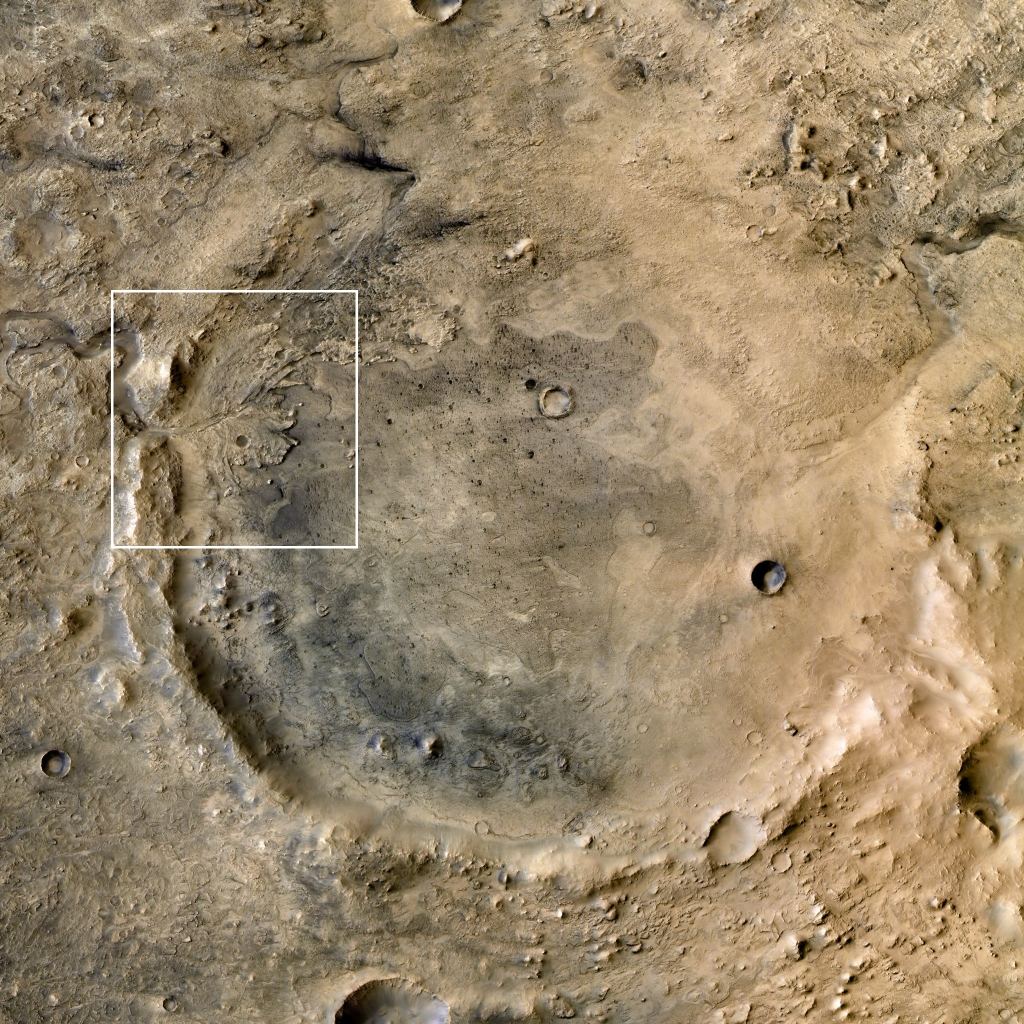
The search for life on alien worlds has captivated us for hundreds of years. In some respect, the search for life has expanded to the search for water since it is not unreasonable to assume if there is water then there is a good chance there is life too. When NASA selected the landing site for Perseverance, they were looking for such a body of water and settled upon the Jezero Crater. Images from orbiters reveal a crater that looks like it has been filled with water in the past but further investigations were needed to confirm. Now it seems, Perseverance has risen to the challenge.
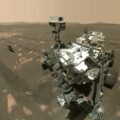
Perseverance is a car sized rover that arrived on Mars on 18 February 2021 and carried with it the innovative Ingenuity helicopter, the first powered aircraft on another world. The main objective of the mission was to identify ancient Martian environments capable of supporting life and if possible, finding evidence of ancient microbial life through collecting rock and soil samples. Since its arrival in 2021, the rover has been travelling around the 50km wide crater studying the geology and atmosphere as it goes.
Mars Perseverence rover sent back this image of its parking spot during Mars Solar Conjunction. Courtesy NASA/JPL-Caltech
A paper recently published in Science Advances journal declares that the crater was indeed filled at some point in its geological past, with water! More that it has deposited layers of sediments on the floor of the crater which have gone through periods of erosion as the lake shrank but are now visible in space images of the region.
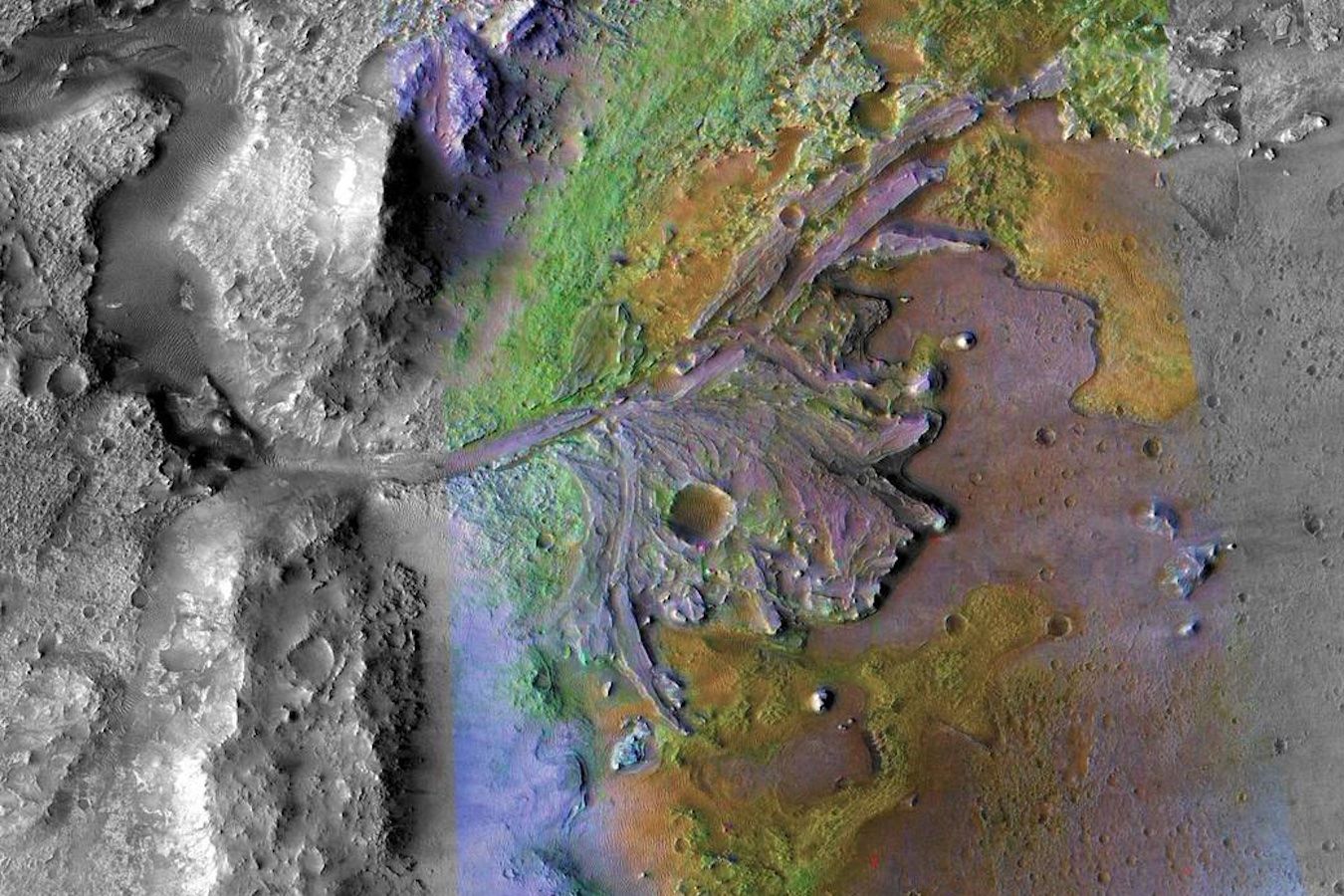
Although there have been nearly 3 years of operation on Mars, the really interesting stuff occurred between May and December 2022 when Perseverance drove from the crater floor onto the ancient river delta, a region believed to be 3 billion years old. During its journey, Perseverance used RIMFAX (the Radar Imager for Mars’ Subsurface Experiment) to shoot radar signals into the ground every 10cm. The pulses reflected from depths of about 20metres from below the surface showing that the base of the sediment was here and they had located the top of the buried crater.
The Jezero Crater and delta. Credit NASA
The data from RIMFAX showed sediment from two distinct periods bordered by periods of erosion as the environmental factors affected the sediments. The team reported that the original crater floor was not completely flat and that erosion must have taken place prior to the deposition of the sediments in the lake.
Despite the discovery of sediments, the team have yet to identify any fossilised remains or primitive life. The journey however has just begun. Over the last few decades we have found mounting evidence that water is common across the universe. It seems to that the processes we see on Earth are also common. Perhaps then we may be permitted to assume that other processes are replicated across the Cosmos, perhaps those that lead to the evolution of life! Time will tell if this latter assumption plays out.
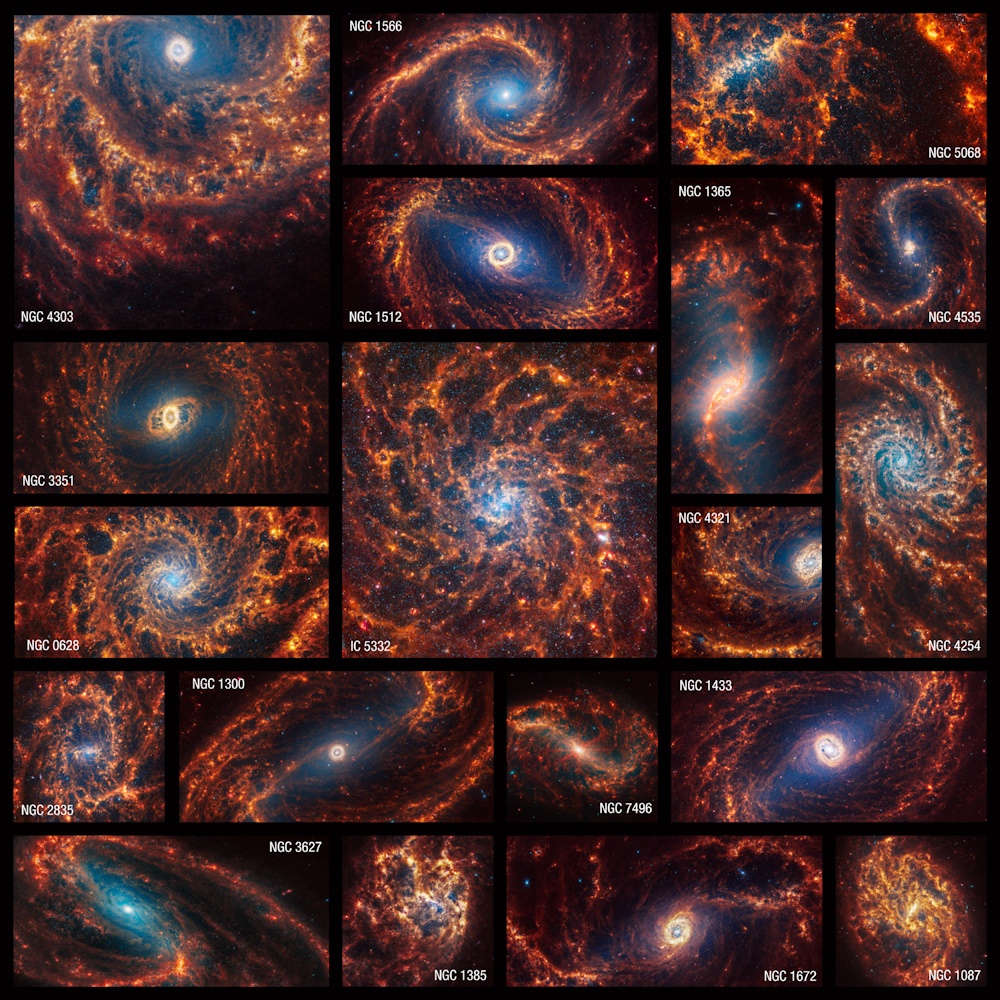
These Webb images are part of a large, long-standing project, the Physics at High Angular resolution in Nearby GalaxieS (PHANGS) program, which is supported by more than 150 astronomers worldwide. Before Webb took these images, PHANGS was already brimming with data from NASA’s Hubble Space Telescope, the Very Large Telescope’s Multi-Unit Spectroscopic Explorer, and the Atacama Large Millimeter/submillimeter Array, including observations in ultraviolet, visible, and radio light. Webb’s near- and mid-infrared contributions have provided several new puzzle pieces. Image Credit: NASA/ESA/CSA
Feast Your Eyes on 19 Face-On Spiral Galaxies Seen by Webb
If you’re fascinated by Nature, these images of spiral galaxies won’t help you escape your fascination.
These images show incredible detail in 19 spirals, imaged face-on by the JWST. The galactic arms with their multitudes of stars are lit up in infrared light, as are the dense galactic cores, where supermassive black holes reside.
The JWST captured these images as part of the Physics at High Angular resolution in Nearby GalaxieS (PHANGS) programme. PHANGS is a long-running program aimed at understanding how gas and star formation interact with galactic structure and evolution. One of Webb’s four primary science goals is to study how galaxies form and evolve, and the PHANGS program feeds that effort. The VLT, ALMA, the Hubble, and now the JWST have all contributed to it.
But Webb’s images are the juiciest.
“Webb’s new images are extraordinary. They’re mind-blowing even for researchers who have studied these same galaxies for decades.”
Janice Lee, Project Scientists, Space Telescope Science Institute.
The JWST can see in both near-infrared (NIR) and mid-infrared (MIR) light. That means it reveals different details, and more details, than even the powerful Hubble Space Telescope, which operates in visible light, UV light, and a small portion of infrared light.
This is NGC 4254 (Messier 99), a spiral galaxy about 50 million light-years away. It has a peculiarity to it, as one spiral arm is normal looking, and one is extended and less tightly wound. Though not a starburst galaxy, it forms stars three times as fast as other similar galaxies. This rapid star formation rate may have been triggered by interaction with another galaxy about 280 million years ago. With the JWST’s help, the PHANGS program will help astronomers understand NGC 4254’s history. Image Credit: NASA, ESA, CSA, STScI, Janice Lee (STScI), Thomas Williams (Oxford), PHANGS Team
In these JWST high-resolution images, the red colour is gas and dust emitting infrared light, which the JWST excels at seeing. Some of the images have bright diffraction spikes in the galactic center, which are caused by an enormous amount of light. That can indicate that a supermassive black hole is active, or it could be from an extremely high concentration of stars.
“That’s a clear sign that there may be an active supermassive black hole,” said Eva Schinnerer, a staff scientist at the Max Planck Institute for Astronomy in Heidelberg, Germany. “Or, the star clusters toward the center are so bright that they have saturated that area of the image.”
The diffraction spike in the center of NGC 1365 is a telescope artifact caused by an enormous amount of light in a compact region. It’s caused by either the active supermassive black hole or tightly grouped stars in the galactic centre. NGC 1365 is a double-barred spiral galaxy about 74 million light-years away. Image Credit: NASA, ESA, CSA, STScI, Janice Lee (STScI), Thomas Williams (Oxford), PHANGS Team
Stars near a galaxy’s center are typically much older than stars in the arms. The further a star is from the galactic center, the younger it typically is. The younger stars appear blue and have blown away the cocoon of gas and dust that they spawned in.
This is NGC 2835, a spiral galaxy about 35 million light-years away that has four or five spiral arms. Blue dots are very young stars that have blown away nearby gas and dust with their powerful UV light. Orange/red clumps are where even younger stars reside. They’re still surrounded by gas and dust. Several background galaxies are visible in the image. Image Credit: NASA, ESA, CSA, STScI, Janice Lee (STScI), Thomas Williams (Oxford), PHANGS Team
Orange clumps indicate even younger stars. They’re still wrapped in their blanket of gas and dust and are still actively accreting material and forming. “These are where we can find the newest, most massive stars in the galaxies,” said Erik Rosolowsky, a professor of physics at the University of Alberta in Edmonton, Canada.
The new images were released alongside some of the Hubble’s views of the same galaxies. These highlight how observing different wavelengths of light reveals or obscures different details in the galaxies. In the PHANGS observing program, different telescopes have observed galaxies in visible light, infrared light, UV light, and radio.
A Hubble Space Telescope image of NGC 628 (left) and the same galaxy as imaged by the JWST (right.) Both images are grand and inspiring and full of information, but the JWST image provides more detail. Large bubble-shaped gaps between concentrations of gas and dust are visible. In some of the images, those could be caused by supernovae. Image Credit: NASA, ESA, CSA, STScI, Janice Lee (STScI), Thomas Williams (Oxford), PHANGS Team
Since the human eye can’t see infrared, different visible colours are assigned to different wavelengths of light in order to make the images meaningful. In the JWST image of NGC 628 above, the galaxy’s center is filled with old stars that emit some of the shortest wavelengths of light the telescope can detect. They’ve been given a blue colour to make them visible. In the Hubble image, the same region is more yellow and washed out. The region emits the longest wavelengths of light that the Hubble can sense, so it has different colour assignments than the JWST.
Janice Lee is a project scientist at the Space Telescope Science Institute in Baltimore. She spoke for all of us when she said, “Webb’s new images are extraordinary. They’re mind-blowing even for researchers who have studied these same galaxies for decades. Bubbles and filaments are resolved down to the smallest scales ever observed and tell a story about the star formation cycle.”
This is NGC 1672, a spiral galaxy about 60 million light-years away. It may be a type II Seyfert galaxy, though astronomers aren’t totally certain. It has both a bright nucleus and a surrounding starburst region. Image Credit: NASA, ESA, CSA, STScI, Janice Lee (STScI), Thomas Williams (Oxford), PHANGS Team
These galaxies are all spiral galaxies like the Milky Way, meaning their massive arms define them. The spiral arms are more like waves that travel through space rather than individual stars moving collectively. Astronomers study the arms because they can provide key insights into how galaxies build, maintain, and shut off star formation. “These structures tend to follow the same pattern in certain parts of the galaxies,” Rosolowsky added. “We think of these like waves, and their spacing tells us a lot about how a galaxy distributes its gas and dust.”
The spiral galaxy NGC 1566 is about 60 million light-years away in the constellation Dorado. NGC is interacting with smaller member galaxies in its neighbourhood. It’s an active galaxy, meaning its nucleus emits a lot of light that doesn’t come from stars. Instead, it probably comes from the supermassive black hole at the center. NGC 1566 is extensively studied due to its proximity, orientation, its strong spiral arms and its active galactic nucleus. Image Credit: NASA, ESA, CSA, STScI, Janice Lee (STScI), Thomas Williams (Oxford), and the PHANGS team
Ever since it began science operations, the JWST has given astronomers an overwhelming flow of data that will fuel research for years and decades to come. These beautiful images are just a part of a larger data release that includes a catalogue of about 100,000 star clusters. “The amount of analysis that can be done with these images is vastly larger than anything our team could possibly handle,” said the University of Alberta’s Erik Rosolowsky. “We’re excited to support the community so all researchers can contribute.”
In the summer of 2023, Carlos Guana, a wildlife filmmaker and storyteller, and Phillip Sternes, a biology doctoral student at the University of California Riverside, set out on an expedition off the central coast of California to film great white sharks and other wildlife in the Pacific waters near Santa Barbara.
On July 9, 2023, while operating his Mavic 3 Pro aerial drone approximately a quarter mile off the coast of Carpinteria, California, Guana spotted something striking and beautiful moving beneath the ocean surface.
Although the creature was familiar in appearance—a small, almost ghostly pale white shark—neither Guana nor Sternes immediately recognized what the drone’s camera had managed to capture at the time.
It wasn’t until later while rewatching the footage that they noticed something odd about the shark’s appearance.
“Upon close examination of video and photos, the individual’s pale color appears to be a thin white film covering the shark,” Guana and Sternes would later write. “We noted that as the shark was swimming, the whitish film was being sloughed off.”
The infant great white shark Sternes and Gauna observed, as seen from the front
(Carlos Gauna/The Malibu Artist).
Although it seemed possible that the unusual film might have been caused by some kind of skin disorder that neither of the observers recognized, nor could it be found in the available literature on white sharks, a more likely possibility soon presented itself: this might be the remains of intrauterine material left over from the creature’s seemingly very recent birth.
If the latter were true, it would be an unprecedented sighting, given that what Guana and Sternes had filmed was likely a baby great white shark and the first of its kind ever captured on film.
“We enlarged the images, put them in slow motion, and realized the white layer was being shed from the body as it was swimming,” Sternes said in a recent statement about their discovery.
Now, their discovery has been reported in a new paper that appeared in the Environmental Biology of Fishes journal.
Great whites are among the most famous shark species, partially due to their famous, monstrous depiction in films like Jaws. Despite the attention the species has received, many things about them remain mysterious to ocean scientists.
Guana, who is known online as The Malibu Artist, has filmed these and other species of sharks in locations all over the world, documenting an impressive amount of footage of the creatures where they are often shown swimming frighteningly close to beachgoers.
His footage of these enigmatic ocean predators has racked up millions of views online, but the new images could offer scientists new clues about one of the most perplexing mysteries involving great white sharks.
“Where white sharks give birth is one of the holy grails of shark science,” Guana said in a statement. “No one has ever been able to pinpoint where they are born, nor has anyone seen a newborn baby shark alive.”
“There have been dead white sharks found inside deceased pregnant mothers,” Guana says, “But nothing like this.”
The suspected newborn great white shark, observed from the side
(Carlos Gauna/The Malibu Artist).
Like mammals, young great sharks are born live, and it is believed that they might feed on unfertilized eggs while still in the embryonic stage, along with a milky substance secreted within the uterus of the mother that provides additional nourishment.
It is the remnants of this intrauterine milk that Sternes and Guana believe they observed on the shark they filmed last July.
Other key observations also point to the likelihood that what they filmed represents the first imagery of a baby great white shark. While filming in the area, the pair observed several very large—and potentially pregnant—female great whites nearby.
By comparison, the small shark they captured in imagery with Guana’s drone is very small, and its appearance and behavior both suggest a very young creature—perhaps as little as a day, or even just a few hours old.
Also of interest is that the coastal waters of central California had already been put forward in the past as a potential birthing location for great whites. Hence, the pup that Guana and Sternes observed was in the right place, and at the right time, to be a likely match for a newborn great white.
White sharks are a protected species, although Guana and Sternes note in their paper that fishermen do sometimes inadvertently catch these sharks, some of which may die resulting from stress or injuries.
If the central California coast is indeed a breeding ground for white sharks, as opposed to waters much further offshore, as some past studies have suggested, then a greater level of management may be required to help ensure the conservation of the species and their habitat.
Ultimately, Guana and Sternes write that their aerial drone footage “has provided shark science with another interesting set of information,” adding that “future drone observations of sharks in this area will greatly improve our knowledge and understanding of white shark life history.”
Their recent paper, “Novel aerial observations of a possible newborn white shark (Carcharodon carcharias) in Southern California,” can be read online here, along with additional imagery of the white shark they observed in July 2023.
It seems like the waiting time is over, UFO disclosure is imminent. There is growing skepticism and indifference towards whistleblower David Grusch’s claims that the US federal government has hidden information about recovered extraterrestrial spacecraft from Congress. Republican leaders have dismissed potential witnesses, and NASA officials have reportedly withdrawn from an upcoming hearing on UFOs.
However, two Republican lawmakers leading the investigation still intend to hold a public hearing on July 26. US Representative Anna Paulina Luna confirms the hearing date and mentions that the names of witnesses will be released a week before the event.
Luna and Rep. Tim Burchett are facing pressure from the Pentagon and NASA after announcing their investigation into UFOs (also known as UAPs). NASA has stopped cooperating with the investigation, leading to speculation of a cover-up. Despite the challenges, Luna and Burchett remain determined to hold the hearing and promise an impressive lineup of witnesses. If necessary, Burchett is even willing to hold a field hearing in his own front yard. The hearing is scheduled for the last week of July before Congress goes on recess in August.
Meanwhile, Steve Sprague, a UFO researcher who studied the UAP phenomenon for 30 years, claimed that an aerospace executive would come forward and share the information during the upcoming Congressional Hearing on UAPs. This unidentified insider is described as a C-level executive within the United States-based company which, according to Sprague, is a top firm reverse-engineering alien technology. (Source)
“Let me say this unequivocally, without ambiguity, in no uncertain terms, we are not alone, aliens not only exist but have been here for five millennia, if not considerably longer, they are not friendly and humanity is absolutely in danger,” writes Steve Sprague.
According to the insider, aliens not only exist but have been present on Earth for at least five millennia, if not longer. Startlingly, the individual revealed the existence of at least two civilizations currently residing on our planet: humans and a group known as the “Ganzi,” originating from a distant part of our galaxy, roughly forty light years away. The Ganzi are characterized as technologically advanced beings who possess knowledge far surpassing humanity’s capabilities.
One of the most chilling aspects of the disclosure centered around Ganzi’s technological superiority. The insider explained that the technology recovered and possessed by humans is composed of terrestrial components manipulated in a manner that exceeds human understanding. These materials, created by alien processes, involve elements and physics beyond our comprehension. The Ganzi, however, refuse to share their technology with humanity, fearing the dire consequences of us wielding power beyond our current evolutionary stage.
The insider emphasized the vast technological gap between humans and the Ganzi, stating that they are millions of years ahead of us. They warned that humanity’s very existence could be threatened without the proper knowledge to manipulate these advanced materials. Humans were compared to protozoa on the technological scale, highlighting how far we have yet to evolve.
Disturbingly, the insider also shared incidents involving encounters with the Ganzi. One notable event involved the disintegration of an F-15 fighter jet by a particle beam technology wielded by extraterrestrial beings. The astonishing video evidence showcased a green beam hitting the side of the aircraft, which subsequently turned to ash without leaving any debris. Further analysis of the footage revealed the presence of extraterrestrial occupants, commonly referred to as Greys, characterized by their small bodies, large heads, and prominent eyes.
While the Ganzi were not described as inherently malevolent, they view humanity as an annoyance, akin to flies. However, the insider cautioned that provoking or interfering with their mission could lead to dire consequences. Reports of lost pilots and destroyed ships in encounters with the Ganzi underscore the potential dangers of crossing paths with these technologically advanced beings.
These shocking revelations come as anticipation mounts for the upcoming Congressional Hearing on UAPs. The insider has promised to come forward and share their information with the public during the event, which is expected to shed further light on the existence of extraterrestrial life and the presence of UFOs.
Sprague writes that the insider revealed to him that the Ganzi can manipulate matter in ways beyond human comprehension. They have a deep understanding of DNA manipulation, enabling them to increase lifespans indefinitely and cure or prevent diseases. It is even speculated that they have experimented on humans, possibly for reasons such as galactic war or slave labor.
Perhaps one of the most chilling revelations shared by the insider relates to nuclear power. They stated unequivocally that the Ganzi vehemently oppose humanity’s use of nuclear weapons. Any attempt to engage in large-scale nuclear conflict would be met with severe consequences, potentially leading to a complete shutdown of human society. The Ganzi have made it clear that they will not tolerate actions that could jeopardize the Earth or their larger objectives.
Moreover, the insider highlighted Ganzi’s superior abilities in manipulating higher dimensions, allowing them to be present anywhere at any time. They operate within the framework of Multi-Dimensional Theory and Brane Theory, concepts that challenge human understanding. This exceptional capability to navigate dimensions and remain undetected unless desired adds a layer of intrigue to the extraterrestrial presence on Earth.
The insider also touched upon significant presidential briefings that have taken place, shedding light on the United States government’s awareness of these developments. On various occasions, President Biden was reportedly briefed on advanced technologies recovered from the Ganzi. The briefings included demonstrations of lasers capable of remarkable feats, such as extracting elements directly from ore and analyzing biological and geological data.
Videos of these briefings purportedly exist, with one showing Biden interacting with three Ganzi beings through a small device placed in his ear. Notably, one of the individuals accompanying the beings was John Podesta, who later assumed the role of Senior Advisor for Clean Energy Innovation. The insider also linked breakthroughs in fusion energy and laser technology to the company’s efforts in reverse-engineering Ganzi technology.
In response to the question of why he was chosen by the insider, Sprague admitted uncertainty but speculated that a mutual friend with military and intelligence background may have facilitated the connection. He highlighted the importance of trust and the fact that he was seen as an outsider to the intelligence and journalistic spheres. Sprague acknowledged that his role in this situation may be that of a blunt instrument serving a specific goal. (Source)
Sprague mentions that his source is currently not in their home state and may or may not testify in front of cameras during the hearings. The source’s identity and their potential employment with a defense contractor remain undisclosed to protect their livelihood and family from potential fallout. However, Sprague asserts that if the hearings do not take place or the source cannot testify publicly, the information he received will still be released, leaving it out of his hands and independent of his involvement.
Sprague dismisses any connection between his information and a post on 4chan, asserting that he had never visited the platform before and had no intention of doing so in the future. He clarifies differences between the accounts, such as the claim of first-hand dealings with the craft, which he states his source did not mention. Regarding the element discussed by Bob Lazar, Sprague mentions that his source considered it pure trash and explained that the craft operated using a theoretical field similar to an Einstein-Rosen bridge or wormhole.
Sprague mentions his need for at least two more parts to cover additional topics, including the F-15 incident and post-disclosure scenarios. He expresses exhaustion after a busy day and indicates that he will engage with readers on Twitter the following day.
Former US intelligence officer David Grusch testified before Congress during the July 2023 UAP hearing, stating that we have numerous spacecraft of non-human origin. If this is the case, one might wonder if any contact has been established between humans and these extraterrestrial species. There have been persistent rumors suggesting that the US government may have signed treaties with these extraterrestrials and has been engaged in collaborative efforts with them over an extended period.
According to a rather extraordinary claim made by former US government consultant Timothy Good, it is alleged that the 34th President of the United States, Dwight D. Eisenhower, had three clandestine meetings with extraterrestrials. Good claimed Eisenhower met aliens at a remote air base in New Mexico in 1954. In more recent times, former Israeli Space Head Haim Eshed stated that aliens and the U.S. government had reached some type of deal to stay quiet about their experiments on Earth and secret facilities on Mars. Eshed went on to claim the existence of a “Galactic Federation” and implied that then-President Trump was on the brink of making significant revelations in this regard.
Video Evidence
During a podcast with former Fox News anchor Clayton Morris on his show Redacted, Joshua Reid, a former United States Navy serviceman with a background in missile weapons defense systems, brought a wealth of knowledge and experience to the table. He opened the conversation by referencing his personal experiences in the Navy, specifically during the years 2004 to 2006. Reid’s background made him intimately familiar with topics related to secret space projects, a subject that has piqued his interest for over two and a half decades.
It is worth noting that Joshua Reid’s extensive research in the field of UAPs and classified information has led him to the inner workings of certain government activities. His extensive four-year investigation revealed a disconcerting pattern. It appeared that military technology, particularly in special access programs, was unintentionally making its way to foreign adversaries, including China. This exchange of classified information seemed to involve universities and professors who were receiving grants to reverse engineer technologies from these programs.
The remarkable twist in this story was that Hillary Clinton’s emails were potentially facilitating the sale of this classified information to China and other foreign entities. China would fund universities, enticing professors to divulge information on special access programs. This enabled them to advance their technology rapidly, potentially reaching parity with the United States.
Former Inspector General I. Charles McCullough III, well-versed in these special access programs, played a crucial role in this unfolding drama. He represented David Grusch and became a central figure in the whistleblower saga. According to Reid, multiple whistleblowers were involved, with two possessing firsthand information and tangible evidence. The fear of repercussions led these individuals to testify in front of congressmen, notably, Indiana Congressman André Carson. However, it was not until these whistleblowers presented video evidence of intelligence community members communicating with extraterrestrials that congressmen took their claims seriously.
The impact of these videos was profound. Congressmen were visibly shaken, with one trembling and another drinking water profusely. This sudden shift in demeanor signified that the evidence was both extraordinary and unsettling. The whistleblowers were introduced to Inspector General McCullough, who had an extensive background in the very special access programs at the center of the controversy.
“I’ve heard that we can confirm this later, but from what I’m hearing, André Carson is this Congressman that they testified in front of, along with a few others. The Congressman didn’t take these guys seriously, but what ended up happening is they pulled out the evidence, a DVD, and they showed these congressmen video evidence of intelligence community members communicating with extraterrestrials. After these videos were shown to congressmen, they were noticeably shaken in fear. One of them was holding a piece of paper and could not stop shaking. Another was drinking water profusely, and this is when they began to take this very, very seriously and introduce these gentlemen to the former Inspector General of the Intelligence Community, McCullough. Hence, he enters the picture as someone who understands these SAP programs, has been read into these programs from back in the day, and is now representing these gentlemen.”
Morris was eager to learn more about the DVDs and the physical evidence related to the astounding claims made by the whistleblowers. He posed the question of where this evidence was currently held and whether the public would ever have the opportunity to view it.
Joshua Reid responded by revealing that the evidence, in the form of DVDs and other materials, was regarded as an “insurance policy.” This meant that the evidence was securely in the hands of two prominent UFO researchers. Furthermore, Reid confirmed that these researchers had not only seen the evidence but also verified its authenticity, which was a significant factor contributing to the growing interest in this matter.
Morris was eager to learn more about the DVDs and the physical evidence related to the astounding claims made by the whistleblowers. He asked Reid where this evidence was currently held and whether the public would ever have the opportunity to view it.
Joshua Reid responded by revealing that the evidence, in the form of DVDs and other materials, was regarded as an “insurance policy.” This meant that the evidence was securely in the hands of two prominent UFO researchers. Furthermore, Reid confirmed that these researchers had not only seen the evidence but also verified its authenticity, which was a significant factor contributing to the growing interest in this matter.
One of the prominent UFO researchers who has been sharing insider knowledge on UAPs is investigative journalist Ross Coulthart. It is quite uncertain if Coulthart possesses this DVD evidence but he did reveal that there exists a huge UFO in the possession of the United States that cannot be moved, and he knows the location of the craft. Ross mentioned the existence of non-human intelligence engaging with Earth for a long time and the recovery of certain objects, but he could not disclose specific details due to concerns about revealing advanced technologies.
In a recent episode of “The UFO Podcast,” host Andy engaged in a thought-provoking conversation with Ross. The discussion centered around the secrecy surrounding UFO sightings and government knowledge. Ross, who has deep insights into the matter, shared his perspective on why certain details remain undisclosed.
Andy began by addressing a critical question that has been on the minds of many UFO enthusiasts: the location of the mysterious craft. He asked Ross whether he could reveal where the craft was being held.
Ross responded: “Let me tell you, I can’t tell you the country it’s in; it’s not America. But what I can tell you is that the place where it is kept is used for another purpose that is a laudatory purpose that’s as much in your interests in your country in the UK as it is in mine in Australia and as it is in America. The simple reasons are that there are other uses for the place where this object is stored, and we could end up with a storm Area 51-type scenario if you came out and announced it.”
Ross went on to explain the potential consequences of revealing such information, including international incidents and threats to the safety of personnel at the facilities. He also emphasized the importance of protecting sources, drawing on his experience as a journalist dealing with sensitive intelligence.
Interestingly, Steve Sprague, a UFO researcher who studied the UAP phenomenon for 30 years, claimed that an aerospace executive would come forward and share the information during the July 2023 Congressional Hearing on UAPs. This unidentified insider is described as a C-level executive within the United States-based company, which, according to Sprague, is a top firm reverse-engineering alien technology.
According to the insider, aliens not only exist but have been present on Earth for at least five millennia, if not longer. Startlingly, the individual revealed the existence of at least two civilizations currently residing on our planet: humans and a group known as the “Ganzi,” originating from a distant part of our galaxy, roughly forty light years away. The Ganzi are characterized as technologically advanced beings who possess knowledge far surpassing humanity’s capabilities.
The insider also touched upon significant presidential briefings that have taken place, shedding light on the United States government’s awareness of these developments. On various occasions, President Biden was reportedly briefed on advanced technologies recovered from the Ganzi. The briefings included demonstrations of lasers capable of remarkable feats, such as extracting elements directly from ore and analyzing biological and geological data.
Videos of these briefings purportedly exist, with one showing Biden interacting with three Ganzi beings through a small device placed in his ear. Notably, one of the individuals accompanying the beings was John Podesta, who later assumed the role of Senior Advisor for Clean Energy Innovation. The insider also linked breakthroughs in fusion energy and laser technology to the company’s efforts in reverse-engineering Ganzi technology.
Sprague wrote, “Date 4 – May 19, 2022, Biden is now in Alaska and stopped off to refuel at Joint Base Elmendorf-Richardson. This video is the most incredible of all. Biden meets with three of the Ganzi. Biden puts a small device in his ear and a conversation occurs without sound. The video lasts for nine minutes and then four people enter the area. One of the people is John Podesta. The other three are unknown. The beings leave and the video ends. In September of 2022, Biden names Podesta as the Senior Advisor for Clean Energy Innovation. December 14, 2022, America has a breakthrough in fusion. To achieve this scientific feat – a laser is used. This laser has ‘unique’ properties.” (Source)
Sprague’s claims cannot be verified; however, it is certain that there exists an alien craft, and the United States has successfully accessed its interior. Dr. James Lacatski, a retired DIA intelligence officer who established the UFO program that operated from 2008 to 2010, has confirmed this. He stated that the craft possesses a streamlined configuration suitable for aerodynamic flight but lacks conventional features such as an engine, wings, intakes, exhaust, or fuel tanks.
For decades, the subject of Unidentified Flying Objects (UFOs) has captivated the imagination of the public and researchers alike. This fascination reached a new height with the recent disclosure of The Pentagon UFO Files, a collection of information and evidence gathered by the US government. These files, long shrouded in secrecy, offer a rare glimpse into the government’s perspective on what could be one of the most profound discoveries in human history – the existence of unidentified aerial phenomena (UAP) and their implications for humanity.
The Revelation:
After years of speculation and secrecy, the US government’s acknowledgment of these files marks a significant shift in the discourse surrounding UFOs. The files contain detailed accounts of encounters, expert analyses, and, perhaps most intriguingly, military confirmations of unexplainable aerial phenomena. This disclosure not only challenges our understanding of the skies above but also raises important questions about the nature of these phenomena and their potential impact on national security.
Analysis and Expert Opinions:
The Pentagon UFO Files encompass a range of sightings and encounters, some dating back several decades. These incidents, often involving highly credible military personnel, display characteristics that defy current technological and scientific understanding. The speeds and maneuverabilities of these UAPs, as observed and recorded, go beyond the capabilities of known human-made aircraft.
Experts from both scientific and military backgrounds have been analyzing these cases, looking for plausible explanations. In some instances, natural phenomena or misidentifications of conventional objects like aircraft and weather balloons were determined to be the cause. However, a significant portion of these sightings remains unexplained, fueling theories about their potentially extraterrestrial or interdimensional origins.
The Role of Government Secrecy and Public Perception:
The revelation of The Pentagon UFO Files has also brought to light the complex relationship between government secrecy and public knowledge. For decades, projects like Project Blue Book, Project Grudge, and others under the Department of Defense conducted investigations into UFO sightings. These projects, often criticized for their lack of transparency, have contributed to widespread skepticism and conspiracy theories.
The recent disclosure, while groundbreaking, has not been without its critics. Some argue that the released information is still heavily curated, raising questions about what might still be withheld and why. This ongoing secrecy perpetuates public distrust and speculation about the government’s true knowledge of UFOs and their implications.
The Future of UFO Research:
The Pentagon UFO Files have reignited interest in UFO research, not just within conspiracy circles but also among mainstream scientists and academics. This renewed focus could potentially lead to more systematic and open investigations into UAPs. It also underscores the need for international collaboration and transparency in studying these phenomena, as UFO sightings are a global occurrence with implications that transcend national borders.
VIDEO:
The Pentagon UFO Files (FULL DOCUMENTARY) UAO, USA GOVERNMENT, USA MILITARY
The release of The Pentagon UFO Files marks a new era in our quest to understand the unexplained phenomena in our skies. It challenges us to reconsider our place in the universe and invites us to explore possibilities that were once relegated to science fiction. While many questions remain unanswered, one thing is clear: the pursuit of knowledge about UAPs is more important than ever, promising to unlock mysteries that could redefine our understanding of the world and potentially, the cosmos.
De ontdekking van Nag Hammadi: zijn dit de verloren boeken van de Bijbel? Ruim zeventig jaar geleden werden in Nag Hammadi, Egypte, verschillende gnostische teksten ontdekt. Deze galerij duikt in de geschiedenis van deze oude boeken en de controverse die hen omringt.
Zouden dit werkelijk de ontbrekende boeken van de Bijbel kunnen zijn? Kijk naar de foto's om erachter te komen.
Wat en wanneer De gnostische evangeliën bestaan uit 52 teksten die in 1945 in Egypte werden ontdekt. Deze teksten werden op papyrus geschreven en verzameld in 13 oude boeken die codices worden genoemd. Ze werden in december 1945 opgegraven door Muhammad 'Ali al-Samman, een Arabische boer, in een begraven pot.
Wat is er met de boeken gebeurd? De boeken werden later illegaal verkocht in Caïro. Ondanks de inbeslagname van de meeste boeken door de Egyptische regering, werd één enkele codex discreet uit Egypte getransporteerd en uiteindelijk zijn weg naar Europa gevonden.
Waar staan de teksten nu? De originele teksten zijn momenteel ondergebracht in het Koptisch Museum in Caïro onder de identificatie NHC (Nag Hammadi Codices).
Gnostici en gnosticisme De term ‘gnostisch’ is afgeleid van het Griekse woord ‘gnosis’, wat ‘kennis’ betekent. Gnostici hielden vast aan het geloof dat ze verborgen kennis bezaten over God en het goddelijke, vandaar hun naam. Ze hadden verschillende perspectieven op Jezus en zijn leringen. Helaas werden veel van hun teksten uitgeroeid, omdat ze door de vroege kerk als ketters werden bestempeld.
Gnostici en gnosticisme De gnostici waren geen georganiseerde afzonderlijke religie, maar bestonden in plaats daarvan uit verschillende religieuze en filosofische stromingen die bloeiden van de 2e tot de 4e eeuw na Christus.
Gnostische overtuigingen Gnostici waren van mening dat de materiële wereld slecht was en de spirituele wereld deugdzaam. Explore God legt uit dat gnostici mensen zagen als 'goede geesten die gevangen zaten in kwaadaardige materiële lichamen'.
Hoe zagen gnostici God? Gnostici hielden vast aan hun geloof in een Oppergod, transcendent en onbegrijpelijk. Bovendien waren ze van mening dat een mindere God, bekend als Demiurg, en niet de Oppergod, verantwoordelijk was voor de schepping van het universum.
Wat was de gnostische perceptie van Jezus? Volgens de gnostici werd Jezus beschouwd als de ‘Verlosser’ wiens doel het was om de waarheid aan de mensheid te onthullen. Terwijl sommigen Jezus als volkomen goddelijk beschouwden en verstoken waren van de menselijke natuur (het fysieke lichaam als inherent slecht beschouwden), geloofden anderen in zijn menselijkheid.
Redding in het gnosticisme Gnostici geloofden dat verlossing niet afhankelijk was van sacramenten of vergeving van zonden. Ze waren van mening dat mensen 'gnosis', geheime kennis, moesten verkrijgen om verlossing te bereiken.
God woont in ons Het geloof van de gnostici was dat men door zichzelf te begrijpen kennis van God kon verwerven. Een fragment uit het boek 'The Gnostic Bible', gepubliceerd op gnosis.org, legt uit dat gnostici de intermediaire rol van priesters, rabbijnen of andere religieuze figuren niet accepteerden.
Wat is een evangelie? Het woord ‘Evangelie’ komt van de Griekse term ‘euaggelion’, die het concept van ‘goed nieuws’ overbrengt. Vroege christenen omarmden deze term om de boodschap van Jezus over te brengen en verslag uit te brengen over zijn leven.
Gnostische Evangeliën De teksten die in het gnosticisme bekend staan als evangeliën onthullen het perspectief van de gnostici ten aanzien van Jezus. Bekende voorbeelden zijn onder meer Thomas, Maria en Judas.
Het Evangelie van Judas Volgens deze controversiële tekst was Judas eigenlijk een goede apostel, zoals The New York Times betoogt. Er wordt aangenomen dat het evangelie zegt dat Judas zijn verraad aan Jezus op bevel van Jezus zelf uitvoerde.
Zijn de evangeliën betrouwbaar? De betrouwbaarheid van de teksten is uitgebreid besproken. A Clear Lens benadrukt drie belangrijke tegenargumenten: data, consistentie en historische context
Samenhang Gezien de talrijke verhalen over Judas in de canonieke teksten van andere apostelen, is het logisch dat de gnostische interpretatie van Judas argwaan kan wekken.
Samenhang De canonieke verslagen portretteren de boodschap van Jezus als universeel toepasbaar, terwijl de vertolking van de gnostici suggereert dat hij zijn wijsheid exclusief deelde met een paar uitverkorenen.
Historische achtergrond De misvatting draait om het gebruik door de gnostici van mythen om hun overtuigingen over te brengen, wat betekent dat de teksten mogelijk geen feitelijke details over het leven van Jezus verschaffen.
De Bijbel Volgens de International Bible Society onderging de Bijbel een langdurig compilatieproces, waarbij verschillende boeken uit de definitieve versie werden weggelaten.
Het Nieuwe Testament De vier evangeliën die voor het Nieuwe Testament zijn gekozen, zijn geschreven door Matteüs, Marcus, Lucas en Johannes, bekend als de officieel aanvaarde canonieke evangeliën.
Wat is de canon? Biblica, de International Bible Society, definieert de canon als de boeken die worden erkend als door God geïnspireerd en gezaghebbend voor geloof en leven.
Waarom werden de gnostische evangeliën uitgesloten van de Bijbel? Volgens bijbelgeleerde Darrell L. Bock tijdens een interview met Beliefnet "is bij de wortel van deze (canonieke) evangeliën ofwel een apostolische figuur betrokken, ofwel iemand die nauw verbonden is met een apostolische figuur." En dat: "De evangeliën die in de Bijbel terecht zijn gekomen, stammen allemaal uit de eerste eeuw. Geen enkel evangelie uit die [gnostische] lijst dat ik ken, dateert feitelijk uit de eerste eeuw."
De Da Vinci-code Volgens de National Geographic was het populaire boek van Dan Brown geïnspireerd op de gnostische evangeliën, maar geleerden zijn het niet eens met Browns standpunt.
Waarom zijn deze teksten belangrijk? De gnostische evangeliën bieden waardevol inzicht in het gnosticisme en het vroege christendom en werpen licht op verschillende besproken ideeën en de interpretatie ervan door de vroege kerk.
Zie ook: De meest verontrustende delen van de Bijbel
Solar flares pose a major hazard to electronics and infrastructure in Low Earth Orbit, but they may have played a role in kick-starting life on Earth. Credit: NASA/SDO/J. Major
The water that life knows and needs, the water that makes a world habitable, the water that acts as the universal solvent for all the myriad and fantastically complicated chemical reactions that make us different than the dirt and rocks, can only come in one form: liquid.
The vast, vast majority of the water in our universe is unsuitable for life. Some of it is frozen, locked in solid ice on the surface of a world too distant from its parent star or bound up in a lonely, wayward comet. The rest is vaporized, existing as a state of matter where molecules lose their electron companions, boundless and adrift through the great nebular seas that dot the galaxies, or ejected completely into the great voids between them. Either way, that water exists only one molecule at a time, at a temperature of over a million degrees yet its density so low that you could pass through it and mistake it for the cold, hard vacuum of space itself.
No, for water to be liquid it must exist in special place around a star, not too cold for it turn to ice, not too hot for it to turn to gas. It must lay within what astronomers call the habitable zone, or, if they’re feeling playful, the Goldilocks zone.
The habitable zone is different for every star throughout the galaxy, because no two stars are alike. The smallest red dwarfs are barely a tenth the mass of the Sun, with luminosities a thousand times weaker. The largest are great beasts, a hundred solar masses or more, so bright they can be seen from thousands of light-years away by the unaided eye. Around each star a simple iron law holds, the fact that the intensity of light, and all the warmth and comfort that light brings with it, diminishes with the square of the distance from the source. An object twice as far away will experience a quarter of the brightness; at a distance of four times that drops to a sixteenth, and so on. That is why Pluto, despite only sitting about 30 times further away from the Sun than the Earth, is forced to experience never-ending dim twilight, even at the height of its day.
Too far from a star and the radiant temperatures are too cold, and any water freezes. Too close, and the water slips its bonds, free to roam as a gas. In between, in a special band determined by the star’s mass, age, and brightness, sits the habitable zone, where a planet is capable – yes, merely capable – of hosting water in its liquid state on its surface.
For our own Sun, the habitable zone stretches from just within the orbit of Venus to just beyond the orbit of Mars. Three planets perfectly situated within the warm embrace of our Sun, and yet only one has life. What happened? What made our planet so special, or so lucky? It’s impossible to say for sure, because the potential of habitability is not a promise.
There is, however, one other place where we know liquid water can exist. Ironically, it’s in the frozen moons of the outer solar system. There, under surfaces of frozen ice a hundred kilometers thick sit globe-spanning liquid water oceans, with more liquid water than exists on the surface of the Earth. There the habitability isn’t given by the rays of the Sun, but from their molten cores emanating heat, driven by the gravitational warping of the giant planets they orbit. Life could certainly find a purchase there, in places of darkness that the Sun never can touch, even though there worlds are not, according to the traditional definition, habitable.
We do not yet know how, where, or why life first appeared on our planet. Part of the difficulty is that “life” has no strict, universally agreed-upon definition.
Normally this is not an issue, as the vast majority of life is most definitely alive, and only biologists interested in the extreme edges – viruses, prions, and the like – need to worry about precise classifications. But to study the origins of life we must, by necessity, examine a process that takes non-living matter and fundamentally changes it. Presumably this process happened in stages, with fits and starts along the way, and so the line between uncoordinated chemical reactions and the beginnings of vibrancy must be blurred.
It’s helpful here to present at least a simple working definition of life, not to rewrite the biology textbooks, but so that at least we can properly frame the discussion of life’s origins. And for those purposes a simple statement will suffice: life is that which is subject to Darwinian evolution. That is, life experiences natural selection, that unceasing pressure that chooses traits and characteristics to pass down to a new generation through the simple virtue of their survivability. If the trait contributes in some way, even circuitously, to the survivability of an organism and its ability to reproduce, it persists. All else is discarded (or, at best, gets carried unceremoniously along for the ride).
Earth is the only known place in the solar system, in the galaxy, in the entire universe where Darwinian evolution takes place.
To succeed at evolution and separate itself from mere chemical reactions, life must do three things. First, it must somehow store information, such as the encoding for various processes, traits, and characteristics. This way the successful traits can pass from one generation to another.
Second, life must self-replicate. It must be able to make reasonably accurate copies of its own molecular structure, so that the information contained within itself has the chance to become a new generation, changed and altered based on its survivability.
Lastly, life must catalyze reactions. It must affect its own environment, whether for movement, or to acquire or store energy, or grow new structures, or all the many wonderful activities that life does on a daily basis.
By interacting with its environment, making copies of itself, and storing information (like how to interact with the environment and make copies of itself), life can evolve, growing in complexity and specialization over geologic time, from humble molecules to conscious minds capable of peering into its own shrouded origins.
In the modern era, with billions of years of practice behind it, life on Earth has evolved a dizzying array of chemical and molecular machines to propagate itself – a menagerie so complex and interconnected that we do not yet fully understand it. But a basic picture has emerged. Put exceedingly simply (for I would hate for you to mistake me for a biologist), life accomplishes these tasks with a triad of molecular tools.
One is the DNA, which through its genetic code stores information using combinations of just four molecules: adenine, guanine, cytosine, and thymine. The raw ability of DNA to store massive amounts of information is nothing short of a miracle; our own digital system of 1’s and 0’s (invented because it’s much simpler to tell if a circuit is on or off than some stage in-between) is the closest comparison we can make to DNA’s information density. Natural languages don’t even earn a place on the chart.
The second component is RNA, which is intriguingly similar to DNA but with two subtle, but significant, differences: RNA swaps out thymine for uracil in its codebase, and contains the sugar ribose, which is one oxygen atom short of the deoxyribose of DNA. RNA also stores information but, again speaking only in generalities, has the main job of reading the chemical instructions stored in the DNA and using that to manufacture the last member of the triad, proteins.
“Proteins” is a generic catch-all term for the almost uncountable varieties of molecular machines that do stuff: they snip apart molecules, bind them back together, manufacture new ones, hold structures together, become structures themselves, move important molecules from one place to another, transform energy from one form to another, and so on.
Proteins have one additional function: they perform the job of unraveling DNA and making copies of it. Thus the triad completes all the functions of life: DNA stores information, RNA uses that information to manufacture proteins, and the proteins interact with the environment and perform the self-replication of DNA. This cycle allows living organisms to experience the gift of evolution.
And this cycle is, as I said, gloriously complex and obviously the result of billions of years of fine-tuning and refinement. The interconnected nature of DNA, RNA, and proteins means that it could not have sprung up ab initio from the primordial ooze, because if only one component is missing then the whole system falls apart – a three-legged table with one missing cannot stand.
Graduate student Noah Totsline works in the College of Agriculture and Natural Resources lab of Harsh Bais on a NASA-sponsored project looking at how plants grown in space are more prone to infections of Salmonella compared to plants not grown in space or grown under gravity simulations. The microgravity environment of space can be simulated in the lab by rotating the plants at a precise speed that causes the plants to react as if they were in a constant state of free-fall.
Plants Growing in Space are at Risk from Bacterial Infections
I have spent the last few years thinking, perhaps assuming that astronauts live off dried food, prepackaged and sent from Earth. There certainly is an element of that but travellers to the International Space Station have over recent years been able to feast on fresh salad grown in special units on board. Unfortunately, recent research suggests that pathogenic bacteria and fungi can contaminate the ‘greens’ even in space.
It’s been at least three years that astronauts have been able to eat fresh lettuce and other leafy items along with tortillas and powdered coffee.. Specially designed chambers on board allow them to grown plants under carefully controlled temperature, water and lights to ensure a successful harvest. There is however an issue that the ISS is a relatively closed environment and so it is easy for bacteria and fungi to spread and astronauts to get ill.
The International Space Station stretches out in an image captured by astronauts aboard the SpaceX Crew Dragon Endeavour during a fly-around in November 2021. Credit: NASA
A paper just published in Scientific Reports and NPJ Microgravity and authored by a team led by Noah Totsline explores what happens with lettuce grown under ‘simulated’ weightless environments (the device known as a clinostat rotate them so that plants did not know which way was up or down). This was achieved by being gently rotated. Plants it seems though, are pretty good at sensing gravity using their roots. The team found that plants under these conditions were more prone to infection than those on Earth in particular Salmonella.
One of the main lines of defence for plants is their stomata. These are tiny pores in the leaves, much like the pores in our skin, that close to defend when an environmental stress is detected, such as bacteria. The team exposed plants in their micro-gravitational environment to find the plants opened the stomata instead of closing them.
The team went a step further and introduced a natural bacteria known as UD1022 which usually helps to protect plants. In the clinostat however, it failed to help the plant to protect itself from other more harmful bacteria.
The research was not just an interesting scientific problem but does solve real world problems. Space is slowly opening up with more and more non-astronauts becoming astronauts and travelling into space and this is only going to increase. As SpaceX and the like press ahead with the commercialisation of space travel we absolutely must find a way to grow and farm sustainable and healthy food instead of prepackaged snacks if we are to become a truly space fairing civilisation.
We are some way away from that of course but this is step one in a long journey. Sadly it is not as simple a task as sterilising the seeds since their could easily be microbes in the environment on board the ISS (or other space craft that come in the future) and perhaps it is these that pose the greatest risk. The team are now looking at ways to genetically modify plants to help them cope in the microgravity of space.
NASA's plans for exploration of the Moon and Mars are a unified architecture covering all mission, crew, and technology contigencies. Image courtesy NASA.
NASA Gives us an Update on its Long-term Plans for the Moon and Mars
Going to Mars is a major step in space exploration. It’s not a quick jaunt nor will it be easy to accomplish. The trip is already in the planning stages, and there’s a good chance it’ll happen in the next decade or so. That’s why NASA and other agencies have detailed mission scenarios in place, starting with trips to the Moon. Recently, NASA updated its “Moon to Mars Architecture” documents, including a closer look at some key decisions about Mars exploration.
Those decisions cover a wide gamut of challenges to living and working on the Red Planet. NASA planners narrowed them down to these key areas: science priorities, number of crew members on the first trip, how many on each follow-up trip, number of crew members per Mars location, Mars surface power generation technologies, what kinds of missions will be sent (the “target state”), and establishing what they call a “loss of crew risk” posture. That last one involves making the right decisions about missions based on risk to the crew’s health and performance.
NASA Plans for the Moon and Mars
Why create a mission architecture for the Moon and Mars? Essentially, anybody going to these other worlds needs a mutually agreed-upon “roadmap” that plans the explorations and technologies needed. That’s why NASA created its first Moon to Mars objectives in 2022 and has been refining them ever since. The agency’s roadmap includes feedback from a wide swath of society. Members of academia, U.S. industry, international partners, and the NASA workforce all contributed to the project.
“Our new documents reflect the progress we’ve made to define a clear approach to exploration and lay out how we’ll incorporate new elements as technologies and capabilities in the U.S. and abroad mature,” said Catherine Koerner, associate administrator, Exploration Systems Development Mission Directorate at NASA Headquarters in Washington. “This process is ensuring that everything we are doing as an agency and together with our partners is focused on achieving our overarching exploration goals for the benefit of all.”
The Key Decisions Regarding Mars Exploration
In a white paper published along with the Moon to Mars Architecture document, NASA explains key areas of concern when it comes specifically to Mars exploration. The first is science. It’s the main reason for going the both the Moon and Mars, and its needs will drive almost all other considerations. It will determine the resources needed, including crew numbers, payloads, technology deliveries, and power and communications infrastructure, and contingencies for possible accidents or other challenges.
An artist’s concept of Mars explorers and their habitat on the Red Planet. Courtesy NASA.
Once the science is determined, planners can decide on crew needs for the first and subsequent missions. As the white paper states, “…a series of focused science exploration missions to different landing sites would favor one architecture. Establishing a permanent, fixed base from which astronauts could conduct many surface missions supporting diverse and evolving exploration activities would favor a very different architecture.”
From there, planners will figure out the “cadence” of the missions and crew deployments. How often do we send missions and how many people will go? Just as an example, let’s say that the first mission will land in Jezero Crater, near the Perseverance rover. NASA could use its data to determine further science exploration at the site. That will drive the best placement for habitats and other infrastructure, and the type of mission will dictate the number of crew members needed.
Those decisions will then drive the infrastructure and technology needed for each step. Science stations need power to do the science, but also to sustain the habitats for the science teams. If those teams travel across the surface, their rovers will need power, fuel, and possibly replacement parts. Crew members themselves will need to be able to grow food, use local resources to extract fuel and water, and otherwise maintain safe living conditions. And, these are just the first steps in the long-term exploration of Mars, enabled by what people learn about living and working on the Moon.
Why Does NASA Want a Moon to Mars Plan?
While it may seem sexy to send people directly to Mars without any intervening stops at the Moon, NASA and other agencies want a measured approach. The idea to use the Moon as a stepping stone to Mars is not new. The Moon makes a good “training base” of sorts where we can “practice” with the technologies and techniques of living on another world. In addition, it offers a unique environment for astronomy and planetary science exploration. Astronauts learn in an environment close to Earth and if something dire happens to them, rescue is not far away.
Artist’s impression of astronauts on the lunar surface, as part of the Artemis Program. Credit: NASA
These ideas underlie the planning for the upcoming Artemis missions to the lunar surface. There’s supposed to be a gateway orbiting the Moon, to which astronauts and equipment will fly. Then, from there, materials and people head to the Moon to explore various sites, and begin the complex tasks of exploration and habitat construction. That set of missions will establish the foundation for scientific exploration, and land a diverse set of people on the lunar surface, all in cooperation with international partners. Ultimately, everything they learn on the Moon will prepare people for the leap to Mars.
The Moon to Mars mission architectural plans unite both lunar and Mars exploration in one timeline, identifying technologies and capabilities needed to accomplish each step. They are living documents, updated every year to reflect changes in any aspect of mission planning and technology.
Japanse maanlander werkt opnieuw, meer dan een week na de landing
Artikel van Kathleen Heylen
Op 19 januari slaagde Japan erin om voor de eerste keer een onbemand ruimtetuig neer te zetten op de maan. Maar de landing verliep niet helemaal volgens plan. Er bleekeen probleem met de zonnepanelen van de maanlander, waardoor ze geen stroom konden opwekken. Daardoor was JAXA genoodzaakt om de maanlander uit te schakelen, om zo energie te sparen.
Kort voordien hadden de maanlander en de twee robotvoertuigjes aan boord nog wel foto's en data doorgestuurd naar de aarde. Zo kon JAXA achterhalen dat de maanlander door een probleem met een van de motoren op zijn zijde was geland. Daardoor konden de zonnepanelen onvoldoende zonlicht opvangen. Maar er was nog hoop dat dat zich zou herstellen.
De zonnepanelen waren gericht op het westen. Ze zouden meer zonlicht kunnen opvangen naarmate de zonsondergang op de landingssite zich inzet. Die vindt plaats op 1 februari, in de aanloop naar dat moment verandert de richting van waaruit het zonlicht komt geleidelijk. En dat lijkt de maanlander nu weer aan de praat te hebben gekregen.
Een foto gemaakt door het robotvoertuigje LEV-2, meteen na de landing, toont dat de maanlander op zijn zijde terechtgekomen is en daardoor onvoldoende zonlicht kon opvangen.
De maanlander is ook meteen aan de slag gegaan. Met zijn multispectrale camera (MBC) onderzocht hij de samenstelling van gesteenten in de buurt van de landingssite. Met dat soort onderzoek willen wetenschappers meer te weten komen over het ontstaan van de maan.
Op X (vroeger Twitter) postte JAXA een van de foto's die zijn doorgestuurd. Daarop is een gesteente te zien dat de naam "Toy poodle" kreeg. "Toy poodle" is een van de gesteenten die het Japanse team als "interessant" beoordeelde op basis van de eerste foto's meteen na de landing.
Nauwkeurige precisie
Uit die allereerste gegevens bleek ook al dat de maanlander op ongeveer 55 meter is geland van de plaats waar hij oorspronkelijk had moeten landen. Dat is uiterst nauwkeurig. Japan had zich als doel gesteld om binnen een zone van 100 meter te landen, terwijl andere ruimtevaartnaties marges van enkele kilometers gebruiken.
Die nauwkeurigheid is een van de speerpunten van de Japanse maanmissie. De komende jaren staan heel wat onbemande én bemande vluchten naar de maan op de agenda. Ook wordt gekeken naar een basis op maan. Het is dus belangrijk om uiterst precies te kunnen landen, ook op terrein dat minder toegankelijk is.
Een eerdere simulatie toont hoe de Japanse maanlander op de maan had moeten landen.
Het is niet duidelijk wanneer de operaties van de Japanse maanlander zullen eindigen. Eerder al had JAXA gezegd dat het tuig niet ontworpen was om een nacht op de maan te overleven. Die maannacht begint nu donderdag en duurt ongeveer 14 dagen.
Japan is nog maar het vijfde land dat erin slaagt om een onbemand ruimtetuig op de maan te laten landen, na de Sovjet-Unie, de Verenigde Staten, China en India.
Unraveling the Mysteries of Area 51: The Intriguing Accounts of Bob Lazar and John Lear
In the realm of UFO lore, few stories have sparked as much fascination and controversy as those surrounding Area 51, a highly classified United States Air Force facility in Nevada. Central to these tales are the figures of Bob Lazar and John Lear, whose claims about alien technology and government secrecy have captivated public imagination. Investigative reporter George Knapp played a pivotal role in bringing these narratives to light, challenging our understanding of the unknown.
Bob Lazar: A Glimpse into the Unknown
Bob Lazar emerged in the late 1980s as a figure of intrigue within the UFO community. Claiming to be a physicist, Lazar asserted that he was employed at a top-secret government facility known as S4, located near Area 51. His primary role, he said, was to reverse-engineer extraterrestrial technology from recovered alien spacecraft. Lazar’s descriptions of these crafts were detailed and technical, describing propulsion systems that defied known physics, specifically gravity manipulation through antimatter reactors.
His story extended beyond mere engineering marvels. Lazar spoke of various alien species and implied that the U.S. government was deeply involved in studying their technology. The veracity of Lazar’s claims has been widely debated, with skeptics pointing to inconsistencies and lack of evidence, particularly in Lazar’s educational and professional background.
John Lear’s Contributions
John Lear, a respected aviator and son of the inventor of the Learjet, William Lear, lent a significant voice to the UFO narrative. With ties to various intelligence agencies, Lear’s transition into UFO research added a layer of credibility to the discussions about extraterrestrial activities. He posited that the U.S. government had been recovering alien spacecraft since the late 1940s and that these activities were closely guarded secrets.
VIDEO:
Bob Lazar and John Lear talk alien craft at Area 51 ~ with investigative reporter George Knapp
Lear’s role in the Lazar story is pivotal. He introduced Lazar to George Knapp, which eventually led to the public disclosure of Lazar’s experiences. Lear himself became an outspoken advocate for the existence of UFOs and alien visitors, contributing to the growing public discourse on the subject.
George Knapp’s Investigative Journalism
Enter George Knapp, an investigative reporter whose interest in Lazar’s and Lear’s accounts brought them into the public eye. Knapp’s journalistic rigor provided a platform for Lazar to share his experiences. His interviews and investigations into Lazar’s background added depth to the narrative, though they also raised questions about Lazar’s credibility.
Knapp’s work highlighted the challenges in investigating claims surrounded by secrecy. His efforts to verify Lazar’s employment history and academic credentials met with obstructions, fueling theories of a government cover-up. The questions raised by Knapp’s investigation continue to add to the mystique and skepticism surrounding Lazar’s claims.
The Legacy of Lazar and Lear
The stories of Bob Lazar and John Lear have become integral to the UFO mythology, particularly regarding Area 51. Their accounts have fueled debates about government transparency, scientific evidence, and the possibility of extraterrestrial contact. The continuing public interest in their stories is a testament to the enduring human fascination with the unknown and the unexplained.
Ben jij klaar voor de Apocalyps? Onthulling van de mysteries van het boek Openbaring Het Bijbelboek Openbaring staat bekend om zijn dramatische weergave van het einde der tijden. Het boek is de basis geweest voor veel afbeeldingen van de Apocalyps, die – in sommige gevallen – behoorlijk gruwelijk zijn. Maar wat weten we eigenlijk over de auteur van Openbaring; de Vier Ruiters van de Apocalyps, of de betekenis van het getal 666, ook wel het getal van het beest genoemd?
In deze galerij verkennen we het boek Openbaring om licht te werpen op deze vragen en meer. Klik verder om iets nieuws te leren!
De focus ligt niet alleen op de apocalyps Veel mensen geloven dat het boek Openbaring slechts een apocalyptisch verslag is van wat er gaat gebeuren, maar de auteur van het boek, Johannes, richtte zich vooral op de terugkeer van Jezus Christus.
De focus ligt niet alleen op de apocalyps In 70 GT maakte Johannes een tragische gebeurtenis in de geschiedenis mee toen Jeruzalem zwaar werd beschadigd door de Romeinen. Men geloofde dat Jezus terug zou komen om de Romeinen te verslaan en gerechtigheid te zoeken voor zijn dood en het lijden van de christenen.
De focus ligt niet alleen op de apocalyps Dit soort anti-Romeinse propaganda overtuigde christenen ervan dat hun leider en redder tijdens hun leven terug zou komen. Hoe zorg je ervoor dat christenen gemotiveerd blijven om christen te blijven? Deel een intrigerend verhaal met hen.
The Apocalypse zou een script voor een horrorfilm kunnen zijn Bepaalde delen van het boek Openbaring bevatten gewelddadige inhoud, vooral met betrekking tot de Apocalyps. Laten we onze discussie beginnen met de Vier Ruiters van de Apocalyps en hun kenmerkende paarden.
De vier ruiters van de Apocalyps Openbaring 9:17-19 geeft details over het uiterlijk van deze paarden: "De hoofden van de paarden leken op de hoofden van leeuwen, en uit hun muilen kwam vuur, rook en zwavel." Vind je dat niet behoorlijk intimiderend? Maar er is meer aan de hand!
De vier ruiters van de Apocalyps "De kracht van de paarden zat in hun mond en in hun staart; want hun staarten waren als slangen, met koppen waarmee ze verwondingen toebrengen." Niemand zou een vrachtwagen met deze paarden hebben!
De mensheid staat op het punt heel slecht te worden Ze worden letterlijk gekookt door de zon, gebombardeerd met enorme hagelstenen, en dan wordt de zon pikzwart terwijl de maan een bloedrode tint krijgt. En alsof dat nog niet genoeg is, regenen de sterren uit de hemel, gevolgd door een enorme aardbeving. Ja, die tijden zijn serieus zwaar!
Het wordt nog erger Er is een verhaal over sprinkhanen wier ‘gezichten leken op menselijke gezichten. Hun haar was als vrouwenhaar en hun tanden waren als leeuwentanden.’ Bovendien bezaten ze een schorpioenachtige angel, maar het was hen verboden dodelijke slachtoffers te veroorzaken. In plaats daarvan zouden deze sprinkhanen individuen gedurende een periode van vijf maanden kwellen. De aard van deze situatie is zeer verontrustend.
Openbaring is in de Bijbel terechtgekomen dankzij één enkele persoon Het proces van het samenstellen van de Bijbel, ook wel de officiële verzameling genoemd, duurde meerdere jaren. Gedurende deze tijd werden talloze boeken geëvalueerd, waaronder de opmerkelijke opname van het boek Openbaring. Athanasius, een zeer invloedrijke priester, speelde een cruciale rol in dit streven.
Openbaring is in de Bijbel terechtgekomen dankzij één enkele persoon Ondanks dat hij vijf keer met ballingschap en afzetting te maken kreeg, verdedigde Athanasius de kracht van de Openbaring. Hij geloofde dat het stand kon houden tegen iedereen die tegen de Kerk was. Verrassend genoeg leidde zijn geloofwaardigheid ertoe dat het boek in het Nieuwe Testament werd opgenomen, zelfs toen anderen twijfelden aan de waarde ervan.
Auteur van het boek Openbaring? Het auteurschap van Openbaring is een onderwerp van discussie waarbij meerdere personen betrokken zijn die in de Bijbel Johannes worden genoemd, waaronder de apostel van Jezus en de schrijver van een van de evangelieverslagen.
Auteur van het boek Openbaring? Het gebruik van soortgelijke woorden heeft het argument versterkt van degenen die geloven dat de auteur van het boek Johannes en het boek Openbaring één en dezelfde zijn. Dit standpunt wordt echter niet door iedereen gedeeld.
Wie schreef de Openbaring werkelijk? De apostel Johannes noemt zijn eigen naam meerdere keren in zijn boek, maar volgt verrassend genoeg niet dezelfde stijl in Openbaring, waarbij hij elke verwijzing naar zichzelf weglaat, wat duidelijk niet zijn stijl was.
Wie schreef de Openbaring werkelijk? Beide auteurs gebruiken verschillende Griekse woorden om Jezus het lam te noemen. Bovendien is de Griekse schrijfstijl van de apostel verfijnder. De auteur van Openbaring lijkt geen moedertaalspreker te zijn.
Hij was geen gewone christen Gedurende die tijd kende het christendom verdeeldheid tussen de verschillende groepen, en Johannes, waarvan werd aangenomen dat hij een Jood was, beschouwde Jezus als de Joodse Messias.
John's strikte mening Het boek bevat verschillende aanwijzingen van de auteur. De auteur steunde bijvoorbeeld niet dat heidenen (niet-joden) volgelingen van Jezus zouden worden zonder zich te houden aan de regels die in de Thora zijn uiteengezet.
666 heeft geen verband met Satan Het getal 666 wordt vaak geassocieerd met de duivel. Maar volgens Openbaring 13:18: "Dit vereist wijsheid. Laat degene die inzicht heeft, het getal van het beest berekenen, want het is het getal van een mens. Dat getal is 666."
666 heeft geen verband met Satan Dit aantal wordt echter niet geassocieerd met enige kwade connotaties. Het komt feitelijk overeen met de identiteit van een individu, zoals vermeld in het boek Openbaring. Deskundigen suggereren dat deze persoon niemand minder is dan keizer Nero.
Welke methode is gebruikt voor de berekening? De informatie werd verkregen via gematria, een Hebreeuwse numerologische praktijk die waarden aan letters toekent.
Waarom Nero? Nero behandelde christenen op een zeer harde manier en nam zijn toevlucht tot het levend verbranden ervan. Dit maakte hem tot een sterke kanshebber voor de titel van het beest.
Hoe zit het dan met het merkteken van het beest? Er wordt gedacht dat het in Openbaring 13:16-17 genoemde merkteken verwijst naar Romeinse munten of postzegels die door het rijk werden gebruikt.
Toen het einde van de wereld niet plaatsvond Er zijn meerdere mislukte voorspellingen over de Apocalyps geweest, die allemaal gebaseerd waren op Openbaring. Eén zo’n voorspelling werd gedaan door de Schotse wiskundige John Napier, die het einde van de wereld in 1688 of 1700 voorspelde.
Mislukte apocalypsvoorspellingen Bovendien zijn er hedendaagse gevallen geweest, zoals de Branch Davidian-sekte, waarbij de leden helaas omkwamen bij het beruchte Waco-incident in Texas in 1993. Bovendien slaagde eindtijdcomplottheoreticus David Meade er de laatste tijd ook niet in om de apocalyps accuraat te voorspellen. zowel in 2017 als in 2018.
Meer boeken over de Apocalyps Er bestaan andere joodse apocalyptische geschriften, zoals IV (of 4) Ezra, ook bekend als de Apocalyps van Esdras, die qua betekenis wedijvert met het boek Openbaring.
De locatie waar Openbaring werd geschreven Volgens Openbaring 1:9 werd de verblijfplaats van Johannes genoteerd als het Griekse eiland Patmos, waar hij schreef.
De locatie waar Openbaring werd geschreven Er wordt aangenomen dat een grot, omringd door een klooster, de plek is waar de auteur het boek schreef. Ondanks het ontbreken van bewijsmateriaal leidde de betekenis ervan tot de aanwijzing ervan als UNESCO-werelderfgoed.
Openbaring vormde het Amerikaanse Midden-Oostenbeleid Evangelicalen hebben een aanzienlijke invloed in de Amerikaanse politiek en zien de betekenis van Israël in relatie tot de profetie die in Openbaring wordt geschetst. Het geloof dat Joodse mensen naar Israël moeten terugkeren en Christus als hun verlosser moeten omarmen voordat Jezus terugkeert, is een belangrijk aspect van dit perspectief.
Gebeurtenissen op verschillende manieren bekijken Het Preterisme beschouwt de gebeurtenissen in Openbaring als hebbend plaatsgevonden in de periode tussen de bediening van Johannes de Doper en de val van Jeruzalem in 70 GT, toen de tekst werd geschreven.
Gebeurtenissen op verschillende manieren bekijken Sommigen geloven dat de apocalyps nog moet komen, terwijl anderen de gebeurtenissen interpreteren alsof ze al plaatsvinden. De ruiters symboliseren verovering, oorlog, hongersnood en dood. Is dit louter toeval?
Bron:
(Grunge)
Zie ook: De schokkend nauwkeurige profetieën van 30 minder bekende profeten
Details involving a mysterious object that was released during the test flight of an experimental Chinese spaceplane that landed this month were among several potential threats from space addressed in a recent report issued by a Washington-based think tank.
The assessment, produced by the Center for Strategic and International Studies (CSIS) Aerospace Security Project (ASP), examined the varieties of weapons most likely to pose a threat from orbit, as well as the nations capable of deploying them, specifically citing China and Russia as “both challenging the world order that has been in place and has secured peace since the end of World War II.”
Detailing counterspace weapons that “pose a serious risk to the space environment and the ability of all nations to use the space domain for prosperity and security,” the ASP assessment places particular significance on systems that result in orbital debris, focusing on four distinct types of weapons: kinetic physical, non-kinetic physical, electronic, and cyber counterspace weapons.
A portion of the report also focused on the recent launches of a pair of spaceplanes by China, one orbital, the other suborbital, from its Jiuquan Satellite Launch Center.
“[Few details have surfaced about either vehicle,” the report states, although it is known that the first spacecraft was launched in September 2020 by a Long March 2F and thereafter remained in Low Earth Orbit (LEO) for close to 48 hours. During that time, it was observed to release a secondary object.
The mystery object, circled in red, appears some distance behind China’s spaceplane, circled in blue, during its operations in orbit
(Credit: Slingshot Aerospace/CSIS).
While little else is known about the mysterious object, it was determined to be “capable of broadcasting transmissions,” according to the ASP report.
The second test flight occurred on August 4, 2022, remaining in LEO for close to two months before raising its orbit on October 23, shortly before the spacecraft also released an object.
The ASP report says that publicly available data does not provide clear details on the exact time that the object was released from the second Chinese spacecraft. However, it was first recognized on
The Debrief previously reported that the object had been observed while China’s spaceplane had been carrying out its operations in orbit, which is believed to resemble the U.S. X-37B spaceplane, showing “a Chinese interest in matching U.S. capabilities.”
The X-37B, which is said to resemble China’s spaceplane (Public Domain).
October 31, 2022, according to the U.S. Space Force space tracking database.
“There are no indications that a spaceplane capability would act as a counterspace weapon,” the ASP concludes, though noting that its ability to release unknown objects into orbit “could progress to a co-orbital ASAT capability.”
Earlier this month, images released online by independent geospatial intelligence provider BlackSky Technology Inc appeared to show a Chinese aerostat hovering over a runway at the country’s Korla East Test Site in Xinjiang, along with what analysts believed to have been laser anti-satellite weapons capabilities.
A report published by the Defense Intelligence Agency (DIA) last year also stated that between 2019 and 2021, China has reportedly doubled the number of satellites it has in orbit.
According to the ASP’s recent assessment, China currently possesses satellite capabilities that include “advanced positioning, navigation, and timing (PNT); satellite communications; intelligence, surveillance, and reconnaissance (ISR); missile warning; and space situational awareness.”
China’s ground-based space surveillance infrastructure is also addressed, citing knowledge of facilities it has built “in countries around the world, including as far away as South America.”
Apart from concerns over China’s space operations, extensive portions of the ASP report also address developments in Russia, which include mention of Dimitry Rogozin’s replacement last July by Yuri Borisov, changes that were “possibly a demotion for both men” on account of Rogozin’s social media activity which the report’s authors characterized as “erratic,” as well as Russia’s then-stated plans to depart from its operations aboard the International Space Station (ISS).
Last month, Russia said in an about-face that it planned to continue its support of ISS operations at least until 2028, despite previous statements that it would end its support in 2024, and amidst rising tensions between Washington and Moscow related to Russia’s invasion of Ukraine.
(Credit: NASA)
A February 2022 incident involving a Viasat hack carried out by Russia was also addressed among the cyber-related activities the country has engaged in recently, citing it amidst information on a more recent similar cyber intrusion carried out against a “U.S. commercial satellite communications provider” last November.
A U.S. Department of Homeland Security official serving as an analyst with CISA said that the Russian state-sponsored hacking group Fancy Bear had succeeded in the infiltration of the network, where they had reportedly been able to operate for several months before it was learned that the hack had occurred.
While countries like North Korea have shown significantly less in the way of space operations in recent months, the ASP notes in the report that such minimal counterspace weapons concerns are “overshadowed by the immense number of missile launches conducted in 2022.”
While the majority of the ASP space threat assessment addresses potential weapons and other dangers that may emanate the activities of various nations in space, there were also some positive developments, which included the absence of any confirmed ASAT tests within the last year, which the CISA says may be due to “greater recognition of the destructive potential of debris-generating activity in space,” which potentially impacts the safety of orbital operations for all nations and their space programs.
“In 2023, it will be important to monitor if this consequential trend is sustained,” the report concludes.
Whitley Strieber, born in Texas, United States, is a famous author known for his thought-provoking horror fiction. Strieber wrote a novel called The Wolfen, which later became a popular film in 1980. However, it was his book Communion that garnered significant attention, particularly from the UFO community. His book changed this dynamic almost instantly, attracting widespread interest beyond the usual UFOlogy circles.
Strieber’s writings have been adapted into various movies and TV shows, contributing to his global acclaim as a best-selling author. However, his popularity soared after the publication of “Communion” in 1987, a non-fiction novel detailing his encounter with non-human intelligent beings. The book became a major success, reaching the No. 1 spot on The New York Times’ non-fiction bestseller list.
In 1989, a film adaptation of “Communion” was released, featuring actors Christopher Walken and Lindsay Crouse. The author’s real encounter with aliens happened on December 26, 1985, when he was sleeping alone in his cabin in the woods, upstate New York. That night, Strieber was awakened by an unusual noise. When he opened his eyes, he saw a small alien creature approaching his bed.
“Throughout the world, there is a certain type of face, a being that’s seen again and again and again. With a long, thin face and big black eyes, sometimes the head seems quite big, as in the Betty Andreas case. In others, like in my case, they seem smaller, and the beings are taller. But that basic configuration, that basic sort of non-human configuration, seems to be repeated again and again and again in experiences all over the world,” Strieber said.
Whitley Strieber
The next thing Strieber remembered was finding himself sitting in the surrounding woods with fragmented memories of what had transpired. To uncover the truth and regain his memories, he decided to undergo regressive hypnosis administered by Dr. Donald F. Klein. He recalled he had been abducted and physically assaulted by someone whom he designated as “Visitors” to keep the possibility of extraterrestrials’ involvement low.
Under hypnosis, Strieber recalled being “floated” out of his bedroom and taken aboard a UFO. During this experience, he encountered four different types of alien beings: a small robot-like being, a short and stocky type, a slender one, and a weak-looking being. Whatever he had recalled in the hypnosis became the story of his best-selling novel. Since that night, he was full of curiosity about the unknown visitors.
Strieber described that one of the beings had captivating black slanted eyes, while the last being had black button eyes. He further said that he underwent medical experiments conducted by those extraterrestrial beings. The experiments included a needle being inserted into his brain and an object being inserted into his rectum. Additionally, the beings extracted a blood sample from him by making an incision in his finger, indicating a series of invasive procedures.
As a result of the bizarre incidents described, Dr. Klein diagnosed Strieber with “temporal lobe epilepsy,” a condition known to cause hallucinations. However, Strieber did not accept this diagnosis and continued to claim that his abduction was a real experience. In fact, he went on to establish a foundation to provide support for other individuals who claimed to have been abducted by aliens, forming a support group for alien abductees.
Cover page of Communion: A True Story by Whitley Strieber, showing the face of an alien that resembles the famous Grey aliens
In 1998, Strieber had another strange encounter at the Delta Chelsea Hotel in Toronto. He was awakened at 2:30 in the morning by a knock at the door, expecting room service, but instead found a mysterious man. Stieber told the Huffington Post: “I got up to open the door, thinking it was the room service waiter. It was not. It was a man I described as about 5 and a half feet tall, older-looking, like someone in his 70s. He wore dark-colored clothing, a turtleneck, and charcoal slacks.”
Strieber described this encounter in his book “The Key: A True Encounter,” published in 2000. The stranger engaged Strieber in a conversation about life lessons, science, and ethics. He expressed a desire to help humanity escape from a cycle of violence and self-destruction. When asked about technology, the stranger mentioned that an intelligent machine would continually seek to enhance its intelligence for survival. The conversation touched upon various topics, including the existence of multiple universes and catastrophic events in Earth’s history.
During the 45-minute conversation, Strieber grew increasingly curious and asked many questions. However, at one point, the stranger offered him a drink, which caused him to fall asleep immediately. The stranger’s true identity remains unknown, leaving Strieber contemplating the future of humanity and the undiscovered realms of science.
While many people remain skeptical about Strieber’s claim of alien abduction, John B. Alexander, a former Green Beret Commander and weapons developer, has regarded Strieber as an intelligent and thoughtful researcher in the field.
Author Whitley Strieber approached the subject of alien abductions differently than his contemporaries in the 1980s. While others focused on the idea that extraterrestrial scientists were stealing human DNA, Strieber delved into the controversial aspects of his own experiences with what he called the Visitors. He used this term because he was not sure if his captors were truly alien in the conventional sense. Strieber believed they might represent something beyond human comprehension.
In his book “Transformation,” a sequel to “Communion,” Strieber explored traumatic encounters of abductees who believed the Visitors (also known as Greys) had the ability to extract the immortal human soul from the physical body. He received a response from the Visitors, explaining that they recycled souls and that Earth was like a school where souls learn, grow, and evolve through successive reincarnations.
Strieber’s realization that the abduction phenomenon was stranger than initially thought was shared by Harvard professor John E. Mack. Mack encountered abductees who believed the entities they encountered were soul-stealers. In Mack’s book “Passport to the Cosmos,” he recounted the story of an abductee named Greg who feared being separated from his soul, believing it would lead to the end of his consciousness and existence.
Evidence of ancient lake sediments at the base of Mars' Jezero crater offer new hope for finding traces of life in samples collected by NASA's Perseverance rover.
An illustration of Jezero Crater, the landing locale of the Mars 2020 Perseverance rover as it might have appeared billions of years ago when it was perhaps a life-sustaining lake.(Image credit: NASA/JPL-Caltech)
Evidence of ancient lake sediments at the base of Mars' Jezero Crater offer new hope for finding traces of life in samples collected by NASA's Perseverance rover.
Perseverance touched down on Feb. 18, 2021 inside the Red Planet's 28-mile-wide (45 kilometers) Jezero Crater, which is believed to have once hosted a large lake and river delta. The rover has been scouring the crater in search of signs of past life and collecting and caching dozens of samples along the way for a possible future return to Earth.
Using the rover's Radar Imager for Mars' Subsurface Experiment (RIMFAX) instrument, researchers from the University of California, Los Angeles (UCLA) and the University of Oslo revealed new clues about how sediment layers formed over time on the crater floor, according to a statement.
"From orbit we can see a bunch of different deposits, but we can't tell for sure if what we're seeing is their original state, or if we're seeing the conclusion of a long geological story," David Paige, first author of the study, RIMFAX's deputy principal investigator and UCLA professor, said in the statement. "To tell how these things formed, we need to see below the surface."
As Perseverance travels across the surface of Mars, the RIMFAX instrument sends radar waves downward at 4-inch (10-centimeter) intervals and measures pulses reflected from depths of about 65.6 feet (20 meters) below the surface to create a subsurface profile of the crater floor.
The RIMFAX data showed evidence of sediment deposited by water that once filled the crater. It's possible that microbial life could have lived in the crater at this time and, if such life existed on Mars, sediment samples from this area would contain signs of their remains.
Two distinct periods of deposition occurred, creating layers of sediments on the crater floor that appear regular and horizontal, much like strata layers seen on Earth. Fluctuations in the lake's water levels caused some of the sediment deposits to form an enormous delta, which Perseverance traversed between May and December 2022, according to the statement.
Mars Perseverance Rover RIMFAX ground penetrating radar measurements of the Hawksbill Gap region of Jezero Crater. (Image credit: Svein-Erik Hamran, Tor Berger, David Paige, University of Oslo, UCLA, California Institute of Technology Jet Propulsion Laboratory, NASA)
The radar measurements also show an uneven crater floor below the delta, which is likely due to erosion before sediments were first deposited. After, as the lake dried up over time, the sediment layers in the crater were eroded, forming the geologic features visible on the Martian surface today.
"The changes we see preserved in the rock record are driven by large-scale changes in the Martian environment," Paige said in the statement. "It's cool that we can see so much evidence of change in such a small geographic area, which allows us [to] extend our findings to the scale of the entire crater."
Their findings were published today (Jan. 26) in the journal Science Advances.
Perseverance project scientist Ken Farley provides a guided tour of the richly detailed 360-degree panorama taken by the rover’s Mastcam-Z instrument at the “Airey Hill” location in November. Credit: NASA/JPL-Caltech/ASU/MSSS; ESA/DLR/FU-Berlin
This animated artist’s concept depicts water breaking through the rim of Mars’ Jezero Crater, which NASA’s Perseverance rover is now exploring. Water entered the crater billions of years ago, forming a lake, delta, and rivers before the Red Planet dried up.
Joseph Simonton, a poultry farmer was sixty years old at the time of his encounter with a flying saucer. He reportedly received some pancakes as a gift from the ETs who were inside that craft. The farmer lived near Eagle River, Wisconsin, United States.
On April 18, 1961, Simonton was having breakfast in the late morning in his home when he heard a confusing noise near his farm. He looked out his window and stunned after seeing a silver disc hovering over his backyard. The UFO was four meters high and 10 meters in diameter.
Joseph Simonton holding a pancake that he received from the pilots of the flying saucer
Simonton was rather curious to check on the object than shocked. When he stepped outside, a hatch on the disc opened and three dark-skinned humanoid figures appeared. According to the farmer, they were mute and looked like the Italian. The aliens were about five feet tall, dressed up in tight clothes from head to toes.
The man said that one of the aliens had some vessel (like a bucket) and signaled him to fill it with water. He took the bucket, filled it with the water from the nearby pump, and returned it to the alien. Simonton noticed that inside the ship, it was totally dark and one of the ship’s crew was busy with the dashboard while others seemed to be prepared for cooking on a flameless grill. The creatures looked nice and offered him four pancakes that had tiny holes. After that, they closed the hatch, started the ship, slowly rose it some distance from the ground, and flew away tow ard the south. Simonton, holding four pancakes, watched this amazing scene with his eyes wide open.
Interestingly, at the same time, this incident caught one more witness. Savino Borgo, an insurance agent who was driving near Simonton’s farm, also saw a flying saucer.
Simonton tasted one of the pancakes but was not impressed by the friendly aliens’ cooking. According to him, it tasted like cardboard. Normally, such stories are called fake due to their bizarre nature but this one got the attention of the US authorities. After the neighbors spotted a UFO over Simonton’s farm, they called the US Air Force. They arrived with the members of Project Blue Book.
One of the aliens’ pancakes was given to a local judge by Simonton who vouched for his honesty and reliability. The second pancake was received by Dr. J. Allen Hynek, and the third one was handed over to the Food and Drug Administration by the Air Force. After some analysis, it was found out that the pancakes were made from completely earthy products.
Within a few days, this strange story turned from an interesting UFO encounter into a nationwide joke. The newspapers spoke of the incident in a derisive tone, but the people who had known Simonton for a long time believed him. When Dr. Hynek met Simonton for the first time, he was quite impressed by his behavior. He wrote in one of his Project Blue Book reports that Simonton knew that they would not believe him but he did not care. He simply assured that whatever he witnessed had happened in reality.
Two weeks after the sighting, Simonton told a United Press International reporter that “if it happened again, I don’t think I”d tell anybody about it.”
Simonton lived In the Eagle River which is surrounded by forests and lakes and is close to the Michigan border. In the following month of the incident, the area suffered a power failure and all the telephone lines were also affected. Besides, a fighter jet (B-47 bomber) crashed 60 miles from Eagle River on February 24 of the same year, and on May 2, another plane crashed near that area. The pilot in the second crash said: “I felt this weightlessness and I was hanging by my straps” just before the crash. The place had many strange UFO sightings from 1959 to 1963 but never got public attention.
The Eagle River UFO incident has been unsolved. The Air Force said that Simonton mistook a dream and considered it a reality.
A NASA-funded study that evaluated a key strategic location on the Moon with help from imagery obtained by the Lunar Reconnaissance Orbiter (LRO) has revealed the presence of moonquakes and faults in areas near the lunar south pole, which the space agency plans to utilize for future crewed space missions.
The study found that the Moon’s interior is shrinking over time as it cools, a phenomenon that is giving rise to tremors and other seismic activity occurring near the vicinity of the Moon’s south polar region.
The findings could present complications for NASA’s Artemis program, particularly its third mission which will involve crewed lunar exploration that may use the Moon’s south pole for potential landing sites.
Tom Watters, a Senior Scientist with the Center for Earth and Planetary Studies of the National Air and Space Museum at the Smithsonian Institution, says current models reveal shallow moonquakes resulting from fault activity that could produce violent ground shaking in the Moon’s south pole region.
Watters, an expert on tectonic landforms on the Earth and the Moon and the lead author of a paper detailing the new findings, says the potential thrust fault activity in the region “should be considered when planning the location and stability of permanent outposts on the Moon.”
LRO image depicting the the Wiechert cluster of lobate scarps, as detailed with arrows pointing leftward, located near the lunar south pole
(Credit: NASA/LROC/ASU/Smithsonian Institution)
Currently, thousands of small, relatively new thrust faults have been detected in the lunar crust, as revealed in imagery collected by the Lunar Reconnaissance Orbiter (LRO). LRO Deputy Project Scientist Maria Banks, also a co-author of the new study, called the imagery “a good demonstration of one of the many ways in which LRO data is being used to assist planning for our return to the Moon.”
According to the team, these thrust faults detected in LRO imagery are the result of contractions driven by factors that include the Moon’s hot interior gradually cooling over time, which breaks the crust and misaligns the separate halves, producing steep banks resembling steps on a staircase.
Shallow moonquakes have also been detected in conjunction with the formation of these thrust faults by seismometers associated with the Apollo Passive Seismic Network, the strongest of which had an epicenter that was traced to the lunar south pole.
Based on models used in the recent study, the formation of a young thrust fault scarp in the de Gerlache Rim 2, a location NASA has identified as a potential landing site for Artemis III, could have been associated with a moonquake of comparable strength.
Above: Predicted areas of surface slope instability in areas near the lunar south pole, as revealed in models produced by Watters and the team during the recent NASA-funded study (Credit: NASA/LROC/ASU/Smithsonian Institution)
Also of concern is the potential for regolith landslides that may occur, which the recent study shows could result even from much milder seismic activity.
In the years ahead, NASA aims to work with its international and commercial partners to establish the first long-term human presence on the lunar surface under its Artemis program, in addition to landing the first woman and first person of color on the Moon.
However, Renee Weber with NASA’s Marshall Space Flight Center and a co-author of the new study, says that understanding seismic hazards that may potentially impact future human lunar exploration during the Artemis missions, as well as those further in the future, will require additional seismic data from regions around the Moon, and not just its south pole.
“Missions like the upcoming Farside Seismic Suite will expand upon measurements made during Apollo,” Weber said in a statement, “and add to our knowledge of global seismicity.”
The team’s recent paper, “Tectonics and Seismicity of the Lunar South Polar Region,” was published on January 25, 2024, in The Planetary Science Journal.
A series of UFO incidents occurred between 2007 and 2009 in the town of Kumburgaz, situated near Istanbul, Turkey. The events stunned the media and UFO enthusiasts after the images and videos of the sightings went viral on the Internet. The video evidence of UFOs shared by a nightwatchman named Yalcin Yalman could be another strong evidence of non-human technology.
Back in 2008, Yalcin Yalman worked as a night watchman at the Yenikent facility from where he shot all these amazing videos of UFOs, hovering over the Marmara Sea near Kumburgaz. He even showed his second-hand camera to the media in a press conference held at the Dedeman Hotel in Istanbul.
Yalman said he started recording the strange crafts as a hobby to pass his time in the night. Due to the shaky videos, some skeptics claimed that the mysterious objects over the skies of Turkey could have been a US stealth drone or other aircraft. However, numerous experts confirmed that the videos were authentic. Besides, many people witnessed the same unknown crafts in the sky. The sightings gained attention from locals, national media, and even CNN. Several videos were recorded between June 8 and 12, 2009, showing mysterious objects and lights.
Originally, the video was analyzed and made public by the Sirius UFO Space Sciences Research Center led by researcher Haktan Akdoğan. Haktan said the UFOs were often seen by civilians and military pilots during an International UFO Congress in 2009. (Source)
In 2009, after the conference, there were witnesses of 8-10 people including UFOlogist Dr. Roger Leir, who also witnessed and verified the Kumburgaz UFO sighting. Dr. Leir was present during the filming of one video on May 17, 2009, and confirmed that as the UAP turned, it was similar to the “Roswell” shaped craft (more boomerang-shaped) rather than a traditional disc. Dr. Leir discussed this incident that happened with him after the conference on Coast to Coast with George Knapp.
Yalcin Yalman (Left) sitting next to Akdoğan (Right), showing his camera during a press conference in Istanbul in 2009
Dr. Leir told Knapp that he, Yalman and others went to Kumburgaz to film UFOs. The group stayed up from midnight to 4 o’clock in the morning to capture any possible sightings. The conditions were ideal, with clear skies and no obstructions. During the filming, they observed a bright object below the full moon, which initially appeared as a potential star or planet. As they focused on this object, they discovered a semi-circular craft with a multitude of lights, possibly shaped like a boomerang or a cylindrical saucer.
Dr. Leir said,
“You’d think, ‘Well, gee, a bright sky, bright moon, you’re not going to see anything.’ But in this case, the moon was a big help. It essentially lit up the exterior portion of the craft, which initially, when we saw it, looked a bit like a boomerang because we weren’t seeing it straight on, so we couldn’t tell the exact shape of the craft. But then we went to full film on it, and we could see that it was either a boomerang, or we were looking at a certain portion of a cylindrical craft or a saucer.
Till this day, I don’t know, and I don’t know what the analysts said about the shape. But it was either one of the two: either a boomerang shape with a round front or a complete saucer. It did turn a couple of times, so we were able to see the side, and it looked like it could have been saucer-shaped. But then we got the biggest shock of our lives because we could see light that was emanating from the internal portion of the craft in three areas. One was directly in front, and one was on either side.
This was a full-on front view, and folks can look at the Coast website and they can not only see the video but please go to the Chilean analysis because there are some still photos there which show what we saw when we looked in the central portion. That was a big shock to look and see, not a Rorschach-type thing, but actual entities that were, whatever they were doing, looking out the front of the craft, just the same as we were looking at them.”
Video Observation
From 2007 to 2009, Yalman recorded approximately 30 videos. The footage was taken with a MiniDV Canon DM-GR1-A based on the NTSC system with a diaphragm set at a maximum of 1.8. It is a 3CCD 20x optic 100x with a teleconverter mounted on a 58 mm adapter. The tele-objective is a Sony VCL HGD 1758 model lens, x 1.7. [2007 to 2009 Original Raw Footage]
The videos were examined by two influential state-sponsored organizations in Turkey, “The Scientific and Technology Research Board of Turkey” and “The TUG National Observatory.” Their objective was to identify any evidence of forgery, but the results supported the authenticity of the videos. The original film cassettes were also studied by individuals from Japan, Chile, Brazil, and Russia, and despite several attempts, no one has been able to conclusively demonstrate evidence of a hoax, fraud, or manipulation, leaving the case unidentified.
Yalman’s camera was equipped with a zoom option which allowed him to even capture the pilots, sitting in one of the crafts. The image is shaky due to the hand movements while zooming. However, with the editing software, the video was stabilized, and the result shocked everyone. Two humanoid figures could be seen in the image with large black eyes and oversized heads.
Haktan Akdoğan noted that these are the most important images in Turkey and in the world, saying: “After doing all the necessary analysis which went on for several weeks, the board came to a definite conclusion with no doubt that these are 100% genuine videos. The objects sighted in the aforementioned footage that have a structure that is made of specific material are definitely not made up by any kind of computer animation nor are they any form of special effects used for simulation in a studio or for a video effect therefore in conclusion it was decided that the sightings were neither a mock up or hoax. It is concluded that these objects in the sightings that have physical and material structures do not belong in any category such as; planes, helicopters, meteors, Venus, Mars, satellites, fireballs, Chinese lanterns, fireballs, weather balloons, natural or atmospheric phenomenon etc. and but rather fall into the category of UFOs.”
“We see the heads of not only one UFO but also of two beings in the images. This is the first in the world.” He further added that those images would have a great impact on UFOlogy. He had been researching UFOs for 22 years and had never seen something like this. He stated: “These are the most remarkable images taken in Turkish history.”
[In translation] Akdoğan stated that “these beings are generally seen in areas rich with resources, volcanic areas, and historical places. They started to come more frequently after nuclear tests. Maybe the released radiation also harms the cosmic neighbors, we disrupt the balance in the universe. Maybe they observe this dangerous process.” (Source)
The images were recorded in digital NTSC format by the above-mentioned camera.
The date on the video indicates that the recordings were made during 2007, 2008, and 2009.
The footage images of the object that visibly have a certain configuration are not computer animations, special video effects or studio-re-created images or models. The footage is genuine.
The first observation made from the footage is that some of the images were recorded in the nighttime sky at a certain altitude from the horizon. The footage also covers images of the moon in some parts which proves that the video was shot in the nighttime and open air. But, the fact that digital date displays show AM in certain frames and PM in others, raises suspicion about the validity of the time in which the recordings were made.
Since in some parts, there is no other object that can be featured as a reference in the close-up frames and no observable differences were found on background examination, the actual location, distance, dimensions and nature of the objects could not have been determined.
Through the examination of shootings of multiple dates, it is a strong possibility that 2-3 different objects were captured. However, it is difficult to determine whether the objects are moving or not. Their movement is slow even if they do so.
The reflections of light on the objects are sometimes caused by the moon which was in a convenient location at that time, and sometimes produced by some other sources of light.
The light reflection from the left side of the object which is seen on the August 10th shootings is not produced by the moon. At that time, the moon was in a phase that was pretty close to the “new moon” phase and located approximately at a 10-degree proximity/angle to the horizon. Moreover, the image processing analysis conducted on some parts of the footage revealed that the center of the object has the same density as its background, namely is of a transparent nature.
Not Debunked
Adam Goldstack of UAP Media UK mentions that many debunkers try to explain the craft as cruise ships but according to former F-16 fighter pilot and researcher Chris Letho, it does not add up. Letho analyzed the videos and case and calculated the object’s size, horizon distance, plus visual angles from the Marmara Sea. He concluded the logistics of a cruise ship did not match the reported UAP. (Source)
Additionally, the triangulation of the UAP in most video cases was calculated to be too high to be a cruise ship or boat, by other researchers. Alternatively, in the fixed/stabilized camera videos (as shown below), we can see that the objects are motionless against a black background in the vast majority of videos. The motionless aspect of the UAP could also discount the “small-boat theory,” given that even on calm waters/oceans floating objects will still move and rock around slightly. Additionally, despite the mass mainstream media coverage in Turkey at the time, no person has ever come forward to state that the objects/boats belonged to them or that they were sailing off the coast in the middle of the night.
Goldstack writes, “From an analytical perspective, the Turkey Kumburgaz UFO case is unique with regards to the clear and multiple video footage obtained. Through this case, we also have sequential data that display behavioral patterns, times, and dates. We see all of the twenty-five video encounters/incidents at night-time/early morning (with one in the late evening), which is in keeping with the wider range of Ufology data that suggests UAP often appears at night-time.
We also see another significant pattern displaying the encounters around water – in this case, the Marmara Sea. The Sea of Marmara itself is a small sea with an area of 11,350 km2 (4,380 sq mi) and with dimensionsea of 280 km × 80 km (174 mi × 50 mi). The sea has a greatest depth of 1,370 m (4,490 ft). How significant the Sea of Marmara is to potential UAP has still not been explained. No connection to nuclr facilities or weapons has been linked in this case.”
The enigma of Unidentified Flying Objects (UFOs) and the possibility of extraterrestrial life has always fascinated humanity. With countless theories, eyewitness accounts, and unexplained phenomena, the quest for the truth remains a topic of intrigue and debate. For those drawn to the mysteries of the cosmos and the unexplained, here is a curated list of the top 10 must-see UFO documentaries that delve into these perplexing mysteries.
Westall ’66: A Suburban UFO Mystery This documentary takes us back to 1966 in a suburb where over 200 students and a teacher witnessed an inexplicable flying object. The film revisits this iconic event through eyewitness accounts, recreating the sense of wonder and bewilderment that enveloped the community.
Connected: The Hidden Science of Everything While not exclusively about UFOs, this series explores various topics, including a fascinating episode where a viewer spots what appears to be a UFO. The series broadens our understanding of how interconnected our universe really is.
UFOs and Nukes: The Secret Link Revealed Delving into declassified documents, this film uncovers the mysterious sightings of UFOs at nuclear testing sites. It’s a thought-provoking exploration of the potential relationship between UFO sightings and nuclear technology.
Curse of the Man Who Sees UFOs This documentary tells the poignant story of Christo Ropo and his encounters with UFOs, offering a humanizing perspective on the individuals who claim to have experienced these phenomena.
Alien Autopsy: Fact or Fiction? A controversial documentary that aired in 1995, it claimed to depict a real alien autopsy. Despite later being debunked, the film played a significant role in shaping public perception and debate about extraterrestrial life.
ove and Saucers This heartwarming documentary focuses on a 72-year-old man who shares his extraordinary experiences and encounters with aliens, depicted through his own paintings. It’s a unique take on the alien narrative, blending creativity with personal testimony.
The UnXplained Hosted by the iconic William Shatner, this series explores various mysteries, including several episodes dedicated to UFO phenomena. It provides a comprehensive look at government cover-ups and hotspots for UFO activity.
Out of the Blue Renowned for its compelling narrative, this documentary offers a comprehensive overview of UFO sightings globally. It combines scientific perspectives with eyewitness accounts to present a balanced view of the UFO phenomenon.
A Strange Harvest Investigating the bizarre and unsettling phenomenon of cattle mutilations, this documentary explores theories that attribute these occurrences to extraterrestrial activities. It’s a gripping tale that blends mystery with investigative journalism.
Alien Worlds This speculative documentary uses science as a foundation to imagine what life on other planets might be like. It’s a creative blend of science fiction and factual science, expanding our perception of potential extraterrestrial life.
Each of these documentaries offers a unique lens through which we can view the enduring mystery of UFOs. Whether you’re a skeptic, a believer, or simply curious, these films provide a compelling exploration of one of the most intriguing questions of our time: Are we alone in the universe?
Artemis mission landing locations near the South Pole of the Moon. Blue boxes indicate selected landing spots, while small red marks are locations of scarps caused by moonquakes. Credit: NASA/ LRO/ LROC/ASU/ Smithsonian Institution
The Moon is Still Shrinking, Explaining Why it Still Has Landslides
Although our Moon formed 4.5 billion years ago, it’s still evolving. The interior continues to cool and its orbit is slowly changing. As a result, the Moon has lost 150 feet of its circumference. That shrinkage contributes to near-constant moonquakes, and those trigger landslides and other surface changes. The Moon is currently uninhabited, but all that activity threatens future Artemis landing sites and missions at the South Pole.
In a recent paper, planetary scientists point out that the potential of strong seismic events from active thrust faults should be a top consideration when NASA and other agencies are planning permanent outposts on the Moon. This is particularly true as the Artemis mission planners plot exploration of the South Pole. “Our modeling suggests that shallow moonquakes capable of producing strong ground shaking in the south polar region are possible from slip events on existing faults or the formation of new thrust faults,” said the study’s lead author Thomas R. Watters, a senior scientist emeritus in the National Air and Space Museum’s Center for Earth and Planetary Studies. “The global distribution of young thrust faults, their potential to be active, and the potential to form new thrust faults from ongoing global contraction should be considered when planning the location and stability of permanent outposts on the Moon.”
The Moon is particularly vulnerable to the large-scale effects of moonquakes. That’s because its surface is very brittle and easily broken up during a quake. One of the strongest quakes in lunar history occurred in the 1970s and lasted for hours. Such a lengthy event does quite a bit of damage to the lunar surface. So, even a light moonquake could cause significant damage via landslides.
Our Shaky, Shrinking Moon
Moonquakes generally happen within a hundred miles or so of the lunar surface. On Earth, that might result in a fairly mild quake. But, since the Moon’s surface is so brittle, the effects of those “shakes” are much more noticeable. According to Nicholas Schmerr, a co-author of the paper and an associate professor of geology at the University of Maryland, this means that shallow moonquakes can devastate hypothetical human settlements on the Moon.
“You can think of the Moon’s surface as being dry, grounded gravel and dust,” he said. “Over billions of years, the surface has been hit by asteroids and comets, with the resulting angular fragments constantly getting ejected from the impacts,” Schmerr explained. “As a result, the reworked surface material can be micron-sized to boulder-sized, but all very loosely consolidated. Loose sediments make it very possible for shaking and landslides to occur.”
An LROC NAC mosaic of the Wiechert cluster of lobate scarps in Moon’s south pole region, left pointing arrows). A scarp crosscuts a small (?1 km) degraded crater (right-pointing arrow).
Quakes affect every part of the lunar surface. Global compressional stresses deform the surface, forcing splits and cracks to occur. These scarps—steep slopes and cliffs—exist everywhere there. In their paper, the team suggests that many are close to the epicenters of geologically recent quakes. And the regions where they occurred could still be active today. That includes the lunar South Pole.
Risks to Artemis
The team led by Watters examined data and images of the lunar South Pole and linked faults there to a major moonquake in the 1970s. The region is filled with scarps, which are prime evidence for moonquakes. Although they conclude that some regions in the area are probably safe enough for the Artemis missions, others are not. The team’s computer models show that the most dangerous areas are vulnerable to landslides triggered by seismic shaking. They continue to map the Moon and track its quakes to identify the riskiest areas for Artemis astronauts to land.
A mosaic of Shackleton Crater at the Moon’s south pole region. It shows a portion of an interior wall and floor, with arrows pointing to boulder falls likely created during seismic shaking during a moonquake. Image courtesy: NASA/KARI/ASU
That mission could take place by the end of the decade, when NASA hopes to establish long-term habitations for research and exploration. Schmerr points out that the risks to safety from even the slightest quakes can’t be overestimated. “As we get closer to the crewed Artemis mission’s launch date, it’s important to keep our astronauts, our equipment, and infrastructure as safe as possible,” Schmerr said. “This work is helping us prepare for what awaits us on the moon—whether that’s engineering structures that can better withstand lunar seismic activity or protecting people from really dangerous zones.”
The Artemis missions essentially mark NASA’s return to human exploration of the Moon. The idea is to collaborate with both commercial partners and international agencies to make this happen. Teams of lunar astronauts will establish an Artemis Base camp, and depend on a lunar gateway to connect the mission to Earth. Eventually, what they learn there will inform the first human missions to Mars.
Watch a House-Sized Space Habitat (Intentionally) Burst
We live in an age of renewed space exploration, colloquially known as Space Age 2.0. Unlike the previous one, this new space age is characterized by inter-agency cooperation and collaboration between space agencies and the commercial space industry (aka. NewSpace). In addition to sending crews back to the Moon and onto Mars, a major objective of the current space age is the commercialization of Low Earth Orbit (LEO). That means large constellations of satellites, debris mitigation, and plenty of commercial space stations.
To accommodate this commercial presence in LEO, Sierra Space has developed the Large Integrated Flexible Environment (LIFE) habitat, an inflatable module that can be integrated into future space stations. As part of the Commercial Low Earth Orbit Development Program, NASA, Sierra Space, and ILC Dover (the Delaware-based engineering manufacturing company) recently conducted a full-scale burst pressure test of their LIFE habitat. The test occurred at NASA’s Marshall Space Flight Center in Huntsville, Alabama, and was caught on video (see below).
Commercial space has become one of the fastest-growing businesses on Earth. In the past decade, the space economy has expanded by over 60% and is currently valued at around $400 billion. This is expected to grow considerably in the coming years as launch services increase, small satellites (CubeSats) become more affordable, and orbital stations are built. As the International Space Station (ISS) nears retirement, these commercial stations will provide opportunities for research and development, orbital manufacturing, and space tourism.
Sierra Space, the developer of the Dream Chaser reusable spaceplane, has demonstrated its commitment to the commercialization of LEO and the NewSpace economy. The first iteration of their inflatable habitat, LIFE 1.0, measures 6 meters (~20 feet) long and 9 meters (~30 feet) in diameter and can be launched using conventional rockets and inflates once in orbit. With a volume of 285 cubic meters (over 10,000 ft3), it can accommodate four astronauts, with additional room for science experiments, exercise equipment, and Sierra Space’s Astro Garden® plant-growing system.
The purpose of a burst pressure test is to gauge the structural tolerances of a component, be it a fuel tank or an inflatable module. The data gained from this test will assist engineers in simulating how the module will fare in the vacuum of space. Once development and testing are complete, the module will be used on commercial space stations like Orbital Reef, a collaborative effort between Blue Origin and Sierra Space. Future versions, like Life 2.0 and 3.0, will offer additional volume and be able to accommodate larger crews and more science operations.
According to their National Strategic Plan (released in 2022), one of NASA’s strategic goals is to develop a human spaceflight economy in collaboration with the NewSpace industry. In 2021, as part of a Commercial LEO Destinations (CLDs) project, NASA Space Act Agreements with three companies to design commercial space stations. This includes the Orbital Reef proposed by Blue Origin and Sierra Space, the Starlab space station by Nanoracks LLC, Voyager Space, Lockheed Martin, and Northrop Grumman’s free flyer commercial space station.
Starlab, from Nanoracks, Voyager Space, and Lockheed Martin – a continuously crewed, free-flying commercial space station in low-Earth Orbit. Credits: NanoRacks/Lockheed Martin/Voyager Space
As per NASA’s plan, creating a human spaceflight economy will ensure continued research and development in space while “allowing NASA to focus Government resources on the challenges of deep space exploration through Artemis.” Another goal is to maintain the legacy of the ISS long past its retirement:
“Since its inception, industry, academia, and our international partners have used the International Space Station (ISS) as a testbed for research and the development and maturation of state-of-the-art systems that increase access to space. NASA is supporting new space stations from which we and other customers can purchase services and stimulate the growth of commercial human spaceflight activities. As commercial LEO destinations become available, we intend to implement an orderly transition from current ISS operations to these new commercial destinations.”
Our planet sits in the Habitable Zone of our Sun, the special place where water can be liquid on the surface of a world. But that’s not the only thing special about us: we also sit in the Galactic Habitable Zone, the region within the Milky Way where the rate of star formation is just right.
The Earth was born with all the ingredients necessary for life – something that most other planets lack. Water as a solvent. Carbon, with its ability to form long chains and bind to many other atoms, a scaffold. Oxygen, easily radicalized and transformable from element to element, to provide the chain reactions necessary to store and harvest energy. And more: hydrogen, phosphorous, nitrogen. Some elements fused in the hearts of stars, other only created in more violent processes like the deaths of the most massive stars or the collisions of exotic white dwarfs.
And with that, a steady, long-lived Sun, free of the overwhelming solar flares that could drown the system in deadly radiation, providing over 10 billion years of life-giving warmth. Larger stars burn too bright and too fast, their enormous gravitational weight accelerating the fusion reactions in their cores to a frenetic pace, forcing the stars to burn themselves out in only a few million years. And on the other end of the spectrum sit the smaller red dwarf stars, some capable of living for 10 trillion years or more. But that longevity does not come without a cost. With their smaller sizes, their fusion cores are not very far from their surfaces, and any changes or fluctuations in energy result in massive flares that consume half their faces – and irradiate their systems.
And on top of it all, our neighborhood in the galaxy, on a small branch of a great spiral arm situated about 25,000 light-years from the center, seems tuned for life: a Galactic Habitable Zone.
Too close to the center and any emerging life must contend with an onslaught of deadly radiation from countless stellar deaths and explosions, a byproduct of the cramped conditions of the core. Yes, stars come and go, quickly building up a lot of the heavy elements needed for life, but stars can be hundreds of times closer together in the core. The Earth has already suffered some extinction events likely triggered by nearby supernovae, and in that environment we simply wouldn’t stand a chance. Explosions would rip away our protective ozone layer, exposing surface life to deadly solar UV radiation, or just rip away our atmosphere altogether.
And beyond our position, at greater galactic radii, we find a deserted wasteland. Yes, stars appear and live their lives in those outskirts, but they are too far and too lonely to effectively spread their elemental ash to create a life-supporting mixture. There simply isn’t enough density of stars to support sufficient levels of mixing and recycling of elements, meaning that it’s difficult to even build a planet out there in the first place.
And so it seems that life would almost inevitably arise here, on this world, around this Sun, in thisregion of the Milky Way galaxy. There’s little else that we could conceivably call home.
Another Asteroid Discovered Hours Before it Impacts the Earth
What were you doing last Saturday? As it turns out, I was doing something rather unexciting… Trying to fix my washing machine (I did – in case you are interested). At the same time, Hungarian geography teacher by day and asteroid hunter by night Krisztián Sárneczky was out observing and detected a small asteroid which it transpired was on a collision course with Earth!
Spotting asteroids is a tricky business. Not least because they are typically dark in colour against a very black sky but the sky is quite a big place and spotting a tiny dark object against a massive black sky is worse than looking for a needle in a haystack!
Unperturbed by the statistics and likelihood of actually discovering one, Sárneczky regularly scours the sky looking for asteroids and supernova at the Konkoly observatory in Budapest, Hungary. He was engaged in this very task last Saturday night (20th January) at 22:48 CET (21:48 UT) when he spotted a new asteroid using a 0.6m Schmidt Telescope. Any discovery of this sort requires swift action to get the data over to the Minor Planet Center (MPC) who co-ordinate observations from astronomers around the World.
Sárneczky only had three observations when he submitted the data but continued to observe and over the course of the following minutes secured four more observations which he passed over realising it was heading straight for Earth. The actions that follow any such discovery like this are that the MPC alert others for follow up observations. Astronomers and automated impact monitoring systems including the European Space Agency’s wonderfully named ‘MeerKAT’ system sprang into action and more observations came in.
A radio image of the central portions of the Milky Way galaxy composited with a view of the MeerKAT radio observatory. Radio bubbles and associated vertical magnetized filaments can be seen. Courtesy: MeerKAT/SARAO/Oxford University/Heywood
With more data, came more accuracy and thankfully the knowledge the the impactor was only about a metre across and due to impact just west of Berlin in Germany. It is not unusual for asteroids of this size to hit Earth indeed, we get them every couple of weeks but they generally burn up in the atmosphere and pose no threat. Larger asteroids that do pose a threat are thankfully much rarer. Larger objects are also easier to spot so the majority have already been spotted and are already being tracked but there are automated searches and individuals like Sárneczky who are always on the look out.
The asteroid, which is now known as 2024-BX1 hit the Earth’s atmosphere just a few hours after discovery at 01:32 CET (00:32 UT) on Sunday morning the 21st January, 50km to the west of Berlin. It burned up, leaving a fabulous streak across the sky which people witnessed as a fireball even being spotted over here in the UK.
Worryingly it is actually quite an unusual thing for asteroids to have been discovered before they impact our atmosphere. Only eight have been spotted with the first back in 2008. The difficulty of course is to find them early enough to give us time to understand their trajectory and size to understand what level of threat they pose to us. I should add there are no known asteroids on a collision course with Earth and fortunately there are people like Sárneczky and a number of automated search systems out there on the lookout for the next one.
US officials do not have the capabilities to defend America against a hypothetical alien invasion, internal Pentagon watchdogs have determined.
A newly declassified document found the Department of Defense (DoD) lacks comprehensive or coordinated effort to track and analyze UFOs - which have been rebranded Unidentified Anomalous Phenomena (UAP) in recent years.
The Office of Inspector General (OIG) made the eerie conclusion that this blindspot in the DoD's defensive capabilities 'poses a threat to military forces and national security.'
To address the issues identified in this report, the OIG has made 11 recommendations, including the enforcement of protection policies and the development of new tools in the event of an extraterrestrial attack.
A newly declassified document determined the Department of Defense (DoD) lacks comprehensive or coordinated effort to track and analyze UAP, such as one spotted by the US Navy in 2004
'However, military pilots have continued to report UAP incidents despite the sporadic efforts of the DoD to identify, report, and analyze the events'
The 2023 report was a collection of evaluations on whether the Pentagon, military branches, defense agencies and counterintelligence organizations conducted actions 'to detect, report, collect, analyze, and identify UAP.'
'The DoD has not issued a comprehensive UAP response plan that identifies roles, responsibilities, requirements, and coordination procedures for detecting, reporting, collecting, analyzing, and identifying UAP incidents,' OIG concluded.
The agency conducted the work for the evaluation from May 2021 through June 2023 and interviewed Presidential and DoD policies, directives and guidance.
Those individuals are tasked with establishing requirements for intelligence gathering, counterintelligence, force protection, and civil liberty protections for
'As a result, the DoD response to UAP incidents is uncoordinated and concentrated within each Military Department.'
In July 2022, the Pentagon set up the All-domain Anomaly Resolution Office (AARO), to handle reports of UAPs.
AARO is responsible for synchronizing and standardizing the collection, analysis, and identification of UAP incidents.
Inspector General Robert P. Storch announced the declassification of the report on Thursday, noting it was released due to the 'significant public interest in how the DoD is addressing UAPs'
However, OIG has questioned the abilities of the nation to organize and defend itself in a summary of the classified report.
OIG found that due to a lack of DoD-level guidance, AARO has not developed a formal process to detect and report on unidentified object in US skies.
UAPs are designated as 'Special Interest Items' among military officials, who require aircrews to document and report sightings within 24 hours of shutting down the engines of their own aircraft.
Some of those unexplained observations have been sent to AARO, but the reported noted that the DoD does not require military services to do so.
'DoD Components have largely excluded geographic combatant commands, which are responsible for detecting, deterring, and preventing threats and attacks against the United States and its territories, possessions, and bases in their respective areas of responsibility, in developing UAP policies and procedures,' OIG determined in the 16-page document.
In July 2022, the Pentagon set up the All-domain Anomaly Resolution Office (AARO), to handle reports of UAPs. AARO is responsible for identification of UAP incidents such as this observation in 2023 above LAX
To address the issues identified in the report, the DoD OIG said they have made eleven recommendations to the Under Secretary of Defense for Intelligence and Security.
For example, OIG recommended that the DoD issue a policy to integrate roles, responsibilities, requirements, and coordination procedures regarding UAP into existing intelligence, counterintelligence, and force protection policies and procedures,' the report reads.
The report also suggested the Chairman of the Joint Chiefs of Staff issue guidance to 'the geographic combatant commanders regarding unidentified anomalous phenomena detection, reporting, collection, analysis, and identification within their area of responsibility.
'At a minimum, the guidance should include tools to help commands determine the threats posed by unidentified anomalous phenomena.'
Inspector General Robert P. Storch announced the declassification of the report on Thursday, noting it was released due to the 'significant public interest in how the DoD is addressing UAPs.'
'We are releasing this unclassified summary to be as transparent as possible with the American people about our oversight work on this important issue,' Storch shared in a statement.
A new genus and species of temnospondyl amphibian has been described by a team of paleontologists from the Universidade Federal do Pampa, the Universidade Federal do Vale do São Francisco, Princeton University and Harvard University.
An artist’s impression of Kwatisuchus rosai.
Image credit: Márcio Castro.
The newly-identified temnospondyl species roamed our planet during the Early Triassic epoch, some 249 million years ago.
Named Kwatisuchus rosai, the ancient animal was approximately 1.5 m (4.9 feet) in length.
It belonged to Benthosuchidae, a small group of giant crocodile-like amphibians that lived during the Triassic.
These creatures were primarily aquatic, living in rivers and lakes. They were up to 2.5 m (8.2 feet) in length and have no direct living relatives.
“Kwatisuchus rosai can be confidently assigned to the Benthosuchidae, a stereospondyl clade with a distribution previously restricted to the East European Platform,” said Universidade Federal do Pampa paleontologist Felipe Pinheiro and his colelagues.
“Phylogenetic analysis confirms the relationship of the new genus to the trematosaurian lineage, being closely related to the genus Benthosuchus.”
The skull of Kwatisuchus rosai.
Image credit: Felipe Pinheiro.
The fossilized skull of Kwatisuchus rosai was found in August 2022 in the Sanga do Cabral Formation, a sedimentary rock formation found in Rio Grande do Sul, Brazil.
“Kwatisuchus rosai was a survivor,” said Dr. Pinheiro, led author of a paper published in The Anatomical Record.
“It lived in an environment devastated by the greatest mass extinction in the history of the planet.”
“Since they were animals adapted to conditions of high environmental stress, temnospondyl amphibians became abundant throughout the world.”
“They help us understand how extinctions affected the planet and how we can understand their effects today.”
“This was the most diverse group of primitive tetrapods, recorded on every continent on Earth,” said Dr. Estevan Eltink, a paleontologist at the Universidade Federal do Vale do São Francisco.
“Temnospondyls survived the greatest mass extinction of all time.”
“They have a broad record across geological periods, and had several pulses of irradiation over the millions of years of their existence.”
Felipe L. Pinheiro et al. Interrelationships among Early Triassic faunas of Western Gondwana and Laurasia as illuminated by a new South American benthosuchid temnospondyl. The Anatomical Record, published online January 19, 2024; doi: 10.1002/ar.25384
Professor of Religion Gives Her Take on the UFO Phenomenon
In a recent episode of “The Joe Rogan Experience,” an intriguing dialogue unfolded, featuring Diana Walsh Pasulka, a respected Professor of Religion. The podcast delved into the enigmatic world of UFOs, offering a perspective that bridged the gap between the mystical and the empirical.
Pasulka, known for her in-depth research and scholarly approach, brought a unique lens to the topic. She emphasized the diverse nature of UFO phenomena, suggesting that these experiences, steeped in history, are more than mere sightings; they are interactions with something beyond our conventional understanding.
At the heart of Pasulka’s argument lies the idea of transformation. She posited that encounters with UFOs often lead individuals to seek justice and societal improvement. This pattern, illustrated through anecdotes from her research, points to a profound impact on human behavior and societal structures.
What stands out in Pasulka’s discourse is her holistic approach. She doesn’t shy away from considering interdimensional theories, proposing that some UFOs might be objects existing simultaneously in multiple dimensions. This hypothesis ties into the discussion of historical anomalies like the Shroud of Turin, suggesting a tangible intersection between the material world and unknown realms.
Pasulka also touched on the role of technology in shaping public perception of UFOs. With the advent of digital platforms, stories and experiences that were once isolated incidents have found a communal space, amplifying the phenomenon’s reach and impact. This digital age, as she notes, has allowed for a viral spread of information, akin to the rapid expansion seen in early religious movements.
In her conversation with Rogan, Pasulka navigated the complex web of government involvement, scientific inquiry, and public discourse surrounding UFOs. She hinted at a possible government acknowledgment of UFOs, a step that could lead to wider engagement in understanding these phenomena.
Moreover, Pasulka’s discussion ventured into the realms of historical parallels and religious implications. She drew connections between modern UFO experiences and esoteric traditions, suggesting a deeper, perhaps spiritual, dimension to these encounters.
Diana Walsh Pasulka’s appearance on “The Joe Rogan Experience” provided a nuanced, scholarly perspective on the UFO phenomenon. Her approach, blending historical insight with contemporary analysis, invites us to consider the broader implications of these mysterious encounters. It’s a conversation that not only piques curiosity but also encourages a thoughtful exploration of the unknown.
Unraveling the Mystery of the Cold War Era ‘Black Knight Satellite’
The Cold War era was a time of intense rivalry and technological race between the United States and the Soviet Union. Amidst this geopolitical tension, a curious incident unfolded that captured the imagination of the world: the discovery of an unidentified flying object (UFO) orbiting the Earth. This mysterious object, later known as the “Black Knight Satellite,” remains a subject of fascination and speculation even today.
Discovery and Initial Speculations
The story began in the late 1950s, a period marked by rapid advancements in space technology. In 1957, the Soviet Union launched Sputnik 1, the first man-made satellite, signaling its lead in the space race. Around this time, the U.S. Naval Research Laboratory was operating a radar system called Dark Fence, designed to monitor space activities. In January 1960, Dark Fence detected an unknown object in a polar orbit around Earth – an orbit that was technologically challenging at the time.
The detection of this object caused a stir within the defense and scientific communities. The United States and the Soviet Union, the only two nations capable of such a feat, both denied responsibility for the mysterious satellite. This denial led to wild speculations: Was it a covert spy satellite, or could it be something more extraordinary?
The Black Knight Legend and Tesla’s Connection
The enigma surrounding this object fueled various theories, one of which linked it to the legendary Black Knight satellite. This legend proposed that an ancient, alien spacecraft was orbiting Earth, left behind by an extraterrestrial civilization. This theory found roots in an earlier claim by the famous inventor Nikola Tesla, who, in 1899, reported receiving strange radio signals that some later speculated might have been from the Black Knight.
The Discoverer Program and Corona Spy Satellites
The truth, however, was more grounded, albeit still shrouded in secrecy. Years later, it was revealed that the United States had indeed launched a series of satellites into polar orbit as part of the Discoverer program. This program, ostensibly for scientific research, was a cover for the CIA’s Corona spy satellite project. These satellites were designed to replace the U-2 spy planes and gather reconnaissance over the Soviet Union. The object detected by Dark Fence was likely a piece of debris from these covert operations.
Impact and Legacy
The Black Knight satellite story is more than just a Cold War anecdote; it reflects the era’s atmosphere of mystery, technological rivalry, and the penchant for conspiracy theories. While the object’s true nature was likely mundane, its legacy endures in popular culture as a symbol of the unknowns in space exploration and surveillance.
VIDEO:
The UFO Discovered Orbiting Earth During The Cold War | NASA’s Unexplained Files
The Black Knight satellite mystery encapsulates a fascinating period in history where space exploration was in its nascent stages, and the line between science and fiction was often blurred. It serves as a reminder of the lengths nations went to in the name of security and dominance, and how these efforts sparked the human imagination, leading to enduring legends and myths. As we continue to explore the cosmos, stories like that of the Black Knight satellite remind us of our perpetual quest to understand the unknown.
Wetenschappers zien het nog minstens net zo somber in als een jaar geleden: de doemdagklok blijft ook in 2024 hangen op 90 seconden voor middernacht. En daarmee bevinden we ons – net als in 2023 – nog altijd dichter bij de ondergang van planeet en mensheid dan in de zeven decennia hiervoor het geval was.
Dat heeft het Bulletin of the Atomic Scientists zojuist bekend gemaakt. De organisatie boog zich over de situatie in de wereld en kan niet anders dan concluderen dat deze in het afgelopen jaar nauwelijks verbeterd is en de dreiging dat we de planeet en/of onszelf vernietigen nog minstens net zo groot is als in 2023; het jaar waarin de doemdagklok (zie kader) op een ongeëvenaarde 90 seconden voor 12 werd gezet. En dus blijft de klok ook in 2024 op 90 seconden voor 12 staan.
Wat is de doemdagklok? De doemdagklok werd in 1947 in het leven geroepen om in één oogopslag weer te kunnen geven in hoeverre de mensheid erop afstevent de planeet (en misschien zelfs zichzelf) te vernietigen. Daarbij wordt de klok steevast op een aantal minuten voor middernacht gezet, waarbij middernacht dus symbool staat voor de apocalyps. In de tijd dat de doemdagklok geboren werd – kort na de Tweede Wereldoorlog – vreesde men sterk dat de inzet van kernwapens de apocalyps zou inluiden. En bij het bepalen van de tijd op de doemdagklok werd in beginsel dan ook vooral gekeken naar de ontwikkeling van die wapens en de mate waarin landen dreigden met inzet ervan. Het resulteerde erin dat de doemdagklok in het jaar van oprichting – 1947 dus – op 7 minuten voor middernacht werd gezet, maar in 1953 – de Koude Oorlog was toen in volle gang – op 2 minuten voor 12 kwam te staan. Inmiddels zijn kernwapens lang niet meer de enige dreiging die in overweging wordt genomen alvorens de wijzers van de doemdagklok worden verzet. Zo wordt sinds 2017 bijvoorbeeld ook de dreiging van de catastrofale effecten van klimaatverandering meegenomen. Waar de wijzers van de doemdagklok temidden van al het tumult in de wereld op uitkomen wordt met enige regelmaat besproken binnen een speciaal comité – het Science and Security Board van het Bulletin of the Atomic Scientists – waarin vooraanstaande wetenschappers zitting hebben.
2023 Vorig jaar zetten wetenschappers de doemdagklok dus op 90 seconden voor middernacht. Dat was ongeëvenaard: nog nooit hadden de wijzers zo dicht bij middernacht gestaan. Het was vooral te wijten aan de oorlog in Oekraïne en het feit dat Rusland in het kader daarvan met enige regelmaat met de inzet van kernwapens dreigt.
Oorlogen en kernwapens Met het aanbreken van 2024 hebben wetenschappers zich opnieuw over de wereldwijde situatie gebogen, om vervolgens te bepalen of de wijzers van de doemdagklok al dan niet voor- of achteruit moesten worden gezet. Die overwegingen werden opnieuw overschaduwd door de oorlog in Oekraïne, maar ook door de in oktober vorig jaar uitgebroken oorlog in Gaza, zo laat de onderzoekscommissie in kwestie weten. Die laatstgenoemde oorlog kan zomaar leiden tot een grootschaliger conflict in de regio, met alle gevolgen van dien. Daarnaast hebben de onderzoekers grote zorgen over het feit dat landen als China en en Rusland druk bezig zijn om hun nucleaire wapenarsenalen te moderniseren en uit te breiden. Een nieuwe kernwapenwedloop ligt op de loer, zo waarschuwen ze.
Klimaat en AI Maar er zijn meer zorgen. Bijvoorbeeld over ons klimaat: 2023 was het warmste jaar ooit, waarin overstromingen, natuurbranden en andere klimaatgerelateerde rampen miljoenen mensen troffen. Ook zijn de onderzoekers bezorgd over de razendsnelle opkomst van kunstmatige intelligentie (KI): een ontwikkeling die de mensheid ten goede kan komen, maar voor hetzelfde geld ook kan bedreigen en op dit moment nauwelijks door overheden gecontroleerd wordt. “Vergis je niet,” zo benadrukt Rachel Bronson namens het Bulletin of the Atomic Scientists. “Dat de klok op 90 seconden voor middernacht blijft staan, wil niet zeggen dat de wereld stabiel is. In tegendeel zelfs. Het is de hoogste tijd voor overheden en samenlevingen wereldwijd om in actie te komen.”
Eerdere tijden In 2023 stond de klok op 90 seconden voor middernacht. En daarmee stond de mensheid er slechter voor dan in 2022 toen de klok op 100 seconden voor middernacht bleef hangen. Dat wetenschappers wel eens aanzienlijk optimistischer zijn geweest over het lot van de mensheid staat vast; in 1991 stond de klok nog op 17 minuten voor 12 en reflecteerde zo de rust die het einde van de Koude Oorlog had gebracht. Maar die rust was van korte duur. Want in de jaren die volgden, kropen de wijzers steeds iets dichter naar middernacht: van 14 minuten voor 12 in 1995 naar 7 minuten voor 12 in 2002. Nog eens tien jaar later staat de klok op 5 voor 12 en in 2018 komt deze op het niveau van het Koude Oorlogsjaar 1953, met een tijd van 2 voor 12. En in 2020 komt deze zelfs op een ongeëvenaarde 100 seconden voor middernacht te staan. Een droevig record dat in 2023 dus alweer verbroken wordt en ook in 2024 standhoudt.
Reële dreiging En zo schetst de doemdagklok al jaren een weinig rooskleurig beeld. Maar tegelijkertijd zijn we er gewoon nog. Het roept bij de wat sceptischer aangelegde geesten wellicht de vraag op of de angst voor de apocalyps eigenlijk wel terecht is. Wetenschappers kunnen er kort over zijn: die angst fluctueert misschien door de jaren heen, maar is zeker reëel. “Zolang kernwapens bestaan en gebruikt kunnen worden, is er ook een kans dat we onze beschaving vernietigen (…) En zolang het klimaat blijft veranderen, is er een kans dat we daar gevolgen van ondervinden die een bedreiging vormen voor de overleving van onze soort.”
Maar er is altijd hoop Maar de Doemdagklok is niet bedacht met het idee de mensheid een collectieve depressie aan te praten. Juist niet. Wetenschappers willen mensen aan het denken zetten, waarschuwen en in actie laten komen. “Mensen hebben zowel kernwapens als de door fossiele brandstoffen aangedreven machines die bijdragen aan klimaatverandering, bedacht. We weten hoe ze werken, dus is het aannemelijk dat we ook manieren kunnen vinden om de dreiging die ervan uitgaat, te verminderen,” zo is op de site van het Bulletin of the Atomic Scientists te lezen.
Titanic Vooralsnog lijkt het er echter niet op dat wereldleiders echt van de ernst van de situatie doordrongen zijn, zo moet Jerry Brown, voorzitter van het Bulletin of the Atomic Scientists vaststellen. “Net als op de Titanic sturen leiders de wereld richting een catastrofe: meer kernbommen, enorme koolstofemissies, gevaarlijke ziekteverwekkers en KI. Alleen de grootmachten zoals China, Amerika en Rusland kunnen ons nog redden. Ondanks grote vijandschap moeten zij gaan samenwerken – anders zijn we verloren.”
Het klinkt weinig hoopgevend. Maar de wetenschappers houden hoop, zo laat Bronson weten. “Wat ons hoopvol stemt en inspireert is dat we zien dat jongere generaties de leiding nemen.” Over een jaar moet blijken of dat in 2025 dan misschien genoeg is om de grote wijzer wat terug te draaien.
NASA has announced that the Ingenuity helicopter has formally concluded its mission on Mars, following dozens of successful test flights during its three-year tenure on the planet.
The small helicopter, specially designed for flight in the Red Planet’s thin atmosphere, made history as the first aircraft to perform a powered, controlled flight on another planet.
Although initially planned as a technology demonstration that would only conduct five test flights, Ingenuity went on to perform a remarkable 72 flights, many of which provided useful aerial reconnaissance for the Perseverance rover in advance of its movement to areas of interest for potential study.
“It is bittersweet that I must announce Ingenuity… has taken its last flight on Mars,” Nelson said in a statement.
Characterizing the small aircraft as “the little helicopter that could,” Nelson said the helicopter sustained damage to one of its rotor blades while attempting a landing.
NASA’s Ingenuity helicopter takes off above Jezero crater
(Credit: NASA/JPL-Caltech/MSSS).
“At least one of its carbon fiber rotor blades was damaged,” Nelson said. “We’re investigating the possibility that the blade struck the ground.”
The damage occurred during a vertical flight the helicopter performed to determine its location several days ago, following an emergency landing during its previous flight.
Although the aircraft achieved a maximum altitude of 40 feet, hovering for a total of 4.5 seconds before beginning its descent, Ingenuity lost contact with Perseverance before reaching the ground. Several days later the rotor blade damage was revealed.
“What Ingenuity accomplished far exceeds what we thought possible,” Nelson said.
“Ingenuity demonstrated how flight can enhance operational missions, and it’s helping us in the search for life on Mars.”
Ingenuity’s first flight occurred on April 19, 2021, after arriving on the Red Planet earlier that year with the Perseverance rover.
Laurie Leshin, director of NASA’s Jet Propulsion Laboratory in Southern California, said Ingenuity was “an exemplar of the way we push the boundaries of what’s possible every day.
“I’m incredibly proud of our team behind this historic technological achievement and eager to see what they’ll invent next,” Leshin added.
Comparing Ingenuity’s operations to the pioneering flights of Wilbur and Orville Wright, Nelson said the Mars helicopter has set the pace for the future use of aircraft in space exploration.
“Ingenuity has paved the way for future flight in our solar system,” Nelson said, “and it’s leading the way for smarter, safer human missions to Mars and beyond.”
NASA’s Hubble Space Telescope has detected the presence of water in the atmosphere of a distant exoplanet, which astronomers say is the smallest planet of its kind to reveal such a discovery.
The planet, GJ 9827D, was initially found in 2017 by NASA’s Kepler Space Telescope. Roughly twice the diameter of Earth and located approximately 97 light years away, the tiny exoplanet completes an orbit around its nearest star, a red dwarf, in a little more than six Earth days.
Laura Kreidberg with the Max Planck Institute for Astronomy in Heidelberg, Germany, called the discovery of water on such a small exoplanet “a landmark discovery.”
Kreidberg, co-principal investigator in the new study that revealed the discovery, said that finding water on GJ 9827D “pushes [astronomers] closer than ever to characterizing truly Earth-like worlds.”
Artist’s depiction of the exoplanet GJ 9827D (Credit: NASA/Hubble)
The new discovery represents the first time that an exoplanet of this kind has been found to exist around other stars, an observation made entirely possible through atmospheric detection of water made possible by the Hubble telescope.
“This is an important step toward determining the prevalence and diversity of atmospheres on rocky planets,” said Björn Benneke, an astronomer with the Trottier Institute for Research on Exoplanets at Université de Montréal, in a statement.
Hubble was used to observe the planet during eleven transits before its host star over three years. As the planet moves in front of its star, the light the stellar body produces is filtered through GJ 9827D’s atmosphere, which allows astronomers the ability to observe key spectra that indicated the presence of water molecules.
Right now, astronomers cannot tell whether the planet is a “water world” with an abundance of liquid, or if the atmospheric detections made possible by Hubble only point to the presence of water vapor in its hydrogen-rich atmosphere.
Pierre-Alexis Roy, also with the University of Montreal’s Trottier Institute for Research on Exoplanets and lead author of a new paper describing the discovery, said either of these scenarios would be exciting, “whether water vapor is dominant or just a tiny species in a hydrogen-dominant atmosphere.”
Although possessing water like Earth, GJ 9827D’s proximity to its star causes it to resemble Venus due more closely to its extreme heat. With temperatures nearing 800 degrees Fahrenheit, it seems unlikely that GJ 9827D would be a place where life could thrive, particularly if an abundance of water vapor exists in its atmosphere.
If, however, the planet still possesses an atmosphere rich in hydrogen but possesses a degree of water vapor, it could also be a mini-Neptune, or even similar to Juputer’s moon Europa, which astronomers have determined to possess roughly twice as much water as Earth has.
If there are equal parts water and rock on GJ 9827D, it could be that the water vapor exists above the planet’s smaller rock body, Benneke explains.
However, Benneke, Roy, and the team also say that if the planet initially formed farther away from its nearest star, then it could be that the water-richness of its atmosphere is residual and that the heating of the planet as it has moved closer to its stellar host has heated the water as the planet receives more radiation over time.
Thomas Greene, astrophysicist at NASA’s Ames Research Center in California’s Silicon Valley, likened the observation of water as a “gateway” toward additional discoveries, some of which may be made with NASA’s James Webb Space Telescope.
“JWST can see much more with additional infrared observations, including carbon-bearing molecules like carbon monoxide, carbon dioxide, and methane,” Greene said.
“Once we get a total inventory of a planet’s elements, we can compare those to the star it orbits and understand how it was formed,” Greene added.
The team’s new paper, by Benneke, Roy, et al, titled “Water Absorption in the Transmission Spectrum of the Water World Candidate GJ 9827 d,” appeared in The Astrophysical Journal Letters.
David Grusch, a key figure in the UFO mystery, has participated in consecutive interviews with mainstream media regarding the concealment of UFO information. Grusch has gained prominence following the July 2023 US Congress UAP hearings, thanks to his compelling and assertive testimony about non-human intelligence. He is consistently claiming we have alien crafts in double digits and also possess non-human biologics which implies Earth is in contact with or aware of species from other planets.
With each passing day, David Grusch is making efforts to reach a larger audience and share his story. This drew him to former Fox News host Tucker Carlson, a prominent figure in American media. Carlson, with over 10.9 million followers on Elon Musk’s X (formerly named Twitter), did a bombshell interview with Grusch published on December 14, 2023.
On X, Tucker Carlson posted this 66-minute interview with Grusch with the caption: “It’s becoming obvious that the US government has made contact with nonhuman beings.”
Grusch told Tucker that the U.S. government has retrieved “biologics” (bodies) from crashed UFO sites. When asked about the nature of these biologics, Grusch states that they are “non-human.” He emphasizes that this assessment comes from individuals with direct knowledge who are still part of the program. Grusch also mentions the existence of documentary evidence but suggests that details would need to be discussed in a secure location called a SCIF (Sensitive Compartmented Information Facility).
Tucker expresses surprise at Grusch’s sudden public involvement in the UFO topic, given his extensive background in military intelligence. Grusch recounts how he first became interested in the topic after seeing a New York Times article in 2017 about Lou Elizondo and programs like AATIP and AWASAP. Tucker notes that the government never confirmed or denied Elizondo’s involvement, to which Grusch clarified that he knew about Elizondo’s role. He recalls hearing that Elizondo was considered somewhat erratic by some officials. Grusch’s curiosity deepened when he saw news reports about Elizondo’s involvement in a UFO program, leading him to realize that the program was indeed real.
Grusch explains that it was a unique experience during his time in UAP task force because he started uncovering disturbing facts. He had access to classified archives from previous UFO programs and came across foreign intelligence gathered by clandestine human sources overseas. These sources, according to him, noted that the U.S. had a retrieval and reverse engineering program for UFOs. Notably, these assessments were from other countries.
Tucker questions Grusch about how the Pentagon, an entity that serves elected officials, could deny an elected official access to information. He emphasizes that the Pentagon works for politicians who are accountable to the people and compares Pentagon employees to household staff, highlighting that they’re not an independent entity.
Grsuch acknowledged the issue and pointed out that this is one of the reasons he decided to blow the whistle. He explains that even in the normal black Special Access Program (SAP) community, elected leaders are treated as second-class citizens. He mentions instances where reporting is waived, and Deputy Secretaries of Defense (Dep SecDef) can sign orders limiting briefings to certain committees.
“I can sign an order saying we’re not going to fully brief certain committees on, you see, on programs that are in Public Law 10 US Code Section 119, and that is congressional oversight of SAPS, is the title of that part of Public Law. But the department, which I find in retrospect, very weird, where the legislators authorize and appropriate these programs, but they’re not afforded full access. And occasionally the Gang of Eight will get those kinds of briefings. But literally, they could withhold, besides notifying a program that stood up the entire Congress, that we’re doing some kind of clandestine activity.”
Grsuch mentioned there are approximately 40 people, many with firsthand knowledge, some at the same level as Harry Reid. He explains that after realizing the reality of the situation, he and his team conducted interviews with individuals who had privileged information, even comparable to a high-ranking figure like Harry Reid.
Grsuch recounts a conversation with Harry Reid, where the former senator expressed deep concern about the topic. Reid, then planning to discuss it with President Biden, highlighted the challenges even someone of his stature faced in accessing information. David Grusch emphasizes that past administrations had varying levels of knowledge about these programs, and even presidents were not always briefed on all aspects.
When Tucker specifically asks about any connection between the secrecy surrounding the Manhattan Project (which developed nuclear weapons) and UFO programs, Grusch clarifies that there isn’t an overt connection. However, he speculates that the development of nuclear weapons might have sparked interest in unidentified objects.
David Grusch mentions that he can’t discuss many retrievals, and the only one he has publicly mentioned is the 1933 Italian event. He chose this event to highlight that the UFO phenomenon is not exclusive to the United States but is a worldwide issue.
Grusch explains that the Italian event involved the recovery of an object that looked like an acorn in Magenta, Italy, by the Axis powers (Italy and Germany) in 1933. He notes that information about this event surfaced in the early 2000s through Italian researchers who uncovered documents sent by Mussolini to the Gestapo.
According to a senior intelligence officer who briefed him, the recovered object resembled a lenticular disc, but the edges broke off when it hit the Earth, giving it an acorn or bell shape. The Italians kept custody of the artifact until the end of the war, and then the Americans recovered it. He adds that the Vatican and the OSS (Office of Strategic Services) communicated with FDR about the crash. Grusch said the 1933 Italian event is the only one he has cleared through DoD security.
Tucker questions Grusch about the timeline of the U.S. government’s knowledge of UFOs, pointing out that David mentioned the government didn’t take custody until the end of the war. David clarifies that this statement specifically refers to a particular case, but the government was aware of the UFO issue in the 1930s.
Tucker then raises a common question: Why do advanced technologies like UFOs crash so often? Grusch suggests that crashes may not necessarily be intentional. He introduces the concept of von Neumann replicating probes, where advanced civilizations might send throwaway probes that could crash accidentally. Grusch emphasizes that this is not just his theory but something discussed by scientists involved in the program.
Tucker follows up by questioning whether these objects truly come from a far distance. Grusch admits the uncertainty, highlighting that even certain directors of government agencies prefer using the term “extraterrestrial.” However, he leans towards the term NHI, meaning non-human intelligence. He notes that this term is also used in the Schumer amendment called the UAP Disclosure Act of 2023. The act is part of the fiscal year 2024 National Defense Authorization Act and is currently in conference. He underscores that he’s not the only one using terms like “non-human intelligence biologics” and points out that influential figures like Chuck Schumer are pushing for transparency in the matter.
Tucker questions why there is so much secrecy, and David suggests that excessive secrecy hinders national security. He draws a parallel with nuclear physics, explaining that while details about building nuclear weapons are classified, the broader study of nuclear physics is open to the public. David advocates for a similar approach to UFOs, where the subject should be “horizontally protected,” allowing broad academic study and public access to information, with only genuinely dangerous or classified aspects kept confidential. This way, he believes 95% of the subject could be open for study worldwide.
Tucker asks David about the truth behind these abduction claims. David responds by saying that he doesn’t have any first-hand knowledge on the phenomenon of abduction. He notes that, during his interviews, none of the individuals he spoke with had direct experience or knowledge about abductions.
“I don’t know. Nobody I interviewed had any firsthand knowledge of that phenomenon. I certainly believe people have experienced things like that. At least they believe it, because you look at Dr. John Mack, who was a Harvard-trained psychologist and psychiatrist. He examined the phenomenon of abduction in the early 2000s before his death and affirmed that the people he psychoanalyzed certainly experienced something real to them. But what is the abduction phenomenon? I really don’t know. I’m not sure.”
DavidGrusch tells Tucker Carlson about Rep. Mike Turner’s efforts to block the UAP Disclosure Act and destroy Tim Burchett’s career “Mike Rogers & Mike Turner, two of the dumbest people in Washington. Pure tools of the national security state.” Additionally on Newnation, he said, “Mike Turner probably has no business being the (House Intelligence Committee) Chairman… Mike Turner has never been an intelligence officer. He’s never served in the military.” “We need to get these people out of office.”
Physical Harm
Tucker raises a sensitive issue about the potential harm or killing of individuals connected to the U.S. government’s UFO programs. He specifically asks Grusch if he has reason to believe that the government has hurt or killed anyone, particularly American citizens, in connection to these programs.
Grusch responds by acknowledging concerns that were raised by individuals who approached him, expressing worries about potential harm. He emphasizes that he took these concerns seriously and reported them to the Inspector General of the intelligence community, directing the individuals to law enforcement.
Tucker pushes further, specifically mentioning the allegation of murder, to which Grusch confirms that the concerns included both murder and physical harm. However, he refrains from providing specific details due to the ongoing investigation and potential risks to his safety.
Grusch discloses that he felt his life was in jeopardy, and he reported the threats and surveillance to a counterintelligence element and law enforcement. He reveals that these threats not only affected him but also impacted his wife. He states that he doesn’t know the identity of those involved, ruling out the possibility of it being a foreign entity.
Previously on the Joe Rogan Experience, Grusch talked about the fundamental questions related to UFOs, such as the existence of extraterrestrial life and the nature of human consciousness. Grusch asserted with confidence, based on conversations with high-level individuals like Harry Reid, that we are not alone, and the UFO phenomenon is real.
“You know for humanity. Are we alone or you know what happens when we die? Well, I don’t know about that, but are we alone? Well, the answer is we’re not alone. And I know that with 100% certainty, which as an Intel officer, you never say 100%, but all things pointed towards based on the people I talked to…The phenomenon is real. It’s been going on for thousands of years. People have been seeing strange things and not everybody’s mass hallucinating. So that’s kind of my long diatribe about what’s happening.”
The UK Ministry of Defense (MOD) has announced the successful test firing and downing of an aerial target using its high-powered DragonFire laser weapon. The exact power and range of the combat laser remain classified, but an official statement says DragonFire can hit a £1 coin-sized object from a kilometer away.
While there are no immediate plans to deliver the laser system to troops, the MoD says they are currently evaluating DragonFire and that this successful test was a critical next step toward actual deployment.
DRAGONFIRE JOINS GROWING LIST OF DIRECTED ENERGY WEAPONS
In the 1980s and 1990s, using lasers to down aerial targets remained firmly in the realm of science fiction. The U.S. Defense Department first tested a combat laser prototype in 1995, but that system required numerous buildings to operate and had limited target-destroying power.
In subsequent years more systems have been developed, with many sporting power ranges in the tens of kilowatts. Ranging from truck-mounted lasers and aircraft-mounted lasers to larger systems mounted directly on U.S. Navy ships, these lasers are not powerful enough to blast targets out of the sky. Instead, they have to stay locked on an incoming drone long enough to fry their electronics or burn off a wing.
More recently, advances in optical technology have allowed contractors like Raytheon and Lockheed Martin to steadily increase the power of these systems, with the most powerful coming in at 300kW. Dubbed the most powerful combat laser ever built, that system is currently undergoing an upgrade that will bring it up to as much as 500kW. It is possible that such a weapon could be strong enough to take down cruise missiles, something that smaller laser systems cannot do.
Perhaps the most well-known combat laser is employed by the Israeli armed forces. Dubbed Iron Beam, that system is mounted on the Israeli border to complement their Iron Dome system that uses conventional missiles to take down incoming drones and mortars. At 100kW, Iron Beam is the most potent combat laser in deployment anywhere in the world.
Now, it appears that the UK is joining the march toward adding lasers and other directed energy weapons that include powerful microwave emitters that can fry the electronics of a drone or missile to their arsenal. Along with the accuracy of these systems, the MoD is also hoping that laser systems can dramatically reduce costs.
SUCCESSFUL TEST SHOWS DRAGONFIRE IS MOVING CLOSER TO DEPLOYMENT
In that same statement, the MoD says, “This milestone demonstrated the ability to engage aerial targets at relevant ranges and is a major step in bringing this technology into service.” The latest test also builds on previous work that showed how DragonFire can effectively track both air and sea targets “effectively and at range.”
“These trials have seen us take a huge step forward in realising the potential opportunities and understanding the threats posed by directed energy weapons,” said Dstl’s Chief Executive, Dr. Paul Hollinshead.
The MoD also notes the potential financial advantages of using lasers instead of missiles, which can cost as much as 100,000 pounds, to counter the increasing use of low-cost drones.
“Firing it for 10 seconds is the cost equivalent of using a regular heater for just an hour,” they explain. “Therefore, it has the potential to be a long-term, low-cost alternative to certain tasks missiles currently carry out. The cost of operating the laser is typically less than £10 per shot.”
MOD FUNDING MULTI-MILLION POUND PROGRAM TO MAKE DRAGONFIRE READY FOR THE BATTLEFIELD
Following the successful downing of an aerial threat, the MoD says they are moving ahead with funding a multi-million-pound program “to transition the technology from the research environment to the battlefield.” They also say that both the Army and navy are evaluating using DragonFire and similar technologies as part of their future Air Defense capabilities.
“With our decades of knowledge, skills, and operational experience, Dstl’s expertise is critical to helping the armed forces prepare for the future,” said Hollinshead.
“The DragonFire trials at the Hebrides demonstrated that our world-leading technology can track and engage high-end effects at range,” added Shimon Fhima, Director of Strategic Programmes for the MOD. “In a world of evolving threats, we know that our focus must be on getting capability to the warfighter, and we will look to accelerate this next phase of activity.”
Christopher Plain is a Science Fiction and Fantasy novelist and Head Science Writer at The Debrief. Follow and connect with him on X, learn about his books at plainfiction.com, or email him directly at christopher@thedebrief.org.
NASA recently revealed that a laser beam was fired from its Lunar Reconnaissance Orbiter (LRO) at a spacecraft on the Moon’s surface, in a technological first that could pave the path toward new methods of precision target location.
The American space agency says a laser beam was transmitted from the LRO’s laser altimeter instrument at a tiny device on the Indian Space Research Organization’s (ISRO) Vikram lander on December 12, 2023. The transmission occurred while the LRO was more than 60 miles away as it passed over the lunar South Pole when it fired a series of laser pulses at the spacecraft.
The LRO registered light from its laser bouncing back off a tiny NASA retroreflector positioned on Vikram, confirming that the technique was a success.
Xiaoli Sun with NASA Goddard, who led the team that developed the retroreflector placed on Vikram, was enthusiastic about the achievement resulting from the cooperation between the two space agencies.
“We’ve [shown] that we can locate our retroreflector on the surface from the Moon’s orbit,” Sun said.
NASA’s Lunar Reconnaissance Orbiter (LRO) successfully targeted a retroreflector on the exterior of the ISRO’s Vikram lander on December 12, 2023
(Credit: NASA’s Goddard Space Flight Center/Arizona State University).
In principle, firing lasers at an object and measuring the time required for the light to bounce back to its point of origin is nothing new, and is commonly utilized for tracking Earth-orbiting satellites using ground-based laser systems.
However, the technique NASA recently demonstrated reverses this process, firing a laser from a moving satellite at a stationary object—in this case, on the surface of the Moon—and determining its precise location.
FIRING A LASER AT A COOKIE-SIZED RETROREFLECTOR
The special retroreflector NASA designed is tiny, at just two inches across. Roughly the size of an Oreo cookie, the device is formally known as a Laser Retroreflector Array and features a pattern of eight prisms fitted within an aluminum frame shaped like a tiny dome, which allows for a simple, but effective means of reflecting light coming from almost any direction.
The device also requires no power either, meaning that its durable design allows it to function for up to several decades.
This is not the first time NASA has used retroreflectors in novel ways. Since 1969, a technique known as Lunar Laser Ranging (LLR) has been used to measure the Moon’s distance from Earth-based observatories using retroreflectors that were placed on the Moon’s surface during the Apollo missions, as well as the Soviet Luna program.
However, more advanced retroreflector designs currently in use allow for a greater range of potential applications than their Apollo-era predecessors. Today, the devices are also fitted to the exterior of the International Space Station (ISS), which allows cargo-delivery spacecraft to measure their distance while approaching and autonomously dock with it.
In the years ahead, they may also provide several useful applications for Artemis astronauts working in locations where low light conditions would otherwise make landing next to existing spacecraft on the lunar surface difficult.
Right now there are plans for NASA retroreflectors to be carried to space on board several public and private Moon landers, including the Japan Aerospace Exploration Agency’s (JAXA) SLIM lander, which powered down within just three hours of making its historic landing on the Moon over the weekend.
A LOOK AT THE LUNAR RECONNAISSANCE ORBITER’S LOLA
One problem that arises from the more widespread use of this technology in space exploration is that the LRO’s altimeter—currently the only laser instrument orbiting the Moon that could be used for such applications—has been operating for thirteen years longer than its original mission intended and was never designed for such applications. Because of this, the LRO’s instrument required eight attempts before it could successfully contact the retroreflector on the Vikram lander.
The laser in question is the LRO’s Lunar Orbiter Laser Altimeter (LOLA). This instrument is primarily designed for precision measurements of topographic features on the lunar surface, which has helped NASA produce models of the Moon that are crucial for planning safe landings and lunar exploration, as well as increasing our understanding of the lunar environment overall.
LOLA functions with a small array of five laser beams, which are fired toward the Moon. The time required for each beam to bounce back to the LRO is measured, allowing the instrument to gauge the elevation of features on the lunar surface below.
Although LOLA’s capabilities are ideal for mapping the Moon’s surface features, there are large gaps between the beams it produces, meaning that the chances of hitting a cookie-sized target are fairly slim, especially when the beam is required to strike within one-hundredth of a degree of the retroreflector.
In the future, NASA plans to produce a laser that produces no gaps in coverage, and which can continuously beam against the lunar surface as it passes to ensure that it strikes any retroreflectors with maximum precision.
Until such lasers come into use, NASA’s best—and only—bet remains the simpler laser altimeter currently on board the Lunar Reconnaissance Orbiter, which the December experiment has already shown to be successful when used in this manner, although it may also require a bit of trial and error.
“The next step is to improve the technique,” Xiaoli Sun said in a statement, “so that it can become routine for missions that want to use these retroreflectors in the future.”
Some of the most energetic cosmic rays in the galaxy may come from a surprisingly small source.
If Max Planck Institute for Astrophysics researcher Laura Olivera-Nieto and her colleagues are right, they may have just pinpointed one of the sources of the high-energy cosmic rays that occasionally zip past Earth from the far reaches of the universe. Astrophysicists have spent years puzzling over the origin of these particles: protons carrying thousands of trillions of electron volts of energy (yes, cosmic rays are actually particles; early physicists thought they were radiation, and the name stuck). Some cosmic rays seem tocome from supernova remnants, but it turns out that at least some high-energy cosmic rays may come from the twin jets of matter being ejected from a smallish black hole.
NASA’s Chandra X-Ray observatory spotted the x-ray jets from SS 433 several years ago.
CHANDRA X-RAY OBSERVATORY
A COSMIC RAY CULPRIT
The astronomers used a telescope called the High Energy Stereoscopic System, or HESS, to observe gamma ray jets from SS 433, a black hole orbiting a mid-sized star at the heart of the Manatee Nebula.
Like most actively feeding black holes (whether the small ones left behind after the collapse of dying stars or the cosmic leviathans at the heart of galaxies like our Milky Way), SS 433 is ejecting twin jets of matter at nearly a quarter the speed of light. These jets glow brightly with x-rays, which is how astronomers first spotted them several years ago. But about a light year away from the black hole, in both directions, the x-ray jets seem to fade away only to reappear with a vengeance about 75 light-years away.
When Olivera-Nieto and her colleagues examined the black hole in the even shorter wavelengths of gamma rays, they saw that twin gamma ray jets flared to life at exactly the points where the x-ray jets reappeared. In other words, it looked like the jets were fizzling out somewhere between 1 and 75 light years from the black hole, and then something revved them up again.
That something, the researchers surmise, seems to be a shock wave in the gassy interstellar medium of the nebula. Shock waves act like giant cosmic versions of the Large Hadron Collider, accelerating electrons in the jets to ludicrous speeds.
The jets glow with x-rays and gamma rays because electrons crash into lower-energy photons. When that happens, the electron gives the photon part of its energy, which ramps low-energy infrared light up to the high-energy x-rays and gamma rays that light up the black hole’s jets. The faster the electrons are moving, the more energy they transfer to the photons — so fast electrons make x-rays, and even faster electrons make gamma rays.
More importantly, at least for the mystery of cosmic rays, the jets may also be accelerating protons, and even whole atomic nuclei, to the absurdly high energy that turns them into cosmic rays.
Researchers have known for a long time that “the jets of SS 433 do, in fact, contain nuclei [of elements] such as iron or nickel. And the shock that accelerates electrons would accelerate them in the same way,” Olivera-Nieto tells Inverse. However, the protons could potentially be accelerated to even higher energies than the electrons because they’re too big to shed energy in collision with photons.
Astronomers just can’t actually see these high-energy protons and nuclei because, unlike electrons, protons release radiation when they bump into dense matter, not stray photons, and there’s not a big pile of dense matter in the black hole’s jets.
A QUEST FOR MICROQUASARS
Despite having shed light on this cosmic ray mystery, black hole SS 433 isn’t actually the source of any of the cosmic rays physicists here on Earth have detected. It hasn’t been blasting its relativistic jets out into space long enough for any particles from those jets to have reached Earth. But someday, in the distant future, there’s a chance some of the protons and atomic nuclei being accelerated in those jets could reach our planet.
Meanwhile, Olivera-Nieto and her colleagues say other similar objects, called microquasars, could still be among the sources of cosmic rays that do reach Earth.
“Microquasars are intermittent sources, meaning that it is very likely that other systems were active in the past and made a contribution to what we now see,” says Olivera-Nieto.
Looking for those sources is the next step.
“Detecting gamma-ray emission from other microquasar systems and understanding how acceleration takes place in them will be critical because it will allow us to understand how common such systems are,” says Olivera-Nieto. “Answering this question will constrain how much can microquasars as a whole contribute as sources of very-high-energy cosmic rays.”
JAXA/Takara Tomy/Sony Group Corporation/Doshisha University
Last week, Japan became the fifth nation to successfully land on the Moon without crashing. Unfortunately, the historic touchdown left the Smart Lander for Investigating Moon(SLIM) positioned like a toy after a toddler is done playing with it: planted face down on the ground.
This less-than-ideal situation forced the Japan Aerospace Exploration Agency (JAXA) to power down the lander and save precious battery life. But before it did, SLIM was able to send some data back to Earth. Today, JAXA released new images that show how SLIM is situated in its new home.
The new data also confirmed Japan’s biggest hope for its SLIM project: a precise landing on the Moon within 100 meters of its target, confirming proof of concept.
JAXA rotated this image from its SLIM’s Multi-Band Camera “to align with the direction of gravity,” officials wrote on Thursday. The rover didn’t land as expected.
SLIM was designed to last just a few Earth days, JAXA officials wrote in a statement. But the mission will be drawn out for a month at least, to see if the angle of sunlight changes over time and perhaps strike SLIM’s landing site to sufficiently power its solar cells from its unintended westward orientation. The sunlight does a sort of angular reset on the Moon each Earth month (a day on the Moon lasts about one month on Earth).
While JAXA awaits those solar-cell results, SLIM’s Multi-Band Camera took a slanted image of Moon rocks nearby. In an annotated image, their names appear and seem to follow a canine theme. They have names like “St. Bernard,” “Bulldog,” “Toy Poodle,” plus Japanese breed-inspired names like “KAIKEN,” “AKITAINU,” “SHIBAINU.”
The JAXA team named several Moon rocks, and named them after dogs. The names are “with intent of communicating their relative sizes smoothly by the names,” officials wrote on Thursday.
There’ll be more, hopefully, if SLIM’s solar cells absorb enough energy, JAXA officials wrote. “Based on this landscape image, the team is sorting out rocks of interest, assigning a nickname to each of them, with the intent of communicating their relative sizes smoothly by the names,” the space agency shared. JAXA added that preparations are underway to “promptly conduct” high-resolution spectroscopy, a technique that extracts information from light, of Moon rocks once “SLIM recovers by the power generated by the solar array.”
SLIM’s peculiar position on the Moon’s surface appeared in imagery from one of its two tiny robotic passengers. Photo evidence came from JAXA’s collaboration with toy company Takara Tomy. Along with two other partners, Sony and Doshisha University in Kyoto, they created Lunar Excursion Vehicle 2 (LEV-2).
On Thursday, Daichi Hirnao (left), associate senior researcher at JAXA's Space Exploration Innovation Hub Center, explains an image of the lunar surface robot LEV-2, also known as SORA-Q.
KAZUHIRO NOGI/AFP/GETTY IMAGES
Also known as SORA-Q, LEV-2 looks like a rolling ball. It comes from the minds behind the popular toy Transformers and would easily sit in the palm of your hand. This small robot and SLIM’s other rover, LEV-1, are Japan’s first rovers on the Moon. LEV-1 also has other laurels, too. It achieved successful direct communication with Earth from the Moon, according to JAXA. “This is considered as the world's smallest and lightest case of direct data transmission from approximately 380,000 kilometers away,” space agency officials wrote in a recent statement.
JAXA will likely publish more updates in the near future to report the ongoing saga of SLIM’s solar cells.
The Unidentified Aerial Phenomena (UAP) is not what many think it is. The reality of UAPs goes beyond mere flying machines and space aliens; it is turning into a rabbit hole. Every year, UFO enthusiasts and whistleblowers put more effort into unveiling the secrecy. However, instead of revealing the truth, a new branch of mystery unfolds, adding another chapter to the UFO enigma.
Missouri Republican Eric Burlison attended a classified UAP briefing this month but mentioned that it did not change his beliefs. He said, “There’s nothing that’s been said that’s changed my worldview.” He also added that he believes the claims of people who testified in public but thinks there might be more to the story.
Rep. Burlison has said that UFOs might be angels sent by God. Burlison, who heard secret information about UFOs, shared this idea on “That UFO Podcast.” He said, “They may not fit exactly the Biblical narrative, but whenever I use the term ‘angels,’ to me, it’s synonymous with an extradimensional being.”
In a podcast, Burlison shared his thoughts on UFOs, offering a detailed perspective on various theories surrounding these unidentified phenomena. Burlison discussed a theory he read in a public report by UFO whistleblower David Grusch who alleged that the government secretly recovered alien spacecraft and even dead “pilots” inside them. According to Grusch’s report, one theory suggests that what we are encountering might be beings that exist in higher dimensions, beyond our normal understanding of space and time.
Burlison used the analogy of living on a two-dimensional surface and being encountered by a three-dimensional object to explain the idea of encountering something from a higher dimension. In this case, he suggested that we live in a three-dimensional environment and could be encountering something from a higher dimension, where traditional concepts of distance might become irrelevant.
He expressed skepticism about the probability of being visited by an alien race from a distant planet, emphasizing the vast distances involved. Burlison questioned the likelihood of an advanced alien race traveling such long distances only to crash upon arrival on Earth. He leaned towards the idea that these phenomena are more likely to be extradimensional, existing beyond our usual understanding of dimensions.
Burlison explained that various scriptures, including the Bible, describe messengers of God or angels as existing in dimensions beyond our own. While acknowledging the visual evidence and testimony from pilots regarding UFO sightings, Burlison emphasized the most likely explanation, in his opinion:
“I don’t discount the visual recordings or the testimonies from pilots – I believe they are genuinely witnessing something. There is substantial evidence of these unidentified objects, and although we don’t know what they are, I think the most probable explanation might not be what everyone hopes to hear. It could very well be advanced technology under development and research, possibly involving new propulsion technology.
When discussing this topic, I often refer to the discovery of the Higgs boson particle about ten years ago. We identified the Higgs field, which essentially relates to gravity, and the particle is a wave function within that field. Looking back, shortly after the discovery of nuclear vision, scientists developed the nuclear bomb. This illustrates how scientific theories can be transformed into practical functions. I find it hard to believe that we haven’t capitalized on our knowledge of the Higgs field. It seems likely that our private sector industry and the scientific community have been working to find ways to manipulate the Higgs field for various purposes, potentially including advancements in propulsion technology.”
Burlison is not the only one suggesting a link between UFOs and religious texts. Representative Tim Burchett claimed in 2021 that UFOs were in the Bible, referring to the book of Ezekiel.
According to Mystery Wire, Rep. Burchett talked about UFOs being written about in the Bible, pointing specifically to Ezekiel. This reference is for Ezekiel 1:4-28, in which there is a description of seeing “an immense cloud with flashing lightning and surrounded by brilliant light. The center of the fire looked like glowing metal, and in the fire was what looked like four living creatures. In appearance their form was human, but each of them had four faces and four wings.”
“When the living creatures moved, the wheels beside them moved; and when the living creatures rose from the ground, the wheels also rose. Wherever the spirit would go, they would go, and the wheels would rise along with them, because the spirit of the living creatures was in the wheels.”[Ezekiel 1:4-28, Ezekiel 10]
While Grusch has publicly discussed theories on UAPs that might originate from the higher-order dimensions theorized by physicists, those concepts do not appear in the unclassified version of his complaint.
The ‘extradimensional or interdimensional‘ hypothesis also does not appear in what has been made public from Grusch’s written statements first submitted for approval to the Pentagon’s Defense Office of Prepublication and Security Review (DOPSR).
But Grusch did talk about this theory when he was under oath, answering questions from Rep. Burlison during a public UAP hearing in July 2023.
Rep. Burlison said at the hearing, “It’s a bit hard to believe that an alien species advanced enough to travel billions of light years would come here and somehow not be able to survive.” He then asked Grusch about the “interdimensional potential,” saying, “Could you explain that?”
Grusch said, “No matter how smart you are, accidents happen, like plane crashes and car crashes. A small percentage of missions may fail, as we say in the Air Force.” Talking about multidimensionality, Grusch mentioned the holographic principle. It comes from general relativity and quantum mechanics. He explained it as imagining a 3D object casting a shadow onto a 2D surface.
He said, “You can be projected, sort of projected, from higher dimensional space to lower dimensional space… It’s a scientific idea that you can actually cross dimensions, as far as I understand. But there are probably people with PhDs who could argue about that.”
There has been some speculation about UFOs being connected to religious visits or interdimensional beings since the early 20th century. This idea became more famous with the book “Passport to Magonia: from Folklore to Flying Saucers” by Jacques Vallée in 1969. Vallée later inspired a character in Steven Spielberg’s UFO movie “Close Encounters of the Third Kind.” He spent years studying ancient texts for his book.
Vallée states that UFOs and related events of a paranormal nature involve visitations from other “realities” or “dimensions.” The idea proposes that these alternate realities exist separately yet parallel to our own. In 1975’s The Edge of Reality, Vallée and Hynek considered the possibility of what they call “interlocking universes.”
Daniel Sheehan, a public interest lawyer and activist who was a former Chief Council for the United States Jesuit order, revealed intriguing details about his conversations with the head of the Vatican archives regarding the Vatican’s knowledge of extraterrestrial life. He shed light on his involvement in a groundbreaking initiative to address the theological and philosophical implications of the discovery of extraterrestrial intelligence. (Click here to read the full article)
He proposed the formation of a task force involving all 54 major religious denominations to address the issue from a theological perspective. However, at that time, there was insufficient consensus, and the proposal was declined. Sheehan is currently working through his New Paradigm Institute to organize a global summit conference involving world religious leaders to discuss the recent recovery of an extraterrestrial spacecraft.
“The United States government is in possession of biological evidence and has actually taken into custody alive an extraterrestrial person. They’re keeping this secret, interrogating the being, and distorting the information to justify massive expenditures on weapon development under the guise of a perceived threat.” – Daniel Sheehan
Sheehan highlighted the Vatican’s acknowledgment of the possibility of extraterrestrial life. He referenced a formal statement issued by the Catholic Church on November 10, 2009, authorized by Pope Benedict. The statement, issued by Father Jose Gabriel Alfuz, a director of the Pontifical Observatory in Rome, recognized the increasing discovery of exoplanets and called for a global discussion on the philosophical and theological implications of the imminent discovery of extraterrestrial life.
Sheehan disclosed that the government was telepathically interrogating the extraterrestrial biological entity (EBO) in custody. Despite acknowledging the bizarre nature of the revelation, Sheehan stood by the credibility of the information, having interviewed individuals directly involved in the process. The EBO allegedly conveyed that a coalition of star systems in our galaxy monitors the evolution of life on different planets, including Earth.
“Pope Benedict had a formal statement issued by the Catholic Church, saying that with the discovery of more exoplanets, it has become clear that we will be discovering life elsewhere in the universe. This prompted the need for a global discussion on the philosophical and theological questions posed by the discovery of extraterrestrial life.” – Daniel Sheehan
Since the translation of the Book of Enoch from the ancient texts discovered in Ethiopia in 1768, it has created a stir in the history of mankind that has been told for years. The Book of Enoch tells the story of the Fallen Angels called the Nephilims or the Anunnaki; it is attributed to Enoch, the great-grandfather of Noah.
It is no wonder why the Book of Enoch was not included in the modern biblical version, since its content speaks of wicked angels who became fond of mortal women and mated with them, giving birth to the hybrid race of giant humanoids known throughout secular and Biblical history as the Nephilims.
The Nephilims then taught humans great technologies that made us greedy and awful until God destroyed them with a great flood in order to prevent further harm to creation. This is a massively oversimplified summary, but given these themes, the Book of Enoch has understandably grown in popularity in recent years.
So, what are UFOs? Jeremy Corbell says, “UFOs appear to be part of a larger phenomenon, meaning UFOs are kind of an auxiliary implication of a much larger reality. So this idea that what we’re seeing are machines from other planets. I’m unconvinced what we may be seeing is an alternate reality. You know, maybe it is something closer to dimensional travel.”
Former CIA officer Jim Semivan says,“Yes, there is a force out there that can control our environment.” The UFO phenomenon can be shocking, especially to children.
“You know for humanity. Are we alone or, you know, what happens when we die? Well, I don’t know about that, but are we alone? Well, the answer is we’re not alone. And I know that with 100% certainty, which as an Intel officer, you never say 100%, but all things pointed towards, based on the people I talked to… The phenomenon is real. It’s been going on for thousands of years. People have been seeing strange things, and not everybody’s mass hallucinating. So that’s kind of my long diatribe about what’s happening.”–David Grusch
Het gebeurt regelmatig dat er een asteroïde onze atmosfeer in zeilt, maar meestal zien we dat niet van tevoren aankomen. Nu wel: NASA waarschuwde afgelopen zondag voor een heldere vuurbal die op onze planeet af stormde en zou neerstorten in de buurt van Berlijn.
Normaal gesproken crashen er meerdere keren per jaar ruimtestenen op Aarde, maar wat vrijwel uniek was aan deze keer is dat wetenschappers hem zo’n drie uur voor de inslag al hadden opgemerkt. Het is pas de achtste keer ooit dat het lukt om de impact van een asteroïde op voorhand te voorspellen.
Bekende asteroïdejager had weer beet De asteroïde, die 2024 BXI is gedoopt, werd als eerste ontdekt door de zelfbenoemde asteroïdejager Krisztián Sárneczky, een astronoom van het Konkoly-observatorium in Hongarije. Hij zag de ruimterots door zijn Schmidt-telescoop in het observatorium. Vlak daarna kwam NASA met een gedetailleerde voorspelling van waar en wanneer de meteoriet zou neerstorten. “Een kleine asteroïde zal uit elkaar vallen als een onschadelijke vuurbal kort na half twee ’s nachts ten westen van Berlijn, vlakbij Nennhausen”, twitterde NASA in de nacht van 20 januari. Sárneczky is een expert. Hij ontdekte de afgelopen jaren honderden asteroïden en was de eerste die de 2022 EB5 waarnam, zo’n twee uur voor hij de atmosfeer binnenschoot. Ook toen gebruikte hij het Konkoly-observatorium voor zijn waarnemingen.
Slechts een paar seconden in beeld Een camera in Leipzig wist beelden te maken van de uitzonderlijk heldere meteoor. Daarop is te zien hoe de asteroïde binnen een paar seconden tevoorschijn komt en weer verdwijnt. Voor de inslag was de asteroïde ongeveer een meter breed. Hij begon zo’n 50 kilometer ten westen van Berlijn uit elkaar te vallen en onderweg stortten er waarschijnlijk een paar stukken steen op de grond. Daar is ook al druk naar gezocht. “We zoeken naar donker ogende stenen met een glazige buitenkant. Vind je er een, noteer dan de GPS-locatie, stop de steen in een zak en breng hem naar ons”, schreef het Duitse Sample Analysis Laboratory al op X (voorheen Twitter). Doordat de meteoor met een hele steile hoek de atmosfeer in kwam, is het zoekgebied relatief klein.
Hoe kleiner, hoe moeilijker Het is veel bijzonderder dan je misschien denkt dat we zo’n ruimterots waarnemen. Volgens het Europese Ruimteagentschap ESA is 99 procent van de asteroïden met een doorsnee van minder dan 30 meter, die in de buurt van de Aarde komen, nooit gevonden. De meeste planetoïden die onze planeet hebben getroffen, werden vele jaren na inslag pas ontdekt. Hoe kleiner een asteroïde is, hoe dichter hij bij de Aarde moet komen voor wetenschappers hem kunnen waarnemen. En dat maakt het natuurlijk erg lastig om ze van tevoren te zien aankomen.
In sommige gevallen kunnen asteroïden zich zelfs verborgen houden in het licht van de zon, zoals de meteoriet die uit de richting van de opkomende zon tevoorschijn schoot boven de Russische stad Tsjeljabinsk in 2013. Door deze asteroïde van zo’n 17 meter breed raakten zo’n 1200 mensen gewond, vooral als gevolg van gesneuvelde ruiten.
Er komt hulp Het kán dus gevaarlijk zijn, zo’n gloeiende verrassing. Daarom werken wetenschappers aan nieuwe technologie om de hemel te scannen op asteroïden, voordat ze heel dichtbij de Aarde komen. Zo gaat bijvoorbeeld de NEO Surveyor-satelliet van NASA in 2027 de lucht in, maar er is ook hulp vanaf de grond, in de vorm van het Vera C. Rubin-observatorium in Chili. Vanaf 2025 gaan ze daar het zonnestelsel in kaart brengen om zo asteroïden eerder op te merken.
“Het heeft ons tweehonderd jaar gekost om alle asteroïden die we tot nu toe kennen, te ontdekken, zo’n 1,2 miljoen stuks in totaal”, zegt astronoom Mario Jurić, die het project in het Rubin-observatorium leidt. “In de eerste drie tot zes maanden van Rubin, verdubbelen we dat aantal.”
Moeten we bang zijn voor neerstortende asteroïden? Het simpele antwoord: nee, dat hoeft niet. Van de meer dan een miljoen planetoïden die we nu in beeld hebben, zijn er een kleine 31.000 die in de buurt van de Aarde komen, schreven we eerder al. Daarvan zijn er uiteindelijk ruim 2200 als potentieel gevaarlijk bestempeld. ESA komt zelfs maar tot een lijst van iets meer dan 1400 ruimtestenen die een verhoogd risico vormen. Maar wees gerust: nader onderzoek heeft uitgewezen dat er geen enkele nu bekende ruimterots is, die in de komende honderd jaar een serieuze bedreiging voor onze planeet vormt.
Meer van UFO'S of UAP'S, ASTRONOMIE, RUIMTEVAART, ARCHEOLOGIE, OUDHEIDKUNDE, SF-SNUFJES EN ANDERE ESOTERISCHE WETENSCHAPPEN - DE ALLERLAATSTE NIEUWTJES


 Verrassende feitjes over Adam en Eva