Naar de inhoud

UFO'S of UAP'S, ASTRONOMIE, RUIMTEVAART, ARCHEOLOGIE, OUDHEIDKUNDE, SF-SNUFJES EN ANDERE ESOTERISCHE WETENSCHAPPEN - DE ALLERLAATSTE NIEUWTJES

UFO's of UAP'S in België en de rest van de wereld
akke.beakke.be
Ontdek de Fascinerende Wereld van UFO's en UAP's: Jouw Bron voor Onthullende Informatie! Ben jij ook gefascineerd door het onbekende? Wil je meer weten over UFO's en UAP's, niet alleen in België, maar over de hele wereld? Dan ben je op de juiste plek! België: Het Kloppend Hart van UFO-onderzoek In België is BUFON (Belgisch UFO-Netwerk) dé autoriteit op het gebied van UFO-onderzoek. Voor betrouwbare en objectieve informatie over deze intrigerende fenomenen, bezoek je zeker onze Facebook-pagina en deze blog. Maar dat is nog niet alles! Ontdek ook het Belgisch UFO-meldpunt en Caelestia, twee organisaties die diepgaand onderzoek verrichten, al zijn ze soms kritisch of sceptisch. Nederland: Een Schat aan Informatie Voor onze Nederlandse buren is er de schitterende website www.ufowijzer.nl, beheerd door Paul Harmans. Deze site biedt een schat aan informatie en artikelen die je niet wilt missen! Internationaal: MUFON - De Wereldwijde Autoriteit Neem ook een kijkje bij MUFON (Mutual UFO Network Inc.), een gerenommeerde Amerikaanse UFO-vereniging met afdelingen in de VS en wereldwijd. MUFON is toegewijd aan de wetenschappelijke en analytische studie van het UFO-fenomeen, en hun maandelijkse tijdschrift, The MUFON UFO-Journal, is een must-read voor elke UFO-enthousiasteling. Bezoek hun website op www.mufon.com voor meer informatie. Samenwerking en Toekomstvisie Sinds 1 februari 2020 is Pieter niet alleen ex-president van BUFON, maar ook de voormalige nationale directeur van MUFON in Vlaanderen en Nederland. Dit creëert een sterke samenwerking met de Franse MUFON Reseau MUFON/EUROP, wat ons in staat stelt om nog meer waardevolle inzichten te delen. Let op: Nepprofielen en Nieuwe Groeperingen Pas op voor een nieuwe groepering die zich ook BUFON noemt, maar geen enkele connectie heeft met onze gevestigde organisatie. Hoewel zij de naam geregistreerd hebben, kunnen ze het rijke verleden en de expertise van onze groep niet evenaren. We wensen hen veel succes, maar we blijven de autoriteit in UFO-onderzoek! Blijf Op De Hoogte! Wil jij de laatste nieuwtjes over UFO's, ruimtevaart, archeologie, en meer? Volg ons dan en duik samen met ons in de fascinerende wereld van het onbekende! Sluit je aan bij de gemeenschap van nieuwsgierige geesten die net als jij verlangen naar antwoorden en avonturen in de sterren! Heb je vragen of wil je meer weten? Aarzel dan niet om contact met ons op te nemen! Samen ontrafelen we het mysterie van de lucht en daarbuiten.

Berichten van 1 mei 2014 tot 31 mei 2014

Canada: Extraterrestrial Lifeforms Discovered in Meteorite Debris -

Canada: Extraterrestrial Lifeforms Discovered in Meteorite Debris -

meteor

Canada| The fragments of meteorite recovered last week by a team of canadian NASA physicians from Western University, in a frozen field near St-Thomas in Ontario, has turned out to contain some living microorganisms. If the discovery is confirmed, these microscopic lifeforms would become the first extraterrestrial organisms to be encountered alive by human scientists.

Peter Brown, Director of Centre for Planetary Science and Exploration (CPSX), who specializes in the study of meteors and meteorites, says that on the evening of the 18th of March, a long-lasting fireball which occurred near 10:24 p.m. was detected by seven of the all-sky cameras of Western’s Southern Ontario Meteor Network (SOMN). Two camera systems in Ohio and Pennsylvania jointly operated with NASA’s Meteoroid Environment Office also captured images of the object.

Brown along with Phil McCausland, an Assistant Professor and Meteorite Curator at Western’s Department of Earth Sciences, have been able to recover fragments of the meteorite thanks to the help of the public. They have been analyzing the object for barely a week, but they have already been capable of gathering many samples of the unidentified lifeforms.

“We had noticed that the mineral fragment seemed to be covered with microscopic grooves and believed we could have found traces of some now extinct lifeforms, like those already discovered on Mars” explains Mr McCausland. “We were extatic when we noticed that many of the organisms were still alive! We were able to collect a few hundreds which we should now be able to study more thoroughly. Of course, this is the kind of discovery which we do not intend to keep for ourselves. Scientists of many different expertises and from all over the world have already manifested their interest in participating in the research. I think it could be years before we learn everything we can from those microorganisms.”

The general director of NASA, Charles F. Bolden, saluted the discovery and praised the canadian university for it’s exceptional contribution to the world’s astrological knowledge. He added that many NASA experts were to take part in the study of these lifeforms.

- See more at: http://worldnewsdailyreport.com/canada-extraterrestrial-lifeforms-discovered-in-meteorite-debris/#sthash.m7qzamtT.dpuf

Hoe vind je dit bericht?
Geschreven door peter om 01:07 Stuur door

Alien Abduction Cases Soar in Cape Town, South Africa -

Alien Abduction Cases Soar in Cape Town, South Africa

alien-abduction                                                               

Cape Town, the second-most populous city in South Africa, has been struck by a massive increase in what local authorities have called ‘alien abduction cases’. Over 200 UFO sightings have occurred in the past months and no less then 16 alleged victims of sexual assault by ‘alien like’ humanoids were reported to police forces in past weeks, calling the city to immediate action.

«We are asking citizens to stay calm and to please not panic. The situation should be resolved any moment» declared Jim McLaren, a spokesman for the mayor. «The mayor is temporarily outside the city and unreachable for comments at the moment» he explained.

«Before people started disappearing, many farmers complained about their missing cattle» explains Leigh Britts, a local ufologist who has been studying the abductions.  «Sometimes, they found dozens of sheep or cows decapitated, shred to pieces or torn inside out. It was simply horrible!» he recalls.

Most abduction victims are found wandering in the streets, with temporary amnesia and unusually high levels of alcohol in their bloodstream. «It is very peculiar that extra-terrestrial beings would use alcohol to intoxicate their victims» wonders Dr. Wundbärt, visiting astrophysicist at the University of Cape Town, who has written more then 30 books on the subject of UFOs.

«South Africa has something that seems to attract these UFOs. Is it the gold or the diamonds? Why have they been visiting this specific location for hundreds, even thousands of years?» he asks. «Indigenous zulu tribes told of their brothers being taken away to the stars and never coming back. Those who came back, were called udidekile ngokomqondo or insane ones. They were feared and worshipped for hundreds of years» he adds.

- See more at: http://worldnewsdailyreport.com/alien-abduction-cases-soar-in-cape-town-south-africa/#sthash.e3rkOjzO.dpuf

Hoe vind je dit bericht?
Geschreven door peter om 01:02 Stuur door

Former Pope warns of Vatican Alien Agenda

Former Pope warns of Vatican Alien Agenda

(Before It's News)

Vatican-Alien-Agenda

 Former pope Benedict XVI spread consternation in the catholic world as he claimed in a press conference rebroadcasted live on FM german catholic radio station, Radio Horeb, that a group of  jesuits had infiltrated the Vatican and were pursuing what he called an “alien agenda”.

The first pope to retire from his position in 598 years expressed his feelings of deception as “a sinister group of members of the Vatican”  were pushing on for the search for extra-terrestrial life through their Lucifer 2 Large Binocular Telescope based at Vatican Observatory on Mt. Graham in Tucson, USA.

The Vatican made front news earlier this month when José Gabriel Funes, an Argentine Jesuit priest and astronomer, and the current director of the Vatican Observatory, sponsored a major conference in collaboration with NASA entitled The Search for Life Beyond the Solar System: Exoplanets, Biosignatures & Instruments and announced the purchase of a new 2 M$ lens for its Lucifer 2 Large Binocular Telescope.

“Just as there is a multiplicity of creatures on earth, there can be other beings, even intelligent, created by God. This is not in contrast with our faith because we can’t put limits on God’s creative freedom. Why can’t we speak of a ‘brother extraterrestrial’? It would still be part of creation” answered Vatican Observatory director, José Gabriel Funes, when asked about the role of extra-terrestrial life in the catholic faith.

Hoe vind je dit bericht?
Geschreven door peter om 00:58 Stuur door

Egypt: Archaeologist Could Have Discovered the Tomb of Alexander the Great

Egypt: Archaeologist Could Have Discovered the Tomb of Alexander the Great

(Before It's News)


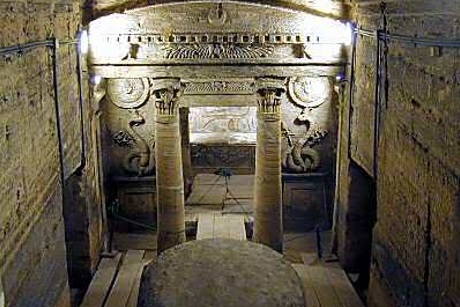
Alexandria| A team of archaeologists and historians from the Polish Center of Archaeology, that were conducting some research in the crypt of an ancient christian church, have revealed a mausoleum made of marble and gold that could well be the long lost tomb of Alexander III of Macedon,  who went down in history as Alexander the Great. 

The site is situated in an area known as Kom el-Dikka in the heart of downtown Alexandria, only 60 meters away from Mosque of Nebi Daniel, where Arabic tradition maintained the tomb was to be found and where many excavations had already been conducted

A famous site of pilgrimage in Antiquity, the tomb is notably known to have been visited by many Roman emperors, including Julius Caesar and Gaius Octavius, better known as Augustus, who is said to have placed flowers on the tomb and a golden diadem upon Alexander’s mummified head. The last recorded visit to the tomb was made by the Roman emperor Caracalla in A.D. 215, less than a century before it disappears from Roman records. 

The large monument, apparently sealed off and hidden in the 3rd or 4th century AD, possibly to protect it from the christian repression and destruction of pagan sites after the change of official religion within the Roman Empire. The entire site is a testimony to the multicultural nature of Alexander’s empire, combining artistic and architectural influences from both Greek, Egyptian, Macedonian and Persian origins. The inscriptions, mostly in greek, but including also a few egyptian hieroglyphs, mention that the Mausoleum is dedicated to the “King of Kings, and Conqueror of the World, Alexander III”.

It held a broken sarcophagus made of crystal glass, possibly damaged during the looting that took place during the political disturbances that ravaged Alexandria during the reign of Aurelian shortly after A.D. 270. It also held 37 bones, mostly broken or heavily damaged,  presumably all from the same adult male. A carbon-dating analysis is already under way to determine the age of the bones, and a battery of other tests also await to determine if the bones could be those of the Macedonian king. Other than that, the site held only a small number of artefacts, mostly broken pottery, dating mostly from the Ptolemaic and Roman eras.

The Egyptian Supreme Council for Antiquities had already officially recognized more than 140 unsuccessful searches for the site of Alexander’s third and final resting place, built by Ptolemy Philadelphus around 280 BC. Many astounding theories had been elaborated by various historians to explain the fact that the archeological excavations had come up empty-handed. Some historians had even evoked the possibility that his body could have been unintentionally stolen from Alexandria by a pair of Venetian merchants, taken to Venice, mistakenly renamed and venerated as St. Mark the Evangelist in Basilica di San Marco (Venice, Italy).

The actual facts however, seem to have been a lot closer to what had been corroborated by many authors of Antiquity and the Middle Ages, such as Plutarch,  Ibn ‘Abd al-Hakam, Al-Massoudi and Leo the African. In 321 BC, on its way back to Macedonia, the funerary cart with Alexander’s body was hijacked in Syria by one of his generals, Ptolemy I Soter.  Ptolemy then diverted the body to Egypt where it was interred in Memphis, the center of Alexander’s government in Egypt. Then, in the late 4th or early 3rd century BC, Alexander’s body was transferred from Memphis to Alexandria, where it was reburied.

By the fourth century A.D., the tomb’s location was no longer known, if one can trust the accounts of several of the early Church Fathers. However, creditable Arab commentators, including Ibn Abd al-Hakam (A.D. 871), Al-Massoudi (A.D. 944), and Leo the African (sixteenth century A.D.) all report having seen the tomb of Alexander, but none of them specified its exact location.

This new discovery by the Polish Center could certainly be one the most important ever made in the country, despite the already immense wealth of archeological treasures it has yielded. The site itself is a masterpiece of architechture and craftsmanship, and containing many possible new details about the great king. Should the bones turn out to be those of Alexander, the importance of this incredible find would certainly skyrocket, making it one of the greatest in history of archeology, if not the greatest.

- See more at:

http://worldnewsdailyreport.com/egypt-archaeologist-could-have-discovered-the-tomb-of-alexander-the-great/


Hoe vind je dit bericht?
Geschreven door peter om 00:51 Stuur door

Meer van UFO'S of UAP'S, ASTRONOMIE, RUIMTEVAART, ARCHEOLOGIE, OUDHEIDKUNDE, SF-SNUFJES EN ANDERE ESOTERISCHE WETENSCHAPPEN - DE ALLERLAATSTE NIEUWTJES

↑ Terug naar de berichten