Naar de inhoud

UFO'S of UAP'S, ASTRONOMIE, RUIMTEVAART, ARCHEOLOGIE, OUDHEIDKUNDE, SF-SNUFJES EN ANDERE ESOTERISCHE WETENSCHAPPEN - DE ALLERLAATSTE NIEUWTJES

UFO's of UAP'S in België en de rest van de wereld
akke.beakke.be
Ontdek de Fascinerende Wereld van UFO's en UAP's: Jouw Bron voor Onthullende Informatie! Ben jij ook gefascineerd door het onbekende? Wil je meer weten over UFO's en UAP's, niet alleen in België, maar over de hele wereld? Dan ben je op de juiste plek! België: Het Kloppend Hart van UFO-onderzoek In België is BUFON (Belgisch UFO-Netwerk) dé autoriteit op het gebied van UFO-onderzoek. Voor betrouwbare en objectieve informatie over deze intrigerende fenomenen, bezoek je zeker onze Facebook-pagina en deze blog. Maar dat is nog niet alles! Ontdek ook het Belgisch UFO-meldpunt en Caelestia, twee organisaties die diepgaand onderzoek verrichten, al zijn ze soms kritisch of sceptisch. Nederland: Een Schat aan Informatie Voor onze Nederlandse buren is er de schitterende website www.ufowijzer.nl, beheerd door Paul Harmans. Deze site biedt een schat aan informatie en artikelen die je niet wilt missen! Internationaal: MUFON - De Wereldwijde Autoriteit Neem ook een kijkje bij MUFON (Mutual UFO Network Inc.), een gerenommeerde Amerikaanse UFO-vereniging met afdelingen in de VS en wereldwijd. MUFON is toegewijd aan de wetenschappelijke en analytische studie van het UFO-fenomeen, en hun maandelijkse tijdschrift, The MUFON UFO-Journal, is een must-read voor elke UFO-enthousiasteling. Bezoek hun website op www.mufon.com voor meer informatie. Samenwerking en Toekomstvisie Sinds 1 februari 2020 is Pieter niet alleen ex-president van BUFON, maar ook de voormalige nationale directeur van MUFON in Vlaanderen en Nederland. Dit creëert een sterke samenwerking met de Franse MUFON Reseau MUFON/EUROP, wat ons in staat stelt om nog meer waardevolle inzichten te delen. Let op: Nepprofielen en Nieuwe Groeperingen Pas op voor een nieuwe groepering die zich ook BUFON noemt, maar geen enkele connectie heeft met onze gevestigde organisatie. Hoewel zij de naam geregistreerd hebben, kunnen ze het rijke verleden en de expertise van onze groep niet evenaren. We wensen hen veel succes, maar we blijven de autoriteit in UFO-onderzoek! Blijf Op De Hoogte! Wil jij de laatste nieuwtjes over UFO's, ruimtevaart, archeologie, en meer? Volg ons dan en duik samen met ons in de fascinerende wereld van het onbekende! Sluit je aan bij de gemeenschap van nieuwsgierige geesten die net als jij verlangen naar antwoorden en avonturen in de sterren! Heb je vragen of wil je meer weten? Aarzel dan niet om contact met ons op te nemen! Samen ontrafelen we het mysterie van de lucht en daarbuiten.

Berichten van 1 juni 2015 tot 30 juni 2015

You can believe your eyes: NASA to test flying saucer

You can believe your eyes: NASA to test flying saucer

s048618655.jpg?w=770 

Two members of the Navy's Explosive Ordinance Disposal team perch on the test vehicle used in the first flight of NASA's Low-density Supersonic Decelerator project. The test vehicle was fished out of the waters of the U.S. Navy's Pacific Missile Range within hours of splashdown. During the June 28, 2014, engineering flight, the saucer-shaped test vehicle climbed to over 180,000 feet (about 55,000 meters) in altitude and went as fast as four times the speed of sound

A saucer-shaped test vehicle holding equipment for landing large payloads on Mars is shown in the Missile Assembly Building at the US Navy's Pacific Missile Range Facility in Kaua'i, Hawaii.  The vehicle, part of the Low Density Supersonic Decelerator project, will test an inflatable decelerator and a parachute at high altitudes and speeds over the Pacific Missile Range this June.  A balloon will lift the vehicle to high altitudes, where a rocket will take it even higher to the top of the stratosphere at several times the speed of sound. This image was taken during a "hang-angle" measurement, in which engineers set the vehicle's rocket motor to the appropriate angle for the high-altitude test. The nozzle and the lower half of the Star-48 solid rocket motor are the dark objects seen in the middle of the image below the saucer.

A saucer-shaped test vehicle holding equipment for landing large payloads on Mars is shown in the Missile Assembly Building at the US Navy's Pacific Missile Range Facility in Kaua'i, Hawaii.  The vehicle, part of the Low Density Supersonic Decelerator project, will test an inflatable decelerator and a parachute at high altitudes and speeds over the Pacific Missile Range this June.  A balloon will lift the vehicle to high altitudes, where a rocket will take it even higher to the top of the stratosphere at several times the speed of sound. This image was taken during a "hang-angle" measurement, in which engineers set the vehicle's rocket motor to the appropriate angle for the high-altitude test. The nozzle and the lower half of the Star-48 solid rocket motor are the dark objects seen in the middle of the image below the saucer.

KAUA’I, Hawaii — Keep an eye on the skies over Hawaii on Wednesday. If all goes to plan, NASA will be testing out a saucer-shaped craft that could hold the key to a future human mission to Mars.

The test flight was originally scheduled for Tuesday but was postponed because of unfavorable ocean conditions. The craft will splash down in the sea, so operators need to be able to recover it safely.

If conditions are suitable Wednesday, an enormous balloon will lift the test vehicle carrying the disc-like Low-Density Supersonic Decelerator, or LDSD, to a height of 120,000 feet, or more than 20 miles (32 kilometers), above Earth.

Then, mission controllers will set the LDSD free to fire its rockets and try out the centerpiece of the test: a giant supersonic parachute, measuring 100 feet (30 meters) across.

For those on the ground, live video will be relayed from four cameras aboard the pioneering saucer-shaped craft.

“You get to see all the same video I do, at the same time I do,” Mark Adler, project manager at NASA’s Jet Propulsion Laboratory in Pasadena, California, said in an online news release.

“This year’s test is centered on how our newly designed supersonic parachute will perform. We think we have a great design ready for the challenge, but the proof is in the pudding and the pudding will be made live for everyone to see.”

Updating decades-old technology

Last year, when the LDSD was tested for the first time — also launched from the U.S. Navy’s Pacific Missile Range facility in Kauai, Hawaii — the deployment of the parachute was the only fly in the ointment, when it didn’t inflate as expected.

This time around, a new design is being tested: the Supersonic Ringsail parachute, which NASA says is the largest supersonic parachute ever tested for use on Mars.

Current technology for decelerating from high speeds during reentry into the atmosphere to the final stages of landing on Mars dates back to NASA’s Viking Program, which put two landers on the Martian surface in 1976.

The basic Viking parachute design has been used ever since. It was successfully used again in 2012 to deliver the rover Curiosity to Mars.

NASA will need new and improved landing technologies to handle the larger spaceships of tomorrow and land them on rocky surfaces, as well as at higher altitudes.

Atmospheric drag

NASA scientists hope this saucer-shaped craft could be the key.

“As NASA plans ambitious robotic science missions to Mars, laying the groundwork for even more complex human expeditions to come, the spacecraft needed to land safely on the Red Planet’s surface will become larger and heavier in order to accommodate explorers’ extended stays on the Martian surface,” the agency’s website said.

This means the supersonic parachute will have its work cut out to create sufficient atmospheric drag to slow the vehicles down so they can be landed safely. Using drag for deceleration means precious fuel can be saved for landing maneuvers.

A third test flight for the LDSD is scheduled for the summer of 2016.

{ http://myfox8.com/ }

Hoe vind je dit bericht?
Geschreven door peter om 00:31 Stuur door

Huge Underwater Pyramid Found Near Portugal

Huge Underwater Pyramid Found Near Portugal

(Before It's News)

Huge Underwater Pyramid Found Near Portugal

Further investigations are beginning to point to the possibility of an underwater volcanic hill based on more recent scans.[3] More information should come to the surface. Some believe this new explanation may be a cover up but that position is currently based on a belief only.

Portuguese news reported the discovery of a very large under water pyramid first discovered by Diocleciano Silva between the islands of São Miguel and Terceira in the Azores of Portugal. According to claims, the structure is said to be perfectly squared and oriented by the cardinal points. Current estimates obtained using GPS digital technology put the height at 60 meters with a base of 8000 square meters. The Portuguese Hydrographic Institute of the Navy currently has the job of analyzing the data to determine whether or not the structure is man-made.

seapy_360001

“The pyramid is perfectly shaped and apparently oriented by the cardinal points,” Silva told Diário Insular, the local newspaper.

The pyramid was found in an area of the mid-Atlantic that has been underwater for about 20,000 years. Considering this is around the time of the last ice age where glaciation was melting from its peak 2000 years prior, whatever civilization, human or not, that was around before the ice age, could be responsible for building the pyramid. While the Portuguese Navy still hasn’t determined the origins, many might question why this hasn’t been first reported on sooner than late 2012. Certainly the NOAA who studies volcanic activity in the area of the pyramid would have discovered the pyramid through sonar imaging and so forth since the area is heavily studied due to volcanic activity. Either the NOAA hasn’t yet come across it, they are hiding what they have found, or the pyramid doesn’t exist. The last theory does not seem to be likely given the authenticity of the find.

To further support the idea that this pyramid could have been built by different civilizations, archeologists from the Portuguese Association of Archaeological Research have recently discovered evidence on Pico island that suggests their belief that humans existed in the Azores region before the arrival of the Portuguese thousands of years ago. As of today, there is still no explanation for who created the rock art found on the islands. Was the pyramid built by whatever civilization existed prior to the Portuguese? Is it possibly not even man-made?

Here is the Portuguese news report with English subtitles for those who wish to look into the authenticity of the claims.

The Azores are an interesting region as they are a chain of nine volcanic islands in three main groups that are roughly 930 miles west of Lisbon. They are all situated around the fault lines between the North American, Eurasian and African tectonic plates. An interesting place to have a pyramid given the energetic qualities often associated with pyramids.

This video discusses some interesting bits of information that explore the authenticity of the story and the possible location visually using some maps. It is important to note that exact coordinates of the pyramid have not been released. He believes that there may be a discovery of 2 more pyramids in the area as images suggest there could be a design link to that of the pyramids built in Egypt.

Source: http://www.conspiracyclub.co/2015/05/05/underwater-pyramid-portugal/

Hoe vind je dit bericht?
Geschreven door peter om 00:00 Stuur door

What Would Aliens Want From Planet Earth Or Humans?

What Would Aliens Want From Planet Earth Or Humans?


What Would Aliens Want From Planet Earth Or Humans?

What Would Aliens Want From Planet Earth Or Humans?

And why do so many hope for “Contact” with Aliens?

I frequently hear a recurring theme among UFO and Alien believers, “The aliens will come”they say, “and help us achieve world peace”.

Isn’t this some sort of secret hope that many religions promise ?

“They created us, and will soon return to help us realize our full potential. They will lead us into a New Age of enlightenment; they will help us to evolve into a greater existence.”

Mankind is not only conscious of trees, rocks, bodies of water, and his own limbs and body, but he also must become conscious of himself as a distinct entity and role in the rest of the universe. The prime characteristic of cosmic consciousness is, as its name implies, a consciousness of the cosmos, that is, of the life and order of the universe.

Mankind is not only conscious of trees, rocks, bodies of water, and his own limbs and body, but he also must become conscious of himself as a distinct entity and role in the rest of the universe. The prime characteristic of cosmic consciousness is, as its name implies, a consciousness of the cosmos, that is, of the life and order of the universe.

How will the aliens do this?

Advocates of these “prophecies” believe the “aliens” will provide humanity with advanced technology in every scientific field of study, and a philosophy of peace and tolerance that will unite all the people of the world into one global government, economic system, and everything will be replaced with peace and harmony. Hence the term given to these believers “New Agers”. Aliens will bring us a New Galactic Consciousness and Ascension!

This sounds good. It sounds right, and it sounds familiar. Consider the fact that religions like Christianity also have this theme. When Jesus returns, He will unite all the people of the world into one global government, economic system, and religion, War will be replaced with peace and harmony. Furthermore,there is no death, sorrow, or pain. All there will be are peace, love, and joy!

We can assume that any race capable of crossing interstellar space will be able to do anything we can do or even remotely contemplate doing.  Any civilization capable of crossing interstellar space will probably be able to travel freely between planets, but it will still take a lot of energy and time. Getting to and landing on planets, and getting off again, will also be a significant effort. Terraforming planets will likewise take a lot of effort and, even more important, time.

  • So we’d have to assume that any Alien visitors coming to our solar system are coming for a specific reason, which might be to colonize, gather resources, or explore.

They certainly will have technology for observing planets around other stars, since we ourselves have begun to do it. If they have telescopes millions of kilometers apart flying in formation with their ships, they can combine the images to obtain the effective resolution of a telescope millions of kilometers in diameter.  So quite likely they would have pretty good images of all the planets in our solar system.

If they pick up our radio and television signals, they’d probably know that there is at least that level of technology in our solar system. But based on the fact our transmissions have not been around that long would they be even close enough to hear them?

Then again, in zero gravity, there would be nothing to stop them from building a radio dish kilometers across in space or on their spacecrafts. We have to assume they are at least as good at cryptography as we are, so if they could pick up the information, they would likely be able to decipher it.

See Also http://ufoandalientruthnetwork.com/making-contact-with-aliens-what-if-we-transmit-the-internet-into-space/ for more about sending the internet into space via laser beams to speed up the time frame.

The yellow dot shows the 200 light year radius of how far radio waves have reached into the Milky Way since Marconi invented the radio in 1895.  (The even tinier Planet Earth buried somewhere in its center)

The yellow dot shows the 200 light year radius of how far radio waves have reached into the Milky Way since Marconi invented the radio in 1895.
(The even tinier Planet Earth buried somewhere in its center)

Resources

In the unlikely event they simply come here blind because they just picked a G-class star at random and didn’t do any reconnaissance on the way in, it’s very likely that they wouldn’t lightly pack up and go to another star, since interstellar travel will be resource and time intensive. And, of course, if they know what’s here, then they came here for a specific reason. But if their primary goal is resources, and they can travel easily between planets, there are much better sources than the Earth.

Water: Icy moons are every bit as convenient as Earth as sources of water. Comets are probably too small and widely scattered to be of much use, although a single comet can supply many cubic kilometers of water.

Metals: Nickel-iron asteroids can supply far more metal than our iron mines, with the added advantage that the smelting is mostly already done. Rarer metals can be extracted during the refining of nickel and iron, just as we do on Earth. Asteroids and comets have the added advantage of negligible gravity. Or our gold. (Hint: Asteroids have gold.)

Oxygen: Obtain it by electrolyzing water, or as a by-product of smelting silicates.

Hydrocarbons: Assuming they use hydrocarbons for some energy needs or a base for creating other organic chemicals, why drill on Earth when there’s a whole planet of it at Jupiter, and lakes of hydrocarbons on Titan?

Energy: Pave Mercury with solar panels, or simply build vast arrays in space. Use the harvested energy to fabricate still more panels, as well as whatever else you need.

If they come to our solar system to gather extraterrestrial resources, earth might be irrelevant to them, just like us going into the woods to pick berries is irrelevant to some bird nesting in a nearby tree. We are very unlikely to be a threat, or even a nuisance. Aww, isn’t that cute? We have itty-bitty nuclear weapons. They can travel between planets and we can’t go beyond earth orbit. They could strip-mine Mars and we’d be able to do little more than watch. We might launch robotic missions to watch them, and maybe pick up some useful ideas, assuming the aliens allow them to get close.


So Who Needs Earth?

There are a few reasons why extraterrestrial visitors might come specifically to Earth apart from curiosity or exchanging greetings:

Hydrothermal Ores: The problem with using the Moon or asteroids as sources of minerals is that a lot of our ores on earth involve water in some way. Copper, zinc and lead are mostly deposited by hot solutions. Aluminum is concentrated by weathering of aluminum rich rocks in tropical environments. Those deposits might make terrestrial sources more attractive than extraterrestrial ones.
Lithophile elements: Plate tectonics and geochemical recycling have made the earth’s interior more homogeneous and has concentrated certain elements in the crust. These tend to be atoms with large ionic radii, high ionic charges, or both. Things like lithium, beryllium, boron, uranium, thorium, cesium, and rare earths might be easier to extract from Earth rocks than asteroids. We now know that planets abound, but watery earth-like planets may not be.
Organic chemicals: If you want complex organic chemicals, it might be easier to harvest them from the biosphere rather than synthesize them from scratch. Maybe we have things they didn’t know about. This is interesting, there may be manmade things to explore not known to them- like – Cocaine, Alcohol, Tobacco and others!
Convenient Working Environment: If you’re an oxygen breather with human-like environmental needs, it may be a heck of a lot easier to land on Earth and do things than terraform Venus or build gigantic domes on the Moon.
R & R: No matter how big your starship is, even if it’s got huge living spaces, it has to get boring after a while. If they can survive on Earth, they’ll very likely want to come down for some breathing room and to see new scenery.
A Place to Live: Bad news. There have to be lots of Earth-like planets without intelligent life. After all, Earth was like that for over 99.9% of its history. So why pick Earth? Assuming they didn’t come here just because they enjoy destroying other intelligent life forms, something probably went very wrong. Either we’re the nearest Earthlike planet and they need it very badly, or they didn’t know we were here, or we’re so far below their level we don’t rate as intelligent.
If their life support is failing and there are twenty billion of them, we’re toast. But if there aren’t too many, and they’re willing to work with us, we could probably find some open spaces for them while they terraform Mars or Venus.

Encounter Scenarios:

They Come and Go: They come into the solar system, harvest a few comets and metal rich asteroids, suck hydrocarbons out of the Gas Giants, unfurl giant solar arrays to replenish their energy storage, and leave without contacting us at all. If this had happened even in 1900, we probably would have not even noticed it, but today we would. We’d certainly know we weren’t alone, but on the other hand we’d be more alone than ever, since there are races that travel among the stars and don’t even consider us worth contacting.

We are Superior: Forget this. They came here. We can’t go there. They will likely be ahead of us in everything. the only exception might be a District 9 scenario, where a small alien contingent arrives, either as refugees or because they had a catastrophic failure of their ship.
We’re OK, They’re OK (Star Trek): The best of all possible universes. But we’ll still be grossly inferior to them in technology. But they’ll treat us nice, and maybe let us share their stuff. That may not be a good thing. (Remember the t.v. series V)

They’re Not OK (War of the Worlds): We’re food, raw material, or an impediment. Maybe we can make ourselves enough of a nuisance that they leave us alone if we stay out of their way. On the other hand, with our industrial base gone, we’re back to rocks and sharp sticks pretty soon, and what kind of a fight can we put up then?

Maybe even benevolent aliens won’t be such a good thing after all? Even when advanced civilizations have encountered primitive ones on earth peacefully, the results have generally been rough on the primitive civilization.

Culture Shock

Then there’s the impact on our beliefs. If they have indisputably been around for millions of years, that pretty much demolishes a recent creation, right? Or maybe not. It’s very likely we’d see the rise of powerful movements denouncing the aliens as liars or hoaxers and demanding an end to contact with them. So instead of working with them we imprison, exile and treat them as enemies.

enslaved_sectoids

Finally, some humans will certainly interact more closely with the aliens than others. If the aliens aren’t careful, they can create such an economic disparity that humanity ends up becoming a wholly owned subsidiary of Aliens, Inc.

Even on earth, anthropologists have noted there are clearly defined zones of influence around outposts of advanced civilizations. Some humans would be almost wholly assimilated. Others would find that proximity to alien knowledge gives them powerful advantages over less favored humans, either in trade or in the use of force.

skyline

That assumes that the aliens are benign or at least neutral. If they’re here to exploit us or at least get what they want without regard for us, then things will get a whole lot nastier. Because there will certainly be humans who will work for whatever rewards the aliens offer. They’ll strip-mine Chicago for the metals, in exchange for power or sex. Or they’ll act as overseers to keep the rest of us in line.

Take the Poll

Why do you Want Alien Contact?
  • They will solve all our Problems.                                       
  • To find the answers to Who we are.                                       
  • I just want mankind to realize we are not Superior.                                       
  • I want off this Planet.                                       
  • It would be Exciting and Amazing Experience.                                       
  • Hoping they give us answers to Immortality and Life.                                       
  • So they will remove Corrupt World Govts.                                       
  • They will provide Acension, Peace and Utopia.                                       
  • To learn not to make the mistakes they made becoming them from us.                                       
  • i want a lightsaber                                       
  • We will be wiped out, diseases we cannot fight.                                       
  • I've warned everyone I know to 'Brace themselves for the truth'...they will finally believe & know I was telling the truth all along!                                       
  • To finally have the certainty and assurance that we are not alone in the Universe.                                       
  • I believe there are billions of aliens lifeforms in just our galaxy not to mention other dimensions that "are" visiting our planet and each of them have would have different reasons to come to Earth. I'd hope they would be peaceful and help better human beings.                                       
  • I think at least one species of aliens are our descendants, and they conquered time travel.  They came back to watch the changes in our world unfold which led to their arrival.  (Genetic mutations caused by massive radiation from nuke plants and other pollution, along with the high methane releases).                                       
  • I don't think we can understand their intentions, we certainnly have next to nothing to offer them so unless we have either a very unique trait, culture or biodiversity to our planet there isn't much for them here.                                       
  • If you ever saw "Prometheus"...nough said...                                       
  • Other

{ http://ufoandalientruthnetwork.com/ }

Hoe vind je dit bericht?
Geschreven door peter om 23:46 Stuur door

Wat zijn die mysterieuze blauwe plekken op de rode planeet? - HLN.be

Wat zijn die mysterieuze blauwe plekken op de rode planeet? - HLN.be

 Bron: ESA 

media_xll_7760603.jpg

© ESA.

MARS 'Blue lagoons' op de rode planeet? Dat lijkt zo op deze beelden van ESA van Mars. Maar de wetenschappelijke verklaring toont iets helemaal anders aan. De blauwe vlekken zouden te maken hebben met winden tot 100 km/uur die Mars teisteren en het landschap er mee vorm geven.

Mooi blauw water? Niet volgens ESA. De wetenschap houdt het bij een optische illusie. Gigantische stofstormen - die dagen of weken kunnen duren en met winden tot 100 km/uur - droppen donkere, vulkanische, basaltrijke materie over heel de planeet. Lagen van donkerdere stof van vulkanen zetten zich vast in de kraters van Mars. Na verloop van tijd is er genoeg van dat stof verzameld om een blauwige kleur te tonen. Dat is wat we zien.

Ook op onze eigen planeet bepalen winden door de tijden heen overigens mee de vorm van het landschap, van rotsen, van duinen.

Op de foto hieronder zie je de gevolgen van een veel recentere storm, die vulkanische stof en as in een krater op Mars blaast. Je kan op dit beeld bijna de kracht van de storm voelen.

media_xll_7760707.jpg 
© ESA/DLR/FU Berlin.
Hoe vind je dit bericht?
Geschreven door peter om 23:17 Stuur door

Amerikaanse luchtmacht bouwt tuig dat in één uur van New York naar Londen vliegt - HLN.be

Amerikaanse luchtmacht bouwt tuig dat in één uur van New York naar Londen vliegt - HLN.be

Bron: The Independent 

media_xll_7764865.jpg

De X-51 WaveRider wordt uit een conventionele bommenwerper gedropt en haalt ruim vijf keer de geluidssnelheid. Impressie van het toestel. © Kos.

De Amerikaanse luchtmacht bouwt samen met Boeing een ultrasnel wapen dat vijf keer de geluidssnelheid zal halen. Daarmaa kan het vliegtuig in een uur de Atlantische Oceaan oversteken. Het toestel zal als wapen dienstdoen en werken als een raket.

"Wij zijn de Air Force. Wat we willen doen met deze technologie? Ze als wapen inzetten, natuurlijk", verklaarde Ryan Helbach van het onderzoekscentrum van de Amerikaanse luchtmacht tegenover Military.com. Het is nog onduidelijk hoe het toestel als wapen zal ingezet worden. De Amerikaanse autoriteiten verwachten dat China en andere landen aan gelijkaardige technologie werken.

De X-51, ontwikkeld door Boeing, wordt uit een traditionele bommenwerper gedropt. Er werden al succesvolle tests uitgevoerd. Het vliegtuig krijgt een kickstart van een raketbooster die het tuig naar een snelheid van Mach 4.5 stuurt, dus 4,5 maal de geluidssnelheid (die ongeveer 1.200 km/uur bedraagt; Mach 4.5 is dus 5.400 km/u). Daarna wordt de raket gedropt en gaat de X-51 op eigen kracht naar Mach 5.1.

Het toestel werd voor het eerst getest in 2013. Toen haalde het een snelheid van 6.430 km per uur op een hoogte van ruim 18 kilometer. Het viel toen zonder brandstof en stortte neer in zee.

{ http://www.hln.be/ }

Hoe vind je dit bericht?
Geschreven door peter om 23:12 Stuur door

The difference between asteroids and meteorites

The difference between asteroids and meteorites

The difference between asteroids and meteorites

Various meteorites from 2008 TC3 asteroid that landed in the Sudan in 2008. Credit: P. Jenniskens, et. al. 

Asteroids, meteors, and meteorites … It might be fair to say these rocks from space inspire both wonder and fear among us Earthlings. But knowing a bit more about each of them and how they differ may eliminate some potential misgivings. While all these rocks originate from space, they have different names depending their location—i.e. whether they are hurtling through space or hurtling through the atmosphere and impacting Earth's surface.

In simplest terms here are the definitions:

  • Asteroid: a large rocky body in space, in orbit around the Sun.
  • Meteoroid: much smaller rocks or particles in orbit around the Sun.
  • Meteor: If a meteoroid enters the Earth's atmosphere and vaporizes, it becomes a meteor, which is often called a shooting star.
  • Meteorite: If a small asteroid or large meteoroid survives its fiery passage through the Earth's atmosphere and lands on Earth's surface, it is then called a meteorite.

Another related term is bolide, which is a very bright meteor that often explodes in the atmosphere. This can also be called a fireball.

Let's look at each in more detail:

Asteroids

Asteroids are found mainly in the asteroid belt, between Mars and Jupiter. Sometimes their orbits get perturbed or altered and some asteroids end up coming closer to the Sun, and therefore closer to Earth. In addition to the asteroid belt, however, there have been recent discussions among astronomers about the potential existence of large number asteroids in the Kuiper Belt and Oort Cloud.

Asteroids are sometimes referred to as minor planets or planetoids, but in general, they are rocky bodies that do not have an atmosphere. However, a few have their own moons. Our solar system contains millions of asteroids, many of which are thought to be the shattered remnants of planetesimals – bodies within the young Sun's solar nebula that never grew large enough to become planets.

The size of what classifies as an asteroid is not extremely well defined, as an asteroid can range from a few meters wide – like a boulder—to objects that are hundreds of kilometers in diameter. The largest asteroid is asteroid Ceres at about 952 km (592 miles) in diameter, and Ceres is so large that it is also categorized as a dwarf planet.

Most asteroids are made of rock, but as we explore and learn more about them we know that some are composed of metal, mostly nickel and iron. According to NASA, a small portion of the asteroid population may be burned-out comets whose ices have evaporated away and been blown off into space. Recently, astronomers have discovered some asteroids that mimic comets in that gas and dust are emanating from them, and as we mentioned earlier, there appears to be a large number of bodies with asteroid-like compositions but comet-like orbits.

How Often Do Asteroids Hit Earth?

The difference between asteroids and meteorites
    An artists impression of an asteroid belt. Credit: NASA        

While we know that some asteroids pass very close to Earth's orbit around the Sun, we've been lucky in the history of humanity that we haven't had a large asteroid hit Earth in the past several thousand years. It wasn't until satellite imagery of Earth became widely available that scientists were able to see evidence of past asteroid impacts.

One of the more famous impact craters on Earth is Meteor Crater in Arizona in the US, which was made by an impact about 50,000 years ago. But there are about 175 known impact around the world – a few are quite large, like Vredefort Crater in South Africa which has an estimated radius of 190 kilometers (118 miles), making it the world's largest known impact structure on Earth. Another notable impact site is off the coast of the Yucatan Peninsula in Mexico, and is believed to be a record of the event that led to the extinction of the dinosaurs 65 million years ago.

These days, asteroid impacts are less of a threat. NASA estimates that about once a year an automobile-sized asteroid enters Earth's atmosphere, creates an impressive fireball and disintegrates before ever reaching the surface. Studies of Earth's history indicate that about once every 5,000 years or so on average an object the size of a football field hits Earth and causes significant damage. Once every few million years on average an object large enough to cause regional or global disaster impacts Earth.

Meteors, Meteoroids and Bolides

Space debris smaller than an asteroid are called meteoroids. A meteoroid is a piece of interplanetary matter that is smaller than an asteroid and frequently are only millimeters in size. Most meteoroids that enter the Earth's atmosphere are so small that they vaporize completely and never reach the planet's surface. When they burn up during their descent, they create a beautiful trail of light known as a meteor, sometimes called a shooting star.

Mostly these are harmless, but larger meteors that explode in the atmosphere – sometimes called bolides—can create shockwaves, which can cause problems. In February 2013 a meteor that exploded over Chelyabinsk, Russia shattered windows with its air blast. This meteoroid or bolide was estimated to be 18 meters (59 feet) in diameter. In 1908, a rocky meteoroid less than 100 meters in diameter is believed to have entered the atmosphere over the Tunguska region of Siberia in 1908 and the resulting shockwave knocked down trees for hundreds of square kilometers.

How often is Earth hit by meteroids?

Because of the Chelyabinsk meteor in 2013, astronomers have acquired more information about the frequency of larger meteors that hit Earth, and there is now a growing consensus that the Earth gets hit by bigger space rocks more often than we previously thought.

https://vimeo.com/92478179

The B612 foundation says that a Hiroshima-scale asteroid explosion happens in our atmosphere on average once a year, but many are not detected because they explode high in the atmosphere, or because most of the Earth's surface is water and even a large percentage of land is fairly uninhabited by humans.

The difference between asteroids and meteoritesEnlarge        
    The asteroid Vesta as seen by the Dawn spacecraft. Credit: NASA/JPL-Caltech/UCAL/MPS/DLR/IDA        

Estimates vary of how much cosmic dust and meteors enter Earth's atmosphere each day, but range anywhere from 5 to 300 metric tons. Satellite observations suggest that 100-300 metric tons of cosmic dust enter the atmosphere each day. This figure comes from the rate of accumulation in polar ice cores and deep-sea sediments of rare elements linked to cosmic dust, such as iridium and osmium.

But other measurements – which includes meteor radar observations, laser observations and measurements by high altitude aircraft—indicate that the input could be as low as 5 metric ton per day.

The difference between asteroids and meteoritesEnlarge        
    Meteor Crater near Winslow, Arizona. Credit: NASA        

Meteorite

If any part of a meteoroid survives the fall through the atmosphere and lands on Earth, it is called a meteorite. Although the vast majority of meteorites are very small, their size can range from about a fraction of a gram (the size of a pebble) to 100 kilograms (220 lbs) or more (the size of a huge, life-destroying boulder). Meteorites smaller than 2mm are classified as micrometeorites.

Meteorites have traditionally been divided into three broad categories, depending on their structure, chemical and isotopic composition and mineralogy. Stony meteorites are rocks, mainly composed of silicate minerals; iron meteorites that are largely composed of metallic iron-nickel; and, stony-iron meteorites that contain large amounts of both metallic and rocky material.

Meteorites have also been found on the moon and Mars and conversely, scientists have traced the origination of the meteorites found here on Earth to four other bodies: the moon, Mars, the asteroid 4 Vesta, and the comet Wild 2. Meteorites are the source of a great deal of the knowledge that we have have about the composition of other celestial bodies.

The difference between asteroids and meteoritesEnlarge        
    A bright meteor from September 21, 1994. Credit: John Chumack        

How Often Do Meteorites Hit Earth?

According to the Planetary Science Institute, it is estimated that probably 500 meteorites reach the surface of the Earth each year, but less than 10 are recovered. This is because most fall into water (oceans, seas or lakes) or land in remote areas of the Earth that are not accessible, or are just not seen to fall.

Summary

In short, the difference between asteroids and meteors all comes down to a question of location. Asteroids are always found in space. Once it enters an atmosphere, it becomes a meteor, and then a meteorite after it hits the ground. Each are made of the same basic materials – minerals and rock – and each originated in space. The main difference is where they are when they are being observed.

The difference between asteroids and meteoritesEnlarge        
    Chelyabinsk fireball recorded by a dashcam from Kamensk-Uralsky north of Chelyabinsk where it was still dawn.        

Explore further:     Two years on, source of Russian Chelyabinsk meteor remains elusive   

More information: "Eight billion asteroids in the Oort cloud." arxiv.org/abs/1410.7403 

Source: Universe Today

{ http://phys.org/ }

Hoe vind je dit bericht?
Geschreven door peter om 23:00 Stuur door

NASA Starts Testing Its New Mars Lander

NASA Starts Testing Its New Mars Lander

NASA has started testing its new Mars lander, which is scheduled to leave for the red planet in March of 2016. It’s big, about the size of a car, and a-roving it will not go. It will stay where it lands because it has a very specific purpose. In terms of what we know about Mars, we have, quite literally, just scratched the surface, leaving us guessing about some very fundamental questions about the red planet. What is Mars’ interior structure? What is the nature of the core? Does Mars have a crust with liquid magma beneath it? And even more fundamentally, how is Mars geologically like Earth and different? The new lander called InSight will drill into the martian surface in an attempt to fill in some of these crucial gaps in our knowledge.

f09619bee14e6b7327dba9edfb54692061226ef1_640x480.jpg

Image Credit: NASA/JPL


If you’ve been following stories about NASA over the past few years, you may have noticed that almost every name they give to one of their missions or vehicles stands for something, so, here it is for InSight: Interior Exploration using Seismic Investigations, Geodesy and Heat Transport. Geodesy? A bit of shoehornery there, NASA? Well, in any case, InSight will, in fact, be doing some very important science. Here’s the thing: The only planet that we’re really drilled into so far is the Earth. So when InSight begins drilling into Mars and sending back data, in addition to providing crucial information about Mars, it will also, for the first time in history, give us something to compare the Earth to.

The current round of tests will put InSight through its paces to ensure that it can withstand  the trip to Mars, the landing there, and the harsh conditions the lander will face on the martian surface, all while remaining operational. NASA engineers want to make sure that any faults with the craft are identified and fixed while it’s still here on Earth. If anything goes wrong with InSight once it’s on its way, the only possibility of a repair man coming by will be many years in the future, when the first manned missions arrive on Mars, in the the 2030’s, or if either of the two private ventures to colonize Mars about ten years earlier actually happen.


This environmental testing on InSight will take place at Lockheed Martin's Space Systems facility near Denver. There InSight will be subjected to the sorts of extreme temperatures and vacuum conditions the lander will be exposed to during its journey through  interplanetary space. Once InSight passes this set of tests, it will be subjected to several other batteries of them over the next seven months, including vibrations to simulate launch conditions, and checking for electronic interference between different parts of the spacecraft. The final set of tests will include a second thermal vacuum test to simulate the conditions the spacecraft will be exposed to on the Martian surface.

"It's great to see the spacecraft put together in its launch configuration," says Tom Hoffman, InSight Project Manager at NASA's Jet Propulsion Laboratory in Pasadena, California. "Many teams from across the globe have worked long hours to get their elements of the system delivered for these tests. There still remains much work to do before we are ready for launch, but it is fantastic to get to this critical milestone.”


(Source: phys.org)

Hoe vind je dit bericht?
Geschreven door peter om 22:34 Stuur door

Ultraviolet study reveals surprises in comet coma

Ultraviolet study reveals surprises in comet coma

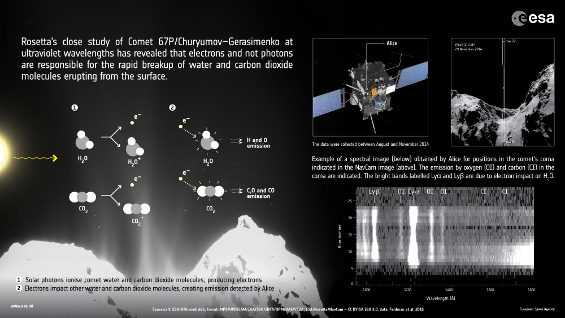
Rosetta's continued close study of Comet 67P/Churyumov–Gerasimenko has revealed an unexpected process at work, causing the rapid breakup of water and carbon dioxide molecules spewing from the comet’s surface.                                

ESA's Rosetta mission arrived at the comet in August last year. Since then, it has been orbiting or flying past the comet at distances from as far as several hundred kilometres down to as little as 8 km. While doing so, it has been collecting data on every aspect of the comet’s environment with its suite of 11 science instruments.

One instrument, the Alice spectrograph provided by NASA, has been examining the chemical composition of the comet's atmosphere, or coma, at far-ultraviolet wavelengths.

At these wavelengths, Alice allows scientists to detect some of the most abundant elements in the Universe such as hydrogen, oxygen, carbon and nitrogen. The spectrograph splits the comet's light into its various colours – its spectrum – from which scientists can identify the chemical composition of the coma gases.

In a paper accepted for publication in the journal Astronomy and Astrophysics, scientists report the detections made by Alice from Rosetta’s first four months at the comet, when the spacecraft was between 10 km and 80 km from the centre of the comet nucleus.

For this study, the team focused on the nature of 'plumes' of water and carbon dioxide gas erupting from the comet's surface, triggered by the warmth of the Sun. To do so, they looked at the emission from hydrogen and oxygen atoms resulting from broken water molecules, and similarly carbon atoms from carbon dioxide molecules, close to the comet nucleus.

Rosetta uncovers processes at work in comet’s coma. (Further information and full credits can be found here.)

They discovered that the molecules seem to be broken up in a two-step process.

First, an ultraviolet photon from the Sun hits a water molecule in the comet’s coma and ionises it, knocking out an energetic electron. This electron then hits another water molecule in the coma, breaking it apart into two hydrogen atoms and one oxygen, and energising them in the process. These atoms then emit ultraviolet light that is detected at characteristic wavelengths by Alice.

Similarly, it is the impact of an electron with a carbon dioxide molecule that results in its break-up into atoms and the observed carbon emissions.

"Analysis of the relative intensities of observed atomic emissions allows us to determine that we are directly observing the ‘parent’ molecules that are being broken up by electrons in the immediate vicinity, about 1 km, of the comet’s nucleus where they are being produced," says Paul Feldman, professor of physics and astronomy at the Johns Hopkins University in Baltimore, and lead author of the paper discussing the results.

By comparison, from Earth or from Earth-orbiting space observatories such as the Hubble Space Telescope, the atomic constituents of comets can only be seen after their parent molecules, such as water and carbon dioxide, have been broken up by sunlight, hundreds to thousands of kilometres away from the nucleus of the comet.

"The discovery we’re reporting is quite unexpected," says Alice Principal Investigator Alan Stern, an associate vice-president in the Space Science and Engineering Division of the Southwest Research Institute (SwRI).

"It shows us the value of going to comets to observe them up close, since this discovery simply could not have been made from Earth or Earth orbit with any existing or planned observatory. And, it is fundamentally transforming our knowledge of comets."

"By looking at the emission from hydrogen and oxygen atoms broken from the water molecules, we also can actually trace the location and structure of water plumes from the surface of the comet," adds co-author Joel Parker, an assistant director in SwRI’s Space Science and Engineering Division in Boulder, Colorado.

The team likens the break-up of the molecules to the process that has been proposed for the plumes on Jupiter’s icy moon Europa, except that the electrons at the comet are produced by solar photons, while the electrons at Europa come from Jupiter’s magnetosphere.

The results from Alice are supported by data obtained by other Rosetta instruments, in particular MIRO, ROSINA and VIRTIS, which are able to study the abundance of different coma constituents and their variation over time, and particle detecting instruments like RPC-IES.

"These early results from Alice demonstrate how important it is to study a comet at different wavelengths and with different techniques, in order to probe various aspects of the comet environment," says ESA’s Rosetta project scientist Matt Taylor.

"We’re actively watching how the comet evolves as it moves closer to the Sun along its orbit towards perihelion in August, seeing how the plumes become more active due to solar heating, and studying the effects of the comet’s interaction with the solar wind."

More information

"Measurements of the near-nucleus coma of Comet 67P/Churyumov-Gerasimenko with the Alice far-ultraviolet spectrograph on Rosetta," by P Feldman et al is accepted for publication in Astronomy and Astrophysics.

{ http://www.esa.int/ }

Hoe vind je dit bericht?
Geschreven door peter om 22:28 Stuur door

Hubble observes chaotic dance of Pluto's moons

Hubble observes chaotic dance of Pluto's moons

In a new study, scientists have gathered all available NASA/ESA Hubble Space Telescope data on the four outer moons of Pluto to analyse the system in more depth than ever before. The observations show that at least two of Pluto's moons are not neatly rotating on their axes but are in chaotic rotation while orbiting around Pluto and its companion Charon. The study also hints that one of the moons has a mysterious jet-black colouring. These surprising results appear in the 4 June issue of the journal Nature.                                

Almost every moon in the Solar System, including our Moon, rotates on its axis at the same speed as it orbits its parent body. It is for this reason that we always see the same side of the Moon facing us on Earth. On Pluto, however, astronomers have now discovered that there are no hidden sides to its moons.

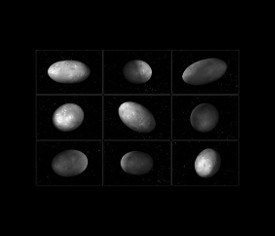
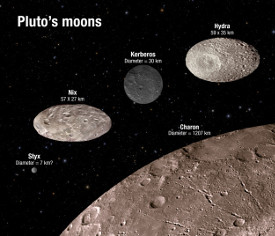
The chaotic spin of Pluto's moon Nix. Credit: NASA, ESA, M. Showalter (SETI Inst.), G. Bacon (STScI) Pluto's four small satellites in comparison to its companion, Charon. Credit: NASA, ESA, A. Field (STScI)

In a surprising new study, it has been found that two of Pluto's moons, Nix and Hydra, are in a chaotic rotation. This means that an observer on Pluto would not see the same face of the moons from one night to the next. For visitors on the moons themselves, things would get even more confusing, as every day would be a different length to the one that preceded it.

The other two moons studied, Kerberos and Styx, will likely be found to be chaotic too, pending further study.

"Prior to the Hubble observations, nobody appreciated the intricate dynamics of the Pluto system," explains Mark Showalter of the Search for Extraterrestrial Intelligence (SETI) Institute in California, USA, main author of the study.

The chaotic motion of the moons is caused by the system's two central bodies, Pluto and Charon [1].

"These two bodies whirl around each other rapidly, causing the gravitational forces that they exert on the small nearby moons to change constantly," explains Doug Hamilton, co-author of the study. "Being subject to such varying gravitational forces makes the rotation of Pluto's moons very unpredictable. The chaos in their rotation is further accentuated by the fact that these moons are not neat and round, but are actually shaped like rugby balls!"


The movement of the moons in the Pluto–Charon system offers valuable insights into how planets orbiting a double star might behave. "We are learning that chaos may be a common trait of binary systems," Hamilton continues. "It might even have consequences for life on planets orbiting binary stars."

Clues to the Pluto system chaos first came when astronomers measured variations in the light reflected off of the two small moons. Looking at images taken by Hubble between 2005 and 2012, the brightness was found to change unpredictably — instead of following a regular cycle — in a way that could only be explained by chaotic movement.

These images also showed that the moon Kerberos is charcoal-black in colour, a stark contrast to the bright white of the other moons. It was predicted that pollution from dust blasted off the satellites by meteorite impacts would coat the moons, giving their surfaces a homogenous look, but why Kerberos is black is a mystery.

The chaotic rotation of the moons was not the only surprise that arose from the study; Hubble's monitoring also revealed a connection between the orbits of the three moons Nix, Styx, and Hydra.

"Their motion is tied together in a way similar to that of three of Jupiter’s large moons," noted Doug Hamilton of the University of Maryland, co-author of the study. "If you were sitting on Nix, you would see Styx go around Pluto twice every time Hydra goes around three times."

The chaotic movements found in this fascinating system do not necessarily mean that it is on the brink of flying apart. More studies are needed to determine the long-term fate of the Pluto system.

The researchers agree that a combination of monitoring data from Hubble, a close-up look from NASA's New Horizons space probe, which flies by the system in July 2015 [2], and, eventually, observations with the NASA/ESA/CSA James Webb Space Telescope will help to settle some of the many mysteries of the Pluto–Charon system.

"Pluto will continue to surprise us when New Horizons flies past it in July," Showalter said. "Our work with Hubble just gives us a foretaste of what's in store."

Notes

[1] Due to Charon's large size, Pluto and Charon orbit about a common centre of gravity that is located in the space between the bodies. Our moon has one eightieth of Earth's mass, whereas Charon has one eighth of Pluto's mass.

[2] NASA's New Horizons space probe was launched in 2006 to study Pluto, its moons, and other Kuiper belt objects. It will fly past the Pluto-Charon system on 14 July 2015 and will produce detailed surface maps of Pluto and all of its moons.

Notes for editors

The Hubble Space Telescope is a project of international cooperation between ESA and NASA.

The team of astronomers in this study consists of Mark R. Showalter (SETI Institute, USA) and Doug Hamilton (University of Maryland, USA).

Pluto's moons are hypothesised to have formed by a collision between the dwarf planet and another similar-sized body early in the history of the Solar System. The smashup flung material that coalesced into the family of satellites observed around Pluto today. Pluto's large binary companion, Charon, was discovered in 1978. The object is almost half the size of Pluto. Hubble discovered Nix and Hydra in 2005, Kerberos in 2011, and Styx in 2012. These little moons, measuring just tens of miles across, were found as part of several Hubble searches for moons and rings to characterize the system in preparation for the New Horizons spacecraft flyby.

Contacts

Mark R. Showalter
SETI Institute California, USA
Tel: +1 650 810 0234
Email: mshowalter@seti.org

Doug Hamilton
Department of Astronomy, University of Maryland Maryland, USA
Tel: +1 301 405 1548
Email: dphamil@astro.umd.edu

Mathias Jäger
ESA/Hubble, Public Information Officer
Garching bei München, Germany
Tel: +49 176 62397500
Email: mjaeger@partner.eso.org

{ http://www.esa.int/ }

Hoe vind je dit bericht?
Geschreven door peter om 22:23 Stuur door

Daily UFO Headlines 6/3/2015

Daily UFO Headlines 6/3/2015

(Before It's News)

openminds.tv


Source: http://www.openminds.tv/daily-ufo-headlines-632015/33795

Hoe vind je dit bericht?
Geschreven door peter om 21:59 Stuur door

Mysterious Unexplained Green Jellyfish-Like Lights Visible Over Holland: What Are They?

Mysterious Unexplained Green Jellyfish-Like Lights Visible Over Holland: What Are They?

(Before It's News)

MessageToEagle.com – Mysterious green jellyfish-like lights have been spotted in the skies over Holland. Some have suggested this is a UFO floating in the night sky.

There are also those who think this could be an interdimensional portal leading to unknown invisible worlds.

The images have sparked a debate and many are trying to explain the nature of these mysterious and unexplained lights.

greenjellylights.jpg

See also:

Unexplained Terrifying “Trumpet” Sound Emanating From The Sky Heard World-Wide – What Is It?

Two Astonishing Cases Of Men Who Say They Traveled Through Time

Can Parallel Universes Explain The Déjà Vu Phenomenon?

The images were taken by nature blogger Harry Perton who at the time was taking pictures of the clouds during a storm in Groningen, Holland.

Suddenly he was left stunned when he appeared to capture the UFO on camera.

Hoe vind je dit bericht?
Geschreven door peter om 21:56 Stuur door

An Underground City Of Giants Discovered In The Grand Canyon?

An Underground City Of Giants Discovered In The Grand Canyon?

(Before It's News)

Why Did the Leshan Giant Buddha Cry 4 Times? Is It a Sign?
  Newly Found – Books By Prophets of Melchizedek Priesthood Found

Don’t Believe in Nephilim? You Will After This: Photos, Top-Secret FBI Documents and More Mind-Blowing Information…


An Underground City of Giants Discovered in the Grand Canyon? 

If only the world’s buried cities would rise up someday…but they won’t. They are almost impossible to find but stories about rediscovered cities once inhabited by a race of giants will always fascinate us.

Amazing discoveries require great efforts or an even greater amount of luck. If we’re to trust early 20th century journalism, we learn that serendipity led to the doorstep of the most famous underground city of giants.

According to an article published in The Arizona Gazette on April 5, 1909, the Grand Canyon was once home to civilization that most likely consisted of individuals of cyclopean proportions. If such a civilization ever lived, surely it would have left behind some structure as a testament of its existence. 

The article mentions the discovery of an enormous underground citadel by an explorer named G.E. Kinkaid, who stumbled upon it while rafting on the Colorado River. It is worth mentioning that Kinkaid was an established archaeologist and had financial backing from the Smithsonian Institute.

grandcanyon_entry

The entrance to the city was at the end of a  tunnel that stretched for almost a mile underground.

  • First, I would impress that the cavern is nearly inaccessible,” Kinkaid wrote. “The entrance is 1,486 feet down the sheer canyon wall. It is located on government land and no visitor will be allowed there under penalty of trespass.”
  • […]Above a shelf which hid it from view from the river, was the mouth of the cave. When I saw the chisel marks on the wall inside the entrance, I became interested, secured my gun and went in.”

The architecture suggested the builders of the underground city possessed advanced engineering skills.

tablet_a

The central hub of the subterranean city was a mammoth chamber out of which passageways radiated like spokes on a wheel. The walls of the main chamber were adorned with copper weapons and tablets covered in hieroglyphic symbols, not dissimilar to those found in Egypt. Another finding that pointed to an Egyptian link were the mummified bodies, by far the most intriguing things inside the citadel.

More stories : 

The Giants Found in Romania and the CIA Cover-Up

Terrifying Footage Found on Camera Dropped in Paris Catacombs: What Did This Man See? (Watch Here)


Archaeological evidence for giants built the pyramids in Egypt

Giant and elephant

No mummy measured less than 9 feet and all of them were wrapped in dark linen. Kinkaid wrote he had stood one of them up and photographed it by flashlight, but that photo is nowhere to be found.

Further exploration revealed something about the religion of the city’s giant inhabitants:

  • Over a hundred feet from the entrance is the cross-hall, several hundred feet long, in which are found the idol, or image, of the people’s god, sitting cross-legged, with a lotus flower or lily in each hand.
  • The cast of the face is oriental, and so is the carving of this cavern. The idol almost resembles Buddha, though the scientists are not certain as to what religious worship it represents.”
 

grandcanyonshrine%20429

The article records the discovery of pottery and instruments, all bearing the signs of having originated elsewhere in the world. Such a melange of cultures is rarely encountered in archaeological finds, making this discovery one of unprecedented importance.

The last chamber that awaited exploration was what Kinkaid and his partner, Prof. S. A. Jordan  believed to be a ceremonial crypt. It was located at the end of the large room where all the other mummies had been found.

  • There is one chamber of the passageway which is not ventilated, and when we approached it a deadly, snaky smell struck us. Our light would not penetrate the gloom, and until stronger ones are available we will not know what the chamber contains.
  • Some say snakes, but others think it may contain a deadly gas or chemicals used by the ancients.
  • The whole underground installation gives one of shaky nerves the creeps,”

Unfortunately, the article stops before giving more details about this crucial discovery. In fact, no other official mention of this underground city is ever made. Was it all a hoax or is there something more sinister responsible for the silence?

orion6_crypt2

There are some who believe the story of the subterranean city of giants is true and that a tight lid has been carefully placed on top of the affair.

Conspiracy theorist John Rhodes once said he knew the exact location of the entrance to the city but that it was guarded 24/7 by soldiers carrying M-16 rifles. Another idea floating around the internet said that the underground city now serves as a museum for the shadowy ruling class.

Last but not least and mostly because of David Icke, many have connected the “deadly, snaky smell” with the presence of reptilian humanoids.

Needless to say, the Smithsonian Institute denied knowledge of the existence of such an enigmatic subterranean city, but their disclosure fails to convince everyone. The abundance of conspiracy theories built around the idea that the Smithsonian actively hides or destroys evidence in order to maintain the standard historical viewpoint does little to help the issue.

Due to an acute absence of evidence, it seems that for the moment, the story of an underground city of giants is just that – a story.

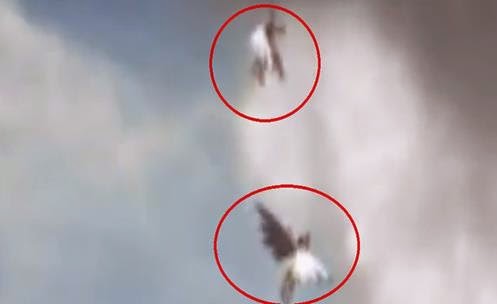
  Strange Creature or Angel Fying Caught on Camera in Brazil

Top 10 Most Famous Ghost Pictures Ever Taken


  UFO, Prophecy, Paranomal News Updates 81

Source : 
http://locklip.com/an-underground-city-of-giants-discovered-in-the-grand-canyon/

https://www.facebook.com/ufonewsupdates81

Hoe vind je dit bericht?
Geschreven door peter om 21:52 Stuur door

Australische studente laat als eerste zien dat er gigantische plasmabuizen boven de aarde zweven

Australische studente laat als eerste zien dat er gigantische plasmabuizen boven de aarde zweven

Australische studente laat als eerste zien dat er gigantische plasmabuizen boven de aarde zweven

Astronomen hebben voor het eerst bewijs gevonden voor het bestaan van buisvormige plasmastructuren in de onderste lagen van de magnetosfeer. “Wetenschappers dachten al meer dan 60 jaar dat deze structuren bestonden en wij hebben nu het eerste bewijs dat ze echt bestaan,” zei Cleo Loi van de Universiteit van Sydney.

Het onderzoek van Loi, dat onderdeel was van haar thesis, is gepubliceerd in het tijdschrift Geophysical Research Letters. “De ontdekking van de structuren is belangrijk omdat ze onze navigatiesystemen kunnen verstoren,” zei ze. “We moeten ze dus leren begrijpen.”

De plasmastructuren worden in onderstaand filmpje uitgelegd:

Het gebied rond de aarde binnen de invloedssfeer van het magnetisch veld wordt de magnetosfeer genoemd. Het magnetisch veld beschermt ons tegen de straling van de zon en tegen kosmische straling. De magnetosfeer is gevuld met plasma dat ontstaat doordat de atmosfeer wordt geïoniseerd door zonlicht.

De onderste laag van de magnetosfeer is de ionosfeer en erboven bevindt zich de plasmasfeer. Ze bevatten een aantal vreemd gevormde plasmastructuren, waaronder de plasmabuizen. “We hebben ze op 600 kilometer boven de grond waargenomen, in de bovenste laag van de ionosfeer, tot en met de plasmasfeer,” zei Loi. “Daar houdt de neutrale atmosfeer op en gaan we over naar het plasma van de ruimte.”

[Business Insider]

© Copyright (c) NineForNews.nl

Hoe vind je dit bericht?
Geschreven door peter om 21:40 Stuur door

Experiment bewijst dat realiteit niet bestaat zonder waarneming

Experiment bewijst dat realiteit niet bestaat zonder waarneming

Experiment bewijst dat realiteit niet bestaat zonder waarneming

Het universum bestaat niet als niemand het nog langer waarneemt. Dat stelt althans een populaire theorie binnen de kwantummechanica. Volgens de theorie verandert de staat van een deeltje zodra het wordt waargenomen.

Wetenschappers hebben een experiment gedaan om te bewijzen dat deze theorie klopt. Volgens de wetten van de kwantummechanica is er geen duidelijke grens tussen de buitenwereld en ons subjectieve bewustzijn.

Als natuurkundigen naar lichtdeeltjes of atomen kijken, zullen hun waarnemingen worden beïnvloed door hun experiment. Om dit te testen hebben natuurkundigen van de Australian National University onlangs het gedachte-experiment van John Wheeler gedaan.

Tijdens het experiment kreeg een bewegend object de keuze om zich als deeltje of als golf te gedragen. Op welk moment maakt het object de keuze? Je zou zeggen dat de staat van het object niet afhankelijk is van de meting die door de wetenschappers wordt gedaan.

De kwantummechanica voorspelt echter dat het gedrag van het object afhangt van de manier waarop het aan het einde van zijn reis wordt gemeten. “Alles draait om de meting,” zei professor Andrew Truscott. “Op kwantumniveau bestaat de realiteit niet als je er niet naar kijkt.”

Als je aanneemt dat een atoom een bepaald pad neemt moet je accepteren dat een toekomstige meting wordt beïnvloed door het verleden van het atoom, aldus Truscott.

“De atomen gingen niet van A naar B,” zei hij. “Pas zodra we aan het einde van de rit een meting deden gedroegen ze zich als golf of als deeltje.” Het onderzoek is verschenen in Nature Physics.

[ANU]

© Copyright (c) NineForNews.nl

Hoe vind je dit bericht?
Geschreven door peter om 21:37 Stuur door

Gray Hay Field’s Crop Circle: Aliens or Prank?

Gray Hay Field’s Crop Circle: Aliens or Prank?

crop circles

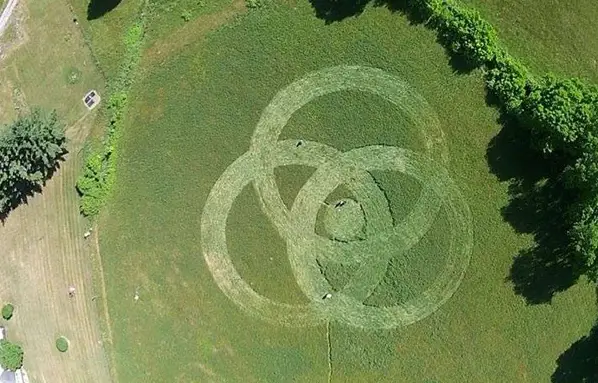
Skeptics would argue that extraterrestrials behind UFOs lie with the believers. They need to gather data and determine substantial evidence being presented. According to the BLT Research, there was a crop circle seen in a hay-field, near the town of Gray, north-eastern Tennessee nearby Virginia. The president of BLT, Nancy Talbott said that the design being reported consist of 2 ‘half-moon’ shapes that are facing in the opposite directions. There is a recent Crop circles are areas designed to grow cereal crops (barley, wheat, rye, oats, etc.). They also occur in grasses, corn, seeds, and vegetables.

In terms of the hayfield, what created its circular pattern is unknown. But a veteran crop circle researcher in Massachusetts was hoping to get the photos from the person who photographed with the hope that she might find out if the circle was created either by a man-made or energy force. The circle has been reportedly in the high grass that pushed down, and there are no vehicle tracks or footsteps leading up to the formation.

As reiterated, Talbott said that the interest was to find out the kind and type of energy that might have caused the crop circle. Their remedy is to organize the field teams around the world since these circles were already common to different countries. Regardless of what country they were in, they discovered fundamental changes that were found consistently in sample plants from inner circles compared to the control samples found outside the circle.

Whether or not the crop circle found in Gray hay field is a strange UFO activity or a prank, it is not a huge issue for Ms. Talbott. With deeper studies, they find out that such formation was due to the intense radiation. Furthermore, she believes that such activity is not a hostile act.

{ http://www.latest-ufo-sightings.net/ }

Hoe vind je dit bericht?
Geschreven door peter om 21:29 Stuur door

Unknown lights flying over Terrebonne, Canada 31-May-2015

Unknown lights flying over Terrebonne, Canada 31-May-2015

canada-ufo

New footage of a bright unidentified flying objects flying across the night sky above Terrebonne in Quebec, Canada. This happened on 31st May 2015.

Witness report: 1-Seen from my back yard
2-My wife called me after noticing weird lights thru the spa window
3-Ufo’s after I wondered if they were lanterns but wind was in opposite direction
4-To me they looked like a squadron of Ufo’s on parade
5-Amazed,goose bumps and excitement
6-they simply vanished out of sight due to tree foliage

Author (source: mufon)

{ http://www.latest-ufo-sightings.net/ }

Hoe vind je dit bericht?
Geschreven door peter om 21:24 Stuur door

UFOs Are No Longer A Theory!

UFOs Are No Longer A Theory!

leslie kean

Leslie Kean will be on to chat about her extraordinary book, “UFOs: Generals, Pilots and Government Officials Go On the Record.” Leslie spent two years interviewing military officers and government insiders with access to top secret files, about what they knew (and we didn’t) about extra terrestrial encounters.


{  http://www.latest-ufo-sightings.net/ }

Hoe vind je dit bericht?
Geschreven door peter om 21:21 Stuur door

Study Claims Earth-Like Planets to Have Similar Circular Orbits

Study Claims Earth-Like Planets to Have Similar Circular Orbits

One of the Earth’s most important characteristic which makes it suitable for life is its optimum distance from the sun. As it follows its orbit, our planet is just enough for harnessing the high amounts of energy from our sun and also far enough to keep the temperature low enough for living creatures. According to a news report from thee Massachusetts Institute Institute of Technology, a new study finds that planets which are almost the same size of Earth follow similar circular orbital paths.

image: http://americanlivewire.com/wp-content/uploads/Pluto-Charon_System-650x327.gif


These strange planets follow circular orbits, just like Earth Photo Credit: Google Images

These strange planets follow circular orbits, just like Earth
Photo Credit: Google Images

The study, published in the Astrophysical Journal, was written by researchers from MIT and Denmark’s Aarhus University. The study examined 74 exoplanets located hundreds of light-years away, and found that each orbited its solar system’s center in a circular pattern, not unlike the ones in our very own solar system.

Each of the exoplanets which were studied in the research were roughly the same size as planet Earth, unlike their larger planetary cousins which follow extremely elliptical paths which makes them too close to their host star, these smaller planets are at a more favorable distance from their sun throughout their orbits.

The variance in orbits is a current discovery. According to Vincent Van Elyen, a graduate student working with MIT’s Physics Department, the discovery for the bizarre orbits of the larger planets around their sun has led the astronomers to seriously reconsider about the possibilities that can take place in other solar systems.

The team used data from NASA’s Kepler telescope to observe distant planets and calculate their orbital velocities, so that they were able to estimate just how long it took for each planet to pass a reference point in front of a star.

The study, funded by the European Research Council, may very well narrow the search for life outside of our own solar system.

{ http://americanlivewire.com/ }

Hoe vind je dit bericht?
Geschreven door peter om 01:09 Stuur door

The Mysterious Kingdom of Shambhala

10pdo4n.jpg

Shambhala, which is a Sanskrit word meaning “place of peace” or “place of silence”, is a mythical paradise spoken of in ancient texts, including the Kalachakra Tantra and the ancient scriptures of the Zhang Zhung culture which predated Tibetan Buddhism in western Tibet. 

According to legend, it is a land where only the pure of heart can live, a place where love and wisdom reigns and where people are immune to suffering, want or old age.

Shambhala is said to be the land of a thousand names. It has been called the Forbidden Land, the Land of White Waters, Land of Radiant Spirits, Land of Living Fire, Land of the Living Gods and Land of Wonders. 

The Hindus call it Aryavartha (‘The Land of the Worthy Ones); the Chinese know it as Hsi Tien, the Western Paradise of Hsi Wang Mu; and to the Russian Old Believers, it is known as Belovoyde.

01%2Bshambhala-kingdom.jpg
But throughout Asia, it is best known by its Sanskrit name, Shambhala, Shamballa, or Shangri-la.

The legend of Shambhala is said to date back thousands of years, and reference to the mythical land can be found in various ancient texts. The Bön scriptures speak of a closely related land called Olmolungring. 

Hindu texts such as Vishnu Purana mention Shambhala as the birth place of Kalki, the final incarnation of Vishnu who will usher in a new Golden Age. The Buddhist myth of Shambhala is an adaptation of the earlier Hindu myth. However, the text in which Shambhala is first discussed extensively is the Kalachakra.

The Kalachakra refers to a complex and advanced esoteric teaching and practice in Tibetan Buddhism. Shakyamuni Buddha is said to have taught the Kalachakra on request of King Suchandra of Shambhala.

As with many concepts in the Kalachakra, the idea of Shambhala is said to have outer, inner, and alternative meanings. The outer meaning understands Shambhala to exist as a physical place, although only individuals with the appropriate karma can reach it and experience it as such.


02%2Bshambhala-paradise.jpg
Shambhala is described as a land of paradise;

The inner and alternative meanings refer to more subtle understandings of what Shambhala represents in terms of one's own body and mind (inner), and during meditative practice (alternative). These two types of symbolic explanations are generally passed on orally from teacher to student.

As the 14th Dalai Lama noted during the 1985 Kalachakra initiation in Bodhgaya, Shambhala is not an ordinary country:

  • "Although those with special affiliation may actually be able to go there through their karmic connection, nevertheless it is not a physical place that we can actually find. 

    "We can only say that it is a pure land, a pure land in the human realm. And unless one has the merit and the actual karmic association, one cannot actually arrive there."
03%2BBuddhist-depiction-of-Shambhala-from-Sera-Monastery.jpg
A Buddhist depiction of Shambhala from 
Sera Monastery (private collection). Image ref..

The Prophecy of Shambhala

The concept of Shambhala plays an important role in Tibetan religious teachings, and has particular relevance in Tibetan mythology about the future. 

The Kalachakra prophesies the gradual deterioration of mankind as the ideology of materialism spreads over the earth. 

When the “barbarians” who follow this ideology are united under an evil king and think there is nothing left to conquer, the mists will lift to reveal the snowy mountains of Shambhala. 

The barbarians will attack Shambhala with a huge army equipped with terrible weapons. Then the king of Shambhala will emerge from Shambhala with a huge army to vanquish "dark forces" and usher in a worldwide Golden Age.

Though the Kālachakra prophesies a future war, this appears in conflict with the vows of Buddhist teachings that prohibit violence. 

This has led some theologians to interpret the war symbolically – the Kālachakra is not advocating violence against people but rather refers to the inner battle of the religious practitioner against inner demonic tendencies.

Shambhala’s hidden location

Over many centuries, numerous explorers and seekers of spiritual wisdom have embarked on expeditions and quests in search of the mythical paradise of Shambhala, and while many have claimed to have been there, no one has yet provided any evidence of its existence or been able to pinpoint its physical location on a map, however most references place Shambhala in the mountainous regions of Eurasia. 

Ancient Zhang Zhung texts identify Shambhala with the Sutlej Valley in Punjab or Himachal Pradesh, India. Mongolians identify Shambhala with certain valleys of southern Siberia. In Altai folklore, Mount Belukha is believed to be the gateway to Shambhala. 

Modern Buddhist scholars seem to conclude that Shambhala is located in the higher reaches of the Himalayas in what is now called the Dhauladhar Mountains around Mcleodganj. 

Some legends say that the entrance to Shambhala is hidden inside a remote, abandoned monastery in Tibet, and guarded by beings known as the Shambhala Guardians.


04%2BHimalayan-Mountains..jpg
 According to Buddhist traditions, 
Shambhala is located in the Himalayan Mountains. 
Photo: Wikipedia.

For some, the fact that Shambhala has never been found has a very simple explanation – many believe that Shambhala lies on the very edge of physical reality, as a bridge connecting this world to one beyond it.

While many disregard Shambhala as the fanciful subject of myth and legend, for others, a belief in Shambhala stirs an inner yearning to one day find this utopian kingdom.


Sources: By April Holloway, Ancient Origins; | Mystery of Shambhala – by James Jeffrey; Shambhala – New World Encyclopaedia; Shambhala - The Magic Kingdom – International Kalachakra Movement; The Prophecies of Shambhala – Stranger Dimensions; | Cover image: Artistic depiction of Shambhala. Photo credit: Naughty Dog-Uncharted;

Hoe vind je dit bericht?
Geschreven door peter om 00:47 Stuur door

Alien Satellite Orbiting Earth: The 'Black Knight' [Complete]

Alien Satellite Orbiting Earth: The 'Black Knight' [Complete]

What is the "Black Knight" satellite? It is a mysterious satellite, of unknown origin, discovered in 1960 which shadowed Sputnik. 

It is believed to have been of extraterrestrial origin, and signaled back old radio waves from the 1920s and 1930s before it disappeared. 

In short wave patterns analyzed by astronomer Duncan Lunan, it revealed its origin as Epsilon Boötes (or the star system as it was 13,000 years ago).

ET+Satellite.jpg

In "Disneyland of the Gods", by John Keel, he reports in depth on this satellite:


"In February 1960 the US detected an unknown object in polar orbit, a feat that neither they or the USSR had been able to accomplish. As if that wasn't enough, it apparently was several sizes larger than anything either country would have been able to get off the ground.

And then, the oddness began. HAM operators began to receive strange coded messages. One person in particular said he managed to decode one of the transmissions, and it corresponded to a star chart. A star chart which would have been plotted from earth 13,000 years ago, and focused on the Epsilon Bostes star system.


On September 3, 1960, seven months after the satellite was first detected by radar, a tracking camera at Grumman Aircraft Corporation's Long Island factory took a photograph of it. People on the ground had been occasionally seeing it for about two weeks at that point. 


Viewers would make it out as a red glowing object moving in an east-to-west orbit. Most satellites of the time, according to what little material I've been able to find on the black knight satellite, moved from west-to-east. It's speed was also about three times normal. A committee was formed to examine it, but nothing more was ever made public.

Three years later, Gordon Cooper was launched into space for a 22 orbit mission. On his final orbit, he reported seeing a glowing green shape ahead of his capsule, and heading in his direction. It's said that the Muchea tracking station, in Australia, which Cooper reported this too was also able to pick it up on radar traveling in an east-to-west orbit. 


This event was reported by NBC, but reporters were forbidden to ask Cooper about the event on his landing. The official explanation is that an electrical malfunction in the capsule had caused high levels of carbon dioxide, which induced hallucinations."

Black Knight Satellite: Press Accounts
Time Magazine - Original Article
Science: Space Watch's First Catch
Monday, Mar. 07, 1960
(Manipulating the Truth!)


"Three weeks ago, headlines announced that the U.S. had detected a mysterious "dark" satellite wheeling overhead on a regular orbit. There was nervous speculation that it might be a surveillance satellite launched by the Russians, and it brought the uneasy sensation that the U.S. did not know what was going on over its own head. But last week the Department of Defense proudly announced that the satellite had been identified. 

It was a space derelict, the remains of an Air Force Discoverer satellite that had gone astray. The dark satellite was the first object to demonstrate the effectiveness of the U.S.'s new watch on space. And the three-week time lag in identification was proof that the system still lacks full coordination and that some bugs still have to be ironed out.

First Sighting. The most important component of the space watch went into operation about six months ago with the construction of "Dark Fence," a kind of radar trip wire stretching across the width of the U.S. 


Designed by the Naval Research Laboratory to keep track of satellites whose radios are silent, it is a notable improvement on other radars, which have difficulty finding a small satellite unless they know where to look. Big, 50-kw transmitters were established at Gila River, near Phoenix, Ariz, and Jordan Lake, Ala., spraying radio waves upward in the shape of open fans. 

Some 250 miles on either side, receiving stations pick up signals that bounce off any object passing through the fans. By a kind of triangulation, the operators can make rough estimates of the object's speed, distance and course.

On Jan. 31 Dark Fence detected two passes of what seemed to be an unknown space object. After detecting several passes during the following days, Captain W. E. Berg, commanding officer of Dark Fence, decided that something was circling overhead on a roughly polar orbit. 


He raced to the Pentagon and in person reported the menacing stranger to Chief of Naval Operations Arleigh Burke. Within minutes the news was communicated to President Eisenhower and marked top secret.

In the confusion, there was a delay before anyone took the step necessary to positively identify the strange satellite: informing the Air Force's newly established surveillance center in Bedford, Mass. 


It is the surveillance center's job to take all observations on satellites from all friendly observing centers, both optical and electronic, feed them into computers to produce figures that will identify each satellite, describe its orbit and predict its behavior. Says one top official, explaining the cold facts of the space age: 

"The only way of knowing that a new satellite has appeared is by keeping track of the old ones."

It took two weeks for Dark Fence's scientists to check back through their taped observations, and to discover that the mysterious satellite had first showed up on Aug. 15. 


The Air Force surveillance center also checked its records to provide a list of everything else that was circling in the sky, and its computers worked out a detailed description of the new object's behavior. The evidence from both Air Force and Navy pointed to Discoverer V, fired from Vandenberg Air Force Base, Calif, on Aug. 13."

The Black Knight Satellite 
by John Emerson


The black knight satellite. I'm not really sure what to make of this story. I've only seen the most sporadic mention of this thing on the occasional website. But man, as a long time fan of Philip K. Dick, the first time I heard about it my eyes sure went wide. Regardless of the truth of the situation, it's one hell of a tale.

The most cited report of the satellite comes from Disneyland of the Gods, by John Keel.


He reports that in February 1960 the US detected an unknown object in polar orbit, a feat that neither they or the USSR had been able to accomplish. As if that wasn't enough, it apparently was several sizes larger than anything either country would have been able to get off the ground.

And then, the oddness began. HAM operators began to receive strange coded messages. One person in particular said he managed to decode one of the transmissions, and it corresponded to a star chart. A star chart which would have been plotted from earth 13,000 years ago, and focused on the Epsilon Boötis star system.


Bootes+Stars.png
Epsilon Boötis Star System, inside Bootes Constellation - Google Sky


On September 3, 1960, seven months after the satellite was first detected by radar, a tracking camera at Grumman Aircraft Corporation's Long Island factory took a photograph of it. People on the ground had been occasionally seeing it for about two weeks at that point. 

Viewers would make it out as a red glowing object moving in an east-to-west orbit. Most satellites of the time, according to what little material I've been able to find on the black knight satellite, moved from west-to-east. It's speed was also about three times normal. A committee was formed to examine it, but nothing more was ever made public.

Three years later, Gordon Cooper was launched into space for a 22 orbit mission. On his final orbit, he reported seeing a glowing green shape ahead of his capsule, and heading in his direction. It's said that the Muchea tracking station, in Australia, which Cooper reported this too was also able to pick it up on radar traveling in an east-to-west orbit. 


This event was reported by NBC, but reporters were forbidden to ask Cooper about the event on his landing. The official explanation is that an electrical malfunction in the capsule had caused high levels of carbon dioxide, which induced hallucinations. 

Creepy, cool, story to be sure. There's two things in particular which are of particular note to Philip K. Dick. The most obvious is the idea of a satellite orbiting the earth and sending coded communications to it. 


One of the theories Dick had for his experiences was that they had been triggered, or enhanced, by an extremely ancient and alien satellite. The initial 2-3-74 experience also began with a very similar color to the first sighting of the black knight, a reddish pinkish light beamed directly at him.

Phil also mentioned in his exegesis that he considered ten of his novels to be of particular importance, with the novel valis as the cipher to unlock their meaning. These ten books, the "meta novel", are Eye in the Sky, Time Out of Joint, The Man in the High Castle, The Game Players of Titan, Martian Time Slip, The Three Stigmata of Palmer Eldritch, UBIK, A Maze of Death and of course VALIS. 


I think it's fair to include Radio Free Albemuth in there as well, which was written after his meta novel statement, and which is in many ways a retelling of VALIS. What's interesting here is that he wrote the first, Eye in the Sky, so soon before the black knight sighting. About three or four years before it was detected by radar. Well, if in fact it was ever there to be detected.

{ http://humansarefree.com/ }

Relevant quotes from VALIS:


"The satellite," Fat said. "VALIS. Vast Active Living Intel-ligence System. It fires information down to them?" 

"It does more than that," Kevin said. "Under certain circumstances it controls them. It can override them when it wants to." 

"And they're trying to shoot it down?" I said. "With that missile?"

Kevin said, "The early Christians-the real ones-can make you do anything they want you to do. And see-or not see -anything. That's what I get out of the picture." 

"But they're dead," I said. "The picture was set in the present." 

"They're dead," Kevin said, "if you believe time is real. Didn't you see the time dysfunctions?"

Relevant quotes from Radio Free Albemuth:


Since my contact came in most strangely between 3:00 and 4:00 A.M., I realized that probably a booster satellite, of alien origin, orbited Earth, a slave communications satellite that had been sent here thousands of years ago. 

'What are you doing sitting out on the patio?' Rachel asked me. 


'Listening,' I said. 

'To what?' 

To the voices of the stars,' I said, although more accurately I meant the voices from the stars. But it was as if the stars themselves spoke, as I sat there in the chilly dark, alone except for my cat, who was out there out of custom anyhow; each night Pinky sat on the railing of the patio, communing as I was but over a longer period of time, over his entire adult life. 

Seeing him now I understood that he was picking up information in the night, from the night, from the pattern of blinks that came by starlight. He was hooked up with the universe as he sat here now, like myself, gazing upward silently.

Bootes+Constellation.png
Bootes Constellation - Google Sky


The new personality in me had not awakened from a sleep of two millennia; it had, more accurately speaking, been printed out by the alien satellite, impressed on me afresh from outside. It was an addition, not a substitution in place of me but a kind of package identity based on the total knowledge of the satellite. 

It was to raise me to the highest level possible in my ability to cope. The satellite, itself linked to higher life forms, was concerned with my capacity to live; it or they, the totality of them, had seen me faltering under the oppression, and their response was reflexive. 

It amounted to a rational attempt to give aid to whoever was in touch with them, who was capable of assimilating their printout. I had been selected for that reason alone. Their concern was universal. They would have assisted anyone they could reach. 

The tragedy lay in their inability to reach the people of our planet.

One odd point that Moyashka had noted which he could not account for was the fact that the radio signals came only when the source was above Earth's dark or night side; during the day the signals ceased. Moyashka conjectured that the so-called Heaviside layer might be involved. 


The signals, although short in duration, seemed 'highly information rich' because of their sophistication and complexity. Curiously, the frequency changed periodically, a phenomenon found in transmissions seeking to avoid jamming, Moyashka stated. 


Further, his team had discovered, entirely by accident, that animals in their Pul-kovo laboratory underwent slight but regular physical changes during the time of signal transmission. Their blood volume altered and their blood pressure readings increased. Provisionally, Moyashka conjectured that radiation accompanying the radio signals might account for it.  

[Ed. Note here the, perhaps slight, similarity in the name of the fictional scientist who discovered the satellite, Moyashka, and the Australian Muchea tracking station which picked up Cooper's sighting.]


If the Russians did photograph the ETI satellite, the invader, they would find it old and pitted. I had been there thousands of years. 


The satellite had passed from our world and, with it, the healing rays, like those of an invisible sun, felt by creatures but unseen and unacknowledged. The sun with healing in its wings.


Even if the stations in this local region or sector are all overshadowed and don't light up any longer, it is a sight to remember. With this the satellite presented us with its final insight into the nature of things: synapses in a living brain. 


And the name we give to its functioning, its awareness of itself and its many parts - ' She smiled at me. 'It's why you saw the figure of Aphrodite. That's what holds all the trillions of stations into harmony.' 

'Yes,' I said, 'it was harmonized, and over such distances. There was no coercion, only agreement.' 


And the coordination of all the transmitting and receiving stations, I thought, we call Valis: Vast Active Living Intelligence System. Our friend who cannot die, who lies on this side of the grave and on the other. His love, I thought, is greater than empires. And unending.

 
Black Knight Satellite 
1927 Encounter
Space Probe from Epsilon Boötes
bootisgraph.jpg
by David Simons 1992

What if we succeeded in 2 way communication with an intelligence outside our planet, and no one noticed? What if THEY heard our call and responded but we just couldn’t grasp their language?
 
That’s exactly what happened as early as 1928 in Eindhoven Holland and again in 1929 aboard a French research vessel in the South China Sea. After transmitting over the radio waves 3 sounds in rapid succession every 30 seconds, Van der Pol in Eindhoven examined the return echoes. They were not as neatly spaced as he had sent. In fact they were highly irregular, ranging from 1 to 30 seconds in delay time.
 
At the time, the discrepancies were explained as fluxuations in the ionosphere, or magnetic disturbances. But the pitch or frequency of the sounds did not change - only the spacing of the echoes.
 
It wasn’t until the 1970’s that this mystery was carefully examined and decifered by Duncan Lunan, a scientist from Scotland. He plotted a vertical axis of the transmitted pulse sequence with a horizontal axis of echo delay time. The result ? A picture of the constellation Boötis as it would look 15,000 years ago.
 
But that’s not all. There was a message hidden in the dots on his graph. Lunan was able to translate into simple English the meaning of these echo delay discrepencies, proving perhaps that they are a purposeful manipulation directed by a highly intelligent ‘other’ .
 
The message is as follows:
START HERE. 
OUR HOME IS EPSILON BOOTIS. 
WHICH IS A DOUBLE STAR. 
WE LIVE ON THE 6th PLANET OF 7 - CHECK THAT, 6th OF 7 - 
COUNTING OUTWARDS FROM THE SUN 
WHICH IS THE LARGER OF THE TWO. 
OUR 6th PLANET HAS ONE MOON, 
OUR 4th PLANET HAS THREE, 
OUR FIRST AND THIRD PLANETS EACH HAVE ONE. 
OUR PROBE IS IN THE ORBIT OF YOUR MOON 
THIS UPDATES THE POSITION OF ARCTURUS SHOWN ON OUR MAPS.
 
The only possible conclusions we can draw from this are:
 
1) Duncan Lunan is a highly imaginative con artist;
 
2) Prof. Lunan interpreted the graph incorrectly and his extrapolations are more speculative;
 
3) An advanced civilization in the vicinity of Arcturus (Hokulea, the guiding star of Hawaiian mythology) sent an unmanned satellite probe to monitor Earth 15,000 years ago, to be activated by radio waves when Humans reached that technological point in their evolution. A dialogue could then have been established, and we might have gained much more than the misunderstood reference greeting.
 
After publication in the Journal of the British Interpanetary Society (complete with disclaimer from the editors) and a few newspaper articles in the U.S. on this ‘far out’ scientist, the matter was dropped and no further investigation was undertaken.
 
Could a musical score be made from graphs of this fascinating interstellar communique`? Is the plotting in 2 dimentions of 4 dimensional space an excellent way for different intelligent species to communicate? 

 
By David Simons, 1992; | References: Time Magazine; Living Moon;
Hoe vind je dit bericht?
Geschreven door peter om 00:19 Stuur door

Cloud Like UFO Travels In Space To Investigate Apollo 7 Module, NASA Photos

Cloud Like UFO Travels In Space To Investigate Apollo 7 Module, NASA Photos

(Before It's News)

 
B4INREMOTE-aHR0cDovLzIuYnAuYmxvZ3Nwb3QuY29tLy12RTRrOUZQdzFzVS9WVzBhcV9BRjdOSS9BQUFBQUFBQWNMOC85MUs5NDh0RllOby9zNDAwL3VuaXRlJTI1MkMlMkJVRk8lMjUyQyUyQlVGT3MlMjUyQyUyQnNpZ2h0aW5nJTI1MkMlMkJzaWdodGluZ3MlMjUyQyUyQmFsaWVuJTI1MkMlMkJhbGllbnMlMjUyQyUyQkVUJTI1MkMlMkJyYWluYm93JTI1MkMlMkJkb3VibGUlMjUyQyUyQk1heSUyNTJDJTJCMjAxNSUyNTJDJTJCbmV3cyUyNTJDJTJCc3RlYWxpbmclMjUyQyUyQmltcGVyc29uYXRvciUyNTJDJTJCd2F0ZXIlMjUyQyUyQmFwb2xsbyUyQjclMjUyQyUyQmlyJTI1MkMlMkJkdXRjaCUyNTJDJTJCdG9wJTJCc2VjcmV0JTI1MkMlMkJuYXNhJTI1MkMlMkJsaWZlJTI1MkMlMkJtYXJzMzE1LmpwZw==


B4INREMOTE-aHR0cDovLzIuYnAuYmxvZ3Nwb3QuY29tLy1qT2N1ek1BRDk4MC9WVzBhc09BbE41SS9BQUFBQUFBQWNNRS9hVGduaE9RSzJoWS9zNDAwL3VuaXRlJTI1MkMlMkJVRk8lMjUyQyUyQlVGT3MlMjUyQyUyQnNpZ2h0aW5nJTI1MkMlMkJzaWdodGluZ3MlMjUyQyUyQmFsaWVuJTI1MkMlMkJhbGllbnMlMjUyQyUyQkVUJTI1MkMlMkJyYWluYm93JTI1MkMlMkJkb3VibGUlMjUyQyUyQk1heSUyNTJDJTJCMjAxNSUyNTJDJTJCbmV3cyUyNTJDJTJCc3RlYWxpbmclMjUyQyUyQmltcGVyc29uYXRvciUyNTJDJTJCd2F0ZXIlMjUyQyUyQmFwb2xsbyUyQjclMjUyQyUyQmlyJTI1MkMlMkJkdXRjaCUyNTJDJTJCdG9wJTJCc2VjcmV0JTI1MkMlMkJuYXNhJTI1MkMlMkJsaWZlJTI1MkMlMkJtYXJzMzE0LmpwZw==

Date of discovery: June 2, 2015
Location of discovery: Earths Orbit
Photo 1: http://www.lpi.usra.edu/resources/apollo/frame/?AS07-07-1832
Photo 2: http://www.lpi.usra.edu/resources/apollo/frame/?AS07-07-1833

I was looking through the NASA Apollo Image Atlas and found this cool looking UFO in two of the photos. The one far away is one frame away from the one close up. This was during the Apollo 7 mission and was in Earths orbit. We can see the Earth in the background of both photos. I can see the shape of the object changes. Far away we see its looks like a curled snake, but close up it looks like an full circle. Also from the photo order, I see the white UFO was disguised as a cloud and decided to take a look at the Apollo 7 module, moving up to investigate. I wonder what the astronauts were thinking when they saw this. SCW

unite%252C%2BUFO%252C%2BUFOs%252C%2Bsighting%252C%2Bsightings%252C%2Balien%252C%2Baliens%252C%2BET%252C%2Brainbow%252C%2Bdouble%252C%2BMay%252C%2B2015%252C%2Bnews%252C%2Bstealing%252C%2Bimpersonator%252C%2Bwater%252C%2Bapollo%2B7%252C%2Bir%252C%2Bdutch%252C%2Btop%2Bsecret%252C%2Bnasa%252C%2Blife%252C%2Bmars311.png


B4INREMOTE-aHR0cDovLzIuYnAuYmxvZ3Nwb3QuY29tLy1MdUtwNUppazhsUS9WVzBhd3dsOVRUSS9BQUFBQUFBQWNNUS95THg4OGo0SnBOTS9zNDAwL3VuaXRlJTI1MkMlMkJVRk8lMjUyQyUyQlVGT3MlMjUyQyUyQnNpZ2h0aW5nJTI1MkMlMkJzaWdodGluZ3MlMjUyQyUyQmFsaWVuJTI1MkMlMkJhbGllbnMlMjUyQyUyQkVUJTI1MkMlMkJyYWluYm93JTI1MkMlMkJkb3VibGUlMjUyQyUyQk1heSUyNTJDJTJCMjAxNSUyNTJDJTJCbmV3cyUyNTJDJTJCc3RlYWxpbmclMjUyQyUyQmltcGVyc29uYXRvciUyNTJDJTJCd2F0ZXIlMjUyQyUyQmFwb2xsbyUyQjclMjUyQyUyQmlyJTI1MkMlMkJkdXRjaCUyNTJDJTJCdG9wJTJCc2VjcmV0JTI1MkMlMkJuYXNhJTI1MkMlMkJsaWZlJTI1MkMlMkJtYXJzMzEzLmpwZw==


B4INREMOTE-aHR0cDovLzEuYnAuYmxvZ3Nwb3QuY29tLy1OWWRBcEduZmp4Zy9WVzBheDdCd3p2SS9BQUFBQUFBQWNNYy9ac3FKWlduVWpqWS9zNDAwL3VuaXRlJTI1MkMlMkJVRk8lMjUyQyUyQlVGT3MlMjUyQyUyQnNpZ2h0aW5nJTI1MkMlMkJzaWdodGluZ3MlMjUyQyUyQmFsaWVuJTI1MkMlMkJhbGllbnMlMjUyQyUyQkVUJTI1MkMlMkJyYWluYm93JTI1MkMlMkJkb3VibGUlMjUyQyUyQk1heSUyNTJDJTJCMjAxNSUyNTJDJTJCbmV3cyUyNTJDJTJCc3RlYWxpbmclMjUyQyUyQmltcGVyc29uYXRvciUyNTJDJTJCd2F0ZXIlMjUyQyUyQmFwb2xsbyUyQjclMjUyQyUyQmlyJTI1MkMlMkJkdXRjaCUyNTJDJTJCdG9wJTJCc2VjcmV0JTI1MkMlMkJuYXNhJTI1MkMlMkJsaWZlJTI1MkMlMkJtYXJzMzEyLnBuZw==

Thanks http://www.ufosightingsdaily.com/

Check out more contributions by Jeffery Pritchett ranging from UFO to Bigfoot to Paranormal.

Hoe vind je dit bericht?
Geschreven door peter om 23:42 Stuur door

Is The Vatican Preparing Disclosure Of Extraterrestrial Life In June?

Is The Vatican Preparing Disclosure Of Extraterrestrial Life In June?

(Before It's News)

MessageToEagle.com – A strange rumor is circulating around the internet right now.

According to this new and unconfirmed information, Pope Francis is about to disclose information that the Vatican is preparing for extraterrestrial contact on the 15 June 2015.

Now, that really does sound exciting, but how true is it?

According to Daniel P. Sheehan, a Harvard College trained American Government & Foreign Policy Scholar, we are about to receive announcement about the ET presence very soon.

vaticanmeetset.jpg

The Pope declared last year tha he will baptize aliens.

Sheehan, who was one of the main speakers at this weekend Ufology conference ‘Contact In The Desert’ held last weekend at Joshua Tree, California US, has made some intriguing statements.

See also:

God’s Personal Flying Vehicle Described In The Book of Ezekiel

Flying Objects Were Present In The Ancient Skies

Codex Gigas – The Devil’s Bible – Ancient Secrets Of The World’s Largest Book

Pope Francis seems to have no problems accepting the existence of extraterrestrial life-forms.

Last year, Pope Francis announced that would be willing to baptize aliens if they came to the Vatican, asking “who are we to close doors” to anyone – even Martians.

Hoe vind je dit bericht?
Geschreven door peter om 23:36 Stuur door

Daily UFO Headlines 6/2/2015

Daily UFO Headlines 6/2/2015

(Before It's News)

openminds.tv


Source: http://www.openminds.tv/daily-ufo-headlines-622015/33793

Hoe vind je dit bericht?
Geschreven door peter om 23:30 Stuur door

Most remarkable UFO sightings in May 2015

Most remarkable UFO sightings in May 2015

UFO Sightings
Most remarkable UFO sightings in May 2015 by www.Latest-UFO-Sightings.net.

early May 2015; bright objects in the sky – Cordoba and Bahia Bianca, Argentina


9th May 2015; 2 UFOs – Melbourne, Australia


15th May 2015; orbs – Florida


22nd May 2015; triangle-shaped craft – Ituzaingó, Argentina


29th May 2015; UFO over volcano – Kuchinoerabu-jima, Japan


{

Hoe vind je dit bericht?
Geschreven door peter om 23:25 Stuur door

Giant Black Holes May Be on a Collision Course

Giant Black Holes May Be on a Collision Course

Astronomers have found what may be two supermassive black holes in a quasar due to become one in roughly 21 years

Colliding black holes simulation
  • Simulation of two black holes spiraling in toward one another. They are surrounded by a disk of infalling gas (in orange) and their magnetic field lines (while) become increasingly tangled.

Stuart Shapiro, University of Illinois at Urbana-Champaign

Most galaxies have a supermassive black hole lurking at their centers, but a galaxy 10.5 billion light-years away looks like it might have two—and the pair may be set to crash together in just 21 years. If the observations are confirmed, the duo would be the closest known set of binary black holes, and their imminent collision would offer scientists an unprecedented chance to watch extreme physics in action. [Video: When Black Holes Collide]

The potential black holes are impossible to glimpse directly. Besides being black—which is to say, invisible—they are far too distant from Earth and too close to one another to make out with telescopes. But scientists found what they think is the telltale signature of a pair of these behemoths circling together. The apparent black holes reside in what’s known as a quasar—a galaxy that is unleashing a torrent of light as mass gets gobbled by the gigantic black hole at its center. The light from most quasars flickers randomly as slightly more or less mass falls in. But if two black holes are at the core, rather than one, their orbital motions will perturb the gas around them in an orderly way, causing the light to rise and fall periodically.

Tingting Liu, a graduate student at the University of Maryland, College Park, analyzed the light pouring from 316 quasars as seen by the Pan-STARRS 1 (Panoramic Survey Telescope and Rapid Response System) Medium-Deep Survey, a scan of the sky undertaken by the Pan-STARRS1 telescope on Mount Haleakala in Hawaii. She looked for periodic patterns in the light and a quasar with the unwieldy name PSO J334.2028+01.4075 turned out to have the best evidence for a recurring signal. The black hole or holesthere have an estimated combined mass between three billion and 30 billion times the mass of the sun. “This candidate that we present is at such a compact separation that they are actually in the process of merging,” says Suvi Gezari, leader of Liu’s research group and a co-author on a paper announcing their find that has been accepted for publication in the The Astrophysical Journal Letters. In fact, the impending impact will seem to happen even sooner for the black holes themselves. In their reference frame, they are due to converge in just seven years. Because of a phenomenon called cosmological time dilation, due to the expansion of the universe, the crash will seem to take place in 21 years from our point of view on Earth. “This was a fortuitous catch,” says Stuart Shapiro, a theoretical astrophysicist at the University of Illinois at Urbana–Champaign who was not involved in the research. “We don’t know of another candidate that’s anywhere near that close [to merging].” But, he adds, “I take it with a grain of salt, and even if it doesn’t pan out there are probably many more on the horizon.”

Astronomers expect to find more binary black holes with the rise of Pan-STARRS1 and other surveys like it that can monitor such systems over time and look for periodic light variations. Shapiro uses computer simulations to predict what happens when giant black holes fuse. To be able to observe one in space would offer him and other theorists a precious reality check of their calculations. “When two black holes get sufficiently close, we think they plunge together suddenly and they merge,” Shapiro says. “That plunge and merger will give rise to a burst of gravitational waves, and that burst will then diminish for awhile as the merged remnant rings down, like a bell.” The bell-like vibrations should send out spirals of gravitational waves, which are ripples that stretch and shrink the fabric of spacetime.


Such ripples could be detectable to so-called pulsar timing arrays, which use spinning stars called pulsars as natural clocks to look for disturbances from gravitational waves. Pulsars spin very regularly and sweep jets of light out like lighthouse beams. If a gravitational wave passed through space, their light might come off schedule. By comparing the timing of many pulsars across the cosmos, astronomers could identify when and where a gravitational wave came from. “Right now we don’t actually have the sensitivity to detect this system [PSO J334.2028+01.4075] but we’re finding more and more of these through various surveys so this is potentially the tip of the iceberg,” says Xavier Siemens of the University of Wisconsin–Milwaukee, who leads the North American Nanohertz Observatory for Gravitational Waves (NANOGrav) pulsar timing array project. “This system is potentially something we could detect with next-generation radio telescopes,” he adds, “with things like the Square Kilometer Array” due to start up around 2025 in South Africa and Australia.

Whether or not PSO J334.2028+01.4075 is truly a binary black hole is still an open question. George Djorgovski, an astronomer at Caltech who recently found another candidate double–back hole quasar, is not convinced. “I am skeptical about their analysis and claims,” he says. The Pan-STARRS1 survey only observed the system in question on a handful of occasions, so the apparent variation in light could turn out to be chance, he cautions. Furthermore, the likelihood of finding such a rare event in such a relatively small initial sample size (316 quasars) is low. “The chances of catching one pair at such a close separation as they claim—that would merge within several years—is probably well less than one in a million,” he adds. “Liu et al would have to be very, very lucky.”

Astronomers should not have to wait too long to find out. Liu and her collaborators calculated that the quasar’s light fluctuates over a regular period of about 542 days, meaning that forthcoming data should soon either confirm or reject the pattern. “It’s a really easy thing to test the persistence of this periodic fluctuation in the future,” Gezari says. “And if there are two black holes that are starting to in-spiral toward one another, then their period should be getting smaller and smaller. We can actually look for that change as a function of time.” If the pattern holds up, astronomers just may get a front-row seat to one of nature’s most extreme events.

{ http://www.scientificamerican.com/}

Hoe vind je dit bericht?
Geschreven door peter om 00:22 Stuur door

Strange lights sparks UFO mystery in Shropshire

Strange lights sparks UFO mystery in Shropshire

It was a straight line of bright lights – and it has become the latest UFO mystery to strike over the skies of Shropshire.

ufo The strange lights in the sky captured by the Edwards’ CCTV

The couple, who live in Nobold, Shrewsbury, have been left puzzled after spotting this pattern of lights on footage from their CCTV over the weekend.

Mr Edwards said: “Our CCTV camera in our garden caught an image of what looks some rather strange lights in the sky.

“I used to be in the RAF and at first I thought that the lights may be from flares, but they are not – I have checked with some friends in the RAF who have confirmed that there was no military activity in Shropshire over the bank holiday weekend.

“The lights seem to be at a distance of approximately half a mile from the back of our property in Nobold and at approx 400 feet altitude, although it is difficult to tell from the image.

“I have checked various applications to see if any aircraft were present in the area at the time and none were. I have also asked West Mercia Police if their police helicopter was operating around this time and they have confirmed that it wasn’t.”

More UFO  stories:

Having exhausted all other options, the couple think this could be some kind of UFO in Shrewsbury.  “My wife Adele did hear a strange humming sound at about 11pm on Sunday over the fields at towards Hook-A-Gate and went to look outside.

“She said that the neighbour was also outside and they could both see strange flashes in the sky over the fields.

“So we are now asking is this a UFO? It certainly cannot be explained and is definitely not any natural phenomena or astronomical – meteorites do not get as low as this or look like this.”

The Edwards are now looking for help in finding out what the image could be.

Mr Edwards added: “I would like to get to the bottom of this as it is highly unusual and strange.”

{ http://www.shropshirestar.com/ }

Hoe vind je dit bericht?
Geschreven door peter om 00:16 Stuur door

NASA Confirms Blue Aurora in Mars Skies

NASA Confirms Blue Aurora in Mars Skies

Gepubliceerd op 31 mei 2015

For the first time, an international team of scientists from NASA, the Institute of Planetology and Astrophysics of Grenoble (IPAG), the European Space Agency and Aalto University in Finland, have predicted that colorful, glowing aurorae can be seen by the naked eye on a terrestrial planet other than Earth — Mars. http://proxyponder.com/2015/05/nasa-c...

Source: http://www.nasa.gov/langley/feature/b...

Find Me & Follow Me:

https://www.facebook.com/pages/Shanti...
https://twitter.com/ShantiUniverse
https://plus.google.com/u/0/b/1082738...

Check out my website for latest News: http://proxyponder.com

Download the ShantiUniverse Ap for iphone & Android: http://apps.appmakr.com/shantiunivers...

Hoe vind je dit bericht?
Geschreven door peter om 00:09 Stuur door

Monthly Statistical MUFON Report - for May 2015:

Monthly Statistical MUFON Report - for May 2015:


CMS continues to amass sighting reports from around the globe. In May 2015 there were 900 sightings reported to MUFON through CMS from the following countries;


CountryNumber of Reports
UNITED STATES 737
CANADA 47
UNITED KINGDOM 30
INDIA 12
AUSTRALIA 7
MEXICO 6
AFGHANISTAN 5
ARGENTINA 5
ITALY 4
SPAIN 3
SOUTH AFRICA 3
GERMANY 3
POLAND 2
SWEDEN 2
PHILIPPINES 2
DOMINICAN REPUBLIC 2
BELGIUM 2
COSTA RICA 2
NETHERLANDS 2
IRAQ 2
ECUADOR 1
FINLAND 1
FRANCE 1
BAHAMAS 1
PERU 1
DENMARK 1
CYPRUS 1
GREECE 1
ICELAND 1
MOLDOVA, REPUBLIC OF 1
HUNGARY 1
PAKISTAN 1
TURKEY 1
SAUDI ARABIA 1
GUATEMALA 1
SAINT LUCIA 1
CAMBODIA 1
LITHUANIA 1
URUGUAY 1
PUERTO RICO 1
INDONESIA 1
SEYCHELLES 1
   TOTAL: 900

Within the United States the distribution by State was as follows;


StateNumber of Reports
California 91
Texas 56
Florida 48
New York 38
Ohio 36
Pennsylvania 32
North Carolina 29
Arizona 29
Michigan 20
New Mexico 20
Virginia 19
Indiana 19
Washington 17
Missouri 16
Tennessee 16
New Jersey 15
Iowa 15
Alabama 14
Georgia 14
Wisconsin 14
Nevada 13
Louisiana 12
Massachusetts 11
Colorado 11
South Carolina 11
Kentucky 10
Oregon 10
Illinois 10
Connecticut 9
Minnesota 9
Oklahoma 8
Utah 7
Arkansas 7
Maryland 7
Kansas 7
Mississippi 7
Maine 6
Montana 5
Idaho 5
Delaware 5
New Hampshire 4
Nebraska 2
South Dakota 2
Alaska 1
Hawaii 1
Vermont 1
Rhode Island 1
West Virginia 1

If you are getting more sighting reports than listed here, please be sure to enter them manually into CMS. To make this happen automatically, make sure your local MUFON Website is pointing to the CMS Reporting form on www.mufon.com and direct all calls you get to the MUFON website so that witnesses can enter their own report directly into CMS.

ALL sighting reports received by CMS are already filled in by the witness, saving you and your investigators time. Each report is automatically sent to YOU, the State Director and Assistant State Director, for you to assign someone to follow-up and complete the report.

If a UFO sighting comes in over the phone, or by e-mail, and you want to enter it yourself, simply go to CMS at http://mufoncms.com (once logged in) and click on "ADD CASE" in the upper right hand corner of the screen. This gives you a blank sighting reporting form that you can fill out while the witness is on the phone. Once the report is filled out be sure to click "SAVE" and you will have easily added your NEW report to CMS.

Other interesting data points in CMS during May 2015 are the shape of the UFOs reported which were as follows;


Shape of ObjectNumber of Reports
Sphere 156
Disc 90
Triangle 84
Other 84
Circle 72
Unknown 69
Star-like 65
Oval 42
Cylinder 36
Fireball 35
Cigar 30
N/A 27
Square/Rectangular 27
Boomerang 19
Bullet/Missile 12
Diamond 11
Blimp 10
Cone 9
Egg 6
Flash 6
Chevron 4
Teardrop 4
Saturn-like 1
Cross 1

as well as the distance from the observer;


Distance from WitnessNumber of Reports
< 100 ft 181
101-500 ft 147
501 ft - 1 Mile 206
Over 1 Mile 210
Unknown 214
NO VALUE 38

Most impressively there were 33 Landings, Hovering, or Takeoffs reported and 2 Entities observed.

To review the CMS data yourself go to www.mufon.com and click on "UFO Case Files" to 1.) Easily look at the Last 20 Sightings, or 2.) Do a customized search of the CMS database by date and/or location, or 3.) Logon to CMS for even more detailed UFO sighting information about your State and the World.

I hope you are enjoying our new internet based Sighting and Reporting System.
For questions regarding its use please refer to the User Guide available on your CMS main menu screen. Please send your questions and/or suggestions to Jan Harzan at janharzan@hotmail.com.

Thank you!

Hoe vind je dit bericht?
Geschreven door peter om 23:48 Stuur door

Photographer captures strange ‘jellyfish UFO’ on stormy night

Photographer captures strange ‘jellyfish UFO’ on stormy night

Photographer captures strange ‘jellyfish UFO' on stormy night

Does it really look like a jellyfish? (Picture: Mercury Press/ Harry Perton)

A photographer has taken a photo of a ‘jellyfish UFO’.

If you hadn’t heard of that type of flying saucer before you’re not alone because we had no idea it ‘existed’ either.

But it’s apparently a thing and Harry Perton has taken a photo of the unusual object in Groningen, in the Netherlands.

MORE: Drive-through workers sacked for accepting weed as payment for food

The photographer only noticed the UFO, which is named after a jellyfish because of its appearance, when he got home after taking pictures in the storm.

‘I was taking photos and suddenly something flashed,’ he said.

‘I decided it must have been a strike of lightning – but back at home I saw something strange in one of the photos that I took – what looked like a UFO.’

The image, which shows an object floating in the night sky and emitting an eerie flash of green light, sparked a flurry of online debate about what it could be.

But the photographer, who posts images on his blog, admitted he thought it was probably something meteorological and not aliens.

{ http://metro.co.uk/ }

Hoe vind je dit bericht?
Geschreven door peter om 23:25 Stuur door

New rocket that will take Russians to the Moon to be built in Siberia

New rocket that will take Russians to the Moon to be built in Siberia

By The Siberian Times reporter

Vice Premier says 'majority' of work on the replacement to Soyuz for future of Space travel likely to be in city of Omsk.

Speaking to Rossiya-1 Channel, Mr Rogozin said the majority of the hardware for the Angara will be manufactured in Omsk. Picture: Russian Ministry of Defence

The rocket that will be at the forefront of the new Russian era of Space exploration will be manufactured, assembled and tested in Siberia.

Vice Prime Minister Dmitry Rogozin wants to begin using the new technology, the Angara-A5V, as soon as possible with Omsk earmarked as the location for much of the work. 

It has already been announced that the eagerly anticipated first manned
launch from the new multi-billion rouble Vostochny cosmodrome in 2020 will use
the rocket.

In what is being heralded as a strategic move away from the old Soyuz technology first used in the 1960s, the Angara will also take the first Russians to the Moon.

Speaking to Rossiya-1 Channel, Mr Rogozin said the majority of the hardware for the Angara will be manufactured in Omsk. However, he gave no timeline for when this would happen.

It is believed there will be an 'urgent meeting' in the city within a week with the Vice Premier and Igor Komarov, the head of Roskosmos, meeting with Polyot, the manufacturers of the rocket, to discuss the quickest way to move to the new technology.

Production Association Polyot is a Russian aerospace engineering company, based in Omsk. Picture: RusVentProm

Chief engineer Vladimir Kolobkov, the First Deputy to the General Director at Plyot, said: 'Rogozin's plans are not reflected in any documents yet, but they are very likely to be followed by decisions.

'The biggest part of the rocket manufacturing will definitely be in Omsk, and relevant industrial facilities are getting prepared for that purpose.'

About 11.5 billion roubles ($218million) has been allocated from the state budget to Siberia’s rocket manufacturers, with a further five billion roubles ($95million) ploughed into modernising facilities in Omsk.

The sprawling 551 sq km Vostochny complex, close to the Chinese border, will employ up to 25,000 people. Architects say the new community will be a 'one-of-its-kinds scientific and tourist space town with a unique design and beautiful landscape'.

There will be three launch pads - one for the Soyuz and two for Angara rockets – and the first launch, for a Soyuz-2 carrier rocket, due in December.

According to officials the Angara-A5V will be capable of launching payloads of about 77,000lbs into orbit and will easily be able to take cosmonauts to the moon, and will likely be involved in Mr Putin’s dream of building Russia’s new space station.

Earlier this year it was reported the estimated cost of creating the new rocket will be about 60 billion roubles ($1.1billion).

Hoe vind je dit bericht?
Geschreven door peter om 23:16 Stuur door

Crop Circles and Alien Contact in the Netherlands? Firsthand accounts say Yes! (Video)

Crop Circles and Alien Contact in the Netherlands? Firsthand accounts say Yes! (Video)

(Before It's News)

 
B4INREMOTE-aHR0cDovLzEuYnAuYmxvZ3Nwb3QuY29tLy1ucDhldXpydjB0cy9WV2FHbHJET2hKSS9BQUFBQUFBQU00QS9NZU9OQ3JvdzgwSS9zMjAwL2Nyb3AlMkJjaXJjbGVzJTJCYWxpZW4lMkJjb250YWN0JTJCcGFyYW5vcm1hbC5qcGc=

Dutch medium and alien contactee Robbert van den Broeke rose to fame in the Netherlands in the early 2000’s with his discovery of crop circles.

The amazing paranormal events experienced by Robert have continued now for over 25 years and over the years many people have tried to debunk his abilities, especially if we talking about the amazing images of spirits, aliens and UFOs he projects onto the camera.

Rob Nanninga, board member of the Dutch Skeptical foundation Skepsis think that there is some trickery involved. So Rob Nanninga decided to perform some tests and based on the results he gave a plausible explanation (You can read Rob Nanninga’s explanation Here) that Robbert van den Broeke’s photos are just photography tricks.

But not everybody is convinced that Robbert van den Broeke is just a hoaxer.

In the next video, Nancy Talbott, a staunch believer in Van den Broeke’s capabilities gives her testimony as well as other firsthand accounts who witnessed the paranormal events that took place while visiting Robert in at his home in Holland.

Note: After watching the video, I personally have my doubts about the photos, if they are real or just trickery. His experiences are almost similar to that from alien contactee Billy Meier, thought it has been proven that the Billy Meier photos are real, so it is quite possible that van den Broeke has the same paranormal capacities as Billy Meyer and thus it is quite possible that his photos are real, but then again…


Thanks http://ufosightingshotspot.blogspot.com/

Check out more contributions by Jeffery Pritchett ranging from UFO to Bigfoot to Paranormal.

Hoe vind je dit bericht?
Geschreven door peter om 23:03 Stuur door

Mysterious Sinkholes spreading across Russia’s Urals (Video)

Mysterious Sinkholes spreading across Russia’s Urals (Video)

(Before It's News)

 
B4INREMOTE-aHR0cDovLzQuYnAuYmxvZ3Nwb3QuY29tLy0ydFVkZEhWRTIwMC9WV2Z6VEtaTmM5SS9BQUFBQUFBQU00VS9PZkFSS3BNYkl0RS9zMjAwL3Npbmtob2xlcyUyQmVhcnRoJTJCY2hhbmdlLmpwZw==

A whole host of theories from subterranean Soviet missile stations to tunnels to the center of the earth have emerged after large mysterious sinkholes appeared near Russia’s Urals Mountains.

But at first the disturbing news which confirms the CIA has ended their information sharing with scientists on climate and earth changes.

Shutting down a program that began nearly a quarter-century ago, the Central Intelligence Agency (CIA) has decided to stop sharing classified information it collects on the ocean and atmosphere with scientists studying climate change. The CIA has ended its Measurements of Earth Data for Environmental Analysis (MEDEA) program, according to news reported by Mother Jones. Under MEDEA, about 60 civilian scientists had security clearances that allowed them to receive classified data, “such as ocean temperature and tidal readings gathered by Navy submarines and topography data collected by spy satellites,” said journalist Tim McDonnell to allgov.com.

The program provided climate experts with information about global warming and other climate-related threats that they couldn’t access from other sources. The CIA uses that data in its analyses on how weather changes will impact global conflicts.

It’s believed that the spy agency had heretofore partnered with the MEDEA scientists to perform their analyses, which then made its way into the agency’s annual Worldwide Threat Assessment report, according to McDonnell

President Obama has called climate change “an immediate risk to our national security” and urged U.S national security agencies to give the matter high priority. He also signed an executive order requiring that climate change data be developed and shared among federal agencies, and made available to the public.

The CIA didn’t state why it shuttered MEDEA, saying in a statement: “Under the Medea program to examine the implications of climate change, CIA participated in various projects. These projects have been completed and CIA will employ these research results and engage external experts as it continues to evaluate the national security implications of climate change.”

What would be the reason to end the program abruptly and stop sharing classified information with civilian scientists, just because they have completed the project or did they discover something what they want to keep hidden for the public.

It seems unlikely that only weather changes will impact global conflicts. Maybe there is a threat from outer space that will lead to an enormous impact on Earth’s climate with all its consequences for humankind, but that’s just a rough guess.

Columbia University political scientist Marc Levy, who has worked with U.S. intelligence agencies on climate change issues since the 1990s, says: “The climate problems are getting worse in a way that our data systems are not equipped to handle and closing of MEDEA is a step in the wrong direction.”

As already mentioned above, the latest strange news on weather- and climate change comes from Russia after a large mysterious sinkhole appeared near Russia’s Ural’s mountains.

An emergency situation committee has yet to say what caused it, or how they’re responding, but meanwhile mysterious sinkholes have also appeared elsewhere in the region.

It may be clear that something is going on with our planet and the CIA not wants you to know.


Thanks http://ufosightingshotspot.blogspot.com/

Check out more contributions by Jeffery Pritchett ranging from UFO to Bigfoot to Paranormal.

Hoe vind je dit bericht?
Geschreven door peter om 22:58 Stuur door

Elongated Object flies into UFO-Shaped Cloud over Texas (Video)

Elongated Object flies into UFO-Shaped Cloud over Texas (Video)

(Before It's News)

 
B4INREMOTE-aHR0cDovLzIuYnAuYmxvZ3Nwb3QuY29tLy1WZkxHYngtNUx2OC9WV2tlNmkzcHFnSS9BQUFBQUFBQU01SS9Oc01KODZ6eF9wTS9zMjAwL3VmbyUyQnJvZCUyQnNreWZpc2glMkJsZW50aWN1bGFyJTJCdWZvJTJCY2xvdWQuanBn

An amazing lenticular cloud appeared over Texas on May 26, 2015. Because of their unusual shape, they have been offered as an explanation for some unidentified flying objects.

While most ordinary lenticular clouds are just clouds, there are recordings which show UFOs hidden ‘cloaked’ in clouds as well as recordings of unidentified objects flying in and out of these specific clouds.

In case of the cloud over Texas, we see an unidentified elongated object, similar to a so-called Rod, apparently flying into the lenticular cloud. (0.47 mark video).

It is believed that these Rods (also called ‘Skyfish’) are organic life forms, mostly cylinder-shaped and often related to the UFO phenomenon. Skeptics say that Rods are nothing more than optical illusions, insects or birds.


Thanks http://ufosightingshotspot.blogspot.com/

Check out more contributions by Jeffery Pritchett ranging from UFO to Bigfoot to Paranormal.

Hoe vind je dit bericht?
Geschreven door peter om 22:49 Stuur door

Strange Unknown Square Object Shoots Out Of A Cloud Over Missouri (Photographs)

Strange Unknown Square Object Shoots Out Of A Cloud Over Missouri (Photographs)

(Before It's News)

On May 26, 2015 a strange event happened in the sky over Missouri.

While driving on the interstate highway I-72 the witness noticed some strange clouds and decided to stop and to take some pictures of the unusual clouds.

Afterwards he noticed a square object ejecting out of the clouds and what he refers to as a giant transparent eyeball, in the shape of a doughnut, behind the object and clouds.

Below the original image and the image colored in blue in order to show more details on both objects.

Maybe the ‘eyeball’ is just lens flare, but what do you think the square object could be? Mufon case 65968. 
 

B4INREMOTE-aHR0cDovLzMuYnAuYmxvZ3Nwb3QuY29tLy1yVVdkQW5KRUExMC9WV3EyNnZHcUVDSS9BQUFBQUFBQU02QS8tTFctSG9RUFJaZy9zNjQwL3NreSUyQnBoZW5vbWVub24lMjUyQyUyQnVmbyUyQmNsb3VkcyUyQnN0cmFuZ2UuanBn
 
B4INREMOTE-aHR0cDovLzIuYnAuYmxvZ3Nwb3QuY29tLy1fcEZIWlNQTzF0MC9WV3EzQWJILU10SS9BQUFBQUFBQU02SS84RUZFVXFabTFhcy9zNjQwL3NreSUyQnBoZW5vbWVub24lMjUyQyUyQnVmbyUyQmNsb3VkcyUyQnN0cmFuZ2UlMkIlMjUyODElMjUyOS5qcGc=

Thanks http://ufosightingshotspot.blogspot.com/

Check out more contributions by Jeffery Pritchett ranging from UFO to Bigfoot to Paranormal.

Hoe vind je dit bericht?
Geschreven door peter om 22:42 Stuur door

Wordt India de nieuwe zuidpool na na passage NIBURI?

Wordt India de nieuwe zuidpool na na passage NIBURI?

eqp5.jpg

Zaterdag werd de wereld weer opgeschrikt door een zware aardbeving voor de kust van Japan.

De vele (zware) aardbevingen en ontelbare vulkaanuitbarstingen zijn voor veel mensen tekenen van de nadering van de planeet Nibiru ook wel Planet X genoemd.


Ook in Japan werd in eerste instantie overal melding gemaakt van een 8.5 aardbeving die al weldra, zoals te doen gebruikelijk, naar beneden toe werd bijgesteld tot een met een kracht van 7.8 op de schaal van Richter.

Nog steeds fors en de reden dat er zich geen verdere schade en/of een tsunami heeft voorgedaan is omdat de beving op zeer grote diepte plaatsvond.

eqp 1

Zoals we schreven in een eerdere artikelen zijn volgens Nancy Lieder en de Zeta’s de aardbevingen in Nepal en ook Engeland niet normaal en hebben die alles te maken met de verschuivende en brekende tektonische platen.

Het zal allemaal nog veel heftiger worden wanneer de planeet ons daadwerkelijk gaat passeren en de Zeta’s zijn ervan overtuigd dat er dan een zogenaamde pole shift zal volgen. Een verschuiving van de aardkorst waardoor, als het ware, kenmerken zoals die van de evenaar en de polen op hele andere plekken terecht zullen komen.

Zo hebben we dan na de pole shift een andere geografische indeling van de aarde, waarbij sommige landen volkomen onder water verdwenen zullen zijn zoals bijvoorbeeld India. Dat niet alleen, maar ook de nieuwe zuidpool zal zich dan bevinden op de plek wat nu India is.

In haar laatste nieuwsbrief zegt Nancy Lieder het volgende over India en de omringende landen:

“India en de hun omringende landen zal het niet zo goed vergaan. Van de totale wereldbevolking woont 17,5 procent oftewel 1,3 miljard mensen in India en dit land zal onder de golven worden gedreven en wordt de nieuwe Zuidpool. De omringende landen zoals Bangladesh, Vietnam, Thailand, Birma, Nepal, Sri Lanka, Cambodja, Pakistan en Afghanistan zullen eindigen met temperaturen zoals wij die nu op de polen tegenkomen of eveneens onder water verdwijnen en de verwachting is dan ook dat de bevolking in die landen dat niet zal overleven.

Dus, India en omringende landen, met in totaal ongeveer 26,5 procent van de wereldbevolking, zullen bezwijken en daarmee ook de bevolking, behalve wanneer deze net voor of net na de pole shift zullen verhuizen”.

Daar is voor dat deel van de bevolking weinig kans op, behalve de superrijken die ongetwijfeld hun ontsnappingsplannen gemaakt zullen hebben.

Een land wat wat dat betreft hun zaakjes wel heel goed op orde heeft, is China. 

Al jarenlang vraagt men zich waarom China in 's hemelsnaam die gigantisch grote spooksteden heeft gebouwd. De reden is volgens Nancy eenvoudig, omdat ook tijdens en na de pole shift de plekken waar die spooksteden zijn gebouwd veilig zullen zijn.

eqp 2

De spooksteden zijn ver genoeg landinwaarts en naar het noorden gebouwd. De zuidelijke provincies in China zullen na de poleshift een behoorlijk koud klimaat hebben, maar de meer noordelijk gelegen gebieden, waar de spooksteden zich bevinden, zullen een heel aangenaam klimaat kennen.

We komen nu langzamerhand in een situatie waarbij zelfs de meest onwetende mensen argwaan beginnen te krijgen over de steeds slechter wordende klimaattoestanden op aarde. 

De vraag is dan ook hoelang overheden er nog in zullen slagen om de nadering van Nibiru verborgen te houden.

Bron:

Zetatalk Newsletter

{ www.NIBURU?nl }

Hoe vind je dit bericht?
Geschreven door peter om 22:37 Stuur door

Exclusief: Nieuwe ondergrondse tunnels ontdekt bij Bosnische piramides

Exclusief: Nieuwe ondergrondse tunnels ontdekt bij Bosnische piramides

Exclusief: Nieuwe ondergrondse tunnels ontdekt bij Bosnische piramides

Archeologen voeren al 10 jaar opgravingen uit rond de Bosnische piramides. Onder de piramides hebben ze nu nieuwe ondergrondse tunnels aangetroffen. In eerder ontdekte tunnels stuitten ze op een bepaald moment op een groot rotsblok. Ze besloten een tunnel om de rots heen te graven.

De nieuwe tunnel werd verkend door een team bestaande uit zes mensen. Onderzoeksleider dr. Sam Osmanagich merkt op dat ondergrondse tunnels in Egypte, Mexico, China of Peru vaak trekpleisters worden en overal in het nieuws verschijnen. Hij zegt inmiddels 1550 meter tunnel te hebben blootgelegd. Het gaat volgens hem om tunnels die in een ver verleden door mensen zijn gemaakt.

Het eerste deel van de tunnels is ongeveer 1,20 meter hoog en op sommige plaatsen bereikt het water een hoogte van 30 centimeter. Er waren geen vertakkingen te vinden. Op de grond werden geen gereedschappen of artefacten gevonden. Er werden ook geen brandplekken gevonden. Wel werden er langwerpige stukken steen aangetroffen die door een archeoloog worden onderzocht. De tunnel eindigde na 41 meter in een waterpoel.

Labyrint

Eenmaal teruggekomen bij de ingang besloot het team ook de tegenovergestelde richting te verkennen. In dit deel van de tunnels stond het water een stuk hoger, tot ongeveer een meter. Na 17 meter kwam het team uit bij een splitsing. Het ene gedeelte werd geblokkeerd door een muur van gesteente, het andere leidde richting het oosten. Het water was ijskoud.

Osmanagich werd er eerder van beschuldigd dat hij de tunnels zelf zou hebben gegraven. In de video zegt hij dat het prehistorische tunnels zijn. Aan het einde van de tunnels werd een stuk hout gevonden. Een archeoloog nam enkele monsters voor analyse. Het stuk tunnel dat richting het oosten liep was in totaal 60 meter lang.

Het team wil nu de tunnel die richting het zuiden loopt, in de richting van de Zonnepiramide, beter begaanbaar maken. De onderzoekers vermoeden dat de tunnel deel uitmaakt van een labyrint, bestaande uit talloze tunnels.

[Ancient Origins]

© Copyright (c) NineForNews.nl

Hoe vind je dit bericht?
Geschreven door peter om 22:27 Stuur door

VIDEO: Eerste graancirkel van het jaar in Dorset

VIDEO: Eerste graancirkel van het jaar in Dorset

VIDEO: Eerste graancirkel van het jaar in Dorset

In Dorset in het zuidwesten van Engeland is de eerste graancirkel van het jaar verschenen. De formatie, die een Keltisch ontwerp heeft, is ontdekt in een weiland in de buurt van Blandford.

Graancirkels zijn geometrische vormen in platgelegd graan of andere gewassen. Experts zijn van mening dat ze door mensen worden gemaakt, hoewel velen claimen dat er mysterieuze krachten achter de patronen schuilen.

Het aantal graancirkels in Groot-Brittannië is de laatste jaren afgenomen. Vorig jaar verscheen er een indrukwekkende graancirkel in een weiland in Dorset die het landelijke nieuws haalde.

De beelden zijn gemaakt door het team van MrGyro.co.uk. Het team gebruikt een quadcopter om luchtfoto’s te maken. Een woordvoerder van MrGyro zei dat veel formaties die ze fotograferen in Wiltshire verschijnen, maar dat graancirkels steeds vaker in Dorset ontstaan.

“Mensen zijn erg geïnteresseerd in graancirkels, daarom proberen we ze zo snel mogelijk te fotograferen,” aldus de zegsman. “Het is prachtig om al die verschillende ontwerpen te zien. Er verschijnen tussen de 50 en 60 graancirkels per jaar in Groot-Brittannië. Sommige zijn klein en eenvoudig, maar andere zijn enorm en hebben een zeer ingewikkeld ontwerp. Afgelopen jaar waren er twee of drie in Dorset en die hadden een buitengewoon interessant ontwerp.”

[Bournemouth Daily Echo]

© Copyright (c) NineForNews.nl

Hoe vind je dit bericht?
Geschreven door peter om 22:23 Stuur door

Boorkop aangetroffen in miljoenen jaren oude laag steenkool

Boorkop aangetroffen in miljoenen jaren oude laag steenkool

Boorkop aangetroffen in miljoenen jaren oude laag steenkool

Algemeen wordt aangenomen dat de moderne mens ongeveer 200.000 jaar geleden is ontstaan. Onze voorouders begonnen zo’n zes miljoen jaar geleden over de aarde te zwerven. De steenkoollagen vormden zich naar verluidt vele honderden miljoenen jaren geleden. Vandaar dat een door mensen gemaakt voorwerp in de vorm van een boorkop in een laag steenkool de historici die het in de 19e eeuw hebben gevonden, voor een raadsel stelde.

Het leek erop dat een stuk gereedschap, dat veel gelijkenissen vertoonde met de gereedschappen die in de 19e eeuw werden gebruikt, in de buurt van organisch materiaal was achtergelaten dat later een steenkoollaag vormde. Was er honderden miljoenen jaren geleden al een beschaving op aarde die beschikte over boorkoppen?

John Buchanan presenteerde het mysterieuze object op 13 december 1852 tijdens een bijeenkomst van de Society of Antiquaries of Scotland. Buchanan zei dat de laag steenkool waarin het ijzeren instrument was aangetroffen, onder een metersdikke laag klei met stenen lag.

“Ik ben het eens met de algemeen geaccepteerde opvatting dat steenkool zich lang voor het verschijnen van de mensheid heeft gevormd, maar het is een raadsel hoe dit voorwerp in de laag steenkool en zware stenen is beland,” zei hij.

De Society of Antiquaries of Scotland oordeelde dat het ijzeren voorwerp mogelijk onderdeel was geweest van een modern stuk gereedschap dat werd gebruikt om naar steenkool te zoeken. In het gedetailleerde rapport van Buchanan zijn echter geen aanwijzingen te vinden dat de steenkool rond het instrument was aangetast door een boor. Hij schreef dat een ijzeren instrument geheel was ingekapseld door steenkool.

[Epoch Times]

© Copyright (c) NineForNews.nl

Hoe vind je dit bericht?
Geschreven door peter om 22:20 Stuur door

Duizenden toehoorders bij conferentie over Anunnaki, graancirkels en NASA-geheimen

Duizenden toehoorders bij conferentie over Anunnaki, graancirkels en NASA-geheimen

Duizenden toehoorders bij conferentie over Anunnaki, graancirkels en NASA-geheimen

Duizenden mensen zijn dit weekend neergestreken in het zuiden van Californië voor Contact in the Desert, een jaarlijkse UFO-conferentie. Het gaat om één van de grootste samenkomsten in de Verenigde Staten. Tijdens de vierdaagse conventie zullen bijna 50 sprekers hun verhaal doen.

“Dit is het Woodstock van UFO’s,” zei Marshall Klarfeld, een onderzoeker uit Californië die voor het derde jaar op rij een lezing geeft. “Mensen komen hier omdat ze met vragen zitten. Wie zijn we? En waar komen we vandaan?”

Klarfeld is gespecialiseerd in de Anunnaki, bijna drie meter lange aliens die de primitieve mens zouden hebben geholpen een beschaving op te zetten. De conferentie wordt gedomineerd door lezingen over de geheime geschiedenis van buitenaardse inmenging op aarde.

Paul Andrews, mede-oprichter van de conferentie, zei dat hij een ‘veilige omgeving’ wil creëren waarin onderzoekers elkaar niet onderbreken en complottheoretici naar elkaar kunnen luisteren. Hij heeft het Joshua Tree Retreat Center uitgekozen als locatie omdat daar al veel UFO’s zijn gesignaleerd.

UFO-experts spraken over het bewijs voor buitenaards bezoek in de geschiedenis van de aarde, graancirkels, enorme geheime piramides en een cover-up op staatsniveau. “Ze houden dit voor je verborgen,” zei auteur Jim Marrs.

Aan het woord kwamen onder meer Giorgio Tsoukalos, bekend van het programma Ancient Aliens; Laura Eisenhower, de achterkleindochter van president Dwight Eisenhower; en Story Musgrave, een NASA-astronaut.

[USA Today]

© Copyright (c) NineForNews.nl

Hoe vind je dit bericht?
Geschreven door peter om 22:16 Stuur door

UFO recorded over volcano eruption In Japan

UFO recorded over volcano eruption In Japan

Volcano Japan UFO

Here’s one interesting video of an unidentified flying object flying through the volcano eruption on Kuchinoerabu-jima island in Japan. On 29th May, 2015 an eruption sent an ash cloud to an estimated 30,000 feet (9,100 meters) into the sky.

What do you think about this footage? Note that there are many UFO sightings around volcanoes.

{ http://www.latest-ufo-sightings.net/ }

Hoe vind je dit bericht?
Geschreven door peter om 22:13 Stuur door

Dead Alien Found by Former UN Worker

Dead Alien Found by Former UN Worker

rushmore-aliens

Do UFOs or aliens actually exist? No one knows because these aliens are from the outer space, and humans cannot go further in their exploration of the outer space. Although, some countries like the United States have already experienced success in some of their outer space explorations, they cannot manage to go further in other planets. While there are hundreds of non-believers, there are also thousands of UFO enthusiasts who believe in their existence.

In a statement released by Andre Gignac, a 58-year-old Canadian, who claimed to have found such extra-terrestrial civilisation evidence through NASA. He claimed to have identified a bare-breasted female alien, with a corpse, a four-legged robot and Mount Rushmore-style carvings of chronological Martian leaders. Since leaving in the UN, Mr Gignac has become an established alien researcher. He also claimed to have found 4 ‘sightings’ of alien civilization in Aeolis Mons, who is a central peak in the Gale Crater on Mars, unofficially identified as Mount Sharp. A month ago, based on the photographs produced, he claimed to have found a “bunker,” which is a hole suggesting Martian population was existing under the surface of the planet.

Despite his credible statements, scientists were keen to believe that such discoveries are attributed to pareidolia. Pareidolia is a psychological phenomenon where the brain is more likely to interpret the pattern as a commonly-known object. The face is the first thing that the mind will recognise in a shape or pattern. Despite NASA’s Curiosity, Mr Gignac is convinced that what he saw was real.

The persuasive arguments about UFOs and aliens still continue until substantial evidence is presented to such claims. Since humans make crafts discover and explore the galaxy and beyond, there may be another part of the universe which is trying to contact us. Until then we just have to wait for the answer to the unanswered question, aliens – do they really exist?

{ http://www.latest-ufo-sightings.net/ }

Hoe vind je dit bericht?
Geschreven door peter om 22:10 Stuur door

Fisherman Witnesses Triangle Over Erie Pennsylvania

Fisherman Witnesses Triangle Over Erie Pennsylvania

(Before It's News)

ARTICLE BRIDGE ERIE  EDIT 5-31-15
FISHERMAN WITNESSES TRIANGLE OVER ERIE PENNSYLVANIA
MAY 8, 2015 ………..  ERIE PENNSYLVANIA
 

I had just concluded an evening of fishing on Misery Bay at Presque Isle State Park. As I got into my truck to leave I looked at my watch; it was 8:25 pm.  I proceeded to pull out onto the road driving west toward Perry’s Monument bridge, from where I parked to the bridge was only a few hundred feet.  As I approached the bridge I looked to my left (south) toward Perry’s monument and noticed a bright light near the monument up in the air. The light was coming closer, the intensity of the brightness emanating from it increasing as it neared. 

There were other people present around the monument area and parking lot, but they seemed oblivious to the entire event. I crossed the bridge and was having a difficult time both driving my vehicle and trying to watch this thing.  I was fixated on it, driving half in one lane, half in the other. As the thing got directly over me it slowed down and changed direction almost as if it noticed that I noticed it.  I pulled my truck into the parking area near Perry’s Monument and stopped. Putting it in park, I could focus all my attention on the craft which was directly over the road I just pulled off of.  The craft was triangular in shape; not congruent, it was solid, but I could not distinguish fine detail because the entire surface area was bright glowing orange.  It was almost like steel heated in a blast furnace. The craft hovered at its original altitude over the road, I could not take my eyes off of it. 

In that brief moment I actually felt uncertainty and fear as I did not know what would happen next. The craft then began to move at first north and then west. It looked like it was moving down the northern shore of the peninsula.  I attempted to follow it in my vehicle but I ran out of road and was unable to keep up with it. The whole event lasted only 3 to 4 minutes. 

NOTE: The above image is a rendering.


KEN PFEIFER WORLD UFO PHOTOS AND NEWS
WWW.WORLDUFOPHOTOSANDNEWS.ORG
WWW.WORLDUFOPHOTOS.ORG
THANKS TO WWW.MUFON.COM CASE FILES AND
WWW.UFOCASEBOOK.COM FOR PUBLICATION


Source: http://worldufophotosandnews.org/?p=10326

Hoe vind je dit bericht?
Geschreven door peter om 01:12 Stuur door

Astronomy: Venus, Jupiter dance to summer solstice

Astronomy: Venus, Jupiter dance to summer solstice

The Beehive Cluster, or Praesepe, is home to hot, Jupiter-like planets called Pr0201b and Pr0211b. Their locations are indicated by the red arrows.
The Beehive Cluster, or Praesepe, is home to hot, Jupiter-like planets called Pr0201b and Pr0211b. Their locations are indicated by the red arrows. (NASA / Courtesy image)

Standing on the doorstep of summer's skywatching season, observers have great opportunities to revel in the celestial firmament of June's night skies.

The most obvious highlight has to be Jupiter's approach to Venus, culminating in an astounding conjunction June 30. The month starts with the first and second brightest planets about 20 degrees apart, but the distances tighten by the end the month to find Jupiter right on top of Venus.

This is the second of a series of three similar conjunctions that many scholars propose may have given rise to the 2 BC concept of the Star of Bethlehem in Christian pious fiction.

Daniel Zantzinger / Skywatcher&#8217;s Guide

Daniel Zantzinger / Skywatcher's Guide

Venus, high and bright in the west even before dusk, shines at magnitude minus-4.6, just shy of its July maximum brilliance. The Evening Star reaches greatest eastern elongation from the sun June 6, blazing away at 26 degrees above the horizon and 45 degrees east of the sun. Use a telescope to see Venus half-lit in the days leading up to that event.

The goddess of love has a busy schedule before conjoining with Ius Pater in an eight day dance beginning June 27.

In the evening of June 1, she forms an equidistant straight line with the head stars of the asterism Gemini, "the Dioskouri," twin brothers Castor (on the right) and Pollux.

On June 13 and 14, use big binoculars or a rich field telescope to view Venus a mere one degree from the center of M44, the Beehive Cluster. This open cluster, bespeckled by yellowish red giants, is dominated by more than one thousand, 600 million-year-old blue giants. Also on the 13th, the cloud-swaddled rock planet forms an equally spaced diagonal line with Jupiter and Regulus, the bright alpha star in Constellation Leo.

Finally, one hour after sunset June 30, Jupiter, shining at magnitude minus-1.8, will be within one third of one degree of Venus in an impressive conjunction. Venus is 7.5 times closer to the sun than Jupiter, and shines 55 times more brightly.

Saturn ranks a close second to the displays of Venus and Jupiter because, having come off its May 22 opposition, is at its closest, biggest, brightest, highest and thus best apparition for the year. Chronos will rise just after sunset and sets in the morning twilight. For finest viewing, look due south around 11 p.m. just above the head of Scorpius to find the gas giant shining at magnitude 0.0.

The ring system has been tipping ever more open relative to our plane of view to 24 degrees, three degrees shy of its 2017 maximum. This makes Saturn appear brighter to the naked eye observer, but to see the rings, you'll need optical aid. Take this opportunity to examine the globe's banding including the bright Equatorial Zone, the darker North Equatorial Belt and the gloomy North Polar Region.

The sun reaches its farthest position north in the celestial sphere at 10:38 p.m. June 21, the moment of the summer solstice. This is the longest day of the year.

Though the days are technically getting shorter after the solstice, the sun actually sets later until the end of the month. There's no need to fret.

Initially, all the loss in total day length is on the morning side when dawn breaks a minute or so later every couple of days. The sun still sets after 8 p.m. even after July, so the dread of the inexorable riptide into punishing winters and back-to-school horrors that the solstice brings is completely unfounded. There's plenty of time to lose oneself in the warm evenings immersed in the deep pool of summer skywatching.

The moon is full at 10:19 p.m. June 2, and is called the Full Strawberry Moon by every Algonquin (Omàmiwinini); the Europeans call it the Full Rose Moon.

{ www.timescall.com }

Hoe vind je dit bericht?
Geschreven door peter om 01:01 Stuur door

Stanford and UC Berkeley partner on NASA's new effort to detect life on other planets

Stanford and UC Berkeley partner on NASA's new effort to detect life on other planets

A new interdisciplinary research program from NASA brings together a team of scientists, including Stanford's Bruce Macintosh, to devise new technologies and techniques for detecting life on exoplanets.

NASA illustrationplanetary collage

A new program in the search for life beyond our solar system will involve Stanford, UC Berkeley and NASA and will call on the skills of scientists researching life on Earth, other planets in our solar system, and worlds that orbit other stars.

The study of exoplanets – planets around other stars – is a relatively new field, but planet-hunting efforts have been prolific. The discovery of the first exoplanet around a star like our sun was made in 1995, and NASA's Kepler space telescope has detected more than 1,000 exoplanets in the past six years.

Now a new NASA initiative aims to answer the big question: Is there life on these alien worlds? The NExSS (Nexus for Exoplanet System Science) initiative will bring together the "best and brightest," according to a NASA press release. NExSS will marshal the expertise of 10 universities, three NASA centers and two research institutes.

The program aims to better understand the various components of an exoplanet, as well as how the parent stars and neighboring planets might interact to support life. The program brings together planetary scientists, Earth scientists, heliophysicists and astronomers to identify and search for biosignatures, or signs of life.

"This interdisciplinary endeavor connects top research teams and provides a synthesized approach in the search for planets with the greatest potential for signs of life," said Jim Green, NASA’s director of planetary science. "The hunt for exoplanets is not only a priority for astronomers, it’s of keen interest to planetary and climate scientists as well."

One NExSS project, called "Exoplanets Unveiled," will specifically address this question: What are the properties of exoplanetary systems, particularly as they relate to their formation, evolution and potential to harbor life? The project is led by James Graham, a professor of astronomy at the University of California, Berkeley, and will draw upon the expertise of Bruce Macintosh, a professor of physics at Stanford and the principal investigator for the Gemini Planet Imager (GPI).

GPI, a new instrument for the Gemini Observatory, began its exoplanet survey at the Gemini South Telescope in November 2014. Most exoplanets are detected through the Doppler technique – measuring the "wobble" of the parent star as an unseen planet’s gravity tugs on it – or though detection of a transit, as the planet’s orbit brings it between the star and Earth.

As the newest generation of instruments for imaging exoplanets, GPI blocks out the bright star to directly see the faint planet next door. GPI has already imaged two previously known exoplanets and disks of planetary debris orbiting young stars where planets recently formed.

"Getting a complete picture of all the incredibly strange planetary systems out there will require every different technique," Macintosh said. "With this new collaboration, we will combine the strengths of imaging, Doppler and transits to characterize planets and their orbits."

The first image of an Earth-size exoplanet is still likely years away. GPI is currently only sensitive enough to detect infrared emission from hot, bright planets the size of Jupiter. Detecting the faint, reflected light of cooler, smaller planets will require next-generation technologies and techniques, which MacIntosh said will be developed via instruments like GPI for eventual use on future planet-finding missions such as NASA's Wide-Field Infrared Survey Telescope (WFIRST).

"If you could see reflected light, you might be able to see the signature of life," said Paul Kalas, an adjunct professor of astronomy at UC Berkeley and co-primary investigator for the project. "We are just now sowing the seeds to get to that point."

{ http://www.stanford.edu/ }

Hoe vind je dit bericht?
Geschreven door peter om 00:56 Stuur door

Study: ET not home … Where are the aliens?

Study: ET not home … Where are the aliens?

Despite the relatively new frenzy to find extraterrestrial life in the universe after astronomers discovered water to exist on a number of celestial bodies over the years, research shows that the only place aliens can be “found” are on bone-chilling late-night documentaries of UFO sightings.      

According to exhaustive analysis performed by a team of scientists at Penn State University (PSU), absolutely no sign of highly advanced extraterrestrial lifeforms exist in the known universe — at least 100,000 galaxies of it, that is.

A lonely frontier

In their latest virtual expedition through space, scientists have used all of their high-tech gadgetry to come up empty-handed — to the dismay of many who claim that human intelligence has spawned from alien lifeforms.

“The researchers used observations from NASA’s Wide-field Infrared Survey Explorer (WISE), an unmanned satellite carrying an infrared-sensitive telescope that is exploring the entire universe by collecting infrared light that comes to Earth,” WorldMag.com reports. “The scientists believe a galaxy with intelligent life would have technologies that would produce detectable infrared wavelengths, but 100 million data entries showed nothing.”

Scientists ascribing to the problematic  old-Earth Darwinian evolutionary theory — which postulates that the universe was formed by “The Big Bang” 13.7 billion years ago — are in a quandary over Penn State’s discovery, believing that billions of years is more than enough time for aliens to spontaneously populate the universe. But “they” can’t be found.

“[It’s] interesting because these galaxies are billions of years old, which should have been plenty of time for them to have been filled with alien civilizations — if they exist,” expressed PSU Assistant Professor of Astronomy and Astrophysics Dr. Jason T. Wright, who initiated the research project at the university’s Center for Exoplanets and Habitable Worlds.

Grounding the astronomical high

The zealousness of atheists to find life in space is said to be motivated by their desire to disprove the Christian worldview that God created the Earth unique in the universe.

“It provides motivation for some people to search for life on other planets,” Discovery Institute Senior Fellow Jay Richards said, according to WorldMag.com.

Above and beyond the biblical account of creation, Christian scholars and leaders argue that Earth’s existence as the sole planet in the universe that sustains life is perfectly aligned with science, which requires a Creator as an intelligent designer. Otherwise, life could not exist — even after giving billions of years to make it happen by chance.

“Doesn’t assuming that an intelligence created these perfect conditions require far less faith than believing that a life-sustaining Earth just happened to beat the inconceivable odds to come into being?” Christian author and speaker Eric Metaxas posed in The Wall Street Journal, after pointing out that 200 distinct known parameters must be perfectly met to make life possible — a condition that is only found on Earth.

One of the arguments for extraterrestrial life is the existence of water discovered in the known universe, such as comets, water-eroded canals on Mars and frozen water found in craters on the dark sides of the moon and Mercury. Such discoveries, however, are contended to support the Genesis 7 Flood account of the “fountains of the great deep” bursting forth and ejecting water into and out of the Earth’s atmosphere, as the extraterrestrial water found in the Milky Way galaxy is reported to contain the same “heavy” hydrogen exclusively found in the Earth’s oceans and nowhere else in the known universe (see OneNewsNow article Does this Flood theory blow Bill Nye’s attack on creation out of the water?).

Regardless of billions of dollars spent around the globe pointing massive radar dishes towards the heavens and space probes exploring the outer boundaries of the known universe with only negative results, more taxpayer money continues to be spent in hopes of keeping the dream of the exinewsstence of extraterrestrials alive.

It was recently announced that the National Aeronautics and Space Administration (NASA) will soon be launching a new program designed to create innovative techniques and technologies devised to detect life on exoplanets in the outer stretches of the universe.

{ www.onenewsnow.com }

Hoe vind je dit bericht?
Geschreven door peter om 00:52 Stuur door

Meer van UFO'S of UAP'S, ASTRONOMIE, RUIMTEVAART, ARCHEOLOGIE, OUDHEIDKUNDE, SF-SNUFJES EN ANDERE ESOTERISCHE WETENSCHAPPEN - DE ALLERLAATSTE NIEUWTJES

↑ Terug naar de berichten