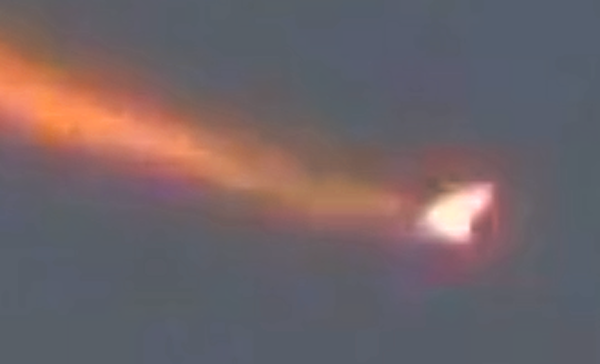
UFO Becomes Visible During Sunset Over Madison, Wisconsin On Nov 1, 2016, UFO Sighting News.

UFO Becomes Visible During Sunset Over Madison, Wisconsin On Nov 1, 2016, UFO Sighting News.
'SOMETHING BIG COMING': Claim after NASA 'shut down ISS cameras when UFO appeared'
Alien 'doorway' discovered on Mercury's surface by conspiracy theorists - but where does it lead to?
BY KARA O'NEILL
Giant glowing orb UFO stuns thousands in Japan leaving experts baffled
A glowing green ball of light appeared in the sky in Japan this week, baffling expertsas to what it actually is.
The orb was captured hovering over Niigata, northern Japan, in the early hours of Monday morning.
This footage shows the green light shooting diagonally across the sky as sparks fly from the tail of it.
The incident has caught the attention of scientists, who have yet to determine what the UFO is.

One astronomer told NBC News that it was probably a bright meteor, known as a fireball.
But they did mention that it could be a piece of space debris that burnt up as it entered the atmosphere, such as a satellite.
It has divided opinion, as one UFO investigator claims it was actually aliens entering Earth's space.
Scott C Waring of UFO Sightings Daily claims the object is an alien space craft trying to disguise itself as a meteor.

He said that the glowing light was an alien, claiming that meteors don't glow green and that the curve of its flight was too straight to be a fireball.
The actual origins of the green ball of light haven't yet been identified.
Mystery 'fireball' drops from the sky over Siberia in bizarre footage - thought to be a falling meteorite
BY KARA O'NEILL
The bizarre footage was captured on a dashcam in the region of Buryatia in Southern Siberia on October 25, 2016.
It shows the dazzling object shooting across the sky before disappearing behind some trees.
During the fall, the strange 'shooting star' appeared to be rapidly losing height.
The 'fireball' is reported to be a falling meteorite , with eyewitnesses reporting numerous sightings at around 7.30pm.
One person who saw the fireball said: “There was a sudden strange flash in the sky.


“Something had flown by as if it was a comet with a great tail.
“Luckily, no glass had shattered due to the fireball though, which is very good.”
Last week conspiracy theorists filmed two UFOs crossing the moon , thought to be getting ready to launch a military assault.


According to an expert in the field, the two dark-coloured ships are shown in stark contrast against a bright white moon, seemingly flying side by side.
He wrote on his UFO Sightings Daily blog : “His editing software allows us to see its actual shape…a perfect saucer…two of them.
“There is no way these disks are satellites,” he adds, claiming that such manmade technology would not fly so close.
He added: “These are actual UFOs, flying in military style, because they are flying with a wingman to keep each other out of possible trouble."
Mysterious noises that have haunted people in the Arctic recently may have a very simple explanation
The theories range from UFOs operating under the ice to the release of methane gas to Russian or U.S. submarines lurking in Canadian waters.
But one possible explanation for the mysterious sounds seemingly coming from the ocean floor in Canada’s Arctic may be rather straightforward, suggests a U.S. scientist working on a project that generates low-frequency sound in the far North. It could be ice rubbing together.
Last week, acting on a request from the government of Nunavut, the Canadian military sent a CP-140 Aurora aircraft to conduct surveillance of Fury and Hecla Strait, northwest of the hamlet of Igloolik. Hunters in the area have reported hearing noises ranging from hums to pings to beeps. They say the noises are driving animals away.
“The sound that has been heard in the area seems to be emitted from the seabed and underwater,” Paul Quassa, a member of Nunavut’s legislative assembly, told lawmakers on Oct. 25.
According to Department of National Defence spokesman Dan Le Bouthillier, the Aurora’s crew conducted “various multi-sensor searches in the area, including an acoustic search for 1.5 hours, without detecting any acoustic anomalies. The crew did not detect any surface or subsurface contacts.”
The Aurora crew did observe two pods of whales and six walruses in the area of interest, Le Bouthillier added.
Residents have speculated about various theories for the sounds, including that a mining company may be conducting sonar surveys or that environmentalists may be using some kind of device to scare away animals so they can’t be hunted. Others have suggested the release of methane gases from the ocean floor or clandestine visits by Russian or U.S. submarines.
One of the more prominent theories focused on the claim the sounds were being emitted by a science project in the Arctic funded by the Office of Naval Research in the U.S.
That project, called the Canada Basin Acoustic Propagation Experiment, or CANAPE, uses low-frequency sound to determine how the ongoing changes in sea ice affect acoustics. The project could produce data for use in tracking submarines in the far North.
But Peter Worcester of the Scripps Institution of Oceanography at the University of California said the sounds being generated by CANAPE are very low and too far away to be heard in the Fury and Hecla Strait.
“The signals transmitted for CANAPE are only expected to be above the background ocean noise level out to a range of at most a few hundred kilometres, which is much less than the distance to Fury and Hecla Strait,” said Worcester, who heads the project.
“Even if the signals were louder, any underwater sound generated north of Alaska would be blocked from reaching Fury and Hecla Strait by the many islands in the Canadian Archipelago.”
Worcester said he didn’t know what would cause the mystery sounds and is loath to speculate since he hasn’t heard them himself. But he noted much of the acoustic noise in the Arctic is caused by ice rubbing together, cracking, and moving. Early Arctic explorers called the noises the “Devil’s Symphony” with descriptions ranging from buzzing to wheezing and loud bangs.
“You can even get things where the ice hums, where you get sounds that resonate almost like an organ pipe,” Worcester explained. “There was a paper written about the notion there are various melodies associated with the sounds generated by sea ice.”
A spokesman with the DND said the department considers the issue of the mystery noises closed and there are no plans to send more aircraft to investigate.
dpugliese@postmedia.com
Twitter.com/davidpugliese
De supermaan komt eraan: bewonder hem komende maandag
Caroline Kraaijvanger

Scientists Disproving Alien Megastructure Hypothesis Made a Discovery
Ajoint investigation between scientists from the Center for SETI Research at the SETI Institute and METI International resulted in the discovery of exactly zero radio transmissions emanating from KIC 8462852, aka Tabby’s Star, aka that “alien megastructures” star everyone freaked out about late last year. According to new findings published in The Astrophysical Journal Letters, we still haven’t found signs of extraterrestrial intelligence. Our cold streak continues.
In case you don’t remember, there was a big hooplah last fall when Jason Wright, an astronomer at Penn State University, dropped a small suggestion that strange stellar light patterns glowing from Tabby’s Star, nearly 1,500 light-years away from Earth, were caused by “alien megastructures,” a catchall phrase for materials artificially placed in orbit. Since then, study after study has basically put that hypothesis to rest, with more reasonable ideas like a family of weird cometsgarnering more and more support based on new data.
But science is about making confirmations, so the dutiful scientists at the SETI Institute and METI international came together and used the Boquete Optical SETI Observatory in Panama to determine whether or not the strange dimming patterns were caused by intelligent extraterrestrials, as well as use the Allen Telescope Array in California to measure whether the star system was spewing out any radio signals indicative of advanced technology.
“We were looking to see if there are intentional laser signals being beamed at us,” says METI International research and study coauthor Douglas Vakoch. He tells Inverse he and his colleagues were looking for the kinds of signs of technology that us humans on Earth might be capable of building and using to broadcast our presence to the rest of the universe.
Unfortunately, they did not find any radio signals, and the optical signals found were less than encouraging. No optical signal of a particular period pattern was measured, and the power of the light pulsing from Tabby’s Star didn’t seem characteristic of a laser signal. “If there is a large laser facility kicking out signals of 5 mega-joules or stronger, we would have been able to detect those,” says Vakoch. “We didn’t.”
Vakoch emphasizes that the results don’t totally discount alien life living in the star system. He and his team were using Boquete during Panama’s rainy season — “the worst possible time,” he says. He acknowledges that the results “don’t say for sure there aren’t extraterrestrials out there.” It’s always possible E.T. is sending weaker signals out or exhibiting patterns stretching across a larger timeframe.
“But we can say that within the scenario where we could have possibly gotten a signal, we didn’t get one,” says Vakoch.
Disheartening, sure, but there’s a strong silver lining to the new findings. While SETI research around the world centers in large part around the measure of radio signals, the new investigation allowed the scientists to flex their optics muscles and get practice at looking for signs of E.T. across other frequencies as well. “If we get a signal, there may be different sources of information at different frequencies, so we need to be ready to jump on that,” said Vakoch.
Moreover, the study demonstrated the feasibility of using even a modest-sized optical telescope to conduct SETI observations. This runs counter to the whole “bigger is better” mentality that permeates space science, and Vakoch thinks the new methodological approaches he and his colleagues outline in their paper illustrate a new model for doing SETI research that is more efficient and sustainable. He says a major goal of METI International, after all, is to answer “how do we sustain the search going forward” as funding for these types of projects drop or become thinned out over more and more initiatives.
“We still don’t have a natural explanation for what is going on” with Tabby’s Star, says Vakoch. And he doesn’t find that particularly discouraging. “This is the type of ambiguity we can expect if we really got a signal from E.T. It will be a slow unfolding and grappling of the data. So we continue to search for answers.”
Check Out These Protoplanetary Disks Slowly Becoming Planets
Protoplanetary disks are celestial bodies found around young stars, which will eventually be sculpted into round spherical as we know them. They’re the subjects of the European Southern Observatory’s Spectro-Polarimetric High-contrast Exoplanet REsearch instrument, which has been somewhat forcibly maneuvered into the acronym SPHERE. On Wednesday, the ESO released new images and data, captured by three teams of astronomers using SPHERE, of what those young solar systems look like in action.
SPHERE’s cutting-edge precision is able to deliver the kind of detail we need in order to better understand the evolutionary processes of these nascent stars and planets. It has adaptive optics that compensate for visual distortion and a coronagraph that keeps the light from the central star from blowing out the rest of the image. It can also isolate light coming from the star and separate it from the features forming in the disk to make for a more accurate reading.
SPHERE’s first observation, or “first light,” was in June 2014. It uses direct imaging— basically, taking highly detailed pictures of the exoplanets scientists have their eye on. Getting usable direct imaging data from protoplanetary disks is no small feat (though it’s not easy to capture regular planets either).
Protoplanetary disks aren’t actually solid — the term refers to expansive clouds of stellar gas and dust that compact into planets over time. But the specifics of that process, including how some planets end up with rings or arms, still aren’t known to us. A SPHERE team hailing from the Netherlands obtained images of rings already forming in an especially young disk — a rare and valuable set of data. Observation of a second symmetrical system soon followed, which is important because prior to this we were mostly finding disks with asymmetrical features — this might mean there are more of the former out there than we thought.
The teams also observed cool phenomena like a “large central cavity and two prominent spiral arm-like structures,” which should eventually develop into something resembling Jupiter. They were also lucky enough to capture images of four separate dark streaks — shadows of young planetary material — one of which changed in shape between observations, meaning SPHERE is getting the data of it dynamically evolving in real time. The takeaway from all of this is basically that protoplanetary spheres are full of surprises — tantalizing, immensely rich fields of study that we now have the technology to better explore.
Photos via European Southern Observatory, J. de Boer et al., European Southern Observatory, T. Stolker et al., European Space Organization
8 Galaxies With Unusual Names
Why Humans Don't Have More Neanderthal Genes

Neanderthals and modern humans interbred long ago, but evolution has purged many of our caveman relative's genes from modern human genomes, a new study finds.
Neanderthals were the closest extinct relatives of modern humans. Previous research suggested that modern humans migrating out of Africa encountered and interbred with Neanderthals tens of thousands of years ago.
"We know that the ancestors of modern Europeans and Asians mated with Neanderthals, and as a result, the modern-day descendants of those people have some small amount of Neanderthal DNA in their genomes," said study lead author Ivan Juric, an evolutionary biologist at the University of California, Davis. [In Photos: Neanderthal Burials Uncovered]
Findings published in 2014 suggested that the hybrid descendants of such interbreeding might have benefited from some of these Neanderthal genes. For instance, Neanderthal mutations may help modern European immune systems dampen inflammation.
However, nowadays, Neanderthal genetic material makes up only about 1.5 to 2.1 percent of the genomes of people outside Africa, according to the draft sequence of the Neanderthal genome published in 2010. That means some of this genetic material was lost over time. To better understand why this evolutionary purge occurred, Juric and his colleagues examined where Neanderthal DNA was found in the modern human genome.
If offspring of modern humans and Neanderthals had Neanderthal DNA segments that possessed some so-called deleterious alleles — that is, harmful genetic variants — "then they'd be less likely to have kids, and so less likely to pass on those Neanderthal segments to future generations," Juric told Live Science.
In this way, the evolutionary mechanism of natural selection ensures that "over time, Neanderthal segments containing deleterious alleles get removed from populations faster than Neanderthal segments not containing deleterious variants," Juric said.
Previous research found that there is less Neanderthal DNA in regions close to genes than in the relatively inactive regions between genes. This suggests that natural selection weeded out Neanderthal variants of those genes, Juric said.
Juric and his colleagues developed a computer model that simulated the effects of natural selection on the distance between segments of Neanderthal DNA and modern human genes. Given the amount of time that has passed between interbreeding between Neanderthals and modern humans and the amounts and locations of Neanderthal DNA now found in the modern human genome, their findings suggest that many Neanderthal gene variants that entered the modern human genome after Neanderthals and modern humans interbred were "weakly deleterious" — that is, "they are being slowly removed by natural selection," Juric said.
The researchers suggested that many mildly negative gene variants, or alleles, were able to persist in Neanderthals because Neanderthals had much smaller populations than modern humans. However, when these gene variants made their way into modern humans, modern humans' larger populations — and thus bigger gene pools — were better at winnowing out these deleterious alleles.
"I find it fascinating to think that if the Neanderthals had reached larger population sizes in Europe, or if modern human populations had grown slower, some of us today would probably carry a lot more Neanderthal ancestry in our genome," Juric said in a statement.
Future research could investigate which genetic variants from extinct relatives of modern humans were weeded out of the modern human genomes. "I would love to know which exact Neanderthal alleles were selected against," Juric said. "Once we know more about the genes involved, we can ask what those genes do and what traits they are involved with in modern humans. Then, we might be able to make some guesses about the traits of those early human-Neanderthal hybrids."
The scientists detailed their findingsonline Nov. 8 in the journal PLOS Genetics.
Original article on Live Science.
What Triggered Tsunamis that Demolished Bronze-Age Civilization?
The historic eruption of the Greek volcano Thera in about 1650 B.C. triggered massive tsunamis and led to the end of the dominant civilization in the Mediterranean. Now, researchers say these destructive tsunamis may have been generated by the flow of volcanic material into the sea, challenging previous explanations, according to a new study.
Studies of the Bronze Age disaster led scientists to think the collapse of the volcanic crater (called the caldera) into the sea caused tsunamis after the eruption of Thera, on the island now known as Santorini. However, in the new study, scientists used volcanic and seismic data, along with detailed mapping of the seafloor, to disprove this theory and offer a new explanation.
Their research revealed that the caldera was not connected to the sea when it collapsed and, therefore, could not have caused the tsunamis. Instead, the researchers propose that large volumes of volcanic material flowing rapidly into the sea could have displaced enough water to create tsunamis. [The 11 Biggest Volcanic Eruptions in History]
Pyroclastic flows are fast-moving currents of volcanic material (rock fragments; lava; and hot, expanding gases) that flow down a volcano after an eruption. These flows can reach scorching temperatures of more than 750 degrees Fahrenheit (400 degrees Celsius) and move at speeds of up to 45 mph (70 km/h), the researchers said. As this material flows into the ocean, it solidifies and displaces massive amounts of water, they added.
"This violent entry of the pyroclastic flows into the sea triggered more than one tsunami," said study lead author Paraskevi Nomikou, a geologist and oceanographer at the National and Kapodistrian University of Athens in Greece.
Deposits of volcanic material up to 200 feet (60 meters) thick were found offshore Santorini, supporting the new theory, the researchers said.

Another famous volcano similarly triggered tsunamis: the eruption of Krakatoa, in Indonesia, in 1883. Tsunamis following the explosive Krakatoa eruption occurred when pyroclastic flows entered the sea, not because the caldera collapsed, Nomikou said. This well-recorded eruption caused more than 35,000 deaths and has been studied extensively by volcanologists. But the eruption of Thera may have been many times larger, and more destructive, according to the new study.
In fact, the eruption of Thera did more than blow a hole into the island and trigger tsunamis and flooding. The eruption also set off the decline of the Minoan culture, the dominant civilization in the Mediterranean at the time, the researchers said.
"The eruption was the beginning of the end of the Minoan civilization," Nomikou told Live Science. "The eruption occurred in 1650 B.C., and the end of the Minoan civilization was at 1450 [B.C.], so the civilization was destroyed completely, disappeared completely after 200 years."
To further understand just how violent and destructive the eruption of Thera was, Nomikou and her colleagues plan to continue their research on the pyroclastic flows.
"We know now that these flows caused so much damage in the area around Santorini like in Crete," Nomikou said. "So we need to better understand these flows and have the total volume of the eruption, because we believe that this was the most catastrophic event during the last 10,000 years."
The new research was detailed in a study published online today (Nov. 8) in the journal Nature.
Original article on Live Science.
Into the Abyss: Astronomers Are Trying To “See” a Black Hole for the First Time Ever
Next year, a network of radio telescopes will do something that’s never been done before: capture a picture of the mysterious inside of Sagittarius A, the black hole in the middle of the Milky Way galaxy. The Event Horizon Telescope Project is scheduled to take the very first snapshot of a black hole’s event horizon by April 2017.
Scientific American
The project consists of nine different observatories all over the world— located in the US, Chile, Spain, Greenland, France, and even the South Pole. And they’ll need all that power to get their shot.
“There are quite a few challenges that need to be overcome to take a picture of a black hole – it’s something that’s extremely small in the sky,” says EHT team member Feryal Ozel.
At 25,000 light years away, the black hole is just a pin prick. Ozel compares the size to us trying to see a CD sitting on our moon. To make it even more challenging, the black hole is surrounded by clouds of gas and dust.
Astronomers had to determine the right wavelength of light they would use for the process. They settled on 1.3mm, which can pierce the black hole’s dust clouds, allow hot gasses to shine brightly, and travel easily through the atmosphere.
The end goal of this is not just to take pretty pictures. Ultimately, the EHT will prove one of the most fundamental tenets of physics: general relativity.
Einstein’s tenet says that black holes bend spacetime, and that we can calculate that bend. So the pictures we get from the EHT have to show a crescent, and it has to be bent the right way, or else something is wrong with our physics models.
“We know exactly what GR predicts for that size,” Prof Ozel said – making this observation what scientists call a “null hypothesis test” of the theory.
Ultimately, projects like the EHT allow us to prove what were only theories decades ago, and teach us a lot about the workings of the universe in the process. Technology is helping us to better see (and understand) our universe.
Paralyzed Monkeys Able to Walk Again With Brain Implant. Human Trials Are Next

Gregoire Courtine, a neurologist at the Swiss Federal Institute of Technology, holds a silicone model of a primate's brain with an electrode array. The goal is to pick up signals from the brain and transmit them to the legs.
Electrodes implanted in the brain and spine have helped paralyzed monkeys walk. The neurologists behind the study reported that the implants restored function in the primates’ legs almost instantaneously. The findings are detailed in Nature.
The spinal cord of the subject monkey was partially cut, so the legs had no way of communicating with the brain. To mend the brain-spine interface, electrodes were placed on key parts of the monkey’s body. Implants were placed inside the monkey’s brain at the part that controls leg movement, together with a wireless transmitter sitting outside the skull. Electrodes were also placed along the spinal cord, below the injury.
A computer program decoded brain signals indicative of leg movement and transmitted the signals to the electrodes in the spine. Within just a few seconds, the monkey was moving its leg. In a few days, it was walking on a treadmill.
Alain Herzog/Swiss Federal Institute of Technology (EPFL)
“The primate was able to walk immediately once the brain-spine interface was activated. No physiotherapy or training was necessary,” said Erwan Bezard, one of the authors of the study.
This study is a massive breakthrough—it’s the first time implants have helped a primate walk. There has been much research to develop tech for paralyzed patients, but most lab trials were done on rodents. “It seems the principles learned in rats are now translating into primates,” said Jen Collinger, a University of Pittsburgh bioengineer.
The results were astoundingly positive, but the researchers say that it will take at least a decade to fine-tune the technology for use in humans. Still, our bodies are greatly similar to that of monkeys, and the researchers believe transition could be quick.
Exciting news about the study is that the components that the researchers used are legal for human use in Switzerland. The Swiss group of the study have started clinical trial with eight people with partial leg paralysis.
We’re all eager for further development in the study—an innovation that could greatly change the lives of approximately 282,000 people in the U.S. with spinal cord injuries.
Massive Base Complex Found In Tycho Crater In NASA Photo, Nov 2016, UFO Sighting News.
Pinging In Arctic Detected By US Navy, Caused By Alien Underwater Base, Nov 2016, UFO Sighting News.
UFO Buzzes Over Washington DC On Day Trump Is Elected US President, Nov 9, 2016, UFO Sighting News.
China Sends a Team of Astronomers to New Antarctica Observatory to Probe Extraterrestrial Life

China’s construction of an astronomical observatory is close to completion at the highest point on the Antarctic plateau as the 33rd Chinese expedition to the frozen continent starts. The missions to the South Pole hope to know the origin of dark matter and extraterrestrial life.
Aboard the research icebreaker Xuelong (Snow Dragon) are four astronomers who have planned about 100 projects for the next nearly six months of travel. They have 20 days to work at Kunlun base, according to one of the scientists.
Since 2007, China has sent astronomers every year to the region to build an observatory on Dome Argus, nearly 750 miles or 1,200 km from the nearest coast and around 4,093 meters or over 13,400 feet above sea level as the highest point.
The Kunlun station was built in 2007, located 7.3 km from Dome Argus, where it has been preparing since for its observation center.
With an automated astronomical observation platform at Dome Argus, the country is now planning to build a high-elevation Antarctic terahertz telescope.
UFO Hunters Discover “Alien Structures” on Mercury

Truth researchers found what they call alien buildings after looking through NASA photos from Jet Propulsion Laboratory team, who send robotic probes for the Solar System exploration.
Experts claim that the discovery of alien buildings on the first rock from the Sun isn’t the first time.
Pictures seem to show 17 structures in dome shape around the craters’ edges on Mercury.
Bumps across the surface of the planet are found in photos taken from one of NASA’s orbiters.
However, instead of considering them as natural formations, some UFO hunters believe these dome-shaped structures are of alien origin.
Just last week, some extraterrestrial enthusiasts identified an alien moon base in pictures taken from lunar orbiter of NASA.
Referring to the dome-shaped formations, truth seekers suggest these structures show something other than what scientists think.
Mercury has temperature highs of about 900C and lows of -173C. Life, as we know it, would be almost impossible to exist in the smallest planet of the Solar System. Furthermore, liquid water cannot exist on its surface.
The planet also experiences frequent solar storms and asteroid impacts.
Government Asked Pilots Not To Discuss Their UFO Sightings With Media

In the 1950s, UFO sightings reported by pilots – military or civilian – could be the biggest headache for the American Air Force to cover-up. Civilian UFO sighting reports could be questioned or even discarded because of the fact they don’t possess knowledge and expertise to come to conclusions about the UFO. This wouldn’t be the case if civilian and military pilots identified UFOs. However, according to many UFO conspiracy theorists, the American government was prepared for the latter scenario.
The U.S. Air Force allegedly implemented the policy of silencing its Air traffic controllers and pilots. The Air traffic controllers and pilots who reported UFO sightings were reportedly provided with Communication Instructions for Reporting Vital Intelligence Sighting (CIRVIS), which detailed procedures to follow in case they encountered a UFO.
The top U.S. Air Force officials allegedly had a meeting on February 17, 1954, with the representatives of the U.S. top airlines. Before the meeting took place, commercial pilots reported UFO sightings on the average of five to ten per night. Instead of sending reports about their UFO sightings directly to their companies, commercial pilots are instructed to report them to the nearest Air Force base or the Military Air Transport Service (MATS) intelligence in Washington.
Pilots were also asked not to discuss their UFO sightings to the public or share them to the newspaper. Hundreds of pilots gathered together and protested against this government instruction. They even sent a petition to the government, but to no avail. Even at present, pilots are discouraged from discussing their encounters with UFOs to anyone from the media or press.
How Rare Is a Supermoon, Really?

This article was originally published at The Conversation. The publication contributed the article to Live Science's Expert Voices: Op-Ed & Insights.
As an observational astronomer who teaches students about the behavior of the moon, I'm thankful for anything that inspires people to go out and look at the sky. For me it's second nature to pay attention to the moon; when my son was born, I would take him out at night to observe with me, and one of his very first words was "moon."
But I have mixed feelings about what's being billed as the upcoming "super-supermoon." Many astronomers do not like using the term because reports overhype the factors that make certain full moons unusual. Most of what you've likely read has probably misled you about what you can expect to see on Nov. 14 and just how rare this event is. Beautiful, yes. Worth looking up for, definitely. Once in a lifetime… that's a bit overblown.
Just about everyone is familiar with the moon's changing appearance as it goes through its phases from crescent, to half-illuminated (first quarter), to gibbous, to full, and then back through gibbous, to half-illuminated (third quarter), to crescent, to new.
This pattern occurs because the moon orbits the Earth. When the moon is between the Earth and sun, it's a new moon, and you don't see it that day. When the moon is on the opposite side of the Earth from the sun we get a full moon as the sun's light illuminates almost its entire face. The complete sequence of phases takes about the same amount of time as it does for the moon to orbit the Earth once — just about a month.
As the moon makes its monthly trip around our planet, it travels on an elliptical, not circular, path. Every object in the solar system orbits like this, including the Earth around the sun; over the course of the year, the Earth is sometimes closer to the sun and sometimes more distant. Same for the moon — sometimes it's closer to us and sometimes farther away.
The changes are proportionally not large; at "perigee" (the closest it gets to the Earth) the moon's approximately 10 percent closer to the Earth than at "apogee" (most distant point on its orbit). Over the year, the moon's distance from Earth varies from around 222,000 to 253,000 miles.
The time it takes the moon to go from perigee to perigee (about 27.3 days) is shorter than the time it takes to go through a complete set of phases (about 29.5 days). Because these timescales are different, the phase at which perigee occurs varies. Sometimes perigee occurs when the moon is full, but it is just as likely for perigee to occur when the moon is in the first quarter phase, or any other. Whichever phase the moon is in when it's at perigee will be the one that looks largest to us here on Earth for that month.
At perigee, the moon can appear 14 percent larger and 30 percent brighter than an apogee full moon. But this is complicated by the fact that our eyes play tricks on us and convince us the moon looks larger when it is near the horizon than when it is higher in the sky. Every full moon will look big and bright whether it happens at perigee or apogee.
The first time I heard the phrase "supermoon" was in 2011, and someone had to explain the suddenly in vogue term to me. People were using it to describe the full moon that happened to occur within an hour of perigee in March of that year. The moon's perigee distance also varies a bit, and March 2011 was the moon's closest perigee of that year.
This was a somewhat rare event – a full moon occurring not just at perigee, but at the closest perigee of the year. But many people got the impression that this was an exceedingly unusual event, and rushed to see and capture images of this supposedly ultra-rare moon. Depending on how closely you require the full moon to occur to perigee in order to call it a supermoon, though, these events happen at least roughly once a year, and often more frequently.
Which brings us to this month's much ballyhooed "super-supermoon." News stories are hyping the upcoming full moon as a once-in-a-lifetime viewing opportunity. It's true that the Nov. 14 full moon is the closest since 1948, and the next time the full moon will be closer is in 2034.
But this month's full moon is only 0.02 percent closer – a mere 41 miles! – than the March 2011 supermoon. These tiny distances make no noticeable difference in the moon's appearance.
Please do go out and observe the November full moon. If you are good with photography, try to document that the moon does appear larger than the other months this year. Just be aware you'll have other virtually equivalent opportunities to do so pretty much every year for the rest of your life. So don't worry if you miss it. You can catch the supermoon next time around.
Christopher Palma, Senior Lecturer and Associate Department Head for Undergraduate Programs in Astronomy & Astrophysics, Pennsylvania State University
This article was originally published on The Conversation. Read the original article.
CURRENCYUFO News 2016: The Latest Sightings and Signs!
UFO News 2016: The Latest Sightings and Signs!
Do UFOs exist? Are aliens real? Could there be aliens living among us? These questions have been plaguing us for many centuries, even thousands of years. UFO news 2016 reports claimed of a “disk-like” UFO passing the moon, raising opinions that aliens were investigating the moon.
UFO news 2016 reports on child actress Rowan Blanchard sighting of a UFO in New York City. She published a photo on her Instagram where she caught a UFO sighting on her phone.
am.com/p/BJeVT3VgwIQ/Screencap from Rowan Blanchard Instagram account/ https://www.instagr
Girl Meets World Rowan Blanchard said on her Instagram post, “Say what u will but that thing was just appearing in the photo and wasn’t physically there.” Her photo shows an alien-like spaceship glowing in the clouds.” Whether it’s an alien ship or not, it is up to the viewers to decide.
Meanwhile, UFO Chronicles posted a tweet about a UFO sighting in 1984 of a “flying saucer.”
Screencap from UFO Chronicles Instagram account
Reports claim that aliens have visited our planet and could be living among us, but that has not been confirmed nor debunked yet. UFO Sightings posted this picture of an alien in Twitter with a caption “Area 51 Scientist Smuggles Alien Photograph, Explains On His Deathbed Aliens Are Real.”
Although this has not been confirmed with evidence or declared edited, this is an interesting picture that could possibly reveal more about aliens.
Screencap from UFO Sightings /
https://twitter.com/UFOsightingss
The Courier reports UFO news 2016 of sightings and aliens living among us. It says that the UFO sightings on Falkland specifically “On September 23, 1996, two adults, a teenager and a 10-year-old driving near Newton of Falkland claimed they saw not only a large black triangular shaped ‘craft’ but numerous small grey ‘beings’ in front of some woods.”
There were also reports of aliens trying to contact us. Mirror reports about a Russian telescope receiving alien broadcast signals from outer space.
“A Russian radio telescope discovered the signal coming from a star in deep space, raising the possibility of intelligent life beyond Earth…Strange signals are thought to be coming from the star HD164595, which is located in the Hercules star constellation,” Mirror reports.
There is not much solid evidence about aliens and UFOs until now. The strange sightings still cannot be substantially explained by science as public records can show. Do you know any UFO news 2016 story that seems authentic? Let us know in the comments section.
For more updates on the latest news, stay tuned to FX NewsCall.
What is a UFO? Basic Facts and History
-
A UFO is technically an "unidentified flying object," nothing more nor less.
Any object that flies and cannot initially be identified as an airplane, helicopter, blimp, balloon, kite, or any other object that normally flies, is a UFO. Many flying objects that are listed as a UFO can later be identified as an object made on Earth, then they can be called an "IFO," or identified flying object.
For many years now, UFOs have been identified as "flying saucers," or disc-shaped objects. But in reality, any flying object — in any shape — that occurs on earth and not readily identifiable as being a natural phenomenon or man made is referred to as a UFO.
The term UFO was created in 1953 by the United States Air Force, according to worldUFOday.com, a website dedicated to sharing factual and helpful information about the subject of UFOs. The US Air Force is said to have created the term UFO to keep track of the the many unidentifiable aircrafts and missiles that were being tested by countries involved in the Cold War.
As a matter of national security, any UFOs seen in the skies were intensely logged and reviewed to keep track of all of these airborne objects being tested during that time.
Even though the term UFO may have been created as a matter of national security, the term has also come to refer to flying objects that may have been created by extraterrestrial life — many people immediately classify UFOs with alien spacecrafts or alien life.
Many conspiracy theories exist around the topic of UFOs, with many people believing that the government has long tried to hide evidence of extraterrestrial life and their flying vessels. Much speculation has been made around the following reports involving UFOs.
The 1947 Roswell UFO Crash Reports of a crashed alien craft in Roswell, New Mexico left many of the general public feeling that the long awaited proof of extraterrestrial intelligence had come — but hopes were soon dashed, as an earlier statement about a crashed saucer was changed to nothing more than a crashed weather balloon. This proved unbelievable to the public, leaving many suspicious of a government coverup as there were too many witnesses who claimed to have seen the crashed UFOs and alien bodies.
Did President Eisenhower Meet with Alien Beings? Rumors and conspiracy theories point to President Dwight Eisenhower being whisked away in 1954 in a hastily arranged trip to see an alien craft and its wreckage. The location for this alleged clandestine meeting was Edwards Air Force Base.
1980-Cash/Landrum UFO Encounter Two women and one child encountered a craft of unknown origin, and all three suffered not only emotional trauma, but severe physical injury as well in the Piney Woods of Texas, near the town of Huffman on December 29, 1980.
1997-The Phoenix Lights Thousands of people witnessed V-shaped patterns in the sky for space of around 300 miles from the Nevada line in 1996. Numerous photographs, and an abundance of video film make this one of the best documented cases in UFO history.
Every year, new reports are made about UFO sightings all around the world. For more information on other cases involving extraterrestrial sightings read The Best Documented UFO Cases and be sure to read on you if are looking for answers to your questions about UFOs & Aliens.
Wat als... de aliens op aarde landen?
Wetenschap opent jacht op aliens die ons al ontdekt hebben

Astronomen kijken toe hoe zonnestelsels worden gemaakt
Cassini ziet wolken drijven op Saturnus' maan Titan
Caroline Kraaijvange

UFOs OUT OF THE BLUE - HD FEATURE FILMUFOs OUT OF THE BLUE - HD FEATURE FILM
From UFOTV®, accept no imitations. Narrated by Peter Coyote, OUT OF THE BLUE is widely considered one of the best documentary films ever made about UFOs and was directed by celebrated filmmakers James Fox, Tim Coleman and Boris Zubov. The films producers traveled around the world to investigate some of the most famous UFO events on record. Through exclusive interviews with high-ranking military and government personnel, this award-winning film supports the theory that some UFOs are of extraterrestrial origin.
This film features Governor Fife Symington, Astronaut Dr. Edgar Mitchell, Russian General Leonid Aleviev, President Jimmy Carter, Cosmonaut Major General Pavel Popovich, UK Admiral Lord Hill Norton, Physics Professor Dr. Brian Greene, President Gerald Ford, Astronaut Colonel Gordon Cooper. White House Chief of Staff John Podesta, and many more. Presents an International Scope, Quality Testimony, and Scientific Perspectives. OUT OF THE BLUE provides a Definitive Investigation of the UFO Phenomenon.
"The weirdest thing about the documentary OUT OF THE BLUE is how weird it isn't." - TV Guide
"...methodically lays out out an argument that something is out there." - Associated Press
"OUT OF THE BLUE emerges as one of the very best films ever produces on this, one of the most interesting in the history of science." - Skeptic Magazine
NOW AVAILABLE IN A 2-DVD SPECIAL EDITION from UFOTV - Out of the Blue: The Definitive Investigation on the UFO Phenomenon - LOADED with Bonus Features and Interviews - Cat# U81112, Go to http://www.UFOTV.com
©UFOTV, all rights reserved.
OVNIs : Spécial Belgique
image:
http://www.sciences-fictions-histoires.com/medias/images/odhtv-1.jpg

Un spécial OVNIs en Belgique pour cette reprise en douceur des publications de votre site Sciences et Fictions et Histoires. Avec les interventions de Gaetan Bovy et Rémy Fauchereau qui vous présentent UFOwallonia et de Gilles Durand qui vous parle de l'Histoire de l'ufologie Belge.
L'émission est en collaboration avec:
http://www.sciences-fictions-histoire...
http://area51blog.wordpress.com/
http://ufoetscience.wordpress.com/
http://investigationsoanisetoceanogra...
http://reub.e-monsite.com/
Voici un spécial Antenne Libre à l'Ufologie Belge avec l'interview de Gaetan Bovy du groupe d'enquêteurs R.E.U.B. asbl.
Présenté par Gilles.T., voici également en enregistrement audio, Gaetan Bovy, qui vous parle de la vague d'ovnis en Belgique des années 89-90.
Yves Herbo, Sciences-Fictions-Histoires.com, 04-02-2016
NASA May Have Just Accidentally Discovered Faster than Light Travel
Long home to science fiction, traveling faster than the speed of light is quite commonplace as heroes and villains alike zip around their galaxy in an effort to engage each other. It has become so popular, in fact, that you would be hard pressed to find anyone on Earth that didn't know about the concept. Now it seems that scientists could have accidentally brought the notion of faster than light travel out of the realm of science fiction and into real science.
The idea of traveling to other planets at speeds much faster than light has seemed impossible for a long time. If only it were possible, planet to planet exploration would be almost instantaneous and open the galaxy up for man to explore.
However, much of the scientific community has long believed that traveling at speeds faster than light is physically impossible, no matter the material, and accelerating something to those types of speeds simply can't happen.
But, there are those in the scientific community that do believe that faster than light travel is possible, and one team may have just accidentally stumbled onto faster than light travel.
A team of researchers at NASA unintentionally accelerated particles to faster than light speeds using the EmDrive resonance chamber. If their findings turn out to be accurate, the team may have just discovered faster than light travel.
The EmDrive is a proposed method of interstellar propulsion and could even end up being the engine that propels starships through the galaxy in the future. There are many advantages to using this engine. It's electrically powered, it doesn't have any moving part and doesn't require any material fuel to move. If it does work as planned, there is a good shot that this could be the first steps in the design of a brand new engine.
NASA is currently studying the new technology for future use, but no one expected these types of results. When the team of researchers fired lasers into the resonance chamber, the particles were accelerated to astronomical speeds, with some even exceeding the speed of light.
"...this signature (the interference pattern) on the EmDrive looks just like what a warp bubble looks like. And the math behind the warp bubble apparently matches the interference pattern found in the EmDrive."
So what does this mean for space travel as we know it? Well, it is possible that NASA accidentally created a warp bubble that could, in theory allow for fast travel between the planeets of our solar system and beyond. While it sounds like something out of Star Trek, it is indeed now a part of real science. If the EmDrive were able to create a stable warp bubble, traveling the stars will become easier than ever and could propel the human face to where no one has gone before.
NASA EM Drive One Step Closer To Reality: Warp Drive Theoretically Possible, But Don't Hold Your Breath
Faster-than-light travel may be a possibility after an accidental discovery by NASA scientists, but researchers are cautioning observers not to get too excited about taking a week-long trip to Alpha Centauri just yet. The new engine technology — once believed to be impossible — is now successful in tests for the third time.

Faster than light travel was thought to be impossible, but new research shows how it might be acheived. Of course, nothing is official.
( NASASpaceflight.com )
The electromagnetic (EM) propulsion drive, or EM Drive, which might make hyperspace travel possible bounces microwaves within a closed container in order to provide thrust. This very notion appears to be contrary to some of the most basic laws of physics, including Newton's Third Law of Motion, which states that for every action, there is an equal but opposite reaction. Traditional rocket engines are driven by this tenet of physics — as propellant is accelerated out through the exhaust of an engine, the movement creates an opposite reaction pushing the spaceship forward.
Albert Einstein is among the scientists best known for outlining reasons that traveling faster than the speed of light should be impossible — among other problems, the mass of an object increases with velocity. A spaceship accelerating to the speed of light would add an infinite amount of mass, making it impossible to propel.
British engineer Roger Shawyer first proposed the idea of an EM Drive about 15 years ago, but it was greeted with extreme skepticism by scientists who declared the principle of the device to be unfounded. However, in 2010, Chinese physicists reported they observed an accelerating force in such a device, an experiment confirmed by NASA in 2014. Neither of those experiments was conducted in a vacuum, leading some researchers to believe the purported effect was just the result of experimental error.
Eagleworks Laboratories, which carries out Advanced Propulsion Physics Research for NASA, has now carried out the third successful test of an EM Drive in a hard vacuum. The results were the same as the earlier experiments, showing the production of a force that could result in an acceleration.
Using such an engine could propel spacecraft from the Earth to the moon in four hours, or to Mars in just 70 days. This would allow space travelers to spend 90 days on the Red Planet before returning home.
"While the fast Mars transits that Q-Thruster technology [EM drive] could enable would be revolutionary, the independence from the limitations of departure and arrival windows may ultimately be more so," researchers report.
Amateur and professional physicists gathered together online to analyze the results of the experiment, although no official statement from NASA has been issued.
Applications for such an engine are not limited to faster-than-light travel. Such engines, without the need for propellant, could keep the International Space Station (ISS) in orbit without the need for intermittent boosts in altitude. Replacing a traditional propellant system on an average geostationary satellite would reduce the mass needed to be launched into space from 3 tons to 1.3 tons, significantly reducing costs.
The experiments are still a long way from powering spacecraft, but another Star Trek technology may one day become real.
Genetically Engineered Bacteria Will Get Construction Jobs on Mars
Every building starts with a strong foundation — pouring concrete into a hole, constructing on top of it. But according to Martyn Dade-Robertson, the buildings on Mars won’t follow that formula, instead relying on colonies of genetically-engineered bacteria to be our de facto architects.
Dade-Robertson — professor of architectural design at Newcastle University — might seem crazy, but he’s onto something: Humans have always been playing catch-up to the construction genius of microbes. The plaque on your teeth is a structure built by bacteria, and we all know how sturdy and resistant it is against intruders. The planet’s youngest fossils are structures built by microbial colonies, called stromatolites. Even our most modern construction techniques rely on the labor of much simpler organisms: Cement is derived from calcium carbonate produced by living things like corals and mollusks — without them, we’d have no concrete, no cities. “Civilization is literally built on the fossils of sea creatures,” writes Dade-Robertson and colleagues in the Journal of the British Interplanetary Society.
So why not cut out the middlemen? Could we inject bacteria directly into the soil, and have it consolidate the soil into a sort of concrete, in response to the pressure from the house sitting above? Maybe. “From our work we know that there are a number of genes (over 100) whose regulation is changed as they come under pressure,” Dade-Robertson tells Inverse by email. “These genes are controlled by genetic switches so we have been looking for genetic switches which can be turned on or off. We can then use these genetic switches to turn on other genes which, for example, would synthesize materials — inducing calcium carbonate formation, for example.”
This isn’t science fiction. Already, a company called BioMason is making bricks cured by bacteria rather than heat. The process produces no carbon dioxide emissions — and the energy savings are enormous. Only the fossil fuel industry is responsible for more greenhouse gas emissions than the construction industry, worldwide. Another group out of Newcastle University has engineered BacillaFilla— a strain of bacteria that can live in a dormant state in concrete, awakening in the presence of cracks to spur the structure to repair itself.
Here on Earth, these technologies could be game-changers. On Mars, they might be our only option.
Transporting construction materials to build colonies on Mars is inefficient, estimated to cost about $50,000 per pound, and lacking (to the best of our knowledge) the fossilized remains of sea creatures, the ingredients for cement won’t be naturally available.
But bacteria isn’t heavy, and under the right environmental conditions, they can be willing conspirators in the construction of a new world. Dade-Robertson admits his bioengineered foundations are still a ways away from reality here on Earth, let alone in extraterrestrial space. There are technical challenges to overcome: his test-case bacteria, E. coli, wouldn’t much like a soil environment, so that will have to be swapped out. Then there’s getting it to produce the right sort of material in the right quantity at the right pressure.
Of course, there will be political, legal, and ethical complications, too. “Do people want genetically engineered microorganisms in their environment?” he asks. “Will governments legislate for it? These are questions that are at the forefront of our mind.” It’s certainly illegal, at least for the time being, to seed Mars with alien life forms from Earth.
Maybe in 20 years we’ll see some working form of bioengineered foundations for Earth-bound homes, Dade-Robertson says. These wouldn’t just save energy, they could actually be carbon-negative, since the production of calcium carbonate sequesters carbon dioxide.
The amazing thing about imagining how we might build on Mars is how it expands our minds in terms of the possibilities here on Earth. In the Journal of the British Interplanetary Society, Dade-Robertson and his coauthors point out that the point is to consider the future in a greater scope: “Ultimately, considering the challenge of new types of material and construction techniques is not only of practical use to the future colonizers of Mars, but also encourages us to think in new ways about the colonization of our own planet.”
Photos via Martyn Dade-Robertson, NASA/Wikimedia
Forget Aliens, Human's Are the Scariest Part of 'Arrival
Here’s a scary thought: If the United States and Russia can’t agree on Ukrainian borders or even the pettiest aspects of cyber security, could the internationally community respond responsibly to an apocalyptic threat?
Though Ted Chiang’s short story “Story of Your Life” is mostly hyper-focused on the exchanges between human scientists and a group of aliens that suddenly descend upon the earth, its big screen adaptation, Arrival, paints a picture — or a mural — of diplomatic madness. In the film, massive alien ships with mysterious occupants land in a dozen countries, including the U.S., Russia, and China, creating an immediate need for human unity and, of course, a lot of narrative-driving tension.
“The loss of U.S. hegemony helped the dramatic narrative,” screenwriter Eric Heisserer told Inverse. “We weren’t the ones calling all the shots. The U.S. doesn’t get to be the leader, the number one domino.”
As expert linguist Dr. Louise Banks (Amy Adams), physicist Ian Donnelly (Jeremy Renner) and their team of military assistants try to establish a line of communication with the aliens, the State Department pressures its ambassadors for humanity to talk faster. Fear makes the issue of extraterrestrial motivation paramount. Military types want to know “why” the aliens have descended upon earth. Are they hostile? Do they want to trade? What are they saying to the Japanese (and can they trust the daily reports from other nations about their conversations with the aliens)?
“There were more scenes in the script; I sketched out conversations between other alien arrival sites, between the London team and one of the Russian teams,” Heisserer said. “I had the Indian Ocean site, which is in international waters, and I asked who is taking charge of that place (spoiler: nobody and everybody). It was a fascinating work of political gymnastics that at at the end of the day just made my head hurt.”
Director Denis Villeneuve’s film didn’t keep all of the scripted international conflicts, but the filmmaker did include looks at how other countries approached communication with the aliens.
“We landed on mahjong as a model of communication that would be an alternative to them learning Mandarin,” production designer Patrice Vermette said of the Chinese government’s attempt to bridge the infinite language gap. “Then we began to realize all the pitfalls and trips that came from using a game with rules and victory and defeat baked into every interaction, and realized how that could undermine all the communication you are trying to do.”
In the film, the Chinese have a more difficult time with the aliens because of this alternate mode of communication, which in turn puts pressure on the American team to decode the aliens’ intentions. The film endorses patience and attempts at empathy over confrontation, policies that become harder to maintain as time goes on — China and Russia in particular inch closer and closer to confrontation with the aliens, which could precipitate an apocalypse for humanity.
Heisserer tried to consider not only what would happen if aliens arrived, but what would happen over time if they stayed. “Every indicator externally suggested that, yes, the longer you had these crazy scary alien ships parked in your backyard and you, as a regular citizen, had no info, the easier it was to buy that you’d be freaked out,” he said. The character of Colonel Weber [Forest Whitaker], is stuck managing an impossible situation: hysterical government leaders and citizens looking for answers, and patient scientists and linguists who see this as the opportunity of a lifetime.
In the version of Arrival that made it to screen, citizens begin to riot and demand information, and, though the United States president goes unnamed in the film, it is clear that he or she has the fortitude to withstand that outcry. Given what we’ve seen in this tumultuous presidential election, with two candidates who promise very different approaches to major crises, it is only fitting that Arrival hits theaters this week.
“For a long time there was a scene in the script where Col. Weber had to deal with the growing crowd surrounding the site of normal citizens who have come to look,” he said. “The tone of that group is more and more violent, the way it is with a certain political candidate in this election. The scene is Col. Weber talking to a sergeant, and the sergeant says, ‘I need 200 more men with assault rifles patrolling the area,’ and Weber says how dangerous it was having 200 armed soldiers next to an alien spaceship. The sergeant says, ‘I’m less worried about what happens to our citizens than what happens to our visitors.’”
Photos via Paramount Pictures
No More Dark Matter? A New Theory of Gravity Could Explain Away Dark Matter and Energy

A new gravitational theory formulated by Erik Verlinde, renowned string theory expert at the University of Amsterdam and the Delta Institute for Theoretical Physics, might just do away with the roles of dark matter and dark energy in explaining the physics of the universe.
Modern physicists haven’t been able to explain why outer regions of galaxies rotate much faster than they should based on the mass and energy of the stars, planets, interstellar gasses, and other matter within them. The best explanation thus far for this strange gravitational behavior has been dark matter, a type of matter that we can’t see and that we haven’t really discovered yet.
Verlinde has a different explanation for these deviations in motion, and he calls his new theory emergent gravity. In his theory, gravity is an emergent phenomenon and not a fundamental force. As such, it’s a product of fundamental bits of information that are stored with the structure of spacetime itself. When those fundamental bits change, gravity emerges.
“We have evidence that this new view of gravity actually agrees with the observations,”says Verlinde in a Delta ITP press release. Indeed, using his theory, he has produced accurate predictions of the velocities of stars rotating around the core of the Milky Way and stars in other galaxies without any need for dark matter. By including an adaptation of the holographic principle within his theory, Verlinde is also able to account for dark energy, the unseen force causing the universe to expand.
Credits: E. Verlinde
Our current understanding of gravity is largely based on Einstein’s theory of general relativity. While that theory can explain a lot of the behavior of our universe, it doesn’t hold up when applied to quantum physics, which becomes evident in extreme situations like near a black hole or during the Big Bang. Therefore, Verlinde and many other physicists think that our theory of gravity needs to be updated.
“Many theoretical physicists like me are working on a revision of the theory, and some major advancements have been made,” says Verlinde. “We might be standing on the brink of a new scientific revolution that will radically change our views on the very nature of space, time and gravity.”
Of course, Verlinde’s theory is still just that — theoretical — and it does have its limitations, including an inability to explain large-scale effects like galaxies clustering together. However, it is a plausible path toward reconciling the two pillars of modern physics, Einstein’s theory of general relativity and quantum mechanics, and therefore worth thinking about…even if it might make your brain hurt.
Alien bodies from Roswell UFO as no one has ever seen

Death-Bed Confessions What was Found at ROSWELL UFO Crash in 1947. Bodies of the Roswell Aliens found in the UFO Crash in New Mexico in 1947. The Dead Alien Bodies as noone has ever seen.
More in the documentary video below!
Baanbrekende theorie: Zwaartekracht is een volstrekte illusie

Natuurkundige Erik Verlinde van de UvA heeft een nieuwe theorie gepubliceerd over de zwaartekracht.
In zijn theorie, die een doorbraak zou kunnen betekenen in de natuurkunde, ontkracht hij het bestaan van donkere materie.
“Onze gangbare ideeën over ruimte, tijd en de zwaartekracht moeten hoognodig op de schop,” zegt Verlinde. “We weten al heel lang dat Einsteins theorie van de zwaartekracht niet door één deur kan met de kwantummechanica.”
Hij voegt toe: “Onze inzichten zijn drastisch aan het veranderen en ik denk dat we ons aan de vooravond van een wetenschappelijke revolutie bevinden.”
Het bestaan van donkere materie en zwaartekracht is volgens Verlinde een volstrekte illusie en het gevolg van iets fundamentelers.
Hij vergelijkt het met temperatuur. De warmte die wij voelen is zelf niets, maar wordt veroorzaakt door de beweging van moleculen.
Iets soortgelijks gebeurt met zwaartekracht, aldus de hoogleraar. Het universum zou zich verzetten tegen het optillen van een massa, waardoor de illusie van zwaarte ontstaat.
We moeten de kosmos niet langer zien als een verzameling massa’s, maar als een verzameling informatie, zegt hij.
Verlinde paste dat toe op het heelal en ontdekte in zijn formules gelijk verklaringen voor onbegrepen zaken zoals donkere materie en donkere energie.
In 2010 haalde de fysicus het wereldnieuws met zijn opvatting dat de zwaartekracht geen kracht is zoals Newton die voorstelde. Ook zei hij dat de oerknal niet bestaat.
Het nieuwe onderzoek is te lezen op de voorpublicatiesite Arxiv.
[Trouw]
EM Drive: Gelekt rapport onthult dat ‘onmogelijke’ Star Trek-motor echt werkt

De resultaten van de tests die de NASA heeft gedaan met de ‘onmogelijke’ EM Drive zijn gelekt.
Ze onthullen dat het controversiële aandrijfsysteem echt werkt en stuwkracht genereert in een vacuüm.
De EM Drive was het afgelopen jaar al vaak in het nieuws omdat het hier gaat om een brandstofvrije motor die ons in slechts 70 dagen naar Mars kan brengen.
Er is alleen één groot probleem: volgens de huidige natuurkundige wetten zou de motor niet moeten kunnen werken.
De EM Drive is in strijd met de derde wet van Newton, die zegt dat krachten altijd in paren optreden. Als voorwerp A een kracht uitoefent op voorwerp B, dan oefent voorwerp B een even grote, maar tegengesteld gerichte kracht uit op voorwerp A.
Normaal gesproken wordt in de ruimte stuwkracht opgewekt door raketbrandstof te verbranden. De EM Drive werkt echter zonder brandstof.
De testresultaten zijn gelekt door de Australiër Phil Wilson, die actief is op het forum van NASASpaceFlight.com.
Zijn bericht werd verwijderd omdat de paper over de resultaten nog niet gepubliceerd is. Ook op Reddit werd zijn post weggehaald.
In december worden de testresultaten gepubliceerd in het tijdschrift van het American Institute of Aeronautics and Astronautics (AIAA).
Nieuwssite Next Big Future heeft besloten om naar de paper te linken, waardoor mensen de resultaten nu al kunnen bekijken.
NASA is erin geslaagd de experimenten van de Britse wetenschapper Roger Shawyer, de uitvinder van de EM Drive, te herhalen.
Ook heeft het ruimteagentschap bewezen dat het controversiële apparaat niet in strijd is met de wetten van Newton.
[IBTimesUK]
OOIT GROEIDEN BOMEN TOT AAN DE HEMEL ( VIDEO )
|
Onze planeet zag er niet altijd uit zoals wij die nu kennen. Ooit was er een compleet andere wereld waar letterlijk alles leefde en groeide. Wij hebben de scholen, de opvoedfabrieken van de machthebbers, waar ons wordt verteld dat de geschiedenis van de mensheid slechts enkele duizenden jaren voor Christus begint en dat alles wat daarvoor gebeurt, niets anders is dan een soort prehistorie, waarbij een aapachtige variant van de huidige mens de aarde bevolkte. Geologisch onderzoek toont zonder enige twijfel aan dat de wereld ooit is getroffen door een enorme ramp. Van zo’n omvang dat er niets of nauwelijks iets is overgebleven van de wereld zoals die ooit was. Russische wetenschappers hebben kunnen vaststellen dat er ooit een zodanige brand op aarde heeft gewoed dat ruim 99 procent van de aardse biosfeer toen is verdwenen. Dit hebben ze onder andere kunnen vaststellen aan de hand van stoffen zoals die zijn aangetroffen in het ijs op de noordpool. Als er destijds 99 procent is verdwenen, dan is dat wat nu over is aan soorten en aantallen, slechts een fractie van wat er toen was. Nu geloven de mensen in het sprookje van overbevolking, maar wanneer je bomen nodig hebt en er is niet genoeg ruimte om ze allemaal naast elkaar te planten, laat ze dan maar de lucht in groeien. Destijds kende de mens een aarde met enorme bomen die een enorme hoogte wisten te bereiken.
Tijden waarin je bomen had zoals we die nog tegenkomen in sprookjes, bomen van meer dan 100 meter hoog, zelf kilometers.
De wetenschap heeft voor alles eigenlijk een soort standaard antwoord dat alle onverklaarbare dingen zijn ontstaan als gevolg van vulkanische uitbarstingen.
Dat je niet alleen Devil’s Tower hebt, maar ook de Giant Causeway in Ierland waar zo'n 40.000 van die regelmatige zeshoeken worden aangetroffen. Wanneer je beelden van een landschap na een vulkanische uitbarsting bekijkt, lijken deze in het geheel niet op de “rotsformatie” die wij boomstronken noemen.
Bomen die zo enorm groot waren dat er op de takken complete dorpen of steden konden worden gebouwd. Bomen die letterlijk tot aan de hemel groeiden.
Wat we nog zien op aarde zijn de trieste overblijfselen van wat ooit enorme vegetatie was op deze planeet. Prachtige grote bomen die zijn omgezaagd voor belangen en anderen afgebroken als gevolg van een ramp. |
Florida witnesses describe hovering triangle UFO

Two Florida witnesses at Bradenton reported watching a triangle-shaped UFO with a red light at its base that hovered for 20 minutes, according to testimony in Case 79981 from the Mutual UFO Network (MUFON) witness reporting database.
Witness A illustration with 8X binoculars.
(Credit: MUFON)
The incident occurred about 8 p.m. on October 22, 2016.
The reporting witness stated that the object was a “white triangle, well defined” – with a “red globe at base.”
Florida MUFON Field Investigator George Hopper State Section Director William Schroeder are investigating.
Hopper and Schroeder reported in their investigation notes that the object remained stationary during the 20-minute sighting.
“The witness described the object as what appeared to look like two long, white, fluorescent bulbs configured in such a way that it gave the appearance of a triangular shape with a red light at its base,” they stated.“The interior appeared darker than the lighted object. They had 8X power binoculars.”
Witness B illustration.
(Credit: MUFON)
The investigators refer to the sketches provided by the two witnesses.
“Witness A shows that the object appeared as two orb-like objects connected together with fuzzy edges. The witness stated that the object appeared more like a rectangular object than a triangle. He also noticed that both orbs appeared brightest on the ends. He stated he noticed red and blue shades emanating from the object. He also stated that the object appeared brighter than the planet Venus (which set below the Western horizon at approximately at 10:50 p.m. No sound was heard emanating from the object. The object was roughly the size of an aspirin held at arm’s length as seen with the unaided eye.”
Bradenton is about 45 south of Tampa, FL.
(Credit: Google)
The investigators checked for a natural explanation.
“I reviewed the Stellarium Astronomy software and did not notice any objects appearing in the sky that would have been mistaken for the object seen. I also reviewed the MUFON database and could not find a similar sighting during the time of this sighting. I asked and received a sketch of the UFO and it is included with this report.”
Bradenton is a city in Manatee County, Florida, population 54,437. The investigations remain open. Please remember that most UFO sightings can be explained as something natural or man-made. The above quotes were edited for clarity. Please report UFO activity to MUFON.com.
Triangle UFO reported hovering at treetop level

A Georgia witness at Moultrie reported watching a triangle UFO with lights at each corner hover and then move directly overhead silently at the treetop level, according to testimony in Case 80091 from the Mutual UFO Network (MUFON) witness reporting database.
The witness first noticed the hovering object at the tree top level at 7:45 p.m. on October 28, 2016. Pictured: Moultrie, GA.
(Credit: Google)
The witness was driving at 7:45 p.m. on October 28, 2016, and stopped at an intersection.
“I saw a strange object right in front of me in the sky that was sitting still,” the witness stated.“I thought it was a plane, but it was way too close to the ground to be a plane. So I rolled my windows down to listen just to be sure.”
The object was completely silent.
“It began to slowly, and at an extremely smooth and constant speed, fly over my car heading the opposite direction as me. As it passed overhead I saw that it had three red lights on all three corners and the front one was blinking.”
The object was hovering in place. Pictured: Moultrie, GA.
(Credit: Google)
As the witness continued to watch, a white light turned on along the right corner of the craft, right beside the red light.
“I tried to see if the white light was coming from a window, but could not tell due to its speed. I want to make it very clear that I saw the outline and bottom of the craft as well as the lights on the end, and I am 100 percent certain that it was not a plane or jet of any sort.”
The witness finally moved through the intersection.
The witness had one red light at each of the three corners. Pictured: Moultrie, GA.
(Credit: Google)
“When I looked out my window to look at it again, I could not find it. This may have been due to trees blocking my view or an increase in speed, I’m not sure. I was driving and it happened too quickly that I couldn’t get my phone out in time to get a picture. But I assure you, I wouldn’t spend the time filling this out if I was making this up.”
Moultrie is the county seat and largest city of Colquitt County, Georgia, population 14,268. MUFON Georgia Field Investigators Jeremy Haslam and Brion Trainor are investigating. Please remember that most UFO sightings can be explained as something natural or man-made. The above quotes were edited for clarity. Please report UFO activity to MUFON.com.
SHOCK CLAIM: Nostradamus predicted ‘audacious’ Trump’s victory - and now world could end
Byzantium was an Ancient Greek colony – some have connected this to the fact Greece is becoming a landing spot for immigrants and refugees, a topic that has been at the centre of Mr Trump’s candidacy.
Finally, in Quatrain 50, Nostradamus writes "the Republic of the big city” will engage in costly military operations, ordered by the “trumpet”, which has led to fears of nuclear war.

GETTY
Some believe that a nuclear war could follow Trump's electionOne user wrote on Facebook: “I pretty sure this is the start to Nostradamus' prediction of the Apocalypse.”
Another posted: “Nostradamus predicted this outcome. Nostradamus predicted after the trumpet wins, there will be a Great War! He predicted this 400 yrs ago!

GETTY
Donald Trump defeated Hillary Clinton to become the 45th President of the United States“His prediction have all come true! I'm afraid America is going fall, compare us to Roma, we have to much debt, and we import more than we export, we are in serious trouble.”
SHOCK CLAIM: UK Government IS 'hiding truth about aliens and UFOs'
IS WORLD ABOUT TO BE TOLD ALIENS EXIST? UFO pop star says 'big things are coming'
LAST 'PROOF' BEFORE THE 'COVER-UP': UFOs caught on ISS livestream NASA about to scrap
RUSSIA Bizzare Portal RING! Military UFO Alert! 11/8/2016, Video, UFO Sightings News.
Reference: Classified Shuttle Missions: Secrets in Space
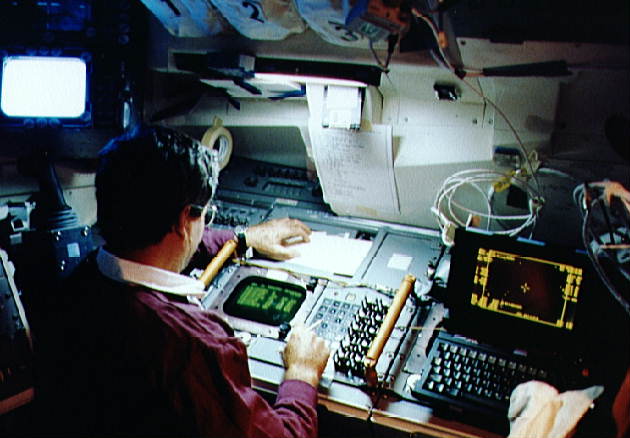
The space shuttle was NASA's primary option for transporting astronauts to Earth orbit between 1981 and 2011. The five shuttles that went into space flew 135 missions. Crews deployed satellites, conducted experiments and studied the Earth. A handful of the missions were classified, and little is known about these secret missions, even 30 years after the fact.
In the early days of the space shuttle program, some of the missions were run jointly by NASA and the military. This was in part because the National Reconnaissance Office had successfully requested the shuttle's payload bay — the part of the shuttle that carried satellites be carried into space — be enlarged to accommodate large military satellites, according to Air & Space Magazine.
NRO also wanted polar shuttle missions, since polar missions make it possible to see the Earth's entire surface below (as opposed to equatorial missions, which are limited.) The Air Force went so far as to create a launch pad in Vandenberg, California for polar-orbiting space shuttle missions, but after the Challenger incident, plans to use the pad were permanently mothballed.
After the Challenger disaster on Jan. 28, 1986, U.S. policy changed to allow the Department of Defense to use expendable, uncrewed rockets again. Classified shuttle flights continued with payloads that could not be shifted to the Titan IV rocket, the magazine added. The astronauts encountered considerable challenges in keeping information secret since the shuttle did not have secure information channels, and their movements and training operations had to be somehow kept separate in a normally open public agency.
Here is some of what we know about the missions with DOD.
The classified payload was known as Cryogenic Infrared Radiance Instrument for Shuttle (CIRRIS), which was supposed to test infrared sensors for a future surveillance satellite called Teal Ruby, according to America Space. The lens cap on CIRRIS failed to open, and the experiment failed. America Space added that Teal Ruby ended up being cancelled after the Challenger incident, which delayed shuttle flights by several years.
"Teal Ruby was first shifted onto STS-39 and finally cancelled," the publication said. "By the time STS-39 lifted off in April 1991, it carried not Teal Ruby … but an updated version of CIRRIS. Apparently, by the time it would have been ready to launch, the Teal Ruby technology — considered 'advanced' in the late 1970s — would be virtually obsolete, because sensor technology was advancing rapidly."
Little is known about STS-51C's payload officially besides this terse line on the NASA website: "The U.S. Air Force Inertial Upper Stage (IUS) booster was deployed and met the mission objectives."
Multiple sources suggest that the satellite deployed was called Magnum/ORION ELINT, a signals intelligence program about which little is known. Before launch, no pre-flight commentary was available until nine minutes before liftoff — a first in the shuttle program.
Two Defense Satellite Communications System satellites were released on this mission, according to NASA. The system is intended to support secure data and voice transmissions for military users from across the globe.
This mission was supposed to be the first one using the Air Force pad in Vandenberg, Calif., but it was cancelled after the Challenger explosion. Its main mission was to put Teal Ruby into orbit, according to NASASpaceflight.com.
It's probable that the crew released a satellite called ONYX, which had radar on board capable of observing targets on the ground through any kind of weather or cloud cover. According to Air&Space Magazine, one of the satellite's antenna dishes did not open and the crew possibly — although it's not confirmed officially — did a spacewalk to fix the issue.
Air&Space Magazine reports that STS-28 hauled the Satellite Data System spacecraft into orbit; SDS was supposed to relay imagery from other military satellites. The magazine got confirmation on this from an Air Force officer, who was not named in the story.
NASA's website simply says this was a Department of Defense mission. The payload has not been confirmed.
There are many theories as to what STS-36 carried, but nothing has been officially confirmed. The shuttle's ground track took it as high as 62 degrees, which is a record for the shuttle program.
NASA's website only says that this was a Department of Defense mission. No confirmed information about the payload is available.
The Air Force partially declassified this mission before launch. The unclassified payload was known as Air Force Program-675 (AFP-675), which was an updated version of CIRRIS. According to NASA, the classified payload "consisted of Multi-Purpose Release Canister (MPEC)," but no further information appears to be available.
The main payload for this mission remains classified, with little information about what it could be.

Hypersonic Flight Is Coming: Will the US Lead the Way?

MOJAVE, California The world is at the start of a renaissance in supersonic and hypersonic flight that will transform aviation, but the effort will need steady commitment and funding if the United States wants to lead the way, congressional leaders and industry officials said at a forum late last month.—
"What's exciting about aerospace today is that we are in a point here where suddenly, things are happening all across the board in areas that just haven't been happening for quite a while," said former U.S. Air Force Maj. Gen. Curtis M. Bedke.
"There was a period where engine technology had just sort of stagnated — a point where all materials technology was going along at about the same pace," Bedke added. "There just wasn't much happening. But suddenly, in all sorts of areas that apply to aerospace, things are happening." [NASA's Vision of Future Air Travel (Images)]
Bedke was one of five panelists to speak Oct. 27 at the Forum on American Aeronautics here at the Mojave Air and Space Port. Sponsored by the House Committee on Science, Space, and Technology, the forum was hosted by committee chairman Lamar Smith, R-Texas, and member Steve Knight, R-Calif. Bedke, Smith and Knight were joined by David McBride, director of NASA's Armstrong Flight Research Center in California, and Craig Johnson, director of business strategy and development for Lockheed Martin's Skunk Works. Former Mojave Air and Space Port CEO Stu Witt moderated.
Knight has taken the lead on the House Science Committee in getting NASA's aeronautical program to focus on a new set of experimental aircraft. He said his passion for these programs isn't just about improving American aviation — it's personal.
"In 1967 was the last time we went hypersonic in an airplane," Knight said, referring to an X-15 flight piloted by his late father, William J. "Pete" Knight. That flight reached Mach 6.7 — 6.7 times the speed of sound — a record for piloted aircraft that still stands nearly 50 years later. (Hypersonic flight is generally defined as anything that reaches Mach 5 or greater. "Supersonic" refers to any flight that exceeds Mach 1.)
Since that time, the U.S. has conducted two unpiloted hypersonic research programs, X-51 and X-43. However, there was no continuity in the work, Knight said. [Going Hypersonic: Air Force's X-51A Waverider in Pictures]
"We collected an awful lot of data," he said. "But what I would like to see is that we can move that data into something, whether we are going to move into an aircraft that we're going to put people into or we're going to use it for some other program. We've got to have that continuity and move forward."
Knight noted that it still takes the same 4.5 hours or so to fly from New York to Los Angeles today as it did 30 years ago. Supersonic aircraft flights over land have been banned for decades because of the sonic booms they produce. No supersonic passenger planes have been in operation since the retirement of the Concorde in 2003.
NASA wants to change that. In February, the space agency awarded a contract to Lockheed Martin for the design of an experimental plane to test technologies that can significantly reduce the sonic booms caused by aircraft. If the program is successful, the ban on overland supersonic flights could be lifted.
"We're poised on the brink of a new era in air transportation," McBride said. "We do need to go faster. There is a market for supersonic flight over land in an efficient manner that can fly without being an annoyance to everyone on the ground."
NASA also is exploring ways to improve the efficiency and reduce the environmental impacts of subsonic aircraft. Engineers are experimenting with blended wings and other innovations.
Smith admitted that the difficulty that Congress and the president have experienced in passing budgets has caused problems in sustaining research.
"None of that is conducive to good work getting done in an efficient way," Smith said. "And we can do better. We need to get to the point where continuity actually lasts beyond just one administration, much less beyond tomorrow. And we're with you on that."
Bedke said there is no time to waste in moving these programs forward.
"It is inevitable that hypersonic technologies are going to happen," he said. "It is not inevitable that we are going to be the country to do it first. But we can be the country to do it first, but we're going to have to put our minds to it, and we're going to have to stop the history of fits and starts, of throwing money at a big program, achieving a wild success, and then having no follow-up. Or throwing a lot of money at too big a program, taking too giant a bite, failing miserably and then deciding hypersonics isn't going anywhere. Neither of those must be allowed to happen in the coming years."
Follow us @Spacedotcom, Facebook or Google+. Originally published on Space.com.
Breakthrough Listen Added Another Alien-Hunting Telescope
Breakthrough Listen, the largest scientific alien-hunting research program in the world, has just begun using a powerful new telescope to monitor what’s far beyond Earth.
The team announced the very first observations from the Parkes Radio Telescope in New South Wales, Australia, which joins two other telescopes operated by Breakthrough Listen (one’s in California and the other’s in West Virginia)
This new, third telescope is an instrument uniquely positioned to help us pinpoint signs of extraterrestrial civilizations that might resemble our own. “First light” for the Parkes telescope was an observation of red dwarf Proxima Centauri, of recent Proxima b fame.
“The chances of any particular planet hosting intelligent life-forms are probably minuscule,” Andrew Siemion, director of UC Berkeley SETI Research Center, told Breakthrough Initiatives. “But once we knew there was a planet right next door, we had to ask the question, and it was a fitting first observation for Parkes. To find a civilization just 4.2 light years away would change everything.”
Parkes is the third such telescope to be used for Breakthrough Listen, and has the advantage of a Southern Hemisphere perspective that its peers, both located in the United States, do not. Now that Parkes has been added to the Breakthrough roster and is officially, functionally up and running, the search for alien life is only ramping up. In the southern sky, it will search the centers of 100 nearby galaxies and 1,000 stars, including all 43 within five parsecs. As with the other telescopes, all the data Parkes gathers will be available to the public for free.
Since theoretical physicist Stephen Hawking and entrepreneur Yuri Milner launched the project in 2015 with a 10-year projection and a budget of $100 million, Breakthrough Listen has leapfrogged to the very front of the search for extraterrestrial life. It plans to survey the 1 million stars closest to Earth. The Breakthrough Initiatives also include Breakthrough Message, a mission to design communication that could be understood by alien species, and Breakthrough Starshot, which aims to get an unmanned flight to Alpha Centauri.
Photos via ESA/Hubble & NASA, Australia Telescope National Facility, Commonwealth Scientific and Industrial Research Organization
A Naked Black Hole Is Streaking Across the Universe
Black holes are mysterious cosmic monsters, shrouded in a thick veil of gas and dust. They lurk in the heart of galaxies, waiting to gobble up stars that get too close, before belching deadly x-rays in satisfaction. However, astronomers recently spotted a strange black hole streaking through space.
At first glance, this rogue specimen just seemed out of place, but upon further study, astronomers realized they had stumbled upon the remains of a grisly cosmic scene. Unlike most black holes, the subject in question — dubbed B3 1715+425 — was not in the center of a galaxy. Even more surprisingly, it appeared to be “naked”, meaning it was devoid of a black hole’s typical stellar shroud.
“We’ve not seen anything like this before,” James Condon, an astronomer at the National Radio Astronomy Observatory and lead author of the study, said in a news release.
B3 1715+425 is a supermassive black hole residing on the fringes of an unusually small, faint galaxy. Like most supermassive black holes, it was doing its thing, munching on stars and spewing out deadly x-rays when it overindulged. That routine continued for billions of years until B3 1715+425’s host galaxy slammed into a larger galaxy.
This type of cosmic collision is commonplace, especially within larger galaxy clusters, like ZwCl 8193, where B3 1715+425’s galaxy lives. Astronomers think that the largest galaxies in the universe formed through galaxy mergers. Typically when galaxies merge, the two black holes within those galaxies take part in a dramatic orbital dance, with the pair orbiting each other until they eventually combine. (The LIGO experiment saw proof of this last September).
Most of the time, this merging process seems to go rather smoothly, as nearly all galaxies host a supermassive black hole, the majority of which are located at the galactic center. However, in the case of B3 1715+425, something went very wrong. B3 1715+425 was stripped of its stars as it tried to escape the clutches of a larger galaxy, and astronomers caught it in the act.
Using the National Science Foundation’s Very Long Baseline Array (VBLA) — a network of ten 25-meter dish antennas spread across the globe and operated out of New Mexico — astronomers clocked the rogue behemoth racing away from the cosmic collision at more than 2,000 miles per second.
“We were looking for orbiting pairs of supermassive black holes, with one offset from the center of a galaxy, as telltale evidence of a previous galaxy merger,” Condon said. “Instead, we found this black hole fleeing from the larger galaxy and leaving a trail of debris behind it.”
As it streaks through space, B3 1715+425 is steadily hemorrhaging ionized gas — the fuel needed to form new stars. Once that gas supply is gone, the galaxy will become invisible, which astronomers expect to see in the next billion years.
Are there other black holes like B3 1715+425 out there? Condon and team think there are, and they will be scanning the cosmos with the VBLA to find them.
Photos via NRAO/AUI/NSF
SABRE Ground Demonstration for Mach 25 Reusable Hypersonic Air Engine
By:
SABRE engine
(Image Courtesy Wikimedia Commons https://goo.gl/images/0HP8Qk)
The Synergetic Air-Breathing Rocket Engine or SABRE, developed by Reaction Engines of the UK and BAE Systems, has been covered by IndustryTap in Imagine Traveling to Any Destination on the Planet in a Few Hours and $1.1 Billion Hypersonic Aircraft’s Engines Get Boost From New Air Cooling Technology. Now, Reaction Engines is moving to phase two of the development of SABRE with tests expected in the next two years with unmanned test flights by 2025.
Reaction Engines is building a fighter jet engine-sized ground demonstration engine of what will be a reusable hypersonic propulsion system. The ultimate goal is to create a single stage SABRE rocket that will lift aircraft into space. The sub-scale demonstrator is expected to show the flight regimen and cycle and will be a significant development on the way toward reliable and inexpensive space access. Reaction Engines expects the demonstrator will provide enough information so that it can create a development and testing plan for a full-sized version of the rocket.
In the following video, meet the Skylon Spacecraft that uses a Mach 25 SABRE engine.