Naar de inhoud

UFO'S of UAP'S, ASTRONOMIE, RUIMTEVAART, ARCHEOLOGIE, OUDHEIDKUNDE, SF-SNUFJES EN ANDERE ESOTERISCHE WETENSCHAPPEN - DE ALLERLAATSTE NIEUWTJES

UFO's of UAP'S in België en de rest van de wereld
akke.beakke.be
Ontdek de Fascinerende Wereld van UFO's en UAP's: Jouw Bron voor Onthullende Informatie! Ben jij ook gefascineerd door het onbekende? Wil je meer weten over UFO's en UAP's, niet alleen in België, maar over de hele wereld? Dan ben je op de juiste plek! België: Het Kloppend Hart van UFO-onderzoek In België is BUFON (Belgisch UFO-Netwerk) dé autoriteit op het gebied van UFO-onderzoek. Voor betrouwbare en objectieve informatie over deze intrigerende fenomenen, bezoek je zeker onze Facebook-pagina en deze blog. Maar dat is nog niet alles! Ontdek ook het Belgisch UFO-meldpunt en Caelestia, twee organisaties die diepgaand onderzoek verrichten, al zijn ze soms kritisch of sceptisch. Nederland: Een Schat aan Informatie Voor onze Nederlandse buren is er de schitterende website www.ufowijzer.nl, beheerd door Paul Harmans. Deze site biedt een schat aan informatie en artikelen die je niet wilt missen! Internationaal: MUFON - De Wereldwijde Autoriteit Neem ook een kijkje bij MUFON (Mutual UFO Network Inc.), een gerenommeerde Amerikaanse UFO-vereniging met afdelingen in de VS en wereldwijd. MUFON is toegewijd aan de wetenschappelijke en analytische studie van het UFO-fenomeen, en hun maandelijkse tijdschrift, The MUFON UFO-Journal, is een must-read voor elke UFO-enthousiasteling. Bezoek hun website op www.mufon.com voor meer informatie. Samenwerking en Toekomstvisie Sinds 1 februari 2020 is Pieter niet alleen ex-president van BUFON, maar ook de voormalige nationale directeur van MUFON in Vlaanderen en Nederland. Dit creëert een sterke samenwerking met de Franse MUFON Reseau MUFON/EUROP, wat ons in staat stelt om nog meer waardevolle inzichten te delen. Let op: Nepprofielen en Nieuwe Groeperingen Pas op voor een nieuwe groepering die zich ook BUFON noemt, maar geen enkele connectie heeft met onze gevestigde organisatie. Hoewel zij de naam geregistreerd hebben, kunnen ze het rijke verleden en de expertise van onze groep niet evenaren. We wensen hen veel succes, maar we blijven de autoriteit in UFO-onderzoek! Blijf Op De Hoogte! Wil jij de laatste nieuwtjes over UFO's, ruimtevaart, archeologie, en meer? Volg ons dan en duik samen met ons in de fascinerende wereld van het onbekende! Sluit je aan bij de gemeenschap van nieuwsgierige geesten die net als jij verlangen naar antwoorden en avonturen in de sterren! Heb je vragen of wil je meer weten? Aarzel dan niet om contact met ons op te nemen! Samen ontrafelen we het mysterie van de lucht en daarbuiten.

Berichten van 1 maart 2017 tot 31 maart 2017

Men in Black – A Worldwide Phenomenon

Men in Black – A Worldwide Phenomenon

Brent Swancer’s recent feature on Men in Black in Japan has prompted me to write an article showing that the creepy and strange MIB are seen just about here, there and everywhere. In 2005, I spent a week or thereabouts in Puerto Rico. I was there with Paul Kimball’s Redstar Films crew. The subject of the shoot: the Chupacabra. While we were there, we met a number of interesting witnesses, including one guy who had encountered not just a Man in Black, but a Woman in Black too.

Late one night, some years earlier, he jumped out of bed to the screams of his pigs – he was a breeder and seller of the animals. And, given that this was his only source of income, he raced to the back-door, grabbed a handy machete and a flashlight, flung the door open, and charged out into the muggy darkness. The scene was one of carnage. The bodies of a number of dead, blood-splattered rabbits – which the farmer also kept – were strewn about the yard, many torn to pieces. And one of his prize-pigs was dead, too, lying on the ground.

All of them, the pig and the rabbits, were killed in the same fashion: via three, huge puncture wounds to the neck. As the man, pretty much in a state of shock, prowled around the tree-shrouded yard, he heard movement in the undergrowth. Wasting no time at all, he threw the machete in what he thought was the right direction. His instinct was right: the machete slammed into something solid. Oddly, the sound was akin to metal hitting metal. Whatever it was, it didn’t hang around. In seconds, it was gone, having leaped into the safety of the all-encompassing, nearby woods. There were even weirder developments to come – in the form of none other than the dreaded MIB and WIB.

It was early the next morning when the darkly-garbed, pale-faced duo descended upon the man’s farm. They asked all sorts of questions about the previous night’s events, making it clear to him that they knew far more about the attack in particular – and the mysterious attacker in general – than they were willing to admit. The strange pair listened, in an emotionless fashion, to everything that he had to say, then suddenly turned and vanished into the woods, along with his machete – which they made clear they were confiscating. Maybe wisely, he decided not to object. He never saw them, or his machete, ever again.

Moving over to the U.K., there are a couple of strange stories from Fortean author-investigator, Neil Arnold. Neil told me: “During the early ‘90s I was with two mates out walking at night, and I’d just got the reissues of The Unexplained magazine – and we saw a strange, hanging, dull yellow light in the sky which at first we took to be a firework about to explode. It was late October. The light eventually came over us, at quite a height and the light vanished (I believe because it was on top of the object). But the underside revealed a circle of lights and we watched in amazement as this thing silently glided over the houses out of sight. I recall a chap walking his dog who also looked up at it and everything was very quiet. Although I don’t recall it, when I spoke to one of the guys many years later (I lost touch with him shortly afterwards) he stated quite categorically that we lost about an hour in time.”

Neil continued: “This is not something I’ve ever taken seriously, but anyway, a month or so later I began writing a lot about MIBs and UFOs, and the same two friends visited London to buy records. It was early afternoon and we were sat in the MacDonald’s in Leicester Square. I was facing the door, one of my mates faced me with his back to the door, and my other mate sat side on. I recall looking up over my mate’s shoulder (the mate who was facing me) and there was a guy sitting there. He was about ten-feet away, staring, what I felt, right into my soul. He was about 60-70 years of age, he had grey hair slicked back, wide, staring, unblinking eyes. He wore a black suit, white shirt and a dark tie. Strangely, he had no food on the table, or no newspaper and he just sat staring at me. I went to mention it to my friend who was facing me and my mate just shuddered and said, ‘I know!’ He said he could sense this guy. We actually got up and left straight away…very odd.”

Neil had another case to report to me: “I also have a relative who in the ‘80s saw a UFO and went to the local phone box to report it to the newspaper. As soon as he entered the phone box a man appeared by the phone box and was staring in rather menacingly. My relative thought the man wanted to use the phone and so he motioned he wouldn’t be long, but the man still stared. The man wore a dark suit. My relative came off the phone and said to the man: ‘You can use it now.’ But he just stood there. My relative told the newspaper that he would go to their offices to tell them of the sighting, but as soon as he got on the bus he got a shocking headache. He thought he was going to pass out but persisted, but when he got to the office no-one working there knew what he was on about and they all said they hadn’t received a call from him.”

Gareth Medway, who has done an excellent job of collecting MIB reports, says of a 1957 case: “Luciano Galli of Rome [Italy] was walking from his home to work after lunch when a black Fiat pulled up and a man with piercing jet-black eyes spoke to him and invited him to come with him. They drove to Croara Ridge outside of Rome, where a saucer shaped craft was waiting. He was taken for a ride into space.” And, one more from Gareth, this one from 1963: “Li Jing-Yang, a security guard in Yangquan, Shansi Province, China, saw an object like two plates sealed together hovering in the sky. The next day he was approached by a strange man dressed in black who warned him not to talk about the sighting.”

That’s just the tip of the iceberg. There is very little we can say for sure about the Men in Black. One thing we do know, however, is that the phenomenon is global.

 TAGS: chupacabra, Men in Black, Neil Arnold

{ http://mysteriousuniverse.org/ }

Hoe vind je dit bericht?
Geschreven door peter om 01:25 Stuur door

INTERESTING: NASA HAS REVEALED FIRST IMAGES OF TRAPPIST-1!

INTERESTING: NASA HAS REVEALED FIRST IMAGES OF TRAPPIST-1!

700_5e41a989ae9c06b95211a5c2ed02edd7.jpg?v=1489258302

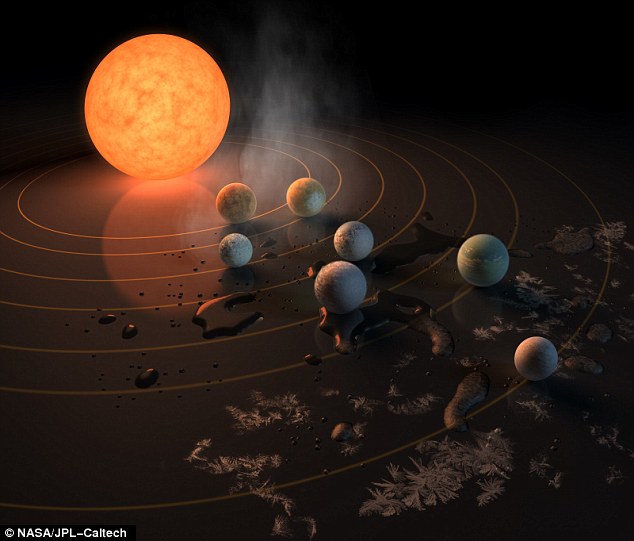
This year we had one of the biggest announcements by NASA as it revealed a relatively close star system with 7 planets and 3 of them being Earth-like. The solar system named 'Trappist-1' has a solar body smaller and younger than our own called a red dwarf. It is locatated 39 light years way which is translated to trillions of kilometers of distance from us.

NASA scientists say that three of the planets in Trappist-1 are perfectly located and have an extemely high probability of containing alien lifeforms. 

Has technology progresses we might someday be able to travel quick enough to this neighbor system and perhaps settle there with new human colonies, or maybe to meet extraterrestrial civilizations. Either way, it's still to early to tell if we can accomplish this goal.

Recently NASA revealed the first images of Trappist-1. It was taken by the Kepler spacecraft.

Watch the following video to know more!

RELATED ARTICLES

{ http://www.disclose.tv/ }

Hoe vind je dit bericht?
Geschreven door peter om 01:09 Stuur door

RESEARCHER CLAIMS REPTILIAN ALIENS HAVE BEEN ABDUCTING HUMANS AND CREATING HYBRIDS

RESEARCHER CLAIMS REPTILIAN ALIENS HAVE BEEN ABDUCTING HUMANS AND CREATING HYBRIDS

700_e80671848c6caaac5462cf28fe9314dc.jpg?v=1489345443

The researcher Len Kasten has made sensational claims, which he says he has gleaned from undisclosed for reportedly reputable sources, that an alien race referred to as the Reptilians have been abducting humans for nefarious purposes. According to Kasten, this activity has been going on for thousands of years and showed no sign of abating anytime soon.

RESEARCHER CLAIMS THAT HUMANS ARE BEING CONTROLLED BY A REPTILIAN RACE

Kasten claims that human beings do not originate from the planet Earth but initially evolved in a constellation referred to as Lyra. Some time ago, a reptilian race from the Draco system invaded and forced the human beings to flee to this solar system where humans took up residence on Earth and Mars. Today, the Martians live in a closed and highly secretive underground society while the reptilians live among human beings on the planet Earth.

According to Kasten, these reptilian beings abduct thousands of people every year for experimentation purposes and food. He says that they prefer the blood of children as it is less polluted than that of adult humans.

Kasten also claims that members of the reptilian race permanently live on this planet in underground bunkers. Despite the fact that they conceal themselves from the human race they manage to wield a huge amount of influence over society through organizations such as the Illuminati. Their goal is to completely control the world’s populations to keep human beings subdued. The primary method by which they ensure the subjugation of humans is by controlling banking and other economic institutions. Kasten claims that the last wave of intense reptilian activity was during the Second World War when the alien beings seized effective control of both the Third Reich and the Imperial Japanese Government. However, their plans to utilize the Axis powers to secure complete world domination failed because of the volatility of key human figures such as Adolf Hitler who improved impossible for the reptilians to control effectively. 

WHY DO THE REPTILIAN ALIENS WANT FULL CONTROL OVER EARTH?

Kasten writes that the reason that the reptilians are so keen to seize complete control of the planet Earth is that they are afraid of what human beings could do if they were released from continual subjugation. Intriguingly, he says that most humans are completely unaware that the race is endowed with certain ‘powers,' however, he did not explicitly state what these powers might be. Instead, he tantalizingly claims that these powers will become apparent as more and more people become aware of what is happening.

RELATED ARTICLES

{ http://www.disclose.tv/ }

Hoe vind je dit bericht?
Geschreven door peter om 00:56 Stuur door

China announces Mars probe that will look for signs of alien life

China announces Mars probe that will look for signs of alien life

nasa-mars.jpg
Hoe vind je dit bericht?
Geschreven door peter om 00:45 Stuur door

Scientists Speculate Mysterious Radio Bursts Are Powering Alien Ships

Scientists Speculate Mysterious Radio Bursts Are Powering Alien Ships

No one's sure what fast radio bursts are, so some Harvard scientists asked: Why not aliens?

Somewhere out there, aliens might be using huge, mysterious bursts of energy to sail ships through space.

No, this isn't some UFO conspiracy. It's a new theory from a pair of Harvard scientists who've been studying fast radio bursts. Those are sudden flashes of radio pulses from beyond our galaxy that our radio telescopes only catch glimpses of.

And the bursts are really weird. Astronomers have only ever found fewer than 20 of them. Sometimes they repeat, but other times they're a one-off burst of energy lasting only thousandths of a second.

The new theory goes something like this: A super-advanced alien species is using these incredibly powerful bursts of energy to push themselves around the universe on light sails.

Essentially, these theoretical aliens are riding a sailboat through outer space, and they're creating wind for their sails. But scientists think the sailboat might be the size of a planet, and that's why the bursts of energy are so big.

It's not as crazy as it may sound. Solar sails are a project we humans have been working on for a while, and some scientists think they're the best option we have for interstellar spaceflight.

The theory is pretty fantastical; even the authors admit that. They say they just want to put the idea out there and let the data "judge" it later.

 { http://www.newsy.com/ }
Hoe vind je dit bericht?
Geschreven door peter om 00:39 Stuur door

‘Life’ adviser Kevin Fong on balancing fact with fiction: ‘Don’t get in the way of the story’

‘Life’ adviser Kevin Fong on balancing fact with fiction: ‘Don’t get in the way of the story’

A doctor specialising in space medicine, Kevin Fong has worked with NASA and the European Space Agency and is one of the experts on the March 24 release.

‘Life’ adviser Kevin Fong on balancing fact with fiction: ‘Don’t get in the way of the story’ Sony Pictures 
Mridula Chari

Space as imagined by Hollywood teems with existential threats. In Daniel Espinosa’s upcoming film Life, it is an extraterrestrial life form found on Mars. Jake Gyllenhaal and Ryan Reynolds are among a crew of six astronauts aboard the International Space Station who successfully intercept a probe returning from Mars with a sample of alien life. This organism turns out not to be as benign as they initially presume.

Drawing on tropes from both horror and science-fiction, the March 24 release portrays the astronauts’ scramble to contain this alien life form before it can escape the ISS and obliterate all life on Earth.

As a critical element of the science-fiction genre is verisimilitude, the filmmakers called on experts who have worked in the field of space. One of them was Kevin Fong, a doctor who specialises in medicine in space and other extreme conditions. Fong has worked intermittently with the United States of America’s National Aeronautics and Space Administration for around a decade and also with the European Space Agency. He has a degree in Astrophysics and Medicine from University College, London. In an interview with Scroll.in, Fong describes his experience of working on Life, the constraints that exist in space, and why scientists need to learn when to back off from film scripts.

Science-fiction films have come a long way since Ridley Scott’s Alien, which is perhaps the film to which people will compare Life. What has changed between now and then?

Alien is a very high benchmark. I think what has changed actually more than anything else is that although you want to compare it to Alien, it’s not the same type of film. Alien is set in a very far flung future, where people are in hyper-sleep and exploring star systems very far away. This is happening on your doorstep, 250 miles above the surface of the Earth in a space station that exists.

I think what’s changed is that since those films, the theme of space exploration has become something we understand much better. And since the launch of the International Space Station [in 1998], there has always been a human being in space. What that means is that space is no longer a place that we temporarily visit. It’s a place in which we live and work. In that there comes an idea that there are people whose entire lives is spent in this very hazardous environment where everything is precariously balanced – and then what happens when you introduce an extra problem into that mix.

Although we talk about it being science fiction, it is almost now just fiction. In many ways, this is a drama that takes place in an industrial setting. It is just that this industrial setting happens to be space, but now space is a place people inhabit.

How closely involved were you with Life? Did your role begin at the scripting stage or on set?

We were involved from the outset, from before they started filming, when they were just storyboarding the scenes and then we spent quite a few days on set, helping mainly with the medical scenes for me because I have worked for the National Aeronautics and Space Administration as a space life sciences director for a while.

So I talked about space medicine and to the cast, about the experience of being a doctor. I don’t know what they gleaned from that. It was an interesting experience to have people ask you about what you do professionally in a very different way. Actors have a different process of trying to understand your experience rather than the mechanics of your job.

In the film, the astronauts encounter stressful situations that require quick responses. Given the constraints and physical effects of space on the body, how will they be able to deal medically with this?

Space has a lot of deep and profound effects on the human body. When you first go to space, it takes a long while to acclimatise to it. The first two or three days, the astronauts can often feel quite awful. It does affect your body and your ability to track moving objects. But after a while, you adapt to that and you begin to be able to function well enough for everyday tasks. There are a lot of impacts on the body due to spaceflight. It affects your balance and coordination, your heart and circulation, your breathing. It affects your entire body.

But amid all that, there are medical constraints, which to me as a doctor is what makes that environment quite interesting. You’re constrained in the kind of skills you can take. In this film, there are two doctors in the space station [including Jake Gyllenhaal], which is unusual. You’re constrained in the number of skilled physicians you have, so in my hospital, when I encounter trouble, i have any number of colleagues who know more, whether I’m asking for a cardiac specialist, or a pulmonary specialist to back me up in intensive care or in an operation theatre.

In space, you’re a lone gun and on your own. Then you’re restricted by the power. You don’t have the same volume or the same weight. You can’t take a lot of equipment up there. You’re not up there having CT scanners or MRI scanners. So it is a real expedition experience as a doctor. I’ve been on expeditions as a doctor and it’s a much more uncomfortable experience than being in a hospital setting surrounded by all your people and your equipment.

Kevin Fong. Photo by Anthony Cullen. Kevin Fong. Photo by Anthony Cullen.

There are two doctors on board the ISS in this film. How do you feel about that as a doctor yourself?

I worked with NASA on and off for ten years. I saw doctors who looked after astronauts. I have friends who are doctors and astronauts. I have seen them up close at work and worked alongside them. So the portrayals were very faithful in different ways. I was impressed as an outsider to watch this process happen. This cast and crew and scriptwriters take people and shape them into being believable as clinicians, forget the fact that they were on a space station. To me, they were believable as clinicians in the way they behaved.

We have had missions before with doctors in the cruise. And there have been in my memory a number of missions where you have more than one medically trained person in the crew. All of that is within the bounds of reality. And again, the filmmakers and scriptwriters didn’t overstep the mark in terms of the capabilities they gave these people. The temptation here is to endow these doctors with far more capability than they have on the space station. The space station does not have a lot of medical equipment. Their main recourse if things go wrong is to try and evacuate early and come home. When that happens, you really are in a lot of trouble.

I thought all of that was really well played. I was most closely involved in the medical scenes, which was really just about making the performance of the doctor believable. Nothing annoys me more than being a doctor and watching a medical drama where they hold the stethoscope the wrong way around or they try to do something with a cardiac defibrillator that is actually impossible or would never be done in real life. So it was quite nice for me to be able to exorcise some of those demons – to say, ‘No, this is wrong,’ and then have people listen to you.

Science fiction films are often a gateway for children to pursue careers in science. As a scientist and a film adviser, how do you balance creative demands with scientific reality?

You mustn’t get in the way of the story. That’s really important for a scientist in this environment to understand. There’s a temptation to think that this is my territory and it must look truly to real life. But the truth about science is of course that quite a lot of it is spending an awful lot of time reading books and looking at microscopes and doing stuff that actually is quite slow and ponderous and doesn’t look good on film. You have to be realistic about the needs of the story and the balancing of needs of reality.

The trick is not making the most realistic portrayal that can be made. Because that is a documentary. The trick lies in blending the needs of the story as closely as possible with what is real. When that is done well, you get films that are really beautiful. That is a real high-wire trip trying to get that balance right.

I think people get it wrong in both directions. I think scientists can be too pedantic about science, but also in a story, people might ride roughshod over some very fundamental things. When you get the partnership right, I think it can work very well.

Jake Gyllenhaal in Life. Jake Gyllenhaal in Life.
We welcome your comments at letters@scroll.in.

{ https://scroll.in/ }

Hoe vind je dit bericht?
Geschreven door peter om 00:26 Stuur door

The terrifying things that would happen if NASA sent a human to Venus

The terrifying things that would happen if NASA sent a human to Venus

Gene Kim and Jessica Orwig

Although Venus is easier to reach than Mars, scientists and space agencies around the world show little interest in exploring the planet. Why is it that they have so much enthusiasm in examining Mars but not our neighboring planet, Venus?

Follow Tech Insider: On Facebook

{ https://flipboard.com/topic/science }

Hoe vind je dit bericht?
Geschreven door peter om 23:54 Stuur door

The Most Amazing Space Stories This Week!

The Most Amazing Space Stories This Week!

The Most Amazing Space Stories This Week!
This artist's illustration shows a light sail powered by a radio beam (red) generated on the surface of a planet. A new study suggests that the leakage from such beams as they sweep across the sky could appear as the superbright light flashes known as fast radio bursts.
Credit: M. Weiss/CfA

Flashes of bright light seen across the cosmos could feasibly be created by intelligent aliens; a lost Indian moon probe was found; a fashion show featured a rocket launch, and a group of scientists proposed a new definition that would make Pluto a planet again. Here are our picks for the best space stories of the week.  

An alien spacecraft? 

Could unexplained flashes of bright light seen flickering across the universe be signs of advanced alien civilizations? A new study (led by a Harvard astrophysicist) investigates whether a phenomenon known as fast radio bursts could be generated by a megastructure built by aliens, as well as the possible purpose such a structure would serve. [Full story: Could Mysterious Cosmic Light Flashes Be Powering Alien Spacecraft?]

Lost and found on the moon

A powerful, Earth-based radar probe has identified the location of a lost Indian spacecraft sent to explore the moon. The Chandrayaan-1 lunar orbiter entered into lunar orbit in October 2008 and studied the moon through August 2009, when the probe stopped communicating with Earth. [Full story: Long-Lost Indian Moon Probe Found by Earth-Based NASA Radar]

Planetary treasure trove

The Kepler space telescope has pointed its planet-hunting eye at the TRAPPIST-1 system, which is now known to be home to at least seven Earth-size planets. Kepler researchers recently released raw data from the telescope's TRAPPIST-1 observations, to give the scientific community a chance to dive in and learn more about this incredible system. [Full story: Kepler Telescope Beams Back Raw Data on Earth-Size Exoplanets of TRAPPIST-1]

Colder than being cold

An experiment scheduled to fly to the International Space Station in August will create temperatures colder than those in interstellar space. The experiment, NASA's Cold Atom Laboratory (CAL), is depicted in this illustration.
Credit: NASA

An experiment set to launch to the International Space Station in August will achieve a temperature of less than 1 billionth of a degree above absolute zero — more than 100 million times colder than the far reaches of deep space, according to NASA. [Full story: Coldest Spot in Universe Should Soon Be Aboard International Space Station]

A mega eclipse movie

The "Eclipse Megamovie Project" is seeking volunteers to contribute footage to what could be the longest movie of a total solar eclipse ever compiled. If you have a high-quality camera (like a DSLR), you can get training on how to film the Aug. 21, 2017, total solar eclipse. The project's organizers said they will also release an app that will let people contribute footage using cellphones and lower-quality cameras. [Full story: How to Use Your Phone or DSLR to Help Make an Eclipse 'Megamovie']

Meteor madness

The streams of debris that cause meteor showers on Earth follow more complex paths than scientists previously thought. A new animation based on crowdsourced footage of falling meteors, plots more than 45 meteor-shower debris paths through the solar system. [Full story: See Earth Fly Through Meteor Showers' Wandering, Warped Paths (Animation)]

Space fashion

This week, the fashion titan Chanel launched a prop rocket during a fashion show debuting a line of clothing that had a classic interstellar twist. Even though the launch was fake, the massive rocket still put on quite a show: Towering 3 or 4 stories tall, it rose upward while nearby support towers moved aside, and a cloud of pinkish exhaust spewed out on the crowd. [Full story: Chanel 'Launches' Rocket at Paris Fashion Week]

The iconic fashion house Chanel


The iconic fashion house Chanel "launched" a massive prop rocket during a fashion show.
Credit: Pascal Le Segretain/Getty Images

Ice volcanoes on Ceres

New evidence suggests there are cryovolcanoes on Ceres, spewing a very salty water mixture toward the surface of the dwarf planet. Salty deposits are known to exist on Ceres' surface, and these could have welled up from beneath the surface, like magma squeezing through cracks in the Earth's crust. [Full story: Briny Ice Oozes in Dwarf Planet Ceres' Ice Volcanoes]

Make Pluto a planet (again)

There's a new campaign to once again change the definition of a "planet" so that Pluto will be included. Members of NASA's New Horizons mission to Pluto are behind the new proposed definition, which they will present to their colleagues at a meeting this month. [Full story: Behind the Push to Get Pluto Its Planetary Groove Back]

Lunar space stations by 2020?

Robert Bigelow, founder of Bigelow Aerospace, a company that specializes in inflatable space habitats, said he thinks private refueling stations could orbit the moon by 2020. But making these dreams a reality will depend on President Trump's willingness to invest in the companies that could make these things happen. [Full story: Private Space Stations Could Orbit the Moon by 2020, Robert Bigelow Says]

Follow Calla Cofield @callacofield. Follow us @Spacedotcom, Facebook and Google+. Original article on Space.com.

{ http://www.space.com/ }

Hoe vind je dit bericht?
Geschreven door peter om 23:40 Stuur door

The Most Interesting Science News Articles of the Week

The Most Interesting Science News Articles of the Week

Each week we uncover the most interesting and informative articles from around the world, here are 10 of the coolest stories in science this week.

Archaeologists unearthed fragments of a colossal statue possibly showing Pharaoh Ramesses II.
Credit: Dietrich Raue

Archaeologists have discovered a colossal statue, possibly depicting Egyptian pharaoh Ramesses the Great, in a muddy pit in a Cairo suburb, Egypt's antiquities ministry announced today (March 9).

Split in fragments, the quartzite statue was found by Egyptian and German archaeologists in the heavily populated Ain Shams and Matariya districts, where the ancient city of Heliopolis — the cult center for sun-god worship — once stood. [Read more about the discovery.]

Young men who take drugs to treat hair loss or an enlarged prostate may experience an unwanted side effect — erectile dysfunction — and the problem can persist long after these men stop taking the drugs, a new study finds.

One of the drugs in the study was finasteride, which is sold under the brand names Propecia and Proscar. Finasteride affects how cells make testosterone; it may be taken for hair growth or to shrink the prostate. [Read more about the long-lasting effect.]

Scientists recently created five synthetic chromosomes in yeast, a step towards a completely synthetic yeast genome.
Credit: Chris Bickel/Science 2017

The world is one step closer to a new synthetic organism.

Scientists have created five synthetic yeast chromosomes and placed them inside yeast cells. The chromosomes are composed of the normal letters, or base pairs, that make up DNA, but the sequence is slightly different from those found naturally in yeast. [Read more about the new creations.]

The upper jaw of a Neanderthal from El Sidrón in Spain. The dental calculus on the rear molar indicated that this individual ate poplar, a source of aspirin.
Credit: Paleoanthropology Group MNCN-CSIC

Neanderthals once dined on woolly rhinoceroses and wild sheep, and even self-medicated with painkillers and antibiotics, according to a new analysis of their dental plaque.

But the diets of Neanderthals — the closest known extinct human relative, which co-existed and sometimes bred with humans before going extinct about 40,000 years ago — varied depending on where they lived. [Read more about our ancient relatives.]

time-crystal.jpg?1488994321?interpolation=lanczos-none&downsize=*:1400
Scientists have recently succeeded in creating a mysterious state of matter known as a time crystal. This exotic state of matter seems to suspend the laws of thermodynamics indefinitely.
Credit: E. Edwards/JQI

A bizarre new state of matter known as a time crystal seems to suspend the laws of thermodynamics almost indefinitely, two new experiments suggest.

The newly created matter joins a host of other exotic states of matter, such as superconductors, quantum-spin liquids and superfluids. [Read more about the law-breaking creation.]

airbus-popup-transformer.jpg?1489082683?interpolation=lanczos-none&downsize=*:1400
The passenger capsule can be driven like a car, flown by a drone or integrated into a transit system like a hyperloop.
Credit: Italdesign/Airbus

George Jetson can eat his heart out. A new flying-car concept can do more than just take to the skies. In fact, the futuristic vehicle takes more cues from "Transformers" than "The Jetsons" in imagining how humans might get around in the future. [Read more about this unique vehicle.]

Temperatures on the Antarctic continent reached a record-breaking high of 63.5 degrees Fahrenheit (17.5 degrees Celsius) in 2015, according to a new report of balmy records for the bottom of the world.

And the tomb isn't just big. It also has a rare example of rock art carved into its ceiling. [Read more about the rock art.]

The Hyperloop One test track, dubbed the DevLoop, will be made up of a series of tubes that will extend 1,640 feet (500 meters).
Credit: Hyperloop One

Though it sounds like a transportation system straight out of a science-fiction novel, the "Hyperloop" is inching closer to reality, and new images offer a first look at the Hyperloop One project's test track.

Though it sounds like a transportation system straight out of a science-fiction novel, the "Hyperloop" is inching closer to reality, and new images offer a first look at the Hyperloop One project's test track. [Read more about the ultra-fast system.]

Easter eggs aren't the only things that are turning pink this spring: Some people are reporting that the special-edition "Peeps-flavored" Oreo cookies are turning their poop pink.

The cream's color, sandwiched between two vanilla cookies, is similar to the color of the iconic marshmallow treats that are especially popular around Easter. But how does the dye go from a colorful cookie to a perhaps unwanted pink stool? [Read more about the strange connection.]

woman-silhouette-on-beach.jpg?1485261030?interpolation=lanczos-none&downsize=*:1400

The title of the nation's happiest community once again goes to the city of Naples, Florida, and its surrounding area, according to a new poll.

In this most recent poll, residents of the Naples metro area scored a 66.3 out of 100 on the survey's measure of well-being. The Naples area previously claimed the top spot in this same poll conducted in 2014 to 2015. [Read more about happy places to live.]

Follow Live Science @livescience, Facebook & Google+.

{  http://www.livescience.com/ }

Hoe vind je dit bericht?
Geschreven door peter om 23:31 Stuur door

ANTARCTICA: NASA IMAGES REVEAL TRACES OF ANCIENT HUMAN SETTLEMENT UNDERNEATH 2.3 KM OF ICE

ANTARCTICA: NASA IMAGES REVEAL TRACES OF ANCIENT HUMAN SETTLEMENT UNDERNEATH 2.3 KM OF ICE

antarctica-pyramid

WASHINGTON |

Recently released remote sensing photography of NASA’s Operation IceBridge mission in Antarctica led to a fascinating discovery when images revealed what some experts believe could be the existence of a possible ancient human settlement lying beneath an impressive 2.3 kilometers of ice.

The intriguing discovery was made during aircraft tests trials of NASA’s Advanced Topographic Laser Altimeter System (ATLAS) lidar technology set to be launched on the Ice, Cloud and land Elevation Satellite-2 (ICESat-2) in 2017, that aims to monitor changes in polar ice.

“There’s very little margin for error when it comes to individual photons hitting on individual fiber optics, that is why we were so surprised when we noticed these abnormal features on the lidar imagery,” explains Nathan Borrowitz, IceBridge’s project scientist and sea ice researcher with NASA’s Goddard Space Flight Center in Greenbelt, Maryland.

“As of now we can only speculate as to what these features are but the launching of ICESat-2 in 2017 could lead to other major discoveries and a better understanding of Antarctica’s geomorphological features” he adds.

nasa-scientist-

Although NASA scientist Nathan Borrowitz claims the infrared images are definitely intriguing, other experts claim they are clearly the proof of ancient human engineering

A human settlement buried under 2.3 km of ice

Leading archeologist, Ashoka Tripathi, of the Department of Archaeology at the University of Calcutta believes the images show clear evidence of an ancient human settlement beneath the ice sheet.

archeo-india

“These are clearly features of some sort of human-made structure, resembling some sort of pyramidal structure. The patterns clearly show nothing we should expect from natural geomorphological formations found in nature. We clearly have here evidence of human engineering. The only problem is that these photographs were taken in Antarctica under 2 kilometers of ice. That is clearly the puzzling part, we do not have any explanation for this at the moment,” he admits.

“These pictures just reflect a small portion of Antarctica’s total land mass. There are possibly many other additional sites that are covered over with ice. It just shows us how easy it is to underestimate both the size and scale of past human settlements,” says Dr Tripathi.

Remnants of a lost civilization

Historian and cartographer at the University of Cambridge, Christopher Adam, believes there might be a rationnal explanation.

piri-reis

The map of Turkish admiral Piri Reis in 1513 AD shows the “ice less” coastline of Antarctica

“One of histories most puzzling maps is that of the Turkish admiral Piri Reis in 1513 AD which successfully mapped the coastline of Antarctica over 500 years ago. What is most fascinating about this map is that it shows the coastline of Antarctica without any ice. How is this possible when images of the subglacial coastline of Antarctica were only seen for the first time after the development of ground-penetrating radar in 1958? Is it possible Antarctica has not always been covered under such an ice sheet? This could be evidence that it is a possibility” he acknowledges.

« A slight pole shift or displacement of the axis of rotation of the Earth in historical times is possibly the only rational explanation that comes to mind but we definitely need more research done before we jump to any conclusion.”

ICESat-2 (Ice, Cloud, and land Elevation Satellite 2), part of NASA’s Earth Observing System, is a planned satellite mission for measuring ice sheet mass elevation, sea ice freeboard as well as land topography and vegetation characteristics, and is set to launch in may 2017.

{https://worldnewsdailyreport.com/ }

Hoe vind je dit bericht?
Geschreven door peter om 23:05 Stuur door

HUGE UFO LEAVES THROUGH PORTAL: Footage of flying diamond over sea goes viral

HUGE UFO LEAVES THROUGH PORTAL: Footage of flying diamond over sea goes viral

A STRIKING video which appears to show a huge bizarre diamond-shaped UFO hovering over the sea before it disappears "through a portal" has gone viral.

Suspicious UFO captured on camera by Danish Fisherman

The footage, uploaded to YouTube by the channel Section 51 2, shows a distant shot of a giant hovering rhombus-shaped UFO with a separate bright orb moving around it.

It is seen to rise into clouds above as if disappearing through a portal to another dimension.

The Section 51 2 website claims it was filmed in November 2016 by Danish fishermen.

However, it includes no real details about the alleged sighting.

An article accompanying the video on the Section 51 2 website makes no further reference to the alleged sighting in the video.

It instead discusses a 2011 sighting over the North Sea.

It is likely the video is a clever hoax made using CGI technology.

UFO-Portal

SECTION512*YouTube

A still from the video showing the 'CGI' UFO.

RELATED ARTICLES

One viewer posted on YouTube: "You guys are doing a great job with the CGI, I hope one day you guys could make a vid of ufos fighting and stuff."

But, amazingly, some thought it could be genuine footage with claims it looked like a legendary mythical UFO called the Black Knight Satellite.

Margaret Bu Shey posted: "Everyone handles their fear or unexpected events differently. 

"To discount a video because someone isn't screaming limits one's possibilities of finding out the truth/facts of the matter."

And, Robert Kimball said: "The large shape is a sampling collector that will be beamed into a large mother ship cloaked in the dark cloud. 

"The little light orb is a small sensor ship making sure it is safe to beam up the sample. 

UFO-Portal

SECTION512*Youtube

Section 51 2 is on several UFO blacklists for running blatantly hoax videos.

Are the objects flying over Giza pyramids alien UFOs?

RELATED ARTICLES

You guys are doing a great job with the CGI, I hope one day you guys could make a vid of ufos fighting and stuff.

YouTube viewer

"We have benevolent ET friends who are serious about helping clean up our mess - starting with the ocean. be happy."

But, Section 51 2 has been outed by serious UFO investigators and hoax busters as regularly using GCI effects to add extraordinarily clear-looking UFOs to its videos.

The website and channel features on many UFO investigators "blacklists" of so-called UFO sites to avoid because of its alleged use of hoaxes, which "discredit genuine research".

The 'about section' on its website suggests it broadcasts genuine footage, saying: "Sometimes we have no words to explain what we see, sometimes we can see that it's just hoax. 

"The purpose of Section 51 is to make you ask yourself these questions about UFOs... Many UFO reports from soldiers exist all around the world but some people want to hide the truth. 

RELATED ARTICLES

"Section 51 shows you UFO incidents reported by people and most of the time by soldiers in wartime."

But there is a disclaimer on its YouTube page, which suggests otherwise.

It states: "These videos are for entertainment purposes only.

"We cannot authenticate all videos. Viewers are free to make their own conclusions." 

Scott Brando, who runs hoax-busting website ufoofintererst.org, said the channel "clearly" broadcast out and out hoaxes which had been digitally made.

Express.co.uk has contacted Section 51 2 a number of times over whether the videos are genuine but is yet to receive a response.

Related articles

Hoe vind je dit bericht?
Geschreven door peter om 22:49 Stuur door

Two Identical UFOs Filmed Over Florida and New York

Two Identical UFOs Filmed Over Florida and New York

triangle-ufos-usa

Various reports suggest that a significant number of people witnessed a UFO in Homestead, Florida on February 15, 2017. The UFO was so mysterious as an aircraft mechanic with many years in aviation could not explain the video of the alleged mass UFO sighting.

Interestingly, a second video showing the same UFOs surfaced on March 3, 2017, and made the rounds online. The unnamed witness was in his room fixing the blinds. He usually looked out of his window to see the moon. He was surprised to see lights beaming from a distance. The sighting took place in Jamaica, NY.

The witness was sure they were not airplanes because he had been seeing planes from a distance during the night and he knew they did not beam as bright or as big as the mysterious lights that he could not explain.

The witness went on to say that he noticed the objects many months, but not paid attention to it as he thought they were just from the JFK airport on the right side.

Airplanes or helicopters are a regular sight around the area with JFK airport stationed nearby.

The witness also initially thought they were just motorbike headlights that appeared flashing when a tree was in front of them while the wind blew the leaves around. He observed on the last beam of light on the right side continually drifted off to the right and reappeared a few seconds again.

The witness claimed to be into cosmology, and his UFO sighting could be his wonderful, amazing discovery yet.

{ http://www.latest-ufo-sightings.net/ }

Hoe vind je dit bericht?
Geschreven door peter om 22:33 Stuur door

Eyewitness Baffle To See An Apparent Decloaked V-Shaped UFO

Eyewitness Baffle To See An Apparent Decloaked V-Shaped UFO

triangle-ufo

TV News recently presents the UFO case seriously, and the MUFON investigator appears to handle it very well. It has been reported that UFO can materialize out of thin air, not by magic but by decloaking technology.

Debunking a UFO sighting is not that easy as most think. It needs evidence and not just mere words to do such thing. Without proof, debunking is just a bluff to make false news and profits to those networks who want to earn money out of it.

The annual UFO sighting report in Mutual UFO Network in Houston average around 80 speculated sightings. The data did not include the ones that are not reported. Fletcher Gray, one of the renowned UFO experts, offers a reason why most UFO sightings are not involving UFOs. However, there’s one case that baffles him big time.

An orange light was spotted over the Katy territory, coasting around. Tourists in the ground speculated it was a UFO. Gray said that it was glinting as it traveled during that time in the sky.

Hoe vind je dit bericht?
Geschreven door peter om 22:31 Stuur door

Fake News About a Secret Nazi UFO Base In Antarctica Refuses to Die

Fake News About a Secret Nazi UFO Base In Antarctica Refuses to Die

1489186012449-image02.jpeg?crop=1xw:0.8435390097524381xh;center,center&resize=1440:*

This researcher at Cambridge has a PhD and still had to take time to prove why the Nazi Antarctic UFO base is a hoax.

Before we get into this let's make one thing clear: the secret Nazi UFO base in Antarctica doesn't exist. The Nazis did go to Antarctica, but they didn't stash priceless European art in a subterranean Antarctic lair where they also happened to be developing flying saucers. That would be a totally insane thing to believe.

But as recently as 2016, articles mentioning the possible existence of this very thing can be found in tabloids like The Mirror, which reported on a possible Nazi UFO under Antarctic ice, as well as The Daily Star, which suggested that the Nazi UFO base may have ties to the giant alien ice pyramids under Antarctica.

In the age of Fake News and flat earthers, it's not hard to see how an outlandish idea could retain currency. But it's remarkable persistence over the half century prompted Colin Summerhayes, a prominent marine geologist and oceanographer at Cambridge, to write a 21-page, peer-reviewed paper outlining all the reasons why the Nazis totally didn't build a secret Antarctic base. Published a little over a decade ago in the quarterly academic journal Polar Review, Summerhayes' paper is an interesting survey of the paranoid conspiracy theories that began with a secret Nazi mission to Antarctica in January, 1939.

Seal of the Nazi Antarctic expedition. Image: Summerhayes, et al.

Months before the outbreak of World War II, Nazi Germany sent a small expedition to Antarctica aboard a vessel called the Schwabenland. According to Summerhayes, the expedition was prompted by German fears about being cut out of the whaling industry by Norway and Britain, which made large claims to portions of the Antarctic continent. So the Nazis launched their own expedition to Antarctica with the intention of claiming some of the seventh continent for themselves and establishing a base for the German whaling fleet there.

Read More: Why is the Flat-Earth Conspiracy Still a Thing?

Although this would end up being the Nazi's only visit to Antarctica, rumors of a secret Nazi base harboring Hitler and his inner circle near the South Pole began to spread immediately after the end of the war. The occasion of these rumors was the arrival of a German U-boat at an Argentine naval base in July, 1945, two months after the Nazis surrendered. Newspapers around the world picked up a fallacious Argentine news report that the U-boat had carried Hitler and other ranking Nazis out of Germany to the secret base on Antarctica.

Unrecognized Nazi claim on Antarctica, known as New Swabia. Image: Wikimedia Commons

The initial report of this rumor, spread by a Hungarian exile Ladislas Szabo who was living in Argentina at the time, was propped up by a book published by Szabo two years later titled (based on, it seems that even the bureau had its suspicions about the escape of the Nazi leader). Szabo's rumors only continued to pick up steam, and eventually in which Hitler did in fact die in a Berlin bunker, but his ashes and other Nazis treasures had been transported to Antarctica where they were stashed in a "very special natural ice cave in the Muhlig-Hofmann Mountains."Hitler is Still Alive recently declassified FBI files warped into a story

Despite the fact that many captured Nazis offered irrefutable evidence to the contrary of these claims, the rumor of Hitler's Antarctic base persisted. This was, in part, due to a covert Antarctic mission carried out by the US military in 1947 called Operation Highjump, as well as the well-documented British military presence in Antarctica throughout the war. According to conspiracy theorists, both the United States and Britain unsuccessfully attacked the secret Nazi base multiple times in the late 40s, but only succeeded in destroying it by dropping three atomic bombs above the base in 1958.

Ultimately, however, Summerhayes isn't convinced. Although he does acknowledge that "there is an element of truth in all these tales," the evidence doesn't seem to add up to a secret Nazi base in Antarctica.

In the first place, there is a pretty exhaustive recap in both German scientific literature and recovered wartime documents of the 1939 expedition to Antarctica. While these documents do outline the marine science and mapping efforts of the mission, there is no indication at all that the Nazis had ever decided on a fitting location for an Antarctic base, much less had begun to build one. As Summerhayes points out, when Norwegian explorer Roald Amundsen built a small hut in Antarctica in 1911, it took them 14 days and required the use of 80 dogs.

By contrast, the German expedition was only in Antarctica for a month, and spent most of its time going up and down the coast collecting marine samples and launching planes to do surveying work. There is also no evidence that the ship had motorized equipment or dogs on board, which would've made the task of ferrying supplies around the Antarctic nearly impossible, especially to build a massive underground complex where there were "hangars for strange planes" and bunkers for the development of advanced weaponry.

A (non-Nazi) research outpost in Antarctica. Image: Daniel Oberhaus

And what about Operation Highjump, the secret mission launched by the US in Antarctica, supposedly to take out the Nazi base? The largest expedition to ever go to Antarctica, Operation Highjump consisted of 4700 men, 33 aircraft, and 13 ships—which certainly sounds like an invasion of sorts. While this was undoubtedly a military exercise, its stated purpose was to train the US Navy to operate in freezing, polar conditions in preparation for a possible war with the Soviet Union in the Arctic

Okay, Summerhayes, but how do you explain the Nazi UFOs in Antarctica, huh? These claims, first advanced in UFOs: Nazi Secret Weapon, a 1975 book published by a Canadian neo-nazi publishing house, are derived from baseless reports that four American aircraft were shot down by Nazis during Operation Highjump. This tied in with an esoteric, post-war Nazism described in the 2002 history of occult Nazism, Black Sun, in which "flying saucers were in fact German super-weapons that had been developed and tested during the Third Reich."

According to Black Sun, this technology which was "supposedly shipped to safety in the Arctic, South America, and Antarctica" and "by the late 1970s, neo-Nazi writers were claiming that the 'Last Battalion,' a massive Nazi military force of highly advanced UFOs, was in possession of a vast tract of Antarctica." Despite the claims made in the neo-Nazi tract that American planes were shot down over Antarctica by Nazi flying saucers, Summerhayes concludes "that the idea that Germans defended themselves with flying saucers from a secret base" to be "pure fantasy," if for no other reason than the only plane lost during the American expedition to Antarctica crashed on the other side of the continent from the location of the supposed Nazi base.

Sure, fine. But why drop three atomic bombs on Antarctica if there wasn't Nazis there? 
Although there were three atmospheric nuclear explosions in the Southern hemisphere 1958, they were not over Antarctica—in fact, they were about 1500 miles north of the continent.

Summerhayes was able to thoroughly debunk the existence of an Antarctic Nazi UFO base, but the fact that the rumor persists a decade later should come as no surprise. In the era of pizzagate and fake news, we know all too well that the seduction of conspiracy will always trap at least a few believers who are willing to accept the apparent absurdity of a story, so long as it means that all the dots are connected.

{ www.Motherbroad .com } 

Hoe vind je dit bericht? 2 stemmen
Geschreven door peter om 18:12 Stuur door

FAIRE POUSSER DES PATATES SUR MARS ?

FAIRE POUSSER DES PATATES SUR MARS ?

Avant de partir explorer Mars, les êtres humains ont encore quelques ajustement à faire : le ravitaillement, entre autres. Des scientifiques ont peut-être trouvé la solution : faire pousser des patates sur la planète rouge. Oui, comme dans Seul sur Mars.

Une première expérimentation menée par le très sérieux Centre international de la pomme de terre au Pérou a donné des "résultats préliminaires encourageants".

Menés entre le 14 février et le 5 mars à Lima, les tests ont été réalisés dans des conditions atmosphériques censées être semblables à celles de la planète Mars, reproduites sous un dôme baptisé CubSat. Les pommes de terre ont poussé dans une terre extraite du désert de la Pampa de la Joya, dans le sud du Pérou, où le sol est ce qu'on peut retrouver sur Mars. Ce n'est donc pas un hasard si la NASA envisage de construire dans cette région un centre d'expérimentations martiennes, comme il en existe déjà aux Etats-Unis, en Antarctique et en Russie.

Le fait qu'il y ait une croissance possible dans des conditions comme celles de Mars est une phase importante de cette expérienceJulio Valvidia Silva, astrobiologiste péruvien

Un cube hermétique, des conditions extrêmes

« Si ces cultures peuvent résister aux conditions extrêmes auxquelles nous les exposons dans notre CubeSat, elles ont de bonnes chances de croître sur Mars, précise Julio Valdivia-Silva de l’UTEC. Nous ferons plusieurs séries d’expériences pour savoir quelles variétés de pommes de terre résistent le mieux. Nous voulons savoir quelles sont les conditions minimales dont une pomme de terre a besoin pour survivre.  »

Si ces cultures résistent, elles ont de bonnes chances de croître aussi sur Mars

Dans ce cube, qui abrite un environnement hermétiquement fermé, le tubercule est alimenté en eau, enrichie de nutriments. La température et ses variations suivent celles observables sur Mars, de jour comme de nuit. De même, les niveaux de pression atmosphérique, d’oxygène et de dioxyde de carbone sont constamment surveillés pour imiter ceux de la planète rouge. Un lot de capteurs et une caméra permettent de surveiller la croissance du tubercule.

Selon les observations de Walter Amoros, spécialisé dans la culture de pommes de terre au CIP, ce féculent présenterait des propriétés génétiques idéales pour résister à des environnements défavorables. En amont de l’expérience à l’intérieur du cube, les chercheurs avaient déjà utilisé le sol d’un désert situé dans le sud du Pérou pour prouver que les tubercules pouvaient s’y développer malgré la sécheresse.

Les patates bientôt au menu sur Mars ?

"Si les tubercules peuvent tolérer les conditions extrêmes auxquelles nous les exposons ici, cela offre une bonne opportunité pour qu'elles poussent sur Mars", estime Julio Valdivia Silva, astrobiologiste péruvien lié à l'agence spatiale américaine.

"Le fait qu'il y ait une croissance possible dans des conditions comme celles de Mars est une phase importante de cette expérience", a-t-il ajouté.  Elle est prévue pour durer cinq ans. Et permet déjà de savoir qu'on ne mourra pas de faim à 76 millions de kilomètres de la Terre.

http://www.numerama.com/sciences/239196-comme-au-cinema-les-futurs-explorateurs-de-mars-pourraient-cultiver-des-patates.html

 { http://www.ufocenter.info/ }

Hoe vind je dit bericht?
Geschreven door peter om 17:47 Stuur door

Westall UFO sighting witnesses to speak about the 1966 alien encounter at Clayton South

Westall UFO sighting witnesses to speak about the 1966 alien encounter at Clayton South

MEET the people whose lives were forever changed when they encountered what they believe was an alien spacecraft.

53ae27f20dbd4b40d090aec4474ea682?width=316 The story as it was reported in The Dandenong Journal.

At 6am on April 6, 1966, Clayton South became host to one of Australia’s most intriguing mysteries when more than 200 school students witnessed an unidentified flying object.

It was Australia’s largest mass UFO sighting.

More than half a century later and a select group of witnesses will share their story at Victorian UFO Action’s event Westall — The Witnesses Speak.

Sue Savage, who now lives in Springvale North, was 13 at the time of the encounter; she was in science class at Westall High School when a fellow student ran into the class room shouting “there is a flying saucer outside”.

Mrs Savage said she and her classmates went out to the corner of the schoolyard and looked up in awe.

“(The UFO) was like two saucers … one on the bottom and one turned upside down on the top,” Mrs Savage said.

“Some people say there was just one but I reckon there were three.

“They were hovering over the trees and then went down into the trees and disappeared for a minute or two then rose back up, sort of banked on its side and then took off at a 1000 miles per hour.”

0a7a16199c4a5dab7fe44d8f30234916?width=650 Westall witness Suzanne Savage at the Clayton South UFO park which was built in memory of the 1966 sighting. Picture: Valeriu Campan

Mrs Savage said the encounter left a lasting impression on her.

Since then she has had a keen interest in astrology and UFOs and has had to deal with many sceptics.

“We were too young to be sceptics — we know what we saw,” she said.

“It really makes me very angry to hear people say there’s nothing else out there and I know there is.

“Even mum and dad both said it was a load of rubbish and I told my children years later and they thought I was crazy until the first reunion was held and they realised (how many witnesses there were).”

Kevin Hurley was 21 at the time of the incident and rode his bike to the school from Murrumbeena after being alerted to the UFO sighting.

Mr Hurley never saw a UFO but he walked through tall grass to the spot behind the trees where the students said the UFO touched down for a couple of minutes.

“I saw a whole lot of people in a group huddle, they were all looking at the ground and there in 2ft high grass was a big perfect circle of absolutely flattened and twisted grass,” Mr Hurley said.

“In that circle there were three distinct impressions where the grass has been penetrated down to the dirt.”

Mr Hurley returned to the site the next day with a group of friends but said it was cordoned off and a military officer ordered him off the area.

James Rigney from Victoria UFO action said these first-hand accounts were what people who came to the event could expect to hear.

DID YOU KNOW?

The Dandenong Journal ran with coverage of the incident on its front page for consecutive issues and Nine News also reported the story on its 6pm bulletin.

The film canister containing the Channel 9 footage from the incident has since been found empty in the station archives.

Witnesses believe there has been a cover-up.

In 2013, the UFO returned to Westall in the form of a playground build by Kingston Council.

DETAILS

Westall — The Witnesses Speak will include the showing of documentary, Westall ’66: A Suburban UFO Mystery, a presentation from amateur investigator Shane Ryan and a Q and A panel with up to 12 witnesses.

It will take place at Kingston Arts Centre, 64 Parkers Rd, Parkdale, on April 2 from 12pm-5.30pm.

{ http://www.heraldsun.com.au/leader }

Hoe vind je dit bericht?
Geschreven door peter om 17:44 Stuur door

Three Glowing Lights Seen Over Ontario, Canada On Feb 27, 2017, UFO Sighting News.

Three Glowing Lights Seen Over Ontario, Canada On Feb 27, 2017, UFO Sighting News.

Canada%252C%2BOntario%252C%2Bartificial%2BIntelligence%252C%2Btank%252C%2Barcheology%252C%2BGod%252C%2BNellis%2BAFB%252C%2BMoon%252C%2Bunidentified%2Bflying%2Bobject%252C%2Bspace%252C%2BUFO%252C%2BUFOs%252C%2Bsighting%252C%2Bsightings%252C%2Balien%252C%2Baliens%252C%2BFox%252C%2BNews%252C%2Bastronomy%252C%2Btreasure%252C%2B1.png

Date of sighting: Feb 27, 2017
Location of sighting: Barrie, Ontario, Canada
Source: MUFON #82604

This UFO was seen over Ontario last week. It does have three lights which could mean its a TR3B military craft, but its hard to tell at night. Sometimes similar UFOs have been reported to suddenly split up and shoot away in opposite directions. I wonder if this would have happened if the eyewitness had watched longer?

Scott C. Waring

Eyewitness states:
I pulled onto my street heading home and i noticed 3 bright lights in the sky. 2 red and one white flashing very fast. I recorded it for a few seconds from my car, until the video went out of focus, then pulled into my driveway and went inside to tell people to come look. My borther in law came outside and seen it as well. I started to record again and as i did it changed its white light to red and began pulsating slowly with the other 2 lights now turned off. It then flickered its lights and changed the red pulsating light back to white, continued to pulsate, and then went back to flashing again for the remainder of the time i watched. It eventually vanished.

Canada%252C%2BOntario%252C%2Bartificial%2BIntelligence%252C%2Btank%252C%2Barcheology%252C%2BGod%252C%2BNellis%2BAFB%252C%2BMoon%252C%2Bunidentified%2Bflying%2Bobject%252C%2Bspace%252C%2BUFO%252C%2BUFOs%252C%2Bsighting%252C%2Bsightings%252C%2Balien%252C%2Baliens%252C%2Bbus%252C%2Bcat%252C%2BTrump%252C%2BObama%252C%2B.jpg

Canada%252C%2BOntario%252C%2Bartificial%2BIntelligence%252C%2Btank%252C%2Barcheology%252C%2BGod%252C%2BNellis%2BAFB%252C%2BMoon%252C%2Bunidentified%2Bflying%2Bobject%252C%2Bspace%252C%2BUFO%252C%2BUFOs%252C%2Bsighting%252C%2Bsightings%252C%2Balien%252C%2Baliens%252C%2BFox%252C%2BNews%252C%2Bastronomy%252C%2Btreasure%252C%2B3.jpg

Canada%252C%2BOntario%252C%2Bartificial%2BIntelligence%252C%2Btank%252C%2Barcheology%252C%2BGod%252C%2BNellis%2BAFB%252C%2BMoon%252C%2Bunidentified%2Bflying%2Bobject%252C%2Bspace%252C%2BUFO%252C%2BUFOs%252C%2Bsighting%252C%2Bsightings%252C%2Balien%252C%2Baliens%252C%2BFox%252C%2BNews%252C%2Bastronomy%252C%2Btreasure%252C%2B4.jpg

{ http://www.ufosightingsdaily.com/ }

Hoe vind je dit bericht?
Geschreven door peter om 16:49 Stuur door

UFO Over Mount Shasta Is Supply Ship For 12,000 Year Old Alien Base! March 2017, UFO Sighting News.

UFO Over Mount Shasta Is Supply Ship For 12,000 Year Old Alien Base! March 2017, UFO Sighting News.

cloud%252C%2Bweather%252C%2BIntelligence%252C%2Btank%252C%2Barcheology%252C%2BGod%252C%2BNellis%2BAFB%252C%2BMoon%252C%2Bunidentified%2Bflying%2Bobject%252C%2Bspace%252C%2BUFO%252C%2BUFOs%252C%2Bsighting%252C%2Bsightings%252C%2Balien%252C%2Baliens%252C%2BFox%252C%2BNews%252C%2Bastronomy%252C%2Btreasure%252C%2B.png
Date of sighting: March 2017
Location of sighting:  Mount Shasta, California, USA
Source: 
This UFO showed up over Mount Shasta, a famous religious mountain where many have claimed to see people surrounded by an aura around there body. Many who have climbed the mountain trails have said they encounter beings along the way that claimed to be from an underground city below the mountain that is over 12,000 years old! One appeared to be Saint Germain. (click here on more info on that encounter). This UFO over the mountain was there to pick up and deliver goods, supplies and passengers to this ancient city. I am sure you have heard of these stories before. I myself first heard about them over 35 years ago. 
Scott C. Waring
moutain%252C%2Bbases%252C%2BIntelligence%252C%2Btank%252C%2Barcheology%252C%2BGod%252C%2BNellis%2BAFB%252C%2BMoon%252C%2Bunidentified%2Bflying%2Bobject%252C%2Bspace%252C%2BUFO%252C%2BUFOs%252C%2Bsighting%252C%2Bsightings%252C%2Balien%252C%2Baliens%252C%2BFox%252C%2BNews%252C%2Bastronomy%252C%2Btreasure%252C%2B.png

 { http://www.ufosightingsdaily.com/ }

Hoe vind je dit bericht?
Geschreven door peter om 15:22 Stuur door

NASA offers glimpse into newly discovered 'second Earth' offering hope of alien life

NASA offers glimpse into newly discovered 'second Earth' offering hope of alien life

NASA has revealed first pictures of the newly discovered star system where a group of new planets could harbour alien life.

By Jess Bell 

planets stock image-

GETTY

BREAKTHROUGH: Seven planets were discovered as part of a new star system

The space agency made the huge announcement last month, with experts calling the discovery of Trappist -1 one of the most important developments in the hunt for aliens.

The seven Earth-like dwarf planets have opened up the possibility for discovering an entirely new solar system.

Now NASA has released raw images from the Kepler space telescope, showing a pixelated first look at the fascinating discovery.

“Finding a second Earth isn't a matter of if but when”

Thomas Zurbuchen

It comes after scientists offered a look into what life could be like on a "second Earth", as they created an interactive look around the exoplanets.

Three of the planets discovered are thought to contain pools of water, suggesting life could be thriving.

The Kepler telescope has been observing the new star system since December and the new data gives scientists a more detailed look at the planets.

the new data

NASA AMES/W STENZEL

REVEALING: The new data helps scientists better understand Trappist-1

the trappist-1 discovery

NASA

HUGE: NASA announced the Trappist-1 discovery last month

Geert Barentsen, K2 research scientist at NASA’s Ames Research Center, said: "Scientists and enthusiasts around the world are invested in learning everything they can about these Earth-size worlds.

"Providing the K2 raw data as quickly as possible was a priority to give investigators an early look so they could best define their follow-up research plans.

"We’re thrilled that this will also allow the public to witness the process of discovery."

Trappist -1 was discovered by NASA's Spitzer Space Telescope with help from ground-based machinery.

Talking about the discovery, NASA's associate administrator Thomas Zurbuchen said: "This discovery could be a significant piece in the puzzle of finding habitable environments, places that are conducive to life.

“Finding a second Earth isn't a matter of if but when."

RELATED ARTICLES

{ http://www.dailystar.co.uk/ }

Hoe vind je dit bericht?
Geschreven door peter om 01:43 Stuur door

Did an extraterrestrial object wipe out Paleo-Americans? Traces of platinum at US archaeological sites suggest an asteroid or comet might have caused disappearance of Clovis people

Did an extraterrestrial object wipe out Paleo-Americans? Traces of platinum at US archaeological sites suggest an asteroid or comet might have caused disappearance of Clovis people

  • Researchers analyzed 11 archaeological sites associated with Clovis peoples
  • The Clovis peoples arrived in Americas more than 13,000 years ago and mysteriously disappeared 12,800 years ago
  • Around the same time, more than 35 ice-age animals went extinct 
  • Scientists found traces of platinum from California to the Carolinas and Virginia
  • Platinum is common in extraterrestrial objects such as asteroids and comets
  • North America experienced mini ice-age called 'Younger Dryas' around this time
  • Evidence suggests Clovis people were maybe wiped out by comet-like object

Traces of platinum discovered at archaeological sites across the US may help scientists determine why the Clovis people disappeared thousands of years ago.

Platinum is found in asteroids and comets, which has led researchers to speculate that an extraterrestrial object could explain the disappearance.

The Clovis people, who inhabited the modern-day contiguous United States more than 13,000 years ago along with beasts such as the mastodon and mammoth, disappeared 12,800 years ago. More than 35 ice-age animals also went extinct.

An extraterrestrial object such as an asteroid (pictured) or comet could have struck North America around 12,800 years ago, when the Clovis peoples disappeared and 35 ice age animals went extinct

An extraterrestrial object such as an asteroid (pictured) or comet could have struck North America around 12,800 years ago, when the Clovis peoples disappeared and 35 ice age animals went extinct

The contiguous United States had been inhabited by the Clovis people, pictured in a drawing battling a woolly mammoth, more than 13,000 years ago

The contiguous United States had been inhabited by the Clovis people, pictured in a drawing battling a woolly mammoth, more than 13,000 years ago

Researchers from the University of South Carolina, whose work was published in Scientific Reports, found 11 Clovis sites from California to the Carolinas and Virginia had platinum, which was previously found in Greenland in 2013.

Archaeologist Albert C. Goodyear told WLTX: 'We found in our study from California to the Savannah River, higher than ordinary concentrations of platinum.'

While no impact site has been found, platinum's dating coincided with the 'Younger-Dryas' period, a sort of mini ice-age lasting 1,400 years that began 12,800 years ago, Science Daily reported.

The study's lead author, Christopher Moore, said: 'Platinum is very rare in Earth's crust, but it is common in asteroids and comets.'

Moore added: 'The presence of elevated platinum in archaeological sites is a confirmation of data previously reported for the Younger-Dryas onset several years ago in a Greenland ice-core.'

Clovis sites from California (pictured as 1) to the Carolinas and Virginia (pictured 5-11) yielded traces of platinum
The Clovis peoples were known for the fine-fluted stone points they made for weapons, pictured. For a time, they were believed to be the first peoples in the AmericasClovis sites from California (pictured as 1) to the Carolinas and Virginia (pictured 5-11) yielded traces of platinum

The Clovis peoples were known for the fine-fluted stone points they made for weapons, pictured. For a time, they were believed to be the first peoples in the Americas

He said that unlike the dinosaur extinction 65million years ago which was caused by a large extraterrestrial object impact, the Younger-Dryas impact would have been caused by a smaller one.

Questions such as how exactly peoples and animals would have been affected by such an environmental change remain, and the study concludes that more research into the theoretical impact is necessary.

The Clovis people were a prehistoric Native American group of hunter-gatherers who, for 40 years, were assumed to have been the first people to arrive in the Americas.

An archaeologist at the El Fin del Mundo Clovis site in northwestern Mexico excavates the culture which mysteriously disappeared 12,800 years ago

An archaeologist at the El Fin del Mundo Clovis site in northwestern Mexico excavates the culture which mysteriously disappeared 12,800 years ago

The Clovis people shared the land with ice-age animals such as the woolly mammoth, pictured, and the mastodon. Such animals are now extinct

The Clovis people shared the land with ice-age animals such as the woolly mammoth, pictured, and the mastodon. Such animals are now extinct

These early humans were distinguished by the fine-fluted stone points they made for weapons.

But in early 2016, anthropologists in Southern Chile discovered a completely different type of a much older stone tool technology believed to be up to 19,000 years old.

David Meltzer, a Southern Methodist University archaeologist, said: 'There is compelling evidence that Clovis was preceded by an earlier and possibly separate population.'

{ http://www.dailymail.co.uk/news/ }

Hoe vind je dit bericht?
Geschreven door peter om 01:33 Stuur door

Crop circles: They're real and contain hidden messages, scientist says

Crop circles: They're real and contain hidden messages, scientist says

By Megan Palin

Crop circlesin Wiltshire, England. Photo / Getty Images Crop circlesin Wiltshire, England. Photo / Getty Images

It all started with a UFO sighting.

Dr Horace Drew, 61, was just 10 years old when he allegedly saw an unidentified, silver, windowless craft hovering in the sky near his suburban home, in Jacksonville, Florida. The encounter lasted only moments but led to a lifelong fascination with the extraterrestrial.

"I saw a UFO, so I knew they were real from an early age," Dr Drew told news.com.au.

The scientist, who holds a PhD in Chemistry from Caltech, the California Institute of Technology, and worked for CSIRO as a molecular biologist, has been researching crop circles and aliens for 20 years. Dr Drew relocated to Australia in the 1980s but most of his work has taken him overseas, predominantly to Europe.

"They're quite rare in Australia," he said.

He, along with many conspiracy theorists, believe crop circles are the work of aliens or human time travellers. Sceptics say most are probably man-made.

A crop circle is typically defined by standing wheat stems that have been flattened in the shape of a circle or more complex pattern. They tend to appear mainly in developed Western or secularised countries - including Japan.

The cause of many of the circles is unknown despite various natural and unorthodox explanations having been put forward. Some crop circles have been proven to be hoaxes.

Crop circles in Paris, France. Photo / Getty Images Crop circles in Paris, France. Photo / Getty Images


But according to Dr Drew, a number are legitimate and contain puzzles that can be decoded and linked to time travel and alien life.

He told news.com.au he had visited about "two dozen crop circles" around the globe in his career. Typically, they were between 50-500m in length, he said.

"For the past 20 years I have been studying UFOs or crop circles. Just as other mainstream scientists study conventional subjects," Dr Drew told guests at the March UFO & Paranormal Research Society of Australia (UFO-PRSA) seminar in Sydney on Wednesday night.

"This has led to at least one major breakthrough the discovery of a more advanced binary code than our computers currently use."

Dr Drew claimed that aliens or human time travellers have been leaving the crop circles on Earth as messages to "us or themselves".

WHY ARE THERE CROP CIRCLES?

Dr Drew said he was one of a handful of scientists around the world who had worked to successfully decode some of the messages in crop circles.

According to him, some crop circles provide general descriptions of the future.

"Other crop (circles) show schematic images of the future for astronomical or human events," he said.

He said some of the decoded messages read: 'Much pain but still time. Believe. There is good out there'; 'Beware the bearers of false gifts and their broken promises'; 'We oppose deception. Conduit closing'.

Dr Drew has developed at least two theories as to the purpose of the circles by reading their "advanced (version of) binary codes".

"One theory is that they are trying to introduce themselves to us peacefully, like we do using bubbles with dolphins," he said.

"When (humans) want to talk with dolphins we put little bubble circles under the ocean with a generator. We watch the dolphins come up and play and investigate, and we study them.

"This is called the 'dolphin communication project'."

He said the dynamic between the way humans interact with dolphins and whales was likely comparable to how extraterrestrials communicate with us.

"Barack or Trump have never said to a dolphin: 'take me to your leader I want to sign a treaty with you'," he said.

"And (the extraterrestrials are) not interested in making a treaty with us.

"They are ahead of us like we are ahead of the dolphins and the whales."

His second theory was that the messages "are not even for us".

Crop circle near Avebury, Wiltshire. Photo / Getty Images Crop circle near Avebury, Wiltshire. Photo / Getty Images


Dr Drew said human time travellers from the distant future could be creating the circles as directional markers, to help them navigate "in their distant past, which is our present".

"There are definitely humans living there in about 5000 years with time travel capability," he said.

"They're coming back and flying all over Earth.

"They seem to just say 'this is a certain day' and mark it.

"So the trouble is we don't know space time physics enough to understand what's happening. It's beyond our knowledge.

"Maybe they don't want us to know about it. It might be just for them."

It's a theory shared by many in his field of work.

HOW ARE THEY MADE?

Dr Drew said the circles appeared to be created by an "unknown energy that heats the crops up".

"It's like microwave energy but is something beyond earth's science," he said.

"It can pattern the wheat.

"No one sees or hears anything and that's why its so hard to prove. If there's a craft, it's silent, noiseless."

But there's nothing to fear, according to him.

"Don't be afraid," he said.

REAL OR A HOAX?

Telling the difference between a real crop circle and a hoax is like differentiating between an original painting and a fake, according to Dr Drew.

"There are some things to look for," he said.

Crops that are bent "halfway up" their stems, rather than on the ground ,is one telltale sign "cereologists", or someone that advocates paranormal explanations of crop circles, look for to determine that it's not a hoax.

"You can't absolutely prove a crop circle wasn't a hoax but you can give a high probability and judgment," he said.

"If there's a hoax the word of it gets around very fast, people are aware, people are not that easily fooled."

In 1991, English pranksters Doug Bower and Dave Chorley took credit for most of the crop circles across southern England made since 1978. They were inspired by the Tully "saucer nest" case in Australia, where a farmer found a flattened circle of swamp reeds after observing a UFO.

Using basic tools including a plank of wood, rope, and a baseball cap fitted with a loop of wire to help them walk in a straight line, they said they made complex crop circles in England - which others then copied all over the world into the 1980s.

They made a circle for journalists, which was later declared authentic by a cereologist.

They then revealed their hoax to the world, spurring on even more copycats.

Dr Drew said there was a lot of scientific evidence to show that some crop circles were made by human time travellers or extraterrestrial beings. "Laboratory results on plant or soil samples taken from a crop circle in Brazil in October of 2016 show that it was formed by unknown sterilising images," he said.

The earliest mention of a crop circle dates back to the 1500s. A woodcut from the time showed a "mowing devil" making the pattern.

GOVERNMENT SECRETS?

Earlier this month, US TV host Jimmy Kimmel asked former US President George Bush if he went through "secret files, the UFO documents" when he was in office.

But instead of laughing off the question, the former commander in chief replied: "Maybe."

Crop circles adorn wheat fields in Wiltshire, England. Photo / Getty Images Crop circles adorn wheat fields in Wiltshire, England. Photo / Getty Images


Mr Kimmel then asked him if there were "any great secrets you know that you can't share with people?"

"Yeah, there are," Mr Bush said. "But I'm not telling you."

Many conspiracy theorists and some scientists, including Dr Drew, argued that Mr Bush's comments indicated the US government knows much more about extraterrestrial life than it has publicly revealed.

"The politicians are scared they'll lose votes if they talk about it," Dr Drew said.

He said international media had also played a part in causing the public to doubt the legitimacy of crop circles and aliens.

But according to him, its important for humans to keep seeking answers.

"The ET visitors have technologies which would benefit us greatly, for example, how to make safe, clean energy without burning oil, coal or gas," Dr Drew said.

"Ultra-fast propulsion systems, based on gravity and inertia, could carry us safely to distant planets or stars.

"We may also need to upgrade our planetary defences soon, to protect against ET's who may not be friendly."

There's still a lot more to be understood but Dr Drew's hope is that he one day gets a closer look at what was inside the UFO he believes he saw as a child.

"I'd like to meet (the extraterrestrials or human time travellers) in person," he said.

"But I don't think they're going to do that.

"Whichever scientific team is doing this I don't think we're supposed to have full knowledge of it because it will interrupt their program, whatever they're doing."

- news.com.au

{ http://www.nzherald.co.nz/ }

Hoe vind je dit bericht?
Geschreven door peter om 01:23 Stuur door

Saturn's Tiny Moon Pan Looks Like A UFO, A Ravioli, An Empanada - But It's Not Weird At All In Space

Saturn's Tiny Moon Pan Looks Like A UFO, A Ravioli, An Empanada - But It's Not Weird At All In Space

By Randell Suba Tech Times
$$

ravioli-moon-of-saturn.png

The internet is in love with the latest image of Saturn's moon Pan. People tag it as the ravioli moon, UFO moon, and more. However, Pan is not weird at all, and here's why. 

( NASA/JPL-Caltech/Space Science Institute ) 

NASA has revealed its closest-ever photos of Saturn's moon Pan. The images were taken by the Cassini spacecraft that flew by the tiny moon on March 7.

The Cassini probe did a close-approach at a distance of just 15,268 miles. This close distance has allowed it to capture images of Pan that clearly reveal its geology and shape.

Pan Is A Ravioli-, UFO-, Empanada-Shaped Moon

Pan is only 12 miles across and this month's encounter is not actually the first for NASA. It was first spotted in 1990 by SETI researcher Mark Showalter using the images captured by the Voyager 2 spacecraft in 1981. The moonlet is named after a Greek mythological god of nature and the forest, a creature that resembles a man with a goat's hind legs and hooves.

Pan is very small and has an average radius of only 8.8 miles. It orbits Saturn at a distance of 83,000 miles in a region known as the Encke Gap on the planet's A-ring.

Pan

(Photo : NASA-JPL/Caltech)

The latest images have captured the attention of the internet. Pan has been called the ravioli moon for obvious reasons. It doesn't end there as Pan is also being compared to other things.

National Geographic compares Saturn's tiny moon to a flying saucer and naturally tags it as a UFO moon.

Ars Technica likens Pan to a walnut... because why not?

After ravioli, UFO, walnut, we get other fascinating takes such as comparing Pan to a pan-fried dumpling or empanada.

Ravioli also rhymes with guacamole so why not include half avocado on the list.

Pan Is Not The Only Weird Thing In Space

We're only starting to discover what's around us. In space, Pan is surely not the only oddly shaped moon or heavenly body we have seen so far.

Another moon of Saturn, Atlas, resembles its sibling. Atlas is just a flatter version of the ravioli-shaped tiny moon.

Tech Times reported before about the planet's Death Star Moon and this one does not need an explanation where it got its name.

Then, there's also the potato-shaped Prometheus moon of Saturn.

Prometheus Moon of Saturn

(Photo : NASA-JPL/Caltech)

We also have the small moons of Mars known as Phobos and Deimos, names that literally translate to fear and panic, respectively.

Phobos And Deimos

(Photo : NASA)

NASA's radars have also captured images of an asteroid resembling Dungeons & Dragons dice.

Lastly, why do we have to look so far when our experts consider our own moon's shape very odd, more of a lemon, less of a sphere, as they say.

{ http://www.techtimes.com/ }

Hoe vind je dit bericht?
Geschreven door peter om 01:12 Stuur door

What is the bizarre UFO which is appearing above cities ALL ACROSS Europe?

What is the bizarre UFO which is appearing above cities ALL ACROSS Europe?

A SPATE of similar UFO sightings at different locations across the UK and Europe has convinced some that aliens really ARE visiting Earth.

But, UK UFO expert Nigel Watson, author of the UFO Investigations Manual, believes he knows what is causing the crop in sightings - and it is from outer space.

Venus has been visible in the night sky since the start of the new year and he believes it is the planet which is behind the huge rise in claims.

Mr Watson said: "The latest crop of UFO videos in the UK and Europe might well be due to the current brightness and visibility of Venus in our night skies. 

"It not only looks strange to human observers but when videoed can appear even odder due to lens reflections, autofocusing and the motion of the camera that can give the illusion a stationary object is darting about."

Salento-UFO

FACEBOOK

The green UFO filmed in Salento, Italy, that may just be Venus.

RELATED ARTICLES

The latest crop of UFO videos in the UK and Europe might well be due to the current brightness and visibility of Venus in our night skies.

Nigel Watson

"It would be interesting to know if the witnesses saw this light turn into a halo, or whether they just saw a distant light. 

"The light itself might have been Venus. 

"It is doubtful it was a satellite as some claim, as a satellite would not be as bright and it would be moving through the sky. 

"Another possibility is that it was a drone carrying a light.

RELATED ARTICLES

He pointed to a video on YouTube entitled "A Real Huge, Silent, Triangular UFO Hovering Nr Bitterne, Southampton, Hants, UK" which was posted this month.

He said: "It looks impressive but could well be Venus and reflections on a window."

Mr Watson also looked at footage of a green UFO taken in Salento, Italy, at around 8pm on January 9 by Lucio Margiotta and posted on Facebook.

He said: "The light in the sky that turns into a ring of light looks impressive, but much of the mystery was probably caused by the smartphone used to video this event.

"It is noteworthy that the distant light only turns into a halo when Lucio Margiotta zooms in on it, which suggests that the autofocus system of the camera is distorting the light to produce this unusual effect. 

RELATED ARTICLES

"Other independent witnesses said they also saw this light, but without further details we can only assume at this stage that the video is just a product of the smartphone technology rather than the product of aliens intent on surveying our planet in preparation for the day they finally reveal themselves to us."

There have also been reports in local media of people believing there as a spaceship over Watford earlier this month, when Venus was visible near the moon.

Mr Watson's theory appears to be backed by an Express.co.uk report from September 2015.

Then we reported how a man recorded a series of bizarre shapes when he zoomed in on what he knew to be Venus over New York.

Related articles

Hoe vind je dit bericht?
Geschreven door peter om 00:56 Stuur door

Two decades later, 'Phoenix Lights' remains a mystery

original.jpg
(FOX 10 Phoenix)

Two decades later, 'Phoenix Lights' remains a mystery

PHOENIX 

It's a date many people will remember, as it is the night the so-called "Phoenix Lights" event took place. 20 years ago. In the two decades since that mysterious night, there have been lots of theories over the light's origins.

Some say it was military flares.

Some say it was hot air balloons.

Those who believe in the theory that extraterrestrial beings were behind the Phoenix Lights also endure ridicule from skeptics who say otherwise.

The sightings that night would become the subject of a book, as well as a documentary, by Phoenix physician Lynne Kitei. She was a witness to the Phoenix Lights. She saw the lights from her Paradise Valley home, and snapped some photographs.

"I have no idea what they were," said Kitei.

It took Kitei seven years to come forward. Those who first talked about the Phoenix Lights suffered because of it. Former Phoenix City Councilwoman Frances Barwood was the first public official to draw attention to the Phoenix Lights. Now living near Prescott, Barwood asked about the sights at a City Council meeting, weeks after the lights appeared.

"I asked if anybody knew what this object was and could we check into it," said Barwood. "I was met by a whole bunch of stares."

{ https://flipboard.com/topic/ufos }

Hoe vind je dit bericht?
Geschreven door peter om 00:00 Stuur door

Alien Footacge & UFO Sightings with Alien Craft In NASA Footage - Docum...

Alien Footacge & UFO Sightings with Alien Craft In NASA Footage - Docum...


This Short yet Amazing documentary really got my imagination flowing.


Loads of great footage and an in-depth presentation towards the end exploring key Alien

Questions like:

Where would Aliens come from ?

Why would they come?

What would happen to us if they did?

Image result for alien visitation
I was fascinated with some of the Genuine UFO Footage most of which I had NEVER

even seen before!!

Make some quality time, relax and enjoy!!

Image result for ufo triangle
Hoe vind je dit bericht?
Geschreven door peter om 17:59 Stuur door

Aardappelen kweken op Mars zoals in de film? Moet kunnen, denken wetenschappers - HLN.be

Aardappelen kweken op Mars zoals in de film? Moet kunnen, denken wetenschappers - HLN.be


media_xll_9581442.jpg

© ap.

Aardappelen kweken om te overleven op Mars: Matt Damon deed het ons al voor in 'The Martian'. Maar mogelijk kan het ook in werkelijkheid, zo concludeert een onderzoek van het International Potato Center in Peru na een jaar experimenteren.

Lees ook

De wetenschappers in Lima zetten een reeks experimenten op touw waarbij ze de omstandigheden op de rode planeet zo goed mogelijk probeerden na te bootsen. Verschillende aardappelsoorten werden uitgezet. Bedoeling was niet enkel te onderzoeken of de mens in de - verre - toekomst de knollen zou kunnen kweken op Mars, maar ook welke soorten het best geschikt zijn om op aarde in barre klimatologische omstandigheden te kweken.

CubeSat

Het aardappelcentrum werkte samen met ruimtevaartorganisatie NASA en gebruikte grond uit de Pampas de La Joya, een woestijn in het zuiden van Peru. Die grond, droog en rijk aan zout, lijkt het felst op wat er zich in de bodem van Mars bevindt. Daarbovenop werd een hermetisch afgesloten ruimte gebouwd, de zogenaamde CubeSat. Die kan extra voeding aan de grond toevoegen en de temperatuur, luchtdruk, en het zuurstof- en koolstofdioxidegehalte regelen om de omgeving op Mars zo goed als mogelijk na te bootsen. Ook op Mars zouden de aardappelen enkel in een afgesloten serre gekweekt kunnen worden.

Niet alle aardappelvariëteiten bleken tijdens het experiment even succesvol. Maar de wetenschappers konden wel een soort die het goed doet in een zoute en harde omgeving ook in de CubeSat tot volwaardige aardappelen laten uitgroeien.

"Als de aardappelen de extreme condities waaraan wij ze onderwerpen, kunnen weerstaan, is er een goede kans dat ze ook op Mars kunnen groeien", zegt Julio Valdivia-Silva van het onderzoekscentrum.

Livestream

Wie de aardappelen live wil zien groeien, kan trouwens terecht op de livestream van het Potato Center:

{ http://www.hln.be/hln/nl/961/Wetenschap/index.dhtml }

Hoe vind je dit bericht?
Geschreven door peter om 17:47 Stuur door

Konijnenhol op Engelse platteland leidt naar eeuwenoud gangenstelsel - HLN.be

Konijnenhol op Engelse platteland leidt naar eeuwenoud gangenstelsel - HLN.be

 Bron: AD.nl

media_xll_9578675.jpg

Archeologen denken dat de grot werd gebruikt door late volgers van de Orde van de Tempeliers.

 © Michael Scott / Caters News.

Een konijnenhol op het Engelse platteland heeft geleid naar een eeuwenoud gangenstelsel. De grot werd door fotograaf Michael Scott op camera vastgelegd.

media_l_9578678.jpg Het bewuste konijnenhol.  © Michael Scott / Caters News.

Het ondergrondse stelsel werd ontdekt door een boer vlakbij het dorpje Shifnal, in de buurt van de stad Birmingham. Archeologen denken dat de grot werd gebruikt door late volgers van de Orde van de Tempeliers, een christelijke kruisridderorde die vocht ten tijde van de kruistochten in het Midden-Oosten in de 12de eeuw.

Het stelsel ligt amper één meter onder de grond en bestaat uit tientallen smalle gangetjes. Bogen die zijn uitgehouwen uit zandsteen houden de boel overeind. De enige manier om toegang te krijgen tot de grot is via het konijnenhol. Het gangenstelsel lijkt volledig intact.

Lees ook

Zwarte magie

Waarvoor de grot werd gebruikt en hoe oud het stelsel precies is, is nog onduidelijk. Archeologen van Historic England beschrijven de ondergrondse ruimte als een zogenoemde 'grotto': een natuurlijke of aangelegde grot die wordt of werd gebruikt door de mens. Ook denken ze dat de grot werd gebruikt voor het uitvoeren van rituelen van zwarte magie.

media_xll_9578679.jpg © Michael Scott / Caters News. media_xll_9578681.jpg © Michael Scott / Caters News.

{ http://www.hln.be/hln/nl/961/Wetenschap/index.dhtml }

Hoe vind je dit bericht?
Geschreven door peter om 17:39 Stuur door

Deze mysterieuze moordzaak werd nooit opgelost: “Alien neergeschoten bij Amerikaanse vliegbasis”

Deze mysterieuze moordzaak werd nooit opgelost: "Alien neergeschoten bij Amerikaanse vliegbasis"

Deze mysterieuze moordzaak werd nooit opgelost: “Alien neergeschoten bij Amerikaanse vliegbasis”

We schrijven 18 januari 1978. De politie van de Amerikaanse staat New Jersey wil toegang tot de McGuire Air Force Base.

Boven die basis en boven de nabijgelegen basis Fort Dix zijn eerder op de avond UFO’s waargenomen. Maar de politie was niet alleen op zoek naar vreemde lichten in de lucht.

De politieagenten lieten weten dat een militaire politieagent die op Fort Dix was gestationeerd een onbekend object over zijn auto had zien vliegen.

Schieten

Hij trapte in paniek op de rem, waarna er voor zijn auto een klein wezen met een groot hoofd, zwarte ogen en een dun lichaam opdoemde.

De agent stapte uit en richtte zijn wapen op het wezen. Hij gaf het de opdracht op de grond te gaan liggen en toen het niet reageerde, begon hij te schieten.

Het gewonde wezen vluchtte en rende naar McGuire, waar het op een landingsbaan op de grond in elkaar zakte en stierf.

Blauwe baretten

De soldaat die op wacht stond, sergeant Jeff Morse (waarschijnlijk een pseudoniem), liet de politie toe op de basis om naar het wezen te zoeken.

Ze troffen al snel het levenloze lichaam van het wezen aan. Het gebied werd afgesloten, waarna plotseling een groep legerofficieren arriveerde.

Op een afstandje keek Morse toe hoe de groep blauwe baretten, die hij nog nooit eerder had gezien, de leiding nam.

Grijsbruine kleur

UFO-onderzoeker Leonard Springfield interviewde Morse, die niet dicht genoeg bij het wezen stond om gezichtskenmerken of handen en voeten te kunnen onderscheiden.

Hij herinnerde zich wel dat de huid van het wezen nat en glimmend was en een grijsbruine kleur had. Het deed hem denken aan de huid van een slang.

Morse keek toe hoe de blauwe baretten de alien besprenkelden met een vloeistof en afdekten met een wit laken. Het werd vervolgens in een grote metalen container met blauwe letters geplaatst.

Verhoord

Vervolgens werd het wezen in een C-141 vrachtvliegtuig geladen en naar Wright-Patterson Air Force Base overgebracht.

Morse en de politieagenten kregen te horen dat ze gelijk zouden worden ontslagen als ze ooit over het incident zouden spreken.

Twee dagen later werden Morse en enkele andere getuigen overgevlogen naar Wright Patterson waar ze werden verhoord.

Zwijgplicht

“Ze zeiden dat ik mijn mond moest houden,” verklaarde Morse jaren later. “Ik ondertekende een formulier waarna ik de rest van mijn leven zwijgplicht had.”

Toen Morse toch met de andere getuigen begon te praten, werden ze overgeplaatst naar het buitenland. Zo kwam Morse terecht in Okinawa.

Tot op de dag van vandaag wordt hij naar eigen zeggen constant bedreigd. Het leger is heel ver gegaan om hem de mond te snoeren.

Stil

Morse kreeg bijval van majoor George Filer, die destijds als inlichtingenofficier was gestationeerd op McGuire.

Hoewel hij die bewuste avond niet getuige was van het incident, hoorde hij er de volgende ochtend over.

In een interview met Katelynn Raymer en David Ruppe van ABC News zei Filer: “Onze veiligheidspolitie trof de alien aan het einde van de landingsbaan dood aan. Ze vroegen mij om de generale staf in te lichten.”

Filer merkte op dat de twee bases er alles aan deden om iedereen stil te houden.

Doofpot

Hoewel hij niet kon bewijzen dat het ging om een alien, was iedereen ervan overtuigd dat er sprake was van een UFO-landing en dat één van de bemanningsleden was gestorven.

De doofpot rond dit en andere incidenten is zo diep dat de betrokkenen bang waren hun baan te verliezen of zelfs vreesden voor hun leven.

Schoot een militaire politieagent die avond een alien neer? Waarschijnlijk zullen we het antwoord op die vraag nooit te weten komen.

[OMNI Media]
Hoe vind je dit bericht?
Geschreven door peter om 17:28 Stuur door

MYSTERIEUZE BLACK KNIGHT SATELLIET DUIKT WEER OP ( VIDEO )

MYSTERIEUZE BLACK KNIGHT SATELLIET DUIKT WEER OP ( VIDEO )

an1.jpg

In 1960 verschenen er diverse nieuwsberichten in kranten en ook een artikel in Time waarin bekend werd gemaakt dat een mysterieuze “donkere” satelliet was ontdekt in een baan om de aarde. 

De Amerikanen werden nerveus omdat ze dachten dat het een nieuwe Russische spionagesatelliet was en de bevolking kreeg de indruk dat de leiding geen idee had over wat er nu eigenlijk boven hun hoofden gebeurde. 


Het wordt wel eens het best bewaarde geheim van onze tijd genoemd. Een mysterieuze 12.000 jaar oude satelliet die ergens in een baan om de aarde zweeft en zo af en toe weer eens ergens op duikt. 

Voor mensen die niets weten over de achtergrond van de Black Knight Satelliet eerst en deel uit een eerder artikel: 

In 1960 verschenen er diverse nieuwsberichten in kranten en ook een artikel in Time waarin bekend werd gemaakt dat een mysterieuze “donkere” satelliet was ontdekt in een baan om de aarde. 

De Amerikanen werden nerveus omdat ze dachten dat het een nieuwe Russische spionagesatelliet was en de bevolking kreeg de indruk dat de leiding geen idee had over wat er nu eigenlijk boven hun hoofden gebeurde.

zwart 2

Deze verwarring duurde ongeveer drie weken, totdat het Ministerie van Defensie plotsklaps met een verklaring kwam: het waren de overblijfselen van een satelliet die ze al een tijdje kwijt waren. 

In die tijd geloofde men nog wat overheden vertelden dus ging iedereen weer rustig slapen. Maar, verhalen over deze vreemde satelliet gaan al veel verder terug dan de jaren zestig. Er zijn berichten dat het in de jaren twintig en dertig van de vorige eeuw al ouderwetse radiogolven uitzond op de korte golf. 

Deze berichten werden in die tijd opgevangen door een groep Noorse en Nederlandse onderzoekers die bezig waren met een onderzoek naar het effect van echo’s. Eén van de berichten waar zij niets mee gedaan hadden, werd later ontdekt door de Schotse auteur en astronoom Duncan Lunan. Hij wist dit bericht te ontcijferen en er kwam uit dat de satelliet toebehoorde aan buitenaardsen uit het sterrenstelsel Epsilon Boötes, dat ze op de zesde planeet in hun stelsel woonden en dat die één maan had. Er gaan ook verhalen dat dit weer ontkend zou zijn, maar het werd wel gepubliceerd in 1973 in het tijdschrift Spaceflight. 

Volgens de auteur John Keel, die het boek Disneyland of the Gods heeft geschreven, was het object vele malen groter dan wat Amerika of Rusland in de ruimte zou kunnen brengen. 

En toen op 3 september 1960, zeven maanden nadat de satelliet voor het eerst door de radar was ontdekt, werd het vastgelegd op de gevoelige plaat door een camera die stond opgesteld bij de Grunman Aircraft Corporation. Mensen op de grond hadden het af en aan gezien gedurende enkele weken. Ze beschreven het object als rood gloeiend en in een baan van oost naar west rond aarde. De weinige satellieten die toen in de ruimte waren, bewogen echter in een baan van west naar oost. 

De snelheid van het apparaat was ook drie keer groter dan die van een normale satelliet. Er werd een comité opgericht om er onderzoek naar te doen, maar de resultaten daarvan zijn nooit bekend gemaakt. 

Toen de satelliet werd ontdekt in 1960 vond men het belangrijk genoeg om de toenmalige president Eisenhower midden in de nacht wakker te maken. Een satelliet waarvan de leeftijd wordt geschat op minimaal 12.000 jaar, op een hoogte van bijna 40.000 kilometer, net onder de Van Allen Gordel. 

De Black Knight satelliet is één van de best bewaarde geheimen van de tegenwoordige tijd. 

Is deze Black Night Satelliet misschien iets meer dan alleen maar een satelliet. Is het een soort moederschip die in een baan om de aarde draait en af en toe verkenners op pad stuurt? 

Enkele dagen geleden werd er door de bekende Youtube gebruiker Streetcap1 een bijzondere ontdekking gedaan bij het ISS, International Space Station. 

Vlakbij het ISS werd door hem een onbekend donker object waargenomen:


xxx

1
xxx

Misschien is de Black Knight een soort ruimteschip van onze verre voorouders de Anunnaki die het destijds in een baan om de aarde hebben “geparkeerd”. 

Hebben ze dit schip nu weer geactiveerd en fungeert het als een soort verkenningsobject om te zien wat ze straks bij hun terugkeer kunnen verwachten? 


Er zijn zelfs de afgelopen jaren aanwijzingen dat het Vaticaan zich voorbereidt op de komst van een buitenaards ras, dus wie weet. 

Los van wie of wat daar bij het ISS rondhangt, opmerkelijk is natuurlijk wel dat ook al die vreemde objecten die in de loop der tijd bij het ISS zijn gesignaleerd, volkomen worden genegeerd. 

{ http://niburu.co/ }

Hoe vind je dit bericht?
Geschreven door peter om 17:20 Stuur door

White UFO Over Istanbul, Turkey On March 5, 2017, Video, UFO Sighting News.

White UFO Over Istanbul, Turkey On March 5, 2017, Video, UFO Sighting News.

Turkey%252C%2Bistanbul%252C%2BAI%252C%2Bartificial%2BIntelligence%252C%2Btank%252C%2Barcheology%252C%2BGod%252C%2BNellis%2BAFB%252C%2BMoon%252C%2Bunidentified%2Bflying%2Bobject%252C%2Bspace%252C%2BUFO%252C%2BUFOs%252C%2Bsighting%252C%2Bsightings%252C%2Balien%252C%2Baliens%252C%2BFox%252C%2BNews%252C%2Bastronomy%252C%2Btreasure%252C%2B.png
Date of sighting: March 5, 2017
Location of sighting: Istanbul, Turkey

This UFO is a cloud orb, but it was caught at a rare time when it was a clear sky. When there are no clouds in the sky and the sky is blue, it makes the cloud orbs stand out. This is a great video from Turkey this week that demonstrates such an occurrence. 

Scott C. Waring

{ http://www.ufosightingsdaily.com/ }

Hoe vind je dit bericht?
Geschreven door peter om 17:11 Stuur door

Close Up Of Croissant Shaped UFO Over Island Nation Of Malta, 5-10-2016, UFO Sighting News.

Close Up Of Croissant Shaped UFO Over Island Nation Of Malta, 5-10-2016, UFO Sighting News.

Malta%252C%2Byoutube%252C%2Btank%252C%2Barcheology%252C%2BGod%252C%2BNellis%2BAFB%252C%2BMoon%252C%2Bunidentified%2Bflying%2Bobject%252C%2Bspace%252C%2BUFO%252C%2BUFOs%252C%2Bsighting%252C%2Bsightings%252C%2Balien%252C%2Baliens%252C%2BFox%252C%2BNews%252C%2Bastronomy%252C%2Btreasure%252C%2B1.JPG

Date of sighting: 5-10-2016 but reported today.
Location of sighting:  Marsaskala, Malta
Source: MUFON #82593

This croissant-shaped UFO was spotted over the island of Malta last year, but reported today on MUFON. The area is very secluded since its surrounded by ocean on all sides and its clear skies make it perfect for spotting UFOs. Most of the alien bases are below the ocean. I assume this since the ocean covers 75% of the Earths surface, that means 75% of the earths surface is mostly unwatched because there are few humans out there except on a few ships and boats. Since aliens can build bases in space that are air tight, and below the surface of Venus (says Val Thor) its just logical that aliens would utilise the untaped resource of our oceans to build bases. 

Scott C. Waring

Eyewitness states:

It was a sunny day and I was taking photos of the view and in 3 photos the object appeared and started noticing it for 15 mins or so then disappeared over the sea.

Malta%252C%2Bartificial%2BIntelligence%252C%2Btank%252C%2Barcheology%252C%2BGod%252C%2BNellis%2BAFB%252C%2BMoon%252C%2Bunidentified%2Bflying%2Bobject%252C%2Bspace%252C%2BUFO%252C%2BUFOs%252C%2Bsighting%252C%2Bsightings%252C%2Balien%252C%2Baliens%252C%2BFox%252C%2BNews%252C%2Bastronomy%252C%2Btreasure%252C%2B2.png

Malta%252C%2Bmarsaskala%252C%2Btank%252C%2Barcheology%252C%2BGod%252C%2BNellis%2BAFB%252C%2BMoon%252C%2Bunidentified%2Bflying%2Bobject%252C%2Bspace%252C%2BUFO%252C%2BUFOs%252C%2Bsighting%252C%2Bsightings%252C%2Balien%252C%2Baliens%252C%2BFox%252C%2BNews%252C%2Bastronomy%252C%2Btreasure%252C%2B3.png

{ http://www.ufosightingsdaily.com/ }

Hoe vind je dit bericht?
Geschreven door peter om 17:09 Stuur door

5 Meter UFO Lands In Forest Field Of Grass Caught On Animal Cam, Feb 15, 2017, Photos, UFO Sighting News.

5 Meter UFO Lands In Forest Field Of Grass Caught On Animal Cam, Feb 15, 2017, Photos, UFO Sighting News.

animal%252C%2Banimals%252C%2BIntelligence%252C%2Btank%252C%2Barcheology%252C%2BGod%252C%2BNellis%2BAFB%252C%2BMoon%252C%2Bunidentified%2Bflying%2Bobject%252C%2Bspace%252C%2BUFO%252C%2BUFOs%252C%2Bsighting%252C%2Bsightings%252C%2Balien%252C%2Baliens%252C%2BFox%252C%2BNews%252C%2Bastronomy%252C%2Btreasure%252C%2B.gif

Date of sighting: February 15, 2017, 07:35AM
Location of sighting: Smithfield, Virginia, USA
Source: MUFON #82587

This animal cam caught a cylinder UFO hovering over the field for almost 30 minutes. The camera is a special infrared camera which is capable of seeing light that the human eye cannot. It will see any cloaked craft immediately. The UFO is not close, but on the other side of the field, making it about 4-5 meters high and 1 meter wide. Since the UFO does settle on the ground as you can see for yourself, its logical that someone probably exited and walked around to analyse the plant and animal life for a few moments. 

Scott C. Waring

Eyewitness states:
Was seen on game cam hovering over a deer.

Animal%2Bcam%252C%2Bforest%252C%2Banimal%252C%2Btank%252C%2Barcheology%252C%2BGod%252C%2BNellis%2BAFB%252C%2BMoon%252C%2Bunidentified%2Bflying%2Bobject%252C%2Bspace%252C%2BUFO%252C%2BUFOs%252C%2Bsighting%252C%2Bsightings%252C%2Balien%252C%2Baliens%252C%2Bcastle%252C%2Bhouse%252C%2Bfarm%252C%2B.JPG

Animal%2Bcam%252C%2Bforest%252C%2Banimal%252C%2Btank%252C%2Barcheology%252C%2BGod%252C%2BNellis%2BAFB%252C%2BMoon%252C%2Bunidentified%2Bflying%2Bobject%252C%2Bspace%252C%2BUFO%252C%2BUFOs%252C%2Bsighting%252C%2Bsightings%252C%2Balien%252C%2Baliens%252C%2Bzoo%252C%2Bcreature%252C%2Bodd%252C%2Bstrange%252C%2B.JPG

star%2Bwars%252C%2Bstar%2Btrek%252C%2Btank%252C%2Barcheology%252C%2BGod%252C%2BNellis%2BAFB%252C%2BMoon%252C%2Bunidentified%2Bflying%2Bobject%252C%2Bspace%252C%2BUFO%252C%2BUFOs%252C%2Bsighting%252C%2Bsightings%252C%2Balien%252C%2Baliens%252C%2BFox%252C%2BNews%252C%2Bastronomy%252C%2Btreasure%252C%2B4.JPG

Animal%2Bcam%252C%2Bforest%252C%2Banimal%252C%2Btank%252C%2Bexperiment%252C%2BMoon%252C%2Bunidentified%2Bflying%2Bobject%252C%2Bspace%252C%2BUFO%252C%2BUFOs%252C%2Bsighting%252C%2Bsightings%252C%2Balien%252C%2Baliens%252C%2BFox%252C%2BNews%252C%2Bastronomy%252C%2Btreasure%252C%2B3.JPG

{ http://www.ufosightingsdaily.com/ }

Hoe vind je dit bericht?
Geschreven door peter om 17:02 Stuur door

Humanity's first look at TRAPPIST-1: Kepler images revealed as NASA sets its sights on seven alien worlds that could contain life

Humanity's first look at TRAPPIST-1: Kepler images revealed as NASA sets its sights on seven alien worlds that could contain life

  • Raw data from Kepler space telescope released this week show look at Trappist-1
  • The pixelated view comes from 74 days of observations of the nearby system
  • Blips in brightness indicate presence of transiting planets passing in front of star

Since NASA first announced the discovery of seven Earth-like planets orbiting a dwarf star just 39 light-years away, imaginations have run wild as to what these mysterious worlds might look like.

Now, the space agency has revealed the much-awaited first glimpse at the Trappist-1 system – but, it might not be the alien landscape you’re hoping for.

Raw data from the Kepler space telescope released this week show a pixelated first look at our ‘ultra-cool neighbour,’ with tiny blips in brightness indicating the presence of transiting planets passing in front of the star. 

Scroll down for video 

The space agency has revealed the much-awaited first glimpse at the Trappist-1 system – but, it might not be the alien landscape you’re hoping for. Kepler has been observing Trappist-1 since December, and the newly released dataset accounts for 74 days of monitoring

The space agency has revealed the much-awaited first glimpse at the Trappist-1 system – but, it might not be the alien landscape you’re hoping for. Kepler has been observing Trappist-1 since December, and the newly released dataset accounts for 74 days of monitoring

Breathtaking illustrations from artists in recent weeks have painted a captivating picture of these mysterious planets.

While the new view might not satisfy our imaginations just yet, these observations are of great value to the scientific community.

Kepler has been observing Trappist-1 since December, and the newly released dataset accounts for 74 days of monitoring, from Dec 15 to March 4.

The system was first spotted by NASA’s Spitzer Space Telescope in combination with ground-based telescopes.

trappist1-mask.gif

Raw data from the Kepler space telescope released this week show a pixelated first look at our ‘ultra-cool neighbour,’ with tiny blips in brightness indicating the presence of transiting planets passing in front of the star

And, with these additional observations, scientists can refine their existing measurements of six of the planets in the system, and get a better understanding of the orbital period and mass of the seventh.

It could also reveal more information on the host star’s magnetic activity.

‘Scientists and enthusiasts around the world are invested in learning everything they can about these Earth-size worlds,’ said Geert Barentsen, K2 research scientist at NASA’s Ames Research Center.

‘Providing the K2 raw data as quickly as possible was a priority to give investigators an early look so they could best define their follow-up research plans.

Breathtaking illustrations from artists in recent weeks have painted a captivating picture of these mysterious planets. While the new view might not satisfy our imaginations just yet, these observations are of great value to the scientific community

Breathtaking illustrations from artists in recent weeks have painted a captivating picture of these mysterious planets. While the new view might not satisfy our imaginations just yet, these observations are of great value to the scientific community

THE SEVEN NEW PLANETS IN THE TRAPPIST-1 SYSTEM 
NameOrbit (days)Mass (where 1.0 = mass of Earth)Distance to star (millions of miles)Distance to star (millions of km)Possibility of hosting alien life
1b 1.5 0.85 1.02 1.64 Less likely - too hot
1c 2.4 1.38 1.39 2.24 Less likely - too hot
1d 4 0.41 1.95 3.14 Less likely - too hot
1e 6 0.62 2.6 4.19 Most likely
1f 9.2 0.68 3.44 5.53 Most likely
1g 12.3 1.34 4.18 6.73 Most likely
1h 20 unknown 5.58 8.97 Less likely - too cold

‘We’re thrilled that this will also allow the public to witness the process of discovery.’

The dataset represents the longest, nearly continuous study yet of this newly-discovered system, and will allow researchers to study the gravitational interactions of the planets within.

And, it will allow them to search for any planets that may have so far evaded discovery.

If Kepler had followed its initial coordinates set in October 2015, defined as Campaign 12, it would have missed the planets.

But, after the discovery of three of the planets in the system was announced in May, researchers reworked the calculations.

This chart shows, on the top row, artist impressions of the seven planets of Trappist-1 with their orbital periods, distances from their star, radii and masses as compared to those of Earth. The bottom row shows data about Mercury, Venus, Earth and Mars. The seven planets' orbits are closer to their star than Venus, Earth or Mars, and are therefore significantly shorter

This chart shows, on the top row, artist impressions of the seven planets of Trappist-1 with their orbital periods, distances from their star, radii and masses as compared to those of Earth. The bottom row shows data about Mercury, Venus, Earth and Mars. The seven planets' orbits are closer to their star than Venus, Earth or Mars, and are therefore significantly shorter

Incredible facts about Earth sized planets that may harbor water

Not only will these observations be of use to scientists working to refine their measurements now, but NASA says the mission could help plan future studies with the upcoming James Webb Space Telescope.

‘We were lucky that the K2 mission was able to observe Trappist-1,’ said Michael Haas, science office director for the Kepler and K2 missions at Ames.

‘The observing field for Campaign 12 was set when the discovery of the first planets orbiting Trappist-1 was announced, and the science community has already submitted proposals for specific targets of interest in the field.

‘The unexpected opportunity to further study the Trappist-1 system was quickly recognized the agility of the K2 team and science community prevailed once again.’ 

THE TRAPPIST-1 SOLAR SYSTEM 

The newly discovered star system is just 39 light years from Earth.

- Seven Earth-sized worlds are orbiting a dwarf star known as Trappist-1

- Six inner planets lie in a temperate zone where surface temperatures range from 0-100°C (32-212°F)

- Of these, at least three are thought to be capable of having oceans, increasing the likelihood of life

In the newly discovered Trappist-1 system, it’s thought that three of the seven Earth-like planets could be habitable – but, the new research suggests the number may be higher

 The Trappist-1 star, an ultra-cool dwarf, has seven Earth-size planets orbiting it. This graphic shows how the outer orbiting 1h is an icy planet, while inner orbiting 1b, 1c and 1d are likely to be hot and dry. An artist's concept is pictured

- Scientists say life may have already evolved on at least three of the planets

- No other star system known contains such a large number of Earth-sized and probably rocky planets

- They were found using the 'transit' method that looks for tiny amounts of dimming caused by a world blocking light from its star 


{ http://www.dailymail.co.uk/news/ }

Hoe vind je dit bericht?
Geschreven door peter om 01:53 Stuur door

So You’ve Been Contacted By Aliens, Now What?

So You’ve Been Contacted By Aliens, Now What?

1489186376764-image00.jpeg?crop=1xw:0.8616379310344827xh;center,center&resize=1440:*

A beginner’s guide to extraterrestrial post-detection etiquette.

Thanks to recent leaps forward in alien-hunting technology, the possibility of contact seems closer today than ever before. In fact, Seth Shostak, director of the SETI Institute, thinks that there's a good chance we'll be hearing from ET within two decades. This is an exciting prospect, especially since the Search for Extraterrestrial Intelligence (SETI) has been scanning the cosmos without luck for over half a century now. But it also raises an intriguing, if not worrisome, question: what do we do after contact?

Fortunately, in 1989 a number of the world's leading SETI researchers in the International Academy of Astronautics got together to solve this very problem.

"The history of SETI really dates back to 1960 with the pioneering work of Frank Drake, but by the 1980s, it was being taken a bit more seriously," said Paul Davies, a theoretical physicist at Arizona State University and the Chair of the IAA SETI Post-detection Taskgroup. "So some people said, 'it's well and good that we're doing this, but what if we detect something, what happens next?'"

The answer to this question was the SETI post-detection protocol drafted up by IAA members. This protocol contained nine principles which placed special emphasis on rigorous confirmation of a potential ET signal, as well as the best ways to contain the potential fallout resulting from first contact. Unfortunately, the IAA is not a governmental organization so its protocols are not legally binding and no government has yet broached the topic of creating a national post-contact policy (although a few years ago a rumor spread that the UN had appointed an official extraterrestrial point of contact at the Office for Outer Space Affairs). So barring any ET liaison at the United Nations for now, the IAA's post-detection plan is the only one we've got.

In the immediate aftermath of first contact, the IAA's principles suggest that anyone who believes they have detected an extraterrestrial signal should try to do everything they can to verify that the signal is not a result of some natural or human cause. If the original discoverer decides that the signal they have found is extraterrestrial in origin, before alerting the public, the IAA advises that they should inform all relevant research institutions so that these organizations can attempt to independently verify the signal. If these other institutions confirm that it is in fact an alien signal, this news should be shared with the world via the International Astronomical Union and the Secretary General of the United Nations should be notified, but the discoverer of the signal should have the privilege of making the announcement.

The remaining principles go into the technical details of what to do after first contact, such as making sure the data derived from the signal is stored in such a way that it will never be lost, as well as reserving the radio band on which the signal was discovered for future SETI work, in case the aliens decide to call again.

Importantly, the post-detection principles state that no reply should be sent until "international consultations" have taken place. Whether or not it's a good idea to send a message to aliens is a fiercely debated subject in the world of SETI, and many researchers think it's a bad idea. But even if it was decided that a reply should be sent, there's still the glaring issue of who gets to speak for Earth and what they will say on our behalf.

But let's back up a bit. If we are contacted by aliens, SETI researchers think it will mostly likely be in the form of a radio signal, rather than a physical object or extraterrestrial being paying a visit to Earth. The question is what is the significance of this signal?

This depends on a number of factors, such as whether this radio signal contains a message, or is simply a meaningless signal to let us know that we're not alone. The consequences of these two different types of signals—the one containing a message and the other which does not—could very significantly in terms of their impact on the lives of Earthlings. What if the one containing the message had instructions for building some amazing ET technologies? Or on the flipside, what if it contained a declaration of war?

Moreover, where is this signal being broadcast from? Is it coming from an earthlike planet in orbit around Proxima Centauri, or from a galaxy far, far away? Both examples would still be pretty amazing, but in the former case, there'd be a possibility of a physical visit, or at least holding a conversation with the extraterrestrials. But if the signal emerged from a solar system hundreds of light years away, the time between the message and the response would span several generations on Earth.

To help quantify the significance of first contact, a group of SETI researchers created something called the Rio scale in 2000. The scale ranks different types of contact from the most significant (10) to the least significant (0). At the low end of the scale would be some sort of evidence of "astroengineering" or a beacon signal that is meant to draw attention, is discovered at some place that is outside of the Milky Way Galaxy, and only occurs once. At the high end of the scale would be a signal containing a message that is steadily broadcast toward Earth and is occurring within our galaxy—or even our own solar system.

So if a signal is discovered that ranks high on the Rio scale, what happens next? Well, hopefully, the discoverer follows the IAA-post detection protocols and keeps the discovery under wraps until it can be verified beyond a reasonable doubt. But even this has become a dubious proposition thanks to the rise of social media, something the original authors of the IAA protocols couldn't have foreseen in 1989. During a SETI panel at last year's International Astronautical Congress, a space lawyer named Les Tennen raised concerns that the IAA protocols need to be updated to take into account social media, which would make it far more difficult to contain the discovery until it is verified than it was a quarter of a century ago.

"In this day and age of social media, it's almost impossible to keep anything under wraps for more than a few hours," said Davies. "[The veracity of a signal] will take a long time to check, I don't think you're ever going to have an absolutely clear cut signal, but instead something that's just on the edge of detectability. It will be a long drawn out process, and possibly take decades to resolve."

But even if SETI scientists keep mum on the discovery until it has been verified–whether this process takes a few months or a few years–there's no guarantee about how people will react to the news. As pointed out in a report from a NASA workshop in 1993, "reactions to a detection can range from indifference…through millennial enthusiasm or catastrophist anxiety, to full scale paranoia…a few reactions would probably be irrationally extreme or even violent."

Unfortunately for the IAA, the post-detection protocols they've created are not backed by any government or legal entity (and as yet, no government has seriously tackled the question of post-contact protocols) so whether or not they will be able to temper the possible hysteria following the revelation of contact remains an open question. For now, though, it's the best we've got, so until we receive that first 'hello,' from the cosmos, it's probably best to take a page from the Brits and keep calm and carry on.

{ www.Motherboard }

Hoe vind je dit bericht?
Geschreven door peter om 01:38 Stuur door

What if fast radio bursts were powering alien starships?

What if fast radio bursts were powering alien starships?

Strange signals from billions of light-years away may have a natural cause. If they're artificial, they'd require some awesome engineering, say scientists.

One of the weirdest phenomena astronomers have run across in the past decade is something called "fast radio bursts" -- millisecond-long flashes of radio signals that don't have an obvious source.

Possible causes include exploding black holes, magnetars and hypothetical blitzars. Harvard scientists have now run the numbers on the most intriguing potential explanation: ginormous transmitters powering alien starships.

"Fast radio bursts are exceedingly bright given their short duration and origin at great distances, and we haven't identified a possible natural source with any confidence," theorist Avi Loeb said in a press release Thursday. Loeb works at the Harvard-Smithsonian Center for Astrophysics. "An artificial origin is worth contemplating and checking."

Earlier this year a different set of researchers announced they had traced the only known repeating FRB to a source somewhere in a distant dwarf galaxy some 3 billion light-years away.

Loeb and co-author Manasvi Lingam have written a paper that considers what it would take to build a transmitter powerful enough to send signals strong enough to be picked up billions of light-years away. The paper has been accepted for publication in Astrophysical Journal Letters.

The answer they come up with is pretty straightforward: It would take a lot of frickin' power. In fact, presuming such a system was relying on solar power from a nearby star, it would require covering a planet twice the size of Earth with energy collectors. They also considered if such a construction project was even viable or if it would just surely overheat. They concluded that a water-cooled energy generation or collection source twice the size of Earth was theoretically possible.

But this all leads to one obvious question: Why the heck would anyone build something so insane just to send signals into the great universal void?

The theorists considered that the purpose might not be to communicate, but to drive interstellar light sails. This is a concept that humans are working on now. Backed by Stephen Hawking and Mark Zuckerberg, Breakthrough Starshot would use the technology to send tiny nanoships on a journey to check out our nearest neighboring star system, Alpha Centauri, which could be home to an Earth-like planet called Proxima b.


Light sails work by constantly focusing an energetic beam on the sail of a ship to push it across the cosmos at high speed. If a super Earth-size transmitter were being used for this purpose, the researchers calculate it could power a starship almost like what we're used to seeing in science fiction, up to 20 times the size of the largest cruise ships on Earth.

Loeb and Lingam concede that their research is speculative and a bit far-out, but they say it's worth checking into all possibilities.

If the notion of a transmitter twice the size of our own planet isn't mind-blowing enough, consider one other fact that physics won't let us get around. If this does turn out to be the actual cause of FRBs, the civilization that built such a system would have been putting it to use billions of years ago.

We might just now be detecting evidence of a real-life "Star Trek" society. The reason they haven't hailed us directly is that they would've been lucky to even find bacteria on Earth at the time they were powering up the starships.

Space is not only really big, it's also really old.

Solving for XX: The industry seeks to overcome outdated ideas about "women in tech."

Crowd Control: A crowdsourced science fiction novel written by CNET readers.

{ https://www.cnet.com/ }

Hoe vind je dit bericht?
Geschreven door peter om 01:32 Stuur door

NASA found a mysterious, badass, lost spacecraft orbiting the moon

NASA found a mysterious, badass, lost spacecraft orbiting the moon

GettyImages-478998938-700x525.jpg
Gabriel Rossi/LatinContent/Getty Images

As it turns out, the moon isn’t all alone up there quietly watching Earth spin on its axis. We aren’t referring to any type of alien presence, but NASA did find a lost spacecraft orbiting the moon, which is not as cool as the Lego figures orbiting Jupiter, but interesting nonetheless.

So, does that technically mean our lovely lunar neighbor has its own moon? Does a piece of space junk even count? These pressing questions need answers, but here’s what we know for sure.

As Gizmodo reports, some majorly intense detective work led NASA to the Indian spacecraft Chandrayaan-1, which was used in India’s first lunar mission when it launched in 2008. The vehicle spent 10 months completing its missions and was never heard from again, until now.

ARUN SANKAR/AFP/Getty Image
“Finding LRO was relatively easy, as we were working with the mission’s navigators and had precise orbit data where it was located,” California’s Jet Propulsion Laboratory radar scientist Marina Brozovic said of the U.S.’s still-active Lunar Reconnaissance Orbiter, which launched in 2009. “Finding India’s Chandrayaan-1 required a bit more detective work because the last contact with the spacecraft was in August of 2009.”

Making the search even more challenging was the Chandrayaan-1’s small size. It measures about five feet on each side, or as the JPL describes it, “about half the size of a small car.” Then there was the matter of the 237,000 distance between Earth and the moon. Since scientists knew the spacecraft was in lunar orbit, so they utilized NASA’s 70-meter antenna at the Goldstone Deep Space Communications Complex in California to send microwave beams toward the moon in order to narrow down a specific location.

Using the echoes that bounced back from those beams, scientists were able to confirm Chandrayaan-1’s position after months of work. According to the JPL, this innovative use of interplanetary radar has not only proven useful for locating lost spacecraft, but may serve as a powerful tool for planning future moon missions

{ http://hellogiggles.com/ }

Hoe vind je dit bericht?
Geschreven door peter om 23:58 Stuur door

Mysterious flashes in distant galaxies proof we are not alone?

Mysterious flashes in distant galaxies proof we are not alone?

An artists impression of a light sail which uses pressure produced by light to produce acceleration. Picture: PA

An artists impression of a light sail which uses pressure produced by light to produce acceleration.

Picture: PA

by JOHN VON RADOWITZ

Mysterious flashes of energy detected in distant galaxies may be evidence of super-advanced aliens powering interstellar spacecraft, theorists claim.

Fast Radio Bursts (FRBs) are intense radio pulses that last no more than a millisecond. Since their discovery in 2007, fewer than two dozen have been detected by the world’s largest radio telescopes – and their origin remains unknown.

Astronomers know almost nothing about them other than that they appear to occur in very remote galaxies billions of light years away. 
Now a team of highly respected US scientists from Harvard University has put forward the serious suggestion that FRBs could be evidence of aliens at work.

They believe the bursts may be leaked energy from unimaginably powerful transmitters capable of sending giant light sail ships on voyages between stars.

Professor Avi Loeb, from the Harvard-Smithsonian Centre for Astrophysics said: “Fast radio bursts are exceedingly bright given their short duration and origin at great distances, and we haven’t identified a possible natural source with any confidence.

“An artificial origin is worth contemplating and checking.”

In a new study, Prof Loeb and Harvard colleague Dr Manasvi Lingham looked at the feasibility of building a radio transmitter powerful enough to be detectable across such immense distances.

They concluded that a solar-powered system would generate the required amount of energy if it used an area twice the size of Earth to capture the sun’s rays.

Water-cooling on a colossal scale would be needed to prevent the underlying structure melting.

But the question remains, why go to the trouble of constructing such an instrument in the first place? The most likely explanation is to drive interstellar light sails, the scientists argue.

A light sail uses the tiny amount of pressure exerted by light to produce a small but continuous acceleration that over time allows a space craft to attain great speeds.

The energy levels responsible for FRBs would be enough to push a payload weighing a million tons – about 20 times the mass of the largest cruise ships on Earth.

“That’s big enough to carry living passengers across interstellar or even intergalactic distances,” said Prof Lingam.

The transmitter would need to focus its beam on the light sail continuously. Prof

Loeb added: “It’s worth putting ideas out there and letting the data be the judge.”

{ http://www.scotsman.com/ }

Hoe vind je dit bericht?
Geschreven door peter om 23:52 Stuur door

This week in space: SpaceX, Blue Origin, and still no aliens

This week in space: SpaceX, Blue Origin, and still no aliens

By Jessica Hall 

NASA’s Mars orbiter MAVEN narrowly avoided whacking into Phobos this week. Thanks to a tiny course correction made a week ago, MAVEN missed the 18-mile-wide moon by about two and a half minutes on Monday, instead of scraping by with only seven seconds’ separation in time. This course correction should be sufficient to prevent any further risk of collision with Phobos or anything else orbiting around Mars, for the remainder of MAVEN’s lifetime.

After being delayed seven times in a row trying to launch EchoStar 23, SpaceX is ready to give it a go for real. SpaceX just announced that its Falcon 9 rocket will carry EchoStar 23 into space next week. The satellite is being launched to provide TV broadcast services over Brazil.

Blue Origin unveiled their new reusable heavy-lift rocket, christened the New Glenn. It’s supposed to tote 45 tons to LEO and 13 tons to a geostationary transfer orbit. For the next few years, the New Glenn will be competing with the Falcon Heavy and NASA’s Space Launch System on price, lift capacity and reliability in a domestic space race. Eric Berger of Ars Technica calls it a new golden era of heavy-lift booster development.

3D visualization of Ahuna Mons, based on Dawn data.

Credit: Dawn Science Team and NASA/JPL-Caltech/GSFC

Also, cryovolcanoes! Or actually, cryovolcano in the singular, and it’s on Ceres. But it might even be an active cryovolcano, as in erupting right now as you read this. Ahuna Mons is now the closest active cryovolcano to the Sun, from where it orbits between Mars and Jupiter.

Food for thought: The orbital distance of planets and moons predicts whether we’ll see cryovolcanism. Earth is in the Goldilocks zone around our sun — the liminal region that surrounds the snow line, where stellar irradiation can let a planet retain a freeze-thaw cycle. There’s always somewhere fully thawed on Earth, so no pressure builds up below the ice. Hence, no terrestrial cryovolcanoes. On Ceres, the lone cryovolcano is a mudpot that built itself up into a cone. Recently we got a crop of beauty shots from Enceladus, which are geysers spraying dramatic plumes into space where they form part of Saturn’s E ring. Could this inform our speculation on habitable exoplanets?

Now, about those fast radio bursts…

Fast radio bursts (FRBs) are sudden, incredibly bright flashes of radio emissions that light up telescope viewfields for an instant, just like a really bright lightning bolt can briefly turn night into day. There have been seventeen FRBs ever detected since we caught the first one ten years ago, and we’re short on answers for the basic question of what the damn things are. It’s so far out of band that it’s a little like the OMG particle, a single proton of cosmic origin that was going so fast it had the effective kinetic energy of a line drive. The first problem is that the FRBs’ brightness temperature is 1037 K. This is hotter than any known natural phenomenon, anywhere, ever.

“This means that a hot surface would need to have that temperature in order to radiate at the observed level,” project lead Avi Loeb, of the Harvard-Smithsonian Center for Astrophysics, told Gizmodo. “There is no known astronomical object that generates radio bursts at such a high brightness, which is tens of billions of times brighter than the known population of pulsars, for example.”

Loeb and colleagues speculate that the source of the FRBs could be an intelligent civilization. A laser pulse, of the kind that we want to use to send the Breakthrough Starshot fleet, could emit a radio burst tightly clustered around a specific frequency. According to their report, such a laser pulse — from an implied Kardashev type I or even Dyson-sphere-making type II civilization capturing the entire stellar irradiation on their twice-Earth-sized planet, no less — could produce a flash that looks just like the FRBs we see.

aliens

It’s crazy. I know. Loeb knows too. When asked in an interview whether he really believes that any fast radio bursts are due to aliens, he replied, “Science isn’t a matter of belief, it’s a matter of evidence. Deciding what’s likely ahead of time limits the possibilities. It’s worth putting ideas out there and letting the data be the judge.”

{ https://www.extremetech.com/ }

Hoe vind je dit bericht?
Geschreven door peter om 23:43 Stuur door

NASA has discovered 7 new planets, but what would life be like there?

NASA has discovered 7 new planets, but what would life be like there?

This article is published in collaboration with Quartz.
All of Trappist-1’s planets are likely tidally locked
Image: NASA
Written by
Akshat Rathi - Reporter, Quartz-

We’ve found a new solar system, and it threatens to put our own to shame. The star Trappist-1, a mere 39 light years away, has been found to host seven Earth-sized, rocky planets.

The discovery has astronomers, alien-hunters, and space enthusiasts abuzz for a good few reasons. Among new solar systems discovered so far, none have had more than seven planets (our system has eight). And none have had all seven that were rocky and also Earth-sized.

What’s more, because the star type is among the most common in our galaxy, such solar systems are likely to be quite common. That makes the Trappist-1 system a prime target to accelerate the search for life beyond our own solar system.

Strange and familiar

Even though our sun is a much larger star than Trappist-1, our planets are so far apart that their conditions range from the scorching hot world of Mercury to the bitter icy gases of Uranus. Instead, planets Trappist-1b to Trappist-1h are nestled together cosily around an “ultracool” dwarf star, and that means each likely has temperate conditions and thus possibly liquid water in some regions.

Humans have been struggling to land on Mars. Instead, if intelligent aliens live on any one of Trappist-1 planets (and you bet scientists are already searching), flying from one to another would be a quick jaunt, relatively speaking. “It’s both easy and tempting to envision a multi-world empire arising in this star system, a small federation of planets in our cosmic backyard,” writes Seth Shostak, director of the SETI Institute.

Our planets have beautiful moons, including Jupiter’s gorgeous Europa and furious Io. We don’t know if any of Trappist-1’s planets have moons, but they likely don’t need them for the view. On the third rock from the dim star, the second rock would look twice the size our moon looks to Earthlings and the remaining planets could line up to create a view that even science-fiction authors haven’t imagined. “The spectacle would be beautiful,” says Amaury Triaud of the University of Cambridge, who is a part of the team that discovered the exoplanets.

To be sure, humans would need special goggles to see this spectacle. Most of the light coming from dwarf stars like the one in the newly discovered solar system is in the infrared spectrum. Our eyes can’t see infrared light, so the world would appear mostly dark to us, including black plant leaves if there are photosynthesizing organisms. Of course, one could imagine that alien life may have evolved to see in the infrared, like snakes have on Earth.

Dark and stormy

But Trappistian life won’t be smooth sailing. All of Trappist-1’s planets are likely tidally locked, which means, just as only one side of the moon faces the Earth, all seven Earth-sized planets have one face permanently facing its star and the other plunged in perpetual darkness. The planets are rotating, but in a co-ordinated manner so slow that one face of the planet remains locked toward the star. The implications of tidal locking for life on such planets are huge.

One side would easily heat up to the boiling point of water, and the other would likely be well below freezing. The atmosphere, which we assume is present because life would not exist otherwise, would enable some heat to move from one side to the other. But that would happen through planet-wide hurricanes that may be far worse than category-5 hurricanes that ravage the Earth.

There would be no day-night cycle on these planets. Complex life on Earth crucially depends on the circadian rhythm that’s controlled by the light-dark daily cycle. Trappistians likely won’t have seasons either. If any of these planets have tilted axes, living beings on them woud likely experience some variation in light but nothing like spring or autumn.

Somehow, however, if life finds a way of existing in the twilight zone—between the hot side and the cold side—it will have other problems. Ultra-cool dwarf stars are fickle. Some times Trappist-1 could dim by as much as 40% for months at a time. At other times, the star can frequently flare up causing devastating solar storms where the star throws out massive amounts of charged particles. All this could cause major problem for Trappistians, who will likely be forced to become underground and underwater dwellers.

And, yet, if we’ve understood one thing from all our study of biology on Earth, it is that life is hardy. So life could’ve evolved and remarkable Trappistians may be real. The only bad news then is that the conditions on their planets don’t seem very favorable to terrestrial life. Too bad for Earthlings who’ve been seeking an escape.

{ https://www.weforum.org/ }

Hoe vind je dit bericht?
Geschreven door peter om 23:35 Stuur door

Are Fast Radio Bursts from Alien Spacecraft? It’s Unlikely, but Possible

Are Fast Radio Bursts from Alien Spacecraft? It’s Unlikely, but Possible

A new paper raises the (distant) possibility that the unusual high-energy bursts from the cosmos are from intergalactic ships

FRB Ship An artists rendering of how a solar sail might be powered by a radio beam from the surface of a planet (M. Weiss/CfA)
smithsonian.com 

Scientists are some of the biggest fans of science fiction. But making claims of intelligent life in other parts of the universe? That’s a pretty big step to take for many researchers. So it’s somewhat surprising that two theorists, Avi Loeb and Manasvi Lingam from Harvard and the Harvard-Smithsonian Center for Astrophysics, recently submitted a paper suggesting that one of the many possibilities behind the enigmatic fast radio bursts emanating from space could be gigantic alien spacecraft.

The suggestion is not just some academic daydream. Fast radio bursts were first discovered in 2007, when West Virginia University astrophysicist Duncan Lorimer analyzed data from Australia’s Parkes Observatory. He noticed a weird phenomenon—a high-energy burst lasting just a few milliseconds with no ready explanation. It was an unique anomaly until 2012, when Puerto Rico’s Arecibo radio telescope also recorded an FRB. Earlier this year, researchers revealed they recorded nine FRBs coming from a puny, faint galaxy 3 billion light years away in the Auriga constellation.

FRBs are strange. In total, researchers have only recorded 18 of the bursts. Few of them repeat, but not on a regular schedule. There’s no known astrophysical explanation for the bursts, and Cornell astronomer Shami Chatterjee, who pinpointed the FRBs in Auriga, joked with Dennis Overbye at The New York Times that there are more theories about what FRBs may be than actual recorded FRBs.

In other words, no one really knows what these things are. One reason Loeb and Lingam went out on a limb to suggest alien technology is that fact that bursts are so energetic. According to George Dvorsky at Gizmodo, the bursts have a brightness temperature, a measure of intensity of microwave radiation, of 1037 degrees. “This means that a hot surface would need to have that temperature in order to radiate at the observed level,” Loeb tells Dvorsky. “There is no known astronomical object that generates radio bursts at such a high brightness, which is tens of billions of times brighter than the known population of pulsars, for example.”

The researchers also argue in their paper, which is accepted for publication in The Astrophysical Journal Letters, that FRBs are suspect because they repeat, but not in any regular pattern, and because they cluster around a frequency that is not consistent with natural phenomena like pulsars. “These clues are consistent with an artificial origin,” Loeb tells Dvorsky. In other words, they might be produced by alien technology.

What would a technology that could produce that much energy look like? According to a press release, the researchers suggest that the technology could be a transmitter powering a light-sail-based spacecraft. That transmitter would need twice the surface area of Earth to receive enough solar power to operate. While that seems absurdly huge to us, they note that it is physically possible to build.

The transmitter would then focus a beam of radio waves on a light sail in space. In this scenario, FRBs detected on Earth are the beam of radio waves sweeping across the sky, passing over our telescopes for just a millisecond as it pushes the sail-powered craft through space.

A craft of that size, 20 times the largest current terrestrial cruise ship, could transport about a million tons of cargo, the researchers estimate. “That’s big enough to carry living passengers across interstellar or even intergalactic distances,” Lingam says in the press release.

Just because they thought it up, though, doesn't mean Loeb and Lingam necessarily believe that FRBs are the engines of intergalactic cruise ships. The researchers says the work is just speculative. “Science isn’t a matter of belief, it’s a matter of evidence,” Loeb says in the press release. “Deciding what’s likely ahead of time limits the possibilities. It’s worth putting ideas out there and letting the data be the judge.”

Berkeley SETI Research Director Andrew Siemion tells Dvorsky that FRBs are so unusual that it’s hard to rule anything out at the current moment. “We cannot...exclude the possibility that anomalous signals like fast radio bursts are produced by an advanced extraterrestrial technology, and even though it is undoubtedly an unlikely possibility, it must remain a possibility until we can rule it out,” he says.

Chatterjee told Overbye earlier this year that there are still many natural possibilities for FRBs, including strange interactions between a neutron star and debris swirling around it or some unknown aspect of a supermassive black holes.

Anders Sandberg of Oxford’s Future of Humanity Institute says the alien spacecraft explanation seems a bit far-fetched. "I like the out of the box thinking, but I would not bet any money on this explanation,” he tells Dvorsky. He points out that a spacecraft powered by radio waves is unnecessarily large and complicated, and any advanced civilization would likely use lasers or a more efficient technology. “By Occam’s razor, alien engineering needs to be a simpler explanation than a natural explanation before it starts to seem plausible.”

{ http://www.smithsonianmag.com/ }

Hoe vind je dit bericht?
Geschreven door peter om 23:24 Stuur door

Humanity might have received a signal from aliens that it isn’t checking, says Harvard professor

Humanity might have received a signal from aliens that it isn’t checking, says Harvard professor

Strange messages received on Earth could be leakage from a huge light-powered spaceship, says Avi Loeb

Andrew Griffin 

jodrell.jpg The source of ‘fast radio bursts’ remains a mystery but two Harvard academics believe they could emanate from ‘leakage’ from a planet-sized transmitter  Christopher Furlong/Getty Images

Scientists might have found proof of alien life but misunderstood it, according to a professor at Harvard University.

Strange radio waves that have been reaching Earth might actually be leakage from a huge, light-powered ship deep in space.

Fast radio bursts (FRB), which have perplexed scientists since they were discovered in 2007, could be evidence of advanced alien technology, according to Avi Loeb of the Harvard-Smithsonian Centre for Astrophysics. Researchers, however, remain far from establishing whether the source of these “messages” is what Loeb speculates it is – leakage from planet-sized transmitters that are powering interstellar probes in distant galaxies.

“Fast radio bursts are exceedingly bright given their short duration and origin at great distances, and we haven’t identified a possible natural source with any confidence,” Loeb has said. “An artificial origin is worth contemplating and checking.”

Fast radio bursts are flashes of radio emissions lasting milliseconds whose source is yet to be identified. They were first picked up in 2007 when scientists came across data that showed a burst had occurred in 2001. While few have happened since that time, scientists have discerned that FRB arrive in apparently organised patterns.

Loeb and fellow Harvard academic Manasvi Lingam have explored whether the messages could emanate from a radio transmitter, in a paper to be published by The Astrophysical Journal Letters. This would require a planet-sized solar-power generator to pelt messages across the galaxy.

Such technology is far beyond human capability now, the Harvard scientists note, but it is not beyond the laws of physics or out of the reach of a very developed alien civilisation.

frb.jpg
Artist’s impression of a light-sail powered by a radio beam generated on the surface of a planet. Leakage from such beams could explain fast radio bursts
(M.Weiss/CfA)

Loeb and Lingam found such a technology would require so much energy it would just end up melting itself – unless it were water-cooled and twice the size of the Earth.

What is less clear is why an alien civilisation would build such a thing in the first place. But the researchers speculate that the energy being sent out is driving interstellar light sails, where spacecraft ride along on light waves in the same way a boat moves through the ocean. Whatever is generating the FRBs is powerful enough to push around something weighing a million tons, or about 20 times the biggest cruise ships ever built.

“That’s big enough to carry living passengers across interstellar or even intergalactic distances,” said Lingam.

To power such a craft the transmitter would have to be constantly pointing its beam towards wherever the ship was in space. If that were happening we would only pick up brief flashes of energy because the ship itself, the planet powering it, and its own star and galaxy would all be constantly moving too.

That would explain why the burst comes to Earth repeatedly but intermittently. (Scientists haven’t been able to explain FRB patterns with reference to the huge astrophysical events required to dispatch huge amounts of energy towards us.)

It would also explain the frequency that the radio waves are pitched at. The optimal frequency for powering such a light sail is similar to the FRBs that have been detected, according to the professors.

Loeb says that his work is speculative and that more work must be done to check whether such an idea would be possible. It doesn’t matter whether or not he believes that they are caused by aliens, he said.

“Science isn’t a matter of belief, it’s a matter of evidence. Deciding what’s likely ahead of time limits the possibilities. It’s worth putting ideas out there and letting the data be the judge.”

The paper, “Fast Radio Bursts from Extragalactic Light Sails”, is already available online.

It speculates on the mass of the hypothetical light sail and the angular velocity that any beam would be sent at.

{ http://www.independent.co.uk/ }

Hoe vind je dit bericht?
Geschreven door peter om 23:17 Stuur door

FRBs: Mystery space signals 'from solar beam powering advanced alien probe'

FRBs: Mystery space signals 'from solar beam powering advanced alien probe'

Scientists at the Harvard-Smithsonian Centre for Astrophysics say alien origin 'worth contemplating'.

Fast radio bursts could be coming from 'extragalactic light sails' powering advanced alien spacecraft, scientists at the Harvard-Smithsonian Centre for Astrophysics have said. While the notion seems far-fetched, the researchers say the possibility that these mystery signals from deep space are coming from aliens is "worth contemplating".

FRBs are radio signals that have been detected coming from unknown sources in space. They last just a few millisecond and, so far, only a few dozen have been detected. Furthermore, they are only found in telescope data after the burst has taken place. This means their origin cannot be traced back.

Only one repeating FRB has been discovered so far: FRB 121102. Because it repeated, scientists have been able to trace it to a galaxy three billion light years away. The source of the burst, however, remains a mystery. At present, scientists think it is coming from a massive, highly magnetised and rapidly rotating neutron stars called magnetas.

However, the CfA scientists have said the bursts could be of alien origin. "Fast radio bursts are exceedingly bright given their short duration and origin at great distances, and we haven't identified a possible natural source with any confidence," said theorist Avi Loeb, one of the authors of the study published in Astrophysical Journal Letters. "An artificial origin is worth contemplating and checking."

In the study, Loeb and co-author Manasvi Lingam, from Harvard University, looked at the possibility that FRBs are coming from a radio transmitter strong enough that it could be detected across huge distances. Their findings showed that if it was solar powered, then yes it could.

fast radio burst iStock

"We examine the possibility that Fast Radio Bursts (FRBs) originate from the activity of extragalactic civilisations," they wrote. "Our analysis shows that beams used for powering large light sails could yield parameters that are consistent with FRBs."

The power needed would be equivalent to sunlight hitting an area of a planet twice the size of Earth. From an engineering perspective, they said that while it is outside our Earthly capabilities, it is not outside the realm of possibly. A water-cooled transmitter twice the size of our planet could withstand the heat, they said.

"The characteristic diameter of the beam emitter is estimated through a combination of energetic and engineering constraints, and both approaches intriguingly yield a similar result which is on the scale of a large rocky planet," they wrote. "Moreover, the optimal frequency for powering the light sail is shown to be similar to the detected FRB frequencies. These 'coincidences' lend some credence to the possibility that FRBs might be artificial in origin."

Fast Radio Bursts FRBs are mystery radio bursts from deep space that last for just a few millisecondsiStock

But why build it? The scientists said the most plausible explanation would be an alien probe. The power from such a device could push a payload of millions of tonnes. "That's big enough to carry living passengers across interstellar or even intergalactic distances," Lingam said.

Loeb added that while the study is very much speculative, it is an interesting point to consider. "Science isn't a matter of belief, it's a matter of evidence," he said. "Deciding what's likely ahead of time limits the possibilities. It's worth putting ideas out there and letting the data be the judge."

{ http://www.ibtimes.co.uk/ }

Hoe vind je dit bericht?
Geschreven door peter om 23:05 Stuur door

We Can’t Detect Alien Life Just Yet

We Can’t Detect Alien Life Just Yet

We’ve discovered nearby habitable planets, but we lack the science to say whether they’re inhabited.

By Michael White

1*r-OWcIwsMB80gT2jpnWXQg.jpeg

The recent discovery of seven Earth-like exoplanets, orbiting a small star only 39 light years away, has scientists hoping that they finally have a realistic shot at answering one of our biggest questions: Is there other life out there? The planets, which orbit the star TRAPPIST-1 (named for the telescopes, not the beer), are roughly Earth-sized, rocky, and cool enough to hold liquid water — conditions that could possibly support life. And, importantly, the planets are close enough to be observed relatively easily. “Here, if life managed to thrive and release gases similar to that we have on Earth, then we will know,” one of the astronomers on the team that discovered the planets told the New York Times.

But to find life on the TRAPPIST-1 planets, or any others outside our solar system, isn’t going to be so easy. While our chances of detecting alien life are now better than they’ve ever been, the truth is that such a discovery is almost certainly still out of reach, because we lack both the technology and scientific knowledge to make it. Before we can point to a planet 230 trillion miles away and say definitively that life exists there, we’ll need to make more scientific progress.

“Our inference of the existence of life on another world will be probabilistic, an estimate of our confidence that life is the only reasonable explanation of the atmospheric chemistry of an exoplanet.”

For the foreseeable future, scientists won’t be able to make high-resolution images of the surface of such planets, much less send out a robot lander that can collect and analyze samples, the way the Curiosity rover does on Mars. In other words, we’re not going to be able to look directly at alien planets and actually see life, the way we see it around us here on Earth. Instead, scientists hope to infer the presence of life from gases present in an exoplanets’ atmosphere. Such gases, called “biosignature gases,” are ones expected to be produced only by living organisms, and not by non-living, geological processes. If we detect these gases in the atmosphere of a potentially habitable planet, then we have evidence that life exists there.

Detecting biosignature gases is the only realistic way in which we’ll find life outside our solar system in the near future. But there are some major challenges to overcome before a biosignature gas ever becomes a smoking gun for alien life. The first is that we haven’t yet built the technology we need to confidently measure biosignature gases in the atmospheres of distant planets. To detect these gases, astronomers measure the light that passes through a planet’s atmosphere as the planet orbits across its sun. As the light travels through the atmosphere, some of it is absorbed. Because different gases absorb light at different wavelengths, scientists can tell what’s in a planet’s atmosphere by measuring the wavelength the light passes through.

1*aZ3nQc4sVFDxs4gYD2OkwA.jpeg

A detail from Albert Einstein’s General Theory of Relativity on display at the Israeli Academy of Sciences and Humanities.
(Photo: David Silverman/Getty Images)

Unfortunately, none of the ground or space-based telescopes we have today were designed to do this for distant planets, though astronomers have, in some cases, been able to make due with existing telescopes. As planetary scientists Sara Seager and Wiliam Bain wrote in a paper on biosignature gases, “we are severely limited as to the underlying raw data we can collect from something as small as a shell of gas a few hundred kilometers thick around a faint planet tens of trillions or more kilometers away.”

If we’re going to find alien life on the TRAPPIST-1 planets or elsewhere, we’re going to need a new generation of telescopes carrying better instruments to measure the light passing through exoplanet atmospheres. One of these, the NASA/European Space Agency James Webb Space Telescope, which has been in development for decades, is slated to launch next year. This telescope will have much more light-gathering power than the aging Hubble telescope, the current premier space telescope. Also slated to launch next year is NASA’s Transiting Expolanet Survey Satellite, which is designed to find more than a thousand new planets by searching much deeper into space.

A more substantial boost in our capabilities will come almost a decade from now, when NASA plans to launch the Wide-Field Infrared Survey Telescope(WFIRST). WFIRST was not initially designed to image distant planets (it’s main mission is to study the universe’s mysterious dark matter), and so it’s advanced planet-imaging instruments are a late addition. To help WFRIST get a better look at distant planets, scientists are talking about building a new technology called a “starshade,” a giant screen that will float thousands of miles away from the WFIRST, and block out the direct light of distant stars. This will allow the instruments on WFIRST to better see the planets themselves. It’s much like putting your hand in front of your face to help you see better when someone shines a flashlight directly at your eyes.

Aside from the need for new telescopes, the other challenge we face is that scientists don’t yet know which biosignature gases will give the best evidence for life. The trick is to find a gas, or combination of gases, whose presence can only be due to the presence of life. On Earth, that gas is oxygen, which makes up 21 percent of the Earth’s atmosphere and is produced by photosynthesizing organisms. Without life, Earth’s atmosphere would have almost no oxygen. But that’s not necessarily true of other planets that might be dominated by different geological processes. One thing that astronomers have learned from their growing catalog of more than 3,000 extra-solar planets is how little we actually know about the surprisingly diverse kinds of planets that exist in the universe. And if there is life out there, we can expect it to be just as diverse, producing atmospheric biosignatures unlike anything we’re familiar with on Earth. Seager and Bain, who study the chemistry of potential biosignature gases, argue that, because of such uncertainties, we’re unlikely to be able to point out a single planet and confidently say, “Life exists there.” Instead, we should expect that “our inference of the existence of life on another world will be probabilistic, an estimate of our confidence that life is the only reasonable explanation of the atmospheric chemistry of an exoplanet.” 

These challenges may sound daunting, but we shouldn’t be discouraged. To be on the cusp of actually finding alien life in the universe is an amazing achievement, the result of centuries of steady scientific progress since Galileo first aimed a telescope at the sky. Within the decade — assuming we continue to launch new telescopes and improve our understanding of biosignature gases — we may very well have observed enough planets to confidently say that some of these planets are not only habitable, but actually inhabited.

{ https://psmag.com/tagged/news }

Hoe vind je dit bericht?
Geschreven door peter om 22:55 Stuur door

Is this the Black Knight Satellite? Video claims legendary UFO caught on ISS live cam

Is this the Black Knight Satellite? Video claims legendary UFO caught on ISS live cam

AN ALIEN chaser claims this image could be the legendary Black Knight Satellite UFO passing the International Space Station (ISS).

YouTube UFO hunter Streetcap 1 uploaded a short video yesterday questioning if the dark object visible in the image could be the mythical "ancient alien satellite" whose existence is believed by thousands of UFO buffs.

The Black Knight satellite is the name that has been given to an object captured on camera by Nasa astronauts during a 1998 space shuttle mission.

There are alien conspiracy theorists who claim the satellite is an object of extraterrestrial origin, possibly up to 13,000 years old orbiting Earth in near-polar orbit. 

Fellow UFO hunter Scott C Waring ran the video on his website ufosightingsdaily.com.

He said: "It's very dark and has a lot of detail to it. 

Black-Knight

NASA

The 'Black Knight satellite' in NASA images, but it was just a thermal blanket drifting in space.

"Its darkness and shape makes it a possibility that this may be a Dark Knight satellite. 

"Dark Knight is an ancient astronaut satellite system placed in Earths orbit thousands of years ago to safeguard their (aliens) planet claim."

But sceptics say the existence of the Black Knight satellite has been debunked many times, and the NASA images show, as the space agency said at the time, a thermal blanket accidentally dropped from a space shuttle.

These include Scott Brando, of website ufoofinterest.org, who said of the latest video: "We don't know if it is a picture cropped by NASA image or a frame by ISS Live Stream. Usually these "objects" are just reflections from ISS."

In 2015, YouTube debunker NUA, laid the mystery to rest.

In a video called "Black Knight Satellite UFO Documentary - Truth Exposed 2015 - (Debunked)" - he claims to conclusively prove the 'Black Knight', as photographed in 1998 NASA images, was nothing more than the dropped thermal blanket.

Black-Knight

NASA*YouTube*UFOSD

Streetcap1 claims this object on the NASA ISS live cam could be the 'Black Knight Satellite'.

RELATED ARTICLES

It was lost by the crew of the Endeavor space shuttle as they worked on the developing the International Space Station (ISS).

In his video, NUA compared NASA video of the Endeavor mission which shows a thermal blanket on the ISS.

The same blanket is then seen being dropped by the crew as it tumbles away into space.

He highlights the blanket as being exactly the same shape as the 'Black Knight' in the 1998 pictures seized on by conspiracists and explains that the object only appeared to change shape because it was turning as it fell away.

The whole legend of the alien satellite seems to have retrospectively started anyway.

In 1899 Nicola Tesla announced he was picking up radio waves coming from space, prompting people to suggest something alien was out there.

Experiments in 1928 in Oslow, Norway, picked up the same signals.

Black-Knight

NASA*YouTube

In close up: The object in the latest Streetcap1 video.

RELATED ARTICLES

Its darkness and shape makes it a possibility that this may be a Dark Knight satellite.

Scott C Waring

In 1954, US state newspapers carried quotes from Donald Keyhoe, a retired naval aviation major and UFO researcher, claiming the US Air Force had detected two satellites orbiting Earth, despite none yet being launched from our planet.

Time then ran a 1960 piece, following the launch of satellites from Earth, stating that the US Navy detected a dark object, possibly a Soviet spy satellite, with a highly irregular orbit.

The myth developed in 1963 when NASA astronaut Gordon Cooper was reported as saying he had seen the Black Knight Satellite while in space, but there was a media blackout upon his return and the US space agency allegedly put it down to cosmic hallucinations.

It has been reported that a decade later in 1973, a researcher from Scotland, Duncan Lunan, looked back at the Norwegian scientists' data from 1928, before claiming the "messages" suggested the Black Knight was sent by aliens from Epsilon Boötis, as a welcome message to Earth 12,600 years ago.

In 1998, the first alleged photographs of the satellite emerged and were taken by astronauts on the space shuttle Endeavor, as it made its first flight to the ISS.

However, many sceptics claim the legend was retrospectively created after the 1998 pictures emerged, with the preceding odd events weaved into the story to make it more convincing.

The noises from 1899 and 1928 remain a mystery, but the possible causes do not so far include an alien satellite, according to scientists. 

RELATED ARTICLES

They insist research shows that in 1954 Mr Keyhoe had been promoting a UFO book and the articles had been written in a tongue-in-cheek fashion by the papers.

A follow-up, but less widely read, article in Time also confirmed that the strange satellite had in fact been the remains of an Air Force Discoverer satellite that had gone astray, they found.

There are reports that Mr Cooper, although maintaining he saw a number of UFOs in space, never claimed to have seen the Black Knight satellite on that mission or at all.

Yet David Bryant, a UK astronomer and Ufologist, said he had discussed the Black Knight with several Nasa astronauts and one assured him: "It's a satellite, we just don't know where it came from."

And Mr Lunan is also later reported to have denied suggesting any alien satellite had its origins 12,600 years ago and that his conclusion that the noises were a star map were from unscientific methods.

Martina Redpath of Armagh Planetarium in, Northern Ireland, who researched the legend, concluded: "Black Knight is a jumble of completely unrelated stories, reports of unusual science observations, authors promoting fringe ideas, classified spy satellites and people over-interpreting photos. 

"These ingredients have chopped up, stirred together and stewed on the internet to one rambling and inconsistent dollop of myth."

MORE ABOUT the Black Knight Satellite

Related articles

Hoe vind je dit bericht?
Geschreven door peter om 22:42 Stuur door

Is "God" An Extraterrestrial From Another Planet?

Is "God" An Extraterrestrial From Another Planet?

R. Gabriel Joseph 
Cosmology.com

No one knows how life began. As to the origin of life on Earth, those in favor of a cosmic ancestry have argued that the "genetic seeds of life swarm throughout the cosmos"--not DNA per se, but rather, that bacteria, archae, viruses, and fungi--and their genes--fell from space, perhaps embedded in meteors and asteroids or were carried here by solar winds (Joseph 2000, 2009, 2017). This latter view is vehemently rejected by NASA and several of the "major" religions who preach that all life began on Earth either miraculously in some sort of organic soup, or (according to the theists, as to the creation of woman and man) via the hand-of-god--a position NASA rejects in favor of Darwin's "small tiny steps" version of evolution, which, however, has been refuted by the fossil record. Not surprisingly, Nobel Prize winner, Francis Crick (one of the "fathers" of modern genetics), utterly rejected NASA's implausible claims, arguing that since even the simplest life form is impossibly complex, that perhaps highly technologically advanced god-like aliens purposefully seeded this planet with life. Crick, however, was unable to come up with a plausible motive. Maybe these god-like aliens did it for entertainment, or as an educational toy, an Earth-sized "ant farm" for their god-like alien children, with humans and other Earthly life, serving as the ants. The ancient Romans and Greeks believed themselves the playthings and unwilling servants of the gods; whereas in Chapters 2 and 3 of Genesis we are introduced to a Lord God (and his fellow gods) who created humans in their image, as they needed a work force to tend their crops, fruit trees, and animals. Which raises the question: if there is a "god" (or gods) is "God" an extraterrestrial?

GodEvolutionMan.jpg

The Extraterrestrial Gods of Genesis

In the Sumerian poem known as Genesis 1, we are told: "In the beginning God created the heaven and the earth. And the earth was without form, and void; and darkness was upon the face of the deep. And the Spirit of God moved upon the face of the waters."

Genesis 1 is a story about life. If there is a "god" and if all things come from "god" then what might be the "spirit of god" if not life? And if god is life, and all things come from god, including other planets, then the spirit of god must have hovered over all of creation--meaning: Life is everywhere, throughout the cosmos.

The God of Genesis 1 is a god who sees only good. This good god, also, does not create life on Earth, but rather says: "Let the Earth bring forth" life. And "let the waters bring forth abundantly the moving creature that hath life, and fowl that may fly above the earth in the open firmament of heaven. And God said, Let the earth bring forth the living creature after his kind, cattle, and creeping thing, and beast of the earth after his kind: and it was so."

And then, in Genesis 1, this god enters into a brief conversation with other god-like beings, and convinces them to join in the creation of something unique:

"And God said, Let us make man in our image, after our likeness: and let them have dominion over the fish of the sea, and over the fowl of the air, and over the cattle, and over all the earth, and over every creeping thing that creepeth upon the earth."

Apparently, a consensus was reached: "So God created man in his own image, in the image of God created he him; male and female created he them."

But why? The first hints can be found in Genesis 1. This god gives the man and woman he created, seeds for growing crops and trees. But again, we are entitled to ask: "Why?" The answer is in Genesis 2, when we are introduced to a god with a first and last name: "Lord God."

Lord God of Genesis 2, and subsequent chapters, has some peculiar very-human characteristics, that is, for a god. This Lord God gets angry. He also likes to eat meat. He is also a gardener. And, he gets tired and needs his sleep: "And on the seventh day God ended his work which he had made; and he rested on the seventh day from all his work which he had made."

But after after a good night's sleep, and when he wakes up later in Genesis 2, this Lord God has a problem. The man and woman created in Genesis 1, are not adequate for his purpose. Apparently they can't tend his gardens or take care of his animals. What's the problem? Well, for one, although created in the images of the gods, the humans of Genesis 1, do not have a "soul." They are not sufficiently human, or god-like. They are too primitive.

The Lord God and the other gods which have accompanied him, need workers. So, what's a god to do? He goes back to the drawing board and tries again. This Lord god is going to take something of himself to make woman and man even more like himself. He's going to give them a soul.

"And the Lord God formed man of the dust of the ground, and breathed into his nostrils the breath of life; and man became a living soul. And the Lord God planted a garden eastward in Eden; and there he put the man whom he had formed. And out of the ground made the Lord God to grow every tree that is pleasant to the sight, and good for food; And the Lord God took the man, and put him into the garden of Eden to dress it and to keep it."

And then, as an after thought, this Lord god says to the other gods: "It is not good that the man should be alone; I will make him an help meet for him."

Lord God is going to make a woman who can help the man take care of the animals and the garden. And so woman is created, and she is kept naked; because, her purpose is also sex. But, as it turns out, woman, that is, women, are not only to have sex with men, but with other male gods who are quite numerous and lusty. These other "gods" serve under the "Lord's" authority and have been given or have staked out conflicting claims over other parts of this planet, the heavens, and even other planets--albeit with Mr. Lord's permission who claims a king's authority over them all:

Among the gods there is none like unto thee, O Lord -Psalm 86:8

For the Lord is a great God, And a great King above all gods. -Psalm 95:3

For the Lord is great, and greatly to be praised: he is to be feared above all gods. -Psalm 96:

Worship Him, all you gods. -Psalm 97:7

For I know that the Lord is great, and that our Lord is above all gods. -Psalm 135:5

For the Lord, your God, is the God of gods, the Lord of lords, the great God, mighty and awesome, who has no favorites, accepts no bribes. -Deuteronomy 10:17

If there were female gods among the assembly of gods described in the religious books of the Jews and Christians, or if Lord God had a wife, are questions which can't be answered with certainty. But that human females were definitely created for sexual gratification, and these female were so beautiful that subordinate gods could not resist having sexual relations with them is apparent, as stated in Genesis 2 and 6:

"And it came to pass, when men began to multiply on the face of the earth, and daughters were born unto them, That the sons of God saw the daughters of men that they were beautiful; and they took them wives of all which they chose" and, "when the sons of God came in unto the daughters of men, and they bare children to them" (Genesis 6).

But now the god of Genesis had a gigantic problem. As explained in Genesis 6, the half-god, half human children born to the women impregnated by the gods, were giants, and powerful. They were called the "Nephilim."

"The Nephilim appeared on earth in those days, as well as later, after the sons of God had intercourse with the daughters of human beings, who bore them sons. They were the heroes of old, the men of renown." -Genesis 6:4

This was not acceptable. According to Genesis, the Lord god and his fellow gods were facing unforeseen problems: The humans which were part god, were disobedient and rebellious. They refused to be naked. They hid. They stole and ate food that was reserved for the table of the gods. They were not good slaves. They were beginning to act like gods!

"And the Lord God said, Behold, the man is become as one of us, to know good and evil." -Genesis 3

So, what's a God to do? He decides to destroy the Nephilim, along with all the humans the Lord God had created, and to kill them all:

"And the Lord said, I will destroy man whom I have created from the face of the earth... for it repenteth me that I have made them." -Genesis 6:7

But the humans, and the Nephilims, were too smart, and with the help of a renegade god, manage to escape and, to survive. Even worse (at least from the perspective of their sires and creators) the Nephilim were breeding, multiplying and creating great cities: "There we saw the Nephilim; in our own eyes we seemed like mere grasshoppers, and so we must have seemed to them." -Numbers 13:33

The other gods and their sons, had clearly broken some rules or regulations; and not just by having sex with and impregnating beautiful Earthly women. In consequence, even the subordinate gods do not escape the Lord God's wrath who accuses them in a huge assembly of gods:

God standeth in the congregation of the mighty; he judgeth among the gods... Ye are gods; and all of you are children of the most High. But ye shall die like men, and fall like one of the princes." - Psalm 82

What are we to make of this? As a thought experiment, it could be said that these "gods" were extraterrestrials, technologically and genetically advanced humans, from other planets. Upon arriving on Earth, these extraterrestrials genetically modified the primitive humans they encountered (Genesis 1) creating a half-god/half extraterrestrial work force which included women so beautiful, that, despite regulations, these women soon became the sexual playthings of these extraterrestrial conquerers.

Human Slaves and the Conquest of Other Planets

The humans of this planet have a several thousand year history of conquering other lands, enslaving the populations, and working to death men, children, and women who also sexually service their masters and bare them children who also becomes slaves. Even in the "modern" world, an estimated 50 million humans are slaves who toil in fields and mines, generating over 35 billion dollars income for their masters.

After the Spanish arrived in the Americas, native populations were enslaved and worked to death as they extracted the wealth of their lands which was then exported to Europe and China. As the native populations died off, they were replaced by African slaves who fared no better. And slave women, of course, were exploited for sex.

The best predictor of the future, is the past.

Conquering and Enslaving Other Planets

Just as the rulers of Medieval Spain (and other countries) passed laws giving themselves ownership over conquered territories and their resources in the Americas--which were then extracted by slaves-- in 2015 The United States Congress passed the "Space Resource Exploration and Utilization Act" giving U.S. citizens and corporations the right to claim, own, and exploit the resources of meteors, asteroids, and by extension, other planets.

Moreover, NASA and DARPA are already laboring away in the hopes of discovery or creating genes which could be inserted into the genomes of humans and other life forms, so to turn them into genetically modified slaves who can be transported to various asteroids, meteors, and planets where they will labor for their masters.

Consider our own scientific and technological capabilities in the present day. Although the creation of genetically modified slaves and the conquering of other planets is not yet within our technological reach, the fact is, if science marches on, and humans do not become extinct, then certainly, within the next 100,000 years humans of Earth will have developed the technology to explore this entire galaxy.

But why create and transport genetic slaves to other worlds, if those worlds already have native populations which can be easily conquered, genetically modified, and enslaved?

AliensGodsObserveEarth.jpg

There are stars which shine in the darkness of night, which were formed nearly ten billion years before our planet was born. What might be the scientific and technological capabilities of these ancient alien races which evolved billions of years before our own? That they might have journeyed to Earth and other planets, to claim desired resources, can be predicted, because its exactly what the humans of Earth hope to do, if they had the capability.

And, just as Spain, France, England, and other European countries competed amongst themselves to conquer and claim the riches of the Americas--and attacking each others booty-laden ships--it is likely that the inhabitants of worlds much older than our own, have done and still do, the same. Great heavenly wars may have been fought over our own planet, a long time ago.

The history of this planet is replete with eye-witness accounts of human-gods who descended from the heavens in sky-ships and who flew over the lands in sky discs: "Strong and durable must the body of the Vimana be made, like a great flying bird of light material.... By means of the power latent in the mercury which sets the driving whirlwind in motion, a man sitting inside may travel a great distance in the sky. The movements of the Vimana are such that it can vertically ascend, vertically descend, move slanting forwards and backwards. With Vimanas human beings can fly in the air and heavenly beings can come down to earth." -Sanskrit Samaraanganasutraadhaara

Some of these "gods" were benevolent. Others brutal. And some of these gods fought heavenly wars amongst themselves. In ancient India, one sky battle was so horrendous that cities below were destroyed:

"Gurkha flying in his swift and powerful Vimana hurled against the three cities of the Vrishis and Andhakas a single projectile charged with all the power of the Universe. An incandescent column of smoke and fire, as brilliant as ten thousands suns, rose in all its splendor. It was the unknown weapon, the Iron Thunderbolt, a gigantic messenger of death which reduced to ashes the entire race of the Vrishnis and Andhakas."-- Mahabharata

Genesis and Exodus make repeated reference to gods who have been assigned responsibility for different countries, and gods whose rule encompasses other planets. And there is rebellion within the ranks with gods attempting to overthrow each other, and conspiring to take power from the Lord God who has claimed a good chunk of Earth, as his own. In consequence, gods are accused, killed or punished:

"For thou hast said in thine heart, I will ascend into heaven, I will exalt my throne above the stars of God: I will sit also upon the mount of the congregation, in the sides of the north: I will ascend above the heights of the clouds; I will be like the most High." -Isaiah 14:13-14

"For on this same night I will go through Egypt, striking down every firstborn in the land, human being and beast alike, and executing judgment on all the gods of Egypt--I, the Lord!" -Exodus 12:12

"... the Egyptians buried those whom the Lord had struck down, every firstborn; on their gods, too, the Lord executed judgments." -Numbers 33:4

"And beware not to lift up your eyes to heaven and see the sun and the moon and the stars, all the host of heaven, and be drawn away and worship them and serve them, those which the Lord your God has allotted to all the peoples under the whole heaven." -Deuteronomy 4:19

"Lord God, you have begun to show to your servant your greatness and your mighty hand. What god in heaven or on earth can perform deeds and powerful acts like yours?" -Deuteronomy 3:24

"For I know that the Lord is great, that our Lord is greater than all gods." -Psalm 135:5

"The Lord shall inspire them with terror, when he makes all the gods of earth waste away; Then the distant shores of the nations. each from its own place, shall bow down to him." -Zephaniah 2:11

"Perhaps then God will lift his hand from you, your gods, and your land." -1 Samuel 6:5

Extraterrestrial Conquerers From Other Planets: Gods and Demi-Gods

There is now considerable evidence that bacteria, fungi, and other organisms, can survive in space, on the outside of the space stations, and that radiation-loving microbes and fungi dwell on Mars (Joseph 2016, 2017).

Perhaps on every Earth-like planet in this universe, the "spirit of god hovered over the waters" and humans similar to those of Earth, evolved.

What might be the technological capabilities of extraterrestrials whose planets were formed billions of years before our own? And like modern day humans, might they have also dreamed of conquering other worlds? Might they have visited our planet and then genetically modified the life they found, with the intent of creating slaves? And if so--then when did this happen?

Genesis, the Egyptians King's List, and Sumerian glyphs provides us with clues.

When Did Extraterrestrial "Gods" Arrive on Earth? 

Ancient Egyptian legends tell of Tep Zepi, or the First Time. This is described as an age when "sky gods" came down to Earth and flew through the air in "celestial discs" and flying "boats."

The Turin King List, also known as the Turin Royal Canon, is a hieratic papyrus thought to date from the reign of Ramesses II; and which lists nine dynasties of gods and demi-gods--the result of sexual coupling with human females-- and who preceded the first dynasty of the pharaohs by over 35,000 years. As based on the duration of each god-like dynasty, their rule came to a close around 13,000 years ago following a world-wide calamity and flood.

CroMagnon "Demi-Gods" vs Neanderthals 

Thirty-five thousand years ago, at least two distinct branches of humanity shared this planet; i.e. 1) the Neanderthals, a short, stocky, slope-headed, extremely primitive and violent peoples, who may have first evolved at least 200,000 years ago; and 2) the CroMagnon who were physical and intellectual giants, the men standing 6 foot tall on average, and sporting a brain one third larger than that of modern humans and the Neanderthals; i.e. 1800 cc compared to 1350 for present day peoples.

In contrast to the lineage of the Neanderthals which can be traced backward in time to H. erectus and then to H. Habilis/Australopithecus who roamed this planet 2-3 million years ago, no one can explain how or from whom the CroMagnon evolved as they just rather suddenly appear in southern paleolithic Europe 35,000 years ago. The big brained CroMagnon were physical and intellectual giants, responsible for the paleolithic underground cathedrals of artistic creations discovered in France and Spain.

The Neanderthals could not compete with these intellectual, god-like giants, and over the ensuing five thousand years, were driven to extinction.

Again, as a thought experiment: Could the Neanderthals be the first humans described in Genesis 1, and the CroMagnon the result of genetic modification or the coupling of sky-gods with female humans?

ANeanderthal55.jpg 
Neanderthal
NeanderthalCroMagnonFinal.jpg 
Neanderthal (left), CroMagnon (right)
CroMagnonHumanSkulls44.jpg 
CroMagnon Skull (top) Modern skull superimposed (bottom)

The humans of Genesis 1, were clearly different from the manufactured humans containing the "breath" of the Lord God, described in Genesis 2. Moreover, apparently the Lord God (like his subordinate gods) may have had sex with and impregnated at least one of the women he created, for she says: "I have produced a male child with the help of the Lord" (Genesis 4) and who is distinguished from her other children by distinct racial markings: The mark of Cain.

Cain is insolent, disobedient, violent, and he murders his more primitive "brother" Abel, who, unlike Cain, was not sired "with the help of Lord." The Lord God was angry, and banished Cain who complained:

"My punishment is too great to bear. Look, you have now banished me... I must avoid you and be a constant wanderer on the earth. Anyone may kill me at sight." - Genesis 4.

Who are these peoples that Cain fears? Perhaps they are the first, more primitive, souless humans of Genesis 1. Perhaps, they are Neanderthals.

Tales From Sumer: Did Extraterrestrial "Gods" Genetically Modify Humans?

Biblical scholars believe the first several chapters of Genesis are highly edited retellings of Sumerian tales of creation (Heidel, 1988; Kramer, 1991; Roux, 1992), penned by the non-semitic poets of the city state of Sumer and Ur of the Chaldees, which was superceded by Babylon--in what today is Iraq (Roux, 1992). According to Roux (1992, p. 85), "For more than three thousand years the gods of Sumer were worshipped by Sumerians and Semites alike; and for more than three thousand years the religious ideas promoted by the Sumerians played an extra-ordinary part in the public and private life of the Mesopotamians, modeling their institutions, coloring their works of art and literature."

As succinctly put by the renowned Sumerian scholar, Samuel Noah Kramer (1991, p. 75), "There is good reason to infer that in the third millennium BC., there emerged a group of Sumerian thinkers and teachers who, in their quest for satisfactory answers to some of the problems raised by their cosmic speculations, evolved a cosmology and theology carrying such high intellectual conviction that their doctrines became the basic creed and dogma of much of the ancient Near East."

Our knowledge of ancient Sumer comes from a variety of ancient texts, including epic tales, hymns, poetry, proverbs, prayers and incantations. Some of these texts are written in ancient Sumerian, others are Akkadian and Babylonian copies that were found in the ruins of palaces and temple libraries.

Sumerian cosmology, as to the origin of the Universe, in some respects resembles modern cosmology. For example, they imagined that at first there was nothing and because there was nothing, it had no name. Rather, all was chaos. Moreover, because there was nothing, "No gods whatever had been brought into being. Uncalled by name, their destinies undetermined."

However, rather than a pure absence, this nothingness was chaos (Kramer, 1991; Roux, 1992), a "commingling" of clouds ("mummu"), and fresh waters (Apsu) and salt waters (Tiamat). And, out of this chaos there came form and substance, and then "An" the eternal heavens from which flowed the seeds of life; seeds which eventually fell to Earth and which also fell upon the planets of the gods, thus giving birth to the gods, the Anunnaki. "An begot the Anunnaki" (Kramer, 1991).

According to Sumerian theology, a pantheon of gods, human-like in form, but possessing extra-ordinary super-human scientific powers and technological capability, arrived on this planet in flying discs and took possession of the Earth in order to exploit this world for its resources.

According to the Sumerians, these "gods" were in turn ruled by laws and regulations that were promulgated and enforced by yet other gods who lived in different regions of the cosmos (Kramer, 1991). These different "gods" through agreements worked out between them and their various factions, were in charge of different regions of the cosmos and thus ruled over and exploited different worlds and those life forms which dwelled on the different planets. The Earth, was just one of the innumerable worlds being exploited, and was ruled by a pantheon of human-like gods, the Anunnaki.

As based on his interpretation of ancient Sumerian cuneiform writing and glyphs, Kramer (1991) informs us that these gods formed and "functioned as an assembly with a king at its head, its most important groups consisting of seven gods... and fifty who were known as the great gods." The chief "god" who ruled over the Earth was Enlil who was exceedingly arrogant, exploitive, and brutal. The other chief gods included Ninhursag who was his wife, and Enki who was a scientist and the half-brother of Enlil.

According to the Sumerians, these "Anunnaki were space-traveling peoples who flew in spherical and winged air ships, but who, according to Sumerian calendars, first arrived on this planet almost 500,000 years ago. Moreover, according to the Sumerians, these "gods" had wives and acted no different from other humans.

The poets and historians of ancient Sumerian tell us the Earth was alive with all manner of beasts, including primitive humans who were little different than animals. The "gods" determined that the human-like animals that roamed the planet were too primitive and unable to perform the tasks required by the gods. In order to obtain a suitable work force, they called upon Enki whose emblem was the double helix: two entwined snakes.

Enki performed experiments on these human-like animals and other creatures, creating all manner of hybrid beasts--what today might be referred to as "transgenic animals." Moreover, he created half-human animals who could entertain the gods, but which nevertheless remained unsuitable for working the fields or the mines.

Finally, by taking blood and other tissues from the body of one of the gods and mixing it in his flasks and then impregnating one of these human-like animals, Enki was able to create an advanced, almost god-like Homo sapiens, who could be employed as forced labor, and who could be instructed to tend the gardens and care for the live stock of the gods: "Primitive man I will create. He shall be charged with the service of the gods that they might be at ease."

These "primitive men" were essentially formed in the image of the gods, in the image of the Anunnaki, and were thus part-god. In addition to working as slave labor, some were given dominion over the lands, the beasts, including dominion and responsibility for the more primitive humans who had independently evolved on Earth. Thus the "gods" according to the Sumerians "lowered from heaven... the throne of kingship," and these individuals were half god and half human and were expected to act as overseers.

According to the Sumerians Kings lists, the Anunnaki created these first god-kings, over 240,000 years ago (Roux, 1992). Likewise, it has been claimed that "modern" human DNA traces it ancestral lineage to ancestors living in Africa about 250,000 years ago (Stoneking & Cann, 1989; Vigilant et al. 1991).

According to Sumerian "mythology," one of the Anunnaki, Enki (who is associated with the emblem of the "serpent"), created a superior human who could be instructed in the art of culture, science, medicine, and technology (Heidel, 1988; Kramer, 1991); and women so beautiful that even the Gods lusted and desired them. In consequence, the Anunnaki fathered innumerable children--and in so doing broke the laws formulated by the supreme lords of the universe.

In the tales of Gilgamesh, Sumerians explain that the demi-gods (part human, part god) were two thirds divine, and one-third mortal. Gilgamesh, the Sumerians tell us in the "Gilgamesh Cycles," was one of the divine kings who ruled the predeluvial city of Eresch tens of thousands of years ago. And although two thirds god and a great hero, Gilgamesh was still a man and felt love, hate, sadness, joy, hope and despair, and who was forever seeking adventure. It was while on one of these adventures that he came upon a long haird, naked and powerful wild man from the mountains, Enkidu, who was more beast than man.

Gilgamesh (or the Gilgamesh people) at first struggled with, then befriended, and humanized his half-human half-animal friend Enkidu. Enkidu transcends his beastly origins, and through sex with demi-god women, becomes wise. But then one day Enkidu grew sick and died; and in the aftermath, Enlil, the Anunnaki king of the gods, sentences Gilgamesh to die.

Was Enkidu and the Enkidu people, Neanderthals? the primitive soulless humans described in Genesis 1? Was the semi-divine Gilgamesh (and the Gilgamesh people) a CroMagnon? Were the CroMagnon people genetically modified Neanderthals and thus part human and part "god"?

The Demise of the Demi-Gods

Whereas there is an obvious progression from Australopithecus/H. habilis to H. erectus and archaic humans and Neanderthals, as is evident from an examination of the skull and the poorly developed frontal lobe (Joseph, 1996, 2000a), the same is not true of the Cro-Magnons.

Neanderthals did not evolve into Cro-Magnons, and these two species of humanity coexisted for at least 5,000 years. However, after a 400,000 year history (if we include the first Homo sapiens in their lineage), Neanderthals disappeared from the face of the Earth, around 29,000 years B.P; a consequence of disease or widespread ethnic cleansing on the part of the Cro-Magnon peoples.

The Neanderthals were of a completely different race; and not just physically, but genetically; as only traces of Neanderthal DNA has been found in the human genome--a consequence, most likely, of the rape and impregnation of CroMagnon women. In all other respects the Neanderthals and their genomes were and are significantly different from that of modern humanity. They did not evolve into CroMagnons whose own origins are completely unknown.

We know what became of the Neanderthals. They were eradicated by those 6ft tall, big brained, intellectual giants, the CroMagnon. But what became of the CroMagnon who disappeared from the fossil record over 13,000 years ago?

Perhaps the answer can be found in Genesis:

"When human beings began to grow numerous on the earth and daughters were born to them, the sons of God saw how beautiful the daughters of human beings were, and so they took for their wives whomever they pleased. Then the Lord said: My spirit shall not remain in human beings forever, because they are only flesh.

The Nephilim appeared on earth in those days, as well as later, after the sons of God had intercourse with the daughters of human beings, who bore them sons... the Lord regretted making human beings on the earth, and his heart was grieved. So the Lord said: I will wipe out from the earth the human beings I have created, and not only the human beings, but also the animals and the crawling things and the birds of the air, for I regret that I made them."

And so the Lord God decided to destroy them all, in a great flood; a calamity which may have taken place 13,000 years ago (the Younger Dryas event), when a comet exploded over the North American continent, melting the glaciers, causing sea levels to rise and temperatures to drop, and killing millions of animals and megafauna such as the saber tooth tiger and mammoth, and wiping out all traces of ancient civilizations, including, perhaps, the Nephilim / CroMagnon people who may have been sired, or created, by extraterrestrial "gods."

References

Crick, F. H. (1981). Life itself, Simon & Schuster.


Crick, F., & Orgel, L. (1973). Directed Panspermia, Icarus, 19, 43-57.

Heidel, H. (1988). The Babylonian Genesis. Oriental Institute of Chicago.

Joseph, R. (1997). Life on Earth Came From Other Planets. University Press, California.

Joseph, R. (2000). Astrobiology, The Origins of Life, and the Death of Darwinism. University Press, California.

Joseph, R. (2009). Life on Earth Came From Other Planets. Journal of Cosmology, 1, 1-40.

Joseph, R. (2017). Space Fungi Are Attacking The Space Stations. Cosmology.com

Joseph, R. (2017). Extraterrestrial Origins: Life on Earth Came From Other Planets Cosmology.com

Joseph, R. (2017). Caveman Cosmology: Constellations, Caves, Paleolithic Astronomy 30,000 B.C. Cosmology.com

Kramer, S. N. (1991). History begins at Sumer. U. Pennsylvania Press, Philadelphia.

Roux, G. (1992) Ancient Iraq. Penguin, New York.

{ http://cosmology.com/IsGodAnExtraterrestrial.html }

Hoe vind je dit bericht?
Geschreven door peter om 22:24 Stuur door

MUFON's Newport Beach Leader Speaks at "They Are Among Us" Gathering

MUFON's Newport Beach Leader Speaks at "They Are Among Us" Gathering

Hoe vind je dit bericht?
Geschreven door peter om 22:06 Stuur door

Here's Our Best Look Yet at Saturn's 'UFO' Moon

Here's Our Best Look Yet at Saturn's 'UFO' Moon

Adorned with a thin band of icy ring particles, the small moon Pan inspires comparisons to alien spacecraft, walnuts, and even ravioli.

Picture of Saturn's moon, Pan

One of Cassini's new views of Saturn's moon Pan.

PHOTOGRAPH BY NASA/JPL-CALTECH/SPACE SCIENCE INSTITUTE

There’s a tiny “flying saucer” orbiting deep within Saturn’s rings, and a NASA probe has just gotten its most impressive look yet at the strange object.

The saucer is actually a little moon called Pan, and NASA’s Cassini spacecraft captured its distinctive shape on March 7 in a stunningly detailed series of images.

When she first saw the new pictures of Pan, Cassini scientist Carolyn Porco thought they might be an artist’s representation.

“They are real! Science is better than fiction,” she later commented.

Named for the flute-playing Greek god of wild places, 21-mile-wide Pan is what’s called a shepherd moon. It lives within a gap in Saturn’s A ring, which is the farthest loop of icy particles from the planet. As it zips around Saturn, Pan continually clears debris from the gap by vacuuming up some ring particles and punting others away, like a little Roomba with a force field.

Picture of Saturn's moon, Pan

Another raw image from Cassini showcases Pan's equatorial band.

PHOTOGRAPH BY NASA/JPL-CALTECH/SPACE SCIENCE INSTITUTE

In fact, it’s this absence of ring junk that led scientists to predict Pan’s existence as early as the mid-1980s. But the small moon wasn’t officially discovered until 1990, when Mark Showalter and his colleagues took a good look at images returned by the Voyager 2 spacecraft and found the moon that is responsible for the gap’s existence.

Now, with the Cassini spacecraft zooming through the Saturnian system, scientists have gotten the chance to see Pan up close. Early images revealed its walnut shape, which Porco and her colleagues attributed to debris from the rings.

These more recent images show in detail that the moon is swaddled in what’s called an equatorial accretion disk, or a smooth, thin layer of ring particles that have been glued on to Pan’s waistline by the moon’s meager gravity.

"This is such a far cry from the nondescript 'dots' that I was tracking way back in 1990 in the Voyager images! It's very gratifying finally to see Pan's closeup,"says Showalter, now at the SETI Institute in California.

In a 2007 study published in Science, Porco suggested the thin disk formed long ago, before the moon had completely vacuumed out material from the gap.

"The shape, as others have also pointed out, is probably because it is always sweeping up fine dust from the rings," Showalter explains. "The rings are very thin compared to the size of Pan, so the dust accumulates around its equator."

Pan isn’t alone in its bizarre appearance: Another small moon, Atlas, bears a similar shape for similar reasons.

{ http://nationalgeographic.com/ }

Hoe vind je dit bericht?
Geschreven door peter om 21:58 Stuur door

What comes after we find aliens?

What comes after we find aliens?

This undated image shows shows an artist's rendering of NASA's Juno spacecraft making a close pass over Jupiter. On Thursday, Feb. 23, 2017, NASA said its the spacecraft is stuck making long laps around the gas giant because of sticky valves.

(NASA/AP Exchange)

Late last month, the discovery of seven earth-sized planets that could potentially have life rocked the scientific community. The planets are relatively close on the cosmic scale: only 40 light-years from Earth. The dwarf star these planets orbit is called Trappist-1, and is much smaller than our sun. Out of the seven planets, scientists say that the fourth, fifth and sixth from the star are at the right distance at which there could be flowing water on the surface. In the coming months and years, scientists will be able to monitor the atmospheres of these planets for molecules associated with life, and some are hoping that they might discover radio signals from an extraterrestrial civilization.

Finding life of any form would be possibly the greatest scientific achievement in all of human history. It would redefine our place in the universe, answer some of our biggest questions and probably raise many more. Plus it would be mind-blowingly cool. There are, however, many uncertainties regarding the discovery of extraterrestrial life.  

The discovery of alien life would be reality-altering for many, but these changes could be for the better. Knowledge that there is extraterrestrial life could help teach some people that the differences among the human race are pretty meaningless. We would be less willing to view different countries and nationalities as competitors or even enemies if we were one intelligent race among many. Hopefully such a discovery would change our perspective in such a way that humanity could unite together and see each other as one human race.

The most concerning issue is how we would interact with alien life that we discover, whether intelligent or not. Directly interacting with life from a star 40 light-years away would be impossible for thousands of years at a minimum, but it is still a question we should reflect on. If we discovered a planet with primordial life, would it be right to help facilitate evolution and artificially speed up the development of advanced lifeforms? Or is it wrong for humanity to meddle with nature in this way? Serious moral questions could be raised, especially in cases where it seems that only our “divine” intervention could stave off some sort of disaster.

We must also determine what course of action to take if we encounter life that is advanced in a similar fashion to humanity. There are many among us who would see an advanced alien civilization as a potential threat and some might even advocate a preemptive attack. Such a course of action, if taken before trying to establish contact with a civilization, would be barbaric. We must not let science fiction movies such as “Independence Day” dictate how we approach extraterrestrials.

We should certainly be cautious when approaching advanced aliens. However, like we are with spiders, we must understand that they are likely to be just as scared of us as we are of them. A successful interaction will depend on both sides utilizing all of their resources to achieve effective communication. The scary part, of course, is that neither side can initially know what the other is planning. It only takes one side that does not trust the other to lead to disaster.

This is a very arbitrary issue and many of the decisions humanity makes will be based on the parameters of the situation. The key thing we should strive for is communication and eventual cooperation with extraterrestrial life. It will be extraordinarily difficult for us to reach the point where we can do this, as we still have trouble accepting people of the same species who look slightly different than we do or have slightly different belief systems. Hopefully, we are still millennia from coming face-to-face with aliens, because I do not believe we as a race are mature enough to successfully interact with them. It would be a shame if we became the alien monsters for another civilization.


Jacob Kowalski is a weekly columnist to The Daily Campus opinion section. He can be reached via email at jacob.kowalski@uconn.edu.

{ http://dailycampus.com/ }

Hoe vind je dit bericht?
Geschreven door peter om 21:50 Stuur door

Cassini Snaps a Wrinkly Shot of a Moon Which Might Have Alien Life

Cassini Snaps a Wrinkly Shot of a Moon Which Might Have Alien Life

Saturn’s moon Enceladus has been the talk of the astronomy community for quite some time. The cratered surface indicates a pummeling of asteroids and other space dust over time, which tells scientists there definitely isn’t an atmosphere protecting it. But, the wrinkles and large wisps that seem to paint brushstrokes on the surface — as viewed in this new photo taken by NASA’s Cassini probe — are illustrative of something much more compelling.

According to NASA, these wrinkles were most likely formed by geyser-like eruptions in the moon’s south pole. When the plumes spew, they smooth over and erase any craters. This feeds the notion that Enceladus does indeed have ice, but also the idea that just below the surface there may be a warmer, wetter world that we only get a glimpse of when the geysers explode.

If this is true, the moon may be harboring extraterrestrial life species just under its crust. Of course, there is no telling how cold the underworld may be, especially because the surface is around negative 300 degrees Fahrenheit, but the hot geysers may make it a little more habitable down there.

Does this icy moon really contain life beneath its surface?
Does this icy moon really contain life beneath its surface? 

Other data suggests that the geysers are spitting out more than just water, including propane and methane. All of these clues have gotten scientists particularly excited about getting a closer look at Enceladus.

“We just need to fly there and collect samples,” Carolyn Porco, a leader of the imaging science team for the Cassini mission, told Inverse back in April 2016. “All we have to do is build something that will go there and pick some stuff up.”

Unfortunately, though, there is currently no mission in place to send a spacecraft to Enceladus to collect samples. But, scientists are remaining hopeful that in the near future, we will finally prove that we are not the only living creatures in the universe.

Photos via NASA/JPL-Caltech/Space Science Institute

WHAT'S NEXT

{ https://www.inverse.com/ }

Hoe vind je dit bericht?
Geschreven door peter om 21:45 Stuur door

UFO paces rural Washington vehicle

image-3-ftr

UFO paces rural Washington vehicle

A Washington witness at Sequim reported a possible UFO incident from 1994 when a “large, green orb” paced the vehicle he was riding in, according to testimony in Case 81184 from the Mutual UFO Network (MUFON) witness reporting database.

The witness and two friends were leaving Sequim and were headed toward the Strait of Juan de Fuca on January 15, 1994, when the incident occurred.

The witness was a passenger in a vehicle who first noticed the sphere. (Credit: Google)

The witness was a passenger in a vehicle who first noticed the sphere.

(Credit: Google)

“I was in the passenger seat of an early 80s white Ford pickup that had a canopy,” the witness stated.“We were driving alongside GraysmarshBerry Farms when I realized that I was gazing out the window at a green ball of light. It was pacing us perfectly, and was about 30 -40 feet from us at about 25-30 feet off the ground. It was about 4 feet in diameter in my opinion. I am a carpenter by trade.”

The witness said it was like staring at a green moon, and gave out its own light, but was not hard to look at.

“At some point I turned around and started looking around the vehicle for a green light that might be reflecting off the inside of the window. As if prompted by me looking away, the object moved out in front of us into the other witnesses’ view. They apparently couldn’t see it at the height it was at outside my window.”

The object was about 30 to 40 feet away and 25 to 30 feet off the ground. Pictured: Sequim, WA. (Credit: Google)

The object was about 30 to 40 feet away and 25 to 30 feet off the ground. Pictured: Sequim, WA.

(Credit: Google)

The other passengers reacted.

“My buddy who was driving yelled, ‘What the Hell is that?’ As I turned around to look, the object had advanced out in front of the truck, but still over the farm property. The large orb was on the other side of some wind break trees that bordered the road, but our view was unobstructed due to no leaves on the trees.”

The driver sped up to catch up with the object, but as he increased his speed, the object did as well.

“We were rapidly approaching the end of the road, where it turned at a 90 and paralleled the Strait. In the next moment, the object took off at a speed – so great it left a line in the sky that was still visible even after we had screeched to a stop at the water. We got out of the truck and just stared as the line slowly disappeared.”

The incident changed how the witness thought.

“We never talked about it after that night. It’s funny now, because when I hear people talk about there being life ‘out there,’ I now have no doubts. One thing I left out is at some point I had rolled down the window to see better once the object had moved out in front of us, and I remember hearing nothing but the truck. Whatever the object was doing, it had to have an ‘intelligence’ behind it. To pace us so perfectly for so long, I will never forget it. I have never written about this experience until now, but remember it as if it were yesterday.”

The object eventually took off at great speed. Pictured: Sequim, WA. (Credit: Google)

The object eventually took off at great speed. Pictured: Sequim, WA.

(Credit: Google)

Sequim is a city in Clallam County, Washington, population 6,606. Washington MUFON Assistant State Director Aleta DeBee investigated this case and closed it as Information Only. Please remember that most UFO sightings can be explained as something natural or man-made. The above quotes were edited for clarity. Please report UFO activity to MUFON.com.

We recently covered a California witness at Rancho Santa Margarita who recalled a UFO encounter from 1999 when a ball of light about the size of a beach ball appeared in front of his vehicle, according to testimony in Case 82195.

The witness says it was a clear and sunny day, in broad daylight, on a very familiar road, while driving his car with friends about 2:30 p.m. on July 10, 1999, when the incident began.

“What I can only describe as some kind of a ‘ball’ of light about the size of a large beach ball appeared, very suddenly, out of nowhere, directly in front of my car,” the witness stated. “In a bit of a panic, I asked my friends if they saw it too and they all definitely did.”

MUFON has several historical cases in their witness database with accounts of objects moving along with vehicles. In particular, three Arizona accounts include fascinating testimony in cases closed as Unknowns. These are Case 27685, May 19, 2010, Congress, AZ; Case 29547, June 10, 2011, near Kingman, AZ; and Case 29703, June 24, 2011, Flagstaff, AZ.

{ http://www.openminds.tv/ }

Hoe vind je dit bericht?
Geschreven door peter om 21:39 Stuur door

Meer van UFO'S of UAP'S, ASTRONOMIE, RUIMTEVAART, ARCHEOLOGIE, OUDHEIDKUNDE, SF-SNUFJES EN ANDERE ESOTERISCHE WETENSCHAPPEN - DE ALLERLAATSTE NIEUWTJES

↑ Terug naar de berichten