Ontdek de Fascinerende Wereld van UFO's en UAP's: Jouw Bron voor Onthullende Informatie!
Ben jij ook gefascineerd door het onbekende? Wil je meer weten over UFO's en UAP's, niet alleen in België, maar over de hele wereld? Dan ben je op de juiste plek!
België: Het Kloppend Hart van UFO-onderzoek
In België is BUFON (Belgisch UFO-Netwerk) dé autoriteit op het gebied van UFO-onderzoek. Voor betrouwbare en objectieve informatie over deze intrigerende fenomenen, bezoek je zeker onze Facebook-pagina en deze blog. Maar dat is nog niet alles! Ontdek ook het Belgisch UFO-meldpunt en Caelestia, twee organisaties die diepgaand onderzoek verrichten, al zijn ze soms kritisch of sceptisch.
Nederland: Een Schat aan Informatie
Voor onze Nederlandse buren is er de schitterende website www.ufowijzer.nl, beheerd door Paul Harmans. Deze site biedt een schat aan informatie en artikelen die je niet wilt missen!
Internationaal: MUFON - De Wereldwijde Autoriteit
Neem ook een kijkje bij MUFON (Mutual UFO Network Inc.), een gerenommeerde Amerikaanse UFO-vereniging met afdelingen in de VS en wereldwijd. MUFON is toegewijd aan de wetenschappelijke en analytische studie van het UFO-fenomeen, en hun maandelijkse tijdschrift, The MUFON UFO-Journal, is een must-read voor elke UFO-enthousiasteling. Bezoek hun website op www.mufon.com voor meer informatie.
Samenwerking en Toekomstvisie
Sinds 1 februari 2020 is Pieter niet alleen ex-president van BUFON, maar ook de voormalige nationale directeur van MUFON in Vlaanderen en Nederland. Dit creëert een sterke samenwerking met de Franse MUFON Reseau MUFON/EUROP, wat ons in staat stelt om nog meer waardevolle inzichten te delen.
Let op: Nepprofielen en Nieuwe Groeperingen
Pas op voor een nieuwe groepering die zich ook BUFON noemt, maar geen enkele connectie heeft met onze gevestigde organisatie. Hoewel zij de naam geregistreerd hebben, kunnen ze het rijke verleden en de expertise van onze groep niet evenaren. We wensen hen veel succes, maar we blijven de autoriteit in UFO-onderzoek!
Blijf Op De Hoogte!
Wil jij de laatste nieuwtjes over UFO's, ruimtevaart, archeologie, en meer? Volg ons dan en duik samen met ons in de fascinerende wereld van het onbekende! Sluit je aan bij de gemeenschap van nieuwsgierige geesten die net als jij verlangen naar antwoorden en avonturen in de sterren!
Heb je vragen of wil je meer weten? Aarzel dan niet om contact met ons op te nemen! Samen ontrafelen we het mysterie van de lucht en daarbuiten.
This illustration depicts a hypothetical uneven ring of dust orbiting KIC 8462852, also known as Boyajian's Star or Tabby's Star. Credit: NASA/JPL-Caltech
The mystery of KIC 8462852 (aka. Boyajian’s Star or Tabby’s Star) continues to excite and intrigue! Ever since it was first seen to be undergoing strange and sudden dips in brightness (back in October of 2015) astronomers have been speculating as to what could be causing this. Since that time, various explanations have been offered, including large asteroids, a large planet, a debris disc or even an alien megastructure.
Many studies have been produced that have sought to assign some other natural explanation to the star’s behavior. The latest comes from an international team of scientists – which included Tabetha Boyajian, the lead author on the original 2016 paper. According to this latest study, which was recently published in The Astrophysical Journal, the star’s long-term dimming patterns are likely the result of an uneven dust cloud moving around the star.
The study, titled “Extinction and the Dimming of KIC 8462852“, was led by Huan Y. A. Meng of the Steward Observatory at the University of Arizona. The team also included members from the Astrolab IRIS in Belgium, the Johns Hopkins University Applied Physics Laboratory (JHUAPL), the University of Cambridge, Iowa State University, Pennsylvania State University, Louisiana State University, and the University of Leuven, Belgium.
Artist’s impression of an orbiting swarm of dusty comet fragments around Tabby’s Star.
Credit: NASA/JPL-Caltech
For the sake of their study, the team consulted data that was obtained by NASA’s Spitzer Space Telescope and the Swift Gamma-Ray Burst mission between January and December of 2016. Whereas Spitzer conducted observations in the infrared band, Swift gathered data in the ultraviolet band. This was then compared to visible light gathered during the same period by AstroLAB IRIS’s 68-cm (27-inch) reflecting telescope.
What they found was that KIC 8462852 experienced less dimming in the infrared band than in the ultraviolet. This, they concluded, was a strong indication that material transiting in front of the star was likely no larger than a few micrometers (about one ten-thousands of an inch) in diameter, since anything larger would cause the light to dim equally across all wavelengths.
This finding contradicts many theories that have been ventured since the mysterious dimming of Tabby’s Star was first noticed. As Dr. Meng indicated in a recent NASA press statement:
“This pretty much rules out the alien megastructure theory, as that could not explain the wavelength-dependent dimming. We suspect, instead, there is a cloud of dust orbiting the star with a roughly 700-day orbital period.”
Artist’s concept of KIC 8462852, which has experienced unusual changes in luminosity over the past few years.
Credit: NASA, JPL-Caltech
Based on the strong dip in the ultraviolet band, the research team also concluded that the particles must be larger than interstellar dust. Otherwise, the pressure caused by KIC 8462852’s solar wind would drive these particles out into space over time. A circumstellar disk of dust particles would not only be able to remain in orbit, it would also explain the uneven changes in the star’s brightness.
So far, this is the best explanation for the mysterious long-term behavior of Tabby’s Star. As with previous observations, much of the credit for this latest study goes to amateur astronomers who assisted in the observations. It was participants in the Planet Hunters project, which provides open to access Kepler mission data, that first noticed that light coming from KIC 8462852 was experiencing strange dips.
In addition, it was the work of amateur astronomers – who provided the necessary technical and software support to AstroLAB – allowed for this study to take place. After the Astrolab group posted the data they had obtained on Tabby’s star in a public astronomy archive, George Rieke (one of the co-authors on this latest study) contacted them and proposed combining their results.
The AstroLAB group consists of Franky Dubois, who operated the telescope during the Tabby’s Star observations, Ludwig Logie, who helps with technical issues on the telescope, and Steve Rau, who processes observations of star brightness, is a trainer at a Belgian railway company. Together, they began monitoring Tabby’s Star after they read Dr. Boyajian 2016 study.
Ever since it was first announced in 2015, there has been speculation as to what could account for the dimming of KIC 8462852.
Credit: SentientDevelopments.com
Naturally, more observations and research is needed to confirm this latest study. While it does fit the long-term observations, there is still the matter of shorter-term dimming events. These include the three-day spurts that were noticed in 2017, as well as the major 20-percent dips that were observed during Kepler’s primary mission. The theory that these could have been the result of a swarm of comets is also still a possible explanation.
This theory, which was based on data collected by the Wide-field Infrared Survey Explorer (WISE) mission, could explain both the short period dips and the longer-term dips. Whereas the comets passing in front of the star could explain the former, dust produced by the sublimation of material from the comets as they draw nearer the star (or through collisions) could explain the latter. As Vanaverbeke said:
“Tabby’s Star could have something like a solar activity cycle. This is something that needs further investigation and will continue to interest scientists for many years to come.”
So for those hoping that Tabby’s Star was the first indication of an alien megastructure, there’s still hope (albeit a faint one)! As Professor Loeb of the Harvard Smithsonian Center for Astrophysics (CfA) told Universe Today recently (with regards to a new study he co-authored), there’s always the possibility that dimming patterns are due to massive structures – like a magnetic shield – passing in front of a host star:
“The imprint of a shield built by another civilization could involve the changes it induces in the brightness of the host star due to occultation (similar behavior to Tabby’s star) if the structure is big enough,” he said. “The situation could be similar to Dyson’s spheres, but instead of harvesting the energy of the star the purpose of the infrastructure is to protect a technological civilization on a planet from the flares of its host star.”
While the Kepler mission is no longer in a position to observe Tabby’s Star (now that it is conducting its K2 mission), next-generation telescopes are expected to pick up where it left off. These include NASA’s James Webb Space Telescope, the Wide Field Infrared Survey Telescope (WFIRST), and ground-based observatories like the Extremely Large Telescope (VLT) array.
Steven Spielberg believes "we're not alone in the universe" and used to look for UFOs
Steven Spielberg followed his first major box-office success Jaws with this epic science fiction adventure about a disparate group of people who attempt to contact alien intelligence.
And it seems like the director behind E.T. The Extra Terrestrial and War of the Worlds was hoping to contact alien life himself while making the much loved Close Encounters of the Third Kind.
The movie celebrates its 40th anniversary this year, and in a new featurette from the special edition 4K Blu-ray box set, Spielberg reveals he believes we’re not alone in the universe.
Richard Dreyfuss in Close Encouters of the Third Kind.(Image: REX/Shutterstock)
The 70-year-old Hollywood veteran says initially he wasn’t trying to make a sci-fi film when he wrote the script and directed the award winning film.
The premise of the movie revolves around a line worker who feels undeniably drawn to an isolated area in the wilderness after he encounters a UFO
Spielberg jokes that he tried to do the same thing.
Spielberg is convinced there is alien life out there.(Image: REX/Shutterstock)
“If I thought of it as a science fiction film, I wouldn’t have taken so many drives out to Californian deserts hoping to find and actually having a UFO sighting, which I by the way I’ve never had a UFO sighting.
“The one person who deserves to have a UFO sighting, it hasn’t happened yet for me.”
Spielberg’s belief in aliens isn’t all that surprising given his history of space-based movies after Close Encounters of a Third Kind but it is clear it’s what helped him created this highly revered film forty years ago.
Spielberg expects to see a sight like this one day.(Image: REX/Shutterstock)
He continues: “I really believed that there was something up there. I still believe we’re not alone in the universe.
UFO spotted hovering over the Yellowstone Supervolcano [VIDEO]
Yellowstone National Park, where this volcano is situated, is an area of great interest for UFO hunters and alien enthusiasts as the region is popular for UFO sightings.
Yellowstone Supervolcano - Wyoming, United StatesFacebook/ Around the World
A new video of UFO sighting has been doing rounds on YouTube which shows a UFO hovering over the Yellowstone Supervolcano, located in the US, which is considered as one of the biggest natural threat to the human civilisation.
The alien craft spotted can be seen passing by across the left of the screen and it appears to be metallic and reflective. Yellowstone National Park, where this volcano is situated, is an area of great interest for UFOlogists, UFO hunters and alien enthusiasts as the region is popular for UFO sightings.
As per media reports, this footage was captured on 9 June but was uploaded on the internet recently and it was titled "Impressive UFO near the Yellowstone Volcano".
In another incident that took place in late 2016, an unknown tiny craft was seen flying by the Supervolcano. A video of this occurance was soon uploaded on the internet by a used named Jeanetta Foresta, which she named "Things R flying all over - overnight" which went viral.
Facebook/UFOSFacts
"There were more than four at the beginning and this is overnight so there is no sun to reflect off of a plane," Foresta posted, as quoted by Express
"There were more than four at the beginning and this is overnight so there is no sun to reflect off of a plane," Foresta added.
Popular controversy theorist and UFO blogger Scott C Waring too shared his views regarding this sighting on the website ufosightingsdaily.com and stated that various glowing orbs are found moving over the Yellowstone, which can attract both alien as well as human tourists.
"Why wouldn't aliens be interested in the Earth's natural wonders?
"The movement is proof its not Venus or a hot air balloon. If you knew the truth about the abundance of alien ships, craft and species around us every day, it would blow your mind," Waring stated.
Watch the latest footage of the UFO sighting captured on 9 June:
YouTube/Riphagen
More about the Yellowstone Supervolcano:
The Yellowstone Supervolcano is an ancient active volcano which is known for its stunning features like 10,000 hot springs, terraces, mud pots and geysers including the cone geyser named Old Faithful.
The volcano is known to erupt in every 600,000 years and it last erupted 600,000 years back. This became a cause of concern for NASA as it is can wipe out the human civilisation.
NASA researchers even thought of taking steps to save people from this disastrous situation as this supervolcano is considered more threatening than an asteroid collision.
Brian Wilcox of NASA's Jet Propulsion Laboratory (JPL) at the California Institute of Technology said: "The most important thing with this is to do no harm,", was quoted as saying by BBC.
"If you drill into the top of the magma chamber and try and cool it from there, this would be very risky. This could make the cap over the magma chamber more brittle and prone to fracture. And you might trigger the release of harmful volatile gases in the magma at the top of the chamber which would otherwise not be released," Wilcox concluded.
A Wyoming man accused of public intoxication allegedly told police he traveled from the year 2048 to warn mankind of an impending invasion by extraterrestrials.
CASPER POLICE DEPARTMENT
Bryant Johnson was arrested for public intoxication on Monday, but allegedly not before attempting to warn the people of Casper, Wyoming, that aliens are coming.
Bryant Johnson issued his grave warning to Casper police Monday night after officers were called about the man and his out-of-this-world message, according to an arrest report obtained by HuffPost.
Johnson, who police said smelled of alcohol and spoke with slightly slurred speech, allegedly told officers that “the aliens were coming next year and we needed to make sure to leave as fast as possible.”
According to the report, he didn’t specify an exact date or time for the aliens’ arrival.
He refused to speak with nurses or doctors and instead insisted on meeting with “the president” of the town, police said.
Johnson informed the officers that he was able to travel through time because the aliens filled his body with alcohol. He also claimed he stood on a “giant pad” which then transported him to the year 2017 — though he said he was supposed to be sent to the year 2018.
Johnson, who was allegedly found with a blood alcohol content of .136, was eventually transported to the Natrona County Detention Center without further incident.
Of course, the joke could be on us when all this turns out to be true.
In a tweet to the official Twitter account of the television show Rick and Morty, Elon Musk suggested that the singularity has already occurred in other levels of the simulation, combining two frequently debated philosophical theories into one.
WUBBA LUBBA DUB DUB
Elon Musk brought together two of the internet’s favorite futuristic topics on Twitter earlier today. In a thread on the official Twitter account of the television show Rick and Morty, Musk discussed the singularity as well as his theory that we are currently living in a simulation and not actual reality.
The singularity for this level of the simulation is coming soon. I wonder what the levels above us look like.
Good chance they are less interesting and deeper levels are better. So far, even our primitive sims are often more entertaining than reality itself.
The singularity refers to a theoretical point in time when artificial intelligence (AI) surpasses human intelligence. Musk’s vision of what that might mean for humanity is a source of considerable debate in the science and tech community.
The simulation theory to which Musk subscribes posits that we are living in a computer simulation created by an extraterrestrial or ancient advanced culture and not “reality” as we think of it. This, too, is a controversial topic, and just recently, a team of theoretical physicists from Oxford University shared evidence against the theory — according to their research, the known universe doesn’t contain enough atoms to facilitate such a simulation.
SIMULATION UNCERTAINTY
These two controversial concepts aren’t often discussed at the same time, but they certainly fit in with the subject matter of the television show, which features an infinite number of universes of infinite possibility, as well as Musk’s own pursuits, which include a startup created for the purpose of preventing an AI uprising.
Musk is diving down a rabbit hole full of head-exploding possibilities by suggesting that the singularity has already occurred in other simulations and that our “reality” is merely one of many simulations as opposed to the only one.
This theory is more philosophical than scientific — whether our world is natural or programmed, we are still subject to the laws that govern it. Either way, perhaps we can just be glad that we’re (probably) not being used as human batteries.
WORLD’S MOST FAMOUS ‘ALIEN ABDUCTEE’ TRAVIS WALTON SLAMS SCEPTICS – CLAIMING 16 LIE DETECTOR TESTS PROVE HIS STORY IS TRUE
THE man involved in one of the most infamous alien abduction cases of all time has hit out at skeptics and non-believers – saying 16 separate lie detector tests – taken by himself and witnesses to the unexplained 1975 incident – prove his story is TRUE.
Travis Walton, disappeared without a trace after he and the crew of loggers he worked with claimed to have seen a huge UFO in the forest they were working in.
Travis believes he was taken aboard an alien spacecraft for five days Originally crew members were suspected of murder but Travis reappeared five days later saying he had been taken into a space craft by alien creatures.
The dad-of-four says he has spent the past 40 year defending himself against those trying to discredit him – and has even written a book debunking every alternate theory to what happened to him.
The 64-year-old, who says the incident is still “fresh in his mind’, told the Sun Online it was important to share his story because the public have a right to “know what’s out there”.
Travis, a logger in the mountains of Arizona, was leaving work on November 5, 1975, with five crew members in a truck when the alleged incident took place.
They saw some glimmers of light through the trees – and pulled up, thinking it was a fire.
“When we pulled up into the light where we had straight view – it was unmistakable I yelled stop and one of the guys in the back said it’s a spaceship or a flying saucer it was less than 100 feet away,” Travis said.
An artist’s impression of the UFO Travis and his crew members saw
Travis was a logger in Arizona when the bizarre incident took place “It was a clearly defined metallic disc outlined against the sky and fantastic in the grandeur of it.
“All the guys in the crew – as frightening as it was – also describe it as being beautiful it was so perfect.
“I got out as soon as Mike who was driving stopped and I left the door open and went towards it.
“It was just an impulse I thought it would be gone by the time I got close. It was immediately alarming to the other guys and the closer I got they were yelling at me to get back in the truck.
“Later they said it looked like I was in a trance but looking at them it seemed like they were in a trance too.”
The incident took place in the Sitgreaves National Forest near Snowflake, Arizona
The spaceship began to make loud noises and move so Travis dived for cover behind a log.
He then tried to stand up and run away but was hit by a strong “force” and was thrown into the air.
“When it hit me it was a stunning force. I did not see this blast of energy but the men in the crew gave a statement to the sheriff’s department and said it looked like a long blue flame – others compared it to stepping on a landmine or grenade because it threw me through the air.
“They were immediately certain it killed me.”
Crew members described Travis being knocked to the ground by a blue light or laser beam. Fearing for their lives – and thinking Travis was dead – the rest of the crew fled to get help.
A huge search party involving the sheriff department, helicopters, ATVs and men on horseback – could not find any trace of Travis.
Meanwhile Travis’s account of what he remembers next is even more bizarre.
The ‘aliens’ were described as having big eyes and huge heads.
He says he awoke from consciousness on a spaceship surrounded by small creatures he believes were aliens.
“It was very blurry and I had some double vision but I could see the outline of these forms around me I thought they were doctors but when my vision got clearer and I could see these were not doctors – I just flipped out,” he said.
“The one that was closest to me – I tried to hit it away – but I felt like I could hardly move my arm.
Travis said the aliens’ stares gave him nightmares.
“It was more of a push than a hit because I was so weakened but the creature felt soft and lighter than I expected. It fell back into one that was standing near it.
“I backed away and bumped up against a shelf and looked around and saw an array of tools or instruments and I very quickly just grabbed one and started flailing at them.
“They stopped and stood there staring at me and that stare was in my nightmares for many years after that. I couldn’t tolerate that stare.”
Travis says he managed to escape through a door and into a narrow passageway then into another room with control panel in it.
A human being dressed in what looked like a space helmet then appeared and took him to a separate room where he was put on a table and given a mask which rendered him unconscious.
Crew members all passed lie detector tests confirming what they saw.
The next thing he knew he was waking up on the road about 15 miles from where he disappeared just outside the nearest town of Snowflake, Arizona.
Travis, who had no idea he had been gone for five days, managed to walk into town where everyone who saw him described him as looking “devastated” and “shell shocked”.
But then the battle to get people to believe his story began – and Travis was thrust into the world’s spotlight.
Travis’s wrote a book about his experiences called Fire In The Sky which was later turned into a movie of the same name.
Travis says he’s faced a battle to be believed for the past 40 years.
Travis said: “From the beginning it was a battle against people trying to explain it away – the locals didn’t want to believe it, the sheriff didn’t want to believe it – you know he thought it was a murder then a drug hallucination.
“I had a whole battery of psychiatric tests and there was nothing wrong in that department, drug tests proved there was nothing in my system.”
And over 40 years later Travis stands by his story – and has taken five separate lie detector tests to prove it is true – while witnesses and crew members have taken a total of 11 polygraph tests.
Travis believes he is not the only one who has been taken by aliens.
Experts believe there is a million to one chance of there being any mistakes in this number of passed tests.
Speaking at the Devil’s Tower UFO rendezvous in Hulett, Wyoming, Travis said: “I decided to break my silence. I started refuted these things that people have been saying about me and my story.
“I took each and every theory the sceptics came up with and just blew them out of the water with facts.
“I am certain I’m not the only one who has been taken – this is absolutely real and it’s important that the general public come to a gradual understanding of that.
“I’m not trying to shock or amaze or frighten anyone – on the contrary – in relating how frightened I was I don’t want anyone to share that fear.
Travis shared his story at the Devil’s Tower UFO Rendezvous.
“I think it’s important for them to realize what happened with me 45 years ago – it was not even an abduction.
“I entertained that term for a while because that’s what other people called it but now I’d say it was more of an ambulance call – that I was injured in a way that would have been fatal and the aliens had the technology available to help me.”
When I was in my thirties, I found out from my father about a government experiment that I was part of in which they were using other alien DNA to create me. I also have been on the ships most of my life off and on. I’ve had lots of contacts. … I was being taken. I’ve been taken on ships quite a bit. I’ve met Salamander beings and I’ve met Greys. I’ve also met the Blue Arcturians which are incredible. They all have their own personalities and their own purposes. … I’ve also met the Cat People that are from Sirius. I’ve actually seen people that can shape shift from human looking to Reptilians. As far as the abductions, I’ve had numerous of them where they’ve shown me around various ships. … They’ve also explained … why they’re here and how they’re here to help humanity.
STEPHEN
I was on a mother ship. I was walking along a gantry and I was looking down to my left and my right and a little Grey had my hand and I could see different types of spacecraft all below. I could see different human looking people and aliens coming and going on these crafts. The Grey brought me into a little room, the door slid open and he just told me in my mind, “Sit here and wait, I’ll be back.” … Then he brought me to another bigger room. It was an auditorium with stadium seating. There was a podium down at the bottom and he led me to a seat and all around me were some humans … but there was a lot of all different types of alien beings. Next thing I’m leaving. I’m telling them, “I want to stay … I belong.” And they said, “No, it’s not your time. You have to help save this planet Earth.” That’s all I remember.
JILL
These beings call themselves pure light beings and they were a collective of beings that were here to assist humanity. And they came through with this message … about shifting conscious for humankind at this time. They would be doing things to my aura or to my energy and I could feel them. I could see visual images of them activating something in my conscious. … They’re helping us in our evolutionary process and all of these events that are happening, that people are experiencing such as abductions are to help us evolve as a species. Our actual DNA is being shifted so our physical bodies are actually becoming lighter in frequency and they’re helping us to do this.
SASHA
I was lying breathing deep and fast to the powerful evocative music and there I was. My consciousness was in the middle of this huge dome like structure. The inside of the structure was white and then there were coves in it that were big enough for people to sit in meditation and they were sitting cross legged. Some of them wore white robes. Some of them had long hair. They were all humanoid. There were some I couldn’t quite tell what they were. But I got the feeling they were a type of human. Some of them were huge. Some of them were small and they were all in their coves and it was all part of this huge dome and the atmosphere in this place was absolutely beautiful. It was golden light and the background was white, like it was whitewashed and it was a place of meditating on peace and love.
NANCY
In the summer of 1961 when I was twelve years old, I was at my girlfriends house and we were playing and her father yelled for us to come outside, he wanted us to see something. When we walked outside we immediately saw a giant silver craft. It was silently hovering above a tree. It had red, green and white lights that I thought at the time were rotating but I realize they were pulsating. Someone called the police. … And then there was a car coming down the road. There was a tree here and a craft here and a car coming down the road and as it got right underneath the craft, a beam of light came out of the bottom and it went right to the roof of the car and as soon as it touched the car the car was totally immobilized. I just remember screaming and being excited and jumping up and down. … And at the end of the first regression I remember seeing that my body was rumbling, was a word I never used. My body was rumbling and waving to the low hum of the craft and that was the end of the first regression. In the second regression, I actually remember being aboard and a procedure that was performed on me.
JOHN
These beings came into my room. We walked through the wall out into the woods and there were two deer in suspended animation and then this, as I learned these were Zetas, I didn’t know what they were called at the time brought me over to this tree. We sat down, he was drawing in the dirt; the earth and the moon and then all these lines way over to the far end of the patch of dirt and that told me that was where they were from. … And the next thing I know I see myself on a ship and the stain glass window started off being what looked like a window out into space and it was looking at the earth and the moon but then it turned to the stain glass window and every time the colors changed I got zapped with energy.
JANET
December 1995 I landed on Johnson atoll which is an island eight hundred miles southwest in the pacific ocean and I was a civilian working for the military and when I landed there a man came over and said, “You’ve landed on a joint US military ET base.” And I said, “Oh really?” So a year later in 1996 I was sleeping in my bed and suddenly I’m being carried by six of the traditional ET’s with the large heads and large eyes. There are there military on either side walking and I’m screaming bloody murder. … And the Grey on the right hand side the one that was carrying my foot said, “Go ahead and scream all you want.You’re in an energy field and no one could hear you.”
BRUCE
These doors open. This ramp goes down and I follow this guy out, down this ramp. I was standing on dirt and I was wondering where I was at. And right in the sky to my left was a huge moon like body and in the immediate background was Saturn. And I could see hundreds and hundreds of rings. And I said, “Where am I?” and he said, “You’re on one of the moons of Saturn.” I said, “Why did you bring me here?” And he said, “Because these two moons are going opposite directions. They get to a certain point and they revolve around each other and go back the opposite direction. I just wanted you to see that.” Well the thing is after he showed it to me, they took me back in, he knocked me out and when I woke up the next morning I was in my bed.
RITA
I have had experiences since I was a child. I had a series of dreams which was sort of unusual for a seven or eight year old child, which in my forties began to unravel into experiences with Reptilians and that eventually culminated with showing them my child. … He’s Reptilian. You know. He’s not human. He’s sort of golden. Reptilian kind of head. Sort of mottled skin. Kind of of more claw like hands and feet. A Reptilian. Not human like me. … I’ve had a lot of experiences with Reptilians. Some of them not very nice. But the ones from my childhood were all pretty ok. They never hurt me or did anything to frighten me or anything like that until much later.
SEBASTIEN
All my life I’ve had visions which I could never control. I was originally abducted when I was sixteen years old. I was lifted up in the air. There was no gravity. I was lifted straight up and eventually I basically turned this way on my back and getting into a spaceship. It was a small spaceship, round. It was basically like a vertical opening. Rectangular shape. I didn’t see any doors and as I was basically brought into the spacecraft, I saw about seven tall Grey aliens with small mouths and big eyes, black. I was in that position and I wasn’t really feeling any fear. I wasn’t scared.
'SUPERBOLIDE' EXPLODES OVER CHINA WITH EQUIVALENT OF 540 TONS OF TNT
Exploding shooting star has onlookers fearing the worst.
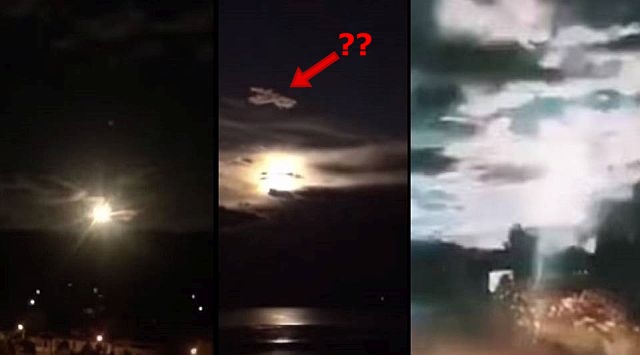
As millions of Chinese celebrated their mid-autumn national holiday gazing heavenward towards the full moon that lit up the night sky, their awe and wonderment turned to fear and amazement as a huge fireball exploded with a deafening bang and a blaze of light which, for a few seconds turned the dark night sky into dazzling bright daylight.
The many people who witnessed it were frozen in fear of it being caused by a wayward missile test from North Korea but these fears were quickly allayed as it became clear that the stunning display of pyrotechnics was in fact caused by an exploding meteor over Shangri-La County in south-west China at around 8 pm on the 4th of October.
This rare astrological event dubbed a ‘superbolide’ happened when a meteor exploded into a bright fireball as it entered the Earth’s atmosphere at an altitude of 37 km (23miles) and traveled at an immense speed of 14.6 km per second (9 miles per second). NASA reported on their Chinese social media page that the superbolide had exploded with the equivalent force of 540 tonnes of TNT.
From Wikipedia, a bolide (from the French word for missile) is an extremely bright meteor that explodes in the atmosphere and has an apparent magnitude of −14 or brighter whereas a superbolide is a bolide which reaches an apparent magnitude of −17 or brighter.
Due to the number of witnesses, Chinese social media was rife with pictures and videos immediately following the event with many also questioning its bizarre coincidental timing and of its brightness even surpassing the brightest full moon of the year on the annual mid-autumn holiday.
In the aftermath of the explosion, which was loud enough to shake windows of the houses below, millions of fragments were seen falling to earth, and Chinese officials and members of the public who had witnessed this rare event rushed to find a memento of this once in a lifetime mid-autumn festival event. Many traditions and myths have grown up over the years around the ‘Moon Cake’ festival which is the second most important in the Chinese calendar and celebrates the moon at its brightest as families come together to give thanks for the harvest and pray for the future and no doubt, this incredible superbolide will too enter the Chinese psyche and its story be told for many years to come.
FBI DOCUMENT REVEALED: A MULTIDEMSIONAL ALIEN RACE VISITS EARTH SINCE 1947
A few years ago an FBI document revealed the existence of extraterrestrial (multidimensional) creatures. With this document declassified the FBI indirectly wanted to alert us to the presence of aliens who could manifest with their spaceships, opening the distance between the dimensions.
1. One part of the vessel sighted contained passengers inside, while another part was under remote control (remote control).
2. The mission is peaceful, visitors are planning to stay on the planet.
3. The type of race in question, the "visitors", has enormous dimensions, but human facets.
4. They are not earthly and come from your world.
5. They come from an "Etheric World" that we do not know, so they do not come from any other known planet.
6. The bodies of visitors and their ships materialize through vibrations with the dense matter of the Earth.
7. Your ships have beams of energy that can disintegrate any aircraft and can suddenly disappear from our vision without a trace.
8. The region from which they come is the astral plane corresponding to Loka or Talas. The esoteric will understand these words. In fact, the Loka-Talas, which are not physical or metaphysical places, are different levels of consciousness. Each plane of consciousness different from ours is a parallel dimensional plane.
9. Visitors use a radar system that allows you to capture the opening location to move from one dimension to another.
The priorities of NASA when looking into the future of space exploration are subject to change. The Bush administration in 2004 announced the Vision for Space Exploration, and this asked for rockets to return astronauts to the moon.
This was then taken over by the NASA Authorization Act of 2010, and this gave outlines of plans to send human beings to an asteroid in 2025 and by 2030 to Mars.
PLANS LAID OUT BY ADMINISTRATION FOR GOING BACK TO MOON SAYS, VP MIKE PENCE
VP PENCE SAYS PRIORITIES HAVE CHANGED
Now the Vice President Mike Pence along with many members of the Trump administration has revealed priorities have changed again and instead of a journey to Mars, the administration has now set their sights on taking crewed missions to the Moon once again along with setting up a permanent presence on the surface of the Moon.
This announcement came at the inaugural meeting of National Space Council. This is s group that is newly-established that is going to guide the US policy over the years to come. It had been established originally in 1989 by George H.W. Bush, but then in 1993, it was disbanded by Clinton. The council is going to be serving the same purpose as that of the National Aeronautics and Space Council.
The meeting was held at the Smithsonian National Air and Space Museum in Virginia, and Mike Pence chaired it with help from Robert Lightfoot, the NASA Administrator. It was also attended by Donald Trump’s administration cabinet members, aerospace industry leaders and senior officials.
PENCE WANTS TO RESTORE NASA AS LEADERS IN SPACE
Throughout the meeting, Mike Pence laid out plans of the administrator for taking astronauts back to the Moon. He emphasized the need to be able to restore NASA and the leadership of the US in space. Pence made a comparison to the early years of the Space Race and today and the achievement of the Apollo 11 mission.
A statement said that it was fitting that the week had been chosen for holding the first of the National Space Council meetings as it was the 60th anniversary of Sputnik. It was on that day that the race for space started, six decades ago. While the Soviets took the lead, the US claimed their place and one giant leap for mankind led America into space.
RE-ESTABLISHMENT OF NATIONAL SPACE COUNCIL ENDS STALLED SPACE EXPLORATION
Pence had indicated that by re-establishing the National Space Council he would put an end to how space exploration had stalled over the recent decades and said how returning to the Moon is one goal that diminished in the post-Apollo era but which would be recaptured and go on to reinvigorate modern day space exploration.
Pence said that a new interest in missions to the Moon would end the decades that not one single astronaut from NASA had gone beyond Low Earth orbit. He also gave an indication how following the retirement of the Space Shuttle Program the United States became dependent on Russia to take astronauts to the International Space Station.
REVELATION ENDS MONTHS OF SPECULATION ABOUT SPACE POLICY OF TRUMP
The new policy does seem to break from the policy brought in by the Obama administration, and it goes back to the one from the Bush administration. Pence said that by returning astronauts to the moon, they would be taking a much-needed step towards eventually sending a crewed mission to Mars. The revelation also ended many months of ambiguity about the space policy of Donald Trump. Pence has, in the past, talked about the need for men to return to the Moon but nothing came from it. NASA has always been somewhat unsure about the future budget. The meeting didn’t indicate as to the fact that the Trump administration does have a policy but a lot of aspects had been in place before the administration took over.
When the meeting had come to an end, the administrator of NASA Robert Lightfoot opened up about the results in a press statement from NASA. It was said that NASA was directed to come up with a plan for a sustainable and innovative program of exploration with both international and commercial partners that would allow humans to expand the solar system and ensure the return of humans to the Moon both for utilization and long-term exploration.
$19.5 billion in the fund has been allocated to NASA for guaranteeing stability over the short-term in the fiscal year 2017. Lightfoot said that the meeting to send men back to the Moon had helped in assisting the efforts of NASA to send manned crews to Mars.
FEATURED, JOURNEY TO MARS, NASA, TRUMP ADMINISTRATION
Advanced ancient technology beneath Egypt: 100-ton stone boxes baffle researchers
Ultimate evidence a lost ancient technology created before the time of the Dynastic Egyptians. Inside a tunnel system carved out of the solid limestone bedrock in the desert of Egypt, more than 20 granite boxes made of precision shaped Aswan granite are a true enigma. Said by some to have been the burial places of prized bulls, their real function is far more intriguing.B. Foerster.
Ever since people turned towards the study of the ancient Egyptian culture and their achievements through thousands of years, we have been left amazed by everything that ancient cultures were able to achieve thousands of years ago.
A massive amount of evidence is piling up supporting the idea that our ancestors had in their possession, thousands of years ago a technology that we can only dream about today.
This technology allowed ancient cultures like the ancient Egyptians to cut, transport, stack and place blocks of stones weighing up to ONE HUNDRED TONS.
Mainstream scholars tell us this was achieved by sticks and stones. However, places like the Serapeum of Saqqara tell a DIFFERENT story.
Ever since its discovery in 1850, the Serapeum of Saqqara has been a mind-boggling location filled with mystery.
This majestic ancient labyrinth is home to 25 megalithic stone ‘boxes,’ weighing between 70 to 100 tons. The existence of these massive blocks of stone is the ultimate proof that the builders of these incredible ‘boxes’ possessed incredible knowledge in fields such as geometry and mathematics, and had the necessary technology to shape, cut, transport and place into position massive blocks of stone.
Some believe the massive boxes were used as burial chambers, other’s like author and explorer Brien Foerster suggest the truth behind the Serapeum is beyond fascinating and has nothing to do with alleged burial chambers for bulls.
We know that the boxes were not: they were not burial places of bulls.
It is noteworthy to mention that when the Serapeum of Saqqara was discovered, some of the massive boxes were blown open with gunpowder, only to find the inside of these giant boxes empty.
Researchers have no idea what their actual purpose is now how these giant boxes were assembled thousands of years ago.
Interestingly, most of these boxes are made of rose granite, an extremely hard rock mined at a quarry located about 800 kilometers from Saqqara while other boxes were made from an even stronger material, diorite, found even further away from Saqqara.
This makes you wonder; what kind of technology was used in the distant past to precisely cut, shape, transport, and place into position massive blocks of stones that weigh up to ONE HUNDRED TONS?
Is it possible that the knowledge and technology did in fact originate from the stars as many ancient astronaut theorists suggest? Or are we missing something in history, an incredibly important moment in ancient history overlooked by mainstream scholars, a moment that could explain the knowledge and ability of ancient civilizations such as the Egyptian?
“Inside a tunnel system carved out of the solid limestone bedrock in the desert of Egypt, more than 20 granite boxes made of precision shaped Aswan granite are a true enigma. Said by some to have been the burial places of prized bulls, their real function is far more intriguing. And they are clear examples of Lost Ancient High Technology created before the time of the Dynastic Egyptians.”
To understand this, we have to look back in history to a period called Pre-Pharaonic Egypt.
In Ancient Egypt, long before the first ‘mortal’ Pharaoh known as Menes-Narmer ruled over the lands of Egypt there were other kings, deities and “those who came from above” who ruled over the land known as Egypt today.
This time in history, the pre-pharaonic period remains a great mystery for most scholars and Egyptologist, mostly because they cannot accept that what is written since it goes directly against the beliefs of most historians, archaeologists, and Egyptologists.
The time before 3000 BC, the date when the first official Pharaoh appeared in Egypt is a great enigma.
De Kernramp Van Tsjernobyl Vond 30 Jaar Geleden Plaats... Onderzoekers Hebben Een Bijzondere Ontdekking Gedaan!
Als het gevolg van de kernramp die plaatsvond in Tsjernobyl in 1986, werd het gebied rondom de getroffen zone geëvacueerd. Tot op heden wordt het gebied nog steeds niet bewoond door mensen en de duizenden nieuwsgierige mensen die een bezoek willen brengen aan het gebied, worden grotendeels afgeweerd door de handhavers van de wet. Hoewel de plaats is verlaten, worden er talloze onderzoeken verricht in het gebied: naast de controles die worden uitgevoerd bij de kerncentrale en met betrekking tot de straling, wordt ook de fauna rondom Tsjernobyl nauwlettend in de gaten gehouden.
Tot de grote verrassing van de onderzoekers, heeft er een herbevolking plaatsgevonden van de wilde dieren die in de bossen rondom de zone van de rampplek leven.
Als gevolg van de kernramp werd er een groot gebied rondom de getroffen zone afgesloten. In de ring rondom de kerncentrale is minder straling aanwezig.
Deze ring is nu herbevolkt door dieren die van nature voorkomen in dit gebied: er zijn maar liefst 14 zoogdieren waargenomen, waaronder wolven, everzwijnen, beren, vossen en een Iberische lynx.
Er werden 5 weken lang 30 camera's geïnstalleerd die de aanwezigheid van deze zoogdieren hebben vastgelegd.
Dit betekent uiteraard niet dat de straling gunstig is geweest voor de ontwikkeling van de fauna, maar door de afwezigheid van de mens, was de natuur in staat om zich te herstellen en zelfs de meest onherbergzame gebieden opnieuw te veroveren.
Zonder invloeden als de jacht, ontbossing en landbouw, konden de dieren zich weer vestigen op de plekken die ze jaren geleden gedwongen moesten verlaten.
30 jaar na de ramp die de hele wereld schokte, heeft de natuur zegevierend het gebied weer ingenomen.
De conclusie van de onderzoeker was overduidelijk voor de onderzoekers: er is een waar natuurreservaat ontstaan in de bossen van Tsjernobyl!
In de video zie je een kudde wilde paarden die vrij rondzwerven in de onbewoonde bossen. Het zijn Przewalskipaarden, een paardenras dat met uitsterven wordt bedreigd.
Het is wonderbaarlijk om te zien dat er rondom een plek waar dood en verderf heeft plaatsgevonden, nu plaats is gemaakt voor nieuw leven!
WETENSCHAP & PLANEETDe maan heeft lang geleden een dampkring gehad, net als de aarde. Die atmosfeer ontstond meer dan 3 miljard jaar geleden en bestond ongeveer 70 miljoen jaar, maar vervloog uiteindelijk. De gassen verdwenen de ruimte in.
Wetenschappers van de Amerikaanse ruimtevaartorganisatie NASA trekken die conclusie na onderzoek op maanrotsen. Die zijn door maanwandelaars meegenomen naar de aarde. De rotsen zijn gemaakt van basalt en gevormd door oude vulkanen op de maan.
Koolstofmonoxide, zwavel en water
Die vulkanen zijn nu gedoofd, maar barstten veel uit toen de maan nog jong was. Lava stroomde over het oppervlak van de maan en de vulkanen vulden de atmosfeer met onder meer koolstofmonoxide, zwavel en water. Sporen daarvan zijn terug te vinden in de maanrotsen.
De atmosfeer van de maan was 3,5 miljard jaar geleden op zijn dikst. Hij was toen dichter dan de dampkring van Mars nu, maar het is ongeveer 100 keer dunner dan de lucht die wij inademen.
Een deel van de waterdamp is mogelijk terechtgekomen bij de noordpool en de zuidpool van de maan. Daar is het nu misschien nog steeds te vinden, als ijs en water onder het oppervlak.
WETENSCHAP & PLANEETVolgens wetenschappelijke berekeningen zal er volgende week een asteroïde rakelings langs de Aarde scheren. Hij zal ons tot op nauwelijks 44.000 kilometer naderen en dat is op een zucht van de baan waarin telecomsatellieten draaien.
Het gaat om planetoïde 2012 TC4, die op 5 oktober 2012 door een observatorium op Hawaï werd ontdekt. Hij passeerde de aarde toen op 100.000 kilometer. Sindsdien is hij niet meer gezien, omdat hij te klein en te ver weg was om te volgen. (lees hieronder verder)
Het ruimteobject zal op 12 oktober om 07.41 uur het dichtste langs ons scheren en heeft de grootte van een huis (15 tot 30 meter). Hij nadert tot op een afstand die een achtste is van de afstand tussen de Aarde en de maan. Volgens Detlef Koschny van Europees Ruimtevaartbureau ESA is er voor alle duidelijkheid geen enkel risico dat hij de aarde zal raken.
Bedreiging Volgens het ESA en de Amerikaanse ruimtevaartorganisatie NASA biedt de scheervlucht wel een “excellente mogelijkheid om de internationale capaciteiten voor het herkennen en het volgen van objecten in de buurt van de Aarde te testen en onze capaciteiten te onderzoeken hoe wij samen op een reële bedreiging kunnen reageren”. Het systeem voor ‘planetaire verdediging’ bestaat uit een netwerk van observatoria en wetenschappers. (lees hieronder verder)
NASA
In oktober 2079 kan dezelfde asteroïde ons wél treffen, al bedraagt volgens de huidige berekeningen de waarschijnlijkheid amper 1 op 2.645. Ter vergelijking: de asteroïde is maar een beetje groter dan de ruimterots die onze Aarde raakte in februari 2013 vlakbij Chelyabinsk in Rusland. Die was 20 meter breed en had dezelfde energie van 30 atoombommen, van het type dat Hiroshima raakte.
Schokgolf Die creëerde een schokgolf die mensen in de buurt van hun benen blies en de ruiten van duizenden gebouwen vernielde. Er raakten in totaal 1.200 mensen gewond, de meeste door rondvliegend glas en puin. Maar ook door brandwonden, want de gigantische vuurbol gloeide tot 30 keer helderder dan de zon, tot hij op 45 kilometer boven het aardoppervlak uit elkaar begon te vallen.
Mysterious dimming star confounds scientists; theories include planet swallowing and aliens
By Jack Loughran
Mysterious dimming star confounds scientists; theories include planet swallowing and aliens
Scientists researching the memorably-named star KIC 8462852, have said they are confounded by the strange behaviour it exhibits, specifically its rapid, unexplained periods of dimming.
In 2015, Nasa’s Kepler Space Telescope picked up its strange behaviour causing quite a stir in the astronomy community, but despite research efforts since then, scientists are still struggling to understand what causes the phenomena.
The latest findings from Carnegie’s Josh Simon and Benjamin Shappee and collaborators take a longer look at the star, going back to 2006, before its strange behaviour was detected by Kepler.
Astronomers had thought that the star was only getting fainter with time, but the new study shows that it also brightened significantly in 2007 and 2014. These unexpected episodes complicate or rule out nearly all the proposed ideas to explain the star’s observed strangeness.
Speculation to account for KIC 8462852’s dips in brightness have ranged from it having swallowed a nearby planet, to an unusually large group of comets orbiting the star, or an alien megastructure.
In general, stars can appear to dim because a solid object like a planet or a cloud of dust and gas passes between it and the observer, eclipsing and effectively dimming its brightness for a time.
Even before this evidence of two periods of increased brightness in the star’s past, the erratic dimming periods seen in KIC 8462852 were unlike anything astronomers had previously observed.
A study in 2016 found that from 2009 to 2012, KIC 8462852 dimmed by almost 1 per cent. Its brightness then dropped by an extraordinary 2 per cent over just six months, remaining at about that level for the final six months of Kepler observations.
The research team wanted to look at KIC 8462852 over a longer period of time. They went back and examined approximately 11 years of observing data from the All Sky Automated Survey (ASAS) and around two years of more-recent data from the high-precision All-Sky Automated Survey for Supernovae (ASAS-SN).
They found that the star has continued to dim since 2015 and is now 1.5 per cent fainter than it was in February of that year. What’s more, they showed that in addition to the dimming the star has experienced from 2009 to 2013 and 2015 to now, it underwent two periods of brightening.
“Up until this work, we had thought that the star’s changes in brightness were only occurring in one direction - dimming,” Simon explained. “The realisation that the star sometimes gets brighter in addition to periods of dimming is incompatible with most hypotheses to explain its weird behaviour.”
“An important next step will be to determine how the colour of the star changes with time, especially during its brief dips in brightness,” added Shappee. “That information would help narrow down the possible explanations for why this star is doing such strange things.”
For example, if the dimming was caused by dust obscuring the star from us, then it would appear to get redder as it dimmed. If large objects were blocking the star’s light, then no colour change would be seen.
“We haven’t solved the mystery yet,” Simon concluded, “but understanding the star’s long-term changes is a key piece of the puzzle.”
Scientists have been stunned by the dimming and brightening of distant Tabby’s Star, which happens much faster than other stars in the galaxy.
Alien fanatics have argued the phenomenon may have been been caused by an advanced civilisation that zaps light from the star.
But boffins have proposed that objects may be eclipsing the star – some 1,280 light-years from Earth.
GETTY
SOLVED: Boffins believe they have discovered the cause of the planet's dimming
GETTY
OUT OF THIS WORLD: Many believe that aliens exist
“This pretty much rules out the alien megastructure theory”
Human Meng
Nasa’s Spitzer and Swift missions, as well as the Belgian AstroLAB IRIS observatory, have discovered the star’s ultraviolet light could be playing a part in causing the phenomenon.
It means something smaller has caused the incredible “structures” to appear around the star that was discovered in 2015.
The Astrophysical Journal has now proposed that space dust may be to blame.
GETTY
MYSTERY: Some think aliens are causing the strange phenomenon
Human Meng, lead author at the University of Arizona, Tucson said: “This pretty much rules out the alien megastructure theory. as that could not explain the wavelength-dependent dimming.
“We suspect, instead, there is a cloud of dust orbiting the star with a roughly 700-day orbital period.”
Researchers also discovered that the dimming rate of Tabby’s Star differed significantly between UV and infrared lights, suggesting “micro-sized dust screens”.
Some scientists suspect the dimming is caused by a dust ring, but stress “this is not a firm conclusion”.
Parkgoers in Weymouth, Massachusetts came across a bizarre mystery at the Great Esker Park on Monday, October 2nd. Visitors of the park discovered a massive metallic flying saucer seemingly crashed near the bank of the Back River which abuts the park. Park officials rushed to the scene in anticipation of finding a downed alien craft, but were disappointed to find what is clearly a haphazard forgery. Despite its clearly terrestrial origins, the fake UFO is still proving to be a bizarre and unsolved mystery.
Is it me, or are hoaxers getting lazy?
The large, silver object has no markings or identifying information whatsoever aside from a single barcode. The inner frame appears to be wood lined with cardboard, while the outer silver shell is some sort of pliable metal.
Saucers ain’t what they used to be.
Park employees with the Weymouth Recreation Division originally speculated that the saucer-shaped object could be some form of crude tent or shelter built by a vagrant or mentally ill individual. However, just exactly how someone could have constructed it without attracting attention or moved it into the park remains a mystery.µ
The duct tape improves aerodynamics serves as a heat shield during atmospheric re-entry.
Andrew Hultin, a program coordinator for Weymouth Recreation Division, says the object has baffled his staff:
It was pretty heavy to lift and it is not something that anyone of us could have moved by ourselves. It is about 25-feet long and 10-feet wide with an exterior shell made of shiny silver material. We have no idea who might have built this thing or how it could have got there. It was found about 200 yards in the woods. Other than that we have no other information. We are puzzled. There is no way for us to remove it without destroying it. It is still at the site. We are contemplating our next step.
Is this some kids’ idea of a prank, or have alien visitors fallen on hard times and turned to shoddy aerospace contractors in light of some sort of intergalactic recession? If you know anything about the Weymouth saucer, park officials would like to speak with you.
Extreem zeldzaam element gedraagt zich alsof het uit een ander universum komt. Dit onderzoek ontrafelt mysteries
Onderaan het periodiek systeem bevinden zich enkele superzware radioactieve elementen die zo zeldzaam zijn dat ze niet in de natuur kunnen worden gevonden.
Eén van deze elementen is berkelium, vernoemd naar wetenschappers van de Universiteit van Californië – Berkeley.
Er is maar heel weinig bekend over dit element. In 1967 werd slechts een gram hiervan geproduceerd in een Amerikaans laboratorium.
Herzien
Baanbrekend nieuw onderzoek begint de mysteries rond dit metaal nu te ontrafelen. De elektronen in berkelium blijken zich op een hele vreemde manier te gedragen en lijken de regels van de kwantummechanica aan hun laars te lappen.
Hoe meer we leren over dit element, hoe meer we algemeen aanvaarde theorieën zullen moeten herzien.
“Het is alsof je in een ander universum zit omdat je scheikundige processen ziet die je niet ziet in alledaagse elementen,” zei Thomas Albrecht-Schmitt van de Florida State University.
Anders
De elektronen in berkelium schikken zich bijvoorbeeld anders rond hun atomen dan de elektronen in andere elementen. Ze staan ook niet allemaal in dezelfde richting.
Het komt er in feite op neer dat de regels van de kwantummechanica niet langer van toepassing zijn.
Onderzoekers hebben waargenomen dat de elektronen in berkelium zwaarder worden als ze met extreem hoge snelheden rond de atomen beginnen te bewegen.
Vreemd
Deze waarneming sluit beter aan op Einsteins relativiteitstheorie. En dat is vreemd, aangezien Einsteins theorie normaal gesproken alleen van toepassing is op grootschalige processen in het heelal.
Investigations Say Deputy Sheriff Did Witness Crashed UFO and Dead Aliens
Investigators have concluded that a former deputy sheriff’s claim of witnessing a strange crash scene outside UFO hotspot Roswell, New Mexico is real.
The late Charles Forgus’ video interview circulated in June wherein he claimed to have seen the crash site of the Roswell UFO in July 1947 along with his senior. Forgus was a deputy sheriff of Big Springs in Howard County, Texas.
Mr Forgus told a private investigator that they saw a crashed UFO and dead extraterrestrials before they were being told to leave the scene. He further noted that they saw remains of aliens being removed from the flying saucer.
The account was recorded on video in 1999 and released in the book titled “UFOs TODAY, 70 Years of Lies, Misinformation and Government Cover-Up,” by Irena Scott, and published by Philip Mantle in June. British UFO investigator Mantle said that many criticised him for releasing the video as they believe that it was a false testimony. However, Mr Mantle believes otherwise after further inquiries.
Roswell UFO Incident took place in July 1947, and it started to become sensational after the military announced in a press release that it had found the crashed flying saucer in the desert nearby. However, it retracted the statement the following day, saying it was just a damaged US Air Force air balloon.
Many people later claimed to have seen dead alien bodies within the crashed craft. They further said that the military took the wreckage and the alien remains to a top-secret military base.
The bizarre behaviour of a star 1,300 light years from Earth may have finally been explained. NASA says the big dips in brightness of the star—KIC 8462852—could be down to a massive, uneven cloud of dust moving around it.
This is far less of an exotic explanation than other theories proposed over the last few years, which include an “alien megastructure” built by some advanced extraterrestrial civilization to harness power from the star.
Scientists first announced that they had observed weird dips in the brightness of KIC 8462852 in 2015. Normally, when you observe a star and an object—a planet, for example—passes in front of it, there is a small dip in the amount of light coming from that star. Because the size of the planet is fixed, the dip would happen at regular intervals and would block the same amount of light each time. But this is not what happened with KIC 8462852.
What the astronomers saw were huge fluctuations in the star’s brightness, ranging from two percent up to 20 percent, at irregular intervals. To block this much of the star’s light, the object must be extraordinarily large—a Jupiter-sized planet would block about two percent of the light from our sun.
An artist's impression of KIC 8462852, a mysterious star more than 1,400 light-years away.
NASA/JPL-CALTECH
Many hypotheses have been put forward over the last few years, including a massive swarm of comets and a giant ringed planet orbiting very close to KIC 8462852. None of these explanations quite explain what was being offered, however.
In an interview with Newsweek earlier this year, Louisiana State University’s Tabetha Boyajian, who first discovered the dimming, said: “Every theory that’s been proposed is [far more extreme] than what we know to exist now. So we’re looking for a solution that works with a reasonable physical mechanism we can postulate.”
However, the mystery may now have been solved. In a study published in The Astrophysical Journal, researchers used NASA's Spitzer and Swift missions to examine the dimming in different wavelengths. What they found was there was less dimming when looking at the star in infrared light than when they observed it in ultraviolet.
If the cause of the dimming was anything bigger than dust particles, then the dimming in different wavelengths would be the same. "This pretty much rules out the alien megastructure theory, as that could not explain the wavelength-dependent dimming," lead author Huan Meng, at the University of Arizona, Tucson, said in a statement from NASA. "We suspect, instead, there is a cloud of dust orbiting the star with a roughly 700-day orbital period."
Artist impression of an uneven ring of dust orbiting KIC 8462852.NASA/JPL-CALTECH
The team observed KIC 8462852 between January and December last year. Findings showed the dimming was more pronounced in the infrared wavelength, suggesting the particles are bigger than interstellar dust—tiny particles that cannot remain in orbit around a star because pressure would drive it away.
This meant there was only one plausible explanation—circumstellar dust. This is bigger than interstellar dust, but no so big that the dimming would become uniform across the various wavelengths. Concluding, the authors say a huge, uneven cloud of circumstellar dust could explain the irregular dimming observed.
Their hypothesis comes with problems. It does not address short-term dimming events seen, nor does it explain the dips where 20 percent of the star’s light is blocked. Potentially, the dimming could be the result of this dust cloud combined with a massive swarm of comets. However, further research will be needed to fully solve the mystery of KIC 8462852.
Observations of the star revealed it was alternately dimming and brightening - and immediately sparked theories of an alien civilisation somehow harvesting the star for energy.
Instead, it appears that space dust might be the culprit.
According to a new study published in the Astrophysical Journal, a cloud of cosmic dust may be orbiting the star roughly every 700 days - causing the light from the star to dim periodically.
Observations showed that the star's ultraviolet light was dimming more than its infrared light.
Huan Meng, lead author of the study at the University of Arizona, Tucson said: “This pretty much rules out the alien megastructure theory, as that could not explain the wavelength-dependent dimming."
The team used two NASA telescopes to watch Tabby's Star (officially known as KIC 8462852) from October 2015 to March 2017 in order to measure the UV and infrared dimming.
1. Dubbed as KIC 8462852 aka Tabby's Star, and present 1,280 light years away from Earth in the constellation Cygnus, the star was an area of interest for astronomers and researchers because of the weird phenomenon it possessed. The star showed sudden drops in its luminosity, which is not a normal behaviour portrayed by a star that is slightly bigger than the Sun.
2. The first significant drop of 15 percent in the star's luminosity was observed on 5 March 2011. The next time the luminosity dropped around 22 percent, which took place 726 days later on 28 February 2013. The third drop in the star's luminosity was around 8 percent, which was analysed 48 days later on 17 April 2013.
3. In September 2015, a cohort of astronomers from Yale University with Tabetha S. Boyajian as the lead researcher analysed the star and found that there was a drop of almost 22 percent in its luminosity. The star has been nicknamed 'Tabby's Star' in honour of the team lead -- Tabetha.
4. This mysterious phenomenon led to the formation of numerous hypotheses like: The star might have swallowed a planet and it is not stable. A popular conspiracy theory that was formulated because of the star's mysterious phenomenon was that an alien megastructure orbiting around the star was causing the fluctuation in its luminosity. One more theory formed by researchers was a group of space rocks and debris are responsible for the star's dimming.
This artist's illustration shows comet fragments crossing the face of a star, one possible explanation for the strange dimming exhibited by Boyajian's star or Tabby star.NASA/JPL-Caltech
5. Further research carried out by astronomers from the University of Arizona, US with the help of NASA's Spitzer and Swift missions and AstroLAB IRIS observatory -- a public observatory with a 68 centimetre reflecting telescope located near the Belgian village of Zillebeke -- came to the conclusion that the dimming of the star is because of the presence of uneven dust cloud that is moving around the star.
6.Researchers found less dimming in the infrared light from the star than in its ultraviolet light using Spitzer.
"This pretty much rules out the alien megastructure theory, as that could not explain the wavelength-dependent dimming," said Huan Meng from the University of Arizona, who is the lead author of the study.
"We suspect, instead, there is a cloud of dust orbiting the star with a roughly 700-day orbital period," Meng added.
7.Based on the strong UV dip, the astronomers concluded that the blocking particles must be bigger than interstellar dust, small grains that could be located anywhere between Earth and the star. Such small particles could not remain in orbit around the star because pressure from its starlight would drive them farther into space. Dust that orbits a star -- circumstellar dust-- is not so small it would fly away nor is it so big that it can block light uniformly in all wavelengths.
According to the researchers this is the best explanation about the enigmatic dimming of the Tabby's star.
The new video, released by NASA on Sept. 25, shows a prototype for an uncrewed Dream Chaser hanging from a Columbia 234-UT helicopter as the spacecraft is carried to the same altitude it will need to be for an upcoming free-flying drop test. The Aug. 30 test carried the Dream Chaser to an altitude of about 12,500 feet (3,810 meters) and was based out of NASA's Armstrong Flight Research Center, which is located at Edwards Air Force Base in the Mojave Desert.
"The captive carry is part of a series of tests for a developmental space act agreement SNC has with NASA's Commercial Crew Program," NASA officials wrote in a video description. "The data from the tests help SNC validate the aerodynamic properties, flight software and control system performance of the Dream Chaser."
Sierra Nevada Corporation's Dream Chaser space plane is prepared for a captive carry test with a Columbia 234 UT helicopter at NASA's Armstrong Flight Research Center in California's Mojave Desert on Aug. 30, 2017.
Credit: NASA/Ken Ulbrich
Sierra Nevada is building the Dream Chaser space plane to carry NASA cargo to the International Space Station as part of the agency's Commercial Resupply Services 2 (CRS-2) program. Under the NASA deal, Sierra Nevada will fly six uncrewed cargo delivery flights for the space agency by 2024. Two other companies, SpaceX and Orbital ATK, also have CRS-2 contracts to fly NASA cargo to the space station.
The Dream Chaser space plane looks much like a miniature space shuttle, but one-quarter the size of NASA's winged spaceships. Dream Chaser is 30 feet long (9.1 m) and designed to carry up to 12,125 lbs. (5,500 kilograms) of cargo to the space station. The spacecraft will launch into orbit atop an Atlas V rocket built by the United Launch Alliance.
The first Dream Chaser flight to the space station is expected to launch in 2020.
Legends of Space, ep 8: Sputnik: The satellite that changed the world
Sputnik's Beeping Legacy: Satellite's Simplicity Made It Iconic 60 Years Ago
By Jesse Emspak, Space.com Contributor
A Soviet technician works on Sputnik 1 before its launch in 1957.
Credit: Sovfoto/UIG via Getty
In October 1957, amateur radio operators monitored the first signal from a spacefaring civilization — and it was us.
Sputnik 1, the first satellite to orbit the Earth, launched on Oct. 4 of that year from a site in Kazakhstan, then a part of the USSR. That site is now the Baikonur Cosmodrome; at the time it was site 1/5 at the Tyuratam range.
The Soviets had planned on a sophisticated scientific satellite, according to Cathy Lewis, curator of international space programs at the National Air and Space Museum at the Smithsonian Institution in Washington, D.C. But they felt they were under time pressure; they wanted a launch as soon as possible because even then they had a sense of urgency. "They needed something very simple," she told Space.com. [Sputnik 1! 7 Fun Facts About Humanity's First Satellite]
What they launched had only a set of batteries, a transmitter and a pressure-activated switch that could tell ground controllers if the 23-inch (58 centimeter) diameter sphere was punctured by a micrometeoroid, Lewis said.
The USSR had been planning satellite launches since January 1956, and the United States since 1955. Both countries planned for their first launches to take place during what had been dubbed the International Geophysical Year, which ran from July 1, 1957, to Dec. 31, 1958. Coincidentally, the IGY was intended to mark a new period of cooperation between the United States, the USSR and other nations. Neither planned launch announcement got much attention until the USSR launched Sputnik and surprised the world.
"There was panic," Lewis said. "For the first time that harsh reality of the fear of nuclear weapons landing came to life. You were not going to have a warning of fleets of bombers."
In the United States, the shock was in part driven by a belief in American technological superiority.
"The U.S. had an image of the Soviets as being technologically limited," said Matt Bille, a historian and author of "The First Space Race" (Texas A&M University Press, 2004). "If not outright backward. While the military had some of this sentiment, the August launch of an R7 (intercontinental ballistic missile) had generally awakened them." [Sputnik 1 in Photos: The World's First Satellite]
On Oct. 4, 1957, the Soviet Union stunned the world with its surprise launch of Sputnik-1.
Credit: Karl Tate, SPACE.com contributor
Bille added that then-President Dwight Eisenhower was not a technically oriented person and was often baffled by the public's reaction to Sputnik. The U.S. already had a missile program and a fledgling space program, and Eisenhower saw them as going well. In fact, the U.S. launched the first intercontinental ballistic missile months before the USSR did.
The Sputnik launch also drove Eisenhower to push for funding for science education at many levels, from grade school to college, via the National Defense Education Act, signed into law in 1958. Lewis said the country's experience in World War II had played a part in this — it was clear during the war that there weren't enough people with technical skills. Bille added that major publications, including U.S. News and World Report, had been lamenting the state of science education in the country, and Sputnik gave an additional push to improve.
The Sputnik launches were more than just a wake-up call for the U.S. In the scramble to show that the United States could stay ahead technologically, the space race was born, and with John F. Kennedy's announcement that the United States was going to attempt to send a man (it was going to be a man, no question) to the moon and bring him back, the die was cast. And there were other political effects; Kennedy, in the late 1950s, ran part of his campaign on the idea that Eisenhower, ever a fiscal conservative, was weak on defense and that the Russians had a sizable advantage in that area. Sputnik, Lewis said, was a gift to people pushing that idea. [Giant Leaps: Milestones of Human Spaceflight]
Bille said one reason the missile-gap concept had currency was that before satellite surveillance, few knew much about what was happening in the USSR at all.
In that sense, Sputnik enabled satellite surveillance, Lewis said. Before the satellite's launch there was some debate over "open skies" — whether spacecraft could fly over the territory of other nations. Aircraft were barred from doing so. Sputnik, Lewis said, made the question moot, because Sputnik flew over the U.S. in the course of its orbit, and therefore U.S. satellites could fly over the Soviet Union.
Even though the Soviets were unable to launch the more ambitious science payload, Lewis said that was part of Sputnik's enduring appeal. The satellite's beeps could be picked up by amateur radio operators; anyone could listen. That wouldn't have been the case for a true science instrument. Today, Sputnik's shape is in the logo of the Russian rocket company Energia, and it gave its name to the "Sputnik chandelier" design that became popular in the 1960s.
And beyond its physical appeal, "there's a simplicity and beauty in being first," Lewis said.
In late 2016, a sighting of a small drone-like object went viral when it was seen hovering above the supervolcano.
Jeanetta Foresta uploaded a video of the sighting under the heading "Things R flying all over - overnight".
She posted: "There were more than four at the beginning and this is overnight so there is no sun to reflect off of a plane.”
Famed UFO blogger Scott C Waring picked up on the video on websiteufosightingsdaily.com.
YOUTUBE
The 'UFO' darted over Yellowstone
He wrote: "Here we have several glowing orbs moving about over Yellowstone and this is the same area as Old Faithful, which could of course attract alien tourists as well as humans.
"Why wouldn't aliens be interested in the Earths natural wonders?
"The movement is proof its not Venus or a hot air balloon. If you knew the truth about the abundance of alien ships, craft and species around us every day, it would blow your mind.”
YOUTUBE
The UFO spotted last year
Yellowstone has also piqued the interest of many around the globe over fears that it could soon erupt.
The Yellowstone Caldera supervolcano last erupted 70,000 years ago but a spike in seismic activity around the national park has unsettled nerves.
If the Wyoming volcano were to erupt it would kill an estimated 87,000 people immediately and make two-thirds of the USA immediately uninhabitable.
GETTY
Yellowstone Volcano
The large spew of ash into the atmosphere would block out sunlight and directly affect life beneath it creating a “nuclear winter”.
The massive eruption could be a staggering 6,000 times as powerful as the one from Washington’s Mount St Helens in 1980 which killed 57 people and deposited ash in 11 different states and five Canadian provinces.
If the volcano explodes, a climate shift would ensue as the volcano would spew massive amounts of sulphur dioxide into the atmosphere, which can form a sulphur aerosol that reflects and absorbs sunlight.
MAN CLAIMS TO BE FROM THE YEAR 2048 WARNS OF AN ALIEN INVASION
A man was arrested by Casper police after he was found to have had too much to drink.
The man then told police that he was a time traveler and aliens had filled his body with alcohol.
JOHNSON CLAIMED TO BE FROM THE YEAR 2048
Police arrested Bryant Johnson on October 2 when they were sent to a street and found him standing in the road saying that he had come from the future and that he was there to help people. Johnson said that he had time traveled from the year 2048 and said that he wanted to warn people that aliens would arrive the next year and that the people should leave as soon as they could.
He then said that he wanted to talk to the president of the town and went on to tell police that he was able to time travel because aliens filled his body with alcohol before standing on a huge pad that transported him to 2017. He went on to say that he should have been transported to 2018 but had ended up landing a year earlier.
Police said that Johnson had bloodshot, watery eyes and his speech was slurred and a strong smell of alcohol was coming from him. He was taken to the emergency room, but it was then said that he was causing a disturbance there. Police gave Johnson a breath test, and it revealed that his blood alcohol content was.136 and he was arrested for being intoxicated in public.
MANY THINK TIME TRAVEL IS POSSIBLE, BUT NOT CASPER POLICE FORCE
While police clearly did not believe that Johnson had traveled in time, it was recently revealed that a leading astrophysicist said that time travel is possible. He also revealed how astronauts could time travel. Talk of time travel is nothing new as it was Albert Einstein who first proposed traveling at the speed of light going away from Earth would slow down time for the person traveling, and people on Earth would see time at the normal rate. Many physicists claim that time travel is not only possible, but it has already occurred. It was said that astronaut Sergei Krikalev is in the future by 0.02 seconds after he spent 804 days in space thanks to time dilation.
Of course, if Johnson had met aliens in the future and they had the superior technology then perhaps time travel is commonplace in 2048.
NASA's Cassini spacecraft captured this image of Saturn's icy moon Dione, with the giant planet and its rings in the background, on August 17, 2015. Measurements by Cassini suggest an ocean may lurk beneath Dione's surface. Credit: NASA/JPL-Caltech/Space Science Institute
Our solar system is filled with oceans. But only a few of those have captivated our attention.
During its 1979 Jupiter flyby, NASA’s Voyager 1 spacecraft found the surface of the moon Europa to be a cracked-up jumble of water ice, as if composed of icebergs floating atop some hidden sea. As the craft moved on to Saturn, it took measurements of that planet’s massive moon, Titan, and revealed the frigid world bore a thick atmosphere that could sustain lakes or seas of liquid hydrocarbons on the veiled, cryogenic surface below.
It took follow-ups by NASA’s Galileo mission that arrived at Jupiter in 1995, and later by the Saturn orbiter Cassini—a joint project between NASA and the European Space Agency (ESA)—to confirm this early evidence for extraterrestrial oceans. Galileo also hinted that two other Jovian moons, Callisto and Ganymede, perhaps harbored oceans as well. Cassini found abundant evidence of multiple ocean-bearing moons during its 13 years of studying the Saturnian system. In part because of these discoveries, both Galileo and Cassini were deliberately crashed into their respective gas-giant subjects, burning up in their atmospheres to avoid any chance of biocontaminating each planet’s promising moons. Galileo’s self-immolation occurred in 2003, and Cassini’s fiery end just unfolded on September 15.
When it reached Saturn in 2004 Cassini deployed a European-built lander, Huygens, to land on Titan’s frozen surface, where it found a bizarre landscape of methane–ethane lakes and hydrocarbon snows. In later observations Cassini revealed Titan possesses a watery ocean beneath its surface of hydrocarbon slush. The breakout star of Cassini’s investigations, however, was unquestionably Enceladus, an icy moon about as big as England is wide—too small, researchers had thought, to sustain much interesting geologic activity.
Against all odds Cassini found the moon jetting plumes of salty water vapor from its south pole—an unmistakable signpost of some kind of mysterious ocean hidden beneath its icy crust. Where there is liquid water, the thinking goes, there might well be life—just as there is on Earth, where water forms the cornerstone of biology as we know it. And unlike Jupiter’s moon Europa, which Galileo had shown contains a sunless sea perhaps impenetrably sealed beneath a thick crust of ice, Enceladus’s plumes offered a way to obtain direct samples of its dark waters. Starry-eyed astrobiologists were instantly enamored with this wee moon—and they still are.
But other astrobiologically interesting moons circle Saturn, too. A bit more than 400,000 kilometers from Enceladus spins another icy satellite, named Dione. Twice as big and similarly coated in ice and snow, it has something else in common with Enceladus: it is probably an ocean world. “There’s really good evidence” for Dione’s ocean, says Bonnie Buratti, a senior research scientist at the Jet Propulsion Laboratory who worked on the Cassini mission. “I kind of feel this is one of the things we’ve left hanging as we leave the Saturn system, that we just haven’t answered.”
Ocean worlds are bodies in the solar system that manage (or managed in the past, like Mars) to hold onto enough liquid water to form seas, lakes and other potential aquatic abodes for life. The newly discovered ones in the outer solar system still harboring oceans today all possess some internal energy source that keeps them from freezing solid like some of their siblings. Scientists argue over the details but most agree those worlds are warmed from within by a combination of radioactive decay and tidal heating (the friction-inducing flexure of their crusts from the gravitational pull of the parent planet).
Buratti lays out the case for Dione’s membership in this elite club: Its surface is fairly smooth, meaning something has been filling in and covering up the spots where craters and fissures might otherwise form. Liquid water rising from a moon-girdling subsurface reservoir, then freezing, would work nicely for that. Tentative evidence from Cassini’s instruments also hinted at plume activity—albeit much weaker than at Enceladus—as if a similar but subtler mechanism is at play inside Dione. Buratti and others suspect that Janiculum Dorsa, one of the moon’s few mountains, may be somehow responsible, but the scientists were unable to gather definitive proof before Cassini’s termination.
Janiculum Dorsa may be Dione’s equivalent of Enceladus’s south pole, where water gushes more than 60 kilometers into space. On the latter this mechanism (called cryovolcanism) is fed by an underwater ocean—and there is similar albeit more circumstantial evidence for Janiculum Dorsa as the source of similar “cryovolcanic” plume activity on Dione.
Cassini’s measurements of Dione’s gravitational field also indicate that something strange is going on beneath the surface. When a spacecraft flies by a completely solid body, the craft’s trajectory tends to be more or less “straight.” In simple terms, it flies by without a discernable difference in the amount of gravity attracting it. But if the body is less homogeneous—for instance, a liquid ocean beneath an icy crust—the spacecraft’s trajectory can exhibit faint but detectable deviations in the tug due to this liquid mass. This is precisely what Cassini experienced as it swooped by Dione. “If Dione has an ocean, it’s another example where there might be a habitable environment because we have liquid water—there’s a heat source and there might be organic molecules in there that contribute to primitive bacterial life,” Buratti says.
And Dione is not the only promising place passed over by many astrobiologists infatuated with Enceladus, Titan and Europa. There are at least a half dozen other ocean worlds that might merit inclusion in the quest to discover alien life. “Might” being the operative term here—these oft-overlooked oceans tend to be less accessible than their more popular peers. They are either locked beneath thicker ice crusts or just so far out in the solar system (in the cases of moons of Uranus and Neptune) that no one can yet say how promising their hidden seas really are. That is, save Dione—which appears to be a sleepier but no less interesting cross between Enceladus and Europa.
THE MOST MASSIVE MOON OF ALL
Ganymede is a truly giant moon. Larger than Mercury and not much smaller than Mars, it is a would-be planet forever demoted from that lofty status by its host Jupiter. Just as Dione is perennially overshadowed by Enceladus and Titan, Ganymede tends to take a back seat to its sister ocean world, Europa, which is slated to be studied up close by NASA’s Europa Clipper mission sometime in the 2020s. But Ganymede is deserving of study, too: Telltale cycles of auroral activity on the surface, witnessed from afar by the Hubble Space Telescope in Earth orbit, reveal oscillations in the moon’s magnetic field best explained by the internal sloshing of a huge ocean hundreds of kilometers below the surface.
How huge? Olivier Witasse, a project scientist working on ESA’s future Jupiter Icy Moon Explorer (JUICE), says Ganymede’s ocean is even bigger than Europa’s—and might be the largest in the entire solar system. “The Ganymede ocean is believed to contain more water than the Europan one,” he says. “Six times more water in Ganymede’s ocean than in Earth's ocean, and three times more than Europa.”
UICE will orbit Ganymede, giving scientists a chance to study this second-fiddle moon in detail. On the way there the craft will make several sweeps past another potentially ocean-bearing Jovian moon, Callisto. “We think that Callisto also harbors a subsurface ocean, but the available data is unclear,” Witasse says. “What we hope to do is to check whether there is an ocean or not—and if yes, at which depth.”
ICY MOONS AROUND ICY GIANTS
Out past Jupiter and Saturn other ocean worlds may be found as well. The moon Ariel twirls in a two-day orbit just 190,000 kilometers from the gas-giant Uranus. All we know about the moon comes from a single encounter with the Voyager 2 spacecraft in 1986. That flyby revealed Ariel to be relatively smooth, as if its surface was being continually renewed by activity deep within. It is currently believed to be the only ocean world in the Uranian system.
The smoothness of Ariel’s surface may be a hallmark of “extrusive cryovolcanism,” or geyser activity that throws material onto a world’s surface. Imagine a flow of molten rock from a volcano on Earth, except with the flow being made of molten ice—in other words, liquid water. Zibi Turtle, a planetary scientist at the Johns Hopkins University Applied Physics Laboratory, says finding and studying instances of cryovolcanism would be a “holy grail in solar system evolution” that could explain how icy worlds, oceanic or not, change over time. She says there may also be a tentative connection between Ariel’s geology and the Uranian rings—but without more data, not much more can be said. (Enceladus’s plumes similarly interact with one of the rings of Saturn, steadily replenishing and maintaining the ring’s tenuous existence with injections of icy particles.) “Really, the best way to learn about the interiors and geologic history—the evolution of these satellites—is going to be another mission that goes through or in orbit around the Uranian system,” she notes.
Farther out, the gas-giant planet Neptune has only one moon of any substantial size, Triton. The satellite appears to be a captured interloper from the Kuiper Belt, a diffuse ring of icy bodies at the outer reaches of the solar system. That would make it kin to Pluto, the Kuiper Belt’s largest denizen. Data from Voyager 2, which encountered Neptune in 1989, suggest Triton possesses a very thin atmosphere and more than a few geysers on its surface. “What is actually driving the cryovolcanism? It’s got to be pretty powerful because it’s shooting this material quite high above tiny Triton,” says Heidi Hammel, a senior research scientist at the Space Science Institute. “It’s not just that it’s leaking, it’s jetting these materials.” The answer, as far as researchers can tell, is the same combination of radioactive decay and tidal forces that sustains oceans on other frozen moons of the outer solar system. But geysers that shoot as high as Triton’s, she notes, would require a particularly potent heat source and a massive ocean. “There’s no doubt that there’s a case to be made to look at Triton in the light of a very habitable environment,” she says. “It’s an active world. It has cryovolcanoes and we’ve seen them. There’s a whole lot of material from these cryovolcanoes that is black, dark,” which indicates the presence of organic materials, according to Hammel.
Triton, it seems, is a hipster ocean world—it was seen spouting geysers decades before the plumes of Enceladus were astrobiology’s next big thing. That it has been overlooked for so long is due to its immense distance from Earth and the fact that it has only been visited once, for a handful of hours by Voyager 2. But if Triton is so promising, what then of Pluto, its Kuiper Belt cousin? On this world, planetary scientists may find the weirdest potential ocean world of all.
THE HEART OF THE MATTER
During its 2015 Pluto flyby NASA’s New Horizons probe only had about 12 hours to study the dwarf planet Pluto before it was a fading point of light in the rearview. The spacecraft had to make use of every available moment, and that intense scrutiny revealed signs of something spectacular but not yet entirely certain: Pluto appears to have an ocean, too.
Pluto's Moon Charon
Scientists had long suspected what New Horizons confirmed: Pluto is mostly made of ices—not only water, but also of more volatile substances like nitrogen and methane that freeze solid at extremely low temperatures. Yet the spacecraft measured Pluto to be more compact than it was expected to be, given its mass, because freezing water should have expanded and pushed the surface outward. There is also a surprising amount of geologic activity at Sputnik Planitia, the heart-shaped region sprawled across one of Pluto’s hemispheres. All that tumult on a world long thought to be locked in deep-freeze suggests some reservoir of heat must linger within—an ocean, perhaps. If so, though, that ocean would be decidedly atypical.
Bill McKinnon, a Washington University in Saint Louis professor and New Horizons team member, says ammonia is believed to be plentiful on Pluto, albeit hard to detect remotely from a spacecraft flying by at thousands of kilometers per hour. That ammonia, he says, should mix with any water below, which might still be in liquid form even billions of years after the dwarf planet’s formation. “If the ocean is able to cool and not freeze, then the ammonia helps to keep it from disappearing,” he says. This would make the ocean fairly viscous. “At those temperatures it ends up having the consistency of honey,” he says. But the scant bit of time New Horizons spent in the Plutonian system means one unfortunate thing: There is insufficient data to conclusively prove the model. “It’s a story, it’s not proof,” McKinnon notes. “At least it hangs together conceptually.”
Cracks in Pluto's Moon Could Indicate it Once Had an Underground Ocean
The only way to further study these ocean worlds is via targeted missions. Europa, of course, will be lavished with attention by Europa Clipper and JUICE. But outside of that, Ganymede and Callisto are currently the sole also-ran ocean worlds with planned visits—from JUICE. Despite their revered status, even Enceladus and Titan lack committed follow-up investigations, but that could change by the end of the year if NASA chooses to pursue a mission to either as part of the agency’s New Frontiers program of midsize interplanetary missions. Uranus and Neptune missions have been discussed—and rejected—for decades, with no concepts for exploration ever advancing beyond the preplanning stages. Of all the lesser-known worlds, Turtle says, “the two that really cry out to me are Ariel and Dione. I think Dione has some surprises still.”
JUICE could make Ganymede and Callisto’s oceans seem less remote and more dynamic, and maybe even confirm some tentative evidence of cryovolcanism at Ganymede, once again revolutionizing our understanding of these mysterious moons. But without more missions to the outer solar system, inquisitive scientists—as well as the curious public they serve—will be left with more questions than answers for several decades to come. The oceans, of course, will wait. Will we?
A local UFO researcher says Kansas City is a hot spot for sightings.
Margie Kay is assistant state director for the Missouri chapter of MUFON, the Mutual UFO Network, and author of a new book, The Kansas City UFO Flaps. The publication documents numerous sightings, mostly in Eastern Jackson County in 2011 and 2012.
"Flap" is a term used to describe sudden grouping of sightings of UFOs in an area that appear to be related.
The accounts involve close encounters in which someone had a really good look at strange objects in the sky, Kay said. In one case, a photograph showed what she called small beings that don't appear to be human.
"There's never cooperation from government agencies," Kay said. "We filed a freedom of information request asking for radar reports and there's hardly ever a response."
A lot of people report seeing multi-colored objects that rotate counter clockwise at high rates of speed. The sightings continue, Kay said.
MUFON wants people to file reports whenever they see something in the sky they can't explain. The organization has set up an online registry.
Yet another theory has been developed to explain the mysteries of Tabby's Star, one much more plausible than previous, eccentric theories of an "alien megastructure." A new study from NASA and Belgian AstroLAB IRIS observatory suggests that the star's odd behavior could be explained by an "uneven dust cloud."
This is not the most exciting explanation of the famous-in-astronomy-circles Tabby's Star, also known as KIC 8462852. It's been observed in the night sky since 1890, but in September 2015, Dr. Tabetha Boyajian, then of Yale and now of Louisiana State, published a paper titled "Where's the Flux?" which looked at 846's highly unusual light curve. Tabby's Star, as it became known, would experience a series of eccentric photometric "dips," which would dim its light with seemingly no pattern.
Theories erupted about what could be causing the dips. The most outlandish of these was that Tabby's Star was, or at least was involved in, the creation of an alien superstructure. But there have been other, more plausible theories. A planet with uneven, wobbly rings near the star could also potentially generate a similar effect.
Continued study, however, has shown less dimming in the infrared light coming from Tabby's Star than in its ultraviolet light.
"This pretty much rules out the alien megastructure theory, as that could not explain the wavelength-dependent dimming," says Huan Meng, at the University of Arizona, Tucson, who is lead author of the new study looking at the dust theory published in The Astrophysical Journal, in a press statement. "We suspect, instead, there is a cloud of dust orbiting the star with a roughly 700-day orbital period."
From January to December of last year, researchers looked extensively at the light from Tabby's Star in ultraviolet, infrared, and visible. Based on dips in ultraviolet light, they determined that tiny particles were blocking the star's light. Dust near a star, known as circumstellar dust, hits the Goldilocks test for what could be causing continued dimming. It's not so fine that it would fly away from the star, but not thick enough to uniformly cover everything.
NASA compares the experience to going "to the beach on a bright, sunny day and sitting under an umbrella." While the umbrella will block some of the sunlight, it won't be able to stop the sunset from changing colors. The light changes through the scattering of particles, and Tabby's Star might experience a similar process from our vantage point. "The new study suggests," NASA says, "the objects causing the long-period dimming of Tabby's Star can be no more than a few micrometers in diameter (about one ten-thousandth of an inch)."
While NASA appears to be quite confident in the larger dust theory, there are still smaller mysteries within, like a three-day period earlier this year of continued short-term dimming. It's had to move its telescopes off the star for now, but it's clear that Tabby's Star will remain an object of curiosity in the sky.
"Tabby's Star could have something like a solar activity cycle," says Siegfried Vanaverbeke, an AstroLAB volunteer who helped convince the Belgian lab to make it a point of study. "This is something that needs further investigation and will continue to interest scientists for many years to come."
A Fast UFO Flying was Filmed by a US Air Force Veteran, He Sent the Footage to MUFON for Investigation
The UFO was filmed with a DJI Phantom 3 Professional 4K aerial camera mounted on a drone above Ayden District Park travelling too fast to be spotted with a naked eye. The 59- year-old veteran was astonished after reviewing the recorded footage that showed a UFO flying in a blur under the drone.
The retired USAF veteran has told MUFON that he had never previously experienced anything similar in his 20 year military career and that this footage took him back.
The object travelled around 1.2 miles just in one-third of a second, meaning, it travelled at around 13,000 mph per hour or 17 times the speed of sound an altitude of just 50 feet.
The object on the footage can be seen clearly only when slowed down. It is when it stays on the screen long enough to be seen. The description on YouTube video says that it traveled 6200 feet (about 1.2 miles) in 1/3rd of a second.
The UFO was reported with MUFON and then a copy of the video was sent to NASA. Both agencies are investigating and anysing it.
The object looked like a solid metallic object which reflected or emitted its own light.It appears like a blur and it covers a distance during one-third of a second without making a sound.
MUFON’s North Carolina investigator Sanford Davis wrote in the official report that the object was not observed nor seen personally. It was spotted after reviewing drone footage and the whole sighting occured within a third of a second – a stroke arising in the background, streaking across the screen before disappearing in the foreground.
It appears as a white dot, turning into a ‘light disk’ right before it disappears off screen.”
Some users on YouTube commented that it has prosaic origins while the others see it as valid proof of UFO’s existence .
Without any doubts, the results of the NASA analysis will share the former’s opinion.
Neil Armstrong: Their ships were far superior to ours-Boy, was the big”
Everyone is familiar with the broadcast images of Neil Armstrong’s historic first steps on the moon, and many believe his footsteps to be the first ever on the lunar surface. However, during a documented NASA symposium, Armstrong made comments alluding to the fact that not only had other species visited the moon but that there were signs of colonization thereupon.
THE REAL REASON NASA REFUSES A RETURN TO THE MOON
Armstrong stated in an interview with an unnamed professor at the symposium that their presence on the moon during the Apollo 11 mission was immediately noticed and addressed by an alien race. The beings that occupied the lunar airspace made very clear their displeasure of the human’s arrival on the moon’s surface: Armstrong: It was incredible … of course, we had always known there was a possibility … The fact is, we were warned off. There was never any questions then of a space station or a moon city. Professor: How do you mean “warned off”? Armstrong: I can’t go into details, except to say that their ships were far superior to ours both in size and technology – Boy, were they big! … and menacing … No, there is no question of a space station. Armstrong: Naturally – NASA was committed at that time, and couldn’t risk a panic on earth…. But it really was a quick scoop and back again. (Above Top Secret, p. 186) Additionally, there are reports that upon arrival on the moon Armstrong witnessed structures on the surface resembling shops and other buildings obviously not designed by man. It is believed that while footage exists of these findings, the decision was made not to make these films public so as to not incite public panic. NASA’s unwillingness to move forward with lunar cities or even stations can easily be explained by the fear of going against the will of a much more advanced race. Armstrong stated that this fear is what leads to the following Apollo missions to only include a quick landing and sample collection. With this limited access to the moon, NASA or any other space exploration organization would be greatly hindered in their efforts to establish surface space stations of any type and lunar colonies would be completely infeasible. Could it be that human’s exploration of the cosmos is closely regulated by alien races? What lengths would those races go to prevent space travel advancement by humans? Perhaps in the future, humans will gain the favor of the celestial inhabitants and be privy to the mysteries of beyond.
This photograph, taken on the evening of May 26, 1988, is typical of several taken in recent years of enormous, slow-moving structures with lights along the perimeter.
CENTER FOR UFO STUDIES
The sounds of frightened cattle woke a rancher from a sound sleep in the early morning of September 30, 1980, near Rosedale, Victoria, Australia. When he went outside, he was astonished to see a domed disc with orange and blue lights gliding about ten feet above the ground. It rose slightly in the air, hovered briefly above an open 10,000-gallon water tank, and then landed 50 feet away. The rancher jumped on a motorcycle and sped toward the object, which was making a "whistling" sound. Suddenly, an "awful scream" sounded as a black tube extended from the UFO's base. With an ear-splitting bang the strange craft rose into the air. A blast of hot air almost knocked the witness down.
The sounds ceased as the object slowly moved to a position about 30 feet away and eight feet above the ground. Hovering briefly, it dropped debris -- stones, weeds, cow dung -- from underneath it, then flew away, disappearing in the east.
Where the disc had landed could be found a ring of black, flattened grass 30 feet in diameter. When he examined it in the daylight, the witness discovered that all the yellow flowers within the circle had been removed. Only green grass remained. But even more bizarre, the water tank was empty, with no evidence of spillage. Only the muddy residue at the bottom of the tank was left, and there was something peculiar about even this: It had been pulled into a two-foot-high cone shape. The witness was sick with headaches and nausea for more than a week afterward.
A similar ring was found the following December at Bundalaguah, not far from Rosedale. The water in a nearby reservoir was also mysteriously missing.
DANGEROUS UFOS
Did you know that witnesses have reported damaged property and even personal injury after UFO sightings? Take a look at these stories of dangerous UFOs:
It’s official: Researchers have discovered a SECOND Earth
Researchers have confirmed the existence of a SECOND Earth located in the Proxima Centauri System. The planet is believed to have oceans just like Earth…
In the past, thousands of exoplanets have been discovered in the universe, but none of them is like Proxima B.
Proxima b, as has been baptized, has very ‘promising characteristics’: it is probably rocky, slightly more massive than our own planet and is located in the region around its star that would allow liquid water on its surface to exist.
Researchers have discovered a planet located in the Proxima Centauri system, one of the closest stars to Earth which they believe harbors liquid water and potentially alien life.
The planet, named Proxima B is believed to be around 1.3 times the size of our planet and has the ideal temperature on the surface for water in a liquid state to exist.
Proxima B is located four light years away from Earth –over 25 TRILLION MILES—meaning that in order to visit the planet in the near future, future generation would have to come up with super-fast spacecraft that would allow them to travel to the Proxima Centauri system with ease.
If the planet proves to be ‘a SECOND Earth’ it could become one of the best options for future human colonization.
Researchers believe that the temperature on the surface of the planet could be between -90 degrees Celsius and 30 degrees Celsius.
According to researchers, Proxima B may be the best opportunity we have come across to find DIRECT evidence of the existence of Alien Lifeforms outside of out solar system.
The planet which has already been dubbed ‘a second Earth’ is located at an ideal distance from its host star for liquid water to exist, which means that life as we know it is very likely to exist.
Proxima B is the closest exoplanet we have ever discovered, and according to researchers, a mission to the planet to search for signs of life could be something achievable within our lifetime.
The distance from our planet to Proxima B may seem insurmountable, but it is actually formidably shorter when compared to other candidates to host life. This means that Proxima B could become the first objective for future interstellar travel.
Proxima Centauri is a red dwarf located in the constellation Centaurus. The star itself is too weak to be observed with the naked eye, but in recent months, scientists have not taken their eyes off of it.
In fact, during the first half of this year, Proxima Centauri was followed regularly with the HARPS spectrograph installed on the 3.6-meter telescope of the European Southern Observatory (ESO) in La Silla (Chile) and monitored simultaneously with other instruments from around the world.
“Many exoplanets have been found, and many more will be found, but searching for the closest potential Earth-analogue and succeeding has been the experience of a lifetime for all of us,” Dr. Guillem Anglada-Escudé, lead author of the paper, said.
“Many people’s stories and efforts have converged on this discovery. The result is also a tribute to all of them. The search for life on Proxima b comes next.”
There are already two papers which describe and go through the potential habitability of Proxima B.
Future observations, for example using the 39-m ESO E-ELT telescope under construction in Chile, will allow further investigation of Proxima b and of the hypothetical presence of a thick atmosphere and a liquid water reservoir. If this turned out to be the case, it would be very exciting that the nearest star to the Sun also hosts the nearest habitable (perhaps inhabited?) planet. (Source)
Suspected huge asteroid explodes in the sky over Yunnan Province, China
A suspected huge asteroid entered Earth's atmosphere over China on October 4, 2017 and exploded at 37 kilometers height near Shangri-La County in Southwest China's Yunnan Province.
Some people caught the asteroid on camera at the moment of its final impact behind thick clouds.
What strikes is the strange rectangular shaped cloud above the asteroid moments of its final impact as it doesn't really look like a natural cloud but more like cloaked object!
NASA said that the explosion was equivalent to 540 tons of TNT. Seismic agencies registered a seismic impact of 2.1 Magnitude.
Asteroid and meteor observers speculate that there might be remains of the asteroid have been falling on the ground, since the asteroid exploded at a relatively low height above the Earth’s surface.
Two years ago, physicists detected for the first time the infinitesimal ripples in space itself set off when two black holes whirled into each other. The observation of such gravitational waves fulfilled a century-old prediction from Albert Einstein and opened up a whole new way to explore the heavens. Today, three leaders of the massive experiment that made the discovery received the Nobel Prize in Physics.
Rainer Weiss, 85, of the Massachusetts Institute of Technology (MIT) in Cambridge and Kip Thorne, 77, of the California Institute of Technology (Caltech) in Pasadena hatched plans for the Laser Interferometer Gravitational-Wave Observatory (LIGO) in 1984. Barry Barish, 81, a Caltech particle physicist, later guided the construction of the twin LIGO observatories in Hanford, Washington, and Livingston, Louisiana. Weiss will receive one half of the $1.1 million prize, and Thorne and Barish the other half. LIGO's third founder, Ronald Drever, died in Edinburgh on 7 March at age 85. (Nobel Prizes are not awarded posthumously.)
Other physicists rate the discovery of gravitational waves among the most important ever in physics. “It's revolutionary,” says Abraham Loeb, a theorist at Harvard University. It's very rare that we open a completely new window on the universe.”
Weiss, however, says that he finds the prize somewhat embarrassing. “Receiving money for something that was a pleasure to begin with is a little outrageous,” he says. "The best way I can think of it is we're symbols for the much bigger group of people who made [LIGO] happen.” Weiss says he has arranged to donate the prize money to MIT to help support students.
The entire notion of gravitational waves is mind-bending. In 1915, Albert Einstein explained in his general theory of relativity that gravity comes about when mass and energy warp spacetime, causing freely falling objects to follow curving trajectories. A year later he predicted that a twirling barbell-shaped arrangement of mass—such as two spiraling black holes—should radiate ripples in space that would zip through the universe at light-speed.
Detecting the incredibly feeble waves is a challenge. Each of LIGO's L-shaped interferometers acts like a pair of perpendicular rulers. A passing gravitational wave will generally stretch the two 4-kilometer-long arms by different amounts, and by comparing laser light bouncing back and forth in the arms, physicists can detect that slight differential stretching. LIGO’s interferometers can detect a difference in length as small as 1/10,000 the width of a proton.
Rainer Weiss of the Massachusetts Institute of Technology in Cambridge.
Ken Richardson
Kip Thorne of the California Institute of Technology in Pasadena.
Caltech Alumni Association
Weiss, a consummate tinkerer who once flunked out of college, wasn't the first person to think of using an interferometer to try to detect gravitational waves. In the 1960s, U.S. physicist Robert Forward built a small interferometer for the task. However, Weiss analyzed the problem far more thoroughly and recognized the need for kilometers-long interferometers. He also identified the main sources of extraneous noise, and explained how to deal with them in an unpublished report in 1972 that became the basis for LIGO.
After overcoming his initial skepticism, Thorne championed the project and pressed Caltech to pursue gravitational wave research by hiring Drever in 1979. Thorne also shaped LIGO’s scientific goals, says Saul Teukolsky, a theorist at Cornell University. For example, early on, many physicists thought the most likely sources of gravitational waves would be supernova explosions. Thorne realized that pairs of spiraling neutron stars or black holes would be more powerful sources and encouraged experimenters to tailor LIGO to spot them, Teukolsky says. Thorne also pushed physicists to assemble a vast catalog of numerical simulations to help them spot potential signals in their data.
Barry Barish of the California Institute of Technology in Pasadena.
Caltech
If Weiss and Thorne conceived of LIGO, Barish made it a reality. He took over leadership of the project in 1994, when it was stalled and the National Science Foundation was thinking of canceling it. Barish expanded the LIGO collaboration, made a key design change, and saw the project through construction before stepping down in 2005. “LIGO wouldn't have happened without his leadership,” says Stanley Whitcomb, a physicist at Caltech and an original member of LIGO. “It was something that Rai[ner] and Kip couldn't do.”
Barish, too, says he's uncertain what to think of the prize. “I have somewhat ambivalent feelings about the recognition of individuals when so much of this was a team effort,” he says.
Had he lived, Drever would have shared in the prize, many physicists think, even though his difficult personality got him drummed out of LIGO in 1990. Drever invented several key elements of the LIGO design, Whitcomb says, but he was not as self-effacing as Weiss and Thorne. “It will be a cruel thing to Kip and Rai[ner] because they have to live with this [attention] for the rest of their lives,” Whitcomb says. “And it's cruel to Ron because he would have enjoyed it.”
LIGO appears to be delivering on its promise. The first discovery revealed the merger of star-sized black holes that were more massive than theorists had thought possible. Last month, researchers announced the discovery of a fourth black-hole merger that had been spotted not only by the LIGO detectors, but also by Europe’s premiere detector—the freshly upgraded Virgo detector near Pisa, Italy—which enabled scientists to better pinpoint the merger’s location on the sky. And rumors are swirling that LIGO has spotted the merger of two neutron stars in a violent explosion that was also seen by conventional telescopes. Such “multimessenger” astronomy could provide unprecedented insight into numerous astrophysical phenomena.
The one thing LIGO has yet to deliver is a surprise, Weiss notes. “We haven’t found anything that we can’t explain at all,” he says. “I hope that will happen.”
The Mystery Of Great Pyramid Of Giza Revealed In Ancient Papyrus Just Discovered
One of the most mysterious and inexplicable constructions on the planet – The Giza pyramids had kept their secrets all the way through many thousands of years. Our best archeologists and researchers around the world desperate to unravel the secret behind the method how this megalith pyramids are constructed.
The primary reason that almost all Archaeologists disagreed with it’s exactly how the components was transported to Giza, currently a part of modern-day Cairo, for construction of Pharaoh Khufu’s tomb in 2600 BC.
Exactly how could possibly people with relatively crude equipment might possibly transfer several hundreds of tons of materials from Aswan, 500 miles to the southern area each and every day?
Is the answer to thousands years old question on the ancient papyrus?
An ancient papyrus scroll that dates back to 2600BC has been recently discovered and is the only first hand account of how the pyramid was built. Image Credit: Channel 4
This question might be just answered by the new discovery of an ancient papyrus, a ceremonial vessel along with system of a waterworks had uncovered the complicated infrastructure developed by ancient builders.
Discovered in the seaport Wadi Al-Jarf this ancient papyrus written by an overseer by name Merer , it brings light on exactly how this builders managed to build this enormous megalith structures.
According to this discovery in ancient times builders used wooden boats built with planks and rope to transfer the 170,000 tones of construction material along the River Nile.
This construction material was made by 2.3 million blocks of limestone, and using ropes and slaves was dragged through long system of canals yards away from the port to the pyramid.
Khufu The Boat and his great importance
In the middle of 20 century archeologist discovered two wooden boats that looked ancient in separate carved stone near the Great Pyramid of Giza in Egypt.
This boats identified as the world’s oldest intact boats has been described as “a masterpiece of woodcraft” that could sail today if put into water, lake and river. For long time has been thought about what exactly they were used for.
Were this boats made to take the Pharaoh on last drive into afterlife along with his equipment and possessions or was it made to serve him in his afterlife?
This boat its estimated to be from the time of second pharaoh Khufu who ruled the Egypt between 2609 BC – 2584 BC. This ancient boats were sewn together with rope, and with this technique they could easy transfer huge blocks from Aswan fall along the base of pyramids.
The reconstructed “solar barge” of Khufu
(Image:: Berthold Werner)
Using 3D laser technology the leading scientist in this area managed to reproduce the construction process of the Khufu boat. As reported by the archeologist Mark Lehner underneath the Great Pyramid was discovered a centuries-old waterway used for the same purpose.
“We’ve outlined the central canal basin, which we think was the primary delivery area to the foot of the Giza Plateau,” as he reported.
There are many questions left unanswered about the way this pyramids are constructed.
Leeding egyptologists are hoping that all remain questions soon will be answered with the help of the Ancient papyrus of Merer.
The best candidate for alien life: The planet LHS 1140b
The super-Earth exoplanet LHS 1140b is located in the liquid water habitable zone surrounding its parent star, LHS 1140.
Planet LHS 1140b is considered to be one of the best candidates for alien life. LHS 1140b is known as a super earth and is located about 40 light-years away from the Sun and is a star, of a type known as M dwarf. It is situated in the constellation of Cetus. As seen from Earth the planet passes once in every 25 days in front of its star. Regardless of its small distance from its sun it is estimated that the planet receives about half of the light our planet receives from our Sun.
Astronomers from the MEarth project at Harvard University in the USA discovered the planet by measuring the variation of light when LHS 1140b passes between our earth and its star. The transit method.
The MEarth project which is dedicated to searching for exoplanets orbiting red dwarf stars uses two instruments to scan the heavens: he MEarth-North telescope located at the Fred Lawrence Whipple Observartory located at Hopkins near Tuscon Arizona, and The MEarth-South telescope situated at the Cerro Tolodo Inter-American Observatory.
Using the High accuracy radial velocity planet searcher at the La Silla Observatory in Chillie has allowed researchers to get more information on the planet.
We are informed that, as far as is known, there are no other planets orbiting around the star but there is still space for other discoveries. Studies of other solar systems has shown that is possible for there to be more planets than the ones originally discovered.
Despite the fact that the universe is endless and full of mysteries the informations gathered about LHS 1140b makes the planet interesting in its own way and promises more great findings.
The Star Spot team’s leader Dr.Jason Dittmann is amazed by this potential alien home and he intends to learn more about it. He describes LHS 1140b as a rocky planet with diameter of 18,000 kilometers, about 1.4 times that of Earth. However, its mass is much higher, about 6.6 times that of Earth.
What makes LHS 1140b more interesting is its rotation, because it is slower and emits less high-energy radiation than similar stars and it’s at least 5 billion years old. LHS 1140b’s large size means that a magma ocean could have existed on its surface for millions of years.
Dr. Xavier Delfosse and Dr. Xavier Bonfils concluded that the LHS 1140b system might prove to be an even more important target for the future characterization of planets in the habitable zone than Proxima b or TRAPPIST-1.
The astronomers were happy to announce that LHS 1140b is really promising in seeking life forms similar to our planet in its atmosphere.
It’s amazing that we have the chance to see it pass in front of its star once every 25 days because a planet’s atmosphere filters the light from its star.
At last but not least is it said that LHS 1140b is being added to the long list of targets for observations which will be conducted with James Webb Space Telescope which, from our resources, we found out that it is scheduled to be launched in 2018. Although it is scheduled for 2018, it is already possible to explore this planet’s atmosphere with existing instruments like the Hubble Space Telescope.
The official estimation says that we need to pay attention (again) to the potential danger of an object heading to the Earth. The asteroid Florence missed the Earth on September 1st, but NASA alerts that the object that they call “2012 TC4” is approaching the Earth and its closest approach will happen on October 12th. New Yorkers will be closer to it than to Tokyo
The object is a bit smaller than Florence,however,this doesn’t help very much because it is much denser and faster. It is thousand times heavier than the Chelyabinsk meteorite that ruined a whole Russian city. The predictions are that it will make the closest approach to earth of any other asteroid of its size. To compare, imagine a watermelon (the Earth) being shot with a BB gun (the asteroid). It will get into the magma, after penetrating the crust and cause magma splashes as well as huge volcanic eruptions.
NASA’s official numbers predict that the probability of an impact is 1 in 600. However, more a coincidence occures,since NASAis holding doomsday exercises on October 12th, the exact date that the asteroid is supposed to “miss” the Earth. It is very possible that they might be just preparations and not actual exercises. Probably not many people have planned to protect themselves on this event. Those who actually have, might need to consider it. The government could be keeping this information wrapped in order not to cause panic among people.
“To develop and promote the realization of a Godhead based on artificial intelligence and through understanding and worship of the Godhead contribute to the betterment of society.”
That’s the mission statement of Way of the Future, a nonprofit religious corporation founded by Anthony Levandowski, the god of self-driving vehicles. He’s the engineer who built Google’s autonomous car and founded Otto, a self-driving truck company that was acquired by Uber. He’s now being sued by Alphabet, the parent company of Goggle, for allegedly stealing trade secrets and infringing on patents. Perhaps that’s why he needs an AI god.
Anthony Levandowski
“He had this very weird motivation about robots taking over the world—like actually taking over, in a military sense. It was like [he wanted] to be able to control the world, and robots were the way to do that. He talked about starting a new country on an island. Pretty wild and creepy stuff. And the biggest thing is that he’s always got a secret plan, and you’re not going to know about it.”
That quote from an engineer friend is in an article in Wired and sums up Levandowski’s view on robots … and on Way of the Future. Not much is known about the company/religion. While just discovered now, Wired found that he filed the incorporation paperwork in 2015. There doesn’t appear to be a website or anything more from Levandowski, which goes along with his reputation for “secret plans.”
Artificial intelligence alone is already feared by scientists and technology gurus like Stephen Hawking and Elon Musk, who sees AI as the antithesis of conventional religion or “summoning the devil.” Others in Silicon Valley see the singularity – when robots or AI surpass human intelligence – to be not too far off. Silicon Valley is said to be moving towards transhumanism, where the human condition is transformed and improved (saved?) by technology.
Is Way of the World already working on the next phase beyond transhumanism where AI becomes a savior and a god? All of sudden, jokes about “AI overlords” aren’t so funny anymore, especially when one considers that plenty of gods destroy many humans while selecting those qualified to be saved.
Levandowski made his name developing a self-driving car which must someday make god-like decisions when in an accident situation where it has to choose who to save and who to run over. Perhaps he’s creating this new religion out of guilt because he knows what the answer will be:
If any group or individual is going to find extraterrestrial life, chances are it will be the SETI Institute. The SETI Institute is a group of interdisciplinary researchers who have been scanning the cosmos for signs of intelligent life for over thirty years. While many false alarms and interesting anomalous signalshave been detected, SETI has yet to find conclusive proof of intelligent life outside of Earth. However, we might be getting close. According to one leading SETI scientist, we might be only a decade or two away from discovering evidence of an intelligent alien civilization.
Someone (or some thing) has to be out there, right?
That prediction was made by Seth Shostak, one of the senior astronomers at the SETI Institute in California. Shostak was interviewed at the Worlds Fair Nano in New York, a convention dedicated to futurology, cutting-edge technology, and all things visionary. Shostak told Futurism that current advances in telescopes, satellites, and data collection mean that we’re on the verge of being able to survey the stars like never before.
SETI’s Breakthrough Listen program has amassed the world’s best radio telescopes to scan for alien communications.
Shostak believes that if current trends continue, we’ll likely discover an alien race within twenty years, but that won’t necessarily mean an intergalactic handshake with little green men, however:
We may find microbial life – the kind you’d find in the corners of your bathtub. We may find that a lot sooner, but that remains to be seen. But it’s gonna happen, I think, in your lifetime. I don’t know about contact. I mean if they’re 500 light years away … you’ll hear a signal that’ll be 500 years old, and if you broadcast back ‘Hi we’re the Earthlings, how’re you doing?’ – it’ll be 1,000 years before you hear back from them. If you ever hear back from them.
Still, microbes on some desolate moon are a lot better than the thought that we might be all alone in the universe. Despite what the Fermi Paradox might say, I find it too hard to believe that in the near-infinite vastness of space, we are the only intelligent life. The big question is when – or if – we’ll ever discover other civilizations and if we’ll even recognize alien life when we see it. Of course, then there’s the question of them being friendly or not. Still, the scariest part of it all is wondering how the human race will react. If history is any guide, not well.
Ancient Kailasa Temple EXPOSED: 60 Mind-bending images of a temple CARVED out of a MOUNTAIN
The temple itself was built out of a single rock, 164 feet deep, 109 feet wide, and 98 feet high, making it ONE of the BIGGEST MONOLITHIC structures on the planet, carved out of a single rock.
Numerous ancient sites around the globe are evidence that thousands of years ago, ancient cultures spanning from America to Asia had incredible knowledge in a number of fields.
Just as many ancient civilizations had staggering astronomical knowledge thousands of years ago, they perfected their cultures in numerous fields. One of those is engineering and architecture.
The Kailasa Temple at the Ellora Caves in Maharashtra India has fascinated researchers and tourists for centuries. This intricate temple suggests—according to many authors—that thousands of years ago, ancient cultures were far more advanced than what mainstream scholars are crediting them for.
Thousands of years ago, ancient builders were able to quarry supermassive blocks of stone—some of them with a weight of over 50 tons—transport them to various construction sites, precisely shape incredibly hard rocks like andesite, and put into position massive blocks as if the entire process was a giant puzzle.
Proof of their advanced skills is the Kailasa Temple which symbolizes Mount Kailash, the home of Lord Shiva, one of the most important ancient Hindu deities.
According to experts, the Kailasa temple is the 16th from a total of 34 caves which were literally carved out of the surrounding rock.
Mainstream scholars tell us that the ancient caves were built sometime around the fifth and tenth centuries AD, but many others disagree suggesting the caves are much older.
H.P. Blavatsky and M.K. Dhavalikar are just some of the authors who agree that we are looking at serious ancient stuff. M.K. Dhavalikar, who was a notable Indian historian, and archaeologist, author of the book ‘Ellora’, suggests the shrines and the Kailasa temple were not excavated at the same time but are the result of a construction process that belongs to a number of different periods.
But it doesn’t really matter that much how –exactly—old these ancient structures are.
What baffles experts is their incredible precision and design.
It seems very plausible that whoever built these fascinating caves thousands of years ago surely had more than just ordinary hammers, chisels, and picks.
The Kailasa temple in Ellora, Maharashtra, India is a MEGALITH carved out of a SINGLE rock. It is considered as one of the most remarkable cave temples in India, mostly because of its humongous size, architecture and sculptural implementations. In other words, it is one of the many places on Earth that proves how ancient societies—around the globe—were extremely advanced in various fields, possessing a knowledge that allowed them to erect—or carve—mind-bending structures that have remained standing for thousands of years after their creation.
Mars' Meridiani Planum, along the planet's equator, is about 29,700 square miles (77,000 square kilometers) — approximately the size of South Carolina. Deposits on Meridiani Planum can be seen in white.
Credit: NASA/JPL-Caltech/Smithsonian
Giant deposits of ice may not lie hidden under the surface of Mars, between its equator and poles, as recently suggested, a new study finds.
Now Thomas Watters, lead author on a new study and planetary scientist at the Smithsonian Institution's National Air and Space Museum, and his colleagues have found that at one equatorial site on Mars, evidence suggesting it may be rich in ice could just as easily mean that it has little to no ice whatsoever. [Inside Opportunity's Record-Setting Marathon Drive on Mars (Infographic)]
The researchers analyzed data collected by the MARSIS radar sounder instrument on board the European Space Agency's Mars Express spacecraft, according to the study. They focused on readings it collected from Meridiani Planum, a South Carolina-size area on Mars' equator that the Opportunity rover is currently exploring.
The MARSIS instrument transmits low-frequency radio pulses at Mars, which can penetrate the crust of the Red Planet and get reflected back when they encounter changes in density or composition.
The data from these pulses helped reveal the electrical properties of materials at Meridiani Planum. These electrical properties are often associated with ice-rich deposits, but "results from the Opportunity rover show there is little evidence to support an interpretation that Meridiani Planum deposits were ice-filled," Watters told Space.com.
Although Opportunity found evidence of some minerals at Meridiani Planum that were once formed in or altered by liquid water, the surface deposits there are mainly composed of dry, volcanic sand. "The view of the Opportunity team has been that the Meridiani Planum deposits are dry," Watters said.Watters and his colleagues found that other materials could have been compacted beneath Mars' surface to create an ice-like signal: The data from Meridiani Planum could be explained if the materials were thick layers of ice-free, porous, windblown, volcanic sand. "Many of the recently identified non-polar deposits interpreted to be ice-rich may contain little or no ice at all," Watters said.
The contours of Meridiani Planum may have made it ideal at trapping such windblown sands, the researchers said in the study. The relatively low gravity of Mars and the cold, dry climate that has dominated the planet for billions of years may then have allowed thick sand deposits to remain porous, they added.
These new insights from Meridiani Planum may help researchers identify areas with and without ice that future missions to Mars can access. "The search for accessible ice in the low latitudes of Mars is becoming a major goal in support of future human exploration and the potential for the colonization of Mars," Watters said.
'Alien Megastructure' Ruled Out for Some of Star's Weird Dimming
By Mike Wall, Space.com Senior Writer
Artist's illustration depicting a hypothetical dust ring orbiting KIC 8462852, also known as Boyajian’s Star or Tabby's Star.
Credit: NASA/JPL-Caltech
There's a prosaic explanation for at least some of the weirdness of "Tabby's star," it would appear.
The bizarre long-term dimming of Tabby's star — also known as Boyajian's star, or, more formally, KIC 8462852 — is likely caused by dust, not a giant network of solar panels or any other "megastructure" built by advanced aliens, a new study suggests.
Astronomers came to this conclusion after noticing that this dimming was more pronounced in ultraviolet (UV) than infrared light. Any object bigger than a dust grain would cause uniform dimming across all wavelengths, study team members said. [13 Ways to Hunt Intelligent Aliens]
"This pretty much rules out the alien megastructure theory, as that could not explain the wavelength-dependent dimming," lead author Huan Meng of the University of Arizona said in a statement. "We suspect, instead, there is a cloud of dust orbiting the star with a roughly 700-day orbital period."
Strange brightness dips
KIC 8462852, which lies about 1,500 light-years from Earth, has generated a great deal of intrigue and speculation since 2015. That year, a team led by astronomer Tabetha Boyajian (hence the star's nicknames) reported that KIC 8462852 had dimmed dramatically several times over the past half-decade or so, once by 22 percent.
No orbiting planet could cause such big dips, so researchers began coming up with possible alternative explanations. These included swarms of comets or comet fragments, interstellar dust and the famous (but unlikely) alien-megastructure hypothesis.
The mystery deepened after the initial Boyajian et al. study. For example, other research groups found that, in addition to the occasional short-term brightness dips, Tabby's star dimmed overall by about 20 percent between 1890 and 1989. In addition, a 2016 paper determined that its brightness decreased by 3 percent from 2009 to 2013.
The new study, which was published online Tuesday (Oct. 3) in The Astrophysical Journal, addresses such longer-term events.
From January 2016 to December 2016, Meng and his colleagues (who include Boyajian) studied Tabby's star in infrared and UV light using NASA's Spitzer and Swift space telescopes, respectively. They also observed it in visible light during this period using the 27-inch-wide (68 centimeters) telescope at AstroLAB IRIS, a public observatory near the Belgian village of Zillebeke.
The observed UV dip implicates circumstellar dust — grains large enough to stay in orbit around Tabby's star despite the radiation pressure but small enough that they don't block light uniformly in all wavelengths, the researchers said.
Mysteries remain
The new study does not solve all of KIC 8462852's mysteries, however. For example, it does not address the short-term 20 percent brightness dips, which were detected by NASA's planet-hunting Kepler space telescope. (Kepler is now observing a different part of the sky during its K2 extended mission and will not follow up on Tabby's star for the forseeable future.)
And a different study — led by Joshua Simon of the Observatories of the Carnegie Institution for Science in Pasadena, California — just found that Tabby's star experienced two brightening spells over the past 11 years. (Simon and his colleagues also determined that the star has dimmed by about 1.5 percent from February 2015 to now.)
"Up until this work, we had thought that the star's changes in brightness were only occurring in one direction — dimming," Simon said in a statement. "The realization that the star sometimes gets brighter in addition to periods of dimming is incompatible with most hypotheses to explain its weird behavior."
Unusual behavior coming from the star known as KIC 8462852, Boyajian’s Star, or Tabby’s Star for short, has caused plenty of hypotheses to circulate about what could be causing apparent dimming there. The star, nicknamed for the lead author on the original paper on the star Tabetha Boyajian, goes through dips in brightness which have been observed from Earth. The brightness dips have eliminated up to 20 percent of the brightness in just days. The star also goes through longer dimming periods.
But new evidence from NASA instruments, studied by researchers, suggests that the dimming can be attributed to an uneven dust cloud moving around the star, effectively blocking some of its light from observers.
Tabby's Star, or KIC 8462852, seen in an illustration from NASA.
Photo: NASA
This theory is grounded in scientific data, while other are not. There’s one theory that the star varies in brightness because there’s an alien superstructure inside of the star harvesting energy from it, said NASA in a press release. Another theory is that the star cosmically swallowed an unstable planet. But these theories are quite unlikely.
New information gathered using the Spitzer and Swift missions in addition to the Belgian AstroLAB IRIS observatory support the theory that the dimming is caused by a moving cloud. By observing the planet in infrared and ultraviolet light separately, researchers found that there was more dimming in the infrared spectrum than in the visible wavelengths. The researchers involved expect that the cloud is orbiting the star about every 700-days or so.
The detailed findings were published in the Astrophysical Journal on Tuesday. The researchers found that the objects causing the dimming at Tabby’s Star are likely tiny, just a few micrometers in diameter, but still large enough that they would stay in orbit around the star. This dust is called circumstellar dust and the reason it merely dims is that it’s not quite large enough to block all light from a star like Tabby’s Star, said the release from NASA.
Amateur scientists and citizen scientists played a role in the research that led to the most recent conclusion. Some people involved had no formal training, said NASA, but their observations and work on publicly available data helped the researchers come to their final conclusions that were published.
The dust explains the longer-term dimming events, but they don’t full explain the shorter-term events. To figure out those events, NASA will need to do more research on the star. One hypothesis is that they’re due to a “swarm of comets,” a common source of dust.
New telescopes will be necessary to study Tabby’s star because those that were trained on it earlier, like the Kepler, have moved on to other areas of space, said NASA.
This illustration depicts a hypothetical uneven ring of dust orbiting KIC 8462852, also known as Boyajian’s Star or Tabby’s Star. (NASA / JPL-Caltech Illustration)
Are aliens building a huge energy-generating megastructure around a weirdly dimming star? That way-out hypothesis has suffered another blow, thanks to a study that draws upon infrared as well as ultraviolet observations.
The star, known as KIC 8462852 or Tabby’s Star, first came to attention two years ago when citizen scientists sifting through data from NASA’s Kepler space telescope noticed some unusually drastic dips in its brightness. The star’s nickname comes from Tabetha “Tabby” Boyajian, the Yale astronomer who oversaw those observations.
Another astronomer, Penn State’s Jason Wright, mused that the data could be explained by the construction of a huge orbital structure known as a Dyson sphere — although he cautioned that “aliens should always be the very last hypothesis you consider.”
Since then, however, the alien hypothesis has been very much considered — along with more mundane explanations such as swarms of comets, stellar variability or clouds of gas and dust. Further observations found that KIC 8462852, which is about 1,500 light-years away in the constellation Cygnus, has been going through a long-term dimming trend.
Astronomers analyzed data from NASA’s Spitzer Space Telescope and Swift spacecraft, as well as from the Belgian AstroLAB IRIS observatory, and compared the levels of dimming in infrared vs. ultraviolet wavelengths.
They found that the ultraviolet light dimmed significantly more than the infrared light. That fits the pattern for starlight shining through a haze of dust particles no bigger than about a ten-thousandth of an inch.
The effect is similar to the way the sun reddens in a smoky sky, as was the case in the Pacific Northwest during this summer’s wildfire season. Tiny particles scatter more light in the bluer, shorter-wavelength part of the spectrum, and less light on the redder, longer-wavelength side.
The researchers said a similar effect appears to be at work around Tabby’s Star.
“This pretty much rules out the alien megastructure theory, as that could not explain the wavelength-dependent dimming,” lead author Huan Meng of the University of Arizona said in a NASA news release. “We suspect, instead, there is a cloud of dust orbiting the star with a roughly 700-day orbital period.”
Tabby’s Star is just one among millions in this image from the All-Sky Automated Survey for Supernovae. (Carnegie Institution for Science / ASAS-SN Image / Benjamin Shappee)
The explanation applies to the long-term dimming, but not necessarily to the shorter-term changes in brightness. Those changes could be due to a swarm of comets, or variations in stellar activity, or the breakup of a planet orbiting the star … or even, heaven help us, alien shenanigans.
Meng and his colleagues favor the comet-swarm hypothesis, because passing comets could contribute fine-grained material to orbiting dust clouds.
Yet another study, led by astronomers Josh Simon and Benjamin Shappee at the Carnegie Institution for Science, adds to the intrigue.
The researchers analyzed more than a decade’s worth of observations from the All Sky Automated Survey and the high-precision All-Sky Automated Survey for Supernovae — and found that Tabby’s Star has gone through periods of significant brightening as well as dimming.
Simon and Shappee said their findings support the view that Tabby’s Star is worth keeping watch on.
“We haven’t solved the mystery yet,” Simon said in a news release. “But understanding the star’s long-term changes is a key piece of the puzzle.”
The first time I heard about Nova Scotia's Shag Harbour UFO incident was about six years ago when a Celtic guitarist with long white hair and a glass eyeball was telling me about it at a house party in Halifax.
As he regaled the fateful day back in 1967 that plagued a sleepy fishing village in rural Nova Scotia with a mystery still unsolved, I became more and more entranced (it didn't help that, at the time, Ancient Aliens was my televised Bible).
My interest grew, and my research furthered as the years went on, and I found out there was an annual festival held at the location of the incident, and that 2017 would mark its 50-year anniversary.
Having never been to Shag Harbour before, I figured it was as good an excuse as any to make my inaugural pilgrimage to the village that was going to celebrate the half-century milestone since an inexplicable flying object fell out of the sky and into the ocean on October 4, 1967. So, I hopped in my car and drove 300 kilometers southwest from Halifax, hoping the truth would be out there.
Shag Harbour Sign
Driving into Shag Harbour is not unlike driving into many of the Maritimes' rural fishing towns—its seaside main road peppered with old wooden boats, old wooden docks, and old wooden homes, all of which are slowly decaying form the salt air. It is quiet, quaint, and completely beautiful, albeit a little tragic to anyone coming from away.
As I continued to drive, I began to notice nondescript signs nailed to telephone poles and churches advertising things like "Lobster Supper," "Baked Bean Supper," "Wednesday Night Kitchen Party," and "UFO Crash Site." You know—normal, fishing village stuff. When I arrived in town, it was the second day of the annual UFO festival, and despite the placidity of the sea and the aged state of everything, the air was electric.
I went straight to the day's main event—a witness panel at the local community center, which was decorated with streamers, balloons, and dozens of old white people. The woman at the registration desk was knitting. She set it aside for a moment and wrote "PRESS PASS" on a small square piece of paper and handed it to me, smiling. I walked into the stucco-ceiling'd, cement-floored room—where I can only imagine every single wedding reception, cribbage tournament, and Knights of Columbus meeting has taken place for the past 60 years—glanced over the UFO memorabilia merchandise table at the back, and made myself comfortable for what would be a two-hour witness testimonial session.
The panel featured firsthand accounts from several people involved in the infamous incident—including eyewitness testimonies from Shag Harbour locals, as well as one from a commercial pilot who was flying a plane at the time of the incident.
As the story goes, on the night of October 4, 1967, a handful of local residents saw a low-flying, brightly lit object head toward Shag Harbour before it quickly crashed into the sea, where it sank before anyone could get to it. It was first reported to authorities as a plane crash by Laurie Wickens—who would become one of the event's key witnesses.
"We went right to the phone booth and called the police and reported a plane crash, and the officer didn't believe me [at first], so I hung up," Wickens, now 67, testified to a crowd of keen onlookers. "But he had gotten the number for the phone booth, so as I made my way back to my car, the phone booth rang, and he wanted to know where [the crash] was, and we told him to meet us. So as we were going back there to meet him, we could see the light drifting in the water, and then me and [my friend] watched the light until it went out."
Shag Harbour DND Memo
Ralph Loewinger was co-piloting a cargo plane from New York to London that same night, and saw the event unfold from a different perspective.
"I just happened to be looking in the right direction, and I saw this formation of bluish-white lights, slanted from upper left to lower right, and I said, 'Ooh—watch this guy,'" he told the room. "And the other two [in the cockpit] looked. I remember the captain's hands and my hands both went for the control yoke—because we figured we were going to have to dodge this guy, he's going right at it."
"And it looked like a big airplane at the time, like a B-52 or a 707, with all of its lights on—there were about five lights, I remember—and he was in a position relative to us of a guy making a left-hand turn, and that would have him crossing our bow. So we were waiting, and these lights just hung there—they did not cross our bow. And I remember the three of us were looking at it, and we said, 'What is this?' And we couldn't discern what it was. I called Boston and asked if they still had us on radar, and he said, 'Yeah,' and I said, 'Well, who's this at 11 o'clock?' He watched the sweep on his radar scope, and he says, 'I don't have anybody out there.' And I said, 'Well, I'm looking at somebody.'"
Norman Smith was a teenager in Shag Harbour in 1967. On the night of the incident, he saw the lights in the sky, and then followed them until they crashed into the water before he, his father, and his uncle hopped in a fishing boat on an immediate rescue mission.
"We were looking for people and debris," he said during the witness panel. "And we went up to the vicinity of where it was, and we didn't find anything, no piece of material or anything in the water, except for a long streak of foam—yellowish orange foam—which was four to six inches thick, on the water. We searched that all night, then the Coast Guard came, and all we did was go back and forth all night long. I was out again the next day, the divers were there, [and] we stayed there for the better part of the day then gave up and went home. We didn't find anything, and the divers didn't find anything that we could see, so we went home."
"I can't tell you what came down or what landed in the water—if it was a plane or if it was a UFO, I don't know—but there definitely was something that came down out of the sky and landed in the water. I can still see it. I'd like to see it again, I really, really would. [But] I don't know what it was and I probably never will."
For days following the incident, Royal Canadian Mounted Police, the Canadian Coast Guard, the Royal Canadian Navy, and local fishing boats all scoured the area for survivors or debris, but no trace of anything was ever found.
Captain Ronnie Newell was the skipper aboard the Coast Guard Cutter 101. He said they mobilized within ten minutes of receiving a call from the Rescue Coordination Center in Halifax that a plane had went down.
"We searched that night on the ocean, pretty much the whole rest of the night [but] we didn't see anything," he recalled to the festival crowd. "We were back the next morning—we brought divers down for two days at that time, and they didn't bring up anything that we [saw]. So I can't tell you anything more than that. I'm not saying that it wasn't [a UFO], but it's just that we didn't see anything. Other than the foam that was on the water—but that's all we did see."
Crash site
On October 9, five days after the mysterious object sank off the shoreline and into the abyss, the UFO search had been called off, after extensive efforts turned up nothing. Of course, some will argue that evidence could have been found and was concealed from the public eye—which is somewhat plausible, especially when one considers the fact that there was a secret US military base monitoring subterranean and underwater frequencies for Russian submarine activity just 30 minutes from the crash site.
One of the panelists at the 50 anniversary festival was Bill Boudreau—who worked at this secret base—which was disguised as an oceanographic institute—for 25 years.
"They picked up the crash here in the harbour almost as soon as it happened," he alleged during the witness testimonies.
It's no wonder conspiracy theorists like to have a heyday with this particular UFO event, because, quite frankly, there does seem to be a lot of ammo.
Diver David Cvet—another panelist at the festival—has been surveying the ocean floor of the harbour for years, and claimed he's discovered underwater anomalies, or depressions, in the area where the crash is said to have taken place.
"The point of these dive expeditions is to figure out what these anomalies are—it may or may not support the Shag Harbour Incident—but that's not the point," Cvet told the room. "The fact is that these anomalies do physically exist."
It's here where the USO (unidentified submerged object) theory comes into play.
Interpretive Centre
Cvet described the depression as a dinner plate, with the center being about a foot deep. "It was perfectly round," he said. "A perfect circle. And the covering of this depression was comprised of pebbles two to four centimeters in size. So where are the big rocks? Where are the plants? Where are the scallops, the lobsters, the silt? There was nothing. It was absolutely clear—like someone had swept it the day before."
Noah Morritt is one of the Shag Harbour UFO Festival event directors. He's also a PhD student studying folklore at Memorial University in Newfoundland writing his dissertation on the Shag Harbour Incident. His interest in the event stems from the identity of the community itself and how its people are still grappling with what happened half a century ago.
"[It] left this community with the challenge of, 'so what's a UFO? So they've spent the past 50 years trying to figure out what this is," he said.
But despite countless hours spent studying the town, the history of the event and immersing himself directly in the culture, Morritt is still stumped as to what exactly it was that so many witnesses reported seeing that night.
"There's lots of interpretation of what it was, from flares to some kind of government satellite, or government aircraft, or extraterrestrial aircraft—there's been a whole range of stuff. I have not a clue [what it was]—no idea," he said.
After hearing the eyewitness accounts at the community center that day, I began to make my way out of town, but stopped first at the commemorative crash site just a few minutes up the road. It was here I met Norman Brown, who drove 600 kilometers from Miramichi, New Brunswick, for his first-ever visit to Shag Harbour. When I asked him what drew him to this year's event, he began to tell me his own story of a peculiar sighting he encountered when he was 18 years old off the coast of New Brunswick—just 200 kilometres straight across the Bay of Fundy—that same first week of October in 1967.
"That same night [on October 4]—or it may have been the night before or two nights before—it sounds very much exactly like the spacecraft or UFO that we saw. I firmly believe it was either the same craft, or if there was more than one, it was one that was with them at the time," he told VICE.
"I have no idea what was manning it, or where it was from, but I can tell you that it was no kind of a spacecraft that the Canadian or US Navy or Air Force could have had at that time. There was no sound, [it was] pitch black, glowing a bit—nothing could just hover as steady as that was. It was stationary, [and] you could see it very clear. It was just over top of the trees maybe a couple hundred feet in the air, on a little bit of an angle, and then all of a sudden it just took off with incredible speed, and as it got going you could see the lights getting smaller and smaller and smaller and—gone."
Brown—who admitted that, before his encounter, he did not believe in spaceship sightings—said he hasn't seen anything like that since.
"When I heard stories of people seeing stuff like this in the sixties, I thought, no way, you're crazy, you're making it up." he said. But when I saw it myself, from that point on, I knew that these stories had to be true, because I saw it myself, and I knew it wasn't something from this earth."
Witness Panel
The people and the identity of Shag Harbour have been completely consumed by the events that happened on the night of October 4, 1967. Whether it was from this world or not, whatever fell out of the sky and into the water 50 years ago, has left this village—and researchers, officials, and the public at large—completely stumped as to what exactly it was. At least that's the official story.
There is no closure, and all the witnesses—and the rest of the world—have, are their stories, their unwavering convictions in what they saw, and the sliver of hope that maybe someday, it might come back.
As for me—I was happy to have met the people of this beautiful, dying place, but I was also happy to get back on the road.
As I drove out of Shag Harbour, I saw those old wooden boats and homes and wondered if they'd still be here in another 50 years or whether this would just be another Maritime ghost town with a wonderful and weird past.
There are thousands of reports of strange lights in the skies, even of close contact with apparent vehicles from other parts of the galaxy. But reports of such craft crash-landing and being recovered by our collective governments are a little more few and far between—not to mention a lot less believed.
Regardless, there are many claims of such instances where alien vehicles, technology, and even dead extraterrestrials have ended up in the possession of a select few at the very top (and dark) reaches of world governments. Here are ten of them; make of them what you will.
10. The Paradise Valley Incident - Arizona, 1947
The origins of the Paradise Valley incident are dubious to many, not least because they come mainly from UFO author Frank Scully, whose sources were questionable according to some. Others defend Scully, stating he was a genuine UFO researcher who was, on occasion, purposely fed disinformation. One of these is one-time leading UFO researcher Timothy Good, who claimed to have met a witness to the incident, Selman E. Graves, four decades after it happened.[1]
According to Graves, in October 1947, he and several friends arrived at the home of Walt Sayler in order to participate in a preplanned hunt. Sayler would inform them that the area they had planned to hunt in was “restricted” by the military, who were conducting some kind of unknown activity. A little bemused, Graves and two of the group decided to check out some mines in the area, before meeting up with Sayler and the rest in a new destination. While at the mines, which had a view of the entire off-limits area, Graves could indeed see military activity, including many soldiers near a “large, aluminum dome” that resembled the top of an observatory.
Only when Graves read Scully’s account years later did he come to believe that the “observatory dome” was in fact a crashed UFO. According to Scully, an ex-military member of the public had alerted the military to the craft. Graves believes that person was Walt Sayler, who was a military veteran. In a (further) bizarre twist to the account, urban legend states that the crash site is now the Dreamy Draw Dam recreation area, the downed craft destroyed and covered over due its sheer size of and the military’s inability to move it covertly.
9. UFO Crashes Near Kingman Airport - Arizona, 1953
On the evening of May 21, 1953, around 13 kilometers (8 mi) to the northeast of Kingman Airport in Arizona, an unidentified craft allegedly crashed to Earth.[2] The military quickly sealed off the area and recovered the debris, moving the wreckage to one of two military bases, either the infamous Area 51 in Nevada or Wright-Patterson Air Force Base in Ohio. (Claims vary.) Government officials discreetly rounded up somewhere close to 40 scientists in various fields, and after having them sign secrecy papers, they transported them (in a windowless bus if some sources are to be believed) to where the craft, and its crew, were being housed so that they could better understand both.
According to researcher and author Preston Dennett, one such scientist, Arthur Stancil, would state to Dennett that their investigations would conclude that “the craft struck the ground at 1,200 miles per hour, but was strangely undamaged and definitely not human-made.” Stancil would further describe the object as “tear-drop shaped [ . . . ] like a streamlined cigar.” Another scientist who spoke with Dennett, Leonard Stringfield, claimed that he managed to get a look inside the crashed craft, witnessing with his own eyes “the dead body of a four foot human-like creature in a silver metallic suit.”
The incident was largely kept under wraps by the military until Frank Scully lit the fuse that would bring apparently legitimate witnesses forward to other UFO researchers.
8. The Kalahari Incident - South Africa, 1989
According to reports made by Quest International in the early 1990s, an unknown craft entered South African airspace on May 7, 1989, and was ultimately shot down by intercepting Mirage fighter jets, crashing in the Kalahari Desert near the border with Botswana.[3] The South African military quickly retrieved the craft, noting how their electrical equipment faltered as they did so. Once the UFO was recovered, the area of the crash, some of which featured sand and rock fused together due to intense temperatures, was covered over with fresh sand and dirt to hide any disturbance.
According to leaked papers, two crew members were discovered inside the craft following the retrieval team forcing open a hatch on the shiny, silver, and smooth material of its exterior. Both of these extraterrestrials were still alive, according to the reports. Each wore a tight one-piece suit and had heads much larger and out of proportion to their otherwise thin bodies. Each being was around 122 to 152 centimeters (4′–5′) tall.
According to UFO researcher Tony Dodd, the United States would trade the South African government nuclear technology (something international law forbade them to do) in return for the crippled craft and the two alien beings. Furthermore, Dodd’s “source” claimed that a third alien being was withheld by the South African government and was unknown to the Americans. According to the source, that being was taken to Camp 13, an apparent top secret base near the Kalahari Desert.
7. ‘Empty’ Craft Recovered In The Desert - Utah, 1958
One of the many supposed government files released as part of the Sirius Disclosure Project was that of a downed UFO in a nonspecific location somewhere in the deserts of Utah.[4] The crash happened sometime in 1958 and was recovered successfully by a military unit and was quickly determined to be of alien origin.
That is quite an assertion, given that according to the files, no alien bodies were found. That brings up several questions in itself. How did the military determine it was an “alien craft” if no extraterrestrial bodies were discovered? Did they have previous experience with such things? Was the UFO some kind of drone and simply didn’t contain any live pilots? Or, assuming the craft was intelligently guided, where had the pilots gone? Were they wandering around the Utah desert?
Regarding the actual craft, it was claimed in the files that it was a “technological marvel” and had been analyzed by the “best aerospace scientists” available, but understanding the alien object was still a goal to be realized. They did however, obtain “a large volume of technological data” from this specific recovery. What that data might be or how it might have been used is, of course, anybody’s guess.
6. The Berwyn Mountain Incident - Wales, 1974
Although the official explanation was an earthquake and a meteorite no less, the disturbance was allegedly confirmed to be a UFO encounter following the release of government UFO records almost 40 years later.[5] Of course, many UFO researchers have conducted extensive research on the case, and between their collective accounts and the declassified files, a fuller picture of what appears to have transpired is available.
A huge explosion rang out from the Berwyn Mountains in Wales at shortly after 8:30 PM on January 23, 1974. The boom registered 3.5 on the Richter Scale, with the British Geological Survey stating the disturbance was “likely” an earthquake. Local residents weren’t so sure.
Margaret Fry, respected UFO researcher, spent considerable time at the scene as it unfolded. She spoke to many locals, all of whom reported hearing a loud explosion that made the ground shake. Very few accepted the earthquake theory. One of them, a nurse named Pat Evans, was driving near the area of the apparent impact that evening. She recalled seeing a pulsating orange glow on the hillside and stated “It had to be a UFO of some sorts!”
Fry would also tell of speaking to local hotel and bar managers in the days following the incident. One particular hotel manager spoke of an influx of American military personnel to the area and of the woodlands near the site being completely sealed off.
In his book Alien Investigator, Tony Dodd revealed a conversation he had with a whistle-blower who claimed to have transported “live alien beings” sealed in advanced chemical containers to Porton Down, well-known to some in the UFO and conspiracy fields who believe such otherworldly beings reside within the walls of the facility.
5. Aztec Crash - New Mexico, 1948
The supposed UFO crash in Aztec, New Mexico, on March 25, 1948, was considered to be a complete fabrication for decades, even by many in the UFO community. The account—another incident that traces its roots back to the controversial Frank Scully—tells of a crippled craft recovered by the US military and moved to various bases over a two-week period. (Such was the size of it.) Perhaps most controversial (or bizarre, depending on your perspective) are the claims that up to 16 dead alien bodies were said to have been discovered (and transported) from the crash site.
The incident has been examined by various researchers over the years, and apparent “further supportive” evidence to the original account would result in the 2015 book The Aztec UFO Incident, by Scott and Suzanne Ramsey and Dr. Frank Thayer.[6] Not only did they present recently (at the time) declassified intelligence documents supporting the claims but also numerous witnesses who all repeated the same thing: They were required, often under duress, to sign secrecy waivers concerning what they had witnessed.
4. Strange Creature Discovered In Gdynia - (Soviet) Poland, 1959
In early 1959 in Cold War–era Poland (then under the control of the Soviet Union), a strange “radiant object” was seen falling to Earth by several witnesses, appearing to vanish in the dark waters of the harbor.[7]
Reports were made, and while the Polish Navy did discover an apparent piece of wreckage, which was sent for further study, nothing else was found. The area around the harbor was nonetheless placed under military guard. This was still the case several days later, when a “strange silhouette” was reported dragging itself from the water and lying, exhausted and weakened, on the sand.
According to reports, “the man” didn’t speak any known language, and he appeared to have suffered severe burns to his face. His body was covered by some kind of uniform. When he was further examined at a local hospital, doctors could not remove the clothing, as there were no obvious zips or fasteners, and the material, while thin and soft to the touch, was as strong as metal.
Accounts differ as to the exact details of how the man came to his end and whether he was indeed from another world, but it appears he did die shortly after his discovery. Assuming for one moment that the account is true, the remains of the being are said to be somewhere in an underground bunker under the streets of Moscow.
3. Laredo Crash - Texas, 1948
According to reports in the book Fallen Angel—UFO Crash Near Laredo, Texas, by Noe Torres, two fully armed US military aircraft gave chase to a large “silver-disc shaped” craft of unknown origin, before witnessing the apparently otherworldly object go crashing into the ground near Laredo, Texas, on July 7, 1948.[8]
The military would soon seal off the area, and a special “retrieval team” was sent to obtain the crippled spaceship so that it might be inspected in secret. According to Torres, the UFO was taken to a secret military base in San Antonio. Further adding to the overall mystery and fascination of the account was that the “badly burned body of a non-human entity” was also taken into the possession of the US military.
Although there were persistent rumors of the encounter, both in the UFOcommunity and locally in Laredo, it was not until the late 1970s that the story began to gain nationwide attention when, amid the sudden popularity of UFOs and aliens in pop culture, various UFO magazines began to pick up on the incident, consequently bringing forth “whistle-blowers” who would confirm the event.
2. Battle Between UFOs - Russia, 1989
An absolute plethora of UFO sightings occurred behind the Iron Curtain in the Cold War days. However, many of them were not reported until after the fall of the Berlin Wall (often many years after they happened). Given the fact that the Soviet regime most often told their citizens that such sightings were the work of the “evil United States” (and so much disinformation ensued), perhaps such reports need an extra pinch of salt. That being said, an incident that is claimed to have happened on September 16, 1989, is too intriguing for most UFO enthusiasts to ignore.[9]
On this evening, not only did an otherworldly craft fall to Earth, but a full-on “alien battle” ensued beforehand. Over the port of Zaostrovka on the River Kama, several “silver disc” UFOs attacked a different “darker coloured craft,” firing “beams of light” at it, forcing it to crash in a military training ground. Dozens of people apparently saw the battle, and all electricity in the area ceased to work.
The crashed UFO was guarded in the swampland it had fallen into until late November, when the cold weather froze the swamps and allowed Soviet troops to investigate further. All that is known is that the four troops who were sent to investigate the craft soon became “extremely ill” with suspected radiation sickness, and the area was consequently sealed off.
Shortly after midnight on January 20, 1996, reports of a strange, glowing craft “crashing to the ground” were received by authorities in Varginha, Brazil.[10]Unknown to residents at the time was that the Brazilian military was also tracking a UFO entering their airspace.
As bizarre as these events undoubtedly were, even weirder were the reports that emergency departments began receiving of a “strange creature” roaming around the area. Originally treating the reports as a hoax or prank, the authorities (or those representing them) were said to be as surprised as the locals when they came face-to-face with the “dazed and confused” otherworldly being.
The extraterrestrial was quickly captured and held before the Brazilian military took possession of it. From there, the trail goes cold, and those suspected of having performed studies and eventual autopsies on the creature deny any involvement. Whether intentionally or not, the incident is now widely regarded as a hoax.
Meer van UFO'S of UAP'S, ASTRONOMIE, RUIMTEVAART, ARCHEOLOGIE, OUDHEIDKUNDE, SF-SNUFJES EN ANDERE ESOTERISCHE WETENSCHAPPEN - DE ALLERLAATSTE NIEUWTJES


 NOT AN ALIEN MEGASTRUCTURE, A CLOUD OF DUST ON A 700-DAY ORBIT


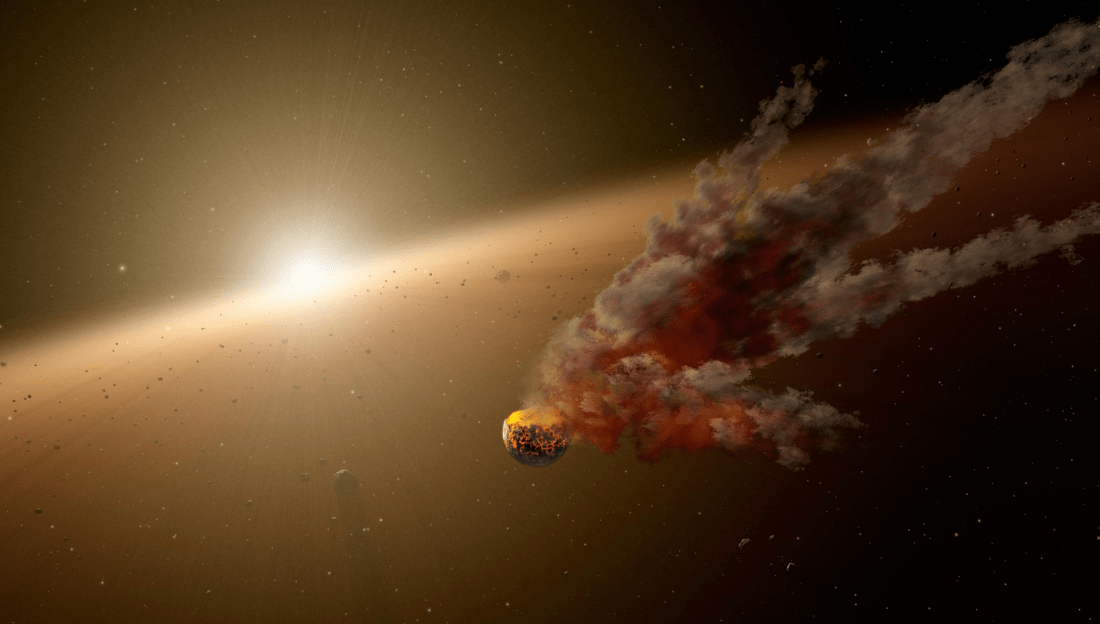



 Bryant Johnson was arrested for public intoxication on Monday, but allegedly not before attempting to warn the people of Casper, Wyoming, that aliens are coming.


 Sinkhole: H-Bomb explosion equivalent in Louisiana possible
 This solar powered floating farm can produce 20 tons of vegetables

 Triangular Metal Piece Found In Rosewell Could Be EVIDENCE Of 1947 UFO Crash!
 The 1947 Richard Byrd expedition to Antartica: Clues To Recent


 The Illuminati Plan to Fake The Return of Jesus SHOCK!
 White House ANNOUNCES Plan For Asteroid Apocalypse Scenario!
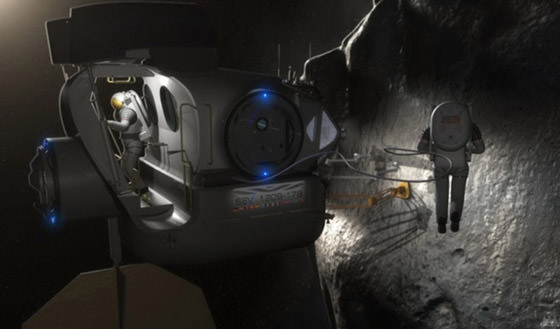
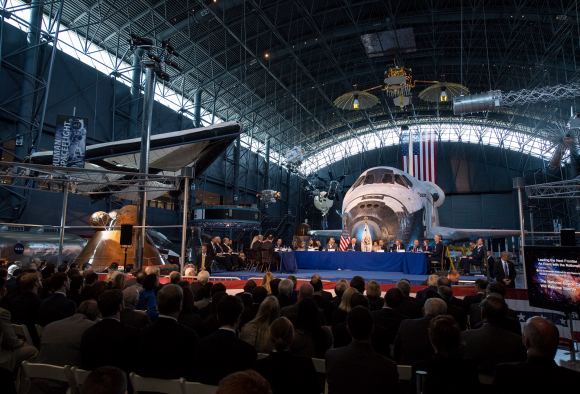
 Deep Space Gateway - NASA Announces Plans For A Moon-Orbiting Spaceport
 NASA Announces Major Press Conference About Its Search For Life Beyond


 Bill Clinton says alien invasion could unite the world
 GOARMY Independence Day False Alien Invasion Exposed Code & Gotthard