Naar de inhoud

UFO'S of UAP'S, ASTRONOMIE, RUIMTEVAART, ARCHEOLOGIE, OUDHEIDKUNDE, SF-SNUFJES EN ANDERE ESOTERISCHE WETENSCHAPPEN - DE ALLERLAATSTE NIEUWTJES

UFO's of UAP'S in België en de rest van de wereld
akke.beakke.be
Ontdek de Fascinerende Wereld van UFO's en UAP's: Jouw Bron voor Onthullende Informatie! Ben jij ook gefascineerd door het onbekende? Wil je meer weten over UFO's en UAP's, niet alleen in België, maar over de hele wereld? Dan ben je op de juiste plek! België: Het Kloppend Hart van UFO-onderzoek In België is BUFON (Belgisch UFO-Netwerk) dé autoriteit op het gebied van UFO-onderzoek. Voor betrouwbare en objectieve informatie over deze intrigerende fenomenen, bezoek je zeker onze Facebook-pagina en deze blog. Maar dat is nog niet alles! Ontdek ook het Belgisch UFO-meldpunt en Caelestia, twee organisaties die diepgaand onderzoek verrichten, al zijn ze soms kritisch of sceptisch. Nederland: Een Schat aan Informatie Voor onze Nederlandse buren is er de schitterende website www.ufowijzer.nl, beheerd door Paul Harmans. Deze site biedt een schat aan informatie en artikelen die je niet wilt missen! Internationaal: MUFON - De Wereldwijde Autoriteit Neem ook een kijkje bij MUFON (Mutual UFO Network Inc.), een gerenommeerde Amerikaanse UFO-vereniging met afdelingen in de VS en wereldwijd. MUFON is toegewijd aan de wetenschappelijke en analytische studie van het UFO-fenomeen, en hun maandelijkse tijdschrift, The MUFON UFO-Journal, is een must-read voor elke UFO-enthousiasteling. Bezoek hun website op www.mufon.com voor meer informatie. Samenwerking en Toekomstvisie Sinds 1 februari 2020 is Pieter niet alleen ex-president van BUFON, maar ook de voormalige nationale directeur van MUFON in Vlaanderen en Nederland. Dit creëert een sterke samenwerking met de Franse MUFON Reseau MUFON/EUROP, wat ons in staat stelt om nog meer waardevolle inzichten te delen. Let op: Nepprofielen en Nieuwe Groeperingen Pas op voor een nieuwe groepering die zich ook BUFON noemt, maar geen enkele connectie heeft met onze gevestigde organisatie. Hoewel zij de naam geregistreerd hebben, kunnen ze het rijke verleden en de expertise van onze groep niet evenaren. We wensen hen veel succes, maar we blijven de autoriteit in UFO-onderzoek! Blijf Op De Hoogte! Wil jij de laatste nieuwtjes over UFO's, ruimtevaart, archeologie, en meer? Volg ons dan en duik samen met ons in de fascinerende wereld van het onbekende! Sluit je aan bij de gemeenschap van nieuwsgierige geesten die net als jij verlangen naar antwoorden en avonturen in de sterren! Heb je vragen of wil je meer weten? Aarzel dan niet om contact met ons op te nemen! Samen ontrafelen we het mysterie van de lucht en daarbuiten.

Berichten van 1 november 2017 tot 30 november 2017

Aliens or simply a meteor? Fireball footage captured by an astronaut on the ISS sparks claims Nasa is hiding evidence of ET

Aliens or simply a meteor? Fireball footage captured by an astronaut on the ISS sparks claims Nasa is hiding evidence of ET

  • The object was spotted entering Earth's atmosphere by the ISS
  • Space agency claims it is a meteor but conspiracy theorists reject this  
  • Alien hunters SecureTeam10 say it is moving too slowly for a meteor
  • Nasa has previously been accused of covering up evidence of alien life 

Nasa has once again been accused of covering up the existence of alien life, after an astronaut captured footage of a UFO.

The mysterious object was spotted entering Earth's atmosphere by one of the crew of the International Space Station.

Despite assurances from the space agency that it is just a meteor, conspiracy theorists remain convinced that it is evidence of extra terrestrials.  

Nasa has once again been accused of covering up the existence of alien life, after an astronaut captured footage of a UFO. The mysterious object (circled) was spotted entering Earth's atmosphere by one of the crew of the International Space Station
Nasa has once again been accused of covering up the existence of alien life, after an astronaut captured footage of a UFO. The mysterious object (circled)  was spotted entering Earth's atmosphere by one of the crew of the International Space Station

SECURETEAM 10 CONTROVERSY

SectureTeam10 is one of the most viewed YouTube channels, with over 785,000 people subscribing to its conspiracy videos.

But the channel has come under fire, as Lions Ground, a rival channel, claims that it has been intentionally fooling its viewers.

According to Lions Ground, SecureTeam10 has been raking in an estimated £600 ($745) a day by posting fake videos that 'outsmart UFO believers.'

Italian astronaut Paolo Nespoli shot the clip, which shows a fiery ball of light racing towards the Earth's atmosphere.

The ISS crew member believes that the object could be space debris, but both the space agency and alien enthusiasts have rejected this explanation.

Tyler Glockner, who runs alien hunting YouTube Channel SecureTeam10, believes it is more proof of a government conspiracy to hide the existence of aliens. 

Nasa has previously been accused of covering up an alien sighting after a video surfaced showing six UFOs passing the ISS live-stream, seconds before the feed was cut and replaced with images from a camera showing the inside of a briefing room. 

Although the footage of the most recent sighting came from Nasa, conspiracy theorists are suspicious over how quickly they released it to the media. 

Speaking in a video uploaded to the SecureTeam10 channel, Mr Glockner said: 'I don't think it's a meteorite at all.

'What many people may not realise is that this video is a timelapse.

'You're seeing the earth spinning at a high rate of speed and we see this flash of light coming from space.

'It does look to be moving at 85mph (136 km/ph). 

'But when you account how fast the earth would have actually been moving, had this not been sped up, it would have been moving much, much slower.

'Speeds that are slower than even the slowest meterorites.

'Why did they do this? Why were they so adamant about publishing this when when they've never jumped on a story so fast?' 

Mr Glockner also says that the round ball is coming in at too steep an angle to be a meteorite.

In the video, he compares the object to another meteorite that fell to Earth during the 2011 Perseid meteor shower.

Italian astronaut Paolo Nespoli shot the clip, which shows a fiery ball of light racing towards the Earth's atmosphere

Italian astronaut Paolo Nespoli shot the clip, which shows a fiery ball of light racing towards the Earth's atmosphere

Tyler Glockner, who runs alien hunting YouTube Channel SecureTeam10, believes it is more proof of a government conspiracy to hide the existence of aliens

Tyler Glockner, who runs alien hunting YouTube Channel SecureTeam10, believes it is more proof of a government conspiracy to hide the existence of aliens

Mr Glockner says that the round ball is coming in at too steep an angle and too slowly to be a meteorite

Mr Glockner says that the round ball is coming in at too steep an angle and too slowly to be a meteorite

Nasa has previously been accused of covering up an alien sighting after a video surfaced showing six UFOs passing the ISS (pictured) live-stream shortly before it was cut

Nasa has previously been accused of covering up an alien sighting after a video surfaced showing six UFOs passing the ISS (pictured) live-stream shortly before it was cut

In this clip, the characteristic tail of a meteor that is missing from the ISS object can clearly be made out.

Mr Glockner added: 'If you compare this to what they are calling a meteor in this new footage, at no time does this so called meteor look like anything that was captured back in 2011 - it just doesn't.

'It's a short, stubby object that looks nothing like the other meteor here.

'We can see this discharge, the energy coming from here vanish.' 

BELIEVE IN CONSPIRACY THEORIES? YOU'RE PROBABLY A NARCISSIST 

People who doubt the moon landings are more likely to be selfish and attention-seeking, according to a study earlier this year.

Over the course of three online-based studies, researchers at the University of Kent showed strong links between the belief in conspiracy theories and negative psychological traits.

Writing in the journal Social Psychological and Personality Science, the team explained: 'Previous research linked the endorsement of conspiracy theories to low self-esteem.'

In the first study, a total of 202 participants completed questionnaires on conspiracy beliefs, asking how strongly they agreed with specific statements, such as whether governments carried out acts of terrorism on their own soil.

Alongside this, they were asked to complete a narcissist scale and a self-esteem assessment.

The results showed that those people who rated highly on the narcissism scale and who had low self-esteem were more likely to be conspiracy believers. 

{ http://www.dailymail.co.uk/ }

Hoe vind je dit bericht?
Geschreven door peter om 17:55 Stuur door

Mysterious meteorite footage sparks cover-up claims by UFO-hunter

Mysterious meteorite footage sparks cover-up claims by UFO-hunter

A CONSPIRACY theorist has dismissed experts’ claims that a meteorite entered Earth’s atmosphere following the release of footage from the International Space Station (ISS).

By Anders Anglesey 

The sped-up clip shows a bright object fall to Earth as the ISS circles the planet.

Space boffins said the plummeting fireball was a meteorite that hurtled towards Earth at a rapid 85mph.

But UFO-hunter, Secure Team 10, raised suspicions about the footage and whether it actually shows meteor.

Boffins believe that tens-of-thousands of space rocks have slammed into Earth

GETTY

METEOR: Boffins believe that tens-of-thousands of space rocks have slammed into Earth

Comparing the two examples he said: “If you compare this to what they are calling a meteor in this new footage, at no time does this so called meteor look like anything that was captured back in 2011 – it just doesn’t.

“It’s a short, stubby object that looks nothing like the other meteor here. We can see this discharge, the energy coming from the back of it.”

Similar cover-up claims have emerged before.

Last week, incredible footage emerged of a bright ball hovering in the sky near a long, thin cloud.

Suddenly, the ball literally causes the cloud to break up in a clip that has to be seen to be believed.

RELATED ARTICLES

{ https://www.dailystar.co.uk/ }

Hoe vind je dit bericht?
Geschreven door peter om 17:37 Stuur door

The Week's Top Space Stories

The Week's Top Space Stories

Hoe vind je dit bericht?
Geschreven door peter om 17:04 Stuur door

Newly-found fossils reveal Antarctica had lush forests before Dinosaurs existed

Newly-found fossils reveal Antarctica had lush forests before Dinosaurs existed

Antarctica—the ‘inhospitable’ white Continent that we know today, was once a surface covered with leafy subtropical forests full of palm trees, ferns, and conifers.

Just over 50 million years ago, the frozen continent looked very different from what we see today.

If mankind could travel to the past and visit Antarctica, we wouldn’t need to wear thermal and waterproof clothing as current expeditions do since the temperatures would be warm and pleasant.

Now, a group of researchers has discovered more evidence of what Antarctica looked like in the distant past as they have found fossil fragments from 13 trees that grew at the end of the Permian Period, before Dinosaurs.

The discovery was made by Erik Gulbranson and John Isbell from the University of Wisconsin-Milwaukee (UWM) who were exploring the continents’ Transantarctic Mountains. By the end of their journey, the scientists discovered fossilized parts of 13 trees.

The discovery confirms one more time that the now-frozen continent was once covered in lush forests and teeming with life, most likely when it was still part of the supercontinent Gondwana that spanned the whole of the Southern Hemisphere.


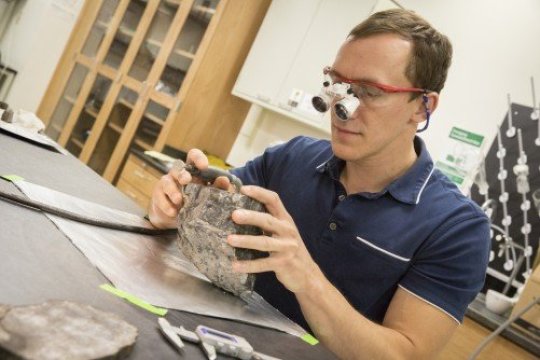
Erik Gulbranson, paleoecologist and visiting assistant professor at UWM, examines some of the fossilized polar trees he recovered from Antarctica.

Image Credit: Troye Fox, UWM Photo Services

Scientists are convinced that massive forests covered the entire continents at the end of the Permian Period, the geological era before first dinosaurs.

“People have known about the fossils in Antarctica since the 1910-12 Robert Falcon Scott expedition. Nevertheless, most of Antarctica is still unexplored today. Sometimes, you might be the first person to ever climb a certain mountain,” Gulbranson said.

The so-called Permian Period came to an end some 251 million years ago in what is considered history’s greatest mass extinction, as our planet rapidly shifted from icehouse to greenhouse conditions.

It is believed that than 90 percent of species on Earth disappeared, including the polar forests scientists found evidence of.

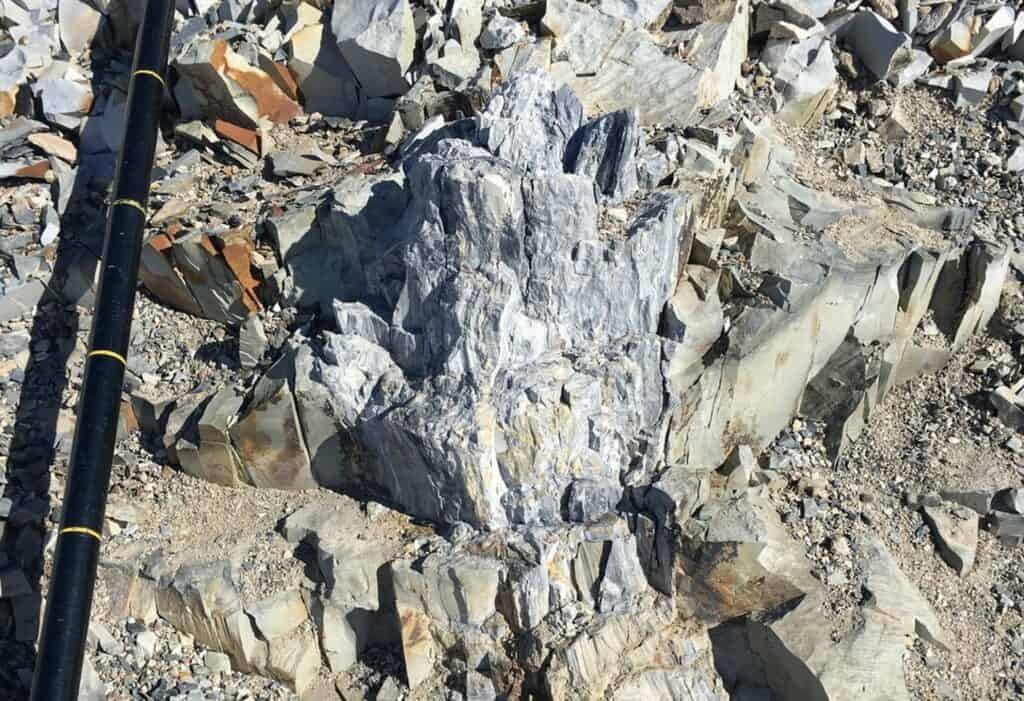
A 280-million-year-old tree stump still attached to its roots in Antarctica.

Image Credit: Erik Gulbranson

Since the lush Antarctic tree grew at polar latitudes were plants cannot grow today, researchers believe the trees that once grew there were an extremely species. Experts are now trying to understand why the forests went extinct.

“This ancient forest is a glimpse of life before the extinction, and this can help us understand what caused the event,” explained Gulbranson.

Scientists explain that the frosts that once grew on the Antarctic continent were used to conditions unlike anywhere else on the planet, having to survive through polar extremes of endless light, and total darkness, which, according to experts, is another reason why its worth studying why they went extinct.

“There isn’t anything like that today. These trees could turn their growing cycles on and off like a light switch. We know the winter shutoff happened right away, but we don’t know how active they were during the summertime and whether they could force themselves into dormancy while it was still light out,” Gulbranson said.


Source: Geologists uncover Antarctica’s fossil forests

Featured image credit: Shutterstock / and Erik Gulbranson

{ https://www.ancient-code.com/ }

Hoe vind je dit bericht?
Geschreven door peter om 15:09 Stuur door

The first ‘Global’ ‘Flat Earth Conference’ just took place and hundreds of people attended

The first ‘Global’ ‘Flat Earth Conference’ just took place and hundreds of people attended

Hundreds of people attended the First International Flat Earth Conference held in the United States, and hundreds of people gathered there presenting their ideas as to why our planet is ‘FLAT.’

The first ‘Global’ ‘Flat Earth Conference’ just took place, and hundreds of people attended

Hundreds of Americans gathered for the First International Flat Earth Conference in November 2017, in Raleigh, North Carolina in the United States.

The United States is one of the countries with the largest number of supporters of Flat Earth movement, despite the fact that it is also one of the few nations that have been able to send astronauts into space to corroborate the spherical shape of the earth.

How contradictory, right?

Approximately 400 people are thought to have attended the conference, flying from around the world to take part.  Tickets to attend ranged from $109 up to $249.

The attendees rejected that planet earth has a spherical shape, and assure that “it is the biggest fallacy created by Satan.”

Gravitation on Flat planet Earth.

Image Credit: Shutterstock

Another one the many who attended the conference said that ‘she checked for herself that the Earth was flat after using a ruler and measuring the horizon.’

The First International Conference of the Flat Earth was composed of several presentations and exhibitions of products related to the theory that the earth is not really a spherical planet.

“It is horizontally infinite and at least 9,000 kilometers deep,” said John Davis, another theorist of this idea.

For his part, James McIntyre, members of the Flat Earth Society, has the idea that “the earth is, more or less, a disk of 24,900 miles in diameter,” and adds that “obviously not perfectly flat, due to geological phenomena such as valleys and mountains.”

McIntyre also said that the photos from space showing the circumference of the earth “are false,” and that “the world’s space agencies are involved in an international conspiracy to deceive the public in pursuit of vast profits.”

In a BBC video interview, one of the attendees said he just came to the conference to meet other like-minded people.

Some of the reasons why the attendees to the conference think the Earth is flat include:

– The Sun and the Moon move through the sky in a focused way, that is why they illuminate only certain parts of the flat earth.

– The earth gives the sensation that it is round because it is arranged in such a way that it simulates a group of concentric radii.  Furthermore, the horizon always appears perfectly flat – except in NASA and other space agency images, which are obviously faked (as part of the global conspiracy)

– When a plane flies, it flies completely horizontally, If the Earth was ’round’ planes would keep flying into space.

-Oh, here’s one of my favorite ones (lol) If our Earth was really spherical, helicopters would be able to hover in place and wait for their destinations to come to them. Savy?

The Flat Earth Conference also included a speech from prominent flat-Earther and YouTuber Mark Sargent who said: “I think we’re almost at the critical mass point. Science is gonna have to address this, plain and simple. They cannot dodge us forever.”

{ https://www.ancient-code.com/ }

Hoe vind je dit bericht?
Geschreven door peter om 14:51 Stuur door

Jupiter’s independently pulsating auroras

Jupiter’s independently pulsating auroras

The auroras over Earth’s north and south poles typically mirror each other. But X-ray observations show that Jupiter’s auroras pulsate on different timescales.

Jupiter-auroras-chandra-e1510766028102.jpg

Jupiter’s auroras as seen in X-rays, via NASA.

Jupiter is our solar system’s largest planet, and its auroras are by far the strongest in our sun’s family. In a way similar to earthly auroras, Jupiter’s northern and southern lights stem from activity on the sun. A couple of months ago, a study using data from the Juno spacecraft, which is currently orbiting the planet, said that Jupiter’s auroras may be accelerated by waves in the giant planet’s magnetic field (a process researchers described as “akin to surfers being driven shoreward ahead of breaking ocean waves”). On November 6, 2017, NASA described another recent study in which X-rays astronomers tracked the behavior of Jupiter’s northern and southern lights, which seem to pulsate, or change in X-rays brightness, independently.

NASA said:

The X-ray emission at Jupiter’s south pole consistently pulsed every 11 minutes, but the X-rays seen from the north pole were erratic, increasing and decreasing in brightness — seemingly independent of the emission from the south pole.

That’s surprising because Earth’s auroras generally mirror each other. William Dunn of the University College London led the research, which was published October 30 in the peer-reviewed journal Nature Astronomy.

According to a statement from the research team, the study relied on data using the Chandra X-ray and XMM-Newton observatories:

… from March 2007 and May and June 2016, a team of researchers produced maps of Jupiter’s X-ray emissions and identified an X-ray hot spot at each pole. Each hot spot can cover an area equal to about half the surface of the Earth.

The team found that the hot spots had very different characteristics.

This makes Jupiter particularly puzzling. X-ray auroras have never been detected from our solar system’s other gas giants, including Saturn.

The X-ray team plans to combine new and incoming data from Chandra and XMM-Newton with data from the Juno mission, which is currently in orbit around the planet. If scientists can connect the X-ray activity with physical changes observed simultaneously with Juno, they think they might be able to determine the process that generates the Jovian auroras and by association X-ray auroras at other planets.

Read more from NASA

Bottom line: The auroras over Earth’s north and south poles typically mirror each other. But X-ray observations show that Jupiter’s auroras pulsate on different timescales.

{ http://earthsky.org/ }

Hoe vind je dit bericht?
Geschreven door peter om 14:35 Stuur door

THE TRUE STORY OF THE PHILADELPHIA EXPERIMENT

THE TRUE STORY OF THE PHILADELPHIA EXPERIMENT

700_a2e3d55ee09d3463106eb76a95f85574.jpg?v=1511161688

In July of 1943 the US Navy, along with Dr. Franklin Reno conducted a test on the Navy Destroyer, USS Eldridge called the Philadelphia Experiment.

The experiment, based on Albert Einstein's theory of relativity was an attempt to make the ship virtually invisible to any enemy radar and immune to magnetic mines.

IN JULY 1943 A BIZARRE CHAIN OF EVENTS TOOK PLACE... 

PhiladelphiaExperiment1.jpg

The ship was set up with two generators, magnetic coils and amplifiers allowing it to create a synchronized electromagnetic field that in theory would divert radio and light waves around the ship making the Navy Destroyer invisible to the enemy. Had the test been successful it would have created the ultimate weapon, in the middle of wartime.

However, the botched experiment turned out to be more catastrophic than anyone could have imagined.  

On July 22nd, when the experiment had begun, and the generators were switched on an unexpected and bizarre chain of events took place. Witnesses claim the water surrounding the ship began to bubble and produced a hazy green fog that engulfed the entire ship, within seconds the ship not only disappeared from radar but also from plain sight.

The Eldridge has spotted 600 km away at a Naval base in Norfolk, Virginia for a few short minutes before returning to its original coordinates in Philadelphia. While the test did render the ship invisible to radar, it left the crew with devastating side effects.

BODIES OF THE CREW MEMBERS EMBEDDED INTO THE METAL  

manos.jpg

Witnesses claim that the experiment left bodies of the crew members embedded into the metal of the railings and decks on the ship, some men caught fire and some simply vanished. The remaining members of the crew were left physically and mentally ill, disoriented and seeming to fade in and out of reality.

After the team of US and German scientists saw the horrific consequences of their experiment, all further research into radar invisibility was canceled. The surviving members of the crew were discharged and labeled mentally unfit for duty, and some even believe the Navy used brainwashing to keep the men quiet about their experience.

US NAVY STILL DENIES THE TOP-SECRET FAILED OPERATION

To this day the US Navy still denies the experiments ever took place and destroyed all records of the Eldridge even being in Philadelphia at the time. However, witnesses and a few surviving crew members stick strongly behind their version of the horrific events.

Originally published by:

https://www.ancient-code.com/the-philadelphia-experiment/

RELATED ARTICLES

{ http://www.disclose.tv/ }

Hoe vind je dit bericht?
Geschreven door peter om 14:21 Stuur door

THREE SUNS PHENOMENON CAPTURED IN MURMANSK

THREE SUNS PHENOMENON CAPTURED IN MURMANSK

700_e753eef5e5d05dd9808f8e70498c92d4.jpg?v=1511178795

Thankfully people do not have to venture out into the cold void of outer space to find a solar phenomenon as they are right here on Earth in the form of Sundogs.

Sundogs occur when the light of the sun gets refracted by any ice crystals that are in the atmosphere, and it results in beautiful solar halos and orbs that glow and move gently over the sky and look like there are three suns. Residents of Murmansk Oblast in Russia were treated to a wondrous sight on 18 November 2017 when the phenomenon was captured on film during sunset.   

sundogs-murmansk-1.jpg

Winter is typically the best time to see sundogs as this is when the ice crystals are more commonly seen. Aristotle once said that he had seen two mock suns, which were the sundogs, rising with the sun, and they had followed it throughout the day until the sunset in the sky. He went on to say that mock suns are always found to the sides of the sun, and they are never seen below and above and are usually more commonly seen at sunset or sunrise but not very often in the middle of the day.  

sundogs-murmansk-3.jpg

Russia is not the only region where sundogs have been recently spotted in November. On 13 November residents of Mobile and Baldwin counties in Alabama were also treated to the rare spectacle. In this case, a double sundog and halo were seen after the sunlight refracted through the cirrus clouds which were high in the sky and made a prism. Halos are said to be similar to the sundogs, and the weather service said that it is a light ring that forms the sun or the moon when it reflects light from the ice crystals.  

15403815_G.jpg

Sundogs were also seen in the sky above the south of Mississippi on 14 November, and a meteorologist said that the best time to see the phenomenon is when the angle of the sun is low. He went on to say that in each of the sundogs the colors are red closer to the sun and change through to blue on the outer side of the sundog. It was also pointed out that sundogs do not just occur in sunlight, they can also happen under moonlight, but that is called a moon dog.  

RELATED ARTICLES

{ http://www.disclose.tv/ }

Hoe vind je dit bericht?
Geschreven door peter om 14:02 Stuur door

HERCACLEION LOST CITY UNDERWATER FOUND AFTER 1200 YEARS

HERCACLEION LOST CITY UNDERWATER FOUND AFTER 1200 YEARS

Image result for HERCACLEION LOST CITY UNDERWATER FOUND AFTER 1200 YEARS

Image result for HERACLEION LOST CITY UNDERWATER FOUND AFTER 1200 YEARS

Image result for HERACLEION LOST CITY UNDERWATER FOUND AFTER 1200 YEARS

Secrets of the sunken city: An ancient metropolis under the Sea of Egypt

Abu Qir is located in the northeast of Alexandria, where archaeologists explore the two ancient cities of Heraklion and Canopus since 1992.

In addition to being a prominent religious center, Heraklion was a major trading point on the Mediterranean Sea in the 6th century. When archeologists began to dive into this site, they discovered the ruins of the Temple of Heraklion, which was dedicated to Amun and Harqal-Khonsu. They also found huge statues of the gods, Ptolemaic kings, their wives, their nests and jewels, and numerous broken wooden ships.

{ http://www.disclose.tv/ }

Hoe vind je dit bericht?
Geschreven door peter om 13:45 Stuur door

FATIMA: UFO INVESTIGATOR SPILLS WHAT REALLY HAPPENED

FATIMA: UFO INVESTIGATOR SPILLS WHAT REALLY HAPPENED

UFO Investigator, La Marzulli explains what really happened during the famous Fatima incident.

The miracle of the sun is a phenomenon that was observed by at least 30,000 people on 13 October 1917 in the Cova da Iria near Fátima in Portugal and is partially classified as a miracle.

Three Secrets of Fatima Documentary

FÁTIMA 1917 Real Facts and Photos

In commemoration of the 100th anniversary of the Apparitions of Our Lady of Fatima, Portugal.

Hoe vind je dit bericht?
Geschreven door peter om 13:27 Stuur door

Conspiracy theorists claim 1972 snap from Apollo 17 mission proves the moon landing was a FAKE - as a 'stagehand' is reflected in US spaceman's visor

Conspiracy theorists claim 1972 snap from Apollo 17 mission proves the moon landing was a FAKE - as a 'stagehand' is reflected in US spaceman's visor

  • Analysis of Apollo 17, the sixth and final Nasa moon mission, in December 1972
  • YouTube user named Streetcap1 said image reflected in visor looked 'strange' - with 'long hair' and a 'waistcoat'
  • He said: 'Did we make it to the moon? Where's this guy's spacesuit?'

Ever since Man first walked on the moon after that 'giant leap' in 1969, conspiracy theorists have sought to debunk what is one of humanity's greatest achievements.

Now, one keen-eyed stargazer is convinced he has seen something strange in a photograph which suggests the sixth and final moon landing, at least, never happened - a figure on the lunar surface who is not wearing a spacesuit.

A video uploaded to YouTube by a user named Streetcap1 focuses on an image which purports to show a 'stagehand' reflected in the visor of an astronaut after Apollo 17 landed on the moon in December 1972. 

On that mission, Eugene Cernan and Harrison 'Jack' Schmitt spent about 22 hours on the surface in the Taurus-Littrow valley, while colleague Ronald Evans orbited overhead. 


A video uploaded to YouTube by a user named Streetcap1 focuses on an image which purports to show a 'stagehand' reflected in the visor of an astronaut after Apollo 17 landed on the moon in December 1972

A video uploaded to YouTube by a user named Streetcap1 focuses on an image which purports to show a 'stagehand' reflected in the visor of an astronaut after Apollo 17 landed on the moon in December 1972

On that mission (pictured), Eugene Cernan and Harrison Schmitt spent about 22 hours on the surface in the Taurus-Littrow valley, while colleague Ronald Evans orbited overhead

On that mission (pictured), Eugene Cernan and Harrison Schmitt spent about 22 hours on the surface in the Taurus-Littrow valley, while colleague Ronald Evans orbited overhead

The team carried out a series of experiments including seismic profiling, atmospheric composition analysis and lunar sampling.

Or did they?

The video clip - which has garnered more than 53,000 views - contains a commentary by Streetcap1, who says of the visor reflection: 'I thought it looked a bit strange, so I took a picture of it using my software.

'What we appear to have here is a figure of a human not wearing a spacesuit. There was some dispute back in 2009 of the legitimacy of these photos.'

He describes the strange figure as having 'long hair' and 'wearing some sort of waistcoat'.

And concludes: 'Did we make it to the moon? Where's this guy's spacesuit?'

The team (above, Harrison 'Jack' Schmitt on the mission) carried out a series of experiments including seismic profiling, atmospheric composition analysis and lunar sampling

The team (above, Harrison 'Jack' Schmitt on the mission) carried out a series of experiments including seismic profiling, atmospheric composition analysis and lunar sampling

The Apollo 17 crew returned with 110kg of rock and soil samples, more than was returned from any of the other lunar landing sites

The Apollo 17 crew returned with 110kg of rock and soil samples, more than was returned from any of the other lunar landing sites

The three crewmen arrive aboard the prime recovery ship, U.S.S. Ticonderoga, to conclude the final lunar landing mission in the Apollo programme. Above, Cernan (waving), Schmitt (next to him) and Evans at the back

The three crewmen arrive aboard the prime recovery ship, U.S.S. Ticonderoga, to conclude the final lunar landing mission in the Apollo programme. Above, Cernan (waving), Schmitt (next to him) and Evans at the back

Fact or faked? YouTubers react to the 'stagehand' moon photo

LANDINGS FAKED... 

Leo Dei: I thought 'another astronaut' then checked the astronaut in the reflection has NO life support backpack, while the astronaut in the foreground HAS a life support backpack. Good catch, Streetcap1! You continue to impress.

Adrian Lee: Someone definitely there. Looks like they're wearing high-top sneakers and a jacket with a hood. 

Mathias Weiss: First I thought this is a camera of some sort, because of the form of the casted shadow. But when I looked into it, the Apollo 17 mission took a camera with a small tripod with them, which is not comparable to this figure. 

LANDINGS REAL... 

Unum: Hey, geniuses - the guy in the reflection is the other astronaut taking the photo.

Brian Chandler: It looks to be photoshopped. Notice the circular line around the person, whether adding or removing not my call to make, original negative needs to be analyzed!

willows26: I vote astronaut... the shadow on the ground looks more like an astronaut in a bulky suit. I don't know why some people would much rather buy into the 'studio' conspiracy; Russia would have been all over this had there been an inkling of fraud at the time and I don't recall hearing a thing from them.


Apollo mission conspiracy theories answered

Why are no stars visible in the Apollo photos?

The Apollo landings took place during lunar mornings so the stars were not bright enough to be captured on camera.

Who filmed Neil Armstrong take the first steps?

A video camera was fixed on an extending arm to swing out and capture the historic moment.

Why did the heavy Landing Modules make no impression on the surface, while the astronauts' footprints did?

The layer of lunar dust on the rocky moon is thin, so was blown away from the landing area by the descent engines. This dust resettled by the time the astronauts left the module.

Why does the flag wave?

It was rigged with a rod and wires so that it would look as if it was unfurled and blowing in Apollo photographs.

Why didn't the Lunar module show a flame when it took off from the Moon?

The fuel used does not produce a flame in a vacuum. 

{ http://www.dailymail.co.uk/ }

Hoe vind je dit bericht?
Geschreven door peter om 12:02 Stuur door

Reflectie op ruimtehelm onthult ‘toneelknecht’. Bewijst deze Apollo-foto dat de maanlanding nep was?

Reflectie op ruimtehelm onthult 'toneelknecht'. Bewijst deze Apollo-foto dat de maanlanding nep was?

Reflectie op ruimtehelm onthult ‘toneelknecht’. Bewijst deze Apollo-foto dat de maanlanding nep was?

Uit een foto blijkt dat de zesde en laatste maanlanding mogelijk nooit heeft plaatsgevonden. Op de foto lijkt namelijk een figuur op het maanoppervlak te zien te zijn die geen ruimtepak draagt, schrijft de Daily Mail.

In een filmpje, dat door YouTube-gebruiker Streetcap1 is gepubliceerd, wordt de foto nader geanalyseerd.

Op de ruimtehelm van een astronaut van Apollo 17, die in december 1972 op de maan landde, zou de reflectie van een ‘toneelknecht’ te zien zijn.

Recordhoeveelheid

Tijdens de missie verbleven Eugene Cernan en Harrison Schmitt 22 uur bij de maankrater Littrow in het Taurusgebergte, terwijl collega Ronald Evans in de ruimte bleef.

De NASA wilde het maximale wetenschappelijke resultaat uit dit laatste bezoek aan de maan halen en er werd dan ook een recordhoeveelheid aan maansteen mee teruggenomen.

Ook de duur van de maanwandelingen was langer dan bij ieder van de voorgaande missies.

Discussie

Of is het allemaal niet gebeurd? “Ik vond het er nogal vreemd uitzien, dus ik maakte een foto van de helm met behulp van mijn software,” zei Streetcap1.

“Het gaat hier mogelijk om een persoon die geen ruimtepak draagt,” voegde hij toe. “Er was in 2009 al discussie over de echtheid van deze foto’s.”

Lang haar

De figuur heeft volgens hem ‘lang haar’ en draagt een soort ‘vest’. “Zijn we naar de maan geweest? Waar is het ruimtepak van deze gast?”

Bekijk het filmpje, dat op het moment van schrijven zo’n 200.000 keer is bekeken, hieronder:

[Daily Mail] 
Hoe vind je dit bericht?
Geschreven door peter om 11:43 Stuur door

Glowing Sphere appears out of nowhere flying towards huge glowing Sphere over Manitoba, Canada

Glowing Sphere appears out of nowhere flying towards huge glowing Sphere over Manitoba, Canada

A huge sphere in the sky accompanied by a second smaller sphere has been captured on video by dwayne hegelheimer over Manitoba, Canada on November 19, 2017.

sphere%2Borb%2Bball%2Bof%2Blight%2Bcanada.jpg

While filming the two spheres the smaller ball of light suddenly vanishes but after a while it returns again out of nowhere flying towards the bigger ball of light which seems to hang motionless in the sky.

It remains unclear what these spheres may have been.

The moment the smaller sphere appears again flying towards the huge sphere can be seen from the 2.05 mark in the video.


{ http://ufosightingshotspot.blogspot.com/ }

Hoe vind je dit bericht?
Geschreven door peter om 11:35 Stuur door

Les successeurs de Hubble

 Les successeurs de Hubble

Space-telescope_v4.jpg

Les futurs télescopes spatiaux qui nous rapprocheront des étoiles : TESS (août 2017), James Webb (octobre 2018, 100 x Hubble), WFIRST (mid 2020s) et surtout ATLAST (Advanced Technology Large-Aperture Space Telescope, "enfin", en anglais ; 2000 x Hubble ; 2025-2035). Pour ce dernier on note la taille de son miroir primaire comparée à celui de Hubble et de JW. Il sera stationné au Point de Lagrange L2 entre Terre et Soleil et devrait, entre autres missions, détecter la présence de vie sur des exoplanètes lointaines.
Sacrée panoplie ! Si seulement nous avions eu ça en 1947 !

{ https://futurism.com/ }

Hoe vind je dit bericht?
Geschreven door peter om 00:10 Stuur door

That interstellar asteroid is even weirder than we thought

That interstellar asteroid is even weirder than we thought

The asteroid, discovered last month, lives up to its alien reputation as scientists reveal its bizarre traits and give it a proper name.


This artist's impression shows Oumuamua, an interstellar asteroid

ESO/M. Kornmesser

Our solar system recently had a very strange visitor. For the first time ever, scientists last month spotted an interstellar object invading our part of space. Astronomers have revealed more details about the now-confirmed interstellar interloper and it's just plain weird.

The Pan-Starrs 1 telescope in Hawaii first spotted the object on Oct. 19 when it was already heading back to interstellar space. Astronomers rushed to make observations. An artist's impression shows a very elongated shape, different from any known asteroids. Scientists estimate it's about 1,300 feet (400 meters) in length. 

"For decades we've theorized that such interstellar objects are out there, and now -- for the first time -- we have direct evidence they exist," NASA's Thomas Zurbuchen said Monday in a news release. By studying space objects like this one, researchers hope to find clues to the formation of other solar systems.

Originally named A/2017 U1, it now has the official moniker "Oumuamua," which refers to its distant origin as a messenger from the past. 

"Oumuamua may well have been wandering through the Milky Way, unattached to any star system, for hundreds of millions of years before its chance encounter with the Solar System," says the European Southern Observatory, which used its Very Large Telescope in Chile to observe the object.

The Gemini Observatory, a collaboration between telescopes in Hawaii and Chile, also got in on the action, resulting in a color composite image of Oumuamua.

University of Hawaii astronomer Karen Meech says the rapidly rotating asteroid has a "complex, convoluted shape," is dark red in color and is "completely inert, without the faintest hint of dust around it." 

Meech and an international research team published their findings Monday in the journal Nature with the title "A brief visit from a red and extremely elongated interstellar asteroid."

The International Astronomical Union, which is responsible for cataloging the names of space objects, also gave the asteroid its very first "I" for "interstellar" designation, which shifts its formal name from A/2017 U1 (with the "A" standing for "asteroid") to "1I/2017 U1."

Scientists expect our solar system regularly receives interstellar visitors like this one, but they are faint and extremely hard to find. That makes Oumuamua all the more special. 

Update, Nov. 20 at 11:05 a.m. PT: This story has been updated to include a quote from NASA.  

Hoe vind je dit bericht?
Geschreven door peter om 00:00 Stuur door

Scientists hope their latest alien invitation won’t trigger an invasion of Earth

Scientists hope their latest alien invitation won’t trigger an invasion of Earth

Hoe vind je dit bericht?
Geschreven door peter om 23:49 Stuur door

How NASA will defend the Earth against plagues from outer space

How NASA will defend the Earth against plagues from outer space

Because nobody wants to be dissolved by extraterrestrial amoeboids.


In the summer of 1957, the Earth stood witness as a meteorite cratered in rural Pennsylvania, bringing with it a people-eating plague never seen: an alien amoeba with the taste for human flesh. While we had Steve McQueen around for the first invasion, humanity is now defended against microbial marauders from outer space by NASA and its international counterparts.

Biological contamination goes both ways, mind you. Just as important as keeping extraterrestrial organisms from reaching the surface (aka "backward contamination") is ensuring that our planetary probes carry as few microbial hitchhikers from Earth as possible ("forward contamination"). To that end, in 1958, the U.S. National Academy of Sciences (NAS) issued a decree urging "that scientists plan lunar and planetary studies with great care and deep concern so that initial operations do not compromise and make impossible forever after critical scientific experiments."

The following year, the newly formed Committee on Space Research (COSPAR) argued "that all practical steps should be taken to ensure that Mars be not biologically contaminated" until an exhaustive search for life on the planet had been undertaken. These recommendations became law in 1967 when the US, the USSR and the UK all signed onto the United Nations Outer Space Treaty.

"Part of our thinking about planetary protection is that we want to make sure that we safeguard to any future human exploration," Dr. Lucianne Walkowicz, an astronomer at Adler Planetarium and the Astrobiology Chair at the Library of Congress, told Engadget. "When we bring spacecraft to other worlds (or eventually human beings), we want to make sure that we understand that environment. That means being relatively cautious about contaminating it."

However, not every extraterrestrial target of human interest requires the same degree of caution. Places like the Sun or Mercury, which are almost assuredly devoid of biological organisms, don't require the same level of protection as, say, Mars or the Moon, which are just heavily irradiated and desperately cold. In fact, COSPAR has developed a 5-category systemwhich space agencies must abide by when they're developing their planetary probes:

  • Category I covers places with little chance of finding even basic forms of life, like Mercury.

  • Category II includes places that might be explored for the origins of life but where the chances of contamination by Earthly microbes is remote. Think Venus or the Moon.

  • Category III regulates flyby and orbiter missions where the chances of contamination are moderate, like Mars or Europa. This is why Cassini was thrown into Saturn: we couldn't have it falling into Enceladus or Titan.

  • Category IV regulates lander or probe missions to the same places as category III, though it is further divided into a series of subclasses based on specific regions of the planet's surface and what the lander is actually looking for.

  • Category V is what happens if there's a good chance we'll pick up a Blob in space. It demands "absolute prohibition of destructive impact upon return, containment of all returned hardware which directly contacted the target body, and containment of any unsterilized sample returned to Earth."

"I think they're good for us as a working framework," Walkowicz said. "They certainly have served us well in the history of exploration and our solar system thus far."

It's extremely important that space agencies understand the categorical protection requirements of their mission, explains Dr. John Rummel, Senior Scientist at the SETI Institute and former NASA Planetary Protection Officer. "If you tell someone at the last minute they going to do something they had never been planning on, well, they may have to re-engineer entire spacecraft," he told Engadget. "If, on the other hand, they anticipate these requirements from the beginning... then it's not that big of a deal."

This planetary protection scheme is designed to minimize the damage from both forward and backward contamination. "We really want to safeguard our own planet's biosphere we have all these wonderful living things here," Walkowicz said. "We want to make sure that we can explore and bring back the samples and use the benefits of our Earthly labs without endangering the world."

Dr. Rummel, however, is not particularly concerned. "In my opinion, there is a reasonable possibility that nothing we could do with a sample return done robotically would bring back anything that's alive," he said.

Rummel argues that any microorganisms hitching a ride from Mars aboard a material sample would be woefully ill-equipped to handle the rigors of interplanetary flight. "We don't know what those organisms require so the chance that we get lucky and bring them back alive is small."

That said, Rummel acknowledges the value in assuming the worst. "The National Research Council and Space Studies Board have always maintained that we will contain [returned samples] as if they're the most hazardous thing on Earth until we prove that it's safe," he continued. "There's no upside in cutting corners."

To ensure that outbound spacecraft remain sterile until they're launched, the OPP has traditionally relied on a process known as Dry Heat Microbial Reduction (DHMR). This involves baking individual spacecraft componentsat temperatures of 110 degrees Celsius for 47 hours or 125C for 5 hours with zero relative humidity.

First utilized for the Viking missions, "it's a very handy technology," Walkowicz explained. "It's very effective on surfaces, but also between surfaces or even within materials, which is why it has widespread adoption."

There are limitations to this method, however. It cannot sterilize an entire spacecraft, for example, as everything from electronic components to structural adhesives and landing parachutes would be destroyed by the heat. As such, NASA has been researching alternative methods to augment the DHMR process, many of which hail from existing medical technologies.

Of particular interest for Mars exploration is supercritical carbon dioxide cleaning. Carbon dioxide is held under extremely low temperature and at extremely high pressure so it exhibits qualities of both a gas and a liquid. When mixed with peracetic acid (PAA), it can be used to sterilize materials. What's more, Walkowicz said, given the planet's high CO2 content "maybe there would be a way to develop technology that could use Mars's atmosphere in some way to create a local bioburden reducing technology... and do that in situ."

NASA's Jet Propulsion Lab is also developing a technique dubbed vapor phase hydrogen peroxide (VHP) sterilization, which is generated from a solution of liquid H2O2 and water. When concentrated between 140 ppm and 1400 ppm, it acts as an antimicrobial agent. However, "the limitation there is that it's never been used at a systemic level -- like the whole spacecraft level -- so you could do it on smaller components but not necessarily the entire craft," Walkowicz said. There's also the danger of it becoming too concentrated. If VHP levels reach 75 ppm, it becomes toxic to humans.

There is also work being done with ethylene oxide as a sterilizer, though Walkowicz points out that ethylene oxide is "kind of explosive." Ionizing radiation techniques are also being explored. The parachute for the Beagle 2 mission, for example, could not withstand DHMR, so NASA scientists subjected it to radioactive sterilization instead. Beyond that, the NASA Mars Exploration Program has examined leveraging electron beam sterilization, which is already utilized in food processing, as a means of cleaning spacecraft.

Of course, there is also the chance that we're overthinking this whole issue, at least as it applies to Mars exploration. Rummel hypothesizes that there was a natural interchange of biology between Mars and Earth some 4 billion years ago that potentially renders our efforts moot:

Imagine that life originated on Mars. Life was knocked off of Mars by a large impact event which made Mars rocks eventually come to Earth. The Earth, without any life, is seeded by Mars rocks and then all of a sudden you have all these Mars organisms living on the Earth... the natural response of Earth and Mars together would be the evolution of animals, plants and whatnot. So we could all be Martians and that is as bad as it gets, I think.

Whether we need the protection or not, there are a number of ways that future interplanetary explorers might avoid the biological pitfalls of Mars. "We tend to think of it as being robotic exploration or human exploration," Walkowicz said. "In reality we see humans and robots cooperate all the time in exploration on Earth" such as the Fukushima power plant cleanup or subsea exploration in Antarctica.

"We often send robotic probes and I think that that's something that we're likely to see in some of those early explorations of Mars that involves a human component," she continued. Essentially, astronauts would either remain in orbit or sequestered in a planet-side bunker and remotely control robotic rovers who would do the legwork on our behalf. "The other possibility is, instead of worrying about cleaning your spacecraft off afterwards, you construct it as cleanly as you possibly can" from the start.

In the end, Walkowicz argues, planetary protection requirements should not be viewed as a hindrance to space exploration, but rather, an asset. "If we want to answer some of those difficult questions about the origin of life, if we really want to understand Mars or Europa or any of these worlds as astrobiological resources, we have to fold planetary protection into our thinking," she said. "It enables the science that we want to be able to do."

Or, as Rummel points out, "To paraphrase Franklin Roosevelt, 'The only thing we have to fear is fear itself.'" Well, that and the space plague.

Images: United Nations (Outer Space Treaty signing); NASA (clean room and Carl Sagan with Voyager 1)

{ https://www.engadget.com/ }

Hoe vind je dit bericht?
Geschreven door peter om 23:39 Stuur door

WHAT HAPPENS IF ALIENS ARE REAL? ASTRONOMERS HAVE PROTOCOL ON HOW HUMANS SHOULD REACT

WHAT HAPPENS IF ALIENS ARE REAL? ASTRONOMERS HAVE PROTOCOL ON HOW HUMANS SHOULD REACT

Hoe vind je dit bericht?
Geschreven door peter om 23:27 Stuur door

40 years ago NASA sent a message to aliens -- here's what it says

40 years ago NASA sent a message to aliens -- here's what it says

Hoe vind je dit bericht?
Geschreven door peter om 23:12 Stuur door

Alien hunters stunned after mysterious UFO scatters CLOUDS in sky

Alien hunters stunned after mysterious UFO scatters CLOUDS in sky

ALIEN hunters were left stunned after video appearing to show a UFO changing clouds emerged.

Hoe vind je dit bericht?
Geschreven door peter om 23:02 Stuur door

WATCH: Astonishing moment UFO 'scatters CLOUDS'

WATCH: Astonishing moment UFO 'scatters CLOUDS'

UFO enthusiasts have been sent into a frenzy after a video emerged online which seems to show a mysterious object manipulating clouds.

A video uploaded to YouTube by conspiracy theory channel Suspect Sky shows a strange white object moving upwards in the sky.

The video, which was uploaded on November 17 but apparently shot some time in October, then sees the bright, white UFO hover in the clouds.

After sitting in the long thin cloud for a few seconds, the craft, which looks similar to a star in the sky, then appears to disperse the cloud.

The video is on its way to becoming viral after racking up more than 3,000 views in little more than 12 hours.

ufo cloud

GETTY • YOUTUBE

Astonishing moment UFO 'scatters CLOUDS'

RELATED ARTICLES

ufo

YOUTUBE

The UFO places itself in the clouds

Many of the commenters of the video are convinced that the footage is a genuine sighting of a UFO.

Josh Hammond wrote: “That is some awesome footage not only seeing a UFO but seeing how it affects change the area around it, great video man.”

Another person, foxleyleon, wrote: “I've also personally witnessed a ufo literally erasing a CHEM CLOUD. Rather nice of them.”

However, there were some viewers who were not so convinced of its authenticity.

ufo 2

YOUTUBE

The clouds then scatter

One commenter was brutally honest in his assessment, writing: “Fakery at its best.”

Mr Sudan President was also critical, stating: “It’s fake…”

A similar looking craft was also recently spotted over the Great Barrier Reef.

ufo

JENNY MORRISON

A similar UFO was recently seen over the Great Barrier Reef

An Australian woman, Jenny Morrison, took some pictures of the sunset over the Great Barrier Reef and when she later reviewed the photographs, she noticed a bright orb-like craft moving slowly across the screen in the series of photographs of the view above Fitzroy Island.

The mystery then deepens when in the latter pics, the green dot disappears from the images.

Experts are convinced it is a genuine UFO sighting, with the Daily Star reporting one expert said: “This is utterly bizarre and cannot be explained.
"I would say it’s an alien spaceship.”
Hoe vind je dit bericht?
Geschreven door peter om 22:50 Stuur door

Earthbound Antimatter Mystery Deepens After Scientists Rule Out Pulsar Source

Earthbound Antimatter Mystery Deepens After Scientists Rule Out Pulsar Source

Hoe vind je dit bericht?
Geschreven door peter om 22:30 Stuur door

Iconic Arecibo Observatory Saved From Demolition

Iconic Arecibo Observatory Saved From Demolition

Famous for its role in the search for intelligent aliens, the world’s second-largest radio telescope has NSF approval to keep doing science.

The main radio dish of the Arecibo Observatory, nestled into a sinkhole in Puerto Rico, is seen here in February 2013.

PHOTOGRAPH BY RICHARD ELLIS, ALAMY

“This plan will allow important research to continue while accommodating the agency's budgetary constraints and its core mission to support cutting-edge science and education,” the NSF says in their announcement. That decision comes with a big sigh of relief, says observatory director Francisco Córdova, even though it’s not yet clear who will manage the observatory and where the additional funding will come from.

“That adds a level of complexity and stress going forward,” he says. “But today we’re better off than we were yesterday.”

LISTENING FOR ALIENS 

Neil deGrasse Tyson explains why unexplained radio signals from outer space shouldn't automatically be attributed to extraterrestrial life.

The decision is good news for scientists and for Puerto Rico, which is still struggling to recover from the devastation wrought by Hurricane Maria. Not only does the facility act as a tourist draw and employer for local residents, it also provided shelter and supplies for surrounding communities in the wake of the storm.

Though the observatory sustained damage from the hurricane and is still without power, its deep well provided water for local communities, and its helipad served as a base for supply distribution. Observatory staffers helped clear roads and allowed residents to communicate with others via short-wave radio.

SCIENCE HEAVYWEIGHT

Nestled into a sinkhole in the Puerto Rican jungle, the Arecibo Observatory has achieved iconic status since its construction in the 1960s. Through its many roles in science discoveries and popular culture, it has become arguably the world’s most recognizable astronomical facility: James Bond destroyed the place in GoldenEye, and Ellie Arroway visited it in Contact.

It also provided the first indirect evidence for gravitational waves, spotted the first planets orbiting a star other than the sun, and—43 years ago to the day—sent the first targeted message to the stars as part of the Search for Extraterrestrial Intelligence, or SETI (a project of former observatory director Frank Drake, who happens to be my dad).

It sent that message with its radar transmitter, which today is used to study asteroids that might one day collide with Earth. The telescope is also a crucial part of today’s searches for more gravitational waves using rapidly spinning stellar corpses called pulsars.

“It remains the most sensitive telescope in the world for pulsar timing and provides a critical resource for training students throughout the U.S. and Puerto Rico,” says Maura McLaughlin, chair of the NANOGravcollaboration, which seeks out these ripples in space-time.

Yet, buckling under the weight of budget woes, the NSF decided a few years ago to start the process of divesting from the facility and closing it down. That meant considering, among other options, total demolition of the facility. But before the science agency could even do something as minor as simply withdrawing the $8.2 million it provides each year for the observatory to function, it needed to solicit input from scientists and the community about its proposal, which it did starting in early 2016.

It also needed to assess the environmental consequences of its proposition, and somehow work around the fact that the observatory had been listed on the U.S. National Register of Historic Places, as well as Puerto Rico's State Historic Preservation Office.

To say people were fretting about the impeding decision is no overstatement.

“I AM LITERALLY CRYING AT WORK! TEARS OF JOY!!! THE OBSERVATORY SURVIVES!!!,” tweeted planetary scientist Ed Rivera-Valentin, who works at the observatory and has been instrumental in helping train the next generation of Puerto Rican scientists.

“It’s a very big deal, it’s a very important step for us,” Córdova says. “It stops all those rumors and uncertainties about demolition or mothballing and all sorts of negative things.”

Now, the observatory’s staff can begin planning for its next chapter. That means waiting to find out who will manage the facility, a decision that is expected to come in the next several weeks and that will be implemented in March of next year, when the current management contract expires.

It also means finding out who the new funding partners will be, since NSF will slowly reduce the amount of money it annually gives the facility from roughly $8 million to about $2 million, according to Nature. As well, the observatory needs to make some repairs to storm-damaged equipment, notably a line feed used for ionospheric observations.

But overall, the facility weathered the tempest quite well and is already back doing science observations with the help of diesel-powered generators—an achievement Córdova ascribes to the dedication of the staff.

“They deserve all the credit,” he says. “The fact that we’re continuing operating even under these circumstances is truly a testament to the dedication and resilience of the Arecibo staff.”

{ https://www.nationalgeographic.com/ }

Hoe vind je dit bericht?
Geschreven door peter om 22:17 Stuur door

Earth is trying to communicate with aliens around Luyten's star - and could hear back in 25 years

Earth is trying to communicate with aliens around Luyten's star - and could hear back in 25 years

Space festival tries to 'reach out to hopefully superior extraterrestrial intelligence to solicit help and advice'

Jon Sharman

An artist's impression of a planet orbiting a red dwarf star 

University of Warwick

Aliens living around Luyten’s star will hear from humans in about 12 years’ time – if they exist.

Scientists have beamed a message toward the GJ 273 system, 12 light years away, where one of the two planets orbiting the red dwarf sun is thought to be within its habitable zone.

That means it may be capable of hosting life and, if it does, we might hear back in 2042.

The message is part of the 2018 Sonar festival in Spain, and includes 33 short pieces of music.

Festival director Richard Robles said: “Sonar Calling GJ273b arises from the innate human need to communicate and connect.

“It also attempts to find an answer to a question asked by civilisations throughout history: are we alone in the universe?

“Given the largely negative impact of humanity on our planet, perhaps this is the best time to reach out to hopefully superior extraterrestrial intelligence to solicit help and advice.”

Scientists see two stars collide in space, setting off bizarre events

Douglas Vakoch, president of Messaging Extraterrestrial Intelligence (METI) which sent the communication, told Space.com: “To me, the big success of the project will come if, 25 years from now, there’s someone who remembers to look [for a response].

“If we could accomplish that, that would be a radical shift of perspective.”

METI exists to “understand and communicate the societal implications and relevance of searching for life beyond Earth, even before detection of extraterrestrial life,” its website said.

Mr Vakoch dismissed suggestions that sending messages to potential alien races could be dangerous for humanity if one turns out to be aggressive.

He said: “It’s really hard to imagine a scenario in which a civilization around Luyten’s star could have the capacity to come to Earth and threaten us, and yet they’re not able to pick up our leakage radiation.”

Radio waves from Earth’s media networks have been travelling through space for decades.

But the fear of hypothetically hostile species from other stars is real for many scientists, including Stephen Hawking.

He has said that if we were to receive an extraterrestrial communication we should be “wary” of sending a reply.

Potential rival species could be vastly more powerful than humanity and contact could be like the meeting of Christopher Columbus and the Native Americans, the physicist has said – which “didn’t turn out so well”.

Even if it were benign, an interstellar civilisation could be so state-of-the-art it ”may not see us as any more valuable than we see bacteria”, he added last year.

More about: 

{ http://www.independent.co.uk/ }

Hoe vind je dit bericht?
Geschreven door peter om 22:05 Stuur door

U-F-O sightings in South Florida in the #RobyFiles

U-F-O sightings in South Florida in the #RobyFiles

Hoe vind je dit bericht?
Geschreven door peter om 21:55 Stuur door

I-Team: Former military intelligence officer pursues supernatural phenomena

I-Team: Former military intelligence officer pursues supernatural phenomena

Hoe vind je dit bericht?
Geschreven door peter om 21:47 Stuur door

Scientist assures that it is possible to physically travel to the past

Scientist assures that it is possible to physically travel to the past

viajar-al-pasado.jpg?resize=678%2C381

Back to the future, Terminator, The Philadelphia experiment , The end of the countdown and, of course, The time machine. All these films focus on the possibility of moving through time, both forward and backward. But in the digital world we find many other stories, which involve time travel. And why not? It is one of the most mysterious concepts that man has invented. Travels in the time. But is it a possibility?

For according to the astrophysicist Ethan Siegel, within the realms of Einstein’s General Relativity, a person can travel through a wormhole and go back in time.

It is possible to travel to the past

In a publication for the American magazine Forbes entitled “How to travel back in time could be physically possible,” Ethan Siegel of Lewis & Clark College, Portland, Oregon, explains that, by using the laws of theoretical physics, we could technically build elaborate wormholes that could send humans back to the past.

As Spiegel points out, space-time tissue experiences constant positive and negative fluctuations. Theoretically, a strong positive fluctuation and a powerful negative fluctuation could be connected to form a quantum wormhole. The wormhole can be converted into a passageway that can transport particles from one point in spacetime to another. But this only works if the wormhole gets to resist enough for that time travel to happen.

But creating a wormhole big enough to take a person from the present to the past will not be easy, says Spiegel. So far, the search for the negative energy particles has not been successful.

“While every known particle in our Universe has positive energy and a positive or zero mass, it is eminently possible to have negative mass / energy particles within the framework of General Relativity,” writes the astrophysicist. “Of course, we have not discovered any yet, but according to all the rules of theoretical physics, there is nothing that forbids it.”

So, to travel through time we would need to apply the laws of special relativity . When traveling at speeds close to the speed of light, a phenomenon called temporary dilation occurs. This means that as the person increases their movement through space, their movement through time will decrease.

For example, if you traveled to a star that was 40 light-years away at speeds close to that of light, you can get there in one year and take a year to return. But, according to Spiegel, when you have returned to Earth, 82 years will have passed.

“This is the standard way in which time travel works physically: it takes you to the future, with the amount of forward travel in time that depends solely on your movement through space,”Siegel explains.

But your quantum theory of the wormhole changes that and avoids the “grandfather paradox” , that is, the notion that you can change the course of your life through time travel backing up in time and killing your grandfather. The first time this theory was postulated was in the novel by René Barjavel titled “Le Voyageur imprudent (1943)” . In essence, Barjavel explains that a person can not travel back in time to kill his own grandfather before having children. Because if he kills his grandfather before he has children, then his son would not be born, nor the father, and finally the person. So, if that person was never born, how could he have gone back in time to kill your grandfather?

“Even if the wormhole was created before your parents were conceived, there is no way you exist at the other end of the wormhole early enough to return and find your grandfather before that critical moment , ” he says. Spiegel.

However, this is not the first time that scientists have theorized somewhat viable ways of traveling through time. Astronomer Frank J. Tipler invented a device, called a Tipler cylinder, where you roll the matter into a long, dense cylinder. Tipler theorized that when matter is rotated at a few billion revolutions per minute, a spacecraft that orbits the cylinder could be locked in a “closed curve, similar to time” that would facilitate time travel.

In addition, scientists have spent years behind making travel possible over time. Moreover, in 2014 Robert Nemiroff and Teresa Wilson, from the Technological University of Michigan, began to look for weather travelers on the Internet . They believed that, if a person learned to travel in time in the future, and if he passed through our timeline, he should have left some kind of “trace on the network” . For “the hunt of time travelers on the Internet,” Nemiroff and Wilson devised three ingenious search schemes. It seems that the scientific community is taking time trips very seriously, possibly because what awaits us in the future is not pleasant at all. It’s a posibility.

Do you agree with Spiegel’s theory? Is it possible to travel to the past? And the future? Do not hesitate to comment below.

{ http://mysteriousthing.com/ }

Hoe vind je dit bericht?
Geschreven door peter om 21:27 Stuur door

Deze robot kan waarschijnlijk beter turnen dan jij - HLN.be

Deze robot kan waarschijnlijk beter turnen dan jij - HLN.be

Bron: Boston Dynamics

video_placeholder.png

Herinner je je de film ‘I, Robot’ nog, waarin Will Smith het opneemt tegen een maatschappij vol robotten? Wel, als we het laatste filmpje van Boston Dynamics zien, is die tijd niet meer heel veraf. Hun exemplaar, genaamd Atlas, kan intussen beter turnen dan de gemiddelde mens (inclusief salto). Cool, maar nutteloos? Blijkbaar niet, want Atlas moet op termijn ingezet worden tijdens zoek- en reddingsacties. En daarbij is wat gymnastiek best handig.

Robot Atlas  ScreenshotRobot Atlas

{ https://www.hln.be/ }

Hoe vind je dit bericht?
Geschreven door peter om 21:14 Stuur door

Maak kennis met Asgardia, de allereerste ruimtenatie. Ze heeft net voor het eerst een object in een baan om de aarde gebracht - HLN.be

Maak kennis met Asgardia, de allereerste ruimtenatie. Ze heeft net voor het eerst een object in een baan om de aarde gebracht - HLN.be

Koen Van De Sype

Bron: Asgardia, CNN

Een impressie van hoe Asgardia eruit moet gaan zien. Voorlopig bestaat het alleen nog maar op papier.  Twitter Een impressie van hoe Asgardia eruit moet gaan zien. Voorlopig bestaat het alleen nog maar op papier.
 Asgardia – de allereerste natie in de ruimte – heeft deze week een satelliet gelanceerd en daarmee bracht ze voor het eerst een object in een baan om de aarde. Het bevat digitale data van 18.000 van haar inwoners, een voorstelling van de vlag, het wapenschild en de grondwet.

Het was Russisch wetenschapper Dr. Igor Ashurbeyli (53) die Asgardia stichtte in oktober 2016. De onafhankelijke natie werd genoemd naar de plaats waar volgens de Noorse mythologie de goden wonen. Ze telt intussen meer dan 133.000 inwoners uit meer dan 200 landen en daar zijn ook 881 Belgen bij. Iedereen die meerderjarig is, een e-mailadres heeft en de grondwet aanvaardt (die deze zomer werd goedgekeurd), kan het staatsburgerschap aanvragen.

Lees ook

Vredevol

Doel is volgens Ashurbeyli om een vredevolle samenleving te stichten in de ruimte, los van afkomst, taal, huidskleur, religie, geslacht of leeftijd. Maar ook om de toegang tot ruimtetechnologie makkelijker te maken en de aarde te beschermen voor bedreigingen vanuit de ruimte, zoals asteroïden en ruimtepuin dat door de mens werd gecreëerd.

763?appId=2dc96dd3f167e919913d808324cbfeb2&quality=0.8  Facebook

Hoewel de inwoners nu dus nog op aarde wonen, heeft de lancering van de Asgardia-1 de natie weer een stapje dichter bij haar ultieme doel gebracht: in de ruimte wonen. De satelliet – die de grootte van een brood heeft – werd meegenomen door een cargoschip van de Amerikaanse ruimtevaartorganisatie NASA met als bestemming het internationaal ruimtestation ISS. Ergens in de komende weken zal het toestel daar uitgepakt worden door de zes astronauten die daar momenteel verblijven.

Ruimtereis

Daarna kan hij zijn eigen ruimtereis beginnen in een baan om de aarde. Het tuig zal tussen de 5 en 18 maanden rondcirkelen - de normale levensduur van zo’n satelliet - waarna het zal opbranden. Het is dus eerder een symbolische tocht, maar daarmee houdt Ashurbeyli zich wel aan een belofte die hij maakte bij de oprichting van Asgardia: om de inwoners aan de hand van hun data dit jaar al een eerste keer de ruimte in te brengen. “Ik had een lancering beloofd. Die is er gekomen”, zegt hij.

Dr. Igor Ashurbeyli (centraal).  FacebookDr. Igor Ashurbeyli (centraal).

Ashurbeyli is overigens niet de eerste de beste. De raketwetenschapper en bedrijfsleider – die het project naar verluidt ook zelf financiert voor een niet nader bepaalde som – is een zwaargewicht in de wetenschapsindustrie. Hij richtte onder meer het Aerospace International Research Center op in Wenen en is de voorzitter van het Comité voor Wetenschap en Ruimte van UNESCO.

Vlucht

Het team achter de nieuwe natie hoopt op termijn bewoonbare platformen te creëren in een lage baan om de aarde, een eerste op ongeveer dezelfde hoogte als het ISS. De eerste vlucht daarheen met mensen aan boord wordt verwacht over 8 jaar. In afwachting daarvan zullen wel nog andere satellieten worden gelanceerd, maar wanneer precies is nog niet duidelijk.

763?appId=2dc96dd3f167e919913d808324cbfeb2&quality=0.8  Facebook

Een van de ambitieuze plannen van Asgardia is om lid te worden van de Verenigde Naties. Daarvoor moet de VN Veiligheidsraad eerst de natie erkennen. Criteria zijn onder meer een permanente populatie hebben, een vast grondgebied, een regering en de mogelijkheid om relaties te onderhouden met andere naties. Andere naties moeten het land ook erkennen als dusdanig. Vervolgens moet het lidmaatschap nog worden goedgekeurd door twee derde van de leden van de VN.

Regering

Bedoeling is dat Asgardia een democratisch verkozen regering krijgt en ook alle andere gangbare overheidsinstellingen, zoals een Openbaar Ministerie. De departementen zullen voorlopig worden geleid door de verkozenen in de landen waar ze nu wonen. De administratieve zetel is Wenen. Nog tot 29 maart kunnen inwoners zich kandidaat stellen voor een zitje in het parlement. Na de verkiezingen zullen de overheidsinstellingen gevormd worden. 

Interesse? Dan kan je hier alle info vinden.

763?appId=2dc96dd3f167e919913d808324cbfeb2&quality=0.8  Facebook
763?appId=2dc96dd3f167e919913d808324cbfeb2&quality=0.8  Facebook

{ https://www.hln.be/ }

Hoe vind je dit bericht?
Geschreven door peter om 20:31 Stuur door

Physicist Describes Wormhole That Will Make Time Travel Possible

wormhole-739872_1280-copy-999x540.png

Physicist Describes Wormhole That Will Make Time Travel Possible

We haven’t reached Black Friday yet but fans of Doc Brown, Mr. Peabody and Doctor Who may have have already received the present they’ve wanted since they were kids.

“But thanks to some very interesting properties of space and time in Einstein’s General Relativity, traveling back in time may be possible after all.”

In a recent post on his Forbes blog, Starts with a Bang, theoretical astrophysicist and science writer Ethan Siegel lays out the parts and the plans for traveling backwards in time. Siegel claims this ‘time machine’ abides by Einstein’s general theory of relativity and will not destroy the universe as we know it. Yes! Tell us how to build one, Professor Siegel, so we can all go back change the answer on the test that kept us from getting into Harvard. Or one questionable election vote.

“The place to start is with the physical idea of a wormhole.”

Sigh. You skipped right over that part about Dr. Siegel being a “theoretical” physicist, didn’t you? Wormholes can exist theoretically – we just haven’t found one yet. Siegel starts with the accepted idea that positive/negative energy fluctuations can create a curve space wormhole that a particle could travel through from one point in spacetime to another. Who cares about particles, Dr. Siegel? We want to transport ourselves and possibly a cool-looking but poor-performing sports car back in time.

“If we want to scale that up, however, to allow something like a human being through, that’s going to take some work. While every known particle in our Universe has positive energy and either positive or zero mass, it’s eminently possible to have negative mass/energy particles in the framework of General Relativity. Sure, we haven’t discovered any yet, but according to all the rules of theoretical physics, there’s nothing forbidding it.”

With that assumption in mind, Siegel proposes a sort of reverse wormhole. Instead of the conventional “travel 40 light years out at nearly the speed of light, come back and you’ve aged 2 years while everyone else is 82 years older,” he proposes a wormhole with one fixed end and one that moves around at nearly the speed of light. The wormhole is created, you wait a year and then enter the end that has been in motion. When you come out at the fixed end, it’s 40 years prior. That means if you entered this wormhole today, you could travel back to 1978 …

I’m right again!

… provided someone in 1977 had created this wormhole. So Dr. Siegel’s time machine wormhole is dependent on a previous Dr. Siegel-type with his theoretical physics knowledge and more. What if that person was your grandfather? Could you go back in time to meet him and prevent your own birth?

“Satisfyingly, we discover that this form of time travel also forbids the grandfather paradox! Even if the wormhole were created before your parents were conceived, there’s no way for you to exist at the other end of the wormhole early enough to go back and find your grandfather prior to that critical moment. The best you can do is to put your newborn father and mother on a ship to catch the other end of the wormhole, have them live, age, conceive you, and then send yourself back through the wormhole. You’ll be able to meet your grandfather when he’s still very young — perhaps even younger than you are now — but it will still, by necessity, occur at a moment in time after your parents were born.”

So Dr. Seigel is satisfied that he’ll never be able to prevent his own birth, but are we satisfied that we’ll ever be able to travel back in time through one of these strange theoretical (for now) wormholes?

Anyone? Doc Brown? Mister Peabody? Einstein? Bueller? Anyone?

{ http://mysteriousuniverse.org/ }

Hoe vind je dit bericht?
Geschreven door peter om 20:16 Stuur door

How Traveling Back In Time Could Really, Physically Be Possible

How Traveling Back In Time Could Really, Physically Be Possible

The Universe is out there, waiting for you to discover it  Opinions expressed by Forbes Contributors are their own.

Ethan Siegel Ethan Siegel , Contributor

Ed g2s of Wikimedia Commons

The idea of traveling back in time has long fascinated humans, such as in Back To The Future's Delorean DMC-12. After decades of research, we may have hit upon a solution that's physically possible.

It's one of the greatest tropes in movies, literature, and television shows: the idea that we could travel back in time to alter the past. From the time turner in Harry Potter to Back To The Future to Groundhog Day, traveling back in time provides us with the possibility of righting wrongs in our own past. To most people, it's an idea that's relegated to the realm of fiction, as every law of physics indicates that motion forward through time is an absolute necessity. Philosophically, there's also a famous paradox that seems to indicate the absurdity of such a possibility: if traveling backwards through time were possible, you'd be able to go back and kill your grandfather before your parents were ever conceived, rendering your own existence impossible. For a long time, there seemed to be no way to go back. But thanks to some very interesting properties of space and time in Einstein's General Relativity, traveling back in time may be possible after all.

NASA/CXC/M.Weiss

An illustration of the early Universe as consisting of quantum foam, where quantum fluctuations are large, varied, and important on the smallest of scales. Positive and negative energy fluctuations can create minuscule, quantum wormholes.

The place to start is with the physical idea of a wormhole. In our known Universe, we have tiny, minuscule quantum fluctuations in the fabric of spacetime on the smallest of scales. These include energy fluctuations in both the positive and negative directions, often very close by one another. A very strong, dense, positive energy fluctuation would create curved space in one particular fashion, while a strong, dense, negative energy fluctuation would curve space in exactly the opposite fashion. If you connected these two curvature regions together, you could — for a brief instant — arrive at the notion of a quantum wormhole. If the wormhole lasted for long enough, you could even potentially transport a particle through it, allowing it to instantly disappear from one location in spacetime and reappear in another.

Wikimedia Commons user Kes47

Exact mathematical plot of a Lorentzian wormhole. If one end of a wormhole is built out of positive mass/energy, while the other is built of negative mass/energy, the wormhole can become traversible.

If we want to scale that up, however, to allow something like a human being through, that's going to take some work. While every known particle in our Universe has positive energy and either positive or zero mass, it's eminently possible to have negative mass/energy particles in the framework of General Relativity. Sure, we haven't discovered any yet, but according to all the rules of theoretical physics, there's nothing forbidding it.

If this negative mass/energy matter exists, then creating both a supermassive black hole and the negative mass/energy counterpart to it, while then connecting them, should allow for a traversible wormhole. No matter how far apart you took these two connected objects from one another, if they had enough mass/energy — of both the positive and negative kind — this instantaneous connection would remain. All of that is great for instantaneous travel through space. But what about time? Here's where the laws of special relativity come in.

John D. Norton, via
http://www.pitt.edu/~jdnorton/teaching/HPS_0410/chapters/Special_relativity_clocks_rods/

A "light clock" will appear to run different for observers moving at different relative speeds, but this is due to the constancy of the speed of light. Einstein's law of special relativity governs how these time and distance transformations take place, but it means that the stationary and the moving parties age at different rates.

If you travel close to the speed of light, you experience a phenomenon known as time dilation. Your motion through space and your motion through time are related by the speed of light: the greater your motion through space, the less your motion through time. Imagine you had a destination that was 40 light years away, and you were able to travel at incredibly high speeds: over 99.9% the speed of light. If you got into a spaceship and traveled very close to the speed of light towards that star, then stopped, turned around, and returned back to Earth, you'd find something odd.

Due to time dilation and length contraction, you might reach your destination in only a year, and then come back in just another year. But back on Earth, 82 years would have passed. Everyone you know would have aged tremendously. This is the standard way time travel physically works: it takes you into the future, with the amount of travel forward in time dependent only on your motion through space.

Wikimedia Commons user Kjordand

Is time travel possible? With a large enough wormhole, such as one created by a supermassive black hole connected to its negative mass/energy counterpart, it just might be.

But if you construct a wormhole like we just described, the story changes. Imaging one end of the wormhole remains close to motionless, such as remaining close to Earth, while the other one goes off on a relativistic journey close to the speed of light. You then enter the rapidly-moving end of the wormhole after it's been in motion for perhaps a year. What happens?

Well, a year isn't the same for everyone, particularly if they're moving through time and space differently! If we talk about the same speeds as we did earlier, the "in motion" end of the wormhole would have aged 40 years, but the "at rest" end would only have aged by 1 year. Step into the relativistic end of the wormhole, and you arrive back on Earth only one year after the wormhole was created, while you yourself may have had 40 years of time to pass.

Twin Paradox, via http://www.twin-paradox.com/

Moving close to the speed of light will cause time to pass appreciably differently for the traveler versus the person who remains in a constant frame of reference.

If, 40 years ago, someone had created such a pair of entangled wormholes and sent them off on this journey, it would be possible to step into one of them today, in 2017, and wind up back in time at the mouth of the other one... back in 1978. The only issue is that you yourself couldn't also have been at that location back in 1978; you needed to be with the other end of the wormhole, or traveling through space to try and catch up with it.

NASA / Digital art by Les Bossinas (Cortez III Service Corp.), 1998

Warp travel, as envisioned for NASA. If you created a wormhole between two points in space, with one mouth moving relativistically relative to the other, observers at either traversible end would have aged by vastly different amounts.

Satisfyingly, we discover that this form of time travel also forbids the grandfather paradox! Even if the wormhole were created before your parents were conceived, there's no way for you to exist at the other end of the wormhole early enough to go back and find your grandfather prior to that critical moment. The best you can do is to put your newborn father and mother on a ship to catch the other end of the wormhole, have them live, age, conceive you, and then send yourself back through the wormhole. You'll be able to meet your grandfather when he's still very young — perhaps even younger than you are now — but it will still, by necessity, occur at a moment in time after your parents were born.

A great many unusual things become possible in the Universe if negative mass/energy is real, abundant, and controllable, but traveling backwards in time might be the wildest one we've ever imagined. Owing to the oddities of both special and general relativity, time travel to the past might not be forbidden after all!

Astrophysicist and author Ethan Siegel is the founder and primary writer of Starts With A Bang! His books, Treknologyand Beyond The Galaxy, are available wherever books are sold.

{ https://www.forbes.com/science }

Hoe vind je dit bericht?
Geschreven door peter om 01:32 Stuur door

Tijdreizen is echt fysiek mogelijk. Astrofysicus legt in dit stuk uit hoe het werkt

Tijdreizen is echt fysiek mogelijk. Astrofysicus legt in dit stuk uit hoe het werkt

Tijdreizen is echt fysiek mogelijk. Astrofysicus legt in dit stuk uit hoe het werkt

“De wetten van de theoretische natuurkunde verbieden het niet,” schrijft Ethan Siegel van Lewis & Clark College voor Forbes.

Terug in de tijd reizen hangt samen met materie die een negatieve massa heeft.

Lichtsnelheid

Als je twee supermassieve zwarte gaten maakt, één met een negatieve massa/energie en één met een positieve massa/energie, kun je ze met elkaar verbinden en ontstaat er een wormgat waar je doorheen kunt reizen, schrijft Siegel.

Het maakt dan niet uit hoe ver de objecten van elkaar staan. Als ze over genoeg massa/energie beschikken blijft de verbinding bestaan.

De ene kant van het wormgat zou nagenoeg bewegingloos zijn terwijl de andere kant zich met bijna de lichtsnelheid voortbeweegt.

Terug in de tijd

Een persoon die zo’n tunnel binnengaat zou in theorie terug in de tijd reizen.

Siegel geeft als voorbeeld een bestemming op 40 lichtjaar van de aarde. Na een jaar zou het bewegende deel van het wormgat 40 jaar ouder zijn geworden, terwijl aan de andere kant slechts een jaar is verstreken.

Andere uiteinde

“Als iemand 40 jaar geleden een dergelijk paar verstrengelde wormgaten had gemaakt en iemand erin was gestapt, zou het mogelijk zijn om vandaag de dag, in 2017, in één van de twee te stappen en uit te komen in 1978,” schrijft hij.

“Je kunt alleen niet in 1978 op die locatie zijn geweest, maar je moet je aan het andere uiteinde van het wormgat hebben bevonden, of in de ruimte om het bij te houden,” aldus Siegel.

[Forbes] 
Hoe vind je dit bericht?
Geschreven door peter om 01:13 Stuur door

‘Signs’ and Wonders: Interpreting Shyamalan’s Alien Blockbuster In the Age of Hyperreality

Sings-999x540.jpg

‘Signs’ and Wonders: Interpreting Shyamalan’s Alien Blockbuster In the Age of Hyperreality

Inspired by the crop circle phenomenon, the 2002 movie Signsdraws broadly from the UFO mythos and, in one of its more comical scenes, has three of its characters huddled together in tinfoil hats, wracked by paranoia. Beyond such cliché, however, M. Night Shyamalan’s film exhibits a deeper—perhaps subconscious—awareness of the UFO phenomenon and of the effects of its mass-mediation in the post-modern world.

In the film, a Pennsylvanian farming family—headed by old-fashioned priest and widower Reverend Graham Hess (Mel Gibson)—is thrown into turmoil when a crop formation appears overnight in their corn field. From TV news coverage we learn that hundreds of similar crop ‘signs’ have appeared suddenly and simultaneously around the world, baffling experts. Graham is quietly concerned and seeks to distance his family from the inexplicable events unfolding around them by refusing them access to the media circus now spoon-feeding the hungry masses. “See, this is why we’re not watching TV,” says Graham, “people get obsessed.” For Graham, despite the undeniable physical reality of the sign in his corn field, and his own gut instinct that something strange is afoot, it is only through their mediation by TV news reports that the bizarre events can assume a sense of the ‘real.’

Discussing Jean Baudrillard’s notions of hyperreality, John Storey notes that, “Representation does not stand at one remove from reality, to conceal or distort it, it is reality”; implicitly aware of this, Graham opts to sever his own access to media imagery, leaving him free to interpret the outside events as he chooses and to continue to inhabit his own secure, albeit emotionally stagnant, reality. It is only when Graham catches a glimpse of an alien in his corn field one night that he submits to his family’s desire to be mediated (“Okay, let’s turn on the TV”). It is Graham’s submission to television that plants him firmly in the “present age” to which Feuerbach refers in The Essence of Christianity: an age “which prefers the sign to the thing signified, the copy to the original, representation to reality, the appearance to the essence…” For Graham, the grieving widower and priest faced with an incomprehensible threat to his family, now, more than ever, “Illusion only is sacred, truth profane.”

The reality of the situation is unpalatable for Graham, so he opts to filter it through the lens of television.

As the family watch live footage of numerous UFOs over Mexico City, Graham’s brother Merrill (Joaquin Phoenix) quips: “the nerds were right”—a reference to the generic UFO believers he had mocked in an earlier scene. Shyamalan’s decision to have the alien craft arrive over Mexico City was inspired by the real-life mass-sightings of UFOs over this same locale during the solar eclipse of July 11, 1991 when hundreds of people witnessed what appeared to be a number of hovering, metallic, disc-shaped objects. Signs again draws from the UFO mythos during a scene in which Merrill reacts with horror as the TV news runs grainy, daylight footage of an alien prowling the backstreets of Paso Fundo, Brazil. This is an oblique reference the famous “Varginha incident” of 1996 in which three teenage girls claimed to have been traumatized by a daylight encounter with an unearthly entity in the Brazilian city of Varginha.

M. Night Shyamalan directs Abigail Breslin.

Several scenes later, the whole family has succumbed entirely to the mystical power of their television as they stare passively at the numerous “lights” now hovering over Washington DC and over hundreds of cities worldwide. Such is the magnetism of their TV screen that, rather than driving to the nearest city in an attempt to see the lights for themselves, or even simply stepping outside to glance up at the sky, the family considers it more natural to watch the events on television and, most importantly, to record them. “We have to tape this,” urges Graham’s son, Morgan, “this is very important… the history of the world’s future is on the TV right now,” telling his younger sister Bo (Abigail Breslin), “We need to record this so you can show your children this tape and say you were there.” Clearly, the Hess family understand, as theorist John Fiske does, that the postmodern media do not simply provide, “secondary representations of reality; they affect and produce the reality that they mediate,” and that, “all events that ‘matter’ are media events.”

Glued to the screen.

As the saucer-shaped lights twinkle overhead, the anchorman informs viewers that “This image has not been adjusted or enhanced in anyway. What you’re seeing is real. It’s unbelievable.” Later in the film, Graham asks himself, “Is this really happening?” Such dialogue points to an awareness on Shayamalan’s part that the literal existence of UFOs is difficult to accept, not because of what UFOs might represent (otherworldly intelligences), but because of how the phenomenon has been mediated (i.e. ridiculed) for over sixty years. Shayamalan’s concerns along these lines are expressed subtly in his decision to confine his UFOs and aliens securely to his characters’ TV screen as objects of media scrutiny for all but a few seconds of the film’s total running time.

“What you’re seeing is real. It’s unbelievable.”

The extent to which the family’s perception of UFOs has been historically mediated is also effectively illustrated through their inability to envisage what horrors might be unfolding beyond the four corners of their TV screen. When both their television and radio cease to function as a result of the unseen invasion outside, in the total absence of media to guide their perceptions, the Hess family are lost, as demonstrated when a terrified Merrill asks: “What’s going on out there?” A question to which Graham can only respond: “I can’t even imagine.” Indeed, in an earlier scene, when Merrill does attempt to make use of his imagination, he can’t help but fall back on iconographic imagery conjured by classic UFOlogical fiction, describing the scenes on TV as being “like War of the Worlds.”

During the film’s climax in which an alien intruder holds Morgan hostage in the Hess family’s living room, Shyamalan again chooses to objectify the aliens through television—this time quite literally. When Graham finally sees the alien up close it is in the form of a reflection in his TV screen, and, again, when the creature is defeated and lies dying on the floor, we see only its reflection in the glass of the television. Are aliens real, or do they exist purely as media constructs? In Signs, Shayamalan seems to answer the question with a question: “in today’s hyperreal society, does it even matter?”

One of several shots in ‘Signs’ in which the image of the alien is distorted quite literally through the televisual medium.

Signs is an anomaly in the UFO subgenre. Consciously or not, it engages with the UFO subject through the intellectual framework of spectatorship and hyperreality. As a meditation on UFOs as a media abstraction (viewed most comfortably through the filter of television), the film serves as a reflection of popular attitudes towards the phenomenon today, demonstrating that, when it comes to UFOs, even Hollywood in its mass-mediation of the phenomenon is acutely aware that there is no longer a clear distinction between a ‘real’ event and its media representation.

{ http://mysteriousuniverse.org/ }

Hoe vind je dit bericht?
Geschreven door peter om 00:57 Stuur door

Scientists Transmit Songs to Planet With Potential Alien Life

music-654580_1920-999x540.jpg

Scientists Transmit Songs to Planet With Potential Alien Life

There are serious questions being pondered and actions being taken by our top minds these days and there’s no reason why the thought process shouldn’t be open to all humans, especially since the end result could potentially put all humans in danger of being destroyed by aliens … especially aliens who don’t like techno-pop music. The questions? Would you broadcast radio signals at a planet that may contain alien life? If you say yes, would you send music or words? If you chose music, what songs would you send? Space Oddity? Rocket Man? The 1812 Overture? Space Cowboy?

GeekWire reports that a group of scientists and artists calling themselves Sónar Calling GJ273b didn’t bother to ask us before transmitting signals on three successive days, Oct. 16-18, from the EISCAT radio antenna in Tromsø, Norway. The transmissions were aimed at GJ273b, a planet twice the mass of Earth, orbiting GJ273 or Luyten’s Star, a red dwarf in the constellation Canis Major. GJ273b is in a habitable zone orbit and could harbor life, so it’s a prime target for messaging extraterrestrial intelligence (METI) according to METI International, a co-sponsor of Sónar Calling GJ273b.

Can’t they already hear this?

The other sponsors are the Institute of Space Studies of Catalonia, Spain, and the Sónar music festival in Barcelona. So the inhabitants of GJ273b will someday be tapping their toes (or whatever appendages they’ve developed) to flamenco, opera, Spanish jazz and classical guitar songs – right?

“We will turn the EISCAT transmitter into a musical instrument, sending basic melodies by transmitting pulses at a series of different radio frequencies that maintain the same sort of intervals between one another that we see in the intervals between musical notes.”

What is that … polka? (Sorry, polka fans). Do we want them to like us or hate us? Douglas Vakoch, president of METI International, says those “pulses” were composed especially for this project by people like sound artist Holly Herndon, French composer Jean-Michel Jarre and the experimental electronic-music duo Matmos.

That might not be too bad … except the Sónar Calling pieces are only 10 seconds long and transmitted as binary code at two frequencies, 929.0 MHz and 930.2 MHz. The signal will also contain some sort of ‘cosmic clock’ to help ETs figure out our concept of time … which will help them know when to clap to the music.

People like Stephen Hawking think METI is a bad idea, but this musical cat is out of the bag, man, so we should have some input into what’s being sent to other life forms. This could be an exercise that brings us all together. Then again, have you ever been involved in picking out music for a DJ to play at a wedding?

Would aliens request Freebird?

What could possibly go wrong? It’s worth a shot. My vote is for some New Orleans jazz like When the Saints Go Marching In. Even aliens should like that. And if they don’t, they can play it at our funeral after they destroy Earth.

What music would you send to an extraterrestrial civilization?

{ http://mysteriousuniverse.org/ }

Hoe vind je dit bericht?
Geschreven door peter om 00:45 Stuur door

Fast Moving Meteor-Like Object from Space Captured by ISS Astronaut

Fast Moving Meteor-Like Object from Space Captured by ISS Astronaut

ESA astronaut Paolo Nespoli captured a meteor-like object slam into Earth’s atmosphere and burning up over the Atlantic Ocean on November 5, 2017 from the International Space Station.

meteor%2Bspace%2Bastronaut%2Bnasa%2BISS.jpg

The space object, traveling at roughly 24 miles per second (40km/s), was sighted over the Atlantic Ocean, off the west coast of South Africa.

Several lightning flashes were also recorded by Nespoli as the Space Station flew from the southern Atlantic Ocean over to Kazakhstan.


{ http://ufosightingshotspot.blogspot.com/ }

Hoe vind je dit bericht?
Geschreven door peter om 00:34 Stuur door

Does Astronaut’s Visor Reflection Shows A Mysterious Figure On The Moon?

Does Astronaut’s Visor Reflection Shows A Mysterious Figure On The Moon?

Many people believe that the Apollo moon landings were one of the biggest hoaxes in human history. They believe that NASA has created this hoax. They actually never traveled to the moon and that everything was staged and filmed here on earth.

nasa%2Bapollo%2Bmoon%2Blanding%2B%25281%2529.jpg

Personally I believe that the moon landings were real but if you look at a particular moon landing image showing one of the astronauts and you look at a close-up view of the astronaut’s helmet then in the visor reflection you see a mysterious figure that doesn’t really look like an astronaut.

Now conspiracy theorists suggest that the mysterious figure could be a member of the film crew who has filmed the so-called moon landing here on earth.

Rather than a member of the film crew maybe the strange figure in the visor reflection is just the second astronaut with his camera strapped to his chest of his astronaut’s space suit aimed towards the first astronaut as seen in the image or the image was taken from a steady, tripod-mounted camera using the camera timer before taking the image?

Maybe but then again, if you compare the astronaut in his astronaut’s space suit with the strange figure as seen in the visor reflection then indeed the figure doesn’t really look like an astronaut but more like a person sitting on a square-like box.

nasa%2Bapollo%2Bmoon%2Blanding%2B%25282%2529.jpg
Image above: Left - astronaut in space suit, Middle – figure in visor reflection, Right – same figure “sitting on a square-like box” but in negative image.

Here is the original NASA link and decide for yourself whether the figure in the visor reflection is the second astronaut, a member of the film crew on earth or something else.

Link: https://history.nasa.gov/alsj/a17/AS17-141-21608HR.jpg


{ http://ufosightingshotspot.blogspot.com/ }

Hoe vind je dit bericht?
Geschreven door peter om 00:32 Stuur door

Eyewitness Illustrations of UFOs From Declassified Drawings

Eyewitness Illustrations of UFOs From Declassified Drawings

ufo-1975

The Ministry of Defence (MoD) of the British Government had a UFO desk and telephone hotline that collected around 11,000 cryptic sightings between 1962 and 2009 from across the UK. The formerly classified files have been made accessible to the public. Among reports on UFOs and mysterious lights are drawings that attempt to describe the sightings.

Book author David Clarke said that sketches of UFOs might appear naïve or worthless if viewed from a purely aesthetic viewpoint. However, they are uniquely valuable historical documents in their own right and give light on how popular culture of the age and events imprinted on the imaginations of the people.

Among the most exciting drawings on declassified witness reports are the elementary school children’s crude crayon on construction paper drawings. The children claimed to have witnessed a flying saucer in 1977 altogether. Another notable illustration is a beautiful painting of bright white object spotted above a roof in Harborne in 1975.

The drawings depict the incredible diversity of movement, colours, and shape of the UFOs, ranging from soaring discs to dark triangular ships, and large hovering eggs. Each sketch and painting is with a personal account.

The MoD desk may be closed for good, but the visual record of these personal experiences will remain the evidence of a widespread, mysterious event.

{www.latest-ufo-sightings.net/ }

Hoe vind je dit bericht?
Geschreven door peter om 00:17 Stuur door

Police Receives A Lot of Reports On The Strange Fireball From Anxious Germans

Police Receives A Lot of Reports On The Strange Fireball From Anxious Germans

ufo-germany

A bizarre fireball in a dramatic appearance was observed speeding through the sky over Germany. Citizens in Italy and Switzerland had also seen the UFO getting brighter and giving out the blue and green light. German police speculated that it was a celestial body.

The UFO sighting video shows the bright aerial thing speeding over the town of Hoeschen, sparking speculations about aliens. It then faded into the distance.

The fireball resulted in the number of calls received by the police. A police spokesman said that they could not tell what the bright light was.

Christian Hoppe, German air traffic control spokesman, said they could not tell anything other than saying that it was not an aircraft.

Anxious witnesses took to Twitter to share their thoughts about what they had observed.

Aliens spacecraft, a meteor, or a crashing Chinese space stations are just among the possibilities being put forward on the social media.

Most witnesses of the UFO came from the German states of Saarland, Baden-Wuerttemberg, as well as the southern part of Hesse. However, the same UFO was also spotted in Switzerland and Italy, particularly on the other side of the Alps at Lake Garda.

Hoe vind je dit bericht?
Geschreven door peter om 00:14 Stuur door

Villagers Worry About Mysterious Lights In The Sky Staying In A Formation

Villagers Worry About Mysterious Lights In The Sky Staying In A Formation

ukraine-ufo

Rumours of an alien invasion started to spread after seven lights that stayed in one formation as if linked appeared in the sky above the village of Novogradovka in Odessa Oblast, Ukraine. The bizarre sights raised suspicions of UFO invasion or visitation. One social media user went as far as likening the flying shapes to a variation of the Starfleet insignia utilised in the Star Trek television shows and movies.

Ivan Rusev, who posted the footage online, claimed that the objects just appeared suddenly in the sky and remained visible for about 12-15 minutes.

There have been reports that the lights were used as targets for Ukrainian marines for their training, but no details were released, including what they were made of.

Residents were worried about the incident, but an army spokesman came out to assure them that there was no reason for any concern.

However, social media users aired out their views. One user posted that those UFOs came to claim what is theirs while another said that it looks like something is bound to happen.

Another witness added that it appears like massive fireballs making a formation at high altitude and wondered why do those things appear now, what triggers them and why no reports on them before.

{ http://www.latest-ufo-sightings.net/ }

Hoe vind je dit bericht?
Geschreven door peter om 00:09 Stuur door

OVNIS : la guerre de la conscience

OVNIS : la guerre de la conscience

EN EXCLUSIVITE pour OVNIS-DIRECT par Philippe SOLAL, Professeur Agrégé de Philosophie
I. Le matérialisme des neurosciences

Le titre de cet article reprend celui d’une conférence Tedx (Whitechapel), donnée le 12 janvier 2013 par l’écrivain britannique Graham Hancock, conférence intitulée « La guerre de la conscience » (« The War on Consciousness »), entendue comme une guerre contre la conscience. Le propos qui y est développé est admirable, il touche du doigt la nouvelle interprétation du phénomène OVNI que je développe avec les auteurs de l’ouvrage Ovnis et Conscience, et comme on pouvait s’y attendre, la vidéo de cette intervention  fut ensuite bannie de la chaine des Tedx, car jugée bien trop subversive par rapport à la science officielle matérialiste.

az-2.png
C’est désormais sur le terrain des neurosciences que va se jouer l’avenir de la recherche ufologique et non plus sur celui de la physique. Les physiciens étaient autrefois au premier plan dans le débat permettant de savoir si les évolutions aériennes des OVNIS pouvaient donner lieu à une explication d’ordre physique, et ce débat incluait la cosmologie et la structure globale de l’univers. Les sceptiques ne peuvent plus trop faire confiance à la physique pour défendre leur position depuis que celle-ci a révélé toute l’étrangeté du monde quantique et sa propension à nous faire dangereusement penché du côté de la conscience. Le radeau n’est pas assez solide. Désormais, c’est le terrain des neurosciences et des sciences cognitives que ceux-ci investissent pour contester l’existence même de la conscience et en stigmatiser les errements par le recours à un réductionnisme massif. Cap, toute voile levée, vers le cerveau. 

On nous explique désormais que tous les témoignages d’OVNIS reposent sur un mécanisme cérébral qui génère des faux souvenirs dans le présent. Les rencontres rapprochées ? Des hallucinations liées aux paralysies du sommeil, vu que, comme chacun sait, c’est vers 6h du matin que les RR3 se produisent le plus fréquemment et que c’est aussi à cette heure que se produisent en majorité de telles paralysies. Les NDE ? Une molécule dans le cerveau dont l’excitation, selon des conditions spécifiques, produit une vision hallucinatoire, toujours identique, avec tunnel, lumière blanche etc. On pourrait même, parait-il, en provoquer sur commande !

Mais il y a plus : la conscience n’existe pas.  Les neurosciences nous disent que tout est cérébral, matériel. Grâce aux IRM et autres moyens technologiques dont la science s’est dotée, on a expliqué ce qu’est la conscience : un « espace de travail global », comme l’écrit Stanislas Dehaene dans son ouvrage très remarqué, Le Code de la conscience. Celui-ci a pu distinguer par résonance magnétique fonctionnelle les territoires du cortex cérébral mobilisés par un traitement conscient et non conscient de l’information. Quand, nous dit-il, le sujet traite un stimulus visuel, un mot, de façon non consciente, seules quelques aires, essentiellement postérieures, « s'allument ». Au contraire, quand il y a accès à l'espace conscient, les territoires corticaux mis en activité sont beaucoup plus vastes et incluent en priorité le cortex frontal.

Les travaux de Stanislas Dahaene sont d’une remarquable précision et il faudrait être sot pour ne pas en saluer la valeur.  Ils se situent dans la cadre de l’approche matérialiste de la conscience comme l’ont fait avant lui Jean-Pierre Changeux (L’homme neuronal) ou plus récemment François Anceau (Vers une étude objective de la conscience) et bien d’autres avec eux.  Là où se situe la contestation, de nature philosophique, concerne les conclusions auxquelles aboutissent leurs travaux respectifs : le réductionnisme de la conscience à des fonctions cérébrales, c’est-à-dire la naturalisation de la conscience.  On confond ici la perception consciente et la conscience, le traitement de l’information par le cerveau (qu’il soit global, séquentiel ou hyper-parallèle) et la saisie conjointe du monde extérieur et de sa propre identité par la conscience. La conscience est une connaissance immédiate irréductible à toute modélisation à partir des concepts issus de l’univers de l’intelligence artificielle, car elle transcende toute description en termes de schéma fonctionnel. 

Stanislas Dehaene, dans la vidéo suivante, se réfère de manière très pertinente, à Descartes et à sa théorie des animaux-machines :
ss.png
Pour Descartes, les animaux n’ont pas de conscience, ce sont des machines, semblables en tous points à des automates, dont les actions et réactions comportementales obéissent à un mécanisme. Mais Descartes rejette ce réductionnisme pour l’homme, qu’il dote d’une conscience non réductible au mécanisme et à la matière. La conscience appartient à une autre « substance » que la matière et qu’il nomme l’âme. Descartes s’appuie sur la « flexibilité » constitutive de la capacité de verbalisation de l’homme, autrement dit sur le langage et la pensée libre qu’il révèle, irréductible au nécessitarisme d’un pur mécanisme. Or Dehaene, ici, nous annonce triomphalement que cette flexibilité dans la verbalisation est enfin « réduite » par les neurosciences, grâce à un repérage précis des mécanismes qui interviennent dans la verbalisation humaine, et aux aires cérébrales sollicitées par elles. Avec un sourire béat, il nous annonce que nous sommes, nous aussi, des animaux-machines, des machines, et qu’enfin le dernier territoire non encore annexé par le matérialisme scientifique, l’est enfin. Quelle victoire !
sq.png
Nous ne sommes plus seulement des « machines désirantes » (comme l’écrivait Gilles Deleuze) mais aussi désormais des « machines pensantes », des ordinateurs sur pattes mais faits de chair et de sang. Nous sommes désormais « de la viande » comme le dit Graham Hancock dans la vidéo donnée plus haut.  Exit la spiritualité, fini le Bouddhisme, terminé la transcendance. Les NDE ? Des Hallucinations. Les expériences shamaniques ? Un dérèglement du cerveau. La vie de l’esprit ? Une computation, etc.

Philippe Guillemant a tout à fait raison d’écrire que cette voie nous conduit tout droit au transhumanisme, forme d’étape ultime de l’asservissement de l’homme par le matérialisme scientifique qui règne en maître et sans partage depuis la fin du XIXe siècle.  Ce matérialisme est à la Connaissance ce que le matérialisme dialectique fut à l’action et à la politique : un totalitarisme et une source d’oppression. Il a « désenchanté » le monde, en le vidant de toute spiritualité, de tout sens, de toute liberté.

J’ose à peine imaginer la tête d’un Stanislas Dehaene, couvert d’honneurs et de toutes les distinctions officielles qu’on peut imaginer depuis 1999, si on lui signalait que certains essaient de réenchanter le monde à partir de l’étude du phénomène OVNI. Il se gondolerait de rire, avec toute la suffisance qui est celle de la science matérialiste officielle, oublieuse du fait que ses principaux pères fondateurs, Descartes, Leibniz, Newton, étaient tous dualistes et donc spiritualistes.

II. Les trois axes

Désormais c’est sur le terrain des neurosciences que la recherche ufologique doit se développer, si tant est qu’il y ait eu jusqu’à présent une recherche ufologique digne de ce nom, je veux dire, une recherche doté d’un cadre théorique cohérent capable de produire des modèles d’explication précis. La physique de l’information et de la conscience n’est qu’une promesse, mais elle pourrait en fournir un, le plus puissant et, à mes yeux, le plus satisfaisant jamais proposé. Si la conscience était « naturalisée » et annexée par le matérialisme scientifique, ce cadre tomberait de lui-même, et le psycho-réductionnisme des sceptiques deviendrait un neuro-réductionnisme. L’enjeu est là, et il nous permet de distinguer désormais trois axes bien différents en ce qui concerne la question des OVNIS :

1. L’axe exobiologique, qui rejette la réalité du phénomène OVNI et se concentre sur la recherche d’exoplanètes habitées et l’écoute de signaux intelligents (programme SETI). Cette recherche subit le fameux « paradoxe » de Fermi (silence radio sur toute la ligne) et, selon moi, ils vont pouvoir attendre longtemps un signal.

2. L’axe « ufologie interplanétaire » (aussi appelée « tôle et boulon ») qui repose sur une méconnaissance de l’étrangeté du phénomène et sur la variété de ses manifestations (polymorphisme). Cette méconnaissance est due au phénomène lui-même qui, comme l’écrivait Carl Jung, entretient un « mythe moderne », celui du vaisseau spatial venant nous visiter d’outre-espace. Cette voie est bouchée car elle tombe « dans le panneau » du simulacre, qui sollicite et flatte notre rêve de conquête spatiale par la technologie.

3. L’axe d’une ufologie spiritualiste, qui est celui que je défends, dans la lignée d’auteurs comme Keel ou Aimé Michel, qui avaient compris, sans être eux-mêmes compris car trop en avance, que le phénomène nous met devant les yeux nos propres fantasmes (monstres, cryptides) et nos propres rêves (merveilleuses soucoupes, êtres angéliques, etc.).  Ces auteurs avaient compris que nous poursuivons nos propres chimères mais que derrière ce théâtre d’ombres, se révèle un univers des consciences, une noosphère, l’univers réel, où toute communication et toute matérialisation utilise le canal de la conscience et le jeu sur l’information. On comprend pourquoi il devient dès lors stratégique pour les sceptiques de couper court aux recherches sur la conscience en affirmant que seule la matière existe et que la conscience n’existe pas.

III. Conclusion

Pour terminer je voudrais revenir sur ces deux personnalités : Hancock et Dehaene. L’un parle de notre liberté, l’autre formalise notre asservissement.  Le premier est banni des TedX, le second est couvert d’honneurs. La statue de la connaissance humaine, qui a la tête a l’envers, aura décidément bien du mal à être remise à l’endroit. Et pourtant, quand nous serons des milliers, des millions à dire et à penser comme Graham Hancock, dans la vidéo signalée en ce début de cet article,  nous commencerons à mettre fin à l'imposture du matérialisme scientifique et un palier de conscience aura été franchi.

Philippe Solal
Hoe vind je dit bericht?
Geschreven door peter om 00:00 Stuur door

BOSTON DYNAMICS UNVEILS STUNNING ROBOT THAT CAN RUN, JUMP AND EXECUTE THE PERFECT BACKFLIP

BOSTON DYNAMICS UNVEILS STUNNING ROBOT THAT CAN RUN, JUMP AND EXECUTE THE PERFECT BACKFLIP

Boston Dynamics unveils stunning robot that can run, jump and execute the perfect backflip

{ https://www.youtube.com/ }

Hoe vind je dit bericht?
Geschreven door peter om 02:04 Stuur door

Scientists have just sent out a message an Alien world

Scientists have just sent out a message an Alien world

Scientists have just sent out a message towards two potentially habitable worlds, and experts hope Aliens will reply.

Astronomers have just sent out a message to TWO potentially habitable alien worlds located 12 light years away. If those two planets are home to an alien civilization, the aliens could respond and the answer would arrive back to earth by 2042.

Another effort in contacting aliens has been made by scientists who have just beamed a message to two planets that according to data, may be capable of sustaining life as we know it.

The message was sent out to GJ273, a red dwarf star located around 12 light years from Earth.

Scientists chose GJ273 as it is believed to be home to two potentially habitable worlds, and is located relatively close to Earth.

The message is part of a project called Sónar Calling, led by the Sónar organization, who sought the help of METI International (Messaging Extraterrestrial Intelligence) and The Institute of Space Studies of Catalonia (IEEC), as reported by IFLScience.

The GJ273 system.

Image Credit: Sonar Calling

In an interview with Space.com, Mr. Douglas Vakoch, president of METI, said:

‘It is a prototype for what I think we would most likely need to do 100 times, or 1,000 times, or 1 million times. To me, the big success of the project will come if, 25 years from now, there’s someone who remembers to look [for a response]. If we could accomplish that, that would be a radical shift of perspective.’

The message to ET carried a scientific and mathematical tutorial, and 33 short musical excerpts created by various artists from the Sonar music festival.

The message was beamed towards the stars in a binary code at two different radio frequencies on October 16, 17 and 18, using the European Incoherent Scatter Scientific Association radio antenna in Tromsø, Norway.

If aliens actually spot our message identify open, and decide to answer, we could receive it by 2042.

And while this may be a revolutionary era for humans, not everyone agrees this is such a good idea.

Professor Stephen Hawkins has heavily criticized scientists for sending out messages into space, saying that it was too risky as we don’t know whether or not aliens are friendly.

Professor Hawking is worried that if aliens see our message, they would be able to trace it back to Earth and may want to conquer and colonize our planet.

Speaking about the dangers of sending out our location in the universe, Professor Hawking compared the arrival of aliens to Earth to the arrival of Columbus in America:

“If aliens visit us, the outcome could be much like when Columbus landed in America, which didn’t turn out well for the Native Americans.”

But despite these warnings, Mr. Vakoch is convinced that sending a message to the stars, specifically the star GJ273, aka Luyten’s star, isn’t a risk for our civilization.

“It’s really hard to imagine a scenario in which a civilization around Luyten’s star could have the capacity to come to Earth and threaten us, and yet they’re not able to pick up our leakage radiation.”

Scientists are planning on sending out another message to aliens in April 2018, at different radio frequencies.


Source: Sónar Calling

Featured image credit: Danielle Futselaar / METI 

{ https://www.ancient-code.com/ }

Hoe vind je dit bericht?
Geschreven door peter om 01:40 Stuur door

Time travel ‘Technically possible’ says expert—but only if you are going back in time

Time travel ‘Technically possible’ says expert—but only if you are going back in time

‘…nothing is forbidding it’ in the laws of theoretical physics.” We would basically need to create a wormhole in such a way that one end of it remained almost entirely motionless, while its other end moves at speed almost equal to the speed of light.

Time travel has only been possible in science fiction books, and conspiracy theories. Both genres are filled with stories and theories on how to travel in time.

And despite the fact that time travel is a concept familiar to modern society, the truth is that tales of time travel can be traced back thousands of years back to ancient civilizations from Asia, to the Americas.

Despite the fact that we have made an incredible technological advancement in the last couple of decades, we have still been unable to explain and demonstrate how time travel would be possible.

Some scientists have argued it’s not.

However, we might be able to travel in time after all, according to an astrophysicist who says its theoretically possible, and there are no limitations.

The rules of theoretical physics have certain conditions that would allow for the creation of ‘wormholes’ which would eventually allow ‘humans’ to travel back to different areas.

Astrophysicist Ethan Siegel of Lewis & Clark College wrote the Forbes blog Starts With A Bang:

“While we still haven’t discovered the conditions we need to travel back in time and find the necessary means by which we can create a large enough system for humans to do so, ‘nothing is forbidding it’ in the laws of theoretical physics.”

Is time travel possible?

Image credit: Wikimedia Commons

As explained by the expert, traveling backward in time would rely on the baffling equivalent to positive energy / positive or zero mass particles found across the cosmos, the negative mass/energy particles, which have long been theorized by experts but never yet identified.

“If this negative mass/energy matter is real, then building both a supermassive black hole and the negative mass/energy equivalent to it, while then connecting them, should make it possible for a traversable wormhole to become reality,” Siegel explains.

“No matter how far apart you took these to connected objects from one another, if they had enough mass/energy – of both the positive and the negative kind – this instantaneous connection would remain.”

The theory sounds just like science fiction.

We would need to build a wormhole in such a way that one end of it remained almost entirely motionless, while its other end moves at speed almost equal to the speed of light.

We would need to create an elaborate system of wormholes in order to travel back in time.

Image Credit: Shutterstock

A piece of cake, right?

If we were to create such a system, theoretically a person may be able to travel backward in time.

So how would we travel back in time, if we were to build such a complex system?

Dr. Siegel explains it in a scenario with a destination located 40 light years away.

After one year has passed, the fast-moving end of the wormhole would have gone through 40 years, while the other end would have only experienced a year go by.

“If 40 years ago, someone had created such a pair of entangled wormholes and sent them off on this journey, it would be possible to step into one of them today, in 2017, and wind up back in time at the mouth of the other one… back in 1978,” Siegel writes.

“The only issue is that you yourself couldn’t also have been at that location back in 1978; you needed to be with the other end of the wormhole, or traveling through space to try and catch up with it.”


Source: How Traveling Back In Time Could Really, Physically Be Possible

Featured image: Shutterstock

{ https://www.ancient-code.com/ }

Hoe vind je dit bericht?
Geschreven door peter om 01:31 Stuur door

Astronomers find the Milky Way has a ‘Twin’ Galaxy that looks just like our own

Astronomers find the Milky Way has a ‘Twin’ Galaxy that looks just like our own

Located 180 light years away, astronomers have spotted a supermassive spiral galaxy that seems to be the Milky Way galaxy’s twin. But, not only does this galaxy look like our own, it also has two satellite galaxies, just like the Milky Way. The discovery caught experts by surprise. They say such an arrangement is extremely rare.

Dubbed NCG 2718, the mystery galaxy not only looks like our galaxy, but it also contains a pair of orbiting galaxies that look just like the two satellite galaxies interacting with the Milky Way.

An extremely rare discovery

To understand more about the Milky Way’s twin galaxy, researchers will further study it hoping to learn more about it.

But as experts note, it’s an extremely rare discovery.

If we take a look at the Milky Way Galaxy and the two orbiting galaxies—the large and small Magellanic Clouds—we will notice how these two still have enough gas to spawn NEW stars, unlike many other galaxies which have run out of material.

 
The spiral Galaxy BGC 2718.

The Large and Small Magellanic Clouds are located 160,00 and 200,000 light years away from Earth.

And this is precisely what caught experts by surprise. The arrangement of a giant spiral galaxy like the Milky Way and two orbiting satellite galaxies like the Large and Small Magellanic cloud is extremely rare.

This is why researchers from the Yonsei University wanted to see if they could spot the pattern anywhere else in the universe.

To their surprise, they did after going through images of around 20,000 smaller galaxies in hopes of spotting a similar cosmic layout.

Their search revealed that the massive spiral galaxy referred to as NGC 2718, located in the constellation Hydra eerily resembles the Milky Way Galaxy, and just as our galaxy, has two orbiting galaxies called UGC 4703 and UGC 4703B.

We show the SDSS r−band image of an area around NGC 2718 and its satellites with a field of view of Rain 90×50.

Image Credit: arXiv

Experts wrote in their study: ‘Based on the comparison of physical and morphological properties with that of the Large and Small Magellanic Clouds (LMC and SMC), we report that the UGC 4703 pair-NGC 2718 system is probably an LMC-SMC-MW analogue.’

This discovery follows a study from 2011 which found that galaxies with the layout resembling our own are extremely rare in the universe.

Speaking about the study in 2011, Dr. Philip James, a physicist at Liverpool John Moores University who led the study told New Scientist: ‘They have definitely found a better analogue than any of the cases we presented.’

Source: New Scientist

Reference: arxiv.org/abs/1710.09040

Featured image credit: Shutterstock

{ https://www.ancient-code.com/ }

Hoe vind je dit bericht?
Geschreven door peter om 01:15 Stuur door

A Stable Plasma Ring Has Been Created in Open Air For the First Time Ever

A Stable Plasma Ring Has Been Created in Open Air For the First Time Ever

by Dom Galeon

 MGharib-Fig1B-NEWS-WEB-750x300.png

A torus of plasma, viewed from above. The ring is created by a jet of water striking a crystal plate.

Credit: Mory Gharib/CaltechLike Magic, Only Better

Like Magic, Only Better

When it was first described in the 1920s by physicist Irvin Langmuir, plasma was said to be one of the fundamental states of matter, though not one that exists freely on Earth under normal circumstances. Plasma is made up of charged particles, ions and electrons, and does occur naturally as lightning; an occurrence that can be contained in man-made objects like florescent light bulbs and plasma-cutting torches.

Now, for the first time, engineers from the California Institute of Technology(Caltech) have been able to create a stable plasma ring without a container According to the Caltech press release, it’s “essentially capturing lightning in a bottle, but without the bottle.”

This remarkable feat was achieved using only a stream of water and a crystal plate, made from either quartz and lithium niobate. The union of these tools induced a type of contact electrification known as the triboelectric effect.

The researchers blasted the crystal plate with an 85-micron-diameter jet of water (narrower than a human hair) from a specially designed nozzle. The water hit the crystal plate with a pressure of 632.7 kilograms of force per centimeter (9,000 pounds per square inch), generating an impact velocity of around 305 meters per second (1,000 feet per second) — as fast as a bullet from a handgun.

Plasma was formed as a result of the creation of an electric charge when the water hit the crystal surface. The flow of electrons from the point of contact ionizes the molecules and atoms in the gas area surrounding the water’s surface, forming a donut-shaped glowing plasma that’s dozens of microns in diameter.

Energy Storage Potential

The researchers were able to sustain the ring-shaped plasma as long as the water stream kept firing at the crystal. They also realized that the smoother the surface was, the clearer the plasma ring would be.

“We were told by some colleagues this wasn’t even possible. But we can create a stable ring and maintain it for as long as we want, no vacuum or magnetic field or anything,” Francisco Pereira, a Caltech visiting fellow originally from the Marine Technology Research Institute in Italy, said in the press release. Pereira is a co-author of the study published in the journal of the Proceedings of the National Academy of Sciences, together with Caltech’s Morteza Gharib.

3-engineerscre.jpg

The illustration depicts how the ring is created, in profile. At the shear region, the flow of water induces the triboelectric effect in the crystal, building an electrical charge that flows through the water to its surface.

Credit: Mory Gharib/Caltech

Gharib’s team also noticed another peculiar phenomenon: the plasma ring emitted distinct radio frequencies, as evidenced by the high levels of static the engineers’ mobile phones picked up during the experiment. “That’s never been seen before. We think it’s because of the piezo properties of the materials that we used in our experiments,” Pereira explained.

As remarkable as the achievement is, the team’s plasma ring doesn’t yet have any immediate commercial application — though Gharib did suggest one possibility: energy storage.

He explained that generating plasma without the help of any powerful electromagnetic fields or vacuum hints that it may be possible to use plasma structures to store energy. If that proves to be the case, it would an exciting discovery for those hard at work developing alternative energy methods. It would be yet another option for experts who have been devoting their time and resources to finding (or developing) a better battery for the energy storage needs of today — and the future.

{ https://futurism.com/ }

Hoe vind je dit bericht?
Geschreven door peter om 00:45 Stuur door

There’s an abundance of antimatter in our atmosphere, and dark matter decay might be to blame

There’s an abundance of antimatter in our atmosphere, and dark matter decay might be to blame

BY TIBI PUIU

Credit: CERN.

Crab nebula.

Credit: NASA.

In 2008, physicists found that the number of high-energy positrons — the antiparticle or the antimatter counterpart of the electron — hitting Earth was three times greater than the Standard Model predicted. Some scientists have suggested that nearby pulsars, which expel copious amounts of positrons as they spin erratically, could account for the extra positions. One new study, however, proposes that this antimatter may be the result of decaying particles of dark matter. 

Stranger than fiction

Dark matter is an elusive and hypothetical substance that is supposed to comprise roughly 5/6 of all matter in the universe. Scientists have never been able to directly observe dark matter, which seems to be invisible to current means of observation, but they do have good reasons to believe dark matter exists judging from the gravitational effects it exerts on ordinary matter.

Though not as weird as dark matter, antimatter is also another exotic physical quirk. You’ve likely heard a lot about antimatter in the science fiction universe. Star Trek’s starship Enterprise uses matter-antimatter annihilation propulsion for faster-than-light travel and in the famous book Angels and Demons, (spoiler alert) Professor Langdon tries to save Vatican City from an antimatter bomb. Unlike dark matter, though, we know for sure that antimatter is real.

Every particle of ordinary matter has an antimatter counterpart which is equal in mass but opposite in charge. When the two kinds of particles meet, they annihilate each other while releasing energetic photons called gamma rays.

There are many unsolved riddles surrounding antimatter. For instance, antimatter should have annihilated all ordinary matter during the Big Bang. Scientists think the reason why galaxies, stars, and eventually we exist in the first place is that there was one extra matter particle for every billion matter-antimatter pairs.

Antimatter is closer to us than most people think. Small amounts of antimatter — at a rate ranging from less than one per square meter to more than 100 per square meter — constantly rain down on the Earth in the form of cosmic rays, energetic particles from space. Antimatter can be found closer yet.  The average banana (rich in potassium) produces a positron roughly once every 75 minutes. That’s because potassium-40 will occasionally split out a positron in the process of radioactive decay.

When researchers working with the space-based instrument PAMELA (Payload for Antimatter Matter Exploration and Light-nuclei Astrophysics) detected an overabundance of positrons hitting Earth’s atmosphere, things got weird. For a long time, scientists have thought that all of this extra positrons are sourced from pulsars.

A pulsar is a rapidly rotating neutron star which emits electromagnetic signals. These objects are also very dense, concentrating the mass of the sun in a diameter comparable to that of a large city. Pulsars radiate two steady, narrow beams of light in opposite directions from their poles. Although the light from the beam is steady, pulsars appear to flicker because they also spin really fast, and so constantly spin these polar rays around. For this reason, pulsars have earned the nickname of ‘cosmic lighthouses’.

But now, writing in a recently published paper in the journal Science, a team of researchers claims these candidates —  a pair of pulsars less than a thousand light-years away — aren’t the likely culprit.

“When I started this work, I really believed it was pulsars,” lead author Rubén López Coto of the Max Planck Institute for Nuclear Physics told National Geographic. “But these two pulsars actually cannot provide enough positrons in order to account for this positron excess.”

A new suspect: dark matter

HAWC detector consisting of 300 large water tanks, each with four photodetectors

HAWC detector consisting of 300 large water tanks, each with four photodetectors.

Credit: Jordan A. Goodman

Coto and colleagues refer to observations made at the High Altitude Water Cherenkov Gamma-Ray Observatory (HAWC), a science laboratory nestled at the base of a volcano four hours away from Mexico City. When gamma rays from annihilated positrons interact with the atmosphere, they generate showers of particles that hit the planet’s surface. Inside HAWC, scientists have placed 300 corrugated steel tanks filled with water. When the extremely high-energetic particles strike the tanks, they generate flashes of light which can be used to distinguish the signature and origin of the gamma rays that triggered the particle cascade.

By back-tracking from the gamma-ray observations, the HAWC team found that the pulsars’ positrons were not moving fast enough to arrive on Earth. This implies that the interstellar medium between the two pulsars and Earth is likely murky, preventing the positrons from reaching Earth.

“HAWC scans about one third of the sky overhead, giving us the first wide-angle view of high-energy light from the sky,” says study co-author Jordan Goodman, a particle astrophysicist at the University of Maryland, College Park. “Before HAWC there were observatories that were highly sensitive to high-energy gamma rays, but they had relatively limited fields of view. With HAWC, we can see how gamma rays are diffusing from these pulsars across wide regions of sky.”

If the two pulsars, called Geminga and Monogem, aren’t the source of positron overabundance in Earth’s atmosphere, then “other pulsars, other types of cosmic accelerators such as microquasars and supernova remnants, or the annihilation or decay of dark matter particles” must be considered.

Not everyone is convinced that dark matter could be the source, though. Since dark matter is literally everywhere, it follows that the signature generated by dark matter particles annihilating one another should be ubiquitous — but they’re not. It could be that the positrons are sourced from even more unconventional sources such as high-energy particles produced by black holes.

{ https://www.zmescience.com/ }

Hoe vind je dit bericht?
Geschreven door peter om 00:17 Stuur door

L’armée de l’air américaine tente d’intercepter un ovni

L’armée de l’air américaine tente d’intercepter un ovni

Image-1024-1024-2747563.jpg?t=%220a692314e87f38a09824a6d79acb6baegzip%22

Un avion non identifié a été vu en train de voler parmi d’autres avions de ligne dans le ciel de l’Oregon, aux États-Unis. Inquiète, l’armée de l’air a même envoyé des avions de chasse à sa recherche, en vain.

Image-1024-1024-2747564.jpg?t=%220a692314e87f38a09824a6d79acb6baegzip%22

L’État de l’Oregon, aux États-Unis. (Infographie Ouest France)

Le 25 octobre dernier, un mystérieux ovni a semé la panique dans le ciel de l’Oregon. Un avion sans aucun plan de vol, ni transpondeur d’identification, bref, sans aucun appareil permettant de l’identifier et de reconnaître sa trajectoire. Les stations de contrôle aérien ont déclenché l’alarme après l’échec des tentatives de communication avec l’appareil.

Tout de suite après, l’Agence fédérale de l’aviation des États-Unis (FAA) a demandé l’aide du Commandement aérospatial de l’Amérique du Nord (NORAD) pour traquer l’ovni. Entre 10 000 et 12 000 mètres, là où volent habituellement les vols commerciaux, aucune trace de l’appareil. L’US Air Force (l’armée de l’air américaine) a même envoyé plusieurs chasseurs intercepteurs F-15C pour tenter de repérer le mystérieux avion, décrit simplement comme un « objet volant de couleur blanche ». Mais toujours rien.

Image-1024-1024-2747565.jpg?t=%220a692314e87f38a09824a6d79acb6baegzip%22
Soucoupe volante, avion déclassifié du gouvernement… Quel était donc cet objet ? (Photo d’illustration : Wikimédia)

Quelques témoins et beaucoup de rumeurs

Les rumeurs ont rapidement fusé sur internet. Certaines évoquent même un possible trafic de drogue. Les rares informations collectées sur cet appareil non identifié concernent sa vitesse : celle d’un avion de ligne classique. « Quelques équipages ont pu le suivre visuellement. Mais personne n’a pu le voir d’assez prêt pour reconnaître de quel type » d’avion il s’agissait, selon un des pilotes.

Quelques pilotes ont pu le repérer brièvement sur leur radar, mais impossible de le suivre pour autant. « Le dernier avion à le voir devait descendre à l’aéroport de Portland et l’a perdu de vue. » C’était au-dessus de la vallée de Willamette, direction nord.

« Les chasseurs ont volé un certain temps, mais ne l’ont pas trouvé. Et c’est tout. » Pourtant, ce vol pourrait constituer une violation de l’espace aérien, et constituer une menace pour la sécurité des États-Unis.

{ https://www.ouest-france.fr/ }

Hoe vind je dit bericht?
Geschreven door peter om 00:07 Stuur door

Scientist Has Performed a Human Head Transplant, But There's a Catch

sergio canavero

The controversial Italian doctor Sergio Canavero claims he’s successfully performed a human head transplant, demonstrating that the technique is ready for prime time. At a press conference on Friday morning, the Italian neurosurgeon reported that, in an 18-hour surgery, he transplanted a head onto a corpse in China, proving that it’s possible to connect blood vessels, nerves, and the spine. Canavero, the director of the Turin Advanced Neuromodulation Group, has talked a big game for years about his plans to transplant human heads, and he says this latest achievement proves it can be done.

In the Telegraph on Friday, Canavero said that an operation on a living human will happen very soon.

“The first human transplant on human cadavers has been done. A full head swap between brain dead organ donors is the next stage,” he said. “And that is the final step for the formal head transplant for a medical condition which is imminent.”

sergio canavero Sergio Canavero likes to think he's on the margins of the scientific community because he's ahead of his time, like Copernicus, but it's more likely that he is not taken seriously because he's a snake oil salesman.

There’s plenty of reason not to believe Canavero, who has been making these outrageous claims for years, much to the chagrin of the global medical and scientific community. This latest announcement builds on his previous claim, in January 2016, that he’d transplanted a monkey head. Then as now, however, he never provided enough proof to convince the scientific community. When Inversepreviously reported on Canavero, reporter Ben Guarino called his goal of transplanting a living human head onto the body of a brain-dead person “not fucking likely,” and this latest announcement does little to adjust our assessment.

The 18-hour surgery took half as long as Canavero previously estimated, which he attributes to time-saving techniques from his team of Chinese colleagues, led by Dr. Xiaoping Ren. Once again, Canavero did not provide evidence of the successful operation, though he did say a paper would be made public in the next few days.

So far, the papers linked to his research that he has managed to publish in peer-reviewed journals include only a handful in Surgery, which were carefully editedto focus specifically on Canavero’s treatments for traumatic spinal cord injury, and a series published in the controversial journal Surgical Neurology International, in which he lays out his idea of “head anastomosis venture” — or HEAVEN, for short.

Subsequent procedures will be performed in China, said Canavero, since the “Americans did not understand.” Canavero, whose work continually pushes the boundaries of medical ethics, seems to envision himself as a modern version of Copernicus or Galileo, someone who is so far ahead of his time that he appears heretical. But it’s more likely that he’s simply selling snake oil.

In 2015, when Canavero first came on the scene, outspoken medical ethicist Arthur Caplan told Forbes that the doctor is out of his mind, and that his goal was unattainable and irresponsible. “It is both rotten scientifically and lousy ethically,” wrote Caplan.

Inverse reported earlier this year that Canavero said he’d be able to thaw cryonically preserved brains in 2018. Now, just as then, Canavero has done nothing to inspire any confidence in his claims.

Nonetheless, he’s found a willing subject in a Russian computer scientist named Valery Spiridonov, who suffers from Werdnig-Hoffman disease, a muscle condition that leaves him wheelchair-bound. Spiridonov’s condition is debilitating, and he deserves a chance at life if he can get one, but this procedure is not likely to give him more than an accelerated and gruesome death.

If Canavero wants to prove himself to the medical community, he should make incremental advances, like connecting nerves in people with severed spinal cords. But instead, he’s setting his goal at the very peak of what could be achievable, and as such, he’s likely to fall flat.

Photos via Getty Images / Jeff J Mitchell
Hoe vind je dit bericht?
Geschreven door peter om 23:57 Stuur door

A Crashed UFO Tale: Inspired By A Novel?

A Crashed UFO Tale: Inspired By A Novel?

The following report – titled “Research Findings on the Chihuahua Disk Crash, originally from ‘JS’ to ‘Deneb Team Members'” and dated March 23, 1992 – was mailed anonymously to the late UFO researcher Elaine Douglass in July 1993. She forwarded the report to crashed UFO researcher Leonard Stringfield, who later published it. It tells a fascinating story of a crashed UFO, mysterious deaths, a huge conspiracy, and much more. But, is the story true? As we try and find the answer, let’s begin with the report itself, which I have presented, below, without interruption:

“On 25 Aug. 74, at 2207 hrs., U.S. Air Defense radar detected an unknown approaching U.S. airspace from the Gulf of Mexico. Originally the object was tracked at 2,200 knots (2530 mph) on a bearing of 325 degrees and at an altitude of 75,000 feet, a course that would intercept U.S. territory about forty miles southwest of Corpus Christi, Texas. After approximately sixty seconds of observation, at a position 155 miles southeast of Corpus Christi, the object simultaneously decelerated to approximately 1700 knots (1955 mph), turned to a heading of 290 degrees, and began a slow descent. It entered Mexican airspace approximately forty miles south of Brownsville, Texas. Radar tracked it approximately 500 miles to a point near the town of Coyame, in the state of Chihuahua, not far from the U.S. border. There the object suddenly disappeared from the radar screens.

“During the flight over Mexican airspace, the object leveled off at 45,000 feet, then descended to 20,000 feet. The descent was in level steps, not a smooth curve or straight line, and each level was maintained for approximately five minutes. The object was tracked by two different military radar installations. It would have been within range of Brownsville civilian radar, but it is assumed that no civilian radar detected the object due to a lack of any such reports. The point of disappearance from the radar screens was over a barren and sparsely populated area of Northern Mexico. At first it was assumed that the object had descended below the radar’s horizon and a watch was kept for any re-emergence of the object. None occurred.

“At first it was assumed that the object might be a meteor because of the high speed and descending flight path. But meteors normally travel at higher speeds, and descend in a smooth arc, not in ‘steps.’ And meteors do not normally make a thirty-five degree change in course. Shortly after detection, an air defense alert was called. However, before any form of interception could be scrambled, the object turned to a course that would not immediately take it over U.S. territory. The alert was called off within twenty minutes after the object’s disappearance from the radar screen. Fifty-two minutes after the disappearance, civilian radio traffic indicated that a civilian aircraft had gone down in that area. But it was clear that the missing aircraft had departed El Paso International with a destination of Mexico City, and could not, therefore, have been the object tracked over the Gulf of Mexico. It was noted, however, that they both disappeared in the same area and at the same time.

“With daylight the next day, Mexican authorities began a search for the missing plane. Approximately 1035 hrs there came a radio report that wreckage from the missing plane had been spotted from the air. Almost immediately came a report of a second plane on the ground a few miles from the first. A few minutes later an additional report stated that the second “plane” was circular shaped and apparently in one piece although damaged. A few minutes after that the Mexican military clamped a radio silence on all search efforts.

“The radio interceptions were reported through channels to the CIA. Possibly as many as two additional government agencies also received reports, but such has not been confirmed as of this date. The CIA immediately began forming a recovery team. The speed with which this team and its equipment was assembled suggests that this was either a well-rehearsed exercise or one that had been performed prior to the event. In the meantime requests were initiated at the highest levels between the United States and Mexican governments that the U.S. recovery team be allowed onto Mexican territory to “assist.” These requests were met with professed ignorance and a flat refusal of any cooperation. By 2100 hrs, 26 Aug. 74, the recovery team had assembled and been staged at Fort Bliss. Several helicopters were flown in from some unknown source and assembled in a secured area.

UH1 Huey

“These helicopters were painted a neutral sand color and bore no markings. Eyewitness indicates that there were three smaller craft, very possibly UH1 Hueys from the description. There was also a larger helicopter, possibly a Sea Stallion. Personnel from this team remained with their craft and had no contact with other Fort Bliss personnel.

“Satellite and reconnaissance aircraft overflight that day indicated that both the crashed disk and the civilian aircraft had been removed from the crash sites and loaded on flat-bed trucks. Later flights confirmed that the convoy had departed the area heading south. At that point the CIA had to make a choice, either to allow this unknown aircraft to stay in the hands of the Mexican government, or to launch the recovery team, supplemented by any required military support, to take the craft. There occurred, however, an event that took the choice out of their hands. High altitude overflights indicated that the convoy had stopped before reaching any inhabited areas or major roads. Recon showed no activity, and radio contact between the Mexican recovery team and its headquarters ceased. A low altitude, high speed overflight was ordered.

“The photos returned by that aircraft showed all trucks and jeeps stopped, some with open doors, and two human bodies lying on the ground beside two vehicles. The decision was immediately made to launch the recovery team but the actual launching was held up for the arrival of additional equipment and two additional personnel. It was not until 1438 hrs. that the helicopters departed Fort Bliss. The four helicopters followed the border down towards Presidio then turned and entered Mexican airspace north of Candelaria. They were over the convoy site at 1653 hrs. All convoy personnel were dead, most within the trucks. Some recovery team members, dressed in bio-protection suits, reconfigured the straps holding the object on the flatbed truck, then attached them to a cargo cable from the Sea Stallion. By 1714 hrs the recovered object was on its way to U.S. territory. Before leaving the convoy site, members of the recovery team gathered together the Mexican vehicles and bodies, then destroyed all with high explosives. This included the pieces of the civilian light plane which had been involved in the mid-air collision. At 1746 hrs the Huey’s departed.

“The Hueys caught up with the Sea Stallion as it re-entered U.S. airspace. The recovery team then proceeded to a point in the Davis Mountains, approximately twenty-five miles north east of Valentine. There they landed and waited until 0225 hrs. the next morning. At that time they resumed the flight and rendezvoused with a small convoy on a road between Van Horn and Kent. The recovered disk was transferred to a truck large enough to handle it and capable of being sealed totally. Some of the personnel from the Hueys transferred to the convoy.

All helicopters then returned to their original bases for decontamination procedures. The convoy continued non-stop, using back roads and smaller highways, and staying away from cities. The destination of the convoy reportedly was Atlanta, Georgia. Here the hard evidence thins out. One unconfirmed report says the disk was eventually transferred to Wright-Patterson A.F. Base. Another says that the disk was either transferred after that to another unnamed base, or was taken directly to this unknown base directly from Atlanta. The best description of the disk was that it was sixteen feet, five inches in diameter, convex on both upper and lower surfaces to the same degree, possessing no visible doors or windows. The thickness was slightly less than five feet. The color was silver, much like polished steel. There was no visible lights nor any propulsion means. There were no markings.

“There were two areas of the rim that showed damage, one showing an irregular hole approximately twelve inches in diameter with indented material around it. The other damage was described as a ‘dent’ about two feet wide. The weight of the object was estimated as approximately one thousand five hundred pounds, based on the effect of the weight on the carrying helicopter and those who transferred it to the truck. There was no indication in the documentation available as to whether anything was visible in the ‘hole.’

“It seems likely that the damage with the hole was caused by the collision with the civilian aircraft. That collision occurred while the object was traveling approximately 1700 knots (1955 mph). Even ignoring the speed of the civilian aircraft, the impact would have been considerable at that speed. This is in agreement with the description of the civilian aircraft as being “almost totally destroyed.” What was being taken from the crash site were pieces of the civilian aircraft. The second damage may have resulted when the object impacted with the ground. The speed in that case should have been considerably less than that of the first impact.

“No mention is made of the occupants of the civilian aircraft. It is not known if anybody or bodies were recovered. Considering the destruction of the civilian light aircraft in mid-air, bodies may well not have come down near the larger pieces.

“Unfortunately, what caused the deaths of the Mexican recovery team is not known. Speculation ranges from a chemical released from the disk as a result of the damage, to a microbiological agent. There are no indications of death or illness by any of the [U.S.] recovery team. It would not have been illogical for the recovery team to have taken one of the bodies back with them for analysis. But there is no indication of that having happened. Perhaps they did not have adequate means of transporting what might have been a biologically contaminated body. Inquiries to the FAA reveal no documents concerning the civilian aircraft crash, probably because it did not involve a U.S. aircraft nor did it occur over U.S. airspace. It should be noted that the above facts do not tell the complete story. Nothing is known of the analysis of the craft or its contents. Nothing is known about the deaths associated with the foreign recovery team. Nor is it known if this craft was manned or not.

“Other questions also remain, such as why would a recovered disk be taken to Atlanta? And where did the disk come from? It was first detected approximately 200 miles from U.S territory, yet U.S. air defenses extend to a much greater distance than that. If the object descended into the atmosphere, perhaps NORAD space tracking has some record of the object. Alternate possibility is that it entered the Gulf of Mexico under radar limits then “jumped” up to 75,000 feet. Considering prior behavior exhibited by disks of this size, it is probable that the entry was from orbital altitude. The facts that are known have been gathered from two eye witness accounts, documentation illegally copied, and a partially destroyed document. This was done in 1978 by a person who is now dead. Only in February of this year did the notes and documents come into the hands of our group.”

Well, that’s quite a story. It’s also quite familiar. In the world of fiction, a very similar scenario was played out in Michael Crichton’s novel and movie, The Andromeda Strain.

The book was published in 1969 and the movie was released in 1971. A TV mini-series followed in 2008. In the story a satellite of the U.S. military crashes to Earth in a small, isolated town in Arizona. Unknown to anyone, the satellite has brought back on its shell a deadly virus of unearthly origins. That only becomes clear when people start to die, their blood turned to powder. Suddenly, the race is on to find a cure to prevent the virus from wiping out not just the people of the little town, or even of just Arizona – but the entire world. Crichton’s story is indeed a cautionary one and which shows just how quickly the human race might come to a crashing end when faced with something so unpredictable and poorly understood as an alien virus.

Read the novel, or watch the movie, and you’ll see undeniable parallels between both of them and the alleged 1974 events described above. In their 2007 book, Mexico’s Roswell: The Chihuahua UFO Crash</em>, authors Noe Torres and Ruben Uriarte suggest across approximately 200-pages that the event was real. Maybe it was. But, consider this: the alleged UFO is said to have vanished off the radar screens near the Mexican village of Coyame. The village just happens to be less than a 2-hour drive from the Texas town of Shafter, where portions of The Andromeda Strain were filmed…

{ http://mysteriousuniverse.org/ }

Hoe vind je dit bericht?
Geschreven door peter om 23:36 Stuur door

Ufoalarm in Phoenix: mysterieuze felle lichtflits verlicht hemel boven de stad - HLN.be

Ufoalarm in Phoenix: mysterieuze felle lichtflits verlicht hemel boven de stad - HLN.be

avh 

Bron: Daily Mail

De mysterieuze lichtflits boven Phoenix.

 Twitter  De mysterieuze lichtflits boven Phoenix.
 Het regent weer complottheorieën nadat de hemel boven de Amerikaanse stad Phoenix gisteravond werd verlicht door een felle lichtflits. “Een ufo!” klonk het bij veel believers, maar wellicht gaat het gewoon om een stuk ruimtepuin dat opbrandde in de dampkring.

Something BRILLIANT just flew across the Phoenix sky around 8:30 this evening! Check out what our Phoenix City Cam captured! Look to the right of this screen......#Meteor #Citycam#PHX

“Er vloog net een heel helder iets door de lucht boven Phoenix om 8.30 uur deze avond”, postte het officiële Twitter-account van de stad Phoenix gisteravond. “Kijk naar wat ons Phoenix City Cam gefilmd heeft! Kijk naar de rechterkant van het scherm.” Op de beelden is te zien hoe een lichtbol aan het firmament plots een felle lichtflits veroorzaakt en vervolgens uitdooft.

Lees ook

Getuigen dachten eerst dat het om vuurwerk ging. “Maar het licht was te helder en het ontplofte niet”, zo vertel een ooggetuige.

“Dat is een ufo!”

Waar een mysterieus verschijnsel is, zijn ufotheorieën nooit veraf. Op Twitter lieten believers dan ook snel van zich horen: “Dat is een ufo! Arizona staat bekend om buitenaardse activiteiten”, klonk het.  Ook rockster en ex-frontman van Oasis Liam Gallagher mengde zich in de debatten: “Ik kijk ernaar uit om me in de verwarring te begeven”, tweette hij.

So Phoenix has been experiencing some unexplained light last night lovely I look forward to getting amongst the confusion as you were LG x

Meer dan waarschijnlijk gaat het gewoon om een kleine meteoriet die is opgebrand in de dampkring. Geen reden tot paniek dus.

{ https://www.hln.be/ }

Hoe vind je dit bericht?
Geschreven door peter om 18:24 Stuur door

Meer van UFO'S of UAP'S, ASTRONOMIE, RUIMTEVAART, ARCHEOLOGIE, OUDHEIDKUNDE, SF-SNUFJES EN ANDERE ESOTERISCHE WETENSCHAPPEN - DE ALLERLAATSTE NIEUWTJES

↑ Terug naar de berichten