Naar de inhoud

UFO'S of UAP'S, ASTRONOMIE, RUIMTEVAART, ARCHEOLOGIE, OUDHEIDKUNDE, SF-SNUFJES EN ANDERE ESOTERISCHE WETENSCHAPPEN - DE ALLERLAATSTE NIEUWTJES

UFO's of UAP'S in België en de rest van de wereld
akke.beakke.be
Ontdek de Fascinerende Wereld van UFO's en UAP's: Jouw Bron voor Onthullende Informatie! Ben jij ook gefascineerd door het onbekende? Wil je meer weten over UFO's en UAP's, niet alleen in België, maar over de hele wereld? Dan ben je op de juiste plek! België: Het Kloppend Hart van UFO-onderzoek In België is BUFON (Belgisch UFO-Netwerk) dé autoriteit op het gebied van UFO-onderzoek. Voor betrouwbare en objectieve informatie over deze intrigerende fenomenen, bezoek je zeker onze Facebook-pagina en deze blog. Maar dat is nog niet alles! Ontdek ook het Belgisch UFO-meldpunt en Caelestia, twee organisaties die diepgaand onderzoek verrichten, al zijn ze soms kritisch of sceptisch. Nederland: Een Schat aan Informatie Voor onze Nederlandse buren is er de schitterende website www.ufowijzer.nl, beheerd door Paul Harmans. Deze site biedt een schat aan informatie en artikelen die je niet wilt missen! Internationaal: MUFON - De Wereldwijde Autoriteit Neem ook een kijkje bij MUFON (Mutual UFO Network Inc.), een gerenommeerde Amerikaanse UFO-vereniging met afdelingen in de VS en wereldwijd. MUFON is toegewijd aan de wetenschappelijke en analytische studie van het UFO-fenomeen, en hun maandelijkse tijdschrift, The MUFON UFO-Journal, is een must-read voor elke UFO-enthousiasteling. Bezoek hun website op www.mufon.com voor meer informatie. Samenwerking en Toekomstvisie Sinds 1 februari 2020 is Pieter niet alleen ex-president van BUFON, maar ook de voormalige nationale directeur van MUFON in Vlaanderen en Nederland. Dit creëert een sterke samenwerking met de Franse MUFON Reseau MUFON/EUROP, wat ons in staat stelt om nog meer waardevolle inzichten te delen. Let op: Nepprofielen en Nieuwe Groeperingen Pas op voor een nieuwe groepering die zich ook BUFON noemt, maar geen enkele connectie heeft met onze gevestigde organisatie. Hoewel zij de naam geregistreerd hebben, kunnen ze het rijke verleden en de expertise van onze groep niet evenaren. We wensen hen veel succes, maar we blijven de autoriteit in UFO-onderzoek! Blijf Op De Hoogte! Wil jij de laatste nieuwtjes over UFO's, ruimtevaart, archeologie, en meer? Volg ons dan en duik samen met ons in de fascinerende wereld van het onbekende! Sluit je aan bij de gemeenschap van nieuwsgierige geesten die net als jij verlangen naar antwoorden en avonturen in de sterren! Heb je vragen of wil je meer weten? Aarzel dan niet om contact met ons op te nemen! Samen ontrafelen we het mysterie van de lucht en daarbuiten.

Berichten van 1 november 2017 tot 30 november 2017

'Leaked' radar footage shows 'UFO destroy US military drone with laser'

'Leaked' radar footage shows 'UFO destroy US military drone with laser'

THIS “leaked” viral video shows a US Predator drone getting blitzed by a mystery UFO in Afghanistan, it has shockingly been claimed.

The footage, which has received more than 160,000 views, is supposedly leaked government footage, according to alien conspiracy theorists.

In the clip, the cross-hairs of the predator drone are seen soaring over a mountain range.

It appears to be tracking a small object in the distance in the desert-like landscape.

The mystery craft being tailed then disappears, but when the drone follows it, a bright light is seemingly fired directly at it from the unknown object.

alien-news-sightings-1125777.jpg

YOUTUBE/UFO TODAY

MYSTERY: The drone started to scramble when the beam of light appeared It comes after an alien spacecraft was allegedly spotted in the skies over California.

RELATED ARTICLES

The video then scrambles, suggesting the military craft has been destroyed.

YouTube channel UFO Today posted the clip amid claims a military source had explained the video seemed genuine.

He said: “Some ex-military people told me that this footage seems genuine drone footage.”

The YouTuber also claimed his "source" said the attack was the "tip of the iceberg" as "there seems to be an increase of UFO's interacting with military drones”.

Alien-UFO

YouTube

UFO LEAK? It is claimed this is genuine footage, but debunkers do not agree.

RELATED ARTICLES

Some ex-military people told me that this footage seems genuine drone footage.

UFO Today

Viewers of the film had mixed views on its authenticity, with many thinking it was just a hoax.

One posted: "Is that real? Why would they allow this to be released if it was?”

Another added: “They’re finally here, this has to be proof.”

And a third commented: “So obviously edited.”

Lockheed released a video showing off its latest tests of the 30-kilowatt class ATHENA (Advanced Test High Energy Asset) laser weapons system at the White Sands Missile Range in New Mexico from last month. 

RELATED ARTICLES

UFO Today appears on a number of "UFO blacklists" of websites and website channels compiled by sceptical hoax debunkers.

They claim the channel has been known to present previously seen and debunked material as new broadcasts.

The UFO and alien subject is awash with many hoaxers, which infuriates genuine researchers.

Scott Brando, who runs debunking website ufoofinterest.org suspected the video is old footage, and is investigating with other sceptics.

Express.co.uk contacted UFO Today via Twitter for comment and awaits a response.

Related articles

Hoe vind je dit bericht?
Geschreven door peter om 15:34 Stuur door

Dino-dooming asteroid impact created a chilling sulfur cloud

Dino-dooming asteroid impact created a chilling sulfur cloud

New, more precise calculations help re-create how the collision affected Earth’s climate

BY 
 
meteorite impact

IT’S A GAS  When a massive meteorite slammed into Earth 66 million years ago, it vaporized rocks, sending up enough climate-changing gases to spark mass extinction.

NASA

The asteroid collision that may have doomed the dinosaurs 66 million years ago really stank. A new analysis of gases released from vaporized rocks at the impact site in modern-day Mexico suggests that the smashup released up to three times more smelly, climate-cooling sulfur than previously believed.

Image result for en a massive meteorite slammed into Earth 66 million years ago, it vaporized rocks, sending up enough climate-changing gases to spark mass extinction.

The study reveals for the first time how much sulfur and carbon dioxide gas was ejected

The Chicxulub impact spewed about 325 billion tons of sulfur and 425 billion tons of carbon dioxide into the air, researchers report October 31 in Geophysical Research Letters.

This relatively modest release of CO₂ might have contributed to long-term planetary warming. But the massive cloud of sulfurous gas would have more immediately blocked out the sun, the researchers suggest, plunging the planet into a dark Narnia-style winter that was colder and longer than previously thought. That could help explain why so many of Earth’s plants and animals went extinct around this time, even those living nowhere near the impact crater (SN: 2/4/17, p. 16).

The new study suggests that the impact may have released around three times as much sulfur and much less carbon dioxide compared with previous estimates from 20 years ago. The new calculations incorporate a better understanding of the meteor’s angle of impact, the composition of the rocks and how much gas would make it high enough into the atmosphere to influence climate.

Citations

N. Artemieva et al. Quantifying the release of climate-active gases by large meteorite impacts with a case study of Chicxulub. Geophysical Research Letters, Vol. 44. Published online October 30, 2017. doi:10.1002/2017GL074879.

Further Reading

T. Sumner. Devastation detectives try to solve dinosaur disappearance. Science News, Vol. 191, February 4, 2017, p. 16.

S. Schwartz. Giant asteroid may have triggered deadly volcano eruptions. Science News, Vol. 188, October 31, 2015, p. 12

Top 10 Largest Impact Structures On Earth

{ https://www.sciencenews.org/ }

Hoe vind je dit bericht?
Geschreven door peter om 14:50 Stuur door

A potential human habitat on the moon?

A potential human habitat on the moon?

A new study says a hole in the moon’s Marius Hills region is the skylight of an underground lava tube large enough to house a city.

The Marius Hills Skylight, as observed by the Japanese SELENE/Kaguya research team.

Image via NASA/Goddard/Arizona State University.

A study published in Geophysical Research Letters on October 17, 2017 says that a hole in the moon’s Marius Hills – a region with a set of volcanic domes – is a skylight of a large open lava tube that could be used to protect astronauts from hazardous conditions on the surface. It could be large enough, the researchers say, to house an underground lunar city.

No one has ever been on the moon longer than three days, largely because space suits alone can’t shield astronauts from its elements: extreme temperature variation, radiation, and meteorite impacts. Unlike Earth, the moon has no atmosphere or magnetic field to protects its inhabitants.

The safest place to seek shelter is the inside of an intact lava tube, according to the study.

Lava tubes are naturally-occurring channels that form when a lava flow develops a hard crust, which thickens and forms a roof above the still-flowing lava stream. Once the lava stops flowing, the tunnel sometimes drains, forming a hollow void. Lava tubes exist on Earth, but the ones on the moon are much larger.

The city of Philadelphia is shown inside a theoretical lunar lava tube.

Image via Purdue University/David Blair.

The Marius Hills hole was first discovered by the Japanese SELenological and ENgineering Explorer (SELENE), and has been the subject of much research and speculation. The new study, the scientists say, confirms that the opening is a skylight of a large underground lava tube.

Junichi Haruyama is a senior researcher at JAXA, Japan’s space agency. Haruyama said in a statement:

It’s important to know where and how big lunar lava tubes are if we’re ever going to construct a lunar base.

For the study, the researchers analyzed data from the SELENE spacecraft, and consulted scientists from the GRAILmission, a NASA effort to collect high-quality data on the moon’s gravitational field.

Read more about how the researchers did the study.

The researchers say that, if the gravity results are correct, the lava tube near the Marius Hills is spacious enough to house one of the largest U.S. cities.

Bottom line: A large open lava tube in the moon’s Marius Hills region could protect astronauts from hazardous conditions on the lunar surface. It might someday be a good spot for a city on the moon.

Read more from Purdue University

{ http://earthsky.org/ }

Hoe vind je dit bericht?
Geschreven door peter om 14:32 Stuur door

Twin Yellowstone super-eruptions altered global climate

Twin Yellowstone super-eruptions altered global climate

By Eleanor Imster in  

The Yellowstone supervolcano’s last eruption wasn’t a single event, but 2 closely-spaced eruptions that put the brakes on a natural global-warming trend, says a study.

The gorgeous colors of Yellowstone National Park’s Grand Prismatic hot spring are among the park’s myriad hydrothermal features created by the fact that Yellowstone is a supervolcano – the largest type of volcano on Earth.

Photo via Windows into the Earth by Robert B. Smith and Lee J. Siegel

The Yellowstone supervolcano’s last catastrophic eruption, about 630,000 years ago, was not a single event, but two powerful and closely-spaced eruptions, according to a new study. The super-eruptions were powerful enough, the researchers say, to slow a natural global warming trend that eventually led the planet out of a major ice age.

For the study, presented at the Geological Society of American’s annual meeting in Seattle on October 25, 2017, a team of geologists from the University of California Santa Barbara (UCSB) analyzed two layers of volcanic ash discovered in seafloor sediments off the coast of Southern California. These layers of ash, sandwiched among sediments, bear the unique chemical fingerprint of Yellowstone’s most recent super eruption. and contain a remarkably detailed climate record of the violent events that formed the vast Yellowstone caldera – or cauldron-like crater – that we see today.
UCSB geologist Jim Kennett said in a statement:

We discovered here that there are two ash-forming super eruptions 170 years apart, and each cooled the ocean by about three degrees Celsius.

Read more about the research here.

By comparing the volcanic ash record with the climate record of single-celled marine animal fossils, it’s quite clear, Kennet said, that both of these eruptions caused separate volcanic winters, when ash and volcanic sulfur dioxide emissions reduce the amount of sunlight reaching Earth’s surface and cause temporary cooling. According to the study, the onset of the global cooling events was abrupt and coincided precisely with the timing of the supervolcanic eruptions.

These cooling events occurred at an especially sensitive time, Kennet said, when the global climate was warming out of an ice age and easily disrupted by such events. But, Kennet added, each time, the cooling lasted longer than it should have, according to simple climate models. He said:

We see planetary cooling of sufficient magnitude and duration that there had to be other feedbacks involved.

These feedbacks might include increased sunlight-reflecting sea ice and snow cover or a change in ocean circulation that would cool the planet for a longer time.

Bottom line: New research suggest that the Yellowstone supervolcano’s last eruption wasn’t a single event, but 2 closely-spaced eruptions that slowed a natural global-warming trend.

Read more from the Geological Society of America

{ http://earthsky.org/ }

Hoe vind je dit bericht?
Geschreven door peter om 14:14 Stuur door

Most remarkable UFO sightings in October 2017

Most remarkable UFO sightings in October 2017

october-ufos
Most remarkable UFO sightings in October 2017 by www.Latest-UFO-Sightings.net.

3rd October 2017; bright lights – Karolino Bugaz Bay


9th October 2017; triangle-shaped craft – Thornhill, Canada


late October 2017; unknown lights – Haifa, Israel


{ http://www.latest-ufo-sightings.net/ }

Hoe vind je dit bericht?
Geschreven door peter om 13:59 Stuur door

Second Scientist to analyse Nazca Alien mummies says they are REAL

Second Scientist to analyse Nazca Alien mummies says they are REAL

“At first sight, it looked like a normal body but looking closely at every body part we found could find several abnormalities. “For example, the head is bigger, it has wider eyes, a smaller nose, and it has no ears. It has fewer vertebrae that a common human…”

The alleged mummified remains discovered in Nazca Peru have created a massive debate among Alien believers, and researchers around the globe.

The scientific community was left awe-struck when UFO hunters and a group of researchers released a statement claiming they had come across the mummified remains of the mummified remains of several alien bodies at an undisclosed cave at Nazca, Peru.

Soon after the statement was made, the scientific community struck the claims and tagged the entire thing as a hoax, saying that the alleged mummies were in fact fabricated, and were never actually discovered.

These comments were made despite the fact that skeptical scientists never took a look at the mummies, nor did they analyze them thoroughly.

Nevertheless, as the scientific community stood up against the mummies, most people recognized they were probably a hoax, despite the fact that Mr. Jaime Maussan—a UFO researcher and journalist from Mexico—and his team provided evidence suggesting the mummified remains found in Peru were not ordinary human beings.

Now, months after the mummies were found and analyzed by independent laboratories around the globe, a second scientist has studied the bodies discovered in Peru and said that they are not a HOAX.

Dr. Jose Benitez, a doctor of forensic medicine, and member of the team studying the alleged mummified remains has made shocking claims about the mysterious remains discovered in Peru.

ALIENS LATEST: New DNA results on Nazca Tomb 'mummified aliens' say they are 'not human'

Benitez is the SECOND scientists to put his reputation at stake by saying that the mummified remains could in fact be aliens or a least a new species we haven’t encountered before on Earth.

The first scientists to make the same claims was Dr. Edson Vivancoa, a skeletal specialist, who concluded after studying the remains, they were not human.

However, DNA results suggest otherwise.

In fact, one set of DNA results found that the mummified remains were 100 percent Human, while other sets of DNA results showed inconclusive results.

Hence the confusion.

Both Dr. Vivancoa and Dr. Benitez are part of the group of researchers led by Mexican Investigative Journalist and UFOlogist Mr. Maussan.

Dr. Benitez has analyzed previous discoveries together with MR. Maussan. In 2015, they examined the images of what some have suggested may be a non-human body, which later turned out to be a mummified child.

Dr. Benitez was recently interviewed by British ufologist Steve Meera, who traveled to Peru to investigate the claims.

“I found a lot of characteristics that make this body entirely different.

“At first sight, it looked like a normal body but looking closely at every body part we found could find several abnormalities. “For example, the head is bigger, it has wider eyes, a smaller nose, and it has no ears. It has fewer vertebrae that a common human,” said, Dr. Benitez

“The bone structure is different; it’s wider. There are only three fingers and three toes. These are the most notable distinctions we could find. There are a few more such as the number of finger joints and the nail beds,” added Dr. Benitez.

“The white dust that covers the mummified remains is a special material known as diatom soil. “This soil has a unique origin with extraordinary characteristics. It dries, dehydrates and preserves tissue and also has the unusual characteristic of being an insect repellent, deterring insects.

“For example, the head is more prominent. It has wider eyes, a smaller nose, has no ears. It has fewer vertebrae that an ordinary human.

“Helping the dehydration process and encouraging the natural mummification process.”

All of these conclusions made by Dr. Benitez, and presented in a documentary produced by Steve Meera suggest that the mummified remains found in Peru are anything but human.

“It is essential; we are faced with the try possibility of discovering an organic being very similar to humans but different at the same time. We need to take a step forward to determine what it is and where it has come from,” concluded Dr. Benitez.

{ https://www.ancient-code.com/ }

Hoe vind je dit bericht?
Geschreven door peter om 13:06 Stuur door

Antediluvian monument? Scientific study says the Sphinx may be up to 800,000 years old

Antediluvian monument? Scientific study says the Sphinx may be up to 800,000 years old

“…it is the sea level during the Calabrian phase which is the closest to the present mark with the highest GES (Great Egyptian Sphinx) hollow at its level. High level of sea water also caused the Nile overflowing and created long-living water-bodies. As to time, it corresponds to 800000 years.

700_80e72c4651f21fd8f73e13c4a3004c76.jpg?v=1506675493

Great, mysterious, almost mystical, shrouded in mystery, millennial, how else would you describe this amazing ancient monument?

It is probably one of the most recognized monuments in the world, one of the icons representative of the power and culture of the ancient Egyptian civilization, cradle, and tomb of pharaohs.

It is ironic then, that the Great Sphinx of Giza is also one of the least understood architectural wonders of ancient Egypt, even though researchers from around the globe have tried to understand when the Sphinx was carved, how, why and what it represents.

An artists illustration of the Great Sphinx before it was completely excavated. 

by ATArts

But the most mysterious part of the Sphinx is probably its age. Egyptologists estimate that it was sculpted around the XXVI century BC., as part of the funerary complex.

Having a lion’s body and a human head, this strange hybrid being, which we know with the term of the Sphinx, is one of the most striking productions of Egyptian art.

The ancient Egyptians called it Shesep-ankh, “living image,” the name given to the royal statues.

They symbolized the idea of strength and power, and the Pharaoh was generally represented in this form.

This is indicated by the fact that the sphinxes wore nemes— the striped headcloth worn by pharaohs in ancient Egypt.

This ancient monument faces from West to East and stands on the Giza Plateau on the west bank of the Nile in Giza, Egypt.

The face of the Sphinx is commonly assumed to represent the Pharaoh Khafre.

The Great Sphinx was created by carving a mound of limestone located on the Giza plateau.

It has a height of about twenty meters and the fact of the creatures measures around five meters. In ancient times it was painted in bright colors: red body and face, and the nemes that covered the head were decorated with yellow and blue stripes.

A man standing on the shoulder of the Great Sphinx. The image was taken in the 1900’s. Notice the size of the monument.

Titled “GEOLOGICAL ASPECT OF THE PROBLEM OF DATING THE GREAT EGYPTIAN SPHINX CONSTRUCTION” a study presented in 2008 offers controversial details about the Great Sphinx of Giza, and particularly its age.

As noted by Vjacheslav I. Manichev and Alexander G. Parkhomenko in their study, after all these years of intensive scientific work trying to determine the exact age of the Sphinx, we still have problems coming to an agreement.

“The problem of dating the Great Egyptian Sphinx is still valid, despite the long-term history of its research. A geological approach in connection to other scientific-natural methods allows answering the question about the relative age of the Sphinx. The conducted visual research of the Sphinx allowed the conclusion about the important role of water from large water bodies which partially flooded the structure with formation of wave-cut hollows on its vertical walls,” wrote experts in the study.

“The morphology of these formations has an analogy with similar hollows formed by the sea in the coastal zones. The genetic similarity of the compared erosion forms and the geological formation and petrographic composition of sedimentary rock complexes lead to a conclusion that the decisive factor of destruction of the Great Sphinx is the wave energy rather than sand abrasion in Eolian process.”

“Voluminous geological literature confirms the fact of existence of long-living fresh-water lakes in various periods of the Quaternary from the Lower Pleistocene to the Holocene.”

“These lakes were distributed in the territories adjacent to the Nile. The absolute mark of the large upper erosion hollow of the Sphinx corresponds to the level of water surface which took place in the Early Pleistocene.”

“The Great Egyptian Sphinx was already present on the Giza Plateau by that geological (historical) time,” concluded experts.

Manichev and Parkhomenko are convinced that the Great Sphinx had to hae been submerged for a long time underwater and, to support this theory, they point towards existing literature of geological studies of the Giza Plateau.

According to a number of studies, it was at the end of the Pliocene geologic period (sometime between 5.2 and 1.6 million years ago) that sea water entered the Nile valley and gradually created flooding in the area.

This phenomenon led to the formation of lacustrine deposits which are at the mark of 180 m above the present level of the Mediterranean Sea.

According to Manichev and Parkhomenko, it is the sea level during the Calabrian phase which is the closest to the present mark with the highest GES (Great Egyptian Sphinx) hollow at its level.

High level of sea water also caused the Nile overflowing and created long-living water-bodies. As to time, it corresponds to 800000 years.

Read the entire study here.


Featured image by Rob-Joseph

{ https://www.ancient-code.com/ }

Hoe vind je dit bericht?
Geschreven door peter om 12:38 Stuur door

Scientists have just found THOUSANDS of new lifeforms that redraw the Tree of Life

Scientists have just found THOUSANDS of new lifeforms that redraw the Tree of Life

A stunning discovery has just been made by scientists who have found ‘organisms that are different from any other life forms on Earth known to science’.

While humans are the dominant species on Earth, if we take a look at the tree of life, we will notice that we share this branch with a number of different creatures on Earth, who all have one thing in common, a backbone.

This small—yet extremely important feature—is enough to place humans in a group referred to as ‘phylum’ together with dogs, fish, and lizards. This is something we see repeated across Earth’s organisms, and essentially connects all of life’s diversities into one.

A phylogenetic tree of life. Note how small the phylum Animalia — where humans fit in — is compared to bacteria and archaea.

(Image Credit: Adl, Sina M.; Simpson, Alastair G. B.; et al.)

As noted by Futurism, scientists from the  University of Queensland (UQ) in Australia have uncovered an array of thousands of organisms so unique, they don’t fit into any existing phylum.

Their study, published in the Journal Nature Microbiology, experts revealed a new technique referred to as metagenomics, which essentially involves the sequencing of ALL the DNA in a sample of an environment — dirt, water, feces, etc. — to produce that sample’s metagenome.

With aid of an international massive database composed of 1,500 metagenomes, scientists were able to reconstruct the individual genomes of 7,280 new bacteria and 623 new archaea.

Outstretched hands holding earth

A fertile hunting ground for new species

Then, scientists came across something totally unexpected. The discovered that out of all these microorganisms, around a third were UNLIKE anything experts had seen before, resulting in the creation of 17 completely new bacterial phylums and three new achaeal phylums.

“The real value of these genomes is that many are evolutionarily distinct from previously recovered genomes,” asserts lead researcher Gene Tyson. “They increase the evolutionary diversity spanned by both bacterial and archaeal genome trees by over 30 percent, and are the first representatives within 17 bacterial and three archaeal phyla.”

“To give this context, every single insect on Earth belongs to just one phylum, and every single animal with a backbone belongs to one phylum, so this is crazy new levels of stuff,” says Nicholas Coleman at the University of Sydney.

Previous scientific studies have estimated that Earth has about 1 trillion microbial species, with 98 percent yet to be identified.

“But this is probably an underestimate, as we’ve recently found that existing methods for estimating this actually miss a lot of organisms,” says Donovan Parks at the University of Queensland in Australia.


References: ScienceAlert - Latest, Nature

(H/T New Scientist) (Futurism)

Featured image credit: PixaBay

{ https://www.ancient-code.com/ }

Hoe vind je dit bericht?
Geschreven door peter om 12:26 Stuur door

Meet NGTS-1b, a monstrous planet that ‘should not exist’

Meet NGTS-1b, a monstrous planet that ‘should not exist’

A giant planet, so disproportionate that it should not exist according to the theory of planet formation, has been discovered around a small distant star.

The new research detailing its discovery was presented for publishing in the Monthly Notices of the Royal Astronomical Society.

The existence of the monster planet, NGTS-1b, defies the theories of planetary formation that affirm that a planet of this size could not be formed around such a small star.

According to these theories, small stars can easily form rocky planets but do not accumulate enough material to produce planets the size of Jupiter.

However, NGTS-1b is a gas giant; Due to its size and temperature, the planet is known as a “hot Jupiter,” a class of planets that are at least as large as our own Jupiter, but with about 20 percent less mass. H

However, unlike Jupiter, NGTS-1b is very close to its star, barely 3% of the distance between Earth and the Sun, and completes one orbit every 2.6 days, which means that one year in NGTS -1b lasts two and a half years in Earth’s days.

In contrast, the host star is small, with a radius and a mass half that of our sun.

Professor Peter Wheatley, of the University of Warwick, detailed in a statement the complications that this introduced to astronomy:

“Despite being a monster planet, NGTS-1b was difficult to find because its parent star is small and faint “. He went on to explain that “small stars are actually the most common in the universe, so it is possible that there are many of these giant planets waiting to found.”

exoplanet_ngts-1b_-_version_1_-_credit_university_of_warwick__mark_garlick-1024x879.jpg

NGTS-1b is the first planet to be detected by The Next-Generation Transit Survey (or “NGTS”) that uses a series of 12 telescopes to explore the sky.

The researchers made the discovery by continuously monitoring patches of the night sky for months, and detecting the red light of the star with innovative red-sensitive cameras.

They noticed dips in the light of the star every 2.6 days, which implies that a planet was in orbit and periodically blocked the light from the star.

Using this data, they tracked the planet’s orbit and calculated the size, position, and mass by measuring the radial velocity of the star.

In fact, this method, which measures how much the stars wobble due to the gravitational pull of the planet, was the best way to measure the size of NGTS-1b.

Daniel Bayliss, lead author of the study, from the University of Warwick, said:

“The discovery of NGTS-1b was a complete surprise to us – such massive planets were not thought to exist around such small stars. This is the first exoplanet we have found with our new NGTS facility, and we are already challenging the received wisdom of how planets form.

“Our challenge is to now find out how common these types of planets are in the Galaxy, and with the new NGTS facility we are well-placed to do just that.”

Source:

{ https://www.ancient-code.com/ }

Hoe vind je dit bericht?
Geschreven door peter om 12:12 Stuur door

Monster Planet That Should Not Exist Discovered

Monster Planet That Should Not Exist Discovered

This may not be as big as the news that scientists at CERN believe the universe should not exist, but it may be easier to prove. Astronomers using a new array of telescopes in Chile have discovered a monster planet which challenges the previously-held theory that huge gaseous planets cannot exist in tight orbits around tiny stars. Now they’re scrambling to explain this big-planet-little star combo. (Insert “Aliens!” here.)

The latest Monthly Notices of the Royal Astronomical Societyannounced the exciting discovery this week – exciting because this is the first big finding using the Next-Generation Transit Survey (NGTS) whose purpose is to find giant exoplanets orbiting small stars. Baseball fans will recognize this as an example of a rookie hitting a grand slam home run in his first major league at-bat. (This is what happens when big discoveries occur during the World Series.) Its array of fully-robotic small telescopes operate in the 600-900nm band, making them sensitive to bright but relatively small, cool host stars … stars like the aptly named NGTS-1 in the Columba constellation.

The Columba constellation

The shocking aspect of the discovery is the size, composition and location of NGTS-1b – the ‘hot Jupiter’ spinning around NGTS-1. Hot Jupiters have been in the astronomical news recently with the discovery of WASP-12b, a dark giant gas ball that is mysteriously eating the light from its star. If Elon Musk tells you he has no more seats left on his Mars spacecraft but can get you on a trip to a Hot Jupiter – just say “no.”

“The discovery of NGTS-1b was a complete surprise to us — such massive planets were not thought to exist around such small stars. The planet is about 25 percent the radius its host star. This makes is very large compared to its host star! For comparison, Jupiter is only about 10 percent the radius of our sun.”

Daniel Bayliss, lead author of the study, illustrates one of the impossibilities of NGTS-1b – its size. Dwarf stars were not thought to have enough mass of their own to pull together the amount of mass needed to create such monster planets. Impossibility #2 is its incredible closeness to NGTS-1 … NGTS-1b is a mere 2.8 million miles away from its star (Earth is 93 million miles from the Sun) and completes a ‘yearly’ orbit in 62.4 hours or 2.6 Earth days.

NGTS-1b’s size and proximity to its star contributed greatly to its discovery. Astronomers observing NGTS-1 saw it dim every 2.6 days but, unlike Tabby’s star, they quickly determined it was a monster planet and not an alien-built energy-collecting Dyson sphere causing the dimming.

Artist’s depiction of a red dwarf and its planets

If there’s an astronomer’s creed, it is that “If there’s one, there’s more,” so the researchers at the European Southern Observatory’s Paranal Observatory in the Atacama Desert of Chile will be using the Next-Generation Transit Survey to find more giant hot Jupiters orbiting tiny cool planets.

If there’s an astronomer’s creed, it may have to be modified to require astronomers discovering monster gas ball planets to yell “Hot Jupiter!”

{ http://mysteriousuniverse.org/ }

Hoe vind je dit bericht?
Geschreven door peter om 01:39 Stuur door

M.I.B. – “It Still Freaks Me Out To This Day”


M.I.B. – “It Still Freaks Me Out To This Day”

Of all the many and varied encounters with the Men in Blackthat I have on record, there is no doubt that one of the creepiest is that of an Englishman, Nev Jacques. Nev told me, just a couple of years ago, that while he and his wife were vacationing in the Canary Islands in 2012 they had a very strange encounter with a mysterious MIB. Nev began as follows:

“Hi Nick, I listened to your show on Coast to Coast, re Men in black recently, the header photo for that gave me some relief! Let me explain. I was on holiday with my wife in Fuerteventura, in the Canaries, November-December 2012. We were walking back to our hotel on a very long promenade walk. It was close to 4 p.m. There were other people milling about. It’s kind of high up on a volcanic rock face, directly at the seas edge and a wide open area.”

Up until that point, everything had been completely normal. That normality, however, was destined to change radically and drastically, as Nev revealed to me: “We noticed about 100 meters in front of us a tall, thin man, at least 6 foot 2 with a big rimmed black hat, round feature hugging black sixties type sunglasses, a long sleeved shirt and a light-colored jumper over his shoulders and long trousers! What made it more strange was his face looked white, as if it was plastered in sun block, (whiter than white). We both laughed and watched him walk towards us. I got the feeling he was watching me, although I couldn’t see his eyes. As he drew closer it became apparent that it wasn’t sun block it was his skin! He had big hands and long fingers, also very white; kind of in front of him, not by his sides!”

There was far more to come. All of it was very weird, which is hardly surprising: just about everything concerning the Men in Black is weird. Back to Nev: “When we where about 5 feet from him I noticed his skin was almost translucent. That’s the only way I can describe it. His sunglasses covered all of his eye area and wrapped around the full socket area. They were round and black. He had a narrow, sunken face, and had a very angular jaw and prominent cheek bones. He looked in his sixties or so.”

Things got stranger…

“When he was passing us he turned his head looking at me and spoke, with a kind of acknowledging manner and said something that I and my wife couldn’t understand or describe as human language. It was high and low pitched all at the same time and very short, that’s the best way to describe it! Strangely, we didn’t look back to see where he went or take a photo. Both of us don’t know why we didn’t. I got the feeling he was watching me from me first noticing him.”

The brief experience was over, but Nev was unable to shake off the spine-tingling effects of that eerie encounter, as he told me: “We got back to the hotel and I could stop thinking and talking about the encounter with my wife. I kept telling her he wasn’t from here, his clothes weren’t right. In fact, he was totally alien in appearance to anyone I have ever seen in my life. I went to bed that night and didn’t sleep much. Every time I tried to go to sleep all I could see was him and I thought about the encounter for the rest of the holiday.”

Nev concluded: “I searched the Internet for all types of albinos that I could find for months after, but couldn’t find a match for him. Then, I found your interview on Coast to Coast and, bingo, the artist’s impression of the Man in Black was him, only without the hat and glasses. It still freaks me out to this day, Nick, We can still not explain it! Kind Regards, Nev Jacques, UK.”

{ http://mysteriousuniverse.org/ }

Hoe vind je dit bericht?
Geschreven door peter om 01:33 Stuur door

NASA finds dwarf planet Ceres once had a global ocean - and say some of it could still be there today

NASA finds dwarf planet Ceres once had a global ocean - and say some of it could still be there today

  • NASA found Ceres' crust is a mixture of ice, salts and hydrated materials 
  • Say it shows past and possibly recent geologic activity, and represents most of an ancient ocean
  • Second studyfind a softer, layer beneath Ceres' rigid surface crust, which could be residual liquid

Ceres may have once had a global ocean - and part of it could still remain, NASA has revealed.

The dwarf planet, best known for its strange 'alien spots', is seen as being a record of the early solar system.

Now, the Dawn mission has found minerals containing water are widespread on its surface.

Scroll down for video 

This animation shows Ceres as seen by NASA's Dawn spacecraft from its high-altitude mapping orbit at 913 miles (1,470 kilometers) above the surface. The colorful map overlaid at right shows variations in Ceres' gravity field measured by Dawn, and gives scientists hints about the dwarf planet's internal structure. Red colors indicate more positive values, corresponding to a stronger gravitational pull than expected, compared to scientists' pre-Dawn model of Ceres' internal structure; blue colors indicate more negative values, corresponding to a weaker gravitational pull

WORLD OF CERES

Ceres is 590 miles (950 km) across and was discovered in 1801.

It is the closest dwarf planet to the sun and is located in the asteroid belt between Mars and Jupiter, making it the only dwarf planet in the inner solar system.

Ceres is the smallest of the bodies currently classified as a 'dwarf planet'.

It lies less than three times as far as Earth from the sun - close enough to feel the warmth of the star, allowing ice to melt and reform.

Nasa's Dawn spacecraft made its way to Ceres after leaving the asteroid Vesta in 2012.

There is high interest in the mission because Ceres is seen as being a record of the early solar system.

'More and more, we are learning that Ceres is a complex, dynamic world that may have hosted a lot of liquid water in the past, and may still have some underground,' said Julie Castillo-Rogez, Dawn project scientist and co-author of the studies, based at NASA's Jet Propulsion Laboratory, Pasadena, California.

The Dawn team found that Ceres' crust is a mixture of ice, salts and hydrated materials that were subjected to past and possibly recent geologic activity, and that this crust represents most of that ancient ocean.  

Landing on Ceres to investigate its interior would be technically challenging and would risk contaminating the dwarf planet. 

Instead, scientists use Dawn's observations in orbit to measure Ceres' gravity, in order to estimate its composition and interior structure.

Led by Anton Ermakov, a postdoctoral researcher at JPL, the first study used shape and gravity data measurements from the Dawn mission to determine the internal structure an   d composition of Ceres.

The measurements came from observing the spacecraft's motions with NASA's Deep Space Network to track small changes in the spacecraft's orbit. This study is published in the Journal of Geophysical Research.

Ermakov and his colleagues' research supports the possibility that Ceres is geologically active -- if not now, then it may have been in the recent past. 

Three craters -- Occator, Kerwan and Yalode -- and Ceres' solitary tall mountain, Ahuna Mons, are all associated with 'gravity anomalies.' 

This means discrepancies between the scientists' models of Ceres' gravity and what Dawn observed in these four locations can be associated with subsurface structures.

'Ceres has an abundance of gravity anomalies associated with outstanding geologic features,' Ermakov said. 

In the cases of Ahuna Mons and Occator, the anomalies can be used to better understand the origin of these features, which are believed to be different expressions of cryovolcanism.

The study found the crust's density to be relatively low, closer to that of ice than rocks. 

The second study builds off the first and suggests there is a softer, easily deformable layer beneath Ceres' rigid surface crust, which could be the signature of residual liquid left over from the ocean, too.

However, a study by Dawn guest investigator Michael Bland of the U.S. Geological Survey indicated that ice is too soft to be the dominant component of Ceres' strong crust.  

The second study, led by Roger Fu at Harvard University in Cambridge, Massachusetts, investigated the strength and composition of Ceres' crust and deeper interior by studying the dwarf planet's topography. 

The map overlaid at right gives scientists hints about Ceres' internal structure from gravity measurements. Led by Anton Ermakov, a postdoctoral researcher at JPL, the study used shape and gravity data measurements from the Dawn mission to determine the internal structure and composition of Ceres

The map overlaid at right gives scientists hints about Ceres' internal structure from gravity measurements. Led by Anton Ermakov, a postdoctoral researcher at JPL, the study used shape and gravity data measurements from the Dawn mission to determine the internal structure and composition of Ceres

This study is published in the journal Earth and Planetary Science Letters

By studying how topography evolves on a planetary body, scientists can understand the composition of its interior. 

A strong, rock-dominated crust can remain unchanged over the 4.5-billion-year-old age of the solar system, while a weak crust rich in ices and salts would deform over that time.

By modeling how Ceres' crust flows, Fu and colleagues found it is likely a mixture of ice, salts, rock and an additional component believed to be clathrate hydrate. 

A clathrate hydrate is a cage of water molecules surrounding a gas molecule. This structure is 100 to 1,000 times stronger than water ice, despite having nearly the same density.

The researchers believe Ceres once had more pronounced surface features, but they have smoothed out over time. 

This type of flattening of mountains and valleys requires a high-strength crust resting on a more deformable layer, which Fu and colleagues interpret to contain a little bit of liquid.


The team thinks most of Ceres' ancient ocean is now frozen and bound up in the crust, remaining in the form of ice, clathrate hydrates and salts. 

It has mostly been that way for more than 4 billion years. 

But if there is residual liquid underneath, that ocean is not yet entirely frozen. 

This is consistent with several thermal evolution models of Ceres published prior to Dawn's arrival there, supporting the idea that Ceres' deeper interior contains liquid left over from its ancient ocean. 

{ http://www.dailymail.co.uk/ }

Hoe vind je dit bericht?
Geschreven door peter om 01:21 Stuur door

What does alien life look like? Oxford scientists think the answer may surprise you

What does alien life look like? Oxford scientists think the answer may surprise you

Experts are using Darwin's evolutionary theory to predict what aliens may look like.

Jason MurdockBy Jason Murdock

Aliens Using evolutionary theory, Oxford experts say aliens may actually look like humans  iStock

Sci-fi fans may think aliens from outer space would resemble little green men or large monstrous creatures – but new research suggests they may be more like us than we realise.

For the first time, experts are using Darwin's evolutionary theory to make predictions about extra-terrestrial life, hoping to glean new insights and patterns about its potential behaviour.

A new study, published this week (31 October) in the international journal of astrobiology, sees University of Oxford scientists suggest aliens would likely be shaped by the same processes and mechanisms that have changed humans over time.

"A fundamental task for astrobiologists, those who study life in the cosmos, is thinking about what extra-terrestrial life might be like," said Sam Levin, a researcher in Oxford's Department of Zoology.

"But making predictions about aliens is hard. We only have one example of life – life on Earth – to extrapolate from.

"Past approaches in the field of astrobiology have been largely mechanistic, taking what we see on Earth, and what we know about chemistry, geology, and physics to make predictions about aliens."

But his new paper takes a different approach, instead using evolutionary theory to make predictions independent of Earth's parameters.

"This is a useful approach, because theoretical predictions will apply to aliens that are silicon based, do not have DNA and breathe nitrogen, for example," he said, adding that the new Oxford model could also be used to judge how "complexity" would arise in space.

On Earth, species' complexity increases thanks to major transitions, which occur when a group of separate organisms evolve into a higher-level organism. For these transitions to occur, scientists believe "extreme conditions" are typically needed.

The experts said they don't yey know if aliens – if they exist, of course – would walk on two legs of have large, oversized, eye sockets as depicted in some Hollywood movies. But they noted that evolutionary theory has offered a unique tool to glean greater understanding.

"By predicting that aliens undergone major transitions we can say that there is a level of predictability to evolution that would cause them to look like us," Levin continued.

"Like humans, we predict that they are made-up of a hierarchy of entities, which all cooperate to produce an alien. At each level of the organism there will be mechanisms in place to eliminate conflict, maintain cooperation, and keep the organism functioning.

"There are potentially hundreds of thousands of habitable planets in our galaxy alone.

"We can't say whether or not we're alone on Earth, but we have taken a small step forward in answering, if we're not alone, what our neighbours are like."

{ http://www.ibtimes.co.uk/ }

Hoe vind je dit bericht?
Geschreven door peter om 00:56 Stuur door

Aliens may be more like us than we think: study

Aliens may be more like us than we think: study

Scientists from the University of Oxford in the UK show that aliens are potentially shaped by the same processes that shaped humans.

Scientists from the University of Oxford in the UK show that aliens are potentially shaped by the same processes that shaped humans. (Photo: Pixabay)
 Scientists from the University of Oxford in the UK show that aliens are potentially shaped by the same processes that shaped humans.
(Photo: Pixabay)

Hollywood films and science fiction literature have projected aliens as other-worldly, monster- like beings, but an Oxford study suggests that our extra- terrestrial neighbours may be more like us than we think.

The study published in the International Journal of Astrobiology shows for the first time how evolutionary theory can be used to support alien predictions and better understand their behaviour.

Scientists from the University of Oxford in the UK show that aliens are potentially shaped by the same processes and mechanisms that shaped humans, such as natural selection.

The theory supports the argument that foreign life forms undergo natural selection, and are like us, evolving to be fitter and stronger over time.

"A fundamental task for astrobiologists (those who study life in the cosmos) is thinking about what extra-terrestrial life might be like," said Sam Levin, a researcher in Oxfords Department of Zoology.

"But making predictions about aliens is hard. We only have one example of life - life on Earth to extrapolate from.

"Past approaches in the field of astrobiology have been largely mechanistic, taking what we see on Earth, and what we know about chemistry, geology, and physics to make predictions about aliens," said Levin.

In the new study, researchers offer an alternative approach, which is to use evolutionary theory to make predictions that are independent of Earths details.

"This is a useful approach, because theoretical predictions will apply to aliens that are silicon based, do not have DNA, and breathe nitrogen, for example," Levin said.

Using this idea of alien natural selection as a framework, the team addressed extra-terrestrial evolution, and how complexity will arise in space.

Species complexity has increased on the Earth as a result of a handful of events, known as major transitions.

These transitions occur when a group of separate organisms evolve into a higher-level organism - when cells become multi-cellular organisms, for example.

Both theory and empirical data suggest that extreme conditions are required for major transitions to occur.

The study also makes specific predictions about the biological make-up of complex aliens, and offers a degree of insight as to what they might look like.

"We still cannot say whether aliens will walk on two legs or have big green eyes.

But we believe evolutionary theory offers a unique additional tool for trying to understand what aliens will be like, and we have shown some examples of the kinds of strong predictions we can make with it," Levin said.

Tags: 
evolution, natural selection, oxford university, humans, aliens, extra terrestrial, astrobiology

{http://www.asianage.com/ }

Hoe vind je dit bericht?
Geschreven door peter om 00:43 Stuur door

US predator drone ‘shot down by alien UFO with ENERGY BEAM’ in baffling video

US predator drone ‘shot down by alien UFO with ENERGY BEAM’ in baffling video

A US predator drone chasing a UFO was shot down by an energy beam, according to wacky conspiracists.

By Simon Green 

In supposedly leaked “government” footage, the cross-hairs of the predator drone are seen soaring over a mountain range.

It appears to be tracking a small object in the distance in the desert-like landscape.

The mystery craft then disappears around a corner but when the drone follows it, a bright light is seemingly fired directly at it.

The video then scrambles, suggesting the military craft has been destroyed.

Renowned conspiracist UFO Today posted the clip to its YouTube account and claimed that military personnel had told him the “footage seems genuine drone footage”.

The UFO

YOUTUBE/UFO TODAY

MYSTERY: A UFO allegedly shot down a predator drone with an energy beam


But it’s split opinion among the 160,000 people that have watched it.

“Is that real?” one asked. “Why would they allow this to be released if it was?”

Another added: “They’re finally here, this has to be proof.”

And a third commented: “So obviously edited.”

The beam of light

YOUTUBE/UFO TODAY

MYSTERY: The drone started to scramble when the beam of light appeared

It comes after an alien spacecraft was allegedly spotted in the skies over California.

The saucer-like craft was described as “moving very quickly” by the cameraman.

And a giant glowing orb that was filmed hovering over Russia sent conspiracy theorists into meltdown.

However, it was later revealed to be the exhaust from Vladimir Putin’s recent ICBM blast.

RELATED ARTICLES

{ https://www.dailystar.co.uk/ }

Hoe vind je dit bericht?
Geschreven door peter om 00:25 Stuur door

Is it a bird, plane or ALIENS? Woman spots a UFO hovering over the Great Barrier Reef

Is it a bird, plane or ALIENS? Woman spots a UFO hovering over the Great Barrier Reef

  • A woman photographed an inexplicably green dot with a saucer-like shadow 
  • The figure appeared to drift across the sky, but she didn't see it at the time
  • She was photographing with her smartphone after a day at Elford Reef

Jenny Morrison captured photos of a bizarre UFO-like object appearing to drift across the sky above the Great Barrier Reef on Saturday afternoon.

The Cairns local was photographing the sunset with her smart phone as she cruised back to shore from a fishing trip off Elford Reef, News.com.au reports. 

A Cairns woman captured photos of a bizarre UFO-like object hovering across the sky above the Great Barrier Reef on Saturday

A Cairns woman captured photos of a bizarre UFO-like object hovering across the sky above the Great Barrier Reef on Saturday

She recalled nothing out of ordinary at the time, but when inspecting her photos later on noticed a strange neon dot surrounded by a saucer-like shadow.

The out-of-place figure seemed to progress further across the skyline near Fitzroy Island with every frame, before disappearing completely. 

'There's this little light, that looks just like a bit of water on the lens,' she said.

'I haven’t edited the photos, or done anything to them.'

The Cairns local was photographing the sunset with her smart phone as she cruised back to shore from a fishing trip off Elford Reef

The Cairns local was photographing the sunset with her smart phone as she cruised back to shore from a fishing trip off Elford Reef

'When you look through the photos, though, the dot is in the middle of a saucer-shaped shadow thing.'

Ms Morrison likened the 'crazy' sighting to something normally only seen on television.

Far North Queensland has become known for being a UFO hotspot, with 20 sightings recorded throughout the past 20 years in Townsville alone.

Ms Morrison likened the 'crazy' sighting to something normally only seen on television

Ms Morrison likened the 'crazy' sighting to something normally only seen on televisio

Read more:
Hoe vind je dit bericht?
Geschreven door peter om 23:51 Stuur door

The Rise of Conscious AI is Just Decades Away

The Rise of Conscious AI is Just Decades Away

by Dom Galeon

Artificial intelligence, autonomous, technology : Stock Photo 

Getty Images

Putting the “AI Hype” in Perspective

Today, many of the world’s leading companies are in a one-of-a-kind race: To bring artificial intelligence (AI) to life. Already, machine learning systems are the core of many businesses, so it’s no surprise that updates about this AI or that neural net often pop up on our newsfeed. Such headlines typically read along the lines of, “AI beats human players in video game” or “AI mimics human speech” and even sometimes things like “AI detects cancer using machine learning.”

But just how close are we to having machines with the intelligence of a human—machines that we can talk with and work with like we do any other individual? Machines that are conscious?

While all of the aforementioned developments are real, Yann LeCun, Director of AI Research at Facebook and a professor of computer science at NYU, thinks that we may be overestimating the abilities of today’s AI, and, thus building up a bit of hype. “We’re very far from having machines that can learn the most basic things about the world in the way humans and animals can do,” LeCun told The Verge in an interview published last week. “Like, yes, in particular areas machines have superhuman performance, but in terms of general intelligence we’re not even close to a rat.”

This so-called artificial general intelligence (AGI) refers to an AI operator capable of performing virtually every task a human being could. Conversely, today’s AI specialize in particular tasks: for example, image or speech recognition, or identifying patterns by sifting through tons of data that machine learning AIs have been trained on. These specialized AIs are also called “applied AI” or “narrow AI” to highlight their rather limited intelligence.

Speaking to Futurism via email, Manuel Cebrian, one of the MIT researchers that developed Shelley, an AI horror storyteller, agreed with LeCun’s sentiments. “AI is just a great tool,” he said, adding that, “it seems to me, based on my work with Shelley, that AI is very far from being able to create professional-level horror fiction.” And thus, still quite far from human levels of intelligence.

LeCun clarifies that we shouldn’t devalue the significant work that AI researchers have made in recent months and years, but that work in machine learning and neural networks is not the same as developing true artificial intelligence. “So for example, and I don’t want to minimize at all the engineering and research work done on AlphaGo by our friends at DeepMind, but when [people interpret the development of AlphaGo] as significant progress towards general intelligence, it’s wrong,” LeCun added. “It just isn’t.”

Pierre Barreau, CEO of Aiva Technologies, the company behind the music-composing AI Aiva, also thinks that the advancements that we have made towards synthetic intelligence are overstated. “AGI is a very hyped topic,” he noted via email. “I am, in general, quite optimistic about how fast tech develops, but I think a lot of people don’t realize the complexity of our own brain, let alone creating an artificial one.”

Making Artificial General Intelligence

People often use AI-related terms as synonymous with true artificial intelligence. News coverage drops terms like machine learning or deep learning together with artificial neural networks whenever AI is discussed. While each of these have something to do with AI, these aren’t exactly AI per se.

Machine learning is a tool: a set of algorithms that learn by ingesting huge amounts of data, from which an intelligent system is constructed. Similarly, deep learning refers to a kind of machine learning that is not task-specific. An artificial neural network, on the other hand, is a system that mimics the way the human brain works, and upon which machine learning algorithms are built.

All of these, AI experts believe, are the foundation for a synthetic intelligence with truly human cognition. But this is just the nascent stage; we have made a lot of progress, but current research isn’t really close to creating true intelligence.

So the big question is, when can we expect to have this type of intelligent AI? What’s the specific timeline?

For Luke Tang, general manager of AI startup accelerator TechCode, the shift will start with a “breakthrough in unsupervised learning algorithms.” Once this is accomplished, “machine intelligence can quickly surpass human intelligence,” he said in a statement sent to Futurism.

Needless to say, the path to this will be quite challenging. “In order to achieve AGI, there will need to be major breakthroughs not just in software, but also in Neuroscience and Hardware,” Barreau explained. He clarified, “We are starting to hit the ceiling of Moore’s law, with transistors being as small as they can physically get. New hardware platforms like quantum computing have not yet shown that they can beat performances of our usual hardware in all tasks.”

Indeed, for an AI to be considered truly intelligent, most agree that it has to pass at least five tests, foremost of which is the Turing Test—where a machine and a human both converse with a second human being, who will determine which one is a machine. Barreau said that he’s confident that we will see in our lifetime an AI passing the Turing Test; i.e., that it would pass as a human being. However, he says this won’t necessarily be “AGI, but good enough to pass as AGI.”

A Case for Augmented Intelligence

It goes without saying that an AGI is the prerequisite for the so-called singularity. If you aren’t familiar with the concept of “singularity,” it’s essentially that moment when intelligent machines surpass humankind’s levels of intelligence, spurring runaway and exponential technological growth that will transform the foundations of life as we know it. The term was coined in 1993 by Vernor Vinge, who wrote: “We will soon create intelligences greater than our own. When this happens, human history will have reached a kind of singularity, an intellectual transition as impenetrable as the knotted space-time at the center of a black hole, and the world will pass far beyond our understanding.”

While this is something SoftBank CEO Masayoshi Son and Google’s Ray Kurzweilare excitedly looking forward to, other brilliant minds of today, such as Elon Musk, Stephen Hawking, and even Bill Gates, aren’t quite as keen for this moment. They assert that, in the same way that we don’t really understand what it means to have a super-intelligent AI, we’re also not prepared for whatever consequences the singularity would bring.

But what if we shift our perspective a bit? Instead of looking at AI as humanity’s downfall, why not see it as a partner? Musk seems to hint on this with his Neuralink project, while Kurzweil mentioned this when he talked about nanobots living inside us, augmenting our capabilities. The key word here is augmenting, something Google’s current push for AI seems to be setting the ground for.

“We should focus our efforts on an exciting outcome of AI: augmented intelligence (i.e. human intelligence being augmented by AI),” Barreau said. Like Aiva and Shelley, other AIs have done considerably well when working side-by-side with human beings.

Still, with intelligent robots like Hanson Robotics’ Sophia and SotfBank’s Pepper, it does not seem very far-fetched to imagine truly intelligent machines living among us. Could Masayoshi Son’s super-intelligent AI, with an IQ of 10,000, be the cognitive machine intelligence we’re looking for? If that’s the case, we might have to wait for at least three more decades. “It’s probably only 30 to 50 years away,” Tang said. “So it is likely–it will just take some time to get there. But it also means many of us will have a chance to see that day come!”


Hoe vind je dit bericht?
Geschreven door peter om 23:32 Stuur door

Electrifyingly GIANT: Futuristic Tesla Towers built and tested in Russia

Electrifyingly GIANT: Futuristic Tesla Towers built and tested in 

This futuristic Tesla Complex can produce enough power matching all power generation facilities in Russia when lightning is discharged onto a platform.

It’s not a massive alien colony. It’s not part of a Hollywood movie set up, it’s not HAARP. What you are seeing here is in fact a massive TESLA tower complex located in a forest outside of Moscow.

Dubbed as the “High Voltage Marx and Tesla Generators Research Facility,” the weird facility belongs to the Russian Electrical Engineering Institute. It was created near the town of Istra, some 40 kilometers of Moscow.

The massive high-voltage testing range was not built recently. It was erected in the 1970’s and it was created in order to test insulator and protect vehicles, aircrafts and electronic equipment against lightning.

This futuristic facility is absolutely stunning, and most importantly its unique. There is nothing like it anywhere else in the world, and its mostly because of its outlandish charging capacity.

According to Rossiya-1 TV reports, at its peak operating capacity, and when lightning is discharged onto an isolated platform, this Tesla-like generator has power equal to ALL power generating facilities in Russia, including thermoelectric, hydroelectric, nuclear, solar, and wind power stations combined. However, it can only last for around 100 microseconds.

The massive facility consists of a 3 Megawatt capacity transformer cascade; a 9 Megawatt Pulsed Voltage Generator (PVG), measuring 39.3 meters high, capable of creating 150-meter artificial lightning, believed to be the largest in the world; and a 2.25 Megawatt constant voltage unit.

The facility is one of the most powerful in the world. If not the most powerful. In fact, when the facility is operational, the static charge in the ‘hot zone’ is so massive that the air of anyone present ‘bristles’ reports Rossiya-1 TV.

Here is a video of the facility filmed from a drone:

{ https://www.ancient-code.com/ }

Hoe vind je dit bericht?
Geschreven door peter om 23:16 Stuur door

A rare chance to scrutinize a comet’s jet

A rare chance to scrutinize a comet’s jet

On July 3, 2016 – as Comet 67P erupted with a plume of dust – the orbiting Rosetta spacecraft happened to pass right through the dust cloud.

On July 3, 2016, when Comet 67P sent a jet of dust into space, all 5 instruments aboard the orbiting Rosetta spacecraft were able to record the event. This image shows the dust plume, which originated from the Imhotep region on the comet.

Image via ESA/ Rosetta/ UPD/ LAM/ IAA/ SSO/ INTA/ UPM/ DASP/ IDA/ MPS.

The Max Planck Institute for Solar System Research (MPS) in Germany reported on October 26, 2017 on scientists’ analysis of a very conveniently placed jet of dust that had erupted from Comet 67P/Chruyumov-Gerasimenko a year earlier. ESA’s Rosetta spacecraft, which was orbiting the comet at that time, passed serendipitously right through the jet and was able to use all five of its instruments to record it. Subsequent analysis of this goldmine of data from Rosetta is now complete. The scientists said it revealed a more intricate process driving the jets of comets than had been previously supposed.

It was known that the jets of comets are driven by the sublimation of frozen water, the process by which a solid turns into a gas without going through a liquid stage. But, in addition, these scientists said:

… further processes augment the outbreaks. Possible scenarios include the release of pressurized gas stored below the surface or the conversion of one kind of frozen water into an energetically more favorable one.

The analysis of the July 3, 2016 jet from 67P has now been published in the peer-reviewed journal Monthly Notices of the Royal Astronomical Society.

Before the Rosetta spacecraft, who knew comets could look like this? This is Comet 67P/Churyumov-Gerasimenko – aka Chury – via Rosetta.

Thanks to Rosetta, researchers had previously discovered a day-night cycle of activity on Comet 67P. The comet’s “day,” that is, its day-night cycle (a single rotation on its axis) takes about 12.4 hours. Data from Rosetta had shown that, as the comet spins, and as the sun rises and shines on each new part of the comet, that area becomes most likely to produce jets. A statement from MPS explained:

When the sun rose over the Imhotep region of Rosetta’s comet on July 3, 2016, everything was just right: As the surface warmed and began to emit dust into space, Rosetta’s trajectory led the probe right through the cloud. At the same time, the view of the scientific camera system OSIRIS coincidentally focused precisely on the surface region of the comet from which the fountain originated. A total of five instruments on board the probe were able to document the outburst in the following hours.

Jessica Agarwal of MPS led the study. She said:

This was an amazing stroke of luck. It is impossible to plan something like this.

Prior to this event, the spacecraft had been able to point perhaps one of its instruments – from afar – toward an erupting jet on 67P. Agarwal said:

From the extensive measurement data of July 3, 2016, we were able to reconstruct the progress and the characteristics of the outburst as detailed as never before.

The July 3, 2016 dust plume was spotted within the ice-filled depression close to the large boulder near the bottom of this image. The image is a false-color composite, where the pale blue patches highlight the presence and location of water-ice.

Image via ESA/ Rosetta/ UPD/ LAM/ IAA/ SSO/ INTA/ UPM/ DASP/ MPS.

The researchers were able to see the starting point of the jet as a circular area on the comet, about 30 feet (10 meters) in diameter, and located within a depression on the comet’s surface. As the data show, this area contains frozen water at the surface. In general, scientists assume that frozen gases on a comet’s surface, such as water, are responsible for dust production.

The new study shows, though, that sublimation of water ice by itself can’t explain the event of July 3, 2016. The dust production from this region was measured at approximately 40 pounds per second (18 kilograms per second), and hence the jet is much dustier than conventional models had predicted. Agarwal explained:

An additional energetic process must be at play – energy must have been released from beneath the surface to support the plume.

The scientists statement elaborated further:

It is conceivable, for example, that under the surface of the comet there are cavities filled with compressed gas. Upon sunrise, the radiation begins to warm the overlying surface, cracks develop and the gas escapes. According to another theory, deposits of amorphous ice beneath the surface play a decisive role. In this type of frozen water, the individual molecules are not aligned in a lattice-like structure, as is customary in the case of crystalline ice, but arranged in a far more disorderly fashion. Since the crystalline state is energetically more favorable, energy is released during the transition from amorphous to crystalline ice. Energy input through sunlight can start this transformation.

[However],exactly which process took place on July 3, 2016 is still unclear.

Matt Taylor, Rosetta Project Scientist at ESA, said:

There’s a particular focus now within the Rosetta science community on looking to combine data from 67P with modelling, simulations, and laboratory work here on Earth, to address the question of what drives such activity on comets.

Here’s a Rosetta spacecraft selfie with Comet 67P/Churyumov–Gerasimenko in background taken by the CIVA camera onboard the Philae Lander on September 7, 2014. The spacecraft and comet were separated by about 31 miles (50 km) at the time. Two frames were taken and merged due to the high contrast.

Image via ESA/ Rosetta/ Philae/ CIVA. Read more about this image.

Bottom line: Outbursts of dust from comets appear without warning. But on July 3, 2016 – as Comet 67P erupted with a plume of dust – the orbiting Rosetta spacecraft happened to pass right through the dust cloud.

Via Max Planck Institute for Solar System Studies

{ http://earthsky.org/ }

Hoe vind je dit bericht?
Geschreven door peter om 22:52 Stuur door

ALIENS COULD BE JUST LIKE US—DARWIN'S THEORY OF EVOLUTION MEANS E.T. WOULD BE HUMAN-LIKE

ALIENS COULD BE JUST LIKE US—DARWIN'S THEORY OF EVOLUTION MEANS E.T. WOULD BE HUMAN-LIKE

Hoe vind je dit bericht?
Geschreven door peter om 22:36 Stuur door

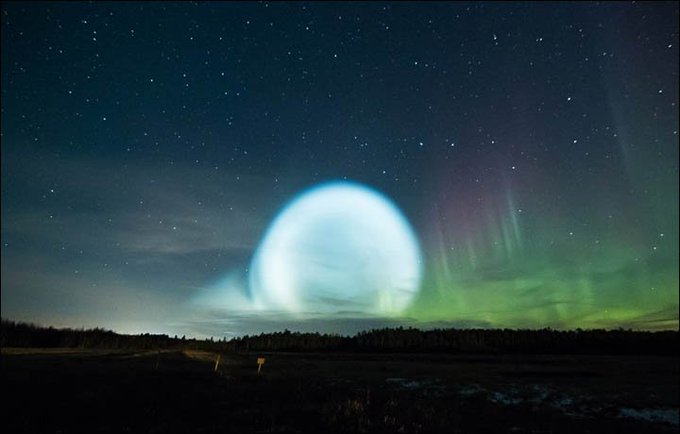
Is That Glow a UFO? No—It’s an ICBM

Is That Glow a UFO? No—It’s an ICBM

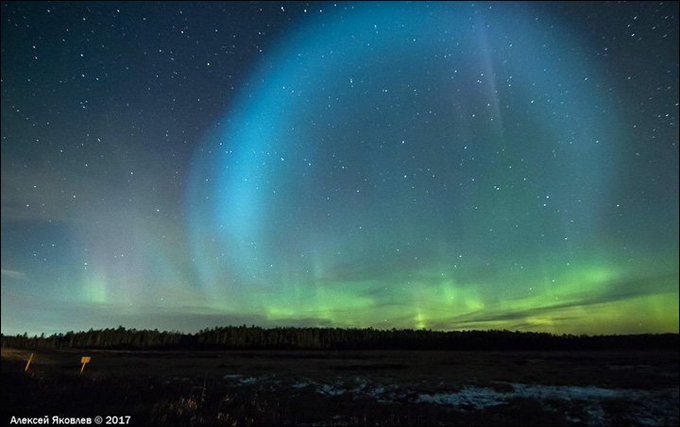
A group of photographers camping out in Siberia to shoot the Northern Lights saw a sight every bit as spectacular and even more mysterious.

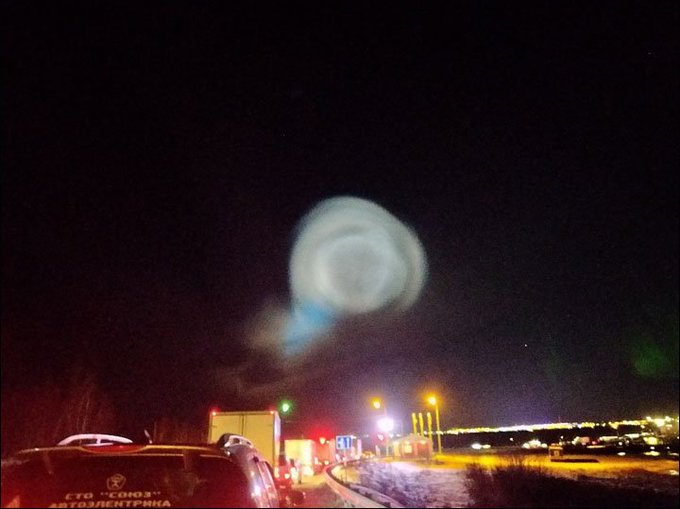
Viewers were stunned to see a huge, glowing, bubble of light rise into the sky. It was weird, it was unidentifiable—and it was flying. It was an Unidentified Flying Object.

According to Siberian Times, many people saw the inexplicable bubble and at least five took pictures on the night of Oct. 26–27.

Some people described the bizarre bubble as “a gap in the space-time continuum” according to the Siberian Times. Others said it must have been aliens.

The actual explanation is a bit more mundane.

The Topol ICBM (Vitaly V. Kuzmin via Creative Commons Attribution-Share Alike 4.0 International license.)

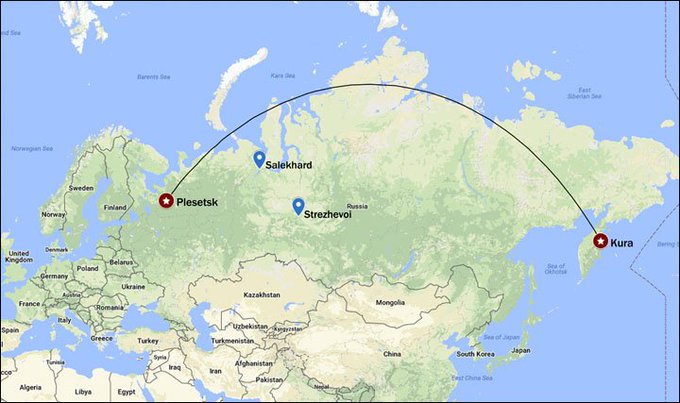
The Russian Ministry of Defense reported on its Facebook page that it had launched a Topol-M intercontinental ballistic missile from a missile base in northern Siberia that night.

According to the Facebook page, the Topol-M missile was fired from the Plesetsk Cosmodrome in northwestern Russia toward the Kura testing range in Kamchatka, which is on Russia’s far eastern Pacific peninsula.

An S-300 PMU-1 anti-aircraft missile launches during a Greek army military exercise near Chania on the island of Crete on December 13, 2013. (Papanikolaou Giorgos/AFP/Getty Images) An S-300 PMU-1 anti-aircraft missile launches during a Greek army military exercise near Chania on the island of Crete on Dec. 13, 2013. (Papanikolaou Giorgos/AFP/Getty Images)

The strange atmospheric effects caused by the missile launch came as a kind of extra treat for the photographers, who were there to capture what was predicted to be an exceptionally bright display of the Aurora Borealis.

Tourists photograph the Northern Lights near Reykjavik, Iceland on October 30, 2015. (Halldor Kolbeins/AFP/Getty Images) Tourists photograph the Northern Lights near Reykjavik, Iceland on Oct. 30, 2015. (Halldor Kolbeins/AFP/Getty Images)

From NTD.tv

Hoe vind je dit bericht?
Geschreven door peter om 22:10 Stuur door

‘Flying saucer’ photographed over Great Barrier Reef

‘Flying saucer’ photographed over Great Barrier Reef

A WOMAN believes she has snapped a picture of a bright “flying saucer” over the Great Barrier Reef.

Daniel Bateman

1e111085b3ba141bf004729517df9732

UFO Bargo NSW

playerARE aliens intent on invading the Great Barrier Reef?

A Cairns woman has photographed, what she believes, is a UFO flying off Fitzroy Island, while she was sailing back to the mainland from a reef fishing trip on Saturday afternoon.

Jenny Morrison was returning from Elford Reef, about 50km east of Cairns, after spending a day at sea with friends, and took a series of photographs of the sunset on her smartphone.

Jenny Morrison photographed this UFO with her iPhone, off Fitzroy Island, on Saturday afternoon. WHAT IS IT????

Jenny Morrison photographed this UFO with her iPhone, off Fitzroy Island, on Saturday afternoon. WHAT IS IT????

Source:Supplied

When she later examined the photos, she noticed in several of the images, an inexplicable luminous green dot shrouded in a distinctive flying saucer shape.

“There’s this little light, that looks just like a bit of water on the lens,” she said.

“I haven’t edited the photos, or done anything to them.

“When you look through the photos, though, the dot is in the middle of a saucer-shaped shadow thing.

“I don’t know how to explain it.”

Adding to the mystery, the green dot eventually vanishes from the last few photographs in the series.

Jenny Morrison photographed this UFO with her iPhone, off Fitzroy Island.

Jenny Morrison photographed this UFO with her iPhone, off Fitzroy Island.

Source:Supplied

Ms Morrison said she did not notice anything with her naked eye, when she took the photos.

“It’s so weird. It looks really real — like something you’d see on TV,” she said.

“It’s crazy.”

Far North Queensland is considered a UFO hotspot, with several sightings of mystery aircraft in the sky over several decades.

The Cardwell UFO Festival, held each October, celebrates the region’s interstellar links by inviting the public to share their experiences of the unexplained.

Originally published as Woman photographs ‘UFO’ over Reef

{ http://www.news.com.au/ }

Hoe vind je dit bericht?
Geschreven door peter om 21:49 Stuur door

U.S. Navy Carrier Strike Force 11 Encounters Unknowns on November 14, 2004 near San Diego – Part 2/3

U.S. Navy Carrier Strike Force 11 Encounters Unknowns on November 14, 2004 near San Diego – Part 2/3

Editor’s note: This is the second part of a series regarding Robert Powell’s investigation of this case. Part I, along with alleged video of the event, can be found here.

In December 2016 I submitted nine different Freedom of Information Act (FOIA) requests to the Navy and the Marines in an effort to establish whether the information on the UFO encounter that I discussed in Part I was real. Here is a link to one of the actual FOIA requests for those that like to see the details click here.

Notice that I never used the term “UFO” in the request as this lessens the likelihood of success because of the negative connotations with the use of that word. This type of FOIA request was made for five different Navy assets that were involved in this incident; a nuclear aircraft carrier, the USS Nimitz; a guided missile cruiser, the USS Princeton; an F-18 part of a Marine Fighter Attack Squadron (VMFA-232); two to four F-18 Super Hornets from a Navy Fighter Attack Squadron (VFA-41); and a carrier based airborne early warning aircraft (an E-2C from VAW-117). Requests were sent to Naval Intelligence, Chief of Naval Operations, U.S. Marines Pacific, U.S. Pacific Fleet, Naval Research, Naval Surface Forces in the Pacific, Naval Air Warfare Center, Naval Facilities, Naval Sea Systems Command, and Naval History.

By April of 2017 I had received replies on all nine of my requests for information. In every case the Navy replied that they had no information responsive to my request. I appealed two of what I considered the most important of the nine FOIAs to the Navy’s Judge Advocate General (JAG). The first appeal came back denied. In the second appeal, I pointed out to the Navy JAG officers that another appeal denial would would indicate that on November 14, 2004, that they had no records on five different Navy assets. I copied my senators and congressman on my appeal. This time I had success. Although the Navy again indicated that they could find no documents, this time they provided me emails with some very interesting information that establishes the encounter with the unknown craft did occur.

Remember in Part I of this story that the F-18 pilot referred to the objects encountered as resembling the oval candy known as “tic tacs.” JAG provided me an email they received from a Marine Lieutenant Colonel that began as follows: “I am definitely aware of the ‘flying tic tac’! We were aboard the USS Nimitz attached to CVW-11. The CO of VFA-41, CDR Fravor had the video footage on his ATFLIR and several pilots in VMFA-232 saw the video.” Bingo! Not only did this event happen, the video was witnessed by a number of Navy and Marine officers. Is the video the same one that was leaked to the internet? We can’t know for certain but I think if the Navy has done their due diligence then they still have a copy of that video.

USS Princeton, guided missile cruiser, part of Carrier Strike Group-11.

And then a second email was provided to me by JAG from a Marine Major. In that email he states, “MAG-11 (Marine Air Group 11) Operations should have a Point of Contact at the archive to facilitate recovery of these files.” This clearly indicates that the Major would expect the Marine archival group to have copies of these records. And would it not be reasonable to expect that the Navy would have the records archived of such an extraordinary event!

In total, I have the names of nine different Marine and Navy officers who either participated in the encounter with the unknown craft or have direct knowledge of the event. I will again appeal for the actual case files but the only way to really get to the bottom of this mystery is to ask a Congressional subcommittee to get involved. In Part 3 I will give you step by step instructions on how you can help petition your congressman. Please share this story with others on Facebook.

{ http://www.openminds.tv/ }

Hoe vind je dit bericht?
Geschreven door peter om 21:36 Stuur door

Debbie Ziegelmeyer – Missouri UFO Landing and Alien Abduction Cases – October 31, 2017

Debbie Ziegelmeyer – Missouri UFO Landing and Alien Abduction Cases – October 31, 2017

Open Minds UFO Radio: Debbie Ziegelmeyer is a successful entrepreneur, diver and paranormal investigator and lecturer in Missouri. Among her paranormal research efforts, she has spent decades looking into the UFO phenomenon. She is the state director for the Mutual UFO Network (MUFON) Missouri Chapter, head of the MUFON Dive Team and a member of the MUFON board of directors. She teaches underwater UFO search and recovery. She appeared as a volunteer archeologist on Sci-Fi’s(now Syfy) “Roswell Crash Startling New Evidence” and NBC’s Sci-Fi Investigates “Roswell Re-visited.”

Debbie recently spoke at the Devil’s Tower UFO Rendezvous commemorating the 40th anniversary of the release of Close Encounters of the Third Kind. She spoke about some of her best cases in Missouri. Two of those cases included the report of a landed UFO in a forest and a young girl who had a sighting with her mother that turned into memories of dreams of alien abduction. I found the stories intriguing and am happy to welcome back Debbie to discuss them in this episode of Open Minds UFO Radio.

For more information about Debbie visit MissouriMUFON.org and UFONut.com.

Featured image by John Chapple/The Sun

{ http://www.openminds.tv/ }

Hoe vind je dit bericht?
Geschreven door peter om 21:27 Stuur door

Aliens Might Actually Be Surprisingly Human-Like

Most of our ideas about what aliens might look like are frankly pretty absurd, despite having no concrete evidence on a) if there’s anything actually out there, and b) what these hypothetical organisms would look actually look like, even if they did indeed exist. Take the aliens from Signs for example — sure, they look like every other alien in sci-fi, but they’re also fatally allergic to water? Why the hell would they come to conquer a planet full of it in the first place?

A new study from the University of Oxford sheds some light on what extraterrestrial life might be like, and unsurprisingly, it could be more us than the M. Night Shyamalan interpretation assumed. The researchers argue that Darwin’s idea of natural selection might be useful in understanding alien life forms — basically, they suggest “survival of the fittest” might apply to aliens as well. Their findings have been published in the International Journal of Astrobiology.

“In our paper, we offer an alternative approach, which is to use evolutionary theory to make predictions that are independent of Earth’s details,” O’ne of the study’s co-authors Sam Levin, a researcher in Oxford’s Department of Zoology, says in a statement. “This is a useful approach, because theoretical predictions will apply to aliens that are silicon based, do not have DNA, and breathe nitrogen, for example.”

The researchers also suggest extraterrestrial life becomes increasingly complex over time, just as species on Earth has become more advanced organisms as a result of extreme events. The evolution of multicellular life roughly 600 million years ago is just one such example of one of these major shifts.

“By predicting that aliens undergone major transitions, which is how complexity has arisen in species on earth, we can say that there is a level of predictability to evolution that would cause them to look like us,” Levin says. “Like humans, we predict that they are made-up of a hierarchy of entities, which all cooperate to produce an alien. At each level of the organism there will be mechanisms in place to eliminate conflict, maintain cooperation, and keep the organism functioning. We can even offer some examples of what these mechanisms will be.”

Obviously, the main drawback of this study is that we’ve never found extraterrestrial life, so any ideas about what they look like or how they behave are extremely speculative. After all, some scientists think the majority of intelligent alien life might not be biological at all — that civilizations on other worlds might have be so advanced they’ve already built robots that can basically just hang out in space.

“The majority of the intelligence in the universe is probably synthetic intelligence,” SETI senior astronomer Seth Shostak told Inverse back in October. “So now if you ask where should we point antennas to find that, it becomes a very hard problem. It’s pretty easy to say ‘[Intelligent life] is gonna be biological, living on some world sort of like Earth. But it could be machines just hanging out in space.”

While this new research is certainly exciting, it’s probably best not to get too excited. Or you can go ahead and totally freak out — aliens are pretty fun to think about, and I won’t tell you how to live your life.

{ https://www.inverse.com/ }

Hoe vind je dit bericht?
Geschreven door peter om 21:16 Stuur door

Monster Black Hole Mergers Could Be Hiding in an Unexpected Place

Black hole mergers are having a moment: Just a few weeks ago, an international team of scientists announced the fourth-ever detection of gravitational waves coming from a black hole smash-up. Now, researchers at the Rochester Institute of Technology (RIT) think they might know where these giant collisions are lurking within spiral galaxies similar to ours.

According to a new study set to be published in the Astrophysical Journal Letters,RIT scientists claim that the edge of spiral galaxies could have all the right ingredients to host big black hole mergers. Previously, dwarf galaxies were thought to be the best place to look for these massive collisions since they don’t have many stars or heavy metals left over from supernovae. Unfortunately, dwarf galaxies are hard to spot, since they have low luminosity — in other words, they’re not very bright.

The RIT researchers say that the outer edges of spiral galaxies might be similar environments to dwarf galaxies, and — bonus points — they’re much easier to observe.

“The metal content in the outer disks of spiral galaxies is also quite low and should be rife with black holes in this large area,” the study’s lead author Sukanya Chakrabarti, an assistant professor of physics at RIT, said in a statement.

Understanding where black hole mergers come from is especially useful for scientists trying to pinpoint the source of various gravitational waves. Over the last year alone, researchers have developed more sophisticated ways of tracing gravitational waves, and it’ll only get better from here.

Nothing puts your entire life into perspective more than the fact that giant, ravenous holes are colliding somewhere out in the universe. It’s truly humbling — and mildly terrifying.


Ever wonder how the Guardians travel so dang fast? Check out this video about wormhole travel in Guardians of the Galaxy Vol. 2, according to a theoretical physicist.


Written by Rae Paoletta

{ https://www.inverse.com/ }

Hoe vind je dit bericht?
Geschreven door peter om 20:56 Stuur door

'GOD MADE ALIENS' Shock theory that UFOs are sent by 'our creator'

'GOD MADE ALIENS' Shock theory that UFOs are sent by 'our creator'

UFOS could be a sign from God, according to a shock theory that aliens are connected to Christianity.

Aliens-God

Getty

ALIEN NEWS: ETs may have been sent by God, according to the Reverend Barry Downing.

The Reverend Barry Downing even claims many biblical events may have involved UFOs or aliens. 

Mr Downing, who is Pastor emeritus of Northminster Presbyterian Church in Endwell, New York, penned the book, “The Bible and Flying Saucers,” which puts forth the argument.

And, in a new updated version just out, “Biblical UFO Revelations,” he continues to push the theory that many Biblical events, including the Burning Bush, could have been caused by alien visitors.

He said: “I believe UFOs are God’s way of saying to our godless culture: ‘I’m back!’ And if God is back, it is time to repent and be glad that the world lives under the umbrella of God’s love, with his angels looking over us.” 

He goes on to question whether "the church has the eyes to see, to open the church doors to welcome our UFO strangers, or will we continue to be ‘unaware’?”

He added: “From my point of view… what we have here now in the skies, they’re part of the divine mission.”

The former reverend has never seen a UFO, but is convinced they are real.

RELATED ARTICLES

He said: "I believe by ‘faith,’ in the same way I believe in the resurrection of Jesus by faith. I believe the reports.

“Except, I can question witnesses, which is even better than in the case of the resurrection.”

Although, his cousin has seen one - a tear-drop-shaped UFO which flew slowly over her house at night. 

He said there was no noise until it hummed after stopping.

He added: "She said it gave off so much light that, even though dark, she could have read a newspaper.”

Mr Downing even thinks that a UFO could have caused the “fire” that never consumed the burning bush in front of Moses?

He said: "What is not amazing to me is not that we had a burning bush… we had a talking bush. 

RELATED ARTICLES

I believe UFOs are God’s way of saying to our godless culture: ‘I’m back!’ And if God is back, it is time to repent and be glad that the world lives under the umbrella of God’s love, with his angels looking over us.

Barry Downing

"A voice came to Moses from the bush.” 

He has also looked at the book of Exodus, including the cloud that moved with the Israelites.

He said: "The cloud of fire moves... you know… it goes in front of them then it stops and moves some more.

"After they get to Mount Sinai and build the tabernacle, the house of worship for the Jewish people, it hovers over the tabernacle.”

On the cover of the latest book - the original was published in 1968 - there is an image of Moses watching the Red Sea part with a shiny UFO above the waters. 

He is also convinced a UFO turned up during the 100th anniversary of the apparitions of the Virgin Mary in Fatima, Portugal, earlier this month. 

He said: "“The UFO got in the way of the sun, causing the earth to seem darker, and this would make the ball of light show up even more.

RELATED ARTICLES

“Church people have trouble with what I’m doing. People who’ve seen UFOs have no problem.

“It represents an inversion of the old story of Galileo and the Catholic Church.

“Because in that story, the church authorities were squelching a scientist. What we have here are scientists squelching the religious stories.”

Mr Downing has many critics within Christianity, however, he is far from the first to push forward a theory about aliens visiting Earth for thousands of years.

Many ufologists claim to have found pictures that resemble flying saucers in the air in religious works of art.

And the Ancient Aliens theory claims advanced visitors from out of space came down thousands of years ago to help build monuments like the Pyramids of Giza.

Related articles

Hoe vind je dit bericht?
Geschreven door peter om 20:04 Stuur door

ANCIENT CITY DISCOVERED IN MIDDLE OF OCEAN

ANCIENT CITY DISCOVERED IN MIDDLE OF OCEAN

Mysterious location just off coast of Micronesia

Ancient City Discovered in Middle of Ocean

Ancient ruins in the middle of the Pacific ocean could be the remnants of a legendary race or dare we say….Atlantis.

Clips from the Science Channel series What on Earth? reveal images of a mysterious location just off the coast of the tiny nation of Micronesia.

The remote island of Pohnpei is home to the archaeological site of Nan Madol, yet very little is known about the area and the ruins that reside there.

The city appears to be sit on top of a lagoon and consists of a series of canals and large stone walls. 

Studies published by Research Gate show that the complex could date back to the first or second century AD but little has still yet to be verified about Nan Madol.

Images of the site can still clearly be seen via Google Earth.

atlantis.jpg
Via: Google Earth

Last year, FOX News published a report stating that the site could date back to around 1180.

This was after a team of researchers lead by Mark McCoy of the Southern Methodist University in Texas analysed findings on the island.

McCoy is quoted by FOX News as saying:

It now looks like Nan Madol represents a first in Pacific Island history.

The tomb of the first chiefs of Pohnpei is a century older than similar monumental burials of leaders on other islands.

To me, in its prime, Nan Madol was a capital.

It was the seat of political power, the centre of the most important religious rituals, and the place where the former chiefs of the island were laid to rest.

HT YouTube


More: The mystery of why Easter Island's inhabitants all died just took a surprising new twist

{ https://www.infowars.com/ }

Hoe vind je dit bericht?
Geschreven door peter om 19:35 Stuur door

Images From Above Reveal An Ancient City In The Middle Of The Ocean

Images From Above Reveal An Ancient City In The Middle Of The Ocean

Images from above reveal an ancient city in the middle of the ocean

Remains of an ancient city, rumored to be haunted, litter the Pacific island of Pohnpei.

[Image: nWc4fxi.jpg]

http://lunaticoutpost.com/thread-800365.html

{ http://investmentwatchblog.com/ }

{

Hoe vind je dit bericht?
Geschreven door peter om 19:23 Stuur door

Satellietbeelden onthullen mysterieuze stad midden in de oceaan. Zijn dit resten van een verloren beschaving?

Satellietbeelden onthullen mysterieuze stad midden in de oceaan. Zijn dit resten van een verloren beschaving?

Satellietbeelden onthullen mysterieuze stad midden in de oceaan. Zijn dit resten van een verloren beschaving?

Onderzoekers hebben in het midden van de Grote Oceaan een oude stad ontdekt. Het zou kunnen gaan om de resten van een verloren beschaving.

In het programma What on Earth? van Science Channel waren onlangs luchtfoto’s te zien van de mysterieuze ruïnes vlak voor de kust van Micronesië, een eilandengroep bestaande uit zo’n 600 eilanden.

Bekijk de beelden hieronder:

De stad bevindt zich op het eiland Pohnpei, waarop onder meer de hoofdstad van Micronesië gelegen is.

Raadsel

Op Pohnpei kan ook de archeologische vindplaats Nan Madol worden gevonden. In 2016 werden deze ruïnes op de Werelderfgoedlijst van UNESCO geplaatst.

Hoewel erkend wordt dat Nan Madol historisch gezien belangrijk is, blijven de ruïnes voor onderzoekers en historici een raadsel.

De stad, die wordt omgeven door enorme muren van steen, bevindt zich bovenop een lagune en bestaat uit een serie kleine eilandjes die middels kanalen aan elkaar gelinkt zijn.

Spookstad

Het complex zou dateren uit de eerste of tweede eeuw na Christus. Onderzoekers denken dat de stenen monumenten ergens tussen 1180 en 1200 zijn gebouwd.

De ontdekking werd gedaan nadat onderzoekers van de Southern Methodist University in Texas het eiland hadden geanalyseerd.

Sommigen spreken van de ‘spookstad’ en zeggen dat het één van de vele steden was die onderdeel uitmaakten van het hypothetische continent Lemurië.

Foto: Magnus Manske Wikimedia Commons

[Science Channel] 
Hoe vind je dit bericht?
Geschreven door peter om 19:13 Stuur door

SFU professor delves into crop circle community

SFU professor delves into crop circle community

When Simon Fraser University professor Paul Kingsbury tells people that he spends his time studying the people who investigate aliens, ghosts, sasquatches and other paranormal activity, he doesn’t get the strange looks you might expect.

“The most common reaction is absolutely affirmation, or that’s brilliant or interesting. I’ve not received a cynical or a dismissive reaction,” said Kingsbury. “I’ve garnered a lot of respect and intrigue.”

Two years ago, Kingsbury, who is a cultural geographer, received a $183,000 grant from Social Sciences and Humanities Research Council to study paranormal investigators and their motivations. Now halfway through his project, he has gone ghost hunting, interviewed alien abductees, and attended conferences on UFOs and sasquatches.

His latest research brought him to the south of England, where he took time away from visiting family to attend a three-day conference in Devizes on crop circles. You read that right — crop circles.

A crop circle photographed in southwest England in the summer of 2011.

A crop circle photographed in southwest England in the summer of 2011. 

CHAD DEETKEN / PNG

“The crop circle was a new direction in the project,” said Kingsbury. “Like sasquatches, UFOs and ghosts, crop circles are in many ways a very controversial and mysterious phenomenon.

“They are different, though, because they are very tangible.”

Kingsbury said crop circles are a worldwide phenomenon, and even appeared in B.C. almost 20 years ago when 10 circles were spotted in an oat field near Vanderhoof airport in 1998. Three years later, a pilot saw six circles in another field about five kilometres from the Vanderhoof airport.

Kingsbury said the conference was fantastic for his research.

He found that people were less interested in the origins of the mysterious circles — theories includes aliens, aquifers, energy fields or manifestations of divine feminine energy — than they were in their beauty. At crop circle sites, people lay down in the circles, meditating and embracing.

“There’s a great deal of passion and desire among the crop circle enthusiasts,” Kingsbury said. “I think it’s important to understand why there would be so many people spending a lot of time, energy and money on these paranormal phenomena.”

When asked where he thinks the circles come from, Kingsbury said some are definitely made by humans, but there are those that defy explanation.

“I’m open to possibilities,” he said, carefully. “I try to occupy a middle ground.”

His work with crop circle enthusiasts will form part of his research, which will continue for another couple of years. The end goal is to publish three journal articles and a book, but before that he has some other ideas.

Kingsbury plans to work with Vancouver skywatcher Charles Lamoureux, who uses video to document unexplained lights over the city, to conduct research and co-author a paper to be presented, hopefully, at a UFO conference.

Next year, he will go on expeditions with a sasquatch hunter.

He would also like to organize a mini conference in Vancouver to bring together sasquatch, UFO and ghost enthusiasts/investigators.

He will also be taking his six-year-old daughter out trick-or-treating for Halloween.

“We will be in the world of ghosts, aliens and sasquatch,” he said. “They say the truth is out there, and it certainly is on Halloween.”

jensaltman@postmedia.com

twitter.com/jensaltman

RELATED

{ http://vancouversun.com/ }

Hoe vind je dit bericht?
Geschreven door peter om 19:05 Stuur door

Ruim een ton voor wetenschappelijk onderzoek naar graancirkels. Door wie of wat worden ze gemaakt?

Ruim een ton voor wetenschappelijk onderzoek naar graancirkels. Door wie of wat worden ze gemaakt?

Ruim een ton voor wetenschappelijk onderzoek naar graancirkels. Door wie of wat worden ze gemaakt?

Er zijn inmiddels al meer dan 20.000 graancirkels verschenen, maar nog steeds kan niemand met zekerheid zeggen door wie ze worden gemaakt.

“Sinds de jaren 2000 worden graancirkels steeds groter en complexer en wordt er ook steeds meer onderzoek naar gedaan,” zei professor Paul Kingsbury van de Simon Fraser University in Canada.

Hoewel graancirkels in theorie kunnen worden gemaakt door mensen, zijn de patronen vaak te ingewikkeld om na te maken, aldus Kingsbury.

UFO’s

“Als mensen die verantwoordelijk zeggen te zijn voor hoaxen wordt gevraagd om te laten zien hoe ze deze perfect gevormde cirkels in het weiland hebben gemaakt, kunnen ze ze niet reproduceren,” zei hij.

Twee jaar geleden kreeg Kingsbury 183.000 dollar (122.000 euro) om paranormale onderzoekers te bestuderen. Hij is nu ongeveer halverwege.

Sommige onderzoekers zeggen dat UFO’s verantwoordelijk zijn voor graancirkels, terwijl anderen claimen dat ze gelinkt kunnen worden aan bolbliksem.

Krachtige energie

Kingsbury bezocht een graancirkel toen hij in Wiltshire was. Daar ontdekten lokale bewoners in de afgelopen zomer 30 formaties.

Hij was getuige van het effect dat ze hadden op bezoekers. “Mensen claimden een krachtige energie te krijgen. Mensen waren aan het mediteren,” zei hij.

De professor merkte op dat ook in Canada en Amerika in de afgelopen jaren diverse graancirkels zijn opgedoken, maar dat er nog weinig onderzoek naar wordt gedaan.

Onverklaarbare formaties

Zo werden in 1998 graancirkels ontdekt in een weiland bij Vanderhoof Airport in Brits-Columbia. En drie jaar later zag een piloot zes cirkels in een weiland bij dezelfde luchthaven.

Kingsbury zei dat sommige cirkels duidelijk zijn gemaakt door mensen, maar dat er ook veel onverklaarbare formaties tussen zitten. “Ik sta open voor mogelijkheden,” zei hij.

Het is de bedoeling om drie wetenschappelijke artikelen en een boek te publiceren over het onderzoek.

Foto: MrGyro.co.uk

[Vancouver Sun, Toronto News] 
Hoe vind je dit bericht?
Geschreven door peter om 18:38 Stuur door

UFOs in the Bible? Retired pastor says so

UFOs in the Bible? Retired pastor says so

Thomas Picciano, Correspondent

Retired Endwell pastor Rev. Barry Downing was asked if he feels like a modern-day prophet.

10312017-Faith.JPG

Rev. Barry Downing, pastor emeritus of Northminster Presbyterian Church in Endwell is the author of "Biblical UFO Revelations."

(Photo: Thomas Picciano / Correspondent photo)

“No, but I feel rejected. Does that qualify me?” he said with a chuckle.

Since his first book, “The Bible and Flying Saucers,” was published in 1968, Downing has been putting forth an argument that many biblical events may have connections to UFOs. But it’s not been accepted warmly in all circles.  

In a new book just out in September, “Biblical UFO Revelations,” Downing offered an update with words for 2017.

“I believe UFOs are God’s way of saying to our godless culture: ‘I’m back!’ And if God is back, it is time to repent and be glad that the world lives under the umbrella of God’s love, with his angels looking over us,” he writes.

Downing goes on to question whether the church has the “eyes to see, to open the church doors to welcome our UFO strangers, or will we continue to be ‘unaware’?”

“From my point of view … what we have here now in the skies, they’re part of the divine mission,” he said in an interview.

And although he’s never seen an UFO, Downing believes in them.

“I believe by ‘faith,’ in the same way I believe in the resurrection of Jesus by faith. I believe the reports," he said. “Except, I can question witnesses, which is even better than in the case of the resurrection.”

Downing said his cousin once saw a tear-drop-shaped UFO fly slowly over her house on night. He said there was no noise until it stopped, then hummed.

“She said it gave off so much light that, even though dark, she could have read a newspaper.”

Could a UFO have caused the “fire” that never consumed the burning bush in front of Moses?

Maybe, Downing thinks. 

“What is not amazing to me is not that we had a burning bush … we had a talking bush.  A voice came to Moses from the bush,” he said.

The book of Exodus contains lots of material for Downing, including the cloud that moved with the Israelites.

“The cloud of fire moves ... you know … it goes in front of them then it stops and moves some more. After they get to Mount Sinai and build the tabernacle, the house of worship for the Jewish people, it hovers over the tabernacle,” he said.

The cover of his new book shows an image of Moses watching the Red Sea part with a shiny UFO above the waters. An English artist who died almost three decades ago said he painted it for the cover of Downing’s first book, although they’d never made contact. 

Downing also believes a UFO was involved in a more recent event, in mid-October, the 100th anniversary of Fatima. Roman Catholics believe Mary, the mother of Jesus, visited three shepherd children there over several months. Then on Oct. 13, 1917, as perhaps 50,000 or more gathered, the sun seemed to fall from the sky.

“The UFO got in the way of the sun,” Downing said, “causing the earth to seem darker, and this would make the ball of light show up even more where the children were.”

Downing, whose doctorate specialized in the relationship between science and religion, is not without skeptics.

“Church people have trouble with what I’m doing,” he said. “People who’ve seen UFOs have no problem.

“It represents an inversion of the old story of Galileo and the Catholic Church," Downing said, “because in that story, the church authorities were squelching a scientist. What we have here are scientists squelching the religious stories.”

Downing spoke about his new book at the Rotary Club of Endwell earlier this month. That’s the same organization where he presented his first speech about his original book in 1968.

Tom Hranek, a Rotarian who is Roman Catholic, heard Downing’s talk. Hranek is “intrigued by his pursuit about the truth about UFOs, otherworldly beings and how much information may shed additional light on sacred scripture.”

Adding that Downing is facing challenges to his “scholarly pursuit of the truth,” Hranek said, “He may be on the trail of a scriptural/scientific truth that may awaken and bring together folks from spiritual and scientific persuasions.”

Rev. Barry H. Downing

Position: Pastor emeritus, Northminster Presbyterian Church in Endwell.

Author: “The Bible and Flying Saucers” and “Biblical UFO Revelations.”

Residence: Endwell.

Hometown: Delhi.

Family: Wife, Eleanor.

Education: Bachelor’s degree in physics, Hartwick College, Oneonta; divinity degree, Princeton Theological Seminary; Ph.D., University of Edinburgh, Scotland.

Associations: Who’s Who in Theology and Science; theological consultant, MUFON (the Mutual UFO Network); took part in History Channel series “UFOs In the Bible” and “Ancient Aliens.”

Hoe vind je dit bericht?
Geschreven door peter om 18:30 Stuur door

Bijbel bevat verhalen over UFO’s. Deze dominee geeft een aantal opmerkelijke voorbeelden

Bijbel bevat verhalen over UFO's. Deze dominee geeft een aantal opmerkelijke voorbeelden

Bijbel bevat verhalen over UFO’s. Deze dominee geeft een aantal opmerkelijke voorbeelden

De gepensioneerde dominee Barry Downing is auteur van het boek The Bible and Flying Saucers, dat in 1968 werd gepubliceerd.

Downing stelt dat veel gebeurtenissen in de Bijbel gelinkt kunnen worden aan UFO’s. Volgende maand komt er een nieuw boek van hem uit: Biblical UFO Revelations.

De dominee vraagt zich af of de kerk de deuren zal openen voor deze bezoekers uit de ruimte of dat we onwetend blijven.

Geen geluid

“In mijn ogen zijn ze onderdeel van een goddelijke missie,” zei hij in een interview. Hoewel hij zelf nog nooit een UFO heeft gezien, gelooft Downing er wel in.

Hij zei dat zijn nicht eens op een avond een UFO in de vorm van een traan over haar huis zag zweven. Hij zei dat er geen geluid was te horen tot het object stil bleef hangen. Toen was een zoemend geluid hoorbaar.

Veroorzaakte een UFO de brand die de braamstruik in de Bijbel niet deed opbranden?

Wolk

“We hebben in dit geval niet te maken met een brandende struik, maar met een pratende struik,” zei Downing. “Uit de struik kwam een stem die tegen Mozes sprak.”

Het boek Exodus bevat veel materiaal voor Downing, waaronder de wolk die de Israëlieten verplaatste.

“De wolk van vuur bleef voor ze hangen en kwam daarna weer in beweging,” zei hij. “Vervolgens bouwden ze de tabernakel bij de Sinaï en bleef het boven de tabernakel hangen.”

Maria

Op de kaft van zijn boek is een afbeelding van Mozes te zien bij de Rode Zee. Boven het water hangt een glimmende UFO.

Downing denkt ook dat er een UFO betrokken was bij een meer recente gebeurtenis, de 100e verjaardag van de verschijning van Maria van Fatima.

Zij verscheen in 1917 aan drie herderskinderen. Op 13 oktober dat jaar zagen 50.000 aanwezigen hoe de zon uit de lucht leek te vallen. “Het was een UFO die voor de zon langs vloog,” zei Downing.

Galileo Galilei

Mensen binnen de kerk hebben moeite met zijn theorieën. De dominee trok een parallel met het conflict dat Galileo Galilei had met de Katholieke Kerk.

“In dat verhaal snoerde de kerk een wetenschapper de mond. In dit geval drukken wetenschappers de religieuze verhalen de kop in,” besloot hij.

[Press & Sun-Bulletin] 
Hoe vind je dit bericht?
Geschreven door peter om 18:16 Stuur door

Niece of Abducted Aunt and Uncle by UFO Seeks the Truth

Niece of Abducted Aunt and Uncle by UFO Seeks the Truth

betty-barney-hill Betty & Barney Hill

Kathleen Marden is a leading abduction and UFO author, researcher, and lecturer. Her undisputable educational background in the world of social sciences has shaped her fascination and interest in ufology. Comprehensive research, study, and investigation in alien abduction have interested her that some abductions are not fictional or mere imagination, but real. She believes that Barney and Betty Hill, both her uncle and aunt have reported their experiences of seeing a strange object while out driving in the rural New Hampshire. A woman whose uncle and aunt were at the centre of the most famous yet controversial alien abduction stories for the past sixty years expresses her beliefs that aliens do exist no matter how authorities or some people debunked alien stories since there is strong evidence from such incident.

Mrs Marden was 13 at that time. However, it was years later that she began researching and studying what took place for a biography of the Hills. With some convincing evidence that is being physically added to the weight of the case as claimed by her aunt and uncle in 1961 – where it includes a pink substance on her Betty’s dress and some strange spot marks on the car’s boots. She calls her relatives as reputable and credible witnesses. The Florida-based writer, for the first time, has spoken to the Examiner at the conference in West Yorkshire. She expresses her beliefs on UFOs and the abduction. She claimed to be unbiased when she undertook the investigation. She analysed her aunt and uncle’s statement when they were on the alien spacecraft. She added that her relatives did not want their stories to go public, and it was only revealed when it was picked up by a reporter for a newspaper due to a breach of confidence.

She made it clear that people need to go out from their comfort zone if they felt uncomfortable with the idea that such UFO abduction exists and further added that she is not trying to convince or persuade anyone who does not believe the existence of aliens. All she wanted to do was to separate fact from fiction since fiction has dominated on the stories of her relatives.

{http://www.latest-ufo-sightings.net/ }

Hoe vind je dit bericht?
Geschreven door peter om 18:09 Stuur door

Florida Congressional Candidate Claims To Have Received Instructions From Aliens Telepathically

Florida Congressional Candidate Claims To Have Received Instructions From Aliens Telepathically

Bettina Rodriguez Aguilera Bettina Rodriguez Aguilera

Florida congressional candidate Bettina Rodriguez Aguilera gave details of her experience with aliens during interviews years ago. In 2009 interview, she said aliens first contacted her when she was seven years old and was instructed through telepathy to visit them in their spaceship.

She said that quartz stones controlled the craft and described the aliens as similar to the blonde female host who interviewed her. She stated there were three aliens, one female and two males, which reminded her of Rio de Janeiro’s Christ the Redeemer in Brazil.

Many times over the years, she claimed that they connected with her again through telepathy and told her secrets about the present and future.

Among these so-called secrets were; Africa is the center of energy in the world, the presence of 30,000 non-human skulls buried in subterranean caves in Malta, and the limestone tourist attraction Coral Castle in South Miami-Dade is an ancient Egyptian pyramid.

She further revealed that these aliens made detailed predictions about people she would meet in her life, including the year, month, and day.

In 2009 interview, she also hinted that aliens told her about ISIS or possibly the Egyptian goddess Isis.

Now, the Florida congressional candidate is trying so hard to be known for her experiences with people than with space aliens. Running as a Republican for a seat in the House of Representatives, Bettina Rodriguez Aguilera has faced scrutiny for interviews she gave, detailing her experience with aliens.

{http://www.latest-ufo-sightings.net/ }

Hoe vind je dit bericht?
Geschreven door peter om 17:49 Stuur door

Doctors 3D Printed a Replacement for This Woman’s Damaged Spine

Doctors 3D Printed a Replacement for This Woman’s Damaged Spine

Image result for Doctors 3D Printed a Replacement for This Woman’s Damaged Spine 
IN BRIEF
  • Doctors in India replaced a woman's damaged vertebrae with a 3D-printed titanium copy during a 10-hour surgery that was the first of its kind in the nation.
  • 3D printing technology allowed the doctors to created a perfect replacement part for this patient, another way that technology is leading us into an age of personalized healthcare.

FROM A DISEASE TO A DISABILITY

Human innovation continues to push forward in so many directions. In all walks of science, researchers are achieving new “firsts” in the pursuit of a better life for the people of the world. Now, doctors in India, a country that has been basking in its recent record-breaking satellite launch, have completed the nation’s first 3D-printed spinal restoration surgery.

The patient, a 32-year-old Indian woman, lost her ability to walk due to a severe case of tuberculosis. The disease commonly affects the lungs, but it traveled to the woman’s spinal cord when her immune system was particularly weakened by drugs she was prescribed for infertility. The tuberculosis compromised her first, second, and third cervical vertebrae, removing support for both her skull and lower spine.

The damaged spinal cord resulted in a curved posture, weakness in her limbs, and an involuntarily sliding of the head. If left untreated, her condition would have been essentially a death sentence. However, a team of surgeons at Gurgaon Hospital had an interesting solution.

TO PRINT A SPINE

A team of surgeons led by Dr. V Anand Naik, a senior consultant of spine surgery from the Medanta Bone and Joint Institute, replaced the damaged vertebrae with a 3D-printed titanium copy. Using CT and MRI scans as reference, they first 3D printed a dummy spine that was perfectly sized for the patient’s needs. After much testing by design teams from India, the U.S., and Sweden for biomechanics and stress resistance, the final titanium implant was created.

Related image

Image result for Doctors 3D Printed a Replacement for This Woman’s Damaged Spine

Photo Credit: Sanjay Kumar Pathak

Photo Credit: Sanjay Kumar Pathak

Naik and his team then inserted the replacement between the first and fourth vertebrae, bridging the gap within the damaged spine. The surgery was completed over an intense 10-hour period, and afterward, Dr.Naik told the Hindustan Times, “It was a very complex surgery and the patient’s condition was deteriorating by the day. It would not have been possible to do it without 3D-printing technology.”

The woman is expected to recover fully in two weeks and live a normal life. Her journey is truly one for the history books. What seemed like an impossible case was resolved with multinational efforts that went beyond traditional medical thinking. Today’s “first” in a field could eventually become a common practice that saves many lives, but for now, just saving one is enough.

{ https://futurism.com/ }

Hoe vind je dit bericht?
Geschreven door peter om 12:57 Stuur door

Very strange UFO spotted floating in the sky over Las Vegas, Nevada

Very strange UFO spotted floating in the sky over Las Vegas, Nevada

A couple captured a really strange unidentified flying object in the sky over Las Vegas, Nevada on October 29, 2017 that has left them baffled.

strange%2Bufo%2Blas%2Bvegas%2B%2B%25281%2529.jpg

Witness said:” We were driving and my husband said look at that, what is it?”

“We observed a rectangular shaped object hovering very close to us...it was quite large. As we tried to move closer we took two pictures and then all of a sudden it seemed to change shape somewhat and then it was miles away from us.”

“It looked very small at this point. We tried to follow it but it just disappeared from our sight.” Mufon case file 87715.

strange%2Bufo%2Blas%2Bvegas%2B%2B%25282%2529.jpg
strange%2Bufo%2Blas%2Bvegas%2B%2B%25283%2529.jpg
Note: Is this odd looking object a real alien spacecraft or is it actually a highly advanced man-made craft used by the military or Intelligence agencies that is far ahead of what the public is generally aware?

{ http://ufosightingshotspot.blogspot.com/ }

Hoe vind je dit bericht?
Geschreven door peter om 12:44 Stuur door

RIP Art Campbell

RIP Art Campbell

RIP Art Campbell

Art Campbell’s wife informed me yesterday that her beloved husband passed away on October 28. This sad news really came as a surprise to me. I sent her my deepest condolences on her loss.

My email exchanges with Art Campbell have always been very amicable in nature and I’ll always be very grateful to him for the free documentation he has sent me over the years pertaining to UFOs, in particular to his long research re the alleged July, 1947 UFO crash at The Plains of San Augustin and the associated metallurgical analyses of wreckage which was found at the site. For those of you who didn’t know him, I’ve included a link to his website.

foto van André Skondras.
Hoe vind je dit bericht?
Geschreven door peter om 12:36 Stuur door

We Can’t Alter The Flow of Time But, According to Physics, We Can Bend It

We Can’t Alter The Flow of Time But, According to Physics, We Can Bend It

by Chelsea Gohd


generalfmv/Adobe Stock

Traveling in Time

Most of us have dreamed of traveling through time, backward or forwards, faster than those around us. And surprisingly, recent work has shown us that time travel is far more than just a dream. In fact, a number of researchers have explored, and are currently exploring, the legitimacy of time travel. While they haven’t quite gotten to the point where they are able to time travel themselves—these researchers have found some concrete science backing it up.

This past June, I met with James Beacham, a particle physicist at the European Organization for Nuclear Research (CERN), at Brain Bar Budapest, a festival focused on science and the future, to talk about the ways in which time travel has enraptured humanity and discuss both the logistical and technical potential of time travel.

Beacham began by outlining the ways that, according to Einstein’s theories, time travel is technically possible through a number of different methods.

“If space can be bent, then spacetime can be bent.”

One proposed method of time travel is via wormholes. “We know that space can be bent. If space can be bent by, say, gravity, then spacetime can be bent,” Beacham said. To clarify, space is the three-dimensional body in which all things in the universe move. Spacetime, however, is the combined concepts of space and time into a four-dimensional continuum. You may have even seen spacetime portrayed as a fabric, manipulated by energy. If spacetime can be bent, Beacham continued, it’s theoretically possible that time can be bent.

Making Time Travel A Reality

This concept of bending spacetime sprung from Einstein’s theory of General Relativity, which introduced the idea that wormholes could, in theory, act as a bridge between two points that would otherwise be very distant. Because of spacetime’s flexibility, a wormhole could link two different points in its fabric.

Recently, evidence for this theory has moved beyond the strictly theoretical.  A couple of years ago, scientists built what they described as a “wormhole.” Their model, however, created a portal for magnetic fields. As Smithsonian outlined, “if another magnetic field travels through the wormhole, it appears to leave space altogether, only showing up at either end.”

So it doesn’t exactly teleport particles (or people) across spacetime, but it does highlight the continual advances that are being made in our ability to manipulate the various fundamental forces in our universe, and ultimately, the manipulation of this force is an important step towards creating a simplified wormhole that would allow us to send electromagnetic waves through an invisible tunnel. Perhaps, one day, we will be able to manipulate spacetime in a similar manner.

So while wormholes remain theoretically possible and important steps are being made, wormholes in spacetime, specifically, have yet to be observed or created.

Another potential method of time travel is time dilation. Einstein’s theories predicted that time passes differently throughout the universe. We now know this to be true—clocks tick slower on the International Space Station (ISS) than they do here on Earth, for example. This happens because time moves slower for objects that are near strong gravitational fields (such as Earth) than for objects further from these fields, like the ISS. 

So by spending time off Earth’s surface and returning at a later point, a human could, in a sense, fast forward through time. If you could get close to a black hole, because there are such strong gravitational forces in the vicinity, time would slow to a mesmerizing degree. Thousands of Earth-years might pass by while only a few seconds tick by near a supermassive black hole.

Time dilation also comes into play where speed is concerned. If we were to, say, travel at 95% of the speed of light, time would slow down dramatically. So again, thousands of Earth-years could pass by in what the traveler experiences as just a few moments.

And this is just the beginning, as there are a number of different ways in which we could make time travel into a reality. Scientists from various disciplines are investigating different methods for us to make more dramatic jumps through time, like using circulating light beams, which can be created through the use of gamma and magnetic fields to twist space and cause time to be twisted. Other methods include quantum tunneling and hypothetical cosmic strings.

Of course, just because something is theoretically possible doesn’t mean it’s technically feasible. At least, not yet. We can’t make wormholes, and we can’t travel near the speed of light. But there is hope that we could achieve these things in the very near future. “We could possibly address things about time travel and understand the basic nature of time with the research that we do now. Or at least, in the next 50 to 100 years,” Beacham said.

Yet, we must acknowledge the possibility that moving back and forth through time may be contrary to the laws of physics. Still, that doesn’t mean we shouldn’t try. As Stephen Hawking famously wrote in his autobiography, “Even if it turns out that time travel is impossible, it is important that we understand why it is impossible.”

{ https://futurism.com/ }

Hoe vind je dit bericht?
Geschreven door peter om 12:27 Stuur door

DocUFObia by Mars Moon Space TV Raises More Questions Than Answers

DocUFObia by Mars Moon Space TV Raises More Questions Than Answers

57f0efae170000e20aac8cf8.jpg?ops=100_100
Jim Barnes II, Contributor

59f8f44a180000310ddfd223.jpg?ops=scalefit_820_noupscale

MARS MOON SPACE TV

DocUFObia

Documentary film producer, Thomas Mickey Jensen of Mars Moon Space TV has released an independent film entitled “DocUFObia”. The film is comprised of video clips from official NASA STS and ISS missions that show strange anomalies in space that appear to change direction and speed. After watching it myself, I must admit.... Something very strange is going on. The film is hosted by Billy Carson, who is an expert host on Gaia’s original streaming series, Deep Space. Billy Carson has also been on may shows surrounding these topics and his research has been used in many documentaries and films. The documentary also features Dollie Indigostar from the UK. Dollie is also the co-host of Social Media UFO’s which is broadcasts live on Wednesdays every week. Leading the pack is Thomas Mickey Jensen. Millions of people have see his research all over the world. His work has made international news many times over and this film is his 5th major production.

DocUFObia seeks to find an answer to this question.... Is there of the life in the universe?

MARS MOON SPACE TV
DocUFObia

For more information visit http://marsmoonspace.com

{ https://www.huffingtonpost.com/ }

Hoe vind je dit bericht?
Geschreven door peter om 12:14 Stuur door

“Electric Sails” Could Allow Us To Reach the Farthest Recesses of Space

“Electric Sails” Could Allow Us To Reach the Farthest Recesses of Space

by Universe Today

 The Planetary Society

Sailing Through Space

We’re all familiar with the idea of solar sails to explore the Solar System, using the light pressure from the Sun. But there’s another propulsion system that could harness the power of the Sun, electric sails, and it’s a pretty exciting idea.

A few weeks ago, I tackled a question someone had about my favorite exotic propulsion systems, and I rattled off a few ideas that I find exciting: solar sails, nuclear rockets, ion engines, etc. But there’s another propulsion system that keeps coming up, and I totally forgot to mention, but it’s one of the best ideas I’ve heard in awhile: electric sails.

Artist concept of a solar sail demonstration mission that will use lasers for navigation. Credit: NASA.

As you probably know, a solar sail works by harnessing the photons of light streaming from the Sun. Although photons are massless, they do have momentum, and can transfer it when they bounce off a reflective surface.

In addition to light, the Sun is also blowing off a steady stream of charged particles – the solar wind. A team of engineers from Finland, led by Dr. Pekka Janhunen, has proposed building an electric sail that will use these particles to carry spacecraft out into the Solar System.

To understand how this works, I’ll need to jam a few concepts into your brain.

First, the Sun. That deadly ball of radiation in the sky. As you probably know, there’s a steady stream of charged particles, mainly electrons and protons, zipping away from the Sun in all directions.

Visualization of the solar wind encountering Earth’s magnetic “defenses” known as the magnetosphere. Clouds of southward-pointing plasma are able to peel back layers of the Sun-facing bubble and stack them into layers on the planet’s nightside (center, right). The layers can be squeezed tightly enough to reconnect and deliver solar electrons (yellow sparkles) directly into the upper atmosphere to create the aurora. Credit: JPL

Astronomers aren’t entirely sure how, but some mechanism in the Sun’s corona, its upper atmosphere, accelerates these particles on an escape velocity. Their speed varies from 250 to 750 km/s.

Solar Wind Power

The solar wind travels away from the Sun, and out into space. We see its effects on comets, giving them their characteristic tails, and it forms a bubble around the Solar System known as the heliosphere. This is where the solar wind from the Sun meets the collective solar winds from the other stars in the Milky Way.

In fact, NASA’s Voyager spacecraft recently passed through this region, finally making their way to interstellar space.

The solar wind does cause a direct pressure, like an actual wind, but it’s incredibly weak, a fraction of the light pressure a solar sail experiences.

This artist’s concept shows the Voyager 1 spacecraft entering the space between stars. Interstellar space is dominated by plasma, ionized gas (illustrated here as brownish haze), that was thrown off by giant stars millions of years ago. Credit: NASA.

But the solar wind is negatively charged, and this is the key.

An electric sail works by reeling out an incredibly thin wire, just 25 microns thick, but 20 kilometers long. The spacecraft is equipped with solar panels and an electron gun which takes just a few hundred watts to run.

By shooting electrons off into space, the spacecraft maintains a highly positive charged state. As the negatively charged particles from the Sun encounter the positively charged tether, they “see” it a huge obstacle 100 meters across, and crash into it.

By imparting their momentum into the tether and spacecraft, the ions accelerate it away from the Sun.

The amount of acceleration is very weak, but it’s constant pressure from the Sun and can add up over a long period of time. For example, if a 1000 kg spacecraft had 100 of these wires extending out in all directions, it could receive an acceleration of 1 mm per second per second.

In the first second it travels 1 mm, and then 2 mm in the next second, etc. Over the course of a year, this spacecraft could be going 30 km/s. Just for comparison, the fastest spacecraft out there, NASA’s Voyager 1, is merely going about 17 km/s. So, much faster, definitely on an escape velocity from the Solar System.

One of the downsides of the method, actually, is that it won’t work within the Earth’s magnetosphere. So an electric sail-powered spacecraft would need to be carried by a traditional rocket away from the Earth before it could unfurl its sail and head out into deep space.

I’m sure you’re wondering if this is a one-way trip to get away from the Sun, but it’s actually not. Just like with solar sails, a electric sail can be pivoted. Depending on which side of the sail the solar wind hits, it either raises or lowers the spacecraft’s orbit from the Sun.

Strike the sail on one side and you raise its orbit to travel to the outer Solar System. But you could also strike the other side and lower its orbit, allowing it to journey down into the inner Solar System. It’s an incredibly versatile propulsion system, and the Sun does all the work.

Although this sounds like science fiction, there are actually some tests in the works. An Estonian prototype satellite was launched back in 2013, but its motor failed to reel out the tether. The Finnish Aalto-1 satellite was launched in June 2017, and one of its experiments is to test out an electric sail.

We should find out if the technique is viable later this year.

The HERTS Mission

It’s not just the Finns who are considering this propulsion system. In 2015, NASA announced that they had awarded a Phase II Innovative Advanced Concepts grant to Dr. Pekka Janhunen and his team to explore how this technology could be used to reach the outer Solar System in less time than other methods.

The Heliopause Electrostatic Rapid Transit System, or HERTS spacecraft would extend 20 of these electric tethers outward from the center, forming a huge circular electric sail to catch the solar wind. By slowly rotating the spacecraft, the centrifugal forces will stretch the tethers out into this circular shape.

Artist’s illustration of NASA’s Heliopause Electrostatic Rapid Transit System. Credit: NASA

With its positive charge, each tether acts like a huge barrier to the solar wind, giving the spacecraft an effective surface area of 600 square kilometers once it launches from the Earth. As it gets farther, from Earth, though, its effective area increases to the equivalent of 1,200 square km by the time it reaches Jupiter.

When a solar sail starts to lose power, an electric sail just keeps accelerating. In fact, it would keep accelerating out past the orbit of Uranus.

If the technology works out, the HERTS mission could reach the heliopause in just 10 years. It took Voyager 1 35 years to reach this distance, 121 astronomical units from the Sun.

But what about steering? By changing the voltage on each wire as the spacecraft rotates, you could have the whole sail interact differently on one side or the other to the solar wind. You could steer the whole spacecraft like the sails on a boat.

In September 2017, a team of researchers with the Finnish Meteorological Institute announced a pretty radical idea for how they might be able to use electric sails to comprehensively explore the asteroid belt.

Instead of a single spacecraft, they proposed building a fleet of 50 separate 5-kg satellites. Each one would reel out its own 20 km-long tether and catch the Sun’s solar wind. Over the course of a 3-year mission, the spacecraft would travel out to the asteroid belt, and visit several different space rocks. The full fleet would probably be able to explore 300 separate objects.

This image depicts the two areas where most of the asteroids in the Solar System are found: the asteroid belt between Mars and Jupiter, and the trojans, two groups of asteroids moving ahead of and following Jupiter in its orbit around the Sun.

Each spacecraft would be equipped with a small telescope with only a 40 mm aperture. That’s about the size of a spotting scope, or half a pair of binoculars, but it would be enough to resolve features on the surface of an asteroid as small as 100 meters across. They’d also have an infrared spectrometer to be able to determine what minerals each asteroid is made of.

That’s a great way to find that $10 trillion asteroid made of solid platinum.

Because the spacecraft would be too small to communicate all the way back to Earth, they’d need to store the data on board, and then transmit everything once they came past our planet 3 years later.

The planetary scientists I’ve talked to love the idea of being able to survey this many different objects at the same time, and the electric sail idea is one of the most efficient methods to do it.

According to the researchers, they could do the mission for about $70 million, bringing the cost to analyze each asteroid down to about $240,000. That would be cheap compared to any other method proposed of studying asteroids.

Space exploration uses traditional chemical rockets because they’re known and reliable. Sure they have their shortcomings, but they’ve taken us across the Solar System, to billions of kilometers away from Earth.

But there are other forms of propulsion in the works, like the electric sail. And over the coming decades, we’re going to see more and more of these ideas put to the test. A fuel free propulsion system that can carry a spacecraft into the outer reaches of the Solar System? Yes please.

I’ll keep you posted when more electric sails are tested.

{ https://futurism.com/ }

Hoe vind je dit bericht?
Geschreven door peter om 11:57 Stuur door

The hidden world under Antarctica: Researchers reveal what lies beneath the ice

The hidden world under Antarctica: Researchers reveal what lies beneath the ice

Researchers have revealed what actually lies under the western parts of the icy continent of Antarctica.

There is a hidden world under Antarctica, in a new study, researchers have shown giant ‘wetlands’ 800 metres beneath the Ice in western Antarctica. Thanks to the Whillans Ice Stream Subglacial Access Research Drilling (WISSARD) project financed by the National Science Foundation (NSF) researchers are one step closer to discovering exactly what lies beneath the thick ice sheets covering most parts of the icy continent.

Reports indicate that Lake Whillans — first discovered in 2007, covering a staggering area of 20sq miles— which lies beneath 800 meters of ice in Western Antarctica is eerily similar to a ‘wetland.’

Researchers hope that further studies will allow them to understand how sea levels rise, and how ice behaves in response to global warming.

“It is amazing to think that we did not know that this lake even existed until a decade ago.,’ said Helen Amanda Fricker of Scripps, who initially discovered Subglacial Lake Whillans in 2007 from satellite data.

‘It is exciting to see such a rich dataset from the lake, and these new data are helping us understand how lakes function as part of the ice-sheet system.”

Researchers now know that Subglacial Lake Shillans is fed by ice ad contains small amounts of seawater from ancient marine sediments which can be found on the seabed of the lake. The water of the lake periodically drains to the ocean through some channels connecting the lake, however, with insufficient energy to carry much sediment.

The new data will allow researcher to better comprehend the extensive  biogeochemistry and mechanics of Lake Whillans, but will also help them improve current models of how Antarctic subglacial lake systems interact with the ice located on the surface and the sediments located below it

Three separate papers analyzed the studies obtained in January of 2013, when the WISSARD project managed to successfully drill through the ice sheet reaching Subglacial Lake Whillan, retrieving water and sediment samples from a body of water that had remained in isolation from direct contact with Earths Atmosphere for thousands of years.

Two of the most interesting papers were those published in Geology and the journal Earth and Planetary Science Letters.

According to lead author Alexander Michaud, of Montana State University, they used data taken from a 38-centimeter (15-inch) long core of lake sediment to characterize the water chemistry of the subglacial lake and its sediments. They discovered that lake water primarily originates from melting at the base of the ice sheet covering the subglacial lake and that there was a minor contribution from seawater, trapped in the sediments under the ice during the last interglacial period, a time when the Antarctic ice sheet eventually retreated.

Scientists have found that the ancient, isolated reservoir of ocean water has the ability to affect the biogeochemistry of this lake system.

The second paper published in the journal Earth and Planetary Science Letters, lead author Timothy Hodson of Northern Illinois University and his colleagues looked at core sediments taken fro the lake in hopes of discovering more about the relationship of the ice sheet, subglacial hydrology, and underlying sediments. Their discoveries show that while numerous floods pass through the lake every once in a while, the flow of the floods lacks energy in order to erode extensive drainage channels.

Researchers concluded that that the environment beneath the Icy continent is very similar to a wetland within the coastal plain on other parts of the planet.

What we have to understand is that around 170 million years ago, Antarctica was part of the supercontinent called Gondwana. Around 25 million years ago, Antarctica as we know it, gradually broke apart from Gondwana.

According to research, Antarctica was not always cold, dry, and covered in ice sheets. Au contraire, during its long history, Antarctica was located farther north and experienced a tropical or temperate climate, meaning that it was covered in forests, and inhabited by various ancient life forms.

Ancient Code

{ http://mysteriousearth.info/ }

Hoe vind je dit bericht?
Geschreven door peter om 11:41 Stuur door

Would you recognise an alien? Scientists suggest that extra-terrestrials may be shaped by natural selection and could 'look like us' Previous studies made predictions about aliens based on what we see on Earth But in a new study, scientists have used evol

Would you recognise an alien? Scientists suggest that extra-terrestrials may be shaped by natural selection and could 'look like us'

  • Previous studies made predictions about aliens based on what we see on Earth
  • But in a new study, scientists have used evolutionary theory to make predictions
  • Scientists suggest aliens are likely to be shaped by the same processes as us
  • They are likely to exist in various complexities, ranging from basic cell-like aliens to aliens with intricate human-like parts  

They're regularly depicted in science fiction blockbusters as other-worldly, monster-like beings.

But a new study suggests that in reality, aliens could be more similar to us than thought.

The research indicates that aliens are potentially shaped by the same processes that shaped humans, such as natural selection, and that they may even 'look like us.'

Scroll down for video 

They're regularly depicted in science fiction blockbusters as other-worldly, monster-like beings. But a new study suggests that in reality, aliens could be more similar to us than thought

They're regularly depicted in science fiction blockbusters as other-worldly, monster-like beings. But a new study suggests that in reality, aliens could be more similar to us than thought

THE EVOLUTION OF ALIENS 

Researchers have shown for the first time how evolutionary theory can be used to predict alien behaviour.

Their theory supports the argument that foreign life forms undergo natural selection, and like us, are evolving to be stronger over time.

Using the idea of alien natural selection as a framework, the researchers addressed extra-terrestrial evolution, and how complexity will arise in space.

On Earth, species have become more complex as a result of a handful of events.

These transitions occur when a group of separate organisms evolve into a higher-level organism - when cells become multi-cellular organisms, for example.

Data suggests that extreme conditions are required for major transitions to occur.

Researchers from the University of Oxford have shown for the first time how evolutionary theory can be used to predict alien behaviour.

Their theory supports the argument that foreign life forms undergo natural selection, and like us, are evolving to be stronger over time.

Mr Sam Levin, lead author of the study, said: 'A fundamental task for astrobiologists (those who study life in the cosmos) is thinking about what extra-terrestrial life might be like.

'But making predictions about aliens is hard.

'We only have one example of life - life on Earth - to extrapolate from.

'Past approaches in the field of astrobiology have been largely mechanistic, taking what we see on Earth, and what we know about chemistry, geology, and physics to make predictions about aliens.

'In our paper, we offer an alternative approach, which is to use evolutionary theory to make predictions that are independent of Earth's details.

'This is a useful approach, because theoretical predictions will apply to aliens that are silicon based, do not have DNA, and breathe nitrogen, for example.'

Using the idea of alien natural selection as a framework, the researchers addressed extra-terrestrial evolution, and how complexity will arise in space.

On Earth, species have become more complex as a result of a handful of events.

Pictured is a fictitious alien called 'The Octomite' that comprises a hierarchy of entities (pictured is circles, right)

Pictured is a fictitious alien called 'The Octomite' that comprises a hierarchy of entities (pictured is circles, right)

These illustrations represent different levels of adaptive complexity that aliens may have gone through. (a) A simple replicating molecule, with no apparent design (b) An incredibly simple, cell-like entity (c) An alien with many intricate parts working together

These illustrations represent different levels of adaptive complexity that aliens may have gone through. (a) A simple replicating molecule, with no apparent design (b) An incredibly simple, cell-like entity (c) An alien with many intricate parts working together

These transitions occur when a group of separate organisms evolve into a higher-level organism - when cells become multi-cellular organisms, for example.

Data suggests that extreme conditions are required for major transitions to occur - and the same may be true for aliens. 

In terms of looks, the researchers make a number of predictions about aliens.

WHAT WILL ALIENS LOOK LIKE? 

In terms of looks, the researchers make a number of predictions about aliens.

Mr Levin said: 'We still can't say whether aliens will walk on two legs or have big green eyes.

'But we believe evolutionary theory offers a unique additional tool for trying to understand what aliens will be like, and we have shown some examples of the kinds of strong predictions we can make with it.

'By predicting that aliens have undergone major transitions - which is how complexity has arisen in species on earth, we can say that there is a level of predictability to evolution that would cause them to look like us.

'Like humans, we predict that they are made-up of a hierarchy of entities, which all cooperate to produce an alien.

'At each level of the organism there will be mechanisms in place to eliminate conflict, maintain cooperation, and keep the organism functioning. 

Mr Levin added: 'We still can't say whether aliens will walk on two legs or have big green eyes.

'But we believe evolutionary theory offers a unique additional tool for trying to understand what aliens will be like, and we have shown some examples of the kinds of strong predictions we can make with it.

'By predicting that aliens have undergone major transitions - which is how complexity has arisen in species on Earth, we can say that there is a level of predictability to evolution that would cause them to look like us.

They're regularly depicted in science fiction blockbusters as other-worldly, monster-like beings. But a new study suggests that in reality, aliens could be more similar to us than thought (stock image)

They're regularly depicted in science fiction blockbusters as other-worldly, monster-like beings. But a new study suggests that in reality, aliens could be more similar to us than thought (stock image)

'Like humans, we predict that they are made-up of a hierarchy of entities, which all cooperate to produce an alien.

'At each level of the organism there will be mechanisms in place to eliminate conflict, maintain cooperation, and keep the organism functioning. 

'There are potentially hundreds of thousands of habitable planets in our galaxy alone.

'We can't say whether or not we're alone on Earth, but we have taken a small step forward in answering, if we're not alone, what our neighbours are like.' 

{ http://www.dailymail.co.uk/ }

Hoe vind je dit bericht?
Geschreven door peter om 01:29 Stuur door

A closer look at the first 'alien' asteroid to pay us a visit

A closer look at the first 'alien' asteroid to pay us a visit

What could be the first interstellar object ever seen dropped by and then sped back to deep space. Scientists rushed to study it as it passed.

BY ERIC MACK twc-de-komet-700x432

It may be the most important asteroid spotted yet, and it's already gone

NASA/JPL-CalTech

It's really rare that we get any visitors from outside the solar system. In fact, astronomers believe they only spotted one for the first time earlier this month when an object that's probably an asteroid whipped by us.

The previously unknown space rock, currently designated A/2017 U1, dropped into our solar system from above the flattish ecliptic plane where most planets, asteroids and comets native to our system rotate around the sun. It then slingshotted around our star and back out to deep space, but not before scientists got a better look at the visitor.

View image on Twitter

A/2017 U1 is an unidentified interstellar object passing through the Solar System. It was discovered on October 19, 2017.

By looking at the asteroid's trajectory, scientists have determined that A/2017 U1 likely came from the direction of the star Vega and the constellation Lyra. It began a close approach to the sun in September, then swung around the star and passed within 15 million miles of Earth on Oct. 14. Problem is, it wasn't spotted until Oct. 18, when it was already heading away from us.

Still, telescopes and astronomers swung into action to observe the retreating visitor. The Liverpool Telescope in the Canary Islands managed to capture this cool sequence last week of the vagabond minor planet:

a2017-u1-ljmu

What's possibly the first visitor from beyond the grasp of the sun's gravity, captured in one glorious GIF.

Liverpool John Moores University

The alien asteroid is interesting not just because of its potentially interstellar origin, but also because of its speed -- it was seen rocketing by us at 15.8 miles (25.5 kilometers) per second. It also turns out to be a little more colorful than the drab gray rocks we tend to picture when we think of asteroids. In fact, NASA astronomer Joseph Masiero says A/2017 U1 is actually red.

The data that scientists were able to grab isn't great and the margin for error is significant, but Masiero wrote up his findings in a brief paper (PDF) showing that the asteroid looks to be largely featureless and red like many objects from the Kuiper Belt beyond Neptune.

It may be hard to get much more data on the itinerant asteroid that paid us such a brief but significant visit. Still, it seems worthy of a better name than just A/2017 U1. I suggest "Red Rama" after its apparent hue and the series of Arthur C. Clarke "Rama" novels that pretty accurately described its journey. (Disclosure: This is not a completely original suggestion. See below.) 

View image on Twitter

Perhaps @IAU_org should name A/2017 U1 "Rama" - Sir Arthur C. Clarke certainly described it rather well - in 1973 #Interstellar#astronomy

Crowd Control: A crowdsourced science fiction novel written by CNET readers.

Solving for XX: The tech industry seeks to overcome outdated ideas about "women in tech."

{ https://www.cnet.com/ }

Hoe vind je dit bericht?
Geschreven door peter om 01:13 Stuur door

Alien Planet Too Big To Exist: Astronomers Say Exoplanet Doesn't Belong

Alien Planet Too Big To Exist: Astronomers Say Exoplanet Doesn't Belong

Hoe vind je dit bericht?
Geschreven door peter om 00:58 Stuur door

New analysis of Kepler data finds 20 habitable worlds 'hiding in plain sight' including a 'frozen Earth' astronomers say could hold life

New analysis of Kepler data finds 20 habitable worlds 'hiding in plain sight' including a 'frozen Earth' astronomers say could hold life

  • One of the finds is KOI-7923.01, and exoplanet with a 395-day year 
  • It is 97 per cent the size of Earth, but a little colder similar to a tundra 
The 'alien tundra: The finds include  KOI-7923.01, an exoplanet 97 per cent the size of Earth, but colder that astonomers says could be similar to the Arctic tundra, shown here.

The 'alien tundra: The finds include KOI-7923.01, an exoplanet 97 per cent the size of Earth, but colder that astonomers says could be similar to the Arctic tundra, shown here.

THE EARTH TWIN 

KOI-7923.01 takes 395 Earth days to orbit its star.

Its cooler temperature is due to its distance from its star and the fact that the star is slightly cooler than our sun.

This means it may be a little more like tundra regions on Earth than temperate ones, but is still warm enough and large enough to hold the liquid water essential to life as we know it, New Scientist said. 

'If you had to choose one to send a spacecraft to, it's not a bad option,' Jeff Coughlin, a Kepler team lead who helped find the potential planets, told New Scientist. 

KOI-7923.01 takes 395 Earth days to orbit its star.

Its cooler temperature is due to its distance from its star and the fact that the star is slightly cooler than our sun.

This means it may be a little more like tundra regions on Earth than temperate ones, but is still warm enough and large enough to hold the liquid water essential to life as we know it, New Scientist said. 

However, the team admits more observations are needed before the finds can be confirmed. 

The catalog was created using a new tool called the Robovetter which automatically analyses Kepler finds. 

'We present the Kepler Object of Interest (KOI) catalog of transiting exoplanets based on searching four years of Kepler time series photometry,' they wrote.

'The catalog contains 8054 KOIs of which 4034 are planet candidates with periods between 0.25 and 632 days. 

'Of these candidates, 219 are new in this catalog and include two new candidates in multi-planet systems (KOI-82.06 and KOI-2926.05), and ten new high-reliability, terrestrial-size, habitable zone candidates'

Earlier this year the Kepler spacecraft has detected 219 new exoplanet candidates – and ten could be habitable. 

In a press briefing earlier this year at NASA's Ames Research Center, scientists revealed the 'most reliable' catalog yet of potential planets in our galaxy, bringing the total to 4,034. 

According to the scientists, over 2,300 planets spotted during the Kepler missions have been confirmed so far, including over 30 terrestrial-sized planets that lie in the 'Goldilocks Zone' of their star. 

In a press briefing today, scientists revealed the 'most reliable' catalog yet of potential planets in our galaxy, bringing the total to 4,034. In addition, the researchers identified a notable distinction between groupings of small planets that could help guide the search for alien life

I a press briefing today, scientists revealed the 'most reliable' catalog yet of potential planets in our galaxy, bringing the total to 4,034. In addition, the researchers identified a notable distinction between groupings of small planets that could help guide the search for alien life

A NEW BRANCH IN THE 'FAMILY TREE'

In addition to the new exoplanet candidates, the researchers also identified a notable distinction between groupings of small planets, akin to a new branch in their 'family tree.' 

With the Kepler observations and the W. M. Keck Observatory in Hawaii, the researchers found groups of small planets could be divided among two categories: rocky, Earth-sized planets, and gaseous planets smaller than Neptune.

The finding suggests that – for reasons not yet understood – the universe tends to create rocky planets up to about 75 percent bigger than Earth.

And, roughly half of these planets take on small amounts of hydrogen and helium, causing them to dramatically increase in size.

As a result, they ‘jump the gap,’ to become one of the Neptune-sized worlds.

Of the 219 new planet candidates, 10 are near-Earth sized and orbit within the habitable zone of their host star, the Kepler scientists revealed during the briefing today.

The habitable zone represents a range in which a planet could be the right temperature to host liquid water at the surface. 

With the new analysis, the number of terrestrial-sized candidates in habitable zones has now climbed to about 50, with over 30 confirmed as exoplanets.

The closest candidate to Earth is an object known as K77-11, the researchers say.

It receives just about the same amount of energy as we do from our sun, and is only slightly larger than Earth, at 1.3 Earth-radii, explained Susan Thompson, Kepler research scientist at the SETI Institute in Mountain View, California.

The latest catalog represents Kepler’s final survey from the Cygnus constellation, and spans the spacecraft’s first four years of data.

Of the 4,034 candidates identified so far, 2,335 have now been verified.

Researchers say the findings could ultimately help guide the search for alien life, offering ‘the most complete and reliable accounting of distant worlds to date.’

The latest catalog represents Kepler¿s final survey from the Cygnus constellation, and spans the spacecraft¿s first four years of data. The Kepler spacecraft has detected 219 new exoplanet candidates ¿ and ten could be habitable

The latest catalog represents Kepler’s final survey from the Cygnus constellation, and spans the spacecraft’s first four years of data. The Kepler spacecraft has detected 219 new exoplanet candidates – and ten could be habitable

With the new analysis, the number of terrestrial-sized candidates in habitable zones has now climbed to about 50, with over 30 confirmed as exoplanets

With the new analysis, the number of terrestrial-sized candidates in habitable zones has now climbed to about 50, with over 30 confirmed as exoplanets

WHAT KEPLER HAS FOUND SO FAR 

Kepler mission

    • Candidate exoplanets: 4,034
    • Confirmed exoplanets: 2,335
    • Confirmed exoplanets less than twice Earth-size in the habitable zone: 21

K2 mission (2014-present)

    • Candidate exoplanets: 520
    • Confirmed exoplanets: 148 

Source: NASA

'This new result presented today has implications for understanding the frequency of different types of planets and galaxies, and helping us to advance our knowledge on how planets are formed,' said Mario Perez, Kepler program scientist in the Astrophysics Division of NASA’s Science Mission Directorate in Washington, during the conference.

In addition to the new exoplanet candidates, the researchers also identified a notable distinction between groupings of small planets, which could help guide the search for alien life.

With the Kepler observations and the W. M. Keck Observatory in Hawaii, the researchers found groups of small planets could be divided among two categories: rocky, Earth-sized planets, and gaseous planets smaller than Neptune.

The finding suggests that – for reasons not yet understood – the universe tends to create rocky planets up to about 75 percent bigger than Earth.

Of the 4,034 candidates identified so far, 2,335 have now been verified. Researchers say the findings could ultimately help guide the search for alien life, offering ¿the most complete and reliable accounting of distant worlds to date¿

Of the 4,034 candidates identified so far, 2,335 have now been verified. Researchers say the findings could ultimately help guide the search for alien life, offering ‘the most complete and reliable accounting of distant worlds to date’

With the Kepler observations and the W. M. Keck Observatory in Hawaii, the researchers found groups of small planets could be divided among two categories: rocky, Earth-sized planets, and gaseous planets smaller than Neptune

With the Kepler observations and the W. M. Keck Observatory in Hawaii, the researchers found groups of small planets could be divided among two categories: rocky, Earth-sized planets, and gaseous planets smaller than Neptune

And, roughly half of these planets take on small amounts of hydrogen and helium, causing them to dramatically increase in size.

As a result, they ‘jump the gap,’ to become one of the Neptune-sized worlds.

‘We like to think of this study as classifying planets in the same way that biologists identify new species of animals,’ said B.J. Fulton, doctoral candidate at the University of Hawaii at Manoa and the California Institute of Technology.

‘Finding two distinct groups of exoplanets is like discovering mammals and lizards make up distinct branches of a family tree.’

The Kepler mission has spotted thousands of confirmed exoplanets over the years, with at least 30 planets not much larger than Earth now known to exist in the habitable zone.  

After the fix, Kepler started its K2 mission, which has provided an ecliptic field of view with greater opportunities for Earth-based observatories in both the northern and southern hemispheres

After the fix, Kepler started its K2 mission, which has provided an ecliptic field of view with greater opportunities for Earth-based observatories in both the northern and southern hemispheres

The Kepler mission has spotted thousands of confirmed exoplanets over the years, with 21 planets not much larger than Earth now known to exist in the habitable zone ¿ and, the latest catalog will be the best look yet at possible alien worlds

The Kepler mission has spotted thousands of confirmed exoplanets over the years, with 21 planets not much larger than Earth now known to exist in the habitable zone – and, the latest catalog will be the best look yet at possible alien worlds

According to NASA, the new catalog is the result of ‘the most sophisticated analyses yet,’ by the Kepler mission, and will give rise to new lines of exoplanet research.

The Kepler space telescope launched in 2009, in a major breakthrough in the search for Earth-sized planets outside of our solar system that may be in or near the habitable zone of their star.

Just last summer, astronomers revealed they’d discovered 197 new planet candidates, and confirmed 104 planets through the Kepler mission.

The planets, which are all between 20 and 50 per cent larger than Earth by diameter, are orbiting the M dwarf star K2-72, found 181 light years away.

At the time, the researchers led by the University of Arizona said the possibility of life on planets around a star of this kind cannot be ruled out.

The Kepler space telescope launched in 2009, in a major breakthrough in the search for Earth-sized planets outside of our solar system that may be in or near the habitable zone of their star

 In the spacecraft's extended mission in 2013, it lost its ability to precisely stare at its original target area, but a fix created a second life for the telescope

 In the spacecraft's extended mission in 2013, it lost its ability to precisely stare at its original target area, but a fix created a second life for the telescope

Since its launch, the Kepler mission has been plagued by several setbacks – but, it has still continued to spot new objects outside of our solar system.

In its initial mission, Kepler surveyed just one patch of sky in the northern hemisphere, measuring the frequency of planets whose size and temperature might be similar to Earth orbiting stars similar to our sun.

In the spacecraft's extended mission in 2013, it lost its ability to precisely stare at its original target area, but a fix created a second life for the telescope.

After the fix, Kepler started its K2 mission, which has provided an ecliptic field of view with greater opportunities for Earth-based observatories in both the northern and southern hemispheres.

Because it covers more of the sky, the K2 mission is capable of observing a larger fraction of cooler, smaller, red-dwarf type stars.


Read more:

{ http://www.dailymail.co.uk/ }

Hoe vind je dit bericht?
Geschreven door peter om 00:34 Stuur door

UFO hunters on high ALERT after ‘alien aircraft’ spotted in skies

UFO hunters on high ALERT after ‘alien aircraft’ spotted in skies

ALIEN hunters are convinced shocking footage of a set of UFOs flying across the sky are proof the existence of extra terrestrials.

By Christine Younan 

The sighting – which put UFO hunters on high alert – was uploaded on YouTube by the channel SuspectSky.

The footage, which was shot in Rowland Heights, Los Angeles, shows a what could be a small white craft being followed by a larger one moving over a mountain range.

The bloke who captured the footage while driving can be heard saying: “If it is an airplane, it is moving very quickly.

I was driving when I saw it and I had to make a U-turn to come back to see this.

“At first it looked like a cigar shape, right now it looks like it is almost a saucer.”

Some people who commented on the clip were convinced that the sighting was of extra-terrestrial origin.

“It looks like it is almost a saucer”

Driver

UFO spotted in California

YOUTUBE

SPOTTED: UFO hunters are convinced the sighting in California is real

One person said: “The smaller object in front of the black one, now that’s not right! It looks like a UFO to me!”

Another wrote: “Too fat to be a plane. The white object might have been a regular passenger plane.

“The black one might have been a UFO.”

This comes after an eerie hole in the sky appeared in Dorset.

People were left stunned after a freaky looking cloud resembled an alien aircraft.

And another giant UFO was filmed hovering in Russian skies which sparked fears of an alien invasion.

RELATED ARTICLES

{ https://www.dailystar.co.uk/ }

Hoe vind je dit bericht?
Geschreven door peter om 00:00 Stuur door

Meer van UFO'S of UAP'S, ASTRONOMIE, RUIMTEVAART, ARCHEOLOGIE, OUDHEIDKUNDE, SF-SNUFJES EN ANDERE ESOTERISCHE WETENSCHAPPEN - DE ALLERLAATSTE NIEUWTJES

↑ Terug naar de berichten