Ontdek de Fascinerende Wereld van UFO's en UAP's: Jouw Bron voor Onthullende Informatie!
Ben jij ook gefascineerd door het onbekende? Wil je meer weten over UFO's en UAP's, niet alleen in België, maar over de hele wereld? Dan ben je op de juiste plek!
België: Het Kloppend Hart van UFO-onderzoek
In België is BUFON (Belgisch UFO-Netwerk) dé autoriteit op het gebied van UFO-onderzoek. Voor betrouwbare en objectieve informatie over deze intrigerende fenomenen, bezoek je zeker onze Facebook-pagina en deze blog. Maar dat is nog niet alles! Ontdek ook het Belgisch UFO-meldpunt en Caelestia, twee organisaties die diepgaand onderzoek verrichten, al zijn ze soms kritisch of sceptisch.
Nederland: Een Schat aan Informatie
Voor onze Nederlandse buren is er de schitterende website www.ufowijzer.nl, beheerd door Paul Harmans. Deze site biedt een schat aan informatie en artikelen die je niet wilt missen!
Internationaal: MUFON - De Wereldwijde Autoriteit
Neem ook een kijkje bij MUFON (Mutual UFO Network Inc.), een gerenommeerde Amerikaanse UFO-vereniging met afdelingen in de VS en wereldwijd. MUFON is toegewijd aan de wetenschappelijke en analytische studie van het UFO-fenomeen, en hun maandelijkse tijdschrift, The MUFON UFO-Journal, is een must-read voor elke UFO-enthousiasteling. Bezoek hun website op www.mufon.com voor meer informatie.
Samenwerking en Toekomstvisie
Sinds 1 februari 2020 is Pieter niet alleen ex-president van BUFON, maar ook de voormalige nationale directeur van MUFON in Vlaanderen en Nederland. Dit creëert een sterke samenwerking met de Franse MUFON Reseau MUFON/EUROP, wat ons in staat stelt om nog meer waardevolle inzichten te delen.
Let op: Nepprofielen en Nieuwe Groeperingen
Pas op voor een nieuwe groepering die zich ook BUFON noemt, maar geen enkele connectie heeft met onze gevestigde organisatie. Hoewel zij de naam geregistreerd hebben, kunnen ze het rijke verleden en de expertise van onze groep niet evenaren. We wensen hen veel succes, maar we blijven de autoriteit in UFO-onderzoek!
Blijf Op De Hoogte!
Wil jij de laatste nieuwtjes over UFO's, ruimtevaart, archeologie, en meer? Volg ons dan en duik samen met ons in de fascinerende wereld van het onbekende! Sluit je aan bij de gemeenschap van nieuwsgierige geesten die net als jij verlangen naar antwoorden en avonturen in de sterren!
Heb je vragen of wil je meer weten? Aarzel dan niet om contact met ons op te nemen! Samen ontrafelen we het mysterie van de lucht en daarbuiten.
Berichten van 1 december 2017 tot 31 december 2017
It seems like each week there’s some new development in artificial intelligence that causes everyone to freak out and proclaim the end of human superiority. Well, this is another one of those weeks. AI researchers at computing hardware manufacturer Nvidia have designed what is being billed as one of the first artificial intelligence networks with a working imagination. The system can create realistic (if not real) looking videos of fictional events using simple inputs, similar to how the human mind can imagine abstract or fictional scenarios based on a thought. Should we be frightened? How frightened?
Examples of the AI “imagination” showing how the system can change the weather in pre-recorded video clips without being fed clips of the target weather.
So far, not that frightened. The technology is still in its infancy, and has only been used in what researchers call “image-to-image translation,” or altering video clips and photos in small ways such as changing the setting from night to day, changing human subjects’ hair color, or switching a dog to one of another breed. Still, that’s pretty impressive if you think about it. Nvidia’s Ming-Yu Liu says that their system is the first to be able to do so simply by ‘imagining’ the new image or scene, as opposed prior similar systems which faced the problem of having to compile massive sets of data based on prior examples and extrapolating from those data:
We are among the first to tackle the problem, [and] there are many applications. For example, it rarely rains in California, but we’d like our self-driving cars to operate properly when it rains. We can use our method to translate sunny California driving sequences to rainy ones to train our self-driving cars.
The potential applications of this technology have lead some to wonder if similar AI networks might mean the “end of reality as we know it.” Whatever that means. Unless the whole universe spontaneously blinks out of existence, reality’s not going to end anytime soon. But I see what they mean; if completely real-looking video and audio can be generated by these AI networks, and those could be fed into, say, an advanced augmented reality setup or even some of the more Matrix-like brain-computer interfaces being developed, we could soon see the lines between virtual reality and physical reality start to get more difficult to distinguish. Until you take your headset off, that is. But what about if when these experiences can be transmitted directly into your brain’s sensory centers?
The system can take a photo of a dog and change it into another dog. And here I thought reality-killing AI would be much scarier.
While it’s unlikely we’ll see the end of any reality, we might see the creation of fully-fledged alternate realities. Without a doubt, this technology will someday be used to distort or obfuscate the truth here in our own reality. What is reality other than what we make of it, anyway? Recent events have shown us that it’s getting more and more difficult to discern truth from fiction in mass media; what will happen once completely real-looking video can be conjured up from the twisted imaginations of rogue AI systems? Of course, the same fears arose over the invention of moving pictures. Is this just the latest advancement in graphic and animation software, or could something more nefarious be brewing?
NASA komt met grote aankondiging. Heeft deze planeetjager buitenaards leven ontdekt?
NASA komt donderdag met een grote aankondiging rond planeetjager Kepler, die volgens het ruimteagentschap een doorbraak heeft bereikt.
De ruimtetelescoop wordt ingezet door de NASA om te speuren naar andere aardes, waarvan op sommige leven kan bestaan.
Er is verder nog maar heel weinig bekend over de aankondiging, die hoogstwaarschijnlijk betrekking zal hebben op exoplaneten.
Sneller
De ruimtevaartorganisatie zei dat de ontdekking is gedaan met behulp van de kunstmatige intelligentie van Google, die wordt gebruikt om de gegevens die de telescoop doorstuurt te analyseren.
NASA hoopt levensvatbare planeten op die manier sneller te ontdekken.
De Kepler-telescoop is gelanceerd in 2009, toen er nog maar weinig exoplaneten waren ontdekt. Inmiddels weten we dat ze rond de meeste sterren draaien.
Helpen
De missie werd in 2012 afgerond, maar Kepler bleef actief. In 2014 begon de telescoop opnieuw naar exoplaneten te speuren en andere kosmische fenomenen te onderzoeken.
Omdat de telescoop zo ongelooflijk veel gegevens doorstuurt hebben wetenschappers moeite om de interessante planeten eruit te pikken. Kunstmatige intelligentie moet daarbij gaan helpen.
Groot nieuws
Eerder dit jaar kwam NASA met groot nieuws over een zonnestelsel dat veel overeenkomsten vertoont met het onze.
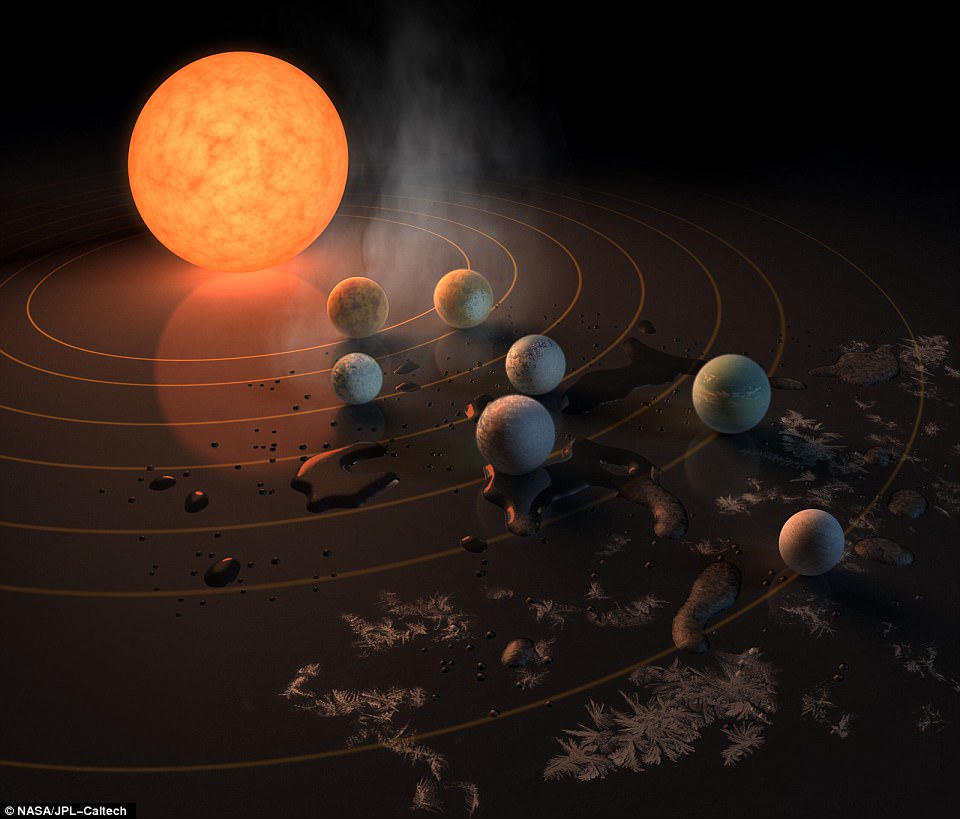
Rond de ster TRAPPIST-1 bleken zeven exoplaneten te draaien waarvan zeker drie leven kunnen herbergen.
Scientists had originally thought that the cigar-shaped object was a very strange passing asteroid. But a number of things have led scientists engaged in the search for alien life to wonder whether it might actually be an "artifact" from an alien civilisation.
Researchers involved in the Seti – Search for Extra-Terrestrial Intelligence – project are now preparing to point a powerful telescope at the bizarre object and find where it came from.
The mysterious object, which has been named Oumuamua, is our first visitor from another part of the galaxy to make it into our solar system. It flew past in October when it was spotted by astronomers from the University of Hawaii.
Scientists initially presumed that it was an asteroid. But a number of strange characteristics have led them to wonder whether it might have been intentionally formed.
It is long and cigar-shaped, for instance. While it is hundreds of metres long, it's only one tenth as wide – and it is very unusual for asteroids to come in such non-round forms.
Some researchers have suggested this long needle shape would be useful for a long-distance spacecraft, since it would minimise the chance of being hit by interstellar gas and dust as it travelled through the universe.
The body is travelling quickly through the universe, at up to 196,000mph, and looks as if it will not get wrapped up in our sun's gravity but fly right through and out of the solar system.
A statement from the 100 million dollar (£75 million) Seti project Breakthrough Listen, launched by Russian digital tech mogul Yuri Milner in 2015, said: "Researchers working on long-distance space transportation have previously suggested that a cigar or needle shape is the most likely architecture for an interstellar spacecraft, since this would minimise friction and damage from interstellar gas and dust.
"While a natural origin is more likely, there is currently no consensus on what that origin might have been, and Breakthrough Listen is well positioned to explore the possibility that Oumuamua could be an artifact."
The Breakthrough Listen team is using the Green Bank radio telescope in West Virginia, US, to study Oumuamua, which is named after the Hawaian term for "scout" or "messenger".
From 8pm UK time on December 12, the giant dish - the largest fully steerable radio telescope in the world - will "listen" to the object across four radio frequency bands spanning one to 12 gigahertz.
Lead scientist Dr Andrew Siemion, director of the Berkeley Seti Research Centre in California, said: "Oumuamua's presence within our solar system affords Breakthrough Listen an opportunity to reach unprecedented sensitivities to possible artificial transmitters and demonstrate our ability to track nearby, fast-moving objects.
"Whether this object turns out to be artificial or natural, it's a great target for Listen."
The object is currently about two astronomical units (AU) from Earth, or twice the distance between the Earth and sun.
At this distance it would take less than a minute for the Green Bank telescope to detect an omnidirectional transmitter with the power of a mobile phone.
Even if no evidence of extraterrestrial technology is found, the search could provide important information about gases surrounding Oumuamua or the presence or absence of water, say the researchers.
Breakthrough Listen aims to survey a million nearby stars and 100 nearby galaxies looking for alien signals.
Since the 1960s there have been more than 98 Seti projects around the world, none of which have turned up any convincing evidence of extraterrestrial civilisations.
Enorm sigaarvormig object in ons zonnestelsel is mogelijk buitenaards ruimteschip. Dit zeggen wetenschappers erover
Een enorm object dat pas geleden langs de aarde vloog is mogelijk een buitenaards ruimteschip, zo hebben wetenschappers gezegd.
Ze dachten in eerste instantie dat het sigaarvormige object een zeer vreemde asteroïde was. Maar ze begonnen zich al snel af te vragen of het misschien een ‘artefact’ was van een buitenaardse beschaving.
Onderzoekers die betrokken zijn bij het SETI-project zijn nu van plan een krachtige telescoop op het bizarre object te richten om te achterhalen waar het vandaan komt.
Interstellair ruimteschip
Het mysterieuze object, Oumuamua geheten, is de eerste bezoeker uit een ander deel van de Melkweg.
Het vloog in oktober langs de aarde en werd gespot door astronomen van de Universiteit van Hawaï.
Het is honderden meters lang, maar amper 80 meter breed, wat erg ongewoon is voor een asteroïde.
Dat maakt dat Oumuamua eerder de vorm heeft van een interstellair ruimteschip dan van een asteroïde.
Erg geschikt
Sommige onderzoekers hebben gezegd dat deze naaldvorm erg geschikt is voor het maken van interstellaire reizen.
Het object raast met honderdduizenden kilometers per uur door ons zonnestelsel en is inmiddels al bijna in de buurt van Jupiter.
Oumuamua heeft op geen enkel moment een komeetachtige staart gehad, wat erop wijst dat het niet gaat om een stuk ruimterots uit een nabijgelegen zonnestelsel.
Kunstmatig gemaakte verkenner
Avi Loeb van de Harvard-universiteit zei: “Hoe meer ik dit object bestudeer, hoe ongewoner het lijkt, wat me doet afvragen of dit een kunstmatig gemaakte verkenner is die is gestuurd door een buitenaardse beschaving.”
Vanavond gaan wetenschappers van het Breakthrough Listen-project, dat speurt naar buitenaards leven, Oumuamua bestuderen met de Green Bank Telescope in West Virginia.
A discovery that microbes in Antarctica can scavenge hydrogen, carbon monoxide and carbon dioxide from the air to stay alive in such extreme conditions has implications for the search for life on other planets.
Robinson Ridge, one of the two sites in Antarctica where microbes were collected.
UNSW-Sydney led scientists have discovered that microbes in Antarctica have a previously unknown ability to scavenge hydrogen, carbon monoxide and carbon dioxide from the air to stay alive in the extreme conditions.
The find has implications for the search for life on other planets, suggesting extra-terrestrial microbes could also rely on trace atmospheric gases for survival.
“Antarctica is one of the most extreme environments on Earth. Yet the cold, dark and dry desert regions are home to a surprisingly rich diversity of microbial communities,” says study senior author and UNSW scientist Associate Professor Belinda Ferrari.
“The big question has been how the microbes can survive when there is little water, the soils are very low in organic carbon and there is very little capacity to produce energy from the sun via photosynthesis during the winter darkness.
“We found that the Antarctic microbes have evolved mechanisms to live on air instead, and they can get most of the energy and carbon they need by scavenging trace atmospheric gases, including hydrogen and carbon monoxide,” she says.
The Australasian-based study, by researchers at UNSW, Monash University, the Australian Centre for Ecogenomics at the University of Queensland, GNS Science in New Zealand, and the Australian Antarctic Division, is published in the journal Nature.
Soil samples were collected from two coastal ice-free sites in different regions of eastern Antarctica. One was Robinson Ridge, 10 kilometres from Casey Station, in Wilkes Land. The other was Adams Flat, 242 kilometres from Davis Station in Princes Elizabeth Land.
Adams Flat, one of two sites in Antarctica where microbes were collected.
Photo: Phil O'Brien
“Both areas are pristine polar deserts devoid of any vascular plants,” says Associate Professor Ferrari, of the UNSW School of Biotechnology and Biomolecular Sciences.
The researchers studied the microbial DNA in the surface soil from both sites and reconstructed the genomes of 23 of the microbes that lived there, including some of the first genomes of two groups of previously unknown bacteria called WPS-2 and AD3.
They found the dominant species in the soils had genes which gave them a high affinity for hydrogen and carbon monoxide, allowing them to remove the trace gases from the air at a high enough rate to sustain their predicted energy needs and support primary production.
“This new understanding about how life can still exist in physically extreme and nutrient-starved environments like Antarctica opens up the possibility of atmospheric gases supporting life on other planets,” says Associate Professor Ferrari.
Most organisms use energy from the sun or the earth to grow. More research is needed to see if this novel use of atmospheric gases as an alternative energy source is more widespread in Antarctica and elsewhere, the scientists say.
Ontdekking op Antarctica heeft grote implicaties. Zijn deze vreemde bacteriën de sleutel tot het vinden van aliens?
Op Antarctica zijn micro-organismen ontdekt die kunnen overleven op niet meer dan waterstof, koolmonoxide en koolstofdioxide uit de lucht.
Er is op de Zuidpool nauwelijks of geen vloeibaar water, maandenlang komt de zon niet op en de temperaturen zijn er extreem laag. Toch wemelt het er van het leven, zo hebben onderzoekers ontdekt.
Ze verzamelden in het kustgebied van Oost-Antarctica, Robinson Ridge en Adams Flat bodemmonsters en ontdekten 23 verschillende micro-organismen.
Lucht
Er zaten onder meer bacteriën tussen die wetenschappers nog niet in het laboratorium hebben kunnen kweken.
De meeste microben die ontdekt zijn leven van gassen die ze uit de lucht halen. Door waterstof en koolmonoxide te oxideren kunnen ze energie produceren en in combinatie met koolstofdioxide zorgt dat voor organisch materiaal.
De bacteriën slagen erin te overleven met weinig zonlicht, geen aardwarmte en een extreem beperkte hoeveelheid voedingsstoffen.
Andere planeten
De onderzoekers willen nu gaan kijken of deze levenswijze ook op andere plekken op Antarctica en de aarde voorkomt.
Wat op Antarctica kan, moet ook op andere planeten kunnen, stellen ze.
Astronomen zeggen dat de aanwezigheid van water een goede indicator is van leven op andere planeten, maar de nieuwe resultaten laten zien dat er ook genoeg andere indicatoren zijn.
Opnieuw
“Exoplaneten die niet werden gezien als kandidaten voor buitenaards leven moeten mogelijk opnieuw geanalyseerd worden om bewoonbare regio’s te vinden, aldus hoofdonderzoeker Belinda Ferrari van de University of New South Wales.
Het is volgens haar mogelijk dat atmosferische gassen ook op andere planeten leven kunnen ondersteunen.
De studie is gepubliceerd in het wetenschappelijke tijdschrift Nature.
Wanneer de machthebbers op aarde de keuze hebben tussen het vriendschappelijk benaderen van ons bezoekende buitenaardsen of het ontketenen van een oorlog, zullen ze altijd voor het laatste kiezen.
Wat dat betreft is er helemaal niets veranderd sinds de tijd van het Wilde Westen, waar men eerst schoot en pas later vragen stelde.
Er zijn inmiddels talloze films en boeken verschenen over buitenaardse invasies en het is een onderwerp dat de meeste mensen ook niet onbekend zal voor komen. Daarnaast is er natuurlijk de elite en hun plannen om de mensheid te dwingen tot de New World Order door het kunstmatig creëren van een dergelijke invasie, waardoor de mensheid een gemeenschappelijke vijand heeft. Dit is het beruchte Project Blue Beam.
Maar, hoe zouden de mensen op deze aarde werkelijk reageren als er een vloot buitenaardse schepen zou worden waargenomen die linea recta richting aarde koersen? Zouden wij ze met open armen ontvangen of bombarderen met kernwapens?
Zo vertelt Nick Pope in een recent interview dat een invasie van buitenaardsen helemaal niet denkbeeldig is en dat wij er goed aan zouden doen om ons daaop voor te bereiden. Dat niet alleen, maar dat we er ook maar beter van uit kunnen gaan dat ze kwade bedoelingen hebben.
Gebaseerd op zijn ervaringen in het Engelse leger en de manier waarop men daar denkt, heeft hij een scenario gemaakt van wat hij denkt dat er zou gebeuren als er een vloot buitenaardse ruimteschepen waargenomen zou worden.
Zo denkt Nick dat buitenaardsen hier zouden komen om ons tot slaaf te maken of misschien dat ze ons beschouwen als een soort ongedierte of als interessante objecten in een dierentuin. Dat is de reden dat hij van mening is dat wij ons als aarde moeten voorbereiden op het ergste scenario en dat ze hier dus niet komen voor een vriendelijk bezoek.
Wat daarnaast een belangrijke rol zal spelen, is dat ze technologisch waarschijnlijk veel verder gevorderd zullen zijn dan wij, wat het nog een stuk lastiger, zo niet onmogelijk, maakt om een dergelijke vijand te bestrijden.
Hieronder is een nagemaakt officieel document, met daarop alle stappen die in dit geval de Engelse overheid zou ondernemen volgens Nick Pope.
Nick Pope ziet geen positief scenario wanneer buitenaardsen ons zouden bezoeken en gaat bij voorbaat uit van kwade bedoelingen. De vraag is natuurlijk als die buitenaardsen werkelijk kwaadgezind zouden zijn en beschikken over vergevorderde technologie, wat de aarde dan in 's hemelsnaam tegen een dergelijke vloot zou kunnen uitrichten?
Het is alsof een wilde uit het oerwoud met pijl en boog een Apache gevechtshelikopter tegemoet treedt.
Een andere mogelijkheid is natuurlijk dat Nick Pope nooit werkelijk het leger heeft verlaten, maar de opdracht heeft gekregen om de bevolking voor te bereiden op een nep buitenaardse invasie die uiteraard kwaadgezind moet zijn omdat we een vijand nodig hebben.
De werkelijkheid is dat wij mensen niet eens merken dat er buitenaardsen of half buitenaardsen in ons midden lopen. De werkelijkheid is dat wanneer buitenaardsen echt kwaad in de zin zouden hebben gehad wij dit allang gemerkt zouden hebben.
HEBBEN WIJ PER ONGELUK DE BINNENKANT VAN DE AARDE KAPOT GRMAAKT...
Zoals zo vaak staan wetenschappers voor raadsels wanneer er dingen gebeuren die niet in de handboeken staan.
Men heeft geen flauw idee waardoor het vreemde gebrom dat diep vanuit de aarde lijkt te komen, wordt veroorzaakt, maar is er misschien een reden waar niemand aan heeft gedacht?
In recente nieuwsberichten werd melding gemaakt van het feit dat wetenschappers voor een raadsel staan aangaande een vreemd gebrom dat diep vanuit de aarde lijkt te komen.
Het gebrom is niet nieuw, want ze zijn al sinds 1959 hiermee bezig en nu zijn ze er eindelijk in geslaagd om het geluid vast te leggen met behulp van seismische instrumenten op de bodem van de zee. Wij mensen kunnen dit geluid niet horen omdat de frequentie te laag is.
Ondanks dat men geprobeerd heeft een logische verklaring voor die geluiden te vinden, is er tot nu toe niet één die het kan verklaren. Het wordt niet veroorzaakt door atmosferische storingen of door golven, maar door wat dan wel?
Kenmerkend is dat het over de gehele wereld voor komt, het niet aan een bepaalde locatie gebonden is en het permanent/constant aanwezig is.
Stel dat dit geluid wordt veroorzaakt door iets wat wij als mens hebben gedaan en waar waarschijnlijk nog nooit iemand over heeft nagedacht? Grote problemen zijn wel vaker opgelost door een totaal andere invalshoek of denkwijze dan gebruikelijk.
In eerste instantie wordt iemand vaak voor knettergek verklaard, zoals ons ook nogal eens overkomt, en later blijkt het dan toch te kloppen. Een beetje in diezelfde trant zijn de gedachten welke door een lezer aan ons werden gestuurd (dank!), met een bijzonder suggestie.
Op het eerste gezicht denk je misschien: dat bestaat niet, maar het is wel een verklaring en dat is meer dan waar wetenschappers tot nu toe mee komen. Volgens deze lezer zit het antwoord misschien wel in petroleum.
In de bredere zin is petroleum een synoniem voor ruwe olie of aardolie.
Het volgende is wat de lezer schrijft:
Zoals jullie ondertussen wel weten, denk ik teveel na.
Petroleum komt zogezegd van planten en dieren die miljoenen jaren geleden gestorven zijn. Als dat zo is, waarom word er nu door de natuur/aarde geen petroleum gemaakt van dode planten en dieren die gestorven zijn?
Wat ik me dan ook afvraag, als al die planten en dieren na al die miljoenen jaren, kilometers onder de grond zitten als petroleum, hoe kan het dan, dat er zoveel dino skeletten en plantenfossielen aan de oppervlakte gevonden worden? Zouden die ook niet kilometers diep moeten zitten?
Wetenschappers breken er momenteel hun hoofd over, waar het geluid vandaan komt dat ze opvangen uit de aarde.
Ik heb jullie dit al eens gezegd, wat als petroleum dient om de binnenmantel soepel te doen draaien, rond de buitenmantel, of omgekeerd?
Dus dan zou het geluid dat wetenschappers nu horen, het resultaat kunnen zijn van het wegpompen van een beschermlaag,zoals olie uit een motor verwijderen. Of de lucht uit je banden laten lopen, op je velgen rondrijden klinkt ook niet echt goed.
Vergezocht en onmogelijk? Misschien, maar toch zeker de moeite waard om eens over dit soort dingen na te denken. Want wij hebben werkelijk geen flauw benul wat voor schade wij ondergronds aanrichten door het permanent wegpompen van olie. En ook weten we niet hoe de aarde eruit ziet, hoe deze is gemaakt, hoe deze ronddraait/of deze ronddraait. Wij denken dat te weten omdat ons dat op school wordt geleerd en omdat "experts" ons dat vertellen, maar werkelijk en hard bewijs daarvoor is echt moeilijk te vinden.
Tot dusver klinkt de verklaring van de lezer een stuk beter dan wat vaag gewauwel over atmosferische storingen. Nadenken kunnen ze wel onze lezers en dat is iets om trots op te zijn.
Bacteria discovery in Antarctica prompts rethink of humanity’s search for alien life
PLANETS that were once not even considered candidates to host alien life might be reanalysed to find habitable regions after the discovery of unique bacteria.
BACTERIA discovered in the icy continent of Antarctica is set to change the way humanity looks for alien life on other planets.
To date, our search for habitable worlds which could host alien life has been guided by what we know about life-conducive conditions on Earth. But in a new breakthrough, researchers have discovered a bacterium in Antarctica that can survive solely off chemicals in the air.
The microscopic organisms can survive just of hydrogen, carbon monoxide and carbon dioxide — opening up new possibilities about the existence of extraterrestrial life forms living in harsh conditions.
Antarctica is among the most extreme environments on our planet and it was previously thought the stresses of freezing temperatures, limited carbon, nitrogen and water availability along with strong UV radiation restricted life.
But new research reported in the journal Nature has shown the desert soils of Antarctica harbour surprisingly rich microbial communities.
“Here we provide evidence that atmospheric trace gases are the primary energy sources of two Antarctic surface soil communities,” researchers wrote.
“We propose that atmospheric H2, CO2 and CO provide dependable sources of energy and carbon to support these communities, which suggests that atmospheric energy sources can provide an alternative basis for ecosystem function to solar or geological energy sources.”
Essentially, the bacteria can survive with little sunlight, no geothermal energy and extremely limited nutrients.
The discovery was the result of DNA sequencing and analysis of soil samples collected from the icy continent.
“Although more extensive sampling is required to verify whether this process is widespread in terrestrial Antarctica and other oligotrophic habitats, our results provide new understanding of the minimal nutritional requirements for life and open the possibility that atmospheric gases support life on other planets,” researchers said.
Astronomers have historically sought out the potential presence of water when looking for planets which could support life but the bacteria findings show it’s not the only indicator }for life.
Exoplanets that were once not even considered to be candidates to hold life might be reanalysed to find habitable regions, said lead researcher Dr Belinda Ferrari.
“This new understanding about how life can still exist in physically extreme and nutrient-starved environments like Antarctica opens up the possibility of atmospheric gases supporting life on other planets,” she said.
Has an alien probe entered our solar system? Mystery object to be scanned for alien tech
Is it possible that we’ve missed welcoming an alien visitor into our solar system?
According to experts, it’s possible that an alien probe from a distant solar system may have entered our solar system, disguised as a ‘comet’.
The mystery comet dubbed as Oumuamua is currently being investigated by astronomers for signs of extraterrestrial technology, as there are doubts among experts that the cigar-shaped comet isn’t just a comet.
Now, alien-hunting scientists led by Russian billionaire Yuri Milner are set to scan the enigmatic object before it sails beyond Earth’s telescopes. They are looking for signs of advanced, or alien, technology.
Oumuamua is the first interstellar object to have entered our solar system.
An artist’s rendering of the asteroid.
Photo credit: ESO/M. Kornmesser
Alien-hunting scientists say they are looking for ‘radio singles’ claiming that the mystery visitor from another solar system could, in fact, be an alien probe, exploring the cosmos.
Yuri Milner is the tycoon behind the project Breakthrough Listen—a $100 million (£75m) search for intelligent extraterrestrial life.
According to reports from the Atlantic, Mr. Milner received last week an email from one of his chief scientists, where he mentioned the enigmatic object sailing through our solar system.
“The more I study this object, the more unusual it appears, making me wonder whether it might be an artificially made probe which was sent by an alien civilization,” Professor Avi Loeb, the chair of Harvard’s astronomy department and one of Milner’s advisers on Breakthrough Listen, wrote in the email.
According to Professor Loeb, the mysterious elongated shape of the comet is odd for a space rock but perfect for a space probe traveling between solar systems.
Now, the Breakthrough Listen project has announced it will scan ‘Oumuamua this week for signs of radio signals.
‘Researchers working on long-distance space transportation have previously suggested that a cigar or needle shape is the most likely architecture for an interstellar spacecraft since this would minimize friction and damage from interstellar gas and dust,’ the research firm said in a statement.
‘While a natural origin is more likely, there is currently no consensus on what that origin might have been, and Breakthrough Listen is well positioned to explore the possibility that ‘Oumuamua could be an artifact.’
To search Oumuamua for alien technology, scientists will use the Green Bank Telescope in West Virginia.
Despite the fact that the enigmatic object is now located at twice the distance between our planet and the Sun, the Green Bank Telescope can pick up the slightest signal, if of course there is anything to pick up.
Researchers from the Breakthrough Listen project want to gather as much info as they can about the object before it leaves our solar system. In 2018, the mystery object will fly past Jupiter and will arrive at Pluto by the 2020s.
“‘Oumuamua’s presence within our solar system affords Breakthrough Listen an opportunity to reach unprecedented sensitivities to possible artificial transmitters and demonstrate our ability to track nearby, fast-moving objects,” said Listen’s Andrew Siemion, Director of Berkeley SETI Research Center. “Whether this object turns out to be artificial or natural, it’s a great target for Listen.”
Experts at Breakthrough Listen have also made it clear that even if no signal or other evidence of extraterrestrial technology is heard, Listen observations will cover portions of the radio spectrum in which the object has not yet been observed, and could provide important information about the possibility of water/ice, or the chemistry of a coma (gaseous envelope), neither of which have yet been identified.
Earlier this year, our solar system got a visitor the likes of which it has never seen. Astronomers first spotted the object on October 18th using the PanSTARRS 1 telescope in Maui. At first, the visitor appeared to be a the first known comet to originate from outside our solar system, but further observations revealed it to be much stranger. Nevertheless, it was clear that the speeding visitor came from interstellar space, so the object was given the name ‘Oumuamua from the Hawaiian meaning “a messenger from afar arriving first.” Further analysis by the European Southern Observatory found the object to be perhaps not quite a comet, not quite an asteroid, and cigar-shaped. Based on the light bouncing off of it (or lack thereof), astronomers estimate the object to be among the darkest objects ever observed in space, absorbing 96% of the light that touches its surface.
Telescopic imagery of ‘Oumuamua (dot in center) passing through our solar system.
Given the strange nature of the object, it wasn’t long before speculation ran wild that we might have just encountered our first extraterrestrial spacecraft. Avi Loeb, the chair of Harvard’s astronomy department, writes “the more I study this object, the more unusual it appears, making me wonder whether it might be an artificially made probe which was sent by an alien civilization.” In particular, scientists are struck by the long cylindrical shape of the object; ‘Oumuamua is estimated to be between 100 and 400 meters long with much smaller diameter. Such cylinder shapes are perfect for aerospace applications – just look at our own space shuttles and rockets – but are seldom seen in naturally occurring space objects like comets or asteroids which tend to be more spheroid.
But who knows how many types of weird asteroids we’ve yet to discover? There’s no telling what ‘Oumuamua could be.
With so much weirdness surrounding ‘Oumuamua, the Breakthrough Listen initiative has decided the object could be its best bet for discovering proof of an alien intelligence. Breakthrough Listen hails itself as “the largest ever scientific research program aimed at finding evidence of civilizations beyond Earth” and shares facilities and researchers with SETI. In a press release issued this morning, Breakthrough Listen announced that even if the possibility of ‘Oumuamua being an alien ‘artifact’ is low, it’s worth checking out:
Researchers working on long-distance space transportation have previously suggested that a cigar or needle shape is the most likely architecture for an interstellar spacecraft, since this would minimize friction and damage from interstellar gas and dust. While a natural origin is more likely, there is currently no consensus on what that origin might have been, and Breakthrough Listen is well positioned to explore the possibility that ‘Oumuamua could be an artifact.
Even if the chances that ‘Oumuamua could be an alien craft are tiny, any possibility greater than 0% is exciting. Could this be it? Are we finally be close to getting a glimpse of a civilization far more advanced than our own? I sure hope so. If this festering dung heap of a civilization is the best the Universe has got, maybe it’s best that we’re all alone out here. Breakthrough Listen’s observations of ‘Oumuamua begin tomorrow at the Robert C. Byrd Green Bank Telescope in West Virginia. Fingers crossed.
'Prepare for invasion' Ex-MoD UFO chief drafts WAR PLAN for future ALIEN assault
A FORMER investigator for the Ministry of Defence has drafted a war plan reflecting how he believes the UK and US should respond to being attacked by aliens.
Nick Pope has stressed that it is worth preparing for an alien invasion
Nick Pope, who used to look into claims about UFOs for the Government, has suggested the UK should prepare for an alien invasion despite it being unlikely.
He predicts that an extraterrestrial attack would likely see the UK ally with NATO and the US to hit aliens with missiles.
However, Mr Pope also admitted that the UK would almost definitely be defeated by super-advanced alines in the event of a war.
His plan also stipulates that the UK may have to rely on its nuclear defences as a last resort.
The Government’s former UFO investigator said: “I based the document as much on declassified plans for the Iraq War as on my knowledge of UFOs and extraterrestrial life.
“This is exactly the sort of top-level strategic document that politicians and senior officials need in order to take the very rapid and important decisions.”
NASA does recognise the likelihood that humans will find alien life relatively soon. But it is widely believed that the chances of an alien invasion are very small.
However, Mr Pope stressed that it is worth preparing for an alien invasion because its consequences would be so devastating.
Mr Pope said: “There’s no government plan for an alien invasion, or for other scenarios where we find extraterrestrial life.
“Aliens capable of getting to Earth would clearly have technology way ahead of ours, so getting into any kind of war should be the last resort.
“We can only guess at what technology they may have, and what weaponry they might possess.
“I hope that if aliens arrive on Earth they’ll come as explorers or scientists – but that’s wishful thinking.”
Speaking to the Sun Online, Mr Pope predicted that if super-advanced aliens did arrive on earth, they would arrive as slavers, zoo keepers or pest controllers.
GETTY
The UK would almost definitely be defeated by super-advanced alines in a war, claimed Nick Pope
He said: “The biggest single thing we can do to protect ourselves is to acknowledge that there’s an issue here.
“With Nasa and others now openly talking about the possibilities of alien life, we can no longer dismiss this as sci-fi.
“Is it that hard to believe that we might not be alone, and there might be civilisations out there much older than ours, and thus more advanced?”
Flashing lights seen across the country this weekend prompted people to send videos and messages to local media asking if there were UFOs in the sky may be explained.
Joint Base Charleston told Charleston-based WLTX that those lights were a group of C-17 cargo jets that were flying in formation from Charleston to Nevada on Saturday and Sunday.
A spokesman for the base told WLTX that a group of 17 jets from the 437th Airlift Wing took off from their base around 7 p.m. Saturday, Dec. 9, and were joined on the way by other air military installations and groups, including the 82nd Airborne.
In all, there were more than 40 C-17s from 10 bases and more than 20 C-130s from three bases that partook in a training exercise involving HALO drops, or high-altitude military parachuting.
The exercise was a final training exercise for the U.S. Air Force Weapons School located at Nellis Air Force Base in Nevada, a representative said, to allow mobility Air Force students to apply what they’ve learned over the last five months.
Witnesses called and wrote into Denver TV station KUSA to say they saw a string of slow-moving lights that appeared to be flying at a low altitude.
They asked if they were UFOs, or—one of the more creative explanations— if they were Santa’s scout elves on their way back to the North Pole.“Much more creative solutions for what the answer turned out to be,” KUSA reporter Jacob Rodriguez wrote.
A video of the lights, uploaded to YouTube by Denver’s South Metro fire’s representative, has since been removed. The video was taken from his home in Littleton, Colorado, KUSA reported.
Rocket engine start-up Relativity Space shared a video of its 3D-printedrocket engine this week that’s stunning, for what it represents for the future of manufacturing and space travel.
The engine, named the Aeon 1, goes from ignition to full thrust in milliseconds. The entire video (embedded below) only last 10 seconds. While Elon Musk is working on the BFR, Relativity’s 3D printed engine is still a BFD for the future of space.
Relativity claims that the Aeon 1 engine takes far less time to create than a traditional rocket because it’s 3D printed — around one month instead of six for production, according to this chart that they shared — and has far less individual parts per engine. “Our process reduces the number of component interfaces, making full robotic automation of engine production possible,” the company says.
Relativity was founded in December 2015 by Tim Ellis and Jordan Noone, aerospace engineers and veterans of space companies Blue Origin and SpaceX, respectively. It first graduated from startup accelerator Y Combinator, before raising eight figures of funding – more than $10 million – led by Social Capital, the Palo Alto, California-based venture capital firm.
Relativity aims to decrease the price of rocket launches from $100 million to $10 million in four years, 3D print the first rocket — a 90-foot-tall, 7-foot-wide, able to carry 2,000 pounds into orbit — by 2020, and to launch that rocket into space by 2021.
“The 3D printing and automation of rockets is inevitable,” Ellis told Bloomberg in October.
Aeon-1 at full thrust, just milliseconds after igniting.
Current 3D printing technology is actually slower than traditional welding, so his “inevitability” may take some time to be realized. To get there, Relativity first had to develop its own 3D printer. Enter Stargate, a giant machine with 18-foot long arms, specifically designed with Relativity’s rockets in mind. Relativity says that it is the world’s largest 3D printer to work with metal.
If the technology continues to develop, Ellis and Noone hope to cut down the development time of a rocket from the many months – and hundreds of workers – currently required to just one month, and with minimal labor.
They’re still some way off from that goal, but that’s why the first video of their test at NASA Stennis was so exciting. Exclaimed Chamath Palihapitiya, the CEO of Social Capital: “Time to freak out, people.”
Gulf Breeze UFO phenomenon: 30 years later, sightings still divide public
Troy Moon, tmoon@pnj.com
Three decades after a Gulf Breeze building contractor released eerie photos of circular UFOs to local media and set off a year-long skywatching phenomenon, the so-called "Gulf Breeze Sightings" have become part of American lore.
Ed Walters claimed he shot the photos from his yard on Nov. 11, 1987. And now, even 30 years later, people are still divided on what really happened in Gulf Breeze in late 1987 through 1988.
Even the nation's most legendary UFOlogist, fictional FBI Special Agent Fox Mulder from the 1990s hit series "X Files" weighed in on the Gulf Breeze sightings when it was revealed the character investigated the Panhandle sightings and wrote an essay on the phenomenon for Omni magazine.
“I really don't have a good opinion on whether they're faked or not. There was so much controversy about it and MUFON went back and forth about it for years.”
George Williams, state section director of the Florida Mutual UFO Network
"When I first saw the Gulf Breeze photos, I knew they were a hoax,'' Mulder said in a classic 1994 episode "E.B.E."
And Mulder was a person who famously always wanted to believe.
But he's not alone in concluding the controversial Walters photographs were a hoax, an opinion that became more widespread after Walters moved from his home and in 1990, the new owner found a model of a "flying saucer" wrapped in old drafting paper in the attic. The model was made out of foam pie plates, cardboard, paper and tinted plastic gel.
Walters claimed the model was planted, but most thought — and still think — Walters' photos were a hoax. (There were witnesses who alleged knowledge of the staged UFO.) News Journal reporters and photographers later used the model to stage their own UFO models that seemed identical to the ones taken by Walters.
Using the model that was found a Pensacola News Journal photographer fabricated this UFO photo.
(Photo: News Journal file photo)
Craig Myers was the lead reporter on the story for the Pensacola News Journal during the Gulf Breeze sightings and subsequent controversy. He wrote a dozen stories on the sightings — and specifically Walters' claims — and later wrote a book on the Gulf Breeze sightings. Today, he works as an editorial assistant for Middle Tennessee State University, where he still gives the occasional lecture on the Gulf Breeze sightings.
Myers is confident the photographs were faked by Walters, who was known as a prankster, according to news reports from the time.
Former Pensacola News Journal reporter Craig Myers wrote a book about the Gulf Breeze UFO sightings titled "War of the Worlds: The True but Strange Story of the Gulf Breeze UFO."
(Photo: Courtesy of Craig Myers)
"Maybe it started as a fun prank,'' Myers said. "But then it just took off and snowballed. "He's probably the smartest guy in the room in most of the rooms he walks into."
(Walters could not be reached for comment, but has always maintained the photographs he took were authentic. He also wrote a book on the topic titled "Gulf Breeze Sightings.")
And even now, there are those who believe Walters' story — and the validity of his photographs — including noted UFO researcher and physicist Bruce Maccabee, who has written numerous research papers and technical papers on the Gulf Breeze sightings.
Ed and Frances Walters wrote a book entitled "The Gulf Breeze Sightings."
(Photo: Special to the News Journal)
"I think they're real,'' he said of Walters' photographs, dismissing the model found later. "I think the model is a hoax. Hoax squared."
Even if you dismiss Walters' photographs, Maccabee said, there were too many other witnesses who claimed to see UFOs in the Gulf Breeze area, and not all of them can be ignored.
"You had politicians reporting seeing objects,'' he said. "There were so many sightings that you have to account for, unless you believe there was massive collusion on the part of the residents of Gulf Breeze and Pensacola."
On Feb. 20, 1990, Gulf Breeze City Councilwoman Brenda Pollak holds a photograph she took at night of a bright red light hovering over Gulf Breeze near the Gulf Breeze United Methodist Church.
(Photo: News Journal file photo)
Danise Boone was living in Gulf Breeze at the time with her daughters, who were then 6 and 8 years old.
"My daughters and I saw something spinning just barely above the trees at dusk,'' she recalled. "We were on Central Drive off Highway 98 looking west toward the Sound side. They saw it first and came inside to get me. I couldn't believe what I was seeing, but I know I saw something in the sky that rotated. It wasn't a plane or copter. "
There are countless stories like that. Hundreds of people began watching the skies over Gulf Breeze, most congregating at watch parties at Shoreline Park. Dozens reported sightings, but no one came close to matching the clarity and proximity of Walters' photographs.
"I really don't have a good opinion on whether they're faked or not,'' said George Williams, state section director of the Florida Mutual UFO Network in Tallahassee and the field investigator who has investigated the Gulf Breeze sightings extensively. "There was so much controversy about it and MUFON went back and forth about it for years. ... But he made a model and buried it in the installation? That just doesn't sound right, but I don't know."
But no matter Walters' photos, Williams said Gulf Breeze and Pensacola remain a "UFO hotspot."
"We still get reports of interesting stuff in the area,'' he said. "And in 1987, you had hundreds of people besides Walters reporting sightings. It's always been an interesting area."
Gulf Breeze UFO Incident: Hoax or Cover-Up?
Troy Moon can be reached at tmoon@pnj.com and 850-435-8541.
Man says he captured UFO on camera on NW Side of San Antonio
SAN ANTONIO (KABB/SBG) - A man says he caught a UFO on camera as it flew around the Northwest Side Thursday night.
The viewer told us he followed the craft at a distance all night and said he spotted three of the "massive" crafts in the air.
The witness, who identified himself as a former pilot for the Air Force, said "this was no flight path approved by the FAA" and said it wasn't a helicopter "as it made no sound."
The man said there were at least 10 vehicles in front of him that stopped on the side of the road. He told us the craft then somehow shrunk down in size to land in what he believes was a warehouse off of Interstate 10 near the Loop 410 Interchange.
The viewer said, "They were absolutely all over last night."
The internet loves an optical illusion, and it seems like people are always on the lookout for new ones. For all you people who like having your mind bent a little bit, you’re in luck: Kohske Takahashi, a psychologist at Chukyo University, Japan, has a new illusion for you. It’s called “curvature blindness,” and it may not be obvious at first.
In this illusion, which he described and explained in the journal i-Perception in November, pairs of wavy lines span the image. These waves, which have consistent peaks and valleys like sine waves, are divided into segments of dark gray and light gray and are laid over a black, white, and gray background.
Some pairs look curvy, while others look more like zig-zags, especially over the gray background. But here’s the thing: They’re all curvy. Take a look for yourself.
The zig-zag lines are actually curves, even though your eyes are blind to the curvature.
In the paper, Takahashi explains the principle behind this illusion: The lines that appear to zig-zag are the ones in which the color changes occur at the peaks and valleys. The abrupt corner created by the cutoff between the dark gray and light gray makes it so the viewer perceives the curve as a sharp angle. This perception competes with the more accurate perception of a gentle curve. He notes that this is somewhat different from a situation in which perception is incorrect, because people really do see it.
“It is notable that observers exactly ‘see’ an illusory zigzag line against a physically wavy line, rather than have an impaired perception,” he writes. “We propose that the underlying mechanisms for the gentle curve perception and those of obtuse corner perception are competing with each other in an imbalanced way and the percepts of corner might be dominant in the visual system.”
In other words, your brain might tend more toward seeing a corner when there’s confusion about whether it’s seeing a corner or a curve.
Another popular illusion involving black-and-white lines.
As we’ve seen with other optical illusions, these phenomena bug us out because we assume the way we see the world is pretty much the way it is. When we find out the way we’re seeing the world is wrong — or at least a little different from the way others see it — it unsettles us with the idea that there’s no actual consensus about reality. While this optical illusion won’t be the next dress illusion, it still makes your eyes cross with perceptual confusion.
Atmospheric pressure on Mars is just 1% that found on Earth.
Credit: YouTube.
In many respects, Mars is but a shell of its former self. About 3-4 billion years ago, it boasted a hot climate that could sustain an active hydrological cycle. There were heavy rains, rivers of flowing waters, even vast oceans. All of these require a thick atmosphere. Today, however, the atmosphere is roughly 100 times less dense than Earth’s, and the Red Planet is still continuously losing gas — expending about 100 grams of its atmosphere into outer space every second.
Solar wind is regarded as an important factor that can explain this atmospheric loss. However, a grad student at Luleå University of Technology, Sweden, has come to results that say otherwise. According to Robin Ramstad, who studied for his Master of Science degree in Engineering Physics at the university, Mars’ atmosphere is adequately protected from the effects of solar wind despite lacking an Earth-like magnetic dipole.
Thin air
Here on Earth, the motion of molten iron alloys in the planet’s outer core acts like a geodynamo which generates a massive magnetic field. Scientists call our planet’s magnetic field the magnetosphere. It extends for several tens of thousands of kilometers into space, well above the atmosphere, sheltering the planet from the charged particles of solar winds and cosmic rays that would otherwise strip away the upper atmosphere, including the ozone layer that protects the Earth from harmful ultraviolet radiation.
Earth isn’t unique in this respect. Jupiter has masses of liquid metallic hydrogen in its outer mantle, creating the largest planetary magnetic field in the solar system. Uranus generates a global magnetosphere closer to the surface, which leads to some very strange quadrupole field effects — rather than just a north and a south, there are another two poles lurking in a quadrupole field. Mars also used to have a magnetic field but lost it half a billion years after its formation.
Artist impression of Mars covered in a primitive ocean.
Credit: NASA/GSFC.
Solar wind is a stream of charged particles released from the upper atmosphere of the Sun. First described as a phenomenon in 1859, it has been observed only in the 1960s. According to one mainstream theory, it’s also responsible for the erosion of the early Martian atmosphere, which caused the greenhouse effect to collapse on the planet. At the same time, solar wind interacts with the ionized upper atmosphere, called the ionosphere, and induces a magnetosphere.
“It has long been thought that this induced magnetosphere is insufficient to protect the Martian atmosphere,” says Robin Ramstad. “However our measurements show something different.”
Left: Charged particles from the sun (the solar wind) form an induced magnetosphere round Mars, which unlike the sun does not have its own intrinsic magnetic field (artwork: Anastasia Grigoryeva) Larger file Right: Robin Ramstad points out the position of the Swedish instrument ASPERA-3 on a model of the Mars Express spacecraft (photo: Anastasia Grigoryeva)
Ramstad studied data beamed back to Earth by the Mars Express orbiter. The spacecraft has an ion mass analyzer mounted that measured ion escape from Mars since 2004.
The researcher combined and compared measurements of the ion escape under varying solar wind conditions and levels of ionizing solar radiation. His results suggest that solar wind has an effect on the ion escape rate, but it’s rather negligible. Instead, the ion escape rate is more dependent on EUV (extreme ultraviolet) radiation which has a large effect on the total amount of escaped atmosphere.
“Despite stronger solar wind and EUV-radiation levels under the early Sun, ion escape can not explain more than 0.006 bar of atmospheric pressure lost over the course of 3.9 billion years,” said Ramstad in a statement. “Even our upper estimate, 0.01 bar, is an insignificant amount in comparison to the atmosphere required to maintain a sufficiently strong greenhouse effect, about 1 bar or more according to climate models.”
According to Ramstad, what solar wind mainly does is it accelerates particles that are already escaping the planet’s gravity. It does not, however, increase the ion escape rate.
If Ramstad is indeed correct the question of where all of Mars’ water has gone will be put back into the scientific limelight.
Time travel — moving between different points in time — has been a popular topic for science fiction for decades. Franchises ranging from "Doctor Who" to "Star Trek" to "Back to the Future" have seen humans get in a vehicle of some sort and arrive in the past or future, ready to take on new adventures.
The reality, however, is more muddled. Not all scientists believe that time travel is possible. Some even say that an attempt would be fatal to any human who chooses to undertake it.
Understanding time
What is time? While most people think of time as a constant, physicist Albert Einstein showed that time is an illusion; it is relative — it can vary for different observers depending on your speed through space. To Einstein, time is the "fourth dimension." Space is described as a three-dimensional arena, which provides a traveler with coordinates — such as length, width and height —showing location. Time provides another coordinate — direction — although conventionally, it only moves forward. (Conversely, a new theory asserts that time is "real.")
Most physicists think time is a subjective illusion, but what if time is real
Einstein's theory of special relativity says that time slows down or speeds up depending on how fast you move relative to something else. Approaching the speed of light, a person inside a spaceship would age much slower than his twin at home. Also, under Einstein's theory of general relativity, gravity can bend time.
Picture a four-dimensional fabric called space-time. When anything that has mass sits on that piece of fabric, it causes a dimple or a bending of space-time. The bending of space-time causes objects to move on a curved path and that curvature of space is what we know as gravity.
Both the general and special relativity theories have been proven with GPS satellite technology that has very accurate timepieces on board. The effects of gravity, as well as the satellites' increased speed above the Earth relative to observers on the ground, make the unadjusted clocks gain 38 microseconds a day. (Engineers make calibrations to account for the difference.)
In a sense, this effect, called time dilation, means astronauts are time travelers, as they return to Earth very, very slightly younger than their identical twins that remain on the planet.
Through the wormhole
General relativity also provides scenarios that could allow travelers to go back in time, according to NASA. The equations, however, might be difficult to physically achieve.
One possibility could be to go faster than light, which travels at 186,282 miles per second (299,792 kilometers per second) in a vacuum. Einstein's equations, though, show that an object at the speed of light would have both infinite mass and a length of 0. This appears to be physically impossible, although some scientists have extended his equations and said it might be done.
A linked possibility, NASA stated, would be to create "wormholes" between points in space-time. While Einstein's equations provide for them, they would collapse very quickly and would only be suitable for very small particles. Also, scientists haven't actually observed these wormholes yet. Also, the technology needed to create a wormhole is far beyond anything we have today.
Alternate time travel theories
While Einstein's theories appear to make time travel difficult, some groups have proposed alternate solutions to jump back and forth in time.
Infinite cylinder
Astronomer Frank Tipler proposed a mechanism (sometimes known as a Tipler Cylinder) where one would take matter that is 10 times the sun's mass, then roll it into very long but very dense cylinder.
After spinning this up a few billion revolutions per minute, a spaceship nearby — following a very precise spiral around this cylinder — could get itself on a "closed, time-like curve", according to the Anderson Institute. There are limitations with this method, however, including the fact that the cylinder needs to be infinitely long for this to work.
An artist's impression of a black hole like the one weighed in this work, sitting in the core of a disk galaxy. The black-hole in NGC4526 weighs 450,000,000 times more than our own Sun.
Credit: NASA/JPL-Caltech
Black holes
Another possibility would be to move a ship rapidly around a black hole, or to artificially create that condition with a huge, rotating structure.
"Around and around they'd go, experiencing just half the time of everyone far away from the black hole. The ship and its crew would be traveling through time," physicist Stephen Hawking wrote in the Daily Mail in 2010.
"Imagine they circled the black hole for five of their years. Ten years would pass elsewhere. When they got home, everyone on Earth would have aged five years more than they had."
However, he added, the crew would need to travel around the speed of light for this to work. Physicist Amos Iron at the Technion-Israel Institute of Technology in Haifa, Israel pointed out another limitation if one used a machine: it might fall apart before being able to rotate that quickly.
Cosmic strings
Another theory for potential time travelers involves something called cosmic strings — narrow tubes of energy stretched across the entire length of the ever-expanding universe. These thin regions, left over from the early cosmos, are predicted to contain huge amounts of mass and therefore could warp the space-time around them.
Cosmic strings are either infinite or they’re in loops, with no ends, scientists say. The approach of two such strings parallel to each other would bend space-time so vigorously and in such a particular configuration that might make time travel possible, in theory.
Time machines
It is generally understood that traveling forward or back in time would require a device — a time machine — to take you there. Time machine research often involves bending space-time so far that time lines turn back on themselves to form a loop, technically known as a "closed time-like curve."
The Doctor's time machine is the TARDIS, which stands for Time and Relative Dimensions in Space.
Credit: BBCAmerica
To accomplish this, time machines often are thought to need an exotic form of matter with so-called "negative energy density." Such exotic matter has bizarre properties, including moving in the opposite direction of normal matter when pushed. Such matter could theoretically exist, but if it did, it might be present only in quantities too small for the construction of a time machine.
However, time-travel research suggests time machines are possible without exotic matter. The work begins with a doughnut-shaped hole enveloped within a sphere of normal matter. Inside this doughnut-shaped vacuum, space-time could get bent upon itself using focused gravitational fields to form a closed time-like curve. To go back in time, a traveler would race around inside the doughnut, going further back into the past with each lap. This theory has a number of obstacles, however. The gravitational fields required to make such a closed time-like curve would have to be very strong, and manipulating them would have to be very precise. [Related: Warp Speed, Scotty? Star Trek's FTL Drive May Actually Work]
Grandfather paradox
Besides the physics problems, time travel may also come with some unique situations. A classic example is the grandfather paradox, in which a time traveler goes back and kills his parents or his grandfather — the major plot line in the "Terminator" movies — or otherwise interferes in their relationship — think "Back to the Future" — so that he is never born or his life is forever altered.
If that were to happen, some physicists say, you would be not be born in one parallel universe but still born in another. Others say that the photons that make up light prefer self-consistency in timelines, which would interfere with your evil, suicidal plan.
Some scientists disagree with the options mentioned above and say time travel is impossible no matter what your method. The faster-than-light one in particular drew derision from American Museum of Natural History astrophysicist Charles Lu.
That "simply, mathematically, doesn't work," he said in a past interview with sister site LiveScience.
Also, humans may not be able to withstand time travel at all. Traveling nearly the speed of light would only take a centrifuge, but that would be lethal, said Jeff Tollaksen, a professor of physics at Chapman University, in 2012.
Using gravity would also be deadly. To experience time dilation, one could stand on a neutron star, but the forces a person would experience would rip you apart first.
The traveler leaves home, but the people he or she left behind might age or be dead by the time the traveler returns. Examples: "Interstellar" (2014), "Ikarie XB-1" (1963)
Time travel by moving through higher dimensions:
In "Interstellar" (2014), there are "tesseracts" available in which astronauts can travel because the vessel represents time as a dimension of space. A similar concept is expressed in Madeleine L'Engle's "A Wrinkle In Time" (2018, based on the book series that started in 1963), where time is folded by means of a tesseract. The book, however, uses supernatural beings to make the travel possible.
Travelling the space-time vortex:
The famous "Doctor Who" (1963-present) TARDIS ("Time And Relative Dimension In Space") uses an extra-dimensional vortex to go through time, while the travelers inside feel time passing normally.
Instantaneous time jumping:
Examples include "The Girl Who Leapt Through Time" (2006), the DeLorean from "Back To The Future" (1985), and the Mr. Peabody's WABAC machine from "The Rocky and Bullwinkle Show" (1959-64).
Time travelling while standing still:
Both the "Time Machine" (1895 book) and Hermione Granger's Time-Turner from "Harry Potter" keep the traveler still while they move through time.
Slow time travel:
In "Primer" (2004), a traveler stays in a box while time traveling. For each minute they want to go back in time, they need to stay in the box for a minute. If they want to go back a day in time, they have to stay there for 24 hours.
Traveling faster than light:
In "Superman: The Movie" (1979), Superman flies faster than light to go back in time and rescue Lois Lane before she is killed. The concept was also used in the 1980 novel "Timescape" by Gregory Benford, in which the protagonist sends (hypothetical) faster-than-light tachyon particles back to Earth in 1962 to warn of disaster. In several "Star Trek" episodes and movies, the Enterprise travels through time by going faster than light. In the comic book and TV series "The Flash," the super-speedster uses a cosmic treadmill to travel through time.
Difficult methods to categorize:
There's a rocket sled in "Timecop" (1994) that pops in and out of view when it's being used, which has led to much speculation about what's going on. There's also the Time Displacement Equipment in "The Terminator" movie series, which shows off how to fight a war in four dimensions (including time).
So is time travel possible?
While time travel does not appear possible — at least, possible in the sense that the humans would survive it — with the physics that we use today, the field is constantly changing. Advances in quantum theories could perhaps provide some understanding of how to overcome time travel paradoxes.
Watch a Brilliant Fireball Light Up the Sky in This NJ Police Dash-Cam Video
By Tariq Malik, Space.com Managing Editor
When Sgt. Michael Virga went out on patrol last weekend in Hamilton, New Jersey, he wasn't expecting to see something truly out-of-this-world. But thanks to a spectacular fireball, that's exactly what the officer saw.
The fireball streaked across the early-morning sky at 3:09 a.m. EST (0809 GMT) on Saturday, Dec. 2, and Virga's vehicle dash cam recorded the dazzling sight, according to a statement from the Township of Hamilton Police Department.
A dazzling fireball streaks across the sky in this still from the dash-cam video of Sgt. Michael Virga, of the Township of Hamilton Police Department in New Jersey, on Dec. 2, 2017.
Credit: Township of Hamilton Police Department
The fireball was a bolide, a meteor that explodes in a brilliant flash as it plunges through Earth's atmosphere.
In a Twitter statement, the American Meteor Society said it received 133 separate reports from spectators who witnessed the fireball across Pennsylvania and New Jersey. Sightings were also reported from 10 other states (New Hampshire, New York, Rhode Island, Connecticut, Delaware, Virginia, West Virginia, Maryland, Ohio and Massachusetts) and Washington, D.C., the AMS reported.
Extraterrestrial Life– When aliens arrive in the movies, they typically come from distant galaxies. Extraterrestrial life, however, could exist right here in our solar system, nestled in briny oceans under the surface of icy worlds close to home.
Many thinkers have been led astray by anthropic assumptions, while others were simply led astray by ignorance. Due to lack of information tells us that it’s prudent to guide ourselves by the notion that we are not special. That is generally the Copernican principle. This principle places the Sun back in the middle of our solar system where it belongs. The sixteenth-century Italian monk Giordano Bruno suggested publicly that an infinite universe was filled with planets that harbor life.
So far, life on Earth is the only life we know in the universe. But there are compelling arguments to suggest we are not alone. Indeed, most astrophysicists agree there may be life elsewhere in the universe. And, maybe life exists on other planets or moons inside our own solar system. The numbers are, well, astronomical: If the count of planets in our solar system is not unusual, then there are more planets in the universe than the sum of all sounds and words ever pronounced by every human who has ever lived. There is no reason for declaring Earth as the only planet in the cosmos with life.
The Possibility of Extraterrestrial Life!
In 2016, scientists announced the discovery of three, Earth-size, rocky planets orbiting around a red dwarf star that’s about the size of Jupiter. Planets in this system gather around their home star in tightly packed orbits—TRAPPIST-1b circles its star once per day. And because red dwarfs are cooler than our sun, experts think that several of these planets could be habitable, despite proximity to their star.
The closely packed solar system begs a tantalizing question: Are these planets exchanging life via space rocks? Some theories say that life on Earth may have come from Martian rocks. And if that’s the case, Harvard University researchers argue that the odds of the same thing occurring in the TRAPPIST-1 system are magnitudes higher.
Seeking forward, we first need to determine if life indeed exists in TRAPPIST-1. Telescopes prepared to launch soon will be able to probe planets’ atmospheres in the system. They will be able to detect bio-signatures associated with life as we know it on Earth. Scientists could also search for “red edge” spectral signals that hint at the presence of vegetation.
If life exists…
…Researchers could then theoretically verify the panspermia hypothesis, as well. If “red edge” signals are the same on several TRAPPIST-1 planets, that would indicate life sprung forth from a singular source.
Life relies on “left-handed” amino acids and right-handed sugars. If organisms on TRAPPIST-1 planets all adhere to the same chirality rules, that’s a good sign that life hopped from a planet to another. But if the rules were different on each planet, it would be an indication that life evolved in isolation.
Alan Stern, the principal investigator of NASA’s New Horizons mission, has another theory to add to all this, which he shared at the recent 49th annual meeting of the American Astronomical Society’s Division for Planetary Sciences.
As Space.com reports, Stern floated the idea that perhaps intelligent life does exist in other parts of the galaxy. But they live in dark oceans found deep beneath the surfaces of whatever planet they live on. Such oceans should exist in our galaxy, as they do in our own solar system. Look no further than oceans on Pluto, Jupiter’s moons, or Saturn’s moon Titan for evidence of that. Buried oceans would also give life more time to evolve. As it would also protect them from anything that typically only affects the surface.
“Impacts and solar flares, and nearby supernovae, and what orbit you’re in, and whether you have a magnetosphere, and whether there’s a poisonous atmosphere — none of those things matter,” Stern said to Space.com.
Why is Extraterrestrial Life discovery still a dream?
Basically, Earth is unique. The Rare Earth hypothesis argues that planets with complex life, like Earth, are extremely rare and intelligent extraterrestrial life is highly improbable. Hence we are one of a kind.
Dr. Aditya Chopra, suggest that alien beings are all dead. Life on “habitable” planets failed to emerge quickly enough to stabilize the planet and pave the way for more life.
Earth was subjected to the Great Filter – Five mass extinction events – but evolved complex creatures. Moreover, Earth had a head start. In a study, Dr. Peter Behroozi said that compared to all the planets that will ever form in the Universe, the Earth is actually quite early. The last star will burn out 100 trillion years from now, and 92% of planets are yet to be born. We are the first but not necessarily last.
Approx. 46.5 light – years is the distance to the edge of the observable universe (that’s significant distance). We’ve scanned for extraterrestrial life to just around 40,000 light years from Earth; we haven’t even outpassed the bounds of our galaxy, which is 100,000 light – years wide. Extraterrestrial life could simply be too far away for our current technology to reach.
An Estimate
Seth Shostak, from the Search for Extra-Terrestrial Intelligence (SETI) Institute, while speaking to Futurism predicted that we would find intelligent alien life within the next 20 years. He even betted everyone “a cup of coffee” that the existence of intelligent extraterrestrials will be confirmed within the next two decades. He further added, “in the last 20 years, understanding of the cosmos has expanded significantly it is now known just how many planets there are that could host alien life.”
Moreover, he gave a hope by further saying, “We may find microbial life—the kind you’d find in the corners of your bathtub. We may find that a lot sooner, but that remains for the future. But it’s going to happen, I think, in your lifetime.”
“For the first time, we are not only visualizing the detailed structure of our Local Supercluster of galaxies, but we are also seeing how the structure developed over the history of the universe.”
If you click play on the interactive above, you’ll see the motions of galaxies in our local supercluster, from 13 billion years ago to the present day.
Where’s our home galaxy, the Milky Way, in this interactive? Look below at the still graphic, for the yellow letters marked MW. Our Milky Way is part of what’s called the Local Group, which spans about 10 million light-years and contains several dozen galaxies. The Local Group, in turn, is part of the Virgo Supercluster, which spans just over 100 million light-years and is thought to contain at least 100 galaxy groups and clusters. The interactive above is part of a study by a team of astronomers from Maryland, Hawaii, Israel, and France. They say it’s the most detailed map ever of the orbits of galaxies in our extended local neighborhood. It shows the past motions of some 1,400 galaxies within 100 million light-years of our Milky Way.
The study called Action Dynamics of the Local Supercluster. It’s published in the December 4, 2017 issue of the peer-reviewedAstrophysical Journal.
Our home Milky Way galaxy (MW, yellow) and our companion Andromeda galaxy (M31, red) are participating in a downward flow away from a vast underdense region called the Local Void and toward the Virgo Cluster, represented by the large purple dot in this image. Most galaxies between us and the Virgo Cluster will eventually fall into the cluster but we lie slightly beyond the capture zone.
In the interactive, you’ll notice the galaxies are moving toward something, a gravitational attractor represented by the big red dot more or less in the center of the mapped area (and in purple in the still graphic just above). This attractor is the Virgo Cluster, a large cluster of galaxies at the heart of the Virgo Supercluster (all located in the direction to the constellation Virgo in our sky; hence their names).
The Virgo Cluster alone – which is about 50 million light-years from us, or in the midst of the Virgo Supercluster’s 100 million light-years – has 600 trillion times the mass of our sun. These astronomers explained in their statement that the Virgo Cluster is pulling other galaxies toward itself, and absorbing them:
Over a thousand galaxies have already fallen into the Virgo Cluster, while in the future all galaxies that are currently within 40 million light-years of the cluster will be captured. Our Milky Way galaxy lies just outside this capture zone. However the Milky Way and Andromeda galaxies, each with 2 trillion times the mass of the sun, are destined to collide and merge [with each other] in 5 billion years.
The study – and the interactive at top – are based on the measurement of 18,000 galaxy distances.
The astronomers’ statement explained the interactive this way:
With the interactive model, a viewer can pan, zoom, rotate, and pause/activate the time evolution of movement along orbits. The orbits are shown in a reference frame that removes the overall expansion of the universe.
So be sure to click on it, and play around with it!
Here’s an artist’s concept of the Virgo Supercluster, via Wikimedia Commons. Look toward the center to find our Local Group.
The lead author of this study is Ed Shaya of the University of Maryland in collaboration with Brent Tully of University of Hawaii, Yehuda Hoffman of Hebrew University in Israel, and Daniel Pomarede of University of Paris-Saclay in France. These scientists used what they said is a novel method for determining galaxy orbits, which they called numerical action.
Brent Tully said:
For the first time, we are not only visualizing the detailed structure of our Local Supercluster of galaxies but we are seeing how the structure developed over the history of the universe. An analogy is the study of the current geography of the Earth from the movement of plate tectonics.
These dramatic merger events are only part of a larger show. There are two overarching flow patterns within this volume of the universe. All galaxies in one hemisphere of the region – including our own Milky Way – are streaming toward a single flat sheet. In addition, essentially every galaxy over the whole volume is flowing, as a leaf would in a river, toward gravitational attractors at far greater distances …
Representations of the orbits in the Virgo Supercluster can also be seen in the video below:
Bottom line:A team of astronomers has made the most detailed map ever of the orbits of galaxies in our local supercluster. It shows the past motions of some 1,400 galaxies within 100 million light-years of our Milky Way.
This video has been up on YouTube since 2011, but a friend posted it to my Facebook page this week. It’s wonderfully amusing, and also strangely compelling, maybe because listening to Carl Sagan’s voice is always such a pleasure.
Robert Price posted this video to YouTube. As he said:
For all the other words that aren’t [millions, billions, trillions or 1 quadrillion], please watch Cosmos.
When I was a kid, maybe about 6 or 7 years old, I was spending Christmas vacation at my Grandparents’ farm. On Christmas Eve that year, myself and several of my siblings and cousins saw what I would later understand to be a UFO. The object was a perfect sphere of soft blue light, but somewhat smaller than the full moon which was on the other side of he sky at the time of the sighting. It remained in a fixed location in the sky before abruptly vanishing.
The idea that what we had seen at the time was Santa, or the Star of Bethlehem was discussed among us, being children from a religious family. It wasn’t until years down the road I would begin to piece together the concept that what we had seen that night wasn’t a magical phenomenon, but had a more “scientific” explanation: it was quite obviously a spacecraft piloted by extraterrestrials who are observing us for some unknown reason.
It again wouldn’t be until several more years and experiences later I would develop the current theories I hold for the explanation of these Unidentified Flying Objects that people have been reporting for centuries or more. Ironically enough, I came full circle in a way, as I now feel that the strange lights and objects are perhaps something more mystical in nature that most ufologists say.
The idea that a race of super advanced biological creatures have traveled farther than our current technology can even see, simply to annoy and/or scare the hell out of people without any observable gain or advantage or logical reason seems a bit much for me. I’m sure in some cases secret military projects could be the cause for some sightings, but by and large, when the military wants to keep things secret from the public, they don’t fly low to the civilians and flash their lights at them. Also, I tend to side with what Stephen Hawkins said on the matter, that if the government is hiding the existence of aliens from the public they are better at that one thing than anything else they do.
Now, say for a theory what we are seeing up there is not really a physical craft at all, but something from outside of the current reality we exist in. The idea of portal to other dimensions is not a new idea, but what that might really look like is a subject that is often misunderstood. This concept involves a variable that is outside of what our senses and analytical ability are designed to process. While it is easy to picture a two-dimensional shape (a line) growing longer or shrinking from both ends, and a three-dimensional cube growing or contracting height, width depth, etc. We can even stretch our minds a little to visualize the fourth dimension of “time” or entropy by seeing that same three dimensional cube dispersing into smaller cubes and spreading out into space, or doing the opposite and forming a lager cube from smaller constituent cubes coagulating together. In this way, our minds and senses are designed to observe and process information defined within these dimensions. Now, try to expand that same cube into the fifth dimension. Which direction does the edge of the cube go?
The hypercube https://en.wikipedia.org/wiki/Hypercube is one illustration of how another dimension would interact with space as we know it, but as far as what something existing in this type of space would look like, well…
When the light is dim, our minds will “fill in the blanks” so to speak to provide us with the most accurate perception possible. Sometimes, however people overlook details because this perceptual phenomenon can cause us to see only what we were expecting to see, rather than getting the true input from our sensory organs. This might be why when a person is confronted with an object existing in 4+ dimensions, our minds put together strange impossible objects in the sky, like a mishmash of “close enough” approximations of what we are actually seeing, but our minds and sensory organs are not highly enough developed to process yet. That might also explain the feelings of awe or terror that people have prior to and just after a UFO experience. The overload to the nervous system has to find the closest match to be expressed or processed. That’s all fine and well you say, but it doesn’t really explain what people are seeing does it? What would cause an additional dimension to suddenly spring into a observer’s perception? It could be a naturally occurring thing like lightning or mineral hot springs, just occurring for a period of time when the conditions are right then vanishing, or they coul be part of a machine or occult metaphysical process operated by independent entities of an unknown nature, they could be psychic projection created in our collective subconscious and displayed in the skies for our group benefit. Or it could be mass hallucinations, which is kind of the same thing.
Although many people may pass off the idea of mass hallucination as a debunking and move on, in a way, isn’t that an even more profound than hidden master races from distant planets, or mystical apprehensions of the Nth dimension, just the fact that having belief in something, even against conventional logic, if shared in a sincere and open way can have a true and powerful effect on everyone participating. If a person can just have an experience that makes the universe feel bigger and more meaningful, and then to be able to share that with another human being in such a fundamental way that it becomes a simple matter of fact, wouldn’t that be the most magical phenomenon of all?
New discovery could change the way we look for alien life
Newfound species shows it’s possible to survive on nothing more than the chemicals in air.
by Chelsea Gohd, Futurism
A glacier is seen from NASA's Operation IceBridge research aircraft on Oct. 31, 2017.
Mario Tama / Getty Images file
In brief:
Scientists search for extraterrestrials and habitable exoplanets based on what we know of life on Earth. But in a breakthrough discovery, researchers found a bacterial species that require only chemicals in the air to survive.
As described in the journal Nature, scientists have discovered a new bacterium that can survive solely off of chemicals in the air. Discovered in Antarctica, these microscopic organisms can survive off of just hydrogen, carbon monoxide, and carbon dioxide. Taking the term “extremophile” to the next level, these microbes can survive in some of the most extreme conditions that exist on our planet. These organisms are so unique that they are opening up the potential for finding alien life because, now that we know organisms can exist off of only chemicals in the air, extraterrestrial life could exist in much wilder circumstances than previously thought.
Lead researcher Belinda Ferrari expanded, “Antarctica is one of the most extreme environments on Earth. Yet the cold, dark and dry desert regions are home to a surprisingly rich diversity of microbial communities. The big question has been how the microbes can survive when there is little water, the soils are very low in organic carbon and there is very little capacity to produce energy from the Sun via photosynthesis during the winter darkness.”
ADVANCED ALIEN HUNTING
The conditions necessary for life to exist have evolved as we have grown and learned over time. One of the criteria in considering alien planets as hospitable to life is liquid water. But does the discovery of an organism that essentially survives off of only air change that?
This research team reconstructed the genomes of 23 microbes and was able to identify two species of previously-undiscovered bacteria known as WPS-2 and AD3. Living in the soil with other species, these bacteria survive with little sunlight, no geothermal energy, and extremely limited nutrients. As mostly dormant bacteria, these are the first lifeforms every discovered that survive by eating air.
Ferrari explained that “This new understanding about how life can still exist in physically extreme and nutrient-starved environments like Antarctica opens up the possibility of atmospheric gases supporting life on other planets.”
While life on other planets might look and be nothing like life on Earth, understanding how life can exist in unusual and never-before-seen circumstances will push us forward to concretely discovering alien life and better understanding where and how aliens are most likely to exist. Exoplanets that once may not have even been candidates to hold life might be re-analyzed to find habitable regions and the potential to hold life. It is apparent that the better we understand life on Earth, the more equipped we are to search for alien life.
Amateur Astronomers spots ‘massive cigar-shaped UFO’ near the Orion Nebula
An Amateur astronomer snapped a few extremely interesting images from the Orion nebula, and UFO hunters are turning towards his images as proof as massive, interstellar alien spaceships.
The Amateur Astronomer from North Carolina was exploring the Orion Nebula when he spotted a strange cigar-shaped UFO. Further analysis of the footage revealed a few mystery objects.
While the astronomer was focusing on his Newtonian telescope, he observed a massive cylinder-shaped UFO that popped up on the screen of his laptop, capturing the enigmatic event in a single frame that lasted for 30 seconds.
Notice the Cigar-shaped object to the center-right of the image.
Image Credit MUFON
Immediately after noticing the object that ‘should not have been captured’ near the Orion Nebula, the amateur astronomer turned to MUFON for explanations.
“I was out collecting data on M42 Orion nebula, as I was fine focusing my 8 in astrograph / Newtonian Telescope this appeared on my laptop screen after the 1st I ran 5 frames @ 30.2-second sequence and it shows the movement of the objects at the bottom of the frames. The single cigar-shaped object was captured in a single 30.2-second frame and the 5-frame sequence followed because I’d thought the thrill was over Not the case. It had backup right behind it in the sequence. It’s not the 1st and surely not the last as I search the night sky for galaxies, nebulae and the truth that’s out there.”
More objects were allegedly spotted, and are visible at the bottom of the image.
Image Credit: MUFON
Are these cigar-shaped object really UFO’s, or is there another explanation?
Image Credit: MUFON
Furthermore, after observing the UFO, the amateur astronomer noticed that the UFO sighting was not over as he identified several ‘other’ cigar-shaped objects which he also captured in a sequence of 5 frames at 30.2 seconds, and they clearly show the movement of objects at the bottom of the frames.
However, Facebook page UFO of Interest takes a closer look at the alleged UFOs, and offers a possible explanation proposed by Dave Greg and Jerry Bell from the Facebook group “dazzathecameraman”:
Here are the images of the mystery objects spotted by the amateur astronomer:
NASA to make major announcement after Google’s AI makes alien planet-hunting discovery
NASA is set to hold a ‘major, press conference after its planet-hunting telescope, working together with state-of-the-art Artificial Intelligence from Google, made a major breakthrough.
The agency wrote on their website: NASA will host a media teleconference at 1 p.m. EST Thursday, Dec. 14, to announce the latest discovery made by its planet-hunting Kepler space telescope.
NASA’s Kepler Space Telescope is one of the most respected planet-hunting tools used by astronomers in search for alien life and Earth-like worlds.
The Kepler Space Telescope was launched into space in 2009 when astronomers were unaware of the number of exoplanets that exist elsewhere in the cosmos. To the surprise of many, in almost nine years, it has shown that planets are very common in the universe and that each star may at least have ONE planet orbiting it.
According to Astronomers, our universe is teeming with exoplanets.
Recently, NASA has made a new breakthrough, one that is significant enough to deserve a major press conference.
Despite the fact that very little information has been offered to the press about the nature of the discovery, scientists believe it is most likely related to exoplanet—Alien worlds orbiting distant stars, and one of our best chances of finding Earth-like planets.
“The discovery was made by researchers using machine learning from Google. Machine learning is an approach to artificial intelligence, and demonstrates new ways of analyzing Kepler data,” wrote NASA officials in a recently released press release.
According to NASA, the discovery was made in collaboration with Google’s Artificial Intelligence, which has been sued by experts to analyze the information gathered by different telescopes.
NASA hopes that by using Artificial Intelligence, it can comb through different discoveries and identify possible exoplanets more swiftly, and hopefully find another planet elsewhere in the universe which can support life as we know it.
According to NASA, four engineers and scientists will take part in the press conference, including Paul Hertz, who leads Nasa’s astrophysics division, a senior Google software engineer, and two scientists.
Recently, the telescope has started working on its new project called K2, whose main goal is to search for exoplanets while also searching and analyzing different cosmic phenomena.
This means that a huge amount of information needs to be processed by astronomers, who have discovered that our universe is teeming with planets that could—at least theoretically—support alien life.
Many similar groundbreaking discoveries have been announced in similar press conferences held by NASA in the past.
This is why many people expect that NASA’s latest discovery will be of great importance.
Despite the fact that many expect the press conference to make an announcement related to exoplanets, many believe that NASA may announce the discovery of Alien life.
A Dangerous asteroid capable of destroying a city skims past Earth without being detected by NASA
A massive Asteroid recently flew dangerously-close to Earth. Despite the fact that the asteroid—which could have destroyed a city the size of New York—missed us, NASA didn’t see the space rock coming.
An asteroid skimmed barely past Earth recently. If it had crashed into Earth, it could have ‘erased’ a city the size of New York.
The city-killer asteroid flew past Earth at speeds close to 9 kilometers per second. NASA astronomers only detected it a day later.
If it had crashed into Earth, it could have ‘erased’ a city the size of New York.
Image Credit: Shutterstock
The space rock, called 2017 VL2, is the size of a blue whale it skimmed past Earth at a distance of only 117,480 kilometers- a third of the distance between Earth and the Moon.
The space threat was first observed by the Mauna Loa observatory in Hawaii at 11:24 UTC on November 10.
However, this was too late, as the asteroid had already passed near Earth at that time, having achieved its closest approach at 9:50 on November 9.
Had it impacted a city on Earth, the asteroid would have left a 6 km crater and wreaked havoc.
“The space rock measures between 16 and 32 meters in diameter, and belongs to the group of Apollo asteroids,” explains The Watchers site. It will not pass near Earth again until the year 2125.
Currently, astronomers have identified more than 8,000 Apollo-type asteroids.
According to reports, around 1,500 Apollo asteroids are large enough and may get extremely close to Earth to be considered as potentially dangerous asteroids that could impact our planet.
Astronomers say that in theory, all NEOs or Near Earth Asteroids, are considered by NASA in order to predict potential impacts.
NASA says that all NEOs that are greater than 100 meters in diameter and pass within 4.6 million miles are classified as PHAs or potentially hazardous asteroids.
However, another eery encounter is set to occur just before Christmas when a massive asteroid dubbed as 3200 Phaethon is due to pass near Earth on December 17, Russian astronomers have revealed.
It is this asteroid which is believed to be responsible for the Geminids meteor shower which occurs between December 13 and December 14, resulting in hundreds of bright meteors to illuminate the sky as they are consumed by Earth’s atmosphere.
Researchers find that Earth’s inner ocean is much larger than previously thought
Scientists have found a massive volume of water 1,000km inside of our planet, around a third way to Earth’s core: “This water is much deeper than ever found before, at a third of the way to the edge of Earth’s core.”
A research published by scientists at the French University Jean Monnet has shown what for many years only appeared in science fiction books: oceans of water to unimaginable depths in the interior of the Earth, reports New Scientist.
For Steve Jacobsen, one of the members of the team of researchers, the discovery shows the existence of a reservoir of water much larger than previously believed located inside of our planet.
The Diamond found in Juína, Brazil.
Mederic Palot
In addition, it is the deepest aquatic deposit ever found, since it is located a third of the distance between the outer layer of our planet and its core, a thousand kilometers deep.
This amazing discovery was made possible thanks to a strange diamond expelled by a volcano more than 90 million years ago and found near the São Luiz River in the municipality of Juína, in Brazil.
The rock has an imperfection in its structure produced in the first moments of its formation. This natural defect shows an unusual accumulation of “sealed” minerals inside the diamond, which contain hydroxyl ions, a functional group that comes from water.
In addition, the presence of minerals characteristic of the lower terrestrial mantle has allowed scientists to determine the depth of the water deposit.
An illustration of the internal composition of our planet.
Image Credit: Shutterstock.
Scientists believe that this finding will allow us to understand why our planet has tectonic plates and what has been the role of water in its formation and conservation.
“If it were not there [the water], we would probably all be submerged,” believes Jacobsen, who also believes that this type of discovery will help understand how the oceans and Earth’s atmosphere formed.
According to Jacobsen, this study may help us better understand why Earth is the only planet we know to have plate tectonics.
“If there were no water inside the Earth, the convection of the Earth’s mantle would be inefficient and eventually cease,” explains the researcher.
“The expression on the surface of the convection of the mantle is the movement of plates, the process by which volcanoes are created; and volcanoes have a fundamental role in generating the crust in which we live. Ergo, if the volcanic activity stops, then so will the formation of the crust, generating a chain reaction that would end all planetary activities. ”
The enigmatic ancient ‘city’ of Midas, built by the Phrygians almost 3,000 years ago
It’s an ancient—3,000-year-old city—that isn’t a city. It is said to be the eternal resting place of King Midas, the mythical character remembered in Greek mythology for his ability to turn everything he touched into gold.
Located in the Turkish province of Eskisehir there is an archaeological site dubbed as Yazilikaya—which literally means engraved rock. However, it is also referred to as the City of Midas.
It is believed that the Phrygians built it sometime between the 8th and 7th centuries BC, although archaeologists suspect that it may be much older.
The most curious thing is that, although it is called a city, there were never houses there.
Rather, it was an ancient religious center of the time.
The so-called Ancient city of Midas.
Image Credit: Shutterstock
Looking back in history
The Phrygians were an ancient Indo-European people who, according to Herodotus, inhabited the south of the Balkans.
In the 8th century, they emigrated to Anatolia, where they founded their capital at Gordio (in which centuries later the famous episode of the cut of the Gordian knot by Alexander the Great took place).
The oldest mythical king of the Phrygians was Midas, a character from whom there is no archaeological evidence, but who appears in later Greek myths as the man who everything he touched, turned to gold.
However, there are references to a king that ‘fits his descriptions’ in Assyrian sources from the eighth century BC, which portray him as an ally of Sargon II in 709 BC.
Interestingly, successive Phrygian kings were called Midas or Gordias, which may indicate that Midas may have been a title, and not a name.
Around the same time, the Phrygians built their capital in Gordio they installed their religious center in Yazilikaya.
It is not known for sure if when they arrived, the caves, galleries, and stairways were already there.
Scholars are unable to verify it was already a sacred place when the Phrygians got there, or if that aspect was given by the new inhabitants.
The fact is that they turned it into a kind of sanctuary and began to adorn it with new constructions, excavating and inscribing new elements into the surrounding rocks.
Phrygia Yazilikaya and the cave houses in ancient Midas City, Eskisehir, Turkey.
Image Credit: Shutterstock
The Tomb of ‘Midas’
One of the best-known monuments of the site is the so-called Tomb of Midas.
It is a monument, which has never been proven to be a tomb, and is composed by a facade dug in the rock 20 meters high by 16 wide.
It features a false door, today partially destroyed by looters, who must have thought that something had to be behind it, and an inscription on the upper part, perfectly legible and consisting of a dedication.
Written in ancient Phrygian, the inscription says; “by Ates, son of Arkias, to Midas.”
On the walls of the lower niche, there is also a small inscription that says Matar (mother) and probably refers to the goddess Cibeles, whose image may have once stood there.
Just a legend?
What the world Midas refers to remains a mystery today.
If we pay attention to the sources, Midas was buried under a massive tumulus near Gordio.
Interestingly, excavations carried out in the 1990s did not find a single trace of burials there, nor in any other place in the area for that matter.
However, one of the most fascinating, and weird things is that, if you ascend all the way to the highest point of the city, you’ll see hundreds of stairs dug into the surrounding rocks, leading to dead ends or simply disappearing under the ground.
Archaeologists have found a number of scattered altars and stepped thrones.
Many scholars believe these are ceremonial paths, which played an important role in the religious cult of the area.
The stairways that were crafted leading literally into the ground point towards tunnels and underground chambers, interconnected among themselves, which some archaeologists consider were used as ‘cisterns’ to store water, although several authors believe they had a different, more profound reason.
Most of these passageways are blocked by land and rocks which have accumulated over the centuries and have never been excavated.
Underground cities?
The ancient ‘tunnels’ which lead to the underground.
Image Credit: Shutterstock
Despite the fact that there are numerous authors who believe there may be some kind of connection to the numerous underground cities found in Turkey in recent decades, let us not forget that the Phrygians—like many other ancient cultures—believed that their gods lived inside the mountains, or inside of the Earth, and the tunnels leading inside were passages to the divine underworld.
Mankind before Religion: what was society like before we started believing in the supernatural?
Have you ever wondered about what society—early society—was like before religion appeared?
The Family Tree of the ancient Anunnaki—those who came down from heaven
Thanks to many discoveries made in the past few decades, we have come to understand that mankind has existed on earth much sooner than written history—and religion for that matter—tells us.
So, before humanity started dividing and worshiping different Gods, what where we really like?
We must distinguish the historical origins of religion from its psychological or sociological roots.
The first religious behavior that appears in the course of human evolution is likely to be relatively recent—researchers say the Middle Paleolithic—and constitutes an aspect of behavioral modernity that it seems surely at the same time as the origin of the language.
Many researchers note how evidence of religious behavior in the first humans pre-Homo sapiens is irrefutable.
Scholars point to intentional burials, particularly those that include a series of artifacts buried together with an individual, which can be considered as one of the first detectable forms of religious practice, since, it may illustrate a “concern for the deceased that transcends daily life.”
What was society like before religion appeared on Earth?
Image Credit: Shutterstock
Evidence suggests that the Neandertals were the first hominids to intentionally bury the dead.
Examples of this are the Shanidar in Iraq, the Kebara Cave in Israel and Krapina in Croatia.
Some scholars claim, however, that these bodies may have been manipulated for secular reasons, despite the fact, there is no evidence whatsoever to support this claim.
Archaeologists propose that Middle Palaeolithic societies, such as Neanderthal societies, may have practiced a form of totemism or zoolatry, apart from their burials, which many believe were religious in nature.
However, scientists note that while religious behavior varies widely among different cultures around the globe, in a broad sense, religion is a universal cultural identity found in all human populations.
But, where did it all start?
Image Credit: Simon E. Davies.
Oxford Study: mankind is ‘hardwired’ to be religious, and the cause of this is EVOLUTION
A study by Oxford University experts suggests that mankind is ‘hardwired’ to be religious, and the cause of this is EVOLUTION. As noted by Dominic Johnson, an expert in evolutionary biology and in international relations from Oxford University fear of gods could have helped shape mankind into what we are today. This means that Religion could very well be the result of evolution.
Storytelling, myths, and bonding, as foundations to complex religions?
A new—fresh insight—is offered by experts from the UK, who suppose that the exchange of traditional tales among ancient peoples served as a “universal” instrument for the establishment of relations between different tribes.
They call it ‘the diplomacy of prehistory.’
Anthropologists at University College Londonreveal that the stories and myths of ancient peoples served as a means of uniting the population, according to a study published in the journal Nature Communications.
Many anthropologists accept the theory that religions appeared with the objective of maintaining social order and strengthening the links between members.
However, according to a new study, the ancient peoples had other ways to establish relationships, since the first religions appeared some 13,000-15,000 years ago.
One of the co-authors of the study of the British university, Andrea Migliano, looked into the life of an indigenous tribe of the Philippines, the Agta: they are hunters and gatherers and live oblivious to new technologies, and modern society.
The research explored the impact of storytelling on hunter-gatherer cooperative behavior and the individual-level fitness benefits to being a skilled storyteller.
In order to understand the behavior of society and religion, researchers from the UK asked the Agta to tell them stories and traditional fables of their tribe and noticed that most of the stories centered around the value of cooperation, the importance of social norms, gender equality and the prohibition of the use of violence as an instrument for the solution of conflicts.
Furthermore, the best narrators of stories, both men, and women, have advantages within their tribe.
The other members respect them especially and have on average 0.5 children more than the others.
Also, scientists estimate that the tradition of storytelling served as a prototype to the religions that would appear later.
The researchers concluded how“skilled storytellers are preferred social partners and have greater reproductive success, providing a pathway by which group-beneficial behaviors, such as storytelling, can evolve via individual-level selection.”
The study has been published in the journal Nature Communications.
Newly found Antarctic ‘air-eating’ bacteria could change the way we search for aliens
Scientists have made yet another bizarre discovery in Antarctica as they have discovered a new type of bacterium that can survive solely off the chemicals in the air. The discovery is important because it could completely revolutionize the way we think about alien organisms living on different planets in the cosmos.
The newly found organisms are able to survive on a basic diet of hydrogen, carbon monoxide and carbon dioxide, which allows them to survive under the most extreme conditions where other sources of energy and food are scarce, or nonexistent.
This discovery raises a number of questions related to the search for alien life in the universe. Is it possible that low-level lifeforms on other distant planets and moons are able to survive on a diet of scarce gasses available in the atmosphere?
This is a new possibility we should consider according to a team of scientists from the University of New South Wales in Australia.
“Antarctica is one of the most extreme habitats on Earth,” says lead researcher Belinda Ferrari. “Yet the cold, dark and dry desert regions are home to a surprisingly rich diversity of microbial communities.”
dubbed WPS-2 and AD3, the new types of bacteria can stay alive in extreme conditions.
Image Credit: Shutterstock
“The big question has been how the microbes can stay alive when there is little water, the soils are very low in organic carbon and there is a very little capacity to generate energy from the Sun via photosynthesis during the winter darkness.”
The fact is that there are places which are home to extreme, freezing temperatures, offer very little or no water at all. These places also remain in darkness for months, or are exposed to extremely strong ultraviolet radiation, in addition to the weathering of freeze and thaw cycles. All of these facts make it hard for life—as we know it—to exist.
However, studies have demonstrated that nonetheless, life finds a way to thrive in such extreme environments.
This raised an important question among scientists: How can different organisms stay alive without energy sources, like carbon being turned into sugar via photosynthesis?
To answer this question, scientists took soil samples from two ice-free parts in Antarctica.
Researchers reconstructed the genomes of 23 microbes by studying the soil’s microbial DNA with a shotgun sequencing method. Scientists used small sections of DNA to recreate the whole, and were able to identify two groups of previously unknown bacteria they dubbed WPS-2 and AD3.
WPS-2 and AD3 have no issue whatsoever to stay alive with little sunlight, no geothermal energy, and few nutrients.
It’s a revolutionary find as it is the first air-eating life form we’ve encountered yet.
“This new understanding about how life can still exist in physically extreme and nutrient-starved environments like Antarctica opens up the possibility of atmospheric gases supporting life on other planets,” says Ferrari.
UFO Encounter Created Strange Light Phenomenom In Michigan
A post on Reddit was brought to the attention of Christopher Connelly on January 12, 2017, and it talked about a guy who was having a drink with his boss, who proceeded to tell him a story about a UFO incident.
This incident came to be known as the North Michigan strange light phenomenon.
Large Bright Lights Appeared In Sky Over Glen Arbor
At first, the guy thought that his boss was joking around, but then he got serious and began to tell him a very strange story. He said that when he had been driving along in his car some 20 years back in north Michigan close to Glen Arbor at around 2.30am his entire car had suddenly lit up even though he was in the middle of nowhere.
He said that the light was insanely bright and there was a shrieking type noise that actually hurt his ears. The many had been out taking photographs of the region as he was a keen photographer and his camera was in the passenger seat of the car. At this point, he described getting out of the vehicle and seeing a strange craft that was hovering above him and it remained there for what seemed to be a very long time. He then reached into his car and grabbed his camera and began to take photographs.
Man Captured Photographs Of The Strange Lights
At this point, the man went over to a filing cabinet and started rustling around in some folders. He then showed his friend the photos and at this point, the hairs rose on the back of his neck and his jaw just dropped open as he realized that his friend was not joking.
The photographs seem to have come from a camera that is an older model than the ones on the market today. The only images that were available for investigation were photographs that had been taken of the original photographs and of course this was not the best for analyzing.
The photographs had been taken at night time and they showed snow on the ground, so the temperature would have been cold. The photographs did not reveal if there were clouds around or if there were any other types of meteorological formation. However, they do show that the ground is very heavily illuminated and this created almost complete coverage of the region. The light formations look like pillars that are rising up from the center of the area that is illuminated. The light seems to have a bluish tinge to it and no animals, vehicles or humans can be seen in the pictures.
There does seem to be a signpost in the lower right-hand side of the photo, which is seen on the opposite side of the road and this could indicate that there is a side road leading off the main one. The strange lights do seem to be behind trees but the distance cannot be judged from the person taking the photograph.
An anonymous user had posted the photos on Reddit, who was said to be the co-worker of the person who witnessed the event. The date of the actual event is unknown but it was said to have taken place some twenty years previously.
Analysis Of Photos Was Unclear
The photograph was analyzed and no craft was seen in the picture. What can be seen is that there appears to be a valley and this is where the lights are coming from. The lights also seem to be hitting a small cloud or fog that is low lying. It is possible that the site may be a construction or fracking site or it could be a city. The lights do seem to look like the light that a site or small town might make.
The pillars of light could be explained away by ice crystals or maybe light pillars. Light pillars are an atmospheric optical phenomenon that seems to extend below or above the light source. The effect comes from the reflection of the light from many small ice crystals that are suspended in the clouds or the atmosphere. The light might come from the Sun if it is close to the horizon or below it. It is also possible that it might come from streetlights or the Moon. Light pillars are commonly found in colder climates, including in Michigan, where the photo was taken.
The Original Reddit post
“Was having a drink with my boss in his office today. I’m a conspiracy theorist and he picks at me from time to time regarding some of the stuff I share with him. So he goes “did I ever tell you my ufo story?”
I was like hahahahaha ok thanks for making fun of me, his face got serious and he goes “listen to this story…”
So he said “20 or so years ago I was driving in northern Michigan near Glen Arbor (sic) at 2:30am in the middle of nowhere and all of a sudden my entire car lit up”.
He described this insane light and shrieking noise that hurt his ears… and he’s going on and on and im waiting for him to laugh and be all like gotcha!!
He had been taking pictures of northern Michigan cuz photography is his hobby, so he had a camera on the passenger seat of his car.
He said he got out and this craft was hovering over him for what seemed like a very long time, he was afraid. Then he remembers he had his camera, so he took it out and said he took pictures.
Still I’m waiting for him to laugh. I gave him a “ya ok” look…then he rolled his chair over to his file cabinet and started rustling around folders…
See the photos attached to this post…the hairs stood up on the back of my neck and my arms. My jaw dropped.
Kazakhstan Lines - Were The Gods Supposed To Land Here?
Most people know about the Nazca lines in Peru. These are a series of large ancient geoglyphs in the Nazca Desert, in southern Peru. These pictures of animals and abstract figures are only visible from high altitude. Their only function seems to be to be visible from the sky, probably by their godlike observers.
Did you know that these signs were also made in Kazakhstan? Someone made the effort of creating a certain design of these ground paintings, but it’s not clear what their real purpose was.
Remember, these signs were created in an age where humans were only supposed to hunt animals for food. Their only occupation was to make sure there was enough food for the tribe to make it to the next day. However, archaeologists assume that pre-modern people made these sightings for religious beliefs…
The real question in these cases remains the same, why were people in the stone age period obsessed with visitors from the sky?
The eerie picture was posted to online discussion forum reddit by a poster who claimed to have been given a set of images by their boss, who said he saw a craft hovering above his car before he began snapping.
The poster, a confirmed conspiracy theorist, claimed the pictures were taken around 20 years ago in a remote area near Glen Harbour in northern Michigan, USA, at 2.30am.
It was after the boss's car "suddenly lit up like a Christmas tree", he claimed.
The pictures show what look like beams of light either coming down into or rising up from an area of white smoke of mist behind some trees set back from a road.
Getty*Reddit
The mysterious light beams (left) compared to a CGI of a UFO with light beaming down.
The poster wrote: "He described this insane light and shrieking noise that hurt his ears and he’s going on and on and I'm waiting for him to laugh and be all like gotcha!
"He said he got out and this craft was hovering over him for what seemed like a very long time, he was afraid.
"Then he remembers he had his camera, so he took it out and said he took pictures."
The boss explained that the "craft" had moved away from above his car by the time he started snapping.
No craft is visible in the image, but the poster says the boss suggested it was above the beams of light in the night sky.
The poster described their reaction to seeing the pictures, saying: "The hairs stood up on the back of my neck and my arms. My jaw dropped.
He said he got out and this craft was hovering over him for what seemed like a very long time, he was afraid.
Reddit poster
"I asked him 'you sure it was not a helicopter?' He said 'no f’ing way, this stood still with ZERO movement and sounded like a screaming banshee'.
"He said that it was a huge flat bottom craft.
"The light from the craft was blinding.
"He said that initially it was over his car, which lit the entire inside up like a Christmas tree. "When he got out of the car he saw the flat bottom and the lights were positioned around the perimeter of the craft and one larger light in the centre.
"As soon as he grabbed the camera and started snapping flash and photos it zig zagged away."
Some posters who responded seemed convinced it may have been an alien event.
One said: "In 1976 or 77 I was living in that area and one night my girlfriend and I watched a very large unlit object at low altitude slowly pass directly over us. It wasn't a plane. And it made no noise."
Another said: "If these are genuine pictures I would say this is the most convincing evidence of a UFO I’ve ever seen."
A third added: "From my understanding we are looking only at crazy bright lights emitted down to the ground from a craft somewhere above and the craft itself couldn't be photographed because it was pitch black darkness out there.
"But the lights seem weird enough for it to be one of the most interesting photos posted here, if you ask me."
However, many others were less than convinced.
One said: "So he takes a picture or two of the light emitted from the craft, but not the actual craft itself?
"I would be snapping madly away at the source of the light, even if the thing would come out indistinct."
A believer tried to explain why, adding: "He said that he took a picture of the craft, although it's very overexposed and you cant see anything due to bright lights."
However, many people had what appeared to be a plausible natural explanation... that there was no craft and the image shows "pillar lights."
Pillar lights are caused when ice crystals in the air reflect light from the ground, creating what appear like pillars of light shooting up.
One poster said: "They happen in very particular conditions. Cool pic, cheesy story."
Another said: "Frozen light pillars. A light phenomenon that happens in very cold temps. Nothing extraterrestrial about it."
Some provided confirmed pillar light pictures which appeared similar to the pictures in question.
However, this did not stop the conspiracy theorists who argued the lights on the UFO could have caused the pillar lighting, even though it was said to be in the air and the light source needs to be on the ground.
Reddit
DEBUNKED? An example of light pillars uploaded by a Reddit user.
One said: "So it could be light pillars from a UFO."
Another said: "Hey, I thought light pillars too... but something has to be creating the light for the pillars to appear.”
Scott Brando is a debunker behind website ufoofinterest.org.
He believes the image is another example of light pillars.
Caroline Cook was 16 years old when she attempted suicide. Traumatised by her parents’ divorce and struggling to cope with her mother’s mental illness, she swallowed an overdose of sleeping pills.
After spending three days in hospital in a coma, she awoke to a shockingly vivid memory that has never faded.
Now aged 63, Caroline says: ‘I suddenly found myself standing in a beautiful, lush, green forest, looking out over pastures filled with flowers with snow-capped mountains in the distance, all beneath a brilliant blue sky.
I was taken to the hospital where I worked as a neurosurgeon. The doctors discovered I’d contracted a type of meningitis, and very soon the part of the brain that controls thought and emotion shut down as the bacteria ate away at my brain.
Pictured: Dr Eben Alexander
‘The colours were vivid, yet everything was bathed in a white light, even the sky. I felt joyful and happy to be there.’
An old man appeared beside her, with white robes and a white beard. He, too, was bathed in white light.
‘You cannot stay here,’ he told Caroline. ‘It is not your time yet. Go back and finish living your life.’
Another woman, Alison Leigh Sugg, had an experience that was both similar and surprisingly different.
During a difficult labour with her second baby, in 1999, she suffered a severe haemorrhage. Bleeding profusely, she lost consciousness. Her heart rate slowed and then flatlined.
The emergency doctor in charge was Dr Margaret Christensen. Alison lay dying on the operating table, but she could not be operated on until enough blood had been pumped back into her veins to let the heart start beating again. Unable to begin surgery, Dr Christensen decided to lead the medical team in a short prayer instead.
‘Please guide us to heal Alison’s body,’ she prayed. ‘Please guide her spirit back into her body.’
Caroline, who had a near-death experience, says: ‘I suddenly found myself standing in a beautiful, lush, green forest, looking out over pastures filled with flowers with snow-capped mountains in the distance, all beneath a brilliant blue sky'
Alison was unconscious, but still somehow aware that her vital energy was leaving her body through two areas simultaneously: her nose, mouth and throat; and the point between her eyebrows.
This energy seemed to flow together at a point above her body, until she was looking back down at herself, with both indifference and compassion.
Other energy seemed to swirl around her, in a spiral of light that propelled her up and away. She drifted into inky blackness, before what she described as ‘a wondrous being of light and sound’ appeared in front of her, emanating profound love.
She had no language for what she was experiencing. The ‘being’ communicated with her, seeming to project a thought: ‘You have a choice.’ Realising that it would be a mistake to turn away from this overwhelming sense of serenity, Alison knew what she must choose. She had to return to her body. Her children needed her.
Both these women confided their deeply personal stories after reading my 2012 book Proof Of Heaven, in which I detailed my own near-death experience.
What happened to me was different — but just as vividly recollected. I’d woken up at 4.30am with a splitting headache. As my then wife frantically tried to massage away the pain, it spread to my back. Within 15 minutes, the agony was so bad I could barely take a step.
I was taken to the hospital where I worked as a neurosurgeon. The doctors discovered I’d contracted a type of meningitis, and very soon the part of the brain that controls thought and emotion shut down as the bacteria ate away at my brain.
After being placed on a ventilator, a light came slowly down from above, throwing off marvellous filaments of living silver and golden effulgence.
It was a circular entity, emitting heavenly music that I called the Spinning Melody. The light opened up like a rip, and I felt myself going through the rip, up into a valley full of lush and fertile greenery, where waterfalls flowed into crystal pools.
There were clouds, like marshmallow puffs of pink and white. Behind them, the sky was a rich blue-black, with trees, fields, animals and people. There was water, too, flowing in rivers or descending as rain. Mists rose from the pulsing surfaces of these waters, and fish glided beneath them.
More than half of people who have near-death experiences are astonished by their highly intense perceptions. It is as if reality has become more real, and yet none of it is as truly real as their memories of the afterlife
Sceptics would say that, because of the many differences in our accounts, we must all be wrong. But as a scientist, a neurosurgeon and an academic who taught brain science at Harvard Medical School, I am fascinated to know how we all perceived these versions of the hereafter — so vivid in the memory but so difficult to describe.
The evidence for near-death experiences is overwhelming. But the evidence for how they occur is virtually non-existent.
How were our minds conscious when our bodies were effectively dead and, in my case at least, the brain had ceased to function? And where are these bright, unfading memories stored?
To explore these questions takes courage and a thirst for knowledge. In the nine years since I first awoke from my coma, my mantra has been ‘believe in it all, at least for now’.
My advice to you, dear reader, is to do the same: suspend disbelief for now, and open your mind as broadly as possible.
I was in a coma for a week, suffering from meningoencephalitis — a brain infection — of such severity that my odds of survival were estimated at 2 per cent. After a week, my doctors gravely told my family that it was time to let me die. Hearing this, my ten-year-old son ran into the room, pulled open my eyelids and started pleading with me.
‘Daddy,’ he cried, over and over again, ‘you’re gonna be OK.’
Across the vast reaches of the spiritual realm, I felt his presence very clearly . . . and began to wake.
Physicist Albert Einstein would sometimes drift in a small sailing boat, staring into the sky as his imagination wandered, and new possibilities for explaining reality came to him. Pictured: The light at the end of the tunnel
In the early weeks of recovery after my coma, I experienced a constant crackling energy, a hyper-sense of life itself — a sizzling body sensation.
Just two days after I came round, my older son, who was majoring in neuroscience at college, saw me and was struck by this intense energy.
‘You are so clear, so focused, so much more present than ever before,’ he said. ‘It is as if there is a light shining within you.’
Bizarre phenomena happened all around me. Street lights would blink as I walked beneath them. My laptop seemed prone to crashing. I went through three wristwatches before I found one that would work. And I had great difficulty sleeping, though this turned out to be a blessing because it granted me the time I needed to read, study and reflect on what had happened.
The shift in my perceptions brought difficulties, too. Studies show around 80 per cent of marriages break up after one partner has a near-death experience. For my then wife and me, it became clear that our life together was not meant to last for ever.
Our marriage had been struggling in the years before my coma, and my significant change brought us to an amicable parting.
My newly awakened energy sometimes seemed out of control, though it also never harmed me. While I was writing Proof Of Heaven, a massive branch tore itself away from the oak tree outside my study window and landed parallel to one outside wall.
No sooner had my sons and I sawed it up for firewood, baffled as to why a healthy tree should lose a limb, than another giant branch fell — this time along the adjoining wall of the house, at a 90-degree angle to the first.
That alarmed me so much that I called a tree surgeon . . . only to be told the tree was in fine condition, with no rot or insect damage.
There was no good reason why those branches fell. It was as if some giant hand had snapped them off. But one thing was certain: if either one had hit the house, it would have smashed down to the foundations.
Little wonder that, around this time, one friend told me: ‘You are sitting on a maelstrom of energy!’
Just as my senses were heightened, so were my memories — at least those rooted in my near-death experience.
This is common: more than half of people who have near-death experiences are astonished by their highly intense perceptions. It is as if reality has become more real, and yet none of it is as truly real as their memories of the afterlife.
In order to bring this whirling energy under control, I began to explore other ways to understand the brain than the merely medical.
In the Eighties, I discovered, the Dalai Lama — the Buddhist spiritual leader and winner of the Nobel Peace Prize — began working with Western doctors to combine everything that science, mysticism and religion can teach us about the mind. He calls this ‘contemplative neuroscience’.
For me, one of the most effective Buddhist practices is a form of meditation called mindfulness.
I find I can accomplish it by placing all my attention on whatever activity is taking place, whether it is walking, sitting quietly or just drinking a cup of coffee.
Mindfulness involves the constant awareness of the breath and the body, to move the mind’s attention away from negative or distressing thoughts.
As my attention remains focused only on the present moment, my mind eventually becomes free of all other distractions.
Looking back, I realise I did this instinctively when I was practising neurosurgery. I saw the operating theatre as a sanctuary where I could focus exclusively on my task. Time appeared to contract in this state, and a procedure that lasted hours might seem to be over in a matter of minutes.
By getting the brain ‘out of the way’, we can explore the world of universal consciousness.
Many of the world’s greatest geniuses have understood this, and achieved it in individual ways.
Physicist Albert Einstein would sometimes drift in a small sailing boat, staring into the sky as his imagination wandered, and new possibilities for explaining reality came to him.
Inventor Thomas Edison learned to work for days on little sleep. He would sit, with weights in his hands, and when he began to nod off, the weights would fall . . . waking him up. At these moments, between sleep and wake, some of his most brilliant ideas would come to him, and he would be ready to write them down.
The novelist Robert Louis Stevenson used another technique, travelling to the edge of dreams to harvest ideas for his stories.
All of these men were active participants in the pursuit of inspiration through free-form daydreaming, a level of awareness known as hypnagogia — the borderline of sleep.
Meditators, prophets and mystics have done this since the dawn of time. Perhaps this receptive state of being is the ultimate foundation of all our great religions. After reading my book Proof Of Heaven, the Dalai Lama invited me to join him to discuss modern scientific views on reincarnation.
He said there were three sorts of phenomena. The first was the most obvious — events that we perceive with our ordinary five senses.
The second was more subtle: hidden phenomena which go unobserved but which can be deduced from other evidence.
The third was the most tantalising — hidden phenomena, which can only be experienced personally, such as a dream, a secret wish, or a near-death experience.
These can be told but they might not be believed.
Unless you’ve had such an experience yourself, you can’t know with certainty that it took place, and so cannot investigate it using conventional scientific methods.
But first-hand experiences are vital to our understanding. We have to trust the experiences of others while cultivating our own, so that we can compare them.
And that’s what I, as a scientist, am most interested in. Mysteries are around every corner — we just need to learn to pay attention.
Adapted from Living In A Mindful Universe by Dr Eben Alexander and Karen Newell, published by Piatkus Books at £14.99. To order a copy for £11.99 (20 pc discount, valid until December 16), go to www.mail shop.co.uk/books or call 0844 571 0640. P&p free on orders over £15
Hersenchirurg vertelt over zijn bijna-doodervaring. Dit is wat hij meemaakte in het hiernamaals
Niemand weet wat er precies gebeurt als je sterft. Sommige mensen claimen echter een glimp te hebben opgevangen van het hiernamaals.
Eén van hen is dr. Eben Alexander, een hersenchirurg die in 2008 een week in coma lag. Hij vertelt wat hij daar heeft meegemaakt.
In een boek dat hij eerder dit jaar publiceerde schrijft hij: “Ik lag een week in coma en leed aan een vorm van meningo-encefalitis – een hersenaandoening – die zo ernstig was dat er een kans van twee procent was dat ik het zou overleven.”
Cirkelvormige entiteit
“Na een week vertelden artsen mijn gezin dat het tijd was om me te laten sterven,” vervolgde hij.
De 63-jarige Alexander zag terwijl hij in coma lag een ‘licht dat langzaam omlaag kwam’. “Het was een cirkelvormige entiteit waar hemelse muziek uit kwam,” zei hij.
“In het licht vormde zich een opening, waar ik doorheen ging,” aldus de arts. “Ik kwam terecht in een groene, vruchtbare vallei, waar watervallen uitkwamen in kristallen poelen.”
Overweldigend
“Er waren witte en roze wolken,” legde hij uit. “Daarachter een blauwe lucht met bomen, velden, dieren en mensen.”
Alexander zag water dat in rivieren stroomde of omlaag kwam als regen. Boven het water, waarin vissen zwommen, hing mist.
De arts stelt dat er steeds meer bewijs komt voor het hiernamaals. “Het bewijs voor bijna-doodervaringen is overweldigend,” zei hij. “Maar er is bijna geen bewijs waaruit blijkt hoe ze ontstaan.”
In Na de Dood ontmoeten we bijzondere mensen die allemaal één ding met elkaar gemeen hebben: de dood.Na de Dood is een onderdeel van het televisieprogramma Over Mijn Lijk. Meer afleveringen: http://overmijnlijk.bnn.nl.
They Are Here: Huge Alien Craft In Our Solar System
The Washington PostFriday, May 11, 2001.
The U.S. Government has been covering up evidence of extraterrestrial visits for more than 50 years an array of 20 retired Air Force, F.A.A. and intelligence officers said…
The 20 witnesses were a fraction of the 400 who are willing to testify under oath and under congressional immunity…
Image: Moon UFO - Anomaly.
Credit: TheRealJimmyRoberts1
December 2017; nothing has changed, the U.S. Government and NASA still cover-up evidence of the existence of interstellar alien spacecraft in our solar system and extraterrestrial visits to our planet.
Image: Moon UFO - Anomaly.
Credit: TheRealJimmyRoberts1.
Even the Cassini probe made clear images of Saturn’s moons, like Promethius, Atlas, Pan, Daphnes and a Trojan follower of Thethys. Moons that may not be moons at all but huge extraterrestrial space craft cloaked as moons, like the Martian moon Phobos which is probably also a cloaked alien satellite.
Image: Saturn's Moon Promethius.
Credit: TheRealJimmyRoberts1.
Image: Saturn's Moon Atlas.
Credit: TheRealJimmyRoberts1.
Image: Saturn's Moon Pan.
Credit: TheRealJimmyRoberts1.
More and more individuals are no longer accepting the UFO and alien cover-up!
TheRealJimmyRoberts1 is one of the persons who not accept any longer the silence of the U.S. Government and NASA and has started his own investigation to bring out the truth.
Image: Saturn's Moon Daphnes.
Credit: TheRealJimmyRoberts1.
In the excellent video below he presents strong pictorial evidence of alien spacecraft from the 1972 Apollo16 Mission to the moon as well as from the Cassini probe images of Saturn's moons.
The skies over Gloucester became the centre of attention after a bright red object was observed moving erratically last week.
Luke Kane spotted a moving object in the sky over Gloucester Quays around 6:30 pm on November 28. He saw the bright red object moving in different directions in a strange movement that he has never seen before. The UFO also would pulsate, according to Kane.
Kane believed that he could not have been the only person to witness the strange bright red.
No official explanation to the mystery at the moment and there is a big possibility it would remain an unsolved case forever.
Some experts in drone say that the flying object seems familiar to them. They say it could be a drone taking excellent photos of the city. They explain that the erratic movements could be due to the operator losing control of the drone after maybe the battery suddenly died.
They say that people in Gloucester have nothing to be afraid as Martians are not coming just yet. The UFO could be a drone taking amazing photos of Gloucester from above.
This year's one and only supermoon rises, scientists spot 72 galaxies in a patch of sky, slippery ice could add power to landslides on Mars, cosmonauts come across bacteria from space and a government agency stops a flat-earther from flying in a homemade rocket in some of the top stories from Space.com this week.
Photo Credit: ESO/MUSE HUDF Collaboration
1. 72 potential galaxies spotted for the first time
Astronomers have now added 72 galaxies to their sky maps! Using the MUSE instrument on the Very Large Telescope (VLT) in Chile, researchers found the celestial bodies hiding in plain sight. The newly-discovered galaxies will help researchers understand the motions of stars, and are also interesting subjects of scientific study in and of themselves.
This year's one and only supermoon will rise this Sunday night (Dec. 3), and will be completely full at 10:47 A.M. EST (1547 GMT). The moon's orbit around the Earth is not perfectly circular, and if a full moon coincides with the moment the moon is closest to Earth, the moon appears slightly bigger and brighter than normal.
Photo Credit: Missile Defense Agency/U.S. Department of Defense
3. Can the US stop a nuclear weapon?
Some experts believe that the potential for nuclear war is greater than it's been in years, and that the United States currently lacks a reliable defense system. The Pentagon announced on Nov. 28 that North Korea conducted a nuclear test launch of a far-reaching missile, and decades of American research on defense strategies may not be sufficient to combat a possible threat.
4. Martian landslides gain power from slippery ice
Two Italian researchers found that ice on Mars helps produce powerful landslides on our neighboring planet's slopes. By modeling the dynamics of Martian sediment flow, they found that slippery ice might produce landslide speeds of up to 450 mph (725 km/h).
Registration has opened to enter Phase 3 of the space agency's 3D Printed Habitat Challenge, in which participants will develop ways to build shelters on Mars and the moon using materials likely found on those celestial bodies.
Photo Credit: NASA/JPL-Caltech/Space Science Institute
6. Cosmonaut announces discovery of bacteria in outer space
Upon analysis by researchers on Earth, cosmonaut Anton Shkaplerov announced that living bacteria has been detected on material collected from the exterior of the International Space Station. During his announcement on Russia's state-owned TASS news agency, Shkaplerov suggested that the bacteria "came from outer space."
7. 'Monkey King' satellite seeks to 'understand the void'
China's first space observatory is nicknamed "Wukong" after the shape-shifting Chinese hero, Sun Wukong (aka the Monkey King). This satellite launched in 2015, and is now looking at cosmic rays to seek evidence of the origins of dark matter, the invisible substance that seems to make up most of the matter in the universe.
8. Roscosmos rocket payload fails to make contact with Earth
Nineteen satellites that launched into orbit on Nov. 28 aboard a Soyuz rocket are now presumed to be lost. Although initial reports signaled a successful launch, the Russian state space corporation Roscosmos later stated that it could not contact the main weather satellite aboard the vehicle because the rocket was probably off its planned course.
9. US government stops flat-earther from attempting homemade rocket launch
A flat-Earth conspiracy theorist announced a Nov. 25 launch to disprove the widely-accepted scientific notion that the Earth in round. The Bureau of Land Management, however, stepped in to shut down Mike Hughes' launch, which he intended to attempt aboard a homemade rocket above California's Mojave Desert.
10. Can Enceladus support life? Scientists develop lab tests
Scientists continue discovering evidence that oceans exists on some of the moons of Jupiter and Saturn. Laboratory experiments can now simulate the environment under which Enceladus — an icy Saturnian moon — could harbor alien life.
Once theorized as visions of a future society, technology like automation and artificial intelligence are now becoming a part of everyday life. These advancements in AI are already impacting our economy, both in terms of individual wealth and broader financial trends.
It’s long been theorized that a readily available machine workforce will make it more difficult for humans to keep their jobs, but automation may, in fact, offer up more even-handed consequences. Major changes are coming, but there’s reason to believe these changes could benefit a broader range of stakeholders — not just corporations who no longer have to worry about paying living wages (just parts and servicing).
“It is far more an opportunity for growth,” said Joshua Gans, holder of the Jeffrey S. Skoll chair of technical innovation and entrepreneurship at the University of Toronto’s Rotman School of Management. “At the moment, while some jobs have been replaced by automation, this has also led to job creation as well. So while there may be short-term disruption, the longer-term potential is very strong.”
While jobs that rely on manual labor may increasingly fall to machines, everything from the design of these systems to their upkeep has the potential to create new jobs for humans. There’s also the capacity for technology to augment the human workforce, allowing them to accomplish tasks that would otherwise be impossible. For instance, imagine a robotic suit that could allow a factory worker to lift objects so heavy they could never perform the task with their human strength alone (at least not without incurring injury). In a more general sense, these technologies stand to increase productivity, which would have far-reaching benefits.
“I don’t think they are going to disrupt the economy but instead make individuals and firms more efficient,” said Gans. “In other words, they are productivity enhancing.”
Automation might even allow some of us to escape the traditional work week. If you have access to a self-driving car, you could use it as a taxi service, collecting profits without having to be behind the wheel. This isn’t dissimilar to the basic concept of cryptocurrency mining, which puts the hardware to work in order to earn money for its human owners.
Assuming that individuals aren’t priced out of buying new hardware, this could make a huge shift in how we earn money. A basic income could be accrued from ownership of a machine that performs a task for others. Of course, a scenario like this would prompt questions of disparity in access: how could we ensure the rich won’t simply get richer, while the less wealthy are left behind?
MONEY MAKERS
The days of a standard 40-hour work week seem to be coming to an end. In an ideal world, we’d all be able to provide for ourselves by leveraging a robotic workforce on a personal scale to earn money. In practice, it’s much more likely that corporations are going to be able to invest in this infrastructure well before individuals can do so.
Universal basic income (UBI) has been touted as one solution to decreased job opportunities for humans. Automation could even foot the bill via a tax on robotic workers – though, critics of this idea have suggested it could discourage widespread adoption.
Proponents have argued that UBI could foster entrepreneurship, and even have a positive impact on the economy. It would be a huge shift in its own right, and there could be smaller changes to be made in the meantime that would ease the transition toward a greater reliance on automation and AI.
“In countries with a well established social safety net and non-employer related health insurance, the transition will be much easier,” said Gans. “That said, there are few companies that have good programs for mid-career retraining. So this is an area that could use some significant public policy effort.”
This much is clear: these technologies are already beginning to change the way we work. It’s of crucial importance that we start preparing for greater changes as soon as possible. Automation and AI could have a positive effect on wealth disparity and quality of life for the average person. However, if they aren’t employed with the proper care and consideration, they also have the potential to bring about the opposite effect.
In the months running up to the 2016 election, the Democratic National Committee was hacked. Documents were leaked, fake news propagated across social media — the hackers, in short, launched a systematic attack on American democracy.
Whether or not that’s war, however, is a matter for debate. In the simplest sense, an act of cyber warfare is defined as an attack by one nation on the digital infrastructure of another.
These threats are what Samuel Woolley, research director of the Digital Intelligence Lab at Institute for the Future, calls “computational propaganda,” which he defines as the spread of disinformation and politically motivated attacks designed using “algorithms, automation, and human curation,” and launched via the internet, particularly social media. In a statement to Futurism, Woolley added that these attacks are “assailing foundational parts of democracy: the press, open civic discourse, the right to privacy, and free elections.”
Attacks like the ones preceding the 2016 election may be a harbinger of what’s to come: We are living in the dawn of an age of digital warfare — more pernicious and less visible than conventional battles, with skirmishes that don’t culminate in confrontations like Pearl Harbor or 9/11.
Our definitions of warfare — its justifications, its tactics — are transforming. Already, there’s a blurry line between threats to a nation’s networks and those that occur on its soil. As Adrienne LaFrance writes in The Atlantic: an act of cyber warfare must be considered an act of war.
A War of 0s and 1s
A little over a decade ago, the United States Cyber Command began developing what would become the world’s first digital weapon: a malicious computer worm known as Stuxnet. It was intended to be used against the government of Iran to stymie its nuclear program, as The New York Times reported. In the true spirit of covert operations and military secrecy, the U.S. government has never publicly taken credit for Stuxnet, nor has the government of Israel, with whom the U.S. reportedly teamed up to unleash it.
Stuxnet’s power is based on its ability to capitalize on software vulnerabilities in the form of a “zero day exploit.” The virus infects a system silently, without requiring the user to do anything, like unwittingly download a malicious file, in order for the worm to take effect. And it didn’t just run rampant through Iran’s nuclear system — the worm spread through Windows systems all over the world. That happened in part because, in order to enter into the system in Iran, the attackers infected computers outside the network (but that were believed to be connected to it) so that they would act as “carriers” of the virus.
As its virulence blossomed, however, analysts began to realize that Stuxnet had become the proverbial first shot in a cyber war.
Like war that takes place in the physical world, cyber warfare targets and exploits vulnerabilities. Nation-states invest a great many resources to gather intelligence about the activities of other nations. They identify a nation’s’ most influential people in government and in general society, which may come in useful when trying to sway public opinion for or against a number of sociopolitical issues.
image credit: pixabay
Gathering nitty-gritty details of another country’s economic insecurities, its health woes, and even its media habits is standard fare in the intelligence game; figuring out where it would “hurt the most” if a country were to launch an attack is probably about efficiency as much as it is efficacy.
Historically, gathering intel was left to spies who risked life and limb to physically infiltrate a building (an agency, an embassy), pilfer documents, files, or hard drives, and escape. The more covert these missions, and the less they could alarm the owners of these targets, the better. Then, it was up to analysts, or sometimes codebreakers, to make sense of the information so that military leaders and strategists could refine their plan of attack to ensure maximum impact.
The internet has made acquiring that kind of information near-instantaneous. If a hacker knows where to look for the databases, can break through digital security measures to access them, and can make sense of the data these systems contain, he or she can acquire years’ worth of intel in just a few hours, or even minutes. The enemy state could start using the sensitive information before anyone realizes that something’s amiss. That kind of efficiency makes James Bond look like a slob.
In 2011, then-Defense Secretary Leon Panetta described the imminent threat of a “cyber Pearl Harbor” in which an enemy state could hack into digital systems to shut down power grids or even go a step beyond and “gain control of critical switches and derail passenger trains, or trains loaded with lethal chemicals.” In 2014, TIME Magazine reported that there were 61,000 cybersecurity breaches in the U.S that year; the then-Director of National Intelligence ranked cybercrime as the number one security threat to the United States that year, according to TIME.
Computer viruses, denial of service (DDS) attacks, even physically damaging a power grid — the strategies for war in the fifth domain are still evolving. Hacking crimes have become fairly common occurrences for banks,hospitals,retailers, and college campuses. But if these epicenters of a functioning society are crippled by even the most “routine” cybercrimes, you can only imagine the devastation that would follow an attack with the resources of an enemy state’s entire military behind it.
image credit: pixabay
Nations are still keeping their cards close to their chest, so no one is really certain which countries are capable of attacks of the largest magnitude. China is a global powerhouse of technology and innovation, so it’s safe to assume its government has the means to launch a large-scale cyber attack. North Korea, too, could have the technology — and, as its relationship with other countries becomes increasingly adversarial, more motivation to refine it. After recent political fallout between North Korea and China, Russia reportedly stepped in to provide North Korea with internet— a move that could signal a powerful alliance is brewing. Russia is the biggest threat as far as the United States is concerned; the country has proven itself to be both a capable and engaged digital assailant.
The Russian influence had a clear impact on the 2016 election, but this type of warfare is still new. There is no Geneva Convention, no treaty, that guides how any nation should interpret these attacks, or react to them. To get that kind of rule, global leaders would need to look at the ramifications for the general population and determine how cyberwar affects citizens.
At present, there is no guiding principle for deciding when (or even if) to act on a perceived act of cyberwarfare. A limbo that is further complicated by the fact that, if those in power have benefitted from, or even orchestrated, the attack itself, then what incentive do they have to retaliate?
If cyber war is still something of a Wild West, it’s clearly citizens who will become the casualties. Our culture, economy, education, healthcare, livelihoods, and communication are inextricably tethered to the internet. If an enemy state wanted a more “traditional” attack (a terrorist bombing or the release of a chemical agent, perhaps) to have maximum impact, why not preface it with a ransomware attack that freezes people out of their bank accounts, shut down hospitals and isolate emergency responders, and assure that citizens didn’t have a way to communicate with their family members in a period of inescapable chaos?
As cybersecurity expert and author Alexander Klimburg explained to Vox, a full-scale cyber attack would result in damage “equivalent to a solar flare in terms of damaging infrastructure.” In short, it would be devastating.
A New Military Strategy
In summer 2016, a group called the Shadow Brokers began leaking highly classified information about the arsenal of cyberweaponry at the National Security Agency (NSA), including cyber weapons actively in development. The agency still doesn’t know whether the leak came from someone within the NSA, or if a foreign faction infiltrated Tailored Access Operations (the NSA’s designated unit for cyber warfare intelligence-gathering).
In any case, the breach of a unit that should have been among the government’s most impervious was unprecedented in American history. Aghast at the gravity of such a breach, Microsoft President Brad Smith compared the situation “to Tomahawk missiles being stolen from the military,” and penned a scathing blog post calling out the U.S. government for its failure to keep the information safe.
The last time such a leak shook the NSA, it was in 2013, when Edward Snowden released classified information about the agency’s surveillance practices. But as experts have pointed out, the information the Shadow Brokers stole is far more damaging. If Snowden released what was effectively battle plans, then the Shadow Brokers released the weapons themselves, as the New York Times analogized,
Earlier this year, a ransomware attack known as “WannaCry” began traversing the web, striking organizations from universities in China to hospitals in England. A similar attack hit IDT Corporation, a telecommunications company based in Newark, New Jersey, in April, when it was spotted by the company’s global chief operations officer, Golan Ben-Oni. As Ben-Oni told the New York Times, he knew at once that this kind of ransomware attack was different than others attempted against his company — it didn’t just steal information from the databases it infiltrated, but rather it stole the credentials required to access those databases. This kind of attack means that hackers could not only take that information undetected, but they could also continuously monitor who accesses that information.
WannaCry and the IDT attack both relied upon the cyber weapons stolen and released by the Shadow Brokers, effectively using them against the government that developed them. WannaCry featured EternalBlue, which used unpatched Microsoft servers to spread malware (North Korea used it to spread the ransomware to 200,000 global servers in just 24 hours). The attack on IDT also used EternalBlue, but added to it another weapon called DoublePulsar, which penetrates systems without tripping their security measures. These weapons had been designed to be damaging and silent. They spread rapidly and unchecked, going undetected by antivirus software all over the world.
The weapons were powerful and relentless, just as the NSA intended. Of course, what the NSA had not intended was that the U.S. would wind up at their mercy. As Ben-Oni lamented to the New York Times, “You can’t catch it, and it’s happening right under our noses.”
“The world isn’t ready for this,” he said.
The Best Defense
The average global citizen may feel disenfranchised by their government’s apparent lack of preparedness, but defending against the carnage of cyber warfare really begins with us: starting with a long overdue reality check concerning our relationship with the internet. Even if the federal agencies aren’t as digitally secure as some critics might like, the average citizen can still protect herself.
“The first and most important point is to be aware that this is a real threat, that this potentially could happen,” cybersecurity expert Dr. Eric Cole told Futurism. Cole added that, for lay people, the best defense is knowing where your information is being stored electronically and making local backups of anything critical. Even services like cloud storage, which are often touted as being safer, wouldn’t be immune to targeted attacks that destroy the supportive infrastructure — or the power grids that keep that framework up and running.
“We often love going and giving out tons of information and doing everything electronic,” Cole told Futurism, “but you might want to ask yourself: Do I really want to provide this information?”
Some experts, however, argue that your run-of-the-mill cyber attack against American businesses and citizens should not be considered an act of war. The term “war” comes with certain trappings — governments get involved, resources are diverted, and the whole situation escalates overall, Thomas Rid, professor and author, recently told The Boston Globe. That kind of intensity might, in fact, be counterproductive for small-scale attacks, ones where local authorities might be the ones best equipped to neutralize a threat.
As humans evolve, so too do the methods with which we seek to destroy each other. The advent of the internet allows for a new kind of warfare — a much quieter one. One that is fought remotely, in real time, that’s decentralized and anonymized. One in which robots and drones take the heat and do our bidding, or where artificial intelligence tells us when it’s time to go to war.
Cyber warfare isn’t unlike nuclear weapons — countries develop them in }and, should they be deployed, it would be citizens that suffer more than their leaders. “Mutually assured destruction” would be a near guarantee. Treaties mandating transparency have worked to keep nuclear weapons in their stockpiles and away from deployment. Perhaps the same could work for digital warfare?
We may be able to foretell what scientific and technological developments are on the horizon, but we can only guess at what humanity will do with them.
Humans made airplanes. These allowed them to fly above the clouds…and they used it to drop bombs on each other.
The Exoplanet Most Likely to Support Alien Life Might Not Be Habitable After All
By Elizabeth Howell, Seeker
Image of starlight on exoplanet.
µCredit: NASA/JPL-Caltech
The closest potentially habitable planet may not be so habitable after all. The atmosphere of Proxima Centauri b could have been whisked away from strong winds blowing from its star. It is just one of dozens of rocky planets known to exist in the habitable zones around stars — the regions that scientists believe could provide the conditions for liquid water on the surface of orbiting planets.
But habitability depends on so much more than water. Two papers in Astrophysical Journal Letters consider one metric that has a huge influence on a planet's climate — its parent star.
Models described in these papers show the influence of the stellar wind, or the charged particles a star emits. If a star has strong periods of activity, the particles could erode the atmosphere over hundreds of millions of years and make it impossible for life as we know it to exist on the surface. A similar process may have happened on Mars, with many scientists saying the planet once had a thick atmosphere, but the sun eroded it over time.
"Traditional definition and climate models of the habitable zone consider only the surface temperature," lead author Chuanfei Dong of Princeton University said in a statement. "But the stellar wind can significantly contribute to the long-term erosion and atmospheric loss of many exoplanets, so the climate models tell only part of the story."
The first paper examines how long an atmosphere would survive on Proxima Centauri b, which is only four light-years from Earth and was discovered in 2016. The second paper looks at a type of planet called "water worlds" and questions how long oceans could survive. Because life takes billions of years to evolve, the research has broad implications for understanding of planet habitability.
The researchers concluded that the atmosphere of Proxima Centauri b would only be retained if the pressure from the stellar wind is low and the planet has a magnetic field to deflect the particles. Otherwise, they wrote, over time the stellar wind would strip the planet's atmosphere, which would become so thin that evaporated water in the atmosphere couldn't fall as rain.
"Our results indicate that [Proxima Centauri b] and similar exoplanets are generally not capable of supporting an atmosphere over sufficiently long timescales when the stellar wind pressure is high," Dong said.
Even worse is what happens to the type of star that Proxima Centauri b orbits. The planet is nearby a red dwarf star, which is smaller and produces less energy than our sun. The habitable zone around these stars could change as the star evolves. Specifically, when a red dwarf is young, it is prone to producing high stellar winds. This means a young, nearby planet could lose much of its atmosphere before life has a chance to develop.
"In addition, such close-in planets could also be tidally locked like our moon, with one side always exposed to the star," Dong said. "The resultant weak global magnetic field and the constant bombardment of stellar wind would serve to intensify losses of atmosphere on the star-facing side."
The second paper asked how the oceans on water worlds would fare under different stellar wind conditions. It considered three scenarios. The first was an environment similar to the winds Earth experiences. The second one considers the stronger stellar winds believed to be present in young stars. And the third evaluates what would happen in the case of a huge "Carrington event" solar storm, which refers to an incident in 1859 on Earth when auroras disrupted telegraph service.
Unfortunately for life prospects, the simulations showed that the stellar wind from young stars would produce greater atmospheric loss on young planets, causing the oceans to dry up. And Carrington-type events — believed to be frequent in these young stars — would cause even more damage.
The researchers said these findings could alter the famous Drake equation, which estimates how many civilizations there might be in the Milky Way. One of the factors in the equation is the number of planets in a given star system with an environment suitable for life. But how that environment is determined to be suitable for life remains a matter of debate.
The authors say more observations, including from the James Webb Space Telescope that NASA will launch in 2019, are necessary to better estimate how many planets could support life.
While the case for life looks pessimistic on Proxima Centauri b, the scientists did note another recently discovery could have a better chance for life. Ross 128b, first announced in November, is just 11 light-years from Earth. It is rocky and in the habitable region of its star. But unlike Proxima Centauri b, the red dwarf star near Ross 128b appears to be quieter, without eruptions that could disrupt life on its surface.
Artist’s illustration of NASA’s Kepler space telescope, which has discovered more than 2,500 confirmed alien planets to date.
Credit: NASA/Ames Research Center/Wendy Stenzel
NASA is about to announce some more big alien-planet news.
The agency will hold a news conference Thursday (Dec. 14) at 1 p.m. EST (1800 GMT) to reveal a new discovery made by its prolific Kepler space telescope, which has been searching the heavens for alien worlds since 2009. Space.com will air the briefing live, courtesy of NASA.
"The discovery was made by researchers using machine learning from Google," NASA officials wrote in a media advisory. "Machine learning is an approach to artificial intelligence, and demonstrates new ways of analyzing Kepler data." [7 Ways to Discovery Alien Planets]
The following people will participate in the news conference:
Paul Hertz, director of NASA's Astrophysics division at the agency's headquarters in Washington, D.C.
Christopher Shallue, senior software engineer at Google AI in Mountain View, California.
Andrew Vanderburg, astronomer and NASA Sagan postdoctoral fellow at The University of Texas at Austin.
Jessie Dotson, Kepler project scientist at NASA's Ames Research Center in Moffett Field, California.
Kepler spots alien worlds by noticing the tiny brightness dips they cause when they cross the face of their host star from the spacecraft's perspective. Kepler is the most accomplished planet hunter in history. It has found more than 2,500 confirmed alien worlds — about 70 percent of all known exoplanets — along with a roughly equal number of "candidates" that await confirmation by follow-up observations or analyses.
The vast majority of these discoveries have come via observations that Kepler made during its original mission, which ran from 2009 to 2013. Study of these data sets is ongoing; over the past few years, researchers have used improved analysis techniques to spot many exoplanets in data that Kepler gathered a half-decade ago or more.
Kepler's first mission, which involved staring continuously at about 150,000 stars, ended in May 2013, when the spacecraft lost its second orientation-maintaining "reaction wheel." But the telescope's handlers soon figured out a way to stabilize Kepler using sunlight pressure. It is now on a second mission, called K2, during which it's hunting for exoplanets on a more limited basis and making a number of other observations.
The man behind the message (for a planet that could possibly, maybe have life, transmitted as music along with a few math equations), was Douglas Vakoch, a psychologist and SETI researcher. Vakoch chose one of Luyten’s Star’s planets (called GJ 273b) chiefly based on its proximity. The message—which combines music and math—works like a clock, setting a rhythm for the music, then broadcasting it through two different tones to create a binary message, he told Wired.
“Sending intentional signals and waiting for a reply requires tremendous patience, and with Luyten’s Star we have the prospect of getting a response in just a quarter of a century—a blink of the eye on galactic timescales,” Vakoch said. At 12.36 light years, a civilization could receive the message in 2029-2030 and get one back to us by 2042—barely any time at all in cosmic terms.
The message wasn’t without controversy. There are plenty of critics of METI, or Active SETI as the practice is frequently also called, as opposed to the more “passive” listening of other SETI programs. But while sci-fi or any stray Stephen Hawking thought might provoke fears of an alien invasion, critics of METI fall more frequently into a different camp: Who should be making the call to our neighbors?
Shelley Wright, a physicist at the University of California-San Diego, began working on SETI initiatives in 1999. Despite their similar sounding names, METI and SETI are separate organizations. While the movie Contact made the popular image of a SETI researcher one hunting for radio signals, Wright has been looking for light beacons coming from other civilizations (a process known as optical SETI).
She also co-signed a 2015 statement urging researches to think long and hard about sending messages to other planets. The list includes a “who’s who” of SETI and exoplanet researchers alongside a few science writers and, of course, Elon Musk. The possibility of a millions-Earth-year-more-advanced civilization is raised in the letter, but the last point is perhaps the central thesis to the letter. “Intentionally signaling other civilizations in the Milky Way Galaxy raises concerns from all the people of Earth, about both the message and the consequences of contact,” the letter says. “A worldwide scientific, political and humanitarian discussion must occur before any message is sent.”
“My primary concern is that individual rogue voices are representing humanity without our collective consent and given an opportunity to join the discussion,” Wright said.
By “rogue voices,” she may very well mean Vakoch’s stream of thought. She wasn’t particularly impressed with Vakoch’s musical math message, telling The Daily Beast, “I enjoyed learning about their signal and it seemed like a fun activity for those involved, but the majority of these activities have to do with the thrill factor of sending a beacon, and for gaining exposure for that particular organization and/or facility.”
But Vakoch’s message isn’t the first—nor will it be the last.
The most famous signal is one drawn up by Carl Sagan and Frank Drake in 1974 and blasted out of the Arecibo Observatory in Puerto Rico. It featured information on DNA, the numbers one through 10, a human figure, a crude guide to our solar system, and a pixelated radio dish, all encoded as a very simple bitmap that could be reconstructed in binary.
Vakoch staunchly believes his message is different from the rest.
“Past interstellar messages have tried to talk about everything, at the risk of communicating nothing,” Vakoch said. “Instead, we focus on communicating a few key mathematical and scientific principles needed to explain radio waves themselves.”
Wright pointed to the Pioneer Plaque, a simple plate aboard the Pioneer 10 and 11 craft, as an example of an Active SETI message that seemed right to her. The plates featured a map of radio-loud compact stars called “pulsars” that would help point back toward Earth. It also featured a neutral hydrogen atom diagram and a drawing of a nude man and woman, and a diagram of our solar system. The spiritual successors to the Pioneer missions, the Voyager 1 and 2 crafts, had a similar plate placed over a phonographic record made of gold. That record featured music, encoded images, dozens of languages, and more. (Drake and Sagan were instrumental in the creation of both the record and the plaque.)
Wright says the right way to go about it is to let a consortium of organizations examine what we should send, how the message should be encoded, and what kind of power is needed. She says the exploration of this idea is important to SETI research, in fact. But also, that just because we could send something out doesn’t mean that we should.
“Before sending a message I believe there needs to be extensive international based endeavor, potentially United Nations level,” she says. “The involvement should include scientists, politicians, and the general public that is 100% transparent.”
This surprisingly echoes Vakoch’s sentiments, even if in the views of some researchers he jumped the gun a little.
“My dream is that António Guterres, Secretary-General of the United Nations, would put this at the top of his agenda, so we could get the sort of broad based international discussion this topic deserves,” he says. But there’s a big point of difference between he and Wright. While Wright wants to wait for this conversation, Vakoch says that, “Until then, organizations with interests in interstellar communication have a special obligation to promote that discussion.”
Vakoch convened a group in May of this year to discuss what that message would take. Input from that meeting went into the Luyten’s Star message sent in October, which is music encoded with bits of science and physics knowledge. In April 2018, METI will send out some follow-up messages getting a little bit more in the weeds with a music lesson meant to teach melody, put together by 33 artists at the electronic 2018 Sónar Festival.
“That will allow us to introduce the fundamentals of musical melodies by turning the transmitter into a musical instrument itself, and demonstrating music through the structure of the radio signals and their relationship to one another,” Vakoch said.
If other Active SETI groups want to join in similar efforts, he urges them to keep exact records to help out researchers receiving any reply decades later. Eventually, he hopes for an optical beam of METI’s own. But for right now, he’s just ready to get things underway.
“[We] may need to repeat these transmissions to hundreds, thousands, or even millions of stars before we get a response,” Vakoch said. “And that will require a fundamental shift of mindset that views science as a multigenerational project. So METI will continue to transmit to other stars in the coming months and years, starting with the stars closest to Earth and methodically moving outward.”
But to Wright and others, the impatience may have the peril of misrepresenting our species.
“The process of METI I believe is really important for the world to jointly think about what our message would be for first contact with another alien civilization,” she said.
Area 51 has been the focal point of alien conspiracy theories in America for decades. The remote military base in the Nevada desert has a lot of history, and has been associated with aliens almost since its inception. Here's why. Following is a transcript of the video:
In the early 1950s, US planes were conducting low-flying recon missions over the USSR. But there were constant worries of them being spotted and shot down.
So … in 1954, President Eisenhower authorized the development of a top secret, high-altitude recon aircraft Dubbed Project Aquatone. The program required a remote location that wasn't easily accessible to civilians or spies. Area 51 fit the bill perfectly.
It was in the Nevada desert near a salt flat called Groom Lake. No one knows exactly why it's called Area 51, but one theory suggests it came from its proximity to the Nevada Nuclear Test Sites. The Nevada Test Site was divided into number-designated areas by the Atomic Energy Commission. The location was already familiar territory for the military, as it had served as a World War II aerial gunnery range.
In the summer of 1955, sightings of "unidentified flying objects" were reported around Area 51. That's because the Air Force had begun its testing of the U-2 aircraft. The U-2 can fly higher than 60,000 feet. At the time, normal airliners were flying in the 10,000 to 20,000 feet range. While military aircraft topped out around 40,000 feet. So if a pilot spotted the tiny speck that was the U-2 high above it, they would have no idea what it was. And they would usually let air traffic control know someone was out there. Which is what led to the increase of UFO sightings in the area. While Air Force officials knew the UFO sightings were U-2 tests, they couldn’t really tell the public. So they explained the aircraft sightings by saying they were "natural phenomena" and "high-altitude weather research."
The testing of the U-2 ended in the late 1950s; but, Area 51 has continued to serve as the testing ground for many aircraft, including the F-117A, A-12, and TACIT BLUE.
No one knows for sure what Area 51 is up to these days. The government never even publicly acknowledged the existence of the base until 2013, with the release of declassified CIA reports. But if you’re ever at the Las Vegas airport, keep an eye out for some small, unmarked, passenger planes in a fenced-off area. They're how Area 51 employees get to work from their homes in Vegas.
This first video was first published on July 13, 2017.
SpaceX founder Elon Musk threw down the gantlet Thursday on the race to Mars. He took to Twitter to issue a simple “Do it” in response to Boeing CEO Dennis Muilenburg’s assertion that the first person on Mars would get there on one of his company’s rockets.
While Musk’s much-publicized Mars dreams have dominated the conversation around human exploration of the red planet, could Muilenburg actually be right? Does Boeing have what it takes to pull ahead of SpaceX and take the first humans to Mars? To answer that, it’s useful to understand just where each company currently stands and where they are hoping to go.
While there still remain plenty of unanswered questions about the specifics of the companies’ Mars plans, it does appear there’s a key difference in how SpaceX and Boeing view themselves in relation to NASA, and that distinction could shape their eventual paths to the red planet.
Musk’s Mars plans see SpaceX as the main driver. The work SpaceX does in low Earth orbit — both right now as a NASA contractor with its Falcon 9 rocket and in the future with its planned successor, the BFR — are about bringing in the funds and resources necessary so that SpaceX can pay for its own Mars plans. Plans can obviously change a lot between now and 2022, when Musk says the first uncrewed BFR will make the journey to Mars, but for now he has consistently described it as an entirely private venture.
Concept art of Boeing and NASA's SLS.
Boeing, on the other hand, generally describes itself more as a collaborator with NASA. It is developing the Space Launch System in partnership with the space agency. The SLS is the equivalent of SpaceX’s BFR, in that its primary goal is to carry human beyond low Earth orbit for the first time since Apollo 17, with a trip to Mars very much parts of its long-term goal. But whereas SpaceX would presumably have sole discretion over how the BFR is used, Boeing is developing the SLS for NASA’s eventual use.
This is where it’s worth paying attention to Muilenburg’s specific phrasing in his comments to CNBC’s Jim Cramer: “Eventually we’re going to go to Mars and I firmly believe the first person that sets foot on Mars will get there on a Boeing rocket.”
A Boeing rocket, but not necessarily a Boeing mission — based on its current trajectory, it’s more plausible that a Boeing-built SLS rocket would be used on a NASA mission to Mars. And while NASA has experienced plenty of uncertainty and budgetary cutbacks over the past decade in its efforts to get humans back to the moon or go to Mars, it still remains the only organization, public or private, to ever take humans beyond low Earth orbit, and it has all the budgetary resources of the United States government.
Elon Musk and SpaceX might have the most single-minded commitment to getting humans to Mars, but Boeing’s closer partnership could — emphasis on could — end up giving them an advantage.
Right now, it’s safe to say that SpaceX is quite a ways ahead of Boeing in actually demonstrating what it can do as a commercial spaceflight company. While Musk’s Mars ambitions still have a ways to go before they are realized, SpaceX has established that it’s damn good at launching and recovering uncrewed rockets that can take satellites into orbit and deliver payloads to the International Space Station. Its Falcon 9 rocket has gone 16 for 16 in launches this year, with the long-awaited Falcon Heavy set for its maiden flight in January.
A launch of a SpaceX Falcon 9 rocket earlier this year at Cape Canaveral.
Boeing, on the other hand, has eschewed uncrewed rockets in favor of the development of the CST-100 Starliner, aa capsule designed to carry astronauts to the International Space Station. It’s working on that project as part of NASA’s Commercial Crew Development program, which is the space agency’s ongoing effort to support private companies as they develop spacecraft capable of carrying crewed missions to Earth’s orbit.
SpaceX is also involved in that program as it works to redevelop its Dragon capsule to carry people. Boeing and SpaceX are by far the biggest recipients of NASA funding for this project, with Boeing receiving $4.8 billion and SpaceX $3.1 billion of the total $8.3 billion the space agency has invested. And while both companies have pushed the initial deadlines for when their crewed capsules would make their first flights, 2018 is shaping up as a big year for both.
The current plan calls for SpaceX’s Dragon V2.0 to make an uncrewed test flight in February, with a first crewed flight to the ISS provisionally scheduled for June or later. The uncrewed Boeing test is set for June, with a crewed test flight in August and a maiden flight to the ISS in December.
Once one or both of these companies demonstrate they can actually take people into space, we can officially start talking a lot more seriously about who can make it to Mars first. For now, this is mostly speculative, and for all we know it’s entirely possible that it could be NASA and SpaceX, not Boeing, that end up working together to get the first humans to Mars. If nothing else, the next year at least gets us a step closer to taking the companies’ rivalries off of Twitter and onto the launchpad.
Hello! You've made it to the end of the article. Nice. Here's a related video you might like: "SpaceX Falcon 9 Blooper Landing"
From ET to Spock, we've always toyed with the idea of extra-terrestrial life - but how would humans react if it actually turned out to be true?
Psychologists believe we would be positive about finding out we were not alone, according to a study that looked at people's responses to five key 'alien' announcements since 1967 - and they appeared to be largely positive.
This is despite warnings from scientists such as Stephen Hawking who say we should 'be wary' about answering alien signals.
Research released last week found there are dozens of likely worlds - including Pluto (pictured) and its moons - that could harbour alien life. Researchers at Arizona State University are trying to anticipate how humans would react if a discovery such as this came back positive
WILL WE FIND ALIEN LIFE?
Nasa scientists have claimed alien life could be found within the next fewdecades.
Experts say the search is heavily guided by characteristics of our own planet, helping scientists to weed out inhospitable worlds from those that may have promise for life, such as the icy moons Enceladus and Europa.
Nasa scientists are looking for environments that contain both oxygen and methane.
When these two gases are found in the same atmosphere, 'you've got something special,' the space agency says.
'There are ways to build up oxygen and methane in a planetary atmosphere, but the only way you could have both in the same atmosphere at the same time is if you produce them both super rapidly,' said Shawn Domagal-Goldman, of NASA's Goddard Space Flight Center.
Michael Varnum, a psychologist at Arizona State University is trying to anticipate how humans would react if a discovery like this came back positive.
'One of the initial questions [of the initiative] that we're curious about is how might we respond if we discover evidence of extraterrestrial life', he told Washington Post.
Published online on a preprint server, the paper looks at the psychological reactions to extraterrestrial life in a 'systematic, careful way'.
In the first experiment Dr Varnum and his colleagues looked at five key events; the discovery of pulsars in 1967; the detection of the 'Wow!' radio signal in 1977; the announcement of fossilised microbes on a Martian meteorite in 1996; the behaviour of Tabby's Star in 2005 and the discovery of exoplanets within the Goldilocks zone in 2015.
In astronomy and astrobiology, the habitable zone is the range of orbits around a star in which a planet can support liquid water.
Since the concept was first presented in 1953, many stars have been shown to have a Goldilocks area, and some of them have one or several planets in this zone, like 'Kepler-186f', discovered in 2014.
Psychologists looked at fifteen articles using a program that scans for positive or negative words.
British astronomer Dame Jocelyn Bell Burnell was the first person to discover a pulsar in 1967 when she spotted a radio pulsar (artist's impression) which was thought could be alien life
'The reaction seemed to be much more positive than negative,' found Dr Varnum.
Researchers also got 500 people to describe how they would feel if aliens were discovered and how they thought people more generally would react.
Participants said they themselves would feel positive but felt most people would not be so excited about the discovery.
SIGNS OF ALIEN LIFE?
Discovery of pulsars
British astronomer Dame Jocelyn Bell Burnell was the first person to discover a pulsar in 1967 when she spotted a radio pulsar.
Since then other types of pulsars that emit x-rays and gamma rays have also been spotted.
Pulsars are essentially rotating, highly magnatised neutron stars but when they were first discovered it was believed they could come from aliens.
'Wow!' radio signal
In 1977, an astronomer looking for alien life in the nigh sky above Ohio spotted a powerful radio signal so strong that he excitedly wrote 'Wow!' next to his data.
In 1977, an astronomer looking for alien life in the nigh sky above Ohio spotted a powerful radio signal so strong that he excitedly wrote 'Wow!' next to his data
The 72-second blast, spotted by Dr Jerry Ehman through a radio telescope, came from Sagittarius but matched no known celestial object.
Conspiracy theorists have since claimed that the 'Wow! signal', which was 30 times stronger than background radiation, was a message from intelligent extraterrestrials.
Fossilised martian microbes
In 1996 Nasa and the White House made the explosive announcement that the rock contained traces of Martian bugs.
The meteorite, catalogued as Allen Hills (ALH) 84001, crashed onto the frozen wastes of Antarctica 13,000 years ago and was recovered in 1984.
Photographs were released showing elongated segmented objects that appeared strikingly lifelike.
Photographs were released showing elongated segmented objects that appeared strikingly lifelike (pictured)
However, the excitement did not last long. Other scientists questioned whether the meteorite samples were contaminated.
They also argued that heat generated when the rock was blasted into space may have created mineral structures that could be mistaken for microfossils.
Behaviour of Tabby's Star in 2005
The star, otherwise known as KIC 8462852, is located 1,400 light years away and has baffled astonomers since being discovered in 2015.
It dims at a much faster rate than other stars, which some experts have suggested is a sign of aliens harnessing the energy of a star.
The star, otherwise known as KIC 8462852, is located 1,400 light years away and has baffled astonomers since being discovered in 2015 (artist's impression)
Recent studies have 'eliminated the possibility of an alien megastructure', and instead, suggests that a ring of dust could be causing the strange signals.
Exoplanets in the Goldilocks zone in 2015
In February this year astronomers announced they had spotted a star system with planets that could support life just 39 light years away.
Seven Earth-like planets were discovered orbiting nearby dwarf star 'Trappist-1', and all of them could have water at their surface, one of the key components of life.
Three of the planets have such good conditions, that scientists say life may have already evolved on them.
Researchers claim that they will know whether or not there is life on any of the planets within a decade, and said 'this is just the beginning.'
This could be because 'most Americans tend to think, on any desirable trait or ability, that they're better than the average person,' Dr Varnum said.
In the third part of the experiment researchers presented a 1996 article reporting bacteria on a Martian meteorite.
The consensus is now that they were just mineral deposits but those participating in the experiment were left to believe they were forms of life.
They still described their reactions positively, leading Gordon Pennycook, a Yale University psychologist who was not involved in the experiment to say he was 'pretty confident' humans would be pleased if aliens were discovered.
Dr Varnum warned these results were based on American publications and it is possible the rest of the world would respond differently.
Physicist Stephen Hawking has previously warned we we should 'be wary' about answering alien signals, and suggests an advanced civilization could attempt to colonise Earth.
Hawking said if we were to really meet an advanced civilisation, it could be similar to when the Native Americans first encountered Christopher Columbus – and ‘that didn't turn out so well’.
SHOULD WE BE WARY?
If there are any intelligent alien life forms out there, Stephen Hawking thinks we're playing a dangerous game by trying to contact them.
The physicist believes if aliens discovered Earth, they are likely to want to conquer and colonise our planet.
'If aliens visit us, the outcome could be much like when Columbus landed in America, which didn't turn out well for the Native Americans,' he said in an interview.
But co-founder and former director of the Seti Institute, Jill Tarter, doesn't think this will be the case.
She argues any aliens who have managed to travel across the universe will be sophisticated enough to be friendly and peaceful.
'The idea of a civilisation which has managed to survive far longer than we have...and the fact that that technology remains an aggressive one, to me, doesn't make sense,' she said.
Seven Earth-like planets were discovered orbiting nearby dwarf star 'Trappist-1', and all of them could have water at their surface, one of the key components of life (artist's impression)
Last month Nasa scientists claimed alien life could be found within the next few decades.
Experts say the search is heavily guided by characteristics of our own planet, helping scientists to weed out inhospitable worlds from those that may have promise for life, such as the icy moons Enceladus and Europa.
Nasa scientists are looking for environments that contain both oxygen and methane.
When these two gases are found in the same atmosphere, 'you've got something special,' the space agency says.
'There are ways to build up oxygen and methane in a planetary atmosphere, but the only way you could have both in the same atmosphere at the same time is if you produce them both super rapidly,' said Shawn Domagal-Goldman, of NASA's Goddard Space Flight Center.
Meer van UFO'S of UAP'S, ASTRONOMIE, RUIMTEVAART, ARCHEOLOGIE, OUDHEIDKUNDE, SF-SNUFJES EN ANDERE ESOTERISCHE WETENSCHAPPEN - DE ALLERLAATSTE NIEUWTJES


 First AI with Imagination Could Mean ‘End of Reality As We Know It’


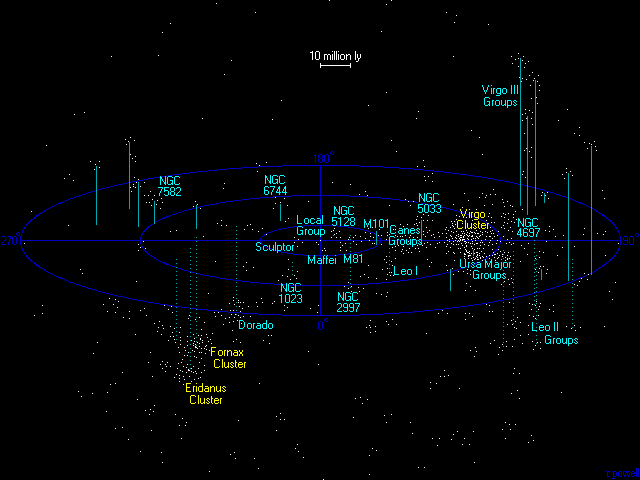


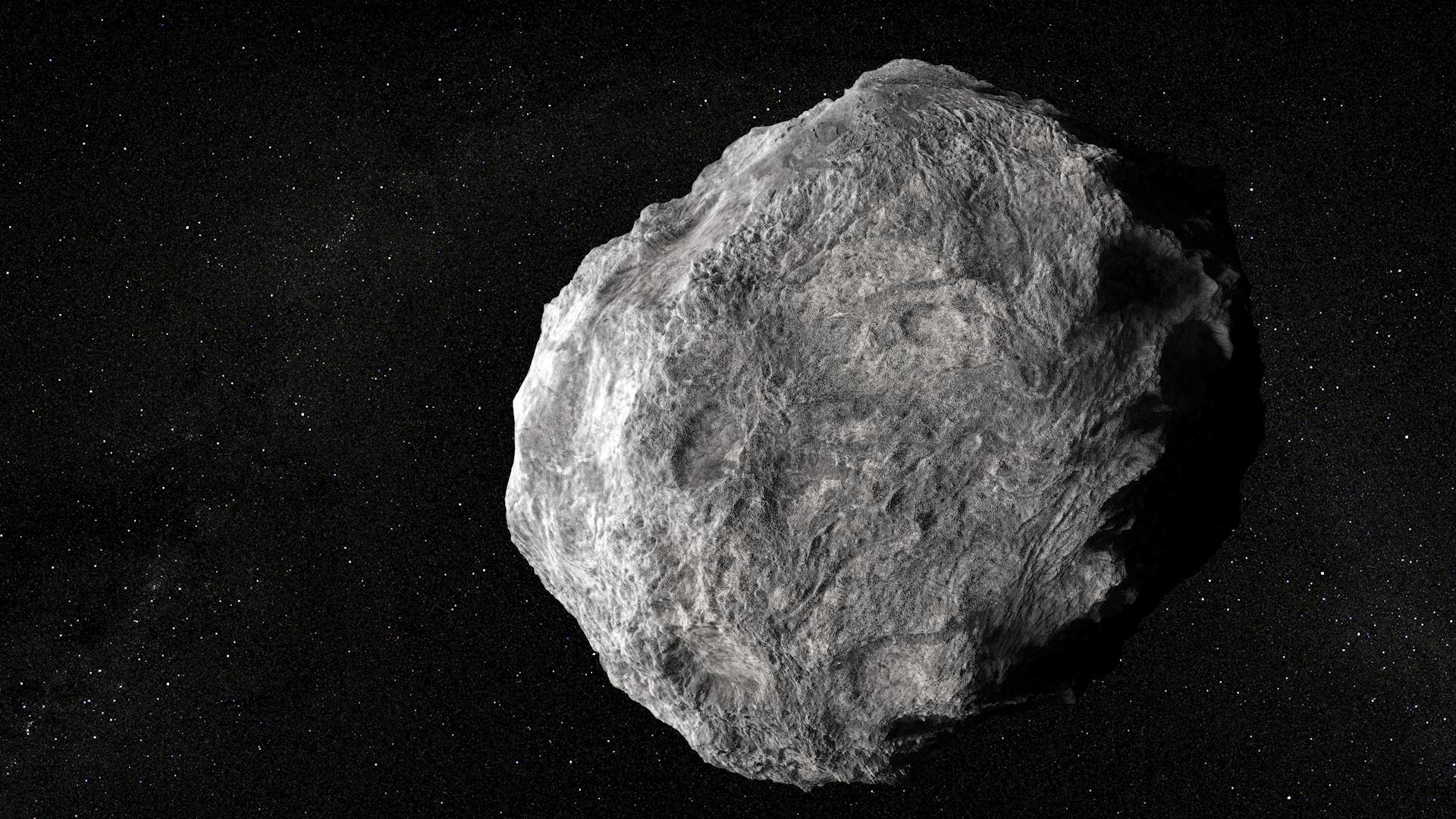








 Muslim 'day of rage' against Trump turns deadly: Two...
 California burning: Fast-moving wildfire races towards San.


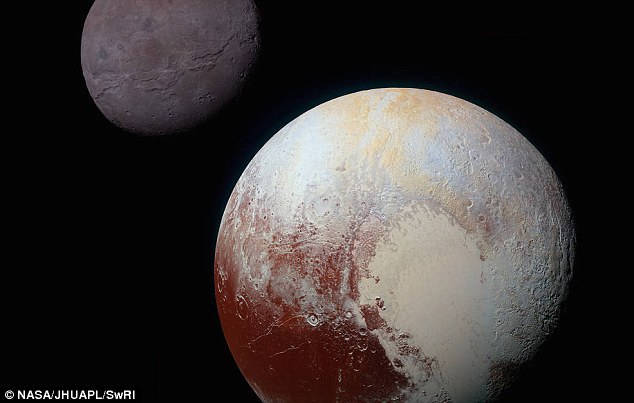
 Can you HEAR this GIF? Mind-bending audio illusion tricks...
 Wars of the future will use algorithms like ammunition,..
 Mushrooms imported from Russia to France are found to...
 Stunning sight of this year's only supermoon mesmerises...