Ontdek de Fascinerende Wereld van UFO's en UAP's: Jouw Bron voor Onthullende Informatie!
Ben jij ook gefascineerd door het onbekende? Wil je meer weten over UFO's en UAP's, niet alleen in België, maar over de hele wereld? Dan ben je op de juiste plek!
België: Het Kloppend Hart van UFO-onderzoek
In België is BUFON (Belgisch UFO-Netwerk) dé autoriteit op het gebied van UFO-onderzoek. Voor betrouwbare en objectieve informatie over deze intrigerende fenomenen, bezoek je zeker onze Facebook-pagina en deze blog. Maar dat is nog niet alles! Ontdek ook het Belgisch UFO-meldpunt en Caelestia, twee organisaties die diepgaand onderzoek verrichten, al zijn ze soms kritisch of sceptisch.
Nederland: Een Schat aan Informatie
Voor onze Nederlandse buren is er de schitterende website www.ufowijzer.nl, beheerd door Paul Harmans. Deze site biedt een schat aan informatie en artikelen die je niet wilt missen!
Internationaal: MUFON - De Wereldwijde Autoriteit
Neem ook een kijkje bij MUFON (Mutual UFO Network Inc.), een gerenommeerde Amerikaanse UFO-vereniging met afdelingen in de VS en wereldwijd. MUFON is toegewijd aan de wetenschappelijke en analytische studie van het UFO-fenomeen, en hun maandelijkse tijdschrift, The MUFON UFO-Journal, is een must-read voor elke UFO-enthousiasteling. Bezoek hun website op www.mufon.com voor meer informatie.
Samenwerking en Toekomstvisie
Sinds 1 februari 2020 is Pieter niet alleen ex-president van BUFON, maar ook de voormalige nationale directeur van MUFON in Vlaanderen en Nederland. Dit creëert een sterke samenwerking met de Franse MUFON Reseau MUFON/EUROP, wat ons in staat stelt om nog meer waardevolle inzichten te delen.
Let op: Nepprofielen en Nieuwe Groeperingen
Pas op voor een nieuwe groepering die zich ook BUFON noemt, maar geen enkele connectie heeft met onze gevestigde organisatie. Hoewel zij de naam geregistreerd hebben, kunnen ze het rijke verleden en de expertise van onze groep niet evenaren. We wensen hen veel succes, maar we blijven de autoriteit in UFO-onderzoek!
Blijf Op De Hoogte!
Wil jij de laatste nieuwtjes over UFO's, ruimtevaart, archeologie, en meer? Volg ons dan en duik samen met ons in de fascinerende wereld van het onbekende! Sluit je aan bij de gemeenschap van nieuwsgierige geesten die net als jij verlangen naar antwoorden en avonturen in de sterren!
Heb je vragen of wil je meer weten? Aarzel dan niet om contact met ons op te nemen! Samen ontrafelen we het mysterie van de lucht en daarbuiten.
Evidence of life on Mars is being covered up by Nasa, according to a researcher Barry DiGregorio at a Buckingham University.
The agency’s space explorer, the Curiosity rover, has snapped what may be trace fossils created by soft-bodied creatures on the red planet, he says.
An upcoming 'bombshell' report will reveal how Nasa is aware of the find and has chosen to keep it hidden from the public, the scientist claims.
The controversial scientist believes the space agency could be ignoring the find because of its plans for a manned mission in the 2030s, when astronauts will explore Mars in more depth.
However, according to Nasa, the shapes captured in images from Mars are simply rock crystals that are currently undergoing analysis.
Scroll down for video
Evidence of life on Mars is being covered up by Nasa, according to a researcher at a Buckingham University. The agency’s space explorer, the Curiosity rover, has snapped what may be trace fossils on the red planet, he says. Pictured are the alleged trace fossils
The findings were made by Barry DiGregorio, an honorary research fellow at the University of Buckingham who specialises in studies of microscopic life found in the soil of our planet.
Images beamed back from Mars by Curiosity appear to show patterns similar to Ordovician trace fossils Dr DiGregorio has photographed here on Earth, he says.
Trace fossils are made by animals going about their lives, like footprints, burrows and waste matter, rather than the remains of the creatures themselves.
Ordovician fossils are found in a geological layer spanning 41.2 million years from the end of the Cambrian Period 485.4 million years ago to the start of the Silurian Period 443.8 million years ago.
Dr DiGregorio Days fossils on Mars represent signs of soft bodied creatures which once roamed its surface.
Speaking to the Daily Express, he said: 'If not trace fossils, what other geological explanations will Nasa come up with?
Trace fossils are made by animals going about their lives, like footprints, burrows and waste matter, rather than the remains of the creatures themselves. This image shows a trace fossil from the Logan Formation, found in east-central Ohio and parts of western West Virginia
Dr DiGregorio says fossils on Mars represent signs of soft bodied creatures which once roamed its surface. This image shows trackways from a slug-like animal, from the Cambrian, found in Blackberry Hill, central Wisconsin
This image shows burrows produced by crustaceans from the Middle Jurassic, found in Makhtesh Qatan, southern Israel
This image shows Ophiomorpha and Thalassinoides trace fossils produced by crustaceans from the Late Miocene, found at Camacho formatio in Colonia Department, Uruguay.
'Nasa has turned its back on trying to get the data on this. The order came down from HQ that they should move the rover on to the next point.
'They didn't feel it was important enough to look at, I thought that was very odd, despite the fact Gale Crater was host to probably a series of lakes for billions and billions of years.
'We're talking about something that might have been equivalent to the Ordovician period on Earth.'
The findings were made by Barry DiGregorio, an honorary research fellow at the University of Buckingham. This image shows Dr DiGregorio (right) with Apollo astronaut Neil Armstrong (left)
Dr DiGregorio is not alone in his belief of evidence of life on Mars.
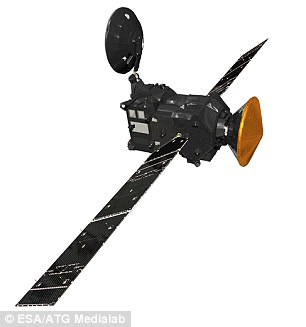
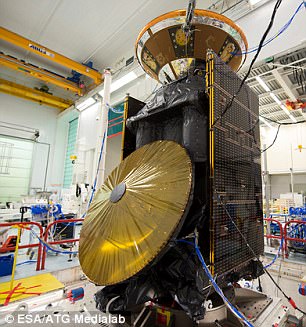
In recent weeks, a European space probe swung into position around Mars in preparation to analyse its atmosphere for possible signs of life.
The European Space Agency said on Wednesday, February 21, its Trace Gas Orbiter successfully performed a delicate manoeuvre known as aerobraking that involved dipping into the red planet's upper atmosphere to slow the probe.
The agency says the orbiter will start looking for trace gases such as methane, which can result from biological or geological activity, in April.
It will also search for ice that could help future Mars landings.
A Nasa-made radio on board will also help relay signals from US rovers on the surface back to Earth.
Europe plans to land its own rover on Mars in 2021. A European test lander crashed on the surface of Mars in 2016.
Dr DiGregorio says the agency’s space explorer, the Curiosity rover, has snapped what may be trace fossils on the red planet
In January 2018, Nasa announced that its Curiosity rover had spotted a set of mysterious ‘stick-like figures’ on the red planet. The surface of the Martian rock target in this stereo, close-up image includes small hollows with a 'swallowtail' shape characteristic of gypsum crystals
The shapes left behind will be familiar to geologists who have studied gypsum crystals formed in drying lakes on Earth. This image shows a mineral vein with bright and dark portions that distinguishes this Martian rock investigated near the upper edge of Vera Rubin Ridge
WHAT ARE THE TINY CRYSTAL SHAPES FOUND ON MARS?
In January 2018, Nasa announced that its Curiosity rover had spotted a set of mysterious ‘stick-like figures’ on the red planet.
In a photo shared to the rover’s Twitter account that week, the space agency gave its followersa look at the unusual formations found on the face of a Martian rock.
The images were captured during the rover’s ‘working holiday’ at the end of December 2017.
On New Year’s Eve, Curiosity revisited an ‘interesting’ site as part of its activity plan, to get a closer look what Nasa says are some ‘very peculiar targets.’
It’s unclear what exactly created the quarter-inch-long ‘stick-figures,’ though the space agency says they could be crystals or minerals left in the gaps where crystals dissolved.
The shapes left behind will be familiar to geologists who have studied gypsum crystals formed in drying lakes on Earth.
Further inspection of similar features by the rover elsewhere on Mars may resolve the timing of when the crystal-shaped features formed, relative to when layers of sediment accumulated around them.
Another uncertainty is whether the original mineral that crystallised into these shapes remains in them or was subsequently dissolved away and replaced by something else.
Answers may point to evidence of a drying lake or to groundwater that flowed through the sediment after it became cemented into rock.The Trace Gas Orbiter launched in March 2016 with the ill-fated Shiaparelli Demonstrator Module aboard a Proton rocket.
The Trace Gas Orbiter launched in March 2016 with the ill-fated Shiaparelli Demonstrator Module aboard a Proton rocket.
The pair arrived at the red planet in October of that year – but, just days before reaching the atmosphere, Shiaparelli was ejected toward Mars, ESA says.
The test lander entered Mars’ atmosphere at 21,000 km/h, and began to decelerate using aerobraking and a parachute.
But, due to technical problems, Shiaparelli’s braking thrusters and on-ground systems activated early, as though it had already landed, despite still being 3.7 kilometers above the surface.
The Trace Gas Orbiter, however, managed to successfully make it to its destination.
Dr DiGregorio is not alone in his belief of evidence of life on Mars. In recent weeks, a European space probe swung into position around Mars in preparation to analyse its atmosphere for possible signs of life
The craft was inserted into an elliptical orbit around Mars in October 2016, and performed a series of maneuvers in January 2017 to shift its angle of travel so it can get the best view of Mars.
It then began its aerobraking phase in March 2017, to slowly bring it down to a 400-km altitude orbit so it can begin its scientific mission in April of this year.
According to ESA, the Trace Gas Orbiter’s mission will run for roughly two years, during which it will observe the Martian atmosphere in search of gases that could be of ‘biological importance.’
And, its instruments will gather measurements to gain better understanding of the location and nature of these sources.
The craft will continue to relay information for the 2020 ExoMars rover mission until the end of 2022, ESA says.
WAS MARS EVER HOME TO LIQUID WATER?
Evidence of water on Mars dates back to the Mariner 9 mission, which arrived in 1971. It revealed clues of water erosion in river beds and canyons as well as weather fronts and fogs.
Viking orbiters that followed caused a revolution in our ideas about water on Mars by showing how floods broke through dams and carved deep valleys.
Mars is currently in the middle of an ice age, and before this study, scientists believed liquid water could not exist on its surface.
In June 2013, Curiosity found powerful evidence that water good enough to drink once flowed on Mars.
In September of the same year, the first scoop of soil analysed by Curiosity revealed that fine materials on the surface of the planet contain two per cent water by weight.
Last month, scientists provided the best estimates for water on Mars, claiming it once had more liquid H2) than the Arctic Ocean - and the planet kept these oceans for more than 1.5 billion years.
The findings suggest there was ample time and water for life on Mars to thrive, but over the last 3.7 billion years the red planet has lost 87 per cent of its water - leaving it barren and dry.
NASA verdoezelt bewijs van leven op Mars. Deze wetenschapper zegt het te kunnen bewijzen
De NASA verdoezelt bewijs van leven op Mars, zo stelt een wetenschapper van de Universiteit van Buckingham.
Marsrover Curiosity heeft volgens Barry DiGregorio namelijk sporenfossielen vastgelegd op de rode planeet.
Hij is van plan een onderzoek te publiceren dat alles uit de doeken zal doen. Volgens DiGregorio is de NASA op de hoogte van de vondst en heeft de ruimtevaartorganisatie ervoor gekozen het publiek in het duister te houden.
Doelbewust negeert
De wetenschapper vermoedt dat het ruimteagentschap de vondst doelbewust negeert omdat het zich voorbereidt op een bemande Marsmissie in de jaren 2030.
Volgens de NASA zijn de voorwerpen die Curiosity op Mars heeft gefotografeerd rotskristallen.
Dr. DiGregorio zegt dat de fossielen erop wijzen dat er ooit wezens rondliepen op het Marsoppervlak.
Heel vreemd
“Vanuit het hoofdkwartier van de NASA kwam het bevel om de rover naar het volgende punt te sturen,” zei hij.
“Ze vonden het niet belangrijk genoeg om te onderzoeken,” vervolgde hij. “Ik vond dat heel vreemd, aangezien zich miljarden jaren geleden waarschijnlijk meren bevonden in de krater.”
Enkele weken geleden werd een Europese ruimtesonde in een baan om Mars gebracht. De sonde moet in de atmosfeer van de rode planeet gaan speuren naar mogelijke tekenen van leven.
Methaan
De ESA liet weten dat de Trace Gas Orbiter in april gaat zoeken naar gassen zoals methaan, die het resultaat kunnen zijn van biologische of geologische activiteit.
Europa is van plan in 2021 een rover op Mars te laten landen. Een Europese testlander crashte in 2016 op het Marsoppervlak.
Vreemd object gespot op Google Earth bij Antarctica. Is dit een gecrasht schip?
Alienjagers zijn ervan overtuigd dat een mysterieus object dat op Google Earth is gespot, een gecrasht ruimteschip is. Dat schrijft de Daily Mail.
Het object werd ontdekt op het nagenoeg onbewoonde eiland Zuid-Georgia, dat zich in de buurt van Antarctica bevindt.
Sporen
Het vreemde object is waargenomen in de buurt van de bijna 3000 meter hoge Mount Paget, het hoogste punt van Zuid-Georgia.
Achter het object zijn sporen te zien, wat suggereert dat het door de sneeuw is gegleden voordat het tot stilstand kwam.
Vreemde massa
Beelden van de vreemde massa zijn zaterdag op YouTube gezet en inmiddels bijna een half miljoen keer bekeken.
Sommigen geloven dat het hier gaat om het werk van buitenaardsen, terwijl vele anderen zeggen dat het een rots is die vanaf een nabijgelegen gletsjer is gedrukt.
Het Pentagon doet nog steeds onderzoek naar UFO’s. Worden deze objecten bestuurd door buitenaardsen?
Leslie Kean schreef mee aan een schokkend artikel dat eind vorig jaar in de New York Times werd gepubliceerd over het geheime UFO-project van het Pentagon.
Het artikel maakte veel los, aangezien de Amerikaanse overheid jarenlang beweerde dat het laatste officiële onderzoek naar UFO-waarnemingen bijna 50 jaar geleden werd beëindigd.
“De onderzoekers die zich hiermee bezighouden hebben zich altijd al afgevraagd wat er achter de schermen gebeurt,” zei Kean.
Nog steeds
“Loopt er een overheidsonderzoek? Nu kunnen we die vraag met ‘ja’ beantwoorden,” voegde ze toe.
Dit maakt het onderwerp geloofwaardig en nu weten mensen dat de overheid het serieus genoeg neemt om er geld in te stoppen en er jarenlang onderzoek naar te doen, aldus Kean.
De Amerikaanse overheid gaf tussen 2007 en 2011 in totaal 22 miljoen dollar uit aan het onderzoek naar UFO’s. Hoewel de financiering werd stopgezet, loopt het onderzoek volgens Kean nog steeds.
Ongelooflijke dingen
“We weten dat dit programma nog steeds bestaat,” zei ze. “Er worden onder meer gevallen onderzocht waarbij militairen en piloten deze onbekende objecten zagen.”
Kean benadrukte dat ongeïdentificeerde vliegende objecten niet per definitie ruimteschepen zijn die worden bestuurd door buitenaardsen.
Maar tijdens het onderzoek zijn UFO’s bestudeerd die ongelooflijke dingen konden doen, dingen waar geen enkel conventioneel vliegtuig toe in staat is.
Uit de ruimte
Zo zagen legerpiloten mysterieuze objecten voor de kust van San Diego. “Die bleken uit de ruimte te zijn gekomen,” zei Kean.
“Ze kwamen naar de aarde en verdwenen weer in de lucht,” vervolgde ze. “Ze bewogen buitengewoon snel van ene naar de andere plek. Veel sneller dan vliegtuigen.”
March 12 this year marks the 25th anniversary of the release of Fire in the Sky, Hollywood’s controversial take on the famous Travis Walton UFO abduction case of 1975. Walton, a logger from Snowflake, Arizona, famously claimed to have been taken aboard a flying saucer and to have interacted with two different species of aliens—the now iconic ‘Grays’ and the attractive human-looking beings known in UFOlogy as ‘Nordics.’ What distinguishes Walton’s story from innumerable other accounts of cosmic kidnapping is that his apparent abduction was witnessed, in part, by the six other men on his logging crew. They sped back into town that night to inform bemused authorities of how a UFO had zapped Travis in front of their very eyes. Assuming he was dead, the terrified loggers had left their colleague where he lay, the saucer looming above his lifeless body.
D.B. Sweeney as Travis Walton, and Robert Patrick as Mike Rogers.
A swirling storm of confusion, anger, and allegations was soon to descend on the sleepy town of Snowflake. The loggers, having reported to police that their friend had been taken by a UFO, immediately were considered suspects in Walton’s disappearance and possible murder. After no less than five days, Walton returned. He was found in a telephone box some three miles outside of Snowflake, huddled and shivering. He had five days’ growth of beard and was visibly malnourished. As he was taken back into town he began babbling about strange creatures with large eyes. He assumed he’d been gone just a couple of hours and was stunned into prolonged silence when he was told almost a week had passed. Today, the case remains one of the most famous on record, and this is thanks in no small part to Hollywood.
The movie
Featuring solid performances from D.B. Sweeney as Travis, and Robert Patrick as logging-crew-leader Mike Rogers, the Fire in the Sky movie was a reasonably faithful accounting of the Walton experience—that is until its final act, which notoriously pummelled the meat of Walton’s encounter out of all recognition. The Nordic beings described by Travis and their walkabout with him in a spaceport were nowhere to be seen in the movie. Walton’s skittish Grays were replaced with frightful goblin-like beings who literally drag the logger like a sack of spuds through their pestilent, rotting spaceship—all dank tunnels and dripping embryonic sacks—before gluing him to a table with a suffocating membrane and subjecting him to graphic torture with a thick needle to the eyeball. It’s a horrific sequence, so powerful as to erase almost all memory of the events that precede it. This marked the point in time when alien abduction truly entered the horror genre. The film would go on to influence abduction-themed fright-fests such as Altered(2005), The Fourth Kind (2009), Dark Skies (2013), Alien Abduction (2014), and, in particular, Extraterrestrial (2014), to name but a few.
The UFO community was outraged by Fire in the Sky, and all fingers were pointed at screenwriter Tracy Tormé. In a 2014 interview, Tormé explained to me his writing process for the movie, the cultural climate in which it was written, and the circumstances which led to the movie being so creatively distorted.
Reaching out
Tormé had already successfully explored the subject of alien abduction in his 1992 CBS miniseries, Intruders, which took inspiration from the work of researchers Budd Hopkins and John Mack; now, the screenwriter wanted to tackle abduction through cinema. Tormé had reached out to Walton as early as 1985:
When I first met him over the phone, it was ten years almost to the day since the incident had happened. I told him that I had a lot of respect for his story and I really wanted to make a movie, but first I wanted to investigate the story more and see how I felt about it. Travis was very, very reticent. He felt like no one had really treated him fairly in the past. Especially people from Hollywood. So he was not inclined to do this.
Tormé agreed that they should meet in Snowflake, Arizona, so that screenwriter and experiencer could get better acquainted. Tormé recalled:
I spent three days with Travis. I went up to the site where it happened, and I took him and Mike Rogers with me and had them re-enact the incident. They had not been back to the site in nearly ten years at this point, and they were both extremely haunted to be up there again. It’s a very lonely place and it had changed hardly at all. There was even a wood pile on the ground that had been there ten years ago when they were there.
William Keeble / Onwinges Prod.
Tormé returned to Snowflake at least six times over the next six years: “I just tried to learn more and more about the case every time I went. I got to know Travis and Mike very well. All the ideas for Fire in the Sky really formulated out of those trips.” Selling the script to studios, however, was an uphill struggle for Tormé:
On several occasions I thought we’d found a buyer, then I would have to go back to Travis and tell him the sad news ‘no, they’re not going forward.’ The studios at the time found the subject of abductions strange and unbelievable, and really, ultimately, not satisfying. If the aliens had come here and invaded the Earth and blown up the cities or something they might have been more open to making the movie.
Tormé emphasizes that abduction movies in general were a hard sell in the late-1980s-early-1990s:
At that time there was not a lot of interest in this subject. People wonder why it was such a struggle to get Fire in the Sky made. But the public really did not know about the abduction phenomenon. They weren’t following it, they weren’t reading about it. It had not broken through in a big way in the mass media. I really believe these two projects [Fire and Intruders] were part of the process of people becoming aware of how these things allegedly work.
Screenwriter Tracy Torme.
When eventually Paramount Studios bought Tormé’s script, it had been six-and-a-half years since the screenwriter had first approached Travis Walton. The dream would now become a reality. But the reality would be compromised…
Script changes
“The original script was, I would say, close to one-hundred-percent accurate to Travis’ memory of the events,” Tormé told me:
I literally used his memory of waking up on the table and then everything that happened to him up to the point that he’s put back on the highway. I followed his story to the tee. I felt an obligation to these guys to tell the story in the truest way that I could. And I thoroughly believed him by this point, too. I had come to the conclusion that the case was real, and that he was not a liar, that’s for sure. So I originally wrote exactly what he said.
One day, Tormé received a phone call in his office at Paramount Studios: “It was a panicked Paramount executive who just happened to have seen Intruders on TV the night before. He was unbelievably put-off and worried because he’d seen little gray men with big eyes standing over a table doing experiments on someone, therefore it’d ‘been done before,’ therefore he had no interest in doing the Walton movie and was going to kill the project if I didn’t come up with something else.”
Tormé was shell-shocked. “They were serious,” he stressed, “they were firm on it. They were going to shut the project down and not make it. We were going to have to start back at square one.” Tormé had no other option but to re-write the abduction sequence: “I got together with the director and with Travis and we devised the fictional sequence that is seen in the movie.” Tormé did at least attempt to maintain the essence of the encounter:
I insisted that if we’re going to fictionalize this, let’s at least mirror his real occurrence. So one example would be, when Travis said he’d had trouble breathing when he came to in the strange environment, we put a scene in where they put a mask over his face. That’s an example of the type of thing we tried to do. Yes, we were creating something wholly fictional, but we were going to try to maintain somewhat the feel and integrity of the terrifying experience that he had. So we tried our best to write a scary, disturbing sequence. But it was entirely fictional. I knew very early on that a lot of UFO people were going to be very upset about this.
Reception
Despite its divisive ending, Tormé is proud of Fire in the Sky, first and foremost on its undeniable strength as a human drama. The movie made back its budget, but little more. It received mixed reviews from the critics, although, ironically, the legendary Roger Ebert praised the film’s final sequence for its believability, writing: “The scenes inside the craft are really very good. They convincingly depict a reality I haven’t seen in the movies before, and for once I did believe that I was seeing something truly alien, and not just a set decorator’s daydreams.” However, Ebert was left deflated as the credits rolled, adding: “The movie ends on an inconclusive and frustrating note.” Film critic James Berardinelli described Fire in the Sky as a “muddled-up mess,” saying “It can’t make up its mind whether it wants to be horror, drama, or science-fiction. As a result, it ends up being ineffective as any of the three.”
These criticisms, essentially describing the movie as a mishmash of genres with an inconclusive ending, in fact speak to its overall authenticity as an abduction story. The phenomenon, as experienced in reality, does not comfortably lend itself to any one genre, encompassing as it does an array of complex facets straddling drama, sci-fi, fantasy, horror, and others besides. Walton’s real-life experience had no satisfactory resolution, and neither did the film. In this sense, ‘true’ abduction movies arguably will always struggle to make sizable dents at the box-office. Extreme ‘Hollywoodization’ is deemed essential to bringing these stories successfully to a mass audience.
A researcher studying the possibility of microscopic life on Mars has just made a stunning announcement that he has evidence showing soft-bodied creatures once lived on the red planet and NASA knows this as well and is covering up the evidence. What’s more, the Curiosity Rover was parked in a bed of fossils and NASA received orders from “HQ” to move along … there’s nothing to see here. Really?
The researcher is Barry DiGregorio and if his name sounds familiar, you’re probably up on ichnology – the study of dissolution cavities left behind by organisms along with their tracks, trails and burrows. DiGregorio is an honorary research fellow at the University of Buckingham, whose website bio brags that “in 2000 Barry published a comparison of dissolution cavities found in rocks on the shores of Lake Ontario to similar looking rocks imaged at the Viking 2 landing site on Mars.” So, if there’s anyone qualified to spot evidence of organisms that once crawled around on Mars, it would be Barry DiGregorio — and that’s exactly what he claims to have done.
Fossilized burrows produced by crustaceans during the Middle Jurassic period in Israel
In January, NASA posted photos on Twitter taken by the Curiosity rover of what it called stick-like figures and speculated on what they might be.
“Each is about a quarter-inch long. Maybe they’re crystals? Or they could be minerals that filled spaces where crystals dissolved away.”
According to Metro.co,uk, Barry vehemently disagreed.
“They look remarkably similar to Ordovician trace fossils I have studied and photographed here on Earth. If not trace fossils,at other geological explanations will NASA come up with.”
If you slept through that lecture in geology class, the Ordovician period was part of the Paleozoic Era, lasting from 485.4 to 443.8 million years ago. DiGregiorio was obviously awake and immediately spotted the resemblance between life signs on Earth and what he believes are life signs on Mars. Unfortunately, NASA didn’t agree with him and sent Curiosity to take photos in another spot.
With that move, DeGregorio told the Daily Star Online that he smelled a rat.
“Put it this way, these images, these figures, have not been seen on Mars to date. One of the things that grabbed me immediately was the expediency that NASA left the area of such a mission. So when I started looking, it wasn’t just the objects that were attached the outside, what they are calling sticks. “If you look at the images more closely, the sticks merge into the host rock, this actually has features in it that are reminiscent of trace fossils.”
And …
“NASA has turned its back on trying to get the data on this. The order came down from NASA HQ that they should move the rover on to the next point.”
Why does he think NASA was ordered by “HQ” (NASA is part of the executive branch – is he referring to the White House?) to ‘turn its back on signs of life? DiGregorio believes NASA or HQ or someone in the know wants to increase excitement in the proposed 2030 manned mission to Mar by having a human (re-)discover these signs of Martian life in person.
“If they announced that, once that has been satisfied to the general public, people who pay their taxes to send the $2.5billion probe to Mars, they are going to say okay well we discovered life, we don’t need to go there anymore.”
DiGregorio says he’s working with two other experts in ichnology (there’s more than him?) on a paper he will present to NASA and the public clearly stating the evidence that those “stick figures” on Mars are signs of life.
Is he right? Will he succeed?
Oh man, wonder if he’ll ever know He’s in the best selling show Is there life on Mars? — “Life on Mars?”(David Bowie)
Ball lightning is a mystery of atmospheric science that has fascinated researchers and laymen alike for centuries. While a range of theories exist that suppose how and why it may form, to-date we have no real clear explanations for the phenomenon, despite the accumulation of a wealth of scientific data over the last several decades.
Due to its curious nature, there have been several attempts to recreate ball lightning in a laboratory setting in recent years. Business Insiderreported in 2013 that a group of researchers at the U.S. Air Force Academy managed to create “a ball-shaped flash of plasma” in a laboratory setting that “closely resembles” ball lightning as it occurs in nature.
According to a recent paper in Science Advances, an effect similar to ball lightning has once again been produced in a lab setting … although this time, it occurred on the quantum level. The study, co-authored by researchers Wonjae Lee1, Andrei H. Gheorghe, and several others is titled “Synthetic electromagnetic knot in a three-dimensional skyrmion.” The study observes the behavior of particular groupings of atoms, called Bose-Einstein condensates, which consisted in this case of rubidium atoms that were operating near absolute zero (thus presenting conditions where the movement of particles is very minimal).
According to the paper’s abstract, the experiment led to the observation of a theoretical phenomenon which had never been observed before in a lab setting, and which may present new clues about how ball lightning is formed:
“We experimentally realize a simulation in which a charged quantum particle interacts with the knotted electromagnetic fields peculiar to a topological model of ball lightning. These phenomena are induced by precise spatiotemporal control of the spin field of an atomic Bose-Einstein condensate, simultaneously creating a Shankar skyrmion—a topological excitation that was theoretically predicted four decades ago but never before observed experimentally. Our results reveal the versatile capabilities of synthetic electromagnetism and provide the first experimental images of topological three-dimensional skyrmions in a quantum system.”
Writing for Gizmodo, science writer Ryan Mandelbaum explains Bose-Einstein condensates as systems that are “able to demonstrate strange quantum effects on macroscopic scales, and they allow researchers to create otherwise impossible-to-study phenomena, like magnets with only one pole, supersolids, Rydberg polarons, and in this case, strange, knotted magnetic fields.”
Hence, the researchers liken the observation of the mysterious Shankar skyrmion, in this case, to being essentially a “topological model of ball lightning,” produced in a controlled setting.
The enduring question, of course, is how (and why) such things may occur in nature, and presumably on a scale that is orders of magnitude greater than that observed when being induced in a lab setting. More importantly, what natural phenomena could constitute the unusual, self-contained luminosity of ball lightning, which sometimes appears to erupt spontaneously into an environment, and in the absence of weather systems and other meteorological phenomena associated with “normal” lightning?
Photo of possible ball lightning-like manifestation over Table Rock, North Carolina in 2009 (photo by Bill Fox).
There are some unusual occurrences of ball lightning that have been reported over the years, which may provide some clues about what causes it to form. Examining a few of these, one such report (albeit an early one) comes from Michael W.Rowe’s 1983 article in the British Journal of Meteorology, titled “Unusual Ball Lightning,” wherein it was described that a ball lightning manifestation occurred with what appeared to one observer to be “chains”:
“It happened in the afternoon in 1924. There came a large ball of fire — or so it looked — but the thing was that it had chains all the way round. It lasted about five minutes, then all the chains clashed together with a terrific bang; then we had a terrible thunderstorm which lasted quite a long time.’ In a second let ter Mrs. Revell drew the ball lightning as a red globe with 16 rays, composed of links like a chain, issuing from it; the rays were rather longer than the diameter of the ball. She said, ‘You asked the size. From the ground it looked about four to five yards across, which would be larger than that in the sky. The chains opened from the top to the bottom with a terrific bang.”
Four years before the account presented above, we have a similar incident from Parkside, Australia, where another unusual ball lighting manifestation was observed after a loud noise was heard some distance away. The account given is as follows:
“It wasn’t long till we heard a hissing noise and, looking up to the western sky, saw an object about 12 inches in diameter slowly moving through the air down toward us — about 12 feet away. It was travelling eastward and came down over Mrs. Harris’s wooden fence landing on the cement porch floor about 3 feet behind us. It gracefully bounced along the cement floor in a straight path covering the 30 foot length of the verandah at a walking pace. It bounced three or four times rising to a height of 18 inches on each occasion. Each time the spherical ball touched the cement it was flattened at the point of contact, and deformed, but it quickly resumed its globular shape when it left the ground. It was not transparent but, rather, like a ball of smoke with glowing ‘comma-shaped’ electrical ‘worms’ wriggling about — sizzling, hissing and flickering. It flattened by 1/4 into the egg shape on each bounce. On reaching the far western end of our verandah it accelerated rapidly and rose at a steep angle of about 45 degrees clearing the apricot tree, wires, and the house next door. At this stage my mother rushed in the back door of the house where we huddled for about 30 seconds before hearing a resounding crash some 250 yards away off to the east. It had hit Green’s house at the far eastern end of Campbell Road. It apparently then bounced all the way to the Salvation Army home and demolished the whole house somewhere near Dawson and Florence Streets at Fullarton.”
Another peculiarity of ball lightning, in addition to its association with unusual forms and loud noises, is its occasional appearance in a metallic, or even glass-like form (such reports often occur in the daytime). In an incident dated June 1, 1984, a Mrs Elsie Haigh of Nottingham, England, observed the following, which again was featured in the British Journal of Meteorology the same year the incident occurred:
“…at approximately 5.45 p.m., I was in my kitchen. The window and door were both closed. I was standing with my back to the window when I heard a ‘boiling noise’ and a noise which sounded like glass splintering — a crash sound. I was very scared and turned around to face the window and saw a large glass-looking ball, approximately 10 inches in diameter (25 cm), slightly oblong (oblate), with a white filament in the middle. This was floating on a bowl of water which was in the sink. I ran to the bathroom, and seconds later I heard an explosion and splintering glass. When it was quiet — I think a few seconds elapsed — I returned to the kitchen. The ball had gone and there was no damage. I can only describe it as a miracle.”
By far, the most peculiar report involving a ball lightning manifestation occurred on August 17, 1978, in a region of the Caucasian Mountains in Russia. The incident involved a man named Victor Kavunenko, who was camping with four other individuals at an altitude of 3900 meters when a luminous phenomenon manifested within their tent during the night:
“I woke up with the strange feeling that a stranger had made his way into our tent. Thrusting my head out of the sleeping bag, I froze. A bright yellow blob was floating about one metre from the floor. It disappeared into Korovin’s sleeping bag. The man screamed in pain. The ball jumped out and proceeded to circle over the other bags now hiding in one, now in another. When it burned a hole in mine I felt an unbearable pain, as if I were being burned by a welding machine, and blacked out. Regaining consciousness after a while, I saw the same yellow ball which, methodically observing a pattern that was known to it alone, kept diving into the bags, evoking desperate, heart-rendering (sic) howls from the victims. This indescribable horror repeated itself several times. When I came back to my senses for the fifth or sixth time, the ball was gone. I could not move my arms or legs and my body was burning as if it had turned into a ball of fire itself. In the hospital, where we were flown by helicopter, seven wounds were discovered on my body. They were worse than burns. Pieces of muscle were found to be torn out to the bone. The same happened to Shigin, Kaprov and Bashkirov. Oleg Korovin had been killed by the ball — possibly because his bag had been on a rubber mattress, insulating it from the ground. The ball lightning did not touch a single metal object, injuring only people.”
This incident is arguably the most sensational of the collection examined in this article; it is always wise to treat such cases with caution, although Kavunenko’s testimony certainly shouldn’t be ruled out (and while speculative, the events described in Kavunenko’s narrative certainly bear a passing similarity to some of the events surrounding the mysterious deaths of a group of Russian hikers in 1959, known as the Dyatlov Pass incident).
With little doubt, even the newest discoveries detailing ways ball lightning is formed leave much to the imagination. It is one of those rare, enduring mystery that remains in the modern era, and one that is sure to fascinate and perplex us for many more years to come.
Government denials and UFOs go hand-in-hand. In fact, that element of unexplained aerial phenomena being something “they” don’t want us to know could be one reason why UFOs continue to fascinate us. After last year’s revelations that the Pentagon has been studying UFO phenomenon for years, though, it’s becoming more and more difficult to deny that governments do have a documented interest in studying the mysteries of UFO activity. However, that’s not to say that all nations’ governments are willing to disclose any study of or interest in unidentified aircraft and phenomena. For their part, the Japanese government recently drafted an official statement on UFOs, and their position appears to be one of disinterest. Is there more going on behind the scenes, or are Japanese leaders unconcerned with the unexplained?
It’s not like they don’t have other problems to worry about at the moment.
Japanese Prime Minister Shinzo Abe and his Cabinet staff issued the statement on February 27 after Seiji Osaka, a Lower House member of the opposition Constitutional Democratic Party of Japan, petitioned the Japanese government to disclose any information it had concerning the study of UFOs. Osaka’s inquiry was in direct response to the American government’s secretive “Advanced Aviation Threat Identification Program” made public last year. While the request was made in the interests of the freedom of information, Abe’s response was characteristic of most official responses to UFO issues.
Reptilians are so predictable.
The Japanese government’s official response stated that the existence of UFOs “has not been confirmed” and military and governmental leaders “have not made any particular consideration of how to respond should one fly into Japan.” One elected official, Chief Cabinet Secretary Nobutaka Machimura, disagreed, however, telling the press that while “the official response from the government is extremely stereotypical, I personally believe (UFOs) definitely exist.”
This official statement comes at a strange time. With North Korea continuing to carry out missile tests and South Korean and American forces ramping up their air power presence in the region, chances are high that Japanese citizens might see some unfamiliar craft flying overhead. Is the Japanese government’s response intended to quell public fears at a time of heightened tensions, or is this yet another example of UFO denial by elected officials?
A Compilation Video Of Many Of The UFO Reports Coming Out This Week, March 2018, UFO Sighting News.
Date of sightings: March 2018 Location of sightings: worldwide Here are some great compilations of the recent UFO sightings and reports this week coming out of MUFON. Some of them are really eye openers an get you wondering. Thats why we are interested in the subject, the mystery of it all pulls us toward it. Scott C. Waring
MUFON 90433 Wheeling, WV, USA 2017-08-21 MUFON 90438 Lowell, MA, USA 2018-02-26 MUFON 90442 Tampa, FL, USA 2018-02-25 MUFON 90460 Cascais, PT 2012-05-30 MUFON 90496 Naples, FL, USA 2018-02-28 MUFON 90502 Woodstock, IL, USA 2018-02-26 MUFON 90503 Marysville, WA, USA 2018-03-01 MUFON 90523 Dearborn Heights, MI, USA 2018-03-02 MUFON 90552 Baltimore, MD, USA 2017-10-24 MUFON 90555 London, UK 2018-01-16
Explain This! Rare Sky Anomaly filmed above Ecuador and it is NOT the Sun!
Things get more and more bizarre every day. A rare sky phenomenon has been spotted above Ecuador on March 3, 2018.
The atmospheric anomaly actually rises up from the horizon approximately at the same rate of speed as the setting sun and at first glance you would think it is the sun, it isn’t.
The anomaly gradually fades away until it is completely gone and there is no sun.
Maybe it could have been some sort of reflection off a faint cloud structure bouncing upwards for some reason?
Audio Recording Reveals The Moment A Bizarre UFO Flying Very Fast And Disappearing Without A Trace Even The US Military F-15s Fail To Track It
An audio recording relays the scene wherein a white speck appeared on the radar then strangely vanished without a trace. It somewhat relays the bizarre moment an intruder UFO was noticed at high speed above Oregon.
The mysterious object reportedly appeared on the radar, and air traffic controllers were left baffled with it. Adding to the mystery, it chillingly vanished without a trace.
F-15 fighter jets were sent to the scene, but could not find the mysterious thing.
Now audio tapes reveal the hours of confusion of the aerial incident that took place on October 25, 2017. The alarm was raised at 4:30 pm to Oakland Center Sector 31, close to the border of Oregon.
The object in question was apparently moving very fast at 37,000 feet over Crater Lake towards the Willamette Valley when it was first noticed.
Officials tried to follow the mysterious object on radar but were unable to track it. They tried to contact it, but it appeared it did not have a working transponder.
A United Airlines flight called in later saying that the object, described as a large white plane, had no markings on it to identify itself.
The sightings of the plane lasted for 30 minutes and stretched hundreds of miles.
The same report was called in over and over again, but it was too far away to decipher the type of plane it was.
F-15 fighter jets from Portland were deployed to find and intercept the unknown plane just 27 minutes after the aircraft was spotted.
However, the air control agent reported no track on the plane, saying it must be in stealth mode.
Pilots descending into Portland International Airport last spotted the unknown aircraft.
This was filmed over Baltimore, MD on 24th October 2018 and it was just recently reported to MUFON.
Witness report:
Three white lights in a Right angle triangle next to TV hill that fade. While driving to the park with my cousin to take my dog for a walk, i noticed 3 lights in a triangle pattern to the right of the tv hill towers. i started recorded, we had to go around a couple blocks as there was traffic and road work at the time and no where to pull over. the video i am attaching shows the lights to the right of the tv towers. the topic most light quickly fads out while the other 2 remain and then start to fad out. at this time i can not get a hold of my cousin to make a report.
Despite Funding Cuts, US Government Still Studying UFOs
Months after a bombshell story revealed that the US government has spent millions of dollars and many research hours detecting and studying unidentified foreign objects, the government continues to study these phenomenon even though funding has technically been cut off, according to a new report.
"We know that this program existed, it still exists and it investigated military cases and very significant cases of pilot encounters with these objects," according to one of the authors who broke the story late last year.
In December, the New York Times reported that the guided missile cruiser USS Princeton had tracked enigmatic aircraft that "appeared suddenly at 80,000 feet and then hurtled toward the sea, eventually stopping at 20,000 feet and hovering." After the maneuver the objects would shoot directly up or fall out of radar range, according to the report.
"It's completely rational to be interested and to try and figure out what's going on with this," Leslie Kean told WTOP Monday. Kean was a co-author of the December report in the New York Times.
"The researchers in this area have always speculated and wondered what is going on behind the scenes," Kean began. "Is there a government investigation into this? And now we know the answer is yes. It just established credibility for the topic for people to know that our government takes it seriously enough to have to put financial resources into it."
While it's not clear how the government is financing the programs without directly funding them, one possibility is for military and intelligence agencies to dig into their black ops budgets. For fiscal year 2018, the military and intel communities have $78 billion for running off-the-books operations. The Trump administration has requested increasing the black ops budget to $81 billion.
While the stigma around UFO research can make academics and researchers "feel like they're going to be laughed at," an attitude that has tainted institutions' perceptions of further research, Kean expressed hopes that things were changing.
Perhaps one way to change perceptions of UFO research is to introduce the vital clarification that UFOs should not be misconstrued with aliens. "You can't take the leap of looking at something unexplained and then assume that it's alien," Keane noted.
Thousands of People Have Mysteriously Disappeared in "Alaska's Bermuda Triangle"
Written byCody Gough
You've probably heard legends about planes and ships mysteriously disappearing in the Bermuda Triangle (or Devil's Triangle), the area of ocean between Florida, Puerto Rico, and Bermuda. But those legends don't come close to the very real, very serious disappearances that have plagued Alaska for decades. There's a region of wilderness known by names like "Alaska's Bermuda Triangle," the "Bermuda Triangle of Alaska", and the "Alaskan Triangle" — and no matter what name you give it, it's far more deadly than its tropical cousin.
Missing In Alaska
The border of the Alaskan Triangle stretches from Barrow on the state's north coast to Anchorage and to Juneau across the southern coast, and includes vast areas of largely unexplored wilderness. Sprawling forests, icy mountain peaks, and desolate tundras are clearly not the safest places in the world, but of the hundreds of search-and-rescue missions conducted every year, state troopers rarely find any trace of bodies — dead or alive.
The Alaskan Triangle first received widespread attention when US House Majority Leader Hale Boggs' airplane vanished somewhere between Anchorage and Juneau in 1972. The disappearance triggered one of the country's largest ever search-and-rescue operations, involving 40 military aircraft, 50 civilian planes, and 39 days of searching an area of 32,000 square miles. Yet the search yielded not a shred of results: no wreckage, no debris, no human remains. Nothing.
(The silver lining: after this incident, Congress passed a law mandating the installation of emergency locator transmitters in all U.S. civilian aircraft.)
That wasn't the only aircraft to be lost, either: back in 1950, a military craft with 44 passengers had disappeared without a trace; and a Cessna 340 carrying a pilot and four passengers vanished in 1990, never to be heard from again. Disappearances without a trace are strangely typical of cases in the region, and the cases aren't rare: since 1988, more than 16,000 people have vanished in the Alaskan Triangle. This contributes to the annual filing of roughly 4 missing person reports for every 1,000 people in Alaska — more than twice the national average.
Nature Or Unnatural?
It's easy to write off the disappearances as people getting lost and quickly succumbing to the elements, but the numbers seem too staggering for such an easy answer. One potential reason for the disappearing planes: the terrain utterly obliterates them. In 1947, for example, the British South American Airways (BSAA) Lancastrian 3 airliner Star Dust disappeared en route from Buenos Aires, Argentina to Santiago, Chile, and its fate was unknown for more than 50 years. Two Argentinian climbers found the plane's wreckage while ascending Mount Tupungato in 1998, and investigators concluded that Star Dust had likely crashed into a nearly vertical glacier, which caused an avalanche that buried it within minutes
Still, it seems unlikely that similar avalanches would have occurred in every plane that's gone missing over the Alaskan Triangle. And what about the lost hikers, tourists, and Alaskan residents who weren't flying in planes? This is where theories get a little less, er, grounded in science, to say the least.
In the book "In Search of the Kushtaka, Alaska's Other Bigfoot: The Land-Otter Man of the Tlingit Indians," author Dennis Waller explores the history of mythical shape-shifting creatures found in stories of the Tlingit and Tsimshian Indians indigenous to southeastern Alaska. The "Kushtaka" roughly translates to "land-otter man" and is the Bigfoot of the Alaskan Triangle. Legend has it that the creature appears to travelers in an irresistible form (such as a relative or vulnerable child) to lure victims to a nearby river, where it tears them to shreds or turns them into another Kushtaka.
A more grounded explanation is that the deceptively beautiful glaciers of Alaska have swallowed many of the missing people and planes. Although they may appear to be solid ice, the glaciers are actually honeycombed with hidden chambers, and those crevasses can be larger than houses or even office buildings. Coupled with the falling snow of the northern climate, it's not unreasonable to think that in the Alaskan Triangle, "vanishing into thin air" really just means "buried by nature." Just remember to stay safe if you do venture into the Alaskan wilderness, and contact Alaska'sMissing Persons Clearinghouseif you find (or need help finding) a wayward traveler.
This article contains affiliate links. If you choose to make a purchase through that link, Curiosity will get a share of the sale.
Scientists Find: Certain Black Holes Erase Your Past, And Give You Infinite Number Of Possible Futures
A researcher from the University of California Berkley claims that there are certain types of black holes in the cosmos that can ‘press the reset button on history,’ sort of speak.
According to experts, these black holes have the ability to reset the past completely and offer an infinite number of possible futures.
Image Credit: NASA/JPL-Caltech
In the real world, the past uniquely determines the future. If a physicist knows how the universe began, he has the necessary means to calculate its future for all time and all space. However, a UC Berkeley mathematician has found some types of black holes in which this law does not apply.
If someone ventured into one of these relatively benign black holes, he could survive, but his past would be erased, and he could have an infinite number of possible futures.
Such claims have been made in the past, and physicists have invoked a “strong cosmic censure” to explain it.
There are two types actually; the weak and strong cosmic censorship hypotheses.
Experts suggest that there are certain ‘barriers’ within black holes, deeper than the even horizon, beyond which physics is entirely canceled out, and nothing can be predicted from there. Some argue that this barrier seals off troublesome singularities from the rest of space and time, which in turn prevents their lawlessness from becoming a pressing issue, note science alert.
However, they note a second cosmic censorship also exists. This one, a stronger version of cosmic censorship, holds the idea that physical lawlessness does not exist. This would require or the ‘barrier’ to disappear so that physics could live on.
Peter Hintz, a scientist from the University of California, Berkeley, has his doubts about version number two.
“People had been complacent for some 20 years, since the mid-’90s, that strong cosmological censorship is always verified,”says Hinz.
“We challenge that point of view.”
After studying non-rotating objects called Reissner-Nordström-de Sitter black holes, Hintz and his colleagues argue that theoretically, these mysterious black holes would have a barrier called a Cauchy horizon. Beyond this point, say, experts, there’s no cause and effect inside this warped landscape, and time and space are smeared smoothly into an infinite instant.
A spacetime diagram of the gravitational collapse of a charged spherical star to form a charged black hole. An observer traveling across the event horizon will eventually encounter the Cauchy horizon, the boundary of the region of spacetime that can be predicted from the initial data. Hintz and his colleagues found that a region of spacetime, denoted by a question mark, cannot be predicted from the initial data in a universe with accelerating expansion, like our own. This violates the principle of strong cosmic censorship.
(Image courtesy of APS/Alan Stonebraker)
The Cauchy Horizon, within the event horizon— a boundary beyond which nothing, not even light nor radiation, can escape, is where determinism breaks down. This means that it is there where the past no longer influences the future.
If someone would somehow end up venturing into these black holes, he could survive, but his past would be completely obliterated, and he would face a number of different possible futures.
“It is no longer uniquely determined by full knowledge of the initial conditions,” Hintz said. “That is why it’s very troublesome.”
What life would be like in a space where the future was unpredictable is unclear.
“No physicist is going to travel into a black hole and measure it. This is a math question. But from that point of view, this makes Einstein’s equations mathematically more interesting,” he said. “This is a question one can only study mathematically, but it has physical, almost philosophical implications, which makes it very cool.”
“This … conclusion corresponds to a severe failure of determinism in general relativity that cannot be taken lightly in view of the importance in modern cosmology” of accelerating expansion, said his colleagues at the University of Lisbon in Portugal, Vitor Cardoso, João Costa and Kyriakos Destounis, and at Utrecht University, Aron Jansen.
As quoted by Physics World, Gary Horowitz of UC Santa Barbara, who was not involved in the research, said that the study provides “the best evidence I know for a violation of strong cosmic censorship in a theory of gravity and electromagnetism.”
Did Dozens Of UFO’s Just Appear On Fox News’ Television Broadcast?
In a Bizarre sighing, Fox6 News Milwaukee anchors have kickstarted a massive conspiracy after showing viewers a footage of what appeared to be dozens of moving lights over Milwaukee.
The ‘UFO’ sighting happened live on air, and it started a heated debate in the online community.
So, what on Earth did Fox6 News’ cameras record over Milwaukee?
After watching the mystery objects invade the skies above Milwaukee, it was only natural to think, it was aliens, right?
Soon after it was posted on Facebook, Youtube, Twitter, and Reddit, the video went viral and people started asking questions, what on Earth were the mystery objects above Milwaukee?
Fox has offered its theory stating that what their cameras spotted in the skies above Milwaukee were not aliens flying around in their fancy spaceships but, wait for it… SEAGULLS.
Because it is completely normal for Seagulls to fly around like this making the internet go crazy saying… it was aliens.
Image Credit: Fox News Milwaukee.
Yeah, seagulls, and not just an ordinary flock of seagulls; Illuminated seagulls, flying at 5 in the morning above Milwaukee.
Reporter Amy DuPont posted the explanation on Twitter suggesting that the lag in the recording from the cameras made it look as if the Seagulls were leaving some sort of light trail behind them.
This explanation kickstarted a set of even greater conspiracy theories, and people rushed to social media to respond to what many refer to as an absurd explanation:
“This is just another case of the government attempting to hide another UFO encounter by putting out some ridiculous explanation for it,” one Facebook user said.
“If those are seagulls they have been swimming in some nuclear waste,” one said.
“Seagulls don’t poop light emitting glitters,” wrote one user.
And because we can’t leave religion out of anything… there was this:
“They are called spirits people. Read your Bible,” someone said on Facebook.
Mick West from Metabunk argues that Seagulls is the right explanation:”Flock of seagulls looks like UFOs with vapor trails in traffic camera video. But it’s just the camera over-exposing, and the persistence of the image makes the trails. I simulated the trails in the video of seagulls with the “Echo” effect in Adobe After Effects,” West wrote on YouTube.
Giorgio Tsoukalos doesn’t agree, and who can blame Giorgio, right?
Apparently, the mystery continued Wednesday, when the tower camera again captured a similar grouping of lights.
Mystery ‘Lights’ Caught on Video Hovering Above Milwaukee May Have Been Seagulls
Video of a strange, mysterious sight in the skies above Milwaukee has created a viral stir online and prompted speculation and a number of theories about what it actually was. Around 4:43 a.m....
Are The Mysterious Metallic Spheres Of Siberia Product Of A Long Lost Ancient Civilization?
Siberia: Home of frozen landscapes, and origin of countless mysteries.
A beautiful yet mysterious land in Russia has it all. From tales of lost civilizations, numerous strange explosions like the Tunguska, to countless UFO sightings and strange phenomenon, Siberia has it all.
Yakutia, a region in Northern Russia with a total area of 3,083,523 km2 of virtually unexplored and very inhospitable land, full of swamps, is a place that locals avoid at all costs since, according to them, anyone that enters the Valley of Death never returns.
There, in the enigmatic and mysterious frozen landscape, people claim to have found, among many other mysterious things, strange metallic spheres whose purpose and origin are as controversial as inexplicable to science.
The area of land is referred to by locals as Uliuiu Cherkechek, the Valley of Death. Anyone who ventures out into the unexplained can encounter a great number of mysterious metallic spheres, which many say are of extraterrestrial origin.
An alien defense grid? It almost sounds like a sci-fi movie or script from MIB, but few people who have ventured out into the unknown lands and seen the mystery spheres claim they are ‘strategically positioned.
This fact has given rise to various conspiracy theories which suggest that the enigmatic metallic spheres are not only of alien origin but were placed there to protect the region from the dangers of space, and even ‘hostile’ energies.
Beyond any speculation, the truth is that this mysterious area of land has been a protagonist of several catastrophic events such as the great Tunguska explosion in 1908, Chulum in 1984, and Vitim, in 2002. It’s almost as if the entire region is a magnet for destruction.
According to explorers who have ventured out into the unknown, this is what the mystery objects look like.
Image Credit: Biblioteca Pleyades.
People who live in the vicinity of this dangerous place believe there is no mystery to it: the Death Valley owes its name to countless deaths and illness that marked the fate of anyone who dared roam the vicinity of any of these metal spheres which are, according to rumors of extraterrestrial origin.
Legends state that here, in this inhospitable landscape live the ancient demons of the “Taiga.”
In 1853, R. Maak, a noted explorer of the region, wrote: “In Suntar [a Yakut settlement] I was told that in the upper reaches of the Viliuy there is a stream called Algy timirbit (which translates as “the large cauldron sank”) flowing into the Viliuy. Close to its bank in the forest, there is a gigantic cauldron made of copper. Its size is unknown as only the rim is visible above the ground, but several trees grow within it.”
In 1936, alongside the Olguidakh (“place with a cauldron”) River, a geologist led by elderly natives came upon a smooth metal half-sphere, reddish in color, protruding from the ground with such a sharp edge that it “cut a fingernail.” Its outer walls were about two centimeters thick, and it stuck out of the ground roughly a fifth of its diameter. The geologist despatched a description of it to Yakutsk, the regional center.
Some of the objects seem to be buried beneath the surface.
Image Credit: Biblioteca Pleyades.
In 1979, an archaeological expedition from Yakutsk attempted to find the hemisphere he had encountered. The team members were accompanied by a guide who had seen the structure several times in his youth. However, since any years went by and the region’s topography changed, the group failed to find the hemisphere.
The same thing was recorded by N. D. Arkhipov, a researcher who studied the ancient cultures of Yakutia, who wrote: “Among the population of the Viliuy basin there is a legend from ancient times about the existence in the upper reaches of that river of bronze cauldrons or olguis. This legend deserves attention as the areas that are the supposed location of the mythical cauldrons contain several streams with the name Olguidakh – ‘Cauldron Stream.'”
Lone hunters who have ventured into the area where the metallic spheres are said to be located say that some of the mystery spheres are submerged under water while other spheres are half-buried in the ground. Some have already been devoured by vegetation, and remain hidden from sight. Nonetheless, they plague the entire area.
The “olguis” are said to be forged out of an unknown metal, believed to be “copper-like” in nature.
The metal of these spheres is said to be extremely resistant and hard, and no one has been able to analyze them, due to fear of approaching the spheres. The few tests that were made were ignored by laboratories who have failed to identify their composition and origin.
Local hunters say that over time, these metallic spheres sink into the ground and disappear from sight. They leave behind strange stains where vegetation cannot grow, the reason why many tribal elders have cursed the spheres and the lands where they are found.
Strangely, despite the fact that their existence seems to be very well documented on paper, we have failed to find a single quality image of the mysterious spheres.
Mikhail Koretsky from Vladivostok who visited the mysterious area where the spheres are located wrote:
“I was there three times. The first time was in 1933, when I was ten – I travelled with my father when he went there to earn some money – then in 1937, without my father. And the last time was in 1947 as part of a group of youngsters.
“The ’Valley of Death’ extends along a right-hand tributary of the Viliuy River. In point of fact it is a whole chain of valleys along its flood lands. All three times I was there with a guide, a Yakut. We didn’t go there because life was good, but because there, in the back of beyond, you could pan for gold without the threat that at the end of the season you’d be robbed or get a bullet in the back of your head.
“As for mysterious objects, there are probably a lot of them there, as in three seasons I saw seven of those ’cauldrons’. They all struck me as totally perplexing: for one thing, there was their size – between six and nine meters in diameter.
“Secondly, they were made of some strange metal. Everyone has written that they were made of copper, but I’m sure it isn’t copper. The thing is that even a sharpened cold chisel will not mark the ’cauldrons’ (we tried more than once). The metal doesn’t break off and can’t be hammered. On copper, a hammer would definitely have left noticeable dents. But this ’copper’ is covered over with a layer of some unknown material resembling emery. Yet it’s not an oxidation layer and not scale – it can’t be chipped or scratched, either.
“We didn’t come across shafts going down into the ground with chambers. But I did note that the vegetation around the ’cauldrons’ is anomalous – totally different from what’s growing around. It’s more opulent: large-leaved burdock; very long withes; strange grass, one and a half or two times the height of a man. In one of the ’cauldrons’, the whole group of us (six people) spent the night. We didn’t sense anything bad, and we calmly left without any sort of unpleasant occurrences. Nobody fell seriously ill afterwards. Except that three months later, one of my friends lost all his hair. And on the left side of my head (the side I slept on), three small sore spots the size of match-heads appeared. I’ve tried to get rid of them all my life, but they’re still with me today.
“None of our efforts to break off even a small piece from the strange ’cauldrons’ was successful. The only thing I did manage to bring away was a stone. Not an ordinary one, though: half of a perfect sphere, six centimeters in diameter. It was black in colour and bore no visible signs of having been worked, yet was very smooth as if polished. I picked it up from the ground inside one of those cauldrons.
“I took my souvenir of Yakutia with me to the village of Samarka, Chuguyevka district, Primorsky region (the Soviet Far East), where my parents were living in 1933. I was laid up with nothing to do until my grandmother decided to build a house. We needed to put glass in the windows and there wasn’t a glass-cutter in the entire village. I tried scoring it with the edge of that half of a stone sphere, and it turned out to cut with amazing ease. After that, my find was often used like a diamond by all our relatives and friends. In 1937 I gave the stone to my grandfather, but that autumn he was arrested and taken to Magadan where he lived on without trial until 1968 and then died. Now no-one knows where my stone got to…”
In his letter, Koretsky stresses that in 1933 his Yakut guide told him that:
“…five or ten years before, he had discovered several spherical cauldrons (they were absolutely round) that protruded high (higher than a man) out of the ground. They looked brand new. Later the hunter had seen them again, now broken and scattered.”
The area remains a profound mystery not only for scientists but for explorers and ordinary people as well.
That’s what investigative journalist and author Leslie Kean says of UFOs.
“It’s completely rational to be interested and to try to figure out what’s going on with this,” she told WTOP.
Kean co-authored a stunning article in The New York Times late last year that revealed the existence of the Pentagon’s secret project to investigate unidentified flying objects — the Advanced Aerospace Threat Identification Program (AATIP).
Months later, this is still earth-shaking news to those eager for the truth.
That’s because the last known government program to investigate UFO encounters — the Air Force’s Project Blue Book — officially ended almost 50 years ago in 1969.
“The researchers in this area have always speculated and wondered what is going on behind the scenes. Is there a government investigation into this? And now we know that the answer is yes,” Kean said. “It just establishes a credibility for the topic for people to know that our government takes it seriously enough to have put financial resources into it and to have studied it for all these years.”
According to the Times, $22 million was spent on AATIP from 2007 through the end of 2011. And although the funding stopped, Kean says the project did not.
“We know that this program existed, it still exists, and it investigated military cases and very significant cases of pilot encounters with these objects,” said Kean, who authored the 2010 New York Times best-selling book “UFOs: Generals, Pilots, and Government Officials Go on The Record.”
Kean wants to make something clear: Unidentified flying objects are not necessarily spacecraft piloted by extraterrestrials.
“You can’t take the leap of looking at something that’s unexplained and then assuming that it’s alien,” she said.
But one of the encounters AATIP investigated involved UFOs that appeared to do incredible things no known aircraft is capable of.
About 13 years ago, numerous members of the military spotted mystery objects off the coast of San Diego.
“These objects in this one incident in 2004 were actually observed coming in from outer space. They came in and then they went out, up into the sky. So whatever that means, that’s what happened. They were also seen able to move very, very, very fast from one space to another. Way faster than any airplane could do,” said Kean.
The Pentagon program’s conclusions, if any, are not known, and Kean says more people should be studying UFOs without fear of ridicule.
“Professional people feel like they’re going to be laughed at, and it’s the same problem for scientists and academic institutions and universities and research facilities who want to work on this topic, but they feel that it would be detrimental to their careers. So it continues to be a problem, unfortunately,” Kean said.
“But I really hope it’s changing, and I think it is.”
Editor’s note: This is the first story in a three-part series about UFOs, studies into them and local sightings.
NASA Mars Lander Arrives at Launch Site to Prep for May Liftoff
By Mike Wall, Space.com Senior Writer
NASA's InSight Mars lander is loaded into a C-17 cargo aircraft at Buckley Air Force Base in Denver, for shipment to Vandenberg Air Force Base, California, on Feb. 28, 2018.
Credit: NASA/JPL-Caltech/Lockheed Martin Space
A NASA spacecraft that will probe the deep Martian interior has arrived at its launch site to prep for its planned May liftoff.
The InSight lander touched down at Vandenberg Air Force Base in California yesterday afternoon (Feb. 28) aboard a C-17 cargo plane, NASA officials said. InSight made the trip from the Denver facilities of the company that built it, Lockheed Martin Space Systems.
"The Air Force C-17 crew from the 21st Airlift Squadron gave us a great ride," InSight project manager Tom Hoffman, from NASA's Jet Propulsion Laboratory in Pasadena, California, said in a statement. "Next time InSight travels as high and as fast, it will be about 23 seconds into its launch, on the way to Mars." [The Mars Insight Mission in Pictures]
That launch is scheduled to take place during a five-week window that opens May 5. InSight will ride atop a United Launch Alliance Atlas V rocket that lifts off from Vandenberg, in the process becoming the first planetary mission ever to launch from the U.S. West Coast, NASA officials said. (The agency's other robotic explorers have launched from Florida.)
Engineers and technicians will perform a number of tests on InSight between now and May 5, to make sure that the craft survived its trip from Colorado in good health and to get it ready for liftoff.
A truck carrying NASA's InSight spacecraft leaves Lockheed Martin Space in Denver, where the spacecraft was built and tested, on Feb. 28, 2018, headed for Buckley Air Force Base. At Buckley, InSight was loaded into a cargo plane, which flew it to Vandenberg Air Force Base in California.
Credit: NASA/JPL-Caltech/Lockheed Martin Space
"One of the most important activities before launch is to load the spacecraft with the fuel needed for the journey to Mars," Hoffman said. "After fuel loading, the spacecraft will undergo a spin-balance test to determine precisely the center of mass. This knowledge is needed to be sure the entry and descent into the Mars atmosphere goes as planned."
If all does go according to plan, InSight — whose name is short for Interior Exploration using Seismic Investigations, Geodesy and Heat Transport — will touch down on Mars in November, then begin studying the Red Planet's interior using two main science instruments. One is a heat probe that will hammer itself about 16 feet (5 meters) underground, and the other is a suite of supersensitive seismometers known as the Seismic Experiment for Interior Structure (SEIS).
InSight's observations should reveal a great deal about Mars' structure and composition, leading to a better understanding of how rocky planets form and evolve, mission team members have said.
The solar-powered lander was originally scheduled to launch in March 2016, but a leak in the vacuum chamber surrounding SEIS' seismometers delayed the liftoff. (Mars and Earth align favorably for interplanetary missions just once every 26 months.)
Colorful Clouds Churn on Jupiter in Stunning NASA Juno Image
By Hanneke Weitering, Space.com Staff Writer
Clouds swirl around Jupiter's south pole in this colorful image taken by NASA's Juno spacecraft on Feb. 7, 2018. Citizen scientist Gerald Gerald Eichstädt processed the image using data from the spacecraft's JunoCam.
NASA's Juno spacecraft captured this stunning image of Jupiter's south pole during a close flyby of the planet on Feb. 7.
The view reveals colorful cloud formations swirling around the south pole along with several white, oval-shaped storms known as the "string of pearls."
Citizen scientist Gerald Gerald Eichstädt created the color-enhanced view of Jupiter using data from the spacecraft's JunoCam imager. When Juno captured the image, the spacecraft was 74,896 miles (120,533 kilometers) from Jupiter's cloud tops at 84.9 degrees south latitude. [Gallery: Jupiter Shines in Scientific and Artistic Images by Citizen Scientists]
"This image is one in a series of images taken in an experiment to capture the best results for illuminated parts of Jupiter's polar region," NASA officials said in a statement.
To enhance some of the features along Jupiter's terminator, or the line where day meets night, the Juno team "adjusted JunoCam so that it would perform like a portrait photographer taking multiple photos at different exposures," NASA officials said. The team was "hoping to capture one image with the intended light balance," the officials said.
"For JunoCam to collect enough light to reveal features in Jupiter's dark twilight zone, the much brighter, illuminated dayside of Jupiter becomes overexposed with the higher exposure," the officials said.
The Juno spacecraft has been taking incredible close-up photos of Jupitersince arriving at the gas giant in 2016. The probe is also conducting research into the planet's weather, composition, magnetic fields and more.
Futurist Michio Kaku sees humans doing ballet on Mars and projecting their brains into the cosmos. And aliens? Oh, they're coming.
The only way for humans to survive is to colonize at least one other planet, possibly Mars, says futurist Michio Kaku.
PHOTOGRAPH BY NASA, ESA, THE HUBBLE HERITAGE TEAM (STSCI/AURA), J. BELL (ASU), AND M. WOLFF (SPACE SCIENCE INSTITUTE)
This self-portrait of NASA's Curiosity Mars rover shows the vehicle exploring the red planet.
PHOTOGRAPH BY NASA, JPL-CALTECH, MSSS
The Apollo 14 mission in 1971, with U.S. astronauts Alan Shepard (L, first row) and Edgar Mitchell (R), was the third mission to land on the moon.
PHOTOGRAPH BY STF, AFP, GETTY IMAGES
A SpaceX Falcon 9 rocket carrying 10 communications satellites illuminates the Southern California sky above the Pacific Ocean.
PHOTOGRAPH BY MARK JOHNSON, IRONSTRING CREDIT: IRONSTRING, ALAMY LIVE NEWS
In the War of the Worlds, aliens invaded Earth to colonize it.
PHOTOGRAPH BY BFA, ALAMY STOCK PHOTO
By Simon Worrall
As a child in Palo Alto, California, he built an atom smasher in the garage. He later became one of the founders of string theory. Today, with his flowing mane of silver locks, Michio Kaku is one of the most recognizable faces of science, with several bestselling books and numerous television appearances, including on the Discovery Channel and the BBC.
In his new book, The Future Of Humanity, he argues passionately that our future lies not on Earth, but in the stars.
When National Geographic caught up with him by phone at his office at City College, in New York City, he explained how billionaires like Elon Musk are transforming space travel; why laser porting may be the best way to reach other galaxies; and how one day there may be ballet dancers on Mars.
PHOTOGRAPH COURTESY OF DOUBLEDAY
Right at the beginning of the book, you make the shocking prediction: “Either we must leave the Earth or we will perish.” Are humanity’s prospects really that dire? And doesn’t this play into the nihilistic feeling that there is nothing we can do to save this planet?
If you take a look at evolution on Earth, 99.9 percent of all life forms have gone extinct. When things change, either you adapt or die. That’s the law of Mother Nature. We face various hazards. First of all, we have self-inflicted problems like global warming, nuclear proliferation and bio-engineered germ warfare. Plus, Mother Nature has hurled at the Earth a number of extinction cycles. The dinosaurs, for example, didn’t have a space program. And that’s why the dinosaurs are not here today.
On the other hand, we shouldn’t use this as an excuse to pollute the Earth, or let global warming run amok. We should cure these problems without having to leave for Mars or another planet, because it’s impossible to remove the entire population of Earth to Mars. We’re talking about an insurance policy—a backup plan in case something does happen to the Earth. I once talked to Carl Sagan about this, who said, “We live in the middle of a shooting gallery with thousands of asteroids in our path that we haven’t even discovered yet. So, let’s be at least a two-planet species, as a backup plan.”
One of the beautiful images you conjure is of ballet dancing on Mars. Explain why this may one day be less fanciful than it seems.
We have the Olympics, where we have athletes that understand the laws of gravity on Earth, but once we’re on the moon and Mars, we have a totally different set of physical constraints. Here, ice skaters can’t do anything more than a quad; four rotations in the air and that’s it! No one has ever done a quint. However, on Mars the gravity is only 30 percent of Earth, so one day we may have an Olympics on Mars where people could do four, five, six, seven rotations in the air, and ballet, or acrobatics, and gymnastics. A whole new set of athletes could be formed because they are adapted to a new environment where the gravity and air pressure is lower. The astronaut Alan Shepard was the first one to golf—golf—on the moon! He snuck on a pair of golf irons. NASA was horrified, yet in the Smithsonian Museum now, you can see a replica of the golf clubs he used, to prove that interstellar sports could become a real possibility.
You use the phrase “the fourth wave of science.” Explain what this means and how it could one day make it possible to terraform Mars.
We’ve had three waves of scientific innovation. The first wave, the Industrial Revolution, gave us the steam engine, the locomotive, and factories. The second wave was electricity and magnetism, whereby we had TV, internal combustion cars, a beginning of the space program. The third revolution is high tech: computers, lasers, the Internet.
Now we have the fourth wave of innovation: artificial intelligence, biotech, and nanotech. That’s going to change the way we view Mars. Many people say Mars is cold and desolate, and there’s nothing to grow there. We can genetically modify plants and algae to thrive in the Martian atmosphere. But who’s going to do the heavy lifting? We all would like to see futuristic cities on Mars, but robots are going to become much more adapted to working in these harsh environments by the end of this century, so we expect to see robotic construction workers building the fantastic domed cities you see in science fiction novels.
Elon Musk recently launched his old Tesla sports car into space. Tell us about the “battle of the billionaires” and how they are shaping the future.
Space was very expensive back in the 1960s. That’s why, after we went to the moon, we lost interest. Now we’re talking about a new golden age of space exploration, in part because a whole fleet of Silicon Valley billionaires are fulfilling their childhood dreams, building spaceports on their own. The Falcon Heavy moon rocket launched by Space X was funded by Elon Musk’s own pocket money. It was the most powerful rocket ever and taxpayers didn’t pay one dime.
Both Musk and NASA are focused on Mars as the next challenge. Talk us through the problems we will face, and what solutions we might find.
We’re going to have to be very careful sending our astronauts to Mars. Going to the moon took only three days. You could go to the moon on Monday and come back on Friday. Going to Mars is a whole other picture. It takes nine months just to get to Mars, then you have to wait a few months for the planets to realign and then another nine months to come back. So, it’s a two-year journey where weightlessness, cosmic radiation, and micrometeorites will all be problems. Mars is also frozen, so we’re going to have to heat up the surface, which is called terraforming.
Early settlers who came to the U.S. almost 400 years ago had game to shoot, plants to raise and topsoil on which to grow crops. But we will have to bring everything to Mars ourselves. That’s why cost is so important and why we want robots to build things, genetically engineered crops to thrive in that environment, and nanotechnology to create lightweight, super-strong building materials that are pre-fabricated to create dome cities.
HOW TO TERRAFORM MARSHave you ever dreamed of living on another planet? Well it might not be as sci-fi as it sounds. In this episode of Today I Learned, astrobiologist and National Geographic Explorer Brendan Mullan lays out the blueprints for how we might terraform Mars.
Travelling to distant stars will require new forms of transportation. Tell us about the Breakthrough Starshot project and other fantastical ideas being advanced.
Once again, Silicon Valley billionaires are opening up their checkbooks to the tune of $100 million to build the first starship to go to the nearest star, Proxima Centauri. We’ve been brainwashed by Hollywood to think that you have to have a gigantic starship, like The Enterprise, with heroic captains, like Captain Kirk. But the first starship that goes to Proxima Centauri could be the size of a postage stamp—a computer chock full of sensors and cameras, with a parachute on it. You inflate the parachute by shooting a laser beam at it from Earth, maybe 800 megawatts of energy, which would shoot these tiny parachutes up to 20 percent the speed of light. That is doable, believe it or not. So in just 20 years some of them may reach the nearest star, using off-the-shelf technology. Looking further into the future, physicists are already dreaming about the post-chemical rocket era when we might use antimatter, fusion power, or ramjet reactors in order to travel at 50 percent the speed of light, which could take us to the stars.
Another problem with deep-space travel is that it may take hundreds of light-years to reach your destination. You suggest deep freezing astronauts, then thawing them out at the other end. To quote John McEnroe: You can’t be serious, can you?
The stars are extremely far away, but one day we hope to use advanced physics to go faster than the speed of light—warp drive. Until we get warp drive, we’re stuck with rockets that are below the speed of light and the planets we have discovered that are Earth-like would take hundreds of years to reach. This means we have to find the secret of extending the human lifespan or learn how to freeze ourselves. Some companies already offer to freeze your body so that when you are thawed out, there’ll be cures for cancer and other diseases. Don’t believe it. These companies, I think, are bogus. However, it’s a possibility that has to be looked at.
We’ve discovered about 60 genes that seem to influence the lifespan of human beings and we know that certain genes allow animals to live for centuries. The Greenland shark, for example, lives to be over 400 years of age. So genetics may make it possible to slow down the aging process.
Your own preferred solution is what you call laser porting. Explain what this is—and how the Human Connectome Projectmay be laying the foundations.
The first big scientific project was the Manhattan Project, which gave us the atomic bomb. The second was the Human Genome Project, which gave us the human genome. The third could be the Connectome Project. Many nations, including the U.S., have said that the brain is the key to understanding mental health, depression, and suicide. All that could perhaps be unraveled if we understand the connectome, which is a map of the entire brain.
We expect to have this perhaps by the end of this century. But once we have it, what do we do with it? We could look at mental illness, but we could also put it on a laser beam and shoot it into outer space. In one second, you’d be on the moon; in 20 minutes you’re on Mars; and in years you’re on the nearest star. So laser porting is perhaps the most efficient way to explore the galaxy without booster rockets, radiation dangers, or problems from asteroid impacts. You just laser port yourself!
Let’s end with the million-dollar question: Will we one day make contact with another civilization in outer space? If so, when? And do you agree with Stephen Hawking, who warned of the dangers of contact?
I definitely think we have to take his warning to heart because we will one day encounter other terrestrial life forms. They’re probably going to be thousands of years more advanced than us. They’re not going to want to plunder us for resources because there are a lot of uninhabited planets out there, like Mars, that they can plunder without having to deal with restive natives like us. The main threat is that we might be in the way. In the novel The War of The Worlds, the Martians wanted to take over the Earth not because they were evil or because they didn’t like Homo sapiens. They had to remove us so Martians could thrive on Earth and terraform it so it looked like Mars.
We have discovered 4,000 planets so far in the galaxy, and we now know that on average every star in the galaxy has a planet of some kind. So I think it’s inevitable that we’re going to bump into one of these advanced civilizations and it will change world history. Not like Cortez meeting Montezuma and shattering Aztec civilization in a matter of months. The conquistadors had a hidden agenda. They wanted to plunder the gold of the Aztecs. I don’t think the aliens will want that. And, hopefully, there’ll be a mentor to show us the way to the future without having to go to war and resort to savagery and barbarism.
Une caméra embarquée a récemment filmé un étrange OVNI triangulaire. Pour les experts, il s’agirait d’un TR-3B, un mystérieux appareil top secret développé par le gouvernement américain.
Dans cette vidéo, on peut voir cet objet planer dans le ciel nocturne à une vitesse régulière. Se déplaçant de gauche à droite, l’OVNI semble voler en arrière ! En zoomant dessus, on remarque que cet engin possède une forme parfaitement triangulaire ainsi que trois lumières à chacune de ses extrémités.
Les images ont été mises en ligne sur la chaîne YouTube UFO Today et sont rapidement devenues virales, quelques heures seulement après leur publication.
La vidéo est accompagnée de l’explication suivante : « Le 26 janvier, cette incroyable vidéo a été prise à partir d’une caméra embarquée. »
« La séquence nous montre un OVNI TR-3B volant dans les airs. Cela pourrait constituer la meilleure preuve de l’existence des OVNI de type TR-3B. »
« L’objet triangulaire arrive de la gauche de l’écran et vous pouvez voir que cet objet n’a pas de lumières clignotantes comme un avion normal devrait avoir. »
« Il vole à très basse altitude ce qui serai très étrange pour un avion conventionnel. »
Le TR-3 Black Manta est le nom que les théoriciens de la conspiration ont donné à un avion de surveillance développé par l’United States Air Force. Cet engin aurait été créé dans le cadre d’un Black Project.
Il existe peu de preuves quant à l’existence de cet engin. Les preuves les plus convaincantes proviennent de témoins ainsi que de plusieurs observations rapportées au-dessus d’Antelope Valley, une zone désertique dans le sud de la Californie, aux États-Unis.
Pour les internautes, il s’agit d’une confirmation que l’engin est actuellement utilisé par l’armée.
Des ufologues affirment que la NASA ou le complexe industriel militaire aurait développé ce genre d’appareil en étudiant des engins extraterrestres recueillis à la suite de crashs d’OVNI.
« La plupart des objets que nous voyons dans le ciel sont de fabrication humaine, mais il y a un petit pourcentage qui reste inexpliqué. »
« Bien sûr, c’est un TR-3B, les États-Unis ont construit environ 60 de ces choses. »
« Ils sont alimentés par l’énergie nucléaire et constituent des avions espions militaires. »
Florida could use some good news these days and this certainly fits the bill – at least for the Gulf Coast city of Venice and archeologists. On February 28, Secretary of State Ken Detzner announced in a press release that a human tooth found by a diver in 2016 has led archaeologists to an unprecedented 7,000-year-old Native American ancestral burial site in the Gulf of Mexico near Venice.
“Research indicates that during this time period [Early Archaic], when sea levels were much lower, a small inland freshwater pond was present and ancestors of Florida’s indigenous people interred their deceased there. As sea levels rose, the pond was covered by the Gulf of Mexico; despite the flooding, the peat bottom of the pond remained intact. Peat slows the process of organic decay, which allowed the site to stay well preserved.”
The burial site covers about 32,000 square feet (3,000 square meters) off the coast of Manasota Key and has been named Manasota Key Offshore. The site is protected under Florida law and it is illegal to excavate and/or remove any material or human remains from the site without authorization. Underwater researchers visiting the site have so far found remains of six people, carved wooden stakes and pieces of clothing and radiocarbon dating shows them to be about 7,000 years old.
How did the graveyard end up under 21 feet of water in just 7,000 years? Good question, but first make the total 30 feet (9.1 meters) because researchers determined that the original burial pond was ten feet ABOVE sea level when the interments occurred. Pond burials were practiced during what is known as the Archaic or Meso-American period in North America’s pre-Columbian history, lasting from about 8000 to 1000 BCE. The culture located in the northern Louisiana, Mississippi and Florida areas buried their dead in the peat at the bottom of shallow ponds, which helped preserve the remains found off the coast of Manasota Key and in other ponds found inland (the Windover site in Titusville is a well-known example). Manasota Key Offshore is the first found underwater, which means more evidence of the land and the culture may have been preserved.
Manasota Key
That 30-foot water rise was the result of the global climate change the ended the last ice age beginning 14,000 years ago. At that time, the Florida land mass was much wider than it is today and many native settlements from the Archaic period were eventually underwater. Archeologists generally ignored looking for remnants and artifacts of these settlements, believing that the sea water would have destroyed the human remains and their living areas. Manasota Key Offshore is proof that this isn’t the case and will provide new incentives to look for more evidence of these prehistoric Meso-American peoples.
Not to mention learn what will happen if the rest of Florida ends up underwater.
Ex-Canadian Defense Minister: US Has Technology for Shooting Down UFOs
ufo paul hellyer
Paul Hellyer, a whistleblower and alien conspiracy theorist, says that the US not only traded technology with aliens for years, but even possesses technology capable of shooting down extraterrestrial spaceships.
New Death Bed UFO Testimony from High Level Canadian Official
The United States has developed technology capable of downing alien spaceships, says Hellyer, a 94-year old Canadian engineer, politician, writer, commentator and alien conspiracy theorist.
"I do believe they have developed two or three kinds of weapons that are capable of disabling and bringing down UFOs," he told the Daily Star.
According to Hellyer, the United States has been exchanging technology and even salvaging technology from the advanced lifeforms.
"That is the primary purpose of the anti-ballistic missile shield, the weapons are ones that can be aimed in either direction to control the situation on Earth but equally, if not more important, to shoot down UFOs," he told the Daily Star.
What makes this claim particularly noteworthy is the fact that Hellyer was once minister of national defense of Canada from 1963 to 1967 and minister of transport from 1967 to 1969.
In 2014, Hellyer told RT that there are at least four different alien species that have visited Earth for thousands of years. Some of them are actually interacting with the US military at an Air Force base in Nevada. According to Hellyer, the US military have been exchanging technology with "Tall Whites," as he describes the alien race, since the 1960s.
According to the Daily Star, he cited former US Air Force serviceman Charles James Hall, who has written about his alleged encounters with aliens at a Nevada base, as having told Hellyer they had a hangar for a "mother ship that came into the side of a mountain on the nights of a full moon."
However, despite having weapons capable of shooting down a UFO, there is no need to do that, as the aliens are actually friendly and are more concerned about the way humans treat their planet.
"They are friendly, most observers believe, so why would we shoot at friends?" he asked.
It's also possible that the US has not shot any UFOs because, as Hellyer said in 2013 in another interview for RT, that would spark an "interstellar war." On the other hand, if the alien world turned out to have oil…
'Aliens could share more tech with us, if we warmonger less' - Former Canada Defense Minister
Paul Hellyer In-Depth interview on Disclosure 2017
VS beschikt over technologie om buitenaardse schepen neer te halen. Oud-minister doet onthullingen
De VS heeft niet alleen jarenlang technologie uitgewisseld met aliens, maar beschikt ook over wapens waarmee buitenaardse ruimteschepen kunnen worden neergehaald. Dat heeft de Canadese oud-minister van Defensie Paul Hellyer gezegd.
“Ze hebben volgens mij twee of drie soorten wapens die in staat zijn om UFO’s uit te schakelen en neer te halen,” citeert het Russische persbureau Sputnik de 94-jarige ex-minister.
“Dat is ook het primaire doel van het raketschild,” vervolgde hij. “Die wapens kunnen worden gebruikt om UFO’s neer te schieten.”
Vier soorten
Hellyer was tussen 1963 en 1967 minister van Defensie en van 1967 tot 1969 minister van Handel.
Enkele jaren geleden zei hij tegen zender RT dat tenminste vier soorten aliens de aarde al duizenden jaren bezoeken.
Sommige buitenaardsen onderhouden op een vliegbasis in Nevada contact met het Amerikaanse leger, zo zei hij.
Jaren zestig
“Het Amerikaanse leger wisselt al sinds de jaren zestig technologie uit met de ‘Tall Whites’,” vervolgde hij.
Hellyer zei dat Charles James Hall, die werkzaam was voor de Amerikaanse luchtmacht, hem had verteld dat hij aliens op de basis had gezien.
Hall zei dat hij een hangar voor een ‘moederschip’ had gezien. Bij volle maan vloog dat schip via de zijkant van een berg naar binnen, zei hij.
Vrienden
Volgens Hellyer hebben we wapens die UFO’s kunnen neerhalen helemaal niet nodig, omdat de aliens vreedzaam zijn en simpelweg bezorgd zijn over de manier waarop mensen omgaan met hun planeet.
“Volgens de meeste waarnemers zijn ze vriendelijk, dus waarom zouden we op vrienden schieten?” vroeg hij zich af.
UFO Crashes On Deserted Island And Leaves Trail Many KM Behind It! March 2018, Video, UFO Sighting News.
Date of sighting: March 5, 2018
Location of sighting: 54°39'44.62"S 36°11'42.47"W This is awesome. A possible UFO crash site has been found out in the secluded area of the ocean in the center of an island covered in snow and ice. As it crashed it left and even trail all the way behind it. We know this is no icebreaker ship, because its in the middle of the island! Its over 10km away from the ocean! So...something appears to have fallen on the soft snow, attempting a safe landing. Excellent report bySecureTeam10 of Youtube. Scott C. Waring
Mystery: 60 Birds found dead with their hearts torn out!
Over the past seventy years, thousands of animals have been found killed and mutilated, usually left lying on their sides, with multiple organs, like hearts, eyes, tongues, lungs, removed through precise cuts and no blood markers and so far there is no answer to this mystery.
Some days ago a similar event has occurred in Baiirro Alto, in Curitiba, Brazil where sixty birds were found dead in a chicken coop, a mysterious situation that left the residents of Baiiro Alto, quite frightened.
Credit image: Colaboração
Only two chickens were left alive. The other birds - among geese, ducks and chickens - had their hearts torn out.
Credit image: Colaboração
The hen owner found all the dead animals, with precise cuts on the chest, back and neck. In addition, no blood markers were identified in on-site burglary signs.
"I have no idea what might have happened."
"I have never seen such a thing."
"If there were two, three chickens, I could say it was a dog, but there were a lot of birds, "said the hen owner, Sidnei dos Santos to Massanews.
Another aspect of the mysterious death is the fact that neither Santos nor the neighbors heard any noise that indicated the presence of some person in the place. "They always made noise when people were around"
Are the aliens to blame for the death of the 60 birds?
Dead birds mystery in metro Detroit
Why Did Nearly 4,000 Birds Die In The Yolo Bypass Last Week?
Scientists ‘Inject’ Information Into Monkeys’ Brains
CreditChristoph Hitz
When you drive toward an intersection, the sight of the light turning red will (or should) make you step on the brake. This action happens thanks to a chain of events inside your head.
Your eyes relay signals to the visual centers in the back of your brain. After those signals get processed, they travel along a pathway to another region, the premotor cortex, where the brain plans movements.
Now, imagine that you had a device implanted in your brain that could shortcut the pathway and “inject” information straight into your premotor cortex.
That may sound like an outtake from “The Matrix.” But now two neuroscientists at the University of Rochester say they have managed to introduce information directly into the premotor cortex of monkeys. The researchers published the results of the experiment on Thursday in the journal Neuron.
Although the research is preliminary, carried out in just two monkeys, the researchers speculated that further research might lead to brain implants for people with strokes.
“You could potentially bypass the damaged areas and deliver stimulation to the premotor cortex,” said Kevin A. Mazurek, a co-author of the study. “That could be a way to bridge parts of the brain that can no longer communicate.”
In order to study the premotor cortex, Dr. Mazurek and his co-author, Dr. Marc H. Schieber, trained two rhesus monkeys to play a game.
The monkeys sat in front of a panel equipped with a button, a sphere-shaped knob, a cylindrical knob, and a T-shaped handle. Each object was ringed by LED lights. If the lights around an object switched on, the monkeys had to reach out their hand to it to get a reward — in this case, a refreshing squirt of water.
Each object required a particular action. If the button glowed, the monkeys had to push it. If the sphere glowed, they had to turn it. If the T-shaped handle or cylinder lit up, they had to pull it.
After the monkeys learned how to play the game, Dr. Mazurek and Dr. Schieber had them play a wired version. The scientists placed 16 electrodes in each monkey’s brain, in the premotor cortex.
Each time a ring of lights switched on, the electrodes transmitted a short, faint burst of electricity. The patterns varied according to which object the researchers wanted the monkeys to manipulate.
As the monkeys played more rounds of the game, the rings of light dimmed. At first, the dimming caused the monkeys to make mistakes. But then their performance improved.
Eventually the lights went out completely, yet the monkeys were able to use only the signals from the electrodes in their brains to pick the right object and manipulate it for the reward. And they did just as well as with the lights.
This hints that the sensory regions of the brain, which process information from the environment, can be bypassed altogether. The brain can devise a response by receiving information directly, via electrodes.
Neurologists have long known that applying electric current to certain parts of the brain can make people involuntarily jerk certain parts of their bodies. But this is not what the monkeys were experiencing.
Dr. Mazurek and Dr. Schieber were able to rule out this possibility by seeing how short they could make the pulses. With a jolt as brief as a fifth of a second, the monkeys could still master the game without lights. Such a pulse was too short to cause the monkeys to jerk about.
“The stimulation must be producing some conscious perception,” said Paul Cheney, a neurophysiologist at the University of Kansas Medical Center, who was not involved in the new study.
But what exactly is that something? It’s hard to say. “After all, you can’t easily ask the monkey to tell you what they have experienced,” Dr. Cheney said.
Dr. Schieber speculated that the monkeys “might feel something on their skin. Or they might see something. Who knows what?”
What makes the finding particularly intriguing is that the signals the scientists delivered into the monkey brains had no underlying connection to the knob, the button, the handle or the cylinder.
Once the monkeys started using the signals to grab the right objects, the researchers shuffled them into new assignments. Now different electrodes fired for different objects — and the monkeys quickly learned the new rules.
“This is not a prewired part of the brain for built-in movements, but a learning engine,” said Michael A. Graziano, a neuroscientist at Princeton University who was not involved in the study.
Dr. Mazurek and Dr. Schieber only implanted small arrays of electrodes into the monkeys. Engineers are working on implantable arrays that might include as many as 1,000 electrodes. So it may be possible one day to transmit far more complex packages of information into the premotor cortex.
Dr. Schieber speculated that someday scientists might be able to use such advanced electrodes to help people who suffer brain damage. Strokes, for instance, can destroy parts of the brain along the pathway from sensory regions to areas where the brain makes decisions and sends out commands to the body.
Implanted electrodes might eavesdrop on neurons in healthy regions, such as the visual cortex, and then forward information into the premotor cortex.
“When the computer says, ‘You’re seeing the red light,’ you could say, ‘Oh, I know what that means — I’m supposed to put my foot on the brake,’” said Dr. Schieber. “You take information from one good part of the brain and inject it into a downstream area that tells you what to do.”
A version of this article appears in print on December 12, 2017, on Page D5 of the New York edition with the headline: Scientists ‘Inject’ Information Into Monkeys’ Brains. Order Reprints|Today's Paper|Subscribe
De 'nabije' ster Betelgeuze staat op ontploffen, maar moet je daar wakker van liggen?
Caroline Kraaijvanger
Kunnen supernova’s een gevaar vormen voor het leven op aarde?
Op zo’n 600 lichtjaar afstand van de aarde bevindt zich een rode superreus: Betelgeuze. Waarschijnlijk heb je deze ster op een heldere avond al wel eens aan de hemel zien staan. Hij valt op tussen al die andere lichtpuntjes, omdat hij een beetje rood van kleur is. Bovendien brandt de ster heel fel. Dat laatste komt echter met een prijs: hierdoor zal de ster ook relatief snel zijn brandstof opmaken en maar een korte levensduur hebben. De naar schatting acht miljoen jaar oude ster zal dan ook (naar astronomische begrippen) spoedig een supernova worden. En als het eenmaal zover is, kan dat ons mensen hier op aarde eigenlijk niet ontgaan. De explosie die dan ontstaat, is naar verwachting zelfs op klaarlichte dag vanaf de aarde te bewonderen!
Het ontstaan van een supernova
Supernova’s zijn de grootste explosies die in de ruimte voorkomen. Ze ontstaan doordat er een verandering optreedt in de kern van een ster. Die verandering kan het resultaat zijn van twee verschillende ontwikkelingen. In het geval van Betelgeuze treden de veranderingen op, doordat de ster door zijn brandstof heen is. Zonder die bron van energie kan de ster niet meer opboksen tegen de zwaartekracht en een deel van zijn eigen massa stroomt richting die kern. Die wordt steeds zwaarder en zwaarder, tot deze ineenstort. Dat resulteert in een gigantische explosie, oftewel supernova. Een supernova kan daarnaast ook ontstaan in een systeem dat uit twee sterren bestaat die om elkaar heen draaien. Hierbij steelt de ene ster materie van de andere ster, waardoor deze uiteindelijk zo zwaar wordt, dat deze explodeert.
Eerdere supernova’s Wanneer Betelgeuze ontploft, is dat niet de eerste supernova die in de nabijheid van de aarde ontstaat. In 2016 is een studie verschenen die aantoonde dat de aarde tussen 3,2 en 1,7 miljoen jaar geleden herhaaldelijk gebombardeerd werd met radioactieve isotopen, afkomstig van supernova’s in de buurt. “Het suggereert dat er sprake was van een serie supernova’s, waarbij de één na de ander ontplofte,” zo stelde onderzoeker Anton Wallner in een persbericht. Geschat werd dat deze sterren op dat moment zo’n 300 lichtjaar van de aarde verwijderd waren. Welke gevolgen de ontploffingen voor de aarde hadden, konden Wallner en collega’s niet achterhalen. Maar er zijn voorzichtige aanwijzingen dat de explosies niet ongemerkt aan het leven op aarde voorbijtrokken. Zo wijst Wallner erop dat het wel heel toevallig is dat deze supernova’s samenvallen met de periode “waarin de aarde afkoelde en het Plioceen plaatsmaakte voor het Pleistoceen”.
Betelgeuze is zo’n 100.000 keer helderder dan onze zon en dit is de scherpste foto die ooit van de ster is gemaakt. De foto werd vorig jaar zomer vrijgegeven door ESO.
Afbeelding: ALMA (ESO / NAOJ / NRAO) / E. O’Gorman / P. Kervella.
Mogelijke gevolgen Wallner en collega’s suggereren in hun studie dat een supernova voor grote veranderingen op aarde kan zorgen. Het is niet heel verbazingwekkend. We hebben het hier tenslotte over zware sterren die exploderen en daarbij tal van zware elementen en allerhande straling de ruimte in slingeren. Maar hoe kan dat nu precies voor problemen zorgen op aarde? Er zijn verschillende scenario’s te bedenken, zo blijkt onder meer uit een onderzoek dat vorig jaar verscheen. Zo kan een ster die in de buurt van de aarde ontploft leiden tot:
meer bosbranden. Wanneer een ster ontploft, komt er kosmische straling vrij. En als de ster redelijk dicht bij de aarde in de buurt staat, kan die kosmische straling in theorie vrij diep in de atmosfeer doordringen. Daarbij creëert deze als het ware een ‘pad’ door de atmosfeer en op dat pad worden atomen van hun elektronen ontdaan. Het maakt de weg vrij voor bliksemschichten die zich vanuit wolken naar de grond haasten. “Het resultaat zou een significante toename in bliksemschichten zijn: de belangrijkste oorzaak van bosbranden (op mensen na dan),” aldus onderzoeker Brian Thomas, één van de auteurs van het hierboven aangehaalde paper. Die bosbranden kunnen ervoor zorgen dat complete ecosystemen op losse schroeven komen te staan.
klimaatverandering.Wanneer er middels kosmische straling meer blikseminslagen zijn en wereldwijd grote bosbranden ontstaan, kan dat bijvoorbeeld leiden tot afkoeling. De bosbranden brengen namelijk roetdeeltjes in de lucht, waardoor zonlicht niet of nauwelijks meer het oppervlak kan bereiken.
kanker. De kosmische straling kan ook een directe impact hebben op het leven op aarde: “De duidelijkste consequentie die het baden in kosmische straling voor het leven op aarde heeft, is een toename van kanker en het sneller ontstaan van mutaties,” vertelt Thomas in een persbericht.
ernstige aantasting van de ozonlaag. Wanneer een ster ontploft, kan er ook gammastraling vrijkomen. Deze straling leidt tot chemische reacties hoog in de atmosfeer, die weer leiden tot de afbraak van ozon. Deze ozonlaag beschermt ons tegen (kankerverwekkende) UV-straling én kosmische straling en zo kan gammastraling de eerder genoemde problemen – die stuk voor stuk het resultaat zijn van kosmische straling – dus nog verder vergroten.
een verstoord ritme. Wanneer een supernova nabij de aarde ontploft, zal er gedurende ongeveer een maand een blauw licht aan de hemel staan. “Dat klinkt niet heel ernstig, maar er is aangetoond dat het voor bijna alle levende organismen een probleem is,” vertelt onderzoeker Adrian Melott die eveneens aan de hierboven aangehaalde studie meewerkte. Het gooit de productie van een hormoon (melatonine) dat van cruciaal belang is voor het dag- en nachtritme overhoop.
Een artistieke impressie van een supernova.
Afbeelding: NASA / CXC / M.Weiss.
Het draait allemaal om afstand Het moge duidelijk zijn: supernova’s kunnen een nachtmerrie zijn voor een levende planeet zoals de onze. Of een supernova ook echt in staat is tot het bezorgen van de hierboven beschreven ellende is echter voornamelijk afhankelijk van de afstand waarop deze zich bevindt. Wat ons natuurlijk brengt bij de vraag: hoever moet je bij een supernova uit de buurt blijven? Daar zijn astronomen het nog niet helemaal over eens. In een paper dat in 2003 verscheen, stelden onderzoekers dat een supernova die binnen 25 lichtjaar van de aarde ontstond, zou leiden tot massa-extincties op aarde. Maar het onderzoek dat vorig jaar verscheen, suggereert dat ook supernova’s voorbij 25 lichtjaar afstand behoorlijk gevaarlijk kunnen zijn. “We weten het niet precies,” moest Melott in een persbericht bekennen. “Maar we denken meer aan 40 tot 50 lichtjaar.” In hun studie bogen Melott en collega’s zich over een supernova-explosie die zo’n 2,6 miljoen jaar geleden plaatsvond, waarschijnlijk op zo’n 150 lichtjaar afstand van de aarde. Het leidde niet tot massa-extincties, maar mogelijk wel tot grote veranderingen op aarde. Zo zijn er aanwijzingen dat bossen in Afrika – mogelijk onder invloed van de door de supernova ingegeven bosbranden – verdwenen en plaatsmaakten voor graslanden. “En dat kan zelfs weer van invloed zijn geweest op de evolutie van de mens,” denkt Melott.
Betelgeuze Terug naar Betelgeuze: de dichtstbijzijnde ster die op relatief korte termijn (naar schatting binnen 100.000 jaar) een supernova dreigt te worden. De ster staat op een veilige afstand van zo’n 600 lichtjaar en is dus geen reden voor slapeloze nachten. Maar er zijn meer supernova-kandidaten in de buurt. Zo wordt IK Pegasi B bijvoorbeeld vaak genoemd. De ster – onderdeel van een dubbelstersysteem – bevindt zich op dit moment op slechts 150 lichtjaar afstand van de aarde en is daarmee de dichtstbijzijnde supernova-kandidaat. Het goede nieuws is echter dat deze ster niet – zoals Betelgeuze – op ontploffen staat. Het kan nog miljoenen jaren duren voor deze voldoende massa van zijn begeleider heeft afgepakt om te kunnen exploderen. En – nog meer goed nieuws – dit dubbelstersysteem beweegt bij ons vandaan. Dus wanneer deze eindelijk klaar is om te ontploffen, is deze zo ver van ons verwijderd dat we er weinig van te vrezen hebben. Hetzelfde geldt voor Spica, een supernova-kandidaat op 250 lichtjaar afstand.
Van Betelgeuze en collega’s hoef je dan ook niet wakker te liggen. En dat is ook wat Melott aan een ieder die hem naar de rode superreus vraagt, meedeelt. “Ik vertel ze dat ze zich zorgen moeten maken over klimaatverandering en kernoorlogen, maar niet over dit soort dingen.”
The conspiracy theorists spotted the strange shape in footage taken from Google Earth
The shape, which was seen on South Georgia Island – a Brit territory with a population of 30, could be a crazed spacecraft created by an alien civilisation, it has been claimed.
The “vehicle” was spotted by a user of a well-known alien site, who posted the video on Youtube.
Using satellite mapping, web theorists at Secureteam10 zoomed in on the unknown mass near the 10,000ft tall Mount Paget.
GOOGLE EARTH
SPACESHIP? Alien hunters claim this is proof of a crashed spaceship in Antarctica
It appears to have skidded for a considerable distance before grounding to a halt.
But some people who watched the vid appear not to be convinced and have their own theories about what the object is.
One viewer who claimed he had been station on the island with the Royal Navy punctured the ET theory.
GOOGLE EARTH
CAPTURED: The sight was seen in footage taken by Google Earth
“Santa had a little to much to drink”
Non-believer
Rain606 said: "The research station on the island asked us to fly a photographic recce over the entire island to document population and locations of reindeer.
"As the photographer on that recce, I can confirm 100 per cent that what you see in the image is just the result of a glacial slide. Sorry."
Others saw a funny side to the clip.
One joked: "Santa had a little to much to drink".
GOOGLE EARTH
REMOTE: The South Georgia Island is home for 30 people
The outlandish video has been viewed more than 100,000 times.
It’s not the first time conspiracy theorists have claimed to have spotted an alien civilisation on Google Earth.
Google Maps is one of the most useful tools available on the internet, allowing people to visit all areas of the world from the comfort of their own home.
GOOGLE EARTH
DRAG: It appears the "vehicle" landed and was dragged a fair distance
But as well as its informative qualities, the site also provides countless entertaining images.
Alongside the ordinary looking residential streets and national parks is everything from the amusing to the downright bizarre.
Google Maps: Is this proof of alien existence? UFO hunters claim to find underwater base
GOOGLE MAPS can be a great tool for exploring different parts of the world without actually having to travel there. But the web mapping service has picked up both the weird and wonderful during its existence, including unusual objects UFO hunters have claimed are alien bases.
Argentinian alien researcher, Marcelo Igazusta, believed he’d found evidence of a “giant pyramid” beneath the surface of the Pacific Ocean back in 2016
Argentinian alien researcher, Marcelo Igazusta, believed he’d found evidence of a “giant pyramid” beneath the surface of the Pacific Ocean back in 2016, and that it could be an alien underwater base.
The sighting was detailed on Scott Waring’s blog UFO Sightings Daily.
The object in the sea, which can be found at coordinates 12°8'1.49”N 119°35'26.39”W, is reportedly 8.5 miles across its base.
Whether it is actually an underwater alien base is unknown.
GOOGLE
Google Maps: Argentinian alien researcher Marcelo Igazusta believes it's an alien base
GOOGLE
Google Maps: The object in the sea is reportedly 8.5 miles across its base
But Scott said the discovery was incredible all the same.
He said: “Even if this is not a UFO that landed in the ocean that was being used as an alien base, it still is a monumental discovery.
“An 8.5-mile pyramid… biggest the world has ever known, and it’s right off of Mexico, near the ancient Mayan and Aztec pyramids. Humans could never have built such a construction. Only aliens could accomplish making such a massive structure.”
Another image that appears on Google Maps shows a Star Wars-like structure in the middle of the Egyptian desert.
GOOGLE
Google Maps: A Star Wars-like structure in Egypt also sparked the interest of UFO hunters
The unique sight triggered a debate among UFO hunters who claimed the unique building has links to UFO research.
Some have even described it as a “secret UFO base”.
The structure’s existence was noted by SecureTeam10, a source for “UFO sighing videos”.
Photo Credit: Roberto Molar Candanosa/Carnegie Institution for Science, NASA/SDO, NASA/JPL
The Week's Top Space Stories
The Expedition 54 crew makes a safe landing from the International Space Station, a new species of "water bear" was discovered in a Japanese parking lot and researchers found the imprints of the universe's first stars. These are some of this week's top stories from Space.com.
Photo Credit: PTScientists via collectSPACE.com
1. The moon is getting a 4G network.
Vodafone Germany will work with Nokia to build the first 4G network on the moon in 2019. This network will support PTScientists, a private moon mission development team from Berlin that hopes to launch a lander and two small rovers for the 50th anniversary of NASA's Apollo 11 moon landing.
2. Expedition 54 crew makes safe landing from space
Two U.S. astronauts and a Russian cosmonaut returned safely to Earth on Tuesday (Feb. 27). The Expedition 54 crew completed a total of 168 days aboard the International Space Station. Mark Vande Hei and Joe Acaba of NASA, alongside Alexander Misurkin of Roscosmos, re-entered the atmosphere inside a Soyuz MS-06 capsule and landed in Kazakhstan at 9:31 p.m. EST (0231 GMT).
3. New "water bear" species found in Japanese parking lot
Kazuharu Arakawa found a new species of tardigrade, also known as a "water bear," in a sample of moss he scraped from the parking lot outside his apartment in Tsuruoka City, Japan. The tardigrade biology researcher thinks that the unusual-shaped eggs of this species, which have long filaments, may help the vulnerable cargo attach to where it's laid. This minuscule animal can withstand extreme radiation and even the vacuum of space.
4. NASA envisions astronauts on the moon in ten years.
On Feb. 20, NASA's acting administrator Robert Lightfoot spoke at a Space Transportation Association event, revealing NASA's newest vision for lunar exploration. This includes sending astronauts to the moon's surface by the late 2020s. The Lunar Orbiting Platform, according to Lightfoot, would serve as a place from which astronauts would transit back and forth from the moon.
Photo Credit: Sarah Stewart/UC Davis based on NASA rendering
5. First came the moon, then came Earth?
Scientists have developed a new theory about Earth's formation which suggests that the moon formed about 1,000 years before the Earth. This theory helps explain certain lunar features, and is the first model that matches the pattern of the moon's composition, according to the research team.
Black holes may not be entirely impenetrable after all. A new paper published on Jan. 17 suggests that at certain points along a black hole's event horizon, the boundary after which matter is thought to be destroyed and impossible to study, there may be tiny spots where Einstein's theories of gravity break down and finite measurements no longer apply. They are hypothetical places of entry into a black hole where an observer would not be destroyed instantly.
Photo Credit: N.R. Fuller, National Science Foundation
7. Signs of the universe's earliest stars spotted
Researchers finally found evidence that stars were shining as early as 180 million years after the Big Bang. Finding their signals involved looking at the cosmic background radiation; this indirect method was necessary because the further back in time you go, the more difficult it gets to spot a star directly with a space telescope, for instance.
8. New Sally Ride stamps will be issued this spring
On May 23, 2018, the U.S. Postal Service (USPS) will issue its commemorative Forever stamp to honor Astronaut Sally Ride, the first American woman to fly to space. The USPS also set April 6, 2018 as the first day of issue for a stamp series dedicated to STEM (science, technology, engineering and mathematics) education.
Photo Credit: Roberto Molar Candanosa/Carnegie Institution for Science, NASA/SDO, NASA/JPL
9. Nearby star flays its planet with a superflare
If there was life on the rocky planet circling the star closest to the sun, Proxima Centauri, a recent finding does not bode well for its existence now on this planet. The red dwarf parent star blasted Proxima b with a powerful solar flare, whose high-energy radiation would have scorched any existing atmosphere or ocean.
10. Curiosity successfully tests out new drill moves
NASA engineers have been working for 15 months to reprogram the Mars rover Curiosity so that it can drill Martian rocks using a new technique. The drill instrument on Curiosity's robotic arm has not been used since 2016, and on Monday (Feb. 26) it bored a half-inch hole into a target rock on its trial run.
Mythological hybrids are legendary creatures combining body parts of more than one species, one of which is often human.
Since ancient times there has been a fascination with the idea of creatures who are half human and half animal. The strength of this archetype can be seen in the persistence of modern tales of werewolves, vampires, different monster and horror characters.
Ancient myths include many monstrous beings. Some resemble hybrids between different species, while others are of the same species but having un-natural extra heads or limbs.
The Sanskrit epics of India feature gods in the form of elephants, monkeys, and snakes. The Sumerians depicted gods with bird heads and wings, Egyptians did portray many of the gods with animal features.
Let’s have a look at 12 of the most bizarre hybrid mythical creatures from ancient history:
1 – Ammit (Egyptian Mythology)
Ammit
Ammit or Ammut is translated as the ‘Soul Eater’, and was claimed to be an underworld-dwelling Ancient Egyptian goddess/demon who personified divine retribution. With an anatomy of a lion, hippopotamus and a crocodile, she waited to devour the hearts of the unworthy people, thus, cursing their ’empty’ souls to roam aimlessly for eternity. She epitomized the collective fear of Egyptians that was apparently pertained to ‘second death’.
2 – Buraq (Islamic Mythology)
Buraq
The dome of rock is a spot venerated by Muslims as they consider it sacred because from there Prophet Mohammad rose to heaven on a supposedly fantastical white-hued, horse-like creature named Buraq. It was apparently half mule, half donkey and had wings.
In the Hindu Mythology, Narsimha was one of the 10 avatars of Lord Vishnu. Gajasimha is probably a variant in that being, who was half human and half lion. Gajasimha is depicted as half elephant, half lion, where Elephant is the representation of Lord Ganesha.
It is signified as the primordial ancestor of human beings with four eyes, serpent like body and humongous wings. The Hatuibwari was most probably worshiped as a cosmic creature, and is described in the folklore of Melanasia.
This half-horse and half-rooster featured creature has depictions as old as 3,000 years. Some speculate it to have originated from the Middle Eastern folklores and some claim it to be an alternative representation of the renowned winged-horse Pegasus.
6 – Khepri (Egyptian Mythology)
Khepri
Usually depicted as a man with a beetle head in Ancient Egyptian funerary papyri, it is symbolic of the god epitomizing the forces that moved the sun across the vast expanse of the sky. Derived from the Egyptian word ‘Kheper’ meaning ‘to change’, this creature derives its connection from the Scarab Beetles, who rolled balls of dung across the rigorous desert surface, while the young beetles emerged from inside the dung, from the eggs laid by the parent.
7 – Matsya (Indian Mythology)
Matsya
With the head of a human and underpart of a fish, Matsya is claimed to be one of the avatars of Vishnu. Also, in the popular Noah’s Arc depicting from the Bible and the story of Manu from the Vedic literatures who made an arc and survived against the catastrophic floods, there was a character ‘Matsya’ who guided them towards a safe place to repopulate the Earth.
8 – Monocerus (Medieval legends)
Monocerus (Unicorn)
Monocerus is derived from the Greek word Μονόκερος, which simply pertains to an animal with a single horn, similar to a unicorn. However, the medieval descriptions say that it had a head of a stag, the body of a horse, the legs of an elephant and a tail of a boar, topping which, was one horn to target the belly region of its opponents, the Elephants.
9 – Onocentaur (Greek Mythology)
Onocentaur
Half man and half horse have much been talked about, but the Onocentaur is a version of Centaur with Donkey credentials. Moreover, a Greek poetic mythology mentions another exotic centaur hybrid known as Ichthyocentaur, with upper torso of a man, the lower front of a horse and tail of a fish.
10 – Pazuzu (Babylonian Mythology)
Pazuzu
Pazuzu was the Dog head, eagle-like feet, a scorpion’s tail and a serpentine penis, with some ominous aspects. The demon of winds who could bring upon catastrophic famines during the rainy seasons. But Pazuzu was also invoked to fight against other evil spirits.
11 – Qilin (Chinese Mythology)
Qilin
Also known as the Chinese Unicorn, the Qilin goes hand in hand with whimsicality and mysticism, signifying the birth (or death) of a sage or eminent ruler. The features of this creature are depicted as having a body of a deer with a single horn, a tail of an ox and hooves of an horse, while their backs project a vivacious palette of colors, complemented by a yellowish belly.
12 –Tarasque (French folklore)
Tarasque
Golden Legend, the medieval bestseller, has the most renowned mentions of Tarasque. It describes Tarasque as a dragon or a dragon-like creature having a head of a lion, a body of an ox covered with a turtle shell, legs of a bear and a scaled tail like that of a scorpion.
We are on the cusp of discovering new technologies that “will take us even farther as we explore the planets and the stars” — and lead us closer to making contact with alien life, writes Michio Kaku in “The Future of Humanity.”
We know that one out of every five stars in the Milky Way galaxy has an Earth-like planet orbiting it — which means that there are more than 20 billion Earth-like planets in our galaxy, according to Kaku. Though there are other conditions necessary to creating life (there must be a Jupiter-size neighbor to keep asteroids and debris out of the planet’s path and the Earth-like planet requires a moon to stabilize it), there seem to be plenty of options out there for life to exist.
The Search for Extraterrestrial Intelligence (SETI) Institute, thanks in part to funding from Microsoft co-founder Paul Allen, devotes 42 high-power telescopes to scanning a million stars to listen for alien communication.
Last year astronomers sent out a signal from the Norwegian city of Tromsø, containing electronic music and information on geometry and binary numbers, hoping it will reach ET ears.
Dr. Seth Shostak of the SETI Institute told Kaku that he believes we will make contact before 2025, though he upped that number by 10 years in a recent article for science magazine The Nautilus.
“I’ve bet a cup of coffee to any and all that by 2035 we’ll have evidence of ET,” Shostak wrote. “I’m optimistic by nature — as a scientist, you have to be . . . I feel that we’re on the cusp of learning something truly revolutionary.”
But what would ETs look like once we finally meet them?
To find out, Kaku interviewed experts in exobiology, a field that studies what life might be like in distant worlds with different ecosystems. Based on his research, Kaku decided that intelligent alien life would have three necessary features:
The aliens, like humans, would have stereo vision, which allows eyes to compare images and track distance — a necessary feature in predators, who hunt and track their prey. “In all likelihood, intelligent aliens in space will have descended from predators that hunted for their food,” Kaku writes. “This does not necessarily mean that they will be aggressive, but it does mean that their ancestors long ago might have been predators. We may be well served to be cautious.”
The aliens would have some form of opposable thumbs or grasping appendages, necessary for hunting prey and creating tools (which they would have to do to be sophisticated enough to make contact).
They would also need to have language. “In order to hand down and accumulate essential information from generation to generation, some form of language is crucial,” Kaku writes.
In addition, Kaku theorizes that many alien civilizations will exist on ice-covered moons (like Jupiter’s moon Europa or Saturn’s moon Enceladus), where life would exist completely underwater. So how would an aquatic species become truly intelligent beings?
Kaku takes this thought experiment back to Earth. The one Earth-bound underwater animal that nearly fits all the above criteria — stereo vision, graspable appendages — is the octopus, he writes. The cephalopod, which has survived on Earth for at least 165 million years, only lacks language.
On a different planet, however, cephalopods could easily develop language — in fact, if conditions changed drastically on Earth, Kaku says it could even happen here, too.
“On a distant planet under different conditions, one can imagine that an octopus-like creature could develop a language of chirps and whistles so it could hunt in packs,” Kaku writes. “One could even imagine that at some point in the distant future, evolutionary pressures on Earth could force the octopus to develop intelligence. So an intelligent race of octopods is certainly a possibility.”
So that’s what we can expect? An intelligent race of octopods, like in the movie “Arrival”?
PACKS A PUNCH Engineers are testing a new spacecraft shield by slamming a bullet into it at 7 kilometers per second.
FRAUNHOFER INSTITUTE FOR HIGH-SPEED DYNAMICS
Engineers are taking a counterintuitive approach to protecting future spacecraft: shooting at their experiments. The image above and high-speed video below capture a 2.8-millimeter aluminum bullet plowing through a test material for a space shield at 7 kilometers per second. The work is an effort to find structures that could stand up to the impact of space debris.
Earth is surrounded by a cloud of debris, both natural — such as micrometeorites and comet dust, which create meteor showers — and unnatural, including dead satellites and the cast-off detritus of space launches. Those pieces of flotsam can damage other spacecraft if they collide at high speeds, and bits smaller than about a centimeter are hard to track and avoid, says ESA materials engineer Benoit Bonvoisin in a statement.
FLASH BANG Watch as a bullet slams through the first layer of a new, experimental space shield, and a second layer deflects the shrapnel.
To defend future spacecraft from taking a hit, Bonvoisin and colleagues are developing armor made from fiber metal laminates, or several thin metal layers bonded together. The laminates are arranged in multiple layers separated by 10 to 30 centimeters, a configuration called a Whipple shield.
In this experiment at the Fraunhofer Institute for High-Speed Dynamics in Germany, the first layer shatters the aluminum bullet into a cloud of smaller pieces, which the second layer is able to deflect. This configuration has been used for decades, but the materials are new. The next step is to test the shield in orbit with a small CubeSat, Bonvoisin says.
TOTALLY LIT The first stars in the universe switched on by 180 million years after the Big Bang, radio observations indicate. Ultraviolet light from early, blueish stars (illustrated) interacted with hydrogen gas, causing it to absorb background radiation, and creating a signature scientists have now detected.
N.R. FULLER/NATIONAL SCIENCE FOUNDATION
For the first time, scientists may have detected hints of the universe’s primordial sunrise, when the first twinkles of starlight appeared in the cosmos.
“It’s a tremendously exciting result. It’s the first time we’ve possibly had a glimpse of this era of cosmic history,” says observational cosmologist H. Cynthia Chiang of the University of KwaZulu-Natal in Durban, South Africa, who was not involved in the research.
The oldest galaxies seen directly with telescopes sent their starlight from significantly later: several hundreds of millions of years after the Big Bang, which occurred about 13.8 billion years ago. The new observation used a technique, over a decade in the making, that relies on probing the hydrogen gas that filled the early universe. That approach holds promise for the future of cosmology: More advanced measurements may eventually reveal details of the early universe throughout its most difficult-to-observe eras.
But experts say the result needs additional confirmation, in particular because the signature doesn’t fully agree with theoretical predictions. The signal — a dip in the intensity of radio waves across certain frequencies — was more than twice as strong as expected.
The unexpectedly large observed signal suggests that the hydrogen gas was colder than predicted. If confirmed, this observation might hint at a new phenomenon taking place in the early universe. One possibility, suggested in a companion paper in Nature by theoretical astrophysicist Rennan Barkana of Tel Aviv University, is that the hydrogen was cooled due to new types of interactions between the hydrogen and particles of dark matter, a mysterious substance that makes up most of the matter in the universe.
If the interpretation is correct, “it’s quite possible that this is worth two Nobel Prizes,” says theoretical astrophysicist Avi Loeb of Harvard University, who was not involved with the work. One prize could be given for detecting the signature of the cosmic dawn, and another for the dark matter implications. But Loeb expresses reservations about the result: “What makes me a bit nervous is the fact that the [signal] that they see doesn't look like what we expected.”
To increase scientists’ confidence, the result must be verified by other experiments and additional tests, says theoretical cosmologist Matias Zaldarriaga of the Institute for Advanced Study in Princeton, N.J. Several other efforts to detect the signal are already under way.
Experimental cosmologist Judd Bowman of Arizona State University in Tempe and colleagues teased out their evidence for the first stars from the impact the light had on hydrogen gas. “We don’t see the starlight itself. We see indirectly the effect that the starlight would have had” on the cosmic environment, says Bowman, a collaborator on the Experiment to Detect the Global Epoch of Reionization Signature, EDGES, which detected the stars’ traces.
TURN THE TABLES Detecting the signature of the first stars required a radio antenna about the size of a table (shown), located in western Australia, far from artificial sources of radio waves.
BRETT HISCOCK AND LOU PULS/CSIRO AUSTRALIA
Collapsing out of dense pockets of hydrogen gas early in the universe’s history, the first stars flickered on, emitting ultraviolet light that interacted with the surrounding hydrogen. The starlight altered the proportion of hydrogen atoms found in different energy levels. That change caused the gas to absorb light of a particular wavelength, about 21 centimeters, from the cosmic microwave background — the glow left over from around 380,000 years after the Big Bang (SN: 3/21/15, p. 7). A distinctive dip in the intensity of the light at that wavelength appeared as a result.
Over time, that light’s wavelength was stretched to several meters by the expansion of the universe, before being detected on Earth as radio waves. Observing the amount of stretching that had taken place in the light allowed the researchers to pinpoint how long after the Big Bang the light was absorbed, revealing when the first stars turned on.
Still, detecting the faint dip was a challenge: Other cosmic sources, such as the Milky Way, emit radio waves at much higher levels, which must be accounted for. And to avoid interference from sources on Earth — like FM radio stations — Bowman and colleagues set up their table-sized antenna far from civilization, at the Murchison Radio-astronomy Observatory in the western Australian outback.
Scientists hope to use similar techniques with future, more advanced instruments to map out where in the sky stars first started forming, and to reveal other periods early in the universe’s history. “This is really the first step in what’s going to become a new and exciting field,” Bowman says.
Expand to full size to see this video from ESA’s Mars Express spacecraft, which caught a close-up view of the little Mars moon Phobos, moving in front of distant Saturn.
On March 1, 2018, the European Space Agency (ESA) released this video from its Mars Express spacecraft, which has been orbiting Mars since December 2003. The video combines 30 images as individual frames and shows Phobos passing through the frame with the gas giant planet Saturn, some 600 million miles (roughly a billion km) further away. Be sure to expand the video to full size to see Saturn as a small ringed dot in the background.
Putting Together a Community Strategy To Search for Extraterrestrial Life
I regret that the formatting of this column was askew earlier; I hope it didn’t make reading too difficult. But now those problems are fixed.
The scientific search underway for life beyond Earth requires input from many disciplines and fields. Strategies forward have to hear and take in what scientists in those many fields have to say. (NASA)
Behind the front page space science discoveries that tell us about the intricacies and wonders of our world are generally years of technical and intellectual development, years of planning and refining, years of problem-defining and problem-solving. And before all this, there also years of brainstorming, analysis and strategizing about which science goals should have the highest priorities and which might be most attainable.
That latter process is underway now in regarding the search for life in the solar system and beyond, with numerous teams of scientists tackling specific areas of interest and concern and turning their group discussions into white papers. In this case, the white papers will then go on to the National Academy of Sciences for a blue-ribbon panel review and ultimately recommendations on which subjects are exciting and mature enough for inclusion in a decadal survey and possible funding.
This is a generally little-known part of the process that results in discoveries, but scientists certainly understand how they are essential. That’s why hundreds of scientists contribute their ideas and time — often unpaid — to help put together these foundational documents.
With its call for extraterrestrial habitability white papers, the NAS got more than 20 diverse and often deeply thought out offerings. The papers will be studied now by an ad hoc, blue ribbon committee of scientists selected by the NAS, which will have the first of two public meetings in Irvine, Calif. on Jan. 16-18.
Shawn Domagal-Goldman, a leader of many NASA study projects and a astrobiologist at NASA’s Goddard Space Fight Center. (NASA)
Then their recommendations go up further to the decadal survey teams that will set formal NASA priorities for the field of astronomy and astrophysics and planetary science. This community-based process that has worked well for many scientific disciplines since they began in the late 1950s.
I’m particularly familiar with two of these white paper processes — one produced at the Earth-Life Science Institute (ELSI) in Tokyo and the other with NASA’s Nexus for Exoplanet System Science (NExSS.) What they have to say is most interesting.
This is what Shawn Domagal-Goldman, an astrobiologist at the Goddard Space Flight Center, had to say about their effort, which began 16 months ago with a workshop in Seattle:
Chaitanya Giri, a research scientist and the Earth-Life Science Institute in Tokyo. (Nerissa Escanlar)
“This is an ‘all-hands-on-deck’ problem, and we held a workshop to start drawing a wide variety of scientists to the problem. Once we did, the group gave itself an ambitious goal – to quantify an assessment of whether or not an exoplanet has life, based on remote observations of that world.
“Doing that will take years of collaboration of scientists like the ones at the meeting, from diverse backgrounds and diverse experiences.”
Chaitanya Giri, a research scientist at ELSI with a background in organic planetary chemistry and organic cosmochemistry, said that his work on the European Rosetta mission to a comet convinced him that it is essential to “develop technological capacities to explore habitable niches on various planetary bodies and find unambiguous signatures of life, if present.” There is some debate about the organic molecules — the chemical building blocks of life — identified by Rosetta.
“Over the years there have been scattered attempts at building such instruments, but a coherent collaborative network was missing,” Giri said. “This necessity inspired me to put on this workshop,” which led to the white paper.
We’ll discuss the conclusions of the papers, but first at little about the decadal surveys:
NASA Decada:
Here are the instruction from the NAS to potential white paper teams working on life beyond Earth projects and issues:
Identify promising key research goals in the field of the search for signs of life in which progress is likely in the next 20 years.
Identify key technological challenges in astrobiology as they pertain to the search for life in the solar system and extrasolar planetary systems.
Identify key scientific questions in astrobiology as they pertain to the search for life in the solar system and extrasolar planetary systems
Discuss scientific advances that can be addressed by U.S. and international space missions and relevant ground-based activities in operation or funded and in development
Discuss how to expand partnerships (interagency, international and public/private) in furthering the study of life’s origin, evolution, distribution, and future in the universe
Quite a wide net, from specific issues to much broader ones. But the teams submitting their papers are not expected to address all the issues, but only one or perhaps a related second.
The papers range from a SETI Institute call for a program to increase the use of artificial intelligence and machine learning to address a range of astrobiology issues; to tempting possibilities offered by teams already in the running for future missions to Europa or Enceladus or elsewhere; to recommendations from the Planetary Science Institute about studying and searching for microbialites, living carbonate rock structures once common on Earth and possibly on Mars as well.
Proposed White Paper Subjects
Saturn’s moon Enceladus and plume of water vapor flowing out from its South Pole.
(NASA)
Microbialites are fresh water versions of the organic and carbonate structures called stromatolites — which are among the oldest signs of life detected on Earth.
The white paper from ELSI focuses how to improve and discover technology that can detect potential life on other planets and moons. It calls for an increasingly international approach to that costly and specialized effort.
The paper from Giri et al begins with a disquieting conclusion that only “lately, scattered efforts are being undertaken towards the R&D of the novel and as-yet space unproven ‘life-detection’ technologies capable of obtaining unambiguous evidence of extraterrestrial life, even if it is significantly different from {Earth} life. As the suite of space-proven payloads improves in breadth and sensitivity, this is an apt time to examine the progress and future of life-detection technologies.”
The paper points to one discovery in particular as indicative of what the team feels is necessary — an ability to search for life in regions theoretically devoid of life and therefore requiring novel detection techniques or probes.
“For example,” they write, “air sampling in Earth’s stratosphere with a novel scientific cryogenic payload has led to the isolation and identification of several new species of bacteria; this was an innovative technique analyzing a region of the atmosphere that was initially believed to be devoid of life.”
Other technologies they see as promising and needing further development are high-sensitivity fluorescence microscopy techniques that may be able to detect extraterrestrial organic compounds with catalytic activity surrounded by membranes, i.e., extraterrestrial cells. In addition, they support on-going and NASA-funded work on genetic samplers that could go to Mars and — if present — actually identify nucleic acid-based life.
“With back-to-back missions under development and proposed by various space agencies to the potentially habitable Mars, Enceladus, Titan, and Europa, this is a right time for a detailed envisioning of the technologies needed for detection of life,” Giri said in an e-mail.
Yellowknife Bay on Mars, where the rover Curiosity first found conditions that were habitable to life. The rover subsequently found many more habitable spots, but no existing or fossil microbial life so far. (NASA)
The NExSS white paper on potentially detectable biosignatures from distant exoplanets– one of four submitted by the group– is an especially ambitious one. The NASA-sponsored effort brought in many top scientists working in the field of biosignatures, and in the past year has already resulted in the publication or submission of five major science papers in addition to the white paper.
In keeping with the interdisciplinary mission of NExSS, the paper brought in people from many fields and ultimately advocates for a Bayesian approach to exoplanet life detection (named after 18th century statistician and philosopher Thomas Bayes. )
In most basic terms, the Bayes approach describes the probability of an event based on prior knowledge of conditions that might be related to the event. A simple example: Runners A and B have competed four times, and runner A won three times. So the probability of A winner is high, right? But what if the two competed twice on a rainy track and each won one race. If the forecast for the day of the next race is rain, the probability of who will be the winner would change.
This approach not only embraces probability as an essential way forward, but it is especially useful in terms of weighing probabilities involving many measurements and fields. Because the factors involved in finding a biosignature are so complex and potentially confounding, they argue, the field has to think in terms of the probability that a number of biosignatures together suggest the presence of life, rather than a 100 percent certain detection (although that may some day be possible.)
Nancy Kiang of the Goddard Institute for Space Studies in New York, explores (among other subjects) the possibility of using photosynthetic pigments as biosignatures on exoplanets.
Nancy Kiang of the Goddard Institute for Space Studies in New York, explores (among other subjects) the possibility of using photosynthetic pigments as biosignatures on exoplanets.
Both Domagal-Goldman and collaborator Nancy Kiang of NASA’s Goddard Institute for Space Studies are eager to adopt climate modeling and it’s ability to use known characteristics of divergent sub-fields to put together a big picture. (Those two, along with Niki Parenteau of NASA Ames Research Center led the NExSS effort.)
“For instance,” Kiang said, “the general circulation model (GCM) at GISS simulates the global circulation patterns of a planet’s wind, heat, moisture, and gases, providing statistical behaviors of the simulated climate.” She sees a similar possibility with exoplanets and biosignatures.
Such a computer model can take in data from different fields and come up with some probabilities. The model “might tell us that a planet is habitable over a certain percent of its surface,” she said.
“A geochemist or planetary formation person might then tell us that if certain chemistry exists on that planet, it has good potential for prebiotic compounds to form. A biologist and geologist might tell us that certain surface signatures on the planet are plausible for either life or mineral background.” That’s not a robust biosignature, but the probability that it could be life is not zero, depending on origin of the signature.
“These different forms of information can be integrated into a Bayesian analysis to tell us the likelihood of life on the planet,” she wrote.
One arm of the NExSS team is already using the tools of climate modeling to predict how particular conditions on exoplanets would play out under different circumstances.
This is a plot of what the sea ice distribution could look like on a synchronously rotating ocean world. The star is off to the right, blue is where there is open ocean, and white is where there is sea ice. (NASA/GISS/Anthony Del Genio)
I will return to the NExSS biosignatures white paper later, since it is so rich with cutting edge thinking about this upcoming stage in space science. But I do want to include one specific recommendation made by the group, which calls itself the Exoplanet Biosignatures Workshop Without Walls (EBWWW).
What they say is necessary now is for more biologists to join the search for extraterrestrial life.
“The EBWWW revealed that the search for exoplanet life is still largely driven by astronomers and planetary scientists, and that this field requires more input from origins of life researchers and biologists to advance a process-based understanding for planetary biosignatures.
“This includes assessing the {already assessed probability} that a planet may have life, or a life process evolved for a given planet’s environment. These advances will require fundamental research into the origins and processes of life, in particular for environments that vary from modern Earth’s. Thus, collaboration between origins of life researchers, biologists, and planetary scientists is critical to defining research questions around environmental context.”
The recommendation, it seems to me, illustrates both the youth and a maturing of the field.
ENCIRCLED BY AN UFO? THE WEIRD ENCOUNTER OF CAPTAIN JÚLIO MIGUEL GUERRA
Following my own demarcations about the nature of a strange flying object having been sighted, I see a UFO as any object in the air which cannot be accounted for with our current knowledge. It stands to reason this isn’t necessarily the same thing as an alien spacecraft.
A UFO encircles a helpless aircraft. Artistic creation.
Given this definition, the general claim that UFOs really exist isn’t extraordinary by any means and seems almost certain to anyone having taken a look at the most puzzling sightings with an open eye.
Yet one can still find hardcore skeptics such as German debunker Werner Walter confidently asserting that there are “no unsolved cases“.
As we saw with the disappearance of Australian pilot Frederick Valentich, having “solved“ an intriguing case generally means picking and choosing some facts fitting the pet-theory of the “Skeptics“, while ignoring all other elements or explaining them away by resorting to incredibly unlikely ad-hoc hypotheses.
But there are some incidents which are ignored altogether by debunkers who do not write a sole page to “account“ for them in a conventional way.
In what follows, I reproduced such a case for which I’ve been (until now) utterly unable to find any debunking explanation.
Portugal, 1982
In the chapter he wrote for “UFOs,” Airline Captain Júlio Miguel Guerra relives his lengthy encounter with a highly active UFO while serving as a flight instructor for the Portuguese Air Force in 1982.
He writes: “At various times the object had been very close to me and I was able to verify that it was round with two halves shaped like two tight-fitting skullcaps. I carefully looked at the lower one, which seemed to be somewhere between red and brown with a hole or dark spot in the center.
“The center band looked like it had some kind of a grid, and possibly a few lights, but it was hard to tell since the sun was so bright and was reflected.”
The object circled his small airplane for 15 minutes while he was alone in the sky, in his DHC-1 Chipmunk. He made this drawing the day after the encounter and submitted it with his report to the Portuguese Air Force.
(Júlio Guerra, CNIFO Case Report)
Guerra states that the object “flew at a fantastic speed in a large elliptical orbit to the left, between 5,000 feet to the South and approximately 10,000 feet to the North, always from left to right, repeating this route over and over. “I tried to keep it in sight.”
Two fellow Air Force officers, Carlos Garcês and António Gomes, flew to the location, and they too watched the object repeat its elliptical course, passing between the two planes on each return, for about 10 minutes. They were able to estimate the size, given its proximity to the two aircraft: about eight to 10 feet.
After landing, all three pilots filed detailed, independent written reports with the Air Force. General José Lemos Ferreira, the Portuguese Air Force Chief of Staff at the time, authorized the release of all the records to a team of scientists and experts, which conducted a lengthy scientific investigation.
The group estimated that the unidentified object was flying at over 300 MPH vertically and its velocity when it circled Guerra’s aircraft was about 1550 MPH.
Since leaving the Air Force in 1990 after 18 years of service, Júlio Guerra has been a Captain with Portugália Airlines (TAP), Portugal’s largest commercial airline. He has 17,000 hours of flight experience, and in 2009 he received an aeronautic science degree from the Lusofona University of Oporto. (Courtesy Júlio Guerra)
It is worth noting that as he first noticed the object, the captain was flying at 5000 feet and perceived it as a metallic disk flying not far from the ground. He turned around to better observe it and the thing flew up to him in only 10 seconds. The sky was clear and the visibility was excellent.
Trying to put myself in the shoes of a debunker is really hard in that specific situation. I’ll nevertheless try to put on my pseudo-skeptical hat and look for conventional explanations compatible with known phenomena or aircrafts.
Weather balloon
Weather balloon
This is the first thing which sprang to the mind of the flight officers and other pilots he contacted by radio while having this strange experience.
Their initial reaction was that it must be a kind of weather balloon and some of his colleagues even laughed at him.
The problem is that Guerra could clearly recognize that the object was initially flying close to the ground while the visibility was incredibly good under this cloudless sky. Whilst distance appreciations are never perfect, it is extremely far-fetched to think that this experienced pilot would perceive an object flying just below him as being near to the soil, that is at least 4000 feet lower than it actually was.
Given that, the fact that the thing covered vertically in only 10 seconds such a distance rules out that it was some kind of non-motorized balloon.
What is more, in order to circle Julio’s plane (a fact attested by the two other pilots having attended to the event), it needed to have glided considerably more quickly than him.
Its peculiar orbiting movements would also involve an extraordinarily improbable wind distribution at the time and place of the incident.
Consequently, I think we can completely forget this possibility.
Conventional aircraft
The next theory would be that Guerra had been confronted with a conventional helicopter or plane he and the two other pilots misidentified.
Unknown form
The first objection is that this doesn’t fit at all the shape of the object which had neither body nor rear.
Its oval form made up of two halves doesn’t correspond to any known aircraft.
Incredible velocity
The scientific committee having meticulously studied this case estimated the speed of the object during his vertical ascension to 300 miles per hour and even to 1550 miles per hour as it was circling around Julio Guerra, based on the data of the three men who had already produced three independent reports after the sighting. While such numbers might be imprecise, it can be deduced that it was truly flying much faster than their planes, which is at the very least incompatible with it being a helicopter or any usual type of planes back in 1982.
Weird behavior
The whole behavior of the object is also completely at odds with it being a private or military aircraft being piloted by someone else. What motive could have had any other pilot to rapidly fly towards another aircraft and start out circling him in such a bizarre fashion?
Taking together, these three factors make it extremely implausible that the three men had just encountered a conventional piloted aircraft.
Full fleshed hallucination
(c) Alan Davie; Supplied by The Public Catalogue Foundation
Delirious hallucination.
I think that the only way a debunker could cope with this sighting would be by declaring it was entirely hallucinatory.
The sober and experienced pilot Julio Guerra began to see an object which didn’t exist and during the next 15 minutes, he hallucinated it doing coherent movements around him even though there was nothing at all out there.
Since the two other pilots were expecting to see something, they experienced a similar hallucination consistent with what their colleague had shortly described to them.
Needless to say that the probability of three mentally sane individuals having such a shared coherent hallucination during a elongated timespan is astronomically low.
Imagine they had just reported having sighted another plane flying illegally. After having made their report to the local military police, one of the responsible just shrugged and said: “Well, I’m pretty sure they saw no plane at all but just dreamed up the whole thing.“ what would be your own reaction?
Would not such a statement sound incredibly ridiculous and even outrageously absurd?
Yet, for die-hard skeptics convinced that there must be an ordinary explanation for anything seen in the sky, this is pretty much the only game in town.
Conclusion: an unknown flying object
I myself wholeheartedly echo Guerra’s own conclusion: “I have no clue about whether or not it stemmed from another universe, another planet or was of earthly origin. I just don’t know.“
It doesn’t seem to me unlikely that what he saw was a sophisticated purely human creation (such as a sort of very advanced drone or robot). But this would then mean that there is a huge gap between human technology as it is publicly known and the very best vehicles and weapons our governments really dispose of.
Anyway, such kinds of incidents show us that when “Skeptics“ affirm that there isn’t any sighting they can’t conventionally account for, all what they mean is that one can explain everything away through piling up widely implausible assumptions made in hindsight.
Op het nog steeds bevroren continent van Antarctica komen steeds meer dingen boven water, zoals nu een object dat lijkt te zijn neergestort.
Het heeft waarschijnlijk een berg geraakt en komt na een spoor door de sneeuw van meer dan een kilometer uiteindelijk tot stilstand.
Bovenstaande lijkt een logische verklaring wanneer je kijkt naar de satellietbeelden waarop te zien is hoe een onbekend object een lang spoor door de sneeuw maakt en dan abrupt stopt.
De plek waar dit gebeurt is, is een eiland wat zich bevindt tussen het uiterste puntje van Antarctica en het Zuid Amerikaanse Chili. Het eiland is met een rode cirkel aangegeven.
Wanneer we verder inzoomen, ziet het er zo uit.
En daar, ergens op dat eiland, is een langwerpig, sigaarvormig object te zien in de sneeuw dat na een lang spoor te hebben gemaakt abrupt tot stilstand komt. Om het zelf op te zoeken, gebruik je de volgende coördinaten:
Wanneer je de beelden goed bekijkt, begint het spoor aan de rand van een berg, waardoor het lijkt alsof dit object eerst de rand van die berg heeft geraakt waarna het uiteindelijk een kilometer verderop in de sneeuw tot stilstand kwam.
Wanneer je de plek bekijkt bij de berg waar het spoor begint, dan lijkt het alsof dat de plek is waar dit object de berg heeft geraakt, verschillende onderdelen alle kanten zijn opgevlogen en het hoofddeel van het sigaarvormig object de sneeuw in wordt gelanceerd waar het na ongeveer een kilometer tot stilstand komt.
Hier is een opname gemaakt vanaf de andere kant van het object en hier zie je duidelijk de grote schaduwen. Deze is op het hoogste punt 12 meter, waardoor je dus over een behoorlijk object spreekt.
Wanneer je het spoor van dichtbij bekijkt, dan zie je goed dat hier geen sprake is van iets dat natuurlijk is gevormd, maar een duidelijk spoor dat door een solide object is gemaakt.
Er zijn misschien nog andere verklaringen mogelijk, maar duidelijk is dat daar iets in de sneeuw ligt wat niet door de natuur is gevormd.
Lying within the Tualatin Valley of Oregon, in the United States, just 25 miles from the major city of Portland, is the rustic suburb of Forest Grove. Originally sprouted from a farming community, the quiet town has a population of just over 20,000, and is usually a peaceful place outside of major news and the noise of the city. However, in 2016 the usual quiet was rudely broken when terrified residents of the rural town began to report hearing an unearthly loud shrieking noise piercing out from the surrounding countryside at night that no one could explain, and which would go on to generate national news and baffle experts.
To those who heard it, the sound was described variously as being a shrill squeal, a flute-like blare, the screeching of car brakes, a steam whistle, a mechanical scream, metal scraping against metal, an off-kilter siren, or a banshee like moan, but it was agreed by all that no matter what exactly it sounded like it was a truly intense and nerve-wracking racket which purportedly kept people awake and was said to drive pets nuts. The weird noise was also described as coming from the trees, from backyards, and even from the middle of the street, and no one could quite figure out where or what it was emanating from. The story was propelled even further into the mainstream consciousness when a video made by resident Paula Lynch was released purporting to contain one of the mystery shrieks, and the Internet went nuts trying to figure out what it was. One Dave Nemeyer, fire marshal of Forest Grove Fire and Rescue, investigated and said of it:
It’s definitely a horrendous noise. I have no idea what the noise is. [The resident] described to us that it was coming from the middle of the street. To me, it sounds like the sound of train tracks, that metal screeching sound, but there are no train tracks near her home … so that’s obviously ruled out.
Forest Grove, Oregon
Several other people began to come forward with their own recordings of the anomalous noise, which supposedly typically lasted from 10 seconds all the way up to several minutes, and the whole mystery deepened further. It was widely thought that the sound perhaps came from some broken pipeline or leak, but when this was checked out it was found that the sound did not really match this audio signature. For their part, Forest Grove Public Works and the gas company Northwest Natural denied that the sound could be coming from them or a ruptured gas line, and that even if it had it would have absolutely released a strong odor of gas, and the fire department also put to rest the idea that it was coming from a fire alarm somewhere. The Department of Forestry also said that whatever it was did not originate from them. Additionally, the nearby train tracks are rarely used, and authorities explained that this could not be the origin of the sound either. Some suggested that pranksters could have been behind it, but there was no evidence of this. Forest Grove Police Capt. Mike Herbs said of the noise:
There would be a city ordinance violation if somebody was creating a noise like this, that late at night, on purpose to annoy people. At this point, we don’t have information that would lead us to believe that’s the case. It sounds to me like some kind of release valve or some kind of pipe that’s under pressure. We’ve had different suggestions from folks that it’s an alien mother ship or a warning sign of something to come.
Yes, of course aliens come into the picture. The wilder theories included that the sound was made by UFOs or that it was the wailing of some strange creature or entity like a ghost or Sasquatch, or even the portentous trumpeting of angels from Heaven. Indeed, whole forums were dedicated to the unexplained noise, where there were theories ranging that it was produced from vast underground bases and government mind control experiments, to the inscrutable activities of government installations or more paranormal explanations like ghosts and UFOs. Whatever it was, the mystery shriek of Forest Grove was all over the news on websites, in newspapers, on news shows, and on TV programs such as Inside Edition and World News Tonight.
Then, almost as suddenly as it appeared the noise stopped and the town was quite again. In the void of silence left by the lack of the mysterious squeal, the speculation has continued and theories remained rampant, with people of all opinions sticking fast to their own ideas on what it could have been. The most rational explanation is still that tis was some sort of problem with a pipe or a valve, and a physics professor at Forest Grove’s Pacific University, an Andy Dawes, has thrown in his two cents by saying:
An audio analyst from Florida emailed me a fairly detailed report that certainly agreed well with the hypothesis that it came from a faulty valve within an HVAC (or heat pump) unit. If the original source was a failing valve, then it may have gone away completely when the failure was complete.
Is that all this was, some leaky pipe? Or was there something more to this? Was it perhaps something beyond our ability to rationally explain? Whatever it was, the mystery shriek of Forest Grove has never been solved, and continues to baffle all who hear it. Considering that it has not been heard since, there is the very real possibility that we may never know what caused it, but for now it seems as if the residents of the area can rest easy. At least for now.
Sky-Watcher caught Being-Plasma Ball traveling through Space
A sky-watcher David S captured a strange phenomenon through his telescope on the evening of March 2, 2018 around 9.30 pm using a Canon powershot camera with a Celestron 130 telescope with an 18 mm eyepiece and a 2x barlow lens.
The short footage shows a strange object that looks like a kind of transparent plasma ball with a being or alien residing inside the ball.
Image left: Original Enlarged - Image right: Original Enlarged Over Exposed
Despite this kind of phenomenon is not yet understood, it is not the first time images have been captured of orbs or plasma balls that show beings residing inside the objects.
Former Pentagon X Files Project Head Reveals US Intelligence Officers Leak UFO Footage Themselves To Get More Pieces of the Puzzle
Defence officials need help from the public after all to find answers on top secret UFO videos. Former head of real life X-Files programme of the Pentagon revealed that defence officials leak UFO footage themselves to the public in a bid to find answers.
Luis Elizondo, the former top secret programme head, revealed that the releasing of two strange videos of UFO encounters late in 2017 was intended to ask help from the public in solving these mysteries by putting together more pieces of the puzzle.
The Pentagon confirmed back in December the existence of the $22 million programmed which investigated UFO sightings from 2007 to 2012.
In a recent video clip, Elizondo claims that the defence officials declassified and released the footages themselves so that members of the public could try identifying the mysterious objects in those videos.
The Pentagon claimed that the funding for the Advanced Aviation Threat Identification Program (AATIP) and its operation ceases in 2012 but Elizondo said that the program itself had not ended. The bombshell revelations provide the clearest insight so far on the secret UFO project of the Pentagon.
Elizondo has promised to reveal some more information as long as it has been approved for release. Ufologist Alejandro Rojas said that the insider’s view of Elizondo is invaluable.
Humans Are Being Alien Abducted. Why Is It Happening?
People forget that Cthulhu is not actually evil, he’s amoral. He just doesn’t care about you one way or the other. These aliens could be the same way. So all the fear you endure, the tears, the pain from their experiments, all the things you feel from their research; it means nothing. They’re just insignificant reactions to them. Not because they’re sociopaths, but because they just don’t give a shit about humanity either way. They just want to come here, do the research they were going to do, and get the hell off this crazy monkey planet.
Let’s say that there are aliens and they live in the closest star system to us, Proxima Centauri. Proxima Centauri is about 4.2 light years away. It will take us tens of thousands of years to travel that distance with our current technology. If they can cross that distance, that would mean that they are really smart cookies.
The aliens would have to cross the void of space very quickly for it to be practical to do research about another sentient species in another star system. If it took them thousands of years to cross the gap, they would likely be looking to colonize. If it took hundreds of generations to travel somewhere, it would be pointless to even send a scouting mission, as it would take hundreds of generations to get any data. When space travel is that slow, traveling vast distances would have to be an all or nothing effort. So if they were sending only a few researchers over (as a ship that can support generations of life forms would be easily detected), that would mean that they were crossing the void at least fast enough for time dilation to take effect so a few researchers can survive the journey. This means that they are really really smart cookies.
Now technology that uses energy will give off some form of radiation as a waste product. This is because the laws of the universe prevent things from being 100% percent efficient. (This is why phones, tablets, and computers heat up during use). If they had the technology to travel that quickly and then slow down in our solar system (as an object in motion stays in motion and if one had enough energy to go 50% the speed of light, for example, they would need just as much energy to slow back down), it would give off radiation that would be detectable to us. Even if their technology is 99.9% efficient, it would give off some radiation that we could detect.
And don’t forget that 0.1% of the energy needed to slow down from 50% light speed is still a lot of energy. Along with that, they would need to communicate back to their homeworld any data they gather. This would also be something we could pick up on. If they established a base of operations in the solar system, then the energy used to power the technology keeping them alive and processing data would also give off some radiation signature.
We have probes all over the place. The various rovers and satellites would have picked up something if they were on Mars. The sphere of satellites around Earth and the moon would pick up something if they were there. Juno would likely pick up on something if they were on one of Jupiter’s moons. Cassini would found them if they were on one of Saturn’s moons. Flybys of Uranus, Neptune, and Pluto likely would have found them out if they were there. And if they were on Mercury or Venus, Earth would have been between them and Proxima Centauri multiple times, so we would have stumbled upon their communications with sensors here on Earth. For us to not detect them means that they have found a way to hide their radiation from us. This means that they are really really really smart cookies.
Given that they are hiding their existence from us, and they aren’t trying to make their presence known far and wide without a shadow of a doubt to Earth’s people (or at least the scientific community), they aren’t trying to make first contact.
One could argue that they are making contact with the government and the government is hiding this from us, but this logic is flawed. First, meeting aliens is a big fucking deal. The US government could barely keep the contents of the patriot act secret for as long as it did. That was leaked in about a decade. A big deal like this would likely be leaked much faster by a whistleblower, assuming a hacker doesn’t beat them to it. Second, scientists want information to be seen by many so they can use their knowledge to advance mankind. There would be no reason for a scientist to hide this information from everyone, so this makes the odds of a whistleblower revealing this more likely. Lastly, the US government is likely not the only government that they would make contact with, and one of these governments is likely to be less deceptive to its populace than the US is. Let’s say that they also contacted Denmark, and Denmark is transparent to its citizens about first contact. The news will spread over Twitter in literal seconds, making any US efforts to hide first contact pointless.
So they aren’t here to be known. They also aren’t here to take resources. Given that they can cross multiple light year gaps in space and can hide any waste radiation that they produce, the aliens are very advanced. The difference in technology between them and us would be greater than that between us and an ant hill. Remember when I said they were “really really really smart cookies”. That was a massive understatement. They could get any resource they want in abundance from the solar system without getting close to the Earth. Metals and minerals are common in the asteroid belt. Gases can be taken from the gas giants. Heck, if they needed a specific molecule, they could just siphon hydrogen from Jupiter, use nuclear fusion to convert it into the atoms they need, and arrange the atoms into the molecules they need. They have no reason to visit earth and would likely leave us alone. If there was a convoluted scenario they did need a non-living thing from Earth, they could just bulldoze the planet. Again, we are an anthill to them.
So that leaves research. They’ve taken great efforts to hide their presence from us, so they want to keep the research a secret. Why would they take humans at night, then return them to tell their friends that the aliens are there? To reiterate, we are ants to them. If they were doing any level of research on us they would know, based off of news stories, that it isn’t uncommon for someone to go missing and never be found again, or found several years later as a corpse in a river or something. If they killed their test subjects, they will remain hidden.
But if they do take people at night and return them, why would they do so?
It wouldn’t be a moral reason. Again, they would see our media and know that contact with an advanced alien species would topple religion, cause several revolutions, and a war or two may be started. At the very least, mass rioting would ensue. More humans would die if their presence was known. Why let one person live when it dooms a hundred to die?
So maybe they want their presence to be known, a little. They keep the major giveaways of their presence hidden, so most people think that their existence is improbable at best. Yet they let one or two people see them and make everyone else think that the people who saw them are crazy. They may also mess with some NASA footage now and again to make their presence kinda known, but not common knowledge. Then they sit back and watch the show.
I bet that this would turn into some entertainment to them. They watch as the hairless monkey creatures squabble amongst themselves about the existence of magical creatures from the sky. They would now be laughing their asses off as they watch Ancient Aliens. It is utterly hilarious that some people will credit their entire civilization to beings that the scientific community doesn’t even have strong evidence to prove their existence. If they were messing with us, there is no way they could have expected Ancient Aliens to be made.
If there were aliens that shaped the course of human civilization, they likely already have enough notes on us to make abductions pointless today. If a different race of aliens came to us, they would likely also know of the aliens that already shaped our civilisation and opt to trade notes instead of doing their own research (That, and the existence of one race of aliens is already unlikely, so the odds that there are two races close enough to us to do research on us, and the odds that, if they both existed, both managed to remain as hidden from us as well enough that their existence is considered a conspiracy theory to most people today, are astronomical).
But, if you are a follower of William of Ockham (Occam’s Razor) it leaves us with the following scenario.
Aliens are not taking us, it’s a sleep disorder thing. Before aliens were invented, people would say they were taken by demons. This has been going on for many centuries. Humans have several flaws in the way our brains behave under certain stresses. If you experience sleep paralysis, your body will not move and you’re brain will be half asleep. This allows dream-like images to become part of the real world. Your brain will make up stories about why you can’t move and you can easily hallucinate animals, aliens, or a succubus. Imagine half waking up and not being able to do anything. Imagine the fear of struggling to move, but thinking you’re being held down. It’s natural that your brain would go through all of the possibilities and arrive at something you fear. With most people that fear is something getting in your house, violating your body, and doing it all while you’re utterly defenseless.
Your hypnogogic state will seem just as real to you as when you are awake. That is because the same parts of the brain that create your daytime reality are the ones that are utilized in your hallucinatory state.
Of course, that does not answer to the claims of multiple people being abducted at the same time or wide awake abductions that happen nowhere around bedtime. It all comes down ultimately to the evidence. There is plenty of anecdotal evidence in peoples accounts of being taken but absolutely nothing else of substance.
With the recent release of the Pentagon’s UFO footage, which comprised of two videos filmed by U.S. Navy pilots of objects performing maneuvers that defy our current understanding of aerodynamics, the topic of UFOs has once again grabbed headlines around the world.
The video was a step forward towards disclosing the fact that there are unknown objects in our atmosphere that are commonly spotted and tracked on radar by defence authorities. They are highly technologically advanced, more so than any air-craft which is available in any global inventory at the moment.
Further to this, many people have had strange sightings that don’t really ‘make sense,’ in the realm of known aircrafts. The frequency of these sightings are not uncommon these days, especially for avid star gazers.
Haven’t seen one yourself? Well, how often are you looking up into the night sky? For many people, the answer is little to never.
Who Man’s These Craft’s?
The next question to be asked is, are these objects, or at least some of them, extraterrestrial?
According to one of the pilots who filmed the UFO released by the Pentagon, yes, they are, at least that’s their belief. The Pentagon’s “aerial defence” program director, Luis Elizondo also shared his belief that they are, along with hundreds of other high ranking personnel from several branches of military, intelligence, academia, aerospace and academia. He said that there is plenty of evidence to make that connection… The most recent example might be Robert Bigelow, founder of the Bigelow Aerospace corporation who, not long ago, stated that he knows we are being visited, and have been visited by ET’s.
“Yes there have been crashed craft, and bodies recovered. . . . We are not alone in the universe, they have been coming here for a long time. . . . I happen to be privileged enough to be in on the fact that we have been visited on this planet, and the UFO phenomenon is real.”
Ancient history is fascinating to say the least, and we’ve discovered so much about it. But, at the same time, we still know very little about Earth’s history and even the history of humanity. One of the most fascinating points to make about ancient history is that much of which was once considered mythological, is actually turning out to be true.
Perhaps information that didn’t fit within our framework of accepted knowledge was deemed mythological? How can we take seriously the writings of ancient Greek philosophers when describing social life and other aspects of humanity, yet when it comes to other areas of theworld, like the Oracle at Delphi, they are placed in a the mythological realm?
EVOLVE YOUR INBOX & STAY CONSCIOUS DAILY
Inspiration and all our best content, straight to your inbox.
Perhaps some was mythological, but perhaps some of what we call mythological was actually real.
Another great example is the Lost Land of Atlantis, a highly technologically advanced civilization that would shake what we thought we knew of human history, it’s not so much a tale anymore, and it’s one of many examples that show what we’ve been taught may not be completely correct.
For anybody who has done their research in this area, it’s quite clear given the evidence we now have, that Atlantis was far from a mythological place. Given our research on Atlantis, and many scholars out there, Atlantis is no joke, and perhaps before that, Lemuria as well.
This is why when it comes to stories of figures like Quetzalcoatl, it’s always interesting to contemplate that they were real.
The video footage mentioned above, which was released by the Pentagon, was done so in conjunction with To The Stars Academy headed by Tom Delonge, along with Luis Elizondo (mentioned earlier), and several other figures who’ve held high level positions within the Department of Defence. The Pentagon is working with the academy in the disclosure of UFO’s.
That in itself is a completely different discussion with many implications. It’s hard to trust the government these days, so can we really trust them with UFO disclosure and what that means? Will leave this for another time.
Delonge recently made some interesting comments about his experiences so far, and the contacts he’s been able to make, and the discussions that have been had.
“I went and met a former director of the CIA and NSA…Right when I sat down and told him about the book you know what he says to me? He goes, “I didn’t read much science fiction when I was a kid but I read a lot about Greek mythology”…The sixth biggest defense contractor in the world is a company called Science Applications International Corporation (SAIC)…and in the front of the building (SAIC’s headquarters) you have an obelisk coming out of a fake leg and two Atlantians on thrones, and they’re both holding pyramids and one says the past and one says the future, and they’re 8 foot tall statues.”
So, who was Quetzalcoatl? Considered to be a mythical tale, Spanish chronicler Juan de Torquemada states that Quetzalcoatl was ‘a fair and ruddy complexioned man with a long beard. Another describes him as follows:
“A mysterious person…a white man with strong formation of body, broad forehead, large eyes, and a flowing beard. He was dressed in a long, white robe reaching to his feet. He condemned sacrifices, except of fruits and flowers, and was known as the god of peace…When addressed on the subject of war he is reported to have stopped up his ears with his fingers.” (source)
Graham Hancock, one of the world’s foremost researchers into such things, describes another description from Central American Mayan tradition in his book, Fingerprints of the Gods:
“He came from across the sea in a boat that moved by itself without paddles. He was a tall, bearded white man who taught people to use fire for cooking. He also built houses and showed couples that they could live together as husband and wife; and since people often quarrelled in those days, he taught them to live in peace.”
This figure is spoken of the Mesoamerican culture.
It’s interesting because there are multiple accounts of various figures, not just Quetzalcoatl, all of which seemed to have provided humanity with a little ‘push’, here and there, and assistance with regards to discovery. Nothing was really done for humanity, it seemed that the common theme through all of these contacts was for us to better ourselves, and be responsible for our own progression, with a little bit of assistance.
Not all of the ‘gods’ were kind, loving and peaceful. There were others who required sacrifices, and seemed to almost be a little opposite of ones like Quetzalcoatl.
What’s also interesting is that the descriptions of Quetzalcoatl resemble modern day descriptions of some, supposed extraterrestrial beings. Those who have examined the lore, like myself, would know this. Could these have been who we consider today, benevolent extraterrestrial beings? Perhaps.
Ancient history, along with many ancient cultures who pre-date modern-day religion, all have very interesting stories which can easily be interpreted has highly advanced beings from another place.
The idea that these are just mere interpretations seem to be dwindling every year. Being an avid researcher in the field for more than a decade, I can tell you that extraterrestrial intelligence is just the tip of the iceberg. It truly does open up Pandora’s box, and there is much more to this universal story, so much so that we probably couldn’t even comprehend it.
The evidence today points to the idea that we’ve been visited for a long time, so to contemplate the idea that these were extraterrestrial visits is not out of the question.
“There are objects in our atmosphere which are technically miles in advance of anything we can deploy, that we have no means of stopping them coming here … [and] that there is a serious possibility that we are being visited and have been visited for many years by people from outer space, from other civilizations….Who they are, where they come from, and what they want. This should be the subject of rigorous scientific investigation and not the subject of ‘rubishing’ by tabloid newspapers.”
–Lord Admiral Hill-Norton, former Chief of Defence Staff, 5 Star Admiral of the Royal Navy, Chairman of the NATO Military Committee (source)
If they have been here as well as visiting us for a long time, that’s good news. It takes out the idea of an ‘extraterrestrial invasion’, because, if that were the case, it would have already happened by now.
To find all of our archived articles on the UFO/Extraterrestrial phenomenon, you can visit theexopolitics section of our website.
The meaning of Quetzalcoatl is “feathered serpent,” this is the translation that comes from ancient South America, from the Maya and the Aztecs. In Hancock’s book, he goes on to describe how there were other entities who resembled Quetzalcoatl quite closely:
“There were other deities, among the Maya in particular, whose identities seemed to merge closely with those of Quetzalcoatl. One was Votan, a great civilizer, who was also described as pale-skinned, bearded and wearing a long robe. Sholars could offer no translation for his name but his principal symbol, like that of Quetzalcoatl, was a serpent. Another closely related figure was Itzamana, the Mayan god of healing, who was robed and bearded individual, his symbol, too, was the rattlesnake.”
Graham, in his book, goes on to state:
“All of the legends stated unambiguously that Quetzalcoatl/Kukulkan/Gucumatz/Votan/Itzamana had arrived in Central America from some-where very far away (across the “Eastern Sea”) and that amid great sadness he had eventually sailed off again in the direction whence he had come.”
This is an interested quote, and relates closely to a sentiment shared by a First Nations Canadian storyteller, Richard Wagamese:
“My people tell of Star People who came to us many generations ago. The Star people brought spiritual teachings and stories and maps of the cosmos and they offered these freely. They were kind, loving and set a great example. When they left us, my people say there was a loneliness like no other.” (source)
Interesting to think about. These are versions of history that old more plausibility to them than the ones we currently consider concrete. As we continue to move forward exponentially, perhaps our destiny is in the stars and we ourselves one day will be the extraterrestrials, or perhaps we already are.
There May Be Alien Life In Our Solar System, Say Experts
According to scientists, certain microbes can develop and produce methane from carbon dioxide and hydrogen under extrapolated conditions on Enceladus, Saturn’s sixth largest moon, according to a study published in Nature.
What does this mean? Well, it means that there’s a very high chance that we may not be the only life forms in our solar system, and that aliens are…real.
Satun’s satellite has been found to have a warm underground ocean and strange hydrothermal vents which may help support life, according to experts. Now, new research has offered groundbreaking evidence that certain microbes could survive in the moon’s ocean.
Enceladus’s plumes.
Image: NASA/JPL/Space Science Institute
Now, scientists which refer to Enceladus as a hot spot in the search for alien life have discovered how certain methane-producing microbes on Earth, have the ability to survive extremely harsh conditions which may exist on Enceladus.
Furthermore, scientists explain how methane found around Enceladus’ surface may have been produced by microbial life, located just beneath its icy crust.
According to the cited scientific publication, prokaryotic microorganisms known as methanogenic archaea could develop under certain conditions assumed on Enceladus, using carbon dioxide and molecular hydrogen for growth, releasing methane.
Enceladus as seen from afar across Saturn’s rings.
Image: NASA/JPL/Space Science Institute
“I’m pleased people are starting to take deep looks at biological methane production,” says Christopher Glein, a geochemist and planetary scientist at the Southwest Research Institute speaking to WIRED. “The next step is doing this hard work in the lab to figure out what life might look like from a spacecraft instrument’s point of view.”
To reach this conclusion, a team of researchers from the University of Vienna cultivated three of these microorganisms in the laboratory, under gas compositions and pressures similar to those attributed to Enceladus. One of the microbes, called Methanothermococcus Okinawensis, grew and produced methane, even in the presence of components that inhibited the growth of other methanogenic archanes, such as ammonia, carbon monoxide or formaldehyde.
This graphic shows how Cassini scientists think water interacts with rock at the bottom of the ocean of Saturn’s icy moon Enceladus, producing hydrogen gas.
In addition, scientists found that serpentinization – a process in which rocks are geochemically altered – that possibly occurred in the Enceladus nucleus, could generate enough hydrogen to support these prokaryotic microorganisms.
The recently obtained results support the idea that methanogenic archaea could, in theory, develop and produce methane in Enceladus. However, experts warn that methane can also be generated by geochemical, not biological, processes.
To find out whether or not Enceladus may in fact be an alien homeworld, “Future missions to Enceladus or other icy moons should be equipped to be able to detect methanogenic biosignatures related to methanogens, like certain lipids or ratios of certain carbon isotopes,” said study co-author Simon Rittmann, of the Department of Ecogenomics and Systems Biology at the University of Vienna in Austria, in an interview with space.com.
Record Breaker! Powerful Supernova Is Most Distant Ever Seen
By Mike Wall, Space.com Senior Writer
This animation shows the appearance of the superluminous supernova DES16C2nm, which occurred 10.5 billion years ago. It is the farthest star explosion ever seen, scientists say.
Credit: Mat Smith and DES collaboration
An extraordinarily powerful "superluminous supernova" that occurred 10.5 billion years ago is the most distant star explosion ever observed, a new study reports.
The Big Bang occurred about 13.8 billion years ago, which means that light from the superluminous supernova (SLSN) has been streaking through space for about three-quarters of the universe's existence.
Astronomers first spotted SLSNs just a decade or so ago. As the name suggests, these objects are extreme versions of "normal" supernovas. Several different phenomena may trigger these events, including the infall of material onto neutron stars, the rapidly rotating corpses of once-massive stars, study team members said. [Supernova Photos: Great Images of Star Explosions]
The newfound SLSN is known as DES16C2nm, because it was first spotted by the Dark Energy Survey, an international research effort that aims to better understand the mysterious force thought to be responsible for the universe's accelerating expansion. The initial detection came in August 2016; DES16C2nm's brightness and distance were confirmed two months later by astronomers using the Very Large and Magellan telescopes in Chile and Hawaii's Keck Observatory.
"It's thrilling to be part of the survey that has discovered the oldest known supernova," study lead author Mathew Smith, of the University of Southampton in England, said in a statement. "DES16C2nm is extremely distant, extremely bright, and extremely rare — not the sort of thing you stumble across every day as an astronomer."
The superluminous supernova DES16C2nm flares up as a glowing dot in a region of space that had previously been dark.
Credit: Mat Smith and DES collaboration
The discovery of DES16C2nm holds more than mere gee-whiz value, Smith added.
"The ultraviolet light from SLSN informs us of the amount of metal produced in the explosion and the temperature of the explosion itself, both of which are key to understanding what causes and drives these cosmic explosions," he said.
DES16C2nm may not keep its distance record for lon
"Finding more distant events, to determine the variety and sheer number of these events, is the next step," study co-author Mark Sullivan, also of the University of Southampton, said in the same statement. "Now [that] we know how to find these objects at even greater distances, we are actively looking for more of them as part of the Dark Energy Survey."
The Dark Energy Survey is a five-year project that kicked off in 2013. It uses a 570-megapixel camera, mounted on a telescope at Cerro Tololo Inter-American Observatory in the Chilean Andes, to study 300 million distant galaxies throughout the cosmos.
Editor's note: A previous version of this story incorrectly stated that DES16C2nm lies 10.5 billion light-years from Earth. Because of the expansion of the universe, the object is actually much farther away than that. The previous version also equated SLSN with hypernovae; in reality, these are two similar but distinct types of star explosions.
‘Giant’ 300,000-Year-Old Hand Axes Used By Mystery Ancestor Found In Spain
Researchers have uncovered ‘giant’ hand axes believed to date back between 200,000 and 300,000 years. It is believed the hand axes were used by a mysterious human ancestor to cut prey in prehistoric Europe, report experts.
The ‘giant’ tools were used by ancient man to process hard materials such as wood and carcasses and were discovered at an archaeological site at Proto Maior in Spain.
Furthermore, a recent study carried out on the giant hand axes, suggests that there may have been two species of ancient humans, who lived close to each other for long periods of time.
Image Credit: Eduardo Mendez Quintas
One group used technologies recently imported from Africa, while the others were long-standing residents.
In Porto Maior, located in Galicia, a group of archaeologists, led by experts from the National Center for Human Evolution Research, have found an important repository of large tools dating back nearly 300,000 years.
The tools have a distinctive style known as Acheulian, which is seen much more frequently in Africa and the Middle East than in Europe.
The nature of the finding suggests that humans may have used these tools to cross the Mediterranean 300,000 years ago, but we have no idea how.
It also shows that the Acheulean style coexisted for a long period of time with another style of tools, most likely belonging to a different species of primitive humans.
The conclusions, recently published in the journal Scientific Reports, point out that although similar tools had already been found in southwestern Europe, they had never been found in this amount. Experts have recovered a total of 159 pieces, with a weight of 118 kilograms.
The pieces are larger and heavier than those found in other parts of Europe, while they are consistent with those of other continents.
‘Porto Maior introduces further complexity to this overlapping technological pattern, and suggests that distinct early human populations of different geographical origins coexisted during the Middle Pleistocene (between 773,000 and 125,000 years ago)’, researchers, led by Dr. Martina Demuro, a research fellow at the University of Adelaide wrote in the Conversation.
To explain this finding, two theories are currently considered by experts.
The first involves an African population crossing the Mediterranean, while the second indicates an independent invention of a very similar style.
The defenders of the second theory call attention to the subtle differences between the European findings and those of Africa.
The authors of the study, on the other hand, are inclined towards the African option, arguing; “Any hypothetical reinvention of Acheulian technology in Europe would have occurred 1 million years after the appearance of Acheulean in Africa in a different environmental and technocultural context, and most likely by a human species that was very different from Homo ergaster, the species responsible for this technology.”
“The discovery of Porto Maior is further evidence of the arrival of this technology from Africa, given the similarities that the site shares with deposits of African tools,” conclude experts.
Featured image credit:The large tools are consistent with a culture known as Acheulean.Eduardo Mendez Quintas
Are The Mysterious Dogu Figurines Depictions Of Ancient Astronauts?
The so-called Dogu are relatively small humanoid figures made at the end of the Jōmon period (14,000-400 BC) in Japan. The curious figurines have a number of strange characteristics that make them some of the most unique pieces of ancient art on the surface of the planet.
What do the Dogu have that makes them so mysterious?
Well, if you look at them, they kinda’ resemble some sort of humanoid wearing a suit? Maybe a spacesuit? The figurines are depicted with helmets or goggles. They are also depicted having strangely shaped ‘elongated’ heads, and some of them have almond shaped eyes. The eyes are nearly always depicted disproportionally in relation to the body.
The most interesting part perhaps is the fact that the Dogu Figurines are meant to represent the ‘Gods’.
Shakōki-dogū (遮光器土偶) (1000–400 BCE), “goggle-eyed type” figurine. Tokyo National Museum
Most Dogu figures have breasts, small waist, and large eyes and are considered by many to be representations of goddesses. Many have a large abdomen associated with a pregnancy, suggesting that the Jomon considered them to be mother goddesses.
According to the Metropolitan Museum of Art, these figures “suggest an association with fertility and shamanic rites.”
Made of clay, these figures take on many fascinating forms.
The Dogu tend to have large faces, small arms, hands, and a compact body. Some seem to wear glasses or have “heart-shaped” faces.
Most have marks on their faces, chests, and shoulders. Nearly all of the Dogu figures have been discovered in graves or stone circles, indicating through the location they were discovered in, some sort of religious or shamanistic use.
Experts have identified four types of Dogu figurines:
Another interesting fact is that the Dogu figurines are believed to be exclusive to the Jōmon period and disappeared in the next historical period, the Yayoi period.
Regarding the Jomon ceramics, the Dogu have several styles depending on the area and type of associated exhumation. According to the National Museum of Japanese History, researchers have recovered around 15,000 Dogu figurines so far. Most of the Dogu have been found in eastern Japan and it is rare to find any in the west of the country.
Despite the fact that the figurines were associated with the Gods, the exact purpose of the Dogu is not yet clear, but most likely the Dogu acted like the effigy of people manifesting some kind of magic or shamanic purposes. As noted by Timothy Insoll, author of the book “The new hakodate jomon culture center, minamikayabe, Japan” it may have been believed that illnesses could be transferred into the Dogu, then destroyed, clearing the illness, or any other misfortune.
Gods or Ancient Astronauts?
Well, what’s the difference, right?
Ancient Astronaut theorists offer interesting explanations. Some authors believe that these figurines represent otherworldly visitors, extraterrestrial beings that came to Earth thousands of years ago.
The Dogu figurines appear humanoid but are certainly anything but human. The mysterious ‘suit’ that some of these figures appear to wear, helmets, and what some describe as goggles are just a few of the characteristics unfamiliar with that period in human history. This raises a few interesting questions: Did the ancient artists see beings that resembled the Dogu? Or are the mysterious figures the result of ancient mankind’s imagination?
Given the enigmatic nature and peculiar characteristics of the figurines, the Dogu have been part in numerous controversial theories. As noted by popular researcher and best-selling author Erich von Däniken, the Dogu (referred in the text as the “Japanese statue of Tokomai”) “…have modern fastenings and eye apertures on their helmets”, an attribution made in the final chapter of his 1968 book Chariots of the Gods?.
Meer van UFO'S of UAP'S, ASTRONOMIE, RUIMTEVAART, ARCHEOLOGIE, OUDHEIDKUNDE, SF-SNUFJES EN ANDERE ESOTERISCHE WETENSCHAPPEN - DE ALLERLAATSTE NIEUWTJES


 Nasa is hiding evidence of soft-bodied aliens on Mars, claims controversial scientist who says he’ll prove the cover-up with a 'bombshell report'

 The deadliest animals in America revealed: Study finds more...
 Uber and Lyft drivers make less than $4 per hour and many...
 Women don't regret a one night stand as long as they made...
 'Cyborg legs' you can control with your MIND could help..