
Alien Invasion? Strange Glowing UFOs sighted in San Bernardino, CA.
Are the aliens heading toward Earth? Strange glowing UFOs near the Sun sighted in San Bernardino, California


 Are the aliens heading toward Earth? Strange glowing UFOs near the Sun sighted in San Bernardino, California
Alien Invasion? Strange Glowing UFOs sighted in San Bernardino, CA.
Are the aliens heading toward Earth? Strange glowing UFOs near the Sun sighted in San Bernardino, California
The director of the National Solar Observatory in New Mexico states that the closure is not about aliens
It has been a week since the National Solar Observatory in Sunspot, New Mexico, was shut down, evacuated, and visited by FBI agents— and the undisclosed “security issue” behind all this activity remains a mystery to the public.
Strange UFO In The Sky Over New Jersey Seen From Multiple Locations
These strange lights were filmed from 3 separate locations in New Jersey - Ocean city, Somers Point and Margate.
The witnesses claim the lights where part of one huge object.
Sondes de la NASA et de SpaceX : Une affirmation explosive suggère que les missions ont été “sabotées par des OVNI”
Les OVNI ont délibérément saboté trois grandes missions spatiales, selon des affirmations farfelues en ligne.
Des théoriciens du complot sont convaincus que les extra-terrestres ont piraté et détruit des sondes conçues pour explorer la galaxie en guise d’avertissement aux humains.
Ils ont mis en lumière des événements aussi bizarres que l’explosion d’un OVNI quelques secondes avant l’explosion de la fusée SpaceX en 2016 et avant la disparition de la sonde russe Phobos II en orbite autour de Mars.
Ces événements étranges, aussi farfelus qu’ils puissent paraître, ont déclenché des théories selon lesquelles des formes de vie intelligentes suivent de près nos missions galactiques.
La Fusée de SpaceX
Une fusée SpaceX Falcon-9 transportant un satellite Amos-6, qui devait étendre le haut débit de Facebook dans le monde entier, a explosé trois minutes avant un lancement d’essai programmé.
La compagnie d’Elon Musk a accusé une anomalie dans la quantité d’oxygène absorbée alors qu’elle chargeait le propergol dans la fusée.
Cependant, les théoriciens du complot aux yeux de faucon ont un point de vue différent.
Ils ont repéré un objet étrange – décrit comme un “globe gris” – qui apparaît une seconde avant que la fusée n’explose en une boule de feu.
Et ils sont convaincus que c’est un OVNI ou même un drone.
Certains ont prétendu que le Pentagone avait tiré quelque chose à côté de la fusée parce que SpaceX devient un sérieux concurrent pour le déploiement de satellites militaires.
Les sceptiques ont dit que l’OVNI était simplement un oiseau qui semblait beaucoup plus grand de loin.
Lorsque Musk a été interrogé sur la vie extra-terrestre, il a répondu sur Twitter : “On ne sait pas si nous sommes la seule civilisation actuellement vivante dans l’univers observable, mais il y a des chances que nous soyons est une impulsion supplémentaire pour étendre la vie au-delà de la Terre.”
Dans une autre réponse sur le média social, l’entrepreneur sud-africain a déclaré : “Il n’y a pas d’extraterrestres, du moins officiellement.”
La sonde Voyager 2 de la NASA
La sonde Voyager 2 de la NASA, lancée en août 1977 pour étudier les planètes les plus éloignées, est le seul vaisseau spatial à avoir visité les mastodontes de glace Uranus et Neptune.
C’est le troisième objet le plus éloigné de la Terre et il reste en contact avec le quartier général de l’agence spatiale.
En 2010, quelque chose de très étrange s’est produit.
Voyager 2 a commencé à transmettre des données illisibles pendant plusieurs semaines, ce qui a donné lieu à des suppositions selon lesquelles la sonde avait été piratée.
Un auteur pseudo-scientifique allemand, Hartwig Hausdorf, a laissé entendre que des extraterrestres avaient manipulé l’équipement dans l’espace lointain.
“On dirait presque que quelqu’un a reprogrammé ou détourné la sonde – nous ne connaissons donc peut-être pas encore toute la vérité”, a-t-il dit.
Cependant, la NASA a une explication plus simple, imputant le dysfonctionnement à la mémoire d’un ordinateur de bord qui, en quelques semaines, était à nouveau pleinement opérationnel.
Même si les données scientifiques étaient inintelligibles, ils ont insisté sur le fait que la sonde n’avait été ni piratée ni reprogrammée.
On pense qu’un vent cosmique d’une tempête solaire a pu frapper l’engin spatial.

La sonde russe Phobos II
La Russie a lancé les sondes Phobos 1 et 2 pour explorer la lune martienne du même nom en 1988.
L’un d’eux aurait été perdu à cause d’une erreur de commande radio.
Mais la deuxième sonde a atteint la lune martienne et a commencé à renvoyer des images de l’atmosphère de Mars et des environs.
L’image incroyable montre des objets très étranges, y compris ce qui semble être une forme d’éclipse très mince à la surface de la lune.
Peu de temps avant que la sonde ne disparaisse pour toujours, elle a renvoyé une photo montrant un énorme objet entre le vaisseau spatial et Mars.
Les conspirationnistes prétendent que l’OVNI était un vaisseau spatial cylindrique géant qui, selon eux, projetait l’ombre à la surface de Mars.
Ils croyaient qu’il s’agissait de la “première fuite d’un vaisseau mère extraterrestre dans le système solaire”.
New Mexico Solar Observatory Re-Opening Monday After Criminal Investigation Thawing arctic lakes are bubbling methane, amplifying global warming
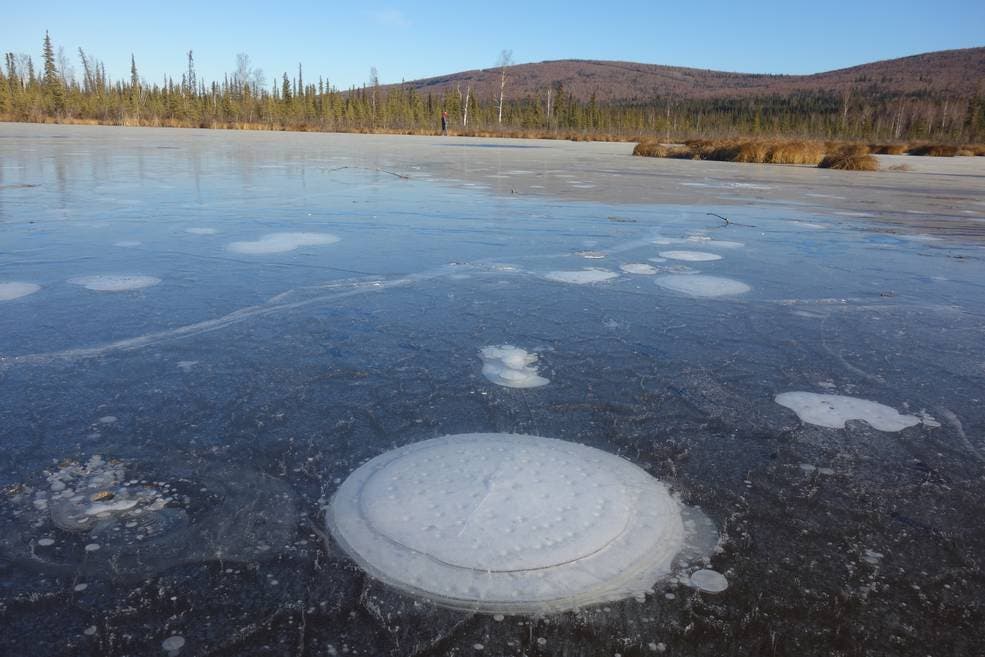
A NASA study of certain bubbling lakes in the Arctic suggests that methane deposits are being released due to an understudied phenomenon called ‘abrupt thawing’. Methane — which is 30 times more potent at trapping heat than carbon dioxide — has been frozen for potentially thousands of years and its sudden release could significantly impact the climate by the end of the century.
Methane bubbles up from the thawed permafrost at the bottom of the thermokarst lake through the ice at its surface.
Credits: Katey Walter Anthony/ University of Alaska Fairbanks.
Methane and carbon dioxide are both produced in thawing permafrost as animal and plant remains decompose. As long as this organic matter remains frozen, it will stay in the permafrost. However, if it thaws, it starts decaying, releasing carbon dioxide or methane into the atmosphere — which is why scientists are deeply concerned with the present development.
Right now, Earth’s atmosphere contains roughly 850 gigatons of carbon (a gigaton is about the weight of 100,000 school buses). Scientists estimate that there is about twice as much carbon frozen in permafrost than present in the atmosphere today.
That doesn’t mean that all of the carbon will end up in the atmosphere. The trick is to find out how much of the frozen carbon is going to decay, how fast, and where. The full picture seems to be even more complex than previously thought. In a new study, scientists have discovered a new source of methane that hasn’t been accounted for by climate models — methane emissions from ‘thermokarst‘ lakes.
Such lakes form when permafrost taws at a faster rate and deeper levels than usually happens. This sudden thawing creates a depression which fills up with rainwater, ice, and snow melt. The water’s presence then leads to even more thawing at the shores of the lake, speeding up the rate of methane release into the atmosphere.
“The mechanism of abrupt thaw and thermokarst lake formation matters a lot for the permafrost-carbon feedback this century,” said first author Katey Walter Anthony at the University of Alaska, Fairbanks. “We don’t have to wait 200 or 300 years to get these large releases of permafrost carbon. Within my lifetime, my children’s lifetime, it should be ramping up. It’s already happening but it’s not happening at a really fast rate right now, but within a few decades, it should peak.”
Walter Anthony and colleagues used a combination of computer models and field measurements to reach the conclusion that abrupt thawing more than doubles previous estimates of permafrost-derived greenhouse warming.
“Within decades you can get very deep thaw-holes, meters to tens of meters of vertical thaw,” Walter Anthony said. “So you’re flash thawing the permafrost under these lakes. And we have very easily measured ancient greenhouse gases coming out.”
Current models estimate carbon emission from thawing permafrost as a gradual process. These new results suggest that in reality, the Arctic’s thawing feedback loops are more complex than we suspected. It’s all especially concerning considering that the IPCC — the leading international body for the assessment of climate change — did not incorporate any permafrost carbon emissions and the resulting amplification of climate change in its most recent climate projections.
This means that it will be even more challenging to keep global temperatures below the 1.5- or 2- degrees Celsius target set by the international community under the Paris Agreement.
Even so, methane emissions from thawing permafrost pale in comparison to the amount of human fossil fuel emissions. According to the researchers, permafrost methane emissions account for only 1% of the global methane budget. So the best thing we can do is to transition as fast as possible to a carbon-neutral society.
“But by the middle to end of the century the permafrost-carbon feedback should be about equivalent to the second strongest anthropogenic source of greenhouse gases, which is land use change,” Walter Anthony said.
It Is Possible Jupiter Could Support Life, Scientists Say
BY
Jupiter and its shrunken Great Red Spot.
Credit: Wikimedia Commons.
A new factor has been added to the debate on whether or not living organisms could exist on Jupiter. You probably know Jupiter is a Jovian planet, a giant formed primarily out of gases. So how could alien life be able to exist in an environment where most of the phases of matter are absent? The answer is simply found in the element of water.
Within the rotating, turbulent Great Red Spot, perhaps Jupiter’s most distinguishable characteristic, are water clouds. Many of the other clouds in this enormous perpetual storm are comprised of ammonia and/or sulfur. Life theoretically cannot be sustained in water vapor alone; it thrives in liquid water. But according to some researchers, the fact alone that water exists in any form on the planet is a good first step.
The Great Red Spot is still a planetary feature which stumps much of the scientific community today. As it has been observed for the past century and a half, the Great Red Spot has been noticeably shrinking. The discovery of water clouds may lead to a deeper understanding of the planet’s past, including whether or not it might have sustained life, as well as weather-related information.
Some scientists have pondered the possibility that, due to the hydrogen and helium content in its atmosphere, Jupiter could be a diamond-producing“factory.” They have further speculated that these diamonds could enter into a liquid state and a rainfall of liquid diamonds would be in the Jovian’s weather forecast.
Likewise, the presence of water clouds means that water rain (a liquid) is not entirely impossible. Máté Ádámkovics, an astrophysicist at Clemson University in South Carolina, had this to say on the matter:
“…where there’s the potential for liquid water, the possibility of life cannot be completely ruled out. So, though it appears very unlikely, life on Jupiter is not beyond the range of our imaginations.”
Scientists are acting accordingly, researching the part which water plays in the atmosphere and other natural systems on Jupiter. They remain skeptical but eager to follow up on the new discovery. They shall also strive to find out just how much water the planet really holds.
Elon Musk Shares Powerful New Images of SpaceX BFR in Action
SpaceX’s BFR is taking on a new shape. Just days after sharing images of a new Tintin-inspired design for the Mars-bound rocket, CEO Elon Musk has posted more concept art alongside details of some additional features. The BFR, expected to complete test firing next year, could send the first humans to Mars as early as 2024.
It’s a big development for the company’s largest-ever rocket, unveiled 12 months ago at the International Astronautical Congress in Adelaide, Australia. The rocket eclipses even the Falcon Heavy, the world’s most powerful operational rocket that completed its first test launch in February. Where the Heavy has a liftoff thrust in the region of 2,500 tons, the BFR has a thrust of 5,400 tons. The new rocket uses 31 Raptor engines, powered by liquid oxygen and methane.
The altered design, depicted below, adds new fins to the rocket that Musk admits bear a resemblance to the ones found in the Tintin comics:

The redesigned nose plays a key role in operations:
 San@vicentes
What’s this thing near the nose ? Looks like some retractable thing ?
 Elon Musk ✔@elonmusk
Forward moving wing
However, the new renders also lack a key feature found on previous designs:
Elon Musk ✔@elonmuskGood catch. They are there in the flight design, but we forgot to put them in this render.
The rocket has been designed with reusability in mind, enabling humans to visit Mars and refuel by extracting resources from the area. The company will send two unmanned ships to Mars in 2022, followed by two more unmanned ships and two manned ships in 2024. Each ship will carry around 100 tons, meaning the six will send double the mass of the International Space Station to Mars. These will be used to set up refueling stations, laying the groundwork for self-sufficiency, and making the first step to a multi-city Martian colony.

The BFR is also expected to send the world’s first private passenger on a trip around the moon. SpaceX announced the development last week, declaring that “only 24 humans have been to the Moon in history” and “no one has visited since the last Apollo mission in 1972.” The company plans to announce further details about the identity of the passenger and their reasons at a livestreamed event on Monday at 6 p.m. Pacific time.
While it’s a serious moment for the company, Musk couldn’t help dropping a reference to comedy spy thriller Austin Powers in the replies:
 Conor McDonnell ✔@ConorMcDPhoto
Is it supposed to look like a shark? Because if that was planned thats pretty bad ass
Elon Musk ✔@elonmuskWith lasers
Doctor Evil’s dream of sharks with lasers is coming to life.
See also:
Photos via Elon Musk/Twitter
Solar Observatory Mysteriously Reopens After Investigation
They’re ba-ack!
The FBI and the Blackhawk helicopters are gone and the employees of the Sunspot Solar Observatory on Sacramento Peak in New Mexico are slowly coming back after the facility was mysteriously evacuated and closed on September 6thwithout explanation, causing rumors and conspiracy theories of all sizes and flavors to flourish. While the reason given for the closure seems to make sense in hindsight, the stress it caused local residents (some of whom were also evacuated) and law enforcement officials makes many wonder if it wasn’t overkill … or if there’s still some things they’re not being told.
“However, our desire to provide additional information had to be balanced against the risk that, if spread at the time, the news would alert the suspect and impede the law enforcement investigation. That was a risk we could not take.”

The Richard B. Dunn Solar Telescope
A spokesperson for AURA, the Association of Universities for Research in Astronomy which runs the 71-year-old solar observatory in Sunspot, New Mexico, finally revealed on September 16th that the investigation was criminal in nature, but gave no details on the crime itself.
“AURA has been cooperating with an ongoing law enforcement investigation of criminal activity that occurred at Sacramento Peak. During this time, we became concerned that a suspect in the investigation potentially posed a threat to the safety of local staff and residents. For this reason, AURA temporarily vacated the facility and ceased science activities at this location.”
Temporarily? Eleven days of evacuation plus a total news blackout at a facility whose main feature is a telescope makes one say more than “Hmm.” The observatory is near Holloman Air Force Base, the White Sands Missile Range and, of course, Roswell. The investigation was done by the FBI and the owners of the Blackhawk helicopters, not members of local law enforcement, who were asked to leave and kept in the dark.

As of this writing, there is no news of arrests being made or criminal charges being filed as a result of the alleged criminal investigation. The nine employees are back on the job and the facility is again open for tourists. How long will it take before they’re tired of being asked the same questions that have nothing to do with the Dunn Solar Telescope or the sun?
While the sun continues to shine everywhere else, Sunspot seems to be under a dome covered with an SPF 100 suncreen.
Fishermen saw ‘robot-like creatures with slit mouths and crab pincers in most bizarre alien abduction ever’, secret hypnosis files revealThe never-seen-before notes describe how the two men were fishing when a UFO hovered above them and three strange beings emerged
RUIMTESCHIP HANGT VIER MINUTEN BOVEN WEG...
RUIMTESCHIP HANGT VIER MINUTEN BOVEN WEG...
Het zal je gebeuren dat als je ’s avonds naar huis rijdt er opeens een enorm "iets" boven de weg hangt.
Dat is exact wat er enkele dagen geleden gebeurde toen een man samen met zijn vriendin naar huis reed en gelukkig kon hij een aantal foto’s maken.

De getuige is er absoluut van overtuigd dat het geen weerspiegeling of iets dergelijks is omdat nadat dit object een minuut of vier boven de weg had gehangen, dit opeens met grote snelheid wegvloog. Iets dat door hem en zijn vriendin beiden is gezien.
Ufoloog Scott Waring is heel benieuwd of er die avond ergens in de buurt mensen zijn vermist of tijdelijk zoek geweest zijn. Hij denkt namelijk dat wanneer een ruimteschip zo dichtbij de weg komt er een reden voor moet zijn. En die reden zou heel goed kunnen zijn dat ze van plan waren om één of meerdere mensen te ontvoeren.


Strange Series of Anomalies Stretching Across Pacific Ocean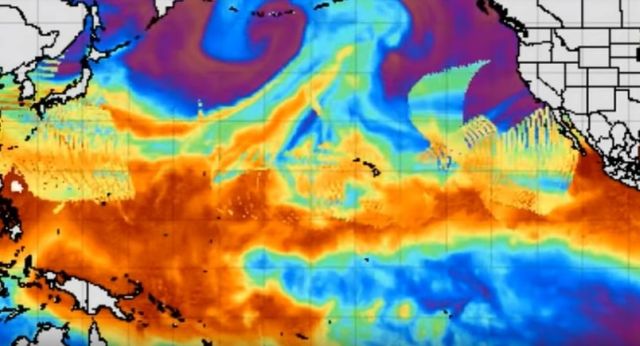

 Glowing Disk Hovers Over Road In Minnesota For Four Minutes Before Shooting Off, Sep 2018, Photos, UFO Sighting News.


 ‘UFO’ spotted onboard US Navy aircraft carrier, EXTRAORDINARY YouTube footage shows

One amazed YouTube user wrote: “TR-3B. It really exists!"
Another offered a detailed explanation, writing: “I think it's a TR-3B, the latest of the US's black projects vehicles.
“This is the next generation of secret technology developed by the skunk works and other secret development programs.
“It is in any case not alien. It might have been developed with the use of reverse-engineered alien technology. But built on this planet.”
Others were not so convinced, with user Jim Hatch penning: “Pretty sure they wouldn't leave it parked on the deck of an aircraft carrier, was it an alien spacecraft or some sort of secret technology?”


And others suggested the object was Photoshopped into the footage, joking about the triangle craft's “stealth shadow”.
One said: “Nice CGI.”
Another sceptic said: “So tell me why a craft which can defy gravity and travel faster than anything known by mankind, which doesn't use fossil fuel stands on the deck of an aircraft carrier?”
But there were some who were not sure what to think.
Matt Simon said: “The problem with today's CGI is that it's getting damn near impossible to know what is real and what is fake.


“Unless you're right there to actually witness it with your own eyes, when you see a compelling video and wonder if it's real or fake, sometimes all you can do is shake your head and shrug your shoulders.”
Eventually, ufoofinterest.org, which claims to “debunk hoaxes, conspiracies and misinformation”, rubbished the UFO claims.
The group tweeted a video which showed the original US Navy training footage with no UFO in sight, proving it had been doctored.
They said: “Triangle shaped UFO spotted on US Aircraft Carrier in the Mediterranean Sea?
“It's interesting to check out which sources the hoax promoter and CGI artist SECTION 51 used to fabricate his latest video.
“Here's a source without that fake UFO.”

Triangle shaped #UFO spotted on US Aircraft Carrier in Mediterranean Sea?
It's interesting to check out which sources the #hoax promoter and #CGI artist SECTION 51 used to fabricate his latest video.
Here's a source without that #fake UFO
https://youtu.be/Le_eYNdCrRQ?t=37s …
US observatory denies involvement of aliens in its ‘security’ closure
An American solar observatory has denied that aliens were involved in its security-related closure in a state known for secretive military testing and a suspected UFO crash.
The New Mexico solar observatory remains closed after being evacuated for unknown reasons last week.
“I can tell you it definitely wasn’t aliens,” a spokeswoman for the National Solar Observatory, part of the Sunspot Solar Observatory consortium, told The Washington Post.
Meanwhile, an investigation was underway by the Federal Bureau of Investigation (FBI).
“We don’t know anything. We’re just as curious as anyone else,” one guard said.
No local law enforcement was involved in the case as the FBI remained on the scene.
“They wouldn’t give us any details,” Otero County Sheriff Benny House said. “I’ve got ideas, but I don’t want to put them out there. That’s how bad press or rumors get started, and it’ll cause paranoia, or I might satisfy everybody’s mind and I might be totally off base.”
The observatory is also taking the chance to attract the people’s attention to its work.
“With the excitement this closure has generated, we hope you will come and visit us when we do reopen, and see for yourself the services we provide for science and public outreach in heliophysics,” it said.
Mars Explorers Could Live in 'Igloo' Near Red Planet's North Pole


"The crane vehicle could be reused several times and would be powered by fuel produced on Mars. It would reduce the payload that space shuttles would have to carry up to the research base," study co-author Claudio Leonardi, a scientist at EPFL, said in the same statement. "The vehicle's docking system would be similar to that used on the International Space Station: once a shuttle was docked, the vehicle would unload the cargo and crew and set them down on Mars."

 YouTube Goes Nuts Over Apparent Footage of 'UFO' Aboard US Aircraft Carrier

YouTube Goes Nuts Over Apparent Footage of 'UFO' Aboard US Aircraft Carrier
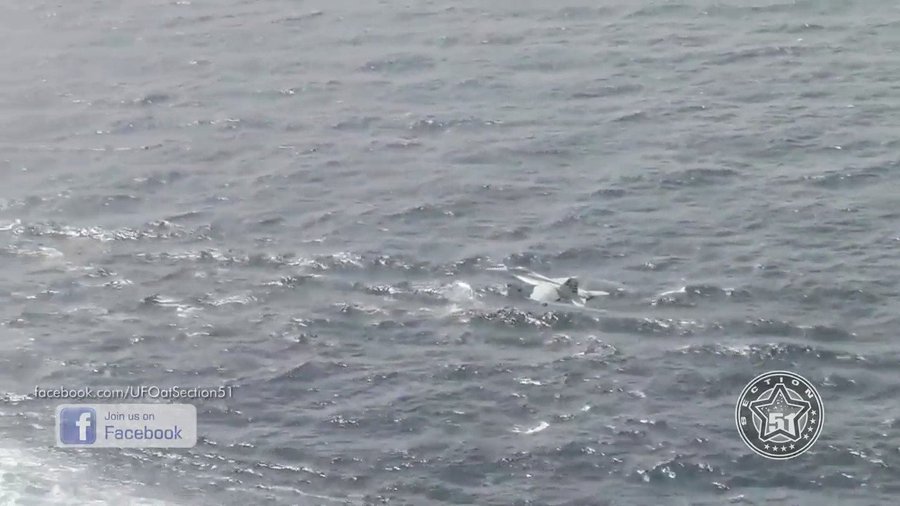
The amateur footage, said to have been captured by a pilot filming the landing of a US Navy F-15 fighter jet aboard the USS Gerald Ford, sparked a debate about the video's authenticity.
The video, published by 'Section 51', a US-based YouTube channel collecting footage of unidentified flying objects, shows a fighter shadowing a US jet as it comes in for a landing aboard the carrier, accidentally sighting a grey metallic triangle-shaped object parked next to a Navy helicopter.
The footage, slowed down for effect and accompanied by appropriately eerie music, has racked up 500,000+ views on YouTube, and pitted users into a debate on whether the video has been tampered with.
Multiple users were sure that it was the TR-3B, an alleged ultra-secret anti-gravity spy plane vehicle some believe is being developed by the US Air Force.
"TR-3B. It really exists!" one YouTube user excited wrote. "I think it's a TR-3B, the latest of [the US's] black projects vehicles," another added, launching into a detailed explanation. "This is the next generation of secret technology developed by the skunk works and other secret development programs. It is in any case not alien. It might have been developed with the use of [reverse] engineered alien technology. But built on this planet."

Others suggested the object was Photoshopped into the footage, joking about the triangle craft's "stealth shadow." "Nice CGI," one user said, complementing the author.
"Pretty sure they wouldn't leave it parked on the deck of an aircraft carrier were it an alien spacecraft or some sort of secret technology," another skeptic noted. "So tell me why a craft which can defy gravity and travel faster than anything known by mankind, which doesn't use fossil fuel stands on the deck of an aircraft carrier?" another user asked.
Some simply weren't sure what to believe. "The problem with today's CGI is that it's getting damn near impossible to know what is real and what is fake. Unless you're right there to actually witness it with your own eyes, when you see a compelling video and wonder if it's real or fake, sometimes all you can do is shake your head and shrug your shoulders," one user said.
Eventually, ufoofinterest.org, a site whose self-described purpose is to 'debunk hoaxes, conspiracies and misinformation,' crashed the conspiracy party, showing the footage with the 'UFO', along with the original US Navy training footage, with no 'UFO' anywhere in sight.
ufoofinterest.org@ufoofinterestTriangle shaped #UFO spotted on US Aircraft Carrier in Mediterranean Sea?
It's interesting to check out which sources the #hoax promoter and #CGI artist SECTION 51 used to fabricate his latest video.
Here's a source without that #fake UFO https://youtu.be/Le_eYNdCrRQ?t=37s …
VIDEO: Hunt for the Skinwalker – Exclusive interview at pre-premiere screening in Las VegasBased on the best-selling book by George Knapp & Dr. Colm Kelleher, Hunt for The Skinwalker investigates the confidential, most extensive scientific study of a paranormal hotspot in human history. This is an exclusive OpenMinds.tv interview with filmmaker Jeremy Corbell at the friends and family pre-premeire screening in Las Vegas.
Watch Hunt for the Skinwalker NOW on iTunes: https://itunes.apple.com/us/movie/hun…
Get the book: Hunt for the Skinwalker: Science Confronts the Unexplained at a Remote Ranch in Utah https://amzn.to/2vYs6Tf
—Transcript of Interview—
Alejandro: Okay. So we’ve got an exclusive interview with Jeremy Corbell, we’re at a premiere of the movie. Of course, Open Minds listeners know who Jeremy is, and they know I’m a huge fan of your films-
Jeremy: Thanks, man.
Alejandro: … so this is really exciting, this has gotta be exciting for you.
Jeremy: This is, man. This is the premiere of Hunt for the Skinwalker, that film goes live on iTunes on September 11th for everybody to watch, but you and everybody gets to see today, really, the pre-premiere before it’s launched to the public. And man, this is an exciting movie, two hours and seven minutes, plus an hour and a half of bonus features. You have never seen footage from inside Skinwalker Ranch. This film shows you hours of it. During active investigations by the NIDS team. It’s incredible. So thanks to George Knapp and all the work that he’s done for over two decades, this movie is gonna show it to you. It’s gonna show all the goods.
Alejandro: So cool. So a couple of parts, cattle mutilations have happened on that ranch, there’s been UFO sightings, a lot of people feel that those are a type of phenomena related to aliens. Were there aliens at the ranch, you think?
Jeremy: Well, whatever is there certainly is alien to us. We don’t know for sure the nature of this reality. There seems to be something that’s been here longer than us, and recorded since the beginning of recorded human history. We see a pantheon of that at the ranch, it really, truly is like a paranormal Disneyland. And you might not believe it, or someone else might not believe it. They might dub it aliens or portholes or dimensional beings, I don’t know. Nobody knows. But the fact of the matter is yes, craft are visible there. Huge craft. Beings that we would call aliens, that are certainly alien to us, occur and interact, close encounters, with people not only on the ranch, but in the Uintah Basin. So look man, I don’t know what’s going on there. If I try to give you a theory it would be a guess. What I do now is that it’s worth and worthy of investigation, and that’s what this film is going to do, it’s going to light a fuse, man.
Alejandro: And it’s gonna show that the government felt it was worthy of investigation and spent millions of dollars doing that.
Jeremy: It’s gonna break the news, it’s gonna tell you in-depth the connection between the 22 million dollars from Harry Reid, that all began with Skinwalker Ranch, it was targeted and focused on Skinwalker Ranch. The majority of that funding went to Skinwalker Ranch. AATIP, what we were told through the New York Times, is a very small part of the bigger truth. And this film, with the bonus materials, will clarify that.
Alejandro: Last question is, with this film, what is your intent, what is your main goal, with getting this information out?
Jeremy: Alejandro, you know my main goal. That is to weaponize your curiosity, take you from being a passive observer and consumer to a participant. That’s it.
Alejandro: Thank you so much.
Why Social Stigma About Unexplained Phenomena Holds Humanity Back
Like most other biological systems on this planet, humans are largely motivated by self-preservation and conflict avoidance.
As a species, we tend to avoid associating ourselves with anything that will isolate us from the larger group or make us sound strange, or that might draw negative attention from our peers.
In essence, stigma results in a paralysis of communication.
And when left unaddressed, it exerts a chilling influence over society and across generations. This is true whether we are trying to find the cause for diseases, reasons for environmental change, or primers for global conflict.
Throughout history, there are times when we, as a society, found it more convenient and socially acceptable to ignore uncomfortable topics. The results were often catastrophic both to our moral fiber and the health of our species. Stigma regarding certain psychological conditions once led to a life sentence in an asylum and forced lobotomies simply because stigma prevented families having a conversation about mental illness.
There has been similar social stigma in recent decades around the topic of Unidentified Aerial Phenomena (UAPs), or UFOs — a topic that has been relegated to conspiracy theorists, B-Movie villains, and the weird uncle no one wants to talk to anymore. As was the case with other topics that hold stigma, many people would rather look the other way than be associated with what’s been labeled “crazy,” or “fringe.”
When I was assigned Director of the Advanced Aerospace Threat Identification Program (AATIP), my colleagues and I experienced enough to know with absolute certainty that UAPs exist. Furthermore, they don’t seem to care if whether or not we believe in them and they are here with or without our permission.
How can we have an honest conversation about National Security and humanity if we can’t even address the topic of a potential threat or opportunity?
Consider this example from pop culture. In the famous Harry Potter series, the evil wizard Voldemort is so vile that other wizards are afraid to even utter his very name. The idea is if you don’t mention his name, it minimizes the threat and makes him less real. But ironically, the stigma of his name only makes him more powerful.
Refusing to acknowledge UAPs in our airspace is no different.
If we don’t overcome the social stigma about UAPs and address them, we may end up on the wrong side of history — only in this case, we’re not talking about fantasy and wizards, we are talking about reality and national security.
Here’s why we can’t afford to allow stigma to drive our fears and bury our heads in the sand:
Social stigma is often the product of fear concerning topics that have no answers and are poorly understood. Project Blue Book provides a useful example.
From 1952–1969, the U.S. Air Force conducted a series of studies on UAPs. The goals of Project Blue Book were to determine whether UAPs were a national security threat and to scientifically analyze UFO-related data. For 17 years, Project Blue Book compiled reports of tens of thousands of UFO sightings, classifying 700 of these incidents as “unidentified.”
In 1966, the Air Force requested another committee, headed by Dr. Edward Condon, to look into these sightings. Two years later, they released the “Condon Report,” which concluded that the sightings they examined showed no signs of unusual activity. This prompted the Air Force to shut down Project Blue Book the following year.
Upon its dismantling, the project announced that despite nearly one thousand unidentified sightings, there was no evidence of extraordinary phenomena in our airspace.
These dismissive conclusions in the public versions of both Project Blue Book and the Condon Report simply weren’t supported by the facts. There were hundreds of credible eyewitness reports by trained observers, many with high-level security clearances, who witnessed these objects. Our country has put people in the electric chair based on the testimony of just two corroborating witnesses who aren’t particularly trained in the art of observation.
As is the case with other controversial topics, this verifiable evidence was suppressed and diluted due to stigma surrounding the topic of UAPs.
But there are always two sides to an argument.
During the time of the inquiries, the U.S. Government was in the middle of a cold war and, in all fairness, could not afford to be distracted on a wild goose chase for which they had no answers. As long as Americans weren’t under attack from these unusual phenomena, attention was rightfully placed towards more tangible matters. I don’t necessarily agree with that mindset, but I understand it.
Tabloids and social media have certainly not helped the issue of stigma. These outlets frequently provide their consumers with sensationalized stories that only reinforce the stigma of certain topics.
The rise of social media means that now, everyone has a voice.
But many of those voices are less motivated by truth and instead seek to spread their own agendas. A simple search on Google about the program I once helped run, AATIP, results in hundreds of hits, many of these from purportedly reputable sites with “Deep-State” sources. These sites are run by the same individuals who claim to have inside knowledge of UAPs but have never provided one shred of evidence or proof that they have access to Government insiders.
But not all social media sites or Youtube channels have it wrong. Those sites which emphasize data collection, facts, and objectivity are usually on the right track. Surprisingly, some sites appear to have a strong understanding of the bizarre nature of the phenomena and a few well-placed sources of information. One specific example I have found is “UFOJesus,” a humorous YouTube channel that seems to have some credible inside information and insight.
No matter the medium, frank and honest conversation is crucial to moving forward as a society.
If there is one thing that nature has shown us time and time again, it’s that we either adapt, or we die out.
As a species, it’s crucial to understand the things we can’t explain, in order to survive. And that means being open to new ideas, possibilities, and data. It’s always been this way, dating back to when mankind lived in caves. If you heard something roaming outside, you had to investigate. If you didn’t, you and your family would be unaware of a potential predator.
At the same time, an animal wandering around outside your cave could also mean food, which would keep your family alive so they could then flourish. If you stayed in the cave and never ventured outside, you might survive the night but probably not in the long run.
When it comes to UFOs, ignoring the unknown is similarly harmful because it might mean failing to seize upon opportunities and new understandings.
As a society, we have to recognize that stigma serves only to keep our heads in the sand. Our future depends on transparency and truth.
White House could stage ‘public hearings into ALIENS' exposing TRUTH behind UFO project
GROUNDBREAKING public hearings debating UFOs and aliens could soon be staged by the White House, it’s claimed.
By Paul Harper
The influential US Armed Services Committee has been investigating the money spent on a top-secret X-Files type Pentagon project.
Seen as one of the most powerful committees in Washington, the group oversees military spending and legislation.
Top political members asked how much taxpayers’ cash was spent on the Advanced Aerospace Threat Identification Program (AATIP) which investigated flying saucer reports for four years from 2008.
Officials working alongside scientists from Bigelow Aerospace have examined videos of UFOs and reportedly studied debris from crashed objects.
RELATED ARTICLES


GETTY
ALIENS: Top White House officials could stage public hearings on UFOs
Video of one AATIP case study showed US pilots in the Pacific in 2004 watching an object appear suddenly at 80,000ft before hurtling towards the sea and stopping at 20,000ft.
Luis Elizondo, who ran the Pentagon project, said researchers concluded some of the UFOs are using time-travel jumps to achieve such speeds and dramatic movements.
Nick Pope, who probed the UFO phenomenon for the Ministry of Defence, believes the investigation by the US armed service committee could lead to a major public hearing which would be a “political bombshell”.
Mr Pope said: “I think the powerful House Armed Services Committee was as fascinated and mystified by the revelations about the Pentagon's UFO project as everyone else.
“Some committee members and staffers may have been angered that they were kept in the dark about AATIP, not least because the US government had previously denied there was any official interest in UFOs.
“The record of Congressional proceedings that mentions AATIP suggests to me that the committee asked for and received a brief on this UFO project from the Defense Intelligence Agency, possibly with a view to holding formal Congressional hearings.
“These hearings might be narrowly focused on AATIP, looking into how taxpayers' dollars were spent and what the DIA concluded.
“This would almost certainly include investigation of the three declassified videos that have been released, showing US navy jets chasing unidentified objects.
“Hearings should probably go wider than just looking at AATIP, and should look at the UFO phenomenon as a whole.
“It would be a great opportunity to get to the bottom of the UFO mystery.”
Mr Pope said he is aware from private sources that discussions are taking place and he would be happy to testify.
He said President Donald Trump has stayed quiet on the subject on the subject of UFOs but Hilary Clinton had indicated she would request information on Area 51.
RELATED ARTICLESFour New Technologies That Are Driving Archaeology Into the Future
Four New Technologies That Are Driving Archaeology Into the Future
When your profession is studying ancient temples and cultural artifacts, you need a toolbox that matches the magnitude of the job. Brushes, buckets, and sieves have long been the foundation of an archaeologist’s work, but today, those essentials are paired with groundbreaking technology to deepen human understanding of our collective past.
While studying the Cajamarca culture, which existed in the highlands of northern Peru, archaeologist Solsire Cusicanqui Marsano has a variety of high-tech tools that enable her to analyze without doing damage.

Marsano, a Ph.D. candidate at Harvard University, looks for evidence of their way of life by excavating settlements, pottery, bones, and other artifacts. A key part of her hunt is the use of high-tech tools, which allow her to identify the best sites before she has to grab the shovels and break ground.
“I´m using different types of technology in every step of my work,” Marsano tells Inverse. Below are just some of the high tech tools used by a modern archaeologist.

Marsano later processes the photographs taken with the Mavic with a sophisticated software program called Agisoft Photoscan. It allows her to create 3D models of her sites — virtual replicas that are geographically accurate representations of where she works. Marsano, and other archeologists who do the same, can layer these digital, 3D models over pre-existing maps to get a better sense of the areas tophography and elevation. Essentially, the photogrammetry software stitches together the hundreds of photographs taken with the drone, resulting in a composite image. Goodbye treasure map, hello perfectly accurate digital model.
But those aren’t the only technological tools that archaeologist use to amp up their work.


LIDAR is an acronym for Light Detection and Ranging and has a wide use of applications ranging from navigating autonomous cars to helping farmers sense where they should apply fertilizer. Archeologists also make use of the remote sensing method: In the hands of excavators, LIDAR is used to create highly accurate and detailed 3D maps of ground surface tomography. It not only maps hundreds of miles — it alerts archeologists to the possibly hidden temples and tombs on those maps as well.
A LIDAR instrument consists of a laser, scanner, and GPS receiver. The laser sends out light pulses capable of penetrating deep vegetation, which in turn generates 3D information about the surface characteristics of the region its evaluating.
In 2018, archeologists announced that they used LIDAR to map 470 deep-jungle square kilometers, a process that revealed more than 15,000 ancient Maya architectural remains — a huge jump from the eight square kilometers and 1,000 structures they had identified previously. Laser scans can expose networks of temples and palaces, if archeologists shoot them in the right direction.
This flying robot could reveal secrets of the aerial world of insects
SHOO FLY A new insect-inspired flying bot could be used to test ideas about how winged insects perform precise aerial maneuvers.
HENRI WERIJ, TU DELFT (CC BY-SA 4.0)
A new winged robot helps explain why airborne insects are so doggone hard to swat.
Scientists have wondered how these tiny pilots pull off such rapid twists and turns, but researchers haven’t been able to test all their ideas by monitoring real insects or using tethered robots. Now, a free-flying, insect-inspired robot, described in the Sept. 14 Science, gives researchers an alternative. Programming the bot with different flight control strategies and comparing its movement with real animal flights could reveal which techniques winged insects and other creatures use for airborne acrobatics.
The new robot can control how much it turns or rolls to the left or right — or pitches forward or backward — by precisely adjusting the flapping speed and angles of its wings. The bot is nimble enough to zip around at about 25 kilometers per hour and do aerial somersaults.
Matěj Karásek, a bioinspired roboticist at Delft University of Technology in the Netherlands, and colleagues used the robot to investigate how fruit flies execute rapid banked turns. The researchers had suspected a fruit fly doesn’t make these hairpin turns by intentionally turning to the left or right. Instead, the team thought that simply rolling to the side and pitching forward or backward would angle the insect in the proper direction. Their experiments with the bot supported this theory. When Karásek’s team programmed the robot to roll and pitch, but not to point itself left or right, the bot’s banked turns closely resembled those of real fruit flies.
This flapping robot could also help examine the flight methods of other animals, such as hummingbirds. Or it could be used for search-and-rescue jobs, building inspections or pollinating plants inside greenhouses, Karásek says.
SMOOTH MOVES
A nimble, insect-inspired bot that twirls and zips around in the lab could help scientists better understand how winged animals weave through the air.
Strange Two Kilometer Long Strip of Structures Unearthed By Melting Ice In Antarctica
A two-kilometer series of 22 eerie-looking buildings was unveiled by the thawing of ice in Antarctica - leading to the assertion that the installation was a fail-safe for the global elite or a World War III landing site.
Coordinates for unknown base Latitude 75° 0'46.98"S Longitude 0° 4'52.71"E
Experts say the bizarre-looking series of buildings is the size of a small town - and seems to have been buried for years.
North of the settlement deep in Antarctica, where temperatures can drop to -130F (-90C), there seems to be a runway, and the entire area is covered with apparent vehicle tracks.
According to a researcher who deals with the unexplained, the nearest official scientific research station is Troll, a Norwegian research station at Jutulsessen, 200 miles northeast of the structure near the Princess Martha Coast in Queen Maud's Land of Norway.
Les autorités ferment simultanément 7 observatoires solaires dans le monde : Un lien avec l’apparition d’une flotte d’OVNIS ?


Cobra a publié des codes pour le Mouvement Résistance, comme il le fait souvent et deux de ces codes se lisaient comme suit : «L’invasion du domaine L2 a commencé» / «VITRIOL Keyhole activée» et «ALT4Y4LOC2».
Décryptage :
1) Dans le code donné plus haut à savoir «ALT4Y4LOC2» a été publié le 1er septembre et on peut reconnaitre «LOC» qui fait référence au «Lunar Operation Command» donc à des opération sur des bases lunaire militaires.

2) Le code «L1 domain invasion started» (L’invasion du domaine L1 a commencé) a été publié le 9 semptembre.

L1 étant un point de Lagrange : plus d’infos sur ce lien :

Ces deux codes importants on été donc publié le 1er et le 9 septembre donc quelques jours avant les fermetures des observatoires solaires et les observations «d’OVNIS». Cobra avait annoncé que les Forces Galactiques bienveillantes avançaient vers l’espace sublunaire et que d’autres Forces nouvelles arrivaient dans le système solaire au fur et à mesure que la Cabale est retirée et que les bombes Toplets ( bombes à Quark ) sont retirées.

Pour ceux qui ont suivi la source QAnon (source confirmée par cobra avec 70 % d’informations véridiques), ce sujet pourrait être quelque peu familier. Cependant, pour ceux qui ne l’ont pas encore fait, je vais faire un bref rappel.
La source d’information QAnon est arrivé sur la scène publique vers octobre 2017. À l’époque, cette source était affichée sur l’obscur site Web, 4Chan, et ne semblait pas très importante. Ce n’est que lorsque Q a commencé à afficher ce qui semblait être des prédictions suggérées d’événements mondiaux majeurs que davantage de gens ont commencé à s’en rendre compte. Puis, lorsque certaines de ces prédictions ont commencé à se réaliser, une grande partie du public américain a vraiment commencé à comprendre.

S’agit t-il d’une prédiction de cet arrivage massif d’ovnis ? Ou une référence à l’événementdont parle Cobra et d’autres ? S’agit t’il d’un code qui n’a rien à voir ?

Il ne s’agit pas d’un message politique, mais d’un message d’urgence envoyé par le président Donald Trump dans le cadre du système de l’Agence fédérale de gestion des urgences pour prévenir le public en cas d’urgence nationale.
La majorité des utilisateurs de téléphones cellulaires recevront une alerte le jeudi 20 septembre, avec l’en-tête «Alerte présidentielle» et le message «C’EST UN TEST du Système national d’alerte d’urgence sans fil. Aucune action n’est nécessaire.»
WEA a été techniquement lancé en avril 2012, mais ce sera la première fois que la FEMA testera le système au niveau présidentiel dans l’espoir de résoudre les problèmes, a déclaré l’agence dans un communiqué de presse cette semaine.
Plus de 100 opérateurs téléphonique, dont les plus grands (Verizon, AT&T, Sprint, T-Mobile), participeront au test d’alerte d’urgence, selon la FEMA.
La FEMA effectuera également un test de son système d’alerte d’urgence (EAS) pour les radiodiffuseurs et les télédiffuseurs le même jour, deux minutes après le test de la WEA.
( Note ExoPortail : Ce genre de message sont généralement envoyé pour alerter d’une catastrophe naturelle, attaque terroriste ou, je cite, «tout autre situation d’urgence» )
Source de la mise à jour :

Nous connaissons tous la discipline scientifique de l’astronomie. Bien que intéressante, l’astronomie dominante a tendance à être ennuyeuse, immuable et prévisible. Cependant, au sein de la communauté alternative, l’astronomie prend souvent une toute nouvelle dimension de possibilité.
Selon de nombreux dénonciateurs qui sont très populaires au sein de ces communautés, l’univers ne se compose pas seulement d’énergie électromagnétique. L’univers est également fondé sur l’énergie électroplasmique, et cette énergie est devenue la nouvelle base d’une grande partie de la version holistique et avant-gardiste de l’astrophysique.
Essentiellement, les étoiles ne sont pas simplement des boules de gaz qui brûlent ou fusionnent. Ce sont des générateurs électroplasmiques ainsi que des champs soutenus de ce que l’on appelle l’énergie de torsion. Nous ne parlerons pas de la physique des torsions pour gagner du temps. Pour l’instant, abordons ce sujet des étoiles électroplasmiques.
Selon la science de pointe, les étoiles se composent d’un noyau chargé négativement et d’un trou noir entouré d’une couronne chargée positivement. Ces composants interagissent avec l’espace-temps d’une manière très intéressante. Cependant, pour garder l’explication simple, nous dirons simplement que le noyau et la couronne travaillent ensemble pour créer une fusion nucléaire à la surface.
De plus, cette dynamique peut en fait se comporter comme une passerelle hyperdimensionnelle. Selon les témoignages de dénonciateurs et les révélations astronomiques courantes, il existe naturellement des liens à haute énergie entre les étoiles, qui traversent généralement de grandes distances dans l’espace. Ce sujet a été couvert par le site Web, le Daily Mail, parmi beaucoup d’autres, et il est assez détaillé et implicite. Examinons la situation.
Les astronomes ont exposé de nouvelles preuves qui renforcent la croyance en l’interconnexion entre les planètes et les galaxies dans le système solaire.
Le Dr Stephan Keller de l’École de recherche en astronomie et en astrophysique de l’Université nationale australienne a révélé les détails complexes des résultats, qui relient l’Univers entier.
Il a dit :
«En examinant la position d’anciens groupes d’étoiles, appelés amas globulaires, nous avons découvert que les amas forment un plan étroit autour de la Voie lactée au lieu d’être dispersés dans le ciel»
Lien en Anglais :
Bien que l’astronomie dominante puisse laisser beaucoup à désirer, pour la plupart, elle semble prouver le point ci-dessus plutôt correctement. Des étoiles, des planètes et des galaxies entières sont en fait reliées par ces filaments cosmiques qui peuvent être aussi vieux que chacune de ces galaxies elles-mêmes.
Bien que la science dominante suppose généralement que l’univers est dans un état constant de déséquilibre et de désintégration (ce qui est largement inexact d’après des découvertes scientifiques plus récentes), la réalité de cette connectivité énergétique dans notre univers suggère le contraire. Non seulement notre univers présente des preuves d’une fonction soutenue et équilibrée, mais il présente un potentiel intrinsèque et omniprésent d’évolution dans l’ensemble du cosmos.
Beaucoup d’entre nous connaissent peut-être le travail d’un astrophysicien célèbre, le Dr Nikolia Kardashev. Kardashev est peut-être mieux connu pour ses expériences révolutionnaires dans la recherche d’une vie ET intelligente au moyen de divers signaux cosmiques provenant de l’espace lointain. Bien qu’il soit né en avance sur son temps, Kardashev a ouvert plusieurs pistes importantes dans le domaine de l’astrophysique.
Nikolia Kardashev était également connu pour ses théories sur les civilisations ET. Bref, il a mis au point une échelle – maintenant connue sous le nom d’échelle de Kardashev – qui pourrait nous aider à déterminer le niveau de développement technologique possible d’une civilisation.

Une civilisation de Type II – peut exploiter la puissance de leur étoile entière (non seulement transformer la lumière des étoiles en énergie, mais contrôler l’étoile). Plusieurs méthodes ont été proposées à cet effet. La plus populaire est l’hypothétique «Sphère Dyson». Ce dispositif, si vous voulez l’appeler ainsi, engloberait chaque centimètre de l’étoile, rassemblant la plus grande partie (sinon la totalité) de son énergie produite et la transférant sur une planète pour une utilisation ultérieure. Alternativement, si l’énergie de fusion (le mécanisme qui alimente les étoiles) avait été maîtrisée par la course, un réacteur à une échelle vraiment immense pourrait être utilisé pour satisfaire leurs besoins. Les géants gaziers voisins peuvent être utilisés pour leur hydrogène, lentement drainé de la vie par un réacteur en orbite.
Que la raison soit en rapport à des Ovnis ou à une activité absolument anormale du soleil, ou un « corps étranger », il se passe définitivement quelque chose avec la zone proche du soleil que les autorités ne veulent pas que l’on voit. J’espère que l’analyse vous aura intéressé, en continuant à suivre cette affaire.
Uniquement pour les articles m’ayant demandé beaucoup de temps et de travail, j’offre la possibilité de me soutenir par un Don si l’article vous à intéressé. Bien sur il n’y a aucune obligation, ni même de montants et l’article reste consultable gratuitement ainsi qu’en intégralité. Ceci est donc à votre convenance et à votre gentillesse.
Source à 50 % + Recherches ExoPortail
Questioning Mysteries Centering The Human History


 How NASA's Mission to 'Touch the Sun' May Reveal Clues About Alien Worlds

NASA's new mission to the sun may reveal clues about alien worlds, too.
Every day, we rely on the sun for warmth and light, but we need Earth's atmosphere to protect us from our star's harsh conditions — and because in the end our sun is just another star, the same could be true of life on other worlds, planetary scientists told Space.com.
That means studying our sun up close could teach us about planets in distant solar systems as well. And a NASA mission may soon begin to do just that: This fall, the Parker Solar Probe, which launched in August, will start investigating how our star works. Exoplanet scientists are watching the mission to see what data it might offer them about exotic worlds. [Launch Photos! NASA's Parker Solar Probe Blasts Off to the Sun]
"We can learn so much from our sun and particularly for other sun-like stars," Evgenya Shkolnik, an astrophysicist and planetary scientist at Arizona State University, told Space.com. In particular, she wants a better sense of the high-energy particles and photons, or particles of light, stars produce. "It's critically important to understand all these things for exoplanet hosts, for sure," she said.
We know about the dangers of those particles and photons from our own experiences here on Earth, where the planet's atmosphere buffers us from the worst side effects of living near the sun: Only with extreme sunbathing do we absorb enough ultraviolet radiation to damage the DNA inside our cells enough to potentially kill us with cancer, and only during the most extreme solar outbursts, called coronal mass ejections, do its highly charged particles overwhelm Earth's magnetic field and thus interfere with our technology.
If an exoplanet is less fortunate in its natural protections or in its star's temperament, those high-energy particles and photons could be the deciding factors in an exoplanet's habitability, said Ravi Kopparapu, a planetary scientist at NASA. Even if a planet develops an atmosphere, if it's bombarded by too many stellar particles, that barrage can destroy the atmosphere. "They can strip away the atmosphere and then make the planet uninhabitable," Kopparapu told Space.com.
But both types of high-energy outflow are incredibly difficult to study at a distance — hence the appeal of piggybacking on the Parker Solar Probe.
The spacecraft's path through the sun's broiling outer atmosphere will allow it to get within 4 million miles (6 million kilometers) from what we consider the sun's surface — about the same distance many exoplanets are from their stars, Shkolnik said. In fact, in her lectures about these planets, she edits images of the solar eclipse and planet depictions to convey the incredible environment around these planets.
"I show the corona and put fake exoplanets in there because it is amazing to think that these planets are actually streaming through their suns' coronae," Shkolnik said. Many of those planets are what scientists have dubbed "hot Jupiters" and are uninhabitably gaseous themselves — but that might not be the end of the story.
"There is talk of whether or not moons around these hot Jupiters could be habitable," Shkolnik said. (Scientists haven't discovered any such moons yet, but they're still honing their ability to spot planets, which are much larger.) "That's not a crazy thought, because we think that the moons of Jupiter and Saturn might be places to look for life in our solar system," Shkolnik said.
So Shkolnik is watching for the data Earth's solar probe will beam home beginning later this year, in hopes of using it to isolate information about habitability near at least other sun-like stars. "I won't know how hard or easy that analysis will be until I see the data," she said. [The 7 Earth-Sized Planets of TRAPPIST-1 in Pictures]
And high-energy radiation like ultraviolet light doesn't just potentially destroy ill-shielded life; it can also trick scientists into thinking someplace is more lively than it really is. That's because ultraviolet radiation can break down water and create oxygen, one of the key molecules scientists look for as a potential signature of life. Extrapolating data from the Parker Solar Probe may stop scientists from being fooled by these fake biosignatures, Kopparapu said.
Perhaps most valuable will be any understanding the spacecraft can give us of how the sun's dynamics are shaped by its magnetic field, which seems to guide much of what happens in and around a star.
"Somehow, it's all related to the sun's magnetic field," Shkolnik said. "Even if we don't have the details, we know that much."
India Unveils Its Own Spacesuit Design for 2022 Astronaut Flights
 Space Expo - India@SpaceExpoIndia
Indegenously developed space suit by ISRO at Gaganyaan Pavilion.@isro @FollowCII #gaganyaan #spacesuit @makeinindia
According to reports by Indian news publications, the agency has already manufactured two of the bright-orange suits and will build a third before crewed flights begin. During the presentation last week, a suit was displayed with text explaining that it is made of four layers and weighs less than 11 lbs. (5 kilograms).
NASA Plans to Build a Moon-Orbiting Space Station: Here's What You Should Know

 Scientists are pushing the limits of 3D printing with these shape-shifting materials

Three-dimensional printing has been used to create all sorts of things, from car parts and experimental rocket engines to entire houses. Now scientists at MIT have found a way to 3D print objects that can change shape almost instantaneously in response to magnetic fields.
So far the researchers have created a few demonstration objects with the new technology, which uses plastic “3D ink” infused with tiny iron particles and an electromagnet-equipped printing nozzle. These include a plastic sheet that folds and unfolds, a star-shaped object that can catch a ball and a six-pointed structure that scrunches up and crawls like a spider.
But the researchers see broad applications for small shape-changing devices — what some call "soft robots" — especially in medicine.
“You can imagine this technology being used in minimally invasive surgeries,” said Xuanhe Zhao, a professor of engineering at MIT and a member of the team that developed the 3D-printed shape-shifting technology. “A self-steering catheter inside a blood vessel, for example — now you can use external magnetic fields to accurately steer the catheter.”
Other uses could include magnetically controlled implants to control the flow of blood, and devices that could be guided by magnet through the body — to take pictures, clear a blockage or deliver drugs to a specific location, Zhao said.
The technology might one day make it possible to 3D print entire soft robots, Zhao said. These could have information stored as magnetic data directly inside their structural materials, instead of needing additional electronics.
“The MIT soft robotics development is very cool ... It's an important step in terms of being able to control materials,” said Jim McGuffin-Cawley, an engineering and materials science professor at Case Western Reserve University in Cleveland, who was not involved with the MIT project. He noted that the technology allows researchers to make precise changes to the shape-shifting materials by using magnetic fields to control very small moving parts inside the materials themselves.
MIT is releasing free software and a recipe for its magnetic ink so that other scientists around the world can use the technology and print their own shape-shifting materials, Zhao said.
“With these three components they can design their own untethered, fast-transforming soft robots,” he said. “We hope this method can find very important applications in the fields of soft robotics [and] materials.”
SETI Neural Networks Spot Dozens Of New Mysterious Signals Emanating From Distant Galaxy
The perennial optimists at the Search for Extraterrestrial Intelligence, or SETI, have joined the rest of the world in deploying AI to help manage huge data sets — and their efforts almost instantly bore fruit. Seventy-two new “fast radio bursts” from a mysteriously noisy galaxy 3 billion miles away were discovered in previously analyzed data by using a custom machine learning model.
To be clear, this isn’t Morse code or encrypted instructions to build a teleporter, à la Contact, or at least not that we know of. But these fast radio bursts, or FRBs, are poorly understood and may very well represent, at the very least, some hitherto unobserved cosmic phenomenon. FRB 121102 is the only stellar object known to give off the signals regularly, and so is the target of continued observation.
The data comes from the Green Bank Telescope in West Virginia (above), which was pointed toward this source of fast and bright (hence the name) bursts for five hours in August of 2017. Believe it or not, that five-hour session yielded 400 terabytes of transmission data.
Initial “standard” algorithms identified 21 FRBs, all happening in one hour’s worth of the observations. But Gerry Zhang, a graduate student at UC Berkeley and part of the Breakthrough Listen project, created a convolutional neural network system that would theoretically scour the data set more effectively. Sure enough, the machine learning model picked out 72 more FRBs in the same period.
A Berkeley GIF visualizing the data of a series of bursts.
That’s quite an improvement, though it’s worth noting that without manual and traditional methods to find an initial set of interesting data, we would have little with which to train such neural networks. They’re complementary tools; one is not necessarily succeeding the other.
The paper on the discoveries, co-authored by Cal postdoc Vishal Gajjar, is due to be published in the Astrophysical Journal. Breakthrough Listen is one of the initiatives funded by billionaires Yuri and Julia Milner, of mail.ru and DST fame. The organization posted its own press release for the work.
The new data suggests that the signals are not being received in any kind of pattern we can determine, at least no pattern longer than 10 milliseconds. That may sound discouraging, but it’s just as important to rule things out as it is to find something new.
“Gerry’s work is exciting not just because it helps us understand the dynamic behavior of FRBs in more detail, but also because of the promise it shows for using machine learning to detect signals missed by classical algorithms,” explained Berkeley’s Andrew Siemion, who leads the SETI research center there and is principal investigator for Breakthrough Listen.
And if we’re being imaginative, there’s no reason some hyper-advanced civilization couldn’t cram a bunch of interesting info into such short bursts, or use a pattern we haven’t yet grokked. We don’t know what we don’t know, after all.
Whatever the case, SETI and Breakthrough will continue to keep their antennas fastened on FRB 121102. Even if they don’t turn out to be alien SOS signals, it’s good solid science. You can keep up with the Berkeley SETI center’s work right here.
Right Stuff for Life Found on Small Saturn Moon
NASA's Cassini spacecraft caught this image of geysers spewing icy material from Saturn's moon Enceladus.
On Saturn’s small moon Enceladus, perpetual fountains of alien seawater launch all sorts of curious stuff into space: water, salt, silica, and even simple carbon-containing compounds fly into the void—many of which are ingredients for life as we know it.
Now, scientists working with data from a dead spacecraft have discovered something even more potentially intriguing: heavy organic compounds containing hundreds of atoms arranged in rings and chains. These are the most complex organic molecules uncovered so far at Enceladus, and—sorry, Europa—they may make the moon the most promising place in our solar system to search for life beyond Earth.
“What we know today is telling us that Enceladus is an outstanding target to go look for life, and there may be microbes living in that ocean today,” says Cornell University’s Jonathan Lunine.
Discovered by the Saturn-exploring Cassini spacecraft in late 2005, icy jets erupting from Enceladus were a surprise to most scientists. Blasting through fissures in the south polar region, the jets contain seawater from a global ocean locked beneath the moon’s icy shell. Over the years, scientists have been able to study those jets and calculate the salinity and acidity of the ocean, identify ejected organic compounds such as methane, and determine that hydrothermal vents in the seafloor are providing heat and energy.
But these newly detected complex molecules spin that story forward and raise questions about whether they’re the work of lifeless chemistry or a sign pointing toward alien life.
“We cannot decide this hundred-million-dollar question, but it certainly shows that something is going on there, that complex organic chemistry is happening and that we can probe it from space,” says Frank Postberg of the University of Heidelberg, lead author on the paper describing the results today in the journal Nature.
“The moon freely delivers its organic inventory at high concentrations to the Cassini spacecraft. That’s just an amazing finding.”
Though Cassini ended its exploration of the Saturn system by purposefully plunging into the ringed planet last September, the spacecraft’s enormous trove of data is stuffed with treasures waiting to be mined. (Explore Cassini’s grand tour of Saturn with our interactive.)
SEE THE LAST PICTURES FROM THE CASSINI MISSION

Saturn's icy moon Enceladus sinks behind the planet in a farewell portrait from NASA's Cassini spacecraft, which destroyed itself by diving into the ringed giant on September 15, 2017.

Cassini's very last image shows the region on Saturn's night side where the probe entered the planet's atmosphere, sealing its fate. Here, the planet's swirling clouds glow with light reflected from its rings.
PHOTOGRAPH BY NASA, JPL- CALTECH, SPACE SCIENCE INSTITUTE

Cassini captured this picture of majestic Saturn and its famed rings as the NASA spacecraft hurtled toward its doom on September 14, 2017.
PHOTOGRAPH BY NASA, JPL-CALTECH, SPACE SCIENCE INSTITUTE

Cassini gets one of the closest, most detailed views of Saturn's rings during the final phase of its mission.
PHOTOGRAPH BY NASA, JPL-CLATECH, SPACE SCIENCE INSTITUE

Enceladus appears as a thin crescent under the bright bulk of Saturn in this Cassini image released on September 14.
PHOTOGRAPH BY NASA, JPL-CALTECH, SPACE SCIENCE INSTITUTE

The rings of Saturn lay sprawled against the cosmos in one of the last images from Cassini.
PHOTOGRAPH BY NASA, JPL-CALTECH, SPACE SCIENCE INSTITUTE

Saturn takes center stage in this Cassini image taken mere hours before the end of the mission.
PHOTOGRAPH BY NASA, JPL-CALTECH, SPACE SCIENCE INSTITUTE

Saturn's wide but thin rings seem almost solid enough to skate across in this unprocessed picture from Cassini.
PHOTOGRAPH BY NASA, JPL-CALTECH, SPACE SCIENCE INSTITUTE

As part of ts farewell tour, Cassini took this picture of Saturn's largest moon, Titan.
PHOTOGRAPH BY NASA, JPL-CALTECH, SPACE SCIENCE INSTITUTE

A closeup of frigid Titan reveals dark splotches that Cassini revealed are lakes of liquid hydrocarbons.
PHOTOGRAPH BY NASA, JPL-CALTECH, SPACE SCIENCE INSTITUTE
That includes information Cassini gathered while flying near the planet’s E ring. Thin and diaphanous, this ribbon is formed by dust and ice ejected by Enceladus. As Cassini skirted the E ring’s edge, some of its particles collided with an onboard instrument designed specifically to study cosmic dust and return information about its ingredients.
Postberg and his colleagues decided to look at data gathered during E ring flybys between 2004 and 2008, when the instrument was least contaminated by interplanetary dust from elsewhere in the solar system. Over 15 separate intervals, the spacecraft collected and studied about ten thousand dust particles. And in roughly one percent of those, Postberg and his colleagues identified the signatures of complex organic compounds.
“It was kind of a needle in a haystack problem,” he says.
Clinging to grains of water ice ejected by Enceladus, these heavy, carbon-containing molecules had been launched into space, just waiting for Cassini to come by and collect them upon impact. What’s more, the large compounds are likely fragments of even larger parent molecules that could weigh thousands of atomic mass units, Postberg says.
It’s the first time such heavy organics have been identified at Enceladus. Previously, Cassini detected lighter, gassy molecules such as methane and ethane, which contain one or two carbon atoms and a smattering of hydrogens; these molecules weigh in at around 15 atomic mass units.
But the newly detected molecules are as heavy as 200 atomic mass units and comprise anywhere between seven and 15 carbon atoms, handfuls of hydrogens, as well as nitrogen and oxygen.
“While we have found large molecules outside of Earth before, this is the first time they have been detected emerging from a liquid water ocean,” says Morgan Cable of NASA’s Jet Propulsion Laboratory, who looks for life in improbable places on Earth. (Recently, scientists also found complex organics on cold, dry Mars.)
“Many large organic molecules are not stable in liquid water for extended periods of time, so one of the next questions to ask is, where are these organic molecules coming from?”
Postberg and his colleagues think it’s likely that newly formed heavy organics rise to the top of the moon’s buried ocean and end up floating in a layer near areas where water erupts from fissures at the south pole. There, they stick to ice grains that are carried into space by bubbles rising from the seafloor to the surface.
“Our oceans have a thin film of organic molecules floating on top—think 'oil slick' but made up of life and its byproducts—that covers the ocean to a significant extent,” Cable says. “Now it seems that Enceladus has this too. But is it also made by life?”
Though tantalizing, this soup of carbon-containing riches is not an indication of life yet. Many processes could have crafted such structures in the absence of extraterrestrial metabolisms.
“Are they being made by abiotic processing at the bottom of the ocean, where the rock and water meet, or are they the waste products of microbes? That’s the question, with a capital Q,” Lunine says.
Fundamentally, the molecular soup tells scientists that the environment beneath Enceladus’s icy shell is capable of extremely complex chemistries. Whether those reactions are completely independent of life and fueled simply by chemistry and geology, are part of a prebiotic mix from which life could one day emerge, are currently building alien microbes, or are perhaps the waste products of extraterrestrial lifeforms already living in the Enceladian sea is still unknown.

Fractures in the icy shell snake along the south polar region of Enceladus in this Cassini picture.
PHOTOGRAPH BY NASA, JPL-CALTECH/SPACE SCIENCE INSTITUTE
“We should try to go back to Enceladus as soon as we can,” Lunine says. “It’s waiting for us. It’s not going anywhere, and think of all that microbial poo that could be spewed out into space and analyzed today.”
The instruments needed to answer these questions already exist—all it takes is a return trip. One such mission, designed by Lunine and his colleagues and called the Enceladus Life Finder, could have flown in the near future. But NASA declined to fund the project.
Soon, though, a fleet of spacecraft will be sent to explore another icy ocean world: Europa, which orbits Jupiter. Scientists don’t yet know what kinds of chemistry take place in that alien sea, or if the ingredients needed for life as we know it are similarly abundant.
For now, Enceladus will have to wait. And so will scientists, who will continue hoping that maybe someday soon, they won’t need to mine archival data to answer one of humanity’s most pressing questions, and instead coax this promising astrobiological target into revealing its secrets in real time.
Ruimteobservatorium dat middelpunt is van buitenaards complot vraagt om geduld. Ondertussen zijn webcams van deze andere observatoria uitgeschakeld
Een ruimteobservatorium dat het middelpunt is van complottheorieën over aliens en dat nog steeds gesloten is, heeft mensen gevraagd om ‘geduld’ te hebben.
Het Sunspot Solar Observatory in Sunspot in New Mexico trok de aandacht toen het werd gesloten door FBI-agenten, die naar verluidt aankwamen in mysterieuze Blackhawk-helikopters.
Dit leidde tot suggesties dat het observatorium iets vreemds had ontdekt, zoals buitenaardsen of UFO’s.
Het observatorium is slechts een kleine 200 kilometer verwijderd van de plek waar het Roswellincident plaatsvond.
De FBI wilde alleen kwijt dat het gebouw was ontruimd vanwege een ‘veiligheidsprobleem’.
In de dagen erna liet de lokale sheriff weten dat hij geen idee heeft wat er aan de hand is. Ondertussen blijft het gebouw dicht.
De National Solar Observatory (NSO), die het ruimteobservatorium beheert, schreef op Facebook dat het gebouw uit voorzorg tijdelijk is ontruimd.
Veel Facebookgebruikers vroegen waarom de NSO de feiten geheim blijft houden. Velen hadden het over complottheorieën over aliens of speculeerden dat er iets vreemds aan de hand is met de zon.
“Waarom vertellen jullie ons niet gewoon wat er aan de hand is?” schreef iemand. “De FBI moet eerlijk zijn.”
Opvallend is dat ook andere zonne- en ruimtecamera’s buiten werking zijn, aldus Zero Hedge. Het gaat daarbij om:
RAADSELS ROND GESLOTEN OBSERVATORIUM WORDEN MET DE DAG GROTER
RAADSELS ROND GESLOTEN OBSERVATORIUM WORDEN MET DE DAG GROTER
|
Enkele dagen geleden schreven wij over een observatorium dat in Amerika werd gesloten door de FBI. Een kort stukje uit het artikel eerder deze week over de sluiting van het observatorium in Sunspot, New Mexico. Het volgende is wat de Wikipedia ons vertelt: Een sterrenwacht of observatorium is een instituut van waaruit sterren en andere hemellichamen worden bekeken en bestudeerd. Er wordt onderscheid gemaakt tussen professionele sterrenwachten en volks- of publiekssterrenwachten. Nu was er iets bijzonders aan de hand bij het observatorium in Sunspot vorige week. Van het ene op het andere moment werd het observatorium ontruimd en de toegangswegen er naartoe afgesloten door de FBI. Sinds die tijd is er een storm aan speculaties losgebarsten over wat nu wel niet de reden is van het , in grote haast, sluiten van dit obsevatorium. Sheriff Benny House vertelde dat de FBI razendsnel te werk ging, compleet met een Black Hawkhelikopter en teams met mensen die bezig waren met antennes en dergelijke. Hij vertelde geen flauw idee te hebben waarom de FBI zo snel hierbij werd betrokken. Het feit dat de FBI zo snel kwam, betekent dat de tijdfactor in dit hele verhaal belangrijk is. De FBI werd erbij gehaald om te zorgen dat het observatorium heel snel werd gesloten, zodat niemand nog dingen vanuit de gebouwen kon communiceren met de buitenwereld. Ze hebben ook de gebouwen uitgekamd om te zorgen dat er geen verborgen USB sticks of iets dergelijks achterbleven waardoor men misschien een indicatie zou kunnen krijgen over de reden van de sluiting. Eén van de theorieën die de ronde doen is dat men door het observeren van de zon heeft ontdekt dat we een soort echte mini ijstijd tegemoet gaan en dat dit iets is, dat niet in het officiële verhaal past en dat men er daarom alles aan heeft gedaan om alle bewijsmateriaal daar weg te halen. Het is tenslotte een observatorium dat zich bezighoudt met de zon, dus wat het ook is, grote kans dat het iets te maken heeft met de zon. In de volgende video zie je hoe een vader en zoon voorbij de afzetting gaan en het terrein opwandelen. Wat ze zien is verbazingwekkend. Auto’s staan overal alsof ze plotseling in de steek zijn gelaten, deuren van de gebouwen zijn open en je kunt zo naar binnen lopen. Ook uit de beelden blijkt dat mensen daar in grote haast zijn vertrokken. En plots zien ze in een prullenbak een DVD van het X-Files spel Unrestricted Access liggen.
Terwijl ze verder rondlopen, ruiken ze een vreemde lucht en krijgen een beetje beklemmend gevoel. Het doet allemaal onwerkelijk aan, alsof je rondloopt in een spookstad. |
GECLOAKTE UFO BOVEN NEDERLAND ( VIDEO )
GECLOAKTE UFO BOVEN NEDERLAND ( VIDEO )
|
Het Engelse werkwoord to woord cloak betekent verbergen, het niet zichtbaar zijn en dat is wat er regelmatig gebeurt met UFO’s. De meeste mensen kijken naar de grond als ze over straat lopen of op het scherm van hun smartphone. Wanneer ze wat meer naar de lucht zouden kijken, dan is er grote kans dat er veel meer vreemde dingen waargenomen zouden worden.
Door de jaren heen zijn hier talloze artikelen verschenen over hoe ze zich vermommen, cloaken, en dat het liefst in wolken. Het navolgende is een ervaring van een lezer (dank!) en kan ook anderen misschien helpen om sneller vreemde zaken in het luchtruim te ontdekken: Ik lees zojuist dit artikel op jullie site en kan hierin relateren. Het onderwerp "UFO's" heeft mij sinds mijn jeugd geboeid en door de loop der jaren er veel artikelen over gelezen, documentaires en de nodige "UFO" filmpjes gekeken. Ben nu in de dertig dus heb redelijk wat jaren in de materie kunnen duiken. Persoonlijk vind ik maar enkele van de talloze filmpjes interessant (overtuigend zeg ik dus niet) vanwege de veelal arme kwaliteit van de meeste filmpjes en om enigzins sceptisch/gereserveerd te blijven i.r.t. wat er allemaal mogelijk is met foto/video bewerking of ik noem maar iets als lens-flares / halo's. Voor mijzelf hou ik het op een combinatie van logisch relativeren c.q. een rationale motivering vinden op "wetenschap" en "feiten" gebaseerd en dat er meer tussen hemel en aarde bestaat. De filmpjes die mij meestal boeiden waren de filmpjes waarin gecloakte objecten zich in wolken bevonden en met de wolken meebewogen of de wolken met hen... Of "gecloakte" objecten hoog in de lucht die binnen enkele minuten een heel wolkenpakket om hun heen kregen, een smoke-screen zeg maar. Vroeg mij altijd af en hoopte er eigenlijk op dat ik dit ooit zelf met eigen ogen zou mogen aanschouwen. Wat bedoel ik met gecloakte objecten voor de beeldvorming ? Cloaking als in de films Predator. De contouren van meestal schotel of delta-vormen zijn flauw zichtbaar vanuit een bepaalde hoek en waarschijnlijk lichtval (ben geen expert) waarbij je door of voorbij iets lijkt te kijken maar er bevindt zich degelijk wat. Met cloaking is men best ver zoals jullie zelf ongetwijfeld weten maar in deze "ufo"-films gaat het om objecten die enkele honderden meters tot een paar kilometer wijd kunnen zijn. Eind februari 2015 reed ik terug van Zwolle richting het West-Friesland door de polders en over de Markerwaarddijk. Al snel vielen mij enkele enorme schotelvormige gaten in het wolkendek op waarvan ik schatte dat die boven Noord Holland dreven in ik meen Zuid of Zuidwestelijke richting. Het eerste waar ik aan dacht was de film Independence Day : het moment voordat de UFO's door het wolkendek breken en daarna aan die filmpjes van gecloakte objecten in de lucht. Eenmaal thuis en op dit onderwerp zoekende leerde ik dat dit werd verklaard als het verschijnsel "Pilotengaten". Ik ben geen expert en probeer zoals gezegd alles tegen elkaar af te wegen dus ik hield het voor mijzelf op 55% dat het voor ons onbekende gecloakte objecten waren en 45% op "Pilotengaten" gerealiseerd door normale vliegtuigen. De rit van het Oosten naar het Westen duurde langer als een uur en gedurende die tijd had ik goed zicht op de "Pilotengaten". Voor mijn beeld bleven de vormen in het wolkendek redelijk stabiel tijdens de gehele rit. De eerste keer in mijn leven dat ik dit fenomeen had gezien en sindsdien geen "Pilotengaten" meer gezien.Wat ik later apart vond was het feit dat ik 2 gaten had gezien terwijl het luchtruim op diverse hoogtes over het IJsselmeer / Noordwest Nederland door tig vliegtuigen worden gebruikt (ervan uitgaande dat de gaten in deze contreien waren ontstaan). Ik hield het erop dat het misschien zou kunnen dat onder bepaalde omstandigheden en op een bepaald tijdstip deze twee specifieke "Pilotengaten" echt door vliegtuigen waren gemaakt, de 45% kans :) 2 maanden later zag ik op internet artikelen voorbij komen omtrent "mysterieuze zwarte ringen" die wereldwijd opeens in de lucht verschenen en na verloop van tijd weer oplosten. De filmpjes hiervan vond ik zeer intrigerend en redelijk geloofwaardig. Okee, zwarte ringen in de lucht zijn geen "reguliere UFO's" maar het is de inleiding tot het volgende : Circa 2 maanden na het zien van filmpjes over deze "zwarte ringen" was ik op zoek naar artikelen / filmpjes van de Pilotengaten die ik toen in februari had gezien in de lucht. Tijdens het bekijken van de zoekresultaten viel het mij op dat heel recent links waren gepost met UFO en Utrecht in de titel. Ik klikken en het betroffen opnamen van een "zwarte ring" in de lucht boven Utrecht.... ! Dat terwijl er een paar maanden geleden dus redelijk wat meldingen over de hele wereld waren i.r.t. "zwarte ringen" in de lucht. De verklaring voor deze "zwarte ring" zou uiteindelijk zijn dat deze afkomstig waren van een toneelstuk, te weten : The Day After. Kan zo zijn, heb het stuk niet bezocht maar er was best wat vuur en rook als ik de trailer van dit toneelstuk zo zag dus het zou kunnen. Terwijl ik zo zat te zoeken leerde ik dat er zich een "UFO" bevindt te Utrecht op het gebouw de "Inktpot" als overblijfsel van een expositie op hoogte. Nooit geweten en ik vond het wel grappig. Niet om een verband te zoeken met de "zwarte UFO ring" boven Utrecht of iets dergelijks, gewoon grappig maar uiteindelijk wel twee aparte gebeurtenissen die 1e helft van 2015 in de lucht i.r.t. UFO-onderwerp i.m.o.Nu weet ik helaas niet meer of het vorig jaar of het jaar daarvoor was maar ik zat op een dag op mijn balkon (3 hoog) 's-middags een sigaret te roken met een bakkie thee. De lucht was bijna vrij van wolken in de richting waar ik naar keek en 50 meter tegenover mij staat een gebouw van 3 hoog en daarover heen kijk je onbelemmerd de lucht in richting het Zuidoosten. Tijdens het kijken naar de lucht viel het mij op dat ik lijnen zag in de verte in het luchtruim nabij de enkele wolken die er waren en die in de wolken opgingen. Ik ging mij focussen en ik was echt flabbergasted toen ik de contouren zag van een gecloakt object in de lucht. Geen "Pilotengaten" maar dit was the real deal ! Ik zat enkele minuten met complete verbazing in de lucht te kijken. Op alleen zicht schatte ik in dat het ongeveer boven het Markermeer / Flevoland / Provincie Utrecht hing, op welke hoogte ook lastig om in te schatten maar toch minimaal al wel een aantal honderden meters tot een paar kilometer als ik het als zodanig vanaf mijn positie in West-Friesland kon aanschouwen. Ik zag het object van opzij als het ware en het leek mij een delta-vorm te hebben. Ook het formaat was bizar, inschattend misschien richting een kilometer of wat meer lang. Zoals ik al zei is het lastig om afstanden en dimensies in te schatten van iets wat zich tientallen kilometers ver weg kan bevinden op een x-hoogte maar dat dat ding groot was... daar ben ik 100% zeker van. Het was echt heel lastig om te zien en je moest je echt wel focussen en ook weten waar je naar zoekt maar ik kon toch niet de enigste zijn ? Zelfs met steeds meer mensen die naar de grond (telefoon) kijken moest minimaal 1 iemand dit ook hebben gezien ? Ik naar binnen en daarna weer naar buiten. Ik was al overtuigd dat wat ik had gezien echt was maar ik nam toch even break. Weer terug op mijn balkon en focussen in de lucht en het was er nog steeds in de verte. Het bewoog zich langzaam voort en toen viel ik in de volgende fase van verbazing... Het luchtruim was zoals gezegd goed vrij van wolken m.u.v. de wolken die nu voor een kwart het gecloakte object verhulden. In een mum van een paar minuten tijd ontstonden er nog meer wolken om het gecloakte object heen en was niet meer zichtbaar. Het wolkenpakket wat zich had gevormd op de plek van het object bewoog nu net zo langzaam in dezelfde richting als waar ik net tevoren het object had zien gaan. Precies zoals hoe ik in het verleden de weinige voor mij redelijk geloofwaardige filmpjes van gecloakte objecten in wolken had bekeken op het internet. Of het om Mensen / Aliens / andere entiteiten of een combi gaat wil ik mij niet aan wagen. Mijn wens was vervuld, ik had nu zeker weten een "UFO" gezien. Maar dan kan er toch iemand tegen aan vliegen als het een kilometer of meer lang is ? Zoals hoe ik stealth / camouflage / cloaking begrijp wil je niet op de radar of met het oog zichtbaar zijn van de diverse luchtverkeersleidingen maar toch moeten er vliegtuigen worden omgeleid om niet tegen zo'n gevaarte te knallen dus er moeten insiders zijn, dat lijkt mij goed mogelijk. Hologrammen etc. laat ik achterwege als optie want anders wordt het te langdradig wat het eigenlijk al is geworden :) Niet gefilmd ? Stom genoeg heb ik het inderdaad niet geprobeerd of er eigenlijk niet eens aan gedacht waar ik later spijt van had. Ging daarna op bezoek bij mijn ouders en heb nog een aantal minuten in hun tuin gestaan kijkende in het luchtruim en het hele verhaal uitleggende aan mijn pa en hopende dat het weer opdook zodat ik het kon laten zien aan mijn vader. Die weet dat ik af en toe in ben voor een geintje maar hij wist dat ik op dat moment over wat ik had gezien bloed serieus was dus hij liet mij mijn ding in de tuin doen totdat ik het na een tijdje had opgegeven. Dat dus mijn persoonlijk relaas omtrent een gecloakt, ik meen deltavormig object van een kilometer of langer in het luchtruim van Nederland. Tot zover het verhaal van de lezer: Eerder deze week schreven wij over een gecloakte UFO boven IJsland. Bij nader onderzoek heeft iemand ontdekt dat er naast het in het oog vallende object nog een tweede verborgen UFO te zien was.
En tot slot, hier de bewegende beelden van ge-cloakte UFO's boven IJsland.
|
More Evidence of Drilling Sabotage Found on Space Station
It was fun poling holes in the recent story about a tiny hole poked in the International Space Station which an astronaut held his finger over until Russian cosmonauts patched it with a modern version of chewing gum and duct tape. Funny stuff … until it was revealed that the hole was not the result of a micrometeorite impact but an accidental drill hole made by a Soyuz contractor who himself had patched it up so the capsule could pass inspection. Unfortunately, that wasn’t the end of it. Further inspections by the crew have found evidence of more mysterious drill dents and unexplained scratches … this time on the outside. Don’t shout “Aliens!” … yet.

Russian astronaut Sergei Prokopyev showed the original 'drilled hol during a video released by the space agency Roscosmos
“Traces of drilling have been found not only inside the spacecraft’s living compartment, but also on the screen of the anti-meteorite shield that covers the spacecraft from the outside and is installed 15 millimeters away from the pressure hull.”
That chilling revelation was given to the TASS news agency by “a rocket and space industry source.” Prior to plugging the two-millimeter hole discovered after pressure began to drop in the ISS on August 30th, cosmonauts conducted an extensive examination of the area surround it both inside and out. Photo and video images taken of the outer hull using an endoscope (that cheer you just heard was from gastroenterologists) showed more evidence of non-reported-or-repaired drilling.

“During the analysis of those images, traces of drilling were found on the anti-meteorite shield … the top of the drill came through the pressure hull and hit the non-gastight outer shell.”
With that discovery, the finger-pointing began. The non-gastight anti-meteorite outer shell is the last piece installed before the spacecraft is taken to the final assembly workshop. Another anonymous source (see, the Russians use them too) gives this evidence:
“When Soyuz MS-09 has just arrived to the final assembly workshop, it was photographed in details. No hole and no signs of drilling… were found. The spacecraft was drilled later, when it was fully assembled.”
Photographs of the anti-meteorite shield taken when it arrived also showed no damage. That implies the drilling scratches and dents were made at the very end of the assembly cycle or during the 90-checkout. Hmm. How did none of this get caught during the entire 90-day inspection? Have they not heard of fine-toothed combs?
The sources don’t believe the damage occurred while the Soyuz was moved to the Baikonur space center in Kazakhstan or when it was connected to the rocket and placed on the launch pad.
This additional information seems to have been released AFTER a commission consisting of specialists from Roscosmos, the Energia Rocket and Space Corporation and the Central Research Institute of Machine-Building completed their investigation and Roscosmos director general Dmitry Rogozin said the damaged materials would be studied “for as long as it takes” but “within reasonable limits.”

Within reasonable limits? This is the only vehicle in use for transporting crew member to and from the ISS. Would he feel the same way if it was a NASA-made capsule … or Musk-made? How quickly would they bring up the pot-smoking? NASA chief Jim Bridenstine contacted his Russian counterpart and offered assistance to continue the investigation, identify all of the parties involved in this serious problem and insure that the crew can return safely.

Sergei Prokopyev (pictured) explained on a video released Monday by the Russian space agency Roscosmos how the crew last week located and sealed the tiny hole that created a slight loss of pressure
It’s not aliens. However, if it’s someone paying the contractor to sabotage the ship or the ISS, who might that be? And why?

Roscosmos director Dmitry Rogozin said that the hole could have been drilled during manufacturing or while in orbit. He did not say if he suspected any of the current crew of three Americans, two Russians and a German aboard the station (pictured)
Mysterious moon swirls have finally been explained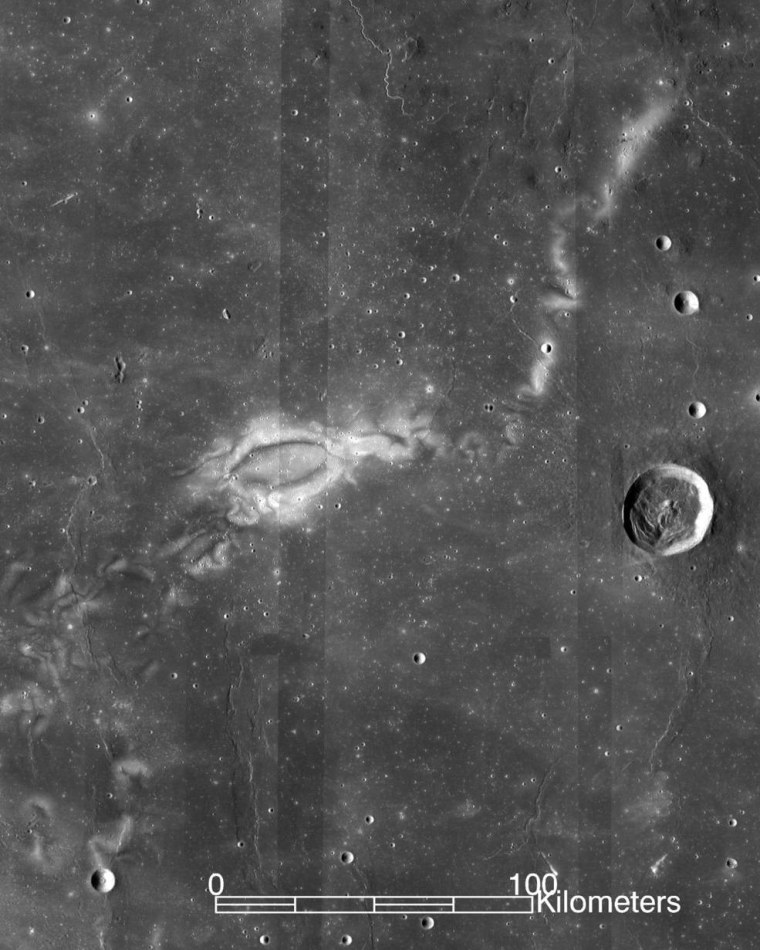
Light and dark markings swirl over the moon, looking like cream swirled into coffee or clouds against a slate gray sky. These lunar swirls may result from ancient, magnetic lava just below the moon's surface, according to one new study.
A joint study between researchers at Rutgers University and the University of California, Berkeley, pointed to the moon's internally generated magnetic field and past volcanic activity to explain the lunar swirls.
Researchers have known for some time that lunar swirls share space with localized magnetic fields and that when those fields deflect particles from solar wind, parts of the moon's surface weather more slowly than other parts. "But the cause of those magnetic fields, and thus of the swirls themselves, had long been a mystery," Sonia Tikoo, co-author of the study and a researcher at Rutgers University-New Brunswick's Department of Earth and Planetary Sciences, said in a statement. "To solve it, we had to find out what kind of geological feature could produce these magnetic fields — and why their magnetism is so powerful."
[How the Moon Evolved: A Photo Timeline]
The researchers developed mathematical models for these localized fields, or "geological magnets" as they're described in the statement. These models showed that each lunar swirl must exist above a narrow, magnetic object located just below the lunar surface.
Even stranger, researchers think that these subsurface magnetic objects are ancient, long, narrow lava tubes formed by flowing lava or lava dikes, which are vertical sheets of magma in the crust of a moon or planet. Past experiments have shown that, when heated above 1,112 degrees Fahrenheit (600 degrees Celsius) in a zero-oxygen environment, certain minerals in moon rocks break down and release metallic iron, making the rocks extremely magnetic.
So, when the moon was erupting lava over 3 billion years ago, these magnetic lava tubes or lava dikes were likely created and became highly magnetic as they cooled down, according to the statement
"No one had thought about this reaction in terms of explaining these unusually strong magnetic features on the moon," Tikoo said in the statement, referring to the lava becoming magnetic moon rock under the surface and causing lunar swirls. "This was the final piece in the puzzle of understanding the magnetism that underlies these lunar swirls."
This study was published July 26 in the Journal of Geophysical Research: Planets.
Are we truly alone in the cosmos? New study casts doubt on rise of alien life in our galaxy
It’s something people tell me all the time, and usually in hushed tones: “With a trillion planets out there, we really can’t be the only intelligent beings in the galaxy.” In other words, given the enormous amount of real estate in space, aliens are sure to exist. So why haven’t we found any?
I don’t dispute this straightforward idea because, after all, it underpins the search for extraterrestrial intelligence (SETI). But not everyone agrees. A recent paper by three researchers at the University of Oxford is throwing shade on those who feel confident that the cosmos is thick with extraterrestrials.
The Oxford academics were addressing a puzzle known as the Fermi Paradox, which describes the disconnect between our expectation of many worlds swarming with aliens and the fact that they remain undiscovered. Nearly 70 years ago, the celebrated physicist Enrico Fermi mouthed a deceptively simple question: “Where is everybody?” He made a quick estimate of how long it would take for any society bent on building an empire to colonize the entire Milky Way and realized it was only a few tens of millions of years, which is nearly 1,000 times shorter than the age of the galaxy.
This raised an obvious problem: There’s been more than enough time for aliens to spread out, and yet we don’t see them.
Perhaps the Fermi Paradox is keeping you awake at night. If so, the Oxford scientists offer some succor. The source of your discomfort, they say, could be your inflated estimate of how many alien societies might be out there.
To make such estimates, nearly everyone deploys the Drake Equation — a simple formula that was cooked up by astronomer Frank Drake in 1961. It reckons how frequently intelligent species arise by multiplying the probability that biology will appear with the likelihood that it will become smart enough to develop science and technology.
Most people who wield the Drake Equation simply suppose (which is to say, guess) the values of its terms. For example, they might say that the chance that microbes will eventually bubble out of the primordial soup of a watery planet is between one and 10 percent. But the Oxford scientists rightly point out that we really don’t know this percentage with any degree of accuracy. It could be that the probability that biology will arise is many orders of magnitude less. Similar issues apply for some of the other terms in the Drake Equation.
If we own up to the true extent of these uncertainties and do the requisite math, the Oxford study finds that there’s at least a 53 percent chance that we’re alone in the Milky Way and at least a 40 percent chance that we’re alone in the visible universe. Homo sapiens could be the smartest thing going.
This result, they claim, melts the Fermi Paradox like butter on a hot griddle — maybe no one has colonized the galaxy because no one else inhabits it.
Perhaps now you can sleep better. If so, great, but I can’t.
While there’s no arguing against the fact that many of the steps that lead to intelligent creatures have unknown and possibly very low probabilities, that situation could change soon. The discovery of microbes on one of the moons of Jupiter or Saturn — something that might happen while you still have your teeth — would strongly boost the chance of finding life elsewhere, and essentially guarantee that biology is as universal as door dings in a parking garage. At that point, the analysis by the Oxford team could itself dissolve.
Frankly, exploration is seldom done well on blackboards. For 2,000 years academics argued over the possibility that a continent-size land mass sat at the bottom of the globe. The ancient Greeks suggested that this was required by symmetry, which may have qualified as a good idea in 350 B.C. A better, if less optimistic, argument could have been made in the year 1600 by noting that all of the waters of the southern Atlantic and Pacific Oceans explored to date were known to be devoid of any large polar continent. Since these two sprawling bodies of water cover 55 million square miles, whereas a land mass the size of Antarctica is 5 million square miles, the a priori chances were more than 10-to-one against there being a continent just out of sight to the south.
Obviously this analysis would have been wrong, but it demonstrates that you don’t make new discoveries by computing probabilities, only by investigating — by actually doing an experiment. In the case of the Antarctica hypothesis, that meant sending ships south.
We can try to reckon the odds of success in our hunt for cosmic confreres. That’s always worthwhile. But, such exercises should not deter us from an actual search.
SUR GOOGLE MAPS, LA MOINDRE TÂCHE PEUT SE TRANSFORMER EN OVNI
Google Maps est l’un des endroits préférés des ufologues pour dénicher des OVNIS en visite sur notre planète. Le dernier cas en date nous vient du Brésil où des internautes pensent avoir découvert un objet volant non identifié sur une image de Google Street View.
Alors véritable OVNI, ou simple objet terrestre ?
La photo a été prise au-dessus du Parque Eloy Chaves, situé à Jundiaí, dans l’État de São Paulo, au Brésil. L’objet doré est bien visible au loin dans le ciel bleu dégagé, et il fait effectivement penser à un vaisseau volant. La photo du mystérieux objet récupérée sur Google Street View a très vite été partagée des milliers de fois sur les réseaux sociaux et les commentaires ont abondé.
Évidemment, les ufologues pensent avoir découvert une énième preuve de l’existence des extraterrestres et de leur grand intérêt pour notre planète. Pourtant, l’étrange objet sur cette photo prise au-dessus de la Avenida Luiz José Sereno, sur la Estrada da Ermida, pourrait être une simple anomalie dans la prise de vue des cameras de Google.
Et ce ne serait pas la première fois que cela arrive.
L’idée que des soucoupes volantes survolent la Terre est très excitante, mais l’explication de ces « phénomènes » pourrait être bien plus simple en réalité. Ce que beaucoup d’ufologues prennent pour un OVNI pourrait en effet être simplement un ballon, un cerf volant, un débris transporté par le vent, ou un bug graphique du logiciel de Google. Et oui, même les services du géant Google n’échappent pas aux bugs !
En effet pour modéliser le monde, la société utilise ses Google Cars qui parcourent la planète pour prendre des clichés de tous les endroits. Et pour ce faire, les Google Cars n’utilisent pas une seule caméra mais plusieurs à la fois. Un algorithme développé par Google se charge ensuite de les assembler. C’est justement à ce stade que des bugs ou des artefacts se glissent parfois dans les images de Maps.
Il arrive aussi que de la poussière ou de la matière organique se dépose sur les lentilles des caméras de Google, donnant lieu à d’étranges tâches qu’on pourrait prendre pour des objets extraterrestres. Un problème que corrigent en général les algorithmes de Google. Mais il arrive que certaines passent entre les mailles du filet. Les ufologues ont ainsi reporté au fil des ans de nombreux supposés « OVNI » dans les images de Maps.
En juin dernier, la chaîne YouTube spécialisée dans le paranormal et les « phénomènes étranges et inexpliqués », NowYouKnow, a publié une vidéo montrant une étrange tache ovale photographiée dans le ciel de la province de Neuquen par Google Earth. Nous en avions parlé dans cet article. Malheureusement, Google a actualisé ses clichés de Street View et le supposé OVNI n’est plus visible.
En mai 2018, une tache similaire avait été découverte dans Google Maps par un ufologue du nom de Pedro Ramirez. Ce qui Ramirez a considéré comme « un vaisseau construit par une civilisation extraterrestre avancée » a été photographié au-dessus de Punalu’u Black Sand Beach, une des plus célèbres plages de Hawaï. Mais il y a de grande chance que le supposé OVNI soit en réalité une tâche causée par un dépôt de poussière sur l’optique de la caméra de Google, un drone ou simplement un débris emporté par le vent.
Plusieurs clichés de Google Maps supposés montrer des vaisseaux aliens ont également été identifiés par les ufologues sur des photos de l’Antarctique. L’ufologue russe Valentin Degterev a par exemple publié une photoqui selon lui montre le site du crash d’un vaisseau extraterrestre. Une allégation démentie par Andrew Flemming, un chercheur travaillant pour le British Antarctic Survey, qui pense lui qu’il s’agit simplement d’une crevasse comme on en trouve beaucoup dans la région.Le même Valentin Degterev pense avoir découvert une autre preuve de l’existence des extraterrestres sur cette photo de Maps prise en Antarctique. Mais le supposé vaisseau alien pourrait bien n’être qu’un simple rocher en réalité. Vous pouvez aussi jeter un œil à cette image de Google Maps où des internautes pensent reconnaître les restes d’une soucoupe volante… qui se serait écrasée en Antarctique.
Hole in Sun's Atmosphere Amps Up Northern Lights
 SETI scientists spot 72 signals 'from alien galaxy' 3bn light years away

Scientists do not yet know what causes the mysterious fast radio bursts, but a form of alien transportation has been suggested.
Newfound Alien World May Bridge Rare Gap in Planet Types
According to the statement, exoplanet Wolf 503b orbits an old "orange dwarf" star slightly dimmer than the sun, and goes around it quite closely and quickly — every six days. Wolf 503b is also fascinating because there's nothing in our solar system quite like it for comparison, according to university officials. Its size puts the exoplanet in a scientific sweet spot — Wolf 503b is in the zone where it might be a rocky "super-Earth," or gaseous like a "sub-Neptune."
Kepler has studied the radii of thousands of exoplanets strewn across the universe, but because of a yet-to-be-well-understood phenomenon that researchers call the Fulton gap, there aren't many exoplanets 1.5 to 2 times the size of Earth. This is what makes additional observations of Wolf 503b — with a radius 2.03 times that of Earth — brimming with discovery potential.
Typically, these Fulton-gap planets observed by Kepler are challenging to study. They orbit distant, dim stars, according to the statement, making it hard for researchers to figure out their density, measure the wavelengths of light coming from them or investigate their atmospheres.
But this star is relatively close to Earth, making it appear brighter and riper for study.
"Wolf 503b is one of the only planets with a radius near the gap that has a star that is bright enough to be amenable to more detailed study," Benneke, also at University of Montreal, said in the statement.
 Are octopuses aliens? Bizarre new theory suggests the sea creatures’ eggs arrived on earth on a comet from outer space
A group of 33 scientists think octopuses descend from alien material that came to earth on an icy comet
THE KLERKSDORP SPHERES: OUT-OF-PLACE ARTEFACTS, OR PRODUCTS OF NATURE?
One such item – an item that actually belongs to a group of objects known as out-of-place-artefacts – is called the Klerksdorp Sphere (or spheres as is actually the case). Also commonly known as the grooved spheres, the Klerksdorp Spheres are what some are calling definitive proof of the advanced technological abilities of ancient (pre-historic) cultures. You might think that Erik von Däniken should have his hands in this argument, but as far as I can tell he doesn’t.
The spheres are described as small, smooth metal spheres, usually about an inch in diameter, many with concentric grooves running around their circumference. Those forwarding claims of advanced ancient technology claim that they are perfect spheres, which, if you’re familiar with sculpture you’re aware of how difficult that is to achieve. The spheres apparently vary in colour between a dark blue to varying hues of red. But their most impressive feature is that, according to some, they could not be manufactured on Earth, but rather could only be made in space. The common story is that this has been confirmed by NASA. They are said to be perfectly balanced and to be the hardest objects known to man (alternately they are claimed to only be as “hard as steel”).

The Klerksdorp Spheres
The spheres have been found by miners and rock hounds in and around a mining operation near a small town called Ottosdal, South Africa, which is owned by a local mining company called Wonderstone Ltd. Wonderstone’s primary product is a mineral called Pyrophyllite – composed of aluminum silicate hydroxide (Al2Si4O10(OH)2). Pyrophyllite is a relatively soft mineral used in manufacturing, from train brakes to aerospace technologies and even as a sculpture medium. The Wonderstone deposit is said to be somewhere between 2.8-3 billion years old, and it is inside this Pyrophyllite deposit that all of the Klerksdorp Spheres have been found.
That number is generally blamed for the confusion. The more conspiratorial among us claim that, since the Klerksdorp spheres consist of a different, much harder material than the Pyrophyllite, this means that they cannot be natural formations and if they are not natural, then they must be manufactured. Pyrophyllite is sedimentary rock which generally measures a three on the Mohs scale of hardness, while the spheres, which remain unmeasured, appear much harder (highly scientific, I know). This apparent discrepancy combined with the fact that the parent deposit of stone is roughly 3 billion years old, we have a duck that doesn’t appear to be a duck.
Add to this the story that they are perfect spheres, so highly balanced that they baffled NASA scientists, and you’ve got a ready-made out-of-place-artefact.
The problem is, much of the above is not true.
The spheres have been studied by a number of people since their first discovery, most notably Paul. V. Heinrich, Geologist and Archaeologist at Louisiana State University, and a team led by Professor of Geology at the University of Johannesburg, Bruce Cairncross. Also notably, no record exists of any NASA funded or directed study of these artefacts.
There are many photos that show (without much room for argument) that most known examples are actually not perfect spheres. In fact, many aren’t even spherical at all. They’re generally described by researchers as flattened spheres or discs. Sometimes they’re even inter-grown, like soap bubbles. Some have concentric grooves and others don’t. And as mentioned, at least insofar as no such record exists, they have never been measured for hardness (though I can’t imagine why not). But since they are quite easily broken open to reveal a well-defined internal radial structure, the contention that they are so hard they cannot be scratched, even by metal tools, is easily dismissed[1].
Another issue is, as may already be obvious, that they are not made of metal. According to Paul Heinrich – who used petrographic and x-ray diffraction analysis to determine their composition – the majority of the spheres are actually made of hematite, while some few of them consist of magnetite or wollastonite.[2] Hematite is an iron-ore mineral, the most common and important iron-ore mineral on the planet, in fact. It’s used in many manufacturing processes, though most famously in jewellery, its polished black appearance is apparently quite appealing, though its colour can range from black to silver-grey to brown and reddish-brown.

Hematite Crystal (Rob Lavinsky, iRocks.com – CC-BY-SA-3.0)
As to the question of how such hematite deposits could form inside the Pyrophyllite, and how they could emerge with such a manufactured appearance, both Cairncross and Heinrich agree, as do several other geologists, that the spheres are what’s known as volcanic concretions.
A concretion is the result of the process of precipitation of mineral cement within the spaces between sediment grains. In simpler terms, it means that the small grains of iron-ore sediment, slowly filter through the considerably larger substrate grains of the host mineral – in this case Pyrophyllite – eventually collecting in small pockets within the deposit. It most often produces small, hard, roughly spherical stones within other, softer sedimentary host materials. As with the Klerksdorp Spheres, concretions also often have characteristic grooves, which are believed to be a result of fine-grained laminations within which the concretions grew – basically, the shape of the hole in which they found themselves.[3]

Concretions on Bowling Ball Beach, south of Mendocino, CA
Now, far be it for me to tell you what’s what, but this process is really quite well-understood and documented. And there are other examples of such concretions found all around the world. There are even some that seem even more incredible than the incredible Klerksdorp Spheres, namely The Waffle Rock of West Virginia. And while some experts have claimed that it’s odd for hematite and Pyrophyllite to interact in this way, but, as with most geologic processes, it’s not outside of the realm of possibility for two such materials to meet and interact in a way that’s consistent with their own physical properties.
All of the pseudo-scientific claims surrounding these objects revolve around the notion that they could not have formed naturally. Cairncross, Heinrich, et al, seem to have lain waste to that idea. Statements these researchers have made regarding their conclusions have been twisted and distorted by tabloid journalists in years past, and have muddied the waters surrounding the mythical nature of these artefacts. But rest assured, the truth can be found with a little digging.
References.
Top 3 myths about jellyfish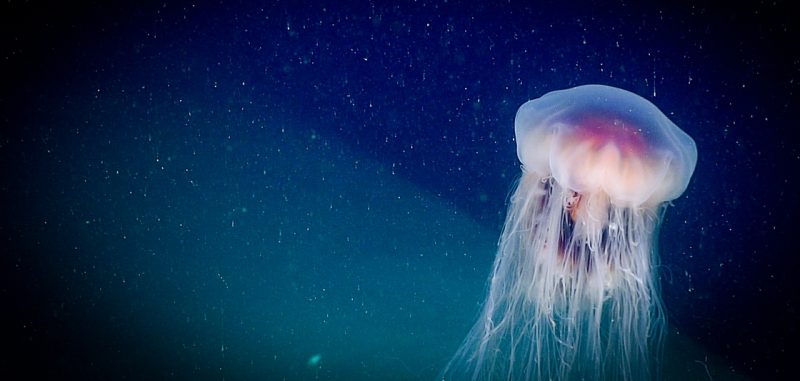
Myth #3: Applying urine to a jellyfish sting can reduce the pain
Jellyfish have a complicated relationship with humans: They are often feared by beachgoers because of their sting. They can get unintentionally caught up in commercial fishing nets. Some jellies can even clog intake pipes of coastal power and desalination plants, and in high concentrations, can force closures of popular beaches.
For scientists, however, jellyfish are fascinating research subjects – they play important roles in the marine ecosystem and are a key source of food for some fish and sea turtles. Some even protect commercially valuable species, such as oysters, from predators.
Whatever your view may be, many misconceptions exist about jellyfish. Let’s bust the top three myths:
Myth #1: Jellyfish are all the same species
On the contrary, there are more than 200 documented species of true jellyfish (and many more of their stinging relatives) across the globe. The environmental conditions required for each species to thrive can differ. In fact, NOAA and Smithsonian Institution scientists recently found that sea nettles in the Chesapeake Bay are considerably different than those in the open ocean and recognized it as a new species.
Myth #2: Jellyfish go after people
Not true. Any contact with jellyfish is incidental. Humans are not on their menu, but when we are in their environment we can get in the way of their tentacles. While jellyfish don’t have a brain, they can sense light and have coordinated swimming behaviors, which help keep them in good places to hunt for microscopic plants and fish eggs/larvae, or other prey like fish, worms, and crustaceans.
Myth #3: Applying urine to a jellyfish sting can reduce the pain
Perhaps the most interesting of myths, the use of urine to treat stings, has been tested and proven unhelpful. A better idea? Try an acidic liquid like vinegar. There are also several commercially available products marketed for stings.
What to do if you get stung: First, look for any tentacle adhering to skin, and flush the area well with cold ocean water. Do not rub the sting area because you could inadvertently distribute the venom further into the body. Then vinegar or evidence-based commercial product should be applied if there is continuing pain.
Image via NOAA.
Bottom line: NOAA busts three myths about jellyfish.
Massive armada of UFOs emerging out of a giant “spiral” near the sun?!
On September 11, 2018, Maria G. Hill from Salem, Indiana has photographed something extraordinary near the sun what can be described as large disk-shaped UFOs as well as a huge fleet of smaller UFOs that accompany the massive disk-shaped UFOs.
Gina wrote on her Facebook: September 11, 2018, 8:02 AM Salem, Indiana:
“This is what showed up in my camera after I took a picture of the sun in the eastern sky this morning. iPhone 8 with a camera lens adapter.”
“A green circular door-like object is at the center of the vortex/worm hole and a serpent snake at the top right above it, by a circular disc. I am sure this has a symbolic meaning with the snake and the disc – pictures and videos are on my timeline” she continued.

Besides, in the two videos here and here Gina talks about the massive UFO disks and the fleet of smaller UFOs.
If the objects in the images are not lens flares or objects reflecting in the lens of the camera, but massive mother ships and a fleet of smaller UFOs, then could that be the reason for the sudden shutdown of 7 solar observatories?
Source www.disclose.tv
Mysterious Evacuation Of Solar Observatory Overlooking White Sands Smells Like Espionage

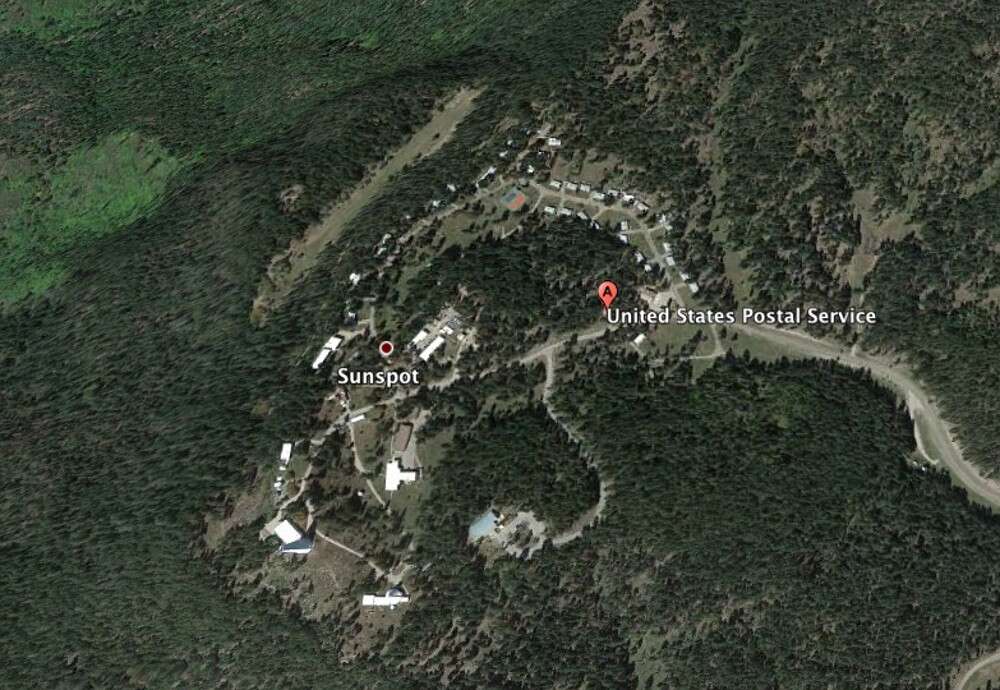
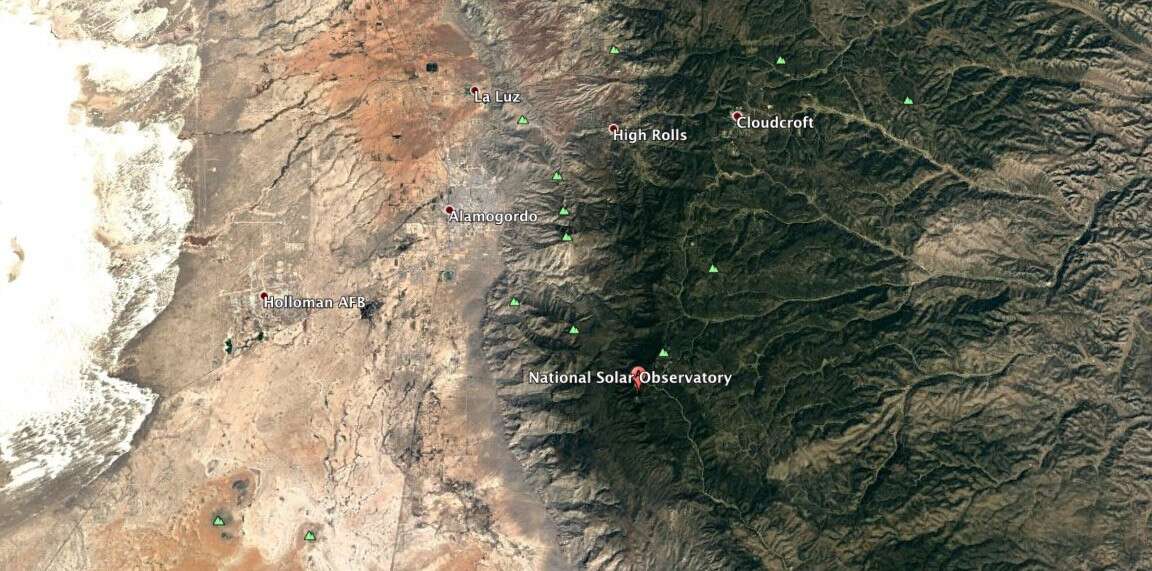
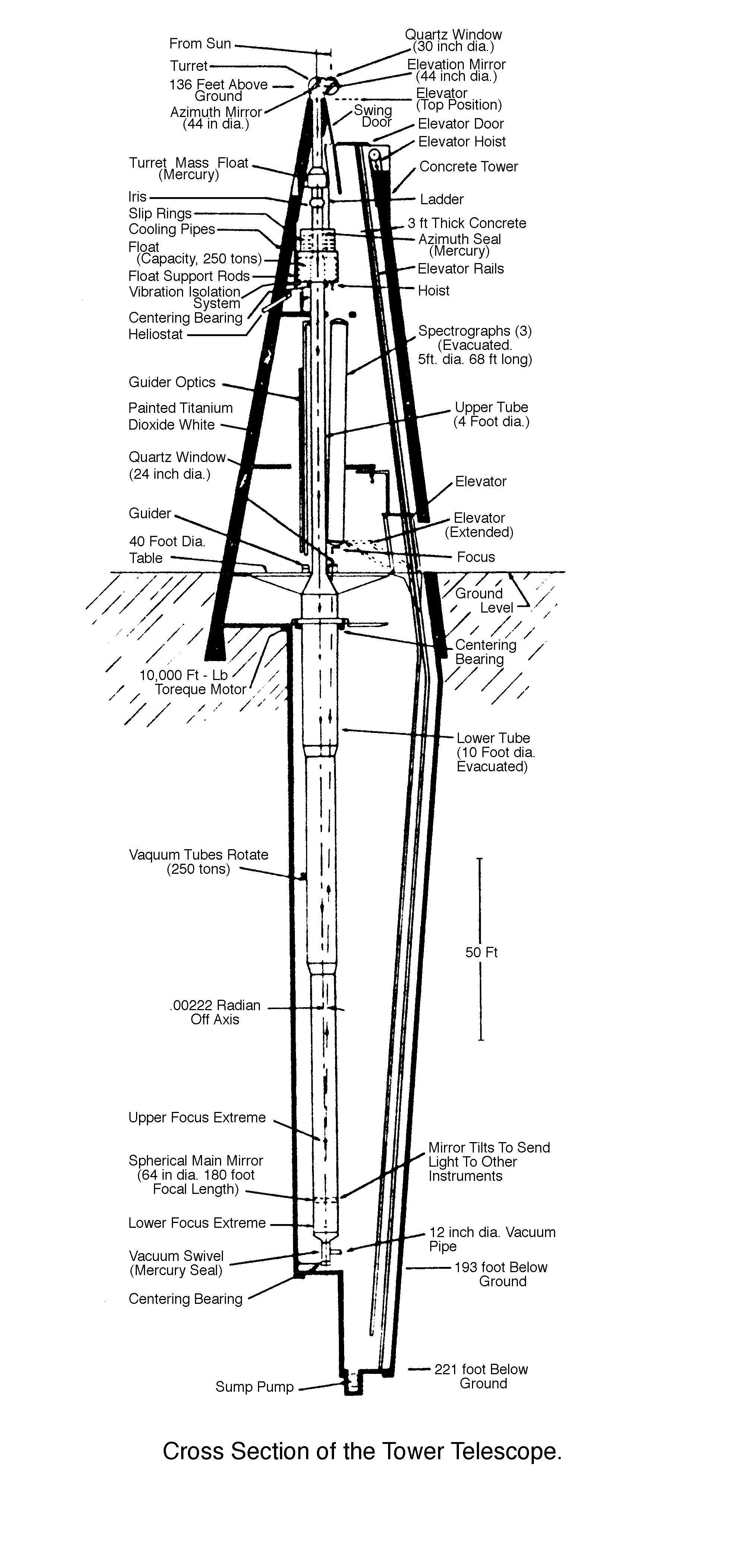
 Unexplained 'Security Issue' Keeps National Solar Observatory Facility Shuttered
 The Mysterious Origin of Our Galaxy’s Gold
 Alien-hunting AI discovers dozens of mysterious fast radio bursts
Astronomers with the Breakthrough Listen program used AI (artificial intelligence) to find 72 repeating, short, unpredictable radio bursts, from a mysterious source 3 billion light years away.
Researchers with Breakthrough Listen said on September 10, 2018, that they’ve now used artificial intelligence, AI, to discover 72 new fast radio bursts from a mysterious source some 3 billion light-years from Earth. The source is a known “repeater” of fast radio bursts – the only such object known to date – called FRB 121102.
Fast radio bursts, aka FRBs, are bright pulses of radio emission, lasting just milliseconds. They’re thought to originate in distant galaxies.
Most FRBs are one-offs, but this source – FRB 121102 – emits repeated bursts. FRB 121102 emitted 21 bursts previously detected during Breakthrough Listen observations made in 2017 with the Green Bank Telescope in West Virginia. Now – using AI – astronomers have found 72 more
What are these mysterious bursts? Previous studies showed the bursts from 121102 emanating from a galaxy 3 billion light-years from Earth. Beyond that, we don’t know much about the source. Theories range from highly magnetized neutron stars, blasted by gas streams near to a supermassive black hole, to suggestions that the burst properties are consistent with signatures of technology developed by an advanced civilization.
The 72 newly discovered FRBs are not about new observations. They’re about new and more powerful data-analysis techniques, made possible by artificial intelligence.
Breakthrough Listen researchers used artificial intelligence to search through radio signals recorded from a fast radio burst, capturing many more than humans could. Image via Breakthrough Listen/Berkeley.edu.
The statement from Breakthrough Initiatives continued:
In search of a deeper understanding of this intriguing object, the Listen science team at the University of California, Berkeley SETI Research Center observed FRB 121102 for five hours on August 26, 2017, using the Breakthrough Listen digital instrumentation at the [Green Bank Observatory]. Combing through 400 TB [terabytes] of data, they reported … a total of 21 bursts.
All were seen within one hour, suggesting that the source alternates between periods of quiescence and frenzied activity.
Now, UC Berkeley Ph.D. student Gerry Zhang and collaborators have developed a new, powerful machine learning algorithm, and reanalyzed the 2017 GBT dataset, finding an additional 72 bursts that were not detected originally.
Zhang’s team used some of the same techniques that internet technology companies use to optimize search results and classify images. They trained an algorithm known as a convolutional neural network to recognize bursts found with the classical search method … and then set it loose on the 400 TB dataset to find bursts that the classical approach missed.
Gerry Zhang said:
This work is only the beginning of using these powerful methods to find radio transients. We hope our success may inspire other serious endeavors in applying machine learning to radio astronomy.
Bottom line: Breakthrough Listen astronomers used AI (artificial intelligence) to find 72 repeating, short, unpredictable radio bursts from a mysterious source known as FRB 1211023, located some 3 billion light years away.
Via Breakthrough Initiatives and Berkeley.edu
Richard Dolan Show (Chinese Ufology) Interview with Cheuk Fei


