Ontdek de Fascinerende Wereld van UFO's en UAP's: Jouw Bron voor Onthullende Informatie!
Ben jij ook gefascineerd door het onbekende? Wil je meer weten over UFO's en UAP's, niet alleen in België, maar over de hele wereld? Dan ben je op de juiste plek!
België: Het Kloppend Hart van UFO-onderzoek
In België is BUFON (Belgisch UFO-Netwerk) dé autoriteit op het gebied van UFO-onderzoek. Voor betrouwbare en objectieve informatie over deze intrigerende fenomenen, bezoek je zeker onze Facebook-pagina en deze blog. Maar dat is nog niet alles! Ontdek ook het Belgisch UFO-meldpunt en Caelestia, twee organisaties die diepgaand onderzoek verrichten, al zijn ze soms kritisch of sceptisch.
Nederland: Een Schat aan Informatie
Voor onze Nederlandse buren is er de schitterende website www.ufowijzer.nl, beheerd door Paul Harmans. Deze site biedt een schat aan informatie en artikelen die je niet wilt missen!
Internationaal: MUFON - De Wereldwijde Autoriteit
Neem ook een kijkje bij MUFON (Mutual UFO Network Inc.), een gerenommeerde Amerikaanse UFO-vereniging met afdelingen in de VS en wereldwijd. MUFON is toegewijd aan de wetenschappelijke en analytische studie van het UFO-fenomeen, en hun maandelijkse tijdschrift, The MUFON UFO-Journal, is een must-read voor elke UFO-enthousiasteling. Bezoek hun website op www.mufon.com voor meer informatie.
Samenwerking en Toekomstvisie
Sinds 1 februari 2020 is Pieter niet alleen ex-president van BUFON, maar ook de voormalige nationale directeur van MUFON in Vlaanderen en Nederland. Dit creëert een sterke samenwerking met de Franse MUFON Reseau MUFON/EUROP, wat ons in staat stelt om nog meer waardevolle inzichten te delen.
Let op: Nepprofielen en Nieuwe Groeperingen
Pas op voor een nieuwe groepering die zich ook BUFON noemt, maar geen enkele connectie heeft met onze gevestigde organisatie. Hoewel zij de naam geregistreerd hebben, kunnen ze het rijke verleden en de expertise van onze groep niet evenaren. We wensen hen veel succes, maar we blijven de autoriteit in UFO-onderzoek!
Blijf Op De Hoogte!
Wil jij de laatste nieuwtjes over UFO's, ruimtevaart, archeologie, en meer? Volg ons dan en duik samen met ons in de fascinerende wereld van het onbekende! Sluit je aan bij de gemeenschap van nieuwsgierige geesten die net als jij verlangen naar antwoorden en avonturen in de sterren!
Heb je vragen of wil je meer weten? Aarzel dan niet om contact met ons op te nemen! Samen ontrafelen we het mysterie van de lucht en daarbuiten.
Berichten van 1 december 2018 tot 31 december 2018
Linda Moulton Howe Reveals What Extraterrestrials Really Want... it's Not Good! (Video)
Unbeknownst to a vast majority of the population, humanity has a long and complicated history with extraterrestrial beings.
Whistleblowers from the military and government explain that Earth is caught in the middle of a battle to retain ownership of our planet, and we are simply pawns in a galactic chess game.
Linda Moulton Howe conveys information she has collected from several insiders who have come forward to reveal what they know about extraterrestrial races, long-term genetic projects involving humans, what happens to a soul as it reincarnates across many lifetimes, and much more.
The radar signature meandered over southern Illinois for 10 hours on Monday.
It definitely wasn’t precipitation, the National Weather Servicesaid.
But that seemed for days to be the only sure thing about the blob, which floated for nearly 140 miles before scattering into nothing after it crossed into western Kentucky.
So what was it?
Birds? Meteors?
The National Weather Service in Paducah posted this message on Facebook at 1:00 a.m. this morning:
The first volley of a coordinated campaign to distract military aircraft from alien sorties?
Chris Noles, a meteorologist at the National Weather Service outpost in Paducah, Ky., first observed the disturbance.
So when you’re watching severe weather crawl across the radar screen, Noles said, yellow and red typically show hail or snow. Those are strong.
Rain and drizzle are not so solid and appear as weaker signals, in blue and green hues.
This disturbance, then, was puzzling and churned with a core of yellow and red signatures as it pushed along a southeastern wind, producing radar signals from as high as 10,000 feet.
Birds don’t appear that way on radar, Noles said.
So: ̶b̶i̶r̶d̶s̶.
Meteors are pretty solid. But they don’t move at 14 miles an hour.
So: ̶m̶e̶t̶e̶o̶r̶s̶.
North American Aerospace Defense Command, which oversees air sovereignty in the United States, said it was following the incident but did not have information on what the object could have been.
What about aliens then?
“NORAD does not track UFOs or alien aircraft,” spokesman Michael Kucharek said, though he explained that NORAD would be aware of unauthorized aircraft in the United States.
Kucharek referred further questions to the Federal Aviation Administration, which referred back to NORAD.
(NORAD does, however, track Santa’s flight across the world. But it’s too early for Santa to show up on radar.)
Back at the National Weather Service, Noles offered another explanation.
Perhaps the slow-moving band that tracked with wind patterns on that clear day was a countermeasure launched from a military aircraft.
Chaff is a cloud of light aluminum-coated material deployed in the air to fool and overwhelm radar signals that may be tracking the aircraft. An incident in southern Missouri in the 1990s that Noles observed was similar, he said.
But an NWS report on chaff and its impact on weather radar said chaff typically lingers for two to five hours. Monday’s incident was twice as long as the high end of that window.
A longer event is not unprecedented, however.
During a training exercise in 2013, a military aircraft launched chaff over Alabama, where it lingered in the atmosphere for about the same amount of time — 10 hours, according to the NWS report.
Two military installations relatively close to the path of the most recent radar anomaly — Scott Air Force Base in Illinois and Fort Campbell in Kentucky — told the Evansville Courier and Press that their aircraft were not responsible.
An Evansville meteorologist said he was told by an unnamed pilot that chaff came from a military C-130 transport aircraft but did not say where it originated.
The mystery continued Wednesday, even for those who would eventually know what really happened.
It was chaff released from a C-130H aircraft piloted by the 130th Airlift Wing of the West Virginia Air National Guard during a training operation, state guard spokeswoman Capt. Holli Nelson said.
The pilots were required to expend the material, potentially for safety reasons, Nelson said, and received air traffic control permission to do so.
Officials at the National Guard Bureau began to piece together that news by the afternoon.
“I woke up, and I was having my coffee, picking through news and saw the headline myself,” said Army Master Sgt. Mike Houk, a Bureau spokesman. “And I didn’t know what it was.”
In Amerika was urenlang iets vreemds op de radar te zien. Wat was het?
Experts van de Amerikaanse weerdienst, de National Weather Service, stonden eerder deze week voor een raadsel toen er boven de staten Illinois, Indiana en Kentucky urenlang een vreemde vlek op de radar was te zien.
De vreemde formatie leek op een regenbui, maar het was op dat moment helder.
Op Twitter werd druk gespeculeerd over het 80 kilometer lange spoor. Sommigen dachten aan een zwerm vogels of een explosie in de ruimte.
Antiradarsneeuw
Een lokale meteoroloog suggereerde dat het ging om antiradarsneeuw, wat door het leger wordt gebruikt om vliegtuigen te verbergen door radars te verblinden.
In het gebied bevinden zich enkele legerbases, maar die waren naar eigen zeggen niet verantwoordelijk voor de vreemde ‘wolk’.
Eén van de bases verklaarde ‘niets te maken te hebben gehad met vliegtuigen die antiradarsneeuw hadden uitgeworpen’.
Slaat nergens op
Een woordvoerder van Fort Campbell in Kentucky zei dat het mogelijk te maken had met een ‘geheime oefening van de speciale troepen’.
De National Weather Service in Paducah in de staat Kentucky zei ook te denken dat de radar antiradarsneeuw had opgepikt.
Stormjager Chris Conley, die voor verschillende nieuws- en weerstations werkzaam is, zei: “We weten niet wat het is. Het slaat nergens op dat het antiradarsneeuw zou zijn. Waarom zouden ze antiradarsneeuw boven het zuiden van Illinois dumpen?”
Among the many contentious sub-fields of phenomena associated with UFO research, perhaps none is quite so baffling as animal mutilation. Many of these apparent “mutilations” have been casually dismissed as the simple interventions of scavenging beasts, following the natural or otherwise mundane death of cattle or other livestock. Undoubtedly, this is true in some cases, although there are other instances where physical evidence points to a more complex phenomenon behind the mysterious deaths and mutilations.
The situation is complex enough that, during the 1970s, the FBI became involved in studies aimed at determining the possible factors underlying some of these incidents, although the depth to which they investigated the matter at the time has come under scrutiny. Writing for Skeptoid in 2015, Allison Hudson noted that, “[The FBI’s] investigation amounted to little more than collections of newspaper clippings because of jurisdictional issues, but they concluded that nothing seemed to be amiss in the deaths other than natural causes. This was a conclusion shared by other investigations.”
In a memorandum dated January 21, 1975, sent to the FBI Laboratory by the Special Agent in Charge of the Minneapolis Division, the mutilations were described thusly:
“For the information of the Bureau, animals, mostly livestock, have been reported as mutilated in the three-state area of this division and parts of their bodies missing. The parts listed as missing have been the sexual organs, ears, lips and udders, and in some instances, the blood from the animals was considered ‘completely drained.’ No evidence of value ever located at the scene.”
The briefing goes on to note that state veterinarians who examined the remains “contend dead animals were eaten by other animals or varmints, believed to be foxes due to their sharp side teeth.” However, the notion that “no evidence of value” was ever collected at the scene of such mutilations is particularly curious, as it appears to contrast sharply with some of the law enforcement investigations and lab work conducted on the State and municipal level over the years.
Around the same time the briefing above was issued, mutilations were occurring in other parts of the country, and were under investigation by law enforcement. In his Alien Contact: Top Secret UFO Files Revealed, researcher Timothy Good recounted such an investigation that was underway in early 1975, under the supervision of the Coryell County deputy sheriff and Department of Public Safety. The incident involved the remains of a calf that was discovered at Copperas Cove, Texas, bearing many of what would become staples of the mutilation cases: sex organs had been “bloodlessly” removed with surgical precision, and peculiar impressions were found in the soil approximately forty yards from the calf that formed concentric circles, approximately 30 feet in diameter. Similar markings were found elsewhere in the same field, along with circular dispersals of dried grass which appeared to have been depressed by some object using “tremendous force,” along with the apparent removal of surface soil and stones in some areas.
“The DPS officials speculated that an aerial vehicle had been used in the operation,” Good wrote. “It was later learned that several residents near Copperas Cove and Killeen had observed a yellowish-orange light hovering over the farmland at around the same time as the mutilation.”
As Good notes of the Texas mutilations, the FBI initially was hesitant to become involved (despite memorandums that show Agents in some regions were looking into the matter around the same time, as outlined earlier). With the FBI maintaining a low profile in relation to the mutilations in the mid-1970s, local law enforcement was left to carry out most of the investigations at that time.
Officer Gabriel Valdez of the New Mexico State Police participated in the investigation of a similar incident that transpired on June 13, 1976, at the ranch of Manuel Gomez near Duke, New Mexico. FBI documents pertaining to this incident were later released by the FBI, and detail the incident as follows:
At the scene, writer examined carcass of a three-year-old black White-Faced cow which was lying on its right side. The left ear, the tongue, the udder, and the rectum had been removed with what appeared to be a sharp precise instrument. No traces of blood were left on the skin of the cow. .. . Other evidence on the cow was a small puncture on the brisket. No other evidence was available as to cause of death.
Investigations continued around the area and revealed that a suspected aircraft of some type had landed twice, leaving pod marks positioned in a triangular shape. The diameter of each pod part was 14″. The perimeter around the three pods was 16 1/2′
(6′ x 5′ x 5 1/2′). Emanating from the two landings were smaller triangular-shaped tripods 26″ apart and 4″ in diameter Investigation at the scene showed that these small tripods had followed the cow for approximately 600 feet. Tracks of the cow showed where she had struggled and fallen. The small tripod tracks were all around the cow. Other evidence showed that grass around the tripods, as they followed the cow, had been scorched. Also a yellow oily substance was located in two places under the small tripods. This substance was submitted to the State Police Lab. The Lab was unable to detect the content of the substance. . . .
The details given thus far are interesting, to say the least, in that a very detailed account is given of the appearance and measurements of the “tripods” which Valdez believed had followed the mutilated cow for 600 feet, whereafter forensic evidence apparently indicates she had “struggled and fallen.” The recovery of the oily substance beneath the tripods was also of interest, in that physical traces were left at the scene, despite the State Police Lab’s inability to identify it.
The report continues:
On 06-17-76 writer contacted a Mr. Howard Burgess from Albuquerque, N.M., to proceed to the scene and conduct a radiation test. This was three days after the incident had occurred. His findings were that around the tripod marks and in the immediate tracks, the radiation level was twice the normal background reading. Mr. Burgess’s qualifications may be checked as he is a retired scientist from Sandia Lab, Albuquerque. It is the opinion of this writer that radiation findings are deliberately being left at the scene to confuse investigators. . . .
The above statement is particularly interesting, and little has been said of the assessment Valdez makes in the final sentence: that the presence of radiation, rather than being some hallmark or indicator of the phenomenon itself, had instead been intended to confuse or misdirect any ensuing investigation. This is merely Valdez’s personal opinion; however, it is important to consider its implications on those grounds, since there is an obvious stereotype that often becomes associated with such mutilation reports. This, simply put, is the tried and true assumption that either 1) extraterrestrials did it, or that 2) anyone who suggests that forensic evidence in such cases points to something more complex than simple, natural deaths and predation by scavengers must, therefore, also buy the alien explanation. Neither assumption is valid, although plenty of people—skeptics and believers alike—are guilty of falling into such traps, which are based on bias and presumption, rather than logic.
There were other very important clues obtained during Valdez’s investigation, as Good points out. “Officer Valdez noted that in all the cattle mutilations that had occurred in New Mexico and surrounding states at that time, ‘the object of the mutilations has been the lymph node system’.” This is quite in contrast to the preoccupation many researchers seem to have on the removal of sexual organs and soft tissues in cattle mutilation cases and strongly suggests that the focus of the mutilations (supposing there had been a medical basis for such procedures) had been on the immune system.
The emphasis on lymphatic functions was not all that Valdez noticed. In one instance, a mutilated specimen in New Mexico was examined and found to have high concentrations of a specific chemical agent in the bloodstream. “[A] high dosage of Atropine insecticide was analyzed in the blood system,” Good wrote. “Since Atropine is a tranquilizing drug, this would imply that either government agents or private individuals were responsible in this case, yet the presence of the drug need not necessarily be related to the mutilation, and investigations into later cases failed to confirm the presence of such drugs.”
The significance of this bizarre twist seems obvious, and as Good has already outlined for us, “this would imply that either government agents or private individuals were responsible in this case.” The problem, of course, is that atropine is not necessarily a common feature of cattle mutilations. However, my colleague Nick Redfern, who has looked into such cases for a long time (point in case, his work is referenced by Timothy Good in the aforementioned book, which was published in 1991), notes that the presence of Atropine at least appears to have been discovered in a few other instances of cattle mutilations.
“What are the chances,” Nick asks, “of aliens from some far-away galaxy utilizing atropine to sedate cattle before systematically butchering them? Personally, I’d say the chances are practically zero.”
He further notes:
“In other words, while it is unlikely to satisfy those who so desperately wish to believe that the mutilations are the work of bug-eyed aliens from distant worlds, the presence of atropine in a significant number of the reports coming out of Dulce suggests we may be looking at a definitively home-grown operation – but one that utilizes the alien-motif as a convenient cover – focused on matters relative to biological-warfare and, perhaps, concerns about such worrying, and growing, issues as Creutzfeldt-Jacob-Disease, or Mad-Cow Disease, as it is more commonly known.”
It would be interesting to look through available resource literature and see if similar reports of Atropine in the bloodstream of these cattle might have been noted elsewhere, although there could be simple reasons why, even if it had been present, it may not have been detected in all cases. As Valdez noted in a separate investigative report pertaining to one of the Dulce cattle mutilations from around this time, “Investigation of these strange mutilations has been hampered by an inability to find laboratories which will perform tests and report accurate findings.” Had resources not been so limited to the state and municipal agencies that were investigating the deaths, there indeed might have been more relevant information about the mutilations that could have been obtained.
On a final unsettling note, according to Dr. Howard Burgess, a retired Sandia Laboratories scientist who was investigating cattle mutilations around the same time, splotches of fluorescent material had been found on the backs of some of the live cattle in the region, which was only visible under ultraviolet light.
Burgess wrote:
“To our amazement, three four-year-old cows and two young heifers had bright fluorescent splashes on their backs or top sides, fitting the pattern of animal types being mutilated in that area at that period. No markings were found on their sides, underneath, or lower parts. We were not able to find any liquid or solid in the corral or pasture that glowed with the same color or brilliance as the marks on the animals. The fluorescent marking was not from material picked up locally. If the animals were marked in advance, how was it done? When? By whom?”
The implications of Burgess’s views discussed here are indeed pretty disturbing, especially when compared to the final thoughts of Officer Gabriel Valdez on the subject:
“It is writer’s opinion that these animals have been marked for some time before they are mutilated. . . . It is writer’s theory that these animals are picked up by aircraft, mutilated elsewhere, and returned and dropped from aircraft. This is indicated from bruised marks and broken bones on cattle. Identical mutilations have been taking place all over the Southwest. . . no eye witnesses to these incidents have come forward. . . . One has to admit that whoever is responsible for the mutilations is very well organized, with boundless technology and financing and secrecy.”
As Allison Hudson, writing for Skeptoid noted in 2015, “For many, [the cattle mutilation] scenario is all too believable. They fear that extraterrestrial spaceships are kidnapping unsuspecting ungulates, conducting horrid vivisections, and then dumping the bodies.”
It’s a fair criticism since there are certainly plenty of people in the UFO community who wholeheartedly believe in an “alien” presence behind such reports; if anything, they wouldn’t have it any other way, and remain unwilling to look at other, more down-to-earth explanations. However, to assume that there may be more to some of these cases than mundane predation does not have to equate to belief in extraterrestrial visitation; nor does it require further sad conflagrations between the idea of unconventional aerial technologies that may be involved, and extraterrestrial visits to our planet, which remain unproven.
Whatever was really going on behind those cattle mutilations during the 1970s (and even still today), was probably far from being anything as unusual or “paranormal” as popular literature on the subject would suggest–although that’s not to say that some of the mutilations aren’t downright bizarre. On the other hand, popular skeptical interpretations that chalk the entire affair up to willfully ignorant “UFOlogists” and credulous farmers, who overlooked the telltale signs of foxes, insects, and other natural means by which the mutilations could be explained, fall equally short of the mark. And for all their hours spent clipping articles from newspapers in order to get around jurisdictional constraints, the FBI didn’t seem to notice fluorescent splotches, atropine insecticide in cattle blood, soil disturbances, radiation, and other physical data when they lamented about “no evidence of value ever located at the scene.”
There does seem to be more to some of the cattle mutilations, although getting to the bottom of what that might be would require ideological researchers learning to put aside their own “sacred cows,” and look at what the evidence actually says.
Residents of the Illinois–Indiana–Kentucky tri-state area were treated to a genuine airborne mystery this week when weather radar picked up a strange anomaly, puzzling meteorologists and weather watchers alike. Despite the fact that skies were clear and no storms were reported in the area, several weather stations reported a massive, extremely severe-looking storm on their radar systems. While an official explanation was given in the wake of the incident, we all know how official explanations go. What exactly happened in the skies over Indiana this week?
It all began late on the evening of Monday, December 12 when the National Weather Service office in Paducah, Kentucky reported a large anomaly over Southern Illinois which drifted across Southern Indiana and Western Kentucky. Whatever was on radar appeared to be as dense as a thunderstorm, but with the night clear and temperatures low, that theory was ruled improbable.
With little else to go on, National Weather Service believe the only other explanation is chaff released by a military aircraft. Chaff is a common countermeasure designed to fool radar and consists of small fibers or strands of metallized glass, paper, plastic, or aluminum. Clouds of lightweight chaff released by aircraft float on the air and are commonly picked up by weather radar.
Newer types of chaff in several different diameters.
However, this recent case appears different. National Weather Service meteorologist Greg Meffert says whatever caused this radar anomaly appeared to track as high as 10,000 feet but also at ground level. If it was chaff, Meffert adds, the weather service has “never seen it quite this hot.” Meffert went on to point out that he’s never before seen the Air Force conduct chaff exercises or tests in the Evansville, Indiana area.
A formation of C-130 Hercules aircraft fire off chaff and flare countermeasures over the Nevada Test and Training Range.
Furthermore, whenever nearby air bases have conducted drills with chaff, residents in the area have found the fibers strewn throughout their yards. In this case, no fibers were reported. Still, several news outlets report that air traffic control in Evansville were aware of a C-130 releasing chaff in the area on Monday. If this was chaff, why did it appear so different from prior tests? It could merely be a new type of countermeasure the weather service is unfamiliar with.
Military aviation blog The Drive adds that chaff does not usually stay in such a tight pattern for over 10 hours like this radar anomaly did. The Drive‘s Tyler Rogoway reached out to all nearby Armed Forces bases to see which might have conducted the chaff test, but none claimed responsibility. Rogoway’s theory is that this was likely “a test involving a more exotic type of material that hangs in the air longer” than normal chaff. Why conduct a test in such an usual location over suburban Indiana and not on a test range, though?
Giant Angelic UFO Leaving The Sun In NASA Photo, Dec 13, 2018, UFO Sighting News.
Date of sighting: Dec 13, 2018
Location of sighting: Earths sun
Source: SOHO LASCO C2 camera
An angelic object flew out of the earths sun today on NASA SOHO images taken by a satellite that records the suns changes. The object has two wings and a long tail, very similar to other such sightings of this angelic space ship leaving the sun. Yes, this has been seen over 50 times over the last few years. Usually its heading to the sun, here its leaving.
After all these years, NASA still refuses to comment on what this object is and why its seen so often entering and exiting our sun. I will try to message them today on twitter to see what they say.
Strange Green Portal Filmed Opening During Storm In Kalgoorlie, Western Australia
In this truly amazing footage we see this greenish plasma like light just appeared during an electrical storm to which it seem to have been fired up by the light underneath and at a point in this footage it looks like the unknown green light is emitting light downward toward the ground.
NASA releases audio recording: Mars sounds this scary!
A dark humming, dark vibrations. A howl and tremble. Teeth chattering!
Nasa has released sound recordings of Mars - these are the first audio recordings ever that human ears hear of the Martian wind.
Finally, we know: This is what our neighbor planet sounds like. It's nothing for weak minds.
But also nothing for bad ears. The rumble recorded by the sensors of the "InSight" probe, which landed ten days ago, can hardly be perceived unprocessed. Nasa recommends subwoofers and headphones to bring out the full low frequencies.
The Nasa has therefore increased the vibrations registered by the onboard seismograph by two octaves so that they are easier to hear. The "Insight" sensor, which measures the pressure in the lander, is also ghostly: the Martian wind whistles around your ears - impressive at least when the Nasa increases the speed by a factor of 100.
According to Nasa, the recorded wind had a speed of 16 to 24 km/h, blowing from the northwest.
Artist's conception of the Hudson Valley UFO.(Copyright Lee Krystek, 2008)
In a place you would hardly expect, just one hour north of New York City, lies the site of one of the most widely observed and yet most unexplainable set of UFO sightings ever seen. The place is the Hudson Valley, and the story of its strange UFO started on New Years Eve, 1982.
A few minutes before midnight, a retired police officer was out in his backyard in Kent, New York when he observed a group of strange lights off to the south. They were colored red, green and white. At first the former officer thought they belonged to a jet aircraft in trouble, but as the object passed over his house at a height he estimated to be about 500 feet, he realized it was moving much too slowly for a jet and made too little noise. Just a distant humming sound. As he watched, he decided the the lights, which appeared as a "V" shape, were connected by a dark, triangular fuselage.
What the former officer had seen would be observed many times in the Hudson Valley area over the next few years by hundreds of different witnesses: A "V" shaped set of multicolored lights moving slowly and silently across the sky. On March 26th, 1983, a front-page story in the Westchester-Rockland Daily Item proclaimed:
HUNDREDS CLAIM TO HAVE SEEN UFO
The article, which told of sightings of a triangular UFO on Marth 24th, got the attention of a group of UFO researchers in the Valley associated with Dr. J Allen Hynek, founder of the Center for UFO Studies. The group started an investigation of the phenomena which was later documented as a book, Night Siege: The Hudson Valley UFO Sightings, authored by Dr. Hynek and Philip J. Imbrogno, with the help of Bob Pratt.
The group opened up a UFO hotline and received over 300 calls from people that had seen the UFO on the night of March 24th alone. One witness cited in the book reported that it had moved up the Taconic Parkway in "sort of a Z pattern." He described the object as being triangular in shape with thirty to forty colored lights along the back edge. The object, he stated, was huge, "If there is such a thing as a flying city, this was a flying city."
The object apparently cruised over the community of Yorktown that evening too where the police switchboard became so jammed with reports, officials became concerned that they would be unable to take emergency calls.
On the Taconic parkway people pulled over to watch the object as it moved slowly on its path. One observer estimated it was "as large as an aircraft carrier."
The UFO researchers estimated that over 5,000 people had seen the object over a period of five years from 1982 through 1986. Often the UFO seemed to glide over large areas causing dozens of sightings in one night. It was never spotted during the day.
Most reports came from people who seemed to be reliable witnesses. As the authors put it "ordinary people who have seen something extraordinary." The UFO was seen not just over the Hudson Valley, but as far east as New Haven, Connecticut and as far north as Brookfield, Connecticut.
While most reports described the UFO moving at a very slow speed, hovering, or turning slowly like a wheel, a few reports described the object as suddenly zooming away at fantastic speeds, or just disappearing. In some accounts the shape varied so that the lights appeared as more of a circle than a "V". Often the color and arrangement of the lights changed as the viewers watched. In a few cases reports arrived that put the object at two distant locations at the same time suggesting there might be more than one of them.
One of the most striking reports that the group gathered was from guards at the Indian Point Nuclear Plant. The UFO apparently hovered over an active nuclear reactor for some minutes coming as close to the reactor dome as thirty feet. The security supervisor even considered ordering guards to shoot it down. One guard described it as being the length of three football fields.
The object also seemed to be interested in bodies of water. One observer watched the UFO over Croton Falls Reservoir where it seemed to use a red beam to probe the surface.
The researchers knew that when investigated most UFO reports turn into reports of IFOs: Identified Flying Objects. Often they turn out to be planes, balloons, satellites, or even the planet Venus. They did find evidence that some of the reports of the "V" shape may have been a group of small planes flying out of the Stormville Airport. The pilots seemed to have been flying their planes in a formation in a deliberate attempt at a UFO hoax.
The plane hoax only cleared up a small number of reports, however. Most observers reported that the lights moved together as a solid object. Others could see the body of the UFO between the lights. None of the observers who had seen both the planes and the object thought they were the same phenomenon.
There are few good explanations for most of the Hudson Valley sightings. The only object that moves slowly through the air and hovers almost silently is a blimp. Researchers contacted all blimp operators in the area and could find no matches between the blimp schedules and the UFO reports. It was widely speculated at the time that object was a formation of ultralight planes. This seems unlikely as the UFO was nearly silent, could hover, and carried tremendously bright lights, all things ultralight aircraft are incapable of doing.
The Hudson Valley UFO remains a mystery even today. If you decide to take a trip to the Hudson Valley to try and see the strange UFO for yourself, you may want to stay at one of the excellent local bed and breakfast Inns. One, the Burlingham Inn, has decided to take advantage of the strange nighttime phenomena by featuring a UFO Bed & Breakfast. They welcome UFO watchers and list UFO sighting as one of the activities for which the Inn is especially well located.
A dwarf planet in our solar system is rich in organic matter, a Nasa spacecraft has shown.
Ceres is like a "chemical factory" full of the same ingredients that helped create life on Earth, according to scientists.
And studying it could reveal how those important processes took place on our own planet.
Ceres, a strange world that sits in the asteroid belt between Mars and Jupiter, is thought to be about 4.6 billion years old, originating at the same time as our solar system.
The Nasa Dawn spacecraft, which sent back the new findings, had already shown the presence of water and other important chemicals such as ammonium.
And now it has found the planet is rich in carbon – far more than even the most carbon-rich meteorites on Earth, and giving it a strange chemical makeup.
"Ceres is like a chemical factory," said the Southwest Research Institute's Simone Marchi, a principal scientist who was the lead author of the research, which is published in Nature Astronomy.
"Among inner solar system bodies, Ceres' has a unique mineralogy, which appears to contain up to 20 percent carbon by mass in its near surface. Our analysis shows that carbon-rich compounds are intimately mixed with products of rock-water interactions, such as clays."
The discoveries could help us understand how planets like Earth came to be – and what laid the foundations for the life that is there today.
"With these findings, Ceres has gained a pivotal role in assessing the origin, evolution and distribution of organic species across the inner solar system," Dr Marchi said. "One has to wonder about how this world may have driven organic chemistry pathways, and how these processes may have affected the make-up of larger planets like the Earth."
THE SEARCH FOR ALIENS MAY DEPEND ON IN-SPACE ASSEMBLY
DAN ROBITZSKI
Time To Outsource
If we ever want to find habitable planets far away from Earth, spot whatever extraterrestrial life be out there, or fly crewed missions out into deeper space, we’re going to have to invest heavily in space-based manufacturing operations.
That’s especially when it comes to peering into space that’s farther away from Earth. That reason is that we’re reaching the point where the telescopes that are big enough to improve upon current models are also too big to build on Earth then fly into space. That’s the crux of the argument of a new feature in Scientific American, which listed the in-space assembly and modifications to the Hubble Telescope and International Space Station as examples of how in-space assembly could push forward our understanding of the cosmos.
Size Matters
It’s simple physics: a high-definition image of deep space requires a telescope to have a big lens. Sure, it would be simpler to manufacture these complex apparatuses on Earth, but doing so would require the use of heavier and riskier rockets.
Meanwhile, smaller rocket launches — which could carry all of the parts, but with some assembly required — seem to grow cheaper and more commonplace by the day.
Crossing New Bridges
In-space assembly matters for other reasons, too. Recent progress in the realm of microgravity-environment 3D printing and similar endeavors will be necessary if we ever want people to actually explore deep space.
“Imagine a world where once your car runs low on fuel, instead of driving to the gas station you take it to the junkyard and abandon in,” DARPA program manager Joe Parrish told Scientific American. His message is clear — if we don’t find new ways to become self-sustaining on our journey into space, we will never get very far.
UFO’s en aliens zijn hier en jullie worden klaargestoomd voor de officiële aankondiging. Bekijk deze video
Onlangs stelde computerwetenschapper Silvano P. Colombano dat de aarde mogelijk al bezocht is door buitenaards leven.
Het zou volgens de NASA-wetenschapper gaan om een extreem kleine en bijzonder intelligente soort die voor mensen niet waarneembaar is omdat zij niet op koolstof gebaseerd is.
De uitspraken van Colombano maakten de Amerikaanse radiopersoonlijkheid Lionel woedend.
God
“Luister goed: er zijn buitenaardse levensvormen. Er zijn UFO’s. Ze zijn hier geweest. Ze zijn hier. Ze bewegen zich op allerlei verschillende manieren voort. Ze komen in alle soorten en maten,” zei hij.
“Er is zo veel bewijs,” vervolgde hij. “Er is meer bewijs [voor dit fenomeen] dan voor God.”
Je kunt God niet volgen op de radar, aldus Lionel. Je kunt geen foto’s maken van God. Daarnaast zijn er talloze getuigenverklaringen.
Bepaald doel
“Er zijn hele goede foto’s gemaakt die niet kunnen zijn gefotoshopt,” zei hij. “Roswell is echt gebeurd. Er komt een nieuwe documentaire over Bob Lazar uit.”
Het publiceren van dit soort nieuwsberichten in de media heeft volgens hem een bepaald doel.
“De mainstream media bereiden jullie voor op een ontdekking, verklaring of uitleg met betrekking tot buitenaards leven,” klonk het.
Andere dimensie
We zijn niet alleen, er is meer dan genoeg bewijs. Er zijn foto’s, er zijn videobeelden, er zijn getuigenissen van militairen.
We moeten volgens Lionel afstappen van de gedachte dat buitenaardsen per definitie op een planeet leven; ze kunnen net zo goed in andere dimensies leven.
Life in Deep Earth Totals 15 to 23 Billion Tonnes of Carbon—Hundreds of Times More than Humans
Barely living "zombie" bacteria and other forms of life constitute an immense amount of carbon deep within Earth's subsurface—245 to 385 times greater than the carbon mass of all humans on the surface, according to scientists nearing the end of a 10-year international collaboration to reveal Earth's innermost secrets.
Deep Carbon Observatory collaborators, exploring the ‘Galapagos of the deep,’ add to what’s known, unknown, and unknowable about Earth’s most pristine ecosystem
Bacteria, archaea, and other microbes—some of them zombies—exist even in deepest known subsurface, and they’re weirder than their surface counterparts
~70% of Earth's bacteria and archaea live underground
Earth’s deep life suggests microbes might inhabit the subsurface of other planets
Barely living “zombie” bacteria and other forms of life constitute an immense amount of carbon deep within Earth’s subsurface—245 to 385 times greater than the carbon mass of all humans on the surface, according to scientists nearing the end of a 10-year international collaboration to reveal Earth’s innermost secrets.
On the eve of the American Geophysical Union’s annual meeting, scientists with the Deep Carbon Observatory today reported several transformational discoveries, including how much and what kinds of life exist in the deep subsurface under the greatest extremes of pressure, temperature, and low energy and nutrient availability.
Drilling 2.5 kilometers into the seafloor, and sampling microbes from continental mines and boreholes more than 5 km deep, the team has used the results to construct models of the ecosystem deep within the planet.
With insights from now hundreds of sites under the continents and seas, they have approximated the size of the deep biosphere—2 to 2.3 billion cubic km (almost twice the volume of all oceans)—as well as the carbon mass of deep life: 15 to 23[1] billion tonnes (an average of at least 7.5 tonnes of carbon per cu km subsurface).
The work also helps determine types of extraterrestrial environments that could support life.
Among many key discoveries and insights:
The deep biosphere constitutes a world that can be viewed as a sort of “subterranean Galapagos” and includes members of all three domains of life: bacteria and archaea (microbes with no membrane-bound nucleus), and eukarya (microbes or multicellular organisms with cells that contain a nucleus as well as membrane-bound organelles)
Two types of microbes—bacteria and archaea—dominate Deep Earth. Among them are millions of distinct types, most yet to be discovered or characterized. This so-called microbial “dark matter” dramatically expands our perspective on the tree of life. Deep Life scientists say about 70% of Earth's bacteria and archaea live in the subsurface
Deep microbes are often very different from their surface cousins, with life cycles on near-geologic timescales, dining in some cases on nothing more than energy from rocks
The genetic diversity of life below the surface is comparable to or exceeds that above the surface
While subsurface microbial communities differ greatly between environments, certain genera and higher taxonomic groups are ubiquitous - they appear planet-wide
Microbial community richness relates to the age of marine sediments where cells are found—suggesting that in older sediments, food energy has declined over time, reducing the microbial community
The absolute limits of life on Earth in terms of temperature, pressure, and energy availability have yet to be found. The records continually get broken. A frontrunner for Earth’s hottest organism in the natural world is Geogemma barossii, a single-celled organism thriving in hydrothermal vents on the seafloor. Its cells, tiny microscopic spheres, grow and replicate at 121 degrees Celsius (21 degrees hotter than the boiling point of water)
Microbial life can survive up to 122°C, the record achieved in a lab culture (by comparison, the record-holding hottest place on Earth’s surface, in an uninhabited Iranian desert, is about 71°C—the temperature of well-done steak)
The record depth at which life has been found in the continental subsurface is approximately 5 km; the record in marine waters is 10.5 km from the ocean surface, a depth of extreme pressure; at 4000 meters depth, for example, the pressure is approximately 400 times greater than at sea level
Scientists have a better understanding of the impact on life in subsurface locations manipulated by humans (e.g., fracked shales, carbon capture and storage)
Ever-increasing accuracy and the declining cost of DNA sequencing, coupled with breakthroughs in deep ocean drilling technologies (pioneered on the Japanese scientific vessel Chikyu, designed to ultimately drill far beneath the seabed in some of the planet’s most seismically-active regions) made it possible for researchers to take their first detailed look at the composition of the deep biosphere.
There are comparable efforts to drill ever deeper beneath continental environments, using sampling devices that maintain pressure to preserve microbial life (none thought to pose any threat or benefit to human health).
To estimate the total mass of Earth’s subcontinental deep life, for example, the team compiled data on cell concentration and microbial diversity from locations around the globe.
Led by Cara Magnabosco of the Flatiron Institute Center for Computational Biology, New York, the scientists factored in a suite of considerations, including global heat flow, surface temperature, depth and lithology—the physical characteristics of rocks in each location—to estimate that the continental subsurface hosts 2 to 6 × 1029 cells.
Combined with estimates of subsurface life under the oceans, total global Deep Earth biomass is approximately 15 to 23 petagrams (15 to 23 billion tonnes) of carbon.
Says Mitch Sogin of the Marine Biological Laboratory Woods Hole, USA, co-chair of DCO’s Deep Life community of more than 300 researchers in 34 countries: “Exploring the deep subsurface is akin to exploring the Amazon rainforest. There is life everywhere, and everywhere there’s an awe-inspiring abundance of unexpected and unusual organisms.
“Molecular studies raise the likelihood that microbial dark matter is much more diverse than what we currently know it to be, and the deepest branching lineages challenge the three-domain concept introduced by Carl Woese in 1977. Perhaps we are approaching a nexus where the earliest possible branching patterns might be accessible through deep life investigation.”
“Ten years ago, we knew far less about the physiologies of the bacteria and microbes that dominate the subsurface biosphere,” says Karen Lloyd, University of Tennessee at Knoxville, USA. “Today, we know that, in many places, they invest most of their energy to simply maintaining their existence and little into growth, which is a fascinating way to live.
“Today too, we know that subsurface life is common. Ten years ago, we had sampled only a few sites—the kinds of places we'd expect to find life. Now, thanks to ultra-deep sampling, we know we can find them pretty much everywhere, albeit the sampling has obviously reached only an infinitesimally tiny part of the deep biosphere.”
“Our studies of deep biosphere microbes have produced much new knowledge, but also a realization and far greater appreciation of how much we have yet to learn about subsurface life,” says Rick Colwell, Oregon State University, USA. “For example, scientists do not yet know all the ways in which deep subsurface life affects surface life and vice versa. And, for now, we can only marvel at the nature of the metabolisms that allow life to survive under the extremely impoverished and forbidding conditions for life in deep Earth.”
Among the many remaining enigmas of deep life on Earth:
Movement: How does deep life spread—laterally through cracks in rocks? Up, down? How can deep life be so similar in South Africa and Seattle, Washington? Did they have similar origins and were separated by plate tectonics, for example? Or do the communities themselves move? What roles do big geological events (such as plate tectonics, earthquakes; creation of large igneous provinces; meteoritic bombardments) play in deep life movements?
Origins: Did life start deep in Earth (either within the crust, near hydrothermal vents, or in subduction zones) then migrate up, toward the sun? Or did life start in a warm little surface pond and migrate down? How do subsurface microbial zombies reproduce, or live without dividing for millions to tens of millions of years?
Energy: Is methane, hydrogen, or natural radiation (from uranium and other elements) the most important energy source for deep life? Which sources of deep energy are most important in different settings? How do the absence of nutrients, and extreme temperatures and pressure, impact microbial distribution and diversity in the subsurface?
Comments
“Discoveries regarding the nature and extent of the deep microbial biosphere are among the crowning achievements of the Deep Carbon Observatory. Deep life researchers have opened our eyes to remarkable vistas – emerging views of life that we never knew existed.” - Robert Hazen, Senior Staff Scientist, Geophysical Laboratory, Carnegie Institution for Science, and DCO Executive Director
“They are not Christmas ornaments, but the tiny balls and tinsel of deep life look they could decorate a tree as well as Swarovski glass. Why would nature make deep life beautiful when there is no light, no mirrors?” - Jesse Ausubel, The Rockefeller University, a founder of the DCO
“Deep life probably has an important impact on global biogeochemical cycles, and thus on the surface world. However, we are still far from quantifying this impact.” - Kai-Uwe Hinrichs, MARUM University of Bremen, Germany
“Even in dark and energetically challenging conditions, intraterrestrial ecosystems have uniquely evolved and persisted over millions of years. Expanding our knowledge of deep life will inspire new insights into planetary habitability, leading us to understand why life emerged on our planet and whether life persists in the Martian subsurface and other celestial bodies.” - Fumio Inagaki, Japan Agency for Marine-Earth Science and Technology
"While we are far from being able to quantify it, we believe Deep Life has an important impact on global biogeochemical cycles and chemical equilibria in habitable rocks. Deep Life plays a role in aquifer quality, for example, or carbon capture and storage (CCS). Unfortunately, the deep biosphere is very poorly considered in engineering operations carried out in the subsurface. We recently demonstrated the high reactivity of deep biota to CO2 injections (CCS), which ultimately led to the bioclogging of the injection well, and surrounding reservoir." - Bénédicte Ménez, Institut de Physique du Globe de Paris, France
“A decade ago, we had no idea that the rocks beneath our feet could be so vastly inhabited. Experimental investigations told us that microbes could potentially survive to great depth; at that time, we had no evidence, and this has become real ten years later. This is simply fascinating and will surely foster enthusiasm to look for the biotic-abiotic fringe on Earth and elsewhere.” - Isabelle Daniel, University of Lyon 1, France
Exploring deep microbial life in coal-bearing sediment down to ~2.5 km below the ocean floor. (2015) Science Inagaki F, Hinrichs K-U, Kubo Y, Bowles MW, Heuer VB, Hong W-L, Hoshino T, Ijiri A, Imachi H, Ito M, Kaneko M, Lever MA, Lin Y-S, Methé BA, Morita S, Morono Y, Tanikawa W, Bihan M, Bowden SA, Elvert M, Glombitza C, Gross D, Harrington GJ, Hori T, Li K, Limmer D, Liu C-H, Murayama M, Ohkouchi N, Ono S, Park Y-S, Phillips SC, Prieto-Mollar X, Purkey M, Riedinger N, Sanada Y, Sauvage J, Snyder G, Susilawati R, Takano Y, Tasumi E, Terada T, Tomaru H, Trembath-Reichert E, Wang DT, Yamada Y
A new view of the tree of life (2016) Nature Microbiology Hug LA, Baker BJ, Anantharaman K, Brown CT, Probst AJ, Castelle CJ, Butterfield CN, Hernsdorf AW, Amano Y, Ise K, Suzuki Y, Dudek N, Relman DA, Finstad KM, Amundson R, Thomas BC, Banfield JF
High reactivity of deep biota under anthropogenic CO2 injection into basalt.(2017) Nature Communications Trias R, Ménez B, le Campion P, Zivanovic Y, Lecourt L, Lecoeuvre A, Schmitt-Kopplin P, Uhl J, Gíslason SR, Alfreðsson HA, Mesfin KG, Snæbjörnsdóttir SA, Aradóttir ES, Gunnarsson I, Matter JM, Stute M, Oelkers EH, Gérard E
Illustrations
Note: High resolution version of most of the images below can be accessed by simply clicking on the images.
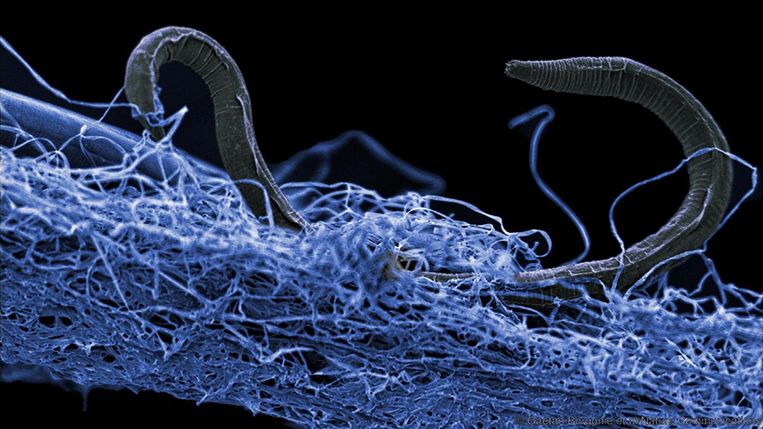
A nematode (eukaryote) in a biofilm of microorganisms. This unidentified nematode (Poikilolaimus sp.) from Kopanang gold mine in South Africa, lives 1.4 km below the surface.
Image courtesy of Gaetan Borgonie (Extreme Life Isyensya, Belgium).
Cells in this cluster of archaea (the ANME-2 cells, red) and bacteria (Desulfosarcina / Desulfococcus species, green) work together to harvest energy from methane at seafloor seeps. These organisms have very slow growth rates with a minimum doubling time of a few months, making them very difficult to cultivate and study in the lab.
Image courtesy Katrin Knittel (MPI Bremen)
Candidatus Desulforudis audaxviator (the purplish, blue rod-shaped cells straddling orange carbon spheres) is a species of bacteria that survives on hydrogen (H2) from radiolysis of water and sulfate derived from oxidation of pyrite by radolytically produced oxygen and hydrogen peroxide (H2O2), and fixes carbon dioxide (CO2) and nitrogen (N2). Scientists originally found Ca. Desulforudis living within a fluid and gas-filled fracture 2.8 km beneath Earth’s surface at Mponeng Gold Mine near Johannesburg, South Africa. Surprisingly, scientists found no other organisms in their samples, making this deep ecosystem the first found on Earth with only one species. The genus name Desulforudis comes from the Latin for "from sulfur" and "rod," noting its shape and its ability to get energy from sulfates. And audaxviator? From Jules Verne's Journey to the Center of the Earth, and a message in Latin deciphered by Verne's protagonist, Professor Lidenbrock, which read in part: "descend, bold traveler, and attain the center of the Earth."
Image courtesy of Greg Wanger (California Institute of Technology, USA) and Gordon Southam (The University of Queensland, Australia)
This is a species of Methanobacterium, which produces methane. Found in samples from a buried coal bed 2 km below the Pacific Ocean floor off the coast of Japan, this specimen was retrieved during an Integrated Ocean Drilling Program (now the International Ocean Discovery Program) expedition in 2012 aboard the Drilling Vessel Chikyu. Bar represents 10 µm.
Image courtesy of Hiroyuki Imachi (Japan Agency for Marine-Earth Science and Technology (JAMSTEC), Japan). Please note that a high-resolution version of this image is available by contacting images@jamstec.go.jp
These archaea, Altiarchaeales, were originally found living in sulfidic springs in Germany. Scientists collected water samples from a 30m-deep borehole, however the cells they analyzed could be living at much greater depths. Each cell is surrounded by a fuzzy coat of “hami,” hair-like appendages with “grappling hooks” at the end and barb-wire-like prickles along their length. These surface structures help the cells stick to surfaces.
Image courtesy of Christine Moissl-Eichinger (Medical University of Graz, Austria)
Cara Magnabosco and colleagues collect ancient water samples 1.3 km deep within the Beatrix Gold Mine, South Africa to investigate the diversity and abundance of deep microbes.
Image courtesy of Gaetan Borgonie (Extreme Life Isyensya, Belgium) and Barbara Sherwood Lollar (University of Toronto, Canada)
The Japanese scientific drilling vessel Chikyu has made it possible for scientists to access microbial life in the deep subsurface. The ship is designed to ultimately drill 7 km beneath the seabed in some of the planet’s most seismically-active regions. DCO researchers were onboard the vessel for an expedition to the Nankai Trough in 2016 to determine the temperature and pressure limits of microbial life at temps above 120°C.
Photo copyright JAMSTEC. Please note that a high-resolution version of this image is available by contacting images@jamstec.go.jp
The D/V Chikyu is one of the most advanced scientific drilling ships available today. Coring operations take place 24 hours a day.
Image courtesy of Luc Riolon/JAMSTEC
Scientists look for signs of life in cores like this one. The cores on International Ocean Discovery Program's (IODP) Expedition 337 were taken to depths down to 2.5 km below the seafloor, where temperature increases from 30°C to 60°C, spanning the predicted temperature limit for life on Earth.
Image courtesy of Luc Riolon/JAMSTEC
IODP Expedition 357 to the Atlantis Massif pioneered the use of seabed rockdrills, MeBo (left) and RockDrill2 (right), equipped with sensors capable of monitoring in-situ fluid conditions during drilling, and with the potential to "plug" a borehole. Such technology is enhancing scientists’ ability to understand conditions of the deep subsurface encountered by microbial life. Images courtesy of ECORD/IODP
Onderzoekers ontdekken reusachtig, mysterieus ecosysteem op kilometers onder onze voeten. Zit het meeste leven in de aarde?
Onderzoekers van het Deep Carbon Observatory (DCO) hebben ontdekt dat zich diep onder de aardkorst bijna dubbel zoveel levende organismen bevinden als in alle oceanen samen.
De wetenschappers boorden tot vijf kilometer diep en ontdekten dat 70 procent van alle bacteriën zich onder het oppervlak bevindt.
Volgens de onderzoekers is de diversiteit daar vergelijkbaar met die in de Amazone of op de Galapagoseilanden.
Miljoenen
“We hebben een volledig nieuw levensreservoir ontdekt,” zei Karen Lloyd van de Universiteit van Tennessee.
“We ontdekken constant nieuwe levenssoorten onder het aardoppervlak. Er zit meer leven in de aarde dan erop.”
Diep in de aarde leven letterlijk miljoenen onontdekte soorten.
Elke diepte
Zo werd op een diepte van 2,5 kilometer een organisme ontdekt dat daar al miljoenen jaren begraven ligt en volledig onafhankelijk is van energie van de zon.
In hydrothermale bronnen op de zeebodem zijn organismen gevonden die gedijen bij temperaturen van 121 graden Celsius, ver boven het kookpunt van water.
De onderzoekers proberen te achterhalen op welke diepte geen leven meer mogelijk is, maar op elke diepte vinden ze weer leven.
Andere planeten
Zelfs op vijf kilometer diepte onder continenten en 10,5 kilometer onder het wateroppervlak werd leven aangetroffen.
Dit betekent dat ook op andere planeten op grote diepte leven mogelijk is.
Mysterieus netwerk
Bij het Deep Carbon Observatory zijn meer dan 1000 wetenschappers uit 52 landen betrokken.
Al meer dan 10 jaar brengen ze de ‘diepe biosfeer’ van de aarde in kaart, een mysterieus netwerk van ondergrondse ecosystemen tussen het aardoppervlak en de kern.
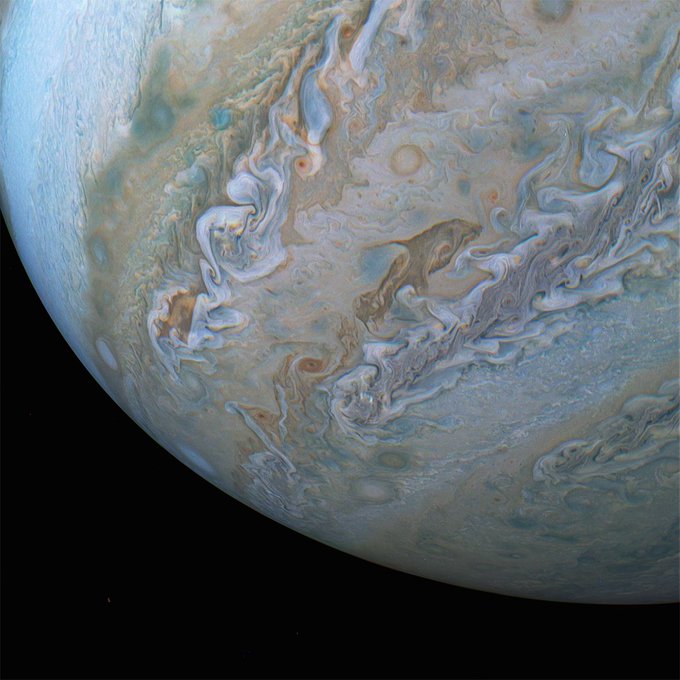
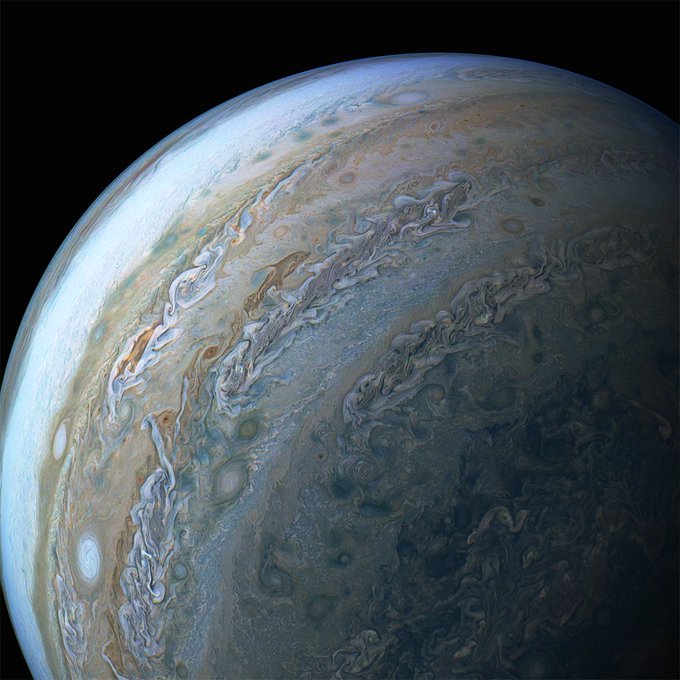
Images captured from the JunoCam imager seem to show a dolphin-shaped cloud swimming across Jupiter. While seeing an image of a dolphin-shaped cloud is like seeing the face of Jesus in your toast, the phenomenon that’s called pareidolia where we perceive images in random patterns, is really quite fascinating and fun to look at.
Juno spacecraft has been collecting data from our solar system’s largest planet since arriving there in July of 2016 and is expected stay operational until 2021.
On October 29, 2018, the Juno spacecraft made its sixteenth close flyby of the giant gas planet. Citizen-scientists Brian Swift and Seán Doran created the images by using the data collected from an instrument on the spacecraft called the JunoCam imager. According to NASA’s photo description, the series of images that captured the dolphin-shaped cloud swimming along the planet’s South South Temperate Belt appeared between 2:26 p.m. and 2:46 p.m. PDT and were taken from a distance of approximately 11,400 miles to 31,700 miles above Jupiter’s atmosphere.
Although NASA officially released the photo to the public on November 30th, Seán Doran beat them to it as he posted a photo of the oddly-shaped cloud on November 7th in a Twitter post. Since Juno arrived at Jupiter, Doran has been processing images with data collected from the spacecraft.
Another strange image captured two of Saturn’s moons in an odd position. Although it looks more like a snowman, the image was of Saturn’s moons called Dione and Rhea that was captured by the Cassini spacecraft that spent thirteen years orbiting the ringed planet before plunging into its atmosphere in September of 2017.
While the two moons look as though they were conjoined in the picture, Dione (which is the top moon in the picture) is in fact quite a bit smaller than Rhea. Dione has a diameter of 1,123 kilometers while Rhea has a diameter of 1,528 kilometers. Since Dione was closer to the spacecraft at the time that the picture was taken, they both appear nearly identical and as if they were touching or joined even though they are two separate moons. To elaborate, at the time that the picture was taken, Dione was approximately 1.1 million kilometers from Cassini, while Rhea was about 1.6 million kilometers away from the spacecraft.
Another reason why the moons looked conjoined is because Dione has a large crater called Evander that’s located in the center of the South Polar Region (where Rhea appears to connect with it) which makes the picture even more convincing that they were joined.
Something odd happened over Hull, England this week. Or, at least it sure appears like something odd happened. On the afternoon of Monday, November 10, residents in the Preston Road area of Hull in East Yorkshire spotted what appeared to be a strange-looking aircraft in the skies and took to social media to ask if anyone knew anything. The aircraft wasdescribedas having a “short body, no nose or tail and huge wings” and was reported to hover silently and still before zooming away at a high rate of speed. Sound familiar?
Why, yes. Yes it does.
It should, to anyone who’s ever read a single UFO sighting report. Of course, many modern unmanned aerial vehicles match that description and are capable of similar acrobatics. Whatever the airborne object was, it seems to have attracted the attention of the Royal Air Force in a big way. According to the UK Ministry of Defence, a “Quick Reaction Alert” (QRA) mission was carried out Monday afternoon by RAF Typhoon aircraft around the same time as the reported sighting. That’s where things get confusing, though; the MOD claims that the Typhoons were scrambled from RAF Lossiemouth in Scotland to intercept an “unidentified aircraft” that was not the same onethat was spotted over Hull. Seems like a pretty big coincidence.
An RAF Typhoon
Civilian air traffic logs show that a Cessna 680 Citation Sovereign flew over Hull around the same time as the reported sighting and the RAF intercept flights, but that aircraft doesn’t exactly match descriptions of what was seen in the skies of East Yorkshire. Meanwhile, the MOD released a press statement stating simply that the QRA over Hull was to intercept “an undisclosed airspace incursion” but released no further details.
The 680 Cessna Citation Sovereign
Interestingly, the MOD statement also says the QRA was the first mission in which RAF Typhoons have carried the new Meteor Air-to-Air missile, an anti-aircraft missile capable of flying at four times the speed of sound designed to counter new hypersonic weapons and aircraft. Was this merely a chest-thumping drill to demonstrate that the Meteor missiles are ready for action, or could this have been something stranger?
A UFO Caught On Video During Sunset Over City of Keller in Texas
Keller resident Angie McNatt Krackenberger was snapping photographs of a breathtaking scene of the sunset on J.T. Ottinger Road, located just south of Texas 114, near from her home, on the evening of November 19, 2018.
The photography enthusiast and teacher noticed something unusual while taking pictures of the sunset.
She saw through her lens clouds moving and eventually disappearing, but one simply remained.
She described the mysterious thing as glowing and much smaller than the other clouds.
She later realized that it stayed put and completely unchanged.
So, she zoomed in and found out that it was not a cloud at all, but could not identify it either. She took a few pictures and recorded some videos. She continued to observe the strange object for around 15 minutes.
When the sun already set, she got back in her car and tried to think an explanation of what she saw but could not think of anything.
She called her husband while on the drive home to tell him about what she had seen. Her husband suggested it could be a weather balloon, or perhaps a blimp.However, when she let him viewed the footage, he was also equally confused.
Disc-shaped UFO over Ehrenberg, Arizona 9-Dec-2018
This daytime UFO video of a solid flying saucer was filmed over Ehrenberg, AZ on 9th December 2018.
Witness report:
Driving back from Disneyland with the family on I-10 heading east stopped at Chevron near Ehrenberg AZ to get gas, made a wrong turn to get back on highway, wound up on dirt road close to the gas station and noticed a dark object hovering completely motionless just above the mountains in the Southern sky. I observed it for approximately 5 minutes, it had absolutely no motion whatsoever. I was able to videotape it and took one photo before the wife made me leave and get back on the road towards home.
It’s the 100th anniversary of the birth of the Soviet Union’s most famous (and most hated by its leaders ) novelist — Aleksandr Solzhenitsyn – who brought the word “gulag” into the vocabulary of the Western world. A century later, a certain Russian space scientist may be glad those forced labor camps no longer exist (or do they?) after going against the leader of Russia’s space program and saying that not only does he believe that the U.S. landed humans on the moon, faking such a landing would be harder than actually accomplishing it. Hear that,lunar-landing-denier Steph Curry?
“Falsifying moon soil is impossible. The Americans brought back to Earth about 300 kilos of it, most of it basalt.”
In a wide-ranging interview with the Russian news agency RIA Novosti, Yury Kostitsyn, the head of Russia’s Institute of Analytical Chemistry, went against recent statements of Roscosmos head Dmitry Rogozin, who “joked” that one purpose of Russia’s own future lunar missions will be to prove or disprove the 1969 Apollo 11 landing, give the country an opportunity to check whether Neil Armstrong’s footprints are actually out there.
“The question of whether the Americans landed on the moon in 1961-1972 is not controversial. However, there are still speculations on this topic in the world and mainly come from people who have nothing to do with space. You will not hear from any astronaut that the Americans have not landed on the moon.”
The “astronauts” Kostitsyn is referring to are Russian cosmonauts who know that the U.S. lunar space program was and still is far ahead of theirs. However, as a scientist, he looks for proof in the lunar rocks themselves, which he and other Russians were allowed to examine. He points out that although basalt came into existence on both the Earth and the moon at the same time, there are no old samples on Earth because of weathering. On the other hand, the samples from the moon are over 4 billion years old, far older than any rocks on Earth. In addition, they show a different form of weathering due to solar wind, which does not affect Earth rocks.
Then he goes after Dmitry Rogozin and Steph Curry.
“The Americans were very worried whether the USSR was going to arrange a trick on the moon – after all, at the same time as their mission, the USSR launched its probes on the moon. Of course, we did not have the task to harm them, it was – to get ahead. Staging the landing of American astronauts on the moon would be more difficult and more expensive than its actual implementation. Including because then this deception would have to be kept secret, which is not possible. NASA could classify its materials, but many independent firms participated in the implementation of Apollo.”
Even in the Soviet Union, with the threat of gulags and worse, it would be impossible to have so many different and independent parties keep such a massive hoax a secret for 50 years. Kostitsyn also points out that, while the U.S. seems to be focused on Mars, Russia is talking about establishing a base on the moon – a project that will require a better understanding of how much water is actually there and available.
“To build a base on the moon, you first need to establish life there and solve the problem of protecting people from space radiation. To do this, from the lunar substance to build shelters, and inside them to maintain the atmosphere. It is difficult to carry oxygen from Earth, therefore the water on the Moon is of primary interest – we need to understand how much water is there, how much water is available and how to get oxygen out of it.”
Oxygen and protection from radiation – two challenges Kostitsyn thinks are beyond the ability of Roscosmos and its goal of establishing a base in the 2030s.
“I think that humankind will not be able to fully live on the Moon soon. In the next decade, most likely, missions to the Moon will be resumed – both Russia, the USA and China have plans to launch orbiters there for the time being. Plans for the creation of manned moon descent modules remain at the level of theory.”
It’s discussions like this that remind us we need to listen more to scientists and less to NBA stars.
DeepMind is on the forefront of artificial intelligence (A.I.). The computer system it developed, known as AlphaZero, amazed (and terrified) the world in 2017 when it was able to defeat human chess masters at their own game, despite only learning it four hours previous to the matches. That machine has been tested numerous times by even more chess grandmasters, and now people are seeing it do something not yet seen within machines – it is improvising.
Not only was AlphaZero a master at chess, it has also taught itself games such as shogi, commonly called Japanese chess, and Go. In each attempt, AlphaZero was able to beat the previous world champions of the games, who were all human. On DeepMind’s website, developers say they are “thrilled” to see the program developing improvisation and intuition skills, which are not previously known to be in machines.
In a paper published in Science Magazine, it is stated the machine’s ability to master the complicated game of Go and defeat the world champion showed it had use of “deep convolutional neural networks” because it developed a massive knowledge of the game simply by playing it repeatedly to the point the writers of the paper said it has “superhuman performance” in the game.
Computers have been beating humans at chess since 1997, but the addition of shogi, which is far more complicated than chess, and Go, which relies on practice and intuition, shows AlphaZero is able to not only defeat humans at their own games, but ultimately learn how to do it in better and more efficient ways.
When pitted against another chess computer, Stockfish, AlphaZero won 155 of 1,000 matches, with six losses and the rest being draws. Unlike most chess-playing A.I.’s, however, AlphaZero does not prefer to save its pieces, instead opting to sacrifice them for the greater good.
This ability comes from what developers describe as a “neural network with millions of different tunable parameters, each learning its own rules of what is good in chess.” With all of these variables, the machine, much like a human, can look at a situation and know what the best thing to do is.
AlphaZero began with a blank slate mind, developing strategies and tactics based only on the basic rules of the games it plays. It developed its human-like ability to play games based on its experiences.
While many prominent thinkers such as Elon Musk have warned against A.I., citing the possibility such mechanical minds could ultimately lead to human extinction, DeepMind researchers believe studying the way this machine learns how to play games can lead to real issues, such as why proteins become misfolded in Parkinson’s and Alzheimer’s. That protein folding conundrum is ultimately the goal of A.I.’s such as AlphaZero built by DeepMind.
Did Supernovae Kill Off Megalodon and Other Large Ocean Animals at Dawn of Pleistocene?
About 2.6 million years ago, an oddly bright light arrived in the prehistoric sky and lingered there for weeks or months. It was a supernova some 150 light years away from Earth. Within a few hundred years, long after the strange light in the sky had dwindled, a tsunami of cosmic energy from that same shattering star explosion could have reached our planet and pummeled the atmosphere, touching off climate change and triggering mass extinctions of large ocean animals, including a shark species that was the size of a school bus.
“I’ve been doing research like this for about 15 years, and always in the past it’s been based on what we know generally about the universe — that these supernovae should have affected Earth at some time or another,” said lead author Adrian Melott, professor emeritus of physics & astronomy at the University of Kansas. “This time, it’s different. We have evidence of nearby events at a specific time. We know about how far away they were, so we can actually compute how that would have affected the Earth and compare it to what we know about what happened at that time — it’s much more specific.”
Muons showering Earth may have spelled curtains for Megalodon, a school-bus-sized shark, 2.6 million years ago.
Credit: Wikimedia Commons.
“As far back as the mid-1990s, people said, ‘Hey, look for iron-60. It’s a telltale because there’s no other way for it to get to Earth but from a supernova.’ Because iron-60 is radioactive, if it was formed with the Earth it would be long gone by now. So, it had to have been rained down on us. There’s some debate about whether there was only one supernova really nearby or a whole chain of them. I kind of favor a combo of the two — a big chain with one that was unusually powerful and close. If you look at iron-60 residue, there’s a huge spike 2.6 million years ago, but there’s excess scattered clear back 10 million years.”
Melott’s co-authors were Franciole Marinho of Universidade Federal de São Carlos in Brazil and Laura Paulucci of Universidade Federal do ABC, also in Brazil.
According to the team, other evidence for a series of supernovae is found in the very architecture of the local universe.
“We have the Local Bubble in the interstellar medium,” Melott said. “We’re right on its edge. It’s a giant region about 300 light years long. It’s basically very hot, very low-density gas — nearly all the gas clouds have been swept out of it. The best way to manufacture a bubble like that is a whole bunch of supernovae blows it bigger and bigger, and that seems to fit well with idea of a chain. When we do calculations, they’re based on the idea that one supernova that goes off, and its energy sweeps by Earth, and it’s over. But with the Local Bubble, the cosmic rays kind of bounce off the sides, and the cosmic-ray bath would last 10,000 to 100,000 years. This way, you could imagine a whole series of these things feeding more and more cosmic rays into the Local Bubble and giving us cosmic rays for millions of years.”
Whether or not there was one supernova or a series of them, the supernova energy that spread layers of iron-60 all over the world also caused penetrating particles called muons to shower Earth, causing cancers and mutations — especially to larger animals.
“The best description of a muon would be a very heavy electron — but a muon is a couple hundred times more massive than an electron,” Melott said. “They’re very penetrating. Even normally, there are lots of them passing through us. Nearly all of them pass through harmlessly, yet about one-fifth of our radiation dose comes by muons. But when this wave of cosmic rays hits, multiply those muons by a few hundred. Only a small faction of them will interact in any way, but when the number is so large and their energy so high, you get increased mutations and cancer — these would be the main biological effects. We estimated the cancer rate would go up about 50 percent for something the size of a human — and the bigger you are, the worse it is. For an elephant or a whale, the radiation dose goes way up.”
Adrian Melott
Credit: University of Kansas
A supernova 2.6 million years ago may be related to a marine megafaunal extinction at the Pliocene-Pleistocene boundary where 36 percent of the genera were estimated to become extinct. The extinction was concentrated in coastal waters, where larger organisms would catch a greater radiation dose from the muons.
According to the authors of the new paper, damage from muons would extend down hundreds of yards into ocean waters, becoming less severe at greater depths: “High energy muons can reach deeper in the oceans being the more relevant agent of biological damage as depth increases,” they write.
Indeed, a famously large and fierce marine animal inhabiting shallower waters may have been doomed by the supernova radiation.“One of the extinctions that happened 2.6 million years ago was Megalodon,” Melott said. “Imagine the Great White Shark in ‘Jaws,’ which was enormous — and that’s Megalodon, but it was about the size of a school bus. They just disappeared about that time. So, we can speculate it might have something to do with the muons. Basically, the bigger the creature is the bigger the increase in radiation would have been.”
The KU researcher said the evidence of a supernova, or series of them, is “another puzzle piece” to clarify the possible reasons for the Pliocene-Pleistocene boundary extinction.
“There really hasn’t been any good explanation for the marine megafaunal extinction,” Melott said. “This could be one. It’s this paradigm change — we know something happened and when it happened, so for the first time we can really dig in and look for things in a definite way. We now can get really definite about what the effects of radiation would be in a way that wasn’t possible before.”
Contacts and sources:
Brendan M. Lynch
University of Kansas
Citation: Hypothesis: Muon Radiation Dose and Marine Megafaunal Extinction at the End-Pliocene Supernova Adrian L. Melott, Franciole Marinho, Laura Paulucci.. Astrobiology, 2018; DOI: 10.1089/ast.2018.1902
RH Negative: Aliens Genetically Created Us: Overwhelming Evidence (Video)
If you want to rouse passionate opinions – just discuss the origin of the human race. Fervent believers argue the literal, biblical perspective… that we were created in an instant by a Creator … while scientists claim we are the result of pure evolution – and there are many theories inside that. As it turns out, more and more evidence is showing the likelihood that both theories actually hold some truth, …that the human race is, by all means, an evolving species, but also, that there are a multitude of reasons to believe that a more intelligent life form played a role in developing our DNA.
As we unravel more mysteries from our past, more and more physicists, historians, geneticists, and anthropologists are pushing the boundaries of accepted theories by mentioning the “A” word – yes – the dreaded “alien” – and the overwhelming evidence that something played a role in our evolution. So if you’re among those people still laughing off this possibility – because you’ve never seen one – we’d like to bring you up to speed with some of the remarkable discoveries being discussed in the scientific community, ones that prove our genetic makeup has to be more than just a random hand of cards.
In this video, I will show you how NASA is able to cover up life on Mars and make it all look like natural landscape, by adding the fake yellowish color tint and fake sand.
When they add this effect, it makes everything blend in as part of the environment, so that nothing out of the ordinary stands out.
To me it seems like there is a massive amount of live beings gathered around close to where the Rover is, looking at this image closely, what i’m seeing is beings of various sizes and maybe some kind of alien plant life?
Let me know what your thoughts are on this Mars Anomaly in the comment section below!
Thanks for Watching! - Like & Share & Subscribe if you Like this video! If you dislike, please comment suggestions for improvement
Throughout 2017 and 2018 a series of mysterious animal attacks have left many rural Indian shepherds and farmers rattled. Whole flocks of sheep have been left eviscerated with onlytheir livers missingor their blood seeminglysucked right outof their woolly little bodies. Things then took a turn for the worse and the weird earlier this year when the culprit – whatever it is – was reported toattack a dozen villagersin eastern India in their sleep.
Some of the creature’s unfortunate victims.
The attacks continued late into 2018 with the vicious slaughterof over 40 ducks in late November. Despite the frequency of the attacks and the fact that over 150 animals were slaughtered, the identity of the creature behind the killings remained unknown. In response to these unexplained livestock mutilations, the State Government of Manipur launched an investigation earlier this year, calling in scientists from the Wildlife Institute of India were to install remote cameras and gather evidence in an attempt to identify whatever may be behind these recent attacks. According to local news reports, those scientists have finally identified what was behind the killings: dogs. Wait, dogs? Plain old dogs ate the livers of whole flocks of sheep and drained the blood from pigs?
“I need the iron for my anemia.”
Manipur Forest and Environment Minister Thounaojam Shyamkumar told reporters this week that the “Wildlife Institute of India (WII), who have been conducting the probe on the string of attacks on livestock have collected enough evidence to conclude that the attacks were carried out by stray dogs. We will take all possible measures to control this menace. These dogs prowling in the streets and villages could turn to man if they get infected with rabies.”
Scientists concluded that “poor and unhygienic husbandry practice and open garbage” contributed to the dogs’ attacks. While I don’t doubt that packs of feral dogs pose problems in rural places where livestock are commonplace, I’m dubious of any explanations presented without evidence. Where are the photographs of these dogs? Casts of their footprints? Not even a single liver-filled scat sample?
Dog works in mysterious ways.
While I’m sure this explanation is sure to calm the nerves of some of the shepherds affected by the string of attacks, it seems too tidy. Until I see a sad, mangy mutt caked in blood and sheep liver in a wire crate at a press conference, I’m still going with an Indian cousin of the chupacabra.
Black Triangle moving at low altitude in Cape May, New Jersey
This sighting is from August 2016 but submitted to Mufon on December 5, 2018. The footage is interesting because it clearly shows a TR-3B moving at low altitude over Cape May, New Jersey.
The witness said: My adult daughter was jogging on the beach and noticed some weird things going on with regard to that storm, and phoned me. my wife and i stepped out on the balcony of our vacation rental unit and checked out the night sky and caught on my cell phone video camera something that appeared to be 3 lights in a triangular formation, with a single flying light not far behind it
I found some interesting structures in this Mars surface photo. Most of the big structures were deliberately blurred out, however there were still a few that were clearly visible. These structures are not new, but very old...ancient ruins. The photo is a planned route of the Mars Curiosity rover and the route takes it through two areas that are littered with structures. Its no wonder why NASA says the rover has not responded to NASA signals or has problems...its because the rover is on a black opps mission to explore some of these ancient ruins and get some photos of the tech and ruins...close ups that the public will never see, until today.
For the first time in history, scientists have detected the first interstellar object ever observed.
In October 2017, an elongated interstellar object named "Oumuamua" — the first to enter the solar system — was detected by a survey telescope in Hawaii.A new study published this week in the Astronomical Journal, coauthored by scientists at NASA's Jet Propulsion Laboratory, uncovered new information that suggested there was a limit to how big Oumuamua actually is, and gave astronomers a better indication of its size.
Scientists have been looking for signs of extraterrestrial life for decades. So does the appearance of Oumuamua mean the elusive "E.T" has finally been detected? Perhaps: Experts say it is exceedingly unlikely, but the possibility can't be ruled out just yet.
"I personally think the odds are much better that is something natural, but I don't want to dismiss the possibility that it could be from an alien civilization. But we have to have an open mind," Michael Wall, a writer at Space.com and a biologist, told CNBC recently.
Scientists believe Oumuamua is shaped like a cigar, approximately 400 feet long and 40 feet wide. However, they are only able to guess based on its changing brightness as it spins.
But scientists' biggest unanswered question is the object's thickness. As far as the scientific community is aware, there is no naturally occurring object that is as big as Oumuamua that appears so thin at the same time, increasing the likelihood that it was created by another life form.
Given the speed the object is moving, experts believe that it may be a light sail — an object that is thin enough to be pushed by the sun or another star, almost like a plastic bag in the wind, according to Matija Cuk, a research scientist at the Search for Extraterrestrial Intelligence (SETI) Institute.
Seth Shostak, a SETI research fellow, told CNBC that for that to be true, Oumuamua would have to be about a millimeter thick—about as thick as 5-10 sheets of paper stacked together.
According to Wall, scientists originally hypothesized that Oumuamua was a comet or an asteroid. However, both theories were ruled out: Unlike comets studied here on earth, this object does not have a tail, nor jets of gas that a comet would normally emit.
If Oumuamua is not a comet or an asteroid, chances of it being a light sail increase. According to SETI's Cuk, it is possible that outside our solar system, composition of space objects are different.
"Maybe in other solar systems comets could be made differently," Cuk said. That suggests the object could be naturally occurring, despite the fact that nothing like it has ever been seen anywhere near earth before.
Shostak said there are likely many objects similar to Oumuamua in the depths of space. This time, the object "hit the bullseye" by reaching the earth's solar system.
"This implies a number of these things are drifting through the cosmos, as ubiquitous as fire hydrants," Shostak said.
These objects have also likely reached our solar system in the past and gone unnoticed. Scientists are building another telescope similar to the one in Hawaii that detected Oumuamua. Once it is completed in Chile, it will be used to search for similar objects.
"Unless a miracle has occurred, these are entering our solar system all the time. This is just the first one we've found," Shostak said. He acknowledged the alien hypothesis was plausible, adding that Oumuamua acted more like a rock than a spaceship.
"If they really wanted to target our solar system, they'd hang around longer and probably come closer to the earth," he said.
Scientists also would have been able to detect any sort of signal the object had if it were as advanced as a cell phone, Shostak said. That does not prove anything, but decreases the likelihood that it was deliberately sent.
Oumuamua is now drifting further away from our solar system. The longer the distance, the harder it will be for earthlings to study it. Yet as technology increases, scientists may discover more objects similar to Oumuamua, perhaps in the next three to ten years.
"If we don't keep finding them, this will be increasingly peculiar," Shostak said.
Correction: Oumuamua was first discovered in October 2017.
Early in its mission, the Opportunity rover spotted round, iron-rich concretions nicknamed "blueberries," which constituted one of several different types of evidence suggesting that Mars used to be wet. This (false-color) photo captures an area just 1.2 inches (3 centimeters) across.
Credit: NASA/JPL-Caltech/Cornell/USGS
It was just a few months after NASA's Opportunity rover touched down on Mars in 2004 that it spotted a geological curiosity: tiny, iron-rich spheres scattered across the rock surface near the robot's landing site. Snack-loving scientists working with the mission dubbed these objects "blueberries," but the features were easier to name than to understand. Their recipe remains something of a puzzle.
Trying to sort out the origins of these blueberries has always involved studying similar-looking spherical formations here on Earth. New research takes its inspiration from these terrestrial analogs to offer a new idea of the chemistry that may have gone into whipping up these Martian blueberries. In turn, this research helps reveal what ancient Mars may have looked like.
The blueberries are tantalizing for more than just their whimsical name; they also constituted some of the earliest evidence we had that Mars was once incredibly wet. "No matter what the exact chemistry of these spherules was to start, the fact that they're there tells us [that] a lot of liquid water moved through these rocks over time," Briony Horgan, a planetary scientist at Purdue University in Indiana, told Space.com. [10 Amazing Mars Discoveries by Rovers Spirit & Opportunity]
And if scientists can parse out precisely how the blueberries formed, that may help us understand what Mars was like back when the features formed — and what sort of life could have theoretically thrived in those circumstances, Horgan said.
So, the team behind the new research traveled to two different terrestrial destinations in search of rock formations that resemble Martian blueberries: Utah and Mongolia. These formations aren't identical to those on Mars, which are about a tenth the size of the Earthly equivalents. Our planet's formations are also less orderly than the Martian versions. "They're all blobbed together. They're different sizes," Horgan said of the terrestrial features.
But it's much easier to get to Utah and Mongolia than to Mars, so scientists use these features despite the imperfect comparison. The researchers found that the formations seemed to have been built around cores of a mineral called calcite, with iron-rich material in only the outer shell. "That moment [of discovery], it was very exciting," geochemist co-authors Hidekazu Yoshida of Nagoya University and Hitoshi Hasegawa of Kochi University in Japan, wrote in an email to Space.com.
Based on those observations in the field and chemical modeling, the scientists suggested that floods of iron-rich, gently acidic water washed over the original calcite structures. Unlike the terrestrial versions, Martian blueberries seem to be made of hematite all the way through, no longer sporting any calcite heart. But that could point to a long period of overwash that ate through all the calcite, the researchers said.
The nagging details of chemical reactions that may or may not have taken place on early Mars have larger implications. First, these details are relevant to scientists' natural interest in all that water that flowed through rocks to form the blueberries. "The chemistry of water tells us about the habitability of the environment," Horgan said.
The second potential implication would relate to another long-standing debate about Mars — what happened to its once-thick atmosphere. The authors in the new study argued that this atmosphere could have gone into the carbonate ions locked in calcite precursors to the blueberries.
But that wouldn't solve the atmospheric mystery, Steve Ruff, a planetary geologist at Arizona State University who works on the Opportunity mission, told Space.com. "My sense of what we know about the area of the hematite that we can map from orbit is it's not a huge area," covering less than 1 percent of Mars' surface, he said. There just aren't enough blueberries to pack away very much atmosphere. [Latest Mars Rover Photos from Opportunity & Spirit]
He said he also worries that Earth's formations aren't similar enough to those on Mars for scientists to learn about the blueberries. But Ruff didn't dismiss the new paper. "I'm intrigued by this idea," he said. "The formation of these little concretions on Earth and certainly on Mars has always been a bit of a mystery, and there's multiple ideas about how you form these things."
The Martian blueberries are small enough that in order to truly solve their mystery, scientists will need more-sophisticated tools than are currently on the Red Planet. NASA's next rover, the Mars 2020 rover, will carry instruments with high enough resolution that they could tackle these questions. But that rover is slated to visit a place called Jezero Crater, far away from the plain where Opportunity spotted the blueberries.
"Going back to places on Mars with NASA is not something people want to do. They want to go to new places," Ruff said. Nevertheless, he said he isn't giving up hope that the new rover could solve the blueberry mystery. "Maybe we'll get lucky and see something like this with the 2020 rover."
Whatever the nuances of blueberry chemistry turn out to be, the new paper is a reminder of the vast time scales — and the potential complexity such time scales entail — involved in Martian geology, Horgan said. "Time can play a really important role in the minerals that we see," Horgan said. "We should be careful. There could have been multiple things that happened to these rocks."
The research is described in a paper published today (Dec. 5) in the journal Science Advances.
Alien contacts: will it be an invasion or just a courtesy visit?
Written by Gianni Rizzo
So far, science has ignored any hypothesis of contact with alien civilizations, but the number of those who claim to have seen a UFO or of being in direct contact with extraterrestrials shows no decline.
This despite being long past the clamor of the nineties when the world was in the grip of an “x-file mania” which may have induced suggestive phenomena capable of distorting statistics.
ALIEN CONTACTS, TWO OPPOSITE HYPOTHESES
That said, any large-scale contact with alien beings continues to be imagined as two diametrically opposite situations: a courtesy visit or a real invasion.
On the one hand it has been repeatedly noted that UFOs appear more often in some critical moments or natural disasters, such as volcanic eruptions or earthquakes. So some researchers believe that the aliens have helped us fight the whims of nature and overcome the most difficult moments throughout our history.
ALIENS WOULD TRY TO IMPROVE HUMANITY
Some historians, fascinated by the UFO theme, have suggested that the ultimate goal of aliens is to bring goodness, harmony and peace to planet Earth as human nature is imperfect. We lie to one another, we kill, we pollute the environment, we break down the forests, we run out of natural resources, while the aliens, as representatives of a much more developed race, would like to help us, as if we were their younger brothers. They would induce us, kindly, to improve, to love each other more.
A large-scale alien contact in such a scenario would not be an invasion, but simply a visit by friends we do not know, but who know us very well. The opinion is shared by those ufologists who believe that the aliens, no matter if Nordic aliens, Grey aliens or Reptilian aliens, have been visiting the planet Earth for some time having been observed by the ancient Maya as well as by ancient Egyptians.
NOT EVERYONE AGREES WITH A BENEVOLENT HYPOTHESIS
If they wanted to, it's logical deduction, the aliens could have conquered the Earth a long time ago. However, not all scientists share this rosy point of view and some like Stephen Hawking suggested to be cautious.
After all, every year thousands of people seem to disappear without leaving a trace all over the world and the few who return speak of barbarous experiments to which victims of alien abductions would have been subjected. Abductions whose numbers would be growing, exceeding those that have occurred in the last 20 years before or even before.
THE NUMBER OF ALIEN ABDUCTIONS IS GROWING
All this would happen secretly, so most of humanity knows nothing about such abductions or does not believe that they really happened. Meanwhile, the aliens, given their level of technology and the apparent ability to exercise mental control over people, could easily manage the whole thing openly, without paying attention to what's happening.
The spread of panic among the terrestrials would depend only on them, but in the end the aliens would rather act in secret, hiding among us. Why? Perhaps because in the universe there are forces, extraterrestrial civilizations, that oppose this way of proceeding and have not yet lost the hope of putting the terrestrials on the right path.
However, if it is true that the number of abductions is growing more and more, ours “supporters” would be getting tired, or maybe they would lose their confidence in our desire to improve. Also for this reason the last alien contacts would have had as their aim more and more unscrupulous experiments, perhaps even genetic ones.
THE ROBERT DEAN REVELATIONS
According to some stories of these years, human women would be fertilized on board UFO and then give birth to children who would soon be kidnapped by the aliens, Nordic, Gray or Reptilian who are. These children could play a special role during a possible future alien invasion.
They seem only speculations, yet according to the former US Army officer Robert Orel Dean (dead October 11, 2018), there would exist a top secret document to which Dean had access and with which almost all the leaders of the world powers are familiar, which would demonstrate the veracity of these “hypotheses”.
EARTH LEADERS HAVE KNOWN THE TRUTH SINCE THE 1960S
According to this document, planet Earth has long been the object of intense and massive observation by various alien civilizations, equipped with technologies more advanced than our thousands of years. The sequence of observations and the fact that they are conducted for many centuries would demonstrate the existence of a specific plan or program.
The military intelligence services would have signaled the absence of an immediate threat from alien civilizations. However, some facts indicate a potential for intervention in the affairs of the main world governments.
Copies of the document, Dean said, were sent to all the heads of NATO member states in the mid-1960s and since then the secret would be kept waiting to see if one day the aliens were to visit us in droves, amicably or not.
A well-known Russian expert, Ernst Rifgatovich Muldashev, ophthalmic surgeon by profession and researcher by passion, has long been looking for traces of ancient civilizations disappeared before the rise of mankind on Earth.
Muldshev, who in 2002 published three volumes of “In Search of Cities of the Gods”, followed by numerous other volumes (among which “Where do we come from” e “Between the arms of Dracula”), believes that the existence of more ancient civilizations of man is confirmed by archaeological finds, rock carvings, references to airplanes and Ufos in stories and legends. According to the expert, the civilizations that inhabited the planet would have been four.
1.ASURAS, THE NATIVES
The Asuras, or the natives, according to Muldashev were the first race appeared on Earth 10 million years ago. They were incredibly tall beings, up to 50 meters, they had an etheric body, they lived for up to ten thousand years and used telepathy to communicate with each other. In reality they were not natives of the Earth: they moved there after the death of the Phaethon planet.
2. ATLANTEANS, THOSE BORN AFTER
As the millennia passed, the Asuras changed, their bodies became denser. Thus a new race would develop, the Atlanteans, i.e. “those born after”. They were slightly smaller than the Asuras, they still did not have bones, but they had a third eye, located between the eyebrows.
3.LEMURIANS, THE BUILDERS OF THE SPHINX
After the Atlanteans, appeared on Earth the Lemurians. Much more similar to modern humans, they possessed a bone skeleton and were differentiated according to sex. The third eye was still present, but not as well developed as the Atlanteans.
Lemurians were about 7-8 meters tall and lived about a thousand years. According to Muldashev, they were the ones who built the Sphinx, Stonehenge and many other wonderful monuments of antiquity.
4. BOREI, THE MOST SIMILAR TO MAN
Lastly the Borei would have appeared: this race was formed long after the other, its members were much lower, did not exceed 3-4 meters in height, their third eye was more hidden while the other organs were very similar to those of man. What happened to all these beings?
According to Muldashev, about 25-30 thousand years ago on our planet occurred a nuclear catastrophe following a conflict between Lemurians and Borei. Some of the Lemurians took refuge in the caves, where they fell into a hibernating state, the other side flew away on space ships.
5. ARYANS, AFTER THE FALL OF ATLANTIS
After the Lemurians left the scene, the Boers and the Atlanteans reached unprecedented development peaks, but they could not avoid the disappearance of their civilizations that would have happened about 12 thousand years ago.
According to Muldashev a fifth race would have developed just before the disappearance of Atlantis, whose myth survived so far: the "aryan" race. The ancestors of modern man did not have a third eye and that's why our society would be developing more slowly.
Will it be true, or as official science says it's just about fantastic theories without any concrete proof? The experts have spoken, but this does not interest the readers of Muldashev.
The boulder-strewn asteroid Bennu, shown here in a mosaic of images taken by the OSIRIS-REx spacecraft on December 2, is full of water-rich minerals.
As the asteroid Bennucomes into sharper focus, planetary scientists are seeing signs of water locked up in the asteroid’s rocks, NASA team members announced December 10.
“It’s one of the things we were hoping to find,” team member Amy Simon of NASA’s Goddard Space Flight Center in Greenbelt, Md., said in a news conference at the American Geophysical Union meeting in Washington, D.C. “This is evidence of liquid water in Bennu’s past. This is really big news.”
NASA’s OSIRIS-REx spacecraft just arrived at Bennu on December 3 (SN Online: 12/3/18). Over the next year, the team will search for the perfect spot on the asteroid to grab a handful of dust and return it to Earth. “Very early in the mission, we’ve found out Bennu is going to provide the type of material we want to return,” said principal investigator Dante Lauretta of the University of Arizona in Tucson. “It definitely looks like we’ve gone to the right place.”
OSIRIS-REx’s onboard spectrometers measure the chemical signatures of various minerals based on the wavelengths of light they emit and absorb. The instruments were able to see signs of hydrated mineralson Bennu’s surface about a month before the spacecraft arrived at the asteroid, and the signal has remained strong all over the asteroid’s surface as the spacecraft approached, Simon said. Those minerals can form only in the presence of liquid water, and suggest that Bennu had a hydrothermal system in its past.
Bennu’s surface is also covered in more boulders and craters than the team had expected based on observations of the asteroid taken from Earth. Remote observations led the team to expect a few large boulders, about 10 meters wide. Instead they see hundreds, some of them up to 50 meters wide.
“It’s a little more rugged of an environment,” Lauretta said. But that rough surface can reveal details of Bennu’s internal structure and history.
If Bennu were one solid mass, for instance, a major impact could crack or shatter its entire surface. The fact that it has large craters means it has survived impacts intact. It may be more of a rubble pile loosely held together by its own gravity.
Telling scars
Crater pockmarks on Bennu, like this 20-meter-wide depression photographed on December 2, may turn out to be the safest places for the spacecraft to pick up a sample of the asteroid. Craters also tell scientists that the asteroid is not one solid mass but instead different materials clumped together. If Bennu had been a solid rock, large impacts could crack or shatter its surface.
UNIV. OF ARIZ./GODDARD/NASA
The asteroid’s density supports the rubble pile idea. OSIRIS-REx’s first estimate of Bennu’s density shows it is about 1,200 kilograms per cubic meter, Lauretta said. The average rock is about 3,000 kilograms per cubic meter. The hydrated minerals go some way towards lowering the asteroid’s density, since water is less dense than rock. But up to 40 percent of the asteroid may be full of caves and voids as well, Lauretta said.
Some of the rocks on the surface appear to be fractured in a spindly pattern. “If you drop a dinner plate on the ground, you get a spider web of fractures,” says team member Kevin Walsh of the Southwest Research Institute in Boulder, Colo. “We’re seeing this in some boulders.”
The boulders may have cracked in response to the drastic change in temperatures they experience as the asteroid spins. Studying those fracture patterns in more detail will reveal the properties of the rocks.
The OSIRIS-REx team also needs to know how many boulders of various sizes are strewn across the asteroid’s surface. Any rock larger than about 20 centimeters across would pose a hazard to the spacecraft’s sampling arm, says Keara Burke of the University of Arizona. Burke, an undergraduate engineering student, is heading up a boulder mapping project.
Cracked surface
Some of the rocks strewn across Bennu, like this 35-meter-wide boulder photographed on December 2, are fractured in a spindly pattern. The fractures may be the result of sudden, drastic temperature change. Studying the fracture patterns could help scientists learn more about the properties of the rocks.
UNIV. OF ARIZ./GODDARD/NASA
“My primary goal is safety,” she says. “If it looks like a boulder to me, within reasonable guidelines, then I mark it as a boulder. We can’t sample anything if we’re going to crash.”
The team also needs to know where the smallest grains of rock and dust are, as OSIRIS-REx’s sampling arm can pick up grains only about 2 centimeters across. One way to find the small rocks is to measure how well the asteroid’s surface retains heat. Bigger rocks are slower to heat up and slower to cool down, so they’ll radiate heat out into space even on the asteroid’s night side. Smaller grains of dust heat up and cool down much more quickly.
“It’s exactly like a beach,” Walsh says. “During the day it’s scalding hot, but then it’s instantly cold when the sun sets.”
Measurements of the asteroid’s heat storage so far suggest that there are regions with grains as small as 1 or 2 centimeters across, Lauretta said, though it is still too early to be certain.
“I am confident that we’ll find some fine-grained regions,” Lauretta said. Some may be located inside craters. The challenge will be finding an area wide enough that the spacecraft’s navigation system can steer to it accurately.
Editor's note: This story was updated December 11, 2018, to correct the description of Bennu's density. It's measured in cubic meters, not cubic centimeters.
This may be an anti climax to the title to some, but it’s ufo none the less. To save you time, it’s in the last 40 seconds of the video
for a moment I thought it may be a snow covered mountain top but the white is crossing the sea. So the object is floating or flying above the clouds doesnt look like a plane to me? So must be a alien space ship
Scientist Finds 'Evidence' of Another Universe Before This One
in a study published back in august .......a team of theoretical physicists claimed to have discovered the remnants of previous universes hidden within the leftover radiation from the big bang.........
Before our universe, Another Universe existed, and another one will emerge after this universe ends
“The next universe will be just like ours — but only in overall appearance, not in detail, of course…” A researcher may just have discovered conclusive evidence that another universe existed before this one. Not only that, he claims that our universe is just the latest in an infinite series of universes. Professor Sir Roger Penrose argues that …
Starchild Skull: New DNA Tests Show 56 Differences To Humans
In an interview with Coast To Coast, scientist Lloyd Pye shared news about the 900-year-old skull found in the 1930s.
Even though the skull is called "Starchild Skull", he thinks the skull belongs to an adult. Recent DNA tests show 56 differences between the skull and human DNA.
For the second time ever, a man-made object has reached interstellar space. The "Voyager 2" probe is now about 18 billion kilometers away from Earth.
In 1977 the probe "Voyager 2" left Earth and now - 41 years later - also the direct influence of our Sun. Nasa has just reported this. It was said to be the second man-made object that had ever ventured into this area.
The first was the Voyager 1 probe. It was the first man-made object to reach this region in 2012.
NASA is still able to communicate with the probe. However, it takes more than 16 hours at the speed of light for the messages to arrive on Earth. For comparison: The distance from the sun to the earth can be covered in about eight minutes at the speed of light.
Congratulations NASA. I hope countries spend less on military and more on space missions.
"Planet X": Astronomers are about to locate the mysterious celestial body
Planetologists have obtained detailed photos of the areas in space in which, from a hypothetical point of view, the mysterious ninth rogue planet of the solar system is located.
According to US astronomer Michael Brown, the photographs will help to discover the giant planet.
"We were able to spend seven full observation days. If there is 'planet X' out there, it will in the data collected. It covers 85 percent of the area in space where the planet is supposed to be," the researcher said.
At the beginning of January 2016, Michael Brown and his colleague Konstantin Batygin announced that they had calculated the state of a mysterious 'planet X' - the ninth planet of the solar system.
This planet is said to be 41 billion kilometers away from the Sun and has a mass about ten times greater than that of the Earth.
Scientists estimate that Planet X orbits the Sun within 15000 years
The exact location of the planet has not yet been determined, but it is known that the orbit of the celestial body is inclined by 30 degrees to the plane of rotation of the other planets.
Brown and Batygin have not yet achieved any significant success in their search for "Planet X" and have only been able to pinpoint the search area. As Brown claims, however, he is 80 percent sure that the planet can be found soon.
Fox News published astartling articleMonday (Dec. 3) with the headline "NASA scientist says Earth may have been visited by aliens." Unsurprisingly, that news rocketed around the web, with similar articles soon turning up in the New York Post, Russia Today and The Daily Wire. (Fox appears to have been the first major U.S. news source to run with the story.)
These articles are based on a document on NASA's website by Silvano Colombano, a researcher at NASA's Ames Research Center in Mountain View, California. It really does argue that scientists should at least take seriously the notion that aliens may have visited planet Earth. But Colombano told Live Science that the coverage on Fox News and elsewhere misrepresented what he was trying to say when he wrote it.
"It is not accurately represented," he said. "My perspective was simply that reports of unidentified aerial phenomena should be the object of serious study, even if the chance of identification of some alien technology is very small." [13 Ways to Hunt Intelligent Aliens]
There's some nuance here. Colombano really does believe, as Fox News wrote, that aliens "may" have visited planet Earth. As in, it's theoretically possible that this has happened, not entirely impossible, and worth looking for evidence that it has. But that's not the same as expecting to actually find any such evidence, or believing that there's a good chance aliens are scuttling around under our noses — an impression you might get if you read Fox News's article.
Though Colombano's name and email address appear right on top of the document, he said Fox News did not contact him before publishing their story. (Live Science has reached out to Fox News to confirm this, but has not yet heard back.) Fox described the document as a "new research paper" — a term usually used to describe formal articles intended for publication in research journals and making conclusions based on evidence and the scientific method.
But that's not what this document is.
"The context was a presentation delivered last spring at a meeting of the SETI (Search for Extraterrestrial Intelligence) Institute," he said.
"The meeting was to get feedback from scientists as to future directions for the Institute's research program," Colombano said.
The document accompanied a talk he gave in which he suggested that perhaps the notion of aliens visiting Earth isn't quite as ridiculous as most scientists believe, and that SETI might devote some resources to systematically hunting through UFO reports and other data for evidence that this has happened — to hunt for a faint, unlikely signal in a lot of messy noise.
In other words, it was a speculative piece of writing intended to persuade other scientists to spend their resources on a long-shot project — not an argument about whether or not aliens have actually visited Earth. Colombano's position is that it's possible, but not necessarily likely.
The event brought together bioprinting experts to discuss the possibility of using 3D bioprinting and regenerative medicine for medical treatment of astronauts on extraterrestrial missions.
Tommaso Ghidini, ESA’s Head of the Structures, Mechanisms and Materials Division, said, “For the first time in Europe, all the relevant experts have come together to discuss applying 3D bioprinting and regenerative medicine for space.”
Participants at the ESA 3D bioprinting workshop. Image via ESA–G. Porter
HUMEX
ESA’s latest project 3D Printing of Living Tissue for Space Exploration will be conducted under OHB System, a German space and industrial technology company, who has worked with ESA before. Dresden University of Technology will also collaborate on the project. The project will be funded under ESA basic activities, which includes technological research and studies on future projects.
HUMEX study focuses on the health-related issues including survivability and adaptation of astronauts undertaking long-duration mission beyond the Low Earth Orbit (LEO). The LEO is defined as an Earth-center orbit with altitudes between 160 to 2,000 km. Most of the man-made objects such as satellites are in the LEO.
The study reports the effects of cosmic radiation, reduced gravity on Mars and Moon, gravity changes during launch, and related psychological health issues. The findings of HUMEX are a guide for ESA researchers taking part in future projects related to interplanetary travel and habitat.
HUMEX, a Study on the Survivability and Adaptation of Humans to Long-Duration Exploratory Missions. Image via ESTEC
The latest ESA project intends to advance 3D bioprinting to the level where it becomes possible to 3D print skin, bones and organs.
However, the issues highlighted in HUMEX are complicated, and space beyond Earth is alien and hostile and presents different challenges. As Sandra Podhajsky, a researcher from OHB System’s Life Sciences explained, “Compared to today’s low-Earth-orbiting crews, long distance missions to far away destinations will face very different challenges.”
For example, some of the space mission scenarios sketched in the HUMEX study include, one hundred and eighty days stay on the Moon with a crew size of four. A thousand-day long mission to Mars, of which four hundred days will be spent on the red planet. And a five hundred day trip to Mars of which thirty days will be spent on the planet.
Partial gravity is potential health hazards for Astronauts in space. Here, Jack Schmitt, a NASA astronaut looses balance on the Moon. Image via NASA
Tackling problems of beyond-Earth 3D bioprinting
In view of the scenarios mentioned in the HUMEX study, getting medical attention to the traveling crew is nearly impossible. As Podhajsky explained, “In the event of a medical emergency a rapid return home will not be feasible. Instead, patients will have to be treated on the spot. Thus we are evaluating the feasibility and added value of implementing different 3D printing technologies and bioprinted tissues into future exploration missions.”
Another problem is performing medical surgery, as access to equipment and personnel will not be handy in space. Telemedicine, i.e. communication of medical instructions via IT and telecommunications technology, will not be possible due to the communication delay on deep space mssions.
To overcome this difficulty, a possible solution which employs robotic surgeons equipped with Artificial Intelligence was discussed, at the two-day workshop.
Furthermore, beyond the scientific and technological aspect, legal and regulatory issues were also explored. Bioprinting products will need to be controlled by regulatory bodies, like the American FDA, as well as space regulation bodies.
Tommaso Ghidini explained, “We’re asking what astronauts would need in the short, medium and long term, and what steps are needed to mature 3D bioprinting to a level where it can be useful in space. We’re defining a development roadmap and timeline, with the aim that this group becomes a scientific working group in future, pushing progress on.”
Strange Castle-Like Structure Emerges In Antarctica – Proof Of Advanced Ancient Civilization?
An enormous castle structure revealed itself inAntarctica, striking immediate opinions that the icy continent was once a homeland to an ancient civilization.
The image of the castle taken from Google Earth depicts an oval-shaped formation. Theorists have estimated it measures around 400 foot across.
This structure appears to show signs of a tremendous, man-made building, similar to a medieval motte and bailey castle.
If we observe the image carefully, we can notice how the rings of the structure look like a man-made structure in ruins, covered with ice and snow.
If it’s not a product of mother nature, then who created this castle? This question does not provide an answer since the structure locates in the only place on Earth where people can’t seem to form a life.
The picture shows an oval-shaped structure that theorists claim to be 400 foot across.
It wasn’t a surprise that people quickly started debating whether an ancient civilization once lived here. On the other hand, there were others who claim the castle is only a natural phenomenon.
But, whether this enigmatic construction is, it is still quite remarkable and engaging.
What if, in the distant past, Antarctica was not the picture we see today, but something rather the opposite.
Perhaps it had civilization developing over there, building structures just like this one. And we are encountering evidence of it as the time goes by.
Besides this castle, there appeared several ancient maps that painted some Antarctica parts iceless.
One of them was the 1513’s map by Turkish Admiral Piri Reis. Namely, this map shows Antarctica which was in fact discovered between 1818-1820. Weird, huh?
Recently, modern beliefs have pushed down the aisle mainstream scholars. People increasingly believe that ancient civilizations were much more advanced than we think.
Several maps discovered in the past are evidence that the story we know lacks some important parts.
Maybe these ancient maps, together with satellite images of our planet are the ultimate proof that civilizations could have lived in the most desolate places on our planet in the distant past.
Experts explained the reason to be a natural cause. They said it’s an ice structure, built by the heavy snowfall, low temperature, and Antarctica’s freezing katabatic wind.
Experts believe that what satellites spotted over Eastern Antarctica may be weirdly-shaped Sastrugi – sharp irregular grooves formed on a snow surface by wind erosion.
However, sastrugi always appear in a different shape, depending on the wind’s direction. They very rarely emerge as an oval formation, as the image appears to depict.
This fort-like structure is not the first discovery to suggest issues about ancient civilizations living in Antarctica. There was also a pyramid, hidden inside the snow, which had a triangular, symmetrical shape.
Toen ik 10 jaar oud was landde er een vliegende schotel voor ons huis. Actrice doet heftig boekje open
De Fins-Italiaanse actrice Anna Falchi heeft op de radio een boekje opengedaan over UFO’s die ze als kind heeft gezien.
Falchi is erg bekend in Italië en speelde in de afgelopen 25 jaar in diverse films. De actrice kwam naar eigen zeggen als kind in aanraking met het UFO-fenomeen, schrijft de Italiaanse krant Il Messaggero.
Tijdens een programma op de zender Rai Radio 1 zei ze: “Toen ik 10 jaar oud was zag ik twee jaar op rij UFO’s. Ik herinner het me nog goed.”
Mist
Ze legde uit dat de objecten iedere keer in de vakantie verschenen.
Falchi zei dat ze de eerste keer vliegende schotels zag die tevoorschijn kwamen ‘uit de mist’ en vervolgens wegvlogen.
De vaartuigen kwamen een jaar later terug.
“Een vliegende schotel landde in een weiland voor ons huis,” zei ze in de radio-uitzending.
Patronen
Ze vertelde dat het object vier landingspoten had, omgeven was door een rood licht en een geluid voortbracht zoals een sirene.
Haar familieleden werden wakker van het lawaai, maar besloten zich te verstoppen.
De dag erna besloten ze het weiland te inspecteren en tot hun verbazing zagen ze ‘van die bekende patronen’. Vermoedelijk bedoelde ze hier graancirkels of iets soortgelijks.
Intelligent leven
Falchi merkte op dat het niet noodzakelijkerwijs aliens waren, maar dat het ‘ook iets kon zijn geweest wat door bijvoorbeeld de NASA werd getest’.
Ze is ervan overtuigd dat er intelligent leven elders in het heelal is.
Zijn we wel écht op de maan geweest? Deze NBA-ster zegt van niet
Stephen Curry, die vorig jaar de best betaalde NBA-speler ooit was, gelooft niet dat we op de maan zijn geweest.
In de podcastWinging Itging het op een bepaald moment over de vraag hoe wetenschappers weten welke geluiden dinosaurussen maakten, aangezien we alleen maar fossielen hebben.
Daarop vroeg de sterspeler van de Golden State Warriors: “Zijn we ooit op de maan geweest?”
Nep
Waarna meerdere gasten meteen antwoordden: “Nee.”
“Ik denk ook van niet,” reageerde Curry. “Sorry, ik wil geen com
plotten beginnen.”
Toen één van de gasten doorvroeg, zei hij opnieuw dat hij denkt dat de maanlandingen nep waren.
Tussendoor zei één van de presentatoren dat mensen ‘moeten zoeken naar Stanley Kubrick’, als verwijzing naar een populaire theorie dat de filmregisseur betrokken zou zijn geweest bij de maanhoax.
Monstercontract
Curry, sinds 2009 bij de Warriors, werd vorig jaar beloond met een vijfjarig monstercontract ter waarde van 201 miljoen dollar.
Dat jaar leidde hij de Warriors naar een tweede NBA-titel in de drie jaar.
MVP
Hij krijgt voor zijn inspanningen een jaarsalaris van 40 miljoen dollar. Daarmee stootte hij LeBron James van de troon. Begin dit jaar haalde James hem weer in.
Curry werd in 2015 en 2016 verkozen tot MVP. In 2015 en 2017 kroonde zijn club zich tot kampioen, telkens na een finale tegen de Cleveland Cavaliers.
WETENSCHAPDe Osiris-Rex van NASA heeft sporen van water gevonden op de asteroïde Bennu. Het water zit binnenin de ruimterots. Het ruimtevoertuig vliegt al een paar jaar rond de asteroïde om verkenningen uit te voeren.
Bij de verkenning werd geen vloeibaar water gevonden, daar is de asteroïde te klein voor, maar wel moleculaire sporen van water. Die zijn mogelijk afkomstig van de grotere asteroïde waar Bennu eerst aan vast zat.
De onderzoekers zijn enorm blij met de vondst, ze hadden gehoopt dit te zullen vinden. De asteroïde stamt uit de tijd dat ons zonnestelsel is ontstaan. Doordat er water op gevonden is, kunnen de gegevens van het onderzoek veel duidelijk maken over die beginperiode.
De NASA-missie heeft 2,2 miljoen kilometer afgelegd sinds de lancering in 2016 om bij de asteroïde te komen. Als alles goed gaat keert de missie in 2023 terug met stukken rots van Bennu. De monsters kunnen wetenschappers meer vertellen over het ontstaan van ons zonnestelsel.
Deep Carbon ObservatoryEen nematode (rondworm) in een biofilm van micro-organismen. Dit organisme werd ontdekt in Zuid-Afrika op een diepte van 1,4 kilometer.
WETENSCHAPOnze planeet bevat veel meer leven dan we dachten. Wetenschappers hebben een ecosysteem ontdekt onder de aardkorst dat bijna dubbel zoveel levende organismen bevat als in alle oceanen samen. “Er zit meer leven ín de aarde dan erop”, luidt het bij de onderzoekers.
Vijf kilometer onder het aardoppervlak is de hitte en druk immens, en toch bevat dat deel van de planeet tussen 15 en 23 miljard ton aan micro-organismen. Ter vergelijking: hun gezamenlijke gewicht bedraagt honderden keren het totale gewicht van de volledige wereldbevolking.
We hebben een volledig nieuw levensreservoir ontdekt.
De onderzoekers van het Deep Carbon Observatory, een wereldwijde wetenschappelijke organisatie met 1.2000 wetenschappers, zoeken al tien jaar naar levensvormen in de aarde. Ze boorden tot 5 kilometer diep en ontdekten nu dat liefst 70 procent van de bacteriën op de aarde zich onder het oppervlak bevindt. Volgens de wetenschappers is de diversiteit in de ‘onderwereld’ vergelijkbaar met die in de Amazone of op de Galapagoseilanden. Maar in tegenstelling tot die plekken is deze omgeving ongerept.
“We hebben een volledig nieuw levensreservoir ontdekt”, zegt Karen Lloyd van de University of Tennessee. “We ontdekken constant nieuwe levenstypes onder het aardoppervlak. Er zit meer leven ín de aarde dan erop.”
Als het leven op aarde zo anders kan zijn dan onze ervaringen ons hebben geleerd, welke levensvormen kunnen we dan vinden op andere planeten?
Mineraloog Robert Haze (Carnegie Institution of Science)
Stasis
Een van de organismen, dat op een diepte van 2,5 kilometer werd ontdekt, ligt al miljoenen jaren begraven en zou zelfs op geen enkele manier beroep doen op energie van de zon. “Sommige organismen kunnen millennia lang blijven bestaan”, zegt Lloyd. “Ze bevinden zich in een soort stasis waarbij ze minder energie verbruiken dan we voor mogelijk achtten.”
“Wij mensen oriënteren ons volgens een vrij snelle cyclus van de zon, maar deze organismen maken deel uit van trage cycli op geologische tijdschalen”, voegt Rick Colwell van de Oregon State University toe.
Voorlopig kunnen de wetenschappers de omvang van het ecosysteem enkel schatten. De boringen op verschillende plekken zijn maar speldenprikken die de onderzoekers toelaten de volledige omvang te schatten. “Dankzij de boringen kunnen we nu een vrij precieze schatting maken”, zegt Rick Colwell.
Leven buiten de aarde?
Wat betekent deze ontdekking nu voor onze kennis van de aarde? Om te beginnen geeft het ons een nieuw perspectief op de limieten van het leven. Momenteel ligt de limiet voor leven op 122 graden Celsius, maar mogelijk ligt dat record binnenkort al aan diggelen. De onderzoekers zijn op zoek naar een ultieme diepte waarop geen enkel leven meer mogelijk is, maar voorlopig lijken ze alsmaar meer leven te vinden naarmate ze dieper boren.
Mineraloog Robert Haze van de Carnegie Institution of Science tilt de hele ontdekking naar nog een veel hoger, zelfs existentieel, niveau: “Als het leven op aarde zo anders kan zijn dan onze ervaringen ons hebben geleerd, welke levensvormen kunnen we dan vinden op andere planeten?”
Colwell denkt ook dat het perfect mogelijk is dat er levende organismen aanwezig zijn onder het oppervlak van andere planeten. “Zeker nu we op aarde hebben gezien dat organismen ver van zonlicht kunnen overleven.”
Artificial intelligence is already beginning to spiral out of our control, a new report from top researchers warns. Not so much in a Skynet kind of sense, but more in a ‘technology companies and governments are already using AI in ways that amp up surveillance and further marginalize vulnerable populations’ kind of way.
On Thursday, the AI Now Institute, which is affiliated with New York University and is home to top AI researchers with Google and Microsoft, released a report detailing, essentially, the state of AI in 2018, and the raft of disconcerting trends unfolding in the field. What we broadly define as AI—machine learning, automated systems, etc.—is currently being developed faster than our regulatory system is prepared to handle, the report says. And it threatens to consolidate power in the tech companies and oppressive governments that deploy AI while rendering just about everyone else more vulnerable to its biases, capacities for surveillance, and myriad dysfunctions.
The report contains 10 recommendations for policymakers, all of which seem sound, as well as a diagnosis of the most potentially destructive trends. “Governments need to regulate AI,” the first recommendation exhorts, “by expanding the powers of sector-specific agencies to oversee, audit, and monitor these technologies by domain.” One massive Department of AI or such that attempts to regulate the field writ large won’t cut it, researchers warn—the report suggests regulators follow examples like the one set by the Federal Aviation Administration and tackle AI as it manifests field by field.
But it also conveys a succinct assessment of the key problem areas in AI as they stand in 2018. As detailed by AI Now, they are:
The accountability gap between those who build the AI systems (and profit off of them) and those who stand to be impacted by the systems (you and me) is growing.Don’t like the idea of being subjected to artificially intelligent systems that harvest your personal data or determine various outcomes for you? Too bad! The report finds that the recourse most public citizens have to address the very artificially intelligent systems that may impact them is shrinking, not growing.
AI is being used to amplify surveillance, often in horrifying ways. If you think the surveillance capacities of facial recognition technology are disturbing, wait till you see its even less scrupulous cousin, affect recognition. The Intercept’s Sam Biddle has a good write-up of the report’s treatment of affect recognition, which is basically modernized phrenology, practiced in real time.
The government is embracing autonomous decision software in the name of cost-savings, but these systems are often a disaster for the disadvantaged.From systems that purport to streamline benefits application processes online to those that claim to be able to determine who’s eligible for housing, so-called ADS systems are capable of uploading bias and erroneously rejecting applicants on baseless grounds. As Virginia Eubanks details in her book Automating Inequality, the people these systems fail are those who are least able to muster the time and resources necessary to address them.
AI testing “in the wild” is rampant already. “Silicon Valley is known for its ‘move fast and break things’ mentality,” the report notes, and that is leading to companies testing AI systems in the public sector—or releasing them into the consumer space outright—without substantial oversight. The recent track record of Facebook—the original move fast, break thingser and AI evangelist—alone is example enough of why this strategy can prove disastrous.
Technological fixes to biased or problematic AI systems are proving inadequate.Google made waves when it announced it was tackling the ethics of machine learning, but efforts like these are already proving too narrow and technically oriented. Engineers tend to think they can fix engineering problems with, well, more engineering. But what is really required, the report argues, is a much deeper understanding of the history and social contexts of the datasets AI systems are trained on.
The full report is well worth reading, both for a tour of the myriad ways AI entered the public sphere—and collided with the public interest—in 2018, and for a detailed recipe for how our institutions might stay on top of this ever-complicating situation.
This story is part of Automaton, an ongoing investigation into the impacts of AI and automation on the human landscape. For tips, feedback, or other ideas about living with the robots, I can be reached at bmerchant@gizmodo.com.
OVNI LUMINEUX ROUGE ET VERT QUI VOLE BAS EN ARGENTINE (VIDÉO)
Date de l’observation: 25 nov. 2018 Lieu de l’observation:Argentine
Scott C. Waring: Cette vidéo a été tournée par une conductrice la fin de semaine dernière sur la Route Nationale 9, en route pour Le Résevoir de La Cienaga. La femme se déplaçait la nuit avec sa famille lorsqu’ils ont vu les lumières rougeoyantes des OVNI le long de la route. La vidéo complète dure 47 secondes. La femme déclare que l’OVNI, “n’avait pas de roues, de jambes ou quoi que ce soit, et flottait dans les airs.”
L’Argentine est un lieu de prédilection pour les observations d’OVNI. Beaucoup de chercheurs d’OVNI comme moi croient que les extraterrestres ont des entrées de base dans la Cordillère des Andes qui se trouve à la frontière occidentale de l’Argentine. Les Andes ont plus d’une douzaine de volcans que les extraterrestres pourraient utiliser comme porte d’entrée. Vous vous rappelez comment la police de Denver, dans le Colorado, a filmé des boules blanches de lumière rougeoyante qui bourdonnaient autour des Rocheuses du Colorado ? Même chose….les extraterrestres ont choisi ces bases il y a longtemps pour éviter les contacts humains, mais la civilisation moderne a rendu la plupart de ces endroits accessibles.
'They Are Watching Us': Ufologists Predict When Aliens Will Return to Earth
While von Daniken speculated that extraterrestrial beings that visited our planet in the past may already return and are secretly observing us, Tsoukalos claimed that humans need to become "more friendly with each other" in order for space aliens to try and establish contact with mankind.
During their appearance at the UFO Summit 2018 conference in Brazil, Erich von Daniken and Giorgio A. Tsoukalos, two prominent ufologists and proponents of the ‘ancient astronauts’ theory which postulates that aliens visited Earth in the distant past and interacted with ancient humans, explained to Sputnik when these extraterrestrial entities might return.
According to Tsoukalos, the aliens didn’t attempt to make an official contact with mankind is that humans need to achieve something first.
"In my opinion, it is that we, as a society, we need to become more friendly with each other. We really need to start looking at ourselves and say, you know, we are all brothers and sisters on this planet, we really are. And it is up to us to clean up our house, here on Earth. And I think then, after we cleaned up our mess, that’s when they will make contact," Tsoukalos said.
His sentiment was echoed by von Daniken who claimed that extraterrestrials who allegedly visited our planet in the past promised to “return in the far future, and probably they are back already.”
"Now, what can we learn from that? We have to learn to become humble. We are not unique. We are not the crown of creation, neither the top of evolution. We are just one of the millions of species in outer space. They will come back. They will teach us again," he remarked.
Von Daniken also added that numerous suspected UFO sightings suggest that “somebody is around this planet and obviously is observing us, maybe studying our languages, our microbacterias, our weapons, our religious systems, our political systems.”
"They are watching us," he surmised.
The views and opinions expressed by the speaker do not necessarily reflect those of Sputnik.
Ze houden ons in de gaten. Ufologen voorspellen wanneer aliens terugkeren naar aarde
Tijdens de UFO Summit 2018 in Brazilië vertelden Erich von Däniken en Giorgio A. Tsoukalos, twee prominente ufologen, wanneer de buitenaardsen volgens hen terugkeren naar onze planeet.
Von Däniken speculeerde dat buitenaardse wezens die ons in een ver verleden hebben bezocht, mogelijk al teruggekeerd zijn en ons in het geheim observeren.
Tsoukalos claimde dat mensen ‘aardiger tegen elkaar moeten doen’ voordat ruimtewezens contact kunnen maken met de mensheid.
Schoon schip
“Ik ben van mening dat wij als samenleving aardiger tegen elkaar moeten gaan doen,” zei hij.
“We moeten naar onszelf kijken en erkennen dat we allemaal broers en zussen zijn op deze planeet,” vervolgde hij.
“Het is aan ons om schoon schip te maken, hier op aarde,” aldus Tsoukalos. “Ik denk dat ze daarna officieel contact zullen maken.”
Niet uniek
Von Däniken denkt dat buitenaardsen die onze planeet in het verleden hebben bezocht en beloofden in de toekomst terug te keren, waarschijnlijk al terug zijn.
“Wat kunnen we hiervan leren? We moeten leren om nederig te zijn. We zijn niet uniek. We zijn niet de kroon van de schepping of het hoogtepunt van de evolutie,” zei hij.
UFO-waarnemingen
“We zijn slechts één van de miljoenen soorten in de ruimte. Ze zullen terugkeren. Ze zullen ons opnieuw onderwijzen,” merkte hij op.
Von Däniken voegde toe dat de grote aantallen UFO-waarnemingen erop wijzen dat ‘iemand ons in de gaten houdt en misschien onze talen, microben, wapens, religies en politieke systemen bestudeert’.
Truth about CIA’s illegal MKUltra mind-control experiments – using drugs, hypnosis and electronic devices- revealed in sensational new documents officials hid for decades
The records “rewrite the history” of the CIA’s covert and illegal MKUltra project, according to researcher John Greenewald Jr who spent almost 20 years trying to obtain the documents
EXCLUSIVE
By Emma Parry, Digital US Correspondent
DISTURBING details of secret mind-control experiments carried out by the CIA have been revealed in newly released documents - that officials have been trying to hide for decades.
The new documents, released under the Freedom of Information Act, reveal how the CIA experimented on both humans and animals using drugs, hypnosis and electronic devices as part of the top secret - and illegal - mind control project MKUltra.
The CIA carried out a covert programme of mind-control experiments during the 50s and 60s
Shockingly the swathes of information still missing or redacted in the records could mean the CIA is STILL carrying out the experiments to this day, according to experts.
One document details how the CIA planned to drug “criminals awaiting trial held in a prison hospital ward” in a bid to develop “improved techniques in drug interrogation”.
Another document details the CIA’s interest in developing ways to cause amnesia in humans using experiments “no matter how weird, inconclusive or unusual”.
It goes on to detail how they were looking to find ways of developing hypnotic speaking techniques which would control the minds of “large audiences” and “heighten group susceptibility”.
Experiments which were “too dangerous, too shocking, too unusual for routine testing would be of interest to us,” the memo from 1956 reads.
CIA/ WWW.THEBLACKVAULT.COM
This document details plans to drug inmates at a prison hospital then interrogate them
The records also detail mind control experiments on dogs, cats and mice with a cocktail of drugs and by implanting electronic devices - most likely as a precursor to human experiments.
They also researched electric fish who can zap each other with electricity in a bit to create a super soldier who could do the same thing.
The records were obtained by researcher John Greenewald Jr, who published them last week on his website The Black Vault.
John, 37, from Castaic, California, told Sun Online he has been fighting since 1999 to get the CIA to hand over the documents and says they “completely rewrite the history” of the controversial project.
FACEBOOK
John, the owner of the Black Vault website has made thousands of Freedom of Information requests to uncover government secrets
John said: “Are the CIA still trying to cover up projects that took place in the 50s and 60s? In my opinion yes.
“They are trying to cover it up and that is evidenced not just by what I went through to get the documents but the documents themselves.
“So you'll see through these records they were doing a lot of different types of research with drugs on cats and dogs and other animals.
“They were implanting electronic devices into animals to see whether electronic impulses can essentially control the brain.
CIA/ WWW.THEBLACKVAULT.COM
This document details how the CIA wanted to develop sinister ways of torturing and interrogating subjects
“If you control and master that type of technology with cats and dogs - you’re very close to doing that with humans. And so this is kind of a very interesting look into the beginning days of that research.
“There’s also one document that specifically breaks down multiple project proposals but the majority of project names on the document are redacted.
“That means that whatever these projects were, they won't even tell you the name of the project, let alone what they were doing.
“It shows that the entire story is not yet out - which is contrary to what the CIA wants us to believe.”
John believes the CIA have deliberately lied and misled him over the documents
MKUltra was the code name for a top secret and illegal programme of human experiments which the CIA carried out in the early 50s until it was official halted in 1973.
The aim of the project was to identify and develop mind-control drugs and procedures to be used in interrogations and torture in a bid to force confessions and control behaviour.
Although the CIA admitted to running the covert operation during congressional hearings in the 70s, they claimed that all records relating to it had been destroyed.
John’s battle for information started in 1999, when he requested the only documents relating to MKUltra that the CIA said had not been destroyed - 30,000 pages of financial records.
The CIA finally provided John with the 30,000 pages on CD-Rom in 2004 - which they claimed were a full and complete set of records related to the project.
CIA/ WWW.THEBLACKVAULT.COM
The CIA even produced a detailed 100 page report on electric fishes - in a bid to create humans who could generate electricity
It wasn’t until 2016, that a fellow researcher realised a staggering 4,358 pages, which the CIA claimed were on the CD, were actually missing and John began his fight to have the missing records released.
Although the CIA initially claimed John was wrong and “fought him hard”, he finally received two separate boxes of records in the past month.
But most worrying, John says, is that there is still at least 1,245 pages missing - which could contain even more disturbing details.
He believes the missing information may relate to top secret mind control projects which are STILL taking place.
CIA/ WWW.THEBLACKVAULT.COM
This 1953 document reveals how the CIA were trying to develop a "miracle" truth serum drug that would cause victims to forget everything they said
“The possibilities behind the redacted information are honestly endless - we don't know what's underneath this classified material,” John said.
“We've known for many years that MKUltra related material was destroyed, but if you look at these documents, you realise that there was a lot going on outside of MKUltra - still drug, mind-control and manipulation-related.
“You begin to realise that MKUltra may ultimately just be the tip of the iceberg. “If we know X what the heck is redacted under Y? We can't know for sure, but it's certainly scary to think about
“They are redacting the information because it's absolutely a threat to national security to tell us.
“Could that threat be that they are still doing this research to this day? Yes possibly - it makes sense. We know that the United States government does things that go beyond the law that go beyond the norm of what was approved.
“Edward Snowden has proven that phone tapping goes on which obviously is a little bit different than mind control, but historically these intelligence agencies have been proven to have been able to get away with a lot that goes against the law.
All of the documents have been posted on The Black Vault website
“So absolutely the CIA could be continuing this type of research decades later - when you look at the records you realise they were making huge accomplishments with this research.
“If all this stuff was declassified, with not a whole lot of redactions and just failure after failure, then there’s probably a chance that they indeed cancel funding to the programme, but when you read these materials you realise they were actually making leaps and strides.
"I’m sure that they are using what they found in the fifties and the sixties - and beyond - probably today.”
John, who has made over 9,000 Freedom of Information requests and posted over 2 million pages of documents online since 1996, believes the CIA went out of their way to prevent him obtaining the documents and has letters and written evidence that prove they lied and misled him over the past 20 years.
He’s now determined to obtain the missing documents.
“There’s been multiple times that they just kept giving me bad information and a lot of times in writing where they're telling me one thing that isn't necessarily true,” he said.
“If there were just one instance of a frustrating moment, we can put it down to a mistake - human error - but if you count up everything they’ve put me through to get these documents that would be ridiculous.
"And you can only talk it up to the fact that they were not telling me the truth. There's really no other way around it.
“But my fight is still going for the missing documents or trying to get the CIA to say where those 1,245 pages went.”
Waarheid over geheime experimenten rond MK-ULTRA onthuld in sensationele nieuwe documenten. Dit materiaal hield de CIA tientallen jaren verborgen
Er zijn verontrustende details naar buiten gekomen over geheime experimenten rond hersenspoeling die werden uitgevoerd door de CIA. Decennialang heeft de Amerikaanse overheid geprobeerd documenten hierover te verbergen, meldt The Sun.
De nieuwe documenten onthullen hoe de spionagedienst met drugs, hypnose en elektrische apparaten experimenteerde op mensen en dieren.
De experimenten waren onderdeel van het topgeheime, illegale project MK-ULTRA. Volgens experts is het goed mogelijk dat het project nooit is beëindigd.
Geheugenverlies
Eén van de stukken onthult hoe de CIA met drugs experimenteerde op gevangenen die in afwachting waren van hun proces.
Uit een ander document blijkt dat de spionagedienst methodes uitwerkte om geheugenverlies te veroorzaken bij mensen.
De CIA werkte verder aan spraaktechnieken die konden worden gebruikt om een grote mensenmassa te hersenspoelen en mensen ontvankelijker te maken voor bepaalde boodschappen.
Volledig herschrijven
De dienst was vooral geïnteresseerd in experimenten die normaal gesproken ‘te gevaarlijk, te schokkend of te ongewoon’ werden geacht, aldus een memo uit 1956.
De stukken zijn boven water gehaald door John Greenewald en op zijn website The Black Vaultgepubliceerd.
Greenewald, die al sinds 1999 probeerde om inzage te krijgen in de documenten, zei dat ze ‘de geschiedenis van het controversiële project volledig herschrijven’.
Topje van de ijsberg
“Probeert de CIA nog altijd projecten in de doofpot te stoppen die in de jaren vijftig en zestig hebben plaatsgevonden? Ja,” zei hij.
Volgens Greenewald is MK-ULTRA slechts het topje van de ijsberg en zijn er nog veel meer van dit soort geheime projecten rond hersenspoeling en manipulatie.
NASA: Earth’s Poles Are About To Flip – Worldwide Blackouts Coming! The Consequences Could Be Deadly
Scientists understand that Earth’s magnetic field has flipped its polarity many times over the millennia. In other words, if you were alive about 800,000 years ago, and facing what we call north with a magnetic compass in your hand, the needle would point to ‘south.’ This is because a magnetic compass is calibrated based on Earth’s poles. The N-S markings of a compass would be 180 degrees wrong if the polarity of today’s magnetic field were reversed. Many doomsday theorists have tried to take this natural geological occurrence and suggest it could lead to Earth’s destruction. But would there be any dramatic effects? The answer, from the geologic and fossil records we have from hundreds of past magnetic polarity reversals, seems to be ‘no.’
Reversals are the rule, not the exception. Earth has settled in the last 20 million years into a pattern of a pole reversal about every 200,000 to 300,000 years, although it has been more than twice that long since the last reversal. A reversal happens over hundreds or thousands of years, and it is not exactly a clean back flip. Magnetic fields morph and push and pull at one another, with multiple poles emerging at odd latitudes throughout the process. Scientists estimate reversals have happened at least hundreds of times over the past three billion years. And while reversals have happened more frequently in “recent” years, when dinosaurs walked Earth a reversal was more likely to happen only about every one million years.
Sediment cores taken from deep ocean floors can tell scientists about magnetic polarity shifts, providing a direct link between magnetic field activity and the fossil record. The Earth’s magnetic field determines the magnetization of lava as it is laid down on the ocean floor on either side of the Mid-Atlantic Rift where the North American and European continental plates are spreading apart. As the lava solidifies, it creates a record of the orientation of past magnetic fields much like a tape recorder records sound. The last time that Earth’s poles flipped in a major reversal was about 780,000 years ago, in what scientists call the Brunhes-Matuyama reversal. The fossil record shows no drastic changes in plant or animal life. Deep ocean sediment cores from this period also indicate no changes in glacial activity, based on the amount of oxygen isotopes in the cores. This is also proof that a polarity reversal would not affect the rotation axis of Earth, as the planet’s rotation axis tilt has a significant effect on climate and glaciation and any change would be evident in the glacial record.
Earth’s polarity is not a constant. Unlike a classic bar magnet, or the decorative magnets on your refrigerator, the matter governing Earth’s magnetic field moves around. Geophysicists are pretty sure that the reason Earth has a magnetic field is because its solid iron core is surrounded by a fluid ocean of hot, liquid metal. This process can also be modeled with supercomputers. Ours is, without hyperbole, a dynamic planet. The flow of liquid iron in Earth’s core creates electric currents, which in turn create the magnetic field. So while parts of Earth’s outer core are too deep for scientists to measure directly, we can infer movement in the core by observing changes in the magnetic field. The magnetic north pole has been creeping northward – by more than 600 miles (1,100 km) – since the early 19th century, when explorers first located it precisely. It is moving faster now, actually, as scientists estimate the pole is migrating northward about 40 miles per year, as opposed to about 10 miles per year in the early 20th century.
Another doomsday hypothesis about a geomagnetic flip plays up fears about incoming solar activity. This suggestion mistakenly assumes that a pole reversal would momentarily leave Earth without the magnetic field that protects us from solar flares and coronal mass ejections from the sun. But, while Earth’s magnetic field can indeed weaken and strengthen over time, there is no indication that it has ever disappeared completely. A weaker field would certainly lead to a small increase in solar radiation on Earth – as well as a beautiful display of aurora at lower latitudes – but nothing deadly. Moreover, even with a weakened magnetic field, Earth’s thick atmosphere also offers protection against the sun’s incoming particles.
The science shows that magnetic pole reversal is – in terms of geologic time scales – a common occurrence that happens gradually over millennia. While the conditions that cause polarity reversals are not entirely predictable – the north pole’s movement could subtly change direction, for instance – there is nothing in the millions of years of geologic record to suggest that any of the 2012 doomsday scenarios connected to a pole reversal should be taken seriously.
There’s a renewed interest right now in Earth’s magnetic poles – specifically, whether or not they’re about to flip, and what may happen. The consequences of this seemingly rapid geomagnetic backflip may sound a little ominous, but don’t worry: we’re not sure when the next reversal will happen, and even when it does, the risks aren’t likely to be as scary as you may think.
Let’s start with the basics.
As Earth’s liquid, iron-rich outer core gradually cools, it sloshes around through colossal convection currents, which are also somewhat warped by Earth’s own rotation. Thanks to a quirk of physics known as the dynamo theory, this generates a powerful magnetic field, with a north and south end.
Although 99 percent of the magnetic energy remains within the core, the slithers that escape extend into space, and spends most of its time deflecting potentially deadly, atmosphere-stripping solar wind.
Right now, the magnetic north pole is exactly where you suspect it is; the same goes for the magnetic south pole. Both represent locales in which the planet’s magnetic field is vertical, and at which point your compass needle tries to point upwards.
Throughout geological time, these magnetic poles have switched sides – a phenomenon known as a “geomagnetic reversal”. Although there are several hypotheses that attempt to explain this, geophysicists are still a little unsure as to why it happens. It’s clearly something to do with turbulence and chaos within the metallic outer core, but the specifics haven’t been nailed down yet.
This is bad news for anyone who enjoys life without radiation sickness.
The Earth’s magnetic field is a barrier which shields us from a lot of harmful solar radiation, attracting cosmic rays towards our planet’s poles so that they shoot harmlessly past us without doing too much damage. If the field were to become weak enough during this transitional period, more radiation would bake the planet than we’re typically used to, which could ultimately render large parts of the Earth uninhabitable for a long time to come.
What’s more, our technology won’t fare too well once the magnetic field begins to weaken—orbital satellites in particular will suffer from solar buffeting without the convenient protection that’s currently provided by the Earth’s magnetic field. Down on the planet itself, things could get hectic too—solar flares would do more damage than normal, overloading power grids, causing computers to fail, and generally running amok.
This wouldn’t be a small global problem that would pass harmlessly afterwards. Because it takes hundreds of years for the planet’s poles to stabilize, entire generations of humans would be constantly affected, unable to use the technology that has become, and will continue to become, such a large part of our lives.
The greatest threat that this poses to humans is via the sun. With a weak magnetic field, we would be far more exposed to CMEs (Coronal Mass ejections), in which flaming hot materials from the Sun are thrown into space at high speeds (around 5,000,000mph), often in the direction of Earth. These would easily create temporary punctures in our ozone layer, causing massive exposure to UV rays. Some scientists predict that skin cancer rates would skyrocket.
Or, nothing happens…
There are some who are quite sure that people would feel absolutely nothing if the poles were to flip. Whilst sleeping, eating our lunch or working out at the gym, the magnetic poles of our planet could reverse, and we’d be none the wiser.
Those who go by this theory often believe that it will be technology that suffers in such a huge magnetic event. We’ve seen before that solar storms can cause huge malfunctions on satellites, interfere with communications, and cause blackouts. The best, and most recent example of this was the 2003 ‘Halloween Storm’ which caused blackouts across Sweden, it was a logistical nightmare for aviation and caused two NASA satellites to temporarily fail.
If humanity wants to continue to survive indefinitely, we’re going to need to come up with some inventive solutions to this problem while we don’t have plenty of time to organize ourselves.
The Coming Blackout Epidemic The lights may go out sooner than you think.
Every year, millions of people around the world experience major electricity blackouts, but the country that has endured more blackouts than any other industrialized nation is the United States. Over the last decade, the number of power failures affecting over 50,000 Americans has more than doubled, according to federal data.
The looming power failure epidemic
The paper published this September in Routledge’s Journal of Urban Technology points out that 50 major power outages have afflicted 26 countries in the last decade alone, driven by rapid population growth in concentrated urban areas and a rampant “addiction” to high-consumption lifestyles dependent on electric appliances.
Extreme weather and climate change
According to a little-known report last year to the Executive Office of the President by the Council of Economic Advisers and Department of Energy, between 2012 and 2018 the US saw 679 blackouts due to extreme weather events, costing on average $18-33 billion a year. In 2018 alone, the US suffered eleven “billion-dollar” weather disasters.
“The number of outages caused by severe weather is expected to rise as climate change increases the frequency and intensity of hurricanes, blizzards, floods and other extreme weather events,” the report found.
The growing prevalence of extreme weather including droughts due to climate change could also significantly undermine coal, gas and nuclear production, all of which require large inputs of water, to spin and cool turbines in thermal power plants.
The amount of fresh water consumed for world energy production could double in the next 25 years according to the International Energy Agency (IEA). In that fossil fuel-centric scenario, over 50 percent of demand would come from coal-fired power plants, 30 percent from biofuel production, and 10 percent from oil and natural gas production.
Surveying the impacts of past blackouts in the US, China, Canada, Italy, Africa, and many other regions, they show that blackouts can lead to state-rationing of electricity, massive economic losses, the breakdown of manufacturing, food supply shortages, degradation of water purification and waste facilities, and increases in crime rates and civil unrest. Yet they are not fatalistic about the inevitability of such an increasingly dark future.
“There is a possibility of mitigating, but not eliminating, the risk with improved technology,” said Hugh Byrd. Major investments in self-healing ‘smart grids’ and ‘smart metering’ “can assist in reducing demand by providing feedback to users,” but some technologies can also create new risks like “cyber-espionage of the control systems of generators and distributors.”
Growth of global electricity production, is undergoing “a marked slowdown in many industrialized countries of the west,” due to “increasingly high prices of energy that are squeezing demand. Now, the question is: would that lead to blackouts? In short, I think not—not in the short run, at least… Right now, the industrial sector of several western countries is rapidly contracting and the result is reduced consumption. So, right now, as long as things evolve slowly, I would say that I don’t see a blackout danger anywhere in Europe. We should see a gradual reduction of consumption as people become poorer and poorer, and less and less able to afford to pay the electricity bill.”
So whether we face a future of increasing blackouts or declining consumption, the climbing costs of keeping the lights on means more of us might be switching off. But clearly that doesn’t need to be the final verdict: increasing investments in installing smart grids now could prepare us for increased electricity demand in the future.
Hopefully before another major solar event happens, we might at least have the ability to anticipate it. To, at least, mitigate damages, people could be informed of the exact time and nature of the event, lessening panic and chaos. They could also be instructed to stay off the roads, airlines could be entirely shut down, and protective structures could be created/used (or there might be ways for people to maximize safety at home). While these actions wouldn’t ensure safety, being informed would be the key to recovering from the event. NASA is also aware of the potential problems, and is actively researching solutions. The agency says:
[Space weather] is a problem the same way hurricanes are a problem. One can protect oneself with advance information and proper precautions. During a hurricane watch, a homeowner can stay put … or he can seal up the house, turn off the electronics and get out of the way. Similarly, scientists at NASA and NOAA give warnings to electric companies, spacecraft operators and airline pilots before a CME comes to Earth so that these groups can take proper precautions.
There are a number of different options for emergency cooking. In this post we’ll cover everything from simple heating to large scale cooking for emergency situations.A grand encyclopedia of country Carnivore’s Bible , weather wisdom,country remedies and herbal cures, cleaning solutions, pest purges, firewoodessentials, adobe making and bricklaying, leather working, plant dyes, farmfoods, natural teas and tonics, granola, bread making, beer brewing andwinemaking, jams and jellies, canning and preserving, sausage making and meatsmoking, drying foods, down-home toys, papermaking, candle crafting, homemadesoaps and shampoos, butter and cheese making, fishing and huntingsecrets, and much more. Carnivore’s Bible : Traditional Skillsfor Simple Living
Meer van UFO'S of UAP'S, ASTRONOMIE, RUIMTEVAART, ARCHEOLOGIE, OUDHEIDKUNDE, SF-SNUFJES EN ANDERE ESOTERISCHE WETENSCHAPPEN - DE ALLERLAATSTE NIEUWTJES






 Linda Moulton Howe Reveals What Extraterrestrials Really Want... it's Not Good! (Video)