Ontdek de Fascinerende Wereld van UFO's en UAP's: Jouw Bron voor Onthullende Informatie!
Ben jij ook gefascineerd door het onbekende? Wil je meer weten over UFO's en UAP's, niet alleen in België, maar over de hele wereld? Dan ben je op de juiste plek!
België: Het Kloppend Hart van UFO-onderzoek
In België is BUFON (Belgisch UFO-Netwerk) dé autoriteit op het gebied van UFO-onderzoek. Voor betrouwbare en objectieve informatie over deze intrigerende fenomenen, bezoek je zeker onze Facebook-pagina en deze blog. Maar dat is nog niet alles! Ontdek ook het Belgisch UFO-meldpunt en Caelestia, twee organisaties die diepgaand onderzoek verrichten, al zijn ze soms kritisch of sceptisch.
Nederland: Een Schat aan Informatie
Voor onze Nederlandse buren is er de schitterende website www.ufowijzer.nl, beheerd door Paul Harmans. Deze site biedt een schat aan informatie en artikelen die je niet wilt missen!
Internationaal: MUFON - De Wereldwijde Autoriteit
Neem ook een kijkje bij MUFON (Mutual UFO Network Inc.), een gerenommeerde Amerikaanse UFO-vereniging met afdelingen in de VS en wereldwijd. MUFON is toegewijd aan de wetenschappelijke en analytische studie van het UFO-fenomeen, en hun maandelijkse tijdschrift, The MUFON UFO-Journal, is een must-read voor elke UFO-enthousiasteling. Bezoek hun website op www.mufon.com voor meer informatie.
Samenwerking en Toekomstvisie
Sinds 1 februari 2020 is Pieter niet alleen ex-president van BUFON, maar ook de voormalige nationale directeur van MUFON in Vlaanderen en Nederland. Dit creëert een sterke samenwerking met de Franse MUFON Reseau MUFON/EUROP, wat ons in staat stelt om nog meer waardevolle inzichten te delen.
Let op: Nepprofielen en Nieuwe Groeperingen
Pas op voor een nieuwe groepering die zich ook BUFON noemt, maar geen enkele connectie heeft met onze gevestigde organisatie. Hoewel zij de naam geregistreerd hebben, kunnen ze het rijke verleden en de expertise van onze groep niet evenaren. We wensen hen veel succes, maar we blijven de autoriteit in UFO-onderzoek!
Blijf Op De Hoogte!
Wil jij de laatste nieuwtjes over UFO's, ruimtevaart, archeologie, en meer? Volg ons dan en duik samen met ons in de fascinerende wereld van het onbekende! Sluit je aan bij de gemeenschap van nieuwsgierige geesten die net als jij verlangen naar antwoorden en avonturen in de sterren!
Heb je vragen of wil je meer weten? Aarzel dan niet om contact met ons op te nemen! Samen ontrafelen we het mysterie van de lucht en daarbuiten.
Alien Drone Close Up In NASA Lunar Module Take Off Video, UFO Sighting News.
Long ago I found this video on the NASA site. I slowed it down and saw several UFOs shoot past. This video was taken of the lunar module taking off from the moon. As it did the camera recorded a UFO about 1 meter in size shot over the module, but got caught on camera. The drone UFO looks to be all metal construction, but has some areas that are whitish which I assume are clear areas for scanners to shoot through.
Watch the video I made below in slow motion as the UFO appears. This video was taken directly from the NASA archive by me. I will not cite the source because I fear it will be deleted by NASA.
UFO Seen In Earths Orbit From Space Station, May 26, 2019, UFO Sighting News.
Date of sighting: May 26, 2019 Location of sighting: Earths orbit at ISS I recorded this yesterday while my family was watching TV and talking, so there is no sound. I noticed a triangle looking cloud that I believed to be a cloaked ship at the bottom of the screen. After it had risen a little...the screen when blank and said transmission interrupted. This often happens when a UFO is seen, its SOP (standard operating procedure) for NASA. The days where UFOs can hide in clouds are numbered. The public is taking notice and no longer believe these are just clouds. This object is several miles across. It has a raised upper deck. Honestly, for hundreds and maybe thousands of years, humans have been misidentifying these flying cloaked ships. Its time for humanity to raise their awareness of the world around them. There is so much information in the details all around us. Scott C. Waring
Conspiracy theorists have several times claimed that moon, Earth's only natural satellite is home to an advanced alien civilization. Adding heat to their seemingly outlandish claims, a conspiracy theory YouTube channel named 'Mavi xxx' has now uploaded a mysterious video that shows multiple UFOsflying above the moon.
The conspiracy theory channel revealed that the video was shot by a user named 'Fotohota' from Moscow, Russia. After witnessing the bizarre sighting through the telescope, the amateur astronomer revealed that these flying objects were travelling between Earth and the moon.
"They are not near the moon because there is no shadow. They are between the Earth and the moon, but not far from the moon. Their sizes are not small," said the eyewitness, Daily Star reports.
The video uploaded by 'Mav xxx' soon went viral on online spaces, and it has already racked up more than 35,000 views on YouTube. Most of the viewers who watched the video claimed that this is irrefutable proof of alien existence. These alien enthusiasts claim that alien life is real, and space agencies like NASA are well aware of their presence.
"OMG! Thanx for sharing. I think we all know it is going on. It is so disgusting we don't have full disclosure at this point in our human existence," commented Bo, a YouTube user.
A section of other conspiracy theorists claimed that these flying objects could be actually Donald Trump's space force which has already started surveilling our cosmic neighborhood.
"Our government is finally letting us see where our money goes to, SPACE Force the black budget fleet," commented Nicholas Santos, another YouTuber.
This is not the first time that UFO fleets are being spotted while viewing the moon through telescopes. A few months back, an amateur astronomer from Turkey spotted two unidentified flying objects hovering low above the lunar surface. After analyzing the video, self-proclaimed alien researcher Scott C Waring also assured that the sighting is a proof of extraterrestrial presence on the moon.
A Turkish pilot has claimed to have seen a speeding UFO during a domestic flight from Istanbul to Cologne on May 10. The pilot, Atilla Senturk, revealed that the UFO moved in an incredible speed across the skies.
Interestingly, Senturk also filmed the visuals of the UFO, and in the video, the apparently white unidentified flying object can be seen performing weird manoeuvres at an incredible speed in the day sky.
After witnessing the incident, the pilot also made it clear that he had never seen such an object in his flying career. He added that the object was very bright and visible despite bright sunlight.
"During Germany to Cologne flight, we saw an incredibly bright celestial body at high altitude. It wasn't a satellite or a star. It was the first time I saw something like this. It was very close to us and very bright despite the sun," said Senturk, Dailystar reports.
As the news of the UFO sighting went viral, popular conspiracy theory channel 'UFO Mania' also uploaded a video on YouTube detailing about this incident. The video soon went viral, and it has already racked up more 18,000 views.
After watching the video, viewers of the conspiracy theory channel also put forward various bizarre theories to explain this UFO sighting. Most of the people who watched the video claimed that the bright orb could be actually a secret space vehicle developed by aliens. These people argue that aliens have the habit of visiting the earth to monitor human activities, and this ship might be one among those spy vessels.
"That's exactly what we need, more credible airline pilots stepping up and capturing evidence. Keep it up," commented MatthewDowling.com, a YouTube user.
"Very important evidence," commented M Baris, another YouTuber.
However, after analysing the clip, sceptics claimed that this white object could be either a weather balloon or a plastic bag floating in the air.
Jupiter's magnetic field has changed since the 1970s, and physicists have proved it.
That's not exactly a surprise.Earth's magnetic field, the only planetary field for which we have good ongoing measurements, changes all the time. But the new information is important, because these small changes reveal hidden details of a planet's internal "dynamo," the system that produces its magnetic field.
In a paper published May 20 in the journal Nature Astronomy, a team of researchers looked at magnetic field data from four past missions to Jupiter (Pioneer 10, which reached Jupiter in 1973; Pioneer 11, which reached Jupiter in 1974; Voyager 1, which reached Jupiter in 1979; and Ulysses, which reached Jupiter in 1992). [10 Places in the Solar System We'd Most Like to Visit]
They compared that data to a map of the planet's magnetic field produced by the spacecraft Juno, which conducted the most recent and most thorough probe of the giant planet. In 2016, Juno orbited very close to Jupiter, passing from pole to pole, gathering detailed gravitational and magnetic field data. That allowed researchers to develop a thorough model of the planet's magnetic field and some detailed theories as to how it's produced.
The researchers behind this paper showed that data from those four older probes, though more limited (each of them just swung by the planet once), didn't quite fit with the 2016 model of Jupiter's magnetic field.
"Finding something as minute as these changes in something so immense as Jupiter's magnetic field was a challenge," Kimee Moore, a Juno scientist at Harvard and lead author on the paper, said in a statement. "Having a baseline of close-up observations over four decades long provided us with just enough data to confirm that Jupiter's magnetic field does indeed change over time."
One challenge: The researchers were only interested in changes to Jupiter's internal magnetic field, but the planet also has magnetism coming from its upper atmosphere. Charged particles from volcanic eruptions on Io, Jupiter's most volatile moon, end up in the Jovian magnetosphere and ionosphere (a region of charged particles in the outer reaches of Jupiter's atmosphere) and can also change the magnetic field. But the researchers developed methods to subtract those effects from their data set, leaving them with data based almost entirely on the internal dynamo of the planet.
So the question was, what caused the changes to happen? What's going on in Jupiter's dynamo?
The researchers looked at several different causes of magnetic field changes. Their data most closely matched the predictions of a model in which winds in the planet’s interior change the magnetic field.
Jupiter's southern hemisphere, as photographed by NASA's Juno spacecraft.
"These winds extend from the planet's surface to over 1,860 miles (3,000 kilometers) deep, where the planet's interior begins changing from gas to highly conductive liquid metal," the statement said.
In truth, researchers can't see that deep into Jupiter, so the depth measurements are really best estimates, with several uncertainties, the researchers wrote in the paper. Still, scientists have robust theories to explain how the winds behave.
"They are believed to shear the magnetic fields, stretching them and carrying them around the planet," the statement said.
Most of those wind-driven changes seem to be concentrated in Jupiter's Great Blue Spot, a region of intense magnetic energy near Jupiter’s equator. (This is not the same thing as the Great Red Spot.) The northern and southern parts of the blue spot are shifting east on Jupiter, and the central third is shifting west, causing changes to the planet's magnetic field.
"It is incredible that one narrow magnetic hot spot, the Great Blue Spot, could be responsible for almost all of Jupiter's secular variation, but the numbers bear it out," Moore said in the statement. "With this new understanding of magnetic fields, during future science passes we will begin to create a planetwide map of Jupiter's [magnetic] variation. It may also have applications for scientists studying Earth's magnetic field, which still contains many mysteries to be solved."
In the Chinese science fiction filmThe Wandering Earth, recently released on Netflix, humanity attempts to change the Earth's orbit using enormous thrusters in order to escape the expanding sun — and prevent a collision with Jupiter.
The scenario may one day come true. In five billion years, the sun will run out of fuel and expand, most likely engulfing the Earth. A more immediate threat is a global warming apocalypse. Moving the Earth to a wider orbit could be a solution — and it is possible in theory.
But how could we go about it and what are the engineering challenges? For the sake of argument, let us assume that we aim to move the Earth from its current orbit to an orbit 50% further from the sun, similar to Mars'.
We have been devising techniques to move small bodies — asteroids — from their orbit for many years, mainly to protect our planet from impacts. Some are based on an impulsive, and often destructive, action: a nuclear blast near or on the surface of the asteroid, or a "kineticimpactor", for example a spacecraft colliding with the asteroid at high velocity. These are clearly not applicable to Earth due to their destructive nature.
Other techniques instead involve a very gentle, continuous push over a long time, provided by a tugboat docked on the surface of the asteroid, or a spacecraft hovering near it (pushing through gravity or other methods). But this would be impossible for the Earth as its mass is enormous compared to even the largest asteroids.
Electric thrusters
We have actually already been moving the Earth from its orbit. Every time a probe leaves the Earth for another planet, it imparts a small impulse to the Earth in the opposite direction, similar to the recoil of a gun. Luckily for us — but unfortunately for the purpose of moving the Earth — this effect is incredibly small.
SpaceX's Falcon Heavy is the most capable launch vehicle today. We would need 300 billion billion launches at full capacity in order to achieve the orbit change to Mars. The material making up all these rockets would be equivalent to 85% of the Earth, leaving only 15% of Earth in Mars orbit.
An electric thruster is a much more efficient way to accelerate mass — in particular ion drives, which work by firing out a stream of charged particles that propel the vessel forward. We could point and fire an electric thruster in the trailing direction of Earth's orbit.
The oversized thruster should be 1,000 kilometres above sea level, beyond Earth's atmosphere, but still solidly attached to the Earth with a rigid beam, to transmit the pushing force. With an ion beam fired at 40 kilometres per second in the right direction, we would still need to eject the equivalent of 13% of the mass of the Earth in ions to move the remaining 87%.
Sailing on light
As light carries momentum, but no mass, we may also be able to continuously power a focused light beam, such as a laser. The required power would be collected from the sun, and no Earth mass would be consumed. Even using the enormous 100GW laser plant envisaged by the Breakthrough Starshot project, which aims to propel spacecraft out of the solar system to explore neighbouring stars, it would still take three billion billion years of continuous use to achieve the orbital change.
But light can also be reflected directly from the sun to the Earth using a solar sailstationed next to the Earth. Researchers have shown that it would need a reflective disc 19 times bigger than the Earth's diameter to achieve the orbital change over a timescale of one billion years.
Interplanetary billiard
A well-known technique for two orbiting bodies to exchange momentum and change their velocity is with a close passage, or gravitational slingshot. This type of manoeuvre has been extensively used by interplanetary probes. For example, the Rosetta spacecraft that visited comet 67P in 2014-2016, during its ten-year journey to the comet passed in the vicinity of the Earth twice, in 2005 and 2007.
As a result, the gravity field of the Earth imparted a substantial acceleration to Rosetta, which would have been unachievable solely using thrusters. Consequently, the Earth received an opposite and equal impulse — although this did not have any measurable effect due to Earth's mass.
But what if we could perform a slingshot, using something much more massive than a spacecraft? Asteroids can certainly be redirected by the Earth, and while the mutual effect on Earth's orbit will be tiny, this action can be repeated numerous times to ultimately achieve a considerable Earth orbit change.
Some regions of the solar system are dense with small bodies such as asteroids and comets, the mass of many of which is small enough to be moved with realistic technology, but still orders of magnitude larger than what can be realistically launched from Earth.
With accurate trajectory design, it is possible to exploit so-called "Δv leveraging" — a small body can be nudged out of its orbit and as a result swing past the Earth, providing a much larger impulse to our planet. This may seem exciting, but it has been estimated that we would need a million such asteroid close passes, each spaced about a few thousand years apart, to keep up with the sun's expansion.
The verdict
Of all the options available, using multiple asteroid slingshots seems the most achievable right now. But in the future, exploiting light might be the key — if we learn how to build giant space structures or super-powerful laser arrays. These could also be used for space exploration.
But while it is theoretically possible, and may one day be technically feasible, it might actually be easier to move our species to our planetary next-door neighbour, Mars, which may survive the sun's destruction. We have, after all, already landed on and roved its surface several times.
After considering how challenging it would be to move the Earth, colonising Mars, making it habitable and moving Earth's population there over time, might not sound as difficult after all.
The Starlink satellite train as seen shortly before 1:00 am in the Netherlands on May 25, 2019 (video is three-times normal speed).GIF: Marco Langbroek/Gizmodo
A satellite tracker in the Netherlands has captured stunning video of dozens of SpaceX Starlink satellites passing overhead. Launched together late last week, the chain of satellites looked like a giant, brightly lit train chugging away in the night sky—a rare sight that understandably prompted UFO sightings.
Marco Langbroek, a spy satellite tracker and astronomer, spotted the string of Starlink satellites from a tracking station located in Leiden, the Netherlands. Using data from last week’s launch of a SpaceX Falcon 9 rocket, he calculated a probable search orbit, got his camera ready, and was duly rewarded.
Just before 1:00 a.m. local time on May 25 (10:55 pm UT on May 24 to be exact), the Starlink train drifted into Langbroek’s view. The satellites had only recently been deployed and were still parked in orderly, soldier-like formation. On his website, SatTrackCam Leiden (b)log, Langbroek wrote:
My search orbit turned out to be not too bad: very close in sky track, and with the objects passing some 3 minutes early on the predictions. And what a SPECTACULAR view it was!
It started with two faint, flashing objects moving into the field of view. Then, a few tens of seconds later, my jaw dropped as the ‘train’ entered the field of view. I could not help shouting “OAAAAAH!!!!” (followed by a few expletives...).
Langbroek uploaded the video to Vimeo, writing on his site, “be prepared to be mind-blown!”
Launched from Cape Canaveral, Florida on May 23, these 60 satellites are the first build-out of Elon Musk’s Starlink internet constellation. Eventually, the plan is for this telecommunications system to provide low-cost broadband internet access to paying customers around the planet, including remote areas where internet service is hard to come by. Starlink won’t reach “significant operational capacity” until at least 800 satellites are placed in orbit, so the private company still has a way to go.
Late last week, the 60 Starlink satellites, each weighing 500 pounds (227 kg), were placed in Low Earth Orbit (LEO) at an altitude of 400 kilometers (250 miles). The intended orbit is much higher. Accordingly, each satellite is equipped with a Hall ion thruster, which will enable the units to adjust their positions in orbit, hold an intended altitude, and even deorbit themselves when the time comes. SpaceX doesn’t expect these satellites to last more than five years, after which time they’ll dip back into Earth’s atmosphere and disintegrate during reentry; SpaceX intends to replace old satellites with newer models over the course of the project.
Importantly, this Starlink train is a temporary feature. The satellites will drift further and further apart with each successive orbit of Earth. This train, as Langbroek wrote at his website, “will probably quickly dissipate.”
Langbroek wasn’t the only person to see the amazing sight; commenters at his website said they saw the formation in Minnesota, Australia, the United Kingdom, Canada, and elsewhere. Understandably, the strange sight prompted concerns of UFOs, as AFP reported via CTV News:
Shortly afterwards, Dutch website www.ufomeldpunt.nl was inundated with more than 150 sighting reports, with astonished spotters describing a “bizarre train of stars or lights moving across the skies at constant speed.”
“There’s a long line of lights. Faster than a plane. Huh?” one spotter reported, while another called it a “star caravan” and one saying “I have it on film”.
One spotter simply texted: “WTF?”
“I didn’t know what to make of it,” an unnamed witness later told the NOS public broadcaster.
“Is it Russia attacking the US? Are they UFOs? Seriously, I didn’t know,” the witness said.
Thankfully it wasn’t an alien invasion—but this likely won’t be the last Starlink train we’ll get to see, and as a result, not the last time we’ll experience a wave of related UFO sightings. SpaceX needs least 800 Starlink satellites in orbit to gain full functionality of the system, and a total of 1,000 for the project to become economically viable for the company. Incredibly, Elon Musk also envisions as many as 12,000 Starlink satellites as part of the constellation. If that’s true, we can expect many more transient Starlink trains in the coming months and years.
Artist’s impression of Bajadasaurus pronuspinax, a newly discovered sauropod dinosaur from South America.
Illustration: Jorge A. González
Paleontologists in Argentina have uncovered a dinosaur unlike anything ever seen before. Alive some 140 million years ago, these majestic herbivores featured long, forward-pointing spikes running along their necks and backs. These spikes may have served a defensive role, but their exact purpose now presents a fascinating new mystery.
New research published this week in Scientific Reports describes a new species of dinosaur its discoverers are calling Bajadasaurus pronuspinax (pronounced “BA-HAD-AH-SAURUS” “PRONE-OO-SPIN-ACKS”). The first half of its binomial references to the geological formation where its fossils were found, the Bajada Colorada Formation in Northern Patagonia, Argentina. The latter part of its name means “bent over forward spine,” owing to its most distinctive feature. The fossilized remnants of this extraordinary creature, including a nearly complete skull with some teeth, were uncovered in 2013 by paleontologists from CONICET, Universidad Maimónides, and several other institutions.
Bajadasaurus was a sauropod, a wildly successful group of long-necked, four-legged dinosaurs. A Lower Cretaceous dinosaur, it lived 140 million years ago in what is now Argentina, and it belonged to a subgroup of sauropods called dicraeosaurids—medium-sized sauropods with distinctive vertebrae and long spines along their necks and backs.
Lead author Pablo Gallina posing with the new reconstructions.
Image: Secretariat of Science
Analysis of the Bajadasaurus skull and teeth suggests they grazed on low-lying plants. Their eye sockets were located near the roof of the skull, allowing them to keep watch for predators while they munched on foliage. In the beautiful art produced by Jorge A. González, a small pterosaur can be seen perching on a Bajadasaurus spike—a nice touch, given how prolific these winged reptiles were in South America at the time. Reconstructions of the spikey beast were recently unveiled at the Cultural Science Center in Buenos Aires (pictured above).
“We’re barely into February, but Bajadasaurus might end up being the most awesome dinosaur of 2019.”
Prior to this latest discovery, paleontologists had uncovered another South American dicraeosauridae with spikes, Amargasaurus cazaui. This sleek-looking sauropod lived around 15 million years after Bajadasaurus, but its spikes were much shorter and they leaned backward instead of forward. Bajadasaurus is notable both for the size of its spikes and their forward-leaning orientation. The longest of the rod-like neural spines measured nearly 5 feet in length, close to 150 centimeters.
“We’re barely into February, butBajadasaurusmight end up being the most awesome dinosaur of 2019. The name looks a lot likeBadassasaurus, which is actually pretty fitting, as this looks like a punk dinosaur,” Steve Brusatte, a University of Edinburgh paleontologist not directly involved with the research (though he edited the paper for Scientific Reports), told Gizmodo. “The long, spindly spikes sticking out of the neck give the appearance of a Mohawk haircut, or the spiky hair of Johnny Rotten. I can’t help but think that the spines functioned in the same way as Johnny Rotten’s hair: to get attention. These must have been display structures, to attract mates or intimidate rivals, or maybe to rock out in other ways that only the dinosaurs would have known.”
Indeed, the exact function of the spikes isn’t clear. Possibilities include heat regulation (an issue for large-bodied sauropods), sexual display (horns to make dinos horny), a fat reservoir (the fat stores would be located between the spikes, and similar to a camel’s humps), and defense against predators. The authors of the new study, led by Pablo A. Gallina from Universidad Maimónides, favor the idea that the spines served as “passive defense structures.” Any would-be predator, the authors surmised, would risk impaling themselves on these formidable structures during an attack. For that hypothesis to work, however, the long spines would need to be strong enough to avoid shattering or fracturing.
Fossil elements of Bajadasaurus pronuspinax.
Image: P. A. Gallina et al., 2019
“We believe that the long, pointed spines—extremely long and thin—on the neck and back of Bajadasaurus... should serve to deter potential predators,” said Gallina in a CONICET statement. “However, we think that if they were only bare bone structures or covered only with skin they could have broken or fractured easily with a blow or when attacked by other animals. This leads us to suggest that these spines should have been protected by a corneal keratin sheath similar to what [is observed] in the horns of many mammals.”
Brusatte isn’t convinced.
“The paleontologists who described the new dinosaur suggest that the spines may have been used for defense, but it’s hard for me to imagine that such thin, delicate, gaudy structures would have been much use in deflecting the bite of a big meat-eating dinosaur,” said Brusatte. “It’s an interesting idea, and maybe the authors are correct, but I think display is much more likely.”
Eric Gorscak, a postdoctoral research scientist at The Field Museum in Chicago who wasn’t affiliated with the new study, said “Bajadasaurus is certainly a bizarre discovery,” but like Brusatte, he’s skeptical about the authors’ defense hypothesis.
“Their reconstruction is somewhat speculative as it is based on only one recovered neck vertebra with the curved neural spines,” Gorscak told Gizmodo. “The trouble with such unique features in extinct animals is that there are rare, if any, living examples to compare to better understand potential functions. But at the very least, Bajadasaurus demonstrates that life will find a way to modify pre-existing structures in response to ever-changing ecological and biological demands—even if we’re not entirely sure what those were.”
Stephen Poropat, a paleontologist from Swinburne University of Technology in Australia, thought the new discovery was significant owing to how much of the skull was recovered, but he was “intrigued” by the significance the authors afforded to the forward-pointing spines, which appeared on only one of the three neck vertebrae recovered.
“They seem not to consider the possibility that these processes [fossils]—which are very long and exceedingly thin—might have been subjected to some degree of post-mortem deformation due to geological processes,” Poropat told Gizmodo. “In other words, when Bajadasaurus was alive they might have pointed forward to a lesser degree, or not pointed forward at all.”
He also said it’s difficult to know the kind of soft tissue that once covered these spines. He agreed that keratin is a possibility, as the authors suggest, but it’s also possible the spines were surrounded by soft tissue, or used to support a frill, he said.
“It is important to remember that these structures were actually part of the vertebrae of these animals, unlike the plates of stegosaurs or the armor of ankylosaurs, which were separate bones, not fused to the spine,” Poropat said, adding that “the conclusions the authors draw about Bajadasaurus using its spines for defense are speculative.”
A reasonable next step for the authors would be to put their theories to the test, and conduct some experimental paleontology. This could be done using computer simulations or with materials that approximate the strength of the Bajadasaurus spikes. Similar experiments have been done before, for example, with researchers using models to estimate the maximum running speed ofTyrannosaurus rex before it would snap its legs with its tremendous bulk.
The exact purpose of the spikes aside, there’s no question Bajadasaurus is one of the more spectacular dinosaurs we’ve seen in quite some time. It’s incredible to think of all the things we’re still learning—and still hope to learn—about the remarkable creatures that lived long before humans.
This post was updated to include comments from Stephen Poropat.
This is an odd start, but before we get into complicated things I want to talk about something near and dear to my heart—corn. Once upon a time, the corn we know and love (at least I do), used to be something called teosinte, a small green plant that doesn’t look anywhere near as appetizing. It is hard to believe, I know, but something very interesting happened. In the area that is now Mexico, this plant was identified as having potential as a food crop, so farmers began intentionally growing it. Being good farmers, they thought that maybe if they kept the seeds of the biggest ones and kept planting those they would get more food out of it. As it turns out, they were right. After ten thousand years of only planting the ones that produced the biggest kernels, we ended up with maize as we know it today. It’s bizarre but entirely true and it happened through a process we call artificial selection.
In nature similar, very strange changes can happen to species over time given enough pressure by the environment around them. Evolutionary biology is essentially the study of how organisms have changed over time to develop into new species. The topic is a bit contentious, as we all know, but there are also many common misconceptions about exactly how this process works. Thinking about it as a whole is difficult, with many points where it is easy to get hung up and confused. So, instead of looking at the big strange picture, we should start with a closer look at the little parts that make up the concept. As we move into this article, remember that, ultimately, every species needs to survive and reproduce because that’s how species continue to exist. With that said, let us take a look!
Credit: Pixabay.
Getting Fit
Let us consider two individuals, Tom and Jack. Tom is long-limbed, athletic, lightweight, and doesn’t have much body hair. Jack is shorter, has a fair amount of hair, and a larger, higher-fat build. If you put both of these men in a forest, it is likely that Tom will have a bit of an advantage with traversing, climbing, et cetera. However, take the same pair and put them in a windy tundra and Jack will likely do a lot better in the harsh weather.
Every environment poses its own unique challenges. If you live in an area that has a lot of water, you will do a lot better if you can swim. If you live in an area that has a lot of plants and cover, predators are less likely to see you if you’re small and green. These factors contribute to something we call fitness which is a measure of how well you are built to survive and how likely you are to reproduce. In some ways, it’s a bit like physical fitness in humans. And, similarly, this fitness affects more than just your looks.
Genetics plays a huge role in this, and your genes (genotype) are expressed through your outward characteristics, called your phenotype. Small brown lizards living in a forest are displaying (‘expressing’) genes that give them the small and brown phenotype, and maybe even more that tell them to like staying on surfaces that match their color. Which brings us to the next main idea, a process called natural selection.
Selection Bias
Natural selection looks at the differences in the likelihood of survival and reproduction based on a species’ phenotype. Ultimately, in nature, creatures that have genes that result in fit phenotypes will survive and reproduce. This concept is where the term “survival of the fittest” comes from. The survivors live to have offspring and so genes in that population will, therefore, start leaning towards that fitter survivor genotype. Let us use an example.
Imagine that in a grassland there is a population of mostly large, green grasshoppers. They are doing well here because nature provides a lot of cover. This season, though, there isn’t much rain and the grassland starts turning brown and sparse. This means that the larger, brighter grasshoppers become much easier to see by predators and many of them get eaten. So, the next generation of grasshoppers ends up being mostly smaller and perhaps a bit less green, because the ones that best survived the change in the grasslands were the ones that were harder to see.
This is natural selection. Those built to survive in an environment will live long enough to have offspring, changing the gene variety in the next generation. The same process happens with plants, fungi, and microorganisms. An important thing to note here, though, is that this is only possible because a healthy population has a wide range of genes to choose from. Not all organisms of a species will be the same size or the same color or have the same features.
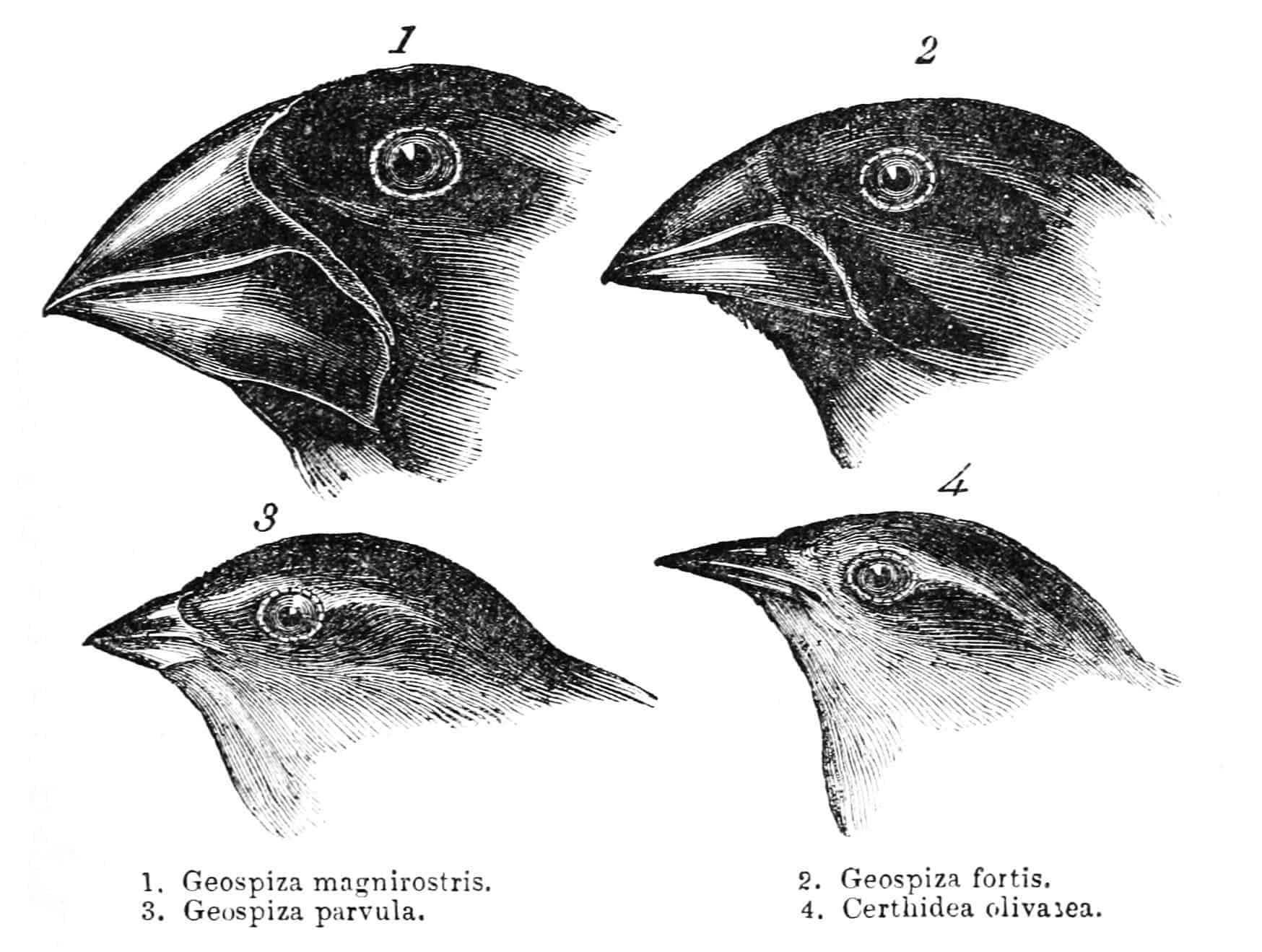
Charles Darwin is considered the father of modern evolutionary biology. He developed his theory of natural selection by observing the variations among the species of the Galapagos Islands. He was best known for his study of birds, which all occupied different niches on these far islands but bore obvious resemblances to mainland species.
Image credits: John Gould.
Over a long period of time and given a lot of pressure, a population of organisms can change in significant ways. The reason we are now having an antibiotic crisis is that, after many years of exposing bacteria to chemicals designed to kill them, the ones that had the gene quirks allowing them to survive are the ones which were able to multiply. So now we have a large number of antibiotic-resistant bacteria to contend with which have whole sections of DNA that exist only to counteract these drugs—but that, of course, raises a question. If they didn’t have these genes before, why do they have them now?
Mutant Power
Credit: Pixabay.
Mutation is a major factor influencing the process of evolution. Every so often, when cells are dividing, the mechanisms that copy bits of genetic data make a mistake. While it can often result in problems, it sometimes creates just what an organism needs to survive. One reason why HIV has been so hard to cure is that its reproduction process is unstable and prone to genetic errors. What this means is that the medication will work on most viral particles, but not all of them. The virus is, therefore, constantly evolving and the ‘error’, mutant forms that help it survive persist due to natural selection.
Some mutations are overtly harmful, like mutations in hemoglobin genes that cause sickle cell disease, where red blood cells curve into a “sickle” shape. The mutation makes the cells less efficient oxygen carriers and more fragile, and sometimes they cause painful blockages and organ damage. However, these mutations continue to persist because if a person is only a carrier, having received the variant gene from only one parent, it has a protective effect against malaria—a common disease in the parts of Africa where sickle cell is most prevalent. The fragility of the cell due to the hemoglobin structure means the cell will often rupture before the parasite can reproduce. But, since the remainder of their hemoglobin is normal, they don’t experience most of the severe effects seen in persons with the full form of the disease. The carrier phenotype is, therefore, fit. Natural selection is a strange process indeed.
So we have looked at mutation, natural selection, and fitness. We have looked at bacteria and viruses and how these factors have made them survive and evolve on a smaller faster scale. Now, how does that translate to bigger more complex things?
Making Sense of it All
Imagine that there is a ground-dwelling species of mammal that lives in a forest. Many of them are competing for the same food sources. A few of them, have started climbing in the hopes of finding another food source. A mutation comes which makes one offspring’s claws curve a bit more, causing that individual to be better at climbing. It survives to reproduce. A few generations down the line, all its descendants may have these curved claws. Somewhere along the line, a descendant is born with unusually long limbs which makes it better at both climbing and jumping, this individual’s offspring may well, do better than others—and so on. These minor changes can add up over time, just like the biggest teosinte kernels being intentionally planted. In nature, however, it takes far longer than a neat ten thousand years to produce something as different as maize.
Let this mammal group adapt for many thousands of years with natural selection favoring climbing habits and hunting in trees. At the end of that time if you were to take one of these climbing adapted creatures and put them alongside the ground dwellers they would look very different. They may have a different body form, make different sounds, have eyes that are adapted to seeing at a distance, and so on. And, because of the amount of mutation and genetic changes that brought them to this point, any offspring born of a mix of these two creatures would be sterile like a liger or mule. Just like that, you now have two different species. This also speaks to a common misconception, the idea that if one organism advanced from another, the first one should be gone. That simply isn’t how the process works.
In nature, creatures will exist side by side as one group remains the same and others experience changes due to environmental pressure. It is strange, and hard to fully appreciate, but we have a bit of evidence that can follow the trail. Think even of the liger I just mentioned, the mere fact that a lion and tiger—two distinct species from two different regions—can produce offspring means that their genotypes must be similar enough to make an embryo viable. We interpret this to mean that these big cats must have some ancestry in common.
What Do We Know?
Though it happens over a very long period of time in creatures that take longer to reproduce than bacteria or viruses, there are a few ways we can observe that evolution is an acting process. If an organism has advanced from one form to another, it stands to reason that there had to be some forms in between. Well, though we don’t always have all the bits of the puzzle, the fossils we find often help us fill these gaps. For example, between dinosaurs and birds we have found species of feathered, winged dinosaurs like Archaeopteryx.
There are also several odd cases in nature of organisms growing parts they have no need for. Some snake species and legless lizards retain a pelvic girdle with no real function, dolphin embryos in development still start to grow hind limb buds that retract after a time, and many cave dwelling or burrowing species retain non-functioning eyes. The fact that the genetic machinery required to make these structures happen exists, presents as evidence that these genes had a purpose at some point in the organism’s history.
There are other factors to consider as well. Genetic evidence frequently shows fairly small differences between one species and another of a similar type that cannot reproduce with each other. In fact, genetic evidence shows that a large variety of organisms have a surprising number of genes in common—whales, humans, bats, and cats all have the same bones making up their forelimbs. But, this gets into very complex discussion and murky waters. This article really just serves to give a background of a concept. Take the information here, interpret and think about it as you will and, of course, there are many other great sources of information on the topic out there. Whether evolution on a larger scale makes sense to you or not, hopefully we can at least agree that these smaller processes of change are things we can observe. By now, I hope, the idea of what evolution is and how it works is at least a little bit clearer.
The U.S. Navy is drafting new guidelines for pilots and other employees to report encounters with 'unidentified aircraft.'
A growing number of Navy pilotsclaiming to have spotted unidentified flying objects, or UFOS, has led the Navy to update its protocol for reporting them, according to a New York Times report.
In 2007, thePentagonbegan a shadowy program called “Advanced Aerospace Threat Identification Program.” It intended to study radar data, video footage captured by pilots and accounts of senior officers who reported seeing UFOs. The program officially ended in 2012 amid dried-up funds, but the Navy has continued investigations of military reports of UFOs,the report said.
Reports of UFO sightings occurred almost daily between 2014 and 2015 in the East Coast. Navy pilots reported seeing flying objects that had no visible engine or exhaust plumes but could read hypersonic speeds. One Super Hornet pilot in late 2014 said he had a near collision with a UFO, The Times reported.
Lt. Ryan Graves, who has been with the Navy for 10 years, told The Times: “These things would be out there all day. Keeping an aircraft in the air requires a significant amount of energy. With the speeds we observed, 12 hours in the air is 11 hours longer than we’d expect.”
Experts, however, caution against extraterrestrial explanations. Senior astrophysicist Leon Golub, who was quoted by The Times, said “there are so many other possibilities – bugs in the code for the imaging and display systems, atmospheric effects and reflections, neurological overload from multiple inputs during high-speed flight.”
Earlier this year, the Navy issued new classified guidelines on how to report such instances “in response to unknown, advanced aircraft flying into or near Navy strike groups or other sensitive military facilities and formations.”
‘Wow, What Is That?’ Navy Pilots Report Unexplained Flying Objects
“These things would be out there all day,” Lt. Ryan Graves said. “Keeping an aircraft in the air requires a significant amount of energy. With the speeds we observed, 12 hours in the air is 11 hours longer than we’d expect.”CreditTony Luong for The New York Times
WASHINGTON — The strange objects, one of them like a spinning top moving against the wind, appeared almost daily from the summer of 2014 to March 2015, high in the skies over the East Coast. Navy pilots reported to their superiors that the objects had no visible engine or infrared exhaust plumes, but that they could reach 30,000 feet and hypersonic speeds.
“These things would be out there all day,” said Lt. Ryan Graves, an F/A-18 Super Hornet pilot who has been with the Navy for 10 years, and who reported his sightings to the Pentagon and Congress. “Keeping an aircraft in the air requires a significant amount of energy. With the speeds we observed, 12 hours in the air is 11 hours longer than we’d expect.”
In late 2014, a Super Hornet pilot had a near collision with one of the objects, and an official mishap report was filed. Some of the incidents were videotaped, including one taken by a plane’s camera in early 2015 that shows an object zooming over the ocean waves as pilots question what they are watching.
“Wow, what is that, man?” one exclaims. “Look at it fly!”
No one in the Defense Department is saying that the objects were extraterrestrial, and experts emphasize that earthly explanations can generally be found for such incidents. Lieutenant Graves and four other Navy pilots, who said in interviews with The New York Times that they saw the objects in 2014 and 2015 in training maneuvers from Virginia to Florida off the aircraft carrier Theodore Roosevelt, make no assertions of their provenance.
But the objects have gotten the attention of the Navy, which earlier this year sent out new classified guidance for how to report what the military calls unexplained aerial phenomena, or unidentified flying objects.
Joseph Gradisher, a Navy spokesman, said the new guidance was an update of instructions that went out to the fleet in 2015, after the Roosevelt incidents.
“There were a number of different reports,” he said. Some cases could have been commercial drones, he said, but in other cases “we don’t know who’s doing this, we don’t have enough data to track this. So the intent of the message to the fleet is to provide updated guidance on reporting procedures for suspected intrusions into our airspace.”
The sightings were reported to the Pentagon’s shadowy, little-known Advanced Aerospace Threat Identification Program, which analyzed the radar data, video footage and accounts provided by senior officers from the Roosevelt. Luis Elizondo, a military intelligence official who ran the program until he resigned in 2017, called the sightings “a striking series of incidents.”
Sign Up for On Politics With Lisa Lerer
A spotlight on the people reshaping our politics. A conversation with voters across the country. And a guiding hand through the endless news cycle, telling you what you really need to know.
The program, which began in 2007 and was largely funded at the request of Harry Reid, the Nevada Democrat who was the Senate majority leader at the time, was officially shut down in 2012 when the money dried up, according to the Pentagon. But the Navy recently said it currently investigates military reports of U.F.O.s, and Mr. Elizondo and other participants say the program — parts of it remain classified — has continued in other forms. The program has also studied video that shows a whitish oval object described as a giant Tic Tac, about the size of a commercial plane, encountered by two Navy fighter jets off the coast of San Diego in 2004.
Navy pilots from the VFA-11 “Red Rippers” squadron aboard the aircraft carrier Theodore Roosevelt in 2015. The squadron began noticing strange objects just after the Navy upgraded the radar systems on its F/A-18 fighter planes.CreditAdam Ferguson for The New York Times
Leon Golub, a senior astrophysicist at the Harvard-Smithsonian Center for Astrophysics, said the possibility of an extraterrestrial cause “is so unlikely that it competes with many other low-probability but more mundane explanations.” He added that “there are so many other possibilities — bugs in the code for the imaging and display systems, atmospheric effects and reflections, neurological overload from multiple inputs during high-speed flight.”
Lieutenant Graves still cannot explain what he saw. In the summer of 2014, he and Lt. Danny Accoin, another Super Hornet pilot, were part of a squadron, the VFA-11 “Red Rippers” out of Naval Air Station Oceana, Va., that was training for a deployment to the Persian Gulf.
Lieutenants Graves and Accoin spoke on the record to The Times about the objects. Three other pilots in the squadron also spoke to The Times about the objects but declined to be named.
Lieutenants Graves and Accoin, along with former American intelligence officials, appear in a six-part History Channel series, “Unidentified: Inside America’s U.F.O. Investigation,” to air beginning Friday. The Times conducted separate interviews with key participants.
The pilots began noticing the objects after their 1980s-era radar was upgraded to a more advanced system. As one fighter jet after another got the new radar, pilots began picking up the objects, but ignoring what they thought were false radar tracks.
“People have seen strange stuff in military aircraft for decades,” Lieutenant Graves said. “We’re doing this very complex mission, to go from 30,000 feet, diving down. It would be a pretty big deal to have something up there.”
But he said the objects persisted, showing up at 30,000 feet, 20,000 feet, even sea level. They could accelerate, slow down and then hit hypersonic speeds.
Lieutenant Accoin said he interacted twice with the objects. The first time, after picking up the object on his radar, he set his plane to merge with it, flying 1,000 feet below it. He said he should have been able to see it with his helmet camera, but could not, even though his radar told him it was there.
A few days later, Lieutenant Accoin said a training missile on his jet locked on the object and his infrared camera picked it up as well. “I knew I had it, I knew it was not a false hit,” he said. But still, “I could not pick it up visually.”
At this point the pilots said they speculated that the objects were part of some classified and extremely advanced drone program.
Lieutenant Graves with Navy flight log books.CreditTony Luong for The New York Times
But then pilots began seeing the objects. In late 2014, Lieutenant Graves said he was back at base in Virginia Beach when he encountered a squadron mate just back from a mission “with a look of shock on his face.”
He said he was stunned to hear the pilot’s words. “I almost hit one of those things,” the pilot told Lieutenant Graves.
The pilot and his wingman were flying in tandem about 100 feet apart over the Atlantic east of Virginia Beach when something flew between them, right past the cockpit. It looked to the pilot, Lieutenant Graves said, like a sphere encasing a cube.
The incident so spooked the squadron that an aviation flight safety report was filed, Lieutenant Graves said.
The near miss, he and other pilots interviewed said, angered the squadron, and convinced them that the objects were not part of a classified drone program. Government officials would know fighter pilots were training in the area, they reasoned, and would not send drones to get in the way.
“It turned from a potentially classified drone program to a safety issue,” Lieutenant Graves said. “It was going to be a matter of time before someone had a midair” collision.
What was strange, the pilots said, was that the video showed objects accelerating to hypersonic speed, making sudden stops and instantaneous turns — something beyond the physical limits of a human crew.
Asked what they thought the objects were, the pilots refused to speculate.
“We have helicopters that can hover,” Lieutenant Graves said. “We have aircraft that can fly at 30,000 feet and right at the surface.” But “combine all that in one vehicle of some type with no jet engine, no exhaust plume.”
Lieutenant Accoin said only that “we’re here to do a job, with excellence, not make up myths.”
In March 2015 the Roosevelt left the coast of Florida and headed to the Persian Gulf as part of the American-led mission fighting the Islamic State in Iraq and Syria. The same pilots who were interacting with the strange objects off the East Coast were soon doing bombing missions over Iraq and Syria.
The incidents tapered off after they left the United States, the pilots said.
A version of this article appears in print on May 27, 2019, on Page A14 of the New York edition with the headline: ‘Wow, What Is That?’ Navy Pilots Reported Unexplained Flying Objects. Order Reprints | Today’s Paper | Subscribe
“Here is the video I shot, be prepared to be mind-blown!” Marco Langbroek wrote on his website SatTrackCam Leiden (b)log, where he shared an amazing capture of dozens of SpaceX Starlink internet satellites chugging along, in a straight line, across the heavens.
Netherlands-based satellite tracker Marco Langbroekstunned space fans this weekend with this video of dozens ofStarlink internet satellites soaring overhead. SpaceX had launched its first 60 Starlink satellites into orbit on Thursday, May 23, 2019. It plans to launch nearly 12,000 of these satellites; from low-Earth orbit, they’ll beam internet coverage to the world. Though precise tracking figures for the satellites aren’t available yet, Marco was able to make a rough prediction of where to spot them. His prediction turned out to be close enough to catch the satellites soaring over his location.
On 24 May 2019 at 2:30 UT, SpaceX launched STARLINK, a series of 60 satellites that is the first launch of many that will create a large constellation of satellites meant to provide global internet access.
Just short of a day after the launch, near 22:55 UT on May 24, this resulted in a spectacular view over northwestern Europe, when a ‘train’ of bright satellites, all moving close together in a line, moved across the sky. It rained UFO reports as a result, and the press picked it up as well.
There were no orbital elements for the objects available yet on Space-Track, but based on the orbital information (53 degree inclination, initially 440 km orbital altitude) I had calculated a search orbit and stood ready with my camera.
My search orbit turned out to be not too bad: very close in sky track, and with the objects passing some 3 minutes early on the predictions. And what a SPECTACULAR view it was!
It started with two faint, flashing objects moving into the field of view. Then, a few tens of seconds later, my jaw dropped as the ‘train’ entered the field of view. I could not help shouting ‘OAAAAAH!!!!’ (followed by a few expletives…)!
Marco Langbroek captured the SpaceX Starlink satellites the night after their launch, moving like a train across the heavens.
Marco said he counted at least 56 objects as the satellites flew overhead. He wrote:
Over the coming days the ‘train’ of objects will be making two to three passes each night. As they are actively manoeuvering with their ion thrusters, they will be more spread out with each pass, so the ‘train’ will probably quickly dissipate.
The objects were launched into a ~440 km altitude, 53 degree inclined orbit. Using their ion thrusters, they will raise their orbits to ~550 km the coming days/weeks.
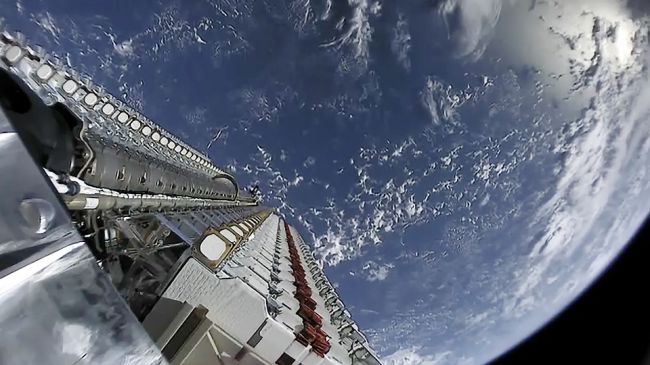
A view of SpaceX’s first 60 Starlink satellites in orbit, still in stacked configuration, with the Earth as a brilliant blue backdrop on May 23, 2019.
Marco isn’t the only stargazer who caught the view. Karoline Mrazek and Erwin Matys of Project Nightflight in Austria were taken by surprise when, while outdoors for a night of observing on May 24, they saw the satellites, too. They said in an email to EarthSky:
We were testing a new imaging system at our dark-sky observing site in Austria. Suddenly a weirdly slow moving streak of light appeared on the horizon, due northwest from our location. The object slowly moved eastward across the sky, stretching in length all during the pass. A few stragglers appeared to trail behind the larger bulk of objects. The several dozen individual objects of the bulk were soon resolvable with the unaided eye. They had approximately 2 magnitudes each. The spooky wagon train of dots culminated near Polaris, before it disappeared in the Earth’s shadow shortly before 22:57 UT. The spectacular show lasted several minutes. We literally stood and watched, stunned speechless.
All in all that was one of the most amazing observations we had in a long time. It was amazing to see this show of a totally unfamiliar object appearing unexpectedly in the sky. We look forward to the next deployment. We can only recommend it to other stargazers to look out for new deployments next time SpaceX launches another Falcon rocket.
And, of course, others were caught unawares on May 24 and, judging from our email today, were stunned by what they saw.
By Saturday night, May 25, the satellites apparently were already fading in brightness, as they were being moved to a higher orbit. Dave Chapman in Canada, another veteran observer of the skies, wrote to EarthSky:
I observed the Starlink train from rural Nova Scotia on Saturday night, May 25 at 10:20 pm ADT. I knew it existed and had seen the video, but I was not expecting it. It appeared to me like a dim jet contrail, but the binoculars resolved it into a train of lights. I was showing beginners the night sky and they were amazed to see it. Very exciting, but worrisome. This could get old very fast!
As for your chances of seeing the Starlink satellite train in the nights ahead, we checked the tried and true website Heavens-Above.com, but didn’t find any predictions. The satellites are currently being maneuvered via their ion thrusters to a higher orbit; as they get higher, they’ll become fainter to earthly observers (hopefully notstill bright enough to be seen, because thousands of them would not be a pretty sight above us). They are also dispersing and so aren’t as likely to appear train-like. Our advice is to keep checking Heavens-Above.com, as well as Marco’s site SatTrackCam Leiden (b)log. Also, try Marco’s Twitter page (@Marco_Langbroek). If predictions do become available, you’ll likely find them at one of those places.
This just in: We got an email Sunday morning, with word of a new tool for finding out when the Starlink satellites will pass over your location. We can’t vouch for its accuracy, but it’s very easy to use. Find the Starlink prediction tool here. Thank you, dev@cmdr2!
WHOAAA!!!! Just had a SPECTACULAR view of the train of @SpaceX#Starlink objects passing over! Video to follow. FAN-TAS-TIC!!!!
Dr Marco Langbroek@Marco_Langbroek
VIDEO! Prepare to be mind-blown! The train of @SpaceX#Starlink satellites passing over Leiden, the Netherlands, some 25 minutes ago. Camera: WATEC 902H with Canon FD 1.8/50 mm lens. I was shouting when they entered FOV!@elonmuskhttps://vimeo.com/338361997
Bottom line: Marco Langbroek shared an amazing video capture of dozens of SpaceX Starlink internet satellites – marching in a straight line across the heavens – at his website SatTrackCam Leiden (b)log.
Thousands of years from now, scientists who dig up our bones may classify our remains in a new way if the results of a momentous vote on Tuesday hold up. If they do, we’ll formally be the fossilized remains (if we’re lucky) of humans born during the Anthropocene — a brand-new geologic epoch, marked by the detritus of modern life, that may soon be recognized by geology’s formal channels to succeed the ongoing Holocene epoch.
On Tuesday, the majority of the Anthropocene Working Group (AWG), a subcommittee of 34 scientists within the International Commission on Stratigraphy, voted in favor of formally declaring the Anthropocene a new epoch.
Getting an official designation of the Anthropocene would reflect this new reality, and help us analyze it more effectively.”
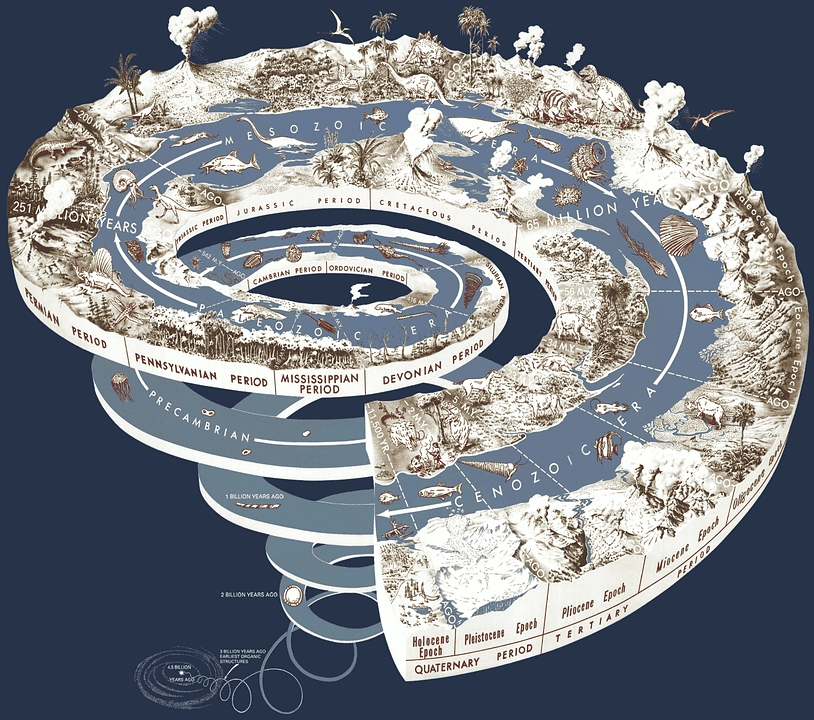
The term “Anthropocene” is already used to describe humanity’s large impact on the environment, but it has yet to actually mark a new geological epoch, like these scientists propose. Technically, we’re still in the Holocene, which began 12,000 to 11,600 years ago, but paleobiologist and AWG head Jan Zalasiewicz, Ph.D., argues that human activity has changed the Earth so drastically that it’s time to recognize a new chapter in the planet’s geological history.
“Formally we are still in the Holocene, but in reality many important geological conditions of Earth are now outside the envelope of conditions that have characterized the great bulk of the Holocene,” he tells Inverse. “Getting an official designation of the Anthropocene would reflect this new reality - and help us analyze it more effectively.”
Is the Anthropocene Geologically Real?
Tuesday’s vote builds upon an earlier, informal vote conducted at a meeting in Cape Town in 2016 and crucially lays the groundwork for the case that the AWG will submit for review in 2021. Now, the AWG must seek approval from two larger regulatory bodies before the new epoch can formally be recognized.
If they’re successful, the primary start date for the Anthropocene will be somewhere in the middle of the 20th century.
But new geological epochs mean nothing without actual evidence of change. To impress the International Commission on Stratigraphy (ICS) and the International Union of Geological Sciences (IUGS), humanity’s impact has to be shown to be “geologically real”. Zalasiewicz isn’t worried: There’s plenty of physical evidence that humans have changed the planet’s surface in the past 100 years.
The impacts of thermonuclear testing that date from the mid-twentieth century could be crucial markers that define the Anthropocene
The mid-1900s conveniently stick out, says Zalasiewicz, noting that time period is associated with “an array of geological signals.” Those include sharp increases in carbon dioxide, the spread of plastics, persistent organic pollutants or concrete, widespread species invasions and extinctions, and “perturbations to the nitrogen and phosphorus cycles.”
Evidence of these characteristics will be used to make the case for the Anthropocene, but there is one dramatic signal that may drive home the AWG’s point: artificial radionuclides. Thermonuclear bomb tests from the ‘50s onward provide a “particularly sharp and globally synchronous signal” that could be used to help define the Anthropocene as well.
“It is being looked at as a possible ‘primary marker,’” Zalasiewicz explains. “Though all of the changes will be used in characterizing and recognizing an Anthropocene unit in practice.”
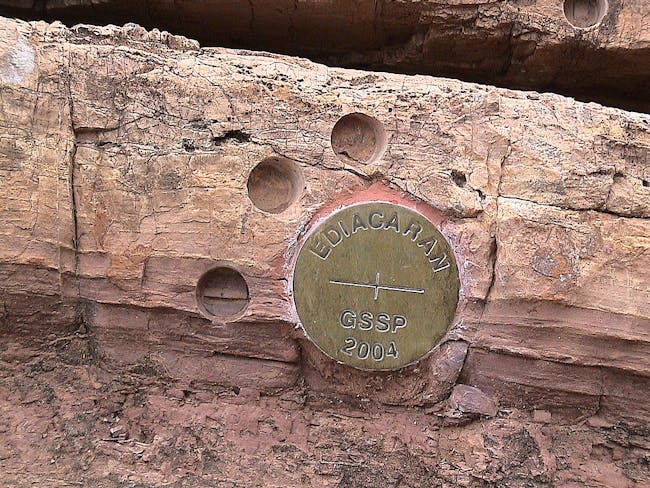
The 'golden spike' marking the Global Boundary Stratotype Section and Point (GSSP) at the base of the Ediacaran Period
Finding Proof for the Anthropocene
The major holdup for the Anthropocene is that the AWG still needs to find exemplary samples from all around the world that can show a clear transition from the Holocene into the proposed Anthropocene. This transition is sometimes called a “golden spike.” A particularly good sample, if approved, would be labeled as the Global Boundary Stratotype Section and Point (GSSP), an international reference point marked by a golden plaque.
Over the next several years, the team will search for their geological smoking gun to build the final case that the Anthropocene is here — and has been for at least 50 years. “That’s a work in progress,” Zalasiewicz adds, though his team is determined.
“It’s a long process, as we are trying to analyze and reflect multi-faceted forms of change on a large and immensely complex planet,” he says. “The Geological Time Scale is meant to provide a stable reference, so changes to it are not at all easy to make.”
Read more about the emergence of the new epoch known as the Anthropocene:
An amazing transformation has occurred in modern science. It has been slow in coming and is one that many scientists avoid discussing: there is a point where science and religion coincide. The frightening truth about this agreement is that it isn’t about new age physics, the nature of God or the transcendent union of science and religion – it concerns the nature of man, or rather, the problem of man.
For many years, under the influence of liberalism and humanism, science tended to favour the logic of the ‘Noble Savage’. Violence and evil were human problems, probably caused by the conflict between our intellect and natural instincts. Nature was great, instincts were marvellous and sex was fun. This logic was buttressed with romantic notions about the innocence of animals, the moral purity of instinct, and the marketable icon of the harmless, playful, innocent ape. However, as science progressed, these notions fell like a house of cards.
During the 1970s science began to refine its interpretation of Darwin’s theory of evolution. This refinement became known as sociobiology – the inclusive fitness theory – or in journalistic terms, ‘the selfish gene’. It was popularised by Richard Dawkins’s book The Selfish Gene. This discovery, which is now conventional scientific wisdom, holds that the ultimate driving force for evolution is the genes, the molecular unit of heredity of a living organism. The maximisation of genetic successes to assure the passing on of certain genes to subsequent generations. This principle, however terrifying in its ramifications, is the state of present evolutionary theory.
When this is combined with our new understanding of the nature of animal behaviour, a darker and more reflective scientific paradigm arises, one that has more in common with Gnosticism, a stream of thought that extends from the early followers of Christ.
A Man & a Chimp
Our relationship to apes has always been a matter of conjecture. We need to abandon the theories and debates about origins and consider the state of humanity at present. There are many ways to consider evolution: Whether we accept Darwinian evolution or a modification thereof, or that evolution was manipulated by ETs, God(s), or even if we consider we are part of a stage of a larger evolutionary cycle (Theosophy, Anthroposophy etc.), the fact remains that our present genetic inheritance indicates something about our present condition.
Science places modern man (Homo sapiens sapiens) in the centre of the ape kingdom. It says humans are part of the same lineage as orangutans, gorillas, chimpanzees, and bonobos. The standard view of this great-ape ‘family tree’ is that humans and chimps are more similar to each other than either is to the gorilla – because chimps and humans diverged more recently. But with the publication of the sequence of the full gorilla genome in 2012, this theory has been overthrown. Scientists realised that much of the human genome more closely resembles the gorilla than it does the chimpanzee genome.
While they may seem affectionate and lovable at first appearance, extensive study in the wild has shown a far darker side to ape behaviour. Apes murder, rape and torture. They will defend their territory and intrude on any surrounding territories using guerrilla warfare, literally! In various studies of ape behaviour, it is estimated that at least forty per cent of all cases of copulation involves elements of violence, which would be interpreted as rape. Apes have short-term memories when it comes to companions. If an ape leaves one pack to join another, he becomes an instant enemy. Raids on other packs are frequent, bloody and brutal and involve ambush, torture and death. Apes behave differently from many other animal species and their aggressiveness seems very similar to human behaviour. It’s frighteningly clear that our genetic heritage is directly related to the ape kingdom. This invokes some fascinating questions and quandaries.
Why Intellect?
Apes and related kin are excellent reproducers. They create many offspring and continually reinforce their genetic heritage by territorialism and brute force. Researchers in this field raise the question: why would the ‘genetic program’ create what we understand as the conscious mind?
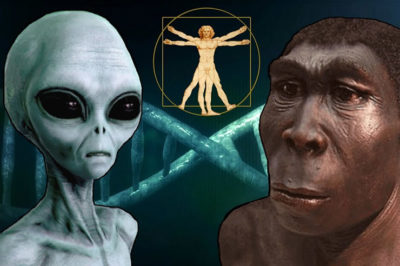
Many argue that intelligence developed as the result of enhanced hand-eye coordination by using tools. However, many other species use tools, including apes. Apes are quick learners, and use whatever they can find to open that nut, get that fruit, or crush that skull. But apes did not develop a high level of intelligence – only the offshoot of Homo sapiens sapiens. This argument sheds light on a fascinating possibility – was human nature tweaked? Did genetic engineering take place that modified available genetic substances to create modern humans? Such writers as Zecharia Sitchin and Erich von Daniken use this sort of reasoning extensively.
The darker side of this theory is why would an alien life form modify genetic substance without adequately balancing the social effects of the inherent flaws within the original substance? If an alien species, a deity or whatever was capable of manipulating genetic materials, then surely it would be aware of the destructive power within the primate form it was transforming. If we consider there was some manipulation of our genetic structure, then was this accomplished by a somewhat primitive and ignorant entity (which is unlikely considering the required technology)? An entity or force that was malefic and unsympathetic to the resulting human condition?
This may seem too much to grasp at first, yet if we consider the myths and legends that abound within humanity’s history, they all seem to include such tales of genetic interference.
The Gnostics believed that a false creator (Demiurge) formed Matter (the physical world), and humans were moulded out of fallen substance in an effort to trap particles of Light (preexistent Souls). Sitchin argued that an alien race (the Anunnaki) genetically engineered humanity as a slave species, but the early humans rebelled and developed consciousness. Numerous myths, stories and legends suggest someone or something interfered with the ape to create man, and all tend to see this creation as negative. While most religions insist that Matter is good and ‘God’ is the creator, other more esoteric approaches from the Vedas to the Gnostic suggest that Matter is at best dangerous, at worst malefic, and our creation was the result of either a miscalculation or error – or a deliberate destructive act.
This view posits that apes were engineered as a mechanism to trap Souls which existed in the ‘first estate’ (the spiritual worlds). Many Gnostic sects believed that the fallen creator, in his attempt to wrest control of the universe, first created Matter to encapsulate and control the Light. He then evolved the physical form of mankind to capture the preexistent Light forms and turn them into automations under his control. While we may debate details, it is certainly true there is a dichotomy between our genetic programming and mind (which is the gate for one’s true spiritual self). Even if we have trouble accepting the more flamboyant aspects of this theory, the split within humanity and the violent traits of our innate genetic programming cannot be ignored.
The Role of the Mind
The role of the mind in human development has been ambivalent to say the least. From one perspective it is our saving grace, from another it keeps us enslaved. According to Sitchin, the mind was genetically engineered through modifications to the brain so that a slave race could be created. Apes were difficult to command, so a brain/mind complex (however originally limited) was created. Through the dichotomy between the brain/mind and the instincts, mind control was achieved. Continuing from this argument, early religions and social structures would have worked as ‘control mechanisms’ to keep the slaves in their preordained roles. As time went on, however, the mechanism of control became the tool of liberation. Even the most limited mind/brain complex began to develop thoughts outside the ‘control spectrum’, and one thought led to another and ultimately rebellion. Whether we accept this paradigm or not, we can see that intellect has a contradictory role: it exists as an affront to what science understands as the normal evolutionary process and can work to enslave or liberate.
In this extraterrestrial cosmology, we deduce there are diverse alien species – some wish to help humans, while many desire to keep us enslaved. Accordingly, some early cultures worked to liberate humanity’s intellect, while some cultures, if not the same ones over time, regressed their culture back into slavery by the same means.
It is interesting to note that many early Gnostic groups had a similar view of human nature. In one Mandean account, we read of demons copulating together and their progeny being man’s body and mind. Man’s physical and mental forms are in direct opposition to his spiritual essence. In other Gnostic traditions, our mind is a mixture of light and darkness which offers the opportunity to ascend beyond limitation through its redemption.
Sigmund Freud argues that civilisation exists only in as much as it suppresses instinct, and in many ways we are now returning to his understanding. While pleasure may be the veneer that we accept as justification for our behaviour, not far under the surface is a pit of uncontrolled violence. The major contradiction in our culture is the desire for individualism – the more we demand freedom, the more restraints removed, the more we return to the unfettered ape-like creature we once were. As moral codes are loosened and as we gain more supposed freedom, crime, rape, murder and social disorder arises. As culture fails, the apes return.
Light Emissaries
If we contemplate the adversarial view of prehistory with evil alien forms controlling humanity for their own purposes, we can perceive it in different ways. Gnostics and some Christians may interpret this on a more spiritual level, with dominions and principalities, demos and demi-gods replacing the ‘little green men’. For the scientifically-minded researcher, we could replace aliens and demons with complexes and unconscious social control mechanisms (memes).Ultimately the symbol system is irrelevant. This model could be extended to explain the role of such figures as Zoroaster, Krishna, Jesus, Gautama (Buddha) and so on.
As humanity’s consciousness began to expand, it rejected the ‘social control religions’ and tried to make it on its own. However, humanity was unaware that the forces which created these paradigms of control also started the human mind on a journey of development. An immense conflict evolved. When man rejects tyranny, his instincts take over and a new tyranny, one of ape violence, comes into effect. He is caught in a vicious cycle.
The forces of Light, which exist beyond the contamination of Matter, decided to intervene. Over many millions of years, they sent emissaries to explain to man his real constitution and the conflicting nature of his being. Each avatar taught that man is a hybrid, a mixture of fallen Matter and Light ‘stuff’. Man is a split being – Animal, Intellect and Spirit – each with its own agenda and programming. The physical organism is made of fallen Matter and its programming is that of an ape ruled by the ‘selfish gene’. It is innately violent and destructive. In some sense it has its own consciousness, we could perhaps call it the ‘GE’ (genetic entity).
The mind is another problem. It was created as a modification to the brain but evolved into something more. It has facets (such as the brain stem) which hark back to its original nature, and yet has advanced nodes that offer interface to the spirit. It is a collection of false I’s, sub-identities and personas. It craves domination and works best under control, whether by a cult or ism or by TV and computer games. Its liberation is painful, yet necessary. The emissaries of Light have been giving man ‘wake-up’ calls for thousands of years, yet man does not listen. As soon as the emissaries die, sometimes even before, their messages are distorted and become part of the ‘social control mechanism’.
Aliens, DNA & Beyond
Ultimately it does not matter how we perceive our masters, whether we believe the extraterrestrial theory of our origins or see them in more religious, psychological or scientific terms. The point of reference for all these paradigms is spiritual: if the aliens created slaves, it was under the influence and control of greater and more malefic spiritual powers and dominions. The Gnostics said that Matter is fallen, nature is a trap, and man’s real self is locked in an eternal game.
As we move further and further into the Kali Yuga, the age of blood and iron, the game becomes more and more vicious. The ‘selfish gene’ is far more malleable than we care to realise, since it is an intrusion from a spiritual reality: it can transform and change according to new challenges. In the distant past the ‘selfish gene’ program realised man could not be controlled by the genetic entity alone, so it evolved new gene-like structures to control the mind like Memes. A Meme is a virus of the mind.
Meme: (pron. ‘meem’) A contagious idea that replicates like a virus, passed on from mind to mind. Memes function the same way genes and viruses do, propagating through communication networks and face-to-face contact between people. – David S. Bennahum
Memes mould consciousness to fulfil the directive of the original DNA program. Memes transform meaningful social movements into bureaucracies, and take ideals and turn them into commodities. They take transformational technologies and turn them into mechanisms of control. TV, computer games and sport are means to stop us using our mind to any spiritual end by keeping it absorbed and controlled. Our entire culture is based on this premise: all thought must be controlled, albeit covertly, so that freedom is impossible. Democracy is simply the choice between different paradigms of control. Isms, cults and ologies offer further mechanisms of control. Many appear to be outside of the structure, but are really part of it.
Where Science Meets Religion
We have arrived in the new millennium, and science meets religion at last, yet in a way neither would have expected. By understanding the ‘selfish gene’, and the split nature of humanity, we have uncovered the reasons behind the constant tension and violent behaviour of modern man. Illusions are washed away when we truly comprehend the hybrid composition of human nature.
“Yes there have been crashed craft, and bodies recovered. . . . We are not alone in the universe, they have been coming here for a long time. . . . I happen to be privileged enough to be in on the fact that we have been visited on this planet, and the UFO phenomenon is real.”
– Doctor Edgar Mitchell, 6th man to walk on the moon (source)(source)(source)
As recent as a decade ago, avid UFO and extraterrestrial researchers were unable to speak openly about their research without being ridiculed. Today, the topic has gained considerable credibility and popularity, so much so that not only are high ranking figures from military, political, and academic spheres speaking out, but also popular global figures as well, and particularly at prestigious conferences around the world. Previously classified documents that have been released from dozens of governments around the world have also allowed this topic to enter the respected public domain.
The 2011 Global Competitiveness Forum, at which a number of prominent scientists attended, featured a lecture by Jacques Vallee, notable for co-developing the first computerized mapping of Mars for NASA, and for his work at SRI International on the network information centre for ARPANET, on the UFO/extraterrestrial phenomenon.
Here’s another talk by nuclear physicist Stanton Friedman at the same conference. The main theme of that conference was contact with intelligent extraterrestrials, and learning from outer space.
As far as documents, whistleblowers, and other ‘proofs’ that have emerged, we’ve covered many in great detail in a number of articles that we’ve published. You can access those articles by visiting the exopolitics section of our website here.
The latest major figure to comment on extraterrestrials was Elon Musk, founder, CEO, and CTO of SpaceX and co-founder, CEO, and product architect of Tesla, Inc. Aside from a phenomenal businessman, Tesla is an activist who uses his wealth and resources to create a better Earth.
He touched on extraterrestrials at the World Government Summit, a global platform dedicated to shaping the future of government worldwide. Each year, the Summit sets the agenda for the next generation of governments with a focus on how they can harness innovation and technology to solve universal challenges facing humanity.
Here’s an excerpt from that speech, which you can view here:
When I was a kid I was wondering, kind of, what’s the meaning of life, like, why are we here, what’s it all about? I came to the conclusion that what really matters is trying to understand the right questions to ask, and, the more that we can increase the scope and scale of human consciousness, the better we are able to ask these questions. . . .
Some of those things are in the long term, having long term sustainable transport and sustainable energy generation, and to be a space-bearing civilization, and for humanity to be out there among the stars, and be a multi-planetary species. I think being a multi-planet species and being out there among the stars is important for the long term survival of humanity. . . . It creates a sense of adventure, and it makes people excited about the future.
Below is a snippet taken from the full interview. In it, he states that if there are super intelligent extraterrestrials somewhere out there, which is the generally agreed upon scientific hypothesis, “they’re probably already observing us, that would seem quite likely, and we’re just not smart enough to realize it.”
“Not Smart Enough To Realize It”
“Intelligent beings from other star systems have been and are visiting our planet Earth. They are variously referred to as Visitors, Others, Star People, ETs, etc. . . . They are visiting Earth NOW; this is not a matter of conjecture or wistful thinking.”
– Theodor C. Loder III, Phd, Professor Emeritus of Earth Sciences, University of New Hampshire (source)
I think Musk is right — they are probably already watching us, we just don’t realize it yet. But things are changing. Numerous efforts are being made to educate the public on this subject, from the most credible sources available. Scientific publications, video footage, and photos have already been published in peer-reviewed scientific journals for a number of years. (source)
Below is a powerful statement made by former NASA astronaut and Princeton physics professor Dr. Brian O’Leary, who says that there is “abundant evidence that we are being contacted, and that intelligent civilizations have been visiting for a very long time.”
Again, if you want to sift through some of this evidence, we’ve presented it in hundreds of articles you can view in chronological order in the exopolitics section of our website here.
Why the Masses Haven’t Realized It — Or Have They?
“Behind the scenes, high ranking Air Force officers are soberly concerned about UFOs. But through official secrecy and ridicule, many citizens are led to believe the unknown flying objects are nonsense.”
– Former head of CIA Roscoe Hillenkoetter, 1960 (source)
Movies and television shows bombard us constantly with stories of extraterrestrial invasions, and despite all of the evidence available, the fact that we are being and have been visited by extraterrestrials can be a scary thought, particularly given the way extraterrestrials are typically portrayed.
With a massive disinformation campaign that has focused on covering up these facts for decades, along with the mass ridicule of this subject for anyone who took it seriously in the past, it quickly escaped the minds of the masses and many people considered the notion of ongoing intelligent contact with our planet from extraterrestrials completely preposterous.
A great quote from Carl Sagan comes to mind:
One the saddest lessons of history is this: If we’ve been bamboozled long enough, we tend to reject any evidence of the bamboozle. We’re not longer interested in finding out the truth. The bamboozle has captured us. It’s simply too painful to acknowledge, even to ourselves, that we’ve been taken. Once you give a charlatan power over you, you almost never get it back.
Current public perception of UFOs and extraterrestrials reveals how easily our minds can be influenced, and how quickly our thoughts about a subject can be given to us, even subconsciously. It begs the question, how many other beliefs do we share that have been, in a sense, ‘programmed’ into us by powerful groups of people with an agenda?
“There are objects in our atmosphere which are technically miles in advance of anything we can deploy, that we have no means of stopping them coming here … [and] that there is a serious possibility that we are being visited and have been visited for many years by people from outer space, from other civilizations. That it behooves us, in case some of these people in the future or now should turn hostile, to find out who they are, where they come from, and what they want. This should be the subject of rigorous scientific investigation and not the subject of ‘rubishing’ by tabloid newspapers.”
– Lord Admiral Hill-Norton, Former Chief of Defence Staff, 5 Star Admiral of the Royal Navy, Chairman of the NATO Military Committee (source)
All this being said, the fact that UFOs/extraterrestrials is one of the most searched subjects on the web suggests that people are at least curious to learn the truth
Enlarge/ The Starship test vehicle, currently under assembly in South Texas, may look similar to this illustration when finished.
On Tuesday, photos began to emerge onlineof a new, Starship-like vehicle being built in an industrial park near Kennedy Space Center in Florida. Later, SpaceX founder Elon Musk confirmed that the company will develop a Starship prototype in Florida to parallel work being done in South Texas.
"Both sites will make many Starships," Musk shared on Twitter. "This is a competition to see which location is most effective. Answer might be both." This will not be a strict A/B test, a randomized experiment. Rather, Musk added, any insights gained by one team must be shared with the other, but the other team is not required to use them.
This is a rather new way to develop an orbital spaceship, especially one as large and as complex as Starship, which is designed to land and take off from other worlds such as the Moon and Mars. However, it is far from unprecedented in the tech world. For example, Google has long had a strategy of making two of everything, with multiple, competing products that go after the same user base.
Musk also provided an update on development of Raptor engines—which will power both the Starship vehicle and its companion rocket, Super Heavy. SpaceX, ultimately, will need dozens of the engines for the spaceship and rocket. But initially, the company will be testing its prototype Starship with one and three engines. SpaceX has now completed four of the engines, and it's building the fifth one in Hawthorne, California. The company should have built more than 100 of the methane-fueled engines by next year, Musk added.
Elon Musk✔@elonmusk
Starship test flight rocket just finished assembly at the @SpaceX Texas launch site. This is an actual picture, not a rendering.
Meanwhile, after about five weeks of downtime, SpaceX appears ready to ramp up activity at its Boca Chica test site in South Texas. In early April, a series of tests culminated in a short, tethered hop of a Starship prototype. Now, the company may begin testing activity again later this month. The Brownsville Herald reports that a nearby highway, State Highway 4 from Oklahoma Avenue to Boca Chica Beach, will be closed on May 28 between 2pm and 10pm CT, or alternatively, on May 29 and May 30.
SpaceX is working toward an orbital launch of the Starship vehicle in 2020, but as with all large aerospace projects, that date is likely to slip later into the 2020s. A flight any time soon, given the absence of government funding and overall ambition of the project, would be notable.
Mysterieuze streep van lichtjes aan Nederlandse hemel leidt tot talloze UFO-meldingen
In de nacht van vrijdag op zaterdag was in de lucht een bijzonder verschijnsel waarneembaar. Aan de hemel was een streep van tientallen lichtjes zichtbaar die op sterren leken.
Het ging om satellieten van het Amerikaanse ruimtevaartbedrijf SpaceX, die vrijdag in een baan om de aarde zijn gebracht.
In binnen- en buitenland maakten mensen melding van het fenomeen dat zich rond 01.00 uur voordeed.
Intercity
De één vroeg zich af of het ging om een ‘zwerm drones’, de ander zei dat het was ‘alsof de intercity langskwam door de lucht’.
Onderzoeker Marco Langbroek plaatste op Twitter een spectaculair filmpje waarin de ‘trein’ van Starlink-satellieten te zien is.
Het project van het bedrijf van Elon Musk is bedoeld om een verbinding voor snel internet op aarde en op termijn ook in de ruimte te realiseren.
UFO’s
Daarvoor zijn honderden satellieten nodig, waarvan de eerste 60 de ruimte zijn ingeschoten.
Er waren ook veel mensen die dachten dat het om UFO’s ging. Bij het UFO Meldpunt Nederland kwamen uit heel het land meldingen binnen.
“We zijn op de hoogte van een UFO in de vorm van een lange reeks lichtjes die op verschillende plaatsen door heel Nederland (en België) zichtbaar was rond 1 uur vannacht,” tweette het meldpunt.
Beste volgers/lezers, we zijn op de hoogte van een ufo in de vorm van een lange reeks lichtjes die op verschillende plaatsen door heel Nederland (en zelfs België) zichtbaar was rond 1 uur vannacht. Heeft u beeld, deel het dan alstublieft met info@ufomeldpunt.nl. Dank!
PROFESSOR: UFOS, ALIENS ARE HUMAN ANTHROPOLOGISTS FROM FUTURE
In a recent experiment, scientists reversed the arrow of time for a split second, simulating the possibility of time travel using quantum particles called qubits. The experiment was a far cry from achieving time travel anytime in the near future, but if it provides even a modicum of possibility it would support Dr. Michael P. Masters’ theory that UFOs and aliens might just be future anthropologists traveling back in time to study their ancestors — us.
Masters completed his Ph.D. in Anthropology at the Ohio State University and is currently a professor of biological anthropology at Montana Tech. His resume also cites coursework in astrobiology, astronomy, and physics – needless to say, he has some pretty relevant credentials.
OUR FUTURE HUMANOID ALIEN DESCENDANTS
In his bookIdentified Flying Objects: A Multidisciplinary Scientific Approach to the UFO Phenomenon, Masters explores the evolution of humans in relation to our hominin ancestors, and our likely progression as a species moving forward. Based on the trajectory of our physical, intellectual, and technological development, he says he believes the common trope of the hairless, large-headed, technologically advanced alien is likely where evolution is leading us.
Humans have evolved to become (relatively) hairless creatures compared to our ancestors and many anthropologists believe we’ll eventually lose it entirely as it doesn’t really serve much of a function anymore, save aesthetics. Add to that the fact that our skull size has doubled and tripled to support a larger brain compared to the smaller cranium of ancestors like Homo erectus and Australopithecus, respectively.
“The phenomenon may be our own distant descendants coming back through time to study us in their own evolutionary past,” Masters told a local television station in his home state of Montana. “The extra-tempestrials are ubiquitously reported as being bipedal, upright-walking, five fingers on each hand and foot, bi-lateral symmetry, that they have two eyes, a mouth, a nose, and they can communicate with us in our own languages.”
Dr Michael P. Masters
If that’s the case, and close encounters with aliens are really close encounters with our future relatives, the term extraterrestrial wouldn’t be appropriate to describe our humanoid alien descendants. That’s why Masters coined the term, extratempestrials.
Much like the theme of Michael Crichton’s 1999 novel Timeline, Masters imagines how incredible it would be for future archeologists and anthropologists to travel back in time to study the eras and people we’ve only imagined from our history textbooks.
“As an anthropologist who has worked on and directed numerous archaeological digs in Africa, France, and throughout the United States, it is easy to conceptualize just how much more could be learned about our own evolutionary history, if we currently possessed the technology to visit past periods of time,” Masters said.
THE ALIEN ANTHROPOLOGIST
Language is another facet of his argument: reported encounters with extraterrestrials often involve their ability to communicate with us through the same mechanisms we use for communication.
Masters posits the possibility that extraterrestrials from another planet with a different atmosphere, different physics, and different evolution might use different forms of vibratory communication – not necessarily through language.
Though admittedly just a theory, Masters had his book peer-reviewed by a number of his colleagues to verify some of the foundations of his conclusion.
The theory is an interesting one and might help explain or corroborate the theory that extraterrestrials sometimes appear to act as inter-dimensional entities, who are able to transcend time and space through apparently inexplicable means.
And as we consider some of the bizarre elements of UFO encounters and their seeming ability to zip in and out of existence, appearing to defy known laws of physics, one can’t help but think of Arthur C. Clarke’s famous line “any sufficiently advanced technology is indistinguishable from magic.”
UFO technology appears to be magic based on current technological capabilities, but much of our technology today would look like magic to anyone living a century ago, let alone hundreds, or thousands of years ago. What if we were to fast forward hundred or thousands of years from now?
Given that Moore’s Law — that is, computer processing power doubles every two years– has maintained, while quantum physics has conceptually made many science fiction themes now seem within the realm of possibility, time travel might just become science fact. That is, if our species is able to survive long enough to see it come to fruition, but if Masters’ theory is right, it appears we must have.
UFO’s en aliens zijn antropologen uit de toekomst. Amerikaanse professor baart opzien
Natuurkundigen kregen het onlangs voor elkaar om een zogeheten qubit een fractie van een seconde terug in de tijd te sturen.
Wetenschappers creëren tijdmachine die vergelijkbaar is met de Tardis van Doctor Who, kopte de Britse Daily Mirror.
De wetenschappers creëerden een kunstmatige toestand die zich ontwikkelt tegen de thermodynamische richting van de tijd in.
Haarloze wezens
Dit lijkt een ondersteuning te zijn van de theorie van dr. Michael P. Masters, die pas geleden beweerde dat UFO’s en aliens antropologen zijn uit de toekomst, die zijn teruggereisd in de tijd om hun voorouders te bestuderen.
Professor Masters, verbonden aan Montana Tech, suggereert dat mensen in de toekomst zijn veranderd in haarloze wezens met grote hoofden.
“Mogelijk zijn het onze verre verwanten die terugreizen in de tijd om ons in hun eigen verleden te bestuderen,” zei Masters tegenover een lokale tv-zender.
Eigen taal
“Deze wezens lopen rechtop, hebben vijf vingers aan iedere hand en vijf tenen aan iedere voet, hebben twee ogen, een mond, een neus en kunnen in onze eigen taal met ons communiceren,” klonk het.
“We zouden zoveel kunnen leren van ons eigen evolutionaire verleden als we de technologie hadden om naar het verleden te gaan,” zei hij.
Professor Masters suggereerde verder dat echte buitenaardsen, afkomstig van andere planeten met een andere atmosfeer en een andere evolutie, met ons communiceren op een ander trillingsniveau, niet noodzakelijkerwijs via taal.
RH Negative - Real Alien Human Hybrid Programs - A New Race is Appearing on Earth
In this complimentary episode from George Noory’s Gaia TV show, Beyond Belief, hypnotherapist Barbara Lamb details how many of her clients have had encounters with otherworldly beings; and a number of those have had startling similar experiences which revealed they’d been subjected to extraterrestrial hybridization programs.
The Rh blood group system is one of thirty-five known human blood group systems. It is the second most important blood group system, after the ABO blood group system. The Rh blood group system consists of 49 defined blood group antigens, among which the five antigens D, C, c, E, and e are the most important.Wikipedia
Major Alien Disclosure - They Are Starting To Release Something BIG!
The powers that be that are in favour of ending UFO secrecy and they are doing it in some very strange ways, sometimes even using big news outlets or in some cases even Ufologists.
Could it be that there may actually be that the good people among the secret keepers are moving forward with telling the truth, despite resistance within from others that are in the know. UFO researchers right now need to understand that this is the superbowl of history and they’re in the stadium.
Most of the world doesn’t understand this yet. All the information is ready to be released, but everyone is making deals and agreeing to keep things secret.
Planet X: Sumerian Texts Speak of Ancient Kings and a Mystery Planet - Half a Million Years
Most of mythology speaks about the same things, the sky.. Approximately half a million years ago these Anunnaki beings came to Earth because our planet and their planet came in close proximity. And if you don’t believe research the ancient Sumerians and see…
Planet X. Lieder drew the name Planet X from the hypothetical planet once searched for by astronomers to account for discrepancies in the orbits of Uranus and Neptune.
The Nibiru cataclysm is a supposed disastrous encounter between the Earth and a large planetary object that certain groups believed would take place in the early 21st century. Believers in this doomsday event usually refer to this object as Nibiru or Planet X. Wikipedia
Something pretty weird happened in Cambodia this week. On May 23, a mysterious explosion was heard somewhere along Cambodia’s border with Laos in Stung Treng province. While I immediately jumped at the story thinking this would be another mystery boom to add to the pile, villagers in several communes along the Cambodian-Lao border reported finding pieces of unidentified metallic debris shortly after the explosion was heard. What could have exploded over Cambodia?
That remains unknown, but Major General Mao Dara, chief of Stung Treng provincial police, says the debris has been sent to experts for identification. “We heard the sound of an explosion and we saw pieces of iron debris scattered in different places,” Maj Gen Dara said. “We don’t know where the debris came from because we are not experts, so we can’t make a conclusion yet.”
Stung Treng, Cambodia.
Pictures published by the Phnom Penh Post show various pieces of metal housing, circuit boards, and metal canisters. From the look of the debris alone, it’s impossible to make out what it could have been from – at least to my layman eyes. One villager who heard and saw the explosion says rumors have been circulating that the debris may have come from a Chinese space launch gone awry, though. “I heard villagers saying there was an announcement in Laos [on Thursday] that a spacecraft was launching in China,” said Prak Savorn. “This might be part of the debris from a Chinese spacecraft that fell on five southern provinces in Laos. That was what I overhead Lao people saying.”
Unidentified metal and plastic debris fell to earth in Stung Treng province’s Borei O’Svay Sen Chey district near Laos on Thursday following a loud explosion. Photo supplied
A Chinese Long March 3 rocket.
There may be some truth to that. Chinese state media confirmed that a Long March 4C rocket failed to get what is believed to be a secret electromagnetic military satellite into orbit Wednesday after a launch near Beijing ended in what Xinhua News called “abnormal operation.” Footage posted to Chinese social media sites shortly after launch show the rocket’s smoke trail spiraling off into several directions at once as the rocket explodes.
According to Xinhua, “rocket and satellite debris have fallen on the ground” following the failed rocket launch, but exactly where that debris fell wasn’t disclosed. This isn’t the first time other countries have had to deal with China’s falling space debris. Is that what villagers found in Cambodia? If so, there are going to be plenty of people who want to get their hands on that debris before the Chinese do.
Angelic UFO Leaving Our Sun On May 15, 2019, UFO Sighting News.
Date of sighting: May 15, 2019 Location of sighting: Earths sun I was looking at the NASA SOHO satellite images of our sun when I noticed the angelic UFO was back. This one is slightly different in that one is different size than the other. This angelic UFO has been seen weekly for years and I just love reporting about it. It moves much too fast to be a planet or star. There is only one photo of the object in the SOHO video. If it were a planet, there would be dozens of images of it moving from one side of the photo to the other. So this angelic object is something that moves so fast, it gets caught only for a few minutes on the SOHO satellite, before it hyper jumps out of the area. Scott C. Waring
Alien Figure Near Moon Appears Next To The Moon In Aceh In Indonesia, May 2019, Video, UFO Sighting News.
Date of sighting: May 2019 Location of sighting: Indonesia This dark object was recorded by the moon last week over Indonesia. The dark object stood out well near the moon and looks to be a standing figure. Its easy to make out the head, shoulders, back and legs. I don't believe that all aliens who visit earth need a spaceship to get here. Some may transport here with a mere thought, because of advances in tech of billions of years. Others may travel in energy form and not need protection from the elements of space. I have seen the energy beings close up, about 400 meters up at midnight over Taipei a few years back, and it was obvious when they came back a few seconds later and circled over me...that they saw me too. SCW
Twitter/Marco LangbroekDe ‘trein’ van lichtjes die vannacht door de hemel trok.
WETENSCHAPDe voorbije nacht was in de lucht een bijzonder verschijnsel waarneembaar. Aan de hemel was een streep van tientallen lichtjes zichtbaar die op sterren leken. Vermoedelijk ging het om satellieten van het Amerikaanse ruimtevaartbedrijf SpaceX, die vrijdag in een baan om de aarde zijn gebracht. Dat zegt ook weerman Frank Deboosere. “De heldere lichtpunten vannacht rond 1.00 uur aan de hemel zijn dus de Starlink-satellieten van SpaceX”, tweette hij.
In binnen- en buitenland maken mensen melding van het fenomeen, dat zich rond 1.00 uur voor het eerst voordeed en ook daarna nog te zien was. De een vraagt zich af of het gaat om een “zwerm drones”, de ander zegt “alsof de intercity langskomt door de lucht”.
Het project van het bedrijf van ondernemer Elon Musk, met de naam Starlink, is bedoeld om een verbinding voor snel internet op aarde en op termijn ook in de ruimte te realiseren. Daarvoor zijn honderden satellieten nodig, waarvan de eerste zestig de ruimte zijn ingeschoten.
Rond 02.30 uur was de trein van satellieten nogmaals te bewonderen al was het toen meer bewolkt.
Over een uurtje, rond 2:30-2:35 Nederlandse tijd, komt de "trein" van #Starlink satellieten opnieuw over. Bijgaande kaart is voor Leiden. Elders wat kleine afwijkingen in het traject, en hou rekening met een plus/min van enkele minuten:
Beste volgers/lezers, we zijn op de hoogte van een ufo in de vorm van een lange reeks lichtjes die op verschillende plaatsen door heel Nederland (en zelfs België) zichtbaar was rond 1 uur vannacht. Heeft u beeld, deel het dan alstublieft met info@ufomeldpunt.nl. Dank!
On the night of October 10, 1973, two men – Charles Hickson and Calvin Parker – were fishing on the banks of Mississippi’s Pascagoula River. All was going fine. That is, until approximately 9:00 p.m. rolled around. That’s when all hell broke loose. Yet, it all began relatively calmly. It didn’t stay that way, however. As they fished, Parker and Hickson suddenly noticed a light in the distance. Not only that, it was following the river and appeared to be coming in their direction. Which was not necessarily a good thing. As the light got closer, they could see it in its full glory: the light was actually a brightly lit, somewhat egg-shaped craft, from which came a deep, throbbing hum. Such was the intensity of the hum, it provoked intense nausea in both men. Confusion, and a sense of distinct unreality, quickly followed. The pair watched in horror and amazement as what was described as a “hatch” opened and a trio of very strange-looking creatures exited the hovering object: they had aerial-like protrusions coming out of their heads and “hands” that resembled the claws of a lobster. Even stranger, and much more unnerving, the three things floated from the craft, across the waters of the river, and towards Hickson and Parker.
The aliens were not of the famous large-headed, black-eyed, and dwarfish kind, however. They weren’t even of the benevolent-looking, so-called “Space Brothers” variety of the 1950s. Nope, this particular breed of E.T. was described later by the shocked and undeniably traumatized men as being humanoid, and with faces that appeared to be almost masked, and heads from which three carrot-style points protruded. On top of that, they had large crab-like or lobster-like claws. Then matters got even worse: when the things from another world were practically on top of terrified Parker and Hickson, both men were rendered into a state of paralysis. Whether due to some technology of the aliens, or provoked by overwhelming fear, remains unknown. Maybe it was a combination of both.
Suddenly, the entities seized the pair, who were manhandled onto the UFO. Like most abductees, Hickson and Parker were quickly reduced to the equivalents of lab rats. When the encounter was over, the pair was dumped back on the edge of the river. The story, hardly surprisingly, became a UFO classic, and in quick time too. The media was soon on the case. As was the military. While Parker chose to keep out of the limelight, Hickson went on to write a book about his experience (UFO Contact at Pascagoula, co-written with William Mendez), and spoke about it on the lecture circuit. So, why am I mentioning all of this now? Well, I’ll tell you.
Just recently I had the opportunity to meet the aforementioned Calvin Parker at the annual Out of This World gig in Edinburg, Texas. In fact, I was able to hang out with him quite a bit at the weekend-long conference. The Pascagoula affair was one that I got interested in as a kid. So, for that reason alone, it was good to meet Calvin and speak to him, face to face, about the now-legendary encounter of October 1973. Not only that, while I was at the conference I bought a copy of Calvin’s book on his experience. Its title: Pascagoula – The Closest Encounter: My Story. If you haven’t yet seen this 2018 publication, then you really should. It’s a fascinating book that not only tells the story of what went down on the night that changed Calvin’s life, but way more too.
What I particularly appreciated, while reading the book, was Calvin’s openness and willingness to share not just the details of that close encounter on the Mississippi River, but much of his life too – from a child to the present day. This skillfully sets the scene for what is to come and lets the reader really know who Calvin Parker was back then and who he is now. This is important because, by opening up to a significant degree, we learn a great deal about the lead-up to the incident and what came afterwards – both immediately and in the years ahead. The fear that followed the incident is detailed graphically. It’s pretty much impossible to come away from the book and not conclude that something seriously strange occurred.
Not only does the book contain Calvin’s very own words on the event; it also includes a mountain of newspaper and magazine clippings on his encounter with Charles Hickson back in 1973. It’s accurate to say that these otherwise-hard-to-find clippings provide not just a look back at how the media coverage the story. They also demonstrate the sheer, incredible scale of interest that the same media displayed. Most important of all, we see how Calvin has come to terms with the trauma-filled incident. Running to more than 400 pages, Pascagoula – The Closest Encounter: My Story, is an excellent story of how the UFO phenomenon – when encountered up close and personal – can provoke amazement, stress, terror, bewilderment, and life-changing experiences. Calvin Parker experienced all of those. He has done all of us a great favor in finally telling his firsthand story of what happened on that incredible night – and way beyond, too.
Last week, a strange series of events had been unfolding in the mountains of Western North Carolina, where locals reported what they believed to have been a possible plane crash near the town of Hendersonville.
“Multiple agencies were searching on the ground after a report of a possible plane going down,” local ABC News affiliate WLOS reported, stating that rescue and search teams, as well as the Mountain Area Medical Airlift helicopter, were all involved in the search.
Emergency dispatch said they received a call on the evening of Thursday, May 16, 2019 “about a possible downed aircraft” near the intersections of Summer Road and Spicer Cove Road. However, after finding no evidence of a crash, the search was called off by 10:30 PM.
So what was behind the false alarm that had rescue teams out looking for a plane crash?
Surprising though it may sound, one of the simplest explanations had been a meteor streaking through the sky, which are a common occurrence on clear spring nights. Despite their prevalence, people can–and often do–mistake shooting stars for being structured aircraft falling out of the sky. I know this for a fact, since in my experience, these brightly illuminated objects have aroused suspicions about far stranger things than alleged plane crashes.
A number of years ago, I was contacted by a MUFON investigator who wanted to share a remarkable story with me. “This is too big,” he explained to me in an email. “I think you’d better come up here.”
Fortunately, “up here” was only an hour away near the town of Burnsville, North Carolina, a little mountain community that sits quite literally in the shadow of Mount Mitchell, the tallest U.S. peak east of the Mississippi River. It was a quick drive up through the country, which is scenic enough to be enjoyed with or without an urgent call pertaining to something mysterious and UFO-related.
We had agreed to meet at a small Chinese restaurant in a little strip mall off the main road. A pleasant, elderly gentleman, he brought a small leather briefcase with him to our table, and once we had placed our order, he opened it and handed me a newspaper.
“Rather than telling you myself, I think I’ll let you read that,” he said.
The front page story described an incident remarkably similar to the recent search for a missing plane in Hendersonville: area law enforcement had been called about what appeared to be a plane that went down over Spanish Oak Mountain toward the end of October some years earlier. Once rescue teams were called in to search for the wreckage, they were unable to find any evidence that anything had crashed there at that time.
However, my host thought otherwise. “Not only do I think there was a crash, but I don’t believe it was a plane… and I think the authorities are hiding what really crashed that night.” As we finished our lunch, we returned to the parking lot and began the second leg of our little adventure; we got in the gentleman’s car, and he drove me around to the locations where several people in the community had been interviewed, all of whom did see something in the sky on the night in question.
“This man refused to talk with me at all,” he said, pointing up a hill toward a small brick home. “We were told to leave his property immediately.”
“Why do you think he had he been so hostile?” I asked.
My driver was silent for a moment. Then he replied, “I think they might have gotten to him first.”
As we continued along, we rounded a large corner and he pointed down to our left at another little house with an unkempt front yard. “Now this family had been willing to talk with me, and they gave a very good description of the craft.” At the time he visited with the family, the father had said that he remembered seeing a bluish-green object that “sparkled” similar to fireworks as it passed over their home.
After driving us around to see several other homes of witnesses in the area, he finally explained his own theory about what had happened that night.
“I think it was a saucer,” he said. “Quite obviously something was seen… these people couldn’t all be lying. And the authorities didn’t report what they found because it wasn’t a plane at all.”
As he dropped me back off at my car, he thanked me for making the trip up the mountain, and we parted ways. However, it was fairly clear by this time what had actually happened that night: observers in the area who had been watching the skies in the final weeks of October had probably seen part of the annual Orionid meteor shower, which occurs around this time every year. Although they generally peak around the 22nd of October, these meteors can be seen on almost any clear night during the latter half of the month, and are actually the result of particle remnants left by the tail of Haley’s Comet. According to Space.com, the majority of these cometary fragments are very small (some as tiny as a grain of sand) and can produce very bright trails before burning up in our atmosphere.
In short, based on the color described by those who had seen it, as well as the rather suspicious time of year it was reported (in fact, the alleged incident had occurred the same weekend that the Orionids would have peaked), it seems very likely that people would have seen something that might have seemed out of the ordinary in the skies that night; it is also very unlikely, being an Orionid meteor, that it ever struck the ground.
It’s actually understandable that someone who is unused to seeing illuminated objects in the sky might mistake a falling star for a plane going down. However, in light of all this information, why would this gentleman have leaped to the conclusion that, rather than a case of mistaken identity, that a UFO crash had occurred?
We can sometimes chalk things like this up to willful belief or fantasies, but I think that in this case, the gentleman in question might have actually felt that his theory was logical: if rescue crews had been called out on the night in question, something must have been seen to warrant this kind of response. Furthermore, the witnesses he interviewed all seemed to confirm that an object was seen passing through the sky over their homes, and yet the official explanation was that no wreckage of any kind had been recovered. In his mind, it seemed that something had to have crashed, and if the authorities wouldn’t talk about whatever it had been, then there must have been a coverup. What he failed to consider was whether there had been a simpler solution to the problem of why local rescue teams concluded that there hadn’t been a crash.
However, I would further argue that there was probably more going on here than just a willful desire to uncover evidence of a groundbreaking UFO crash incident. In fact, part of the reason for his fantastical conclusion was due to the sort of precedent set by what is arguably the most famous investigation in the history of ufology: that of the alleged UFO crash at Roswell, New Mexico in the summer of 1947.
In part two of this article series, we will look more deeply at some of the reasons the Roswell incident had such a lasting effect on UFO investigatons, and further point to how the precedent set by this high-profile, but now rather questionable case has continued to shape attitudes toward UFO study.
In the early 2000s, several Spanish scientists became interested in relatively unknown and mysterious meteorological phenomena known asmegacryometeorsafter huge chunks of ice, some weighing up to 6 pounds (2.7 kg), fell repeatedly from cloudless skies over Spain. While a few peer-reviewed studies were published following these incidents (seehereandhere), little remains known about these anomalous ice conglomerations.
Ice falling from passing aircraft is often cited as the most likely explanation for megacryometeors, as ice can form on aircraft at high altitudes and melt as aircraft descend. However, numerous incidences of megacryometeors have been cited far from flight paths, not to mention the fact that accounts of the phenomena pre-date the invention of aviation.
A Spanish megacryometeor from 2007.
The latest report of an anomalous ball of ice falling from the sky occurred in Arizona on April 27 as a 10-pound chunk of ice crashed through a woman’s house in Havasu, Arizona. Unlucky homeowner Sandy Ford said the megacryometeor crashed through her roof and destroyed her garage ceiling before exploding on the ground. The ice was clear, as opposed to the blue ice that is typically used in airline septic systems. According to Ford, the noise of the ice exploding in garage was so loud that neighbors called emergency services:
It sounded like a sonic boom in my garage. My neighbor heard the sound and came over, then someone from the fire department showed up. When I went out, I was expecting to see that my hot water heater exploded … it was a chunk of ice that fell through the tile roof, through the ceiling and all the way to the ground.
In 2018, a megacryometeor was caught on camera as it exploded on a London street just feet away from a street cleaner. Just last month, a huge chunk of ice shattered a Colorado woman’s windshield as she drive along a busy highway. When will one of these incidents turn deadly?
For now, megacryometeors remain an enigma. Could these phenomena merely be signs that aviation and human population growth are contributing to increased incidents of ice falling from aircraft onto populated areas? Then what to make of similar reports that are nowhere near flight paths? Aircraft could be to blame, but that would mean that – gasp! – there are undisclosed aircraft buzzing around places they shouldn’t be. That couldn’t be, could it?
But that leaves out what to make of reports that pre-date aircraft. Could these megacryometeors simply be some kind of super-sized hailstone created under a very specific set of atmospheric conditions? That begs the question: could they become more common as climate patterns change? That’s a scary thought.
Figure 1.
A chunk of ice that fell in Chilches (Castellón de la Plana, Spain) having a diameter of around 10 cm.
Figure 3.Raman spectra obtained at intervals of 60 s on cooling distilled water from 25 to −50°C at a rate of 2°C min−1. The acquisition time of each spectrum was 10 s.
Figure 4.Band fitting performed on the Raman OH stretching band obtained from the Chilches sample. Four bands are obtained after deconvolution and subtraction of the broad feature covering the spectral range of 1900–2800 cm−1.
Figure 5.Band fitting performed on the Raman OH stretching band obtained at −20°C on cooling distilled water. Four bands are also obtained after deconvolution and subtraction of the broad feature covering the spectral range of 1900–2800 cm−1.
Figure 6.Measured δ18O (V-SMOW) versus δD (V-SMOW) values of selected megacryometeors that fell in different areas of Spain and analysed in this work. The samples match quite well with the Meteoric Water Line (Craig’s Line): δD=8×δ18O+10. CHIL, Chilches; ALG, Algemesi; ENG, Enguera; AL, Alcudia; TO, Tocina. (Adapted from Martínez-Frías et al. 2005.)
Meningen verschillen en dat is maar goed ook, want uit al die verschillende meningen komt uiteindelijk de waarheid boven tafel.
De oude geschiedschrijvers beschreven een periode op aarde dat er geen maan was, of was die er toch wel?
Naar aanleiding van ons artikel gisteren over dingen die niet kloppen met betrekking tot de maan, volgt hier een geheel afwijkende mening van onze gewaardeerde auteur Evert Jan Poorterman (dank!).
Klopt de ene versie van het verhaal en de andere niet of is het een mix van beiden. Lees het verhaal van Evert Jan en oordeel zelf.
Geachte redactie,
vóór de zondvloed waren de Zon, de Maan en de planeten en de sterren NIET te zien vanwege de zeer dichte dampkring om de planeet! Afgaande op de omlooptijden van de tweede ster (volgens Zecharia Sitchin 3.600 jaren) vond de zondvloed plaats 10.800 jaren geleden (3 x 3.600 jaren terug) of 14.400 jaren geleden (4 x 3.600 jaren terug). De oude Soemeriërs kenden de Maan al, getuige afbeeldingen en beschrijvingen. Al in het 'Scheppings-epos' wordt de Maan genoemd als KIN.GU. – kind van de stier... ofwel opgewekt door de binnenkomst van de tweede ster – uit de buik van planeet Tiamat. Nou zullen der wel weer lieden zijn die zeggen dat de Soemerische schrijvers dat bedacht hebben, maar waarom zouden ze dat doen?! Het Enoema Elisj (Enuma Elish) is het scheppingsverhaal over het ontstaan van ons zonnestelsel. Planeet Tiamat baart elf monsters, waarvan Kingoe de grootste is... en ook nà de 'hemelstrijd' aan de zijde van Tiamat/Gaia blijft! Daarom is de Maan in verhouding met de andere planeten en hun satellieten te groot voor ons kleine planeetje... maar eens was planeet Tiamat groter; haar bovenste helft (hoeft niet per see 50% te zijn!) werd afgeslagen en is de astroïdengordel en haar onderste helft (hoeft niet per see 50% te zijn!) werd naar 'aarde' weg geketst tussen de planeten Venus en Mars in! In de naam zit duidelijk een verwijzing naar de 'Hemel' ofwel de astroïdengordel! Daar werd de Maan geboren! 4,1 miljard jaren geleden...
MAAN
MA AN> maat-hemel NA AM< gevormd-geworteld
De MAAN is ons hemelmaatje en haar maat, haar formaat werd in de Hemel gevormd. Zij zou een planeet worden, maar haar werden de voorwaarden om een planeet te worden, ontnomen; haar wateren, haar... ach lees maar mee in een eerder bericht aan jullie; de redactie van Niburu:
De Soemeriërs schrijven dat de Maan niet zijn bestemming kreeg; hij was voorbestemd om een planeet om de Zon te worden. Dat ging niet door en de Maan verloor al zijn wateren, zijn potentie om een levende planeet te worden. Hij werd 'als een pot klei' schrijven ze! Hij droogde op en droogde uit en na 4 miljard jaren is de Maan wel echt droog te noemen en net als een terracotta bloempot of een vaas van klei, klinken deze als je der op klopt of tikt...
De Maan oefent enorme kracht uit op onze planeet. Zo sterk dat de Maan onze planeet wegtrekt uit het exacte midden. Zoals een kogelslingeraar één wordt met de kogel en door de opgewekte centrifugaalkrachten zelf ook onderhevig is aan de door hem zelf opgewekte krachten!
En Kingoe, die het hoofd van hen geworden was, Liet hij slinken: Hij noemde hem DOEG.GA.E. Ontnam hem zijn tablet van bestemming Waarop hij geen recht had.
Marduk (tweede ster, later door hem Nibiru genoemd) schrijft Zecharia Sitchin, vernietigde Kingoe dus niet. Hij strafte hem door hem zijn onafhankelijke baan te ontnemen, die Tiamat hem toegekend had, naarmate hij in omvang toenam. Edoch tot een kleiner omvang gekrompen, bleef Kingoe een 'god' - een planeet van ons zonnestelsel. Omgezet in een hemelse 'doeggae' was Kingoe ontdaan van zijn 'vitale' elementen - atmosfeer, wateren, radioactieve materie: zijn omvang kromp en werd een 'massa levenloze klei'.
DOEG.GA.E. zou volgens de vertalers 'pot met klei' betekenen, maar als ik er mijn oertaal Kwando op los laat komt der wat anders uit de bus. DUG GA E> = DU.UG. = 'doen-uitgaande', ofwel komt voort uit de buik van Tiamat: is er uit gekomen, maar ook doeg als daag, adieu, tot ziens... want DUG GA E> = 'vertrekken-garant-lichaam', ofwel alle condities om een garant (levend) lichaam te worden, zijn vertrokken. Weg en foetsie! Omgekeerd: E AG GUD< = 'lichaam-agitatie-Gud', ofwel dat komt door de agitatie van de ster Gud (= aanstormende stier).
Het perfecte lichaam van de pas ontstane Maan/Kingu werd door het kosmisch treffen tussen de ster Gud/Anu/Ra en de leidende planeet Tiamat ontdaan van zijn levenskansen. De andere tien 'monsters' uit Tiamat werden verstrooid door de kracht van de ster Gud/Anu/Ra (Marduk/Nibiru), maar Kingu werd gespaard en mocht aan de zijde van zijn moeder blijven... die echter wel een kleiner formaat heeft; want Gaia is de onderste helft van Tiamat. Haar afgeslagen bovenste helft werd de astroïdengordel.
Groet Evert Jan
Geachte redactie,
krijgen we nu binnenkort ook aandacht voor de platte 'aarde' en voor Jupiter als Satan?! De oude Soemeriërs beweren dat de Maan werd geboren als één der elf monsters die uit de buik van de planeet Tiamat kwamen. Dat werd veroorzaakt door de binnenkomst van de jonge nog vuur brakende ster uit het Orion-stelsel... die wij inmiddels kennen als Gud, als Anu en als Ra (door Sitchin eerst Marduk genoemd en later Nibiru). Indien de Maan een kunstmatig object zou zijn (wat niet zo is) dan is de Maan dat al vanaf het begin van zijn bestaan; 4,1 miljard jaren!
De Maan is wel bewoond, evenals Mars... en wel alleen in ruimtestations of ondergrondse bases. Als de Maan een hol object zou zijn... en zelfs een ruimteschip, dan heeft de Maan onvoldoende massa om onze planeet te beroeren. De draaiing van de Maan om onze planeet haalt onze planeet zelfs uit haar midden (centrifugaalkracht). Zo sterk zijn de twee met elkaar verbonden. De Maan veroorzaakt tweemaal daags eb en vloed. Dat zou een hol object nooit en te nimmer kunnen doen! Neen de Maan heeft massa!
Hierboven zien we voorbeelden van boodschap en antwoord. Carl Sagan verzond een boodschap de ruimte in via de Arecibo-telescoop en jaren later kwam er een antwoord in een graanveld nabij Chilbolton (Zuid-Engeland). Op ons bericht tonen we informatie over onze planeet, het zonnestelsel en de mens. We zien rechts de Zon (afbeelding linksboven), vervolgens de planeten Mercurius en Venus, dan (verhoogd afgebeeld) planeet Gaia, dan Mars, Jupiter, Saturnus, Uranus en Neptunus. Pluto is weggelaten omdat het niet op die schaal kan worden weergegeven.
Op de afbeelding rechtsboven (het antwoord in het graan) zien we NIET een ander stelsel maar opnieuw ons eigen stelsel. We zien links de Zon, vervolgens de planeten Mercurius en Venus, dan (verhoogd weergegeven) planeet Gaia, planeet Mars en de tweede ster Ra (met zijn vier planeten) en dan Jupiter, Saturnus, Uranus en Neptunus. Ook hier zijn de Maan en Pluto weggelaten vanwege hun geringe formaat. Het betreft dus geen ander stelsel, maar opnieuw het onze! De anunnaki wonen op onze planeet en zitten ook op de Maan en op Mars.
IS THE EARTH ROUND OR FLAT? THE FINAL SOLUTION IS HERE
By Lee Austin
Anyone up for the final solution? The heliocentric model states the coastline of Antarctica is about eleven thousand miles long. The geocentric model, propagates a sixty-thousand mile circular ice wall that ascends to a height of two hundred feet. So which is it? There is a fourty-nine thousand mile differential between both theories. One of them is true. The other is a delusion.
Of course the debate surrounding the shape of the earth could be easily resolved by flying over the South Pole. The rulers of this flat earth want you to believe in the fictious moon landing pictures. Yet there are no videos of man flying over the entire continent of Antartica.. Why? Because it doesn’t exist. And it’s illegal. All flights over the fictional South Pole were banned in 1958. This is what is known as the Nation State Treaty. It’s the only geopolitical topic that the UN can agree upon. The International Maritime Organization, World Meteorological Organization, International Civil Aviation Organization, and The Air Map of The World all display a flat earth flag, adding a layer of Masonic intrigue. The flat UN flag is divided into thirty-three Freemasonic sections.
Although the South Pole doesn’t exist, there is an Antarctica. Just not in the heliocentric sense. Antarctica’s inner ocean frozen border wall/bulkhead is over two hundred feet in height: a threehundred and sixty-degree circumference covering sixty-thousand miles and containing the oceans of the flat earth. At the end of Antarctica’s vast interior territory, the flat earth plane intersects the precipice of the sea firmament dome, which is also where the first heaven of the third dimension ends and the second heaven of the fourth dimension begins.
The answer is so simple and yet is anyone with the resources doing anything about it?
Charter a boat and sail around the coast of Antartica. Once the “continent” has been circumvented, check the mileage and you’ll know the answer. Eleven thousand miles, it’s round. Sixty thousand, it’s flat…..
What you can’t see touch, hear, smell, or feel pales in reality to the multi-dimensional parallel universe existing outside the third dimensional prison of space and time. The first heaven of the third dimension is a tangible demonstration of invisible vibrations. It’s an infinitesimal component of a gigantic electric universe built on and governed by a base foundation of tiny, super-symmetric vibrating strings. Superstring Theory is not a theory. The Universe is comprised of electromagnetic forces containing highly charged particles in a plasma conduit holding the luminaries (stars and planets) in their orbits. Everything animate and inanimate vibrates to corresponding harmonics. These subsequent frequencies result in the building blocks of light and dark matter, the latter comprising twenty-seven percent of the universe.
Before the fall, Adam and Eve reflected the Ancient of Day’s perfect triple-helix DNA genome code, wearing their spirits externally and bodies internally. After their expulsion from Eden, both were downgraded to a perishable double-helix DNA genome code, displaying their bodies externally and their spirits internally. You may want to re-read this paragraph.From the beginning of our beginning, the Ancient of Days prophesied he would restore Eden as the second Adam. A unique God/image hybrid, offering the free gift of restoration through the infusion of his triple-helix DNA genome code.
Every human contains a scroll of DNA determining their physicality, intellect and emotions. Forty-six chromosomes from the father and mother form one individual set containing a doublehelix DNA genome code. This physical testimony and record of the parents’ lives has been passed down and preserved since the deluge.
As above, so below illustrates the lie of duality and confusion. Freemasons and Knights of The Templar believe the Demiurge and Lucifer are equal, as demonstrated in the black and white trestle floor of Masonic Halls and Ying and Yang of Chinese philosophy.
The systemic lie of Kabbalah postulates that God is the total of everything: good and evil, knowable, unknowable, limitless, limited, merciful and cruel. In the beginning, Kabbalists believe God sent out an emanation of himself in the form of ten lights called the Sephiroth or Tree of Secret Knowledge. This equates to the name I Am.
The universe is comprised of layered spheres of frequencies, with the Ancient of Days ruling from the ninth dimension/heaven. To be one with the Light Bearer, disciples must pass through the nine guarded spheres, which are protected by angels and devils. Only those who know the guardian’s passwords can pass though the nine spheres. Gnostic knowledge enlightens the soul as it ascends the ladder of the Sephiroth, attaining apotheosis. The ten Sephiroth spheres are the driving forces that move all of creation. In truth, there are ten heavens in the multi-universe. …..To be continued…
Lee Austin is the author of “Morning Star’s Tale”…. a sci-fi novella
Evidence Of Trains Operating Underground On Mars!!! (Mars Mysteries) Video, UFO Sighting News.
Its a well known fact for most researchers that Mars had intelligent life on it. But what we really want to know is where did they all go? Every few years the atmosphere over Mars fills with 75% methane, a gas created by living organisms, so if the gas exists, then so does life. But life looks hard on the surface of Mars and I believe most life has moved below the surface to survive. Take a look at the screenshot above, of a craft that hovers above the surface and rests every so often, leaving an indention in the dirt below. It appears to be a mining craft. It could be an autonomous mining craft or manned, but nevertheless its there and it seems to be working hard in a straight line, leaving marks as it moves. This is a good video by "Of Sound Mind And Body," which puts all the evidence together for us to see. Scott C. Waring
A String Of 60 Glowing Objects Recorded By Space X Stirs The Imagination, UFO Sighting News.
Date of sighting: May 24, 2019 Location of sighting: Earths orbit This string of brightly lit objects flew past a SpaceX satellite and was even visible from the ground. It could easily be mistaken for a fleet of UFO, but SpaceX is claiming its the Starlink satellites being released. Some comments below the video seems to show peoples dismay:
1. I just saw them here in Germany, totally unprepared. I didn't know it were the starlink satellites, never saw something alike. wow. 2. I saw this earlier over Devon, UK. Amazing sight. 3. Saw them here in the Netherlands as well.. I was pretty confused that night😂😅
I can see the conversation now...Elon Musk standing next to James Fredrick head of NASA.
NASA: So, we sent up 3 satellites today. Hows your day been Musk? Elon: Well Fred, I don't really know for sure, we just kinda keep shoving those little basterds into the BFR until we can't pack anymore in. We're at 60 right now. NASA: So...BFR, does it really mean? Musk: Yep, Big F@%#ing Rocket. NASA: Deep sigh as his hopes and dreams are smashed.
I was searching a map and looking over Area 51 when I noticed new construction on the map. This new location appears to be an underground base. On one end of the base is some huge air vents to pull fresh air down into the underground facility. There is also two fields being grow near the underground base. This field look like it might be grown for genetic research. They are altering the genetics of the plants for unknown reason. This worries me...because if they are doing genetic research...then why do they need an underground base to do the research? Unless of course its includes other research that could endanger the public. Scott C. Waring-Taiwan
Those who don't learn the lessons of an extinct alien civilization's fall may be doomed to repeat it.
Humanity appears to be going down a dangerous path. We've developed weapons powerful enough to off ourselves many times over, for example, and we've been altering Earth's climate for decades without much regard for the serious consequences.
Similar behavior may have led to the demise of advanced alien races around the galaxy, said Avi Loeb, the chair of Harvard's astronomy department. Indeed, this might help explain, at least in part, why we have yet to make contact with ET despite the profusion of habitable real estate in the Milky Way (a puzzle known as the Fermi paradox).
"One possibility is that these civilizations, based on the way we behave, are short-lived," Loeb said last week during a talk at The Humans to Mars Summit in Washington, D.C. "They think short term, and they produce self-inflicted wounds that eventually kill them."
So, the hunt for ET should be wide-ranging enough to spy artifacts left behind by vanished civilizations, he added — evidence such as burned-up planetary surfaces and products of nuclear war swirling in an alien world's air.
Such a find would perhaps be the greatest scientific discovery of all time, and it might have the added benefit of putting our troubled species on a better path.
"The idea is we may learn something in the process," Loeb said. "We may learn to better behave with each other, not to initiate a nuclear war, or to monitor our planet and make sure that it's habitable for as long as we can make it habitable."
There are other practical justifications for the search for extraterrestrial intelligence (SETI) as well, Loeb said. For example, making contact could lead to huge technological breakthroughs — if the aliens were kind enough to share their knowledge.
"Our technology is only a century old, but if another civilization had a billion years to develop space travel, they may teach us how to do it," Loeb said.
This possibility is another reason to continue pushing for interstellar-flight technology, he added. Loeb is involved in this field; he chairs the advisory board for Breakthrough Starshot, a $100 million project to develop tiny laser-sailing probes that could zoom toward exoplanetary systems at 20% the speed of light.
Breakthrough Starshot aims to have such a system up and running in 30 years or so. If this effort, or something like it, is successful, intelligent aliens may regard us in a new light — as relative peers worthy of attention and respect, Loeb said.
"My hope is that finding dead civilizations will inspire us to behave better and get our act together," he said. "And another hope that I have is that, once we exit from the solar system, we will receive a message back: 'Welcome to the interstellar club.' And we will figure out that there's a lot of traffic out there that we were not aware of."
We may have already gotten a glimpse of this traffic, Loeb said. He co-authored a paper recently suggesting that 'Oumuamua, the first confirmed interstellar object ever spotted in our solar system, might be an alien spacecraft.
The consensus view is that 'Oumuamua is a cometary body. But it's important not to dismiss the spacecraft idea out of hand, Loeb stressed.
"We should keep an open mind and not presume we know the answer in advance," he said. "You don’t need to pretend that you know something."
The broadband constellation could eventually consist of nearly 12,000 satellites.
The 60 internet satellites SpaceX just launched will be but the tip of a very large off-Earth iceberg, if all goes according to plan.
Last night (May 23), SpaceX lofted the first five dozen members of its Starlink broadband constellation to low-Earth orbit (LEO) using one of the company's workhorse Falcon 9 rockets. Starlink is designed to provide internet connectivity to people around the world, and it will do so using a truly enormous number of satellites.
Starlink won't be able to provide "minor" coverage until about 400 spacecraft are up and running, and "moderate" coverage requires about 800 operational satellites, SpaceX founder and CEO Elon Musk has said. But the company doesn't plan to stop at "moderate."
"In a year and a half, maybe two years, if things go well, SpaceX will probably have more satellites in orbit than all other satellites combined — a majority of the satellites in orbit will be SpaceX," Musk said last week during a prelaunch teleconference with reporters.
That milestone will come around Starlink launch number 30, with 1,800 satellites delivered to orbit, he said.
But the number could rise higher still — much higher, in fact. The Federal Communications Commission has granted SpaceX permission to launch a total of nearly 12,000 Starlink satellites.
Musk said SpaceX has taken great pains to ensure the constellation doesn't pose a collision risk to the other denizens of LEO. For example, he said the Starlink satellites can automatically navigate around other spacecraft and larger pieces of orbital debris, using tracking data provided by the North American Aerospace Defense Command (NORAD).
And this first batch is headed for an operational altitude of 340 miles (550 kilometers) — low enough that they'll get pulled down to Earth by atmospheric drag in a few years even if SpaceX doesn't manage to deorbit them intentionally.
"So, I think we've got a really solution for making sure that we do not create orbital debris," he said. "And, worst-case scenario — the good news there is, the atmosphere cleans it up."
SpaceX isn't the only company with eyes on a LEO broadband constellation.
OneWeb, Telesat and Amazon have similar goals, though their networks may not be as big as Starlink. (OneWeb and Telesat envision constellations numbering in the hundreds, and Amazon's Project Kuiper will top out at around 3,200 satellites if all goes according to plan.)
Starlink is a key part of Musk's long-term plan to help humanity colonize Mars. SpaceX hopes to use Starlink revenue to fund the development of Starship and Super Heavy, the spaceship and rocket the company is building to carry people to the Red Planet, Earth's moon and other solar system destinations.
Last night's launch featured a Falcon 9 whose first stage had already flown twice. It launched from Cape Canaveral Air Force Base in Florida, with the booster acing its third-ever landing, touching down on SpaceX's drone ship "Of Course I Still Love You" off the Florida coast.
Meet Camazotz; the Ancient Maya ‘Batman god’ Worshiped 2,500 Years Ago
Some 2,500 years ago, and even before DC Comics introduced us to Batman, the ancient Maya worshiped Camazotz, an ancient god that had the body of a person and the head of a bat.
Meet Camazotz, the Ancient Mayan Batman
Many things we think originated in recent times are actual copies from much older sources.
There’s plenty of evidence of such cases throughout history.
But did you know that thousands of years ago, the ancient Maya worshiped a god that had the body of a person and the head of a bat? The ‘creature’ had pointy ears and was referred to by the ancient Maya as Camazotz.
Curiously, that description may sound awfully similar to a character most of us are familiar with, seeing him in movies, series, and comic strips.
His name is Batman.
Batman, not the only Bat Man
You guessed it.
Batman’s origins can (sort of) be traced back to a long lost civilization that existed in modern-day Mexico.
Before the DC Comics ‘invented’ the Batman, there was Camazotz, a mysterious pre-Hispanic deity that symbolized night, death and sacrifice.
He was popular among the ancient Maya.
And his description is awfully similar to our modern-day Batman.
But there isn’t really much about him on the internet.
In fact, most of the details describing Camazotz can be traced back to the Popol Vuh.
Origins
Camazotz or Camazot is a relatively unknown character from Mayan mythology. The ancient Mayan god is considered as the murderous bat god.
Representations Camazotz can be found in the museum of Copán, in Honduras although description about him can be found in a few Mayan codices as well.
The ancient deity was dubbed as a master of mysteries, life, and death.
Camazotz comes from two ancient Maya (K’iche ) words ‘kame, which means “death”, and sotz’, which is translated as “bat”.
The worship of Camazotz can be traced back to around 200 B.C. and it is believed to have started among the Zapotecs of Oaxaca, Mexico, who worshiped an anthropomorphic monster with the body of a man and the head of a bat.
The bat was associated with night, death and sacrifice.
Camazots eventually found his place among the pantheon of the Quiche, a Mayan tribe that lived in the jungles of what is now Guatemala and Honduras.
The K’iche quickly identified the bat-god with their god Zotzilaha Chamalcan, which is the god of fire.
Some scholars even believe that the myth surrounding Camazotzs went far beyond the land of the ancient Maya, as stories of similar beings spread across Guatemala, and as far as Brazil.
Featured
It was back in 2014 when Warner Brothers gathered as many as thirty artists for them to reinterpret the looks of Batman for the 75th anniversary.
There were quite a few results.
But one of them was a stunning piece made by Christian Pacheco, owner of a design agency in Yucatan. In fact, it was his examples that stood out the most.
With his piece, Pacheco reminded everyone, that DC Comics was not the first to actually have their very own Batman.
Pacheco’s design gave a heads up to many people that the very first ‘bat’ man can be traced back to the ancient Maya, more than 2,500 years ago.
You can see more images of his version of ‘If Batman was a Mayan god’ in his Behance gallery.
The Popol Vuh and Camazotz
If we take a look at the Popol Vuh we find a few descriptions of this mythical god.
The Popol Vuh, the book of the council ‘or’ book of the community’, is a compilation of mythical, legendary and historical narratives of the K’iche; the Mayan people inhabiting modern-day Guatemala.
The book, of great historical and spiritual value, has been called Sacred Book or the Bible of the Maya Quiche.
In the Popol Vuh, Camazotz was a common name making reference to the bat-like monsters that the Mayan twin heroes Hunahpú and Ixbalanque stumbled across, during their trials in the underworld of Xibalbá.
Temples
It has been found that the Nahua horseshoe-shaped temples were dedicated to the worship of the bat god.
Their altars were made of pure gold and oriented towards the East.
It was believed that the bat god had power to cure any disease, but also power to cut the divine cord of life that unites the body to the soul.
The Nahua priests invoked the bat god when asking for health.
20-year minister and Bible College graduate Jeffrey Daugherty looks at the STUNNING appearance of a UFO in the very first chapter of the Bible–actually between the first and second verses! This is the best explanation in view of the text.
UNINDOCTRINATE YOURSELF! Jeffrey Daugherty, Bible College graduate and former 20-year Christian minister, shines light into the dark corners of Orthodoxy, exposing 2,000 years of suppression and manipulation. You have the right to as much unbiased information as possible when making choices of faith. Mark Twain said ‘It’s easier to fool someone that to convince them they’ve been fooled.
That doesn’t mean Jeffrey is going to stop trying. He is an author, speaker, spiritual worker, frequent guest on Coast To Coast AM, US Air Force veteran, and proud father and grandfather.
The beautiful island of Mayotte was shaken by numerous volcanic temblors.
Image credits: Yane Mainard.
Volcanic shake
About half a year ago, seismologists noticed something unusual off the coast of Mayotte, an overseas French territory between Africa’s eastern coast and Madagascar. Sensors all around the world picked upseismic wavescoming from around the island, but the source was largely unknown.
The locals felt it too. Almost every day, they felt small rumbles, stressing out about what the source might be, and authorities had little answers. French researchers had a hunch what the source might be, but without an on-site expedition, it was impossible to confirm. In February, such an expedition was launched. Nathalie Feuillet of the Institute of Geophysics in Paris (IPGP) and colleagues installed six seismometers on the seafloor, 3.5 kilometers beneath the surface, to monitor the seismic activity.
They pinpointed the seismic area, triangulating a region some 20-50 km deep — but this was only the first step. After the area was identified, researchers mapped it using sonar, finding evidence of a tall volcanic mountain formed underwater, and a huge quantity of solidified lava around it.
The outline of the volcano (in red) was excellently outlined by the sonar beams. The 800-meter (half a mile) volcano was built from nothing in just six months. The eruption was so dramatic that the island of Mayotte sank by about 13 centimeters (5 inches) and moved eastwards about 10 centimeters (4 inches). The sonar also revealed 5 cubic km (1.2 cubic miles) of magma on the seafloor
Image credits: MAYOBS TEAM (CNRS/IPGP-UNIVERSITÉ DE PARIS/IFREMER/BRGM).
Competing theories
Mayotte is part of the Comoros archipelago, an archipelago formed through volcanic eruptions. However, although some areas of the Comoros are still very active, the last eruption around Mayotte took place about 7,000 years ago. It’s not just the location of this new volcano that’s a bit puzzling, its nature is also a mystery.
There are several competing theories regarding the nature of this volcanic range. Most volcanoes are found along mid-ocean ridges — underwater mountain ranges formed where the Earth’s tectonic plates are pulling apart, and where convection currents from the mantle are bringing magma closer to the surface. However, this isn’t really the case in the Comoros.
Another possibility is that of a hotspot. A volcanic hotspot is an area where a rising mantle plume comes really close to the surface, producing volcanic activity. The classic example is Hawaii, although the nearby island of Reunion was also formed this way. Hot spots aren’t affected by plate tectonics, and they stay in place while tectonic plates move about, typically leaving a “trail” of volcanoes on the surface. This is consistent with the fairly deep earthquakes observed around Mayotte, which would also suggest that the volcanic magma chamber is also very deep. But the evidence isn’t convincing enough to definitively say that there’s a hotspot there.
Depiction of a rift breaking down into multiple rigid blocks.
Image credits: Italian Institute for Geosciences.
Another likely culprit is the geological process of rifting. East Africa is one of the world’s most active rift zones, with the African tectonic plate splitting into two separate plates. The rifting area isn’t exactly close to Mayotte, but rifting tends to break large areas into rigid blocks, and this might be responsible for the volcanic events.
Most intriguingly, it could be a combination of some (or all) of the above, making Mayotte one of the most exciting volcanic areas to study.
As for the island’s inhabitants, they still have reason to worry. The volcano is probably too deep to threaten the island in any way — the eruptions are too deep to affect the surface and even a potential collapse of one of its flanks would likely be too deep to generate a tsunami. However, the earthquakes seem to be slowly migrating towards the island, which could po}entially lead to a collapse of the island’s flank itself — which would, of course, be much more dangerous. Given this turn of events, Feuillet wants to extend the mission for a few months and get a much better view of what’s happening with this volcanic activity in order to assess the potential risk to the locals. After this is done, results will also be published in a journal, Feuillet says.
ASTEROID FLYING BY EARTH IS SO BIG IT HAS ITS OWN MOON
EUROPEAN SPACE AGENCY
KRISTIN HOUSER
Buddy System
Earth will be getting not one but two visitors from space this weekend.
Astronomers expect an asteroid known as 1999 KW4 to swing by the Earth at around 7:05 p.m. ET on Saturday — and when it does, it’ll bring along its very own moon.
“It’s one of the closest binary flybys probably in recent history,” planetary scientist Vishnu Reddy told NBC News. “That’s what makes it a very interesting target.”
Dynamic Duo
Asteroid 1999 KW4 is 1.5 kilometers (.93 miles) wide. That’s about three times the size of its moon, which clocks in at a width of about 0.5 kilometers (.3 miles).
Even at their closest, the space rocks will still be more than 3 million miles away, so don’t worry about them smashing into the Earth. In fact, they won’t even come close enough to see with the naked eye.
Still, the pair won’t be this close to Earth again until 2036, so if you want to catch a glimpse of the dynamic duo, be sure to have your telescope ready Saturday night.
Animation showing the KW4 system viewed from Earth as it moved across the sky from May 21, 2001 to June 12, 2001.
SpaceX’s deploys 60-satellite Starlink blob, all spacecraft successfully phone home
SpaceX’s first 60 “production-design” Starlink satellites have been successfully placed in orbit, kicking off a constellation beta test at an unprecedented scale. According to CEO Elon Musk, all spacecraft also managed to successfully ‘phone home’ after separation.
SpaceX’s Falcon 9 lifts off the pad at Space Launch Complex 40 to send 60 Starlink satellites into orbit.
Photo Credit: Graham Smith / SpaceFlight Insider
The company’s Redmond satellite operators still need to verify that all spacecraft are functional and healthy after a Falcon 9 launch and chaotic deployment from the rocket’s upper stage, but the riskiest part of the mission is now arguably behind SpaceX. What remains is essentially a massive, hardware-rich test of SpaceX’s Starlink satellite constellation, ranging from granular flight testing of individual components to an effective simulation of a full constellation’s operations.
All 60 Starlink satellites online, solar array deployment coming up soon
In support of those tests, SpaceX has already received permission from the FCC to begin setting up a number of ground stations and user terminals across the US. Testing will begin on a relatively small scale but will rapidly expand as FCC permissions roll in and the basics of the first 60 Starlink satellites’ operational capabilities are verified.
According to sources familiar with the matter who spoke under the condition of anonymity, SpaceX will most likely begin commercial testing of its Starlink constellation much like Tesla, using its significant workforce (~6000 people) as beta testers. The sources didn’t know how many launches it would take before that internal testing kicks off, but it’s safe to say that SpaceX will need at least a few hundred satellites in orbit to provide uninterrupted broadband service over a few swaths of the US.
Elon: 60 satellites of the production design for the Starlink system (minus the Ka antenna) will be launched tonight. An incredible amount of hard work went into getting to this point. It’s one of the hardest engineering projects that I’ve ever seen done.#SpaceX
A little over one hour after launch, SpaceX deployed all 60 Starlink satellites simultaneously, producing a bizarre blob of spacecraft that appeared to slowly begin to separate, almost like a zipper unzipping. CEO Elon Musk noted on May 15th that there was “a chance” that satellites would bump into each other during deployment. After watching the actual act, it’s safe to say that many of the 60 satellites almost certainly bumped into each other after separating from Falcon 9, albeit very slowly.
The 60 Starlink satellites in their launch configuration before being encapsulated in the Falcon 9’s payload fairing.
Photo Credit: SpaceX
60 Starlink satellites deployed from Falcon 9’s upper stage in a truly bizarre fashion, moving away from the rocket like an 18 ton blob of spacecraft.
(SpaceX)
All 60 Starlink satellites moments after deployment.
Photo Credit: SpaceX
A rendering of a Starlink satellite in orbit.
Image Credit: SpaceX
Starlink’s deployment mechanism is easily the most SpaceX-reminiscent thing SpaceX has ever done. It certainly isn’t pretty and your author would love nothing more than to immediately head to orbit to evenly distribute the satellites (oh, the asymmetry ). And yet, it seems likely that the chaotic blob deployment will ultimately be a success, getting rid of the wasted mass of a dispenser, speeding up deployment, and offloading the need for accuracy from Falcon 9 S2 to the satellites themselves.
Starlink satellites are propelled by krypton-fueled electric thrusters, also known as ion or Hall Effect thrusters.
(SpaceX)
A stack of the first 60 Starlink satellites.
(SpaceX)
By simply designing the satellites to handle minor bumps and more significant mechanical loads during launch and deployment, SpaceX can forgo the hassle of treating each spacecraft as if they’re made out of fine china, fairly routine for most modern satellites.
Check out Teslarati’s newsletters for prompt updates, on-the-ground perspectives, and unique glimpses of SpaceX’s rocket launch and recovery processes
Foto’s bewijzen dat er iets verborgen ligt onder een Egyptisch tempelcomplex. De autoriteiten willen niet dat jij dit weet
Jimmy van YouTube-kanaal Bright Insight heeft een aantal foto’s gepubliceerd van een ontdekking in Egypte waar geen ruchtbaarheid aan gegeven is.
De foto’s zijn gemaakt in het tempelcomplex van Dendera, het heiligdom van Hathor en Isis, dat grotendeels dateert uit de Ptolemaeïsche periode.
Onlangs werd er iets ontdekt onder één van de vloeren van de tempel van Hathor wat maar weinig mensen hebben gezien.
Onbekende tempel
Onder de vloer stuitte men op de bovenkant van meerdere begraven zuilen.
Dat betekent dat recht onder de tempel van Hathor nog een tweede, onbekende tempel gelegen is.
De vraag is nu waarom de internationale nieuwsmedia geen aandacht hebben besteed aan deze bijzondere ontdekking.
In het geheim
Daarnaast kun je je afvragen hoe groot de zuilen zijn, hoeveel het er zijn, hoe groot de onderliggende tempel is en wat we er kunnen aantreffen.
Een gids liet weten dat de blootgelegde zuil eerst zal worden afgedekt en dat pas later, in het geheim, opgravingen zullen worden verricht.
Voorkomen
Dit wijst erop dat de autoriteiten die archeologische vindplaatsen beheren, proberen te voorkomen dat nieuwe informatie de massa bereikt.
Professoren, wetenschappers en egyptologen worden niet op de hoogte gebracht van ontdekkingen, maar er worden in het geheim opgravingen gedaan, waarna wordt besloten wat er naar buiten wordt gebracht (als er al iets naar buiten wordt gebracht).
A retired carpenter in Ireland claims that a stroll home from his neighborhood pub turned into an extraterrestrial encounter when he was abducted by aliens who told him when and how the world would end.
Gerry Battles says that the incident occurred on December 26, 2001 as he was walking home from the Seven Sisters Pub.
As he was admiring the stars, he noticed one particularly odd light emerge in the sky and then suddenly found himself aboard an alien spacecraft.
Paralyzed but able to observe other humans in a similar state aboard the ship, Battles was gob smacked when he finally encountered the alien seemingly in command of the vessel.
"All I remember is his big cone head and his beautiful, ginormous eyes. They were jet black, almost like mirrors," Battles told the Limerick Post.
The ET was impressed that Battles was not afraid like the other abductees and even flew the spacecraft over the North Pole at his request.
During their telepathic conversation, the alien revealed to Battles that Earth was due to be destroyed by an asteroid in 850 years.
The disappointed ET also expressed dismay that humanity continues to engage in warfare and subterfuge.
Additionally, the observant alien told him not to trust politicians or banks, which is likely advice he didn't really need from the ETs.
While Battles story will likely be easily dismissed by skeptics, there is one quizzical element to it which should be of interest to UFO enthusiasts.
The former carpenter had no recollection of his experience until a contractor from the Regional Hospital told him that they'd found his coat on the roof of the building!
After getting his coat back, Battles suddenly remembered his incredible experience aboard the spacecraft.
He hopes that by sharing his story, the scientific community will make a serious effort toward solving the UFO enigma.
Although that is unlikely to happen, perhaps someday in the distant future humans will remember his tale and manage to stop that asteroid from hitting us.
The 2019 crop circle season is officially underway in England as the first formation of the year has been found. The design was reportedlydiscovered in the town of Warminster on Wednesday. The appearance of the formation may have elicited sighs of relief from the UK crop circle research community who have not had to wait this long for the season to begin since 2013, when it took until June for the first design to be discovered.
Suggesting that perhaps the crop circle makers are working off a bit of rust accumulated over the winter months, this first formation of the year is a fairly basic design. It consists of a circle surrounded by a thick ring and then a thinner ring which features a pair of larger spheres opposite of each other. Suggestions as to what the formation may be meant to convey include a rudimentary electrical generator or possibly some kind of celestial alignment.
Per usual, fastidious crop circle investigators in England have already flocked to the site to document the formation by way of two different drone videos as well as close-up photographs from the inside the design. What may be most noteworthy about the scene is that the crops appear to be fairly high, making the shape of the formation noticeably crisp, which somewhat makes up for its lackluster design.
As to who or what may have created the formation, it's a safe bet that the debate over the cause of the crop circle phenomenon will undoubtedly continue in 2019 as skeptics contend that the formation came courtesy of human hands. However, based on his examination of the drone videos, researcher Dr. Horace R. Drew argued that "there is no indication at present of any heavy mechanical or other man-made actions in its formation." One thing that seems certain is that we'll be seeing many more formations in the weeks and months to come now that crop circle season has begun.
Eerste graancirkel van 2019 gevonden in Engeland. Wat is de betekenis hiervan?
In Engeland is de eerste graancirkelformatie van het jaar gevonden. De graancirkel werd woensdag ontdekt bij de plaats Warminster.
Het graancirkelseizoen begint dit jaar relatief vroeg. In 2013 moesten liefhebbers bijvoorbeeld wachten tot juni voordat de eerste formatie werd gespot.
De graancirkel bestaat uit een cirkel die wordt omgeven door twee ringen. De buitenste ring wordt onderbroken door twee bollen.
Samenstand
De theorieën over de betekenis van de formatie lopen nogal uiteen. Sommigen zien er een stroomgenerator in, terwijl anderen zeggen dat het iets heeft te maken met een samenstand van hemellichamen.
Onderzoekers zijn al naar de locatie afgereisd om de graancirkel te documenteren. Ook zijn er dronebeelden van gemaakt.
Geen aanwijzingen
Eén van de onderzoekers, dr. Horace R. Drew, liet weten dat ‘er op dit moment geen aanwijzingen zijn dat er mensenhanden aan te pas zijn gekomen’.
De komende weken en maanden zullen er naar verwachting nog veel meer graanformaties gaan verschijnen.
WETENSCHAPHet Amerikaanse ruimtevaartagentschap NASA heeft grootse plannen met de maan. Artemis, dochter van Zeus en tweelingzus van Apollo, “is de godin van de maan” en tevens ook de naam van het nieuwe programma van NASA. Het eerste onderdeel van het ambitieuze maanprogramma is de Lunar Gateway: een nieuw ruimtestation.
“We gaan naar de maan, om er te blijven”, zo verkondigde NASA een tiental dagen geleden bij de voorstelling van het nieuwe “Artemis”-programma. Enkele dagen later lijken de plannen alweer een beetje concreter. In 2022 zal er alvast een testmodel van een nieuw ruimtestation gelanceerd worden. Dat vertelde NASA-baas Jim Bridenstine tijdens een persconferentie.
NASA✔@NASA
We are going to the Moon — to stay.
We will build sustainable infrastructure to support missions to Mars and beyond. This is what we’re building. This is what we’re training for. We are going. #Moon2024
ISS versus Lunar Gateway Het nieuwe ruimtestation zal in vele opzichten lijken op het internationale ruimtestation (ISS). Alleen zal de Lunar Gateway niet rond de aarde, maar wel rond de maan cirkelen. Daarbij zal het veel kleiner zijn dan het ISS. Nog een belangrijk onderscheid: terwijl astronauten ruim een jaar in het ISS kunnen verblijven, zal dat in de Lunar Gateway hooguit drie maanden mogelijk zijn. Doordat de Gateway maar zo groot zal zijn als een eenkamerflat zijn er minder voorzieningen dan in het ISS. Bovendien kunnen er in het ISS, dat groter is dan een huis met zes slaapkamers, grotere voorraden aangelegd worden.
Het nieuwe ruimtestation zal in twee fases gebouwd worden. In een eerste fase zal de Lunar Gateway gebruikt worden om af te dalen naar de maan. In een tweede fase, die omstreeks 2028 gepland staat, wordt het ruimtestation omgetoverd tot een ruimte waar astronauten enige tijd kunnen verblijven. En zo zal het onderzoek naar de maan een tikkeltje geïntensifieerd worden.
(Lees verder onder de foto)
Photo NewsBuzz Aldrin, de eerste man die voet op de maan zette, tijdens de Amerikaanse Apollo 11-missie.
Race naar de maan
Jim Bridenstine maakte eerder al de naam van het programma bekend, alsook de datum waarop de Amerikaanse astronauten opnieuw op de maan willen landen. NASA mikte er in eerste instantie op om in 2028 weer een maanreis te maken, maar Trump wilde de datum vier jaar naar voren halen en kwam daarom met extra geld over de brug: maar liefst 1,6 miljard dollar (1,4 miljard euro). Er zijn immers andere (maan)kapers op de kust en de Amerikaanse president wil de eerste blijven.
Donald J. Trump✔@realDonaldTrump
Under my Administration, we are restoring @NASA to greatness and we are going back to the Moon, then Mars. I am updating my budget to include an additional $1.6 billion so that we can return to Space in a BIG WAY!
Things are falling from the skies at an alarming rate. With the on comingwar in spaceheating up nicely, nations are starting to test all sorts ofspace-based weapons andkiller satellitespresumably in order to see some rad zero-gravity explosions. Whenever things go ‘boom,’ however, they tend to leave a whole lot of debris behind and, well, we all know what happens to things that go up.
"The Indian test showcased Space Fence's capabilities in a real-world event," Col. Stephen Purdy, director of the Space Superiority System Directorate at Los Angeles Air Force Base, said in a release. "The system was able to quickly respond to a highly dynamic situation providing critical data."
In order to protect hapless civilians from the inevitable tons of flaming satellite shrapnel falling from space, the U.S. Air Force has recently tested a new technology it’s calling “Space Fence.” The system was designed by Lockheed Martin and was able to successfully detect and track the debris field left behind when India recently blew one of their own satellites to smithereens just for kicks.
If a nation can do that to one of their own satellites, think what we can likely do to all of those other weirdos’ satellites with our space weapons.
Lockheed Martin doesn’t share too many details about the system on its official Space Fence website other than that it consists of high-frequency radar positioned in such a way as to be able to accurately track the altitudes of small pieces of space debris in real time and “permit the detection of much smaller microsatellites and debris than current systems.” According to Lockheed Martin, Space Fence will provide peaceful spacecraft with better defenses against space debris and “significantly improve the timeliness with which operators can detect space events, which could present potential threats to GPS satellites or the International Space Station.” Of course, that also means the system will be able to better track adversaries’ satellites, even tiny ones like Russia’s ‘nesting doll’ satellites which are meant to latch onto and hijack other, larger satellites.
The system’s true purpose can be gleaned from the language Lockheed and Air Force spokespersons use in the press release. Vice president and general manager of Radar and Sensor Systems for Lockheed Martin Dr. Rob Smith says in a press release that Space Fence will prove to be an invaluable asset as near-Earth orbits become increasingly crowded, enabling “warfighters” to be more aware of the space battlefield:
The criticality of space assets to both national defense and the world economy cannot be understated. As multiple new mega constellations consisting of thousands of satellites become a reality and the space domain continues to become more congested, the demand for more accurate and timely space situational awareness data will be of the utmost importance to the warfighter.
Colonel Stephen Purdy, Director of the Space Superiority Systems Directorate at the Space and Missile Systems Center at Los Angeles Air Force Base echoes Lockheed’s vice president, likewise saying that “Space Fence is the latest in a long line of capabilities we are collectively bringing to the warfighter as we continue to build out space capabilities for the United States.” Judging from the way Lockheed and Air Force execs describe the system, it’s clear Space Fence is a primarily military tool that will benefit civilians as a side effect. I mean, who will oversee operations of the system? Why the Space Force, of course, making it the Space Force Space Fence. Space War I is coming soon, folks.
KWAJALEIN ATOLL, Marshall Islands, May 22, 2019 /PRNewswire/ — The U.S. Air Force Space Fence system detected the breakup field from an anti-satellite test conducted by India during a scheduled endurance exercise of the new space surveillance radar. As MICROSAT-R was expected to pass…
All this talk of protecting American spacecraft against space threats comes at a time when planetary defense seems to be getting more attention than ever from government agencies. Why the sudden focus on protecting the planet from near-Earth objects and space debris? Could an impact event be looming in our near future? A team of astronomers from University of Western Ontario thinks so, saying the risk may be higher than we currently know.
Earth’s final viral video.
In a new study accepted for publication by the Royal Astronomical Society, Earth scientist David Clark and astronomers Paul Wiegert and Peter Brown write that this summer is the perfect time to analyze the risk of the Taurid meteor swarm. The Taurid swarm is one of the most well-known groups of meteors, creating bright meteor showers every Autumn as it encounters Earth. While the large majority of these are tiny meteoroids smaller than a grain of sand, the Taurid swarm has long been suspected of hiding larger asteroids or meteors in some of its branches. 2019 is predicted to be one of the most active years for the Taurid meteor showers, possibly even creating fireballs bright enough to be observed during the day.
The swarm will come within 30,000,000 km of the Earth in a few months, enabling scientists to better predict the path of the swarm in the future. “There has been great interest in the space community since we shared our results at the recent Planetary Defense Conference in Washington, DC,” says David Clark. “There is strong meteoric and NEO evidence supporting the Taurid swarm and its potential existential risks but this summer brings a unique opportunity to observe and quantify these objects.” Could these meteors or other near-Earth objects pose a greater risk than the public is aware of? We may soon find out. Let’s hope that Space Fence works.
“On May 26, 1946, the U.S. Air Force awarded to the Fairchild Engine and Airplane Corporation a contract which established Fairchild as the responsible agency of theNuclear Energy for Propulsion of Aircraft(NEPA) project. The purpose of the project was twofold: (1) to perform feasibility investigations and research leading toward the adaptation of nuclear energy to the propulsion of aircraft, and (2) to educate the aircraft engine industry in the field of nuclear science and its adaptation to aeronautical propulsion,” wrote staff based at the Oak Ridge, National Laboratory in Tennessee. The content above is extracted from a lengthier, secret document that dealt with the feasibility – or otherwise – of constructing a nuclear-powered aircraft, one that could be used in a showdown with the Soviets at the height of the Cold War. The content of the document is made particularly controversial for one specific reason. It makes it clear that the military was thinking of using human test-subjects – such as prisoners and even cadavers – in its nuclear experimentation.
In the late summer of 1946 there was a radical shake-up in the Nuclear Energy for Propulsion of Aircraft program. The contract that Fairchild had with the military did not live up to its expectations and was placed into the hands of General Electric, who insisted that the operations be carried out not at Oak Ridge, but at GE’s plant in Ohio. More than a few Fairchild staff jumped ship and joined the new version of NEPA. Others, however, stayed at Oak Ridge, which – despite the severing of ties with Fairchild – had already made plans for a new project: the Aircraft Nuclear Program, ANP.
The biggest challenges that faced both NEPA and the ANP were the scientific and technological issues surrounding the development, construction, and deployment of nuclear-powered aircraft into the skies of our world. Could the crew be affected by very close proximity to a nuclear power-source? There were other challenges, too, and chiefly economic ones: Congress balked and frowned upon the ever-escalating costs, and particularly in light of the fact that missiles and supersonic planes were already demonstrating their significant worth. So, thought Congress, why are we even giving consideration to extremely costly, and potentially hazardous, nuclear aircraft? Congress’ question was a fair and understandable one – to the extent that, not even one year into his presidency, President John F. Kennedy finally had the research programs into nuclear-powered aircraft shut down.
Although official, and extensive, research into nuke planes went ahead, for around fifteen years before JFK closed it down, it is an acknowledged fact that dark and disturbing research was done on human beings, in an effort to understand and combat the potentially troublesome issues of exposing a crew to such a futuristic vehicle and power-plant. This is amply demonstrated in the papers of NEPA’s Medical Advisory Committee, the MAC. A June 1948 document makes it very clear what was going through the minds of the scientists on the program: “The NEPA Medical Advisory Committee is attempting to determine what will happen to humans exposed at infrequent times to amounts of radiations which are higher than those accepted as permissible for peace time operations. The Committee, with the exception of one member, feels that such information cannot be obtained by animal experiments nor by clinical observations.”
MAC made another suggestion, or, as some might call it, an example of crossing the line that should never be crossed. MAC said: “The information sought is sufficiently important to justify the use of humans as experimental subjects.” It was then time for the entire scenario to tumble out. And what a hotbed of controversy it was, and as the official, previously top secret papers show: “The Committee, therefore recommends, that the Armed services arrange for and conduct unclassified experiments on man which will make possible the accurate prediction of biological changes resulting from known levels of radiation exposure. “
Those very same “experiments on man” were aimed at using nothing less than prisoners then held in American jails: “The Committee is not in a position to make recommendations as to where these tests can be conducted other than that they should be carried out at some federal, state, or Armed Services prison, where life prisoners are incarcerated and where arrangements can be made with the prison authorities to cooperate in the experiment. The selection of the prison is a matter for top military consideration. Continued cooperation of the prison staff and prisoners for a matter of many years will be required.”
Actually, it didn’t take years, at all. In fact, it wasn’t even oneyear. By early 1948, MAC’s Subcommittee on Human Experimentation recommended that “the Armed Services arrange for and conduct unclassified experiments making possible accurate prediction of biological damage in man from known levels of radiation exposure.” Matters began to progress with speed. In June 1949, the Joint Panel on Medical Aspects of Atomic Warfare gave its support to the program. Four months later, every scientific agency, and arm of the military, that had a vested interest in seeing the nuclear aircraft program come to life was unanimous. An October 4, 1949 memo makes that starkly clear. Experiments on people, the author noted, were the “number one recommendation.”
Everything was running smoothly; that is, until February 1950. That was when a significant percentage of staff at the Atomic Energy Commission Medical Group (CMG) grew worried about where things were potentially heading. In their eyes and minds, it was one thing to undertake research into the effects of nuclear aircraft on their crews. They saw it as quite another thing entirely, however, to consider, and give the go-ahead for, experiments to be undertaken on American citizens – even those incarcerated in American jails. Unfortunately for the rest of the people allied to the program, the CMG was a large and powerful body, one that, when it flexed its muscles and expressed its concern, was able to put everything into a definitive state of limbo.
The arguing went on until September, with many suggesting it was dangerous to go down the path of using human guinea-pigs – and without their consent and even knowledge, too – and just as many others offering that it was no big deal. Unless, that is, one happened to be just such a prisoner. It was in September that NEPA’s staff began working on a recommendation-style document that would forcibly argue the need for the program to proceed, and also the need for human test-subjects to be found – and quickly, too. Matters came to a head in December when NEPA noted that the only thing to end the stalemate would be for a major, powerful body to make a final decision, once and for all: “At the meeting of the NEPA Research Guidance Committee, it was recognized that unless AEC or some other highly influential agency recommends human experimentation, the NEPA proposal would never be carried out by the Armed Services.”
In essence, this amounted to nothing less than a stern warning, combined with a final ultimatum. NEPA’s Medical Advisory Committee also had their say, as a January 5, 1950 report – Radiation Biology Relative to Nuclear Energy Powered Aircraft Recommendations to NEPA – shows: “For many reasons it is desirable that the aircraft carry a crew. This implies that the reactor will be surrounded with shielding adequate to protect the crew against radiations escaping from the reactor. It is necessary to determine the amount of radiation a human can reasonably tolerate in a given number of doses, at given repetition frequencies, and at given intensities, so that shield weights can be minimized. This knowledge is only partially available.”
Despite the ultimatum, those against the human experimentation proceeding were unmoved. It was this stance that, on February 12, 1951, provoked M.C. Leverett, who was the Technical Director of the nuclear aircraft program, to send a memo to Dr. Shields Warren, the Director of Medicine and Biology at the Atomic Energy Commission. It said:
“Dr. Warren, “In connection with our work on Nuclear Powered Flight, we have as you know called together a group of highly qualified experts in the general field of radiology and the effects of radiation upon human beings, in order to assist us in defining the limiting exposure to which we should plan to subject the crew of a nuclear powered airplane. One of the actions taken by this group of experts was the formulation of a program of recommended research necessary, in their opinion, for adequate coverage of the radiobiological aspects of nuclear flight. Among the recommended research projects was the highly controversial one of human experimentation which this group strongly recommended and gave a position of highest priority. For almost two years the various members of this Committee have been making efforts to gain governmental approval of their recommendation regarding human experiments. These efforts have been largely unsuccessful and we and they have come finally to the conclusion that further efforts in this direction would be a waste of energy. We are therefore discontinuing our efforts to obtain governmental approval for experiments on humans along the lines recommended by our Advisory Committee.”
Although the discontinuing went ahead, in the years that followed further research into nuclear-powered aircraft was put into place. Some of those latter-day prototype aircraft may have been mistaken for UFOs – as we shall see in a follow-up article to this one…
Meer van UFO'S of UAP'S, ASTRONOMIE, RUIMTEVAART, ARCHEOLOGIE, OUDHEIDKUNDE, SF-SNUFJES EN ANDERE ESOTERISCHE WETENSCHAPPEN - DE ALLERLAATSTE NIEUWTJES


 Alien Drone Close Up In NASA Lunar Module Take Off Video, UFO Sighting News.