Ontdek de Fascinerende Wereld van UFO's en UAP's: Jouw Bron voor Onthullende Informatie!
Ben jij ook gefascineerd door het onbekende? Wil je meer weten over UFO's en UAP's, niet alleen in België, maar over de hele wereld? Dan ben je op de juiste plek!
België: Het Kloppend Hart van UFO-onderzoek
In België is BUFON (Belgisch UFO-Netwerk) dé autoriteit op het gebied van UFO-onderzoek. Voor betrouwbare en objectieve informatie over deze intrigerende fenomenen, bezoek je zeker onze Facebook-pagina en deze blog. Maar dat is nog niet alles! Ontdek ook het Belgisch UFO-meldpunt en Caelestia, twee organisaties die diepgaand onderzoek verrichten, al zijn ze soms kritisch of sceptisch.
Nederland: Een Schat aan Informatie
Voor onze Nederlandse buren is er de schitterende website www.ufowijzer.nl, beheerd door Paul Harmans. Deze site biedt een schat aan informatie en artikelen die je niet wilt missen!
Internationaal: MUFON - De Wereldwijde Autoriteit
Neem ook een kijkje bij MUFON (Mutual UFO Network Inc.), een gerenommeerde Amerikaanse UFO-vereniging met afdelingen in de VS en wereldwijd. MUFON is toegewijd aan de wetenschappelijke en analytische studie van het UFO-fenomeen, en hun maandelijkse tijdschrift, The MUFON UFO-Journal, is een must-read voor elke UFO-enthousiasteling. Bezoek hun website op www.mufon.com voor meer informatie.
Samenwerking en Toekomstvisie
Sinds 1 februari 2020 is Pieter niet alleen ex-president van BUFON, maar ook de voormalige nationale directeur van MUFON in Vlaanderen en Nederland. Dit creëert een sterke samenwerking met de Franse MUFON Reseau MUFON/EUROP, wat ons in staat stelt om nog meer waardevolle inzichten te delen.
Let op: Nepprofielen en Nieuwe Groeperingen
Pas op voor een nieuwe groepering die zich ook BUFON noemt, maar geen enkele connectie heeft met onze gevestigde organisatie. Hoewel zij de naam geregistreerd hebben, kunnen ze het rijke verleden en de expertise van onze groep niet evenaren. We wensen hen veel succes, maar we blijven de autoriteit in UFO-onderzoek!
Blijf Op De Hoogte!
Wil jij de laatste nieuwtjes over UFO's, ruimtevaart, archeologie, en meer? Volg ons dan en duik samen met ons in de fascinerende wereld van het onbekende! Sluit je aan bij de gemeenschap van nieuwsgierige geesten die net als jij verlangen naar antwoorden en avonturen in de sterren!
Heb je vragen of wil je meer weten? Aarzel dan niet om contact met ons op te nemen! Samen ontrafelen we het mysterie van de lucht en daarbuiten.
With the sudden ubiquity of cell phones, even Boy Scouts are no longer learning semaphore in case they get lost in the woods with only a flashlight. Sure, cell phones have a flashlight too, but most lost campers and hikers will wear down the battery trying to make calls and swearing instead of sending signals. Besides, even a simple SOS signal (three short flashes, three long flashes, three short flashes) depends on someone at the other end knowing Morse code. All of this makes the mysterious light signals coming from the surface of the Moon even more mysterious.
“The so-called transient lunar phenomena have been known since the 1950s, but they have not been sufficiently observed.”
That’s about to change, according to Hakan Kayal, Professor of Space Technology at Julius-Maximilians-Universität Würzburg in Bavaria, Germany. Kayal headed the project to build a new lunar telescope specifically designed to study these mysterious “transient lunar phenomena” which was completed when the telescope went into operation in April 2019.
Located in a remote private observatory about 100 km (63 miles) north of Seville, Spain, (“There are simply better weather conditions for observing the moon than in Germany”), Kayal and his team control the telescope from Germany. As explained in a university press release, that primarily occurs when they get a message from the two cameras also at the telescope site scanning the lunar surface 24/7 for flashes. When both pick one up simultaneously, they sound an alarm at Julius-Maximilians-Universität Würzburg and Kayal’s team springs into action — analyzing the photos and videos automatically sent to them by the observatory via. Email? Really?
“Among other things, Kayal wants to use artificial intelligence methods: neural networks make the system gradually learn to distinguish a lunar flash of technical interference from objects like birds and planes that fly by in front of the camera. It is estimated that another year of work is needed by then.”
The lunar flash telescope is obviously a work-in-process. Right now, Kayal manually checks with the European Space Agency to see if their monitors have also observed the flash to confirm it’s legitimate before proceeding to the next step – trying to determine what the flashes might be before the next human expedition to the Moon.
“Anyone who wants to build a lunar base at some point, of course, must know the local conditions very well,” says Professor Kayal. What if such plans became concrete? At the latest then it should be clear what the mysterious flashes and luminous phenomena are about.”
Speculations on the causes of these mysterious lunar flashes range from meteors to lightning to seismic activity releasing gases that reflect sunlight (a strong possibility) to … aliens (a popular possibility).
While New Horizons leaves the solar system for more long-distance explorations, we still know very little about our closest neighbor. Professor Kayal hopes to change that with his lunar telescope and new programs at the University of Würzburg where there is a bachelor’s degree program for aerospace computer science, a master program in “Satellite Technology” and a degree in aerospace engineering in the Master’s program Computer Science.
Let’s hope we get answers on the “transient lunar phenomena” and other lunar mysteries before the Moon is closed off and exploited by those more interested in its minerals, rare metals and potential as a space military base.
Tonight, the world gets its first glimpse of what To the Stars Academy of Arts and Science has been promoting for nearly two years as its new program Unidentified: Inside America’s UFO Investigation premieres on the History Channel. Ever since the 2017 disclosure of the shadowy Advanced Aerospace Threat Identification Program at the Pentagon, the world has learned that the U.S. Navy has encountered aerial phenomena in recent years that remain unexplained and unidentified. Some of these encounters sound far spookier than your everyday flying saucer sighting.
In the latest New York Times piece published this week, Navy pilots described encounters with cubes suspended inside spheres, giant spinning tops hovering at 30,000 feet, and incredibly fast-moving objects only visible on infrared sensors. Many of the pilots are baffled about how these objects are able to perform such incredible feats of flight while remaining in the air for over twelve hours a day. Are these visitors from afar, some sort of interdimensional entity or probe, an unknown natural phenomenon, or something stranger altogether?
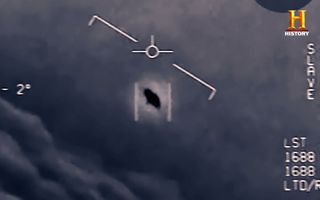
The seemingly spinning-top-shaped object in the “GIMBAL” video.
Stranger doesn’t necessarily need to imply paranormal, supernatural, or extraterrestrial. As more and more descriptions about these Navy pilots’ interactions with these objects come to light, strange coincidences and curious details are starting to emerge. Could all of these sightings and the current wave of ‘disclosures’ actually be a way for the Navy to coyly admit it possess next-generation aerospace tech?
That’s all conjecture at this point, but there are a few pieces of evidence to support such a theory. Many observers have noted how curious it is that all of the sightings described in these recent disclosures took place in highly-controlled airspace in which the U.S. Armed Forces readily conduct exercises and drills or test new technologies. Many of the sightings took place in the military airspace near Naval Air Station Oceana in Virginia, while the infamous “Tic Tac” incident took place in special use airspace off the coast of California. Given that the Armed Forces regularly conduct Joint Strike Group exercises in highly-controlled waters and airspace, it seems pretty coincidental that so many high-profile encounters with unidentified aerial phenomena would occur within these spaces.
Particularly given the new technology that was being tested in these areas at the time of these sightings. In the 2004 Tic Tac sightings, the USS Nimitz supercarrier and its F/A-18F Super Hornets were testing a revolutionary new sensor fusion and data-sharing system known as Cooperative Engagement Capability technology. This system lets satellites, aircraft, and ships share real-time data gleaned from dozens of sources, enabling aircraft or other vessels to track and fire upon targets their own sensors aren’t even picking up. In a way, it’s a type of ‘hive mind’ allowing an entire Joint Strike Group to share data on the fly.
USS Nimitz
The 2004 sightings occurred as the Navy was testing this technology for the first time and had just completed training for the new system. What better way to test a new data-sharing system than to send some kind of crazy next-generation prototype up into the air to see if the USS Nimitz and all of its high-tech assets could track it? The 2004 sightings weren’t unique in this regard: in the recent New York Times story detailing incidents form 2014 and 2014, the F-A/18 pilots also described conducting exercises with the same Cooperative Engagement Capability technology in preparation for deployment when they began encountering strange objects as high as 30,000 feet in the air.
It seems like a pretty big coincidence that Navy pilots would encounter these seemingly superior aircraft while conducting drills in highly-controlled airspace while using revolutionary new sensor fusion and data-sharing technology. Could these encounters have actually been the Navy’s way of conducting real-world tests of some unknown type of new aerospace technology while keeping everyone, even their own pilots, in the dark about it? Of course, we don’t know how many other Cooperative Engagement Capability drills took place without any UFO encounters, so without other information, this is all speculative.
Still, the coincidence is glaring and has some wondering if it could have been by design. According to the most recent New York Timesreport, even many pilots “speculated that the objects were part of some classified and extremely advanced drone program” in the wake of these encounters. As aviation watchdog Tyler Rogoway at The War Zone points out, “it’s hard to overstress just how opportune the conditions would have been for this particular [Carrier Strike Group], or elements of it, equipped with the world’s best air defense capabilities to be tested against exotic and high-performance flying craft.”
F/A-18E Super Hornet
Allegations or speculation about the U.S. military muddying the waters surrounding UFO encounters in order to conceal revolutionary, secret, or prototype technologies are nothing new and are rarely supported by evidence. In the case of the Navy’s alleged UFO encounters, there is no hard evidence surrounding these claims, but there is a deal of ‘soft’ evidence, if you will. For years, several nations and scientific institutions have claimed to have created a radical new form of propulsionusing electromagnetic radiation inside resonant vacuum chambers. If ever constructed, this theoretical “EM Drive” engine could hypothetically enable aircraft to maneuver as the UFOs in the Navy pilots describe mysterious airborne objects behaving.
While the EM Drive remains a theoretical concept as far as we know, there is the strange addition of a few curious Navy patents which surfaced on the internet recently as the Navy UFO fervor has heated up. One appears to describe a polygonal craft which can “engineer the fabric of our reality at the most fundamental level” and “greatly advance the fields of aerospace propulsion and power generation.” The patent claims the inventor of this craft is a shadowy figure named Salvatore Cezar Pais, while the patent was filed by and assigned to the US Secretary of Navy. Other patents by the same Salvatore Cezar Pais/Secretary of Navy combo include a new type of room temperature superconductor which could allow for “the design and development of novel energy generation” and a “high frequency gravitational wave generator” which sounds suspiciously like the EM Drive and looks like a cube inside a sphere – the same description of an object seen by two Navy pilots in 2014 off the coast of Virginia. All of the patents were filed within the last three years.
Are these patents related to the Navy’s now-famous UFO encounters in any way? The craft they describe sure do sound eerily familiar alongside the descriptions of these recent Navy encounters. If the Navy does possess next-gen or next-next-gen aircraft, what better way to see what they can really do than to send them up in the air to toy with your best pilots, sensors, and aircraft? Are all of these recent ‘disclosures’ and the new History Channel series merely a way to get out in front of the story concerning radical new technologies?
I found not one, but hundreds of buildings on planet Ceres. The southern pole is littered with structures everywhere. I tried my best to find and report only the most clear of the structures. I will report the Northern pole tomorrow. This video I made is 18 minutes long with new structures every half minute, so I hope you wont get board. Ceres...had life on it long before human life ever evolved on Earth. Perhaps these are our ancient descendants and they placed humanity on earth to create an experiment that would allow them to watch and learn from us...thus learning about their own early evolution. Scott C. Waring
UFOs are very real, as we have recently seen — but that doesn't mean E.T. has been violating our airspace.
"UFO" refers to any flying object an observer cannot readily identify. And pilots with the U.S. Navy saw fast-moving UFOs repeatedly off the East Coast throughout 2014 and 2015, in one case apparently nearly colliding with one of the mysterious objects, The New York Times reported earlier this week.
Those incidents were reported to the Pentagon's Advanced Aerospace Threat Identification Program (AATIP), whose existence the Times and Politico revealed in December 2017. (Interestingly, those 2017 stories cited Pentagon officials as saying that AATIP had been shut down in 2012.)
Former AATIP head Luis Elizondo, by the way, is involved with a new six-part series called "Unidentified: Inside America's UFO Investigation," which premieres tonight (May 31) on The History Channel.
The Navy pilots said some UFOs reached hypersonic speeds without any detectable exhaust plumes, suggesting the possible involvement of super-advanced propulsion technology. Still, Defense Department officials aren't invoking intelligent aliens as an explanation, according to this week's Times story — and they're right to be measured in this respect, scientists say.
There are multiple possible prosaic explanations for the Navy pilots' observations, said Seth Shostak, a senior astronomer at the SETI (Search for Extraterrestrial Intelligence) Institute in Mountain View, California.
He pointed out, for example, that the sightings occurred off the coast, as did a similar 2004 observation unveiled in conjunction with the December 2017 stories. (That previous sighting occurred near San Diego).
Coastal regions are where you might expect to find a rival nation's advanced reconnaissance craft, Shostak said, because incursions over the continental United States would be more obvious and easily detected.
He also noted that, according to the recent Times story, the Navy pilots began spotting the UFOs after their jets' radar system was upgraded. That detail suggests the sightings might stem from some sort of software bug or instrument issue, he said.
"As anybody who uses Microsoft products knows, whenever you upgrade any technical product, there are always problems," Shostak said.
Such reasoning is bolstered by the current tendency of UFOs to manifest as blobs or blurs on the displays of advanced instruments rather than as crisply defined objects in cellphone photos.
"The sightings always recede to the edge of what technology allows you to do," Shostak said. "The aliens are kind of keeping pace with technology."
Common sense also argues against jumping to the E.T. conclusion. If these UFOs are indeed alien spacecraft, what exactly are they doing? Why were they sent here, across the vast gulfs of space and time?
"If the aliens are here, you gotta say they're the best houseguests ever, because they never do anything," Shostak said. "They just buzz around. They don't address climate change; they don't steal our molybdenum."
But such skepticism should not be taken as a dismissal of the E.T. possibility, Shostak stressed.
"It's not trivial to say what these things are," he said. And Shostak applauded a newly enacted classified Navy policy, as reported by the Times, instructing pilots on how to report UFOs (which the military, and many other people, now call "unexplained aerial phenomena," likely in an attempt to dodge the tinfoil-hat stigma associated with the term "UFO.")
"That's a good policy," he said. "Let them do it."
After all, we've learned over the past decade or so that our Milky Way galaxy is home to huge numbers of potentially habitable worlds. Observations by NASA's Kepler space telescope, for example, suggest that at least 20% percent of the galaxy's 200 billion or so stars likely harbor a rocky planet in the "habitable zone," that just-right range of distances where liquid surface water could exist.
So, while the odds may be long that any UFO witnessed to date was an extraterrestrial craft, it's far from crazy to suspect that intelligent aliens are out there somewhere (or at least were out there somewhere, at some point during the Milky Way's 13-billion-year history). That's why people like Shostak keep listening for signals from the sky.
Mike Wall's book about the search for alien life, "Out There" (Grand Central Publishing, 2018; illustrated byKarl Tate), is out now. Follow him on Twitter @michaeldwall. Follow us on Twitter@Spacedotcom orFacebook.
Former head of secretive government UFO program who claims to have seen mysterious supersonic craft that spun like a top set to reveal all in new documentary
Luiz Elizondo will talk about helming a secretive government UFO program
In a documentary on the History Channel, Elizondo hopes to start a conversation
Included in the documentary are details on sightings of mysterious aircraft
The documentary moves the needle on a more frank discussion of UFOs
One of the former leaders of a covert government program meant to investigate the nature of 'unknown aerial phenomenon' is opening up about some of the strange and often unexplained accounts.
In an upcoming History Channel documentary featuring former head of the Pentagon's Advanced Aerospace Threat Identification Program (AATIP), Luis Elizondo details his involvement with the Pentagon's UFO research program in a blockbuster New York Times report from 2017.
In the Times' report, Elizondo revealed that he left the secretive $22 million government program after what he has termed excessive secrecy and internal opposition to the project.
Scroll down for video
Luis Elizondo, pictured above, headed a secretive government program meant to investigate the nature of UFO's and will open up about his involvement in a History Channel documentary
According to Elizondo, who spoke to Live Science ahead of the documentary's premier tonight at 10 pm ET, the goal of his participation is to kick start a frank conversation about the phenomenon witnessed by the now defunct program and other reports like it.
Included in that discussion, are various puzzling reports of aircraft that seem to defy the laws of gravity as humans know them, traveling and maneuvering at speeds unparalleled by current technology.
In a recent New York Times report, a former Navy official described some of those sightings which he said occurred between 2014 and 2015.
The mysterious craft, which he said looked like a spinning top, had no visible signs of propulsion but were able to reach 30,000 feet at speeds well faster than sound.
'These things would be out there all day' Lt. Ryan Graves, an F/A-18 Super Hornet pilot told the Times.
Unexplained aircraft often defy the laws of gravity, traveling at speeds well beyond the limits of human aerospace technology. In a New York Times report, a former Navy official described some of those sightings ( one shown) which he said occurred between 2014 and 2015
'Keeping an aircraft in the air requires a significant amount of energy. With the speeds we observed, 12 hours in the air is 11 hours longer than we’d expect.'
Likewise, Elizondo said, these sightings of seemingly impossible aircraft were not uncommon. In an interview with Live Science, he said that some of the ships reported by the agency far exceeded the known limits of gravitational force.
While human technology tops out at about 16 to 18 G's, the craft seemed to ignore those rules.
'These things that we were observing were pulling 400 to 500 G's,' Elizondo told Live Science.
'They don't have engines or even wings, and they are able to seemingly defy the natural effects of Earth's gravitational pull.'
Elizondo stops short of saying the unknown craft are the result of extraterrestrial beings, but underscores the need to investigate phenomenon, citing its implications on national security.
Willingness to talk about unexplained phenomenon has seemed to broaden in the U.S. military with new guidelines on reporting sightings
'We trust the American people to know that North Korea has nuclear warheads pointed at Los Angeles, yet we don't trust them with the knowledge that there's something in our skies and we don't know what it is? That seems counterproductive to me,' Elizondo told Live Science.
Elizondo's appearance in the History Channel documentary marks the latest step toward an increasing willingness on the part of the U.S. government and others to acknowledge and investigate the existence of UFO's.
Recently, the U.S. Navy also unveiled new guidelines on collecting information about UFO sightings which they said are designed to make it easier for sailors to report UFO sightings amid fears that the objects could actually be 'extremely advanced Russian aircraft.'
Earlier this month, a U.S. Department of Defense spokesperson reportedly confirmed the Pentagon's interest in UFO's to the New York Post, citing the agency's investigation of 'unidentified aerial phenomena' in an unprecedented use of UFO-like terminology.
In 1957, a beach-ball-shaped satellite hurtled into the sky and pierced the invisible line between Earth and space. As it rounded the planet, Sputnik drew an unseen line of its own, splitting history into distinct parts—before humankind became a spacefaring species, and after. “Listen now for the sound that will forevermore separate the old from the new,” one NBC broadcaster said in awe, and insistent that others join him. He played the staccato call from the satellite, a gentle beep beep beep.
Decades later, we are not as impressed with satellites. There have been thousands of other Sputniks. Instead of earning front-page stories, satellites stitch together the hidden linings of our daily lives, providing and powering too many basic functions to list. They form a kind of exoskeleton around Earth, which is growing thicker every year with each new launch.
The newest additions come from SpaceX. The company launched 60 satellites into orbit Thursday night, the first batch of thousands of satellites that will someday beam internet down to Earth. The satellites traveled to space in a big, cozy stack. Once in orbit, they will fan out—“like spreading a deck of cards on a table,” according to Elon Musk—and unfurl solar arrays to soak up the sunlight they’ll use to power themselves. As of early Friday morning, all 60 satellites had come online.
Musk, SpaceX’s CEO, says the effort, named Starlink, will provide convenient and reliable internet service “ideally throughout the world.”
Sixty is just the beginning. Musk hopes to deploy as many as 12,000 satellites to furnish the constellation. “I wouldn’t be surprised if we’re launching at least on the order of 1,000 to 2,000 satellites a year,” he told reporters recently.
Here’s what that would look like:
Starlink will connect the globe with reliable and affordable high-speed broadband services pic.twitter.com/dWVvPwVWU4
That’s a lot of satellites. Right now, about 5,000 are in orbit around Earth—in total. Only about 2,000 are still functioning. Nearly half belong to the United States, with China and Russia leading the pack with the rest. “I think within a year and a half, maybe two years, if things go well, SpaceX will probably have more satellites in orbit than all other satellites combined,” Musk said. “If things go according to plan—a big if, of course, but it is quite remarkable to think of that being the case.”
The launch puts Musk ahead of other entrepreneurs with their own internet-satellite ambitions. Jeff Bezos wants to launch thousands through a program under Amazon, and Greg Wyler, the head of OneWeb, which was established for this express purpose, deployed the company’s first six satellites in February.
SpaceX’s initial delivery of satellites is also a bit of a headache for a niche group of conservationists, the people who worry about the growing number of satellites and pieces of debris accumulating over Earth. They warn that a crowded orbit increases the risk of collisions, fast-moving impacts that would generate even more floating junk. A historian once told me that if an avalanche of crashes were to knock out the entire satellite infrastructure, “tentacles of disruption” would unfurl across the globe. Some experts even say that a packed orbit would make it more difficult for space missions to squeeze through and leave Earth altogether.
“The space environment isn’t easy to clean,” says Lisa Ruth Rand, a historian who studies orbital debris. “As difficult as it is to remediate damage on Earth from, say, an oil spill, imagine how difficult it would be to clean up a disaster in microgravity.”
Musk said SpaceX is “taking great pains to make sure there’s not an orbital-debris issue.” The newest satellites, he pointed out, orbit at an altitude low enough that allows them to become sucked back into Earth’s atmosphere within a year if they stop working. The satellites also receive radar information that tracks objects in orbit, allowing them to “automatically maneuver around any orbital debris.”
The fact that SpaceX is doing the kind of work historically done by national governments doesn’t seem as novel as it did even a few years ago. But the thought of a commercial company’s satellites outnumbering all the rest, and in such a short period of time, is rather astonishing. If extraterrestrial beings were to swing past Earth and check the tags on the artificial objects shrouding the planet, they might think the place belonged to SpaceX.
What happens when young stars brush past each other? A lot, according to a new study suggesting our solar system contains comets stolen from another star 4.5 billion years ago.
I love the video above. It shows what happens when two young stars – still surrounded by their disks of planetesimals, or planet-building blocks – encounter each other. It’s based on recent computer simulations, part of a newly published study by astrophysicists at the University of Zurich, describing how our solar system likely contains comets stolen from a star that swept near our sun 4.5 billion years ago. Stars like our sun are born in clusters. Our sun is thought to be about 4.5 billion years old. So we’re talking about the very young sun here, newly emerged from the cloud of gas and dust that created it and its sister stars. The new study says that, when two young stars meet, their encircling disks mix it up, literally. In particular, the outer planetesimals of the smaller star are heavily disrupted by its higher-mass sibling. Some planetesimals – chunks of rocky or icy material – switch from one star system to the other. They are “stolen,” in other words.
And some planetesimals leave both star systems behind entirely. Tom Hands, who led the new study, explained:
[The encounter] causes a bunch of planetesimals to be ejected, flying away to become things like ‘Oumuamua [the small interstellar object that recently swept near our sun]. I was surprised by the number of ‘Oumuamua-like free-floating objects that can be generated in an environment like this on a relatively short time-scale.
‘Oumuamua is a now-famous object among astronomers, who noticed it and began tracking its movement through our solar system in 2017. Though many free-floating objects are thought to exist, ‘Oumuamua is the only small interstellar object seen moving in our solar system so far. It’s not attached to our sun, or any star. That’s how it received its name, which is Hawaiian for “a messenger from afar arriving first.” Astronomers don’t know where ‘Oumuamua came from, exactly. Speaking about the new study, Tom Hands and his colleagues’ statement said:
… it is clear that free-floating planetesimals, comets and asteroids should be ubiquitous in the galaxy.
This diagram shows the path of the interstellar object ‘Oumuamua – the first known interstellar object to pass through our solar system – as it was sweeping toward our sun in late 2017, rounded the sun, and then began moving outward again. ‘Oumuamua passed the distance of Jupiter’s orbit in May 2018. It passed the distance of Saturn’s orbit in January 2019. It will reach a distance corresponding to Neptune’s orbit in 2022, according to some studies.
‘Oumuamua made headlines after it was discovered in October 2017. Many theories have been suggested to explain its origin, including the possibility of its being an alien spacecraft.
Researchers at the University of Zürich used large computer simulations to show how ‘Oumuamua-style objects can be set on their solitary paths through space. They calculated what happens when multiple young stars are born together in a stellar cluster, much as our sun is thought to have been 4.5 billion years ago. Most of what astronomers call planetesimals – the building blocks of planets – ultimately do become planets, comets and asteroids while the stars are still in their infancy. But not all do. Tom Hands commented:
Coming into close contact with other stars can have a profound effect on these planetary systems.
I was also surprised by the ease with which stars can steal material from their stellar siblings at a young age.
Artist’s concept of the cigar-shaped interstellar object ‘Oumuamua.
Image via ESA/Hubble, NASA, ESO, M. Kornmesser, NCCR PlanetS.
Even now, our sun might retain alien comets stolen from another star in these early phases. Hands said:
Even if alien material is really there, there likely isn’t much of it. But we might be able to detect it based on the strange orbits this stuff could be on.
Hands said his research has relevance to the ongoing search for a ninth planet in our solar system, which is based on an odd alignment of orbits of small objects in the outer solar system. He said the results of his study suggest that a large, unseen ninth planet isn’t the only plausible explanation for this observed alignment. Hands commented:
People should keep an open mind when considering how these things might have ended up on the orbits they are on.
Finally, he commented:
This is the first time we have been able to get a feeling for how the cluster environment could affect our Kuiper belt, or similar structures in exoplanetary systems
And I don’t think he’s boasting there. It seems like novel research to me. Forty-plus years ago, when I started writing about astronomy, we’d sometimes hear astronomers say that comets in the Oort Cloud could be dislodged by “passing stars” and thereby be sent hurtling in toward our sun. I always wondered which passing stars, and when, and what went on there? To my knowledge, this study doesn’t relate specifically to Oort Cloud comets; it does talk about objects in the Kuiper Belt, though, which are also in our solar system’s outer reaches, at a lesser distance from our sun. Both Oort Cloud and Kuiper Belt material would surely be affected by an encounter with another star 4.5 billion years ago. It’s great to have an actual simulation, at last, that provides concrete images of this long-discussed encounter.
And, by the way – on an entirely different subject – I found a second super cool video at Tom Hands’ website, also based on his computer simulations. You might enjoy it, too, so I posted it below. It’s an exoplanet visualization, based on data from the Open Exoplanet Catalog. He described the video below as:
… a flyby of all known exoplanets around single stars. The systems are ordered according to the largest semi-major axis (planet-star separation) within each of them, from largest to smallest. The systems that you fly past first contain planets which takes hundreds or even thousands of years to orbit their stars, while by the end they take mere hours or days. Designed to give the viewer an overview of the current distribution of exoplanets.
Bottom line: A new study from Tom Hands and colleagues at the University of Zurich suggests our solar system contains comets stolen from another star 4.5 billion years ago. The interstellar visitor ‘Oumuamua might be an example of an object dislodged from its original solar system in that way. According to this study, there might be many free-floating objects like ‘Oumuamua in our galaxy.
Meer van UFO'S of UAP'S, ASTRONOMIE, RUIMTEVAART, ARCHEOLOGIE, OUDHEIDKUNDE, SF-SNUFJES EN ANDERE ESOTERISCHE WETENSCHAPPEN - DE ALLERLAATSTE NIEUWTJES


 Mysterious Flashes of Light are Coming From the Lunar Surface




 King of the Monsters: Godzilla has evolved 30 times FASTER...
 Is Twitter making you 'stupid'? Italian scientists find the...
 World's oldest case of whipworm infection is discovered in...


