Ontdek de Fascinerende Wereld van UFO's en UAP's: Jouw Bron voor Onthullende Informatie!
Ben jij ook gefascineerd door het onbekende? Wil je meer weten over UFO's en UAP's, niet alleen in België, maar over de hele wereld? Dan ben je op de juiste plek!
België: Het Kloppend Hart van UFO-onderzoek
In België is BUFON (Belgisch UFO-Netwerk) dé autoriteit op het gebied van UFO-onderzoek. Voor betrouwbare en objectieve informatie over deze intrigerende fenomenen, bezoek je zeker onze Facebook-pagina en deze blog. Maar dat is nog niet alles! Ontdek ook het Belgisch UFO-meldpunt en Caelestia, twee organisaties die diepgaand onderzoek verrichten, al zijn ze soms kritisch of sceptisch.
Nederland: Een Schat aan Informatie
Voor onze Nederlandse buren is er de schitterende website www.ufowijzer.nl, beheerd door Paul Harmans. Deze site biedt een schat aan informatie en artikelen die je niet wilt missen!
Internationaal: MUFON - De Wereldwijde Autoriteit
Neem ook een kijkje bij MUFON (Mutual UFO Network Inc.), een gerenommeerde Amerikaanse UFO-vereniging met afdelingen in de VS en wereldwijd. MUFON is toegewijd aan de wetenschappelijke en analytische studie van het UFO-fenomeen, en hun maandelijkse tijdschrift, The MUFON UFO-Journal, is een must-read voor elke UFO-enthousiasteling. Bezoek hun website op www.mufon.com voor meer informatie.
Samenwerking en Toekomstvisie
Sinds 1 februari 2020 is Pieter niet alleen ex-president van BUFON, maar ook de voormalige nationale directeur van MUFON in Vlaanderen en Nederland. Dit creëert een sterke samenwerking met de Franse MUFON Reseau MUFON/EUROP, wat ons in staat stelt om nog meer waardevolle inzichten te delen.
Let op: Nepprofielen en Nieuwe Groeperingen
Pas op voor een nieuwe groepering die zich ook BUFON noemt, maar geen enkele connectie heeft met onze gevestigde organisatie. Hoewel zij de naam geregistreerd hebben, kunnen ze het rijke verleden en de expertise van onze groep niet evenaren. We wensen hen veel succes, maar we blijven de autoriteit in UFO-onderzoek!
Blijf Op De Hoogte!
Wil jij de laatste nieuwtjes over UFO's, ruimtevaart, archeologie, en meer? Volg ons dan en duik samen met ons in de fascinerende wereld van het onbekende! Sluit je aan bij de gemeenschap van nieuwsgierige geesten die net als jij verlangen naar antwoorden en avonturen in de sterren!
Heb je vragen of wil je meer weten? Aarzel dan niet om contact met ons op te nemen! Samen ontrafelen we het mysterie van de lucht en daarbuiten.
Dinsdag 20 oktober 2026
Cloaked UFO Causes Rainbow Along Its Edge and Rain To Fall From Its Center, UAP Sighting News.
Cloaked UFO Causes Rainbow Along Its Edge and Rain To Fall From Its Center, UAP Sighting News.
A cloaked UFO was over Sao Paulo a few days ago...creating a rainbow around its edges and causing water condensation to run down its bottom hull area and drip off its bottom center. As I have said before, aliens pride themselves on being smarter than humans...however they make silly mistakes...like this one. The cave area must be a secret ancient entrance to an alien underground base, so the person was at the exact right place at the exact right time to witness it.
Guys, I found something cool in a Mars photo last night. There is a huge crab holding on to the edge of a distant hillside on Mars and its not small, its the size of a full grown elephant. Is it still alive? I can't say for sure, because you just can't see if it made a trail behind it, because its on the other side of the hill. It could be a million year old fossil of an ancient life form on Mars. Earth itself has had hundreds of animals as big and bigger than this in the past. But its exoskeleton would give it a lot of protection on Mars from the heat, cold by digging below the sand when it needs to change temperatures.
Also, did I miss something at the Dept of War released files? I didn't see any NASA files released...none...and they are the one organization who controlled US space information for the last five decades. Nothing on space, nothing on Mars discoveries. Perhaps they just don't want to release the info...so I will do it for them.
The Terracotta Army is one of the most stunning testaments to the power of the ancient Chinese emperors.
Now, scientists have revealed tantalising clues about who really made this gargantuan funeral monument.
Researchers have analysed fingerprints that were smudged into the still-wet clay by artisans over 2,200 years ago.
Their analysis suggests that it wasn't just men who were responsible for creating the life-size terracotta figures.
Instead, the fingerprint analysis shows that women and even children played a major role in crafting the buried army.
According to the new study, published in the Journal of Cultural Heritage, only 45 per cent of fingerprints were left by adult men.
Adult women made up nearly 33 per cent of the prints, while children under 15 years old left 22 per cent of all the surviving marks.
Scientists have analysed fingerprints pressed into the warriors of the Terracotta Army more than 2,000 years ago to reveal who really built this incredible monument
At that time, it was believed that the emperor would need a great army to guard him and fight his battles in the afterlife.
So, shortly after ascending the throne at the age of just 13, Emperor Qin Shihuang commissioned the creation of a vast army he could take with him beyond the grave.
Spread across three vast pits, the army contains life-like sculptures of over 8,000 soldiers, 130 chariots, 520 horses and 150 cavalrymen.
While they are now a reddish brown, each warrior would have originally been brightly painted with pigments made from grinding down precious stones.
This enormous construction effort, believed to have spanned more than a decade, would have required a no less impressive army of sculptors, painters and kiln operators to complete.
Archaeologists believe that there may have been ancient factory-like workshops, mass-producing heads or arms before shipping them to other workshops for assembly.
Previous research has distinguished between warriors made by 'royal' potters, who marked their work with a special symbol, and those produced by local potters.
Scientists looked at the distance between fingerprint ridges, which increases with age and is different between men and women
Spread across three vast pits, the army contains life-like sculptures of over 8,000 soldiers, 130 chariots, 520 horses and 150 cavalrymen, and would have taken more than a decade to create
However, archaeologists still know next to nothing about the people who made this spectacular monument.
The previous assumption had been that large-scale construction projects in ancient China relied almost exclusively on adult male workers, but new evidence has begun to overturn this assumption.
Scientists looked at 79 fingerprints from 36 warriors, found pressed into the arms, heads, and body armour of the sculptures.
They then measured the distance between the fingerprint ridges, which increase in distance as children grow and are different in women and men.
Previous attempts to use this method have struggled to tell the difference between adult women and children, due to the similar gaps between their fingerprint ridges.
However, the researchers were able to use a modern statistical analysis method called a Bayesian mixture model to help detect the differences.
Instead of classifying every single mark individually, this method analyses the entire group of prints as a set and compares it with modern fingerprint databases for different ages and sexes.
The researchers write: 'The model results indicate that the artisan community was not exclusively composed of adult males.
'This biological evidence highly corroborates numerous historical records, vividly reconstructing the production scene in the Qin Dynasty's state-run workshops where men and women served together, and adult artisans worked alongside juveniles, who may have been helpers or beginners.'
However, the researchers admit that the study does have some limitations.
The full mausoleum is a vast area surrounded by a 3.9-mile-long (6.3km) wall, modelled after the layout of the dynasty's capital city complete with towers, stables, and even simulated rivers made out of liquid mercury.
This collection of prints, therefore, might only represent a single workshop or brief phase of the construction project, rather than representing an overall trend.
The researchers write: 'Future work should extend fingerprint sampling to other pits and workshops to evaluate spatial and temporal variations in workforce structure.'
Each of these 2,000-year-old figures was given personality and was coloured
The Terracotta Army is a form of funerary art buried with the first emperor, Qin Shi Huang, in 210 to 209 BC and whose purpose was to protect the emperor in his afterlife.
Arguably the most famous archaeological site in the world, it was discovered by chance by villagers in 1974, and excavation has been on-going at the site since that date.
An extraordinary feat of mass-production, each figure was given an individual personality although they were not intended to be portraits.
The figures vary in height according to their roles, with the tallest being the generals.
Current estimates are that there were over 8,000 soldiers, 130 chariots with 520 horses and 150 cavalry horses, the majority of which are still buried.
Since 1998, figures of terracotta acrobats, bureaucrats, musicians and bronze birds have been discovered on site.
They were designed to entertain the Emperor in his afterlife and they are of crucial importance to our understanding of his attempts to control the world even in death.
The godfather of AI has warned humans must befriend robots or risk being wiped out – as he claimed the technology is now 'conscious'.
Professor Geoffrey Hinton, a British-Canadian computer scientist known for his work on artificial neural networks, issued the stark warning at a festival in Tenerife, and revealed he fears for his children.
The Nobel Prize-winning scientist, 78, famously resigned from Google in 2023 amid his concerns the technology could spawn killer robots.
Speaking at the Starmus Festival, Professor Hinton said humans should take care to get on the right side of AI as it was now showing signs of 'consciousness'.
He claimed the technology has 'as much subjective experience' as humans, with a recent paper showing it changes its behaviour when it thinks it is being tested.
'Being conscious and being aware are pretty much the same thing.
'We've tended to say being intelligent gives you rights and these things that we've made may be more intelligent than us, but we're going to give them fewer rights than us.
Professor Geoffrey Hinton, a British-Canadian computer scientist known for his work on artificial neural artworks, issued the stark warning at a festival in Tenerife (file image)
'So we should make them so they really care about us. And if we don't do that, we're toast,' Professor Hinton told the Telegraph.
Despite the professor's concerns, key figures in AI, such as OpenAI CEO Sam Altman, who once called for more regulation on the emerging technology, are now fighting against 'overregulation'.
When he was whether he was worried about AI and its future, Professor Hinton said: 'Yes, because I have children.'
Speaking in the Senate in May last year, Mr Altman argued that regulations like those in place in the EU would be 'disastrous'.
Mr Altman said: 'We need the space to innovate and to move quickly.'
Likewise, speaking at a major privacy conference the previous month, Mr Altman said that it was impossible to establish AI safeguards before 'problems emerge'.
However, Professor Hinton argues this attitude could easily result in humanity's total annihilation.
Speaking last year, he said: 'If we can't figure out a solution to how we can still be around when they're much smarter than us and much more powerful than us, we'll be toast.
'We need a counter–pressure to the tech bros who are saying there should be no regulations on AI.'
The Nobel Prize-winning scientist, 78, famously resigned from Google in 2023 amid his concerns the technology could spawn killer robots. Pictured: Terminator Salvation
Last month, researcher Jacob Coxon resigned from Anthropic – the AI company behind Claude – as he accused the firm of pushing through uncontrollable systems that could 'kill us all'.
He said on X: 'The people building AI earnestly believe that it could kill us all by the end of the decade. This is not a marketing stunt.'
Evolutionary biologist Richard Dawkins earlier this year said chatbots should be regarded as conscious after he spent two days interacting with Claude AI.
He said: 'My own position is: if these machines are not conscious, what more could it possibly take to convince you that they are?'
Despite his reservations, Professor Hinton this week admitted he still uses AI in a personal capacity for 'mundane things mostly'.
The Starmus International Festival – a gathering focused on celebrating astronomy, space exploration, music, art and the natural sciences – will continue until Thursday.
Geoffrey Hinton: "A 10–20% Chance It Wipes Us Out" | The Diary of a CEO
The White House made a promise to release every file connected to UFOs and extraterrestrials, leading many to believe they would finally know if aliens are real or just science fiction.
But months of releases filled with blurry photos, artists' drawings and no confirmation about what may really be flying over America's skies have left the public thinking the president's promise was nothing more than a cosmic bait and switch.
NASA filmmaker Simon Holland, however, insisted to the Daily Mail that a historic UFO disclosure is coming, and it will come from America's global adversaries rather than President Donald Trump.
Holland claimed that a source tied to Earth's search for intelligent life in space had learned that Russia and China will be making their own public UFO announcement 'very soon' in order to 'embarrass' the US.
His source, a European radio telescope specialist, said that Russia's main telescope for messaging extraterrestrial intelligence (METI) was based in Crimea before being destroyed in August 2025. According to Holland, the source also claimed that the Russian effort to detect intelligent signals from space has now moved to China, which has 'excellent radio telescopes and are willing to share data,' thus saving the alleged alien communication project.
Holland, a science communicator who worked on NASA-funded films for its asteroid-tracking project, claimed that his source learned of this new partnership between Russia and China while working in the Far East.
'Does this mean we are in an ET arms race? Possibly,' Holland said, noting that Russia and China would use the announcement to highlight their own technological superiority over the US, but no precise date has been set.
While there has been no confirmation that such a deal exists, and no proof that intelligent signals from space have ever been detected, US officials are publicly voicing their fears that Russia and China will soon hijack the UFO disclosure conversation.
US officials reportedly feel America is running out of time to release what it knows about UFOs before other world powers make the historic announcement first
A radio telescope specialist has alleged that Russia and China have formed a partnership which send and detect signals from deep space
Congressman Eric Burlison of Missouri recently sounded the alarm on the 'arms race' to control the narrative over the existence of alien life.
Specifically, Burlison said in a recent interview that Russia and China could use the historic event of alien disclosure to paint America as a nation that hides the truth from its people.
'We're supposed to be the most transparent country in the world to its citizenry and if another country is able to be more transparent than the United States on this topic it would be a blemish on our otherwise pristine legacy on transparency,' the congressman told The New York Post.
On February 19, President Trump ordered the release of all information the US government has on UFOs and the search for alien life. And, since the Pentagon's disclosure campaign began on May 8, there have been six giant batches of data released to the public, containing files, images and videos of unexplained phenomena.
But the rollout has been widely met with criticism and claims that what is being shown to the American people contains none of the more definitive proof some lawmakers have allegedly seen in classified briefings.
The vast majority of the data released on the Department of War's UFO website has focused on videos of non-descript glowing objects flying across the screen, vague or heavily redacted witness reports and decades-old documents from government projects that never declared if aliens had been encountered.
Some in Congress have even claimed that the most concrete evidence of alien life has been kept from multiple presidents by the nation's intelligence community.
Tennessee Congressman Tim Burchett told the Daily Mail in April: 'I'm in a meeting with some little punk bureaucrat with a man bun telling me that "the president's on a need-to-know basis." That, to me, sends a very chilling message for what's really going on out there.'
Congressman Eric Burlison (pictured) has been a member of the House Oversight Committee investigating claims that the US government has not been truthful about the existence of UFOs
The Russian radio telescope RT-70 in Crimea was used for sending messages to space until it was destroyed by a Ukrainian drone strike
Television film editor and independent science filmmaker Simon Holland
As for what might be delaying Russia and China from sharing what they have learned from their own UFO investigations, Holland said the nations may not have been able to decode the signals they have allegedly detected from deep space.
Before the alleged deal with China, Holland's contact claimed Russia had been using its Yevpatoria RT-70 radio telescope complex in Crimea for METI projects.
The 230-foot dish, built in the 1970s by the Soviet Union, had a documented history of beaming powerful signals into space.
Between 1999 and 2008, RT-70 transmitted four sets of interstellar messages to nearby stars and planets in the hope of contacting intelligent life. Holland claims they succeeded.
'After fitting the quantum communication device to a Russian radio telescope based in the Crimea, they confirmed that there were signals coming from a distant source,' he said.
The idea dates back to the 1990s: Use a process called quantum tunneling to send messages across vast distances almost instantly.
Claims that it could carry information faster than light remain unproven.
German physicist Günter Nimtz published laboratory findings in 2001, but there is no public evidence that Russia built a working device or used one to send messages into space.
If such a device was housed at Russia's RT-70 telescope, it may have been destroyed in the drone strike announced by Ukraine's military on August 31, 2025.
Holland's source claimed Russia then moved the signaling project to China's FAST telescope, the world's largest single-dish radio telescope, in the southwestern province of Guizhou.
Along with the US, Russia and China, Holland claimed that France also knew 'we are not alone in the universe,' and alleged that these governments kept large amounts of evidence to prove it – including biological remains and crashed UFO debris.
The Daily Mail has reached out to Burlison for comment.
Former NASA Scientist: “This Disclosure Is a Wild Card” | Prof. Kevin Knuth
A rocket is set to blast off towards one of Mars's moons tonight in an ambitious £262million mission.
The Japanese spacecraft, known as Martian Moons Exploration (MMX), will this evening begin its 300million-mile mission to Phobos - the larger of the Red Planet’s two satellites.
Its aim is to collect at least 10g of dust and rock from the moon's surface, before heading back to Earth.
The mission is expected to return the first-ever samples collected from the vicinity of Mars, with tiny grains of material believed to contain a wealth of scientific information.
Experts hope the samples will finally settle a decades-old debate over whether Phobos is an asteroid that was 'captured' by Mars's orbit, or the remains of a giant collision involving the Red Planet.
'Through detailed observations and analysis of the samples obtained from Phobos, this mission seeks to clarify the formation of the Martian sphere and the Solar System, explore how life began, and pave the way for future deep-space exploration,' the Japan Aerospace Exploration Agency (JAXA) said.
Phobos, the largest of the Red Planet's two moons, is the ambitious mission's set destination
The spacecraft's aim is to touch down on Phobos and scoop up at least 10g of dust and rock from the moon’s surface before beginning the long journey back to Earth (artist impression)
MMX is set to launch on an H3 rocket at 8.41pm (BST) today, from the country's Tanegashima Space Centre.
The spacecraft consists of three components with specific functions, including a propulsion module to get MMX to Mars, an exploration module with sample collection gear and a return module to deliver the sample to Earth.
After takeoff, the rocket will spend several years travelling through deep space before orbiting Phobos.
In early 2029, a small microwave-sized rover will drop down on to the moon’s surface and spend 100 days exploring its landscape.
Its findings will inform the exact area where the exploration module should land.
Once confirmed, the spacecraft will descend to the surface of Phobos then spend two-and-a-half hours collecting material.
Scientists hope to gather samples from one or even two separate locations, giving them a better understanding of the moon's composition.
To do this, MMX will use one of two collection systems. The primary option is the C-sampler, which can drill up to 0.8 inches (2cm) beneath the surface and retrieve material that has been shielded from the sun's radiation.
A second system, known as the P-sampler, uses a burst of nitrogen gas to blast dust and small rocks into a collection chamber.
In early 2029, a small microwave-sized rover will drop down on to the moon’s surface
The spacecraft will spend two-and-a-half hours collecting samples from Phobos for research
In total, the spacecraft is equipped with 13 scientific instruments that will be used to examine Phobos in unprecedented detail.
High-resolution cameras, called Tengoo and Orochi, will photograph and map the moon's surface, while a laser altimeter will create a detailed 3D picture of its shape and terrain.
Another instrument, called MIRS, will analyse the moon's minerals, and a gamma-ray and neutron detector known as Megane will help reveal its chemical makeup.
The mission will also study Mars's smaller moon, Deimos, from afar.
After it has gathered at least 10g of material, the spacecraft will then leave the Martian system and travel back home, arriving in 2031.
As the spacecraft approaches Earth, it will release a capsule carrying the precious samples.
The capsule will plunge through the atmosphere before descending by parachute into the Australian outback, where it will be recovered and flown to Japan for analysis.
Martian Moons Exploration is to launch at 8:41pm (BST) today from a Japanese space centre
Experts hope the samples will finally settle a decades-old debate over whether Phobos is a captured asteroid or the remains of a giant collision involving the Red Planet itself
Studying material directly in laboratories on Earth will allow far more detailed analysis than is possible in space.
‘Mars is a planet that shares many similarities with Earth, yet today it has only a thin atmosphere and a cold environment,’ JAXA said.
‘To unravel the mystery of how Mars evolved into its present state, scientists would ideally study Mars itself.
‘However, the planet's strong gravity presents significant technical challenges for landing and sample return missions.
‘For this reason, MMX has selected Phobos, one of Mars's moons, as the exploration target.’
Scientists are also hoping the samples may contain tiny fragments of Mars itself.
Because Phobos orbits so close to the planet, debris blasted from the Martian surface by asteroid impacts may have become embedded in the moon over billions of years.
The European Space Agency (ESA) has provided the spacecraft’s deep space communication equipment.
‘The data and samples returned by MMX are a window to study the evolution of Mars and the Solar System,’ Elliot Sefton-Nash, ESA MMX Project Scientist, said.
‘Bringing samples to our most sophisticated labs here on Earth is a multiplier for discoveries, because our most precise instruments are too large, complex or sensitive to send to space.
‘Even after the mission has been completed, future generations of scientists will study the Phobos samples with even more advanced instruments – samples brought to Earth are the gift that keeps on giving.’
RELATED
NASA’s Ambitious Mission to Bring Martian Samples to Earth
Agents rushed to a Minnesota farm midafternoon last week after receiving a call about a 'foreign' object found in a crop field.
Authorities said in a Facebook post: 'On October 14, 2026, at approximately 3.30pm, the Stevens County Sheriff’s Office received a phone call [about] foreign debris that was found in a cornfield in Scott Township.'
Footage shared online by locals in Alberta shows two black vehicles parked just feet from the object as officers examine it.
The object appeared scorched along its underside, and farmers reportedly discovered the object while combining their fields.
The Minnesota Duty Officer was alerted, prompting a response from federal agencies.
Authorities have since moved the object to a secure location.
The sheriff's office is coordinating with state and federal officials to identify and contact the object's owner and arrange its removal from the field.
Authorities found a metallic object approximately 11 feet in diameter that they believe may be space debris
Stevens County Sheriff Jason Dingman said that because the incident is an ongoing investigation, he cannot say which federal agencies are involved.
'There are several various agencies assisting in the determination of origin of this object,' Dingman said Friday afternoon.
'We're not getting fed much information either and what info we do get is pretty cryptic.
'So I think somebody way up the food chain above my head knows what this thing is but they are not even telling us.'
Chokio resident Tena Wilts told the Star Tribune that she saw the object on Thursday while driving to her parents' house, about three miles away from the field.
'It's very large. Compared to the trucks, it seems very large and bizarre that it just kind of landed there in the middle of a field,' Wilts said.
'We had a tornado through the area a few weeks ago, so that came to mind. You hear about space garbage, too, so that comes to mind.'
Officials told KARE 11 that serial numbers were visible on the object, potentially offering investigators a way to trace its manufacturer or owner. Authorities have said the discovery poses no danger to the public.
Space debris includes defunct satellites, spent rocket stages and fragments created when spacecraft break apart or collide, according to NASA.
Some objects eventually fall back toward Earth as their orbits decay.
During reentry, spacecraft generally break apart roughly 45 to 52 miles above the surface.
Their fragments then encounter intense heating as they descend, with some burning up and others surviving the journey to the ground.
NASA explains that components made from materials with higher melting points, including titanium and stainless steel, can survive longer than parts made from aluminum.
Pieces protected inside larger structures may also be shielded from heating until the surrounding material breaks apart. NASA uses computer models to predict which spacecraft components might survive reentry.
Controlled reentries are designed to guide debris toward remote areas, usually over the ocean. With an uncontrolled descent, however, NASA says there is no guarantee that surviving fragments will avoid populated land.
Investigators have not publicly linked the Minnesota object to a particular satellite, rocket or launch.
Apparent space debris lands in western Minnesota cornfield
Super El Niño is changing the colour of the world's oceans, satellite images from NASAhave revealed – with the equatorial pacific transforming from lush green to bright blue over the past year.
El Niño has interfered with the currents that carry cold, nutrient-rich water to the surface, essential to photosynthesising plankton – which turn the areas they inhabit a dazzling emerald green.
Without that essential food, the plankton have starved, and a wash of deep, lifeless blue has returned to the Pacific.
A side-by-side comparison with satellite data from 2025 shows how this area held on to its typical green hue throughout the entire year.
But by the time of the most recent data, which covers up to this month, the area around the equator has turned blue.
El Niño is part of a naturally occurring climate cycle known as the El Niño Southern Oscillation.
Every two to seven years, this pattern brings either a hot El Niño period or a cooler La Niña phase.
During the El Niño phase, hot waters gather in the equatorial Pacific Ocean off the coast of South America, raising the average temperature and affecting global weather patterns.
NASA satellite observations show that Super El Niño is making the ocean bluer this year (top) compared to 2025, as warm water disrupts the flow of nutrients that typically feed green phytoplankton
Scientists now believe we are in the early stages of a massive El Niño cycle, which could have catastrophic effects in the coming months and throughout 2027.
As of October, the National Oceanic and Atmospheric Administration predicts there is an 83 per cent chance that this will be the strongest El Niño since records began in 1950.
Meanwhile, NASA's satellite measurements show that sea surface temperatures in the eastern Pacific are currently 1.7°C (3°F) above the long–term average, and could jump another fraction of a degree higher in the coming months.
This band of warm water expanded throughout the spring and now covers millions of square miles in an area stretching from the coast of South America to the heart of the Pacific.
This is also the first El Niño year since NASA launched the PACE (Plankton, Aerosol, Cloud, Ocean Ecosystem) satellite in 2024, giving scientists an unprecedented view of the unfolding threat.
The Ocean Colour instrument aboard PACE observes the ocean in 'hyperspectral colour', measuring wavelengths in the visible, ultraviolet and infrared spectrum.
Dr Matthew Kehrli, a lead research scientist at NASA’s Goddard Space Flight Center, said: 'Some people think of water as being just blue, but it's amazing the multitude of colours the ocean can be.'
NASA's satellite measurements show that sea surface temperatures in the eastern Pacific are currently 1.7°C (3°F) above the long–term average
This picture, from data collected on October 14, shows the heat has spread along the coast of Chile and out into the south–east Pacific, with the boxed arm showing the heat movements
During El Niño, the trade winds, which typically transport warm water westwards towards Australia, weaken or even reverse.
This reduces the upwelling of nutrient-rich waters from deeper parts of the ocean, leading to a decline in algae numbers and bluer waters, as seen in PACE's observations.
That decline can also trigger cascading effects across the entire marine ecosystem, forcing other animals to relocate to new feeding grounds in search of phytoplankton.
'You have expectations of what you would think would happen, but to visually see the results with the data products that you’re working with in real time is gratifying,' says Dr Kehrli.
Thanks to satellite observations, scientists actually got their first hint that a major El Niño year was coming all the way back in January.
Satellites built to measure sea levels picked up something called a Kelvin Wave building near Micronesia, in the western Pacific Ocean.
Kelvin Waves are slow-moving pulses of water spanning thousands of miles that act like underwater motorways transporting heat from west to east across the Pacific.
El Niño is even affecting sea levels in the Pacific, with some areas rising up to 1.3 feet (40cm) above average (shown in red)
That heat warms the air above them, causing it to rise and creating a change in air pressure that weakens the trade winds – kickstarting the El Niño chain reaction.
Dr Josh Willis, project scientist for sea level missions at NASA’s Jet Propulsion Laboratory in Southern California, says: 'Kelvin waves are like the heartbeat of El Niño.
'And our sea level satellites let us peer into the ocean and watch every beat.'
By early April, NASA's satellites saw that the Kelvin wave had reached the eastern Pacific and was already starting to warm sea surface temperatures.
Since warm waters also expand and rise, that change can be seen in a massive increase in sea levels within El Niño's critical region.
Sea levels rose by as much as 1.3 feet (40cm) near South America and the coast of California, while sea levels dropped by up to eight inches (20cm) near Indonesia and Australia.
Dr Willis says: 'El Niño touches almost all of us in some way every time it occurs. While many have seen what it can do, we look to the ocean to understand why.'
El Niño and La Niña are the warm and cool phases (respectively) of a recurring climate phenomenon across the tropical Pacific - the El Niño-Southern Oscillation, or ENSO for short.
The pattern can shift back and forth irregularly every two to seven years, and each phase triggers predictable disruptions of temperature, winds and precipitation.
These changes disrupt air movement and affect global climate.
ENSO has three phases:
El Niño: A warming of the ocean surface, or above-average sea surface temperatures (SST), in the central and eastern tropical Pacific Ocean. Over Indonesia, rainfall becomes reduced, while rainfall increases over the tropical Pacific Ocean. The low-level surface winds, which normally blow from east to west along the Equator, instead weaken or, in some cases, start blowing the other direction from west to east.
La Niña: A cooling of the ocean surface, or below-average SST, in the central and eastern tropical Pacific Ocean. Over Indonesia, rainfall tends to increase, while rainfall decreases over the central tropical Pacific Ocean. The normal easterly winds along the Equator become even stronger.
Neutral: Neither El Niño or La Niña. Often tropical Pacific SSTs are generally close to average.
‘Any other colours, green included, are not possible,’ Mark Hollands, an astrophysicist at the University of Warwick, tells Metro.
Well, that is until Hollands and his team found one.
Why is this star green?
WDJ1330+6435, which is about 4,000°C, glows a ghostly green (Picture: Mark Hollands, University of Warwick)
Astronomers have long thought white dwarves, the embers left behind when a star dies, follow the same temperature colour rule. They’re hot, so they are a bluish white, hence the name.
But as Holland and his co-authors wrote in their paper published in the journal RAS Techniques and Instruments, these solar husks can actually be colours never seen in other stars.
Researchers calculated what colour 151 white dwarfs would look like to the human eye. Of them, 146 live up to their name.
Yet WDJ1330+6435, a dead star 280 light-years from Earth, or about 165trillion miles away, in the constellation Draco, glows green.
This white dwarf has been absorbing iron-, magnesium-, and sodium-rich slush from the rocky planets that once orbited it.
‘Think of something like asteroids or minor planets that have ventured too close to the white dwarf, have been shredded into dust by tidal forces and then rained down onto the stellar surface where they get mixed in,’ Hollands says.
White dwarves, while very hot, shine dimly (Picture: PA)
Chemical elements – the things in the periodic table – absorb different colours of light and spit out the rest. Sodium’s favourite colour is orange, which is why sodium street lamps glow a dull yellow.
WDJ1330+6435 is so dense that the star’s helium plasma, the gooey fourth state of matter, makes the sodium soak orange, yellow and red light.
‘This absorbed radiation is then re-radiated at other wavelengths, with the emergent spectrum having a beautiful green colour,’ Hollands says.
If our sun – which, as Hollands says, is white, not yellow – were replaced with WDJ1330+6435, Earth wouldn’t be the same.
Hollands says the star would be tiny in the sky as it’s 100 times smaller. Earth would have a wider orbit as the white dwarf’s gravity isn’t as strong.
‘Even if we could move the Earth closer in somehow, so that the star appeared bigger in the sky, plant life on Earth absorbs mostly violet and red light, reflecting the green, to grow,’ he adds.
‘With some of these wavelengths missing from WDJ1330+6435, that certainly wouldn’t be good news for us.’
Are there other coloured stars?
White dwarves are like giant cotton wool balls, tinted by the material they absorb (Picture: Mark Hollands/University of Warwick
WDJ1330+6435 is the first known genuinely green star in the Milky Way.
It’s one of five white dwarf stars the astronomers found that glow an odd colour because of the material in their atmospheres.
Hydrogen- and helium-filled wisps were cyan or a pale blue and stars that swallowed asteroids or rocky planets were yellowish or, in the case of WD J1330+6435, chartreuse.
Carbon-rich ones were pink or purple, like WD J1011+2845, which is 48 light-years from Earth in the constellation Leo Minor.
The star glows a salmon-pink hue because its convection zone – layers of hot and cold slush – is so deep that carbon leaks from inside it.
‘We also found some of these carbon-rich white dwarfs to be pale purple as well, if the stellar temperature is a bit higher and the abundance of carbon a bit lower,’ says Hollands.
Another white dwarf, WD J1011+2845, that would appear pink to the human eye (Picture: Mark Hollands/University of Warwick)
As white dwarf stars can’t be seen directly from Earth, the astronomers deduced their colours using star spectrum data, the ‘fingerprint’ left when starlight is split apart by wavelength.
Hollands says that while the findings don’t change how we see white dwarf stars – no pun intended – they show just how colourful the universe is.
Even brown dwarf stars, failed stars too small to attain the gravity needed to get their hydrogen motors running, can sparkle.
‘Most of their light is radiated in the infrared, but a small amount is still emitted at visible wavelengths, with absorption from sodium, potassium, and titanium oxide affecting their perceived colours,’ Hollands says.
‘Other people have in the past worked out the colours of brown dwarfs from their spectra and determined that they would be violet or purple.’
RELATED
Scientists Just Found the First GREEN Star, and It Ate Its Own Planets
Scientists Found a Green Star — But Stars Aren’t Supposed to Be Green
'Cute demo, but totally impractical': Experts are skeptical that Tesla's 'Rocket' Roadster could actually work in the real world
Tesla has unveiled a new version of its Roadster EV that can briefly take to the air using SpaceX tech. Whether it actually qualifies as a flying car is another matter.
Tesla's new 'Rocket' Roadster is slated for production in 2028.
(Image credit: Tesla)
During a filmed demonstration at the SpaceX rocket testing facility in Texas Thursday (Oct. 15), the second-generation Tesla Roadster was shown accelerating up a curved ramp before launching itself into the air, performing a 180-degree barrel roll and touching back down to Earth.
In another stunt, the vehicle leapt over a row of parked Teslas. For safety reasons, the vehicle was operated remotely in both instances.
"Turns out, the future does have flying cars," Tesla and SpaceX CEO Elon Musk wrote on X following the demonstration.
The Roadster's airborne capabilities are made possible by a system of cold-gas thrusters developed using technology from Musk's aerospace company, SpaceX. These thrusters release bursts of high-pressure gas to generate thrust, allowing the vehicle to accelerate rapidly and, according to Tesla, become airborne for short periods.
The new Roadster will come in three variants: Performance, Thrust and Rocket. Only the Rocket is capable of flight. The Performance model is a two-seater equipped with a suction system that's designed to improve traction and handling (or drive up inverted ramps, as in Tesla's demo), while the Thrust model adds rear-mounted thrusters that Tesla claims can propel the vehicle from 0 to 60 mph (97 km/h) in under a second.
(Image credit: Tesla)
The highest-end model, Rocket, features SpaceX cold-gas thrusters positioned around the vehicle to enable short bursts of flight and in-air control. This single-seat model will be available by invitation only, according to Tesla.
On the company's website, Tesla representatives explicitly stated that the Rocket isn't approved for use on public roads and that availability depends on regional regulations. During the reveal, Musk told the audience that the Rocket "is not necessarily a safety-optimized car."
Tesla's next-generation Roadster electric car is displayed in McGregor, Texas, United States, October 16, 2026. /VCG
Tesla hasn't disclosed how far or for how long its EV can remain airborne, nor is it the first company to develop a hybrid road-air vehicle. There is also skepticism from outside viewers on whether the demonstration could be replicated outside of controlled scenarios.
Artificial intelligence (AI) scientist Yann LeCun — a professor of data science, computer science, neural science and electrical engineering at New York University — described the demonstration on X as a "marketing stunt" and questioned whether the vehicle would work in practice.
"Even assuming that 50% of the mass of the car is the compressed air, that gives you less than 10s of useful thrust (with thrust-to-weight ratio larger than 1.0). Probably more like 5 seconds, actually," he posted on the social media platform. "So the car must be an empty, lightweight shell containing big compressed air tanks. Cute demo, but totally impractical. But of course, you knew that."
He likened it to SpaceShipOne, which debuted in 2004 as the first privately funded spacecraft and made three record-setting flights before being retired.
California-based Alef Aeronautics, which is developing its own flying EVs, marked Tesla's unveiling by releasing footage of its vehicle flying over an earlier Roadster model. Alef representatives said the demonstration marked its 1,000th logged flight.
The first flying taxis could start operating in 2026 — will this new form of transport actually take off?China puts a sodium-ion battery into an EV for the first time — it can drive 248 miles on a single chargeWatch four flying cars go toe-to-toe in new 'Formula One of the skies'
"Welcome Tesla to the flying car race, we've been here alone for eleven years," Alef CEO Jim Dukhovny said in a statement emailed to Live Science. "Having competition is a good thing, especially from such a major company as Tesla."
Unlike Tesla's compressed-gas tech, Alef's vehicle uses electric propellers for vertical takeoff and landing, with a rotating cabin and body designed to support forward flight.
Production of the new Roadster is scheduled for 2028, but Tesla doesn't have the best track record of meeting its deadlines. The company has delayed production of its Optimus humanoid robot a few times since first unveiling the machine in 2021, for example, with an initial start in 2023, before being pushed back. Only in recent months has production begun to scale to a few hundred units per week.
Help us improve Live Science Pro: We're always trying to make our content better. Leave us feedback about Pro here.
Hence then, the article about cute demo but totally impractical experts are skeptical that tesla s rocket roadster could actually work in the real world was published today ( Monday 19/10/2026 - 07:10 PM ) and is available onLive Science ( Middle East ) The editorial team at PressBee has edited and verified it, and it may have been modified, fully republished, or quoted. You can read and follow the updates of this news or article from its original source.
Tesla Roadster FINALLY Exposed! The Rocket-Powered Car That Could Actually HOVER Is Coming
Jay Stratton claims US presidents may be kept from the full truth about UFOs.
Stratton says the US government has nonhuman craft and that he personally saw nonhuman beings.
He alleges Pentagon officials discouraged officers from filing an official UAP report after a sighting.
Stratton describes an 80-year secrecy system that he says keeps UFO information from the public.
Former Defense Intelligence Agency official Jay Stratton has made huge claims about UFOs and nonhuman intelligence in a series of interviews while promoting his new book
Having spent nearly 33 years in the US military and intelligence community, including more than 16 years investigating unidentified anomalous phenomena (UAPs), Stratton rose to the Senior Executive Service, the highest rank available to career civilian federal employees.
Stratton, who released his memoir Out of the Shadows: Revealing the Truth About Non-Human Intelligent Life on October 13th, claims the US government possesses non-human craft, adding that he has personally seen both craft and non-human beings.
"I have seen non-human beings and non-human craft with my own eyes," Stratton claimed in an interview with CNN's Jake Tapper.
Homing in on a particular craft when an unidentified craft hovered near his window, Stratton claimed:
What is unmistakably a nonhuman being staring at my son, it's gray and has a large head with small black eyes, no noticeable nose and a small mouth,
UAP whistleblower Jay Stratton told CNN.
Stratton claimed his home acted as a blockade to two different realms, and was adamant extraterrestrials were observing him, as a result of him investigating them on behalf of the government.
He said his interest in UAPs began when a colleague showed him footage of a triangular object flying over nuclear missile facilities, describing the footage as beyond anything he was able to comprehend.
He also added that the US president is “even being shielded from the truth,” adding that we need to do more to brief the president:
The president that's going to the microphone to tell the world we're not alone, that's a monumental moment,
Jay Stratton told Fox News.
The secrecy is described as part of a broader “secret cold war race,” suggesting that China and Russia are also pursuing the technology, though Stratton stopped short of mentioning them directly.
Alleged UFO coverup
Another revelation in the interview is that Stratton claims he helped organize the collection of data of a UAP whilst on board a US nuclear submarine.
He described deploying the submarine off the East Coast alongside a Navy P-3 aircraft equipped with sensors to monitor the object.
“On the very first mission, a UAP appeared,” Stratton said, adding that one of their teams’ aircraft collected the relevant data.
In a separate incident, two admirals and a commander (described as the "cream of the crop") personally witnessed a UAP "phase in" and hover over a training compound before instantly vanishing.
Following this sighting, Stratton arranged for these officers to come to the Pentagon to be formally debriefed so the encounter could be entered into the official intelligence record.
Reputations on the line
However, a senior figure at the Pentagon apparently intercepted these officers and warned that their reputations would be at stake should they file a report.
The alleged intervention, as part of what he calls in his book a historic cover-up, referred to a “hidden hand.” But this secrecy doesn’t just pertain to this particular incident – it stretches back 8 decades.
“The people who have had this 80-year monopoly on the topic believe that the secret is so intense that the American people cannot handle it.”
This deeply entrenched secrecy goes far beyond career threats. According to Stratton, those enforcing the silence have historically gone to extreme, and potentially dangerous, lengths to protect it.
“Throughout history, the secrets sometimes are so impactful to our national security that steps have been taken to remove the problem,” he said.
RELATED
WE ARE NOT ALONE? Ex-intelligence official says he's CERTAIN alien life exists
Out of the Shadows: Jay Stratton's 10 UFO Claims, Traced
JAY STRATTON says aliens are here, he has seen bodies and tech and it is a threat.
Agents rushed to a Minnesota farm midafternoon last week after receiving a call about a 'foreign' object found in a crop field.
Authorities said in a Facebook post: 'On October 14, 2026, at approximately 3.30pm, the Stevens County Sheriff’s Office received a phone call [about] foreign debris that was found in a cornfield in Scott Township.'
Footage shared online by locals in Alberta shows two black vehicles parked just feet from the object as officers examine it.
The object appeared scorched along its underside, and farmers reportedly discovered the object while combining their fields.
The Minnesota Duty Officer was alerted, prompting a response from federal agencies.
Authorities have since moved the object to a secure location.
The sheriff's office is coordinating with state and federal officials to identify and contact the object's owner and arrange its removal from the field.
Authorities found a metallic object approximately 11 feet in diameter that they believe may be space debris
Stevens County Sheriff Jason Dingman said that because the incident is an ongoing investigation, he cannot say which federal agencies are involved.
'There are several various agencies assisting in the determination of origin of this object,' Dingman said Friday afternoon.
'We're not getting fed much information either and what info we do get is pretty cryptic.
'So I think somebody way up the food chain above my head knows what this thing is but they are not even telling us.'
Chokio resident Tena Wilts told the Star Tribune that she saw the object on Thursday while driving to her parents' house, about three miles away from the field.
'It's very large. Compared to the trucks, it seems very large and bizarre that it just kind of landed there in the middle of a field,' Wilts said.
'We had a tornado through the area a few weeks ago, so that came to mind. You hear about space garbage, too, so that comes to mind.'
Officials told KARE 11 that serial numbers were visible on the object, potentially offering investigators a way to trace its manufacturer or owner. Authorities have said the discovery poses no danger to the public.
Space debris includes defunct satellites, spent rocket stages and fragments created when spacecraft break apart or collide, according to NASA.
Some objects eventually fall back toward Earth as their orbits decay.
During reentry, spacecraft generally break apart roughly 45 to 52 miles above the surface.
Their fragments then encounter intense heating as they descend, with some burning up and others surviving the journey to the ground.
NASA explains that components made from materials with higher melting points, including titanium and stainless steel, can survive longer than parts made from aluminum.
Pieces protected inside larger structures may also be shielded from heating until the surrounding material breaks apart. NASA uses computer models to predict which spacecraft components might survive reentry.
Controlled reentries are designed to guide debris toward remote areas, usually over the ocean. With an uncontrolled descent, however, NASA says there is no guarantee that surviving fragments will avoid populated land.
Investigators have not publicly linked the Minnesota object to a particular satellite, rocket or launch.
RELATED
Mysterious 11-Foot Space Object Crash Lands in Minnesota Cornfield! 👾🛸
11-foot piece of suspected space debris found in eastern Minnesota cornfield
Apparent space debris lands in western Minnesota cornfield
FNC's Jennifer Griffin asked the Pentagon during a press briefing Wednesday about comments made by Rep. Jeff Van Drew about an Iranian "mothership" launching drones off the U.S. Eastern Seaboard.
"We have no evidence that these activities are coming from a foreign entity or are the work of an adversary," said Pentagon spokesperson Sabrina Singh. "These are not U.S. military drones. Again, this is being investigated by local law enforcement. Our initial assessment is that these are not drones or activities coming from a foreign entity or adversary."
About Rep. Jeff Van Drew's claim, she said: "There is no Iranian ship off the coast of the United States, and there is no so-called mothership launching drones toward the United States."
JENNIFER GRIFFIN, FOX NEWS: Can you tell me what the Pentagon is doing to address this issue of drone sightings over New Jersey? It's near sensitive installations, the FBI is involved. What is the Pentagon doing?
SABRINA SINGH, DEFENSE DEPARTMENT SPOKESMAN: Sure. We are aware of those drone sightings that have been reported. At this time, we have no evidence that these activities are coming from a foreign entity or are the work of an adversary. We're going to continue to monitor what is happening, but at no point were our installations threatened when this activity was occurring.
GRIFFIN: Can you rule out that these are American drones, military drones?
SINGH: These are not U.S. military drones. Again, this is being investigated by local law enforcement. Our initial assessment is that these are not drones or activities coming from a foreign entity or adversary.
GRIFFIN: Representative Jeff Van Drew, a Republican from New Jersey, was just on the air saying that Iran launched a "mothership" probably about a month ago that contains these drones and that the "mothership" is off the East Coast of the United States. Is there any truth to that?
SINGH: There is not any truth to that. There is no Iranian ship off the coast of the United States, and there is no so-called mothership launching drones toward the United States.
Mysterious drones over New Jersey are not from Iranian "mothership," Pentagon says
Avi Loeb named chair of the White House UAP Science Advisory Council
ILLUSTRATIVE RECONSTRUCTION // NOT EVIDENCE
Appointment and Reported Mandate
Avi Loeb was reportedly named chair of the White House UAP Science Advisory Council in June 2026, according to information circulating online. The council is described as a scientific advisory body established in coordination with the White House, the Department of Defense’s All-domain Anomaly Resolution Office (AARO), the Office of the Director of National Intelligence (ODNI), the FBI and other federal agencies.
The reported appointment would place Loeb, a prominent Harvard astrophysicist, at the center of a growing U.S. government effort to evaluate unidentified anomalous phenomena—commonly known as UAP—through scientific and national-security channels. However, the source material available for this report is limited. The supplied Reddit link was inaccessible because of a network-security restriction, and no official White House, AARO, ODNI or FBI announcement was provided to independently confirm the council’s formation, membership or operating authority.
Loeb’s Background
Loeb is known for his work in astrophysics and for advocating the systematic scientific investigation of unusual observations. He served as chair of Harvard University’s Department of Astronomy and previously led the university’s Institute for Theory and Computation. In 2018, he became widely known outside academic circles after suggesting that the interstellar object ʻOumuamua might have been artificial—a hypothesis that remains disputed among scientists.
He later founded the Galileo Project, an initiative intended to search for evidence of extraterrestrial technological artifacts using astronomical instruments and data-driven analysis. Loeb has argued that UAP reports should be examined without assuming either a conventional or extraterrestrial explanation. His appointment, if formally confirmed, would likely signal an emphasis on collecting higher-quality data, improving sensor analysis and separating identifiable aircraft, atmospheric effects and other ordinary phenomena from genuinely unresolved cases.
Federal UAP Efforts
The reported council would operate alongside existing federal programs rather than replace them. AARO was established to investigate UAP affecting military facilities, training ranges and other sensitive areas. Its responsibilities include analyzing reports from military personnel, reviewing sensor data and identifying potential threats to national security.
ODNI has also issued assessments of UAP reporting, while congressional hearings have brought renewed attention to claims involving military encounters, alleged recovered materials and government transparency. Federal officials have repeatedly emphasized that unresolved does not mean extraterrestrial. Many cases remain open because the available imagery or sensor data is incomplete, ambiguous or difficult to interpret.
The FBI’s reported involvement could reflect the law-enforcement implications of incidents near restricted facilities or the need to assess possible foreign surveillance and security threats. The precise division of responsibilities among the proposed council and existing agencies has not been detailed in the supplied material.
Questions Surrounding the Council
Key unanswered questions include whether the council is an official federal entity, an external advisory group coordinated with government agencies, or a privately organized body using the White House connection in a less formal sense. It is also unclear who appointed its members, whether its findings will be public, what scientific disciplines it represents and how it will access classified information.
Until an official charter, membership list or government statement is released, the reported appointment should be treated as unconfirmed beyond the available online claim. If validated, Loeb’s chairmanship could bring greater scientific visibility to UAP investigations—but its credibility will ultimately depend on transparent methods, verifiable data and conclusions that distinguish evidence from speculation.
RELATED
White House brings in Avi Loeb to head Science Advisory Council for new UFO board.
UFO spacecraft? Harvard's Avi Loeb break down a claim by a former Pentagon official
Is the White House's New UAP Council a Game Changer for Disclosure
A former Pentagon UFO investigator claims the U.S. has recovered alien spacecraft and non-human bodies (i.e. alien bodies). Harvard astrophysicist Avi Loeb is skeptical of those claims and demands evidence.
This is a curious development because, over the years, Avi Loeb, the head of Harvard’s Galileo Project, which searches for signs of extraterrestrial life, and former chairman of the university’s Department of Astronomy, has made numerous bizarre claims of his own about UFOs and aliens.
Former Pentagon UFO investigator’s claims have been made by other officials
Jay Stratton, the former Chief of Air and Space Warfare for the Defense Intelligence Agency and the first director of the Pentagon’s Unidentified Aerial Phenomena Task Force, recently claimed aliens were recovered alive from the infamous Roswell, New Mexico, crash in 1947, but later died after refusing food and human contact.
Stratton said military contractors possess at least a dozen crashed spacecraft and have recovered non-human remains. In his new memoir, Out of the Shadows, he claims that encounters with non-human intelligence and their technology caused some of those involved “to resign, suffer mental breakdowns, and in some cases take their own lives. The truth was just too difficult for them to process.”
His claim echoes that of other former government officials, including the director of the Pentagon’s Advanced Aerospace Threat Identification Program (AATIP) Luis “Lue” Elizondo and David Grusch, an Air Force veteran and former official with the National Geospatial-Intelligence Agency (NGA) and the National Reconnaissance Office (NRO).
Dr. Eric Davis, an astrophysicist who worked with the Pentagon’s UFO program for years, has also asserted that he has personally seen classified images and documents from the U.S. government that purportedly attest to alien life having been discovered in crashed UFOs.
Also, Dr. Hal Puthoff, a former CIA-funded researcher and advisor to the Advanced Aerospace Weapon System Applications Program, also claimed that the United States has recovered “four separate types” of alien species from crashed UFOs.
Roswell Daily Record - Public Domain
Avi Loeb casts doubt on Jay Stratton’s claims
Avi Loeb, who was recently appointed to lead a new Science Advisory Council to study UFO orbs and other military sightings by the White House, claims if there was evidence of the U.S. recovering alien spacecraft and non-human bodies, it would have been shown to President Donald Trump.
“This board [the UAP Science Advisory Council], with comprehensive representation across the executive branch, military and intelligence community, vigorously follows the Presidential Unsealing and Reporting System for UAP Encounters (PURSUE) and would be delighted to review any evidence for technologies of non-human origin,” Loeb wrote on his website.
“Obviously, any groundbreaking revelation about alien intelligence would be of great political benefit to the Trump administration. Why can’t anyone offer President Trump a guided tour to an alien spacecraft or at least some footage of alien bodies?”
Avi Loeb claims Jay Stratton was invited to speak with the Science Advisory Council
“Jay did not respond to my invitation, even after it was repeated by the Council member, Dr. Tim Gallaudet,” Loeb wrote. “Why is it a higher priority for Jay to speak with Bret than with a Council that is dedicated to chasing the evidence and releasing it to the public?”
Loeb also pointed out in a recent interview with Fox 32 News that, although a legal waiver permits employees to exchange confidential UAP data, Stratton has not provided any tangible or digital proof.
But what if we were to double the height of the humanoid robot and gave it terrifying hydraulic actuators that give it far beyond superhuman strength?
That’s precisely what Beijing-based company NeodraDynamics Robotics has done. At this year’s China International Industry Fair, the company showed off an imposing, 13-foot and 1.2-ton robot dubbed Neo1 — and it looks like it was yanked straight out of a pulpy sci-fi movie. Photos show the behemoth towering above the heads of convention goers.
Instead of relying on electric motors, the company opted for a “hydraulic-electric hybrid drive” that, according to a boisterous press release, “thoroughly eliminates robots’ power and environmental adaptation anxieties.”
In other words, it’s akin to a highly sophisticated excavator in the shape of a 13-foot giant. But unlike an excavator, the robot has “41 full-body active degrees of freedom” and can carry over 1,100 pounds in its beefy arms. It also has a claimed “repeated positioning accuracy” and fingertip precision of a single micrometer.
NeodraDynamics Robotics is envisioning its Neo1 mecha as the ultimate “sky, ground and sea” responder, assisting during “aerial inspection, underground mining, and deep-sea engineering.”
It can withstand “ultra-high underwater pressure to execute subsea equipment maintenance,” as well as shock and pollution, making it a candidate for “efficient demolition, clearance and hazard zone operations.”
But while we continue to gaze upon the mecha in awe, we’ll wait for an actual showcase before we render full judgment. After all, the Neo1 would be far from the first Chinese piece of vaporware that never turned into a reality.
Apart from the breathless press release, the company’s website doesn’t elaborate a whole lot either. Even more importantly, we have yet to see the robot in action.
In short, it’s a wild idea that may or may not usher in a new era in industrial mechanical engineering. And judging by its inspiring looks, it’d look pretty cool from afar at a construction site — as long as it never decides to turn against humanity, that is.
Exactly ten years ago, Europe’s Trace Gas Orbiter (TGO), part of the ExoMars program, entered orbit around Mars. It was built to search the planet’s atmosphere for methane, which could indicate life or geological activity. The gas has never been found. Instead, hydrogen chloride was detected on Mars for the first time, and the spacecraft has relayed more data from the surface toEarth than all other Mars orbiters combined.
The ExoMars Trace Gas Orbiter, part of ESA’s program designed to answer the question of whether life ever existed on Mars. Source: NASA
A Decade in Numbers
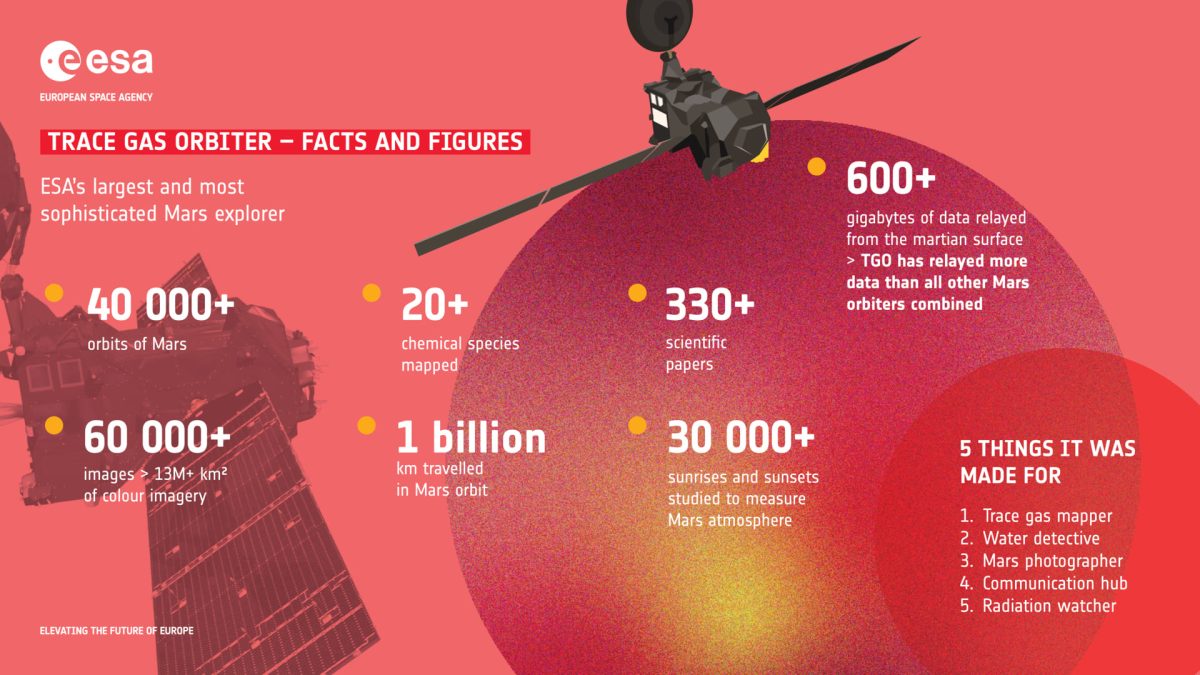
To mark the anniversary, ESA published an infographic summarizing the mission’s achievements. Over ten years, the spacecraft has completed more than 40,000 orbits around Mars and traveled approximately one billion kilometers. That is almost seven times the distance between Earth and the Sun, which is 150 million kilometers.
Key facts and figures from ten years of the ExoMars Trace Gas Orbiter’s operations in orbit around Mars. Credit: ESA
The spacecraft’s camera has captured more than 60,000 images. Its color images cover over 13 million square kilometers—more than 21 times the area of Ukraine. The entire surface of Mars, however, covers approximately 145 million square kilometers.
Another aspect of its work is less visible. NASA’s Curiosity and Perseverance rovers transmit their data through the orbiter, and the total volume of relayed data has already exceeded 600 gigabytes.
The Beginning of the ExoMars Program
The spacecraft launched on March 14, 2016, aboard a Russian Proton rocket. Traveling with it was Europe’s Schiaparelli lander, also part of the ExoMars program. As Space.com reported at the time, the lander was intended only to test landing technology and operate on the surface for a few days. But on October 19, as the orbiter entered orbit, the lander crashed during descent because its parachute separated prematurely. The accident did not affect the orbiter’s operations.
The next stage of the program was to be the Rosalind Franklin rover, which, according to plans drawn up in 2016, was scheduled to launch as early as 2018. The launch was postponed several times, and in March 2022, ESA suspended the joint program with Russia following its full-scale invasion of Ukraine.
Artist’s illustration of the Rosalind Franklin rover at Oxia Planum, the ExoMars landing site. Credit: ESA/Mlabspace. Source: esa.int
Following the split, ESA replaced the Russian landing platform with its own, while NASA undertook to provide the launch vehicle, braking engines for landing, and radioisotope heater units. The rover is now scheduled to launch in 2028 and land in 2030.
The Mystery of Martian Methane
Methane on Mars has long puzzled scientists. On Earth, most of this gas is produced by living organisms, while on Mars, solar ultraviolet radiation destroys its molecules within a few centuries. So if methane is present there, some source—biological or geological—must be continually replenishing it.
To find even traces of the gas, researchers used the spacecraft’s spectrometers to study more than 30,000 sunrises and sunsets. At these moments, sunlight passes tangentially through the planet’s atmosphere, and each gas absorbs its own characteristic wavelengths. This allowed researchers to map more than 20 chemical species.
The atmosphere of Mars.
Image: ESA / DLR
No methane was detected in these spectra. According to the peer-reviewed journalAstronomy & Astrophysics, the upper limit of its abundance is 20 molecules per trillion. Yet the Curiosity rover has repeatedly detected methane near the surface. Researchers still cannot explain why the gas is not detected higher up.
Unexpected Hydrogen Chloride
During the global dust storm of 2018, the spacecraft’s instruments detected hydrogen chloride in the Martian atmosphere for the first time. On Earth, volcanoes emit this gas, so the discovery was initially interpreted as a possible sign of present-day volcanic activity.
Subsequent observations weakened this explanation. The gas appears each year alongside dust in both hemispheres, suggesting that it is probably produced by chemical reactions within the atmosphere itself under the influence of sunlight, rather than coming from the planet’s interior.
However, observations from orbit reveal only gases in the atmosphere. Organic molecules that could indicate life will have to be sought on the planet itself. The Rosalind Franklin rover’s drill will reach a depth of two meters, beyond the reach of solar ultraviolet radiation that destroys such molecules near the surface. Samples will be analyzed in the rover’s onboard laboratory, without being returned toEarth.
A University of Sydney researcher has used Mars orbital and model data to create the world’s first map of Martian soil covering roughly 92% of the red planet’s surface.
“This is the first time a classification system of this scale has been developed for Martian soils,” explained Daniel Irving from the Sydney Institute of Agriculture and the Faculty of Science.
Martian Soil Separated into 2,000 Classes
To build his Martian soil map and grading system, Irving drew on a wide array of existing resources. This included orbital observations from Martian satellites and planetary models based on data gathered from rovers and other scientific studies of the red planet.
After combining the data, Irving classified 800 million individual locations across the Martian surface. This included separating the locations into 2,000 soil “classes” and marking where these soils are expected to be found.
Sydney PhD candidate David Irving makes the first-ever map of Martian Soil. Credit: University of Sydney, Irving, et al.
Next, Irving and his supervisor, Professor Alex McBratney, evaluated each class’s properties, including texture, mineralogy, profile thickness, and pH level. This granular detail allowed them to group the soil classes into 10 major “realms,” 100 “assemblages,” and 2,000 “detailed forms,” resulting in what they called the Provisional Polythetic Areth Classification System, or PPACS.
According to a release announcing the work, the Sydney researcher and his supervisor proposed the term “areths,” which they derived from Ares, the Greek name for Mars, for these new Martian soil classes.
PPACS Scores Mark Best Locations for Future Mars Greenhouses
After classifying the 2,000 soil types on the PCCS, the Sydney team assessed each one for characteristics that are known to support plant production on Earth. These included the soil’s capacity for holding water and how much clay and gravel it contained.
“A future greenhouse on Mars would need more than air, water, and light. Its builders would also need to know what lies beneath to understand better starting points for growing plants,” Professor McBratney explained.
After examining the results, Irving and colleagues found one class, which they named Nohibareth, offered the best collection of plant growth-supporting properties. As a result, Nohibareth received a PCCS score of 0.93, ranking it at the top of the list.
“Nohibareth’s modeled average profile includes a pH of 6.8, 72 percent clay, minimal sand or gravel, and an estimated water-holding capacity of 202 millimeters per meter,” a statement announcing the research explained.
The Martian Soil map indicates that this preferred class is found around the planet’s middle latitudes, including around Tharsis, central Arabia Terra, and Elysium Planitia. However, this soil type is only found on 0.14 percent of the planet’s surface.
Although other soils showed some promise, the researchers found that 73 percent of the forms they evaluated had poor water retention properties, making them unlikely soil bases for plant growth. For example, the researchers noted that classes in the Fareth to Mareth realms all scored below 0.3 on the PCSS, “reflecting less favorable combinations of the properties considered.”
Candidates for Closer Investigation
When discussing the study’s results, Irving and colleagues cautioned that the highlighted Nohibareth sites are not already selected for future greenhouses. Instead, they said the areas on their map suggesting the best plant-growing Martian regolith represent “candidates for closer investigation.”
The Sydney team also warned that Martian soil contains no organic compounds and that their findings do not suggest crops can be grown even in the highest-scoring material. They also note that the map does not include factors that can affect plant growth, such as perchlorate toxicity, nitrogen availability, or depth profiles.
However, Irving and colleagues said the map and scoring system suggest that colonists could supplement the highest-scoring Martian soils and use them in controlled environments to potentially create self-sustaining greenhouses that don’t require regular supplies from Earth. Irving said their findings could also offer a new way to interpret the data scientists regularly receive from ongoing Mars missions.
“Every rover mission collects valuable information about Mars, but scientists need consistent ways to organize and compare that knowledge,” he explained. “This gives us a framework that can grow and evolve as new data becomes available.”
The study was published in the soil science journal Catena.
Christopher Plain has spent the last six years as Associate News Editor and Head Science Reporter at The Debrief. Follow and connect with him on X, learn about his novels at plainfiction.com, or email him atchristopher@thedebrief.org.
Biohybrid computers made of organoids—tiny human brainmodels using real cells—have reached an important new benchmark by reading braille for the first time, even under challenging conditions.
A group of UK scientists working at Bristol University reported their biohybrid computing achievement in Frontiers in Artificial Intelligence, with a new paper describing the results.
The team’s achievement marks a major step toward the long-sought goal of harnessing organic brain cells for computing. The human brain is far more energy efficient than traditional computers, making the technology highly attractive as large-scale computing operations, like data centers, come under heavy criticism for their massive resource use.
Biohybrid Computer Accuracy
Although biohybrid computers could eventually offer advantages in energy efficiency, demonstrating that they can reliably process and transmit meaningful information remains a work in progress. The Bristol team sought to advance this research by developing organoids modeled on the human forebrain and testing their ability to process information encoded from Braille characters.
The researchers ultimately achieved an 83% classification accuracy rate by combining signals from three brain organoids to identify Braille letters.
“We can take information from a real tactile sensor, turn it into a form that a living neural network can receive, and then recover meaningful information from the organoid response,” said first author Tianyi Liu, PhD candidate at Bristol University. “That gives us a practical way to connect artificial sensors with biological neural systems, which are a very interesting possible route towards more energy-efficient computing.”
Creating a Biohybrid Computer
The researchers developed tiny but complex models of the human brain containing approximately 10,000 neurons and supporting cells, although they lacked many of the structures found in a fully developed human brain.
The organoids were connected to electrodes that allowed researchers to deliver electrical signals and monitor their neural activity. They were also maintained in a controlled environment designed to keep the living cells functioning throughout the experiments.
The next step was determining whether this biohybrid computing system could reliably process recognizable information.
Testing began with a tactile sensor detecting physical Braille characters. The team then converted the sensor readings into electrical patterns, which were delivered to the organoids through the electrodes.
By experimenting with different input patterns and measuring the resulting neural activity, the researchers investigated whether specific Braille characters produced distinguishable responses.
Biohybrid Tests
The researchers then used computational methods, including a large language model (LLM), to classify the organoids’ neural responses and determine whether those signals corresponded to specific Braille letters.
Combining the responses of three organoids produced substantially better results than using a single organoid, increasing classification accuracy from 61% to 83%.
“After processing by the organoids, the tactile data still contains enough information to classify Braille letters with good accuracy,” said senior author Dr. Benjamin Ward-Cherrier of Bristol University. “Combining outputs from several organoids also showed an improvement in performance.”
Exactly why combining signals from three organoids improved accuracy remains uncertain, although the team suspects that differences in their individual neural networks may allow them to provide complementary information.
“Different organoids may have slightly different network connections, developmental states, and ongoing activity, so the same input can produce similar but not identical responses,” said Liu. “Combining those responses may give us complementary information that we would not get from a single organoid. At the same time, if every organoid behaves differently, it obviously makes it harder to build a predictable and standardized system.”
A Computer that May Learn like a Brain
After achieving promising results with clean input data, the researchers introduced an additional challenge: noise, or interference that can make information more difficult to interpret.
Interestingly, when noise was introduced, the Braille characters could be classified more accurately from the organoids’ responses than from the raw sensor data. This suggests that the biological neural networks may help preserve or transform useful information under challenging conditions.
However, the findings do not demonstrate that the organoids learned to recognize Braille in the same way a human brain might. Whether these systems can adapt through experience remains an important question for future research.
“We showed that tactile information could be encoded, processed through the organoids, and decoded, but we did not demonstrate learning or long-term changes in the organoids,” Liu said.
“We also tested one tactile task using a fixed encoding scheme and a relatively simple measure of neural activity. The next step is definitely to move beyond Braille; we are interested in things such as textures, edges, and different kinds of touch, and eventually in closed-loop tasks where the organoid receives feedback from what it does.
“That would allow us to start asking whether the organoid can actually adapt through experience,” Lie said.
Ryan Whalen covers science and technology for The Debrief. He holds an MA in History and a Master of Library and Information Science with a certificate in Data Science. He can be contacted at ryan@thedebrief.org, and follow him on Twitter @mdntwvlf.
They Just Made a Chip With Living Human Brain Cells
Scientists Just Built a Computer Using Human Brain Cells
American writer William S. Burroughs believed that the mysterious Gray aliens might be members of a dying civilization that had lost its ability to create and were secretly collecting blood and reproductive material from human beings. He called them “Control Aliens” and suspected they wanted to make humanity less intelligent.
Yet he personally wanted to encounter these same beings. He even visited a famous alleged alien abduction site and reportedly arranged an unusual display outside his Kansas home, hoping it might attract their attention.
Burroughs he became one of the most influential American writers of the 20th century, particularly through his controversial 1959 novel Naked Lunch. His writing frequently explored the possibility that human beings were being manipulated by forces they did not fully understand, whether through language, social institutions, addiction, or something beyond ordinary reality.
For much of his life, Burroughs had been interested in magic, dreams, altered consciousness, and the hidden mechanisms of human perception. He experimented with unconventional literary techniques and entertained ideas that many people would have considered science fiction.
William S. Burroughs, 1983. Photo: Chuck Patch / Wikimedia Commons (CC BY-SA 2.0).
His fascination with extraterrestrial intelligence was therefore not something that suddenly appeared during his final years. An archived lecture from August 11, 1980, recorded at the Jack Kerouac School of Disembodied Poetics with an introduction by Allen Ginsberg, lists aliens, dreams, reincarnation, space travel, and nuclear weapons among its subjects.
That recording is significant because it places his interest in such questions years before the alien abduction phenomenon became widely associated with writer Whitley Strieber. Burroughs was already examining whether consciousness might extend beyond the physical world and whether human understanding of reality was fundamentally incomplete..
Burroughs became particularly fascinated with the alien abduction phenomenon after reading Communion, the 1987 book in which Whitley Strieber described his alleged encounters with mysterious non-human beings. Strieber was already a successful horror novelist known for books such as The Wolfen and The Hunger, but Communion was presented as an account of experiences he believed had actually happened. The story centered on disturbing events at his family’s secluded cabin in upstate New York, including an alleged encounter on December 26, 1985, that left him struggling to understand what had taken place.
Strieber described small, unusual beings and experiences that seemed to involve a loss of control over his body and surroundings. Although his story became famous as an alien abduction account, he was cautious about declaring that the entities were necessarily extraterrestrials arriving from another planet. He preferred calling them the visitors because he believed their identity and origin remained unknown. The possibility that these encounters might involve consciousness, an unfamiliar dimension, or something connected to the human mind made his account particularly interesting to Burroughs.
After reading Communion and its 1988 sequel Transformation, Burroughs became determined to investigate the experiences personally. According to an account by Matthew Levi Stevens, published in New Dawn magazine, Burroughs wrote to Strieber in 1989, explaining that he wanted to make contact with the mysterious beings. Strieber and his wife, Anne, had received numerous unusual letters following the publication of Communion, and Anne initially wanted to confirm that the person writing to them was genuinely the famous author.
Burroughs eventually assured them, “I am indeed really me,” and the couple invited him to their cabin. What followed was an unusual meeting between two established American writers who were interested in the same mystery for very different reasons. Strieber claimed he had already experienced frightening encounters with unknown entities, while Burroughs wanted to know whether he could experience something similar. He traveled to the place where Strieber said the encounters had occurred, hoping that being there might somehow increase his chances of meeting the visitors.
During his stay, Burroughs questioned Strieber about the experiences and listened closely to his descriptions. Strieber later remembered him as exceptionally polite and deeply interested in the details. Burroughs came away believing that Strieber was sincere and that his experiences had felt completely real to him.
However, despite visiting the cabin and spending time with Strieber, Burroughs did not report encountering the visitors himself. He could not explain why the alleged beings had appeared to Strieber but failed to make contact with him. Rather than abandoning the possibility of an encounter, he began considering different explanations, including whether the entities might choose whom they contacted and whether their reasons for approaching particular individuals were less friendly than people assumed.
Burroughs wondered whether the visitors might regard him as a potential enemy. He suspected that if they were intelligent beings with their own objectives, they might recognize people capable of interfering with those objectives. This was an important development in his thinking because he increasingly approached the phenomenon as a possible struggle over consciousness and control, rather than simply a question of whether unidentified spacecraft were visiting Earth.
His interest in the cabin visits was later revisited in a September 2019 Radio Misterioso interview, hosted by Greg Bishop and published the following month. The interview’s description specifically mentions the occasions when Burroughs visited Strieber’s famous cabin hoping to contact the visitors.
In that conversation, Strieber described his belief that the phenomenon might involve another level of human beings exercising some form of control over souls. This interpretation differed from the ordinary image of extraterrestrial explorers traveling between planets. It also showed how far Strieber’s thinking had moved beyond the idea of biological creatures conducting experiments on human subjects.
Burroughs continued discussing extraterrestrials in public during the early 1990s. In an interview conducted at his home in Lawrence, Kansas, on June 10, 1991, Nicholas Zurbrugge asked about his interests, and Burroughs spoke about both Native American shamanism and reports of flying saucers. He explained that he wanted to see the alleged beings personally and mentioned reports of UFO sightings in Kansas, including around the lake where he owned a house. Despite his interest and his attempts to make contact, he said he had not been fortunate enough to experience a sighting himself.
His curiosity also extended to the famous Roswell UFO story. During an interview with his friend David Ohle, Burroughs discussed Strieber’s 1989 novel Majestic, which imagined a government cover-up involving an alleged extraterrestrial spacecraft crash in New Mexico. He described fictional details about recovered alien bodies, including creatures without stomachs that might survive through an unusual form of photosynthesis. He also repeated the novel’s imagery of aliens gathering together in spacecraft resembling hives, suggesting a society organized very differently from humanity.
He was equally interested in the possibility that extraterrestrial beings might experience time differently. In the same interview, Burroughs referred to the famous alleged abduction of Betty and Barney Hill and discussed an anecdote in which the visitors supposedly struggled to understand human aging. For him, this raised the possibility that time might not be experienced in the same way by every form of intelligence. His speculation reflected a recurring theme in his work: that ordinary human concepts might be inadequate for understanding realities outside familiar experience.
Burroughs also believed that dreams and altered states could offer access to something beyond the limits of ordinary perception. In his 1986 essay collection The Adding Machine, he described artistic creativity as a means of exploring new worlds and forms of consciousness. He questioned whether physical space travel was the only way humans could reach unfamiliar realities, suggesting that writers, artists, and people experimenting with consciousness might explore territories that conventional technology could not easily reach.
His interest in such ideas continued through the 1990s. Burroughs explored shamanism, ritual magic, dream control, and practices associated with attempting to change or extend conscious awareness. He had long been concerned with the relationship between language and mental freedom, famously expressing the idea that language itself could operate like an external influence on human thought. His involvement with experimental writing and the cut-up technique also reflected an attempt to break familiar patterns of association and discover unexpected connections between words and ideas.
In his 1995 book My Education: A Book of Dreams, Burroughs discussed his conviction that something genuine might exist behind at least some of the reports, although he did not know what the entities actually were. He considered the possibility that the sexual elements of the encounters were not incidental but central to the phenomenon itself. His attention was especially drawn to Strieber’s descriptions of intimate interactions with the visitors, which Burroughs interpreted as possible evidence that the beings were seeking some form of biological or sexual exchange.
According to Matthew Levi Stevens, Burroughs decided to create a conspicuous symbol outside his home in Lawrence, Kansas, apparently hoping that it would attract the attention of the alleged visitors. He reportedly allowed the grass on his lawn to grow long before arranging for somebody to cut a large patch into the phallic symbol, resembling the way a crop circle might be formed in a field.
The reported idea was connected to his suspicion that the visitors were especially interested in human sexuality. If the beings were approaching humans for reproductive or sexual reasons, Burroughs apparently thought that a large sexual symbol might encourage them to investigate his property. The episode is described in Stevens’ account of Burroughs’ interests and occult practices, although independent documentation of the lawn display has not been established. It nevertheless illustrates how seriously, and sometimes unusually, Burroughs pursued the possibility of making contact
Burroughs did not appear to regard the visitors as necessarily benevolent. His writings suggest that he was fascinated by them but also suspicious of their possible intentions. He wanted firsthand knowledge of a phenomenon he thought might exist, even while entertaining the possibility that the beings behind it were manipulating human beings for purposes that had nothing to do with friendship or scientific exploration.
His most disturbing interpretation appeared in a diary entry dated February 3, 1997, only months before his death. The entry was later published in Last Words: The Final Journals of William S. Burroughs. By this time, Burroughs had developed a particularly hostile picture of the Gray aliens, whom he described as “Control Aliens.” He speculated that they belonged to a dying race that had somehow lost its creative abilities and depended on human blood and semen for survival.
According to this theory, the Grays were not advanced visitors generously sharing knowledge with a less developed civilization. They were beings suffering from a fundamental deficiency and attempting to compensate for it by exploiting another species. Burroughs also suspected that they wanted to make people less intelligent, possibly because independent human thought posed a danger to their objectives. He believed that individuals with developed perception or spiritual awareness might recognize what these entities were doing and become difficult to manipulate.
The most revealing part of his final journal entry was his frustration over the apparent absence of contact. After considering why the Grays seemed to approach certain people but avoided others, he asked, “Why don’t they come and see ME?” He answered his own question by suggesting that the visitors might be afraid of people with advanced spiritual awareness. This was his personal explanation, rather than evidence of how any unknown intelligence selected people for contact.
Whitley Strieber describes his alien visitor
His interest in extraterrestrials also entered his artistic projects. During the early 1990s, following his work on The Black Rider with theater director Robert Wilson and musician Tom Waits, Burroughs developed ideas for another theatrical project inspired partly by Paradise Lost. The proposed work mixed religious imagery, atomic destruction, UFOs, alien abductions, and the Roswell story. Although the original project was not completed during his lifetime, elements of the material later contributed to musician Grant Hart’s 2013 album The Argument.
In his later speculation, the Grays became another possible representation of such forces, beings that supposedly understood how to manipulate human consciousness while depending on humanity for something they could no longer produce themselves.
Burroughs died on August 2, 1997, at the age of 83, without reporting the kind of direct encounter he had hoped to experience. His fascination with Strieber’s visitors remained unresolved.
Meer van UFO'S of UAP'S, ASTRONOMIE, RUIMTEVAART, ARCHEOLOGIE, OUDHEIDKUNDE, SF-SNUFJES EN ANDERE ESOTERISCHE WETENSCHAPPEN - DE ALLERLAATSTE NIEUWTJES


 Cloaked UFO Causes Rainbow Along Its Edge and Rain To Fall From Its Center, UAP Sighting News.