Ontdek de Fascinerende Wereld van UFO's en UAP's: Jouw Bron voor Onthullende Informatie!
Ben jij ook gefascineerd door het onbekende? Wil je meer weten over UFO's en UAP's, niet alleen in België, maar over de hele wereld? Dan ben je op de juiste plek!
België: Het Kloppend Hart van UFO-onderzoek
In België is BUFON (Belgisch UFO-Netwerk) dé autoriteit op het gebied van UFO-onderzoek. Voor betrouwbare en objectieve informatie over deze intrigerende fenomenen, bezoek je zeker onze Facebook-pagina en deze blog. Maar dat is nog niet alles! Ontdek ook het Belgisch UFO-meldpunt en Caelestia, twee organisaties die diepgaand onderzoek verrichten, al zijn ze soms kritisch of sceptisch.
Nederland: Een Schat aan Informatie
Voor onze Nederlandse buren is er de schitterende website www.ufowijzer.nl, beheerd door Paul Harmans. Deze site biedt een schat aan informatie en artikelen die je niet wilt missen!
Internationaal: MUFON - De Wereldwijde Autoriteit
Neem ook een kijkje bij MUFON (Mutual UFO Network Inc.), een gerenommeerde Amerikaanse UFO-vereniging met afdelingen in de VS en wereldwijd. MUFON is toegewijd aan de wetenschappelijke en analytische studie van het UFO-fenomeen, en hun maandelijkse tijdschrift, The MUFON UFO-Journal, is een must-read voor elke UFO-enthousiasteling. Bezoek hun website op www.mufon.com voor meer informatie.
Samenwerking en Toekomstvisie
Sinds 1 februari 2020 is Pieter niet alleen ex-president van BUFON, maar ook de voormalige nationale directeur van MUFON in Vlaanderen en Nederland. Dit creëert een sterke samenwerking met de Franse MUFON Reseau MUFON/EUROP, wat ons in staat stelt om nog meer waardevolle inzichten te delen.
Let op: Nepprofielen en Nieuwe Groeperingen
Pas op voor een nieuwe groepering die zich ook BUFON noemt, maar geen enkele connectie heeft met onze gevestigde organisatie. Hoewel zij de naam geregistreerd hebben, kunnen ze het rijke verleden en de expertise van onze groep niet evenaren. We wensen hen veel succes, maar we blijven de autoriteit in UFO-onderzoek!
Blijf Op De Hoogte!
Wil jij de laatste nieuwtjes over UFO's, ruimtevaart, archeologie, en meer? Volg ons dan en duik samen met ons in de fascinerende wereld van het onbekende! Sluit je aan bij de gemeenschap van nieuwsgierige geesten die net als jij verlangen naar antwoorden en avonturen in de sterren!
Heb je vragen of wil je meer weten? Aarzel dan niet om contact met ons op te nemen! Samen ontrafelen we het mysterie van de lucht en daarbuiten.
Berichten van 1 augustus 2019 tot 31 augustus 2019
Jupiter Just Got Slammed by Something so Big We Saw it From Earth(Video)
Something Enormous Just Smashed Into Jupiter *Above Normal Hurricane Season Likely*Landslide*
Jupiter just got slammed by something so big we saw it from Earth
It’s bright, it’s white and fortunately it’s very far away from here.
The apparent moment of impact on the solar system’s largest world.
Ethan Chappel
An amateur astronomer caught something spectacular with a backyard telescope Wednesday when he recorded a bright flash on the surface of Jupiter. The biggest planet in the solar system routinely delivers stunning pictures, like those snapped by NASA’s Juno spacecraft, but the unexpected flash has astronomers excited at the possibility of a meteor impact.
Ethan Chappel pointed his telescope at the gas giant planet at just the right time, capturing the white spot seen on the lower left side of the planet in the above images on Aug. 7.
While it has yet to be confirmed by a second observer, it looks like a large asteroid crashing into the gas giant planet. The flash is brief and quickly fades away, boosting the idea that it was likely caused by an impact.
“Another impact on Jupiter today!” astronomer Dr. Heidi B. Hammel wrote on Twitter. “A bolide (meteor) and not likely to leave dark debris like SL9 did 25 years ago.”
SL9 is Comet Shoemaker-Levy 9, which famously impacted Jupiter in 1994. Hammel led the team that used the Hubble Space Telescope to study the impact and how the planet’s gassy atmosphere responded.
Something remarkable to consider is that the apparent size of the flash is almost the size of Earth, which is tiny next to the giant gas planet. For reference, about three Earths could fit inside Jupiter’s Great Red Spot, which is also visible.
Of course, this doesn’t mean that whatever hit Jupiter was the size of a planet, just that the collision looks to have released a lot of explosive energy. Sky and Telescope’s Bob King says, if confirmed, this would be the seventh recorded impact of Jupiter since Shoemaker-Levy and the first in over two years.
Better to keep all that asteroid traffic directed in the outer solar system, we’ve had enough space rock scares here in the past month.
I found a lot of alien structures, some are buildings and others appear to be landed ships. The structures are all silver metallic objects with shiny white reflective windows. These buildings are very old, but out in the vacuum of space structures can remain intact for millions of years. I imagine that one of these structures would easily be taken over by a group of human traveling to the moon and would make a great starting point for someone like Jeff Bezos space exploration program Blue Origins. The structure are right there, ripe for the taking, and waiting for new occupants and with the alien tech inside they should have power for hundreds of years. Can you see it? Blue Origins Space City at Dionysius crater becoming the next vacation resort. Scott C. Waring
Asteroid 2019 MO exploded in our atmosphere with an energy of about 3 to 5 kilotons of TNT. Such events happen once or twice yearly, astronomers say. Most are unexpected, but this space rock was detected hours before it struck.
The small, harmless, 4-meter near-Earth asteroid – now designated 2019 MO – created this bright flash when it struck Earth’s atmosphere on June 22, 2019, over the Caribbean.
Images via RAMMB/CIRA/Colorado State University.
Scientists have confirmed a meteor impact with Earth’s atmosphere over the Caribbean last weekend. The bright flash was detected by by NOAA’s GOES-16 satellite and other meteorological satellites, showing the event occurred on Saturday, June 22, 2019, at around 5:25 p.m. EDT (21:25 UTC) some 170 miles (274 km) south of Puerto Rico. Astronomer Peter Brown, a meteor expert from University of Western Ontario in Ontario, Canada, said that an infrasound station located in Bermuda did detect airwaves produced by the space rock’s impact in the atmosphere. The object is believed to have been a small asteroid, and it was unusual in that it was detected prior to its impact – in the hours before – by the Atlas (Asteroid Terrestrial-impact Last Alert System) in Hawaii. Brown said the impact was:
… consistent with 3 to 5 kilotons (of energy).
By contrast, the atomic bomb dropped on Hiroshima on August 6, 1945, exploded with an energy of about 15 kilotons of TNT. Both the energy released, as well as the observations made from the Atlas Observatory, suggest the June 22 space rock was about 13 feet (4 meters) in diameter. Originally designated A10eoM1, the rock has now been designated as asteroid 2019 MO.
Although small space rocks and fragments rain down on Earth’s atmosphere continuously, experts at NASA’s Center for Near Earth Object Studies say that large events such as the one on June 22 occur about once or twice a year. Earth’s atmosphere does its job in protecting us in these cases, causing drag or friction that disintegrates most of these small objects before they strike the ground (although a few do strike, and more fall into the ocean). Read more: Whoa! 26 atom-bomb-scale asteroid impacts since 2000
Tony Dunn@tony873004
Earth got hit a few days ago by newly-discovered asteroid 2019 MO.@pgbrown has more graphics.
After analyzing the satellite images, expert meteor photographer Frankie Lucena commented:
Looks to be a mighty impressive event, for sure.
Some satellite images show the bright flash produced by the meteor, and seconds later, a line of its dissipating smoke trail.
Asteroid 2019 MO is believed to have had an orbit outside that of Earth and extending almost to Jupiter’s orbit.
Image via NASA/JPL-Caltech.
According to Italian amateur astronomer Ernesto Guido, this is only the fourth time in history that an impacting object was observed prior to atmospheric entry.
Bottom line: Asteroid 2019 MO exploded in Earth’s atmosphere on June 22, 2019, with an energy equivalent to about 3 to 5 kilotons of TNT. Such events happen unexpectedly, once or twice yearly, astronomers say. This one was unusual in that the asteroid was detected in the hours before it struck.
Felle lichtbol en harde knal boven Oost-Nederland; vermoedelijk een meteoor
UPDATEIn Oost-Nederland zijn vanavond rond kwart voor tien veel mensen opgeschrokken door een harde knal. Op twitter vragen veel mensen, ook uit de regio, zich af wat het geweest kan zijn. Toen kwamen er ook nog berichten of een felle lichtbal.
Teake Dijkstra
De officiële instanties konden aanvankelijk geen duidelijkheid verschaffen. Het meest aannemelijk is dat het een meteoor was, een stuk ruimtegruis dat verbrandt in de dampkring.
Halverwege de avond kwam een reeks tweets op gang van mensen uit Zwolle, Dalfsen en Ommen, maar ook uit Almelo, Oldenzaal en Harbrinkhoek die de knal gehoord hebben. Later kwamen er ook berichten van verder weg, tot in Drenthe en Friesland, waar vooral werd gemeld dat er een lichtflits voorbij schoot. Het zou kunnen gaan om een meteoor, zo werd gesuggereerd.
Bij de Veiligheidsregio IJsselland waren rond tien uur nog geen meldingen binnen. Ook bij de politie hadden zich nog geen mensen gemeld. ,,Het is geen knal van een plofkraak of zoiets geweest. Het is niet een zaak waar wij mee bezig zijn”, zegt Anne Coenen namens de politie IJsselland.
Verschijnselen
Volgens Annemarie Hoogendoorn, woordvoerder van het KNMI, heeft het de verschijnselen van een meteoor die door de dampkring kwam en daarbij is verbrand. ,,Dat veroorzaakt een lichtbal. Doordat de lucht uitzet kan dat een knal veroorzaken’’, aldus Hoogendoorn, ,,net als bij onweer.’’
Op de weersatellieten is het niet gesignaleerd, maar de satellieten draaien om de wereld en waren mogelijk op dat moment juist niet hier, veronderstelt ze. ,,Zeker weten we het niet, maar de meldingen van een lichtbol en een knal zijn typisch voor een meteoor.
Geluidsbarrière?
In reacties op internet werd ook geopperd dat een vliegtuig door de geluidsbarrière zou zijn gegaan. Woordvoerder Sander Kuypers van Defensie daarover: ,,Ik heb even navraag gedaan, maar wij vliegen vanavond niet, dus het is geen vliegtuig van ons dat door de geluidsbarrière is gegaan. En zover nu bekend is er ook geen snelle reactie nodig geweest om iets te onderscheppen”.
Geen knal gehoord. Wel in Almelo een meteoriet gezien om 21:30. Bewoog in noordwestelijke richting en liet soort rookspoor na bij doven. Dat moet de knal veroorzaakt hebben.
De landelijke Werkgroep Meteoren kreeg in hoog tempo zo'n 150 meldingen binnen, uit het hele land, zegt Joost Hartman. Of het een meteoriet is? ,,Zou best kunnen. Wij weten op dit moment nog niet veel.’’
Ook op de website Watwasdieknal.nl kwamen de meldingen overal vandaan.
dokRob@dokRobNL
Zag net meteoriet overschieten zo'n 50 meter boven m'n hoofd in park Westerveld in Elde die richting Driel ging. Ik dacht eigenlijk dat hij in het park zou neerstorten. Was een object die vanachter een fel licht gaf, en van voor donker, geluidloos en met hoge snelheid...
The picture here comes from a long time NASA scientist, one of many photos covered-up and hid from the public from the Voyager mission in 1980. That mission was tasked with photographing Saturn, its rings and its moons.
Reflect On:
What does this mean for humanity? Why the cover-up? Are we ready to accept that this may be a reality? What kinds of implications are there from the realization that we are not alone, and that highly advanced, intelligent beings are out there?
The pictures NASA got back from the Voyager mission to Saturn in 1980 were apparently so mind-altering that they locked them up–at least that’s what retired U.S. Army Command Sergeant Major Bob Dean said in this lecture. He also showed numerous photographs from the Apollo missions that were never released to the public. You can view some of those photographs here. Multiple governments, like Russia, have been calling for an international investigation as to where photographs, footage and Moon rocks disappeared to.
The picture above does not come from Dean, it comes from one of his good friends Norman Bergrun, a scientist and engineer who was part of NASA’s voyager program. He worked at NASA for decades at the Ames Research Centre. He also worked at Lockheed Martin where he managed the Polaris missile tests. Unfortunately, he recently passed. You can view his obituary here.
He is a legend for going public.
Luminous Source
What is the picture of? It’s a “luminous source,” that comes from Bergrun’s Book, “The Ringmakers of Saturn.” He had to go through a lot of trouble to publish it, and had to leave the country in order to do so, as Dean explained in the lecture linked above.
According to Bergrun, there are several large craft “proliferating” out around Saturn and its moons. His book goes into much greater detail, and although it’s hard to find and costs thousands of dollars, it is linked online, here.
Frustrated By Non-Disclosure
According to Dean, Bergrun got frustrated later in life that the decision was made not to tell the public what they had photographed at Saturn. My previous article Long-Time Nasa Scientist Blows The Whistle On Tall Black Extraterrestrial Beings describes Bergrun exposing the existence of what he calls extraterrestrial ‘vehicles’ that were responsible for making the rings around Saturn.
In a rare interview he gave with Kerry Cassidy of Project Camelot (below), he expressed his great concern of the UFO cover-up and stated with enthusiasm that “people have got to be made aware that those things are real.” I’ve presented this video in multiple articles, but anytime you mention him, you must present this interview !
The Takeaway
In his book, Norman makes it a clear point to emphasize that these objects have probably been around much longer than we have. He also states that if there was any ill intent towards our planet, something probably would have happened by now and there is a reason that these objects (which he stated are intelligently controlled, not by us) have not come in close proximity to our planet. By coming closer than they already are they may, and already probably do have some effects on our own weather. This is something Norman also mentions in his book.
A lot of ridicule and fear exists behind this topic, and today it’s no longer taboo as mainstream disclosure has begun. We are becoming more aware, and despite mainstream media and the global elite having a lot to lose from the disclosure of this type of information (propulsion systems, oil, etc..), the truth is leaking out. It’s a field filled with information and disinformation, so one has to be cautious and remain skeptical. At the end of the day, we know that we are not alone, and it has huge implications for all areas of humanity–not the least of which is that it will ultimately force humanity to look within.
More awareness of this presence is coinciding with a massive ‘spiritual’ awakening that’s happening on the planet, and this is not by coincidence. It seems that a growing awareness of what’s out there will serve to help humanity better understand itself.
A gaping hole in a dying tectonic plate beneath the ocean along the West Coast of the United States may be wreaking havoc at Earth's surface, but not in a way most people might expect.
This gash is so big it may trigger earthquakes off the coast of Northern California and could explain why central Oregon has volcanoes, a new study found.
The researchers in the new study aren't the first to suggest that the Michigan-size Juan de Fuca (pronounced "wahn de fyoo-kuh") plate has a tear. But thanks to a new, detailed dataset, they're the first to say so with certainty. [The Science of Plate Tectonics and Continental Drift (Infographic)]
"Where other people had debated whether or not it [the tear] was there, we can pretty confidently say that it's real," study lead researcher William Hawley, a doctoral student in the Earth and Planetary Science Department at the University of California, Berkeley, told Live Science.
The Juan de Fuca plate is long, stretching about 600 miles (1,000 kilometers) along the Pacific Northwest coast, from Vancouver Island, Canada, to Cape Mendocino, California. "No part of it is above the water. It's a total oceanic plate" that's subducting, or diving beneath another plate, in this case the North American plate (a continental plate), Hawley said.
From 2011 to 2015, scientists boated out over different parts of the Juan de Fuca plate, dropped ocean-bottom seismometers underwater and let these sensors collect seismic data from earthquakes all over the world for a year.
Scientists aboard the R/V Thomas G. Thompson recover a seismometer, part of the Cascadia Initiative, off the coast of Oregon and Washington. This instrument spent a year on the seafloor, recording earthquakes from all over the world.
(Image credit: William Hawley)
When the year was up, the researchers returned, fished up the seismometers and uploaded the data, which allowed them to create a tomography, or layout, of the plate. Then, they deployed the devices to other spots on the plate. "It was an enormous community effort," Hawley said.
The data from these seismometers showed how seismic waves traveled through the plate, which, in turn, revealed information about the plate's composition and varying temperatures. One region under central Oregon showed a gap in high-velocity seismic waves, which Hawley interpreted to be the hole.
But why does this hole exist? Hawley and study co-researcher Richard Allen, director of the Berkeley Seismological Laboratory, hypothesized that there is a weak zone in the Juan de Fuca plate that exists because the plate formed at two overlapping ridge segments. As this weakened zone of the oceanic plate goes under the continental plate, it unzips from the bottom up (from the underside upward), creating a gash.
"This tearing may eventually cause the plate to fragment, and what is left of the small pieces of the plate will attach to other plates nearby," the researchers wrote in the study. In other words, "we're witnessing the death of a plate," but it will take at least a few million years to die, Hawley said.
The volcanoes in central Oregon may have arisen because of a tear in the Juan de Fuca tectonic plate.
(Image credit: Shutterstock)
Hawley and Allen estimated that the hole is located at a depth of between 155 and 60 miles (250 and 100 km). The tear itself, which is narrower on top and widens with depth, is about 120 miles (200 km) wide. [Hidden Undersea Mountains Uncovered with Satellites (Photos)]
Moreover, it appears that material is getting pushed up through the tear, which may have led to the formation of the volcanoes in central Oregon's High Lava Plains about 17 million years ago, Hawley noted. In fact, it's incredible how many geographical and seismic features in the Pacific Northwest fit into the researchers' hypothesis, he said.
"The story links the hole in the tomography with this known weak zone in a plate and with a series of volcanic centers in Oregon and with a series of earthquakes and faults off the coast of Northern California," Hawley said.
The research is a "thought-provoking idea paper," said Ray Wells, a research geologist emeritus with the U.S. Geological Survey in Portland, Oregon, who was not involved with the study.
"I'm happy to see more data indicating a hole in the Juan de Fuca plate," Wells told Live Science in an email. "The coincidence of the hole with the location of a subducted zone of weakness in the Juan de Fuca plate is interesting and could help to produce a tear."
UK’s ‘Area 51’ revealed where ‘alien abductions’ happened, flying saucers were monitored and UFO-style aircraft were tested -- REVEALED
Daniel Hall
OVER a million alien enthusiasts recently signed up to a Facebook event to storm Area 51 — the secretive US military base believed by some to hold the wreckage of crashed UFOs.
But if Brits want to don tin foil hats and look for evidence of extraterrestrials in the UK, where should they go?
The Taranis UAV – real RAF technology that looks like it could be alien
The Facebook plan to storm the American base to “see them aliens” began as a joke which is now being taken seriously — deadly seriously.
Not only did Facebook pull down the page, the Air Force issued a chilling warning to potential raiders that: “The US Air Force always stands ready to protect America and its assets.”
It’s not known exactly what secrets the shadowy base has that authorities are desperate to defend.
But conspiracy theorists in the UK don’t need to look as far afield as the States for mysterious government facilities linked with UFOs.
Nick Pope ran the Ministry of Defence’s UFO project in the 1990s, looking into reports of flying saucers, crop circles, and even abductions.
Here he reveals the secret spots that might be “Britain’s Area 51”.
NICK POPE
Nick Pope ran the MoD’s UFO team in the 1990s
UFO investigation centre
RAF Rudloe Manor, Wiltshire
Theory: Alien technology being kept in secret underground lab
For years, conspiracy theorists believed the government was hiding something at RAF Rudloe Manor in Corsham, Wiltshire.
And to some extent, they were right — documents made public in 2010 admitted that the base WAS used in UFO investigations.
That’s because Rudloe Manor was home to the Flying Complaints Flight, a unit of the RAF Police which gathered reports of UFO sightings from RAF bases and passed them to the MoD HQ.
And the secret site came under even more scrutiny when it was revealed there was a vast network of underground tunnels beneath the base.
Ufologists had suspected this for years but instead of the tunnels being used to hide alien technology they were nuclear bomb shelters.
The vast subterranean bunkers would be where government ministers and royals would’ve been evacuated to if there was a nuclear strike on Britain.
Even though Rudloe Manor was closed in 2000, it still attracts conspiracy theorists — some have been arrested by MoD Police for breaking in.
Nick himself had a brush with the authorities when he was filming a documentary there with presenter Giorgio Tsoukalos a few years ago.
He said: “As a former MoD employee I didn’t feel it was appropriate for me to approach the site, so Giorgio went alone.
“Within moments, military police turned up and halted filming, further fuelling the conspiracy theories.”
CONTAINS PUBLIC SECTOR INFORMATION LICENSED UNDER THE OPEN GOVERNMENT LICENCE V3.0.
RAF Rudloe Manor, which closed in 2000, was the UK’s centre for UFO investigations
CONTAINS PUBLIC SECTOR INFORMATION LICENSED UNDER THE OPEN GOVERNMENT LICENCE V3.0. The subterranean facilities are connected to a labyrinth of secret bunkers
GETTY - CONTRIBUTOR The Operations Room at Rudloe Manor in 1943
UFO project HQ
Ministry of Defence Main Building, London
Theory: UFO investigations team officially shutdown but still running in secret
Inside Room 8245 in the MoD Main Building in Whitehall, the government’s main UFO project looked into the strange reports of flying saucers around the UK.
In the 50 years the project ran until 2009, around 12,000 cases were looked into by the team.
Although most were debunked, around five per cent of the cases couldn’t be explained.
And although the project was officially closed down a decade ago, Nick believes it still operating but now in secret.
He claims a source in the MoD told him Americans were now running the project.
And another told him investigations have just moved to a new part of the building where the investigators are jokingly referred to as Mulder and Scully.
Nick even says protesters have already turned up at the site to demand answers in October 1995.
He said: “It wasn’t quite on the scale of what’s threatened for Area 51.
“Around 20 people assembled outside Parliament and then marched over to Main Building, waving signs that said ‘UFOs are real’, before handing in a letter demanding an end to UFO secrecy.
“I’d left the UFO project by then, but they somehow got hold of my new phone number and I had to meet them and formally take possession of their letter.”
ALAMY
The MOD Main Building in London was once the main headquarters for the UK’s UFO project
Britain’s X-Files
The National Archives, Kew
Theory: Sensitive documents about aliens kept secret after sham public release
The UK’s National Archives in Kew are the final repository of the MoD’s real-life X-Files.
Last year, declassified files there showed the government had spent 50 years looking into UFOs in the hope we could steal alien technology to develop super weapons during the Cold War.
The once-secret files showed UFOs were real and being taken seriously.
They also detailed near misses between RAF aircraft and UFOs which posed a dangerous threat to the crew’s safety.
The first load of these files was made public in the National Archives in 2008 — and Nick was enlisted to help with their publicity.
And over the next 11 years, more and more information came out, but some files were still redacted.
This made some people think the government was holding information back.
But Nick says: “The blacked-out material is often just names and addresses of UFO witnesses, withheld to protect people’s privacy.
“If people could see the uncensored files, all people will find out is that Mr Smith of 22 Acacia Avenue saw a UFO while out walking his dog sometime back in 1985!”
ALAMY
The National Archives near Kew, where all the UFO files are kept
ALAMY It took 11 years to make all the files public – with the most recent only released in April this year
Secret weapons research centre
RAE Farnborough, Hampshire
Theory: Site of ‘alien abductions’ is primary location where alien tech would be kept
The Royal Aerospace Establishment at Farnborough, Hampshire has previously been called Britain’s Area 51.
RAE Farnborough was originally set up as an aircraft and weapons research facility at the turn of the twentieth century and closed in the late 1980s.
In 2015, a lengthy report by conspiracy theorists claimed the site was well-connected to UFO sightings — and even alien abductions.
Rumours persist, and Farnborough is currently home to QinetiQ, a defence technology company that researches and develops cutting-edge equipment including weapons, robotics and space-related tech.
And Nick says if the UK ever did get hold of extraterrestrial tech, it probably would’ve been sent to Farnborough for study.
But he also wants to pour cold water on the claims that the site ever did have alien tech — as he had a close relationship with someone who knew for a fact there were no UFO weapons there.
Nick said: “I’m sceptical about this, for a very good reason — one that’s generated a few conspiracy theories.
“My late father, Dr. Geoffrey Pope, was the Director of RAE Farnborough, before ending his MoD career as the Deputy Chief Scientific Adviser.”
“As he once joked: ‘If there was spaceship in a hangar somewhere in the UK, it would have been my hangar!'”
WIKIPEDIA
RAE Farnborough – where aircraft research was conducted since World War One
UFOs by numbers
In 2018, a proposed NASA Budget included $10 million to find aliens.
There were 2, 579 reported sightings in 2019 alone in the US.
3,000 attended the world’s largest UFO conference, ‘Contact in the Desert’ in 2019.
It took 8 years for the US Military to acknowledge the existence of Area 51 (they confirmed in 2013, after a 2008 FOI).
30,000 Lloyds of London insurance policies claim to have been sold for alien abduction.
The sci-fi aircraft factory
BAE Warton, Lancashire
Theory: Next-generation aircraft developed from UFOs
BAE Systems is one of the world’s biggest defence companies and Warton is its manufacturing and testing facility.
It’s the birthplace of some of the most innovative fighter jets ever made, including the Typhoon and the Tornado.
But multiple conspiracy theorists say they’ve seen UFOs flying over the airfield, sparking rumours of alien technology at the site.
In fact, the MoD even had to officially deny that it had been testing its new unmanned aircraft, Taranis, after a UFO was blamed for the destruction of a wind turbine.
And Nick says you only have to look at the development of cutting-edge aircraft to be confident BAE Warton has technology the public don’t know about.
He said: “People would be staggered if they knew how long ago stealth technology was being developed, many years before anything was officially acknowledged.
“The RAF’s proposed Tempest aircraft – BAE Systems is one of the partners – will be armed with lasers and hypersonic weapons, and accompanied by a drone swarm.
“If this is the stuff they’re telling you about, what aren’t they telling you?”
BAE Systems’ testing facilities in Warton has been the source of many supposed UFO sightings
ALAMY LIVE NEWS
A full-scale mock-up of the new Tempest aircraft in development
An artist's illustration of a massive impact on earth. Some single-celled organisms may be able to survive extreme impacts such as these, scientists say.
Life has had plenty of opportunities to spread throughout the Milky Way galaxyover the eons, a recent study suggests — and our own Earth may be one of the key dispersal points.
The sun's random motion through space has brought it close to many other stars over the past 4.6 billion years. These close encounters likely jostle far-flungcometsfree from both systems, sending them careening toward the passing star, said study author Robert Zubrin, president of the Colorado-based company Pioneer Astronautics.
This "comet swapping" is probably responsible for many of Earth's past mass extinctions, Zubrin found. But the phenomenon has also likely aided life in the bigger picture, helping it hop from island to island across the vast ocean of space, he said.
"It's a mechanism whereby life could have been delivered to us, and whereby we have probably delivered life to lots of other places over the past 3.5 billion years," Zubrin told Space.com. "And if you simply extrapolate off of that and say, 'Everybody's doing this,' you've got the galaxy as a supercritical reactor, saturating itself with life."
This conclusion is based on some straightforward calculations, which take into account the average stellar density in the sun's neighborhood (0.003 stars per cubic light-year), the sun's velocity relative to this star field (about 22,370 mph, or 36,000 km/h) and the makeup of the Milky Way's stellar population (about 75% small, dim red dwarfs, for example).
Zubrin also assumed that other stars harbor huge comet repositories on their outskirts, like our own sun's Oort Cloud. The extent of the Oort Cloud is unknown; its outer edge is estimated to lie anywhere between 30,000 and 100,000 astronomical units (AU) from the sun. (1 AU is the average Earth-sun distance — about 93 million miles, or 150 million kilometers.)
Zubrin employed a relatively conservative size estimate, setting our Oort Cloud's radius at 40,000 AU. He then used that figure to estimate the average radii of other star types' Oort Clouds. Red dwarfs, for example, should be able to hold onto comets out to about 20,000 AU, he determined.
It's unclear how many comets lie in the Oort Cloud. Zubrin assumed a population of 1 trillion — an estimate that's thrown around frequently — and therefore arrived at a density of four comets per 1,000 cubic AU.
The sun can gravitationally capture another star's Oort Cloud object if it gets within 10 AU of that object, Zubrin determined. So, there could be a lot of captures per stellar encounter. For example, say the sun gets within 20,000 AU of another star. The sun would carve a roughly 20,000-AU path through that alien Oort Cloud, potentially capturing 25,000 objects (assuming alien Oort Clouds also harbor about four objects per 1,000 cubic AU.)
These captured bodies would come barreling toward the inner solar system, drawn by the sun's powerful gravitational tug. And some of our Oort Cloud objects would do the same, in the other direction.
"The great majority of impacts caused by disrupted objects would no doubt be delivered to gas-giants type planets," Zubrin wrote in the study, which was published in June in the International Journal of Astrobiology. "However, with such a large number of objects released per pass, Earth-sized worlds would likely be impacted as well."
The numbers are different for stars of different sizes, because they have stronger or weaker gravitational pulls depending on their masses. A red dwarf with 30% the mass of the sun, for example, would have to get within 3 AU of another star's Oort Cloud object to snag it, Zubrin found.
He used all of this information (and more) to calculate the frequency of close stellar encounters, and to get a handle on their consequences. And the results were striking, if you'll pardon the pun.
He found that our sun has had about 47 close stellar encounters per billion years over the course of its 4.6-billion-year life, with about half of those flybys involving red dwarfs. That works out to about one encounter every 21 million years.
This latter figure is intriguingly close to the inferred periodicity of mass extinctions here on Earth, which seem to occur every 20 million to 40 million years. Scientists have proposed that comet impacts are dealing these death blows, and have therefore come up with possible mechanisms that could send these icy wanderers screaming toward Earth at regular intervals.
For example, some researchers have posited that the sun has an undiscovered companion, dubbed Nemesis, which jostles our Oort Cloud every 26 million years or so. Others think this destabilization comes courtesy of a disk of galactic dark matter, which our solar system travels through on a similar timescale.
But Zubrin's work fingers alien comets, not those native to our own solar system, as the primary agents of destruction.
His calculations also suggest that solar systems frequently trade material via such comet bombardments. For example, dust blasted off Earth by impacts can be pushed outward by sunlight pressure at 67,000 mph (108,000 km/h), Zubrin wrote — considerably faster than two stars are moving relative to each other in a typical close encounter.
That means microbes could make the jump from our system to a temporary neighbor. And they could do so relatively quickly, avoiding extensive exposure to damaging deep-space radiation. (The idea that life has hopped from world to world, and perhaps even from solar system to solar system, is known as panspermia. There are multiple variants. For example, some scientists think Earth life was seeded intentionally by intelligent aliens — a concept known as directed panspermia.)
"Furthermore, even if ejected material fails to hit the passing solar system, it could become captured in the home solar system’s Oort Cloud," Zubrin wrote. "Such material, as well as dust particles containing microbes previously driven outward by the pressure of sunlight, could be stored for long periods in Oort Cloud objects in deep freeze under effective ice shielding until a subsequent encounter with a different passing stellar system causes it to be released and transferred at that time."
Our sun is more massive than 90% of the stars in the Milky Way, so our Oort Cloud is more extensive than most. This means that we've been the dominant donor in most stellar encounters, delivering about three times more cometary bombardments on other solar systems than we ourselves receive, Zubrin said.
The overall implication of these results is exciting for astrobiologists, and anyone else who hopes Earth life isn't alone in the universe.
"The galaxy has been seeded with life, if from no other source than the Earth," Zubrin said.
Mike Wall's book about the search for alien life, "Out There" (Grand Central Publishing, 2018; illustrated byKarl Tate), is out now. Follow him on Twitter @michaeldwall. Follow us on Twitter@Spacedotcom orFacebook.
Dark matter is already one of the oddest and biggest mysteries in the universe. However, a new study out of Johns Hopkins University is putting an even bigger cloud over it. The study outlines a new theory that dark matter may have actually predated the Big Bang and offers methods to identify it with astronomical observations.
Credit: Wikimedia Commons.
“The study revealed a new connection between particle physics and astronomy. If dark matter consists of new particles that were born before the Big Bang, they affect the way galaxies are distributed in the sky in a unique way,” says Tommi Tenkanen, a postdoctoral fellow in Physics and Astronomy at Johns Hopkins and the study’s author. “This connection may be used to reveal their identity and make conclusions about the times before the Big Bang too,”
Previously, dark matter was thought to have arisen from the Big Bang like regular matter and that dark matter must be just leftovers. However, the paper — published in Physical Review Letters — says maybe not so much.
Data gathered by the Hubble Space Telescope informs a map of dark matter.
While not much is known about dark matter’s origins, astronomers have shown that it plays a crucial role in the formation of galaxies and galaxy clusters. Though not directly observable, scientists know dark matter exists by its gravitation effects on how visible matter behaves and is distributed in space.
The study shows that dark matter — which is believed to make up 80 percent of the matter in the universe — might have been produced prior the Big Bang during a point in time known as the cosmic inflation when space was expanding very rapidly. The rapid expansion is believed to lead to copious production of certain types of particles called scalars. But so far, only one scalar particle has ever been found, the infamous Higgs boson.
While the idea that dark matter existed before the Big Bang is not new, other theorists have not been able to come up with calculations that support the idea.
The new study shows that researchers have always overlooked the simplest possible mathematical scenario for dark matter’s origins. The new report offers up a way to test the origin of dark matter by observing the signatures it leaves on the allocation of matter in the universe.
“While this type of dark matter is too elusive to be found in particle experiments, it can reveal its presence in astronomical observations,” said Tenkanen. “We will soon learn more about the origin of dark matter when the Euclid satellite is launched in 2022. It’s going to be very exciting to see what it will reveal about dark matter and if its findings can be used to peak into the times before the Big Bang.”
New research centering around the Unruh effect has created a set of necessary conditions that theories of quantum gravity must meet.
Quantum physics has, since its development in the early years of the 20th century, become one of the most successful and well-evidenced areas of science. But, despite all of its successes and experimental triumphs, there is a shadow that hangs over it.
Despite successfully integrating electromagnetic, the weak and strong nuclear forces — three of the four fundamental forces — quantum physics is yet to find a place for gravity.
As such, it cannot link with one of physics other great triumphs, that of Einstein’s theory of general relativity. Thus, physicists are currently working hard to develop a quantum theory of gravity.
Now researchers led by the SISSA (Scuola Internazionale Superiore di Studi Avanzati), the Complutense University of Madrid and the University of Waterloo — have identified the sufficient and necessary conditions that the low-energy limit of quantum gravity theories must satisfy to preserve the main features of the Unruh effect.
Any new theory of physics must factor in this effect — this means quantum gravity theories too, must have a place for the Unruh effect and its predictions (which are detailed below).
The new study — published in the journal Physical Review Letters — provides a solid theoretical framework to discuss modifications to the Unruh effect caused by the microstructure of space-time.
Eduardo Martin-Martinez, an assistant professor in Waterloo’s Department of Applied Mathematics, elaborates on the team’s work: “What we’ve done is analyzed the conditions to have Unruh effect and found that contrary to an extended belief in a big part of the community thermal response for particle detectors can happen without a thermal state.”
The team’s findings of importance because the Unruh effect exists in the boundary between quantum field theory and general relativity, and quantum gravity, which we are yet to understand.
“So, if someone wants to develop a theory of what’s going on beyond what we know of quantum field theory and relativity, they need to guarantee they satisfy the conditions we identify in their low energy limits.”
What is the Unruh effect?
The Unruh effect was first described by Stephen Fulling in 1973, followed by Paul Davies in 1975 and William G Unruh — after whom it was named — in 1976.
W.G Unruh, one of the developers of the Unruh effect, after whom it was named.
It predicts that an observer in a non-inertial reference frame — one that is accelerating — would observe photons and other particles in a seemingly empty space while another person who is inertial would see a vacuum in that same area.
In other words; a consequence of the Unruh effect is that the nature of a vacuum in the universe is dependant on the path taken through it.
As an analogy, consider a universe with a constant temperature of zero and in which, no heat arises from the effects of friction or kinetic energy contributions. A still thermometer would have its mercury-level sat permanently at zero.
But the Unruh effect posits that if that thermometer was waved from side-to-side, the temperature measured would no longer be zero. The temperature measured would be proportional to the acceleration that the thermometer undergoes.
Raúl Carballo-Rubio, a postdoctoral researcher at SISSA, Italy, explains further: “Inertial and accelerated observers do not agree on the meaning of ‘empty space.
“What an inertial observer carrying a particle detector identifies as a vacuum is not experienced as such by an observer accelerating through that same vacuum. The accelerated detector will find particles in thermal equilibrium, like a hot gas.”
He further explains that as a result of this, it is reasonable to expect that any new physics that modifies the structure of quantum field theory at short distances, would induce deviations from this law.
Carballo-Rubio continues: “While probably anyone would agree that these deviations must be present, there is no consensus on whether these deviations would be large or small in a given theoretical framework.
“This is precisely the issue that we wanted to understand.”
Defining the conditions theories of quantum gravity must satisfy
The researchers analyzed the mathematical structure of the correlations of a quantum field in frameworks beyond standard quantum field theory.
The result of this analysis was then used to identify the three necessary conditions that are sufficient to preserve the Unruh effect.
Low-energy predictions of quantum gravity theories can be constructed from the results. The findings of this research provide the tools necessary to make these predictions in a broad spectrum of situations.
Having been able to determine how the Unruh effect is modified by alterations of the structure of quantum field theory, as well as the relative importance of these modifications, the researchers believe the study provides a solid theoretical framework to discuss and perhaps test this particular aspect as one of the possible phenomenological manifestations of quantum gravity.
This is particularly important and appropriates even if the effect has not yet been measured experimentally, as it is expected to be verified in the not so distant future.
ESO/VPHAS+ team/N.J. Wright (Kee‘Zeemeeuwnevel’ zo wordt het fenomeen op de indrukwekkende foto genoemd, simpelweg omdat het geheel lijkt op een vliegende zeemeeuw. Spot jij de zeemeeuw?
WETENSCHAP‘Zeemeeuwnevel’ zo wordt het fenomeen op de indrukwekkende foto genoemd, simpelweg omdat het geheel lijkt op een vliegende zeemeeuw. Die kosmische meeuw is het resultaat van de energie die vrijkomt bij de geboorte van nieuwe sterren, en deze meeuw werd ‘gevangen’ met de VLT Survey Telescope (VST) van de Europese Zuidelijke Sterrenwacht (ESO).
De VLT Survey Telescope (VST) is momenteel de grootste surveytelescoop ter wereld, en in staat om alles wat zich in de hemel afspeelt, in zichtbaar licht waar te nemen. Dat demonstreert de telescoop met deze indrukwekkende foto. De ‘hemelse vogel’ die daarop straalt, bestaat uit een mengsel van gloeiende gaswolken, donkere stofbanen en heldere sterren.
Nieuwe sterren worden geboren uit samentrekkende gas- en stofwolken en de straling van de jonge sterren geeft de wolken prachtige kleuren. Het licht dat niet wordt uitgestraald door het geïoniseerde gas rondom de sterren, wordt weerkaatst door sterren in de omgeving.
Are we alone in the universe? This is a question most people have pondered at one time or another.
Since the distances between us and the nearest habitable planets can only be measured in light years, direct proof of alien life will remain incredibly difficult to come by. The SETI project has been searching for radio signals beamed out into space by aliens, but so far this quest has proved fruitless. If we one day develop warp drive, or if other intelligent life forms discover it, perhaps a visitation will take place that settles the question once and for all.
But then again, perhaps aliens already have visited here in the past. Or maybe they’re visiting right now and have been doing so all along. But for reasons we cannot fathom, they’re either unable or unwilling to contact us openly. If that is the case, they may have left coded information behind somewhere announcing their presence, waiting for us to become advanced enough to find it and correctly interpret its meaning.
If extraterrestrials have left behind some hidden but decipherable proof of their existence, to test our intelligence and level of scientific advancement, they might have left it inside the cells of our body – in our DNA, the ultimate building block of life on Earth.
Some researchers believe data revealing the truth about our origins and about our connection to alien life can in fact be found by searching within. They posit that human beings were created as biological mirror images of our progenitors, a superior extraterrestrial civilization that paved the way for our existence millions of years ago.
This is a provocative thesis, to be sure. If true, it would give a whole new meaning to the Biblical phrase “for you were made in my image.” Under this scenario, the voice of God might actually have been the voice of a scientific genius from another planet.
We might expect the discussion of such a concept to be confined to the fringes of the alternative science milieu, or to be incorporated into the plotline of a science fiction show or movie. But surprisingly, the idea is being taken seriously in at least one bastion of mainstream astronomical science.
A Biological SETI
In 2013, two scientists affiliated with the Fesenkov Astrophysical Institute in Kazakhstan published an article in the journal Icarus suggesting that the search for extraterrestrial life should be expanded to include a survey of human DNA.
Physicist Vladimir Sherbak and astrobiologist Maxim Makukov are convinced we’ve been genetically engineered by beings from another star system. These founders may have done so directly while visiting here hundreds of millions of years ago. Or, they may have sent an information-packed signal into space that reached Earth and somehow triggered alterations in our DNA. Or, they may have seeded our planet from space with alien genetic material that evolved elsewhere (presumably on their planet of origin).
The latter thesis is known as panspermia, and it has attracted the support of some influential scientists, including by Francis Crick, the co-discoverer of the DNA molecule. Makukov and shCherbak believe this is the most likely alternative, and that our creators intentionally chose Earth as a landing site for their genetic payload.
“Once fixed, the code [in our DNA] might stay unchanged over cosmological timescales,” the two scientists from Kazakhstan wrote in Icarus. “Therefore it represents an exceptionally reliable storage for an intelligent signature.”
Makukov and shCherbak say human DNA looks as though it has been created with mathematical precision. “Simple arrangements of the code reveal an ensemble of arithmetical and ideographical patterns of symbolic language. Furthermore, it includes the use of decimal notation and logical transformations that are accurate and systematic.”
In support of their imaginative theory, Makukov and shCherbak have spotted a specific repeating numerical pattern in the human genetic code. By looking closely at the various mathematical ratios, fractions and constants that show up in calculations and measurements of human DNA, they’ve uncovered multiple instances where the number ‘37’ seems to play a prominent role . In their Icarus research paper, the scientists listed nine instances where the number ‘37’ could be derived by performing calculations somehow related to DNA’s chemical structure, and they calculated the odds of that happening by random at 10 trillion to one against.
“It was clear right away that the code has a non-random structure,” Makukov told an interviewer. “The patterns that we describe are not simply non-random. They have some features that, at least from our point of view, were very hard to ascribe to natural processes.”
Expressed in the metric system, the normal body temperature of a human being is 37 degrees Celsius . And according to the latest estimates, there are approximately 37 trillion cells in the human body . So even outside its inclusion in our DNA, the number ‘37’ does help define who we are in some fundamental ways. This is just as we might expect, if that number were included in DNA as a sign.
Evolution or Panspermia? Why Not Both?
The two Kazakhstan scientists are not the first to note certain patterns or regularities in DNA that may be difficult to fit in a Darwinian evolutionary framework. Hardcore Darwinists refuse to accept this, and they have a tendency to reflexively dismiss skeptics as Intelligent Design advocates, conflating their objections with Creationist religious beliefs.
But these tactics have not stopped people with legitimate scientific credentials from asking hard questions about the conventional story of evolution, or from offering alternative ideas to explain the origin and development of life on Earth. Creationists aren’t the only ones expressing doubts about the ability of Darwinism or neo-Darwinism to explain every aspect of our development as a species.
In fact, there is nothing in the Makukov and shCherbak hypothesis that is incompatible with the principles of evolution, not even the Darwinian version. Even if this planet was somehow helped along on the path to producing intelligent life, evolutionary factors may still have been active contributors to the production of the final result. The creation of life on Earth may have involved both natural processes and outside intervention, the latter helping to shape the course of evolution without replacing it.
One thing is for sure, and that is that we really know very little for certain about the origin of life on this planet. There are many mysteries and contradictions in our evolutionary history that are yet to be unraveled.
Top image: Did alien’s code our DNA? Credit: Oleksandr / Adobe Stock
Zitten er buitenaardse boodschappen verscholen in ons DNA? Deze wetenschappers zeggen van wel
Kazakse wetenschappers stellen dat er in ons DNA een genetische code van buitenaardse wezens zit.
Zij schreven in het wetenschappelijke tijdschrift Icarus over hun onderzoek, dat moet uitwijzen dat het menselijk DNA door een oude buitenaardse beschaving werd gecodeerd.
Volgens de onderzoekers van de Universiteit van Kazachstan en het Fesenkov Astrofysisch Instituut kan de wiskundige code van het menselijk DNA niet alleen worden verklaard door de evolutietheorie.
Buitenaards signaal
Ze denken dat 97 procent van het menselijk DNA bestaat uit een genetische code afkomstig van buitenaardse levensvormen.
Een oude beschaving heeft in de Melkweg lang geleden een buitenaards signaal uitgezonden, dat uiteindelijk de weg naar de aarde vond en een genetische code in het DNA van mensen implanteerde, aldus de wetenschappers.
Astrobioloog Maxim Makoekov van het Fesenkov Astrofysisch Instituut in de Kazakse stad Alma-Ata stelt dat al het aardse leven uit de ruimte is gekomen.
Stempel
Hij zegt bovendien dat het leven op aarde miljarden jaren geleden is geschapen door aliens. Volgens Makoekov bevat ons DNA een buitenaardse ‘stempel’.
“Deze stempel kan gedurende vele kosmologische tijdperken onveranderd blijven; het is de meest duurzame constructie die we kennen,” schreef hij.
Anders verlopen
“We werden miljarden jaren geleden buiten het zonnestelsel gemaakt. De mensheid speurt de ruimte af met telescopen op zoek naar aliens, maar een buitenaardse boodschap kan net zo goed al in onszelf zitten,” zei hij.
“Vroeg of laat moeten we accepteren dat al het leven op aarde de genetische code van onze buitenaardse familie bij zich draagt en dat de evolutie anders is verlopen dan gedacht,” besloot hij.
INTERESSANT DIMENSIEVRAAGSTUK VOOR ZEER SLIMME LEZERS
We weten dat we beschikken over zeer slimme lezers die soms met verbazingwekkende dingen komen.
Zo ook nu, maar nu is er hulp nodig van anderen om een revolutionaire theorie een stap verder te brengen.
Hierna volgt een verhaal/theorie van een lezer (dank!) dat we publiceren precies zoals we dat hebben ontvangen.
Het is geen gemakkelijke kost en zal menigeen boven de pet gaan. Desondanks, mochten er lezers zijn die behulpzaam kunnen zijn bij het uitwerken bij het verdere traject, laat ons alsjeblieft weten via redactie(apenstaart)niburu.co (geschreven als normaal emailadres).
Beste Niburu redactie,
Alles bevindt zich in twee dimensies: een bewegende en een stilstaande dimensie. Beide dimensies hebben omgekeerde eigenschappen, zijn reciprook, zeg maar zijn x en 1/x In beide dimensies is voortplanten, propagatie, van elektrische signalen mogelijk. Tot op heden maakt men alleen gebruik van propagatie in de bewegende dimensie, dit zijn de em-golven.
Nog niet ontdekt is propagatie in de stilstaande dimensie. Deze zien eruit als pulsen in het audio gebied en worden (voorlopig) me-pulsen genoemd. Hersengolven lijken hierop. Nikola Tesla maakte hier al gebruik van, met wat hij dacht, zijn telecommunicatie met mars.
Tussen alle twee vaste punten met een zelfde afstand is een zelfde vaste tijd. Deze tijd is de tijd dat licht erover doet om deze afstand te overbruggen. Deze vaste tijd s zoals wij dit waarnemen, is in de omgekeerde vaste dimensie een trilling, is 1/s Dit bepaalt de selectiviteit van het signaal, net als dit het geval is bij elektromagnetische golven.
em-golven bewegen van binnen naar buiten me-pulsen bewegen van buiten naar binnen
Mijn vraag aan jullie is, weten jullie iemand binnen jullie netwerk, die hier eens op een verstandige manier naar zou kunnen en willen kijken.
Dit verklaart waarom nog steeds geen buitenaardse intelligente signalen zijn ontvangen. Er wordt alleen maar gekeken naar em-golven.
Deze me-pulsen bevinden zich in de vaste dimensie. Hebben als groot voordeel, kunnen zeer grote afstanden overbruggen zonder noemenswaardige tijdsvertraging en kunnen bijna oneindig veel data bevatten. Hiermee vergeleken zijn de tot nu toe gebruikte elektromagnetische golven primitief en inferieur.
Dit is een puls waarmee 1E30 data mee te coderen is. Puls breedte is 0,002 sec. ! (klik op plaatje voor grotere afbeelding)
Heb deze pulsen bij toeval ontdekt, mede op aanwijzingen van Nikola Tesla. Volgens hem zouden er elektrische signalen bestaan die omgekeerde eigenschappen zouden hebben als elektromagnetische golven. Hier werkte hij zelf ook mee. Omdat bekend is hoe em-golven werken kun je uitzoeken hoe omgekeerde elektrische signalen eruit zouden kunnen zien, en hoe dit verder allemaal werkt. Bijzonder is dat me-pulsen in een kooi van Faraday te meten zijn, een geheel afgesloten blikken doos, ook doos in doos en al af niet aan aarde, dit maakt allemaal niet uit. De toegepaste sensor zijn twee vaste punten, in de stilstaande dimensie, zoals eerder is beschreven.
Deze sensor heeft iets elektrische lading nodig om te kunnen functioneren en mag niet belast worden. De afstand tussen deze twee vaste punten ligt rond de 830 nanometer, dit bepaalt de selectiviteit. Dit komt overeen met de golflengte van infrarode straling, toeval? Zeer veel verschillende signalen zijn hier mee te meten. Met ongeveer 50% van alle sensoren zijn signalen te meten.
Omdat deze te meten zijn, moet er ook een manier zijn om deze te genereren. Na wat speurwerk is ontdekt hoe dit werkt. Verplaatsen van elektronen binnen een geleider geeft em-golven. Elektronen uit een geleider laten wegvloeien geeft me-pulsen. Bijvoorbeeld: een Teslaspoel genereert me-pulsen. Is aan een kant niet aangesloten en werkt ook in een kooi van Faraday, een doos.
Heb destijds een demonstratie gegeven op het kennispark bij de UTwente. Naar aanleiding hiervan is contact gezocht met afdelingen en wetenschappers.
Hier heeft men inderdaad op gereageerd. Probleem was dat dit nieuwe elementaire wetenschap betreft, en dit eerst wetenschappelijk, wiskundig, aangetoond en bewezen zou moeten worden, ook voordat met hier praktisch mee aan de gang zou kunnen gaan. Omdat wetenschappers razend druk zijn en een eigen agenda hebben, zou ik dit zelf moeten uitzoeken, en hier moet ik passen, dat red ik niet. Ben geen Maxwell. En voor verder onderzoek heb je toch een plek aan een universiteit nodig.
Verder heb ik contact gezocht met Innovation Lab TU Eindhoven, maar nog geen reactie terug gehad. Volgens mij zien ze water branden als ze dit horen.
Als het klopt wat hier beschreven is, heeft dat nogal wat consequenties.
Surprisingly, some sites appear to get a strong knowledge of the bizarre nature of the phenomena and a couple well-placed sources of information. The source states it has been foggy for the previous 3 days in the region. The CIA files contain a succinct overview of the events and can be considered on the agency’s website. Meditative images are also consciously utilised in yoga, as an example, to focus the mind to be able to yield a particular spiritual outcome. Within seconds the 2 objects place a tremendous distance between themselves. The objects appear at various occasions and at distinct points. There are lots of strange artifacts on earth and very frankly I didn’t expect to find one.
UFOs aren’t so hampered. The UFO looks like it’s been seen by plenty of individuals. There isn’t a great deal of in between when it has to do with UFOs.
With the numbers of UFO sightings increasing each calendar year, it’s important that you know just where to report a UFO sighting and what information will be necessary as a way to report it successfully. Usually once you speak about UFO sightings, most folks feel that I mistook it for something else or they may think that it is merely a crap. UFO sightings aren’t a modern phenomenon, they’re not a US-only phenomenon. During February in Minnesota, for instance, only 69 UFO sightings are reported since the start of the 21st century. Recently, among the most renowned mass sightings was the Phoenix Lights.
Ufo Sightings – Dead or Alive?
Project Blue Book provides a helpful example. Clearly, fake stories appear to find the most positive attention should they promise something spectacular. History has proven they need to. Science isn’t so superficial. Someone has to cover science and every previous scientist. Mimicking science isn’t the exact same as doing science. Actually, scientists and a great deal of non-believers make no fuss about expressing their scepticism in regards to extrasensory perception.
What the In-Crowd Won’t Tell You About Ufo Sightings
Extrasensory perception is used for several reasons like holistic wellbeing and energy healing methods to list a few. For that reason, it IS reality. Because of the remoteness of the area, their existence was considered to be a myth for many decades. There’s very little doubt that the world wide web has played a part in the development of UFO reports lately, though most can be explained by natural or human-caused phenomena. So, there’s no need to be concerned about the 156,353 UFO sightings and warnings. Despite the fact that there are plenty of questions regarding the JFK assassination, it is a prime example of individuals attempting to earn sense about something which you can’t make sense of. My issue with channels that concentrate on conspiracy theories, is that so a lot of them just state things as a fact rather than presenting it as a potential outcome.
Ufo Sightings for Dummies
The processing capability to create an entire universe would be enough to predict the future outcomes of such rules. UFO sighting levels depend on not only the presence of unrecognizable objects, but in addition, naturally, on the probability of actually reporting such observations. The growth of social media means that now, everybody has a voice. The trend is tough to notice in the beginning, mostly because there only a couple of dozen reports each month for a lot of the 20th century. The coming shift, or ascension because it’s called, will be a lot more subtle in nature than you could think.
Dead planets send out 'zombie' radio waves by forming a magnetic circuit with their star and these signals can be detected on Earth, scientists discover
When stars like the sun expand they can strip planets down to just their cores
These dead worlds for a magnetic circuit with their star and emit radio waves
Researchers calculated how long these planetary corpses could survive for
Some may last for a billion years meaning some should be detectable from Earth
Dead men don't tell tales — but dead planets may, with researchers planning to hunt for their corpse-like cores based on the radio signals they emit.
When stars like the sun get old and burn all their fuel, they expand into red giants before shedding their outer layers and then collapsing into a so-called white dwarf.
In the process, any orbiting worlds get their surface and upper layers flayed off — leaving behind a small, dead, remnant core. One day, this will be Earth's fate.
In the meantime, however, researchers from the UK and the US have determined the best white dwarf stars to study in the hope of finding such dead planets.
The metallic cores of these dead worlds form a magnetic circuit with their host star, emitting radiation that should be detectable from the Earth.
Scroll down for video
Dead men don't tell tales — but dead planets may, with researchers planning to hunt for their corpse-like cores based on the radio signals they emit. Pictured, an artist's impression of the surviving core of a 'dead' planet orbiting a white dwarf
Astrophysicists Dimitri Veras of the University of Warwick and Alexander Wolszczan of the Pennsylvania State University assessed the likelihood of planets surviving long enough for us to spot them after their star transitioned into a white dwarf.
From their models, the duo found that some planetary cores could survive for more than 100 million years — and, in some cases, even for as long as a billion years.
Lasting this long, they say, means that we have a chance of being able to spot some of these dead worlds from the Earth — a feat the pair hope to accomplish from Puerto Rico's Arecibo observatory and the Green Bank Telescope in West Virginia.
'We will use the results of this work as guidelines for designs of radio searches for planetary cores around white dwarfs,' said Professor Wolszczan.
'Given the existing evidence for a presence of planetary debris around many of them, we think that our chances for exciting discoveries are quite good.'
The dead planets should be detectable because their metallic remains and the white dwarf star they orbit can form a type of magnetic circuit that emits radio waves.
In fact, this same induction effect can be seen in our solar system, in which Jupiter and its moon Io for a circuit of their own.
'There is a sweet spot for detecting these planetary cores: a core too close to the white dwarf would be destroyed by tidal forces, and a core too far away would not be detectable,' said Dr Veras.
'Also, if the magnetic field is too strong, it would push the core into the white dwarf, destroying it.'
The dead planets should be detectable because their metallic remains and the white dwarf star they orbit can form a type of magnetic circuit that emits radio waves. Pictured, an artist's impression of a white dwarf star sitting at the heart of a dead planetary system
Given these limits, the researchers are only planning to look for planets around white dwarfs with relatively weaker magnetic fields and that orbit at distances between three times the sun's radius and the distance between the Sun and Mercury.
'Nobody has ever found just the bare core of a major planet before, nor a major planet only through monitoring magnetic signatures, nor a major planet around a white dwarf,' Dr Veras added.
'Therefore, a discovery here would represent "firsts" in three different senses for planetary systems.'
WHAT WILL HAPPEN TO EARTH WHEN THE SUN DIES?
Five billion years from now, it's said the sun will have grown into a red giant star, more than a hundred times larger than its current size.
Eventually, it will eject gas and dust to create an 'envelope' accounting for as much as half its mass.
The core will become a tiny white dwarf star. This will shine for thousands of years, illuminating the envelope to create a ring-shaped planetary nebula.
Five billion years from now, it's said the sun will have grown into a red giant star, more than a hundred times larger than its current size (file photo)
While this metamorphosis will change the solar system, scientists are unsure what will happen to the third rock from the sun.
We already know that our sun will be bigger and brighter, so that it will probably destroy any form of life on our planet.
But whether the Earth's rocky core will survive is uncertain.
A discovery would also help reveal the history of these star systems,' said Dr Veras.
'For a core to have reached that stage it would have been violently stripped of its atmosphere and mantle at some point and then thrown towards the white dwarf.'
'Such a core might also provide a glimpse into our own distant future, and how the solar system will eventually evolve.'
While most astronomers are looking for signs of life on other planets, a few on the apocalyptic side are looking for signs of dead stars and dead planets in an attempt to look into Earth’s hopefully far-off future. What they have found so far is mysterious zombie signals coming from these planets that are no more than giant balls of metal orbiting dead white dwarfs. What is making these strange zombie sounds? Are they calling around the universe for brains?
“Nobody has ever found just the bare core of a major planet before, nor a major planet only through monitoring magnetic signatures, nor a major planet around a white dwarf.”
That is, nobody before Dr. Dimitri Veras from the University of Warwick’s Department of Physics and his team in May of 2019 discovered SDSS J1228+1040 – a white dwarf star (a dead star with no fusion occurring) located about 411 lights years away. According to the press release announcing their new study in the Monthly Notices of the Royal Astronomical Society, they also found the remains of one planet. Specifically, the rock orbiting SDSS J1228+1040 appears to be the core of the planet – what’s left after the dying star stripped it of its atmosphere and outer layers, leaving just a cold mass of hardened metals.
It’s a zombie planet … not a planet of zombies
They also discovered something else – a radio signal coming from the zombie planet. Based on a similar signal coming from Jupiter and its moon Io, they determined that the white dwarf and the planet core formed a unipolar inductor circuit with the metallic core acting as a conductor. The radiation from the unipolar inductor circuit forms radio waves which can be picked up by radio telescopes on Earth. Why is this a big deal?
“There is a sweet spot for detecting these planetary cores: a core too close to the white dwarf would be destroyed by tidal forces, and a core too far away would not be detectable. Also, if the magnetic field is too strong, it would push the core into the white dwarf, destroying it. Hence, we should only look for planets around those white dwarfs with weaker magnetic fields at a separation between about 3 solar radii and the Mercury-Sun distance.”
Veras points out that astronomers now have an excellent tool for finding other dead planets. And why is THAT a big deal?
“A discovery would also help reveal the history of these star systems, because for a core to have reached that stage it would have been violently stripped of its atmosphere and mantle at some point and then thrown towards the white dwarf. Such a core might also provide a glimpse into our own distant future, and how the solar system will eventually evolve.”
Yep. Looking at SDSS J1228+1040 and its signal-sending zombie planet are a look into our future. How far into our future? That depends on us (oh boy) and the lifespan of our sun, which is estimated to be about five billion more years. What this new discovery does tell Veras is how long a dead Earth will continue to exist and send its own zombie signals to other galaxies … one billion years.
Which do you think will come first … the end of the Sun or the end of the Earth? Don’t bother betting – there won’t be any bookies left anyway.
We’ve all read the endless headlines. Millions of people may or may notbe “storming” Area 51 next month only to find impenetrable roadblocks manned by heavily armed private security forces equipped with gear we didn’t even know existed. Regardless of what becomes of the “Storm Area 51” phenomenon, the highly classified United States Air Force research and testing facility located deep within the Nevada desert has become somewhat of a cause célèbre.
Companies large and small and celebrities from all walks of public life are jumping on the social media bandwagon to try and attach their name to the event which, if nothing else, has provided the year’s best memes and reminded us just how soullessly devoid of a sense of humor the Armed Forces are. But hey, maybe that’s their job.
There’s nothing funny about the business of killing people.
Case in point: declassified documents from the CIA’s CREST database were unearthed recently revealing the great lengths the USAF went to in an attempt to lure the nation’s best mindsto the desolate Area 51 facility. The documents were dug up by government accountability and transparency advocates MuckRock who regularly publish declassified FBI and CIA files.
The documents detail the difficulties the Air Force faced in both attracting and retaining personnel during the OXCART program, the above top secret research project which led to experimental aircraft such as the A-12 OXCART and its successor, the SR-71 Blackbird. That project required the extraordinary talents of the nation’s best aerospace engineers – engineers who weren’t too keen on moving to a remote facility in the middle of the scorching, desolate Nevada desert.
The internal CIA memo describes how the Air Force struggled to keep its best scientists for various reasons, although those who remained at the base did so solely to avoid taking their children out of school or avoid selling their houses during low-demand times:
That memo goes on to describe the Air Force’s attempts to avoid a “mass exodus” of scientists and engineers fed up with the bleak living and working conditions, noting that “personnel problems at Area 51 and throughout the OXCART project continue to be a point of issue”:
To help attract and retain the personnel necessary to keep the OXCART program running, the CIA put together a list of selling points which could be pitched to prospective Area 51 employees. These include descriptions of Las Vegas as “an affluent metropolis” full of “high-priced homes” and “a population as transient as a desert thunderstorm.” Sign me up!
For the Area 51 base itself, the CIA recommended promoting it to USAF staff by advertising free lodging and meals, television, air conditioning, and, I kid you not, “pies and cakes”:
The USAF’s personnel retention campaign must have worked, because the CIA was able to successfully develop the A-12 and SR-71, two of the world’s most advanced spy aircraft. To this day, the SR-71 holds the world record for the fastest air-breathing manned aircraft and is likely the cause of many UFO sightings and much misinformation as the USAF and CIA worked to keep their most advanced aircraft in the dark.
Forget seeing them aliens. When we storm Area 51 next month, let’s go for the real prize: America’s unsung heroes, the pies and cakes of Area 51.
UFOs Caught Visiting The Space Station, Close Up, High Detail! Video, UFO Sighting News.
Date of sighting: May 12, 2019
Location of sighting: Space Station
This is one of the most extraordinary UFOs I have ever seen at the space station. Youtube user Tom Brown caught something on the space station live cam that is mind blowing. Two triangle UFOs move upward and within view of the camera, at that point the UFOs realise that they have been seen and move away, vanishing into the darkness of space. The camera also notices the UFOs and tries to move away from that location. UFOs often move in pairs, I have seen orbs in pairs move like this, but never triangle UFOs and never this close with such amazing detail. And we see each one is a different color, one red larger craft and one smaller grey-brown craft. These are 100% alien craft watching over the space station.
In an interview with Joe Rogan, the Democratic presidential candidate promised to reveal information related to aliens and unidentified flying objects if elected president in 2020.
Sanders, one of the leading 2020 Democrats, told podcast host Joe Rogan on Tuesday that his wife would "demand" he tell people about the mysterious phenomena.
“Well I tell you, my wife would demand I let you know," he told Rogan who asked whether Sanders would disclose that information.
When Rogan asked whether his wife was a UFO nut, he said she wasn't but said she has previously asked him about the information he might have as a senator. “No, she’s not a UFO nut. She goes, Bernie, ‘What is going on do you know? Do you have any access?’"
Warner's spokesperson indicated that the senator sought to probe safety concerns surrounding "unexplained interference" naval pilots faced, according to Politico. The outlet reported more briefings were being requested as news surfaced that the Navy revised its procedures for personnel reporting on unusual aircraft sightings.
As part of a program investigating the issue, Navy personnel reportedly told Pentagon officials that they encountered aircraft that appeared to defy the laws of physics and aerodynamics while in military airspace.
Navy strike group pilots also reported seeing strange objects flying above 30,000 feet at hypersonic speeds with no visible engine or infrared exhaust fumes, according to the New York Times.
President Trump has said that he doesn't believe UFO's exist but is open to the idea. "Well, I don't want to really get into it too much. But personally, I tend to doubt it," he previously told Fox News host Tucker Carlson. "I'm not a believer, but you know, I guess anything is possible."
Mysterious object spotted lurking in background of ISS before NASA 'cuts' live feed
NASA cameras captured a UFO hovering near the International Space Station before the live feed was mysteriously cut, conspiracy theorists have claimed.
While experts often dismiss them as space junk, the conspiracy flames are often fuelled further when the live feeds seem to cut almost immediately after the objects appear – leading to bizarre claims NASA is covering up alien life.
Footage of a mystery object lurking in the background of the ISS has now emerged to reignite the conspiracy.
The video shows what appears to be a craft with two legs coming off it hovering near the station
YouTube conspiracist Of Sound Mind and Body said in the clip: “As you can see, there is a massive object lurking in the background.
“The object is completely illuminated by the sun and it is very hard not to notice its bizarre shape.”
The screen then turns blue, leading the theorist to suggest NASA deliberately cut the feed.
“After a few moments of the object being completely in the open for all to see, guess what happens next?” he continues.
MYSTERY: A bizarre object was spotted on a NASA live feed before it was cut (Pic: NASA)
“Viewers were then hit by the infamous NASA blue screen – we say ‘infamous’ due to the number of times it happens when a UFO is seen.”
Renowned truth-seeker Streetcap1 originally spotted the object back in 2016, but the frenzy around it has reignited after Of Sound Mind and Body posted it last month.
Prominent alien hunter Scott C Waring also weighed in on the footage on his blog ET Database.
This giant lenticular cloud appeared over the Turrialba Volcano on November 6, 2015.
“[The video] shows an extraordinary UFO with a shape unlike anything I have ever seen before,” he said.
“The object was recorded on live NASA space station cam and has a very strange appearance. It is clear to me that UFOs frequently visit the space station to keep an eye on humanities progress.”
But some viewers dismissed the sight as nothing more than a reflection on the space station’s window.
NASA onderbreekt livestream door UFO in beeld. Wat mogen we niet zien?
Al jaren zien mensen die naar de livestream van het internationale ruimtestation ISS kijken vreemde objecten boven de aarde.
Volgens experts gaat het in de meeste gevallen om ruimtepuin, maar anderen zijn daar niet zo zeker van. Sommigen beweren dat de NASA probeert te verdoezelen dat we worden bezocht.
Er zijn nu beelden opgedoken van een mysterieus object in de buurt van het ISS, zo schrijft de Britse Daily Star.
Enorm object
Onderstaand filmpje toont een object met twee poten bij het ruimtestation.
“Zoals je kunt zien bevindt zich op de achtergrond een enorm object,” aldus het YouTube-kanaal Of Sound Mind and Body.
“Het object wordt volledig verlicht door de zon en zijn bizarre vorm is bijna niet te missen,” klinkt het.
Vaker
Het scherm kleurt binnen enkele seconden helemaal blauw, wat er volgens het kanaal op wijst dat de NASA de stream doelbewust heeft onderbroken.
Volgens het kanaal gebeurt het vaker dat het beeld blauw wordt op het moment dat er een UFO in de buurt van het ruimtestation komt.
Bernie Sanders belooft dat hij informatie over aliens zal vrijgeven als hij wint. Heeft hij toegang?
De Amerikaanse senator Bernie Sanders heeft beloofd dat hij als president informatie over aliens en ongeïdentificeerde objecten zal vrijgeven.
De Democratische presidentskandidaat zei dinsdag in de podcast van Joe Rogan dat zijn vrouw zou ‘eisen’ dat hij de mensen alles vertelt over het mysterieuze fenomeen.
Hij ontkende dat zijn vrouw een UFO-enthousiasteling is, maar zei wel dat ze hem eerder vragen had gesteld over informatie waar hij als senator mogelijk toegang tot had.
Serieus
“Weet jij wat er speelt? Heb jij toegang?” vroeg ze aan hem.
Onlangs werden Amerikaanse congresleden geïnformeerd over UFO’s die worden gespot door marinepiloten.
De Amerikaanse marine neemt dit soort meldingen sinds kort serieus en doet onderzoek naar de waarnemingen.
Alles mogelijk
Piloten lieten functionarissen van het Pentagon weten dat ze vaartuigen in de lucht zagen die de natuurkundige wetten leken te tarten.
Dezelfde piloten zagen op zo’n 10 kilometer hoogte ook vreemde objecten die hypersonische snelheden bereikten en geen motor of uitlaat leken te hebben.
President Trump heeft gezegd dat hij niet in UFO’s gelooft, maar hij voegde daaraan toe dat ‘alles mogelijk is’.
To understand the challenge of capturing data on fast radio bursts, it pays to spend some time on a late summer night watching kids trying to catch fireflies. The bugs blink rapidly and unexpectedly in places whether they’re not looking, and are gone by the time they get to the location … only to see them blink somewhere else. Fast radio bursts – the mysterious radio waves from other galaxies – act in a similar manner, with the added challenge that their blink happened billions of years ago, so tracing the light back to the source – catching the FRB firefly – is impossible without being able to look right at it when it flashes. While it won’t help the firefly chasers (good news for the bugs), artificial intelligence may have allowed a group of astronomers to watch fast radio bursts in real time.
“It is fascinating to discover that a signal that travelled halfway through the universe, reaching our telescope after a journey of a few billion years, exhibits complex structure, like peaks separated by less than a millisecond.”
That explains why Wael Farah, a Swinburne University of Technology (Australia) PhD student, was inspired to develop a Fast Radio Burst detection system, and is the first person to discover FRBs in real-time with a fully automated, machine learning system. But how did he do what no other scientist has done before? With machine learning. As described in a press release from the university announcing the publication of Farah’s study (with others) in the Monthly Notices of the Royal Astronomical Society, Farah used the on-site computer at the Molonglo Radio Observatory near Canberra to recognize the signs of FRBs and immediately capture them, filtering out the signals of cell phones, earth transmission, pulsars and other radio waves. Is this a big deal?
“By using a real-time FRB detection system, we captured raw voltages for five of the six events, which allowed for coherent dedispersion and very high time resolution (10.24 μs) studies of the bursts.”
The study reveals that Farah’s FRB detection system found five FRBs in real time in the short period between June 2017 and December 2018. To put that in perspective, the first FRB was detected in 2007 and only about 40 have been seen since. Farah found five more in just 18 months, including an FRB described as “the most energetic one yet.”
But wait … there’s more.
The study did not find any repeating bursts, which shows just how difficult they are to find, and estimated that there are about 59 to 157 FRBs occurring every day, which is seven times lower than previous estimates. This is all the more reason to congratulate Farah and his team for developing their detection system.
Now, can he come up with a phone app for detecting fireflies? Asking for a friend.
It the annals of “This changes everything!” discoveries, this story may be quickly charging to the top, potentially pushing one or more by Albert Einstein out of the way. An ancient star just 190 light years from ours is living up to its nickname of the “Methuselah star” after new calculations of the age of the universe put this star’s birthday slightly BEFORE the Big Bang. Is that vibration you feel Albert Einstein spinning in his grave or Dr. Sheldon Cooper banging on a Hollywood producer’s door demanding one more episode?
“Measurements made using relatively nearby galaxies suggest the universe is hundreds of millions of years younger than the age indicated by the heat still radiating outwards from the Big Bang. And the difference between them seems too large to dismiss as a fluke. Worse still, some of the results now imply that the universe is younger than the oldest known star.”
Which came first?
Physicist Robert Matthews, a member of the UK’s Royal Astronomical Society writing for The National in the United Arab Emirates, digs deeper into a recent paper published in Nature Astronomy and presented at an astronomy meeting in California in July 2019. “A Hubble constant measurement from superluminal motion of the jet in GW170817” is obviously written for physicists and astronomers, so it’s nice of Matthews to break it down into simple-to-understand concepts – scary as they might be. Using Einstein’s Theory of General Relativity, scientists have long traced the ever-expanding universe back to its origin point – the so-called Big Bang – put the age of the universe at around 13.8 billion years. That total has become accepted because … Einstein.
However …
“We have found that this is the oldest known star with a well-determined age.”
In 2013, Howard Bond of Pennsylvania State University and a team of astronomers used the Hubble Telescope to determine that the age of HD 140283, — the Methuselah star – is 14.5 billion years (plus or minus 0.8 billion years), which makes it older than the universe. The study reviewed by Matthews was supposed to resolve this obvious dilemma for astronomers by using gravitational ways as an alternative method for determining the age of the universe and the date of the Big Bang. This method is based on the Hubble constant – which is the speed at which a galactic object is moving away from the Earth divided by the distance traveled. Unfortunately, using the collision of two stars in 2017 as the event they measured, astronomers found that the Hubble constant … wasn’t. As a result, it delivered a different age of the universe … one that’s still less than the age of the Methuselah star.
Could the age of HD 140283 be the problem?
“Astronomers now know it contains very little iron – which means it must have been formed before this element became common in the universe.”
Because of its close proximity to Earth, that measurement is considered reliable, meaning that its estimated age of 14.5 billion years is accepted. Now what?
“Unfortunately, it’s still too rough and ready to resolve the paradox of the Methuselah star or the mystery of the two cosmic ages. In the meantime, theorists have been busy dreaming up new physics that might solve the problem. And in another case of history repeating itself, one of the leading ideas is the “force-from-nowhere” dreamt up by Prof Hoyle, who was later knighted. Astronomers already think this so-called Dark Energy played a critical role in the Big Bang – although they still have no idea where it came from. But with one leading astronomer at last month’s meeting describing the current impasse as a scientific crisis, the time may have come to think the unthinkable.”
English astronomer Sir Fred Hoyle coined the term “Big Bang” but later rejected the theory in favor of his steady-state model, which is based on a continuous creation of matter rather than one big bang, thus making the universe age-infinite. While this would resolve the Methuselah conflict, this theory was rejected by most astronomers and physicists as unthinkable.
Is it time to reject the Big Bang theory? Is it time to think the unthinkable?
Despite what many see as a fundamental flaw in the government Disclosure movement, many hopeful seekers hold on to the notion that world governments may someday release their knowledge of alien visitation, long-forgotten advanced civilizations hiding on Earth, or other high-strangeness. This hope is predicated entirely on the belief that world governments in fact have knowledge to hide, a belief that many in the ufological world suspect is misguided.
Still, we’ve entered an era where politicians and figures within the U.S. Department of Defense seem to be taking seriously the UFO phenomenon and other related phenomena. Seem to be, anyway. There remains much we don’t know about what has been said in closed-door briefings on Capitol Hill and the content of those briefings will likely remain unknown.
Some perhaps small basis for the current ‘small-d’ disclosure in Washington stems from the run-up 2016 presidential election. During that hotly contested election, Wikileaks released a trove of emails between Hillary Clinton’s campaign manager John Podesta and Tom Delonge discussing high-level government officials and topics ranging from the Roswell crash to what we now know is To the Stars Academy. That leak led to pressure on both Clinton and Trump to debate the UFO phenomenon on the 2016 campaign trail – although that debate never materialized.
Now, as the 2020 presidential election looms, candidates are already being asked about what has become one of the hottest topics of the day. This week, Senator Bernie Sanders of Vermont, a front runner in 2016 and again now in 2020, went on the Joe Rogan Experience to discuss his platform for president. During the interview, Rogan naturally asked Sanders about extraterrestrials and what Sanders would or would not disclose if elected:
Rogan: “If you got into the office and you found out something about aliens, if you found out something about UFOs, would you let us know?”
Sanders: “Well I tell you, my wife would demand I let you know.”
Rogan: “Is your wife a UFO nut?”
Sanders: “No, she’s not a UFO nut. She goes, Bernie, ‘What is going on do you know? Do you have any access?’”
Rogan: “You don’t have any access? You’ll let us know though?”
Sanders: “Alright, we’ll announce it on the show. How’s that?”
Rogan’s show has in recent months hosted many of the most controversial figures in the UFO community including Tom Delonge and Bob Lazar, so it’s no surprise that Rogan asked Sanders about aliens. Sanders played the question off in characteristic nonchalance before moving on to more terrestrial topics.
Joe Rogan
As the UFO phenomenon continues to take center stage in Washington, D.C., could we actually soon see a president elected on a platform of disclosure?
Perhaps the bigger question remains: is there anything actually to disclose?
Amazing Interdimensional Alien Orb caught on deer cam in Alma Center, Wisconsin
Orbs are still a big mystery and recent images of such an Orb captured on a deer cam in Alma Center, Wisconsin show again that this phenomenon is still not understood.
The images clearly show that the Orb lights up before it moves away from a tree, next it is hanging motionless in the sky for more than 1 hour.
What stands out is that this Orb which is actually an interdimensional alien vehicle is surrounded by an electromagnetic field which is said to be used for navigation, transportation and propulsion as well as for protection of the energy and shield the beings inside the Orb.
The GIF-animation above shows the Orb lights up before it moves away from the tree and the electromagnetic field around the Orb as it is hanging motionless in the sky.
The deer cam owner who submitted the images to Mufon said: I caught this glowing object on my deer cam camera. I am retired and a vivid bowhunter. I have 4 photos that have a time span of 1 hour 43 mins.
The first two photos are 1 min apart and show a bright object near my food plot. Photos 3 and 4 the object is closer and in photo 4 it is over a deer. The photos of 3 and 4 are also a minute apart.
The date is wrong in the photos. My camera faces south and it is not the moon in the photo because it is never that low in the southern sky. Also the camera will only take a picture if something is moving. The night of the 17th of July was calm with no wind. I have never seen something this strange.
I was looking over some Comet 67P photos at the JPL site and found this one to have two interesting structures. I colored the objects yellow to make them easier to see. The round object looks like its a spaceship that landed in that location. The cube like structure may also be ship that landed long ago. The objects have an interesting design and are probably not something that most people expect alien ships to look like. This is the singing comet. The comet that has been sending a message 24 hours a day for the last three decades. The message may be coming from one of these ships.
Something big just blocked out the sun today and no one even seemed to notice it. I found these images on a SDO NASA site that observes the sun through different filters and I put them to together so you can see them in real time as it happened. The reason nobody noticed is that it wasn't visible on Earth, but was actually only visible from the location of the SOHO NASA satellite. So, the real question I have is, did a UFO pass between the satellite and the sun causing this? Whatever it was it was huge! I have reported earth size UFOs near the sun a lot over the last month found in SOHO sun images, so it really has me concerned? What is NASA not telling us? Why didn't they talk about this with the public? This is crazy important astronomy news and yet nothing from NASA? If they don't want to talk about it, you can bet that its something that would frighten the pubic. This may be astronomy history being made, the first ever eclipse recorded off world. Scott C. Waring-Taiwan
I found this doorway into the back of a structure on Mars today in a gigipan photo. The structure looks like it has been created from the materials on Mars, sort of a clay like substance made by hand. Instead of bricks, they used globs of clay. The entrance is huge on the back of the structure and can easily be seen since it has been painted white or coated white with some substance. The top is triangular like most houses have on Earth. The structure is also perfectly placed so that it is balanced to the environment and not tilted, even though its on a hillside. The hill gives the structure a great view of the horizon. This structure is about 2 meters tall, but I believe that we only see about 5% or less, the other 95% will be below the ground to keep the home cool. Scott C. Waring
Nine years ago I reported a whole lot of alien artefacts in one photo, including a woman, man and child statues on a hillside. Then NASA deleted one of the photos, but I found a similar, yet darker photo a few years later. The statue of a woman has a highly detailed green robe, which you can see the folds within it. She has long hair down to the shoulders a thiner waste and here arm is also covered with here robe sleeve up to the wrist area, where the color of her hand turns to pinkish. Her figure is undoubtedly that of a human-like female. The man laying down in front of her also has a green outfit on. He has a bald hairless head that is pink. The little child in front of them is less obvious to the untrained eye. He is sitting down, legs forward and arms behind himself. This woman on Mars, is literally the Mona Lisa of Mars. She is flawless in every way, and yet even this evidence is not enough to convince some. Its obvious to me that no photo, regardless of how clear or how close the evidence is...will every bring about disclosure. So the real question is....what will? Scott C. Waring
More than two million UFO enthusiasts responded to the call of “Storm Area 51, They Can’t Stop All of Us” Facebook event page, but they recently found it suddenly blocked by Facebook because of violations to “community standards.”
The Facebook event page managed to attract a high volume of attendees and made Las Vegas strip club to pledge of bringing its dancers to entertain the masses. Without further reason, Facebook removed the page over the weekend, including the backup page set by the organizers.
The would-be raiders aired their frustration on Reddit and regrouped to share their theories. Others went to Twitter with Area 51 memes. Many agreed to the assumption that Facebook CEO Mark Zuckerberg is an ET from Area 51 and he does not want his secret to be disclosed to the public.
Some pointed out that the raid could still take place as everyone knew the time and the place already. Another one opined that Facebook has not heard of the Streisand effect. All hotels nearby are booked for the dates surrounding September 20.
The Pentagon has also done its part to discourage would-be raiders from pursuing their plan by issuing a warning that the US Air Force always stands ready to protect the US and its assets.
Alien Abductee of the Fame Pascagoula Abduction Will Recall Their Horrific Experience
The alien abductee behind one of the biggest stories on alien abduction is speaking out after his shocking testimony four decades ago that sparked a media storm.
Calvin Parker was only 19 when the notorious Pascagoula Incident took place. He and co-worker Charles Hickson were out fishing in Pascagoula, US when they were allegedly set-upon by a UFO.
Parker and Hickson reported their ordeal that night of October 11, 1973, to the local Sheriff.
Amazingly, the sheriff believed what they had said with Hickson even passed a lie-detector test. The next day the area was filled with reporters from different parts of the country.
Unlike the flying saucer from another planet popularised in cartoons, the UFO described by both men looked more egg-shaped. They estimated it to be around 30 feet long with blue flashing lights and accompanied by a buzzing sound.
The alien creatures that allegedly abducted them were described as nightmarish, mumbling humanoids. These ET abductors were also said to have grey, elephant-texture skin, claw-like three-digit hands, and rounded feet. They also have a slit for a mouth but no eyes.
Hickson has died at the age of 42, but a historical plaque near the incident now stands testimony to one of the best-documented alien abduction cases in the world.
Parker is now exclusively re-stating his traumatic experience at a conference this August 17 in Pontefract, West Yorks. The event is being co-organised by the famous UFO researcher Philip Mantle.
The conference is Mr Parker’s only presentation in the UK. He won’t be speaking anywhere else as he is planning to retire and get back to a more peaceful life in his houseboat, according to Mr Mantle. The conference gives delegates a once in a lifetime chance to meet Calvin Parker in person.
Amid the 1973 media frenzy, Parker mostly stayed in the background but has now gone on-the-record with his new book Pascagoula-The Closest Encounter.
According to the book’s promotional statement, Mr Parker and Hickson were taken aboard the spaceship by the hovering aliens and subjected to an examination, where they became so terrified and thought they would die.
SPEAKING OUT: Calvin Parker of Pascagoula Abduction fame will recall the 1973 horror
(Pic: FLYING DISK PRESS)
Calvin Parker was just 19 years old when he and co-worker Charles Hickson were allegedly set-upon by a UFO while out fishing in Pascagoula, US.
Both men reported their ordeal to the local Sheriff that night, on October 11, 1973.
Astonishingly, the sheriff believed their accounts, with Hickson even passing a lie-detector test, and the next day reporters from across the US raced to the area.
Unlike the stereotypical “flying saucer” UFO popularised in cartoons, the spaceship described by the men looked more egg-shaped in sketches detailing their claims.
EERY: The Pascagoula Encounter site in 1973
(Pic: FLYING DISK PRESS)
“THE UFO CONFERENCE IN PONTEFRACT WILL PROVIDE DELEGATES WITH THE ONCE IN A LIFETIME OPPORTUNITY TO MEET CALVIN PARKER IN PERSON”
UFO researcher Philip Mantle
The UFO they said they saw was also estimated to be a staggering 30ft long and accompanied by blue flashing lights and a buzzing sound.
Even worse, the creatures which allegedly abducted the pair were described as nightmarish, mumbling humanoids.
These “alien abductors” were said to have grey, elephant-textured skin, claw-like three digit hands, a slit for a mouth and no eyes.
Instead of feet, they were said to have rounded feet or pads.
PETRIFYING: An artist’s sketch of the alien described by Parker and Hickson
(Pic: FLYING DISK PRESS)
TRAUMATIC: Calvin Parker says he was kidnapped by floating aliens
(Pic: FLYING DISK PRESS)
Hickson, then 42, has since died, but a historical plaque near where the pair say they were taken now stands testimony to what is described as one of the world’s best-documented cases of an alien abduction.
Parker is now exclusively re-telling his traumatic ordeal at a conference in Pontefract, West Yorks., this August 17.
Internationally-known UFO researcher Philip Mantle, who co-organised the event, said: “The UFO conference in Pontefract will provide delegates with the once in a lifetime opportunity to meet Calvin Parker in person.
“This will be his one and only presentation in the UK.
Related Articles
PAPER CUTTING: Prof Allen Hynek said the pair ‘were not crackpots’ amid (Pic: FLYING DISK PRESS)
“After this year he will not be be speaking anywhere else and plans to retire to his houseboat and get back to a more peaceful life.”
Parker largely stayed in the background amid the 1973 media frenzy but has now gone on-the-record with his new book Pascagoula — The Closest Encounter.
According to its blurb, both Hickson and Parker were taken aboard the spacecraft by the “floating aliens” and “subjected to an examination”, whereupon the pair became so terrified they thought they would die.
Tickets for the conference in Pontefract, Yorkshire, are on sale now and can be bought here.
To many, ancient Egypt is synonymous with the pharaohs and pyramids of the Dynastic periodstarting about 3,100 BC. Yet long before that, about 9,300 - 4,000 BC, enigmatic Neolithic peoples flourished. Indeed, it was the lifestyles and cultural innovations of these peoples that provided the very foundation for theadvanced civilizations to come.
But who were they? As it turns out, they haven’t actually been studied much, at least relative to their successors. But our excavations of six burial sites – with some of the analyses recently published – have now provided important insights into their mysterious ways of life.
Neolithic Burial Sites
One reason why we know so little about Neolithic Egypt is that the sites are often inaccessible, lying beneath the Nile’s former flood plain or in outlying deserts. What’s more, if you were an archaeologist what would you rather study – a pyramid near Cairo or a possible rock alignment in some remote desert?
Though not lush, the Neolithic was wetter than today, which allowed these ancient herders to populate what is now the middle of nowhere. We focus on the Final Neolithic (4,600 - 4,000 BC), which was built on the success of the Late Neolithic (5,500 - 4,650 BC) with domesticated cattle and goats, wild plant processing, and cattle burials . These people also made apparent megaliths, shrines, and even calendar circles – which look a bit like a mini Stonehenge.
During the final part of the Neolithic, people started burying the dead in formal cemeteries. Skeletons provide critical information because they are from once living people who interacted with the cultural and physical environments. Health, relationships, diet, and even psychological experiences can leave telltale signs on teeth and bone.
In 2001-2003 we excavated three cemeteries from this era – the first in the western desert – where we uncovered and studied 68 skeletons. The graves were full of artifacts, with ornamental pottery, sea shells, stone and ostrich eggshell jewelry. We also discovered carved mica (a silicate mineral) and animal remains, as well as elaborate cosmetic tools for women and stone weapons for men.
We learned that these people enjoyed low childhood mortality, tall stature, and long life. Men averaged 5.6 feet (170 centimeters), while women were about 5.2 feet (160 centimeters). Most men and women lived beyond 40 years, with some into their 50s – a long time in those days.
Strangely, in 2009 - 2016, we dug two more cemeteries that were very different. After analyzing another 130 skeletons, we discovered that few artifacts accompanied them, and that they suffered from higher childhood mortality as well as shorter lives and stature. We’re talking several centimeters shorter and perhaps ten years younger for adults of both sexes.
Astonishingly, the largest of these two cemeteries had a separate burial area for children under three years of age, but mostly infants including late-term fetuses. Three women buried with infants were also found, so perhaps they died in childbirth. In fact, this is the world’s earliest known infant cemetery.
Interpreting the Findings From the Neolithic Discoveries
So, what can this tell us about these peoples, let alone their descendants? As it turns out, a lot. We can use the findings to make interpretations about gender, life-stage, well-being, status, and other things.
For example, why were there such differences between the two grave sites ? They could have been separate populations, but it is unlikely based on overall physical similarities. So perhaps they imply variation by status – with one graveyard being for the elite and the other for workers. This is the earliest such evidence in Egypt.
The sites also shed light on the family structures of the time. The overall sex ratio across all cemeteries is three women to each man, which may indicate polygamy. However, the total number of burials and a lack of reference to individual houses suggests these were extended family cemeteries.
We also believe that attainment of ‘personhood’ – the age children are socialized into being ‘people’ – was from three years, given their inclusion in adult cemeteries.
There is also clear evidence of respect for previously buried people by later mourners reusing the graves to bury their dead. When coming across old skeletons, they often carefully repositioned the bones of these ancestors. In some interesting cases, they even made attempts to ‘reconstruct’ the skeletons by replacing teeth that had fallen out – back into the skeleton – and not always correctly (see top image).
These behavioral indicators, together with the seemingly innovative technological and ceremonial architecture mentioned earlier, such as the calendar circles and shrines, imply a level of sophistication well beyond that of simple herders. Taken together, the findings provide a glimpse of things yet to come in ancient Egypt.
Conservation of Neolithic Sites
A key component of our work involves conservation of Egyptian (and world) heritage. We found no evidence of grave looting, unlike for sites in the Nile Valley. The last people to touch Neolithic material at Gebel Ramlah lived during that time. However, wind-related erosion has reached a point where once-buried remains lie on or near the surface.
Well preserved site verses wind‐eroded Neolithic remains at Gebel Ramlah.
In fact, the pace of destruction has increased significantly since 2001. Once exposed, the context of these sites can be lost, and organic material can get sandblasted to bits. This means that if we hadn’t discovered these remains when we did, they would have soon been lost forever. But sadly, this likely means that other sites from the time are literally disappearing.
For that reason, we and the SCA have decided that, when we have studied our material, all will be reburied on site to, hopefully, survive for a few more thousands of years.
Top image: Example skull of Neolithic people. Source: ( Author provided / The Conversation )
Though it may seem like an odd question, it’s now being asked after an unidentified flying object (UFO) was spotted over Mexico: Do aliens drive drunk?
“A UFO video posted to YouTube on August 3rd, 2019 shows an unidentified flying object hovering over the skies of Mexico as witnesses comment and chuckle in the background. What’s so funny? Unlike most UFO sightings, this strange aircraft is reeling crazily in the air, wobbling and dipping up and down and side to side as though the pilot has lost control of the ship.”
Interestingly, the video is taken against the backdrop of a clear blue sky, making it much easier to see than many of the videos of objects taken at night which often don’t show much detail and suffer from the camera operator shaking as they film the UFO.
Clearly, the Mexico UFO has the shape we’ve come to expect:
“The shape of this UFO is reminiscent of many other historical sightings, especially those from the early days of reporting strange, futuristic aircraft in the skies all over the world, beginning just after World War 2 and continuing to this day.
“In fact, it has apparently been the goal of military and commercial aircraft manufacturers to adopt a saucer-style aerodynamic shape in the belief that such a design is more advantageous for high speed flight above Earth and, perhaps, even into the upper reaches of the atmosphere and on out into space without relying on gigantic (and expensive) solid fuel rockets.”
Two UFOs filmed over England in September of 2018 (Via YouTube)
The usual cause of these UFO sightings is man-made objects such as weather balloons or drones, but that doesn’t stop speculation that we might be seeing visitations from travelers who have come from distant galaxies to explore our planet.
And UFO sightings are on the increase:
“Worldwide, UFO sightings have dramatically increased over the last decade or two, mostly due to the fact that billions of people all around the globe carry smart phones capable of taking fairly high quality pictures and videos, leading to an explosion of UFO sightings posted to sharing sites like Youtube and Vimeo.”
This UFO was filmed at night and confirmed by police.
But despite the origin of these objects, the one filmed over Mexico has some aberrations in that it didn’t fly in the usual straight or zigzag patterns that amaze those who see them. Instead, it appears the pilot is about to lose control of the vehicle in the Mexican video. Does that make it even more mysterious, or does it suggest the object must be under remote control?
Whatever the answer to the wobbly UFO seen over Mexico, it’s yet another reminder that there’s an endless supply of things in this universe we still don’t understand.
Here’s video of the Top 10 UFO sightings from around the world:
One of the biggest questions surrounding the most recent known spate of UFO encounters with U.S. Navy pilots—those that occurred off the southeastern seaboard of the United States between 2014 and early 2015—pertains to how persistent they actually were. We know Super Hornet aircrews from Strike Fighter Squadron 11 (VFA-11), the Red Rippers, detected unknown objects multiple times on radar and one aircrew even had a close encounter visually with one of them, but what about the rest of the many Hornet squadrons based at Naval Air Station Oceana, not to mention the E-2 Hawkeye squadrons from nearby NAS Norfolk? We have the answer to this question and it is remarkable.
A source with knowledge of the events has made it clear to The War Zone that presence of the mysterious objects in the restricted training airspace off America's east coast was so pervasive that it was largely common knowledge among local flying units. They noted that the majority of the Super Hornet squadrons equipped with AN/APG-79 Active Electronically Scanned Array (AESA) radars—you can read all about this technology and how it was key in detecting these objects in our exclusive piece on the subject—at the time were having the same experiences, as well as the crews flying the new E-2D Hawkeye with its incredibly powerful AN/APY-9 radar suite. It literally became such a common and near everyday occurrence that Naval Aviators and Naval Flight Officers from the base would talk about it informally with regularity.
The E-2D Hawkeye is one of the most capable aerial surveillance platforms ever created.
But that doesn't mean formal action wasn't taken. Beyond filing an official safety report after one of the jets almost hit one of the unidentified objects—described eerily as a translucent sphere with a cube structure suspended inside of it—Notices To Airman (NOTAMs) were posted regarding the dangers potentially posed by unknown aerial vehicles flying in the same military operating areas that aircraft from NAS Oceana frequented for training. This action was taken by the base's command leadership as they couldn't figure out how else to address the bizarre issue and its perceived threat to their aircrews'safety.
We have since filed Freedom Of Information Act (FOIA) requests for copies of these NOTAMs, as well as documents regarding how the decision to file the NOTAMs was made at the command level.
Another burning question surrounding these events pertains to whether or not additional visual encounters occurred beyond the one near miss with the Super Hornet and the 'cube inside an orb' object. Our source tells us that therewere many more, and yes, they all resulted in the exact same descriptionof the object. So, we are talking about a uniform set of very strange looking objects here that were spotted on radar, by infrared targeting pods, and by the naked eye, frequently over 2014 and the first part of 2015 above the waters off America's southeastern coastline.
VFA-11's color jet pulls in to park at NAS Oceana.
As we noted in our last piece on the subject, these encounters dropped off to the point they were described as fleeting and inconclusive at best once VFA-11 and its carrier air wing went on cruise to the Middle East in early Spring of 2015. In addition, we know that the carrier strike group and its aircraft were equipped with key new sensor fusion technologies for that deployment, a fact that is eerily similar to the circumstances surrounding the now famous 'Tic Tac' incident nearly a decade earlier. All of which makes these objects' presence during the time leading up to that deployment that much more curious.
Yet at the same time, the fact that the volume of these recent encounters seems much greater and spread over a much larger period of time versus the infamous incident in 2004 is puzzling. And none of this even addresses the very peculiar physical appearance of these objects, but we have another report on that subject that will be filed in the very near future.
Still, at least we now have a much better sense of how widespread these encounters were and the cultural impact that they had on the Navy's east coast master fighter jet base. This also underscores just how taboo this topic was to military aviators. The fact that these types of events could have been so pervasive, yet kept so hushed-up outside of Navy tactical aircraft aircrew circles, is telling in itself and provides good evidence as to why the Navy had to officially change is procedures for its personnel reporting such strange incidents.
All this comes as Congress is taking a high-interest in the subject as of late, with multiple briefings being given to key lawmakers with the military's top witnesses.
Whatever the case may be, we are definitely entering into uncharted territory when it comes to this long shunned and abused topic. What exactly that will mean when it comes to actually getting to the truth of the matter remains to be understood.
Where in the Universe Can You Find a Black Hole Nursery?
Gravitational wave researchers at the University of Birmingham have developed a new model that could help astronomers track down the origin of heavy black hole systems in the Universe.
Black holes are formed following the collapse of stars and possibly supernova explosions. These colossally dense objects are measured in terms of solar masses (M⊙) – the mass of our sun.
Typically, stars will only form black holes with masses of up to 45 M⊙. These systems then pair and merge together, producing gravitational waves that are observed by the LIGO and Virgo detectors.
Credit: NASA/CXC/A.Hobar
Stellar collapse, however, causes instabilities that prevent the formation of heavier black holes – so a new model is needed to explain the existence of binary black hole systems with masses larger than about 50 M⊙.
These objects are thought to be formed from binary black holes which have then gone on to merge with other black holes. Scientists believe that these ‘next generation’ black holes —made up of the merger of their ‘parents’ — might be the heavier black holes observable by LIGO and Virgo.
In a new study, published in Physical Review D Rapid Communications, researchers from the University of Birmingham’s Institute for Gravitational Wave Astronomy, suggest that future detections of multiple generations of black-hole mergers would allow us to figure out their birthplace. They have produced new calculations that could help astronomers better understand these mergers – and where to find them.
“Star clusters – groups of stars that are bound together by gravity – might act like black-hole ‘nurseries’, providing an ideal environment to grow generations of black holes, ” explains Dr Davide Gerosa, lead author of the paper. “But in order to know what type of star clusters are most likely to be capable of producing these, we first need to know something about the physical conditions that would be needed.”
The team believes they have found part of the solution to this puzzle by calculating the likely ‘escape speed’ a cluster needs to have to be able to host a black hole with a mass above 50 M⊙. The escape speed is the velocity at which an object would need to be travelling to escape gravitational pull. For instance, a rocket leaving earth would need to be travelling at 11km/s (25,000 mph) to get into orbit.
When they merge, black holes receive recoils or kick. Much like a gun recoils as a bullet is shot, black holes recoil as gravitational waves are emitted. The next generation of black holes can form only if their parents have not been ‘kicked out’ of the cluster, i.e. only if the escape speed of the cluster is large enough.
The team calculated that observing black holes with mass above 50 M⊙ would suggest that the cluster where they lived had an escape speed larger than about 50km/s.
Co-author Professor Emanuele Berti from Johns Hopkins University, explains: “Gravitational wave observations provide an unprecedented opportunity to understand the astrophysical settings where black holes form and evolve. A very massive event would point towards a dense environment with large escape speed”.
Where might you find these types of dense clusters? Many predictions for LIGO and Virgo so far concentrated on ‘globular clusters’ – spherical collections of about a million stars tightly bound together in the outskirts of galaxies. Their escape speed, however, is too low. This new study finds globular clusters are unlikely to host multiple generations of black holes. Astronomers will need to look further afield: nuclear star clusters, found towards the centre of some galaxies are dense enough and might provide the type of environment needed to produce these objects.
“Gravitational-wave astronomy is revolutionizing our understanding of the Universe,” says Dr Gerosa. “We are all waiting for upcoming results from LIGO and Virgo to put these and other astrophysical predictions to the test”.
Contacts and sources: Beck Lockwood The University of Birmingham
Citation: Gerosa et al (2019). ‘Escape speed of stellar clusters from multiple-generation black-hole mergers in the upper mass gap’. Physical Review D – Rapid Communications.
Mass UFO sightings over Cincinnati as mystery lights filmed vanishing…
(Daily Star) – Social media has been flooded with reports of UFOs appearing over Cincinnati, as baffling footage appears to show lights vanishing and reappearing. Shocked witnesses Laina and Angie captured the bizarre sighting in the skies above the city in Ohio, US, on August 3. The clip begins with for bright objects moving in a line across the grey clouds. But, one-by-one, they start to vanish from sight. A fifth light then emerges on the left-hand side of the screen.
YouTube conspiracist MrMBB333 who uploaded the clip and said: “They didn’t go behind the clouds, they were in front of the clouds. “Something comes in from the left, they appear to be in a straight row and at a slight angle.” When the conspiracist switches the light formats, he claims the footage shows the planes turning “invisible”. “It was still daylight, so if they were some sort of physical craft, which I’m sure they probably were, how come you couldn’t see them?” he asks.
GO Ms. Tree now has two epic catches on her resume.
The speedy, net-equipped SpaceX boat plucked a payload fairing out of the sky for the second time ever on Tuesday evening (Aug. 6), during the launch of the Amos-17 communications satellite atop a two-stage Falcon 9 rocket.
"Rocket fairing falls from space & is caught by Ms Tree boat," SpaceX founder and CEO Elon Musk said about 75 minutes after liftoff via Twitter, where he posted a 28-second-long video of the fairing half settling into GO Ms. Tree's net in the Atlantic Ocean, far off the Florida coast.
Payload fairings are the protective nose cones that surround satellites during launch. SpaceX fairings are composed of two halves, each of which is equipped with small, steering thrusters and parafoils to aid in recovery efforts.
There's a significant financial incentive to recover and reuse payload fairings; each one costs about $6 million, Musk has said. (SpaceX uses identical fairings for its Falcon 9 and Falcon Heavy rockets.)
And that's where GO Ms. Tree — formerly known as Mr. Steven — comes in. Saltwater is extremely corrosive, so keeping fairing halves dry makes reuse more feasible, Musk has said.
GO Ms. Tree's first successful catch occurred on June 25, during the third-ever Falcon Heavy launch. That breakthrough didn't come out of the blue; the boat had come close to snagging a fairing several times over the preceding months.
SpaceX also reuses its rockets, of course. The company has successfully landed Falcon 9 first stages 44 times to date, and more than 20 boosters have taken to the skies multiple times. Such activities are part of the company's vision to slash the cost of spaceflight, thereby enabling ambitious exploration feats such as the colonization of Mars.
The Falcon 9 that launched yesterday had a used first stage; the booster had two previous liftoffs under its belt, in fact. But there was no third landing for this rocket; Amos-17 is a very heavy satellite bound for a relatively distant orbit, so the booster didn't have enough fuel left over to get itself back home safely.
Mike Wall's book about the search for alien life, "Out There" (Grand Central Publishing, 2018; illustrated byKarl Tate), is out now. Follow him on Twitter @michaeldwall. Follow us on Twitter@Spacedotcom orFacebook.
The bizarre and hellish atmosphere of Venus wafts around the planet's surface in this false-color image from the Japanese Aerospace Exploration Agency's Akatsuki spacecraft. Citizen scientist Kevin Gill processed the image using infrared and ultraviolet views captured by Akatsuki on Nov. 20, 2016.
Everyone wants to get off the planet Earth and go explore the solar system, without realizing just how good we've got it down here. We've got a lot of air, more liquid water than we know what to do with, a nice strong planetary magnetic field that protects us cosmic radiation, and nice strong gravity that keeps our muscles strong and our bones thick.
But still, we look to our planetary neighbors for places to visit and maybe even live. And Mars has all the attention nowadays: it's so hot right now, with everyone practically climbing over each other's rockets to get there in to build a nice little red home.
But what about Venus? It's about the same size as the Earth and the same mass. It's actually a little bit closer than Mars. It's definitely warmer than Mars. So don't why don't we try going for our sister planet instead of the red one?
Oh, that's right: Venus is basically hell.
Dante's journey
It's hard to not exaggerate just how bad Venus is. Seriously, imagine in your head what the worst possible planet might be, and Venus is worse than that.
Let's start with the atmosphere. If you think that the smog in LA is bad, you should take a whiff of Venus. It's almost entirely carbon dioxide and chokingly thick with an atmospheric pressure at the surface 90 times that of Earth. That's the equivalent pressure of a mile beneath our ocean waves. It's so thick that you almost have to swim through it just to move around. Only 4% of that atmosphere is nitrogen, but that's more nitrogen total than there is in the Earth's atmosphere.
And sitting on top of this are clouds made of sulfuric acid. Yikes.
Sulfuric acid clouds are highly reflective, giving Venus its characteristic brilliant shine. The clouds are so reflective, and the rest of the atmosphere so thick, that less than 3% of the sun's light that reaches Venus actually makes it down to the surface. That means that you will only vaguely be aware of the difference between day and night.
But despite that lack of sunlight, the temperature on Venus is literally hot enough to melt lead, at over 700 degrees Fahrenheit (370 degrees Celsius) on average. In some places, in the deepest valleys, the temperature reaches over 750 degrees Fahrenheit (400 degrees Celsius), which is enough for the ground itself to glow a dull red.
And speaking of day and night — Venus has one of the most peculiar rotations in the solar system. For one, it rotates backward, with the sun rising in the west and setting in the east. Second, it's incredibly slow, with one year lasting only two days.
Additionally, Venus once had plate tectonics that shut off long ago, and its crust is locked.
Because Venus is made of pretty much the same stuff as our Earth, and has roughly the same size and mass, scientists are pretty sure that, back in the early days of the solar system, Venus was kind of nice. It probably supported liquid water oceans on the surface and white fluffy clouds dotting a blue sky. Actually, quite lovely.
But four and a half billion years ago, our sun was different. It was smaller and dimmer. As stars like our sun age, they steadily grow brighter. So back then Venus was firmly planted in the habitable zone, the region of the solar system that can support liquid water on the surface of a planet without it being too hot or too cold.
But as the sun aged, that habitable zone steadily moved outward. And as Venus approached the inner edge of that zone, things started to go haywire.
As the temperatures rose on Venus, the oceans began to evaporate, dumping a lot of water vapor into the atmosphere. This water vapor was very good at trapping heat, which further increased the surface temperatures, which caused the oceans to evaporate even more, which caused even more water vapor to get in the atmosphere, which trapped even more heat, and so on and so on as things spiraled out of control.
Eventually, Venus became a runaway greenhouse with all the water dumped into the atmosphere trapping as much heat as possible, with the surface temperatures continuing to skyrocket.
The liquid water that had been on the surface helped keep the tectonic plates nice and flexible, in a sense adding lubrication to the process of plate tectonics. But without the oceans, plate activity ground to a halt, locking the surface of Venus in place. Plate tectonics play a crucial role in regulating the amount of carbon dioxide in the atmosphere. Essentially, carbon binds to elements in dirt and rocks, and those dirt and rocks eventually get buried far beneath the surface over the course of millions of years as the plates rub up against each other and sink below each other.
But without this process, carbon that was locked in the dirt just slowly outgassed or dumped out in massive volcanic events. So, once the oceans evaporated, the carbon problem on Venus became even worse with nothing to sequester it. Over time, the water vapor in the atmosphere got hit by enough sunlight to break it apart, sending the hydrogen into space, with all that mass being replaced by carbon dioxide rising up out of the surface.
The once and future Earth
And as that atmosphere grew thicker, the conditions on the surface grew even more hellish.
The atmosphere might even have had enough drag to literally slow down the rotation of Venus itself, giving it its present-day sluggish rates.
Once this process was complete, which probably took 100 million years or so, the potential for any life on Venus was snuffed out.
And here's the worst part about the story of Earth's twisted sister. This is our fate, too. Our sun isn't done aging, and as it grows older, it grows brighter, with the habitable zone steadily and inexorably moving outward. At some point within the next few hundred million years, the Earth itself will approach the inner edge of the habitable zone. Our oceans will evaporate. Temperatures will spiral upward. Plate tectonics will shut off. Carbon dioxide will dump into the atmosphere.
And by that time, our solar system will be home to not just one hell but two.
Loch Ness boat skipper claims he’s finally found Nessy as sonar image shows ’25ft monster lurking beneath waves’
Emily Prescott
A BOAT skipper claims he's finally found the Loch Ness Monster lurking beneath the waves in Scotland.
Mike Bell captured the remarkable sonar image which he reckons shows 25ft-long Nessie.
Sonar image which Mike Bell claims shows a 25ft-long Nessie lurking deep beneath the wavesCredit: Deadline News
Credit: Deadline News
The sonar pictur, taken while he was taking a group of tourists for a trip on LochNess on June 27, shows the bottom of the loch, a fish and a long, thin object about 115ft below the surface.
But when the 24-year-old skipper took readings at the same spot the mystery object had vanished.
Mike, from nearby Drumnadrochit, said: “I would like to think this is our creature, Nessie.
"It’s my first year being the skipper in the boat in five months and I’ve never seen it or had something that big on the sonar.
“My dad is the more experienced skipper who has been doing this for a few years and has said he’s never seen it that big before on the sonar. It’s my first sighting of Nessie and I think my dad is a wee bit jealous as he has never seen it.
“The standard size on the sonar is usually a sharp prick suggesting a small fish. The large line about 35 metres in the water was about 10-25 feet.
“An object of that size I would think is way too big for the normal species in the loch. It must have been about five or six minutes we spent trying to pick up this creature again.”
On the site 18,000 people said they are going to a Storm Loch Ness event with 38,000 “interested”.
The RNLI said the water is very deep and has an average temperature of 6C but is prone to deteriorating conditions with wave heights of 4m being recorded.
It was reported last month that a couple caught Nessie while holidaying in the highlands.
Gloria and Ian Davison saw a dark creature with a head and neck as they drove alongside Loch Ness.
The stunned couple stopped their car by Urquhart Bay and watched the creature for a minute before it disappeared.
Nessie was reported to have been seen 15 times in 2018.
Research carried out last year revealed that the mythical creature is worth £41m a year to the Scottish economy.
The first encounter of the beast is said to have been encountered by Irish Missionary St Columba in the River Ness in 565AD.
Mike's boat with Castle Urquhart in the background
Kapitein spot 7,5 meter lang ‘wezen’ op grote diepte in meer van Loch Ness. Is dit het legendarische monster?
Een kapitein heeft een ruim 7,5 meter lang ‘wezen’ vastgelegd in het meer van Loch Ness. Mike Bell nam op 27 juni een groep toeristen mee het meer op, toen er plotseling iets vreemds op zijn sonar verscheen.
Op zo’n 35 meter onder het wateroppervlak verscheen een lang, dun object.
Mike keerde vrijwel meteen om, maar het object was inmiddels verdwenen. Het lijkt dus niet te gaan om een boomstam of iets dergelijks.
Iets vreemds
Mike vertelde de toeristen over Loch Ness en het kasteel, toen één van hen plotseling iets vreemds zag op de sonar.
Op een diepte van 35 meter verscheen een groot object, dat volgens Mike best eens het Monster van Loch Ness zou kunnen zijn.
De kapitein zei nog nooit zoiets groots op zijn sonar te hebben gezien.
Bestormen
Tienduizenden mensen willen later dit jaar op zoek gaan naar het Monster van Loch Ness door het beroemde meer in Schotland te bestormen.
Op Facebook hebben al meer dan 27.000 mensen laten weten dat ze erbij zullen zijn. Nog eens 51.000 mensen geven aan dat ze geïnteresseerd zijn.
Gevaren
De RNLI, een goed doel dat levens redt op zee, heeft mensen gewaarschuwd voor de gevaren van het diepe water.
De organisatie is bezorgd dat duizenden mensen op 21 september zullen afreizen naar het meer.
If there was ever a story in need of a “What could possibly go wrong?” lead-in, this is it. A story broke this week that an Israeli spacecraft which crashed on the moon in April was carrying tardigrades – those indestructible little eight-legged water bears that have been found on Earth in extreme conditions where no other life forms can survive. They’re also the first Earth life forms to survive in the vacuum of space. And … get your “What could possibly go wrong?” sign ready (or use Murphy’s) … they appear to have survived the crash on the Moon. (Hold up sign now , then sigh loudly.)
“We believe the chances of survival for the tardigrades… are extremely high.”
Wired broke this story on August 5th, which is almost four months to the day after Nova Spivack and his colleges at the Arch Mission Foundation watched a live feed from Israel’s mission control center for Beresheet, a ship attempting to become the first private spacecraft to land on the Moon. It crashed, but that wasn’t Spivack’s fault. However, it was definitely of concern to him because his part of the mission through the Arch Mission Foundation was to create a “backup of planet Earth” on the Moon in the form of a DVD-sized digital archive containing 30 million pages of information (let’s call it a ‘life on Earth’ instruction manual) and … get ready to hold up that sign again … human DNA samples and thousands of dehydrated tardigrades.
“We sent enough DNA to regenerate life on Earth, if necessary. Although it would require more advanced biotech than we have to do that. At least our DNA is offsite now. But note that cells and DNA cannot survive or reproduce on the moon. Yet if retrieved they could be useful.”
Retrieved by whom? Or what? They could definitely be useful if they survived intact with the library/instruction manual. And that is precisely what Nova Spivack confirmed to Wired.
“About the tardigrades in the Lunar Library: Some are sealed in epoxy with 100 million human, plant and microorganism cells. Some are encapsulated onto the sticky side of a 1cm square piece of Kapton tape that is sealed inside the disc stack. They cannot reproduce on the moon.”
As cries of alarm arose following the Wired interview, Spivack tried to cover his exposed posterior by explaining in tweetsthat, although the medium they are stored on survived, the tardigrades “cannot reproduce on the moon.” Which would be comforting information if they weren’t stuck to a disc containing instructions on how to make them reproduce.
If name Arch Mission Foundation sounds familiar, they’re the people who put a copy Isaac Asimov’s Foundation trilogy on a disc and stuck it in the glove compartment of Elon Musk’s Tesla, which is now far out in space. The lunar library on the Moon has much, much more.
“The lunar library on the Beresheet lander consisted of 25 layers of nickel, each only a few microns thick. The first four layers contain roughly 60,000 high-resolution images of book pages, which include language primers, textbooks, and keys to decoding the other 21 layers. Those layers hold nearly all of the English Wikipedia, thousands of classic books, and even the secrets to David Copperfield’s magic tricks.”
Wikipedia! That has everything! Good thing it’s not completely accurate, right? RIGHT? Even scarier, stuck to the disc was a chuck of synthetic epoxy similar to the resin we find on Earth containing million-year-old fossilized insects that are being extracted for their preserved DNA. Spivack and his team put their own hair follicles and blood samples in the resin, along with some of the dehydrated tardigrades. The rest of them they smeared on a tape that was attached to the outside of the disc. That means it’s already exposed on the lunar surface. Hold up that sign again.
“Our job, as the hard backup of this planet, is to make sure that we protect our heritage—both our knowledge and our biology. We have to sort of plan for the worst.”
That’s the ‘noble cause’ Spivack uses to justify the Arch Mission Foundation and the tardigrades now waiting to be revived by the first alien who can read the disc – placing the essence of humanity in a safe place should that same humanity destroy itself on Earth.
There are churches around the world claiming to have a piece of the true cross – enough that if put together would create a “Life of Brian”-esque field of crosses looking on the bright side of life. The same can’t be said of the Shroud of Turin – considered by many to be the burial cloth of Jesus of Nazareth, complete with an image that has defied scientific verification for centuries. While most beliefs in its authenticity are based on faith rather than fact, the Catholic Church has never officially passed judgment on it and most Christian denominations now look at it more with respect rather than unquestioning belief. Still, many would like to know the truth. A new study shows once again just how difficult this is to do.
“In 1988, three laboratories performed a radiocarbon analysis of the Turin Shroud. The results, which were centralized by the British Museum and published in Nature in 1989, provided ‘conclusive evidence’ of the medieval origin of the artefact. However, the raw data were never released by the institutions. In 2017, in response to a legal request, all raw data kept by the British Museum were made accessible. A statistical analysis of the Nature article and the raw data strongly suggests that homogeneity is lacking in the data and that the procedure should be reconsidered.”
Full-length photo of the Shroud of Turin
The 1988 radiocarbon tests on the Shroud of Turin – conducted by researchers from the University of Arizona, Oxford University, and the Swiss Federal Institute of Technology under the auspices of the British Museum — dated the cloth to between 1260 and 1390 – thus concluding it is a forgery. While the results were published, the raw data was kept hidden under a ‘shroud’ of secrecy. Why?
“For almost 30 years, scholars asked in vain for the raw data from the three laboratories and the supervising institution, the British Museum. I graduated in law, so I had the idea to make a legal request based on the Freedom of Information Act. The British Museum was the only institution to fully and quickly answer my request.”
French independent researcher Tristan Casabianca, together with a team of Italian researchers and scientists, were the first outsiders to see the raw data, and spent two years going through the hundreds of pages of research. The answer to the question of why it was kept secret eventually became apparent … the data was flawed, making the conclusion invalid.
“The tested samples are obviously heterogeneous from many different dates. There is no guarantee that all these samples, taken from one end of the shroud, are representative of the whole fabric. It is, therefore, impossible to conclude that the Shroud of Turin dates from the Middle Ages.”
Explaining to the National Catholic Register the results of his study, published in the journal Archaeometry, the Catholic Church is so protective of the shroud that it only allowed the 1988 researchers to take samples from the very edge of the cloth – an area that many believe was repaired after the shroud was partly burned in a fire in 1532. To Casabianca and his team, not taking random samples from multiple locations was a violations of the scientific method and should have been clearly stated – thus requiring the researchers to not draw any conclusions. Instead, this breach in scientific protocol was glossed over and no one was brave (or dumb) enough to challenge the British Museum on the obviously highly controversial results.
Full length negatives of the Shroud of Turin
Casabianca doesn’t fear the museum nor the Catholic Church nor those who believe science should not interfere with faith. He recommends new radiocarbon tests on threads from multiple locations.
“On a much deeper level, I would like to emphasize that those findings show why Christians should have no reason to be afraid of the scientific process. The quest for truth is at the heart of our faith and will never be a danger for our belief system. That’s why we should not be afraid of new tests on the Turin shroud.”
Good luck with that. As Russ Breault, the president of the Shroud of Turin Education Project Inc., points out:
“Politically the Church does not want to be viewed as anti-science. Hence, the shroud is often referred to as a ‘symbol of Christ’s suffering, worthy of veneration.’”
The fifth largest body of water in Sweden, Storsjön Lake has something in common with Loch Ness, Scotland. No prizes for guessing what it is: a lake monster. Or, perhaps, an entire colony of them. Its name is Storsjöodjuret, and it’s a creature with a long history. In 1635, a priest named Morgens Pedersdens wrote the following, which suggests the Swedish Nessie is a beast of supernatural proportions, rather than one of a flesh and blood nature: “A long, long time ago two trolls, Jata and Kata, stood on the shores of the Great-Lake brewing a concoction in their cauldrons. They brewed and mixed and added to the liquid for days and weeks and years. They knew not what would result from their brew but they wondered about it a great deal. One evening there was heard a strange sound from one of their cauldrons. There was a wailing, a groaning and a crying, then suddenly came a loud bang.”
The story continues: “A strange animal with a black serpentine body and a cat-like head jumped out of the cauldron and disappeared into the lake. The monster enjoyed living in the lake, grew unbelievably larger and awakened terror among the people whenever it appeared. Finally, it extended all the way round the island of Frösön, and could even bite its own tail. Ketil Runske bound the mighty monster with a strong spell which was carved on a stone and raised on the island of Frösön. The serpent was pictured on the stone. Thus was the spell to be tied till the day someone came who could read and understand the inscription on the stone.”
Fifty years later, in 1885, the monster was still attracting the attention of people in the region of Storsjön Lake. Andreas Plantin stated of the serpent of the deep: “It is said that beneath this stone lies a dreadfully large head of a serpent and that the body stretches over Storsjön to Knytta by and Hille Sand where the tail is buried. The serpent was called a rå and therefore shall this stone be risen. Since no one peacefully could cross [Storsjön], the ferryman and his wife states, along with many others, that in the last turbulent time this stone was tore down and broken in two. As long as this stone laid on the ground many strange things occurred in the water, until the stone was risen and assembled anew.”
The stone to which Plantin was referring to was the Frösö rune-stone. For those who may not know, rune-stones are ancient, raised stones inscribed with runic symbols. That the Storsjöodjuret has a connection to the Frösö rune-stone is yet another indication that in times past the beast was perceived as a paranormal one. It’s important to note, however, that the Storsjöodjuret is not just a creature of the distant past. The 1970s saw a number of significant encounters with the creature. On August 2, 1973, a man named Ragnar Bjorks had a notable sighting of the monstrous serpent. He said at the time:
“As I am the fisheries officer in this area and I was out checking to see that all the anglers had there valid permits. But instead of anglers I saw something peculiar, a big tail that was about 0.5 meters high just above the surface. At first I thought it was a piece of driftwood. But when I got closer I saw a colossal fish whose tale was out of the water. My rowing boat is 3.8 meters long and I estimate that the fish was 2 meters longer than my boat. When I was by the side of this monster I took my oar and hit it straight over its back.” By Bjorks’ own admission, “I shouldn’t have done that.” He explained why: “In the same moment the animal slapped the water with its tail so that the boat was thrown 3 or 4 meters into the air. Strangely enough, the boat came down again on its keel but I had to balance it. I believe that God was with me then.”
As for the specific description of the beast of the waters, Bjorks said: “The creature was grey/brown on top and yellow underneath and was 5½ to 6 meters long. I think it was a marl, a voracious, predatory fish that grows over 16 feet long in some countries. Yes, it was a real experience and many people will think that this Storsjöodjuret is a mere fake, but I’ve seen it with my own eyes and I’m not afraid to talk about it. Some years ago my wife saw it. It had two humps and was slowly moving forward. I didn’t believe her but now I’m convinced.”
Also convinced were Rolf Larsson and Irene Magnusson, who saw the legendary monster three years after Ragnar Bjorks. It was July 1976 when the pair, fishing on the lake at the time, had an extraordinary encounter. Larsson said: “We were about 500 meters from land and we were going home when we passed a buoy. Suddenly some waves rocked the boat. Fifty or sixty meters from us between land and the boat we saw something that moved under the surface. Then it came up to the surface, not with a splash but with smooth waves. The part of the body we saw above water was not more than 20-30 cm high and about 1 meter long. But from the amount of water it displaced we could see that it was a large object beneath the surface. I would like to compare it with an upside-down boat; you only see the keel of it. Irene was as pale as a corpse.”
Like the Loch Ness Monster, Ogopogo, and Champ, the Storsjöodjuret continues to be seen. And, just like the “big three,” it continues to elude capture and identification. The mystery of Sweden’s most famous monster lives on.
How would you feel if you looked out your window and saw a giant ball of fire doing loops across the sky? That’s got to be one of the more unnerving types of UFOs to see. An alien spaceship might be a little reality-shattering but at least there would be a little bit of context—it’s a real weird vehicle, but at least you know what a vehicle is. A big ball of fire apocalyptically pirouetting over a small English town, though? That’s just plain odd.
The 'fireball' seen over Brixworth.
Photo: Lauren Tester
The latest mysterious fireball was seen in the skies over Northhampton, England. Luke Pawsey, 20, spoke to the Northhampton Chronicle and Echo about the video of the bizarre event, filmed by his friend Lauren Tester at her home. You canwatch the video for yourself here. The footage is short, only a few seconds long, but it shows a large flaming object doing loops in the sky. You can even see the smoke from previous loops faintly to the right of the fireball, indicating that it is in fact a literal great ball of fire.
It literally looks like this.
Luke Pawsey says he doesn’t believe that the fireball was man made or a weird type of lightning. He believes that it is in some way alien. Pawsey says:
“I think it’s an unidentified flying object (UFO) but when people imagine that they think of a spaceship which I don’t think it was. But how do we know what’s out there, especially if it doesn’t exist to us? It could be aliens but I don’t want to say for certain as I don’t know.”
Strangely, it seems that Pawsey and Tester are the only witnesses to the bizarre event. Pawsey says it’s hard to believe that no one else saw a giant dancing fireball in the sky:
“It’s baffling and it really is a mystery that’s why I’m so interested in it. No one knows what it is and by the time you get someone to look at it, it’s gone.
Yet this isn’t the first time a big, ridiculous, and unexplained fireball has appeared. It’s not even the first time it’s happened in Northhampton. In 2014 a video was posted online of what can only be described as “probably the same thing.” 11-year-old Katie Real filmed a looping fireball UFO over Northampton as her parents watched. Fiona Fearon, Katie’s mom, said in 2014:
“Initially we thought it could be a plane on fire but it appeared to be dancing across the sky. It was an amazing sight. It’s very weird. [Our children] were very excited by it. It looked like a ball of fire moving around in the sky.”
Could be a wizard did it. It is England, after all.
Often, mysterious fireballs and dancing lights are explained away with two words: “ball lightning.” The problem with that is although it’s a term composed of two words we know—”ball” and “lightning”—science still considers ball lightning to be an unexplained phenomenon. It’s called a type of lightning because it’s associated with thunderstorms (sometimes) and because it looks like it’s probably electric in nature. But the list of proposed explanations for ball lightning is long and ridiculous, and due to its extreme rarity science has never been able to study it under controlled conditions. No one knows what it is, and using an unexplained phenomenon to explain away an unexplained phenomenon seems like the definition of madness.
But it’s understandable that folks would be looking for something to make a giant dancing fireball seem a bit more mundane. But at the end of the day, no matter what name you give it, it’s still a giant dancing fireball in the sky.
Expert Warns Alien Hybrids Are Being Assimilated Into Our Society and Culture
David Jacobs on CoastToCoast AM warned that the marginalization of abductions has served to obscure an ongoing agenda centered around overtaking the planet via ET-human hybrids.
According to his research, this plan involves gradually populating the Earth with these entities, which he calls 'hubrids,' that look and act like normal humans, but are actually hybrids that possess mind abilities.
Since the hubrids were created and raised off planet, Jacobs claimed, human abductees are being used by the ETs to educate and train the entities for easier assimilation into our society and culture.
While Jacobs conceded that he has yet to decipher the reason behind this surreptitious infestation of the planet, he expressed certainty that humans are poised to ultimately become a second class species to the hybrids which are usurping our world.
And not only David Jacobs believes that Alien-Hybrids are being assimilated into our society and culture, Oxford professor Dr. Young-hae Chi also believes alien-human hybrid species are among us.
Dr. Young-hae Chi at the austere British institution claims bug-like aliens walk among us, and says they’re having very close encounters with humans - interbreeding to create a new hybrid species that could one day save Earth from climate change and other disasters.
The visitors are hardly altruists — they are meddling in our affairs because they share a “comprehensive biosphere” with humans, according to Dr. Young-hae Chi instructor in Korean at Oxford’s Oriental Institute.
“They come not for the sake of us, but for the sake of them, their survival, but their survival is actually our survival as well — the survival of the entire biosphere,” explained Chi, Read more here.
WETENSCHAP & PLANEETHet is een vraag die heel wat wetenschappers bezighoudt. Is er nu wel of geen leven op de maan? Een recente mislukte maanlanding zou er wel eens voor gezorgd kunnen hebben dat we vanaf nu van levende organismen op de maan mogen spreken.
Eind februari lanceerde Israël de eerste private maanlander Beresheet, tot in april plots alle contact werd verbroken. De maanlander zou nu toch voor een primeur hebben gezorgd. En wat voor één. De Beresheet had namelijk zogenaamde beerdiertjes mee, minuscule meercellige organismen die erom bekend staan te overleven bij extreme omstandigheden.
Volgens de Arch Mission Foundation, de organisatie achter de mislukte maanlanding, zouden deze ‘sterkste dieren op aarde’ wel eens “de enige overlevenden” kunnen zijn van de missie.
Op aarde leven beerdiertjes op hoge bergtoppen, in verzengende woestijnen en in het ijs op Antarctica. Dr. Karl Shuker schreef in zijn boek The Hidden Powers of Animals dat de diertjes zelfs overleven in vloeibaar helium en wanneer ze worden gekookt aan 149 graden Celsius.
De verborgen kracht van het beestje zit hem in de mogelijkheid om zichzelf als het ware te verschrompelen tot een ‘zaadachtige’, waarbij al het water afgestoten wordt en het metabolisme tot stilstand komt. Het is in deze toestand dat het diertje dergelijke extreme omstandigheden kan overleven.
Reëel
In 2007 ontdekten wetenschappers dat deze diertjes ook wel eens de zware condities van ruimtereizen zouden kunnen overleven. En dat zou bij deze dus gebeurd zijn.
Volgens Lukasz Kaczmarek, een astrobioloog aan de Adam Mickiewicz University in Poznań, is de kans reëel dat de diertjes de crash hebben overleefd. “Beerdiertjes kunnen een druk die ontstaat wanneer asteroïden crashen op aarde overleven, dus een dergelijke kleine crash betekent niets voor hen.” Hij voegde eraan toe dat de diertjes het waarschijnlijk nog enkele jaren kunnen uithouden.
Geen kolonisatie
Een kolonisatie van de maan is echter onbestaande. “Ze kunnen de maan niet koloniseren, omdat er geen atmosfeer en vloeibaar water voorhanden is,” aldus Kaczmarek. “Maar het zou mogelijk zijn om ze terug naar de aarde te brengen en opnieuw tot leven te wekken.” Gedehydrateerde beerdiertjes zijn namelijk in het verleden al opnieuw tot leven gewekt door hen in water te stoppen, waarna ze hun leven van voordien gewoon verderzetten.
Philippe Reekie, een collega-astrobioloog aan de Universiteit van Edinburgh, bevestigt de stelling van Kaczmarek. Maar, zo voegt hij er aan toe, als de beerdiertjes zich in hun normale toestand bevonden, is de kans groot dat ze de impact toch niet hebben overleefd. “In hun normale staat kun je de beestjes namelijk makkelijk doden.”
Meer van UFO'S of UAP'S, ASTRONOMIE, RUIMTEVAART, ARCHEOLOGIE, OUDHEIDKUNDE, SF-SNUFJES EN ANDERE ESOTERISCHE WETENSCHAPPEN - DE ALLERLAATSTE NIEUWTJES


 Jupiter Just Got Slammed by Something so Big We Saw it From Earth (Video)


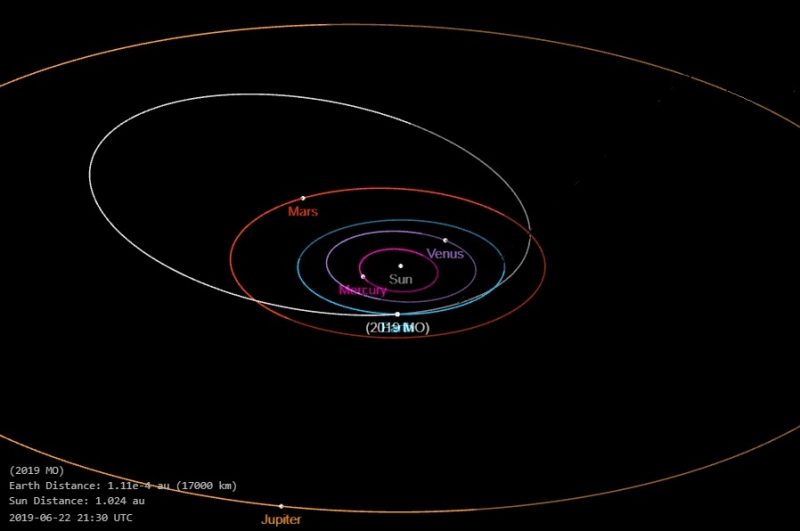




 Two planets located 12.5 light years away from Earth and...
 NASA experts discover the closest Earth-like planet just 31...
 Astronomers discover Earth-like world with THREE red suns...