Ontdek de Fascinerende Wereld van UFO's en UAP's: Jouw Bron voor Onthullende Informatie!
Ben jij ook gefascineerd door het onbekende? Wil je meer weten over UFO's en UAP's, niet alleen in België, maar over de hele wereld? Dan ben je op de juiste plek!
België: Het Kloppend Hart van UFO-onderzoek
In België is BUFON (Belgisch UFO-Netwerk) dé autoriteit op het gebied van UFO-onderzoek. Voor betrouwbare en objectieve informatie over deze intrigerende fenomenen, bezoek je zeker onze Facebook-pagina en deze blog. Maar dat is nog niet alles! Ontdek ook het Belgisch UFO-meldpunt en Caelestia, twee organisaties die diepgaand onderzoek verrichten, al zijn ze soms kritisch of sceptisch.
Nederland: Een Schat aan Informatie
Voor onze Nederlandse buren is er de schitterende website www.ufowijzer.nl, beheerd door Paul Harmans. Deze site biedt een schat aan informatie en artikelen die je niet wilt missen!
Internationaal: MUFON - De Wereldwijde Autoriteit
Neem ook een kijkje bij MUFON (Mutual UFO Network Inc.), een gerenommeerde Amerikaanse UFO-vereniging met afdelingen in de VS en wereldwijd. MUFON is toegewijd aan de wetenschappelijke en analytische studie van het UFO-fenomeen, en hun maandelijkse tijdschrift, The MUFON UFO-Journal, is een must-read voor elke UFO-enthousiasteling. Bezoek hun website op www.mufon.com voor meer informatie.
Samenwerking en Toekomstvisie
Sinds 1 februari 2020 is Pieter niet alleen ex-president van BUFON, maar ook de voormalige nationale directeur van MUFON in Vlaanderen en Nederland. Dit creëert een sterke samenwerking met de Franse MUFON Reseau MUFON/EUROP, wat ons in staat stelt om nog meer waardevolle inzichten te delen.
Let op: Nepprofielen en Nieuwe Groeperingen
Pas op voor een nieuwe groepering die zich ook BUFON noemt, maar geen enkele connectie heeft met onze gevestigde organisatie. Hoewel zij de naam geregistreerd hebben, kunnen ze het rijke verleden en de expertise van onze groep niet evenaren. We wensen hen veel succes, maar we blijven de autoriteit in UFO-onderzoek!
Blijf Op De Hoogte!
Wil jij de laatste nieuwtjes over UFO's, ruimtevaart, archeologie, en meer? Volg ons dan en duik samen met ons in de fascinerende wereld van het onbekende! Sluit je aan bij de gemeenschap van nieuwsgierige geesten die net als jij verlangen naar antwoorden en avonturen in de sterren!
Heb je vragen of wil je meer weten? Aarzel dan niet om contact met ons op te nemen! Samen ontrafelen we het mysterie van de lucht en daarbuiten.
When ranking “Wouldn’t it be great if we had these?” science fiction inventions, innovations and imaginations, flying cars would certainly be #1, followed closely by the thing that would make flying cars able to traverse the universe – wormholes. While Albert Einstein had nothing to say about airborne autos, he influenced the possibility of wormholes with his theories of special relativity and gravity. Since the existence of such a time-space warp requires massive power, they’re often linked to the supermassive black holes that exist at the centers of galaxies. Now, a group of scientists have figured out a way to test whether Sagittarius A* (Sgr A*), the Milky Way’s central (and still hypothetical) black hole is also a wormhole. Is someone on the other side doing the same thing? Have we seen this movie plot before?
“If a wormhole smoothly connects two different spacetimes, then the flux cannot be separately conserved in any of these spaces individually. Then objects propagating in the vicinity of a wormhole in one space must feel the influence of objects propagating in the other space. We show this in the cases of the scalar, electromagnetic, and gravitational field. The case of gravity is perhaps the most interesting. Namely, by studying the orbits of stars around the black hole at the center of our galaxy, we could soon tell if this black hole harbors a traversable wormhole.”
That’s the abstract of “Observing a wormhole,” a new paper, published in Physical Review D, written by Dejan Stojkovic, PhD, cosmologist and professor of physics in the University at Buffalo College of Arts and Sciences, and De-Chang Dai, PhD, of Yangzhou University in China and Case Western Reserve University in Cleveland. Stojkovic and Dai didn’t just observe Sgr A* — they also watched S2, the star orbiting the black hole. Unlike in Interstellar and other wormhole movies and novels, these physicists don’t believe humans in giant, extremely tough spaceships can travel through a wormhole. However, something much large can, and it could also use its gravity to influence something equally large on the other side. Enter S2 and its possible opposite-galaxy twin.
“In particular, with a near future acceleration precision of 10-6 m/s2, a few solar masses star orbiting around Sgr A* on the other side of the wormhole at the distance of a few gravitational radii would leave a detectable imprint on the orbit of the S2 star on our side. Alternatively, one can expect the same effect in black hole binary systems, or a black hole–star binary systems.”
In other words, unusual movements by a giant star near a supermassive black hole could indicate that the black hole is actually a wormhole. And Stojkovic and Dai measured S2 and found it shaking hard enough to make them shake at the discovery of an actual wormhole … right? RIGHT?
“When we reach the precision needed in our observations, we may be able to say that a wormhole is the most likely explanation if we detect perturbations in the orbit of S2,” he says. “But we cannot say that, ‘Yes, this is definitely a wormhole.’ There could be some other explanation, something else on our side perturbing the motion of this star.”
As Stojkovic indicates in a University of Buffalo press release, current technology is not precise enough to see the movement, nor have they been observing S2 long enough to determine if it has actually moved in a non-standard way. On the good news side, Stojkovic believes this technology will be available in a within-our-lifetime period – possibly in a decade.
What if S2 never moves? That doesn’t necessarily mean Sgr A* isn’t a wormhole, just that there’s no giant star on the other side. It also doesn’t mean that something smaller couldn’t make a trip through it, although the ‘negative energy’ required to accomplish it is still considered to be impossible, even at the particle level.
Turn around.
So then, why keep looking at S2 and Sgr A*? Astronomers, like cryptid hunters, are on a quest. As Stojkovic told Popular Science:
“If one worm hole is found, then there is no reason to believe that there aren’t many others, When we found the first candidate for a black hole, then suddenly we saw millions of them.”
One phenomenon that has picked up quite a few accounts and attention in recent years is one that lies firmly out in the domain of the fringe, and deals with thin, pale beings that seem to defy any real classification. I have covered such entities before here, and they are commonly referred to by the creepy name “pale crawlers,” a unique branch of the paranormal which has grown to encompass countless very bizarre sightings reports. Here we will take a look at even more such encounters, which really stretch the limits of the odd and leave us wondering what could possibly be going on.
The reports of unearthly pale humanoid creatures lurking about in the shadows cover a range of different descriptions, but one of the most common is that of something very tall and extremely thin and gaunt, with very pale, almost translucent skin. They often appear out of nowhere for reasons we cannot comprehend, can be seen to travel on two legs or four, and one report that demonstrates an eerie sighting of one of these entities comes from Lon Strickler at Phantoms and Monsters. The witness says that this occurred back in 1994, at a place called Willow Creek, California, where he had been visiting his grandparents’ house in the summer of that year. The house is described as a small 2-bedroom place in a rugged wilderness area, with the Trinity River flowing practically right through their backyard, which is overlooked by a deck attached to the house. One evening he went to sleep in a sleeping back in the house’s solarium outside under the stars, and the witness says he woke up in the middle of the night for no discernible reason. After wiping away the remnants of sleepiness he realized that he was being overcome with a distinct feeling of dread that snaked through his veins and provoked within him a flight or fight response, shocking him awake like a splash of cold water, despite the fact that it was a quiet evening and there was no threat to be seen.
After some time (most likely just a minute or two), I turned my head to the side to look into the yard. I had to turn to my side and lift myself a bit to get a better look, but the source of my feeling was impossible to miss. Standing at the bottom of the yard next to the neighbor’s fence line stood a tall skinny creature with skin the color of the moon. It had no hair on it’s head or anywhere else that I could see. It’s eyes where shiny white with a reflective quality, but not bright like a bright light was shining on them right then. Just moon light. Its face had human features, but seemed squished flatter. It’s arms seemed really long, but that could be just because it was really tall. The chain link fence came up to it’s armpits, so it had to be around 7-8 feet tall. Not enough to just step over the fencing, but I didn’t hear it climb over unless it had been in the yard before I woke up and just didn’t get the dread feeling until later. It’s body had dirty brown-dark gray looking rags over its chest and around its hips cover its crotch.
It was looking right at me. I got scared and ducked down into my sleeping bag as far as I could. My sister has always been a heavy sleeper and I didn’t want her to wake up for this anyway. Next thing I hear heavy steps on the deck coming towards the solarium. There’s a wood door with a screened window in the top of it (not opened at the time as far as I can remember). All was quiet for a while, so I peeked out through a small fold of the sleeping bag. Through one of the bottom windows of the solarium next to the door I saw it’s pale large feet. The skin was rough and the toes were gnarled with dirty nails. I curled up trying not to make a sound or move much. The bag was getting stuffy.
He says the next thing he knew he was being shaken awake by his father after having passed out, and he would later find out that no one else had seen or heard anything unusual, there were no footprints or any physical evidence left behind, and his father told him that it had probably all been a bad dream. What did this witness see out there and why was it prowling about this property? A somewhat similar report comes to us from Reddit user “BuckeyeBrute,” who relates an experience his grandfather had at his rural home in a coal mining town in Southeastern Ohio. The grandfather began to get visitations at night from a very otherworldly, tall pale being that seemed to just loiter about the property and watch the house, and the commenter says of his grandfather and his brush with the weird:
He used to be soft spoken and generally reserved but the last time I visited him he was easily startled by noises, constantly checking outside the window, and he won’t let his dog outside unless he goes with the dog and he always bring his handgun with him. I asked him why he was so jumpy and he told me it was because of something he has seen multiple times outside his kitchen window. He claims that he has seen a tall, white, and very thin creature on the edge of his backyard near the treeline. He tells me it has small black eyes, that it’s around 8 feet tall, and that it just stands there watching his house and then vanishes. He said the sightings started about two months ago and I have only seen him twice since he started to see whatever this thing is. I am at a loss for words on how to help him. My grandfather used to be so easygoing, but anymore he’s afraid of my family staying at his house past sundown because he doesn’t want us seeing it either.
A quite bizarre report is also given by a Reddit user called “onionstarseed,” on a thread of humanoid encounters, who says that he and a friend saw a pale white creature they refer to as “an inorganic being” in the wilds of British Columbia, Canada, in 2010. On this evening the two of them were out exploring the area along with the friend’s dog, and they came to a steep cliff overlooking the forest area, and that is when the witness noticed a very peculiar entity down in the trees. He says of what happened:
There’s a steep cliff made out of forest floor when you first walk in. It is only about 10 – 15 feet into the forest area from the “entrance” of the forest. When we were standing at the top of the cliff/ravine before the path way leading down to the rest of the forest and the creek at the bottom which was the only safe way to walk down especially at night, I could see a 7-8 feet tall pure white soft looking figure and it was in between the trees moving around softly swaying left to right back and forth slowly standing (literally touching the forest floor) in the exact same place the whole time we saw it making absolutely no sound and there was absolutely no wind.
It was 7-8 feet Tall, Pure White (When I mean “pure white” I mean Paper, Bone white) Not see-through, Just 2 Pure White Long limbs (from what we could see in the dark). It was so white it looked like it was almost giving off light but it wasn’t because it was not shining or illuminating the trees or ground and Im pretty sure you could see shadow on it from it moving back and forth in the same place between the trees, had no facial features from what we could see and it was swaying back and forth around that I can only describe as 7-8 foot separated curtains blowing in the wind touching the forest floor, but right and left back and forth in a specific motion with no sound at all, absolutely no wind, dead silent. Emanated the feeling of dread and impending doom when I started being “Mesmorized” by its strange movements. I tried my best to squint my eyes and adjust them to the Inorganic Being/dark better to see what it was doing or if I could make out what it looked like better, but it did not help at all it just still appeared as I described.
I wasn’t even going to say anything about the figure to my friend at first because I was waiting for my friend to say something. We observed it for a couple seconds in complete silence and we’re “mesmerized” by it’s movements, then I asked my friend if he saw it and he said yeah he could as well. We stood silent in fear as we were watching it do its strange unsettling soft swaying movements/trying to adjust our eyes to the Inorganic Being and see what it was doing. As I was in a slight daze watching it sway I started to feel a ominous energy “set in” and felt impending doom (the sinking feeling) in my chest area like when you are going to die or are in a life threatening situation and I had shivers going throughout my body. That’s when I told my friend specifically “I don’t like this”, he agreed and we left immediately.
There were absolutely no sounds in the forest, it was dead silent while it was moving back and forth. Its movements could have been a lure of some sort because it did not move towards us or anywhere, or it was just letting us know to stay away because it was scared to death as well or just didn’t want us to disturb it. It was literally something you would see in a science fiction horror movie.
In this particular case, the witness claims that he asked around to people from the First Nations, and that they told him it was a creature they called the Sisiutl and other regional names, and that it was a sort of spirit that they did not like to talk about with outsiders. It is interesting to note that many of these cases make mention of a potent sense of this fear that washes over the witness almost as if it is being generated from outside and beamed into them. A case that really exemplifies this is one given by a Reddit user on a post titled “White “creature” in the woods of PA.” The witness says that he was driving his aunt to the airport at around 1 AM in a rural area outside of Philadelphia, Pennsylvania, and the road is described as having been very dark and a little foggy that night. Then they came across something they could not explain, of which the witness says:
It was facing toward a telephone pole off to the right of the car. The pole was just in front of a garage or small barn structure. All I could see was the back of its head – completely white, no hair – and its hands and its forearms which were also totally white. It looked like it was wearing a dark shirt or something of that nature. But it was facing away from us, leaning into the telephone pole with its arms up against the pole and its head against its arms. Or at least a stance similar to that. The worst feeling I have ever felt Rose up in my chest when I saw it. I felt my heart almost stop and drop into my stomach. I felt sick. And terrified. All I knew was that whatever it was, I didn’t want it to turn around. No matter what. I knew it couldn’t be allowed to turn around, or I would regret it.
I’ve seen a lot of really weird things in my life and felt a lot of really weird sensations. I’ve always been super sensitive to the energy in homes and I have straight up seen ghosts in my parents home, one of which I am very wary of (the other, I am comforted by, but that’s a different story for a different time). But this… this was actually TERRIFYING. I cannot explain the immense feeling of dread and horror I experienced in that moment to you. You could only understand if you’ve experienced it yourself.
This thing was tall, and had distinct arms and legs. It had no hair whatsoever on its body. I don’t know if it had facial features because it was faced towards the pole. Almost like it was counting for Hide and go seek with it’s arms up. It might have been hugging onto the pole. It wore something black. And I experienced the worst and most deeply jolting fear in its presence, and I was only near to it for a few seconds.
What was this thing? This case is rather interesting because it really emphasizes the pure fear these things are often described as emanating, and it is also curious in that it is a rare account of such an entity actually wearing some sort of clothing, and there is also the fact that a great many of these encounter reports take place along lonely roads at night. Reddit user “DistinctEarthling” gives such an account that supposedly happened on Christmas night in 2007, along a darkened rural backroad in Upstate New York. At one point as he made his way along a very secluded dark patch of road that had “barren fields on either side and woods set back,” he claims that he came across something very odd walking along the opposite side of the road coming in his direction. He says of the sight that bloomed up out of the night:
It was not a person. It stood on two long legs, with long arms hanging down from its shoulders. It was strong looking. Lean, muscular, but not beefy in stature. It looked thin at the same time. It stood at least 7 foot tall. It was light colored: not sure whether it was white, tan, yellow or grayish. It didn’t appear to have fur but there was some texture to the skin- it wasn’t smooth. There appeared to be something coming down off its back. I don’t know what this was. All I can recall about it’s face is the small features it had but the mouth and jaw were notably large. And it had pointed things atop its head- 2 things going straight upward with something mingled between the two things. That’s what I got from a quick scan and from my observation of it as it neared my car and my car neared it.
As my car became parallel to it within a split second, I went from looking out my windshield to looking at it from my drivers side window. In that moment, it’s face quickly peered down at me and all I remember was the mouth opened wide. Out came a remarkable scream that I’ll never forget. Gives me the chills just thinking about it. It consisted of a high-pitched shrill/shriek, enveloped by a deep guttural growl. Both sounds happened simultaneously in that scream. I kept driving all the while. This was all happening so fast that I didn’t even have a chance to be scared or shocked or anything. Later on, I was in total shock after it sunk in. Had my drivers side window been opened fully, it would have touched me, or worse, taken me. I’m certain of it. To this day, I still haven’t worked out what this was.
Quite a disturbing account, indeed. In another report, we have Reddit user “cspin360,” who also saw something very unsettling by the side of the road while driving with his fiancé through a remote road in an undisclosed location within one of the “rust belt states.” He says of the freakish encounter:
I live in a rust belt state about an hour south of our state capital in a rural hilly area. Me and my fiancé were driving from my parents house to a friends for a bit of night swimming. Our way there passes a state park’s boundaries and about 5 miles from any house on the road we seen what looked to be a pale skinned humanoid crouching on the side of the road. From behind you could see the spine of this creature poking out of its back and it almost looked as if it was hunched over roadkill. I could see it turn it’s head in our direction as we passed it but I didn’t get a good look at it’s face. Before seeing that me and my fiancé were very skeptical of the paranormal.
From the state of Illinois we have a report from Ranker, with a witness who was driving on his way home from a friend’s house in rural Illinois in an area with many creeks and woods when he had his encounter. His girlfriend was with him at the time, going home herself in a separate car, but later on she would call him in a state of frantic panic, and would give a very strange tale. The bizarre story goes as follows:
On Friday night she and I were at a friend’s house and decided to leave at around 1 am. It’s very foggy outside being that we live near rivers and creeks in rural Illinois. She goes to the gas station on her way home to the rural town where we both live about a block away from each other. I get home and don’t hear from her for a bit until she calls me very shaken up and crying. She says on her drive home she saw something crouched in the road on the right side. It looked to be fairly small possibly a child. She rolled her window down and asked if they were okay, and got no answer, only continued sobbing. She pulls over and gets out of the car walked up to whatever this was and attempted to ask if it needed any help. The thing stands up on two feet at over six feet, pale and hairless, and lets out a god awful screech and runs off of the road into some pretty dense woods near a tributary of the Kaskaskia river. She can’t say it was a boy or a girl but can say she’s never heard something like that before. She’s pretty jarred by the experience.
Yet another sighting reported to Lon Strickler of the site Phantoms and Monsters supposedly occurred along a dusty old road in South Texas in 2009. The witness says:
Me and a friend were driving home during the early morning hours in 2009 here in south Texas, near Brownsville. A bipedal, hairless & pale glowing humanoid or being of some sort jumped out of the brush towards my car as we passed. We were driving at 20 to 25 mph. This being screamed at us…a very shrill high-pitched yell. I’ll never forget it. When I fully looked at this humanoid my heart just stopped. It did not look anything like a Hollywood character of what an alien might look like. It was definitely not of this world. We then sped off as fast as we could and did not look back.
As frightening as these reports might be, perhaps even scarier still are those reports of pale humanoids or “pale crawlers” right within the confines of one’s home, and there are a few very disturbing cases along these lines. One is give on the site Ranker, by a witness who was at the time staying with her parents at their home in Texas. She says that one day she was just taking a nap on a futon in the middle of the day, and that at one point she opened her eyes to see that she wasn’t alone there. She says:
As I opened my eyes I saw, for only a second, the image of some white humanoid creature kneeling on its hunches looking at me. It couldn’t have been that tall since its eyes where only a inches above my bed. I could see the top of it’s knees which it was resting it’s head against. While I can’t remember many details about it’s face I knew, somehow, that it wasn’t entirely ‘right,’ for lack of a better term. I can’t remember if it even had any hair on it’s head, or the color of its eyes, but I can remember that it’s skin was very pale and it looked as if it were just skin and bones. I don’t know why the image of this creature was so vivid even though I only saw it for a second but even to this day it stands out.
Perhaps even more spectacular is an account given by a Reddit user who also saw something incredibly odd in his home when he was 14 years old. At the time it was around 10 PM at night, and the witness had gone to sleep on the sofa in the living room. As he lie down to try and sleep, he then heard a scrabbling, scratching sound that kept him awake and which was odd because the family did not own any pets and everyone else was in their rooms. The witness describes the spooky ordeal that would follow thusly:
So I’m lying down as as soon as I close my eyes (it’s like I blinked), I hear something crawling on the shaggy carpet, like it was crawling fast in circles, I could hear it loud and clear. I stay frozen thinking what the fuck???? The crawling sounded as if it what scraping itself against the carpet while moving. I hear it coming closer to me, next to the couch and it goes back off to the same spot where the sound started, which was like 5 feet away from the couch in this empty space in the corner of the living room.
Curious, I take a small peak and as I can remember, it looked like a human crawling on all fours, except the body was backwards (like if you lie down facing up, and then arch your body up with your hands and legs), and it was dark pale skin and I didn’t see a head, only it’s legs and hands. It wasn’t wearing anything, it was dark from my view so i didn’t see it’s entire body. At that time, I never ever played any scary games, and now that I’m older, I can say the creature looked like something out of a silent hill game. Like the skin texture. I know I wasn’t asleep because I barely got on the couch and when I jumped, I was still wide awake, I wasn’t sleepy at all. I know it wasn’t a dream.
These reports don’t really seem to comfortably fit within any traditional area of the paranormal, making them a phenomenon that really deserves its own classification, and which leaves us scrambling for answers. What could these sorts of entity be? Are they ghosts or spirits of some kind, aliens, demons, undiscovered animals, interdimensional interlopers, or something else all together? With such numerous differences in appearance reported, perhaps this is a phenomenon that encompasses several different possibilities, none of which are easily explainable with our current knowledge. Whatever they are, these “pale crawlers” represent the weird of the weird, inhabiting their own realm of the paranormal and evading any real understanding.
Tom Delonge's To the Stars Academy announced a partnership with the Army to research advanced alien technology. (Katy Winn/AP)
Much like the universe, the military’s affiliation with alien-related subject matter appears to be ever-expanding.
In 2017, the Pentagon confirmed the existence of a program that existed from 2007 to 2012, the Advanced Aerospace Threat Identification Program, that was dedicated solely to investigating reports of UFO sightings.
The Navy then verified the authenticity of a declassified 2015 video, released by former Blink-182 frontman Tom DeLonge’s To the Stars Academy, featuring a bizarre encounter between Navy pilots and a high-speed, low-altitude unidentified flying object.
This April, the Navy confirmed it was drafting a fleet-wide message to establish guidelines for pilots and other military personnel to report UFO sightings, the culmination of a surge in what the Navy called a series of intrusions by advanced aircraft on Navy carrier strike groups.
Encounters with unidentified aircraft by pilots have once again prompted officials from the Department of Defense to take action.
By: J.D. Simkins
Now, the Army has joined the extraterrestrial fray in a big way, inking a contract with DeLonge’s TTSA to collaborate in the study of “exotic” metals that both parties hope will lead to the development of advanced technologies.
As part of the agreement, the Army’s Ground Vehicle System Center and Ground Vehicle Survivability and Protection component will lend research resources, including laboratories, to TTSA, which in turn will leverage what the company asserts are alien metals capable of enhancing the effectiveness of Army vehicles.
To the Stars claims to have “acquired, designed, or produced” these materials, which can offer an array of futuristic modifications like active camouflage, beamed energy propulsion, inertial mass reduction, and quantum communication.
Details on how or where DeLonge’s company acquired these materials were not provided.
“TTSA has acquired material from various sources and does not comment on the specifics of each sample,” Kari DeLonge, TTSA chief content officer and Tom’s sister, told Vice’s Motherboard.
The Army will make a $750,000 commitment to TTSA research as part of the five-year collaboration.
“Our partnership with TTSA serves as an exciting, non-traditional source for novel materials and transformational technologies to enhance our military ground system capabilities,” Dr. Joseph Cannon, deputy product manager of science and technology in the Vehicle Protection Systems Division of the GVSC, said in a TTSA press release announcing the contract.
"We look forward to this partnership and the potential technical innovations forthcoming.”
The Army’s contractual agreement comes in the wake of insistence by a number of former defense officials that the Pentagon take a more aggressive approach to analyzing data surrounding UFO encounters.
Former military intelligence official Luis Elizondo, who now works for DeLonge’s TTSA after reportedly spearheading the AATIP, told Politico in April that the military’s determination to keep such encounters quiet could be detrimental.
“If you are in a busy airport and see something you are supposed to say something,” he said.
“With our own military members it is kind of the opposite: ‘If you do see something, don’t say something. ... What happens in five years if it turns out these are extremely advanced Russian aircraft?”
Recent measures taken by the Army and Navy would suggest, at least on the surface, an acknowledgement of the concerns of those like Elizondo, who told Motherboard in September that he was "heartened by the Navy’s new position to address this issue in a serious manner and without the distraction of the social stigma that this phenomena seems to attract.”
And while these Pentagon-led endeavors come sans admission of the existence of alien life, new developments continue to signal a return to DoD acknowledgement that recently documented encounters at least warrant further investigation.
To the Stars officials are happy to accommodate the effort.
“This cooperative research agreement brings additional, critically important expertise that is necessary to advance the state-of-the-art in both our near and long-term technology areas of study," Steve Justice, TTSA’s COO and Aerospace Division director said in the release.
"While the Army has specific military performance interests in the research, much of the work is expected to have dual-use application in support of TTSA’s path to commercialization and public benefit mission.”
DeLonge’s team at TTSA is spearheaded by a number of noteworthy officials who have spent significant time in the DoD.
Dr. Hal Puthoff, a NASA quantum physicist and DoD adviser, Jim Semivan, a former senior intelligence member of the CIA, and Chris Mellon, a former deputy assistant secretary of defense for intelligence in both the Clinton and Bush administrations who was instrumental in creating Special Operations Command, all occupy leadership positions within TTSA.
DeLonge’s To the Stars Academy team was recently the subject of six-part documentary series on the History Channel called “Unidentified: Inside America’s UFO Investigation™."
Amerikaanse leger sluit deal met UFO-groep om buitenaardse technologie te bestuderen. Is dit het ultieme bewijs?
is geen geheim meer dat het Amerikaanse leger geïnteresseerd is in alles wat te maken heeft met aliens.
In 2017 bevestigde het Pentagon het bestaan van een UFO-programma dat liep van 2007 tot 2012.
Vervolgens bevestigde de Amerikaanse marine de authenticiteit van beelden die in 2015 door een gevechtspiloot waren gemaakt van een onbekend vliegend object.
Exotische metalen
En in april stelde de marine richtlijnen op voor het melden van UFO’s, die steeds vaker worden waargenomen door piloten.
Het Amerikaanse leger heeft nu een deal gesloten met de UFO-onderzoeksgroep van voormalig zanger van Blink-182 Tom DeLonge om ‘exotische’ metalen te gaan bestuderen, meldt Army Times.
Het leger stelt onder meer laboratoria ter beschikking aan de groep.
Niet bekend
DeLonge zegt te beschikken over buitenaardse metalen die de ‘effectiviteit van legervoertuigen zullen vergroten’.
Het is niet bekend waar zijn organisatie de materialen precies vandaan heeft gehaald.
Het leger heeft 750.000 dollar opzij gezet voor de samenwerking, die vijf jaar moet gaan duren.
Meer openheid
Eén van de mensen die zich heeft aangesloten bij de groep van DeLonge, Luis Elizondo, stond jarenlang aan het hoofd van het UFO-programma van het Pentagon.
Hij wil dat er meer openheid komt over UFO-waarnemingen.
Hoeveel versies van jezelf bestaan er? Deze natuurkundige stelt dat er ontelbaar veel parallelle universa zijn
De veel-werelden-interpretatie, ook wel de theorie van de parallelle universa genoemd, behoort zeker tot de mogelijkheden. Dat zegt natuurkundige Sean Carroll van het California Institute of Technology in een interview met NBC.
“Het is absoluut mogelijk dat er meerdere werelden zijn waarin je verschillende keuzes hebt gemaakt,” zei hij tegen de zender.
“We hebben ons alleen te houden aan de natuurwetten,” voegde hij toe.
Groot aantal
De vraag is dan hoeveel werelden er precies zijn.
“We weten niet of het aantal werelden eindig of oneindig is, maar waarschijnlijk gaat het om een groot aantal,” beweerde Carroll.
“Het zijn er in ieder geval niet maar iets van vijf,” vervolgde hij.
Waarnemer
Volgens de natuurkundige hangt de fysieke realiteit in het universum nauw samen met de waarnemer.
“Voordat je naar een object kijkt, of het nu een elektron of een atoom is, bevindt het zich niet op een bepaalde locatie,” zei Carroll.
“Je neemt het ergens waar, maar het bevindt zich niet op een specifieke plek,” lichtte hij toe.
Hawking
Carrroll is niet de enige die onderzoek heeft gedaan naar de mogelijkheid dat er vele alternatieve realiteiten zijn.
Ook Stephen Hawking en Erwin Schrodinger hebben gesuggereerd dat er veel andere parallelle werelden bestaan.
In zijn meest recente werk stelde Hawking dat de oerknal ons dankzij de kwantummechanica heeft voorzien van een oneindig aantal universa, niet slechts eentje.
Bezoeken
Volgens Carroll is het onmogelijk om andere parallelle universa te bezoeken.
“Andere universa interacteren niet met elkaar, ze beïnvloeden elkaar niet,” zei hij.
Deep Field:The Impossible Magnitude of Our Universe
“Deep Field: The Impossible Magnitude of Our Universe”
“Eric Whitacre’s “Deep Field: The Impossible Magnitude of our Universe” is a unique film and musical experience inspired by one of the most important scientific discoveries of all time: the Hubble Telescope’s Deep Field image.”
○
“When I heard the learn’d astronomer;
When the proofs, the figures, were ranged in columns before me;
When I was shown the charts and the diagrams, to add, divide, and measure them;
When I, sitting, heard the astronomer,
where he lectured with much applause in the lecture-room,
How soon, unaccountable, I became tired and sick;
Till rising and gliding out, I wander’d off by myself,
In the mystical moist night-air, and from time to time,
Secret Space Program Insider Reveals Everything He Knows About Extraterrestrials
Here Emery will give a detailed account of the specific experiences that changed the way he thought about our planet, solar system and humanity forever. In this workshop, Emery dives into the information he learned while working on and with extraterrestrial beings.
He will discuss what he learned through a classified library. This unique access was granted through credits achieved by “good behavior.’ Emery will shed light on the most impactful information found in the library archives, including human and extraterrestrial history, what the inside of our planet actually looks like, and which nations are contributing information to this worldwide shared library today.
Lastly, Emery discusses one of the projects he was assigned to where he and a few select others created the first extraterrestrial DNA database and the implications it has for identifying the origins of every human on this planet.
Mysterious Air Force spaceplane returns to Earth more than two years after SpaceX launch
More than 25 months after it lifted off on a SpaceX Falcon 9 rocket, the US Air Force’s secretive X-37B spaceplane successfully returned to Earth on October 27th, breaking its own record for time spent in orbit.
As always, the specifics of what exactly the X-37B spaceplane does in orbit remain as obscure as ever.
SpaceX’s Falcon 9 rocket launched X-37B on its fifth mission – OTV-5 – on September 7th, 2017, just a handful of months after successfully launching a similarly secretive mission (NROL-76) for the National Reconnaissance Office (NRO) and a handful of months prior to the company’s even more mysterious ‘Zuma’ launch. SpaceX’s OTV-5 launch had to race against the clock to beat Hurricane Irma’s forecasted landfall and the company managed to launch just a few days prior, while the booster’s post-landing operations had to be similarly expedited.
Falcon 9 B1040 returns to Landing Zone-1 after launching the X-37B spaceplane. The booster was reused roughly 9 months later.(SpaceX)
Thankfully, all went as planned and SpaceX recovery technicians had Falcon 9 booster B1040 safely stored inside a nearby hangar before Hurricane Irma impacted the Florida coast. B1040 was reused for the second and final time during the June 2018 launch of the SES-12 communications satellite and marked the second to last launch of a pre-Block 5 variant of Falcon 9.
In the interim, the USAF X-37B has been quietly stationed in low Earth orbit (LEO), performing any number of tasks. Over the course of the 779 days it spent in orbit, the spaceplane modified its orbit several times before finally reentering Earth’s atmosphere to land at Kennedy Space Center’s Shuttle Landing Facility (KSC SLF) runway.
The#OTV5 / #X37B space plane photographed in orbit! Finally an image showing this mini-Space Shuttle which is only a fraction in size of the real Shuttle. https://t.co/r7zqATUpN4
During the OTV-4 mission that preceded OTV-5, the same X-37B spacecraft spent 717 days in orbit – just shy of two years. OTV-5 surpassed that endurance record on August 26th and remained in orbit for another two months, breaking its own record by a bit less than 10%. For the most part, the USAF’s most consistent cover story for the X-37B paints the spaceplane as platform for testing reusable spacecraft hardware, but that explanation has never made a huge amount of sense alongside the fact that each mission has averaged more than 570 days in orbit.
“[The X-37B is the] Air Force’s premier reusable and unmanned spacecraft providing the performance and flexibility to improve technologies in a way that allows scientists and engineers to recover experiments tested in a long-duration space environment.”
In reality, it’s largely assumed that X-37B serves as a kind of flexible, on-call spy satellite, featuring a payload bay with plenty of room for signals intelligence or imaging hardware and a level of orbital endurance that makes it comparable to satellites. For example, OTV-5’s orbital parameters meant that the spacecraft routinely overflew Russia.
Aside from the “experiments” and likely espionage-related payloads X-37B can stow inside its payload bay, the spacecraft also brings along a small solar array and radiator and features a hydrazine maneuvering system with substantial delta-V reserves, allowing it to significantly change its orbit.
An artist’s impression of X-37B in orbit. (Adrian Mann)
Following its successful October 27th recovery, Boeing and USAF teams will likely begin the process of refurbishing X-37B and preparing it for its sixth orbital mission as soon as possible. Known as OTV-6, the spacecraft is scheduled to head to orbit atop a ULA Atlas V rocket no earlier than Q2 2020.
Check out Teslarati’s newsletters for prompt updates, on-the-ground perspectives, and unique glimpses of SpaceX’s rocket launch and recovery processes.
Alien Bases Found In Craters On Earths Moon, Photos, UFO Sighting News.
Date of discovery: Oct 2019 Location of discovery: Earths moon Source: NASA/ESA Here is something I found in a photo of Earths moon. The most interesting and artistic alien structure that I have found in a very long time. Each of the craters shown have an alien structure within it. One of which is silver in color. This silver structure has amazing detail. It is slightly blurry because the white fake crater the aliens made creates a shine that is difficult to focus, but the structure in its center stands out well. Next to the silver structure is a brownish structure that is smaller...which is in the shape of a face. I can clearly make out its eyes, nose, ears, mouth and hair...its male. Cool stuff huh? This is 100% proof that aliens currently occupy our moon and it also explains why humans have not been back since the early Apollo missions. They are still there and don't want us meddling in their affairs. Scott C. Waring-Taiwan
UFO passing the volcano Popocatépetl caught on live cam
Cameras are filming the volcano Popocatépetl in Mexico 24 hours a day. Once again a UFO has been caught on the volcano cam Popocatépetl while passing the volcano on October 22, 2019.
The bright object has no wings or other visible parts which means it can't be a plane, helicopter or drone.
Although people have reported strange lights or the appearance of unidentified flying objects at the volcano since years, there is no explanation why the volcano is visited so often by strange objects.
UFOs Across the US Could Be the Country’s Secret Space Force
A peace worker and military veteran has claimed that UFOs across the US could be the new Space Force craft of the military that the government has built using a secret military budget.
Growing speculation has hit the headlines over the last few months about the US military preparation of hitting the skies with a secret Space Force fleet.
Some conspiracy theorists believe the snake-like UFOs and other mysterious aircrafts observed over the country are evidence the USAF is testing craft for the 6th branch of the military.
Bruce Gagnon, the Global Network Against Weapons and Nuclear Power in Space coordinator and co-founder, believes it may not be too far from the truth.
Bruce claimed such secret craft could be a new type of Space Force craft that’s funded by a highly confidential budget. Bruce explained that the secret military budget, development of advanced technologies, and the black budget are only speculations, but these are conceivable and possible.
Bruce saw a photo of Northrop Grumman B-21 Raider when the speaker of a Space Militarisation Peace talk released it. He said it looked like something out of space.
Bruce has previously revealed that the USAF has been making a new generation of space soldiers by teaching children.
The US Space Force (USSF) is the US Armed Forces’ proposed space warfare service branch that’s intended to have power over military space operations.
If established, it would become the 6thbranch of the US Armed Forces and the 8thUS uniformed service. It would be organised as a military service branch within the Department of the Air Force, one of the three military departments in the Department of Defence.
The Mars-bound rover is closer to ready for the Red Planet.
Engineers remove the inner layer of protective foil from NASA's Mars 2020 rover.
(Image credit: NASA/JPL-Caltech)
NASA's Mars 2020 rover has shed its skin and gained a new arm, and it's now standing on its own six wheels, closer to ready for the Red Planet.
The Mars-bound rover has gone through a few major updates this October. After the rover relocated from the Spacecraft Assembly Facility to the Simulator Building at NASA's Jet Propulsion Laboratory (JPL) to undergo testing, engineers removed the first, inner layer of protective, anti-static foil on the rover to prevent contamination on Mars. In the GIF above, taken on Oct. 4, 2019, you can see a team of engineers in bunny suits (a nickname for their clean room coveralls) "unwrapping" the rover.
After removing the first layer of anti-static foil, the team of engineers wiped down the last layer of foil with 70% isopropyl alcohol. The protective foil and alcohol wipe-down are meant to prevent Earth material from hitching a ride on the rover to Mars and contaminating the surface of the planet.
"The Mars 2020 rover will be collecting samples for future return to Earth, so it must meet extraordinary cleanliness measures to avoid the possibility of contaminating Martian samples with terrestrial contaminants," Paul Boeder, a contamination control lead for the Mars 2020 rover at JPL, said in a statement. "To ensure we maintain cleanliness at all times, we need to keep things clean not only during assembly and testing, but also during the moves between buildings for these activities."
Standing on its own
A few days later at JPL, on Oct. 8, the Mars 2020 rover carried its full weight on its six legs and wheels for the first time ever.
"After years of design, analysis and testing, it is fantastic to see the rover on her wheels for the first time," Ben Riggs, a mechanical systems engineer working on Mars 2020 at JPL, said in a statement. "The whole team looks forward to seeing her in the same configuration on Mars in the not-too-distant future."
NASA's Mars 2020 rover carried its full weight on its legs and wheels for the first time ever on Oct. 8, 2019.
(Image credit: NASA/JPL-Caltech)
The legs of the rover, which can be identified in the image above as the black tubes above the spacecraft's wheels, are made of titanium. The rover's six wheels are made of aluminum and have cleats, or grousers, that help it get traction on the ground. The wheels currently on the rover are "engineering models" used during this testing phase, and before the rover is launched to Mars, they will be replaced with flight models.
A new arm
The rover updates didn't stop there. On Oct. 22, Maxar Technologies announced that it had delivered the robotic Sample Handling Assembly (SHA), a robotic arm, for the Mars 2020 rover.
The SHA is designed to assess, store and release rock and soil samples collected by the rover on the surface of Mars. The sixth robotic arm from Maxar that will be used on Mars, the SHA will be an important asset for the rover's goal of answering questions about the potential existence, now or in the past, of life on Mars.
NASA's Mars 2020 rover is scheduled to launch to the Red Planet in July of 2020 aboard a United Launch Alliance Atlas V rocket from Space Launch Complex 41 at Cape Canaveral Air Force Station. The rover is set to land on Mars at Jezero Crater on Feb. 18, 2021.
If there's life swimming in the dark, frigid ocean of the Jupiter moon Europa, an upcoming NASA mission might be able to sniff it out.
The agency's Europa Clipper spacecraft is scheduled to launch in the mid-2020s on a mission to characterize the icy moon's subsurface sea and its life-hosting potential. But Clipper is capable of making even bigger discoveries, if everything falls into place just right.
"We're a habitability mission. We're trying to understand, Is Europa a habitable environment?" Europa Clipper project scientist Robert Pappalardo, of NASA's Jet Propulsion Laboratory (JPL) in Pasadena, California, said Wednesday (Oct. 23) at the 70th International Astronautical Congress (IAC) in Washington, D.C.
"We're not a life-search mission," Pappalardo added. "But, if Europa's interior happened to be rich in organic microbes pouring out of it, we would be able to tell from the mass spectra — probably, possibly — that we're sensing life. That's a longshot, but it's not impossible."
Pappalardo was referring to measurements made by Clipper's mass spectrometer, one of nine science instruments the probe will carry. Mass spectrometers determine the masses of ions (charged atoms and molecules) in a sample, helping scientists identify what those ions are.
Clipper will collect these samples during dozens of flybys of Europa, which the probe will make from Jupiter orbit over the course of its 3.5-year operational life. Circling Europa itself was not a viable option, given the intense radiation environment around the moon, mission team members have said.
The samples will come from Europa's wispy atmosphere and, the team hopes, from plumes of water vapor and other material wafting from the icy moon's surface. Scientists have spotted evidence of such plumes on multiple occasions, but their existence has yet to be confirmed.
"Early in the mission, we'll be searching for plumes and trying to understand, Are they real? Are they there? Where are they? Are they sporadic or continuously active?" Pappalardo said.
"And maybe we'll fortuitously go through a plume, or maybe we'll be able to adjust the orbit slightly in order to go through a plume," he added. "And if we do, then our in situ instruments, especially the mass spectrometer and the dust detector, will be able to sample that material in extreme detail to search for organic materials and to understand the detailed chemistry of Europa's interior."
Pappalardo cautioned that Europa's plumes, if they do indeed exist, might be very different than the confirmed one emanating from the south polar region of Saturn's icy moon Enceladus. The Enceladus plume is generated by powerful geysers that are continuously blasting material from the Saturn satellite's subsurface ocean into space. Although the Europa material could be coming from its ocean, the source could also be lakes of liquid water within the moon's ice shell, Pappalardo said.
And he stressed that plume sampling won't make or break Clipper's mission.
"That's essentially bonus science, not required by the mission," Pappalardo said. "But I sure hope it happens."
The other instruments carried by the solar-powered Clipper, whose total mission costs are estimated at around $4 billion, include a magnetometer and a radar instrument, which will allow the team to characterize in detail Europa's ocean and ice shell, respectively. Scientists think the ocean is about 50 miles (80 kilometers) deep and the ice shell about 13 miles (20 km) thick, but those are estimates, and there will certainly be regional variation.
In case you just skimmed over that last sentence: A 50-mile-deep ocean is pretty amazing, considering that the deepest point on Earth's seafloor is just 7 miles (11 km) beneath the waves. At 1,900 miles (3,000 km) wide, Europa is smaller than Earth's moon but is thought to harbor twice as much liquid water as our planet's surface does.
Europa's ocean is also thought to be in contact with the moon's rocky core, potentially enabling a wide range of interesting and complex chemical reactions. As a result, Europa is widely regarded as one of the solar system's best bets for harboring alien life. Others on the short list include Enceladus and Saturn's huge moon Titan, which has hydrocarbon seas on its surface and likely a buried ocean of liquid water as well.
The Clipper will also tote powerful cameras, which will snap photos with a resolution of about 1.6 feet (0.5 meters) per pixel. That's 10 times sharper than the best existing images of Europa's surface, which were captured by NASA's Galileo spacecraft, Pappalardo said. Galileo orbited Jupiter from 1995 to 2003.
While Clipper's photos will be revelatory enough in their own right, they should also help pave the way for the next step in Europa exploration: a life-hunting lander that Congress has instructed NASA to develop. Clipper's data will help researchers identify good places for the lander mission to touch down, NASA officials have said. (The lander mission remains a concept for the moment, however; it's not officially on NASA's docket.)
NASA had long been targeting a 2023 liftoff for Europa Clipper. Congress has told the agency to launch the mission using NASA's powerful Space Launch System (SLS) megarocket, which would allow Clipper to travel directly to Jupiter and get there after just 2.4 years of flight.
But SLS is still in development and has experienced multiple delays and cost overruns. In addition, NASA plans to use the first three SLS vehicles for its Artemis lunar-exploration program. As a result, the first SLS available for use by Clipper won't be ready until 2025 at the earliest, NASA's Office of the Inspector General (OIG) recently concluded.
The OIG therefore recommended that NASA should be allowed to consider launching Clipper on a commercial rocket, such as SpaceX's Falcon Heavy or United Launch Alliance's Delta IV Heavy. These vehicles aren't as powerful as SLS is expected to be, so going the commercial route would require a different trajectory for Clipper — a roundabout one that employs planetary "gravity assists" and features a total transit time of nearly six years, according to the OIG report.
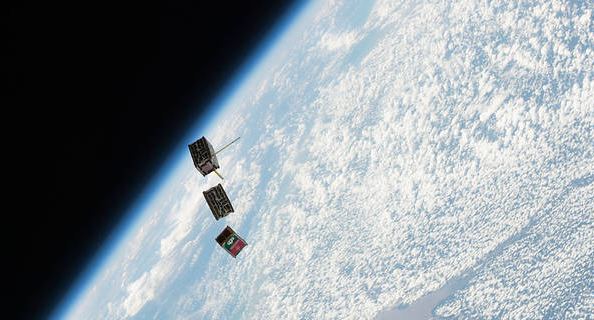
We’re accustomed to the ‘large craft’ approach to exploring our Solar System. Probes like the Voyagers, the Mariners, and the Pioneers have written their place in the history of space exploration. Missions like Cassini and Juno are carrying on that work. But advances in technology mean that Nanosats and Cubesats might write the next chapter in the exploration of our Solar System.
Nanosats and Cubesats are different than the probes of the past. They’re much smaller and cheaper, and they offer some flexibility in our approach to exploring the Solar System. A Nanosat is defined as a satellite with a mass between 1 and 10 kg. A CubeSat is made up of multiple cubes of roughly 10cm³ (10cm x 10cm x 11.35cm). Together, they hold the promise of rapidly expanding our understanding of the Solar System in a much more flexible way.
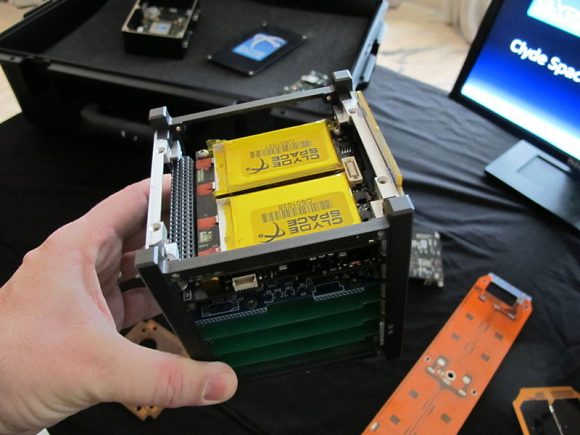
A cubesat structure, made by ClydeSpace, 1U in size. Credit: Wikipedia Commons/Svobodat
NASA has been working on smaller satellites for a few years, and the work is starting to bear some serious fruit. A group of scientists at JPL predicts that by 2020 there will be 10 deep space CubeSats exploring our Solar System, and by 2030 there will be 100 of them. NASA, as usual, is developing NanoSat and CubeSat technologies, but so are private companies like Scotland’s Clyde Space.
NASA has built 2 Interplanetary NanoSpacecraft Pathfinder In Relevant Environment (INSPIRE) CubeSats to be launched in 2017. They will demonstrate what NASA calls the “revolutionary capability of deep space CubeSats.” They’ll be placed in earth-escape orbit to show that they can withstand the rigors of space, and can operate, navigate, and communicate effectively.
Following in INSPIRE’s footsteps will be the Mars Cube One (MarCO) CubeSats. MarCO will demonstrate one of the most attractive aspects of CubeSats and NanoSats: their ability to hitch a ride with larger missions and to augment the capabilities of those missions.
In 2018, NASA plans to send a stationary lander to Mars, called Interior Exploration using Seismic Investigations, Geodesy and Heat Transport (InSight). The MarCO CubeSats will be along for the ride, and will act as communications relays, though they aren’t needed for mission success. They will be the first CubeSats to be sent into deep space.
So what are some specific targets for this new class of small probes? The applications for NanoSats and CubeSats are abundant.
Other NanoSat and CubeSat Missions
NASA’s Europa Clipper Mission, planned for the 2020’s, will likely have CubeSats along for the ride as it scrutinizes Europa for conditions favorable for life. NASA has contracted 10 academic institutes to study CubeSats that would allow the mission to get closer to Europa’s frozen surface.
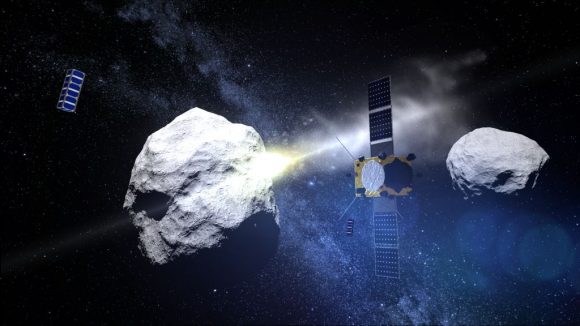
The ESA’s AIM asteroid probe will launch in 2020 to study a binary asteroid system called the Didymos system. AIM will consist of the main spacecraft, a small lander, and at least two CubeSats. The CubeSats will act as part of a deep space communications network.
ESA’s Asteroid Impact Mission is joined by two triple-unit CubeSats to observe the impact of the NASA-led Demonstration of Autonomous Rendezvous Technology (DART) probe with the secondary Didymos asteroid, planned for late 2022. Image: ESA
The challenging environment of Venus is also another world where CubeSats and NanoSats can play a prominent role. Many missions make use of a gravity assist from Venus as they head to their main objective. The small size of NanoSats means that one or more of them could be released at Venus. The thick atmosphere at Venus gives us a chance to demonstrate aerocapture and to place NanoSats in orbit around our neighbor planet. These NanoSats could take study the Venusian atmosphere and send the results back to Earth.
NanoSWARM
But the proposed NanoSWARM might be the most effective demonstration of the power of NanoSats yet. The NanoSWARM mission would have a fleet of small satellites sent to the Moon with a specific set of objectives. Unlike other missions, where NanoSats and CubeSats would be part of a mission centered around larger payloads, NanoSWARM would be only small satellites.
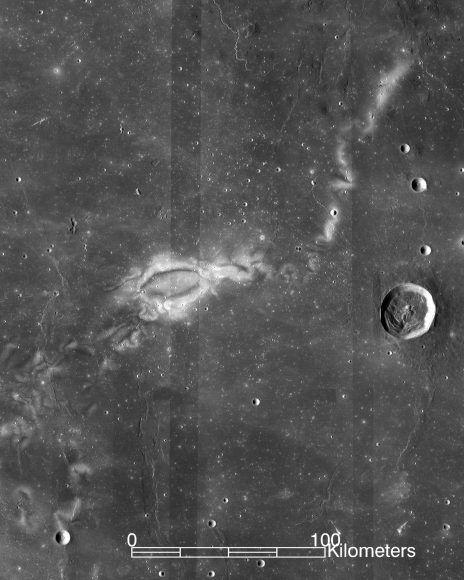
NanoSWARM is a forward thinking mission that is so far only a concept. It would be a fleet of CubeSats orbiting the Moon and addressing questions around planetary magnetism, surface water on airless bodies, space weathering, and the physics of small-scale magnetospheres. NanoSWARM would target features on the Moon called “swirls“, which are high-albedo features correlated with strong magnetic fields and low surficial water. NanoSWARM CubeSats will make the first near-surface measurements of solar wind flux and magnetic fields at swirls.
This is an image of the Reiner Gamma lunar swirl from NASA’s Lunar Reconnaissance Orbiter. Credits: NASA LRO WAC science team
NanoSWARM would have a mission architecture referred to as “mother with many children.” The mother ship would release two sets of CubeSats. One set would be released with impact trajectories and would gather data on magnetism and proton fluxes right up until impact. A second set would orbit the Moon to measure neutron fluxes. NanoSWARM’s results would tell us a lot about the geophysics, volatile distribution, and plasma physics of other bodies, including terrestrial planets and asteroids.
Space enthusiasts know that the Voyager probes had less computing power than our mobile phones. It’s common knowledge that our electronics are getting smaller and smaller. We’re also getting better at all the other technologies necessary for CubeSats and NanoSats, like batteries, solar arrays, and electrospray thrusters. As this trend continues, expect nanosatellites and cubesats to play a larger and more prominent role in space exploration.
A “thought provoking” video was uploaded to YouTube which seems to show several crafts flying over China. Details of the video are scarce, with the uploader not saying which area of China they are in, but it clearly depicts something suspicious. In the video, three UFOs can be seen flying overhead in formation.
The strange aircrafts differ massively in size, with the middle one being by far the largest.
The variation of size has led certain quarters of the internet to believe the UFOs are not man made as if they were terrestrial, the fleet would likely all have been of the same aircraft.
The video was quickly picked up by alien hunters, with prominent UFO enthusiast Scott C Waring claiming that extraterrestrials are watching us all over the globe.
Mr Waring wrote on his popular blog UFO Sightings Daily: “This video was taken in China last week and shows not one, but three UFOs or more flying over a person’s office building.
UFO sighting: Alien spaceship fleet seen flying in formation over China
(Image: UFO SIGHTINGS DAILY)
“There is no country that UFOs exclusively fly over. They are everywhere and they are big and some are as small as baseballs.
“This is a very though provoking video.”
China has become something of a focal point of alien enthusiasts, with some saying the secretive nation even has its own Area 51.
Situated in the middle of nowhere in the Gobi desert, a series of strange structures have baffled internet users.
Is this China's Area 51?
(Image: YOUTUBE)
The focal point is a strange “Stonehenge-like” circle contains three aircrafts, which the narrator cannot identify.
The aircrafts are all pointing outwards, and as the Youtuber, ThirdPhaseOfMoon, looks at the time lapse on Google Earth, you can see that the number of planes there drops from four to three between 2005 and 2015, despite the fact that no tracks are left behind, and there is no runway close to it.
Additionally, to the right of the patch of aircrafts is a mysterious square formation with jagged lines running through it.
Some believe that this may be a secretive code that extra-terrestrial beings can pick up on aerially.
Astronomers have spotted a new type of storm on Saturn
The tempests are larger than other squalls but smaller than massive Great White Spots
Until now, astronomers have only seen Saturn ravaged by small storms that last days or enormous Great White Spots that last months (a Great White Spot that raged in 2010 and 2011 pictured). Now, astronomers have identified a third, midsize kind of storm activity on the gas giant.
Until now, astronomers had seen only two kinds of Saturnian storms: relatively small storms about 2,000 kilometers across that appear as bright clouds for a few days and Great White Spots that are 10 times as large and last for months (SN: 4/14/15). The newly spotted weather disturbance was a series of four midsize storms. Each was several thousand kilometers across and lasted between about 1.5 weeks and about seven months.
Saturnian storms are thought to originate in water clouds hundreds of kilometers below the planet’s visible upper cloud cover. Studying such storms can offer a window into deep atmospheric goings-on that aren’t directly observable, says Agustín Sánchez-Lavega, who studies planetary atmospheres at the University of the Basque Country in Bilbao, Spain.
Sánchez-Lavega and colleagues analyzed hundreds of telescope images taken by amateur astronomers, as well as pictures from by the Calar Alto Observatory in Spain and NASA’s Hubble Space Telescope. From late March to late October 2018, four unusual bright spots appeared in Saturn’s atmosphere near the North Pole, between the latitudes of 67° N and 74° N.
Computer simulations indicate that each midsize storm required about 10 times as much energy as a small storm to get going, but only about one-hundredth the energy required to brew up a Great White Spot.
Weather report
In 2018, telescopes on the ground and in space spotted a series of storms near Saturn’s North Pole (white spots indicated by black arrows). Not all of the storms were visible simultaneously; the shortest-lived lasted about 10 days while the longest-running storm raged for 214 days. These weather disturbances were larger than storms previously seen on the gas giant, but nowhere near as big as Saturn’s rare Great White Spots.
Tracking a new type of storm activity on Saturn, April 1–August 16, 2018
A. SÁNCHEZ-LAVEGA ET AL/NATURE ASTRONOMY 2019
The sighting of this storm outbreak “almost leaves more questions than it can give answers,” says Georg Fischer, a planetary scientist at the Space Research Institute of the Austrian Academy of Sciences in Graz not involved in the work.
For instance, the 2018 telescope images don’t show whether the newfound storms crackled with lightning. Small storms typically boast a few flashes per minute and Great White Spots several flashes per second. If similar midsize storms appear in the future, Fischer says, radio telescopes that monitor the gas giant’s tempests for lightning strikes could indicate whether middling storms are more similar to their small or giant counterparts. That might help scientists figure out how they form.
The timing of the 2018 storm sequence hints that it might have been a failed Great White Spot. These planetary-scale storms have been observed only seven times since 1876. But those few data points seem to indicate that Great White Spots form around the same latitudes once every 60 years or so. The last time Saturn sported a far-north Great White Spot, near the latitudes where the 2018 storm quartet cropped up, was in 1960.
It’s possible that a 2010 Great White Spot that formed farther south siphoned so much energy from Saturn’s atmosphere that there was only enough left to fuel a few middling storms, rather than a full-blown Great White Spot in 2018, Sánchez-Lavega says.
But planetary scientist Robert West, who wasn’t involved in the study, is skeptical that the 2010 Great White Spot could have interfered with storm activity farther north. That’s because gas swirling in Saturn’s atmosphere at different latitudes tends to stay in its own lane. West, of Caltech and NASA’s Jet Propulsion Laboratory in Pasadena, Calif., suspects that the storm sequence in 2018 was not a failed Great White Spot, but “a whole different thing.” For now, however, the origins of those intermediate storms and how they relate to other weather phenomena on Saturn are still mysterious, he says.
Comment: Some other recent discoveries about Saturn include:
This eROSITA image shows the Large Magellanic Cloud, our galactic neighbor. The image was created with exposures from all seven of the telescope's mirror modules; the pictures were taken between Oct. 18 and 19.
The first images from a dark-energy-hunting telescope have been revealed, and they're spectacular.
On Oct. 22, 2019, the inaugural images from the German X-ray telescope eROSITA were presented to the public at the Max Planck Institute for Extraterrestrial Physics (MPE) in Bavaria, Germany. These "first light" images are a combination of pictures from all seven of the telescope's Wolter-1 mirror modules, which have been scanning the sky with custom CCD cameras.
This image from eROSITA shows A3391/3395, two interacting galaxy clusters that are 800 million light-years from Earth. This image was created with exposures from all seven of the telescope's mirror modules; the images were taken between Oct. 17 TKTK
(Image credit: T. Reiprich (University of Bonn), M. Ramos-Ceja (MPE), F. Pacaud (University of Bonn), D. Eckert (University of Geneva), J. Sanders (MPE), N. Ota (University of Bonn), E. Bulbul (MPE), V. Ghirardini (MPE), MPE/IKI)
The German space agency (DLR)'s eROSITA telescope, which has been making observations since Oct. 13, has taken combined X-ray images of pieces of the night sky. Those include pictures of the Large Magellanic Cloud (LMC) and A3391/3395, an interacting pair of galaxy clusters located about 800 million light-years from Earth.
"These first images from our telescope show the true beauty of the hidden universe," Peter Predehl, principal investigator of eROSITA, said in a statement. "To meet our science goals, we needed enough sensitivity to detect the most-distant clusters of galaxies in the universe over the whole sky and resolve them spatially. These first light images show that we can do exactly that, but we can go a lot further."
The eROSITA X-ray telescope before it launched aboard a Proton rocket on July 13, 2019.
(Image credit: DLR)
Between the telescope's CCD cameras and seven mirror modules, the observatory is extremely sensitive. "The potential for new discoveries is immense. Now we can start reaping the fruits of more than 10 years of work," Predehl added.
A testament to the sensitivity of the instrument, eROSITA was able to capture some interesting details in the LMC, including remnants of the supernova SN 1987A and a number of both foreground stars and distant active galactic nuclei.
The highly sensitive eROSITA telescope will not only help scientists capture detailed images of cosmic objects like stars and diffuse gas, but it could also support the investigation of dark energy, scientists said.
"This is a dream come true. We now know that eROSITA can deliver on its promise and create a map of the whole X-ray sky with unprecedented depth and detail," Andrea Merloni, eROSITA project scientist, said in the same statement.
"The legacy value will be enormous," Meroni added. "Beside the beautiful images like the ones we're showing today, catalogues of millions of exotic celestial objects such as black holes, galaxy clusters, neutron stars, supernovae and active stars will be used by astronomers for years to come."
eROSITA, which launched with a Spektrum-Röntgen-Gamma (Spektr-RG) satellite onboard a Proton rocket on July 13, 2019, from the Baikonur Cosmodrome in Kazakhstan, is part of Spectrum Roentgen Gamma (SRG), a Russian-German collaborative astrophysical-observation mission, which includes the Russian ART-XC telescope.
You’re in a position to take a look at the footage below. You may observe the footage below. You may inspect the footage below. You may see the footage below. It’s possible to have a look at the footage below. Footage of an enormous shadow moving over the crowd stays in the movie. Footage of a massive shadow moving over the crowd stays in the movie.
You can analyze the video below. It’s possible that you analyze the video below. It’s possible to have a look at the video below. You can have a look at the video below. The video can be seen on the TTS Academy Community of Interest site by click on this link. The quick video below, for instance, is only one of several contemporary sightings. It, for instance, is only one of several contemporary sightings.
You can have a look at the footage below. You may have a look at the footage below. You may have a look at the footage below. You may have a look at the footage below. It’s possible that you look at the footage below. You may have a look at the footage below. You can have a peek at the footage below.
My sighting only lasted lots of seconds. It’s quite easy to comprehend why there are plenty of UFO sightings. It’s very simple to comprehend why there are plenty of UFO sightings. Now, UFO sighting has been a matter of amusement as an alternate to a concern, in spite of the fact there are ample evidences about their scary general appearance. Now, UFO sighting has been a matter of amusement rather than a concern, even though there are ample evidences about their scary general appearance. Many reported UFO sightings actually end up being something as simple as a balloon.
All About Latest UFO Footage
Now, UFO sighting has been an issue of amusement instead of a concern, although there are ample evidences about their scary general appearance. It’s very easy to comprehend why there are lots of UFO sightings. It’s simple to comprehend why there are lots of UFO sightings. Many reported UFO sightings actually wind up being something as easy as a balloon.
UFOs are often connected with aliens and conspiracy theories. At some stage, you’re most likely to encounter a UFO. At a while, you’re most likely to run into a UFO. Throughout that time period, there were two triangle UFOs sighted in the identical website. Throughout that time frame, there were two triangle UFOs sighted in the same site. Throughout that period of time, there were two triangle UFOs sighted in only the identical website.
UFOs are observed through telescopes. At times, however, they cannot be identified due to the minimal quality of evidence associated with their sightings. Sometimes, however, they cannot be identified because of the low quality of evidence related to their sightings. Throughout that time period, there were two triangle UFOs sighted in precisely the exact site. Throughout that time period, there were two triangle UFOs sighted in the identical site. Throughout that period of time, there were two triangle UFOs sighted in exactly the same website.
Secret Space Program Insider Reveals Everything He Knows About Extraterrestrials
Here Emery will give a detailed account of the specific experiences that changed the way he thought about our planet, solar system and humanity forever. In this workshop, Emery dives into the information he learned while working on and with extraterrestrial beings.
He will discuss what he learned through a classified library. This unique access was granted through credits achieved by “good behavior.’ Emery will shed light on the most impactful information found in the library archives, including human and extraterrestrial history, what the inside of our planet actually looks like, and which nations are contributing information to this worldwide shared library today.
Lastly, Emery discusses one of the projects he was assigned to where he and a few select others created the first extraterrestrial DNA database and the implications it has for identifying the origins of every human on this planet.
Antarctica Anomalies Investigated Amazing Findings Made By Leading Researchers
There have been some very strange goings on at the South Pole in recent years, many of them are bizarre to say the least. Join leading alternative researchers as they continue their investigations into this vast and largely unexplored area.
The universe isn’t expanding, it is growing. It is a life form. A younger one, by it’s own standards.The universe is a being. We are simple cells supporting this life form, just as the cells in our body, are supporting their universe. Mark Marker
Why buzz said “Its evil itself and we all are in danger? Is this the same what ISS astronaut Heger did? Before her laboratory burns down and she gets her nervous breakdown? Coincidence? Well…Odd things happened and happens here. Austrian UFO News
Does ball lightning move like this or is it something else?
On September 19, 2019 a dashcam recorded a ball of fire coming out of a thunderstorm over Russia.
Ball lightning (electric orb) is an unexplained and potentially dangerous atmospheric electrical phenomenon and has captivated and mystified us for centuries and although scientists seem to agree ball lightning is real, even if they don't yet fully understand what causes it.
But since this ball of fire follows a very strange trajectory before it disappears we may wonder whether it is ball lightning or something else.
The original video has a high pitched annoying buzz and is twice as long. Willease added the audio track to make it more bearable.
When it comes to UFOs, those truly in the know – let’s call them the Deep Know – know that no one was going to find out much by storming Area 51. That’s not due to the security but to the reality that the alleged crashed spaceships and live-or-dead aliens are not in Nevada but in Ohio – specifically at Wright-Patterson Air Force Base in Dayton. If any reverse engineering of extraterrestrial technology is going on, it’s going on there. Which is why we should be paying very close attention to an announcement recently that Air Force scientists at WPAFB have developed a liquid metal that becomes stronger and a better conductor when stretched – the exact opposite of all other known conductive materials. Is this what spaceships are made of? Or Terminator-like aliens?
“Typically a material will increase in resistance as it is stretched simply because the current has to pass through more material. Experimenting with these liquid metal systems and seeing the opposite response was completely unexpected and frankly unbelievable until we understood what was going on.”
Old technology liquid metal
“Unbelievable” is not a word you’d expect to be used in a press release from the military, let alone one from an Air Force base so closely tied to Project Blue Book and other secret UFO projects. Yet that is exactly the word Dr. Christopher Tabor, lead research scientist at Air Force Research Laboratory, used to describe the properties of Polymerized Liquid Metal Networks, a new material developed by the lab while researching new ways to make next-generation wearable electronics that won’t weaken when the body it surrounds stretches or bends, and will retain all of its conductivity properties under the same stresses.
“Core–shell particles of liquid metal with surface‐bound acrylate ligands are synthesized and polymerized together to create cross‐linked particle networks comprising >99.9% liquid metal by weight. When stretched, particles within these polymerized liquid metal networks (Poly‐LMNs) rupture and release their liquid metal payload, resulting in a rapid 108‐fold increase in the network’s conductivity. These networks autonomously form hierarchical structures that mitigate the deleterious effects of strain on electronic performance and give rise to emergent properties. Notable characteristics include nearly constant resistances over large strains, electronic strain memory, and increasing volumetric conductivity with strain to over 20 000 S cm−1 at >700% elongation.”
In a technical paper published in the journal Advanced Materials, Tabor and lead author Capt. Carl Thrasher, research chemist within the Materials and Manufacturing Directorate at AFRL, explain how the particles of liquid metal are enclosed in a shell and then chemically tethered to the next one through a polymerization process, linking all of them together. Under stress, the shells break, releasing the liquid that quickly rebonds its particles to maintain the material’s conductivity and inherent stretchability. According to the report, there is no detection of fatigue after 10,000 stress cycles.
“This is something that isn’t available on the market today so we are really excited to introduce this to the world and spread the word.”
Or is it being reintroduced? The Air Force Research Laboratory is the primary scientific research and development center for the Air Force and “plays an integral role in leading the discovery, development, and integration of affordable warfighting technologies for our air, space, and cyberspace force.” More importantly, it’s based at WPAFB which is located at the birthplace of manned flight and the heart of military air flight research since World War I (as McCook Field). And, as the Deep Know and anyone who watched the recent Project Blue Book series or read the insider books about it knows, it has long been rumored to be where alien pilots and their crashed UFOs are taken and … re-engineered?
One of the most talked-about UFO sightings of all time occurred in November of 2004 when an F/A-18 Super Hornet captured footage of an unknown tic-tac shaped object flying through the skies off the coast of California. The USS Nimitz in addition to its support ships, like the USS Princeton, all saw the unexplained craft in the sky.
The footage captured of the “tic-tac UFO” led the Pentagon to admit that they have a top-secret government program called Advanced Aerospace Threat Identification Program (or AATIP) tat specifically focuses on investigating reports of UFO sightings. While the Defense Department stated that the program ended in 2012, there have been reports that it’s still in operation to this very day.
With that being said, a U.S. Navy veteran has come forward with a startling revelation that secret officials came onboard the USS Princeton to retrieve important information about the encounter. In an interview with The Nimitz Encounters, Lead Petty Officer Ryan Weigelt revealed new information that shortly after the encounter with the tic-tac shaped object, several United States Air Force personnel boarded the ship.
USS Princeton
Weigelt, whose job was to look after the helicopters that were on the USS Princeton, said that the group of men who boarded the carrier “weren’t assigned” to the ship. After they boarded the vessel, the group immediately went to the Admiral’s Quarter where a guard was stationed outside the door so that nobody could enter.
Shortly after, they took “something” from the helicopters that made them unable to fly. “I couldn’t tell you what it was they had taken,” Weigelt said, adding, “But they took something that meant we couldn’t fly our aircraft until we got them back.” He went on to say, “There was something that they had taken off our aircraft that, whatever box it was, they logged it out and it was directed by a higher authority to take it.”
After they had retrieved what they wanted, the group left the ship in a RIB (rigid-hulled inflatable boat). At that point, the crew of the USS Princeton was told to dock at a marina. “I’ve done a lot of cruises in my time in the military and never once did we pull in during a work-up to a harbor for any reason whatsoever,” Weigelt explained, continuing on by stating, “I’ve never even seen a ship anchor in the mouth of the harbor.”
USS Princeton
So, what was the reasoning behind the mysterious group of secretive officials boarding the ship and retrieving “something” that wouldn’t allow the helicopters to fly? Weigelt provided his theory by saying, “There’s no doubt in my mind that these guys were looking for data on the UFOs.” Weigelt’s interview can be watched in full here.
Perhaps there’s more footage out there showing the tic-tac shaped object in the sky that they’re trying to keep secret. If there is additional footage, I’d sure love to see it.
Somewhere in the afterlife, the great-and-gone geniuses of Earth might be gathered around a celestial campfire (or burning bush) roasting heavenly marshmallows, swapping tales of how their creations and theories turned out and having a good laugh at how they continue to baffle humanity long after they’ve left the planet. Two who may be sharing a similar story these days are Enrico Fermi, creator of the Fermi Paradox, and John Von Neumann, proposer of the idea of space probes that can replicate themselves as they travel ad infinitum. A still-living astrophysicist recently pulled these two ideas together and shrunk them down to a microscopic size with his new proposal that aliens may already be among us in the nearly invisible form of self-replicating nanoprobes. Are Fermi and Von Neumann laughing … or crying?
John von Neumann
“In this paper we consider efficiency of self-reproducing extraterrestrial Von-Neumann microscale robots and analyse the observational characteristics. By examining the natural scenario of moving in the HII clouds, it has been found that the timescale of replication might be several years and even less – making the process of observation quite promising. We have shown that by encountering the interstellar protons the probes might be visible at least in the infrared energy band and the corresponding luminosities might reach enormous values.”
In a paper published recently in arxiv, Zaza Osmanov, astrophysicist and professor of physics at the Free University of Tbilisi, Georgia, proposes that Fermi’s Paradox (“where are all of the aliens?”) is due to scientists looking in the wrong place for creatures of the wrong size. He suggests that Von Neumann probes are already here but the machines are a microscopic one nanometer long. (For comparison, a strand of human DNA is 2.5 nanometers in diameter.) At that scale, the probes can be powered by hydrogen atoms – abundant in space – and replicate themselves in just a few years. At that rate, Osmanov estimates a mere 100 nanoprobes launched into space would need only four light years to create – they would create 1,000,000,000,000,000,000,000,000,000,000,000 or 10 to the 33rd power (a decillion) offspring. (Take that, Duggar family!)
While one nanoprobe would be nearly impossible to find, a decillion of them might be easier, especially when feeding on hydrogen atoms. That act would result in emissions that could be luminous, especially to someone looking right at them. At that size and with the right density, Osmanov speculates that the cloud of nanoprobes emitting hydrogen farts could look like a comet. And the place with the highest probability of such a mass gathering would be in interstellar clouds containing a lot of hydrogen atoms. Or perhaps in a zeppelin?
Enrico Fermi
“All the aforementioned results indicate that if one detects a strange object with extremely high values of luminosity increment, that might be a good sign to place the object in the list of extraterrestrial Von-Neumann probe candidates.”
So, if you look at an interstellar cloud and see a luminous object about the size of a comet, it just might be a swarm of alien nanoprobes on their way to Earth. And if you see a smaller luminous blob inside of a hydrogen-filled zeppelin, they may already be here.
Osmanov’s theory is certainly possible and plausible. The real question is … what would Fermi and Von Neumann think?
Are they laughing, crying … or scheming up ways to come back and see what’s next?
AFPBeeld ter illustratie, NASA wil een rover naar de zuidpool van de maan sturen om er water te zoeken.
WETENSCHAP Het Amerikaanse ruimtevaartagentschap NASA wil een “rover” (een rijdende robot) naar de zuidpool van de maan sturen om er water te zoeken. Dat heeft NASA-baas Jim Bridestine vandaag gezegd. Bedoeling is om uit te zoeken of het water dat op de maan aanwezig is, zou kunnen dienen als drinkwater voor astronauten en om er brandstof van te maken.
De mobiele robot VIPER (Volatiles Investigating Polar Exploration Rover) zou in 2022 moeten arriveren op de maan. “VIPER gaat rondrijden op de zuidpool van de maan en zal uitzoeken waar het ijswater is”, aldus Bridestine op de laatste dag van het International Austronautical Congress in Washington. “We gaan het water kunnen analyseren en er uiteindelijk naar boren.”
NASA hoopt dat de gegevens over hoeveel water er aanwezig is kunnen helpen om de ambitie van het agentschap waar te maken om een langdurige en duurzame menselijke aanwezigheid op de maan mogelijk te maken. NASA wil tegen 2024 twee astronauten naar de zuidpool van de maan sturen. De bedoeling is dat ze er 6,5 dagen buiten hun maanlander werken.
De VIPER zal ongeveer honderd dagen aan data verzamelen, die zullen dienen voor de eerste globale watervoorraadkaarten van de maan. De robot heeft instrumenten mee die waterstof en zuurstof kunnen opsporen, de basiscomponenten van water die afgescheiden kunnen worden om er brandstof van te maken voor een toekomstige vloot van commerciële maanlanceringsvoertuigen.
EEN DRUKTE VAN BELANG BIJ BUITENAARDSE BASIS IN MEXICO
Al jarenlang duiken er beelden op van ufo's die aankomen of vertrekken bij hun basis in Mexico.
Zo ook nu komt er weer een ruimteschip aan bij de basis die zich volgens ufologen diep onder de Popocatépetl vulkaan bevindt.
Als het gaat over ufo's en buitenaardsen is voorzichtigheid geboden. Dit omdat inmiddels ook de aardbewoners beschikken over ruimtevoertuigen die afgeleid zijn van buit gemaakte buitenaardse versies. In die zin is een oproep voor aanstaande 30 oktober van US Air Force Academy boeiend want de afbeelding bij de oproep wekt verwachtingen.
Als je dan ook een vreemd object in de lucht ziet, weet je eigenlijk nooit met zekerheid de herkomst ervan.
Echter, wanneer we spreken over ufo's die bij de Mexicaanse vulkaan Popocatepétl op regelmatige basis worden gesignaleerd, dan nemen we eigenlijk aan dat het hier gaat om buitenaardsen. Dit ook omdat er al sinds mensenheugenis verhalen de ronde doen over een buitenaardse basis, diep onder deze vulkaan en ufologen ervan overtuigd zijn dat er zich zo'n 4 tot 6 kilometer onder de grond een buitenaardse basis bevindt.
Maar, echt zeker weten doen we het niet, maar wat we wel zeker weten is dat er al jarenlang onbekende vliegende objecten worden waargenomen bij deze vulkaan en dat niet alleen, je ziet ze gewoon de vulkaan binnenvliegen.
De meeste opnames zijn echt, simpelweg omdat ze zijn gemaakt door webcams, zoals de volgende enkele dagen geleden. We kwamen deze opname tegen bij Scott Waring, één van de ufologen die er 100 procent van overtuigd is dat we hier te maken hebben met een ondergrondse basis.
De opname is op 20 oktober 2019 gemaakt door een webcam en je ziet een object de vulkaan naderen en vervolgens naar binnen verdwijnen.
De meest spectaculaire ufo die is waargenomen bij deze vulkaan is die in het najaar van 2012. Toen verscheen er een cilindervormige ufo die met grote snelheid in de krater verdween en ook die opname was echt, gemaakt door webcams en werd zelfs uitgebreid op de Mexicaanse televisie vertoond.
Onderstaande afbeelding is afkomstig van de weerradar van Intellicast van 27 oktober, de dag dat een Ufo de vulkaan Popocatepetl in vloog. Het beeld bleef de hele dag online tot en met 28 oktober.
Hier zie je heel duidelijk de vorm van de vortex.
Het centrum van de vortex ligt precies op de plaats waar de vulkaan zich bevindt. Dit toeval lijkt ons te groot om geen verband te hebben met de Ufo die op datzelfde moment de vulkaan binnenvloog.
Wetenschappers hebben nog steeds geen idee en eennieuwsbericht van Televisa, het station wat de opname heeft gemaakt, laat weten dat men heeft uitgerekend dat de snelheid waarmee het object naar binnenvloog, groter was dan die van een vliegtuig.
Ufologen wereldwijd zijn van mening dat het óf een basis betreft in de vulkaan, vergelijkbaar met de basis van Marconi in de Andes, óf dat het een ingang betreft naar de Holle Aarde. Een combinatie van beiden zou ook nog een mogelijkheid zijn.
Dit gebeurt allemaal ook op onze planeet en krijgt in de mainstream verslaggeving geen enkele aandacht.
Alien Abductee Reveals What Really Happened At Devil's Den State Park
Incident at Devils Den is a true story by former Assistant Attorney General Terry Lovelace, who was taken by Aliens on a camping trip. In 2012 an anomalous bit of metal the size of a fingernail was discovered on a routine x-ray following a fall.
I’ve been a devoted runner for most of my life. I began running in earnest when I left the military in late 1979. I didn’t run marathons, but I was devoted to three or four miles a day. Soon I noticed something odd. At about the two-mile mark in my run a spot on my right leg went completely numb. It was just above my knee and only about an inch in diameter. With a pin I could define its edges as perfectly round. Less than an hour after my run the sensation returned. I mentioned it to my doctor who blew it off and suggested I do the same. I dubbed it my “numb spot” and never gave it a second thought. That was until October 22, 2012 when a fall landed me in an emergency room.
An X-ray of my leg above the knee discovered an anomalous bit of metal. The radiologist was sure it was a manmade object about the size of a fingernail with two wires attached. He pointed out it resembled an “RIFD compute device.” He also noticed a collection of foreign objects below in my calf muscle. He insisted on examining my leg for scar tissue, insisting the only way these objects could become embedded in my leg would have required an incision. He said, “It’s impossible to breach the integrity of the skin without leaving a scar.” There is no scar. I asked, “Doctor, how often do you find a foreign body underneath the skin without a corresponding scar?” He thought for a moment. “Never,” he replied. “I’ve been a radiologist for 23 years and I’ve never seen it before.” He said it was “disturbing.”
FAA say mysterious canister that fell from the sky and crashed through the wall of a Kentucky home did NOT come from an airplane, as railway operator and military also deny knowledge of it
FAA says a mysterious object that damaged a mobile home wasn't from a plane
The heavy foot-long canister hit the home of Tommy Woosley in Burgin, Kentucky, 75 miles southeast of Louisville, two weeks ago
Military, railway and aviation bosses all say the item did not come from them
The FAA is turning the object over to the Mercer County Sheriff's Office for further investigation
The Federal Aviation Administration says a mysterious object that seemingly dropped from the sky and damaged a Kentucky man's mobile home didn't come from an airplane.
Tommy Woosley says a heavy, nearly foot-long canister-type object hit his home in Burgin, about 75 miles southeast of Louisville, two weeks ago.
But the FAA and Norfolk Southern Railway say their transportation units have nothing to do with the object that lodged into the siding of his house.
The FAA says this mysterious object that damaged a mobile home wasn't from a plane
Tommy Woosley says a heavy nearly foot-long canister-type object hit his home two weeks ago
In a statement, a Norfolk Southern spokesperson said the railroad company confirmed that the damage to Woosley's home 'was not caused by part of a Norfolk Southern engine or any (Norfolk Southern) device. Norfolk Southern was not involved.'
The National Guard and nearby Fort Campbell military base which are some 220 miles away have also denied responsibility.
'We expect to return the object to the Mercer County Sheriff's Office for further investigation and will close our inquiry into this matter,' FAA spokeswoman Kathleen Bergen said in a statement to WKYT.
The home left quite the dent in the side of his home ripping apart some of the metal
Military, railway and aviation bosses all say the item did not come from them
Woosley is completely puzzled as to where the object came from and nobody seems to know
Authorities initially believed the canister may have fallen from a plane, but an FAA spokeswoman told The Courier Journal their investigation has ruled it out and 'determined that the object is not an aviation part.'
She says the agency is turning the object over to the Mercer County Sheriff's Office for further investigation.
'Seems to me that they should be able to trace the bar code on this thing to see where it came from,' Woosley told the Journal.
Woosley had admitted to the newspaper that he going to be speaking with someone who 'claims to know exactly where the object came from.'
The speed and impact the object hit the home saw it made a dent in the side of the wall
Some of the paint chipped and the plaster cracked from where the object smashed into the home
A mysterious object believed to have fallen from the sky has damaged a persons mobile home. The object found stuck in the wall has unusual writing on it and a bar code. So it may possible be a canister of some kind...maybe compressed air. The object is 2 inches round and 10 inches long and very heavy for its size. The FAA, Railroad company and Fort Cambell all indicated that the foreign object was not theirs.
Although objects from space like meteorites are unusually heavy due to metal content, this object looks to be an unexploded rocket launcher grenade. The ID of the object is on the side, alone with the tail that looks similar and the nose. Hopefully this object doesn't explode while they are examining it. So...until they read that bar code or read that unusual language on it...its still an unknown. Could it be from a UFO...yeah of course it could, since the FAA and others say its nothing to do with them. Scott C. Waring
I found this UFO in a photo of our sun and it has three layers. The detail is great. You can clearly see a lot of right angles to the spaceship. Also you see some smaller ships tagging behind for safety. This ship is heading directly toward our sun. So why is it heading there? Probably because aliens found a way to use the interior of the sun itself...hollow sun theory. Or perhaps they are harvesting a ultra rare particle that is created by our sun. This ship is huge. Think moon size.
Ancient City Found On Mars, 100% Proof Of Intelligent Life, UFO Sighting News.
Date of discovery: Oct 2019
Location of discovery: Mars
Source: google Mars map 8°45'15.46"N 1° 4'55.38"W
Here are some pyramid like structures on Mars. There are over two dozen of them and it looks like it might have been an ancient city long ago. The edges of the structure are absolutely perfect. This incredible attention to detail could only be attained by intelligent design. These structures are absolute proof that aliens not only lived on Mars, but thrived in bustling cities such as this.
Weird glowing UFO fixed above the moon captured by sky-watcher
Aweird glowing UFO emitting pulsating lights has been filmed by a sky-watcher in England. While filming the UFO the camera battery was drained and switched off, and although it is not the first time batteries have switched off during a UFO encounter, there is no explanation for it.
Sky-watcher:
I captured video of this strange glowing object fixed above the moon over SW London England in October, 2019. As I was filming the object my cameras battery was drained and it switched off. By the time I got the camera switched back on the object vanished. To my surprise the camera still had a full battery.
The weather peddler claims to have found buyers for his technology, although none of have gone on the record with verifiable claims.
Australia has been suffering through a serious drought since 2017. The entire country has been hit by the lack of rainfall, including the southeastern state of Victoria, Australia's largest agriculture producer with around 77,000 people working in the field. Recently, the state's government has offered $31 million for drought-affected farmers.
"It won't make it rain, no drought package can do that," state Premier Daniel Andrews said at the time.
But that's exactly what a company called Miles Research is promising. The company offers three-month "rain contracts" to farmers for $50,000, or around $33,800 USD.
“It’s preying on people’s desperation,” Australian Competition and Consumer Commission deputy chairman Mick Keogh told ABC Radio, admitting the government can't do much to stop people from hiring the man behind the company, David Miles.
“If you wanted to prosecute, a court requires you to prove essentially that there’s no basis for the claims being made and that is a very difficult thing to do," Keogh said. "By far the very best defense against them is widespread consumer education. It’s up to individuals obviously to make their own mind up. If it sounds too good to be true, it probably is.”
So what kind of technology is Miles peddling? It isn't exactly clear. The company doesn't actually mention on its website what it's doing to create more rain in Victoria; it just claims it's responsible for increased rainfall in a region of the state called Wimmera in July and August 2018. The Australian government notes high rainfall in part of Wimmera in August at the time, but calls the July rainfall average.
Miles Research also claims it would increase rainfall in the state of New South Wales, although no further information is available on that claim. While we don't have many tech specs, we do have an origin story:
It was in the late 1990’s that [Miles] realized that it was possible to incrementally influence weather patterns using a variant of the Einstein - Rosen Bridge hypothesized in the 1930's, to effectively create a bridge between ‘the present’ in the physical space-time continuum, and a near-future event, forecast to exist from one to ten days ahead in time. The necessary targeting profile of the predicted event is created using meteorological forecast data and high-resolution supercomputing.
You're probably wondering ... what?
Einstein-Rosen Bridges, still hypothetical in science, are also commonly known as wormholes. Miles claims he has gained the ability to somehow "configure" a wormhole, enter it, and then alter the weather in the future. Theoretical scientists have speculated about warping space-time in one way or another, but many believe it would take approximately all energy within the known universe to do so.
Miles Research then goes on to claim credit for secretly ending a variety of droughts in Australia from the 1990s onward.
The company also referenced something called “electromagnetic scalar waves” on its website, but took down the language after ABC Radio contacted University of Melbourne associate professor of physics Martin Sevior, who told them “electromagnetic scalar waves don’t exist. There’s no such thing. He’s taken a few words and put them together and made them sound somewhat scientific but it’s meaningless.”
Miles says he has a “small, private group” of farmer clients. One anonymous client spoke to ABC Radio favorably, saying, “I got involved because it sounded good, the fact you can control weather, because as a farmer rainfall is everything." The anonymous client makes no mention of any actual rain benefits they have received.
There have been many efforts to try and artificially create rainfall over the years, mostly through something called cloud seeding. Though both the South Korean and Chinese governments have tried the technique of seeding clouds with certain chemicals in order to create rain for years, there is little proof that it has actually worked.
Weird star wiggles could betray the presence of wormholes, if these fabled space-time tunnels do indeed exist, a new study suggests.
Wormholes are sci-fi staples; over the years, many stories, books and movies have sent their protagonists zipping between widely separated locales via these cosmic shortcuts. Wormholes are possible, according to Einstein's general theory of relativity, but nobody has ever spotted one.
The new study provides a possible way to make the first tentative detection: look for slight but strange movements of stars.
"If you have two stars, one on each side of the wormhole, the star on our side should feel the gravitational influence of the star that's on the other side," study co-author Dejan Stojkovic, a cosmologist and professor of physics at the University at Buffalo in New York, said in a statement. "The gravitational flux will go through the wormhole."
Wormholes require extreme warping of space-time, which in turn depends on very powerful gravitational forces. So, a good place to hunt for these theoretical tunnel is near the supermassive black holes that lurk at the cores of galaxies — such as Sagittarius A* (pronounced A-star), the four-million-solar-mass behemoth in our own Milky Way, Stojkovic said.
"So if you map the expected orbit of a star around Sagittarius A*, you should see deviations from that orbit if there is a wormhole there with a star on the other side," he said.
Current observing techniques likely aren't sensitive enough to make such a detection at the moment, he added. But it may be possible to do so in the next decade or two with advances in instrumentation as well as long-term monitoring of appropriate target stars, such as S2, which circles near Sagittarius A*.
Don't get too excited, however; such a detection, if astronomers ever manage to make one, is unlikely to be a slam dunk.
"When we reach the precision needed in our observations, we may be able to say that a wormhole is the most likely explanation if we detect perturbations in the orbit of S2," Stojkovic said. "But we cannot say that, 'Yes, this is definitely a wormhole.' There could be some other explanation, something else on our side perturbing the motion of this star."
And there's some more bad news on the space-exploration side: Wormhole travel will probably remain a mere sci-fi dream for a very long time, if not forever, Stojkovic said.
"Even if a wormhole is traversable, people and spaceships most likely aren't going to be passing through," he said. "Realistically, you would need a source of negative energy to keep the wormhole open, and we don't know how to do that. To create a huge wormhole that's stable, you need some magic."
The new study, which was led by De-Chang Dai of Yangzhou University in China and Case Western Reserve University in Ohio, was published earlier this month in the journal Physical Review D.
Mike Wall's book about the search for alien life, "Out There" (Grand Central Publishing, 2018; illustrated byKarl Tate), is out now. Follow him on Twitter @michaeldwall. Follow us on Twitter@Spacedotcom orFacebook.
Astronomers love a hot mess — at least when it can tell them more about how solar systems work.
When scientists studied a star system called BD +20 307 a decade ago, they saw a lot of warm dust. And when they checked in on the neighborhood again using SOFIA, an airplane-based telescope run by NASA and its German counterpart, scientists saw even more warm dust. That could be a sign that astronomers are seeing the residue of a fairly recent dustup.
"This is a rare opportunity to study catastrophic collisions occurring late in a planetary system's history," Alycia Weinberger, a staff scientist at the Carnegie Institution for Science in Washington, D.C., and the lead investigator on the project, said in a NASA statement. "The SOFIA observations show changes in the dusty disk on a timescale of only a few years."
Scientists know that giant impacts play an important role in shaping planetary systems. Close to home, astronomers believe that the moon formed during just such an impact. But that collision took place a long, long time ago, and scientists have to piece together the story of what happened from scattered clues.
That's just as well. It's better to watch such dynamics unfold in real time from afar because it would be awfully disruptive to try studying such an event nearby. Although dust isn't necessarily caused by collisions, warm dust should disperse and cool as a solar system ages. This distant solar system, about 300 light-years away, is located in a region full of stars at least a billion years old, which means birth debris should have cooled by now, according to the NASA statement.
And there aren't many events that should cause warm dust over as short a time frame (cosmically) as the scientists' observations of this star. That's why it's likely a planetary collision that's causing the mess, the research team said.
The research is described in a paper published April 12 in The Astrophysical Journal; you can also read a copy posted to the preprint server arXiv.org.
Editor's note: This story has been updated to clarify the age of the star the solar system surrounds. Email Meghan Bartels at mbartels@space.com or follow her @meghanbartels. Follow uson Twitter @Spacedotcom and on Facebook
The surface of Venus is covered in hundred-meter volcanic mountains made of crystals, and scientists think they finally figured out how they formed.
The crystals, which form as mushy liquid deep underground and get squeezed through the surface, resemble tiny crystalline structures found here on Earth in Cyprus, New Scientist reports. Scientists from the University of Edinburgh suspect that these crystals are able to reach the surface and form mountains as the result of tectonic activity, and they hope that future missions to our planetary neighbor will be able to investigate further.
Squeezing Out
The idea is that the crystals form underground through the same process as lava, except it ends up being thicker and mushier. So when a volcano erupts, the crystals get left behind in large deposits that accumulate and eventually press out through the surface, according to research published in the journal Icarus — like a magnificent, sparkly pimple.
While magma flows away, the crystals stick together to form tall, steep structures on the planet’s surface.
“If you poured olive oil onto the table it would just flow away and run all over the table and you’d still have a flat surface,” Edinburgh researcher Geoffrey Bromily told New Scientist, illustrating the differences between the volcanoes. “If you poured something a lot thicker, like peanut butter, that would stay there and form a dome on the table.”
Lost Ancient Metropolises Abandoned, Forgotten, or Hidden by the Sands of Time
All these magnificent cities were widely considered as the most mysterious lost places on earth. They were later rediscovered, either by chance or by the sheer determination of archaeologists and historians.
They show that even when you think there is nothing left to discover, there are many ruins lying just beneath the surface awaiting rediscovery. With so many deserts, forests, islands, and caves (as well as most of the ocean floor) just waiting for us to explore and with extraordinary advances in radar technology, we have to wonder what else we will be found in the near future.
Lost Ancient Metropolises Abandoned, Forgotten, or Hidden by The Sands of Time presented by DTTV Archaeology Answers
Sometimes the introduction of a news report will stop you in your tracks, forcing you to reread in fear you didn't quite grasp its point the first time. That was certainly the case when Mail Online published a story on Mar. 21, 2017: "An alien satellite set up more than 12,000 years ago to spy on humans has been shot down by elite soldiers from the illuminati, UFO hunters claim."
And with that, the conspiracy surrounding the so-called "Black Knight" satellite appeared to be very much alive.
It's been 120 years since conspiracists believed the existence of the Black Knight was recorded. Those who subscribe to the theory lay claim of an extraterrestrial spacecraft in near-polar orbit of the Earth, although they draw upon evidence so disparate that it's not entirely clear why people link them. What they amount to, however, is an intriguing set of ingredients that, taken together, cause people to scream loud about potential cover-ups by NASA and the government. In that sense, it is a legend that refuses to go away.
The photo evidence that isn't evidence
A lot of the earliest discoveries that have come to be linked to the Black Knight satellite theory relate to radio signals. But a series of images from 1998 emerged that really threw the celestial cat among the pigeons. They were taken during STS-88, which was the first Space Shuttle mission to the International Space Station (ISS).
There, for all to see, were images released by NASA that showed a black object hovering above the Earth in low orbit. And it wasn't long after the images were thrust in front of a hopeful public before people were performing some conspiratorial sums and sharing them with the wider world.
By way of explanation, astronaut Jerry Ross pointed out that the ISS was in the midst of being constructed when the images were taken. The U.S. team, he said, was on its way to attach the American module to the one created by the Russians and, as part of that work, they had taken four trunnion pin thermal covers with them. The task was to wrap these around four bare trunnion pins, these being rods that attached the module to the shuttle while it was being transported. This would act to prevent heat loss from the exposed metal.
The photo snapped by astronauts during Space Shuttle mission STS-88 in 1998.
(Image credit: NASA)
Unfortunately, during one of the extravehicular activities (EVA) things went a little bit wrong and one of the covers came loose from its tether, causing it to float away along with some other items. "Jerry, one of the thermal covers got away from you," said commander Robert Cabana, and it soon became apparent that they wouldn't be getting it back.
Subsequently captured on camera, this black object was given the object number 025570 by NASA, and a few days later the object fell from orbit and burned up. Far from being an extraterrestrial object, the black item floating in space was nothing more than a blanket.
Much of this has been placed on the record. Former NASA space engineer James Oberg, who personally knows Ross and the person who took the photos, Sergei Krikalev, has gone to great lengths to show that these supposed images of the Black Knight have less fanciful origins.
The International Space Station (ISS) was in the process of being constructed when astronauts spotted the Black Knight.
(Image credit: NASA)
"Before leaving NASA I led the trajectory design team that produced the mission profile," Oberg told All About Space. "Every step of the way there is consistency with what I learned as a lifelong spaceflight operations specialist: why the blankets were needed, why one of them came loose, why it floated off the way it did. The difference is, for the general public all these features are unearthly to folks who are only familiar with Earthside principles of heating, working, motion and dozens of other never-before-encountered-in-history aspects of outer space."
Given Oberg's debunking you'd think the matter would have drawn to a close. But no. Since the images were shared far and wide, conspiracy theories have continued.
"They are probably some of the weirdest-looking 70 mm photos to ever come out of the space shuttle program," Oberg said. “And apparently a NASA website update made the original links inoperative, sparking concerns over a cover-up. All normal journalistic practices — determining the timeline, asking witnesses, searching for the wider context — were skipped."
The Black Knight is likely to be debris left over from extravehicular activity (EVA).
(Image credit: Future/Adrian Mann)
Historical evidence that also isn't evidence
By absorbing the images into a growing body of "evidence," they were seen as definite proof that the Black Knight alien satellite really was out there. Reaching that conclusion, however, has required greats leaps of faith, and has also needed past discoveries to be forced into the overall story. Firm believers have had no problems going right back to 1899 in pursuit of such "truth" but, just like the photographic records, each piece of supposed evidence brought to the table so far has been explained away without falling back on the Black Knight myth.
So what happened in 1899? That year Nikola Tesla began to record some very odd signals, seemingly from outer space. The accomplished Serbian-American electrical engineer had a passion for wireless technology, and he was in the early throes of an experimental wireless transmission station called Wardenclyffe Tower in Shoreham, New York. While in his barn-like laboratory in Colorado Springs, he noted the unusual signals and speculated they had come from another planet, a claim greeted with disbelief and scepticism.
"The very first source of non-terrestrial radio waves was discovered in the 1930s, and that was from the centre of our galaxy, which is the most powerful radio source in the sky at many frequencies," NASA Jet Propulsion Laboratory scientist Varoujan Gorjian explained. "It wasn’t until the 1960s that the technology evolved to detect the first pulsars. If what Tesla detected was a real signal and not an artefact of his instrument, it most likely came from Earth."
So why does talk of the Black Knight persist?
People continued to use Tesla's findings to bolster claims for the Black Knight. They also took on board the work of a Norwegian engineer called Jørgen Hals, who found that radio signals he transmitted were being echoed back to him a few seconds later. We now know these as long delayed echoes, and Hals was the first person to observe them.
The fact that we don't have a confirmed explanation of their cause, however, has been seized upon: In 1973, Duncan Lunan wrote an article in Spaceflight magazine suggesting those studying long delayed echoes had overlooked the possibility they were sent by an alien space probe.
Lunan still has faith in an extraterrestrial explanation for the recordings. "The changes in the long distance echo patterns in apparent response to changes in the outgoing signals from Earth really do look like the responses of a Bracewell probe, and there is still no satisfactory natural explanation for the phenomenon," Lunan said. If the long distance echoes were deliberately produced by a probe, there's a problem in that they stopped in 1975.
"If a probe was monitoring Earth, rather than trying to attract attention, perhaps it belatedly discovered from the 1973 to 1974 publicity that it had given away its presence in the 1920s and pulled out in 1975," Lunan said. "That's the only explanation I can see for its apparent departure."
And yet, for all of that, Lunan said his research has nothing to do with the "Black Knight nonsense." If there is a link between his theory and the Black Knight, it is not one that is being made by him.
With this summer’s revelation that the US Navy considers UFOs and “Unidentified Aerial Phenomena” (UAPs) to be real, a team of venture capitalists, university professors, and military veterans are launching a project to track UFOs off the coast of California.
UAP eXpeditions is a non-profit group based in Oregon that will “field a top-notch group of uber-experienced professionals providing the public service of field testing new UAP related technologies.” With some of the Silicon Valley UFO Hunters, UAP eXpeditions will pioneer the ability to predict, find, observe, and document UAP for study and analysis. They will use “classical observation techniques, by trained observers and scientists, while using the latest experimental technologies—in the right places and the right times,” Kevin Day, the group’s founder and CEO, wrote in a Facebook post viewed by Motherboard.
Day, who has appeared on the History Channel’s Unidentified: Inside America’s UFO Investigation and Discovery Channel’s Contact, is a retired U.S. Navy Chief Petty Officer and radar operator. Day served in the Nimitz Carrier Strike Group on the USS Princeton during the 2004 infamous “Nimitz UFO Incident” which was reported by The New York Times in December of 2017.
He recalls tracking the infamous “Tic Tac” UFOs for several days around Catalina Island off the coast of California using the USS Princeton’s advanced radar system. Now, he believes that these objects continue to operate along the same trajectory and “migrate” from Catalina Island south along the California coast.
The company’s white paper is pretty wild. It asks, “Do fleets of UAP 'migrate' from Catalina Island to Guadalupe Island with a certain frequency? And if so, how well do whale songs correlate, if at all, to UAP appearances?” It’s unclear how whale songs are relevant here, but let’s move along.
Day, who believes that his experience tracking these objects has led to some curious special abilities, such as “advanced cognition” told Motherboard that the organization is hoping to “offer technology developers a way to test their new tech at no direct cost to them.” Using state of the art cameras and other experimental monitoring devices, the idea is to put this high tech gear into the field and attempt to track unknown aerial objects off the coast of California.
Leading the team of scientists is Dr. Kevin Knuth, a former scientist with NASA’s Ames Research Center, now an associate professor of physics at the University of Albany. Knuth specializes in machine learning and the study of exoplanets. While the organization and the project is still in its infancy, Knuth told Motherboard that “the goal of the expedition is to give us some ground truth. We aim to try to observe these objects directly, and record them using multiple imaging modalities.”
Knuth explained that the project has two phases. First, the team “will obtain current satellite imagery of the area (more or less in the area of Catalina Island and southward for ~100 miles) and determine whether these anamolous objects can be observed. We will monitor these satellite images both manually and using machine learning and build up a database of detections, classifications, and any observed patterns of activity.”
If, and it's a big “if,” the satellite imagery does point to a strange concentration of unknown objects, the team will go hunt UFOs. The second step, which is slated for November 2020, is to basically park a large boat off the coast of California loaded with various cameras and sensors to detect and record anomalous aerial activity. The team has already begun negotiations to charter the MV Horizon, a small research vessel.
“We will be using tracking security cameras in the visual to infrared wavelengths with telephoto lenses, human eyes on the water with high power binoculars and spotting scopes, as well as digital SLR cameras with high power telephoto lenses ranging from 400mm - 600+mm,” Knuth told Motherboard. “We plan to have high-quality drones in the air with imaging capabilities. We are looking into IR imaging as well, as well as detectors for x-ray, gamma-ray and custom-built neutron detectors (which are designed to look for dark matter).”
Knuth presented a lecture at the Maximum Entropy and Bayesian Methods in Science and Engineering Workshop at the Max Planck Institute for Plasmaphysics in Garching Germany on determining the flight characteristics of unidentified anomalous vehicles in July 2019. His paper, which is currently waiting to be peer-reviewed, can be found online.
"This is an effort that I believe is rare and timely given current events"
Knuth explained that much is still unknown about what exactly people are reporting when it comes to UFOs.
“These are always delicate issues in any study relying on people reporting information. This includes studies in medicine, psychology, and neuroscience which rely on subject responses, sociology studies relying on surveys, and even data reported by scientists (all of whom can make mistakes or lie). The key to ensuring consistency is reproducibility and this requires additional study,” Knuth explained.
This is one of the more serious attempts to look for UFOs. It is, admittedly, a bit of a wild goose chase and will cost a boatload of cash. But the team includes some heavy hitters outside of Knuth himself. According to the organization’s white paper, Silicon Valley tech entrepreneur and MIT technologist Rizwan Virk and the Toronto-based CEO of the quantum computing company, ReactiveQ, Deep Prasad have both signed on to help with securing investment for the project.
“I am personally very excited no matter the outcome,” Prasad told Motherboard. “This is an effort that I believe is rare and timely given current events, such as the apparent increase in UAP incidents through official military channels.”
Some other individuals on the team include Sean Cahill, the former Chief Master-at-Arms who served aboard the USS Princeton during the 2004 Nimitz Incident, and optical physicist and UFO researcher Bruce Macabee.
Getting the money to pay for all this isn’t going to be easy. While Day’s team is working on grant proposals, they know that the vast majority of funding will have to be private. Renting a research vessel and acquiring the high-tech gear needed to search for UFOs is not cheap. While Day is looking at potentially crowd funding this project, he hopes that the non-profit can secure a few angel investors who are interested in funding scientific research into studying the UFO phenomenon. Day is asking for any interested parties to reach out to him via email as the group’s website is still under development.
Knuth believes it is time to start doing real scientific work on UFOs. While the study is unorthodox (especially the whale bit), so is the very real fact that unidentified aerial vehicles are tracked by the Air Force and Navy, and seem to easily evade the technological weapons apparatus maintained by the most powerful military on the planet.
“The failure to study these phenomena scientifically has resulted in a state of ignorance, which is unacceptable considering the aviation safety issues that have been reported by the US Navy,” stated Knuth.
Update: This article previously noted that Luis Elizondo would be part of this project. Though he is listed on the team's white paper, he has since said he will not participate.
Nat Geo Photographer Admits to Encountering Alien Beings Underwater
by Inigo Monzon
Luis Lamar, an underwater director of photography for National Geographic and OceanX, says that he has encountered alien beings during his underwater assignments. “[I]n the ocean, I have come across potentially beings from another heavenly body that are more highly advanced than humans,” Lamar says in the OceanX video.
Lamar apparently claims that these advanced beings in the ocean depths come in the form of enhanced sea creatures. Says Lamar, “I’ve seen giant deep sea arachnids, venomous sea snakes far offshore with, like bright-yellow heads… Some sort of you know, hyper-advanced aquatic alien creatures inhabiting the shallow waters, which almost look like stingrays.”
A renowned photographer for National Geographic and OceanX claimed that he has encountered alien beings during his underwater assignments. According to the photographer, the beings resembled stingrays and appeared to be more advanced than humans.
The claims about the underwater aliens were made by Luis Lamar, an underwater director of photography for National Geographic and OceanX. He made the revelation through a recent video made by the latter company.
Luis Lamar
The clip, which is only about a minute and a half long, focuses on Lamar’s profile and his remarkable experience working as an underwater photographer. At the beginning of the video, Lamar immediately confessed his encounters with alien lifeforms from other planets.
“I think, in the ocean, I have come across potentially beings from another heavenly body that are more highly advanced than humans,” he said.
In another part of the video, Lamar discussed the various marine lifeforms he came across underwater. While talking about the strange marine organisms he encountered, Lamar also discussed the appearance of some of the underwater aliens that he saw.
“I’ve seen giant deep sea arachnids, venomous sea snakes far offshore with, like bright-yellow heads,” he said.
“Sharks in a frenzy, Orcas swarming all around me,” he continued. “Some sort of you know, hyper-advanced aquatic alien creatures inhabiting the shallow waters, which almost look like stingrays.”
Despite his bizarre and terrifying encounters with deep sea creatures, Lamar still considers the ocean as a very beautiful place to be in.
Claims regarding encounters with underwater aliens are not new. In January, a report was released regarding the encounters of U.S. nuclear submarines with unknown underwater objects. These were referred to as the underwater counterparts of UFOs, which are known as USOs or underwater submerged objects.
The report, which was released by The War Zone, focuses on the encounters of Navy personnel with USOs. In one of the encounters, an attack submarine was patrolling the North Atlantic when its sonar picked up an object moving fast in the water. Although the submarine’s sonar personnel were not able to classify what the object was, they noted that it was moving at a speed of several hundred knots.
Where can we expect to find life beyond Earth? A new study has redefined the lower limit in mass for habitable exoworlds. It suggests that low-mass waterworlds might exist and might be a place to look.
The habitable zone as traditionally understood. New findings suggest that rocky planets smaller than Earth might still have liquid water, even if they’re somewhat outside a star’s primary habitable zone.
What makes a planet potentially habitable? Life as we know it requires liquid water, among other factors. And it makes sense that larger rocky planets, like Earth, can maintain their liquid water – and their atmospheres – more easily than very small planets, whose gravity is weaker. But now, scientists from Harvard University have found that even very small rocky exoplanets, orbiting other stars, might still hold onto their water, boosting their chances for habitability. This finding expands on the traditional view of a star’s habitable zone, the zone around a star where temperatures are just right, allowing liquid water to exist.
The new peer-reviewed results were first published in The Astrophysical Journal on August 13, 2019.
If you don’t mind a bit of jargon, consider it this way. This new research redefines the lower limit in mass for potentially habitable exoplanets. Mass is simply the amount of matter a body contains. This new definition extends what we can think of as a habitable zone for small, low-mass and (because gravity depends on mass) low-gravity exoplanets.
How small is too small? The critical boundary point seems to be about 2.7 percent of the mass of Earth. Any planets less massive than that would lose their atmospheres to space before liquid water could form on their surfaces, and any water that might be present would vaporize or freeze. For comparison, the moon is 1.2 percent of Earth’s mass and Mercury is 5.53 percent.
When people think about the inner and outer edges of the habitable zone, they tend to only think about it spatially, meaning how close the planet is to the star. But actually, there are many other variables to habitability, including [a planet’s] mass.
Setting a lower bound for habitability in terms of planet size gives us an important constraint in our ongoing hunt for habitable exoplanets and exomoons.
Low-mass waterworlds are a fascinating possibility in the search for life, and this paper shows just how different their behavior is likely to be compared to that of Earth-like planets. Once observations for this class of objects become possible, it’s going to be exciting to try to test these predictions directly.
Graphic depicting the new lower size limit for smaller rocky exoplanets. Very small planets – at least larger than only 2.7% of the mass of Earth – could maintain liquid water (depending on other factors), according to this new work, while planets smaller than that limit would have their water escape to space or freeze.
According to traditional thinking about habitable zones, if a planet is too close to its star, a runaway greenhouse effect might occur, resulting in the planet losing all its water. This might happen even at the inner edge of a star’s habitable zone. Venus is often mentioned as an example of this process in our own solar system; it might once have had an ocean, but a runaway greenhouse effect occurred, leaving Venus dry as a bone and hot enough on its surface to melt lead.
According to its authors, the new study:
… sheds light on the important process of atmospheric evolution on small planets.
In other words, their work suggests that – for small exoplanets that are not too small – something interesting occurs as one of these planets, even if it is on the edge of its star’s habitable zone, begins to warm due to the greenhouse effect. In conditions of a warming atmosphere, on a low-mass world with relatively weak gravity the exoplanet’s atmosphere expands outward, becoming larger and larger relative to the size of the planet. This has the effect of increasing both the absorption and radiation of heat from the star, allowing the planet to achieve a kind of balance, maintaining a stable temperature. In this way, the atmospheric expansion might prevent small, low-gravity planets from experiencing a runaway greenhouse effect. Instead, they might be able to maintain their surface liquid water, even on the inner edge of the habitable zone, in relatively close proximity to their stars.
It’s also interesting to note that these findings, according to the researchers, appear to apply to both G-type sun-like stars as well as M-type red dwarf stars.
Smaller, cooler red dwarfs are the most common stars in our galaxy, so that in itself would increase the chances of finding more habitable worlds.
Jupiter’s icy ocean moon Europa as seen by Galileo in the late 1990s. The researchers wondered if these kinds of small icy moons could be habitable on the surface if they were closer to the sun, but the new study suggests they would be too small.
Image via NASA/JPL-Caltech/SETI Institute/Europa Clipper.
The researchers also used their findings to figure out a question regarding certain moons in our solar system. Scientists had wondered if Jupiter’s icy moons Europa, Ganymede and Callisto could become habitable on the surface if they were closer to the sun, especially since they all have subsurface oceans beneath their ice crusts. The answer, though, seems to be no, as they are too small.
Although there is still a limit as to how small a planet can be and still be habitable, this new study shows that there could still be many more such worlds – smaller than Earth, but habitable, with liquid water – than previously thought. This bodes well in the search for life beyond our solar system.
Artist’s concept of one of the rocky worlds orbiting the TRAPPIST-1 red dwarf star, with possible liquid water on the surface. A new study says that smaller rocky planets could have a better chance of holding on to their water than previously thought.
Bottom line: A new study has found that small exoplanets have a better chance of holding on to their water than previously thought, increasing the chances that some of them could be habitable.
Eindelijk denken wetenschappers te snappen waarom liefst driekwart van alle soorten op aarde het loodje legde
De Mauna Loa- vulkaan op Hawaï -
Beeld Reuters
Eindelijk denken wetenschappers te snappen hoe het precies kwam dat 202 miljoen jaar geleden liefst driekwart van alle soorten op aarde het loodje legde. Het leven moet zijn getroffen door een verschrikkelijke apocalyptische cocktail van vulkaanrook en kwikvergiftiging ineen.ikvergiftiging ineen.
Destijds, aan het einde van het Trias-tijdperk, scheurden de Amerika’s zich los van Europa en Afrika, waardoor de aardkorst openbarstte en er honderdduizenden jaren achtereen vulkaanrook omhoog wolkte. Dat moet de dampkring hebben verpest, de oceanen hebben vergiftigd en het klimaat op hol hebben gebracht, wisten onderzoekers al. Maar naar nu blijkt was er nog iets: de vulkanen vergiftigden de aarde met kwik, een element dat het DNA beschadigt.
“Dit was niet één klap. Waarschijnlijk ging het in pulsen, waarbij het ecosysteem dreun na dreun kreeg”, vertelt de Utrechtse aardwetenschapper Bas van de Schootbrugge, een van de deelnemers aan het onderzoek. “En bij elke klap krijg je zaden die minder levensvatbaar zijn, individuen die minder nageslacht krijgen, soorten die het zwaar krijgen. Een aanslag op het leven.”
MONSTERS
Het team baseert zich op oude sporen (zaadjes) van varens uit die tijd, opgeboord uit de grond van Denemarken en Noord-Duitsland. Die zijn opvallend vaak misvormd: bewijs dat iets hun ontwikkeling verstoorde. Of er ook letterlijk monsters door de bossen strompelden, zoals je bij een fatsoenlijke apocalyps mag verwachten, is onduidelijk. “We hebben nog veel vragen over de biologie hierachter”, zegt Van de Schootbrugge. Wél is het voor het eerst dat onderzoekers het verband leggen tussen vulkanisme en de aantasting van levende wezens overal op aarde.
Mismaakte zaadjes van prehistorische varens.Beeld GEUS
ZWAAR GIFTIG
Van de Schootbrugge wijst erop dat kwikvergiftiging ook een nieuw licht werpt op andere prehistorische uitsterframpen. Liefst drie andere massa-extincties vonden plaats tegelijk met extreem vulkanisme. De ergste keer was 251 miljoen jaar geleden, toen een Russische megavulkaan miljoenen jaren lang de boel op stelten zette. In zee verdween toen tot liefst 95 procent van alle soorten. “Ik denk dat kwik ook daarbij heeft meegespeeld”, zegt Van de Schootbrugge.
Former NSA employee Edward Snowden stated, "there are probably aliens." And then went on to say, “I went looking on the network, right,” he said on Wednesday's episode. “I couldn’t find anything. If it’s hidden, and it could be hidden, it’s hidden really damn well, especially for people on the inside.” So even a former employee of the NSA believes intelligent aliens to be real, yet he was never deep enough into the network to actually find such evidence. Its not as if every single NSA and CIA and NASA agent knows about them and have seen the files. I would estimate that 1 out of 1,000 employees have actually worked with or had access to those files. For example as of 2019, NASA employees 17,219 employees. That means 17 people at NASA actually have knowledge and access to information of intelligent alien life. So...yeah...its a bit hard to get to that inner circle. But the day will come, when one of the inner circle will reveal the truth to the public. Scott C. Waring
300 Meter UFO Recorded On Live Cam Over Mexico Volcano, Oct 2019, UFO Sighting News.
Date of sighting: Oct 24, 2019
Location of sighting: Iztaccihuati, Mexico
This UFO was seen on live Internet cam over the mouth of the volcano Iztaccihuati. Mexico volcanos are notorious for its UFO sightings and UFOs are seen around it weekly. This object was only visible for two minutes, but you can easily make out its rectangle shape. The object hovered over the mouth of the volcano to either enter or it had just left the underground base. This volcano hasn't erupted since 1889. The alien base is about 4-6km below the base of the volcano. The mouth of the volcano is about 500 meters across, making this UFO 300 meters long.
UFO Caught Near Moon Over Germany, Oct 23, 2019, UFO Sighting News.
Date of sighting: Oct 23, 2019
Location of sighting: Duisburg, Germany
Source: MUFON #104137
This eyewitness was casually taking photos of the moon and accidentally caught a UFO passing the location. The UFO Is moving so fast that you can actually see six of it in the photo. Its speed is beyond anything todays technology has. The object has no visible wings, engines, trails or windows. Only an alien craft could move that fast.
Scott C. Waring
Eyewitness states:
I was photographing the morning Moon, and after I returned home, I looked at the Photo and then I saw that I had photographed a UFO.
Two UFOs Battle at Each Other in Australian Sky, Locals Claim
While many UFO sightings involve spotting circles and dots in the sky, Australians Rob and Phil Tindale insist they witnessed a fight and subsequent crash as children. Although their encounter dates back to 1980, they don’t believe they saw anything else but aliens.
They firmly believe they saw two UFOs in the sky outside their Adelaide Hills home nearly 40 years ago, when they were just ten years old. They claimed to have spotted a bright yellow object and a red light thing.
According to the brothers, they spotted the first one over the tree line at the end of the valley from the ground before the appearance of a red one that tried to charge at the yellow UFO. Eventually, the yellow craft sped off at extreme speed to their right and vanished behind the hill. The mysterious red object had also gone, but they were not sure if it followed the yellow object or simply left.
They heard no engine noise in the area that was less populated and sparsely treed.
The pair woke their parents up, but they did not do anything and sent them back to bed. However, their grandmother read an article in their local paper titled “Aussie Sure UFO Damaged Trees,” talking about an alleged spacecraft crashing on the same night when they witnessed the bizarre aerial battle.
Reporting the crash was Daryl Browne, who claimed to have heard a tree creaking and groaning. He said that he saw an eight-metre yellow aircraft when he approached the site and called the police. However, the object was gone by the time he and authorities had got there, leaving no traces but damages.
An image of what is believed to be Norton's original 1977 artifact.
Image Credit: Paul Dale Roberts
The object reportedly matches a similar item that CSM James Norton allegedly found at a UFO crash site.
This story comes courtesy of paranormal investigator Paul Dale Roberts of HPI Paranormal in Sacaramento who recently received a call from a woman named Stephanie Fuller.
She claimed that her fiance - a maintenance worker at an apartment block - had discovered a very strange object while cleaning up the home of a WWII veteran who had recently died.
The man had been a compulsive hoarder and it is unclear how he had obtained the object.
After researching the artifact, Fuller came across the story of Command Sergeant Major James Norton who in 1977 had a very strange encounter with a UFO at Fort Benning, Georgia.
On September 14th of that year, a group of men had been engaged in a live fire training exercise when a number of orbs appeared in the sky followed by a large triangular-shaped craft.
Shortly afterwards, many of the soldiers became ill and reported periods of missing time.
According to the report, the object, whatever it was, had seemingly crash-landed in the vicinity and Norton was able to surreptitiously retrieve a small piece of it.
The metal fragment was said to be adorned with strange symbols and exhibited peculiar properties.
Norton later posted a photograph online before burying the artifact on his property for safe-keeping.
It was this photograph that Fuller would later match to the object that was found in the veteran's flat.
Ultimately, it's difficult to know what to make of this story as there's no way to corroborate Norton or Fuller's claims and unless tests can be conducted on the metal, its origins cannot be proven either.
As things stand, it makes for interesting reading, but it's authenticity is open to interpretation.
You can view an article about Norton's 1977 encounter -here.
A larger image of the artifact he found can be viewed -here, and Fuller's -here.
Update:
It turns out that the artifact in the photographs bears more than a passing resemblance to an alien artifact prop from Steven Spielberg's 2002 science-fiction miniseries 'Taken'.
You can check out a photograph of the prop -here. Look familiar ?
Big thanks to our forum members for getting to the bottom of this one.
Vrouw claimt ‘buitenaards voorwerp’ te hebben gevonden. Zoek de overeenkomsten
Paranormaal onderzoeker Paul Dale Roberts van HPI Paranormal kreeg onlangs een telefoontje van een vrouw genaamd Stephanie Fuller.
Zij beweert dat haar verloofde een heel vreemd voorwerp heeft gevonden toen hij het huis van een veteraan uit de Tweede Wereldoorlog aan het schoonmaken was die pas is overleden.
De man was een verzamelaar en het is niet bekend hoe hij de hand op het voorwerp heeft weten te leggen.
Driehoekig vaartuig
Fuller begon onderzoek te doen naar het voorwerp en kwam uit bij sergeant-majoor James Norton, die in 1977 een UFO had gezien toen hij gestationeerd was op Fort Benning in Georgia.
Op 14 september dat jaar zag Norton tijdens een militaire oefening een aantal lichtbollen in de lucht die gevolgd werden door een groot driehoekig vaartuig.
Kort daarna werden veel van de soldaten op de basis ziek en konden ze zich niet meer herinneren wat ze hadden gedaan.
Vreemde symbolen
Eén van de objecten zou in de buurt van de basis zijn gecrasht en Norton zou het bewuste voorwerp vervolgens hebben buitgemaakt.
Het metalen fragment staat vol vreemde symbolen en heeft opmerkelijke eigenschappen.
Norton zette later een foto van het voorwerp op internet en begroef het in zijn tuin.
Precies overeen
Het voorwerp op deze foto komt volgens Fuller precies overeen met het voorwerp dat in de woning van de veteraan is gevonden.
Een artikel over de waarneming van Norton in 1977 vind je hier (The Costa Rican Times).
The China Lunar Exploration Program has released a photo from the Yutu 2 moon rover that reveals the likely nature of a previously unidentified material.
The rover — part of the Chang'e 4 mission, which in January completed the first-ever soft landing on the far side of the moon — made the discovery in July. Earlier reports on the few published details captured widespread interest.
The photo taken by Yutu 2's main camera shows the center of a crater containing material that is colored differently than its surroundings and that contains bright spots. The image was released by Our Space, a Chinese-language science-outreach publication, via its Weibo social media account on Oct. 8.
A desaturated, high-contrast version of the material viewed by Yutu 2.
(Image credit: CNSA/CLEP/NASA/GSFC/Dan Moriarty)
While gaining the attention of the Yutu 2 team, the material does not appear altogether mysterious, as claimed by Chinese media.
Clive Neal, a lunar scientist at the University of Notre Dame in Indiana, told Space.com that the new image reinforces the previous suggestion that the material is broadly similar in nature to a sample of impact glass found during the Apollo 17 mission in 1972.
Sample 70019, collected by astronaut and trained geologist Harrison "Jack" Schmitt, is made of dark, broken fragments of minerals cemented together and black, shiny glass. Impact melt glass can be created or modified through high-speed meteor impacts on a planetary surface.
Dan Moriarty, NASA Postdoctoral Program fellow at the Goddard Space Flight Center in Greenbelt, Maryland, has analyzed and processed the image, seeking clues as to its precise nature. While this compressed image lacks a lot of the useful information a raw image would contain, Moriarty said he could gain insights by adjusting parameters.
Yutu 2 looks back over tracks made from the Chang’e 4 lander in July.
(Image credit: CNSA/CLEP)
"The shape of the fragments appears fairly similar to other materials in the area. What this tells us is that this material has a similar history as the surrounding material," Moriarty said. "It was broken up and fractured by impacts on the lunar surface, just like the surrounding soil.
"I think the most reliable information here is that the material is relatively dark. It appears to have brighter material embedded within the larger, darker regions, although there is a chance that is light glinting off a smooth surface," Moriarty told Space.com, adding that the material is likely heterogeneous in composition.
The image also gives an idea of the origin of the substance. Moriarty said the material may have been excavated by the crater-forming impact or it may be a breccia, containing highlands crust, glass, impactor material and basalts from the volcanic "seas" known as mare. "But we're definitely looking at a rock," Moriarty concluded.
China's Yutu 2 moon rover captured this image from the edge of the small crater.
(Image credit: CNSA/CLEP )
Far side find
Yutu 2 has been making its way west from the Chang'e 4 landing site, which is situated within the roughly 110-mile-wide (180 kilometers) Von Kármán Crater. On July 28, during Lunar Day 8 of the mission, the rover came across a crater about 6.5 feet (2 meters) in diameter containing a material deemed to have an unusual color and luster.
The initial discovery was made by a Yutu 2 drive team member checking images from the rover's main camera. The drive team consulted lunar scientists, resulting in the decision to postpone plans to have Yutu 2 continue west and instead order the rover to check out the strange material.
Our Space, which announced the findings on Aug. 17, used the term "胶状物" ("jiao zhuang wu"), which can be translated as "gel-like." This description sparked wide interest and speculation among lunar scientists.
The first images of the crater and its contents came from an obstacle-avoidance camera. These images did not, however, have a high resolution, and they included colored shapes likely related to Yutu 2's science instruments, further obscuring the material.
Yutu 2 made a number of approaches to the material to analyze it using the rover's Visible and Near-Infrared Spectrometer (VNIS), which detects light that is scattered or reflected off materials to reveal their makeup.
The small adjustments in orientation and roving tested the rover and its team, with the danger that Yutu 2 could fall into and become stuck in the crater. The movement of the sun across the sky also altered shadowing and affected results.
A second set of measurements, taken in August, was apparently more successful than the first, but results from VNIS have not been announced.
Yutu 2 has driven a total of 950 feet (289 m) across 10 lunar days. Yutu 2 and the Chang'e 4 lander power down to hibernate during the roughly two-week-long lunar nights, when temperatures can drop to as low as minus 310 degrees Fahrenheit (minus 190 degrees Celsius).
Sunrise over the landing site in Von Kármán Crater occurred Oct. 21; Yutu 2 will wake for Lunar Day 11 on Oct. 22, and the lander will do so about 24 hours later.
China geeft nieuwe foto vrij van mysterieuze gel op de maan. Bekijk ‘m hier
China heeft een nieuwe foto gepubliceerd van de vreemde gel-achtige substantie die rover Yutu-2 op de achterkant van de maan is tegengekomen.
Yutu-2 bevindt zich in het 2500 kilometer lange Zuidpool-Aitken-bekken, een inslagkrater, en is in januari dit jaar op de maan geland.
De rover stuitte op de vreemde gel nadat het wagentje een glimmend object had gespot.
Nieuwe foto
De gel heeft een opvallende vorm en kleur, waardoor de substantie afsteekt tegen de rest van het landschap.
De mysterieuze substantie bevindt zich middenin de krater.
In een poging het mysterie te ontrafelen, heeft het Chinese ruimtevaartagentschap een nieuwe foto van de substantie vrijgegeven waarop meer details te zien zijn.
Mogelijke verklaring
Eén mogelijke verklaring is dat de substantie een soort donker glas is dat zich tijdens de inslag van een asteroïde heeft gevormd.
Eenzelfde soort glas zou in 1972 door Apollo 17-astronauten zijn gevonden.
“De vorm van de fragmenten komt aardig overeen met die van andere materialen in het gebied,” zei Dan Moriarty van de NASA, die de foto heeft geanalyseerd.
Dichterbij
“Dit materiaal is verspreid door inslagen op het maanoppervlak, net als het bodemmateriaal in de omgeving,” zei hij.
Als de rover nog dichterbij kan komen, zou dit mysterie voor eens en voor altijd opgelost kunnen worden.
SPACE.com✔@SPACEdotcom
Here's What China's Yutu 2 Rover Found on the Far Side of the Moon (Photos) http://dlvr.it/RGjYlG
Meer van UFO'S of UAP'S, ASTRONOMIE, RUIMTEVAART, ARCHEOLOGIE, OUDHEIDKUNDE, SF-SNUFJES EN ANDERE ESOTERISCHE WETENSCHAPPEN - DE ALLERLAATSTE NIEUWTJES


 How To Spot the Possible Wormhole in the Middle of the Milky Way