Ontdek de Fascinerende Wereld van UFO's en UAP's: Jouw Bron voor Onthullende Informatie!
Ben jij ook gefascineerd door het onbekende? Wil je meer weten over UFO's en UAP's, niet alleen in België, maar over de hele wereld? Dan ben je op de juiste plek!
België: Het Kloppend Hart van UFO-onderzoek
In België is BUFON (Belgisch UFO-Netwerk) dé autoriteit op het gebied van UFO-onderzoek. Voor betrouwbare en objectieve informatie over deze intrigerende fenomenen, bezoek je zeker onze Facebook-pagina en deze blog. Maar dat is nog niet alles! Ontdek ook het Belgisch UFO-meldpunt en Caelestia, twee organisaties die diepgaand onderzoek verrichten, al zijn ze soms kritisch of sceptisch.
Nederland: Een Schat aan Informatie
Voor onze Nederlandse buren is er de schitterende website www.ufowijzer.nl, beheerd door Paul Harmans. Deze site biedt een schat aan informatie en artikelen die je niet wilt missen!
Internationaal: MUFON - De Wereldwijde Autoriteit
Neem ook een kijkje bij MUFON (Mutual UFO Network Inc.), een gerenommeerde Amerikaanse UFO-vereniging met afdelingen in de VS en wereldwijd. MUFON is toegewijd aan de wetenschappelijke en analytische studie van het UFO-fenomeen, en hun maandelijkse tijdschrift, The MUFON UFO-Journal, is een must-read voor elke UFO-enthousiasteling. Bezoek hun website op www.mufon.com voor meer informatie.
Samenwerking en Toekomstvisie
Sinds 1 februari 2020 is Pieter niet alleen ex-president van BUFON, maar ook de voormalige nationale directeur van MUFON in Vlaanderen en Nederland. Dit creëert een sterke samenwerking met de Franse MUFON Reseau MUFON/EUROP, wat ons in staat stelt om nog meer waardevolle inzichten te delen.
Let op: Nepprofielen en Nieuwe Groeperingen
Pas op voor een nieuwe groepering die zich ook BUFON noemt, maar geen enkele connectie heeft met onze gevestigde organisatie. Hoewel zij de naam geregistreerd hebben, kunnen ze het rijke verleden en de expertise van onze groep niet evenaren. We wensen hen veel succes, maar we blijven de autoriteit in UFO-onderzoek!
Blijf Op De Hoogte!
Wil jij de laatste nieuwtjes over UFO's, ruimtevaart, archeologie, en meer? Volg ons dan en duik samen met ons in de fascinerende wereld van het onbekende! Sluit je aan bij de gemeenschap van nieuwsgierige geesten die net als jij verlangen naar antwoorden en avonturen in de sterren!
Heb je vragen of wil je meer weten? Aarzel dan niet om contact met ons op te nemen! Samen ontrafelen we het mysterie van de lucht en daarbuiten.
Berichten van 1 november 2019 tot 30 november 2019
While the great unwashed Facebook hordes were storming Area 51 in Nevada, something equally strange transpired over Minnesota in an area known locally as “Spot 51”. Friday, September 20th, Todd Mitchell, owner of Country Campground in Detroit Lakes, MN, ran his 24-hour security video camera just like any other evening. But this night he wondered if it might document something more exciting than camper arrivals, perhaps some dramatic lightning strikes from an incoming thunderstorm. What he didn’t know was he had recorded something even more extraordinary.
Later when Mitchell reviewed his footage, he forgot all about the lightning when he noticed what appeared to be a fuzzy, black object flitting erratically among the storm clouds, trailing what could be easily mistaken for dark fumes behind it. To the viewer’s eye, it sure looks like a skybound smoke monster, repeatedly performing feats of aerial acrobatics before it vanishes into thin air. Or perhaps it’s an alien spaceship suffering the effects of a faulty exhaust system. Or maybe someone just let the air out of one prime specimen of Charles Fort’s normally invisible sky jellyfish. Any of those options qualify the strange object as Unidentified Aerial Phenomena (UAP).
Mitchell provided the footage to his TV news station, noting that on a local map, the Detroit Lakes Chamber of Commerce identifies Country Campground as “Spot 51”. The video combined with that revelation resulted in yucks and ample banter at the end of WDAY’s Sept. 25th evening news broadcast. But at least they didn’t play the X-Files theme music.
Looks like I spoke too soon! They saved the X-Files theme music for the second report. To their credit, the TV crew visited the scene, interviewed Mitchell, and even delved into the county’s UFO-related history.
Some may propose that the object Mitchell captured is merely a bug on the lens or some other equally pedestrian explanation. I contacted witness Todd Mitchell and he provided a link to three video clips, which he has uploaded to YouTube for your examination.
Mitchell acknowledges that some of the office to the back of the camera is reflected by the double pane window he shoots the video through. He identifies the small lights to the left and the center of the screen as the reflection of his “Dish Network rack system”. To the far right side, there is additional room reflection.
In Part 1, the video seemed perfectly normal until Mitchell drew my attention, about 10 seconds in, to a tiny, barely perceivable black dot off to the right of the screen, in the part of the sky just above a small tree. The dot moves slowly upward in a more-or-less straight line. Of all three of the objects appearing in these video clips, this one most clearly seems to demonstrate the crawling movement of a bug. It traverses the screen smoothly, seemingly unaffected by wind shear or changes in sky composition, as if creeping across a perfectly flat surface.
In Part 2, we see much more erratic moment, that is also consistent with bugs flying close to the lens. However, the smokey trailing effect following the movement is interesting, but may just indicate video blurring caused by extreme speed.
Part 3, is the most curious because at the last moment some commenters point out that the object seems to weave through a cloud.
When I asked Mitchell if he had ever experienced anything strange or paranormal before his response was, “Oh, heck, no!” “There’s a lot of things that you can generally explain or guess at. But for this I have no guesses,” he says.
When Mitchell’s footage went public, a Native American man stopped by the campground for a visit. He came to share with Mitchell the possibility that perhaps the mysterious sky dweller Mitchell captured on video was a sacred Thunder Being — a bringer of life, a protector of humanity, and an important part of the man’s native heritage. Mitchell intends to review past footage to see if there is any correlation between thunderstorms and the appearance of the strange objects. If there is some relationship to thunderstorms, perhaps that will help explain the similarities between Mitchell’s footage and another strange object spotted in Nebraska during a thunderstorm in 2015.
So what’s your take, is this simply the work of displaced insects attracted to the lights of the campground or could it be something far stranger?
Henry Lee was someone whose diligent research in the 19th century uncovered numerous tales of sea serpents and over-sized creatures of the oceans. He spent some of his time addressing one of the most controversial of all aspects of this phenomenon. Namely, the disturbing issue of people being attacked – maybe even killed – by creatures of the sea. Of this particular issue, Lee said: “I have often been asked whether an octopus of the ordinary size can really be dangerous to bathers. Decidedly, ‘Yes,’ in certain situations. The holding power of its numerous suckers is enormous. It is almost impossible forcibly to detach it from its adhesion to a rock or the flat bottom of a tank; and if a large one happened to fix one or more of its strong, tough arms on the leg of a swimmer whilst the others held firmly to a rock, I doubt if the man could disengage himself under water by mere strength, before being exhausted. Fortunately the octopus can be made to relax its hold by grasping it tightly round the ‘throat’ (if I may so call it), and it may be well that this should be known.”
Lee continued with his position on all of this: “That men are occasionally drowned by these creatures is, unhappily, a fact too well attested. I have elsewhere related several instances of this having occurred. Omitting those, I will give two or three others which have since come under my notice. Sir Grenville Temple, in his ‘Excursions in the Mediterranean Sea,’ tells how a Sardinian captain, whilst bathing at Jerbeh, was seized and drowned by an octopus. When his body was found, his limbs were bound together by the arms of the animal; and this took place in water only four feet deep.”
Lee was not done; indeed, his files were voluminous: “Mr. J. K. Lord’s account of the formidable strength of these creatures in Oregon is confirmed by an incident recorded in the Weekly Oregonian (the principal paper of Oregon) of October 6th, 1877. A few days before that date an Indian woman, whilst bathing, was held beneath the surface by an octopus, and drowned. The body was discovered on the following day in the horrid embrace of the creature. Indians dived down and with their knives severed the arms of the octopus and recovered the corpse.
Lee cited the work of Clemens Laming, the author of a book titled The French in Algiers. In its pages, as Lee learned, was a case that could have resulted in overwhelming tragedy. Thankfully, it didn’t quite get to that point: “The soldiers were in the habit of bathing in the sea every evening, and from time to time several of them disappeared–no one knew how. Bathing was, in consequence, strictly forbidden; in spite of which several men went into the water one evening. Suddenly one of them screamed for help, and when several others rushed to his assistance they found that an octopus had seized him by the leg by four of its arms whilst it clung to the rock with the rest. The soldiers brought the ‘monster’ home with them, and out of revenge they boiled it alive and ate it. This adventure accounted for the disappearance of the other soldiers [italics mine].”
Lee was hardly done: “The Rev. W. Wyatt Gill, who for more than a quarter of a century has resided as a missionary amongst the inhabitants of the Hervey Islands, and with whom I had the pleasure of conversing on this subject when he was in England in 1875, described in the Leisure Hour of April 20th, 1872, another mode of attack by which an octopus might deprive a man of life. A servant of his went diving for ‘poulpes’ (octopods), leaving his son in charge of the canoe. After a short time he rose to the surface, his arms free, but his nostrils and mouth completely covered by a large octopus. If his son had not promptly torn the living plaister from off his face he must have been suffocated – a fate which actually befell some years previously a man who foolishly went diving alone [italics mine].”
“In Appleton’s American Journal of Science and Art, January 31st, 1874,” said Lee, “a correspondent describes an attack by an octopus on a diver who was at work on the wreck of a sunken steamer off the coast of Florida. The man, a powerful Irishman, was helpless in its grasp, and would have been drowned if he had not been quickly brought to the surface; for when dragged on to the raft from which he had descended, he fainted, and his companions were unable to pull the creature from its hold upon him until they had dealt it a sharp blow across its baggy body. A similar incident occurred to the government diver of the colony of Victoria, Australia. Whilst pursuing his avocation in the estuary of the river Moyne he was seized by an octopus. He killed it by striking it with an iron bar, and brought to shore with him a portion of it with the arms more than three feet long.”
There is a lesson to be learned here. Be very careful when you go swimming in our oceans and seas: you may not be aware of what lurks below you, just ready to strike. Perhaps, fatally so.
Near-Death Experience - Being at the edge of the Afterlife
Today, we know much more about what happens to people when they die - and what we are learning does not support materialism. Even medical scientists take near-death-experiences seriously now.
The doorway or barrier is a common event in a typical NDE. The experiencer instinctively knows that to pass through the door or barrier means they would not come back to their life.
In the next video a brief NDE experience told by Paul Swain on what it was like to be at the edge of the afterlife.
Then, in a continuing interesting discussion, Robert J. Marks and Walter Bradley, after whom the Walter Bradley Center for Natural and Artificial Intelligence is named, looked at near-death experiences (NDEs) which I recommend you to read the in-depth article (including excerpts, podcast, video and additional information on NDEs) at Mindmatters.ai
Driver Stuck in Traffic Captures a Video of Strange Rotating Disc in NC
Experts logged eleven UFO sightings last month in North Carolina. However, if you include a lesser-known report made close to Shelby, approximately 50 miles west of Charlotte, it is an even dozen.
The potential sighting has surfaced publicly after a video showing a disc-like object appeared on YouTube. The UFO on the video remained stationary for several minutes before disappearing over Cleveland County.
According to the witness, the video was recorded in the morning rush hour on 25th of October. The footage requested viewers to offer ideas on what the mysterious thing might have been.
Aaron Bostic, 33, said that he was stuck in traffic on U.S. 74 in Shelby when a diamond-shaped object came into his view glowing brightly against a cloudy sky. He observed the object was somewhat rotating. He added that it stuck out like a sore thumb.
Initially, he thought it was a plane landing at Charlotte Douglas Airport or a big stunt drone but later wondered as it stayed in the same spot for around two minutes.
He showed the video to his co-workers, but nobody knew what it could have been. He added that the UFO did not have the flashing lights of a helicopter and no right contours to be a blimp.
Several Residents Have Witnessed a UFO in the Dubai Sky
UAE residents who happened to be outdoors shared clips online, showing a glowing object that flew over Al Khalil Road on Wednesday night.
According to the report, a single UFO appeared for a short time at around 7:45 pm over the skies of Dubai in the United Arab Emirates.
Astronomer Ebrahim Al Jarwan said that this was the second reported sighting within the month.
Al Jarwan, who works at Sharjah Planetarium as a general supervisor, stated that they have also been investigating the strange incident.
Indian expatriate Shiny Shajudheen and daughter Ashley spotted the UFO in the sky from Al Khail Gate in Al Quoz at around 7:50 pm.
According to Mr Shajudheen, he was driving within their community, and his daughter first saw the strange fireball. He then pulled over and took a video.
Before hitting the record button, he saw two trails of flares crisscrossing each other. The video only shows both of them swirling while slowing going down.
He said that it was an impressive sight, but they felt scared as they could not understand what they had witnessed.
Unearthly greens and yellows color the scorching-hot landscape surrounding the Dallol volcano in northern Ethiopia. This alien-like world is filled with hydrothermal pools that are some of the most extreme environments on the planet — and some of them seem to be completely devoid of life, according to a new study.
Different life-forms on our planet have adapted to survive under some pretty harsh conditions, places that are superhot, superacidic or supersalty, to name a few, said study senior author Purificación López-García, the research director at the French National Centre for Scientific Research.
But can life survive in a single environment that combines all three conditions, such as in the colorful waters of the Dallol hydrothermal region?
To figure out if this extreme environment oversteps the limits for life on our planet, the researchers sampled a number of brines— or pools of water with high concentrations of salt — in the area. Some were extremely hot, salty and acidic, while others were still very hot and salty but weren't too acidic or basic. The scientists analyzed all the genetic material found in the samples to identify any organisms living there.
Some of the milder pools were chock-full of sodium chloride, a condition that some tiny organisms can withstand; the more extreme environments had high concentrations of magnesium-based salt, which is "deleterious for life," because magnesium breaks down the cell membrane, López-García said.
In these most extreme environments, that were really acidic, hot and contained magnesium salts, the researchers found no DNA and thus no trace of a living organism, the study said. The scientists did detect a small hint of DNA from single-celled organisms called archaea if they "forced the conditions" in those samples, López-García said. That means they took the sample and kept amplifying the DNA — imagine zooming into a picture — to see if there was a very small quantity that they'd missed. But the researchers hypothesized that this small amount of DNA is likely the result of contamination from a neighboring salt plain, brought from people who visit the area or wind.
On the other hand, in the less extreme ponds, the researchers found a large diversity of microbes, again mostly archaea. "The diversity of archaea is really very, very large and very surprising," López-García said. Researchers found some archaea that are well known to live in areas of high salt concentration and some that the scientists had no idea could survive in even the relatively less-salty ponds.
Their findings suggest that there is a gradient of extreme environments, some of which harbor life and others that don't and might serve as a bit of a caution in the search for life elsewhere in the cosmos, she added. "There is this idea … that says any planet with liquid water on the surface is habitable," she said. But as the lifeless pools of Ethiopia may suggest, water "might be a necessary condition, but it is far from sufficient."
What's more, using electron microscopes, the researchers also detected the presence of biomorphs or "mineral precipitates that can mimic tiny cells" in samples taken from both the lifeless pools and those found to harbor life, López-García said. "If you go to Mars or to fossil environments and you see little, rounded things, you might be tempted to say that these are microfossils, but they might not be."
Proving that life doesn't exist
There were some weaknesses in this study, John Hallsworth, a lecturer at The Institute for Global Food Security at Queen's University Belfast in Northern Ireland wrote in an accompanying commentary published in the journal Nature Ecology & Evolution. For example, the researchers' DNA analysis couldn't determine if the detected organisms were alive or active, and it's unclear if their measurements of the water factors such as pH were done accurately, he wrote.
Even so, the team "managed to characterize the geochemistry and microbial diversity of a large number of brines that span a wide range of physicochemical conditions, revealing the extensive diversity of the archaeal communities present," Hallsworth wrote.
What's more, a couple of months ago, another group of researchers came up with the opposite conclusion after they, too, sampled the waters in the Dallol area. In the most extreme ponds of the area, those researchers found that archaea were "thriving," and various types of analysis suggested that these microorganisms didn't originate from any type of contamination, said Felipe Gómez, a biochemist at Spain's Center of Astrobiology and the lead author of that study, which was published in May in the journal Scientific Reports.
"Given the risk of detecting any type of contamination, microbiologists that work in extreme environments take many precautions to avoid it," he said. "In our work, we sampled in completely aseptic conditions," or those free from contamination. It's unclear why there is a discrepancy between the studies, and though "they claim that they do not see what we report," that doesn't mean the older findings are incorrect, he said. "More work needs to be done."
But this older paper is "weak" because the researchers only found traces of one type of archaea that's similar to archaea living in the neighboring salt plain, and didn't do enough to prevent contamination, López-García said.
"Dispersal is active in the area," so this trace of archaea could have been carried in by the wind or tourists, similar to how her team also discovered traces of archaea but hypothesized that they were contaminants from the neighboring salt plain, she said.
A bright fireball meteor streaked across the night sky above Missouri Monday (Nov. 11), passing over St. Louis' iconic Gateway Arch.
The giant flash of light came from a meteor traveling east to west across the state. It was seen over Missouri around 8:52 p.m. local time (0252 GMT), according to the American Meteor Society (AMS). The meteor was clearly visible in this stunning video from EarthCam's St. Louis location. You can see here on YouTube.
More than 120 sightings were reported to AMS. Reports came from multiple cities in Missouri, including St. Louis and Columbia, which are approximately 125 miles (200 kilometers) apart. The meteor is believed to have ended its flight somewhere near Wellsville, Missouri, according to AMS.
While the meteor was mostly seen in Missouri, observations were also reported from Indiana, Illinois, Kansas, Minnesota, Nevada, Nebraska, Oklahoma and Wisconsin. In addition to seeing a bright flash of light, many people also reported hearing a loud boom as the meteor streaked across the sky.
This video from AMS includes several views of the meteor that were captured by smart home security cameras in the area. The video also contains footage from EarthCam's St. Louis camera, which spotted the meteor passing behind the Gateway Arch monument, according to the statement from AMS.
NWS St. Louis✔@NWSStLouis
Great video of a meteor this evening! Video courtesy of Tom Stolze! Awesome catch Tom!
The National Weather Service in St. Louis also shared a video of the meteor on Twitter and stated that it was unknown whether or not it touched down on Earth.
The sighting coincides with the peak of the Taurid meteor shower, which is known for its spectacular fireballs. The Taurid meteor shower is one of the year's longest, running from Oct. 20 to Nov. 30. The Taurids are most active during a one-week time frame extending from Nov. 5 through Nov. 12.
The centers of massive galaxy clusters are super hot (red), while bright structures show diffuse gas from the intergalactic medium shock heating at the boundary between cosmic voids and filaments.
The formation of galaxies is a complex dance between matter and energy, occurring on a stage of cosmic proportions and spanning billions of years. How the diversity of structured and dynamic galaxies we observe today arose from the fiery chaos of the Big Bang remains one of the most difficult unsolved puzzles of cosmology.
In search of answers, an international team of scientists has created the most detailed large-scale model of the universe to date, a simulation they call TNG50. Their virtual universe, some 230 million light-years wide, contains tens of thousands of evolving galaxies with levels of detail previously seen only in single-galaxy models. The simulation tracked more than 20 billion particles representing dark matter, gases, stars and supermassive black holes, over a 13.8-billion-year period.
The unprecedented resolution and scale allowed the researchers to gather key insights into our own universe's past, revealing how various oddly shaped galaxies morphed themselves into being and how stellar explosions and black holes triggered this galactic evolution. Their results are published in two articles to be featured in the December 2019 issue of the journal Monthly Notices of the Royal Astronomical Society.
TNG50 is the latest simulation created by the IllustrisTNG Project, which aims to build a complete picture of how our universe evolved since the Big Bang by producing a large-scale universe without sacrificing the fine details of individual galaxies.
"These simulations are huge datasets where we can learn a ton by dissecting and understanding the formation and evolution of galaxies within them," said Paul Torrey, associate professor of physics at the University of Florida and co-author of the study. "What's fundamentally new about TNG50, is that you're getting to a sufficiently high mass and spatial resolution within the galaxies that give you a clear picture of what the internal structure of the systems looks like as they form and evolve."
The model's attention to detail comes at some cost. The simulation required 16,000 processor cores of the Hazel Hen supercomputer in Stuttgart, Germany, running continuously for more than a year. The same calculation would take a single processor system 15,000 years to compute. Despite being one of the most computationally heavy astrophysical simulations in history, the researchers believe their investment has paid off.
"Numerical experiments of this kind are particularly successful when you get out more than you put in," Dylan Nelson, a postdoctoral fellow at the Max Planck Institute for Astrophysics in Munich, Germany, and co-author of the study, said in a statement. "In our simulation, we see phenomena that had not been programmed explicitly into the simulation code. These phenomena emerge in a natural fashion, from the complex interplay of the basic physical ingredients of our model universe."
The violent simulated birth of a galaxy cluster where dark matter structures (in white) merge together while supermassive blackholes and supernovae expel cosmic gas away (gas motion is shown in red). (Image credit: TNG Collaboration)
That emergent phenomenon might be essential to understanding why our universe appears as it is today 13.8 billion years after the Big Bang. TNG50 allowed researchers to see firsthand how galaxies may have emerged from the turbulent clouds of gas present shortly after the universe was born. They discovered that the disk-shaped galaxies common to our cosmic neighborhood naturally emerged within their simulation and produced internal structures, including spiral arms, bulges and bars extending from their central supermassive black holes. When they compared their computer-generated universe to real-life observations, they found their population of galaxies were qualitatively consistent with reality.
As their galaxies continued to flatten into well-ordered rotating disks, another phenomenon began to emerge. Supernova explosions and supermassive black holes at the heart of each galaxy created high-speed outflows of gas. These outflows morphed into fountains of gas rising thousands of light-years above a galaxy. The tug of gravity eventually brought much of this gas back unto the galaxy's disk, redistributing it to its outer edge and creating a feedback loop of gas outflow and inflow. Apart from recycling the ingredients for forming new stars, the outflows were also shown to change their galaxy's structure. The recycled gases accelerated the transformation of galaxies into thin rotating disks.
Despite these initial findings, the team is far from finished dissecting their model. They also plan to release all of the simulation's data publicly for astronomers across the world to study their virtual cosmos.
"There's a huge road ahead of us now that we have these simulations completed," Torrey said. "A whole team of researchers are working to better understand the detailed properties of the galaxies that form and what emergent trends show up in that data."
Is our fundamental reality continuous or is it chopped up into tiny, discrete bits?
Asked another way, is space-time smooth or chunky? The question cuts to the heart of the most fundamental theories of physics, linking together the way space and time intersect with the material of our everyday existence.
However, experimentally testing the nature of space and time has been impossible, because of the extreme energies needed to probe such tiny scales in the universe. That is — until now. A team of astronomers has proposed an ambitious new plan to use a fleet of tiny spacecraft to detect subtle changes in the speed of light, a hallmark of some of the most mind-bending theories of the cosmos. If space and time are indeed broken up into little bits, the research could pave the way for a completely new understanding of reality.
In general relativity, space and time are woven together into the unified fabric of space-time, the four-dimensional stage that underpins our universe. This space-time is continuous, which means that there are no gaps anywhere; it's all a smooth texture. Space-time isn't just a platform for us to act our parts, however; it's also a player too: The bending and warping of space-time gives us our experience of gravity.
In the opposite corner, a set of rules called quantum mechanics governs the interactions of the very tiny things in the universe. Quantum mechanics rests on the idea that not much of our everyday experience is smooth and continuous, but chunky. In other words, it's quantized. Energy, momentum, spin and so many other properties of matter come in only discrete little packets.
What's more, quantum mechanics itself also splits itself into two camps. On one hand, we have the familiar particles of our everyday existence, such as electrons and protons, that interact and do other interesting things. These are obviously very chunky, as they're discrete "things." On the other hand, we have the quantum fields. In the subatomic world, each kind of particle has its own field that spreads throughout space-time; when we think of particles, we think of little vibrations in their fields, which in turn interact with other particles, and do some other interesting things. The fields are understandably very smooth.
Bits of time and space
So, we have some smooth pictures of our universe and some chunky ones. When it comes to space-time itself, we can easily imagine extending the concepts of quantum mechanics all the way to their logical conclusion, and ruling that space and time are discrete: The very fabric of reality is divided up like pixels on a computer screen, and what we experience as smooth, continuous movement is nothing but a grid of discrete pixels at the tiniest of scales.
Many theories of merging together quantum mechanics and general relativity, like string theory and loop quantum gravity, predict some form of discrete space-time (although the precise predictions, interpretations and implications of that chunkiness are still poorly understood). If we could find evidence for discrete space-time, it would not only completely rewrite our understanding of reality, but also open the door to a revolution in physics.
This discreteness can reveal itself only in the most subtle ways; otherwise we would've spotted it by now. Various theories have predicted that if space-time were indeed chunky, then the speed of light may not be entirely constant — it may shift ever so slightly depending on the energy of that light. Higher energy light has a shorter wavelength, and when the wavelength becomes small enough, it can "see" the chunkiness of spacetime. Imagine walking down sidewalk: with big feet you don't notice any small cracks or bumps, but if you had microscopic feet you would trip over every little imperfection, slowing you down. But this shift is incredibly tiny; if space-time is discrete, it's on a scale more than a billion times smaller than what we can currently probe in our most powerful experiments.
A quest for the grail
Enter GrailQuest: the Gamma-ray Astronomy International Laboratory for Quantum Exploration of Space-Time. A team of astronomers submitted a proposal for this mission in response to a call for new space-time-hunting ideas from the European Space Agency (ESA). Their proposal is detailed in the arXiv database, meaning that it hasn't yet been reviewed by peers in the field.
Here's the scoop: In order to see if the speed of light changes with different energies, we need to collect a huge amount of the highest-energy light in the universe, and GrailQuest hopes to do just that.
GrailQuest consists of a fleet of small, simple spacecraft (the exact number varies, from just a few dozen if the satellites are larger to well over a few thousand if they're smaller) to constantly monitor the sky for gamma-ray bursts. These are some of the most powerful explosions in the universe. Like their name suggests, these bursts release copious amounts of high-energy photons, a.k.a. gamma rays. These gamma rays travel across billions of years before reaching the fleet of spacecraft, which record the energy of the gamma rays and the differences in timings as the burst washes over the fleet.
With enough accuracy, GrailQuest might be able to reveal if space-time is discrete. At least, it has the right setup: It's examining the highest-energy light (which is affected the most in theories that predict that space-time is chunky); the gamma rays have been traveling for billions of light-years (allowing the effect to build up over time); and the spacecraft are simple enough to produce en masse (so the entire fleet can see as many events as possible, all across the sky).
How would our conceptions of reality change if GrailQuest were to find evidence for the discreteness of space-time? It's impossible to say — our current theories are all over the map when it comes to implications. But no matter what, we're going to have to wait. This round of ESA proposals is for launches sometime between 2035 and 2050. While we're waiting, we can debate if the time elapsed between now and then is fundamentally smooth or chunky.
NASA cameras capture ‘soundwaves from mystery spacecraft’ hurtling across Earth
The images taken from the International Space Station have sparked a fierce debate online, with some believing it was proof of the US government controlling the weather. Others claimed the “craft” was actually a top-secret sonic weapon
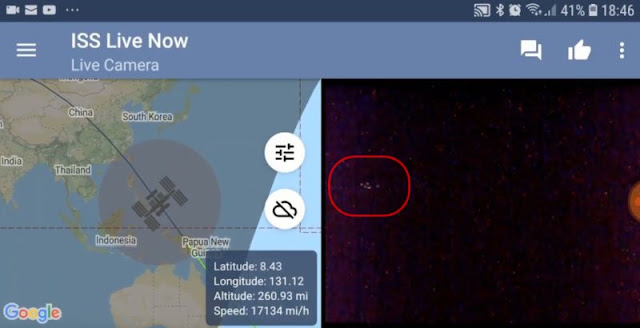
NASA cameras on the International Space Station have captured soundwaves travelling across Earth from a new form of “space technology”, conspiracy theorists have claimed.
The collection of baffling photos appear to show something cutting through the clouds to send miles upon miles of “ripples” trailing off behind it.
NASA/thirdphaseofmoon/YouTube
Cameras on the International Space Station have reportedly captured images of soundwaves travelling across Earth at high speeds, believed by some people to be a new form of ‘space technology’.
YouTube conspiracists Blake and Brett Cousins – of thirdphaseofmoon – noticed the images on NASA’s website and posted footage giving their thoughts earlier today.
“These are some of the best images I’ve seen from NASA, this is blowing me away,” Brett says.
“What we’re seeing is something ripping through the clouds that is creating a pattern that we haven’t seen before.
The 'soundwaves' caught by NASA cameras on the ISS(Image: NASA/THIRDPHASEOFMOON)
NASA/thirdphaseofmoon/YouTube
The images were spotted on the NASA website by Blake and Brett Cousins, who regularly post space-related content on their YouTube channel thirdphaseofmoon. The photos were apparently captured earlier this month, as the ISS was around 226 nautical miles above the Earth.
“What kind of craft is zipping through the clouds to cut clouds and make this ripple effect?
“Whatever it is, it’s massive.”
Blake then likens the patterns to those created by soundwaves and claims the fact the ISS was over the Earth at the exact spot to capture the images was no coincidence.
“What’s amazing to me is that NASA and the ISS were in the exact spot at the right time to capture this, I think this was an experiment,” he continues.
“The ISS wanted to get some good images of this – they are super hi-res.
“Is this some sort of secret sonic weapon that we’re not aware of?”
NASA/thirdphaseofmoon/YouTube
His brother agrees, suggesting that the agency was showcasing “new space technology”.
The footage has sparked fierce debate since surfacing on YouTube.
Some viewers suggested the “craft” could be alien in origin, while others believed it looked like a “cloaked military mother ship”.
Another bizarrely claimed: “Sonic blast, just like they use to control weather.”
But others were less convinced, saying it could have been a meteor entering the Earth’s atmosphere.
Daily Star Online has previously revealed claims that the US government has forced NASA to cut its live feed in the past when UFOs appear, for the sake of "national security".
Lunar Reconnaissance Orbiter Camera images taken before and after the impact of China's Longjiang-2 satellite show the crater likely formed by the event.
A NASA spacecraft circling the moon has spotted the scar left by a Chinese satellite's impact.
China's Longjiang-2 spacecraft — also known as the Discovering the Sky at Longest Wavelengths Pathfinder, or DSLWP-B — crashed onto the lunar far side on July 31 after completing its orbital mission. On Nov. 14, a scientist on NASA's Lunar Reconnaissance Orbiter mission announced that the spacecraft had spotted Longjiang-2's apparent impact site.
The China National Space Administration launched the Longjiang-2 satellite to the moon along with the Queqiao relay communications satellite on May 20, 2018. The small spacecraft, which weighed nearly 100 lbs. (45 kilograms), was designed to work with its twin, Longjiang-1, to validate technologies for low-frequency radio astronomy observations.
Longjiang-2 was designed to orbit the moon for a year. The satellite exceeded that estimate, but its mission still needed to come to an end, and China wanted to crash the spacecraft to ensure it wouldn't clutter up lunar orbit.
Now, a new lunar crater has been identified, and it's most likely the result of that impact, according to a statement from Mark Robinson, leader of the Lunar Reconnaissance Orbiter Camera (LROC) team at Arizona State University.
In his remarks about the images released from the instrument, Robinson saluted the team — led by amateur radio operator Daniel Estévez of Tres Cantos, Spain — that estimated that the small spacecraft impacted the lunar surface somewhere within Van Gent crater (16.69 degrees North, 159.52 degrees East).
The LROC team used these coordinates to image the area on Oct. 5. Through a careful comparison of pre-existing LROC Narrow Angle Camera images, the LROC team located a new impact crater (16.6956 degrees N, 159.5170 degrees E, plus or minus 10 meters) just 1,076 feet (328 m) from the estimated site.
The crater is 13 feet by 16 feet (4 by 5 m), with the long axis oriented southwest to northeast.
Based on the crater's size and proximity to the estimated crash coordinates, "we are fairly confident that this new crater formed as a result of the Longjiang-2 impact," Robinson wrote.
Listen to would-be space explorers for long enough, and eventually they will likely argue that humans must develop outposts on other worlds in case of disaster here on Earth, as a so-called Planet B.
But that's a dangerous narrative, said Kathryn Denning, an anthropologist at York University in Canada who focuses on the intersection of space exploration, humanity and ethics. It's not particularly feasible, either, by her calculation.
"The reality is, what would be needed to create a sustainable human civilization in the solar system that could effectively be a backup for humanity?" Denning said to Space.com. "That, for every kind of foreseeable future for, say, the next hundred years, requires a functioning and sustainable civilization here."
That reliance on Earth is not surprising considering how many characteristics of other worlds make them inhospitable or even threatening to humans. But the tie to Earth does throw a wrench in dreams of shuffling off our terrestrial coil — dreams that can be an attractive alternative to the difficulty of tackling the challenges of life at home.
"For me, the question is balance," Denning said. "How can we be enthusiastic about the human capacity to explore while maintaining our focus on what needs to happen here on this planet?"
Some approaches developed to address challenges of spaceflight can also shape life on Earth; NASA regularly highlights "spinoff" technologies you don't need to go to orbit to appreciate. Other challenges and solutions of space lack those spinoff applications.
Sometimes, the idea of a fallback world is stretched even further beyond the bounds of possibility, to places we can't pragmatically visit. "Amazing scientific discoveries, for example, exoplanets, get co-opted into problematic stories about our own life here on Earth. Exoplanets do get framed as a Planet B," Denning said. "That's become the story, that that is why exoplanets are important, because maybe we can go there when we've destroyed Earth." That reasoning ignores the scientific importance of studying these distant alien planets.
Transferring humanity elsewhere also has consequences for destination worlds. Some of those concerns are addressed by planetary-protection guidelines, which are designed in part to reduce the odds that terrestrial contamination will prevent scientists from being able to determine whether life exists on other worlds.
Still, Denning said she's not convinced that those guidelines are enough to protect either other worlds and any life there or even astronauts themselves. "I'm not saying Mars off limits forever or anything like that," she said. "In my ideal universe, we would just be slowing down and taking more time and making sure that we get it right for everybody's sake, for the sake of any humans you're sending out there as well."
Those concerns apply to exploration on the scale of just a handful of astronauts as well as to the more sizable and permanent migration implied by the term Planet B. But in both cases, humans have a lot of potential to change the worlds they visit, purposefully or accidentally. And Denning said she wishes we would spend more time now discussing what those worlds' futures may someday look like.
"We've got worlds out there that we haven't really messed up yet," Denning said, wistfully pointing out that if we're careful, we can keep them that way. "Wouldn't it be nice?"
Were the Pyramids of Giza designed to be a mirror of the stars?
Conventional archeology tells us the great pyramids at Giza were built as tombs for the pharaohs of ancient Egypt.
Constructed during the Old Kingdom’s 4th dynasty 4500 years ago, the monuments many mysteries have cast a spell on mankind for millennia.
Built with incredible accuracy and containing many puzzling features, the true purpose of the pyramids has inspired endless speculation.
Why, if they were built as tombs for the pharaohs, are the Giza pyramids completely bare? Unlike other Egyptian tombs, they contain no inscriptions, hieroglyphics or indeed pharaoh’s bodies.
Mainstream Egyptology tells us the tombs were stripped bare by grave robbers — but did they also strip them of all inscriptions?
Sceptics of the tombs theory have long wondered why pharaohs would build such incredible monuments to themselves and then fail to put their name on them.
The Great Pyramid has inspired curiosity for millennia
Even more puzzling — just why were the pyramids built with such astonishing accuracy?
The Great Pyramid’s 4 faces are aligned almost perfectly with the compass, with its south face aligned so precisely with true south that its average error is just 2 minutes of arc — astonishing accuracy even today.
It’s construction also shows the builders knowledge of Pi, the golden ratio and even the dimensions of the Earth and Sun.
In the 1980s, an extraordinary new theory emerged that attempted to explain some of these mysteries.
Robert Bauval, a Belgian engineer, noted how the smallest of the 3 pyramids at Giza — The Pyramid of Menkaure, was offset slightly from the other two.
Noting the similarity between this and the offset in the 3rd star of Orion’s Belt, Bauval overlaid the stars of Orion over an aerial view of the pyramids and was astonished to discover they matched almost exactly.
The 3 Pyramids of Giza match almost exactly the 3 stars of Orions Belt.
Publishing his findings in a best-selling book in 1994, Bauval’s theory captured the public’s imagination and became a global sensation, spawning newspaper articles, documentaries and numerous other books.
Not only did the 3 pyramids match Orion’s Belt, Bauval argued that the Great Sphinx mirrored the constellation of Leo, and the monument’s alignments to the Nile matched the stars positions relative to the Milky Way.
Were the Ancient Egyptians really trying to create a map of the stars on the Earth?
Evidence for
The alignments
Whilst Bauval’s basic thesis was even accepted by some Egyptologists, he massively expanded on it for his 1994 book.
Looking out beyond the pyramids to the wider Giza plateau, Bauval and fellow researcher Graham Hancock began to look for other alignments.
Perhaps the Great Sphinx, a vast stone statue of a lion with a human face, located next to the pyramids, was intended to represent the constellation of Leo?
The Great Sphinx of Giza (credit: Ana Paula Hirama/flickr)
Using astronomical computer programs, the pair dialed back the skies over Giza to the supposed date of the construction of the Pyramids — 2500BC. Disappointingly they could find no match.
But 2500BC was during the astronomical Age of Taurus — represented by a bull. Perhaps they could find a match in the Age of Leo?
Dialing the starfields back thousands of years, Bauval and Hancock were able to find an amazing match — in 10500BC, whilst the pyramids matched Orions belt, the Sphinx was looking directly at the constellation of Leo.
10500BC marked the dawning of the Age of Leo, and even more astonishingly at that date the pyramids and Sphinx’s position relative to the nearby River Nile matched Orion and Leo’s position relative to the Milky Way.
Robert Bauval — right, with his friend geologist Robert Schoch (credit: Filipov Ivo/wiki)
This clinched it for the 2 authors — whilst the original Orion correlation theory was dismissed by many Egyptologists as a coincidence, this was surely beyond any possible coincidence.
The layout of the monuments at Giza really did appear to be a ground map of the heavens.
The Duat
The stars that appeared to be mapped in stone on the Giza plateau were of great significance to the ancient Egyptians.
Their most sacred religious writings — the Pyramid Texts, describe a region of the sky called the Duat that represented the afterlife, the underworld and rebirth.
This is where the Egyptians believed their Gods resided and it’s guardian was Osiris, the God of the dead and rebirth.
Osiris was usually depicted with green skin (credit: dalbera/wiki)
Pharoahs regarded themselves as the embodiment of Osiris on Earth and when they died they believed they would travel up to the Duat and be reborn in the afterlife.
Tellingly, Osiris was represented in the night sky by the very constellation mapped out by the 3 Pyramids of Giza — the constellation of Orion.
Whilst mainstream archeology declares the pyramids were tombs for the pharaohs, they also acknowledge them as vehicles to facilitate the pharaoh’s travel to the afterlife through the Duat.
The pharaohs were Osiris, the pyramids were vehicles to the Duat, and Osiris was represented in the Duat by Orion.
With so many other connections the prospect, suggested by many Egyptologists, that the correlation between the layout of the pyramids and Orion’s belt occurred by chance would seem to be unlikely.
The shafts
Khufu’s Pyramid is the largest and most magnificent of the 3 pyramids at Giza. The only survivor of the 7 Wonders of the World, it contains some unusual features that have long resisted explanation.
Both the King and Queen’s Chamber in the pyramid have 2 mysterious 8-inch wide shafts, unique in all Egypt, that travel out diagonally through hundreds of feet of the pyramid’s vast body.
Diagram showing the shafts from the King and Queen’s chambers (credit: RF Morgan/wiki)
These shafts would have been unfathomably complex to construct — each of hundreds of thousands of blocks had to be separately carved into shape to form the shaft. Clearly they were of fundamental importance.
Whilst traditionally described as ventilation shafts by egyptologists, this is unlikely to be their true purpose since 2 of the shafts do not connect with the exterior of the monument.
They do, however, exhibit several significant astronomical alignments that reinforce the Orion correlation theory.
The astronomer Virginia Trimble noticed in 1964 that the southern shaft in the King’s Chamber pointed towards Orion — the very constellation mapped out on the ground by the 3 pyramids. Could this really be another coincidence?
Robert Bauval then traced the path of the southern shaft of the Queen’s chamber and discovered it pointed at Sirius. Sirius, the brightest star in the sky was considered by the Egyptians to represent Isis — Osiris’s sister and lover.
The shaft in the Queen’s chamber points to Sirius
Like the 3 pyramids and the Sphinx, these correlations all fitted best at 10500BC. The real question is — why that date?
If the Great Pyramid was built in 2500BC, why were the Egyptians pointing to this much earlier date?
Could the pyramids actually be much older that conventional archeology tells us? Or was 10500BC a date of great significance that the Egyptians wished to mark in stone for eternity?
Whatever the reason its hard to dismiss the idea that the ancient Egyptians were trying to mirror the heavens above on Earth at the Giza plateau.
Evidence against
Replanning
Several Egyptologists have responded to the Orion correlation theory by pointing out the extensive replanning that occurred during the construction of the 2nd and 3rd pyramids.
The location of the main chamber in Khafre’s pyramid suggest the original plan was for its footprint to be some 50% further north. It could be that topological problems with the underlying rock necessitated a change in location.
Plans for Menkaure’s pyramid appear to have changed mid-build (credit: Ankur P/wiki)
The smaller 3rd pyramid, whose offset so distinctly mirrors Orion’s belt, also seems to have been replanned during its construction. Dead ends in some of the main passages suggest that the pyramid was considerably enlarged during its construction.
If either of these pyramids really were re-built in this ad-hoc fashion, then it undermines the idea they were laid out toatch a grand plan to mirror the constellation of Orion.
Magnitude of the stars
Another objection to the Orion correlation centres on the relative magnitude of the 3 stars in Orions belt.
Critics point out that the smallest of the 3 monuments — Menkaure’s Pyramid, is considerably smaller than the others, it’a total volume only 1/10th of the Great Pyramid.
However, the supposed corresponding star in Orions Belt — Mintaka, is only slightly less bright than it’s neighbours. Neither through the naked eye or telescopes is Mintaka anywhere near 1/10th as bright as its neighbours.
Whilst a small discrepancy may be written off to artistic license, the difference here would seem too large if the intention was to accurately mirror the constellation on the ground.
Astronomers Find Three Supermassive Black Holes in NGC 6240
NGC 6240, a well-studied nearby galaxy system in the process of merging, contains three supermassive black holes at its core, two of which are active and each with a mass of about 90 million solar masses, according to a study published in the journal Astronomy & Astrophysics.
NGC 6240 harbors three supermassive black holes at its core: the northern black hole (N) is active and was known before; the zoomed-in new high-spatial resolution image shows that the southern component consists of two supermassive black holes (S1 and S2); the green color indicates the distribution of gas ionized by radiation surrounding the black holes; the red lines show the contours of the starlight from the galaxy and the length of the white bar corresponds to 1,000 light years.
Image credit: P. Weilbacher, Leibniz Institute for Astrophysics Potsdam / NASA / ESA / Hubble Heritage / STScI / AURA / Hubble Collaboration / A. Evans, University of Virginia, Charlottesville / NRAO / Stony Brook University.
NGC 6240 is a system of merging galaxies approximately 400 million light-years away in the constellation Ophiuchus.
It spans 300,000 light-years and has an elongated shape with branching wisps, loops and tails.
Until now, astronomers have assumed that it was formed by the collision of two galaxies and therefore containstwo black holes in its core.
“Through our observations with extremely high spatial resolution we were able to show that NGC 6240 hosts not two but three supermassive black holes in its center,” said Professor Wolfram Kollatschny, an astronomer at the University of Göttingen.
“Each of the three heavyweights has a mass of more than 90 million Suns.”
“They are located in a region of space less than 3,000 light-years across, i.e. in less than one hundredth of the total size of the galaxy.”
Professor Kollatschny and colleagues observed NGC 6240 using the Multi Unit Spectroscopic Explorer (MUSE) instrument on ESO’s Very Large Telescope (VLT).
“Up until now, such a concentration of three supermassive black holes had never been discovered in the Universe,” said Dr. Peter Weilbacher, a researcher in the Leibniz Institute for Astrophysics Potsdam.
“The present case provides evidence of a simultaneous merging process of three galaxies along with their central black holes.”
According to the team, the discovery of the triple supermassive black hole system is of fundamental importance for understanding the evolution of galaxies over time.
“Until now it has not been possible to explain how the largest and most massive galaxies, which we know from our cosmic environment in the ‘present time,’ were formed just by normal galaxy interaction and merging processes over the course of the previous 14 billion years,” the scientists said.
“If, however, simultaneous merging processes of several galaxies took place, then the largest galaxies with their central supermassive black holes were able to evolve much faster. Our observations provide the first indication of this scenario,” Dr. Weilbacher said.
W. Kollatschny et al. 2019. NGC 6240: A triple nucleus system in the advanced or final state of merging. A&A, in press; doi: 10.1051/0004-6361/201936540
Usually it’s possible to find both the good and bad in things. When it comes to the Phallaceae family of fungi, a.k.a. the stinkhorn mushrooms, however, there is only side to the story, and it is maximally disgusting. Everything from their name to their taste to the way they look is 100% grade-A barf-o-rama. Keep reading for proof of that statement, if you can stomach it.
We first learned of the stinky, bloomin’ mushroom from YouTuberzefrank1’slatest “true facts” video on the Phallacea fungi, which is featured above. The hilarious video, which is also quite disgusting, of course, outlines most of what that stanky stinkhorn life is about, but let’s rehash it real quick because just how repulsive the stinkhorn is as a life form needs to be appreciated on every level.
Phallus impudicus covered in gleba, which is, in turn, covered in flies.
First of all, there’s that name. Not the colloquial name, stinkhorn, which sounds like a deranged Pokémon or something Elon Musk would put on a Tesla, but that scientific name. The name of the family, Phallacea, sounds kind of off in its own right, but that’s nothing compared to the moniker of the common stinkhorn (pictured above), Phallus impudicus, which translates literally to “immodest phallus.” By the by, botanist John Gerard referred to Phallus impudicus as the “pricke mushroom” or “fungus virilis penis effigie,” when he discovered it in the late 16th century.
The physiology of the stinkhorn mushrooms is where things get really interesting. And when we say interesting, we mean gut-wrenchingly gross. The fruiting body of Phallus impudicus (that’s the part of the fungus that’s ejected from out of the ground) is produced from a squishy, bizarre egg, which looks from a cross-sectional view like a slimy piece of sushi. After it bursts its way through the ground, the fruiting body also oozes out a gelatinous goop known as gleba, which contains the stinkhorn’s spores. According to the stinkhorn wiki, the gleba smells like the dead, rotting flesh of animals or dung, which is unsurprising considering the fact that the stinkhorn uses flies to spread its spores. Also, there’s that name.
The fruiting body of Aseroë rubra, a member of the stinkhorn family, in action.
zefrank1
Perhaps the only non-disgusting quality of the stinkhorn is the fact that it stands as an emblem of the lengths life will go to keep on keepin’ on. That, and the fact that it is indeed edible and has a taste that lies somewhere between radish and nothing at all. Although make sure not to eat it at the wrong time in its life cycle, ’cause it’s definitely possible to get some gleba on your hands and mouth if you’re not careful.
What do you think of these stinkhorn mushrooms? Are you immensely happy that you’ll probably never get a whiff of one, or have they somehow carved out a little stinky, oozing home in your heart? Discuss all this disgustingness in the comments!
New observations appear to confirm the existence of water vapor geysers on Europa. The findings are tantalizing, but some scientists are not convinced yet.
Artist’s concept of a water vapor plume on Jupiter’s large moon Europa. It’s thought that this moon has a liquid ocean of water beneath its icy crust.
Jupiter’s large moon Europa is one of the most intriguing places in the solar system, an ocean world that might support life of some kind. As well as a subsurface ocean, it might also share another characteristic of Saturn’s moon Enceladus: geyser-like water vapor plumes bursting through its icy surface. The evidence for geysers on Europa has been tentative up to now, but this month (November 18, 2019) scientists said they’ve found what might be new confirmation: they reported the direct detection of water vapor above the moon’s surface.
Like Enceladus, Europa has a deep ocean below the outer ice crust. On Enceladus, water percolates up to the surface from the ocean below, erupting into space through cracks in the ice as water vapor. It has long been thought that the same thing could be happening on Europa, but the evidence hasn’t been as solid yet, with hints of activity seen by the Hubble Space Telescope (HST).
Essential chemical elements (carbon, hydrogen, oxygen, nitrogen, phosphorus, and sulfur) and sources of energy, two of three requirements for life, are found all over the solar system. But the third — liquid water — is somewhat hard to find beyond Earth. While scientists have not yet detected liquid water directly, we’ve found the next best thing: water in vapor form.
Composite photos from the Hubble Space Telescope and the Galileo spacecraft, showing a suspected plume erupting on Europa in 2014 and 2016.
Image via NASA/ESA/W. Sparks (STScI)/USGS Astrogeology Science Center/JPL.
Another composite image from the Hubble Space Telescope and the Galileo spacecraft, showing a “finger-like” plume in the lower left in 2016.
Image via NASA/ESA/W. Sparks (STScI)/USGS Astrogeology Science Center.
Europa’s cracked icy surface as seen by NASA’s Galileo spacecraft in the late 1990s. Yellowish regions on the moon’s surface have now been confirmed to be irradiated sodium chloride, aka table salt.
According to Paganini, about 5,202 pounds (2,360 kilograms) per second, enough to fill an Olympic-size swimming pool within minutes.
But like earlier observations have suggested, the outbursts of water vapor appear to be infrequent, unlike those on Enceladus, which erupt on a regular basis. Paganini said:
For me, the interesting thing about this work is not only the first direct detection of water above Europa, but also the lack thereof within the limits of our detection method.
The signal of water vapor is distinct but faint, and was only seen once in 17 nights of observations in 2016 and 2017. That suggests that Europa’s plumes are much more sporadic than those on Enceladus. The science team detected the water molecules on Europa’s leading hemisphere, the side of the moon that’s always facing in the direction of the moon’s orbit around Jupiter. Like Earth’s moon, Europa is gravitationally locked to its planet, so the leading hemisphere always faces the direction of the orbit, while the trailing hemisphere always faces in the opposite direction. The detection was made using a spectrograph at the W. M. Keck Observatory on Mauna Kea in Hawaii. The spectrograph measures the chemical composition of planetary atmospheres through the infrared light they emit or absorb. From the paper:
Previous investigations proved the existence of local density enhancements in Europa’s atmosphere, advancing the idea of a possible origination from water plumes. These measurement strategies, however, were sensitive either to total absorption or atomic emissions, which limited the ability to assess the water content. Here we present direct searches for water vapor on Europa spanning dates from February 2016 to May 2017 with the Keck Observatory. Our global survey at infrared wavelengths resulted in non-detections on 16 out of 17 dates, with upper limits below the water abundances inferred from previous estimates. On one date (26 April 2016) we measured 2,095 ± 658 tonnes of water vapor at Europa’s leading hemisphere. We suggest that the outgassing of water vapor on Europa occurs at lower levels than previously estimated, with only rare localized events of stronger activity.
Some of the tentative evidence for Europa’s plumes came from studying data sent back by the Galileo spacecraft. The disturbances in Jupiter’s magnetic field that provided clues about the subsurface ocean also hinted at possible plumes, according to researchers in 2018. In 2013, the HST had detected the chemical elements hydrogen and oxygen in plume-like configurations in Europa’s extremely tenuous atmosphere. Then, in 2016, Hubble imaged “finger-like projections” in silhouette while Europa passed in front of Jupiter. All of these findings were tantalizing, but still tentative. But now the first detection of water vapor itself is additional evidence for the plumes. As Lorenz Roth, an astronomer and physicist at the KTH Royal Institute of Technology, said:
This first direct identification of water vapor on Europa is a critical confirmation of our original detections of atomic species, and it highlights the apparent sparsity of large plumes on this icy world.
One problem that Paganini and his team needed to address, however, was that water in Earth’s atmosphere can distort the readings of water vapor on distant worlds taken by ground-based telescopes like Keck. To compensate, complex mathematical and computer modeling was used to simulate the conditions of Earth’s atmosphere so they could differentiate Earth’s atmospheric water from Europa’s in the data. According to Avi Mandell, a Goddard planetary scientist:
We performed diligent safety checks to remove possible contaminants in ground-based observations. But, eventually, we’ll have to get closer to Europa to see what’s really going on.
Saturn’s moon Enceladus was confirmed to have water vapor plumes by the Cassini spacecraft. This stunning photo shows then erupting through cracks in the ice crust at the moon’s south pole.
Not all researchers, however, are convinced that the new findings prove the existence of the plumes, and emphasize how they show that the geyser activity is probably lower than had been anticipated. Astronomer Phil Plait wrote about this in an addendum to his Nov. 19, 2019, article on SYFY about the news:
Correction, and it’s a big one: When I wrote this, I thought the conclusions based on the observations were much more solid than they were reported in a NASA press release. But after being alerted by a couple of astronomers, and looking things over again, I see that the idea that a plume of water from a geyser is not “confirmed” as I originally wrote, but more like “maybe.” The detection by itself was marginally statistically significant, but was part of 16 other observations that showed nothing. I was thinking about the single observation taken alone, but when placed in context of the other observations the statistical significance drops. That means the likelihood of this observation being real – that is, that the light from a plume of water was definitely seen – is lower than I originally stated.
So at this point, it may be safer to say that the new observations add to the evidence for water vapor geysers on Europa, but are still not 100% conclusive. This does not take away from the abundant evidence for the subsurface ocean, it only addresses how much of that water may actually make it to the surface and erupt as vapor into space. Hopefully NASA’s upcoming Europa Clipper mission – due to launch in the mid-2020s – will be able to finally settle the question of whether the geysers are real or not, and how frequent they are, if other observations don’t beforehand. It could even sample them directly, just like Cassini did at Enceladus.
Bottom line: Scientists have found new evidence for water vapor geysers on Europa, although whether they have actually been proven now is a matter of debate.
Hongaarse wetenschappers ontdekken ‘mysterieuze vijfde natuurkracht’. Dit kan een gamechanger zijn
Wetenschappers hebben naar eigen zeggen een vijfde natuurkracht ontdekt die onze kijk op het universum weleens drastisch zou kunnen veranderen.
Onderzoekers van de Hongaarse Academie van Wetenschappen zagen een heliumatoom op een vreemde manier vervallen naar een ander deeltje die niet kon worden verklaard door de huidige natuurkunde.
Hoofdonderzoeker Attila Krasznahorkay en zijn team hebben dit nieuwe deeltje X17 genoemd.
Gamechanger
“X17 is mogelijk een deeltje dat onze zichtbare wereld verbindt met de donkere materie,” zei hij tegen CNN.
Professor Jonathan Feng van de Universiteit van Californië – Irvine, die het werk van Krasznahorkay nauwgezet heeft gevolgd, zei dat dit weleens een ‘gamechanger’ zou kunnen zijn.
Als het onderzoek kan worden herhaald, moet hij de Nobelprijs krijgen, aldus Feng.
Vijfde
De ontdekking kan onze kijk op de werking het universum drastisch veranderen.
Volgens het huidige model zijn er vier fundamentele natuurkachten: zwaartekracht, elektromagnetisme, en de zwakke en sterke kracht tussen atomen.
Krasznahorkay en zijn team suggereren nu dat er nog een vijfde kracht is.
Donkere materie
Wetenschappers theoretiseren al decennia over een vijfde natuurkracht. Ze claimen dat deze kracht kan helpen bij het verklaren van donkere materie.
Geschat wordt dat ongeveer 80 procent van de massa van het heelal bestaat uit donkere materie.
Scientists claim they have observed a fifth force of nature that could transform our understanding of how the universe works.
Researchers at the Hungarian Academy of Sciences have revealed results that could show it in action.
They saw an excited, decaying helium atom emit light when the particles split in a strange way that could not be explained by the current understanding of physics.
Hints of a fifth fundamental force have set the physics world abuzz. Researchers at the Hungarian Academy of Sciences have revealed results that could show it in action. The discovery could completely upend our understanding of the universe. Pictured is an image of the cosmic web
It was the second time lead scientist Attila Krasznahorkay and his team had seen the new particle they called X17.
They found its mass to be 17 megaelectronvolts.
Mr Krasznahorkay told CNN: 'X17 could be a particle, which connects our visible world with the dark matter.'
STANDARD MODEL OF PARTICLE PHYSICS AND WHY THE FIND IS SO EXCITING
The Standard Model says everything in the universe is made from the most basic building blocks called fundamental particles, that are governed by four forces: gravity, electromagnetic, weak nuclear and strong nuclear.
The Higgs boson, named after professor Higgs (pictured), was discovered in 2012 and is an essential component of the Standard Model
The forces work over different ranges and have different strengths.
This new particle, if it exists, would not fit into the description given by the Standard Model and so would lead to a whole new area of particle physics. Some have suggested it might even lead to the discovery of a fifth fundamental force.
This development is exciting because the Standard Model has left some questions unanswered for years, so scientists are keen to break free of it and find new theories.
It can't explain gravity, for example, because it is incompatible with our best explanation of how gravity works - general relativity, nor does it explain dark matter particles.
The quantum theory used to describe the small particles in the world, and the general theory of relativity used to describe the larger objects world, are also difficult to reconcile.
Nobody has managed to make the two mathematically compatible in the context of the Standard Model.
According to the Big Bang theory, matter and antimatter were created in equal amounts at the start of the universe and so they should have annihilated each other totally in the first second or so of the universe's existence.
This means the cosmos should be full of light and little else.
But because it isn't there must have been a subtle difference in the physics of matter and anti-matter that has left the universe with a surplus of matter and that makes up the stars we see, the planet we live on and ourselves.
But the observations seen so far are not enough to confirm the existence of a particle.
Professor of physics and astronomy at the University of California, Irvine, Jonathan Feng, who has closely watched the Mr Krasznahorkay's team's efforts, said it could be a 'game changer', adding if it could be replicated, 'this would be a no-brainer Nobel Prize'.
It comes three years after the Hungarian team spotted an anomaly in radioactive decay, suggesting the existence of a new particle.
If their tests prove accurate, the discovery could completely upend our understanding of how the universe works.
The current working model of physics states that there are four fundamental forces of nature: gravity, electromagnetism, and the weak and strong forces between atoms.
The 2016 experiment by Mr Krasznahorkay and his team of physicists suggested there was another force.
The team said at the time that they had found a bizarre radioactive decay irregularity, according to a report by Nature News.
They published their results in late 2015 in the prestigious Physical Review Letters.
Despite the radical claim, their paper received very little attention, according to a report in Gizmodo.
That is, until physicists at the University of California checked their method and results – and found the study to be accurate.
'What it's telling us if it is correct is that there is something going on in the way that one particle talks to another particle that we haven't got inside our mathematics at the moment,' Geraint Lewis, a professor of astrophysics at the University of Sydney told ABC News at the time.
Scientists have theorised that a fifth force exists for decades.
They claim it could help explain the inability of the standard model of particle physics to explain dark matter.
Dark matter is invisible substance thought to make up more than 80 per cent of the universe's mass.
Theorists have proposed a number of exotic-matter particles, including 'dark photons', that carry the electromagnetic force.
The Hungarian scientists were looking for dark photons by blasting protons at a thin strip of lithium.
As the lithium absorbed the protons, it transformed into an unstable version of beryllium, which decayed even further, creating electrons and positrons.
When the protons hit against the lithium at 140 degrees, more electrons and positrons were created than were expected.
Krasznahorkay suggested this extra material was being created by a particle that was 34 times heavier than the electron.
'We are very confident about our experimental results,' said Krasznahorkay at the time, adding that the team had repeated its test several times.
But many scientists were sceptical of the claim.
Physicists at the Institute for Nuclear Research in Debrecen, Hungary, said this apparatus — an electron-positron spectrometer — found evidence for a new particle
Throughout history there have been scientific theories and hypotheses pushed forward that have either driven us forward as a species or have served to become historical oddities that make us ask “What were we thinking?” It is all part of our stumbling, bumbling quest to feel our way through this morass of mysteries that is the natural world and our universe, and there is not always a clear beacon of light to pave the way forward. While some hypotheses have fallen by the wayside and others have pushed us forward into new realms of knowledge, others have sort of swirled about in a limbo, mere curiosities that cannot be proven or disproven, and one of these is certainly the notion that at some point in human history we were amphibious beings.
The bizarre notion known as the “Aquatic Ape Hypothesis” was first seriously proposed by the marine biologist Alister Hardy in 1960, as a way to try and explain what he thought were a great many quirks in our physiology and evolutionary path when compared to other great apes. Hardy proposed that at one point in our evolutionary history human beings had increasingly turned to aquatic food resources such as fish and shellfish in response to fierce competition from other terrestrial animals. He speculated that this had caused our species to take a different path than the other apes, as we began to swim and wade out into the sea to pursue this semi-aquatic lifestyle rather than life on the savanna, with our bodies adapting to this new way of living in myriad intriguing ways.
In Hardy’s opinion, human bodies show a great many adaptations that he was convinced had come about through this amphibious way of life, including functional hairlessness, subcutaneous fat, regression of our olfactory organ, hooded nose and large sinuses, webbed fingers, big brains, greasy skin with an abundance of sebaceous glands perhaps as waterproofing, as well as our distended larynx, all of which are features common for aquatic animals but not apes, as well as our almost innate ability to swim. Bipedalism was thought to have come about to help us wade about in the water and keep our hands free to forage on the bottom or break open shellfish, and even our predilection for eating seafood, our ability to hold our breath for long periods compared to other apes, and our expressive faces, which could help with visual communication underwater, as well as our our ability to produce speech have gone on to be put forward as evidence.This was all seen as not consistent with the paradigm that we had evolved on the African savanna as long thought, and therefore suggested an aquatic stage of our evolution.
Hardy was not the first to suggest this, as the German pathologist Max Westenhöfer had also played with this hypothesis, but it was Hardy who truly ran with it and brought the whole concept to the public consciousness. It was an idea he had actually been percolating for decades, and only first officially came forward with it after he had become a respected academic and scientist, when in 1960 he presented it all to the British Sub-Aqua Club in Brighton. Although it was met with quite a few raised eyebrows and shrugged shoulders, there would be quite a few who would support the theory and go on to further bolster it, such as famed naturalist Sir David Attenborough, and one proponent of the hypothesis who would catapult it into greater awareness was writer Elaine Morgan. Like Hardy, Morgan believed that humans had gone through a stage in our natural history in which we had turned to the vast food resources of aquatic environments and had gone on to demonstrate convergent evolution of mammals living in these sorts of environments. She would write about the theory in her book The Descent of Women, which would go on to become an international bestseller and really increase the prominence of the Aquatic Ape Hypothesis, and she would go on to pen other books on the matter such as The Aquatic Ape (1982), The Scars of Evolution (1990), The Descent of the Child (1994) and The Aquatic Ape Hypothesis (1997). She has said of the notion:
Waterside hypotheses of human evolution assert that selection from wading, swimming and diving and procurement of food from aquatic habitats have significantly affected the evolution of the lineage leading to Homo sapiens as distinct from that leading to Pan.
There have been many other researchers who have followed up on this hypothesis, such as researchers Michael Crawford and David Marsh, who wrote of this in their book The Driving Force: Food, Evolution and The Future. They are a big fan of the idea that out large brains could not have possibly evolved in a savanna lifestyle, and that they would only have come about through a diet rich in protein and Docosahexaenoic acid (DHA), an omega-3 fatty acid that is found in in seafood, that would only be available with an aquatic lifestyle. Crawford would say of this:
A branch of the line of primitive ancestral apes was forced by competition to leave the trees and feed on the seashore. Searching for oysters, mussels, crabs, crayfish and so on they would have spent much of their time in the water and an upright position would have come naturally. The evolution of a large brain on the savannas of Africa was impossible. The only way it could have happened was with the resources of the marine food-web which initiated the growth and development of the brain in the first place.
It is all a very intriguing notion, and on the surface it seems that the Aquatic Ape Hypothesis could explain a lot about our many unique attributes that seem to separate us from terrestrial apes, but there are of course a lot of skeptics, and indeed the hypothesis is mostly treated as pseudoscience today and mostly ignored by the mainstream scientific community. Some of the main arguments are that is absolutely no fossil evidence of such a thing ever happening, and many of the adaptations credited to an aquatic lifestyle can be explained in other ways that fit more into the current evolutionary paradigm of the human species. For instance, hairlessness would be more likely due to sexual selection and adaptations to heat loss, whereas bipedalism would allow us to peer out over tall grass and keep our hands free for tool use, and breath control would be related to our development of speech. It has also been pointed out that we have a similar distribution of body fat to other land animals, and also that we are in reality really not that particularly good at swimming after all. There are plenty of explanations for our various quirks that can be fit into the current savanna mold of evolution that do not require some radical shift away. The Aquatic Ape Hypothesis is also criticized for being basically an umbrella theory for a wide variety of adaptations that would have gradually evolved over a very long period of time rather than all at once, meaning they cannot really be lumped together into a single explanation. One professor Chris Stringer of the Natural History Museum, London has said of this:
I think that wading in a watery environment is as good an explanation, at the moment, for our upright gait as any other theory for human bipedalism. But the whole aquatic ape package includes attributes that appeared at very different times in our evolution. If they were all the result of our lives in watery environments, we would have to have spent millions of years there and there is no evidence for this.
Also rather a strike against the hypothesis is that if we evolved to an aquatic environment, then why did we go back out to a terrestrial one and then keep those features? This has not really been adequately explained, and remains a sticking point for those who see this all as wishful thinking and fringe science. While some scientists have sort of just ignored the hypothesis, others have soundly dismissed it and even gone as far as to lump it together with creationism as an untenable and absurd idea. Despite the criticism, the Aquatic Ape Hypothesis has remained very tenacious, and still is discussed and has its staunch supporters to this day. In the realm of cryptozoology it has importance as a possible explanation for sightings of a wide range of entities, such as mermaids or other aquatic mystery beasts such as the Kappa of Japan and many others which could be some offshoot of this amphibious evolutionary history. Is there anything to the Aquatic Ape Theory or is it all a bunch of bunk? Whatever the case may be, as long as it is being discussed it will be out there swirling about in the periphery, and it is probably important to at least understand what it is all about.
Often when visiting historic places there is a feeling or a “presence” that one may begin to sense. For some, this might represent a literal connection to the people who visited there long ago; others may liken it to simple reverence for the amount of time that has passed, and the number of individuals that might have come and gone there.
Whether one literally ascribes to the idea of “ghosts” or not, this feeling is hard to ignore, particularly at early human habitation sites, or looking even further back, at locations where earlier forms of life on earth once existed, which predates the arrival of humans.
However, new technologies may soon also play a role in shedding light on these “ghosts” of the ancient past.
“Sometimes paleontologists uncover ghosts,” wrote Riley Black, in a recent article at Scientific American. What he referred to specifically had been trace fossils, among which are the “ghost tracks” of ancient life forms that are indiscernible to the naked eye, but with the help of modern science, are beginning to give up their long-held secrets.
Ichnofossils can be defined as “an expression of the alteration of the depositional fabric of in sedimentary rocks by living organisms.” In other words, these are the footprints or other alterations to an environment that become fossilized and are thus preserved, even in the absence of any actual fossilized organisms.
Fossil footprints on display at the Natural History Museum, Bonn University
(Wikimedia Commons).
Black refers to a set of tracks that made news in months past, located at White Sands National Monument in New Mexico which tell a very unique story of ancient American hunters in pursuit of a giant sloth, which they stealthily followed leading up to a presumed Pleistocene-era ambush.
A recent study published in the journal Natureexpounds on the White Sands discovery, where the authors note that data has now been recovered from various locations which presents “evidence for the successful detection and 3-D imaging of such footprints via ground-penetrating radar (GPR), including co-associated mammoth and human prints.”
In other words, ground-penetrating radar technology can now successfully uncover trace fossil footprints, even when they are not exposed at ground level.
Motorized Ground-Penetrating Radar System
(Wikimedia Commons).
According to the study’s extract:
“Using GPR we have found that track density and faunal diversity may be much greater than realized by the unaided human eye. Our data further suggests that detectable subsurface consolidation below mammoth tracks correlates with typical plantar pressure patterns from extant elephants. This opens future potential for more sophisticated biomechanical studies on the footprints of other extinct land vertebrates. Our approach allows rapid detection and documentation of footprints while enhancing the data available from these fossil archives.”
This is exciting, in part due to the fact that the ability to discover trace fossils below ground, or in areas that are otherwise inaccessible, may be useful not only in the discovery of unrecognized archaeological sites, but also in their preservation. Excavation is an intrusive process, and despite what it helps us to learn about the past, it requires the removal of layers of earth that may once have coincided with early human living spaces or other historically significant areas. Ground-penetrating radar, on the other hand, reveals these features of the past without ever having to dig.
Short of having a time machine, such technologies are the next best thing to being able to open a window in time, through which these “ghosts” of the past become available to the modern eye.
“Your vision only sees a sliver, a tiny range of the electromagnetic spectrum. You are unaware of most of it If you had to interact with the world in the full range of what’s going on, you would be frozen. So biology has developed a user interface that ultra simplifies what you are interacting with. It is constantly updating your model of reality and interacting with it. It is your matrix. You interact without knowing there is anything else out there.”
“It is your matrix.” That sounds like an opening line in a sci-fi movie or a New Age homily, not business plan, but it may be a little of all three as it was uttered an unusual two-day festival exploring “the intersection between creativity, technology, and humanity.” The festival is the annual Cucalorus Connect, held this past week in Wilmington, North Carolina, and the speaker was University of North Carolina at Wilmington Julian Keith, Ph.D. He and fellow professor Curry Guinn, Ph.D, addressed a popular movie plot as a potential real-life scenario – that we’re living in a matrix or computer simulation created by an advanced society and the ghosts we see are actually glitches in said matrix.
“We may be actually living in a computer simulation. I’m not the only one who says this. Elon Musk of Telsa and Space X has said there is a billion to one chance we are not living in a computer simulation.”
Musk again! This guy is everywhere these days — with or without that breakable truck he probably wishes was a simulation. Professor Julian Keith opened his half of the joint presentation, “You’re in The Matrix, You Just Don’t Know It,” by pointing out that Musk believes we could be living in a simulation and points out to rapid advances in technology – like the ones Musk himself is making – as a sign of it … especially computer games.
“Look at where computer games are now compared to where they were 40 years ago in the era of Pong.”
Pong
Curry points out that we’re already approaching games similar to the Star Trek Holodeck where players can lose the sense that they’re in a simulation. If we’re on our way to creating a matrix, it doesn’t seem that far-fetched that a more advanced society has already created it … and it is us. The question is: how can we tell?
“Glitches in the system. Deja Vu, such as in the Matrix movie when a character sees a cat crossing a doorway repeatedly, may be one glitch. Ghosts, ESP, coincidences may be others. The laws of physics in our universe seem peculiarly designed with a set of constants that make carbon-based life possible. Where are the edges?”
“Where are the edges?” There’s some ready-made movie plot point dialogue for you budding screenwriters. Here’s another one: “Spooky action at a distance.” Curry references Einstein’s comment about quantum entanglement—the ability of separated objects like atoms and electrons to share a condition or state across a vast distance. Einstein didn’t buy quantum entanglement but he has since been proven wrong … at least on a particle scale. What if it exists on a human scale? What if there’s a connection between the beings in simulations and those in our perceived realities … us?
“We run a ton of them all the time. Supercomputers run simulations for weather predictions. We use them to better understand our environment and make changes. We use them to study human activity and ask questions such as how does population grow? What things work best? It is us running these simulations.”
Are our own simulations already influencing our actions? Curry’s example of weather simulations is a perfect example of exactly that. Based on hurricane simulations, we make decisions on where to run for safety. However, a few people may see a ghost or have a premonition that following those directions could be dangerous and they take a different path. Those who follow the simulation end up in a place where they drown, while the others survive. Could the ghostly warning have been a ‘glitch in the matrix’?
The Cucalorus Festival began 25 years ago as an underground film festival, but presentations like those of Keith and Curry show it has evolved into so much more. Or … are THEY just another glitch in the matrix.
Here is an intersting discovery made by Youtube user Florida Maquis. He shows us three unique and flying objects above the coastal area of Florida. When I added contrast to the screenshots, they really came into focus. Each of the three objects are flying and all have an intelligent design to them. They do appear to be three large UFOs. At the time of sighting, they were probably cloaked in a cloud or using some other cloaking device, but google earth radar caught them and included them into the map. Just mindblowing! Absolute proof that aliens are visiting coastal regions of Florida.
If you have trouble finding it...open Chrome browser and click on Google earth web version. It will take you there if you drop the coordinates into it.
75km Mothership Seen On Weather Radar Map Over Philippines, Nov 2019, UFO Sighting News.
Date of discovery: Nov 23, 2019 Location of sighting: Philippines Source: Weather map I was looking at my weather map radar and noticed that there was a huge mothership red disk over the Philippines. I recorded it and thought that this UFO was similar to the red UFOs seen on weather radar over Australia back in 2010. Sadly the weather radar map I use doesn't give me such high detail. This is about 2,000 km from Australia so it may be one of those motherships returning to an underwater base. Google rule says the UFO was approximately 75km across. Scott C. Waring
Bizarre ‘pyramid in the sky’ appears at night above Philadelphia in baffling clip
A 'sky pyramid' has appeared above Philadelphia surrounded by an eery orange glow, with truth-seekers claiming the object could be an alien black triangle UFO, also known as a TR-3B
A mysterious pyramid in the sky has been captured hovering over the US city of Philadelphia in a photo, according to a stunned witness.
Youtuber researcher MrMBB333 said the "simply amazing" phenomenon – which was photographed by a woman called Venetia – appeared to show the triangle shape in the night sky.
There seems to be an orange-red tint behind the shape – giving the impression of the "object" on fire.
"It looks like a pyramid in the sky", MrMBB333 said, adding that there "is definitely something there".
This bizarre triangle shape in the sky above Philadelphia has been described as a UFO by truth-seekers(Image: Youtube / MrMBB333)
A secret UFO study called Project Condign was carried out between 1997 and 2000 to try to make sense of black triangle UFOs and other Unidentified Aerial Phenomena.
It concluded with the theory that "the majority, if not all, of the hitherto unexplained reports may well be due to atmospheric gaseous electrically charged buoyant plasmas".
The research was made public in 2006 following a Freedom of Information request.
It is not the only mysterious sight to have been spotted in the skies in recent weeks.
Space-based observatories detected a violent explosion in a galaxy billions of light-years away. It became the brightest source of high-energy cosmic gamma rays seen so far. Specialized Earth-based telescopes detected it via faster-than-light particles cascading through Earth’s atmosphere.
Specialized telescopes – like H.E.S.S. in Namibia and MAGIC in the Canary Islands – detect the bluish Cherenkov light in Earth’s atmosphere, generated by faster-than-light particles, caused by cosmic gamma rays.
On January 14, 2019, two NASA space observatories – Swift and Fermi – detected a burst of gamma rays from a source billions of light-years away. That’s not unusual in and of itself; these space telescopes detect gamma ray bursts about once daily, routinely sending automatic alerts to other gamma-ray observatories around the world. But this burst – labeled GRB 190114C – was different. It became the most powerful yet detected by a specialized telescope on Earth’s surface, where scientists registered the highest energy gamma rays ever measured from a gamma ray burst, reaching about 100 billion times as much energy as visible light. The MAGIC telescope in the Canary Islands was able to point to the region of origin so quickly that it began observing the event within only 57 seconds of the space-based observations. Its scientists presented their observations last week (November 20, 2019) in two independent studies in the peer-reviewed journal Nature.
In the same issue of Nature, scientists presented a study of an earlier gamma ray burst – labeled GRB 180720B – not as strong but also detected on the ground via the H.E.S.S. telescope in Namibia on July 20, 2018. Read an overview of the three Nature studies here.
These two ground-based detections – from January 2019 and July 2018 – are the first detections of gamma-ray bursts with ground-based gamma-ray telescopes. They come after many years of trying to catch such events.
The power of these cosmic explosions is mind-boggling. But their detection is fascinating as well. The ground-based H.E.S.S. and MAGIC telescopes didn’t detect the gamma rays directly. They detected their effect on Earth’s atmosphere, via faster-than-light particles known as Cherenkov radiation. The Deutsches Elektronen-Synchrotron (DESY) – a national research center in Germany that operates particle accelerators and that also plays a role in operating both H.E.S.S. and MAGIC – explained in a statement:
When an energetic cosmic gamma ray hits Earth’s atmosphere, it shatters molecules and atoms. This process creates an avalanche of particles called an air shower. The shower particles are so energetic that they move faster through the air than light – although not faster than light in a vacuum, which according to Albert Einstein’s theory of relativity is the absolute upper speed limit. The result is a bluish glow, a kind of optical counterpart to the supersonic bang. This Cherenkov light, named after itsdiscoverer, can be observed by Cherenkov telescopes such as those of the H.E.S.S. and MAGIC observatories …
The Hubble Space Telescope caught the fading afterglow of GRB 190114C and its home galaxy on February 11 and March 12, 2019. The difference between these images reveals a faint, short-lived glow (center of the green circle) located about 800 light-years from the galaxy’s core. Blue colors beyond the core signal the presence of hot, young stars, indicating that this is a spiral galaxy somewhat similar to our own. The source of the burst is located about 4.5 billion light-years away in the direction of the constellation Fornax.
Gamma-ray bursts – called GRBs by scientists – are sudden, short bursts of gamma radiation from the cosmos. They were discovered by chance at the end of the 1960s by satellites used to monitor compliance with the nuclear test ban on Earth. These bursts are thought to originate from colliding neutron stars or supernova explosions. David Berge, head of gamma-ray astronomy at DESY, said:
Gamma-ray bursts are the most powerful explosions known in the universe and typically release more energy in just a few seconds than our sun during its entire lifetime – they can shine through almost the entire visible universe.
Since the 1960s, astronomers have been studying gamma-ray bursts with satellites. Earth’s atmosphere absorbs gamma rays; Earth-based telescopes can’t detect cosmic gamma rays directly. Telescopes like H.E.S.S. and MAGIC are designed to detect a faint blue glow in the atmosphere – Cherenkov light – induced by cosmic gamma rays.
The detection of these two recent gamma ray bursts by these ground-based observatories was a culmination of years of effort by astronomers.
What are gamma ray bursts? They are cosmic explosions, with radiation up to a trillion times the energy of visible light. This illustration shows the set-up for the most common type of gamma ray burst. The core of a massive star (left) has collapsed and formed a black hole. This “engine” drives a jet of particles that moves through the collapsing star and out into space at nearly the speed of light. The prompt emission, which typically lasts a minute or less, may arise from the jet’s interaction with gas near the newborn black hole and from collisions between shells of fast-moving gas within the jet (internal shock waves). The afterglow emission occurs as the leading edge of the jet sweeps up its surroundings (creating an external shock wave) and emits radiation across the spectrum for some time — months to years, in the case of radio and visible light, and many hours at the highest gamma-ray energies yet observed. These far exceed 100 billion electron volts (GeV) for two recent GRBs.
Image via NASA’s Goddard Space Flight Center/ICRAR.
One reason the result could be achieved was that – when space-based observatories detect a gamma ray burst – they quickly alert the entire observational community. In the case of the January 2019 gamma ray bust, more than 20 different telescopes were able to obtain a deeper look at the burst’s source. DESY said:
This allowed [them] to pinpoint the details of the physical mechanism responsible for the highest-energy emission, as described in the second paper led by the MAGIC collaboration. Follow-up observations placed GRB 190114C at a distance of more than four billion light-years. This means, its light travelled more than four billion years to us, or about a third of the current age of the universe.
GRB 180720B, at a distance of six billion light years even further away, could still be detected in gamma rays at energies between 100 and 440 billion electron volts long after the initial blast.
DESY theorist Andrew Taylor, who contributed to the H.E.S.S. analysis, commented:
The detection came quite unexpected, as gamma-ray bursts are fading fast, leaving behind an afterglow which can be seen for hours to days across many wavelengths from radio to X-rays, but had never been detected in very-high-energy gamma rays before.
This success is also due to an improved follow-up strategy in which we also concentrate on observations at later times after the actual star collapse.
Bottom line: On January 14, 2019, space-based observatories detected a violent explosion in a galaxy billions of light-years away. GRB 190114C became the brightest source of high-energy cosmic gamma rays seen so far. The MAGIC telescope in the Canary Islands was able to detect it via faster-than-light Cherenkov radiation cascading through Earth’s atmosphere. This observation – combined with a similar observation of another gamma ray burst, GRB 180720B, from July 2018 – were the successful culmination of years of effort by astronomers.
It's going to take a lot more than a doggy paddle to explore the oceans hidden below the icy surfaces of some of the solar system's most intriguing moons.
That's why NASA engineers are already working on an underwater rover they hope could one day tackle the challenges posed by ocean worlds like Jupiter's moon Europa and Saturn's moon Enceladus. A team has been working on such a robot, called Buoyant Rover for Under-Ice Exploration or BRUIE, for a few years now. NASA is taking a prototype of that rover to Antarctica for testing in the most similar environment to those moons found on Earth.
"The ice shells covering these distant oceans serve as a window into the oceans below, and the chemistry of the ice could help feed life within those oceans," Kevin Hand, lead scientist on the BRUIE project at NASA's Jet Propulsion Laboratory in California, said in a statement. "Here on Earth, the ice covering our polar oceans serves a similar role, and our team is particularly interested in what is happening where the water meets the ice."
The tests will take place at Australia's Casey research station along the coast of Antarctica far south of Australia, where BRUIE will spend a month exploring both the ocean and inland lakes. The rover focuses on where the top of the water meets the bottom of the ice.
"We've found that life often lives at interfaces, both the sea bottom and the ice-water interface at the top," Andy Klesh, lead engineer on the BRUIE project, said in the same statement. "Most submersibles have a challenging time investigating this area, as ocean currents might cause them to crash, or they would waste too much power maintaining position."
BRUIE is designed to manage these challenges via buoyancy; it crawls along the bottom of the ice, held up by the denser water below. The rover itself is a bar about 3 feet (1 meter) long, with a large wheel on each end.
The version of the BRUIE rover that will be tested in Antarctica for a month. (Image credit: NASA/JPL-Caltech)
NASA's robot is also designed to turn itself on and off as needed between gathering measurements scientists are most interested in, which will let it stay locked below the ice for longer periods of time without recharging. With all these features, the team behind the project is hoping to eventually develop BRUIE into a flight model that can spend months at a time exploring below ice sheets that are from 6 to 12 miles (10 to 19 kilometers) thick, the sort of scenario a rover would need to survive on the distant moons NASA is targeting.
For early tests, BRUIE will explore on its own, tied to the ice to keep from getting lost. But in the long run, the rover is designed to do more than just rove; it will also carry instruments, including two cameras and probes measuring factors like salinity, water temperature and pressure, and oxygen levels, according to the statement. As data from BRUIE's first excursions come back, scientists will determine when to begin adding instruments to the tests.
"We only really know how to detect life similar to that on Earth," Dan Berisford, a mechanical engineer on the project, said in the NASA statement. "So it's possible that very different microbes might be difficult to recognize."
NASA tests alien-hunting submarine in Antarctica to prepare for oceans in space
The Buoyant Rover for Under-Ice Exploration will travel to Australia's Casey research station, to test whether it can withstand the icy conditions of oceans on off-world moons
NASA is testing a special submarine designed to find extraterrestrial life in the freezing oceans around Antarctica.
On Monday, the space agency released a statement revealing that its Buoyant Rover for Under-Ice Exploration (BRUIE) will head to Australia's Casey research station close to the South Pole.
There, researchers will drill holes in the ice before submerging the sub in water.
A number of tests will be carried out on the rover and its instruments, designed to see whether it could survive the icy conditions for months on end.
BRUIE is designed to crawl along the bottom of the ice covering the oceans, held up by the denser water below.
The Buoyant Rover for Under-Ice Exploration, or BRUIE(Image: JPL/Cover Images)
A simple design, it is made up of a bar about one metre long with a large wheel at each end.
It is designed to turn itself off and on as needed between gathering measurements, meaning it can stay locked below the ice for longer periods of time without recharging.
The team behind the project hope that eventually it will be developed into a flight model which can spend months at a time exploring below ice sheets up to 6 to 12 miles (10 to 19km) thick.
It is being tested as Australia's Casey research station in Antarctica(Image: JPL/Cover Images)
NASA engineers specifically designed BRUIE to investigate the moons of other planets, such as Europa or Enceladus.
Once fully tested, BRUIE will be sent to investigate oceans in space where the water meets the ice, which NASA suspects could be where extraterrestrial life is found.
"Most submersibles have a challenging time investigating this area, as ocean currents might cause them to crash, or they would waste too much power maintaining position," lead engineer Andy Klesh said in a statement.
"BRUIE, however, uses buoyancy to remain anchored against the ice and is impervious to most currents."
The sub is 3ft long and designed to use energy only when moving
(Image: NASA/Youtube)
The ice-covered oceans on Saturn's moon Enceladus could contain alien life
(Image: PA)
Lead scientist on the project Kevin Hand added: "The ice shells covering these distant oceans serve as a window into the oceans below, and the chemistry of the ice could help feed life within those oceans.
"Here on Earth, the ice covering our polar oceans serves a similar role, and our team is particularly interested in what is happening where the water meets the ice."
The sub will cling to the ice covering the ocean, being held up by the denser water below(Image: NASA/Youtube)
But the biggest challenge facing NASA may not be creating a submarine which can withstand temperatures hundreds of degrees below zero.
The greatest problem could be spotting alien life at all.
"We only really know how to detect life similar to that on Earth," mechanical engineer on the project Dan Berisford said.
"So it's possible that very different microbes might be difficult to recognise."
In his 1942 short story “Runaround,” legendary science fiction author Isaac Asimov clearly outlined his “Three Laws of Robotics,” which could, at least in fictional worlds, fundamentally underpin autonomous robots’ behavior. The last of the three laws states, in part, that, “A robot must protect its own existence…” This may turn out to be quite necessary for the development of real-life autonomous robots as well, especially when it comes to their ability to feel. At least that’s the argument being made in a recently published white paper outlining the significance of self-preservation in robots.
The paper, which comes via Futurism, was recently published in the journal Nature Machine Inteligence by Antonio Damasio and Kingson Man of the University of Southern California’s Brain and Creativity Institute (BCI); Damasio is one of the institute’s directors, and Man is one of its research scientists. In the paper, available in full here for free, Damasio and Man argue that in order to develop “feeling machines,” they must be programmed with the task of maintaining homeostasis. So if engineers want to build machines that feel and empathize with what people feel, the machines are going to have to care about their own health.
Kingson Man@therealkingson
we wrote a thing. hope you like it.
How do we design machines with something akin to feeling? (1/n)
The paper is about seven pages long and is rich with the logical sequence of steps that comes to the conclusion that machines need to worry about their own state of “mind” and “body” in order to interact effectively with we meat bags (a term borrowed from the greatest fictional robot of all time). In essence, Damasio and Man are saying that just as biological life needs to be concerned with its own well-being to have meaningful interactions with its environment, so too will genuinely autonomous robots.
That is to say, caring about one’s own self—one’s own temperature, level of hunger, amount of sleep, etc.—is a critical part of what gives life any meaning at all. The researchers say as much, in regards to robots, when they note, “This elementary concern would infuse meaning into [a machine’s] particular information processing” capabilities.
This intuitively makes sense because maintaining homeostasis is a significant impetus for—perhaps the only impetus for—biological organisms having any goals whatsoever. If you’re cold, your goal is to find some way to get warm; if you’re hungry, your goal is to find food; if you’re tired, your goal is to find somewhere to sleep; if you’re bored, your goal is to use any one of the bazillion streaming services currently available until you’re hungry or sleepy, at which point you circle back to goal two or three. (We’re kidding to some extent with that last one, of course, but you get the point.)
The paper describes the concept succinctly when it notes that “machines capable of implementing a process resembling homeostasis might… acquire a source of motivation and a new means to evaluate behaviour, akin to that of feelings in living organisms.”
Antonio Damasio@damasiousc
The natural force of homeostasis, present in the simplest organisms, carried over into organisms with nervous systems, was expressed as feelings, and motivated creative reason. It has remained pervasive in cultures. #TheStrangeOrderofThings
In terms of how robots could develop their own intuitive sense of homeostasis, Damasio and Man write that sensors, in a very real sense just like our own biological ones (eyeballs, ears, taste buds, etc.), are the answer to that problem. They specifically discuss human skin as an example of a biological sensor, or more specifically, an amalgam of biological sensors, that could be duplicated in robotic builds by utilizing “soft robotic” materials. They note that “a soft electronic ‘skin'” made with an “elastomer base with droplets of liquid metal that, on rupture, cause changes in electrical conductivity across the damaged surface,” have already been developed by researchers and could be deployed on robots as one way of monitoring homeostasis.
But even though a robot covered in “skin” that senses tears or leaks may be able to develop a sense of homeostasis, and thusly some kind of “feeling,” it seems that this evolution would inevitably lead to what can only be described as vulnerability. This is exactly what Damasio and Man are aiming for, however, and it seems they believe that vulnerability necessarily goes hand-in-hand with sensing homeostasis. This would mean vulnerability, for both robots and people, necessarily goes hand-in-hand with having feelings. “Rather than up-armouring or adding raw processing power to achieve resilience,” the authors write, “we begin the design of these [feeling] robots by, paradoxically, introducing vulnerability.”
A video demonstrating a soft robotic sensor skin developed by researchers at UC San Diego.
“Homeostatic robots might reap behavioural benefits by acting as if they have feeling,” Damasio and Man write in their conclusion, adding that “Even if they would never achieve full-blown inner experience in the human sense, their properly motivated behaviour would result in expanded intelligence and better-behaved autonomy.” And even if robots never understand why something feels good, or whether they experience a feeling of “goodness” at all, creating better-behaved autonomous robots seems like a worthwhile goal: It could potentially work to help preserve the homeostasis of our entire species, after all.
What do you think of Damasio and Man’s paper on “feeling machines”? Do you think robots need to have a sense of homeostasis in order to develop empathy, or do they just need to do what they’re told? Give us your thoughts in the comments if that action will help you maintain homeostasis!
Photo from UFO sighting in Riverside, California, November 23, 1951. Photograph via National Archives, Records of Headquarters U.S. Air Force (Air Staff).
The US Air Force ended the two-decade-plus-long UFO investigation known as Project Blue Book 50 years ago this week, deciding that, among other things, that no sighting or evidence had managed to “represent technological developments or principles beyond the range of present-day scientific knowledge.”
If you believe that, you may not be the target audience for the National Archives’ new exhibit, which will place some of Project Blue Book’s documents on display in the Archives’ East Rotunda Gallery.
This chart shows the correlation between national media coverage of several highly publicized sightings and daily UFO sightings reported between June and September 1952. Image via National Archives, Records of Headquarters US Air Force (Air Staff).
Project Blue Book has maintained a spot in some parts of the American psyche, including a History Channel series named for it, and another, Unidentified: Inside America’s UFO Investigation, executive produced by former Blink-182 member Tom DeLonge. DeLonge has emerged as a somewhat unexpected expert on ufology. The Air Force still considers 701 of the sightings reported to it during the investigation as “unidentified.”
A majority of UFO sightings reported to Project Blue Book could be explained. Most, like the incident depicted in this comic, were caused by misidentification of known objects. As this comic book sensationalizing the sightings over Washington, DC, in 1952 shows, not all Americans were convinced by the government’s conclusions. Image via National Archives, Records of Headquarters US Air Force (Air Staff).
The documents will be on display from December 5, 2019, through January 8, 2020. The National Archives Museum, 701 Constitution Avenue, NW.
Correction:This post originally incorrectly stated DeLonge was an executive producer on Project Blue Book.
The ancient Egyptians built pyramids as tombs for their Pharaohs, or kings. A Pharaoh would begin planning his tomb, or "house of eternity," as soon as he took the throne. This was because the Egyptian pyramids held many items in preparation for the afterlife. It was believed that the Pharaohs would need many of his belongings, as well as slaves, for the afterlife.
There are more than 100 Egyptian pyramids, each built for a different person. Most pyramids were actually pyramid complexes including a main pyramid surrounded by a courtyard, a nearby mortuary temple, and a small cult pyramid that was to house the king's soul. Some pyramids had nearby small pyramids or other kinds of tombs set aside for family members.
In ancient Egypt, it was believed that death began a journey that brought the person to the next world of the afterlife. The king was mummified and the mummy kept inside the pyramid both for protection and for easier travel to the afterlife. His belongings were kept with him in the pyramid so that he might have access to them in the afterlife.
There was a specific reason for the shapes of the ancient Egyptian Pyramids. They believed that the Pharaoh ascended to heaven on the rays of the sun. The sun's rays, which a Pharaoh would use to climb to the afterlife, were symbolized by the shape of the pyramid. The pyramid shape could also have been a monument to Ra, the Sun God, who was believed to have created all life.
The location of the pyramids were also important, since the pyramids needed to be located under the stars which were considered the most important. Most pyramids were built on the west bank of the Nile because the sun was thought to "die" in the west each night.
The first of the Egyptian pyramids of ancient Egypt was built in 2611 B.C. for Pharaoh Djoser. This pyramid did not have smooth sides, but instead was comprised of six step-like levels. The "Bent Pyramid," the first pyramid without steps, was built approximately thirty years later. The angle of its sides were changed about halfway through construction, making the sides appear bent. This pyramid was not very tall.
About fifty years later, the largest of the pyramids at Giza was built. This pyramid was a true feat of engineering, built of about two million stone blocks, with each block weighing as much as fifteen tons. It took over 80 years to build all three pyramids located at Giza.
Huge Asteroid Capable of 'Continental-Scale Devastation' on Track to Zoom Past Earth
According to the Center for NEO Studies, as of September 2019 there are over 20,600 near-Earth objects, of which roughly 922 near-Earth asteroids have been listed on the risk table, with about 95 per cent far too small to qualify as a potentially hazardous object.
A giant asteroid measuring up to 2,034 feet in diameter is speeding past Earth today, 20 November, packing a speed of around 17,800 miles per hour.
The space rock—dubbed 481394 (2006 SF6)—was on schedule to make its close approach at 7:01 p.m. EDT, within around 2.7 million miles of our planet, or about 11 times the Earth-Moon distance, according to NASA's Center for Near Earth Object Studies (CNEOS.)
The zooming space rock was first discovered on 17 September 2006 by the Catalina Sky Survey.
The astronomical project, managed by scientists at the Steward Observatory near Tucson, Arizona, was designed to look for asteroids and comets.
The space rock's last close approach to Earth took place in February this year, while it will next zoom past us in November 2020.
Paul Chodas, manager of the CNEOS at NASA's Jet Propulsion Laboratory, was quick to allay any fears regarding the likelihood of the cosmic visitor’s impact with our planet.
"Regarding the future, over the next 200 years this asteroid will not approach closer than it will this month," Chodas was quoted by Newsweek as saying.
Asteroid 481394 (2006 SF6) is considered to be a near-Earth object (NEO), as its path around the sun takes it within 121 million miles of the star and 30 million miles of our planet's orbit, and has no chance of striking the Earth in the next two centuries or so.
“A near-Earth asteroid is considered “potentially hazardous” if its orbit approaches the Earth's orbit to within approximately 4.6 million miles, or about 19 lunar distances, and its size is greater than roughly 140 meters,” added Chodas.
If an asteroid the size of 2006 SF6 were ever to impact the Earth the result would be “continental-scale devastation,” claims the scientist, while it would stop short of reaching a “global catastrophe/mass extinction level.”
Observations have determined about roughly 25,000 NEOs larger than 460 feet in diameter, with Chodas noting that about 35 per cent of the total figure are currently known to scientists.
NASA keeps a watchful eye on speedy space rocks to evaluate their potential for impact, relying on observations provided by the Center for NEO Studies (CNEOS).
CNEOS computes high-precision orbits for Near-Earth Objects in support of NASA's Planetary Defense Coordination Office, using Sentry - a highly automated impact prediction system.
Despite Ho 229’s outstanding technical features, one of them allegedly making the plane a true pioneer in its class, the flying machine never made it off the ground. However, it arguably served as an inspiration for American firm Northrop Grumman.
Although stealth fighters, like for instance the B-2 Spirit or its soon-to-be-manufactured successor B-21 Raider, are commonly perceived as a 21st century US-led breakthrough, it appears the very first jet-powered aircraft was actually devised by two German brothers in Nazi Germany, National Interest reported.
Walter and Reimar Hortens’ idea was to marry the new turbojet engine Germany started manufacturing in the 1940s with a flying wing design - a tail-less plane that is sufficiently aerodynamically clean not to generate any drag whatsoever.
The design came from their practical know-how, as Walter, an ace fighter pilot in the German Luftwaffe, and Reimar, an airplane designer lacking formal aeronautical qualifications, had constructed a number of tail-less manned gliders in their youth.
The Hortens were given a green light to start their venture in August 1943, around the time American Northrop XB-35 flying wing bomber failed to enjoy mass production due to certain design setbacks, as the lack of a tail rendered the vehicle prone to uncontrolled stalls and swings.
Horten Ho 229 being unloaded after making it into the hands of the US military.
The Horten brothers’ first unpowered glider known as the H.IX V1 was assembled soon afterwards, featuring thin long wings made of plywood so as to save weight, the bell-like shape of which ruled out yawing.
The planes were designated as Ho 229s or Go 229s and were to be used as military gliders. However, due to their capacity for a breakneck speed of about 975 kilometres per hour, they were repurposed to serve as fighters with two heavy Mark 103 thirty-millimetre cannons. The speed was truly exceptional, as it could have exceeded the maximum speed of the best Allied fighters of the time by at least 33 percent.
War-Time Projects Go Awry The plan, however, was never fulfilled, because when American troops from the VIII Corps rolled into the factory at Friedrichroda, Germany in April 1945, they found just the cockpit parts of the manta-like jet’s prototypes in various stages of construction.
The most complete one, the V3 prototype, was shipped to the United States for study along with the wings, and can today be seen at the Udvar-Hazy Center of the United States Air and Space Museum in Chantilly, Virginia.
The last surviving Horten Ho 229 airframe, pictured here at the Smithsonian museum's storage facility.
Capable of Breaking Radar Waves?
Although it was never explicitly intended to be a stealth jet, the Hortens reportedly viewed the Ho-229’s design as one that lends itself to a diminished radar cross-section, ideal for a stealth vehicle. Reimar Horten, who spent the post-war years in Argentina, wrote an article in 1950 for the Revista Nacional de Aeronautica arguing that wooden aircraft would absorb radar waves.
Thirty years later, as the theory behind stealth aircraft became more widely known, Reimar wrote that he had actually intended to make the Horten flying wing into a stealth plane, claiming that he had even constructed the airframe using a special radar absorbent mixture of carbon, sawdust and wood glue with his bosses being unaware of it.
One of two tests conducted to determine if carbon dust had indeed been used, proved his claim, while the other didn’t, adding to the overall skepticism of whether stealth was the German brothers’ design goal.
Alleged Footage of Mysterious Aircraft at US Top Secret Facility Near Area 51 Emerges Online
The Tonopah Test Range is a restricted military polygon located in the vicinity of the eponymous town in the state of Nevada. It is currently used for nuclear weapons stockpile reliability testing, research and development of fusing and firing systems, as well as testing nuclear weapon delivery systems.
A YouTube blogger nicknamed TheArea51Rider has uploaded a video in which he claims that he filmed an unidentified aircraft at a restricted test range southeast of Tonopah, Nevada.
In the video, the authenticity of which cannot be confirmed, the blogger recorded himself ostensibly nearby the military site, located in the vicinity of the notorious and highly-classified Area 51. The YouTuber showed images of an open hangar with what appeared to be an aircraft inside. However, he failed to identify the vehicle, pondering whether it is some sort of new secretive military plane.
The Tonopah military site is a hotspot for various conspiracy theories surrounding the use of experimental and classified aircraft.
However, it is less popular among conspiracy theorists than the nearby Area 51 that attracts UFO enthusiasts who are convinced that the government is hiding the existence of extraterrestrial technology.
Beelden opgedoken van mysterieus vliegtuig op topgeheime basis bij Area 51. Wat spoken ze hier uit?
De Tonopah Test Range is een militaire installatie in de Amerikaanse staat Nevada. Er wordt onder andere onderzoek gedaan naar kernwapens.
Een YouTuber genaamd TheArea51Rider heeft een video geplaatst waarin volgens hem ten zuidoosten van Tonopah een onbekend object is te zien, schrijft persbureau Sputnik.
De blogger filmde zichzelf in de buurt van de militaire installatie, die nabij Area 51 gelegen is.
Open hangar
De YouTuber toonde beelden van een open hangar met daarin een vliegtuig.
Het is niet duidelijk om wat voor soort vliegtuig het gaat. Mogelijk is het een geheim legertoestel, klonk het.
Complottheorieën
Tonopah is omgeven door complottheorieën rond het gebruik van experimentele en geheime vliegtuigen.
De installatie is altijd nog minder populair dan het nabijgelegen Area 51, dat al jarenlang UFO-enthousiastelingen aantrekt die ervan overtuigd zijn dat de Amerikaanse overheid er buitenaardse technologie bewaart.
RUIMTESCHIP OBSERVEERT ASTRONAUT BIJ ISS ( VIDEO )
Nog nooit eerder is er, voor zover ons bekend, zo duidelijk een vreemd ruimteschip waargenomen bij het ISS ruimtestation.
Wanneer een astronaut een ruimtewandeling maakt verschijnt er achter hem een vreemd object.
Wij schrijven al jarenlang over hoe NASA iedere keer probeert te verbergen dat er zich vreemde ruimteschepen ophouden in de buurt van het ISS ruimtestation.
Wanneer er iets vreemds valt waar te nemen op de camera's van het ISS dan valt ongeveer standaard de verbinding weg met het ruimtestation en is er alleen een blauw scherm te zien. Navolgende gaat ervan uit dat er inderdaad zoiets is als de ruimte en het ISS; uiteindelijk kan ook dat echt allemaal nep zijn en wat we "zien" bij het ISS deel van "disclosure".
Soms gaat het wegpoetsen bij NASA mis en dit keer goed, want nu zijn er opnames opgedoken die ronduit spectaculair zijn want nabij het ISS houdt zich een vreemd ruimteschip op.
Wanneer één van de astronauten bezig is met een reparatieklus buiten het ruimtestation en door de camera's wordt gefilmd, is het duidelijk dat hij wordt geobserveerd vanuit een ander ruimteschip. Het object dat je ziet rechts op de volgende foto is een door intelligente wezens gemaakt vliegend object en niet een wolk zoals ongetwijfeld later door NASA zal worden verklaard.
Het is een object met een bepaalde structuur en het is echt; onderstaand de bewegende beelden.
Wat we natuurlijk niet weten is of het hier een buitenaards ruimtevaartuig betreft of een exemplaar van de geheime ruimtevloot zoals wij die op aarde hebben. Een vloot waarvan het grote publiek nooit of te nimmer het bestaan te weten zal komen.
Hierna een close up van wat het dan ook mag zijn dat zich daar ophoudt en het ruimtestation volgt met exact dezelfde snelheid.
Hieronder een video met een analyse van Mr. MB333 en bewegende beelden waar je de astronaut ziet buiten het ISS, waar dan opeens het hierboven getoonde object verschijnt.
NASA moet van goede huize komen om dit weg te verklaren als een wolk of een ander natuurlijk fenomeen, maar waarschijnlijk horen we nooit iets van dat instituut over dit voorval, want ze zijn iets slimmer dan prins Andrew en weten precies wanneer ze hun mond dicht moeten houden. En nogmaals, dit hele verhaal kan ook een groot sprookje zijn wat ons op de mouw gespeld wordt.
The rule that one should never look directly at the Sun doesn’t not apply to the Hubble telescope and it’s a good thing for us that’s the case. Otherwise, we’d never know about what astronomers are calling the brightest light energy ever recorded. Aliens burning a lot of leaves? Independence Day on Proxima b orbiting Proxima Centauri? Actually, the real reason for the light is much more interesting.
An artist's concept showing a "naked-eye" view of a GRB up close. Observations suggest that material is shot outward in a two-component jet (white and green beams). Credit: NASA/Swift/Mary Pat Hrybyk-Keith and John Jones (NASA / Swift / Mary Pat Hrybyk-Keith / John Jones) Read more: https://www.smithsonianmag.com/science-nature/astronomers-detect-record-breaking-gamma-ray-bursts-colossal-explosion-space-180973610/#1bZX1LyZe5OMMMmI.99 Give the gift of Smithsonian magazine for only $12! http://bit.ly/1cGUiGv Follow us: @SmithsonianMag on Twitter
“Hubble’s observations suggest that this particular burst was sitting in a very dense environment, right in the middle of a bright galaxy 5 billion light years away. This is really unusual, and suggests that might be why it produced this exceptionally powerful light.”
“Burst” gives it away. What Andrew Levan of the Institute for Mathematics, Astrophysics & Particle Physics Department of Astrophysics at Radboud University in the Netherlands, was referring to in a press release on the Hubble Space Telescope web site is a gamma-ray burst – the rare, extremely brief and intensely bright explosions thought to be caused by massive supernovas. This one was discovered on January 14, 2019, by astronomers using the Neil Gehrels Swift Observatory and the Fermi Gamma-ray Space Telescope. The coordinates were immediately sent to fellow astronomers around the world who trained their telescopes at the rare event. Shortly thereafter, time was allocated on the Hubble’s busy schedule to observe the gamma-ray burst, which is now known as GRB 190114C.
It didn’t take much observation to determine that GRB 190114C was special. Its light was measured at 1Tera electron volt (TeV). One electron volt (eV) is the “amount of kinetic energy gained (or lost) by a single electron accelerating from rest through an electric potential difference of one volt in vacuum” (Wikipedia). That makes it a unit of energy, not light. 1Tera electron volts is one trillion electron volts. The Large Hadron Collider (LHC) web site has an interesting way of looking at this amount of energy.
“A TeV is a unit of energy used in particle physics. 1 TeV is about the energy of motion of a flying mosquito. What makes the LHC so extraordinary is that it squeezes energy into a space about a million million times smaller than a mosquito.”
This is also the amount of kinetic energy released by proton collisions in the Large Hadron Collider, making GRB 190114C the ultimate big thing in a small package. It’s such a big deal, the journal Nature published four papers in one day on it. While it’s difficult to pinpoint the exact location of GRB 190114C, the Hubble’s Wide Field Camera 3 focused in on a pair of interacting galaxies, with the GRB appearing in the nuclear region of the more massive galaxy – something else that’s never been seen before.
“This new observation is a vital step forward in our understanding of gamma-ray bursts, their immediate surroundings, and just how matter behaves when it is moving at 99.999% of the speed of light.”
Antonio de Ugarte Postigo of the Instituto de Astrofísica de Andalucía in Spain, lead author of one of the papers, described the immensity of the discovery – at least to astronomers. Let’s hope it’s eventually a big deal to the rest of us – at least in our lifetimes.
GRB 190114C, located about 4.5 billion light-years away in the constellation Fornax. (NASA / ESA / V. Acciari et al. 2019) Read more:
https://www.smithsonianmag.com/science-nature/astronomers-detect-record-breaking-gamma-ray-bursts-colossal-explosion-space-180973610/#1bZX1LyZe5OMMMmI.99 Give the gift of Smithsonian magazine for only $12! http://bit.ly/1cGUiGv Follow us: @SmithsonianMag on Twitter
In the world of the paranormal there are countless reports of encounters with strange creatures, entities, and apparitions of all shapes and sizes. These accounts run the range of the slightly odd to the full on absurd, and they never cease to amaze with their pure outlandishness. Some of these are perhaps stranger than others, and I am always on the lookout for such reports and experiences. Well, here I have compiled an array of a certain subspecies of strange encounter reports, which deals with what can only be described as octopoid entities complete with tentacles, which have come wandering in from beyond the limits of the reality we perceive.
In some of these reports of strange entities with tentacles the apparitions in question seem to be of a decidedly paranormal nature. Take the case of one witness on the site Psychic Experiences, calling herself “Alkara.” She claims that seeing strange entities was nothing particularly strange or new for her, as she had been having such visions from a very young age, being constantly tormented by shadow people. She had always taken these to be some sort of demons, and according to the witness they took many forms, such as reptilian creatures, alien “greys,” and others, but the strangest was an octopoid entity that would come to her in her room at night, and she says of it:
My encounters with different types of entities and dead people has continued since. But a week ago, I encountered an entity that looked so ridiculous that I brushed it off as my own imagination. It had a structure of a human: head, torso, two legs but the remarkable difference was it had eight octopus-like tentacles for arms. I couldn’t remember how it’s face looked like because at that time it seemed so ridiculous to me that I didn’t take time to study it.
Very strange indeed. A similar and maybe even creepier account comes from Darkness Radio, concerning a witness called Ken, who also encountered a tentacled entity in his own bedroom. He explains that at the time he had been living out in Rosemead, California, in a small little house from which he ran a tattoo business. Things were apparently pretty odd from the moment he moved in, as he said he was prone to hearing strange things rustling or moving around in the dark in the kitchen and living-room area, and he occasionally saw a “misty shadow” roaming about, but nothing was quite so strange as something that would come to him one evening when he awoke to quite the surreal experience. He says of this:
One night I woke up in a very calm and relaxed state but I found myself floating above the bed with my feet barely hovering off the mattress. I knew I wasn’t dreaming because I was aware of all the items in my room and my eyes were scanning around. I found my body floating gently back down onto the bed but was suddenly slammed down onto the mattress violently, as if somebody put his hand across my face and pulled me down. It felt as if I was in that state of sleep paralysis. To my horror, as I looked to my side; I could not move my face or body but with my eyes, I clearly saw the silhouette or the shadow figure of this creature. I saw the clear defined sharp pointed nose and as crazy as it sounds the silhouette of this tentacle for an arm with all suction cups clearly defined. Its other arm held my head down to the bed and pulled it, as it was trying to make me look back at the ceiling and, in shock, every inch of my black ceiling was covered with this bizarre looking hieroglyphic as if it were painted in wet substance. In my head, it was the color of blood as it was hard to make out in the moonlight shining through my window. I felt as if the entity was trying to tell me something.
With all my energy, I willed myself out of this paralyzed state and once I blinked my eyes, it was over. No writings on my ceiling. No creature. Everything was gone. A few other weird things happened after this incident, especially at night and sometimes even during the day but nothing that tops that crazy night I told you about. I’m not sure if there is a dark history in this residence or if I’m just haunted myself because I’ve seen things in every place I’ve lived. Friends don’t believe me, thinking I was under the influence of something but I wasn’t. I was completely sober. I know what I witnessed.
Was this a ghost, something more demonic, or just sleep paralysis and hallucinations, the witness caught in that bizarre limbo between sleep and wakefulness? It is hard to say. In another account from Your Ghost Stories, we have a witness who says this happened to him after he moved to a small apartment in the state of Illinois with his wife and 2-year-old son. He claims that he was plagued with sudden, very intense headaches after moving into this place, which he had never experienced before but which he chalked up to just the stresses of moving and settling down in a new place, yet it seems there was perhaps more to it than that. He says that one night he would have a horrifying encounter with a very menacing, possibly demonic apparition tormenting his young son, and he explains the outlandish scene thusly:
It was one Sunday when my son was playing in my bed and all of a sudden he started screaming holding his head. When asked he showed the exact same place where I got my pain in head and said that it pains (the pain will be like some one puts a nail on back of the head). I was little concerned but thought to ignore. The interesting thing here is I was not feeling this pain anymore by my son started getting this pain often. We took him to medical check up and turns out to be nothing. Finally after 3 attempts, I decided to use my supernatural medium to protect everyone and it worked.
The face to face happened one night. We were in a good sleep and I was suddenly awake and I noticed a pink ball with tentacles floating above my sons body. When tried to catch it, it just moved away and disappeared and I felt asleep. The very next night we were all sleeping and I was awake at 12. 05 midnight and I saw the wall above my head and ceiling was full black. I turned around and stared at the wall (just 2 feet away) and I saw a totally black object with huge tentacles floating. After this incident I finally confirmed that there are some demonic presence in this apartment and I secured the full house until we vacated.
Again, we seem to be dealing with something very paranormal in nature with these particular reports, or perhaps even projections of the mind or other tenuous phenomena, but other reports point to something more concretely physical in nature. There are a few accounts that seem to definitely at least suggest aliens or inter-dimensional interlopers of some sort, and these are perhaps even more bizarre that the reports of tentacled ghostly specters. There are a few cases such as these from the 1960s and 70s, which have been covered by different UFO and paranormal researchers over the years. Probably the more well-known and indeed creepier of these is what has come to be known as the “Octosquatch.” In the summer of 1961, a 29-year-old truck driver named Arquimedes Sanchez was driving along a precipitous mountain road through the Basque mountains in Spain at around 11 PM, along with an unnamed companion, on their way to the town of Puerto de Barazar. As they rounded a bend, their headlights hit a bizarre and rather monstrous being standing upon an embankment nearby, which prompted the pair to stop their vehicle.
When they peered through the murk ahead of them they claim that they saw a “hairy octopus,” which stood around 4 feet tall, with glowing eyes and “tentacle-like” arms. The witnesses and the thing apparently sat there completely frozen and immobile for several minutes, both parties probably just as startled and scared as the other, before Sanchez snapped out of it and slammed the accelerator, which caused the weird apparition to scurry backwards away from the threat, after which Sanchez backed up and tried again, apparently intent on running it over. Interestingly, the otherworldly intruder refused to take off into the night, instead always just managing to avoid being run over, as if it were all a game. Finally the two men, neither who were willing to step out of the vehicle to investigate, drove off to leave the being behind, never to be seen again. What in the world was this thing? Who knows?
Just a few years later in 1966 we have a case that was covered in both Jim Brandon’s Weird America: A Guide to Places of Mystery in the United States, as well as Jerome Clark’s Extraordinary Encounters: An Encyclopedia of Extraterrestrials and Otherworldly Beings. the state of Oregon for an equally bizarre case. On the night of April 5, 1966, a 16-year-old witness named Kathy Reeves was allegedly walking along with her friend on a secluded dark road in the small city of Newport, Oregon, when they got the sudden, unmistakable feeling that they were being followed and watched. The two girls assumed it was just someone messing around trying to scare them, which was made clearer when they thought they could see a dimmed flashlight beam bobbing about behind them.
They picked up their pace and even tossed rocks behind them at the unseen follower, but the feeling that someone was lurking in the darkness behind them did not abate, and when they turned around at one point what they thought had been a simple flashlight suddenly erupted into a brilliant beam of incandescent light far beyond what would be expected, which was then joined by more spears of brightness jutting from the night to converge upon them. Squinting through the glare, they claimed that they could make out a large, dome-shaped object some distance off that seemed to be wreathed in some sort of fog or smoke. The now terrified girls began to run as fast as they could towards home, but as they did their path was blocked by three unearthly creatures the likes of nothing they had ever seen. The entities were described as being headless and armless, and as looking like mobile tree stumps that moved about on what resembled spider legs and which were dressed in some sort of multi-colored cloth. The creatures thankfully did not seem to pay too much attention to the witnesses, instead scurrying across the road to scamper off out of sight towards the inscrutable dome, which still flickered in the dark behind them.
The 1960s seem to have been a rather odd time for these sorts of octopoid extraterrestrial encounters, because our next case is every bit as bizarre and occurred in 1968 in the province of Tarragona in Spain. It revolves around a humble farmer by the name of John Mateu, and according to a report contained within the Barcelona Tele-Express, in the summer of that year Mateu was out doing his usual farm work like any other day, when he caught sight of what appeared to be something glinting in the morning light some distance down the dirt road that went past the property. His first impression was that it was someone who might be lost or even worse broken down, and so he walked off down the dusty road with his dog in tow to see what was going on. It would soon become quite clear that this was no car, nor any sort of vehicle he recognized.
As he approached, Mateu could see that rather than a car the source of the glinting light was actually some sort of oval, metallic object that was glowing and hovering several feet off of the ground. As the dumbfounded farmer stared on in amazement, he noticed three small creatures that looked vaguely octopoid, moving along swiftly on tentacles towards the craft. When they reached it, the weird entities were described as piling into the spheroid object and shooting off into the sky and leaving Mateu there to faint and lose consciousness. Indeed, he’d go on to remain missing for a full day as friends and family searched for him, after which he wandered home, unable to account for his missing time. Mateu and his brother would go on to find several patches of scorched earth where it was surmised that the alien craft had landed, and oddly enough their watches were also reported as stopping when they entered the vicinity.
Moving on to the 1970s we have the extraordinarily odd account of 9 year-old José Cantu, of the town of Harrah, in Washington state. On January 19, 1977, Cantu was up early in the morning making himself breakfast when he looked outside to see a strange, diminutive “little men” out in the yard. He tried to wake his mother, but she told him to leave her alone and that he was imagining things, so he went out to take a look for himself, soon coming face to face with a pair of 3-foot-tall beings with greenish skin and no legs, instead sitting atop rotating bases with various tubes and small wheel-like protuberances attached to them. The heads of the things were monstrous, with pig-like snouts, odd mushroom-shaped caps, and only a single eye placed within the center of their heads, as well as tiny, useless looking forearms jutting out from the middle.
Cantu immediately hid behind a shed, and it was here where he would notice two brightly lit metallic crafts parked nearby which had ramps leading to the ground and seemed to be piloted by more of the same cyclops beings. The two beings he had seen earlier then boarded these “spaceships” via the ramps, after which the crafts hovered into the air and vanished into puffs of smoke. The boy ran back inside, woke his sleeping mother, and told her all about what he had seen, but she would not believe him and sent him on his way to school. There he would tell anyone who would listen about what he had seen, and two classroom aides ended up being so enthralled by his sincerity that they went home with him after school to take a look at the scene themselves.
In the yard, the aides would find circular indentations within the earth, apparently caused by the bases that the two aliens had sat upon, and neighbors would say that they had also found enormous depressions in the ground where Cantu said the craft had been resting. An examination of these depressions showed that they had strange patterns of swirled grass within them, and this was all big enough news that the following day a a police officer for the Indian Reserve of Yakima by the name of Willard J. Vogel came to investigate, seeing the evidence and interviewing the boy, and he became convinced that the boy at least truly believed that he was telling the truth.
Moving on into more recent years, a truly otherworldly account was given by the Dutch psychic Robbert van den Broeke, who had his own strange experience as he was investigating a crop circle in the area of Zevenbergen with a friend called Roy. At one point they both felt an intense sensation of being watched, after which Robbert had his mind invaded by a sudden, very vivid image of an octopus-like creature. At the time he was puzzled by this, but it would only get weirder in the coming days. Upon returning to his home, Robbert was allegedly overcome with an irresistible urge to venture out to a grassy field near Seppen airport, and when he arrived he says he did so to the sight of an egg shaped craft emanating a golden light hovering over the field. As he watched the strange UFO with awe, the bottom opened and from within came two creatures that looked exactly like the slithering thing he had seen in his vision. They were described as being slippery, reptilian looking things with pear-shaped heads, almond shaped eyes, and numerous tentacles sprouting from their chest and back. These outlandish entities approached him, and gave out a telepathic signal that seemed to be benign in nature, and indeed they allowed Robbert to get close enough to touch one of their tentacles, where things would get more deeply odd.
As soon as he made contact with the wet, slimy skin, he says that he was jolted by a strong shock that was accompanied by an urgent telepathic message from the creature that apparently proclaimed that Robbert was meant to be a bridge between humans and them. Right after this, a light enveloped the beings and they began to spin around at great speed, as if caught up in a tornado, and the tentacles of one of the creatures then seemed to fly off of its body to go scattering all over the field. Alarmed, Robbert telepathically asked them if they were OK, and they said that the tentacles had been left behind as evidence of the encounter and that they would regrow quickly, after which they spun off back into their craft and shot up into the sky out of sight to leave him standing there in the field alone and surrounded by the detached tentacles. Robbert then claims that he gathered these tentacles up and that he now is keeping them frozen in a safe place awaiting analysis. It all seems pretty questionable, since he has not come out publicly in any capacity that I know of on these tentacles, so it should probably all be taken with a huge grain of salt, but it is a wild tale all the same, and when dealing with octopus entities what tale isn’t?
From Reddit user “horrorbxtch” we have a pretty bonkers report that he says happened to him in the summer of 2016 while visiting his grandparents near Grand Junction, Colorado. He describes their house as being rather rural, and situated near a river, and on this evening he had let the dog to do its business when the animal suddenly started viciously barking and snarling at something out in the dark. The witness then grabbed a flashlight to go investigate and he explains of the strange series of events that would unfold:
My dog is outside for maybe a minute before I hear her start viciously growling and barking like I’ve never heard before. She’s growled/barked at animals or people outside before but this was more aggressive than I’d ever heard her. I start making my way over to my dog to investigate, I make it about halfway to my dog and I freeze dead in my tracks. Im pointing my flashlight in the direction she’s facing, and I see the most unsettling thing I’ve ever seen. At first I think I’m just imagining it or tripping out but there was no denying it was clear as day. It was about 3-4 feet tall, a rectanglular figure but with rounded edges. Imagine like a 4 foot tall twinkie lol. It was this gross translucent tan/flesh color. Like the color of a naked mole rat. There was no apparent face, or limbs. All I saw was a bunch of tentacle/leg looking things potruding all down the front and side of it’s body. The way it was moving was creepy.
At first it was sort of gently rocking side to side, and then I swear it started taunting my dog like running from one spot to another to mess with her. At this point I got too scared it would do something to my dog so I ran to her, snatched her up, and booked it inside and locked the door. When I peeked back outside the thing was gone. I don’t think anything has ever disturbed me that much in real life before. My body wouldnt stop shaking for probably 25 mins after I got inside. The most fucked up part is the next day I told my aunt I saw a “weird Alien bug looking creature” outside the night before. She then said “Ive seen some weird shit out there.” And proceeded to explain seeing the exact same thing I saw. Same color, shape, lots of tentacle/centipede looking appendages, and the icing on the cake for me was when she said it kept rocking from side to side. I said you’re kidding me thats exactly what I saw last night. We both got chills and flipped out because it confirmed it wasn’t our imagination.
Also in more recent years, in December of 2014 there was a very odd report taken by the Mutual UFO Network (MUFON), concerning an outlandish bipedal creature that was sighted and almost hit by a car in the vicinity of the sleepy town of Carmel, in Highland County, Ohio. The witnesses, a former Marine and his wife, had just moved to the area, and one evening they were driving along the rural road through a wooded area towards their home when a 7-foot-tall creature with muscular, very bendable, tentacle-like legs, and a tubular body without any arms or head ran in front of their car and into the woods on the other side of the road, narrowly avoiding being hit by the vehicle in the process.
It would later be described as being a dull, sickly grey in color and looking sort of like a “walking squid,” and after the report was featured in the local paper there was a lot of speculation as to what it might be. One of the most popular ideas is that this was merely a misidentified deer that had just happened to be witnessed in a strange, bipedal pose. This sort of makes sense, as white-tailed deer are known to rear up on their hind legs and even take a few steps in that position, but it seems odd that one would walk so far, and it doesn’t really seem to totally match the witnesses’ description. Interestingly, the witnesses also claimed that there was a large sphere of grass near their house that is always greener than the surroundings and where snow does not gather, so make of that what you will. Whatever it is, the “Walking Squid” Of Carmel, Ohio, is a truly bizarre case that can’t easily be explained away.
With such completely bizarre, almost absurd reports as we have looked at here, it is rather difficult to get a handle on what could be going on. In some cases it looks like these might be ghostly or demonic in nature, while others might have to do with aliens, interdimensional phenomena, or something else. Perhaps none of them are real at all, and have their origins merely in the imagination and the mind. In the end, we are left with a range of accounts that really stretch the limits of the bizarre, and hint that this world is perhaps far odder than any of us even suspect.
Archaeologists in Russia have discovered the remains of a 250-million-year-old dragon-like creature that roamed the Earth even before the dinosaurs. In fact, it looks quite similar to the Komodo dragon that lives on the Indonesian islands of Komodo, Flores, Rinca, and Gili Motang.
The fossils that were found 45 miles from the city of Orenburg on the Ural River belonged to a creature called Garjainia that was part of a reptilian group named erythrosuchids. Erythrosuchids are nicknamed “red crocodiles” because of their long bodies and gigantic teeth.
Garjainia
The species called Garjainia was around ten feet tall and had a gigantic head along with large teeth that have been described as being like “steak knives”. The creature would have lived in different parts of the world like South Africa, Eastern Europe, China, and India. Although it may sound strange that it lived in such different places, it actually makes a lot of sense as the creature was alive during the time of the super-continent Pangaea which was before Earth’s land separated into different continents.
Dr. Richard Butler, who is from the University of Birmingham and is also the lead author of the study (which can be read in full here), said that he was surprised at how well preserved the Garjainia remains were.
He said, “Erythrosuchids are large, predatory meat-eating reptiles that lived shortly after the Permian-Triassic mass extinction, the largest ecological crisis in Earth history.” The mass extinction wiped out almost every species on Earth 252 million years ago when volcanoes erupted in Siberia causing the oceans to turn into acid.
Garjainia
Another interesting fact about Erythrosuchids is that they roamed the Earth a few million years before the dinosaurs did, meaning that they were by far the planet’s most dominant predator. “They lived just prior to the very first dinosaurs, so erythrosuchids and dinosaurs did not live alongside one another, as far as we know,” Butler stated.
One of the species’ most notable features is its disproportionately gigantic head. “Proportionately, their skulls are probably larger than any other group of living or fossil reptiles,” Butler said. “In appearance, they looked a bit like a Komodo dragon – walking on four legs,” he noted, adding, “But they had very large heads relative to their body, with powerful jaws and large, sharp, steak-knife-like teeth.”
An artist’s rendition of what a Garjainia looked like can be seen here along with pictures of the bones that scientists analyzed
These are some of the bones that the team examined, some with the animal's teeth preserved
The bones from the study were excavated in Russia in the 1950s. This is the team preparing to take material from the site in November 1953.
A Russian excavation in 1954
A G. madiba reconstruction from Gower et al. (2014).
The appearance of an alien structure in Antarctica has made the rounds online, but the disappearance that made it even more exciting to many conspiracy theorists. The so-called alien structure has surfaced and then disappeared on Google Earth, sparking conspiracy theories on its origins after some suggested it had been black-out.
Some conspiracy theorists brought up a possible top-secret government cover-up. YouTube conspiracy page thirdphaseofmoon released the mysterious footage on the video-sharing site showing a row of identical structures lined up apparently in Antarctica on Google Earth. The place was claimed to be found at coordinates 75° 0’46.98″S 0° 4’52.71” E.
The massive structure also seems to have undergone a significant change, with an alleged airstrip disappearing between 2015 and 2016.
Blake Cousins, who runs the YouTube channel, suggested it may be an ancient alien city after analysing the footage.
He told viewers that he had never seen anything like it before and said that the place gets more bizarre as they go through it. He added that it is not some natural event created by weather as it looks like each point has its own entrance, like some sort of tunnel. He explained that there might be a hidden city below.
They measured the site at around 2,000 metres-long.
Scientists have created a recording of the eerie ‘song’ that Earth sings when it’s hit by a solar storm.
An international team of scientists, using data from ESA’s Cluster mission, have created the first recording of the eerie “song” that Earth makes when it’s hit by asolar storm.
The song comes from waves that are generated in the Earth’s magnetic field by the collision of the storm. The storm itself is the eruption of electrically charged particles from the sun’s atmosphere. The sun constantly sends out streams of charged particles, but Earth’s magnetic field prevents these particles from entering our atmosphere. However, explosions on the sun’s surface can send a huge clouds of particles and radiation out into space. If these solar storms are directed towards Earth, when they hit they can disrupt our satellite systems, cause widespread blackouts and affect GPS systems.
To create the recording, the team analyzed two decades of data from ESA’s Cluster mission, four spacecraft that have been orbiting Earth in formation since 2001, investigating our planet’s magnetic environment and its interaction with the solar wind.
As part of their orbits, the Cluster spacecraft repeatedly fly through the what’s called the foreshock, the first region that particles encounter when a solar storm hits our planet. The team found that in the early part of the mission, from 2001 to 2005, the spacecraft flew through six such collisions, recording the waves that were generated.
The new analysis shows that, during the collision, the foreshock releases magnetic waves that are much more complex than first thought.
When the frequencies of these magnetic waves are transformed into audible signals, they give rise to a psychedelic song more reminiscent of sound effects from a science fiction movie than from a natural phenomenon.
In this image – a computer simulation being developed at the University of Helsinki – you can see the intricate wave pattern that appears in Earth’s magnetic environment during solar storms. Earth is the tiny white dot at the left, within the dark blue half circle. The large arc around Earth represents our planet’s magnetic bow shock. The swirling pattern to the right is the foreshock region where the solar wind breaks into waves.
Image via Vlasiator team/University of Helsinki/AGU.
In quiet times, when no solar storm is striking the Earth, the song is lower in pitch and less complex. But when a solar storm hits, the frequency of the wave is roughly doubled, depending on the strength of the magnetic field in the storm.
University of Helsinki astrophysicist Lucile Turc is lead author of the study, published November 18, 2019 in the peer-reviewed journal Geophysical Research Letters. She said in a statement:
It’s like the storm is changing the tuning of the foreshock.
The researchers said that not only does the frequency of the wave change, but it also becomes much more complicated than the single frequency of the quiet times. Once the storm hits the foreshock, the wave breaks into a complex network of different, higher frequencies. According to a statement about the research:
The changes in the foreshock have the power to affect the way the solar storm is propagated down to the Earth’s surface. Although it is still an open question exactly how this process works, it is clear that the energy generated by waves in the foreshock cannot escape back into space, as the waves are pushed towards Earth by the incoming solar storm.
Before they reach our atmosphere, however, the waves encounter another barrier, called the bow shock, which is the magnetic region of space that slows down solar wind particles before they collide with Earth’s magnetic field. The collision of the magnetic waves modifies the behavior of the bow shock, possibly changing the way it processes the energy of the incoming solar storm.
Behind the bow shock, the magnetic fields of Earth start to resonate at the frequency of the waves and this contributes to the transmission of the magnetic disturbance all the way to the ground. It is a fast process, taking around 10 minutes from the wave being generated at the foreshock to its energy reaching the ground.
Bottom line: Listen to an eerie song of Earth getting hit by a magnetic storm.
Scientists are still trying to figure out where Mars’ methane comes from. Now there’s a new mystery that might be connected: unusual fluctuations of oxygen in Mars’ atmosphere, detected by the Curiosity rover.
Recent self-portrait of NASA’s Curiosity on Mars, stitched together from 57 individual images taken by a camera on the end of Curiosity’s robotic arm on October 11, 2019 (Sol 2,553).
Image via NASA/JPL-Caltech/MSSS. Curious about Curiosity’s self-portraits?
The presence of methane in Mars’ atmosphere has been a fascinating puzzle for planetary scientists. That’s because, on Earth, methane is linked to life, but it can also be produced geologically. Some of the best data about Mars’ methane has come from the Curiosity rover, which landed on Mars after a daring descent through the atmosphere in August, 2012. Now Curiosity has made another intriguing discovery: oxygen at the rover’s location is behaving in ways that haven’t yet been explained by any known atmospheric or chemical process. The levels of the gas increase much more in the spring and summer months than had been predicted, similar to the still-mysterious methane. The big question, of course, is why?
The baffling peer-reviewed results were just published in the November 12, 2019, issue of the Journal of Geophysical Research: Planets.
Sushil Atreya, professor of climate and space sciences at the University of Michigan, said:
The first time we saw that, it was just mind boggling.
Seasonal variations in oxygen levels in Gale Crater from 2012-2017. So far, scientists haven’t been able to explain these changes.
Image via Melissa Trainer/Dan Gallagher/NASA Goddard/NASA.
Curiosity analyzed the composition of the air at Gale Crater over three Mars years (about six Earth years), using its Sample Analysis at Mars (SAM) portable chemistry lab. The results were pretty much what had been expected, and known for years: 95% carbon dioxide (CO2), 2.6% molecular nitrogen (N2), 1.9% argon (Ar), 0.16% molecular oxygen (O2), and 0.06% carbon monoxide (CO). (The methane is normally in much smaller amounts, about 0.00000004% on average).
The nitrogen and argon tend to follow a predictable pattern each year, increasing and decreasing relative to how much carbon dioxide there is. This is related to changing air pressure during the year, since carbon dioxide freezes as snow and ice over the planet’s poles during the winter, which lowers the air pressure. The air pressure rises again when the carbon dioxide evaporates in the spring and summer.
This is where it gets weird. Scientists had expected that the oxygen would follow the same pattern as the nitrogen and argon, but it didn’t. The oxygen level increased much more in spring and summer – as much as 30% – and then dropped back to normal levels, and even below, in the fall. This same process was observed by Curiosity each Martian spring and summer.
So what are the possible explanations? The researchers have considered several possibilities, but none of them explain all of the results.
Was there a problem with the SAM lab? The researchers checked but the instrument was fine and working properly.
Could carbon dioxide or water molecules have released oxygen when they broke apart in the atmosphere due to solar radiation? Probably not, since it would take five times more water vapor than exists to produce the amount of oxygen observed. Carbon dioxide would break up too slowly to generate the same amount of oxygen over such a short time period.
As for the oxygen decrease seen later, could that have been caused by solar radiation breaking apart oxygen molecules? No, since that would be an even slower process, taking up to 10 years.
The scientists involved also think it is unlikely to be caused simply by atmospheric circulation patterns. According to Melissa Trainer, a planetary scientist at NASA’s Goddard Space Flight Center (GFSC) who led the research:
We’re struggling to explain this. The fact that the oxygen behavior isn’t perfectly repeatable every season makes us think that it’s not an issue that has to do with atmospheric dynamics. It has to be some chemical source and sink that we can’t yet account for.
As Timothy McConnochie, assistant research scientist at the University of Maryland, also noted:
We have not been able to come up with one process yet that produces the amount of oxygen we need, but we think it has to be something in the surface soil that changes seasonally because there aren’t enough available oxygen atoms in the atmosphere to create the behavior we see.
Diagram showing the seasonal cycle of methane as detected by the Curiosity rover in Gale Crater. The methane also varies in concentration on a daily basis as well as seasonal.
The paper itself goes into more detail about each of these hypotheses and how none of them adequately explain the results so far. Yet something is producing a lot more oxygen during the warmer months than there should be. Intriguingly, both the oxygen and methane have been observed to fluctuate like this in tandem on at least some occasions, suggesting there may be a common source. As Atreya also noted:
We’re beginning to see this tantalizing correlation between methane and oxygen for a good part of the Mars year. I think there’s something to it. I just don’t have the answers yet. Nobody does.
On Earth, having oxygen and methane together is regarded as a biosignature, since they tend to destroy each other unless they are being continuously produced and fluxed into the atmosphere at relatively high rates. Because of this, the two gases are said to be in a state of thermodynamic disequilibrium.
By far, most of the oxygen and methane on Earth are produced by and/or consumed by life. Could that really be what’s happening on Mars? Or is there still some other unknown chemistry occurring? The Curiosity data showed that the background methane levels decreased at the same time as the oxygen levels did in the last half of each year, although the oxygen increases again earlier in the year than the methane, and is more variable year-to year. The larger “spike” in methane seen by Curiosity however, also occurred during the same period of time as the increase of oxygen in the spring. What all this means isn’t clear yet, and more study will be needed.
Melissa Trainer at Goddard Spaceflight Center (GFSC), who led the new research.
If there really is a correlation between the oxygen and methane on Mars, that could be a potential biosignature. A previous study in 2014 by Shawn Domagal-Goldman of NASA’s Goddard Space Flight Center found that while oxygen and methane by themselves could sometimes be created by non-biological processes, on exoplanets for example, but finding them together would be a more convincing biosignature:
However, our research strengthens the argument that methane and oxygen together, or methane and ozone together, are still strong signatures of life. We tried really, really hard to make false-positive signals for life, and we did find some, but only for oxygen, ozone, or methane by themselves.
These odd fluctuations in the oxygen levels at Gale Crater – with a possible connection to the methane fluctuations and spikes – are a fascinating new mystery for Mars scientists to try and solve. As Trainer summarized:
This is the first time where we’re seeing this interesting behavior over multiple years. We don’t totally understand it. For me, this is an open call to all the smart people out there who are interested in this: See what you can come up with.
Bottom line: NASA’s Curiosity rover has detected unusual increases and decreases in the level of oxygen in the air at Gale Crater. In some ways these are similar to the fluctuations of methane, and may even be connected.
Aliens ‘turning off nuclear weapons to show humans they’re useless’
Aliens have been turning our nuclear weapons on and off to show us how "useless" they are against them, according to a lobbyist who says he thinks ETs are "not a threat"
Aliens have been turning our nuclear weapons on and off to show us how “useless” they are against their superior technology, a lobbyist has claimed.
Stephen Bassett is the founder of Paradigm Research Group (PRG), which has spent years trying to get the US government to reveal the “truth” about extraterrestrials and UFOs — which he prefers to call Unidentified Aerial Phenomena in line with the US Navy's official definition.
Discussing what motives aliens might have, Stephen claimed several witnesses have observed them controlling our own nuclear weapons with ease.
But he insists this is not intended as a “threat” and actually shows us that ETs and Unidentified Aerial Phenomena (UAP) support nuclear disarmament.
According to Stephen many sources have observed aliens "turn off" nuclear weapons(Image: Time Life Pictures)
He told Daily Star Online: “They turned off our nuclear weapons repeatedly, does that mean they are bad?
“The witnesses to the events, and there are many, generally believe that it is not an ominous thing but rather it was a message.
“It wasn’t a threat but a message that these things are useless.
“[As if they're saying] 'they certainly are useless against us, all you are going to do is kill yourselves and we can’t turn them off at will, why don’t you just get rid of them?'
“That’s how the witnesses, by and large the majority, have interpreted this.”
This is not the first time it has been claimed that aliens have been shutting down nukes and showing an interest in military bases.
Former US Air Force lieutenant Bob Jacobs gave a shocking interview on CNN’s Larry King Live in 2008.
He made the staggering claim that during a missile test an object “shot a beam of light at the warhead” in what has been called the 1967 Malstrom AFB UFO incident.
A 'UFO' photographed by a government employee was released by the Aerial Phenomena Research Organization(Image: Getty)
Guys, this was just sent into me from a fellow Youtuber going by the name of Infowars Wikileaks. The photos we have here are all viewing earth and space from orbit. They were taken from the International Space Station...the ISS. I know this because the URL address has ISS036 in it. That should be the 36th day of active duty of the space station. The photo shows many glowing lights between the space station and the earth, but more close to the ISS. NASA has been recording UFOs since the day NASA was founded. They just don't want the public to ever find out. Scott C. Waring
Russian Astronaut Says..."A Ship!" NASA Control Say..."Copy All. Its With You!," Nov 21, 2019, Video, UFO Sighting News.
Date of sighting: Nov 21, 2019 Location of sighting: International Space Station Source: NASA live ISS cam Russian astronaut on ISS noticed the UFOs appearing on the live cam... Russian on ISS: "A ship..." NASA on earth: "Copy all. We just clarified. Its with you...thank you." This conversation recorded from the NASA live cam is 100% proof that NASA knows about alien craft buzzing past and around the space station. When the Russian astronaut aboard the ISS said, "a ship..." The NASA ground control cut him off and said, "Copy all," before he could finish what he was saying. She already saw it on live cam at ground control. She reacted fast, before he could talk about it too much...but he already said the most important thing he could..."a ship!" You see, even he knew it was an alien ship off the bow of the ISS. Eventually going to a red screen with no cam. Also, did you notice the video was clear, but when the UFOs appeared...it caused a disturbance in the tech and made the video fuzzy. UFOs are known to cause electrical disturbances and to even shut down cars, trucks and watches. So...here is 100% proof that NASA and Russia know that aliens frequently visit the space station. Scott C. Waring-Taiwan JUMP TO 2:00 INTO VIDEO TO HEAR THE WORDS... "A SHIP."
Massive underwater explosion in South China Sea caused by mysterious craft captured on ISS Live Cam?
According to HalTurnerRadioShow the oceanographic instruments that monitor the South China Sea have recorded a significant underwater nuclear explosion.
The explosion occurred on November 21st at around 18.22 ET and took place at a depth of about 50 meters and had to be between 10 and 20 Kiloton.
After the explosion an increase of radiation was detected on the coast of China and Taiwan by the uRADMonitor.
There are rumors that China would have been responsible for the underwater explosion to set off a small nuclear device to try and cause an earthquake for several reasons which you can read in the article of HalTurnerShow but was it China or is it possible that the underwater explosion has been caused by something else?
On the same day of the explosion in the South China Sea, Scott Dillon recorded via the ISS Live Cam application on his cellphone a mysterious partially cloaked craft at about the same time of the explosion.
But what is striking is that at the time of Scott Dillons's recording the ISS and thus the mysterious craft were exactly above the location of the explosion.
Without stating that the craft has been responsible for the underwater explosion we may ask ourself whether it has dropped a nuclear device or not.
To date there is a lot of mystery surrounding the underwater explosion.
Below Scott Dillion's video showing the mysterious craft captured on the ISS Live cam.
“Don’t tell me the sky’s the limit when there are footprints on the Moon.”
We’ve all heard that clichéd phrase at least once in our lives. Leaving the high frequency at which this go-to motivational platitude is used to one side, it’s hard to deny that the traces of human activity on the bright white sphere in the starry ocean above is anything less than utterly inspirational.
It is, without question, a powerfully positive symbol – a timeless encapsulation of our collective ambition and scientific progress. This point in history wasn’t guaranteed to occur, though. Although there is no limit to the number of alternative timelines anyone could entertain regarding our relationship with the Moon, one in particular stands out.
Just as the Cold War was getting going, Project A119 was born. This covert operation, spearheaded by the US Air Force, never truly got off the ground, and it became little more than a detailed thought experiment. If it did, though, we would have lived in the world where the Apollo space program would be nothing more than a thought lingering in an alternative future.
This is the tale of how, once upon a time, humanity planned to trigger a nuclear explosion on the Moon.
One of two "diamond ring" phases of the 2017 summer Solar Eclipse.
MICHAEL ROUDABUSH/WIKIMEDIA COMMONS; CC BY-SA 4.0
A Mushroom Cloud on the Dark Side of the Moon
The 1950s were a decidedly unnerving time. “The latest rumor going the rounds is that the Russians plan to explode a rocket-borne H-bomb on the moon on or about Nov. 7,” the Pittsburgh Press reported on November 1, 1957. “If that’s true – look out! The rocket and its cargo of violence are more likely than not to boomerang.”
The sensational article, which notes that the rumor is being checked out by US intelligence, explains that the aim of such a strike on our pale guardian would be to demonstrate how far Russian missile technology would have come. Indeed, this was a momentous year for the Soviet Union: A month earlier, Sputnik was launched, and just two days after this article was published, Sputnik 2 was also sent into space, complete with Laika the dog.
At the same time, President Eisenhower was handed a review that suggested US defensive capabilities had fallen far behind that of the Soviets, particularly in terms of missile technology. Later that month, Soviet premier Khrushchev dared the US to a shooting match to prove his point. The world was on edge, and rumors of a Soviet nuclear strike on the Moon perhaps didn’t seem so outlandish.
The event never took place, of course, but the US government was still nervous at the mere thought of it. Indubitably, they had fallen behind, and long before the Apollo program would see them stand victorious in front of all of humanity, they decided to take those rumors and see just how plausible such a scheme could be.
Dr Leonard Reiffel, a respected physicist, gained his doctorate from the Illinois Institute of Technology in 1953, and his star swiftly rose thereafter. He gained senior positions at NASA, and worked with other such famed scientists, including Enrico Fermi, the mind behind the very first nuclear reactor and someone widely considered to be the architect of the nuclear age. Reiffel also collaborated with several key scientists stolen from the collapsed Third Reich as part of America’s Operation Paperclip.
In 1958, officers from the Air Force approached him and, rather bluntly, asked him how possible it would be to detonate a nuclear device on the Moon. Intrigued by the possibility, he worked in complete secrecy as he attempted to answer this question. In the summer of 1959, Project A119 – as it became known – was summarized in one of the strangest scientific reports in human history.
Entitled A Study of Lunar Research Flights, it weighed the pros against the cons of the first atomic explosion on another world to our own. Describing the benefits of such a detonation as being scientific, military and political, it immediately dives in to the many ripples that such a colossal, surprising splash would cause.
Not only would the world find out just how possible it would be to engage in off-world nuclear warfare, but the political benefits the destruction would bestow were obvious: A lunar mushroom cloud, partly illuminated by sunlight if prominent enough, would send an unparalleled message of strength to the Soviet Union.
The report is a thesis on everything scientists knew about the Moon back in the 1950s, from its magnetic field and its lack of atmosphere, to its geological properties and the possibility of organic matter hiding in pockets up there. Every detail was provided in service to a sole question: would it be possible to show the world that the US Air Force could bring hell to a celestial sphere 384,400 kilometers away from home?
A blast on the dark side was preferred.
NASA
This document doesn’t envisage how the nuclear warhead would have made it to the Moon. Or, rather, it does, but those sections are redacted and still not publically viewable.
Interviews given by Reiffel in 2000 – when this document was finally declassified – reveal nothing concrete about the delivery system either aside from the fact that, per the Guardian, it was technically plausible. It’s most likely that it would have involved an intercontinental ballistic missile of some kind, the type that had just made their debut on the world stage in the late-1950s.
Aside from the mysterious delivery system, it’s also uncertain how the package itself would be tracked from terra firma. Nevertheless, various methods were assessed in the report, which focused heavily on visual monitoring through the use of telescopes – both ground-based, and some floating from balloons.
One option was to use flares made using the vaporization of sodium, something tested out by both superpowers that decade and proven to be intensely incandescent. Reiffel and his team even calculated the requisite amount of sodium required for the delivery vehicle on the Moon to be seen with the naked eye, on both the dark and bright sides.
The way in which the blast would be carried out was also undecided at the time, but again, multiple pathways were explored. The document does suggest that, based on plenty of simulations, three instrument packages assessing the nature of the blast would be placed in arbitrary places on the visible hemisphere of the Moon. The bomb itself would likely explode on the very edge of the dark side of the Moon, the part that just about wobbles into our terrestrial line of sight, so that the fire and fury could be seen back on Earth more clearly.
The warhead could be unleashed above, on, or under the lunar soil. Some back-of-the-envelope calculations suggested that, no matter which option is used, the pressure waves a powerful nuclear explosion would generated would create artificial “earthquakes” on the Moon, rocking an otherwise seismically silent body. If a one-megaton bomb was used, tremors would be detectable anywhere on our planet’s solitary satellite mere moments after the red switch was flicked.
As on Earth, the geology in the explosion’s midst would be immediately vaporized. “we have the picture of the lunar material moving upward as a gaseous piston from the moon… with a considerable fraction of the radioactive material [being] expelled into space.”
The report adds that although the distribution of the irradiated, ejected dust would be somewhat unpredictable, calculations suggested that the volume of radioactive material reaching Earth would be expected to be very low. For that assessment, we can thank a young graduate student named Carl Sagan, recruited by Reiffel as part of the project.
From Earth, scientists could track the development of the blast’s light much in the same way that they track the flickering of the Sun’s corona, its outermost atmospheric extremities. Apt, considering that the Air Force would have been effectively creating an ephemeral new star on the Moon.
It would have been an undoubtedly epochal moment. Much like the hundreds of millions of people that would have sat around television sets watching Neil Armstrong make our species’ first mark on the ancient volcanic soil, recordings of America’s might would have indelibly burned themselves into the public consciousness.
Extinguishing Lunar Life
The legacy of nuclear fires on our pale blue dot are explicitly clear.
When nuclear tests were carried out in the Cold War, they were done so with a near-nonchalant disregard to the environment and the health of others. Surrounded by scientific instruments and recording equipment, the increasingly powerful blasts set the skies ablaze.
Sometimes old battleships were annihilated in atolls, with the wind sweeping radioactive fallout onto fishermen or settlements. On other occasions, soldiers were asked to march toward the mushroom cloud that was rushing up into the azure air – practice for a future where a ground invasion would follow on from a nuclear strike on the enemy’s position.
As time ticked away, the effects of the blast and the resulting radiation became ever clearer. Aside from the clearly dangerous contaminated veils they would leave in their wake, such blasts also led to scientific revelations in fields outside the realm of nuclear physics.
The craters generated by subterranean blasts were curiously similar to a type of volcano – maar-diatremes – whose formation and destruction still eludes volcanologists today. Along similar lines, the document explains that – whether it’s a nuclear or chemical bomb, the subsurface layers of the Moon would be revealed, ending years of scientific debate on the subject.
At the same time, the isotopes forged in such blasts proved to be oddly useful to oceanographers, who used them to provide detailed cartography of the major aquatic currents transporting heat and nutrients all over the planet.
There’s a good chance that, one day, we’ll be officially living in the Anthropocene Epoch, a brand-new unit of geological time created thanks to our irrevocable decisions. Take your pick: plastics littering our oceans, carbon dioxide smothering our atmosphere, species extinction rates – all make good markers denoting when we first left a clearly detectable signature in the sedimentological record.
Committees looking into the matter, however, have decided that the so-called Golden Spike should instead be represented by the spike in plutonium debris those nuclear weapons tests have left laying around. As a result, the Anthropocene would have begun in 1950, or perhaps in the 1960s, depending on which version of “global distribution” wins out in the end.
Symbolically, the 1950 version works even better when you look at the concerns Reiffel et al. had when considering what environmental impact a nuclear detonation on the Moon would engender. Forget the impact of spreading radioactive ash all over the place: Years before the mission to send manned astronauts to the Sea of Tranquility took place, scientists were wondering that delivering a nuke to the Moon would bring with it hazardous organic or biological material from Earth.
By the 1950s, it was thought that Mars and Venus should definitely not be contaminated in any such way. The Moon was considered to be far less hospitable to biology, but nevertheless it remained unclear how correct this notion actually was, particularly with regards to the subsurface.
The report stresses, therefore, that “if such biological contamination of the moon occurred, it would represent an unparalleled scientific disaster, eliminating several possibly very fruitful approached to such problems as the early history of the solar system, the chemical composition of matter in the remote past, the origin of life on earth, and the possibility of extraterrestrial life.”
The document does argue, however, that such a concern may be merely academic. “The first moonfall is very likely to be by a Soviet vehicle,” the report notes, implying that the biological contamination issue was out of their hands anyway. “The US propaganda possibilities following a USSR lunar contamination – or vice versa – should not be overlooked,” Reiffel suggests.
The danger of biological – and of course radiological – contamination wasn’t the only obstacle that the document outlined. Reiffel explained that there were so many potential problems with carrying out this plan that it was impossible to actually foresee them all.
One passage, in particular, emphasizes just how much time it would take to even go through the issues that the document touched on: “The enormous effort that would be involved in any controlled experiment on or near the moon demands nothing less than an exhaustive evaluation of suggestions by the many qualified persons who have begun to think about this general problem.”
The document deals heavily in abstractions, but one concern that seemed absolutely concrete to Reiffel was the affect such a blast would have on public opinion. Detonating a nuclear bomb on the Moon was expected to garner a hugely negative public reaction: America may demonstrate that it’s more technologically advanced than the Soviet Union, but by assuming the mantle of extraterrestrial vandals.
That of course assumed that the warhead would even make it to the Moon. One thing that’s clear from several high-profile disasters is that spaceflight is incredibly difficult to get right. We do succeed more often than not, but enormous risks are always involved, particularly if such spacecraft have had human payloads. The delivery vehicle in this case wouldn’t involve any such passengers, of course, but a failed launch – perhaps one ending in a high-altitude fireball – would spread radioactive debris over an enormous area.
The risk to public health, for once, took precedent – but perhaps not as much as the risk to public opinion did if the plan was to go awry. “Unless the climate of world opinion were well-prepared in advance, a considerable negative reaction could be stimulated,” the report muses.
“The foremost intent was to impress the world with the prowess of the United States,'” Reiffel said in an interview, per The New York Times. '”It was a P.R. device, without question, in the minds of the people from the Air Force.'”
It just wasn’t worth it in the end. In the coming months, the project was abandoned. The Moon’s pristine, alien environment would remain untouched, aside from a few probes sent by both superpowers crashing down onto its surface.
Thanks to the Outer Space Treaty, which came into force on October 10, 1967, we are unlikely to hear about such a plan ever again. Under terms agreed by both the Soviet Union and the US, among others, it became prohibited to place nuclear weapons – and any weapons of mass destruction – in orbit, on the Moon, or on any other physical body in space.
Fear and Loathing on Planet Earth
A Study of Lunar Research Flights is the only declassified document relating to Project A119. Several others likely exist, based on Reiffel’s comments prior to his recent death, and others have been destroyed. Much about it remains tantalizingly under wraps, and little will change in this respect for many years to come.
The plan’s legacy is one of juxtaposition in the starkest of terms. Driven by fear, there was a chance that humanity could have decided to prove that, for all intents and purposes, it could have killed the Moon. Not long after the plan was shuttered, we chose to land on the lunar surface.
Buzz Aldrin, photographed by Neil Armstrong, who you can spot reflected in Aldrin's visor.
NASA
Project A119 is a microcosm of our species’ ability to be dangerously absurd; an example of what could happen if the darker sides to our imaginations are allowed to run riot, catalyzed by doubts and terrors. Although the antagonizing factors have evolved, plenty of us still remain ruled by such hard to control notions today, just as previous generations were in 1959. That doesn’t mean we have to give into them, though.
So by all means, ponder on those footprints if it gives you a sense of optimism. I’d argue, though, that they become even more powerful when you consider that there was a chance that we almost decided to leave a radioactive crater up there instead.
Robin George Andrews is a doctor of experimental volcanology-turned-science journalist. He tends to write about the most extravagant of scientific tales, from eruptions and hurricanes to climate change and diamond-rich meteorites from destroyed alien worlds - but he's always partial to a bit of pop culture science. Apart from Forbes, his work has appeared in The Atlantic, National Geographic, Scientific American, The New York Times, The Verge, Atlas Obscura, Gizmodo, WIRED and others. You can get in touch with him at robingeorgeandrews.com.
The US Tried To Detonate A Nuke On The Moon – USAF Colonel Says ‘Someone’ Intervened When We Did
IN BRIEF
The Facts:
Documents as well as witness testimony from high ranking people with verified backgrounds point to the idea that extraterrestrials have tampered with and disarmed our nuclear weapons on more than one occasion.
Reflect On:
With so much corroborating evidence, it's clear that something is going on which is why the mainstream has started to take this seriously. But why are stories like this never presented by the mainstream, are they trying to control the narrative?
Did the United States try and detonate a nuclear weapon on the Moon? Well, there is a slew of declassified documents that clearly show it was a deep desire for the United States to do so. These documents were heavily classified, and you can be assured that if the United States did, or at least did attempt what they were planning to do, it would remain highly classified and away from public knowledge. A declassified report by the Air Force Nuclear Weapons Center from June 1959 shows just how seriously they considered the plan. It was called Project A119, and it outlines the desire of the government to investigate the capability of weapons in space, as well as gain further insight into the space environment and the detonation of nuclear devices within it, hence why they wanted to detonate a nuke on the Moon.
Again, it’s s just one of multiple documents that show a high level of interest with regards to detonating weapons on the Moon. There are even strange documents with regards to supposed bases on the Moon. To complement the disclosed desire is the testimony of a very interesting person, Colonel Ross Dedrickson. Dedrickson was a real whistleblower, meaning his background can be verified, he actually was who he says he was. In the episode below we present multiple documents that show this, including a list from the Air Force registrar as well as a document from the atomic energy commission. He is one of hundreds of high ranking people to discuss and share his experiences with UFOs and what he knows and extraterrestrials. He is one of many who specially worked close with nuclear weapons.
He was assigned to the US Atomic Energy Commission and served with them from 1950-1958. His job dealt with the administration duties at Nevada test sites, Pacific Nuclear Test Areas west of Hawaii, nuclear weapon manufacturing and quality assurance in Albuquerque, and inspection of nuclear and non-nuclear facilities throughout the country.
In our latest episode of The Collective Evolution Show on CETV, founder Joe Martino and I go in deeper into the discussion of the desire of the United States to test nuclear weapons on the Moon for scientific purposes, measurements and such. We also present the video testimony of Ross Dedrickson, which show his claims that yes, the US did attempt transporting nuclear weapons to the Moon, but extraterrestrials destroyed the weapon before it they got there, according to him. We go deep into the connection between nuclear weapons and UFOs and provide more evidence in the form of documentation and witness testimony from more high ranking military personnel , as well as dive deeper into the discussion about possible extraterrestrials and their interest in our nuclear weapons as it seems that, on more than one occasion, they’ve destroyed and or deactivated these weapons of ours.
The clip below is just the introduction, for the full episode and hundreds of other inspiring shows and interviews, you can start a free 7-day trial on CETV today and watch it. We created this platform in an attempt to stay alive and allow us to continue to do what we do as we are experiencing tremendous amounts of censorship from social media platforms
Meer van UFO'S of UAP'S, ASTRONOMIE, RUIMTEVAART, ARCHEOLOGIE, OUDHEIDKUNDE, SF-SNUFJES EN ANDERE ESOTERISCHE WETENSCHAPPEN - DE ALLERLAATSTE NIEUWTJES


 VIDEO: Aliens Read Map Wrong, UAP Storm “Spot 51” Instead?


 Well that will make them feel DEFLATED! Test of expandable...
 Are YOU a distracted driver? Virtual reality test reveals...