Ontdek de Fascinerende Wereld van UFO's en UAP's: Jouw Bron voor Onthullende Informatie!
Ben jij ook gefascineerd door het onbekende? Wil je meer weten over UFO's en UAP's, niet alleen in België, maar over de hele wereld? Dan ben je op de juiste plek!
België: Het Kloppend Hart van UFO-onderzoek
In België is BUFON (Belgisch UFO-Netwerk) dé autoriteit op het gebied van UFO-onderzoek. Voor betrouwbare en objectieve informatie over deze intrigerende fenomenen, bezoek je zeker onze Facebook-pagina en deze blog. Maar dat is nog niet alles! Ontdek ook het Belgisch UFO-meldpunt en Caelestia, twee organisaties die diepgaand onderzoek verrichten, al zijn ze soms kritisch of sceptisch.
Nederland: Een Schat aan Informatie
Voor onze Nederlandse buren is er de schitterende website www.ufowijzer.nl, beheerd door Paul Harmans. Deze site biedt een schat aan informatie en artikelen die je niet wilt missen!
Internationaal: MUFON - De Wereldwijde Autoriteit
Neem ook een kijkje bij MUFON (Mutual UFO Network Inc.), een gerenommeerde Amerikaanse UFO-vereniging met afdelingen in de VS en wereldwijd. MUFON is toegewijd aan de wetenschappelijke en analytische studie van het UFO-fenomeen, en hun maandelijkse tijdschrift, The MUFON UFO-Journal, is een must-read voor elke UFO-enthousiasteling. Bezoek hun website op www.mufon.com voor meer informatie.
Samenwerking en Toekomstvisie
Sinds 1 februari 2020 is Pieter niet alleen ex-president van BUFON, maar ook de voormalige nationale directeur van MUFON in Vlaanderen en Nederland. Dit creëert een sterke samenwerking met de Franse MUFON Reseau MUFON/EUROP, wat ons in staat stelt om nog meer waardevolle inzichten te delen.
Let op: Nepprofielen en Nieuwe Groeperingen
Pas op voor een nieuwe groepering die zich ook BUFON noemt, maar geen enkele connectie heeft met onze gevestigde organisatie. Hoewel zij de naam geregistreerd hebben, kunnen ze het rijke verleden en de expertise van onze groep niet evenaren. We wensen hen veel succes, maar we blijven de autoriteit in UFO-onderzoek!
Blijf Op De Hoogte!
Wil jij de laatste nieuwtjes over UFO's, ruimtevaart, archeologie, en meer? Volg ons dan en duik samen met ons in de fascinerende wereld van het onbekende! Sluit je aan bij de gemeenschap van nieuwsgierige geesten die net als jij verlangen naar antwoorden en avonturen in de sterren!
Heb je vragen of wil je meer weten? Aarzel dan niet om contact met ons op te nemen! Samen ontrafelen we het mysterie van de lucht en daarbuiten.
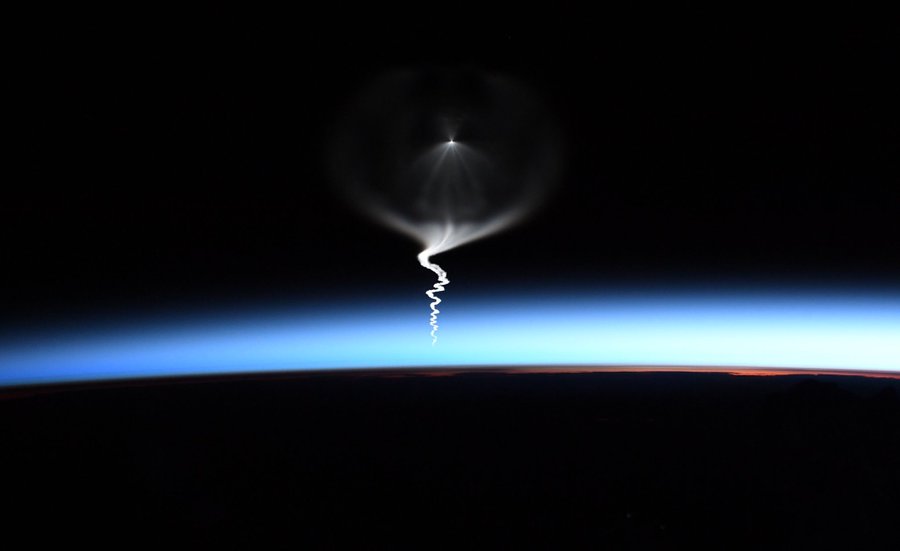
Secret Space Mysterious Object With Huge Trail of Fire Spotted In The Florida Sky On New Years Day
FORT PIERCE, Fla. — Early risers on New Year’s Day walking along the beach to see the sunrise on the Treasure Coast also saw what appeared to be a mysterious rocket launch.
With no scheduled launches at Cape Canaveral, it is not immediately known what occurred.
Photo taken by John Simard of Fort Pierce seems to show the object going up with a long trail of fire behind it.
Several viewers from Vero Beach to Fort Pierce said they saw the object, which was located east of the shore and out in the Atlantic Ocean.
This story was originally published by Matt Sczesny on WPTV in Palm Beach, Florida.
The six astronauts of Expedition 60 on the International Space Station celebrated 2020 earlier than you might think. Pictured here: (foreground from left) NASA astronauts Jessica Meir, ESA astronaut Luca Parmitano (center) and NASA astronaut Christina Koch (right). Background from left: Russian cosmonauts Alexander Skvortsov, Oleg Skripochka and NASA astronaut Andrew Morgan.
The people of Earth weren't the only ones ringing in the year 2020 at midnight. Six explorers in orbit celebrated the new year's arrival - and indeed, a new decade - aboard theInternational Space Station.
"Happy New Year from low Earth orbit!" NASA astronaut Andrew Morgan wrote on Twitter as Earth began the year 2020.
Morgan celebrated 2020's arrival with crewmates Christina Koch and Jessica Meir (both of NASA), European Space Agency astronaut Luca Parmitano, and Russian cosmonauts Oleg Skripochka and Alexander Skvortsov. Parmitano commands the crew, known as Expedition 60.
Celebrating a new year in space is a bit different than ringing in Jan. 1 on Earth. For starters, astronauts orbit the Earth 16 times a day, meaning they see 16 sunrises and sunsets as the circle the planet every hour and a half. Then there's their time zone, which meant the station crew saw 2020's arrival before flight controllers at NASA's Mission Control center in Houston.
"The space station operates on Greenwich Mean Time, or GMT, meaning it will only be 7 pm ET when the orbiting astronauts' clock strikes midnight to ring in the new year," NASA officials said in a Twitter statement.
3, 2, 1... #HappyNewYear! We're usually counting down to liftoff, but today, we're counting down to 2020. The space station operates in Greenwich Mean Time, or GMT, meaning it will only be 7 pm ET when the orbiting astronauts' clock strikes midnight to ring in the new year!
The year 2020 is a major milestone for the International Space Station. In November, the station will celebrate 20 years of continuous operation with a human crew. (The first station crew Expedition 1 arrived in 2000.)
This incredible photo by @Astro_Christina as my #Soyuz headed to @Space_Station in September sums up 2019 – my most extraordinary year yet. #TheJourney was certainly not only my own, I remain in debt to countless individuals on the ground. #HappyNewYear to all on (& off) #Earth!
Meir celebrated the new year on Twitter with a photo of her own launch as seen by Koch in space in September. The image, Meir said, summed up 2019 as her "most extraordinary year yet."
"The journey was certainly not only my own, I remain in dept to countless individuals on the ground," Meir said. "Happy New Year to all on (& off) Earth!"
Oldupai (Olduvai) Gorge in Tanzania, one of Africa’s ‘cradles of humankind’.
Source: CC BY 2.0
Archaeological Discoveries Are Occurring Faster Than Ever
In 1924, a 3-year-old child’s skull found in South Africa forever changed how people think about human origins.
The Taung Child, our first encounter with an ancient group of proto-humans or hominins called australopithecines, was a turning point in the study of human evolution. This discovery shifted the focus of human origins research from Europe and Asia onto Africa, setting the stage for the last century of research on the continent and into its “ Cradles of Humankind.”
Few people back then would’ve been able to predict what scientists know about evolution today, and now the pace of discovery is faster than ever. Even since the turn of the 21st century, human origins textbooks have been rewritten over and over again. Just 20 years ago, no one could have imagined what scientists know two decades later about humanity’s deep past, let alone how much knowledge could be extracted from a thimble of dirt, a scrape of dental plaque or satellites in space.
Human fossils are outgrowing the family tree earliest hominin
In Africa, there are now several fossil candidates for the earliest hominin dated to between 5 and 7 million years ago, when we know humans likely split off from other Great Apes based on differences in our DNA.
Although discovered in the 1990s, publication of the 4.4 million year old skeleton nicknamed “Ardi” in 2009 changed scientists’ views on how hominins began walking.
Anthropologists are realizing that our Homo sapiens ancestors had much more contact with other human species than previously thought. Today, human evolution looks less like Darwin’s tree and more like a muddy, braided stream.
The rise of biomolecular archaeology means new opportunities for interdisciplinary collaboration among field- and lab-based scientists.
Many recent discoveries have been made possible by the new science of ancient DNA .
Since scientists fully sequenced the first ancient human genome in 2010, data from thousands of individuals have shed new insights on our species’ origins and early history.
One shocking discovery is that although our lineages split up to 800,000 years ago, modern humans and Neanderthals mated a number of times during the last Ice Age. This is why many people today possess some Neanderthal DNA .
The 2010 excavation in the East Gallery of Denisova Cave, where the ancient hominin species known as the Denisovans were discovered.
Bence Viola. Dept. of Anthropology, University of Toronto, CC BY-ND
Ancient DNA is how researchers first identified the mysterious Denisovans, who interbred with us and Neanderthals. And while most studies are still conducted on bones and teeth, it is now possible to extract ancient DNA from other sources like cave dirt and 6,000-year-old chewing gum .
Genetic methods are also reconstructing individual and family relationships, and connecting ancient individuals to living peoples to end decades long debates.
The applications go far beyond humans. Paleogenomics is yielding surprising discoveries about plants and animals from ancient seeds and skeletons hidden in the backrooms of museums.
Natural history museums hold a wealth of information, some of which can only be tapped through new biomolecular methods. Scientists analyze modern and fossil animal skeletons to ask questions about the past using ancient proteins.
Mary Prendergast at National Museums of Kenya, CC BY-ND / The Conversation
Biomolecules are making the invisible visible
DNA is not the only molecule revolutionizing studies of the past.
Dental calculus – the hardened plaque that your dentist scrapes off your teeth – is particularly informative, revealing everything from who was drinking milk 6,000 years ago to the surprising diversity of plants, some likely medicinal, in Neanderthal diets. Calculus can help scientists understand ancient diseases and how the human gut microbiome has changed over time. Researchers even find cultural clues – bright blue lapis lazuli trapped in a medieval nun’s calculus led historians to reconsider who penned illuminated manuscripts.
Scientists unexpectedly found lazurite pigment in calcified plaque clinging to a 11th- to 12th-century woman’s tooth, challenging the assumption that male monks were the primary makers of medieval manuscripts.
Lipid residues trapped in pottery have revealed the origins of milk consumption in the Sahara and showed that oddly shaped pots found throughout Bronze and Iron Age Europe were ancient baby bottles .
Researchers use collagen-based “barcodes” of different animal species to answer questions ranging from when Asian rats arrived as castaways on Africa-bound ships to what animals were used to produce medieval parchment or even to detect microbes left by a monk’s kiss on a page.
Big data is revealing big patterns
While biomolecules help researchers zoom into microscopic detail, other approaches let them zoom out. Archaeologists have used aerial photography since the 1930s, but widely available satellite imagery now enables researchers to discover new sites and monitor existing ones at risk. Drones flying over sites help investigate how and why they were made and combat looting.
Archaeologists increasingly use technology to understand how sites fit into their environment and to document sites at risk. Here, a drone captured a tell (a mound indicating build-up of ancient settlements) in the Kurdistan Region of Iraq.
Originally developed for space applications, scientists now use LIDAR – a remote sensing technique that uses lasers to measure distance – to map 3D surfaces and visualize landscapes here on Earth. As a result, ancient cities are emerging from dense vegetation in places like Mexico, Cambodia and South Africa .
Technologies that can peer underground from the surface, such as Ground Penetrating Radar, are also revolutionizing the field – for example, revealing previously unknown structures at Stonehenge. More and more, archaeologists are able to do their work without even digging a hole.
Geophysical survey methods enable archaeologists to detect buried features without digging large holes, maximizing knowledge while minimizing destruction.
Mary Prendergast and Thomas Fitton, CC BY-ND / The Conversation
Teams of archaeologists are combining big datasets in new ways to understand large-scale processes. In 2019, over 250 archaeologists pooled their findings to show that humans have altered the planet for thousands of years, for example, with a 2,000-year-old irrigation system in China. This echoes other studies that challenge the idea that the Anthropocene, the current period defined by human influences on the planet, only began in the 20th century.
New connections are raising new possibilities
These advances bring researchers together in exciting new ways. Over 140 new Nazca Lines , ancient images carved into a Peruvian desert, were discovered using artificial intelligence to sift through drone and satellite imagery. With the wealth of high-resolution satellite imagery online, teams are also turning to crowdsourcing to find new archaeological sites.
Although new partnerships among archaeologists and scientific specialists are not always tension-free, there is growing consensus that studying the past means reaching across fields.
The Open Science movement aims to make this work accessible to all. Scientists including archaeologists are sharing data more freely within and beyond the academy. Public archaeology programs, community digs and digital museum collections are becoming common. You can even print your own copy of famous fossils from freely available 3D scans, or an archaeological coloring book in more than 30 languages.
Archaeologists are increasingly reaching out to communities to share their findings, for example at this school presentation in Tanzania.
Efforts to make archaeology and museums more equitable and engage indigenous research partners are gaining momentum as archaeologists consider whose past is being revealed. Telling the human story requires a community of voices to do things right.
Studying the past to change our present
As new methods enable profound insight into humanity’s shared history, a challenge is to ensure that these insights are relevant and beneficial in the present and future.
In a year marked by youth-led climate strikes and heightened awareness of a planet in crisis, it may seem counterproductive to look back in time.
Yet in so doing, archaeologists are providing empirical support for climate change and revealing how ancient peoples coped with challenging environments.
As one example, studies show that while industrial meat production has serious environmental costs, transhumance – a traditional practice of seasonally moving livestock, now recognized by UNESCO as intangible cultural heritage – is not only light on the land today, but helped promote biodiversity and healthy landscapes in the past.
Archaeologists today are contributing their methods, data and perspectives toward a vision for a less damaged, more just planet. While it’s difficult to predict exactly what the next century holds in terms of archaeological discoveries, a new focus on “ usable pasts ” points in a positive direction.
Top image: Oldupai (Olduvai) Gorge in Tanzania, one of Africa’s ‘cradles of humankind’. Source: CC BY 2.0
Something strange has been happening in Eastern Colorado at night.
Since the week of Christmas, giant drones measuring up to 6 feet across have been spotted in the sky at night, sometimes in swarms as large as 30. The Denver Post first reported these mysterious drone sightings in northeastern Colorado on December 23. Since then, sightings have spanned six counties across Colorado and Nebraska.
Phillips County Sheriff Thomas Elliott had no answer for where the drones came from or whom they belonged to but did have a rough grasp on their flying habits. "They've been doing a grid search, a grid pattern," he told The Denver Post. "They fly one square and then they fly another square."
The drones, estimated to have 6-foot wingspans, have been flying over Phillips and Yuma counties every night for about the past week, Elliott said Monday. Each night, at least 17 drones appear at about 7 o'clock and disappear at about 10 o'clock, staying 200 to 300 feet in the air.
The Air Force, Drug Enforcement Administration, and Army all say the drones do not belong to them. Óscar J.Barroso/Europa Press via Getty Images
The Federal Aviation Administration told The Post it had no idea where the drones came from. Representatives for the Air Force, the Drug Enforcement Administration, and the US Army Forces Command all said the drones did not belong to their organizations.
As the airspace where the drones are flying is relatively ungoverned, there are no regulations requiring the drone operators to identify themselves. Elliott, however, said the drones did not appear to be malicious.
The Post spoke with the commercial photographer and drone pilot Vic Moss, who said the drones appeared to be searching or mapping out the area. Moss said drones often flew at night for crop-examination purposes. The drones might also belong to a local Colorado drone company, which could be testing new technologies.
In the meantime, Moss urges residents not to shoot down the drones, as they are highly flammable.
"It becomes a self-generating fire that burns until it burns itself out," he told The Post. "If you shoot a drone down over your house and it lands on your house, you might not have a house in 45 minutes."
NOW WATCH: Watch the Navy's LOCUST launcher fire a swarm of drones
It is unclear who created the giant geoglyph or why, but the large earthen figure has drawn attention to a remote part of South Australia for two decades.
(CNN)- NASA confirms one of the greatest modern art mysteries is still going strong in Australia.
A pilot discovered the mysterious 2.6-mile-long geoglyph of an aboriginal hunter in 1998, etched into the earth, and to this day no one knows how it got there.
The Marree Man gained new life in 2016 when a group from the figure's namesake town of Marree plowed the lines to keep the man from fading due to erosion. Now, NASA is sharing an image taken in June showing the success of their efforts.
So far, the restoration team's belief that their preservation will last longer than the original holds up. They created wind grooves, designed to trap water and encourage the growth of vegetation, according to NASA. They hope that eventually the man will turn green.
Many have tried to discover the origin of the Marree Man.
CNN previously reported that Dick Smith, founder of Dick Smith Electronics and Dick Smith Foods, decided to tackle the mystery in 2016, and for two years his team pored over all the evidence to see what they could find.
He believed it was professionally done, so in 2018 he offered a reward of $5,000 Australian dollars ($3,712) for anyone with information regarding its existence.
No one has come forward, but several believe it was made by an artist living in Alice Springs, though other clues suggest the creator may have been an American.
Where do the 2020 Democratic presidential candidates stand on UFOs? In front of the nearest ET camera, of course! Bada-bing! Sorry, couldn’t help myself. But seriously, what do the people running for president on the Democratic side think about UFOs, the possible existence of extraterrestrials and the disclosure of secret files on those and other related subjects? Minnesota Senator Amy Klobuchar was recently interviewed by Draymond Steer, a reporter for New Hampshire’s The Conway Daily Sun and someone known for asking politicians those tough UFO questions. Steer asked Klobuchar about the USS Nimitz UFO incident – one of the witnesses was New Hampshire’s own David Fravor. Here’s what she had to say:
“I’ve read some articles about it. And, you know, I think we don’t know enough. I don’t know. I mean, I don’t know what happened, not just with that sighting, but with others. And, I think one of the things a President could do is to look into what’s there; in terms of what does the science say; what does the military say? Here’s the interesting part of that answer, is that some of the stuff is really old, these sightings. So, why can’t you see if you can let some of that out for the public? So, earnest journalists like you, who are trying to get to the bottom of the truth would be able to see it?”
Senator Amy Klobuchar
She explained that a president should be able to figure out what information still needs to be hidden and what can be released, implying that she would be that kind of president. What about the other Democratic candidates? Earlier this year, The Conway Daily Sun asked Andrew Yang and he said:
“I’m very curious about UFOs. I have a feeling they probably do exist.”
No word on whether extraterrestrials from other parts of the universe would qualify for Yang’s $1000-per-month ‘universal’ income. When asked about Bernie Sanders, Steer said, “Bernie had no interest in the UFO question.” However, in a later interview with Joe Rogan, Sanders himself said he’d reveal UFO information if he found it and “Alright, we’ll announce it on the show. How’s that?” Did Bernie flip or is he just flippant?
Many will remember the 2016 campaign when both Hillary Clinton and her campaign manager and former chief-of-staff to her husband, John Podesta, promised to open the X-files if elected. That didn’t happen, and the current president shows no sign of opening them. When asked about the briefing he received on the USS Nimitz UFO incident, President Trump commented:
“I did have one very brief meeting on it. But people are saying they’re seeing UFOs. Do I believe it? Not particularly.”
The other candidates don’t seem to have been asked any UFO questions or, if they have, are avoiding giving an answer. They may remember 2008 when then candidate Dennis Kucinich admitted during a debate that he had once seen a UFO Over the house of actress Shirley MacLaine and that he “felt a connection in his heart and heard directions in his mind.”
“It was an unidentified flying object, OK? It’s, like, it’s unidentified. I saw something. I’m also going to move my campaign office to Roswell, New Mexico, and other one in Exeter, New Hampshire, OK? And also, you have to keep in mind that more – that Jimmy Carter saw a UFO and also that more people in this country have seen UFOs than I think approve of George Bush’s presidency.”
Dennis Kucinich
Kucinich dropped out of the race shortly after and some say his poll numbers plunged because of the comments.
Is this an endorsement of Senator Amy Klobuchar or Andrew Yang because of their UFO beliefs? No. Will any other Democratic candidate give us full disclosure if elected? Partial disclosure? Let’s just say it would be wise to base your voting decision on some other criteria.
If you don’t want your car to get hit by a bus, you move it out of its way. If you don’t want your house to get hit by a tsunami, you move it out of its way. If you don’t want your solar system to get hit by a supernova … believe it or not, you move it out of its way. How? According to a recent paper by Matthew E. Caplan of the Department of Physics at Illinois State University, published by Acta Astronautica, entitled “Stellar engines: Design considerations for maximizing acceleration,” with a giant stellar engine.
“Stellar engines, megastructures used to control the motion of a star system, may be constructible by technologically advanced civilizations and used to avoid dangerous astrophysical events or transport a star system into proximity with another for colonization.”
That’s probably the easiest-to-understand sentence in the entire scientific report. Fortunately, a German design studio called Kurzgesagt – German for “In a nutshell“ – has released an animated YouTube video explaining Caplan’s stellar engine in a way the rest of the world can understand. (Watch the video here.)
The real question is, after watching the video and attempting to read the paper, can the rest of the world – or anyone in the world or universe – build one?
“Stellar engines are a class of hypothetical megastructures which use a star’s radiation to create usable energy. Some variants use this energy to produce thrust, and thus accelerate a star, and anything orbiting it, in a given direction. The creation of such a system would make its builders a Type-II civilization on the Kardashev scale.”
Wikipedia points out that developing a working stellar engine to move the Sun – dragging the solar system behind it – out of the way of a rogue supernova – would bestow on its inventors the title of “Type-II civilization,” which Soviet astronomer Nikolai Kardashev defined as a civilization that can use and control energy at the scale of its stellar system. For comparison, our current civilization (us) is nowhere near Type-I — a planetary civilization capable of using and storing all of the energy available on our planet.
Wait a minute, you say, what about that guy Matthew E. Caplan? Didn’t he develop a plan?
Yes, he did. And in fact, his “Caplan thruster” uses something that has been proposed as an explanation for those blinking or dimming stars, like Tabby’s star, that astronomers have been discovering with greater frequency – a Dyson sphere cluster. Caplan first considered a giant solar sail which would passively move the Sun via its own solar energy. However, “At full throttle, the solar system could probably be moved by about a hundred light-years over 230 million years” – too slow to save the Sun and solar system from most catastrophes. For that we’ll need a star-sized Brussard ramjet – a fusion rocket which compresses hydrogen from massive electromagnetic fields until thermonuclear fusion occurs, causing energy to blast out of the exhaust, thrusting the Sun in the opposite direction at a speed of 50 light-years per million years – fast enough to save civilization – provided it survives the move.
That doesn’t sound too complicated, you say, so when can we start building a Caplan thruster … just in case?
Well, the Brussard ramjet – despite approval by great minds including Carl Sagan – is still theoretical. The magnetic sail is also theoretical, but much closer to reality. And the Dyson sphere or star-circling cluster of electromagnetic-energy-collecting mirrors is a daunting project for a civilization still struggling with solar energy panels.
However … if a dimming orb like Tabby’s star is already surrounded by one, that means a Type II civilization already exists in a nearby solar system and, upon seeing our potential demise, it might come over and build one for us in a galactic-sized barn-raising or “help us move our apartment” kind of way. How much beer and pizza would that cost us?
So, what does our Type .0001% of I civilization have to save our sorry butts from a supernova apocalypse? A possible but far from plausible theory. An excellent design paper and entertaining animation to help us. And two great names for bands – the Caplan Thrusters and the Brussard Ramjets.
Also great porn star names … which are probably what we really need because we’re screwed.
Linda Moulton Howe: Reptilians, Blondes, and Greys via Coast to Coast AM
Linda Moulton Howe is a graduate of Stanford University with a Masters Degree in Communication. She has devoted her documentary film, television, radio, writing and reporting career to productions concerning science, medicine and the environment. Ms. Howe has received local, national and international awards, including three regional Emmys, a national Emmy nomination and a Station Peabody award for medical programming. Linda’s documentaries have included A Strange Harvest and Strange Harvests 1993, which explored the worldwide animal mutilation mystery. Another film, A Prairie Dawn, focused on astronaut training in Denver. She has also produced documentaries in Ethiopia and Mexico for UNICEF about child survival efforts and for Turner Broadcasting in Atlanta about environmental challenges.
In addition to television, Linda produces, reports and edits the award-winning science, environment and earth mysteries news website, Earthfiles.com. In 2003, Earthfiles received an Award for Standard of Excellence presented by the Internet’s WebAward Association. Earthfiles also received the 2001 Encyclopaedia Britannica Award for Journalistic Excellence. Linda also reports science, environment and earth mysteries news for Clear Channel’s Premiere Radio Networks and Unknowncountry.com. In 2005, she traveled to Amsterdam, Hawaii, and several other U. S. conferences to speak about her investigative journalism.
In 2004, Linda was on-camera TV reporter for The History Channel’s documentary investigation of an unusual August 2004 cow death in Farnam, Nebraska. In November 2009, Linda was videotaped in Roswell, New Mexico, to provide document research background for a 1940s American policy of denial in the interest of national security about spacecraft and non-human body retrievals for a 2010 History Channel TV series, Ancient Aliens.
In 2010, Linda was honored with the 2010 Courage In Journalism Award at the National Press Club in Washington, D. C., by the Paradigm Research Group’s X Conference. She has traveled in Venezuela, Peru, Brazil, England, Norway, France, Switzerland, The Netherlands, Yugoslavia, Turkey, Ethiopia, Kenya, Egypt, Australia, Japan, Canada, Mexico, the Yucatan and Puerto Rico for research and productions.
AMAZING footage of a triangular-shaped UFO over New York
Another triangle UFO video was recorded over New York a few days ago. This one over Rome on 21st December.
What’s you opinion?
Witness Description:
It was hovering over my backyard for about 10 mins then it just vanished or maybe just turned off the lights it had no sound.
Sighting Specifics:
Distance 21-100 Feet Altitude Treetop Duration 00:03:00 Features Other Flight Path Stationary Shape Triangle
BEAMS Comment:
The configuration of this latest triangle UFO capture is identical to that of a fabulous still catch by the *late UFOlogist/BEAMS investigator Gordon Dungavel, back in 2014: check it out here.
There are striking similarities between how these triangles were observed as well; the 2014 UK object hovered almost above Gordon's garden - same with this latest case over in America... it hovered silently above the witness' "backyard".
Gordon had no lights switched on in his house whatsoever - and there are no streetlamps outside his home either. He described what he saw as a 'black triangle' that made no sound, which had one huge bright light in the middle and three dimmer ones at each corner the object.
*Sadly, Gordon and his wife Tracy were found dead at their home 11 July 2016; causes of death were never established: One headline some weeks later read An investigation has been launched into the death of a top UFO investigator and his wife after their bodies were found at their home last month...
Several private enquiries that we made about the sudden demise of our friends, (who were only in their mid fifties) proved fruitless - and despite a later official inquest, only an 'open' verdict was given by the coroner; their deaths remain a mystery.
Even more bizarrely, since then, all web news articles about this puzzling case seem to have been removed - leaving just broken links.
Daytime triangle filmed over Ilion, New ork 27-Dec-2019
Check out this really interesting daytime footage of a triangular shaped formation in the sky above Ilion in New York. This was filmed on Friday, 27th December 2019.
Meer van UFO'S of UAP'S, ASTRONOMIE, RUIMTEVAART, ARCHEOLOGIE, OUDHEIDKUNDE, SF-SNUFJES EN ANDERE ESOTERISCHE WETENSCHAPPEN - DE ALLERLAATSTE NIEUWTJES


 Secret Space Mysterious Object With Huge Trail of Fire Spotted In The Florida Sky On New Years Day


 The space station operates in Greenwich Mean Time, or GMT, meaning it will only be 7 pm ET when the orbiting astronauts' clock strikes midnight to ring in the new year!