Ontdek de Fascinerende Wereld van UFO's en UAP's: Jouw Bron voor Onthullende Informatie!
Ben jij ook gefascineerd door het onbekende? Wil je meer weten over UFO's en UAP's, niet alleen in België, maar over de hele wereld? Dan ben je op de juiste plek!
België: Het Kloppend Hart van UFO-onderzoek
In België is BUFON (Belgisch UFO-Netwerk) dé autoriteit op het gebied van UFO-onderzoek. Voor betrouwbare en objectieve informatie over deze intrigerende fenomenen, bezoek je zeker onze Facebook-pagina en deze blog. Maar dat is nog niet alles! Ontdek ook het Belgisch UFO-meldpunt en Caelestia, twee organisaties die diepgaand onderzoek verrichten, al zijn ze soms kritisch of sceptisch.
Nederland: Een Schat aan Informatie
Voor onze Nederlandse buren is er de schitterende website www.ufowijzer.nl, beheerd door Paul Harmans. Deze site biedt een schat aan informatie en artikelen die je niet wilt missen!
Internationaal: MUFON - De Wereldwijde Autoriteit
Neem ook een kijkje bij MUFON (Mutual UFO Network Inc.), een gerenommeerde Amerikaanse UFO-vereniging met afdelingen in de VS en wereldwijd. MUFON is toegewijd aan de wetenschappelijke en analytische studie van het UFO-fenomeen, en hun maandelijkse tijdschrift, The MUFON UFO-Journal, is een must-read voor elke UFO-enthousiasteling. Bezoek hun website op www.mufon.com voor meer informatie.
Samenwerking en Toekomstvisie
Sinds 1 februari 2020 is Pieter niet alleen ex-president van BUFON, maar ook de voormalige nationale directeur van MUFON in Vlaanderen en Nederland. Dit creëert een sterke samenwerking met de Franse MUFON Reseau MUFON/EUROP, wat ons in staat stelt om nog meer waardevolle inzichten te delen.
Let op: Nepprofielen en Nieuwe Groeperingen
Pas op voor een nieuwe groepering die zich ook BUFON noemt, maar geen enkele connectie heeft met onze gevestigde organisatie. Hoewel zij de naam geregistreerd hebben, kunnen ze het rijke verleden en de expertise van onze groep niet evenaren. We wensen hen veel succes, maar we blijven de autoriteit in UFO-onderzoek!
Blijf Op De Hoogte!
Wil jij de laatste nieuwtjes over UFO's, ruimtevaart, archeologie, en meer? Volg ons dan en duik samen met ons in de fascinerende wereld van het onbekende! Sluit je aan bij de gemeenschap van nieuwsgierige geesten die net als jij verlangen naar antwoorden en avonturen in de sterren!
Heb je vragen of wil je meer weten? Aarzel dan niet om contact met ons op te nemen! Samen ontrafelen we het mysterie van de lucht en daarbuiten.
In our search for life in the universe our solar systems provides us with tantalizing options including several ocean worlds.
This past week NASA’sJet Propulsion Lab Von Karman Lecture Series hosted Dr. Morgan Cable who spoke on the topic of The Search for Life: Exploring Ocean Worlds.
Here’s the lecture description: “The search for life is “civilization level science.” What happens if or when we find it? Using the upcoming block of “Ocean Access” missions, Dr. Morgan Cable shows us why ocean worlds are important and what the discovery of life could mean to us as a civilization.”
Organic molecules present in truffles, coal and oil on Earth have been identified on the surface of Mars and may hint at the presence of alien life on the red planet.
These chemicals, called thiophenes, are important molecules as they contain both carbon and sulphur — two ingredients essential for life.
NASA's curiosity rover has identified signs of them on the surface of Mars and astronomers think the most likely source of origin is from biological processes.
Further analysis by the Rosalind Franklin rover that will launch later this year will help add credence to the tentative theory, researchers hope.
Scroll down for video
NASA's curiosity rover has identified signs of thiophenes on the surface of the red planet and astronomers believe the most likely source is from biological processes. These chemicals contain both both carbon and sulphur — two ingredients essential for life
WHAT ARE THIOPHENES?
Thiophene molecules have four carbon atoms and a sulphur atom arranged in a ring.
Both of these elements are essential for life.
Thiophenes are found on Earth in coal, crude oil and oddly enough, in white truffles.
Thiophenes can also be created through a chemical reaction called thermochemical sulfate reduction.
This process involves a set of compounds being heated to 248 degrees Fahrenheit (120 degrees Celsius) or more.
Washington State University astrobiologist Dirk Schulze-Makuch looked into how thiophenes came to exist on Mars.
Their findings, published in the journal Astrobiology, indicate the chemicals were likely produced by biological processes and not chemical reactions.
This is a major step in the hunt for Martian life but is not concrete proof, the scientists say.
'We identified several biological pathways for thiophenes that seem more likely than chemical ones, but we still need proof,' Dirk Schulze-Makuch said.
'If you find thiophenes on Earth, then you would think they are biological, but on Mars, of course, the bar to prove that has to be quite a bit higher.'
NASA's Curiosity rover (pictured) has identified signs of them on the surface of the red planet and astronomers believe the most likely source is from biological processes
Thee most likely source of these chemicals is thought to be biological processes of primitive lifeforms but it is also possible they were formed after a meteor impact.
A space rock crash landing can cause searing temperatures and thiophenes can be created if a host of certain chemicals are heated to around 120°C (248°F).
HOW WILL ROSALIND'S 'ALIEN HUNTING' CAMERA WORK?
The camera system, called Pan-Cam, was designed by engineers at University College London.
It perches atop the rover’s high mast and is fitted with sensors that scan the planet's surface in search of minerals or water.
Once it identifies an area, it will travel towards it at 47 inches an hour, then drill down to take a biopsy of the land.
The samples will then be stored into a self-contained laboratory on the rover, where it'll be crushed and examined.
If thiophenes were made as a result of biological processes it is likely it was via bacteria three billion years ago.
Back then, Mars was warmer and wetter and a more hospitable land where the key chemical reaction to form thiophenes can take place - a reaction called sulfate reduction process that creates thiophenes.
Data from Curiosity has been exhausted and astronomers hope the imminent launch of the Rosalind Franklin rover can shed more light on the chemicals and their origin.
It will be carrying a Mars Organic Molecule Analyser, or MOMA, which can collect large samples and analyse them without having to destroy them.
Analysing isotopes - chemical strains that can reveal its history - could help learn more about this potential indicator of life on Mars.
Dr Schulze-Makuch said: 'Organisms are "lazy". They would rather use the light isotope variations of the element because it costs them less energy.
Yet even if the next rover returns this isotopic evidence, it may still not be enough to prove definitively that there is, or once was, life on Mars.
'As Carl Sagan said ‘extraordinary claims require extraordinary evidence",' Dr Schulze-Makuch said.
'I think the proof will really require that we actually send people there, and an astronaut looks through a microscope and sees a moving microbe.'
WHAT EVIDENCE DO SCIENTISTS HAVE FOR LIFE ON MARS?
The search for life on other planets has captivated mankind for decades.
But the reality could be a little less like the Hollywood blockbusters, scientists have revealed.
They say if there was life on the red planet, it probably will present itself as fossilized bacteria - and have proposed a new way to look for it.
Here are the most promising signs of life so far -
Water
When looking for life on Mars, experts agree that water is key.
Although the planet is now rocky and barren with water locked up in polar ice caps there could have been water in the past.
In 2000, scientists first spotted evidence for the existence of water on Mars.
The Nasa Mars Global Surveyor found gullies that could have been created by flowing water.
The debate is ongoing as to whether these recurring slope lineae (RSL) could have been formed from water flow.
Meteorites
Earth has been hit by 34 meteorites from Mars, three of which are believed to have the potential to carry evidence of past life on the planet, writes Space.com.
In 1996, experts found a meteorite in Antarctica known as ALH 84001 that contained fossilised bacteria-like formations.
However, in 2012, experts concluded that this organic material had been formed by volcanic activity without the involvement of life.
Signs of Life
The first close-ups of the planet were taken by the 1964 Mariner 4 mission.
These initial images showed that Mars has landforms that could have been formed when the climate was much wetter and therefore home to life.
In 1975, the first Viking orbiter was launched and although inconclusive it paved the way for other landers.
Many rovers, orbiters and landers have now revealed evidence of water beneath the crust and even occasional precipitation.
Earlier this year, Nasa's Curiosity rover found potential building blocks of life in an ancient Martian lakebed.
The organic molecules preserved in 3.5 billion-year-old bedrock in Gale Crater — believed to have once contained a shallow lake the size of Florida's Lake Okeechobee — suggest conditions back then may have been conducive to life.
Future missions to Mars plan on bringing samples back to Earth to test them more thoroughly.
Methane
In 2018, Curiosity also confirmed sharp seasonal increases of methane in the Martian atmosphere.
Experts said the methane observations provide 'one of the most compelling' cases for present-day life.
Curiosity's methane measurements occurred over four-and-a-half Earth years, covering parts of three Martian years.
Seasonal peaks were detected in late summer in the northern hemisphere and late winter in the southern hemisphere.
The magnitude of these seasonal peaks – by a factor of three – was far more than scientists expected.
Some ‘superpuff’ exoplanets may actually be ringed worlds like Saturn
Rings could make the mysterious planets look bigger than they really are
Wide rings could block light from a star as a planet crosses in front of it, making the planet look bigger than it really is, scientists say. This artist’s illustration shows what such a planet might look like up-close.
ROBIN DIENEL, COURTESY OF THE CARNEGIE INST. FOR SCIENCE
Some puzzling planets called superpuffs could be Saturns in disguise.
These exoplanets appear very large given their masses, suggesting that they have densities like cotton candy. Astronomers have struggled to explain how these planets could have turned out so fluffy (SN: 11/30/15).
“People had been thinking of complicated ways to explain these mysterious planets,” such as dust storms leaving a planet, says theoretical astrophysicist Anthony Piro of the Carnegie Observatories in Pasadena, Calif.
Now, Piro and exoplanet scientist Shreyas Vissapragada of Caltech propose a simpler explanation. Instead of being outsized for their weight class, some superpuffs could sport wide rings that make the planets appear bigger than they really are, the researchers suggest February 28 in the Astronomical Journal.
“This seemed like such a natural, kind of cute explanation,” Piro says. “We know of things like Saturn in our own solar system. Why can’t something like that exist in other solar systems as well?”
The duo considered 10 known superpuffs observed with the Kepler space telescope, and ran computer simulations to see if the planets’ girths could be due to rings.
The team found that because all of the superpuffs sit fairly close to their stars, their rings would need to be made of rock, unlike Saturn’s icy rings (SN: 8/23/17), to avoid melting away. And, as a result, the proposed rocky rings can’t extend too far from a planet, or the rocks’ gravity would pull them together into moons.
That means that the three superpuffs orbiting the star Kepler 51 can’t be explained by rings — the planets appear big enough that any rocky rings they might have would turn into moons, the team found. But the other seven worlds might have rings and are worth checking, Piro says.
Following up on these planets might need to wait for NASA’s sharp-eyed James Webb Space Telescope, scheduled to launch in 2021 (SN: 4/19/16).
For centuries, humans have wondered whether Earth is unique in the universe, or if similar planets exist out there. Even a decade ago, we still did not know — but then NASA's Kepler Space Telescope made discoveries that changed everything.
Thanks to that important mission, the answer became clear: other planets like ours are out in the cosmos. We just haven't seen one with our own eyes yet.
Since its 2009 launch, Kepler has discovered more than 2,000 confirmed exoplanets and has given us a huge amount of information about their orbits and sizes. The planets found range greatly in their masses, composition and orbital distances: for instance, enormous gas giants orbiting incredibly close to their stars, called hot Jupiters; planets that orbit two stars, called circumbinary planets; and rocky planets with the potential to be like Earth. [In Mission To Find Another Earth, Project Blue Hopes To Inspire (Video)]
The planets considered Earth-like are rocky on their surface and about 0.5 to 1.5 times the size of Earth. They also land in the "habitable zone" of their orbiting stars, meaning they fall in the sweet spot of orbital distance — not too close and not too far away — and therefore have the potential to be able to support liquid water on their surfaces. The ability to support water is huge, as it means the planet could have the potential to support life.
Kepler showed us these planets are common in the universe. In fact, we now know there are more potentially habitable planets in our galaxy alone than there are people alive on Earth. One out of every two sun-like stars you see in the night sky has a rocky, Earth-like planet in its habitable zone.
Depiction of NASA's Kepler mission's smallest habitable zone planet: Kepler-62f. (Image credit: NASA Ames/JPL-Caltech/Tim Pyle)
Earlier this year, one potentially habitable planet made news when scientists discovered it orbiting the nearby red dwarf star Proxima Centauri. That planet, called Proxima b, which has similarities to Earth that include orbiting in the habitable zone of its star, so the potential to support water, and a size about 1.3 times that of Earth.
Artist's conception of the surface of Proxima Centauri b (Proxima b, for short). (Image credit: ESO/M. Kornmesser)
We now know these planets exist, but we have yet to see them. To know more about a planet's Earth-like properties, such as whether it hosts water or oxygen, further specific detection methods are needed. Thanks to recent breakthroughs, the technology now exists to capture a direct image of an Earth-like planet outside our solar system. That's what we aim to do at Project Blue.
Our mission is to capture an image, visible to the human eye, of one of these worlds. Proxima b is an unlikely candidate, as it orbits so close to its small, dim star that it would be extremely difficult to image with a telescope. Project Blue is therefore targeting our best chance at success: our stellar neighbor Alpha Centauri.
Our goal is to see a "pale blue dot" that could indicate the presence of oceans or an atmosphere — and the potential to support life. Since Alpha Centauri is a binary system, it doubles our chances, and the probability that we'll find at least one potentially habitable planet is around 85 percent.
Capturing the first image of a planet like ours and seeing it with our eyes will help us begin to characterize its properties and spark a movement to quickly further research. The photograph of Earth 2.0 would be a defining moment in human history and is sure to transform how we see ourselves in the universe.
NASA's satellite spotted a strange object moving across the solar system.
The object was as big as the Moon
Experts believe the object was an alien vessel
UFO experts claimed that a massive alien vessel as big as the Moon is currently moving across Earth’s neighborhood. According to the experts, the alleged UFO was spotted by NASA’s solar satellite.
The strange UFO sighting was reported via YouTube by the channel The Hidden Underbelly 2.0. According to the operator of the channel, the camera of NASA’s Solar and Heliospheric Observatory (SOHO) was able to capture a strange object moving across the Solar System on Feb. 29.
The camera, known as Stereo A, was positioned to observe the Sun. In the short clip recorded by the camera, various planets such as Earth, Venus and Mercury can be seen orbiting in the Solar System. Then, an unidentified object appears in the video and stars to move towards the planets.
Unfortunately, a couple of seconds after the strange object appeared, Stereo A begins to malfunction and the video cuts off.
Based on the video, the object appears to have a circular shape with a cross or diamond-shaped structure at its center. After watching the video and enhancing its images, Scott Waring of ET Data Base claimed that the object was an alien vessel that was traveling across the Solar System.
“Here is a really interesting video of a circular craft with a diamond-shaped center,” Waring wrote in a blog post. “It was moving through a NASA SOHO video and got caught. The UFO is there for only 4 seconds, but if slowed down, we can see its detail well.”
Based on the appearance of the object, Waring estimated that it could be about as big as the Moon or possibly even bigger. For Waring, the object proves that alien vessels are currently wandering the Solar System. He also said that NASA intentionally denies their existence to prevent the public from panicking.
“This is 100% proof that aliens are in our Solar System right now,” Waring stated. “This ship is massive, moon size or bigger and moving incredibly fast. I'm sure NASA would never mention it because if they did, they would have to tell the public the truth about aliens existing. They don't want to cause any panic.”
The Kepler Spacecraft has detected a lot of exoplanets orbiting stars in other solar systems, but its data may have just uncovered an exomoon for the first time.
NASA'S CURIOSITY JUST TOOK THE HIGHEST RESOLUTION PANORAMA OF MARS TO DATE
The rover is quite the photographer.
While America overdosed on turkey, NASA's Curiosity rover spent this past Thanksgiving holiday all alone, millions of miles away on Mars.
But unlike the rest of us, the rover was far from idle. Instead, the Martian explorer worked on its photography skills.
Between November 24 and December 1, 2019, Curiosity took more than 1,000 images of the Red Planet, piecing together the highest resolution panorama of Mars to date. The stunning image reveals the dry, dusty surface of Mars in its full glory.
"While many on our team were at home enjoying turkey, Curiosity produced this feast for the eyes," Ashwin Vasavada, Curiosity's project scientist at NASA's Jet Propulsion Laboratory, which leads the Curiosity rover mission, said in a statement.
The robot took six and a half hours to produce this detailed panorama. NASA/JPL-Caltech/MSSS
NASA released the final image on Wednesday.
The panorama captures a wide view of Glen Torridon, an area of Mars that Curiosity is currently exploring near a mountain called Mount Sharp.
Curiosity used the telephoto lens on its Mast Camera to snap the high-resolution image. Altogether, it is made up of 1.8 billion pixels, revealing the Martian landscape in unprecedented detail.
The rover also used a medium-angle lens to produce a lower resolution version of just 650 million pixels, which also features the robot’s arm and front deck.
The rover may have left its finger on the lens while snapping this lower-resolution image. NASA/JPL-Caltech/MSSS
The image marks the first time Curiosity has dedicated its operations to producing a 360-degree panorama of its surroundings, according to NASA.
It took Curiosity nearly seven hours to capture both shots. The holiday period meant the rover could spare the extra time, though — with its operating team away on holiday, it didn’t have many tasks on its to-do list.
While this view is unprecedented, Curiosity is known for its photography skills. In 2013, it snapped a lower-resolution panorama of the Martian surface while it was on the Rocknest site. The image is not as detailed as the new panorama, and features the rover’s shiny metallic body in the foreground. Clearly, the robot has stepped up its game over the intervening years.
Curiosity's first attempt at a panorama image.NASA/JPL-Caltech/MSSS
The rover is also fond of taking selfies, snapping pictures of itself as it explores the Red Planet.
Curiosity landed on Mars in 2012 with the mission of searching for hints of microbial life that may have existed on the Red Planet during its early history.
The car-sized robot roams the Gale Crater on Mars, where it has discovered a lake that may have contained water billions of years ago, and an environment that may have supported life.
Curiosity will soon be joined by NASA’s Mars 2020 rover, which is scheduled to launch this summer. Like its robot peer, the Mars 2020 rover is designed to search for signs of current or past signs of life on the Red Planet.
UFO 'Bigger Than Earth' Flying Past the Sun Spotted by NASA Observation Mission aka "Ezekiel's Wheel" Type
The development comes weeks after a camera at the International Space Station spotted an unknown cone-like object that was flying upward.
NASA’s STEREO observation mission has spotted what fans of conspiracy theories said is a gigantic UFO flying past the Sun. The incident itself occurred on 29 February, but the footage of it was posted just recently on the channel “Hidden Underbelly 2.0” dedicated to mysterious events and sightings. According to the host, STEREO’s camera filmed the humongous object for four seconds after which it turned off and began working only after the UFO passed.
The “humongous object” appears to be bigger than Mercury, Venus, and the Earth. “You can tell this thing doesn’t look like our space station, no way. It doesn’t look like any satellite that I have seen. To be honest, when I first saw the footage I thought: Ezekiel’s Wheel! It’s very similar – the circle with a cross in it”, the host said.
The host refers to a saying in the Book of Ezekiel, where the prophet spoke about a flying chariot, which he described as a “wheel in the middle of a wheel”.
NASA has not yet issued a response to the issue. via Sputnik.news
Selfie of Curiosity Rover reveals Ancient Machinery on Mars
A selfie of the Curiosity Rover at Greenheugh Pediment on Mars, uploaded by Neville Thompson on his Gigapan page, shows a couple of strange objects.
The alleged objects appear very different compared to the large rocks surrounding them, suggesting that these objects may be parts of old machinery used for mining activities.
NASA’s Curiosity Rover has photographed many interesting images of the surface of Mars since it touched down on the red planet in 2012 and these images is yet another proof that ancient civilizations lived on the red planet in the distant past?
The Unexplained UFO Lights over G.E. Peebles Test Facility in Ohio’s Area 51 (1996)
The UFO Lights over G.E. Peebles Test Operation Facility in Ohio’s Area 51.
The Peebles operation, with more than 250 employees and located on nearly 7,000 acres, is both an engine test and final assembly facility. Each year, Peebles runs final acceptance testing on about 1,250 engines manufactured by GE and its joint venture partners. From Peebles, these engines are shipped to aircraft manufacturers for installation on customer aircraft. Does Hangar 18, Legendary Alien Warehouse, Exist? Crashed UFOs, alien autopsies and government cover-ups — untangling the legend surrounding Ohio’s Wright-Patterson Air Force Base. As home to Project Blue Book, ground zero for government investigation of UFOs from 1951 to 1969, Wright Field (now Wright-Patterson Air Force Base) outside Dayton, Ohio, ranks up there alongside Area 51 as a subject of enduring speculation.
Posted by Andy Briggs in ASTRONOMY ESSENTIALS | SPACE
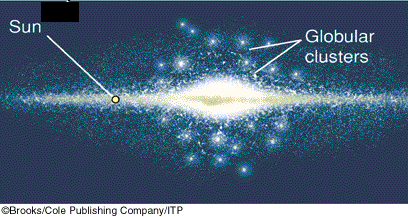
Globular clusters are spherical collections of up to perhaps a million stars, orbiting mostly in the star halo of spiral galaxies, containing some of a galaxy’s oldest stars.
The globular cluster M5, as seen by the Hubble Space Telescope. This photo was an Astronomy Picture of the Day in June 2015.
Globular clusters are tightly packed, symmetrical collections of up to about a million stars, orbiting mostly in the star halos surrounding most spiral galaxies. Globular clusters contain some of the oldest stars in a galaxy and are thought to have formed early in its history. Could it be that – when it was first forming – a spiral galaxy like our Milky Way was once an amorphous cloud of gas and dust? Could its first stars have collected into globular clusters? Could these clusters have stayed put in the halo around a galaxy’s center, as the rest of the galaxy flattened out and formed spiral arms? That scenario would explain why globular clusters orbit in a galaxy’s halo and contain a its oldest stars.
But the fact is that no one knows precisely how globular clusters formed, and what role, if any, they played in the development of galaxies. We do know that globular clusters are the oldest, largest and most massive type of star cluster and that they contain the oldest stars. Their age can be demonstrated by their almost complete lack of gas and dust, all of which has presumably been incorporated into stars.
Globular clusters are big. They can reach 300 light-years in diameter. Unlike the open star clusters – containing a few hundred young, sibling stars, scattered through the disk of our galaxy and presumably other galaxies – globular clusters are big, symmetric and old, like an earthly city’s oldest and most staid citizens.
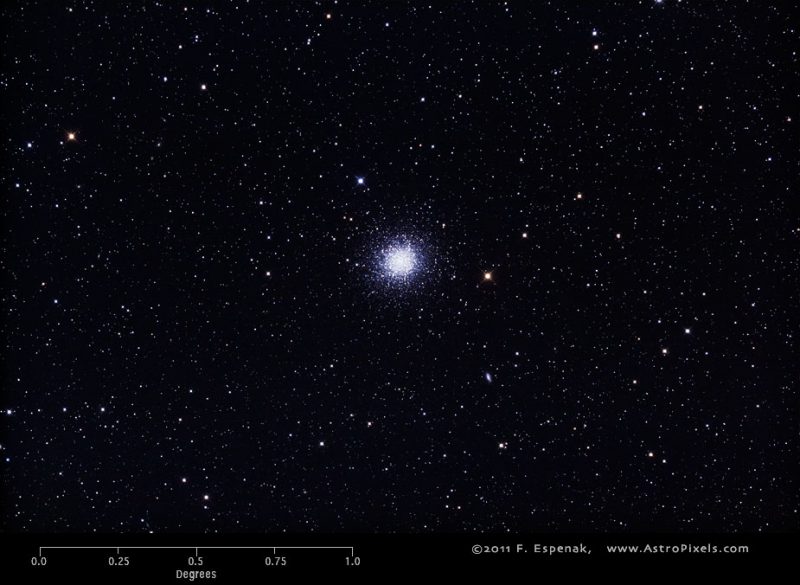
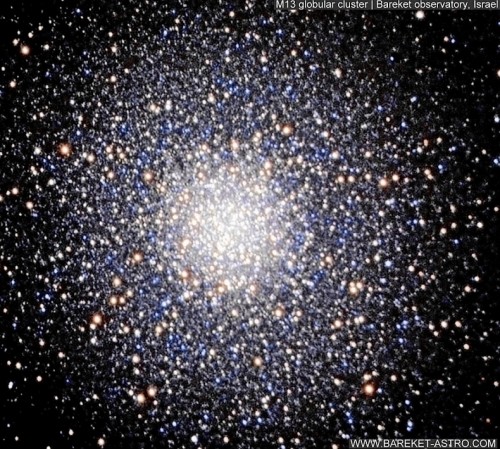
View larger. | The famous globular cluster Messier 13 or M13 – largest and brightest globular cluster easily visible from the Northern Hemisphere – seen against its star field. At 25,000 light-years away and about 145 light-years in diameter, M13 is a popular target for amateur astronomers using small telescopes.
Our own Milky Way has around 150 globular clusters, with perhaps more awaiting discovery, hidden by galactic dust. Our neighboring spiral galaxy in the direction of the constellation Andromeda – M31 or the Andromeda galaxy – appears to have around 300 globular clusters. Some football-shaped, elliptical galaxies do have globular clusters, too, like M87 in the direction of the constellation Virgo, home to the supermassive black hole that was famously imaged by the Event Horizon Telescope in 2019. This giant elliptical galaxy, M87, has been estimated to possess around 15,000 globular clusters, with more than 1,000 having been directly observed telescopically so far.
About 150 globular star clusters are known to surround our galaxy’s center.
Globular clusters orbit galaxies in orbits which are highly eccentric and highly inclined to the galactic plane. Orbiting in the “outskirts” of a galaxy, they take perhaps a few hundred million years to complete a single orbit. In a telescope, a globular cluster looks like a fuzzy ball, with individual stars at the periphery merging into a solid ball of light towards the center. However, this is simply because the stars are so close together that they can’t be resolved individually telescopically. At the center of a globular cluster, stars may reach a density of between 100 and 1,000 stars per cubic parsec. That’s in contrast to the density of stars near our sun, estimated at about 0.14 star per cubic parsec. If you were standing on a planet orbiting a star in a globular cluster, your night sky would be extremely crowded with nearby stars!
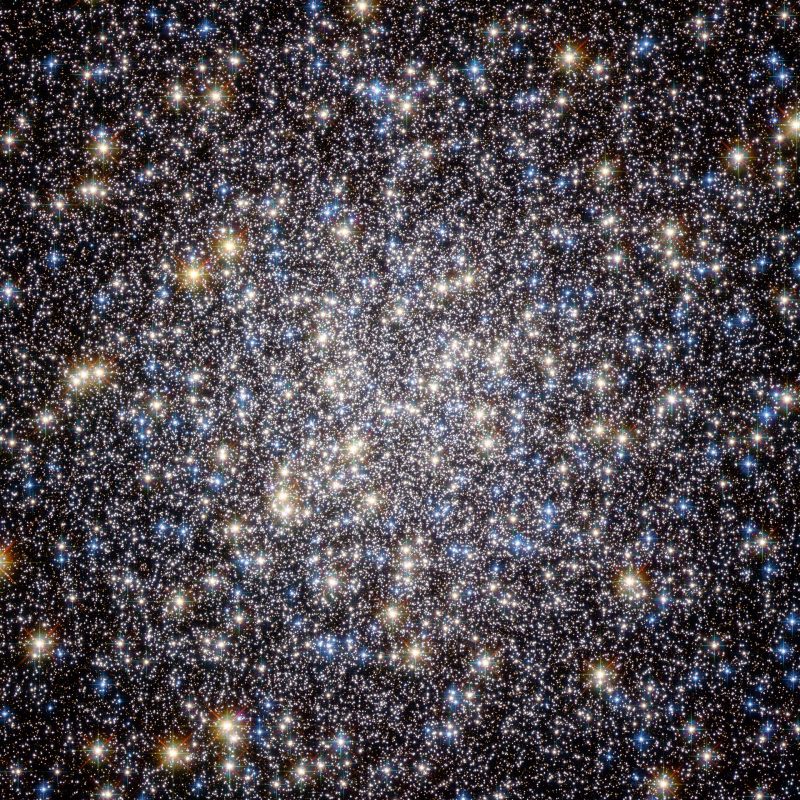
This Hubble Space Telescope image shows the core of the great globular cluster Messier 13, in the constellation Hercules.
The stars in globular clusters are the galaxy’s most ancient inhabitants, comprising a population of what astronomers call Population II stars. Those whose age has been measured are between 11 and 13 billion years old, making them almost as old as the galaxy itself. Not surprisingly, many of these ancient stars have evolved into huge, bloated red giant stars, as our sun will do in a few billion years. The stars are extremely metal-poor, which is to say – in the peculiar language of astronomy – they have tiny amounts of materials heavier than helium compared to the surrounding interstellar medium (astronomers refer to all elements heavier than helium as “metals”). Because the heavier elements are made inside stars – and then spread throughout the interstellar medium via supernova explosions – this paucity of metals is exactly what would normally be expected from such old stars. In other worlds, Population II stars consist almost exclusively of hydrogen and helium, the materials that were present in the early universe.
However, there is a mystery: globular clusters also have “abundance anomalies” of heavier metals, meaning there are elements present which are found elsewhere, in stars that formed more recently. In particular, there appears to be excesses of sodium, carbon, oxygen and aluminum, with heavier metals such as strontium, yttrium, barium and europium also being present in some clusters. These anomalies have not been satisfactorily explained, although there have been several explanations put forward, such as the early presence of supermassive stars .
The most famous globular cluster in the northern hemisphere is M13 in the constellation of Hercules, sometimes referred to as the Great Globular Cluster, which was discovered by Edmond Halley in 1714. Charles Messier later added it into his famous catalog in 1764. In amateur telescopes, it is a small fuzzy patch of light, some 22,000 light-years from Earth. At the center of this cluster, stars orbit so closely that occasionally they collide, their deaths leading to the creation of new stars known as “blue stragglers.” This stellar population is the only type of newer stars in globular clusters.
Other globular clusters of note are M22 in Sagittarius – one of the brightest in the sky – M5 in Serpens and M12 in Ophiuchus. Many of the night sky’s biggest and brightest globular clusters are best viewed on spring nights and often feature in so-called “Messier Marathons.”
Globular clusters are a wonderful sight in even the smallest telescopes, although a large instrument is needed to resolve individual stars towards their centers.
When you look at them, you are seeing populations of stars born in our galaxy’s infancy!
Amateur astronomers enjoy peering at globular clusters through their small telescopes. Here is Omega Centauri, captured by Greg Hogan in Kathleen, Georgia. Thanks, Greg!
Bottom line: Globular clusters are spherical collections of up to perhaps a million stars, orbiting mostly in the star halo of spiral galaxies and containing some of a galaxy’s oldest stars.
Juno arrived at Jupiter in 2016. It’s in a 53-day orbit around the planet. Close sweeps past the planet are called “perijoves” (peri means “near”). Here are some spectacular images from the most recent sweep, Perijove 25, in February.
Jupiter at mid-northern latitudes as seen by Juno during Perijove 25. The small, round, swirly spots are storms in Jupiter’s atmosphere.
Image via NASA/ JPL-Caltech/ SwRI/ MSSS/ Kevin M. Gill.
The Juno mission to Jupiter has been orbiting the giant planet since 2016, and NASA has made the raw images from Juno’s camera available to the public for processing. Click here if you want to help. Juno has a 53-day orbit around Jupiter, and close passes of the planet are called perijoves, from the Greek wordperi meaning near. Images are now coming in from Juno’s most recent close sweep past the planet, Perijove 25, on February 17, 2020. We’ve also included some images on this page from the next-to-last sweep past Jupiter (Perijove 24) on December 26, 2019.
Jupiter as seen from the south, also from Perijove 25.
Image via NASA/ JPL-Caltech/ SwRI/ MSSS/ Kevin M. Gill.
Brian Swift processed the video below, using imagery from the JunoCam instrument during Perijove 25.
The best place to see the latest processed images from Juno is probably Twitter. Follow the three people below, who are active in image processing.
Kevin M. Gill@kevinmgill
Fisheye view of Jupiter at mid-northern latitudes, @NASAJuno Perijove 25
A mosaic from @NASAJuno images PJ25_25 and PJ25_27 obtained on Feb 17, 2020. Approx true color/contrast and enhanced versions. The oval left of center is known as NN-WS-4. It is about 7000 km long in the east-west direction and is at planetographic latitude ~42 degrees north.
Here’s a mosaic of images of Jupiter, processed and assembled by Brian Swift from Perijove 24. He labeled this as a “collage [with] exaggerated contrast/color.”
Image via NASA/ JPL-Caltech/ SwRI/ MSSS/ Brian Swift.
And here’s a cool image to end on, processed by citizen scientist Tanya Oleksuik and released by NASA on March 2, 2020. It’s from the second-to-last close sweep past Jupiter by Juno, in December 2019 (Perijove 24). Tanya created this color-enhanced image using data from the JunoCam camera.
See the 2 white ovals merging, within the orange-colored band? NASA’s Juno spacecraft caught these 2 storms in the act of merging on December 26, 2019, a few days after a close flyby of the planet (Perijove 24). The 2 merging white ovals are anticyclones; they rotate counter-clockwise. The larger of the ovals has been tracked for many years, as it grew in size through mergers with other anticyclonic white ovals on Jupiter.
Bottom line: Newly processed images from the days around the Juno spacecraft’s most recent low pass over the planet – called a “perijove” – on December 17, 2019.
This article was originally published on The Conversation.
Last week, scientists announced the discovery of Kepler-186f, a planet 492 light years away in the Cygnus constellation. Kepler-186f is special because it marks the first planet almost exactly the same size as Earth orbiting in the “habitable zone” – the distance from a star in which we might expect liquid water, and perhaps life.
What did not make the news, however, is that this discovery also slightly increases how much credence we give to the possibility of near-term human extinction. This because of a concept known as the Great Filter.
The Great Filter is an argument that attempts to resolve the Fermi Paradox: why have we not found aliens, despite the existence of hundreds of billions of solar systems in our galactic neighborhood in which life might evolve? As the namesake physicist Enrico Fermi noted, it seems rather extraordinary that not a single extraterrestrial signal or engineering project has been detected (UFO conspiracy theorists notwithstanding).
This apparent absence of thriving extraterrestrial civilizations suggests that at least one of the steps from humble planet to interstellar civilization is exceedingly unlikely. The absence could be caused because either intelligent life is extremely rare or intelligent life has a tendency to go extinct. This bottleneck for the emergence of alien civilizations from any one of the many billions of planets is referred to as the Great Filter.
Are We Alone? What exactly is causing this bottleneck has been the subject of debate for more than 50 years. Explanations could include a paucity of Earth-like planets or self-replicating molecules. Other possibilities could be an improbable jump from simple prokaryotic life (cells without specialized parts) to more complex eukaryotic life – after all, this transition took well over a billion years on Earth.
Proponents of this “Rare Earth” hypothesis also argue that the evolution of complex life requires an exceedingly large number of perfect conditions. In addition to Earth being in the habitable zone of the sun, our star must be far enough away from the galactic centre to avoid destructive radiation, our gas giants must be massive enough to sweep asteroids from Earth’s trajectory, and our unusually large moon stabilizes the axial tilt that gives us different seasons.
These are just a few prerequisites for complex life. The emergence of symbolic language, tools and intelligence could require other such “perfect conditions” as well.
Or Is the Filter Ahead of Us? While emergence of intelligent life could be rare, the silence could also be the result of intelligent life emerging frequently but subsequently failing to survive for long. Might every sufficiently advanced civilization stumble across a suicidal technology or unsustainable trajectory? We know that a Great Filter prevents the emergence of prosperous interstellar civilizations, but we don’t know whether or not it lies in humanity’s past or awaits us in the future.
For 200,000 years humanity has survived supervolcanoes, asteroid impacts, and naturally occurring pandemics. But our track record of survival is limited to just a few decades in the presence of nuclear weaponry. And we have no track record at all of surviving many of the radically novel technologies that are likely to arrive this century.
Esteemed scientists such as Astronomer Royal Martin Rees at the Cambridge Center for the Study of Existential Risk point to advances in biotechnology as being potentially catastrophic. Others such as Stephen Hawking, Max Tegmark and Stuart Russell, also with the Cambridge Center, have expressed serious concern about the exotic but understudied possibility of machine superintelligence.
Let’s Hope Kepler-186f is Barren When the Fermi Paradox was initially proposed, it was thought that planets themselves were rare. Since then, however, the tools of astronomy have revealed the existence of hundreds of exoplanets. That just seems to be the tip of the iceberg.
But each new discovery of an Earth-like planet in the habitable zone, such as Kepler-186f, makes it less plausible that there are simply no planets aside from Earth that might support life. The Great Filter is thus more likely to be lurking in the path between habitable planet and flourishing civilization.
If Kepler-186f is teeming with intelligent life, then that would be really bad news for humanity. For that fact would push back the Great Filter’s position further into the technological stages of a civilization’s development. We might then expect that catastrophe awaits both our extraterrestrial companions and ourselves.
In the case of Kepler-186f, we still have many reasons to think intelligent life might not emerge. The atmosphere might be too thin to prevent freezing, or the planet might be tidally locked, causing a relatively static environment. Discovery of these hostile conditions should be cause for celebration. As philosopher Nick Bostrom once said:
The silence of the night sky is golden … in the search for extraterrestrial life, no news is good news. It promises a potentially great future for humanity.
Organic Molecules Found on Mars Could Have a Biological Origin, Study Shows
MICHELLE STARR
New analysis of organic molecules found in dried-up Martian mud in the Gale Crater has revealed an intriguing possibility. Scientists have concluded that we can't rule out those molecules actually have a biological origin.
NASA's Curiosity rover took this selfie in 2019.
NASA/JPL-Caltech/MSSS/Kevin M. Gill
Although our understanding of the Martian molecules is limited and incomplete, the information we do have could be consistent with life on the Red Planet billions of years ago.
The molecules were actually extracted by the Curiosity rover from a mudstone section of the Gale Crater called the Murray Formation; a study on the finding was published in 2018. The initial experiments revealed a number of molecules, including a group of aromatic compounds called thiophenes.
Here on Earth, these compounds are usually found in some pretty interesting places. They show up in crude oil - made of compressed and superheated dead organisms such as zooplankton and algae; and coal - made of compressed and superheated dead plants.
The compound is thought to form abiotically - that is, through a physical process, not a biological one - when sulphur reacts with organic hydrocarbons at temperatures greater than 120 degrees Celsius (248°F), a reaction called thermochemical sulphate reduction (TSR).
However, while this reaction is abiotic, the hydrocarbons and sulphur can both be of biological origin. So, researchers set out to investigate how thiophenes could have formed on Mars.
"We identified several biological pathways for thiophenes that seem more likely than chemical ones, but we still need proof," said astrobiologist Dirk Schulze-Makuch of Washington State University.
"If you find thiophenes on Earth, then you would think they are biological, but on Mars, of course, the bar to prove that has to be quite a bit higher."
There are a number of ways thiophenes could have emerged on Mars without necessitating the presence of life. For instance, thiophenes have been detected in meteorites; so extramartian rocks could have carried the molecules in.
Geological processes can also produce the heat necessary for TSR, especially back when Mars was volcanically active; and volcanic activity, of course, also produces sulphur.
But there's something interesting about the Martian thiophenes. The processes described above require the sulphur to be nucleophilic, that is, the sulphur atoms donate electrons to form a bond with their reaction partner. Yet most of the sulphur on Mars exists as non-nucleophilic sulphates.
These can be reduced to nucleophilic sulphides via TSR. But there's another possibility, too - biological sulphate reduction (BSR). Some bacteria - and white truffles, too, actually, although you probably won't find those on Mars - can synthesise thiophenes.
So it's possible that when Mars was a warmer, wetter place than it is today, around 3 billion years ago, that bacterial colonies existed, and produced the thiophenes. This could occur even in below-zero temperatures. Then, when Mars dried up, the thiophenes were left there for Curiosity to dig out of the mudstone all these years later.
Sadly, the sample was a bit damaged. Curiosity uses an analysis technique called pyrolysis that heats the samples to over 500 degrees Celsius. So there's a limit to the knowledge we can glean from what survived.
But the Rosalind Franklin rover, scheduled for launch in July, will have on board an instrument that is much less destructive. So any thiophenes it digs out of the ground may be more intact when analysis is applied.
In addition, the carbon and sulphur isotopes could be revealing, too. That's because living organisms prefer lighter isotopes; if the thiophenes contain lighter isotopes, that could weight the evidence towards biological processes too.
Sadly, we probably won't know for sure based on just what our robotic friends can dig out of the ground.
"As Carl Sagan said 'extraordinary claims require extraordinary evidence'," Schulze‑Makuch said.
"I think the proof will really require that we actually send people there, and an astronaut looks through a microscope and sees a moving microbe."
Two galaxy clusters collided to create the “Bullet Cluster,” shown here. Normal matter is shown in pink and the rest of the matter is illustrated in blue, revealing that dark matter dominates this enormous cluster.
(Credit: X-ray: NASA/CXC/CfA/M.Markevitch et al.; Optical: NASA/STScI; Magellan/U.Arizona/D.Clowe et al.; Lensing Map: NASA/STScI; ESO WFI; Magellan/U.Arizona/D.Clowe et al.)
Most of our universe is hidden in plain sight. Though we can’t see or touch it, most astronomers say the majority of the cosmos consists of dark matter and dark energy. But what is this mysterious, invisible stuff that surrounds us? And what’s the difference between dark energy and dark matter? In short, dark matter slows down the expansion of the universe, while dark energy speeds it up.
Dark matter works like an attractive force — a kind of cosmic cement that holds our universe together. This is because dark matter does interact with gravity, but it doesn’t reflect, absorb or emit light. Meanwhile, dark energy is a repulsive force — a sort of anti-gravity — that drives the universe’s ever-accelerating expansion.
Dark energy is the far more dominant force of the two, accounting for roughly 68 percent of the universe’s total mass and energy. Dark matter makes up 27 percent. And the rest — a measly 5 percent — is all the regular matter we see and interact with every day
Dark matter cannot be photographed, but researchers can detect it and map it by measuring gravitational lensing. Its distribution is shown here in the blue overlay of the inner region of Abell 1689, a cluster of galaxies 2.2 billion light-years away.
(Credit: NASA/ESA/JPL-Caltech/Yale/CNRS)
Dark Matter
In the 1930s, Swiss-born astronomer Fritz Zwicky studied images of the roughly 1,000 galaxies that make up the Coma Cluster — and he spotted something funny about their behavior. The galaxies moved so fast that they should simply fly apart. He speculated that some kind of “dark matter” held them together.
Decades later, astronomers Vera Rubin and Kent Ford found a similar phenomenon when they studied the rotation rates of individual galaxies. The stars at a galaxy’s outer edge should circle slower than stars near the center. That’s the way planets in our solar system orbit. Instead, they noticed that the stars on a galaxy’s outskirts orbit just as fast — or faster — than the stars closer in. Rubin and Ford had found more evidence that some invisible form of matter is apparently holding the universe together.
“Even stars at the periphery are orbiting at high velocities,” Rubin once explained in an interview with Discover. “There has to be a lot of mass to make the stars orbit so rapidly, but we can’t see it. We call this invisible mass dark matter.”
The left galaxy rotates how astronomers would have expected if dark matter didn’t exist. The galaxy on the right reflects what their telescopes actually reveal. (Credit: Wikimedia Commons)
Astronomers now have many other lines of evidence that suggest dark matter is real. In fact, the existence of dark matter is so widely accepted that it’s part of the so-called standard model of cosmology, which forms the foundation of how scientists understand the universe’s birth and evolution. Without it, we can’t explain how we got here.
But that lofty status puts pressure on cosmologists to find definitive proof that dark matter exists and that their model of the universe is correct. For decades, physicists all over the world have employed increasingly high-tech instruments to try and detect dark matter. So far, they’ve found no signs of it.
A wide view of the local universe, spanning hundreds of millions of light-years, reveals the clumped and weblike structure of the cosmos, with strands of galaxies and immense voids. The Milky Way is just one of many points that make up the Virgo Supercluster. Rather than just empty, passive spaces, voids may hold clues to understanding dark matter, dark energy and galactic evolution.
Astronomers have known that our universe is expanding for about a century now. Telescopic observations have shown that most galaxies are moving away from each other, which implies the galaxies were closer together in the distant past. As a result, the evidence piled up for the Big Bang. However, astronomers assumed that the combined gravitational pull of all the cosmos’ stars and galaxies should be slowing down the universe’s expansion. Perhaps it would even someday collapse back in on itself in a Big Crunch.
That notion was thrown out in the late 1990s, however, when two teams of astronomers spotted something that didn’t make any sense. Researchers studying supernovas in the the most distant galaxies discovered that distant galaxies were moving away from us faster than nearby galaxies. The universe wasn’t just expanding — the expansion was speeding up.
“My own reaction is somewhere between amazement and horror,“ astronomer Brian Schmidt, who led one of the two teams, told The New York Times in 1998. “Amazement, because I just did not expect this result, and horror in knowing that it will likely be disbelieved by a majority of astronomers — who, like myself, are extremely skeptical of the unexpected.“
(Credit: Roen Kelly/Discover)
But rather than refute it, subsequent observations have only made the evidence for dark energy more robust. In fact, some prominent critics of dark matter still accept the existence of dark energy.
Now, that doesn’t mean researchers know what dark energy is. Far from it. But they can describe its role in the universe, thanks to Albert Einstein’s theory of general relativity. Einstein didn’t know about dark energy, but his equations suggested new space can come into existence. And he also included a fudge factor in relativity called the cosmological constant, which he added — and later regretted — to keep the universe from collapsing inward. This idea allows space itself to have energy. However, scientists have still never actually seen this force on Earth.
Some theoretical physicists think there’s an entire dark realm of particles and forces out there, just waiting to be discovered. Whatever dark energy and dark matter are made of, they seem to be playing tug-of-war with our universe — both holding it together and pulling it apart.
On February 6, weather stations recorded the hottest temperature on record for Antarctica, 64.9°F (18.3°C). The warm spell caused widespread melting on nearby glaciers
These images show melting on the ice cap of Antarctica’s Eagle Island. They were acquired by NASA’S Landsat 8 satellite on February 4 and February 13, 2020.
On February 6, 2020, weather stations recorded the hottest temperature on record for Antarctica. Thermometers at the Esperanza Base on the northern tip of the Antarctic Peninsula reached 18.3°C (64.9°F) – around the same temperature as Los Angeles that day. The warm spell caused widespread melting on nearby glaciers.
The warm temperatures arrived on February 5 and continued until February 13, 2020.
Mauri Pelto, a glaciologist at Nichols College, observed that during the warming event, around .9 square miles (1.5 square km) of snowpack became saturated with meltwater (shown in blue above). According to climate models, Eagle Island experienced peak melt – 1 inch (30 millimeters) – on February 6. In total, snowpack on Eagle Island melted 4 inches (106 millimeters) from February 6-February 11. About 20 percent of seasonal snow accumulation in the region melted in this one event on Eagle Island.
The heat is apparent on this map, which shows temperatures across the Antarctic Peninsula on February 9, 2020. The map was derived from the Goddard Earth Observing System (GEOS) model, and represents air temperatures at 2 meters (about 6.5 feet) above the ground. The darkest red areas are where the model shows temperatures surpassing 50°F (10°C).
I haven’t seen melt ponds develop this quickly in Antarctica. You see these kinds of melt events in Alaska and Greenland, but not usually in Antarctica.
He also used satellite images to detect widespread surface melting nearby on Boydell Glacier.
Pelto noted that such rapid melting is caused by sustained high temperatures significantly above freezing. Such persistent warmth was not typical in Antarctica until the 21st century, but it has become more common in recent years.
The warm temperatures of February 2020 were caused by a combination of meteorological elements. A ridge of high pressure was centered over Cape Horn at the beginning of the month, and it allowed warm temperatures to build. Typically, the peninsula is shielded from warm air masses by the Southern Hemisphere westerlies, a band of strong winds that circle the continent. However, the westerlies were in a weakened state, which allowed the extra-tropical warm air to cross the Southern Ocean and reach the ice sheet. Sea surface temperatures in the area were also higher than average by about 2-3°C (about 3.5-5.5 F).
Dry, warm foehn winds also could have played a part. Foehn winds are strong, gusty winds that cause downslope windstorms on mountains, often bringing warm air with them. In February 2020, westerly winds ran into the Antarctic Peninsula Cordillera. As such winds travel up the mountains, the air typically cools and condenses to form rain or snow clouds. As that water vapor condenses into liquid water or ice, heat is released into the surrounding air. This warm, dry air travels downslope on the other side of the mountains, bringing blasts of heat to parts of the peninsula. The drier air means fewer low-lying clouds and potentially more direct sunlight east of the mountain range.
Rajashree Tri Datta, an atmospheric researcher at NASA’s Goddard Space Flight Center, said:
Two things that can make a foehn-induced melt event stronger are stronger winds and higher temperatures.
With warmer air in the surrounding atmosphere and ocean, the conditions were conducive this month for a foehn wind event.
This February heatwave was the third major melt event of the 2019-2020 summer, following warm spells in November 2019 and January 2020. Pelto said:
If you think about this one event in February, it isn’t that significant. It’s more significant that these events are coming more frequently.
Bottom line: In February 2020, weather stations recorded the hottest temperatures on record for Antarctica. The warm spell caused widespread melting on nearby glaciers.
Linda Moulton Howe: A Hidden Alien Language Within Binary Codes Could Reveal the ET Agenda
Linda Moulton Howe – For thousands of years a secret language may have been right under our very noses. A language that has flashed up in the minds of UFO contactees, a language that has been described by witnesses of UFO Crash debris.
A language that has been seen etched into the sides of alien crafts for over 80 years. What are these Alien Symbols and how do they aquavit to the Binary Code?
Linda Moulton Howe: A Hidden Alien Language within Binary Codes Could Reveal The ET Agenda
Advanced Ancient Civilizations That Had Abilities We Are Still Struggling To Understand
Legendary accounts tell of these feats of levitation being performed by ancient civilizations speaking “words of power” over the huge stones which moved of themselves. There are similar ancient accounts about the Egyptians and Tibetans employing similar mysterious mental levitational skills.
The easy cutting and movement of gigantic slabs of stone, and the carving of enormous statuary, were not the only strange abilities of bygone early civilizations. They possessed many amazing skills in such matters as navigation and map-making, of which a few specimens are still preserved today. The question remains, how did they get this seemingly advanced knowledge from?
Advanced Ancient Civilizations That Had Abilities We Are Still Struggling To Understand
Awesome craft moves unbelievably fast through the sky in Southern Arizona.
An awesome unidentified flying object moves unbelievably fast through the sky in Southern Arizona. The footage, captured on March 6, 2020 raises many questions about what it could have been.
It is suggested that the object is a bug of some kind flying real close to the camera but not everybody is convinced and argue that it is more likely an antigravity craft whether man-made or alien.
Another point of discussion is the vortex like cloud in the background and some people wonder if it came into our dimensional plane of existence through the vortex.
Navy Has One More Video and More Documents On The Nimitz UFO Encounter
As you may recall, the Navy released three videos of bizarre UFO encounters, involving characteristics that defy much of our understanding of physics. One was from the Nimitz aircraft carrier incident, and the others were from a much later encounter with the carrier Roosevelt. The videos were short in length and somewhat grainy. Many journalists have attempted if there’s more of those videos that are at least longer, clearer versions of the ones already made public. However, all such requests were answered in the negative.
Interestingly, researcher Christian Lambright submitted a Freedom of Information Act (FOIA) request to the Office of Naval Intelligence (ONI) in October 2019 to look for some particular details along these lines. Recently, he finally received a response. While the military did not provide him with any new videos or documents, they did concede that they have other papers and another video that would apply to his recent request. Unfortunately, they could not release the documents and video footage because they were classified top secret and secret respectively. The Navy claims that their release could cause grave damage to national security.
The new development is in contrast to what Pentagon spokesperson Susan Gough had announced. Despite testimony from several of the sailors from the Nimitz battle group who witnessed these events claiming that they remembered seeing longer videos, Ms Gough informed us on several instances that those three videos were the only ones they had and no clearer or more extended versions existed.
Now, we have the Pentagon, through Ms Gough, saying there are no more videos and we have ONI saying there’s at least one more. Somebody is lying again, as both of these things can’t be simultaneously true.
Who should we believe? Let us know in the comment section.
We're used to thinking of possible homes for life on watery worlds orbiting stars like the sun, but a new research paper has found a new potential habitat: a rocky planet orbiting just past the event horizon of a rapidly spinning supermassive black hole.
The exotic forces around that black hole are able to warm up the planet just right, but the scenario comes with a catch: the planet must orbit at nearly the speed of light.
We don't know all the possible places that life could arise in our universe, because so far we only have one example: us. And while scientists (and sci-fi authors) enjoy thinking about all sorts of exotic arrangements and possibilities for lifeforms, for serious searches of extraterrestrial intelligence, our best bet is to use our own circumstances as a template, hunting for life that isn't too dissimilar to what we find on Earth.
From that, we can draw two extremely broad requirements. One, life like our own requires liquid water. Water is the most common molecule in the universe, composed of hydrogen (element No. 1 when it comes to abundance in the cosmos) and oxygen (the byproduct of fusion reactions inside stars like our sun, making it also very common). But that water is usually either vaporized into a plasma (and hence very bad for life) or locked down in its solid, frozen state as ice (also not very good for life).
The liquid stuff is harder to come by, and requires a source of heat that isn't so hot that water just evaporates. We've found this perfect balance in only two kinds of locations: the so-called "habitable zone" of stars, a band of orbits where the light output it just right; and buried underneath the icy crusts of certain moons of the outer planets in our solar system, where tidal heating generates the necessary energy.
But just raw heat isn't enough. Life is a complex process that uses energy to do interesting things (like move around, eat and reproduce). All those processes are not perfectly efficient, so they generate waste heat. This waste heat must be dumped safely away from the environment; otherwise, you end up with nightmare greenhouse scenarios, with temperatures escalating to uncontrolled levels and killing off any life that got started.
On the Earth, we dump our waste heat into the vacuum of space itself in the form of infrared radiation. This contrast, between a source of energy and a place to put all the waste, enables life to flourish on our home planet, and presumably any other planet with a similar setup.
At first glance, black holes appear to be the least inviting homes for any potential lifeforms. After all, they are objects made of pure gravity, pulling in anything that gets too close beneath their event horizons, shutting them off from further contact with the rest of the universe forever. Nothing, not even light, can escape their gravitational maw.
Black holes don't give off light themselves — they're black, after all — but that inescapable gravity can provide a surprise, unique to them throughout the cosmos.
Permeating the universe is something called the cosmic microwave background (CMB). The CMB is the leftover radiation from when the universe was just a baby, only 380,000 years old. It is, by far, the greatest source of radiation in the entire cosmos, easily swamping all the stars and galaxies by many orders of magnitude. The reason you don't see it is that it's primarily in the microwave region of the electromagnetic spectrum (hence the name).
In other words, the CMB is cold, with a temperature just about 3 degrees above absolute zero.
But as that CMB light falls into a black hole, it becomes blueshifted, bumped to higher and higher energies from the extreme gravity. Just before it hits the event horizon, CMB light can gain so much energy that it shifts into infrared, visible and even ultraviolet portions of the spectrum.
In other words, near a black hole, the CMB stops being cold, and gets very, very hot.
What's more, if the black hole is spinning, it's able to focus the light into a narrow beam, making the CMB appear as a single spot on the sky. Kind of like a sun.
Goldilocks
So if you're able to get close enough to a black hole, you'll find yourself surprisingly warm, and if you're a planet, you might just find your water ice converted into liquid water oceans — a potential home for life.
But for life to thrive, it also needs a heat sink, which can handily be provided by the black hole itself. Close to the black hole, gravitational distortions enlarge the appearance of the event horizon, swelling it far larger than you might naively think.
Close enough to the black hole (say, at a radius less than 1% above the event horizon), the hot CMB shrinks to fill only a small disk, while the event horizon swells to cover 40% of the sky. If your planet is rotating, you then have a "sun" and a "night" — and life has everything it needs to do its business.
But orbits at this radius are usually extremely unstable, prone to just falling all the way into the terrible blackness itself. Recently, a team of researchers published an analysis in The Astrophysical Journal, exploring this scenario to see if there was any way to stabilize the situation.
And they found a way to make it work. If the black hole is big, at least 1.6x10⁸ times the mass of the sun, and rapidly spinning, then it hosts a "habitable zone" just barely above the event horizon, where the CMB light peaks in the UV part of the spectrum — hot, but not terrible. Any closer and the planet would be destroyed by extreme gravitational forces, and any farther and the CMB would be too cold. But in that narrow band? Just right.
Though this scenario is possible, it wouldn't be very pretty. The planet would have to orbit at nearly the speed of light, experiencing a time dilation factor of thousands — meaning that for every second that goes by on that world, hours would slide by for us. And who knows if a planet could even find its way that close to a black hole while still surviving.
Still, the work shows that we have to keep our minds open when it comes to potential homes for life, up to and including some of the most terrible environments in the universe.
NASA's next Mars rover — a life-hunting, sample-caching robot scheduled to launch this summer — is officially called Perseverance, agency officials announced today (March 5).
The new name suits the car-size rover and its groundbreaking mission nicely, NASA officials said.
"There has never been exploration — never, never been making history — without perseverance," Thomas Zurbuchen, associate administrator of NASA's Science Mission Directorate, said during a name-unveiling ceremony today.
"Perseverance is a strong word," he added. "It's about making progress despite obstacles."
The kids are all right
Artist's illustration of NASA's 2020 Mars rover, now officially known as Perseverance, on the Red Planet. (Image credit: NASA/JPL-Caltech)
Like all of NASA's previous Mars rovers, Perseverance was named via a nationwide student competition. The contest kicked off last year and drew 28,000 essay submissions from K-12 students, NASA officials said.
This huge initial pool was culled to 155 semifinalists, which were whittled further to nine finalists this past January. Those nine included three proposals from each of the three age categories (grades K-4, 5-8 and 9-12). The finalist monikers, and the kids who proposed them, were:
Endurance, K-4, Oliver Jacobs of Virgina.
Tenacity, K-4, Eamon Reilly of Pennsylvania.
Promise, K-4, Amira Shanshiry of Massachusetts.
Perseverance, 5-8, Alexander Mather of Virginia.
Vision, 5-8, Hadley Green of Mississippi.
Clarity, 5-8, Nora Benitez of California.
Ingenuity, 9-12, Vaneeza Rupani of Alabama.
Fortitude, 9-12, Anthony Yoon of Oklahoma.
Courage, 9-12, Tori Gray of Louisiana.
NASA encouraged the public to vote for their favorite of these final nine, but the decision ultimately was made by Zurbuchen.
As the proposer of the winning name, Mather, a seventh grader at Lake Braddock Secondary School in Burke, Virginia, will get a free trip to Cape Canaveral, Florida, to watch Perseverance launch in July.
Mather read his winning essay during today's event and said he has a love of space and science that he plans to carry through his entire life.
"I want to go to college, get a degree in some form of engineering or science — space engineering and astronautics sound good right now," he said today. "And then, after that, go work at NASA as an engineer."
Looking for signs of life
Perseverance will land inside Mars' 28-mile-wide (45 kilometers) Jezero Crater in February 2021, kicking off a $2.5 billion mission to search for signs of ancient Red Planet life — the first time a NASA surface craft has actively hunted for possible Martians since the twin Viking landers did so from the mid-1970s through the early 1980s.
Jezero is a great place to do this work, NASA officials have stressed. The crater harbored a lake and a river delta billions of years ago, meaning that life could have both flourished there and left lasting evidence of its existence. (Here on Earth, river deltas are great at preserving biosignatures, mission team members have said.)
The rover will look for signs of life on-site, using its powerful seven-instrument suite. But Perseverance will also collect and cache several dozen samples of pristine, promising Mars material for future return to Earth, where scientists can continue the hunt using advanced equipment in labs around the world. Those samples could be here as early as 2031, if all goes according to plan.
Perseverance will do a variety of other work as well, from characterizing Jezero's geology to helping pave the way for human exploration of Mars, which NASA aims to achieve in the 2030s. For example, the rover has a ground-penetrating radar instrument that will look for deposits of subsurface water ice — a valuable resource for astronaut pioneers. And another instrument will demonstrate the production of oxygen from the thin, carbon dioxide-dominated Martian atmosphere.
That's not the only technology demonstration flying on the mission. Perseverance is also carrying a small helicopter scout, which will make brief sorties to show that rotorcraft can indeed explore the Red Planet air.
Perseverance also has 23 cameras and two microphones, potentially allowing us to hear the sounds of Mars for the first time ever. (Two previous NASA Mars craft, the Mars Polar Lander and the Phoenix lander, also carried microphones. But the Mars Polar Lander crashed, and Phoenix's microphone was never turned on.)
NASA has let schoolkids name all of its Red Planet rovers to date.
NASA's first-ever wheeled Mars explorer, Sojourner, was deployed from the Pathfinder lander in July 1997. Sojourner was named by Connecticut 12-year-old Valerie Ambroise in honor of 19th-century abolitionist and activist Sojourner Truth.
Sofi Collis, a third grader from Arizona, won the competition to name Spirit and Opportunity, twin NASA rovers that landed on Mars three weeks apart in January 2004. And the car-size Curiosity rover, which has been exploring the Red Planet's Gale Crater since August 2012, was named by Kansas sixth grader Clara Ma.
Perseverance's body is modeled on that of Curiosity, and the new rover will employ the same sky-crane descent and landing system as its predecessor. And the link between the two missions goes deeper than that; Perseverance aims to extend work done by Curiosity, which determined that Gale Crater was capable of supporting Earth-like life long ago.
Zurbuchen acknowledged the ties between the two missions and stressed that their names go together well, too.
"Perseverance and curiosity together are what exploration is all about," he said.
After a national contest, NASA’s next Mars rover has an official name: Perseverance.
Until now, NASA has simply called Perseverance the Mars 2020 rover, which stuck out next to past rovers with inspiring names like Spirit, Opportunity, and Curiosity. Like Perseverance, those rovers were also named by the winners of student contests, according to a Jet Propulsion Laboratory press release — a longstanding effort to keep the public engaged with the space agency’s exploration missions.
Wherefore Art
When it launches later this year, Perseverance will scan Mars for signs of past and present life while also studying the planet’s environment and geochemistry. And Thomas Zurbuchen, associate administrator of NASA’s Science Mission Directorate, said that contest winner and seventh-grader Alexander Mather picked a name that encapsulated those challenges.
“Alex’s entry captured the spirit of exploration,” Zurbuchen said in the release. “Like every exploration mission before, our rover is going to face challenges, and it’s going to make amazing discoveries. It’s already surmounted many obstacles to get us to the point where we are today — processing for launch.”
Honorable Mentions
When Perseverance reaches Mars, it will not only carry scientific instruments but also over 100 of the names suggested for the contest.
“All 155 semifinalists’ proposed rover names and essays have been stenciled onto a silicon chip with lines of text smaller than one-thousandth the width of a human hair,” Lori Glaze, director of NASA’s Planetary Science Division said in the release, “and will be flown to Mars aboard the rover.”
In a move that surely must have frustrated the hundreds, if not thousands, of people pouring over databases full of old Martian satellite images and rover photographs for signs of life, NASA posted an unusual shot on its “Astronomy Picture of the Day” blog of a really strange-looking hole on the side of a Red Planet volcano with a caption that readily admits it could contain life forms. (Image above. Credit: NASA.) All we need is someone or some rover to creep up to the edge and peek in. Any volunteers? Anyone? Bueller?
“Holes such as this are of particular interest because their interior caves are relatively protected from the harsh surface of Mars, making them relatively good candidates to contain Martian life. These pits are therefore prime targets for possible future spacecraft, robots, and even human interplanetary explorers.”
On March 1, 2020, NASA’s pic of the day was a hole photographed in 2011 by the HiRISE instrument on the Mars Reconnaissance Orbiter. Located on a slope of the Pavonis Mons volcano, the opening measures 35 meters (115 feet) across and the hole, based on the angle of its shadow, measures at least 20 meters (65.5 feet) deep. If Pavonis Mons sounds familiar, the volcano is the subject of the Flaming Lips instrumental song “Approaching Pavonis Mons by Balloon (Utopia Planitia)” on the album Yoshimi Battles the Pink Robots, which later was made into a Broadway musical by The West Wing creator Aaron Sorkin. Is NASA hinting that there might be pink robots in this hole? Or perhaps it’s a space elevator to Deimos, the smaller moon of Mars, as depicted in Buck Rogers in the 25th Century. Or is NASA hiding something else … in plain sight?
Pavonis Mons is a giant shield volcano made from stacks of overlapping lava flows that measures 8.7 miles high — taller than Mt. Everest. A digital model shows a pile of debris inside the hole, indicating it was once as deep as 295 feet. That makes the hole deeper than most caves on Earth. If early humans lived in caves, why not Early Martians? Or current Martian life forms?
“These results have important implications for habitability and human exploration of the moon but also for the search for extra-terrestrial life on Mars. Lava tubes are environments shielded from cosmic radiation and protected from micrometeorites, potentially providing safe habitats for future human missions. They are also, potentially, large enough for quite significant human settlements.”
Riccardo Pozzobon from the University of Padova, Italy, agrees. In a study conducted in 2017, he and other scientists compared volcanic lava tubes on Earth in Hawaii, Iceland, and the Galapagos Islands to those seen on the Moon and Mars. On the Moon, some are 1 km (0.6 miles) across and hundreds of kilometers in length. Both these and the smaller ones on Mars are big enough for future human settlements and possibly past or current extraterrestrial life.
Another view of pavonis mons
(NASA)
We may soon find out. The Mars 2020 rover is scheduled to launch on July 17 and land on February 18, 2021, with the mission to search for signs of life. Unlike other rovers, this one will carry a helicopter – perfect for flying over and perhaps even flying into the hole on Pavonis Mons.
Maybe The Flaming Lips should head back to the studio and begin working on some lyrics to “Approaching Pavonis Mons by Balloon (Utopia Planitia)” about approaching it by helicopter or on wheels.
APIngenieurs van NASA met rover 'Perseverance' in het Jet Propulsion Laboratory in Pasadena, Californië.
WETENSCHAP & PLANEETDe eerstvolgende robotjeep die de NASA naar Mars zal sturen krijgt de naam Perseverance (“Volharding”). Dat heeft het Amerikaanse ruimtevaartbureau NASA donderdag (plaatselijke tijd) bekendgemaakt.
De Perseverance moet op zoek gaan naar sporen van vroeger microbiologisch leven, en zal ook het klimaat en geologie van de rode planeet onderzoeken.
De nieuwe verkenner is de opvolger van de Curiosity uit 2012, die nog altijd rondtoert op Mars. Het nieuwe voertuig heeft zeven nieuwe instrumenten aan boord, laten de ingenieurs van het Jet Propulsion Laboratory van NASA weten. De nieuwe instrumenten zullen het terrein van Mars bestuderen en in bodemstalen op zoek gaan naar tekenen van leven.
“Wat we zullen leren uit de stalen die tijdens deze nieuwe missie zullen genomen worden, heeft het potentieel om een antwoord te geven op de vraag of we alleen zijn in het universum”, stelde Ken Farley, die als wetenschapper betrokken is bij het project, eerder.
Voor de nieuwe verkenner ontwikkelde NASA ook een nieuwe landingstechnologie waarmee het voertuig plekken op Mars zal kunnen bezoeken die te riskant waren voor Curiosity.
AFPBedoeling is in juli te vertrekken, om in februari neer te strijken op Mars.
De naam werd aangereikt door een scholier uit Virigina die een landelijke wedstrijd heeft gewonnen om de Marsverkenner te dopen. Totnogtoe ging die met de droge naam ‘Mars 2020’ door het leven. Bedoeling is in juli te vertrekken, om in februari neer te strijken op Mars.
Er waren 28.000 deelnames aan de wedstrijd. De winnende scholier krijgt nu een uitnodiging om op Cape Canaveral in Florida de lancering bij te wonen.
Eerder vonden scholieren voor Amerikaanse Marsjeeps al namen uit zoals Sojourner, Spirit, Opportunity en Curiosity. Die laatste nam onlangs nog de scherpste panoramafoto van Mars ooit.
Bewijs voor mysterieuze wereldomvattende beschaving die aarde beheerste? 250+ verbluffende foto’s
Volgens Jimmy van het populaire YouTube-kanaal Bright Insight leefde er duizenden jaren geleden een mysterieuze wereldomvattende beschaving op aarde.
Hoe kan het dat de tempels van de Inca’s en de Maya’s in Midden- en Zuid-Amerika, en de piramides van de Egyptenaren – beschavingen die helemaal geen contact met elkaar gehad zouden hebben – zoveel overeenkomsten vertonen?
Jimmy heeft een video gemaakt waarin hij aan de hand van meer dan 250 foto’s laat zien hoezeer oude bouwwerken van over de hele wereld op elkaar lijken.
De foto’s tonen volgens hem dat er veel is wat we niet weten over ons verleden.
Begrafenismaskers
Gouden begrafenismaskers zijn bijvoorbeeld niet alleen gevonden in Egypte, maar ook in Peru en Griekenland, waar overigens ook piramides zijn ontdekt.
De caduceus, de herautenstaf, is gevonden in drie culturen, te weten de Indiase, Soemerische en Griekse.
In Chachapoyas in het noorden van Peru zijn beelden ontdekt die heel erg doen denken aan de moai-beelden op Paaseiland.
Veelhoekige stenen
Soortgelijke beelden zijn aangetroffen in Bolivia, Turkije en Indonesië.
Vrijwel identieke muren bestaande uit veelhoekige stenen zijn te vinden in Peru, Japan, Egypte, Turkije, Griekenland, Italië en op Paaseiland.
Billy Meier Prophecies! Real or Fake UFO's? The Controversial Story
We enter 2020 with an explosive, intense, dynamic and fascinating interview-conversation with UFO Researcher, Author, Lecturer, Documentary Filmmaker and the English-speaking representative for the controversial reclusive Swiss UFO photographer and Alien contactee – BILLY MEIER! Michael Horn is interviewed by AOT TV´s Lucas Alexander in this compelling and controversial edition of Age Of Truth TV. IS BILLY MEIER A FRAUD OR IS HE REAL? Who is Billy Meier really, and if his extraordinary story and photographic evidence is real, how come HE WAS CHOSEN to predict prophecies of world events and disasters to come, told by his alien contacts from the Pleiadian Star System? Why was Billy Meier “allowed” to take all these numerous photographs of UFO crafts? Is he in fact linked to the deep-state military – or the New World Order power-elite?
Michael Horn is calling the Billy Meier case, the ONLY authentic UFO case with real evidence! He has spent 40 year researching the Billy Meier case, and become very controversial in the field of UFOlogy and amongst researchers into Alien, E.T. existence on planet Earth and all over the universe. Michael Horn claims that Billy Meier, through his E.T. contacts have given warnings about man-made Climate Change as early as 1951, and many times thereafter, and he claims that Climate Change is very much man-made. This is leading the conversation into an interesting area, discussing The Club of Rome, New World Order plans and U.N. Agenda 21 and much more. In 2004, after 25 years of research into Meier’s information, Michael Horn became the voluntary Authorized American Media Representative for the Billy Meier Contacts. Michael gives national and international multi-media presentations, university lectures, interviews, etc., and makes frequent media appearances representing the Meier contacts
…. SELECTED TOPICS DISCUSSED: – IS BILLY MEIER REAL OR A FRAUD? – Did Billy Meier take all the numerous photographs of REAL UFO´s from elsewhere in the universe, Alien crafts, or could they be man-made advanced military technology? – Is Billy Meier a TRUE Alien contactee, and a chosen prophet, or is he part of a military cover-up, promoting a secret New World Order agenda plan?
- Is Climate Change really man-made, or is there an agenda behind the massive media propaganda about Global Warming, through f.ex. Greta Thunberg. – U.N. Agenda 21 – New World Order – The DARK ORDER (aka. Illuminati) – The Club Of Rome – Prophecies from Billy Meier about world catastrophes. – UFO researchers/ UFO community vs. Billy Meier and Michael Horn. – 5G roll-out and the danger of electromagnetic radiation and frequencies. – REINCARNATION! Is it a soul-trap? ……all this and much much more when AGE OF TRUTH TV presenter and investigative reporter, Lucas Alexander is interviewing Michael Horn in this hard-talk explosive 2 hour 22 min. show. Filmed on December 5, 2019 at the Age Of Truth TV studios in Copenhagen, Denmark, and via ZOOM to Flagstaff Arizona, USA.
On February 20, 20202 we reported about the strange space vehicles that seemed to appear out of flashes of light.
Now, more of these strange lights have been captured on the ISS live feed the last days.. Could it be that these flashes are jumpgates or wormholes from which UFOs emerge? And as said before, what could be reason for their arrival?
The enlarged images show unidentified flying objects coming out of these flashes. Even in some images you can see a sort of portal.
“I Have Seen the Bodies.” Cases from the Crash Retrieval Vault. Richard Dolan Intelligent Disclosure
Richard and Tracey return to the astonishing and all-too-forgotten cases of the late Leonard Stringfield, the pioneer of UFO/UAP crash retrieval research. For this program, they discuss three more cases uncovered by Stringfield during the late 1970s, when this phenomenon was only just beginning to be discussed among UFO researchers. The cases are fairly detailed, fascinating, and compelling.
An international team of astrobiologists claim that organic molecules discovered by NASA’s Curiosity Mars rover could be evidence of life on Mars.
In a paper published in the journal Astrobiology, the team argues that the presence of “thiophenes,” which are special compounds found in coal, crude oil and white truffles back on Earth, could be a sign of ancient life on the Red Planet.
“We identified several biological pathways for thiophenes that seem more likely than chemical ones, but we still need proof,” Washington State University astrobiologist and lead author Dirk Schulze-Makuch said in a statement.
The team, however, isn’t jumping to any conclusions just yet.
“If you find thiophenes on Earth, then you would think they are biological, but on Mars, of course, the bar to prove that has to be quite a bit higher,” Shulze-Makuch added.
While thiophenes are made up of two bio-essential elements, carbon and sulfur, it’s still very possible they could’ve been created during meteor impacts that heat sulfates to high temperatures — a possible explanation the researchers are also considering.
If the compounds were indeed a sign of life, they could’ve been the result of bacteria some three billion years ago breaking down sulfates — or alternatively could have been broken down by the bacteria.
But, again, it’s far too early to draw conclusions.
The Curiosity rover analyzes compounds by breaking them down into fragments. The upcoming European Space Agency’s Rosalind Franklin rover, however, could fill in the gaps with its Mars Organic Molecule Analyzer (MOMA), which doesn’t use the same destructive technique as Curiosity.
What has Schulze-Makuch most excited is the possibility of finding differing ratios of heavy and light isotopes in compounds, the result of organisms breaking down elements and “a telltale signal for life,” according to the researcher.
“As Carl Sagan said ‘extraordinary claims require extraordinary evidence,'” Schulze-Makuch said. “I think the proof will really require that we actually send people there, and an astronaut looks through a microscope and sees a moving microbe.”
A meteor streaks across the sky. In a new study, researchers report finding a novel protein in the meteorite Acfer 086, which landed in Algeria in 1990.
A research team claimed to have found the first known extraterrestrial protein, spotting it in a space rock that fell to Earth 30 years ago.
The scientists, led by Malcolm McGeoch of the Plex Corp. in Fall River, Massachusetts, analyzed the meteorite Acfer 086, which landed in Algeria in 1990. High-precision mass spectrometry revealed the presence of a novel protein, McGeoch and his team wrote in a new paper that's available on the online preprint site arXiv.org.
The protein, which the researchers proposed calling "hemolithin," consists of chains of the amino acids glycine and hydroxyglycine, as well as iron, oxygen and lithium atoms, the researchers reported. And the hemolithin is significantly enriched in deuterium, a heavy isotope of hydrogen that features a neutron in its atomic nucleus along with a proton. (The nucleus of a "normal" hydrogen atom has a proton but no neutron.)
Such deuterium enrichment does not appear in amino acids that form here on Earth, and so it "indicates protosolar disc or molecular cloud origin," McGeoch and his colleagues wrote in the paper, which has been submitted to a journal and is currently undergoing peer review. (You can read the preprint for free here.)
"This is the first report of a protein from any extraterrestrial source," the scientists added.
To be clear, the researchers aren't claiming that the hemolithin is evidence of alien life. But the discovery, if it holds up, would still be of great interest to astrobiologists. That's because it would show that very complex chemistry of the sort employed by life as we know it on Earth occurs of its own accord in deep space. (Proteins are the workhorses of cells, performing a wide variety of tasks for organisms.)
The implication would be that it doesn't take a miracle for bona fide biochemical systems to get up and running — and that, therefore, life might be widespread throughout the cosmos.
This notion is hardly outré anymore, because researchers are racking up more and more evidence of complex chemistry occurring beyond Earth. Big organic molecules swirl in the thick atmosphere of Saturn's huge moon Titan, for example, and amino acids — the building blocks of proteins — have been found in meteorites and on comets.
But such talk of implications is preliminary; the new paper is still under peer review, after all. And not everyone is onboard with the results.
"I am not impressed by this report," said Jeffrey Bada, distinguished professor of marine chemistry emeritus at the University of California, San Diego's Scripps Institution of Oceanography.
"The main problem is the occurrence of hydroxyglycine, which, to my knowledge, has never before been reported in meteorites or in prebiotic experiments. Nor is it found in any proteins," Bada, whose research interests include the geochemistry of amino acids, organic cosmogeochemistry and the search for alien life, told Space.com via email. "Thus, this amino acid is a strange one to find in a meteorite, and I am highly suspicious of the results."
Space.com reached out to the corresponding author of the new study, Julie McGeoch of Harvard University's Department of Molecular and Cellular Biology. She said she'd be happy to discuss the paper — but only after it has passed peer review.
So, stay tuned; we may be hearing more about possible extraterrestrial proteins in the not-too-distant future.
1. In 1692 Edmond Halley (of comet fame) proposed that the Earth is hollow. Below the outer crust where we live, he pictured two concentric shells and a core about the size of Mercury, all floating in a luminous gas.
2. Helloooo down there: Halley even imagined that these shells might be inhabited. Jules Verne riffed on this idea in his classic Journey to the Center of the Earth.
3. Halley was right about the planet-size core, at least. At Earth's center is an iron-rich orb more than 4,000 miles wide—bigger than Mercury, actually—closer to our feet than L.A. is to New York.
4. Its outer part is molten. Its inner part is a solid hunk of metal that spins independently of the rest of the planet.
5. Earthquake waves that pass through the inner core travel faster north-south than they do east-west. One theory: The inner core consists of metallic crystals aligned with Earth’s poles, and the waves move more rapidly when they go with the grain.
6. The inner core is nearly as hot as the surface of the sun, and the pressure down there is 3 million times what it is on the surface.
7. Earth's solid and liquid cores together generate the magnetic field that keeps the solar wind—a nonstop, 250-mile-per-second stream of charged particles emitted by the sun—from stripping away our atmosphere.
8. Earth's mini-me: A group at the University of Wisconsin is attempting to model Earth's field by bottling 500,000-degree plasma in a 10-foot-wide aluminum sphere with really solid walls. The currents inside should mimic flows in the outer core.
9. The deepest place ever reached by human technology is the Kola Superdeep Borehole near Murmansk, Russia, the product of a Cold War inner-space race.
10. Bacteria have been discovered in the cavities and cracks of gold mines 2.4 miles beneath Earth's surface. They live on hydrogen and sulfates, and their primary source of energy is radiation, not the sun. Yum.
11. Microbiologist James Holden of the University of Massachusetts at Amherst speculates that our planet's deep biomass could weigh as much as all the things living up here on the surface.
12. According to NASA scientists, life on Mars may be huddling out of sight in a similar deep, hot biosphere.
13. Change is inevitable, even in the core. Examining paleomagnetic data, geoscientists at Johns Hopkins University suggest that the eastern and western halves of Earth’s core take turns growing and melting.
14. That may be why the axis of Earth's magnetic field is cockeyed, leaning these days to the east, while a few geologic eyeblinks ago it tilted to the west.
15. The Johns Hopkins researchers think the axis gets anchored in the growing half. Which could account for our planet’s weird history of magnetic field reversals, with north and south poles swapping places.
16. Such magnetic field quirks might also be explained by pandemonium at the boundary between the molten core and the overlying mantle.
17. Berkeley physicist Richard Muller speculates that oxygen, silicon, and sulfur are being squeezed out of the inner core and floating up to the core-mantle boundary, where they collect into hot, slushy dunes. Every once in a while, one dune may violently tumble into the mantle, revving up convection and disturbing the magnetic field.
18. Reduce, reuse, recycle. The slow churn of plate tectonics pulls crust into the interior, where any plant and animal life in it gets trapped and cooked. Organic material eventually resurfaces in lava and volcanic gases, including atmosphere-warming carbon dioxide.
19. Such cycling, and the protective magnetic field generated by the core, keep our planet at the perfect temperature for life.
20. Look at Venus, with its 900-degree Fahrenheit days and nights. If not for our planet's restless insides, that could be us.
Sometimes, when you’re focusing on a very strange story – eerie, even – the best thing you can do is to sit back and let the witness tell the tale, and without interruption. And, that’s exactly what I’m going to do today. The account below comes from a well-respected UFO researcher and writer, Denise Stoner, who very generously shared this with me for publication. Denise is – with Kathleen Marden – the co-author of The Alien Abduction Files. With that said, onto the story in Denise’s own words: “At least three times here in Florida at a particular combination health/grocery/restaurant called Whole Foods I have been observed by a strange character. This is a good place to blend as many folks who shop here are ‘odd characters’ to begin with or ‘hippie like,’ gone back to nature types. So, the person who has observed me is wearing a gauzy outfit, thin hair, woven straw Panama type hat and sun glasses fits right in. His skin, hair, and clothing are all almost the same beige color.
“The difference is he has a drink in front of him, a notebook, stares at me the whole time as we eat at a table on the sidewalk. He never has food of his own nor does he touch the drink. It seems he knows when we are almost finished eating, he gets up, walks slowly past our table, rounds the corner that is clearly visible but must pass a pillar on the corner of the shopping plaza by our table. Once he goes behind that pillar,he never comes out the other side. There is literally nowhere for him to go but out the other side, then down the sidewalk or out to the parking lot – but no, he is gone. I cannot get up to follow thinking I am going to bump in to him on the other side of the pillar. He lets me know in no uncertain terms that he is watching me or letting me know he is there.
“Yes, I have pondered many times what prevents me from picking up my cell phone and taking a picture of this individual. I have no answer for that. It absolutely crosses my mind the whole time the episode is taking place. Afterwards I feel foolish, know I will be made fun of in the telling of the story, and promise myself I will have the camera ready the next time. It never happens. Are we somehow prevented from having photographic evidence needed as proof? I do have several speaking engagements a year and have decided to add one of these odd stories each time as I feel people need to know this type of thing exists. Let them decide for themselves what they think. This is going on and that is a fact – the fact appears to be that we have some type of ‘human’ with unusual abilities living among the earthly beings and our only choice for now is to be observant, to watch and wait. What other options do we have?”
“The situation to you as it has remained clear as crystal in my mind. As for my Mom, she knows something happened but it has gotten foggy and she doesn’t know why, yet she recalls something happened that made her feel very uncomfortable. My Mom and I had gone to the mall on Christmas Eve for a couple of last minute stocking stuffer type gifts. We actually knew what we wanted so parked outside J.C. Penney’s on the side where those goods were. We went in and immediately noticed that in late afternoon, there were only a few shoppers. We picked out our gifts and got in line at the cashier in back of two other people. We could easily see the exit door and the sun in the parking lot, we were facing that way. The glass doors opened and two very tall, thin women entered. They had long almost waist length blond hair parted in the middle on top and it was thin in texture. Their skin was also pale and I did not notice any make up but each had huge piercing blue eyes. Their gait was odd like they were too tall (approximately 6’1) to walk smoothly. I was already an investigator for MUFON so was aware of oddities in people and had done background searches for the Federal Government, so was trained to be observant.
“They were pushing one of those umbrella style strollers with no fancy attachments – just the hammock type bed, wheels, and handles. I noticed they had no purses or accessories such as a diaper bag to carry diapers or bottles, etc. The women moved slowly it seemed and drew my attention to the stroller. There was a baby blanket in the bottom portion and on top the head of a baby no bigger than a small grapefruit, pasty colored skin, no noticeable nose, a line for a mouth and huge dark eyes taking up most of the rest of this head. I wondered if the baby was deformed but knew this was not the case somehow. The baby appeared alert and was staring up at me. My Mom bumped me with her arm to get my attention and said ‘what is wrong with that baby?’ I felt I needed to tell the person in front of me because we had been talking with her about being slow in finishing up our shopping. When I tapped her on the shoulder I then was shocked to see not only her but the lady in front of her and the cashier were kind of frozen in place. Everything seemed to be moving in extremely slow motion around us.
“The blond women seemed to pass the thought to me that I needed to take another good look at the baby and study it. Then as if a film was put back in to normal speed they walked past me and the cash register began to work, people – the only three in the area were moving again as if nothing happened. I told my Mom to hold our places and I ran after the women. Just next to us was the infants’ clothing department. The women had turned in to that aisle. I followed and when I turned in to the aisle – they disappeared. Just gone like they had never been there. I ran back the short distance to my Mom and told her they were gone. We checked out and my Mom kept saying, ‘what was going on with that baby?’ I told her no one goes shopping with a baby that tiny without taking needed supplies, bottles, diapers, clothes, etc.
“I remember asking her if she thought we had seen something alien such as a hybrid and she just shook her head as if there was no answer. We stepped out the door and that’s when the experience with the men took place. When we exited the mall my Mom had already stepped off the curb to locate my car, I was stopped by three men who were leaning on the brick wall by the door. Wearing black suits, black hats, white shirts, sun glasses. Short in stature. The only difference from your reports was the fact that one had a briefcase – black also. I don’t recall their mouths moving but it could be I was just nervous.
“One of them said, ‘you will not discuss what happened inside that store, do not talk about it to anyone; do you understand?’ I did not answer, stepped off the curb as I felt I was in danger and called after my Mom. Just after I stepped off the curb I turned back to discover these men were gone and there was nowhere for them to go other than in to the parking lot or further down the sidewalk as there was a brick wall where they had been and continued down the length of the building to the only door we had come out. We had been shown something in the store we both feel wasn’t normal and were talking about it as we left to see if we were imagining things when I met these men. Does this sound typical of these types? I am too old to be abducted and used for breeding and have had a hysterectomy so that could not have been the purpose – to show me a child of mine and I felt nothing like that was going on.”
It sometimes seems that the UFO phenomena is drawn to military activity. For whatever reasons something seems to draw these forces in, and there are countless reports of UFO activity around military installations or events. It has actually become quite the point of discussion among UFO aficionados, and one very prominent example of this is the time a wave of strange UFO phenomena washed over one of the largest military exercises the world has ever seen.
In the fall of 1952, one of the largest peacetime military exercises in history was underway in the frigid waters of the North Atlantic in the vicinity of Denmark and Norway. Called “Operation Mainbrace,” or also “Exercise Mainbrace,” the massive naval operation was carried out by the Allied Command Atlantic, which is one of the commands of the North Atlantic Treaty Organization (NATO), and was meant to simulate a response to an attack or invasion by the Soviet Union on Europe. The operation was truly epic in scope, involving the navies of nine countries, the USA, UK, Canada, France, Denmark, Norway, Portugal, the Netherlands and Belgium, and composed of over 200 ships, 1,000 aircraft, and 80,000 personnel. It was the most powerful fleet seen in the North Sea since World War. It was a truly impressive series of military war games, and it would also turn out to be an absolute magnet for UFOs, and indeed one of the most amazing military UFO incidents ever.
It all kicked off on September 13, 1952, when crew aboard the Danish destroyer Willemoes saw a glowing blue triangular unidentified object shoot through the night sky at an estimated speed of 900 mph. This would be far from the only strange sight witnessed in the skies above the operation, and reports from other navy personnel would come in over the coming days. On September 19, a British Meteor jet involved with the operation coming in to land at the airfield at Topcliffe, Yorkshire, England, was observed by crew on the ground to be followed by an anomalous silvery circular object that swayed “like a pendulum” and reportedly stopped when the jet circled around to engage it. The UFO then made a sudden acceleration into the distance, only to do a sharp turn and continue on in a different direction. One of the witnesses, a Lieutenant John W. Kilburn, would say of the incredible incident:
I was standing with four personnel of No. 269 Squadron watching a Meteor fighter gradually descending. The Meteor was at approx. 5000 feet and approaching from the east. Flight Officer Paris suddenly noticed a white object in the sky at a height between ten and twenty thousand feet some five miles astern of the Meteor. The object was silver in color and circular in shape. It appeared to be travelling at a much slower speed than the Meteor, but on a similar course. It maintained the slow forward speed for a few seconds before commencing to descend, swinging in a pendular motion during descent. Like a falling sycamore leaf. After a few seconds, the object stopped its pendulous motion and its descent and began to rotate about its own axis. Suddenly it accelerated at an incredible speed towards the west turning onto a south-easterly heading before disappearing. All this occurred in a matter of fifteen to twenty seconds. The movements were not identifiable with anything I have seen in the air and the rate of acceleration was unbelievable.
On the following day another high profile sighting was made, this time by the crew of the U.S. aircraft carrier the U.S.S. Franklin D. Roosevelt. The ship was thrown into a state of confusion and alarm when a large silvery sphere was observed, seeming to follow the fleet. On board that day was a journalist by the name of Wallace Litwin, who managed to snap a series of four color photographs of the object. At the time he thought it must surely be a weather balloon, but he was soon informed that it was moving way to fast to be a balloon and also that none of the ships had launched any. The photos were examined by Navy Intelligence officers, who deemed the object to not be a balloon, although there was no other explanation offered. All witnesses also confirmed that it was not a balloon, and it was seen as very disconcerting, as this was well monitored airspace that had just been violated. Litwin would say:
In other words, the skies above this NATO fleet were very carefully observed and nothing flew around overhead unobserved. But I knew that I had taken a picture of what looked like a ping-pong ball 10 feet over my head.
On that very same day the oddness would continue when three Danish Air Force officers at Karup Air Field, Denmark, saw a shiny metal disc-like object move rapidly out towards the fleet at sea. On September 21 another silver sphere seeming to be speeding away from the fleet’s position was tracked by a formation of RAF jets. The jets moved to intercept the mysterious object, but found that it was easily able to evade them with a physics defying display of maneuvers and speed, after which is shot off into the distance. It would apparently appear once again to follow the planes, but then disappear for good when one of the pilots circled around towards it.
In many of these cases there turned out to be radar confirmation, and considering the experience of these witnesses there seemed to be little reason to think that these could be mere weather balloons or some atmospheric phenomena or Venus. There were numerous other reports from personnel aboard ships and aircraft with the fleet, from witnesses of all nationalities, and even none other than Dwight D. Eisenhower supposedly saw one as he was aboard one of the vessels. One witness reported on this incident thusly:
We were North and East of England with the NATO fleet in the North Atlantic. It was about 1:30 a.m. Through the stormy rain and lightning, this big blue-white light appeared right off starboard bow. It came down to 100 feet off the water and just hung there as we cruised by it. The UFO was easy to see when the lightning flashed. It then rose straight and left. Four of us saw it. Here’s the kicker! General Ike, who’d flown over by chopper with the Admiral had just come out on the signal bridge wearing P.J.s and a robe looking for coffee. We were sitting and making small talk when the bright light came on. We all watched it ten minutes, then just stood there staring at each other. After a while, General Eisenhower said, he better go ‘check this out’ and left. He also told us to ‘forget about it for now’. Next day and ever after, nothing was ever said about it. I don’t know what it was or why it was hushed, but I saw it.
Interestingly, even after Operation Mainbrace ended on September 25 UFO sightings reports would come pouring in from the region, almost as if they had been agitated by the activities the fleet had been carrying out, before suddenly disappearing as mysteriously as they had arrived. What brought these phenomena here? Are these forces drawn to our military activities for some reason, or is this just misidentifications, weather balloons, and Venus? Considering the caliber of witnesses on offer here, perhaps it is best to keep an open mind, and the Operation Mainbrace UFO encounters remain a well-documented fixture of UFO lore.
Among the many witnesses of UFO phenomena, some of them really stand out, and some of the most remarkable of these are when the men or women of law enforcement report their encounters with these otherworldly forces. These are people out doing their job to serve and protect, yet sometimes it seems that they come across things that nothing in their experience or training has prepared them for. Here we will look at a few of some of the most terrifying UFO encounters that police officers have reported, in which the outcome was truly bizarre and frightening.
For our first case we go back to the 1960s. On September 3, 1965 a Deputy Sheriff Bob Goode was out on patrol along Highway 35, just outside of Damon, Texas, joined by another officer, Chief McCoy. At around 11PM they allegedly noticed a purple light off in the distance. As they stared at it wondering just what they were looking at, another smaller light reportedly detached from the main body, after which both seemed to hover. The curious officers began taking a series of dark backroads that would take them closer to the strange phenomena, which they estimated was around 5 or 6 miles away. They got about as close as the roads would take them and stopped the patrol car to marvel once again at those eerie hovering lights, and as they did they were startled when the two objects came rushing right towards them with breathtaking speed, covering several miles within seconds. The objects then seemed to position themselves directly overhead, bathing the entire landscape in bright purple light, like day time on some alien world, and they could feel heat emanating from them. McCoy would say the larger object was “as big as a football field,” and later say of the frightening experience:
The bulk of the object was plainly visible at this time and appeared to be triangular shaped with a bright purple light on the left end and the smaller, less bright, blue light on the right end. The bulk of the object appeared to be dark gray in color with no other distinguishing features. It appeared to be about 200 feet wide and 40-50 feet thick in the middle, tapering off toward both ends. There was no noise or any trail. The bright purple light illuminated the ground directly underneath it and the area in front of it, including the highway and the interior of our patrol car. The tall grass under the object did not appear to be disturbed. There was a bright moon out and it cast a shadow of the object on the ground immediately below it in the grass.
Image by Steve Baxter
The two men tore out of there, and after a few moments of hovering the lights shot off back to their original position. The two officers stopped once more to observe them, but the chances of a repeat of what had happened scared them into leaving. They would later be interviewed by a Major Laurence Leach, Jr., of Ellington Air Force Base, who deemed them to be very sincere and of sound judgement, stating, “There is no doubt in my mind that they definitely saw some unusual object or phenomenon.”
A couple of years later, in 1967 we have the account of patrolman Herb Schirmer, who was a police officer in Ashland, Nebraska. On the evening of December 3 of that year he was on his usual patrol and things were pretty routine until he noticed two red lights over Highway 63, which he at first took to be the lights of a big rig truck at first. Still, something felt off about it, and so he drove off towards the lights to investigate, soon realizing that this was no truck. According to Schirmer, the red lights were in fact emanating from what looked to be the portholes of a metallic, semi-spherical object hovering just over the highway in front of him. As he got closer he could see that it had a sort of walkway around it and some kind of landing gear dangling from the bottom. The object would then float upwards and speed off into the distance, and this is where things would get bizarre.
Although nothing else seemed to have happened at the time, a look at the clock showed that it was nearly 3 AM, which was odd because he had only just started approaching the object around 10 minutes before. As he drove back to the station that bewildering sense of lost time intruded upon his thoughts, and he also began to feel physically ill. Something was itchy on his neck, and he reached around to feel a large welt there that he could not explain. Schirmer would report the whole crazy encounter, and this caught the attention of a UFO research organization called the Condon Commission, who believed that he had possibly been abducted.
Image by Steve Baxter
A hypnosis session was organized, during which Schirmer described being rendered paralyzed and unable to remove his sidearm shortly after stopping his vehicle. He was then apparently beamed aboard the craft and telepathically communicated with by humanoid beings in uniforms bearing winged serpent insignias, who claimed to draw power from electrical lines and to be from the planet Venus. Schirmer would go on to quit the force several months later due to post traumatic stress from his experience and recurring physical problems. In the meantime, he was apparently the object of ridicule within the community and his wife eventually left him because he could not stop talking about the UFO he had seen.
From the 1970s we have the frightening encounter relayed by an officer Manuel Amparano, of Kerman, California. It was a little after 3:30 AM on May 13, 1978 when Amparano was on a routine patrol and noticed a “a circular-type thing, similar to a round fireball or a setting sun, about 100 to 150 feet off the ground.” Thinking that this was maybe a fire, he got closer to investigate and what he took to be a tree on fire suddenly lifted off of the ground. The amazed officer quickly trained his searchlight on the object, and was met with a bright blue flash, after which whatever it was sped off. That flash soon turned out to have been perhaps some sort of weapon, as officer Amparano claims he was left with burns on his face and chest, of which he would say:
It was like a sunburn when you fall asleep at the pool. There were white blisters on the parts of my body facing that light. I also had trouble with sunlight. It was like right after you have your eyes checked and they are sensitive to light. That lasted about a week.
Image by Steve Baxter
When doctors examined him, they came to the conclusion that these particular burns seemed to have been caused by microwaves, although no one could figure out how it had happened. An investigation of the area of the purported encounter would turn up a circle of dead vegetation, where it is claimed nothing would grow for years after, although now it is apparently an almond orchard. What happened here? Who knows?
The following year we have a somewhat similar type of encounter, reported by a Deputy Sheriff Val Johnson, of Marshall County, Minnesota. On August 27, 1979, Johnson was on patrol near the North Dakota border when he saw a strange light apparently off in the wilderness. As he took a side road to get closer, the light apparently began to approach his car at an amazing rate of speed. It seemed to almost be on a collision course, and Johnson lost consciousness after being blinded by a bright flash to the sound of breaking glass. When he came to he was still sitting in his stalled car, happy to be alive but alarmed that he could not see anything. Oddly, his car had travelled some distance from where the object had engaged him, and he would say of his bizarre experience:
I noticed a very bright, brilliant light, 8 to 12 inches in diameter, 3 to 4 feet off the ground. The edges were very defined. I thought perhaps at first that it could be an aircraft in trouble, as it appeared to be a landing light from an aircraft. I proceeded south on #220. I proceeded about a mile and three tenths or a mile and four tenths when the light intercepted my vehicle causing damage to a headlight, putting a dent in the hood, breaking the windshield and bending antennas on top of the vehicle.
At this point, at the interception of the light, I was rendered either unconscious, neutralized or unknowing for a period of approximately 39 minutes. From the point of intersection, my Police vehicle proceeded south in a straight line 854 feet, at which point the brakes were engaged by forces unknown to myself, as I do not remember doing this, and I left about approximately 99 feet of black marks on the highway before coming to rest sideways in the road with the grille of my hood facing in an easterly direction. At 2:19 a.m., I radioed a 10-88 (Officer Needs Assistance) to my dispatcher in Warren.
Image by Steve Baxter
The officer called on his radio for help, and he was rushed to the hospital with what looked like burns on his face and irritation of the eyes. Meanwhile, the patrol car he had been in was found to have a smashed in right side headlight, a crack in the windshield on the driver’s side, an unusual circular dent on the hood, also on the driver’s side, and a roof antenna that was bent over at a 60-degree angle. The windshield was particularly weird, as it seemed to have sustained “inward and outward forces acting almost simultaneously.” All of the damage was on the driver’s side of the vehicle. The interior clock was also found to be 14 minutes slow, and oddly Johnson’s wristwatch had the same anomaly. Experts who examined the vehicle would be unable to explain the peculiar damage it had incurred, and it did not seem to be any normal collision, with the official explanation being “mechanical forces of unknown origin.” Luckily his eyes would heal and he would regain his eyesight.
These have just been a few of the more remarkable and harrowing encounters that officers of the law have faced, although there are more where this came from. It is interesting to note that these are seasoned professionals out on patrol not looking for the mysterious and certainly more or less considered to be more reliable witnesses than most. We are left to wonder just what would cause them to risk their reputations and standing to come forward to report these things, and if they were simply tall tales why they would do such a thing. Considering the police pedigree of these cases, it certainly lends them a bit of added weight, and truly plunges them into the bizarre.
A special thanks to Steve Baxter for all of the amazing artwork he provided for this article.
As far as we know, we’re the only life in this solar system. While there are other places in the solar system where we think life could exist, nothing has been proven or even been close to proven. At this point we can’t say for sure it’s even possible for extraterrestrial life to exist outside our little bubble. That might soon change, however. Researchers claim that they have recently discovered the first-known extraterrestrial protein in a meteorite that fell to Earth 30 years ago.
Over the last few years, other building blocks of life have been discovered in meteorites from our Solar System. Cyanide, ribose, and amino acids have all been discovered in space rocks here on Earth. This latest find would be the first-ever whole extraterrestrial protein.
The paper detailing the discovery was uploaded to the preprint server arXiv, and it has yet to be peer-reviewed, so bear that in mind. The discovery sill has to be replicated by other scientists to prove that it is, in fact, an extraterrestrial protein. If it does check out, it would be a clue that there very well could be extraterrestrial life (of some sort) here in this solar system. While it wouldn’t be direct evidence of extraterrestrial life, proteins are necessary building blocks of life and it would show that they can form outside of Earth.
The meteorite that contains the alleged extraterrestrial protein fell in Algeria in 1990
The meteorite, named Acfer 086, landed in Algeria in 1990. Since then, it has been kept in a museum. It had been analyzed previously, but the authors of the paper decided to attack it again with “state-of-the-art” mass spectrometry. According to ScienceAlert, astronomer and chemist Chenoa Tremblay of CSIRO Astronomy & Space Science in Australia, who was not involved in the research says:
“In general, they’re taking a meteor that has been preserved by a museum and has been analysed previously. And they are modifying the techniques that they’re using in order to be able to detect amino acid inside of this meteor, but in a higher signal ratio.”
According to the paper, the researchers found the amino acid glycine, which had already been discovered in the meteorite, at a higher signal ratio than previously found. They also found that the glycine was bound to other elements including iron and lithium. After modeling the structure they realized that they had an entirely new alien protein, which they named hemolithin.
The protein has a chemical composition found in long-period comets.
While hemolithin is similar in structure to proteins found on Earth, its ratio of deuterium to hydrogen isn’t found on Earth. It is found, however, in long-period comets. The researchers argue that this protein likely formed in the proto-solar disc, some 4.6 billion years ago.
They do acknowledge that they may be completely wrong, although they don’t think it’s likely. Another explanation is that this isn’t a protein at all, but some other type of polymer, but the researchers say this is an outside possibility.
It’s a bit too early to get over-excited about this. After all, it still has to pass peer-review. But there’s a good chance that this is actually an extraterrestrial protein. That would mean that the chances of extraterrestrial life in our Solar System just became a bit more plausible.
A snapshot of a distant exoplanet gives astronomers an idea of what it looks like. A snapshot of a distant exoplanet as it passes in front of its sun and light shines around it gives astronomers an idea of what the planet and its atmosphere are made of. If we assume there’s intelligent life on some of these planets, we can also assume that they’re looking back at us and trying to figure out the same thing. If we could only look back from deep space at Earth as it passes in front of the Sun, we could see the signatures of life that would tell us if an exoplanet is our cosmic twin – identical or fraternal. Last year, astronomers figured out a way to do without the need for a spaceship looking back. Instead, they looked into a giant mirror during a lunar eclipse. Wait … what?
“Observations of the Earthshine off the Moon allow for the unique opportunity to measure the large-scale Earth atmosphere. Another opportunity is realized during a total lunar eclipse which, if seen from the Moon, is like a transit of the Earth in front of the Sun. We thus aim at transmission spectroscopy of an Earth transit by tracing the solar spectrum during the total lunar eclipse of January 21, 2019.”
As described in a paper published this week in the journal Astronomy & Astrophysics and summarized in a press release, lead author Klaus Strassmeier from the Leibniz Institute for Astrophysics in Potsdam firgured out that a total lunar eclipse on January 21, 2019 – when the Earth passed directly between the Moon and the Sun — was a total ‘solar’ eclipse to anyone looking at the Sun (with protective glasses, of course) from the lunar surface. Since we know (or at least can confidently assume) that no one did that, Strassmeier and astronomers using the Large Binocular Telescope in Arizona took advantage of the dimmed yet reflective surface of the Moon and looked into a mirror image that showed Earth’s atmosphere as sunlight passed through it around the edges – a filtered light with the appropriate name “Earthshine.”
Large Binocular Telescope
(Credit: NASA)
“The Earth’s atmosphere contains many by-products of biological activity, such as oxygen and ozone in association with water vapor, methane and carbon dioxide. These biogenic molecules present attractive narrow molecular bands at optical and near infrared wavelengths for detection in atmospheres of other planets.”
Our Earthshine also showed traces of sodium, calcium and potassium — all elements generated by or needed by human life on the planet. A similar planetshine would thus indicate that an exoplanet has or is capable of hosting similar life forms or even humans, once we figure out how to travel that far.
Besides the Large Binocular Telescope, the astronomers needed the Potsdam Echelle Polarimetric and Spectroscopic Instrument (PEPSI) to separate tiny spectral-line absorptions of the Earth’s atmosphere from the normal solar spectrum. That combination allowed them to find two elements that don’t belong in Earth’s atmosphere — manganese and barium. Instead of from Earth, the astronomers believe these two chemicals came from the Sun.
Lunar eclipse
“To understand this phenomenon further, the researchers plan to study the Sun’s atmosphere more closely to trace those two conspicuous chemical elements. Doing so will reveal how they traveled from the center of the Sun to its limb, leaving an imprint on Earth’s upper atmosphere, the researchers say.”
In an interview with Inverse, the astronomers admitted they have much more to learn before they’ll feel confident identifying an exoplanet as a potential Earth clone. That should not take anything away from the fantastic accomplishment of using the Moon as a mirror to check ourselves out.
When astronomers decided that Pluto was no longer a planet, many who memorized the names of nine planets in in school and spent hours building models of them for science projects were upset that all of this high-quality education was for naught. This was never a concern with the Moon, which didn’t have a name to memorize nor any competition in orbit around the Earth … until recently. Astronomers have discovered the second known mini-moon circling the planet, and there’s probably more. Will there be time to add it before the next science fair? Will it still be around by then?
Kacper Wierzchos @WierzchosKacper Feb 25 BIG NEWS (thread 1/3). Earth has a new temporarily captured object/Possible mini-moon called 2020 CD3. On the night of Feb. 15, my Catalina Sky Survey teammate Teddy Pruyne and I found a 20th magnitude object. Here are the discovery images. https://twitter.com/i/status/1232460436634656769
On February 15, 2020, astronomers Kacper Wierzchos and Teddy Pruyne at the Catalina Sky Survey operating out of the University of Arizona’s Lunar and Planetary Laboratory in Tucson spotted what they believed to be a mini-moon orbiting Earth. They quickly made over 30 more observations in two days to confirm the discovery of a space rock measuring a mere 6 to 12 feet (1.9 to 3.5 meters) in diameter – so small that it may not have been discovered had it not been reflecting sunlight like its really big brother. They quickly commissioned a photographer and captured the first image of the mini-moon – now called 2020 CD3 or C26FED2 – and the Smithsonian Astrophysical Observatory’s Minor Planet Center announced it to the world.
“Orbit integrations indicate that this object is temporarily bound to the Earth. No link to a known artificial object has been found. Further observations and dynamical studies are strongly encouraged.”
Wait … what? “Temporarily bound”? Maybe you should scrap the ‘Earth and its Moons’ project completely and go with an old reliable volcano. It turns out that 2020 CD3 and the only other mini-moon — 2006 RH120 – don’t stay in Earth orbit forever. In fact, they don’t even stay for a few years. 2006 RH120 was only in Earth orbit from September 2006 to June 2007, and 2020 CD3, while it’s been around since around 2017, will probably leave by April 2020. That’s no joke – merely a sign of what the two mini-moons really are — tiny near-Earth asteroids that get captured by Earth’s gravity for a short time before slipping back out into space or being consumed by the atmosphere.
Or are they something else?
“Although we still have no idea entirely what the object is, experts believe it is either a rare space rock or a manmade object that has become locked by our planet’s gravity.”
Curiosmos reports that the highly-reflective surface of 2020 CD3 has some questioning whether it’s truly a space rock or if it might be a missing satellite, rocket part or other piece of space junk. It may be difficult to identify 2020 CD3 before April because it’s moving away from Earth.
“It came just in time to witness humanity fight the coronavirus. Coincidence…I think not.”
If it’s not an NEO and not one of ours, Scott Waring of ET Data Base suggests it’s one of theirs – with ‘them’ being aliens monitoring the spread of the coronavirus on Earth. Farfetched? Not much more farther to fetch than the theory that the virus came to Earth on a recent meteor which traveled over Wuhan before crashing in China. Yes, most people would not reject ‘coincidence’ as fast as Waring does and the dots are pretty far apart. What would help is a better photo of 2020 CD3 or the discovery of more mini-moons – something astronomer Amy Mainzer sees happening as soon as the Vera C. Rubin Observatory in Chile is operational in 2022 and recording images of the entire sky every few days to produce a time-lapse movie of the universe.
“We can only see what we have the technology to see. And necessarily, that’s not everything all of the time.”
Type that up, put it on your ‘Earth and its Moons’ science project and maybe the judges will give you a break … this time
NASA/JPL-Caltech/MSSSEen stukje van het scherpe panoramabeeld dat Curiosity maakte op Mars.
WETENSCHAP & PLANEETCuriosity, de robotjeep van NASA die de rode planeet Mars aan het onderzoeken is, heeft zijn scherpste panoramafoto ooit van het martiaanse oppervlak genomen. Opgebouwd uit meer dan 1.000 zorgvuldig samengestelde foto’s bevat het geheel maar liefst 1,8 miljard pixels aan Mars-landschap.
Curiosity Rover✔@MarsCuriosity
How’s this for 2020 vision? Over the holidays, I took a series of high-res photos of my hometown on #Mars. This panorama is made up of a crisp 1.8 billion pixels. It’s my most detailed view to date.
De foto’s werden genomen met de ‘Mastcam’ van de bekende rover, die zijn telefotolens gebruikte om het spectaculaire vergezicht vast te leggen. Een groothoeklens voegde een panorama van onder meer het dak van de Marsjeep en de robotarm toe, goed voor bijna 650 miljoen pixels. Beide panorama’s samen tonen ‘Glen Torridon’, een gebied aan de kant van Mount Sharp, de berg die Curiosity volop aan het bestuderen is.
Leuk detail: De beelden werden gemaakt tussen 24 november en 1 december vorig jaar, toen het bevoegde missieteam van het Amerikaanse ruimtevaartagentschap enkele dagen verlof had rond Thanksgiving. Met weinig taakjes voorhanden tijdens het wachten op de terugkeer van het team en nieuwe commando’s, had de Marsrover de zeldzame kans om af en toe even rustig achteruit te zakken en zijn omgeving vanuit exact hetzelfde punt te kieken.
(Lees verder onder de foto)
NASA/JPL-Caltech/MSSS
Focus
Uiteindelijk was Curiosity meer dan 6,5 uur - verspreid over 4 dagen - zoet met de speciale fotoshoot. Om een consistente verlichting te krijgen, werd telkens bewust enkel tussen de middag en 14 uur lokale Marstijd geklikt. Achter de goeie focus van het totaalplaatje zat een complex programma.
“Terwijl velen van ons team thuis kalkoen zaten te eten, maakte Curiosity dit feestmaal voor de ogen”, zegt projectwetenschapper Ashwin Vasavada.
Wil je Mars graag van nog wat dichterbij bekijken? Met deze speciale tool kan je verder inzoomen.
Russia's Roswell, Alien Autopsy, Unexplained Abduction Cases Globally, Philip Mantle
Once Upon a Missing Time, About the Author
Philip Mantle is an international UFO researcher, lecturer and broadcaster. His books have been published in six different languages around the world. He is the former Director of Investigations for the British UFO Research Association and former MUFON representative for England.
Philip has written articles and features for numerous publications around the world and has been both editor and assistant editor of high street UFO publications.
Nikola Tesla: 13,000 Year Old Black Knight Satellite UFO That NASA Knows About
13,000 Year Old Black Knight Satellite UFO That NASA Knows About
Something highly secret is being monitored by NASA, an ancient satellite orbiting earth that’s not ours! First detected by Nikola Tesla and then by astronomers around the world, this strange polar orbiting craft may still be producing signals…
Presented by David Wilks at Awakening UFO & Conspicuous Life Expo, Manchester, UK.
Giant UFO Moves Through Or Solar System, NASA Footage, Video, UFO Sighting News.
Date of sighting: Feb 19-20, 2020 stereo A camera Location of sighting: Earths sun Source:NASA Here is a really interesting video of a circular craft with a diamond shaped center. It was moving through a NASA SOHO video and got caught. The UFO is there for only 4 seconds, but if slowed down, we can see its detail well. This is 100% proof that aliens are in our solar system right now. This ship is massive, moon size or bigger and moving incredibly fast. I'm sure NASA would never mention it because if they did, they would have to tell the public the truth about aliens existing. They don't want to cause any panic. So they wont. Scott C. Waring
Black UFO Seen In The Daytime Over Mexico, Video, UFO Sighting News.
Date of sighting: Feb 16, 2020 Location of sighting: Queretaro, Mexico This dark black UFO is moving over a central Mexico during the daylight which gives us great detail. The object is coming down behind some trees and appears to be interested in the surround area foliage. Past UFOs have been seen to do similar things...flying over the surface of water, bushes and trees. Perhaps its running biological tests on the plants. Awesome daytime raw footage. Scott C. Waring
Eyewitness states:
We do not know what it was. It was recorded in Querétaro, Mexico. A friend said that he looked like a flying vochito.
Do You believe the Earth is flat? 11 million Brazilians believe in the Flat Earth theory
According to Anderson Neves, the Earth is flat and does not rotate, the sun and the moon are close to the world, within a large dome that surrounds our flattened planet.
A malignant pseudo-science has corrupted the education system around the world,It calls the idea of a round Earth "humankind's greatest lie, dictated by the global elite."
"Just look at the horizon. Climb a mountain and take pictures. You can see the Earth isn't curved," says Neves, clutching a level to illustrate his point.
The Flat-Earthers are brimming with counter-factual questions: If the Earth is rotating at 1,700 kilometers (1,000 miles) per hour at the equator, why doesn't the movement make everything fly off? If it's a sphere, why can't we see the curve from an airplane, reports Phys.org.
A recent survey out of Brazil suggests that around seven percent which is about 11 million residents in the country have become believers in the controversial concept.
Unidentified flying object changes shape next to the ISS before disappearing into space
An unidentified flying object appears close to the International Space Station on March 4, 2020. Then, The UFO changes shape, moves away from the ISS before it disappears into space.
Many UFOs and other strange space vehicles have been observed on the ISS live feed lately, they come and they go and nobody knows where they come from.
The Unexplained UFO Cover Up Cases and The End of Project Blue Book
On December 17, 1969 the Secretary of the Air Force announced the termination of Project Blue Book, the Air Force program for the investigation of UFOs. The decision to discontinue UFO investigations was based on an evaluation of a report prepared by the University of Colorado entitled, “Scientific Study of Unidentified Flying Objects;” a review of the University of Colorado’s report by the National Academy of Sciences; past UFO studies; and Air Force experience investigating UFO reports during the past two decades.
Ever wonder what kinds of unusual objects pilots see from the air?
With a truly unique vantage point, they've reported a range of strange sightings, including UFOs, geoglyphs, and drones. But they've also had unobstructed views to some of nature's most incredible sights.
Here are 10 wild things that pilots have seen while flying.
1. Several pilots have claimed to have seen UFOs.
We might not have confirmation of any UFOs, but pilots have seen something. shanecotee/ iStock
Pilots have claimed to see UFOs (unidentified flying objects) for decades – sightings usually involve bright lights or objects flying in a formations. In June 1947, for example, pilot Kenneth Arnold said he saw nine glowing blue objects flying in a V over Mount Rainier in Seattle, Washington. In November 2018, pilots reported seeing UFOs off the coast of Ireland.
A satellite image shows Hurricane Florence off the eastern coast of the United States on Thursday, September 13, 2018. NOAA via AP
National Oceanic and Atmospheric Administration Pilot Terry Lynch recalled his experience of flying near a hurricane to Popular Mechanics.
"I could see the lights of Charleston going out, and I knew they were catching hell down there. I'd much rather be in the air. When the wind pushes, a plane gives," he said of flying over the South Carolina coast during Hurricane Hugo in 1989.
Commercial flights typically go higher in the air than a hurricane, so aircraft can sometimes just fly over them. Meteorologist and pilot James Aydelott told The Points Guy, "Each storm is different, but down low, near the eye, where the C-130 and P-3 'Hurricane Hunter' flights fly, there is often turbulence. High above, from all accounts I've seen, the ride is smooth. As far as flying goes, there should be no issues flying above a hurricane in an aircraft equipped to monitor radar echo tops."
3. NASA pilots have seen rectangular-shaped icebergs.
It is unusual to see an iceberg that shape. Mario Tama/Getty Images
NASA pilots spotted a rectangular iceberg while flying over the northern Antarctic Peninsula. Such icebergs look as if they have been purposefully cut, and they are rarely seen. Of the experience, one pilot told Mysterious Universe:
"I thought it was pretty interesting; I often see icebergs with relatively straight edges, but I've not really seen one before with two corners at such right angles like this one had."
4. Some lucky pilots get to fly over pink lakes as part of their day job.
So many people want to see pink lakes that scenic flights over them are now offered. The most famous is Lake Hillier in Western Australia. There are also pink lakes in British Columbia, Spain, and Canada. The lakes get their pink color from a high level of salinity along with algae that make carotenoids, or organic pigments, turning the water pink. These lakes create such great amounts of salt that locals harvest and use it.
5. Geoglyphs can also be seen from the sky.
Geoglyphs can only be seen from the air. lovelypeace/ iStock
Geoglyphs are designs built into the natural landscape via mounds of earth. Most geoglyphs are large crosses, squares, and rings. Some geoglyphs can be as wide as 1,300 feet. The structural designs can be found in northern Kazakhstan, Russia, Brazil, Peru, and other places.
6. Pilots have experienced lightning striking their planes.
Some planes can fly better during lightening storms than others. Jurkos/ iStock
It's not uncommon for a plane to get hit by lightning. Aircraft are made of aluminum, which conducts electricity, but their design ensures the lightning current stays on the outside of the plane. Some private planes are not made of the same materials as commercial planes, so pilots flying those aircraft need to be cautious about getting near thunderstorms.
NASA pilot Conway Roberts described flying a jet into a cold front to the New York Times:
''I was flying at about 40,000 feet over Amarillo, when I first started seeing lightning from this front several hundred miles away. The thunderstorms that the front was generating were just like a picket fence. They had very little depth and were shoulder-to-shoulder, hundreds of them, and they all had almost continuous lightning.''
7. St. Elmo's Fire is a phenomenon similar to lightning.
A phenomenon that only some pilots are lucky enough to see, St. Elmo's Fire is similar to lightning.
It's a branch-shaped discharge of atmospheric electricity into the sky that's caused by heavy thunderstorms in combination with a plane flying through an exceptionally high-intensity electric field.
But how exactly does this phenomenon happen? When there is a difference in the concentration of electrons between two objects, the potential difference induces an electric field. This electric field can become so strong that air can no longer suppress it and electrons jump through the air creating a visual spark. This occurrence happens on a lesser scale when you touch a doorknob and give yourself a minor shock. But because thunderstorms create such a powerful electric field, there becomes a dramatic difference in charge between the air and the pointed tip of an airplane, that a continuous spark is created, namely St. Elmo's Fire.
Unlike lightning, St. Elmo's Fire isn't the movement of electricity, but the shot of electrons into the air, aka a "corona discharge."
The flashes in the sky look like dancing lightning bolts. St. Elmo's Fire is usually blue or purple in color, but can also appear to be green. It can also be heard "singing" on the plane's radio — a hissing sound that goes up and down the musical scale.
8. Some claim they have flown over rainbows.
It is technically impossible for a rainbow to appear in front of a plane. undefined undefined/ iStock
People have claimed to have flown over rainbows, but the laws of physics tell us that this is not possible. Rainbows are formed when sunlight hits water. The water splits the light into its various colors, reflecting them at an angle of 42 degrees. Since the rainbow is only seen when that consistent angle is maintained, it's impossible to see a rainbow in front of you and then also fly over it. It is possible, however, for a rainbow to appear to the side of or below a plane.
9. Balloons have appeared at high altitudes.
Helium balloons have obstructed flight sensors. jakkapan21/ iStock
High-altitude balloons have caused trouble for pilots and airports, since they can obstruct flight sensors and create other problems. A passenger flight over London (flying 10,000 feet over the city) once hit a helium balloon, but it did not have any adverse effects on the flight. However, these high-altitude balloons could potentially cause a collision — they are certainly not something a pilot wants to see at eye level when mid-flight.
10. Drones have also been getting a little too close to planes, according to pilots.
There are strict laws for drones, but sometimes they aren't followed. Naypong/ iStock
Pilots have seen drones get very close to their planes. In London earlier this year, a pilot reported spotting a drone flying just 20 feet below the plane. There are strict regulations for drones in flight – they can't come within 50 meters of people or structures or within a kilometer of airports, and can't get higher than 400 feet. The pilot reported the following, which was announced by the UK Airprox Board, according to ITV:
"He had no doubt that it was being deliberately flown under the flight path in an attempt to collide with an aircraft."
In 2018, a modest 3395 people in the U.S. and Canada submitted their accounts of UFO sightings to the National UFO Reporting Center. In 2019, that number jumped to 5971.
Apparently, aliens are especially fond of flying their aircrafts over California, Florida, and Washington; according to ABC News, they were the three most popular states for UFO sightings in 2019, with 485, 385, and 222 reports, respectively. Nevada, home of the infamous Area 51, totaled only about 70 for the year.
Peter Davenport, director of the Washington-based organization, told ABC News that he didn’t have any insight as to why the number had jumped nearly 76 percent in just one year.
"One of the mysteries of ufology is there is a fluctuation in the number of reports over the years," he said. "Some years it’s been low, but it’s gotten higher recently."
American Astronomical Society spokesman Rick Fienberg, on the other hand, offered a few ideas to ABC News: Not only were Jupiter and Venus extra-visible last year, but SpaceX sent a total of 180 new satellites into space. Since the National UFO Reporting Center simply catalogs reports—it doesn’t investigate them—it’s likely that many are actually planets, satellites, or other easily explainable phenomena. As Fienberg pointed out, the u in UFO stands for unidentified, not unidentifiable.
"If you’re not keeping up with the news and not familiar with the skyline, you might mistakenly see an unidentified flying object. It may be unidentified to you, but known to others," Fienberg said.
We’re not ruling out the possibility that extraterrestrial beings are getting more careless about concealing themselves and their vehicles as time goes on—they’ve supposedly been slipping up as far back as 1400 BCE. Find out about 12 notorious UFO sightings from history here.
In 1947, a pilot spotted a fleet of “saucer-like” aircrafts speeding across the sky. It was only a matter of time until paranoia set in.
IN 1947, KENNETH Arnold was flying his CallAir A-2 between Chehalis and Yakima, Washington, when he took a detour to search for a downed Marine Corps aircraft. There was a reward for anyone who could find the plane, and who couldn’t use $5,000?
Arnold flew around searching for a while, and accidentally found something else—something much stranger than what he’d actually been looking for. As he watched, rapt, nine objects flew through the air in formation.
COURTESY OF PEGASUS BOOKSExcerpted from They Are Already Here by Sarah Scoles. Buy on Amazon.
That’s nothing crazy, really. You’d call it a fleet and go on with your day. But the craft appeared to be traveling much faster than the jets of the time. Arnold allegedly clocked them, as they flew between Mount Rainier and Mount Adams, at significantly more than 1,000 miles per hour. When he landed back on the ground, he—he claimed later—told an East Oregonian reporter that the objects skipped like saucers on water, referring to their motion and not their shape. The reporter wrote, however, that the craft appeared “saucer-like.” That line soon rushed out on the AP wire. The term “flying saucer” showed up a day later—the first time of many times to come—when the Chicago Sun ran the headline “Supersonic Flying Saucers Sighted by Idaho Pilot.” The actual path of the saucer description, from Arnold’s mouth to our modern ears, is more complicated: The reporter held fast to the transcription, and as a National Aviation Reporting Center on Anomalous Phenomena analysis notes, Arnold had plenty of opportunities to correct the record earlier.
“It seems impossible, but there it is,” the article ended, quoting Arnold.
Arnold’s sighting marks the origin point of modern UFO lore and terminology. His story contains several archetypal characteristics (which it would, of course, itself being the archetype): lights in the sky, spotted by a pilot who knows the sky and what should be in it (what insiders call “a reliable observer”), moving fast and with erratic, intelligent-seeming choreography. You could almost swap Arnold with the pilots in the videos from the Pentagon’s Advanced Aerospace Threat Identification Program, which ran secretly from around 2007 to 2012, and the military personnel who have come forward since, saying (probably honestly!) that they have seen quick, creepy, inexplicable things up there. Their status as hardened fighter jocks is what lends their stories credibility and unnerves the softer and less experienced rest of us.
For talking about his story, Arnold got more—and different—attention than he would have liked: People didn’t believe him. It was only a reflection on the glass, a meteor. He had made it all up. In his own book, Coming of the Saucers, Arnold wrote, “I have been subjected to ridicule, much loss of time and money, newspaper notoriety, magazine stories, reflections on my honesty, my character, my business dealings.” He was not happy about it, and according to the 1975 book The UFO Controversy in America, Arnold said: “If I saw a 10-story building flying through the air, I would never say a word about it.” (This statement, though, remains hard to reconcile with the fact that he published his own book, today’s edition complete with pulpy cover art showing bathing-suit-clad women holding pictures of outer space up for some saucer pilots to see.)
Arnold’s sighting, however he felt about it, began an epidemic. Soon, other people around the US started to see their saucers. The night sky opened up, kicking off a ufological period insiders refer to as a “flap”: a period of increased sightings. The term also has the contextual tinge of the word’s other definition, “an increased state of agitation.” Edward Ruppelt, an Air Force officer who would go on to be part of governmental UFO investigations, wrote that “in Air Force terminology a ‘flap’ is a condition, or situation, or state of being of a group of people characterized by an advanced degree of confusion that has not quite yet reached panic proportions.” In this case, the people were not yet panicking about strange sights in the sky.
If Arnold hadn’t said a word, history probably would have nevertheless been set on a similar course. Someone else’s sighting would likely have catalyzed a similar flap—a year later, maybe two, or five. All events unfold in a cultural medium, after all. And the medium of Arnold’s time—colored by the fear of outsiders, fear of invasions, and awe of technology, just like today—was fertile ufological ground. Perhaps, in a world without Arnold’s encounter, people would have described “the phenomenon” differently. Perhaps we wouldn’t have the term “flying saucer” at all. Maybe it would have been pancakes or spheres. But Arnold and saucers are what we’ve got. So the flap that followed—and, really, all flaps to follow—bear his imprint, however faint.
WHILE WE HUMANS like to feel that we choose our own actions autonomously, math and geometry can actually describe their collective nature quite well. So our waves of UFO sightings tend to take one of two distinct shapes: a sharp peak or a bell curve. The first type is explosive, with lots of people reporting lots of UFOs at once, and then sightings dropping off around the same time. The second has a more tame, tapered onset and a more gradual offset.
Maybe, during either kind of crest, more people really do see truly strange things, as could be the case if spaceships or air forces are actually descending. Or maybe the upsurge happens because of what social scientists call “perceptual contagion”—a catching disease, whose sole symptom is that you suddenly notice things that have always existed and interpret them differently because someone else pointed them out. It’s like if a friend said to you, “Everyone who wears Abercrombie and Fitch has something to prove.” Maybe you’d never noticed anyone in an Abercrombie and Fitch shirt before at all. Now, though, you not only see them but also feel like you know something about them.
Either way, a clear relationship also exists between flaps in the general population and the onset of government programs—a symbiosis that former NASA employee Diana Palmer Hoyt has mapped out. When you view the citizens’ sightings and the feds’ research side by side, she noted in a thesis paper on the topic, “the dose-response mechanism becomes clear”: When the population begins to see saucers, the press begins to say so in the papers. Faced with citizens who expect their leaders to demystify the potentially dangerous mystery, the government has historically tried to (not always in good faith). When the flaps were fierce, its agents looked into UFO cases, adding their investigations to the quotidian explanations for the majority of sightings. Citizens are meant to believe that whatever may fly by in the future has a similarly prosaic origin. Don’t worry: It’s just a weather balloon, a too-twinkly star, Venus, atmospheric physics at play.
When a big flap pops, in other words, codified programs crop up. You can see this happening today, when in April 2019, the Navy confirmed that, given the number of unauthorized or unidentified craft that military personnel had encountered recently, it was “updating and formalizing the process by which reports of any such suspected incursions can be made to the cognizant authorities,” as Politico reported. Long before that, the first official program came together the year after Arnold’s sighting. Like the two programs that would immediately follow, spanning more than two decades of federal effort, this initial effort aimed to soothe—and redirect—the masses, while also more quietly attempting to determine whether these saucers were something the military should worry about. The ethos in general? “Publicly debunk and treat the matter lightly,” Hoyt noted, “and privately investigate, and take the matter seriously.”
THE GOVERNMENT’S FIRST UFO investigation program began the year Scrabble became a game, and the year the US passed the Marshall Plan, an effort in part to stop the spread of communism in Europe. Also, it was around the time the country began rampant missile testing in New Mexico, thanks in no small part to the German scientists and engineers. After World War II, the government gave German scientists (often from the Nazi party) new identities and fresh lives in America, as part of an initiative called Operation Paperclip. It aimed to bring American rocketry to former German heights, while keeping that same achievement from the Soviet Union. With their Teutonic know-how, our aero-flight program could catch up with the Russians, who had also stolen some scientists from across the border.
Initially called Project Saucer (an obviously bad PR idea), the government quickly renamed its first UFO program Project Sign. It began in January of 1948 and ran for just one year. At the time, rockets from the Operation Paperclip scientists were not for spacefaring; they were weapons. But some of these stolen scientists (and their non-Paperclip peers) reasoned that with a little more thrust, the rockets could enter orbit. And with a little more oomph than that, they could leave orbit. Despite the less warlordy dream, the country wouldn’t send rockets to orbit till the late 1950s. It’s interesting that looking out into the universe, we saw our own future and foisted it onto others, already successful.
In the Arnold era of almost-kind-of spaceflight, fears about who might take over or destroy the world pervaded the US. The country had just gotten out of a war, using planet-destroying bombs that the Soviets would also soon possess. The globe felt cold and tenuous. And Project Sign attempted to find out whether the potential conquerors included experimental enemy aircraft or hostile aliens. We’re in a similar situation today, with worries about whether America will be overtaken by China, about the influence Russia has over our world-leading government. The shadow of international tension looms large, and it’s a little like those focused on the threat of UFOs have managed to capture and redirect our existential fear outward (way outward), while tinging it with awe.
Three months after Arnold’s sighting, Lieutenant General Nathan Twining sent a message called “AMC [Air Materiel Command] Opinion Concerning ‘Flying Discs’” to the commanding general of the Army Air Force.
The disputed document outlined the Lieutenant General’s belief that, while some may have been the result of “natural phenomena, such as meteors,” the objects reported were, in fact, real. Twining detailed the appearance of the objects—disc-like, and as large as a man-made aircraft—and suggested the possibility, based on reports of their movement, that “some of the objects are controlled either manually, automatically or remotely.”
These objects, he continued, tended toward the metallic, usually leaving no trail. They were normally soundless and fast. Given a lot of money and development time, the US could build aircraft with these characteristics, so maybe these UFOs were just UF-Ours, part of a classified project he wasn’t privy to. Also possible was that they were another country’s. But also possible: They didn’t exist at all.
The Air Force had undertaken low-level, unmandated investigation already, but Twining’s memo, some claim, ushered things into officialdom. A few months later, Project Sign was born. It hoovered in UFO reports and sent investigators to determine the hypothetical objects’ natures and their threat level.
As the investigations went on, the Sign group split into the two fervent factions, occupying different ends of the ideological spectrum and jockeying for power over the project. Some thought these UFOs weren’t really real, and so couldn’t be dangerous. This project was thus silly and inconsequential. Another subset of researchers, though, thought the opposite. And some of these believers soon developed what was later called the Extraterrestrial Hypothesis, a term that has stuck around since and whose meaning remains self-evident.
That leadership polarization—“it’s dumb” versus “it’s aliens”— has historically posed a problem for Air Force pilots who wanted to submit UFO reports. They never knew to which pole their case would go, or which way that pole’s boss was leaning. If one of the naysayers got their hands on it, they might think the pilot was mentally unfit—in general, and especially to be flying planes bearing guns and missiles. If their report went into the hands of an alien enthusiast, meanwhile, maybe the pilot would become known as one of them, and end up a Kenneth Arnold-type casualty.
IN 1953, IN response to the international climate and the rising tide of UFO reports, the CIA sponsored a four-day meeting called the Robertson Panel, whose findings echo ominously into the present day.
The panel’s conclusions, its very existence, and especially its CIA sponsorship remained classified at the time and for several years after. The agency didn’t want people to know the government worried about their worries about UFO reports. But they did worry, according to declassified copies of the report, which provide a cold-toned assessment of their fears. If foes could use UFOs—real or simply reported—to sow panic among the populace, causing chaos and distrust, that could prime the US for physical or psychological invasion. Imagine a hypothetical scenario in which the Russians saturate America with UFO sightings: They could launch a weapon and maybe no one would notice because the warning system would be busy chasing ghosts. Even without deliberate foreign malfeasance, if too many people got too amped and called in a panic about Venus, the government would have fewer available resources to sort the MiGs from the chaff.
Watch, the panel also advised, those UFO clubs, the civilian investigator groups that had cropped up. Should a flap occur, these groups might have the ears and minds of the people. Keep in mind “the possible use of such groups for subversive purposes.” To this day, some ufologists take this surveillance and disinformation suggestion as evidence of the virtues of their work. (If there’s nothing to worry about, why worry about us?)
Everything you need to know about SETI, the Drake equation, ’Oumuamua,
and hot tubs.
BY SARAH SCOLES
The panel further reaffirmed some of the conclusions from Project Sign, which was later renamed Project Grudge—most notably that whatever UFOs were or were not, they did not seem to represent a national security threat. The overload was dangerous, as was the panic, along with the fact that soldiers might see a foreign spycraft and think it was merely one of those UFOs.
But we can fix this, suggested the panel. All they had to do was train people and do some very public debunking. Agencies could educate employees on how to recognize high-altitude balloons hit by moonlight, fireballs that look like floating orbs, noctilucent clouds that resemble extraterrestrial neural networks.
The debunking should happen in public. Mass media, the panelists said, could also illuminate real UFO stories and their mundane explanations. When people saw something strange, then they would assume it, like the fireball they saw on a prime-time special, was just a terrestrial phenomenon they weren’t yet acquainted with. If you want to know why people read malicious, secret-keeping intent into the Robertson Report and the investigation programs, you need only read some of the panel’s concluding statements, with an ear for their timbre: “The continued emphasis on the reporting of these phenomena does, in these perilous times, result in a threat to the orderly functioning of the protective organs of the body politic. ... National security agencies [should] take immediate steps to strip the Unidentified Flying Objects of the special status they have been given and the aura of mystery they have unfortunately acquired.”
Any time the government decides, behind closed doors, to strip something of any quality, that’s pretty much a propaganda campaign. And any time the government decides something might disrupt its tightly grasped order, that can read as a license to impose order. Given this, it’s understandable that the agency didn’t want word of its work to get out. It looked bad. It looked like something powerful had taken hold of the American public, and the government not only disliked it, but was going to finagle an end to it. If you believe UFOs are a “phenomenon,” you can read the report and see a cover-up campaign.
In keeping the panel secret, the CIA actually sowed the very seeds of distrust it had tried not to plant by keeping secrets in the first place. When word of the Robertson Panel’s existence came out years later, the public called for the report’s full release. At first, the CIA put out what National Reconnaissance Office historian Gerald Haines called a “sanitized” version. Later, the complete record was declassified. The UFO-verse was never the same again.
A new study from researchers in the Netherlands shows how scientists can detect exoplanets orbiting red dwarf stars, and learn about their environments, from the radio waves generated by auroras on those worlds.
Artist’s concept of the atmosphere of a rocky planet interacting with the strong magnetic field of its nearby red dwarf star. This would create auroras in the planet’s atmosphere powerful enough for their radio waves to be detected from Earth.
Exoplanets orbiting distant stars are hard to detect, but there are several ways to do it. The most popular method is to watch for a dip in a star’s light when an exoplanet transits in front of it. Other exoplanets are found via a tiny shift in a star’s movement through space, caused by the tug of an exoplanet’s gravity. Rarely, some exoplanets are found via direct imaging. Now there’s another novel technique that scientists are testing: finding radio waves from auroras caused by interaction between a planet and its star, red dwarf stars in particular. And now scientists using this new technique have their first candidate exoplanet.
Using the Low Frequency Array (LOFAR) radio telescope, scientists in the Netherlands have detected unusual radio waves coming from the nearby red dwarf star GJ1151. These radio waves are just what would be expected from auroras on a planet, caused by the interaction of the star and a strong magnetic field around a planetary body.
Harish Vedantham, the lead author of the study and a Netherlands Institute for Radio Astronomy (ASTRON) staff scientist, said in a statement:
The motion of the planet through a red dwarf’s strong magnetic field acts like an electric engine much in the same way a bicycle dynamo works. This generates a huge current that powers auroras and radio emission on the star.
Basically, the radio waves generated by auroras on a planet could be considered evidence that the planet exists, even if it hasn’t been detected yet by other methods. For this study, that would be planets orbiting red dwarf stars, since they have stronger magnetic fields that could generate auroras powerful enough to be detected.
Auroras at the poles of Jupiter on October 2, 2011. This image is a composite of data from the Chandra X-ray Observatory and the Hubble Space Telescope. Similar auroras would be more powerful on planets orbiting close to red dwarf stars and could be detected by their radio waves.
Image via NASA/ CXC/ UCL/ W. Dunn et al./ STScI/ Sci-News.
This doesn’t work in our own solar system, as the sun’s magnetic field is weaker and the currents generated in planets’ atmospheres are therefore not as strong. According to Joe Callingham, co-author of the study:
We adapted the knowledge from decades of radio observations of Jupiter to the case of this star. A scaled up version of Jupiter-Io has long been predicted to exist in the form of a star-planet system, and the emission we observed fits the theory very well.
The researchers now want to look at other red dwarfs for similar emissions. Many exoplanets have already been found orbiting red dwarfs, and red dwarfs are the most common type of star in our galaxy. It stands to reason then that many more exoplanets are waiting to be found around these stars. According to Callingham:
We now know that nearly every red dwarf hosts terrestrial planets, so there must be other stars showing similar emission. We want to know how this impacts our search for another Earth around another star.
Many planets orbiting close to red dwarf stars would likely be uninhabitable due to the strong solar radiation. But not all. The TRAPPIST-1 system has at least seven Earth-sized rocky planets, of which at least three are thought to be potentially habitable. This illustration compares them (artist’s concepts) to the four rocky planets in our solar system.
To do this, the researchers will use images from the ongoing survey of the northern sky called the LOFAR Two Metre Sky Survey (LoTSS), also called the LoTSS wide area survey. Tim Shimwell, co-author of the study, said:
With LOFAR’s sensitivity, we expect to find around 100 of such systems in the solar neighborhood. LOFAR will be the best game in town for such science until the Square Kilometre Array comes online.
Not only could this be a unique new way of detecting exoplanets, it could also help to better understand the environment of those planets. According to Vedantham:
The long-term aim is to determine what impact the star’s magnetic activity has on an exoplanet’s habitability, and radio emissions are a big piece of that puzzle. Our work has shown that this is viable with the new generation of radio telescopes, and puts us on an exciting path.
For many planets orbiting red dwarfs, habitability may be severely compromised. Red dwarfs, with their intense magnetic fields, generate powerful solar radiation, which can strip the atmospheres away from planets that are too close, rendering them uninhabitable, at least on the surface. But not all planets will necessarily suffer that fate, and there should still be planets that are far enough from their red dwarf stars to avoid that problem, while also being not too far away, allowing them to possibly have liquid water.
Harish Vedantham at ASTRON, lead author of the new study.
The TRAPPIST-1 system is a good example of this. There are at least seven Earth-sized rocky worlds orbiting this red dwarf, and at least three of them are thought to be potentially habitable with the possibility of having liquid water on their surfaces. It will be very interesting to see what further study of these worlds reveals.
Detecting planetary auroras by the radio waves they emit will be an exciting new way to find and study exoplanets, including ones that may be missed by other methods. Stay tuned!
Bottom line: A study from the Netherlands shows a new way scientists can detect exoplanets from the radio waves generated by auroras on those worlds.
Retired FBI Agent Reveals His UFO Experiences, One Involving Missing Time
He was later invited to discuss them at a meeting attended by other government employees and higher-ranking military personnel
ByRobert Hastings - The UFO Chronicles
In November 2019, Dr. Bob Jacobs and I published our book, Confession: Our Hidden Alien Encounters Revealed, in which we divulged our secret status as “experiencers”. Prior to this voluntary outing of ourselves, I was known for my investigations of nuclear weapons-related UFO cases—including incursions at ICBM sites during which the missiles were knocked offline—and Bob was publicly associated with one of the key events, the 1964 Big Sur Incident, when a UFO was inadvertently captured on motion picture film during the test launch of a dummy nuclear warhead. Almost unbelievably, the domed, disc-shaped craft was seen to circle the warhead and shoot it down with four beams of light! The film was quickly classified Top Secret and confiscated by two CIA officers.
Following our book’s publication Bob and I have each been contacted by other experiencers who wished to relate their own encounters to us. In early February 2020, I was approached by one such person, a retired FBI agent—whom I have vetted—who agreed to let me publish his account as long as he remained anonymous. He told me:
A “war baby,” I was born in 1942 while my Dad was flying missions against the Japanese in the South Pacific. Upon his return home and during my formative years, he steered me towards the U.S. Air Force—if not as a career, then at least the experience. And so upon completion of high school I enrolled in and eventually graduated from a military institution, was commissioned, and reported for active duty overseas with an Air Force flying unit in 1965.
Still single and while quartered in the base Bachelor Officers Quarters (BOQ) in 1966, I experienced the following: My suite consisted of a living room and a bedroom, connected by a bathroom. The living room and bedroom each had a door opening out into a long second floor hallway of the barracks/dormitory; my suite was approximately in the middle.
While asleep one night, tucked-in beneath my blanket, I awoke to what appeared to be a person standing beside the bed and to my immediate right. Because the room was darkened the image was indistinct. There was no sound and, since my arms were pinned beneath the blanket, I had no option but to stay still. The person/image moved away and out the nearby door. I immediately jumped out of the bed, moved to that door and opened it. There was no one in the hallway, which startled me because the second floor corridor was 50-75 feet long in either direction from my bedroom door.
Fast-forward to 1974. Upon completing four years active duty with the Air Force and returning to the United States following a combat tour in Southeast Asia, I had joined the Federal Bureau of Investigation (FBI), completed new-agent training, and was assigned investigative duties at a large East Coast field office. Now married, but without children, and living in a single family residence just outside Mount Holly, New Jersey (McGuire AFB/Fort Dix were nearby), I experienced the following:
My wife, myself, and another couple had enjoyed a Saturday night dinner at our house and were in the finished basement recreation room area when someone called to our attention a strange light over the tree-line beyond the back yard, visible through the rear sliding glass door. Our friends—I’ll call them “Dave” and “Michelle”—were educated, responsible and professional. He was a former college quarterback and at that time a staff assistant to a highly respected college football coach. She was a schoolteacher, friend and colleague of my wife.
The “light” appeared highly strange and unrecognizable to me as any conventional aircraft and was moving in an erratic, unpredictable manner that alarmed us. Michelle immediately became highly agitated and demanded (to me) “get your gun!” I immediately ran upstairs to the master bedroom, retrieved my issue .357 sidearm, and ran back downstairs to where the other three had been standing at the doorway. However, strangely, I have no recollection as to what happened from that point forward until the following morning when, our friends apparently having returned to their home, my wife and I proceeded with our normal activities. Several weeks later, while dining out with the same couple, I mentioned the strange event, but none of the others could recall anything beyond seeing the light. I was the only one who could recall me leaving the group and returning to the basement armed.
Later, also in 1974, I had reconnected with an Air Force friend, formerly a maintenance officer in my old squadron. A chance meeting on a commuter train brought Jim and his wife Diane to our home, again on a Saturday night, where we had dinner followed by relaxation and conversation in the downstairs recreation room. I subsequently lost touch with Jim until, years later and after my transfer to FBI Headquarters in Washington, D.C., I got a call from him as he was in the capitol area for a business conference. We agreed to meet for lunch and a tour of the nearby Air and Space Museum. Afterward and while walking back across The Mall, I remarked to him that, while extensive and interesting, there was no reference to or displays of [NASA] spacecraft or the UFO phenomenon. He responded, and I’ll never forget, “Like that UFO we saw out in back of your house in New Jersey that night.” I then had and still have absolutely no recollection of the specific event to which he was referring, beyond the fact that he and Diane had actually visited us in Mt Holly.
(RH: The earlier incident involving the agent retrieving his gun clearly qualifies as a missing time event. However, as regards the second incident mentioned above, the agent only says that he could not, at a much later date, recall anything about it. One might argue that this memory lapse was mundane in nature due to the passage of time. That said, in my view it’s likely that it too involved missing time.)
Moving forward into the late 1980s, I was scheduled to travel to Connecticut on Bureau business, and was able to reconnect with our other friends, Dave and Michelle, who had by then relocated from New Jersey to the Hartford area. Upon my arrival and greeting them for dinner at a local restaurant, Michelle reminded me of “the UFO we saw that night” in Mt Holly. Once again, none of us could remember anything else about that event.
I asked the retired agent, “Did you or your wife ever find odd, unidentifiable marks or scars on your bodies at any point in time?” He responded, “No, nothing like that.”
Continuing, he then said something that I found absolutely remarkable:
Around the decade’s turn (1989-91), I was made aware of a meeting of ‘experiencers’, involving persons in government and/or the military who had experienced events involving unexplained lights/strange aircraft, missing time and memory failure. I proceeded to the meeting, held at a facility in Northern Virginia near but not at the Pentagon, which was attended by numerous others, most of whom appeared to be government officials and higher-ranking military officers. I was asked to tell my story—actually, stories—and was thereafter assured that I was “not alone” and that others present at the meeting had had similar if not identical past experiences. I was subsequently provided a list of publications to read to perhaps better understand the phenomena and, as I recall, at the top of that list was Communion by Whitley Strieber.
I then asked, “Who told you about the meeting?” He responded:
I cannot recall how I was advised about the meeting in Northern Virginia but information about it, as well as its location, was probably provided by an FBI associate as I had little or no contact with other government agency personnel during my 15-plus years at FBI Headquarters.
The strange experiences I had were something best left unsaid due to fear of ridicule and of job security concerns, not to mention curtailment of professional advancement. However, by the time of the meeting, I was nearing mandatory retirement age—at that time age 55 for all FBI Special Agents—and had “capped out” salary-wise so I had little to no concern regarding future administrative advancement. I had obviously told a colleague about my encounters and he in turn apparently told someone else who decided that I should attend the meeting.
I then asked, “Were you the only member of the audience to speak about your strange experiences?” He replied:
I do not recall any other specific stories, just that I did relate mine in detail to the group and was told afterward by one or more persons that they had experienced similar events. The purpose of the meeting was obviously to share similar experiences and information, perhaps in part to allay our fears, and by directing our attention to recent publications detailing the phenomena.
This account is stunning! Having interviewed 167 former/retired U.S. Air Force personnel over the years, I’ve never heard anything like it. Those veterans made clear that their commanders—and sometimes Air Force Office of Special Investigations agents—had sternly warned them not to share their nuclear weapons-related UFO encounters with others, even their spouses. Severe penalties were mentioned should a security breach occur.
However, in this case, we have a retired FBI Special Agent stating that he was asked by a colleague, presumably a superior, to address a gathering of government officials and higher-ranking members of the military regarding his strange, suggestive experiences. This implies that, as of the 1989-91 time-frame, some number of high-level persons in the U.S. intelligence community and the military were aware of reports involving the UFO abduction phenomenon—that were obviously considered credible—and had authorized certain presumably self-confessed experiencers within their own organizations to attend a meeting during which the subject would be openly discussed. If this were not enough, information about it—found in various books and articles—would be disseminated to the attendees. As far as I am aware, such an account is unprecedented! Was this gathering a one-off event or did this happen more than once over the years?
Any individual who has had a similar experience who wishes to speak with me about it may contact me at ufohastings@aol.com. Please note that I will ask such persons to provide records substantiating their former U.S. government employment or military service.
Meer van UFO'S of UAP'S, ASTRONOMIE, RUIMTEVAART, ARCHEOLOGIE, OUDHEIDKUNDE, SF-SNUFJES EN ANDERE ESOTERISCHE WETENSCHAPPEN - DE ALLERLAATSTE NIEUWTJES


 Exploring ocean worlds in the search for life


 NASA reveals image of mysterious 'lava tube' beneat
 NASA scientists launch fresh bid to probe Uranus and Neptune...
 Jackpot rock: Elon Musk's SpaceX will launch a NASA mission...