Ontdek de Fascinerende Wereld van UFO's en UAP's: Jouw Bron voor Onthullende Informatie!
Ben jij ook gefascineerd door het onbekende? Wil je meer weten over UFO's en UAP's, niet alleen in België, maar over de hele wereld? Dan ben je op de juiste plek!
België: Het Kloppend Hart van UFO-onderzoek
In België is BUFON (Belgisch UFO-Netwerk) dé autoriteit op het gebied van UFO-onderzoek. Voor betrouwbare en objectieve informatie over deze intrigerende fenomenen, bezoek je zeker onze Facebook-pagina en deze blog. Maar dat is nog niet alles! Ontdek ook het Belgisch UFO-meldpunt en Caelestia, twee organisaties die diepgaand onderzoek verrichten, al zijn ze soms kritisch of sceptisch.
Nederland: Een Schat aan Informatie
Voor onze Nederlandse buren is er de schitterende website www.ufowijzer.nl, beheerd door Paul Harmans. Deze site biedt een schat aan informatie en artikelen die je niet wilt missen!
Internationaal: MUFON - De Wereldwijde Autoriteit
Neem ook een kijkje bij MUFON (Mutual UFO Network Inc.), een gerenommeerde Amerikaanse UFO-vereniging met afdelingen in de VS en wereldwijd. MUFON is toegewijd aan de wetenschappelijke en analytische studie van het UFO-fenomeen, en hun maandelijkse tijdschrift, The MUFON UFO-Journal, is een must-read voor elke UFO-enthousiasteling. Bezoek hun website op www.mufon.com voor meer informatie.
Samenwerking en Toekomstvisie
Sinds 1 februari 2020 is Pieter niet alleen ex-president van BUFON, maar ook de voormalige nationale directeur van MUFON in Vlaanderen en Nederland. Dit creëert een sterke samenwerking met de Franse MUFON Reseau MUFON/EUROP, wat ons in staat stelt om nog meer waardevolle inzichten te delen.
Let op: Nepprofielen en Nieuwe Groeperingen
Pas op voor een nieuwe groepering die zich ook BUFON noemt, maar geen enkele connectie heeft met onze gevestigde organisatie. Hoewel zij de naam geregistreerd hebben, kunnen ze het rijke verleden en de expertise van onze groep niet evenaren. We wensen hen veel succes, maar we blijven de autoriteit in UFO-onderzoek!
Blijf Op De Hoogte!
Wil jij de laatste nieuwtjes over UFO's, ruimtevaart, archeologie, en meer? Volg ons dan en duik samen met ons in de fascinerende wereld van het onbekende! Sluit je aan bij de gemeenschap van nieuwsgierige geesten die net als jij verlangen naar antwoorden en avonturen in de sterren!
Heb je vragen of wil je meer weten? Aarzel dan niet om contact met ons op te nemen! Samen ontrafelen we het mysterie van de lucht en daarbuiten.
Mysterious Sound Coming Out Of Weining, Guizhou in China
July 4, 2020. A mysterious sound has lasted for more than 10 days now in Weining, Guizhou, China. People used drones to try to find out the source without success. Experts sent to investigate but failed to give any explanations, only asking people not to panic, and go back to their normal lives.
According to a number of people who commented on Jeffener Zeng's Twitter account: It sounds really like blowing a whistle or horn, a sound produced when the flow of air is obstructed and forced through a small opening, it makes sense as Guizhou is a place famous for its karst landform, which is characterized by underground drainage systems with sinkholes and caves.
Although local people tend to mystify things that are natural, they would know the difference between the sounds of an underground drainage system with sinkholes makes and whatever this is. A flow of air being forced through a small opening would be a common activity, and not worth the times of tens of people, but the mere gathering of people speaks to that the sound is not something natural.
Canadians may argue that there are many things they have given the world that they don’t get enough credit, such as the Schitt’s Creek, Yukon gold potatoes, and the first female late-night host.
However, perhaps the field where their contributions are most unrecognized is the UFO sighting elusive world. The U.S. appears to get all the extraterrestrial-hype simply because they have one fancy, highly secretive facility known as Area 51.
Well, it’s different now. Finally, the most famous and intense UFO sighting in Canada has been memorialized on pure silver, rectangular, glow-in-the-dark coin that can be purchased for $129.95.
The Shag Harbour Incident was picked by the Royal Canadian Mint to be boasted as the second coin in its series ‘Canada’s Unexplained Phenomena.’ The incident was a UFO sighting that happened on October 4, 1967.
Everything changed for Shag Harbour in Nova Scotia, which was once just a small fishing community, on one clear night in October.
Residents first noticed orange lights in the sky. The lights were first observed flashing in a sequence and then appeared to dive towards the water of the Gulf of Maine. According to witnesses, the lights hovered on water.
Then called to investigate was the RCMP. Shag Harbour incident society chair Laurie Wickens was the first person who called to RCMP to share them what he saw. Seven people reported the incident along with Wickens.
The RCMP first thought an aircraft had crashed because the Navy did several practicing in the area. However, no missing plane had been reported that night.
Don’t forget to follow us on Facebok for the latest UFO news, videos & photos.
Ottawa officials were then pulled into the search but found nothing.
Eventually, the Department of National Defense conducted its underwater search and also came to the surface with nothing. It was called off five days after the object was spotted. Until now, the case is described as “unsolved.”
Not satisfied with the lack of answers, Wickens has been heading Shag Harbour Incident Society UFO Interpretative Center, a museum exhibiting clippings and documentaries related to the incident. There’s a center’s picnic space where there’s a clear view of where the event took place.
Wickens collaborated with the coin’s designer, Pandora Young, to assist in picking a scene for the coin. The coin shows three fishermen looking up at a black sky, where a round UFO flashes four orange lights.
To complete the alien experience, the coin has little black light. The UFO disappears when shining a light through the back, but the mysterious lights stay. A portrait of Queen Elizabeth II is placed on the back, which is unrelated to the alien scene.
Canada’s UFO enthusiasm is well and alive if the way the coin is selling is any indication. The Royal Canadian Mint sold 95 percent of 4,000 coins by the evening of their release day.
Extraterrestrials once resided on Mars but went extinct after a planet-wide war - according to a bizarre new claim. Conspiracy theorists are shockingly claiming that a thin rock discovered inNASA images is actually an ancient bullet. The claimants argue not only is this evidence of past life on the Red Planet but also that the beings there were involved in war.
The shock claim was made by prominent UFO enthusiast Scott C Waring, who said Martians destroyed themselves.
Taking to his ET Database blog, Mr Waring said: "What I found was something I didn't want to find - a bullet.
"This tiny projectile is longer than most bullets but does appear to still be unused. I see the head of the bullet which looks like is make [sic] from a copper alloy.
"The lower part of the projectile is the the case which is quite long. The longer case means it could hold more gunpowder to propel the bullet further.
War on Mars: Alien hunters make shock claim after discovering 'BULLET' on Mars
(Image: ET DATABASE)
"What I found was something I didn't want to find - a bullet."
(Image: ET DATABASE)
"The back part of the bullet has a square area which may have made each bullet manually loaded into the gun one at time, meaning the gun held only one shot at a time.
"It may be a sign of a great battle taking place long ago. A battle that very well may have destroyed Mars itself."
However, sceptics and NASA would say the bullet as other similar findings are just the effects of pareidolia – a psychological phenomenon when the brain tricks the eyes into seeing familiar objects or shapes in patterns or textures such as a rock surface.
But this is not the first time someone has said there was a huge war on Mars.
A user on Reddit posted his theory on the social media site, which claims Martians were forced to flee their planet when disaster struck.
"It may be a sign of a great battle taking place long ago. A battle that very well may have destroyed Mars itself."
As a result, the aliens created our Moon as a new base as to rescue as many of the population as possible.
The Redditer, Brarticus, wrote: “I think the Moon is not only an artificial structure.
“I think Mars was home to intelligent life and they faced a catastrophic planetary event and our Moon was created to rescue as much of their population as possible.
"It was manufactured as an Ark by 'Martians' in the very, very distant past.
"Look at the surface of Mars - it's obvious something catastrophic occurred.”
After it jumped between millions of humans, SARS-CoV-2 has suffered many mutations along the way. A particular strain, known as ‘D614G’, is more adapted to infecting human cells than earlier mutation variants of the coronavirus. As such, it didn’t take long for D614G to become the dominant coronavirus strain seen in new cases across the globe.
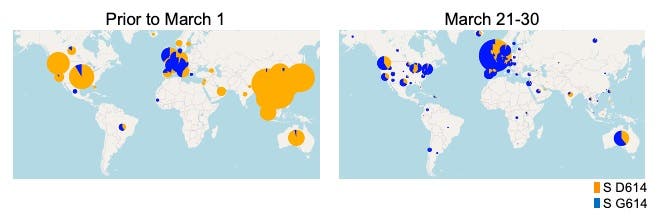
Prior to March, D614G was present in just a few locations across the globe, mostly spreading in Europe. However, small changes in the virus’ ‘spike’ protein — a protrusion on the surface of the virus that latches on to cell receptors in order to commence infection — has made D614G much more suited to infecting humans.
By the end of March, D614G was already present across the world, becoming the dominant strain, replacing D614.
Map showing how the new strain (blue) spread rapidly across the world. Credit: University of Sheffield.
These findings were revealed by researchers at Los Alamos National Laboratory in New Mexico, Duke University in North Carolina, and the University of Sheffield in the UK, who analyzed genome samples from GISID — a huge database of genome sequences shared among researchers worldwide. Tens of thousands of sequences are currently available, enabling researchers to quickly identify virus variants that show signs of rising to the top.
Dr. Thushan de Silva, Senior Clinical Lecturer in Infectious Diseases at the University of Sheffield, has been studying the new D614G genome mutation variant in the lab since the pandemic first started. It was clear since then that the strain was more potent. However, de Silva found that strain is even more infectious in the real world than in the lab.
“Data provided by our team in Sheffield suggested that the new strain was associated with higher viral loads in the upper respiratory tract of patients with COVID-19, meaning the virus’s ability to infect people could be increased,” de Silva said in a statement for the press.
“Fortunately at this stage, it does not seem that viruses with D614G cause more severe disease.”
Next, de Silva and colleagues will focus on conducting laboratory analyses of live cells infected with D614G in order to fully understand what this new mutation is capable of doing in the future.
“It’s remarkable to me,” commented Dr Will Fischer, from Los Alamos National Laboratory and an author on the study. “That this increase in infectivity was detected by careful observation of sequence data alone, and that our experimental colleagues could confirm it with live virus in such a short time.”
This cave pool, found in the Lechuguilla Cave of New Mexico, appears to be completely pristine. It was discovered in October at Carlsbad Caverns National Park.
MAX WISSHAK PHOTO/CARLSBAD CAVERNS NATIONAL PARK
An expedition into “virgin” cave passages found at Carlsbad Caverns National Park in New Mexico has discovered an isolated pool of liquid believed to have never before been seen by humans.
A photo shows the pool surrounded by white frosted rock, and filled with an odd-looking liquid that resembles thick lime yogurt.
“This pool has been isolated for hundreds of thousands of years and had never seen light before that day,” said Rodney Horrocks, Chief of Natural and Cultural Resources at Carlsbad Caverns National Park.
It was found 700 feet below the entrance of Lechuguilla Cave, a “sister cave” in the back country of Carlsbad Caverns National Park. (The park covers 46,766 acres.) It was discovered in 1993, but not entered until October, he said. Lechuguilla is one of the 10 longest caves in the world., the National Park Service says.
Geoscientist Max Wisshak, who led the expedition, told McClatchy News the color of the water is an optical illusion: It’s actually “crystal clear,” he said in an email.
The discovery — made in a cavern 328 feet in length — is important because the pool has been isolated from human contact for hundreds of thousands of years, experts say.
“Such untouched pools are scientifically important because water samples are relatively free of contaminants and the microbial organisms that may live in those pools are only those that belong there,” Wisshak said.
“Contamination can occur from the surface above the cave, but in case of Lechuguilla Cave, that’s not a big issue, since it is situated in a well-protected wilderness area. Contamination can also occur via aerosols in the air. However, a newly discovered pool in Lechuguilla Cave is about as pristine as it gets.”
Horrocks says microbiologists have found new species of microbes when sampling pools in Lechuguilla Cave and the latest discovery could bring more surprises.
The pool is about a foot wide, 2 feet long and “several inches deep,” he said. As for the source of the water, it likely started as rain that seeped through the overlying limestone, then dripped or slid down the cave walls into the pool.
An exact age for the formation has not been determined, but it’s still growing, Horrocks said. “So, the top layer dates to this year and the ones below are older. These formations typically grow and stop growing for varying periods of time, so the layers on the bottom can be very old,” he said.
There are several more such pools in the passage, the largest of which has been named “Lake of Liquid Sky,” Horrocks said.
Wisshak is publishing research on the unique barite crystals in Lechuguilla Cave. He has also applied for grant funding to return to the site for a broader study of the crystals. Both the pool and the cave passage contain barite, which is rarely found in caves, and that needs to be scientifically investigated, he says.
The cave exploration, which included “numerous rope drops,” mapped 1.3 miles of passages during the October expedition, about 4,344 feet of which were new discoveries. No signs of life “visible to the naked eye” were found in the new passages.
However, “we found bat skeletons, thousands of years old, in some places in the cave,” Wisshak said.
Remember the STS-75 incident where its satellite tether snapped in 1992 where a 12 mile wide satellite cable snapped and these UFOs appeared out of no-where? This looks Identical to these shaped craft. This video was posted “LIVE” and quickly avoided my media TV as they switched over quickly. What do you think?
It seems like every year, there’s more new UFO footage online. With photo and video editing programs being easy to obtain and learn, it’s hard to take any proof seriously. However, some footage is just too outlandish to ignore. So today I’m going to countdown the most bizarre UFO sightings. I’m not saying these clips are authentic proof of alien life, and I’m not trying to convince you. But this interests me, so I’m making a video about it. This is The Top 20 Most Bizarre UFO Sightings.
An unidentified flying object, or UFO, in its most general definition, is any apparent anomaly in the sky that is not identifiable as a known object or phenomenon. Culturally, UFOs are associated with claims of visitation by extraterrestrial life or government-related conspiracy theories, and have become popular subjects in fiction. While UFOs are often later identified, sometimes identification may not be possible owing to the usually low quality of evidence related to UFO sightings (generally anecdotal evidence and eyewitness accounts).
Stories of fantastical celestial apparitions have been told since antiquity, but the term “UFO” (or “UFOB”) was officially created in 1953 by the United States Air Force (USAF) to serve as a catch-all for all such reports. In its initial definition, the USAF stated that a “UFOB” was “any airborne object which by performance, aerodynamic characteristics, or unusual features, does not conform to any presently known aircraft or missile type, or which cannot be positively identified as a familiar object.” Accordingly, the term was initially restricted to those fraction of cases which remained unidentified after investigation, as the USAF was interested in potential national security reasons and/or “technical aspects.” (See Air Force Regulation 200-2.) During the late 1940s and through the 1950s, UFOs were often referred to popularly as “flying saucers” or “flying discs”. The term UFO became more widespread during the 1950s, at first in technical literature, but later in popular use. UFOs garnered considerable interest during the Cold War, an era associated with a heightened concern for national security. Various studies have concluded that the phenomenon does not represent a threat to national security nor does it contain anything worthy of scientific pursuit (e.g., 1951 Flying Saucer Working Party, 1953 CIA Robertson Panel, USAF Project Blue Book, Condon Committee).
Sunken Aboriginal Sites Discovery Dated Back To Time When Seabed Was Dry Land
The first underwater Aboriginal archaeological sites have been discovered off northwest Australia dating back thousands of years ago when the current seabed was dry land.
Aboriginal artefacts discovered off the Pilbara coast in Western Australia represent Australia’s oldest known underwater archaeology. The discoveries were made through a series of archaeological and geophysical surveys in the Dampier Archipelago, as part of the Deep History of Sea Country Project, funded through the Australian Research Council’s Discovery Project Scheme.
An international team of archaeologists from Flinders University, The University of Western Australia, James Cook University, ARA – Airborne Research Australia and the University of York (United Kingdom) partnered with the Murujuga Aboriginal Corporation to locate and investigate ancient artefacts at two underwater sites which have yielded hundreds of stone tools made by Aboriginal peoples, including grinding stones.
In a study published today in PLOS ONE, the ancient underwater sites, at Cape Bruguieres and Flying Foam Passage, provide new evidence of Aboriginal ways of life from when the seabed was dry land, due to lower sea levels, thousands of years ago.
The submerged cultural landscapes represent what is known today as Sea Country to many Indigenous Australians, who have a deep cultural, spiritual and historical connection to these underwater environments.
“Today we announce the discovery of two underwater archaeological sites that were once on dry land. This is an exciting step for Australian archaeology as we integrate maritime and Indigenous archaeology and draw connections between land and sea,” says Associate Professor Jonathan Benjamin who is the Maritime Archaeology Program Coordinator at Flinders University’s College of Humanities, Arts and Social Sciences.
“Australia is a massive continent but few people realise that more than 30% of its land mass was drowned by sea-level rise after the last ice age. This means that a huge amount of the archaeological evidence documenting the lives of Aboriginal people is now underwater.
“Now we finally have the first proof that at least some of this archaeological evidence survived the process of sea level rise. The ancient coastal archaeology is not lost for good; we just haven’t found it yet. These new discoveries are a first step toward exploring the last real frontier of Australian archaeology.”
The dive team mapped 269 artefacts at Cape Bruguieres in shallow water at depths down to 2.4 metres below modern sea level. Radiocarbon dating and analysis of sea-level changes show the site is at least 7000 years old.A diver on the Deep History of Sea Country Project led by Flinders University,
Credit: Hiro Yoshida
The second site at Flying Foam Passage includes an underwater freshwater spring 14 metres below sea level. This site is estimated to be at least 8500 years old. Both sites may be much older as the dates represent minimum ages only; they may be even more ancient.
The team of archaeologists and geoscientists employed predictive modelling and various underwater and remote sensing techniques, including scientific diving methods, to confirm the location of sites and presence of artefacts.
“At one point there would have been dry land stretching out 160 km from the current shoreline. That land would have been owned and lived on by generations of Aboriginal people. Our discovery demonstrates that underwater archaeological material has survived sea-level rise, and although these sites are located in relatively shallow water, there will likely be more in deeper water offshore” says Chelsea Wiseman from Flinders University who has been working on the DHSC project as part of PhD research.
“These territories that are now underwater harboured favourable environments for Indigenous settlements including freshwater, ecological diversity and opportunities to exploit marine resources which would have supported relatively high population densities” says Dr Michael O’Leary, a marine geomorphologist at The University of Western Australia.”
The discovery of these sites emphasises the need for stronger federal legislation to protect and manage underwater heritage across 2 million square kilometres of landscapes that were once above sea level in Australia, and hold major insights into human history.
“Managing, investigating and understanding the archaelogy of the Australian continental shelf in partnership with Aboriginal and Torres Strait Islander traditional owners and custodians is one of the last frontiers in Australian archaeology” said Associate Professor Benjamin.
“Our results represent the first step in a journey of discovery to explore the potential of archaeology on the continental shelves which can fill a major gap in the human history of the continent” he said.
In Murujuga, this adds substantial additional evidence to support the deep time history of human activities accompanying rock art production in this important National Heritage Listed Place.
Murujuga Aboriginal Corporation CEO Peter Jeffries says the discoveries will help the community add to the story of Aboriginal people in the Pilbara.
“Further exploration could unearth similar cultural relics and help us better understand the life of the people who were so connected to these areas of land which are now underwater.
“With this comes a new requirement for the careful management of Aboriginal sea country as it’s not automatically protected by current Heritage legislation, however plans are progressing to lead this change and protect our sea country land and heritage.”
Orange Disk Recorded Over La Paz, Argentina Raw Footage, June 22, 2020, UFO Sighting News.
Date of sighting: June 22, 2020 Location of sighting: La Paz, Argentina Dozens of residents of La Paz witnessed an unusual event at 8 o'clock in the evening on Monday...when a gigantic, well-defined circle appeared in the sky to the south of the city. Social media was flooded with reports suggesting the presence of a "mothership" over La Paz. The object remained motionless for at least half an hour. This is an extraordinary event, since some believed that it had to do with a fire at the city landfill, which gives off a column of smoke that can be seen from various points of Baja California's capital. However, this cannot be ascertained at the time. I have seen such reports and videos of similar orange disks going all the way back to the 1970s. This...is one of those alien craft. Such UFOs are only seen once every few years and always in central and south America. Scott C. Waring - Taiwan
White UFO With Dome In Middle Over Grand Canyon, Arizona June 27, 2020.
Date of sighting: June 27, 2020
Location of sighting: Grand Canyon, Arizona
Source: MUFON
Watch this video below and I guarantee it will surprise you. This UFO is in high detail, but its not an orb, its a disk. The clear transparent dome is seen in it and the alien who is piloting the craft is watching the person below. Arizona is famous for its UFO sightings and in such a low populated area, UFOs will be more frequently buzzing around. This raw footage is just amazing and it tells us so much in it. It allows us to know how it moves, how it hides in the clouds, how it appears closer and how it appears further away, how they appear to people. So much information in one video. I love it! Scott C. Waring
Eyewitness states:
On June 27, 2020 at approximately 1921 hours, over a dozen tourists observed a stationary circular object with a hole in the middle hovering in one location to the right of the moon near some clouds, for over 30 minutes. Video and pictures were taken with a Samsung phone, which will be uploaded later.
This occurred looking westward towards the moon while standing at the South Rim of the Grand Canyon by the Bright Angel Trails next to the Gift Shop. One of the videos taken with the phone was initially used in telescope mode thinking it would show the object clearer, but was then changed to normal camera view during the recording. This was taken by my daughter on her vacation to the Grand Canyon and you can hear her and her friend talking about the object they were observing. The object disappeared behind some clouds and it was first noticed by another tourist who made mention of a strange object in the sky.
I was looking through some old photos of the Lunar Reconnaissance Orbiter mission when I came across this tall white tower at the center of the crater. Aristarchus crater is 40km in diameter according to NASA. The tower at the center stands about 1/10th or 10% of the craters diameter. That means although the crater floor is deeper than the surface of the moon, this tower stands a whopping 4km tall. How is that possible? Well a mix of alien alloys and technology mixed with a lower gravity of just 16.6% that of earth and you easily find your answers. The impossible quickly becomes possible.
Ancient Aliens – Aliens and the Presidents History Channel, Season 15 Episode 12 18th April 2020
Researchers link connection of UFO sightings and space alien with presidents like Trump, Abraham Lincoln, Eisenhower and other alleged extraterrestrial cases with founding fathers.
A UFO Baffles Several People and Organizations in Japan
A balloon-like unidentified flying object (UFO) in the sky over Sendai City has left Japanese skywatchers baffled. The strange object didn’t resemble a plane or a bird. It was seen on June 17 at around 7 a.m. local time. The origin of the mysterious object, which looked like a giant, white unmanned balloon, has not been confirmed yet. The Japan Meteorological Agency has denied it was theirs.
The object appeared to be attached to two crossed propellers and continued to hover in the air motionless for a few hours. It drifted later over to the Pacific Ocean.
The strange object looked like a weather balloon, but the Japan Meteorological Agency said they didn’t know anything about it. Yoshihide Suga, the country’s Chief Cabinet Secretary, denied having any knowledge about the origin of the UFO sighted in the nation. Sendai bureau confirmed the object looked like a balloon for monitoring weather.
The aeronautics department of Kyushu University also denied the object was from them. The police consulted several organizations and authorities and all of which refused their association with the bizarre object.
The UFO in Japan has received nationwide attention and has set off a debate involving the government. Yoshihide Suga confirmed that the government is looking into it.
The object flew past the Pacific Ocean after hovering in the sky for several hours.
Don’t forget to follow us on Twitter for the latest UFO videos & photos.
This is an artist's illustration of a supermassive black hole and its surrounding disk of gas. Inside this disk are two smaller black holes orbiting one another. Researchers identified a flare of light suspected to have come from one such binary pair soon after they merged into a larger black hole.
(CNN)The center of our galaxy, the Milky Way, can be a strange place. It's notoriously hard to see, obscured from our viewpoint by clouds of gas and dust in one of the galaxy's spiral arms.
But 13 years worth of near-infrared wavelengthdata from the W. M. Keck Observatory in Hawaii has captured the bizarre reality behind the haze.
The supermassive black hole at the center of our galaxy, Sagittarius A*, is behaving strangely and eating voraciously. And now, astronomers have spotted a weird new class of objects not far from the black hole, according to a study published Wednesday in the journal Nature.
"These objects look like gas and behave like stars," said Andrea Ghez, study author, director of the UCLA Galactic Center Group and the university's Lauren B. Leichtman and Arthur E. Levine Professor of Astrophysics.
Normally, these objects appear compact. But they stretch out when they near the black hole during their orbits, which can last from 100 to 1,000 years.
This is the latest detection in a mystery that's been unfolding since 2005, when Ghez's research team spotted an object in the center of our galaxy they dubbed G1. In 2012, a second object called G2 was found, and it came close to the black hole in 2014.
The astronomers believe G2 was once really two stars that orbited the black hole together, but merged into one massive star and became obscured by a thick gas and dust cloud.
"At the time of closest approach, G2 had a really strange signature," Ghez said. "We had seen it before, but it didn't look too peculiar until it got close to the black hole and became elongated, and much of its gas was torn apart. It went from being a pretty innocuous object when it was far from the black hole to one that was really stretched out and distorted at its closest approach and lost its outer shell, and now it's getting more compact again."
Now, Ghez's research group has discovered four more objects and determined their orbits: G3, G4. G5 and G6. They're incredibly different orbits from G1 and G2, which were similar to one another.
"One of the things that has gotten everyone excited about the G objects is that the stuff that gets pulled off of them by tidal forces as they sweep by the central black hole must inevitably fall into the black hole," said Mark Morris, study co-author and UCLA professor of physics and astronomy. "When that happens, it might be able to produce an impressive fireworks show since the material eaten by the black hole will heat up and emit copious radiation before it disappears across the event horizon."
The researchers think that all six objects are the result of binary stars -- or pairs of stars that orbit one another -- that were forced together due to the strong gravity of Sagittarius A*.
Ghez said that mergers of stars may be happening in the universe more often than we thought and likely are quite common.
"Black holes may be driving binary stars to merge. It's possible that many of the stars we've been watching and not understanding may be the end product of mergers that are calm now, " Ghez said. "We are learning how galaxies and black holes evolve. The way binary stars interact with each other and with the black hole is very different from how single stars interact with other single stars and with the black hole."
G2 differs from the rest of the objects because it didn't undergo as much stretching as the others.
"Something must have kept it compact and enabled it to survive its encounter with the black hole," said Anna Ciurlo, study author and postdoctoral researcher at UCLA. "This is evidence for a stellar object inside G2."
Now, the astronomers have enough evidence to show a small group of G objects -- rather than a couple of instances -- meaning they can continue analyzing them while searching for others.
The fact that these objects have been found near Sagittarius A*, which likely swallowed up the gas it ripped off the stars, means they could actually be feeding the constantly voracious black hole.
It's further proof that chaos is constantly unfolding at the center of not just the Milky Way but many galaxies in the universe.
"The Earth is in the suburbs compared to the center of the galaxy, which is some 26,000 light-years away," Ghez said. "The center of our galaxy has a density of stars 1 billion times higher than our part of the galaxy. The gravitational pull is so much stronger. The magnetic fields are more extreme. The center of the galaxy is where extreme astrophysics occurs -- the X-sports of astrophysics."
Chicxulub collision put Earth’s crust in hot water for over a million years
Asteroid crater on the Yucatán Peninsula reveals surprising new geologic details
About 66 million years ago, an asteroid slammed into Earth at what is now Chicxulub, on Mexico’s Yucatán peninsula (illustrated). In addition to triggering a mass extinction, the impact sent superheated water cycling deep into the crust.
The asteroid that slammed into Earth 66 million years ago left behind more than a legacy of mass destruction. That impact also sent superheated seawater swirling through the crust below for more than a million years, chemically overhauling the rocks. Similar transformative hydrothermal systems, left in the wake of powerful impacts much earlier in Earth’s history, may have been a crucible for early microbial life on Earth, researchers report May 29 in Science Advances.
The massive Chicxulub crater on Mexico’s Yucatán Peninsula is the fingerprint of a killer, probably responsible for the destruction of more than 75 percent of life on Earth, including all nonbird dinosaurs (SN: 1/25/17). In 2016, a team of scientists made a historic trek to the partially submerged crater, drilling deep into the rock to study the crime scene from numerous angles.
One of those researchers was planetary scientist David Kring of the Lunar and Planetary Institute in Houston. A dozen years earlier, Kring had found evidence at Chicxulub that the layers of rock bearing the signs of impact — telltale features such as shocked quartz and melted spherules — were subsequently cut through by veins of newer minerals such as quartz and anhydrite. Such veins, Kring thought, suggest that hot hydrothermal fluids had been circulating beneath Chicxulub some time after the impact.
Hydrothermal systems can occur where Earth is tectonically active, such as where tectonic plates pull the seafloor apart, or where mantle plumes like the one beneath Yellowstone rise up into the crust. The molten rock rising through the crust in these regions superheats water already circulating within the crust.
But the Yucatán Peninsula is tectonically quiescent, and has been for 66 million years, Kring says. So, as part of the International Ocean Discovery Program’s Expedition 364 to Chicxulub, he and colleagues drilled 1,335 meters below the the crater’s peak ring, a circular, mountainous region within the vast crater bowl, and retrieved long cores of sediment and rock.
The team then analyzed the minerals found in the cores. “It was immediately obvious that they had been hydrothermally altered. It was pervasive and apparent,” Kring says. The intense heat of the circulating seawater caused chemical reactions within the rock, transforming some minerals into others. By identifying the different types of minerals, the team determined that the initial temperature of the fluids was more than 300° Celsius, later cooling to about 90° C.
The entire length of the cores showed chemically altered rocks, but computer simulations suggest the hydrothermal alteration beneath the crater likely goes much deeper into the crust, down to perhaps four or five kilometers. The hydrothermally altered zone covers a volume more than nine times that of the Yellowstone Caldera system, Kring says. Paleomagnetic data suggest that the hydrothermal system lasted for more than a million years.
A core of rock and sediment extracted from within the Chicxulub impact crater revealed centimeter-sized cavities within the rocks containing hydrothermally altered minerals. Here, tiny cavities within impact breccia — a type of rock formed of broken fragments cemented together by fine-grained sediment — contain analcime (transparent crystals), which forms at temperatures around 200° Celsius and dachiardite (red crystals), which forms at temperatures around 250° C.D. KRING
Those conditions, the researchers say, may have also been capable of fostering life akin to the extremophiles that thrive in Yellowstone’s boiling pools. In addition to the metal-rich fluids that could provide an energy source for microbes, the Chicxulub cores revealed that the rocks were both porous and permeable — in other words, filled with interconnected nooks and crannies that could have been cozy shelters for microbes.
“It looks like a perfect habitat,” Kring says.
Kring has previously suggested that the very same destructive impacts that annihilate life may also create appealing habitats — not just on Earth, but potentially on other planetary bodies such as Mars. Even more tantalizing is the possibility that hydrothermal systems, engendered beneath ancient impacts, may have been where life on Earth began (SN: 3/1/13).
Evidence from lunar craters suggests that Earth was heavily bombarded by asteroids about 3.9 billion years ago (SN: 10/18/04). Most of those more ancient craters on Earth have long since vanished or been altered by the constant tectonic recycling of Earth’s surface (SN: 12/18/18). So the hydrothermal system beneath Chicxulub offers a window into what such systems might have actually looked like much deeper in the past, says geophysicist Norman Sleep of Stanford University, who was not involved in the study. “It shows the reality of the process,” Sleep says.
The new study may set the stage for the possibility of life thriving beneath an impact. But whether a microbial cast of characters was actually present beneath Chicxulub is a question for future studies, Kring says.
“Let me be clear: This paper has no evidence of microbial life,” Kring says. “We just have all the properties of hydrothermal systems that do support life elsewhere on Earth.”
Ancient environments that provided water, chemical building blocks and energy “are very promising candidates for hosting [life’s] origins and early evolution,” says NASA astrobiologist David Des Marais, who was not involved in the study. Impact-generated hydrothermal systems aren’t the only such environments; researchers have also made a compelling case for hot springs, Des Marais says.
That’s an ongoing debate, he notes, adding “I consider hydrothermal systems to be highly promising exploration targets for astrobiology.”
A series of viral articles claimed that NASA had discovered particles from another parallel universe in which time runs backward. These claims were incorrect. The true story is far more exciting and strange, involving a journey into the Big Bangand out the other side.
The sensational headlines had muddled the findings of an obscure 2018 paper, never published in a peer-reviewed journal, which argued that our universe might have a mirror reflection across time, a partner universe that stretches beyond the Big Bang. If that's the case, and a series of other extremely unlikely and outlandish hypotheses turn out to be true, the paper argued, then that in turn could explain a mysterious signal hinting that a completely new particle is flying out of the ice in Antarctica.
The claim that NASA discovered a parallel universe seemed to have been first dreamed up by British tabloid The Daily Star, and the story was then picked up by British and American outlets, including The New York Post.
Screenshots show false "parallel universe" claims in several publications. (Image credit: Illustration by Live Science)
Our universe's "mirror"
In order to understand how The Daily Star arrived at its bizarre, viral claim, it's necessary to understand the claims of two separate papers from 2018.
The first paper, by Latham Boyle, a physicist at The Perimeter Institute in Alberta, Canada, and his colleagues, proposed a mirror universe — a reflection of our universe across time. It was published December 2018 in the journal Physical Review Letters (after an appearance on the arXiv server in March that year).
"I think nobody else understands the full sweep of what they have composed," said John Learned, a University of Hawaii astrophysicist and the co-author of a second paper, which builds on Boyle's theory.
Boyle's work is a kind of expansion pack meant to plug holes in the theory that tells the dominant origin story of the universe: Lambda-Cold Dark Matter (ΛCDM).
ΛCDM explains the cosmos using two key ideas: An unknown dark energy causes the universe to expand. Rewind that expansion far enough backward in time and the whole universe occupies a single point in space. Second, an unseen dark matter gravitationally tugs on stuff in the universe, yet emits no light. This dark matter, the idea goes, accounts for the vast majority of the universe's mass.
"ΛCDM is basically the only game in town," Learned said. "It works in many cases, but there are some somewhat disturbing lapses in the modeling."
For instance, measurements of expansion don't line up across time, so that measurements made of this expansion based on data from the early universe don’t jive with measurements using data from the modern universe. In addition, ΛCDM can't explain why matter exists at all, since it predicts that matter and antimatter would have formed at equal rates after the Big Bang, and annihilated each other, leaving nothing behind.
Boyle and his colleagues' new universe unwinds the ΛCDM story further back in time, diving into the singularity at the beginning of time and coming out the other side.
Here’s how Boyle’s team sees their theory: Imagine today's universe as a wide, flat circle, sitting on top of yesterday's slightly smaller circle, which sits on top of the yet-smaller circle of the day before that, Boyle said.
(Image credit: Meghan McCarter)
Stack up all the circles from today back to the Big Bang, and you'd end up with a cone standing on its point end.
(Image credit: Meghan McCarter)
When astronomers look deep into space, they're effectively looking back in time. The most distant galaxy we can see, GN-z11, appears to us as it existed 13.4 billion years ago, or 400 million years after the Big Bang.
Before that, the universe had a "dark age" lasting millions of years, where nothing bright enough for us to see formed. Before that, the universe produced the oldest thing we can see: the Cosmic Microwave Background (CMB), which formed 370,000 years after the Big Bang, as the universe cooled out of a hot, opaque plasma.
Telescopes can't see anything from before the CMB.
Looking back in time like this, Boyle said, is like looking down through the cosmological cone.
Image credit: Meghan McCarter)
Viewed in this way, the ΛCDM story ends with the universe coming together into a single point hidden behind the CMB. Boyle's theory looks at the opaque wall the CMB forms across time and draws a different conclusion about what the CMB hides.
The standard view, he said, is that the hot, dense era below the CMB (from our vantage point on the cone) was more or less a "big mess." In ΛCDM cosmology, this is the accelerated period of expansion known as "the epoch of inflation." Back then everything was chaos, the theory states.
But the CMB isn't that chaotic. Its simple structure, according to ΛCDM, emerged after an intense flattening process that wiped away the old mess.
"We were interested in exploring a simpler picture where you take the evidence more at face value," he said. "You say 'Okay, we can't see all the way down to the Bang, but we can look darned close, and as close as we look things look super simple. What if we take those observations at face value?'"
This vision of space-time still has a Big Bang hiding behind the CMB, he said.
But "it's much simpler than most of the singularities that arise in Einstein's theory of gravity," he said. "It's a very special type of ultra-simple singularity, where you can follow the solution [to the equations governing space-time] through the singularity."
Whereas observations go no further back than the CMB, normal cosmological models go a bit further back but still tend to come to a hard stop at the Big Bang. Not in Boyle's scheme.
"You find that it extrapolates, it extends — it analytically continues, physicists would say, to this double cone," he said, referring to the second universe extending away from the Big Bang in time
(Image credit: Meghan McCarter)
"It just seems to be the natural, simplest extension of the equations that seem to describe the universe as we see it," he said.
This universe that’s inside the “second cone” is too far down space-time for us to see. Time might seem to run backward there from our reference frame, Learned said. But beings in that universe would still see cause coming before effect, just like we do in ours. Time runs away from the Big Bang in that universe, just like it does in ours. "Away from the Big Bang" in that universe is the opposite direction from the direction of time in our universe. but it doesn't run "backward" in the way we might imagine.
Our universe exists on the other side of that universe's ancient history, and that universe exists on the other side of ours.
The "zero particle state"
We have no evidence that this reflected universe exists, Boyle said.
However, he said, "once you have it, it turns out this universe has an extra symmetry, which you didn't see when you were just looking at the top half of the cone."
Symmetries "ring a loud bell" for physicists, Boyle said. They suggest deeper truth.
And this double-cone universe could, in turn, help restore a crack in a symmetry that has bothered physicists for years.
The symmetry in question, known as Charge, Parity, Time (CPT) symmetry states that if you flip a particle to its antimatter twin — an electron into a positron, say — or make it right-handed instead of left-handed, or move it backward through time instead of forward, that particle should still behave in the same way and obey the same laws as it did before getting flipped. (Right-handed or left-handed refers to a particle's spin and direction of movement.)
"Everybody thought these were fundamental symmetries that could not be escaped," Learned said.
Eventually, in 1956, the Columbia University physicist Chien-Shiun Wu led an experiment that established CPT symmetry wasn't absolute. (The two male colleagues who proposed the underlying idea to Wu won the 1957 Nobel Prize for her discovery, but she was left out.)
Wu's experiment showed that the "C" in CPT symmetry is imperfect. And further experiments showed that some particles break both "C" and "P." But though cracked, most physicists think CPT symmetry still holds in general, and no particle has been found that breaks all three elements of this symmetry. At the particle level, the universe appears CPT symmetric.
But the ΛCDM model of the universe itself lacks clear CPT symmetry — a consequence of the curvature of space-time and the strange quantum vacuum. A feature of the universe that Boyle called its "zero particle state," the nature of space-time when emptied of particles, is uncertain. That means that at the scale of all space, CPT symmetry is violated.
Boyle says that his model preserves the universe's CPT symmetry in a way the ΛCDM cosmology does not. Add a second cone to space-time, and the zero particle state is no longer uncertain. The universe's CPT asymmetry is repaired.
"We thought, 'Wait a minute. It seemed like the universe violated CPT symmetry, but actually we just weren't looking at the whole picture," he said. If the universe really is CPT-symmetric, if it really comprises two space-time cones rather than one, what would that mean for the rest of physics?
The truth behind what those "NASA scientists" really detected
The most practical consequence of the CPT-symmetric universe is a simple explanation for dark matter.
One popular set of theories about the unseen stuff relies on the existence of some undetected, fourth type of neutrino — often termed a sterile neutrino. Boyle's CPT symmetry seems to point in this direction. The three known flavors of neutrino, the electron, muon and tau neutrinos, are all left-handed. That means that they fly around without a matching right-handed partner. The Standard Model assumes that, unlike other particles, neutrinos don't have such partners. But the CPT-symmetric universe disagrees, indicating they should have those partners.
Boyle and his colleagues found that their cosmology implies the existence of a right-handed partner in our universe for every left-handed neutrino in the Standard Model. But, unlike left- and right-handed quarks, these left- and right-handed mirror particles wouldn't stick together.Instead, two of the right-handed partner neutrinos would have long since been lost to space-time, decaying out of our view in the very early universe. A third right-handed partner would have stuck around, however — a consequence of the equations governing the beginning of time.
It's not clear which of the three known neutrinos it would have partnered with, Boyle said. But it would have had a particular energy signature: 480 picoelectronvolts (PeV), a measure of a particle's mass. And that 480PeV neutrino might account for all of that missing dark matter in the universe.
The details of how the CPT-symmetric universe leads to a 480 PeV neutrino are tricky — so tricky, Learned said, that few physicists beyond Boyle and his team understand them at all.
"But these guys are not nutcases," he said. "They're respected members of the field and they know what they're doing. Whether all of that complicated field theory is correct or not, I can't say."
Still, the prediction of a 480 PeV particle jumped out at Learned.
Four years ago, a particle detector hanging from a balloon over Antarctica detected something physics could not explain: Twice, as Live Science previously reported, the Antarctic Impulsive Transient Antenna (ANITA) instrument picked up signals of high-energy particles that seemed to shoot straight up out of the Antarctic ice. (Most researchers involved in ANITA aren't "NASA scientists," but the project does receive NASA funding.)
Researchers prepare to launch the Antarctic Impulsive Transient Antenna (ANITA) experiment, which picked up signals of impossible-seeming particles as it dangled from its balloon over Antarctica. (Image credit: NASA)
Particles like this shouldn't exist. None of the known Standard Model particles should have been able to fly all the way through the Earth and burst out the other side at such high energies, but that's what ANITA seemed to be detecting.
As of June 2020, the most popular explanation is that ANITA has detected sterile neutrinos. Learned, who was involved in the early days of the ANITA project, realized the 480 PeV figure lined up nicely with the ANITA findings.
If particles really came from space, then plunged through the Earth to produce the anomaly, they must have decayed just under the Antarctic surface, producing a shower of lighter particles that ANITA detected popping up from the ice. Boyle's 480 PeV dark matter neutrino fit squarely in the mass range that could explain ANITA's decaying mystery particle.
Learned and a team of four other researchers cooked up a scheme where this 480 PeV dark matter neutrino might have pulled off this trick, which they wrote up in a 2018 paper titled "Upgoing ANITA events as evidence of the CPT symmetric universe" and published to the arXiv database. This is the paper The Daily Star turned into a confused headline.
If the ANITA particle really did fit Boyle's scheme, that would be a strong weight on the scale in favor of the two-cone cosmos, Learned said. But it's a long shot. The most important problem they had to solve: getting the particle close enough to Antarctica. Models show that dark matter candidate particles like this 480 PeV neutrino would fall to the center of the Earth soon after running into our planet, leaving none close enough to produce the ANITA anomaly.
These researchers argued that perhaps a recent encounter with a huge, unseen disk of dark matter has stirred up the Earth's 480 PeV neutrinos, leaving some wandering around close to our planet’s surface.
It was an exciting idea to play with, Learned said, but even he is not convinced by his own paper.
"That was our feeble excuse, not thinking of any other good way to do the job [of getting Boyle's neutrinos close enough to Antarctica to trip ANITA's sensors]," Learned said.Though Learned and his colleagues worked hard on the paper, he thinks its conclusions are surely wrong, he said.
"Amongst cosmology folks there's … an idea that you get to use a 'tooth fairy' once in your cosmology model but twice is simply not credible," he said. "And I think we needed the tooth fairy two or three times to make this one work, so, oh well."
Boyle agreed. While the idea of using his team's ideas to explain ANITA was appealing, he said the numbers don't quite add up. But he's still confident the underlying idea of a CPT-symmetric universe is sound.
"My personal hunch is that whether or not it's exactly correct, it's on the right track," he said. "I'm very excited about that."
Let's light that candle! The folks at Firefly Aerospace took a brief break from rocket development recently to fire up an engine in honor of co-founder Max Polyakov, who turned 43 years old Tuesday (June 30).
The Lightning upper stage engine, in true celebratory form, was used to light candles on a large birthday cake as high-speed cameras rolled, according to a new video. (The other planned use for the engine will be to help launch small satellites to orbit cheaply, using Firefly's Alpha rocket.)
"Anyone that's getting older understands that one of the most difficult problems is figuring out how to light all those darn birthday candles on the cake," said Firefly's other co-founder, Tom Markusic, in the video, which the company released on Twitter and YouTube. In the video, Markusic wore a multi-color birthday hat and a T-shirt that says "Texas Rocket Science," a nod to Firefly's headquarters in Cedar Park, just north of Austin.
Firefly Aerospace used a Lightning rocket engine to light candles on a birthday cake to celebrate the 43rd birthday of co-founder and investor Max Polyakov in a June 30, 2020 video. (Image credit: Firefly Aerospace)
The video showed Markusic unsuccessfully trying to light birthday candles on his own. "They melt. They burn you. It's actually a pretty difficult problem," he said. "To solve the problem, we've devised a rather unique solution to light all of the candles at once."
Just like any rocket science problem, solving it took teamwork. The video showed the careful preparations Firefly workers made to get the cake ready for its special lighting. They measured the sides with a ruler and used hand signals to get the engine ready.
The video then shows a final countdown and the engine firing — blowing fire on the candles and the cake itself in epic slow-motion video usually used to see how well a rocket engine is doing during testing.
Was the result tasty? The team doesn't say while sharing the charred cake, but their enthusiasm radiates nonetheless. "Happy Birthday, Max!" they cry.
Firefly Alpha is in development for a test launch later this year, with paying flights expected to start in 2021 or so. The two-stage rocket is designed to send up to 2,200 lbs. (1,000 kilograms) to low Earth orbit and 600 kilograms (1,300 pounds) to sun-synchronous orbit.
A view of Firefly Aerospace's birthday cake candle-lighting using a Lightning rocket engine for the company's Alpha rocket. (Image credit: Firefly Aerospace)
Firefly is also working on a more powerful launch vehicle called Beta, as well as a Genesis lunar lander to compete for NASA's Commercial Lunar Payload Services program opportunities to support Artemis crewed moon missions.
The Texas-based company was founded in 2017 after a predecessor entity, Firefly Space Systems, filed for bankruptcy protection after a major European investor pulled out of funding. Firefly officials have said the pullout was related to Brexit, which is the gradual withdrawal of the United Kingdom from the European Union.
Editor's note:This story was updated to correct the engine use to light the birthday cake candles. It was Firefly Aerospace's Lightning upper stage engine for the Alpha rocket.
This artist's visualization shows an Ankylosaurus magniventris, a large armored dinosaur, witnessing an asteroid impact 66 million years ago. (Image credit: Fabio Manucci)
An asteroid impact, not volcanic activity, killed the dinosaurs, a new study finds.
For decades, scientists have gone back and forth over exactly what caused a mass extinction event 66 million years ago, which destroyed about 75% of all life on Earth, including all of the large dinosaurs. Some have thought that volcanic activity could be to blame, but one new study shows that a giant asteroid impact was the prime culprit.
Scientists have known that the impact, which created the massive Chicxulub impact crater (located in what is now the Yucatán Peninsula in southeast Mexico), was a major contributing factor to this extinction event. But volcanic activity happening at around the same time has raised questions over which could have been the main factor which changed conditions on our planet that led to the demise of Earth's creatures.
In a new study, researchers from Imperial College London, the University of Bristol and University College London have shown that the asteroid impact, not volcanic activity, was the main reason that about 75% of life on Earth perished at that time, and it did so by significantly interfering with Earth's climate and ecosystems.
"We show that the asteroid caused an impact winter for decades, and that these environmental effects decimated suitable environments for dinosaurs. In contrast, the effects of the intense volcanic eruptions were not strong enough to substantially disrupt global ecosystems," lead researcher Alessandro Chiarenza, who conducted this work whilst studying for his PhD in the Department of Earth Science and Engineering at Imperial, said in a statement. "Impact winter" signifies a semi-permanent "winter" created when sunlight-blocking particles are kicked up into the atmosphere after an impact. "Our study confirms, for the first time quantitatively, that the only plausible explanation for the extinction is the impact winter that eradicated dinosaur habitats worldwide."
To come to this conclusion, the researchers modeled how Earth's climate would be expected to respond to two separate possible extinction causes: volcanism and asteroid impact. In these mathematical models, they included environmental factors including rainfall and temperature, which would have been critical to the survival of these species. They also included the presence of sunlight-blocking gases and particles and carbon dioxide, a greenhouse gas.
"Instead of only using the geologic record to model the effect on climate that the asteroid or volcanism might have caused worldwide, we pushed this approach a step forward, adding an ecological dimension to the study to reveal how these climatic fluctuations severely affected ecosystems," co-lead author Alex Farnsworth, a climatologist at the University of Bristol, added in the same statement.
With these models, the team found that the giant asteroid hitting our planet would have released tremendous amounts of gas and particles into Earth's atmosphere, blocking out the sun for years on end. This effect would have created a sort of semi-permanent winter on Earth, making the planet unlivable for most of its inhabitants.
Now, while the team found the asteroid impact to be the major factor in making Earth unlivable for most animals, they also found that volcanic activity could have actually helped life to recover over time, a conclusion that scientists have drawn before.
They found that, while volcanoes do release sunlight-blocking gases and particles, which would have helped to block the sun in the short term, they also release large amounts of carbon dioxide which, because it's a greenhouse gas, would have built up in the atmosphere and warmed the planet.
So, as the researchers suggest in this work, while the devastating winter caused by the asteroid killed off most life on Earth, over time, the warming effect created from the volcanic greenhouse gases could have helped to restore life to habitats.
"We provide new evidence to suggest that the volcanic eruptions happening around the same time might have reduced the effects on the environment caused by the impact, particularly in quickening the rise of temperatures after the impact winter. This volcanic-induced warming helped boost the survival and recovery of the animals and plants that made through the extinction, with many groups expanding in its immediate aftermath, including birds and mammals," Chiarenza added.
This work was published June 29 in the journal Proceedings of the National Academy of Sciences.
Email Chelsea Gohd at cgohd@space.com or follow her on Twitter @chelsea_gohd.
Follow us on Twitter @Spacedotcom and on Facebook.
The Largest Underwater Cave Was Just Discovered And It’s Full Of Mayan Artifacts
One of the most impressive discoveries was made recently in the Mexican city of Tulum in the Yucatan Peninsula. Inside of what appeared to be a random submerged cave they uncovered a set of subterranean caverns that became the largest underwater cave system ever discovered by humanity.
Guillermo de Anda from Mexico’s National Institute of Anthropology and History stated that there are well over a hundred archeological findings in this cave system, and they all relate back to the ancient Mayan civilization.
The team that made the discovery is a part of the Great Maya Aquifer Project or GAM for short. They’ve been working towards discovering more about the ancient Mayan civilization for decades now.
They uncovered 358 cave systems, all submerged underwater, spread across 1,400 kilometers (870 miles). One of the systems was named the Sac Actun System, and thanks to its immense size they believed there to be two cave systems interjecting at first, but after further research, they uncovered that it was all part of the original cave system.
The secondary system was called Dos Ojos System and it was believed to be 93km long (57.8 miles) when it was, later on, uncovered that it was all a part of the Sac Actun System after all.
Astronomers from the University of Göttingen in Germany have discovered two, and possibly three, super-Earth exoplanets orbiting the nearby red dwarf star Gliese-887.
Artist’s concept of Gliese 887b and Gliese 887c orbiting their red dwarf star.
Among the various types of exoplanets discovered so far, those larger than Earth but smaller than Neptune are among the most common. Astronomers call these worlds super-Earths. The nearby TRAPPIST-1 planetary system actually has seven known super-Earths orbiting its star! Now, RedDots researchers at the University of Göttingen in Germany have announced the discovery of another nearby planetary system with at least two super-Earths and possibly a third.
Details of the peer-reviewed findings have been published in the June 26, 2020, issue of the journal Science.
The two planets are orbiting the nearby red dwarf star called Gliese 887 (also known as GJ 887 or Lacaille 9352), which is only 11 light-years away. While not quite within the habitable zone, where liquid water could exist on the surface of rocky worlds, the planets are close to the inner edge of the zone. According to the abstract of the new paper:
The closest exoplanets to the sun provide opportunities for detailed characterization of planets outside the solar system. We report the discovery, using radial velocity measurements, of a compact multiplanet system of super-Earth exoplanets orbiting the nearby red dwarf star GJ 887. The two planets have orbital periods of 9.3 and 21.8 days. Assuming an Earth-like albedo, the equilibrium temperature of the 21.8-day planet is ~350 kelvin [-623 Celsius or -1,090 Fahrenheit]. The planets are interior to, but close to the inner edge of, the liquid-water habitable zone. We also detect an unconfirmed signal with a period of ~50 days, which could correspond to a third super-Earth in a more temperate orbit. Our observations show that GJ 887 has photometric variability below 500 parts per million, which is unusually quiet for a red dwarf.
Illustration depicting the size of a super-Earth called CoRoT-7b. Super-Earths are larger and more massive than Earth, but smaller and less massive than Neptune.
Super-Earths are one of the most common types of planets in our galaxy. Some of them may be habitable for some kind of life to exist.
Image via NASA/ JPL-Caltech/ R. Hurt (SSC-Caltech)/ Earth Magazine.
The temperature of Gliese 887c has been estimated at 158 degrees Fahrenheit (70 degrees Celsius). A bit hot, but perhaps not enough to render the planet uninhabitable. If the third planet does exist, it could have cooler temperatures since it is in a more temperate orbit within the habitable zone.
The planets were discovered using the “Doppler Wobble” technique, which enables the researchers to measure the tiny back and forth wobbles of the star caused by the gravitational pull of the planets. The researchers used the High Accuracy Radial velocity Planet Searcher (HARPS) spectrograph at the European Southern Observatory (ESO) in Chile.
Red dwarf stars, although smaller and dimmer than our sun, are known for typically being very active, emitting strong bursts of radiation that could strip close-in planets of their atmospheres and make conditions difficult or impossible for life to exist. But Gliese 887 has only a very few star spots and appears to be less active than most red dwarfs. That’s good news for the possibility of any of the planets retaining their atmospheres and perhaps being habitable.
In a related Perspective article, Melvyn Davies wrote:
If someone had to live around a red dwarf, they would want to choose a quieter star like GJ 887. If further observations confirm the presence of the third planet in the habitable zone, then GJ 887 could become one of the most studied planetary systems in the solar neighborhood.
Red dwarf stars are known for being very active, emitting powerful blasts of solar radiation, which can strip atmospheres off planets that are too close, as in this artist’s concept. But Gliese 887 is less active than most red dwarfs, increasing the chance that some of its planets might be potentially habitable.
The Gliese 887 worlds will also be ideal candidates for follow-up studies by the upcoming James Webb Space Telescope (JWST), not only because they are close by, but also because the brightness of the star is almost constant, making it easier to detect any atmospheres. As Sandra Jeffers, from the University of Göttingen and lead author of the study, said in a statement:
These planets will provide the best possibilities for more detailed studies, including the search for life outside our solar system.
The discovery reinforces two previous findings about exoplanets: one, super-Earth worlds are common (as well as Earth-sized planets), even though there isn’t one in our solar system (unless the elusive Planet Nine turns out to be one, as some scientists think), and two, exoplanets are abundant around red dwarf stars, which are the most common stars in our galaxy. This is exciting, since many, if not most, super-Earths are thought to be rocky like our own planet. But we still don’t know how habitable these kinds of worlds could be. Scientists think that some super-Earths could have extensive or even global oceans. Others might be dry and barren.
Sandra Jeffers at the University of Göttingen in Germany, lead author of the new study.
New upcoming telescopes like JWST will be able to take a closer look at some of these worlds, and provide a much better idea of what the actual conditions are like. If there are millions or billions of them in our galaxy, as seems likely – and scientists now say there are more exoplanets in total than stars, including an estimated six billion ‘Earth-like’ planets – then it seems reasonable that some of them should be potentially habitable.
Bottom line: Astronomers have discovered two, and possibly three, super-Earth exoplanets orbiting a nearby red dwarf star.
Astronomers from Western University in Canada have discovered six more possible exomoons orbiting distant exoplanets, in data from the Kepler Space Telescope.
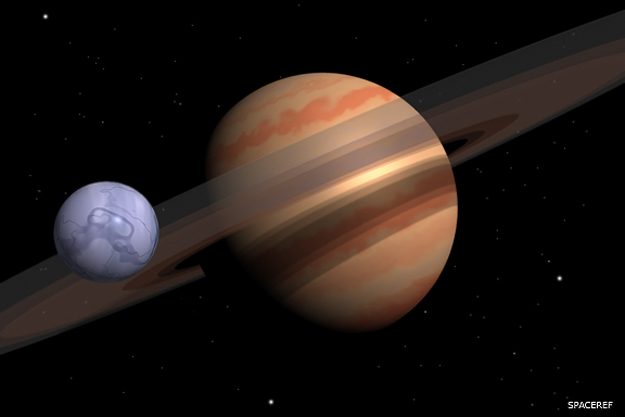
Artist’s concept of a habitable exomoon orbiting a distant exoplanet similar to Saturn. Astronomers have now discovered what may be 6 more exomoons orbiting exoplanets ranging from 200 to 3,000 light-years away. There are hundreds of moons in our own solar system, and some of them have subsurface water oceans. How many similar ocean moons may be out there?
Our solar system is filled with hundreds of moons, many more moons than planets. But what about distant solar systems? We now know of well over 4,000 confirmed exoplanets – or planets orbiting distant stars – 4,171 right now, to be exact. Yet there’ve been, so far, still only a few possible detections of exomoons. It makes sense, given that moons of planets tend to be smaller and thus more difficult to find than planets themselves. But now scientists at Western University in London, Ontario, Canada, haveannounced that they might have spotted six more exomoons!
The potentially exciting findings have been submitted in a new paper to the Monthly Notices of the Royal Astronomical Society, with a preprint version posted on arXiv on June 23, 2020.
The possible moons are not confirmed yet, but the results seem promising. As Paul Wiegert, co-author of the study, noted in a statement:
We know of thousands of exoplanets throughout our Milky Way galaxy, but we know of only a handful of exomoon candidates.
From the paper:
Here we explore eight systems from the Kepler data set to examine the exomoon hypothesis as an explanation for their transit timing variations, which we compare with the alternate hypothesis that the TTVs are caused by an non-transiting planet in the system. We find that the TTVs of six of these systems could be plausibly explained by an exomoon, the size of which would not be nominally detectable by Kepler. Though we also find that the TTVs could be equally well reproduced by the presence of a non-transiting planet in the system, the observations are nevertheless completely consistent with a existence of a dynamically stable moon small enough to fall below Kepler’s photometric threshold for transit detection, and these systems warrant further observation and analysis.
So where are these moons and how were they potentially found?
The moons are in data from theKepler Space Telescopemission, which ended in 2018. The host planets range from about 200 to 3,000light-yearsaway, and were discovered by thetransitsthat the planets made in front of their stars, which caused the star’s brightness to dim slightly and briefly. Most exoplanets are found using thetransit method. But the moons are much smaller and dimmer, so they are very difficult to detect by any method. Wiegert said:
These exomoon candidates are so small that they can’t be seen from their own transits. Rather, their presence is given away by their gravitational influence on their parent planet.
The six moon candidates are (KOI) 268.01, Kepler 517b (KOI-303.01), Kepler 1000b (KOI-1888.01), Kepler 409b (KOI-1925.01), Kepler 1326b (KOI-2728.01) and Kepler 1442b (KOI-3220.01). KOI refers to Kepler Object of Interest.
So how might these moons reveal themselves?
Usually, the transit of a planet occurs precisely at regular timed intervals, the same as how planets orbit our own sun. But sometimes, that precise timing is actually variable. This means that the gravity of some other body, another planet or a moon, must be affecting it. These variations are called transit timing variations (TTVs). The results fit with what would be expected of exomoons, but could still possibly be explained by other planets in these systems instead. As Fox explained:
Because exoplanets are more massive than exomoons, most TTVs observed to date have been linked to the influence of other exoplanets. But now we’ve uncovered six Kepler exoplanet systems whose TTVs are equally well explained by exomoons as by exoplanets. That’s why we’re calling them exomoon ‘candidates’ at this point as they still need follow-up confirmation.
TTVs were also found for two other exoplanets, KOI-1503.01 and KOI-1980.01, but those are thought to be caused by other planets in the systems instead of moons and were ruled out.
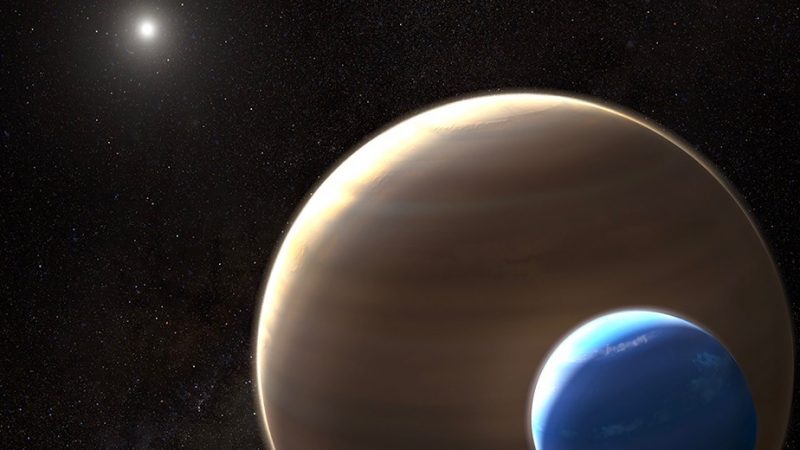
Artist’s concept of the possible huge exomoon orbiting the exoplanet Kepler-1625b, found by the Hubble Space Telescope in 2018.
That confirmation may have to wait a while, however, since current telescopes can’t do it; it will require telescopes that are being planned and designed, but not built yet. Fox said:
We can say these six new systems are completely consistent with exomoons: their masses and orbits are such that they would be stable; they would be small enough that their own transits wouldn’t be seen; and they reproduce the pattern of TTVs seen throughout the entire Kepler data set. But we don’t have the technology to confirm them by imaging them directly. That will have to wait for further advancements.
It is exciting to contemplate what kinds of alien exomoons are out there. Just in our own solar system, there is a huge variety of these smaller worlds, from gray, cratered and moon-like, to Io, which kind of looks like a pizza and has the most active volcanoes of any object in the solar system, to ocean worlds like Europa, Enceladus and others. The icy moons with subsurface oceans are especially appealing, since they could be habitable by earthly standards. There are several of them in our solar system alone, so how many more might be out there? What kind of life might exist on such worlds? Chris Fox, who made the discoveries, said:
Our own solar system contains hundreds of moons. If moons are prolific around other stars, too, it greatly increases the potential places where life might be supported, and where humankind might one day venture.
Chris Fox at Western University, who discovered the possible new exomoons.
Fox makes a very good point. Since our own solar system has hundreds of moons orbiting six out of the eight planets, is it not reasonable that many of the planets in other solar systems would also have their own moons? And as we are now discovering, a good number of the moons in our solar system are indeed potentially habitable, with their subsurface water oceans.
In 2018, Fox also discoveredKepler-159d, an exoplanet about the size of Saturn, which orbits its star in only 88 days.
In 2014, another possible exomoon, dubbed MOA-2011-BLG-262 exoplanet-exomoon system, was discovered, where the moon would be less massive than Earth and the planet would be more massive than Jupiter. In 2018, the Hubble Space Telescope (HST) found what may be a huge exomoon orbiting the gas giant planet Kepler-1625b. It’s also still not confirmed yet, but if real, is about the size of Neptune! If the new findings from Western University are any indication – and confirmed – then there may many more exomoon discoveries to look forward to.
Bottom line: Astronomers examining data from the Kepler Space Telescope appear to have discovered six more exomoons. Although the result awaits confirmation, it has the potential to be a big step forward in understanding distant solar systems.
This artist’s impression shows how ULAS J1120+0641, a very distant quasar powered by a black hole with a mass two billion times that of the Sun, may have looked. This quasar is the most distant yet found and is seen as it was just 770 million years after the Big Bang. This object is by far the brightest object yet discovered in the early Universe. Credit: ESO/M. Kornmesser
Astronomers have come across a monstrously large black hole with a gargantuan appetite. Each passing day, the insatiable void known as J2157 consumes gas and dust equivalent in mass to the sun, making it the fastest-growing black hole in the universe.
The sheer scale of J2157 is almost unfathomable, but we can try pinning some numbers on it nevertheless.
According to Christopher Onken, an astronomer at the Australian National University who was part of the team that originally discovered the object in 2019, J2167 is 8,000 times more massive than the supermassive black hole found at the heart of the Milky Way. That’s equivalent to 34 billion times the mass of the Sun.
In order for Sagittarius A*, the Milky Way’s supermassive black hole, to reach a similar size, it would have had to gobble two-thirds of all the stars in the galaxy.
For their new study, astronomers turned to ESO’s Very Large Telescope in Chile to get a more accurate assessment of the black hole‘s mass. The researchers already knew they were dealing with a black hole of epic proportions, but the final results surprised everyone.
“We knew we were onto a very massive black hole when we realized its fast growth rate,” said team member Dr. Fuyan Bian, a staff astronomer at ESO.
“How much black holes can swallow depends on how much mass they already have. So, for this one to be devouring matter at such a high rate, we thought it could become a new record holder. And now we know.”
Although black holes can’t be imaged directly because they don’t let light escape, J2157 is actually classed as a quasar, or “quasi-stellar radio source” — extremely bright objects powered by black holes at least a billion times as massive as our sun.
The bright signal of the quasar is formed by particles of dust and gas accreting around the edge of the supermassive black hole that are accelerated away at almost the speed of light. Practically, the black hole acts like an extremely powerful natural particle accelerator.
Luckily for us, the black hole is located many billions of light-years away. But this also means that astronomers are measuring J2157’s gravitational influence as it appeared in the distant past when the universe was still very young.
“We’re seeing it at a time when the universe was only 1.2 billion years old, less than 10 percent of its current age,” Dr Onken said.
“It’s the biggest black hole that’s been weighed in this early period of the Universe.”
Since then, J2157 likely grew even bigger, perhaps merging with several other black holes across the eons.
“With such an enormous black hole, we’re also excited to see what we can learn about the galaxy in which it’s growing,” Dr Onken said.
“Is this galaxy one of the behemoths of the early Universe, or did the black hole just swallow up an extraordinary amount of its surroundings? We’ll have to keep digging to figure that out.”
If Gene Roddenberry were alive today, he might look at the newly-formed US Space Force and wonder if the current administration owes him royalties. After all, the command responsible for the organization, training, equipping, commanding and controlling space forces is called SpOC (Space Operations Command} and their logo looks like the Starfleet emblem. And this week, the five-tiered bureaucracy of squadrons, groups, wings, numbered Air Forces, and major commands was replaced by a threesome of squadrons, field commands and ‘deltas’. Deltas? Does that sound familiar, Spock?
“This is the most significant restructuring of space units undertaken by the United States since the establishment of Air Force Space Command in 1982. Innovation and efficiency are driving our mission as we position the Space Force to respond with agility to protect our nation’s space capabilities and the American way of life.”
According to the Air Force press release, Secretary of the Air Force Barbara Barrett announced the restructuring this week as a way of making the organization “lean, agile and mission-focused.” However, “to protect our nation’s space capabilities and the American way of life” is a far cry from “to explore strange new worlds, to seek out new life and new civilizations, to boldly go where no one has gone before.” Give it a chance, some say. Perhaps the Space Force will steal the Enterprise’s mission statement someday too, just like it has now taken ‘Delta’ – one of the most used words across the entire Star Trek world.
“Deltas will be O-6 led and will be organized around a specific function – operations, installation support, training, etc. Within the deltas will be squadrons focused on specific tactics. When the field command structure is fully implemented, it will eliminate one general officer echelon and one O-6 echelon of command.”
Well, that’s not exactly any of the Star Trek Deltas. The most famous one is the Starfleet insignia itself. The delta-shaped emblem was created by costume designer William Ware Theiss and was paired with other symbols to designate divisions: an elongated star for the Command division aboard ship; a planet for the Sciences division; an “e” stands for Engineering; and a red “Swiss Cross” for the Nursing Corps. In the Star Trek movies, Delta (or Delta IV) was a Federation planet inhabited by the humanoid Deltans. And on Star Trek:Voyager, the Delta Flyer was a shuttlecraft.
Do you see the connection, Mr. Spock?
However, the most famous of the Star Trek ‘Deltas’ was the Delta Quadrant – home of the Borg Collective and the area where the USS Voyager got stranded and spent the bulk of the series trying to escape. Other residents of the Delta Quadrant were the Kazon, the Vidiians, the Talaxians, the Ocampa, the Hirogen, and the Malon.
Patterning the Space Force after Star Trek would actually be a good idea – if it took the high concepts of Roddenberry’s creation rather than just cherry-picking names and logos. Unfortunately, the chance is also there that it will instead pick up the mission, or even worse, the attitude, of a very different group of Deltas — the fraternity from “Animal House.”
Let’s hope at least a few of the heads of the Space Force are Trekkies.
“First there is a mountain, then there is no mountain, then there is” ‘There Is a Mountain‘ by Donovan
Rock and Roll Hall of Fame member Donovan Leitch was inspired by a Buddhist saying to write those lyrics about finding one’s true nature. If a mountain can disappear, can something bigger … like a star? That the question astronomers are pondering after a massive star in a strange dwarf galaxy suddenly blinked out of existence and left nothing behind to indicate what happened or where it went. The next lines of the song compares it to a caterpillar shedding its skin to transform into a butterfly. Did this star shed its life and transform into something else other than a black hole? If so, this would be a first. Is it? Donovan? Buddhists?
“We investigate a suspected very massive star in one of the most metal-poor dwarf galaxies, PHL 293B. Excitingly, we find the sudden disappearance of the stellar signatures from our 2019 spectra, in particular the broad H lines with P Cygni profiles that have been associated with a massive luminous blue variable (LBV) star.”
In a research paper published this week in the Monthly Notices of the Royal Astronomical Society, astronomers from around the world reveal how the massive star they had studied between 2001 and 2011 suddenly disappeared when they went for a look in 2019. Located in the Kinman Dwarf (PHL 293B) galaxy in the Aquarius constellation about 75 million light years from Earth, this was a luminous blue variable star about 2.5 million times brighter than the Sun and in the latter stages of its life – although certainly not on its deathbed. Or so they thought.
“It would be highly unusual for such a massive star to disappear without producing a bright supernova explosion.”
Where was the supernova explosion?
In a European Southern Observatory (ESO) press release announcing the study, team leader and PhD student Andrew Allan of Trinity College Dublin describes using the ESPRESSO instrument (Echelle SPectrograph for Rocky Exoplanet and Stable Spectroscopic Observations) of the ESO’s Very Large Telescope (VLT) and the VLT’s four 8-metre telescopes simultaneously in August 2019. Finding no sign of the star, they suspected and error and switched to the VLT’s X-shooter instrument (“the ultimate weapon in intermediate resolution spectroscopy across a wide wavelength range, from the ultraviolet (UV) to the near-infrared (NIR)”) and still found no sign of the massive luminous star. With the Kinman Dwarf galaxy being too far away to see individual stars, they went back to older data which gave the astronomers a clue to what they had really been looking at.
“The old data indicated that the star in the Kinman Dwarf could have been undergoing a strong outburst period that likely ended sometime after 2011. Luminous blue variable stars such as this one are prone to experiencing giant outbursts over the course of their life, causing the stars’ rate of mass loss to spike and their luminosity to increase dramatically.”
Ah-ha! The luminous blue variable star was luminous because it was in a last blast of brightness and on its way out in 2011, or already “going gently into the night,” as team member Jose Groh, also of Trinity College Dublin, described it. As a result, the star may have dimmed considerably and is now blocked by a dust cloud. Or, the star collapsed into a black hole without producing a supernova – something only known to have occurred once before. As expected, the astronomers hope it’s the latter option, but can’t prove it because they can’t see the black hole … yet.
“Planned to begin operations in 2025, ESO’s Extremely Large Telescope (ELT) will be capable of resolving stars in distant galaxies such as the Kinman Dwarf, helping to solve cosmic mysteries such as this one.”
Will it come back?
Will they find a non-supernova black hole where the star was first? Donovan?
“Caterpillar sheds his skin to find a butterfly within.”
Then what?
“First there is a mountain, then there is no mountain, then there is”
Astronomy, like Buddhism and rock singers, can be comforting and frustrating at the same time.
An ongoing earthquake swarm in Iceland has now reached around 9,000 quakes, officials have said. The swarm, in the north of the country, began on June 19. Experts with the Iceland Meteorological Office (IMO) said activity is ongoing and more earthquakes can be expected.
In an updated statement on the IMO website, officials said there were two events above magnitude 3 on June 28. Both these earthquakes were felt in Siglufjordur and Ólafsfjordur—towns near to where they hit.
The IMO said that of the 9,000 earthquakes, three have been above magnitude 5. This includes a magnitude 5.8 earthquake on June 28. It said there is a chance of more earthquakes of this magnitude in the area.
What is causing the earthquake swarm is not known. Kristín Jónsdóttir, Earthquakes Hazards Officer for the IMO, told the Icelandic National Broadcasting Service RÚV: "We're trying to figure out what's going on."
She said the earthquakes are shallow and it could be that they are related to geothermal production in the region, as they are located near a geothermal power plant.
In an email to Newsweek, Jónsdóttir said the swarm is happening in a known fault zone called the Tjörnes Fracture zone. "Stress builds up in the zone because of tectonic plates which move past each other in opposite directions. This is the largest earthquakes swarm in the Tjörnes Fracture Zone recorded in the past 40 years."
Image showing the earthquake swarm to the north of Iceland.
IMO
"It is very difficult to say [when the swarm will end]," Jónsdóttir said. "The behavior is episodic, we record hundreds of earthquakes in a few hours and then it becomes quiet and all of a sudden it starts again. The last swarm in 2012 was ongoing for a few weeks. Let's hope we only have a few weeks to go."
Iceland sits on the Mid Atlantic Ridge and is slowly being torn apart. This is a tectonic plate boundary that separates the Eurasian and the North American tectonic plates. According to Volcano Discovery, the Tjörnes Fracture Zone is a zone that separates Iceland's northern volcanic zone from the Kolbeinsey Ridge.
The current swarm does not appear to have caused any damage to property. It has been linked with landslides and rocks falling near the epicenter. However, because of steep slopes in the area, researchers say these sorts of events have taken place before. Members of the IMO were flown to the region by the Icelandic Coast Guard for observations on June 21.
The earthquake swarm coincides with signs a volcano to the south may be about to erupt. The IMO said activity at the volcano, which is one of Iceland's most active, appears to be characteristic of an impending eruption. Since January, researchers have recorded uplift in the area, while in recent weeks scientists have recorded an increase in sulfur dioxide close to where two previous eruptions have taken place. Activity at the volcano has not been linked with the earthquake swarm.
This article has been updated to include quotes from Kristín Jónsdóttir.
Wat is er in hemelsnaam aan de hand op IJsland? 9000 aardbevingen in 10 dagen: ‘Grootste zwerm in 40 jaar’
Op IJsland hebben zich in 10 dagen maar liefst 9000 aardbevingen voorgedaan. De aardbevingzwerm begon op 19 juni in het noorden van het land. Experts van de IJslandse meteorologische dienst (IMO) verwachten nog meer bevingen.
Er zijn twee aardbevingen geweest die zwaarder waren dan 5 op de schaal van Richter. Zo is op 28 juni een beving met een kracht van 5,8 gemeten. Het is onduidelijk wat de bevingen veroorzaakt. Kristin Jonsdottir van de IMO zei tegen de IJslandse publieke omroep RUV: “We proberen te achterhalen wat er aan de hand is.”
Grootste aardbevingszwerm in 40 jaar
Jonsdottir vertelde aan Newsweek dat de bevingen zich voordoen in de Tjornes-breukzone, een gebied waar twee tektonische platen tegen elkaar schuren. “Dit is de grootste aardbevingzwerm in de Tjornes-breukzone in 40 jaar.”
“Het is heel moeilijk om te zeggen wanneer de zwerm voorbij zal zijn,” zei Jonsdottir. “De ene keer registreren we honderden aardbevingen in enkele uren tijd, de andere keer is het stil.” De vorige zwerm dateert van 2012 en duurde enkele weken.
Er zijn daarnaast aanwijzingen dat een vulkaan in het zuiden van IJsland mogelijk op uitbarsten staat, zegt de IMO verder. De afgelopen weken hebben wetenschappers een verhoogde concentratie zwaveldioxide waargenomen rond de vulkaan.
Ghostly shadow of a Medieval Castle suddenly appears on the ice sheet of Antarctica
Explain: Until 12/10/2014 6am there is nothing to see on the ice sheet between Hutchinson Island and Cronenwell Island at Antarctica, then 1 hour later on 12/10/2014 7am the shadow of an enormous medieval castle becomes visible on the same spot.
Something went wrong with the Google Earth image processing or the appearance of the shadow is a mysterious and unexplained holographic projection from the past when it used to be ice-free until about 34 million years ago, before it became covered with ice.
Here are the coordinates: 76°52'13.87"S 149°59'14.52"W
Incredible: French film from 1947 predicts smartphones and other modern-day technology!
Inspired by an essay by Barjavel, the 70-year-old documentary proposes the evolution of television in transportable pocket format, and the way in which humans will interact with the objects. Today, parallels are drawn between the objects, like smartphones, described in the short documentary.
People using miniature-television devices in public places; professional meetings conducted via picture-phones; cars equipped with television screens; shops promoting their goods on television: these snapshots are taken from the 1947 short film Télévision: Oeil de Demain. Produced and shot by J. K. Raymond-Millet, Télévision.
Oeil de Demain combines documentary and science fiction sequences as it simultaneously offers a depiction of television in postwar France as well as imaginative speculations of the medium’s future developments.
While Raymond-Millet’s work is virtually forgotten today, his film Télévision has been applauded for ‘predicting our present’ and although the small handheld devices used in the film have long retractable antennas that resemble the first cell phones, it shows that '70 years ago, smartphones already existed. Actually they do mirror today’s smartphones that are in the pockets of nearly every human.
At the end of the movie, viewers are transported to the bedroom of a couple where a man is having trouble sleep. He seems to 'summon' a holograph of a dancing woman that appear at the bottom of the bed and watches it while his wife sleeps besides him.
The film’s sketching of coming televisual uses indeed appears as a rather precise forecasting of contemporary digital media with regard to the flexibility and hybridity of media technologies and their various consumption forms.
Now this is rare. Its not everyday you find a humanoid body laying on the surface of an alien planet. The body remains mostly intact and is defiantly not a statue. The legs are boney and dried out. One leg is even broken off at the knee. The other leg is mostly intact with a foot at the end. The chest and lower stomach area is different from humans in that its more reptilian like. The ribs seem to extend extremely low. The upper arms are less visible, but one arm can be seen behind the persons shoulder. The neck, ear, cheek, nose, eye and hair are all easily seen. The focus of the person is great, the quality of the photo is high. There is no doubt in my mind that this was an intelligent being which stood about 2 meters tall on Mars. For it to still exist, only two possibilities exit...first, its DNA is more than 2 different strands like we have, it must have 6-10 strands or more for its body to be so difficult to break down in the environment. Or second, it died recently.
I also found some other anomalies that are proof of alien life, but they pale in comparison to the alien body. You can see them below.
Ancient Aliens – The Ultimate Guide to UFOs History Channel, Season 15 Episode 11 11th April 2020
Researchers shows various evidence of UFOs and its sightings through past. And discuss about the UFOs having different shapes and appearances. If different shapes of UFO have different vehicular uses.
A 200,000 Year Old Annunaki Gold Civilization Might Rewrite History Books
The discovery of ancient or even unknown civilizations has always fascinated archaeologists and scientists because such findings have added up to the known history by bringing in new episodes depicting the achievements of the old people who once dwelt on planet Earth.
However, when a team of archaeologists investigated this particular site, they couldn’t find a link between it and any other known culture. After carbon-14 was used in order to find the approximate time-period of the African remains, the archaeologists and historians were perplexed – the ruins were around since 160,000 to 200,000 years before Christ.
What makes this even more interesting is the fact that no advanced civilizations were thought to exist in South Africa in the past and that the first powerful cultures appeared in Sumeria, Egypt and other places.
When researcher and author, Michael Tellinger, teamed up with Johan Heine, a local pilot who had surveilled the area from above countless times, this mysterious settlement and its extreme importance was finally brought into discussion.
West of the port city of Maputo, about 150 miles inland, lies the remains of a colossal ancient metropolis that measures about 1,500 square miles and is considered part of an even larger picture measuring about 10,000 miles. Until recently, local people who encounters the strange stone foundations thought they were built by the indigenous people in the past and no one was attracted in discovering the exact origins, until Tellinger and Heine arrived.
When Heine first introduced me to the ancient stone ruins of southern Africa, he had no idea of the incredible discoveries we would achieve in the following years. The photographs, artifacts and evidence we accumulated, points towards a lost civilization that has never before been and precedes all others – not for a hundred years, or a few thousand years…but many thousands of years. – said Tellinger
The researchers were puzzled by the presence of so many gold mines remnants located in the vicinity of the ancient city. As Tellinger considers, this striking element shows how a timeworn civilization lived and prospered in this massive city while undertaking massive gold exploitations from the numerous mines around the settlement.
What they did with the gold remains a mystery because not much is known about a period so far away in time. Even though the site is only 150 miles away from an excellent port that could had facilitated a great way to ship their goods, we are still talking about 200,000 BC. Is it possible that they used the gold for trade or for sculpting statues and idols? Or could this enigmatic material possess a different, nobler value for these ancient people?
I see myself a fairly open-minded chap but I will admit that it took me well over a year for the penny to drop, and for me to realize that we are actually dealing with the oldest structures ever built by humans on Earth.
The main reason for this is that we have been taught that nothing of significance has ever come from southern Africa. That the powerful civilizations all emerged in Sumeria and Egypt and other places. We are told that until the settlement of the Bantu people from the north, which was supposed to have started sometime in the 12th century AD, this part of the world was filled by hunter gatherers and so-called Bushmen, who did not make any major contributions in technology or civilization. – Tellinger
The ancient ruins are scattered over an extremely large area. While most of them consist of circular stone circles buried in the sand, the climate change has blown the sand off, revealing other imposing structures with walls standing as high as 5 feet, while being over a meter in diameter; also roads were discovered, some extended over hundreds of miles, connecting the community and terraced agriculture.
NASA's plans to explore the ice moons of the Solar System are getting more detail as the space agency is developing a robot that would use steam to power itself in deep space.
In a post to its website, NASA's Jet Propulsion Laboratory notes researchers are developing a soccer-ball sized robot known as SPARROW (Steam Propelled Autonomous Retrieval Robot for Ocean Worlds) that "would use steam propulsion to hop across the sort of icy terrains found on Jupiter's moon Europa and Saturn's moon Enceladus."
"The terrain on Europa is likely highly complex," said Gareth Meirion-Griffith, JPL roboticist and the lead researcher of the concept, in the statement. "It could be porous, it might be riddled with crevasses, there might be meters-high penitentes" - long blades of ice known to form at high latitudes on Earth - "that would stop most robots in their tracks. But SPARROW has total terrain agnosticism; it has complete freedom to travel across an otherwise inhospitable terrain."
Moons In this artist's concept, a SPARROW robot uses steam propulsion to hop away from its lander home base to explore an icy moon's surface.
Both moons have been mentioned as candidates to possibly host life previously, including one study published in December 2019 that suggested they could be "indigenous."
By using steam to power the robot, SPARROW could thrive in the "low-gravity environment" on Enceladus and Europa, hopping "many miles over landscapes that other robots would have difficulty navigating," NASA added.
With its global ocean, unique chemistry and internal heat, Enceladus has become a promising lead in our search for worlds where life could exist.
Enceladus and Europa both likely have oceans that exist under a layer of ice crust. In 2019, researchers determined Enceladus' ocean is likely 1 billion years old, placing it in the sweet spot for supporting life.
In 2018, researchers acknowledged they had found the "building blocks" for life on Enceladus, having discovered complex organic molecules.
JPL notes that the SPARROW concept is dependent upon a lander to serve as a home base for it. The lander would "mine ice and melt it" prior to putting it on SPARROW, which would later heat it and create the steam necessary to power itself.
An artist's illustration of a plume of water vapor emanating from Jupiter's
JPL added that it's possible "many SPARROWs could be sent together, swarming around a specific location or splitting up to explore as much alien terrain as possible."
Enceladus is not the only celestial satellite of Saturn to intrigue scientists. In June, NASA announced the latest mission in its New Frontiers program. Known as Dragonfly, the mission will explore Saturn's largest moon, Titan, which could potentially host extraterrestrial life.
Two months later, NASA confirmed it would launch a mission to Europa, a trek that could answer whether the icy celestial body could be habitable for humans and support life.
A new study from scientists in the UK suggests that atmospheric dust could increase the habitability of some exoplanets, especially those orbiting red dwarf stars.
Three computer simulations depicting how airborne dust can be distributed by winds on rocky exoplanets like Earth.
Image via Denis Sergeev/ University of Exeter/ ScienceAlert.
What makes a planet habitable? Various factors can affect a planet’s ability to sustain life, such as temperature, amount of water, composition of both the planet and its atmosphere and the amount of radiation from the host star. Last month, researchers in the U.K. said they’ve found that a common component of atmospheres – dust – could increase the habitability of some exoplanets.
This is a significant finding, since it suggests that planets with a lot of dust in their atmospheres could have habitable conditions farther from their stars than previously thought. This would, in effect, expand the habitable zone, which is basically the region around a star where temperatures on a rocky could allow liquid water to exist.
Researchers from the University of Exeter, the Met Office and the University of East Anglia (UEA) were involved in the new study.
Effects of dust on the climate of planets. For a tidally locked planet (a) and non-tidally locked planet (b), panels a–d show the base state of the planets, e–h show the short- (stellar) and long-wave (infra-red) forcing (change in surface energy balance) introduced by dust and i–j show the resultant effect of the forcing on the surface temperature. Blue arrows show the motion of the planet around the star, and green arrows show the rotation of the planet relative to the star.
Identification of habitable planets beyond our solar system is a key goal of current and future space missions. Yet habitability depends not only on the stellar irradiance, but equally on constituent parts of the planetary atmosphere. Here we show, for the first time, that radiatively active mineral dust will have a significant impact on the habitability of Earth-like exoplanets.
In our own solar system, Mars typically comes to mind when we think of a dusty world, yet it remains a cold, dry planet on the surface due to its very thin atmosphere. But for some exoplanets, especially those that are tidally locked to their stars, it could be a different situation. Ian Boutle, from both the Met Office and University of Exeter and lead author of the study, said in a statement:
On Earth and Mars, dust storms have both cooling and warming effects on the surface, with the cooling effect typically winning out. But these ‘synchronised orbit’ planets are very different. Here, the dark sides of these planets are in perpetual night, and the warming effect wins out, whereas on the dayside, the cooling effect wins out. The effect is to moderate the temperature extremes, thus making the planet more habitable.
The dust factor is especially significant for planets orbiting red dwarf stars, the most common type of star in our galaxy. Many planets around those stars are likely to be tidally locked, orbiting with one side of the planet always facing the star, just as the moon always keeps one side facing Earth. Those planets would have one side always in daylight, and the other always in darkness. If there is a lot of dust, that could help cool down the hotter day side, and warm the colder night side.
Artist’s concept of a cloudy and rocky exoplanet orbiting a red dwarf star. Dust in the atmospheres of planets like this could moderate the temperature extremes if the planets are tidally locked, helping to make them more habitable.
In an interesting scenario, dust could help hot planets retain their surface water, if they have any. A planet that is really hot, like Venus, could be cooled down by enough dust in the atmosphere. The amount of dust would then increase as water starts to be lost on the planet’s surface, which, ironically, in a process called negative climate feedback, would then slow down the loss of water. From the paper:
On tidally-locked planets, dust cools the day-side and warms the night-side, significantly widening the habitable zone. Independent of orbital configuration, we suggest that airborne dust can postpone planetary water loss at the inner edge of the habitable zone, through a feedback involving decreasing ocean coverage and increased dust loading.
The amount of energy a planet receives from its star is an important part of assessing habitability, but as Manoj Joshi from UEA noted, the composition of the atmosphere, including dust, is also very important:
Airborne dust is something that might keep planets habitable, but also obscures our ability to find signs of life on these planets. These effects need to be considered in future research.
The researchers performed a series of simulations of rocky Earth-sized planets and found that naturally occurring mineral dust can have a big impact on the habitability of such planets.
Mars is a very dusty place, and massive dust storms are common, but the dust doesn’t warm the planet much since the atmosphere is so thin.
Image via SA/ Roscosmos/ CaSSIS/ CC BY-SA 3.0 IGO/ New Scientist.
Duncan Lyster, who ran an undergraduate experiment as part of the overall study (and now builds his own surfboards), also said:
It’s exciting to see the results of the practical research in my final year of study paying off. I was working on a fascinating exoplanet atmosphere simulation project, and was lucky enough to be part of a group who could take it on to the level of world-class research.
The researchers also point out that dust in a planet’s atmosphere must be taken into account when searching for possible biomarkers in that atmosphere. Those biomarkers could include gases such as oxygen, methane and ozone, and if there also was enough dust, the dust could obscure the detection of them, producing a false negative result. If potential biomarkers were missed in that way, the planet might be erroneously characterized as uninhabitable. Such biomarkers, which will be searched for with upcoming space telescopes like the James Webb Space Telescope (JWST) and others, will be a crucial aspect of the search for evidence of life beyond our solar system. Identifying them is already a challenge due to the extreme distances to these worlds, so knowing the amount of dust in a planetary atmosphere will be important as well. From the paper:
The inclusion of dust significantly obscures key biomarker gases (e.g. ozone, methane) in simulated transmission spectra, implying an important influence on the interpretation of observations. We demonstrate that future observational and theoretical studies of terrestrial exoplanets must consider the effect of dust.
Ian Boutle at the Met Office and University of Exeter, lead author of the new study.
Nathan Mayne from the University of Exeter, who assisted with the study, also noted how astrophysics in general will play a large role. He said:
Research such as this is only possible by crossing disciplines and combing the excellent understanding and techniques developed to study our own planet’s climate, with cutting edge astrophysics. To be able to involve undergraduate physics students in this, and other projects, also provides an excellent opportunity for those studying with us to directly develop the skills needed in such technical and collaborative projects. With game-changing facilities such as the JWST and E-ELT, becoming available in the near future, and set to provide a huge leap forward in the study of exoplanets, now is a great time to study physics!
The new assessment regarding exoplanetary dust will be very beneficial to scientists who will be looking for biomarkers and other evidence for habitable exoworlds, as well as studying how dust can affect a planet’s climate and environment overall.
Bottom line: Atmospheric dust could increase the habitability of some exoplanets.
Researchers have discovered the true colors of a group of fossilized insects, trapped in amber approximately 99 million years ago in Myanmar. The ancient insects include cuckoo wasps, soldier flies, and beetles, all bursting in metallic blue, purple, and green colors.
Comparisons between original and altered metallic colors in cleptine wasps. Credit: NIGPAS.
Nature is very visually rich but fossils rarely retain evidence of an organism’s original color. Nevertheless, paleontologists are now finding ways of teasing out colors from well-preserved fossils, whether they be dinosaurs and flying reptiles or ancient snakes and mammals.
Knowing the color of extinct species is actually very important, as it can tell researchers many things about the behavior of the animals. Colors could have been used to attract mates or warn off predators or even help with temperature regulation, for example. Knowing more about them can also help researchers know more about ecosystems and environments.
For the new study, a research team from the Nanjing Institute of Geology and Palaeontology of the Chinese Academy of Sciences (NIGPAS) looked at 35 individual amber samples with fantastically preserved insects trapped inside. The fossils were found in an amber mine in northern Myanmar.
“The amber is mid-Cretaceous, approximately 99 million years old, dating back to the golden age of dinosaurs,” said Cai Chenyan, the lead author, in a press release. “It is essentially resin produced by ancient coniferous trees that grew in a tropical rainforest environment. Animals and plants trapped in the thick resin got preserved, some with life-like fidelity.”
Colors in nature usually fall under three main categories: bioluminescence, pigments, and structural colors. The amber fossils found retained structural colors, which tend to be intense and rather eye-grabbing (including metallic colors) and are produced by microscopic light-scattering structures located on the heads, bodies, and limbs of animals.
The researchers polished the fossils using sandpaper and diatomite powder. Some pieces of amber were polished into very thin slices, making the insects clearly observable and the surrounding amber matrix almost transparent in bright light. The images included in the study were edited to adjust for brightness and contrast.
“The type of color preserved in the amber fossils is called structural color,” said Pan Yanhong, a co-author of the study, in a statement. “The surface nanostructure scatters light of specific wavelengths” which “produces very intense colors,” said Pan, adding that this “mechanism is responsible for many of the colors we know from our everyday lives.”
Diverse structural-colored insects in mid-Cretaceous amber from northern Myanmar.
Credit: NIGPAS.
Among all the fossils, the cuckoo wasps were particularly stunning, with their heads, thorax, abdomen, and legs featuring hues of metallic blue-green, yellow-red, violet, and green. The color patterns were a close match to cuckoo wasps alive today, according to the research. Other standouts included blue and purple beetles and metallic dark-green soldier flies.
The researchers used electron microscopy to demonstrate that the amber fossils have a “well-preserved exoskeleton nanostructure that scatters light.”
“Our observations strongly suggest that the color preserved in some amber fossils may be the same as displayed by the insects when alive, some 99 million years ago,” wrote the authors in the study. “This is moreover corroborated by the fact that metallic blue-green coloration is frequently found in extant living cuckoo wasps.”
Let NASA go back to the Moon and Elon Musk go to Mars. People in the know (that’s you, me and the select few we tell) are planning trips to Neptune and Uranus to gather up buckets of diamonds raining from the clouds and bring them back to Earth. Crazy? Not according to a new study by Helmholtz-Zentrum Dresden-Rossendorf (HZDR) – not a law firm but a German research organization – which developed a way to analyze the hydrocarbon gas mixture enveloping these planets and found that they “can produce a kind of diamond rain.” When does the next rocket leave? And don’t forget to bring a big, strong sack!
“At SLAC National Accelerator Laboratory at Stanford University, the researchers studied the structure of the matter in mixtures that are typical for planets, in the case of ice giants, hydrocarbon, employing intense laser light. Standard plastic film served as a substitute for planetary hydrocarbon. An optical high-energy laser converts the plastic into warm dense matter: short, strong laser pulses generate shock waves in the film and compress the plastic to the extreme.”
Can you see any diamonds raining on Neptune?
According to the study, published in the journal Nature Communications, researchers at Stanford under the direction of Helmholtz-Zentrum Dresden-Rossendorf used a new technique based on X-ray scattering to simulate the conditions on Neptune, Uranus and similar gas exoplanets. The short, strong laser-generated shock waves create intense pressure — described as the equivalent of 250 elephants stacked on a human thumbnail (ouch!) – which heats the plastic up to 5,000 degrees F. Laser light is then aimed at the dense plastic and measured on how it scatters as it passes through. This light can then tell them about the structure of the matter. That’s when they made a startling discovery.
“The researchers observed that in a state of warm dense matter, what was formerly plastic produces diamonds. The high pressure can split the hydrocarbon into carbon and hydrogen. The carbon atoms that are released compact into diamond structures. In the case of planets like Neptune and Uranus this means that the formation of diamonds in their interior can trigger an additional energy source. The diamonds are heavier than the matter surrounding them and slowly sink to the core of the planet in a kind of diamond rain.”
Diamond rain! Take your protein pills and put your helmet on! OK, it’s not quite a piece of Neptunian cake to scoop up handfuls of diamonds like the scientists simulated. For one thing, these are ice giants and the rain is falling on their cores, which are 10,000 km (6,200 miles) deep below layers of hydrogen, helium, hydrocarbons, possibly nitrogen, and ices made of water, ammonia and methane. It’s that methane which forms the diamonds as the pressure heats it up while separating it into carbon and hydrogen. And, while the researchers guarantee that this carbon is in the form of diamonds, they don’t say how big they are nor what the daily rainfall totals are. Is Neptune Seattle or the Sahara? Are they keeping this information for their own trips to the planets?
How about on Uranus?
“Moreover, this method will enable unprecedented measurements of mixing/demixing kinetics in dense plasma environments, e.g., induced by chemistry or hydrodynamic instabilities.”
Being typical scientists, they’re more excited about the new process for studying gas exoplanets than the end result of diamond rains. This is why we need research AND development. There are few things as motivational as greed (sad as that is to say) so this discovery could someday drive the development of large, long-distance mining ships in operations that mimic both science fiction and the age of resource discovery and exploitation on Earth.
On second thought, perhaps we need another letter at the end of space R&D – E for ethics.
Are you planning your first post-coronavirus-shutdown vacation? Looking for a place where you can get away from it all … except UFOs? Then stop throwing darts at a map (does anyone really do that anymore?) and Google a direct route to Idaho – the new UFO capital of the United States.
Did he say Idaho? Home of hot springs, great skiing and the Idaho Potato Museum?
Yes, Idaho. The Idaho Statesman proudly announced that the Gem State (its slogan is: “Great Potatoes. Tasty Destinations”) whose name is a Shoshoni exclamation which translates roughly to “Behold! The sun coming down the mountain!” had the highest per-capita rate of UFO sightings in the U.S. between January 2019 and June 2020. Over that time period, Idahoans reported 164 UFO sightings. With a 2019 population of 1,787,065, that adds up to 9.18 sightings per 100,000 people, just squeaking by Montana at 9.17 per 100K and well ahead of #3 New Hampshire at 7.87. These numbers were compiled by the Satellite Internet website using data from the National UFO Reporting Center.
Wait a minute! (Not a Shoshoni exclamation but appropriate here.) Idaho’s population density is only 21.6 people per square mile, while my state’s is (fill in the blank with any higher number – unless you live in New Mexico, South Dakota, North Dakota, Wyoming, Alaska and yes, Montana where there’s even less people watching for UFOs.)
Yes, you’re right. Florida has the highest number of UFO sightings over the same 18-month period (567) and is eighth in population density, which puts it at #36 with 2.64 per 100K people. But Florida has plenty of other strange things going on and plenty of explainable reasons why its population is seeing so many UFOs. On the other hand, Idahoans have clear skies and little light pollution. Is this why more of them are seeing UFOs or do aliens like potatoes too?
Come for the UFOs … stay for the scenery.
“The reality is most UFO sightings are less dramatic, such as a strange aircraft or odd light formations descending slowly into a forest. Planets are also sometimes mistaken for UFOs. You can get to know the stars and planets with apps like Sky Map, NASA, or Star Walk 2 so you don’t file a report on Venus. Another common error is mistaking a Starlink satellite chain for a UFO.”
Satellite Internet admits what the rest of us should already know but so many I-want-to-believe-ers refuse to accept about UFOs — a lot of them are SpaceX’s satellites (curse you, ELon Musk!). However, in the spirit of fairness, it points out that “up to 5% of UFO reports remain unexplained.”
“Idaho wants to believe: Our state has highest per-capita UFO sightings in the country.”
That’s the message for the good citizens of Idaho and the good citizens of the rest of the states who are ready to bust out of coronavirus lockdown and get up close and personal (within a proper social distance, of course) with some UFOs and possible extraterrestrials. Idaho has parks mountains, water, skiing, fresh air, potatoes … and UFOs. So plan your trip to Idaho and get ready to …
For a few decades, sightings of large, triangular-shaped UFOs, usually described as being black in color, very often with rounded – rather than angled – corners, and that make a low humming noise, have been reported throughout the world. The sheer proliferation of such reports has led some ufological commentators to strongly suspect that the Flying Triangles (as they are known) are prime examples of still-classified aircraft, the development of which was secretly begun in the early 1980s by elements of the United States’ Department of Defense and Air Force. And while it would, of course, be foolish to completely rule out such a scenario, the fact is that when placed under scrutiny, this argument doesn’t completely stand up. As my extensive research demonstrates, the Flying Triangles have been with us for a very long time. Indeed, far longer than most people have realized. As you will now see.
There is a report of a Flying Triangle-style UFO described in officially-declassified U.S. Air Force documents of May 26, 1949. The account originated with the Air Force Office of Special Investigations at Barksdale Air Force Base, Louisiana. According to Special Agent Bernard A. Price: “Investigation at Vicksburg, Mississippi regarding an unidentified aerial phenomena described as being a flying triangle, failed to verify definitely just what type of object was sighted.” In this particular case the object, which was seen on the night of April 22, 1949, was relatively small in size when compared to its present-day equivalents; but was described by the witness to Special Agent Price as moving “faster than mail planes, or National Guard planes, but slower than a jet type aircraft.” Also, the object reportedly did not exhibit “any kind of propulsion,” nor “stabilizers or antenna.”
Moving on: in September 1952, the North Atlantic Treaty Organization (NATO) coordinated a huge military exercise in the North Sea and North Atlantic. Code-named Mainbrace, the exercise utilized the armed forces of Britain, the United States, Canada, Norway, Denmark, France, the Netherlands, and Belgium. Approximately 85,000 personnel took part; the purpose of which was to demonstrate to the then-Soviet Union that NATO was fully prepared to withstand, and counter, any possible assault on Western Europe. Only twenty-four-hours into the exercise two reports of encounters with unidentified flying objects were filed with British, American and NATO authorities by naval personnel on board ships in the Atlantic between Ireland and Iceland. The first involved a “blue-green triangle” that was observed flying high shortly after dawn broke over the sea at a speed estimated to have been no less than 1,500 miles-per-hour. Later that same day, a similar-shaped craft – but this time emitting a “white light exhaust” – was reported to the U.S. Air Force’s UFO investigative body known as Project Blue Book.”
Then, on the night of September 9, 1960, an unidentified flying object, described as a “triangular formation of lights with a red light in the center,” was viewed by various people in the Consett, South Shields, Fawdon, and Fenham areas of the British city of Newcastle. Leslie Otley said that his wife and two neighbors saw the UFO circling over Fenham between 9:15 p.m. and 9:40 p.m. “A friend of mine, Mr. A. Miller, telephoned to say he saw them too, over Consett at 8:30 p.m.,” added Otley, who telephoned a local Royal Air Force base – RAF Acklington – to report the encounters. After having been firmly pressed by the Newcastle Evening Chronicle newspaper for a comment, a spokesman at RAF Acklington admitted that he had indeed received two independent reports of the mystery object, and said that these were duly being forwarded to the Air Ministry at London for examination. He also added, somewhat cryptically, to the newspaper that: “I have no further information about this, and even if I had, we are not allowed to release information.”
For the most convincing evidence that exists to support the notion that Flying Triangles – identical to those seen today – were being viewed much earlier than many students of the mystery would have us believe, we have to turn our attention to, once again, the U.K. – but this time to early 1965. While digging through a whole host of formerly classified UFO files at the National Archive at Kew, England in 1996, I uncovered a one-page document that revealed some truly startling data. As the relevant, now-declassified Ministry of Defense paperwork stated, on March 28, 1965, at around 9:30 p.m. near the town of Richmond, North Yorkshire, a man saw, “Nine or ten objects—in close triangular formation each about 100ft long—orange illumination below—each triangular in shape with rounded corners, making low humming noise.” The “rounded corners” and “low humming noise” are precisely what many witnesses to Flying Triangle-style UFO encounters reported throughout the late 1980s and 1990s, and continue to report to this day.
Shortly after midnight on Sunday, August 28, 1977, a large object – that fits the description of those discussed thus far – was seen by more than ten police officers and several members of the public in and around the Windermere area of Cumbria, England. Sergeant James Trohear described the “triangular or slightly diamond-shaped” nature of the craft; while another officer commented that it “resembled the shape of a stingray fish.” Meanwhile, Constable David Wild added that it appeared to be “kite-shaped, or like a skate fish,” adding that it was “very large and solid in construction.” It, like so many other sightings of a similar nature, was classified as unexplained.
Found in the released records of a now-defunct Ministry of Defense office known as Defense Secretariat 8, is a photo-copy of a long letter written by Mark Birdsall – the brother of the late Graham Birdsall, of UFO Magazine, and who was heavily active in UFO research in the late 1970s and throughout the 1980s and 1990s. Dated March 27, 1984, the letter from Mark requested access to any and all official data pertaining to a certain UFO incident, the details of which, Mark explained, were known to “a high ranking RAF [Royal Air Force] officer and thirteen others,” and that had occurred in early 1981. Mark added to the Ministry of Defense that his informant had advised him that “the incident” involved the sighting of a huge, triangular-shaped object over a military base on Cyprus. It was described as being “silver [and] hanging motionless in the sky at 60,000 feet.” The Flying Triangle, Mark elaborated, was 100 meters in length by 50 meters wide and, according to his sources, was apparently tracked on radar as well as having been sighted visually. On April 24, 1984, declassified Ministry of Defense files reveal, a DS8 representative replied to Mark Birdsall’s letter and advised him that they had “no record” of any such incident on file. To this day, the case remains unresolved.
Contrary to the popular belief perpetuated by elements of the world-wide UFO research community, we now know that sightings of the mysterious Flying Triangles have proliferated for, quite literally, decades: the forties, fifties and sixties. They are most assuredly not a relatively recent development. Had we – and by “we” I mean the collective Human Race – been designing, building and flying huge triangular-shaped, high-performance aircraft in the 1950s and 1960s, then surely they would not still be subject to an overwhelming blanket of secrecy to this very day. More likely, they would either have been put to regular use in a battlefield environment, or the projects would have been canceled as not being seen as ultimately viable. Either way, we would by now have widespread awareness of their existence, in much the same way that the existence of the famous U-2 spy-plane of the Cold War, and today’s F-117 Stealth Fighter and the B-2 Stealth bomber have been acknowledged. The fact that we do not have such awareness, however – and the fact that the UFO research community is still scratching its collective head as it seeks to resolve the puzzle – suggests strongly that the Flying Triangle has a far stranger point of origin. Those who seek a definitive answer to the conundrum of the Flying Triangle might be very wise to turn their attentions away from restricted military bases and firmly towards the distant heavens.
WETENSCHAPHet Amerikaanse ruimtevaartagentschap NASA stelt de lancering van zijn gloednieuwe Marsrobot Perseverance – het middelpunt van de veelbelovende Marsmissie – met enkele dagen uit. Dat is te wijten aan problemen met de Atlas-V draagraket.
Het is niet de eerste keer dat de lancering wordt uitgesteld. Dat gebeurde driemaal: de ene keer voor een defect, nog een andere keer voor een verontreinigingsprobleem. Dit keer wordt de lancering met enkele dagen uitgesteld, de lanceerdatum schuift op van 17 juli naar 30 juli. En veel langer kan die overigens niet uitgesteld worden, gezien het lanceervenster nauw is en tot 15 augustus loopt.
Zolang de Marsrover binnen dat lanceervenster gelanceerd wordt, zal hij in februari 2021 op de rode planeet landen. Daar moet de Perseverance zoeken naar sporen van vroeger microbiologisch leven. Bovendien moet de robot het klimaat en de geologie van onze buurplaneet onderzoeken, door het nemen van stalen van stenen en stof. De missie moet tevens toelaten nieuwe technologie voor toekomstige onbemande en bemande missies naar Mars te testen.
Wetenschappers willen ook meer leren over het ontstaan van het universum.
Photo NewsArtistieke impressie van een lichtrijke blauwe variabele ster in het Kinman-dwergstelsel.
WETENSCHAPWaar is toch die massarijke ster gebleven, een ster maar liefst 2,5 miljoen keer helderder dan de zon? Astronomen staan versteld. In 2011 hadden collega’s de ster ver weg in het Kinman-dwergstelsel nog - indirect - gespot, vorig jaar was ze plots verdwenen. Mogelijk is de ster ingestort tot een zwart gat, zónder voorafgaande supernova-explosie. “Dat zou dan de eerste directe waarneming zijn van een monsterster die zijn leven op deze manier afsluit”, weet de Ierse onderzoeksleider, Andrew Allan.
Doctoraatsstudent Andrew Allan van het Trinity College Dublin in Ierland en zijn team vragen zich af waar de ster gebleven is die zich op zo’n 75 miljoen lichtjaar van ons bevindt - of bevond - in het Kinman-dwergstelsel in het sterrenbeeld Waterman. Collega-astronomen hadden de zware ster nog bestudeerd tussen 2001 en 2011. Hun waarnemingen deden veronderstellen dat de ster op haar laatste benen liep, maar een supernova kwam er kennelijk niet.
Het Kinman-dwergsterrenstelsel ligt op 75 miljoen lichtjaar en dat is te ver om aparte sterren te kunnen onderscheiden, maar astronomen kunnen wel de kenmerkende ‘handtekening’ van sommige ervan ontwaren. Het onderzoek tussen 2001 en 2011 liet zo het bestaan van een lichtsterke blauwe variabele ster vermoeden, ook hyperreus genoemd. Dit type is instabiel, met soms dramatische veranderingen in de helderheid en in de hoeveelheid licht die ze in verschillende golflengtes uitstralen. Maar zelfs dan laten ze sporen achter. Zoals deze ster, ongeveer 2,5 miljoen keer zo helder als de zon.
In 2019 wou het team van Andrew Allan meer te weten komen van hoe dat soort zeer massarijke sterren aan zijn einde komt. Maar zelfs met de Very Large Telescope (VLT) van de Europese Zuidelijke Sterrenwacht (ESO) konden ze de vroegere aanwijzingen die wezen op het bestaan van de bewuste ster niet meer terugvinden. “We stonden versteld: de ster was weg”, aldus Allan. Wat was er gebeurd? “Het zou erg ongewoon zijn dat zo’n massarijke ster verdwijnt zonder een heldere supernova-explosie”, voegde hij eraan toe. “Mogelijk hebben we een van de meest massarijke sterren in het lokale heelal als een nachtkaars zien uitgaan”, zei teamlid Jose Groh, ook van het Trinity College Dublin.
De gegevens van de oude waarnemingen wezen op gigantische erupties, waarbij materiaal van de ster verloren gaat. Die moeten ergens na 2011 opgehouden zijn. Zulke uitbarstingen zijn niet ongewoon voor lichtsterke blauwe variabele sterren, die zo in korte tijd veel massa verliezen, waardoor hun helderheid fel toeneemt.
EPAHet sterrenbeeld Waterman.
In dit geval zou de bewuste zware ster door de uitbarstingen kunnen zijn getransformeerd in een minder heldere ster, die bovendien nog eens deels verduisterd kan zijn door stof. Dat zou een reden - waarschijnlijk de meest plausibele - kunnen zijn waarom de ster verdwenen lijkt.
Een andere verklaring volgens het wetenschapsteam rond Allan is dat de ster wel degelijk is ineengestort tot een zwart gat, maar dan zonder dat er eerst een supernova-explosie plaatsvond. Dat zou uiterst zeldzaam zijn en indruisen tegen de huidige kennis over het einde van massarijke sterren die stelt dat zij hun bestaan wel degelijk afsluiten met een supernova.
De studie van het onderzoeksteam is gepubliceerd in de Monthly Notices of the Royal Astronomical Society.
Chance Encounter with Mysterious Orb Changed Man's Life Forever
COAST TO COAST AM – Preston Dennett shared the case of Jim Schaffer, whose medical records show he had been diagnosed with cancer. After an encounter with an orb that entered his body, Schaffer’s neck tumor disappeared. Surgery to remove tissue there showed no trace of cancer, Dennett reported, adding he has seen 40 documented cases of patients healed of cancer by the power of UFOs.
He shared the case of a police officer in Texas struck by a beam of light which healed an animal bite he had on his arm. There are numerous other incidents of people hit by beams of light and healed of everything from the common cold to major injuries, and in one instance a man even grew new teeth, Dennett revealed.
There appears to be a large disk shaped craft leaving from within our sun. The object is huge and as it moves out its form is clearly a huge round object, but as it moves away, the object fades and vanishes as if it soon cloaked the ship to go undetected. Interesting video and very difficult to tell for sure for or against it due to the poor video quality that NASA puts out. Scott C. Waring - Taiwan
Disk Craft Caught Over Mountains In Puerto Rico, June 29, 2020, UFO Sighting News.
Date of sighting: June 29, 2020 Location of sighting: Caguas, Puerto Rico Source: MUFON #109789 This is an interesting sighting just in from Puerto Rico. A person caught a disk craft in the distance passing as he took photos. It might have been moving slowly and cloaked, so was invisible to the human eye. Often certain tinted lenses can allow the human eye or camera to capture the image, some sunglasses have such lenses. Absolute proof that aliens are highly interested in the island nation of Puerto Rico. Scott C. Waring Eyewitness states:
After taking photos with my drone I observed an unusual dark silhouette in the photo. I showed my wife who thought it was a small cloud but the clouds were way up, I said.
The next to screenshots below are in negative format.
Missing 411 and The Spontaneous Formation of Portals
As part of his continuing Missing 411 investigations, David Paulides relays recent findings on some of the most bizarre missing person cases that he has investigated; many of which have left more questions than answers.
He has found that many areas in which people have mysteriously disappeared are prone to the spontaneous formation of portals.
In addition, some insiders have revealed that technology exists which can direct these portals upon targeted individuals.
AMAZING triangle UFO over Ontario, California 2020
asd
Witness report:
Skywhatching the nigth using my Night Vision intesifier tube gen3 from my back yard. April 22, 2020 11:13 pm. After almost more than 3 hrs of being skywatching the clear night sky, minutes before midnight and about to abort mission… Suddenly, this SPECTACULAR triangular formation of lights appears on the screen!!!Fast and without any sound…the three ligths like a triangule were heading towars the West… I mean LAX area.
Don’t forget to follow us on Youtube for the latest UFO videos.
Donald Trump Hints About Interesting Things He Heard On Alleged UFO Crash Site
US President Donald Trump has said he’d heard things about Roswell that are “interesting.” He made the statement during the Father’s Day-interview hosted by the president’s re-election campaign.
The president’s answer came after his son asked if the White House incumbent could let the public knows what’s really going on. Trump replied he wouldn’t talk about what he knows about it, but said it’s very interesting.
In 1947, a rancher found mysterious debris in his sheep pasture outside Roswell, New Mexico. According to Air Force officials, it was a crashed weather balloon, but sceptics questioned whether it was, in fact, a space UFO.
A few decades later, the UFO theory has flourished as the US military acknowledged a top-secret atomic project had caused the debris.
Don’t forget to install our Android app for the latest UFO videos & news!
In the past, the president has talked sceptically on the possibility that there’s life out there. After the president told his son that he heard some interesting things about Roswell, Mr Trump Jr asked him if the president might declassify that information in the future. The president responded he’ll have to think about that one.
Ancient Aliens: The Mystery of Skinwalker Ranch S15E10
Ancient Aliens – The Mystery of Skinwalker Ranch History Channel, Season 15 Episode 10 28th March 2020
The Skinwalker Ranch in Utah is a major point for UFO activity as well as paranormal and supernatural incidents. Researchers believe that Skinwalker Ranch is a doorway to parallel universe.
The observable universe contains an estimated 1×1024 stars. They come in very different sizes, and their masses and brightness can vary dramatically. Even so, researchers have developed a system that managed to look at them all together.
The most common classification system is called the Morgan–Keenan (MK), which classifies stars based on temperature and luminosity. The MK system essentially merges two different systems:
the Harvard classification, where stars are classified on their surface temperature using a single letter of the alphabet: O (the coldest), B, A, F, G, and M (the hottest). These are the so-called main-sequence stars, but as we’ll see, there are also more extreme types of stars (like giant stars, supergiant stars, and white dwarfs). These broad types are also split, so you can have G1 stars, G2 stars, and so on.
the Yerkes spectral classification (sometimes used synonymously with the MK system), which is luminosity, where stars are named using Roman numerals: 0, I (Ia, Iab, Ib), II, III, IV, V, VI, and VII.
In the MK system, stars are defined with a letter from the Harvard classification and a Roman numeral from the Yerkes one (the Sun is a G2-V star).
Over the years, astronomers have created different catalogs where stars are classified in somewhat different ways, and it’s not always a straightforward process, nor is the classification set in stone — it has changed over the years, as our understanding of stars has improved. So if anything, the stellar classification discussed is a general indication more than anything else.
Now, let’s look at things in a bit more detail and see why this matters.
There can be massive variation between the different types of stars. Image via Wiki Commons.
The universe is big, dark, and cold — the vast majority of it, at least.
But if you were to wander this universe, you’re bound to come across something that’s hot and bright. Stars, as these objects are called, are giant thermonuclear reactors. They’re responsible for heating up some planets to a livable temperature, they produce the vast majority of the chemical elements we know of, and they’re basically the reason why the universe is not a completely frozen and barren place.
A star’s life begins when a gaseous nebula of material starts to collapse on its own gravity.
Just like planets, all stars are round, because of this gravitational collapse. When the stellar core gathers sufficient mass, it starts to develop a significant gravitational attraction, which packs the particles even more tightly, increasing the density. Then, once a crucial point is reached and the stellar core becomes sufficiently dense, hydrogen starts to be converted into helium through nuclear fusion, releasing energy in the process — and thus, a star is born.
This hydrogen-helium fusion is the fuel of the star, and the heat it produces also creates a pressure that prevents stars from collapsing on themselves. Depending on how massive they get, stars will also end up on a different course.
In general, larger stars have a shorter lives, although we’re still usually talking about billions of years. However, their lifecycle greatly depends on their mass.
For instance, a star with a mass greater than 0.4 times the Sun will expand and turn into a red giant. Then, as it ejects much of its mass violently across the galaxy, the star would become a white dwarf. Based on its mass, the star might also become a brown dwarf, a neutron star, or, if it is sufficiently massive, a black hole. So already, we’re seeing that different types of stars can turn into different things after they use up their fuel.
Average stars become white dwarfs. They eject their outer layers but still maintain a hot core comparable in size to the Earth. Counterintuitively, the smaller the white dwarf, the larger its mass — this happens because it’s the pressure from fast-moving electrons that keeps these stars from collapsing, so the more massive the star, the more it is able to overcome this pressure, and thus, massive white dwarfs tend to become smaller.
White dwarfs can become active stars once again. If a white dwarf is close enough to a companion star, it can start sucking material from the second star, and if it acquires enough, it can produce a burst of nuclear fusion, causing it to brighten and turn into a nova. This typically lasts a few days, after which the process starts again. If enough material is gathered in one go, the white dwarf can erupt into a supernova.
Larger stars become supernovae. A supernova is not only a big nova. In a nova, the star’s surface explodes but in a supernova, the core also collapses and explodes. The supernova-generating process is cataclysmic — in mere seconds, the core shrinks from thousands of miles to only a few dozen, and the temperature can spike by over 100 billion degrees. A supernova eruption can outshine an entire galaxy. Every year, we discover 20-40 supernovae in other galaxies.
Supernovae can become neutron stars . After this ungodly process, the core collapses. If the collapsing stellar core has a mass of 1.4-3 solar masses, what’s left behind is a neutron star. Neutron stars are the smallest and densest stars, if we exclude black holes or hypotheticals such as white holes. Neutron stars have a radius on the order of 10 kilometers, and the ones we’ve observed so far seem very hot, although they don’t actually produce heat anymore and slowly cool down over time.
The formation of a neutron star. Image via Wiki Commons.
Large supernovae turn into black holes. If the stellar core remaining after the supernova explosion is larger than three solar masses, it will collapse into a black hole. Black holes are the most massive objects we know of in the universe, so massive that even light cannot escape their grasp. Black holes are so exceptional that they start to break our current understanding of physics. Black holes are thought to be extremely cold on the inside, but incredibly hot just outside.
Stellar debris often forms new stars. The dust and debris ejected by novae and supernovae are excellent seeds for new stars, recycling the material and potentially forming new generations of stars.
A supernova remnant
Understanding stars
We’ve already seen some types of stars but before we dig into the classification per se, let’s take a brief look at what we know and don’t know about stars.
Outside of the sun, the closest star to Earth is one of the three stars in the Alpha Centauri system, some 4.3 light-years from Earth. That’s very, very far. To get an idea how far it is, the distance from Earth to Mars is around 0.00001 light-years away and, with our best available space ships, it would still take around 7 months for the trip. To get to Alpha Centauri at that speed, it would take over 100,000 years. So while mankind has looked at the stars since forever, we’ve only recently started to look at them closely.
Of course, we’re not physically close to the stars, but with the aid of telescopes, we can get a closer look at them. Ground-based telescopes enable scientists to study stars in different wavelengths of light, including the visible spectrum, radio waves, and even infrared light.
It’s not just observation — researchers also conduct experiments in the lab to infer the properties of stars and investigate the processes that fuel stars. Ultimately, computer modeling has also helped improve our understanding of stars.
Thanks to modern research we know that stars have stratified, onion-like layers. Here we see a massive star before exploding. Image via Wiki Commons.
With computer models, we can approximate different properties of stars (such as density, pressure, velocity, composition) and see how they influence observations.
Enough chit-chat. Let’s look at some stars.
Main sequence stars — and beyond
In astronomy, the ‘main sequence‘ is a term used to denote stars that fit in the common group of stars on the color versus luminosity charts. These plots, also called Hertzsprung–Russell diagrams after their co-developers, are the common classification tool for stars.
The Hertzsprung–Russell diagram is essentially a square where stars are plotted with color on the horizontal and luminosity on the vertical. Color is dependent on temperature, and brightness depends on size so you can also see it as a temperature-size chart.
The main sequence of stars is exactly what the name says: the main sequence in which these stars are grouped, from top left (bright and blue/hotter) to bottom right (less bright and less hot).
Hertzsprung–Russell diagram, via Wiki Commons.
It’s hard to say why stars are grouped along this chart, but about 90% of all the known stars in the universe (including the sun) are main-sequence stars.
That doesn’t mean that main sequence stars are monotonous — quite the opposite. There can be huge variation, ranging from a tenth of the mass of the sun to up to 200 times as massive.
There are also other clusters of stars — to the left we see the less bright white dwarfs, which we’ve discussed already, and above the main sequence, we have the giants and supergiants. Here’s what a real diagram of stars looks like, from 22,000 stars plotted from the Hipparcos Catalogue and 1,000 from the Gliese Catalogue of nearby stars, with the most prominent being the main-sequence diagonal.
Image via Wiki Commons.
So the first stellar classification is into main-sequence stars and non-main-sequence stars. Main sequence are stars are the norm, other types of stars can exist scattered around the diagram (though they also tend to group into clusters).
Types of main sequence stars
As we’ve already mentioned, main sequence stars are also extremely varied, so there is also a separate classification for them.
The traditional classification here is called the Harvard classification, a one-dimensional classification where stars are grouped by their temperature, with a letter representing each category. However, this classification does not distinguish between stars with the same temperature but different luminosities. So a new classification system was devised — the Morgan–Keenan (MK) classification, which also includes the luminosity.
The modern classification system for them is called the Morgan–Keenan (MK) classification and also includes the luminosity.
Each star is assigned a spectral class from the older Harvard spectral classification, as well as a luminosity class using Roman numerals as explained below, forming the star’s classification. So you’d have, for instance, B0 stars, BI, stars, BII, and so on.
So M stars are the smallest, O stars are the biggest, and the luminosity ranges from I (brightest) to VI (less bright) and D (white dwarfs). As mentioned, the Sun is a type G2V star. Alpha Centauri A is also a G2V star, while Proxima Centauri is a type M5.5-V star.
The classification can also be expanded to stars outside of the main sequence. A plot of the stars would look like this:
Why we classify stars
Well, for starters, researchers love to classify all things — that’s how we better understand trends and patterns. That’s how we know, for instance, that M type stars are by far the most abundant in the known universe. The Sun belongs to a relatively rare group of stars.
Astronomers also calculate the habitable zone around different types of stars — the distance at which a planet can exist around the star so that it hosts liquid water, and therefore, could potentially host life.
NASA’s Kepler mission is searching for habitable planets around nearby main-sequence stars less massive than type A stars but more massive than type M — so mostly around K, G, and F types of stars.
Ultimately, we class stars because we want to better understand and define them. We’re still only scratching the surface of a very vast universe of knowledge, and it helps to group things in an orderly, systematic fashion.
More exotic stars
It’s not the only stellar classification, and it’s not entirely fixed and set-in-stone. There are other classifications and talk about changing classifications is not unheard of in the astronomical world, as our understanding progresses and improves.
There are also more exotic types of stars. For instance, recent research has suggested that Class L (small, dark, reddish) stars and Class T (methane dwarf) stars could be more common than all the other classes combined, but they are more difficult to discover.
There is yet another class — Class Y of brown dwarf stars, cooler than those of spectral class T and with different spectral signatures. So far, less than two dozen of these stars have been confirmed. Class C of carbon stars is also discussed, and Class D stars is typically used to denote any stars that are not currently undergoing fusion. It’s estimated that there are 300 billion stars in our galaxy alone, and we have very little idea how many galaxies there are in the universe, but estimates range in the trillions. I’ll let you do the math.
As our detection capacity and image processing power advances, we are likely to keep discovering new stars that improve and challenge our current understanding. There is much, much more to discover.
Take a moment to appreciate what’s going on in this photo. This is Major Jesse Marcel of the Roswell Army Air Base in July of 1947. He knows that something incredible has taken place outside of town because he has seen the crash site with his own eyes and touched the wreckage with his own hands. For almost a day, it’s been breath-taking for Marcel knowing that the world is going to change dramatically, something he knows because his military bosses seem to be trying to level with the American people.
Then, the next day, the door slams shut hard. The policy is now denial and ridicule, and it comes straight down from Washington, D.C. Worse, Marcel gets chosen to be the visual messenger that takes it all back, to say sorry, our mistake, just a weather balloon, nothing to see here.
In this photo, Marcel realizes that at this singular moment in human history his role is to play the joker who screwed up, someone so dumb he can’t tell the difference between a weather balloon from his own military base or a flying saucer from outer space.
That is exactly how Jesse Marcel got to wear the deer-in-the-headlights look on his face in this memorable photo. He is taking the most epic fall in human history. Shakespeare could not have written it better.
With the scene set, let’s get to the breaking news…
Roswell Today | Photo by Jared Zabel
The New York Times Running with Fox News?
There’s a rumor buzzing about in the increasingly sophisticated and informed UFO circles that the New York Times has reporters out making calls about actual crash retrievals of unidentified flying objects on American soil.
Take a moment and appreciate what this might mean if it turns out to be true. That would mean the nation’s most famous newspaper may be on the verge of stating that we have recovered materials from crashes, and that the technology is not ours (the U.S.) or theirs (China, Russia), and comes from another source. Do the math on that one.
New York Times
Why in the world would respectable journalists like Ralph Blumenthal and Leslie Keane, working in the bosom of respectability that the New York Times, want to chase that old canard of crashed saucers out in the desert?
For starters, because there’s always been lots of anecdotal evidence and witness testimony from some key people. Only it just hasn’t been the Smoking Wreckage that proof demands. That, plus you’d be so far out on a limb as a journalist that you might never crawl your way back. And that might have been true until just last year.
That’s when Luis Elizondo, who ran the government’s AATIP, Advanced Aerial Threat Identification Program, said out loud what we knew he was thinking. While talking to Fox’s Tucker Carlson, he said that, yes, the U.S. had the goods, actual physical wreckage. Former military intelligence, Elizondo quit the government’s UFO program to live the activist’s life and advocate for new thinking and transparency out about this reality.
Carlson: Do you believe, based on your decade of serving in the U.S. government on this question, that the U.S. government has in its possession any material from one of these aircrafts?
Elizondo: I do, yes.
Carlson: You think the U.S. government has debris from a UFO in its possession right now?
Elizondo: Unfortunately, Tucker, I really have to be careful of my NDA. I really can’t go into a lot more detail than that, but simply put, yes.
The whole topic just oozes the possibility of rapid Disclosure and change waiting in the wings, just off the stage of transparency. Here’s a great refresher on who’s said what about crash wreckage from an important voice among the New Gods in the UAP research community, Danny Silva. (Note to Self: Write new memo about UFO’s New Gods next month.)
It is possible that the new headlines from The New York Times will be the kick to the barn door of Disclosure that lets all the horses out.
While we wait to see, let’s check in with what the Donald Trumps have to say about Roswell.
Roswell is the Holy Grail
Donald Trump Jr. just asked his dad, repeatedly, about Roswell in a Father’s Day 2020 interview. Red or blue, it is still semi-astonishing to hear the sitting President of the United States admit his awareness of Roswell, and say, “I won’t talk to you about what I know about it, but it’s very interesting.” It just feels like that has got to mean something.
The Question You Just Have to Ask
Quick review of Roswell 101 —
In early July of 1947, the military brass at the Roswell Army Air Base put out a press release that was so forthright that the local paper headlined with “RAAF Captures Flying Saucer on Ranch in Roswell Region.” Here’s the paper.
Roswell Daily Record
The next day the same people said that all these trained military people who the U.S. trusted with nuclear weapons got it all wrong and had just misidentified a weather balloon, something they dealt with every day. Here’s that headline:
Roswell Daily Record
What if the government accidentally told the truth that first day?
Why Do I Believe the Roswell Crash?
This is clearly a question to be answered cautiously. I start with what we know. We know the Roswell Army Air Base put out a press release saying they had captured a flying saucer and the next day took it all back and said they had only found a weather balloon. That’s shady behavior, but it’s not proof.
We know over the years the U.S. military has variously announced that Roswell was a flying saucer, a weather balloon, crash dummies from a test flight, or a secret Mogul balloon to spy on the Soviets nuclear capability. Those are just the official attempts at explanation. Other interested parties have spun tales of Nazi Mengele-crewed saucers, Soviet saucers, and the work of the Devil. The subject has clearly been one open to interpretation for decades now.
Then, in shocking counterpoint to all of that, there’s a singular, other one. Roswell was exotic technology. We got wreckage and bodies. We don’t talk about Fight Club.
Roswell Today | Photo by Jared Zabel
That storyline has hundreds of witnesses testifying to roughly the same fact trail. Some were first hand witnesses to debris and even the recovery of bodies, and several accounts came from death bed confessions. Many more witnesses were family members who learned of the secret their fathers and husbands had kept inside them for decades. There were dozens and dozens who attested to extremely tight security and transportation of material in the aftermath of what crashed at Roswell.
I know this because I worked with the top two researchers — Don Schmitt and the late Stanton Friedman — and I’ve spent dozens of hours going through their research. Stan was the man who found Jesse Marcel back in 1978 and Don was the energetic young researcher who competed with Stan in a bitter 1990s feud. At the end of their competition, though, they became friends. As Don has always asked:
Would hundreds of people be enlisted in such an immense effort to guard the scraps of a mere weather balloon that would be shown later in a news conference?
Those people do not agree on each and every detail, nor were they all direct witnesses, but taken together they tell a very compelling story about essentially the same thing.
It involves a crash in a thunderstorm, a rescue effort to assess and move the intact part of the craft, and a clean-up effort both literally and figuratively that probably yielded one survivor and four dead. Bodies, craft and wreckage were moved, mostly to Wright-Paterson Air Force Base, and to other places, as ordered.
The testimony I’ve seen comes from men and women who were there, at the base, in the field, in the hospitals and funeral homes, and flying cargo and guarding it with care at a level you’d never experienced. There are so many of them.
Not one witness has come forward to say, “well, you know, I never wanted to talk about it in all these years but it really was a weather balloon.”
I believe the Roswell history told by the vast majority of the first and second hand witnesses. Some of the details may feel slippery as would be normal based on memory in a case of this magnitude. Especially one that’s been undermined for years by experts in psychological operations, both in government and out.
There may be an uncomfortable amount of noise in this one but, to me, the signal remains loud and clear.
Roswell Today | Photo by Jared Zabel
Roswell is Probably Off-Limts for a While Longer
The media has done a very poor job on the story over the years, preferring to cover people in alien cosplay costumes at the Roswell UFO Festival over actually digging in and doing research and interviewing witnesses.
The full story of Roswell likely won’t be written for years. When it is, the story will gain the respect it deserves. Historians and readers of that age will wonder how it came to be that such a serious matter was swept under the rug for so long. It will seem insane.
It’s doubtful that any imminent New York Times reporting will dare to touch the Roswell story, so tainted by disinformation, abuse, witness intimidation, and the twin pillars of cover-up, denial and ridicule, that to many it appears shaky and unreliable. It’s better for them to go after a fresh target, maybe something more recent, less well known. Roswell, it turns out, has hardly been the only crash. These wingless craft are not regularly falling out of the skies, but there have been a few, here and around the world.
So the Times will have a go at easier targets first. Editors will force reporters to source meticulously. The big game they’re hunting is just one piece of material from a UFO wreck, or a craft itself. They want to know who got it, what they did with it, what we’ve learned from it, and where it is today.
Once they establish it’s happened before, the story of Roswell is on a fast track to investigation and then de-classification. At that point, the game will continue with different rules.
Meer van UFO'S of UAP'S, ASTRONOMIE, RUIMTEVAART, ARCHEOLOGIE, OUDHEIDKUNDE, SF-SNUFJES EN ANDERE ESOTERISCHE WETENSCHAPPEN - DE ALLERLAATSTE NIEUWTJES


 Mysterious Sound Coming Out Of Weining, Guizhou in China