Naar de inhoud

UFO'S of UAP'S, ASTRONOMIE, RUIMTEVAART, ARCHEOLOGIE, OUDHEIDKUNDE, SF-SNUFJES EN ANDERE ESOTERISCHE WETENSCHAPPEN - DE ALLERLAATSTE NIEUWTJES

UFO's of UAP'S in België en de rest van de wereld
akke.beakke.be
Ontdek de Fascinerende Wereld van UFO's en UAP's: Jouw Bron voor Onthullende Informatie! Ben jij ook gefascineerd door het onbekende? Wil je meer weten over UFO's en UAP's, niet alleen in België, maar over de hele wereld? Dan ben je op de juiste plek! België: Het Kloppend Hart van UFO-onderzoek In België is BUFON (Belgisch UFO-Netwerk) dé autoriteit op het gebied van UFO-onderzoek. Voor betrouwbare en objectieve informatie over deze intrigerende fenomenen, bezoek je zeker onze Facebook-pagina en deze blog. Maar dat is nog niet alles! Ontdek ook het Belgisch UFO-meldpunt en Caelestia, twee organisaties die diepgaand onderzoek verrichten, al zijn ze soms kritisch of sceptisch. Nederland: Een Schat aan Informatie Voor onze Nederlandse buren is er de schitterende website www.ufowijzer.nl, beheerd door Paul Harmans. Deze site biedt een schat aan informatie en artikelen die je niet wilt missen! Internationaal: MUFON - De Wereldwijde Autoriteit Neem ook een kijkje bij MUFON (Mutual UFO Network Inc.), een gerenommeerde Amerikaanse UFO-vereniging met afdelingen in de VS en wereldwijd. MUFON is toegewijd aan de wetenschappelijke en analytische studie van het UFO-fenomeen, en hun maandelijkse tijdschrift, The MUFON UFO-Journal, is een must-read voor elke UFO-enthousiasteling. Bezoek hun website op www.mufon.com voor meer informatie. Samenwerking en Toekomstvisie Sinds 1 februari 2020 is Pieter niet alleen ex-president van BUFON, maar ook de voormalige nationale directeur van MUFON in Vlaanderen en Nederland. Dit creëert een sterke samenwerking met de Franse MUFON Reseau MUFON/EUROP, wat ons in staat stelt om nog meer waardevolle inzichten te delen. Let op: Nepprofielen en Nieuwe Groeperingen Pas op voor een nieuwe groepering die zich ook BUFON noemt, maar geen enkele connectie heeft met onze gevestigde organisatie. Hoewel zij de naam geregistreerd hebben, kunnen ze het rijke verleden en de expertise van onze groep niet evenaren. We wensen hen veel succes, maar we blijven de autoriteit in UFO-onderzoek! Blijf Op De Hoogte! Wil jij de laatste nieuwtjes over UFO's, ruimtevaart, archeologie, en meer? Volg ons dan en duik samen met ons in de fascinerende wereld van het onbekende! Sluit je aan bij de gemeenschap van nieuwsgierige geesten die net als jij verlangen naar antwoorden en avonturen in de sterren! Heb je vragen of wil je meer weten? Aarzel dan niet om contact met ons op te nemen! Samen ontrafelen we het mysterie van de lucht en daarbuiten.

Berichten van 1 augustus 2020 tot 31 augustus 2020

Multiple lights flying over Blackwood, New Jersey 16-Aug-2020

Multiple lights flying over Blackwood, New Jersey 16-Aug-2020

ufo-sighting.png

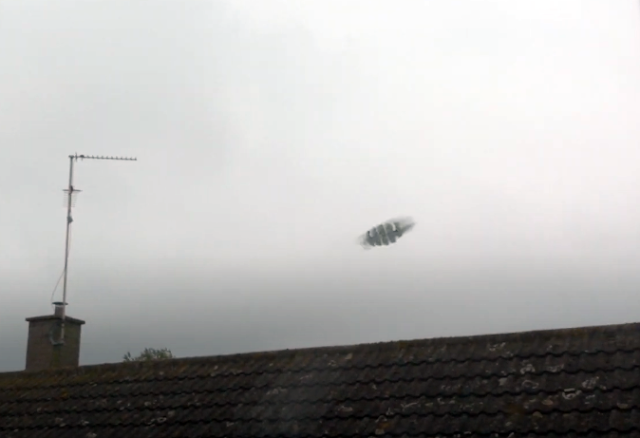
New footage of a multiple lights in the sky above Blackwood in New Jersey. This was taken on 16th August 2020.

Witness report: 

Several objects seen in sky that disappeared and re appeared and blinked. While driving down the highway noticed 2 aircraft flying close together to low and close to be airplanes had a fire glow to them. After getting of the highway I saw several of them just floating in the sky. I wanted to pull over and get a better picture and video. It when I tried to take video it would not work on my phone. I was having trouble making phone calls during this time and got freaked out and took off thinking I did not get any pictures or videos. After leaving the area I was able to use my phone and did indeed get a few seconds of videos and pictures. In the different pictures the objects appear to be different shapes upon zooming in.

Don’t forget to install our Android App for the latest UFO news & videos!

Link: play.google.com/store/apps/details?id=com.latestufosightings.app

{ https://www.latest-ufo-sightings.net/ }

Hoe vind je dit bericht? 1 stem
Geschreven door peter om 16:51 Stuur door

Researchers detect a boomerang earthquake under the Atlantic Ocean

Researchers detect a boomerang earthquake under the Atlantic Ocean

Earthquakes usually come and go, but sometimes, they come back.

Earthquakes usually start small and then extended outwards, causing tremors in and around their path. They may have aftershocks, but after a while, it’s over. But sometimes, earthquakes can go ‘boomerang’, spreading away from the initial rupture and then returning back at higher speeds.

Now, for the first time, researchers have detected such a boomerang earthquake.

A reconstructed image of the Romanche fracture zone

An international group of researchers found evidence of an unprecedented boomerang earthquake that affected the seabed of the Atlantic Ocean back in August 2016. It took place in the Romanche fracture zone, which is located near the equator, mid-way between the east coast of Brazil and the west coast of Africa. The earthquake, detected by undersea seismometers in the region and by distant monitoring stations, had a 7.1 magnitude.

In a new study, researchers showed that the temblor went one way first but then turned around and came back for more, increasing its speed in the process, the authors argued. It was an ultra-fast earthquake.

“Whilst scientists have found that such a reversing rupture mechanism is possible from theoretical models, our new study provides some of the clearest evidence for this enigmatic mechanism occurring in a real fault,” said lead researcher and seismologist Stephen Hicks from Imperial College London in a press release.

Reviewing the seismic data, the authors argued that the earthquake had two phases. First, the rupture went upward and eastward to where the fracture zone meets the Mid-Atlantic Ridge. Then, it unusually expanded westwards, with the tremors going to the center of the fault at a speed of up to six kilometers per second.

via GIPHY

The explanations behind the phenomenon are only speculative so far. Nevertheless, the researchers believe that the first phase of the earthquake released enough fracture energy in order to start the reversal rupture in the westerly underwater land. Further studies would be needed to verify this theory.

It’s not the first-time seismologists looked at backward-propagating earthquakes, but until now the evidence was sparse and based on theoretical models. That’s why the researchers behind the study argue this is a first-of-its-kind type event, detecting a boomerang earthquake in the real world. Boomerang ruptures were also observed in the past in slow earthquakes, which progress slowly over days or months, Jean-Paul Ampuero of the Université Côte d’Azur in France told National Geographic. There were also hints of these events in other quakes. For example, the Tohoku earthquake may have had a boomeranged rupture.

But the circumstances of this particular earthquake are unique. The researchers believe that the study will now allow other scientists to find similar patterns in other earthquakes.

This will add new scenarios into their modeling and improve earthquake impact forecasts in the future, highly relevant to prevent damages.

“Studies like this help us understand how past earthquakes ruptured, how future earthquakes may rupture, and how that relates to the potential impact for faults near populated areas,” Kasey Aderhold, a seismologist with the Incorporated Research Institutions for Seismology, told National Geographic.

{ https://www.zmescience.com/ }

Hoe vind je dit bericht?
Geschreven door peter om 16:07 Stuur door

Dwarf planet Ceres is an ocean world with liquid water beneath the surface

Our solar system is getting more interesting with each passing year

Hoe vind je dit bericht?
Geschreven door peter om 01:15 Stuur door

Visualize the Perseid meteor stream in space

Visualize the Perseid meteor stream in space

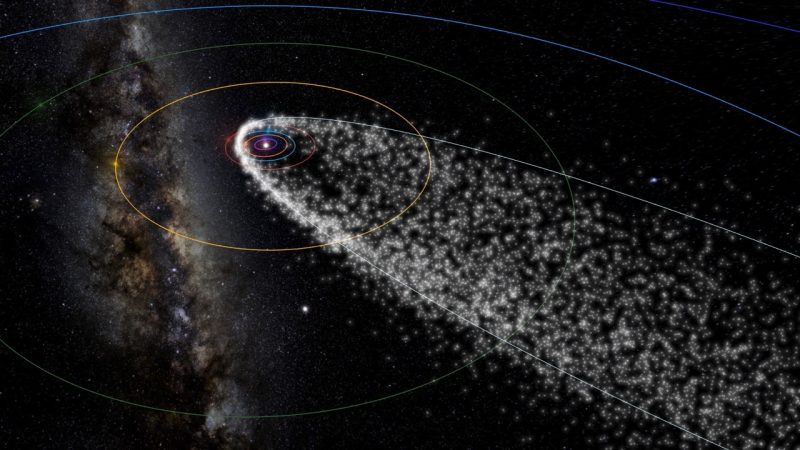
This visualization by Ian Webster and Peter Jenniskens uses NASA data to render known Perseid meteoroids in space. Don’t miss this!

Diagram of Earth orbit with an arc of debris following a narrow elliptical path intersecting it.

Perseid meteor stream visualization. It looks blurry because it’s a screen shot from a video. Be sure to click into the interactive page; it’s awesome! Visualization via Ian Webster.

This visualization uses NASA data to render known Perseid meteoroids as they move through the space of our solar system. What’s a meteoroid? It’s simply the name for a bit of debris in space before it has entered Earth’s atmosphere and vaporized, thereby becoming a meteor or fiery streak in our night sky. Meteors originate in the bodies of comets. The Perseids, in particular, come from Comet Swift-Tuttle, which last visited the inner solar system in 1992. Ian Webster developed this visualization of the Perseid meteor stream in space, using meteor data provided by Peter Jenniskens. The visualization was created with the help of the SETI Institute with the goal of making it easier to understand the natural phenomenon of meteor showers.

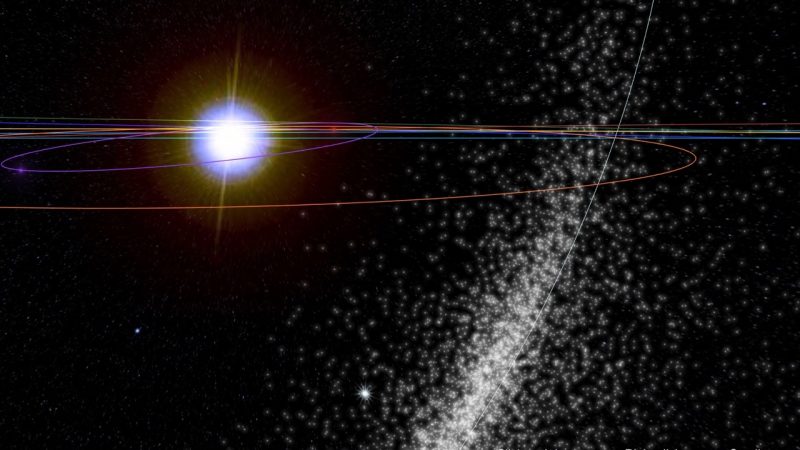
What’s so cool about the interactive page of this visualization? It’s always great to have an aid for picturing a three-dimensional aspect of outer space. This visualization is especially effective because it lets you click into the view from various perspectives. For example, the view below is the Perseid meteor stream as seen from Earth; be sure to click into the page to see the meteors coming toward you!

Diagram of extremely oblique Earth orbit with stream of white particles sweeping almost vertically across it.

Perseid meteor stream from Earth’s perspective in space. Click into the interactive page to see the meteors coming toward you. Click the box in the upper left that says “Watch from Earth.” Visualization via Ian Webster.

  • Bottom line: Two screen shots from Ian Webster and Peter Jenniskens’ wonderful visualization showing Perseid meteoroids in space.

{ https://earthsky.org/ }

Hoe vind je dit bericht?
Geschreven door peter om 00:33 Stuur door

Meet 'Tenacity': 1st Dream Chaser space plane gets a name

Meet 'Tenacity': 1st Dream Chaser space plane gets a name

Hoe vind je dit bericht?
Geschreven door peter om 00:19 Stuur door

What are lightning sprites?

What are lightning sprites?

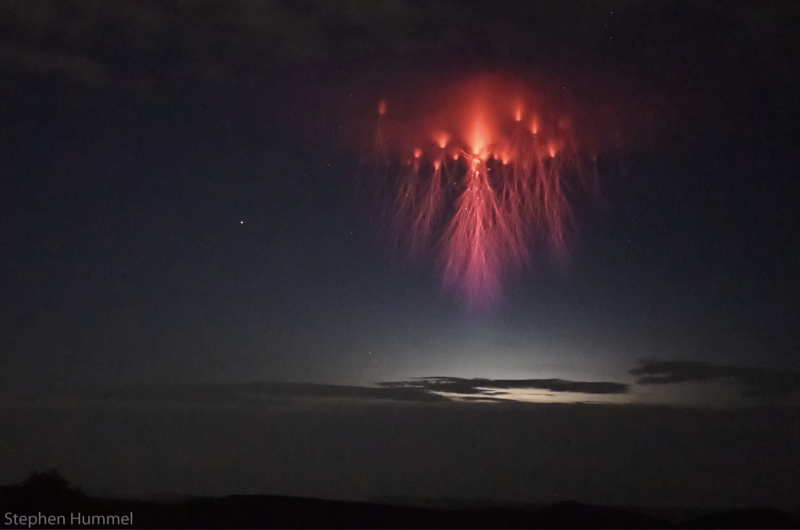
Lightning sprites – aka red sprites – are electrical discharges taking place high in Earth’s atmosphere, above thunderstorms.

A red, glowing structure in the sky, with an intricate, jellyfish-like shape, domed top with streamers hanging down.

View at EarthSky Community Photos. | Stephen Hummel, who works at McDonald Observatory in West Texas, captured this fleeting lightning sprite – aka a red sprite – on July 2, 2020. McDonald Observatory is spearheading a Dark Skies Initiative in its region. Stephen commented, “Dark skies help you see faint objects like sprites.” Thank you, Stephen!

Did you know that lightning sprites – like the one captured in the image above – exist above some thunderstorms? Sprites aren’t terribly well known, except to meteorologists, nature photographers and others who study the skies. They aren’t especially rare, but they’re fleeting. They’re not easy to capture on film. Lightning sprites are electrical discharges high in Earth’s atmosphere. They’re associated with thunderstorms, but they’re not born in the same clouds that send us rain. Thunderstorms – in fact all earthly weather – happen in the layer of Earth’s atmosphere called the troposphere, which extends from Earth’s surface to about 4 to 12 miles (about 6 to 19 km) up. Lightning sprites – also known as red sprites – happen in Earth’s mesosphere, up to 50 miles (80 km) high in the sky.

So when you’re standing on Earth’s surface and you spot one, it appears relatively small, even though, in fact, sprites can be some 30 miles (50 km) across. As Matthew Cappucci of the Washington Post’s Capital Weather Gang said in an article about lightning sprites last year:

Imagine one electrical discharge spanning the distance from Baltimore to Washington, D.C.

Cappucci also commented:

Although sprites are poorly understood, atmospheric electrodynamicists have figured out the basics behind their formation. Sprites are often triggered by a strong, positive bolt of ordinary lightning near the ground. They’re thought to be a balancing mechanism that the atmosphere uses to dispense charges vertically. It’s a quick process that takes less than a tenth of a second.

That’s what makes hunting for sprites so tough. Blink and you’ll miss them.

The fleeting aspect of lightning sprites probably explains why – when people first see photos of them – they’re surprised that such a strange-looking weather phenomenon even exists.

Also, it hasn’t been that many years since lightning sprites were confirmed. In the 20th century, pilots spoke of “flashes above thunderstorms.” Lightning sprites as we know them today weren’t captured and their intricate structure didn’t begin to be recorded on film until as late as 1989, when experimental physicist John R. Winckler (1916-2001) happened to capture one while testing a low-light television camera.

Today, people around the world routinely capture photos of lightning sprites. You’ll find many photos of them in this gallery from SpaceWeather.com.

To photograph a sprite, you need a dark sky and a clear view toward a distant thunderstorm. The sky needs to be dark, because you’ll be taking long exposures; too much stray light in your sky will wash out your photo and make capturing sprites impossible. One of the most successful sprite photographers in the U.S., and likely in the world, is Paul M. Smith. He captured the sprite below in June 2020. You can follow him on Twitter: @PaulMSmithPhoto. Or find him on YouTube.

Want more photos of lightning sprites? Try these:

  • Bottom line: Lightning sprites, or red sprites, often occurring in tandem with lightning, are short-lived electrical discharges that flash high above thunderstorms in the mesosphere layer of the atmosphere.

All related videos, selected and posted by peter2011

{ https://earthsky.org/ }

Hoe vind je dit bericht?
Geschreven door peter om 23:56 Stuur door

Mars 2020: The hunt for life on the Red Planet is about to get serious

Mars 2020: The hunt for life on the Red Planet is about to get serious

Illustration of NASA's Perseverance rover on Mars.
(Image: © NASA/JPL-Caltech)

Monica Grady, Professor of Planetary and Space Sciences,

The Open University

Next spring is going to be a busy time for Mars. In close succession, three spacecraft will arrive at the planet, joining the dozen or so craft already circling Mars. Two of the spacecraft were launched in the past couple of weeks by newcomers to martian exploration: the United Arab Emirates’ Al-Amal (meaning Hope) and China’s Tianwen-1 (which means Question to Heaven).

The third vessel will be NASA’s Mars 2020, containing the Perseverance rover, which just took off successfully from Florida. While this rover will be just one of many on the red planet, it is our best bet for finding life there for the time being.

The sudden flurry of activity is a result of planetary dynamics: every two or so years, the orbits of Earth and Mars align so that the two bodies are at their closest to each other. This results in a shorter interplanetary transit time, of just over six months. The next such launch window will not be until 2022 – when it is expected that the European Space Agency’s ExoMars 2022 will join the throng.

It is legitimate to question why we keep sending rockets to Mars. Surely we have acquired enough images of the surface and its landscapes to know that water used to be there, but has now vanished? True enough – but there are still mysteries to solve: when did the water go, and why? And, of course, the biggest question of all: is (or was) there life on Mars?

The three missions have different objectives: Hope will orbit the planet for at least two Earth years (one Martian year), acquiring data on Mars’ weather – just like the weather satellites orbiting Earth. Tianwen-1 will orbit Mars and is carrying a rover that will be parachuted down to the surface at Utopia Planitia, where it will analyse the soil and take images of the surface.

Perseverance will arrive almost at the same time – but a couple of thousand kilometres away in Jezero Crater. It will be deposited on the surface by sky-crane technology (see the video below), the same method that delivered Curiosity so successfully in 2012.

Perseverance carries a full complement of scientific instruments that will measure all the usual things that get measured on Mars: the chemistry and mineralogy of the rocks and soil, the amount and type or organic material present at and just below the surface, and so on. But there are two other features of the mission that make it unique.

First of all is the helicopter/drone – called Ingenuity - that will be released from beneath the rover. This will fly from Perseverance and circle around before landing away from the rover. It is not certain what the range of the drone will be – although the flight will only last a few minutes and Ingenuity will land only a few metres away from the rover.

The idea behind the flight is to test the concept of atmospheric flight on Mars. Eventually, it is anticipated, drones will be able to fly for much longer and for greater distances. This could help guide rovers, identifying features worth investigating and hazards to avoid.

The ingenuity drone.

(Image credit: NASA/JPL-Caltech)

The second unique feature is a drilling and caching system. Perseverance is the first rover to have the capability to drill a core, about ten centimetres long and one centimetre in diameter, and extract it intact from the drill hole. Perseverance will take samples from a range of different rock types as it traverses the crater floor. The drill cores will be left in a small pile - a cache – for collection, possibly in early 2027, and subsequent transport back to Earth (estimated arrival time is still not known, but maybe around spring 2032).

Sample return

Why is it so important to bring samples back from Mars? The instruments carried by Perseverance will be able to undertake fairly sophisticated chemical analyses of the rocks and soil. But even though the instruments and measurements are a tremendous achievement, they do not have the full range of equipment that we employ on Earth to squeeze every drop of information from a rock.

Tests to check for organic compounds – and whether they might have a biological origin – require a chain of different analyses that are far too elaborate and complex to be undertaken on Mars. Boiling acids, alcohol rinses, addition of chemicals, subtraction of solids, are steps in the chemistry needed to extract and separate organic molecules from their rocky hosts. This just cannot (as yet) be done on Mars.

The rocks will be weighed and measured practically on a grain-by-grain basis and analysed, in some cases down to the individual atoms from which the material is composed. This will be an international effort – there is already a multi-national panel (called MSPG-2) which will draft the requirements for the first sets of analyses and how the samples will be stored, curated and subsequently distributed to the wider scientific community.

There is another set of reasons to bring samples back from Mars – the future of human exploration of Mars. If we send humans to Mars, we have to know how to bring them back again. We have not returned anything directly from another planetary body since the Apollo 17 astronauts left the Moon in December 1972. Yes, we have captured bits from a comet and an asteroid and returned them to Earth – but those missions did not land, collect and come back.

We have been investigating Mars for a long time: for over 150 years by telescope, 50 years from orbit and 20 years by rovers. Only another 12 years, then, before we can analyse Mars in our own laboratories.

Perseverance to get things done is a gift of humanity. Here’s hoping that the rover will live up to its name.

Follow all of the Expert Voices issues and debates — and become part of the discussion — on Facebook and Twitter.

The views expressed are those of the author and do not necessarily reflect the views of the publisher. 

{ https://www.space.com/ }

Hoe vind je dit bericht?
Geschreven door peter om 23:17 Stuur door

Here's how 2 Indian schoolgirls discovered a 'Mars-Crosser' asteroid

Here's how 2 Indian schoolgirls discovered a 'Mars-Crosser' asteroid

It's not every day that two Indian schoolgirls spot a space rock that scientists haven't yet, but that's exactly what happened this summer in a stroke of cosmic good luck.

Radhika Lakhani and Vaidehi Vekariya, two students in Surat, a city in Gujarat in western India, were taking part in a citizen-science project using astronomical data when they realized they were seeing something new. That something turned out to be an asteroid now dubbed 2020 OE6.

It was an exciting moment for the space-minded schoolgirls. "This was a dream. I want to become an astronaut," Vekariya told CNN.

"I don't even have a TV at home, so that I can concentrate on my studies," Lakhani told Reuters.

The 2020 OE6 designation is a standardized nomenclature that reflects the object's discovery date. But someday, Lakhani and Vekariya could propose a more accessible name to the International Astronomical Union, the body that oversees all names in the solar system, an opportunity they told Reuters they were excited about.

Lakhani and Vekariya made their find through a campaign with a citizen-science project called the International Astronomical Search Collaboration. The group connects people around the world with data from two key asteroid-hunting observatories, the Panoramic Survey Telescope and Rapid Response System (Pan-STARRS) in Hawaii and the Catalina Sky Survey in Arizona. Both projects specialize in scanning huge swaths of the sky frequently, enabling newly seen moving objects to stand out against the steady background of the stars.

That said, it's unusual for human eyes to actually discover asteroids these days, and Lakhani and Vekariya got lucky to do so, Paul Chodas, who leads the Center for Near-Earth Object Studies at NASA's Jet Propulsion Laboratory in California, told Space.com in an email. Typically, algorithms do the hard work of spotting an unexpected object moving across the frame.

But for this particular asteroid, those algorithms didn't have enough information to spot the space rock. Lakhani and Vekariya found it in images taken by Pan-STARRS on June 23. The observatory's view is an arrangement of squares, with narrow seams between them that block out certain parts of the sky in each image. And the newly discovered object spent too much time in those seams for the observatory's algorithms to detect it in those images..

Although the asteroid slipped through the net that night, however, scientists would have detected it sooner or later, Robert Weryk, an astronomer at the University of Hawaii, told Space.com in an email. And it turns out that the newly discovered asteroid has turned up before: Weryk was able to track it down in images from another asteroid-hunting observatory and in images taken in 2013 and 2017, as well as in July 2020, a month after the images the students had used.

In the context of some media reports about the discovery, which have labeled the asteroid "Earth-bound," that delay might be worrying. But 2020 OE6 is 50 million miles (70 million kilometers) away from Earth right now and will stay at more or less that distance for at least centuries if not millennia, Chodas said. (For comparison, the moon is about 240,000 miles or 390,000 km away, making this particular asteroid about 200 times more distant.)

All the observations combined have allowed scientists to identify the object's orbit quite precisely, Weryk said. The asteroid takes a bit more than three Earth years to orbit the sun and is perhaps between 1.2 and 3 miles (2 to 5 kilometers) wide. And 2020 OE6 is what scientists call a Mars-Crosser, which means it orbits at around the same distance from the sun as Mars does, although despite the name, the two bodies' paths don't actually cross, according to Chodas.

That's not a particularly unusual type of asteroid — in fact, scientists have discovered more Mars-Crossers than near-Earth asteroids, although both tallies pale in comparison to main-belt asteroids between Mars and Jupiter, which represent the vast majority of asteroids scientists have discovered to date.

The coronavirus pandemic has put a damper on Lakhani and Vekariya's celebrations, according to news reports. But International Astronomical Search Collaboration Director Patrick Miller, a mathematician at Hardin-Simmons University in Texas, told Space.com that the group is preparing commemorative plaques and organizing a ceremony for the pair in New Delhi.

Email Meghan Bartels at mbartels@space.com or follow her on Twitter @meghanbartels.

Follow us on Twitter @Spacedotcom and on Facebook.

Related videos, selected and posted peter2011

{ https://www.space.com/ }

Hoe vind je dit bericht?
Geschreven door peter om 22:57 Stuur door

NASA powers up Ingenuity Mars helicopter in space for the 1st time

NASA powers up Ingenuity Mars helicopter in space for the 1st time

Hoe vind je dit bericht?
Geschreven door peter om 22:33 Stuur door

Scientists Have Shown There's No 'Butterfly Effect' in the Quantum World

Scientists Have Shown There's No 'Butterfly Effect' in the Quantum World

In a new paper, scientists from Los Alamos National Laboratory show that time can be reversed in a quantum system to recover scrambled information without it spiraling into chaos. Wait, uh, what?
BUTTERFLY.jpeg
IMAGE: PIXABAY

Of all the reasons for wanting to time-travel—saving someone from a fatal mistake, exploring ancient civilizations, gathering evidence about unsolved crimes—recovering lost information isn’t the most exciting. But even if a quest to recover the file that didn’t auto-save doesn't sound like a Hollywood movie plot, we’ve all had moments when we’ve longed to go back in time for exactly that reason.

Theories of time and time-travel have highlighted an apparent stumbling block: time travel requires changing the past, even simply by adding in the time traveller. The problem, according to chaos theory, is that the smallest of changes can cause radical consequences in the future. In this conception of time travel, it wouldn’t be advisable to recover your unsaved document since this act would have huge knock-on effects on everything else. 

New research in quantum physics from Los Alamos National Laboratory has shown that the so-called butterfly effect can be overcome in the quantum realm in order to “unscramble” lost information by essentially reversing time. 

In a paper published in July, researchers Bin Yan and Nikolai Sinitsyn write that a thought experiment in “unscrambling” information with time-reversing operations would be “expected to lead to the same butterfly effect as the one in the famous Ray Bradbury’s story ‘A Sound of Thunder’” In that short story, a time traveler steps on an insect in the deep past and returns to find the modern world completely altered, giving rise to the idea we refer to as the butterfly effect. 

“In contrast," they wrote, "our result shows that by the end of a similar protocol the local information is essentially restored.”

"The primary focus of this work is not 'time travel'—physicists do not have an answer yet to tell whether it is possible and how to do time travel in the real world,” Yan clarified.  

“[But] since our protocol involves a 'forward' and a 'backward' evolution of the qubits, achieved by changing the orders of quantum gates in the circuit, it has a nice interpretation in terms of Ray Bradbury's story for the butterfly effect. So, it is an accurate and useful way to understand our results."

What is the butterfly effect? 

The world does not behave in a neat, ordered way. If it did, identical events would always produce the same patterns of knock-on effects, and the future would be entirely predictable, or deterministic. Chaos theory claims that the opposite: total randomness is not our situation either. We exist somewhere in the middle, in a world that often appears random but in fact obeys rules and patterns. 

Patterns within chaos are hidden because they are highly sensitive to tiny changes, which means similar but not identical situations can produce wildly different outcomes. Another way of putting it is that in a chaotic world, effects can be totally out of proportion to their causes, like the metaphor of a flap of butterfly wings causing a tornado on the other side of the world. On the tornado side of the world, the storm would seem random, because the connection between the butterfly-flap and the tornado is too complex to be apparent. While this butterfly effect is the classic poetic metaphor illustrating chaos theory, chaotic dynamics also play out in real-world contexts, including population growth in the Canadian lynx species and the rotation of Pluto’s moons.

Another feature of chaos is that, even though the rules are deterministic, the future is not predictable in the long-term. Since chaos is so sensitive to small variations, there are near-infinite ways the rules could play out and we would need to know an impossible amount of detail about the present and past to map out exactly how the world will evolve. 

Similarly, you can’t reverse-engineer some piece of information about the past simply by knowing the current and even future situations; time-travel doesn’t help retrieve past information, because even moving backwards in time, the chaotic system is still in play and will produce unpredictable effects.

Information scrambling

Unscrambling information which has previously been scrambled is not straightforward in a chaotic system. Yan and Sinitsyn’s key discovery is that it is nonetheless possible in quantum computing to get enough information via time-reversal which will then enable information unscrambling. 

According to Yan, the fact that the butterfly effect does not occur in quantum realms is not a surprising result, but demonstrating information unscrambling is both novel and important.

In quantum information theory, scrambling occurs when the information encoded in each quantum particle is split up and redistributed across multiple quantum particles in the same quantum system. The scrambling is not random, since information redistribution relies on quantum entanglement, which means that the states of some quantum particles are dependent on each other. Although the scrambled result is seemingly chaotic, the information can be put back together, at least in principle, using the entangled relationships.

Importantly, information scrambling is not the same as information loss. To continue the earlier analogy: information loss occurs when a document is permanently deleted from your computer. For information scrambling, imagine cutting and pasting tiny bits of one computer file into every other file on your machine. Each file now contains a mess of information snippets. You could reconstruct the original files, if you remembered exactly which bits were cut and pasted, and did the entire process in reverse.

Physicists are interested in information scrambling for two main reasons. On the theoretical side, it’s been proposed as a way to explain what happens to information sucked into a black hole. On the more applied side, it could be an important mechanism for quantum computers to store and hide information, and could produce fast and efficient quantum simulators, which are used already to perform complex experiments including new drug discovery.

Yan and Sinitsyn fall into the second camp, and construct what they call a “practically accessible scenario” to test unscrambling by time-travel. This scenario is still hypothetical, but explores the mathematics of the actual quantum processor used by Google to demonstrate quantum supremacy in 2019.

Yan says: “Another potential application is to use this effect to protect information. A random evolution on a quantum circuit can make the qubit robust to perturbations. One may further exploit the discovered effect to design protocols in quantum cryptography.”

The set-up

In Yan and Sinitsyn's quantum thought experiment, Alice and Bob are the protagonists. Alice is using a simplified version of Google’s quantum processor to hide just one part of the information stored on the computer (called the “central qubit”) by scrambling this qubit’s state across all the other qubits (called the “qubit bath”). Bob is cast as the “intruder”, much like a malicious computer hacker. He wants the important information originally stored on the central qubit, now distributed across entangled quantum particles in the bath. 

Unfortunately, Bob’s hack, while successful in getting the information he wanted, leaves a trail of destruction.

“If her processor has already scrambled the information, Alice is sure that Bob cannot get anything useful,” the authors write. “However, Bob’s measurement changes the state of the central qubit and also destroys all quantum correlations between this qubit and the rest of the system.”

Bob's method of information theft has altered the computer state so that Alice can also no longer access the hidden information. In this case, the damage occurs because quantum states contain all possible values they could have, with assigned probabilities of each value, but these possibilities (represented by the wave function) “collapse” down to just one value when a measurement is taken. Quantum computing relies on unmeasured quantum systems to store even more information in multiple possible states, and Bob’s intrusion has totally altered the computer system.

Reversing time

Theoretically, the behaviour of a quantum system moving backwards in time can be demonstrated mathematically using what’s called a time-reversed evolution operator, which is exactly what Alice uses to de-scramble the information. 

Her time-reversal is not actually time travel the way we understand it from science fiction, it is literally a reversal of time’s direction; the system evolves backwards following whatever dynamics are in play, rather than Alice herself revisiting an earlier time. If the butterfly effect held in the quantum world, then this backwards evolution would actually increase the damage Bob had caused, and Alice would only be able to retrieve the hidden information if she knew exactly what that damage was and could correct her calculations accordingly.

Luckily for Alice, quantum systems behave totally differently to non-quantum (classical or semiclassical) chaotic systems. What Yan and Sinitsyn found is that she can apply her time-reversal operation and end up at an "earlier" state which will not be identical with the initial system she set up, but it will also not have increased the damage which occurred later. Alice can then reconstruct her initial system using a method of quantum unscrambling called quantum state tomography. 

What this means is that a quantum system can effectively heal and even recover information that was scrambled in the past, without the chaos of the butterfly effect. 

“Classical chaotic evolution magnifies any state damage exponentially quickly, which is known as the butterfly effect,” explain Yan and Sinitsyn. “The quantum evolution, however, is

linear. This explains why, in our case, the uncontrolled damage to the state is not magnified by the subsequent complex evolution. Moreover, the fact that Bob’s measurement does not damage the useful information follows from the property of entanglement correlations in the scrambled state.”

Hypothetical though this scenario may be, the result already has a practical use: verifying whether a quantum system has achieved quantum supremacy. Quantum processors can simulate time-reversal in a way that classical computers cannot, which could provide the next important test for the quantum race between Google and IBM. 

So, while time travel is still not in the cards, the quantum world continues to mess with our classical conception of how the world evolves in time, and pushes the limits of computing information.

Hoe vind je dit bericht? 1 stem
Geschreven door peter om 22:01 Stuur door

New Cryptid or Brave Elf Possibly Spotted in Iceland

art-1729274_1920-e1597685150166-999x540.jpg

New Cryptid or Brave Elf Possibly Spotted in Iceland

While the most frequently active volcano in Iceland – Grímsvötn – is overdue and making noises like the next eruption is coming, an unusual alleged cryptid sighting at a famous waterfall in that country has some wondering if underground rumbling may be causing hidden monsters to arise. Has anyone in Iceland checked on the Lagarfljót worm lately? How about the elves?

feverdreamofficial
Feel like this creepy video that I posted on my story needs an answer. Shot on the cliff of Dettifoss, Iceland. Close to the capital city of elves, Ásbyrgi. No people in front of us and only a cliff so steep it could not carry anyone. We even went too far in my taste. I then noticed much later this little creature in my video and then a head popping up in the end 😰 Looking like the girl from Ring 😂 No drones, no birds, no plastic bags, what is it?? I am not crazy right it looks hella wack?

Hella wack? That’s something beyond ‘wack’ (duh) or absurd and it seems to be a useful description for the video (watch it here) posted on Instagram by Icelandic feminist rapper and poet Vigdís Howser Harðardóttir (aka Fever Dream). She says she was at the Dettifoss waterfall (in the background) in the Vatnajökull National Park at the edge of a cliff when she spotted what looks like a small, dark figure. For the non-elf-aware, she points out that Ásbyrgi canyon is believed by many Icelanders to be the magical capital of elf world. Did she record one of the elves or the Huldufólk (Hidden people)? While she tells Fréttablaðið (The Newspaper) that she’s “not saying this is an elf,” she believes only “a black elf or even some kind of devil” could perch on such a precarious precipice, and that it resembles other videos she’s seen posted by people claiming to see an elf.

If it’s not an elf or a ‘devil’, what the devil is in the video? It could be a small or young person with incredible climbing ability and balance – Vigdís Howser Harðardóttir doesn’t say how long it was there or when it disappeared. Belief in elves is strong and deep in Iceland, but it has some other cryptids – most famously the Lagarfljót worm, an alleged monster in Lagarfljót lake. The legend of a giant serpent, worm or slug in Lagarfljót dates back to the 1300s but it’s limited to the lake, which is 170 km (105 miles) from Dettifoss. Another candidate could be a Merman, the more evil counterpart of mermaids, but Dettifoos is a long way from the coastal waters where they’re allegedly seen.

That leaves an elf or a huldufólk – the main difference between them is size (huldufólk are human-sized, elves are small) and coffee preference (huldufólk like it). Others may scoff at the idea, but there must be some reason why polls find about 54 percent of Iceland’s 300,000+ residents would not deny the existence of elves.

Being a feminist rapper means Vigdís Howser Harðardóttir is a controversial figure, but that may not stop true elf believers from siding with her on this one.

Take a look again. (See the video here.) What do you think? Is the volcano stirring things up?

{ https://mysteriousuniverse.org/ }

Hoe vind je dit bericht?
Geschreven door peter om 21:21 Stuur door

429-Million-Year-Old Sea Creature Had Eyes “Almost Identical” To Modern Bees

429-Million-Year-Old Sea Creature Had Eyes "Almost Identical" To Modern Bees | Mysterious Universe

429-Million-Year-Old Sea Creature Had Eyes “Almost Identical” To Modern Bees

Prehistoric armored sea bugs called trilobites that lived nearly half a billion years ago had disco-ball-like-eyes that are remarkably similar to those of modern bees and dragonflies. Trilobites were a marine arthropod with many legs that lived at the bottom of the seafloor during the Cambrian time period (543 million to 490 million years ago) until becoming extinct around 250 million years ago.

Numerous fossils from the sea bug’s strong exoskeleton were discovered by paleontologists and surprisingly its eye was very well preserved. Actually, the remains of the eye were initially found in 1846 close to Loděnice in the Czech Republic but it’s only been recently studied in great detail.

Fossil of a trilobite.

The researchers analyzed the left eye of a type of trilobite called Aulacopleura koninckii from approximately 429 million years ago (pictures can be seen here), specifically the light-sensitive receptor cells in the lenses that suggested a very early evolution of compound eyes. As a matter of fact, trilobites from as far back as 522 million years also appeared to have had compound eyes which suggest that those types of eyes may have evolved a lot earlier than previously thought, maybe in shell-less creatures. Their protruding oval-shaped eyes are situated on the back part of its head.

They studied the eye using microscopy and found hundreds of optical units called ommatidia that make up the compound eyes that are found in today’s insects and crustaceans. According to the scientists, the ommatidia found in the trilobite’s left eye had eight cells that detected light “forming a kind of rosette”. The cells were gathered around a translucent cylinder that channeled light that’s called a rhabdom in addition to there being a thick lens that covered the top of the ommatidia. They also found that the dark-colored rings of pigmented cells created a “cellular basket” surrounding the optical units as well as a thin crystalline cone “although its shape is not very distinct”. You put all of that together and you have a compound eye that looks similar to a disco ball.

3D model of a trilobite.

Based on the fact that the Aulacopleura koninckii’s eye facets were just 0.0001 inches in diameter, the creature would have had a vision of around 200 “pixels” which would have helped it to glide around the waters and avoid predators. It “surely was day active and lived in shallow, light-flooded waters,” Brigitte Schoenemann, who is a paleontologist in the Institute of Biology Education at the University of Cologne in Germany and the lead author of the study, explained in an email to Live Science.

She finished off by stating that today’s insects and crustaceans have vision that is “an enormously old and effective system, quite unchanged since our trilobite”. Things change over the course of hundreds of millions of years but apparently the eyes of crustaceans and insects remained the same. That reminds me of the old saying, “if it isn’t broke, don’t fix it”.

Related videos, selected and posted by peter2011

{ https://mysteriousuniverse.org/ }

Hoe vind je dit bericht?
Geschreven door peter om 21:01 Stuur door

Probing the Middle of Uranus Yields Surprising Results

Probing the Middle of Uranus Yields Surprising Results | Mysterious Universe

Probing the Middle of Uranus Yields Surprising Results

3-2-1 …

“It’s pronounced YOUR-a-nus, not your-ANUS, you blankety-blank-blank!”

Get that frustration out of your system now and we’ll promise not to do any more Uranus probe double entendres. OK? Finished? Good.

“A new theoretical method paves the way to modelling the interior of the ice giants Uranus and Neptune, thanks to computer simulations on the water contained within them.”

The Scuola Internazionale Superiore di Studi Avanzati (SISSA – International School of Advanced Studies) in Trieste, Italy, announced this week a new way of determining what is inside planets far too distant to land rovers or ground-penetrating landers. Until now, space scientists have had to settle for theories based on features and reflections of surface matter and magnetic field studies. To get a better X-ray of Uranus and Neptune, scientists at SISSA and the University of California at Los Angeles developed a new computer model using data about the water on and inside Uranus.

“In such exotic physical conditions, we cannot think of ice as we are used to. Even water is actually different, denser, with several molecules dissociated into positive and negative ions, thus carrying an electrical charge. Superionic water lies somewhere between the liquid and solid phases: the oxygen atoms of the H2O molecule are organised in a crystalline lattice, while hydrogen atoms diffuse freely like in a charged fluid.”

In a statement on their study published in Nature Communications, SISSA professors and study co-authors Federico Grasselli and Stefano Baroni describe how they used their model to simulate the three stages of water on Uranus – ice, liquid and superionic (a part-liquid-part-ice condition caused by extremely high temperatures and pressures.) the charges show these states have different positive and negative ions than Earth water and they’re more dense than what comes out of our taps. These simulations told them a lot about the evolution of the planets and what may be deep inside of them.

Different in many ways

“In particular, the heat conduction properties that emerge from our study allow us to hypothesise that the existence of a frozen core may explain the anomalously low luminosity of Uranus as due to an extremely low heat flux from its interior towards the surface.”

They show that the planetary layers below the fluid layer that generates a planet’s magnetic field are predominantly superionic water, which may help explain the behavior of these fields on these distant planets. This will aid future research in determining how these so-called gas giants formed and how they cooled into space bodies made up of a water that is not liquid or solid – where hydrogen atoms are free but oxygen atoms are locked in a lattice formation. A planetary slushie?

If you’ve been keeping score, we’ve made it through the article without another double entendre about scientists using a computer model to peek inside YOUR-a-nus.

You’re welcome.

NOTE:

  • all related videos, selected and posted by peter2011

{ https://mysteriousuniverse.org/ }

Hoe vind je dit bericht?
Geschreven door peter om 20:47 Stuur door

“We willen geen paniek zaaien, maar dit is verontrustend”: deeltjes microplastic gevonden in menselijke organen - HLN.be

“We willen geen paniek zaaien, maar dit is verontrustend”: deeltjes microplastic gevonden in menselijke organen - HLN.be

Bron: De Morgen

Illustratiebeeld.

 Getty Images Illustratiebeeld.
 Wetenschappers hebben voor het eerst deeltjes microplastic en nanoplastic gevonden in menselijke organen. Die resultaten, waarover The Guardian bericht, hebben Amerikaanse onderzoekers vandaag voorgesteld op het congres van de American Chemical Society

De vervuilende impact van plastic is wereldwijd voelbaar. Straten, stranden en oceanen: overal zijn de gevolgen van onze wegwerpcultuur te zien. Amerikaanse onderzoekers hebben nu zelfs kleine plastic deeltjes gevonden in het menselijk lichaam.

Lees ook

De wetenschappers vonden deeltjes van microplastic (met een diameter kleiner dan 5 mm) en nanoplastic (met een diameter kleiner dan 0,001 mm) in alle onderzochte organen van deze studie. De deeltjes in de concreet 47 onderzochte longen, levers, milten en nieren werden vermoedelijk ingenomen via voedsel en water.

In totaal konden ze tientallen soorten plastiek ontdekken in de organen. Het gaat onder meer om polyethyleentereftalaat (PET), waarvan plastic drankflessen worden gemaakt, en polyethyleen, dat voor plastic zakjes wordt gebruikt.

Ongerust

Hoewel de impact op onze gezondheid nog niet bewezen is, maken de onderzoekers zich zorgen. Zo is de schade van microplastic al eerder gebleken bij onderzoek naar zeedieren. Toen konden wetenschappers een verband vaststellen tussen de blootstelling aan de kleine deeltjes en onvruchtbaarheid, ontsteking en kanker.

“We willen geen paniek zaaien, maar het is verontrustend dat deze niet-biologisch afbreekbare materialen in het menselijk weefsel terechtkomen en zich daar kunnen ophopen zonder dat we de impact ervan kennen”, zei mede-auteur Varun Kelkar aan The Guardian.

De onderzoekers hopen nu dat deze resultaten leiden tot diepgaander onderzoek naar het effect van vervuiling op ons lichaam. “Als we beter zicht hebben op hoeveel stoffen er in onze weefsels zitten, kunnen we epidemiologische studies uitvoeren om het effect op de menselijke gezondheid te bestuderen. Op die manier kunnen we de potentiële gezondheidsrisico’s in kaart brengen.”

Kunststof

Naast de deeltjes microplastic werd in alle proefmonsters ook de chemische stof Bisfenol A aangetroffen. Die schadelijke stof wordt voornamelijk gebruikt bij de productie van kunststoffen. Het Amerikaanse Beschermingsinstituut maakt zich zorgen om de aanwezigheid van de stof wegens de impact op het menselijke lichaam. Zo kan het onder meer de ontwikkeling en voortplanting aantasten.

{ https://www.hln.be/ }

Hoe vind je dit bericht?
Geschreven door peter om 20:20 Stuur door

Wederom vreemde cirkels op Buienradar

Wederom vreemde cirkels op Buienradar

vortex Buienradar
Het is niet de eerste keer dat er vreemdsoortige cirkels verschijnen op de populaire buienradar.

Niet alleen in Nederland hebben wij dit soort vortexen eerder gezien, maar ook op radarschermen naast de Popocatepetl vulkaan in Mexico.

Vorig jaar november ontvingen wij via een lezer een aantal afbeeldingen van Buienradar waarop tijdens onweersbuien een soort vreemde cirkel waar te nemen was.

cirkel buienradar

Voor zover ons bekend heeft niemand daar ooit een verklaring voor kunnen vinden.

De afgelopen dagen deed zich weer een vreemd verschijnsel voor op Buienradar. Weer een cirkel en weer in combinatie met onweer, alleen ziet die cirkel er nu als volgt uit.

vreemde cirkel buienradar

Hierna volgt een video met talloze voorbeelden van het vreemde verschijnsel op Buienradar.


Dan wordt er natuurlijk al heel snel gespeculeerd over wat dit zou kunnen veroorzaken en dan komt ook al snel het woord HAARP om de hoek kijken.

Volgens Martin Vrijland kunnen we daar kort en duidelijk over zijn, het is niet een effect dat door HAARP wordt veroorzaakt.

De perfecte cirkel die buienradar laat zien is namelijk een gevolg van de grondradar en heeft niets met HAARP te maken.

Waar we eerder iets dergelijks op een weerradar hebben gezien is op 28 oktober 2012 in Mexico. Die cirkel/vortex zag er als volgt uit:

vortex mexico


vortex mexico

Ook hier is nooit een verklaring voor gevonden, maar er was hier wel degelijk iets bijzonders aan de hand. De dag ervoor werd de wereld opgeschrikt door beelden van een enorme cilindervormige ufo die met grote snelheid in de krater van Popocatepetl vulkaan verdween. 

Dit fenomeen is bij ons niet echt in het mainstream nieuws geweest, maar in landen als Mexico des te meer, waar er uitgebreid over werd gesproken op de televisie.


Dat was in Mexico, wij hebben geen vulkanen met grote kraters waar ufo's met grote snelheid in kunnen verdwijnen, dus de cirkels op Buienradar zullen een andere oorzaak hebben.

We gaan nog even terug naar Vrijland die zegt dat volgens hem HAARP dan wel niet die cirkel veroorzaakt op de Buienradar, maar wel voor een ander heel actueel effect kan zorgen en dat zijn exosomen.

Voor hen die niet weten of vergeten zijn waar HAARP precies voor staat, hier een uitleg uit een eerder artikel:

Ondertussen zijn veel mensen bekend met het High Frequency Active Auroral Research Program (HAARP), een Amerikaans militair en civiel onderzoeksinstituut in Alaska dat formeel gezien onderzoek doet naar de ionosfeer. Dr. Nick Begich heeft het verband aangetoond tussen HAARP en de beïnvloeding van bewustzijn. Hij is geregeld als getuige-deskundige opgeroepen door het Europees Parlement. Volgens Dr. Begich schiet HAARP een gerichte elektromagnetische straal in de bovenste laag van de atmosfeer. Zie het als een geavanceerde ionosferische kachel. De ionosfeer is de elektrisch geladen laag bovenin de atmosfeer. De laag bevindt zich op 60 tot 100 kilometer boven het aardoppervlak. HAARP is eigenlijk een omgekeerde radiotelescoop omdat het apparaat een antenne heeft die signalen uitzendt in plaats van ontvangt. Met HAARP wordt een technologie getest die de ionosfeer met een gerichte straal op bepaalde plaatsen opwarmt. Elektromagnetische stralen worden vervolgens teruggekaatst naar de Aarde en penetreren alles.

Door het op bepaalde plaatsen opwarmen van de ionosfeer kan men dan ook vrij gemakkelijk dingen doen zoals het weer beïnvloeden, maar boven alles hebben die teruggekaatste stralen ook een effect op het menselijk lichaam en geest.

Zoals we hierboven zagen heeft het een effect op het bewustzijn van de mens, maar zorgt het ook voor de uitscheiding van exosomen.

Exosomen is een bepaalde genetische uitscheiding van de cellen die voor komt, wanneer de cellen worden aangevallen of onder stress staan.

Exosomen zijn blaasjes met een diameter van 50 tot 100 nm die worden uitgescheiden door een grote verscheidenheid aan cellen in het menselijk lichaam.1 Ze ontstaan in de cellen via een complex mechanisme, waarbij celinhoud zoals eiwitten en RNA-strengen in de blaasjes wordt ingekapseld.

En wat belangrijk is dat bij de PCR testen zoals die voor covid-19 worden gebruikt, de aanwezigheid van exosomen zal worden uitgelegd als positief en de persoon in kwestie zal (onterecht) het label: "besmet met covid-19" opgeplakt krijgen.

En dat is dan hetgeen dat Vrijland bedoelt als hij het volgende schrijft:
Een ander effect wat die HAARP straling op kan leveren, is gebaseerd op de ‘terrain theory’ waarbij het lichaam de straling als vervuiling ervaart en daarmee zogenaamde exosomen gaat aanmaken. Louis Pasteur, de bedenker van de ‘germ theory’, die door de gehele wetenschap is overgenomen, maar waarvan hij zelf op zijn sterfbed zei dat die onjuist was, bleek niet alleen te hebben gefraudeerd, maar gaf dus toe dat die terrein theorie de enige juiste was (zie dit artikel en dit artikel). 
Kortom, met HAARP kan men naar hartelust op ieder gewenst moment, op iedere gewenste locatie net zoveel besmette coronapatiënten leveren als ze op dat moment nodig hebben.

{ https://www.niburu.co/ }

Hoe vind je dit bericht?
Geschreven door peter om 18:33 Stuur door

Weird Creature filmed at waterfall in Iceland

Weird Creature filmed at waterfall in Iceland

Several days ago, Vigdís Howser Harðardóttir posted a weid video on Instagram showing a small dark creature that suddenly appears and climbs over the edge of a cliff at Dettifoss waterfall in Iceland.
weird-creaure-waterfall-iceland%2B%25281%2529.jpg
                                       
  Credit image: Vigdís Howser Harðardóttir.
Vigdis states:Shot on the cliff of Dettifoss, Iceland. Close to the capital city of elves, Ásbyrgi. No people in front of us and only a cliff so steep it could not carry anyone. 
We even went too far in my taste. I then noticed much later this little creature in my video and then a head popping up in the end. No drones, no birds, no plastic bags, what is it? I Feel like this creepy video that I posted needs an answer.
Indeed very strange, I have no explanation for the strange appearance, but some people say that the creature looks like a human figure with something covering its head while others talking about a cryptid, a creature whose existence is unsubstantiated.
weird-creaure-waterfall-iceland%2B%25282%2529.jpg
Credit image: Vigdís Howser Harðardóttir.
Vigdís did indeed captured something extraordinary or there is an explanation for the strange appearance?
You can watch the video below or directly on feverdreamofficial Instagram.

{  http://ufosightingshotspot.blogspot.com/ }

Hoe vind je dit bericht?
Geschreven door peter om 18:16 Stuur door

Ancient Spaceship Found On Mercury In Crater Center, Photos, UFO Sighting News.

Ancient Spaceship Found On Mercury In Crater Center, Photos, UFO Sighting News.

%25E0%25A4%25AF%25E0%25A5%2582%25E0%25A4%258F%25E0%25A4%25AB%25E0%25A4%2593%252C%2B%25C4%2591i%25CC%2583a%2Bbay%252C%2BNLO%252C%2BOZN%252C%2B%25D0%259D%25D0%259B%25D0%259E%252C%2Bovni%252C%2Bomni%252C%2B%2BMUFON%252C%2BDeagla%25CC%2581n%252C%2B%2BUFO%252C%2BUFOs%252C%2Bsighting%252C%2Bsightings%252C%2Balien%252C%2Baliens%252C%2BET%252C%2B%2BMercury%252C%2Bplanet%252C%2Bbase%252C%2B.png

%25E0%25A4%25AF%25E0%25A5%2582%25E0%25A4%258F%25E0%25A4%25AB%25E0%25A4%2593%252C%2B%25C4%2591i%25CC%2583a%2Bbay%252C%2BNLO%252C%2BOZN%252C%2B%25D0%259D%25D0%259B%25D0%259E%252C%2Bovni%252C%2Bomni%252C%2B%2BMUFON%252C%2BDeagla%25CC%2581n%252C%2B%2BUFO%252C%2BUFOs%252C%2Bsighting%252C%2Bsightings%252C%2Balien%252C%2Baliens%252C%2BET%252C%2B%2Bparanormal%252C%2B.png

Date of discovery: Aug 15 2020
Location of discovery: Planet Mercury
Source coordinates: 

I have found a structure within a crater on planet Mercury today. The structure has three long segments to it. Each part is along side the next. NASA map says this is 2.5km across by 2.5km high. Thats a huge structure. The way its laying down and the way the three segments are side by side make me think this is a ship and can move from place to place. It may have been docked in this location in the crater to make it easier to find and accessible. But...I wonder...where did the captain and crew go? Their must be an underground base near this location or why park the ship there?
One answer...brings many more questions. 
Scott C. Waring - Taiwan

UFO%252C%2BUFOs%252C%2Bsighting%252C%2Bsightings%252C%2Balien%252C%2Baliens%252C%2BET%252C%2B%2Bancient%252C%2B%25D7%25A2%25D7%25A6%25D7%259D%2B%25D7%2591%25D7%259C%25D7%25AA%25D7%2599%2B%25D7%259E%25D7%2596%25D7%2595%25D7%2594%25D7%2594%252C%2Barchaeology%252C%2Bastrobiology%252C%2Bvreemdelinge%252C%2B%2B%2B.png

UFO%252C%2BUFOs%252C%2Bsighting%252C%2Bsightings%252C%2Balien%252C%2Baliens%252C%2BET%252C%2B%2Bancient%252C%2B%25D7%25A2%25D7%25A6%25D7%259D%2B%25D7%2591%25D7%259C%25D7%25AA%25D7%2599%2B%25D7%259E%25D7%2596%25D7%2595%25D7%2594%25D7%2594%252C%2Barchaeology%252C%2Bastrobiology%252C%2Bpaleontology%252C%2Bwaarneming%252C%2Bvreemdelinge%252C%2B%2B%2B.png

{ https://www.ufosightingsdaily.com/ }

Hoe vind je dit bericht?
Geschreven door peter om 18:03 Stuur door

Really fast UFO filmed over Atlantic ocean (Florida beach) 16-Aug-2020

Really fast UFO filmed over Atlantic ocean (Florida beach) 16-Aug-2020

atlantic-ocean-ufo.png

This really fast unidentified flying object was spotted in the sky above Atlantic ocean. It was filmed from Volusia county, Florda on 11th August 2020.

Witness report:

 Object seem to be hovering with no sound miles and miles from the hotel I was at. It made no nosie it looked dark grey. On vacation went out on the balcony and noticed a black disk shaped object from a far distance on the beach just hovering in one spot for about minute or two that’s what caught my attention. It then started to move and I lost it. I grabbed my phone to record hovering and then I thought I lost because the sun was shining so bright I could barely see or sit on the balcony. Then I noticed I found the object again it seemed to be scanning the same spot and then it took off so fast I could barely see because of the sun in my eyes I had to put the phone down to see where it went. But it kept hovering that area of the water drop real low go back up and shoot cross the water and then disappear from my eye view.

Related videos, selected and posted by peter2011

{ https://www.latest-ufo-sightings.net/ }

Hoe vind je dit bericht?
Geschreven door peter om 17:31 Stuur door

A visual tour of Ceres, where astronomers found evidence of a subsurface ocean

A visual tour of Ceres, where astronomers found evidence of a subsurface ocean

Recent evidence has just made Ceres one of the more interesting places in the solar system.

Ceres is the largest asteroid in the asteroid belt that lies between Mars and Jupiter. It’s also considered a dwarf planet, much like Pluto. In a flurry of new studies, astronomers report strong evidence of a salty ocean beneath the surface

Ceres

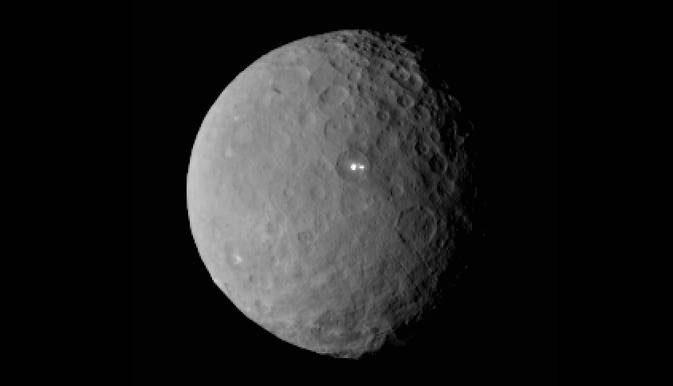
The Dawn spacecraft entered the orbit of Ceres in March 2015, offering an unprecedented close view of a surprisingly dynamic environment. Far from being a cold, barren, and dull planetoid, Ceres is remarkably active.

Researchers now believe its rigid crust harbors a subsurface ocean, an ocean which may have once been on the surface.

What’s inside Ceres? Gravity can tell. The map overlaid on the right gives scientists hints about Ceres’ internal structure from gravity measurements. Image credits: NASA.

Landing on Ceres would be very challenging logistically and would risk contaminating the planet, so instead, researchers use remote sensing from Dawn’s instruments to measure the Ceresian galaxy, estimating its composition and interior structure, in addition to its topography. Maps such as the one above (right side) help researchers estimate its composition and interior structure.

“Ceres has an abundance of gravity anomalies associated with outstanding geologic features,” says Anton Ermakov, a postdoctoral researcher at JPL.

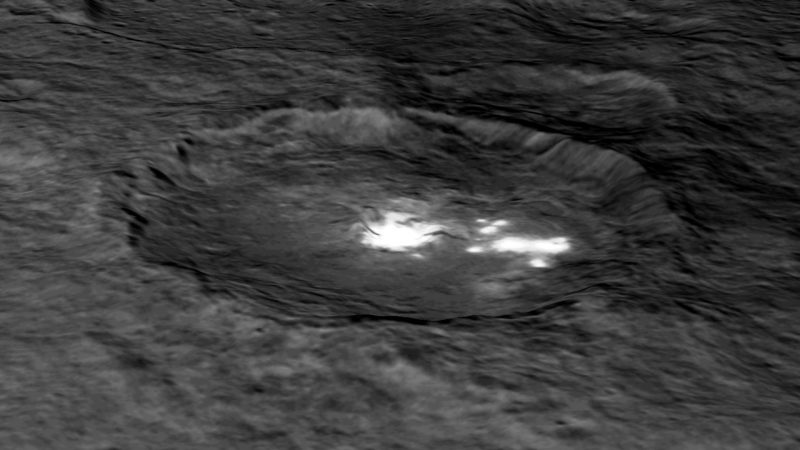
Occator Crater is one of the more interesting features on Ceres — and one that researchers looked at to infer the presence of subsurface water.

Image credits: NASA/JPL.

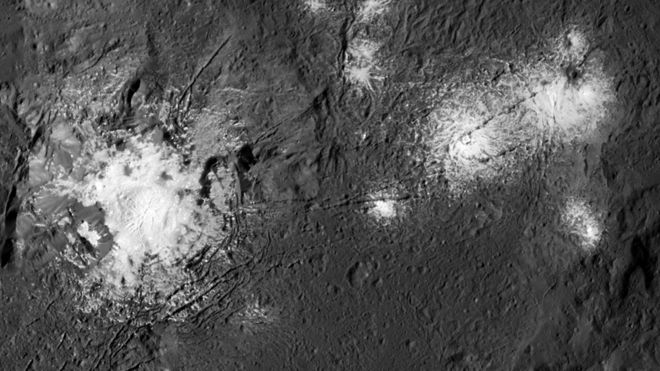
Occator is an impact crater located on Ceres containing the brightest of the bright spots observed by the Dawn spacecraft. Astronomers have found evidence that some of the rocks on Occator are hydrohalite — a type of rock that forms in salt water.

Before this, hydrohalite had only been observed on Earth.

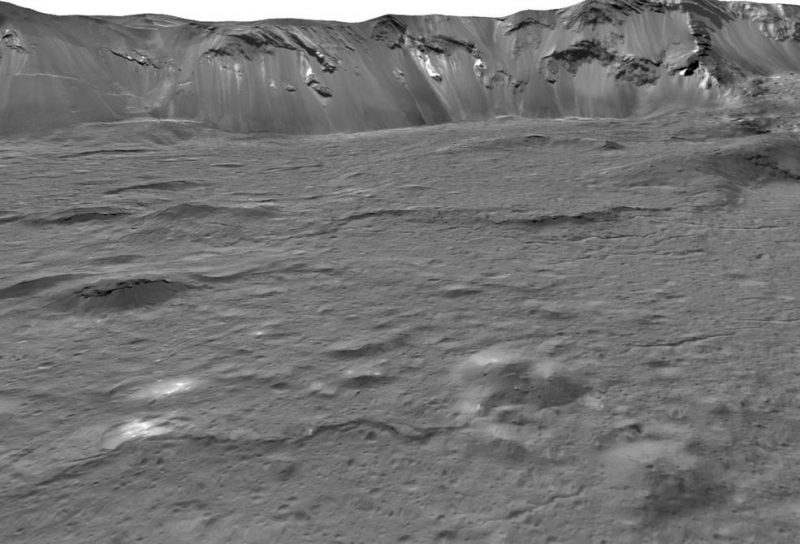
Fracture system inside Occator. Image taken by the Dawn shuttle at an altitude of 22 miles (36 kilometers). Image credits: NASA/JPL

Ceres seems riddled with minerals containing water suggesting that the dwarf planet once had a global ocean. What became of that ocean? Likely, it now only exists underground as a ‘fossil ocean’, recent NASA research indicates.

The Dawn team found that Ceres’ crust is a mixture of ice, salts, and hydrated materials — a type of crust also indicative of a former ocean.

This image of Occator Crater’s northern wall was obtained by NASA’s Dawn spacecraft on June 16, 2018 from an altitude of about 21 miles (33 kilometers). Image credits: NASA/JPL.

It’s not just Ceres’ past that intrigues astronomers — its present seems quite interesting as well. Ceres is still geologically active in several ways and exhibits signs of cryovolcanism, quite possibly connected to its subsurface water.

The Dawn team also discovered what seems to be a softer, easily deformable layer beneath the rigid crust, a potential signature of residual liquid.

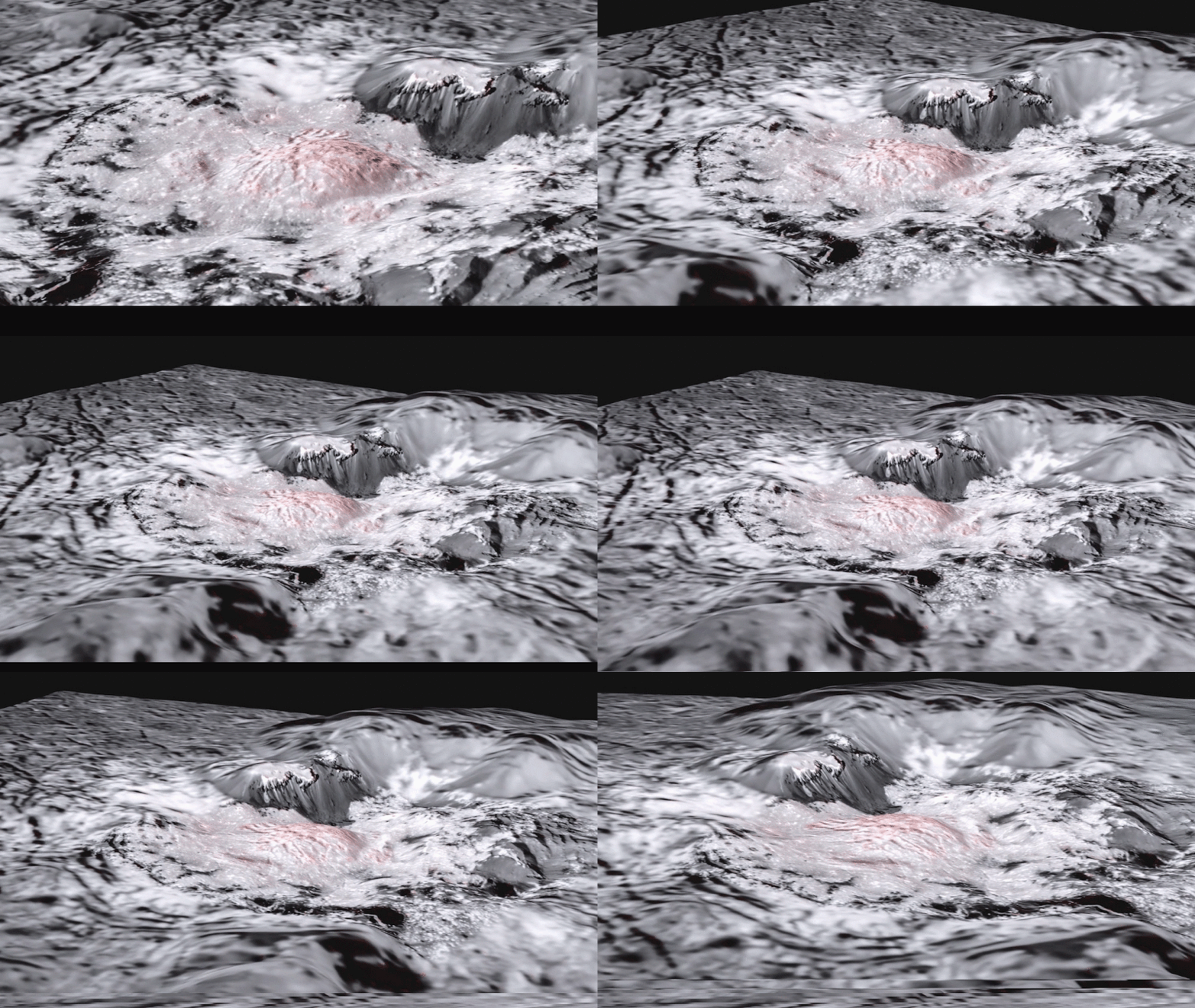
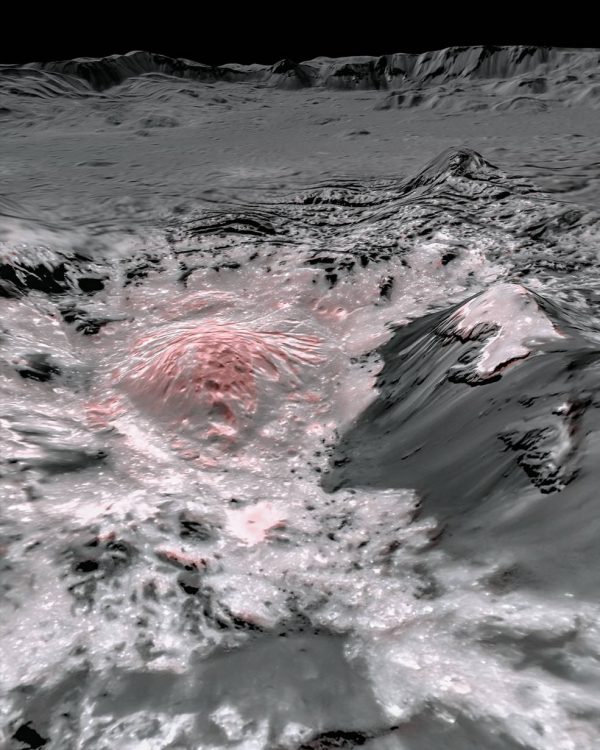
A false-color mosaic of Occator Crater pieced together from multiple Dawn photos. Image credits: NASA/JPL.

Ceres doesn’t benefit from internal heat generated by the gravitational interactions with a large planet (as is the case for some of Jupiter’s and Saturn’s satellites) yet, nevertheless, Ceres seems to be a water-rich world.

Recent evidence shows that the bright areas previously observed on Ceres were formed through hydrothermal activity that involves salt, which makes the dwarf planet even more tantalizing, as it seems to sport all the required ingredients for life.

The internal layer (the mantle) is dominated by hydrated rocks, like clays. Artistic depiction of the structure of Ceres. Image credits: NASA / JPL.

It’s not clear what this means for potential life on Ceres. Water is essential for life as we know it, and NASA regards Ceres as one of the more promising places to host life in our solar system. If Ceresian life exists, it is likely in the form of microbes, similar to bacteria. Even if there’s no life on Ceres anymore, it could still have harbored life in its past ocean. Ceres truly is one of the more interesting places in the solar system.

“More and more, we are learning that Ceres is a complex, dynamic world that may have hosted a lot of liquid water in the past, and may still have some underground,” said Julie Castillo-Rogez, Dawn project scientist and co-author of the studies, based at NASA’s Jet Propulsion Laboratory, Pasadena, California.

Ceres has plenty of interesting features. Here, a mosaic of Cerealia Facula, another bright spot area.

Image credits: NASA/JPL.

It’s remarkable just how much the Dawn mission has revealed about Ceres. Yet again, we’ve learned that one body which didn’t seem all that interesting harbors plenty of fascinating information. Our solar system is becoming more interesting every year.

“Dawn accomplished far more than we hoped when it embarked on its extraordinary extraterrestrial expedition,” said Mission Director Marc Rayman of NASA’s Jet Propulsion Laboratory in Southern California. “These exciting new discoveries from the end of its long and productive mission are a wonderful tribute to this remarkable interplanetary explorer.”

This mosaic of Ceres’ Occator Crater is composed of images NASA’s Dawn mission captured on its second extended mission, in 2018. Bright pits and mounds (foreground) were formed by salty liquid released as Occator’s water-rich floor froze after the crater-forming impact about 20 million years ago.

Image credits: NASA/JPL

{ https://www.zmescience.com/ }

Hoe vind je dit bericht?
Geschreven door peter om 01:17 Stuur door

Million-year-old dormant microbes beneath ocean floor push life to its absolute limits

Million-year-old dormant microbes beneath ocean floor push life to its absolute limits

Zombified cells found in sediments deep beneath the ocean floor use slightly more than a zeptowatt of power to survive.

Every living creature requires energy in order to subsist, multiply, and pass on its genes. How much energy an animal requires depends on their habitat and size, among many other things. But some cells require so little energy, it just boggles the mind.

pia17369_tersicoccus-1-br2-360x180.jpg

Recently, researchers have identified microbial cells that live in sediments kilometers beneath the ocean floor that require a tiny fraction of a calorie to survive. In fact, many of these cells may be up to 100 million years old, something that is owed to their suspended animation state.

Speaking to Quanta Magazine, James Bradly, a geobiologist at Queen Mary University of London and the lead author of a new study that modeled the suboceanic biosphere, said that “This entire biosphere of cells, equivalent in size to the world’s soils, hardly has enough energy to survive.”

Bradly, along with colleagues from universities across the world, employed existing data from previous drilling operations and lab experiments, which they modeled to extrapolate a detailed profile of sub-seafloor sediments.

Researchers projected values like the age of the sediments, the density of cells living inside them, which nutrients are available to these cells, and the rate at which the cells metabolize the nutrients. The findings were quite staggering.

When the researchers calculated the power consumption of the dormant cells living inside the sediments, they found that they were close to the absolute theoretical limit for energy requirements to sustain life.

These sub-seafloor microbes use only 0.1% of the power consumed by creatures living in the upper 200 meters of the ocean. The buried microbes survive at power levels orders of magnitude lower than any organism ever measured in a laboratory, the authors reported in the journal Science Advances.

Previously, in 2015, Douglas LaRowe and Jan Amend, both at the University of Southern California in Los Angeles, estimated the lowest amount of power required to sustain life. Even life that is dormant for millions of years in a zombified state waiting for the right conditions for reanimation needs at least some energy for fundamental biological processes like the repair of DNA damage.

Power per cell (watts) calculated on a global scale and depth-integrated for the (A) oxic, (B) sulfate-reducing, and (C) methanogenic sedimentary layers. White areas denote absence of the corresponding catabolic zone. Credit: Science Advances.

Even if an individual cell doesn’t divide, it would still need at least a zeptowatt, or 10−21 watts, in order to survive. The sub-seafloor microbes are just slightly above this threshold.

Some of these microbes may be up to 100 million years old, researchers report. Given their phenomenally low energy requirements, this all might change how biologists see cellular evolution.

The findings also open the possibility that life may exist in places that scientists had previously discarded as impossible habitats — and this includes other planets, as well.

The sediment samples that were used for the new theoretical model are around 2.6 million years old. However, deeper sediments might house even more starving cells, pushing energy requirements further to the brink.

{ https://www.zmescience.com/ }

Hoe vind je dit bericht?
Geschreven door peter om 00:54 Stuur door

Pentagon launches task force to investigate UFOs

Pentagon launches task force to investigate UFOs

V-NAVY-RELEASES-UFO-VIDEOS-4A_WTVT3489_711.mxf_.00_00_00_00.Still001.jpg?ve=1&tl=1

The Pentagon has created a task force to investigate UFOs following several unexplained incidents that have been observed by the U.S. military.

The Unidentified Aerial Phenomena Task Force was launched earlier this month by Deputy Defense Secretary David Norquist, boosting an effort by the Office of Naval Intelligence, officials said.

The Defense Department said Friday that it hopes to "improve its understanding of, and gain insight into, the nature and origins of UAPs. The mission of the task force is to detect, analyze and catalog UAPs that could potentially pose a threat to U.S. national security."

"The safety of our personnel and the security of our operations are of paramount concern. The Department of Defense and the military departments take any incursions by unauthorized aircraft into our training ranges or designated airspace very seriously and examine each report," the department said.

"This includes examinations of incursions that are initially reported as UAP when the observer cannot immediately identify what he or she is observing."

The plans for the task force, which is expected to be officially unveiled in the next few days, were first reported by CNN on Thursday.

The move marks an extension of previous efforts to look into UFOs -- but stops well short of trying to prove the existence of extraterrestrial life.

Since 2018, a Navy task force has been informally investigating such incidents and has coordinated information with U.S. intelligence agencies.

In April, the Defense Department released and declassified three videos of Navy pilots encountering UFOs in 2004 and 2015.

In 2017, The New York Times reported on the existence of the Advanced Aerospace Threat Identification Program, which had previously been disbanded, according to the Pentagon.

While the new task force’s work will remain classified, that status could change if the Senate Select Committee on Intelligence’s proposal for an unclassified report on UFOs is adopted by the full Senate and House.

Related videos, selected and posted by peter2011

{ https://www.fox13news.com/ }

Hoe vind je dit bericht?
Geschreven door peter om 23:54 Stuur door

The oldest known grass beds from 200,000 years ago included insect repellents

The oldest known grass beds from 200,000 years ago included insect repellents

The ancient bed remnants include fossilized grass, bug-repelling ash and aromatic leaves

South Africa’s Border Cave

South Africa’s Border Cave, shown here at its entrance, contains bits and pieces of the oldest known grass bedding, dating to around 200,000 years ago, researchers say.

A. KRUGER

Hoe vind je dit bericht?
Geschreven door peter om 23:19 Stuur door

Mysterious dimming of Betelgeuse explained?

Mysterious dimming of Betelgeuse explained?

betelgeuse-dimming-explained-artist-cp-high-res-e1597524199975.png

This 3-paneled artist’s concept illustrates new research, explaining why the bright red supergiant star Betelgeuse suddenly became fainter for several months during late 2019 and early 2020. In panel 1, a bright, hot blob of plasma is ejected from the star. In panel 2, outflowing expelled gas rapidly expands outward and cools to form an enormous cloud of obscuring dust. In panel 3, the huge dust cloud partially blocks Betelgeuse’s light.

Image via NASA/ ESA/ E. Wheatley (STScI)/ CfA.

For us skywatchers, it was lots of fun – and entirely shocking – when the well-known bright star Betelgeuse unexpectedly dimmed in late 2019 and early 2020. Betelgeuse has been such a steadfast sight in the night sky throughout our lives (and some of us have been around awhile), shining with a red light at the shoulder of the easy-to-see constellation Orion the Hunter. The dimming of Betelgeuse was even more exciting because it’s a well-known fact that this star will someday explode. Was the sudden dimming of Betelgeuse a sign that it would explode soon? Speculation raged for weeks, as we gazed toward a fainter Betelgeuse than we’d ever seen before. The star did not explode. In fact, by February, it was starting to brighten again. Then last week – on August 13, 2020 – scientists released a new study suggesting that the sudden dimming of Betelgeuse was most likely caused by the ejection and cooling of dense hot gases. In the meantime, as I write this, it appears Betelgeuse is dimming once more, about a year earlier than expected.

A statement from the Harvard & Smithsonian Center for Astrophysics (CfA) explained:

Between October and November 2019, Hubble Space Telescope observed dense, heated material moving outward through the star’s extended atmosphere at 200,000 miles per hour. The following month, several ground-based telescopes observed a decrease in brightness in Betelgeuse’s southern hemisphere, as if something was blocking light in this region of the star. By February 2020, the star had lost more than two-thirds of its brilliance, a dimming visible even to the unaided eye, creating buzz that the star might be going supernova. Continued ultraviolet light spectroscopic observations with Hubble provided a timeline for researchers to follow, like breadcrumbs leading back through time to pinpoint the source of the mysterious dimming.

Andrea Dupree is associate director of the Harvard & Smithsonian Center for Astrophysics and lead author of the study, which was published on August 13 in the peer-reviewed The Astrophysical Journal. She said in the scientists’ statement:

With Hubble, we had previously observed hot convection cells on the surface of Betelgeuse and in the fall of 2019 we discovered a large amount of dense hot gas moving outwards through Betelgeuse’s extended atmosphere. We think this gas cooled down millions of miles outside the star to form the dust that blocked the southern part of the star imaged in January and February.

The material was two to four times more luminous than the star’s normal brightness. And then, about a month later the south part of Betelgeuse dimmed conspicuously as the star grew fainter. We think it possible that a dark cloud resulted from the outflow that Hubble detected. Only Hubble gives us this evidence that led up to the dimming.

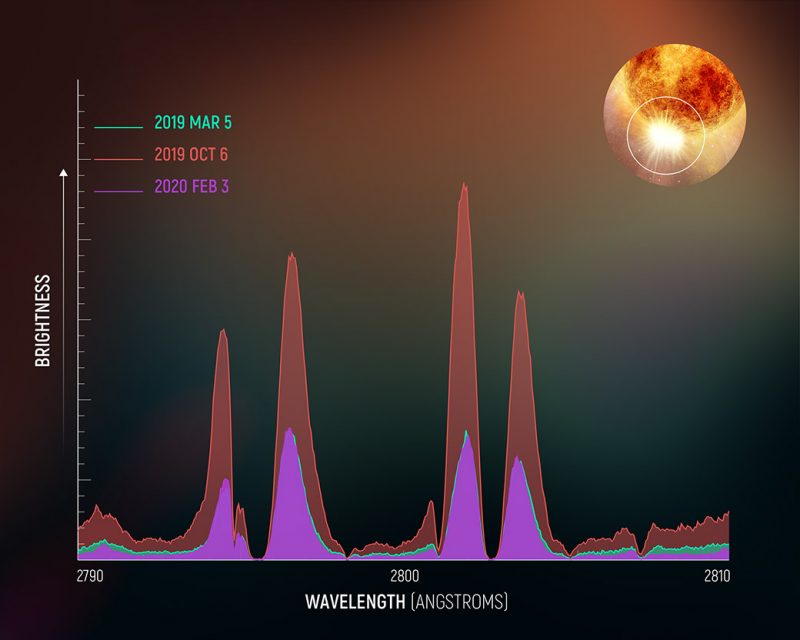
This spectral plot is based on Hubble Space Telescope observations from March 2019 to February 2020. Hubble recorded a surprising outburst in the atmosphere of the nearby red supergiant star Betelgeuse. Measurements of emission from magnesium II were used to trace motion in the star’s pulsating atmosphere. Hubble’s Space Telescope Imaging Spectrograph captured a dramatic increase in the brightness of magnesium emission in October 2019, in the southeast region of the star, as outlined by the white circle. (Betelgeuse is close enough and big enough for Hubble to resolve the star’s enormous disk.) This traumatic event was different from what is normally seen in the star’s 420-day pulsation period. At the same time in October, the star abruptly began dimming. This fading continued until February 2020, at which time the Hubble ultraviolet spectral data had returned to normal. The outburst is suspected to have ejected a cloud of hot plasma that cooled to form dust that blocked out a significant portion of the star’s light for a few months. Hubble’s long baseline of monitoring the star helped put the puzzle pieces together.

Image via NASA/ ESA/ A. Dupree (CfA)/ E. Wheatley (STScI)/ CfA.

Scientists’ models had suggested that – in this situation – the plasma should be ejected from the star’s rotational poles. The Hubble observations showed it was not, however. Dupree said:

Hubble observations suggest that material can be driven off from any part of the stellar surface.

Dupree added that recent activity on Betelgeuse was not normal for this star. Dupree noted that Betelgeuse is losing mass at a rate 30 million times higher than the sun, but that recent activity resulted in a loss of roughly two times the normal amount of material from the star’s southern hemisphere alone. She said:

All stars are losing material to the interstellar medium, and we don’t know how this material is lost. Is it a smooth wind blowing all the time? Or does it come in fits and starts? Perhaps with an event such as we discovered on Betelgeuse? We know that other hotter, luminous stars lose material and it quickly turns to dust making the star appear much fainter.

But, in over a century and a half, this has not happened to Betelgeuse. It’s very unique.

An image from NASA’s STEREO spacecraft shows the star Betelgeuse, circled. For several weeks in 2020, STEREO was the only observatory making measurements of Betelgeuse because of the spacecraft’s unique position in space. Between late June and early August 2020, STEREO observed Betelgeuse on five separate days, measuring the star’s relative brightness in comparison to other stars.

Image via NASA/ STEREO.

The star Betelgeuse, and its constellation Orion, are behind the sun as seen from Earth in early Northern Hemisphere summer. They always return to our early morning sky around late July and early August. While Betelgeuse was hidden behind the sun for earthly observers, scientists turned to NASA’s Solar TErrestrial RElations Observatory – STEREO – to monitor the star’s brightness. Those observations revealed another surprise, the scientists said: more unexpected dimming.

Between late June and early August 2020, STEREO observed Betelgeuse on five separate days, measuring the star’s relative brightness in comparison to other stars. Dupree said:

Our observations of Betelgeuse with STEREO confirm that the star is dimming again.

Betelgeuse is a variable star, though its rising and falling in brightness isn’t noticeable to casual observers. It typically goes through brightness cycles lasting around 420 days.

Since the previous minimum happened in February 2020, this new dimming is over a year early, the scientists commented.

Dupree said she plans to observe Betelgeuse with STEREO again next year, during the star’s maximum, to monitor for unexpected outbursts.

People always want to know if Betelgeuse will explode. It is an old star and a supergiant star, and so the answer to that question is surely yes. When Betelgeuse dimmed so noticeably in late 2019 and early 2020, some scientists agreed it might be a sign that the star was about to go supernova. These scientists commented in their statement:

Betelgeuse is a bright star in our galaxy, near the end of its life, that is likely to become a supernova. When the star became very faint in February 2020, this was the faintest that it had ever been since measurements began over 150 years ago. The dimming was obvious to everyone when looking at the constellation Orion; it was very weird, Betelgeuse was almost missing.

At 725 light-years away, light – and dimming – seen from Betelgeuse today on Earth left the star in the year 1300. Dupree said:

No one knows how a star behaves in the weeks before it explodes, and there were some ominous predictions that Betelgeuse was ready to become a supernova.

Chances are, however, that it will not explode during our lifetime, but who knows?

Related videos, selected and posted by peter2011

{ https://earthsky.org/ }

Hoe vind je dit bericht?
Geschreven door peter om 22:53 Stuur door

The Day Aliens Invaded Jafr, Jordan

The Day Aliens Invaded Jafr, Jordan

img_0099.jpg?w=234

Readers of the Jordanian newspaper Al-Ghad were startled to read the reports of an alien encounter close to the town of Jafr. According to the news reports, the desert community witnessed the landing of UFOs, piloted by creatures 3 meters (10 feet) in height.

The reports went on to describe the bizarre alien language from these gigantic humanoid creatures. Their voices, which the newspaper referred to as “squawking” were indecipherable to the terrified earthlings who witnessed the first contact.

Even more frightening than the appearance or sound of the creatures was the effect of their technology. All electronics in the region were knocked out, even as the intense heat from the UFOs scorched the nearby ground.

Al-Ghad recounted how many terrified residents of Jafr fled into the desert to escape the alien invasion.  Much to everyone’s relief, after one hour and forty minutes, the mysterious alien visitors reboarded their spaceships and departed, without ever making their intentions known. All that remains of this close encounter are the scorch marks on the desert floor and horrifying memories to haunt the nightmares of the befuddled community.

All of this was reported as news. The only clue that it might not have really happened was in the date at the top of the paper: April 1, 2010. For those who noted the date, it might not have generated the skepticism it would have caused English readers. Al Ghad‘s readers were unaccustomed to seeing April Fool’s Day hoaxes in its pages, and many found the experience less than hilarious.

With their own version of the panic from the 1938 radio show “The War of the Worlds,” Jafr had to deal with the fallout from those who believed the story. Many residents, believing the story, huddled behind locked doors, fearing the worst. School absences skyrocketed as parents kept their children home from classes. The mayor of Jafr even considered the mandatory evacuation of the 13,000 residents but elected against it, fearing that people would be injured in the chaos.

Al Ghad‘s managing editor later apologized for the article, saying “We meant to entertain, not scare people.”


{ https://commonplacefacts.wordpress.com/ }

Hoe vind je dit bericht?
Geschreven door peter om 21:59 Stuur door

The Jafr “Alien Invasion” and Mass Panic

article-1270546944569-00733E2E00000258-156944_636x300.jpg

The Jafr “Alien Invasion” and Mass Panic

Out in the rural desert town of Jafr, in eastern Jordan, about 190 miles east of Amman, nothing much ever really happens. This is a simple, forgotten place in the unforgiving desert terrain well away from the rest of the world, a place that not even people in Jordan have ever really heard of, but this would change in 2010, when this rugged town of 13,000 suddenly got major national news coverage when Jafr was supposedly invaded by menacing, malevolent aliens from another world. And so would begin a panic unlike the region had ever seen before, which in the people’s minds at least involved towering aliens and their death machines out to kill them all.

On April 1, 2010, a major story ran on the front page of the Jordanian newspaper Al-Ghad. According to the report, UFOs had descended from the sky to land out in the desert boondocks surrounding the dusty town, piloted by massive, marauding aliens that were described as being a full 10 feet tall which spoke in a squawking language. During the night, the UFOs, which could supposedly shoot beams of intense heat, had reportedly flown about over town, lighting up buildings and city streets as if it were daylight, leaving scorch marks in the ground, and it was also said that some force they were generating had knocked out communications in the area. Panicked residents had reportedly run out into the streets in fear of their lives, and by the time the article made the rounds the populace was in a frenzied panic thinking the world was ending.

Jafr, Jordan

Through all of this, parents refused to send their children to school, many stores closed, and the mayor of the city, Mohammed Mleihan, was making preparations to evacuate the entire populace. He would say of this, “Students didn’t go to school, their parents were frightened and I almost evacuated the town’s 13,000 residents. People were scared that aliens would attack them.” When other news outlets picked up the story it seemed to take on a life of its own, with some saying that military personnel were being mobilized and that an alien invasion force was preparing to launch an attack from the desert. In the meantime, the mayor did have security forces patrol the outskirts of town, but they were unable to locate any UFOs or giant aliens.

As soon as the newspaper Al-Ghad realized what was happening, and became aware of the gravity of the uproar their article had caused, Moussa Barhoumeh, Al Ghad’s managing editor, came forward to say that the whole thing had been nothing but an April Fool’s joke, something many astute readers here might have already surmised by reading the date of the publication. According to the editor, it had just been a silly, good-natured prank “meant to entertain, not scare people.” The newspaper issued a formal apology for the inconvenience it had caused, but many of the people of Jafr, who had had their whole life momentarily upended, were furious, not the least of all Mayor Mleihan. He was so livid, in fact, that he threatened to sue the newspaper for their tasteless “big lie,” especially since he had allocated valuable resources to prepare for an alien invasion that had never come.

It does seem odd that Al-Ghad would decide to try and pull such a stunt. After all, whereas someone from the West might be accustomed to seeing fake April Fool’s Day news stories printed on April 1st and cast a skeptical eye at such spectacular headlines on this day, In Jordan it is different. They have no such custom, especially not in a rural, superstitious backwater like Jafr, where most people would not even know what an April Fool’s day prank was. Considering this, it does seem pretty odd that the Jordian newspaper would not only pull a front-page prank article, but also base it in Jafr. In America or Britain it probably would not have been a big deal, but in Jordan it had led to a mass panic and minor regional emergency amongst a populace not versed in such things.

It is in some aspects quite reminiscent of the infamous War of the Worlds broadcast of October 30, 1938, in which future filmmaker Orson Welles adapted the HG Wells classic of the same name as a Halloween radio show over the Columbia Broadcasting System radio network, made up to sound like it was taking place as the alien invasion of the novel happened. It was clearly announced as a dramatization, but presented in a very realistic style of another program being interrupted by news of the invaders from Mars, so some people who caught the show midway through were said to have bought it all as real and flown into a panic due to this realistic “breaking news” style of storytelling used. The extent of this panic has been disputed in recent years, as it turns out that the show wasn’t listened to by all that many people and most of them met it with curiosity rather than fear, but there were no doubt a few who took it to be real and were not too happy about having been fooled. Even though the panic caused by the broadcast was nowhere near as bad as it has traditionally been portrayed, it still did gain quite a bit of backlash from people who did not appreciate its use of its deceptive news bulletin format, leading to stricter regulation of such programs by the Federal Communications Commission.

The Jafr alien invasion scare is the worst case scenario for fake news and questionable journalistic ethics, mixed with pranksters who perhaps went a little too far. This one story threw this little town into an absolute whirlwind of fear and apprehension, and it is a cautionary tale as to how skittish and gullible people can be, especially in an out of the way, undeveloped area where the populace is especially susceptible. It is certainly an intriguing little tale, and shows that the mainstream news is probably not the best place to play out practical jokes.

{ https://mysteriousuniverse.org/ }

Hoe vind je dit bericht?
Geschreven door peter om 21:54 Stuur door

The Great Pyramid, Built By the Nephilim, Has Many Stunning Mathematical Codes

The Great Pyramid, Built By the Nephilim, Has Many Stunning Mathematical Codes

1491841321970.jpeg

Irish author Patrick Heron returned to the show to share “the last few pieces of the jigsaw puzzle” concerning the pyramids and Bible prophecy. The Great Pyramid has a number of stunning mathematical features and could not be replicated today. There is enough stone in it to build a 6 ft. wall that stretches from New York to Los Angeles, said Heron, who believes it is impossible that the Egyptians constructed the Great Pyramid.

Rather, he suggested that 5,500 years ago, the Nephilim, who were the “fallen angels” written about in Genesis, built the pyramids and other ancient structures. They were beautiful looking “spirit men,” who appeared human but were not bound by the same laws of physics as mankind, he explained. They mated with Earth women during two periods, before the Great Flood and afterwards, he added.

Heron said the Nephilim never died, but were entombed in an “abyss” or netherworld. According to prophecy in the Book of Revelation, a spirit man or “star” comes down to Earth with the “keys” to the bottomless pit. He identified this being as the Antichrist, whom people will be deceived into thinking is the Messiah, but he’ll actually lead the world into the prophesied Apocalypse. 


Related videos, selected and posted by peter2011

{ https://beforeitsnews.com/ }

Hoe vind je dit bericht?
Geschreven door peter om 21:32 Stuur door

MUFON: Two UFOs In Washoe Valley, Nevada 9-10-2019, UFO Sighting News. (NO SOUND)

MUFON: Two UFOs In Washoe Valley, Nevada 9-10-2019, UFO Sighting News. (NO SOUND)

%25E0%25A4%25AF%25E0%25A5%2582%25E0%25A4%258F%25E0%25A4%25AB%25E0%25A4%2593%252C%2B%25C4%2591i%25CC%2583a%2Bbay%252C%2BNLO%252C%2BOZN%252C%2B%25D0%259D%25D0%259B%25D0%259E%252C%2Bovni%252C%2Bomni%252C%2B%2Bnevada%252C%2B2019%252C%2B%2BUFO%252C%2BUFOs%252C%2Bsighting%252C%2Bsightings%252C%2Balien%252C%2Baliens%252C%2BET%252C%2B%2Bancient%252C%2B%25D7%25A2%25D7%25A6%25D7%259D%2B%25D7%2591%25D7%259C%25D7%25AA%25D7%2599%2B%25D7%259E%25D7%2596%25D7%2595%25D7%2594%25D7%2594%252C%2Barchaeology%252C%2Bastrobiology%252C%2Bpaleontology%252C%2Bwaarneming%252C%2B.png

%25D0%259D%25D0%259B%25D0%259E%252C%2Bovni%252C%2Bomni%252C%2B%2Bnevada%252C%2B2019%252C%2B%2BUFO%252C%2BUFOs%252C%2Bsighting%252C%2Bsightings%252C%2Balien%252C%2Baliens%252C%2BET%252C%2B%2Bancient%252C%2B%25D7%25A2%25D7%25A6%25D7%259D%2B%25D7%2591%25D7%259C%25D7%25AA%25D7%2599%2B%25D7%259E%25D7%2596%25D7%2595%25D7%2594%25D7%2594%252C%2Barchaeology%252C%2Bastrobiology%252C%2Bpaleontology%252C%2Bwaarneming%252C%2B%2Bcopy.png

Date of sighting: 9-10-2019
Location of sighting: Washoe Valley, Nevada, USA
Source: MUFON #110943

Here is an amazing video of a pair of glowing white UFOs over some mountains in Washoe Valley, Nevada. Nevada is famous for Area 51, Area S4, Nellis AFB tall whites alien base, and of course...the extraterrestrial highways. Although this video is 1 year old, it was reported today to MUFON and its quality and focus is outstanding. This is true evidence...evidence of some of the glowing UFOs seen not only in Nevada, but also Colorado Rockies and around the world. We don't get to see them come or leave, but thats how people are...we look around, get board and assume objects in the sky will stay there for ten seconds or more...only to go back and see they have gone. I too have been guilty of such videos. 100% proof UFOs have active alien bases in Nevada desert. 

Scott C. Waring 

Eyewitness states: 

I was eating lunch in our breakfast nook and noticed something shiny in the distance to the north, in the sky. At first i thought helicopter or plane or glider/ultralight (people fly those in this region), but the light did not move. I noticed it looked like actually two circular metallic objects. The were fixed in space, between my location on Aspen Creek and Slide Mountain, southwest of Reno NV. I took my phone and started recording video. I walked to the window to get a closer look and the objects remained in place. Moving closer I could not see any additional detail. I did not notice the pulsating while watching, but it came out on the video. The objects remained in the exact same position for a while so and stopped the recording. About a minute later I looked up again and they were gone, so I do not know if and how they moved. 


%25D0%259D%25D0%259B%25D0%259E%252C%2Bovni%252C%2Bomni%252C%2B%2Bnevada%252C%2B2019%252C%2B%2BUFO%252C%2BUFOs%252C%2Bsighting%252C%2Bsightings%252C%2Balien%252C%2Baliens%252C%2BET%252C%2B%2Bancient%252C%2B%25D7%25A2%25D7%25A6%25D7%259D%2B%25D7%2591%25D7%259C%25D7%25AA%25D7%2599%2B%25D7%259E%25D7%2596%25D7%2595%25D7%2594%25D7%2594%252C%2Bpaleontology%252C%2Bwaarneming%252C%2B%2Bcopy.png

{ https://www.etdatabase.com/ }

Hoe vind je dit bericht?
Geschreven door peter om 21:15 Stuur door

Glowing Orb Over Draper, Utah Desert, MUFON, July 13, 2020, UFO Sighting News.

Glowing Orb Over Draper, Utah Desert, MUFON, July 13, 2020, UFO Sighting News.

%25E0%25A4%25AF%25E0%25A5%2582%25E0%25A4%258F%25E0%25A4%25AB%25E0%25A4%2593%252C%2B%2B%25D0%259D%25D0%259B%25D0%259E%252C%2Bovni%252C%2Bomni%252C%2B%2BMUFON%252C%2BDeagla%25CC%2581n%252C%2B%2BUFO%252C%2BUFOs%252C%2Bsighting%252C%2Bsightings%252C%2Balien%252C%2Baliens%252C%2BET%252C%2B%2Bancient%252C%2B%25D7%25A2%25D7%25A6%25D7%259D%2B%25D7%2591%25D7%259C%25D7%25AA%25D7%2599%2B%25D7%259E%25D7%2596%25D7%2595%25D7%2594%25D7%2594%252C%2Barchaeology%252C%2Bastrobiology%252C%2Bpaleontology%252C%2Bwaarneming%252C%2Bvreemdelinge%252C%2B%2B%2Bcopy%2B4.png

Date of sighting: July 13, 2020
Location of sighting: Draper, Utah, USA
Source: MUFON #110995

This just came in at MUFON today. A guy is reporting a glowing white orb coming very low and close to the rooftops of his home. It looks like its very late at night and they guys girlfriend is still in the house, because at the end of the video he gets irritated and says, "Hey Teresa! Get out here! Get up! You got to see this!" But by that time the glowing orb seemed to have moved off and disappears in the distance.  I guess Teresa missed it, but its awesome he caught raw footage of the object for her and all of us to see. 


Its not a drone, drone lights are not that powerful and its not a plane or helicopter...because its silent and not far above the houses. I estimate it flying at 50 meters above the eyewitness. It noticed him, circled him but was distracted by other glowing lights nearby. Absolutely real, absolutely unexplainable. 

Scott C. Waring 

%25E0%25A4%25AF%25E0%25A5%2582%25E0%25A4%258F%25E0%25A4%25AB%25E0%25A4%2593%252C%2B%25C4%2591i%25CC%2583a%2Bbay%252C%2BNLO%252C%2BOZN%252C%2B%25D0%259D%25D0%259B%25D0%259E%252C%2Bovni%252C%2Bomni%252C%2B%2B%2BUFO%252C%2BUFOs%252C%2Bsighting%252C%2Bsightings%252C%2Balien%252C%2Baliens%252C%2BET%252C%2B%2B%2B%25D7%259E%25D7%2596%25D7%2595%25D7%2594%25D7%2594%252C%2Barchaeology%252C%2Bastrobiology%252C%2B%252C%2Bvreemdelinge%252C%2B%2B%2B.png

 I added some shadows and focus to the above and below. To the below, strangely it came out...like layered coral, but is correctly focused. 

%25E0%25A4%25AF%25E0%25A5%2582%25E0%25A4%258F%25E0%25A4%25AB%25E0%25A4%2593%252C%2B%25C4%2591i%25CC%2583a%2Bbay%252C%2BNLO%252C%2BOZN%252C%2B%25D0%259D%25D0%259B%25D0%259E%252C%2Bovni%252C%2Bomni%252C%2B%2BMUFON%252C%2BDeagla%25CC%2581n%252C%2B%2BUFO%252C%2BUFOs%252C%2Bsighting%252C%2Bsightings%252C%2Balien%252C%2Baliens%252C%2BET%252C%2B%2B%2Bastrobiology%252C%2Bwaarneming%252C%2B%2Bcopy%2B2.png

%25E0%25A4%25AF%25E0%25A5%2582%25E0%25A4%258F%25E0%25A4%25AB%25E0%25A4%2593%252C%2B%25C4%2591i%25CC%2583a%2Bbay%252C%2BNLO%252C%2BOZN%252C%2B%25D0%259D%25D0%259B%25D0%259E%252C%2Bovni%252C%2Bomni%252C%2B%2BMUFON%252C%2BDeagla%25CC%2581n%252C%2B%2BUFO%252C%2BUFOs%252C%2Bsighting%252C%2Bsightings%252C%2Balien%252C%2Bancient%252C%2B%25D7%25A2%25D7%25A6%25D7%259D%2B%25D7%2591%25D7%259C%25D7%25AA%25D7%2599%2Bwaarneming%252C%2Bvreemdelinge%252C%2B%2B%2B.png

{ https://www.etdatabase.com/ }

Hoe vind je dit bericht?
Geschreven door peter om 20:43 Stuur door

Tom Delonge Posts UFO Photos And Cryptic Message, Aug 2020, UFO Sighting News.

Tom Delonge Posts UFO Photos And Cryptic Message, Aug 2020, UFO Sighting News.

%25E0%25A4%25AF%25E0%25A5%2582%25E0%25A4%258F%25E0%25A4%25AB%25E0%25A4%2593%252C%2B%25C4%2591i%25CC%2583a%2Bbay%252C%2BNLO%252C%2BOZN%252C%2B%25D0%259D%25D0%259B%25D0%259E%252C%2Bovni%252C%2Bomni%252C%2B%2Btom%2Bdelonge%2BUFO%252C%2BUFOs%252C%2Bsighting%252C%2Bsightings%252C%2Balien%252C%2Baliens%252C%2BET%252C%2B%2Bancient%252C%2B%25D7%25A2%25D7%25A6%25D7%259D%2B%25D7%2591%25D7%259C%25D7%25AA%25D7%2599%2B%25D7%259E%25D7%2596%25D7%2595%25D7%2594%25D7%2594%252C%2Barchaeology%252C%2Bastrobiology%252C%2Bpaleontology%252C%2Bwaarneming%252C%2Bvreemdelinge%252C%2B%2B.jpg

Date of post: Aug 15, 2020
Source of post: Instagram
Source link: 
The band member of Blink, Tom Delonge has recently posted a photo of a UFO on his Instagram about 7 hours ago. The photo of a UFO disk viewed from its side with an orb below it had just a few words that didn't explain much..."Doesn't look supernatural to me."

Sadly he has no possible explanation nor any clue as to this UFO sighting being real or not. His cryptic message to his Instagram users hints that he is looking for something more unique in sightings...and seems disappointed that its a mere classic disk design UFO even though its releasing an orb. The original video was released on Instagram last year and can be seen below. 


I believe there is a simple explanation to this video. The orb is the pilot of the UFO wanting to get a closer look at things on the surface, but doesn't want to risk being seen so takes an orb which seems to come out of the pilot area. A sphere should be easier to cloak on the ground than a disk, because of the light bending. This alien pilot was heading to land someplace. 

Scott C. Waring - Taiwan

{ https://www.etdatabase.com/ }

Hoe vind je dit bericht?
Geschreven door peter om 20:35 Stuur door

Edgar Cayce The Location of Atlantis and the Hall of Records

Edgar Cayce The Location of Atlantis and the Hall of Records

Edgar Cayce expert, Dr. Greg Little, discussed the topic of Atlantis that came up numerous times during Cayce's readings, said Little. 
edgar-cayce-atlantis-hall-of-records-crystals.jpg

The civilization, according to Cayce, began around 200,000 years ago and stretched from the Straits of Gibraltar to the Bahamas.
Its final destruction occurred around 10,000 BC, but priests who used crystals to "communicate with other worlds" were warned about the coming cataclysm. This led them to construct three "Hall of Records," which were located in Egypt (under the Sphinx), at Piedras Negras, Guatemala and near the Bimini Islands.
Little detailed his underwater investigations at Bimini and Andros Islands, his most recent trip there was in May 2005. In regards to what is called the "Bimini Road," he described a formation of six-sided rectangular slabs which are 2ft. by 3ft. each. 
The stones were not actually part of a road, but rather composed a harbor works, that was used as a huge breakwater for maritime activity, he suggested. Little said that seven different categories prove these stones were man-made, and they probably date back at least 10,000 years. 
Referring to theories about Atlantis mention the extensive use of crystals by Atlanteans, see our in-depth report on the Mystery of the Crystal Sphere of Atlantis.
Link article: 
Below an excerpt of the report:
Atlanteans allegedly harnessed the energies of the pyramids, using harmonics linked to crystals to that end. As we have the Great Pyramid at the center of the planet linked to the grid matrix that creates our reality, so, too, did the Atlanteans.
Their pyramid allegedly sunk to the bottom of the Atlantic Ocean which is a metaphor about returning to the collective unconsciousness or source of creation.
Atlantean crystals received power from a variety of sources, including the Sun, the Earth's energy field grid system or from each other.
Grids point are often marked by pyramids. The Atlanteans used this energy, combined with crystals, to transmit energy from one pyramid to another or, as aliens, to enter and leave the planet.XX 
The Astounding Discovery of Dr. Ray Brown:
Known as Ray Brown’s Atlantean Crystal Sphere, the discovery of the sphere occurred during a scuba diving trip to the Bari Islands in the Bahamas in 1970.While diving, Ray Brown – a naturopathic doctor – became separated from his friends and while he searched for them, he came upon a strange pyramid structure.
Just what the purpose of the crystal sphere was, and what role it once played in the enigmatic instrument Brown found inside the sunken Bahaman pyramid, remains a mystery, though of course there are some interesting possibilities.
Though startled by the find, he investigated and was amazed that the sides of the pyramid were completely smooth and the joints between the individual blocks to be nearly imperceptible. Upon entering the pyramid, Ray was further astounded by the clean, smooth sides of the interior: no algae or coral grew on the walls.
Not only that, but he was able to see the interior clearly as the room was well lit but there was no detectable source of light. He tried to remove a a multi-faceted red gemstone attached to a metallic rod that descended from the center of the ceiling, but was unable to dislodge it. 
About four feet below the point of the red gemstone, stood a bronze metal sculpture of two open hands, and resting upon the palms of the hands was a crystal sphere, about four inches in diameter. He was surprised that he could lift the crystal sphere easily....

{ http://ufosightingshotspot.blogspot.com/ }

Hoe vind je dit bericht?
Geschreven door peter om 18:25 Stuur door

UFO Discovery In 1973 Columbo Episode? A Mysterious Object Turns Up On Film

UFO Discovery In 1973 Columbo Episode? A Mysterious Object Turns Up On Film

ufo-columbo.png

A mysterious UFO aka UPA unidentified aerial phenomena? I was watching an old episode of Columbo in HD on my big home TV screen, and I noticed an unknown flying object. It was dark and it had no aviation lights. Let’s take a closer look!

Don’t forget to follow us on Youtube for the latest UFO videos.

Link: youtube.com/c/LUFOS-UFO

{ https://www.latest-ufo-sightings.net/ }

Hoe vind je dit bericht?
Geschreven door peter om 17:43 Stuur door

Astronomers spy a Milky Way look-alike 12 billion light-years away

Astronomers spy a Milky Way look-alike 12 billion light-years away

This distant galaxy – SPT0418-47 – surprised astronomers by being organized enough to have a spinning disk and a galactic bulge, early in the history of our universe.

Using the ALMA telescope in Chile, astronomers say they’ve found an extremely distant and therefore very young galaxy that surprised them by looking so much like our Milky Way. The galaxy is 12 billion light-years away. Thus we see the galaxy as it was 12 billion years ago, when – according to recent estimates of our universe’s age – the universe was only 1.4 billion years old. The galaxy is called SPT0418-47. It doesn’t appear to have spiral arms as our Milky Way does, these astronomers said, but it has two other features reminiscent of our Milky Way. It has a rotating disk, thought to be similar to the flat disk of our own galaxy, in which our own sun revolves around the galactic center. And it has a galactic bulge, a large group of stars packed tightly its center. This is the first time a bulge has been seen this early in the history of the universe, making SPT0418-47 the most distant Milky Way look-alike.

That’s surprising, these astronomers said, because they’d have expected galaxies at this point in the young universe to be “turbulent and unstable,” not organized enough to have disks and bulges. The astronomers’ statement said:

This unexpected discovery challenges our understanding of how galaxies form, giving new insights into the past of our universe.

Francesca Rizzo of the Max Planck Institute for Astrophysics in Germany led the research, which was published August 12, 2020, in the peer-reviewed journal Nature. Rizzo said in a statement:

This result represents a breakthrough in the field of galaxy formation, showing that the structures that we observe in nearby spiral galaxies and in our Milky Way were already in place 12 billion years ago.

The astronomers added that studying distant galaxies like SPT0418-47 is fundamental to our understanding of how galaxies formed and evolved.

Orange and yellow narrow ring on black.

In this ALMA image, the galaxy SPT0418-47 appears as a near-perfect ring of light. That’s because this image was obtained via gravitational lensing, a process involving a second massive galaxy between us and the more distant galaxy. The gravity of the intervening galaxy causes the light of the more distant galaxy to bend: hence, the ring. What is the more distant galaxy’s true shape? See the image below. 

Image via ESO.

Oblong orange blue with yellow-white center.

This image represents the distant galaxy’s true shape, as revealed by computer modeling that incorporated data from the lensed image and other observations of the galaxy. 

Image via ALMA/ ESO/ NAOJ/ NRAO/ Rizzo et al.

In their statement, the astronomers explained how they were able to see SPT0418-47 despite its distance of 12 billion light-years:

Because these galaxies are so far away, detailed observations with even the most powerful telescopes are almost impossible as the galaxies appear small and faint. The team overcame this obstacle by using a nearby galaxy as a powerful magnifying glass – an effect known as gravitational lensing – allowing ALMA to see into the distant past in unprecedented detail. In this effect, the gravitational pull from the nearby galaxy distorts and bends the light from the distant galaxy, causing it to appear misshapen and magnified.

The gravitationally lensed, distant galaxy appears as a near-perfect ring of light around the nearby galaxy, thanks to their almost exact alignment. The research team reconstructed the distant galaxy’s true shape and the motion of its gas from the ALMA data using a new computer modeling technique.

Rizzo added:

When I first saw the reconstructed image of SPT0418-47 I could not believe it: a treasure chest was opening.

Simona Vegetti, also from the Max Planck Institute for Astrophysics, is a study co-author. Vegetti said:

What we found was quite puzzling; despite forming stars at a high rate, and therefore being the site of highly energetic processes, SPT0418-47 is the most well-ordered galaxy disc ever observed in the early universe. This result is quite unexpected and has important implications for how we think galaxies evolve.

Will SPT0418-47 evolve into another Milky Way? These astronomers said they don’t think so. They said they expect it to evolve into a galaxy very different from our Milky Way, and to join the class of elliptical galaxies, which lack spiral arms, instead appearing a bit like American footballs.

  • Bottom line: Astronomers would have expected a galaxy seen at a distance of 12 billion light-years to be “turbulent and unstable.” They were surprised to find one – labeled SPT0418-47 – with a disk and bulge similar to our Milky Way. They say this galaxy is the most distant Milky Way look-alike yet found.
  • Source: A dynamically cold disk galaxy in the early Universe
  • Via ESO

{ https://earthsky.org/}

Hoe vind je dit bericht?
Geschreven door peter om 01:47 Stuur door

Pentagon is Launching a New Task Force to Investigate UFO Sightings (Again?)

Pentagon Launching Task Force To Investigate UFO Sightings

US Department of Defense/20th Century Fox

Pentagon is Launching a New Task Force to Investigate UFO Sightings (Again?)

It’s August, which means it’s time for a monthly update to the seemingly never-ending saga of UFOs, the Pentagon, The New York Times, Tom DeLonge and the US Senate. This month our focus is on the Pentagon, which announced it is setting up a task force to investigate UFO sightings both in and out of the military. Feel free to insert your “Wait a minute … don’t they already have one?” here.

“Deputy Secretary of Defense David Norquist will help oversee the task force, which is expected to be officially unveiled in the next few days, according to the officials. Previous efforts to look into what the Pentagon dubs unidentified aerial phenomena were led by the US Navy as many of the documented encounters involved their aircraft.”

A still from the USS Nimitz footage

Credit CNN with breaking this story, and no other media sources seem to have anything more to say. CNN itself had no additional clarification or comments from the Department of Defense nor Deputy Secretary Norquist nor the two unnamed sources nor … anybody new. All it had was a rehash of the various ‘blockbuster’ announcements of the past two-going-on-three-how-time-flies years about the Navy UFO videos and the back-and-forth on the existence of the classified Advanced Aerospace Threat Identification Program (AATIP), begun in 2007 by the U.S. Defense Intelligence Agency, secretly funded by Congress until 2012 and then secretly operated without funding ever since.

Remember all that?

Then a Senate committee hearing in June 2020 revealed the existence of the unclassified but still hush-hush Unidentified Aerial Phenomenon Task Force as successor to AATIP, and The New York Times article covering it had quotes about “off-world vehicles not made on this earth” and “actual materials” from these “off-world vehicles” in government possession … which was almost immediately walked back by the authors of the article and Harry Reid.

This has been a busy summer for UFO revelations/non-revelations/controversies hasn’t it?

Which brings us to the latest ‘announcement’. From what little was in the CNN article, it seems to imply that this is a different task force than Unidentified Aerial Phenomenon Task Force because it’s under the Department of Defense rather than the Office of Naval Intelligence. Both report directly to the President under separate directors. Seems like there should just be one task force … doesn’t it? That makes too much sense when you’re dealing with the U.S. government and the U.S. military.

Pentagon

Or is it because there are so many UFO encounters and possible “off-world vehicles” that one task force can’t investigate them all?

This seems to be turning from a potential chance that we’ll finally have some disclosure on UFOs/UAPs/ETs to a ball of confusion (see The Temptations) or the Keystone Cops (see the films of Mack Sennett) or a cover-up (see any book by Bob Woodward). All we can do is keep waiting and pointing out the obvious … we ain’t seen nothing yet (see Bachman-Turner Overdrive).

Note:

  • all related videos, selected and posted by peter2011 

{ https://mysteriousuniverse.org/ }

Hoe vind je dit bericht?
Geschreven door peter om 00:54 Stuur door

The Mysterious Lost Underwater City of Cuba

Underwater-city.-Computer-graphics.jpg?resize=635%2C436

The Mysterious Lost Underwater City of Cuba

What mysteries lie beneath the surface of the oceans of our world? In early 2001, two marine engineers by the names of Pauline Zalitzki and her husband Paul Weinzweig were out on an exploration and survey mission with their Canadian company, Advanced Digital Communications, at a location off the Pinar del Río Province of the western coast of Cuba. They were there under commission by the Cuban government in order to carry out sonar surveys off the Guanahacabibes Peninsula, looking for shipwrecks dating back to the Spanish colonial era, often known to hold vast amounts of lost treasure, and several of which the team had already successfully located. However, on this day, the expedition was to discover something far stranger than a sunken Spanish galleon down there in the murk upon the sea floor. Thus would begin the strange tale of a purported ancient underwater city lying under the waters of Cuba, which has drawn to it all manner of debate and discussion.

At the time the crew were utilizing sonar in about 2,000 feet of water when they began getting startling images that baffled and perplexed all who were present. There flickering on the screen were sonar images of what appeared to be large structures resembling pyramids, massive blocks, and mysterious circular structures, sticking out there on the otherwise flat and barren seafloor of the area. They had no idea what they were looking at, but one thing they were sure of was that this was no shipwreck. Intrigued, they made a second trip to the location, this time bringing along a remote-controlled sonar submersible vehicle to confirm that not only were the structures really there, but they actually seemed to be arranged in a symmetrical grid along the bottom. The stone blocks used in the geometric structures also seemed to be smooth and polished granite, something that had no business being down there at the bottom of the sea. In fact, it looked to them like a vast, urban center of some sort, like a sunken city hiding there in the depths away from the rest of the world.

The story hit the news in a major way at the time, with sensational headlines exclaiming that an underwater lost civilization had been found off the Cuban coast. It was not long at all before people were mentioning the strange submerged ruins in the same breath as the legendary lost continent of Atlantis, UFOs, ancient aliens, and other such oddities. Even as this was all capturing the imagination of the public it was also capturing the attention of curious scientists, to mixed reviews. For the most part those who studied the images, including National Geographic magazine and others, admitted that the structures were anomalous, but they were wary of making any conclusions or endorsing the idea that this was some sort of lost city made by humans or aliens. Marine geologist Manuel Iturralde would notably concede that it was a cool discovery, but pointed out that the ruins were too deep to have possibly been manmade, as he estimated that it would have taken around 50,000 years for such a city to have sunk that low into the sea, putting it past the technology that would have been available at the time. He would say:

50,000 years ago there wasn’t the architectural capacity in any of the cultures we know of to build complex buildings. It would be cool if they were right, but it would be real advanced for anything we would see in the New World for that time frame. The structures are out of time and out of place.

Most scientists were of the mind that more data was needed to derive any conclusion about what was shown in the images, but theories swirled anyway. One idea was that there had perhaps been some catastrophe such as a massive tectonic event that had brought the city down to the depths, but there was no evidence at all that anything of sufficient magnitude had happened in that region at any point in history. Another idea was that the whole area had once been above sea level on a basin and that rising sea levels had submerged it all over time, similarly to what is thought to have happened to Atlantis, but it is considered improbable that this ever happened in the Caribbean, and Keith Fitzpatrick-Matthews, of the site Bad Archeology, has said of this theory:

The depth of the alleged remains is the biggest problem of all: during the Pleistocene, sea levels dropped as water was locked up in the ice sheets that developed around the globe. At the maximum extent of the ice, the drop in level was around 100 m, which is very different from the 600-750 m depth of the alleged remains. At no point during the Ice Age would they have been above sea level unless, of course, the land on which they stand has sunk. This is the claim made for Atlantis: according to Plato’s account (the only primary source for it), it was destroyed σεισμῶν ἐξαισίων καὶ κατακλυσμῶν (“by violent earthquakes and floods”). However, if we take Plato at his word – as we must if we assume Atlantis to have been an historical place – the violence of its sinking makes it improbable that an entire city could have survived plunging more than 600 m into an abyss. Rapid sinking would devastate structures; the persistence of mud just below the surface suggests that the sinking was not to a depth of 600-740 m. Unless we are prepared to jettison Plato’s text – the sole source for the story of Atlantis – we cannot identify the features found by Paulina Zelitsky with Atlantis.

A computer generated mock-up of the supposed city

There have been other, even more fringe theories thrown around as well, such as that the city was intentionally built underwater or even that it was created by ancient aliens. For their part, Zalitzki and Weinzweig maintained that they believed it to be the remnants of a city that had been built by local peoples upon a land bridge connecting Cuba to the mainland at some point, although such a bridge is not known to have ever existed. Of course, another, more mundane notion is that this is simply anomalous looking natural structures. The problem is that all of this is mostly based on just those sonar images, which in itself has its own problems, as Fitzpatrick-Matthews explains:

The next problem involves trying to understand what the sonar shows. All the fancy graphics showing pyramid-like structures are computer generated: they are not photographs of things seen under the sea. All the detail is limited to the resolution of the side-scan sonar, which is not good enough to determine whether the supposed structures exhibit 90° angles, let alone confirm the claims that some stones are covered in hieroglyphs. The initial images, which do not have the three-dimensional data provided by the side-scanning sonar, show rectilinear but not rigorously right-angled features, so I suspect that the angularity of the generated images is an artefact of the processing, much like many of the details claimed for the ‘Face on Mars’. We have some interesting sonar images that are basically like ink-blot tests: they need interpreting and the interpretation is entirely dependent upon the preconceptions an biases of those looking at them. Paulina Zeltisky was predisposed to see artificiality, because that is what she was being paid to do (even if the artificiality she was specifically interested in involved sunken ships). Others have seen geological formations.

In other words, there is simply not enough imagery data, and the ruins might be anything. Interestingly, there seems to have been no real follow-up expedition to the site, which some have seen as rather suspicious and conspiratorial. One reason that has been proposed is that the Cuban government has initiated a cover-up and chased people away from the area, including the original crew that discovered it, but the more skeptical take is that it just hasn’t been seen as worthwhile enough for anyone to want to front all of the funding it would take to launch a proper expedition. Whatever the case may be, there has been very little in the way of follow-up, and the story of the amazing underwater city of Cuba went from a media sensation to just sort of fizzling out to be forgotten, only briefly getting a shot in the arm with an appearance on the TV show Ancient Aliens. What is this place and is there anything to it at all? If it really does exist, is it the work of an ancient civilization, aliens, or merely mundane geological forces? For now no one knows, no one has gone out there to really check it out, and all we can do is wonder and speculate.

Related videos, selected and posted by peter2011

{ https://mysteriousuniverse.org/ }

Hoe vind je dit bericht?
Geschreven door peter om 00:23 Stuur door

Is our solar system shaped like a deflated croissant?

Hoe vind je dit bericht?
Geschreven door peter om 00:00 Stuur door

My Time Spent in the World of Crop Circles

De bronafbeelding bekijken

My Time Spent in the World of Crop Circles

Now and again, people ask me for my views on the Crop Circle phenomenon. Well, I’m sure the vast majority of them are made by people, although calling the creators “hoaxers” is way off the mark. To understand my views on the phenomenon, check out this link which will take you to one of my earlier articles here at Mysterious Universe. Personally, I think that article gets to the heart of the matter – albeit in a very strange and alternative way. With that said, I’ll share with you a few of my many experiences in the weird world of the Crop Circle. Built on land that had come into the possession of the Earls of Chester as far back as the end of the 11th Century, Chartley Castle – which can be found in the county of Staffordshire, England, where I grew up – is a stone fortress founded in the thirteenth century by Ranulph Blundeville, the then Earl of Chester.  And, in the summer of 2006, a striking Crop Circle was found in a field directly next to the old castle.  When word got out about the creation, I drove out to the site, as I was in the U.K. for several months. The Crop Circle was both large and intricately designed.

Chartley Castle, Staffordshire, England

(Nick Redfern)

Not only that, as I clambered down a steep, grassy embankment towards the formation, and made my careful way through thick brambles, lush bushes and a barbwire fence, I could not fail to see something highly strange strewn around the fringes of the Crop Circle: namely, a not inconsiderable pile of large and spectacularly colorful peacock feathers that were laid out in the form of a five-pointed star. And what was the deal with all those peacock feathers? Rumors were circulating in the area – the little villages, for the most part – that the formation and the peacock feathers/circle amounted to what one local called “black magic.” The mystery remained exactly that: a mystery.

The Chartley Castle Crop Circle, 2006

(Nick Redfern)

Moving on, in 1994, while I was digging through a then-newly-released government UFO file at the National Archives in Kew, U.K., I came across a fascinating Ministry of Defense document. As the file demonstrates, on March 23, 1964, T.E.T. Burbury, the Rector at Clifton Rectory, Penrith, Cumberland, wrote to the National Physical Laboratory at Teddington describing an encounter which had occurred some days previously. I quote from the rector’s letter: “Dear Sirs: Does an apparent column of blue light about 8-feet in diameter and about 15-feet high which disappears and leaves a mark of very slightly disturbed earth, the same diameter, mean anything to you? This occurred about 9.30 p.m. last Saturday night about 2 miles from here. It was seen by a person who is very short sighted who would have been unable to see anything, except the light, even if it had been present. I examined the ground which is about 100 Yards from the nearest building and there are no pylons near. There was no sign of burning, either by sight or smell, the grass growing between the exposed ground appeared quite normal. There were no signs of bird tracks or droppings: the ground simply appeared to have been lightly raked over in an almost perfect circle. “For your information only, I told the farmer to have a sample of the earth collected and analysed for bacteria content, but don’t know whether he has done so. Yours faithfully: T.E.T. Burbury.” Note the words of the rector:  “…the ground simply appeared to have been lightly raked over in an almost perfect circle.” Does this not sound somewhat familiar?

Now, there’s the matter of Crop Circles of the tiny kind. One of the things that amazes many people about Crop Circles – regardless of who or what creates them – is there size. Sometimes they are gigantic. It’s a lesser-known fact, however, that others are barely the size of a car tire. Back in the 1990s, I spent a lot of time running around England in search of Crop Circles – chiefly in the circle-saturated county of Wiltshire, but sometimes elsewhere too. One of the things that interests me is the perception that many people have of Crop Circles – namely, that they are huge, sprawling designs of intricate design. Well, yes, some of them are. But, not all of them.

A huge Crop Circle formation with Silbury Hill, England in the background, 1997

(Nick Redfern)

While the photo above shows a huge formation – taken by me at ground-level in the summer of 1997 – with Wiltshire’s famous Silbury Hill in the background, the one below shows a very small Crop Circle, which I captured for posterity in a field in the summer of 1999. A natural event? Whatever the answer, it raises a thought-provoking question: How many similar circles of the small kind are overlooked each year, simply due to the fact that – for the most part – they are almost impossible to see, unless you happen to have reason to be in the relevant field where it “sits”? Perhaps, in a classic “not seeing the woods for the trees” scenario, the number of Crop Circles that manifest, appear or are made in England each and every year is far greater than we suspect. But, while focusing on the huge formations that certainly make for spectacular photographs and that reel in the media and the tourists, we are missing the equally intriguing, but far smaller, ones.

A Crop Circle of the tiny type, 1999

(Nick Redfern)

Maybe, one day, I’ll write a book on my days in Crop Circle land. There’s certainly enough material. All of it very weird…

Related videos, selected and  posted by peter2011

{ https://mysteriousuniverse.org/ }

Hoe vind je dit bericht?
Geschreven door peter om 23:58 Stuur door

Hugh Alien Triangle Ufo Encounter In Madison Wisconsin

Hugh Alien Triangle Ufo Encounter In Madison Wisconsin

TRIANGLE-KEN-PFEIFER-8-14-20.jpg

AUGUST 4, 2020 ………..MADISON WISCONSIN

Large triangle object/ craft emitting extremely bright light and deploying smaller lights/ objects

This sighting took place over two nights/ mornings starting on August 4th, 2020.

August 4th, 2020- 0300 hours: I witnessed a large in scale object in the sky in a Northeast position above the State Capitol building in downtown Madison Wisconsin. It was emitting an extremely bright white light that was almost difficult to stare at due to it’s intensity. The object in question was mostly stationary in the sky only varying a pattern of clockwise movement in a minute fashion, and was slowly rotating on axis. In comparison to cargo jets flying nearby it was determined to be at least 4 to 5 times the size of a large jumbo jet (example being an Airbus A380).

The object in question was not a satellite or the ISS due to it’s size, placement within the atmosphere/ sky, and contradiction to ISS flight path per NASA source.

0330: I witnessed several small lights/ lighted objects dart out of the primary object in question, they flew out in all directions toward the horizon. The object maintained a super- vibrant light emission and proximity to the aforementioned.

0400: The object began to slowly move upward in the sky and diminish in size as if moving out of the atmosphere. Just after dawn broke it was gone.

August 5th, 2020- 0300: The object in question returned, but at a much higher altitude/ further distance than the prior night, it again maintained a somewhat fixed position for a period of time though was rotating on axis more. I maintained observation as able while performing work duties.

0330: I observed the object in question intensify and diminish it’s light projection, and begin to move to higher altitude/ outward toward atmosphere, then back to previous altitude.

0400: I observed several of the smaller lights/ objects move from west to east under the primary large craft in question, then spontaneously disappear just low and east of the large object. The large object had maintained the high intensity light emission once again.

0430: The large object in question once again moved upward and outward in a moderate consistent pace out of the atmosphere until it had disappeared from physical view right around dawn breaking.

  • NOTE: The above image is CGI

KEN PFEIFER WORLD UFO PHOTOS AND NEWS

HTTP://WWW.WORLDUFOPHOTOS.ORG

HTTP://WWW.WORLDUFOPHOTOSANDNEWS.ORG

HTTP://WWW.NEWDISCOVERIES51.YOLASITE.COM

THANKS TO ONE OF THE VERY TOP UFO ORGANIZATIONS IN THE WORLD HTTP://WWW.NUFORC.ORG

GOOGLE……….KEN PFEIFER UFO

YOU TUBE ……….KEN PFEIFER UFO


Source: 

{ https://beforeitsnews.com/ }

Hoe vind je dit bericht?
Geschreven door peter om 23:23 Stuur door

Massive Event!! Asteroid Impact November Worries Worldwide!! - Must See Video

Massive Event!! Asteroid Impact November Worries Worldwide!! - Must See Video

Way 2020 has been going wouldn’t surprise me!

Yeah , there is a whole asteroid belt on its way. And nobody is talking about it. Oh and how about the movie that comes out tomorrow…called “green land” based on earth killer asteroids. Hmmm interesting

  • 1:01 Nope, in September they’ve prepared aliens for us… the asteroid event is reserved for the 2020 season finale in December!
  • 3 incoming asteroids– september 1, 22, nov 2 2020

September 1st must be the demonic elites letting us know that’s when they plan on a fake asteroid IMPACT causing an emp or something along those lines. All I know is that Jesus Christ is coming back soon before all hell breaks loose & America is overthrown by a coalition of nations.

You can’t eat gold. You can’t eat silver. You can’t eat Bitcoin. You can’t eat crypto currency.

The good book says we would see things never before seen and never to be seen again!

I think the focus should be to bring down the private banking families, or at least stop consenting to the tyranny and indoctrination regarding the PLANDEMIC!

There’s no asteroid impact coming. The collapse won’t happen all at once. It’s happening right now, as we speak.

{ https://beforeitsnews.com/ }

Hoe vind je dit bericht?
Geschreven door peter om 22:34 Stuur door

UFO Shoots Over The Roof Tops Of Cambridge, UK Aug 2020, Video, UFO Sighting News.

UFO Shoots Over The Roof Tops Of Cambridge, UK Aug 2020, Video, UFO Sighting News.

%25E0%25A4%25AF%25E0%25A5%2582%25E0%25A4%258F%25E0%25A4%25AB%25E0%25A4%2593%252C%2B%25C4%2591i%25CC%2583a%2Bbay%252C%2BNLO%252C%2BOZN%252C%2B%25D0%259D%25D0%259B%25D0%259E%252C%2Bovni%252C%2Bomni%252C%2B%2BMUFON%252C%2BDeagla%25CC%2581n%252C%2B%2BUFO%252C%2BUFOs%252C%2Bsighting%252C%2Bsightings%252C%2Balien%252C%2Baliens%252C%2BET%252C%2B%2Bancient%252C%2B%25D7%25A2%25D7%25A6%25D7%259D%2B%25D7%2591%25D7%259C%25D7%25AA%25D7%2599%2B%25D7%259E%25D7%2596%25D7%2595%25D7%2594%25D7%2594%252C%2Barchaeology%252C%2Buk%252C%2BEngland%252C%2Bcambridge%252C%2Bwaarneming%252C%2Bvreemdelinge%252C%2B%2B%2B.png

Date of sighting: Aug 14, 2020
Location of sighting: Cambridge, UK

To say this is fake would be jumping to conclusions. I really believe this video to authentic. The UFO that passes over the rooftops is seen for a mere few seconds and its blended in with though overcast sky. This UFO may have been taking advantage of covid19 lockdowns and the weather. UFOs are often attracted to lighting, possibly using the powerful strikes as added energy. 


This craft is rotating as it moves. The rotation apparent right before it leaves the video on the right side. Also there is a fuzziness around it...this blur is often seen around real UFO and its assumed the population systems are the cause. Cambridge...a city famous for being home to some of the greatest minds in history...like Stephan Hawking, Charles Darwin, Sir Isaac Newton...it makes me wonder...was this UFO part of a bigger plan to find a pregnant woman and change her baby to be the next great mind? 

Scott C. Waring

Eyewitness states: 

Was trying to record the heavy lightning that was happening after these stupidly hot days in the UK. Ended up with this instead! Erm...ideas? I thought it was a flock of birds at first lol. Looks sectioned? 


Screen%2BShot%2B2020-08-15%2Bat%2B6.00.19%2BPM.png

%25E0%25A4%25AF%25E0%25A5%2582%25E0%25A4%258F%25E0%25A4%25AB%25E0%25A4%2593%252C%2B%25C4%2591i%25CC%2583a%2Bbay%252C%2BNLO%252C%2BOZN%252C%2B%25D0%259D%25D0%259B%25D0%259E%252C%2Bovni%252C%2Bomni%252C%2B%2BMUFON%252C%2BDeagla%25CC%2581n%252C%2B%2BUFO%252C%2BUFOs%252C%2Bsighting%252C%2Bsightings%252C%2Balien%252C%2Baliens%252C%2BET%252C%2B%2B%2B%25D7%259E%25D7%2596%25D7%2595%25D7%2594%25D7%2594%252C%2Barchaeology%252C%2Buk%252C%2BEngland%252C%2Bcambridge%252C%2Bvreemdelinge%252C%2B%2B%2B.png

Screen%2BShot%2B2020-08-15%2Bat%2B6.01.05%2BPM.png

{ https://www.etdatabase.com/ }

Hoe vind je dit bericht?
Geschreven door peter om 21:17 Stuur door

10km Building Found On Mercury, Mind-Blowing Evidence Of Intelligent Life, Photos, UFO Sighting News.

10km Building Found On Mercury, Mind-Blowing Evidence Of Intelligent Life, Photos, UFO Sighting News.

%25E0%25A4%25AF%25E0%25A5%2582%25E0%25A4%258F%25E0%25A4%25AB%25E0%25A4%2593%252C%2B%25C4%2591i%25CC%2583a%2Bbay%252C%2BNLO%252C%2BOZN%252C%2B%25D0%259D%25D0%259B%25D0%259E%252C%2Bovni%252C%2Bomni%252C%2B%2BMUFON%252C%2BDeagla%25CC%2581n%252C%2B%2BUFO%252C%2BUFOs%252C%2Bsighting%252C%2Bsightings%252C%2Balien%252C%2Baliens%252C%2BET%252C%2B%2Bancient%252C%2B%25D7%25A2%25D7%25A6%25D7%259D%2B%25D7%2591%25D7%259C%25D7%25AA%25D7%2599%2B%25D7%259E%25D7%2596%25D7%2595%25D7%2594%25D7%2594%252C%2Barchaeology%252C%2Bastrobiology%252C%2Bwaarneming%252C%2Bvreemdelinge%252C%2B%2B%2B.png
Date of discovery: Aug 14, 2020
Location of discovery: Mercury
Source coordinates: 
Here is an interesting structure in a crater on Mercury. According to the map ruler, the structure is 5 km wide and 10 km tall. The crater it sits in must be about 12km deep because the structure does not exit the crater ceiling area. Why oh why would aliens want to build a structure directly in the middle of a crater where it obviously stands out? With a species able to construct a 10km tall structure...its just absolute proof of intelligent beings out there. Even with less gravity on Mercury...still an incredible achievement. 
Scott C. Waring 
 
Screen%2BShot%2B2020-08-15%2Bat%2B11.46.27%2BAM.png
Screen%2BShot%2B2020-08-15%2Bat%2B11.46.37%2BAM.png

{ https://www.etdatabase.com/ }

Hoe vind je dit bericht?
Geschreven door peter om 21:07 Stuur door

Mysterious UFO filmed during thunderstorm over Cambridge, UK

Mysterious UFO filmed during thunderstorm over Cambridge, UK

Paul Bryan was recording the heavy lightning over Cambridge, UK on August 13, 2020 when suddenly a strange object came into view flying at low-altitude.
uap-ufo-fastwalker-cambridge-uk%2B%25281%2529.jpg

At first, Paul thought it was a flock of birds, but after a closer look it seems the object is sectioned and there are no visible propulsion characteristics.
uap-ufo-fastwalker-cambridge-uk%2B%25282%2529.jpg
Despite the object being similar to a so-called Fastwalker, could it be that he has captured a new type high tech (military) drone or was it something not of this earth?
Related video, selected and posted by peter2011

{ http://ufosightingshotspot.blogspot.com/ }

Hoe vind je dit bericht?
Geschreven door peter om 20:52 Stuur door

2 Orbs hovering above Washoe Valley, Nevada

2 Orbs hovering above Washoe Valley, Nevada

orbs-ufos

This UFO video was filmed back in September 2019 but it was just published on MUFON’s website today. This happened over Washoe Valley in Nevada.

Witness report: 

I noticed two glowing spheres out my breakfast nook window. I was eating lunch in our breakfast nook and noticed something shiny in the distance to the north, in the sky. At first i thought helicopter or plane or glider/ultralight (people fly those in this region), but the light did not move. I noticed it looked like actually two circular metallic objects. The were fixed in space, between my location on Aspen Creek and Slide Mountain, southwest of Reno NV. I took my phone and started recording video. I walked to the window to get a closer look and the objects remained in place. Moving closer I could not see any additional detail. I did not notice the pulsating while watching, but it came out on the video. The objects remained in the exact same position for a while so and stopped the recording. About a minute later I looked up again and they were gone, so I do not know if and how they moved.

Don’t forget to follow us on Instagram for the latest UFO videos & photos.

Link: instagram.com/latestufos/

{ https://www.latest-ufo-sightings.net/ }

Hoe vind je dit bericht?
Geschreven door peter om 20:14 Stuur door

Ceres’ bright spots come from salty water below

Ceres’ bright spots come from salty water below

The mysterious bright spots on Ceres caused a sensation when the Dawn spacecraft first spied them in 2015. Now, they’re known to be salt deposits from a recent or ongoing percolation of briny water from a large reservoir in Ceres’ interior.

Rotating animated image of lumpy black and white landscape with faint pink markings and black sky.

Images of Occator Crater on Ceres, which is the biggest dwarf planet in the asteroid belt between Mars and Jupiter. The white areas in the crater are salt deposits. Numerous images – seen in false-color – were pieced together here to create this animated view.

Image via NASA/ JPL-Caltech/ UCLA/ MPS/ DLR/ IDA.

As the Dawn spacecraft was approaching Ceres in 2015, it spied some mysterious bright spots on the surface of this dwarf planet. Something on Ceres was so highly reflective that, for a time, onlookers joked about alien lights. Scientists were puzzled at first, wondering what was causing the reflectivity. It turned out there are multiple bright spots on Ceres, and they’re now known to be salt deposits on this little world’s surface, mostly composed of sodium carbonate. Scientists said the spots likely came from liquid that had percolated up to Ceres’ surface and evaporated, leaving behind a salt crust. But percolated up from where? In October 2018, as Dawn’s mission was ending, the spacecraft dipped to less than 22 miles (35 km) above Ceres’ surface. The craft saw new details in the bright areas that have now enabled scientists to explain the bright spots’ origins.

Dawn scientists now say that the salty liquid on Ceres’ surface came from a reservoir of brine, or salt-enriched water, deep in Ceres’ interior. Scientists say this brine reservoir is about 25 miles (40 km) deep and hundreds of miles wide. Ceres itself is less than 600 miles across (1,000 km) across. So, in other words, Ceres is now understood to have a relatively vast interior reservoir of briny water.

The findings, which also reveal the extent of geologic activity in Occator Crater – home of Ceres’ most famous bright spots – appear in a special collection of papers published by Nature Astronomy, Nature Geoscience, and Nature Communications on August 10, 2020.

Round, gray, cratered moon-like planet with two very small, very bright spots.

In 2015, as NASA’s Dawn spacecraft approached dwarf planet Ceres, it saw 2 strange bright spots on Ceres’ surface. Onlookers joked about “alien headlights,” but couldn’t explain the spots yet. Now they’re known to be relatively recent salt deposits. This image is from February 19, 2015, acquired from a distance of nearly 29,000 miles (46,000 km). It revealed that the brightest spot on Ceres has a dimmer companion, which lies in the same crater, now called Occator Crater. 

Image via NASA/ JPL-Caltech/ UCLA/ MPS/ DLR/ IDA.

Large and small bright white patches on a gray cratered surface.

Ceres’ bright spots from just 240 miles (385 km) above its surface (lower than the International Space Station is above Earth).

Image via NASA/ JPL-Caltech/ UCLA/ MPS/ DLR/ IDA.

Oblique view of a crater on irregular terrain with very bright white patchs.

An image of Occator Crater – and the bright spots – draped over a digital terrain model, providing a 3-D-like perspective view.

Image via NASA/ JPL.

Ceres – reclassified as a dwarf planet by the International Astronomical Union (IAU) in 2006, at the same time Pluto was demoted from full planet status – was formerly called asteroid Ceres and was the first asteroid to have been discovered in 1801.

There were hints of bright regions on Ceres long before Dawn’s arrival in 2015. Peering through telescopes, scientists had noticed diffuse bright areas of an unknown nature on the dwarf planets. The scientists’ statement said they:

… knew that micrometeorites frequently pelt the surface of Ceres, roughing it up and leaving debris. Over time, that sort of action should darken these bright areas. So their brightness indicates that they likely are young. Trying to understand the source of the areas, and how the material could be so new, was a main focus of Dawn’s final extended mission, from 2017 to 2018.

From its close orbit, Dawn captured detailed images of two distinct, highly reflective areas within Occator Crater, which were subsequently named Cerealia Facula and Vinalia Faculae (“faculae” means bright areas).

The research not only confirmed that the bright regions are young, some less than 2 million years old. It also found that the geologic activity driving these deposits could be ongoing. This conclusion depended on scientists making a key discovery: salt compounds (sodium chloride chemically bound with water and ammonium chloride) concentrated in Cerealia Facula. The scientists explained:

On Ceres’ surface, salts bearing water quickly dehydrate, within hundreds of years. But Dawn’s measurements show they still have water, so the fluids must have reached the surface very recently. This is evidence both for the presence of liquid below the region of Occator Crater and ongoing transfer of material from the deep interior to the surface.

In our solar system, icy geologic activity happens mainly on icy moons, where it’s driven by their gravitational interactions with their larger planets. But that’s not the case with the movement of brines to the surface of Ceres, because this little world isn’t particularly near any large bodies in space that might be pulling on it. Instead, the scientists found two main pathways that allow liquids from Ceres’ interior to reach its surface. Dawn principal investigator Carol Raymond said:

For the large deposit at Cerealia Facula, the bulk of the salts were supplied from a slushy area just beneath the surface that was melted by the heat of the impact that formed the crater about 20 million years ago. The impact heat subsided after a few million years; however, the impact also created large fractures that could reach the deep, long-lived reservoir, allowing brine to continue percolating to the surface.

The discovery of this presumably ongoing activity on Ceres – this movement of briny water from its interior to its surface – suggests that other large ice-rich bodies in our solar system that are not moons might also be active.

Hilly, irregular landscape with pink markings mostly on a bulge in the middle.

This mosaic image uses false color to highlight the recently exposed brine, or salty liquids, that were pushed up from a deep reservoir under Ceres’ crust. In this view of a region of Occator Crater, they appear reddish.

Image via NASA/ JPL-Caltech/ UCLA/ MPS/ DLR/ IDA

Dawn is the only spacecraft ever to orbit two extraterrestrial destinations: Ceres and the giant asteroid Vesta. This dual mission was made possible by Dawn’s ion propulsion system. The scientists’ statement explained:

When Dawn used the last of a key fuel, hydrazine, for a system that controls its orientation, it was neither able to point to Earth for communications nor to point its solar arrays at the sun to produce electrical power. Because Ceres was found to have organic materials on its surface and liquid below the surface, planetary protection rules required Dawn to be placed in a long-duration orbit that will prevent it from impacting the dwarf planet for decades.

Dawn mission director Marc Rayman of NASA said in a statement:

Dawn accomplished far more than we hoped when it embarked on its extraordinary extraterrestrial expedition. These exciting new discoveries from the end of its long and productive mission are a wonderful tribute to this remarkable interplanetary explorer.

A somewhat lumpy crater floor with steep crater wall in distance.

This mosaic of Ceres’ Occator Crater is composed of images NASA’s Dawn mission captured on its second extended mission, in 2018. Bright pits and mounds (foreground) were formed by salty liquid released as Occator’s water-rich floor froze after the crater-forming impact about 20 million years ago.

Image via NASA/ JPL-Caltech/ UCLA/ MPS/ DLR/ IDA/ USRA/ LPI.

Bottom line: Scientists studying data from spacecraft Dawn now say that the salt deposits on Ceres’ surface came from a reservoir of brine, or salt-enriched water, deep in the dwarf planet’s interior. This brine reservoir is estimated to be about 25 miles (40 km) deep and hundreds of miles wide … remarkable on a little world less than 600 miles (1,000 km) across.

Sources (collection): Dawn XM2 at Occator crater

Via NASA

{ https://earthsky.org/ }

Hoe vind je dit bericht?
Geschreven door peter om 02:00 Stuur door

Mystery as assailants torture, mutilate and kill horses in spate of gruesome attacks that have stunned France and left baffled police probing possible satanic links

Mystery as assailants torture, mutilate and kill horses in spate of gruesome attacks that have stunned France and left baffled police probing possible satanic links

  • In the most recent case, a young filly had its ear cut off and eyes gouged out
  • Police are struggling to find the culprits, or a motivation behind the killings
  • There have been around 10 similar cases in France since the start of the year 

French police are investigating a spate of mysterious 'barbaric' killings of horses involving mutilation of the animals' bodies that have stunned rural France.

The latest in Cortambert, a village in the Saone-et-Loire region, occurred overnight on Friday.

The one-year-old filly's right ear was cut off, one of its eyes was gouged out, its neck slashed and its genitals had been cut away. 

But police are struggling to identify the perpetrators or find a motivation behind the cruel killings, and are probing possible satanic links.

A woman discovered the body of a horse over the weekend that had been mutilated, and was the latest in a string of similar cases in France that have shocked the rural community. Pictured: Horses in pasture, Guillestre, France (file photo)

A woman discovered the body of a horse over the weekend that had been mutilated, and was the latest in a string of similar cases in France that have shocked the rural community. Pictured: Horses in pasture, Guillestre, France (file photo)

A woman discovered the horse over the weekend in a secluded meadow while walking near the village in the Burgandy region. 

A Paris police spokeswoman said there had been about 10 similar cases across France since the start of the year, most in the north and many taking place in secluded meadows.

Jessica Martin, a police captain, said: 'Everything leads us to conclude that the horse was tortured. It's utterly barbaric.'

She said there were also cases between 2014 and 2016 and that similar killings and mutilations of horses had been reported in the past in Belgium and Germany.

But the high number in France was unprecedented over such a short period.

'We do not understand the motivation. Is it a satanic rite, insurance fraud, some macabre trophy hunt or an internet challenge? We don't know. It is very traumatising,' she said.

She said several different breeds of horses had fallen victim, as well as one donkey, and that mutilation of an ear was a common factor. No meat had been taken from the carcases.

The latest series of killings began of February 12 of this year, when a staff member at the agricultural college in Moselle, near France's eastern border with Germany, found the corpse of a horse lying in its paddock.

Thee days later, the son of a racehorse trainer found the body of Démon du Médoc, with an ear removed. 

The trainer, Philippe Boutin, said 'I think they made him gallop and he died of heart failure, and then they cut off his ear.'

French police said there have been around 10 similar attacks on horses since the beginning of the year, but are struggling to find any suspects or motivation behind them

French police said there have been around 10 similar attacks on horses since the beginning of the year, but are struggling to find any suspects or motivation behind them

Mr Boutin said that he has known some cases of horses being shot and killed illegally for their meat, but noted that this motive had been ruled out in the recent cases.

In one instance, a horse had been electrocuted, believed to be with a portable generator, while others appeared to have been stunned or killed by a blow with a large stone before then being mutilated.

In April, a two-year-old horse was found dead by the daughter of a woman who breaks in horses. 

Stéphanie Gachelin said: 'At first we thought it was a natural death, then we discovered traces of wounds, and one of her ears was missing.'

Two other horses were found with wounds - on on the head and the other on the haunch, according to The Daily Telegraph. 

National police are assisting local investigations of cases, and France has sent alerts to other European countries' forces, police captain Martin said.

In France, those who commit 'acts of cruelty or mistreatment of an animal' face up to two years in prison and a fine of €30,000 (£26,973).

Hoe vind je dit bericht?
Geschreven door peter om 01:36 Stuur door

Mysterious Horse Mutilations Continue Across France and Other Countries

horses-1759214_1920-e1597417083710-999x540.jpg

Mysterious Horse Mutilations Continue Across France and Other Countries

The vast majority of unexplained animal mutilation cases in the U.S. are cattle, with many centered along an infamous corridor across Middle America that coincides with many UFO incidents. Cattle mutilations are also the norm in other countries where animal mutilations occur, unless the area is known for Chupacabras or other alleged bloodsucking creatures. That’s why a new rash of attacks is so unusual – they’re centered in France and the target animals are horses.

“French police are investigating a series of mysterious “barbaric” horse murders involving the mutilation of the bodies of animals that have stunned rural France. The last one in Cortambert, a village in the Saône-et-Loire region, occurred on Friday night. The one-year-old filly’s right ear was cut off, one of her eyes was gouged out, her neck was cut, and her genitals were cut. But the police are struggling to identify the perpetrators or find any motivation behind the cruel killings, and probe for possible satanic links.”

The killings generally occur at night.

Fr24news.com and other French media sites are using words like barbaric, torture and unprecedented to describe a recent dramatic increase in strange horse killings that appear at first glance to be the work or a cult. The latest was a horse belonging to Jean-Michel and Virginie Martinot, owners of a riding school. The fact that the right wing was cut off has brought this to the attention of the French National Gendarmerie (police force) because the large number of killings since February 2020 (at least 10) have all had that in common. The incidents include a racehorse that the owner believes was run until it had a heart attack before it was killed. Others showed signs of being electrocuted with a portable generator, hit on the head with a large stone or held with a nose twist. All had one ear cut off and many were said to be “sociable” animals with no fear of humans.

“Hello, The ever more abundant news of violent attacks of all kinds of equines for about 2 years, is at the origin of the creation of this group. Here, the goal is to rescind at the National, all the attacks to which our horses, donkeys and other equines can be victims. This is to make it possible to give the alert in all the regions, to follow the evolution and perhaps also to help the investigations in progress by collecting information which could allow cross-checking between the various cases.”

A Facebook page has been set up for people to register killings or suspicious activities in order to help the national police solve the cases. The killings include donkeys and ponies but no other forms of livestock, and have spread from northern France (Moselle, Yvelines, Aisne, Somme, Seine-Maritime, Oise) to other areas as well as Germany and Belgium, as Franceinfo reports.

Why would anyone risk being convicted of “acts of cruelty or mistreatment of an animal” which carries a sentence of up to two years in prison and a fine of € 30,000 ($35,500 US)? The speculation centers on a Satanic or other cult, but has gravitated towards a possible Internet challenge.

One thing that sets these cases apart from large animal mutilations in the U.S. is that no reports suggest it might be extraterrestrials. Do the French not believe as strongly in UFOs and aliens as Americans do? There have certainly been plenty of UFO encounters and abduction cases in that country. One difference is that, although some of the horses have had organs other than an ear removed, none of the reports say anything about blood being drained – another hallmark of US cattle mutilations.

The cause of these mysterious French horse mutilations has yet to be determined and the stress level – particularly among horse owners – is increasing. Is it a cult? An Internet challenge? Aliens? Or just more cruelty courtesy of the year 2020?

When will happy days return?

{ https://mysteriousuniverse.org/ }

Hoe vind je dit bericht?
Geschreven door peter om 01:25 Stuur door

The Mysterious Indian Manuscript of Ancient Flying Machines

Vimana-machines-999x540.jpg

The Mysterious Indian Manuscript of Ancient Flying Machines

Throughout history there have been various mysterious texts, scrolls, and manuscripts claiming to have secret or even forbidden knowledge that lies beyond our ability to comprehend it. These manuscripts come creeping up upon us through the mists of time, wreathed in mysteries that we may never understand, and they have served to propel the imagination since time unremembered. One such text must surely be an ancient Indian manuscript, which purportedly hold the secrets to amazing, fantastical flying machines well before their time,  and the veracity of which has been debated right up into the present.

In 1952, a G.R. Josyer, founder of the “International Academy of Sanskrit Research,” came forward to unveil a previously unknown text at an event exhibition of rare Sanskrit manuscripts. The text was called the Vaimānika Śāstra, meaning “The Science of Aeronautics,” supposedly dictated between the years of 1918 to 1923 to a  G. Venkatachala Sharma by the mystic Pandit Subbaraya Shastry, who said the information had come to him in flashes and dreams, and considered himself the earthly conduit of the information from the real author, the ancient sage Maharshi Bharadwaja, itself claimed to be thousands of years old and put out there freely for “the benefit of all of mankind.” The mysterious text itself was devoted to the vimānas, which were the fantastical flying chariots, thrones, carts, and palaces, vehicles of the gods mentioned in ancient Sanskrit epics, but which according to this manuscript were actually advanced flying machines far predating any known airplanes. A news publication would say of the unveiling of this mysterious manuscript

Mr. G. R. Josyer, Director of the International Academy of Sanskrit Research in Mysore, in the course of an interview recently, showed some very ancient manuscripts which the Academy had collected. He claimed that the manuscripts were several thousands of years old, compiled by ancient rishis, Bharadwaja, Narada and others, dealing, not with the mysticism of ancient Hindu philosophy of Atman or Brahman, but with more mundane things vital for the existence of man and progress of nations both in times of peace and war. One manuscript dealt with Aeronautics, construction of various types of aircraft for civil aviation and for warfare. Mr. Josyer showed some types of designs and drawing of a helicopter-type cargo-loading plane, specially meant for carrying combustibles and ammunition, passenger aircraft carrying 400 to 500 persons, double and treble-decked aircraft. Each of these types had been fully described.

The text styles itself as sort of a treatise on ancient Indian flying machines, giving exhaustive descriptions, diagrams, and illustrations of aerodynamics, propulsive devices, materials, and metallurgy, as well as definition of an airplane, a pilot, aerial routes, food, clothing, metals, metal production, mirrors and their uses in wars, varieties of machinery, and others. The text goes into great depth on a variety of different flying vehicles. For instance, there is the Shakuna Vimana, which is shaped like a bird, measures 80 by 56 feet in dimension, and is crafted from a super-light, advanced alloy called raja loha. There is the Sundara Vimana, a giant cylindrical cone that utilizes steam and vaporized oil for energy production and is equipped with five gas engines, electrical tube wheels, and lifting fans. The Rukma Vimana is a massive, 5-tiered construct that has a 100 or 1000-foot base dimension, a 20-foot height, and an 80-foot cone height and operates on solar power. Another is the Tripura Vimana, which can move in air, on land, or through water, and which is fashioned of a fire-resistant alloy.

Every single one of these outlandish contraptions is explained in great technical detail, with elaborate illustrations of their inner workings and designs, meticulous recipes for their fuels and alloys, and it all really boggles the mind that any of this could come from thousands of years ago, as claimed. Yet the Vaimānika Śāstra became very popular immediately upon release, being translated into Hindi in 1959 and then English in 1973. Of course, considering that this information and the bizarre designs were claimed to be thousands of years old, its public reveal immediately drew the attention of UFOlogists and ancient astronaut theorists, who studied the Vaimānika Śāstra with great interest and fascination. However, the work has also drawn its share of criticism. One of the main problems with all of this is that, although the information is claimed to be from mystic ancient sources and a great sage, it was more or less released in modern times by the self-professed medium Pandit Subbaraya Shastry, who then left it to his son, Shri Venkatrama Shastry, after which it found its way into the collection of Josyer. However, Shastry has been claimed to have been a humble, honest man who never intended for his work to get out into the public eye, and he never took personal credit for any of it. It doesn’t seem as if is was an intentional hoax perpetrated by Shastry, although it might have been by his son. However, this is probably the least of the worries the veracity of this text has.

Some of the designs

Even more damning are the findings made by scientists who actually went and checked out the viability of the designs contained within the text. For instance, researchers from the Indian Institute of Science in Bangalore checked it out in 1974, and it did not take them very long at all to come to the conclusion that, in reality, most of the designs in the Vaimānika Śāstra simply would never actually be able to practically fly. The team found that not only are the aeronautics and geometries of the craft all wrong, but that the proposed methods of propulsion are also not viable. They even went as far as to say that the designs offended the laws of physics, that the author of the manuscript had a poor understanding of aeronautics, and stated, “If the craft is taken to mean what the drawing and the text say, it can be stated that the craft is a decided impossibility.” The study would not mince words at all when it says;

Any reader by now would have concluded the obvious – that the planes described above are the best poor concoctions, rather than expressions of something real. None of the planes has properties or capabilities of being flown; the geometries are unimaginably horrendous from the point of view of flying; and the principles of propulsion make them resist rather than assist flying. The text and the drawings do not correlate with each other even thematically. The drawings definitely point to a knowledge of modern machinery. This can be explained on the basis of the fact that Shri Ellappa who made the drawings was in a local engineering college and was thus familiar with names and details of some machinery. Of course the text retains a structure in language and content from which its ‘recent nature’ cannot be asserted. We must hasten to point out that this does not imply an oriental nature of the text at all. All that may be said is that thematically the drawings ought to be ruled out of discussion. And the text, as it stands, is incomplete and ambiguous by itself and incorrect at many places.

Ouch. There was also the researcher J. B. Hare of the Internet Sacred Text Archive, who also is blunt and harsh when he says of the origin of the manuscript and its contents:

You just have to buy into the assumption that ‘channeling’ works. … there is no exposition of the theory of aviation (let alone antigravity). In plain terms, the VS. never directly explains how Vimanas get up in the air. The text is top-heavy with long lists of often bizarre ingredients used to construct various subsystems. … There is nothing here which Jules Verne couldn’t have dreamed up, no mention of exotic elements or advanced construction techniques. The 1923 technical illustration based on the text … are absurdly un-aerodynamic. They look like brutalist wedding cakes, with minarets, huge ornithopter wings and dinky propellers. In other words, they look like typical early 20th century fantasy flying machines with an Indian twist.

The proponents for the veracity of the texts will point out that the Vaimānika Śāstra is incomplete, and that these missing parts might fill in the blanks, as well as that these would be highly advanced machines beyond our understanding. We are left with these supposed ancient texts, given to us by a seer and medium, unleashed upon the world to try and explain these mysterious machines of the gods but coming up lacking by modern scientific standards. Whatever one makes of them, they add to the rich history of texts purporting to have secret ancient knowledge, which will always have a particular allure and effect on the imagination, whether they are real or not.

Related videos, selected and posted by peter2011

{ https://mysteriousuniverse.org/ }

Hoe vind je dit bericht?
Geschreven door peter om 01:13 Stuur door

NASA Releases Photo Of Red Cyclones On Jupiter Resembling A “Pepperoni Pizza”

NASA Releases Photo Of Red Cyclones On Jupiter Resembling A

NASA Releases Photo Of Red Cyclones On Jupiter Resembling A “Pepperoni Pizza”

NASA’s Juno spacecraft was launched in 2011 and since its arrival at Jupiter it has taken some spectacular photos. One photo in particular that’s been recently shared shows red cyclones circling the Gas Giant’s North Pole area and it looks just like a pepperoni pizza.

What’s even more interesting is that when the infrared photos of the “lava-like” storms are observed under visible light, the clouds have more of a bluish glow. Scott Bolton, who is the principal investigator for the Juno spacecraft, went into further details in a statement, “It’s bluer in color up there than other parts of the planet, and there are a lot of storms,” adding, “There is no sign of the latitudinal bands or zone and belts that we are used to — this image is hardly recognizable as Jupiter.” “We’re seeing signs that the clouds have shadows, possibly indicating that the clouds are at a higher altitude than other features.”

Juno spacecraft orbiting Jupiter.

When NASA released the photo to their Instagram account, they received a lot of comments, such as “Forbidden pizza” and “Pizza Planet”. Several people commented with nothing more than a pizza emoji while another user suggested that the photo looked like a burnt pie. The photograph that has many people calling the planet a “pepperoni pizza” can be seen on NASA’s Instagram page as well as on their official website.

The Juno spacecraft has done a phenomenal job studying Jupiter but NASA is hoping to get even more detailed analysis of the Gas Giant when the James Webb Space Telescope is launched next year. According to NASA’s website, the telescope will be the “largest, most powerful and complex space telescope ever built and launched into space. It will fundamentally alter our understanding of the universe”. One of its projects will be to study Jupiter in much greater detail, such as measuring the wind speed, particles in the clouds, temperatures, the gas composition, and much more.

Is anyone else now craving a pepperoni pizza?

Imke de Pater from the University of California, Berkeley and Thierry Fouchet of the Observatory de Paris stated, “It will be a really challenging experiment,” adding, “Jupiter is so bright, and Webb’s instruments are so sensitive, that observing both the bright planet and its fainter rings and moons will be an excellent test of how to get the most out of Webb’s innovative technology.”

I know that I’m personally excited to find out what kind of new information the telescope will provide regarding Jupiter.

NASA shared a detailed image of Jupiter, but viewers said it looks more like ‘a pepperoni pizza.’ The Juno spacecraft has been probing the massive planet since 2011 and recently sent back a picture red swirling cyclones in the North Pole region
The American space agency shared the image on Instagram and users responded by comparing the features to the popular food. One user called it the ‘Pizza Planet,’ while another said it looked like a burnt pie

The American space agency shared the image on Instagram and users responded by comparing the features to the popular food. One user called it the ‘Pizza Planet,’ while another said it looked like a burnt pie

The infrared photo highlights ‘lava-like’ storms on Jupiter’s poles and when viewed under visible light, the clouds appear as a blue glow

The infrared photo highlights ‘lava-like’ storms on Jupiter’s poles and when viewed under visible light, the clouds appear as a blue glow

The vast telescope, which has already cost more than $7 billion (£5 billion), is considered a successor to the orbiting Hubble Space Telescope

{ https://mysteriousuniverse.org/ }

Hoe vind je dit bericht?
Geschreven door peter om 00:52 Stuur door

Canary Islands Mass UFO Sighting, 1976

Canary-Island-UFO-photo-June-1976-ftr.jpg

Canary Islands Mass UFO Sighting, 1976

UFO sightings observed by many witnesses are typically the best, most noteworthy cases, as the multiple witnesses’ testimony provides corroborating evidence. Although most sightings are not mass sightings, there are several high-quality cases involving many credible witnesses, and some of these mass sightings paint the best picture showing the mysterious reality of UFOs. One such sighting occurred in 1976 in the Canary Islands, a Spanish archipelago located just off the northwest coast of Africa.

The Canary Islands (Credit: Oona Räisänen/Wikimedia Commons)

The Canary Islands

(Credit: Oona Räisänen/Wikimedia Commons)

In the mid-1990s, philanthropist Laurance Rockefeller financed a report that provided an overview of major UFO events and the evidence surrounding the UFO phenomenon. This report was intended to educate government officials about UFOs, and as such, it was sent to the White House and members of the U.S. Congress. The report, titled “Unidentified Flying Objects Briefing Document: The Best Available Evidence,” was drafted by Don Berliner, an aviation journalist and long-time ufologist. UFO journalist Antonio Huneeus and Marie Galbraith, the wife of investment banker Evan Galbraith (who was the U.S. ambassador to France during the Reagan administration, the Republican candidate for New York governor in 1994, and the chairman of William Buckley’s political magazine, National Review) also participated in the creation of this document. One of the incredible cases presented in the document is the mass UFO sighting that took place in the Canary Islands.

According to newspaper headlines, thousands of residents of the Canary Islands observed an unidentified luminous phenomenon on the night of June 22, 1976. The event was reported by witnesses on at least three different islands. The Spanish Air Force thoroughly investigated the incident. Although the files associated with this investigation were declassified in 1994, they had already been leaked back in 1976. For whatever reason, the classified air force reports were given to journalist Juan José Benítez in October 1976 by an air force general. Benítez included these in his book, UFOs: Official Documents of the Spanish Government.

Laurance Rockefeller

Laurance Rockefeller

Records indicate that the commanding general of the Spanish Air Force’s Canary Islands Air Zone assigned an investigative adjutant to the case on June 25, 1976. Depositions were taken of at least fourteen witnesses. The air force divided these witnesses into four categories, ranking them from most credible to least credible. People found to be mentally challenged, illiterate, or under the influence of drugs or alcohol were put into the very unreliable category, while people like astronomers, pilots, and aeronautical engineers were placed in the most credible category. The sighting reports, like the witnesses, were grouped into four levels to evaluate the quality and quantity of evidence for each.

The witness depositions and a review of the evidence allowed the investigative adjutant to piece together what transpired on June 22, 1976. Based on his report, the first UFO sighting of the night occurred at 9:27 p.m. The unidentified object was observed by the entire crew of the Spanish Navy vessel, the Atrevida, which at the time, was located near the coast of Fuerteventura. According to the Atrevida’s captain, he and his crew observed “an intense yellowish-blue light” moving from the island’s shore towards the ship. They initially assumed the object was an aircraft with active landing lights, but the UFO stopped and hovered in the sky. The captain further described that the light “went out and a luminous beam from it began to rotate. It remained like this for approximately two minutes. Then an intense great halo of yellowish and bluish light developed, and remained in the same position for 40 minutes, even though the original phenomenon was no longer visible.”

The Spanish navy vessel Atrevida. (Credit: José Juan Medina Cobacho/Wikimedia Commons)

The Spanish navy vessel Atrevida.

(Credit: José Juan Medina Cobacho/Wikimedia Commons)

The captain explained that, minutes after this “halo” of light appeared, he observed the following:

[T]he light split into two parts, the smaller part being beneath, in the center of the luminous halo, where a blue cloud appeared and the part from which the bluish nucleus had come, vanished. The upper part began to climb in a spiral, rapid and irregular, and finally vanished. None of these movements affected the initial circular halo in any way, which remained just the same the whole time, its glow lighting up parts of the land and the ocean, from which we could deduce that the phenomenon was not very far away from us, but was close.

The ship’s first officer echoed the captain’s statements. And the officers also confirmed that the ship’s surface radar detected nothing at the time of the sighting.

The depositions of the naval officers were considered to be some of the most-credible testimony regarding the UFO sighting. The deposition of a physician, however, was among the more strange accounts collected during the investigation. Dr. Francisco Padrón León was in a taxi on his way to see a patient in the town of Las Rosas on Tenerife, the largest of the Canary Islands. He explained that, when he had almost arrived at his destination, the taxi’s lights hit a luminous sphere hovering motionless just off the ground. He described that the sphere was electric blue in color and constructed of a “transparent and crystalline-like material.” He estimated that the UFO had a radius of approximately one hundred feet. Inside the sphere, Dr. Padrón saw a platform that looked like it was made of metal, and what appeared to be three control consoles. He also claimed to have seen two tall humanoid figures inside the sphere, whom he estimated were between eight and a half feet and ten feet tall. They wore brilliant red outfits and some type of head gear.

When the taxi arrived at the patient’s home, Dr. Padrón continued watching the sphere. He described it as follows:

I [then] observed that some kind of bluish smoke was coming out from a semi-transparent central tube in the sphere, covering the periphery of the sphere’s interior without leaking outside at any moment. Then the sphere began to grow and grow until it became huge like a 20-story house, but the platform and the crew remained the same size; it rose slowly and majestically and it seems I heard a very tenuous whistling.

The doctor raced into the patient’s house to inform the residents about the mysterious sphere. Everyone came outside to see the object that had ascended high in the sky. The UFO quickly accelerated, shooting away at an incredible speed. The doctor described that it “dissolved into a bluish spindle-shape with red underneath.” Similar to the description provided by the navy officers, Dr. Padrón said “a brilliant white halo was formed close to the object, which bit by bit was forming another very brilliant blue halo.”

A sketch of the sphere and its occupants as described by Dr. Francisco Padrón León. (Credit: Spanish Air Force/Antonio Huneeus)

A sketch of the sphere and its occupants as described by Dr. Francisco Padrón León.

(Credit: Spanish Air Force/Antonio Huneeus)

Although bizarre, the doctor’s testimony was corroborated by the taxi driver, as well as by witnesses at the patient’s house. But the investigative adjutant reportedly still debated whether he should accept the doctor’s deposition. It was his belief that the witnesses of the humanoid figures in the sphere, “facing the presence of an unusual phenomenon in the sky, narrated what their ‘minds’ made them see, mutually influencing each other.” He goes on to say in the records that he “doesn’t have the slightest doubt about their seriousness and sincerity. They told what they unquestionably ‘believed’ to have seen.”

Notably, there are other reports from the 1970s of sphere-like objects containing occupants. In 1970, a boy in East Aurora, New York reportedly witnessed a silent yellowish sphere moving slowly through the sky. According to his report, he clearly saw two occupants at the craft’s control panel. In 1973, a witness in Manchester, New Hampshire reported seeing an orange and gold globe that was “not totally opaque but had a peculiar translucent quality about it.” She claims that she saw a humanoid figure standing at the controls of this UFO. In 1978, a witness in San Antonio, Texas reported seeing a strange, “globular,” amber-colored object with a transparent section through which the witness claims to have seen two “creatures.”

In addition to the witness depositions, the Spanish Air Force’s file related to this case contains more than one hundred pages of questionnaires, illustrations, and other documents. The file also includes a color photograph of the UFO that was taken by a tourist. According to the lab where this photo was developed, “no trickery or modification of any kind was added.”

Photograph of the phenomenon over the Canary Islands on June 22, 1976. (Credit: Spanish Air Force/Antonio Huneeus)

Photograph of the phenomenon over the Canary Islands on June 22, 1976.

(Credit: Spanish Air Force/Antonio Huneeus)

Following the investigation, and after reviewing all the available information, the investigative adjutant concluded that there was no aerial traffic or military exercises at the time of the incident that could account for the phenomenon, and that what witnesses observed on June 22, 1976 was, indeed, an “Unidentified Aerial Phenomenon.”

Similar phenomena were witnessed in the Canary Islands around the same time period. One of these other sightings occurred in November 1976 and was witnessed by the commanding general of the Spanish Air Force’s Canary Islands Air Zone while he was aboard a transport aircraft. Interestingly, a large halo also accompanied this sighting. Personnel at an air base on the island of Gran Canaria and the crew of a Spanish navy ship also witnessed this phenomenon.

The investigative adjutant assigned to the November 1976 sighting in the Canary Islands concluded that, after looking at all of the similar cases around the islands from that time period, “we should have to think seriously of the necessity of considering the possibility of accepting the hypothesis that a craft of unknown origin, propelled by an equally unknown energy, is moving freely over the skies in the Canaries.”

  • This article originally appeared in Open Minds Magazine Issue 26 June/July 2014.

Popular Posts:

{ http://www.openminds.tv/ }

Hoe vind je dit bericht?
Geschreven door peter om 00:28 Stuur door

Crew Of A Navy Ship Witnessed An Alien Craft Over The Canary Islands

Crew Of A Navy Ship Witnessed An Alien Craft Over The Canary Islands

Canary-Island-UFO-photo-June-1976-ftr.jpg

JUNE 22, 1976 ………CANARY ISLAND

One of the most bizarre reports of unusual phenomena occurred in 1976 in the Spanish Canary Islands. Although the case features a most extraordinary description of aliens and their craft, the occurrence is extremely reliable in that it includes multiple witness reports which agreed in all aspects of the case.

The phenomenon began on the night of June 22, 1976, as residents of Tenerife, La Palma, and La Gomera began reporting the sighting of unusual lights in the sky.

These lights and their maneuvers were different from anything residents of the area had seen before. Newspaper headlines the next morning proclaimed that “thousands of people” had witnessed a “spectacular phenomena” which lasted “twenty minutes.” The most sensational aspect was the sighting of the aforementioned “sphere” occupied by strange alien beings.

Three days later, the Commanding General of the Canary Island Air Zone named an “Investigative Adjutant” to make sense of the events. His findings were forwarded by a Spanish Air Force General to journalist J. J. Benitez in 1976, and the details of the case quickly reached beyond the scope of the Islands to the outside world. Benitez’s investigation would be the basis of his book, “UFOs: Official Documents of the Spanish Government.”

The case would regain momentum in 1994, when files of the investigation were released as part of the unveiling of Spanish records, a type of “Freedom of Information” act. The 1976 report was massive, containing over one hundred pages of testimony, evaluations, drawings, and more.

The official Air Force report of the incident was headlined by depositions of fourteen witnesses. A type of standard was established with witness reliability based on social status. A doctor’s report was considered a high priority, whereas a common laborer’s report was given little, if any, weight.

In this particular case, this unfair standard did not take away from the acceptance of the facts, since all involved were in full agreement as to what they saw. The report was very detailed, and presented chronologically.

The initial report of the Canary Island UFO came from the Navy’s armed escort ship, the “Atrevida.” The ship was located off the coast of Fuerteventura Island. The ship’s captain gave a detailed report of what he and his crew observed at 9:27 P.M. on June 22.

The entire crew saw an extremely bright yellow-blue light moving from the shore in the direction of the ship, located three and a half miles at sea. Several of the crewmen at first thought they were seeing a conventional aircraft with its landing lights on. The lights soon faded, and a type of beam began to rotate, similar to a lighthouse effect.

Afterwards, an intense halo of yellow and blue could be seen from the fantastic craft. Amazingly, the crew watched the craft for a full forty minutes. The craft seemed to be playing tricks with its lights, as they constantly changed from one form to another. Even though the light show was observed for a long period of time, no signature was evident on the ship’s radar of any flying craft.

Actual transcript-Captain of Atrevida.

“At 21:27 (Z) hrs. on 22 June, we saw an intense yellowish-bluish light moving out from the shore towards our position. At first we thought it was an aircraft with its landing lights on. Then, when the light had attained a certain elevation (15 – 18 degrees), it became stationary.

The original light went out and a luminous beam from it began to rotate. It remained like this for approximately two minutes. Then an intense great halo of yellowish and bluish light developed, and remained in the same position for 40 minutes, even though the original phenomenon was no longer visible.

“Two minutes after the great halo, the light split into two parts, the smaller part being beneath, in the center of the luminous halo, where a blue cloud appeared and the part from which the bluish nucleus had come, vanished. The upper part began to climb in a spiral, rapid and irregular, and finally vanished.

None of these movements affected the initial circular halo in any way, which remained just the same the whole time, its glow lighting up parts of the land and the ocean, from which we could deduce that the phenomenon was not very far away from us, but was close.”

Only a few minutes later, this same object was seen by residents of Canary Island proper. The bulk of the sightings were by citizens of three villages; Galdar, Las Rosas, and Agaete. A cross section of professions were involved; medical doctor, schoolteacher, farmer, taxi driver, and housewife, among others.

A thorough search of records by the Investigator Adjutant determined that there were no reports of “aerial traffic or military exercises at the time of the reports” that could possibly account for the sightings of the unknown object . The Adjutant, for the sake of clarity, divided the investigation into two different categories.

One was the larger craft observed by ship crewmen and others, and the second the smaller globe with the aliens aboard. By his own admission, and consistent with human nature, the Adjutant had no problem believing the reports of the larger craft, but had reservations accepting the orb since occupants were observed which were not consistent with human beings.

The Investigator General’s last word on the subject was: “The fact that a very strange and peculiar aerial phenomena occurred on the night of 22 June is a true and proven fact, as incredible as its behavior and conditions may seem.”

The incredible account of the sphere was submitted by Doctor Francisco Padron Leon, who lived in the city of Guia. His report is the most voluminous of the entire investigation. His background was thoroughly investigated, and he was found to be an upstanding, sane professional, whose word was considered truthful.

Padron had been summoned to make a house call, and commissioned a cab to take him to the location; the town of Las Rosas. As they rode along, the doctor and cab driver were engaged in light conversation. Suddenly, the car lights pointed out a slightly luminous object in the shape of a sphere.

The object was either landed, or hovering just above the ground. The object was made of a totally transparent and crystalline-like material. The doctor and driver both observed stars through the sphere. The object was bluish in color, with a radius of about 100 feet. The lower part of the orb contained a platform of aluminum-like material with three consoles. At each side of the center there were two huge figures from eight to ten feet tall. They were dressed in red, and always faced each other.

The beings were humanoid in shape, with large heads covered with a type of helmet. The doctor, hardly believing his own eyes, asked for confirmation from his cab driver.

“Are you seeing what I am?” he asked.

The driver exclaimed, “My God! What is that?”

The cab was only a short distance from the patient’s house, and upon arriving, the doctor observed a type of bluish smoke coming from a tube rising through the center of the object.

The doctor stated:

“We were talking about hunting… as we entered the last part of the road, the car lights pointed at a slightly luminous sphere that was stationary and very close to the ground, although I can’t say for sure if it was touching it.

It was made of a totally transparent and crystalline-like material, since it was possible to see through it the stars in the sky; it had an electric blue color but tenuous, without dazzling; it had a radius of about 30 m. [100 ft.], and in the lower third of the sphere you could see a platform of aluminum-like color as if made of metal, and three large consoles.

At each side of the center there were two huge figures of 2.50 to 3 m. [8.5 to 10 ft.] tall, but no taller than 3 m. [10 ft.], dressed entirely in red and facing each other in such a way that I always saw their profile.”

“Then I observed that some kind of bluish smoke was coming out from a semi-transparent central tube in the sphere, covering the periphery of the sphere’s interior without leaking outside at any moment.

Then the sphere began to grow and grow until it became huge like a 20-story house, but the platform and the crew remained the same size; it rose slowly and majestically and it seems I heard a very tenuous whistling.”

The sphere grew to an enormous size as it began to ascend into the sky. The doctor ran into the house, and told the family about what he had seen. Running outside, they observed the orb, which was now extremely high in the sky. It reached an enormous speed, accelerating toward Tenerfie.

Finally it dissolved into a smaller size, and disappeared. Another witness, a lady who was a relative of the patient, was watching television when suddenly the screen went blank, and her dogs began to bark outside. Running to a window, she saw the doctor’s cab, and the blue sphere above it. She also noted that the sphere was transparent, with two beings inside. Shocked, she closed the windows and doors, and began to pray.

Map of Area

There were several other sightings of a similar nature throughout the year of 1976 on the Island. The final “official” report was ambiguous at best.

The observance of the craft by all who saw it was accepted as genuine, although no “earthly” explanation was offered for its unique look and behavior.

On the other hand, although the witnesses of the smaller orb with aliens were classified as totally reliable, the actual presence of the beings was questioned. In other words, the witnesses were telling the truth, but what they saw was too far fetched to believe.

No other explanation was forthcoming on an official level, and the Canary Island phenomenon remains today as an authentic, well documented sighting of an unidentified flying craft with occupants.

KEN PFEIFER WORLD UFO PHOTOS AND NEWS

HTTP://WWW.WORLDUFOPHOTOS.ORG

HTTP://WWW.WORLDUFOPHOTOSANDNEWS.ORG

HTTP://WWW.NEWDISCOVERIES51.YOLASITE.COM

THANKS TO ONE OF THE VERY TOP UFO ORGANIZATIONS IN THE WORLD HTTP://WWW.UFOCASEBOOK.COM

GOOGLE……….KEN PFEIFER UFO

YOU TUBE ……….KEN PFEIFER UFO

Source: 

{ https://beforeitsnews.com/ }

Hoe vind je dit bericht?
Geschreven door peter om 23:56 Stuur door

Meer van UFO'S of UAP'S, ASTRONOMIE, RUIMTEVAART, ARCHEOLOGIE, OUDHEIDKUNDE, SF-SNUFJES EN ANDERE ESOTERISCHE WETENSCHAPPEN - DE ALLERLAATSTE NIEUWTJES

↑ Terug naar de berichten