Ontdek de Fascinerende Wereld van UFO's en UAP's: Jouw Bron voor Onthullende Informatie!
Ben jij ook gefascineerd door het onbekende? Wil je meer weten over UFO's en UAP's, niet alleen in België, maar over de hele wereld? Dan ben je op de juiste plek!
België: Het Kloppend Hart van UFO-onderzoek
In België is BUFON (Belgisch UFO-Netwerk) dé autoriteit op het gebied van UFO-onderzoek. Voor betrouwbare en objectieve informatie over deze intrigerende fenomenen, bezoek je zeker onze Facebook-pagina en deze blog. Maar dat is nog niet alles! Ontdek ook het Belgisch UFO-meldpunt en Caelestia, twee organisaties die diepgaand onderzoek verrichten, al zijn ze soms kritisch of sceptisch.
Nederland: Een Schat aan Informatie
Voor onze Nederlandse buren is er de schitterende website www.ufowijzer.nl, beheerd door Paul Harmans. Deze site biedt een schat aan informatie en artikelen die je niet wilt missen!
Internationaal: MUFON - De Wereldwijde Autoriteit
Neem ook een kijkje bij MUFON (Mutual UFO Network Inc.), een gerenommeerde Amerikaanse UFO-vereniging met afdelingen in de VS en wereldwijd. MUFON is toegewijd aan de wetenschappelijke en analytische studie van het UFO-fenomeen, en hun maandelijkse tijdschrift, The MUFON UFO-Journal, is een must-read voor elke UFO-enthousiasteling. Bezoek hun website op www.mufon.com voor meer informatie.
Samenwerking en Toekomstvisie
Sinds 1 februari 2020 is Pieter niet alleen ex-president van BUFON, maar ook de voormalige nationale directeur van MUFON in Vlaanderen en Nederland. Dit creëert een sterke samenwerking met de Franse MUFON Reseau MUFON/EUROP, wat ons in staat stelt om nog meer waardevolle inzichten te delen.
Let op: Nepprofielen en Nieuwe Groeperingen
Pas op voor een nieuwe groepering die zich ook BUFON noemt, maar geen enkele connectie heeft met onze gevestigde organisatie. Hoewel zij de naam geregistreerd hebben, kunnen ze het rijke verleden en de expertise van onze groep niet evenaren. We wensen hen veel succes, maar we blijven de autoriteit in UFO-onderzoek!
Blijf Op De Hoogte!
Wil jij de laatste nieuwtjes over UFO's, ruimtevaart, archeologie, en meer? Volg ons dan en duik samen met ons in de fascinerende wereld van het onbekende! Sluit je aan bij de gemeenschap van nieuwsgierige geesten die net als jij verlangen naar antwoorden en avonturen in de sterren!
Heb je vragen of wil je meer weten? Aarzel dan niet om contact met ons op te nemen! Samen ontrafelen we het mysterie van de lucht en daarbuiten.
I found a huge doorway into a hillside on Mars in SOL 710. The doorway is thiner on the top and wider on the bottom. Its perfectly balanced and is clearly a door to an alien structure. The doorway is unique and unlike a typical rectangle door or curved cave entrance, this one is more advanced. I believe it to be a ancient tomb. The doorway is similar to that of ancient tombs here on earth. Undeniable proof that intelligent aliens once existed on Mars.
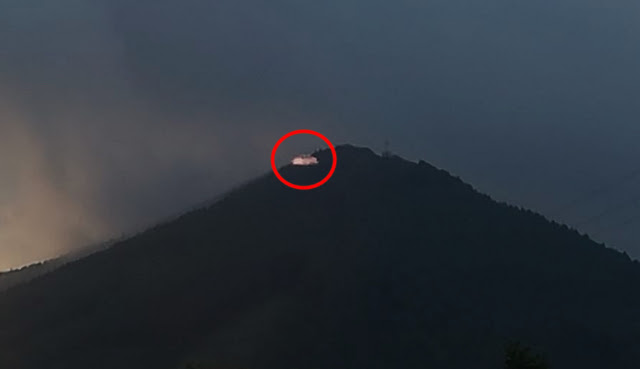
Glowing Disk Caught During Sunset Over Mountain In Spain, May 5, 2020, Photos, UFO Sighting News.
Date of sighting: May 5, 2020 but Reported today.
Location of sighting: Zumarraga, Spain
Source: MUFON #111613
UFOs often move too fast for the human eye to detect. Aliens rely on that technologic skill to avoid detection. However cell phones and cameras are getting more advanced and have a more perfect eye than our own. They capture every detail. So thats is our advantage. We too have tech skills to fall on. This is a perfect disk and caught in two different positions. Absolutely breathtaking. I have often said, if you want to see a UFO, watch a dozen sunsets. You will see at least one.
Scott C. Waring - Taiwan
Eyewitness states:
I was just trying to take a beautiful picture of the sunset. I felt something diferent that day in the sky but I couldn’t see clearly the object with my eyes. It was the picture with the phone which took perfectly the object.
Recent DNA Results of the Elongated Skulls of Paracas Peru indicate they were not Homo Sapiens
The puzzle of why diverse ancient people, even on remote Pacific Islands, would use head-binding to create elongated heads is mystifying, this cultural practice may be traced back to mysterious ancestors with very complex genetics origins.
Image credit: Marcia K Moorf.
On the coast of Peru a mysterious people appeared about 3000 years ago and disappeared 1000 years later. Today we know of them as the Paracas, an Inca term to describe the area some 1500 years after the Paracas were no longer present.
Cranial deformation of human skulls was a phenomenon that existed on all inhabited continents, and especially the case about 2000 years ago among the elite of societies.
In general these were the elites of a society and cranial deformation was performed on new borns in order to make them look distinct from the general population. In Peru and Bolivia there were many societies with elongated heads, including the royal Inca family.
Were they some sort of elite race that roamed the entire planet? Why do anthropologists rarely talk about cranial deformation and know so little about it?
But now recent DNA testing of the early Paracas indicate that they did not originate in Peru and that they were in fact not Homo sapiens.
Check also out Brien Foerster pertinent books Here.
Possible UFO video of a flying saucer over Brookings, South Dakota
This UFO video of a disc-shaped object was filmed back in September 2018 but it was just submitted today to MUFON’s website.
Witness report:
I observed an object floating in the sky for over an hour. I had my phone on me to take video. I saw this object in September of 2018 when I filmed it hovering in the sky for over an hour. Almost exactly a year later I saw the same object in the sky again in September of 2019.
Venus has had a somewhat complicated — and unfortunate — history. Planetary scientists suspect that billions of years ago, Venus was rather more like Earth: warm, pleasant, and flush with liquid water. But sometime in the past it lost its water and turned into a scorching-hot wasteland.
According to a recent paper, Venus was doomed from the start, but may have been accelerated in its path to dry-town through the gravitational influence of none other than the great bully of the solar system: Jupiter.
The early solar system was a total Wild West: lawless and chaotic. For starters, astronomers now strongly suspect that the giant worlds didn't form in their present orbits. We can identify this through the shaping and sculpting of orbits in the asteroid belt and in the distribution of the icy remnants past the orbit of Neptune. By piecing together the gravitational clues from the holdovers of the formation of the solar system, it's clear that the giant planets first formed much farther out, then migrated inward closer to the sun.
However, we don't have a clear picture of exactly how that migration happened. In some models, Jupiter slowly inches closer over the course of hundreds of millions of years, followed by Saturn and the rest. But in other models, Jupiter jumps almost to the orbit of Mars before slinking back out to its present position.
Either way, a dancing Jupiter caused havoc for the inner planets. The mass of that planet is so great — it's 2.5 times more massive than all the other planets combined — that any little shift in its orbit pulls and plucks on anything else in the solar system.
Take, for instance, Venus. Currently, Venus has one of the most perfectly circular orbits in the entire solar system. Its eccentricity (the measure of how elliptical an orbit can get) is only 0.007, meaning that at closest approach Venus is 66.5 million miles (107 million kilometers) from the sun, and at its farthest it's … 67.7 million miles (109 million km) from the sun.
But according to a recent paper appearing in the preprint journal arXiv, if Jupiter happened to migrate inward closer to the sun, it could have tugged Venus into an extremely elliptical orbit, creating an eccentricity of up to 0.3.
Since Venus no longer has that great of an eccentricity, something must have happened to circularize its orbit, and the authors of the paper suggest that it was ocean tides. If Venus had great liquid water oceans (which we suspect it did, since Venus and Earth are about the same size and had similar formation histories), then the tides on the oceans could have provided enough friction to stabilize the orbit of that planet into a nice, steady circle.
But that elongation of the orbit due to Jupiter may have had another catastrophic consequence: It could have hastened the transformation of Venus from tropical wetland to hellish nightmare.
If you're a planet trying to hold on to your liquid water oceans, an eccentric orbit is a real pain in the neck. We already know from studies of Earth's own history that variations in our planet's eccentricity (due to, you guessed it, gravitational tweaks and tugs from the other planets) triggered ice ages and glaciation events. Indeed, some deep-time climate variations are directly connected to changes in our eccentricity.
But still, despite the occasional frozen moment, Earth has been able to hang on to its water. Poor Venus suffered a worse fate, however. If Venus got sent into a highly elliptical orbit due to the presence of Jupiter in the early days of the solar system, it spent some of its year far away from the sun (nice and cool) and some of its year way too close for comfort.
All told, the researchers calculate, Venus may have suffered from more heat exposure than is healthy. The problem is that radiation intensity increases rapidly for even small inward shifts in orbital position. The more time that Venus spent closer to the sun, the worse it suffered.
Even worse, the closer Venus was to the sun, the more it was susceptible to ultraviolet radiation blasts from solar flares, which were especially prominent when our sun was a young upstart.
The combination of increased heat and increased exposure to high-energy radiation set in motion Venus' downward, hellish spiral.
Boiled alive
As Venus lost its oceans, the water vapor in the atmosphere trapped heat. The trapped heat caused more water to evaporate, which put more water in the atmosphere, which trapped more heat, and round and round it went in a vicious greenhouse cycle. With no liquids to lubricate Venus' joints, plate tectonics stopped, allowing carbon dioxide to leak into the atmosphere to dramatic excess, locking in its fate.
Eventually, Venus turned itself inside out and cooked itself to death, leaving our neighbor a nightmare world. And it may have been accelerated on that path by a wandering, plundering Jupiter.
Venus is more than a cautionary tale for our own greenhouse gas emissions. You may have noticed that astronomers are very interested in exoplanets — worlds outside the solar system — and whether they might be homes for life. Venus sits just on the inside edge of what's called the habitable zone of our sun, the range where the intensity of light is just right to allow for liquid water on a world's surface.
But Venus' surface is very much not habitable at all (though its clouds may be another matter), and this may be the fault of Jupiter. When we go to examine the possibility of life on other worlds, the authors of the paper conclude, we have to pay attention to any giant planets in those systems. They may have performed similar acrobatics as Jupiter did, ruining any chances of life persisting on the inner worlds.
Paul M. Sutter is an astrophysicist at SUNY Stony Brook and the Flatiron Institute, host of Ask a Spaceman and Space Radio, and author of Your Place in the Universe. Sutter contributed this article to Space.com's Expert Voices: Op-Ed & Insights.
Follow us on Twitter @Spacedotcom and on Facebook.
A ‘lake’ on Mars may be surrounded by more pools of water
New radar data add to evidence of water under Mars’ south pole, but it’s not “a slam dunk yet”
New radar data from the Mars Express orbiter suggests that a possible lake 1.5 kilometers under the ice at Mars’ south pole (shown) is surrounded by pools of liquid water.
Fresh intel from Mars is sure to stir debate about whether liquid water lurks beneath the planet’s polar ice.
New data from a probe orbiting Mars appear to bolster a claim from 2018 that a lake sits roughly 1.5 kilometers beneath ice near the south pole (SN: 8/18/18). An analysis of the additional data, by some of the same researchers who reported the lake’s discovery, also hint at several more pools encircling the main reservoir, a study released online September 28 in Nature Astronomy claims.
If it exists, the central lake spans roughly 600 square kilometers. To keep from freezing, the water would have to be extremely salty, possibly making it similar to subglacial lakes in Antarctica. “This area is the closest thing to ‘habitable’ on Mars that has been found so far,” says Roberto Orosei, a planetary scientist at the National Institute for Astrophysics in Bologna, Italy, who also led the 2018 report.
Ali Bramson, a planetary scientist at Purdue University in West Lafayette, Ind., agrees “something funky is going on at this location.” But, she says, “there are some limitations to the instrument and the data…. I don’t know if it’s totally a slam dunk yet.”
Orosei and colleagues probed the ice using radar on board the European Space Agency’s Mars Express orbiter. Short bursts of radio waves reflect off the ice, but some penetrate deeper and bounce off the bottom of the ice, sending back a second echo. The brightness and sharpness of that second reflection can reveal details about the underlying terrain.
The possible lake was originally found using radar data collected from May 2012 to December 2015. Now, in data collected from 2010 to 2019, the team once again found regions beneath the ice that are highly reflective and very flat. They say their findings not only confirm earlier hints of a large buried lake but also unearth a handful of smaller ponds encircling the main body of water and separated by strips of dry land.
“On Earth, there would be no debate” that a bright, flat radar reflection would be liquid water, Orosei says. These same analysis techniques have been used closer to home to map subglacial lakes in Antarctica and Greenland.
While much about these putative ponds remains unknown, one thing is certain: This new report is bound to spark controversy. “The community is very polarized,” says Isaac Smith, a planetary scientist with the Planetary Science Institute who is based in Ontario, Canada. “I’m in the camp that leans towards believing it,” he adds. “They’ve done their homework.”
One question centers on how water could stay liquid. “There’s no way to get liquid water warm enough even with throwing in a bunch of salts,” says planetary scientist Michael Sori, also at Purdue.
In 2019, he and Bramson calculated that the ice temperature — about –70° Celsius — is too cold even for salts to melt. They argue some local source of geothermal heat is needed, such as a magma chamber beneath the surface, to maintain a lake. That in turn has led to other questions about whether contemporary Mars could supply the necessary heat.
Smith — as well as the paper’s authors — thinks this isn’t a problem. As recently as 50,000 years ago, Smith says, the Martian south pole was warmer because the planet’s tilt (and hence its seasons) is constantly changing. Warmer temperatures could have propagated through the ice to create pockets of salty liquid. Alternatively, the ponds may have been there before the ice cap formed. Either way, at very high salt concentrations, once water has melted, it’s hard to get it to freeze again. “The melting temperature is different than the freezing temperature,” he says.
Even so, such liquid may be unlike any that most earthlings are familiar with. “Some supercooled brines at these cold temperatures are still considered liquid but turn into some weird glass,” Bramson says.
Resolving these questions will probably require more than radar. Multiple factors, such as the composition and physical properties of the ice, can alter the fate of the second echo from the bottom of the ice, says Bramson. Seismology, gravity and topography data could go a long way to revealing what lurks beneath the ice.
Whether anything could survive in such water is an open question. “We don’t know exactly what is in this water,” Orosei says. “We don’t know the concentration of salts, which could be deadly to life.” But if life did evolve on Mars, he speculates, “these lakes could have been providing a Noah’s Ark that could have allowed life to survive even in in present conditions.“
Tot die conclusie komt een team van Italiaanse wetenschappers op basis van radargegevens van de Europese ruimtesonde Mars Express in Nature Astronomy.
De ontdekking van het meer werd twee jaar geleden al bekendgemaakt. Sindsdien hebben de wetenschappers hun zoekgebied met een paar honderd kilometer uitgebreid. Dat heeft onder meer bewijs opgeleverd dat het ondergrondse zoutmeer dertig kilometer groot is en anderhalve kilometer onder de ijskorst ligt.
Daarnaast zijn nu drie kleinere watermassa’s rond het meer ontdekt. Deze intrigrerende ‘vijvers’ hebben afmetingen van een paar kilometer en staan los van het zoutmeer.
Radiogolven
Bij het onderzoek gebruikte het team onder leiding van Sebastian Emanuel Lauro van de Roma Tre-universiteit een radarmethode die vergelijkbaar is met hoe op aarde ondergrondse meren in het Antarctische en Canadese Noordpoolgebied worden opgespoord. Daarbij wordt gekeken hoe radiogolven weerkaatsen aan ondergrondse lagen van verschillende materialen.
Bij elke ontdekking van water op Mars wordt er al snel over gespeculeerd dat er wellicht nog levende organismen op de planeet te vinden zijn. Maar dit zoutmeer en de omringende ‘vijvers’ zijn daar waarschijnlijk niet geschikt voor. Als ze echt uit vloeibaar water bestaan, moet dat water vanwege de ijzige omstandigheden ter plaatse heel zout zijn – te zout voor levende micro-organismen.
Sommige planeetwetenschappers twijfelen er zelfs aan of er überhaupt water onder de ijskap van Mars zit. Het zou er zelfs te koud zijn voor een pekelmeer. Het heldere gebied dat op de radarbeelden te zijn is, zou eventueel wel op het bestaan van een ondergrondse slijklaag kunnen wijzen.
While extragalactic “rogue” planets – not orbiting any star – have been reported before, the new exoplanet is the first to be detected orbiting stars in another galaxy. And not just any galaxy … but M51, the beautiful Whirlpool, 23 million light-years away.
The Whirlpool Galaxy (M51), where the candidate exoplanet M51-ULS-1b was detected by the Chandra X-ray Observatory. We see this galaxy face-on.
Image via NASA/ ESA/ S. Beckwith (STScI)/ the Hubble Heritage Team (STScI/AURA).
In recent decades, astronomers have found over 4,000 exoplanets, or worlds orbiting other stars. They range from small, rocky planets to huge gas giants, but they all have one thing in common. Every exoplanet found orbiting a star has so far resided in our own Milky Way galaxy. That makes sense, since the Milky Way’s own stars are the stars closest to us, cosmically-speaking. But now scientists at the Harvard-Smithsonian Center for Astrophysics – led by Rosanne Di Stefano – have used X-ray data to take the giant step across extragalactic space, to find the first evidence for a planet orbiting stars in another galaxy.
The planet, still a candidate at this point, appears to orbit a binary star system – two stars in a mutual orbit – in the glorious Whirlpool Galaxy (M51), a galaxy we see face-on, at a staggering 23 million light-years from Earth.
The extragalactic news was reported in The Physics arXiv Blog by Astronomy.com on September 24, 2020.
A new peer-reviewed paper detailing the discovery was submitted to arXiv on September 18, 2020.
Image of the Whirlpool Galaxy from Chandra. The M51-ULS-1 star system, seen in bright X-rays, is the orange dot in the center of the square.
The planet has been labeled M51-ULS-1b, and is estimated to be slightly smaller than Saturn. It orbits its stars about 10 times the distance from Earth to the sun. It was first detected on September 20, 2012, by NASA’s Chandra X-ray Observatory, but went unnoticed in the datasets at the time. It was only later found by Di Stefano and other colleagues.
It’s an exciting finding, but how did astronomers do it, especially when it can be difficult enough just to find planets in our own galaxy?
The answer is that this binary star system is rather unique. One of the two stars in the binary is simply a massive star. But the other one is thought to be a stellar remnant, either a neutron star or a black hole. The massive star is gradually being consumed by the neutron star or black hole companion, either of which would have extreme gravitational pull. The resulting dust releases huge amounts of energy in the form of X-rays, the same electromagnetic radiation used to take images of the inside of a human body or other objects. The amount of X-rays being released is so massive that this binary system is one of the brightest sources of X-rays in the entire Whirlpool Galaxy.
Also, whether the object emitting the X-rays is a neutron star or black hole, it is very small, smaller than a lot of planets. The team calculated that if a Saturn-sized planet orbited it, and transited in front of it from our vantage point – the way many exoplanets are discovered – it would entirely eclipse the object. As seen by Chandra, the transit lasted about three hours.
The extragalactic planet was first detected by the Chandra X-ray Observatory in 2012, but not noticed until much later (artist’s illustration).
Couldn’t the possible planet actually be another star? The researchers say no, since the binary system is too young for other white dwarfs or other stars to have evolved there. What about natural variations in brightness of the neutron star or black hole? Again, the team says this is unlikely, because the different light frequencies in the spectrum all dimmed and then brightened again at the same time, exactly what would be expected of an eclipse by a larger body passing in front:
It is approximately symmetric, and has a shape typical of transits in which the source and transiting object have comparable size.
The researchers now expect that additional planetary candidates will be found soon:
The archives contain enough data to conduct surveys comparable to ours more than ten times over. We therefore anticipate the discovery of more than a dozen additional extragalactic candidate planets in wide orbits.
Since our own galaxy alone is now estimated to contain billions of planets, maybe even more planets than stars, it is reasonable to conclude that other galaxies do as well.
This discovery is tantalizing, but it is not actually the first possible detection of a planet in another galaxy. As reported in EarthSky in February 2018, astronomers at the University of Oklahoma (UO) announced evidence for multiple planets in a galaxy 3.8 billion light-years away, which contains the quasarRX J1131-1231. The main difference with these is that they are free-floating “rogue” planets not orbiting any stars, and the evidence for them is less direct, using a quasar microlensing technique where the gravity from the quasar acts as a natural magnifying glass. The quasar magnifies the light coming from its galaxy, making it easier to detect distant features.
Rosanne Di Stefano at the Harvard Smithsonian Center for Astrophysics, who led the discovery team.
That discovery was also made using Chandra. Using microlensing models at OU’s supercomputing center, the researchers calculated there could be as many as 2,000 rogue exoplanets in that galaxy, ranging from the mass of the moon to the mass of Jupiter.
Millions or more rogue planets like these are also now thought to exist in our own galaxy, but whether they were ejected from their original planetary systems or just formed where they are isn’t known yet.
M51-ULS-1b, however, would be the first “regular” planet discovered in a nearby galaxy, one that orbits a star. That bodes well for the prospect of many more being found in the years ahead. If our galaxy, the Whirlpool Galaxy and others are filled with planets, then how many worlds might there be in the universe? It’s a mind-bending thought, especially when it was first believed there were about 200 billion galaxies in the observable universe, but more recent studies say there are at least 10 times that many, or 2 trillion galaxies. Wow.
Bottom line: Astronomers used X-ray data to make the first discovery of an an exoplanet – labeled M51-ULS-1b – orbiting a star in another galaxy. The planet appears to orbit in a double-star system in the Whirlpool galaxy (M51), 23 million light-years away.
Just in time for Halloween season, the year 2020 has one more trick up its sleeve: “zombie storms.”
As their eerie name suggests, according to the National Weather Service, the rare weather phenomenon occurs when strong tropical climates cause storms to come back from the dead.
Dead Rising
That’s essentially what happened to Hurricane Paulette. The storm landed in Bermuda weeks ago as a Category 1 storm, intensified to a Category 2, and then lost speed.
Then last week, Paulette joined the living dead by strengthening into a tropical storm once more, according to the National Hurricane Center. She made yet another reappearance about 300 miles off the Azores islands.
Hostile Conditions
Meteorologist Brandon Miller told CNN that “conditions can become hostile for a tropical storm to maintain its intensity, but if it doesn’t dissipate completely, it can revive days later when conditions become more favorable.”
He added that “2020 is a good candidate to experience a zombie storm because water temperatures are above average over a bulk of the Atlantic Ocean, and obviously we are seeing a record number of storms — which ups the chances one could regenerate.”
In other words, rather than dying out as they usually do when they hit land or cooler waters, storms are regaining energy from much warmer waters in the Caribbean.
Intensifying conditions caused by climate change might be making such freak occurrences more frequent, especially considering an “extreme amount of heating of the Gulf (of Mexico),” as Donald Wuebbles, professor of atmospheric sciences at the University of Illinois, told Live Science.
Meer van UFO'S of UAP'S, ASTRONOMIE, RUIMTEVAART, ARCHEOLOGIE, OUDHEIDKUNDE, SF-SNUFJES EN ANDERE ESOTERISCHE WETENSCHAPPEN - DE ALLERLAATSTE NIEUWTJES


 Undeniable proof that intelligent aliens once existed on Mars. Photos, UFO Sighting News.