


Now a regional director for the Mutual UFO Network (MUFON), Filer continues to study and disclose his findings about the UFO phenomenon.
What do you think about his encounter?


 It’s Not Just the M.I.B. Who Are Weird: Their Cars Are Too

There’s one thing you can say for sure about the Men in Black: they’re very weird. Witnesses to the M.I.B. describe them as looking pale and gaunt. Their skin sometimes appears plastic-like, and completely free of lines. Sometimes they wear wigs. On other occasions they sport large, wrap-around sunglasses. And, perhaps strangest of all, they seem to not understand what food is. If it is offered to them, they simply stare at it. There’s another aspect to the M.I.B. weirdness. It’s the matter of their vehicles. They are just as weird as the M.I.B. themselves. I guess it’s something we should expect. With that said, let’s now take a look at some of the stranger, car-based cases that have a tie to the Men in Black. We’ll begin with a friend of mine, Tracie Austin, author and radio-host. Like me, Tracie is originally from the U.K., but now lives in the United States. She told me of a very strange experience she had late one night back in the U.K. in the 1990s.
As she drove along the road, Tracie said: “…I noticed there was an old, black Lincoln car coming towards us in the opposite direction. Although it was old, it looked new, but it was an old style, and it was totally out of place. And, coming from England, in Cheshire, that’s just not the kind of car you see: an American Lincoln. That’s what I thought: what’s an American car doing here? As the car approached us – coming the other way – I tried to see who the driver was, but I couldn’t see anybody. I’m not saying the car was driving itself, but I just couldn’t make out anyone. No-one. I could see it had really shiny bumpers and there was no [license] plate, at all. And I noticed that with every car behind that Lincoln, it was like it was the leader of the pack. I could see the drivers of the cars behind were all kind of ‘switched off.’ It looked like an automatic mode. Like they were in a daze. It was very, very odd. We got down the road and my friend said: ‘Did you see the way that vehicle was moving?’ I said, ‘No, what do you mean?’ He said: ‘The wheels were going around, but they weren’t touching the ground.’ It was just like it was hovering, but not high, or I would have known. I was too busy trying to see the driver. I just said: ‘Oh, my God.'” Moving on to another case…

Nick Redfern and a sinister (but cool) car…
As bizarre as it might sound, there are a number of reports on record of black cars (A) entering and exiting UFOs late at night; and (B) of apparent aliens exiting UFOs and getting in cars. Yep, I know: it’s really weird. Back in 2009, longtime Ufologist Tim Beckley shared just such a story with me. Tim said: “I remember one incident where I was lecturing and a gentleman – a professor at the college where I was lecturing – came up to me and told this story about how he was driving outside of a town in Michigan. It was rather late at night, and he saw these lights in the woods. He pulled over, and there was no other traffic coming in either direction, but there was already another car parked at the edge of the road.” Tim continued: “He described seeing some sort of ship in the distance – a UFO. A group of human-like aliens got out of the UFO, walked to the car – which was a Cadillac, or something like that. He watched them and could see they looked human. They just got in the car and drove off. But then, a couple of weeks later, he sees one of the same guys in a supermarket. These reports sound farfetched, but there’s so many of them of what seem to be aliens being able to move among us.”
Dr. Josef Allen Hynek was provided with the details of a fantastically-strange MIB encounter, that occurred in a small Minnesota town in late 1975, and that falls firmly into just such a category. Ironically, no UFO was seen on this particular occasion, but the chief witness was harassed by the driver of a large, black Cadillac on a particular stretch of highway, and who nearly forced the man into an adjacent ditch. The irate man quickly righted his vehicle and headed off in hot-pursuit, only to see the black Cadillac lift into the air and, quite literally, disappear in the blink of any eye!

For Robert Easley, a resident of Defiance, Ohio, the weirdness began in the early hours of July 11, 1967. He was woken up by the sound of his phone ringing. Easley quickly answered it – perhaps fearing it was someone with bad news. It was actually a woman who wanted to report a sighting of two UFOs over the town – a sighting that was still going on. Easley jumped into his car and sped off into the night. It turns out that Easley was shadowed all the way by a black Cadillac, very often the preferred mode of transport for the MIB. The car had no license plates, which is typical, too. As for the driver, who kept very close to Easley’s vehicle, his upper body and head were silhouetted and dark. That was not good news. The MIB soon vanished, however, taking another road and leaving Easley worried and slightly paranoid. On the night of July 15, the MIB returned, yet again in his black Cadillac, following Easley for a number of nail-biting miles. Tim Beckley tells the story of what happened next: “When [Easley] pulled into his driveway, the unknown car sped off. Later that evening as he sat talking with his girlfriend on the front porch, the car came down the road and stopped right in front of the house, as soon as the topic of UFOs entered their conversation. Easley could feel the man looking at them. When they got off the subject the car left, but when they got back on it about an hour later, the same car came back again. It was as if the driver could hear what they were saying or read their minds.”
Présentation d'Athena, la plus grande et la plus ambitieuse optique à rayons X jamais réalisée, avec Andrea Martelli - PART II
Article de Rémy Decourt, publié le 03/07/2014
L'Agence spatiale européenne a sélectionné la seconde grande mission de son programme scientifique Vision Cosmique. L'observatoire Athena, un satellite X conçu pour étudier l'univers chaud et énergétique, sera lancé en 2028 et remplacera, à lui seul, les satellites XMM-Newton (Esa) et Chandra (Nasa). Rencontre avec Étienne Pointecouteau, responsable adjoint du conseil scientifique d'un des deux instruments scientifiques.
En novembre 2013, l'Agence spatiale européenne décidait du thème de ses deux prochaines grandes missions spatiales. L'univers chaud et dynamique et la traque des insaisissables ondes gravitationnelles devenaient sa priorité. Aujourd'hui, elle confirme un de ses choix et sélectionne Athena, pour Advanced Telescope for High ENergy Astrophysics, un observatoire spatial de pointe qui fonctionnera dans le domaine X. Pour l'équipe scientifique en charge du projet, cette sélection met fin à plus de 15 ans de travail, de propositions et de lobbying et va les occuper durant les 15 à 20 prochaines années.
Cet observatoire sera lancé à l'horizon 2028 par un lanceur européen qui devrait être une Ariane 5, voire une Ariane 6. Mis en orbite autour du point de Lagrange 2, choisi pour sa grande stabilité gravitationnelle et sa situation en dehors des ceintures de radiation, il sera positionné dans la direction opposée au Soleil. Il fonctionnera pendant au moins cinq ans mais la mission est conçue pour une décennie.
Athena remplacera XMM-Newton et Chandra, deux observatoires spatiaux. Si Chandra offre une meilleure résolution que XMM-Newton, lequel l'emporte pour la sensibilité, la mission Athena « fera plus que combiner les performances de ses illustres prédécesseurs, puisqu'elle dépassera de loin les capacités en spectro-imagerie des rayons X de XMM-Newton et Chandra », explique Étienne Pointecouteau, chercheur CNRS à l'Irap (Toulouse) et responsable adjoint du conseil scientifique de l'instrument X-IFU d'Athena. En effet, la surface collectrice de cet instrument surpassera d'un facteur 10 celle de XMM-Newton et d'un facteur avoisinant 40 celle de Chandra. Ainsi, avec ses 5" de résolution spatiale et sa très grande sensibilité, cet observatoire nous « apportera la spectro-imagerie de sources très peu brillantes, comme par exemple les premiers trous noirs ou les premiers groupes de galaxies formés dans l'univers ».
Le principal objectif de cet observatoire est de répondre aux grandes questions posées par le thème scientifique l'univers chaud et dynamique. À savoir comment « la matière ordinaire s'assemble pour former les structures que nous voyons aujourd'hui à grande échelle et comment les trous noirs naissent, évoluent et façonnent l'univers tel que nous l'observons ».
Pour répondre à la première question, il est nécessaire de cartographier la distribution du gaz chaud dans les grandes structures de l'univers, « en particulier le gaz contenu dans les groupes, les amas de galaxies et le milieu intergalactique » et en déterminer les propriétés physiques ainsi que leur évolution au cours du temps. « C'est la clé de notre compréhension des processus gouvernant la formation des structures de l'univers de l'échelle des galaxies à celle des grands filaments de matière que nous observons aujourd'hui ». Quant à la deuxième question, il « nous faut étudier les trous noirs supermassifs au centre des galaxies, des environnements très obscurcis par la matière accrétante (gaz, poussières, etc.), jusqu'à leurs premières populations dans l'univers très jeune ». Il nous faut aussi comprendre leur cycle d'accrétion et d'éjection et les échanges de matière et d'énergie qu'ils induisent dans leur environnement (galaxies et gaz chaud). L'ensemble de ces éléments nous fournira une vue de la façon dont les galaxies et les trous noirs supermassifs qu'elles abritent évoluent ensemble.
Au-delà de ces objectifs scientifiques majeurs, Athena permettra un large spectre d'observations, de l'étude des sursauts gamma, « des explosions extrêmement énergétiques dont la nature est encore incertaine » à la caractérisation des explosions de supernovae et de leurs restes, lieux de la production de métaux et responsables de la génération de courants de matière et d'énergie à l'échelle des galaxies (les vents galactiques). Cet observatoire sera également utilisé pour l'étude des planètes du Système solaire qui donnera « une vue complémentaire des mesures in situ de l'interaction par exemple entre leur environnement magnétique (magnétosphère) et les particules énergétiques du vent solaire ».
Comme le souligne Alvaro Gimenez, le directeur de la science et de l'exploration robotique à l'Esa, « par rapport aux missions X précédentes, le bond en avant sera significatif ». Surtout, il permettra aux astronomes européens de rester en « pointe pour de nombreuses années dans l'étude du rayonnement de hautes énergies de l'univers ».
Avec un poids d'environ cinq tonnes, Athena sera aussi lourd qu'un satellite de télécommunications. Il embarquera un miroir de trois mètres de diamètre, avec une surface collectrice efficace de 2 m2 à 1 keV et deux instruments focaux qui opéreront dans « la bande d'énergie des rayons X de basse énergie, c'est-à-dire 0,2 à 12 keV », la même gamme spectrale que XMM-Newton et Chandra. Cette gamme est notre « fenêtre sur l'univers chaud et énergétique ». De nombreux phénomènes physiques y produisent des émissions, comme l'ont montré les nombreux résultats de XMM-Newton et Chandra.
Des deux instruments, le spectromètre intégral de champ (X-IFU, pour X-Ray Integral Field Unit) est le plus novateur. Il permettra d'étudier le détail de nombreuses sources astrophysiques et autres processus physiques dont les émissions sont actuellement totalement hors de portée de XMM-Newton et Chandra. « Le X-IFU est considéré comme l'instrument le plus ambitieux jamais considéré pour une mission spatiale » tient à préciser Didier Barret, chercheur CNRS à l'Irap et investigateur principal de cet instrument à la tête du consortium européen dont les principaux contributeurs sont la France, l'Italie et les Pays-Bas.
Cet instrument, dont les détecteurs sont refroidis à une température proche du zéro absolu, sera doté d'une résolution spectrale de 2,5 eV sur l'ensemble de son champ de vue de 5 arc-minutes, « 60 fois mieux que les performances actuelles des spectro-imageurs embarqués par XMM-Newton et Chandra », précise Étienne Pointecouteau. Athena et X-IFU ouvriront donc les portes, via la très haute résolution spectrale en X, des détails de l'astrophysique des processus physiques énergétiques de l'univers. Le second instrument est sous responsabilité allemande. Il s'agit d'un imageur à grand champ (WFI pour Wide Field Imager) avec une excellente résolution spatiale.
Compte tenu de la complexité de la mission et son coût, l'Agence spatiale européenne souhaite l'internationaliser. Elle recherche des partenariats, notamment avec le Japon et les États-Unis. La Nasa a d'ores et déjà fait savoir son intérêt et se dit prête à fournir certains composants et systèmes. En 2019, l'Agence spatiale européenne devrait détailler la feuille de route de ce programme. Elle fixera un budget et choisira le maître d'œuvre du satellite et les industriels en charge de sa construction. Quant aux instruments, leur développement débute dès aujourd'hui.
Présentation d'Athena, la plus grande et la plus ambitieuse optique à rayons X jamais réalisée, avec Andrea Martelli- PART I
L'observatoire spatial Athena, qui promet des avancées majeures dans le domaine de l'astrophysique des hautes énergies, sera équipé d'un miroir de 2,5 mètres. Ce miroir est si ambitieux au niveau des prouesses scientifiques et de sa conception qu'il nécessite la réalisation d'un prototype grandeur nature pour valider le concept et les performances attendues. L'interview d'Andrea Martelli, responsable des avant-projets scientifiques chez Thales Alenia Space, nous explique les enjeux.
Début janvier, l'Agence spatiale européenne a confié à Thales Alenia Space l'étude de la conception, la fabrication et le test du démonstrateur MAM (Mirror Assembly Module) destiné au futur télescope spatial Athena.
Cet observatoire spatial, dont le lancement est prévu en 2031, pourra sonder le cosmos 10 à 100 fois plus profondément que les précédentes missions dans le domaine des rayons X, afin d'observer les objets célestes les plus chauds et énergétiques. Nos articles précédents détaillent les objectifs scientifiques qui promettent des avancées majeures dans le domaine de l'astrophysique des hautes énergies.
Pour atteindre les objectifs scientifiques extrêmement ambitieux de cette mission, le miroir d'Athena sera la plus grande optique à rayons X jamais construite. En effet, ces objectifs exigent une grande surface effective dans ce spectre. Par conséquent, l'optique du télescope doit pouvoir collecter et focaliser les rayons X à travers une grande structure circulaire d'environ 2,5 m de diamètre. Cette structure comportera près de 600 modules de miroirs très précisément alignés grâce à la nouvelle technologie Silicon Pore Optics (SPO). Elle devra être extrêmement rigide et stable pour atteindre les performances optiques visées. Le module MAM sera ensuite pointé vers deux instruments distincts au moyen d'un système directionnel complexe ultra précis.
Thales Alenia Space sera chargé de concevoir, développer et tester un démonstrateur grandeur nature du MAM, afin de valider ses fonctions critiques préalablement à l'adoption de la mission. Thales devra démontrer la maturité globale de la technologie et du processus retenus pour la mise en œuvre du projet Athena qui débutera en 2022. Elle devra donc démontrer l'aptitude à fabriquer et intégrer le miroir à sa taille réelle et sa compatibilité avec l'ensemble des exigences fonctionnelles et d'interface de la mission Athena. Le succès de la mission reposera en grande partie sur cette technologie.
Andrea Martelli : Cette technologie SPO est actuellement développée par la société Cosine aux Pays-Bas. Le site web de l'ESA et de la Communauté Athena l'explique très bien : « La technologie SPO repose sur l'emploi de plaquettes (wafers) en silicium disponibles sur étagère, dont la qualité de surface (texture et rugosité) est parfaitement compatible avec les applications optiques à rayons X. Un module SPO se compose de deux empilements (stacks) de wafers intégrés ensemble. Le premier stack est un jeu de plaques-miroirs concentriques et confocales qui représentent les paraboloïdes (1re réflexion) à l'intérieur d'un système Wolter de type I emboîté, tandis que le second stack fait office d'hyperboloïdes (2e réflexion) dans ce même système. Chaque module agit ainsi comme une petite lentille à part entière. Le miroir complet peut être constitué en plaçant les modules en anneaux dont la taille diffère en fonction de la position du rayon dans la structure ».
Andrea Martelli : Le miroir d'Athena est la plus grande optique à rayons X jamais fabriquée. La principale contrainte technique est donc liée à la taille de sa structure, qui fait office de banc optique (d'un diamètre de 2,5 m pour une épaisseur globale de l'ordre de 250 mm), ce qui ne va pas sans poser quelques problèmes de disponibilité et d'approvisionnement de la matière brute. Pour cela, Thales Alenia Space peut compter sur sa longue expérience de l'achat et de la qualification de différents matériaux pour ses applications spatiales, et a trouvé une solution potentielle qui doit désormais être entièrement adaptée au miroir d'Athena.
Ce dernier doit en effet être aussi rigide que possible, tout en tenant compte des contraintes habituelles inhérentes aux missions spatiales comme la masse, la réponse en fréquence, l'opérabilité, etc. Les contraintes technologiques sont ensuite essentiellement liées à la forme complexe de la structure qui comprendra 600 logements de modules co-implantés et alignés avec une précision extrême.
Dans un premier temps, il est donc absolument indispensable de développer et tester un démonstrateur MAM (Mirror Assembly Module) grandeur nature, afin de valider la faisabilité technique et technologique d'une telle structure de miroir.
Andrea Martelli : Le miroir est l'un des éléments clés de ce télescope dont les performances dépendent de lui. Capable de combiner à la fois grand champ et haute résolution angulaire, il offrira des capacités d'observation très largement supérieures à celles des précédentes missions comme le montre la figure ci-dessous :
Pour rendre de telles performances possibles, le miroir obéit à un mode de conception et de mise en œuvre radicalement nouveau par rapport aux télescopes XMM-Newton, Chandra et autres satellites d'observation à rayons X. Par exemple, le module optique de XMM repose sur trois télescopes composés de 58 miroirs Wolter I à incidence rasante (coques monolithiques en nickel recouvertes d'une fine couche d'or) qui sont emboîtés dans une configuration coaxiale et confocale soudée à une extrémité sur une araignée. Une conception similaire a été adoptée pour Chandra et, plus récemment, Rosita.
Le miroir d'Athena est composé de 600 modules SPO répartis sur 15 rangées circulaires à l'intérieur de la structure. Par leur conception et fabrication, ces modules améliorent sensiblement la capacité de réflexion des rayons X vers les capteurs des instruments. Chaque module est relié à la structure au moyen de trois goupilles de positionnement qui, lors des phases d'intégration, calibration et test, permettent d'aligner parfaitement chacun de ces modules.
Andrea Martelli : Le développement du MAM défrichera le terrain pour d'autres applications spatiales, en particulier des missions scientifiques où les structures de miroir seront nécessaires pour servir de bancs optiques. Ce type de structures, soumises à d'importantes contraintes de stabilité thermique pour limiter les distorsions des optiques supportées, sont généralement fabriquées en matériaux céramiques ou métalliques à faible coefficient de dilatation thermique. Les matériaux céramiques sont cassants, nécessitent des procédés de fabrication très complexes et sont limités en taille en raison des contraintes des moyens de production.
Les dimensions et la complexité du miroir d'Athena ayant pratiquement exclu l'emploi de ce type de matériaux dans la conception, la solution adoptée par TAS pour ce programme repose sur une formule métallique qui répond au besoin d'un processus de fabrication plus simple et qui, par ailleurs, exige un strict contrôle des dilatations thermiques. La solution fait ainsi appel à un thermorégulateur actif dédié qui assure aux modules de miroir la stabilité requise. Elle pourra donc être exploitée dans le cadre de missions scientifiques spatiales pour des bancs optiques de tailles à la fois plus grandes et plus petites où le facteur coût peut aussi être intéressant.
Andrea Martelli : Ces différences s'expliquent en partie par le niveau technologique propre à l'époque de chacune de ces missions, les missions XMM et Chandra remontant déjà à plus de 20 ans. Leur principale différence réside dans la technologie de fabrication du miroir, comme nous l'avons décrite dans cet article. Athena se distingue en particulier par la taille (2,5 m de diamètre) et la surface effective de son miroir ainsi que par la résolution en énergie et les dimensions générales du télescope, notamment sa longueur focale de 12 m (contre 7,5 et 10 respectivement pour XMM et Chandra), qui porte la longueur hors-tout du satellite à environ 15 m.
Enfin, toute l'électronique embarquée d'Athena sera au tout dernier standard technologique et contribuera ainsi au surcroît de performance et d'opérabilité du satellite.
En outre, les missions Chandra, XMM et Athena se distinguent par leurs opérations et activités scientifiques spécifiques. Le miroir optique de Chandra se focalise sur un point unique, ce qui oblige à déplacer les instruments montés dans le plan focal sur ce point au moyen d'un mécanisme dédié. En revanche, XMM est à même d'opérer ses instruments en parallèle par l'application d'un filtre sur le faisceau focalisé. Athena est, quant à lui, capable de déplacer tout l'ensemble miroir au moyen d'un mécanisme de basculement dédié pour focaliser le faisceau vers l'instrument cible.
Andrea Martelli : Le but du démonstrateur grandeur nature MAM (Mirror Assembly Module Demonstrator), qui permettra de valider les fonctions les plus critiques du système, vise à confirmer l'aptitude de TAS à réaliser la conception, la fabrication, l'assemblage et la campagne de tests dans les temps pour l'adoption de la mission Athena. Le cas échéant, TAS sera le candidat tout désigné pour fabriquer le miroir du satellite, même si la compétition est encore ouverte à ce stade.
Article de Rémy Decourt publié le 26/05/2019
Le futur observatoire spatial X de l'agence spatiale européenne sera lancé au début des années 2030. Il embarquera X-ray Integral Field Unit, un instrument révolutionnaire qui a nécessité une étude de faisabilité pour s'assurer d'être en mesure de pouvoir le réaliser. Cette étude s'est conclue positivement ouvrant la voie à un instrument qui promet des avancées majeures dans le domaine de l'astrophysique des hautes énergies.
Aujourd'hui, les questions scientifiques et les progrès technologiques déclenchent de nouveaux projets spatiaux pour répondre aux questions générées par les données des instruments qui précèdent ces futurs projets. Un cycle sans fin qui pousse scientifiques et ingénieurs à réaliser des instruments très innovants dont certains nécessitent des sauts technologiques significatifs.
Athena (Advanced Telescope for High ENergy Astrophysics), le futur observatoire spatial dans le X de l’Agence spatiale européenne n'échappe pas à cette règle. Le principal objectif de cet observatoire est de répondre aux grandes questions posées par le thème scientifique de l'Univers chaud et dynamique. À savoir, comment « la matière ordinaire s'assemble pour former les structures que nous voyons aujourd'hui à grande échelle et comment les trous noirs naissent, évoluent et façonnent l'univers tel que nous l'observons », explique Étienne Pointecouteau, chercheur CNRS à l'Institut de recherche en astrophysique et planétologie (Irap) et responsable adjoint du conseil scientifique de l'instrument X-IFU d'Athena.
Pour cela, il sera doté de deux instruments principaux dont le X-ray Integral Field Unit : un spectro-imageur haute résolution spectrale, bien plus puissant que ses prédécesseurs et qui promet des avancées majeures dans le domaine de l'astrophysique des hautes énergies. Pour vous donner une idée du saut de performance, X-IFU sera doté d'une résolution spectrale de 2,5 eV sur l'ensemble de son champ de vue de 5 arc-minutes, soit de 50 à 60 fois mieux que les performances actuelles des spectro-imageurs embarqués par XMM-Newton et Chandra.
Autre exemple, la surface collectrice des Le nom photon vient du grec et signifie "lumière". En effet, le photon transmet l'interaction électromagnétique, la lumière étant un exemple d'onde électromagnétique." data-url="/sciences/definitions/physique-photon-3500/" data-more="Lire la définition">photons (en cm2) sera supérieure d'un facteur 45 à celle de l'observatoire spatial XRISM de la Jaxa (Japon), qui devrait voler avant nous (2021). Quant à la résolution spectrale, elle sera deux fois meilleure que celle du Japonais et la taille des pixels sera vingt fois plus petite, ce qui donnera à X-IFU des images de bien meilleure qualité. « Le X-IFU est considéré comme l'instrument le plus ambitieux jamais considéré pour une mission spatiale », précise Didier Barret, chercheur CNRS à l'Irap et responsable scientifique du consortium X-IFU
La matrice de détecteurs (microcalorimètres), l'électronique de lecture et la chaîne cryogénique (les détecteurs seront refroidis à une température proche du zéro absolu), sont les technologies les plus innovantes. Pour s'assurer que le concept de l'instrument, défini par les exigences scientifiques, arrivera à des performances conformes aux spécifications émanant de l'équipe scientifique, une étude de faisabilité de 4 mois a été nécessaire.
Les conclusions de cette étude ont été présentées ce mardi 21 mai. L'agence spatiale européenne et le Centre national d'études spatiales ont confirmé la faisabilité de cet instrument. Celui-ci entre maintenant dans sa phase de définition préliminaire qui va durer environ 3 ans. Si le planning est respecté, la
What Will Happen To Religions If Aliens Arrive
It is possible that humanity may be at the threshold of the most important moment in its history; contact with an extraterrestrial civilization may be imminent.
Until now, this has been the topic of science fiction books and films. But scientifically speaking, the Universe is too big to maintain only one civilization, the human one.
The search for extraterrestrial intelligence (SETI) was started in the past century, with many projects that were funded by the U.S. government and by private sources.

For the moment, nothing has been found to confirm its existence, or if anything has been found, it has not been announced to the public. However, planets have been discovered in our galaxy that indicate similarities with Earth and possibilities of life on those planets.
A few months ago, according to unverified information, there was a meeting of a committee of the U.N., comprised of the permanent members of the Security Council that deals with such issues. It had been the first time in many years that the committee had met and of course very few humans know what was discussed.
Then something very interesting happened. One month after the visit of the Pope to the U.S., the Vatican daily, “L’Osservatore Romano,” hosted an interview on May 13 with the director of the Vatican’s Observatory, titled “The alien is my brother,” in which he says some very important things.
Let us read the contents of his interview.
When he was asked about the possibility of extraterrestrial life, he responded by saying,
“It is possible, even if until now we have no proof. But certainly in such a big universe, this hypothesis cannot be excluded.”
Asked if he sees a contradiction between the Catholic faith and believing in aliens he replied,
“I think there isn’t a contradiction. Just as there is a multiplicity of creatures on the earth, so there could be other beings, even intelligent beings, created by God.
“This is not in contradiction with our faith, because we cannot establish limits to God’s creative freedom. To say it with St. Francis’ words, if we can consider some earthly creatures as brothers or sisters, why could we not speak of a brother alien? He would also belong to creation.”

It is important to note that the Vatican, for the first time in its history, issued a statement of that kind. And the Vatican never makes statements unless there is a reason.
Let us be more concrete.
When there were contacts between civilizations on Earth in the past, what usually happened was that the stronger one influenced or absorbed the weaker one or that the weaker one died out. This is one of the reasons that the Neanderthal race of humans disappeared and Homo sapiens prevailed.
If there was to be contact between humanity and an extraterrestrial civilization, the first casualty could be the religions of Earth, if it were proven that the existence of extraterrestrial life would contradict human religions.
In order to prevent the collapse of human religions, which could lead to chaos and to the loss of the planet’s religious institutions’ power, the Vatican made an effective pre-emptive strike by announcing that no such contradiction exists.
Consequently, it is possible that contact between humanity and an extraterrestrial civilization may be imminent and that technical details of such an encounter may be in the process of being worked out. This would explain the Vatican statement.
If that were the case, then all the other problems of the planet would become temporarily irrelevant, in view of the importance of such a contact.
But let us wait and see. Ponder our thoughts, dear humans, for your benefit.
Mission Artemis : à quoi pourrait ressembler le futur véhicule de transport vers la Lune
Mission Artemis : à quoi pourrait ressembler le futur véhicule de transport vers la Lune
L'Agence spatiale européenne, principale partenaire de la Nasa dans son programme d'exploration lunaire, souhaite se doter de capacités suffisantes pour mener ses propres missions en toute autonomie. Elle a donc engagé les études d'un atterrisseur lunaire polyvalent et d'un croiseur lunaire de transfert cislunaire, s'appuyant sur l'héritage des modules de service d'Orion et de l'ATV. Ce croiseur lunaire serait utile à une grande variété de missions et pas seulement à destination de la Lune. Federico Massobrio, responsable des avant-projets dans le domaine de l'exploration chez Thales Alenia Space, répond à nos questions.
L'Agence spatiale européenne veut jouer un rôle moteur dans la conquête de la Lune et ses environs. Principale partenaire de la Nasa dans la construction du Gateway en réalisant les modules Esprit et I-HA, l'ESA fournit également le module de service du véhicule Orion de la Nasa. Mais elle a aussi pour ambition de se doter d'un alunisseur logistique lourd européen (European Large Logistics Lander, EL3) ainsi que d'un véhicule de transfert polyvalent cislunaire pour ravitailler le Gateway, s'appuyant sur l'héritage des modules de service d'Orion et de l'ATV.
L'ESA qui souhaite se doter de capacités suffisantes pour mener ses propres missions en toute autonomie (comprenez sans dépendre du bon vouloir de la Nasa), a trouvé avec l'atterrisseur lunaire polyvalent EL3 et le croiseur lunaire de transfert cislunaire, deux concepts intéressants. Notamment parce qu'ils permettent une grande variété de missions et, concernant le CLTV (Cis-Lunar Transfer Vehicle), il peut être utilisé pas seulement à destination de la Lune. En janvier, l'Agence spatiale européenne a donc signé deux contrats d'étude avec Thales Alenia Space et Airbus pour valider le concept de ce véhicule de transfert polyvalent cislunaire CLTV.
Avc ce CLTV, l'Europe pourrait se doter d'un véhicule spatial capable de faire la navette entre l'orbite terrestre et la Lune pour contribuer à la logistique du Gateway avec une capacité d'emport non négligeable de plus de 4,5 tonnes jusqu'au Gateway. Cet ATV lunaire pourrait fournir, par exemple, un soutien opportun et efficace à la Nasa et à l'ESA dans la mise en œuvre des futures missions lunaires Artemis, voire être une alternative crédible au SLS (Space Launch System) et autres lanceurs commerciaux en particulier pour ce qui concerne toutes les missions de logistique, comme le transfert de fret, l'assemblage en orbite, le retour d'échantillons, de l'orbite terrestre basse à l'espace cislunaire. Par ailleurs, la polyvalence de CLTV lui permettra également de soutenir des missions d'infrastructure orbitale post-ISS en orbite terrestre basse ainsi que des missions dans le domaine des services aux satellites géostationnaires.
Vous l'aurez compris, il ne s'agit pas d'un véhicule conçu pour le transport d'équipage mais d'un véhicule logistique polyvalent pouvant être utilisé dans le cadre de différentes missions d'exploration spatiale, de l'orbite terrestre basse à l'environnement cislunaire et lunaire. Ce véhicule sera lancé par une Ariane 6, voire un lanceur Vega C en cas de lancement multiple. Premier vol en 2027.
Cela dit, ce n'est seulement que lors de la prochaine réunion du Conseil des ministres de l'ESA, actuellement prévue fin 2022, que les États membres décideront du sort des projets EL3 et CLTV, soit en finançant un seul des deux ou les deux, voire en les abandonnant, ce qui paraît peu probable.
Federico Massobrio, responsable des avant-projets dans le domaine de l'exploration chez Thales Alenia Space dont l'entreprise a remporté un contrat d'étude pour le CLTV, nous apporte des précisions.
Federico Massobrio : Le véhicule est censé être très flexible au regard de la grande variété de missions qu'il aura à accomplir : ravitaillement logistique des modules pressurisés de la station spatiale cislunaire LOP-G (Lunar Orbital Platform - Gateway), ravitaillement en ergols, transport d'infrastructures en orbite terrestre basse (LEO) et missions potentiellement complémentaires aux atterrisseurs lunaires. Par conséquent, les ressources du système et les capacités de transport associées dépendront pour beaucoup de sa destination finale.
Federico Massobrio : Compte tenu du fait que l'ESM est spécifiquement intégré au composite Orion conçu pour être lancé à bord du SLS, avec un moteur principal fourni par les États-Unis, un dérivé direct de l'ESM est difficilement envisageable. Toutefois, des solutions européennes innovantes doivent être identifiées pour fournir à l'ESA un véhicule logistique et utilitaire compétitif.
Federico Massobrio : Pour la mission cargo pressurisée, les composantes les plus appropriées seront analysées et sélectionnées en fonction des exigences en matière d'environnement, interface et habitabilité, de durée de vie et coûts supportables. Cygnus n'est qu'une des solutions les plus prometteuses actuellement à l'étude.
Federico Massobrio : Tout dépendra de la mission visée - si elle concerne l'orbite basse ou la LOP-G - ainsi que de sa durée et de son habitabilité. Quelle que soit la formule finale retenue, une approche modulaire permettra d'accomplir différentes missions avec un minimum de changements.
Federico Massobrio : Là aussi, tout dépendra de la cible (LEO, LOP-G, ou autre) et du type de fret (marchandises, ergols, infrastructures).
Federico Massobrio : Pour l'instant, une version réutilisable du CLTV n'est pas envisagée, sauf si un véhicule de rentrée dérivé du Space Rider est jugé potentiellement intéressant en matière de véhicule de transport.
Federico Massobrio : Un scénario de lancement multiple est en effet à l'étude pour améliorer les capacités actuelles des lanceurs européens, mais se posera également la question des coûts et des opportunités commerciales.
Federico Massobrio : La logistique spatiale, le ravitaillement en ergols, l'assemblage en orbite et l'OOS (on-orbit services) font assurément partie des projets spatiaux de prochaine génération. C'est pourquoi de futures synergies dans ces domaines seront activement recherchées dans l'avenir proche.
Former USAF Major Encounters Extraterrestrial Mothership
Over and over again, trustworthy commercial and military pilots risk their reputation and come forth with descriptions of UFO encounters. Why? Do they seek notoriety and present these stories in exchange for a bit of fame or is there any substance behind their encounters with flying saucers?
Naturally, we can’t answer this question in a way that would satisfy all of our readers so we’ll just portray one pilot’s testimony and let you decide.
Naturally, we can’t answer this question in a way that would satisfy all of our readers so we’ll just portray one pilot’s testimony and let you decide.

Filer is a stern believer in the alien presence on Earth and he thinks aliens have been visiting our planet for thousands of years. According to him, UFOs are encountered more often than we’ve been led to think and there is an ongoing effort to conceal their presence.
In January 1962, he was stationed as a pilot at the U.S. Air Force Base at Sculthorpe RAF Base in the U.K. During an aerial refueling mission taking place over the North Sea at an altitude of 30,000 feet, Filer was notified by London Control that their radar had picked up something anomalous.
He had just finished transferring fuel from his tanker aircraft and started heading toward the object. According to London Control, the unknown object was hovering over an area near Stonehenge, at an altitude of around 1,000 feet. The sun had just set and the skies were clear.
When Filer got within 30 miles of the UFO, his APS-23 Radar detected it.
“It was an exceptionally large radar return reminding me of a large bridge or ship. This craft was bigger than anything I had seen in the air before. It reminded me of the radar return from the Brooklyn Bridge (6,000 feet) or the Firth of Forth Bridge in Scotland (8,300 feet), over a mile long.

“The Return was sharp and solid as compared to the fuzziness of a rain cloud. I felt this craft must be made of steel or strong metal. We were doing around 425 mph as we approached to about 10 miles, when the UFO apparently realized we were intercepting,” Filer said.
Darkness had set so Filer and his copilot could see the spacecraft’s lights ahead of them. As they got closer, the lights turned from dim to bright while the UFO suddenly accelerated. It climbed with an unbelievable speed and was soon gone.
Filer asked London Control if any rocket launches had taken place in the area and received a negative response. Since there was nothing more he could do, Filer returned to base, recording the incident in his log.
It seemed Filer was the only one giving importance to the strange encounter but, several weeks later, he and his crew received an invitation to dinner from Prince Phillip, the Duke of Edinburgh.
As it turns out, Prince Phillip was very interested in hearing Filer’s account. The Duke had been intrigued by UFOs since his uncle, Earl Mountbatten had witnessed flying saucers from up close while in the Navy.
Prince Phillip told Flier he had debriefed aircrews who had encountered UFOs before and revealed that the phenomenon was of greater magnitude than most believe.
The incident turned Filer into a believer. He was especially intrigued by the fact that the large spaceship was hovering above Stonehenge and thinks there might be a connection between ancient megalithic monuments and the unidentified flying objects.
Now a regional director for the Mutual UFO Network (MUFON), Filer continues to study and disclose his findings about the UFO phenomenon.
What do you think about his encounter?
First Ever Space Hurricane Witnessed Above the North Pole
Satellite data showed a space hurricane in the upper atmosphere of our planet that was made of plasma (ionized gas), causing it to rain electrons. The 600-mile-wide cyclone-shaped auroral storm, which was spotted hundreds of miles above the North Pole, was the first ever space hurricane ever witnessed.
The incredible phenomena was found by researchers led by China’s Shandong University who searched through satellite data that revealed plasma swirling around in an anti-clockwise direction around the atmosphere instead of air. The storm lasted almost eight hours before breaking up and during that time, it rained electrons instead of water.

Space hurricanes have similar features as those in the lower atmosphere of Earth.
Based on this new data, space hurricanes could possibly exist on other planets and moons that contain plasma and magnetic fields. Professor Mike Lockwood, who is a space scientist at the University of Reading, stated, “Until now, it was uncertain that space plasma hurricanes even existed, so to prove this with such a striking observation is incredible.”
He went on to say, “Tropical storms are associated with huge amounts of energy, and these space hurricanes must be created by unusually large and rapid transfer of solar wind energy and charged particles into the Earth’s upper atmosphere.” “Plasma and magnetic fields in the atmosphere of planets exist throughout the universe, so the findings suggest space hurricanes should be a widespread phenomena.”
As for what kind of damage it may cause to our planet, space hurricanes could possibly interrupt GPS systems. The study went into further details regarding this topic, reading in part, “A hurricane is clearly associated with strong energy and mass transportation, so a hurricane in Earth’s upper atmosphere must be violent and efficiently transfer solar wind/magnetosphere energy and momentum into the Earth’s ionosphere.”

Space hurricanes have calm, quiet centers just like Earth storms.
Interestingly, space hurricanes are in fact quite similar to hurricanes we often experience right here in the lower atmosphere of our planet. They both contain a very calm and quiet center section, with spiraling arms and spread out for many miles. (An illustration of the space hurricane can be seen here.)

An illustration of a space hurricane.
Pic: University of Reading
As if Earth hurricanes weren’t bad enough, now we have space hurricanes. The study was published in Nature Communications where it can be read in full.
De natuur is bezig met een Great Reset


 Strange anomalies sticking out of Antarctica's ice sheet

 Dark Journalist: Bimini Atlantis And UFOs

 NFL Quarterback Claims He Saw A UFO

One of the biggest questions of the universe continues to be whether we exist alone or not. One Wednesday night, an NFL quarterback turned a believer in space aliens.
Baker Mayfield of Cleveland Browns took to Twitter late night on Wednesday to say he and his wife Emily spotted a UFO. Mayfield claimed to have seen a beam of light while driving in his hometown close to Lake Travis just outside of Austin in Texas.

The 32-year-old Mayfield finished the 2021 regular season with 62.8 percent completed passes for 3,563 yards, 26 touchdowns, and eight interceptions. His 95.9 total quarterback rating finished 15th in the NFL.
Mayfield had 15 touchdowns and seven interceptions in the first half of the season and added 11 touchdowns to just one interception in the second half of the season.
Browns head coach Kevin Stefanski said Baker became more comfortable with what they’re doing when asked the difference for Mayfield from the start of the season to the end.
UFOs hovering above Las Vegas, NE last night!
This new UFO video of a bright lights hovering in the sky above Las Vegas, Nevada was filmed on Wednesday, 3rd March 2021.
What do you think these objects are?
The Quest for the Mysterious Lost Atlantis of the Far NorthAs long as humans have realized that there are worlds out there beyond the confines of what we know, there have been those willing to go out and explore them. Our never-ending push past the boundaries of our own reality have brought back stories from intrepid adventurers of elusive unknown places beyond our wildest imaginings. History is populated by tales of mysterious lost lands and hidden places removed from civilization, with some of the greatest travelers tales revolving around enigmatic realms that have managed to evade understanding to lie out on the periphery of the known universe. One such tale concerns an alleged lost, ghostly continent found in the inhospitable frozen wastes of the far north, which captured the imagination of the era and spurred a doomed expedition to try and find it.
The strange story begins in 1906, when the American explorer Robert Peary attempted to become the first person to reach the North Pole. He was unable to do so, defeated by storms and dwindling supplies, but despite not achieving his intended goal, he would later claim to have made a groundbreaking discovery during the return voyage. Upon returning, he would make the incredible claim that while sailing west of Ellesmere Island and about 130 miles northwest of Cape Thomas Hubbard, he had looked out across the grey expanse of storm-lashed sea to observer a previously unknown, massive landmass complete with soaring mountains and deep valleys, which he christened a new island or perhaps even a continent, a place he called Crocker Land, naming it after a banker who had helped fund his expedition. At the time of his alleged sighting, he was not equipped to approach or explore further, and in the meantime, the idea of a lost land lying out in the polar sea was generating a lot of discussion and excitement, and it even appeared on some maps at the time.

Robert Peary
There was some skepticism to Peary’s claims in 1909, when Frederick Cook and Peary went on a race to be the first to the North Pole, both of them claiming to have reached it. The thing was, Cook insisted that he had been all through the area where Crocker Land was supposed to be, but had seen nothing. Peary was adamant that it was real, and he had accrued plenty of those who believed him. One of these was the famed American Arctic explorer, sailor, researcher and lecturer Donald Baxter MacMillan, who began putting together an expedition of his own to prove it, managing to gain sponsorship by such venerable institutions as the American Museum of Natural History, the American Geographical Society and the University of Illinois’ Museum of Natural History. The expedition meant to confirm the existence of Crocker Land and map its exact position, with MacMillan calling the mysterious realm “the world’s last geographical problem.”
When the expedition left aboard the steamer Diana from the Brooklyn Navy Yard on July 2, 1913, they did so with the backing of some of the most respected organizations in the world, well-supplied, the best equipment money could buy, and a crack team of seasoned professionals and experts. If anyone was going to find Crocker Land again, it was this team, and they left to much fanfare, but things would start to go sour almost from the beginning. Just two weeks after departing, the Diana crashed into some rocks along the Labrador coast while trying to dodge an iceberg, due to a Captain who was drunk behind the wheel and forcing them to change ships. They managed to reach Etah, Greenland, where they built a makeshift shed to use as a base of operations, complete with a radio system that sadly wouldn’t work. At this time the seas had frozen solid, forcing them to head out overland on dog sleds in March of 1914, where their woes only continued.

Members of MacMillan’s expedition
The weather conditions were horrific at the time, making the forbidding no man’s land even worse than usual. Many of the team got frostbite, others dropped from exhaustion, and a good number of the expedition quit and headed back. When they finally reached the Arctic Ocean, there were only four of them left, two of the original team members and two Inuit guides named Piugaattoq and Ittukusuk. They nevertheless set out across the grey expanse of frozen sea upon their dog sleds, braving the unknown and refusing to give up their mission. It was as they penetrated out into the cold domain, dodging thin ice patches, stretches of open water, and uneven terrain while hauling the sleds over steep hills and dropping caches of supplies and building igloos along part of the route, that an exciting sighting was made of what they believed to perhaps be the elusive Crocker’s Land. One day, an expedition member by the name of Fitzhugh Green claimed to have sighted a mysterious landmass in the distance, although it would turn out to be rather tenuous, and MacMillan would write of this:
April 21st [1914] was a beautiful day; all mist was gone and the clear blue of the sky extended down to the very horizon. Green was no sooner out of the igloo than he came running back, calling in through the door, ‘We have it!’ Following Green, we ran to the top of the highest mound. There could be no doubt about it. Great heavens! What a land! Hills, valleys, snow-capped peaks extending through at least one hundred and twenty degrees of the horizon. I turned to Pee-a-wah-to anxiously and asked him toward which point we had better lay our course. After critically examining the supposed landfall for a few minutes, he astounded me by replying that he thought it was poo-jok (mist) [a fata morgana illusion]. E-took-a-shoo offered no encouragement, saying, ‘Perhaps it is.’ Green was still convinced that it must be land. At any rate, it was worth watching. The day was exceptionally clear, not a cloud or trace of mist; if land could be seen, now was our time. Yes, there it was! It could even be seen without a glass, extending from southwest true to north-northeast. Our powerful glasses, however, brought out more clearly the dark background in contrast with the white, the whole resembling hills, valleys and snow-capped peaks to such a degree that, had we not been out on the frozen sea for 150 miles, we would have staked our lives upon its reality. As we proceeded, the landscape gradually changed its appearance and varied in extent with the swinging around of the Sun; finally, at night it disappeared altogether.

Somewhat disheartened by the fact that they had likely seen nothing more than a mirage, the team nevertheless soldiered on. MacMillan thought the land they had seen looked so clear and real, which is what had driven their mad dash towards it, but ultimately after five more days of failing to find it again he decided that it must have been a mirage, after which they were forced to give up the chase due to encroaching warmer weather and the increasing breaking up of the ice. The dejected MacMillan would write in his journal:
As we drank our hot tea and gnawed the pemmican, we did a good deal of thinking. Could Peary with all his experience have been mistaken? Was this mirage which had deceived us the very thing which had deceived him eight years before? If he did see Crocker Land, then it was considerably more than 120 miles away, for we were now at least 100 miles from shore, with nothing in sight. We were convinced that we were in pursuit of a will-o’-the-wisp, ever receding, ever changing, ever beckoning. My dreams of the last four years were merely dreams; my hopes had ended in bitter disappointment.
Unfortunately, this crushing realization that Crocker’s Land likely did not exist was not the end of their harrowing ordeal. When they finally got to solid land, Green and the Inuit Piugaattoq were tasked with scouting out a route west, but would face a disastrous sequence of events. As the two men ventured out to the west, they were hit with fierce weather, one of their sled dogs died, and they were forced to take shelter in a freezing ice cave. At some point the two got into an argument that turned ugly, ending when Green shot his companion dead with his rifle. When he got back to base camp, Green admitted to his American teammates about killing Piugaattoq, yet suggested they all keep it secret, telling the other Inuit that he had died in a blizzard. It was all swept under the carpet, Green never brought to justice for his crime. The ordeal continued when several attempts to rescue the expedition were defeated by poor weather, frozen seas, and harsh Arctic conditions, eventually causing some of them to head all the way back to America 1,000 miles overland down the western coast of Greenland by dog sled, while the others were finally rescued by a ship called Neptune after being stranded there for 3 full years.
Although they had not managed to find the fabled Crocker Land, the ill-fated expedition was not a complete wash. They did manage to collect photographs, data, geological samples, and artifacts from the region and its people, including 5000 photographs, thousands of specimens, and some of the earliest film taken of the Arctic, but MacMillan could never quite get over the fact that he had failed and been possibly misled by one of his idols. The whole thing had left a bitter taste in his mouth, but Peary continued to insist that it did indeed exist, yet by this time these claims by one of the most respected Arctic explorers were falling on deaf ears.

It was probably for the best, because in more recent years it is believed that Peary had made the whole thing up in order to drum up publicity and gain funding for further expeditions to the North Pole. Recent research carried out by historian David Welky, who wrote a whole book on it called A Wretched and Precarious Situation: In Search of the Last Arctic Frontier, found that not only did Peary’s diary contain no mention anywhere of Crocker Land, but he had not mentioned it at all until months after the expedition during which he had supposedly sighted it. There aren’t even any mentions of it in the earlier drafts of Peary’s book that first brought it up, Nearest the Pole. This suggests that he likely came up with the whole thing later on, spinning a yarn that managed to gain a foothold among other explorers and Arctic experts simply because Peary was well-respected and considered to be at the top of his field, one of the best Arctic explorers there was. Welky has said of it:
When Robert Peary comes back to the U.S., he says nothing about Crocker Land. I’ve been through his correspondence, including letters to George Crocker, and he says nothing about it for months after he returns. Then, in 1907, he releases his book, and suddenly here are these paragraphs about this amazing new land. It’s not for many months after his return that he finally says something. Crocker Land is a fabrication by Peary from the start. You can look at this in any number of ways, starting with circumstantial evidence. Obviously, Crocker Land isn’t there. So, let’s give him the benefit of the doubt. What might he have seen and mistaken for land? It could have been an ice island, but ice islands don’t have peaks and valleys, they’re flat on top. Do we really think that the most experienced Western Arctic explorer mistook an ice island for a continent? It could have been a mirage. A fata morgana, as this particular kind of mirage is called. Subsequent explorers have seen fata morganas from that same spot. If you watch one, you will see it wobble and flicker and waver, and it’s obvious it’s not solid land. Nothing Peary might have mistaken for Crocker Land makes sense. That’s strike one.
We can also look at his care notes, the notes he leaves behind to prove he was there. They’re quite detailed notes. He talks about a hunting trip that day, climbing the hills to get this view, but says absolutely nothing about seeing Crocker Land. Several crewmembers also kept diaries, and according to those he never mentioned anything about seeing a new continent. We also have the typed drafts for his book, Nearest the Pole, and for an article he excerpted in Harper’s Magazine. But again there is no mention of this new land mass. In other words, sometime between the final manuscript and when the book comes out the paragraphs about Crocker Land mysteriously appear. It’s all pretty damning. They fell for it because they learned about it from the most authoritative source that Americans had on the Arctic. Robert Peary knew more about the Arctic than any other American or Westerner alive. In that sense, it was an unimpeachable source.
Was Crocker Land ever real? Probably not. It seems as if it was the invention of a man desperate for attention and funds, but it all played into the hunger for new places to discover and explore at the time, driven by his sheer standing as an intrepid explorer and expert. It is a desire we as a species still have deeply ingrained within us, so it is not all that surprising that it should catch on and inspire others to investigate for themselves. We now know that there is nothing there, and whether it was just a fabrication, a mirage, or what, it is nevertheless a peek into a great era of exploration, when there were still ill-defined areas on our maps and the horizon still held potential amazing surprises beyond it.
The Mars Helicopter Could Charge up the Atmosphere Around Itself as it Flies
Plasma globes are a common enough sight in retails stores across the rich world. If you’ve ever seen one and gotten a chance to touch it, you’ve seen how the plasma will arc toward your touch creating a sense that you’re able to harness electricity like Thor.
That effect does not only take place on Earth – anywhere there is a charge build-up that causes a high enough electrical potential between two points to create an electrical glow or corona. Now a team at NASA think that a large charge build-up might occur when Ingenuity, Perseverance’s helicopter companion, takes to the sky.
The team, led by Dr. William Farrell at Goddard Space Flight Center, has been interested in the electrical properties of Mars’ atmosphere for decades, first beginning to study the subject in the early 90s. Reasons abound for wanting to understand these phenomena, not the least of which is understanding what impact it might have on any future human colony.
For now, humanity’s ambassadors on the red planet are robots, and they have their own challenges when facing electrical discharges. One particular robotic emissary is in a unique position amongst the current Martians when it comes to electrical discharges. Ingenuity will operate in a naturally dusty atmosphere and could even possibly create its own miniature dust cloud when it takes to the skies in a few weeks.

With those dust interactions come electrical potentials, which are created when two dust particles run into each other or into the blades of the rotorcraft. The dust contacting the blades will likely cause a phenomena technically known as “tribocharging”. More commonly, people are familiar with this phenomena from rubbing balloons on their hair and then sticking them to a ceiling.
Tribocharging itself is not likely to cause any sparks to fly in Earth’s atmosphere. However, the conditions are different on Mars, whose atmosphere has a much lower “breakdown voltage” than that of Earth’s. While the research team is quick to point out there is no immediate danger to Ingenuity, or the rovers themselves, there is the potential to get some interesting data about the electric potential of Mars’ atmosphere.

That data has been a long time coming, as attempts to study the electrical properties of Mars’ atmosphere have a history going back to the 1990s. Efforts have been plagued by the notorious difficulty of actually landing a craft on Mars. Attempts to send an instrument capable of detailed study were cut short when the Mars Polar Lander mission failed in 1999. That craft was part of the Mars Surveyor program, which was suspended following the loss of the Polar Lander.
One of those planned-but-never-executed Surveyor craft, Mars 03 Surveyor, was to have electrical instrumentation on it that would have allowed scientists to directly study the electrical properties of the atmosphere. A later mission, ESA’s Schiaparelli lander, would have had similar instrumentation, but it was destroyed along with the lander in a failed landing attempt in 2016.

Despite all these setbacks, interest has not waned in the topic. And Ingenuity’s takeoff allows a coincidental chance to at least get some data. The counterrotating blades the helicopter uses for stabilization will likely have the effect of creating a small Van de Graff generator, charging the helicopter body with high voltages when comparing to its surrounding atmosphere.
The best way to observe this phenomenon would be with dedicated instruments, such as an electrometer or radio antenna. In lieu of that, the best scientists can hope for in this mission is to observe Ingenuity while it takes off. Dr. Farrell and his team suggest that doing so at twilight would make for ideal observing conditions. However, mission planners much prefer operations with good lighting and calm winds – not necessarily at twilight.
UT video discussing the challenges of landing on Mars.
No matter the launch time, Ingenuity’s flight will be the first powered controlled flight by humankind on another planet. If it happens to take off with an amazing glow, it will not only result in great data for Dr. Farrell and his team, but also could be a spectacular show for those of us stuck watching on the ground.
Learn More:
Lead Image:
The post The Mars Helicopter Could Charge up the Atmosphere Around Itself as it Flies appeared first on Universe Today.
Source:
The Whole Planet Is Under Alien Attack
The Whole Planet Is Under Alien Attack
Owen and Young Pharaoh discuss what is the root of the evil plaguing humanity, and possible solutions.
Is our whole planet really under attack by aliens? =) What do you think? Let us know in comments and thanks for stopping by.
Stay tuned for more high weird from me and other contributors who enjoy sharing the unknown..
SpaceX Starship rocket explodes minutes after first successful landing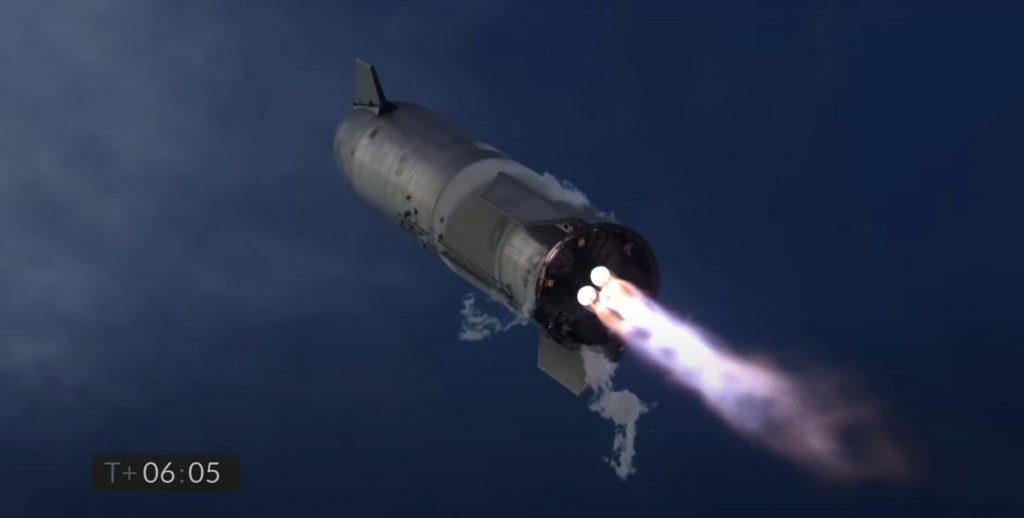
In a classically spectacular fashion, a SpaceX Starship prototype has successfully touched down in one piece for the first time ever, only to explode minutes later after catching itself on fire.
Rolled from SpaceX Boca Chica Starship factory to test and launch facilities just a mile down the road on January 28th, Starship SN10 lifted off just five weeks later – the fastest factory-to-launch flow yet. The speed of that turnaround was mainly made possible thanks to an exceptionally smooth test campaign, passing cryogenic proof and static fire tests after only a few attempts.
Prior to its second launch attempt, Starship SN10 automatically aborted a few seconds prior to its first attempt after the rocket’s flight computer determined that its three Raptor engines were producing more thrust than expected. Within half an hour of the abort, CEO Elon Musk took to Twitter to reveal the cause and stated that SpaceX would be tweaking the flight software’s thrust limits and recycling for another shot at launch around two hours later.


Starship SN10 became the first of its kind to touch down in one piece – but not for long.
(SpaceX)
Up to the last 20 or so seconds of the 6.5-minute flight test, Starship SN10’s launch debut was virtually identical to Starships SN8 and SN9, both of which made it just one or two dozen seconds away from a soft landing. However, after SN9, SpaceX optimized the landing process to add additional redundancy, meaning that SN10 reignited all three of its Raptor engines – instead of just two – for its flip and landing burn.
Exactly as planned, SN10 fired up those engines, autonomously analyzed their performance, and then shut down two Raptors to leave the best-behaving engine to complete the final landing burn. Unlike SN8 and SN9, that maneuver went about as well as it could have, nearly slowing SN10 to a hover with one (seemingly) healthy engine to take it the rest of the way to the ground.


Unfortunately, SN10 only had a bit less than ten minutes to enjoy its incredible accomplishment, exploding around T+14:40 after a small fire spread.
SN10 touched down in one piece but remote firefighting hardware at the landing zone was ultimately unable to beat down an onboard fire that appeared to start during the Starship’s landing burn. Eventually, that fire somehow won out over Starship’s structure or pressure vessels, breaching its pressurized propellant tanks and triggering a massive explosion.
The post SpaceX Starship rocket explodes minutes after first successful landing appeared first on TESLARATI.
What Happens if Perseverance Finds Life on Mars?
It all happened so fast! On Thursday, February 18th, NASA’s Perseverance rover set landed in the Jezero crater on Mars and almost immediately transmitted its first image of the Martian. This was followed by photos from the Mars Reconnaissance Orbiter and footage taken by the rover’s Entry, Descent, and Landing (EDL). Then there was the panoramic video, a sound recording, and deployed its Ingenuity helicopter, all in the space of a week!
But that’s nothing compared to what happened next. Shortly after the rover started drilling into the floor of the Jezero crater, Perseverance found evidence of fossilized bacteria! The search for life on Mars finally struck paydirt! Okay, that didn’t happen… Not yet, anyway. But what if it does? After all, one of Perseverance‘s main objectives is to search for evidence of past life on Mars. What will be the impact if and when it finds it?
The Perseverance rover is NASA’s ninth mission to land on Mars and (like its predecessors) is tasked with characterizing the geology, atmosphere, and climate of Mars and help pave the way for human exploration. But the rover is also focused on astrobiology, which refers to the study of life throughout the Universe. As the next most-habitable place in our Solar System beyond Earth, Mars is a major focus of our astrobiological efforts.
Biosignatures, Anyone?
As Gentry Lee, the chief engineer for the Planetary Science Directorate at NASA’s Jet Propulsion Laboratory, explained in a JPL press release:
“To quote Carl Sagan, ‘If we see a hedgehog staring in the camera, we would know there’s current and certainly ancient life on Mars, but based on our past experiences, such an event is extremely unlikely. Extraordinary claims require extraordinary evidence, and the discovery that life existed elsewhere in the universe would certainly be extraordinary.’”
Thanks to the many rovers, orbiters, and landers that explored Mars in the past, scientists understand that billions of years ago, Mars was a much different place than it is today. Its atmosphere was denser, its climate warmer, and liquid water flowed on its surface. This led to many of the features that are observable today, like the preserved river delta in the Jezero crater.
This feature indicates that ca. 3.5 billion years ago, Jezero was a lakebed that had water flowing into it. This caused sediment to build up over time, leading to the formation of a river delta that is rich in clays. While the lake may be long gone, scientists theorize that there could be biosignatures somewhere in this 45 km (28 mi) wide crater just waiting to be found.
Given the relatively brief window Mars had for habitability, odds are that only simple lifeforms (like single-celled bacteria) would have emerged. On Earth, some of the most ancient evidence for life comes in the form of microbialites, sedimentary deposits composed of carbonate mud that form with the help of photosynthetic cyanobacteria.

Said Ken Williford, the deputy project scientist for the Perseverance mission:
“We expect the best places to look for biosignatures would be in Jezero’s lakebed or in shoreline sediments that could be encrusted with carbonate minerals, which are especially good at preserving certain kinds of fossilized life on Earth. But as we search for evidence of ancient microbes on an ancient alien world, it’s important to keep an open mind.”
Tools of the Trade
Using its advanced suite of scientific instruments, Perseverance will collect rock core samples in metal tubes and place them in a supply cache (which will be retrieved by a future mission sent by the ESA). These instruments include the rover’s suite of cameras, especially the one located on the rover’s mast that’s capable of zooming in to inspect targets (Mastcam-Z).
There’s also the SuperCam instrument, which is also located on the mast and can use a small laser to examine promising research targets. This is done by using the laser to create small clouds of plasma clouds, which will then be analyzed to determine the target’s chemical composition. If the data it obtains reveals something interesting, the rover will be able to examine it more closely with its two turret-mounted instruments.
These are known as the Planetary Instrument for X-ray Lithochemistry (PIXL) and the Scanning Habitable Environments with Raman & Luminescence for Organics & Chemicals (SHERLOC) instruments. The former relies on small x-ray bursts to search for chemical biosignatures while the latter uses its own laser to detect concentrations of organic molecules and minerals that have been formed in watery environments.

Together, these two instruments will effectively create high-resolution maps of elements, minerals, and molecules in Martian rocks and sediments, which astrobiologists will use to determine which to collect and eventually send back to Earth. As Bobby Braun, the Mars Sample Return program manager at JPL, explained:
“The instrumentation required to definitively prove microbial life once existed on Mars is too large and complex to bring to Mars. That is why NASA is partnering with the European Space Agency on a multi-mission effort, called Mars Sample Return, to retrieve the samples Perseverance collects and bring them back to Earth for study in laboratories across the globe.”
“We have strong evidence that Jezero Crater once had the ingredients for life. Even if we conclude after returned sample analysis that the lake was uninhabited, we will have learned something important about the reach of life in the cosmos,” said Williford. “Whether or not Mars was ever a living planet, it’s essential to understand how rocky planets like ours form and evolve. Why did our own planet remain hospitable as Mars became a desolate wasteland?”
In short, the Perseverance mission is dedicated to the search for life and is equipped with the very best that modern science can offer. So it naturally begs the question, what happens if and when it succeeds?

What’s Next?
Well for starters, the announcement would spread around the world like wildfire. Just imagine the headlines: “Perseverance finds evidence of Martian life!” “Humanity discovers extraterrestrial bacteria!” The excitement would be palpable and would be felt wherever the news reached. Of course, it would also raise some very important questions, the answers to which would have some rather drastic implications.
First of all, there’s the question of whether or not life on Mars is related to life on Earth. If the answer to this question is yes, then scientists would have solid evidence of lithopanspermia, where life is distributed between planets in a star system. Alternately, it could be an indication of panspermia, where life is distributed throughout the cosmos by celestial bodies like asteroids and comets.
In this case, it could be argued that Earth and Mars were seeded from the same source (though that would be extremely difficult to prove). Dr. Tanja Bosak, a professor of geobiology at MIT and the group leader of their Program in Geology, Geochemistry and Geobiology, is also the Returned Sample Science Lead for the NASA Mars 2020 Perseverance mission. As she told Universe Today via email:
“The most direct test of the genetic relatedness of any martian and terrestrial life would come from the comparisons of the information molecules (DNA, RNA) and the presence of such molecules in anything we find... In the best-case scenario, we’d find fossils of microbes or some such biosignature, but DNA and RNA do not preserve over billions of years, i.e., from the time when surface life was possible in Jezero crater. However, if we see something that looks like fossil cells upon sample return, and detect some organic biosignatures, that would automatically support the similarities between past life on Mars and life on Earth.”

Artist’s impression of water under the Martian surface.
Credit: ESA/Medialab
Second, the discovery of evidence for past life on Mars is likely to lend some credibility to the theory that life still exists there today. Much like the disappearance of Mars’ surface water, it is theorized that microbial life could have also migrated underground as a result of changes in the planet’s climate. In fact, research has been conducted that demonstrated how microbes could survive beneath the surface in briny patches of water.
As Dr. Bosak added, the scientific consensus is that modern surface life on Mars is highly unlikely, hence why Perseverance aims to collect samples that will preserve evidence of past life. Nevertheless, the existence of past life will make the issue of planetary protection all the more pressing when crewed missions to Mars commences, especially if they lead to an enduring human presence there.
Already, robotic missions are forced to exercise care in the vicinity of potential sites for microbial life, a good example of which is the time Curiosity came upon a discolored patch of sand (thought to be a surface brine) and was forced to divert its path to go around it. If human habitats are ever built on Mars (either temporary or permanent), the possibility that we could be causing harm to Martian organisms will always be there.
The Perseverance rover will not provide the final word on this subject, but the data it collects and the sample return it will perform will provide an essential piece to the puzzle. After all, the search for life on Mars is like the search for meaning in the Universe: ongoing! And while we’re waiting for answers, here’s some entirely appropriate music to help us pass the time. Take it away David Bowie!
Further Reading: NASAThe post What Happens if Perseverance Finds Life on Mars? appeared first on Universe Today.
Source:
Ancient Knowledge Foretells The Arrival of Extraterrestrial Visitors
Ancient Knowledge Foretells The Arrival of Extraterrestrial Visitors
Over 30 ancient cultures tracked the stars to learn when the Gods will return.It appears that all of these ancient peoples and who knows how many others believed in a very different model of history than that which predominates our modern age of so-called rationality. Essentially, the difference is that in these ancient cosmologies, both human consciousness and the motion of history were viewed as cyclical rather than linear. These ancient cultural beliefs are very tied in with the precession of the equinox. Have the Gods already arrived?
Something Strange Is Surrounding Our Solar System! 10 Incredible Discoveries
Something Strange Is Surrounding Our Solar System! 10 Incredible Discoveries
Anyone who looks at the stars secretly wonders what is going on in the universe. For us humans it is almost unimaginable. For people in former times it was a much bigger mystery. Our modern civilization has recently been able to fathom, at least in part, what is hidden in space. Nevertheless, our knowledge is manageable and many explanations can only be given in our imagination – all the more important are all the discoveries made by space explorers and scientists.
In the following we present you with ten of the most exciting, mysterious, interesting and incredible discoveries from the near past, where you will wonder what the future will bring. Have fun with exciting facts about foreign planets, black holes, extraterrestrial life and much more.
Ancient Aliens: Secret Vatican Archives Contain Explosive Revelations
Ancient Aliens: Secret Vatican Archives Contain Explosive Revelations
Well, I came here with an open mind, but JaCintas was a close friend of my greatgrandmother’s. That was not included in Mary’s message at all. I will be studying more into the first though, fascinating background. But as far as the children of Fatima, the recorded records plus personal testimonies and the children themselves said nothing of the sort. TannerDoer
UFO Sighting Over Neuquen Argentina, Feb 28, 2021, White Craft.
 UFO Sighting Of Black UFO Passes Over Las Vegas, Nevada On Feb 23, 2021, News.

 Are The Recent UFO Disclosures Setting Us Up for A Mass Deception of Epic Proportions?

 Large UFO Hits The Moon

 UFO activity over Panjab, India 25-Feb-2021

These unknown lights were filmed in the night sky above Ludhiana, Panjab, India on 25th February 2021 and it was just submitted to us through our Facebook page.
RELATED VIDEOS AND INFORMATION, selected and posted by peter2011

UFO Spotted in Ludhiana? Residents Claim They Saw a Shiny Unidentified Object in Sky

Watch the video here:
Many others also captured the alleged UFO and shared it on Twitter. Here are those videos:
FBI 'aware of' American Airlines possible UFO sighting, stops short of confirming investigation
The FBI is "aware of" an American Airlines pilot’s report of an apparent UFO seen soaring over Northeast New Mexico earlier this week – but stopped short of confirming whether an investigation is underway, Fox News learned Thursday.
The pilot was maneuvering a plane bound for Phoenix, Arizona, from Cincinnati, Ohio, on Sunday afternoon when the flight crew spotted a quick-moving, unusual object flying above them, according to a radio transmission recorded by Steve Douglass on his blog, Deep Black Horizon.
On Tuesday, American Airlines confirmed to Fox News that the audio transmission was from flight 2292, but referred further questions to the FBI.
(iStock)
A spokesperson for the FBI’s Albuquerque office responded to Fox News’ request seeking comment and confirmation on Thursday.
"The FBI is aware of the reported incident," spokesperson Frank Connor wrote in an email. "While our policy is to neither confirm nor deny investigations, the FBI works continuously with our federal, state, local, and tribal partners to share intelligence and protect the public. Anyone who is aware of suspicious or criminal activity should contact their local law enforcement agency or the FBI."
In Sunday’s radio transmission, the American Airlines pilot could first be heard asking an unidentified person, presumably from air-traffic control, if they had "any targets up here."
"We just had something go right over the top of us," the pilot adds. "I hate to say this but it looked like a long cylindrical object that almost looked like a cruise-missile type of thing. Moving really fast and went right over the top of us."
ALL RELATED VIDEOS, selected and posted by peter2011
FAA Can’t Explain Pilot’s UFO Sighting Last Weekend Over New Mexico

Dozens of commercial and military pilots have reported unidentified flying objects in recent years.
GETTY
A radio transmission from an American Airlines from Cincinnati to Phoenix last weekend might have been ripped straight from the X-Files.
“Do you have any targets up here? We just had something go right over the top of us,” said the pilot at 1:19 p.m. CST on Sunday. “I hate to say this but it looked like a long cylindrical object that almost looked like a cruise missile type of thing moving really fast right over the top of us,” according to audio published on aviation blog Deep Black Horizon.
The blogger, Steve Douglass, intercepted the transmission accidentally as he was trying to pick up another aircraft with a radio scanner. “It was a pure coincidence,” he told The Arizona Republic.
Douglass used two flight tracking websites, Flightradar24 and Flight Aware, to determine that the exact position of the plane was “over the northeast corner of New Mexico west of Clayton, New Mexico” at an altitude of 37,000 feet.
Douglass’ blog post includes a link to download the audio MP3 file, which he named “UFO.”
Following a debrief with the flight crew, American Airlines confirmed that the radio transmission came from flight 2292.
Yesterday, the FAA released a short statement: “A pilot reported seeing an object over New Mexico shortly after noon local time on Sunday, Feb. 21, 2021. FAA air traffic controllers did not see any object in the area on their radarscopes.”
While authorities may never be able to explain what the missile-like object was, it’s not the first time a pilot has spotted unexplained flying phenomena. In fact, it happens fairly regularly.
A remarkably similar incident occurred over the Sonoran Desert three years ago. On February 24, 2018, within minutes of each other, two pilots flying different aircraft — a Phoenix Air Group Learjet and an American Airlines commercial flight — both reported passing a mysterious object, according to audio recordings released by the Federal Aviation Administration to the Phoenix New Times several weeks later.
“Was anybody above us that passed us like 30 seconds ago?” the Learjet pilot asked an air traffic controller. “Negative,” replied the tower.
In November 9, 2018, a British Airways pilot flying over Ireland reported seeing “a very bright light that disappeared at very high speed,” reported The Guardian. A Virgin Airlines pilot confirmed seeing it, too: “Multiple objects following the same sort of trajectory – very bright from where we were.”
Experts say there is usually a very logical explanation for UFO sightings, and the U.S. government has had a famously long history of being tight-lipped on the subject. In recent years, however, there’s been some notable movement on that front.
In 2017, the Pentagon acknowledged the existence of a $22-million Advanced Aerospace Threat Identification Program that had investigated reports of “unexplained aerial phenomena” from 2007 until it was shut down in 2012.
In April 2019 the U.S. Navy announced it was modifying how pilots reported UFO sightings in favor of a more data-driven approach, telling Politico that there had been “a number of reports of unauthorized and/or unidentified aircraft entering various military-controlled ranges and designated air space in recent years.”
The next month, five Navy pilots told the New York Times that they had frequently seen unidentified flying objects that looked like white Tic Tacs or spinning tops off the Eastern seaboard from Virginia to Florida between 2014 and 2015. The objects, they said, reached hypersonic speeds and heights of 30,000 feet without any visible engine or exhaust trails.
One 10-year veteran, Lieutenant Ryan Graves, said he saw these objects on a daily basis. “These things would be out there all day,” Graves told the Times. “With the speeds we observed, 12 hours in the air is 11 hours longer than we’d expect.”
Of course, unexplained is not the same as extraterrestrial. “It's probably one part of the military not telling the other part of the military what they're up to,” speculated Bill Nye the Science Guy to CNN’s Brian Stelter at the time. (And to be fair, once in a while a military branch ‘fesses up.)
Last April, the Pentagon declassified and released three videos taken by Navy pilots — one from 2004 and the others from 2015 — in order to “clear up any misconceptions by the public on whether or not the footage that has been circulating was real, or whether or not there is more to the videos,” per a statement, noting “the aerial phenomena observed in the videos remain characterized as ‘unidentified.’”
Americans wondering if the truth is out there will likely learn a lot more about UFOs later this year.
Buried deep in last December’s Covid relief bill, tucked into the “committee comment” section of the Intelligence Authorization Act, is a provision that requires U.S. intelligence agencies to tell Congress what they know about UFOs by mid-2021.
READ MORE
Parker Solar Probe reveals dazzling image of Venus

Launched in 2018, the Parker Solar Probe is a NASA mission focused on observing the Sun’s corona, zooming closer and closer to our star. The spacecraft is currently the closest object to the sun made by humans and it’s already shown us the highest resolution image of the sun, revealing insights such as the stunning solar ‘campfires‘.
When not looking at the Sun, the Parker probe is focusing on comets. On 2019 September 2, it observed the comet 322P/SOHO in its closest approach to the sun. The spacecraft detected the dust particles being ejected through 322P’s tail. In 2020, a more interesting image showed the NEOWISE comet with its double tail — the brightest comet in the northern hemisphere since. The astonishing photo of NEOWISE depicted above was made with Wide-Field Imager the instrument aboard the Solar Probe (WISPR), designed to provide images of the corona and inner heliosphere in visible light.
This time, WISPR brought us an incredible view of Venus. Parker Solar Probe is tightly intertwined with Venus, as the planet sustains the spacecraft’s orbit, and sometimes there is a good opportunity for a flyby. Scientists didn’t lose the opportunity of photographing the planet and the result was a stunning image of the Venusian surface.

Russian Astronaut On The ISS Allegedly Sees 5 UFOs In New Footage
A Russian astronaut stationed on the ISS claims to have seen 5 'UFOs' in his video footage. The objects lasted in frame for about 52 seconds.
Are we seeing greater news coverage of this type of story in mainstream media due to a greater public acceptance of the topic?
I’m not sure this story would have been so widely covered if it had happened 3 or 4 years ago, but given the rise in public awareness around UFOs, Russian cosmonaut Ivan Vagner’s footage of what appears to be 5 lights ‘flying’ in unison was met with mainstream media curiosity.
Vagner referred to the lights as:
“Space guests, or how I filmed the new time-lapse […] you will see something else, not only the aurora”
He made these statements in a Tweet showcasing footage of a breathtaking time-lapse of aurora australis over the earth taken from the International Space Station (ISS) where he is stationed. Vagner does admit that these are only potentially UFOs as he writes in a follow up Tweet:
“At 9-12 seconds, 5 objects appear flying alongside with the same distance,” Vagner wrote in a follow-up tweet. “What do you think those are? Meteors, satellites or … ?”

In the footage, which you can see below, we see the aurora australis passing near Antarctica and Australia. At around the 9 second mark, you see what looks like 5 lights flying in unison coming up from the Earth horizon. The video you see below was shot in a time-lapse, therefor the brief images of the 5 objects you see coming up over the horizon lasted for about 52 seconds.
This is not the first time ISS related footage of what appear to be UFOs has been brought to public awareness. Although in previous incidents, the mainstream media was less interested in reporting on it. Perhaps due to the general lack of public acceptance? We wrote back in 2015 and 2016, about two separate occurrences where NASA cut live video feeds of the ISS following what appeared to be strange phenomenon caught on tape. Both incidents are linked above, and while neither can be proven as being an actual craft, it is interesting to note that live feed footage was cut on both occasions.
“There is abundant evidence that we are being contacted, that civilizations have been visiting us for a very long time, that their appearance is bizarre from any kind of traditional materialistic western point of view, that these visitors use the technologies of consciousness, they use toroids, they use co-rotating magnetic disks for their propulsion systems, that seems to be a common denominator of the UFO phenomenon.”
Dr. Brian O’Leary, former NASA astronaut and Princeton physics professor (source)
It is no secret that UFOs have become a much more widely accepted topic in recent years. This is primarily due to widespread mainstream media coverage of recent US Navy footage that was released and confirmed to be UFO in nature. This essentially means they do not know what these flying objects are. The next plausible question is “who is manning these craft?”
For those interested in exploring this topic further, it’s important to note that the evidence available in the realm of the UFO, ET and contactee phenomenon is extremely vast. It’s not a fringe topic where cheap evidence is brought forth in the form of grainy images or videos online, it’s a realm where high ranking military, government personnel, astronauts and more high profile figures have personally blown the whistle to share evidence with the public that western governments refuse to share at this time. We’ve covered this topic in great detail over the last 11 years and you can find tons of information going through our archives or by watching our coverage on CETV.
RELATED VIDEOS, selected and posted by peter2011
Scientists discovered space hurricane that rains electron3
The first found of space hurricane.
 Schematic of the space hurricane
(Credit: Zhang Qinghe )
Hurricanes are one of nature’s most powerful storms. They produce strong winds, storm surge flooding, and heavy rainfall, leading to inland flooding, tornadoes, and rip currents. They are characterized by a low-pressure center (hurricane eye), strong winds and flow shears, and a spiral arrangement of towering clouds with heavy rains.
Astronomers recently reported a long-lasting space hurricane in the polar ionosphere and magnetosphere during low solar and otherwise low geomagnetic activity. They spotted space hurricanes on Mars, Saturn, and Jupiter, similar to terrestrial hurricanes in the lower atmosphere.
Astronomers wondered if there is a hurricane in Earth’s upper atmosphere. If yes, it must be violent and efficiently transfer solar wind/magnetosphere energy and momentum into the Earth’s ionosphere.

Can we find hurricanes in the upper atmosphere (ionosphere and magnetosphere) in any planet of our heliosphere?
An international team of scientists led by Prof. Zhang Qinghe has answered the question by discovering a space hurricane in the Earth’s polar ionosphere and magnetosphere. Using satellite observations and high-resolution 3D global MHD simulations, scientists found a huge and long-lasting (about 8 hours) cyclone-like auroral spot (diameter over 1000 km) with multiple arms and a trend of anti-clockwise rotation around the north magnetic pole from four DMSP satellites observations.

This cyclone-like auroral spot is also associated with: a spot-like strong upward FAC (with sometimes a FAC hole developed in the center), zero horizontal flow near its center (the hurricane eye) as well as strong flow shears around the edges, ion upflows, enhanced electron temperature (about 1000 K enhancement), a negative-to-positive bipolar magnetic structure (implying a circular magnetic field perturbation), electron inverted-V acceleration to above ten keV, and large and rapid deposition of energy and flux into the polar ionosphere (much stronger precipitating electron energy flux than that during typical quiet and substorm conditions, and comparable to that during superstorms).
As these features are similar to the hurricane in the lower atmosphere, scientists named it as a space hurricane.
The detailed observations and simulation results suggest that the magnetic reconnection will steadily occur at the high latitude lobe region for an extended period of time during a several-hour period of stable northward IMF and very low solar wind density and speed.
After the lobe reconnection, the recently reconnected open field lines are draped by the solar wind to move downward and afterward tailward from the morning side to the afternoon side in the high-latitude lobe region and will slowly get back to their past positions and take an interest in another pattern of magnetic reconnection.

Their development will, in the end, form a tornado cyclone-shaped funnel of FAC with multiple FAC arms and a clockwise circulation of the plasma flow because of the pressing gradient and magnetic stresses on both sides of the funnel for completing the FACs and the flow shear and curve of the circular flow.
Inside the funnel, a corkscrew magnetic field forms with the circular flow and upward FACs, which accelerate electrons that precipitate into the ionosphere and create the auroral spot with multiple arms. This means that the space hurricane opens a rapid energy transfer channel from space to the ionosphere and thermosphere.
Scientists noted, “Our study suggests that even during an otherwise extremely quiet geomagnetic condition, there are still existing local intense geomagnetic disturbance and energy depositions which is comparable to that during superstorms. This will update our understanding of the solar wind-magnetosphere-ionosphere coupling process under tranquil geomagnetic conditions.”
RELATED VIDEOS, selected and posted by peter2011
World's first supersonic unmanned combat aerial vehicle that reaches speeds of Mach 2.1 officially launches with a $16 million price tag
Singapore-based Kelley Aerospace has officially launched the world's first supersonic unmanned combat aerial vehicle (UCAV).
Called 'Arrow,' the drone is designed with a single-shell made of lightweight carbon fiber that allows it to reads speeds up to Mach 2.1 – exceeding the speed of sound.
The UCAV is fitted with a reduced radar cross-section and infra-red signature, and is designed for multiple combat or reconnaissance roles.
The firm says it has already received more than 100 pre-orders for the war machine, which costs between $9 million to $16 million.
Scroll down for video

'The Arrow is designed to complement manned aircraft and be a force multiplier in the aerial battlefield,' Kelley Aerospace shared on its website.
A manned combat aircraft would control 'multiple' Arrow UAVs, tasking 'each with a different missions.'
This would allow military officials to add a variety of weapons depending on the mission.
Kelley also says that Arrow can launch autonomously or be remotely controlled by two ground station controllers.


Arrows maximum weight is 37,038 pounds, but its monocoque design 'endows the Arrow with outstanding strength and stiffness,' the firms shared in a statement.
Video: Drones are growing into a $100 billion industry (CNBC)
It is estimated that it will not cost more than $16 million with prices going as low as $9 million.
Kelley notes that this 'allows more airframes to be purchased and yet, have a multi-role supersonic UCAV to perform high-risk missions as it does not necessarily need to return home.'
The firm conducted the first scale prototype test flights in 2014, Flight Global reports.
Kelley Aerospace plans to be a big player in the supersonic area, and its Arrow UCAV may be the push it needs to take over the space.

At a launch event in Singapore in December 2020, the company disclosed it was also developing a supersonic business jet.
And two prototypes are reporting undergoing testing in the USA and Sweden.
Kelley Aerospace chief executive Ian Lim says: 'UAVs are known for their persistence…loitering, [but] are never known for their speed. So with the Arrow supersonic UAV, you will overcome the issues of speed and reach.'
Other fighter jets do have the ability to reach supersonic speeds, but most are only capable of doing so for short bursts.
 The Mysterious Phenomenon of Déjà vu: What’s Going On?

There can be very few people – if any at all – who have never experienced the phenomenon of Déjà vu. There are two overriding theories for what causes Déjà vu: one is that now and again time itself has a glitch, albeit usually a very brief glitch that leaves us feeling slightly weird and a bit uneasy. The other theory is far more down to earth: that Déjà vu is caused by the occasional misfiring of the brain. Healthline have addressed the matter and provide us some fascinating material: ‘”‘Déjà vu’ describes the uncanny sensation that you’ve already experienced something, even when you know you never have. Say you go paddleboarding for the first time. You’ve never done anything like it, but you suddenly have a distinct memory of making the same arm motions, under the same blue sky, with the same waves lapping at your feet. Or perhaps you’re exploring a new city for the first time and all at once feel as if you’ve walked down that exact tree-lined footpath before. You might feel a little disoriented and wonder what’s going on, especially if you’re experiencing déjà vu for the first time.”

Scientific American have tackled this slightly jarring phenomenon, too: “Carrie-Anne Moss, as Trinity in The Matrix trilogy, tells us (and Keanu Reeves as Neo) that déjà vu is a ‘glitch in the Matrix’’ – the simulated reality that keeps humanity unaware that intelligent machines have actually taken over the world. That explanation is perfect for cyberpunk science fiction, but it doesn’t give us any scientific understanding of the phenomenon. We associate the feeling of déjà vu with mystery and even the paranormal because it is fleeting and usually unexpected. The very things that intrigue us about déjà vu are the same things that make it hard to study. But scientists have tried using tricks like hypnosis and virtual reality.”
Frontiers for Young Minds offer these words: “The percentage of people who experience déjà vu is probably somewhere between 30% (about 8 in a class of 30) and 100% (everyone in a class of 30). We are not sure about the exact percentage for two important reasons. First, we cannot ask everyone in the world so we have to use the results of surveys of small groups of people. This is a problem because surveys can give us quite different results depending on who we ask. Second, people can give very different answers depending on the definition we give of déjà vu. Asking the question in different ways can get very different results. We can also get an idea of how often déjà vu happens by asking people. Again, the answers they give depend on who they are and how we ask them the question, but most people report déjà vu somewhere between every few weeks and every few months. Typically, this means that déjà vu is not very common so if you have experienced it recently you are very lucky!”

Going back to the matter of the mind itself causing Déjà vu, Penn Medicine have some interesting data: “Though much rarer, déjà vu is sometimes a sign of a seizure, specifically an epileptic seizure. ‘About 60 percent of people with epilepsy have something called a focal seizure, which is in just one part of the brain. This can be in the same part of the brain where memory is stored: the temporal lobe,’ says Dr. Spears. Focal seizures can be hard to recognize as seizures because they are short and you remain conscious throughout. A person having one may look like they are having a staring spell or daydreaming.
“Some people who have focal seizures may experience intense feelings of déjà vu. This is often accompanied by: Motor feelings, which impact your ability to control your muscles, like twitching or the inability to move certain muscles; Sensory feelings, involving taste, touch, smell, vision, and hearing, like tasting or hearing something that’s not real; Sudden and unexplainable feelings of joy, anger, sadness, or nausea; Strange, repetitive behaviors, such as blinking, twitching, or moving your mouth involuntarily; An unusual sensation that a seizure is about to occur, called an aura.”
Despite the medical explanations for Déjà vu, what about the movie-themed explanation for the mystery? Did the Matrix movies inadvertently play into a real situation: that reality is not what it appears to be? And, just like the situation in the movies, time is not as we perceive it to be?
Two Suns Seen Over Isle Of Man, England On Feb 2, 2021, Video, UFO Sighting News.

 Is this a UFO photographed by Perseverance Mars Rover

 UFO Orb filmed over Encinitas, CA 28-Feb-2021

This bright unidentified flying object or orb was hovering in the daytime sky above Encinitas, California on 28th February 2021.
Witness report:
White orb travelled across sky. Stopped. Then changed direction and came towards us before ascending and vanishing from sight. On Sunday late afternoon, we watched and partially filmed a prominent white orb travel across the sky. It was moving from North to South, when we first saw it. I called for my son to go grab my cell phone. When he retrieved the phone he began to film it. He pointed the phone towards the eastern sky. At this time, the object stopped moving North/South and hovered in the eastern sky. It then proceeded to move from east to west towards the coast. We followed if for a couple of minutes before it ascended and disappeared from our view. In the video, the erratic movement is due to my son not holding the phone still. The object did not move erratically. it moved in a straight and deliberate path and hovered before changing direction (90 degrees). It was very high in the sky (near to wear we see airplanes). It was much larger than a balloon and smaller than an aircraft by my estimation. It was white, spherical, very reflective, and had no visible characteristics of a plane, common drone, or hot air balloon.
Approximately 15 minutes after it disappeared, a small non-military personal aircraft circled the exact location in the eastern sky where the object hovered. It did multiple, tight circular passes, which seemed odd. It then left the area. 5 minutes later, 3 military ‘Osprey’ aircraft came into the same airspace (heading from west to east). This may have been unrelated, as we often see military planes heading in this direction frequently going to and from Air Station Miramar.
Perseverance Rover's Descent and Touchdown on Mars: Onboard Camera ViewsFebruary 22, 2021
NASA's Mars 2020 Perseverance mission captured thrilling footage of its rover landing in Mars' Jezero Crater on Feb. 18, 2021. The real footage in this video was captured by several cameras that are part of the rover's entry, descent, and landing suite. The views include a camera looking down from the spacecraft's descent stage (a kind of rocket-powered jet pack that helps fly the rover to its landing site), a camera on the rover looking up at the descent stage, a camera on the top of the aeroshell (a capsule protecting the rover) looking up at that parachute, and a camera on the bottom of the rover looking down at the Martian surface.
The audio embedded in the video comes from the mission control call-outs during entry, descent, and landing.
For more information about Perseverance, visit https://mars.nasa.gov/perseverance
Evidence for a Great Evolutionary Leap Finally Found?
Humans, chimpanzees, and gorillas all move similarly, and they share common anatomies. However, until now, it’s remained unknown how exactly humans were related to these other primates. That mystery of the “evolutionary leap” has now been solved, and the implications are Biblical.
Professor Thomas Cody Prang is a name you might hear more about very soon. He is an assistant professor of anthropology at Texas A&M University and he led the team of scientists who recently made the breakthrough in evolutionary sciences. The researchers analyzed a 4.4 million-year-old skeleton from an Ardi hominid ( Ardipithecus ramidus , Ardipithecus) that was discovered in Ethiopia, and their new observations were made in its “exceptionally well preserved hands.”

Ardipithecus ramidus, ‘Ardi.’ ( Fair Use ) Studying Ardi’s skeleton was key in discovering more about the evolutionary leap.
The so-called “Ardi’s” hands were compared with hundreds of others hand specimens from “recent humans, great apes, and dry-nosed primate.” The researchers looked at the types of locomotor behavior and hand restrictions experienced by the earliest hominins (fossilized human ancestors). The results of the study were published in Science Advances and show how early first humans began walking upright. Furthermore, it demonstrates how humans came to perform the range of movements we still use today.
Study author Thomas Cody Prang says that among other things the study, as a whole, “confirms Darwin’s theory of the origin of man from apes.” This conclusion was reached after the scientists analyzed hundreds of bone samples and compare hand shapes, which reflect adaptations to primate habits and lifestyles. And with this new knowledge of how bone shape reflects behaviors, Dr. Prang says his team of researchers were able to draw inferences about the behavior of extinct species, such as the Ardipithecus.
Examination of the hand bones in this particular skeleton have given scientists deep insights into early hominin stone tool making and use. The aforementioned “large evolutionary leap,” however, was found when Dr. Prang compared Ardi’s hand with those of later hominins, including the species to which Lucy belonged ( Australopithecus).

Left: Scientific paleoartist Jay Matternes' rendition of Ardi. ( Fair Use ) Right: A reconstruction of a female Australopithecus afarensis.
( Public Domain )
Looking at the evolutionary timeline this observed genetic “leap” occurred at what the researchers calls “a critical juncture when the hominins evolved to adapt to a more human form of upright walking.” According to the new paper the fact that Ardi represents an earlier phase in human evolutionary history, “is important because it potentially sheds light on the species of ancestors from which humans and chimpanzees descended.”

The evolution of hominin hands and feet reflects an evolutionary shift toward enhanced manipulative capabilities and obligate bipedalism, respectively. Partial hands, partial feet, and stone tool exemplars are depicted here and supplemented by reference to more fragmentary specimens preserving functionally relevant anatomies. Gray bars, facultative bipedalism; black bars, obligate bipedalism; red bar, approximate timing of hypothesized hominin evolutionary shift.
(Prang, T.C. et al./ Science Advances 2021 )
What is perhaps the most impactful aspect of this new research project is that supports classic Darwinism. In 1871 Charles Darwin had little understanding of genetics, and less so about the use of hands in pre-history. He noted that upper limbs were used for manipulation and that they appeared in early human relatives in connection with upright walking in ancient humans. However, until now not everyone has been a fan of Darwin’s theory, and perhaps he has experienced no less fierce an enemy than the might of the Catholic Church.
According to a 2001 article in the Irish Times , the president of the Centre des Etudes et de Prospective sur la Science ( CEP), a 700-strong Catholic organization linked to scientists contesting evolution, said “Evidence does not support the theory of evolution.” They added that Darwin’s theory was “on the way out.”
These Catholic scientists maintained “No empirical proof exists that macro-evolution (that is, evolution from one distinct kind of organism into another) is occurring at present, or has ever happened in the past. No one, throughout recorded history, has ever seen it.” Furthermore, they argue that if evolution “had taken place” there should have been a great many transitional structures preserved in fossilized form recording the stages of development from one type of organism to another type.
Well. Guess what? That evidence has now been provided. Major changes in the anatomy of Ardi’s hands, and in the way all later hominins evolved, between approximately 4.4 and 3.3 million years ago, coincides with the earliest evidence for the loss of the grasping big toe in human evolution, according to the researchers. And if this is not the required hard evidence of evolution, then nothing will ‘work’.
By Ashley Cowie
Scientists Bring Global Pole Shift Fears Into Focus
Scientists have published a paper revealing the catastrophic effects of a “Laschamps excursion” around 42,000-years-ago. A Lascah-what? A “Laschamps excursion” is better known in today’s vocabulary as a pole shift event. The “Cataclysmic Pole-Shift Hypothesis” is largely regarded as a fringe theory about a shifting of the relative positions of the Earth’s geographic poles. The results of pole shifts are often presented in popular culture as great tectonic events that spark global calamities such as floods and landslides.
However, now, a new scientific study suggests that the last time the Earth’s magnetic field “flipped around, then flopped back again,” the effects on Earth’s surface were just like how literature and the movies portray pole shifts.

An ancient kauri (Agathis australis) tree log from Ngawha, New Zealand, which was used as primary evidence in the recent scientific pole shift study.
( Nelson Parker )
The new study was published in the journal Science and reviewed in Science News . Opening with an analysis of fossilized Kauri (Agathis australis) trees from New Zealand that died over 41,000 years ago the researchers present new data about the Earth’s atmosphere at that time. The authors say our planet suffered a series of “unfortunate events” which overlapped with a “Laschamps excursion” event when the Earth's magnetic field flipped, resulting in a pole shift.
In 2006, the disaster movie Absolute Zero featured a “polar shift” that brought on an Ice Age in Florida. The 2009 Polar Storm film also explored the effects of rapid pole reversal. However, the recently published Science study is the first academic paper to consider such a wide swath of possible post-pole shift consequences.
The chemicals preserved within the fossilized Kauri tree rings served the researchers as an ancient library of atmospheric records detailing the Earth's magnetic field’s effect on the ozone layer . Furthermore, the researchers were able to derive data about solar activity and space weather in different periods of time that they say all “impacted ancient people and wildlife on Earth.”

How incredible that an ancient kauri tree log from New Zealand can tell us so much about what the Earth was like 42,000 years ago during a pole shift.
( Nelson Parker )
Last January, the New Zealand Herald announced the discovery of the 41,000 years old Kauri trees and the new study reveals that they had lived during the entirety of the last Laschamps excursion event. This pole shift event is thought to have lasted about 800 years after which the Earth’s magnetic field corrected itself “by flipping backwards.”
The study revealed that between 41,600 to 42,300 years ago the Earth’s magnetic field was only “six percent of its full strength.” The mean date for the pole shift event was calculated at about 42,000 years ago. This fact inspired the researchers to call the last pole shift “The Adams Event,” after author Douglas Adams who wrote Hitchhiker’s Guide to the Galaxy , which famously states “the number 42 is the answer to the ultimate question of life, the universe and everything.”
Taking all this right back to Earth one wonders how did the so-called Adam’s Event affect our ancient forebears who were busy hunting, trapping, fishing and developing survival technologies ? Co-author of the new study, University of New South Wales geoscientist Chris S.M. Turney, told the New York Times that “it must have seemed like the end of days.”
Explaining this dramatic statement Turney said it would have been bad enough if just the Earth’s magnetic field was weakened, but ice core data revealed the sun was also in a period of lowered activity. With fewer solar flares, the sun’s protective shield would have been bombarded with cosmic rays meaning “the heliosphere" (the vast, bubble-like region of space that surrounds and is created by the sun,) was also weakened.”
According to the researchers comments on the Conversation, with both its magnetic field and heliosphere diminished Earth was “doubly at risk from cosmic radiation.” With a thinner ozone layer, the aurora borealis would have appeared closer to the equator.
Furthermore, the paper says the increased ultraviolet radiation reaching the Earth’s surface would have translated into a human experience of “raging electrical storms, and Arctic air reaching across continents.”
Environmental effects linked to the last pole shift include “the extinction of large animals in Australia, and the demise of Neanderthals, and humans using red ocher pigments in their cave arts and as sun screens.”
Scientists generally agree that any such changes in the magnetic field today, including reversals, “probably don’t pose a threat to life.” The main modern threat is our electronic infrastructure on Earth and in the sky. This is because space weather events such as geomagnetic storms, arising from the interaction between the magnetic field and incoming solar radiation, could seriously disrupt satellite communications, GPS and power grids.
And while our lives might not be washed away in floods this is a troubling prospect when we consider the economic cost of a collapse of the US power grid due to a space weather event has been estimated at “around one trillion dollars.” And the pole shift threat is deemed serious enough in the UK that it is regarded as a high priority on the national risk register.
RELATED VIDEOS, selected and posted by peter2011
By Ashley Cowie
Newfound Comet Leonard will blaze into view this year
The comet was discovered in January and may be bright enough to see without a telescope.
A new comet is on its way in toward the sun, with prospects that it may become bright enough to see with the unaided eye by year's end.
The object in question is Comet Leonard, catalogued C/2021 A1 and was discovered by astronomer Gregory J. Leonard on Jan. 3 at the Mount Lemmon Observatory, also known as the Mount Lemmon Infrared Observatory. The observatory is located on Mount Lemmon in the Santa Catalina Mountains, approximately 17 miles (28 kilometers) northeast of Tucson, Arizona. Mr. Leonard is a senior research specialist for the observatory's Lunar and Planetary Laboratory's Catalina Sky Survey.
When Mr. Leonard found the comet's image, it was an exceedingly faint object of magnitude 19. That is nearly 160,000 times dimmer than the faintest stars visible to the unaided eye. Not surprisingly, when it was first sighted the comet was some 5 astronomical units from the sun (one astronomical unit, or AU, is equal to the Earth's average distance from the sun of 92.855 million miles, or 149.565 million km). So, at a distance of 5 AU, Comet Leonard was out near the orbit of Jupiter, far from the sun, but just beginning to feel the effects of its warming rays and slowly beginning the process for it to blossom into a conspicuous celestial object.
Today we know comets to be made primarily of frozen gases that are heated as they approach the sun and made to glow by the sun's light. As the gases warm and expand, the solar wind — subatomic particles radiating out from the sun — blow the expanding material out into the comet's beautiful tail.
To observers of antiquity, the tails resembled a head of flowing hair, so they called comets "hairy stars." Professional astronomers can observe anywhere from half a dozen to a dozen comets on any given night. But comets bright enough to excite those of us without big telescopes are rather unusual, perhaps appearing on an average of one or two years to every 10-15 years.
Of course, memories are still fresh from the striking appearance last summer of Comet NEOWISE. And some are no doubt hoping that we might have a December redux with Comet Leonard.
When Comet Leonard was first sighted, it was about at that distance from the sun that methanol (CH3OH) and water start sublimation; in other words, going directly from a frozen state into a gas. And in some images, there was even evidence of a faint tail.
The first calculations demonstrated that it is traveling in an exceedingly long, flattened elliptical orbit taking it out as far as 3,500 AU from the sun — 325 billion miles (523 billion km). "Out there," temperatures are just a fraction of a degree above absolute zero: minus 459.67 degrees Fahrenheit (minus 273.15 degrees Celsius) — so cold that particles stop moving. In essence, after being in a frozen state for tens of thousands of years, Comet Leonard was beginning to awake from its long slumber.
There are a couple of reasons for being optimistic about Comet Leonard brightening up to naked-eye brightness. First is the comet's orbit itself. Its orbit demonstrates that it is not a "new" comet coming directly from the Oort cloud — an icy shell around the solar system where comets appear to originate before swoop around the sun — and experience the effects of sunlight — for the first time.
Rather, Comet Leonard is traveling in a closed orbit and probably visited the vicinity of the sun at least once before, about 70,000 years ago. That in itself is good news. A "new" comet in a parabolic orbit — that is, a comet that has never passed near the sun before — may have its surface covered with very volatile material such as frozen carbon dioxide, nitrogen, and carbon monoxide. These ices tend to vaporize far from the sun, giving a distant comet a surge in brightness that can raise unrealistic expectations. Then as they draw closer to the sun, their rapid brightening suddenly slows and they end up falling far short of brightness expectations.
Comet Leonard does not fall into that category.
The other reasons for expecting a bright show from this comet are its close approaches to both the Earth and the sun. On Dec. 12, it will pass within 21.7 million miles (34.9 million km) of Earth, and on Jan. 3, 2022 — exactly one year after discovery — it will pass within 57.2 million miles (92 million km) of the sun.
When using standard power-law formulas, taking into account how bright the comet is now versus how much closer it will be by year's end (to both Earth and the sun), the current expectation is that the comet could reach as bright as fourth magnitude, making it bright enough to see without optical aid in a dark sky.
During the first two weeks of December, Comet Leonard will be accessible to early risers, visible a couple of hours before sunrise, low in the east-northeast sky. It will track through the constellations Coma Berenices, Boötes and Serpens Caput.
It should be an easy object to see with a small telescope or a pair of binoculars — and with any luck, with the unaided eye. During the latter half of December, as the comet gets closer to the sun, it will gradually get absorbed into the light of dawn and finally disappear from view.
Will Comet Leonard evolve into another NEOWISE? Unfortunately, from my many years of observing comets, I would have to say no. Most comets are at their best after reaching their closest point to the sun (perihelion) and heading back out into deep space. This is when comets release their maximum amount of dust and gas and when they are intrinsically at their brightest and their tails at their longest.
Comet Leonard will be hidden by the brilliant solar glare during this time, rapidly receding from both the sun and Earth after Jan. 3 of next year and quickly fading away. The best, I think, we can hope for is a modestly bright naked-eye comet that will be available to anyone who cares to get up before sunrise during early and mid-December mornings.
I have seen other websites stating that Comet Leonard will be a "once in a lifetime" sight. That is true, for once it rounds the sun it will be thrown out of the solar system, never to be seen again, according to EarthSky.org. Another claim suggests that it could be "the most brilliant and dramatic" comet of this year. If you compare it to the other "faint fuzzies" due to appear this year, that also is true, although to use words like "brilliant" and "dramatic" are hyperboles.
But since all new comets are notoriously unpredictable, we can only guess just how bright Comet Leonard will get and its tail will get. We're just going to have to wait and see. Space.com will keep you posted on its development in the coming months. Stay tuned!
Joe Rao serves as an instructor and guest lecturer at New York's Hayden Planetarium. He writes about astronomy for Natural History magazine, the Farmers' Almanac and other publications. Follow us on Twitter @Spacedotcom and on Facebook.
RELATED VIDEOS, selected and posted by peter2011
Brilliant yellow-green fireball lights up sky above England (video, photos)And some pieces of the asteroid that generated the light show probably made it all the way to the ground.
A fireball blazed across the skies of southern England Sunday night (Feb. 28), and it likely dropped singed hunks of cosmic rock on the countryside below.
The brilliant yellow-green meteor, which flared up shortly before 10 p.m. local time Sunday, was seen by observers as far away as Ireland and the Netherlands, according to scientists with the UK Fireball Alliance (UKFall). It was a feast for the ears as well as the eyes, generating a sonic boom that rippled across southern England.
"The video recordings tell us its speed was about 30,000 miles per hour [48,300 kph], which is too fast for it to be human-made space junk, so it’s not an old rocket or satellite," planetary scientist Ashley King, of UKFall and the Natural History Museum in London, said in a statement.
"The videos also allowed us to reconstruct its original orbit around the sun," King added. "In this case, the orbit was like an asteroid's. This particular piece of asteroid spent most of its orbit between Mars and Jupiter, though sometimes got closer to the sun than Earth is."
Excitingly, some pieces of the asteroid's charred corpse probably made it to the ground.
"This meteor fragmented a lot, as you can see in the videos. Most of the meteoroid vaporized during the six seconds of visible flight," meteorite scientist Luke Daly, of UKFall and the University of Glasgow in Scotland, said in the same statement.
"However, with this one, we think quite a few fragments probably reached the ground," Daly said. "If pieces landed, they are likely to have been on or just north of Cheltenham, out toward Stow-on-the-Wold. So most pieces are likely to be on farm land."
If you find what may be a piece of this meteorite fall, "ideally photograph it in place, note the location using your phone GPS, don't touch it with a magnet, and, if you can, avoid touching it with your hands," planetary scientist Katherine Joy of the University of Manchester said in the statement. "Pick it up in a clean bag or clean aluminium foil if possible!"
UKFall operates more than 30 fireball cameras across the United Kingdom. Sunday night's event was spotted by six of them — those at Cardiff, Manchester, Honiton, Lincoln, Cambridge and Welwyn Garden City, representatives of the organization said.
Mike Wall is the author of "Out There" (Grand Central Publishing, 2018; illustrated by Karl Tate), a book about the search for alien life. Follow him on Twitter @michaeldwall. Follow us on Twitter @Spacedotcom or Facebook.
Future interstellar comet? Gas-spewing object spotted in asteroid group near JupiterResearchers spotted a celestial object strangely outgassing far from the sun — like a comet — during a long road trip through our solar system that could conclude in interstellar space, NASA says.
The object is temporarily circling the sun in a group of ancient asteroids called Trojans, which are trapped by Jupiter's gravity and moving alongside the planet. New images from the Hubble Space Telescope revealed the cosmic interloper in its temporary parking spot, merrily spewing gas into space despite its great distance from the sun.
Simulations suggest the object originated in the icy Kuiper Belt beyond Neptune, and then flew closer to the sun from a "bucket brigade" of comets kicked in to a region between Jupiter and Neptune. The object, called a "Centaur", will only stay by Jupiter for a couple of years before the planet punts it out of the Trojan zone and forces the outgassing object towards the sun, for further adventures.
It was new observations from Hubble that revealed the shroud of gas and dust, confirming earlier suspicions of this activity spotted with NASA's Spitzer Space Telescope days before Spitzer's retirement in early 2020.
"Only Hubble could detect active comet-like features this far away at such high detail, and the images clearly show these features," lead Hubble researcher Bryce Bolin, of the California Institute of Technology, said in a NASA statement. Bolin noted that the tail of the Centaur is roughly 400,000 miles (640,000 kilometers) in length, which is a little less than twice the average distance between Earth and our moon.
The outgassing so far away from the sun puzzles researchers, since water ice only barely starts to sublimate in Jupiter's neighborhood — that's roughly 465 million miles (750 million km) away from the sun. A typical water-ice comet only outgasses in earnest at 200 million miles (320 million km) away, so the tail may not be indicative of water. Spitzer's observations instead suggested the presence of carbon monoxide and carbon dioxide gases, which don't need as much heat as water to start sublimating.
Bolin said even though this is the first Centaur spotted in a Trojan group, this might be a normal pit stop for objects slinging from the outer solar system to the inner solar system, where Earth and the other rocky planets reside. That said, figuring out the comet's origin story and future was a complicated tale.
Computer simulations from the team suggest the object, more formally known as P/2019 LD2, flew close to Jupiter about two years ago. Jupiter then did what Jupiter often does to small objects, which was slingshot it in a new direction; in this case, the object landed in the Trojan asteroid group leading Jupiter in its orbit by about 437 million miles (703 million km).
Numerous telescopes caught P/2019 LD2 at various stages in its journey. The first to spot it in June 2019 was the University of Hawaii's Asteroid Terrestrial-impact Last Alert System (ATLAS) telescope system in Hawaii, and the comet activity was spotted by Japanese amateur astronomer Seiichi Yoshida.
The study team found archival images of the object from a wide-field survey at California's Palomar Observatory, called the Zwicky Transient Facility, dating to April 2019. They did more research using the Apache Point Observatory in New Mexico, and then the Spitzer Space Telescope in January 2020. Hubble, however, was the first to show the comet's tail, the structure of the coma, the size of the dust particles, and the ejection velocity of the particles.
Studying P/2019 LD2 could also give more detail as to how the so-called "bucket brigade" of comets work. Researchers believe these comets come from the Kuiper Belt and bounce between planets while moving ever-closer towards the sun, warming up along the way. Given the number of comets that pass by Earth, a short-period comet is delivered to Earth's neighborhood from the Kuiper Belt every 100 years or so, simulations suggest.
Once the object circles around the sun, simulations suggest a 90% chance that the gravity of Jupiter — the largest planet in the solar system — will scoop P/2019 LD2 back up sometime in the next 500,000 years. Then the planet may kick the object out of the solar system for good, sending P/2019 LD2 on a one-way trip into interstellar space. Of course, that scenario assumes the comet manages to avoid smacking into the sun or some other planet during its journey, or simply disintegrating from the heat of the sun.
Follow Elizabeth Howell on Twitter @howellspace. Follow us on Twitter @Spacedotcom and on Facebook.
Rare red sprite and blue jet create otherworldly light show above Hawaii
Sprites and jets are fleeting atmospheric phenomena, hard enough to witness, let alone photograph.
But a new image from an observatory in Hawaii captures both a red sprite and a blue jet in the same shot. The photo, released on Feb. 24, comes courtesy a "cloud cam" at the Gemini North telescope, part of the International Gemini Observatory located on Maunakea.
Sprites and jets are upper-atmospheric phenomena caused by electrical discharges. Sprites, which are typically reddish-orange and sometimes blue-green, occur in the mesosphere, between 30 and 50 miles (50 and 80 kilometers) in altitude. They're often triggered by regular, lower-altitude lightning, but are much cooler in temperature. They're also sometimes shaped like jellyfish. Blue jets also occur at high altitude, triggered by a discharge of electricity from the positively-charged upper portion of a storm cloud to the negatively-charged cloud top, according to a paper published Jan. 20 in the journal Nature. They typically appear as blue streamers shooting spaceward.
The camera that captured the red sprite and blue jet was a modified consumer-grade DSLR (digital single-lens reflex), customized to take photographs within a fraction of a second to 30 seconds after lightning strikes. The cameras are mounted on the roof of the observatory, pointed toward the most likely locations of incoming storms. The Gemini North Observatory sits at 13,800 feet (4,200 meters), affording a fabulous view of the surrounding weather.
Though sprites and jets are rarely witnessed from the ground, they're not uncommon above thunderstorms. In 2017, an astronaut aboard the International Space Station witnessed 245 blue flashes in 160 seconds over one storm. Scientists debate whether these phenomena are simply transient or whether they have any lasting effects. For example, if their passage alters the chemistry of the upper atmosphere, they might have an effect on the ozone layer, researcher Hans Stenbaek-Nielsen of the University of Alaska at Fairbanks told Live Science in 2011.
Studying sprites and jets is difficult, physicist Ryan Haaland of Fort Lewis College in Colorado told Live Science in 2015. Scientists take measurements from ground-based observatories and sometimes fly specially-instrumented research aircraft close to storms to detect them. But as the phenomena last just tens of milliseconds, they remain mysterious.
SpaceX is ready to launch more astronauts with Crew-2 next month
LIftoff is set for April 20.
SpaceX's second fully-crewed astronaut flight, Crew-2, is prepared for launch, mission team members said Monday (March 1) during a news briefing.
Crew-2, which is set to launch April 20, follows the company's Demo-2 launch in May 2020, the first crewed test flight for SpaceX's Crew Dragon spacecraft, and Crew-1 launch in November 2020, which saw the company's first fully crewed mission to space. Like Crew-2, these missions took place as part of NASA's Commercial Crew Program.
"Everybody is on track and ready," SpaceX director of crew mission management Benji Reed said during the briefing.
The mission will launch NASA astronauts Megan McArthur and Shane Kimbrough, who will act as spacecraft pilot and commander, respectively, Japan Aerospace Exploration Agency (JAXA) astronaut Akihiko Hoshide and European Space Agency (ESA) astronaut Thomas Pesquet, both of whom will serve as mission specialists. The quartet will spend a little more than six months on to the International Space Station.
"This flight exemplifies the [international] partnership," Kathy Lueders, NASA's associate administrator of the Human Exploration and Operations Mission Directorate, said today during the briefing about the inclusion of JAXA and ESA astronauts in Crew-2. It exemplifies, she continued, "how we are continuing to advance human spaceflight with what we do every day," and how missions like this "lead us to not only doing great things on the space station, but doing even more in our space exploration programs going forward."
The Crew Dragon vehicle used for Crew-2 will deliver not just the four astronauts, but over 440 lbs. (200 kilograms) of pressurized cargo to the space station, supporting science and technology development on the orbiting lab, space station program manager Joel Montalbano said today.
"Last year, we celebrated 20 years of continuous human presence on board the International Space Station," Montalbano said, adding that including the commercial space sector has allowed them to bring more people to the International Space Station. "It's an exciting time," he said.
"It's a sacred honor to make sure that we're going to carry this crew safely to the space station," Reed said of the upcoming launch.
To prepare for Crew-2's arrival at the space station, the four astronauts making up Crew-1, who are still living in orbit, will don their spacesuits and relocate their Crew Dragon capsule to another port attached to the station, allowing the incoming spacecraft to dock where they have been "parked." This will also give the crew an opportunity to "get into their suits and check the suits out and make sure those suits are functioning and working fine," program manager for Commercial Crew Steve Stich told Space.com.
Now, while this is all happening in space, mission teams will be prepared here on the ground as well, just in case anything were to not go as planned. For the maneuver, "SpaceX will have their recovery ship ready to go for the Atlantic sites off the coast of Florida," Stich added. "It's the first time we've done this in the U.S. I would say the SpaceX and NASA teams are taking this operation very seriously and [are] working through checking all the procedures … and just making sure we're ready to go do this. It's something that we'll do quite often, but it's the first time we'll have done it with the Dragon vehicle."
Once the capsule has been moved to another port, making room for the Crew-2 craft, and the Crew-2 mission launches and docks and the astronauts board the space station, a handover will take place between the astronaut crews that will take place over five to seven days, Montalbano told Space.com.
While the astronauts flying to the station with Crew-2 are no strangers to the station, this handover gives the crew finishing their mission the opportunity to go over emergency procedures for possible events like fire or depressurization with the new crew and help them acclimate to life on the space laboratory, walking them through everyday essential activities, odd challenges that present themselves and necessary maintenance.
While the teams behind Crew-2 are ready for the April 20 launch, it's possible that the launch may be delayed a few days, Stich said during the conference. SpaceX is one of two companies
The next launch for Boeing's crew capsule, OFT-2, the second uncrewed test launch with the company's crew capsule Starliner, which will test the vehicle after its first uncrewed flight failed to reach the space station due to software issues. OFT-2 is currently targeting April 2, but will likely be delayed further, due partly to unforeseen challenges that came with unusually harsh winter weather and resulting power outages across Texas.
"We had some unfortunate weather here in the Houston area, where we lost about a week of time and some critical software testing," Stich said. "The vehicle's coming together nicely .. we're about two weeks down from where we'd like to be and we're in the process of figuring out the next step on OFT-2."
NASA's Perseverance Rover Gives High-Definition Panoramic View of Landing Site
A 360-degree panorama taken by the rover’s Mastcam-Z instrument will be discussed during a public video chat this Thursday.
NASA’s Mars 2020 Perseverance rover got its first high-definition look around its new home in Jezero Crater on Feb. 21, after rotating its mast, or “head,” 360 degrees, allowing the rover’s Mastcam-Z instrument to capture its first panorama after touching down on the Red Planet on Feb 18. It was the rover’s second panorama ever, as the rover’s Navigation Cameras, or Navcams, also located on the mast, captured a 360-degree view on Feb. 20.
Mastcam-Z is a dual-camera system equipped with a zoom function, allowing the cameras to zoom in, focus, and take high-definition video, as well as panoramic color and 3D images of the Martian surface. With this capability, the robotic astrobiologist can provide a detailed examination of both close and distant objects.
The cameras will help scientists assess the geologic history and atmospheric conditions of Jezero Crater and will assist in identifying rocks and sediment worthy of a closer look by the rover’s other instruments. The cameras also will help the mission team determine which rocks the rover should sample and collect for eventual return to Earth in the future.
Stitched together from 142 images, the newly released panorama reveals the crater rim and cliff face of an ancient river delta in the distance. The camera system can reveal details as small as 0.1 to 0.2 inches (3 to 5 millimeters) across near the rover and 6.5 to 10 feet (2 to 3 meters) across in the distant slopes along the horizon.
The detailed composite image shows a Martian surface that appears similar to images captured by previous NASA rover missions.
“We’re nestled right in a sweet spot, where you can see different features similar in many ways to features found by Spirit, Opportunity, and Curiosity at their landing sites,” said Jim Bell of Arizona State University’s School of Earth and Space Exploration, the instrument’s principal investigator. ASU leads operations of the Mastcam-Z instrument, working in collaboration with Malin Space Science Systems in San Diego.
The camera team will discuss the new panorama during a question and answer session at 4 p.m. EST Thursday, Feb. 25, which will air live on NASA Television and the agency’s website, and will livestream on the agency’s Facebook, Twitter, Twitch, Daily Motion, and YouTube channels, as well as the NASA app. Speakers include:
Mastcam-Z’s design is an evolution of NASA’s Curiosity Mars rover’s Mastcam instrument, which has two cameras of fixed focal length rather than zoomable cameras. The two cameras on Perseverance’s Mastcam-Z dual cameras are mounted on the rover’s mast at eye level for a person 6 feet, 6 inches (2 meters) tall. They sit 9.5 inches (24.1 centimeters) apart to provide stereo vision and can produce color images with a quality similar to that of a consumer digital HD camera.
The Mastcam-Z team includes dozens of scientists, engineers, operations specialists, managers, and students from a variety of institutions. In addition, the team includes deputy principal investigator Justin Maki of NASA's Jet Propulsion Laboratory in Southern California.
More About the Mission
A key objective of Perseverance's mission on Mars is astrobiology, including the search for signs of ancient microbial life. The rover will characterize the planet’s geology and past climate, pave the way for human exploration of the Red Planet, and be the first mission to collect and cache Martian rock and regolith (broken rock and dust).
Subsequent NASA missions, in cooperation with ESA (European Space Agency), would send spacecraft to Mars to collect these sealed samples from the surface and return them to Earth for in-depth analysis.
The Mars 2020 Perseverance mission is part of NASA’s Moon to Mars exploration approach, which includes Artemis missions to the Moon that will help prepare for human exploration of the Red Planet.
JPL, which is managed for NASA by Caltech in Pasadena, California, built and manages operations of the Perseverance rover.
For more about Perseverance, go to:
and
For more information about NASA’s Mars missions, go to:
To see images as they come down from the rover and to vote on the favorite image of the week, go to:
News Media Contacts
Supplemental Images
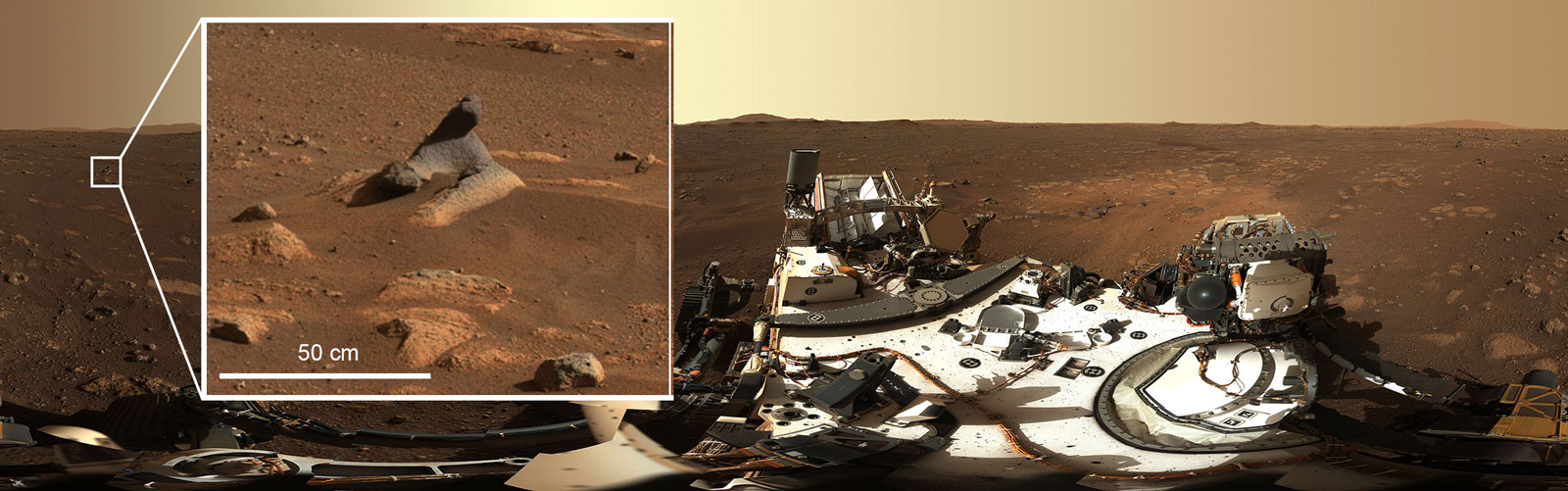
A Wind Carved Rock: This wind-carved rock seen in first 360-degree panorama taken by the Mastcam-Z instrument shows just how much detail is captured by the camera systems.
Credits: NASA/JPL-Caltech/ASU/MSSS. Download image ›

Crater Rim: This shows the rim of Jezero Crater as seen in the first 360-degree panorama taken by the Mastcam-Z instrument aboard NASA’s Perseverance Mars rover.
Credits: NASA/JPL-Caltech/ASU/MSSS. Download image ›
The Myth And Truth About The 13,000 Year-Old Alien Satellite
The story begins in 1954, three years before mankind launched its first artificial satellite, the Soviet Sputnik 1.
On May 14, 1954, several newspapers published articles centered on a statement belonging to retired Major D. E. Keyhoe. At the time, Keyhoe believed the Earth was circled by one — if not two artificial satellites.
Scientists at the famous White Sands government facility in New Mexico were actively researching this possibility and trying to determine the purpose and origin of these objects.

Later that summer, Aviation Week magazine attempted to explain the mystery by saying the two satellites’ orbits had been mapped out at an altitude of 400, respectively 600 miles above Earth.
“Pentagon scare over the observance of two previously unobserved satellites orbiting the Earth has dissipated with the identification of the objects as natural, not artificial satellites. Dr. Lincoln LaPaz, expert on extraterrestrial bodies from the University of New Mexico, headed the identification project.
“One satellite is orbiting about 400 miles out, while the other track is 600 miles from the Earth. Pentagon thought momentarily the Russians had beaten the U.S. to space explorations.”
Keep in mind that this was all happening during the space race, when spirits were high and tensions were higher. The competition between the United States and the Soviet Union fueled the paranoia as each nation raced towards the sky.
Many astronomers suspected a large satellite was indeed orbiting the Earth and by 1960, even the U.S. Department of Defense acknowledged this alien presence.
“WASHINGTON, Feb. 10 — An unidentified, silent satellite has been discovered circling the Earth in a near-polar orbit by United States tracking stations, the Defense Department said today. The identity of the mystery satellite — which has been dubbed “the dark satellite” are not known despite nearly two weeks of tracking.”
It wasn’t long before people made the connection between the unknown object and Nikola Tesla. In 1899, he had detected a repeating radio signal and believed it originated in outer space. The enigma surrounding the black satellite was deepened by its strange behavior.
Virtually all the artificial satellites had been launched on West to East orbits (following our planet’s natural rotation) while this one circled Earth on a polar orbit, from North to South. Interestingly enough, polar orbits are employed by modern observational satellites that carry out mapping missions. So, was the Black Knight Satellite an observational unit? If so, who put it there?

Some astronomers who claimed to have observed it said the object would disappear, only to reappear in a different place, traveling along a different orbit. They also reported it was moving twice as fast as any other known satellite.
The Black Knight is often mentioned in conjunction with astronaut Gordon Cooper’s historic flight. In 1963, on the last of his 22 days spent in orbit, Cooper radioed Muchea Tracking Station in Australia, telling them that he was able to see a glowing green object rapidly approaching his capsule.
Although his sighting had received live coverage by the National Broadcasting Company, reporters were forbidden to question him upon his return to Earth. Although Major Cooper was a stern believer in aliens and their presence here on Earth, there is no link between his sighting and the Black Knight.
An interesting yet unverified aspect is the alleged decoding of the radio message the satellite is said to broadcast. As the story goes, ham radio operators who picked up the alien transmission managed to interpret it as a star map that pointed to Epsilon Boötis, a star in the Boötes constellation, located at a distance of 52 light years from Earth. Interestingly enough, in Babylonian mythology, the Boötes constellation was depicted as the god Enlil, the chief divinity among the Anunnaki on Earth.
Almost every article on the Black Knight Satellite mentions its age of 13,000 years without referencing the origin of this claim. In 1973, Scottish astronomer and science fiction writer Duncan Lunan said he had succeeded in decoding the message caught by two Norwegian physicists in the 1920’s.
The message was said to have come from a probe orbiting the Earth in the same Lagrangian point as the Moon and that probe had been sent a long time ago by the inhabitants of a planet orbiting Epsilon Boötis. The message read:
“Start here. Our home is Epsilon Boötes , which is a double star. We live on the sixth planet of seven, coming from the sun, which is the larger of the two. Our sixth planet has one moon. Our fourth planet has three. Our first and third planets each have one. Our probe is in the position of Arcturus, known in our maps.”
The star Arcturus was pictured in the deciphered star map in the position it occupied 13,000 years ago, hence the supposed age of the Black Knight.
Lunan’s theory was picked up by Time magazine and included in several documentaries. However, in 1976 he acknowledged it was flawed and withdrew it, only to revise and reinterpret part of it in 1998.

There are a number of famous photos that allegedly show the alien satellite. The official explanations for the object they show is that it’s nothing more than a thermal blanket that had come off one of the many satellites we’ve put up there. While this might be the case, it only explains the photos and not the Black Knight itself, as the unknown object had been reported prior to these photos.
Another aspect is that these famous photos show an object far smaller than the one indicated in earlier reports, which was said to be as large as a city block. On a side note, the vimanas portrayed in ancient Hindu texts were of similar size. Perhaps there’s a connection between the two.
And since no one can deny the size and scope of the UFO phenomena, it stands to reason that among all reports of flying saucers in our skies and oceans we can fit one more: a huge alien satellite orbiting above our planet.
Like with most things related to the unexplained, there is an aura of misinformation surrounding the Black Knight Satellite. Keep in mind, this is the internet, the place where things come to get blown out of proportion.
One last thing, before you go. In medieval times, a black knight was one who had no allegiance or opted to hide it by covering his colors and emblems, effectively stating that he served no lord. Quite a fitting name for an enigmatic alien watcher, isn’t it?
Author: Ian Paxton
RELATED VIDEOS, selected and posted by peter2011
ASTRONOMERS TRACK OVER 25,000 SUPERMASSIVE BLACK HOLES MAKING MOST DETAILED MAP OF ITS KIND
The map covers four per cent of the northern half of the sky
Astronomers have published a map of the sky showing 25,000 black holes - the most detailed of its kind ever produced.
The map uses low radio frequencies, built from data from 52 stations across nine continents.
It covers an astounding four per cent of the northern half of the sky, but the scientists do not intend to stop until the entire sky has been mapped.
While the bright specs appear to be stars they are in fact supermassive black holes, with each one located in a distant galaxy.
“This is the result of many years of work on incredibly difficult data. We had to invent new methods to convert the radio signals into images of the sky”, research leader Francesco de Gasperin said in a statement.

Making the map was not easy; the ionosphere that surrounds the Earth - a layer of free electrons that clouds telescopes - makes it difficult to track the black holes.
“It’s similar to when you try to see the world while immersed in a swimming pool”, explains co-author Reinout van Weeren.
“When you look up, the waves on the water of the pool deflect the light rays and distort the view”,
In total, it took 256 hours of observations to make the map, and advanced equipment was needed to clear up the picture.
Supercomputers used by the researchers engaged algorithms to correct the effect of the ionosphere every four seconds.
“After many years of software development, it is so wonderful to see that this has now really worked out”, Huub Röttgering said.
Every Single Document The CIA Says It Has on UFOs Is Now Available to Download
They say the truth is out there, but nobody ever said it would be easy to find. Now, after a search lasting decades, a giant trove of long-classified records held by the CIA in relation to reported UFO activity has finally come to light.
This huge public release of what the CIA claims is its "entire" archive of documentation on Unidentified Flying Objects – now termed "Unidentified Aerial Phenomena" (UAPs) – comprises hundreds of formerly top-secret records going back more than a half-century.
The unprecedented and fascinating data dump is thanks to a long-sustained effort by intelligence website The Black Vault, which has been sourcing and sharing declassified government documentation on UFOs (among many other things) since the mid–1990s.
According to the site's founder, John Greenewald Jr., The Black Vault has been fighting since 1996 for the release of these UFO records, which began to emerge in dribs and drabs in the 1980s after legal proceedings in relation to Freedom of Information Act (FOIA) requests.
While some of the documentation has seen the light of day before, this is the first time the supposedly complete archive of the CIA's UFO records has been publicly released, and was made possible after The Black Vault acquired a CD-ROM from the CIA containing what the intelligence agency claims is its entire haul of UFO records, including much information that has never been seen before.
As Greenewald points out however, there's no easy way of factually verifying whether this is the CIA's entire archive, as the agency claims – or whether the US government is still holding onto classified records on UFOs/UAPs we don't yet know about.
In any case, the 2,780-page collection now available on The Black Vault website represents a significant victory for freedom of information on this mysterious and tantalising subject, and a personal milestone for Greenewald.
Amidst the archive, hundreds of records dating back to the mid–20th century can now be read, either via individual PDFs, or a giant ZIP file.

(The Black Vault)
It's worth pointing out that not all of the information is easily readable. Many details in documents are redacted, and the overall quality of scans and photocopies is hit and miss, with some of the records being quite difficult to read, while others are clearer.
Those hoping that the haul will finally offer proof that the US government has been concealing knowledge of alien life-forms visiting Earth will be disappointed, however.
As we've explained before, UFOs or UAPs are a real, serious topic, reflecting documented accounts of incidents involving objects or phenomena that can't be easily identified or otherwise explained, even by experts.
The terms – including related descriptors such as Anomalous Aerial Vehicles (AAVs) – are not themselves synonymous with (or evidence of) extraterrestrials life forms, even though they often get bundled together, given the wilder possibilities of what these strange sightings could represent.
In other words, UFO means Unidentified Flying Object – nothing more, nothing less, as astronomer Chris Impey from the University of Arizona recently explained.
That said, these hundreds of newly revealed reports offer countless riveting reads of strange and inexplicable episodes, and make a huge contribution to historical records on UFO sightings and how they get handled by those in the intelligence community.
Whether the timing is coincidental or not is unclear, but US intelligence services were already being obliged to publicly divulge more of their knowledge about UFOs in the coming months, thanks to a buried clause in the massive COVID–19 relief bill signed into law in late 2020. Strange but true.
Which is another way of saying that it's possible we may find out even more about UFOs this year – if the CIA's complete archive doesn't turn out to be as complete as it could be.
For Greenewald, it's all part of the job – an important duty to get to the truth, no matter how weird it might be.
"Plain and simple, the public has a right to know!" Greenewald told Motherboard. "I feel I am achieving what I set out to do. Easy access, to important material, for people to make up their own minds on what is going on."
RELATED VIDEOS, selected and posted by peter2011
The Extraterrestrial Species Almanac, 82 Documented ET's, Craig Campobosso via Leak Project
Discover who the aliens are – the benevolent ones and those who mean us harm – and what they want from us. Here is the ultimate field guide to the 82 extraterrestrial species that populate the universe. Fully illustrated throughout.
This is the ultimate field guide to the 82 extraterrestrial species that populate the universe. ET enthusiast Craig Campobasso explores the origins, physical characteristics, technological and consciousness abilities, dimensional capacities, belief systems, and cosmic agendas of each of the species.
The species fall into two categories: 1) benevolent races, which function as the guardians of humanity, whose goals include helping people overcome duality, healing, and protecting; and 2) malevolent races, which are responsible for abductions, cloning, and ultimately domination.
This intergalactic expose will entertain all those interested in UFOs, aliens, ETs. Sci-fi and fantasy fans of the Marvel universe; Star Trek, Star Wars, and other popular TV shows like Ancient Aliens; Roswell, and Project Blue Book are prime targets for this book that delves deep into who the real extraterrestrials are and what they want with the people of Earth.
RELATED VIDEOS, selected and posted by peter2011
Agartha, the Hidden Civilization of Inner Earth | Truth or Lore via Mr. Mythos
Agartha, the Hidden Civilization of Inner Earth | Truth or Lore via Mr. Mythos
There’s an ancient mystery of connected tunnels across the world… could these paths lead to the legendary Hollow Earth kingdom Agartha deep under the Himalayas? Who (or what) lives in Agartha? What kind of lost knowledge might they hide from mankind?
White Triangle Fungus Found On Mars And Other Anomalies UFO Sighting News.


