Ontdek de Fascinerende Wereld van UFO's en UAP's: Jouw Bron voor Onthullende Informatie!
Ben jij ook gefascineerd door het onbekende? Wil je meer weten over UFO's en UAP's, niet alleen in België, maar over de hele wereld? Dan ben je op de juiste plek!
België: Het Kloppend Hart van UFO-onderzoek
In België is BUFON (Belgisch UFO-Netwerk) dé autoriteit op het gebied van UFO-onderzoek. Voor betrouwbare en objectieve informatie over deze intrigerende fenomenen, bezoek je zeker onze Facebook-pagina en deze blog. Maar dat is nog niet alles! Ontdek ook het Belgisch UFO-meldpunt en Caelestia, twee organisaties die diepgaand onderzoek verrichten, al zijn ze soms kritisch of sceptisch.
Nederland: Een Schat aan Informatie
Voor onze Nederlandse buren is er de schitterende website www.ufowijzer.nl, beheerd door Paul Harmans. Deze site biedt een schat aan informatie en artikelen die je niet wilt missen!
Internationaal: MUFON - De Wereldwijde Autoriteit
Neem ook een kijkje bij MUFON (Mutual UFO Network Inc.), een gerenommeerde Amerikaanse UFO-vereniging met afdelingen in de VS en wereldwijd. MUFON is toegewijd aan de wetenschappelijke en analytische studie van het UFO-fenomeen, en hun maandelijkse tijdschrift, The MUFON UFO-Journal, is een must-read voor elke UFO-enthousiasteling. Bezoek hun website op www.mufon.com voor meer informatie.
Samenwerking en Toekomstvisie
Sinds 1 februari 2020 is Pieter niet alleen ex-president van BUFON, maar ook de voormalige nationale directeur van MUFON in Vlaanderen en Nederland. Dit creëert een sterke samenwerking met de Franse MUFON Reseau MUFON/EUROP, wat ons in staat stelt om nog meer waardevolle inzichten te delen.
Let op: Nepprofielen en Nieuwe Groeperingen
Pas op voor een nieuwe groepering die zich ook BUFON noemt, maar geen enkele connectie heeft met onze gevestigde organisatie. Hoewel zij de naam geregistreerd hebben, kunnen ze het rijke verleden en de expertise van onze groep niet evenaren. We wensen hen veel succes, maar we blijven de autoriteit in UFO-onderzoek!
Blijf Op De Hoogte!
Wil jij de laatste nieuwtjes over UFO's, ruimtevaart, archeologie, en meer? Volg ons dan en duik samen met ons in de fascinerende wereld van het onbekende! Sluit je aan bij de gemeenschap van nieuwsgierige geesten die net als jij verlangen naar antwoorden en avonturen in de sterren!
Heb je vragen of wil je meer weten? Aarzel dan niet om contact met ons op te nemen! Samen ontrafelen we het mysterie van de lucht en daarbuiten.
Berichten van 1 december 2021 tot 31 december 2021
Antarctica New Discovery! Scientists Have Just Found The Deepest Hole There & Couldn't Believe What They Found Inside
Scientists have just found the deepest hole in Antarctica & couldn’t believe what they found inside. Today, we take a look at this recent Antarctica discovery. There are mysteries all around us, and we are fascinated by what we cannot understand. Inexplicable phenomena are discovered every day, keeping our curiosity piqued and the prospect of actually knowing the world around us a foreign concept.
Researchers exploring the Ellsworth Sub glacial Highlands, an ancient mountain range buried beneath miles and miles of Antarctic ice, have discovered a pit deeper than The Grand Canyon. The incredible find was discovered by combining data provided by aircraft satellites, with ice-penetrating radar technology towed by snowmobiles.
Thank you for watching! Thank you to CO.AG for the background music!
Skinwalker Ranch: What Is The Secret? Full Documentary
Skinwalker Ranch: What Is The Secret? Full Documentary
Skinwalker Ranch, also known as Sherman Ranch, is a property located on approximately 512 acres southeast of Ballard, Utah, that is reputed to be the site of paranormal and UFO-related activities. Its name is taken from the skin-walker of Navajo legend concerning vengeful shaman. Wikipedia
Tower Found On Saturn Moon Hyperion, Photos, UFO Sighting News.
Date of discovery:Dec 23, 2021
Mission: Cassini Location of discovery: Saturn moon Hyperion
While running through the Saturn moon index I came across a few photos that revealed a dark twisted tower on the far right of the moon. The tower almost looks like a human body without a head, standing on two human like legs. It's strange, it's weird, but it's what it is. Being near saturn and near the rings, this long tower is most likely an engine to propel the moon away from the rings to keep the rings beautiful. Saturns rings has an almost religious nature to it. One that is both sacred and holy. Thus they protect it.
Object Falls From Space, Enters Volcano In Mexico! Live Cam Footage, UFO Sighting News.
Date of sighting: December 10, 2021
Location of sighting: Volcano Popocatepetl, Mexico
This video was recorded straight from the live cam. The volcano is located not far from Mexico City. A UFO was caught moving very slowly, falling almost directly into the mouth of the volcano. It entered the left side of the volcano, where there is a known vent. The vent in that location often spews ash, lava and clouds every week. Thats the opening I believe this UFO entered. I have long said that there is an alien base below Popocatepetl volcano. Not only have UFOs been seen passing over, around and into the volcano, but they have also been recorded exiting the mouth. There has even been sightings by the locals of 7 foot hairy beings with huge spikes on their heels of the feet seen climbing up the volcano side without any mounting climbing equipment. The proof is mounting, soon aliens will choose to reveal themselves to the world. Are you ready? I know I am.
Orb Over Longmont, Colorado Dec 18, 2021, UFO Sighting News.
Date of sighting: Dec 18, 2021
Location of sighting: Longmont, Colorado, USA
Source: MUFON
What looks like a quiet small UFO is actually very special. This is one of the famous glowing orb UFOs in Colorado. They have been witnessed by thousands of people and gov officials in Colorado, so this is one very special report. I have heard so much about them, police, mayors witnessing them and this video actually has one moving slowly over the city of Longmont, Colorado. It's certainly taking its sweet time and I love that it is, because it's gives us a better view of it, its movement, its color, it's orb shape. This alien pilot either didn't know he was uncloaked or just didn't care. Most often recorded over Denver near the Rocky mountains, this UFO may be heading to that mountain range where I believe an alien base sits 6km below its surface. There even seems to be a window area at the front of it when I put the screenshot into negative formate and add light.
Scott C. Waring - Taiwan
Eyewitness states:
We were taping the sunset and when we watched it we say the strange light and say that it moved kinda weird. We always watch the jets, but this was definitely not a jet. We have a video of it and it is very interesting. We would like to have your opinion. If you watch it it appears and hovers.Then it moves up.
Two Glowing Objects Marion, Ohio, Dec 16, 2021, UFO Sighting News.
Date of sighting: Dec 16, 2021
Location of sighting: Marion, Ohio, USA
Source:MUFON
Now this is an eyeopening video, however I have a problem with it. The two glowing UFOs seem to pass behind the house in the first 10 seconds, but at the 35 second mark both UFOs pass in front of a light pole alone the road. That should be impossible. For that to happen would mean the lights are coming from behind the person recording the video and reflecting off the front window of the car...as he records. I feel this is 100% fake. Also compounded by the fact the eyewitness statement was only five words, when such an amazing event took place. Odd. Thats just my personal opinion, but it's how I see it and wanted to share it with you in case you see this video out there circulating.
The Anunnaki: They Created the first Human on Earth
445 000 years ago, “creator gods” – as they call it – came to Earth. They were called the Anunnaki, which means “Those Who from Heaven to Earth Came”. These beings inhabited a distant orbiting planet called Nibiru, which only entered our solar system every 3,600 years. They describe Nibiru as many times the diameter of Earth, and abundant with iron oxide, making its rivers and lakes appear red. A side note about Nibiru: according to the Sumerian tablets, Nibiru’s atmosphere began to deteriorate and became a hostile place for life, and in order to restore it, the Annunaki needed one important element for their atmosphere: gold. Scenes from the following productions were used under Fair Use for educational purposes: History Channel's Ancient Aliens PBS NOVA's Secrets of Noah's Ark 2015 Ancient Sumerian
The first studies conducted on the Ryugu asteroid samples have revealed some very interesting facts. Thanks to the Japan Aerospace Exploration Agency’s Hayabusa 2 spacecraft, scientists have 5.4 grams of material from the asteroid to study and they found that the diamond-shaped Ryugu is more porous and darker than originally thought.
µIt is believed that the samples contain materials from the outer Solar System. This suggests that the researchers could have the some of the most pristine samples from when the Solar System was in its very early stages and before Earth even formed.
Two papers regarding the findings of the samples have been published in Nature Astronomy. The first paper revealed that the samples reflect only 2% of light. Additionally, it is extremely fragile and is approximately 50% more porous than carbonaceous chondrite meteorites that have previously hit our planet. The paper went into further details by reading in part, “Such high-microporosity materials have not been discovered in any meteorites found on Earth probably due to break-up owing to their fragile nature during entry into the Earth’s atmosphere.”
The second paper discussed the chemical analysis of the samples by announcing that there are numerous volatile organic compounds that are present in the material, such as non-water molecules created by oxygen as well as hydrogen atoms that are called hydroxyls that probably came from the outer part of the Solar System.
While the results are very interesting and significant, these are just the first studies that have been conducted on the samples, so much more information will be found out upon further analysis. Scientists are also waiting for the returned samples from asteroid Bennu in 2023 as they will then be able to compare them both.
(Not Ryugu or Bennu)
The analysis of both Ryugu and Bennu samples will be very crucial as stated by JAXA scientist Toru Yada in an interview with Inverse, “Because reflectance spectra and colors of surface rocks on Bennu look different from those of Ryugu, I expect that different kinds of samples will be returned from Bennu.”
While Ryugu measures 3,280 feet in diameter, Bennu is much smaller with a diameter of 1,610 feet. Bennu does pose a threat to Earth with a 1 in 1,750 chance of hitting us through the year 2300, although scientists have stated that they are not worried about an impact. However, when it will fly past our planet in September of 2135, it will be close enough that Earth’s gravity might possibly change its trajectory.
An exquisitely preserved dinosaur embryo has been found curled up inside a fossilised egg, unearthed in southern China, dating back some 66–72 million years.
The embryo has been dubbed 'Baby Yingliang' and was found in the rocks of the 'Hekou Formation' at the Shahe Industrial Park in Ganzhou City, Jiangxi Province.
Palaeontologists led from the University of Birmingham said that Baby Yingliang belonged to species of toothless, beaked theropod dinosaurs, or 'oviraptorosaurs'.
Oviraptors, which were feathered, are found in the rocks of Asia and North America and had varied beaks and body sizes allowing them to adopt a wide range of diets.
The specimen is one of the most complete dino embryos known and notably sports a posture closer to those seen in embryonic birds than usually found in dinosaurs.
Specifically, Baby Yingliang was close to hatching, and had its head below its body, its back curled into the egg's blunt end and its feet positioned either side of it.
In modern birds, such a posture is assumed during 'tucking' — an embryo behaviour controlled by the central nervous system that is critical for a successful hatching.
The discovery of such behaviour in Baby Yingliang suggests that this is not unique to birds, but may instead have first evolved among the non-avian theropod dinosaurs.
Scroll down for video
An exquisitely preserved dinosaur embryo has been found curled up inside a fossilised egg (pictured), unearthed in southern China, dating back some 66–72 million years
Palaeontologists led from the University of Birmingham said that Baby Yingliang (depicted in this artist's impression) belonged to species of toothless, beaked theropod dinosaurs
BABY YINGLIANG STATISTICS
Age: 72–66 million years old
Locality: Ganzhou City, China
Type: Oviraptorosaur
Length: 10.6'' (27 cm) head-to-tail
Egg size: 6.7'' (17 cm) -long
The study was conducted by vertebrate palaeontologist Fion Waisum Ma of the University of Birmingham and her colleagues.
'Dinosaur embryos are some of the rarest fossils and most of them are incomplete with the bones dislocated,' Ms Ma said.
'We are very excited about the discovery of "Baby Yingliang" — it is preserved in a great condition and helps us answer a lot of questions about dinosaur growth and reproduction with it.
'It is interesting to see this dinosaur embryo and a chicken embryo pose in a similar way inside the egg, which possibly indicates similar prehatching behaviours.'
Baby Yingliang takes its nickname from the Yingliang Stone Nature History Museum in Xiamen, among whose fossil collections it is held.
The researchers believe that the embryonic oviraptorosaur would have been some 10.6 inches (27 cm) from head to tail, but was developing curled inside a 6.7 inch (17 cm) -long egg.
'This dinosaur embryo was acquired by the director of Yingliang Group, Mr Liang Liu, as suspected egg fossils around the year 2000,' said paper author and palaeontologist Lida Xing of the China University of Geosciences in Beijing.
'During the construction of Yingliang Stone Nature History Museum in the 2010s, museum staff sorted through the storage and discovered the specimens.
'These specimens were identified as dinosaur egg fossils. Fossil preparation was conducted and eventually unveiled the embryo hidden inside the egg.
'This is how "Baby Yingliang" was brought to light.'
The specimen is one of the most complete dino embryos known and notably sports a posture closer to those seen in embryonic birds than usually found in dinosaurs. Specifically, Baby Yingliang — who was close to hatching — had its head below its body, its back curled into the egg's blunt end and its feet positioned either side of it
'It is interesting to see this dinosaur embryo (pictured) and a chicken embryo pose in a similar way inside the egg, which possibly indicates similar prehatching behaviours,' said vertebrate palaeontologist Fion Waisum Ma of the University of Birmingham
'This dinosaur embryo inside its egg is one of the most beautiful fossils I have ever seen,' said paper co-author and vertebrate palaeontologist Steve Brusatte of the University of Edinburgh.
'This little prenatal dinosaur looks just like a baby bird curled in its egg, which is yet more evidence that many features characteristic of today’s birds first evolved in their dinosaur ancestors.'
The full findings of the study were published in the journal iScience.
The embryo — which has been dubbed 'Baby Yingliang' — was found in the rocks of the 'Hekou Formation' at the Shahe Industrial Park in Ganzhou City, Jiangxi Province
HOW THE DINOSAURS WENT EXTINCT AROUND 66 MILLION YEARS AGO
Dinosaurs ruled and dominated Earth around 66 million years ago, before they suddenly went extinct.
The Cretaceous-Tertiary extinction event is the name given to this mass extinction.
It was believed for many years that the changing climate destroyed the food chain of the huge reptiles.
In the 1980s, paleontologists discovered a layer of iridium.
This is an element that is rare on Earth but is found in vast quantities in space.
When this was dated, it coincided precisely with when the dinosaurs disappeared from the fossil record.
A decade later, scientists uncovered the massive Chicxulub Crater at the tip of Mexico’s Yucatán Peninsula, which dates to the period in question.
Scientific consensus now says that these two factors are linked and they were both probably caused by an enormous asteroid crashing to Earth.
With the projected size and impact velocity, the collision would have caused an enormous shock-wave and likely triggered seismic activity.
The fallout would have created plumes of ash that likely covered all of the planet and made it impossible for dinosaurs to survive.
Other animals and plant species had a shorter time-span between generations which allowed them to survive.
There are several other theories as to what caused the demise of the famous animals.
One early theory was that small mammals ate dinosaur eggs and another proposes that toxic angiosperms (flowering plants) killed them off.
70 miljoen jaar oud en perfect bewaard embryo van dinosaurus ontdekt
In Ganzhou, een stad in het Zuiden van China, is een wel heel bijzondere ontdekking gedaan. Zo werd een 70 miljoen jaar oud dinosaurusembryo teruggevonden. Wat het nog bijzonderder maakt, is dat het embryo zo goed als perfect bewaard is gebleven.
Baby Yingliang, zo werd het embryo genoemd, stond zo’n 70 miljoen jaar geleden op het punt om uit zijn schaal te breken, toen hij vermoedelijk bedolven raakte onder een modderstroom. Dit heeft er voor gezorgd dat hij al die jaren zo goed bewaard is kunnen blijven. Volgens wetenschapsjournalist Martijn Peters is dit erg bijzonder, vaak raken dinosaurusembryo’s immers beschadigd of ontbreken er delen. Van hoofd tot staart meet de kleine dinosaurus 27 centimeter en hij zit opgerold in een ei van 17 centimeter.
Baby Yingliang was een oviraptorosaurus, wat letterlijk een “eierdiefhagedis” betekent. Deze gevederde dinosaurussen leefden in Azië en Noord-Amerika tijdens het Krijttijdperk, dat is zo'n 145 tot 66 miljoen jaar geleden. De vormen van hun snavels kunnen variëren, maar ze staan toch vooral bekend om hun papegaaiachtige bek. Ook in lengte waren er grote verschillen binnen deze dinosaurussoort. De kleinste variant valt qua grootte te vergelijken met de hedendaagse kalkoen, terwijl de meest uit de kluiten gewassen oviraptorosaurus tot 8 meter lang kon worden. Baby Yingliang was volgens de onderzoekers vermoedelijk 2 tot 3 meter groot geworden, als hij zijn volwassen leeftijd had bereikt.
Volgens Fion Waisum Ma, onderzoeker aan de Universiteit van Birmingham, is dit een van de best bewaarde embryo’s ooit ontdekt. Ook geeft baby Yingliang de onderzoekers meer inzicht in de link tussen dinosaurussen en vogels vandaag. Zo lag zijn kopje onder zijn lichaam en waren zijn pootjes opgekruld naast zijn rug. Deze houding zien we ook bij hedendaagse ongeboren kuikens, maar is voor dinosaurussen uniek.
Vergeten in opslagruimte
Baby Yingliang was eigenlijk al ontdekt in 2000, maar raakte in vergetelheid toen hij in de opslagruimte van het museum waar hij bewaard werd belandde. Toen het museum recentelijk aan verbouwingswerken begon, herontdekten wetenschappers het bestaan van het embryo. Wie baby Yinglang een bezoekje wil brengen, kan terecht in het Yingliang Stone Natural History Museum in China.
Another Structure on Jupiter Moon Europa, Photos, UFO Sighting News.
Date of discovery: Dec 22, 2021
Location of discovery:Jupiter Moon Europa
Look carefully at this structure and you will soon notice that its on a separate foundation from that of the ground. There is also some walls around its edges and even main structures upon it. Not far is a huge tunnel that leads directly up to the city. You can see the tunnel hot straight and then break off into many other smaller tunnels. To me, this is an alien structure, built by intelligent beings far beyond our own abilities. The structure has some similarities to our own, but many differences too. I believe it to be grown, a bio-mechanical structure that was grown to save time so that aliens could use it.
Odd Structure on the Jupiter moon Europa #astronomy #astrophysics #jupiter #tunnels #ufosighting UFO Sighting News.
Date of discovery: Dec 22, 2021 Location of discovery: Europa, moon of Jupiter Source:Secret
I was going through an old index I have recently discovered and found this odd white egg shaped structure on the moon Europa. The center top of the structure is open and the sides are curved like a flower that is partly open. Its the only such object with such a unique shape and size. This object is several km tall and over 5km wide. The chances of this being an alien base is very high. The tall white walls are there to protect the city. Absolutely amazing!
On December 17, 2021 NASA's satellite SDO AIA171 captured a huge cylinder-shaped unidentified flying object seemly leaving the sun's surface at a tremendous speed.
It's said that it is impossible to get that close to the sun, yet extraterrestrials are millions of years ahead of us with their technology. A technology so advanced that their ships might also be able to withstand the heat of the sun.
To date, it is not known why these ships come so close to the surface of the sun.
These two bright UFOs were filmed in the night sky above Marion, a city in and the county seat of Marion County, Ohio. This happened on 16th December 2021.
Located near the village of Shiyan Beicun in Zhejiang province, China, lie the Longyou Caves - an extensive, magnificent and rare ancient underground world considered in China to be “the ninth wonder of the ancient world.” Thought to date back at least 2,000 years, the Longyou Caves, also known as the Xiaonanhai Stone Chambers, represent one of the largest underground excavations of ancient times and are an enduring mystery that have perplexed experts from every discipline that has examined them.
Scientists from around the world in the fields of archaeology, architecture, engineering, and geology have absolutely no idea how the Longyou Caves were built, by whom, and why. First discovered in 1992 by a local villager who set out to drain some ponds which locals believed to be bottomless, to date 24 hand-carved caves have been discovered covering a massive 30,000 square meters (322,917 ft sq).
Carved into solid siltstone, each grotto descends around 30 meters (98 ft) underground and contains stone rooms, bridges, gutters and pools. Within the Longyou Caves there are pillars evenly distributed throughout the caves which are supporting the ceiling, and the walls, ceiling and stone columns are uniformly decorated with chisel marks in a series of parallel lines.
Only one of the caves has been opened for tourism, chosen because of the stone carvings found inside which depict a horse, fish and bird. The Longyou Caves of Zhejiang province in China truly are an enigma and here we will explore ten enduring mysteries that remain unresolved, despite more than two decades of research.
A rough estimation of the workload involved in building the Longyou Caves is awe-inspiring. The quantity of rock that would have been removed in the overall excavation of the grottoes is estimated to be nearly 1,000,000 cubic meters (35,314,666 cu ft). Taking into account the average digging rate per day per person, scientists have calculated that it would take 1,000 people working day and night for six years to complete.
These calculations are based purely on hard labor, but what they haven’t taken into account is the incredible care and precision of the sculptors, meaning that the actual workload would far surpass the theoretical estimation. As for how they were constructed and what tools were used, it is still unknown. No tools have been found in the area, and, as we will explore later, scientists still don’t know how they achieved such symmetry, precision, and similarity between the different caves.
2. No Traces of Construction
Despite their size and the effort involved in creating them, so far no trace of their construction, or even their existence, has been located archival sources. Although the overall excavation involved almost a million cubic meters of stone, there is no archaeological evidence revealing where that quantity of stone went, and no evidence of the work. Moreover, there is not a single historic document that refers to them, which is highly unusual considering the sheer scale of the project. The origin of the Longyou Caves is a complete and utter mystery.
Experts wonder why the walls at the Longyou Caves in China are covered in chiseled parallel lines.
Every single one of the Longyou Caves is covered, from floor to ceiling, in parallel lines that have been chiseled into virtually every surface. The effect is a uniform pattern throughout the caves, which would have required immense manpower and endless hours to create. The question is why? Was such labor-intensive work purely for decoration? Are the lines or patterns symbolic in some way? All that is currently known is that the markings are similar to those found on pottery housed in a nearby museum, which is dated between 500 and 800 BC.
4. Lack of Fish in the Longyou Caves
When the caves were first discovered, they were filled with water, which presumably had been there for a long period of time. They had to be pumped out in order to realize that these were not just like the other “bottomless ponds” found within the area, but rather man-made structures. Most villages in southern China contain very deep ponds, which have been called "bottomless ponds" by generations of villagers. These ponds teem with fish, which are easily caught. However, after the first cave was pumped dry, not a single fish was to be seen, or any other sign of life.
5. How Did the Longyou Caves Remain So Well Preserved?
One of the most interesting and challenging questions is how the Longyou Caves have been able to keep their structural integrity for more than 2,000 years. There are no signs of collapse, no piles of rubble, and no damage despite the fact that in some areas the walls are only 50 centimeters (20 in) thick. Over the centuries, the area has gone through numerous floods, calamities and wars, the mountains have changed their appearance and exposed stones have been weathered, but inside the Longyou Caves, the form, patterns and markings are still clear and precise – it is as though they were built yesterday.
6. How Did the Builders Work in the Dark?
Due to the great depths of the caves, some areas at the bottom, which are not exposed to the opening above, are pitch-black. Yet even those dark areas are decorated with thousands of parallel lines on the walls, columns, and ceiling. So how did ancient people work in the dark?
According to Jia Gang, a Tongji University professor specializing in civil engineering: "There should be lamps, because the cave's mouth is very small, and the sunbeam could only shine in the cave at a certain angle during a certain period of time. As one goes deeper into the cave, the light becomes dimmer. At the cave's bottom, which is usually dozen of meters from the mouth, one could hardly see anything." However, this was at least two millennia ago and nothing that could have been used for lighting has been found.
7. Were the Longyou Caves Meant to be Connected?
All of the Longyou Caves are distributed across an area of only one square kilometer (0.38 sq mi). Considering such a high density, one cannot help asking whether some grottoes were meant to be connected. What would be the purpose of making so many separate caves in such a tight area without connecting them? In many areas, the walls between the caves are very thin, only 50 centimeters (20 in), but they were never linked so it appears they were intentionally kept apart. What’s more, many of the Longyou Caves are almost identical to each other.
Geological cross-section of cave 3 (left) and photo showing rock pillars in cave 3 (right).
Nobody has any idea who built the caves. Some scientists have claimed that it was not possible or logical for such as mammoth job to have been undertaken by regular village people. Only the emperor and the leaders could have organized such a huge project, like the construction of the Great Wall , which was built to defend against invasion from the outside world. But if it was commissioned by an Emperor, why are there no historical records of its construction?
9. How Did They Achieve Such Precision?
The scale of the Longyou Caves is magnificent and momentous, the design was delicate and scientific, the construction was sophisticated, and the precision is indicative of superior craftsmanship. The model, pattern and style of each cave is extremely similar. Every grotto is like a grand hall. One side is steep and another side is 45% inclined. The four walls are straight; the edges and corners are clearly demarcated. The chiseling marks within the Longyou Caves are uniform and precise.
"At the bottom of each cave, the ancient [builders] wouldn't be able to see what the others were doing in the next grotto,” explained Yang Hongxun, an expert at the Archaeological Institute of Chinese Academy of Social Sciences. Nevertheless, “the inside of each cave had to be parallel with that of the other, or else the wall would be holed through. Thus the measure apparatus should have been very advanced. There must have been some layout about the sizes, locations, and the distances between the caves beforehand."
With the help of modern equipment and methods, the investigators measured the sizes of the walls, and surprisingly found that the overall construction is extremely accurate. The walls between the caves are of the same thickness in different sections. So how did they achieve this precision? What were their methods?
Stairs leading down into one of the once-submerged Longyou Caves.
Following extensive investigations and study, scientists and scholars have attempted to put forward explanations for the grottoes, but none so far provide a convincing explanation for why they were built and what they were used for.
Some archaeologists have suggested that the grottoes were the tombs of old emperors, emperor halls, or places for storage. But this interpretation is far-fetched. No funeral objects or tombs have been found and no artifacts left behind. If it were used like an emperor’s palace, the caves surely would have been designed differently, with separate rooms for different purposes like entertaining, meeting, and sleeping. But no evidence can be found of this and no traces of habitation have been found.
Another hypothesis is that the Longyou Caves were used for mining and extracting some type of mineral resource. However, mining operations would have required equipment and apparatus to extract the rocks and transport them. Again, no traces of this have been found, nor any evidence of where the rocks were taken. And of course, if the caves were just for mining, why create such intricate decorations on the walls, columns and ceilings?
Finally, some have suggested that these caves were the places for troops to be stationed and that an emperor of the past wanted to keep his soldiers out of view in order to keep his war preparations secret. However, these caves could not have been built in a short period of time. They would have taken many, many years to build so it is unlikely to have been done in preparation for war, which tends to come about much more quickly. Furthermore, there are no signs of people having stayed in the caves.
Despite decades of research, very few answers have emerged to explain the enigma of the Longyou Caves . Our ancient ancestors have achieved many wondrous things throughout history, but this discovery from China is truly an unsolved mystery which has yet to be cracked.
Top image: In China the Longyou Caves are known as the ninth wonder of the ancient world.
Egypt Responds To Elon Musk’s Suggestion The Pyramids Were Built By Aliens
LOUIS W / SHUTTERSTOCK / TWITTER / IFLSCIENCE
Fresh from winning a defamation lawsuit last year after he inexplicably called a British cave explorer involved in the tense rescue of 12 Thai boys trapped in a flooded underground cave system a "pedo guy," Elon Musk has continued to use his Twitter presence for chaotic evil this year.
For example, where many people at the top of successful companies use their platform for important business updates, industry chatter, or else just a bit of fun, earlier this year the Tesla and SpaceX CEO wiped $14 billion off Tesla's value after tweeting "Tesla stock price too high imo". Er, lol?
Now, he's turned his twitter feed into a place for conspiracy theorists to gather, with the baiting post "Aliens built the pyramids obv".
Musk followed up the tweet, clearly a joke but certainly taken seriously by some of his fans, by sharing the true fact that "the Great Pyramid was the tallest structure made by humans for 3,800 years," and sharing a link to Wikipedia. (Though why someone who just made history in a scientific field feels the need to bait conspiracy theorists online in the first place is baffling.)
Though the tweets were likely tongue-in-cheek, it prompted a response from Egypt's Minister of International Co-operation, Rania al-Mashat, who invited Musk to come to Egypt in order to see the pyramids for himself, and learn how they were actually built.
Normally when somebody tells you "we're waiting for you" at a tomb you do not accept the invite, let's hope this is an exception.
If he were to go, he would discover the pyramids were not built by aliens. Obvs.
Contrary to another popular misconception, they weren't built by slaves either. The current consensus is that they were built by paid laborers, after a worker's village and cemetery on the Khafre and Menkaure pyramids was uncovered in the 1990s.
The manner of burial of the workers – in mud-brick tombs, with beer and bread to take with them to the afterlife – and proximity to the pyramids suggests that the builders were paid workers. Examination of their remains showed that they had a protein-rich diet, which was unheard of at the time. There was evidence that broken bones had been reset, and one person was even found to have had his leg amputated before living for a further 14 years, suggesting they were given medical care.
As for how they were built, the answer is simple: The Ancient Egyptians were skilled engineers, and put a lot of time and a gigantic workforce into the task. The giant blocks were moved by boat, oxen, and may have been dragged on sleds by workers across wet sand, reducing the amount of force they'd need to move the huge stones. If aliens had built the pyramids, it's unlikely you would see the progression that has been found in the pyramids, with engineers using bigger blocks as time went on. It's a bizarre alien civilization that masters interstellar travel, builds one pyramid, before realizing how to dramatically improve their masonry.
Musk later linked to a piece explaining some of the techniques used in the building of the pyramids, perhaps making Egypt's kind offer unnecessary, though clearly a lot of his conspiracy theory-loving fans could do with a visit.
You may have seen my recent article on a UFO incident that occurred on November 8, 1966 – near Shrewsbury, England – and that involved a young woman named Diane Foulkes. Diane had a classic case of UFO-driven “Missing Time.” Notably, U.K. military police descended onto Diane’s home, created a file on the incident, and interviewed her and her parents about the encounter and her lost time. The incident makes for fascinating reading. There’s a reason why I mention this: it’s because I find it very strange that so many people laugh at the idea of government agencies quietly interviewing alien abductees and those with erased minds. Or, rather, briefly erased minds. The fact is, though, this has been going on for a long time. Let’s have a look at some cases. Evidence of serious, government concerns about the real alien abduction phenomenon continued into the 1950s, specifically in 1959. That was the year in which a young American soldier found himself caught up in a very strange saga that, to a degree, still disturbs him to this very day. It all went down on a chilly night in Utah’s expansive desert.Private Bernard Gerry Irwin was the manwhose life took a turn of the decidedly unforeseen type. February 20, 1959 began as a regular day for Irwin, but, it most definitely didn’t end that way. At the time, Irwin was driving to Fort Bliss, Texas, from Idaho – the former being the facility at which Irwin was stationed, and the latter his home state. As night set in, something completely unforeseen and paradigm-shifting happened to Irwin. He was about to be confronted by the UFO phenomenon in spectacular and mysterious fashion.
(Nick Redfern)
The night was dark, silent and all but empty of vehicles. As desert highways so often are well after sunset. But, for Irwin this was a night he would never forget – which is somewhat ironic, as a result of the fact that certain portions of his memory were forever erased from his mind. As he drove along the winding, curving road, Irwin was suddenly distracted by a bright light in the night sky – but at a distinctly low level – which descended below a looming ridge. A meteorite? No. A flare, perhaps? Wrong again. Maybe an aircraft in trouble? That was Irwin’s first thought and, with that in mind, he brought his car to a stop at the side of the road, and turned on the blinkers. He quickly got out, and left a note for passing drivers. It read: Have gone to investigate what looks like a plane crash about one-quarter mile to my right. Notify state police immediately. Wearing his Army coat and armed with a flashlight, Irwin headed off into the unknown. Irwin headed for what he suspected – and feared – just might be the site of a plane crash, only to find himself in an even greater nightmare. The next thing Irwin remembered was waking up in a hospital bed in Cedar City. Where and why, he didn’t know.
Certainly, one of the most notable pieces of evidence that has surfaced via the Freedom of Information Act is a document prepared by a Captain Valentine, who was Irwin’s psychiatrist while he was undergoing treatment for his strange condition. On March 27, 1959, Irwin was injected with sodium amytal. It provoked a strange response from Irwin, which caught Captain Valentine’s deep attention. In his official report on this particular drug-induced session, the captain wrote: “[Irwin] stated there was a ‘special intelligence’ that he couldn’t explain to me, since it would be incomprehensible to me, which has directed him not to remember or not to tell me about any of the events in Utah. He says that if he tells what was behind the incidents in Utah there will be a ‘big investigation’ that he does not want to be bothered with and also because it will harm many people and he doesn’t want that to happen. He states ‘it’ all began at the age of three years,’ although he will not reveal how or what began, stating that it would provide a clue to me as to what is behind all this. Also, he informed me that he could leave this hospital any time if he wanted to by invoking a special force. Following this interview the patient stated he could remember nothing of what he said during it.”
Now, onto another case: Just five months after Betty and Barney Hill’s late night encounter, a similar incident occurred in the U.K. In this case, the witness was a man named Ronald Wildman. It was in the early hours of February 9, 1962 that Wildman had an extraordinary experience, one which led him to fully believe he had seen a UFO at very close quarters: an egg-like thing that put Wildman in a state of amzement. So amazed, and even slightly unsettled, by what occurred, Wildman contacted the local police. It was via the police that the U.K.’s Air Ministry (today, called the Ministry of Defense) came to hear about the story. It turns out that the military learned Wildman had lost a period of missing time. A file, of course, was opened.
The night of October 10, 1973 was one that Calvin Parker and Charles Hickson would not forget. And it all began in a perfectly normal, relaxed fashion. Forty-two-year-old Hickson and Parker – who was nineteen – worked together and often spent time fishing on Mississippi’s Pascagoula River. It was around 9:00 p.m. on a dark and fateful night when their world came tumbling down around them. For a while the fish were biting. It would, however, not be long before the two men would find themselves reeled in. “Hauled in” might be a better piece of terminology. As they sat on the banks of the river, the two could not fail to see that there was an odd, blue, flickering light in the distance – odd in the sense that it seemed to be following the contours of the river, but slightly above it. Both Hickson and Parker stared at it, trying to figure out what on Earth it was. Earth may very well have had nothing to do with it. They wondered: helicopter? But, there was no noise. An aircraft? Way too low and slow. Someone’s idea of a joke? If only. When the strange whatever-it-was got closer, a stark realization quickly hit both men: this was like nothing they had ever seen before. It was a fairly small craft, oval in design, and illuminated – almost glowing. And a vomit-inducing, deep droning sound suddenly enveloped them. Things seemed strange, unreal, dream-like, as the pair tried to scramble away. No such luck: in seconds both Parker and Hickson were rendered almost unable to move.
In no time at all after contacting the police, Parker and Hickson were whisked off to Keesler Air Force Base, which is in Biloxi, on the Mississippi Gulf Coast. They were driven there by a local police-officer: Deputy Tom Huntley, who later made an intriguing statement: “We were in an unmarked car but the guards were expecting us and waved us through the moment I said who I was. I looked back through my rear-view mirror, and damn if two cars full of air police hadn’t fallen in behind us. They had more air police stationed at each crossing all along the road.” Officer Huntley eventually revealed much more, too: on being directed to one particular building, a team of medical personnel were already there, waiting for the arrival of Hickson and Parker. Huntley said that after he and Parker and Hickson were directed into the building, a series of tests quickly began. Of the doctors, Huntley added that they “looked like space creatures – all wrapped in white and masked and gloved.” Both men had a Geiger-counter ran over them. Their fingers and shoes were swabbed – with each swab carefully placed into separate bottles.
All of this tells us that, yes, government agencies do take an interest in “missing time” cases and alien abductions. The events above are just the start of things.
Oudste fossiel ooit van duizendpoot zo groot als een auto ontdekt op Brits strand
“Een volslagen toevalstreffer”, zo noemt Neil Davies van de universiteit van Cambridge het grootste en oudste fossiel van een duizendpoot ooit ontdekt. Wetenschappers botsten op het exemplaar van de uitgestorven ‘Arthropleura’ op het strand van het Engelse Northumberland. Het dier zou meer dan 2,5 meter lang geweest zijn en zo’n 50 kilogram hebben gewogen.
De Arthropleura is een uitgestorven duizendpotigengeslacht dat tijdens het late Carboon leefde. Het fossiel van het exemplaar in Northumberland is 75 centimeter lang en werd voor het eerst gespot in 2018 toen een groot blok zandsteen op het strand van Howick viel. “Door de manier waarop het rotsblok neerkwam, barstte het open en legde zo het fossiel perfect bloot. Een van onze vroegere doctoraatsstudenten zag het toevallig toen hij er langsliep”, zegt Dr. Neil Davies van de universiteit van Cambridge.
De reuzenduizendpoot leefde zo’n 326 miljoen jaar geleden, toen het noordoosten van Engeland nog een veel tropischer klimaat had dan nu. Dat is meer dan 100 miljoen jaar voor het tijdperk van de dinosauriërs. Volgens Davies is het fossiel waarschijnlijk niet afkomstig van een dode Arthropleura, maar van het uitwendige skelet dat de duizendpoot vermoedelijk van zich afwierp tijdens zijn groei. “Fossielen van deze reusachtige duizendpoten vinden, dat is zeldzaam, omdat hun lichamen na hun dood meestal uit elkaar vallen”, legt hij uit. Hij voegt eraan toe dat er nooit een fossiele kop werd gevonden, wat “het moeilijk maakt om er alles over te weten te komen”.
Wél staat vast dat ook deze duizendpoten geen duizend poten hadden. Volgens de onderzoekers telden ze er wel minstens 32 en mogelijk tot zelfs 64. Dat de dieren zo groot konden worden, wijst op erg voedzame eetgewoontes. Mogelijk vulden ze hun maaltijden van noten en zaden aan met kleine beestjes en amfibieën. Dit exemplaar zou tot zo’n 2,7 meter lang geweest zijn, zo groot als een kleine auto.
Het is nog maar de derde Arthropleura ooit gevonden en ook de oudste én de grootste. De twee vorige fossielen werden in Duitsland ontdekt.
De vondst van Northumberland, die werd gepubliceerd in de ‘Journal of the Geological Society’, zal volgend jaar worden tentoongesteld in het Sedgwick Museum in Cambridge. Dankzij deze studie weten we dat Arthropleura het grootse bekende ongewervelde dier aller tijden was. Ze waren nog groter dan oer-zeeschorpioenen, die tot voor kort de grootste bekende geleedpotigen waren.
Now We Know Why Pluto has These Strange Features on its Surface
After New Horizons made its close flyby of Pluto in July of 2015, scientists were astounded at the incredible closeup views of Pluto’s surface. One of the most intriguing and mysterious features was a bright plain inside the prominent heart-shaped feature on Pluto, called “Tombaugh Regio” (Tombaugh Region) named after Clyde Tombaugh, who discovered Pluto in 1930.
The region is composed of a broken surface of irregularly-shaped segments that appear to be geologically young because no impact craters are part of the terrain.
“This terrain is not easy to explain,” said Jeff Moore, leader of the New Horizons Geology, Geophysics and Imaging Team (GGI), back in 2015. “The discovery of vast, craterless, very young plains on Pluto exceeds all pre-flyby expectations. There are a few ancient impact craters on Pluto. But other areas like “Tombaugh Regio” show no craters. The landform change processes are occurring into current geologic times.”
Now, a new study of this fascinating landscape reveals with more certainty how the unusual features were formed. A team led by Adrien Morison from the University of Exeter in the UK used sophisticated modelling techniques to show that these ice polygons are formed by the sublimation of nitrogen ice. This is a phenomenon where the solid ice turns directly from the solid to the gas phase due to the extremely negligible atmospheric pressure.
“Pluto is still geologically active despite being far away from the Sun and having limited internal energy sources,” said Morison, in a press release. “The surface conditions allow the gaseous nitrogen in its atmosphere to coexist with solid nitrogen.”
New Horizon’s July 2015 flyby of Pluto captured this iconic image of the heart-shaped region called Tombaugh Regio. Credit: NASA/JHUAPL/SwRI.
The research team show this sublimation of the nitrogen ice powers convection in the ice layer of Sputnik Planitia by cooling down its surface. The team said this is consistent with numerous other data points from New Horizons – including the size of polygons, amplitude of topography and surface velocities.
The polygonal shaped areas are roughly 12 miles (20 kilometers) across.
The new study’s data is also consistent with the timescale at which climate models predict sublimation of the region, beginning around 1 – 2 million years ago. It showed that the dynamics of this nitrogen ice layer echo those found on Earth’s oceans, being driven by the climate.
Previous studies of Pluto’s polygons showed that the ice could be warmed by heat from the interior welling up in the center of cells, spreading and then sinking, creating the ridged margins. However, in the new paper, Morison’s team wrote, “Our proposed mechanism for the convective dynamics requires that the surface cooling be predominant over the heat flux at the bottom of the layer due to radiogenic heating in the rocky core and secular cooling/heating of the interior.”
A close-up slice of Plutonian landscape centered on Tombaugh Regio with informal names waiting for approval. Credit: NASA/Johns Hopkins University Applied Physics Laboratory/Southwest Research Institute
The team said that climate-powered dynamics of a solid layer could also occur at the surface of other planetary bodies, such as Neptune’s moon Triton, or the Kuiper Belt objects Eris and Makemake.
Whats going on with Jupiter moon Amalthea? Looks Like Deathstar, UFO Sighting News.
Date of Photo:1979
Location of sighting: Jupiter moon Amalthea
Source: keeping secret for now...still exploring it.
Guys I was looking through that old NASA index...you know the one I found a few days ago, but can't share the URL, because I just don't want NASA to scrub them from the net, as they often do. Anyways, I found this unique photo, which is grouped with Jupiters moon Amalthea. I can't say this is Amalthea, it doesnt look like it, but there was only several photos of it, and none looked like this. I will include a few below to compare and contrast. This moon Amalthea looks like it is a space station. Similar to that of the DeathStar in Star Wars. This is 100% alien technology in my eyes. I just don't see a moon in that photo. Perhaps something passed by like a satellite or rocket ejected module, but one thing is for sure, thats no moon in that photo.
Hey, how awesome is this? As the satellite Juno passed Jupiter, it came near the moon Ganymede. As it did, it recorded this audio, which does sound like an alien transmission sent from the moon into space. I tried to slow it down 10X but still not much changed, so I slowed it down 20X and it certainly sounded more musical, but no voices. So if this is an alien transmission, its probably pure data. Below is the original audio at normal speed.
Scott C. Waring - Taiwan
NASA States:
This 50-second video provides an auditory as well as visual glimpse at data collected by Juno’s Waves instrument as the spacecraft flew past the Jovian moon Ganymede on June 7, 2021. The abrupt change to higher frequencies around the midpoint of the recording represents the spacecraft's move from one region of Ganymede's magnetosphere to another. The audio track is made by shifting the frequency of those emissions — which range from 10 to 50 kHz — into the lower audio range The animation is shorter than the duration of Juno's flyby because the Waves data is edited onboard to reduce telemetry requirements.
On January 9th, 2017, a shape-shifting UFO hovers over Salento, Italy leaving experts stumped, in this clip from Season 2, “Two-Headed Serpent & Mummified Monster”.
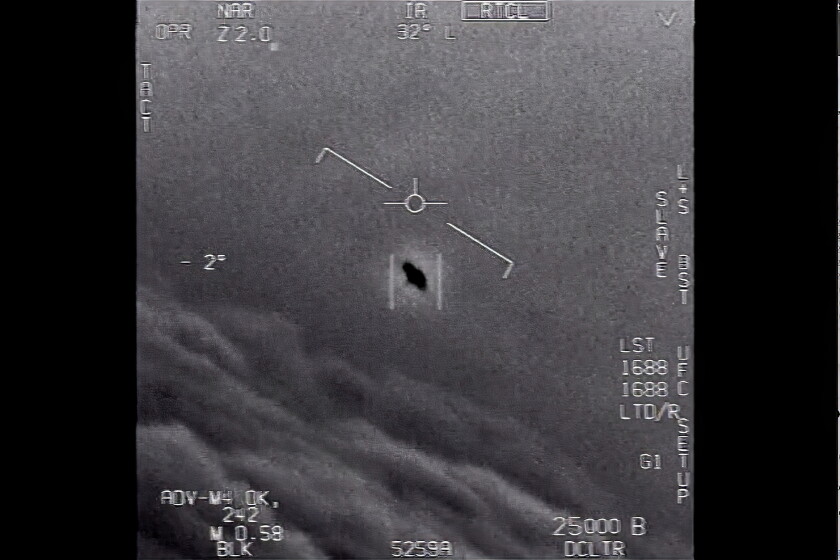
Unexplained aerial objects, like this one captured on video by the Department of Defense in 2015, will be studied by a new government office.
(Associated Press )
BY DILLON GUTHRIE
Of all the year’s political drama, the most surprising may be the U.S. government’s actions on unidentified aerial phenomena, or UAPs — better known as UFOs.
The opening act came in June, when the Pentagon and the director of national intelligence delivered an astonishing report to Congress addressing UAPs. Most of these phenomena turn out to have prosaic explanations — such as weather balloons, space debris and atmospheric effects in the sky — with a small percentage exhibiting unusual flight characteristics that suggest advanced technology.
The June report, however, found the opposite: It could account for only one of the 144 UAP sightings between 2004 and 2021 that it examined, including 80 observed with multiple sensors such as high-tech military radar and infrared cameras mounted on warplanes.
The image from video provided by the Department of Defense labelled Gimbal, from 2015, an unexplained object is seen at center as it is tracked as it soars high along the clouds, traveling against the wind. “There's a whole fleet of them,” one naval aviator tells another, though only one indistinct object is shown. “It's rotating." The U.S. government has been taking a hard look at unidentified flying objects, under orders from Congress, and a report summarizing what officials know is expected to come out in June 2021. (Department of Defense via AP)
Take one of the most memorable sightings, caught on infrared camera in 2004. Navy pilots flying from the USS Nimitz spotted a 40-foot white object resembling a Tic Tac mint levitating erratically above the waters off the California coast. As the pilots approached, the Tic Tac — despite lacking wings or any sign of propulsion — rose to meet them midair before speeding instantly away, vanishing. The report did not conclude what the Tic Tac or any other UAPs are, and it could not attribute them to secret technology developed by the U.S. or any adversaries.
Now Congress wants answers. In November, Sen. Kirsten Gillibrand (D-N.Y.) authored legislation creating an office to study UAPs government-wide and report to Congress. Then the Defense Department tried to stake its claim to the issue, shortly after announcing the formation of its own UAP unit. Its team would investigate only UAPs spotted in sensitive military airspace, and it would operate without congressional supervision. Some criticized the half-measure as a preemptive ploy to avert oversight, though the Pentagon denies those claims.
But Gillibrand anda bipartisan bloc of lawmakers, including Sen. Marco Rubio (R-Fla.) and Rep. Ruben Gallego (D-Ariz.), were not deterred. They steered legislation through Congress — attached as an amendment to the annual defense bill, sent to President Biden’s desk Wednesday to be signed into law — that establishes a new office to study UAPs. The amendment also requires unclassified reports on UAPs delivered to Congress each year, as well as semiannual classified briefings to legislators.
The move represents the most significant public progress yet to understand UAPs. For all its dysfunction, only Congress has the institutional power and legitimacy to lead this conversation.
UAPs intersect with topics as wide-ranging asaerospace technology,national securityand potentialhealth effectson individuals exposed to these craft. No single agency has the multidisciplinary know-how or legal authority to tackle all these questions. For example, the Pentagon unit’s intended focus on military airspace would ignore the Federal Aviation Administration and civilian flight safety.
A comprehensive strategy from Congress is needed. The office created by the Gillibrand amendment accordingly will take a broad approach by investigating UAPs across jurisdictional lines, prioritizing areas of scientific study and requiring various agencies to collaborate — not only the Defense Department and the Federal Aviation Administration but also the Energy Department, intelligence community, NASA and others. It will develop a science plan to investigate striking physical characteristics of UAPs (like their speed) and potentially replicate any advanced UAP technologies. And the new office will seek to understand the global nature of these phenomena, directing outreach to foreign allies.
In particular, the office will analyze whether UAPs represent foreign adversarial technology or otherwise pose a threat. That should be its top priority. The June report stated that UAPs, in addition to representing a flight safety hazard, “may pose a challenge to U.S. national security.” Given the regular sightings in military airspace — and the apparent connection between UAPs and nuclear technology — national security concerns are paramount.
In setting up this office, Congress has legitimized the long-ridiculed topic of UAPs. Yet its work does not end there. It must ensure that the office receives adequate funding and make clear that the office should be led by a civilian director with the expertise necessary to tackle these issues and cut through the Pentagon’s red tape.
Of course, the perspectives of defense and intelligence officials will be crucial. But the Pentagon has a long history of obfuscating work relating to UAPs, whereas Congress can promote transparency. Once the office has delivered its first unclassified report, Congress should hold public hearings to discuss its findings.
Now that legislators have marshaled action on UAPs, they need to make sure the new office does not become shrouded in secrecy.
The year 2019 seems so long ago for most of us, but it probably seems like only yesterday for the US Navy after newly released documents show that the mysterious drones which harassed numerous Navy ships off the coast of Los Angeles in 2019 were far more prevalent that first thought … and the Pentagon still does not have an ‘official’ explanation for these unidentified aerial vehicles (UAVs). Are these more Tic Tac UFOs, Tic Tac decoys, enemy drones, secret U.S. drones or something else?
Something else?
(Not one of the mysterious drones)
Before we look at the latest revelations, let’s review how the Navy got to this point. The bulk of the data comes from The War Zone/The Drive, the military news website which has been tracking, requesting and revealing internal documents on mysterious drones following multiple Navy ships on maneuvers. It first revealed in March 2021 that the USS Kidd, an Arleigh Burke-class destroyer, encountered a UAP near San Clemente Island on July 14, 2019, and deployed a “SNOOPIE (Ship Nautical Or Otherwise Photographic Interpretation and Exploitation)” team to investigate. The War Zone found that other ships also encountered the UAPs on July 15 and 16 — the USS Russell, USS John Finn, the USS Paul Hamilton and the USS Rafael Peralta, which activated its own SNOOPIE team and reported a “white light identified hovering over” the ship’s flight deck for around 90 minutes. Logs of the other ships also reported sightings. The War Zone requested more information on the two-day encounter … and waited. This week, it finally received additional documents and they contained shocking new revelations.
“Newly released documents obtained via the Freedom of Information Act (FOIA) show that the full scope of these drone incursions was greater than it initially appeared, and they persisted well after the Navy’s investigation was launched. Deck logs indicate that drone sightings continued throughout the month of July 2019 and included events where drone countermeasure teams were called into action. One notable event involved at least three ships observing multiple drones. Uncharacteristically for unclassified deck logs, the details on this event are almost entirely redacted.”
The logs show the USS Russell had encounters with the drones on July 17th and 20th. The USS Russell crew took anti-drone countermeasures that appeared to be unsuccessful – The War Zones explains that highly-directional radiofrequency jammers are designed to disrupt communications between drones and their operators, but are not effective against autonomous drones. The document also show that the Russell fired a 5-inch naval deck gun as a UAS (unmanned aerial system) countermeasure, but notes that these guns are not designed to hit targets that are small and slow-moving like these mysterious drones. Finally, they report that “ghostbusters” — lower-end counter UAS devices that look similar to rifles – were fired. The War Zone points out that “ghostbusters” is a new term.
The logs show that at least three ships reported multiple drones following them and adjusting their speed and position whenever a ship would make an evasive maneuver. The ships also enforced enhanced “emissions control,” or EMCON, protocols designed to minimize their electronic profile.
Whose drones are they?
(Not one of the mysterious drones)
Another engagement between the USS Russell and the mysterious drones took place on July 30th, 2019. A SNOOPIE team was activated, “ghostbusters” were used and a SCAT (Small Craft Action Team) was launched – these are machine gun operators that provide 360-degree coverage of the ship and are usually used in response to a small boat attack or low, slow flyers. The logs show that the nearby USS Bunker Hill made the same maneuvers. Perhaps the most interesting revelation is that unlike previous ones, the new documents were heavily redacted.
These new documents tell us that mysterious drones are a bigger problem for the US Navy (and the rest of the US military) than first thought. They tell us that counter-responses – including weapons – have been deployed with little success. They tell us that the Pentagon is probably hiding more information about them. What they DON’T tell us is what these drones are and who – or what – they belong to.
Kudos as always to the reporters at The War Zone and The Drive for their fine work.
ALL RELATED PHOTOS AND VIDEOS, selected and posted by peter2011
Map depicts the USS Paul Hamilton's interactions with an unknown UAS
A member of a destroyer's SNOOPIE team with a video camera in hand
Excerpt from the log of the USS Russell.
Excerpt from the log of the USS Russell
Excerpt from the log of the USS Russell
Excerpt from the log of the USS Russell
A briefing slide depicts several pictures of a "seemingly triangular" shape recorded by the Russell
As someone who has written extensively on the mysterious issue of the Men in Black, I’m often asked something along the lines of “What are the different types of M.I.B.?” Well, that’s a very good question. Specifically because there isn’t just one sort of Man in Black. There’s not even just two. In fact, there are several, as strange as it might sound. We’ll begin with the image that most people have: stern-faced characters – very often wearing fedora hats – and looking like they stepped out of a top secret, government facility. In other words, they aren’t the kinds you would want to cross paths with, but there’s nothing strange or odd about them. We can’t say that for all of the Men in Black, though. As we’ll see soon. Another type, that also comes across totally normal are the “Military Men in Black.” By that, I mean characters who wear military uniforms – and as a means to get into peoples’ homes and question them about their UFO encounters. Such was the extent to which this type of Man in Black was prevalent in the 1960s, the U.S. military circulated an official document warning its personnel to keep a look out for these mysterious, uniformed figures. For example, here’s one of several documents that was circulated:
On March 1, 1967, Lieutenant General Hewitt T. Wheless, USAF, penned the following memo. It was widely circulated within the military: “Information, not verifiable, has reached Hq USAF that persons claiming to represent the Air Force or other Defense establishments have contacted citizens who have sighted unidentified flying objects. In one reported case, an individual in civilian clothes, who represented himself as a member of NORAD, demanded and received photos belonging to a private citizen.” The document continues: “In another, a person in an Air Force uniform approached [italics mine] local police and other citizens who had sighted a UFO, assembled them in a school room and told them that they did not see what they thought they saw and that they should not talk to anyone about the sighting. All military and civilian personnel and particularly information officers and UFO investigating officers who hear of such reports should immediately notify their local OSI [Office of Special Investigations] offices.”
John Keel said of these uniformed men, in The Mothman Prophecies: “Mysterious men dressed in Air Force uniforms or bearing impressive credentials from government agencies have been silencing UFO witnesses. We have checked a number of these cases, and these men are not connected to the Air Force in any way. We haven’t been able to find out anything about these men. By posing as Air Force officers and government agents, they are committing a Federal offense. We would sure like to catch one – unfortunately the trail is always too cold by the time we hear about these cases, but we are still trying.” Moving on, there are the “robot”-like M.I.B. No, I’m not joking. Some Men in Black act and even look like robots. Their skin looks like plastic, and they have a jerky walk.
(Nick Redfern)
Robots in Black?!
Gareth J. Medway has an excellent list of Men in Black encounters that began a long, long time ago and that continued up to the 2000s. Of these robotic M.I.B., Gareth gives us these words: “1967, 9 January: The Christiansen family of Wildwood, New Jersey, who had seen a UFO on 22 November 1966, were interviewed by ‘the strangest looking man I’ve ever seen’, wearing a thin black coat, who introduced himself as ‘Tiny’ from the ‘Missing Heirs Bureau.’ He spoke in a high, ‘tinny’ voice, in clipped words and phrases like a computer, “as if he were reciting everything from memory.” His black trousers were too short, and ‘they could see a long thick green wire attached to the inside of his leg, it came up out of his socks and disappeared under his trousers.’ John Keel commented that he had not heard of this feature in other MIB cases: ‘Was Tiny wearing electric socks? Or was he a wired android operated by remote control?’ He departed in a black 1963 Cadillac. Sanderson, Uninvited Visitors, pp.160-61; Keel, Visitors from Space, pp.85-89.”
We now come to the creepiest Men in Black of all. They look far less like government agents and far more like the M.I.B. of the 1998 movie, Dark City. In fact, I would say the Men in Black of the movie are almost identical to those in the real world. Not only that, they have the ability to hypnotize people, to make them sick, to cause poltergeist activity in the home of the targeted person, and sometimes to vanish at almost impossible speeds. The big question is: are all of these Men in Black interconnected? My view is a big “No.” That, of course, makes the M.I.B. enigma even more complicating! Now, with the various Men in Black addressed, in the next article I’ll do likewise with the Women in Black.
Data from NASA’s Kepler Space Telescope has revealed apossible 172 new exoplanets. In addition to the 172 planetary candidates, the team of astronomers also discovered 18 possible multi-planetary systems.
Among the candidates are several very odd systems. One system in particular that’s been named EPIC 249559552 is located approximately 650 light-years away from us. There are two “sub-Neptunes” in the system (these are smaller planets than Neptune) that orbit a yellow-white sun-like star. Their orbits are rather peculiar as the planet closest to the star completes five orbits for every two done by the further world (this gravitational influence is called orbital resonance).
Another system that is located about 3,500 light-years away from us is called EPIC 249731291 and it has a star that is quite similar to our own sun. Orbiting that star are two giant gas planets that are a little smaller than Saturn. They orbit the star at such a close range that their atmospheres would be exceptionally hot. To understand this better, if those planets were in our Solar System, they would be located closer than Mercury is to our sun.
(Not any of the planets mentioned in this article.)
Despite being retired in 2018, experts are still recovering astonishing information from all of the data collected by the Kepler Space Telescope during its nine-year mission. By studying all of the data, scientists will get a better understanding of how planetary systems form and how they change throughout the years; how gas giants form further away from their star before traveling inwards; and if there are certain types of exoplanets that exist more around specific types of stars.
Jessie Christiansen, who is the lead scientist for the NASA Exoplanet Archive at Caltech’s IPAC astronomy center, discussed the research by stating, “There was a lot of unexplored territory in these NASA Kepler archival data, so we worked together to build a new software pipeline that could uniformly look through the final four years of observations.”
(Not any of the planets mentioned in this article.)
Thanks to Kepler, so far there have been over 2,800 planets that have been confirmed and more than 3,250 that are awaiting confirmation (these include the recently discovered 172 new worlds). The research was published in The Astronomical Journal.
This news comes not long after it was reported that 301 new planets had been confirmed that brought the total at that time to 4,569. Currently, there are a total of 4,884 exoplanets that have been confirmed; 7,958 that are awaiting confirmation; and 3,659 planetary systems.
It’s most intriguing to note that in the United Statesthe black helicopter phenomenon began in 1973 – the very same year in which the U.K. was also hit by a wave of helicopter-based incidents, and that prompted the British Police Force’s Special Branch to launch an investigation. In the U.S., things started in the Hawkeye State: Iowa. For the first three months of the year, outraged farmers contacted local law enforcement officers with strange and unsettling stories: they would wake up in the morning, head to their fields and find several of their cattle dead. These were no normal deaths though. The genitals were gone, as were the eyeballs. Skin appeared to have been opened with the use of some kind of device employing incredible temperatures; maybe even a laser-based device. Organs were not savagely torn out – as they might have been if coyotes were the culprits. Instead, they were carefully cut out. Under cover of darkness, an unstoppable force was causing mayhem throughout the rural parts of Iowa. It wasn’t long before those same ranchers had something else to deal with. You have probably already guessed what that was. That’s right: black and unmarked helicopters.
But, were the pilots of the craft performing the mutilations? Or, were they monitoring the activities of the mutilators, who may not even have been human? These were the questions being asked seriously – and particularly so after sunset, when farmers wondered and dreaded what they might find when a new day dawned. Even local law enforcement were open to the idea that something from another realm of existence just might have been behind the mutilation wave. When the Iowa cases were at their height, local police authorities called in the FBI. Despite the large amount of testimony, photographs, necropsy reports, and extensive police files, the FBI stayed curiously out of the controversy. They maintained that since the events didn’t amount to “interstate transportation of the maimed animals,” they were powerless to get involved. The FBI, then, didn’t deny the reality of the grisly killings, but kept their distance because of bureaucratic reasons.
(Nick Redfern)
Where there were cattle mutilations there were black helicopters
When, in the fall of 1974, Nebraska was next on the hit-list, Senator Carl T. Curtis, who served in the U.S. Senate from 1955 to 1979, wanted answers – and he wanted those answers quickly. Such was Curtis’ level of concern, he went right to the Director of the FBI, Clarence M. Kelley, who, in 1973, took on the position of Director after the death of J. Edgar Hoover. Once again, though, the FBI took the stance that this was an area outside of their jurisdiction. Rumors abounded that the FBI had been warned to keep away from the subject. But, who would have the power and influence to ensure the FBI would stay away? It was a notable question. By 1975, things had gotten to the point where the FBI could not ignore what was going on – and in not just Iowa and Nebraska. Exasperated by a wave of mutes in his state of Colorado in seventy-five, Senator Floyd K. Haskell sent the following letter to FBI Director Kelley: “For several months my office has been receiving reports of cattle mutilations throughout Colorado and other western states. At least 130 cases in Colorado alone have been reported to local officials and the Colorado Bureau of Investigation (CBI); the CBI has verified that the incidents have occurred for the last two years in nine states. The ranchers and rural residents of Colorado are concerned and frightened by these incidents. The bizarre mutilations are frightening in themselves: in virtually all the cases, the left ear, rectum and sex organ of each animal has been cut away and the blood drained from the carcass, but with no traces of blood left on the ground and no footprints.”
(Nick Redfern)
Surveillance of the strange kind (over my old home and super-low)
If one hundred and thirty-plus incidents were not nearly enough to get the FBI involved, there was the matter of the black helicopters, which had also caught the attention of Senator Haskell. He added to Director Kelley: “In Colorado’s Morgan County area there has also been reports that a helicopter was used by those who mutilated the carcasses of the cattle, and several persons have reported being chased by a similar helicopter [italics mine]. Because I am gravely concerned by this situation, I am asking that the Federal Bureau of Investigation enter the case.” The senator signed off: “Although the CBI has been investigating the incidents, and local officials also have been involved, the lack of a central unified direction has frustrated the investigation. It seems to have progressed little, except for the recognition at long last that the incidents must be taken seriously. Now it appears that ranchers are arming themselves to protect their livestock, as well as their families and themselves, because they are frustrated by the unsuccessful investigation. Clearly something must be done before someone gets hurt.”
Since then, various others agencies and bodies- not only the FBI – have got involved. The list includes the Los Alamos National Laboratory and the Atomic Energy. The mystery of the cattle mutilations still continues. The same goes for those strange helicopters, too.
New Antarctica Discovery! The ''TR-3B Pyramid'' & More - 2021
New Antarctica Discovery! The ”TR-3B Pyramid” & More – 2021
I generally post things which directly, indirectly or remotely relate to any aspect of the Elites and/or their agencies/agents. Things which are rarely found through mainstream avenues, or otherwise.
Much more to come. Stay tuned for more at BIN news. Thanks for stopping by and keep up to date with more important news!
Structures found on Dwarf Planet Ceres, Dec 20, 2021, UFO Sighting News.
Date of discovery: Dec 20, 2021
Location of discovery: Planet Ceres
I found an old NASA archive that I have never seen before. It holds a lot of deleted photos of planets, moons and ect. I added yellow color to make it easier for some to see them. I started exploring only a few minutes when I found several large alien structures on planet Ceres. The structures are about 5km across according to the ruler in the bottom left corner of the map. Yes, it's a map, not a small photo. I don't want to say where the link is until I am certain I have explored it well enough. NASA loves to delete and even move URLs as soon as they see them go viral, so I will keep its location secret for now. The evidence is clear...these are 100% proof of intelligent life on planet Ceres. But...the real question is...are these structures still inhabited or are they empty waiting to be used?
Possible TicTac Over San Antonio, Texas 12-18-2021, UFO Sighting News.
Date of sighting: Dec 18, 2021 Location of sighting: San Antonio, Texas, USA Source: MUFON
This report of a possible tictac UFO just came in. The craft is wingless, white and highly reflective. I cannot hear any jet engines and this craft does move very smoothly across the sky. The shape, size, color all point to this being an alien craft.
Scott C. Waring - Taiwan
Eyewitness states:
Saw this in my backyard. Looked up and saw this, not in video but saw plume of white being emitted.
UFO Fleet Over Cincinnati, Ohio 8-5-2019, UFO Sighting News.
Date of sighting: 8-5-2019, but might be 8-3-2019. Location of sighting: Cincinnati, Ohio, USA Source: MUFON
This event happened back in 2019, and I already reported one video of it, however another video just came in today from a woman eyewitness. Not everyone reports UFOs they see. Some people record them...holding onto the video and photos till they think about it more. When they are ready they release their evidence. Often people are frightened and have to wait till their emotions have accepted what they witnessed.
This new video shows the amazing Cincinnati lights event. Its absolutely amazing and 100% proof of UFOs over a major US city.
Giant Black Cube Near Our Sun Detected on NASAs SOHO photos, UFO Sighting News
Date of sighting: Dec 18, 2021
Location of sighting: Earths sun
Source:NASA/SOHO images
Today I was looking over photos from NASA sun images when I noticed a dark cube. The cube has been seen many times over the years and I do think this is an alien ship in the shape of a cube. The craft is big, larger than earth itself. It is frequently seen around the sun and then leaves. It looks like the cube is sucking up rare solar material only found around a sun itself. The energy particles it collects are probably used to run and create alien technology. There are many undiscovered particles in the universe that humanity has yet to discover. One day, we may have to compete with these aliens for mining our sun for the rare particles. I wonder...how thats going to effect human/alien relations in the future?
This UFO video was filmed back in August 5th 2019 but it was just today submitted to MUFON’s website. It happened over Cincinnati, OH.
Witness report:
We were driving to the grocery store when turning into the lot I thought I saw a black plane or helicopter. I wasn’t sure what since I was driving but when we turned my 15 yr old daughter and I both saw the 4 white lights hovering in the mostly cloudless evening sky. There were some high thin clouds but no inclement weather. There were 4 white circular orbs just hovering silently. We parked and she immediately got out of the car and began recording from her I Phone. During that time the orbs continued to hover and occasionally blink out and back. Eventually a 5th orb appeared out if nowhere. We quit recording because they just took off to the northeast and we couldn’t keep up. They were gone.
Conspiracy theorists all across the world have long been claiming that alien existence on earth is real. According to these conspiracy theorists, UFO sightings that happen in various parts of the globe are indicating the presence of an advanced extraterrestrial species on earth. Adding up the heat to these claims, dozens of UFOs were recently spotted in Paterson, New Jersey.
Multiple UFOs in New Jersey skies
The alleged UFO sighting apparently happened on December 10, 2021. In a video released by self-styled alien hunter Scott C Waring, multiple flying objects can be seen hovering in the night skies.
UFOs in New JerseyUFO SIGHTINGS DAILY
Waring, on his website UFO Sightings Daily claimed that these glowing objects could be alien vessels that reached the earth from deep space.
"In this five-minute video, we see dozens of glowing circular objects moving across the sky. The objects are following each other in a line. Sometimes in the video, I see a pair of objects moving apart, then suddenly moving back together so it seems they are trying to stay together. You can hear the eyewitnesses dismay and confusion in their voices as they watch the craft flying over them. At one point in the video one glowing object comes over them, he zoomed in on it, showing a whiteish sphere object, then it moves away. This moment excited the eyewitness who can be heard saying, "See! See I told you so!" meaning he said they were alien craft and this show of intelligence of the craft made that statement accurate," wrote Waring on his website.
Netizens react to new UFO sighting
The video uploaded by Waring has now gone viral on online spaces, and it has made many people believe that aliens are already here on earth. Most of the viewers who watched the clip uploaded by Waring assured that aliens are gearing up for disclosure, and it may happen anytime soon.
"These beings are making it clear that they want to be seen now," commented Just Me, a YouTube user.
Some other users claimed that these lights could be secret military vessels, while a section of people suggested that these UFOs could be mere drones.
A declassified version of the government report presented to Congress on unexplained aerial phenomena says most of them are still unexplained.
U.S. Dept. of Defense via AFP via Getty Images, FILE
In the wake of a UFO report last summer, the Pentagon has announced the formation of a new group that will investigate reports of UFOs close to sensitive military areas.
The new Airborne Object Identification and Management Synchronization Group will specifically look at reports of Unexplained Aerial Phenomena (UAP) near U.S. military facilities. UAP is the military term to describe what is known as UFOs or Unexplained Flying Objects.
"Incursions by any airborne object into our SUA (Special Use Airspace) pose safety of flight and operations security concerns, and may pose national security challenges," said a Pentagon press release using the term that includes restricted military airspace, military operations areas, firing ranges and places restricted for national security and other uses.MORE: Few answers in unclassified UFO report
In a memo outlining the group's formation, Deputy Defense Secretary Kathleen Hicks wrote that unidentified aerial phenomena in special-use areas "represents a safety of flight risk to aircrews and raises potential national security concerns."
U.S. Dept. of Defense
This video grab image obtained April 28, 2020, courtesy of the U.S. Department of Defense shows part of an unclassified video taken by Navy pilots that have circulated for years showing interactions with "unidentified aerial phenomena".
The new group will synchronize the Pentagon's efforts with other federal agencies "to detect, identify and attribute objects of interest in Special Use Airspace (SUA), and to assess and mitigate any associated threats to safety of flight and national security.MORE: Upcoming UFO report to Congress creating lots of buzz
It will be overseen by the under secretary of defense for intelligence, who will head an executive council including the director of the Joint Staff and senior officials from the Office of the Director of National Intelligence.
Compiled by the Navy's Unidentified Aerial Phenomenon Task Force, that report could not explain 143 incidents and said 18 of them appeared "to demonstrate advanced technology." The UAP Task Force will now be absorbed into the newly formed group announced by the Pentagon.
The UAP report also identified the need to make improvements in the Pentagon's processes, policies, technologies and training to improve its ability to understand UAP.
China’s Mars rover has amassed reams of novel geological data
Data collected by the Tianwen-1 mission and Zhurong Mars rover are offering insights into a previously unexplored region of Mars’s northern hemisphere.
In July, Zhurong took this image of the landing site of the parachute and part of the capsule that had carried it safely to the surface.
Credit: CNSA
More than 30 scientists across the Chinese mainland, Hong Kong and Macau are rushing to process data collected by China’s Mars rover, Zhurong, and by the nation’s Tianwen-1 spacecraft, which is in orbit around the planet. Several studies have trickled out, but researchers say that more are coming in the next weeks and months, offering insights on the climate, geology and history of Mars’s northern hemisphere.
Since September, the National Astronomical Observatories of the Chinese Academy of Sciences (NAOC), which has been receiving the data from space, has released nearly 200 gigabytes of information that was collected from eight instruments on the rover and orbiter between February and June. These instruments include cameras, a radar system, climate sensors and a laser spectrometer.
Some surface features, such as possible sedimentary material and potential mud volcanoes, hint at the historical flow of water, so scientists are looking for any clues that there was once water or ice below the surface. This is “of great scientific interest” because it might provide evidence of an ancient ocean, says Bo Wu, a planetary scientist at the Hong Kong Polytechnic University, who is analysing some of the data.
Tianwen-1 arrived at Mars in February. In May, it dropped a lander containing Zhurong onto a vast basin known as Utopia Planitia. The rover’s initial mission was intended to be only about three months long, but it has exceeded expectations. Over a period of four months, the rover travelled more than 1,000 metres, visiting features of interest and even investigating part of the capsule that brought it to the surface, along with the remains of the descent parachute.
Pause in communications
In September, Zhurong was powered down into hibernation by the China National Space Administration (CNSA) because Mars had passed behind the Sun, relative to Earth, meaning that communication was lost. However, in October it was powered up again, and it has traversed another 200 metres in the direction of what might once have been the coastline of an ancient ocean.
The month-long break offered mission scientists at research institutes across China a chance to start analysing data. Some researchers had already received images of Mars from the orbiter’s cameras in March, and the CNSA had previously shared with the public images and videos taken by the rover during its descent and from the surface. But now researchers are studying the much larger volume of data released in September.
This data set includes images from Zhurong’s navigation camera; climatic data on temperature, pressure and wind speed; information on the chemical composition of rocks, soil and sand dunes from a laser spectrometer; and clues from below the surface from its ground-penetrating radar.
Apart from the handful of images and videos released by the CNSA, few scientific insights about the mission have been released or published until now. Researchers say this is because it has taken time to process and clean up the data.
Doing this ensures that the data are reliable and removes noise produced by the instruments, says Lu Pan, a planetary scientist at the University of Copenhagen. The fact that this mission is China’s first to the surface of another planet might also have slowed things down compared with NASA’s recent Mars missions. “If this is the first time you do it, there’s a learning process,” she says.
David Flannery, an astrobiologist at Queensland University of Technology in Brisbane, Australia, who is in communication with scientists in China, says that the team’s approach to managing data could also have contributed to the delay in releasing new insights. With NASA’s Perseverance mission, which Flannery is involved in, each instrument on the rover is designed by a different team, which has exclusive access to data from that instrument for a few months before the data become available to all.
But under the CNSA model, the data generated for all the instruments on Zhurong and Tianwen-1 are processed by the NAOC, before making the information available to multiple teams of scientists linked to the mission.
The CNSA released this image in July of the view from the lander up towards the parachute as it drifted down to the surface of Mars.
Credit: CNSA
Speeding up the analysis
Two publications have already emerged. One study1, posted as a preprint in late September, analysed images and information on friction that were gleaned from the movement of Zhurong’s wheels. The results show that regions of Mars that the rover trundled over have properties similar to those of compact, sandy soil on Earth.
The study “provides useful data about surface soil properties”, says Xiao Long, a planetary geologist at the China University of Geosciences in Wuhan. This might be helpful for understanding how soil and dust on the surface formed, says Long, who is also conducting his own analysis.
A second study2, published in August, used high-resolution images from the orbiter to pinpoint the rover’s precise coordinates on Mars. But researchers say that many more studies are expected soon, including some on the region’s topography.
So far, the data have been shared only with researchers directly involved with the mission, but Wu says that the NAOC will at some point release them to the public and the international community.
That could help to speed up the analysis. Scientists with more experience of Mars might be able to recognize features of interest and their significance more quickly, says Flannery. “Mars is peculiar in some ways, and geologists are only as good as the rocks they have seen in the past,” he adds.
Next phase of the mission
Zhurong will now continue to explore, potentially for years, as some of NASA’s Mars rovers have.
Tianwen-1 has also been busy. The spacecraft recently adjusted its orbit and switched from acting mainly as a communications relay between Zhurong and Earth to also conducting its own observations of Mars. Wenzhe Fa, a planetary scientist at Peking University, Beijing, who is analysing Zhurong’s radar data, says that on 11 November, the CNSA deployed and began to test the antenna for the orbiter’s radar.
Also earlier this month, the CNSA and the European Space Agency (ESA) trialled whether ESA’s Mars Express orbiter could be used to relay Zhurong’s data to Earth — an exercise that Pan says is an “amazing step” towards increased international collaboration with China.
As Zhurong resumes its journey, Bo says that he and his team are providing “suggestions for future data collection” that take in surface features of particular scientific interest.
But we’d wager most people don’t think that line applies to the actual rules of the universe itself. As it turns out, though, researchers at Microsoft, along with scientists at Brown University and even one expert who consulted for Disney’s “Wrinkle in Time” think the laws of physics might actually be slowly changing, complicating our quest to understand the cosmos.
Popular Mechanics published a lengthy explainer this week about a paper, titled “The Autodidactic Universe” and published earlier this year, in which the team argued for that precise mind-bending hypothesis. An autodidact, of course, is someone who learns without a mentor or teacher — and, these researchers say, the universe itself may be one.
“We ask whether there might be a mechanism woven into the fabric of the natural world, by means of which the universe could learn its laws,” the authors wrote in the paper, which has not yet been peer reviewed.
Over time, the theory goes, the universe has sought stability. PopMech draws parallels to animal evolution, too. There are no trilobites or dinosaurs anymore, but cats and dogs have survived because they adapted to the environment around them — and the cosmos may have done the same.
In an early version of the universe, for example, Newton’s laws of gravity — that all matter in the universe attracts other matter with a force directly proportional to the product of their masses and inversely proportional to the square of the distance between their centers — might not have been true yet.
“Over time, that system will teach itself, and some fundamental laws will arise, and that’s really what they’re talking about [in the paper],” Janna Levin, a professor of physics and astronomy at Barnard College of Columbia University who wasn’t involved in the research, told PopMech. “If the universe can compute with a given set of algorithms, then maybe it can do the same kind of thing we see in artificial intelligence, where you have self-learning systems that teach themselves new rules. And by rules, in cosmology we mean laws of physics.”
The paper’s authors also acknowledge their own skepticism and wrote their conclusions with caution, cautioning that their work is only a baby step in the formation of a new theory and requires additional research.
“Of course, this is just a first step,” the authors write. “There are varied potential spin-offs from our approach.”
It’s mind-bending to imagine that the laws of physics might learn and adapt over time. But it reminds us that the universe is stranger than we’ll ever know.
It may seem strange, but, in the 1960s, British military intelligence was secretly opening files on those citizens of the U.K. who were suspected of being alien abductees. This was, I should stress, post-Betty and Barney Hill. We have to focus on the intriguingly weird story of a young woman named Diane Foulkes. The year was 1966, the month was November. It was a month in which NASA’s Lunar Orbiter 2 was launched, John Lennon met Yoko Ono for the first time, and Ronald Reagan was elected Governor of California. Those historic events all paled against what Diane Foulkes had to endure: a close encounter with a strange craft in the sky and a period of missing time. As the U.K.’s Freedom of Information Act has shown, it was the Royal Air Force’s Provost and Security Services who secretly oversaw the investigation into Diane’s trauma-dominated experiences. We would almost certainly be completely oblivious to the facts of the affair, today, were it not for one significant thing: Diane Foulkes’s family decided to contact the military – in an effort to try and understand the nature of her experiences. At the time, twenty-two-year-old Diane – a typist working at a local company – was living with her parents in the old English town of Shrewsbury, in the county of Shropshire. It’s a town which was founded way back in the 9th century and its ancient architecture would not at all look out of place on the likes of Downton Abbey – nor would its surrounding green fields and hills, little old villages, and expansive woods.
(Nick Redfern)
Files and Files – and More Files
As for Diane’s encounter with something definitively unknown, it occurred on the night of November 8, 1966. Although, she kept silent about what had happened for two days; finally confiding in her mother and father on the 10th and revealing all. So shocked were Diane’s parents by what she had to say, her mother promptly contacted the local military base, Royal Air Force Shawbury, which was constructed in the latter stages of the First World War and that, today, is a training facility for military helicopter pilots. She spoke to a Flight Lieutenant Williams, who took a few notes and promised to pass the data onto the right people. We will soon learn who they were. We’ll likely never know what was going through the mind of Diane’s mother when she made that call to RAF Shawbury, but one can imagine it would not have been the easiest of things to do. After all, she was about to share the details of her daughter’s encounter with what may well have been a spacecraft constructed on another world. If Diane had worries about what the authorities might say, she had no need to. It’s most intriguing to note that the military took her story very seriously. To the extent that, four days later, a three-man team arrived at the Foulkes’ home. Questions were about to be asked and a secret file was about to be created.
It was around 7:00 p.m. when the knock on the door – that Diane Foulkes may have been dreading or looking forward to – finally came. Diane herself opened it and was confronted by three men dressed in plainclothes. The man who knocked on the door identified himself as Corporal Robert A. Rickwood, of the Royal Air Force. Notably, Corporal Rickwood carefully avoided adding that he also happened to be attached to the P&SS’ Special Investigation Section, the SIS, which undertook investigations of events with national security implications attached to them. Diane invited the three men into the living-room. They sat down, while her parents hovered awkwardly in the background. In typical English fashion, cups of tea were made for everyone and the interview began. Corporal Rickwood, perhaps aware that Diane was somewhat nervous, simply asked her to relate the facts, and added that he was here to help and try and figure out what it was that she had seen just a few nights earlier. Diane took a deep breath and began. She had been out for an evening with friends and, with midnight barely five minutes away, she was approaching the little village of Great Ness, which even today has a population of less than one thousand. Then, something weird happened, something totally unforeseen: Diane had an encounter of the UFO type.
(Nick Redfern)
When government personnel come calling about UFOs
Then, before she continued with her story, things became even more notable. As a quick aside, Diane said that this was not her first encounter of this particular type. She had had another close encounter – late at night, and in the same area – two years earlier. This was, of course, a surprise to Corporal Rickwood’s team. As a result, he suggested that Diane go back to the beginning, to ensure that they had all of the data in-hand and in chronological order. An incredible tale was about to be unfold. Corporal Rickwood’s now-declassified report states, in part: “The first occurred two years ago in November 1964, when she had been driving from Shrewsbury to her home along the A5 road. This was at about 0200 hours as she neared the Montford Bridge over the River Severn. Approximately midway between Shrewsbury and Great Ness a brightly lit circular object appeared in the sky above her car. She had been frightened and had accelerated along the road. The object had kept pace with her remaining at the same height until she arrived home. She had told her mother and father who also watched the object. She described the object as an especially bright light in the sky which remained stationary due west from their home for about half an hour. It had then rapidly diminished in size and they assumed it had accelerated away from them. No sound was heard from the object. The light was yellow in color and became red as it diminished.” That’s just a portion of the Provost and Security Services’ files.
As fascinating as all of this certainly is, it was yet another aside from Diane that had the P&SS guys sitting up and really taking notice. According to Diane, there was a lapse in time: although it was around 2:00 a.m. when she reached the Montford Bridge, it should actually have been much closer to 1:00 a.m. Hmm…
We humans have never ceased to push at the boundaries of what we can do with the natural world. We have tirelessly pushed forth into new frontiers, penetrated into the unknown, and tried to tinker with the very building blocks of life. There seems to be little that we have not failed to conquer, but one thing that seems to have always been just a force of nature that we have had to deal with is the weather. However, even this seemingly unconquerable realm has not been safe from our will to bend it to our will. Indeed, we have long been set on controlling the weather, and have come closer than some may think.
lthough the idea of controlling the weather may sound like something from straight out of a science fiction novel and the stuff of the future, people have been attempting this for a surprisingly long time. In 1891, the German American engineer and an inventor Louis Gathmann came up with the idea of blasting liquid carbon dioxide into rain clouds to make it rain, and in the 1930s there was the theory that supercooled water droplets present while ice crystals are released into rain clouds would cause rain, called the Bergeron–Findeisen process. This was pursued by General Electric ‘s Vincent Schaefer, who managed to find a way to change super-cooled water into ice crystals. In 1946, Schaefer would use his method to cause snow to fall at Mount Greylock in western Massachusetts, by dumping six pounds of dry ice into the target cloud from a plane. His colleague, Dr. Bernard Vonnegut, would discover another method using silver and iodide chemicals to produce silver iodide, which could be used to modify a cloud’s heat budget and chemistry to induce precipitation. This process would be known as “cloud seeding,” and the era of weather control was born.
Although electrical charges and infrared laser pulses have also been used in a limited capacity, by far the most widely used and common method of trying to modify the weather is that of cloud seeding, in which various substances are dispersed through the air or dropped directly into clouds to serve as cloud condensation or ice nuclei, which alter the microphysical processes within the cloud to induce rain or snowfall. The most common chemicals used for cloud seeding include silver iodide, potassium iodide and dry ice, which are either dispersed from an aircraft or shot up into the cloud using rockets or canisters fired from anti-aircraft guns. In the 1960s and 1970s the technology was used extensively, particularly by the U.S. government. One instance in the 1960s was called Project Stormfury, in which the U.S. military tried to alter hurricanes through cloud seeding to some success before the project was scrapped in the face of the danger involved with messing with one of nature’s most terrifying forces. From March 1967 until July 1972, the US military’s Operation Popeye used cloud seeding technology to extend the monsoon season over North Vietnam during the Vietnam War, and through the 1970s and 1980s the United States Bureau of Reclamation and the National Oceanic and Atmospheric Administration conducted various cloud seeding projects, to varying degrees of success.
The United Sates is far from the only country to have pursued the technology, and cloud seeding projects have been taken up by various countries around the world, including Canada, India, Indonesia, Iran, Israel, Kuwait, United Arab Emirates, Thailand, France, Spain, Germany, Russia, the United Kingdom, and Australia, as well as some parts of Africa. It is most commonly used to try to artificially induce rain in regions with drought or low rainfall, but it has also been used to induce snowfall, reduce the severity of storms, improve the air quality by encouraging rainfall, reduce smog, reduce the size of hailstones that form in thunderstorms, produce snow or rain for hydro power, or stop rainfall by causing clouds to expend their rain before they arrive at a certain area.
Perhaps the country pursuing the technology most aggressively is the People’s Republic of China, which between 2012 and 2017 alone invested a total of 8.8 billion yuan ($1.38 billion) on their weather modification program. China used cloud seeding in Beijing just before the 2008 Olympic Games in order to have dry weather and clear skies for opening and closing ceremonies by coaxing rain showers out of clouds before they reached the Olympic city, and in February of 2009 used cloud seeding over Beijing to artificially induce snowfall after four months of drought. As recently as 2021 China used the technology to clear Beijing’s skies for the Chinese Communist Party’s (CCP) centenary in Tiananmen Square on July 1. In the face of overcast skies and high levels of smog on that day, rockets carrying silver iodine were launched above Beijing and the surrounding areas, having the effect of decreasing the level of the air pollutant PM2.5 by over 66% and bringing the air quality from “moderate” up to “good” under World Health Organization (WHO) standards. China is believed to have some of the largest and most advanced weather modification networks in the world, and has pledged to reach an “advanced” weather modification level by 2035.
Despite such widespread use and the promise of being able to control the weather, there have been a few setbacks for weather modification using cloud seeding. One is that its actual effectiveness has been called into question, with mixed results across the board and frequent difficulties in gaging whether there has been any statistically significant rise in rainfall. There has been much debate and differing opinions from experts, making it hard to tell just how well it actually works. Whereas some countries have claimed amazing results, for instance United Arab Emirates scientists have estimated that cloud seeding operations can enhance rainfall by as much as 30 to 35 percent, other studies and research have come to the conclusion that it has little to no impact on the amount of precipitation. For instance, he US National Research Council (NRC) said of its own conclusions of cloud seeding:
Science is unable to say with assurance which, if any, seeding techniques produce positive effects. In the 55 years following the first cloud-seeding demonstrations, substantial progress has been made in understanding the natural processes that account for our daily weather. Yet scientifically acceptable proof for significant seeding effects has not been achieved.
So does it work or not? There have been so many wildly differing opinions and test results that it is hard to say. Another hurdle has been the potential for environmental damage, as it is still poorly understood what the ecological effects of pumping these chemicals into the clouds will be, nor what happens to an ecosystem when it gets more than rain than it is supposed to. Manipulating the weather was once only something Mother Nature could do, so what happens when we start creating rain where there should be none? It is not entirely understood yet. Additionally, there are worries that the technology could potentially be used as a weapon, such as what was done during the Vietnam War with the creation of monsoons. After all, being able to cause massive floods or to create beastly hurricanes to ravage one’s enemies would definitely be a useful weapon in any country’s arsenal. There have already been several conspiracy theories that such weaponry has already been developed, and the possibility is such a concern that the Convention on the Prohibition of Military or Any Other Hostile Use of Environmental Modification Techniques (ENMOD) was formed to regulate military or any other hostile uses of weather modification technologies. Finally, there are the legal implications, as who actually really owns the clouds? The answer to this is murky, and so there is a potential morass of legal tangles involved with manipulation of the weather.
Does any of this really stop those who would control the weather from trying? Of course not. The experiments and research continues. Can we guarantee that this is all for benevolent reasons? No, we cannot. How far will it all go? Who knows? Whatever the case may be, it shows that we are doggedly at trying to tame this world, to bend it to our will, and this frontier of controlling the weather may just be one step towards more yet to come. where will it take us ultimately and what price will there be to pay for trying to tinker with the work of mother nature? There can be no way to know.
Leaked Secret Photos Under Great Sphinx of Egypt! Hidden Tunnels Now Confirmed
Leaked Secret Photos Under Great Sphinx of Egypt! Hidden Tunnels Confirmed
FIRST EVER Photos/Videos from UNDER & INSIDE the Great Sphinx of Giza Egypt…
A limestone statue of a reclining sphinx, a mythical creature. Facing directly from West to East, it stands on the Giza Plateau on the west bank of the Nile in Giza, Egypt. Wikipedia
Whether you believe in predictions or not, the Old Moore’s Almanac Baba Vanga and Nostradamus predictions are well known for their accuracy.
The Irish 'Old Moore’s Almanac' is 258 years old. Its founder, Theophilus Moore, ran a classical academy at Milltown which was then a village near Dublin (since that time, it has been incorporated into the city). A teacher of Irish, English, Greek and Latin, he became known as a clever mathematician and a wizard of astrology, gaining the nickname 'The Irish Merlin'. He published his Old Moore's Almanac for the first time in 1764.
Here are some of the Old Moore’s Almanac predictions for 2022
1. Shortages of items cause panic and hoarding
2. A tourist spaceship has an incident which makes world news
3. News about Malaysia’s missing flight MH370
4. There will be a second pandemic, unrelated to the first
5. Robotics takes a lot of blue-collar work but add on white-collar work
6, Sett
lement on Mars becomes an absolute reality, and planning starts
The famous blind Bulgarian Baba Vanga, also known as Nostradamus of the Balkans, died in 1996, however, her predictions live on and continue to amaze us by coming true.
Baba Vanga’s predictions for 2022
1. An increase in catastrophes, including earthquakes and tsunamis The Bulgarian Several Asian countries, along with Australia, will be struck by intense bouts of floods.
2. The discovery of a lethal virus in Siberia. A team of researchers will discover a lethal virus in Siberia that was, up until now, frozen. Due to the catastrophic effects of global warming, said virus will be released and could quickly spin out of control…
3. A lack of drinking water. Many cities can expect to be hit by a shortage of drinking water.
4. An alien ship will attack Earth
5. Virtual reality will take over
Michel de Nostredame, usually Latinised as Nostradamus, was a French astrologer, physician and reputed seer, who is best known for his book Les Prophéties, a collection of 942 poetic quatrains allegedly predicting future events. The book was first published in 1555.
Nostradamus' predictions for 2022
1. One of Nostradamus prophecies that is speculated to be due in 2022 is the prediction of war reaching Europe
2. Starvation and inflation
3. Climate change
4. Rise of Artificial Intelligence
What is striking is that all three predict:
Famine and Artificial Intelligence will take over
Famine
Shortages of items cause panic and hoarding
A lack of drinking water
Starvation and inflation
AI
Robotics takes a lot of blue-collar work but add on white-collar work
Virtual reality will take over
Rise of Artificial Intelligence
Old Moore’s Almanac and Baba Vanga predict another pandemic
Another pandemic
There will be a second pandemic, unrelated to the first
The discovery of a lethal virus in Siberia A team of researchers will discover a lethal virus in Siberia that was, up until now, frozen. Due to the catastrophic effects of global warming, said virus will be released and could quickly spin out of control…
Learn more about the Old Moore’s Almanac, Baba Vanga and Nostradamus predictions for 2022 at the following links:
NASA Enters the Solar Atmosphere for the First Time, Bringing New Discoveries
A major milestone and new results from NASA’s Parker Solar Probe were announced on Dec. 14 in a press conference at the 2021 American Geophysical Union Fall Meeting in New Orleans. The results have been published in Physical Review Letters and accepted for publication in the Astrophysical Journal.
For the first time in history, a spacecraft has touched the Sun. NASA’s Parker Solar Probe has now flown through the Sun’s upper atmosphere – the corona – and sampled particles and magnetic fields there.
The new milestone marks one major step for Parker Solar Probe and one giant leap for solar science. Just as landing on the Moon allowed scientists to understand how it was formed, touching the very stuff the Sun is made of will help scientists uncover critical information about our closest star and its influence on the solar system.
"Parker Solar Probe “touching the Sun” is a monumental moment for solar science and a truly remarkable feat," said Thomas Zurbuchen, the associate administrator for the Science Mission Directorate at NASA Headquarters in Washington. "Not only does this milestone provide us with deeper insights into our Sun's evolution and its impacts on our solar system, but everything we learn about our own star also teaches us more about stars in the rest of the universe.”
As it circles closer to the solar surface, Parker is making new discoveries that other spacecraft were too far away to see, including from within the solar wind – the flow of particles from the Sun that can influence us at Earth. In 2019, Parker discovered that magnetic zig-zag structures in the solar wind, called switchbacks, are plentiful close to the Sun. But how and where they form remained a mystery. Halving the distance to the Sun since then, Parker Solar Probe has now passed close enough to identify one place where they originate: the solar surface.
The first passage through the corona – and the promise of more flybys to come – will continue to provide data on phenomena that are impossible to study from afar.
“Flying so close to the Sun, Parker Solar Probe now senses conditions in the magnetically dominated layer of the solar atmosphere – the corona – that we never could before,” said Nour Raouafi, the Parker project scientist at the Johns Hopkins Applied Physics Laboratory in Laurel, Maryland. “We see evidence of being in the corona in magnetic field data, solar wind data, and visually in images. We can actually see the spacecraft flying through coronal structures that can be observed during a total solar eclipse.”
Closer Than Ever Before
Parker Solar Probe launched in 2018 to explore the mysteries of the Sun by traveling closer to it than any spacecraft before. Three years after launch and decades after first conception, Parker has finally arrived.
Unlike Earth, the Sun doesn’t have a solid surface. But it does have a superheated atmosphere, made of solar material bound to the Sun by gravity and magnetic forces. As rising heat and pressure push that material away from the Sun, it reaches a point where gravity and magnetic fields are too weak to contain it.
That point, known as the Alfvén critical surface, marks the end of the solar atmosphere and beginning of the solar wind. Solar material with the energy to make it across that boundary becomes the solar wind, which drags the magnetic field of the Sun with it as it races across the solar system, to Earth and beyond. Importantly, beyond the Alfvén critical surface, the solar wind moves so fast that waves within the wind cannot ever travel fast enough to make it back to the Sun – severing their connection.
Until now, researchers were unsure exactly where the Alfvén critical surface lay. Based on remote images of the corona, estimates had put it somewhere between 10 to 20 solar radii from the surface of the Sun – 4.3 to 8.6 million miles. Parker’s spiral trajectory brings it slowly closer to the Sun and during the last few passes, the spacecraft was consistently below 20 solar radii (91 percent of Earth’s distance from the Sun), putting it in the position to cross the boundary – if the estimates were correct.
On April 28, 2021, during its eighth flyby of the Sun, Parker Solar Probe encountered the specific magnetic and particle conditions at 18.8 solar radii (around 8.1 million miles) above the solar surface that told scientists it had crossed the Alfvén critical surface for the first time and finally entered the solar atmosphere.
“We were fully expecting that, sooner or later, we would encounter the corona for at least a short duration of time,” said Justin Kasper, lead author on a new paper about the milestone published in Physical Review Letters, and deputy chief technology officer at BWX Technologies, Inc. and University of Michigan professor. “But it is very exciting that we’ve already reached it.”
For the first time in history, a spacecraft has touched the Sun. NASA’s Parker Solar Probe has now flown through the Sun’s upper atmosphere – the corona – and sampled particles and magnetic fields there. Credits: NASA's Goddard Space Flight Center/Joy Ng Download this video in HD formats from NASA Goddard's Scientific Visualization Studio
Into the Eye of the Storm
During the flyby, Parker Solar Probe passed into and out of the corona several times. This is proved what some had predicted – that the Alfvén critical surface isn’t shaped like a smooth ball. Rather, it has spikes and valleys that wrinkle the surface. Discovering where these protrusions line up with solar activity coming from the surface can help scientists learn how events on the Sun affect the atmosphere and solar wind.
At one point, as Parker Solar Probe dipped to just beneath 15 solar radii (around 6.5 million miles) from the Sun’s surface, it transited a feature in the corona called a pseudostreamer. Pseudostreamers are massive structures that rise above the Sun’s surface and can be seen from Earth during solar eclipses.
As Parker Solar Probe passed through the corona on encounter nine, the spacecraft flew by structures called coronal streamers. These structures can be seen as bright features moving upward in the upper images and angled downward in the lower row. Such a view is only possible because the spacecraft flew above and below the streamers inside the corona. Until now, streamers have only been seen from afar. They are visible from Earth during total solar eclipses. Credits: NASA/Johns Hopkins APL/Naval Research Laboratory
Passing through the pseudostreamer was like flying into the eye of a storm. Inside the pseudostreamer, the conditions quieted, particles slowed, and number of switchbacks dropped – a dramatic change from the busy barrage of particles the spacecraft usually encounters in the solar wind.
For the first time, the spacecraft found itself in a region where the magnetic fields were strong enough to dominate the movement of particles there. These conditions were the definitive proof the spacecraft had passed the Alfvén critical surface and entered the solar atmosphere where magnetic fields shape the movement of everything in the region.
The first passage through the corona, which lasted only a few hours, is one of many planned for the mission. Parker will continue to spiral closer to the Sun, eventually reaching as close as 8.86 solar radii (3.83 million miles) from the surface. Upcoming flybys, the next of which is happening in January 2022, will likely bring Parker Solar Probe through the corona again.
“I’m excited to see what Parker finds as it repeatedly passes through the corona in the years to come,” said Nicola Fox, division director for the Heliophysics Division at NASA Headquarters. “The opportunity for new discoveries is boundless.”
The size of the corona is also driven by solar activity. As the Sun’s 11-year activity cycle – the solar cycle – ramps up, the outer edge of the corona will expand, giving Parker Solar Probe a greater chance of being inside the corona for longer periods of time.
“It is a really important region to get into because we think all sorts of physics potentially turn on,” Kasper said. “And now we're getting into that region and hopefully going to start seeing some of these physics and behaviors.”
Narrowing Down Switchback Origins
Even before the first trips through the corona, some surprising physics was already surfacing. On recent solar encounters, Parker Solar Probe collected data pinpointing the origin of zig-zag-shaped structures in the solar wind, called switchbacks. The data showed one spot that switchbacks originate is at the visible surface of the Sun – the photosphere.
By the time it reaches Earth, 93 million miles away, the solar wind is an unrelenting headwind of particles and magnetic fields. But as it escapes the Sun, the solar wind is structured and patchy. In the mid-1990s, the NASA-European Space Agency mission Ulysses flew over the Sun’s poles and discovered a handful of bizarre S-shaped kinks in the solar wind’s magnetic field lines, which detoured charged particles on a zig-zag path as they escaped the Sun. For decades, scientists thought these occasional switchbacks were oddities confined to the Sun’s polar regions.
In 2019, at 34 solar radii from the Sun, Parker discovered that switchbacks were not rare, but common in the solar wind. This renewed interest in the features and raised new questions: Where were they coming from? Were they forged at the surface of the Sun, or shaped by some process kinking magnetic fields in the solar atmosphere?
The new findings, in press at the Astrophysical Journal, finally confirm one origin point is near the solar surface.
The clues came as Parker orbited closer to the Sun on its sixth flyby, less than 25 solar radii out. Data showed switchbacks occur in patches and have a higher percentage of helium – known to come from the photosphere – than other elements. The switchbacks’ origins were further narrowed when the scientists found the patches aligned with magnetic funnels that emerge from the photosphere between convection cell structures called supergranules.
In addition to being the birthplace of switchbacks, the scientists think the magnetic funnels might be where one component of the solar wind originates. The solar wind comes in two different varieties – fast and slow – and the funnels could be where some particles in the fast solar wind come from.
“The structure of the regions with switchbacks matches up with a small magnetic funnel structure at the base of the corona,” said Stuart Bale, professor at the University of California, Berkeley, and lead author on the new switchbacks paper. “This is what we expect from some theories, and this pinpoints a source for the solar wind itself.”
Understanding where and how the components of the fast solar wind emerge, and if they’re linked to switchbacks, could help scientists answer a longstanding solar mystery: how the corona is heated to millions of degrees, far hotter than the solar surface below.
While the new findings locate where switchbacks are made, the scientists can’t yet confirm how they’re formed. One theory suggests they might be created by waves of plasma that roll through the region like ocean surf. Another contends they’re made by an explosive process known as magnetic reconnection, which is thought to occur at the boundaries where the magnetic funnels come together.
“My instinct is, as we go deeper into the mission and lower and closer to the Sun, we're going to learn more about how magnetic funnels are connected to the switchbacks,” Bale said. “And hopefully resolve the question of what process makes them.”
As Parker Solar Probe ventures closer to the Sun, it’s crossing into uncharted regimes and making new discoveries. This image represents Parker Solar Probe's distances from the Sun for some of these milestones and discoveries. Credits: NASA's Goddard Space Flight Center/Mary P. Hrybyk-Keith
Now that researchers know what to look for, Parker’s closer passes may reveal even more clues about switchbacks and other solar phenomena. The data to come will allow scientists a glimpse into a region that’s critical for superheating the corona and pushing the solar wind to supersonic speeds. Such measurements from the corona will be critical for understanding and forecasting extreme space weather events that can disrupt telecommunications and damage satellites around Earth.
“It’s really exciting to see our advanced technologies succeed in taking Parker Solar Probe closer to the Sun than we’ve ever been, and to be able to return such amazing science,” said Joseph Smith, Parker program executive at NASA Headquarters. "We look forward to seeing what else the mission discovers as it ventures even closer in the coming years."
Parker Solar Probe is part of NASA’s Living with a Star program to explore aspects of the Sun-Earth system that directly affect life and society. The Living with a Star program is managed by the agency’s Goddard Space Flight Center in Greenbelt, Maryland, for NASA’s Science Mission Directorate in Washington. The Johns Hopkins University Applied Physics Laboratory in Laurel, Maryland, manages the Parker Solar Probe mission for NASA and designed, built, and operates the spacecraft.
Inside CIA’s secret ‘Stargate’ project which used psychics to find ‘ancient aliens’ living on Mars millions of years ago
THE CIA used alleged psychics in a bizarre bid to find aliens on Mars and learn about life on the Red Planet one million years ago.
The world's most powerful spy agency now openly admits the programme existed and worked with people who claimed to have supernatural powers
The CIA asked a psychic to 'view' aliens on Mars
UFOs sketches drawn by psychics during the experiments
The $20m project became known as 'Stargate' and was set up because the US believed the Soviet Union was investing heavily in similar research.
Initially, in a bid to read the minds of enemies, a secret army unit based at Fort Meade in Maryland investigated "extra sensory perception".
The agency worked with people who claimed to have "remote viewing" powers meaning they can 'see' areas and people in different locations without actually being there.
One of the most fascinating experiments took place on May 22, 1984 and was called simply 'Mars Exploration'.
According to the CIA's own documents, the unnamed psychic described "The planet Mars. Time of interest approximately 1 million years B.C."
Scientists believe that life could have existed on the planet millions of years ago, which may explain why the US government wanted "data" from this time period.
The alleged psychic said he could to see "huge" pyramids, an obelisk structure, and road networks on the Red Planet.
He then described a number of shelters visible on the surface of Mars.
The man said: "Different chambers…but they’re almost stripped of any kind of furnishings or anything.
"It’s like ah…strictly [a] functional place for sleeping or that’s not a good word, hibernations, some form.
"I can’t, I get real raw inputs, storms, savage storm and sleeping through storms."
Asked by a CIA agent who would sleep through the storms, the man claimed to be able to make out an alien race.
"Ah very tall, very large people but they're very thin," he said.
"They’re ancient people. They’re dying. It’s past their time or age."
'ANCIENT MARTIANS'
On the CIA's own website, a Q&A was published last month outlining the programme.
Before the research moved to Fort Meade in the latter part of the decade, the project began in 1972 at Stanford Research Institute (SRI) in California.
The agency, at the request of Congress, declassified the project's records and later published all the records online.
Details about the secret project had been leaked to the media since the 1980s.
Army veteran Joseph McMoneagle claims that remote viewers, such as himself, were used to track down hostages taken by terror groups and hunt US fugitives.
McMoneagle told the Washington Post that he was involved in 450 missions between 1978 and 1984.
He says he helped the military locate hostages in Iran and also detected a tiny radio hidden in the calculator of a suspected Russian spy in South Africa.
The alleged remote viewer admitted the practice is not always accurate saying: "Ninety-eight percent of the people are kooks."
Uri Geller, celebrity psychic and famed spoon bender from Israel, was also studied as part of the project.
During these experiments, Geller sat in a sealed and monitored room where he was asked to draw words and objects using his psychic powers.
Sketches drawn during the experiments showing a Devil, God and the Ten Commandments
Geller appeared to demonstrate an ability to 'remote view'
An official VIA sketch showing an unnamed remote viewer's drawing of a target site in a location they had never visited
Credit: CIA
In one of the tests, a word was selected at random from a dictionary.
The first word selected was "fuse". A firecracker was then drawn by someone outside the locked room.
Geller was told via intercom the drawing was finished after the picture had been taped to the wall outside.
The CIA documents say: "His almost immediate response was that he saw a 'cylinder with noise coming out of it'.
"His drawing to correspond with it was a drum, along with a number of cylindrical-looking objects."
The second word chosen was "bunch" and a scientist drew a bunch of grapes.
The documents continue: "He then talked about 'purple circles'.
"Finally, he said that he was quite sure that he had the picture. His drawing was indeed a bunch of grapes."
Uril Geller's alleged psychic powers were tested by the CIA
One of Geller's drawings of a bird
The researchers concluded Uri "demonstrated his paranormal perceptual ability in a convincing and unambiguous manner".
The CIA said it ended the programme in 1977 and handed it over to the Defense intelligence Agency (DIA) where it was eventually renamed with the codename GRILL FLAME.
By the mid-1990s, the DIA handed the project back to the CIA prompting the spy agency to fund an independent study group to assess the findings.
Four researchers from the American Institute for Research published their findings in 1995.
Speaking about the report, the CIA wrote: "That report’s conclusion—which echoed the assessments of the CIA officers involved in the program during the 1970s was that enough accurate remote viewing experiences existed to defy randomness, but that the phenomenon was too unreliable, inconsistent, and sporadic to be useful for intelligence purposes.
"We decided not to restore the program."
The Stargate programme was the subject of a book by British author Jon Ronson which inspired the 2009 film The Men Who Stare At Goats starring George Clooney and Ewan McGregor.
The Stargate project inspired the movie Men Who Stare At GoatsCredit: Alamy
These glowing objects above the Moon are electromagnetic spaceships
During the Apollo missions, many photos were taken by the crews including rare images of strange bright and glowing objects above, on or near the moon. Here are some rare images of these bright objects captured during the Apollo 11, 12, 13, 14 and 16 missions.
Now, there seems to be a ”Moon Industry” to have held for at least the past fifty years in the crater Plato as moving and flashing lights have been observed at the bottom of the crater. For over hundred years the British Royal Astronomical Society has reported 1600 similar sightings of bright lights in the crater Aristarchus, lights at the eastern foot of the lunar Alps, in Mare Crisium a series of spots and streaks of light, and long light lines were seen from the crater Eudoxus.
These bright lights seem to be driven by electromagnetic energy. This energy will offer unlimited opportunities to build huge objects and to move and live in almost any environment. These electromagnetic spaceships emit a pulsing glow under different conditions as the density of the atmosphere, humidity, velocity and the height of the spacecraft.
There can be no doubt, that many of these lights, especially the glowing moving objects, 'electromagnetic spaceships' are intelligently controlled.
Meer van UFO'S of UAP'S, ASTRONOMIE, RUIMTEVAART, ARCHEOLOGIE, OUDHEIDKUNDE, SF-SNUFJES EN ANDERE ESOTERISCHE WETENSCHAPPEN - DE ALLERLAATSTE NIEUWTJES


 Antarctica New Discovery! Scientists Have Just Found The Deepest Hole There & Couldn't Believe What They Found Inside


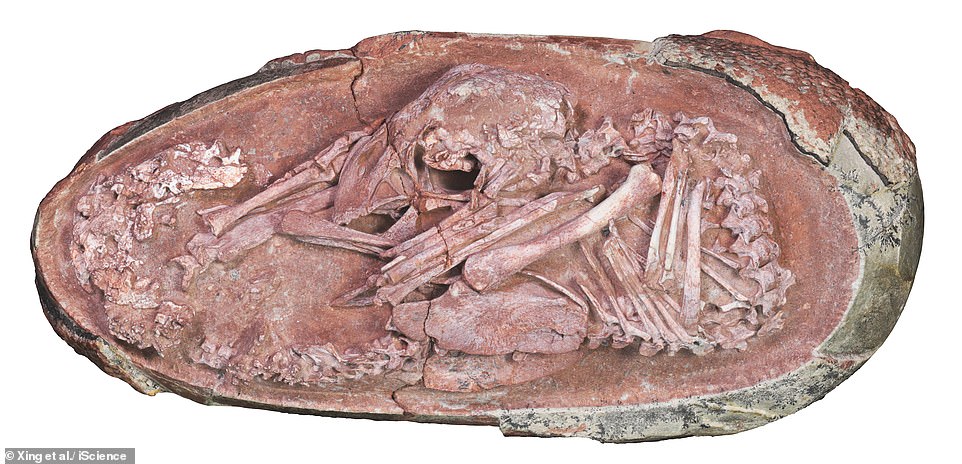

 Sauropods liked it HOT! Long-necked dinosaurs were...
 That's jaw-some! Theropod dinosaurs evolved more robust jaws...
 Dinosaur faces and feet may have popped with COLOUR to...
 Asteroid that wiped out the dinosaurs 66 million years ago...
 Move aside, Usain Bolt! Theropod dinosaurs could reach...
 Welcome to Italy's 'dinosaur trove'! Remains of up to 11...