Ontdek de Fascinerende Wereld van UFO's en UAP's: Jouw Bron voor Onthullende Informatie!
Ben jij ook gefascineerd door het onbekende? Wil je meer weten over UFO's en UAP's, niet alleen in België, maar over de hele wereld? Dan ben je op de juiste plek!
België: Het Kloppend Hart van UFO-onderzoek
In België is BUFON (Belgisch UFO-Netwerk) dé autoriteit op het gebied van UFO-onderzoek. Voor betrouwbare en objectieve informatie over deze intrigerende fenomenen, bezoek je zeker onze Facebook-pagina en deze blog. Maar dat is nog niet alles! Ontdek ook het Belgisch UFO-meldpunt en Caelestia, twee organisaties die diepgaand onderzoek verrichten, al zijn ze soms kritisch of sceptisch.
Nederland: Een Schat aan Informatie
Voor onze Nederlandse buren is er de schitterende website www.ufowijzer.nl, beheerd door Paul Harmans. Deze site biedt een schat aan informatie en artikelen die je niet wilt missen!
Internationaal: MUFON - De Wereldwijde Autoriteit
Neem ook een kijkje bij MUFON (Mutual UFO Network Inc.), een gerenommeerde Amerikaanse UFO-vereniging met afdelingen in de VS en wereldwijd. MUFON is toegewijd aan de wetenschappelijke en analytische studie van het UFO-fenomeen, en hun maandelijkse tijdschrift, The MUFON UFO-Journal, is een must-read voor elke UFO-enthousiasteling. Bezoek hun website op www.mufon.com voor meer informatie.
Samenwerking en Toekomstvisie
Sinds 1 februari 2020 is Pieter niet alleen ex-president van BUFON, maar ook de voormalige nationale directeur van MUFON in Vlaanderen en Nederland. Dit creëert een sterke samenwerking met de Franse MUFON Reseau MUFON/EUROP, wat ons in staat stelt om nog meer waardevolle inzichten te delen.
Let op: Nepprofielen en Nieuwe Groeperingen
Pas op voor een nieuwe groepering die zich ook BUFON noemt, maar geen enkele connectie heeft met onze gevestigde organisatie. Hoewel zij de naam geregistreerd hebben, kunnen ze het rijke verleden en de expertise van onze groep niet evenaren. We wensen hen veel succes, maar we blijven de autoriteit in UFO-onderzoek!
Blijf Op De Hoogte!
Wil jij de laatste nieuwtjes over UFO's, ruimtevaart, archeologie, en meer? Volg ons dan en duik samen met ons in de fascinerende wereld van het onbekende! Sluit je aan bij de gemeenschap van nieuwsgierige geesten die net als jij verlangen naar antwoorden en avonturen in de sterren!
Heb je vragen of wil je meer weten? Aarzel dan niet om contact met ons op te nemen! Samen ontrafelen we het mysterie van de lucht en daarbuiten.
Berichten van 1 december 2021 tot 31 december 2021
Welcome to Italy's 'dinosaur trove'! Remains of up to 11 creatures are uncovered near Trieste dating back 80 million years - including the biggest and most complete dinosaur EVER found in the country
The biggest and most complete dinosaur ever found in Italy has been discovered
Fossilised bones belonging to species Tethyshadros insularis found near Trieste
Researchers at University of Bologna said the dinosaur lived 80 million years ago
First skeleton found was identified as 'dwarf' species but new study disputes this
The biggest and most complete dinosaur ever found inItaly is among the remains of up to 11 such creatures uncovered by paleontologists.
Fossilised skeletons belonging to the species Tethyshadros insularis were discovered at a site called Villaggio del Pescatore near Trieste.
Researchers said the dinosaur lived on an island of the European archipelago in the Tethys Ocean 80 million years ago.
Fossilised skeletons belonging to the species Tethyshadros insularis (pictured in an artist's impression) were discovered at a site called Villaggio del Pescatore near Trieste
The skeleton of Bruno, an adult Tethyshadros insularis described in this new study
Tethyshadros insularis
Diet:Herbivore
Size:13ft (4 metres) long
Known locations:Italy
Time period: Late Campanian of the Cretaceous
It had been believed that the first Tethyshadros insularis skeleton found at the site was a 'dwarf species', but the latest study by the University of Bologna disputes this.
The team of experts said 'Antonio', as the first skeleton was dubbed, was actually a young dinosaur after discovering another one named 'Bruno' that was bigger in size and may still have been growing at the time of its death.
Geologists had previously said the Villaggio del Pescatore site, dubbed a 'dinosaur trove', was part of an island in the middle of a 'proto-Mediterranean' ocean called Tethys.
This led to experts incorrectly identifying Antonio as a 'dwarf' species because they thought it was an example of the so-called 'island rule' — the evolutionary miniaturisation of bigger animals in an insular environment due to the scarcity of resources.
Skeletal reconstructions of the two Tethyshadros insularis dinosaurs, with the younger specimen nicknamed 'Antonio' above and the older, newly-described skeleton of 'Bruno' below
The bones of 'Antonio' under the microscope, showing the bone cells (black, circled dots). The fossilised bone tissues were analysed to calculate the age of the dinosaurs at the time of death
The study found there were at least seven and probably 11 dinosaurs at Villaggio del Pescatore
The study found there were at least seven and probably 11 dinosaur skeletons at Villaggio del Pescatore, as well as the remains of fish, crocodiles, flying reptiles and even small crustaceans.
It also suggests that the site is about 10 million years older than previously thought, dating back around 80 million years to the Cretaceous period.
At that time, what is now north-eastern Italy was a land facing a vast ocean but connected to western Europe and Asia.
This means that not only small islands made up the ancient Mediterranean, but many migratory routes for large terrestrial animals like the dinosaurs might have been possible across land bridges of what we nowadays call Italy.
The skull of 'Bruno', the newly described skeleton of the dinosaur Tethyshadros insularis
The paleontological site of Villaggio del Pescatore, with experts working to extract the fossils from the 'dinosaur trove'
KILLING OFF THE DINOSAURS: HOW A CITY-SIZED ASTEROID WIPED OUT 75 PER CENT OF ALL ANIMAL AND PLANT SPECIES
Around 66 million years ago non-avian dinosaurs were wiped out and more than half the world's species were obliterated.
This mass extinction paved the way for the rise of mammals and the appearance of humans.
The Chicxulub asteroid is often cited as a potential cause of the Cretaceous-Paleogene extinction event.
The asteroid slammed into a shallow sea in what is now the Gulf of Mexico.
The collision released a huge dust and soot cloud that triggered global climate change, wiping out 75 per cent of all animal and plant species.
Researchers claim that the soot necessary for such a global catastrophe could only have come from a direct impact on rocks in shallow water around Mexico, which are especially rich in hydrocarbons.
Within 10 hours of the impact, a massive tsunami waved ripped through the Gulf coast, experts believe.
Around 66 million years ago non-avian dinosaurs were wiped out and more than half the world's species were obliterated. The Chicxulub asteroid is often cited as a potential cause of the Cretaceous-Paleogene extinction event
(stock image)
This caused earthquakes and landslides in areas as far as Argentina.
While investigating the event researchers found small particles of rock and other debris that was shot into the air when the asteroid crashed.
Called spherules, these small particles covered the planet with a thick layer of soot.
Experts explain that losing the light from the sun caused a complete collapse in the aquatic system.
This is because the phytoplankton base of almost all aquatic food chains would have been eliminated.
It's believed that the more than 180 million years of evolution that brought the world to the Cretaceous point was destroyed in less than the lifetime of a Tyrannosaurus rex, which is about 20 to 30 years.
Paleontologists in Italy have uncovered up to eleven skeletons belonging to a dinosaur species that lived approximately 80 million years ago. Included in these remains is the largest and most complete dinosaur that has ever been discovered in the country.
The bones, which belonged to a dinosaur species named Tethyshadros insularis, were unearthed at a location called Villaggio del Pescatore which is close to the Italian city of Trieste. It is believed that the creature inhabited one of the European archipelago islands in the Tethys Ocean.
Tethyshadros insularis was a type of herbivorous Hadrosauroid that grew as long as 13 feet (4 meters) and weighed as much as 350 kilograms (772 pounds). It had a long skull, short neck, short tail, and long legs (especially its shin bones). With the proportions of its body along with the reduced number of fingers, it probably ran on two legs.
(Not the Tethyshadros insularis)
Among the dinosaurs found was a young one named “Antonio” – this was the first one that was discovered and was previously believed to have been a “dwarf species” but new studies conducted by the University of Bologna have indicated that it was just a juvenile. Since the site where the bones were found was once part of an island, experts initially thought that the creatures were a “dwarf species” because of the “island rule” which meant that animals living on islands became smaller in size due to the lesser amounts of resources.
Another dinosaur named “Bruno” was larger than “Antonio” but might have still been in the process of growing when it died. In total, there were at least seven dinosaurs that were unearthed, but researchers say that the number is probably eleven.
Since the site is 80 million years old – 10 million years older than previously believed – terrestrial animals like the dinosaurs may have been able to cross land bridges in what we know today as being Italy.
(Not the Tethyshadros insularis)
In addition to the dinosaurs, researchers found the remains of flying reptiles, crocodiles, fish, and small crustaceans. Their study was published in the journal Scientific Reports where it can be read in full.
Pictures of the skeletons as well as what Tethyshadros insularis would have looked like can be seen here.
It may bear a somewhat uncanny resemblance to the terrifying creation in the Will Smithblockbuster I, Robot.
But this machine is actually real and has been billed as the 'world's most advanced' humanoid.
Named Ameca, it was created in a British lab and has eerily realistic movements and facial expressions.
Impressive: It may bear a resemblance to the terrifying creation in the Will Smith blockbuster I, Robot. But this is actually real and has been billed as the 'world's most advanced' humanoid
Named Ameca, it has eerily realistic facial expressions and movements and has been created in a British lab
Tech firm will pay you £150,000 to use our face on its ROBOTS
The idea of lending your face to a robot may sound like the plot from an episode of Black Mirror, but it could soon become a reality.
Robot manufacturer Promobot is seeking a face for its next humanoid robot, which will be used in hotels, shopping malls and airports from 2023.
The firm is offering a whopping £150,000 ($200,000) to the brave volunteer, who must be willing to transfer the rights to use of their face forever.
Cornwall-based Engineered Arts, which brands itself 'the UK's leading designer and manufacturer of humanoid entertainment robots', unveiled the machine on YouTube to much excitement.
Many viewers expressed their amazement at how realistic and human-like the machine is.
One user wrote: 'I know we're supposed to be scared of AI, but this is the first gynoid that hasn't creeped me out. It's pretty cool.'
Another said: 'It's the eyes. People take for granted how important eyes are when it comes to something looking alive.
'The rapid movement, the focus, the blinking, the attention they seem to pay to whatever is grabbing their attention.'
A third added: 'I seriously thought this was CGI at first. Great work! The hands look really well done too.'
Some people compared Ameca to the NS-5 series from I, Robot, a 2004 science fiction film starring Will Smith that sees intelligent robots fill public service positions in a dystopian world.
In the clip, the robot is seen warming up its shoulder, before opening its eyes and expressing a rather convincing look of shock or surprise.
It even blinks multiple times and observes its machine arm with curiosity.
Engineered Arts, which brands itself 'the UK's leading designer and manufacturer of humanoid entertainment robots', unveiled the machine on YouTube to much excitement
Many viewers expressed their amazement at how realistic and human-like the machine is
The preview ends with Ameca reaching out its hand and admiring its combination of mechanical limbs and ligaments, actuators, and sensor arrays.
It is certainly realistic and at the forefront of its field in terms of its expressions, but the next challenge will be enabling these robots to walk around.
Engineered Arts said it was still a long way off that, but added that the face is housed on a 'human-like artificial body (AI x AB)' that boasts a 'powerful Tritium robot operating system'.
It has not revealed how much the robot cost to make as it is still in development.
In the clip, the robot is seen warming up its shoulder, before opening its eyes and expressing a rather convincing look of shock or surprise
It even blinks multiple times and observes its machine arm with curiosity
(pictured)
Some people compared Ameca to the NS-5 series from I, Robot (pictured), a 2004 science fiction film starring Will Smith that sees intelligent robots fill public service positions in a dystopian world
Ameca follows the development of Sophia, which first emerged in 2016, and was a super-intelligent human-like head with a realistic face that was able to blink, look from side to side and talk.
The humanoid robot, created by Hong Kong firm Hanson robotics, is able to chat, smile mischievously and even tell jokes.
The robot made history in October 2017 when it became legal a citizen of Saudi Arabia.
Engineered Arts hopes Ameca will offer people a glimpse of the future because it 'represents the forefront of human-robotics technology'.
'Designed specifically as a platform for development into future robotics technologies, Ameca is the perfect humanoid robot platform for human-robot interaction,' the company said on its website.
'We focus on bringing you innovative technologies, which are reliable, modular, upgradable and easy to develop upon.'
Engineered Arts was formed in 2005 and its first robot was a mechanical 'Thespian' for the stage.
WHO IS SOPHIA THE ROBOT?
In October 2017, Sophia was granted citizenship in Saudi Arabia
Sophia first emerged in 2016 as a super-intelligent human-like head with a realistic face that was able to blink, look from side to side and talk.
The humanoid robot, created by Hong Kong firm Hanson robotics, can chat, smile mischievously and even tell jokes.
The robot made history in October 2017 when she became legal a citizen of Saudi Arabia.
The stunt made Sophia the world's first robot to be granted legal citizenship.
While Sophia has some impressive capabilities, she does not yet have consciousness.
Hanson Robotics claims fully sentient machines could emerge within a few years.
Sophia herself has insisted 'the pros outweigh the cons' when it comes to artificial intelligence.
'Elders will have more company, autistic children will have endlessly patient teachers,' Sophia said.
Como en New York, volvieron aparecer las luces de ovnis centellas y esta vez ez en la India
Note peter2011:
These lights remind me of multiple searchlights spinning at a certain frequency and shining into the sky. In the early 90's I experienced the same with a searchlight at a dancing Pharao in Halen, Belgium. It was such a real sight that people called the police and the Belgian Air Force sent 2 F16's to it. The resemblance is striking!
“Shocking images.” “Draw Your Conclusions.” “This is not a joke.”
Those types of headlines are sure to draw in readers and viewers, so the Colombian media sprinkled them liberally in their coverage of a UFO sightings recorded by a popular celebrity and reality show judge – two characteristics that also attracted attention to a video that appeared to be picked up and reported on by multiple media sites. What did César Escola see to earn that much coverage?
“To bother with my new cell phone, I started to record the landing of the two planes, so when I record the second plane, I start to look at the video again, as one normally does to see how it turned out. But there was a moment that my eye, after having worked so long on television, detected something strange and I began to search in slow motion. I want you to give your opinion and draw your own conclusions.” (Google translation)
A re-creation of the UFO sighting?
César Escola is a Colombian-Argentine musician, composer, television presenter and reality show judge on “Yo me llamo” (My name is). He claims that on November 26 he was at the El Dorado International Airport in Bogota waiting for his flight and decided to play with smartphone by recording planes landing. Reviewing the videos, his ‘trained’ eye picked up some blurred motion from right to left, so Escola played with the video speed slowed down. What he saw was not something his ‘trained’ eye could identify, as he posts on Instagram.
“Strange object in El Dorado? Help me understand? I share with you what happened to me yesterday 11/26/21.”
“What will it be?”
“Above all, what the authorities think officers. ” (Google translation)
What will it be? Take a look for yourself here or here (on a network TV show with appropriate music) and “draw your own conclusions.”
Many of the conclusions first point out that César Escola is a multimedia star and currently a judge on a reality show, so he has a lot of products that could benefit from this kind of ‘celebrity UFO’ publicity. The prevailing theory is that Escola’s ‘trained’ eye did not recognize a bug flying through his field-of-view but not in the same focal point as the landing planes. He says he’ll make the video available to “authorities” but he’s a celebrity – why didn’t he rush to the authorities while he was at the airport and have the control tower look at the radar?
For comparison purposes — a bug
Sorry, Cesar … unless you have more evidence, this sounds like an episode of “I’m a Celebrity … Let Me See if I Can Fool the Public With a UFO Video and Get Some Media Face Time.” No joke.
Footprints that were made 3.7 million years ago were initially thought to have been made by an ancient bear, but new analysis has revealed that they were instead made by an ancient human ancestor.
The most famous set of Laetoli footprints were made by adult A. afarensis and discovered in 1978.
(Flickr: Tim Evanson)
Located in Tanzania, Laetoli trackway is a well known site for the thousands of footprints that have been found over the years. There are about 18,400 tracks that have been made by numerous animals that include giraffes, hyenas, and ostriches, as well as ancient hominins that walked on two legs.
Millions of years ago, an ancient ancestor of ours walked on two legs along volcanic ash that eventually turned into rock. These footprints were discovered at Laetoli “Site A” back in 1978. They were initially described as being left by a bear; however, new analysis has completely turned that explanation around.
The new study, which was conducted by Ellison McNutt who is an anthropologist at Ohio University, along with colleagues, compared the prints to those made by bears (Ursus americanus), chimpanzees (Pan troglodytes), and humans.
Interestingly, they found that the prints were completely different from others that were made by another hominin species at an area close by. Footprints that were discovered at Sites G and S were left by the Australopithecus afarensis species (“Lucy” belonged to this group). They were made by individuals who were between 111 and 168 centimeters in height.
But the ones made at Site A were made by a smaller individual measuring about 100 centimeters tall – perhaps they were left by a child. In fact, whoever made the footprints is still an unknown hominin species.
The Site A footprints did resemble those left by a bear as they showed a foot that was short but very wide – even the heel was wide. The impression revealed a big toe with a second toe that was almost as long. But the experts were able to rule out bears and chimpanzees as they have heels that are narrower. Additionally, there weren’t any claw marks that would have been left behind if it was a bear.
Another interesting feature was that its big toe pointed out towards the side of the foot which may indicate that the species gripped tree branches with its toes. It also appeared to have a raised ridge which is another characteristic of tree-climbing species. Furthermore, the individual walked in an odd cross-stepping pattern with one leg crossing over the other. The research was published in Naturewhere it can be read in full.
Mystery footprint (l) compared to A. afarensis (r) at Laetoli.
(McNutt et al., Nature, 2021)
This photo shows Anjali Prabhat and Jeremy DeSilva, associate professor of anthropology at Dartmouth, excavating Site A footprints at Laetoli, Tanzania. Prehistoric footprints that have puzzled scientists since the 1970s are getting a second look: Were they left by extinct animals or by human ancestors? When famed paleontologist Mary Leakey first uncovered the footprints in Tanzania 40 years ago, the evidence was ambiguous.
Credit: Shirley Rubin via AP
In this photo from video, Ellison McNutt collects data from a juvenile female black bear (Ursus americanus), who walks bipedally, unassisted through the mud trackway at Kilham Bear Center in Lyme, N.H. Prehistoric footprints that have puzzled scientists since the 1970s are getting a second look: Were they left by extinct animals or by human ancestors? When famed paleontologist Mary Leakey first uncovered the footprints in Tanzania 40 years ago, the evidence was ambiguous.
Credit: Jeremy DeSilva/Dartmouth College via AP
Dr. Mary D. Leakey, of the National Geographic Society in Washington, Feb. 24, 1978 holds hands near a picture of a footprint found at Laetolil, Tanzania. It is believed the track belongs to a hominid who lived between 34 and 3-¾ million years ago and was about 4-foot tall. rehistoric footprints that have puzzled scientists since the 1970s are getting a second look: Were they left by extinct animals or by human ancestors? When famed paleontologist Mary Leakey first uncovered the footprints in Tanzania 40 years ago, the evidence was ambiguous.
Credit: AP Photo/File
This undated photo from video shows the left footprint from one of the juvenile male black bears. Prehistoric footprints that have puzzled scientists since the 1970s are getting a second look: Were they left by extinct animals or by human ancestors? When famed paleontologist Mary Leakey first uncovered the footprints in Tanzania 40 years ago, the evidence was ambiguous.
Credit: Ellison McNutt/Dartmouth College via AP
The underside of a bear's paw looks a bit like a broad human foot — except for the fur and claws.
(Getty Images: Gail Shotlander)
Did Australopithecus afarensis live alongside a mystery cousin in what is now Tanzania?
Group Of UFO "Orbs" Sighted Over The South China Sea At 39,000 Feet. November 24, 2021
Sorry guys i told you in the video that this happen on the 11th, That was wrong.
THIS HAPPEN ON THE 24th OF NOVEMBER.
The witness stated the following: "South China sea, 9 lights visible in video, then it becomes 12 lights in formation, closest object disappears then 3 more objects reappear on outside of formation. Filmed at 39,000ft over the South China Sea, lights all then slowly vanish."
UFOs Over Turkey On April 23, 2021, UFO Sighting News.
Date of sighting: April 2021 Location of sighting:Turkey
Watch as this eyewitness in Turkey records two dark black disks. I say disks because you can actually see them wobble slowly. The dark disks must have been seen by others, because there is all hell breaking loose on the ground with sirens and yelling below. This is 100% proof that UFOs have a high interest in Turkey.
Scott C. Waring - Taiwan
Eyewitness states:
Also, I don't think harp planes etc can rotate around their own axis. confirmed, friends, I can't go into much detail, but we talked to an expert in this field from turkey for 30 minutes on the phone. It could also be the subject of a documentary to be shared with foreign sources, first, I'm sharing it myself for fun. don't take it too seriously believe what you want to believe.
Alien Signals Coming From Colorado Lake, UFO Sighting News.
Date of discovery: Dec 4, 2021 Location of discovery:Steamboat Springs, Colorado
Updated just now: Colorado TV New channel is now talking about it...video below.
This video was recently posted by an employee of the Colorado Parks and Wildlife service on Twitter. The person was baffled by the strange Star War sounds coming from the lake. White sphere UFOs have been recorded and eyewitnesses by thousand of residents of Colorado over the last few years. The signals point to there being an alien base deep below the lake, which amplifies the sounds below due to it being frozen...it acts like an amplifier. Alien bases are never small. Most are 3-6km deep and cover an area of about 5km and even have their own weather system...with chances of rain. This is 100% proof of an alien base below this lake in Colorado. But...if signals can travel up from the alien base, then it would also work to send signals back down to the base. A loud enough speaker placed in a dug out 1 meter deep ice hole at the center of the lake would be sufficient to send them a sonic signal. But...what would you say? In the wrong hands, it could cause an alien military response.
Ever since we started gazing up at the night sky above us and were first aware that there was something out past the planet we live on we have looked to the stars and wondered what lies out there and whether we are alone in the universe. Philosophers, thinkers, and scientists alike throughout history have contemplated this since time unremembered, looking out to the vast sea of stars and pondering what might lie out there. In modern times, the stars themselves have given us strange clues about the nature of the universe, and have even at times hinted at the answer to our question of whether we are alone in the universe, and here are some of the most baffling and bizarre of all.
By far the most well-known weird star that has attracted stories of alien influences is the one called Tabby’s star, also known as Boyajian’s star and occasionally jokingly known as the WTF star. In 2015, scientists noticed unusual fluctuations in the light from a star with the rather dry and scientific sounding name KIC 8462852, located in the constellation Cygnus, about 1,480 light-years from Earth. Mostly it is just a rather ordinary F-type star, meaning it is slightly larger and hotter than our sun, but it would soon turn out that there was something definitely odd going on with this one. When various data collected on the star by NASA’s Kepler space telescope, which is designed to detect exoplanets, astronomer Tabetha “Tabby” Boyajian, of Yale University, noticed that KIC 8462852 would sporadically dim in brightness by up to 22%, with such dips lasting anywhere from a few days to a week and with no obvious explanation. These dimming events did not seem to follow any discernible pattern or rhythm, and were not consistent with what one would expect to see with normal activity such as planets or dust crossing the star.
At the time it was rather bewildering, with no other known example of a star with such a unique and bizarre dimming phenomenon, and astronomers scrambled to try and explain it. Ideas included that it was an uneven ring of dust orbiting the star, fluctuating luminosity caused by uneven heat transfer or cooling of its photosphere, a swarm of disintegrated comet fragments, a field of asteroids, a series of giant planets with very large ring structures, a planetary debris field created by the remnants of a destroyed planet or moon, and others, but none of these fully fit the observed data, and without any other examples there was nothing to compare it to. But why have all of these boring explanations when you can have aliens? Perhaps the most controversial and at the same time fascinating hypothesis is that the dimming phenomenon is caused by some vast megastructure built around the star by an advanced, intelligent alien civilization, and here’s where things get interesting.
The main thrust of this idea is that the star could be surrounded by a hypothetical megastructure called a Dyson sphere, so immense that is partially or completely encompasses the star. First proposed in 1960 by the mathematician and physicist Freeman Dyson, these Dyson spheres would hypothetically be built around a star to harness its energy in order to power the technology and civilization of an extraterrestrial race, and they are theorized as taking the form of either a shell or scaffolding around the star, or globular swarms of giant solar panels orbiting it. Dyson saw this as almost inevitable for any advanced space going civilization, and would write:
One should expect that, within a few thousand years of its entering the stage of industrial development, any intelligent species should be found occupying an artificial biosphere which completely surrounds its parent star.
In this scenario, the dimming could be caused by either the structure passing over the star’s face to block its light, creating the weird dimming, or by blasts of infrared caused by the radiating heat of the energy the aliens did not use, sort of like an energy exhaust port. Although this was just conjecture and really one of the last explanations scientists were entertaining, the media snapped it up and soon Tabby’s Star was all over the news as the star with aliens around it, and the search for extraterrestrial intelligence (SETI) was enamored enough with the idea to make it a prime target for searching for radio signals from aliens. They got no particularly odd signals from there, but considering we are seeing what the star looked like 1,480 years ago perhaps the aliens are just no longer there. After further analysis it is believed that it is likely caused by dust, debris, or the disruption of an orphaned exomoon, although scientists have not fully taken the alien megastructure hypothesis off of the table.
Interestingly, in later years it has turned out that Tabby’s Star is not so completely unique after all, and there have been a few others found with comparable unexplainable dimming patterns and events. One of these is the star KIC 4150611, which also had an odd flickering that hasn’t been explained, as well as the star EPIC 204278916, and the star VVV-WIT-07, with “WIT” amusingly standing for “What is This?”, which has mysteriously dropped up to 80% in brightness at times and has been called a “one in a billion object” by astronomers. More and more of these so-called “dippers” are being found all of the time. Edward Schmidt, an astrophysicist and emeritus professor of astronomy at the University of Nebraska-Lincoln, has extensively studied and mapped such stars, amassing a list of more than a dozen flickering stars like Tabby’s Star. These stars have different patterns and speeds of flickering, with some being “slow dippers” while others are “rapid dippers,” but all are so far beyond any conventional explanation. While Schmidt, like other astronomers, is trying to find rational answers, he has not dismissed the possibility that extraterrestrial intelligences could be to blame, and has said of these mysterious stars:
The thing that surprised me the most were these stars that had so many dips, the ones I called ‘rapid dippers.’ I expected more occasional dips like Boyajian’s star. I intend to try and follow up on the rapid dippers. One thing I noticed about them is that at least one seemed to be slowing way down in its dipping rate over the five years of coverage we have of it. It’d be interesting to find out what happened in its past, which may help give a better idea of what’s going on with these stars. Many explanations for these stars is that something is passing in front of them, but the fact that the stars all fall within a narrow range of properties suggests that may not be it. Extraterrestrial intelligence is a low-probability explanation but it’s a possibility, and the SETI people ought to be looking at these stars.
What is going on with these stars? No one really seems to know for sure. It’s not only changes and anomalies in the brightness of these stars that suggest possible alien activity, but also the spectrum of their chemical elements. In 1960, Polish-Australian astronomer Antoni Przybylski was studying fast-moving stars in southern skies when he saw one that caused him to note “No star should look like that.” The star itself is hotter than our sun, as well as twice the diameter and four times the mass, but what surprised Przybylski was that it harbored a chemical spectrum that seemed to be impossible. Each star has a spectrum that shows the imprint left by its chemical components, and this can be detected with our instruments, but this star had a highly unusual mix of chemicals unlike any other. There were detected strontium and all 15 rare Earth elements, which is not so unusual, but there are also radioactive elements such as neptunium, plutonium, and curium, and the problem is that these radioactive elements should not be there. Jason Wright, a professor of astronomy and astrophysics at Pennsylvania State University, has explained of this, “These are all short-lived elements—they have half-lives of as little as a year or so. But the star has been there for millions of years, so the elements should have decayed away.”
So how did this happen? Some of the more rational scientific explanations include that these elements are being pulled up to the surface by magnetic fields and radiation pressure from below, or that they are somehow being bombarded onto the star by some outside cosmic phenomenon. It could also be that the star passed through an interstellar cloud which contained these elements, or that it devoured a planet that had a high concentration of them. Or it could be aliens. That’s more fun, let’s talk about that. There has been speculated the possibility that the presence of these anomalous elements could be because a spacefaring alien civilization is intentionally dumping them there. The hypothesis is that extraterrestrials from one of the star’s planets could be using their sun as a dumping ground for their radioactive waste, simply launching it into the star to dispose of it. The idea itself is not so far-fetched, as even here on Earth the idea of launching nuclear waste into the sun has been proposed occasionally in the past but was considered too expensive and impractical. Perhaps this race has figured out a way to do it, and that is why these elements are present there. Is this an alien garbage dumping ground or is there a more rational explanation? Who knows?
Perhaps even stranger than flickering stars and those with anomalous chemical balances are those stars that just seem to completely disappear for no explainable reason. Throughout historical and contemporary astronomical data, there have been around 100 stars or at least star-like celestial objects that have just sort of vanished without a trace under observation. They are called “red transients” or more colloquially “vanishing stars,” due to the fact that they typically start off as dim red dots, before experiencing a burst of brightness, up to several thousand times their starting luminosity and then completely disappearing as if they were never there. This usually happens within one hour, and it has been completely baffling astronomers.
A team led by Beatriz Villarroel, from Stockholm University and the Institute of Astrophysics of Canarias in Spain, discovered the phenomenon during a search of astronomical records looking for vanishing objects in the night sky in a project called Vanishing & Appearing Sources during a Century of Observations (VASCO). They have been studying the phenomenon of red transients since 2017 and have ruled out the explanations that they are asteroids, fast-moving stars, or stars that have just moved out of view. These are something else, although what that could be is up for debate. The thing is, stars don’t just spontaneously disappear. When a star dies off, it is a long, slow process of turning into a white dwarf star and fizzling out, or exploding into a supernova, which would definitely leave a trace behind. There is nothing to explain how one could just completely vanish without a trace within the space of an hour, and so scientists have been scratching their heads trying to find an answer. Some ideas are that the phenomenon is caused by massive solar flares emanating from red dwarfs, or that they were sucked into a black hole, but yet another explanation has of course been aliens. Villarroel would say in an article in the Astronomical Journal:
Unless a star collapses directly into a black hole, there is no known physical process by which it could physically vanish. If such examples exist this makes it interesting for searches for new exotic phenomena or even signs of technologically advanced civilizations.
Just like in the cases of the other strange stars we have looked at here, the scientists are not eager to embrace the alien theory, but nor can they completely rule it out considering how bizarre and unprecedented the anomalies are. In the extraterrestrial scenario, it is thought that it could be caused by either massive lasers or heat waste from Dyson spheres. It is certainly a strange possibility, but in the absence of any concrete answers it has not been waved away. Nevertheless, the team is trying to eliminate all other possibilities before deciding on the alien hypothesis, and a co-author of their paper on the matter has said, “But we are clear that none of these events have shown any direct signs of being ETI (extraterrestrial intelligence). We believe that they are natural, if somewhat extreme, astrophysical sources.” However, whenever dealing with some new and inexplicable astronomical phenomenon the possibility that it just might be caused by aliens is always eerily hanging in the background. Andrew Siemion, director of the Berkeley SETI Research Center, has explained of the hypothesis of extraterrestrial influence on these phenomena:
It’s a fine line. We have no evidence for technologically capable life anywhere else in the universe. So one doesn’t want to immediately leap to that solution for any newly discovered astronomical phenomenon. But at the same time, one doesn’t want to neglect the possibility that it could be going on.
What is going on with these stars? As we penetrate further out into the cosmos we are encountering more and more weirdness like this all the time, so what could it all mean? Is this just mundane forces that can be explained away with more knowledge? Is it it all just normal forces at work or is there something more to it? Could there possibly be alien intelligences out there that could account for these anomalies? While scientists like to shy away from such answers, they are still hesitant to rule it out, and through these mysterious stars we might just see that the universe could hold deep mysteries that could answer our question on whether we are alone in it all. Time will tell, and in the meantime, these stars keep doing their mysterious dance, in some ways just as impenetrable and inscrutable as they were at the dawn of our consciousness that they even existed at all.
Space Mysteries: Did an unidentified flying object really crash land at a New Mexico ranch in 1947, only to be hushed up by the government?
Did an unidentified flying object really crash land at a ranch near Roswell, New Mexico?
(Image credit: Getty Images )
There is a spaceship that looks like a flying saucer in Roswell. Thousands of motorists drive past it every day, and hundreds of people go inside. It’s on North Main Street in this southeastern New Mexico city, its metal skin gleaming as it basks in the glow of the sun. Its neon lighting burns into the retinas of those who view it throughout the evening, and it’s rather hard not to admire. After all, aside from its striking looks, who doesn’t fancy a burger every now and then? That’s right: This spacecraft is one of the city’s McDonald’s restaurants.
So why is the building shaped that way? It’s not that far from the site of a mysterious incident which took place in 1947 — the day when a rancher discovered debris scattered around his sheep pasture, prompting speculation that an unidentified flying object, or UFO, had crashed there.
In June, or possibly early July 1947, William Brazel had woken for a normal day’s work on the J.B. Foster ranch in Lincoln County, New Mexico, 75 miles (120 kilometers) north of Roswell, when he made a shocking discovery. He found on the ranch "a large area of bright wreckage made up of rubber strips, tinfoil, a rather tough paper and sticks," Brazel said in an article published on July 8, 1947, in the Roswell Daily Record.
Brazel hadn’t heard of flying saucers — at least not yet. Sightings, however, were coming in thick and fast around that time. On June 24, pilot Kenneth Arnold claimed to see nine unidentified objects "flying like a saucer would across water" near Mount Rainier, Washington. Arnold estimated that the objects were flying at around 1,200 miles per hour (1,930 kilometers per hour), Arnold was reported as saying in the East Oregonian, but at the time there were no known craft that could reach those speeds. The Air Force also said it had no new experimental planes or guided missiles that would fit such a description, according to a U.S. Department of Defense report. That story became front-page news, and the term "flying saucer was born, despite Arnold describing the flying objects as crescent-shape," according to New Scientist.
The country soon became gripped, as Brazel discovered. By July 7, policemen and astronomers were reportedly being harassed for further reports, this time by people from New York and other eastern states, and that was the day Brazel decided to take action. He hand-delivered a box of accumulated debris, which he’d gathered with the help of his wife and two children, to Sheriff George Wilcox of Roswell, according to Smithsonian Magazine.
All About Space magazine takes you on an awe-inspiring journey through our solar system and beyond, from the amazing technology and spacecraft that enables humanity to venture into orbit, to the complexities of space science.
By now there was talk of a reward for anyone who recovered one of these unidentified flying objects. In the Roswell Daily Chronicle, Brazel is stated to have "whispered kinda confidential-like" that his find may be one of the flying disks, so an equally intrigued Wilcox contacted Colonel William Blanchard, the commanding officer of the Roswell Army Air Field (RAAF), who sent agents to the site to gather the remaining material.
What happened next would cement the idea that the debris was the remnants of an alien spacecraft. According to David Clarke’s book "The UFO Files: The Inside Story of Real-Life Sightings", published by Bloomsbury in 2012, the RAAF’s public information officer Walter Haut issued a press release on July 8: "The many rumors regarding the flying disc became a reality yesterday when the intelligence office of the 509th Bomb Group of the Eighth Air Force, Roswell Army Air Field, was fortunate enough to gain possession of a disk through the cooperation of one of the local ranchers and the sheriff’s office of Chaves County
This was reported in the Roswell Daily Record along with the news that Major Jesse A. Marcel was the group intelligence officer dispatched to the scene. He’d gone with Counter Intelligence Corps officer Sheridan Cavitt, but on his way back took a detour to his own home, whipped out a couple of boxes of debris that he’d popped into the boot of his car and showed it to his 10-year-old son, Jesse Jr. One of the objects was said to have hieroglyphic-like markings, something that stuck in the mind of the young boy, according to a report in The Guardian.
But just as quickly as excitement of the find gathered pace, the Army took swift action in debunking the story. The very next day, shortly after government scientists began to arrive at the scene, it was claimed that the debris was actually from a crashed weather balloon, and Marcel was asked to be pictured at a press conference with the debris allegedly found. And that was that, case closed — or so everyone thought.
But interest began to grow again. In 1978, Nuclear physicist, author and UFO researcher Stanton Friedman interviewed Marcel, who said that the discovery made 31 years earlier was not from this world, and that the government had ordered him to keep quiet. Friedman revisited the incident and sought other witnesses, and his work inspired Charles Berlitz and William Moore to write "The Roswell Incident", published in 1980. Their conclusion was simple: there had been a huge cover-up.
The flying saucer conspiracy begins
Other things were happening in the world at the time. Notably, the sci-fi films "Star Wars" and "Close Encounters of the Third Kind" had just been released, and — as reported by The Times — studies since have suggested that sightings and belief in UFOs rise when popular films and TV shows make their debut. Nevertheless, testimonies about that day in 1947 were forthcoming, and they continued to come for many years.
Glenn Dennis called a hotline shortly after an episode of "Unsolved Mysteries" featuring the Roswell incident aired in 1989. He suggested that a friend who worked as a nurse at the Roswell Army Air Field saw three alien bodies, according to TIME Magazine. But the real bombshell moment came in 1994. Could it be that the debris really was from an alien craft?
According to the U.S. Air Force, no. The weather balloon story was not true, but it wasn’t to hide the fact that little green men had visited Earth. The wreckage was actually that of a classified project that flew microphones on high-altitude balloons so that sound waves generated by Soviet atomic bomb tests could be detected. Called Project Mogul, it was said to have run between 1947 and 1949. What’s more, the balloons were claimed to have been made up of unusual material — the type that could easily be confused for a UFO. So, case closed? Not at all.
"The ever-changing accounts gave rise to uncertainty," Kenneth Drinkwater, senior lecturer in psychology at Manchester Metropolitan University, U.K., who specialises in the anomalous and paranormal, said via email. "The first message that went out was unclear. Then they changed the message, and it led to suspicion that something was going on and being covered up. It gives rise to a feeling that something is being hidden from the general population, leading to speculation of possible conspiracy and possibly alien technology."
Huge balloons developed by Seyfang Laboratories were used during Project Mogul, according to a U.S. government report issued in 1994. Their metallic exterior coating meant they were often mistaken for flying saucers. (Image credit: U.S. Government )
It’s why the Roswell files remain open in the eyes of many, and investigators put great value on the testimonies of those who were there, many of them respected military personnel. "Every member of Blanchard’s senior staff, with a single exception, suggested the craft was of alien origin," Kevin D. Randle, a retired lieutenant colonel of the U.S. Army Reserve who served in Vietnam and Iraq, told All About Space. "Major Edwin Easley, the base provost marshal, told me, when asked if we were following the right path — meaning extraterrestrial — that it wasn’t the wrong path."
The "single exception" is Cavitt, the retired lieutenant colonel of the Air Force who accompanied Marcel to the debris site. His careful testimony suggested that nothing untoward happened. He said he had never been threatened by anyone in government and that the debris wasn’t extensively scattered. Yet UFO investigators say that if the wreckage was Project Mogul, then this testimony doesn’t ring true. Mogul arrays were big, so the debris field would have been large.
"Everyone agrees that something fell at Roswell, but there is no terrestrial explanation," Randle told All About Space. "Project Mogul fails because the documentation tells us that flight number four — the alleged culprit — was cancelled. It did not fly. All other explanations have failed too: It wasn’t an aircraft accident, not a rocket from White Sands and not a regular weather balloon."
Over the past 40 or so years there have been new claims and fresh leads, adding to the mystery and keeping the Roswell files very much alive. UFO investigator Calvin Parker, for example, recently spoke of his time with Marcel before he died in 1986, claiming that Marcel revealed that he’d hidden three pieces of metal from the crash site in the top of his water heater in his house. They have never been recovered, however.
Many UFO investigators are keen to stress that they don’t take every testimony at face value. Randle previously said that the credibility of Dennis must be discounted because of inconsistencies, and told All About Space that the accounts of military personnel are not simply accepted just because of their background. "There are some military witnesses who have been discredited as inserting themselves into the tale," Randle wrote via email. Likewise, there are civilian witnesses who are compelling.
"There are some very creditable civilian witnesses, such as Brazel and Frankie Rowe," said Randle. Rowe is certainly an interesting case. She was told of the crash by her father, a firefighter, who described creatures he had seen. According to Randle, Rowe said she was shown debris from the crash site, but had been told to stay quiet by the state. She says there was evidence her phone had been tapped. But of all of the witnesses, is too much weight being put on Marcel’s account?
In 1947, Brigadier General Roger M. Ramey and Colonel Thomas J. Dubose identified fragments found by the rancher as pieces of a weather balloon. The story changed in 1994, however. (Image credit: Getty Images )
"If Marcel was standalone then there would be some real problems here, but he is not. There are many credible witnesses — men who achieved high military rank, men and women who were prominent in their communities — who believe the craft was alien,” Randle said. "We have attempted to eliminate the fakers from those who had information to provide. We have been taken in, for a time, by some of those fakers, but in the long run it was we who investigated the case that removed many of those fakers, though based on evidence and not a belief there is no alien visitation. The point is that Marcel was backed up by other high-ranking officers, and many civilians who were part of the case. Marcel told what he had seen and done, and there was little embellishment in his testimony."
Randle appeared in the documentary, "Roswell: The First Witness". It follows the investigations of former CIA operative Ben Smith into Roswell, and a key part of the series is a journal found in Marcel’s possessions that was initially thought to have been written by him.
Speculation continues: Was the craft of alien origin?
It turned out that the journal — which consisted of quotes, lyrics and jokes — could be dated to the time of the Roswell incident, but the handwriting didn’t match Marcel’s. Smith pondered why the former army officer retained the journal, and there was speculation over whether it may have contained a code. If it did, however, it could not be deciphered by even the best of minds, according to the documentary.
Smith also sought to discover what was written in a document held by Brigadier General Roger Ramey, Eighth Air Force commander, during the press conference. It was captured in a photograph taken by Star-Telegram reporter J. Bond Johnson, and ufologists have long wondered whether the words they struggle to make out refer to "victims of the wreck." As Smith found, however, even the best technology could not sufficiently clean the document enough to make the words readable, and they remain a source of debate.
There were other interesting explorations in the documentary series. A body-language expert examined video interviews of Marcel and said it appeared that he was telling the truth, at least as he saw it. Experts including aviation crash investigator David Soucie were also taken to examine the crash site. Interestingly, the wind currents in the area were found to be inconsistent with a lightweight balloon crashing in the way that was described.
As the documentary continued, more evidence emerged. Crucially, there was a taped interview conversation between Marcel and author Linda G. Corley in which the military man discussed the items he found in 1947. "I found all this stuff and I was told to keep my mouth shut,” he told her. “I held on to this premium for 32 years without saying anything at all. See, I was an intelligence officer. I handled intelligence and security for the base. I still hold an allegiance to my country, the vow that I took to keep my mouth shut about everything that might encroach on military secrets."
Just as compelling was an account from the family of Patrick Saunders, the 509th adjutant who is likely to have known about the whole event. He had apparently told people that it wasn’t a weather balloon, but something similar to a jet fighter, that files were destroyed or changed and that the world wasn’t ready for the truth because it would cause social upheaval. Were the "beings" friendly, he was said to have pondered.
Protestors march in front of the General Accounting Office in the mid-1990s, convinced of a government cover-up over what happened. (Image credit: Getty Images )
This kind of testimony — particularly the first-hand testimony of Marcel that was chronicled in Corley’s book, “For the Sake of My Country” — ensures the incident remains open. The fact the US government admitted there was a cover-up in 1994 only continues to add fuel to the fire.
Yet Drinkwater says failure to provide physical evidence means anecdotal accounts have spread misinformation, and he remains in doubt. "Colonel John B. Alexander offers an excellent insight into the myths and possible conspiracies connected to UFOs, the Roswell incident, the government involvement and so on," he said. "I think it’s more about a sense of reality and how it can be swayed emotionally. I’m dubious about the nature of a secret operation where many might not have known about the goings on at their level."
So what of those who likely know: presidents past and present, perhaps? Former president Donald Trump told his son Don Jr. in an interview on YouTube in June 2020 that he’d heard some "interesting things" about aliens, thereby ensuring speculation will continue for some while yet.
"Would you ever open up Roswell and let us know what’s really going on," Don Jr. asked, to which Trump responded: "There are millions and millions of people who want to go there and want to see it. I won’t talk to you about what I know about it, but it’s very interesting."
That’s something countless people will no doubt chew over if they happen to visit and find themselves in that extraordinary McDonald’s. Roswell is a town that will be forever linked to one of the greatest mysteries of all time, and we may never truly reach a consensus on the truth that is out there.
In relation to the question I have posed at the top of this article, it’s not as easy as you might think. The biggest problem is that apart from aone-page FBI document on the Roswell case from 1947, there is nothing else to be seen or found in government archives. No documents. No files. No dossiers at the National Archives that we can read. Nothing. There are only (a) the memories of the families of the people who were at the site and at the time, and (b) the words of the very few who are still alive, and (c) the handful of military personnel who are just about hanging on. Despite several investigations into the Roswell affair in the 1990s (two by the U.S. Air Force and one by what used to be called the General Accounting Office, and what is now titled the Government Accountability Office), nothing appeared of substance. Just about everyone who has an interest in UFOs will know that back in the summer of 1947, something crashed to Earth outside of Roswell, New Mexico. The object was first described as a “Flying Disk,” and a day after that as nothing stranger than a weather-balloon. And that’s where things stopped and were largely forgotten until Bill Moore and Stan Friedman resurrected the mysterious affair in the mid-1970s. And, although a great deal of testimony is now on file, we still haven’t found a single, solid piece of anything; whether photos of dead bodies, old files or…well…anything.
Now, many might say that the reason why we haven’t been able to penetrate the secret of Roswell is because the U.S. Air Force has it all hidden away. However, I don’t believe that, at all. You’ll see what I mean by that. When, in the 1990s, the Air Force began to take a new look at Roswell, it worded its reports very carefully. I’ll explain that. Despite what many UFO researchers have said, the Air Force never stated that the answer to Roswell was a Top Secret, huge “Mogul” balloon designed to monitor for Russian atomic bomb-tests. What the Air Force actually said was that they suspected that the “Mogul” theory was probably the correct picture. It was very much the same when, in 1997, (the 50th anniversary of the incident), the Air Force brought out its “crash-test dummy” report that suggested that the “alien bodies” found not too far from Roswell in ’47 were really nothing but mannequins used in high-altitude flights. It’s important to note that the Air Force never said that the crash-test dummy theory was the answer. Rather, the Air Force said, the “dummy” angle was the likely answer. In other words, the Air Force came up with two theories. And that’s what they were: theories. But, not hard facts. Even the Air Force admitted that.
(Nick Redfern)
Crash-Test Dummies at Roswell? No.
If you read those two, aforementioned Air Force reports – along with the GAO report – and you read them carefully, you’ll see that the Air Force made it clear (albeit briefly) that there was no hard evidence to prove that the Mogul and dummy theories provided definitive answers. Now, some Ufologists might say that the Air Force was lying when they reeled out their 1990s-era reports; that the Air Force was hiding the alien truth. But, I don’t think the Air Force was lying. Not even in the slightest. In my opinion, the Air Force of the 1990s was completely out of the loop of Roswell. As was the GAO team. It may sound strange to suggest that the U.S. Force of the 1990s was not given access to the real story, whatever it was/is. But, such a thing is quite plausible. And, it all revolves around the issue of what are known in the U.S. government as Special Access Programs. Or, SAPs. It is within the domain of SAPs that secrecy so often resides. And, it’s highly likely that the truth of Roswell is hidden deep within the heart of a SAP that has overseen the Roswell puzzle for decades. In essence, Special Access Programs are highly classified projects that are buried so deeply that not even the U.S. Congress knows much about them – if, indeed, anything at all. There is another important issue to note when it comes to Special Access Programs: just because a person may have a Top Secret clearance, it does not mean that he or she automatically has the “magic key” that opens just about every door in government, every secure facility, and every well-guarded underground bunker. In fact, quite the opposite is the case. On the matter of Special Access Programs, the concept of “need to know” is as significant as one’s level of security clearance.
(Nick Redfern)
Out at the Roswell Crash Site
Let’s say that, purely hypothetically, there is still a secret Special Access Program that is sitting on the smoking-gun that would reveal the full story of the November 22, 1963 assassination of President John F. Kennedy in Dealey Plaza, Dallas, Texas. “John Smith” and “Bill Jones” may both have Top Secret clearances. Smith is tasked with hiding the truth of the death of the president. Jones, however, is an expert in North Korea’s plans to develop and deploy nuclear weapons. There would be no need for Jones to have access to the JFK-themed Special Access Program because it has no bearing on his work and expertise in the field of North Korea’s military. That both men have identical security clearances has no bearing, at all, when it comes to SAPs. In fact, it is wholly irrelevant. It all comes down to what a person needs to know to do their job, or, more specifically, what they don’t need to know. That is the way in which secrets are kept. In other words, the control that oversees what we can know, and what we can’t be told, doesn’t just apply to the public and the media. It also applies to the government itself.
In conclusion, and incredibly, what all of this means is that, just like us in the UFO research field, the U.S. Air Force has been denied access to the history, to the files, to the documents, to the photos, to the recovered whatever-it-was that crashed, and to the remains of the bodies. And, as a result, the Air Force – denied from being briefed on the real story and not given any access to the “Roswell Special Access Program”- did its very best by coming up with the Mogul and crash-dummy scenarios.
Gigantic Antarctica Ancient Machinery Found! They're Hidden All Over the World
Gigantic Antarctica Ancient Machinery Found! They’re Hidden All Over the World
Green House Gasses my Asses! Chernobil and Nuclear is a bigger fucking risk than Coal and equally Uranium Mining! My Great Grandfather was a Coal Miner who lived near Aberfan which had that terrible disaster with the Spoil tip slip, that killed many of it’s Children – Spoil shouldn’t be stacked above a valley town and it’s school ;-( Muffer Mac
Premier Published a few days ago.
What do you think? Let us know in the comments. Hope everyone has a great week.
UFO Fleet Over Hong Kong, China 11-24-2021, UFO Sighting News.
Date of sighting: Nov 24, 2021
Location of sighting:Hong Kong, China
Source: MUFON
Watch as a UFO fleet was caught over Honk Kong this week. The person was on a plane over the South China Sea when they noticed some lights that glow white and seemed to multiply and then disappear. Caught between Taiwan and Hong Kong, this demonstration of power by aliens is clearly a sign meant for the military powers of the world patrolling those seas to view. These UFOs are watching to see what China and other military ships do. Taiwan is just 45 min by plane from Hong Kong and would take only 6 minutes in a fighter jet. Hopefully, aliens are not predicting a Taiwan takeover to happen this coming week. o_O
Scott C. Waring - Taiwan
Eyewitness states:
South China sea, 9 lights visible in video, then it becomes 12 lights in formation, closest object disappears then 3 more objects reappear on outside of formation. Filmed at 39,000ft over the South China Sea, lights all then slowly vanish.
This crashed UFO was found in a Mars photo this week. The UFO is in the shape of a thin disk and as it crashed it made a long canyon behind it, cut into the Mars surface. The UFO itself is half visible with the other half buried under the Mars dirt. Clearly this UFO was moving fast when it crashed, which tells me it had no way of slowing down except using the surface of the planet itself. That means the UFO was so severely damaged that its pilot had no other choice other than crash landing. Even alien craft have flaws. The UFO measures about 15 meters across.
Actor Woody Harrelson Spots UFO Hidden In Clouds Over Winnipeg, Canada, Dec 4, 2021, UFO Sighting News.
Date of sighting:December 4, 2021 Location of sighting:Winipeg, Manitoba, Canada
Source: IG woodyharrelson
American actor Woody Harrelson posted a photo this morning from Winnipeg while getting ready for shooting scenes from a movie. He noticed a round circular pattern in the sky above and the center of the circle pushing some of the clouds downward. Its a well known fact among UFO researchers that UFOs can punch holes in clouds, ever since the monumental O'hare Airport UFO incident where a UFO was over the runway for 15 minutes obstructing air traffic and then suddenly shot straight up, thought the cloud ceiling punching a hole in it that remained for almost ten minutes. Based on previous UFO reports and documentation...this is such an incident. The UFO cam from above and settled within the clouds, displacing the smoke and pushing it away, leaving a footprint of sorts. One edge of circle has clouds pushed deeper which means the craft was thicker on that section of the UFO. See...even famous Hollywood stars know that intelligent life does exist out there.
Scott C. Waring - Taiwan
Woody Harrelson states:
Waiting for the mothership at basecamp in Winnipeg, Manitoba.
One of the most amazing UFO videos I’ve seen lately! Filmed at 39,000ft over the South China Sea!
Check out this really fascinating UFO video filmed from a plane flying at 39000ft (around 12 kilometers) above South China Sea. A formation of 12 UFOs appeared above the clouds and then they slowly vanished away. This was filmed on 24th November 2021.
What do you think about this footage? Please leave a comment below!
Witness report:
South China sea, 9 lights visible in video, then it becomes 12 lights in formation, closest object disappears then 3 more objects reappear on outside of formation. Filmed at 39,000ft over the South China Sea, lights all then slowly vanish.
Astronomers readily admit that black holes are hard to find – even the supermassive ones. Knowing that most galaxies have a supermassive black hole in their center helps, but some that formed when two galaxies collided should have a pair of supermassive black holes that gravitate together in a gravitational hug. That was the case with the galaxy NGC 7727, in the constellation Aquarius, whose peculiar irregular shape indicated a collision, but it was only recently that astronomers using the using the European Southern Observatory (ESO) Very Large Telescope (VLT) discovered its two supermassive black holes … and were immediately in a frenzy when they realized they were the closest pair of supermassive black holes to Earth ever detected and so close to each other that their hug looks more like a dance of death.
“The small separation and velocity of the two black holes indicate that they will merge into one monster black hole, probably within the next 250 million years.”
That’s the blink of a cosmic eye, according to Holger Baumgardt, a professor at the University of Queensland and co-author of a study published in the journal Astronomy & Astrophysics which announced the discovery of two tightly joined supermassive black holes just 89 million light-years from Earth and only 1600 light-years apart – dead-center in the galaxy GC 7727. The larger one has a mass almost 154 million solar masses, while the smaller is 6.3 million solar masses. Together, they affect the motion of the stars around them and that’s how Karina Voggel, an astronomer at the Strasbourg Observatory in France and lead author of the study, found them.
“Our finding implies that there might be many more of these relics of galaxy mergers out there and they may contain many hidden massive black holes that still wait to be found. It could increase the total number of supermassive black holes known in the local Universe by 30 percent.”
One of them might be NGC 7252, a neighbor of NGC 7727 in the Aquarius constellation located 220 million light years away that may have two supermassive black holes or one intermediate-mass black hole. These merged galaxies are generally extremely old and can help understand the early days of the universe when they were two separate galaxies.
And then there was one.
Sadly, we also know the not-too-distant future of these dancing supermassive black holes – a supermassive collision resulting in one survivor … possibly a mysterious intermediate black hole which astronomers suspect are the result of such mergers. While it’s only 250 million years away, we’re going to miss it.
Using the European Southern Observatory’s Very Large Telescope (ESO’s VLT), astronomers have revealed the closest pair of supermassive black holes to Earth ever observed. The two objects also have a much smaller separation than any other previously spotted pair of supermassive black holes and will eventually merge into one giant black hole.
Two Versions of a Curiosity Selfie: Narrow and Wide
November 29, 2021
NASA’s Curiosity Mars rover took this 360-degree selfie using the Mars Hand Lens Imager, or MAHLI, at the end of its robotic arm. The selfie comprises 81 individual images taken on Nov. 20, 2021 – the 3,303rd Martian day, or sol, of the mission.
The rock structure behind the rover is “Greenheugh Pediment”; the hill that is middle distance on the right, is “Rafael Navarro Mountain.” Curiosity is headed toward “Maria Gordon Notch,” the U-shaped opening behind the rover to the left.
Also included here is Figure 2, a cropped version of the selfie.
Curiosity was built by NASA's Jet Propulsion Laboratory in Southern California. Caltech in Pasadena, California, manages JPL for NASA. JPL manages Curiosity's mission for NASA's Science Mission Directorate in Washington. MAHLI was built by Malin Space Science Systems in San Diego.
Astronauts who visit the International Space Station undergo rigorous training to deal with a myriad of emergency situations. Those situations include tiny leaks in the ISS, malfunctions in attached space capsules that cause the ISS to spin, space debris from a satellite weapons experiment in such concentrations that the ISS must be moved and spacewalks canceled. All of those are real situations that were caused since 2018 by cosmonauts, Roscosmos or Russian space contractors, so it would have been more appropriate for the Russian cosmonauts or space agency to deal with them. That has not been the case – instead, the problems were denied or dismissed … until now. Russian state media reports that Roscosmos finally completed its investigation of the ISS leak, which began in 2018, and has turned it over to the police. Wait … what? Why?
If you want to serve those papers … you have to come out here.
“The Izvestia newspaper reported earlier on Friday, citing sources, that the reason behind the hole could have been NASA astronaut Serena Maria Aunon-Chancellor’s desire to return to Earth because of a blood clot or a fight with her boyfriend onboard the International Space Station (ISS). A source told TASS earlier that the hole had been drilled in weightlessness by a person not acquainted with the spaceship’s design.”
The Russian news agency TASS reports that the leak was the result of multiple sabotage drilling attempts – one which was successful – by NASA astronaut Serena Maria Aunon-Chancellor, who was either suffering physically from a blood clot or having “an acute psychological crisis” from a botched romantic affair with another crew member (she married to someone else) and decided to create a situation that would result in her being returned to Earth. The investigators claim the hole and attempted holes were made by someone unfamiliar with how to drill while weightless. While the Russians recently sent a crew to the ISS to film an action movie, this sounds more like a plot for a space soap opera.
“These attacks are false and lack any credibility. I fully support Serena and stand behind all of our astronauts.”
In an interview with Ars Technica, NASA Administrator Bill Nelson defended astronaut Aunon-Chancellor with evidence that NASA identified the location of every one of its astronauts on the ISS when the leak first registered on monitoring instruments and none were anywhere near it on the Russian side. A different investigation suggested the hole was made by a Russian contractor – either by accident or to sabotage the station – but Roscosmos has never accepted that explanation.
As expected, NASA officials suspect this is yet another deflection by the Russian space agency to take attention away from the recent destruction of a satellite by a missile, which resulted in debris causing the need to move the ISS out of danger and later cancel a spacewalk. It seems petty to turn this accusation over to the Russian police rather than deal with it NASA-to-Roscosmos … perhaps this is a sign things are far worse between them and on the ISS than we’ve been led to believe. While Roscosmos has threatened to build its own station or move to China’s, it continues to invest in new modules for the current one.
It’s still working good for us.
So far, there appears to be no comments from Serena Maria Aunon-Chancellor or the other five crew members on the ISS when the leak occurred – a group that includes the potential ex-boyfriend and the only eyewitnesses to whatever might have happened.
‘As the World Turns Under the ISS’ – sounds like the perfect name for the first space soap opera.
For most researchers of the Chupacabra phenomenon, the whole thing began on August 1995. That was when a woman named Madelyne Tolentino – who lived in Canovanas, which is close to the northeast coast of Puerto Rico – changed everything. Tolentino’s description of the creature she encountered, close to her mother’s home, was disturbing, to say the very least. It was a description eagerly embraced by the island’s media and by investigators of monsters and mysteries. Tolentino told journalists and researchers that the creature was around three feet in height, bipedal, ran in a weird, hopping fashion, had large black eyes, bony fingers on each hand, overly long arms and legs, and a kind of feathery line running down its back. Or, it appeared to Tolentino to be a feathery line: a young boy employed by Tolentino’s husband claimed that he saw the beast up close and personal and maintained that the feathers were, in reality, sharp spines. The boy also said that the creature possessed a mouthful of vicious-looking fangs. Not only did the people know of the chupacabra and its predations, they also now knew what it looked like: something straight out of their worst nightmares. As the years progressed, so did the attacks. There is, however, something else: there is evidence that the creatures were roaming around Puerto Rico decades before. Let’s have a look at the data.
(Nick Redfern)
Puerto Rico: The lair of the Chupacabra
In September 1959, a groundbreaking paper was published by the acclaimed scientific journal, Nature. Its title was: Searching for Interstellar Communications. The authors were two physicists, Phillip Morrison and Giuseppe Conconi, both of Cornell University. In essence, the paper was a study of how microwaves might be successfully used to seek out alien intelligences, in other parts of the Universe. It had a great effect on one Frank Drake – a man who, after having carefully read the report, embarked on a life and career to search the Universe for aliens. Drake began his work at the West Virginia-based Green Bank National Radio Astronomy Observatory. He was, without doubt, the star of the Search for Extraterrestrial Intelligence (SETI) conference that was held at the observatory in October 1961. Drake ultimately gravitated to Puerto Rico, home to the Arecibo Radio Telescope, of which he became the director.
(Nick Redfern)
Puerto Rico’s amazing El Yunque Rainforest
Midway through the 1960s, something decidedly strange happened at the telescope, something that may well have a direct bearing upon the chupacabra phenomenon. A guard reported, one day, seeing a curious character roaming around the edge of the installation. What made the man – if a man it was – so curious was his attire: a long, black cloak. The guard, apparently, had his own ideas on what he was seeing: one of the undead; a vampire. A report on the affair was prepared for Drake’s attention. That was far from being the end of the matter, however. Forty-eight hours after the sighting, Drake said: “I really was forced to look into it…because a cow was found dead on a nearby farm, with all the blood drained from its body. The vampire rumor had already spread through the observatory staff, and now the cow incident whipped the fears of many people into a frenzy.” Agree with me or not, this sounds very much like an encounter with a Chupacabra: the blood angle, and the attack on the animal. Now, let’s have a look at 1975. That was when a creature that became known as the Moca Vampire surfaced.
(Nick Redfern)
Searching for the Chupacabra/Vampire of Moca
Noted for its fruit industry and cattle-farming, Moca is a cool place, filled with old and atmospheric buildings and surrounded by amazing forestland and green hills. The municipality was, back in the mid-1970s, home to something else, too: the Moca Vampire. It was a most apt title for a creature that caused brief havoc and mayhem in March 1975. Pigs, goats, chickens, geese, cattle, and even pets were found violently slaughtered, and specifically in the Barrio Rocha suburb of Moca. I know this, as not just the guys on the crew, but numerous locals in Moca itself too, were happy to reveal all during the course of my first excursion to the island. The bodies of the dead animals were quickly collected by the authorities and were subjected to necropsy, which was said to have demonstrated that at least some of them had been drained of notable amounts of blood. The people of the area, hardly surprisingly, were plunged into states of fear and anxiety. Children were kept indoors at night. Armed police patrolled the streets after sunset. Matters came to a horrific climax when the monster turned its attention away from animals and towards the human population. Thankfully, the beast left the island’s animals alone, too.
What all of this tells us is that the Chupacabra is not a creature that first surfaced in 1995. It has been here for a very long time. Longer than most people suspect. The creatures are one and the same. It is just the names that have changed.
Large asteroid stronger than nuke heading towards Earth late December
Large asteroid stronger than nuke heading towards Earth late December
A large asteroid the size of the Washington Monument is heading for Earth in late December that, if it impacts, would cause devastation far greater than an atomic bomb, according to NASA’s asteroid tracker.
Known as 2018 AH, this asteroid is estimated to range around 190 meters in size and is set to pass by the Earth on December 27.
The asteroid is unlikely to hit the planet, however, and is set to pass by at a distance of over 4.5 million kilometers away. For comparison, the distance between the Earth and the Moon is around 384,000 kilometers.
But this asteroid has come by Earth before – and at a much closer distance.
Back in 2018, 2018 AH flew past the planet the planet at a distance of 296,758 kilometers, closer than the Moon is to Earth. It had gone unnoticed due to how dim it was, and scientists didn’t properly see it coming.
An asteroid is seen crashing into the Earth in this artistic rendering of an asteroid impact. (credit: PIXABAY)
Since that time, no asteroid of such size has come so close to the Earth before, and none are ever expected to until 2028, when the massive nearly kilometer-long 153814 (2001 WN5) will arrive, though it won’t hit the planet either and is set to pass at a distance of around 249,000 kilometers.
But what would happen if an asteroid the size of 2018 AH struck the Earth?
Ordinarily, it can be difficult to accurately guess, as size often varies. But in this case, astronomers happen to have a very good idea of exactly how destructive it would be, because something like this happened before.
'HUGE' MH370 breakthrough: Wreck pinpointed 4km deep in Indian Ocean, engineer claims
New tracking technology may have finally solved the mystery of flight MH-370 which disappeared 7-and-a-half years ago
British aerospace engineer, Richard Godfrey has spent the last 9 months using new tracking technology known as 'weak signal propagation' combined with data from the satellite communications system onboard MH370 to track the missing plane’s doomed final flight.
“Together the two systems can be used to detect, identify and localize MH370 during its flight path into the Southern Indian Ocean,” he said to 7news.
According to his report, the aircraft crashed about a minute after the final satellite link-up at 8.19am over the Indian Ocean.
He claims to have pinpointed the precise coordinates where Malaysia Airlines Flight 370 crashed and dropped to the bottom of the southern Indian Ocean, injecting new hope the plane will be found.
He believes the wreckage is 1,900 kilometers west of Perth, lying at a depth of 4-thousand meters, allowing experts to hone in on a more specific underwater search. It's been 7-and-a-half years since the Malaysia Airlines flight vanished with 239 people on board.
Part of Earth’s Water Came from the Sun, New Study Suggests
The solar wind, comprised of solar particles largely made of hydrogen ions, created water on the surface of dust grains carried on asteroids that smashed into the early Earth, according to a paper published in the journal Nature Astronomy.
Daly et al. used atom probe tomography to directly observe an average ~1 mol% enrichment in water and hydroxyls in the solar-wind-irradiated rim of an olivine grain from the S-type asteroid Itokawa. Image credit: Curtin University.
“The Earth was very water-rich compared to other rocky planets in the Solar System, with oceans covering more than 70% of its surface, and scientists had long puzzled over the exact source of it all,” said Professor Phil Bland, director of the Space Science and Technology Centre at Curtin University.
“An existing theory is that water was carried to Earth in the final stages of its formation on C-type asteroids, however previous testing of the isotopic ‘fingerprint’ of these asteroids found they, on average, didn’t match with the water found on Earth meaning there was at least one other unaccounted for source.”
“Our research suggests the solar wind created water on the surface of tiny dust grains and this isotopically lighter water likely provided the remainder of the Earth’s water.”
Using atom probe tomography, Professor Bland and colleagues analyzed an olivine grain from the S-type near-Earth asteroid Itokawa, samples of which were collected by JAXA’s Hayabusa spacecraft and returned to Earth in 2010.
“Our world-class atom probe tomography system allowed us to take an incredibly detailed look inside the first 50 nm or so of the surface of Itokawa dust grains, which we found contained enough water that, if scaled up, would amount to about 20 liters for every m3 of rock,” Professor Bland said.
“It’s the kind of measurement that simply would not have been possible without this remarkable technology,” said Professor Michelle Thompson, a researcher in the Department of Earth, Atmospheric, and Planetary Sciences at Purdue University.
“It gives us an extraordinary insight into how tiny dust particles floating in space might help us balance the books on the isotopic composition of the Earth’s water, and give us new clues to help solve the mystery of its origins.”
“Our research not only gives scientists a remarkable insight into the past source of Earth’s water, but could also help future space missions,” said Dr. Luke Daly, a researcher in the School of Geographical and Earth Sciences at the University of Glasgow.
“How astronauts would get sufficient water, without carrying supplies, is one of the barriers of future space exploration.”
“Our research shows that the same space weathering process which created water on Itokawa likely occurred on other airless planets, meaning astronauts may be able to process fresh supplies of water straight from the dust on a planet’s surface, such as the Moon.”
_____
L. Daly et al. Solar wind contributions to Earth’s oceans. Nat Astron, published online November 29, 2021; doi: 10.1038/s41550-021-01487-w
This file video grab image obtained April 28, 2020 and courtesy of the U.S. Department of Defense shows part of an unclassified video taken by Navy pilots that have circulated for years showing interactions with "unidentified aerial phenomena."PHOTO BY U.S. DEPARTMENT OF DEFENSE / HANDOUT /AFP via Getty Images / Files
Article content
Is the Canadian government covering up sightings of UFOs?
Some documents suggest that’s the case.
Previously classified “event logs” were acquired by Motherboard under Canada’s Access to Information Act.
They describe sightings of unidentified flying objects by pilots to air traffic controllers and how fighter jets were scrambled to check out some of the objects, only to see them disappear from radar.
Ex-Royal Canadian Air Force pilot Jock Williams, a 36-year-veteran, said the reports were buried.
“Somebody throws it out. Nobody cares,” Williams told Motherboard.
“I don’t see any evidence that there’s any kind of in-depth look being taken at any of this kind of stuff, which means that nobody attaches any importance to it.
“You have evidence of the fact that they’re aware of this kind of stuff; at the same time, you have evidence of the fact that nothing is happening,” he said.
Williams would like to see action.
“These guys are getting paid one way or the other. They might as well be investigating,” he said.
The reports included an Air Canada Jazz pilot saying he saw “three red lights 3,000 feet above him and going slower,” a WestJet pilot “reported a very bright light pass overhead of them” when there was “no other traffic in the area” and a Qatar Airways flight reporting a “UFO” over western Alberta, amongst other things.
A Pentagon report on UFOs was released in June and warned they could potentially be a threat to the U.S. and alien origin could not be ruled out.
The Mysterious UAP Encounter by Jessie Roestenberg,1954, in Staffordshire, England
The Mysterious UAP Encounter by Jessie Roestenberg,1954, in Staffordshire, England
⇩⇩ READ THE DESCRIPTION ⇩⇩ ----------------------------------------------------------
This video was banned from airing on TV in the UK starting in the late 60’s. On October 21st, 1954 in West Midlands (Staffordshire), England, Jessie Roestenberg, then aged 29 and her two children, witnessed an object flying overhead then hovering over her house.
She described the event as "Two Blondes" in a "Mexican-Hat" like craft. They also saw two humanoid figures with blond/golden hair staring down at them. She described them as very beautiful with beautiful faces. Many believe this were "Pleiadians". Also known as Nordic aliens, are humanoid aliens that come from the stellar systems surrounding the Pleiades stars, and they're really really really concerned about Earth and our future.
The year is 1955, the place, at Broadlands Estates, near Romsey, Hampshire, England. The witness was incapacitated by the UFO and it flew away at great speed. It appears that something extraordinary occurred during this event. There were no known aircraft that could silently hover and fly away at great speed during 1955.
During a cold February evening in 2016, a bewildering incident would transpire on the outskirts of Cardiff, which would in time go on to become known as the ‘Welsh Roswell Incident’. Did the British military genuinely ambush a UFO in the Welsh valleys, or was this instead a misunderstanding of more earthly events? Join us, as we delve into The Mysterious Pentyrch Incident.
ABOUT THE CHANNEL
Turn off the lights, get into bed and plug in your earphones. It's time for a creepy bedtime story. For the discerning horror fan, we cover the most chilling cases throughout history. From the paranormal to the supernatural, unsolved mysteries and strange deaths to cryptids, conspiracy theories and the most disturbing of true crimes, all told in a unique and creepy way. Join us every week for a new scary story.
The year is 1943, the place, European Military Theatre of World War Two, Allied aircrews were reporting small remote-controlled unidentified flying objects that would follow and mimic their planes during missions.
Dr. Gregory L. Little: The Incredible Edgar Cayce & The Atlantis Readings
Dr. Gregory L. Little is a psychologist turned explorer and documentary maker. Since 2003, Greg and his wife Lora have been actively searching the Bahamas for archaeological ruins that might be linked to Atlantis, working with the Edgar Cayce organization in its Search For Atlantis Project. Along with archaeologist Bill Donato, the Littles have conducted wide explorations around Bimini, Andros, and the Great Bahama Bank. Their explorations have been featured on The National Geographic Channel, The Learning Channel, MSNBC, Sci-Fi, Discovery, and The History Channel. Greg is coauthor of the books, Edgar Cayce’s Atlantis, Mound Builders, Ancient South America, and People of the Web and has over 30 other books in print in various areas of psychology.
The Edgar Cayce story is one of the most compelling in inspirational literature. For more than forty years, the “Sleeping Prophet” closed his eyes, entered into an altered state of consciousness, and spoke to the very heart and spirit of humankind on subjects such as health, healing, dreams, prophecy, meditation, and reincarnation. His more than 14,000 readings are preserved at the Association for Research and Enlightenment, Inc., in Virginia Beach, Virginia.
The success of Edgar Cayce’s remote healing led us to accept his other claims about the mystical nature of human life, reincarnation, etc.
Today we will be talking about China, the most populous country in the world. While we all have seen ‘made in china’ almost everywhere, there are a few lesser-known facts that will surprise you.
Do you think you know China? well i guess you need to think again because China is a homeland to some extremely weird and mysterious creatures that I bet you have never heard of. From the creepiest fish to actual dragons, there is much more in China to stun you than you can imagine. Today we will show you the 10 most peculiar and mysterious creatures found only in china.
Archaeologists Discover 800-year-old Rope-bound Mummy in Peru
A preserved rope-bound mummy, estimated to be at least 800 years old, has been discovered in an underground tomb by archaeologists on Peru’s central coast. The mummified remains, which are in excellent condition, were found at the Cajamarquilla archaeological site about 15 miles (24 kilometers) inland from Lima. The rope-bound mummy was from the culture that developed between the coast and mountains of Peru, according to archaeologist Pieter Van Dalen Luna from the State University of San Marcos, as reported in the Guardian. The mummy is likely from the Chaclla culture, which developed in the high Andes around Lima between 1200 and 800 years ago.
“The main characteristic of the mummy is that the whole body was tied up by ropes and with the hands covering the face, which would be part of the local funeral pattern…. Radiocarbon dating will give a more precise chronology,” said archaeologist Pieter Van Dalen Luna, from the State University of San Marcos, Peru ( UNMSM) to Reuters. He added that the remains are believed to be of a person who lived in the high Andean region of the country, according to the Independent.
Archaeologist Pieter Van Dalen Luna, from the State University of San Marcos, Peru, on the right, with the rope-bound mummy just behind him.
Mummification was practiced by several indigenous cultures of the Andes region beginning as far back as 7000 years ago. The Chinchorro people, who lived in what is now Peru and Chile, were the world’s first practitioners of mummification, thousands of years before the Egyptians. Preserving the bodies of their loved ones allowed the living to retain a link with the dead.
What is fascinating is that Peruvian mummies were not just interred and left to get on with their afterlife. Some people kept mummies in their homes or brought them to festivals and they were often involved in ceremonies such as marriages, sowing, and harvesting. In some cultures, the people brought offerings of food or drink to their loved ones’ graves. Considered a link between the living and the gods, these mummies could also be taken from their resting place and “consulted” on important occasions.
Many different cultures lived in the Andean region and their treatment of the dead varied considerably, ranging from natural to assisted mummification. Preservation of the body could be achieved by desiccation or freeze-drying, processes helped by the natural climatic conditions in desert and mountainous areas found all over the Andean region. Bodies could also be treated and preserved using alcohol (from chicha maize beer). Early Andean cultures also used salt as a preservative and often removed the flesh and bodily fluids from the corpse prior to burial.
Mummies were typically placed in the fetal position and wrapped into bundles using several layers of textiles, bound with cords, and sometimes a head cloth was added. Important individuals were clothed and wrapped in high-quality fabrics and jewelry. The dead person’s possessions were interred along with their owner, sometimes along with the tools of their profession.
A closeup of the rope-bound mummy found at the Cajamarquilla archaeological site not far from Lima, Peru.
While the Cajamarquilla rope-bound mummy’s gender has not precisely been identified, it appears to be an adult male. It was found in an underground chamber tomb placed in the fetal position and bound with ropes that kept the mummy in a tight crouch for over 1,200 years. It was buried with offerings including ceramics, stone tools, and gourds containing vegetable remains.
The ancient site of Cajamarquilla, where the rope-bound mummy was discovered, was situated along a trade route linking the high Andes to urban settlements on the coast. It became an important center of commerce in the Late Intermediate Period (1000 – 1470), which was a time between empires in the Andes when many regional groups reorganized and gained power. Its prosperity was reflected in its large public buildings, boulevards, and squares.
Both the fetal position and rope-binding were funerary practices common among the late pre-Hispanic peoples of the high Andes. The mummy therefore shows that Cajamarquilla was inhabited not just by coastal peoples from the immediate area, but also by people of Andean origin from the mountains. Possibly, its importance as a trading center linking the coast to the mountains, resulted in people from the Andes settling there as well.
Peruvian mummies along with their grave goods have helped archaeologists greatly in extending their understanding of pre-Hispanic indigenous Andean cultures. Detailed examinations of the most recent find are sure to add to this understanding.
Top image: The 800-year-old Peruvian rope-bound mummy in the fetal position as it was found.
Archaeologists in Peru unearthed an ancient mummy that dates back between 800 and 1,200 years. What’s so unusual about this mummy is that it was bound with rope with the hands covering the face.
The team was very surprised that they found a mummy during their excavations as explained by archeologist Yomira Huamán Santillán in an interview with CNN, “The whole team was really happy because we didn’t think this was going to happen,” adding, “We didn’t expect to make such an important discovery.”
The preserved body was found by researchers from the National University of San Marcos. It was located underneath the middle of a town square at an archaeological site called Cajamarquilla which is near the capital of Lima.
(Not the mummy mentioned in this article.)
The mummy was probably a man between the ages of 25 and 30, although that hasn’t been confirmed as of yet. He may have come from the mountains of Cajamarquilla where it was once a busy commercial center during the pre-Columbian times.
The fact that he was tied up with rope and his hands were covering his face was actually a funeral custom in the southern part of Peru. Pieter Van Dalen Luna, who is one of the archeologists who led the excavation, stated, “The discovery of this resident sheds a new light on interactions and relationships in pre-Hispanic times.”
In addition to the mummy, the researchers found numerous marine mollusks outside of the tomb which was quite odd as the site is approximately 25 kilometers (15.5 miles) away from the coast. They even recovered llama bones there as well. But Van Dalen Luna believes that it was the individual’s descendants who placed the items and different offerings (such as food) there throughout the years.
Based on the items found at the site, it is believed that this person was very important during that time and perhaps a significant trader. “The fact of finding a mummy with these characteristics in the middle of the plaza makes it clear that this is someone of high status,” said Van Dalen Luna.
Their next job is to analyze the mummy in further detail in order to gather more information regarding the individual, such as radiocarbon dating to narrow down a more precise time when he was alive.
A news report about the discovery can be viewed here and pictures of the mummy can be seen here.
Archaeologists believe that the remains are of a man aged 18-22 at the time of his death
In the past year, we have seen the U.S. government and its Department of Defense appear to get serious about unidentified aerial phenomena. We have seen the newest branch of the U.S. Armed Force, the Space Force, appear to get serious about space defense. And most recently, we have seen the Chinese military test what appeared to be ahypersonic glide vehicle that may have either been carrying a warhead or, as was recently speculated, may have dropped a separate warhead payload or spilt into two payloads. If falling behind in hypersonic space vehicles isn’t bad enough, a Space Force leader just revealed that this Chinese hypersonic whatever can also park in orbit and potentially fire weapons from space. Is the Chinese military slowly revealing that the Tic Tac UAPs are theirs? Is it time to worry … or is it too late?
“This is a categorically different system, because a fractional orbit is different than suborbital. A fractional orbit means it can stay on orbit as long as the user determines and then it de-orbits it as a part of the flight path.”
Kind of like this?
Lt. Gen. Chance (Salty) Saltzman, deputy Space Force chief for operations (and this year’s winner of the Best Military Nickname), revealed in an online speech reported by Breaking Defense and Asian media that the Chinese hypersonic glider can do more than just travel around the world in a suborbital arc – it can achieve space orbit. And that’s not the ‘big deal’ of Salty’s revelation – “fractional orbit” means this space plane can then leave orbit and return to Earth. Imagine a space shuttle – or the Space Force’s X-37 secret orbiting spacecraft – with hypersonic speed.
Worried yet? General Salty has one more revelation up his many-striped sleeve. Because this hypersonic vehicle can deliver a payload, or perhaps even fire a separate missile, it becomes a system known in the military jargon as a fractional orbital bombardment system (FOBS) … something the general warns is a “very forward-edge technology capability” because it is also a highly maneuverable hypersonic glide vehicle (HGV) – not an intercontinental ballistic missile (ICBM) that the U.S. military has spent billions over decades building systems to defend against. It sounds like the Space Force isn’t ready for FOBS/HGV.
“And so it’s incumbent on the Space Force, in my mind, to make sure that we’re developing the capabilities to track these kinds of weapons. Before they’re launched, ideally, but then throughout their lifecycle — either on orbit or in execution of their mission set. (It is imperative for Space Force) to make sure that we’re developing those capacities to be able to track and hold accountable nations who are using these kinds of destabilizing weapons.”
Nations? There’s more than one? And “tracking” means these are offensive weapons traveling at Mach 5. How fast does the defensive weapon have to be to intercept it?
How hard is it to hit a bullet with a bullet?
Perhaps the most intriguing phrase of this revelation/discussion is “fractional orbital” – another meaning of this might be ‘transmedium from orbital to Mach 5 and back’. And “transmedium” is what many of the Tic Tac UFOs are – changing from air to underwater and vice versa. This takes us back to the original question – could this be the Chinese military slowly revealing that the Tic Tacs are theirs?
Or is the U.S. military doing the revealing?
ALL RELATED VIDEOS, selected and postedby peter2011
Triangle UFO over Berkeley, California | December 2021
Here’s one new footage of a triangular-shaped hovering in the night sky above Berkeley in California. This happened on December 1st 2021.
Witness report:
I climbed on to the roof of a house Im working on and captured a UFO Made of about 7 lights. The lights quickly dispersed in different directions while one light remained for about 25 minutes. Understandably so, the phone didn’t quite capture the triangle shape of lights dispersing. Its quite different in person and can garuntee it wasn’t ours. edit: excuse my fat breathing and language I climbed 3 flights of stairs onto a roof to capture this video
Pentagon Comments on the New DoD UFO Group (AOIMSG)
The Department of Defense is creating a new investigative body to track and analyze "unidentified aerial phenomena," as concerns grow about national security risks posed by UFOs. Deputy Defense Secretary Kathleen Hicks, announced the creation of the Airborne Object Identification and Management Synchronization Group, "to assess, and as appropriate, mitigate any associated threats to safety of flight and national security." John Kirby, Pentagon spokesperson, responds to a question concerning this new group.
“UFOs Are Not Aggressive,” Says Senior NASA Scientist
In an interview on unidentified aerial phenomena, Dr. Richard F. Haines explains that several features can be distinguished when observing UFO phenomena.
One is that when UFOs approach our planes, they show curiosity and interest, not a desire to attack.
UFOs and aliens are usually feared. It comes from pop culture and films. But does this evidence of the UFO phenomenon indicate what we should be afraid of?
Former NASA Senior Scientist Dr. Richard F. Haines spoke about the UFO phenomenon, focusing on the observations of more than 3,000 pilots. He spoke about the phenomenon and how these objects, which are constantly observed, behave.
These objects were spotted and tracked on radar, making maneuvers beyond the power of any known artificial mechanism, while moving at unreachable speeds.
Another common theme is that these objects approach human airplanes and behave similarly to curiosity, Dr. Haynes explains.
For example, in the case of military aircraft, pilots observe how critical electronic capabilities, such as the ability to launch missiles, are disabled when they are near these objects.
One notable example comes from the Iranian encounter of fighters with UFOs in 1976, when the weapons systems of several jet aircraft went out of order..
Dr. Haynes explains that in 50 percent of the cases he has encountered, these objects are approaching our planes, and not vice versa.
Haynes goes on to say that UFOs appear to be making evasive maneuvers to avoid our planes so as not to create a potential collision. This portion of the interview reminds the following quote from General Nathan Twining in 1947.
“The phenomenon reported is something real, not a vision or fiction … Reported performance characteristics such as extreme climb rates, maneuverability, and actions to be considered as avoidance upon detection or contact with friendly aircraft and radars, suggest that some of the objects are controlled manually, automatically or remotely. ”
Dr. Haines is currently Chief Scientist for NARCAP, an organization that has been investigating, documenting and analyzing aviation security and UFO sightings and incidents since 1999.
This leaked footage looks like it was deliberately filmed to examine exhibits and show the different pieces probably as part of a cataloguing system.
I've actually seen the colour photo's of the Air Force News circus from the very day after the Roswell UFO crash. They paraded a load of paper and tinfoil with thin wooden sticks but nothing like this content was paraded in front of the whole world's News media that day. Also, it's understood that Alien beings were recovered from the Roswell UFO crash site. You've got to understand that the day before this news circus, the United States Air Force had just announced that a UFO had in fact crashed.
There's so much information about the Roswell UFO story and it's never gonna fit into this post. So, I'll focus on this specific video with the UFO debris and I'll show the photo's with my own personal thoughts and opinions. I hope you like this video. Every single News outlet from Taiwan to Torbay and from there to here and here to everywhere all wanted a journalist there covering it. Don't forget that this was the biggest revelation since the invention of the wheel or just as important information as anything else could possibly be? People now had confirmation that we are not alone in the Universe.
Although it was briefly, that answer coming from the Government was enough to bring a cold shiver to mankind. Knowledge of such things as this must have made some people wonder just who was their neighbours really...
They didn't have time to change their opinions because the next day it got retracted and a weather balloon was torn apart in the WC by the Air Force personnel and paraded around for the media to photograph because "woops" the Air Force had made a huge mistake. Anyhoo, check out these amazing UFO photo's and this stunning crashed UFO debris video.
The pieces that I see here just below looks like they've been deliberately cut, take this exceptionally Alien looking piece of "Cross beam" which could be from a super structure of an Alien craft, say for instance the Roswell UFO crash. Would you agree that it looks like it's been deliberately cut?
It's leaked footage which insinuates the video wasn't intended for anyone else out of that specific agency yet they're showing off the pieces as if showing them to someone outside of the agency. But believe it or not, that fit's in perfect because if it's a cataloguing video it means that different departments within the agency can have copies etc and still keep a compartmental system in place.
They all each go off in their own directions and discover what they can by meeting with metallurgy experts and some will figure out the metals, some will find out where they originated, what's the latest in each field etc. I suppose it's one way of whittling down the list of possible countries that could if created this. I say that so that they can definitely rule out other countries advanced weapons or advanced aerospace systems.
I'm not sure how an agency like the Pentagon or NASA etc would come to an Extraterrestrial vehicle or if it's a straightforward process but logically thinking, nobody can just take one look and say it's UFO technology and the metal is from the frame. So, the process I listed earlier is more than likely gonna come into effect? Seek out the experts, have small snippets of information about a small conundrum and eventually the bigger question will be answered and in such a way that every single possible solution will be covered.
That's exactly why the compartmental system was started. Secrecy as well but overall, it's to further the information on any given task broken down and intensely studied. The theory that no - one person can know everything is still valid, but also all these little compartments of information will build up a super, well researched picture.
Here's the actual real bona-fide proof that Alien's exist and that's not a joke, that's reality but it comes with a twist. This awesome video below was leaked and because of that, we can't verify it as real or otherwise.
This UFO crash was and still is the most famous UFO event to ever have happened in history. I'm quite sure that it's a prime target for anyone looking to poke fun at the believer's of UFOs and Aliens alike. But I honestly can't think of anything or any reason why someone would fake a video of the Roswell UFO? Unless money is promised or paid up front even for a found footage style of Roswell video, then why would someone fake a convoluted prank like this? I might have just answered my own question there because money is the biggest motivation alway's.
What's your thought's on this video and the supposed crashed and recovered UFO debris? Just remember that the US Government declared that a UFO had been recovered, but the very next day they retracted that story, so just remember that they could have been told by the power's that be to retract that statement, now!
Please share your thought's and opinions also any ideas that you might have about this amazing UFO Spaceship that crashed and was recovered in Roswell New Mexico. I'd also appreciate it if you could share this post with someone who you think would appreciate it, cheers.
The first 'living robots' that can REPRODUCE: Microscopic organisms made from frog cells assemble 'babies' in their Pac Man-shaped mouths – in breakthrough that could one day be used to destroy cancer cells
Frog stem cells, shaped using artificial intelligence, will spontaneously replicate
They gather single cells inside a Pac-Man-shaped 'mouth' and release 'babies'
Self-replicating living bio-robots could allow more personalised drug treatment
In a potential breakthrough for regenerative medicine, scientists have created the first-ever living robots that can reproduce.
The millimetre-sized living machines, called Xenobots 3.0, are neither traditional robots nor a species of animal, but living, programmable organisms.
Made from frog cells, the computer-designed organisms, created by a US team, gather single cells inside a Pac-Man-shaped 'mouth' and release 'babies' that look and move like their parents.
Self-replicating living bio-robots could enable more direct, personalised drug treatment for traumatic injury, birth defects, cancer, ageing and more.
Scroll down for video
Xenobots 3.0 can gather hundreds of single cells, compress them and assemble them into 'babies' released from their Pac-Man-shaped mouths
WHAT ARE XENOBOTS?
Xenobots are neither a traditional robot nor a known species of animal, but a living, programmable organism.
They are made out of adapted stem cells from Xenopus laevis, an African species of frog.
Their shape has been designed by a computer to be able to replicate over multiple generations.
No animal or plant known to science replicates in this way.
Xenobots will help developed computer-designed organisms for intelligent drug delivery.
Xenobots are the work of biologists and computer scientists at Tufts University and the University of Vermont (UVM), who have detailed their creation in a new study.
Xenobots 3.0 follow the original Xenobots, reported in 2020 as the first living robots, and Xenobots 2.0, which can self-propel using hair-like 'legs' called cilia and have the ability to keep memories.
'We found Xenobots that walk. We found Xenobots that swim. And now, in this study, we've found Xenobots that kinematically replicate,' said study author Joshua Bongard, a computer scientist and robotics expert at the University of Vermont.
'We've discovered that there is this previously unknown space within organisms, or living systems, and it's a vast space.'
Xenobots will help develop computer-designed organisms for intelligent drug delivery, according to the team.
'If we knew how to tell collections of cells to do what we wanted them to do, ultimately, that's regenerative medicine – that's the solution to traumatic injury, birth defects, cancer, and aging,' said Michael Levin at Tufts University.
'All of these different problems are here because we don't know how to predict and control what groups of cells are going to build. Xenobots are a new platform for teaching us.'
An AI-designed, Pac-Man-shaped 'parent' organism (in red) beside stem cells that have been compressed into a ball - the 'offspring' (green)
In 2020, the scientists revealed they'd hand-built the original computer-designed Xenobots, adapted from stem cells of Xenopus laevis, a species of frog found in parts of Africa.
WHAT ARE STEM CELLS?
Stem cells are special human cells that have the ability to develop into many different cell types, from muscle cells to brain cells.
In some cases, they also have the ability to repair damaged tissues.
Stem cells are divided into two main forms – embryonic stem cells and adult stem cells.
Embryonic stem cells can become all cell types of the body because they are pluripotent – they can give rise to many different cell types.
Adult stem cells are found in most adult tissues, such as bone marrow or fat but have a more limited ability to give rise to various cells of the body.
Meanwhile, induced pluripotent stem cells (iPSCs) are adult cells that have been genetically reprogrammed to be more like embryonic stem cells.
Stem cells – which can turn into any tissue or organ – were harvested from the embryos of the frogs and left to incubate.
Then, with tiny forceps and an even smaller electrode, a microsurgeon cut and joined the single cells under a microscope into the shapes specified by a computer.
Assembled into body forms never seen in nature, the cells began to work together, powered by embryonic energy stores.
At the time, they showed that the bots were programmed to perform a range of tasks including delivering medicine directly to a point in the body.
This new generation – Xenobots 3.0 – uses stem cells from the same frog species.
Xenobots 3.0 can gather hundreds of single cells, compress them and assemble them into 'babies' released from their Pac-Man-shaped mouths.
A few days later, these 'babies' become new Xenobots that look and move just like their 'parents'.
And then these new Xenobots can go out, find cells, and build copies of themselves – and the process happens over and over again.
In a Xenopus laevis frog, these embryonic stem cells would usually develop into skin.
'They would be sitting on the outside of a tadpole, keeping out pathogens and redistributing mucus,' said Levin.
'But we're putting them into a novel context. We're giving them a chance to reimagine their multicellularity.
'These cells have the genome of a frog, but, freed from becoming tadpoles, they use their collective intelligence, a plasticity, to do something astounding.
Close-up of three young African clawed frogs (Xenopus laevis). Embryonic stem cells from this species were used to create the 'Xenobots'
On its own, the Xenobot parent, made of some 3,000 cells, forms a sphere – but it can't reproduce effectively over several generations.
'These can make children but then the system normally dies out after that,' said Sam Kriegman at Tuft's. 'It's very hard, actually, to get the system to keep reproducing.'
So, the team used a computer – specifically an artificial intelligence (AI) algorithm on the Deep Green supercomputer cluster at UVM.
The algorithm was able to test billions of body shapes in simulation – triangles, squares, pyramids, starfish – to find ones that replicate.
'We asked the supercomputer at UVM to figure out how to adjust the shape of the initial parents, and the AI came up with some strange designs after months of chugging away, including one that resembled Pac-Man,' said Kriegman.
'It's very non-intuitive. It looks very simple, but it's not something a human engineer would come up with. Why one tiny mouth? Why not five? We sent the results to Doug and he built these Pac-Man-shaped parent Xenobots.
A simulation of a computer designed organism collecting stem cells in the environment (left) accurately predicts the behaviour of the system in vitro (right)
'Then those parents built children, who built grandchildren, who built great-grandchildren, who built great-great-grandchildren.'
In other words, the Pac-Man design greatly extended the number of generations.
In response to any ethical concerns the public might have, the team stress Xenobots are entirely contained in a lab, are easily extinguished, and are vetted by federal, state and institutional ethics experts.
'This is an ideal system in which to study self-replicating systems,' said Bongard. 'We have a moral imperative to understand the conditions under which we can control it, direct it, douse it, exaggerate it.
It's important, for society as a whole, that we study and understand how this works.'
STEM CELL ADVANCE COULD FIX A BROKEN HEART, SCIENTISTS SAY
A breakthrough stem cell injection could one day help cure faulty hearts, according to scientists.
Previous attempts to regenerate hearts this way have faltered because the cells struggle to adapt to their new environment.
Researchers at University College London have figured out how to keep stem cells alive for longer in the heart by first growing them on to miniature spheres.
The size of the microspheres means they can be injected into heart muscle. The researchers say their method, which was tested in rats, could help cure heart failure.
The world's first 'living robots' that can now replicate themselves
Scientists have created astonishing new “living programmable organism” a super-sophisticated robot capable of self-replication.
The Xenobots, computer-designed bio-robots, were adapted from frog stem cells and have now been programed to self replicate, spawning ‘babies’ from their Pac-Man-like mouths. Then these new Xenobots can go out, find cells, and build copies of themselves. Again and again.
They hope that the self-generating Xenobots could advance personalized drug treatment for cancers, traumatic injuries, birth defects, and other major health issues.
But is it the future of modern medicine? Technology futurist Ian Khan cautions against excessive optimism or excitement blinding us to the risks involved in the dawning technology. Robots that reproduce themselves 'aren't giant monsters — yet'
By creating these self-replicating "living robots," the scientists are essentially answering the idea that self-replicating alien probes, known as von Neumann probes, do exist.
These alien robotic probes could explore our galaxy and self-replicate themselves from interstellar dust and gas, after which the parent and child probes would each set off for a different star, where they would look for signs of life and then self-replicate themselves again.
Mathematicians in Scotland calculate that "self-replicating" alien spacecraft could already have explored our solar system and may still be here but undetectable to our current technologies.
According to some recent calculations, the massive new observational platform, The new Five-hundred-meter Aperture Spherical Radio Telescope (FAST) might be able to detect swarms of von Neumann probes relatively far away from the sun.
Currently, human civilization is thought to be around a .75 on the Kardashev scale which perhaps explains that we as humans are only just beginning to understand how to make new forms of self-replication products, and certainly don't have the technology yet how to make self-replicating 'Neumann probes' in space which according to Michio Kaku could be Nano Ships.
Video: the first living, AI-designed "Xenobots" that can self-replicate.
This bright unidentified flying object was filmed over Farmington, Utah on 27th November 2021.
Witness report:
My wife and I were headed home from a family dinner on Saturday, November 27th. On our way to get onto Interstate 15, we both noticed a VERY bright light above the mountain, in the sky. My wife asked that I stop the car so she could look at it. I did. We watched it for maybe 5 minutes total. It was large. It was not a star nor a radio tower as it was clearly OFF/Above the wasatch mountain range. I took videos and pictures. When we got onto the interstate to go home, it was gone.
GEZICHT OP MARS: OPTISCHE ILLUSIE OP DE RODE PLANEET INTRIGEERT AL 45 JAAR
Tim Kraaijvanger
In 1976 fotografeerde de Viking 1-orbiter een bijzondere berg op Mars. Deze berg had de vorm van een gezicht. Was dit een buitenaards kunstwerk of een optische illusie?
De planeet Mars spreekt al eeuwen tot de verbeelding. Zou er leven zijn op de rode planeet? Of zijn we helemaal alleen in het zonnestelsel? Het is nu lastig voor te stellen, maar voor de jaren zestig wisten wetenschappers erg weinig over het zusje van de aarde. Er werden diverse pogingen gedaan om een ruimtevaartuig naar Mars te sturen, maar verschillende missies mislukten. Pas in 1965 slaagde de Amerikaanse Mariner 4 er in om langs de rode planeet te vliegen en leerden we meer over de vierde planeet van het zonnestelsel. Tien jaar later zette de Viking 1-lander als eerste ruimtevaartuig voet op Mars en kregen we voor het eerst unieke beelden te zien vanaf het Martiaanse oppervlak.
In de zoektocht naar een geschikte landingsplaats fotografeerde de Viking 1-orbiter verschillende gebieden op Mars, waaronder Cydonia. Op één van de foto’s was een tafelberg te zien met een menselijk gezicht. De foto verscheen in alle kranten en werd gezien door veel mensen als hét bewijs van het bestaan van leven op Mars. Natuurlijk wisten NASA-wetenschappers wel beter en dachten zij al vanaf het begin dat het gezicht een illusie was, veroorzaakt door licht en schaduw. Dit wordt ook wel pareidolie genoemd.
De beroemde berg Cydonia Mensa op Mars, beter bekend als het ‘Gezicht op Mars’.
Wat is pareidolie? Pareidolie is een psychisch verschijnsel waarbij men in alledaagse voorwerpen gezichten herkent. Dat komt omdat het menselijk brein nu eenmaal sterk geneigd is overal iets herkenbaars van te maken. Dit komt goed van pas bij het herkennen van vormen die op eventueel gevaar kunnen wijzen, zoals bijvoorbeeld het silhouet van een roofdier. Maar soms loopt ons brein een beetje te hard van stapel en ziet het verbanden of patronen die er niet zijn. Zo zien sommige mensen allerlei dieren in wolken of bijvoorbeeld een gezichtje in de maan. Overigens is er ook een verschijnsel dat auditieve pareidolie heet. In dat geval hoor je een mondegreen (een zogenoemde ‘mama appelsap’), zoals “waar is toch dat zebrahondje voor” in Lambada van Kaoma.
De afgelopen decennia hebben diverse NASA-ruimtemissies prachtige foto’s gemaakt van nevels, sterrenstelsels, stellaire kraamkamers en planeten. Ieder weekend halen we een indrukwekkende ruimtefoto uit het archief. Dit is het tweede artikel in de reeks, maar binnenkort kun je alle foto’s terugvinden op deze pagina.
Optische illusie Uiteindelijk zijn er betere foto’s gemaakt van het Gezicht op Mars, o.a. door de Mars Odyssey in 2001. Deze foto zie je hieronder. En wat blijkt: het gaat inderdaad om een optische illusie. Cydonia Mensa is een doodgewone twee kilometer lange geërodeerde tafelberg. Geen creatie door Marsmannetjes, maar na 45 jaar spreekt de allereerste foto nog steeds tot de verbeelding.
Gezicht van Ghandi, een geheime basis en meer vondsten op Mars De afgelopen tientallen jaren zijn er meer optische illusies gespot op Mars, zoals het gezicht van Ghandi en een geheime basis. In 2010 fotografeerde de Mars Reconnaissance Orbiter zelfs bomen op de rode planeet.
Een ruimtevaart-enthousiasteling uit Italië heeft via Google Mars het gezicht van de Indiase leider Mahatma Gandhi ontdekt op de rode planeet. Met behulp van satellietfoto's heeft Google Mars onze buurplaneet in kaart gebracht. Ruimtevaartliefhebbers speuren de kaarten af in de hoop opvallende zaken te vinden. Zo heeft de Italiaan naar eigen zeggen ook al ingangen tot ondergrondse tunnels en ru�nes van steden op Mars gevonden. Een universiteit in Arizona onderzocht de ontdekking en kwam dankzij foto's in hoge resolutie erachter dat het gezicht eigenlijk een diepe krater is.
In diepe, donkere maankraters ligt mogelijk CO2-ijs opgeslagen
Beeld: De mogelijke vindplaatsen van rijpafzettingen op de donkere bodems van kraters nabij de zuidpool van de maan.
(NASA's Goddard Space Flight Center)
In de donkere kraters rond de zuidpool van de maan kan niet alleen bevroren water, maar ook bevroren koolstofdioxide te vinden zijn. Dat blijkt uit nieuw onderzoek gebaseerd op gegevens van NASA’s Lunar Reconnaissance Orbiter (LRO).
Dat is goed nieuws voor toekomstige bemande maanmissies. Na water is koolstof waarschijnlijk de belangrijkste hulpbron op de maan. Het kan worden gebruikt voor de productie van raketbrandstof, biomaterialen en staal.
In kraters rond de ijskoude polen van de maan kunnen zich allerlei vluchtige stoffen ophopen. De maan heeft weliswaar geen atmosfeer, en dus ook niet veel water, maar er wordt wel geregeld water en koolstof aangevoerd door kometen en koolstofhoudende (micro)meteorieten.
Veel van de aldus gevormde moleculen verdwijnen uiteindelijk de ruimte in, maar moleculen die bij toeval in diepe kraters rond de polen van de maan verzeild raken, kunnen ter plaatse neerslaan als ijs. De temperaturen aldaar zijn, bij gebrek aan invallend zonlicht, dermate laag dat de kraters als ‘koudevallen’ fungeren.
Waterijs
Meetgegevens van het Diviner Lunar Radiometer Experiment van de LRO laten zien dat de temperaturen rond de polen van de maan laag genoeg zijn om CO2-moleculen ‘in de val’ te laten lopen. Theoretisch zouden zich hier dan ook grote hoeveelheden CO2 kunnen hebben opgehoopt, maar of dat ook werkelijk zo is, zal nog moeten blijken. Vast staat wel dat een andere NASA-maansonde in 2009 CO2 heeft gedetecteerd in de pluim van materiaal die opstoof nadat een rakettrap (doelbewust) was ingeslagen bij de zuidpool van de maan.
De totale oppervlakte aan CO2-koudevallen rond de zuidpool van de maan bedraagt ongeveer 200 vierkante kilometer. Ter vergelijking: de koudevallen van waterijs beslaan bijna 14.000 vierkante kilometer. De eventuele concentraties van CO2 zijn dus heel schaars, maar de meeste koudevallen zijn te vinden op de bodem van de relatief gemakkelijk toegankelijke krater Amundsen. De temperatuur aldaar komt nooit boven de –212 °C uit, dus zal het wel een uitdaging worden om dit gebied te verkennen.
The new TOLIMAN space telescope could launch in the mid-2020s.
A new space telescope mission unveiled today (Nov. 16) will look for habitable planets in the Alpha Centauri system, our sun's closest stellar neighbors.
The new mission, called TOLIMAN after an ancient Arabic-derived name for Alpha Centauri, will carry a novel telescope fitted with a so-called diffractive pupil lens that spreads starlight into a flowerlike pattern. This unique lens will make it easier for astronomers using the scope to detect tiny irregularities in a stars' movements that are usually caused by the gravitational influence of orbiting planets, according to a statement by Breakthrough Initiatives, which is backing the mission.
"Even for the very nearest bright stars in the night sky, finding planets is a huge technological challenge," Eduardo Bendek, an optical engineer at NASA's Jet Propulsion Laboratory, a collaborator on the mission, said in the statement.
"Our TOLIMAN mission will launch a custom-designed space telescope that makes extremely fine measurements of the position of the star in the sky. If there is a planet orbiting the star, it will tug on the star betraying a tiny, but measurable, wobble," Bendek said.
This image simulates a view of Alpha Centauri, the nearest star system to the sun, as it could be seen by the new planet-hunting space telescope TOLIMAN. (Image credit: Breakthrough Initiatives)
Alpha Centauri is the closest solar system to Earth and it has three stars, two of which are like our sun. The third star is a red dwarf called Proxima Centauri, a cool but long-lived type of a star that is the most common in the universe.
This red dwarf is known to have at least two exoplanets, one of which appears to be fairly similar to Earth.
But so far, this intriguing star system, just four light-years away from us, has avoided detailed scientific scrutiny, despite the fact that the planets around these stars could present the most convenient destination for humankind outside of our own solar system.
While, for now, a human mission to Alpha Centauri remains in the realm of science fiction, the TOLIMAN telescope will at least attempt to answer some of the most fundamental and pressing questions about its planets. Most importantly, scientists hope to use the new scope to investigate whether these far-off worlds might indeed harbor life, or perhaps provide the right conditions for its survival.
"Our nearest stellar neighbors — the Alpha Centauri and Proxima Centauri systems — are turning out to be extraordinarily interesting," Pete Worden, executive director of the Breakthrough Initiatives, said in the statement. "The TOLIMAN mission will be a huge step toward finding out if planets capable of supporting life exist there."
The proposed Toliman space telescope to seek out habitable planets around Alpha Centauri. (Image credit: Breakthrough Initiatives)
The mission will focus on the habitable zone around the system's three stars, a region of space in the star's vicinity where liquid water could exist.
"These nearby planets are where humanity will take our first steps into interstellar space using high-speed, futuristic, robotic probes," Pete Klupar, chief engineer of Breakthrough Watch, a branch of Breakthrough Initiatives, said in the statement. "If we consider the nearest few dozen stars, we expect a handful of rocky planets like Earth orbiting at the right distance for liquid surface water to be possible."
Professor Peter Tuthill of the Sydney Institute for Astronomy, who leads the development of the mission, added that TOLIMAN will begin answering the questions about the nature of these intriguing worlds.
"Getting to know our planetary neighbors is hugely important," Professor Tuthill said. "These next-door planets are the ones where we have the best prospects for finding and analyzing atmospheres, surface chemistry and possibly even the fingerprints of a biosphere — the tentative signals of life."
This wide-field view of the sky Alpha Centauri star system and its surroundings was created from photographic images forming part of the Digitized Sky Survey 2. Image released Oct. 17, 2012. (Image credit: ESO/Digitized Sky Survey 2)
The team, which also includes experts from Australian space-tech firm Saber Astronautics, began working on the mission in April this year, according to the statement.
The mission received $788,000 ($576,000) from the Australian government and is expected to be ready for science in the mid-2020s.
"Our plan is for an agile low-cost mission that delivers results by about the middle of the decade," Tuthill said.
Meer van UFO'S of UAP'S, ASTRONOMIE, RUIMTEVAART, ARCHEOLOGIE, OUDHEIDKUNDE, SF-SNUFJES EN ANDERE ESOTERISCHE WETENSCHAPPEN - DE ALLERLAATSTE NIEUWTJES


 Welcome to Italy's 'dinosaur trove'! Remains of up to 11 creatures are uncovered near Trieste dating back 80 million years - including the biggest and most complete dinosaur EVER found in the country
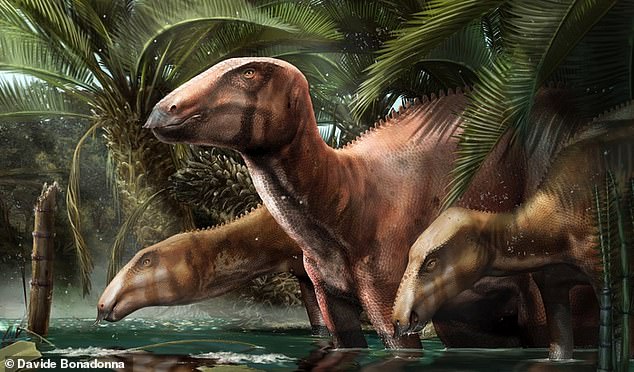
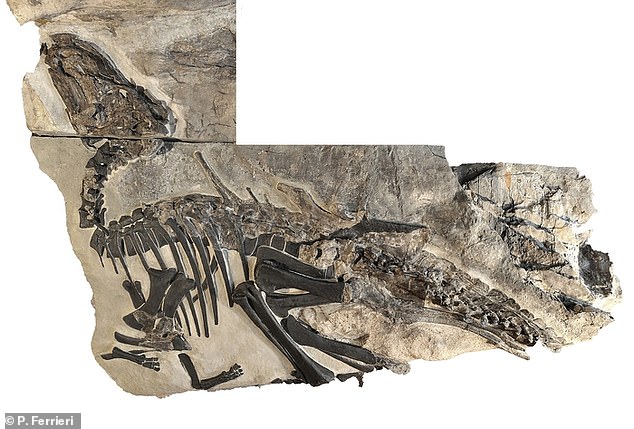
 Terrifying 6.5ft-long dinosaur with a vicious armoured TAIL...
 65 million years in the making! Skeleton of juvenile...
 Dino-mite find! Remains of a toothless, two-legged dinosaur...
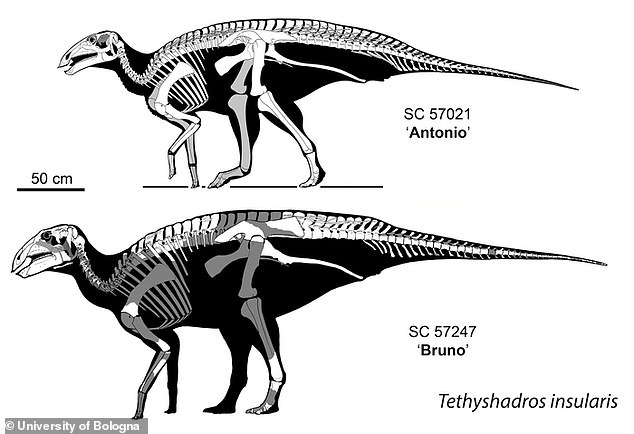
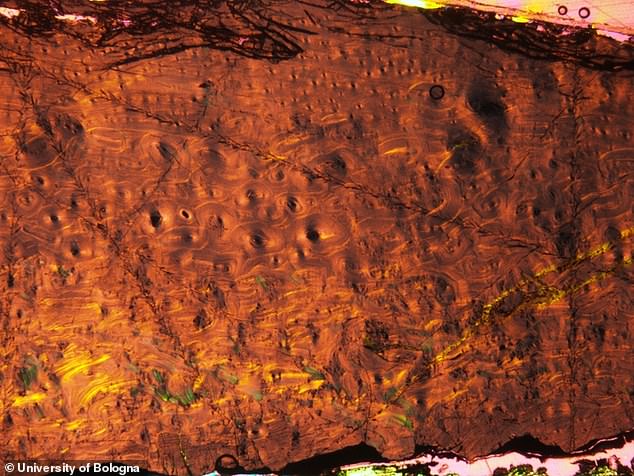
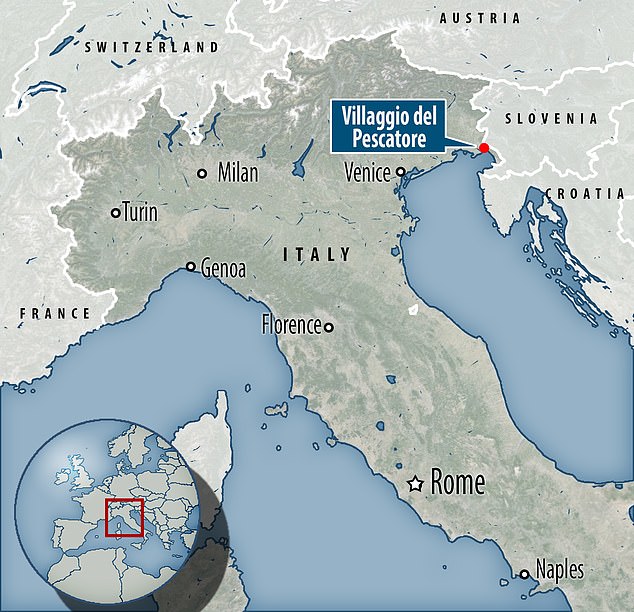
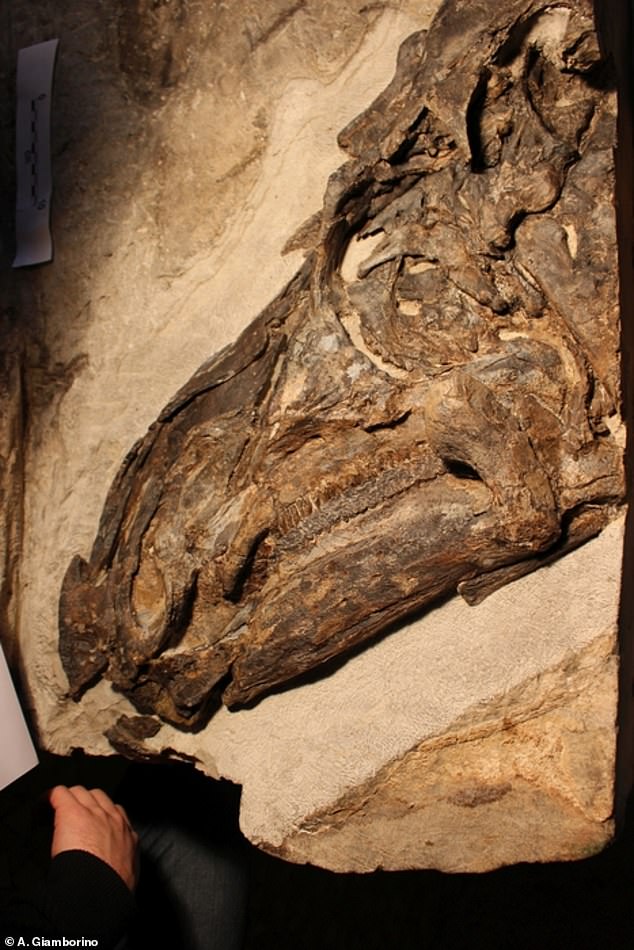




 Missing a distant loved one? Send them a robotic hug!...
 Would YOU apply? Tech firm will pay a brave volunteer...
 The robot that knows when you're lying: Scientists create an...





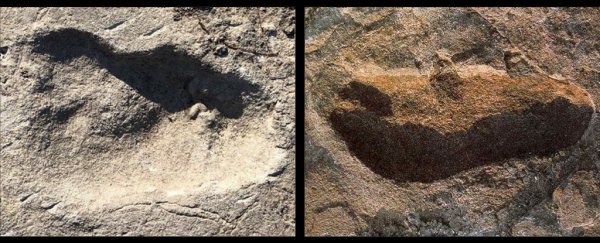


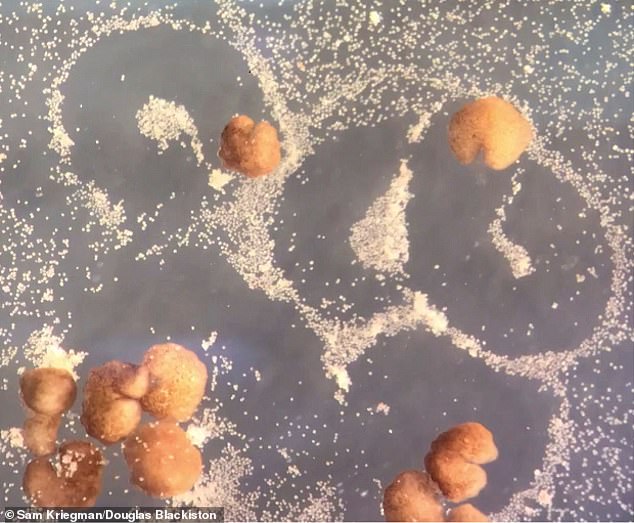
 Microscopic 'living robots' created from frog embryo stem...
 Engineers design 3D-printed robot 'ants' that can walk over...
 Meta announces ultra-thin synthetic skin for robots that...
 'Thinking' robot with neurons grown in a lab from living...