Ontdek de Fascinerende Wereld van UFO's en UAP's: Jouw Bron voor Onthullende Informatie!
Ben jij ook gefascineerd door het onbekende? Wil je meer weten over UFO's en UAP's, niet alleen in België, maar over de hele wereld? Dan ben je op de juiste plek!
België: Het Kloppend Hart van UFO-onderzoek
In België is BUFON (Belgisch UFO-Netwerk) dé autoriteit op het gebied van UFO-onderzoek. Voor betrouwbare en objectieve informatie over deze intrigerende fenomenen, bezoek je zeker onze Facebook-pagina en deze blog. Maar dat is nog niet alles! Ontdek ook het Belgisch UFO-meldpunt en Caelestia, twee organisaties die diepgaand onderzoek verrichten, al zijn ze soms kritisch of sceptisch.
Nederland: Een Schat aan Informatie
Voor onze Nederlandse buren is er de schitterende website www.ufowijzer.nl, beheerd door Paul Harmans. Deze site biedt een schat aan informatie en artikelen die je niet wilt missen!
Internationaal: MUFON - De Wereldwijde Autoriteit
Neem ook een kijkje bij MUFON (Mutual UFO Network Inc.), een gerenommeerde Amerikaanse UFO-vereniging met afdelingen in de VS en wereldwijd. MUFON is toegewijd aan de wetenschappelijke en analytische studie van het UFO-fenomeen, en hun maandelijkse tijdschrift, The MUFON UFO-Journal, is een must-read voor elke UFO-enthousiasteling. Bezoek hun website op www.mufon.com voor meer informatie.
Samenwerking en Toekomstvisie
Sinds 1 februari 2020 is Pieter niet alleen ex-president van BUFON, maar ook de voormalige nationale directeur van MUFON in Vlaanderen en Nederland. Dit creëert een sterke samenwerking met de Franse MUFON Reseau MUFON/EUROP, wat ons in staat stelt om nog meer waardevolle inzichten te delen.
Let op: Nepprofielen en Nieuwe Groeperingen
Pas op voor een nieuwe groepering die zich ook BUFON noemt, maar geen enkele connectie heeft met onze gevestigde organisatie. Hoewel zij de naam geregistreerd hebben, kunnen ze het rijke verleden en de expertise van onze groep niet evenaren. We wensen hen veel succes, maar we blijven de autoriteit in UFO-onderzoek!
Blijf Op De Hoogte!
Wil jij de laatste nieuwtjes over UFO's, ruimtevaart, archeologie, en meer? Volg ons dan en duik samen met ons in de fascinerende wereld van het onbekende! Sluit je aan bij de gemeenschap van nieuwsgierige geesten die net als jij verlangen naar antwoorden en avonturen in de sterren!
Heb je vragen of wil je meer weten? Aarzel dan niet om contact met ons op te nemen! Samen ontrafelen we het mysterie van de lucht en daarbuiten.
Berichten van 1 december 2022 tot 31 december 2022
Space historian examines parallels of NASA's last moon landing and the Artemis mission
The nearly month-long Artemis 1 mission to the Moon is slated to end on Sunday with a splashdown in the Pacific Ocean. On that very day 50 years ago, Dec. 11, 1972, the last Apollo astronauts set foot on the moon. Space historian Andy Chaikin, author of the definitive account of the Apollo missions “A Man on the Moon,” joins Miles O'Brien to discuss the parallels.
Top 10 Biggest Scientific Discoveries of 2022
These scientific discoveries will blow your mind! For this list, we’ll be looking at the most amazing things we learned through scientific research this year. Our countdown includes Brain Cells Playing Video Games, Footprints from the Ice Age, A Detailed View of the Distant Universe, and more! What do you think is the most significant discovery here? Are there any we missed? Tell us in the comments.
ALIEN CYCLOPS : THE SAGRADA FAMILIA CASE - FULL HD SCIFI MOVIE IN ENGLISH - EXCLUSIVE V MOVIES
ALIEN CYCLOPS : THE SAGRADA FAMILIA CASE - FULL HD SCIFI MOVIE IN ENGLISH - EXCLUSIVE V MOVIES Brazil, 1963.
Three children observe a strange flying object in their backyard. A transparent sphere floats above their heads. A member of the crew, an alien cyclops descends among them. The documentary narrates the discoveries made by Mr. Alberto Francisco do Carmo, sent to investigate the fact.
What Lies Beyond the Solar System? Long Episode
Compared to gigantic galaxies and star clusters, the Solar System is no more than just a speck of dust. There are thousands of stars within the radius of 100 light years from it. With some of them barely distinguishable against the dark abyss of space, others are so bright that they can be seen even if they are in other galaxies. Besides, there are a lot of invisible objects lurking in the depths of space, too – from massive brown dwarves to rocky exoplanets comparable to our Earth in size. Some of them may harbour life while others may pose a threat.
However, all this diversity is eclipsed by the scale of our galaxy. There are 200 billion stars and over a trillion planets at the very least to be found across its expanses. It is quite impossible to completely explore this great abundance of unique space objects. Today we will talk about some of the closest ones.
NASA Just Announced That They Are Monitoring a Huge Escalating Anomaly In Earth's Magnetic Field
Many people have come to depend on the Earth's magnetic field even without realizing it! Your phone is able to perform some basic functions, like directing you while driving to your destination. However, a catastrophic event is threatening to render life-saving tasks like this impossible: the flipping of the Earth's poles! Why are the Earth's poles flipping? What are the consequences, and how can you cope with it? In this video, we dive into the Earth's poles flipping, which has many people worried as it is happening!
There are many things that shape your daily life, even without you realizing it. Thanks to science and technology, we have come to rely on many natural phenomena that are not apparent to the naked eye! The Earth's magnetic poles are an example, and this has a lot to do with the Earth's magnetic field!
But what is the Earth's magnetic field, and where did it come from?
Australian UFO Mysteries: The Disappearance of Frederick Valentich
Victorian pilot Frederick Valentich.
Over 40 years ago, during the early evening of 21 October 1978, pilot Frederick Valentich reported in a radio communication with Steve Robey of Melbourne Flight Service that “a large aircraft” which had “a long shape” and “a green light,” appearing to have a bright metallic lustre and four bright lights, travelling variously at high speed, approached his Cessna 182L aircraft (registration VH-DSJ) and apparently hovered in a stationary manner and also orbited above him.
After six minutes Valentich reported his aircraft’s engine was rough idling, and the strange object was “hovering, and it’s not an aircraft.” Having indicated he intended to fly on to King Island, Valentich’s communication terminated after 17-seconds of “metallic” noises.
Valentich’s intended route from Moorabbin to King Island over Bass Strait.
Neither Valentich or the Cessna were ever found. The event became one of Australia’s greatest aviation mysteries, and the apparent UFO connection remains unresolved.
The areas that feature prominently in the Valentich incident – Cape Otway (his last land call), Bass Strait (the apparent location of his disappearance) and King Island (his apparent destination) – all have extensive precedents for UFO activity.
During a two-month period centred around January 1978, holidaymakers, fishermen, school teachers, local police and lighthouse keepers in the Cape Otway area reported seeing UFOs. During July 1977, local residents and the lighthouse keeper at Cape Otway saw an inexplicable brilliant light source that hovered out to sea for half an hour.
The lost Cessna VH-DSJ photographed at Essendon Airport in 1974.
Bass Strait figures in UFO mysteries particularly in 1920 and 1944. The Melbourne Argus newspaper even described many people seeing “cigar-shaped” objects flying over Bass Strait as far back as 1896.
King Island’s 425 square miles played host to a wave of unidentified nocturnal aerial lights for at least three months prior to Frederick Valentich’s disappearance. Oval shaped lights followed cars and mystified local residents. Strange lights or flares appeared off the north of the island.
One of the most spectacular close encounters with a UFO in the area occurred at a wild and uninhabited part of the King Island coast, near Whistler Point, just before dawn, on 10 April 1976. “A beam of light” emanating from “a cross-shaped object” approached a duck-shooter’s car, in a direct line. The light display eventually receded directly along its line of approach, ending a silent inspection when it disappeared over the distant skyline.
Much suggests a UFO connection in the Valentich case, but unfortunately a final answer alludes us. Despite the provocative nature of the taped conversation between Valentich and Melbourne Flight Control before his disappearance, which refers to a possible UFO presence, the affair remains a mystery.
Valentich’s mysterious disappearance made headlines in 1978. The Sun story on the right pictures Frederick’s father Guido and his brother Richard.
The Valentich incident is punctuated with haunting, or rather more appropriately, taunting clues that set one off in all sorts of conflicting directions. Many have come up with solutions varying from the bizarre to the sublime. Did a UFO abduct Valentich? Did Valentich contrive the whole affair? Did he, as many think, crash into Bass Strait, leaving no trace? Or are other prosaic explanations involved? A multitude of various lines of enquiry radiate out in all sorts of directions. Most take us away from the facts of the matter, namely that no trace of pilot or plane have yet been found.
The mystery resonates in the Australian consciousness in a place reserved for more mythic episodes like the haunting fiction of ‘Picnic at Hanging Rock’. It has inspired dramatic works like the profound and confronting play ‘Sky’ and the bizarre and striking TV mini-series, ‘Locusts and Wild Honey’. We must remind ourselves that a family waits for an answer that so far has never come. I hope that someday they will find that answer.
Department of Transport file V116/783/1047
Due to the tenacious efforts of Adelaide-based researcher Keith Basterfield in 2012, we can now study the previously restricted Department of Transport file V116/783/1047, available in digital format at the National Archives of Australia website. I last saw this file back in late 1982 while sitting in front of Mr A. Woodward at the Melbourne office of the Bureau of Air Safety Investigation. He had the file open in front of him while answering my questions. I tried not to be too obvious in reading the file in its upside-down perspective.
The released Valentich files provide hints at some possible answers, and it may be that ultimately the answer does not involve UFOs. Reconciling a detailed analysis of the released data with the extensive research done on the case by researchers over the years might help us come up with a final answer. But for now Frederick Valentich and his Cessna plane are still missing, so final closure eludes those who want to know.
‘The Unexplained Files’ series on the Discovery Science Channel in September 2013 featured an excellent recreation of the extraordinary 1978 Valentich mystery. My friend George Simpson (based in Melbourne, Victoria) was instrumental in the accounting of this story on the programme.
Roy Manifold took some intriguing photos (including the above) at the time and locality of Valentich’s departure from the Australian mainland on route to King Island in Bass Strait.
On the programme, Steve Robey of Melbourne Flight Service was clearly still distressed about the disappearance of Valentich. Frederick’s younger brother Richard gave the family’s dimension to the story. Both these elements remind us that a disturbing and tragic element still haunts this mystery. George Simpson interviewed Roy Manifold who took some intriguing photos at the time and locality of Valentich’s disappearance.
Dr Richard Haines investigated the case and authored a book on it, Melbourne Episode: Case Study of a Missing Pilot (1987). He facilitated the airing of the strange sound heard at the end of Valentich’s last radio conversation with Steve Robey. I listened to the tape back in 1984 when I stayed with Dr Haines in California. Haines’ comment in ‘The Unexplained Files’ programme that the sound might be from contact between the Cessna and the UFO Valentich had been describing in the six-minute conversation, caused me to suddenly reconsider a very strange story I came across back in early 1995.
The Coonabarabran Times of Coonabarabran, north-west New South Wales, Australia, in its 17 November 1994 issue, carried brief details of an apparent close encounter with a diamond-shaped UFO near ground level on 15 November 1994, on the Mendooran road to the south of the town.
With the assistance of local police, I interviewed the four principal witnesses to this apparent close encounter. One of the area witnesses told me that I should seek out Laurie, a local businessman, who had a lot of UFO stories to tell.
One story was utterly startling and unbelievable. It was apparently connected to the Valentich mystery and initially told to me by one of the Coonabarabran witnesses who heard it through Laurie. Others encouraged us to ask Laurie about other stories. We did both, but the story in question stood out.
Laurie told us he had heard the story directly from a South Australian farmer who had bought a property in the north-west of New South Wales. The farmer had come into his business and the talk strayed onto UFOs. He shared with Laurie an experience he had on his South Australian property on the day following the disappearance of Frederick Valentich.
The farmer said he was harvesting lucern when he heard a loud screeching sound coming from the harvester. He thought it might have been a bearing, so he uncoupled the harvester from the tractor’s power drive and jumped off and went back to have a look. The farmer was trying to work out the source of the continuing noise when he became aware that he was in a shadow. He looked up and saw he was directly underneath a large “saucer” shaped object, and going by the size of his harvester; he estimated it to be about 30 metres across. The loud screeching noise continued.
From directly underneath the object, the farmer reportedly could see two concentric outer rings or bands that were counter rotational and were operating at different speeds. One went very fast, so fast that you had to blink to see that it was moving. The other one was moving very slowly in the opposite direction. There were two small protuberances that the farmer took to be rudders, and two large holes, one had “shimmering heat” coming out, the other was shooting small flames.
The farmer began to think there was something horribly wrong with this huge object and that it might crash down on him. He ran to get out from under it. He got the impression that one of the object’s engines had stopped working.
As he moved away the farmer looked back at the object which he could now see edge on. It had a large dome on top and what looked like a black weather seal along the base of the dome structure. He then noticed what looked like a “church door with a curved top, but no windows or handles were visible.”
He told Laurie the most unusual thing was that the massive object had a Cessna stuck to the outside of it – “the whole aircraft.” It was flat up against the side of the object with its tail hanging down. Laurie said he was not sure whether the farmer said there was engine oil running down the outside of the Cessna, but he could clearly see the plane’s registration markings. He found a nail and scratched the plane’s registration number into the paint of his tractor.
According to Laurie, the farmer said the object – “the saucer” – still accompanied by the screeching sound, then flew away over a ridge in the direction of a nearby Army range.
The farmer said to Laurie he told no one about what happened. He went into town later in the day. One of his neighbours saw him and apparently said, “I see you are doing some more crop spreading.” He said no, why do you say that. The neighbour said, “I saw the Cessna today up in your top paddock.” He replied to his neighbour, “There’s no Cessna in my top paddock.” The neighbour insisted, “Yes there is, I was up near there, I saw it there today.” The farmer said, “That’s interesting, I’ll have a look when I get home.”
He went up to the top paddock and saw no plane, but he did see three tyre marks and some tracks from a plane. He followed the tracks to where they ended, and there was “a pool of ’flamin’ engine oil” on the ground.
I recorded the story from Laurie on two separate occasions, one over the phone in January 1995 and face to face in Coonabarabran one month later in the presence of my friend Robb Tilley. Laurie was impressed with the story. Robb and I simply did not know what to think. Getting further information proved elusive.
As I had lived through the Valentich mystery unfolding at the time in 1978 and had written extensively about the research and investigation of the extraordinary events, I was acutely sensitive to the bizarre and strange aspects. I also had contact with Guido Valentich, Frederick’s father, and I knew that he had been exposed to various claims about what had happened to his son. He even helped me investigate one claim, which ultimately ended in no real resolution, just another unverifiable claim. Sadly, Guido passed away without a definitive answer to his son’s disappearance.
With Laurie’s account from the farmer, I had yet another extraordinarily bizarre and unbelievable claim. Laurie told me the farmer returned on another occasion with the Cessna’s registration number. It was DSJ, the number of Valentich’s Cessna. This in itself was not convincing for me because that information was widely reported at the time of the plane’s disappearance.
I did not want to burden the Valentich family or authorities with yet another unverified story. The biggest problem for me was that Laurie couldn’t recollect the farmer’s name. He told me he had written all this down in notes, but he had not been able to find them. I stayed in touch with Laurie for a while, but despite attempts to come up with a name, without his notes we couldn’t progress the investigation unless we had a vast amount time and resources available.
I circulated a brief account on Paranet (a favoured research Internet facility) at the time but nothing came of it. The story stayed a sleeper until Dr Haines’ comments on the Discovery Science programme. I immediately accessed my notes and tapes and began to evaluate whether the considerably improved resources of the Internet, social media and other resources would now allow another attempt at getting to the heart of the story. Sadly, I learnt that Laurie passed away about seven years ago.
I contacted George Simpson and shared the story with him. We both agreed that despite the bizarre nature of the story, we should try to see if we could track down anyone who had knowledge of the story and see if we could get a name for the farmer. We have since tracked down all sorts of clues.
Victorian UFO Action (VUFOA) put on a 40th-anniversary event that featured a panel of people involved in the Valentich affair and its investigation including Steve Robey, Rhonda Rhuston and George Simpson. Videos of the event are available on VUFOA’s YouTube channel. The 3rd edition of Jerome Clark’s massive two-volume work The UFO Encyclopedia appeared in 2018 with my report on the Valentich disappearance.
While there is now a wealth of data on the case, what happened to Frederick Valentich and the Cessna he was flying remains a mystery.
For further information on this case, see my work: “The Missing Cessna and the UFO: a preliminary report on the Bass Strait-King Island Affair”, Flying Saucer Review, Volume 24, No. 5, March 1979, 3-5; “Vanished – A report on the Valentich – Bass Strait Affair”, Australian UFO Researcher (No. 56 & 57, No. 58 & 59, No. 60, January 1979 through to December 1979). This report included details on the widespread UFO activity on the same day as the incident, the precedent for UFO activity over Cape Otway, Bass Strait and King Island, precedents for UFO-related plane disappearances or crashes; “Valentich-Bass Strait (Australia) affair”, in Ronald Story’s The Encyclopedia of UFOs, 1980; “Vanished? The Valentich Affair re-examined”, Flying Saucer Review, Vol. 30, No. 2, 1984; “1978 and the RAAF” and “Frederick Valentich and Delta Sierra Juliet – Vanished?” in my lengthy online document “UFOs Sub Rosa Down Under” at www.theozfiles.com/ufos_subrosa4.html and www.theozfiles.com/ufos_subrosa6.html; I also describe the affair extensively in my 1996 book The OZ Files – the Australian UFO Story.
A Supercomputer Climate Model is so Accurate it Predicted the Weather Patterns Seen in the Famous 1972 “Blue Marble” Image of Earth
The “Blue Marble” was one of the most iconic pictures of the Apollo era. Taken by the astronauts of Apollo 17 on their return trip from the moon, the first fully illuminated image of the Earth taken by a person captured how the world looked on December 7th, 1972, just over 50 years ago. Now, a team from the Max Planck Institute for Meteorology has recreated that iconic image using a climate model.
As a new press release described, they didn’t do this for a publicity stunt. This effort has been a culmination of two decades worth of work on climate modeling that the team has been working on. Their climate model, which they ran with the help of researchers at the German Climate Computing Center, is now capable of drawing up details as fine as 1 km to accurately recreate environmental conditions at a given time.
To feed that model, though, they need data. Unfortunately, there wasn’t a whole lot available in terms of data that could be fed into the mode from 1972, let alone any data from the southern hemisphere, where the image was focused. So the researchers did their best to model what they could based on the data they had by using the equations that had already been developed and the Levante supercomputer at the German Climate Computing Center.
Video showing the new climate model in action – compared to the original image. Credit – Science Magazine YouTube Channel
The result was spectacularly similar to the actual image captured by the Apollo 17 astronauts. So much so that even the team was surprised by the fidelity, given the data limitations that went into the algorithm that fed the image.
However, the outcome of models isn’t always graphical, and for the sake of inspiration, the team wanted to take it a step further. So they enlisted the help of one of the world’s foremost graphics companies – nVIDIA.
They used a tool nVIDIA has developed called Omniverse to visualize the model’s output in a format similar to that captured by the Blue Marble Image. It also used a ray tracing technique commonly used in the other main use case for nVIDIA chips – video games, to make the image as lifelike as possible. And then, the model also introduces its other major advantage – it moves.
An Economist video on how to model climate change.Credit – The Economist YouTube Channel
The Blue Marble has always been a static image – a one-time snapshot of how the Earth looked on that day in 1972. But, if the model is correct (and it appears to be given its outcome on the day the picture was taken), it can be rewound or pushed forward to watch as the clouds, temperatures, and atmospheric makeup change both before and after the iconic picture.
Effectively, it’s like watching what the Apollo 17 astronauts would have seen if they had remained stationary and had a video camera set up to constantly monitor their homeworld. The effect is mesmerizing, but more importantly, it’s useful. Plenty of weather and climate phenomena can only be explored if we understand their input factors at the 1 km scale. That is the output of these climate models, and they can be helpful for more than just looking back into the past.
While this particular effort was a way to commemorate a great picture and the original founding of the Max Planck Institute of Meteorology, where many of the researchers work, it is, in essence, a test of a fully functional, high-resolution climate model. That will be ever more useful as we go forward into an uncertain changing climate, though its future outputs might be more disheartening than inspiring as this one was.
See the 1998 disaster film Deep Impact come to life in a new interactive map! Simulation lets you drop asteroids on Time Square, London or any place in the world - and it tells you how many millions of people will be killed
A coder launched an asteroid scenario simulator that lets users choose a location to drop an asteroid and see the widespread destruction
Asteroid Launch uses Apple Maps to pull satellite footage of the Earth and overlays the selected area with visuals
The system lets users choose the size of the asteroid, speed of impact, makeup and angle of impact
It reveals how many people would be killed by impact, fires, winds and earthquakes following the event
A new interactive map brings the 1998 film Deep Impact to life, allowing users to drop a space rock anywhere globally to watch the devastation unfold.
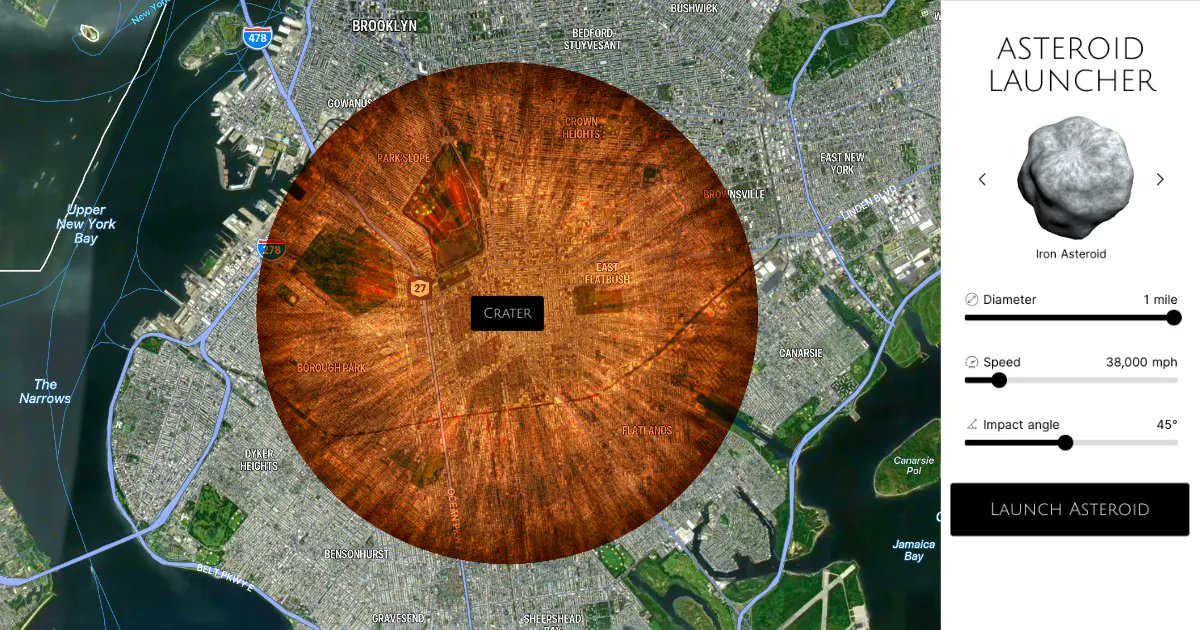
Called Asteroid Launcher, the system lets you choose a location of impact, the diameter of the asteroid, the speed at which it hits the ground and the collision angle - and hit 'launch' to see the destructions it causes and the number of people killed.
If an asteroid measuring one mile in diameter smashes into Time Square at 152,000 miles per hour, it would create a 34-mile-wide crater and vaporize 9,486,287 people with the impact equivalent to 6,403 Gigatons of TNT.
The system also shares other catastrophic events that follow, including shock waves, fireball size and wind speed.
Asteroid Launcher is the brainchild of creative coder Neal Agarwal who told DailyMail.com he was inspired by his favorite movie Deep Impact and wanted to create a website that simulated disasters.
Asteroid Launcher lets users choose a location to drop an asteroid. This simulation released a one-mile-wide asteroid on Time Square in New York City, creating a 34-mile-wide crater
'I love disaster movies and playing out different end-of-the-world scenarios in my head,' Agarwal told DailyMail.com.
'This project took about two months to complete, one month of research and one month for the coding and animations.'
He explained the equations behind Asteroid Launcher from research papers by Dr. Gareth Collins and Dr. Clemens Rumpf, who study the effects of an asteroid impact.
'I chose those research papers because they have detailed equations and models of all the various effects of an asteroid impact (thermal radiation, wind, shock waves, earthquakes, ect),' Agarwal said.
'They also do a great job of summarizing the current knowledge of the field.'
The website also shows destructive events that would follow the initial impact, such as this 74-mile-wide fireball that would give more than four million people third-degree burns and kill over nine million
Another option shows the intense earthquakes that would be triggered following the impact
Asteroid Launcher details all the events, destruction and deaths that would potentially occur in the event of an actual asteroid impact.
For example, if the same size asteroid that hit Manhattan hits London while traveling at the same speed of 152,000 miles per hour, it would also create a 34-mile-wide crater that would vaporize more than 7.7 million people in the surrounding area.
In Time Square, the fireball would cover an area of 74 miles would vaporize 30,561,023 people.
And in London, the same fireball would be released during the impact, killing 56,082,822 people.
'This tool is more for helping the general public learn more about asteroid impacts,' said Agarwal.
Another simulation using London and with the same size asteroid that hit New York would also release a fireball 74 miles wide
Asteroid Launcher also formulates wind speeds after the asteroid hits. In the case of London, wind within 150 miles of the crater would be faster than storms on Jupiter
Asteroid Launcher is the brainchild of creative coder Neal Agarwal who told DailyMail.com he was inspired by his favorite movie Deep Impact and wanted to create a website that simulated disasters
'Scientists have even more precise models of asteroid impacts that they run on supercomputers - this simulation is a more simplified version.'
Asteroid Launcher uses Apple Maps to pull satellite footage of the Earth into its simulation and layer visualizations over the selected area to show users how far the destruction travels.
It also provides different options for what the asteroid is made of.
Users can drop a 2,400-foot-wide gold asteroid on Los Angeles at 247,000 miles per hour, leaving a 34-mile-wide crater in the ground and killing 5,210,549 people.
The simulated events in New York and London only happen once every 22 million years, but Earth is predicted to have a close call when one the size of three football fields is expected to come within 19,600 miles from our planet's surface in 2029.
Asteroid Apophis, named for the serpentine Egyptian god of chaos (also known as Apep), will whizz past Earth on April 13, 2029.
While researchers have ruled out the possibility of the 1,115-foot object slamming into Earth, the close shave will present a unique opportunity to study an asteroid in detail; most others that come this close are much smaller.
'The Apophis close approach in 2029 will be an incredible opportunity for science,’ said Marina Brozović, a radar scientist at NASA’s Jet Propulsion Laboratory in Pasadena, California, who works on radar observations of near-Earth objects (NEOs).
‘We’ll observe the asteroids with both optical and radar telescopes. With radar observations, we might be able to see surface details that are only a few meters in size.’
The simulated events in New York and London only happen once every 22 million years, but one the size of three football fields is expected to come within 19,600 miles from our planet's surface in 2029. Pictured is a simulation of how close it will get
It’s expected to make its closest approach before 6 pm ET, when it will be over the Atlantic Ocean.
According to NASA, however, it will be visible in the sky hours before this point.
Apophis will first appear in the night sky over the southern hemisphere, making itself known to viewers on the east coast of Australia.
It will then travel westward to reach the equator by early afternoon before crossing over the United States by around 7 p.m.
The massive space rock will be traveling so fast it will traverse the entire width of the moon in less than a minute, NASA said in a 2019 statement.
While 19,000 miles might sound far away, the space agency says it’s rare for an object of this size to come so close
This Interactive Tool Lets you Simulate Asteroid Impacts Anywhere on Earth
Asteroid impacts rank highest on the UN’s list of potentially species-ending calamities. They’ve been the subject of countless movies and books, some of which are accurate depictions of what would happen, and some of which are not. Now, if you’ve ever been interested to see what would happen if different sizes of asteroid impact different areas of the globe, the internet has a tool for you!
Called “Asteroid Launcher,” the tool allows you to control three different aspects of your asteroid – the size, the speed, and the angle that it impacts Earth. It also lets you select when it lands. When you first open it up, for better or worse, it is pointed directly at Manhattan. From there, you can scan to any area of the world that you want and hit a “Launch Asteroid” button when you’ve picked the appropriate place, size, speed, and angle.
Out of morbid curiosity, the author decided to see what would happen if he blasted his hometown with an asteroid with default settings. He was happy to find that he would probably have been one of the almost 15000 people that died in the 5.6-mile-wide crater the asteroid would have created. That sounds like a much better option than the other means of death the simulation describes.
Planetary Defense starts with finding the dangerous bodies in our solar system, as this UT video describes.
An 8.3-mile-wide fireball would have wiped out almost 1.9 million people, while nearly 150,000 would die from a shock wave. Over 614,000 would die from a wind blast the strength of an F5 tornado, which is apparently different than a shock wave, but luckily only a little over 2,000 people would die from the 7.1 magnitude Earthquake that the asteroid would cause.
All told, the destruction in the general area of the world the author lives in would amount to a death toll of a little under three million people. Definitely not on the scale of what would happen if an asteroid directly hit Manhattan, but still not exactly the best day in humanity’s history. But what happens if the asteroid hits some of the 70% of the Earth that is covered in water?
Luckily, the author also lives near one of those large bodies of water known as the Great Lakes in North America. Launching a rock in their direction changes some of the parameters of the destruction outcome, such as shrinking the crater, etc. However, it doesn’t mention anything about a tsunami or similar water-based event that viewers of Deep Impact would come to expect.
Stopping a killer asteroid is arguably more important than finding it though – here’s UT’s explanation on how we would do that.
Moving the impact site over the ocean does give an estimation of a tsunami and an impressively high one at that. But unlike the other methods of destruction, it doesn’t detail how many people would be wiped out by that disaster, though it is arguably more dangerous than any other means of destruction listed in the simulation.
Overall, it’s an entertaining tool that reinforces the need for “planetary defense” as it has come to be known, and as we’ve detailed several times at UT before. Though it could do with some updates on some of its estimates and its understanding of where on the globe water is, it’s a highly entertaining look at what the impact of arguably one of the worst possible things that could happen to humanity would be.
Unusual & Unique UFO Cases that Never Gotten Attention They Deserve
Author Preston Dennett has written numerous books about the paranormal (Amazon link). In the second half of the interview, he talked about his research and writing. He said that he enjoys choosing cases that he believes are unusual or unique. For instance, he noted that he wrote about cases involving UFOs that have been chasing and lifting occupied cars.
According to Dennett, the most common sighting of UFOs in the US is on July 4. He has also seen incidents involving planes, boats, and cars. In some cases, the objects collided with the vehicles.
He claims that encounters with these objects have a wide-reaching impact on human bodies. For instance, he said that people who have been in contact with these objects have experienced levitation. He attributes this to the altered electromagnetic properties of the body. In addition, Dennett claims that these encounters have led to the development of telekinetic and other forms of mental abilities.
Commercial Pilots Seeing UFOs in the Sky - Starlink with 6 Lights?
Mark Hulsey was an experienced Marine F-18 Fighter Pilot. Now he flies a Gulfstream 650 private jet for a billionaire. He relays his own unidentified aerial phenomena experience and highlights the safety issues that come up when pilots are afraid to report lights to their employer.
SpaceX launches moon lander, rover and 'flashlight,' booster lands in Florida
SpaceX launched Japanese company ispace's Hakuto-R lander with a range of payloads including "Rashid," a 22-pound (10 kilograms) rover developed by the UAE's Mohammed Bin Rashid Space Center. The rocket lifted off from Cape Canaveral Space Force Station in Florida on Dec. 11, 2022.
Another payload along for the Falcon 9 rocket ride is NASA's "Lunar Flashlight" cubesat, which will hunt for water ice inside craters near the moon's south pole.
The rocket's first stage touched down at Landing Zone 2 in Florida a little over 8 minutes after liftoff.
Credit: SpaceX
NASA Chief Gives Serious Warning About Betelgeuse Star Explosion
NASA Chief Gives Serious Warning About Betelgeuse Star Explosion. Betelgeuse, Orion constellation’s most famous star, and now a bright red supergiant star, is nearing the end of its life. It will likely explode as a supernova and be visible during the daytime from Earth. And while we do not know as of yet if it is a threat or not, scientists have already discovered a telltale way to detect when a star is about to go supernova.
ANCIENT ALIENS : ORIGIN OF HUMANITY - FULL HD SCIFI MOVIE IN ENGLISH - ORIGINAL V MOVIES
ANCIENT ALIENS : ORIGIN OF HUMANITY - FULL HD SCIFI MOVIE IN ENGLISH - ORIGINAL V MOVIES Discovering mysterious extraterrestrial beings. More and more evidence and appearances of UFOs surround our Earth. Secrets, cover-ups, discoveries, testimonies suggest a contact, a contact with beings who came from the sky, which took place at the dawn of our existence; maybe, just ancient aliens who gave and taught life to our ancestors.
NASA Tests a Solar Sail Segment of its Enormous Solar Cruiser Mission
A team led by NASA’s Marshall Space Flight Center (MSFC) was recently selected to develop a solar sail spacecraft that would launch sometime in 2025. Known as the Solar Cruiser, this mission of opportunity measures 1653 m2 (~17790 ft2) in area and is about the same thickness as a human hair. Sponsored by the Science Mission Directorate’s (SMD) Heliophysics Division, this technology demonstrator will integrate several new solar sail technologies developed by various organizations to mature solar sail technology for future missions.
In a recent video released by NASA, we see engineers and industry partners at the MSFC in Huntsville, Alabama, unfurling a segment of the prototype solar sail. The video, taken on October 13th, shows how the teams used two 30.5 m (100-foot) lightweight composite booms to unfurl a 400 m2 (4,300 ft2) quadrant of the solar sail prototype for the first time. Once realized, the Solar Cruiser demonstrator will validate technologies that enable future missions to study the Sun, its interaction with Earth, and its extended atmosphere (aka. heliosphere).
The Solar Cruiser team includes industry partners like spacecraft and payload developer Ball Aerospace, critical systems manufacturer Roccor, LLC, and subcontractor NeXolve, which specializes in producing thin, lightweight materials and structures (such as solar sail films). Alongside NASA Marshall, they are leveraging advancements in solar sail technology from the past decade, including elements from previous missions. These include:
The video features NASA scientists Les Johnson, the Principle Investigator of the NEO Scout mission, which launched with Artemis I (one of ten secondary payloads). As he explained, the purpose of this unfurling was to test how the sail would deploy once it was in space:
“The sail deployment test that we just completed here at NASA Marshall was really a test of [the] functionality of the sail. Could you get these two hundred-foot-long booms coiled up, put in a deployer, attached to a sail that has an area of over four thousand square feet when it’s all folded and rolled, put it in a small box, and get it to deploy unaided? And the answer is yes. We had a very successful test, and the results are evident in the pictures that have been taken and the data we collected during the test.”
Solar sails rely on lightweight highly-reflective material and continuous photon pressure from the Sun’s rays (solar wind) to generate thrust. This does away with the need for propellant that makes up most of a mission’s pre-flight mass or the heavy electric propulsion systems that power Hall-Effect Thrusters (ion engines). In addition to increasing a mission’s mass, they also limit its lifetime and observation locations. This is the purpose of the Solar Cruiser, which will demonstrate a solar sail’s ability to make observations from a sunward-facing position at L1.
The design also includes four 29.5-m (~97-ft) lightweight booms, similar to the metallic Triangular, Rollable and Compressible (TRAC™) booms used by the NEA Scout mission. Designed by the U.S. Air Force and licensed to Roccor, LLC, these booms are similar to those used by theJames Webb Space Telescope(JWST) to deploy its Sunshield. For the sake of the Solar Cruiser, Roccor developed TRAC booms using lighter composite materials via NASA’s Small Business Innovation Research (SBIR) program.
The sail also has embedded Reflective Control Devices (RCDs) that provide propellantless attitude control and help keep the sail stable. The sail membrane consists of a thin-film polyimide successfully flown on NanoSail-D coated with aluminum to make it reflective. This material was selected because of its flight-proven properties and how it is scalable to sails of any size – from the 10 m2 (~33 ft2) sail on NanoSail-D to sails greater than 10,000 m2 (~32,800 ft2). This is consistent with one of the main objectives of the Solar Cruiser, which is the ability to build sails of increasing size
“The key to enabling some of these missions is having larger and larger sails that are very lightweight,” he said. “And that’s why we’re moving from sails the size of NEA Scout, nine-hundred and twenty-five square feet, to seventeen-thousand eight-hundred square feet. And in the future, we will make sails that are even larger still. And the larger the sail, generally speaking, the better it has a capability to do propulsion and higher thrust.”
The study of heliophysics is vital to the National Oceanic and Atmospheric Administration (NOAA) and the Department of Defense. These government organizations are responsible for issuing alerts for space weather alerts and forecasts and monitoring things like solar flares that cause interference with communications or satellites. The Solar Cruiser will also demonstrate the capability to make sustained in-situ measurements of Earth’s magnetotail – the interaction between Earth’s magnetosphere and solar wind.
Artist’s illustration of NEA Scout visiting a Near-Earth Asteroid (NEA). Credit: NASA
Monitoring solar activity and space weather is also of interest to NASA’s human exploration programs. Before this decade is over, the Artemis Program will send astronauts to the Moon for the first time in over fifty years. The long-term aim of Artemis is to create a “sustained program of lunar exploration” that will include the creation of infrastructure and long-duration stays on the lunar surface. By the 2030s, NASA plans to send crewed missions to Mars that will consist of a six to nine-month transit and science operations on the Martian surface.
Knowing how to predict solar events will ensure astronaut health and safety and that their equipment remains operational. Just another exciting field of study that NASA and other space agencies will pursue in the coming years. And it’s fair to say that these efforts will enable new missions to expand our understanding of the Solar System and the Universe.
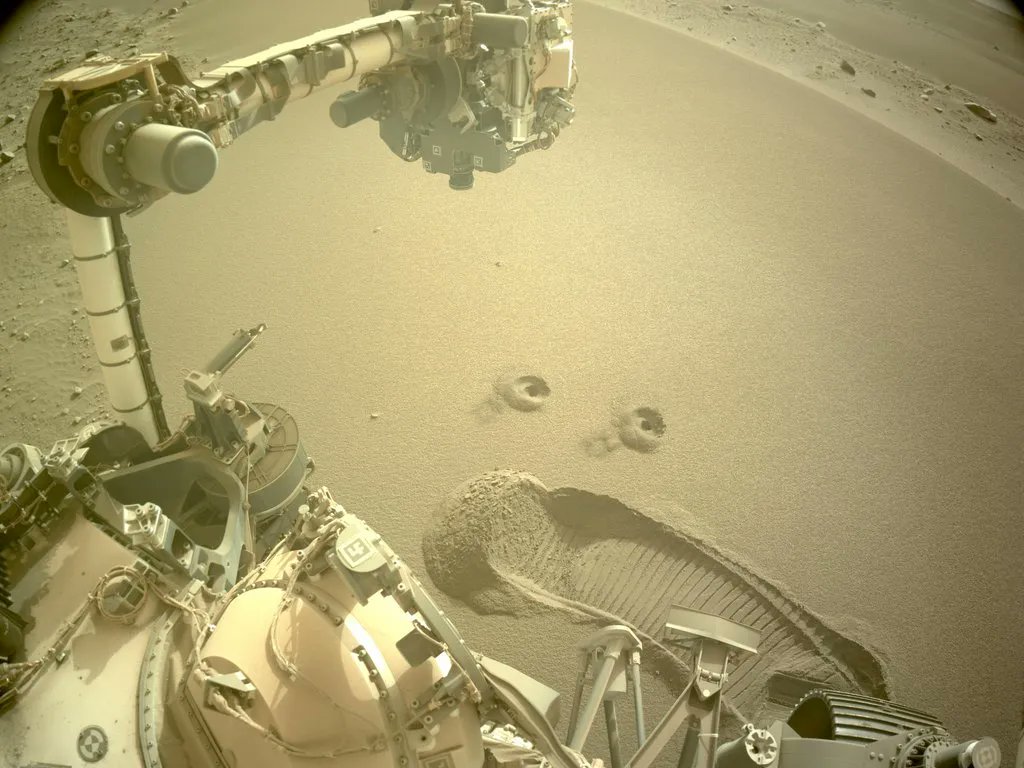
Perseverance’s Latest Sample is Just Crumbled Regolith. When Scientists get Their Hands on it, we’ll Learn so Much About how to Live on Mars
The Mars Sample Return (MSR) part of Perseverance’s mission is picking up – literally. For the past few months, the rover has concentrated on picking up samples that will eventually be returned to Earth as part of the future Mars Sample Return mission. Back on Earth, plenty of advanced technologies can poke and prod the samples in ways that would never be feasible to launch with a spacecraft. However, if scientists decide to poke or prod Perseverance’s latest collections, they might have a hard time because they are made of regular regolith.
Regolith, the ever-present layer of dust on the Martian surface, is integral to our understanding of how the Martian surface has formed over the eons and what can be done to mitigate its effects on it our exploration systems. It is notorious for being the cause of the end of mission for such beloved rovers as Spirit and Opportunity, whether by entrapping one of them in an inescapable morass or shrouding their solar cells in a layer of dust such that only limited sunlight can penetrate through it.
From a scientific perspective, regolith is interesting because it would allow geologists to better understand the evolution of the Martian climate. One of Perseverance’s primary missions is astrobiology, and regolith might hold clues to what exactly was going on back when Mars was warmer and wetter. Even with it being ubiquitous throughout the planet, the best instruments we have so far been able to send there pale in comparison to the technical scrutiny brought to bear on the sample once it has been returned to Earth.
UT video detailing the Mars Sample Return mission.
From an engineering perspective, regolith, which makes up almost all of the dust in the Martian atmosphere, presents a set of difficult challenges. Anakin Skywalker’s axiom about sand in Star Wars holds a grain of truth in it, as it can be coarse and irritating and gets everywhere. The same goes for Martian regolith. It is notorious for sticking to everything, including, potentially, spacesuits and, even more dangerously, the inside of an astronaut’s lungs.
If it even gets into an astronaut’s lungs, it’s dangerous for more than just its abrasiveness. Regolith contains perchlorates, which are potentially deadly toxins to any life that might try to eek by an existence on the Red Planet. Understanding how to mitigate the effects of this dangerous substance might literally prove to be life or death for the first Martian colonists.
All of those are good reasons for Perseverance to be interested in it, and, as such, the rover recently collected two samples using its specialized regolith bit. This bit differs from its standard rock drilling and abrasion bits, as it looks like a “spike with small holes” in it, according to a JPL press release. Though it might look relatively simplistic, it was developed with thousands of hours of engineering and testing with simulated Martian regolith.
The drill bits Perseverance is using on its mission, before they were installed. Far left is the regolith bit used in the latest sample collection, while the middle ones are for rock drilling and the far right are for rock abrasion. Credit – NASA / JPL-Caltech
Unfortunately, there are limitations to the MSR, especially in terms of payload capacity. Therefore, only one of the two regolith samples Perseverance recently collected will be making its way back to Earth. Even then, it will be the better part of a decade before it makes its way back, as the second stage of the MSR process is still in the planning phases.
The other sample will be spending the rest of its days as part of an artifact from the early era of humanity’s exploration of Mars. Perseverance certainly already deserves its place in that pantheon, no matter what sample it decides to send back.
Crew chosen For SpaceX's first private Starship mission to the moon, UFO Sighting News.
Crew chosen For SpaceX's first private Starship mission to the moon, 10 total crew members, including two backup crew, will join him on the roughly week-long flight that was originally scheduled to launch in 2023. That timeline will likely push to 2024.
Guys this is cool. A Japanese billionaire has funded the entire civilian program. This is mind-bogglings stuff. I mean most NASA missions have hard core military, CIA, NSA. I can see by the faces of these individuals picked by SpaceX that they are none of the above, they are us, the people. I can't wait to hear and see what they encounter on the mission. Photos and video is going to be raw and unedited. Don't think for a second this doesn't share the shit out of NASA. The truth coming out, and making NASA look like a fool for lying, always does make the lier look the fool.
This Went On For 12 Days Straight... Artemis Moon Images Exposed, UFO Sighting News.
Here is a cool video by Secureteam10, about several anomalies that occurred over the last few weeks that you may have not heard about. Also, he shows a structure that I discovered on the moon at 3:46 into the video, good to see I'm making a difference too. But I was going to post this with or without it, Tyler is a great reporter who really helps the UFO community.
The structures are in a photo labeled "High Resolution Center PNG 322.4 MB"
Hey guys, I looked at a Apollo 16 photo for a mere five minutes and decided to check in an area of the photo that I imagined others would never check...the dark patches on the far left. There I found a tiny area of light that was only about 1-2% of the total photo. I focused on this area and found these structures in the craters there. Even some small craters had these amazing buildings.
Example of full photo is below and shows the location of these alien buildings I found yesterday. Yes there seems to be a large face in the center of the photo, however I feel the buildings are more significant of a discovery.
Notice the buildings are made up of many squares. These square buildings are linked together to form larger structures. True the ascetic quality that humans want in buildings is not there...but out there, functionality comes first and those cube structures are doing the job.
John Lennon Talks About a UFO over New York, Aug 23, 1974, Video, UFO Sighting News.
On August 23rd, 1974 John Lennon walked out on to the balcony of his New York apartment, and witnessed what he later described as a "Flying Saucer" hovering closely, just above his window. Lennon's girlfriend May Pang, also witnessed the event. Aliens do research, knowledge is the one of the most highly valued things for them, and many celebrities, singers, US presidents have had UFO sightings that they describe and were open to talk about on record.
Triangle UFO formation over St Helens, UK 9-Dec-2022
Once again in the last weeks the triangle formation appeared. This time over St Helens, a town in Merseyside, England on 9th December 2022 at 6:06pm.
Witness report:
We saw these 3 orange bright lights moving in the sky in formation as if they was one thing sort of moving in sync, we got out of the car and they’d completely disappeared, we went around the corner to get a better shot and all of a sudden they was gone. I don’t have any explanation for this, I don’t think they are Chinese lanterns because we would of seen them drifting off – they where also stationary and then they moved a little bit in a way I’ve never seen before. Also, they didn’t seem to be flickering or anything like that, more of a light bulb type of light. If you download the Flightradar24 app you can use the playback feature, the video was recorded at 6:06pm today. There is a plane that appears at 6:07pm but it’s in the opposite direction and it’s around 10 miles away.
Apart from that I haven’t seen anything else. I didn’t see any of the usual green flashing lights or anything that you usually see on a passenger airline either so I don’t think this is a plane. this was an unidentified flying object that I seen in the sky. Okay it could’ve been lanterns (I don’t believe they are) but that’s besides the point, if all you guys are going to do is ridicule anyone who posts strange things in the sky (real or not) then we’re going to decrease our chances of getting real footage. Always better to be safe than sorry
SpaceX Ripping It Back Up, Artemis 1 Reentry, ISS Upgrades, Square Kilometre Array (SKA) underway
This has been a difficult week to squeeze down and it looks like that is only going to get more tricky over the next few weeks. It is busy right now. We’ve got very intriguing stuff to talk about at SpaceX’s Starbase. We now have SpaceX Ripping It Back Up. Yes, the 11 Raptor Engine Static Fire caused enough damage for SpaceX to rip that concrete base back out again with diggers this week. An expendable pad vs the reusable Starship now it seems. Artemis 1 is still going strong as it plummets back toward the atmosphere for reentry. Another incredible week of updates there. Action on the International Space Station as astronauts roll out for the iROSA rollout. We have OneWeb and SpaceX becoming more than frenemies! The mind-blowing Square Kilometre Array to be scanning the skies for an alien spaceport near you, and this is getting real exciting too. Let's jump into it.
Artemis 1 mission update - Earth return prep and benefits for humanity
Preparations are underway for the return of NASA's Artemis 1 Orion spacecraft. Also, learn about the benefits of returning to the moon with the Artemis program. Here's how NASA's Artemis 1 Orion spacecraft will splash down to end its moon mission in 8 not-so-easy steps:
Artemis 1 mission going 'phenomenally well' says NASA in exclusive interview
NASA's Nujoud Merancy, Chief of the Exploration Mission Planning Office at NASA’s Johnson Space Center, talks to Space.com's Elizabeth Howell about the ongoing Artemis 1 mission.
Iconic Earthrise By Artemis 1 // Rule-Breaking GRB // SpaceX Launches Starshield
Construction Begins on the Square Kilometer Array. Artemis I’s iconic crescent Earthrise picture. A gamma-ray burst that breaks all the rules. SpaceX launches a new service.
Damaged Concrete Under the Orbital Launch Mount Removed | SpaceX Boca Chica
Damaged concrete was removed from under the Orbital Launch Mount, crews worked on the Mega Bay extension, and work on the Orbital Launch Mount and Tower continued. Video from Nic (@NicAnsuini).
If Dark Matter is Made of Axions, This Could be the Detector That Finds Them
As we’ve noted in plenty of other articles, science also moves forward by constraints. Understanding the limits of a physical phenomenon helps to develop better methods of looking for it, especially in its absence. Dark matter is an archetype of a missing phenomenon, but there are plenty of potential explanations for it. One of them is known as the axion, which was originally developed as a hypothetical particle that could plug a hole in the Standard Model of particle physics but could also solve the problem of dark energy. That is if they actually exist. Now a new experiment from researchers at CERN can help the scientific community better define where to look for those axions.
Part of the problem with searching for axions is how widely varied their properties could potentially be. Both their strength of interaction with other particles and their mass, two of the most fundamental parts of any particle in the standard model, are up for debate at this point. And to cover that many possibilities, physicists must look all over the place for them.
They generally agree on one of the ways to do so, though – axions can turn into photons if they are subjected to a strong enough magnetic field. And photons can be detected. As such, most axion detectors consist of powerful magnets and photodetectors, and one of the most capable is the CERN Axion Solar Telescope (CAST) experiment.
UT video on that most elusive of all substances – dark matter
CAST is basically a giant metal tube with a very strong magnet known as a helioscope and various kinds of light detectors inside of it. It was initially designed to look at axions that could be coming from our own Sun. So far, it has failed to find any, but the scientists working on the experiment came up with a slight modification that allowed them to take a look at even more data.
Their modifications resulted in the magnet being capable of detecting axions that would have developed in the dark matter halo that surrounds the Milky Way. This is another possible source of axions, but one that other experiments hadn’t yet explored. The next experiment, dubbed an axion haloscope, or CAST-CAPP, started collecting data in September 2019.
Another UT video on how we’re searching for it.
Since it is unclear what frequency of photon axions would turn into at the magnetic field strengths provided by CAST-CAPP, the scientific team had to monitor a wide range of possible frequencies, which took almost two full years. The team also had to eliminate potential noise contamination, such as that from 5 GHz wireless signals.
Unfortunately, even after that, there were still no signs of axions. But, as stated at the beginning of the article, even a lack of evidence for something can help move science forward. Researchers can now definitively narrow down the maximum potential strength of an axion’s interaction with photons and tailor their experiments accordingly. CAST, in all its various forms, isn’t done with its mission yet.
Most Exoplanets Suffer Worse Space Weather Than We Do
We have it relatively easy on the Earth. Our Sun is relatively calm. The space weather environment in the solar system is altogether placid. Things are nice. But new research has shown that we may be the exception rather than the rule, and that many exoplanets face much harsher conditions than we do.
Stars are not simple things. They contain within their hearts cores of nuclear fusion powered by the gravitational weight of their own mass. This releases enormous amounts of energy which makes its way to the surface through radiation and giant convective plumes of material.
In addition to their complex interiors, stars are also spinning. The complex movement of all the plasma that makes up the bulk of a star’s mass triggers the formation of incredibly strong and tangled magnetic fields. Those magnetic fields in turn can dredge up material from the stellar surface and launch it into space.
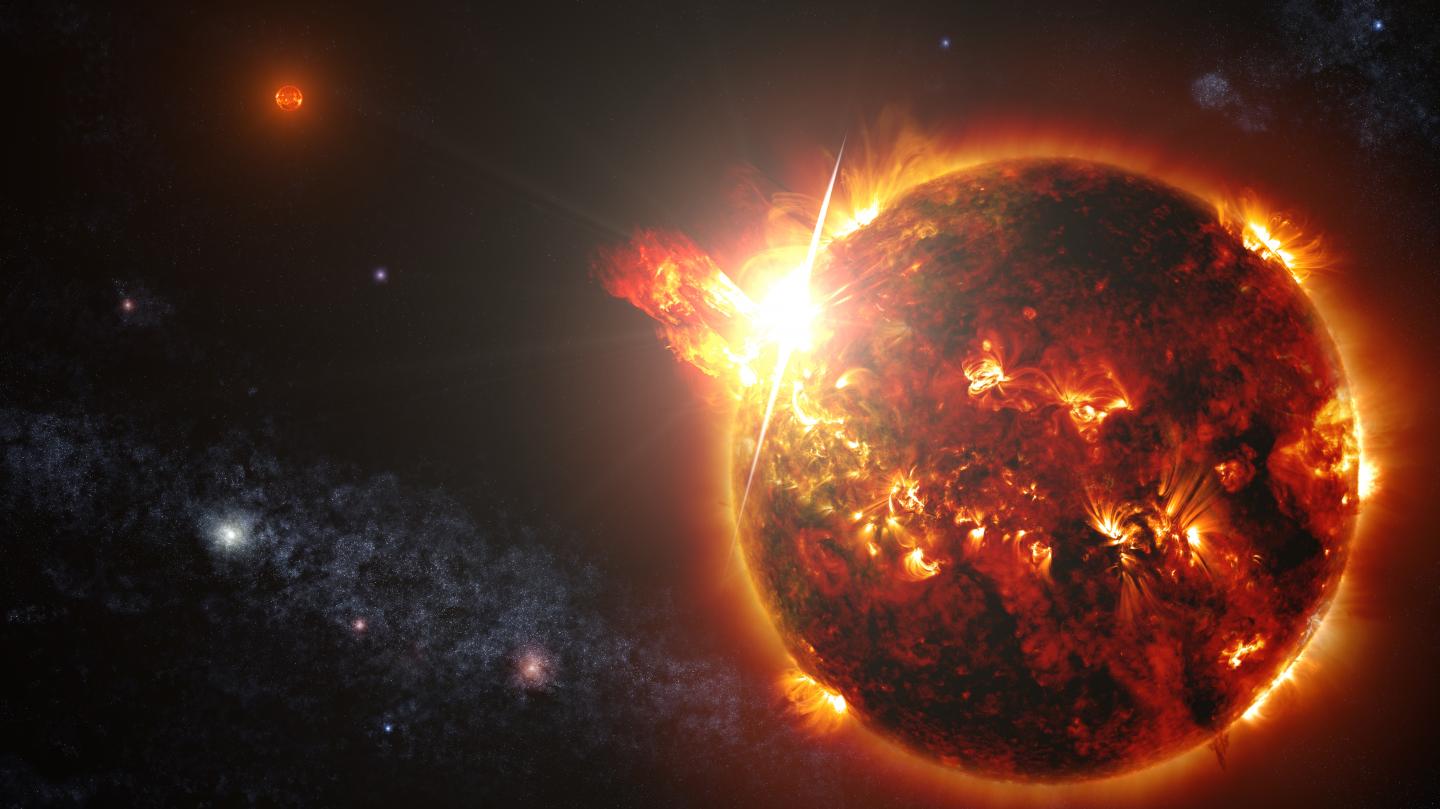
The collective term for all the events that happen outside a star is called stellar weather or space weather. Space weather can take many forms. For example, it can just be the stellar wind, which is a steady drizzle of charged particles that constantly emanate from a star’s surface. It can also include the occasional flare, which happens when the tangled magnetic field lines around a star break. These flares release huge amounts of x-ray radiation. Sometimes those flares even pull up material from the stellar surface and launch it in this space in the form of a coronal mass ejection.
Astronomers around the world constantly monitor our own Sun for space weather. These solar-generated storms can affect orbiting satellites, crewed missions in space, and sometimes even overwhelm our own planet’s magnetic field and atmosphere, leading to dangerous consequences on the surface.
A new study surveying many different kinds of stars in many different stages of their life has shown that overall we have a pretty good. Our Sun is pretty mild with relatively infrequent outbursts. In contrast, the astronomers behind the study found that exoplanets typically suffer much more severe stellar weather than we do. Some of this is just due to random chance, because they happen to lay closer to their parent star than the Earth does around the Sun. And some of it has to do with the kind of star that they orbit. For example, small red dwarfs are much more turbulent and chaotic than our Sun, with some of them capable of suddenly increasing in brightness by over 50%.
In other cases it simply has to do with age. Young stars are much more temperamental than older ones. Planets around younger stars experience much more extreme space weather events then those around more mature systems.
All told, it seems that we should simply count ourselves lucky.
A new 3D map of the Milky Way Uses close to 66,000 Stars and Reveals New Details About the Shape of our Galaxy
In the 17th century, Galileo Galilee aimed his telescope at the stars and demonstrated (for the first time) that the Milky Way was not a nebulous band but a collection of distant stars. This led to the discovery that our Sun was merely one of the countless stars in a much larger structure: the Milky Way Galaxy. By the 18th century, William Herschel became the first astronomer to create a map that attempted to capture the shape of the Milky Way. Even after all that time and discovery, astronomers are still plagued by the problem of perspective.
While we have been able to characterize galaxies we see across the cosmos with relative ease, it is difficult for astronomers to study the size, shape, and population of the Milky Way because of how our Solar System is embedded in its disk. Luckily, there are methods to circumvent this problem of perspective, which have provided astronomers with clues to these questions. In a recent paper, a team from the Astronomical Observatory at the University of Warsaw (AstroUW) used a large collection of variable stars to trace the shape of the Milky Way, which yielded some interesting results!
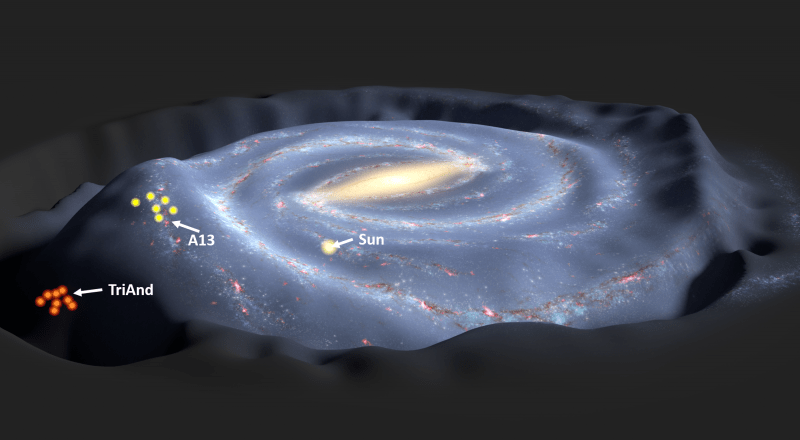
Patryk Iwanek, an astronomer with AstroUW, led the study team. The paper that describes their findings, titled “A three-dimensional map of the Milky Way using 66,000 Mira variable stars,” recently appeared online. For the sake of their study, the team examined data on 65,981 stars observed by the Optical Gravitational Lensing Experiment (OGLE), a long-term sky survey of variable stars based at the University of Warsaw. Since 1992, OGLE has monitored the brightness of about two billion stars in the Milky Way and the Magellanic Clouds, providing insight into a wide range of astronomical phenomena.
The shape of the Milky Way galaxy is perturbed by tidal interactions with a dwarf galaxy, as predicted by N-body simulations. Credit: T. Mueller/C. Laporte/NASA/JPL-Caletch
The OGLE project, also known as the Optical Gravitational Lensing Experiment, is one of the largest-scale sky surveys worldwide. It is a long-term sky survey that monitors the brightness of about two billion stars in the Milky Way and the Magellanic Clouds. During its long history, the OGLE survey has provided significant contributions to the study of a wide range of astronomical phenomena, including gravitational lensing and microlensing, extrasolar planets, variable stars, cosmic distance scale, and the structure and evolution of the Milky Way and Magellanic Clouds.
As stars approach the end of their main sequence phase, they exhaust their supply of hydrogen fuel and begin consuming helium. This causes them to expand to several times the original size and to become dimmer and cooler than main sequence stars – hence the term Red Giants. Mira variables are a special class of pulsating red giants that have long periods ranging from 80 to more than 1000 days. They are part of the Asymptotic Giant Branch (AGB) of the Hertzsprung–Russell Diagram, which includes all stars with less than 5-8 solar masses.
Their dramatic changes in brightness (like other variable stars) make them very useful to astronomers for measuring distances and the spatial distribution of stars in galaxies. As Iwanek explained Universe Today via email:
“These stars follow a well-defined period-luminosity relation, which means that [by] knowing their pulsation periods, it is possible to calculate their absolute magnitudes and then determine their distances. This feature makes Miras an excellent cosmic distance indicator. Using their precisely measured distances, it is possible to study the three-dimensional distribution of stars in our galaxy.
“Moreover, the high luminosity of Miras, which is orders of magnitude greater than that of the Sun, makes it possible to observe these stars not only in the Milky Way but also in other nearby galaxies (e.g., M31 or the Magellanic Clouds). Studying the Mira variables may help to understand the structure and evolution of galaxies.”
This enhanced image shows the X-shaped distribution around the bulgebased on data from the NASA space telescope WISE. Credit: NASA/JPL-Caltech/D. Lang
For their study, the team used 65,981 stars mapped by OGLE that fall into the category of Mira variables. They also considered the distance uncertainties by implementing the Bayesian Hierarchical Method (BHM), a statistical model where inferences are made about stellar populations based on smaller samples. From this, they were able to create a detailed 3D map of our galaxy composed of young and intermediate-age stellar populations. Their analysis provides (for the first time) independent evidence of an X-shaped bulge component and a flared disk.
“Based on the sample of 66,000 Mira variables, we measured and confirmed the angle of the Galactic bar (equal to ~20° to the Sun-Galactic center line-of-sight),” said Iwanek. “But more importantly, we showed that a [X-shaped] structure in the center of the Galaxy exists. The X-shape is an additional structure in the dense, central part of the Milky Way, the Galactic bulge, formed by two overlapping groups of stars. This structure is thought to be caused by the movements and interactions of stars within the bulge. It could be a common feature of barred spiral galaxies (similar to our Milky Way).”
This study builds on previous work conducted by astronomers from the University of Warsaw, Ohio State University (OSU), and the University of Warwick (of which Iwanek was a co-author). For this study (released in 2019), Iwanek and his colleagues used data on Cepheid variable stars to create a 3D map of the Milky Way. This map revealed the structure of the Milky Way and allowed the team to constrain the warped nature of the Milky Way’s disk.
The 3D map of the Milky Way from this latest study offers new clues about the structure of the Galactic Bulge, which could also help astronomers understand the structure of other barred spiral galaxies. As Iwanek emphasized, all 66,000 Miras variables were selected and classified from the OGLE survey “by hand.” In other words, the light curve of every star was examined by an experienced astronomer to determine if they were variable and what type they were. This, said Iwanek, presents opportunities for future surveys that rely on machine learning:
“Our huge collection of Mira variables, thanks to its purity and completeness, as well as the accurate and long-term OGLE light curves, can be used to train the machine learning algorithms for the automatic classification of variable stars in future sky surveys conducted with larger telescopes.”
Mile High Towers On Moon In Artimis Mission Photo. Video, UFO Sighting News.
Guys I found this last night and though I better make a video of it. Its just really amazing to find one tower that 1-2km tall, but to find two side by side is beyond rare. Aliens love the shadow areas of craters to hide from micrometeorites, with the wall offering some protection for ships and buildings.
It's important to understand, that alien structures wont conform to what humans think they should be, but instead are what they are, and we need to respect the differences in cultural ways that they clearly have. Or in other words, we need to think outside the box if we the public are going to succeed at revealing the truth. Rather than be confined to NASAs tight lipped, scientific discoveries being drop fed to us, and us thrilled by it. Take a stand and begin searching photos with us. We will bring the truth, and we will win this fight. Disclosure will happen because of us uniting in our efforts.
Sun Shoots Out Solar Storm Today! 100X Earths Size, Video, UFO Sighting News.
I made a video of the event so you can see it in real time. The object still has not passed out of sight, meaning, Earth could still be in danger, so give it 1-5 hours and well, we will know then. This material spit out from the sun is over 100X the size of Earth.
See those tiniest little white specks? Thats how big Earth is. Earth is so small the scale in the upper right corner now shows no earth, because its so small. So..lets just wait and see if NASA talks about this, or...if we are toast. Either way, its going to be an interesting day.
Giant Solar Storm Just Misses Earth, But Could Have Turned Us Into The Next Mars Had It Hit, UFO Sighting News
Source: NASA Date of photo: December 8, 2022 21:42
Guys, this is nuts, but there is something that just shot out of Earths sun on the NASA SOHO LASCO C3 viewer that shows a huge solar mass shooting outward. Its already traveled a huge distance in just a short time. Totally must have caught NASA off guard, lucky for us Earth is clearly not in the way of the storm. How do I know, well the atmosphere would be torn off our planet whiping all the air, gasses into space, leaving us nothing. All water would instantly turn to gas and be swept into space, life would not be here and you would not be reading this right now. Thats how I know. Basically, what Mars is today, is what that solar storm would turn Earth into if it had hit us.
So...I guess this is your lucky day. That storm is between 50X earths wide and up to 100X wide. It's like the universe is playing Russian Roulette, and we were invited.
You are not going to hear about NASA talking about this anytime soon. NASA makes it a policy to not make the public panic in any way.
Man went outside to speak to a higher being and two UFOs come & hover above him – Georgia, Yesterday
This interesting UFO sightingwas filmed in the sky above Cornelia, Georgia yesterday. Cornelia is a city in Habersham County, GA.
Witness report:
I saw two orbs, like stars that came upon me as I’m looking up and talking to a higher being. They showed up and I know for a fact that they showed up and moved in a fashion that was realistic
The US Military’s Secret Flying Saucer Project | Alien Reproduction Vehicles
Brad Sorenson was an aerospace designer who went to the Norton Air Force Base in 1988 for an air show. The event was a chance for companies and government agencies to show off new technology. He was hoping to connect with potential clients. At some point, Brad got separated from his group.
After he got separated from his group, Brad went to a large hangar to watch a presentation by a three-star general. At first, Brad thought he was in the right place when he saw the usual list of top-secret aircraft. However, the general suddenly pulled a curtain and revealed three brand new airplanes.
Meet the dearMoon crew that will fly on SpaceX's Starship
Yusaku Maezawa announced the 8 crew members and 2 backup crew members for a trip around the moon aboard SpaceX's Starship.
Credit: dearMoon
SpaceX launches OneWeb satellites for 1st time, nails landing in Florida
A SpaceX Falcon 9 rocket launched 40 OneWeb Satellite from from Launch Complex 39A in Florida on Dec. 8, 2022. A few minutes after stage separation, the first stage of the rocket landed on Landing Zone 1 (LZ-1) at Cape Canaveral Space Force Station.
Scientists Terrifying Discovery of a Massive Alien Structure Changes Everything
Massive Unidentified Object Bigger than Jupiter Spotted Around A Star Is Proof of Advanced Aliens. NASA’s Kepler telescope first noticed the mysterious dipping in the star’s brightness, at random intervals between 2011 and 2013. Tabby's Star, nestled 1300 light-years away, in the constellation Cygnus. At first glance, this star looks like any other normal yellow-white dwarf. However, once we started observing it, we noticed that its dimming was wild and mysterious.
In this video, you’ll find out: where on Earth does lightning strike forty times per minute? What wildest atmospheric phenomena can be seen with the naked eye? And how to find a giant red jellyfish in the sky?
China’s Long March 2D launches Gaofen-5 01A satellite, rocket sheds tiles
A Chinese Long March 2D rocket launched the Gaofen-5 01A satellite from the Taiyuan Satellite Launch Center on Dec. 9, 2022. The rocket sheds insulation tiles during launch, a normal occurrence.
Credit: Space.com | footage courtesy: China Central Television (CCTV) | edited by [Steve Spaleta](https://twitter.com/stevespaleta)
Ancient Aliens: Ronald Reagan's Shocking UFO Encounter
Ronald Regan has a frightening encounter with an unidentified flying object next to his plane. See more in this clip from "Aliens and the United States."
Egypt's Lost Wonders (Full Episode) | Drain the Oceans
Using the latest technology and research, a missing ancient wonder and once fabled city of the early Egyptian world are discovered beneath the Nile.
15 MOST Mysterious Archaeological Discoveries
With at least 200 thousand years of modern human history, people are continuously finding ancient artifacts and structures that provide a fascinating insight into what life was once like. From lines carved into the ground, to strange caves, devices, and writings… it’s time to explore the 15 most mysterious archaeological discoveries!
Recently, there has been renewed interest in what’s happening at the fabled Area 51 military base.
Much of the interest stems from the FBI reportedly raiding the homes of a popular Area 51 website operator, seizing his computers and other equipment.
As a result of this renewed interest, a 2013 interview with an alleged former CIA agent who made some stunning claims about Area 51 on his deathbed.
The anonymous 77-year-old ex-CIA agent, who went by the name Agent Kewper, supposedly worked for the government agency from 1957 to 1960.
The pseudonym comes from a 11 hour interview he did with journalist Linda Moulton Howe in 1998. In Dolan and Corbell’s video, he just goes by the nickname “Anonymous.”
After that interview with Howe, he says he was told to not speak anymore about his experience in the intelligence community, but in ailing health he decided to speak out again in 2013.
The anonymous ex-CIA agent was reportedly later identified as Oscar Wayne Wolff.
In his 2013 interview, he spoke about his experiences at Area 51 in an interview with UFO researcher Richard Dolan and award-winning documentary filmmaker Jeremy Corbell.
In his confession, Agent Kewper described seeing an extraterrestrial spacecraft inside of the secretive Area 51 base. He also mentioned seeing a living alien, giving a description of the creature.
Kewper said there were several alien vehicles inside the base and he was able to examine a number of alien artifacts.
The man told Dolan that President Dwight Eisenhower had warned of a threat of Earth being invaded, so he and his superior at the CIA were allowed inside Area-51 to report back to the president. He claimed the two men were also taken to the alleged S-4 facility southwest of Area-51, where they observed “live extraterrestrials.”
“It took us 13 or 15 miles south to s4 and like different garage door openings okay and in these garage door openings they had like different saucer crafts. The very first one had Roswell craft and it was kind of crashed up but apparently, every alien that was in a died except for a couple… The Roswell craft was really strange because it looked like really heavy aluminum foil. We could walk next to it and the whole thing probably weighed 150-300 pounds.”
“Could they tell what the source of power was of this craft?” asked Dolan. “Yeah, it was like a reverse’s gravitational thing of some kind. In fact, I got the mathematical code for reversing gravity in a three-by-five card. I guess they are different types of grays and so on.”
“How did you see that evidence?” – “At s4 we viewed the autopsy film and then the colonel said what we’ve got in here is we’re interviewing a grey alien. I thought we had no idea we were going to see the real thing all we saw was the film. What did this gray alien look like could you describe them a little bit? It didn’t look human as far as the skin tone and basically the shape of it and the size how was its head size compared with a normal human. For example, the brain was kind of a little bit bigger and the nose was very, very small and the ears were just like holes and the mouth was very small.”
There are always TEOTWAWKI survival scenarios that capture the survival community’s imagination. For a number of years that’s been an EMP, although back around 2014 the possibility of an Ebola pandemic rose to the forefront. The epidemic in Northwest Africa had a lot of people concerned, especially since it was the largest outbreak of Ebola on record. But back 30 or 40 years ago, before we were aware of EMP, the big one that everyone was concerned about was an asteroid hitting the Earth.
Part of this renewed interest can be laid at the doorstep of NASA, our government’s space agency, which has upped their asteroid detection game in recent years. Just recently, NASA upgraded their asteroid tracking capability, giving them “full sky” tracking capability. This is now done by radar, rather than through the use of telescopes, a much more accurate means of determining an asteroid’s course track. A single hour’s worth of radar data provides sufficient data to accurately project the asteroid’s path for years to come.
I suppose that the idea of a rogue asteroid destroying the Earth does have some historic president, considering that scientists believe that the extinction of the dinosaurs was caused by an asteroid impacting with the Earth. This impact is believed to have caused an ice age, with the colder climate killing off the giant reptiles.
This may not make much sense, unless you understand what would happen if such an asteroid or comet hit the Earth. These asteroids, which are made up of a mixture of clay, rock, minerals and sometimes even ice, travel at an average speed of about 25 kilometers per second. Those that get captured by the Earth’s gravity accelerate as they come down, reaching about 30 kilometers per second. To put that into perspective, that works out to 98,425 feet per second. Rifle bullets, which vary in velocity, travel at an average of 3,900 feet per second, 1/25 of that speed.
With that high a velocity, any asteroid hitting the surface of the Earth would have an incredible amount of kinetic energy; enough so that the apparent explosion from the asteroid’s impact could be greater than that generated by a nuclear bomb. The material of the asteroid, as well as the rocks and dirt at the impact point would be pulverized, creating a huge blast wave, traveling out from the epicenter. Then, just like happens with an atomic explosion, that blast wave would collapse back on itself, creating a mushroom cloud.
The characteristic mushroom cloud from an atomic explosion is filled with dust and debris, kicked up by the explosion, just as it would be in the case of a large asteroid impact. This is carried up into the upper atmosphere and eventually comes back down as fallout. There would be fallout too, in this case, but it would not be radioactive.
We have a very good idea of what that dust in the upper atmosphere does, because of what’s known as the Year Without a Summer, which happened in 1816. Mount Tambora, a volcano in what was then known as the Dutch East Indies erupted, spewing tons of ash into the upper atmosphere. During the three years that it took for that ash to fall back to earth, the amount of sunlight reaching the surface was diminished by 0.4 – 0.7°C. While that didn’t have much of an impact, the loss of sunlight reduced harvests considerably in 1816, causing widespread famine.
While there is no historic record of the Chicxulub Impactor, as the asteroid that ended the reign of the dinosaurs is known, the dust and debris kicked up into the upper atmosphere by its impact probably had a similar effect, although to a much greater degree. This asteroid, which was 3.1 miles in diameter, hit off the coast of the Yucatan Peninsula, near the city of Mérida, Mexico, leaving a crater that is 110 miles (180 km) in diameter and over 12 miles (20 km) in depth. Scientists have estimated that the kinetic impact equaled an explosion equivalent to 100,000 gigatons of TNT. By comparison, the Tzar Bomb, the largest nuclear bomb ever built, was only the equivalent of 50 million tons of TNT, one-two-thousandth of the explosive force.
The asteroid that made this crater is estimated to have been 10 kilometers, or six miles, in diameter. Not only did it throw up massive amounts of pulverized dust into the upper atmosphere, but more recent research indicates that it also caused the biggest earthquakes the Earth has ever known, releasing some 50,000 times more energy than the magnitude 9.1 earthquake that hit Sumtra in 2004. That was the third largest earthquake in recorded history.
By comparison, the asteroids that NASA tracks as “Near Earth Objects” (NEOs) are much smaller, with sizes ranging from 4 meters up to 320 meters in 2022. Pretty much all of those are large enough that they would survive passing through our atmosphere and hit the Earth, if they were on a collision course. But NASA classifies any asteroid or comet that passes within 1.3 au of the Earth. An AU or astronomical unit, is the distance from the Earth to the Sun. That’s 150 million kilometers or 93 million miles. Not quite close enough to do much damage.
Some 17,000 meteorites hit the Earth each year; but most are not much more than dust by the time they make landfall, having burnt up as they passed through our atmosphere. Few are large enough to cause any damage at all by the time they reach the surface and there is only one recorded case of one actually hitting a person, Ann Hodges, in 1954. In addition to being slowed by passing through the atmosphere, the Hodes meteorite was slowed by passing through the roof of her home, a radio and hitting the blanket she was under. It still left a grapefruit-sized bruise.
Few meteorites large enough to be noticed, let alone cause damage hit the Earth. In 1908, an asteroid or comet came into contact with the Earth’s atmosphere and exploded over Russia. The resulting explosion was equivalent to 12 megatons of TNT, flatting an estimated 80 million trees over an area of 2,150 square kilometers (830 square miles).
The Chelyabinsk meteor, which measured roughly the size of a six-story office building, came down over Chelyabinsk, Russia in 2013 and was caught on film. It was undetected ahead of time, because it came from the direction of the sun, making it difficult to stop by astronomical observation. Most of the meteorite was lost in an air burst, which had the explosive power of 400 to 500 kilotons of TNT. That was enough to cause damage to 7,200 buildings and was recorded as far away as Antarctica.
Yet these events are extremely rare. While it is always possible that another meteorite, large enough to cause considerable damage, could hit the Earth in our lifetime, these events have historically happened only every few hundred years. A meteorite large enough to destroy life on Earth would have to be 60 miles wide (96 kilometers), roughly twenty times the size of the Chicxulub Impactor that wiped out the dinosaurs.
There is obviously little that you or I can do to protect ourselves from such an event. Considering the explosive power of these impacts, it would be physically impossible to fortify a home to withstand them or build a bunker that would allow us to survive at ground zero. Such a bunker would have to be buried 12 miles underground, far deeper than the deepest hole that mankind has ever drilled.
There is some good news though; NASA is hard at work, turning science-fiction into reality. In September of 2022, NASA crashed a spacecraft into an asteroid, in an attempt to alter its course. The small asteroid chosen was Dimorphos, an asteroid 525 feet in diameter (160 meters) and one of a pair of asteroids some 6.8 million miles away. The spacecraft impacted this asteroid at 3.8 miles per second, giving it only 0.5% of the asteroid’s momentum. Even so, it managed to altar the asteroid’s orbit around its twin by 23 minutes. Considering that they had pre-determined that anything more than 73 seconds would be a success; this test can be considered an outstanding success.
Considering the small mass and velocity of the spacecraft, it appears that the material ejected from the asteroid by the kinetic explosion works out to somewhere between 10 and 100 times the mass of the spacecraft itself. Such a huge increase in performance was obviously due to the mass and velocity of the asteroid itself.
While this does not mean that NASA has a weapon ready to protect the Earth from a destructive asteroid aimed right at us; but it is a major step in the right direction. This was nothing more than a proof of concept. Now the concept needs to be developed and turned into a real weapon.
One of the biggest challenges facing NASA is one of aiming the spacecraft; something that they fortunately have lots of experience with. Dimorphos was hit at a point in its orbit when it was coming right at the course track of the spacecraft. That simulates the course track to be expected from an asteroid heading towards the Earth. There would still be some cross-ranging to be concerned about, as both the orbital path of the Earth and the orbital path of the asteroid could have to be taken into consideration. But again, that’s something that NASA has been doing for years. At the time of impact, there would be no cross-ranging, as the point of impact would be somewhere between the original detection point and the Earth, with the asteroid heading towards where the Earth would end up being when it arrived.
Yes, the math is enough to give a world-class headache to you and me. I guess that just proves we’re not rocket scientists. On the other hand, the people working on this program are actual rocket scientists, who I am sure are much better at the math, than I am.
ALL RELATED VIDEOS, selected and posted by peter2011
An artist’s impression of the planet 55 Cnc e (smaller, dark orange circle) blocking the light from its rotating host star.
Image Credit: Maggie Chiang/Simons Foundation
BY EVAN GOUGH
This Hellish Planet Orbits its Star Every 18 Hours. How Did it Get There?
Astronomers discovered 55 Cancri e in 2004. That was five years before NASA’s Kepler planet-hunting spacecraft was launched, and exoplanet science has come a long way in the intervening years. Astronomers discovered the planet with the radial velocity method rather than Kepler’s transit method. 55 Cancri e was the first super-Earth found around a main-sequence star. The 55 Cancri system was also the first star discovered with four, and then five, planets.
The discovery was big news then; over the years, follow-up work has revealed more details, including that 55 Cancri e is extremely close to its star and has a molten surface.
But one question remained unanswered: How did it get there?
A new study published in Nature Astronomy shows how 55 Cancri e must have formed further away from the star in its solar system’s cooler reaches. The study is “Measured spin-orbit alignment of ultra-short-period super-Earth 55 Cancri e.” The lead author is Lily Zhao, a research fellow at the Flatiron Institute’s Center for Computational Astrophysics (CCA) in New York City.
55 Cancri is a binary star system about 41 light-years away. One star (55 Cancri A) is a K-type main sequence star, and the other (55 Cancri B) is a red dwarf. 55 Cancri e isn’t the only planet in the system. It has four siblings.
The new paper is based on observations made with the EXtreme PREcision Spectrograph (EXPRES) instrument on the 4.3-m Lowell Observatory Discovery Telescope at the Lowell Observatory in Arizona. It’s built for precise radial velocity measurements of planets as they orbit their stars.
As the study title suggests, the spin-orbit of planets is vital in understanding planets and their place in the evolution of the solar system they belong to. It’s particularly important when it comes to planets like 55 Cancri e because astronomers don’t understand how planets like it end up so close to their stars. More on that later.
55 Cancri e is known for being extremely close to its main sequence star, Cancri 55 A, most often referred to as simply Cancri 55. Cancri 55 is smaller and less massive than the Sun, so it’s also a little cooler. But that doesn’t matter to the planet.
55 Cancri e is classified as a super-Earth, but it’s far from Earth-like. (Many exoplanets are interesting because of potential habitability but don’t even mention habitability in this case.) It orbits so closely to the star that its surface is molten and reaches a temperature of 2000 Celsius. (3600 F.) It travels so rapidly that its year is only 17.5 hours long.
Because it’s so close to its star and orbits so quickly, 55 Cancri e is called an ultra-short period (USP) planet. Planets that complete an orbit in less than 24 hours are USPs.
The planet wasn’t always a blistering, molten inferno. That’s because it didn’t form in its current location.
“Astronomers expect that this planet formed much farther away and then spiralled into its current orbit,” said Debra Fischer. She’s from the National Science Foundation’s Division of Astronomical Sciences and is a senior author of the paper. “That journey could have kicked the planet out of the equatorial plane of the star, but this result shows the planet held on tight.”
But even though the planet formed further from the Sun than where it resides now, and it’s a super-Earth, it likely was never habitable. 55 Cancri e “… was likely so hot that nothing we’re aware of would be able to survive on the surface,” said lead author Zhao.
55 Cancri e isn’t the only planet to change orbit over time. The same thing happened in our Solar System. The Grand Tack Hypothesis says that Jupiter formed at 3.5 AU, migrated inward to 1.5 AU, then back out to 5.2 AU, where it orbits today. The Grand Tack Hypothesis explains a few things about our Solar System, including why Mars is so small.
Jupiter’s migrations helped shape the Solar System and may have influenced Mars’ fate. If Mars was once habitable, and it’s looking more and more like it was, Jupiter’s migration had to have affected it somehow. So understanding how exoplanets like 55 Cancri e migrate over time should help us understand exoplanet habitability in other solar systems. Such information is critical to finding just how common Earth-like environments might be in the universe and, by extension, how abundant extraterrestrial life may be.
The oddball planet is fascinating because it’s so unlike our planet or any other planet in our Solar System. For curious scientists, it’s more than just an oddball. They want to know how it ended up so close to its star.
That brings us back to the unusual planet’s spin-axis alignment.
This image shows 55 Cancri e’s orbital axis relative to the star’s stellar spin axis. 55 Cancri e is that small black dot, and the larger circle represents the star. The red and blue halves of the star represent how the light is shifted, a critical factor in determining the planet’s spin-orbit axis. Image Credit: L.Zhao et al./Nature Astronomy 2022
It may seem counterintuitive that astronomers use a spectrograph, which measures light, to determine a planet’s motion. But it works because of the Doppler effect. The Doppler effect explains how light moving away from us is red-shifted and light moving toward us is blue-shifted. Cancri 55 e’s host star is spinning, meaning the light from the receding side is red-shifted. Conversely, the light from the approaching side is blue-shifted.
As Cancri 55 e transits in front of the star, the EXPRES instrument at the Lowell Observatory measures the star’s light precisely. Those measurements reveal apparent, but not real, deviations in the planet’s radial velocity, and those deviations tell astronomers about the planet’s orbit and spin relative to the star’s. The authors explain it best when they write, “Capturing the resultant net red/blueshift reveals the orientation of the planet’s orbital normal vector with respect to its host star’s spin vector, that is, the sky-projected stellar spin-orbit alignment or the stellar obliquity.”
The specific effect that the team measured when the planet transits the star is the Rossiter–McLaughlin (RM) effect. Explaining that in detail would mean going down a rabbit hole, and it’s beyond the scope of this article. But the image below does shed some light on it. It’s sufficient to say that the nature of the light changes, and EXPRES can measure it precisely, more precisely than older instruments.
This image illustrates the Rossiter–McLaughlin effect. The viewer is situated at the bottom. Light from the anticlockwise-rotating star is blue-shifted on the approaching side and red-shifted on the receding side. As the planet passes in front of the star, it sequentially blocks blue- and red-shifted light, causing the star’s apparent radial velocity to change, but it does not in fact, change. Image Credit: By Autiwaderivative work: Autiwa (talk) – Rossiter-McLaughlin_effect.png, CC BY 2.5, https://commons.wikimedia.org/w/index.php?curid=9761976
Even though the planet’s actual radial velocity doesn’t change, the measured apparent change still shows the slight gravitational change that the planet induces on the star. Without that information, it isn’t easy to piece together Cancri 55 e’s story and how it got so close to its star. Because, as we know, it cannot have formed there.
This is an inside look at the actual data collected by EXPRES. It shows radial velocity measurements for Cancri 55 e, captured over two separate transits of the planet with the EXPRES instrument. The white highlighted regions span the transit duration of the planet, and the areas outside of the white are from directly before and after the transits. Image Credit: L.Zhao et al./Nature Astronomy 2022
The key finding is that Cancri 55 e orbits along its star’s equator while its four siblings don’t. Remember that the Cancri 55 system is a binary system, and the small red dwarf in the binary pair is quite distant from the larger star. But it still exerts its weaker gravity on the system, which explains why all five stars likely had an orbit not precisely aligned with the larger star’s rotation. Since it’s highly likely that the planet initially had the same orbital plane as its siblings, it shows that as it migrated inward, the primary star’s gravitational force pulled the planet into alignment with the star’s equator.
As far as what led Cancri 55 e to start its migration toward the star, there could be several causes. Planets are in constant motion, and when there are five of them, they exert influence on each other which can cause planets to migrate. It’s also possible that the planet formed out of the circumstellar disk with an initial misalignment.
“We’ve learned about how this multi-planet system — one of the systems with the most planets that we’ve found — got into its current state.”
Lily Ahao, lead author, Flatiron Institute’s Center for Computational Astrophysics.
“We’ve learned about how this multiplanet system — one of the systems with the most planets that we’ve found — got into its current state,” said study lead author Lily Zhao.
While this study can’t conclude exactly what caused Cancri 55 e to get so close to its star, it’s still important. Previous measurements of its spin-orbit alignment gave contradictory results because the instruments used to measure the alignment weren’t as precise.
Several theories attempt to explain how Ultra-Short Period planets end up in hellish locations. One theory says that due to the distant red dwarf, all of the planets should be misaligned with the primary star’s rotation. Another says that secular resonance between 55 Cancri e and the other planets excited the planet’s orbital eccentricity and inclination, misaligning it with the other planets and the star. But thanks to the precise measurements possible with EXPRES, the team has narrowed it down.
An artist’s illustration of the so-called ‘Hell Planet,” 55 Cancri e, orbiting its star, 55 Cancri. Image Credit: ESA/Hubble, M. Kornmesser
“The close alignment of the ultra-short-period, super-Earth 55 Cnc e’s orbit normal with its host star’s spin axis places constraints on theories for how USPs migrate to their present-day positions and how they interact with other planets in compact multiplanet systems,” the authors write in their conclusion. “This measurement additionally gives clues as to why none of the other known planets around 55 Cnc transit and the possible role of 55 Cnc’s distant stellar companion.”
As is usually the case, better data leads to better conclusions. In this case, the powerful EXPRES instrument helped the team understand this unusual planet better. “The EXPRES data used in this analysis have a consistent and often a higher signal-to-noise ratio (SNR), as well as lower uncertainties than the RV measurements previously used,” they write. Here they’re referring to instruments like HARPS, the High Accuracy Radial velocity Planet Searcher, another spectrometer designed to find exoplanets.
“Our precision with EXPRES today is more than 1,000 times better than what we had 25 years ago…”
Debra Fischer, senior author, National Science Foundation’s Division of Astronomical Sciences
The team concludes that the close alignment between the planet’s orbit and the host star’s axis favours one explanation over others. “The close alignment of 55 Cnc e’s orbit normal with its host star’s stellar axis preliminarily favours the low eccentricity and planetary obliquity tide models.” Low eccentricity means the planet’s orbit wasn’t completely circular but didn’t deviate much from a circle. Planetary obliquity is the angle between a planet’s orbit and its spin axis. And that’s as deep as we’re going.
Remember that this star system is 41 light-years away—an enormous distance! And even though Cancri 55 e is several times more massive than Earth, it’s still impossibly tiny from this far away. That’s why improved instruments like EXPRESS are so important in astronomy.
Cancri 55 is 41 light-years away in the Cancer constellation. Image Credit: CC BY-SA 3.0, https://commons.wikimedia.org/w/index.php?curid=361148
“Our precision with EXPRES today is more than 1,000 times better than what we had 25 years ago when I started working as a planet hunter,” Fischer said. “Improving measurement precision was the primary goal of my career because it allows us to detect smaller planets as we search for Earth analogs.”
EXPRES is newer than HARPS and reveals more detail in transiting exoplanets than HARPS can. And the detail is helping us understand solar system dynamics in remote systems like Cancri 55 and may eventually help explain our own Solar System’s history. “With this robust measurement using EXPRES data, we can place constraints on the different proposed dynamical histories for the 55 Cnc system.”
SpaceX Launches ‘Starshield’. A Quiet Announcement With A Huge Potential
SpaceX revealed their new service called Starshield. It is a “secured satellite network for government entities” and is aimed at “supporting national security.” The project looks similar to Starlink, but instead of providing service to end users and businesses, Starshield is aimed at government entities. Here’s what we know so far.
There was no big presentation with Elon Musk getting on stage or anything like that. SpaceX quietly released a new section on its website that adds another entry to the company’s list of services. The information we got is rather limited, but it’s still enough to see where things might be going.
What Is Starshield Exactly?
Image credit: SpaceX
SpaceX has a lot of experience developing Starlink satellites. They develop all the hardware on their own. SpaceX launches the satellites with an unprecedented cadence. They control and maintain this huge constellation, providing communication services worldwide, even to Antarctica. Now SpaceX wants to offer this expertise as a service to the US government through Starshield.
SpaceX claims that Starshield will be focused on three main areas: Earth observation, communications, and hosted payload. This means they will develop, launch, and maintain custom satellites using Starlink technology and launch capability. They are offering SCaaS — Satellite Constellations as a Service — aimed at the B2G market.
Starshield is basically SCaaS — Satellite Constellations as a Service
With Starlink, SpaceX was their own customer. They ordered a constellation capable of delivering space internet connectivity on LEO from themselves, and they delivered it. With Starshield, SpaceX is ready to take orders from others.
Taking Starlink to The Next Level
Starshield will build upon the technology already available for Starlink. Satellites will feature a modular design. This means SpaceX will be able to integrate a variety of payloads depending on the customer’s specific needs. It will also use “additional high-assurance cryptographic capability to host classified payloads” on top of the end-to-end encryption available with Starlink. Starshield satellites will also use laser communication to talk to each other. It’s probably safe to say that Starshield will also use the existing Starlink network for communication if that’s what’s needed.
Image credit: SpaceX
Working with the US government isn’t something new for SpaceX. They already do multiple launches for NASA, US Air Force, and US Space Force. With Starshield, they intend to expand this relationship. Thus getting even more government contracts. We heard multiple times from SpaceX and Elon himself that Starlink is a project intended to provide a lot of cash flow for the company. This way, they should be able to afford all their ‘Occupy Mars’ plans and other not-so-profitable ideas. Adding the government to the list of customers should surely help with that.
With Starshield in place, SpaceX will have even more vertical integration. They are the first private company that provides a full-stack approach to satellite constellations. SpaceX develops, launches, maintains, and services all its satellites. If you want to see how such an approach can benefit you, just look at Apple. It is the most valuable and, arguably, one of the most influential companies in the world. Many of their current successes came because of their very hardcore vertical integration.
NASA Has No Alternative to SpaceX At The Moment
At the moment, NASA depends on SpaceX a lot. Crew Dragon is the USA’s only spacecraft capable of delivering astronauts to the ISS, as Starliner continues to experience problems. Falcon 9 and Falcon Heavy make up more than 2/3 of the USA’s launches in 2022. Other rockets that may provide completion, like Vulcan or New Glenn, suffer multiple delays. But the situation can get even worse soon, as Starship will become operational.
When NASA awarded the HLS contract solely to SpaceX and further extended it later, they put themselves in a very dependent position. It’s obvious that the main space activity for the upcoming decade will revolve around Artemis. This is NASA’s flagship program that will generate the most hype, have the biggest contracts, etc. And it all depends on the success of SpaceX’s Starship. At least through Artemis III and Artemis IV, which are now planned for 2025 and 2027, respectively, and may be further delayed.
Artist’s rendering of SpaceX Starship human lander design. Image credit: SpaceX
The Lunar version of Starship is designed to require multiple LEO refuelings to perform a landing on the Moon. This means that the fully stacked Starship system will need to perform multiple flights quickly. The only way to do that is to master rapid reusability. And the only way to do that is to have a working heat shield that will withstand reentry and won’t need too much servicing between flights; to have a fully working SuperHeavy with all its 33 Raptor V2 engines; to have a working Mechazilla that catches both Starship and SuperHeavy multiple times; as well as all the other bits and pieces that make Starship work.
Failing any of these things is a blocker for the entire Artemis program, as it further delays human landing on the Moon. Therefore, NASA now fully depends on the entire Starship project. It has no alternatives in the near future, as it’s the only landing option for both Aremis III and Artemis IV.
Starshield Makes Dependancy on Starship Even Worse
Image credit: SpaceX
With the HLS contract, SpaceX got NASA (and thus the US government) dependent on Starship. This means they are directly interested in the success of the project. So, there’s a strong incentive for NASA and other government structures to remove all hurdles that the Starship project can potentially face.
SpaceX themselves are also dependent on Starship’s success. It’s the only way to launch Starlink V2, as they are too big and heavy to fit in Falcon rockets. SpaceX doesn’t explicitly say whether Starshield will share a platform with the first or the second generation of Starlinks; the latter might likely be the case. If so, then Starshield will tighten the knot of the US government’s dependency on Starship even harder.
He Who Fights Too Long Against Dragons Becomes A Dragon Himself
Image credit: SpaceX
SpaceX is now in a very dominant position in the space industry. Falcon rockets are responsible for over a third of all successful launches in 2022 in the world. Starlink has a huge head start over its competition, with over 3200 active satellites already in orbit. Without SpaceX, there will be no human landings on the Moon.
If Starship delivers on its promises of 100 tons to LEO with rapid reusability, it will significantly drop the launch costs for SpaceX. This will allow them to further increase their dominance in the markets they are already in and possibly get into new ones. And with the US government and NASA being so dependent on Starship because of Artemis and potentially Starshield, the regulators will have a stimulus to support SpaceX’s monopoly instead of properly regulating it and encouraging completion.
Monopolies are never good in the long term. And SpaceX is clearly on the course of becoming a very strong one. So, no matter how great SpaceX may seem, we desperately need NASA and other government structures to support the competition and encourage its success. Only this way the entire industry can benefit in long term.
Carbonaceous chondrites like the Allende meteorite contain significant amounts of water and amino acids. Could they have delivered amino acids to early Earth and spurred on the development of life?
Meteorites Bathed in Gamma Rays Produce More Amino Acids and Could Have Helped Life get Going on Earth
Our moderntelescopes are more powerful than their predecessors, and our research is more focused than ever. We keep discovering new things about the Solar System and finding answers to long-standing questions. But one of the big questions we still don’t have an answer for is: ‘How did life on Earth begin?’
We won’t answer the question of life’s origins in one dramatic act. Instead, we’re chipping away at it, slowly piecing together an answer over generations. We know life has building blocks, molecules critical to life gaining a foothold here on Earth and, hopefully, elsewhere. Amino acids are some of those building blocks.
Amino acids play a critical role in life on Earth, though we don’t know exactly how they fit into a timeline of life’s origins. We’ve found them in space, which has led to speculation that they originated there and then found their way to Earth as biological building blocks.
A new study fills in part of the picture by showing that meteorites bathed in gamma rays produce more amino acids.
There are hundreds of amino acids, but only 22 appear in the genetic code. Glycine is one of the simplest amino acids in the genetic code, and scientists have found glycine in objects in space. They’ve seen it in comets, interstellar dust clouds, and meteorites that fell to Earth, which led to the idea that meteorites contributed to the appearance of life on Earth.
A new study shows that when meteorites are bathed in gamma rays, they produce more amino acids. The study is “Gamma-Ray-Induced Amino Acid Formation in Aqueous Small Bodies in the Early Solar System,” and it was published in ACS Central Science, the journal of the American Chemical Society. The lead author is Yoko Kebukawa, an associate professor in the Department of Chemistry at Yokohama National University.
When Earth formed, the Solar System was a much more chaotic place. Meteorites flew through space, slamming into things like particles in an accelerator. Many of them struck Earth. There are fewer of them now, though they still fall to Earth. When they do, people find some of them, and many have found their way to scientists’ labs. Over time, scientists have classified meteorites into different families.
There are three top-level categories of meteorites: stony meteorites, iron meteorites, and stony-iron meteorites which are a combination of both types. There are further classifications based on chemical compositions, isotopes, and mineralogy.
Carbonaceous chondrites (CCs) are a type of stony meteorite and are some of the most primitive. The name is a bit confusing. Scientists thought they contained carbon because of their dark and grey appearance, but they actually contain less carbon than other meteorites. However, CCs contain something more important than carbon: they’re known for containing water and other molecules, including amino acids.
That, along with their ancient age, makes them important because they hold clues to the early Solar System, back when Earth was settling down, and life was getting started.
There seems little doubt that carbonaceous chondrites contained amino acids back then and that they would’ve delivered them to the young Earth. But how did the amino acids form?
That’s the question behind the new study.
Artist’s concept of a meteorite entering Earth’s atmosphere. There were more meteorites striking Earth billions of years ago. Could they have delivered building blocks like amino acids to Earth, spurring on the appearance of life?Image Credit: University of Oxford
Lead author Kebukawa showed in previous research that reactions between simple molecules such as ammonia and formaldehyde could create macromolecules, including amino acids. But only in the presence of liquid water and only when there’s heat to drive reactions. We know carbonaceous chondrites contain water, but where did the heat come from?
It could’ve come from one of the two naturally-occurring isotopes of aluminum: 26Al.
26Al is cosmogenic, meaning it was created when cosmic rays bombarded meteor fragments. It was relatively abundant back when the Solar System was forming but has now decayed.
26Al is unstable and releases gamma rays as it decays. Scientists think the heat from that decay is responsible for the melting and differentiation of some asteroids after they formed in the early Solar System. But the heat could’ve also driven the production of amino acids in meteors.
Kebukawa and her colleagues tested this idea in their laboratory. They combined compounds like formaldehyde and ammonia, both common chemicals in space, and exposed them to gamma rays. Not gamma rays from 26Al but from more readily available 60Co (cobalt-60). 60Co is a synthetic radioisotope produced in nuclear reactors. It’s used in radiation therapy, sterilizing medical instruments, and other things.
Since it produces gamma rays as it decays, the researchers used60Co as a proxy for primordial26Al.
The experiment showed that the rays melted ice in carbonaceous chondrites when 26Al decayed and released gamma rays. In the presence of liquid water and the energy from the 26Al, simple chemicals like ammonia (NH3) and methanol (CH3OH) formed amino acids. Image Credit: Kebukawa et al. 2022.
The researchers found that the gamma rays increased the production of some amino acids as the gamma-ray exposure increased.
This figure from the study shows how gamma rays produced different amino acids. Gamma rays are measured in kGy, kilo-Grays (1 kGy. = 1,000 J/kg). The zero kGy rows on the bottom are the control group. The colour-coded legend explains how much of each amino acid was produced. Glycine, the simplest and most common amino acid, is shown in blue at the bottom of the legend. Image Credit: Kebukawa et al. 2022.
Amino acids are divided into four categories: alpha, beta, gamma, and delta. Alpha amino acids are the most essential amino acids because they’re used to synthesize proteins. Glycine (Gly), Alanine (Ala), Leucine (Leu), Serine (Ser), Asparagine (Asp), Isoleucine (Ile), and Glutamine (Glu) are all alpha amino acids produced in the experiment. The quantities of these essential amino acids rose in the irradiation solutions as the total gamma-ray dose increased.
What do these laboratory results mean in the real world?
The researchers took their results and calculated a plausible level of amino acid production in meteorites. They focused on a specific family of meteorites called CM chondrites, the most commonly recovered carbonaceous chondrite type. The M stands for the Mighei meteorite, and their calculations are for the parent body of all CM chondrites. Their analyses also take into account the decay of amino acids over time.
The team calculated the production of alpha-alanine and beta-alanine, a component of things like vitamin B5. They calculated the yields of amino acids in the liquid phase and the whole rock. Their work shows that it would’ve taken between 1,000 and 100,000 years to produce the amount of alanine and ?-alanine found in the Murchison meteorite, the most well-studied Mighei meteorite.
This figure from the study shows the calculated yields of alpha-alanine (green) and beta-alanine (pink) in the CM parent body. The top row shows (a) the Gamma-ray dose rate expected in the parent bodies of CM chondrites and calculated yields of alanine and beta-alanine per year (b) in the liquid phase, and (c) in the whole rock. The bottom row shows (d) the Total gamma-ray dose expected in the parent bodies of CM chondrites and calculated total yields of alanine and beta-alanine (e) in the liquid phase and (f) in the whole rock. Image Credit: Kebukawa et al. 2022.
In the paper’s conclusion, the researchers explain their results. “Our findings point to the possibility of gamma-ray-induced amino acid formation from ubiquitous, simple molecules such as formaldehyde and ammonia in the presence of water inside small bodies during the early stages of the formation of the Solar System.” Note the prudent use of the word “possibility.”
“The gamma-ray-induced production of amino acids could be a novel prebiotic amino acid formation pathway that could have contributed to the origins of life on early Earth, as building blocks of life were delivered through the fall of meteorites.”
The idea that meteorites could’ve brought amino acids to the Earth and helped spur on life is not new. But this study strengthens that idea and is another piece of the intricate puzzle that is life on Earth.
Three Mile UFO Over Hanoi, Vietnam On Nov 30, 2022, Photos, UFO Sighting News.
Date of sighting: Nov 30, 2022
Location of sighting: Hanoi, Vietnam
Often misidentified as a Linear cloud, this UFO is cloaked within a cloud, but the setting sun light hits its shields which contain the cloud within create an iridescent rainbow of colors. This ship is huge, about 3 miles across and could easily hold tens of thousands of alien occupants. I know what you are thinking, I was taught to believe its scientifically explainable, that its just a cloud. Don't be sheep. Even aliens are relying on you being predictable, its the unpredictable people who change this world.
Is An Alien Contact About To Happen In Porto Alegre, Brazil, Video, UFO Sighting News.
Date of sighting: Nov 9, 2022
Location of sighting: Porto Alegre, Brazil
Watch this great catch of a flashing UFO over Brazil last week. The eyewitness posted the video to Twitter. The UFO was seen five days in a row, always the same location. Absolute awesome and very beautiful to look at. It seems that there is going to be a direct contact coming very soon to Porto Alegre, sure hope they are ready for it.
Scott C. Waring - Taiwan
Eyewitness states:
For the 5th night in a row, there are multiple reports of strange lights in the sky over Porto Alegre, Brazil. More aircraft pilots reported the appearance of these UFOs.
Here's something you don't see everyday. A huge rock gets lodged inside the wheel well of the Mars rover this week. With the metal wheels being hollow, its likely this rock has been there for weeks and will likely continue rolling inside the wheel for weeks to come. I'm not sure who designed the wheels but NASA really should have taken these kinds of things into account when designing them. Already I see the two scratch marks going down from where the rock slide down the wheel. Such things can seriously damage the wheel and in turn, damage the rover. If the rover can't move its wheels, the mission is basically over. I just wanted to show you something NASA doesn't want you to see, and something you wont see in the news.
The story of Bob Lazar. This was recently posted on YouTube to watch for free.
Bob Lazar, a former government physicist, revealed in 1989 that the US military had been secretly working on extraterrestrial spacecraft. He blew the whistle and shocked the world, but he had remained silent until now. His account was dramatized by Academy Award nominee Mickey Rourke.
Due to Lazar’s revelation, the public became aware of Area 51, which was a former secret military base. He was burdened with a revolutionary secret that required him to choose between his country’s interests and his conscience. His wife, his mother, and his close friends believed him, which is why his testimony has been regarded as one of the most controversial UFO stories of all time.
The film by Jeremy Corbell, which is about Lazar’s saga, offers a glimpse into the triumphs and struggles of a cosmic whistleblower. It follows Lazar’s claims about the government’s secret program to develop a powerful technology using recovered alien vehicles. His actions have affected his life significantly for the last three decades.
Due to his actions, his life has turned upside-down. He has tried to avoid the spotlight by maintaining a low-profile. This is why he has never allowed journalists or filmmakers into his private life.
The film by Corbell, which is about Lazar’s saga, offers a glimpse into the triumphs and struggles of a cosmic whistleblower. It will also change the way the public thinks about UFOs.
NASA Artemis 1 mission update - Moon flyby and splashdown preview
NASA's Artemis 1 Orion spacecraft performed an engine burn when it was just 79 miles (128 kilometers) above the lunar surface on Dec. 5, 2022. The burn set it on a trajectory to splashdown on Earth on Dec. 11.
Credit:NASA
See Mars get eclipsed by moon in rare occultation - time-lapse
The Griffith Observatory in California had a great view of the Mars-Moon occultation on Dec. 7, 2022. See the Red Planet slip behind the moon and re-emerge in this time-lapse.
Credit:Griffith Observatory | edited by Space.com's edited by [Steve Spaleta]
Wow! See Artemis 1 spacecraft's Earth-moon transit view in amazing time-lapse
Shortly before NASA's Artemis 1 Orion spacecraft performed its longest engine burn of the mission on Dec. 5, 2022, it captured this amazing view of the moon. [NASA's Artemis 1 Orion spacecraft completes crucial moon flyby maneuver for trip home]
Why Does The Trident Missile Have A Spike On Its Nose?
The Lesser known aerospike, the aerodynamic device found on the noses of missiles which have to have blunt noses to make them short enough to fit inside submarines. At supersonic speeds these reduce the drag by 50% and added 550km to the range of a Trident missile while still letting them fit in the same missile tubes designed for the original Polaris.
How NASA Will 3D Print Houses On The Moon!
How NASA Will 3D Print Houses On The Moon! Thanks, Pinecone, for sponsoring this video! Click my exclusive link https://www.influencerlink.org/SHEQZ to start earning cash on Pinecone!
Last Video: How We Will Build An Underground Civilization On Mars!
SpaceX upgrade everything for the massive engine testing and orbital flight incoming
SpaceX upgrade everything for the massive engine testing and orbital flight incoming
Work on Ship 24 Continues as Scaffolding is Removed | SpaceX Boca Chica
Crews worked on Ship 24 as the scaffolding around it was removed, work on the Orbital Launch Mount continued, and Ship 28, 29, and 30's nosecones were spotted in various stages of production.
Video and Pictures from Nic (@NicAnsuini), Nomadd (@Nomadd13), and Starbase Live. Edited by Jack (@theJackBeyer).
Scientists Have Just Landed A Probe On An Asteroid & It Sent Back Some Unreal Photographs
Humans have advanced to the stage where we can land spacecraft on the moon and other planets. However, scientists have managed a by far trickier landing; landing a probe on an asteroid!
This is a massive feat, but even more unreal are the photographs of the asteroid that the probe sent back! Which asteroid did scientists land a probe on, and what has the probe discovered on the asteroid? Stay tuned as we bring you how scientists managed to land a probe on an asteroid and the unreal photographs it sent back!
When you look up at the sky on a clear night and see many stars, you may get the impression that space is a crowded place. However, that is far from the case, as space is mostly an empty place. But it contains objects that are of interest to us! Some, like even the closest stars, are so far away that we may never be able to send a probe there, not to talk of human-crewed missions. However, some are relatively near, like asteroids, and scientists want to study them! We have studied asteroids for long with powerful telescopes. But how about sending a probe to investigate an asteroid? This was the thinking of NASA when it sent a probe to asteroid Bennu to get samples! But landing a probe on an asteroid is no joke! The mission is known as Origins-Spectral Interpretation-Resource Identification-Security-Regolith Explorer! Thankfully, there is an acronym that, while not so short, is more manageable; OSIRIS-REx! OSIRIS-REx is quite expensive, with a budget of 800 million dollars. The mission won funding while pitched against other missions to study Venus and the moon. The mission took off in September 2016 and took more than two years to finally land on Bennu, where it took detailed measurements of the asteroid's shape and mass before returning to orbit
We may be a long way from putting humans on Mars, but that hasn’t stopped scientists from placing sophisticated equipment on the Martian surface to find evidence of life now or once on the Red Planet … and one of those machines just detected a rumble that might mean there is something hot and molten below the surface of what has long been thought to be a cold, hard orb. On Earth, ‘hot and molten’ usually means lava when it is shooting out of a volcano like the Mauna Loa which is currently erupting, or magma when it is still trapped underneath the surface. Believe it or not, it may now mean the same thing on Mars – data from NASA’s InSight rover’s “mole” is showing an active mantle plume, which on Earth means a giant column of hot molten rock which drives volcanic activity and earthquakes by pushing hot magma up from the mantle to the planetary crust. This means Mars may have active volcanic activity – the kind that melts ice into water and sparks chemicals into life forms. Will a mechanical probe find life on Mars before humans arrive?
The Martian surface doesn't look too life-supporting.
“Although the majority of volcanic and tectonic activity on Mars occurred during the first 1.5 billion years of its geologic history, recent volcanism, tectonism and active seismicity in Elysium Planitia reveal ongoing activity.”
As a new study published this week in Nature Astronomy reminds us, there was once volcanic activity on Mars, but it was 4 billion years ago. That has been confirmed by various satellites, rovers and landers which found tracks of ancient lava flows on the planet’s surface. C-authors Adrien Broquet, a postdoctoral research associate in the University of Arizona Lunar and Planetary Laboratory (LPL), and Jeff Andrews-Hanna, an associate professor of planetary science at the LPL, were intrigued by new data from NASA’s InSIght (Interior Exploration using Seismic Investigations, Geodesy and Heat Transport) lander. Since it touched down in 2018, InSight has been measuring marsquakes with its Seismic Experiment for Interior Structure (SEIS) instrument and recording underground heat with its Heat Flow and Physical Properties Package (HP3), which includes a probe nicknamed "the mole", which was designed to burrow 16 feet below the surface but only got to about 1.1 feet. Nonetheless, the equipment picked up a surprising amount of marsquakes and heat and virtually all of it was emanating from a region called Elysium Planitia, a plain close to the equator. According to the press release:
"Previous work by our group found evidence in Elysium Planitia for the youngest volcanic eruption known on Mars. It created a small explosion of volcanic ash around 53,000 years ago, which in geologic time is essentially yesterday."
While the rest of the planet hasn’t had any shaking going on in billions of years, Elysium Planitia has had large eruptions over the past 200 million years that continue to today -- as of May 2022, Insight had recorded 1,313 marsquakes but scientists were unable to determine what was causing them. Broquet and his team knew Mars does not have plate tectonics like Earth, so the only other cause of the marquakes would be a mantle plume. Think of them as blobs of molten magma bubbling to the surface where they either nestle under the crust, warming the area above them, or burst through fissures to cause quakes, volcanoes and lava flows. The data showed that Elysium Planitia had been lifted up a mile high by something under the Martian surface. When the data was fed into a tectonic model, it showed the presence of a plume … and it was a monster.
"This mantle plume has affected an area of Mars roughly equivalent to that of the continental United States. Future studies will have to find a way to account for a very large mantle plume that wasn't expected to be there.”
What was thought to be a dead spot when it was chosen as the landing spot for InSight turned out to be a 2,500 miles wide cap on a massive magma plume. As the study exclaims, this is a big deal.
“Our results demonstrate that the interior of Mars is geodynamically active today, and imply that volcanism has been driven by mantle plumes from the formation of the Hesperian volcanic provinces and Tharsis in the past to Elysium Planitia today.”
There is volcanic activity on Mars today. Broquet calls this “a paradigm shift for our understanding of the planet’s geologic evolution." It means Mars is not a cold, dead orb but a warm, active one … at least under the surface. That, as we now know, is where Marian ice is hiding. The heart of the magma means that ice could be water. And that means this could be a paradigm shift in the search for life on Mars as well.
"Microbes on Earth flourish in environments like this, and that could be true on Mars, as well. Knowing that there is an active giant mantle plume underneath the Martian surface raises important questions regarding how the planet has evolved over time. We're convinced that the future has more surprises in store."
Did the surface of Mars once look like Hawaii?
More surprise like … microbes living deep beneath the Martian surface? How about just 30 feet below it? Dr. Amy J. Williams, an assistant professor of geology at the University of Florida and not part of the study, thinks they could have been there in the not too distant past and perhaps are still there in a dormant state. She tells National Geographic:
“I wouldn’t put it past the Martian microbe to beat the odds and survive for an extended period. Whether it’s still there today, I can’t hazard a guess. But as an astrobiologist, my hope is that it is, and that maybe that knowledge can help us have a deeper appreciation for our place in the universe.”
Until now, Earth and Venus were the only planets in the Solar System known to have active mantle plumes … coincidentally, these were also the only planets to either have life or have strong signs of the possibility of life. We now have a third.
The end of the year 2022 is fast approaching, which means it is time for the 2023 predictions of those famous dueling dead psychics – Baba Vanga and Nostradamus. And even though there are still a few weeks left to change the course of history, this is also a good time to see how the two of the most famous seers of all time did in their prognostications for 2022. Let’s start with the recap first … that will give you time to sit down, take a deep breath and brace yourself for what Baba Vanga and Nostradamus are warning is ahead for us in the new year.
“A team of researchers will discover a lethal virus in Siberia that was, up until now, frozen. Due to the catastrophic effects of global warming, said virus will be released and could quickly spin out of control…”
Baba Vanga Caption
Vangeliya Pandeva Gushterova, better known as Baba Vanga lived in Bulgaria from 1911 to 1996, and lives on to the present day in her predictions on major world events. Not one to dabble in World Cup winners, Baa occasionally forecast royal events as she amassed a sizeable collection of somewhat vague and often cryptic prognostications that nonetheless were deemed to be right or close to correct by those who follow and interpret them. While that hasn’t yet been the case for her 2022 prediction about a lethal virus from Siberia, she was said to be correct about “Intense bouts of floods (in Bangladesh, India, Thailand and Australia)” and “water shortages in several countries and major cities.” While events like those generally happen frequently and in those specific countries, ‘close’ counts in horseshoes, hand grenades and psychic predictions, so Baba Vanga is being credited for two right out of six for 2022, with three weeks left to still be right on this one: “Alien ships will attack Earth and they will bomb cities and take people captive.”
What does Baba Vanga see for humanity in 2023? Here are five predictions, courtesy of MSN.com
A solar storm will strike Earth in 2023 on a scale the world has never before seen. This prediction is certainly possible, and even a minor one could still knock out electrical and power grids that would bring communications and commerce to a standstill.
A "big country" will carry out bioweapons research on people, resulting in the death of thousands of them. This sounds pretty scary and completely plausible with the war in Ukraine, the volatile political climates in Iran and other countries, and the protests raging in China over mass COVID shutdowns – any of these could be linked to bioweapons research and the accidental or intentional mass deaths of thousands.
Baba Vanga predicts a nuclear power plant explosion in 2023. Again, that could easily happen in Ukraine – we came very close in 2022 with Russia attacking and seizing the Zaporizhzhia nuclear power plant.
Humans will grow babies to full term in laboratories in order to allow parents to choose skin color and other characteristics of their offspring. Chinese scientists have already edited the genomes of human embryos and created the first human genetically edited babies, so this is well on its way to happening in that country.
Aliens will visit Earth, the world could find itself "covered in darkness" and millions will die as a result.There is that “mass death” prediction again for 2023 – Baba Vanga doesn’t have much good to say about our upcoming year. If it is any consolation, she also predicted an alien arrival in 2022 and that hasn’t happened yet, but her forecast for 2022 did not predict that “millions will die.”
Will we survive to look back on 2023 and list the predictions of Baba Vanga that didn’t happen or were not as severe as she forecast? Let’s hope so. In the meantime, here’s a look at what Nostradamus saw happening in 2022.
“Twice put down, the East will also weaken the West.
It’s adversary after several battles chased by sea will fail at time of need.”
“The sudden death of the first personage / Will have changed and put another in the reign.”
That first prediction of a world war fought at sea hasn’t happened yet, and the “sudden death” in the second was not Queen Elizabeth II but thought to be North Korea’s Kim-Jong Un, although Russia’s Vladimir Putin is said by some to be dying of cancer … there are still three weeks to go for him to go. The quatrains of Michel de Nostradame’s prophecies were published in 1555 and must be interpreted, but many interpreters believe he correctly predicted the Great Fire of London, the French Revolution, the rise of Adolf Hitler, the assassination of JFK, the moon landing and 9/11. Looking past his misses in 2022, the Santa Barbara News-Press unveiled his predictions for 2023.
The antichrist very soon annihilates the three,
Twenty-seven years the war will last.
The unbelievers are dead, captive, exiled.
With blood, human bodies, water and red hail covering the earth.
If you thought Baba Vanga’s prophecies were depressing, Nostradamus’ are downright apocalyptic. This quatrain is interpreted to predict a 27-year world war between Russia and the U.S. and its allies as a result of the conflict in Ukraine. That war may quickly bring about Nostradamus’ second prediction for 2023 – Britain’s entry into the war.
“Within the isles is a very horrible uproar. One will hear only a party of war.”
Nostradamus is warning about a 9.8 quake in the Pacific Ocean which will release giant spiders and locusts – those are probably symbolic of something worse. He also predicts a meteorite the size of a whale will bring an alien species to Earth – perhaps this is Baba Vanga’s mass deaths as the result of aliens. He also projects that U.S. President Joe Biden will suffer from a mystery disease – that would not be a surprise based on his age. On the climate change front, he sees costs of scarce foods so high that “the bushel of wheat rise that man will be eating his fellow man.” However, the scariest (and possibly strangest) prediction goes back to Putin, Russia and the problem the country has in recruiting new soldiers to fight the war.
A monkey of fortune with twisted tongue
will come to the sanctuary of the gods.
He will open the door to heretics
And raise up the Church militant.
This is interpreted to mean that a long-running rumor that Russia is working on human-monkey hybrids will come true in 2023 – a military chimera that will feed on anything, fight like animals and not result in the same sorrow and guilt back home when they die.
There you go – the predictions of Baba Vanga and Nostradamus for 2023. Don’t you wish they’d stick to World Cup winners?
Over the past century, thousands of pieces of slate engraved with images of owls have been unearthed from tombs and pits across the Iberian Peninsula, in what's now Portugal and Spain. The artifacts date from around 5,000 years ago, and for more than a century their function has flummoxed archaeologists. Many thought they represented goddesses and primarily served a ritual purpose. Findings fromnew research published Thursday, however, suggest a more prosaic function: They were toys made and used by children.
Víctor Díaz Núñez de Arenas, the study coauthor and researcher at the Complutense University of Madrid's department of art history, said the engravings' informal appearance made the team doubt they were exclusively ritual objects. Plus, many of them were found in homes and other archaeological sites that did not have a clearly ritual context.
To test the idea that they were instead toys, the research team examined 100 of the slate plaques, documenting which particular owl traits were featured in the engraving — feathery tufts, patterned feathers, a flat facial disk, a beak and wings. The researchers then compared them with 100 images of owls drawn earlier this year by children ages 4 to 13 at an elementary school in southwestern Spain. The students were asked by their teacher to sketch an owl in less than 20 minutes, with no further instructions.
The common species called little owl (Athene noctua) may have inspired some engraved slate plaques. Two fledglings are shown.
Credit: Juan J. Negro/Scientific Reports
"The similarity of these plaques with the drawings made by children of our days is very remarkable," Díaz Núñez de Arenas said via email. "One of the things that they reveal to us about the children of that time is that their vision of what an owl is (is)very similar, if not identical, to what children of today have."
It's impossible to know exactly how prehistoric children would have played with the owls, he said, but many of the slates have perforations that could have allowed kids to insert real feathers at the top, Díaz Núñez de Arenas said.
Drawings of owls by present-day children were similar to the owls on the plaques, researchers said.
Credit: Juan J. Negro/Scientific Reports
In addition to play, engraving the owls could have helped children learn a valuable prehistoric skill.
"The engraving of these plaques provided the youngest with an activity with which to learn the handling of the different techniques of carving and engraving of the stone, essential for the realization of other objects, such as knives or points of arrow used for functional tasks of daily life. It could even be a way to detect and select the most skilled members of the community for stone carving," he said.
Díaz Núñez de Arenas said the slate owls could have also played a ritual role, perhaps allowing children to participate in community ceremonies such as burials, offering their toys or dolls as a tribute to deceased loved ones.
This slate plaque with an engraving of an owl was part of the study.
Credit: Juan J. Negro/Scientific Reports
Archaeologist Dr. Brenna Hassett, a research associate at University College London who was not involved in the study, agreed that many ancient objects described as ritual might have multiple purposes and uses. She said that not enough was known about how children played in prehistory, and that it remains a relatively understudied field.
"We have to remember that many things would have been made of perishable materials — such as string and fur and wood — so that is one of the reasons it is so rare to find something that is unmistakably a 'toy,'" said Hassett, author of the 2022 book "Growing Up Human: The Evolution of Childhood."
Top photo (from left): An original slate plaque modeled after an owl in Spain's Museo de Huelva is shown with a replica of a slate plaque from Valencina de la Concepción that's adorned with owl feathers inserted in drilled holes.
Populair speelgoed van prehistorische kinderen onthuld door nieuw onderzoek
Een prehistorisch voorwerp van 5.000 jaar oud dat regelmatig wordt gevonden in Spanje en Portugal blijkt speelgoed te zijn. Als je dacht dat een houten tol oud is, dan ga je versteld staan van dit stukje geschiedenis. In verschillende graftombes werden beschilderde stenen gevonden, een eeuw lang werd gedacht dat het ging om een religieus ereteken, maar het blijkt een uil in steen te zijn voor kinderen.
Víctor Díaz Núñez de Arenas, auteur van de studie en onderzoeker aan de universiteit van Madrid, vertelt aan CNN dat de guitige opschriften hen deed twijfelen of het een religieus voorwerp was. Veel van deze voorwerpen werden ook gevonden in huizen en andere sites die niets met religie te maken hadden.
De onderzoekers vergeleken honderd van deze voorwerpen met tekeningen van uilen die door kinderen tussen 4 en 13 jaar oud werden getekend op een lagere school in Spanje. De kinderen kregen als opdracht van hun leerkracht om een uil te tekenen in minder dan 20 minuten. “De gelijkenissen tussen deze tekeningen en de platen waren zeer opvallend”, zegt Díaz Núñez de Arenas. “Hoe kinderen toen een uil zagen, is bijna identiek aan hoe kinderen nu een uil voor ogen zien.”
Versieringen
“Het is onmogelijk om te weten te komen hoe kinderen 5.000 jaar geleden exact met dit speelgoed speelden, maar het werd wel duidelijk dat kinderen de uil konden versieren met veren bovenaan het plakkaat”, zegt Díaz Núñez de Arenas aan CNN. Het graveren van de uil was ook leerrijk, want zo leerden ze verschillende technieken aan voor het bewerken van stenen. Dit zou later van pas komen om messen, pijlpunten en andere objecten uit steen te maken.
Archeologe Brenna Hassett, onderzoeker aan het University College in London, die niet deelnam aan de studie, was het ermee eens dat veel voorwerpen uit de oudheid meerdere doelen en toepassingen kunnen hebben. Zij zegt dat er niet genoeg bekend is over hoe kinderen in de prehistorie speelden, en dat het een relatief onderbestudeerd gebied blijft. “We moeten niet vergeten dat veel dingen gemaakt zijn van vergankelijke materialen - zoals touw, bont en hout - dus dat is een van de redenen waarom het zo zeldzaam is om iets te vinden dat onmiskenbaar ‘speelgoed’ is”, zegt Hassett in een interview met CNN.
Nog ouder speelgoed
De platen zijn echter niet het oudste bekende speelgoed in het archeologische archief. Díaz Núñez de Arenas zegt dat er dierfiguren zijn gevonden in kindergraven in Siberië, van ongeveer 20.000 jaar oud, die mogelijk als speelgoed werden gebruikt. Daarnaast zegt Hassett dat er draaiplaatjes werden gevonden in Franse grotten van ongeveer 36.000 jaar geleden. Ook die kunnen volgens haar als speelgoed worden beschouwd.
Uranus and Neptune are begging to be visited, but expensive missions to visit them may never be approved.
Image Credits: (L) By NASA – http://photojournal.jpl.nasa.gov/catalog/PIA18182, Public Domain, https://commons.wikimedia.org/w/index.php?curid=121128532. (R)
By Justin Cowart – https://www.flickr.com/photos/132160802@N06/29347980845/, Public Domain, https://commons.wikimedia.org/w/index.php?curid=82476611
Will We Ever Go Back to Explore the Ice Giants? Yes, If We Keep the Missions Simple and Affordable
It’s been over 35 years since a spacecraft visited Uranus and Neptune. That was Voyager 2, and it only did flybys. Will we ever go back? There are discoveries waiting to be made on these fascinating ice giants and their moons.
But complex missions to Mars and the Moon are eating up budgets and shoving other endeavours aside.
A new paper shows how we can send spacecraft to Uranus and Neptune cheaply and quickly without cutting into Martian and Lunar missions.
The demands of deeper, scientifically fulfilling missions to Mars and the Moon are squeezing the budgets of NASA, the ESA, and other agencies. But there are fascinating worlds further out in the Solar System that are begging to be explored. Especially the ice giants Uranus and Neptune.
NASA has a strong focus on Mars and the Moon right now. The eventual Mars Sample Return mission will be resource intensive, as will the Artemis program. But the ice giants demand attention, too, even though we can never land there or gather samples from them. They played a role in the evolution of the Solar System, they’re similar to many exoplanets we find in distant solar systems, and our brief encounters with them gave us only tantalizing glimpses.
The last spacecraft to fly past Uranus was Voyager 2 in 1986, and it was the only one. It got to within 81,500 kilometres (50,600 miles) of the planet’s cloud tops. Voyager 2 was also the last and only spacecraft to fly past Neptune, coming to within 4,800 kilometres (2,983 miles) above the planet’s north pole in 1989. Imagine what dedicated orbiters could discover with modern technology.
Voyager 2 caught this view of Neptune’s south pole as it left the planet behind. Image Credit: NASA/JPL
The Hubble space telescope has tried to fill in the gaps in our understanding of the Solar System’s pair of ice giants. But it struggles to reveal details from a distance. The James Webb Space Telescope has shown its ability to study our Solar System’s planets with its fascinating images of Jupiter, but it has other jobs to do. Observations from a distance will always have their limitations and can never replace purpose-built missions.
The Hubble Space Telescope captured these images of Uranus and Neptune. Uranus’ rings are visible, as are Neptune’s moons Proteus (top), Larissa (lower right), and Despina (left). Image Credits: ESA/NASA/Hubble
Philip Horzempa, from LeMoyne College at Syracuse University, says that we can explore both Uranus and Neptune if we’re guided by two simple words: simple and affordable. In a white paper submitted to the National Academies of Sciences, Horzempa outlines the case for building a pair of orbiters to visit Uranus and Neptune. He explains how they needn’t be ground-breaking designs, and they needn’t be flagship missions.
“Flagship missions are wonderful, but they are useless if they are so complex that they never get funded and never fly.”
Philip Horzempa, Syracuse University
Instead, NASA could rapidly develop missions to both ice giants that could gather important scientific data without breaking their budget. Launch windows are approaching for missions to both planets, and rather than propose elaborate missions that may never get approved, NASA should develop reasonable missions that can advance our understanding of both worlds.
Horzempa points out that there’s a historical precedent for this. Some of NASA’s best missions were only launched as more streamlined, cheaper versions of their original proposals. The Viking Mars landers were eventually launched as more streamlined versions of an initial mission proposal. NASA’s Grand Tour program in the 1970s called for four probes: two would’ve visited Jupiter, Saturn, and Pluto. Two more would’ve visited Jupiter, Uranus, and Neptune. But the program was enormously expensive and was cancelled. Instead, NASA launched Voyager 1 and 2. The New Horizons mission and the Parker Solar Probe have similar backstories.
Timing is critical. Later this decade, there are two launch windows that can take advantage of Jupiter gravity-assist maneuvers. “In order to take advantage of the first Jupiter assist, it is imperative that Phase A should begin for a Neptune Orbiter in 2022,” Horzempa writes, so time is running out. “This abbreviated timeline dictates the use of a simple craft with no atmosphere Probe.”
Ideal missions to both planets would include orbiters and atmospheric probes. Both planets likely have solid cores, but the rest of their compositions are very strange and might include regions where methane decomposes into diamond crystals that rain downward like hailstones into oceans of liquid carbon. We’ve got a lot to learn about Uranus and Neptune and their atmospheres, but more detailed studies with probes will have to wait.
This diagram shows our current understanding of Neptune’s composition. Image Credit: By Lajoswinkler – Own work, CC0, https://commons.wikimedia.org/w/index.php?curid=121263027
Sacrificing an atmosphere probe is a trade-off worth making if it means that a mission can be launched to take advantage of gravity-assist maneuvers, according to Horzempa. “Key to affordability is the separation of the Probe missions from the Orbiters,” he writes. This makes the orbiters more simple and cheap, which increases the likelihood that they will be approved.
Probes could still come later, Horzempa says, which can be an advantage for future atmospheric probe missions to both ice giants. “The Orbiters be given 1st priority in the launch queue. Since the Probe program will be untethered from the Orbiter effort, its mission cadence will be determined by factors unique to the study of giant planet atmospheres.”
All spacecraft are high-tech endeavours, but orbiters themselves are the most well-understood design. Rovers are enormously complex, and sample-return missions ratchet the complexity up even further, though neither of those is explicitly relevant to the ice giants. Restricting ice giant missions to orbiters only makes the missions feasible. “The Ice Giant Orbiters will build on the experience of previous such missions. By now, industry has ‘figured out’ how to construct such craft,” writes Horzempa.
Orbiter technology is reliable and ready to be employed at the ice giants. The Mars Reconnaissance Orbiter has been working above Mars since 2006 and is still going strong. In this artist’s illustration, it’s using its Shallow subsurface radar (SHARAD) instrument to look under Mars’ surface. Image Credit: By NASA/JPL/Corby Waste – http://photojournal.jpl.nasa.gov/catalog/PIA07244 (image link), Public Domain, https://commons.wikimedia.org/w/index.php?curid=339732
For NASA, the 2020s is a decade of stiff competition for resources. Their budget will be stretched thin by Artemis, Mars Sample Return, and other programs like the Lunar Discovery program. But since missions to the ice giants can take so long, we run the risk of getting no new data from either planet for up to 40 years unless NASA acts now. “A radically new approach is called for if we are to obtain any new data in the coming 20-40 years,” Horzempa says.
One of the critical pieces for simple and affordable missions concerns the power source. Solar power is in short supply in the ice giants’ neighbourhood. Spacecraft travelling that far are designed around radioisotope thermoelectric generators. They contain radioactive isotopes that decay and release heat, which is then converted into electricity. This is the type of system that the New Horizons mission to Pluto uses.
Unfortunately, the development of the next generation of RTGs was cancelled. It was called the enhanced-MMRTG and would’ve delivered more power than previous RTGs. NASA has plans for a Next Generation RTG, but there are no firm dates attached to it and no guarantees it will be built.
The cancellation of the e-MMRTG is an obstacle for missions to the ice giants but not a deal-breaker. Image Credit: NASA
This means that the standard MMRTG (Multi-Mission Radioisotope Thermal Generator) and solar power are the only available options. The orbiter missions are still doable, according to Horzempa. “This limitation means that the Ice Giant craft will need to be very frugal with their power demands.” It also means that the Uranus orbiter could be forced to get by on solar power because RTGs take time to build and may be needed for other applications. (MSL Curiosity and the Perseverance rover both use MMRTGs.) For distant Neptune, an RTG is the only option.
“Two fast, simple, affordable (FSA) orbiters can be launched if one of those crafts is solar-powered,” Horzempa explains. “Physics dictates that the single MMRTG be used for the Neptune Orbiter.”
Thanks to continued technological progress, solar power is now a feasible power source for a Uranus orbiter, as long as power consumption is managed rigorously. New designs are 20% lighter and one-quarter the volume of previous panels while delivering the same power output. “The ROSA (Roll-Out Solar Array) and Mega-ROSA panels can provide 200-400 W at 20 A.U.,” writes Horzempa. “The first ROSA array was launched to the ISS in 2017 and demonstrated its capability.”
Left: ROSA panels being maneuvered into position with the Canadarm 2 robotic arm. Right: ROSA panels installed on the ISS. Image Credits: (L) https://www.flickr.com/photos/nasa2explore/51615594915/, Public Domain, https://commons.wikimedia.org/w/index.php?curid=111483041. (R) By NASA/Crew-2 – https://www.flickr.com/photos/nasa2explore/51711652461/; see also https://images.nasa.gov/details-iss066e080651 (image link), Public Domain, https://commons.wikimedia.org/w/index.php?curid=112937438
With less power available, decisions will need to be made about science payloads. The words simple and affordable are still the guiding ideas, and Horzempa outlines how science payloads can adapt. The obvious first step is to limit the number of science devices.
As a flagship mission, the Juno mission to Jupiter holds nine scientific instruments. One of them, the JunoCam, was included solely to provide optical light images for the rest of us to enjoy and isn’t truly a science instrument. Simple and affordable orbiters to the ice giants won’t have the same payload capabilities as Juno.
But, perhaps ironically, a high-resolution camera is probably the primary instrument for missions to Uranus and Neptune.
We’ve grown accustomed to stunning JunoCam images of Jupiter. Could a similar instrument on ice giant orbiters provide the same level of visual detail while still being scientifically necessary? Image Credit: NASA/JPL
“With a limited payload, first priority goes to imaging,” Horzempa writes. “The satellites of Uranus and Neptune are in dire need of complete, detailed photographic coverage.” Horzempa points out that creating charts is the first step in exploration, “… a tradition that is thousands of years old,” he explains.
“High-resolution and context cameras will produce those base maps,” he says, and by adding near-IR imagers, the orbiters can probe the atmospheres and the ring systems.
Decoupling probe missions from orbiter missions is one way to develop missions that are fast and affordable. But probe missions are too important to ignore completely.
Horzempa explains that while orbiter technology is well-established and can be employed more readily, probe technology has fallen behind. Proposals for a Saturn probe have been rejected, leaving that technology to languish. Before we can ever send atmospheric probes to the ice giants, we should send one to Saturn.
“The initial mission would be a Saturn Probe. That would satisfy a long-standing objective and develop the technology required for almost-identical Probes for Uranus and Neptune,” he writes. He also says that the Decadal Survey should “…advocate for combined KBO-Ice Giant Probe missions.”
In his white paper, Horzempa keeps coming back to the idea that flagship missions that try to accomplish too much at once are likely to be rejected. While flagship missions including probes are not the priority in ice giant missions, neither should probes be forgotten. The idea for orbiter-only missions to Uranus and Neptune makes more sense if there are also plans for future atmospheric probes.
“Flagship missions are wonderful, but they are useless if they are so complex that they never get funded and never fly,” he writes. He refers to this as the ‘complexity trap.’ “Less ambitious missions will deliver less science, but they have a better chance of achieving a coveted New Start.”
NASA is considering a concept for a mission to Uranus and its moons. It’s called the Uranus Orbiter and Probe, and it’s a flagship mission that could be launched in 2031. It was being considered alongside a similar mission to Neptune called Neptune Odyssey. A flagship mission to Uranus makes logical sense because it follows similar missions to Jupiter and Saturn (Juno and Cassini.) But its potential expense means it may not be approved or developed in time. Horzempa’s argument is that we can visit both ice giants cheaply and rapidly if we trim down the missions.
Ultimately, it’s up to the Decadal Survey team to find the right mix. “This paper does not put forward a specific design but, rather, asks the Decadal team to endorse a competitive approach to the exploration of the Ice Giant systems,” Horzempa states in his conclusion. He says that NASA should set the cost, outline the objectives, and let the commercial sector tackle it. That will engender healthy competition.
There is never a shortage of worthwhile missions. Successful missions to destinations throughout the Solar System have only made us hungry for more. It’s been over 35 years since Voyager 2 performed its brief flybys of the ice giants. That spacecraft’s cameras were essentially TV cameras from the 1970s. Think of how much technology has advanced since then and how much we can learn from modern orbiters.
Horzempa makes a strong case for fast, simple, affordable missions that can take advantage of rapidly-approaching launch windows. Should NASA seize the opportunity?
The latest composite image of supernova remnant DEM L 190, released in November 2022.
Credit: ESA/Hubble & NASA, S. Kulkarni, Y. Chu
A new Hubble Image Reveals a Shredded Star in a Nearby Galaxy
The Hubble Space Telescope, to which we owe our current estimates for the age of the universe and the first detection of organic matter on an exoplanet, is very much doing science and still alive. It’s latest masterpiece remixes an old hit – apparently a growing trend in space science as well as space music.
Big Bada Boom
The story of this image begins roughly 165,000 years ago, when an unnamed O-type star in the Large Magellanic Cloud died in a type II supernova. Light from the explosion shot out in all directions, and about 160,000 years later a tiny cross section of that expanding sphere of light reached Earth. If humanity had modern telescopes around 3,000 BC, automated systems might have logged a blip in the southern constellation Dorado, well under the limits of human perception from such a great distance.
The supernova remnant took on a familiar form: a beautiful glowing cloud of expanding gas surrounding a pulsar – a super-dense and rapidly spinning neutron star with a powerful magnetic field. Shockwaves from the collapsing stellar core interacted with the nebula, coalescing the diffuse gas into filaments. Two especially hot and dense regions of gas shot away from the central pulsar in opposite directions, “bullets” likely fired off by the core’s powerful magnetic field. Within 5,000 years the nebula would be 75 light-years across, its heart still glowing at a million degrees.
People Are Noticing
The remnant was catalogued by Karl Henize in 1956 as part of a survey of emission nebulae in the Magellanic Clouds. Dubbed N49 (sometimes LMC N49) it was immediately recognized as a powerful radio emitter, and to this day it is the brightest supernova remnant in the Large Magellanic Cloud. On March 5, 1979 a historically powerful gamma ray burst was detected by all nine spacecraft of the interplanetary gamma-ray burst network. The source was quickly pinpointed as N49, which at this point was a usual suspect for this sort of mischief.
But The March 5 transient was so insanely powerful that a second otherwise-invisible neutron star in that region was hypothesized. The term “pulsar” wasn’t going to cut it for N49. This and other similar events spurred on the study of “soft gamma ray repeaters,” and eventually the creation of the “magnetar” classification in 1992.
The Hubble Space Telescoped first imaged N49 over 3 hours between November of 1998 and July of 2000. Three false-color images in the classic “Hubble Palette” – red for sulfur, blue for oxygen, and green for hydrogen – were captured using its Wide Field Planetary Camera 2 (WFPC2) and superimposed on a black-and-white base image, also captured by Hubble. The composited image was used in studies mainly focused on better understanding the nebula’s structure and environment.
Hubble image of supernova remnant DEM L 190, released in July of 2003.
Credit: NASA/ESA and The Hubble Heritage Team (STScI/AURA) Acknowledgment: Y.-H. Chu (UIUC), S. Kulkarni (Caltech), and R. Rothschild (UCSD)
N49 has at least 26 other identifiers across different catalogues. The most common byname in the press is DEM L 190. The remnant has been imaged by notables like ROSAT, Chandra, and Spitzer, and was even mentioned in Chapter 9 of the companion book to Carl Sagan’s Cosmos.
The remnant’s intrigue comes not just from its brightness and powerful EM bursts, but also its asymmetry. Think of the stunning Ring Nebula, the Cat’s Eye, or the Lion Nebula. Each of these monuments to the awesome beauty of the cosmos was created by the same basic process as N49. An observer of most planetary nebulae could be forgiven for entertaining the thought of a cosmic watchmaker.
By comparison N49 looks like that watchmaker tried to flip an omelet and really messed up. Pinning down why and how the occasional stellar remnant gets so messy will help us understand stellar life cycles more completely.
Composite image of DEM L 190, released in November of 2006. Optical data from Hubble was overlaid with X-ray data from the Chandra Observatory in blue and infrared data from the Spitzer Space Telescope in red. The result suggests a dense region in the Interstellar Medium around N49 may have contributed to the uneven expansion of the planetary nebula.
Credit: X-ray: NASA/CXC/Caltech/S.Kulkarni et al. Optical: NASA/STScI/UIUC/Y.H.Chu & R.Williams et al. IR: NASA/JPL-Caltech/R.Gehrz et al.
Composite image of DEM L 190, released in May of 2010. Optical data from Hubble was overlaid with X-ray data from the Chandra Observatory in blue. The magnetar can be seen as a blue-white light source in the upper-middle of the image. The result shows a “bullet” in the lower-right corned and a “bullet candidate” opposite, suggesting that the supernova itself may have been asymmetrical.
Credit: X-ray: NASA/CXC/Penn State/S.Park et al. Optical: NASA/STScI/UIUC/Y.H.Chu & R.Williams et al.
Synthesis
As imaging technology improves, from time to time the ESA/Hubble team revisits targets. For example, back in 2003 data from two UV filters centered at 300nm & 380nm were captured at the same time as the others but were not included in the original composite. For the 2022 image they were added in, and luminosity was depicted using red light instead of white, in part to give background stars a more natural-looking color.
The past nineteen years have also seen great strides in noise reduction and data stretching algorithms, which when applied to the updated image reveal an unprecedented level of detail. Fun fact, technically none of this improves the image’s resolution, which is limited by WFPC2’s performance back in the day. But that’s just a technicality – there’s no arguing the new 2022 image shows significantly more detail.
What will this new photo reveal to discerning eyes? That’s the fun part. Maybe the more detailed filaments will help astronomers better model especially violent stellar deaths. In a few years this photo may help answer questions we don’t even have yet.
FBI Documents Admit Existence of Aliens & UFO's - The UFO-Alien Occult New Age Great Deception
The Dan Bidondi Show – Spiritual Warfare The UFO-Alien Occult New Age Great Deception FBI Documents Admit Existence of Aliens & UFO’s
Hosts Dan Bidondi & Brian Reece bring you the latest updates on the U.S. Government’s UFO reports and how the New Age occultic agenda will be pushed to bring about the great deception the Bible prophesied about.
Unprecedented astronomical events and aliens visit Earth in 2023
Whether you believe in predictions or not, Baba Vanga's predictions are well known for their accuracy. About 80% of Vanga's predictions turned out to be accurate.
Vangeliya Pandeva Gushterova, (1911-1996) commonly known as Baba Vanga, was a Bulgarian mystic and herbalist. Blind since early childhood, Baba Vanga spent most of her life in the Rupite area of the Kozhuh mountains in Bulgaria.
According to her own testimony, a turning point in her life, at the ages of 12, occurred when a 'tornado' allegedly lifted her into the air and threw her into a nearby field. She was found after a long search. Witnesses described her as very frightened, and her eyes were covered with sand and dust; she was unable to open them because of the pain. There was money only for a partial operation to heal the injuries she had sustained. This resulted in a gradual loss of sight.
A big astronomical event will occur as Earth's orbit will change. As a result of this event, it could have catastrophic consequences on Earth.
She also claimed that the Earth will be hit by an unprecedented solar storm on a scale the world has never before seen.
Next; aliens are about to visit planet Earth in 2023 and if that is going to happen then we could find ourselves 'covered in darkness' and millions would die, according to Baba Vanga.
Besides astronomical events and aliens who are going to visit us, she also claimed that in 2023 we would see a nuclear power plant explosion and a 'big country' will will carry out bioweapons research on people. The result of such research will cause the death of thousands of people, also the concept of humans (lab babies) will grow in labs could become a reality.
Orbs in triangle formation in the sky above Reno, Nevada 6-Dec-2022
This triangular formation was seen and recorded over Reno, a city in the northwest section of the U.S. state of Nevada, along the Nevada-California border. This happened on 6th December 2022.
Witness report:
Last night on 12/6/22 at 8:48 PM, we were driving off of McCaran by Easy Mile gas station and witnessed 3 floating orbs that were glowing and floating in the sky. They moved in unison with one another and were floating together. After 3 minutes two of the lights disappeared in front of me and then the third one followed about 1 minutes later.
Bright UFO making fast movements over Marion, IL 1-Dec-2022
This UFO video was filmed over Marion, Illinois on December 1st this year. Witness filmed a huge and bright object making fast and impressive movements in the sky.
Voyager 1 Detects Mysterious Sound As It Approaches Alien Star
The classic 1979 sci-fi horror film 'Alien' was advertised with the memorable tagline, space no can hear you scream. But, it did not say anything about humming.
Instruments aboard NASA's Voyager 1 spacecraft, which ten years ago exited our solar system outer reaches, have detected a faint monotonous hum. What is causing this cosmic hum?
The Different Types Of UFO You Should Know About | Unveiled
In this video, Unveiled takes a closer look at the different types of UFO you should know about! In recent times, UFOs have been on the rise... and now even the world's governments are taking them very seriously! But not all UFO cases are the same, so here's all you need to know!
China Just Shocked the Scientists of America! Nobody Would Have Expected That!
The compass, gunpowder, paper production and book printing: just a quick look at the great inventions of the ancient Chinese shows how much we still draw on the milestones of days long past. Today, however, we would like to put these remarkable achievements aside and turn our attention to the Great Wall of China - but not to the monumental protective structure you are thinking of now. Rather, we mean China's Green Wall, the project that aims to declare war on desertification! But how is it even possible to turn a bone-dry desert into a blooming oasis? What are the obstacles to be overcome and what amazing achievements have already been made? Stay tuned and see for yourself how China wants to bring the hot desert to its knees!
Mars helicopter Ingenuity soars on its highest flight yet
The Mars helicopter Ingenuity flew to an altitude of 14 meters (~46 feet) on Dec. 3, 2022. It broke its previous record of 12 meters (~39 feet) that was originally set in July 2021 and flown again in 2 subsequent flights.
It was back in the 1930s when an American teenager discovered an abandoned mine tunnel in Mexico’s Copper Canyon region. Inside it she found a human skeleton and, clutching onto its arm, was the hand bone of another skeleton buried mostly under the earth. It was described as being small and misshapen. The teenager returned to the site the following day only to find that a flash flood had washed most of the bones away. Nevertheless, the upper section of the skull of the buried skeleton, along with a small piece of the upper jaw bone remained. The significance of the so-called Starchild Skull remained unrealized for nearly 70 years.
The Starchild Skull was first discovered in Mexico. ( Fair use )
Initial Research into the Starchild Skull
In 1999, the highly unusual skull, which has been dated at 900 years old, was handed to author and researcher Lloyd Pye to investigate after health professionals failed to identify a condition that could explain its appearance. The skull became known as the Starchild Skull, and between 1999 and 2013 Lloyd enlisted the help of numerous experts and independent medical and scientific institutions across three countries (USA, Canada, and the United Kingdom) to conduct extensive research and testing.
One of the major contributors to the research project was Dr. Ted Robinson, who had a background in medicine and plastic surgery and specialized knowledge of cranial surgery and cranial anatomy. Robinson studied the skull for a period of two years and involved specialists in the disciplines of radiology, ophthalmic surgery, oral surgery, craniofacial surgery, neurology and pediatric neurosurgery. The report Robinson prepared was astounding.
Firstly, Robinson’s expertise in cranial deformities enabled him to rule out all the human deformities he knew of that could account for the skull’s appearance. None of the other specialists were able to find any deformity, illness or cultural practice that could account for the misshapen head.
Secondly, Robinson reported that the bone of the skull is much thinner, lighter, and stronger than regular human bone. Analysis concluded that the Starchild Skull contains unusual reinforcing fibers, the brain is 30% larger than a normal human of its size, the frontal sinuses are absent, the eye sockets are shallow, and the entire skull has over 10 standard deviations from the human norm. This is a highly unusual statistic.
Artists depiction of how the child would have looked, after analysis of the Starchild Skull.
Robinson wrote: "One can only reasonably conclude from these statistical studies that the Starchild skull is distinctly different from human," wrote Robinson. Nevertheless, the medical reports and investigations were not enough to convince mainstream scientists that the Starchild Skull was definitely not human. Instead, they explained away the abnormalities with the claim that “nature can do anything.”
The scientists running the Starchild Project knew that the only definitive way of proving that the skull was not human was through DNA testing . So they waited nearly a decade while the technology for recovering and sequencing ancient DNA, such as the 900-year-old Starchild's, could be perfected.
In 2010, the Starchild Project secured access to a highly sophisticated DNA lab capable of recovering non-human DNA. Preliminary DNA testing found that a significant percentage of the DNA in the skull is not human. If verified, this finding would indicate that the skull belongs to a new species.
In 2012, a geneticist was able to secure a fragment of gene from the 5% of human nuclear DNA that code for proteins and which is a highly functional “master gene”, one of the most vitally important genes in the body of any species on Earth. It is known as the FOXP2 gene. Analysis was carried out on this gene, the full report of which can be read here, and the results were again startling.
The FOXP2 gene in normal humans is 2,594 base pairs long and contains no variations. In mammals and other "higher" species, any single flaw in FOXP2, any isolated mutation or variation, can cause a severe negative impact in some of the most important aspects of development and will normally lead to death.
While a tiny amount of survivable mutations are possible in FOXP2, every one that occurs presents debilitating or life-threatening consequences, so up to this point in time none have been passed on to the general population of humans. This means in the vast, vast majority of humans, the FOXP2 master gene is absolutely identical.
The fragment of gene that was recovered from the skull and analyzed is 211 base pairs long (out of 2,594 base pairs). Now comes the incredible result of the analysis. While all normal humans have the exact same base pairs, the Starchild’s gene contained a total of 56 variations within the fragment! To understand the significance, in a rhesus monkey only 2 of its 211 base pairs would contain variation from humans. If it were a mouse, it would be 20. If a dog, 27.
To put this in perspective, let's imagine that when alive, the Starchild was indeed some unknown humanoid. No matter how different from humans it might have been, to be in the humanoid family its FOXP2 gene would have to be in the range of 1 or 2, or at most 3, base pair variations from a normal human. To go past 5 or 10 would put it into another class of species. To have 56 is to put it in another realm, another dimension entirely. It is utterly unique.
These amazing findings are the result of only a partial analysis of the DNA from the Starchild Skull. In 2013 the Starchild Project was registered as a company in order to raise the necessary funds to undertake a complete DNA test , which will determine once and for all the true nature of this most unusual species.
Illustration of an alien extraterrestrial. ( Sasa Kadrijevic / Adobe Stock)
Mainstream Rejection of Lloyd Pye and his Starchild Skull
According to the HuffPost, in a 2013 article about Lloyd Pye and his work related to the Starchild Skull, “it takes some cojones to take a stand on the existence of aliens.” Nevertheless, mainstream science continues to argue that the skull belongs to that of a human child with congenital hydrocephalus, fobbing off alien arguments as pseudoscience.
“Lloyd Pye spoke often of the bias and fear that is built into the culture of mainstream science and academia, and it is probably that same sentiment that prompts skeptics to jump in with a negative opinion on the Starchild Skull before they have all the facts,” explains the Starchild Project website. Dealing with these subjects automatically attracts criticism, but members of the project call for us to listen to their scientific explanations keeping an open mind.
Top image: Starchild Skull vs average human skull.
Live the Legend: 8 Mythical Places That Actually Exist
When it comes to ancient mythology it can sometimes be difficult to separate fact from fiction. While most myths are obviously fictional, they often contain at least a grain of truth. The ancients had to get their inspiration from somewhere. For example, the locations of some of the most popular myths are based on or set in real places. Here we have a list of mythical places that actually exist.
1. Mount Olympus: Home of the Greek Pantheon
Anyone with even a passing knowledge of Greek mythology will be familiar with Mount Olympus. In ancient Greek religion, it served as the home of the twelve Olympians, the religion’s major deities.
Olympus was described in Homer’s Iliad as essentially being an ancient acropolis, a fortified hilltop palace complex. The palace consisted of golden gates guarded by the three Horai (goddesses of the seasons) and palaces for each of the Olympians (Zeus’s being the grandest, of course).
In the real world, Olympus is the highest mountain in Greece. The mountain has 52 peaks and deep gorges with Mytikas peak supposedly acting as the home of the gods. The area surrounding the mountain has been declared an archaeological and historical site for the preservation of its monumental and historical character, found in numerous excavation sites.
The Greeks had a tendency to point at tall mountains and call them Olympus. While Mount Olympus in Greece is usually the one most associated with the ancient gods, other peaks named Olympus can be found all over the continent. Greece alone has four peaks called Olympus; Turkey has three, and Cyprus has one.
So really, Mount Olympus could count as all eight entries on this list (and that’s not even counting the 9 Mount Olympus peaks in North America or the one on Mars)!
With its majestic appearance reaching into the clouds, it’s no wonder ancient Greeks placed their deities on Mount Olympus
2. Sherwood Forest: Home of Robin Hood and His Merry Men
Thanks to various Hollywood adaptations, people from all over the world today are familiar with the legend of Robin Hood. Robin Hood is a heroic outlaw in English folklore. He was a skilled archer and swordsman, and most tales surrounding him feature him stealing from the rich to give to the poor. In most modern retellings, he is depicted as being of noble birth and having fought in the Crusades.
There is still a debate over whether Robin existed, and what the origins of his legends were. The myths make constant references to real historical figures dating back to the 13th Century AD. There are legal records dating back to 1226 that mention a man named Robert Hod who had his possessions confiscated and became an outlaw. It has also been suggested that the name Robin Hood was a moniker adopted by a group of bandits.
The myths of Robin Hood usually name his base of operations as Sherwood Forest in Nottingham, England. This is most definitely a real place. It is a National Nature Reserve covering 926 acres (375 hectares) but once covered an area of over 100,000 acres (40,000 hectares). The local municipality has done an excellent job over the years of fostering the forest's connection to the popular man of legend. As such, today the area is full of Robin Hood-themed tourist attractions.
The fall of Troy is one of the cornerstones of Greek mythology. In Greek literature, Troy was one of the most powerful kingdoms during the Greek Heroic Age, a period when gods and monsters roamed the earth.
In mythology, the Trojan War began when the city’s prince, Paris, abducted and/or eloped with Helen. Helen was said to be ancient Greece’s greatest beauty, who was married to King Menelaus of Sparta. Menelaus convinced all the great Greek leaders, who were bound by a special oath, to attack the city of Troy .
What followed was the greatest battle of Greek mythology. The Trojan War ended when the Greeks tricked their way into the mighty city by hiding in a great wooden horse they had given to the Trojans as a supposed peace offering.
The Trojan War has been depicted in numerous works of literature and art. View of Burning Troy, 18th century painting by Johann Georg Trautmann
In actual history, Troy was a real city in the region of Asia Minor which is modern-day Turkey. Until the late 19th century, Troy and the Trojan War were considered a legend. However, excavations in 1871 found ruins that closely matched depictions of the ancient city in myths.
The archaeological site at Troy consists of 9 layers dating back to the Early Bronze Age (3000-2500 BC) up to the Byzantine era (around 300 AD). It is believed the city of legend relates to one of the late Bronze Age levels.
Today, the site is easy to visit and is a popular tourist attraction as well as a UNESCO World Heritage Site . While we know for sure that Troy existed, the delineations between legend and fact are still being looked into.
For centuries, the city of Troy was believed to be a myth. However, excavations in the Canakkale province of Turkey have unearthed a multi-layered city matching Homer’s descriptions dating back to 3500 BC.
Camelot is another English legend that has seen modern popularity thanks to a glut of Hollywood adaptations. The legend of King Arthur centers on King Arthur and his Knights of the Round Table .
King Arthur was said to have been early England's greatest king, and his capital city was Camelot. He and his knights were the epitome of chivalric duty. The most popular tales feature Arthur’s betrayal at the hands of his favorite knight, Sir Lancelot, and his Queen, Guinevere.
Over the centuries, historians have attempted to find out if there is any veracity to the Arthurian legends. Was Arthur based on a real king? Was Camelot real? There have been mixed results.
In 1542, the poet John Leland stated that the residents around Cadbury Castle, a Bronze and Iron Age hillfort in Somerset, believed it to be the original Camelot. This theory was bolstered by the fact the castle is close to the River Cam and the villages of Queen Cam and West Camel. Clearly, the thinking was that these place names had to be related to Camelot.
To dig down to the truth, there were large-scale archaeological excavations during the 20th century. These showed that the area had been a settlement since the 4th millennium BC. They also showed that around 470 AD a major Brittonic ruler and his war band had moved into the area and heavily fortified it. This was the largest known fortification of its time.
After these discoveries, Cadbury Castle was widely referred to as ‘the real Camelot’. Many historians disagree, however; these spoilsports point out that the site was built too late to be the Camelot of Arthurian legend.
All hope is not lost, however. Other sites in Cornwall and Shropshire, as well as Huddersfield, have also made claims that they are the original Camelot. It seems that as long as no definitive answer is found, there are lots of options left for people hoping to visit the ‘real’ Camelot.
Cadbury Castle in Somerset has been suggested as a location for the mythical Camelot since the 1700s. This 1723 hand-colored engraving is titled "Prospect of Camalet Castle. 15 Aug 1723."
5. Cyclopean Isles: Home to the Cyclops of Greek Mythology
One of the Greek leaders who played a key role in the fall of Troy was Odysseus. He was the hero who came up with the idea of using a hollow wooden horse to sneak the Greek troops into the city.
Odysseus is most famous, however, for his own set of myths that appear in Homer’s Odyssey. These myths tell the amazing story of how Odysseus and his brave men sailed back to Ithaca, Odysseus’s home kingdom. Odysseus faced many trials on his way home, but one of the most dangerous was the island of the cyclops. Early on in his journey, Odysseus and twelve of his men landed on an island where everything was bigger than usual. They come across a cave that was empty except for some simple shepherd’s belongings. They decided to slaughter one of the giant lambs on the island and enjoy a hearty meal.
When the shepherd returned, it was none other than the mighty cyclops Polyphemus, who was also a son of Neptune. Polyphemus immediately gobbled up two of Odysseus’s men before placing a boulder in the cave's doorway, trapping Odysseus and his men. Odysseus and his men waited until the cyclops was asleep and then blinded him using a sharpened log.
In a rage, Polyphemus cleared the entrance to the cave, searching for Odysseus and his men. Realizing his attackers had fled to the sea, Polyphemus began flinging rocks into the ocean in a vain attempt to crush them.
These rocks can be seen to this day just off the eastern coast of Sicily at the Riviera of the Cyclops. This is a stretch of rocky islands along the coast that features incredible rocky cliff faces. These islands in ancient Greece were said to have been home to Polyphemus and his kin. These days the area is home to beautiful seaside towns, citrus orchards, and amazing views of Mount Etna. Luckily, the Cyclops population appears to have died out.
Panorama of the Cyclopean isles in Aci Trezza. With no cyclops in sight, it’s all sun and fun on the coast of Sicily.
The legend of El Dorado is a tragic tale of human greed. It is also a confusing one. El Dorado was originally used by the Spanish in the 16th Century to refer to a mythical tribal chief. It was said this chief covered himself in gold and jewels and was then submerged in Lake Guatavita.
The 16th-century Spanish began to fixate on the idea of El Dorado; they couldn’t get enough gold. Through word of mouth, the legend evolved and was exaggerated from a man covered in gold, into a city, and eventually an empire covered in gold.
The Spanish conquistadors turned Columbia, Venezuela, Guyana, and Brazil upside down looking for the golden empire they had convinced themselves existed. In doing so, they wiped out countless indigenous tribes. Unsurprisingly, they never came across the mythical city.
However, this doesn’t mean there was no truth to the original legend. Historical texts do point toward an Incan tribe who lived near Lake Guatavita in modern-day Columbia. They did in fact have a ritual during which leaders would drop jewels, gold, and treasures into the lake.
The ruler of the Musica in present-day Colombia used to cover his body in gold dust and offer treasures to the Guatavita goddess from a raft in the middle of the sacred lake. This Muisca tradition became the origin of the legend of El Dorado. Muisca raft from 1500-1200 BC in the Gold Museum, Bogotá, Colombia
While anyone looking for the mythical city of gold is out of luck, this lake can be visited today. It is a stunningly beautiful tourist location. Sadly there is no gold to be found.
Although there is no city of gold, the countryside around Laguna Guatavita in Colombia is a relaxing place to visit and explore
Today, Japan is considered to be a Buddhist country, but Japan has a wealth of traditions and mythology that pre-date Buddhist teachings. One of these is the story of Yomi No Kune, part of an early Asian creation myth.
According to this myth, there were two early gods who were responsible for all creation. They were Izanagi and his sister-wife Izanami. According to the myth, Izanami died giving birth to the element fire. Izanagi, distraught in his grief, went on a journey to the underworld to retrieve her soul.
He discovered a dark and gloomy place where souls who were trapped in their bodies reside. Izanagi found his wife, but was told that during their journey back to the surface he must not look at her. Unfortunately, just as he approached the surface, he caught a glimpse of his rotting sister-bride behind him.
Izanami was outraged and sent demons chasing after her brother, trying to trap him in the underworld. Izanagi managed to escape and seal the entrance to the underworld, called Yomi No Kune, with a giant rock.
The legend finishes with the enraged Izanami promising to drag 1,000 souls into the underworld every day. Izanagi countered by promising to create 1,005 new ones.
18th century painting of the Shinto deities Izanagi and Izanami
The rock Izanagi placed to block Yomi No Kune is said to still exist to this day. It can be found in the Matsue area of Japan. The entrance to Yomi No Kune is called Yomotsu Hirasaka, and the boulder blocking it can be found behind the Iya shrine in Matsue. No one knows for sure which boulder in the area blocks the entrance, which is probably for the best. Visitors can also visit Izanami’s grave and shrine.
Yomotsu Hirasaka is the slope that leads to Yomi, the Japanese underworld.
8. The Giant’s Causeway: Built by Anger, Destroyed by Fear
The Giant’s Causeway can be found in County Antrim in Northern Ireland. It is made up of over 40,000 interlocking basalt columns which, according to scientists, were the result of an ancient volcanic eruption. Collectively, the columns takes the appearance of steps leading from the cliff foot to under the waves.
Science is boring though. Local legends state that the basalt columns are the remnants of a causeway built by an ancient giant. The giant, Fionn mac Cumhaill, was challenged to a fight by a rival Scottish giant, Benandonner.
Eager to fight, Fionn built the causeway to cross the North Channel that separates Ireland and Scotland. Fionn then ended up hiding from Benandonner, after realizing his rival was much bigger than him. Fionn’s wife, Sadhbh, then disguised him as a baby and tucked him into a cradle.
When Benandonner saw this gigantic man-baby he panicked, thinking the child’s father must be truly gigantic. He fled across the Giant’s Causeway back to Scotland, destroying it as he went.
According to myth, the Giant’s Causeway in Northern Ireland was created by the giant Benandonner destroying his steps as he fled back to Scotland
Many places in the world have inspired myths. Visiting these places gives us a look into the lives and beliefs of those who came before us. It may be a little disappointing to find them devoid of the kinds of magical beasts and treasures our ancestors believed they housed, but these places have lost none of their magic.
Today, most of these places are UNESCO World Heritage Sites or enjoy similar levels of protection. People for generations will continue to be able to read these myths and visit these amazing places, sharing in their magic. Maybe one day our ancestors will look at the tales we tell today and search for our inspiration.
Top Image: Visiting mythical places, like the Giant’s Causeway in Northern Ireland pictured, helps us connect with our past, as well as nature.
Mars panorama of an plain scoured by an ancient megatsunami. The image comes from Viking 1.
Courtesy NASA.
Evidence of a Megatsunami on Mars
Things were pretty wet back on Mars about three and a half billion years ago. You wouldn’t know that by looking at the planet today. But, would you believe a megatsunami happened there? It turns out that not one, but two of these rogue waves happened there some 3.4 billion years ago.
They occurred on the very spot where the Viking Lander settled down in 1976. Today, scientists know about these catastrophic floods, thanks to a re-examination of images of rock-strewn Chryse Planitia that Viking sent back.
NASA’s Viking 1 lander’s first image of its site in Chryse Planitia in 1976. New research says an ancient megatsunami swept through here. Image
Credit: NASA/JPL
Planetary Science Institute scientist Alexis Rodriguez studied the region in detail to figure out what happened to the region. It turns out that Viking’s landing spot contains deposits of material left by a pair of catastrophic floods. The second of these swept across the Martian landscape right after a three-kilometer-wide asteroid smacked into a Martian ocean. The fact that water once existed where Chryse Planitia is today isn’t a surprise. After all, that’s why Viking went there. But, figuring out how such a flood happened took a little detective work.
From orbital images available at the time, the Viking scientists selected the landing site because it looked like water once flowed there. “The lander was designed to seek evidence of extant life on the Martian surface, so to select a suitable landing site, the engineers and scientists at the time faced the arduous task of using some of the planet’s earliest acquired images, accompanied by Earth-based radar probing of the planet’s surface,” said Rodriguez, lead author of Evidence of an oceanic impact and megatsunami sedimentation in Chryse Planitia, Mars in Nature Scientific Reports. “In addition to meeting tight engineering constraints on the spacecraft’s orbital and descent paths, the landing site selection needed to fulfill a critical requirement—the presence of extensive evidence of former surface water.”
What Happened to Create a Megatsunami on Mars?
At first glance, Chryse Planitia looks dry, dusty, and rocky. But, it has all the hallmarks of rapidly flowing water. When water rushes across a landscape, it carries along rocks, sand, silt, and whatever else gets in the way. The same thing happened on Mars. Viking actually touched down on the lower edge of a flow feature called a fluvial channel. Chryse Planitia itself is a roughly circular plain north of the Martian equator. However, once Viking got on the ground, scientists noticed how boulder-strewn the region is. They decided that the area was a thick deposit either from multiple impacts or fractured lavas. The whole thing remained a mystery until Rodriguez started looking at the images and data again. His idea invokes more than one episode of catastrophic flooding.
In an earlier paper, he suggested that 3.4 billion years ago, there were two Martian megatsunamis. They smacked into the ancient ocean, sending huge waves across the Martian landscape. Between them, the ocean receded quite a bit and the climate became much colder. Rodriguez also identified a possible marine impact crater—Pohl crater—which likely generated the second of these two megatsunamis.
“Pohl is outstanding in several respects; it is atop immense fluvial landscapes formed by ocean-generating floods, and it is partly covered by the second megatsunami. Hence, we know that it must have formed after the ocean’s generation and before its disappearance,” said Anthony Lopez, a geosciences undergraduate student at Pima Community College and an intern working with Rodriguez.
A Map View of the Mars Megatsunami
(a) South-looking perspective view, showing where Mars’ most enormous outflow channels transition into the planet’s northern plains. Catastrophic floods likely formed these channels and a northern ocean approximately 3.4 billion years ago. The formation of Pohl crater (identified) likely generated the older megatsunami deposits. Credit: MOLA Science Team/MSS/JPL/NASA/Google Earth/PSI. (b) Close-up view showing the superposition of Pohl (red triangle) on outflow channel-excavated bedforms, indicating that its formation happened after the ocean-generating floods. Credit: MOLA Science Team/MSS/JPL/ NASA. (c) Close-up view of Pohl showing that Pohl is covered by the younger of two previously proposed megatsunami deposits, indicating that the crater’s formation pre-dated the ocean’s disappearance. The blue line traces the front of the younger megatsunami deposit. Credit: Christensen et al. (2006).
Simulating and Mapping the Catastrophe
To get a better idea of what happened, Rodriguez and his team used a variety of mosaic images from Mars Reconnaissance Orbiter, Mars Odyssey, Mars Orbiter, and Mars Global Surveyor missions to produce detailed maps of the region. They mapped the distribution of water-related features within Chryse Planitia. Then, they searched for a relevant impact site—which turned out to be Pohl Crater. It wasn’t the first impact to smack into the region, but it created the fluvial plain the Viking lander studied. That second impact landed in the ocean. At that point, the ocean waters flowed catastrophically over the region. The flooding obliterated previous flow channels and created the deposits that Viking 1 landed on billions of years later.
The team also simulated the impact to understand the extent of its influence. “The simulated run-up extents of Pohl’s impact-generated megatsunami accurately reproduce the previously mapped margins of the older megatsunami, providing further robust support to the megatsunami – and hence ocean – hypothesis and this crater’s interpretation as its source,” said co-author Darrel Robertson of NASA’s Ames Research Center.
“The simulation clearly shows that the megatsunami was enormous, with an initial height of approximately 250 meters, and highly turbulent. Furthermore, our modeling also shows some radically different behavior of the megatsunami to what we are accustomed to imagining. Notably, the seismic shaking associated with the impact would have been so intense that it could have dislodged sea floor materials into the megatsunami, densifying some wave fronts into run-up debris flows.”
It appears that the megatsunami reached the Viking 1 lander site and could well have affected Pathfinder’s landing site, about 850 kilometers away. Ultimately, it may have helped create a new inland sea in the region.
Implications for Ancient Life?
While this study doesn’t prove anything about life on ancient Mars, it certainly reveals environments where it could have existed. “The ocean is thought to have been groundwater-fed from aquifers that likely formed much earlier in Martian history—over 3.7 billion years ago—when the planet was “Earth-like” with rivers, lakes, seas, and a primordial ocean,” said Rodriguez. “Consequently, the ocean’s habitability could have been inherited from that Earth-like Mars; the development of transient habitability is not sufficient; we need sustained continuity. So, the Viking 1 lander site was well suited to carry out the life detection experiment.”
With Viking and Pathfinder both in Chryse Planitia, it could well be that NASA’s probes have already sampled a couple of diverse marine environments on Mars. The next steps now are to see if Pohl could be a good landing site for further studies. Could it have been habitable? What will the geologic record tell us about the ancient ocean’s chemistry? Rodriguez says the science merits a second look, now that we know what happened there.
“Right after its formation, the crater would have generated submarine hydrothermal systems lasting tens of thousands of years, providing energy and nutrient-rich environments. As for specific targets, we find numerous possible mud volcanoes over areas of the second megatsunami covering and surrounding Pohl. Our observations suggest that these features extruded regionally megatsunami-retained seawater and marine sediments during extended geologic times. Sampling these materials would maximize the odds of directly probing the habitability of this Mars early ocean,” he said. “Our future characterizations will seek to identify a relatively small site offering access to the entire marine record. Such a terrain would merit a rover’s visit.”
Meer van UFO'S of UAP'S, ASTRONOMIE, RUIMTEVAART, ARCHEOLOGIE, OUDHEIDKUNDE, SF-SNUFJES EN ANDERE ESOTERISCHE WETENSCHAPPEN - DE ALLERLAATSTE NIEUWTJES


 LATEST UFO SIGHTINGS AND VIDEOS




 Two 'alien' minerals never before seen on Earth are...
 Huge asteroid the size of the Burj Khalifa, the world's...