Ontdek de Fascinerende Wereld van UFO's en UAP's: Jouw Bron voor Onthullende Informatie!
Ben jij ook gefascineerd door het onbekende? Wil je meer weten over UFO's en UAP's, niet alleen in België, maar over de hele wereld? Dan ben je op de juiste plek!
België: Het Kloppend Hart van UFO-onderzoek
In België is BUFON (Belgisch UFO-Netwerk) dé autoriteit op het gebied van UFO-onderzoek. Voor betrouwbare en objectieve informatie over deze intrigerende fenomenen, bezoek je zeker onze Facebook-pagina en deze blog. Maar dat is nog niet alles! Ontdek ook het Belgisch UFO-meldpunt en Caelestia, twee organisaties die diepgaand onderzoek verrichten, al zijn ze soms kritisch of sceptisch.
Nederland: Een Schat aan Informatie
Voor onze Nederlandse buren is er de schitterende website www.ufowijzer.nl, beheerd door Paul Harmans. Deze site biedt een schat aan informatie en artikelen die je niet wilt missen!
Internationaal: MUFON - De Wereldwijde Autoriteit
Neem ook een kijkje bij MUFON (Mutual UFO Network Inc.), een gerenommeerde Amerikaanse UFO-vereniging met afdelingen in de VS en wereldwijd. MUFON is toegewijd aan de wetenschappelijke en analytische studie van het UFO-fenomeen, en hun maandelijkse tijdschrift, The MUFON UFO-Journal, is een must-read voor elke UFO-enthousiasteling. Bezoek hun website op www.mufon.com voor meer informatie.
Samenwerking en Toekomstvisie
Sinds 1 februari 2020 is Pieter niet alleen ex-president van BUFON, maar ook de voormalige nationale directeur van MUFON in Vlaanderen en Nederland. Dit creëert een sterke samenwerking met de Franse MUFON Reseau MUFON/EUROP, wat ons in staat stelt om nog meer waardevolle inzichten te delen.
Let op: Nepprofielen en Nieuwe Groeperingen
Pas op voor een nieuwe groepering die zich ook BUFON noemt, maar geen enkele connectie heeft met onze gevestigde organisatie. Hoewel zij de naam geregistreerd hebben, kunnen ze het rijke verleden en de expertise van onze groep niet evenaren. We wensen hen veel succes, maar we blijven de autoriteit in UFO-onderzoek!
Blijf Op De Hoogte!
Wil jij de laatste nieuwtjes over UFO's, ruimtevaart, archeologie, en meer? Volg ons dan en duik samen met ons in de fascinerende wereld van het onbekende! Sluit je aan bij de gemeenschap van nieuwsgierige geesten die net als jij verlangen naar antwoorden en avonturen in de sterren!
Heb je vragen of wil je meer weten? Aarzel dan niet om contact met ons op te nemen! Samen ontrafelen we het mysterie van de lucht en daarbuiten.
Mystifying UFO Sighting in Southeastern Coachella Valley Stirs Curiosity
UFO sighting over California
A remarkable UFO sighting in the southeastern Coachella Valley, California, has captured the attention of both local residents and enthusiasts of extraterrestrial phenomena. On the evening of March 23, 2023, witnesses reported observing two bright, yellow-orange lights merging together before vanishing into the night sky.
According to the witness report, the mysterious lights first appeared as two distinct, glowing orbs hovering in the sky over the southeastern Coachella Valley. The brilliant yellow-orange hue of the lights was striking, catching the attention of those who happened to be nearby. As they watched, the orbs began to slowly move towards each other, eventually combining into a single, brighter light.
Once the two lights had fully merged, onlookers were stunned to see the now unified, luminous orb suddenly disappear without a trace. The entire event unfolded in a matter of minutes, leaving witnesses in awe and sparking a flurry of speculation as to the nature of the phenomenon.
A video captured by a witness, which will be posted alongside this article, provides visual documentation of the event. The footage clearly shows the two glowing lights as they converge and subsequently vanish, supporting the witness accounts and further deepening the mystery.
The southeastern Coachella Valley, located in the Colorado Desert of Southern California, has a history of UFO sightings, which only adds to the intrigue surrounding this recent event. Many hope that a thorough investigation will ultimately shed light on the mysterious occurrence.
NASA Instrument Bound for Titan Could Reveal Chemistry Leading to Life
A new NASA mission to Saturn’s giant moon, Titan, is due to launch in 2027. Whendiscovery that could bring about a new understanding of the development of life in the universe. This mission, called Dragonfly, will carry an instrument called the Dragonfly Mass Spectrometer (DraMS), designed to help scientists hone in on the chemistry at work on Titan. It may also shed light on the kinds of chemical steps that occurred on Earth that ultimately le it arrives in the mid-2030s, it will begin a journey of d to the formation of life, called prebiotic chemistry.
This illustration shows NASA’s Dragonfly rotorcraft-lander approaching a site on Saturn’s exotic moon, Titan. Taking advantage of Titan’s dense atmosphere and low gravity, Dragonfly will explore dozens of locations across the icy world, sampling and measuring the compositions of Titan's organic surface materials to characterize the habitability of Titan’s environment and investigate the progression of prebiotic chemistry.
Credits: NASA/JHU-APL
Titan's abundant complex carbon-rich chemistry, interior ocean, and past presence of liquid water on the surface make it an ideal destination to study prebiotic chemical processes and the potential habitability of an extraterrestrial environment.
DraMS will allow scientists back on Earth to remotely study the chemical makeup of the Titanian surface. “We want to know if the type of chemistry that could be important for early pre-biochemical systems on Earth is taking place on Titan,” explains Dr. Melissa Trainer of NASA’s Goddard Space Flight Center, Greenbelt, Maryland.
The colorful globe of Saturn's largest moon, Titan, passes in front of the planet and its rings in this true color snapshot from NASA's Cassini spacecraft.
Credits: NASA/JPL-Caltech/Space Science Institute
Trainer is a planetary scientist and astrobiologist who specializes in Titan and is one of the Dragonfly mission’s deputy principal investigators. She is also lead on the DraMS instrument, which will scan through measurements of samples from Titan’s surface material for evidence of prebiotic chemistry.
To accomplish this, the Dragonfly robotic rotorcraft will capitalize on Titan’s low gravity and dense atmosphere to fly between different points of interest on Titan’s surface, spread as far as several miles apart. This allows Dragonfly to relocate its entire suite of instruments to a new site when the previous one has been fully explored, and provides access to samples in environments with a variety of geologic histories.
At each site, samples less than a gram in size will be drilled out of the surface by the Drill for Acquisition of Complex Organics (DrACO) and brought inside the lander’s main body, to a place called the “attic” that houses the DraMS instrument. There, they will be irradiated by an onboard laser or vaporized in an oven to be measured by DraMS. A mass spectrometer is an instrument that analyzes the various chemical components of a sample by separating these components down into their base molecules and passing them through sensors for identification.
“DraMS is designed to look at the organic molecules that may be present on Titan, at their composition and distribution in different surface environments,” says Trainer. Organic molecules contain carbon and are used by all known forms of life. They are of interest in understanding the formation of life because they can be created by living and non-living processes.
Mass spectrometers determine what’s in a sample by ionizing the material (that is, bombarding it with energy so that the atoms therein become positively or negatively charged) and examining the chemical composition of the various compounds. This involves determining the relationship between the weight of the molecule and its charge, which serves as a signature for the compound.
DraMS was developed in part by the same team at Goddard which developed the Sample Analysis at Mars (SAM) instrument suite aboard the Curiosity rover. DraMS is designed to survey samples of Titanian surface material in situ, using techniques tested on Mars with the SAM suite.
Trainer emphasized the benefits of this heritage. Dragonfly’s scientists did not want to “reinvent the wheel” when it came to searching for organic compounds on Titan, and instead built on established methods which have been applied on Mars and elsewhere. “This design has given us an instrument that’s very flexible, that can adapt to the different types of surface samples,” says Trainer.
DraMS and other science instruments on Dragonfly are being designed and built under the direction of the Johns Hopkins Applied Physics Laboratory in Laurel, Maryland, which manages the mission for NASA and is designing and building the rotorcraft-lander. The team includes key partners at Goddard, the French space agency (CNES, Paris, France), which is providing the Gas Chromatograph Module for DraMS that will provide an additional separation after leaving the oven, Lockheed Martin Space, Littleton, Colorado, NASA Ames Research Center at Moffett Federal Airfield in California's Silicon Valley, NASA Langley Research Center, Hampton, Virginia, NASA Jet Propulsion Laboratory, Pasadena, California, Penn State University, State College, Pennsylvania, Malin Space Science Systems, San Diego, California, Honeybee Robotics, Brooklyn, New York, the German Aerospace Center (DLR), Cologne, Germany, and the Japan Aerospace Exploration Agency (JAXA), Tokyo, Japan.
Dragonfly is the fourth mission in NASA’s New Frontiers program. New Frontiers is managed by NASA's Marshall Space Flight Center in Huntsville, Alabama, for the agency's Science Mission Directorate Washington.
By: Nick Oakes
NASA Goddard Space Flight Center, Greenbelt, Maryland
Asteroïde met bijnaam ‘City Killer’ passeert tussen aarde en maan, toch stellen wetenschappers ons gerust
Een asteroïde die groot genoeg is om een hele stad te vernietigen, zal dit weekend tussen de aarde en de maan passeren. Toch is er geen reden tot paniek, want de asteroïde zal geen botsing maken. Voor wetenschappers is het wel heel interessant om het object van dichtbij te bestuderen.
Er komen wel vaker ruimterotsen voorbij, maar volgens NASA is het toch zeldzaam dat een asteroïde van zo’n formaat zo dichtbij komt. Volgens het ruimteagentschap gebeurt dit slechts één keer per tien jaar. Wetenschappers schatten de grootte op een diameter tussen 40 en 90 meter.
De asteroïde die een maand geleden werd ontdekt en bekendstaat als ‘2023 DZ2', zal zaterdag met een snelheid van ongeveer 28.000 kilometer per uur langs de aarde vliegen. Die ontmoeting biedt astronomen de kans om een ruimterots vanop iets meer dan 68.000 km afstand te bestuderen. Op minder dan de helft van de afstand tot de maan zal de asteroïde zichtbaar zijn door verrekijkers en kleine telescopen.
“Er is geen kans dat deze ‘City Killer’ de aarde zal treffen, maar zijn dichte nadering biedt een geweldige kans voor waarnemingen”, zei Richard Moissl van het Europees Ruimteagentschap in een verklaring.
Veel bijleren
NASA ziet het als een goede oefening voor planeetverdediging. “Het kan ons veel leren over wat we moeten doen bij een gevaarlijke asteroïde in de toekomst”, aldus het ruimteagentschap.
De asteroïde komt pas in 2026 weer onze kant op. Aanvankelijk leek er een kleine kans te bestaan dat hij bij terugkeer de aarde zou raken, maar wetenschappers hebben dat inmiddels uitgesloten.
Ringcam Sees UFO Hovering Over Lawn! Pennsylvania, 3-19, 2023, UFO Sighting News.
Date of sighting: March 19, 2023
Location of sighting: Pennsylvania, USA Source: MUFON
This was caught by a Ringcam. A glowing disk was seen hovering over a guys front lawn. The UFO was about a foot above the ground and there was a thick beam of light coming from the craft to the ground. Also a myst all around the ground below it. I often say that UFOs are most frequently seen during sunset and sunrise due to the angle of the sun, the person and the UFO, which allows the cloaked UFO to be seen from a few seconds to a few minutes. This UFO is small, so any occupants would be 6-8 inches tall. The same size as the small statues of human like beings I have found on Mars, in NASA photos. 100% proof that aliens exist and may be found in your own front yard.
Scott C. Waring - Taiwan
Eyewitness states:
Small glowing disc with a beam coming down from the center in yard. This was caught on ring camera in the middle of the night. A purple streak goes around it and it looks like there is a red bush behind it, but there is no bush there.
Mysterious Daytime UFO Sighting: Man and His Dog Encounter a Puzzling Orb in March 2023
March 2023, somewhere in the United States – In a remarkable daytime UFO sighting, a man walking his dog named Hero stumbled upon a mysterious orb hovering low over a field. The exact location of this strange encounter remains unknown, but the video captured by the man has gone viral, generating considerable buzz and prompting discussions around the nature of the enigmatic object.
The video begins with the man noticing an odd, seemingly metallic orb in the sky. He can be heard exclaiming, “Um, what is that?” The bewildered man loses sight of the object briefly, only to spot it again and continue recording. He notes that he and Hero are alone in the field, emphasizing that there is no one around who could be operating a drone or similar device.
The orb appears to gyrate in a peculiar way, drawing the man’s attention and raising questions about its origin. He speculates that it could be a balloon, but dismisses the idea given its strange movements and the way it appeared out of nowhere. Instead, he wonders if it could be a government-controlled object. He points out a nearby tree, claiming the orb seemed to have “lodged” itself from that spot before taking to the air.
As the video continues, the man struggles to keep the orb in view, finally losing sight of it entirely. He ponders the possibilities, remarking, “I have no clue what this is right now.” The unsettling encounter leaves him, and the thousands who have viewed the video, questioning the nature of the bizarre object.
Theories surrounding the sighting range from the mundane to the fantastical. Some argue that it could be a weather balloon, while others suggest the possibility of advanced military technology. The more outlandish theories propose that the orb is a genuine extraterrestrial craft, citing its enigmatic movements as evidence.
The video’s authenticity and the true identity of the orb remain topics of heated debate. While the footage has captured the imagination of countless individuals, skeptics argue that the video could be an elaborate hoax or the result of digital manipulation. As of now, the orb’s true nature remains an unsolved mystery that continues to baffle and intrigue those who come across this curious daytime UFO sighting.
Check out the video bellow! Also includes a stabilized footage!
Triangular UFOs: A Historical Journey Through Unexplained Phenomena
Triangular UFO sightings have been a constant presence in the world of ufology, capturing the interest of researchers and enthusiasts alike. Despite being overshadowed by the more traditional disc-shaped UFOs, these mysterious triangular objects have left their mark throughout history, with reports often displaying remarkable consistency. In the video bellow the article, David Marler explores some of the most intriguing triangular UFO sightings from the past, highlighting the persistence of this enigmatic phenomenon. Here are just few of them:
The Early Days: 1950s and 1960s
Although the heyday of UFO sightings began in the late 1940s, it wasn’t until the 1950s that triangular UFOs started to garner attention. One of the earliest recorded sightings occurred in Amarillo, Texas, in 1965. A police officer and his wife reported observing a silent, triangular object with lights at each corner hovering in the sky. This sighting marked the beginning of many more similar reports, with witnesses describing slow-moving, soundless, and mysterious triangular aircraft.
The Lumberton Wave was a series of sightings that took place in Lumberton, North Carolina, in 1975. Residents reported observing a large, silent, triangular object with bright lights at each corner. This object was known to hover for extended periods before moving away at incredible speeds. Notably, a police officer clocked the object at 200 miles per hour with a speed gun. This wave of sightings attracted the attention of UFO investigator Dr. J. Allen Hynek, who found the testimonies to be credible and unexplainable.
Memphis, Tennessee: 1977
In 1977, multiple police officers from various precincts around Memphis, Tennessee, reported witnessing a large triangular object in the sky. One officer, Lamar Todd, shared his experience of observing the silent, hovering object for several minutes before it disappeared across the horizon in a matter of seconds. Interestingly, this sighting occurred just days before the release of the movie Star Wars, challenging the idea that cultural influences were responsible for these reports.
Consistent Characteristics and the Search for Answers
Throughout the years, triangular UFO sightings have displayed remarkable consistency in their descriptions. Witnesses often report slow, silent flight; hovering capabilities; and unconventional lighting configurations. While some modern sightings might be explained by advanced military aircraft, the historical presence of these objects suggests a more complex explanation.
As researchers continue to investigate and compile data on triangular UFOs, collaboration between official agencies, independent investigators, and organizations like MUFON will be crucial to further our understanding of this enigmatic phenomenon. By preserving historical data and exploring new cases, we may one day unveil the truth behind these mysterious triangular objects.
JAMES WEBB DISCOVERS COLDEST ICE IN KNOWN UNIVERSE, HARBORING MOLECULES ESSENTIAL FOR LIFE
"THESE OBSERVATIONS OPEN A NEW WINDOW ON THE FORMATION PATHWAYS FOR THE SIMPLE AND COMPLEX MOLECULES THAT ARE NEEDED TO MAKE THE BUILDING BLOCKS OF LIFE."
NASA
Catch Em Cold
The James Webb Space Telescope, which at this point can safely be described as an inveterate record breaker, has spotted yet another superlative cosmic curiosity: the coldest ice in the known universe.
According to a new study published in the journal Nature Astronomy, that interstellar ice got as cold as minus 440 degrees Fahrenheit — just under 11 Kelvin, and spitting distance from absolute zero.
The frigid formations were found as part of a star-forming molecular cloud residing in a region of space called Chamaeleon I, in the southern reaches of the Chamaeleon constellation, approximately 500 light years from Earth. Thanks to the Webb's powerful Near Infrared Camera (NIRCam) and a healthy, illuminating backdrop of starlight, astronomers were able to spot the frozen molecules that would have hitherto gone unnoticed.
"The ices show up as dips against a continuum of background starlight," said study co-author Klaus Pontoppidan from the Space Telescope Science Institute in a statement. "In regions that are this cold and dense, much of the light from the background star is blocked, and Webb's exquisite sensitivity was necessary to detect the starlight and therefore identify the ices in the molecular cloud."
Ice Spice
Tantalizingly, the ice also includes vital elements to forming a habitable planet, collectively known as CHONS: carbon, hydrogen, oxygen, nitrogen, and sulfur. Some, the scientists found, came in the form of organic molecules like methanol and possibly ethanol, as well as other compounds essential to life including carbon dioxide, ammonia, methane, and of course, water.
And that could have massive implications on our understanding of the occurrence of life in the universe, the scientists say.
"Our identification of complex organic molecules, like methanol and potentially ethanol, also suggests that the many star and planetary systems developing in this particular cloud will inherit molecules in a fairly advanced chemical state," explained study co-author Will Rocha, an astronomer at Leiden Observatory, in the statement. "This could mean that the presence of precursors to prebiotic molecules in planetary systems is a common result of star formation, rather than a unique feature of our own solar system."
The scientists were also able to measure the amount of sulfur trapped in the icy dust for the first time, and while the amount was less than expected, they believe that indicates that other CHONS are still present but are trapped in more solid materials and thus avoid detection.
Some details to iron out notwithstanding, the findings may prove essential in understanding the formation of organic molecules.
"These observations open a new window on the formation pathways for the simple and complex molecules that are needed to make the building blocks of life," said study lead author and Leiden astronomer Melissa McClure.
The aurora borealis might appear in skies from Washington to New York, lighting up the night with beautiful colors, as a stream of electrically charged particles called "solar wind" hits the poles and reacts with molecules in the atmosphere.
The Northern Lights are typically only visible closer to the Arctic Circle, but a forecast from the Space Weather Prediction Center shows they could creep further south as strong solar winds arrive, lighting up the skies with beautiful colors.
As of Wednesday morning, the aurora forecast predicted a "Kp index" of 6 on Friday. That's a measure for the strength of the Northern Lights. It indicates that the aurora may occur halfway between the green and yellow lines in the below image:
These solar winds are coming from a giant coronal hole on the Sun.
The giant dark spot is not an actual hole in the way you might be thinking. Rather, it's an area of the ultra-hot outer layer of the Sun's atmosphere (the corona) that's cooler in temperature than its surroundings, and therefore not glowing as bright.
The 'hole' in the Sun's atmosphere. (NASA/Solar Dynamics Observatory)
This one is very large: the size of about 20-30 Earths lined up back-to-back, Alex Young, the associate director for science at NASA Goddard's Heliophysics Science Division, previously told Insider.
As that giant hole spread across the corona, it blasted strong, high-speed solar winds into space, in the direction of Earth. Those winds don't pose a threat, since the atmosphere shields us and they're not strong enough to cause widespread radio or power blackouts, as some powerful solar storms have in the past.
Because of the approaching eruption of solar particles, the Space Weather Prediction Center issued a watch for a moderate geomagnetic storm on Friday.
That's the magnetic-field chaos that ensues when those high-speed particles hit Earth. Our planet's magnetic field channels them toward the North and South Poles, where they set off a beautiful, ethereal glow. Stronger geomagnetic storms can interfere with GPS, radio, and power grids.
But moderate geomagnetic storms are more benign. They have previously driven the aurora lights as far south as New York and Idaho.
NASA MARS ROVER FINDS METALLIC OBJECT THAT SMASHED DOWN ON SURFACE
OKAY, THAT'S PRETTY AWESOME.
NASA
Cacao Nibs
NASA's Curiosity Mars rover has stumbled across yet another fascinating discovery while exploring the planet's barren surface.
This time, it appears to be an iron-nickel meteorite dubbed Cacao, which measures roughly a foot across and can be seen in an ultra-high resolution image, stitched together from 19 individual photos taken by the rover on January 28.
The mysterious object's lovely silver metallic hue stands out like a sore thumb in the surrounding, rust-colored landscape, a sulfate-bearing region of the Red Planet's Mount Sharp.
"Rock. Rock. Rock. Rock. Rock. Rock. METEORITE!" the rover's official Twitter account wrote. "It's not uncommon to find meteorites on Mars — in fact, I've done it a few times! But a change in scenery's always nice."
Pet Rock
Unfortunately, Curiosity, which has been roaming the surface for well over a decade now, isn't equipped to take a sample from Cacao and bring it back home. That's one of the main objectives of the rover's cousin Perseverance, the only other active rover currently roaming the surface of Mars, which has been industriously picking up samples of Martian rock and soil.
The meteorite could still allow scientists to glean insights into the Red Planet's ancient past or whether it once hosted life. The scars and indentations on Cacao's surface were likely formed as it made its way through the planet's atmosphere, as Universe Today reports, despite the planet's thin atmosphere.
Iron nickel meteorites are also the rarest kinds of meteorites and stand a very good chance of surviving their journey through either Mars' or Earth's atmosphere.
The Beast
As the Curiosity team points out in its update, the rover has come across several meteorites not unlike Cacao, from the golf ball-sized "egg rock" it found in 2016, to the massive seven-foot iron meteorite "Lebanon" — or "the Beast" — meteorite in 2014.
But there's only so much the scientists will be able to learn about Curiosity's newest find.
"There’s no way to date these," the team admitted in a Twitter reply. "But it could have been here millions of years!"
The ancient Egyptians were masterful innovators when it came to warfare, with a diverse and deadly arsenal of weaponsat their disposal. From the iconic khopesh sword, with its curved blade designed for close-quarters combat, to the powerful composite bow capable of piercing armor at great distances, their weapons were designed to strike fear into the hearts of their enemies.
But it wasn't just the weapons themselves that made the ancient Egyptian military so formidable. They also employed clever tactics and strategies to gain the upper hand in battle, such as the use of chariots and skirmishers to harass enemy troops.
Through a closer examination of the weapons and tactics of ancient Egypt, we can gain a better understanding of their military might and the role they played in shaping the history of the ancient world.
Spherical Shaped UFO witnessed on 3/17/23 114 Ml in Riverview FL & traveling towards the Cape Canaveral FL. Video Source MUFON Case Numbers 129796,129790,129793
UFO Spotted In The Footage Of The Russian Jet Taking Down A American Drone. March 14, 2023
This footage was captured when the MQ-9 Reaper drone was seen pointing backwards as the Russian Sukhoi SU-27 fighter jet began its approach and shows the interaction between the surveillance drone and the Russian fighter jet over the Black Sea but also in the footage we can see this UFO "Orb" fly into view. I feel that on the time of the release of this footage the Pentagon officials might have missed this object but we didn't...
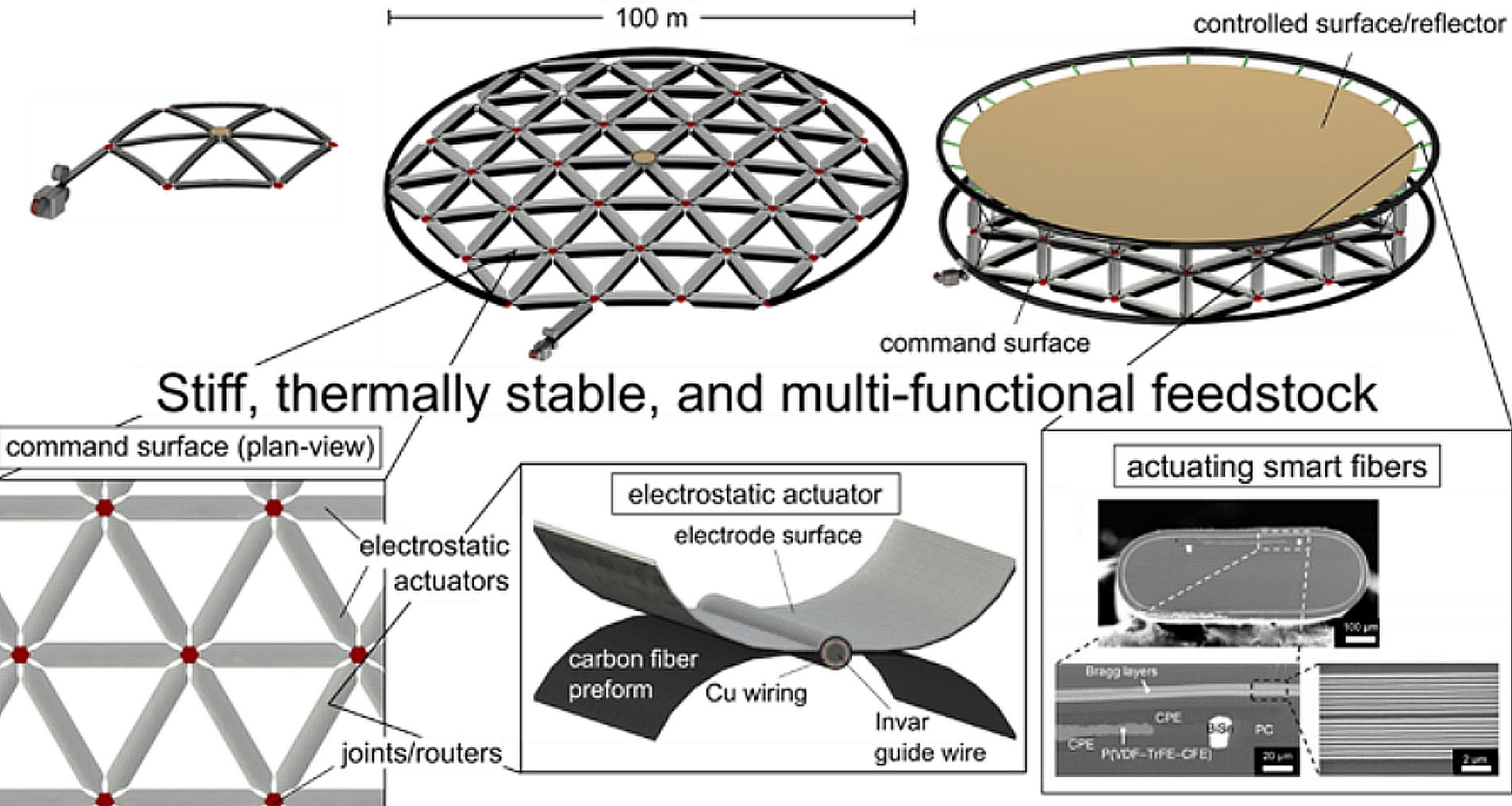
Revolutionary 100-Kilometer Space Telescope [NIAC 2023]
There are radio wavelengths that we can't see from Earth. And to observe them from space, we need a truly huge telescope. Mary Knapp and her team proposed a project that can allow us to build such a telescope and they just recently got a NIAC grant for it.
And exploration of three scientific papers on the UFO Phenomenon, two very recent, in relation to the US government and Harvard's Galileo Project probes into the UFO UAP phenomenon.
Papers:
"Preliminary Assessment: Unidentified Aerial Phenomena", United States Office of the Director of National Intelligence, 2021 https://www.dni.gov/files/ODNI/docume...
Relativity's 3D-printed rocket launches but fails to reach orbit after 2nd stage anomaly
Relativity's Terran 1 rocket launched from Launch Complex 16 in Cape Canaveral, Florida on March 22, 2023. The rocket successfully made it through Max-Q and completed first stage separation but an anomaly with the second stage resulted in failure to reach orbit.
First 3D Printed Rocket Reaches Space But Engine Fails Before Orbit
Relativity Space have been getting a lot of attention for 3D printing their rockets, some of the largest 3D printed structures ever seen are coming from their custom 3D printing systems. Last night was their Debut launch after 2 previous scrubs, and while the initial launch and ascent worked well the 2nd stage engine failed to generate enough thrust to make orbit, appearing to light and die. So what can we learn?
Rarest Atmospheric Phenomena Ever Caught on Camera
Supralateral arcs, ice pillars and sun pillars. For beautiful meteorite rings and more, check out https://www.thorum.com and use the code "ASTRUM" at checkout to get 20% off a truly unique ring!
Three Lights In Triangle Formation, Sunrise, Florida 3-17-2023, UFO Sighting News.
Date of sighting: March 23, 2023
Location of sighting: Sunrise, Florida, USA
Source: MUFON
Hey all, I believe this is not three UFOs, but a single large triangle craft that has its propulsion systems visible. This cloaked craft, could it be a secret military TR3B descendant? I believe so. This is so close to town, so close to the Palm Beach area where I found a secret military testing area for the hypersonic missile at
26°55'42.64"N 80°20'23.97"W on Google Earth map. I believe this UFO may be alien technology in USAF hands, being tested by them. The coordinates I give is a testing are from which it may have come. There are also some rocket part all over the area. Also if you hit time machine (date in lower left corner) you can see the hypersonic missile in different places, parking lot, edge of runway, runway and more. This is US military.
Scott C. Waring - Taiwan
Eyewitness states:
Sunrise, FLA. 3.17.23. Three UFO’s forming triangle moving in straight line, caught on RING camera. Near the end of the video, two disappear.
Below is a US military TR3B recorded in France back in 2009 and sent to me 14 years ago. US military project Aurora.
Mysterious UFO Sighting in Sunrise, FL: The Triangular Formation – 2 VIDEOS!
Triangle UFO over Sunrise, Florida
On the night of March 17th, 2023, a peculiar UFO sighting took place in Sunrise, Florida, leaving residents and UFO enthusiasts intrigued and seeking answers. Eyewitnesses reported seeing three unidentified flying objects forming a distinct triangular formation in the night sky.
The extraordinary sighting, which occurred around 9:30 PM, was captured on two different recording devices – a home security RING camera and a smartphone. This lends further credibility to the event, as the multiple perspectives provide corroborating evidence of the unusual aerial phenomenon.
The videos show three bright, glowing orbs hovering steadily in the sky, forming what appears to be a perfect triangle. These mysterious objects flew slowly for several minutes, allowing ample time for witnesses to observe and record their presence.
As the event unfolded, two of the three UFOs suddenly vanished from sight, leaving only one remaining in the sky. This unusual occurrence was also captured on both videos, adding to the overall mystique of the sighting.
The triangular formation observed in the videos has become a point of fascination for UFO enthusiasts, as it is reminiscent of past sightings and encounters with alleged unidentified aircraft. Theories range from secret military operations to extraterrestrial visitors; however, no concrete evidence has been provided to support any specific explanation.
The Sunrise, Florida UFO sighting has captured the imagination of many, and as with similar events in the past, it is likely to remain a subject of debate and fascination for years to come.
Theia, perhaps as big as the proto-Earth, would have delivered its densest rocks inside the planet.
HAGAI PERETS
Scientists have long agreed that the Moon formed when a protoplanet, called Theia, struck Earth in its infancy some 4.5 billion years ago. Now, a team of scientists has a provocative new proposal: Theia's remains can be found in two continent-size layers of rock buried deep in Earth's mantle.
For decades, seismologists have puzzled over these two blobs, which sit below West Africa and the Pacific Ocean and straddle the core like a pair of headphones. Up to 1000 kilometers tall and several times that wide, "they are the largest thing in the Earth's mantle," says Qian Yuan, a Ph.D. student in geodynamics at Arizona State University (ASU), Tempe. Seismic waves from earthquakes abruptly slow down when they pass through the layers, which suggests they are denser and chemically different from the surrounding mantle rock.
The large low-shear velocity provinces (LLSVPs), as seismologists call them, might simply have crystallized out of the depths of Earth's primordial magma ocean. Or they might be dense puddles of primitive mantle rock that survived the trauma of the Moon-forming impact. But based on new isotopic evidence and modeling, Yuan believes the LLSVPs are the guts of the alien impactor itself. "This crazy idea is at least possible," says Yuan, who presented the hypothesis last week at the Lunar and Planetary Science Conference.
The idea has rattled around lab corridors and conference halls for years. But Edward Garnero, a seismologist at ASU Tempe who was not involved in the work, says it's the first time anyone has marshaled multiple lines of evidence and mounted a serious case for it. "I think it's completely viable until someone tells me it's not."
Evidence from Iceland and Samoa suggests the LLSVPs have existed since the time of the Moon-forming impact, says Sujoy Mukhopadhyay, a geochemist at the University of California (UC), Davis, who considers Yuan's idea plausible but is open to other explanations. Seismic imaging has traced plumes of magma that feed volcanoes on both islands all the way down to the LLSVPs. Over the past decade, Mukhopadhyay and others have discovered that lavas on the islands contain an isotopic record of radioactive elements that formed only during the first 100 million years of Earth history.
Moreover, a new picture of the Moon-forming impactor suggests it could have delivered a cargo of dense rock deep inside Earth. The impact theory was developed in the 1970s to explain why the Moon is dry and doesn't have much of an iron core: In a cataclysmic impact, volatiles like water would have vaporized and escaped, while a ring of less dense rocks thrown up in the collision would have eventually coalesced into the Moon. The theory invoked an impactor the size of Mars or—in recent variants—much smaller. But recent work from Yuan's co-author, ASU Tempe astrophysicist Steven Desch, suggests Theia was nearly as big as Earth.
In studies of Apollo Moon rocks, Desch and his colleagues measured the ratios of hydrogen to deuterium, a heavier hydrogen isotope. Light hydrogen was far more abundant in some of the Moon samples than in Earth rocks, they found. To capture and hold onto so much light hydrogen, Theia must have been massive, they proposed in a 2019 study in Geochemistry. It must also have been quite dry, as any water, which is naturally enriched in heavy hydrogen during its formation in interstellar space, would have raised the overall deuterium levels. Such a dry, large protoplanet would have separated into layers with an iron-depleted core and an iron-rich mantle, Desch says, some 2% to 3.5% denser than present-day Earth.
Even before Yuan learned of Desch's density estimates, he was modeling Theia's fate. His model suggests that after the collision, Theia's core would have quickly merged with Earth's. He also probed the fate of Theia's mantle, varying Theia's size and density to see what conditions would have allowed the material to persist, rather than mixing in, and sink to the mantle's base. The simulations consistently showed that mantle rocks 1.5% to 3.5% denser than Earth's would survive and end up as piles near the core. The result lined up perfectly with Desch's deuterium evidence. "It's this sweet spot for the density," Desch says.
A massive Theia would also explain the scale of the LLSVPs, which together contain six times more mass than the Moon. If they are extraterrestrial, Yuan says, only an impactor as large as Theia could have delivered them.
There are many caveats, however, including the fuzzy evidence for the LLSVPs themselves. Their pilelike structure could simply be an illusion created by models of the interior that rely on low frequency seismic waves, which blur small differences, Barbara Romanowicz, a seismologist at UC Berkeley, and Anne Davaille, a geophysicist at Paris-Saclay University, suggested in a study in Tectonics last year. Rather than reaching up 1000 kilometers, the piles may rise only a few hundred kilometers before breaking off into branched plumes. "There may be holes in them," Romanowicz says. "They may be a bundle of tubes."
Smaller or less monolithic LLSVPs would also be consistent with a forthcoming analysis that finds the LLSVPs are densest at the bottom, says Harriet Lau, a geophysicist at UC Berkeley. The analysis relies on two ways of imaging the deep Earth: using GPS stations to measure the way the Moon's tidal pull stretches Earth, and seismometers to sense how Earth's natural vibrations pass through the deep mantle. "Perhaps the real story behind the density is the distribution depth," she says.
Less massive LLSVPs could complicate the idea that Theia was nearly the size of a proto-Earth, says Jennifer Jenkins, a seismologist at Durham University. Yuan's picture, she adds, "is not inconsistent with what we know, but I'm not entirely convinced."
Desch says the team could test its idea by looking for geochemical similarities between the island lavas and rocks from the Moon's mantle. None of the Apollo samples capture the unaltered mantle, which is one reason scientists want samples from the Moon's largest impact crater, on its south pole, where such rocks may be exhumed. NASA and China are both planning robotic missions to the south pole this decade, and it is a leading candidate site for NASA's return of astronauts to the Moon.
If Theia's remnants do lie deep in Earth's mantle, they may not be alone. Seismologists are increasingly seeing small, ultradense pockets of material in the deep mantle, only a few hundred kilometers across, often near the edges of the LLSVPs. Maybe they are the sunken remnants of iron-rich cores from other miniature planets that hit early Earth, Jenkins says. Theia, in fact, might be just one grave in a planetary cemetery.
*Correction, 24 March, 1:30 p.m.: An earlier version of this story misstated Qian Yuan's Ph.D. focus.
THE WEBB TELESCOPE IS SO POWERFUL, IT SPOTTED A DUST STORM ON A PLANET IN A DIFFERENT STAR SYSTEM
"EVER HAD HOT SAND WHIP ACROSS YOUR FACE?"
GETTY / FUTURISM
Dark and Stormy
For the first time ever, a dust storm has been observed outside of our Solar System — and naturally, it was the powerful James Webb Space Telescope that made the discovery.
A press release on the Space Telescope Science Institute's Webbite details the JWST-detected storm, which took place on exoplanet VHS 1256 b, a "massive brown dwarf" planet located about 40 lightyears from Earth.*
"Ever had hot sand whip across your face?" the press release quips. "That’s a soothing experience compared to the volatile conditions discovered high in the atmosphere of planet VHS 1256 b."
The JWST was able not only to observe the distant dust storm, but also to determine what its atmosphere is made of: "silicate particles, ranging from fine specks to small grains."
"The team projects that the silicates swirling in these clouds periodically get too heavy and rain into the depths of the planet’s atmosphere," reads the release. "Webb’s observations also show clear signatures of water, methane and carbon monoxide, and provide evidence for carbon dioxide."
So Much Data
Pretty much everything about VHS 1256 b — a name that, honestly, sounds more like something you'd put in a VCR than a planet — seems extreme, per its descriptions on the STScI site.
As the BBC notes in its reporting on the Webb discovery, the planet that was first detected in 2015 by the Vista telescope in Chile is what's known as a "super Jupiter," with an atmosphere similar to our Solar System's gas giant but way bigger, between 12 to 18 times the mass.
While other telescopes have been able to gather in a piecemeal fashion as much information as Webb has about VHS 1256 b, this is the first time one telescope has gotten so much data at once.
"No other telescope has identified so many features at once for a single target," the University of California Santa Cruz's Andrew Skemer, who co-wrote the team's forthcoming paper in The Astrophysical Journal Letters, said. "We’re seeing a lot of molecules in a single spectrum from Webb that detail the planet’s dynamic cloud and weather systems."
The JWST has done it again, folks — and, as always, we simply love to see it.
NASA’s Webb Spots Swirling, Gritty Clouds on Remote Planet
Researchers observing with NASA’s James Webb Space Telescope have pinpointed silicate cloud features in a distant planet’s atmosphere. The atmosphere is constantly rising, mixing, and moving during its 22-hour day, bringing hotter material up and pushing colder material down. The resulting brightness changes are so dramatic that it is the most variable planetary-mass object known to date. The team, led by Brittany Miles of the University of Arizona, also made extraordinarily clear detections of water, methane and carbon monoxide with Webb’s data, and found evidence of carbon dioxide. This is the largest number of molecules ever identified all at once on a planet outside our solar system.
Cataloged as VHS 1256 b, the planet is about 40 light-years away and orbits not one, but two stars over a 10,000-year period. “VHS 1256 b is about four times farther from its stars than Pluto is from our Sun, which makes it a great target for Webb,” Miles said. “That means the planet’s light is not mixed with light from its stars.” Higher up in its atmosphere, where the silicate clouds are churning, temperatures reach a scorching 1,500 degrees Fahrenheit (830 degrees Celsius).
This illustration conceptualizes the swirling clouds identified by the James Webb Space Telescope in the atmosphere of exoplanet VHS 1256 b. The planet is about 40 light-years away and orbits two stars that are locked in their own tight rotation. Its clouds, which are filled with silicate dust, are constantly rising, mixing, and moving during its 22-hour day.
Credits: Illustration: NASA, ESA, CSA, Joseph Olmsted (STScI)
Within those clouds, Webb detected both larger and smaller silicate dust grains, which are shown on a spectrum. “The finer silicate grains in its atmosphere may be more like tiny particles in smoke,” noted co-author Beth Biller of the University of Edinburgh in Scotland. “The larger grains might be more like very hot, very small sand particles.”
VHS 1256 b has low gravity compared to more massive brown dwarfs, which means that its silicate clouds can appear and remain higher in its atmosphere where Webb can detect them. Another reason its skies are so turbulent is the planet’s age. In astronomical terms, it’s quite young. Only 150 million years have passed since it formed – and it will continue to change and cool over billions of years.
In many ways, the team considers these findings to be the first “coins” pulled out of a spectrum that researchers view as a treasure chest of data. In many ways, they’ve only begun identifying its contents. “We’ve identified silicates, but better understanding which grain sizes and shapes match specific types of clouds is going to take a lot of additional work,” Miles said. “This is not the final word on this planet – it is the beginning of a large-scale modeling effort to fit Webb’s complex data.”
Although all of the features the team observed have been spotted on other planets elsewhere in the Milky Way by other telescopes, other research teams typically identified only one at a time. “No other telescope has identified so many features at once for a single target,” said co-author Andrew Skemer of the University of California, Santa Cruz. “We’re seeing a lot of molecules in a single spectrum from Webb that detail the planet’s dynamic cloud and weather systems.”
A research team led by Brittany Miles of the University of Arizona used two instruments known as spectrographs aboard the James Webb Space Telescope, one on its Near Infrared Spectrograph (NIRSpec) and another on its Mid-Infrared Instrument (MIRI) to observe a vast section of near- to mid-infrared light emitted by planet VHS 1256 b. They plotted the light on the spectrum, identifying signatures of silicate clouds, water, methane and carbon monoxide. They also found evidence of carbon dioxide.
Credits: Image: NASA, ESA, CSA, J. Olmsted (STScI); Science: Brittany Miles (University of Arizona), Sasha Hinkley (University of Exeter), Beth Biller (University of Edinburgh), Andrew Skemer (University of California, Santa Cruz)
The team came to these conclusions by analyzing data known as spectra gathered by two instruments aboard Webb, the Near-Infrared Spectrograph (NIRSpec) and the Mid-Infrared Instrument (MIRI). Since the planet orbits at such a great distance from its stars, the researchers were able to observe it directly, rather than using the transit technique or a coronagraph to take this data.
There will be plenty more to learn about VHS 1256 b in the months and years to come as this team – and others – continue to sift through Webb’s high-resolution infrared data. “There’s a huge return on a very modest amount of telescope time,” Biller added. “With only a few hours of observations, we have what feels like unending potential for additional discoveries.”
What might become of this planet billions of years from now? Since it’s so far from its stars, it will become colder over time, and its skies may transition from cloudy to clear.
The researchers observed VHS 1256 b as part of Webb’s Early Release Science program, which is designed to help transform the astronomical community’s ability to characterize planets and the disks where they form.
The team's paper, entitled “The JWST Early Release Science Program for Direct Observations of Exoplanetary Systems II: A 1 to 20 Micron Spectrum of the Planetary-Mass Companion VHS 1256-1257 b,” will be published in The Astrophysical Journal Letters on March 22.
The James Webb Space Telescope is the world’s premier space science observatory. Webb will solve mysteries in our solar system, look beyond to distant worlds around other stars, and probe the mysterious structures and origins of our universe and our place in it. Webb is an international program led by NASA with its partners, ESA (European Space Agency) and the Canadian Space Agency.
Media Contacts:
Laura Betz
NASA's Goddard Space Flight Center, Greenbelt, Md.
NASA calls on China to be 'open and transparent' with its lunar missions after revelation that its potential landing sites OVERLAP with US destinations on the moon's south pole
NASA identified 13 potential landing sites for Artemis 3, while China's Chang'e-7 also picked three sites near the moon's south pole that overlap with the US
'We encourage transparency and peaceful exploration of space, per the tenets of the Artemis Accords and the Outer Space Treaty,' NASA said
Chang'e-7 is set for 2024 - it will be uncrewed and consist of an orbiter, lander, a mini hopping probe and a rover - while Artemis 3 is set for 2025
'Just as the lunar South Pole is of scientific interest to NASA, it is also of scientific interest to other nations, so overlap ... is to be expected,' NASA said
NASA has called on China to be 'open and transparent' with its lunar missions following a revelation of overlap between the two nations in potential landing sites near the moon's south pole.
'Just as the lunar South Pole is of scientific interest to NASA, it is also of scientific interest to other nations, so overlap in potential landing regions is to be expected,' NASA told DailyMail.com.
The American space agency earlier this month identified 13 potential landing sites for the Artemis 3 crewed mission that's currently scheduled for late 2025 and will be the first time Americans set foot on the lunar surface in a half century.
In a Chinese journal article on possible landing sites authored by Chang'e-4 lunar mission commander Zhang He and others, 10 spots are mentioned. Artemis 3 and Chang’e-7 both identify sites near Shackleton, Haworth and Nobile craters as potential landing zones.
'We’ll continue to share our plans with the world as we are able, and hope that other nations will share their plans with us. We encourage transparency and peaceful exploration of space, per the tenets of the Artemis Accords and the Outer Space Treaty,' the American space agency said.
NASA has called on China to be 'open and transparent' with its manned lunar missions following a revelation of overlap in potential landing sites near the moon's south pole between the two countries
'In exploring the Moon, we will follow what we have spelled out in the Artemis Accords—that we will be transparent about all activities, operate in a safe and responsible manner, and avoid harmful interference,' NASA added.
'We want to be as open with the international community as we can, and as a recent example, we announced 13 candidate landing regions for Artemis III.'
The space agency already discusses its plans at several forums, including the International Space Exploration Coordination Group (ISECG), of which China is a member.
Chang'e-7, which is named after the Chinese moon goddess Chang'e, will be uncrewed and consist of an orbiter, lander, a mini hopping probe and a rover, is set for 2024.
The American space agency earlier this month identified 13 potential landing sites for the Artemis 3 crewed mission that's currently scheduled for late 2025 and will be the first time Americans set foot on the lunar surface in a half century
The overlapping sites are partly the result that region of the moon's higher elevation, good lighting and proximity to shadowed craters that may trap water-ice, according to SpaceNews, which first reported the news
The overlapping sites are partly the result that region of the moon's higher elevation, good lighting and proximity to shadowed craters that may trap water-ice, according to SpaceNews, which first reported the overlap.
It remains to be seen how the rival nations would deal with potential conflicts due to the 2011 Wolf Amendment - which prohibits NASA from using government funds to engage in direct, bilateral cooperation with the Chinese government and China-affiliated organizations without explicit authorization from Congress and the FBI.
However, in 2015 the Obama administration began something called the U.S.-China Civil Space Dialogue, which allowed for discussion of space matters; that was continued into the Trump administration.
A State Department spokesperson told the space outlet on background: 'The last U.S.-China Civil Space Dialogue was in 2017. There are no plans presently for another civil space dialogue. Should a civil space dialogue be scheduled, the United States will announce at the appropriate time.
'We have and will continue to keep the lines of communication open with Beijing, including on issues of spaceflight safety.'
Sarah Noble, Artemis lunar science lead for NASA’s Planetary Science Division, said in a previous statement: ‘Several of the proposed sites within the regions are located among some of the oldest parts of the moon, and together with the permanently shadowed regions, provide the opportunity to learn about the history of the Moon through previously unstudied lunar materials.’
'In exploring the Moon, we will follow what we have spelled out in the Artemis Accords—that we will be transparent about all activities, operate in a safe and responsible manner, and avoid harmful interference,' NASA said
NASA officials have said they will narrow down their list about 18 months before Artemis 3 so they can prepare for potential landings at each site.
There has been a recent war of words between the two countries over space activities.
Last month, NASA administrator Bill Nelson told a German newspaper that China is planning to take over the moon.
'We must be very concerned that China is landing on the moon and saying: 'It's ours now and you stay out',' he said.
China expressed its displeasure quickly.
Zhao Lijian, a spokesman at the Chinese foreign ministry, said in a statement: 'This is not the first time that the head of the US National Aeronautics and Space Administration has ignored the facts and spoken irresponsibly about China.
'The US side has constantly constructed a smear campaign against China's normal and reasonable outer space endeavors, and China firmly opposes such irresponsible remarks.'
Christopher Newman, professor of space law and policy at Northumbria University in the United Kingdom, told SpaceNews that 'this is a genuine opportunity for collaboration and cooperation between the two giant powers, and would be an opportunity to show all the rhetoric about space exploration being more than geopolitical in nature.'
'However, in reality it is not hard to see why they both want the same spots. It is prime lunar real estate for in-situ resource utilization. This could be the first potential point of conflict over resources beyond Earth,' he added.
A recent article in Beijing's Global Times said: 'Space observers also pointed out that as NASA is trying hard to relive its Apollo glories, China is working on innovative plans to carry out its own crewed moon landing missions.'
Artemis III: NASA’s First Human Mission to the Lunar South Pole
Humans have always been drawn to explore, discover, and learn as much as we can about the world—and worlds—around us. This isn’t always easy, but it’s in our nature. For the benefit of all humanity, NASA and its partners will land the first woman and first person of color on the surface of the Moon with Artemis.
Following two Artemis test missions, Artemis III, currently planned for 2025, will mark humanity’s first return to the lunar surface in more than 50 years. NASA will make history by sending the first humans to explore the region near the lunar South Pole.
On the way
NASA’s Space Launch System rocket carrying the Orion spacecraft launches on the Artemis I flight test, Wednesday, Nov. 16, 2022, from Launch Complex 39B at NASA’s Kennedy Space Center in Florida. NASA’s Artemis I mission is the first integrated flight test of the agency’s deep space exploration systems: the Orion spacecraft, Space Launch System (SLS) rocket, and ground systems. SLS and Orion launched at 1:47 a.m. EST, from Launch Pad 39B at the Kennedy Space Center.
Credits: NASA/Joel Kowsky
NASA’s Orion spacecraft will be the crew’s ride to and from Earth and into and out of lunar orbit. Orion is the only spacecraft capable of returning crews to Earth at lunar reentry velocities. On the successful Artemis I mission, Orion’s uniquely designed heat shield was recently tested under these extreme reentry conditions. Four astronauts will depart from Launch Pad 39B at Kennedy Space Center in Florida atop the Space Launch System (SLS), the only rocket powerful enough to send Orion, its crew, and their supplies to the Moon in a single launch. The crew will be selected from among the most diverse astronaut corps in history, each equipped with unique skills and intensively trained.
First the crew will launch to Earth orbit where they will perform systems checks and solar panel adjustments on Orion. Then, a powerful push from SLS’s interim cryogenic propulsion stage will help Orion perform a translunar injection maneuver, setting its course to the Moon.
For several days, the crew will travel toward the Moon and perform corrective engine burns to intercept the Moon’s gravitational field. At the right time and location, Orion will perform a series of two engine burns to place the spacecraft in a lunar Near-Rectilinear Halo Orbit (NRHO). From hundreds of potential orbits, NASA selected NRHO to achieve long-term Artemis goals. NRHO will provide near-constant communications with Earth and access to sites all over the Moon. Because it is gravitationally balanced between Earth and the Moon, this orbit will maximize fuel efficiency. On future missions, NASA and its partners will assemble the Gateway lunar space station in NRHO to serve as a hub for Artemis missions.
NASA has selected SpaceX to provide the human landing system that will transport Artemis III astronauts from Orion in lunar orbit to the surface of the Moon and back again. SpaceX plans to use a unique concept of operations to increase the overall efficiency of their lander. After a series of tests, SpaceX will fly at least one uncrewed demo mission that lands Starship on the lunar surface. When Starship has met all of NASA’s requirements and high standards for crew safety, it will be ready for its first Artemis mission.
Before the crew launch, SpaceX will launch a storage depot to Earth orbit. A series of reusable tankers will carry propellant to the storage depot to fuel the human landing system. The uncrewed Starship human landing system will then launch to Earth orbit and rendezvous with the storage depot to fill its tanks before executing a translunar injection engine burn and traveling approximately six days to NRHO where it will await the Artemis III crew.
When both spacecraft have arrived in NRHO, Orion will dock with the Starship human landing system in preparation for the first lunar surface expedition of the 21st century. Once the crew and their supplies are ready, two astronauts will board Starship and two will remain in Orion. Orion will undock and back away from Starship to remain in NRHO for roughly one orbit around the Moon, lasting about 6.5 days. This will match the length of the surface expedition, so as Orion completes its orbit, the two person surface crew will finish their work on the surface in time to launch back up to meet the spacecraft.
NASA has its sights set on locations around the South Pole for the Artemis era of human lunar exploration. Extreme, contrasting conditions make it a challenging location for Earthlings to land, live, and work, but the region’s unique characteristics hold promise for unprecedented deep space scientific discoveries. Using advanced technology including autonomous systems, the crew inside of Starship will land at a carefully selected site within a 100-meter radius.
On the Moon
Illustration of SpaceX Starship human landing system design.
Credits: SpaceX
After touchdown, the surface crew’s first task will be to ensure all systems are ready for their lunar surface stay. Then they will rest, eat, and recharge for the first full day of the expedition.
During their time on the Moon, the astronauts will do scientific work inside Starship and conduct a series of moonwalks, exiting Starship to explore the surface. The astronauts will don advanced spacesuits, exit through an airlock, and descend on Starship’s elevator. NASA has selected Axiom Space to provide the Artemis III surface suits and spacewalk systems. These suits will give the astronauts increased range of motion and flexibility to explore more of the landscape than on previous lunar missions.
During their moonwalks, the astronauts will take pictures and video, survey geology, retrieve samples, and collect other data to meet specific scientific objectives. The view from the lunar South Pole region will look very different from the photos taken on Apollo missions in the Moon’s equatorial region. The Sun will hover just above the horizon, casting long, dark shadows across the terrain, which the crew will explore using headlamps and navigational tools. The information and materials collected by Artemis III astronauts will increase our understanding of the mysterious South Pole region, the Moon, and our solar system.
Mission control teams on the ground will be in contact with the crew as they relay what they see, hear, and feel. Through mission coverage and the ability to send high quality images and video to the ground with advanced communication technology, they will be sharing a unique new human experience with the world.
On the journey home
On flight day 25 of the Artemis I mission, Orion captured this photo of the Earth from a camera mounted on one of its solar arrays.
Credits: NASA
When their surface expedition is complete, the two astronauts will lift off the surface of the Moon and head back to NRHO in Starship to reunite with their crewmates in Orion. After docking, the crew will spend up to five days in orbit, transferring samples between the vehicles and preparing for the journey back to Earth.
When they reach the optimal NRHO departure point, with all four astronauts back in Orion, they will undock and ignite Orion’s engines, slinging the spacecraft past the Moon, and allowing it to coast toward Earth. The crew will travel about 24,855 miles (about 40,000 kilometers) per hour during reentry into Earth’s atmosphere. Assisted by 11 parachutes, the spacecraft will splash down in the Pacific Ocean where it and the crew will be retrieved with support from the U.S. Coast Guard and U.S. Navy.
Artemis III will be one of the most complex undertakings of engineering and human ingenuity in the history of deep space exploration to date. The astronauts' observations, samples, and data collected will expand our understanding of our solar system and home planet, while inspiring the next generation.
This mission will usher in a future in which humans consistently access the Moon, and human planetary exploration missions are within reach. Each Artemis mission will increase our knowledge, refine our operations, and prove our technology as we prepare for the first human mission to Mars.
Artemis III Mission Map
Artemis III will be humanity’s return to the lunar surface and NASA will make history by sending the first humans to the lunar South Pole region.
Credits: NASA
To learn more and get the latest updates, follow @NASAArtemis on Facebook, Instagram, and Twitter, and subscribe to theArtemis Blog.
Driven by powerful stellar winds, expanding shrouds of gas and dust frame hot, luminous star Wolf-Rayet 124 in this sharp infrared view. The eye-catching 6-spike star pattern is characteristic of stellar images made with the 18 hexagonal mirrors of the James Webb Space Telescope. About 15,000 light-years distant toward the pointed northern constellation Sagitta, WR 124 has over 30 times the mass of the Sun.
Produced in a brief and rarely spotted phase of massive star evolution in the Milky Way, this star's turbulent nebula is nearly 6 light-years across. It heralds WR 124's impending stellar death in a supernova explosion. Formed in the expanding nebula, dusty interstellar debris that survives the supernova will influence the formation of future generations of stars.
7 Amazing Ancient Technologies Too Advanced for Their Time (Video)
Throughout history, there have been many civilizations that have left their mark on the world through their impressive architectural feats, artistic creations, and innovative technologies. While some of these ancient technologies have been lost to time, others continue to mystify and amaze us today.
From the amazing machinery used to build the pyramids, to the advanced weaponry of ancient China and the invention of the Egyptian war chariot , there are countless examples of ancient technologies that were far ahead of their time. But how did these ancient civilizations manage to achieve such remarkable feats without the benefit of modern technology? Join us as we explore some of the most incredible ancient technologies that continue to inspire wonder and admiration today.
Glowing Object Near Aircraft Over Adelaide. South Australia, March 22, 2023, UFO Sighting News.
Date of sighting: March 22, 2023 Location of sighting: Adelaide, South Australia
This UFO was visible for only a few seconds, but the photographer was able to quickly snap a few shots for us. Here we see object in the upper left corner and the aircraft in the lower right. The UFO was so bright it almost looked like a cloud, but no cloud could move that fast or far from the camera in four seconds. The speed, the color and the fact its so close to the plane all indicate its a alien scout ship, data gathering for sending back to a home planet. This UFO is very bright and it is not a drone, but an actual piloted craft.
Scott C. Waring - Taiwan
Eyewitness states:
On the 22-3-2023 at 11.17 am, I was photographing an airliner flying out of Adelaide South Australia, when an extremely bright object appeared in my view finder. The object appeared at the top of the view finder, coming in from the north-west, and descending rapidly to the bottom of the view finder heading east. It was visible for about four seconds
Fighter jet followed by black cube over Texas, March 21, 2023, UFO Sighting News.
Date of sighting: March 21, 2023
Location of sighting: Texas, USA
Source: MUFON
Guys this is something big. This black craft has many sides, like a diamond of sorts, but black. The eyewitness said it seemed to have an aura, but it didn't come out on camera, however a screenshot quickly confirms that detail. A glowing aura is seen around the UFO above. This means its some sort of energy field from its propulsion. It was following an old military jet, maybe monitoring it, scanning and gathering data to send back to its homeworld. For many alien species, oxygen would be like us breathing propane gas, so they send probes to gather info to learn about us.
Scott C. Waring - Taiwan
Eyewitness states:
F-111 fighter jet flew west to east over the house. I thought was strange, never see fighter jets in this area. Also I thought they were decommissioned. Seconds later a strange orb like object flew from the area the jet left to the north then turned west out of sight. My wife got me to film it with my iPhone. Zoomed in seems to have a glow about it looks almost like an octagon shaped ball. It seemed to fly fast then slow to almost a stop then turned west till out of view.
Lights Flash And Shoot Off, Pennsylvania March 16, 2023, UFO Sighting News. Video.
Date of sighting: March 16, 2023
Location of sighting: Pennsylvania, USA
The report didn't cite the city, but this glowing light was caught as a guy went onto the back deck having a smoke. The light flashed on and off several times and then suddenly shot off into the distance. The flashing is the UFOs powering up and there are two objects side by side shooting away. The UFOs may have come from an underground base about 5 miles below the surface and materialized in the sky above the neighborhood.
Scott C. Waring - Taiwan
Eyewitness states:
This video was captured off the deck of my residence. Strange lights that speeded away.
Fast moving underwater UFO/USO caught on film by deep ocean ROV
On June 29, 2019 a deep ocean ROV (remotely operated vehicle) captured at a depth of 1789 meters a UFO/USO passing the ROV at high speed.
This USO/UFO footage was filmed with a work class ROV at an ocean depth of 5870 Feet (1789 Meters) in the Gulf of Mexico. The USO was untethered and was operating at a depth that prevented any kind of remote operation.
While the footage quality isn't excellent, ROV operators that have seen the footage have no idea what the object may have been but concluded that it is not organic.
The USO demonstrated advanced AI operation, construction, and power management capabilities that are not known in the commercial ROV world.
This footage is further proof that these USOs do exist and have been with us for as long as airborne UFOs have. We only need to recognize and understand this phenomenon whether they are of extraterrestrial origin or military.
Unraveling the Texas UFO Puzzle: Fighter Jet and Glowing Octagonal Object
UFO filmed over Texas
On the evening of March 21, 2023, a bizarre UFO sighting took place over the skies of Texas, leaving residents baffled and sparking curiosity across the nation. The witness, who managed to capture the event on video using his iPhone, reported seeing an F-111 fighter jet flying low over his house, followed by a strange orb-like object just seconds later.
The witness described the jet flying from west to east over his home, which he found peculiar, as fighter jets are not commonly seen in the area. Furthermore, he noted that F-111 fighter jets were decommissioned, adding another layer of mystery to the sighting.
UFO sighting report
Just moments after the jet’s appearance, the witness and his wife spotted a round object flying through the sky. Initially thought to be a balloon, the object seemed to have an octagonal shape and emitted a glowing aura. The UFO traveled from the area where the jet had disappeared, first heading north before making a sharp turn westward and vanishing from sight.
The video, shot on an iPhone, clearly shows the unidentified object moving at varying speeds. At times, the object appeared to be flying quickly, while at other moments, it seemed to slow down to an almost complete stop before changing direction.
The mysterious sighting has raised several questions, such as why an F-111 fighter jet, which is no longer in service, would be present in the area. Additionally, the erratic movements and glowing appearance of the unidentified object defy conventional explanations.
As of now, there has been no official comment from the military or aviation authorities on the incident. However, the video evidence and witness account have intrigued UFO enthusiasts and the general public alike, prompting further investigations into the event.
As we await answers, the enigmatic UFO sighting over Texas serves as a reminder that there is still much to learn about our skies and the potential for unexplained phenomena. Whether the object turns out to be a military experiment, an advanced drone, or something more otherworldly, this incident has undoubtedly captured the imagination of people all around the world.
How Metal Artists In India Are Keeping A 4,500-Year-Old Craft Alive (Video)
Despite the challenges, metal artists in India are working to keep the ancient craft of Dhokra art alive. This traditional craft involves the use of a non-ferrous metal, often brass or bronze, to create intricate and detailed sculptures. The process of creating Dhokra art, which has endured for over four millennia, involves a combination of wax casting and metal casting techniques, resulting in unique and one-of-a-kind pieces.
To ensure the survival of this craft, metal artists are working to adapt and evolve their techniques, while also educating younger generations about the art form. By incorporating modern technologies and experimenting with new materials, these artists are finding new ways to produce Dhokra art and keep the tradition alive for future generations to appreciate and enjoy.
15 of Ancient History’s Most Ingenious Siege Weapons (Video)
Warfare has been a constant throughout human history, and with it, the development of increasingly sophisticated weaponry to overcome defensive fortifications. The ancient world was no exception, and siege warfare was a common tactic used to conquer enemy cities and strongholds. To accomplish this, ancient armies employed an array of ingenious siege weapons that varied from simple battering rams to complex machines capable of launching projectiles with deadly accuracy.
From the ballista, a giant crossbow first used by the ancient Greeks, to the trebuchet, which could hurl projectiles weighing over 1,000kg with ease, our ancestors were no slouches when it came to creating devastating weaponry. As technology advanced, so did the sophistication of these ancient siege weapons , with some armies even employing early forms of flamethrowers and chemical weapons. While the brutality of ancient siege warfare may seem barbaric by modern standards, the ingenuity and engineering prowess displayed in these ancient siege weapons are a testament to humanity's endless quest for innovation and advancement.
Experten waarschuwen in nieuw rapport voor “klimaat-tijdbom”: “Nú handelen voor leefbare toekomst”
Zelfs als de uitstoot van broeikasgassen de komende jaren drastisch vermindert, is het “waarschijnlijk” dat de opwarming van de aarde in de nabije toekomst boven de 1,5 graad Celsius uitkomt. Dat blijkt uit een nieuw rapport van het IPCC, het klimaatpanel van de Verenigde Naties. De klimaatwetenschappers zien tal van “uitvoerbare en effectieve” opties om de uitstoot te verlagen. “Als we nú handelen, kunnen we nog steeds een leefbare en duurzame toekomst voor iedereen veiligstellen”, zegt IPCC-voorzitter Hoesung Lee.
In het rapport beschrijven de wetenschappers hoe de klimaatverandering evolueert en wat de gevolgen ervan zijn. De grens van anderhalve graad wordt in de meeste scenario’s al tussen 2030 en 2035 bereikt. Maar als er onmiddellijk wordt ingegrepen, kan de overschrijding nog beperkt blijven, klinkt het.
Volgens de wetenschappers bedraagt de opwarming momenteel al 1,1 graden Celsius en is die zonder twijfel veroorzaakt door de mens. Het IPCC schrijft bovendien dat “elke toename van de opwarming van de aarde de gevaren zal intensiveren”. Het gaat dan onder meer om intensere hittegolven, zwaardere regenval en extreme droogte.
Zowat 3,3 tot 3,6 miljard mensen, voornamelijk in de armste landen, wonen momenteel al in een gebied dat zeer kwetsbaar is voor de klimaatverandering. Dat terwijl zij eigenlijk het minst hebben bijgedragen aan die opwarming.
Volgens onze weervrouw Jill Peeters gaat het veel moeite kosten om ons klimaat te redden. “We weten dit al lang, maar het blijft choquerend”, zegt ze bij HLN LIVE. “Het is een existentiële crisis die sneller gaat dan je je kan voorstellen.” Om de situatie te verbeteren is het volgens Peeters dan ook nodig om “nu meteen in gang te schieten”.
Uitstoot dringend naar beneden
Volgens het rapport stevenen we nog steeds af op een opwarming van zo’n 3 graden aan het einde van deze eeuw, ten opzichte van voor de industrialisatie. Het panel ziet dan ook veel redenen om snel werk te maken van de uitstootverlaging. Als ons energiesysteem snel van fossiele brandstoffen afstapt, zal ook de luchtkwaliteit verbeteren en dat is goed voor de gezondheid van de mensen. Alleen al de economische voordelen daarvan zouden volgens het IPCC “grofweg gelijk, of mogelijk groter” zijn dan de kosten.
Er is nog een kans om een duurzame toekomst voor iedereen te garanderen, maar die slinkt zienderogen.
IPCC-klimaatpanel
Om de doelstelling van 1,5 graad in leven te houden, moet de uitstoot van broeikasgassen tegen 2050 netto-nul bedragen. Dat wil zeggen dat er niet meer broeikasgassen mogen vrijkomen dan dat er kunnen worden opgeslagen of uit de atmosfeer worden weggenomen. “Er is nog een kans om een duurzame toekomst voor iedereen te garanderen, maar die slinkt zienderogen”, waarschuwen de wetenschappers.
Verschillende oplossingen zijn al voorhanden, stelt het IPCC, maar het huidige beleid hinkt achterop. Bovendien zijn ook de geldstromen niet goed afgestemd. Zo vloeit er nog altijd meer geld naar fossiele brandstofprojecten dan naar de aanpak van de klimaatverandering, klinkt het.
De wetenschappers stellen voor om de uitstoot van broeikasgassen op de volgende manieren te verlagen:
Het energiesysteem moet klimaatneutraal worden, bijvoorbeeld door over te gaan op zonne- en windenergie, aardwarmte of waterkracht
Ecosystemen en bossen moeten worden hersteld
De uitstoot van het broeikasgas methaan – afkomstig uit afval, de landbouw en fossiele brandstoffen – moet worden gereduceerd. Methaan houdt op korte tijd immers heel veel warmte in de atmosfeer vast
Mensen moeten minder zuivel en vlees consumeren
“Klimaat-tijdbom ontmantelen”
VN-secretaris-generaal António Guterres roept rijke landen op om sneller klimaatneutraal te worden, liefst al in 2040. Dat is nodig om de “klimaat-tijdbom” te ontmantelen, zei hij in een videoboodschap op de persconferentie van het IPCC. “De mensheid bevindt zich op dun ijs. En dat ijs smelt snel”, aldus de VN-baas.
Guterres benadrukte de rijke landen met hun industrialisatie in het verleden al veel meer broeikasgassen hebben uitgestoten dan arme landen. Verder zei hij dat opkomende economieën rond 2050 klimaatneutraal moeten zijn.
Milieuorganisatie Greenpeace België zoomt ook in op ons land, want in juni moet België een nieuw nationaal energie- en klimaatplan indienen bij de Europese Commissie. Die onderhandelingen zitten echter al even in het slop. Vooral Vlaanderen, verantwoordelijk voor 70 procent van de Belgische uitstoot, zou zich verzetten tegen ambitieuzere doelstellingen. “Rijke landen zoals België, en regio’s zoals Vlaanderen, hebben als historische uitstoters een enorme verantwoordelijkheid”, aldus de organisatie.
Oxfam België noemt het IPCC-rapport “het rapport van de laatste kans”. Volgens Oxfam mag iedereen op aarde nog maar minder dan 2,2 ton CO2 per jaar uitstoten om de uitstoot tegen 2030 wereldwijd te halveren. Een kaap die de rijkste 1 procent in amper twaalf dagen rondt. “We hebben een snelle afbouw van fossiele brandstoffen nodig, anders wachten ons nog catastrofes.”
This USO/UFO footage was filmed with a work class ROV at an ocean depth of 5870 Feet (1789 Meters) in the Gulf of Mexico. While the footage quality isn't excellent, ROV operators that have seen the footage have concluded that it is not organic. The USO was untethered and was operating at a depth that prevented any kind of remote operation. If it was of Russian or Chinese origin, the USO demonstrated advanced AI operation, construction, and power management capabilities that are not known in the commercial ROV world.
USOs have been sighted before by commercial ROV pilots, but this is the first footage (as far as we know) to ever see the light of day.
Peruvian Archaeologists Uncover Two-faced Moche Men with Cosmic Connections
Painted on a pillar within a ceremonial hall, archaeologists have found a 1,400-year-old “two faced man”, with cosmic associations.
The Moche culture was a pre-Columbian civilization that thrived between 100 BC and 700 AD, farming and fishing, in the northern coastal region of Peru. Known for their exquisite pottery featuring animals, people, and scenes from everyday life, they were also skilled metalworkers and produced fine gold and silver jewelry.
Now, a team of archaeologists have discovered two 1,400-year-old murals depicting two-faced men within a ceremonial hall. According to a report in Live Science , the two-faced men might refer to sacrifice, and "cosmic realms".
Upper and lower men are visible here on the pillar. Archaeologist Gabriela Cervantes Quequezana examines the imagery of the painted pillar.
Two murals of two-faced men holding unusual treasures were unearthed by archaeologists in August 2022 at the 1,400-year-old archaeological site of Pañamarca. Located in Peru's lower Nepeña Valley province of Huari, in the Ancash region of coastal Peru, the site features a large complex of stone structures including a central plaza, several temples, and residential areas. The murals were drawn between 550 AD and 800 AD, at the height of the Moche people’s rule of northern coastal Peru.
The archaeological work was conducted by the Archaeological Research Project (PIA) “ Paisajes Arqueológicos de Pañamarca ” which is collaboratively led by the international team of Jessica Ortiz Zevallos, Lisa Trever of Columbia University and Michele Koons of the Denver Museum of Nature & Science (DMNS).
Interpreting The Painted Pillar
The two murals both adorn the same pillar within a large ceremonial hall. One of the murals, located at the top of the pillar, features a man with two faces holding a feather fan in one hand, and in the other hand he holds a goblet with four hummingbirds drinking from it. The second two-faced man is painted on the lower aspect of the pillar and has a moving feather fan in one hand and a stick-like object in the other.
Two images of two-faced men have been discovered at the Moche site of Pañamarca, Peru. Left; The upper figure painted on the pillar holding a goblet feeding hummingbirds, and a feather fan. Right; the lower figure holding a fan and an unidentified stick-like object.
Both of the two-faced men are depicted with headdresses or crowns and wearing colorful clothing held tight with sizable belts. Lisa Trever is an associate professor of pre-Columbian art history and archaeology at Columbia University , who led the discovery team, and she told Live Science that the reason the Moche artists depicted these two men “is a mystery.”
Dr. Trever suspects that the ancient artists may have been “experimenting with how to show movement, and two narrative moments at once." Furthermore, the archaeologist suspects the two men “may be deities,” but she added that this is uncertain because most depictions of deities in Moche art have non-human aspects “like fangs, or the faces or tails or wings of various creatures.” But these two murals, even though they have two faces, “seem entirely human," Trever noted.
Since uncovering the first mural in 1958, archaeologists have been studying the ceremonial hall at Pañamarca, now for over 60 years. Putting the depictions of two headed men in context, other murals within the ceremonial hall depict a priestess, a serpent and a bat. And according to a statement by the team, despite six decades of study, much of the hall is still unexcavated and it is thought that many more murals are awaiting discovery.
Panoramas of the Moche complex under excavation at Pañamarca.
(Aerial drone photography by J. Antonio Ochatoma Cabrera/ Panamarca)
Exploring Cosmic Connections
Trever said one of the interesting things about the hall is the unusual density of paintings within it. This means the team can only excavate selected aspects of the building each archaeological field season. Trever said the team still has a lot of questions about the architecture and its functions and that it's still unknown how the Moche used this ritual space.
What is known about the ceremonial hall, however, is that it was reserved for use only by priests. The narrow passages and interior spaces suggest ritual use, and that “it was not a public space." Trever added it was probably open to “the leaders or elders of the community at Pañamarca." Edward Swenson , director of the Archaeology Centre at the University of Toronto, told Live Science that the two-faced men might have represented “a mortal wearing a mask and thus impersonating or becoming one with [the] supernatural." Furthermore, a connection with the gods might also be indicated in the detail of the hummingbirds drinking from the goblet.
Picking From the Peruvian Pantheon
Swenson said he interprets the hummingbirds drinking from the cup as “a powerful invocation of the centrality of sacrifice in Moche worldview." He added that sacrifice served as “a critical mechanism to ensure the circulation of life-giving fluids between beings and cosmic realms."
Like the Inca of Peru, the Moche people worshipped a wide variety of gods and deities associated with nature, agriculture, and fertility. Their primary gods included “Ai-Apaec,” a god of sacrifice and warfare; the “Decapitator,” who was a god of death and the underworld; and the Moon Goddess, who was associated with fertility, childbirth, and the menstrual cycle. It might be the case that the hummingbird was regarded as a messenger of the gods, transferring sacrificed human souls to the other world/s.
Top image: The two-faced Moche man figure painted on the lower part of the pillar. Two images of two-faced men have been discovered at the Moche site of Pañamarca, Peru.
Is Archaeology Getting it Wrong? ‘Ancient Stone Tools’ Accidentally Made by Modern Monkeys
Archaeologists from the Max Planck Institute for Evolutionary Anthropology have announced their discovery of stone fragments that closely resemble ancient stone tools made by prehistoric humans. What is notable is that these apparently worked stone objects were actually made unintentionally by old world monkeys living in the forests of Thailand. Does this have implications for stone flakes taken to be tools at ancient hominin sites?
These industrious monkeys were not trying to make cutting or scraping tools. Yet they still produced pieces of rock with sharp edges perfect for cutting and scraping, as a side effect of their use of larger chunks of rocks to crack open hard nuts and shellfish. Impressively sharp flakes are sometimes chipped off during this process, and incredibly enough these rock slices look and feel a lot like some objects that have been identified as ancient stone tools purposely made by ancient humans and by ancient human ancestors.
Until now, it had been believed that hominins like Homo sapiens ( modern humans ) and Neanderthals were history’s only toolmakers. But the stunning results of this new study, which has just been published in Science Advances , call into question the identification of at least some ancient stone tools as human cutting or scraping objects.
This wouldn’t be the case for all of the tools identified , since many (if not most) ancient stone tools are found in archaeological contexts that show other indications of human settlement and activity. But isolated stone “tools” supposedly made by ancient toolmaking cultures may now require much more careful analysis than in the past, to be sure that they really are human artifacts.
If Monkeys Can Make ‘Tools’ Too, what Are the Ramifications?
The animals studied in this research were long-tailed macaques living in Phang Nga National Park along Thailand’s southwestern peninsular coast. The clever macaques use heavy stones to break open nuts and shellfish, and over time these stones have a tendency to break into pieces after repeated use. Pieces of these stones can be found all over the park land, and many of them do indeed bear a remarkable resemblance to the sharpened stone tools recovered from various ancient archaeological sites in East Africa.
“The ability to intentionally make sharp stone flakes is seen as a crucial point in the evolution of hominins, and understanding how and when this occurred is a huge question that is typically investigated through the study of past artifacts and fossils,” lead study author Tomos Proffitt stated in a Max Planck Institute for Evolutionary Anthropology press release .
“Our study shows that stone tool production is not unique to humans and our ancestors.”
Notably, this is not the first study that suggests some ancient stone tools could actually have been made by monkeys. A 2016 University of Oxford study published in the journal Nature revealed that capuchin monkeys living in Brazil’s Serra de Capivara National Park frequently created rock flakes and chips that looked exactly like prehistoric stone tools (these primates use hard quartz and quartzite rock to break open stones that contain mineral dust they like to lick). The authors of that study noted similarities between the shapes of the capuchin “artifacts” and some of the simpler tools associated with the ancient Oldowan culture , which is alleged to have been manufacturing stone tools in East Africa more than two million years ago.
Did Humans Make the First Sharp-Edged Tools by Accident?
Naturally, a lot of the focus on this study will be on the doubts raised about past identifications of stone tools as man-made artifacts. But another important aspect of the research is what it suggests about how ancient humans started using sharp-edged tools in the first place.
Were the earliest modern humans, or human ancestors living millions of years ago, manufacturing all these tools themselves? Or did they start out by experimenting with sharp rock chips and flakes created when they were using larger rocks to break open difficult-to-access food sources?
“Cracking nuts using stone hammers and anvils, similar to what some primates do today, has been suggested by some as a possible precursor to intentional stone tool production,” said Lydia Luncz, the senior study author and the head of the Technological Primates Research Group at the Max Planck Institute. “This discovery shows how living primates can help researchers investigate the origin and evolution of tool use in our own lineage.”
Healthy Skepticism Means Better Science
In order to uncover accurate information about the origin of important cultural practices, archaeologists must interpret ancient artifacts properly and not misidentify natural objects as man-made. In this instance, the situation is interesting because the “natural forces” that can produce objects resembling human tools are still emerging from the intelligent actions of a primate species.
From now on there may be added uncertainty about whether relatively simple sharp-edged stone tools taken from ancient sites were really made by humans as cutting tools. To reach a definitive conclusion researchers will need to rely on more than the presence of sharp edges on stone flakes to identify them as man-made. Such identifications will now require added context to make them fully accepted, meaning they will need to be found mixed in with other man-made objects, collections of animal bones, or other remnants of past human activity that make it obvious that the stone objects were really tools and were being used as such.
In the long run this added scrutiny will be beneficial to the archaeological profession, as its research into prehistoric toolmaking practices will be carried out with a bit more healthy skepticism than was present before.
Top image: Example of a long-tailed macaque using a stone tool to access food.
Is There More to the Mechanics of the Great Pyramid?
At the beginning of March, Egypt’s Ministry of Tourism & Antiquities (MOTA) announced a newly discovered chamber above the main (North) entrance to the Pyramid of Khufu, also known as the Great Pyramid of Giza, outside Cairo. This 9 meter by 2 meter chamber sits directly above the North entrance, and why it was included there currently remains unknown. Could it be part of a long since dismantled locking system?
Another cavity exists between the Grand Gallery and the King’s Chamber, and far more is known about this space, which has a 3 stone blocking mechanism. But it is still somewhat enigmatic. Here, with an analysis of what is known of the construction of the blocking mechanism of this Antechamber, a mystery of the whole of the pyramid’s design is explored.
Current Thinking on the Antechamber to the King’s Chamber
From the time of the early archaeologists, the Antechamber between the Grand Gallery and the King’s chamber of the Pyramid of Khufu has been supposed to be a blocking device with three granite blocks in a row. The empty sarcophagus in the King’s chamber, the majestic Grand Gallery leading to it and this elaborate closing device led everyone to accept blindly that this was Khufu’s burial chamber. Three blocks were obviously meant to seal this chamber off.
The blocking is assumed to have worked this way. Maragioglio & Rinaldi: L’archittura delle piramidi Menfiti, parte 4, tavole (tav. 8 detail).
The vertical protruding “ribs” on the east and west walls looks like guiding lines for blocks. Fair enough. But why three, when one bigger one would be sufficient? Is it symbolic?
This way of blocking the entrance is not used in other pyramids we know of. Cylindrical rollers over the blocks seem to have been used to lower them into sealing-off position. Accurately measured drawings of Maragioglio & Rinaldi show how the blocks, in their view, were simply held up temporarily by wooden logs. So, while others bashed the supporting logs away, the blocks were held back by workers holding ropes, and then slowly lowered into their closing position.
I have calculated the weight of one such stone block to be approximately 1.5 -2 tons, (1.2m x 1.2m x 0.5 m = approx.0.8 m 3 x 2.5 t (average weight of 1 m 3 granite) = approx. 2 t). So it would have taken the weight of 20-30 Egyptians weighing 70 kg each just to hold one block. They must have been standing in the Grand Gallery. But why have nice rollers above the blocks and then a sharp – not even rounded - edge on the corridor’s ceiling. It doesn’t seem well planned.
And what about the open shaft in front of the closing blocks? If the blocks were supposed to be lowered by gradually slacking the ropes over the cylindrical rollers, it leaves this “pre-Antechamber” open to intruders afterwards, who would quickly realize that only the inner of the three blocks would have to be broken to gain access to the supposed burial chamber. Not very smart, though I admit that the damage to the southern wall (repaired) could suggest an attack from above.
But why use rollers at all?
This was a very complicated system for a one-time use. Ropes would easily slide over rounded edges of normally square blocks - the friction would even help the careful lowering, giving an argument against the roller idea - and with just narrow gaps or holes in the masonry, grave-robbers would have had a much harder job.
The rollers led me to conclude that they may have been familiar with pulley systems. Also, because I believe in Australian Paul Hai’s theory: that they rolled big stone blocks, even up the pyramid sides, with the help of convex wooden “sleighs” fastened to the blocks. Models of such sleighs or “rockers” are found.
Imagesfrom Paul Hai’s book, illustrating his wonderful idea. (Author provided)
Gods and Chambers
In an earlier article I have proposed that the closing system was designed to be used time after time and was made as a counterweight opening and closing system. It is the most logical reason for using rollers to eliminate friction.
The idea suits my basic theory that all the chambers in the pyramid were equally important.
I believe that each chamber honored one of the cosmological gods of the area. The Giza pyramids are only 30 km from Heliopolis. The five first listed gods there were gods for nature elements – earth, water (actually rain and mist = water moving vertically), and air, for some, and the three chambers we know were formed to suit one god’s element each. The gods in question were Geb, Tefnut and Shu respectfully.
And yes, I do believe that two other chambers existed: one on top of the pyramid honoring the sky goddess Nut, just covered by the pyramid’s casing stones until they fell off in an earthquake, which also loosened many of the casing stones from the sides; and a hidden chamber honoring the sun- and creator god Re-Atum. These five were the gods who had created the world.
Built vertically into the pyramid the chambers were steps on a ladder helping the deceased king ascend to heaven.
Khufu’s pyramid, including the two missing chambers higher up. I believe the chambers honored local element gods. (Author provided)
All the Chambers Display Symbolism
I believe that Khufu was buried in the subterranean chamber. The chamber was not unfinished and abandoned. This was the earth god Geb’s chamber, and a lot of the bedrock was left, intentionally giving the impression of a quarry. We can imagine how stone masonry was highly respected in ancient Egypt – a divine craft associated with Geb, I presume. Looking carefully you will see that there is a flat level area big enough to house a sarcophagus, wooden, assembled on the spot.
When the Greek historian Herodotus visited Egypt two thousand years after Khufu lived, priests told Herodotus that the king lay buried under the pyramid, on an island surrounded by water coming from an artificial canal.
With a wooden tube and some water, the words of Herodotus are brought to life in a symbolic tableau. (Author provided)
Now watch how much difference a little imagination can result in: All it takes to make us realize that Herodotus’ words may be a rather precise description of an incredible original tableau is a square wooden tube. Placed vertically in the well, with two sides resting on the cut-out ledge and tightened with clay or silt you would have a proper water well (it has been dug out deep enough to conclude that it reached ground water level at least in flooded periods).
Why have they dug the well so deep? Because they needed a lot of water. Pouring water onto the floor would result in a tableau like the one I have drawn. And more water was needed higher in the pyramid.
The Queen’s chamber and the Grand Gallery. Maragioglio tav. 7, partly cleaned for clarity. (Author provided)
Water in Tefnut’s (the Queen’s) chamber. (Author provided)
The Queen’s chamber and the Grand Gallery were wonderful gems too and call for attention, but they are only briefly referred to in this article. The Queen’s chamber had water on the floor and water in the closed canals.
Details reveal that the Grand Gallery is not my missing chamber for the sun god – the sloping Gallery is clearly not a chamber – and anyway his chamber should be closer to the sky/the top chamber. I have come to the conclusion that the Gallery is linked to the sun anyway, in the respect that it represents the sun’s rays, bringing warmth, light, heat, fire and life to the lower world. It represents the fire element on earth, whereas the sun god’s actual chamber is higher up.
Counterweight System Details
After a critical examination of the system I previously proposed for the opening and closing system: a wooden tube, balanced by a stone block in the first shaft, I have realized it was a hasty thought. A wooden tube, even three times the size of one blocking stone, would not balance the weight of a heavy stone counterweight. A wooden tube, even 20 cm (8 inches) thick and having a base area of approx. 1x2 meters – 2 square meters, would only weigh as much as 600 kg, having the average weight of e.g. cedar wood.
The remains of the counterweight stone from the shaft in front may very well be the broken stone block with drilled holes on display outside the pyramid’s entrance. From the looks of it (I haven’t measured) it is as thick as the other assumed stone blocks, therefore possibly weighing 1.5-2 tons.
The wooden tube idea. (Author provided)
I regret having to give up the wooden tube idea. The side walls’ ribs of stone would function as fine guides preventing the tube from getting stuck (from tilting forwards or backwards). I do realize that a tube could be made heavier by putting extra stones on top of it or inside the tube, but a whole extra ton?
Another counterweight possibility: a stone basin, closed and open. The grill (see below) still waits for someone to pull the rope. (Author provided)
A Low Stone Basin
To balance a stone block, “the wooden tube” must instead have been made of stone. A basin almost formed as a sarcophagus, open in both ends, would work. With side wall thicknesses like the sarcophagus inside the chamber, which is c. 15 cm (6 inches), the side walls of a stone basin may have had about the height of the corridor, and contained some water.
Alternately the basin could have had rather low sides and a bottom thickness of about the half of the counterweight, c. 25 cm (because the vertical counterweight area is roughly half that of the floor area under the three rollers). The low side version is shown here, but higher sides would better prevent it from being stuck by tilting.
The vertical grooves with a grill. The grooves continue all up to the ceiling. (Unknown photographer)
Grooves for ropes or a grill?
The interesting vertical grooves on the south wall, over the last bit of corridor leading to the King’s Chamber, could have given room for the ropes holding the inner block, in the popular three-block version. But why, in that case, were the grooves chiseled in all the way up to the ceiling? Even though the big wall stone with the most of the grooves ends a little below the ceiling, the grooves continue on another stone. That would not be necessary, if those grooves were for ropes around the roller.
The grooves could instead have guided a grill, blocking the entrance. It could be lifted with a rope going around the closest roller. It is the best use I can see for these grooves. The grill can be held close to the wall with a wooden beam or two, crossing from wall to wall. An explanation to why it should be there is proposed below.
Temple Functions
Rites were carried out in the grave temple outside the pyramid. Could the pyramid itself be a temple? The later roman writer Apuleius describes in his book The Golden Ass his own initiation into the Isis cult. He wrote that he came to the boundaries of death and then returned, going through all the elements . The Greeks had (re-) invented the elements by then, without gods, but his significant words about elements give meaning to speculations of whether Khufu’s pyramid with its element chambers functioned as an initiation temple as well as grave for a king.
In such a context the Ante-chamber’s layout is very interesting. Coming to this level the initiate would have descended to the bottom chamber, had seen the sarcophagus, had noticed the bedrock linking this chamber to the earth god Geb, had noticed the water seemingly floating in from the square canal on the opposite wall, and seen the hollow upper end of the wooden tube, seemingly a hole to the underworld. To him, this was the boundaries of death.
From here he went up, visited the Queen’s chamber (Tefnut’s watery element), and had passed through the stylized sun beams of the Grand Gallery. Now he stood on the landing in front of the last earthbound element’s chamber, the air god Shu’s chamber. He was the god who had lifted the sky from the earth and was still holding it up by his hands, standing on the earth. The initiate found the entrance closed.
Natural vertical order of elements. Sky goddess Nut held up by air god Shu. Earth god Geb lying on the ground. The sun sailed below the sky. (Author provided)
A Test
Standing in front of a closed entrance must have felt like being tested. Now what? He should probably demonstrate that he mastered manipulation of the elements he had passed on his way.
One of the earth element’s most obvious powers is its weight. Could he overcome that?
The blocking stone didn’t rest perfectly on the floor. A one-centimeter gap gave him no other choice than to try to lift the stone by hands, if he wanted to enter Shu’s chamber. So he tried - and the block moved (due to the low-friction rollers)!
The next thing he saw was glowing and burning charcoal (or dried camel dung) in the next three to four meters (the floor is depressed here, and the air channels in the chamber conveniently ventilated out most of the smoke). Fire… how could he pass this fire without getting grave skin burns? Furthermore, a grill blocked his way, and a much larger stone block was coming down as he lifted the entrance door.
Lifting the door stone all the way up revealed that the descending stone was a stone basin, covering the first half of the burning path. The basin contained water.
Having stood in water in Tefnut’s chamber he would now rely on her help to extinguish (control) the fire in a narrow path. Having wet feet would also help him to a safe passage.
Just the grill remained. Either it had gone up automatically when he lowered the basin, or better, a dangling rope gave him the final opportunity to demonstrate decision and will to enter Shu’s chamber.
In line with later initiation symbolism the sarcophagus in Shu’s chamber implies that the initiate now had to symbolically die by entering the sarcophagus and well, maybe die “the small dead”- go to sleep, or in another way open his mind to the afterlife : he was spoken to by heavenly voices, coming from somewhere (above the ceiling)! This was probably the reason for the narrow-dug tunnel leading from high over the Gallery landing into the lowest of the so-called weight-relieving chambers above the King’s chamber.
This finished his task – now he was reborn, having been dead, having been spoken to by gods. Having realized that the elements and their chambers were steps in the pyramid’s stairway to heaven - he was now initiated.
And we are too, having understood and refurnished the Antechamber.
Unidentified Phenomenon Flies Over Italy: Possible UFO Sighting or Something Else?
In 2021, a video of strange lights in a triangular formation floating in the air above the horizon went viral on social media. Shot from a train in Italy, the footage shows three orange orbs glowing in the sky. Some viewers linked this light pattern to a typical triangular UFO, making claims that this was an alien spacecraft.
Italy has a rich history of UFO sightings, including an alleged UFO crash in 1933 that spurred a secret program led by Mussolini to investigate and potentially weaponize the technology. The Italian Center for UFO Studies has documented almost 10,000 cases over a 50-year period.
But what do the experts think about this latest sighting? Forensic video analyst Michael Primeau says the footage appears real but admits there is a possibility that CGI was used. Astronomer and video effects designer Marc D’Antonio rules out commercial or military aircraft but believes the mysterious object could be a light fixture reflected in the window.
However, science writer Mick West disagrees, saying that the lights appear to move independently and gradually drift down, which is consistent with military flares. Despite the different opinions, experts cannot provide a conclusive explanation for the phenomenon.
The classic saucer-shaped UFOs of the 1950s and ’60s have become passé, and today, more and more sightings feature bright orbs, cylindrical objects, and even triangles. While this latest sighting remains a mystery, it adds to the growing list of unusual and unexplained phenomena in our skies.
If you’re intrigued by UFO sightings and want to know more about this phenomenon, stay tuned for the latest updates and research. Who knows what we might discover next?
Dust launched from the moon’s surface or from a space station positioned between Earth and the sun could reduce enough solar radiation to mitigate the impacts of climate change.
iMAGE: SIMULATED STREAM OF DUST LAUNCHED BETWEEN EARTH AND THE SUN. THIS DUST CLOUD IS SHOWN AS IT CROSSES THE DISK OF THE SUN, VIEWED FROM EARTH. STREAMS LIKE THIS ONE, INCLUDING THOSE LAUNCHED FROM THE MOON’S SURFACE, CAN ACT AS A TEMPORARY SUNSHADE. view more
CREDIT: BEN BROMLEY/UNIVERSITY OF UTAH
On a cold winter day, the warmth of the sun is welcome. Yet as humanity emits more and more greenhouse gases, the Earth'satmosphere traps more and more of the sun's energy and steadily increases the Earth's temperature. One strategy for reversing this trend is to intercept a fraction of sunlight before it reaches our planet. For decades, scientists have considered using screens, objects or dust particles to block just enough of the sun’s radiation—between 1 or 2%—to mitigate the effects of global warming.
A University of Utah-led study explored the potential of using dust to shield sunlight. They analyzed different properties of dust particles, quantities of dust and the orbits that would be best suited for shading Earth. The authors found that launching dustfrom Earth to a way station at the “Lagrange Point” between Earth and the sun (L1) would be most effective but would require astronomical cost and effort. An alternative is to use moondust. The authors argue that launching lunar dust from the moon instead could be a cheap and effective way to shade the Earth.
The team of astronomers applied a technique used to study planet formation around distant stars, their usual research focus. Planet formation is a messy process that kicks up lots ofastronomical dust that can form rings around the host star. These rings intercept light from the central star and re-radiate it in a way that we can detect it on Earth. One way to discover stars that are forming new planets is to look for these dusty rings.
“That was the seed of the idea; if we took a small amount of material and put it on a special orbit between the Earth and the sun and broke it up, we could block out a lot of sunlight with a little amount of mass,” said Ben Bromley, professor of physics and astronomy and lead author of the study.
"It is amazing to contemplate how moon dust—which took over four billion years to generate—might help slow the rise in Earth’s temperature, a problem that took us less than 300 years to produce,” said Scott Kenyon, co-author of the study from the Center for Astrophysics | Harvard & Smithsonian.
The paper was published on Wednesday, Feb. 8, 2023, in the journal PLOS Climate.
Casting a shadow
A shield’s overall effectiveness depends on its ability to sustain an orbit that casts a shadow on Earth. Sameer Khan, undergraduate student and the study’s co-author, led the initial exploration into which orbits could hold dust in position long enough to provide adequate shading. Khan’s work demonstrated the difficulty of keeping dust where you need it to be.
“Because we know the positions and masses of the major celestial bodies in our solar system, we can simply use the laws of gravity to track the position of a simulated sunshield over time for several different orbits,” said Khan.
Two scenarios were promising. In the first scenario, the authors positioned a space platform at the L1 Lagrange point, the closest point between Earth and the sun where the gravitational forces are balanced. Objects at Lagrange points tend to stay along a path between the two celestial bodies, which is why the James Webb Space Telescope (JWST) is located at L2, a Lagrange point on the opposite side of the Earth.
In computer simulations, the researchers shot test particles along the L1 orbit, including the position of Earth, the sun, the moon, and other solar system planets, and tracked where the particles scattered. The authors found that when launched precisely, the dust would follow a path between Earth and the sun, effectively creating shade, at least for a while. Unlike the 13,000-pound JWST, the dust was easily blown off course by the solar winds, radiation, and gravity within the solar system. Any L1 platform would need to create an endless supply of new dust batches to blast into orbit every few days after the initial spray dissipates.
“It was rather difficult to get the shield to stay at L1 long enough to cast a meaningful shadow. This shouldn’t come as a surprise, though, since L1 is an unstable equilibrium point. Even the slightest deviation in the sunshield’s orbit can cause it to rapidly drift out of place, so our simulations had to be extremely precise,” Khan said.
In the second scenario, the authors shot lunar dust from the surface of the moon towards the sun. They found that the inherent properties of lunar dust were just right to effectively work as a sun shield. The simulations tested how lunar dust scattered along various courses until they found excellent trajectories aimed toward L1 that served as an effective sun shield. These results are welcome news, because much less energy is needed to launch dust from the moon than from Earth. This is important because the amount of dust in a solar shield is large, comparable to the output of a big mining operation here on Earth. Furthermore, the discovery of the new sun-shielding trajectories means delivering the lunar dust to a separate platform at L1 may not be necessary.
Just a moonshot?
The authors stress that this study only explores the potential impact of this strategy, rather than evaluate whether these scenarios are logistically feasible.
“We aren’t experts in climate change, or the rocket science needed to move mass from one place to the other. We’re just exploring different kinds of dust on a variety of orbits to see how effective this approach might be. We do not want to miss a game changer for such a critical problem,” said Bromley.
One of the biggest logistical challenges—replenishing dust streams every few days—also has an advantage. Eventually, the sun’s radiation disperses the dust particles throughout the solar system; the sun shield is temporary and shield particles do not fall onto Earth. The authors assure that their approach would not create a permanently cold, uninhabitable planet, as in the science fiction story, “Snowpiercer.”
“Our strategy could be an option in addressing climate change,” said Bromley, “if what we need is more time.”
Stof lanceren vanaf de maan om zonlicht tegen te houden, het klinkt als toekomstmuziek, maar de mogelijkheid komt dichterbij en het zou zomaar eens serieus kunnen helpen om de opwarming van de Aarde tegen te gaan.
Het lijkt namelijk nu veilig en technisch mogelijk om zo’n zonnescherm te creëren tussen de Aarde en de zon. Daarvoor moet dan wel om de paar dagen stof worden afgeschoten vanaf de maan. Zo bereikt minder zonlicht de Aarde, waardoor de planeet afkoelt.
Minder zonlicht op aarde Het is een futuristisch plan waar al langer in verschillende vormen over wordt nagedacht: een kunstmatige barrière opwerpen tussen de zon en de aarde om klimaatverandering tegen te gaan. In het boek SuperFreakonomics uit 2009 staat bijvoorbeeld al een hoofdstuk over de mogelijkheid om zwaveldioxide (SO2) in de stratosfeer te schieten om de aarde tijdelijk af te koelen. De schrijvers baseren zich hierbij onder andere op de enorme uitbarsting in 1883 van de Krakatau-vulkaan in Indonesië, waarbij 20 miljoen ton SO2 vrijkwam. De wereld was toen vijf jaar lang enkele graden kouder dan normaal, omdat minder zonlicht het aardoppervlak bereikte. Maar critici schoten dit wilde plan vrijwel direct af.
Lagrange Points Maar het idee bleef bestaan. Wetenschappers van de University of Utah gaan nu nog een stap verder en hebben verschillende scenario’s doorgerekend voor een haalbare strategie om zonlicht tegen te houden. Ze overwogen om satellietschermen te plaatsen of andere objecten of stofdeeltjes buiten onze dampkring te brengen. Uiteindelijk kwamen ze tot de conclusie dat de meest efficiënte manier om een of twee procent van het zonlicht te blokkeren – dat is al genoeg om de huidige klimaatopwarming teniet te doen – is om stofdeeltjes te lanceren vanaf de maan. Voor een optimale werking moet het stofspoor precies naar het Lagrange Point worden geschoten. Er zijn twee Lagrange Points rondom de aarde. L1 is het dichtstbijzijnde punt tussen de aarde en de zon waar de zwaartekrachten in evenwicht zijn. De James Webb-ruimtetelescoop bevindt zich op L2, een Lagrange-punt aan de andere kant van de aarde.
Het stofspoor tussen de Aarde en de zon dat het zonlicht moet tegenhouden. Afbeelding: Ben Bromley/University of Utah
“De basis van ons idee is om een beperkte hoeveelheid materiaal te gebruiken om in een speciale baan tussen de aarde en de zon te plaatsen en daar uit elkaar te laten vallen. Op deze manier kunnen we veel zonlicht blokkeren met een kleine hoeveelheid massa”, vertelt hoogleraar natuurkunde en astronomie Ben Bromley tegen Scientias.nl. “Ons onderzoek richtte zich hoofdzakelijk op de conceptvraag. Ik kan alleen maar gissen naar de tijd en de kosten die zo’n gigantisch ruimteproject met zich meebrengen. Het zal in ieder geval een astronomisch bedrag zijn, maar vergeet niet dat de gevolgen van klimaatopwarming ook een enorm kostenplaatje hebben.”
Kan maanstof de opwarming van de aarde helpen tegenhouden? Niet aan beginnen, denkt menig wetenschapper.
Stofkanon op de maan Het is een fascinerend idee om vier miljard jaar oud maanstof te gebruiken om de door de mens in tweehonderd jaar veroorzaakte klimaatopwarming tegen te gaan. Het ruimtegruis werkt in de berekeningen korte tijd heel goed, maar wordt dan al snel uit koers geblazen door de zonnewinden, straling en zwaartekracht in ons zonnestelsel. Elke paar dagen is er een nieuwe lading stof nodig om richting het Lagrange Point te schieten en aangezien het enorm veel kracht kost om het stof iedere keer vanaf de Aarde te lanceren, vanwege de zwaartekracht en de atmosfeer, is het volgens de onderzoeker een beter idee om dit vanaf de maan te gaan doen, ook al moet er daar dan eerst een basis worden gebouwd.
Niet te zien Veel zullen mensen er op het eerste gezicht niet van merken, verwacht Bromley. “Aangezien de stofdeeltjes maar een fractie van het zonlicht tegenhouden, is het verschil vanaf de Aarde met het blote oog nauwelijks te zien. De stofdeeltjes verspreiden zich over de volle breedte van de zonneschijf.” Maar wat gebeurt er eigenlijk met het stofspoor nadat het uit elkaar is gevallen? Gaan we daar in de toekomst geen last mee krijgen? “We weten dat de deeltjes in ieder geval niet neervallen op aarde, op de maan of op onze satellieten. Maar het is onduidelijk of het gruis in de toekomst nog schade kan berokkenen bij ruimtereizen of iets dergelijks. Mocht dit concept echt worden uitgevoerd, dan zal eerst extra onderzoek hiernaar nodig zijn”, legt Bromley uit.
Astronomische parasol Er zijn ook scenario’s doorgerekend, waarbij een meer permanente barrière wordt gevormd. “Sterrenkundige J. Roger Angel kwam met het idee om een vloot met een heleboel kleine bestuurbare satellieten in te zetten. Het probleem is dat bij Lagrange Point 1 het gebied dat je moet bestrijken erg groot is. Het gaat hier om een vlak van honderden bij honderden kilometers”, aldus de professor.
Bromley ziet zijn plan als een noodoplossing. “We zijn geen experts in klimaatverandering of de raketwetenschap die nodig is om massa van de ene plaats naar de andere te verplaatsen, maar we hebben wel onderzocht hoe verschillende soorten stof het zonlicht kunnen tegenhouden op verschillende plekken in ons zonnestelsel. Verder maken we de effectiviteit van deze aanpak overzichtelijk. Het zou doodzonde zijn om een alternatieve oplossing als deze voor het enorme klimaatprobleem op aarde niet door te rekenen. Onze strategie zou een optie kunnen zijn om tijd te kopen in de race tegen de klok, nu de tekenen van de destructieve klimaatverandering steeds duidelijker worden.”
Minder uitstoot Maar ook de professor vindt dat in de eerste plaats de CO2-uitstoot omlaag moet. “Ons concept is een interessant onderdeel van een groter internationaal plan om klimaatverandering tegen te gaan. De belangrijkste stap is echter om de oorzaken van de opwarming van de aarde aan te pakken en de hoeveelheid broeikasgassen in onze eigen atmosfeer drastisch te verminderen”, besluit Bromley.
Future Space Telescopes Could be 100 Meters Across, Constructed in Space, and Then Bent Into a Precise Shape
It is an exciting time for astronomers and cosmologists. Since the James Webb Space Telescope (JWST), astronomers have been treated to the most vivid and detailed images of the Universe ever taken. Webb‘s powerful infrared imagers, spectrometers, and coronographs will allow for even more in the near future, including everything from surveys of the early Universe to direct imaging studies of exoplanets. Moreover, several next-generation telescopes will become operational in the coming years with 30-meter (~98.5 feet) primary mirrors, adaptive optics, spectrometers, and coronographs.
Even with these impressive instruments, astronomers and cosmologists look forward to an era when even more sophisticated and powerful telescopes are available. For example, Zachary Cordero of the Massachusetts Institute of Technology (MIT) recently proposed a telescope with a 100-meter (328-foot) primary mirror that would be autonomously constructed in space and bent into shape by electrostatic actuators. His proposal was one of several concepts selected this year by the NASA Innovative Advanced Concepts (NIAC) program for Phase I development.
Corder is the Boeing Career Development Professor in Aeronautics and Astronautics at MIT and a member of the Aerospace Materials and Structures Lab (AMSL) and Small Satellite Center. His research integrates his expertise in processing science, mechanics, and design to develop novel materials and structures for emerging aerospace applications. His proposal is the result of a collaboration with Prof. Jeffrey Lang (from MIT’s Electronics and the Microsystems Technology Laboratories) and a team of three students with the AMSL, including Ph.D. student Harsh Girishbhai Bhundiya.
Their proposed telescope addresses a key issue with space telescopes and other large payloads that are packaged for launch and then deployed in orbit. In short, size and surface precision tradeoffs limit the diameter of deployable space telescopes to the 10s of meters. Consider the recently-launched James Webb Space Telescope (JWST), the largest and most powerful telescope ever sent to space. To fit into its payload fairing (atop an Ariane 5 rocket), the telescope was designed so that it could be folded into a more compact form.
This included its primary mirror, secondary mirror, and sunshield, which all unfolded once the space telescope was in orbit. Meanwhile, the primary mirror (the most complex and powerful ever deployed) measures 6.5 meters (21 feet) in diameter. Its successor, the Large UV/Optical/IR Surveyor (LUVOIR), will have a similar folding assembly and a primary mirror measuring 8 to 15 meters (26.5 to 49 feet) in diameter – depending on the selected design (LUVOIR-A or -B). As Bhundiya explained to Universe Today via email:
“Today, most spacecraft antennas are deployed in orbit (e.g., Northrop Grumman’s Astromesh antenna) and have been optimized to achieve high performance and gain. However, they have limitations: 1) They are passive deployable systems. I.e. once you deploy them you cannot adaptively change the shape of the antenna. 2) They become difficult to slew as their size increases. 3) They exhibit a tradeoff between diameter and precision. I.e. their precision decreases as their size increases, which is a challenge for achieving astronomy and sensing applications that require both large diameters and high precision (e.g. JWST).”
While many in-space construction methods have been proposed to overcome these limitations, detailed analyses of their performance for building precision structures (like large-diameter reflectors) are lacking. For the sake of their proposal, Cordero and his colleagues conducted a quantitative, system-level comparison of materials and processes for in-space manufacturing. Ultimately, they determined that this limitation could be overcome using advanced materials and a novel in-space manufacturing method called Bend-Forming.
This technique, invented by researchers at the AMSL and described in a recent paper co-authored by Bhundiya and Cordero, relies on a combination of Computer Numerical Control (CNC) deformation processing and hierarchical high-performance materials. As Harsh explained it:
“Bend-Forming is a process for fabricating 3D wireframe structures from metal wire feedstock. It works by bending a single strand of wire at specific nodes and with specific angles, and adding joints to the nodes to make a stiff structure. So to fabricate a given structure, you convert it into bending instructions which can be implemented on a machine like a CNC wire bender to fabricate it from a single strand of feedstock. The key application of Bend-Forming is to manufacture the support structure for a large antenna on orbit. The process is well-suited for this application because it is low-power, can fabricate structures with high compaction ratios, and has essentially no size limit.”
In contrast to other in-space assembly and manufacturing approaches, Bend-Forming is low-power and is uniquely enabled by the extremely low-temperature environment of space. In addition, this technique enables smart structures that leverage multifunctional materials to achieve new combinations of size, mass, stiffness, and precision. Additionally, the resulting smart structures leverage multifunctional materials to achieve unprecedented combinations of size, mass, stiffness, and precision, breaking the design paradigms that limit conventional truss or tension-aligned space structures.
In addition to their native precision, Large Bend-Formed structures can use their electrostatic actuators to contour a reflector surface with sub-millimeter precision. This, said Harsh, will increase the precision of their fabricated antenna in orbit:
“The method of active control is called electrostatic actuation and uses forces generated by electrostatic attraction to precisely shape a metallic mesh into a curved shape which acts as the antenna reflector. We do this by applying a voltage between the mesh and a ‘command surface’ which consists of the Bend-Formed support structure and deployable electrodes. By adjusting this voltage, we can precisely shape the reflector surface and achieve a high-gain, parabolic antenna.”
An arrangement of 3 exoplanets to explore how the atmospheres can look different based on the chemistry present and incoming flux. Credit: Jack H. Madden used with permission
Harsh and his colleagues deduce that this technique will allow for a deployable mirror measuring more than 100 meters (328 ft) in diameter that could achieve a surface precision of 100 m/m and a specific area of more than 10 m2/kg. This capability would surpass existing microwave radiometry technology and could lead to significant improvements in storm forecasts and an improved understanding of atmospheric processes like the hydrologic cycle. This would have significant implications for Earth Observation and exoplanet studies.
The team recently demonstrated a 1-meter (3.3 ft) prototype of an electrostatically-actuated reflector with a Bend-Formed support structure at the 2023 American Institute of Aeronautics and Astronautics (AIAA) SciTech Conference, which ran from January 23rd to 27th in National Harbor, Maryland. With this Phase I NIAC grant, the team plans to mature the technology with the ultimate aim of creating a microwave radiometry reflector.
Looking ahead, the team plans to investigate how Bend-Forming can be used in geostationary orbit (GEO) to create a microwave radiometry reflector with a 15km (9.3 mi) field of view, a ground resolution of 35km (21.75 mi) and a proposed frequency span of 50 to 56 GHz – the super-high and extremely-high frequent range (SHF/EHF). This will enable the telescope to retrieve temperature profiles from exoplanet atmospheres, a key characteristic allowing astrobiologists to measure habitability.
“Our goal with the NIAC now is to work towards implementing our technology of Bend-Forming and electrostatic actuation in space,” said Harsh. “We envision fabricating 100-m diameter antennas in geostationary orbit with have Bend-Formed support structure and electrostatically-actuated reflector surfaces. These antennas will enable a new generation of spacecraft with increased sensing, communication, and power capabilities.”
Wetenschappers zien zich genoodzaakt de grote wijzer van de doemdagklok te verschuiven. En niet de goede kant op. De beweging is grotendeels te wijten aan de oorlog in Oekraïne.
Dat heeft het Bulletin of the Atomic Scientists vandaag bekend gemaakt. De klok staat nu op 90 seconden voor middernacht. En daarmee is een droevige mijlpaal bereikt; nog nooit stond de doemdagklok (zie kader) zo dicht bij middernacht als nu.
Over de klok De doemdagklok werd in 1947 in het leven geroepen om in één oogopslag weer te kunnen geven in hoeverre de mensheid erop afstevent de planeet (en misschien zelfs zichzelf) te vernietigen. Daarbij wordt de klok steevast op een aantal minuten voor middernacht gezet, waarbij middernacht dus symbool staat voor de apocalyps. Waar in 1947 de grootste dreiging daarbij nog uitging van kernwapens hebben wetenschappers in de loop der jaren verschillende nieuwe dreigingen in overweging moeten nemen alvorens te besluiten over de stand van de wijzers van de doemdagklok. Zo wordt sinds 2007 bijvoorbeeld ook de dreiging van catastrofale effecten van klimaatverandering meegenomen. Waar de wijzers van de doemdagklok temidden van al het tumult in de wereld op uitkomen wordt met enige regelmaat besproken binnen een speciaal comité – het Bulletin’s Science and Security Board – waarin vooraanstaande wetenschappers zitting hebben.
Kernwapens Dat de wijzers van de klok – die vorig jaar nog op 100 seconden voor middernacht stonden – iets verder zijn opgeschoven, heeft voornamelijk te maken met de oorlog in Oekraïne. Met enige regelmaat dreigt Rusland daarbij met de inzet van kernwapens en dat laat zien dat escalatie – hetzij met opzet of per ongeluk – een reëel gevaar is, zo betogen de wetenschappers.
Daarnaast wijzen de onderzoekers erop dat Rusland erop blijft hameren dat Oekraïne van plan zou zijn om chemische en biologische wapens in te zetten. Het doet vrezen dat Rusland er zelf over denkt dergelijke wapens – die het volgens experts nog altijd ontwikkelt – in te zetten, aldus het comité.
Eerdere tijden De laatste keer dat de doemdagklok verzet werd, was in 2020. Toen werd deze van 2 minuten voor middernacht (in 2019) verzet naar 100 seconden voor middernacht. Dat was al ongeëvenaard: nog nooit stond de klok zo dicht bij middernacht. En in 2021 en 2022 bleef de klok op die tijd staan. En nu is de klok dus nog wat verder vooruitgezet, naar 90 seconden voor middernacht. Een nieuw record in de geschiedenis van de doemdagklok die in 1947 op 7 minuten voor middernacht werd gezet om in 1953 – de Koude Oorlog was in volle gang – voor het eerst gevaarlijk dicht bij middernacht in de buurt te komen: de klok werd in dat jaar op 2 minuten voor 12 gezet. In de eerste jaren erna komt de klok niet meer zo dicht bij middernacht en in 1991 wordt zelfs een tijd van 17 minuten voor 12 genoteerd. In de periode daarna gaat het vrij snel bergafwaarts; van 14 minuten voor 12 in 1995 naar 7 minuten voor 12 in 2002. Nog eens tien jaar later staat de klok op 5 voor 12 en in 2018 komt deze op het niveau van 1953, met een tijd van 2 voor 12, waarna de wijzers vervolgens dus nog iets dichter naar middernacht kruipen.
Kernramp Daarnaast zijn er op dit moment ook grote zorgen over het feit dat Rusland er tijdens deze bloedige oorlog niet voor terugdeinst ook de kerncentrales in Tsjernobyl en Zaporizhzhia te beschieten. Daarmee worden internationale protocollen aan de laars gelapt en is er een kans dat het een keertje misgaat, met het vrijkomen van radioactieve materialen tot gevolg.
New START Ook is er bezorgdheid rond New START, het laatste bestaande kernwapenverdrag tussen Rusland en de VS dat in 2026 afloopt. Nu de relatie tussen beide grootmachten bekoeld is, lijken onderhandelingen over verlenging ver weg. En daarmee kan dit verdrag zomaar aflopen. Daarmee zou ook een einde komen aan wederzijdse inspecties, waardoor het onderling wantrouwen toeneemt en een nieuwe kernwapenwedloop op de loer ligt.
Klimaat Ook voor het klimaat is de oorlog in Oekraïne en de ijzige betrekkingen tussen Rusland en de rest van de wereld slecht nieuws. Landen die eerder afhankelijk waren van Russisch gas en olie zoeken wanhopig naar nieuwe leveranciers, waardoor er in plaats van minder nu juist meer geïnvesteerd wordt in bijvoorbeeld de gaswinning.
“De Russische invasie van Oekraïne heeft de kans op het gebruik van kernwapens en biologische en chemische wapens vergroot, de reactie van de wereld op klimaatverandering verlamd en internationale pogingen om andere wereldproblemen aan te pakken, beperkt,” zo concluderen de onderzoekers. Het is dan ook van het grootste belang dat er gewerkt wordt aan vrede in Oekraïne. “Een manier vinden om serieus te onderhandelen over vrede kan de kans op escalatie flink terugdringen. In deze tijd van ongeëvenaarde wereldwijde dreiging is gecoördineerde actie vereist en elke seconde telt.”
The Bulletin of the Atomic Scientists annually sets the Doomsday Clock to show how close humanity is to destroying itself.
Moving the clock from 100 seconds to midnight to 90 seconds was a decision brought by the Russian invasion of Ukraine, among other factors.
The Doomsday Clock was created in 1947 and has moved over 20 times since its introduction.
When the Bulletin of Atomic Scientists unveiled the world’s first Doomsday Clock in 1947—a symbolic example of how close humanity is to destroying itself—they set the time at 17 minutes until midnight. Well, time’s rapidly running out.
This morning, the Bulletin just updated its Doomsday Clock for 2023, and it’s now just 90 seconds away from midnight—a 10-second march closer than the past few years.
“We are living in a time of unprecedented danger, and the Doomsday Clock time reflects that reality,” Rachel Bronson, president and CEO of the Bulletin of the Atomic Scientists, said in a press release. “Ninety seconds to midnight is the closest the clock has ever been set to midnight, and it's a decision our experts do not take lightly.”
RELATED STORY
Earth Is in the Middle of a Mass Extinction Event
The Bulletin of the Atomic Scientists was founded in 1945 by Albert Einstein, J. Robert Oppenheimer, Eugene Rabinowitch, and other scientists involved in developing the first atomic weapons. They believed their work created man-made threats to human existence. Two years later, they introduced the Doomsday Clock to show the world’s vulnerability to catastrophe from nuclear weapons, technology, and other factors.
The 2023 Doomsday Clock shift—the clock had been set at 100 seconds to midnight since 2020—is due largely, but not exclusively, thanks to Russia’s continued invasion of Ukraine and the increased risk of nuclear escalation for every month the two countries remain in conflict. The Bulletin says continued threats from climate crisis, and the breakdown of institutions needed to mitigate risks associated with advancing technologies and biological threats, also contributed to the shift.
From the Bulletin’s statement:
“Russia’s war on Ukraine has raised profound questions about how states interact, eroding norms of international conduct that underpin successful responses to a variety of global risks. And worst of all, Russia’s thinly veiled threats to use nuclear weapons remind the world that escalation of the conflict—by accident, intention, or miscalculation—is a terrible risk. The possibility that the conflict could spin out of anyone’s control remains high.”
Along with the Russian aggression, the scientists also warn about a Russian-American treaty covering nuclear weapons that expires in February 2026, as well as the continued expansion of nuclear weapon capabilities in China, North Korea, Iran, and India.
To add to the mix, the Bulletin says the climate crisis is worsening, bio-threats—including laboratory accidents—are greater now than ever before, and disruptive technology has grown in concern.
“The Doomsday Clock is sounding an alarm for the whole of humanity,” said Mary Robinson, former United Nations high commissioner for human rights. “We are on the brink of a precipice.”
The Book of Enoch (or I Enoch) wasn’t included in the Biblical canon due to the belief Enoch himself didn’t author most of the book and that I Enoch wasn’t divinely inspired by God.
The Book of Enoch The Book of Enoch is not found in any Christian Bibles (regardless the Bible version)– with the exception of the Ethiopian Orthodox church. I Enoch was at first accepted in the Christian Church, but later left out of the Biblical canon. There remains some hype around it due to the fascination of marginal (and some heretical) Christian groups such as the Manicheans.
Who Was Enoch in the Bible?
Enoch was the son of Jared, making him the great-grandfather of Noah (Genesis 5:18). As we see in Genesis 5:24, Enoch is one of two people in the scriptures not to die – but to be taken up directly by God. He would have been seven generations after Adam and Eve. He likely spoke the same language as them, and might have been just as tall as them.
We also see Enoch praised in the book of Hebrews in what many call the “Hall of Faith:”
By faith Enoch was taken up so that he should not see death, and he was not found, because God had taken him. Now before he was taken he was commended as having pleased God.
The Book of Enoch (or I Enoch) is actually a combination of several separate works written between the time of Enoch and all the way up through 137 BC. The book is full of predictions and messianic prophecies. While some have been proven true, much of the book is proven wrong and historically inaccurate, leading Biblical scholars to refer to it as an Apocryphal writing.
Concerns Over the Book of Enoch
So why was the Book of Enoch left out of Old Testament canon? The biggest reason is that scholars doubt its authenticity. Perhaps Enoch did write portions of it, but most scholars believe different sections were changed and added to by other authors throughout time. In fact, some theorize that one section covering astronomy was written in the 2nd century AD by a Jewish Christian who wished to contribute his own thoughts and speculations with the authority of Enoch.
Because of these concerns, no Biblical scholar believes the book was actually written by the Enoch of the scriptures. There’s far too much evidence it had been tampered with and added to – especially in the years leading up to the birth of Jesus.
Are some portions written by Enoch and valid? Possibly. But our church fathers ultimately made the decision to exclude it from canon.
Unidentified Aerial Phenomena: Insights from Two Experienced Fighter Pilots
Unidentified Aerial Phenomena (UAP), commonly known as UFOs, have long been a subject of fascination and debate. Recently, the discussion has gained new momentum, with more former military personnel coming forward to share their experiences. In a candid interview, two retired fighter pilots, Chris Lehto and Ryan Graves, discuss their encounters with UAPs and the need for more investigation into the phenomenon. Both pilots have extensive experience, with Lehto having flown F-16s and Graves piloting F/A-18 Super Hornets during their military careers.
The Americans for Safe Aerospace Initiative
During the interview, Graves talks about his involvement with the Americans for Safe Aerospace (ASA), an organization that aims to raise awareness about UAPs and their potential implications on national security and aerospace safety. ASA collaborates with experts in various fields, including military personnel, scientists, and engineers, to study and analyze these enigmatic objects.
Graves’ Briefing at the American Institute of Aeronautics and Astronautics
As part of his efforts to raise awareness, Graves presented a briefing at the American Institute of Aeronautics and Astronautics (AIAA), discussing his encounters with UAPs and the need for further research. He emphasized that these objects exhibit advanced capabilities, such as high speeds and rapid acceleration, which are beyond the known capabilities of existing aircraft.
A common argument against the existence of UAPs is that they could be balloons or other man-made objects. However, both Lehto and Graves dismiss this notion, stating that they have encountered balloons during their flying careers and can easily distinguish them from UAPs. They believe that the objects they’ve encountered are not balloons, given their unique flight characteristics and the fact that they were detected within close range.
Interesting Radar Contacts
During their time in service, both pilots had encountered radar contacts with unusual characteristics that were later identified as UAPs. These objects displayed advanced flight capabilities, such as rapid acceleration and instant changes in direction, which are not typical of conventional aircraft.
The ‘Gimbal’ Video and Nimitz Radar Data
Graves shares his insights on the famous ‘Gimbal’ video, which shows an object rotating in mid-air. He believes that the object in the video is not a balloon, given its flight characteristics and proximity to the aircraft. He also discusses the Nimitz radar data, which shows unexplained aerial objects moving at incredible speeds. Graves highlights the classification issues surrounding these incidents, as UAP encounters are often classified at a higher level, making it challenging for researchers to access and analyze relevant data.
The interview between Chris Lehto and Ryan Graves sheds light on the experiences of two experienced fighter pilots who have encountered UAPs during their military careers. Their insights underline the need for further investigation into this phenomenon, as the potential implications on national security and aerospace safety cannot be ignored. As more military personnel come forward to share their experiences, the conversation surrounding UAPs is likely to gain more traction and, perhaps, lead to a better understanding of these mysterious objects.
From time immemorial, people had the need to venerate objects of great significance: religious relics, mythical symbols, or depictions of holy figures. And as if answering this need, the religious establishment has provided. Throughout time relics have been widely worshiped throughout the world. Some of them are relics in the true meaning of that term: holy items of ancient times that are a marvel to witness. Then again, some relics are simply strange and bizarre. Reading about them we can easily explore the limits of human belief and analyze the complex anatomies of faith.
The Fairy Flag is one of the MacLeod Clan relics in Scotland, said to have been gifted to the MacLeod chiefs by fairy folk. ( Public domain )
1. The Fairy Flag: Strange Relic of the MacLeod Clan in Scotland
A relic is not necessarily a religious item. Some of them can be important heirlooms and artifacts with a lengthy heritage and history. One such item is the so-called Fairy Flag, a venerated and very old heirloom of the Chiefs of the Scottish Clan MacLeod . Known in Scottish as Am Bratach Sìth, it is kept in the clan’s seat at Dunvegan Castle and is considered an indivisible part of their heritage.
The Fairy Flag is made from silk that originated in the far east, denoting its luxury status on the remote Isle of Skye. Being very old, it is now quite torn and tattered, and covered with tiny red “elf spots.” Shrouded in mystery, this strange relic has attained legendary status and is said to have magical properties and plenty of healing powers . Its origins are somewhat enigmatic, and the legends state that the MacLeod chiefs were presented with the flag by fairy folk . However, scholars suggested that its origins might lie not with the fairies, but in the Crusades, or the Viking invasions, for whom it could have been a raven banner. Nevertheless, it remains as one of the most precious and strangest in Scotland.
The footprints of the Prophet Mohammad is a selection of artifacts that can be visited across the Islamic world. ( epic_images / Adobe Stock)
2. The Footprints of Muhammad: Petrified Relics of the Prophet
The founder of Islam, the Prophet Muhammad is the most venerated figure of this widespread religion. Accordingly, just like in Christianity, religious relics associated with him are aplenty. But one stands out as quite peculiar: the petrified footprint of Muhammad. Some Muslims believe that wherever the prophet stepped, his left foot made an impression that remained fixed in place.
According to numerous written and oral sources, this prophet left numerous such footprints across the Arabic world. One such alleged footprint is located in the Topkapi Palace in Istanbul, where it is venerated by thousands of believers every year. Some other notable examples of his preserved footprints are located in the mausoleum of Qaitbey in Cairo, or in the Mosque of the Footprint in Qadam, just south of Damascus and directly on the pilgrimage route to Mecca.
Numerous legends are associated with these peculiar relics. One legend says that a royal eunuch of the Nizam (Muslim Indian sovereign) once discovered an imprint after being guided to it by a dream vision of the prophet himself. Whatever one might believe, a petrified footprint is certainly a strange phenomenon, and also one that is quite difficult to skillfully replicate or fake.
Detail from The Circumcision of Jesus by Friedrich Herlin, an event described in the Gospel of Luke. ( Public domain )
3.The Holy Prepuce of Jesus Christ
Possibly one of the strangest relics in the world, the Holy Prepuce - also known as the Holy Foreskin - is just another in a long line of relics associated with Jesus Christ . This relic allegedly originates from the circumcision of Christ, and became an important religious item in the early periods of Christianity. Numerous healing powers have been attributed to this foreskin, and it was soon claimed as a prized item by several churches in Europe.
Alongside the umbilical cord of Christ, the foreskin had a long and turbulent journey in medieval Europe. In 800 AD, it was given as a present to Pope Leo III by King Charlemagne, who most likely received the relic as a present from the Byzantine Empress Irene. The Pope housed the relic in a lavish jeweled gold cross, which was kept under the altar of the Chapel of Saint Lawrence in Rome.
Alas, with the Sack of Rome in 1527, the jeweled cross with Jesus’ foreskin was looted, and later retrieved in a village north of Rome, Calcata, where it was reportedly kept until 1983, when it was yet again stolen. However, its authenticity at that time was dubious at best, and the actual existence of the Holy Foreskin remains a big enigma. Nevertheless, as far as strange relics go, the veneration of a foreskin is definitely a strange practice.
The discovery of the Antikythera Mechanism in a shipwreck off the coast of the Greek island of Antikythera proves the existence of advanced technology as far back as 100 BC. (Tilemahos Efthimiadis / CC BY 2.0 )
5. The Antikythera Mechanism: The Ancient Analogue Computer
Just like religious relics carry a lot of importance for believers, so do the relics of ancient civilizations bear importance for history enthusiasts all over the world. The Antikythera Mechanism remains one of the strangest and most enigmatic discoveries connected with the ancient Greeks, puzzling the scientists to this very day. It was discovered in 1901 off the coast of the Greek island called Antikythera, within a shipwreck at a depth of 45 meters.
The complex gears and mechanism pieces that comprise it were soon recognized, and since then this item has been recognized as one of the world’s first analogue computers. What makes it so strange is the time in which it was built. Being made in roughly 100 BC, it is surprisingly advanced and seems almost futuristic in many ways.
This device is a complex clockwork mechanism that contains more than 30 delicate bronze gears. Scientists proposed that it was used as an orrery, used by the Ancient Greeks to predict astronomical positions and eclipses. Such knowledge could be used for calendar and astrological purposes and provide them with this information decades in advance. As such it is certainly one of the most enigmatic relics of the ancient world.
Golden Palace Events purchased the bizarre religious relic, a grilled cheese sandwich with a depiction of the face of the Virgin Mary, back in 2004 for a stunning $28,000!
Yup, you read that right. When it comes to religious relics, the options become limitless. Not all religious relics were discovered in ancient history. The old toast and sandwich manifestation of holy figures is the true relic of modern times, as strange as it may seem. A woman from Fort Lauderdale in Florida, USA, named Diana Duyser, sold her 10-year-old grilled cheese sandwich in 2004 - with one bite taken out of it - for $28,000 on an online auction! But it was no ordinary grilled cheese sandwich: it allegedly bore the image of the face of the Virgin Mary . Mrs. Duyser kept the sandwich sealed for 10 years before deciding to try and sell it - she never assumed it would fetch such a stellar price.
For the faithful, it could be called a miracle. However, those with a bit more reason will realize that it is simply a curious coincidence: the dark crust formed a pattern that surprisingly accurately depicts a female face. This strange modern-day relic was bought by an online casino, the Golden Palace, whose representatives say that they quickly understood the novelty of such a “recognizable part of modern pop culture.” They did not hesitate to pay $28,000 (£20,113) to own it. This makes it the world’s most expensive grilled cheese sandwich!
Wax effigy of St. Datian at the Church of the Most Holy Redeemer in New York. ( Village Preservation Blog )
7.The Remains of St. Datian in New York
The tradition of Catacomb Saints spread like wildfire through the Christian world, when holy relics and preserved skeletons of “saints” began emerging throughout the world. One such holy relic is considerably stranger than the others, and it found its way all the way to New York. This relic is the body of Saint Datian.
This odd relic is housed in a glass sarcophagus in the Church of the Most Holy Redeemer in East Village, New York City. Not much is known about Saint Datian. In fact, this saint is virtually unknown in preserved written sources. It is possible that Datian was a cruel roman leader who persecuted Christians zealously, but later repented, became a monk, and was later martyred.
The remains (bones) of this saint arrived at the church in 1892 and were housed in a lifelike wax effigy. The relics were donated to the church by a wealthy Italian lady, but the earlier origins of the bones remain a mystery. But some people quickly placed the authenticity of these remains into question. As early as 1897 it was suggested that the encased remains are actually those of a police officer shot and killed while defending the church from a burglary. This belief remained widespread until the late 1940’s. The truth about this strange relic remains unknown.
The Lion-Man of the Hohlenstein-Stadel was discovered in a cave in 1939 in Germany and is considered the oldest zoomorphic figurine in the world. (Izquierda: Dagmar Hollmann / CC BY-SA 3.0 . Derecha: Thilo Parg / CC BY-SA 3.0 )
8. The Lion-Man of the Hohlenstein-Stadel: Prehistoric Ivory Relic
Religion - whether monotheistic or polytheistic - has deep and ancient origins. What beliefs did our earliest ancestors have? Have some of their ancient relics survived until today? The Lion-man, known also as Löwenmensch, is an elaborate prehistoric mammoth ivory figurine that quite possibly depicts an ancient mythical being worshipped by the prehistoric man. In 1939 it was discovered in a cave in Germany and is considered the oldest zoomorphic figurine in the world. Dated to the Upper Paleolithic, it is roughly 40,000 years old and was made from mammoth ivory .
Researchers came to a conclusion that the lion-headed figure was an important part of the mythology of the Paleolithic humans inhabiting this region. It also might be one of the earliest connections with shamanism. It deepens the mystery of numerous Paleolithic depictions of “beast-men,” like the bird-headed man from the Lascaux Cave , the lion-woman from Chauvet Cave , or the stag-headed “Sorcerer” from the Trois Frères cave. Prehistory was undoubtedly strange, seen now from our modern point of view, and ancient relics are all that remains of their belief systems.
The Chapel of the Milk Grotto of Our Lady in Bethlehem takes its name from the belief that the Virgin Mary found refuge in a cave with the infant Jesus and a drop of her milk fell on the cave floor, turning it white. ( Renáta Sedmáková / Adobe Stock)
9. Breast Milk of the Virgin Mary in Bethlehem
Another in a long line of strange Christian relics is the so-called breast milk of the Virgin Mary . “The Nursing Madonna,” or Maddona Lactans , has been often depicted in Christian religious art, nurturing the baby Jesus at her breast. But did you know that her breast milk is venerated as a relic? It is situated in the Chapel of the Milk Grotto of Our Lady in Bethlehem, some 10km south of Jerusalem. Ever since the Byzantine Era, this site has been frequented as one of the major Christian pilgrimage sites. It is believed that Virgin Mary found refuge in this grotto with infant Jesus, and while she breastfed him a drop of her milk fell on the cave floor and turned it white.
Pilgrims visit this site, especially those couples seeking to conceive a child as the faithful believe that this shrine helps those suffering with infertility. The Catholic officials sought to capitalize on this belief, selling limestone powder made from the stone of the grotto, which ought to be diluted in water and drank. It supposedly helps cure infertility. You thought that veneration of a foreskin is strange? How about drinking powdered cave floor? This strange relic is as strange as can be.
10. The Venus of Hohle Fels: 40,000-Year-Old Ivory Sculpture
Venus figurines are the most iconic relics of the world’s earliest history. These fertility symbols were one of the major cultic items for early humans, and pose a great insight into their cryptic and mysterious beliefs. The Venus Of Hohle Fels is one of the strangest of all ancient relics, and can be interpreted in many ways. Unearthed in the Hohle Fels cave in Germany, this ivory sculpture is dated to the very beginning of the Upper Paleolithic period, some 40,000 years ago. It is the oldest, undisputed depiction of a human being and gives us a crucial glimpse into the earliest origins of Cro-Magnons in Europe.
This relic might look strange to us, but for the early man it might have been a revered mythical concept. It depicts a buxom - perhaps even obese - woman with enormous breasts, a large (pregnant) belly, and a prominent vulva. These are clear connections with fertility. It can be easily understood that life was quite hard in the Upper Paleolithic and infant death rates could have been quite high. People were also probably malnourished and lean, so a depiction of a buxom, hale, and fat woman could have been an ideal of health, fertility, prosperity, and good life. Either way, we will never know the true meaning of the Venus figurines, and this one remains a truly strange ancient relic.
Top image: The relics humans have chosen to worship over the course of human history can often help us understand the extent of belief systems and the anatomies of faith.
Marvels of human creativity and engineering prowess, these top 15 rock sculptures captivate the imagination and inspire awe. Among these awe-inspiring rock sculptures are the towering Colossal Statue of Shapur, the remarkableGopachal Jain monuments , the poignant Lion of Lucerne, the imposing Apennine Colossus , and the serene Avukana Buddha. These extraordinary feats of artistry and craftsmanship have withstood the test of time, leaving an indelible mark on the landscape and serving as a testament to the heights of human achievement. As diverse as the cultures and epochs they represent, these magnificent rock sculptures continue to fascinate and enchant visitors from around the world, offering a glimpse into the boundless potential of human creativity and our enduring connection to the natural world.
University of California, Los Angeles assistant professor Artur Davoyan recently proposed a pellet-beam propulsion concept that could send a large spacecraft into interstellar space.
The concept, which has the potential to allow us to propel a spacecraft to another star system within our lifetime, was recently awarded a $175,000 grant by NASA's Innovative Advanced Concepts (NIAC) program.
A new space laser propulsion concept
Today's chemical rockets are simply not fast enough to take us far beyond our solar system within any reasonable timeframe. That's why Davoyan proposed a new concept to propel spacecraft using pellet-beam propulsion.
The new concept was partly inspired by Breakthrough Starshot, a $100 million initiative announced by Russian-born philanthropist Yuri Milner in 2016. Breakthrough Starshot proposed using millions of lasers trained on a tiny probe with a light sail to send it to our nearest star, Proxima Centauri, in as little as 20 years.
For Dayovan's pellet-beam propulsion concept, he and his team proposed using two spacecraft. One would set off towards interstellar space, while the other would go into orbit around Earth. From there, the orbital spacecraft would fire thousands of tiny metallic pellets at the interstellar spacecraft every second. It would also either fire a 10-megawatt laser beam at the interstellar probe or align a laser fired from the ground toward the interstellar craft.
That laser would hit the pellets and heat them to the point that a layer is removed and become plasma. That plasma accelerates the pellet remnants, and the pellet beam provides thrust that propels the spacecraft at enormous speeds.
Dayovan also proposed an alternative method where an onboard magnetic field-generating device could deflect the pellets and propel the craft forward.
Traveling into deep space at 480,000 km/h
The Breakthrough Starshot concept aims to propel its probe at 20 percent the speed of light, though it seeks to use a tiny probe only capable of carrying a basic camera.
Dayovan believes the pellet-beam propulsion system could propel a 1-ton probe at speeds of up to roughly 480,000 kilometers per hour (300,000 miles per hour), meaning it would be 10 times faster than chemical propulsion systems for traditional rockets. It would also be fast enough to overtake Voyager 1 — the farthest human-made spacecraft from Earth — in only five years.
Thanks to NASA's NIAC program, Dayovan, and his team now have $175,000 in funding to demonstrate the concept's feasibility. Much like with Breakthrough Starshot, the new concept relies on significant advances in laser design, meaning it will be some time before we see a pellet-beam propulsion system take to the skies.
A NASA-funded team of researchers has identified a lunar pit on the moon that’s always a balmy 63 degrees Fahrenheit — suggesting it could be the perfect place for future astronauts to establish a moon base.
The challenge:
NASA plans to return humans to the moon as soon as 2025, with the goal of establishing a long-term presence on the lunar surface. The hope is that this will give astronauts enough time to conduct the research needed to eventually send people to Mars and beyond.
Finding a safe location for future astronauts to set up a moon base is essential to NASA’s exploration plans, but the moon is not a hospitable place for people.
Surface temperatures on the moon range from -280 F at night to 260 F during the day.
Because the moon doesn’t have an atmosphere or magnetic field, astronauts will be exposed to about 200 times as much radiation as people on Earth. The lack of an atmosphere makes meteorite strikes on the moon harder and faster than on Earth, too, so space rocks and impact debris are another threat.
The moon’s day-night cycle is nearly 30 Earth-days long, so astronauts will also need to get used to 15 straight days of darkness and light. They’ll need to deal with the moon’s extreme temperatures, too, which can range from a frigid -280 F at night to a blistering 260 F during the day.
Underground moon base:
Lava tubes — subterranean tunnels created more than two billion years ago when the moon was volcanically active — could be the answer to astronauts’ housing problem.
Since 2009, astronomers have discovered 16 pits on the moon’s surface that they believe formed when the roof of a lunar lava tube caved in. Future astronauts could potentially access a tube through a lunar pit and build a moon base within the cave.
This would protect astronauts from space radiation and meteorites, while still offering them direct access to the moon’s surface. And now, new research suggests it would help them avoid the moon’s wild temperature fluctuations, too.
Cozy cave: Using computer models and data collected by a thermal camera aboard NASA’s Lunar Reconnaissance Orbiter, researchers have determined that temperatures within the shaded part of one lunar pit remain about 63 F during the entire day-night cycle.
They believe this is due to the pit’s overhang preventing the area under it from getting too hot during the day, while also trapping heat from radiating out of the pit at night.
“Humans evolved living in caves, and to caves we might return when we live on the moon.”
DAVID PAIGE
Getting in and out of the pit wouldn’t be easy — the bottom is 328 feet below the moon’s surface, so it’d be like rappelling down a 30-story building. But if NASA can make it work, astronauts wouldn’t have to expend energy on yet-to-be-invented climate control systems for their future moon base.
“Humans evolved living in caves, and to caves we might return when we live on the moon,” said study co-author David Paige.
There's a growing consensus among astronomers that beyond the gas giants of the outer solar system lurks a mysterious object — perhaps a black hole — influencing the massive cloud of small, icy bodies in the Oort cloud.
And it turns out there is some evidence to suggest this hypothesis might be right. No one is sure how a planet massive enough to affect the cloud of icy leftovers from the solar system's birth could form at such a great distance from the sun. "All we know is that there's an object of a certain mass out there," said Theorist Jakub Scholtz of the U.K.'s Durham University, in a New Scientist report. "The observations we have can't tell us what that object is."
And Scholtz suspects it might be a primordial black hole forged during the big bang — when the universe exploded into existence. But how can we know for sure, and what else could this show us about the universe?
Planet nine might be a primordial black hole
The object — generally dubbed Planet Nine — has remained a subject of intense scrutiny and disagreement among scientists for years, and should be between five and 15 times Earth's mass. No one has seen it, but if it's a primordial black hole, it would likely be no larger than a grapefruit, and remain totally undetectable to human observation unless we witnessed a distant object plunging to its doom into the tiny maw of the event horizon.
The closest confirmed black hole to Earth lies in a triple-star system called HR 6819, roughly 1,000 light-years away. It's about four times the mass of the sun — comparatively light in the scope of the universe. But evidence is mounting that tiny, primordial black holes are abundant throughout the universe, the nearest of which might be a quick, 10-year trip away aboard NASA's New Horizons spacecraft. New Horizons made headlines back in 2015 when it made a rapid flyby of Pluto and its moon, Charon — providing scientists (and everybody else) with the first clear pictures of the former ninth planet.
An illustration of the rubble pile asteroid Itokawa.
Credit: Kevin M. Gill
Batting away an asteroid as demonstrated by NASA last year might be the best solution to preventing rogue space rocks hitting Earth.
Defending earth from rogue space rocks roared back into the public consciousness in 2022 with the film Don’t Look Up and NASA’s successful Double Asteroid Redirection Test (DART) last year, but now Australian researchers at Curtin University have produced research supporting the use of kinetic impacts to alter the course of ‘rubble pile’ asteroids.
Although asteroids might conjure up pictures of gargantuan, solid rocks floating in space, rubble piles are the result of tiny rocks and dust particles coalescing under very weak, gravitational attraction.
“If you want to create your own rubble pile [asteroid], just go into your backyard, take a rock, [hit with] a sledgehammer and smack the rock to oblivion,” says lead researcher Professor Fred Jourdan.
“There’s going to be small pebbles, there’s going to be dust, and a lot of area between, and that’s exactly what a rubble pile is: the difference on Earth is that it just collapses in its own way, in space it’s bound by its own gravity.
“Everything, all those rocks, are attracted by each other.”
But even though this weak gravity might bring all these rocks together in a loose coalition, separating them appears to be decidedly difficult.
Studying dust samples from the Sydney Harbour Bridge sized Itokawa asteroid, Jourdan and his colleagues found these rubble piles can take a beating.
Itokawa probably formed after a massive space impact around 4.2 billion years ago causing its parent asteroid to fragment. That means the asteroid is almost as old as our solar system.
During that time, it’s had countless collisions with other space rocks and remained intact throughout.
That means it’s probably not going to shatter if an object was to be deliberately smashed into it, as NASA did with the asteroid Dimorphos last year.
“What we found is that a rubble pile, despite the constant bombardment, can take a beating, and it has for more than 4.2 billion years,” Jourdan says.
“DART didn’t try to destroy the asteroid, it just tried to push it out of the way, and that’s exactly what we say.
“Because it’s so resistant, you can bombard it with other stuff more aggressive that’s going to be able to push the asteroid out of the way, without completely destroying it.
“We don’t want to destroy these asteroids, if you did, you might get plenty of fragments and this might be, in some cases, even worse than one single fragment.”
Jourdan’s team also suggested going for the nuclear option might be a viable option if kinetic impact was ruled out.
But rather than launching a high-powered warhead into the asteroid to vaporise it, the detonation of such a weapon in close proximity to the asteroid would provide a suitable shockwave to steer the rubble pile out of the way.
The Curtin team will next take samples from the larger asteroid Bennu which was probed by NASA’s OSIRIS-REx mission for study later this year, and will also take receipt of samples from the Martian moon Phobos at the end of the decade.
Tucker Carlson Relays Strange Account of Soldiers Falling Victim to UFO Encounters
The enigma of unidentified flying objects has fascinated the public and military for decades. Recently, Fox News host Tucker Carlson reignited the discussion with an intriguing tale of troops dying from UFO-inflicted brain injuries. While the U.S. military denies these allegations, the story raises questions about the extent of our knowledge on UFOs and their potential impact on human lives.
Tucker Carlson’s UFO Brain Injury Claims
On the “Full Send” podcast, Carlson recounted a conversation he had with a Stanford professor who, according to the host, was assigned by the Defense Department 11 years ago to investigate cases of troops dying due to UFO-inflicted brain injuries. The professor allegedly had expertise in traumatic brain injury and examined the brains of over 100 troops who died after encounters with UFOs. Moreover, the professor informed Carlson of numerous open court cases supporting these claims.
Carlson expressed his disbelief that such stories were not making front-page headlines, questioning why such significant information remained under the radar.
In response to these claims, the U.S. military has been quick to deny their validity. Susan Gough, a Defense Department spokesperson, declared the story false and the Pentagon declined to comment further. Despite the military’s dismissal, UFOs continue to be a topic of interest within the defense community.
Recent Developments in UFO Research
In recent months, UFOs have taken center stage in military discussions. Last week, Sean Kirkpatrick, head of the Pentagon’s All-domain Anomaly Resolution Office, co-authored a report with Abraham Loeb, chairman of Harvard University’s astronomy department. The report, titled “Physical Constraints on Unidentified Aerial Phenomena,” explores the possibility that alien vessels could be sending out search probes throughout our solar system.
The authors suggest that an interstellar object could be a parent craft releasing multiple small probes during its close passage to Earth, a concept similar to certain NASA missions. This report was published after weeks of heightened attention on unidentified aerial phenomena, sparked by a Chinese spy balloon entering U.S. airspace.
While the U.S. military denies Tucker Carlson’s claims about troops dying from UFO-inflicted brain injuries, the ongoing interest in UFOs highlights our curiosity and thirst for understanding these mysterious phenomena. As researchers continue to investigate the existence and potential implications of unidentified flying objects, the line between fact and fiction remains blurred. The public can only hope that forthcoming studies will shed light on these enigmatic occurrences and their possible impact on human lives.
ALL RELATED VIDEOS, selected and posted by peter2011
'This stuff is real': Sci-fi author details how he saw an 'enormous silver V-shaped UFO' at age 14 as his unsurprised military father gave him a knowing WINK
Dan Harary, 66, saw a UFO hovering above his New Jersey neighborhood in 1970
He told DailyMail.com his father, Jack, acted as though he had seen one before
Harary has said that the experience has inspired his new novel, After They Came
It was an ordinary afternoon in 1970 when a 14-year-old Dan Harary looked through the windshield of his father's car and saw a V-shaped UFO hovering above his New Jersey neighborhood in broad daylight.
The Hollywood publicist-turned-sci-fi writer never forgot the incredible moment, but it wasn't until decades later that he became convinced his military dad, Jack, knew more about the flying saucer than he had let on.
Harary's father worked as an electronics engineer with the U.S. Army from 1951 to 1996 and never discussed his top secret projects.
It was not until Jack died in 2017, that his son remembered he had given him a knowing wink after their UFO sighting. 'I thought, "Oh my God, I wonder if my dad knew what that was,"' Harary, 66, told DailyMail.com.
The author's growing conviction that his father knew about UFOs during his 45 years in the military inspired his new alien novel, After They Came, which tells the story of a man who is beamed up by extraterrestrials after trying to drown himself on his 70th birthday.
Hollywood publicist-turned-sci-fi writer Dan Harary, 66, penned a new alien novel, After They Came, that was inspired by the first UFO sighting he had with his military father in 1970
Harary's father, Jack (pictured in New Jersey in 1957), worked as an electronics engineer with the U.S. Army from 1951 to 1996 and never discussed his top secret projects. Harary was in the car with his dad when he spotted an 'enormous V-shaped UFO'
Harary was born and raised outside Asbury Park, New Jersey, where he developed a passion for rock music — not aliens. The existence of extraterrestrial life didn't really cross his mind until his first UFO sighting as a teen.
He recalled how his father had been driving him home from Hebrew school around 4.30pm when he spotted something flying in the air. He yelled for his dad to pull over, and when they got out of the car, they saw an 'enormous silver V-shaped UFO.'
'It was maybe 200 feet in the air, completely silent, and it was just hovering. It just went very, very slowly over my neighborhood, and I could not believe what I was seeing,' he said.
'So I was jumping up and down. "Dad, a UFO! Dad, a UFO! It's so cool!" My father looked at it like he was thinking about what he had to buy at the grocery store the next day. He had no interest. Just the look on my father's face was like he'd seen it a hundred times already.'
Before they left, his father looked at him and gave him a wink, something he had never done before. When they got home, Harary called his local newspaper and was told they were 'getting a lot of phone calls about this sight,' but nothing was ever published.
The writer had asked his father what he thought about aliens and UFOs three or four times over the years, but his reaction was always the same. He would simply chuckle and say, 'Well, I don't know.'
Harary (pictured with his father and brother Bob) recalled how his dad seemed unimpressed by the sight as if it was something he had already seen before giving him a knowing wink
Harary (pictured in 1974) was more interested in rock music than aliens as a teen, but he never forgot that moment with his father. He recalled asking his dad about his thoughts on UFOs and extraterrestrial life over the years, but he would just chuckle and say, "Well, I don't know'
The sci-fi author (pictured with his mother, Joan, and brothers, Bob and Mike, in 2001) said he saw a second UFO that was a 'white light shaped like an egg' in Lancaster, California, in 1994. He saw a third at Gilliland's Ranch, an alleged UFO hotspot in Trout Lake, Washington, in 2008
He noted that his father's 'goal in life was to get his pension' and would never risk losing it by sharing top secret information with anyone, even his family.
Harary said he had a second UFO sighting while visiting his two children at his ex-wife's house in Lancaster, California, in 1994.
Harary's new book tells the story of a man who is beamed up by extraterrestrials and becomes a world hero
After tucking his kids into bed, he went outside and saw a 'white light shaped like an egg' that traveled from one end of the sky to another and suddenly stopped.
It then reversed its course and returned to its original point of origin.
'Nothing manmade can do that,' he thought to himself.
However, Harary didn't start researching UFOs and extraterrestrial life until he wandered into the paranormal section of a Los Angeles bookstore in 2007.
After buying and reading about a dozen books on the topic, he became a believer and joined the Los Angeles chapter of the Mutual UFO Network (MUFON), an international organization that investigates reported UFO sightings.
'The things I heard and saw absolutely blew my mind,' he said.
'I just could not believe all the history, all the evidence, all the testimony of so many people that have experienced things that I was never aware of... It just completely changed my worldview.'
In 2008, Harary saw his third UFO while spending a long weekend at Gilliland's Ranch, an alleged UFO hotspot in Trout Lake, Washington.
Harary (pictured with his mother and Mel Brooks in 2006) was a longtime Hollywood publicist and worked with dozens of celebrities. Last year, he published his memoir, Flirting with Fame: A Hollywood Publicist Recalls 50 Years of Celebrity Close Encounters
The author (pictured with Steven Spielberg in 2010) started researching UFOs and extraterrestrial life in 2008. He joined the Los Angeles chapter of the Mutual UFO Network (MUFON), an international organization that investigates reported UFO sightings
Harary (pictured with E.T. star Dee Wallace in 2022) told DailyMail.com that it wasn't until after his father's death that remembered how he had winked at him during their UFO sighting. He is now convinced that his father knew about UFOs through his work in the military
James Gilliland, founder of the Enlightened Contact with Extraterrestrial Intelligence (ECETI), owns the property and has been hosting stargazing events since 1986.
'At night, we could go out into the field just at the base of Mount Adams. People would sing and dance, play guitars and tambourines, and dance around,' Harary recalled. 'We did that for three nights in a row hoping to summon up a UFO. That was the goal.
'I kept thinking, "No way while I'm here that something is gonna happen. There's no chance." First night, nothing. Second night, nothing. The third night, the last night we were there, people are singing and chanting, and then suddenly out of nowhere a bright green emerald-shaped craft appeared right above us.'
Harary said the light flashed on and off a few times before it sped off. They all looked at each other with amazement, and he started to cry. Of the three UFOs he has seen, he noted that 'no two were even close to the same.'
After his father's death, he asked his mother if he had ever mentioned UFOs or aliens. She told him that the first week he worked at Fort Monmouth, a former army installation in Monmouth County, New Jersey, he was taken down into the vaults and shown 'something remarkable.'
'He came home and said, "I saw something that I can never tell you about." My mother said he looked pale and he was scared s******s,' he explained. 'He never discussed it with anyone. She even said he was never the same. We'll never know what he saw.'
Harary (pictured promoting his memoir in 2022) shared that his mother told him that his father had seen 'something remarkable' at one of the vaults at Fort Monmouth, a former army installation in Monmouth County, New Jersey, but couldn't tell her about it
Harary (pictured with his daughter Anjuli) said that he is constantly trying to prove to his friends and family that 'this stuff is real.' He is convinced that if people took the time to read the research UFOs and aliens, they would become believers too
UFOs have been making headlines in recent weeks after three were shot down over U.S. and Canadian airspace in three days. A week prior, a Chinese spy balloon was shot down over South Carolina
Harary believes the focus has been on the Chinese balloon 'because the other three were not manmade.' 'Still to this day, they don't want to reveal it to the public,' he said of the government's alleged knowledge of extraterrestrial life. 'They think there will be a panic. That's the thing'
UFOs, or unidentified aerial phenomena (UAPs) as the U.S. government now calls them, have long been the subject of fascination and skepticism. However, Harary is convinced that if people took the time to research UFOs and aliens, they would become believers too.
He rattled off ancient cave paintings, the Nazca Lines in Peru, the Egyptian pyramids, and the deathbed confessions of military men who allegedly helped cover up the Roswell UFO crash as evidence that extraterrestrials exist.
'The other three objects have never been identified. They've not been recovered. They haven't been shown on television,' Harary noted, saying the focus has been on the Chinese balloon 'because the other three were not manmade.'
'Still to this day, they don't want to reveal it to the public,' he said of the government's alleged knowledge of extraterrestrial life. 'They think there will be a panic. That's the thing.'
Harary knows that some people think he is a 'lunatic,' including his own doctor, who asked if he was going to 'wear a tinfoil hat' as a costume while promoting his book at Aliencon, which took place in Pasadena, California, this month.
'I'm trying to tell my friends and relatives, "Hey, this stuff is real, and when the day comes when it's proven, don't be too surprised because it's all absolutely real,"' he said. 'And my mother goes, "Enough with the aliens!"'
Sci-fi writer recounts witnessing a giant silver V-shaped UFO at 14, while his military dad, seemingly unsurprised, gives him a knowing wink
Harary’s Novel Chronicles a Man’s Journey from Alien Abduction to Global Hero (Amazon link)
In 1970, Dan Harary, a 14-year-old boy from New Jersey, had an extraordinary encounter that would go on to shape his life and inspire his career as a sci-fi writer. Sitting in his father’s car, Harary spotted a V-shaped UFO hovering above their neighborhood in broad daylight. The experience was unforgettable, but it took decades for Harary to realize that his military father, Jack, might have known more about the incident than he let on.
Jack Harary, an electronics engineer with the U.S. Army from 1951 to 1996, had always remained tight-lipped about his top-secret projects. It wasn’t until Jack’s death in 2017 that Dan remembered the knowing wink his father had given him after their UFO sighting. This revelation sparked Harary’s curiosity and fueled the creation of his new alien novel, After They Came.
Dan Harary’s fascination with extraterrestrial life didn’t emerge until he had multiple UFO sightings throughout his life. In addition to the encounter in 1970, he experienced another sighting in 1994 and a third in 2008. It was after his second sighting that Harary began researching UFOs and extraterrestrial life, which led him to join the Los Angeles chapter of the Mutual UFO Network MUFON in 2008.
Harary’s journey from a casual observer to a firm believer in extraterrestrial life is a testament to the impact that personal experiences and dedicated research can have on one’s worldview. He has since become an advocate for open discussion on the topic of UFOs and extraterrestrial life, arguing that the evidence supporting their existence is too substantial to ignore. His conviction has driven him to share his story and encourage others to explore the subject with an open mind.
Dan Harary
As a sci-fi writer, Harary has used his passion for the topic to create engaging stories that captivate readers and explore the possibilities of life beyond Earth. His novel, After They Came (Amazon link), draws from his own experiences and the belief that his father had knowledge of UFOs through his work in the military. The book tells the story of a man who is beamed up by extraterrestrials after trying to drown himself on his 70th birthday, taking readers on an intriguing journey through the realm of the unknown.
Despite the skepticism he faces from some, including his own doctor, Harary remains committed to proving the existence of extraterrestrial life. He believes that if people took the time to research UFOs and aliens, they too would become believers. With his writing and advocacy, Harary hopes to inspire others to question the limits of our understanding and embrace the possibility of life beyond our planet. As the author himself states, “this stuff is real,” and when the day comes that it’s proven, he wants people to be prepared for the truth.
Artificial intelligence is permeating every sector of society. Systems like ChatGPT have been rolled out for public consumption boasting an interactive dialogue, and an ability to write ‘in your voice.’ But how ‘intelligent’ is this new artificial intelligence? We have a little fun putting it to the test.
Meer van UFO'S of UAP'S, ASTRONOMIE, RUIMTEVAART, ARCHEOLOGIE, OUDHEIDKUNDE, SF-SNUFJES EN ANDERE ESOTERISCHE WETENSCHAPPEN - DE ALLERLAATSTE NIEUWTJES


 Mystifying UFO Sighting in Southeastern Coachella Valley Stirs Curiosity