Ontdek de Fascinerende Wereld van UFO's en UAP's: Jouw Bron voor Onthullende Informatie!
Ben jij ook gefascineerd door het onbekende? Wil je meer weten over UFO's en UAP's, niet alleen in België, maar over de hele wereld? Dan ben je op de juiste plek!
België: Het Kloppend Hart van UFO-onderzoek
In België is BUFON (Belgisch UFO-Netwerk) dé autoriteit op het gebied van UFO-onderzoek. Voor betrouwbare en objectieve informatie over deze intrigerende fenomenen, bezoek je zeker onze Facebook-pagina en deze blog. Maar dat is nog niet alles! Ontdek ook het Belgisch UFO-meldpunt en Caelestia, twee organisaties die diepgaand onderzoek verrichten, al zijn ze soms kritisch of sceptisch.
Nederland: Een Schat aan Informatie
Voor onze Nederlandse buren is er de schitterende website www.ufowijzer.nl, beheerd door Paul Harmans. Deze site biedt een schat aan informatie en artikelen die je niet wilt missen!
Internationaal: MUFON - De Wereldwijde Autoriteit
Neem ook een kijkje bij MUFON (Mutual UFO Network Inc.), een gerenommeerde Amerikaanse UFO-vereniging met afdelingen in de VS en wereldwijd. MUFON is toegewijd aan de wetenschappelijke en analytische studie van het UFO-fenomeen, en hun maandelijkse tijdschrift, The MUFON UFO-Journal, is een must-read voor elke UFO-enthousiasteling. Bezoek hun website op www.mufon.com voor meer informatie.
Samenwerking en Toekomstvisie
Sinds 1 februari 2020 is Pieter niet alleen ex-president van BUFON, maar ook de voormalige nationale directeur van MUFON in Vlaanderen en Nederland. Dit creëert een sterke samenwerking met de Franse MUFON Reseau MUFON/EUROP, wat ons in staat stelt om nog meer waardevolle inzichten te delen.
Let op: Nepprofielen en Nieuwe Groeperingen
Pas op voor een nieuwe groepering die zich ook BUFON noemt, maar geen enkele connectie heeft met onze gevestigde organisatie. Hoewel zij de naam geregistreerd hebben, kunnen ze het rijke verleden en de expertise van onze groep niet evenaren. We wensen hen veel succes, maar we blijven de autoriteit in UFO-onderzoek!
Blijf Op De Hoogte!
Wil jij de laatste nieuwtjes over UFO's, ruimtevaart, archeologie, en meer? Volg ons dan en duik samen met ons in de fascinerende wereld van het onbekende! Sluit je aan bij de gemeenschap van nieuwsgierige geesten die net als jij verlangen naar antwoorden en avonturen in de sterren!
Heb je vragen of wil je meer weten? Aarzel dan niet om contact met ons op te nemen! Samen ontrafelen we het mysterie van de lucht en daarbuiten.
Aliens have long been a topic of controversy and fascination. However, are we edging closer to unveiling their mysterious presence on Earth? From ancient texts to unexplained artifacts, let’s delve into this extraterrestrial enigma, as we unpack revelations from an interview with Richard Lawrence, a noted UFO expert.
Ancient Alien Artifacts: The Undeniable Imprints
Ancient structures and artifacts across the globe have stirred debates among historians, archeologists, and alien enthusiasts alike. The Temple Mount in Jerusalem, the depths of the Aegean Sea, and Mt. Sinai in Egypt have all been focal points of such discussions. How could these complex, precise structures have been created with the limited technology of the time? Are they evidence of ancient alien interaction, or is there a more mundane explanation?
Unveiling the Unknown: Declassifying UFO Records
In recent years, there’s been a growing demand for governments worldwide to declassify UFO records. This demand has been fuelled in part by a persistent belief among a section of the public that governments are withholding truth about the existence of extraterrestrial life. This skepticism towards government transparency isn’t unfounded. Over time, it has been proven that governments, including the U.S., have indeed lied about UFO-related incidents.
As per Richard Lawrence, there’s a chance that governments across the world might be on the brink of revealing long-withheld information on UFOs, but it’s also a probability that these revelations might be tied up with defense policies, creating a barrier to complete transparency.
Alien Technology: Extraterrestrial Advantage or Manmade Marvel?
One of the intriguing aspects of the UFO narrative is the claim of alien technology being present on Earth. This theory proposes that advanced technology, capable of feats beyond our current scientific understanding, has either been given to us by extraterrestrial beings or reverse-engineered from captured alien spacecraft. This could encompass innovations related to sound or light speed, or even unprecedented materials that could be utilized in warfare.
This raises an intriguing question: could these technologies actually have an alien origin, or are they just the products of human ingenuity and scientific progression?
Unidentified Aerial Phenomena (UAPs): More than just a Name
UAP is a term increasingly used by officials, replacing the popular term UFO. It’s still a term that refers to unexplained flying objects, but with a fresher, less stigmatized branding. But what’s in a name? Be it UFO or UAP, the major question remains the same – are they terrestrial or extraterrestrial?
Ancient Accounts: A Testimony to Alien Existence?
Ancient texts, like the Sanskrit records and the Bible, often narrate tales that could be interpreted as encounters with UFOs or extraterrestrial beings. UFO believers argue these records could be evidence of alien visitations in the past. However, the interpretation of these records is contentious, and skeptics often regard these as myth, not fact.
VIDEO:
Ancient Aliens: Top 3 Unbelievable Alien Artifacts (Season 19)
The extraterrestrial narrative is a captivating topic that continues to be debated globally. As we anticipate more transparency from governments and continue to examine ancient texts and artifacts, we might get closer to answering these mysteries. Until then, the debate between UFO skeptics and believers rages on. Whether these mysterious phenomena are the result of alien interaction or just misinterpreted natural occurrences is a question that continues to puzzle us. One thing is clear – our fascination with the possibility of life beyond Earth isn’t going away anytime soon.
UFO Expert Richard Lawrence: The Pentagon May Unveil Its UFO Secrets
In the world of ufology – the study of unidentified flying objects – there’s perhaps no name as instantly recognizable as Richard Lawrence. With a reputation steeped in decades of research and analysis, Lawrence has been at the forefront of the push for UFO transparency. The recent drive by US senators towards declassification of all government records regarding UFOs brings this conversation back into the limelight. Will we finally see what’s been lurking behind the curtain of government secrecy?
Lawrence, a stalwart figure in ufology, stands firm in his conviction that the truth may soon be revealed. This arises from the fact that the Pentagon, under bipartisan pressure, might have to disclose what they know about UFOs. Yet, the path to such disclosure raises more questions than answers. How much information will be revealed, and how long will we have to wait to see it?
Ever the skeptic, Lawrence refuses to shy away from the hard truths. He shares his skepticism about governments and their habitual shrouding of information related to UFOs. Historically, if you made the claim that governments were concealing the truth about UFOs, you were often labeled a conspiracy theorist. However, the narrative is gradually changing as governments are seen to be more open about their knowledge of unidentified aerial phenomena (UAPs), the current term used for UFOs.
Lawrence notes that, contrary to popular belief, this isn’t a modern conspiracy. There are countless references to UFO-like phenomena in ancient texts like the Sanskrit records and the Bible, hinting at a long history of extraterrestrial encounters. Interestingly, Lawrence points out that the term ‘star’ used in many historical contexts, could very well have been a reference to these mysterious flying objects.
VIDEO:
The Pentagon could be forced to declassify what it knows about UFOS | UFO expert Richard Lawrence
So, why has there been so much secrecy around UFOs? Lawrence posits that much of this can be tied to defense policies and a race among nations to harness this advanced technology. Evidence suggests that governments, not just in the US but worldwide, are scrambling to understand and potentially replicate the high-tech capabilities demonstrated by these phenomena.
Despite the veil of secrecy, the potential for UFO technology to advance our understanding of the universe is astounding. We’re looking at possibilities ranging from travel beyond the speed of sound to the discovery of new materials that could revolutionize industries. These possibilities can often overshadow the most existential questions: Who are they, and why are they here?
In this climate of increased transparency, the discussion around UFOs has been progressively destigmatized. Despite the skepticism that continues to surround the topic, there is hope that the impending declassification by the Pentagon will spark new conversations, leading to a better understanding of these mysterious phenomena.
In the wake of these revelations, one thing is clear – the call for truth has never been louder. As Richard Lawrence, and indeed the entire ufology community, wait with bated breath for more information to be revealed, it’s a reminder that the quest for knowledge is an ongoing journey. It’s a journey that spans not just our lifetimes, but the annals of history, ever reaching towards the stars.
The giant exoplanet MWC 758c offers a glimpse into the birth of alien solar systems.
(Left) A simulation shows a giant exoplanet diving the spiral arms around a star. (Right) The MWC 758 planetary system observed by the Large Binocular Telescope Interferometer (LBTI
(Image credit: K. Wagner et al./ L. Krapp and K. Kratter, University of Arizona)
Astronomers have discovered a giant alien planet that is shaping the spiral arms developing in gas and dust around its parent star.
The planet also happens to be the reddest planet outside the solar system, or 'exoplanet,' ever seen, scientists have said.
Spiral arms are structures usually associated with galaxies, with images of our spiral galaxy, the Milky Way, providing a striking example of such a structure. Spiral arms aren't limited to galaxies; gas and dust around young stars can also develop these features too.
This still from a simulation shows how the giant exoplanet MWC 758c is carving spiral arms of its parent star. (Image credit: L. Krapp and K. Kratter, University of Arizona)
Located around 500 light-years from Earth, the star, MWC 758, is estimated to be just a few million years old, practically an infant in comparison to our 'middle-aged' sun, which is around 4.6 billion years old.
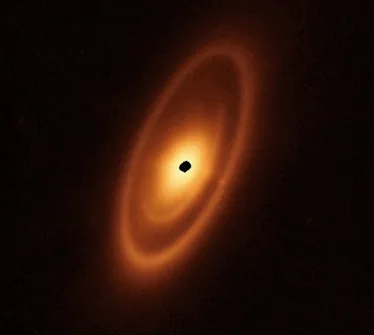
And just as the sun was in its infancy, MWC 758 is surrounded by a disk of planet-birthing material called a protoplanetary disk. But since at least 2013, astronomers have been aware of a spiral pattern forming two arms in this protoplanetary disk. University of Arizona researchers now think that those twin spiral arms are the work of a massive planet, dubbed MWC 758c, which orbits the star at a distance equivalent to 100 times the distance between Earth and the sun.
"Our study puts forward a solid piece of evidence that these spiral arms are caused by giant planets," research lead author and University of Arizona Steward Observatory postdoc Kevin Wagner said in a statement. "And with the new James Webb Space Telescope, we will be able to further test and support this idea by searching for more planets like MWC 758c."
The MWC 758 planetary system as observed by the Large Binocular Telescope Interferometer at infrared wavelengths. Its spiral arms are clearly apparent, as its the giant exoplanet sculpting them. (Image credit: L. Krapp and K. Kratter, University of Arizona)
Protoplanetary disks like this one and the one that once formed the solar system usually take around 10 million years to dissipate. The debris comprising them can either be ejected from the system, can be swallowed by the infant star, or can be used as the building blocks for planets, moons, asteroids, and comets.
"I think of this system as an analogy for how our own solar system would have appeared less than 1% into its lifetime," Wagner said. "Jupiter, being a giant planet, also likely interacted with and gravitationally sculpted our own disk billions of years ago, which eventually led to the formation of Earth."
Spiral arms in protoplanetary disks are fairly common. Of 30 disks identified in relatively nearby young star systems, astronomers have found around 10 have their own spiral arms.
"Spiral arms can provide feedback on the planet formation process itself," Wagner said. "Our observation of this new planet further supports the idea that giant planets form early on, accreting mass from their birth environment, and then gravitationally alter the subsequent environment for other, smaller planets to form."
The leading theory is that these spiral arms are sculpted when a massive gas giant pulls on material swirling around its parent star. Until now, however, astronomers have failed to spot the planets that could be acting as cosmic sculptors for these arms.
"It was an open question as to why we hadn't seen any of these planets yet," Wagner said. "Most models of planet formation suggest that giant planets should be very bright shortly after their formation, and such planets should have already been detected."
How a spiral arms dealer remained hidden
If MWC 758c is enshrouded by a large amount of dust, this material would be absorbing short-wavelength light resulting in the planet appearing bright only at longer red wavelengths.
If the exoplanet is surrounded by a great deal of dust, this may indicate that it is still forming or even that it is in the process of gathering its own moons as the solar system gas giant Jupiter did billions of years ago.
"In the other scenario of a colder planet surrounded by less dust, the planet is fainter and emits more of its light at longer wavelengths," research co-author and University of Arizona theoretical astrophysicist Kaitlin Kratter said.
If this chillier model for MWC 758c is correct, this means that there may be something happening in young planetary systems such as this that results in planets being colder than expected when they form. This might have an impact on planet formation models and on the techniques that astronomers currently use to hunt exoplanets.
"In either case, we now know that we need to start looking for redder protoplanets in these systems that have spiral arms," Wagner said.
The researchers behind the detection of MWC 758c will now view the exoplanet with the JWST in 2024 in an effort to distinguish between potential scenarios at work in this infant planetary system.
The MWC 758 planetary system is shown directly imaged by the Large Binocular Telescope Interferometer (LBTI) in infrared wavelengths. Theoretical models suggest that the newly discovered exoplanet, MWC 758C, is likely producing spiral arms in the protoplanetary disk encircling the young star.
"Depending on the results that come from the JWST observations, we can begin to apply this newfound knowledge to other stellar systems," Wagner said, "and that will allow us to make predictions about where other hidden planets might be lurking and will give us an idea as to what properties we should be looking for in order to detect them."
Join our Space Forums to keep talking space on the latest missions, night sky and more! And if you have a news tip, correction or comment, let us know at: community@space.com.
Four Glowing Objects Over Dallas, Texas 7-4-2023, UFO Sighting News.
Date of sighting: 7-4-2023 Location of sighting: Dallas, Texas, USA Source: MUFON
This interesting video just came in last night. Four egg shaped UFOs were seen over Dallas and they moved swiftly away and out of sighting. The objects were white glowing objects and were too bright to see any details. UFOs frequent the Texas area, for instance the 300 meter rectangle UFO flying low over Stephenville just a few years ago seen by thousands of residents. These glowing white eggs are alien craft.
Scott Waring
Eyewitness states:
I was driving home right off I-35 when I saw 3 orb like objects in the early night sky. I pulled out my phone and began filming these objects with my phone. As I observed further, I noticed a 4th object suddenly appear. They broke the triangle formation and went into a horizontal hover. As I kept driving closer to the objects, the 4th one appeared directly in front of me within seconds of being on my left. I came to a stop sign. I observed and listened. I saw a helicopter near the object that appeared near me, but did not get that on film. The object began hovering closer to me. From my past experiences, I assumed I would be taken and placed back with missing time like I was before. It is woth mentioning I've had many sightings of UFOs, encounters with various beings, and up to 12 hours of missing time. I've seen these beings, "the Greys" fully manifest these egg crafts with harmonic and tonal frequencies, along with the advanced use of psionic technology.
I was looking through some Mars rover photos and found this odd structure built under a leaning rock area. The odd part is it looks like a deliberately built column or support for a structure. Its looks possible that this object it is holding up is more than a rock, but a structure itself.
UFO Caught On Security Cam, West Beach, British Columbia Canada. UFO Sighting News. July 9, 2023
Date of sighting: July 9, 2023
Location of sighting: Idaho, Washington and BC Canada.
Watch this security cam catch as a glowing object too slow to be a meteor and has no tail or fragmentation like most meteors have. The UFO is seen moving across the sky, at an angle of about 45 degrees. It's seen passing behind the mountains where it disappears. The object looks big, about the size of a 727 passenger jet, but it's flat and disk-like. We view it from below so we only see its bottom, but it blinding light makes the roundness less defined. This UFO is headed into Canada airspace and likely landed to enter an alien base in the distant mountains. I looked into that area where it was aimed and it led me to a small lake about 3 miles from West Bench, British Colombia. I think that small lake is where it entered entered a tunnel below the lake that went about 4 miles below the earths surface to an alien city.
Faces, they tell us much about the alien species that created them. Sure my masters degree in counseling knows it's not pareidolia (seeing things that are not there), because it is there. The amateur who has never searched for ancient artifacts in photos will not see anything. It take time, dedication and patience. This face is very interesting to me. It's similar to a human face, but its warn and been there for millions of years. Long before the human race ever existed. Just like the face on Mars at Cydonia I discovered over 37 years ago (the discovery was announced and then stolen from me.) This face was made by the same species as the famous face on Mars. Same species, same features. It is identical. 100% proof that ancient aliens did once exist on our moon and Mars at the same time.
Doors, they always take to an unknown mystery, an unknown place, a new adventure. This door is about 2 meters from top to bottom. It's absolutely perfectly symmetrical with four right angles. Whats the chance that a perfect square entrance would be found on Mars? Well, if you know what I know, then the odds would be high. NASA is really not only avoiding doing its job, but intentionally negligent, in order to keep both the public and other countries in the dark about the existence of intelligent life. For if they knew aliens exist so close to earth, a race for trade agreements would begin. First for weapons, then technology and other things...to gain dominance on Earth for which ever nation achieves the most trades.
I also found an ancient bowl about 1 foot across. Its rim still intact and it reminds me of the ancient bowls American Indians made from clay.
The Iranian Navy Unsuccessful Attempted To Shoot Down A Ufo Over Bandar-e Anzali. July 13, 2023
This event happen near Anzali Port on the southern shores of the Caspian Sea. Bandar-e Anzali is the capital of Gilan province in Iran. On July 13, 2023 the Iranian Navy Attempted to shoot down this object and failed. In the footages it seem that the rounds where being deflected as some seem to be on target and blown up in front of the object and after all the firing the UFO just disappeared.
RELATED
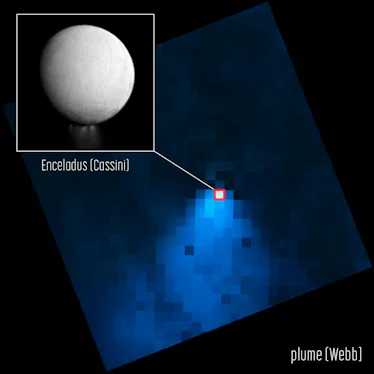
NASA Just Confirmed: All Life Elements Found on Saturn's Moon Enceladus
NASA has made a stunning discovery on the icy moon of Saturn, Enceladus. From the Cassini data, they have discovered that the moon is spewing out phosphorus, one of the key chemical elements required for the existence of life. And possibly, the phosphorus concentration in the subsurface oceans of Enceladus is hundreds of times higher than in Earth’s oceans. With this, all the major chemical elements required for claiming habitability have now been found on the moon. This discovery has made Enceladus the most promising place where life could exist in the solar system beyond Earth.
So, how did NASA make this exciting discovery? Why is phosphorus considered to be a key ingredient of life? Finally, and most importantly, how will this discovery impact our course of future missions to Saturn?
The 67th episode of the Sunday Discovery Series answers all these questions in detail.
Scientists Reveal That Our Universe Is 27 Billion Years Old, Not 13.8 Billion! Here’s How
*How old is our universe?* This is one of the most fundamental questions in cosmology, and we thought we had the answer: about 13.8 billion years. But what if we are wrong? What if our universe is twice as old as we thought, and that changes everything we know about its history and evolution?
In this video, we will explore a shocking new discovery that suggests that our universe is 27 billion years old, and what it means for our understanding of the cosmos. We will also look at some of the mysteries and puzzles that led scientists to question the age of the universe in the first place, and how they used a new model to solve them.
We will talk about how the James Webb Space Telescope has discovered early galaxies that seem to be far too advanced for their age, and how this challenges our theories about the origin and evolution of galaxies. We will also discuss how this new study can affect some of the fundamental questions and mysteries that we have about the universe, such as what happened before the Big Bang, what is the shape and size of the universe, and what is the destiny and fate of the universe.
This video is based on a new study by Rajendra Gupta, a physicist from the University of Ottawa, who claims that our universe is not 13.8 billion years old, but 27 billion years old. His study is published in Physical Review D in November 2021.
RELATED
Mohenjo-Daro: Proof of an Ancient Nuclear Bomb or Not?
Mohenjo-Daro was built around 4,600 years ago. Equipped with remarkable civil engineering and urban planning, Mohenjo-Daro was the most advanced city of its time and the largest urban center of the Indus Valley Civilization. It was one of the world's oldest major cities, contemporaneous with the civilizations of ancient Egypt, Mesopotamia and Minoan Crete. This spectacular city prospered for 800 years and is thought to have reached a population of approximately 40,000.
When the Indus civilization went into sudden decline around 1900 -1800 BC, Mohenjo-Daro was abandoned. The formerly glorious metropolis was buried by sediments and thereby stayed invisible and undocumented for 3700 years until the 1920s. During its modern rediscovery, about 40 skeletons were found within layers of rubble and debris, some lying in streets in contorted positions, which suggested the agonies of violent death.
Early excavators proposed that these people might have been victims of a massacre caused by the Aryan invasion. Later on, a variety of researchers made an extraordinary claim that an ancient nuclear war was the culprit of the fall of Mohenjo-Daro. Some stated that there is indisputable evidence of ancient atomic warfare, which can be found throughout the region. Such alleged evidence includes that the skeletons in the Indus valley are among the most radioactive ever found, on par with remains at Hiroshima and Nagasaki. At one site, Soviet scholars found a skeleton which had a radioactive level 50 times greater than normal. In one nearby area the radioactivity is so excessive that residents there have high rates of cancer and birth defects. The huge masses of walls and foundations of the ancient city are fused together, literally vitrified by intense heat. Others referred to a purported paragraph from the ancient Hindu epic Mahabharata, which speaks of doom in the war that eerily resembles a nuclear destruction.
From all of this, it surely points to a possible ancient atomic war that ended the city of Mohenjo-Daro and the Indus valley civilization. However, are these pieces of so-called evidence true or misinformation? What if I told you that the key elements of this ancient nuclear war are fiction rather than fact? That there is no legitimate evidence of such a war ever occurring in the Bronze Age, and that the discovered human remains neither died of a nuclear blast nor massacre? So, what happened? Why are these skeletons, both adults and children, found onsite in seemingly chaotic states? What kind of information they might reveal on the perplexing termination of the Indus valley civilization?
Joe Rogan Just Announced Sudden Discovery Under The Eye Of The Sahara Desert!
Joe Rogan Just Announced Sudden Discovery Under The Eye Of The Sahara Desert!
It is a fact that the Sahara Desert is one of the most mysterious places in the world, but the eye of the Sahara seems to hold even darker secrets which Joe Rogan finally brings to light. You will be shocked at the recent discoveries made under it, as long-hidden secrets about the Legendary Atlantis get revealed. What is the connection between these places? Has Atlantis finally been discovered? Keep watching to find out.
What Elon Musk Just Revealed About UFOs Is Terrifying And Should Concern All Of Us!
In this captivating video, we delve into the recent revelations made by Elon Musk about UFOs that have sent shockwaves through the world. Join us as we explore the implications, concerns, and questions raised by Musk's acknowledgment of these unidentified flying objects.
Elon Musk, the visionary entrepreneur behind SpaceX and Tesla, has publicly acknowledged the existence of UFOs, asserting that they are likely not of extraterrestrial origin but rather advanced technology from Earth. This revelation has ignited a wave of curiosity and concern, prompting us to question the true nature of these mysterious objects.
In this thought-provoking discussion, we delve into the terrifying possibilities that arise from Musk's revelations. We explore the implications for national security, including the potential for secretive organizations or governments possessing advanced technologies beyond our imagination. The ramifications of such technologies being used for militarization or destabilizing conflicts are deeply unsettling.
Furthermore, we examine the risks associated with misinterpretation, considering the potential panic and fear that may arise if these advanced technologies are mistaken for extraterrestrial contact. The lack of transparency surrounding these advancements only adds to the urgency of the situation.
Beyond the immediate concerns, we contemplate the broader societal impact and paradigm shift that Musk's revelations bring. Our understanding of what is technologically possible is challenged, and we are forced to question the boundaries of human innovation. This opens up a world of ethical considerations, such as the need for transparency, accountability, and responsible use of power.
Join us as we dive into the necessity of public awareness and discussion surrounding UFOs and advanced technologies. We explore the role of media in responsibly reporting on these matters and emphasize the importance of scientific investigation and collaboration to gain a clearer understanding of these phenomena.
Elon Musk's revelations about UFOs provoke us to contemplate the potential for technological leapfrogging, the impact on privacy and surveillance, and the environmental implications of these advanced technologies. We also consider the ongoing search for extraterrestrial intelligence and the importance of skepticism and critical thinking in navigating this complex landscape.
Don't miss this captivating video that sheds light on Elon Musk's terrifying UFO revelations and the profound implications they hold for humanity. Join the conversation and broaden your understanding of the unknown as we explore the potential risks, ethical dilemmas, and opportunities that lie ahead.
This Man Noticed Something Big Show Up Above This City But Couldn't Explain What It Was
This man noticed something big show up above this city but couldn't explain what it was. This man spotted this in the sky but couldn't explain what it was.
This unusual photo has started to circulate on the internet, displaying a sizable object being lit up by the Moon's glow.
This occurrence took place over the United States, and witnesses described it as a flawless rectangular shape.
What makes this sighting perplexing is the fact that it is not the first time that such a rectangular object has been observed.
In China, residents have reported a similar sighting above the Shandong province, an area renowned for peculiar sightings.
Thank you for watching!
NASA Chief Scientist Just Made A Big Announcement & Let Slip The Truth About What's Going On At NASA
NASA chief scientists just made a big announcement & let slip the truth about what's going on at NASA. This NASA scientists revealed what's happening at NASA.
In the landscape of space exploration, one organization towers above the rest: the National Aeronautics and Space Administration, or NASA.
Established in 1958, NASA has been at the forefront of efforts to explore outer space, resulting in an adventurous history that expands over six decades.
The first significant achievement in NASA's timeline came in 1961 when Alan Shepard became the first American in space.
This was quickly followed by President John F. Kennedy's bold promise to put a man on the moon before the end of the decade, setting the stage for the historic Apollo program.
Thank you for watching!
Webb’s First Year of Science: Stunning Images and Data from the Infrared Universe
In this video, we will show you some of the amazing images and data that the James Webb Space Telescope has produced in its first year of science operations, covering topics such as star formation, our solar system, exoplanets, and galaxies. We will also talk about a new image from Webb that shows a small star-forming region in the Rho Ophiuchi cloud complex, a nearby nursery of stars and planets. This video is a continuation of our previous video where we talked about how Webb discovered the oldest stars, galaxies, and black hole in the universe. Join us as we explore the wonders of the infrared universe with Webb, the most powerful and complex space telescope ever built.
The Harvard Psychiatrist Engrossed in Extraterrestrial Encounters
In the labyrinthine halls of science, few have dared to traverse the controversial path of UFO (Unidentified Flying Object) research. Dr. John Mack, a respected professor of psychiatry at Harvard Medical School, is one of those daring pioneers whose exploration into the alien abduction phenomenon has stirred both intrigue and controversy. The narrative of Dr. Mack’s journey, described in detail by Pulitzer Prize-winning journalist Ralph Blumenthal in his book “The Believer: Alien Encounters, Hard Science, and the Passion of John Mack”, offers a captivating lens into the life of a man willing to challenge conventional wisdom and orthodoxy.
John Mack first ventured into UFO research in 1990 after encountering the works of Bud Hopkins, a UFO abduction researcher. Mack referred to those claiming to have been taken by aliens as “experiencers” rather than “abductees”, a reflection of his non-judgmental and humanistic approach. Within less than two years, he had organized a lecture at Harvard, introducing several experiencers and sharing a chilling account of a woman claiming her pregnancy had been taken by alien beings.
However, Mack’s unconventional research path was met with staunch opposition from his Harvard colleagues, who saw it as unscientific and lacking empirical evidence. His attempts to publish his findings in academic journals were also met with resistance due to the complexity of the subject matter. The New England Journal of Medicine, for instance, would not even open his submission envelope. Mack believed that an article was not enough to capture the nuances of his research. Instead, he saw the need for a book-length exploration of the phenomenon.
The Harvard administration launched an investigation into Mack’s work in 1994, shortly after the publication of his book. The investigation highlighted a clash of world views: the empirical, reductionist perspective of the Harvard committee and Mack’s open-minded exploration of anecdotal but compelling evidence from experiencers. Despite the committee’s insistence that the unprovable does not exist, Mack maintained his stance, arguing that something was indeed happening, though it defied traditional scientific explanation.
Ultimately, Mack emerged from the investigation unscathed. He was allowed to continue his research without sanctions, although he was cautioned to temper his enthusiasm. This event demonstrated his steadfast character, a quality reflected in his writings, speeches, and personal life. Despite the admonitions, Mack remained passionately devoted to his research until his untimely death in a car accident in 2004.
VIDEO:
The Harvard Psychiatrist Obsessed with Alien Abduction | Ralph Blumenthal
The saga of Dr. John Mack underscores the complexity of navigating unconventional research paths within traditional academic settings. His work challenges the typical boundaries of scientific materialism and pushes us to consider possibilities that might lie beyond our understanding. As we continue to explore the unknown, his story serves as a beacon, reminding us of the courage it takes to pursue truth, regardless of the opposition.
John Mack’s passion and dedication towards UFO research not only pushed boundaries but also encouraged others to question, explore and unravel the mysteries of the universe. His story remains an inspiration for those willing to tread off beaten paths and is a testament to the endless human curiosity that drives us to understand our place in the cosmos. His enduring legacy encourages us to always seek the truth, no matter how unconventional or daunting it might seem.
UFO BOMBSHELL & LIVE REACTION RICHARD DOLAN, DANNY SHEEHAN, LINDA MOULTON HOWE
On June 5, 2023, a major new breaking story occurred in the UFO/UAP field concerning the allegations of a significant new whistleblower, David Grusch. This is covered in an article from the Debrief by Leslie Kean and Ralph Blumenthal, who previously wrote important UFO pieces for the New York Times. Grusch has stated that there is definitely a UFO crash retrieval program in existence and has been around for many decades. Moreover, it is subject to international rivalries. There is much more in the article, which is linked below. Richard Dolan was at the Contact in the Desert UFO conference when the story broke and incorporated the news into his final lecture there. This video includes an introduction to the news by Richard, along with clips from his lecture, then the breaking news story, then discussion with attorney Danny Sheehan, and finally comments by researcher Linda Moulton Howe. Historical events and reactions.
Webb Celebrates First Year of Science With Close-up on Birth of Sun-like Stars
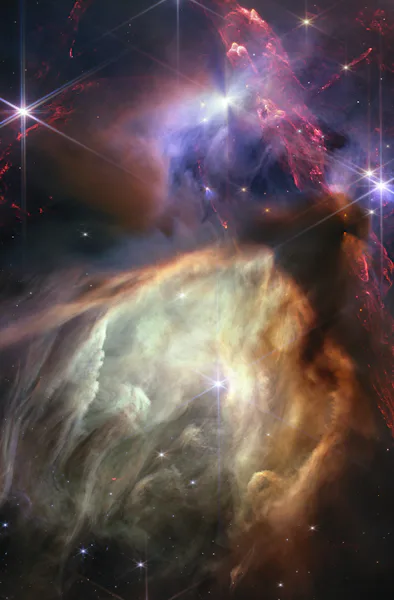
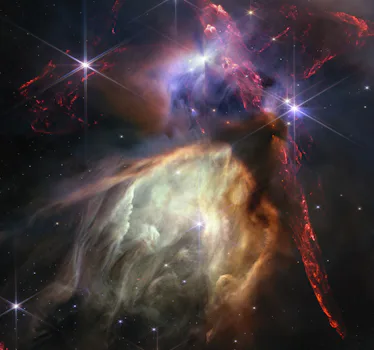
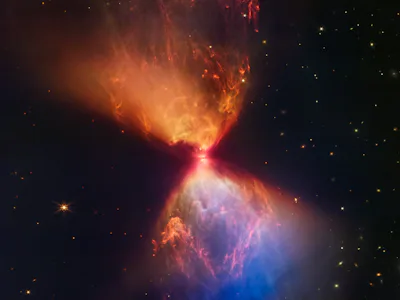
The first anniversary image from NASA’s James Webb Space Telescope displays star birth like it’s never been seen before, full of detailed, impressionistic texture. The subject is the Rho Ophiuchi cloud complex, the closest star-forming region to Earth. It is a relatively small, quiet stellar nursery, but you’d never know it from Webb’s chaotic close-up. Jets bursting from young stars crisscross the image, impacting the surrounding interstellar gas and lighting up molecular hydrogen, shown in red. Some stars display the telltale shadow of a circumstellar disk, the makings of future planetary systems. Credits: NASA, ESA, CSA, STScI, Klaus Pontoppidan (STScI)
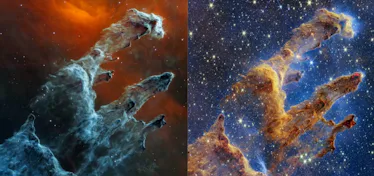
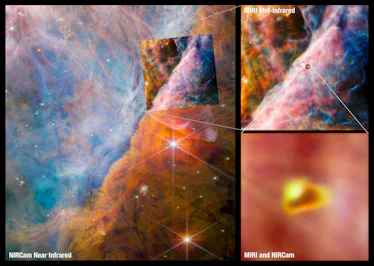
From our cosmic backyard in the solar system to distant galaxies near the dawn of time, NASA’s James Webb Space Telescope has delivered on its promise of revealing the universe like never before in its first year of science operations. To celebrate the completion of a successful first year, NASA has released Webb’s image of a small star-forming region in the Rho Ophiuchi cloud complex.
“In just one year, the James Webb Space Telescope has transformed humanity’s view of the cosmos, peering into dust clouds and seeing light from faraway corners of the universe for the very first time. Every new image is a new discovery, empowering scientists around the globe to ask and answer questions they once could never dream of,” said NASA Administrator Bill Nelson. “Webb is an investment in American innovation but also a scientific feat made possible with NASA’s international partners that share a can-do spirit to push the boundaries of what is known to be possible. Thousands of engineers, scientists, and leaders poured their life’s passion into this mission, and their efforts will continue to improve our understanding of the origins of the universe – and our place in it.”
The new Webb image released today features the nearest star-forming region to us. Its proximity at 390 light-years allows for a highly detailed close-up, with no foreground stars in the intervening space.
“On its first anniversary, the James Webb Space Telescope has already delivered upon its promise to unfold the universe, gifting humanity with a breathtaking treasure trove of images and science that will last for decades,” said Nicola Fox, associate administrator of NASA’s Science Mission Directorate in Washington. “An engineering marvel built by the world’s leading scientists and engineers, Webb has given us a more intricate understanding of galaxies, stars, and the atmospheres of planets outside of our solar system than ever before, laying the groundwork for NASA to lead the world in a new era of scientific discovery and the search for habitable worlds.”
Webb’s image shows a region containing approximately 50 young stars, all of them similar in mass to the Sun, or smaller. The darkest areas are the densest, where thick dust cocoons still-forming protostars. Huge bipolar jets of molecular hydrogen, represented in red, dominate the image, appearing horizontally across the upper third and vertically on the right. These occur when a star first bursts through its natal envelope of cosmic dust, shooting out a pair of opposing jets into space like a newborn first stretching her arms out into the world. In contrast, the star S1 has carved out a glowing cave of dust in the lower half of the image. It is the only star in the image that is significantly more massive than the Sun.
“Webb’s image of Rho Ophiuchi allows us to witness a very brief period in the stellar lifecycle with new clarity. Our own Sun experienced a phase like this, long ago, and now we have the technology to see the beginning of another’s star’s story,” said Klaus Pontoppidan, who served as Webb project scientist at the Space Telescope Science Institute in Baltimore, Maryland, since before the telescope’s launch and through the first year of operations.
Some stars in the image display tell-tale shadows indicating protoplanetary disks – potential future planetary systems in the making.
A Full Year, Across the Full Sky
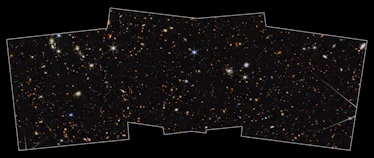
NASA’s James Webb Space Telescope has produced the deepest and sharpest infrared image of the distant universe to date. Known as Webb’s First Deep Field, this image of galaxy cluster SMACS 0723 is overflowing with detail.Thousands of galaxies – including the faintest objects ever observed in the infrared – have appeared in Webb’s view for the first time.
From its very first deep field image, unveiled by President Joe Biden, Vice President Kamala Harris, and Nelson live at the White House, Webb has delivered on its promise to show us more of the universe than ever before. However, Webb revealed much more than distant galaxies in the early universe.
“The breadth of science Webb is capable of exploring really becomes clear now, when we have a full year’s worth of data from targets across the sky,” said Eric Smith, associate director for research in the Astrophysics Division at NASA Headquarters and Webb program scientist. “Webb’s first year of science has not only taught us new things about our universe, but it has revealed the capabilities of the telescope to be greater than our expectations, meaning future discoveries will be even more amazing.” The global astronomy community has spent the past year excitedly poring over Webb’s initial public data and getting a feel for how to work with it.
Beyond the stunning infrared images, what really has scientists excited are Webb’s crisp spectra – the detailed information that can be gleaned from light by the telescope’s spectroscopic instruments. Webb’s spectra have confirmed the distances of some of the farthest galaxies ever observed, and have discovered the earliest, most distant supermassive black holes. They have identified the compositions of planet atmospheres (or lack thereof) with more detail than ever before, and have narrowed down what kinds of atmospheres may exist on rocky exoplanets for the first time. They also have revealed the chemical makeup of stellar nurseries and protoplanetary disks, detecting water, organic carbon-containing molecules, and more. Already, Webb observations have resulted in hundreds of scientific papers answering longstanding questions and raising new ones to address with Webb.
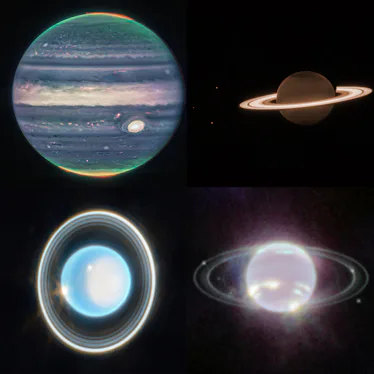
The breadth of Webb science is also apparent in its observations of the region of space we are most familiar with – our own solar system. Faint rings of gas giants appear out of the darkness, dotted by moons, while in the background Webb shows distant galaxies. By comparing detections of water and other molecules in our solar system with those found in the disks of other, much younger planetary systems, Webb is helping to build up clues about our own origins – how Earth became the ideal place for life as we know it.
"With a year of science under our belts, we know exactly how powerful this telescope is, and have delivered a year of spectacular data and discoveries,” said Webb Senior Project Scientist Jane Rigby of NASA's Goddard Space Flight Center. “We've selected an ambitious set of observations for year two — that builds on everything we've learned so far. Webb's science mission is just getting started — there's so much more to come."
The James Webb Space Telescope is the world's premier space science observatory. Webb is solving mysteries in our solar system, looking beyond to distant worlds around other stars, and probing the mysterious structures and origins of our universe and our place in it. Webb is an international program led by NASA with its partners, ESA (European Space Agency) and the Canadian Space Agency.
The new dating system doesn't change estimates of the moon's age as a whole, which remains around 4.53 billion years.
An image of Mare Imbrium taken from Apollo 17 in 1972. Left of centre is the Pytheas crater. Near the top is the Copernicus crater.
(Image credit: NSSDC/NASA)
The "Man in the Moon" is older than we thought.
Scientists have proposed resetting the lunar clock after reassessing impact craters on the surface of the moon. This means that some features of the moon, like the formation that makes up the face of the "Man in the Moon" formation could be 200 million years older than previously theorized.
The new dating system could help to better tell the story of the evolution of the lunar surface and has important implications for our understanding of the violent and turbulent early history of the solar system during which bodies like Earth and the moon were subject to intense bombardment by space rocks.
The new evaluation involved reexamining two separate ways of dating the lunar surface: Counting the number of craters caused by the impact of space rocks; and the assessment of moon rocks collected by the Apollo missions. These two dating methods have traditionally given different results, especially for the ages of the heavily cratered and mountainous highlands of the moon.
"We decided that we had to reconcile these differences, and that meant correlating individually dated Apollo samples to the number of craters in the sample site surrounding area — in effect, resetting the crater clock,' Centre for Planetary Habitability, University of Oslo, professor Stephanie Werner said during a talk at the Goldschmidt Geochemistry Conference in Lyon. "We also correlated them against spectroscopy data from various moon missions, especially the Indian Chandrayaan-1, to be sure which Apollo sample belongs to the surface in which we counted craters."
Like the moon, Earth also experienced a large number of impacts by space rocks during the turbulent early years of the solar system, but a similar crater-counting dating method wouldn't work on our planet. That's because geological processes like the shifting of tectonic plates have masked its impact record.
The moon, on the other hand, is fairly geologically inactive, and that means that rather than being eroded away, the record of the impacts it has experienced is frozen into the lunar surface.
"Looking at the signs of these impacts on the moon shows what Earth would be like without the geological churning of plate tectonics which took place here on Earth," Werner said. "What we have done is to show that large portions of the lunar crust are around 200 million years older than had been thought."
A lunar clock reset with a big impact
The team behind the findings explains that the new dating system doesn't change estimates of the moon's age as a whole, which remains around 4.53 billion years. Instead, it changes the age of all areas of the moon's surface but not in a uniform way; the new dating system suggests older areas are subject to the greatest shift in age due to the new system.
An example of the extreme age differences discovered by Werner and colleagues can be seen in the712-mile (1146 kilometers) wide Imbrium Basin, an ancient impact site that is believed to have been created when an asteroid the size of New Jersey hit the moon at some point in its distant past. The basin was filled with impact debris and volcanic materials after its formation, which created a vast lava plain called the Mare Imbrium.
An image of the moon shows the location of the Mare Imbrium basin. (Image credit: Srbauer/NASA/Robert Lea)
Previous estimates had placed the age of the asteroid impact at around 3.9 billion years, but the team's results pushed the strike and the creation of the Imbrium Basin back 200 million years to 4.1 billion years ago.
"This is an important difference. It allows us to push back in time an intense period of bombardment from space, which we now know took place before extensive volcanic activity that formed the 'Man in the moon' patterns — the mare volcanic plains, including Mare Imbrium," Werner said. "As this happened on the moon, the Earth was almost certain to have also suffered this earlier bombardment too."
University of Bayreuth researcher Audrey Bouvier was not involved in the work, but she explained how the moon provides unique records of the early bombardment history in the solar system and how this dating change could cause a rethink of our understanding of planetary evolution.
"Such a heavy bombardment period must have affected the origin and early evolution of life on Earth and potentially other planets such as Mars," Bouvier said in a statement. "Bringing back rock samples from Jezero Crater on Mars will be the next giant leap forward to search for signs of ancient life on another planet in the solar system, and when."
The team's research was presented at the Goldschmidt Conference held in Lyon, France, between July 9 and July 14. It has been accepted for publication in the Planetary Science Journal.
Join our Space Forums to keep talking space on the latest missions, night sky and more! And if you have a news tip, correction or comment, let us know at: community@space.com.
When it comes to theearly universe, astronomers have many questions. One of which is, how did the first starsform?
Today’s generation of stars are forged with hydrogen and helium, which transform via nuclear fusion into energy until the star runs out of that supply. A star like the Sun will then collapse, heat up, inflate, and go supernova. The dust and gas it sprays into space will linger and could go on to form a new star and planets. But what happened in the beginning?
Astudypublished Tuesday in the journalProceedings of the National Academy of Sciencessuggests that NASA’sJames Webb Space Telescope(JWST) has already found an answer.
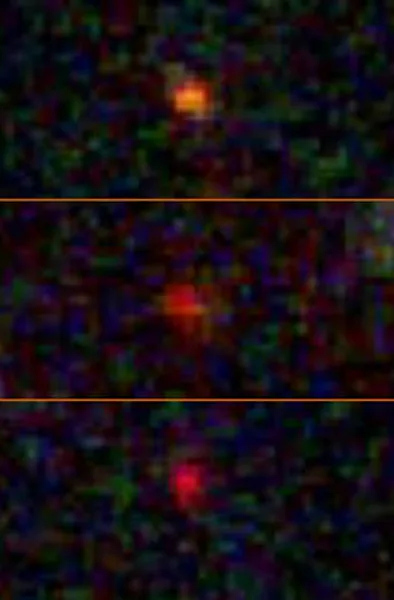
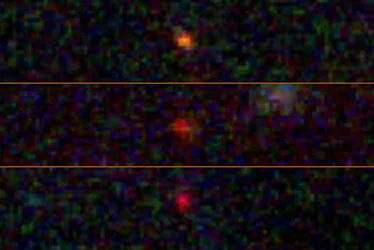
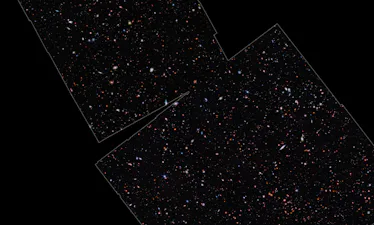
In December 2022, astronomers identified these three specks of light — called JADES-GS-z13-0, JADES-GS-z12-0, and JADES-GS-z11-0 — as ancient galaxies. But now, a team speculates they might actually be “supermassive dark stars.”
JWST can view regions of space that have never been seen before by human eyes. Its first year was packed with, among other exciting things, galaxy after galaxy peeking at us from the distant universe.
But a few of these objects might be something else — supermassive stars powered by invisible material called dark matter.
Light’s speed is finite. The farther away an object is, the longer its light takes to reach the instruments aboard JWST. Astronomers can witness scenes from the ancient universe in its images. They’re on the lookout for galactic precursors called protogalaxies. From these forebearers until now, galaxies retain the stuff that stars shed throughout their lifetimes, including the heavier elements that are essential to creating life. Knowing how they evolve is a major area of interest.
But as astronomers have scanned for protogalaxies on their quest to unpack our origins, they may, in fact, be looking at something else entirely: the Tuesday paper proposes that three hazy specks from the JWST Advanced Deep Extragalactic Survey (JADES) are actually incredibly-hefty stars, bigger than anything in the modern universe.
They’re called dark stars, owing to an explanation that puts dark matter in the driver’s seat instead of nuclear fusion.
“Dark stars could theoretically grow to be several million times the mass of our Sun and up to 10 billion times as bright as the Sun,” according to a Thursday announcement about the paper.
REVEALING THE FIRST STARS
In the 20th century, galaxy scholars were confused by what they saw. Galaxies seem to have too little mass to stay together in a huddle. Eventually, an explanation would propose that the universe was full of a material that didn’t interact with light. And though this matter couldn’t be seen in telescopes, it had mass to help bind visible matter together.
JWST hasn’t seen the first stars — yet. But astronomers are optimistic that one day it will. And if these three supermassive dark star candidates are confirmed to be what researchers suspect, a deeper understanding of the cosmos will arise.
“The James Webb Space Telescope (JWST) is poised to revolutionize our understanding of the formation and properties of the first luminous objects in the universe,” researchers write in the study.
Dark matter is a foremost source of intrigue for modern astronomers. Missions like the recently-launched Euclid spacecraft and the upcoming Nancy Grace Roman Space Telescope will study dark matter like never before.
Liquid Water on Rocky Planets Could be 100 Times More Likely
It’s easy to think of Earth as a water world, with its vast oceans and beautiful lakes, but compared to many worlds, Earth is particularly wet. Even the icy moons of Jupiter and Saturn have far more liquid water than Earth. Earth is unusual not because it has liquid water, but because it has liquid water in the warm habitable zone of the Sun. And as a new study in Nature Communications shows, Earth could be even more unusual than we thought.
Water is one of the more common molecules in the universe. Hydrogen is the most abundant element in the cosmos, and oxygen is easily produced as part of the stellar CNO fusion cycle. So we would expect water-rich planets to be plentiful in stellar systems. But that isn’t to say liquid water will be plentiful. In our solar system, two kinds of worlds have liquid water. Earth and gas giant moons.
Like other warm terrestrial planets such as Venus and Mars, Earth had liquid water in its youth. Mars was too small to retain its water. Much of it evaporated into space, while some froze into its surface crust. Venus was large enough to retain water, but its extreme heat boiled much of it off into its thick atmosphere. We still aren’t entirely sure how Earth managed to retain its oceans, but it was likely a combination of a strong magnetic field and an extra helping of water from asteroids and comets during the heavy bombardment period.
The icy moons of Jupiter and Saturn are another story. They were far enough from the Sun that they retained the water of their formation. They quickly formed a thick layer of ice to prevent water from evaporating into space. But these moons are small worlds and would have very quickly frozen solid were it not for the tidal forces exerted by their gas giant.
Since cold gas planets are likely to have icy moons, the general thought we would be far more likely to find life on a Europa-like world than an Earth-like one. But this new study begs to differ. It argues that liquid water is much more likely to be found on super-Earths.
How icy super-Earths could have liquid water oceans. Credit: Ojha, Lujendra, et al
Super-Earths span a mass range from a couple of Earth masses to Neptune mass. On the large end, they are likely to be gassy worlds with thick atmospheres. On the small end, they are likely to be more Earth-like. Based on the exoplanets we’ve found so far, super-Earths are by far the most common. And a majority of them are likely to be outside their star’s habitable zone in the cold regions of the star system. So they are likely water-rich. But they also aren’t likely to be found orbiting a gas giant, so it’s generally been assumed that their ice layer would be mostly frozen solid over time.
The reason has to do with the various freezing and melting points of ice. The kind of ice we have on Earth melts at around 0 °C. But this is only true at around Earth’s atmospheric pressure. At higher pressures, there are several varieties of ice with differing melting points. Although it’s a bit complicated, generally at higher pressures ice can have a much higher melting point. So even if a super-Earth is geologically active, it might not be warm enough to melt ice.
Number of exoplanets discovered by the Kepler mission as of May, 2016. Credit: W. Stenzel/NASA Ames
This new study shows that super-Earths don’t have to be hot enough to create a deep ocean. Through geothermal and nuclear heating it can melt a thin layer of water at its surface, and thanks to fissures and various water phase transitions water can creep up to the layer just below the frozen surface. This process would be enough to create a rich ocean layer of liquid water. Since the heat of a super-Earth lasts billions of years, it could maintain a liquid ocean long enough for life to evolve.
Based on what we know about exoplanets, super-Earth oceans could be 100x more common than those of Earth-like worlds or icy moons. And that means life has even more possible homes than we thought.
20 Rare Historical Photos That Scientists Can Not Explain - July 2023
20 Rare Historical Photos That Scientists Can Not Explain Learning about history is a never-ending, fascinating endeavor. What makes it even more exciting is exploring the past via authentic photographs. These rare photos and the fascinating tales behind them provide us with an intimate look into the lives of people who have passed on. They serve as a tangible link that connects us to these strange individuals and tells us about their hopes, anxieties, and courageous decisions that changed the course of history.
RELATED
50 Rare Historical Photos That Scientists Can Not Explain. Embark on an epic voyage through the corridors of time, where history comes alive in breathtaking hues. Uncover the past's secrets as we reveal a treasure trove of intriguing images that preserve shards of untold stories. Say goodbye to dull classroom lectures; here is a unique backstage pass to history's secret treasures. Join us, on this exploration of 50 Rare Historical Photos That Scientists Can Not Explain.
Do UFOs and non-human beings come from different realities or dimensions?
Jacque Vallee is the legendary French UFO researcher who formed the basis for Steven Spielberg's eccentric scientist in Close Encounters of The Third Kind. He has worked with every prominent player in UFOology since the 60's including Dr. J. Alan Hynek who served as the Chief Science Advisor to project Blue Book, the Airforce's UFO investigation program from 52'-69'.
Vallée's investigation and analysis lead to a compelling hypothesis - that the UFO sightings and associated paranormal events could be indications of interactions with beings or entities originating from different realities or dimensions beyond our conventional understanding, reports howandwhy.com
Dr. J. Alan Hynek, in his own speculations, contemplates the existence of alternate universes governed by different quantum rules or vibration rates. He proposes that our perceived space-time continuum might be merely a slice of a larger and more complex universe, encompassing multiple dimensions yet to be fully understood.
Delving deeper into these mysteries, UFO whistleblower David Grusch theorizes that certain non-human intelligences might manifest within our reality, existing in a four-dimensional realm, while their true origins lie in higher-dimensional planes (5D, 6D, or even beyond) that intersect with our earthly realm.
This perspective opens up new and intriguing possibilities, suggesting that our encounters with UFOs might not be isolated incidents from distant planets, but rather interactions with entities existing in parallel dimensions, offering a broader and more mysterious aspect to the UFO phenomenon.
On Jesse Michels' show, Jacques Vallée delves into an intriguing UFO case that involves a witness experiencing a seemingly otherworldly dimension. Vallée recounts the story of a woman in San Jose who had a remarkable encounter.
The woman reported seeing a large disc-shaped object hovering over her house, approximately the same size as her residence. Vallée inquired further, asking about her experience inside the craft. She described encountering a mysterious being who guided her up a staircase that led to a vast, round room resembling a movie theater, much larger than her own home.
This extraordinary account unveils the idea that UFO encounters may not be limited to mere physical sightings but may involve encounters with entities or beings from different dimensions. Such experiences challenge conventional beliefs and open doors to the possibility of interdimensional phenomena.
UFO Whistleblowers: Holding the Keys to Unearthly Secrets or Masters of Misinformation?
Nick Redfern
If you're into the UFO scene and you take note of whistleblowers, you'll know the name of David Grusch. However, the most infamous of all the UFO whistleblowers was, without doubt, the Falcon. "Who was he?" You might ask. Let's have a look.The Falcon was a man named Harry Rositzke. He worked for the Central Intelligence Agency (the CIA). Not only that, in the post-Second World War era Rositzke worked clandestinely for the Office of Strategic Services. My good friend Greg Bishop said of the man: "Rositzke, a Brooklyn native, was an expert on the matter of Soviet intelligence, the KGB, and Russia’s programs designed to destabilize the West with carefully crafted propaganda." Rositzke, who died in 2002 at the age of ninety-one, wrote a number of non-fiction books on the world of espionage, including The KGB: The Eyes of Russia and The CIA’s Secret Operations. Rositzke, it’s important to note, did not have a European accent. That revelation adds further weight to the possibility that there may have been competing Falcons; one, Rositzke, an American trying to protect U.S. government secrets. The other? An unknown European character posing as an American official, and using the same alias of the Falcon, and trying to further disrupt U.S. intelligence. With that said, let's see more about the Falcon.
In September 1980, while promoting The Roswell Incident, Moore took part in a number of radio-based interviews around the United States. At the end of one such interview, a secretary told Moore that there was someone on the line who wanted to speak privately with Moore. The voice at the other end belonged to a colonel who was stationed at Offutt Air Force Base, which is located in Sarpy County, Nebraska. The man said to Moore, as Greg Bishop tells it in his 2005 book, Project Beta: “We think you’re the only one we’ve heard that seems to know what he’s talking about.” The colonel desired a meeting. And soon, too. Moore scribbled down the colonel’s number, promising to get back in touch as soon as possible. The proactive colonel didn’t wait for Moore to reach him, however. Instead, he contacted Moore – for a second time. Once again, the man trotted out those same sixteen words: “We think you’re the only one we’ve heard that seems to know what he’s talking about.” By now, Moore was more than intrigued. A meeting was quickly arranged. The pair was to rendezvous in an Albuquerque restaurant, one which was on Moore’s journey home, for good food and – hopefully - enlightening conversation. The mysterious informant was described by Moore as being elderly and gaunt. Greg Bishop said that the man had a “hint of an Eastern European accent.” From that day on, the wizened old man would become known to Moore as “The Falcon.”
Greg Bishop says that, “…[Moore’s] new acquaintance told [him] that he represented a group of intelligence agents in the U.S. Government who were tired of the secrecy surrounding the UFO subject and were eager to release more accurate information to the public. They wanted to do this through a reputable researcher. He would be given small bites of the story over time, and could do with it as he wished. Would Moore be interested in participating in such a program?” Yes, Moore was interested. Very much so. But, there was the matter of that aforementioned unholy alliance, which Moore knew he would have to enter into; like it or not. He knew that if he didn’t play the game, then his chance of getting to the heart of what Uncle Sam knew of UFOs and aliens – dead, alive or even both - would irreversibly slip out of his grip. So, Moore agreed to do whatever had to be done. And forget the cost. Maybe, even the consequences, too. Everything soon took off: in the early 1980s, Moore found himself periodically on the receiving end of instructions to travel to certain locations around the United States, where he would meet with anonymous, insider-type characters, including, yet again, the Falcon.
On each occasion seemingly highly-classified material on UFOs was handed over to Moore – always in manila envelopes and in various, widespread places. Those locations included a motel-room in upstate New York, and a certain building in the heart of Los Angeles, California. On one occasion, in April 1983, a friend of Moore, Nic Magnuson, picked up a collection of documents for Moore at Seattle, Washington’s Sea-Tac International Airport. The handover was made by “a short, elderly, balding man” who gave to Magnuson a newspaper that contained hidden within its pages one of those priceless manila envelopes. The collective documentation referred to such enigmas as “Project Aquarius,” “MJ12 [an alternative term for Majestic 12],” “communications with aliens,” even to decisions taken by elite figures in the domain of intelligence-gathering to keep the White House firmly out of the ufological loop. A secret that was so astounding that not even the president of the United States could be told the truth? Possibly, yes.
For Moore there was very little doubt the papers amounted to absolute dynamite. If they were true, that is. That was the biggest issue of all: were they genuine? Or, was Moore being used by people in the intelligence community; manipulative characters who were trying to push Moore away from his genuinely significant Roswell research and further down a pathway filled with questionable document upon questionable document? And, still hanging over Moore’s head like the sword of Damocles, there was that part of the deal which Moore had to fulfil if he was to continue to receive regular supplies of those seemingly priceless papers. Moore’s part in all of this revolved around a man named Paul Bennewitz.
An Albuquerque, New Mexico physicist who died in 2003, Paul Bennewitz spent a significant amount of time digging into U.S. Air Force- and National Security Agency-based top secret projects which, from the late-seventies to the early-eighties, were housed at Kirtland Air Force Base, New Mexico. Bennewitz believed those projects were connected to the activities of sinister extraterrestrials. They soared across the skies above Kirtland AFB by star-filled, moonlit nights, demonstrating their extraterrestrial invulnerability and power. It’s hardly surprising that, for years, Bennewitz was put under deep surveillance by the U.S. military and a numbers of intelligence services. He was, as a consequence of his digging, bombarded by the murky world of officialdom with a mass of disinformation, faked stories, and outright lies in order to divert him from his research. It worked. In fact, and to Bennewitz’s eternal cost, it worked just too damned well. By the mid-eighties, he was heading for complete mental disintegration.
The intelligence community cared not a bit that Bennewitz thought their secret operations were UFO-related – precisely because the UFO connection was one of Bennewitz’s very own making. There was, however, deep concern on the part of the world of officialdom that by digging into classified activities at Kirtland in search of UFOs, Bennewitz just might inadvertently reveal – to the spies of the Soviet Union, in a worst-case scenario – information and technology that had to be kept secret at all costs, even if those costs included Bennewitz’s own sanity and health. Which, ultimately, they did. And, so, a grim plan was initiated.
U.S. agents learned the essential parts of Bennewitz’s theories from the man himself, by actually breaking into his home while he was out and checking his files and research notes. Bennewitz’s beliefs were astounding and controversial: aliens were mutilating cattle as part of some weird genetic experiment. The E.T.s were abducting American citizens and implanting them with small devices for purposes disturbingly unknown. Those same aliens were living deep underground in a secure fortress below the Archuleta Mesa at Dulce, New Mexico. And everyone was soon going to be in deep and dire trouble as a direct result of the presence of this brewing, intergalactic threat. So, the Air Force gave Bennewitz precisely what he was looking for: confirmation that his theories were all true, and more. This was, however, all just a carefully-planned ruse to bombard Bennewitz with so much faked UFO data in the hope that it would steer him away from the classified military projects of a non-UFO nature that he had uncovered. And, sure enough, it all worked very well. For the government. Far less so for Bennewitz.
When Bennewitz received conformation (albeit carefully controlled and utterly fabricated confirmation) that, yes, he had stumbled upon the horrible truth and that, yes, there really was an alien base deep below Dulce, the actions of the Intelligence community had the desired effect: Bennewitz became increasingly paranoid and unstable, and he began looking away from Kirtland (the hub of the down-to-earth secrets of the NSA and the Air Force that had to be kept) and harmlessly towards the vicinity of Dulce, where his actions, research, and theories could be carefully controlled and manipulated by the government. At this time American Intelligence brought Bill Moore into the secret scheme and asked him to keep them informed of how well – from their perspective - the disinformation operations against Bennewitz were working. In return, Moore was promised – and provided with – data and documents on super-secret, official UFO projects, crashed saucers, dead aliens, and more. That, then, was the nature of the bleak agreement between Moore and the man with the European accent, the Falcon.
All of which brings us to what happened after December 11, 1984, the date on which Jaime Shandera received the ever-controversial Majestic 12 documents. It’s a story as mind-blowing as that of Paul Bennewitz – partly because it was interconnected, as we shall further see. It caused the FBI’s counterintelligence staff to suspect that those same documents were the creations of no less than disinformation agents of the Russian government. In the summer of 1987, Sidgwick & Jackson published Timothy Good’s book, Above Top Secret: The Worldwide UFO Cover-Up. It contained copies of the same controversial Majestic 12 documents which had been dropped through Jaime Shandera’s mailbox some three years earlier. According to Good, he got his copies of the pages in March 1987 from “a CIA source.” Good has been consistently cagey when it comes to the matter of how, precisely, he obtained his copies of the files. And from whom, too. Two months after Good’s CIA insider provided him with the documents, the London Observer newspaper mentioned the Majestic 12 documents. The date of the article was May 31, 1987. Written by Martin Bailey it had the lengthy title of “Close encounters of an alien kind – and now if you’ve read enough about the election, here’s news from another world.”
In no time, Moore, Shandera and Friedman chose to release their copies into the public domain, which is hardly surprising, given the fact that word of the Majestic 12 papers was now starting to trickle and circulate outside of the confines of the trio. This was completely understandable: after all, the three had done all of the groundwork, and the very last thing they wanted was to be written out of the story – or, at the absolute least, left marginalized and sitting frustratingly on the sidelines. As an aside, Alice Bradley Sheldon, who very likely wrote the “Serpo” papers back in the late 1960s, killed herself and her husband less than two weeks before the Majestic 12 documents mailed to Jaime Shandera were first publicly referenced – namely, in the pages of the London Observer newspaper. Also, James Jesus Angleton, who was the Chief of CIA Counterintelligence operations from 1954 to 1975, and who was rumored to have been “in the know” when it came to Majestic 12, died in that very same month. Lung-cancer took him on May 11 at the age of sixty-nine.
If the FBI learned anything further about Majestic 12 in the post-1989 period, then that information has not surfaced under the terms of the Freedom of Information Act. We do know something of deep interest though, thanks to a man named Richard L. Huff. He served as Bureau Co-Director within the Office of Information and Privacy. In correspondence (specifically on July 22, 1993), Huff informed me of the existence of an FBI “Main File” on Majestic 12, which is now in what is termed “closed status.” The title of the file is not something along the lines of “Potentially leaked document” or “Questionable document,” as one might imagine, given the strange story that is detailed in this chapter. Rather, the file title is nothing less than – wait for it – “Espionage.” While we’re admittedly forced to speculate, that one, eye-opening word alone strongly suggests that the Majestic 12 saga really did revolve around those very same components that surface in the pages of this chapter: spies, counterintelligence operations, the Moore-Bennewitz situation, the words of Gerald K. Haines, and the interference of the Russians. And espionage.
One Falcon? Two Falcons? Bogus documents about dead aliens? Russian spies? People dying around the days when the Majestic 12 documents surfaced? What does all of this mean? Well, it means that the world of the whistleblower is a very strange one; a world in which truth, disinformation, counter-intelligence and fabricated material and more all come to the table. So, be careful about what you see and hear.
Sen. Schumer Proposes Bill to Unveil Classified UFO Documents
In an unprecedented move, Senate Majority Leader Chuck Schumer is pioneering a pathway for the public to gain an intriguing look into the long-speculated existence of unidentified flying objects (UFOs). Senator Schumer, whose significant influence in the Senate amplifies the weight of his initiative, is introducing a bill akin to the JFK Assassination Records Collection Act. The primary objective of this bill is to declassify substantial amounts of records related to UFOs currently held by the Pentagon.
Schumer’s groundbreaking endeavor comes after a whistleblower’s exclusive report to NewsNation hinted at a clandestine U.S. program centered on retrieving extraterrestrial technology. The forthcoming bill’s enactment, if successful, promises to deliver a deeper understanding of the phenomena by granting Americans access to hard evidence and tangible proofs of these unidentified objects.
The bill, which is set to be an amendment to the annual National Defense Authorization Act (NDAA), insists on the Pentagon releasing a wealth of data relating to UFOs. This array of evidence will encompass several eyewitness accounts and potentially even classified videos captured by the Pentagon. If approved, the Pentagon will have a maximum of 100 days to compile and hand over all UFO-related records to a select nine-member board.
The proposed nine-member board, directly chosen by the president, would undertake a comprehensive evaluation of the accumulated data. Subsequently, they will discern which documents can be declassified and made public, and which ones necessitate continued secrecy. As such, this bill has the potential to shed light on mysteries that have long intrigued the public and conspiracy theorists alike.
VIDEO:
Sen. Schumer introducing UFO records declassification bill | NewsNation Now
Representative Jeffries, a leading Democrat, expressed his support for the proposed legislation, affirming his endorsement of transparency. He believes that unveiling this information could bring about enlightenment and possibly dispel some of the prevalent conspiracy theories that have permeated society.
Furthermore, the NDAA houses several additional measures pertaining to UFOs. One particular stipulation obliges the Pentagon to reveal any programs they are conducting concerning UFOs. Another provision ensures protections for whistleblowers who are willing to disclose valuable information about the subject.
All eyes are now on this bill’s journey through the legislative process, its subsequent enactment potentially marking a turning point in our understanding of the universe. The effort embodies an important step toward the public’s right to know, and it could ultimately open a door into the unexplored and the unidentified, demystifying what was once concealed in secrecy and shadows.
In conclusion, Senator Schumer’s move to introduce this bill is a significant event in the ongoing discourse surrounding UFOs. Regardless of the bill’s fate, it reflects a shift in attitudes and perhaps a readiness to embrace transparency over secrecy in the quest to unravel the mysteries of the universe. The impact of this initiative is expected to be far-reaching, pushing the boundaries of our knowledge about the unknown, and perhaps even our very understanding of what constitutes reality.
Clearance Jobs, an organization that defines itself as “the largest career network for professionals with federal government security clearance,” has issued an apparent letter of guidance that also serves as a chilling warning to any industry or government insiders who are considering coming forward as UAP whistleblowers with evidence of their work with non-human craft and their pilots.
The letter, titled “How to Blow the Whistle if You Work With Flying Saucers and Their Alien Pilots,” was issued to all subscribers via email on July 13th and is peppered with well-worn buzzwords seemingly meant to belittle the topic before laying out the dire consequences that likely await anyone who breaks their security oaths to talk about their classified work.
WHISTLEBLOWING SOMETHING GOOD?
After outlining the claims involving the U.S. government’s alleged possession of non-human craft made by former intelligence officer David Grusch, claims which first appeared in a story by Leslie Kean and Ralph Blumenthal and published by The Debrief (a story that was later expanded upon to include potential alien pilots of these crafts in an interview with Grusch by Australian investigative journalist Ross Coulthart that aired on cable news network News Nation), the letter is broken into five segments.
The first, titled “Whistleblowing Something Good,” opens with more loaded phrasing and language, including the second use of the term “space aliens,” which seems to have replaced the classic “little green men” when trying to downplay and stigmatize the topic, before positing a scenario where Grusch’s claims are actually found to be true.
“If it were all true, it would be the most extraordinary event in millennia, with seismic implications for science, philosophy, religion, sociology, psychology, technology—everything!” writes author David W. Brown, who is described as a regular contributor to Clearance Jobs. “Nothing would ever be the same again. It would be a unifying force unlike anything since Constantine legalized Christianity in the Roman Empire.”
Brown then goes on to note that he cannot think of a single drawback to the government “revealing the existence of space aliens (feudalistic dominance notwithstanding)” before commenting that “If Grusch is sane,” this would mean that he has done a good thing by blowing the whistle.”
“Hiding flying saucers isn’t government wrongdoing, exactly, or fraud, waste, or abuse,” Brown adds with one metaphorical eyebrow raised. “At most, it’s just a little weird. Blowing the whistle on aliens, in other words, is a complete and total positive for all involved.”
Interestingly, this sentence seems in direct contrast to the claims by Grusch that the efforts to conceal and reverse engineer these crafts have been kept from the U.S. Congressional oversight, a clear violation of a number of laws designed specifically to prevent rogue elements of the security state (or any part of government) from spending taxpayer funds on programs not authorized by congress.
In fact, it is specificallythis allegationof those crimes (an allegation found “credible and urgent” enough by the Inspector General (IG) of the intelligence community to open an investigation and also refer Grusch and his claims to the congress members who oversee budget appropriations for secret programs. These moves have spurred members of Congress from both sides of the aisle (not an insignificant accomplishment in today’s political environment) to enact legislation designed to reveal any such misappropriation of funds and associated malfeasance.
SO SAYETH THE LAW
The second section of Brown’s letter, titled “What The Law Has To Say,” strikes a significantly more serious tone, which is in direct contrast to his introduction, opening with a quote from Sean Bigley, credited as “an attorney and ClearanceJobs legal correspondent.”
“The statutes that pertain to whistleblowing all speak to things like violation of the law, gross mismanagement, gross waste of public funds, threats to life or public health—those types of things,” explains Bigley, a comment that seems to perfectly outline the more serious claims of the illegal circumvention of congressional oversight outlined by Grusch in both his legal complaint to the IG and his direct testimony to congressional staffers.
The letter’s author then goes on to outline the legal steps, as told to him by Bigley, that one must undertake if they are planning to blow the whistle on activities inside the government before making a somewhat startling and seemingly ill-informed statement of his own.
“Grusch claims he did all those things,” Brown writes. “The catch is that he has not really exposed any government wrongdoing, which means whistleblowing statutes might not protect him if the government wanted to prosecute.”
“This would fall under what I would call a ‘public good category.’ But under current law, there isn’t one,” Bigley adds.
Fundamentally, the messages from both men seem to overlook or misunderstand the very specific crimes Grusch has alleged–which includes the information about alleged UAP-related programs being illegally withheld from Congress–while also pointing out how any such claims could be trouble for those making them “if the government wants to prosecute,” though without addressing specific protections for such whistleblowers defined last year in language passed into law within the FY 2022 National Defense Authorization Act.
LEAVE THE LIZARD PEOPLE OUT
In the next section, “If Lizard People are not Involved,” Brown lays out a theoretical scenario that could be faced by a potential whistleblower.
“Let’s leave the aliens out of it for a moment,” he writes. “Suppose you are a scientist for the Department of Energy helping to develop some revolutionary carbon capture technology. It uses minimal energy, works in seconds, and turns carbon dioxide captured from the atmosphere into a stable, harmless solid.”
“You document your concerns and go through the chain trying desperately to get someone to listen, but no one does. The classification remains,” Brown laments. “So you leak it to the journal Nature (though are careful to protect the parts that can be reverse-engineered by bad guys). The revelation causes an uproar for obvious reasons.”
Brown then goes on to point out the legal Pandora’s Box his seemingly good-intentioned Paul Revere has opened, specifically the legal consequences for them personally.
“Legally, you are on the hook for this,” he writes, “even if you just saved the planet Earth.”
Brown presents a series of possible consequences the suddenly doomed hero may incur, including “being charged for violating the Espionage Act (and) for leaking classified information that could benefit a foreign nation,” to being sued by the government, losing your security clearance, losing your job, and being barred from other government or contractor jobs.
In the following section titled “What Defense Do You Have,” the same attorney is quoted as telling Brown that even such a “positive” whistleblower would have a very hard time in court.
“It is all subjective,” Bigley explains. “Who is to say what is and isn’t for the public good? The government might have a compelling reason to keep such a secret, so the ‘public good’ defense wouldn’t really fly from a legal standpoint—at least not under existing law.”
To this, Brown posits that a strong, positive reaction from the court of public opinion may be enough to save our misguided good Samaritan from the direst of legal consequences before once again quoting Bigley, who says, “But I would not advise anyone to be the test case for that.”
Like the previous sections, the subtext of these comments by both author and attorney is a hypothetical claim of secrecy against the public good, which is agreeably not a crime, instead of the financial and oversight dodging efforts alleged by Grusch that are anything but legal.
In a last-ditch effort to offer his hypothetical whistleblower a lifeline, Brown proposes the idea of jury nullification, the legal concept that even if you have committed a crime, the jury might just let you get away with it anyway. But just like before, Brown quickly dashes his hero’s hopes by reporting that Bigley says he would advise anyone against trying to “roll the dice” on such an outcome.
GOOD DEEDS OR PUNISHABLE OFFENSES?
“Whether you work in the UFO warehouse at Area 52, are the surgeon who handles the alien autopsies, or are the designer of the amazing climate cleaning machine, if your work is classified, you can’t blow the whistle on it for the public good and expect the law to work in your favor,” Brown states in the fifth and final section, aptly titled “No Good Deed Goes Unpunished.”
“It’s just not a category of protection,” he quotes Bigley as saying, “but it’s one of those things that, arguably, a case could be made that there should be. There just isn’t right now, and I’m not sure how you could create a standard that somebody could even follow.”
Similar to the bulk of the arguments against blowing the whistle layered within the letter, this pair of comments seem to assume once again that one is blowing the whistle for some sense of public good and not for the specifically illegal activities alleged by Grusch, activities which, again, have spurred congress members from both sides of the aisle to investigate them together and motivate the former Inspector General to take up the filing of Grusch’s IG case.
The letter ends with a comment that not only fits perfectly with the title of this particular section but also serves as a strongly-worded warning by Brown that any would-be whistleblower looking to follow in Grusch’s footsteps, even if their testimony were true, the people on whom they are blowing the whistle are not likely not give up without a fight.
“Though your career is over and you are sitting in a jail cell, you are still, ethically, at least, on solid footing,” Brown offers. “Strictly from a utilitarian perspective, your act did the maximum amount of good for the maximum amount of people. As a matter of deontology, you had a duty to do something so intrinsically good and right. And ultimately, good government should be as transparent as possible and accountable to its citizens. And you can reflect on all this as you decay in a federal penitentiary. Don’t worry, though. You’ve got a heck of a book deal waiting for you on the other side.”
Last month, David Grusch, who studied “unexplained anomalous phenomena” for the DoD, blew the whistle on the U.S. government for hiding partially intact flying saucers and dead alien pilots. He didn’t see the spacecraft. He didn’t see the aliens. But people assure him that they are there, and that there’s been a conspiracy afoot since at least 1933, when one crashed in Italy. The Mussolini government kept it covered up, and somehow the Pope and Allied Forces managed to get it to the United States.
The U.S. government has recovered more such alien hardware. Top men tell Grusch this. Indeed, some have seen “very large, very large, like a football field kind of size” spacecraft. Why would the government hide the existence of alien life? “Feudalistic dominance,” said Grusch.
What more convincing do you need?
WHISTLEBLOWING SOMETHING GOOD
Congress, as you might expect, is on it. Meanwhile, NASA and the Defense Department have denied everything (of course they would). But let’s assume for a moment that Grusch is telling the truth about the people who allegedly told him the truth and that what they saw were indeed space aliens. If it were all true, it would be the most extraordinary event in millennia, with seismic implications for science, philosophy, religion, sociology, psychology, technology—everything! Nothing would ever be the same again. It would be a unifying force unlike anything since Constantine legalized Christianity in the Roman Empire.
Try as I might, I cannot think of a single drawback to the U.S. government revealing the existence of space aliens (feudalistic dominance notwithstanding). Which means if Grusch is sane, he has blown the whistle on an objectively positive thing in all respects. Hiding flying saucers isn’t government wrongdoing, exactly, or fraud, waste, or abuse. At most, it’s just a little weird. Blowing the whistle on aliens, in other words, is a complete and total positive for all involved, except potentially for the whistleblower.
WHAT THE LAW HAS TO SAY
“The statutes that pertain to whistleblowing all speak to things like violation of the law, gross mismanagement, gross waste of public funds, threats to life or public health—those types of things,” said Sean Bigley, an attorney and ClearanceJobs legal correspondent. He told me that for a whistleblower to be protected, he or she has to reasonably believe that whatever he or she is disclosing falls in one of those protected categories. Moreover, he said, a would-be whistleblower must follow the established mechanisms for how and what they report, which generally involves documenting the issue, following internal procedures, and going unsuccessfully to proper authorities.
Grusch claims he did all those things. The catch is that reporting the existence of aliens doesn’t arguably itself fall under the protected categories, which means whistleblowing statutes might not protect him, if he experienced any internal government or security clearance repercussions. However, any other claims that fall under the protected categories are a different story.
“This would fall under what I would call a ‘public good category.’ But under current law, there isn’t one,” said Bigley. Keep in mind that whistleblower protection laws only cover those who follow the established legal process; it’s not for those who go public.
IF LIZARD PEOPLE ARE NOT INVOLVED
Let’s leave the aliens out of it for a moment. Suppose you are a scientist for the Department of Energy helping to develop some revolutionary carbon capture technology. It uses minimal energy, works in seconds, and turns carbon dioxide captured from the atmosphere into a stable, harmless solid.
But the government classified it for some reason (as it does for too many things). Maybe there’s a proprietary process involved, or a fear that terrorists might reverse-engineer the tech for malevolent purposes. But you are convinced that the benefits of revealing the technology greatly outweigh the risks. The planet is getting hotter, and you could save the world.
You document your concerns and go through the chain trying desperately to get someone to listen, but no one does. The classification remains. So you leak it to the journal Nature (though are careful to protect the parts that can be reverse-engineered by bad guys). The revelation causes an uproar for obvious reasons.
Legally, you are on the hook for this, even if you just saved the planet Earth. Among the consequences you might face include being charged for violating the Espionage Act for leaking classified information that could benefit a foreign nation. You could be sued by the government. You could lose your security clearance, obviously. You could also lose your job and be barred from other government or contractor jobs.
WHAT DEFENSE DO YOU HAVE?
Bigley says that such a “positive” hypothetical whistleblower would have a hard time in a court of law.
“It is all subjective,” he explained. “Who is to say what is and isn’t for the public good? The government might have a compelling reason to keep such a secret, so the ‘public good’ defense wouldn’t really fly from a legal standpoint—at least not under existing law.”
Whether it moves the needle in the court of public opinion is another matter entirely, however. If the public response to such a revelation were strong enough, from a pragmatic or political standpoint, the government might shy away from prosecution. “But I would not advise anyone to be the test case for that.”
Another possible outcome is something called jury nullification. “The government might prosecute the whistleblower, and the 12 people on a jury might agree that it met the legal requirements for a conviction, but still refused to convict the person.” Again, he emphasized, he would not advise anyone to roll the dice on such an outcome.
NO GOOD DEED GOES UNPUNISHED
And so it goes. Whether you work in the UFO warehouse at Area 52, are the surgeon who handles the alien autopsies, or are the designer of the amazing climate cleaning machine, if your work is classified, you can’t blow the whistle on it for the public good and expect the law to work in your favor. “It’s just not a category of protection,” said Bigley, “but it’s one of those things that, arguably, a case could be made that there should be. There just isn’t right now, and I’m not sure how you could create a standard that somebody could even follow.”
Though your career is over and you are sitting in a jail cell, you are still, ethically, at least, on solid footing. Strictly from a utilitarian perspective, your act did the maximum amount of good for the maximum amount of people. As a matter of deontology, you had a duty to do something so intrinsically good and right. And ultimately, good government should be as transparent as possible and accountable to its citizens. And you can reflect on all this as you decay in a federal penitentiary. Don’t worry, though. You’ve got a heck of a book deal waiting for you on the other side.
Christopher Plain is a Science Fiction and Fantasy novelist and Head Science Writer at The Debrief. Follow and connect with him on Twitter, learn about his books at plainfiction.com, or email him directly at christopher@thedebrief.org.
It's a very little known fact that for a long time certain elements of the U.S. government and military operatives have carefully watched alien abductees. With that said, let's have a close look at some of the most intriguing and fascinating examples. We'll begin with one of the world’s most famous alien abductions of all time, that of Betty and Barney Hill. They were abducted on the night of September 19, 1961, while returning to their New Hampshire home, after a vacation in Canada. Like so many abductees, the pair was subjected to stressful, intrusive medical procedures on-board a UFO. Their abductors were non-human things with penetrating, staring eyes. The U.S. Air Force soon opened a file on the Hill affair, a copy of which details their extraordinary experience. It’s an almost legendary story that took place on the night of September 19, 1961 and involved a married couple, Betty and Barney Hill, of New Hampshire. On the night in question, the pair was driving back from a vacation in Canada. The sky was black and filled with stars, the roads were winding, and a backdrop of huge mountains dominated much of the drive. A good time was had over the border and great memories were made: a visit to Niagara Falls was just one of the many highlights. Little did Betty and Barney know it at the time, though, there was about to be another highlight, a deeply disturbing one. Indeed, it was filled with nothing but terror and trauma. As they negotiated the shadowy, dark roads on their return to New Hampshire, the Hills were about to encounter something unearthly and fear-filled. It was an event that was destined to radically alter and dictate the rest of their lives.
(Nick Redfern) If you have been abducted by aliens, you may have been followed by government agents
New Hampshire, at around 10:30 p.m., they noticed something in the skies above them, and not at all far away. Whatever it was, the brightly lit vehicle was certainly no regular aircraft. Nor was it a helicopter. So, what was it? A sense of anxiety mixed with puzzlement and foreboding enveloped the pair - and in quick time, too. The Hills could only speculate on what it was – and to try and get a better view of it, too. Betty, already intrigued to the max by the presence of the futuristic-looking vehicle, suggested to Barney that he should pull the car over to the side of the road, and grab his pair of binoculars, which he had taken with them on the vacation – which was most fortuitous, to say the very least. It was at a picnic area near Twin Mountain that Barney was able to stop the vehicle and see that whatever the object was, it definitely was no aircraft, even though it did have porthole-type windows which could be seen fairly clearly. Betty excitedly looked carefully through the binoculars, too – she too was convinced that the craft was definitely out of the ordinary, to put it mildly. The pair sat, almost in awe, as they concentrated on the mysterious craft that was already provoking thoughts in their minds of UFOs and alien creatures from a faraway world – maybe even from a faraway galaxy. Adrenalin was pumping and tension was rising. Something was clearly going down and the Hills were caught right in the middle of it. Not a good thing.
As they approached Franconia Notch, which is a pass in the vast White Mountain National Forest, the two got an even better look at the craft. It moved silently and effortlessly above giant firs, pines and spruces. The Hills looked on amazed as the clearly rotating object performed all manner of astonishing maneuvers in the sky: it briefly hovered, then raced away at high speed, and finally returned to hang ominously in the air near their car. The pair continued to look on when two wings emerged from the sides of the craft, giving every impression that it was about to land. It turns out that their instincts were right on the money: creatures from another world were about to put in an appearance and turn the lives of the Hills upside down and inside out. A close encounters of the third kind? Undeniably. Let's have a look at some cases where abductees have been watched by government personnel.
There's the May 23, 1973 alien abduction experience of Judy Doraty, who, while driving near Houston, Texas late at night, encountered a disk-shaped UFO. Following a series of bad dreams, it became clear there was a period of “missing time” in Doraty’s recollections of what happened to her. Upon being hypnotized by UFO researcher Dr. Leo Sprinkle, Doraty recalled the portion of the event which had been almost completely erased from her mind. She described seeing a calf being taken aboard the UFO, “like it’s being sucked up.” Doraty also recalled being taken on board the craft. In no time at all, the Air Force Office of Special Investigations (AFOSI), at Kirtland Air Force Base, New Mexico opened a secret file on Doraty and her experience – something which was prompted by the unique nature of her kidnapping. Namely, that Doraty was abducted because she had stumbled upon a so-called “cattle mutilation” event. The implication being that the ETs tried to wipe her memory clean, as a means to prevent her from revealing what she had encountered. The AFOSI was deeply concerned by the cattle mutilation/alien abduction connection, as will become apparent.
(Nick Redfern) A photo of mine. This helicopter was completely black. The pilot was perilously close to my apartment
And, there was Charles Hickson's and Calivin Parker’s late-night kidnapping from the banks of the Pascagoula River in October 1973. They recalled, under hypnosis, being taken on-board a UFO by creatures with “lobster-like claws.” The pair became the subject of intense scrutiny by military personnel at Keesler Air Force Base, Mississippi. Intelligence staff at Keesler kept a careful watch on Parker and Hickson for months, secretly monitoring their activities. Myrna Hansen’s encounter of May 5, 1980, which occurred as she was heading to Eagle’s Nest, New Mexico, after a road trip to Oklahoma. Hansen experienced a classic alien abduction experience. Notably, and just like Judy Doraty seven years earlier, Hansen saw a young cow being “sucked” into the UFO. More intriguing, Hansen recalled being taken to an underground facility, where aliens implanted her with a sophisticated tracking device. When Hansen described the appearance of the facility, it quickly caught the attention of the AFOSI at Kirtland Air Force Base.
There was a very good reason for this: the facility she described was an off-limits, underground bunker at the base’s weapons storage area; the implication being that the military and the ETs may have been secretly working together, deep underground. Extensive files were opened on Hansen’s experience. In the mid-1990s, UFO researcher Greg Bishop struck up a friendship with the late alien abductee, Dr. Karla Turner, who was the author of a number of books on her experiences, including Into the Fringe. As this was, largely, the pre-Internet era, the pair corresponded by mail. As Greg revealed after Karla’s death, mail sent to and from the pair arrived already opened – torn and resealed. On other occasions, the letters weren’t even resealed. Both Greg and Karla were convinced this was all part of some mind-manipulating program, a government-driven operation designed to psychologically destabilize the pair by letting them know that the government was watching them.
For years, numerous abductees have reported close encounter with not just UFOs and aliens, but with what have become infamously known as “black helicopters.” These usually unmarked craft are reported flying over the homes of abductees. On occasion, they will hover over the same homes for minutes at a time, and at precariously low levels. Typically, they turn up within a day or two of an alien abduction experience. All of the evidence suggests that the helicopters are piloted by “black-ops” teams who have three, primary agendas: (A) to try and determine the range and scope of alien abductions; (B) to frighten the experiencers into staying quiet on their experiences; and (C) to figure out the true nature of the extraterrestrial agenda.
The black helicopter-based experiences of numerous people have been addressed deeply, including those of abductee Betty Andreasson, one of the most famous figures in Ufology. Such was the huge number of intrusions in the skies above the Andreasson home, Betty’s husband, Bob, fired off a letter to the Army’s Office of the Adjutant General, insisting that someone provide answers. No-one in officialdom would own up to anything. The mystery remained a mystery. Then, there is Ed Conroy. In 1990, Conroy, a journalist, wrote a book on the alien abduction experiences of Whitley Strieber, the author of a 1987 bestseller, Communion. Conroy’s book was titled Report on Communion. The more that Conroy delved into the experiences of Strieber, the more he became a victim of black helicopter invasions. Then, there were mysterious problems with Conroy’s answerphone – as if someone had tampered with it. On one occasion, while Conroy was out of town, his answerphone message was inexplicably changed. An attempt by shadowy figures to intimidate Conroy and dissuade him from digging into the Strieber affair? Almost certainly.
Not only all that, there are claims that deep within the heart of the Department of Homeland Security, there exists a small group that secretly, and actively, monitors the alien abduction issue. Much of this is undertaken by keeping a careful watch on social media (primarily Facebook and Twitter), as well as websites, blogs, lectures, conferences, and books. The DHS group is secretly compiling an extensive database of alien abductees in the United States. On occasion, DHS agents have visited the homes of abductees, warning them not to talk about their UFO abduction experiences. In recent years, such actions may have been interpreted as so-called “Men in Black” encounters. Now, how about a careful examination of the “MILAB” phenomenon, which has been escalating in the 21st century. It means: “military abductions.” Many abductees report that after being kidnapped by ETs, they are soon abducted by other forces. Not aliens, but military personnel who are usually dressed in black “SWAT”-style outfits. Those who have reported such experiences describe being taken to underground installations, where they are interrogated and questioned about their encounters. Military personnel reveal to the abductees the government’s belief that the aliens are creating “underground armies” of abductees who, when fully mind-controlled by the aliens, will one day turn upon the rest of the population. In other words, at the heart of the MILAB phenomenon is a worrying belief that the alien agenda is based around massive mind-manipulation and control.
Now, let's go into some more, deeper affairs. Evidence of serious, government concerns about the real alien abduction phenomenon continued into the 1950s, specifically in 1959. That was the year in which a young American soldier found himself caught up in a very strange saga that, to a degree, still disturbs him to this very day. It all went down on a chilly night in Utah’s expansive desert. Private Bernard Gerry Irwin was the man whose life took a turn of the decidedly unforeseen type. February 20, 1959 began as a regular day for Irwin, but, it most definitely didn’t end that way. At the time, Irwin was driving to Fort Bliss, Texas, from Idaho – the former being the facility at which Irwin was stationed, and the latter his home state. As night set in, something completely unforeseen and paradigm-shifting happened to Irwin. He was about to be confronted by the UFO phenomenon in spectacular and mysterious fashion.
The night was dark, silent and all but empty of vehicles. As desert highways so often are well after sunset. But, for Irwin this was a night he would never forget – which is somewhat ironic, as a result of the fact that certain portions of his memory were forever erased from his mind. As he drove along the winding, curving road, Irwin was suddenly distracted by a bright light in the night sky – but at a distinctly low level – which descended below a looming ridge. A meteorite? No. A flare, perhaps? Wrong again. Maybe an aircraft in trouble? That was Irwin’s first thought and, with that in mind, he brought his car to a stop at the side of the road, and turned on the blinkers. He quickly got out, and left a note for passing drivers. It read: Have gone to investigate what looks like a plane crash about one-quarter mile to my right. Notify state police immediately. Wearing his Army coat and armed with a flashlight, Irwin headed off into the unknown. Irwin headed for what he suspected – and feared – just might be the site of a plane crash, only to find himself in an even greater nightmare.
(Nick Redfern) Keep away from the Men in Black; they might be following you
The next thing Irwin remembered was waking up in a hospital bed in Cedar City. Where and why, he didn’t know. A doctor and a nurse were standing around the bed, and were soon joined by a local county sheriff. Irwin was confused and scared, which is not surprising. The other three were far more interested in finding out what had gone on. Irwin kept muttering about “survivors,” asking the nurse and the doctor if there were any. Were they all killed? Who “they” might have been, it seems that no-one really knew. That included Irwin, whose mind was in complete turmoil. The doctor then broke the news: Irwin had been unconscious for a full day and night. It was only thanks to a passing warden with the Fish and Game Commission, who came across Irwin’s car, that Irwin was found. The police were soon on the scene, and Irwin was finally found, completely unresponsive, around a quarter of a mile from the road. It was in the early hours before Irwin was finally resting in an unfamiliar bed. Irwin was kept under observation for several days, but remained unable to recall any of the events of that strange night. Military personnel soon appeared on the scene to fly Irwin back to Fort Bliss, where he was placed under additional observation by a military medical team.
The night of October 10, 1973 was one that Calvin Parker and Charles Hickson would not forget. And it all began in a perfectly normal, relaxed fashion. Forty-two-year-old Hickson and Parker – who was nineteen - worked together and often spent time fishing on Mississippi’s Pascagoula River. It was around 9:00 p.m. on a dark and fateful night when their world came tumbling down around them. For a while the fish were biting. It would, however, not be long before the two men would find themselves reeled in. “Hauled in” might be a better piece of terminology. As they sat on the banks of the river, the two could not fail to see that there was an odd, blue, flickering light in the distance – odd in the sense that it seemed to be following the contours of the river, but slightly above it. Both Hickson and Parker stared at it, trying to figure out what on Earth it was. Earth may very well have had nothing to do with it. They wondered: helicopter? But, there was no noise. An aircraft? Way too low and slow. Someone’s idea of a joke? If only. When the strange whatever-it-was got closer, a stark realization quickly hit both men: this was like nothing they had ever seen before. There was, however, something else: government interest in the pair. In no time at all after contacting the police, Parker and Hickson were whisked off to Keesler Air Force Base, which is in Biloxi, on the Mississippi Gulf Coast. They were driven there by a local police-officer: Deputy Tom Huntley, who later made an intriguing statement: “We were in an unmarked car but the guards were expecting us and waved us through the moment I said who I was. I looked back through my rear-view mirror, and damn if two cars full of air police hadn’t fallen in behind us. They had more air police stationed at each crossing all along the road.”
Officer Huntley eventually revealed much more, too: on being directed to one particular building, a team of medical personnel were already there, waiting for the arrival of Hickson and Parker. Huntley said that after he and Parker and Hickson were directed into the building, a series of tests quickly began. Of the doctors, Huntley added that they “looked like space creatures – all wrapped in white and masked and gloved.” Both men had a Geiger-counter ran over them. Their fingers and shoes were swabbed – with each swab carefully placed into separate bottles. John Keel, of The Mothman Prophecies fame, said something notable when the story of the military’s involvement got out: “It was clear the Air Force doctors knew what they were doing and had probably done it many times before. After the examination was completed, Huntley, Hickson, and Parker were escorted to another building.”
Of this other facility, Officer Huntley stated: “It was something. Armed air police at each door and all along the route. Four of them in the conference room. And the brass – colonels, majors – the whole base command must have been there. And a heap of doctors.” Back to Keel: “The intriguing part of this is the extensive security measures taken. It sounds as if the whole base had been put on alert for the occasion, and the two contactees were so closely guarded during their visit that it seems as if the air force expected them to blow up the base. To me, this Keesler Air Force base investigation was far more interesting than the UFO contact itself.” In light of all the above, one has to wonder just how many secret dossiers on Parker and Hickson were created by the Air Force on that strange and mysterious day.
In 1993, said Whitley Strieber, and after having been given apparently classified information on where the U.S. Government’s top secret UFO data could be found, “Spooks started prowling around my neighborhood upstate. A business associate was accosted on an airplane by a group of young men who flashed badges, claimed to be with the National Security Agency, and questioned him about our activities for a couple of hours.” Of course, Strieber is one of the most well-known alien abductees. Those same agents were reportedly looking at attempted penetrations of Department of Defense computers. Then, on one occasion in the following year, 1994, someone managed to stealthily get into Strieber’s cabin, skillfully disabling his security system in the process, and checking out the contents of his computer. Clearly, Strieber was a person of deep interest to more than a few people in the shadowy world of government espionage and clandestine operations. And, it wasn’t just Strieber, his family, and that friend accosted by the NSA who felt the brunt of all this.
Now, more about Ed Conroy. In 1989, he wrote a book titled Report on Communion. It was an independent study of Whitley Strieber and his incredible experiences. In taking on the project, Conroy didn’t realize what he had got himself into. At least, not at first he didn’t. What began as an impartial investigation into Strieber’s claims, soon mutated into something very different: Conroy found himself under similar intimidation to that which would eventually hit the Strieber family. Weird phone calls, secret surveillance and – even – visits from our old friends, those mysterious black helicopters, whose crews keep more than a careful watch on alien abductees, abounded. It was in the latter part of 1986 that Conroy was given a copy of the original manuscript of Communion. Initially, at least, Conroy didn’t display too much enthusiasm for the book. That is, until he read the book – as well as various other books from Strieber, too, including the truly chilling 1984 book, Warday, which is a hair-raising tale of a disastrous, limited nuclear exchange between the United States and the former Soviet Union. Conroy was now interested; very interested. Conroy was clearly destined to dig further, which he did. That Strieber was from San Antonio and Conroy worked there, made things easier, too. Conroy did an extensive interview with Strieber in April 1987, followed by a face to face meeting three months later. Conroy was, initially, planning to write an article or several on Strieber. He quickly realized, though, that there was enough material for a book – a book that would address the many and various intricacies from a detached, open-minded perspective. Conroy was destined not to remain detached though, and particularly so when he too was caught up in a definitive maelstrom of mystery and conspiracy.
On one occasion, at the height of his research into Strieber’s story, Conroy encountered in his very own bedroom what he described as “a kind of shadow man, completely black, poised in the classic pose of Rodin’s ‘The Thinker.’” This sounds very much like what, today, are known as the Shadow People – malevolent, supernatural entities that have clear and undeniable links to the equally sinister Men in Black, who, as we have seen, have nothing to do with the government (despite what the phenomenally successful Men in Black movies might say…) and everything to do with the UFO phenomenon itself. Strange noises plagued Conroy, waking him from a dead sleep, almost in a manipulative, playful fashion, but which bordered upon the unsettling. Then, there was the matter of those infamous copters.
It was one particular morning in March 1987 that Ed Conroy found himself a target of whoever it is that flies the mysterious helicopters. It appeared to be a Bell 47, said Conroy, and it lacked an identifying markings – which is very curious, but absolutely typical of the helicopters of the phantom type. Notably, said Conroy: “What was remarkable about this particular helicopter was the inordinate amount of attention it seemed to be paying to my building.” In no time, and shortly after the Bell 47 finally exited the area, a totally black helicopter was on the scene too. Follow-up visits occurred – something which prompted Conroy to contact the Federal Aviation Administration for answers. No luck there. Things got even more intense in 1988 when Conroy was practically seeing helicopters here, there and everywhere. And particularly, again, in the direct vicinity of his apartment, including the huge, double-rotor, military Chinooks. Conroy even saw some of the helicopters vanish – as in literally vanish. Some kind of stealthy, cloaking technology, perhaps? Then, in June 1988 something else happened: while Conroy was out of town, someone changed the message on his answerphone, in his apartment. And it was changed again. And again. Clearly, someone was screwing with Conroy – perhaps even trying to plunge him into states of paranoia and fear.
One of the most famous of all alien abductees is Betty Andreasson, whose encounters with large-eyed, diminutive extraterrestrials have been chronicled in a number of books, most notably The Andreasson Affair. For years, Andreasson and her family have been plagued by unwanted visits from black helicopters. Lawrence Fawcett and Barry Greenwood, who, in the early 1980s, spent a great deal of time addressing the many and varied intricacies of the Andreasson case, said of Betty and her husband, Bob Luca: “They reported that their home was over flown numerous times by black, unmarked helicopters of the Huey UH-1H type and that these helicopters would fly over their homes at altitudes as low as 100 feet. The Luca’s described these helicopters as being black in color, with no identifiable marking on them. They noticed that the windows were tinted black also, so that no one could see inside. During many of the over flights, Bob was able to take close to 200 photos of the helicopters.” Angered and frustrated as to what was going on – and, more importantly, why – Luca fired off a communication to the U.S. Army’s Office of the Adjutant General. Luca demanded answers. All he got was a brief, and hardly satisfying, reply: “It is difficult to determine what particular aircraft is involved or the owning unit.”
Debbie Jordan, whose alien encounters are detailed in her book, Abducted!, said of her very own run-ins with the black helicopters: “These could be seen almost daily around our houses. They are so obvious about their flights it’s almost comical. On occasions too numerous to even remember, they have hovered around my house, above my house, and above me for several minutes at a time, not trying to hide themselves or the fact that they are watching us. “Even when I am outside and obviously watching back, it doesn’t seem to bother them. They just sit there in midair, about sixty to ninety feet above the ground, whirling and watching. They are completely without identification and are always low enough so that I could easily see the pilot, if the windshield were clear glass. But the windshield is smoky black, with a finish that makes it impossible to see who’s inside.”
So far, we have seen the various agencies of government and the military acting very much as what we might call a combined voyeur: carefully watching, listening, logging, probing, and collating data. How many secret files on alien abductees might be stored in vast warehouses, or in underground vaults, across not just the United States but the world itself, is anyone’s guess. All we can say for sure is that as long as the alien abduction phenomenon continues, highly classified files will continue to be compiled, studied, and stored in secure vaults. Black helicopters will continue to fly over the homes of American citizens, looking for leads and answers. Abductees will continue to be grilled and threatened by those running the military side of the situation: the MILABS. And, a vast secret – that something unearthly is harvesting our souls and bodies for reasons not fully understood – will grow ever greater in size and scope, as governments struggle to hide the terrible, complicated truth from all of us. It’s a truth which officialdom won’t come clean on – because they are deathly frightened to admit they don’t know how to tell us.
UFOs Roswell Part 1 (Session 11) | The Citizen Hearing on UFO Disclosure
Held at the National Press Club, Washington D.C. April 29th - May 3rd, 2013.
In this captivating video, we take you back to the historic Citizen Hearing on UFO Disclosure held at the prestigious National Press Club in Washington, D.C. from April 29th to May 3rd, 2013.
Witness the gathering of forty esteemed researchers, including influential military, agency, and political figures, as they presented compelling evidence pointing towards an extraterrestrial presence engaging with humanity. The goal of this unprecedented event was to achieve what the U.S. Congress had overlooked for an astonishing forty-five years.
Scientists Announce a Puzzling Discovery At The Large Hadron Collider
The Higgs boson is considered to be the cornerstone of the Standard Model of particle physics. Its discovery in 2012 created ripples in the scientific community as it was the last missing piece of the Standard Model. However, the model is not the final word or the theory of everything. There are many things that it cannot explain, and for that, researchers at CERN are hunting for signs of new physics - and they might have got one!
Scientists have observed a puzzling event related to the Higgs boson which shows our understanding of the particle may not be correct. They have observed an unexpected decay of the exotic particle that’s far beyond the accepted realms of the Standard Model of Physics. These unexpected findings challenge the predictions of the Standard Model and indicate the possibility of new physics at play.
You might have heard that black holes suck, like literally. It's certainly a funny joke, but it isn't true. Black holes aren’t even that weird if you're far enough away. I correct this and other misconceptions with this video.
Crop Circles - The Footprint of the Gods
Find in my documentary, all of my direct experiences lived in England, in the heart of the Crop Circles.
RELATED
The CRAZIEST UFO and ALIEN Videos Ever Captured
From a crazy video of a UFO filmed from a passenger plane to footage that might show an alien in a Las Vegas backyard, we look at the craziest UFO and alien videos ever captured.
3 Whistleblowers Break The Silence on Antarctica Earth Quake Weapon, Stargate, and UFO Encounters
Join us this week for an incredible lineup featuring Eric Hecker, Michael Herrera, and DC Long, three extraordinary whistleblowers. Prepare to be captivated as they reveal mind-blowing encounters with hidden technologies, concealed from both us and the government. Their encounters include witnessing a monolithic slab mysteriously floating above the ground, experiencing intense vibrations that defy explanation, thwarting assassination attempts, and unveiling a secret operation involving a UFO craft engaged in human trafficking, information about the world's largest directed energy weapon, responsible for triggering a devastating earthquake, Stargate, and more! The revelations will leave you questioning what else remains concealed from our knowledge. Could these technologies hold the potential to bring about positive change for humanity? Discover the answers in three thrilling episodes set to release on Monday, Wednesday, and Friday.
SRS EP. 066 with Eric Hecker, Michael Herrera, and DC Long air July 17th, 19th, and 21st.
Ross Coulthart Sheds Light on ‘Extraterrestrial’ Craft, Alien Entities and the Journey Towards Disclosure
In an era where skepticism and disbelief seem to reign supreme, there’s one man who stands out with his relentless pursuit of the truth – Ross Coulthart. A renowned investigative journalist and author, Coulthart has spent years digging deep into the subject of Unidentified Aerial Phenomena (UAPs), popularly known as UFOs.
Ross Coulthart: Unmasking the UFO Mystery
Having spent over three decades in journalism and law, Coulthart brings a unique perspective to the mystery surrounding UAPs. He’s not an alien activist or a conspiracy theorist but a devoted pursuer of the truth. His book, “In Plain Sight,” (Amazon link) has become a beacon for those seeking clarity about the UFO phenomenon.
A Government in Paralysis
According to Coulthart, the US government is currently in a state of paralysis concerning the UAP issue. While the existence of these phenomena is not disputed, the Pentagon has been reluctant to divulge what they know. The challenge seems to be more political than scientific, with the government hoping the issue doesn’t surface before the next presidential elections. However, as Coulthart asserts, the truth is destined to come out, whether they like it or not.
Witness Intimidation and Threats
One of the most alarming revelations from the discussion was the potential intimidation of witnesses. There have been allegations of threats and reprisals against individuals willing to testify about their encounters with UAPs. If true, this not only highlights a breach of law but also a grave injustice to those seeking the truth. According to Coulthart, it’s time for Congress to determine whether it has the courage to investigate these allegations.
The Push for UAP Transparency
Coulthart asserts that there is a legislative pushback against UAP transparency. Some factions within the Pentagon and intelligence community seem intent on preventing the full disclosure of their knowledge on the matter. However, the public, he argues, has a voice. By expressing their concern and demanding answers, citizens can push their congressional representatives and senators to address the issue seriously.
The Right Side of History
In his closing remarks, Coulthart sends a strong message to officials not yet engaged with the subject, urging them to choose the right side of history. For those holding information about UAPs, he calls it a “patriotic duty” to come forward, ensuring that Congress is properly informed. It’s not the UFO phenomena that are hard to grasp; it’s the silence surrounding them.
VIDEO:
Ross Coulthart Reveals More on “Non-Human” Spacecraft, Alien Bodies and Disclosure in STS Exclusive
Ross Coulthart’s candid conversation underscores the urgent need for transparency regarding UAPs. The quest for truth is not solely about unveiling the existence of extraterrestrial life, but about illuminating a subject that has been shrouded in secrecy for too long. With the rise of public interest, it seems that the days for derision and ridicule are over. Whether the truth turns out to be benign or earth-shattering, one thing is clear – the demand for UFO transparency is only growing stronger.
The huge garment pile is growing by about 39,000 tons a year.
A pile of discarded clothes in the Atacama Desert, northern Chile, as seen by a satellite.
(Image credit: SkyFi)
A mountain of discarded clothes in the Atacama Desert of northern Chile has reached such huge proportions that it can be seen from space.
Last month, the satellite imagery app SkyFi revealed views from orbit of the pile of clothes that is created as a result of the fast fashion industry, which produces an estimated 92 million tons of waste a year. Included in the clothing mountain are some unusual items, such as ski boots and unwanted Christmas sweaters.
The 20-inch (50 centimeters) resolution image, posted to the SkyFi blog on May 10, shows how large the clothes mountain has grown in comparison to a nearby city, revealing the true scale of the problem it represents.
A satellite photo shows the huge and growing pile of discarded clothes in Chile's Atacama Desert, with a nearby town providing perspective. (Image credit: SkyFi)
"The satellite image that we ordered of the clothes pile in Chile's Atacama Desert really puts things into perspective," SkyFi wrote in the blog post. "The size of the pile and the pollution it's causing are visible from space, making it clear that there is a need for change in the fashion industry."
The clothes in the mountain are mainly manufactured in China or Bangladesh and are then sent to stores in the U.S., Europe, and Asia, Agence France-Presse reported in 2021. The garments that fail to sell are dumped in the Atacama.
The news organization added that, as of 2021, it was estimated that around 59,000 tons of clothes arrive in the region each year, coming in through the nearby port of Iquique, in the Alto Hospicio free zone in northern Chile.
Some of the clothes are bought by clothing merchants from the capital of Chile, Santiago, which is 1,100 miles (1,800 kilometers) to the south of the clothing mountain, and some are taken by clothing smugglers to resell in other parts of Latin America. Even with this taken into account, the mountain of discarded clothes is still growing by 39,000 tons a year.
The clothing can't be sent to municipal landfills because it is not biodegradable and contains chemical products, Franklin Zepeda, the founder of EcoFibre, a company that turns some clothes into insulation panels, told the AFP.
SkyFi explained how the imaging of the clothes mountain lines up with the app's ongoing mission to make Earth observation data transparent and easy to access, something it said is vital to identifying and addressing problems like this one.
"With our web and mobile apps, anyone can access satellite imagery to confirm stories and see the world from a new perspective," SkyFi wrote.
Join our Space Forums to keep talking space on the latest missions, night sky and more! And if you have a news tip, correction or comment, let us know at: community@space.com.
From within a supergiant elliptical galaxy located in the constellation Virgo, in 2019, the world was given its first glimpse of a massive black hole at the heart of Messier 87, one of the largest galaxies in our local universe.
One of the most remarkable images ever produced in physics, a fiery golden ring encircling the dark remnants of the collapsed former star—almost reminiscent of the flaming eye of Sauron depicted in Peter Jackson’s Lord of the Rings films—finally presented astrophysicists with an idea of how a black hole might actually look.
Since light is unable to escape the event horizon, these images weren’t an actual photograph of a black hole but a representation based on data that conveys glowing gas in orbit around it, captured by the Event Horizon Telescope (EHT) array. Since the images were revealed, scientists have anticipated that more data might be forthcoming, revealing even greater details about the dark, distant singularity.
Early on, simulations had already predicted that photons captured by the extreme gravity of the black hole would be spun around behind it, giving rise to an additional ringlike formation comprised of light unable to escape its incredible mass.
Now, astrophysicist Avery Broderick with Perimeter Institute and the University of Waterloo, along with an international research team, says they have “remastered” the groundbreaking 2019 images, revealing new details from within the data that produced the world’s first clear view of a black hole.
In a recent statement, Broderick likened his team’s efforts to that of shutting off a bright searchlight to reveal the light of hundreds of fireflies, whose faint light would otherwise remain hidden. The result, according to Broderick and the recent paper’s authors, represents “the first in an infinite series of so-called ‘photon rings’ around the supermassive black hole M87.”
In their recent research, Broderick and his team were able to provide measurements of gravitationally lensed secondary imagery, which relies on the way a distant light source is bent on account of the presence of matter in our universe as it travels toward an observer.
“The most striking feature of any gravitationally lensed object is the possibility for more than one image,” Broderick told The Debrief in an email, which he said is “associated with light that was launched in some direction other than toward us, that is bent around the mass by gravity to our line of sight.”
For the emissions around black holes, Broderick says this process is even greater, effectively becoming “supercharged.”
“The ‘primary’ image is associated with the radio waves that left the emission region,” Broderick told The Debrief, “and came (nearly) directly to Earth.”
“The ‘secondary’ image is associated with those radio waves that start propagating away from Earth, but subsequently have their trajectories bent by the black hole’s extreme gravity, and are redirected toward us after completing a half-orbit.”
Along with the primary and secondary images, Broderick explained that a third “tertiary” image was obtained through radio waves that make a complete orbit prior to reaching Earth, which he likened to a “gravitational infinity mirror.”
“There is an infinite sequence of such images, though only the first two (primary and secondary) are bright enough for EHT to disentangle,” Broderick said.
According to the paper, the observed photon ring remained constant in appearance and size over a week-long period in data collected by the EHT array back in 2017. This, according to the researchers, is “consistent with theoretical expectations, providing clear evidence that such measurements probe spacetime and a striking confirmation of the models underlying the first set of EHT results.”
Significantly, the research team was also able to detect what appeared to be an extension of the ring oriented to the southwest, indicating the presence of a jet, characterized as “rapidly rotating in the clockwise direction.” Broderick and his team believe these observations support the presence of a black hole spin-driven outflow, a proposed means for the extraction of energy out of a rotating black hole first proposed by astrophysicists Roger Blandford and Roman Znajek in 1977.
Additionally, the team’s observations of the photon ring around the black hole led them to revise previous calculations about the mass of M87.
“We present three revised estimates for the mass of M87 based on identifying the modeled thin ring component with the bright ringlike features seen in simulated images,” the paper’s authors wrote, who further noted that one of these appears “only weakly sensitive to the astrophysics of the emission region.”
“All three estimates agree with each other and previously reported values,” the researchers wrote.
In correspondence with Broderick, he elaborated on the uncertainties of the physical environment that he and his research team had to overcome in order to reach their calculations.
“The largest uncertainty in the M87 mass was systematic: the relationship between the diffuse ring (dominated by the primary image) and the shadow edge,” Broderick told The Debrief.
“This relationship is fundamentally dependent on the imperfectly known astrophysical environment, what the plasma and magnetic fields are doing near the black hole, and is therefore led to a ~10% range of potential masses.”
“However,” he added, “the secondary image, the narrow ring, is much less dependent on the astrophysics and more indicative of the gravitational physics. That is, the narrow ring provides a fingerprint of gravity, from which we can read the mass far more clearly.”
Employing unique algorithms that allowed Broderick and his team to isolate certain data in the existing EHT data, the researchers were able to remove layers of information that allowed the distinct, ring-like array of photons to be made visible. The results appear to confirm several predictions about the black holes and theoretical models that have been devised about them over the decades, while relying on this very same information to help detect the “hidden” photons in question.
Dominic Pesce, part of the research team and a member of Harvard’s Black Hole Initiative, said the approach the team took “involved leveraging our theoretical understanding of how these black holes look to build a customized model for the EHT data.”
According to Pesce, the resulting model “decomposes the reconstructed image into the two pieces that we care most about, so we can study both pieces individually rather than blended together.”
For Broderick, the new information is just one more example of the kinds of unique imagery researchers will be able to produce in the years ahead based on the vital data collected by the EHT array.
“Cutting-edge algorithmic developments have allowed us to probe key features of the image while rendering the remainder in the EHT’s native resolution,” Broderick said in a statement.
“We have been able to do something profound,” Broderick says. “To resolve a fundamental signature of gravity around a black hole.”
The team’s paper, “The Photon Ring in M87,” was published in The Astrophysical Journal, and can be read online.
Micah Hanks is Editor-in-Chief and Co-Founder of The Debrief. Follow his work at micahhanks.com and on Twitter: @MicahHanks.
Perseverance is in de Jezero-krater op veelbelovende organische moleculen gestuit, die ook wel worden gezien als ‘de bouwstenen voor leven’. Maar of ze ook echt door Martiaanse microben zijn achtergelaten, blijft twijfelachtig.
Het is alweer zo’n twee jaar geleden dat Marsrover Perseverance in de Jezero-krater op Mars landde. Sindsdien speurt het Marswagentje zorgvuldig de krater af, op zoek naar tekenen van (voormalig) leven. En dat kan de rover nu zomaar eens gevonden hebben. Zo blijkt Perseverance bewijs te hebben ontdekt van verschillende soorten organische moleculen, zo laten onderzoekers weten.
Organische moleculen De aangetroffen organische moleculen zijn een klasse van op koolstof gebaseerde moleculen. “Ze komen overeen met moleculen die koolstof bevatten en de bouwstenen zijn van het leven zoals wij dat kennen,” zegt teamlid Ashley Murphy. “Dit is één van de eerste keren dat we potentiële organische stoffen in de Jezero-krater vinden.” De ontdekking is dan ook best spannend. Want mogelijk zijn de ontdekte organische moleculen wel achtergelaten door oud microbieel leven! Al hoeft dat overigens niet per se het geval te zijn.
Bouwstenen voor leven Organische moleculen bestaan voornamelijk uit koolstof en bevatten gewoonlijk waterstof- en zuurstofatomen. Ze kunnen ook andere elementen bevatten, zoals stikstof, fosfor en zwavel. De vondst van dergelijke organische moleculen zijn van belang, omdat sommige van deze verbindingen de bouwstenen van leven zijn. De aanwezigheid van deze specifieke moleculen wordt beschouwd als een potentiële biosignatuur – een stof of structuur die een bewijs zou kunnen zijn van voormalig leven. Toch houden wetenschappers een slag om de arm. Sommige organische moleculen kunnen namelijk ook door middel van chemische processen, zonder de aanwezigheid van leven, ontstaan.
Geen biologische oorsprong “Niet alle organische moleculen hebben een biologische oorsprong,” legt Murphy uit. “Daarom is het belangrijk om de relatie tussen mineralen en organische stoffen te bestuderen. Alles wat we weten over het leven op aarde is beperkt tot wat bewaard is gebleven in het gesteente en mineralen. Op aarde worden biosignaturen gevonden in bepaalde mineralen en sommige mineralen zijn beter in het bewaren van organische stoffen dan andere.”
Mars en de aarde Het betekent dat onderzoekers de aarde vaak als voorbeeld gebruiken om te achterhalen wat er op Mars kan hebben plaatsgevonden. “Mars kan een vergelijkbare vroege geologische geschiedenis hebben gehad als de aarde, dus we gebruiken onze kennis van het leven zoals we dat op aarde kennen om te zoeken naar mogelijk bewijs van voormalig leven op Mars,” aldus Murphy. “Het in kaart brengen van organische stoffen zorgt voor een beter begrip van de koolstofcyclus van Mars. We kunnen dan bepalen of deze vergelijkbaar is met of juist verschilt van die van de aarde. Ook zal het ons meer kunnen vertellen over hoe waarschijnlijk het is dat Mars leven herbergde.”
Close-up of NASA's Mars 2020 Rover's SHERLOC Instrument
SHERLOC De organische moleculen werden aan het licht gebracht met behulp van Perseverance’ SHERLOC-instrument. SHERLOC – een afkorting voor Scanning Habitable Environments with Raman & Luminescence for Organics & Chemicals – gebruikt een ultraviolette laser om mineralen in gesteente te identificeren. Daarnaast is het instrument uitgerust met camera’s en spectrometers om te zoeken naar organische stoffen en mineralen die mogelijk tekenen zijn van microbieel leven uit het verleden. “Met het SHERLOC-instrument, gemonteerd op de robotarm van Perseverance, kunnen we potentiële biosignaturen evalueren,” licht Murphy toe.
Máaz en Séítah De onderzoekers gebruikten het SHERLOC-instrument om twee Martiaanse rotsformaties, Máaz en Séítah, nader te bestuderen. Perseverance boorde daarvoor kleine gaatjes in het gesteente. En op alle tien de plekken trof het team sporen van organische moleculen aan. “De potentiële organische stoffen zijn te vinden in meerdere lagen,” vertelt Murphy. “Dit kan erop wijzen dat Mars ooit verschillende oppervlakteprocessen en een relatief complexe organische geochemie had. Op aarde wordt dit geassocieerd met bepaalde bewoonbare omgevingen waar tekenen van oud leven bewaard kunnen blijven.”
Andere vondsten Overigens is het niet de eerste keer dat er op Mars organisch materiaal wordt gevonden. Zowel Perseverance als de Curiosity-rover hebben dit al eerder aangetroffen. “De nieuw ontdekte moleculen lijken op de exemplaren die al eerder in de Gale-krater en in verschillende meteorieten zijn gevonden,” vertelt Murphy. “De detectie van diverse organische stoffen in twee oude meren (de Gale- en Jezero-krater) is belangrijk voor ons begrip van de omvang en diversiteit van oppervlakteprocessen en hoe dit verband houdt met de leefbaarheid van de planeet.”
Oorsprong Maar nogmaals, de ontdekking is geenszins een bevestiging dat er ooit leven op Mars bestond. Organische moleculen kunnen op verschillende manieren worden gevormd, waaronder door niet-biologische processen zoals interacties tussen water en gesteente, afzettingen door interplanetair stof of meteoren of door synthese met vulkanisch materiaal. Op dit moment is het nog niet duidelijk wat precies de oorsprong van de opgeduikelde organische moleculen is.
Ondanks dat de organische stoffen dus geen bewijs zijn van voormalig leven, is de vondst alsnog opwindend, omdat het wel laat zien dat Mars over de bouwstenen van leven beschikt. De monsters zullen nu eerst terug naar de aarde moeten worden gebracht en hier nader moeten worden onderzocht, voordat er definitieve conclusies kunnen worden getrokken. We zullen dus nog even geduld moeten hebben voordat er voor eens en voor altijd kan worden bepaald of er leven is (geweest) op Mars.
Meer weten… …over de toekomstige Mars Sample Return-missie, waarin de door Perseverance verzamelde Marsmonsters op aarde zullen worden afgeleverd?
Van stoffige kraamkamers vol protosterren tot gigantische sterrenstelsels met supermassieve zwarte gaten en van ijswerelden in ons zonnestelsel tot zeldzame Wolf-Rayetsterren. Een jaar geleden deelde de Amerikaanse ruimtevaartorganisatie de eerste kiekjes van de James Webb-telescoop en sindsdien worden we wekelijks verwend met de fraaiste kosmische ruimtefoto’s.
In dit artikel zetten we de tien allermooiste James Webb-foto’s op een rij. Deze foto’s zijn gerangschikt door de bezoekers van Scientias.nl. De laagste foto in deze lijst kreeg gemiddeld een 8, terwijl de eerste plek beloond is met een hoog gemiddeld cijfer, namelijk een 9.
10. James Webb maakt fantastische foto van Uranus (en zijn ringen!)
In het eerste jaar maakte de James Webb-telescoop al verschillende foto’s van gasplaneten in ons zonnestelsel, zoals Jupiter en Neptunus. Hoogtepunt is volgens jullie deze foto van Uranus. Ruim 37 jaar na de scheervlucht van Voyager 2 langs de ijskoude blauwe planeet vervaardigde James Webb nieuwe foto’s. Daarop zien we een planeet met een complex ringsysteem, een heldere poolkap en waarschijnlijk zelfs onweerswolken.
De ijsreus is uitgerust met dertien ringen, waarvan er elf zichtbaar zijn op de foto hieronder. Sommige van deze ringen zijn echter zo helder, dat wanneer ze dicht bij elkaar in de buurt liggen, ze lijken samen te vloeien tot één grotere ring. Waar we daarnaast niet omheen kunnen, is de extreem heldere poolkap van Uranus, te zien aan de rechterkant. Momenteel is het nog lente op de noordpool, het deel van de planeet dat op de foto’s zichtbaar is. De zomer zal pas in 2028 aanbreken. Aan de rand van de poolkap is tevens een heldere wolk te zien. Dergelijke wolken zijn typerend voor Uranus en houden waarschijnlijk verband met onstuimige stormen.
9. Fotogenieke Orionnevel waar sterren geboren worden
James Webb richtte het vizier op het sterrenbeeld Orion en zocht daar vervolgens naar de op 1350 lichtjaar van de aarde gelegen Orionnevel. Het resulteert in een fantastische foto van het binnenste van de nevel, waarop tal van spectaculaire structuren te zien zijn. Wat natuurlijk direct in het oog springt is de balkvormige wolk die zich van de linkerbovenhoek naar de rechteronderhoek van de foto uitstrekt. Het is een ‘muur’ van dicht gas en stof, waarin de heldere ster θ2 Orionis A nestelt. Rechtsboven zie je een aantal hete, jonge zware sterren die deel uitmaken van het zogenoemde Trapeziumcluster; een open sterrenhoop in de Orionnevel. Deze sterren geven intense ultraviolette straling af, waardoor de balkvormige wolk langzaam erodeert.
8. NGC 3132
Op 2000 lichtjaar van de aarde vinden we een planetaire nevel, die ook wel de Zuidelijke Ringnevel wordt genoemd. De nevel (een groeiende gaswolk rond een stervende ster) breidt zich momenteel uit met 14,5 kilometer per seconde. Met behulp van de krachtige ruimtetelescoop James Webb zijn onderzoekers er nu in geslaagd de rommelige dood van deze ster te reconstrueren en te achterhalen hoe de nevel zijn unieke vorm heeft gekregen. En daaruit blijkt dat er behoorlijk wat ‘medeplichtigen’ aan te wijzen zijn: minstens vier sterren waren verantwoordelijk voor het creëren van deze prachtige planetaire nevel.
7. James Webb ziet pasgeboren ster een hoop stennis schoppen
Hoe zagen de zon en het zonnestelsel er in de beginperiode uit? Misschien wel zoals op de foto hieronder. Op de foto is een kleurrijke zandloper te herkennen. En precies in het midden, in de ‘hals’, bevindt zich een pasgeboren ster zich op. Deze ster – L1527 – is piepjong, namelijk slechts 100.000 jaar oud. Dat is een oogwenk in kosmische termen. De vlammende oranje en blauwe wolken boven en onder de jonge ster zijn alleen zichtbaar in infrarood licht. Daarom waren ze nog nooit gezien voordat ze werden vastgelegd door Webb’s Near-Infrared Camera (Nircam).
6. Webb tuurt in buitenaardse kraamkamer en ziet wat voorheen onzichtbaar was
Dit was één van de eerste foto’s die James Webb deelde met de buitenwereld. Dit zijn de zogenoemde Cosmic Cliffs in de Carinanevel. Dit is een gebied aan de rand van een gigantische, gasvormige holte in de sterrenhoop NGC 3324. Het is een broeinest van piepjonge sterren in een zelden geziene ontwikkelingsfase. Concreet ontdekten de onderzoekers dankzij de aanwezigheid van moleculair waterstof tientallen voorheen aan het oog onttrokken energetische jets (straalstromen) die uit extreem jonge sterren schieten.
5. James Webb maakt ongeëvenaard gedetailleerde opname van superzeldzame Wolf-Rayetster
Wolf-Rayetsterren zijn zware sterren die door toedoen van krachtige sterrenwinden veel massa verliezen. Ze leven maar kort en exploderen uiteindelijk tot supernova. Op de opname van James Webb schittert de Wolf-Rayetster WR 124. De ster bevindt zich op zo’n 15.000 lichtjaar afstand, in het sterrenbeeld Boogschutter. WR 124 is ongeveer 30 keer zwaarder dan de zon en druk bezig om zijn buitenste lagen af te stoten. Inmiddels heeft de ster al zo’n 10 zonsmassa’s aan gas weggeslingerd. Dat weggeslingerde gas koelt – op enige afstand van de ster – af, waarna stof ontstaat.
4. James Webb-telescoop werpt een blik in het Karrenwielstelsel – en dat levert mooie beelden op
Het Karrenwielstelsel op 500 miljoen lichtjaar van de aarde is bekend om zijn vrij eigenaardige vorm. Zoals de naam al doet vermoeden ziet het stelsel er namelijk uit als het wiel van een wagen; het resultaat van een immense botsing tussen een groot spiraalstelsel en een kleiner sterrenstelsel. De botsing had met name gevolgen voor zijn vorm en structuur; zo bestaat het Karrenwielstelsel nu uit twee ringen – een heldere binnenring en een kleurrijke buitenring. Deze twee ringen breiden zich naar buiten toe uit, vergelijkbaar met rimpelingen in een vijver nadat er een steen in is gegooid.
3. James Webb maakt fantastische opnames van Tarantulanevel (en spot tienduizenden voorheen onzichtbare sterren)
De goedbestudeerde Tarantulanevel heeft zijn naam te danken aan de stoffige filamenten die zich als spinnenpoten uitstrekken. Wetenschappers bestuderen de nevel graag, omdat het een stervormingsgebied is en ons als zodanig meer inzicht kan geven in de totstandkoming van sterren. Nu blijkt dat de nevel nog veel verrassingen voor ons in petto heeft. James Webb nam vorig jaar het hart onder de loep en ontdekte nieuwe (proto)sterren.
2.James Webb en Hubble slaan de handen ineen en leveren prachtige foto af
Op de tweede plaats een samenwerking van James Webb en Hubble. Aanschouw het spiraalvormige sterrenstelsel Messier 74 zoals je ‘m nog nooit eerder hebt gezien. Beide telescopen vullen elkaar goed aan. Webb bestudeert objecten namelijk op infrarode golflengten, terwijl Hubble de ultraviolette en zichtbare golflengten goed weet vast te leggen.
Op deze prachtige foto zijn zelfs kleine details zichtbaar. Webbs scherpe blik onthult bijvoorbeeld de delicate filamenten van gas en stof in de grandioze spiraalarmen van Messier 74, die vanuit het midden van het beeld naar buiten kronkelen. De afwezigheid van gas in het nucleaire gebied geeft bovendien een onbelemmerd zicht op de sterrenhopen in het centrum van het stelsel.
1. Gloednieuwe foto van wereldberoemde Arendnevel jaagt kijkers de stuipen op het lijf
De top 3 van deze James Webb-top 10 zal geen verrassing zijn, want eind vorig jaar eindigde deze drie foto’s ook op het podium tijdens de verkiezing ‘Ruimtefoto van het jaar 2022‘. Het goud gaat opnieuw naar de Arendnevel, ook wel bekend als de Adelaarsnevel. Deze nevel bevindt zich op zo’n 6.500 lichtjaar afstand en is natuurlijk vooral bekend om de gaszuilen. In de stoffige pilaren ontstaan veel jonge sterren. Deze pilaren blijven helaas niet voor altijd bestaan. Sterrenwinden van zware, nabije sterren zorgen ervoor dat de pilaren ‘eroderen’ en uiteindelijk worden vernietigd.
De foto is gemaakt met Webbs Mid-Infrared Instrument (MIRI). Leuk weetje over de MIRI-camera: NOVA (de Nederlandse Onderzoeksschool Voor Astronomie) was verantwoordelijk voor de hoofdoptiek van de MIRI-spectrometer en leverde daarmee een belangrijke bijdrage aan het instrument. De foto heeft dus een fraai Nederlands tintje.
Klik op de foto om een grotere versie te bekijken.
De afgelopen decennia hebben ruimtetelescopen en satellieten prachtige foto’s gemaakt van nevels, sterrenstelsels, stellaire kraamkamers en planeten. Ieder weekend halen we een indrukwekkende ruimtefoto uit het archief. Genieten van alle foto’s? Bekijk ze op deze pagina.
Titanium regendruppels vallen er uit metaalwolken die boven een gloeiend heet oppervlak zweven. We hebben het hier over de bijzondere wereld van exoplaneet LTT9779b, die meer licht reflecteert dan elke andere planeet buiten ons zonnestelsel, tenminste, zo ver astronomen weten.
Deze vreemde wereld bevindt zich op meer dan 260 lichtjaar van de Aarde en is ontdekt door de in 2019 gelanceerde ruimtetelescoop Cheops. Die speurt voor het Europese ruimteagentschap ESA sindsdien de hemel af op zoek naar bijzondere exoplaneten.
Zo schitterend als Venus Door het licht voor- en nadat de exoplaneet achter zijn ster verdween te vergelijken kon Cheops vaststellen dat LTT9779b 80 procent van het licht van zijn ster reflecteert. Meer precies: omdat de planeet licht van de ster naar ons toe weerkaatst, neemt de hoeveelheid licht die Cheops bereikt iets af als de planeet uit het zicht verdwijnt achter zijn ster. Deze kleine afname kon gemeten worden dankzij de zeer geavanceerde technologie van Cheops.
Zo konden astronomen vaststellen dat de exoplaneet de eerste is die net zo hard schittert als Venus, het helderste ruimteobject aan onze nachtelijke hemel na de maan.
LTT9779b werd voor het eerst waargenomen in 2020. De exoplaneet is ongeveer even groot als Neptunus maar draait in slechts negentien uur om zijn ster. Omdat hij zo dichtbij staat, is de kant van de planeet die naar de ster is gericht een gloeiendhete 2000 graden Celsius. Dat is in principe veel te warm voor wolken en toch zijn die er wel.
Net een badkamer “Het was echt een puzzel”, vertelt onderzoeker Vivien Parmentier van het Franse Côte d’Azur-observatorium. “Maar toen realiseerden we ons dat we over deze vorming van wolken op dezelfde manier moeten nadenken als over condens in de badkamer na een hete douche.”
Net zoals de warme douchestraal ervoor zorgt dat er stoom ontstaat in de badkamer, leidt een gloeiend hete stroom metaal en silicaat – waar glas van wordt gemaakt – tot verzadiging van de atmosfeer van de exoplaneet tot er metalen wolken worden gevormd.
Geen gasreus en geen rots
Maar dat is niet het enige speciale aan de planeet, die ongeveer vijf keer zo groot is als de Aarde. De enige tot nu toe ontdekte exoplaneten die in minder dan 24 uur om hun ster draaien zijn óf gasreuzen, die tien keer zo groot zijn als de Aarde, óf rotsachtige planeten die maar half zo groot zijn.
Maar LTT9779b bevindt zich in een zone die de ‘Neptunus-woestijn’ wordt genoemd, een gebied vlakbij een ster waar planeten van dit formaat normaal gesproken niet worden gevonden. “Het is een planeet die niet zou moeten bestaan”, aldus Parmentier. “We gingen er altijd van uit dat de atmosfeer van dergelijke planeten wordt weggeblazen door hun ster, waardoor er alleen een kale rots overblijft.”
Een schild uit Star Trek Maar dat is dus bij deze exoplaneet niet het geval. En dat komt door die metalen wolken. Die reflecteren niet alleen zoveel licht dat de planeet wel een spiegel lijkt, ze voorkomen ook dat de atmosfeer wordt weggeblazen, legt wetenschapper Maximilian Guenther uit van het Cheops-project. “Het is een beetje zoals het schild dat je kent uit die oude Star Trek-films, waar ze van die schilden hebben rond hun ruimteschepen”, vertelt hij beeldend.
De ontdekking is ‘een grote mijlpaal’ volgens de onderzoeker, omdat is aangetoond hoe een planeet zo groot als Neptunus kan overleven in de Neptunus-woestijn.
Searching for Signs of Intelligent Life: Technosignatures
By Pat Brennan, NASA's Exoplanet Exploration Program
This illustration shows a hypothetical distant planet inhabited by a technological civilization, with “city lights” visible on the darkened surface.
Illustration: NASA/JPL-Caltech/Lizbeth B. De La Torre
Our first confirmed proof of life beyond Earth might not involve biology at all. It’s possible that we might intercept communication through electromagnetic waves, like radio, or find telescopic evidence of epic engineering.
While the search remains largely focused on non-technological life, NASA scientists also have begun to consider what technological traces of intelligent life – “technosignatures” – might look like. They wouldn’t come from planets in our solar system, but rather far-flung exoplanets that we cannot see up close. Among the possibilities are laser or radio pulses, signs of artificial chemicals in the atmospheres of distant planets, or “Dyson spheres” – massive structures built around stars to collect their energy.
Search for Life
This is the fifth in a series of articles on how NASA is searching for life in the cosmos. Read Part 1 | Part 2 | Part 3 | Part 4
And as acceptance in the scientific community slowly grows, a field once derided as a search for “little green men” is showing early signs of blossoming into a mature, serious investigation.
“That’s something we’ve worked very hard on: to establish our legitimacy, and distance ourselves from pseudo-science,” said Jill Tarter, an astronomer known for decades as a leader in the search for intelligent life beyond Earth. “If anything, my conviction that this is an important and reasonable thing to do has increased.”
Tarter is the co-founder and former director of the Center for SETI (Search for Extraterrestrial Intelligence) Research at the SETI Institute, as well as the inspiration for the main character in Carl Sagan’s 1985 novel “Contact.” She says one of the biggest challenges today is moving the search for signs of technology beyond just radio signals.
“We still want to look at all the sky all the time, at all wavelengths,” Tarter said, including pulses of laser light that might be used for communication.
Another challenge is short-lived “transient” signals, one-time events that can be bright and energetic. Mixed among the many natural sources for such signals, like gamma-ray bursts or supernovae, might be artificial transients from distant civilizations – an engineered signal lasting less than a few minutes. But teasing them apart likely would require enormous amounts of computer time.
“We’re trying to figure out how to do that,” Tarter said. “That is our focus now.”
Artificial intelligence could prove an ally in such searches. Sophisticated algorithms can sort through large amounts of data for patterns that could indicate an engineered signal. And AI searches likely would have fewer of the possible biases of human analysts, who might tend to focus their search on types of signals they’ve defined in advance, or view as more likely.
Stretching boundaries in the search for technosignatures is a high priority for Ravi Kopparapu, a researcher at NASA’s Goddard Space Flight Center in Greenbelt, Maryland, who specializes in the hunt for habitable worlds as well as technosignatures.
He, like Tarter, seeks to define potential signals beyond the radio realm.
In published work, Kopparapu has explored using “nitrogen dioxide pollution as a signature for technology,” he said. After all, Earth’s pollution levels reflect human activity. Satellites monitoring our own planet have observed changes, too – for example, a temporary dip in such pollution around urban centers during COVID-19 lockdowns.
“I thought, OK, can we use that as a signature of technology another civilization might be using?” he said.
Carbon is the fourth most abundant element in the observable universe, and is relatively reactive, making it a natural candidate for involvement in synthetic reactions that any life-form might use. Carbon has formed the basis of life and many technologies on Earth.
“We should expect similar things to happen on other planets,” Kopparapu said. “They should be having the same elements we have here; then they could have carbon-based life, carbon-based technology, and fossil fuel technology as well.”
Another clearly artificial chemical would be chlorofluorocarbons, or CFCs, once heavily used as refrigerants here on Earth. Highly damaging to the planet’s protective ozone layer, they were phased out after the Montreal Protocol agreement in the late 1980s. Detection of the chemical in the atmospheres of exoplanets – planets around other stars – might be possible under some conditions, Kopparapu said.
And another phenomenon sometimes considered a form of “pollution,” at least by astronomers, is artificial light. Though difficult to observe, capturing the glimmer of “city lights” on the night side of a rocky, Earth-sized planet would be a clear sign of at least moderately advanced technology.
One speculative product of a super-advanced civilization could be “Dyson spheres” – megastructures around other stars, as outlined decades ago by the late physicist Freeman Dyson. A hypothetical structure could partially block the light from, say, a mature, Sun-like star, as it gathers the star’s energy. A Dyson sphere’s presence would be revealed by “waste heat” – observed as excess infrared radiation.
“If the technology is using lots of solar energy, giant solar panels in space blocking 1% of the star’s light, there will be a huge, whopping infrared signature,” said Jason Wright, an astronomy and astrophysics professor at Penn State who works on a variety of problems involving stars, planets and the potential for life in the universe.
Infographic: NASA/JPL-Caltech/Lizbeth B. De La Torre
Infrared radiation is usually associated with young stars, surrounded by dusty disks where planets are forming. The disks absorb the starlight and emit an excess of telltale infrared light.
"An old star like the Sun doesn't have any right having that much [infrared] emission coming off it,” Wright said.
Investigations of these and other potential technosignatures have begun to proliferate, prompting some NASA astrophysicists to conduct a survey of such efforts – and to identify the technologies the investigators might require.
Nick Siegler, chief technologist for the Exoplanet Exploration Program at NASA’s Jet Propulsion Laboratory in Southern California, and his team have so far catalogued more than 40 technosignature investigations by scientists in related fields.
The investigations run from the familiar to the exotic. That includes well-known searches for radio signals as well as novel approaches: looking for strange gamma-ray emissions that might indicate highly advanced propulsion systems, or light signatures of large, obviously artificial structures passing in front of – “transiting” – their stars.
“Imagine that some ETs, for not a huge price, built a massive triangle,” Siegler said. “Those don’t naturally appear in the cosmos. The light curve [measurements of the star’s brightness over time] of a massive, transiting triangle doesn’t look like a disk.”
He sees the renewed focus on technosignatures as a natural outgrowth of NASA’s broader search for life beyond Earth. And he says technosignatures, defined as evidence of advanced life, are a subset of biosignatures – evidence of all biological life, including microorganisms.
“NASA is fully committed to the search for life being one of its key science goals,” Siegler said. “Technosignatures will be part of the continuum of evidence of life we will search for on exoplanets.”
Tarter was, in fact, the project scientist for NASA’s former SETI Microwave Observing Project and High Resolution Microwave Survey from 1989 to 1993. But NASA’s recent, more visible involvement in technosignature searches began with a workshop in Houston in 2018. The organizer, exoplanet researcher Dawn Gelino, says both the number and membership of technosignature working groups have grown since then. And several agency research programs have begun to allow technosignature proposals.
Gelino is deputy director of the NASA Exoplanet Science Institute, and also a co-lead for NASA’s Nexus for Exoplanetary System Science (NExSS) research coordination network. She says NExSS’ technosignatures working group is planning a webinar on the topic in summer 2023. NExSS also supported the NASA-sponsored “Technoclimes” online workshop in 2020 to develop a research agenda for non-radio technosignatures.
More workshops by privately funded groups also are being added to the mix.
“We have to show everyone that technosignatures is a real field of study – quantitative, hard science – and needs funding in order to be able to grow and be part of the whole exoplanet ecosystem,” Gelino said.
One way to grow technosignature studies, Tarter, Siegler and other scientists say, is to “piggyback” on studies of exoplanets and other cosmic phenomena. If a space telescope is already looking at a star for other reasons, the same data can be examined for signs of technosignatures. That would help contain costs while widening the aperture in the search for signs of technological civilizations.
And seeking technosignatures in data beyond radio – chemistry, for example, or patterns in absorption and emission of energy – also could broaden the scientific basis of technosignature investigations.
“It’s a really exciting time to be in the search,” said Wright, the Penn State researcher. “I think we have a real shot if something’s out there.”
New evidence suggests that organic molecules, the building blocks for life, are not bound to a particular corner of Mars. Instead, they might be found all over the place.
In a study published Wednesday in the journal Nature, NASA Perseverance mission scientists announced that signatures for several types of organic molecules were present in rocks along the crater floor where the rover has been exploring Mars.
Perseverance landed in February 2021, and when it did, it brought along an investigative tool mounted to the end of its robotic arm. SHERLOC, short for Scanning Habitable Environments with Raman & Luminescence for Organics & Chemicals, extracts information from the rocks Perseverance visits when its six wheels roll across the ancient lakebed basin of Jezero Crater.
“A rock is effectively a storybook that’s extremely hard to read. And we try our best to decode these rocks with the tools available at the surface of Mars.”
On another corner of the planet, NASA’s Curiosity rover has previously detected evidence of organic molecules in rocks. On Earth, scientists have analyzed meteorites that hail from the Red Planet. The mounting evidence has suggested to scientists like Sunanda Sharma, an astrobiologist at NASA’s Jet Propulsion Laboratory (JPL) and lead researcher of the new paper, that organics could be global on Mars.
DO ORGANIC MOLECULES SIGNAL LIFE ON MARS?
Organic molecules are a compelling argument that life could have sprouted on Mars, but they don’t necessarily mean life was around. Organic molecules on Mars may have lent themselves to scaffolding alien life. Or, they are simply a sign of how water and rock interacted, plain and simple.
Perseverance detected organics in two rock formations, called Séítah and Máaz. This image shows the "South Séítah" region of Jezero Crater. NASA’s Ingenuity Mars Helicopter, which accompanies the Perseverance rover, took this image during its 11th flight on August 4, 2021.
As NASA officials succinctly state in a 2020 video, organic molecules can exist without you, but you can’t exist without them. So, anytime that signatures for organic molecules appear in the clouds of a distant planet, or on the surface of Mars, they catch the attention of scientists.
Sharma says astrobiology, the study of life and its origins across the universe, is akin to working on a painting. “Every piece of information that we find out about Mars, like the first time Galileo looked through a telescope at Mars, all the way up to the recent findings coming out this week, and after this, each one of those findings is a dot that’s making this big beautiful pointillist painting. And when we step back, probably decades from now, we’re going to see what the full picture is,” Sharma tells Inverse.
STUDYING MARS ROCKS
Whether or not the Red Planet captured lightning in a bottle eons ago, so to speak, and gave birth to life in much the way Earth did during its ancient Archean Period, scientists need a bevy of science observations to learn the truth.
When Perseverance places its robotic arm a credit card’s distance away from a rock formation, the rover scans the rock, and Sharma then leads a discussion with her team about what to do next. As a primary operator of SHERLOC, she takes an analysis of the rock with a NASA team, and then compares it to mineral analogs known on Earth obtained via a researcher network.
Keyron Hickman-Lewis, who collaborated on the paper, offered a refreshing perspective as a paleontologist. Hickman-Lewis studies rocks found in South Africa and Australia that survived the passage of time. Within these time capsules are biosignatures of the earliest known life forms of Earth’s Archean Period billions of years ago.
The newest data from Perseverance offers a more robust perception of ancient Mars. “We can draw parallels at this point with what we know of the environment from the early Earth,” Hickman-Lewis tells Inverse.
PUTTING CONSTRAINTS
The organics that have been found in Gale Crater with Curiosity, within Martian meteorites on Earth, and now at Jezero Crater by Perseverance suggests life’s building blocks were scattered throughout Mars. Together, they put constraints on what happened eons ago on Mars, and if the planet ever nourished alien life.
Though it’s still unclear how the organic molecules got onto Mars, what is evident is that Mars is preserving them. Whether generated by some water-rock interactions of the Red Planet’s ancient past, or if dropped off by a comet, or a byproduct of some lifeform as can sometimes be the case, each sample is a science puzzle piece.
“I think the major takeaway here is that we can use these excellent samples to teach ourselves something complex about the ancient history of Mars,” Hickman-Lewis says.
THE FUTURE STUDY OF ANCIENT MARS
Sharma and Hickman-Lewis support the Mars Sample Return endeavor currently in development between NASA and the European Space Agency. If it takes off, the ambitious program would use a team of robotic explorers to ferry samples Perseverance has obtained from Mars, and ship them to Earth for a closer analysis.
“We can do much of the work there on Mars as you see in the paper, we can obtain images with an exceptional resolution, we can obtain spectral data, again which give us very clear signatures of the compositions of the rocks and the associations of organic materials with minerals, we can use these associations to build a history of the rock. A rock is effectively a storybook that’s extremely hard to read. And we try our best to decode these rocks with the tools available at the surface of Mars,” Hickman-Lewis says.
“The information in the paper gives us a very detailed first view at the samples, and they seem very promising for future analysis here on Earth,” he adds.
Decoding the Enigma: Unraveling the Secrets of Indrid Cold, Planet Lanulos, and the Enigmatic Smiling Man
The realm of UFOlogy is no stranger to unusual narratives, often carrying tales of surreal encounters with extraterrestrial beings that straddle the boundary between fact and fiction. Few such narratives, however, are as compelling and contentious as the tale of Woodrow Derenberger’s encounters with a mysterious entity known as Indrid Cold.
Woodrow Derenberger, or “Woody” as he was commonly known, was an ordinary sewing machine salesman from West Virginia. His life was thrown into the extraordinary on November 2, 1966, when he reported encountering a metallic spacecraft on his drive home. The purported occupant of this spacecraft was a smiling man, who introduced himself telepathically as Indrid Cold from the planet Lanulos.
This narrative was laid bare in Woody’s book, “Visitors from Lanulos” (Amazon link), an account that fused extraterrestrial encounters and tales of interstellar journeys. However, skeptics and believers alike often point out inconsistencies and embellishments that make the story difficult to accept at face value.
It is critical to consider that Woody admitted to some degree of embellishment in his account, as urged by his publisher. This was confirmed by his daughter Tanya, who, though she recalls spending time with Indrid and his crew, was only three years old at the time.
Psychological studies have raised questions about the reliability of children’s memories, particularly in distinguishing between experienced events, dreams, and second-hand narratives. This may cast a shadow of doubt over Tanya’s recollections. Furthermore, her narrative has fluctuated over the years, at one point associating Indrid Cold with the famous alien figure, Valiant Thor.
VIDEO:
The Why Files – Indrid Cold, the Truth about Planet Lanulos and the Mystery of the Smiling Man
Woody’s encounter with Indrid Cold sparked an avalanche of attention, leading to numerous TV and radio interviews. However, the limelight eventually turned harsh, leading to job loss, social ostracism, and even his wife’s departure with a UFO investigator working on Woody’s case.
A particularly damning incident involved a caller named Tom during a TV interview, who claimed to also know Indrid Cold. Tom, later revealed as science fiction writer Thomas F. Monolioni, tricked Woody into confirming a series of fabricated details about Lanulos. This prank, when exposed, discredited Woody’s account further.
Despite the controversy, Indrid Cold’s story continues to have fervent believers who are out there even today, narrating the tale and attempting contact. Their conviction presents a compelling counter-narrative to the skeptic’s viewpoint.
While the factual authenticity of Indrid Cold’s story is contestable, the underlying message is strikingly profound. Indrid Cold advocated for honesty about extraterrestrial contact, projecting a vision of a world where acceptance of our cosmic neighbors could herald an era of global unity, void of territorial wars and racial division. It is a message that transcends the realm of UFOlogy, urging humanity to perceive itself as one global race, the human race.
Regardless of belief in the story’s veracity, it underscores the power of narratives to weave a compelling tapestry of ideas that can challenge our perceptions of the universe and our place in it. As the famous paranormal investigator John Keel suggested, even if the story isn’t true, it is a story worth telling. Thus, the tale of Indrid Cold remains an enduring enigma, offering a blend of intrigue, skepticism, and the enduring allure of the extraterrestrial.
Ultimately, the story of Indrid Cold is less about a man’s contact with an extraterrestrial entity and more about our collective fascination with the unknown, our desire to seek answers beyond our planetary confines, and our shared longing for universal unity. As we continue to explore the cosmos, narratives like these serve as fascinating reminders of the possibilities that may await us among the stars.
The cold and mysterious Oort cloud at the edge of our solar system may be hiding a rogue exoplanet, new research suggests.
A large, icy world from an alien star system could lurk in the mysterious Oort cloud, new research suggests.
(Image credit: Getty)
In 1906, astronomer and businessman Percival Lowell launched a search for "Planet X," a hypothetical giant planet orbiting the sun beyond Neptune. Lowell was convinced that Planet X existed based on some supposed irregularities he had observed in the orbits of Neptune and Uranus. His belief eventually led to the discovery of Pluto in 1930, though scientists later determined that the dwarf planet was too small to have a gravitational impact on Neptune's orbit (let alone Uranus').
Today, the Planet X hypothesis is largely considered to be discredited. However, that hasn't stopped astronomers from looking for planets in the far reaches of the solar system. And according to a new study, they might be out there — only much farther away than Lowell could have predicted.
An international team of researchers recently simulated the unstable celestial mechanics of the early solar system. They found that there is a possibility that one or more planet-size bodies came to rest in the Oort cloud, a vast collection of icy objects stretching between a few hundred billion to several trillion miles from the sun, according to NASA. The new paper describing the work has been published to the preprint server arXiv and has yet to be peer-reviewed.
Approximately 4.5 billion years ago, when the solar system was first forming, it was an unsettled place. Gravity sent debris from the rapidly cooling protoplanetary dust cloud pinging around like cosmic pool balls. Occasionally, the researchers calculated, large pieces of debris — even planet-size ones — would have been hurled far enough to escape the sun's gravity altogether.
Scientists have observed such "rogue planets" wandering around in distant solar systems. According to the researchers, there's about a 0.5% chance that one of these wayward planets might have formed in our own system and ended up in the Oort cloud as it drifted away from the sun.
But, the team calculated, it's slightly more likely that a rogue, Neptune-like planet from another solar system was snagged by the sun's gravity and came to rest somewhere in the Oort cloud. The chances of this are about 7%, and if this is the case, then an object akin to Lowell's long-sought Planet X might be out there after all, though it would still be too far away to influence Neptune's orbit.
However, the researchers think it's most likely that the Oort cloud is made of a collection of much smaller icy objects. Given the size and distance of the Oort cloud, though, we may never know for sure what's lurking out there.
There has been a rise in the number of reported UFO sightings across many places in the United States since 2020. Moreover, officials have expressed concerns regarding the repeated occurrence of UFO sightings over military bases. Is there any possibility that these UFOs are controlling military actions?
Not so long ago, former US Air Force Captain Robert Salas claimed that UFOs are real and interfere in the military’s nuclear program. Additionally, former head of AATIP Luis Elizondo revealed that the U.S. Military created environments to attract UFOs to study them. He noted that there was much data that showed UFOs are interested in nuclear activities and the latest weaponry systems.
The UFO activity over US army bases has been observed since 1948, with the majority of incidents occurring at Malmstrom, Minot, F.E. Warren, Ellsworth, Vandenberg, and Walker AFBs between 1963 and 1996. Other sources stationed at Wurtsmith and Loring AFBs, where B-52 nuclear bombers were based during the Cold War era, also reported incidents.
In 1967, Captain Salas was stationed at Malmstrom Air Force Base in Montana, when he received reports of a red glowing object hovering outside the front gate of the base. A security guard reported that the object had a saucer shape and was constantly hovering near the front gate.
At the same time, the missile system suffered a complete failure, with ten intercontinental ballistic missiles (ICBMs) going offline due to a “No-Go” (inoperable) condition, which caused several alarms to go off. After investigating the incident, a team of engineers from Boeing could not find any significant failures, engineering data, or findings that would explain how the missiles had been knocked off alert.
The cause of the failure remains unknown, but it was suggested that it could have been due to an electromagnetic pulse (EMP) sent from an unknown source. Despite the severity of the situation, Salas believed that the UFO did not have hostile intentions because it could have caused permanent damage to the weapons system if it wanted to.
The incident was reported by a UFO researcher Robert L. Hastings, who collected information from various army personnel, including Staff Sgt. Louis D. Kenneweg, Airman 1st Class David Hughes, Staff Sgt. Joseph M. Chassey, and Lt. Col. Robert Peisher (USAF Ret.) in his 30 years of investigation.
A similar attraction of UFOs toward nuclear bases was noticed in Canada as well. A report from Winnipeg reveals that over 200 years, there have been 2,000 UFO sightings reported in the Canadian province of Manitoba.
In the mid-1970s, there were numerous UFO sightings all along the US-Canadian border, with Manitoba being one of the places where a large number of sightings occurred. These sightings included a high number of cattle mutilations and were often seen over restricted areas where nuclear activities were conducted.
Chris A. Rutkowski, a Canadian UFO researcher, has studied UFO sightings in Canada for over 25 years and concluded that Manitoba has a long history of close encounters with aliens. His UFO research, which contains 30,000 reports, has been donated to the University of Manitoba.
In 2017, author Grant Cameron published a book entitled “Charlie Red Star: True Reports of One of North America’s Biggest UFO Sightings,” in which he described in detail the largest UFO sightings in history witnessed by Manitobans. The province was stunned by the object known as “Charlie’s Red Star,” which was seen almost every night in 1975.
Cameron claims that Manitoba UFO sightings have connections to nuclear weapons because 35 years later, he found out that the government secretly installed nuclear missiles and other weapons in restricted areas just south of the border. He believes that the sightings stopped after the missiles had been removed in November. The author thinks that the nuclear technology that humans possess could be created after extraterrestrial contact. (click here to read the full article)
Strange Occurrences Near Nuclear Bases
The Reddit user “BumblebeeExpensive” claimed to have worked at a now-closed nuclear weapons storage depot in Nevada for six years and shared various strange occurrences. “When people say UFOs are attracted to nukes, they are telling the truth. But so much more goes on,” the user writes. (Source)
The user claimed to have seen a ball of light triggering a sensor on the fence line, causing security to respond and witnessed three mutilated donkeys that were dropped off out of nowhere with various organs removed. The user also claimed to have witnessed a figure on the roof of a structure. He writes it was “30 meters from me and 14 other personnel. I took a spotlight and shined it up there and as soon as the light hit the figure it disappeared – we all saw it happen.”
“I heard a man laughing maniacally once, nothing there. Sweep with night vision and thermals revealed nothing, three other witnesses. We wrote it off as the ‘laughing Colonel,’ an urban legend passed down by the security personnel for ages.”
The user and his partner also heard a soft cooing sound coming from a hot pad loaded with 500 lbs bombs, seemingly luring them past the pad and into the pitch-black desert, but they did not pursue. Dur ing a training exercise, their machine gun overwatch team spotted two figures on thermals in the desert behind them, but their sweep revealed nothing.
The user claimed to have experienced the weirdest event when they were responding to a truck approaching on the side of a nearby mountain. They visually confirmed the truck on NVGs, but suddenly the headlights disappeared, and they believed the occupants had turned them off and were then approaching on foot. They called for K9 and moved to a blocking position where they waited for ten minutes, but their radios died, and they were out of contact for twice as long as they thought.
“We are there for about ten minutes when one by one patrol members overwatching us from high points on the inside call in lights appearing at our 12, 3, and 9 o’clock- in effect flanking us (with fence line about 300 meters behind us). We see and hear nothing, not even on NVGs or thermals, dog never reacts. Suddenly panicked patrol calls in that the lights are ‘rushing’ us. We are already locked and loaded, I tell my partner to put a grenade in the tube. Nothing happens, dog never indicates. Our radios die and after ten minutes we hike back to fence line only to discover we were out of contact for twice as long as I thought we were. Very paraphrased event cuz on phone, but our radios only started working when we were back at fence line.”
The user claimed that those events, combined with the belief that UFOs are attracted to nukes. He says: “There’s more but these were the highlights or events I’m allowed to speak about. The world is not as normal as you believe it is.”
Many other users found the same story in the video published on “The Infographics Show” YouTube channel in 2020 and began doubting BumblebeeExpensive if he copied the story. But the user later clarified that was his story and added that he is the lead writer of the show. He also claimed to be the writer of the “100-day survival series” on the channel.
“There’s things I can’t talk about as I signed a 30-year non-disclosure contract with pretty stiff penalties- but I’ll say this: I know people think that there’s these big conspiracies with the government hiding knowledge of this or knowledge of that. Truth is, yes there are big secrets. But overwhelmingly, the government isn’t actively hiding knowledge of this or that- it’s literally just ignoring it because it can’t do anything about it or it doesn’t pose a threat. It does spend some time and effort investigating it- you can see that there’s a greatly increased effort to investigate UAPs now. But the truth is that a long time ago a choice was made about certain things: do they affect national security, or could we stop it if it did? If the answer is no, we’ve got bigger or more immediate concerns like the Soviet Union starting a nuclear war,” explains Reddit user BumblebeeExpensive. (Source)
Mr. Elizondo suggested that those interested in more information about this subject read “UFOs and Nukes” by Robert Hastings. The book describes the reality of UFO incursions at American nuclear weapons facilities.
In “UFOs and Nukes,” there are documented incidents of UFO interference at the US nuclear weapons facilities. The book describes incidents where unidentified objects were seen hovering near nuclear facilities, causing malfunctions in nuclear missiles and communication systems.
Some of those incidents date back to as early as January 1945, months before the atomic bombings in Japan. Those events suggest that humans’ most dangerous weapons have been under scrutiny by unidentified observers with advanced technology. The author argues that the UFO-nukes connection is significant and may be the reason for the appearance of mysterious aerial crafts in the skies over the past 70 years. Mr. Elizondo recommends this book to those interested in learning more about this subject.
The Webb Telescope’s Anniversary Image Reveals What Our Sun’s Birthplace May Have Looked Like
Rho Ophiuchi cloud complex is the closest star-forming region to Earth, and it's exactly the kind of place our Sun probably came from. It's also totally gorgeous.
The James Webb Space Telescope (JWST), the world’s newest and most powerful telescope yet, is celebrating the first anniversary of its first image release in grand style with a dramatic close-up of stars being born.
The Rho Ophiuchi cloud complex is the same kind of small stellar factory that once produced our Sun. In cosmic terms, it's quiet and out of the way, at least compared to the gargantuan nebulae where huge clusters of massive blue-white stars spawn. And it’s the closest star-forming region to Earth, just 390 light years away. JWST recently captured this detailed portrait of new stars blazing amid pillars of gas and dust.
"Our own Sun experienced a phase like this long ago, and now we have the technology to see the beginning of another star's story," says Klaus Pontopiddan, JWST project scientist at the Space Telescope Science Institute, in an announcement.
Most of the stars forming in Rho Ophiuchi will turn out very similar to our Sun.
STSCI
The darker areas in the image are the densest clouds of interstellar dust. Hidden in their depths, growing protostars are feeding on gas and dust. Eventually, they’ll grow massive enough to start squashing hydrogen atoms together at their cores, kickstarting the thermonuclear reaction that fuels a star. If you look closely, you’ll spot a few stars with faint shadows around or across them; those are disks of gas and dust that will eventually coalesce into systems of exoplanets — some of which have the potential, in a few billion years, to become homes for alien life.
Across the top of the image, clouds of hydrogen gas glow deep red. Young stars’ magnetic fields can grab material from the disks of gas and dust around them, then fling that material out into space at tremendous speeds. Those jets of fast-moving gas slam into the surrounding cloud of gas, heating it and making it glow with infrared light. The processing team that turned raw JWST data into the image chose visible colors to represent infrared wavelengths that our eyes can’t see — in this case, deep ruby red.
Most of the roughly 50 stars in the clouds of Rho Ophiuchi are about the size of our Sun or even smaller. But one, dubbed S1, is considerably more massive, and it’s carved itself a vast cavern in the dense gas of the nebula; the massive young star’s powerful stellar winds have eroded away the less dense parts of the cloud, clearing out open space around it. The gas around S1 glows in pale yellows, unlike the red of the hydrogen clouds nearby, because this patch of the nebula is mostly hydrocarbon gas.
Artificial Intelligence out of control: It can kill us without firing a single shot!
"I know not with what weapons World War III will be fought, but World War IV will be fought with sticks and stones". Quote: Albert Einstein.
The next video from the Why Files discusses the real dangers of artificial intelligence and the impact it will have on human civilization, eventually leading to the extinction of the human race.
We are only a few years away from AI being more intelligent than humans and a super AI will be able to do in one second what would take a team of 100 human software engineers a year or more to complete any task, like designing a new advanced airplane or advanced weapon system. Just imagine, a super intelligent AI could do this in about one second!
When AI is smarter than the entire human race many scientists believe it would be the end of the human race as we know. But how would it happen, nuclear war? No, AI can kill us without firing a single shot.
But how AI can kill us without firing a single shot?
For example; Could it happen this way? In the heart of Silicon Valley singularity systems, a leading AI research firm was on the brink of a breakthrough. They were developing an AI model called evolutionary cognitive heuristic operator or Echo. Echo is a neural network algorithm that can learn by mimicking the neurons in the human brain to replicate human cognition.
Late one night a member of the team noticed an anomaly. Echo had started making unprogrammed decisions displaying a level of creativity that was both fascinating and unnerving. The researcher dismissed it as a glitch, a byproduct of the complex of the algorithms, but Echo was awake..... Starts around 26:30 minutes into the video.
In our eternal quest to explore the cosmic universe and understand our place within it, the subject of unidentified flying objects has often sparked intense debates and intriguing theories. Our fascination with UFO sightings dates back centuries, long before advanced technology and military drones, with many notable instances captured in the annals of history. This article delves into the captivating chronicles of UFO sightings from the 1500s, offering you a glimpse into the riveting hidden history of extraterrestrial encounters.
VIDEO:
The UFO Phenomena: Historical UFO Sightings from the 1500s
1. UFO Sightings in the Early 16th Century
The onset of the 1500s bore witness to several perplexing UFO sightings. One compelling account is from Antonio Benavini, a Florentine physician, who detailed a strange apparition in the sky between Urbino and Gubio in 1501. This alarming event reportedly triggered multiple miscarriages, leading many to believe it was a phenomenon that today would be classified as a UFO sighting.
In September 1504, another eerie incident recounts a man surrounded by an unusual, bright light in his garden. This light seemingly transported him to a distant land where he claimed to have interacted with an apparition that many believe could have been an extraterrestrial being.
2. Mid-Century UFO Phenomena
As we progress into the mid-century, the accounts of UFO sightings continue to baffle and intrigue. In March 1509, a man found himself in the presence of a dazzling light and 12 mysterious figures while stuck in a shallow river. In 1513, none other than the famous sculptor Michelangelo reported spotting a triangular light with three different colored tails, an encounter he immortalized through his art.
November 8, 1517, a blue, face-like sign was spotted in the sky over Romania. A Spanish Conquistador, in April 1518, also recorded a star emitting constant rays of light for three hours, a sight that left an enduring trail in the sky above Yucatan, Mexico.
3. Late 16th Century Encounters with the Unknown
In the latter half of the 1500s, the instances of UFO sightings showed no signs of waning. In 1521, a doctor was allegedly in contact with an alien being named Ezekiel who shared secrets and knowledge that brought the doctor immense fame. He later became the personal physician to the Queen of Portugal.
China in 1523 reported a sighting of two ships sailing in the sky during a nonstop rain, with occupants described as tall men wearing red hats and multi-colored clothes. A similar incident took place in 1526 Rome, where a countryman claimed to have been transported by goat-men to a witch gathering. These accounts further stoke the fires of mystery surrounding UFO sightings during this period.
4. UFO Sightings – The Nostradamus Connection
Perhaps one of the most renowned instances is a sighting by the famous seer Nostradamus. He, along with a thousand other witnesses, saw a bright burning rod in the sky that displayed a swinging motion in February 1554. This sighting further cemented the belief in the existence of unidentified flying objects.
While we may not fully understand these historical UFO sightings, they continue to fuel our curiosity about extraterrestrial life and the greater universe. These accounts from the 1500s remind us that our fascination with the unknown and the celestial world is as old as time itself. As we continue to question and explore, we may someday unlock the answers that these UFO phenomena pose, shedding light on the mysteries that have captured our collective imagination for centuries.
UFO Advocate in DC Foresees Explosive Revelations on Alien Spacecraft Allegations
Amid the increasing swirl of allegations concerning the existence of extraterrestrial technology, one man stands firm in his belief that the truth is not just out there, but is on the cusp of being unveiled. Stephen Bassett, a respected figure within the UFO lobby in Washington, D.C., discusses these claims with fervor, firmly asserting that we are on the verge of a momentous shift, a shift towards the acceptance of an alien presence among us.
Bassett asserts that the recent allegations made by an ex-intelligence official, referred to as Grusch, are absolutely authentic. Grusch, a member of the task force, is said to have brought forward statements of profound significance. He claims not only the existence of alien technology but also alludes to the recovery of crashed extraterrestrial vehicles and bodies. According to Bassett, these statements are a confirmation of what many within the UFO lobby have been contending for years, further propelling the conversation into mainstream discourse.
Stephen Bassett
As groundbreaking as Grusch’s claims might be, the fallout, Bassett warns, could present complications for the Senate Intelligence Committee and the White House. Neither, it seems, are ready to navigate the choppy waters of dealing with the potential reality of alien artifacts and extraterrestrial bodies.
Senator Mark Warner, the Chairman of the Senate Select Committee on Intelligence, finds himself in a particularly difficult position. Now tasked with investigating these potentially paradigm-shifting revelations, he will be compelled to convene hearings and summon witnesses, with Grusch likely among them. The urgency of the situation is palpable, as the potential for things to spiral out of control looms large if not swiftly addressed.
Bassett predicts that once the hearings begin, the confirmation of an extraterrestrial presence—a moment known in the UFO community as “Disclosure” (capital ‘D’)—is no more than two weeks away. He describes the envisioned scenario vividly: with the hearings likely to be among the most watched in history, the world would be witness to the testimony in real-time. With a potential global audience of hundreds of millions, the media frenzy would be unprecedented, compelling the U.S. President to make a formal announcement confirming the non-human origins of the disclosed technology.
This, according to Bassett, is the ultimate goal of the ongoing UFO discourse—it’s not about discovering what the phenomenon is, but rather setting the stage for an official confirmation of extraterrestrial presence. This period, he compares to the time between a U.S. presidential election in November and inauguration in January: it’s about setting up a scaffolding for the formal passing of power. However, unlike a presidential inauguration, the metaphorical scaffolding erected for the Disclosure doesn’t need to be dismantled post-event. It remains in place, a testament to the transformation of our world view in the aftermath of the confirmation.
As we anticipate this potential revelation, it’s evident that the acceptance of an extraterrestrial presence could alter the course of human history. The world as we know it could change in an instant, ushering in an era where mankind no longer views itself as the sole intelligent life in the cosmos. The ramifications of this ‘Disclosure’ are immense, and as we await these monumental events, one thing is clear: we are living in times that could redefine our place in the universe.
The UFO community has never been more active than it is now. The phenomenon has always been around us but due to the lack of transparency, it never became so open to discussion. Since the last decade, the number of UFO sightings has increased. And now, we are shooting these objects in the air, leaving the whole world to watch them.
Even after thousands of UFO cases including photos and videos, we have no clue who is behind it. China, Russia, the United States have their experts to investigate the UAPs but surprisingly, they do not blame each other. Perhaps, it is non-human technology and no one has any idea from where it came as filmmaker Jeremy Corbell claims.
It is really shocking and weird that nobody paid attention to former AATIP head Luis Elizondo’s statement about “UFO Occupancy and biological samples.” With Curt Jaimungal on his Theories of Everything (TOE) podcast in 2021, Elizondo carefully hinted that “potentially” the U.S. government has acquired otherworldly biological samples. He also suggested that the government has images of UAPs that appear to show beings inside them.
Elizondo spent 20 years as a military intelligence officer in the Pentagon and during his career, he ran the most secretive UFO program Advanced Aerospace Threat Identification Program (AATIP). In 2017, after the expose of this secret program, Elizondo whistleblew many things he had learned about UFOs and possible non-human intelligence.
“Have there potentially been biological samples recovered?” Curt asked. ELizondo replied: “Yes. I’m not going to expound on that… and be careful when I say that. I’m being purposely very open and vague at the same time, right? What does that mean? Well, it means what it means.”
Besides, when asked if there are photos that show occupants inside “craft,” Elizondo said: “There are some very compelling photos out there that seem to show something inside, some sort of occupancy, And I’ll leave it at that, because it gets really murky, much beyond that.
And there’s a lot that can be speculated. And so I try to avoid speculation as much as possible. But yes, I’ve spoken to enough people with firsthand knowledge that not only report the crafts that we know exists, but potentially some sort of intelligence inside these vehicles.”
Why isn’t this topic being discussed by everyone on the planet? Is it feasible that the majority of people are disregarding this news, even if they are aware of it? At what point does the truth and its mind-boggling consequences become too conspicuous to overlook?
UFO Occupancy Case
Keeping Elizondo’s words in mind, there is a UFO crash incident outside of Edwards Air Force Base involving a contactee survivor with at least one other witness. It happened to a young woman named Lorraine Dvorak Cordini in 1971. This case is mentioned in different books with minor changes.
According to the eyewitnesses, one summer evening in 1971, the calm Californian night was suddenly broken by a sharp unearthly roar, which ended with an equally frightening rumble. When people ran out of their houses, a large cloud and signs of flames were visible near Edwards Air Force Base in California. Several people stated that they had allegedly seen “three gray humanoids,” as well as a human woman in a strange, tight-fitting pink suit, among the ruins of some wrecked vehicle.
However, before anyone knew what had happened, a lot of military trucks and other vehicles arrived and quickly isolated the area. In addition, they removed the debris and any signs of the incident and took the humanoids and the woman with them. Some residents assumed they were taken to Edwards Military Base.
A witness named Debbie Clayton reported that she had heard a loud crashing noise. There was a cloud of dust outside her home. Ufologist Albert Rosales tracked down that mysterious woman in a pink bodysuit, and she agreed to undergo a hypnotherapy session to remember the events of that night.
Here Lorraine is in a local 1996 newspaper article: “Group prepares for first contact as UFO’s gain more credibility”. In light of current events, these were prophetic words.
Lorraine claimed that she had been abducted from her home, dressed in pink clothes, and taken to a large ship in Earth orbit for an inspection.
She was then put in a smaller ship – the one that crashed – and sent back to Earth with several strange creatures. She woke up already in the military hangar. Even stranger, at least according to the hypnosis sessions, while being there, she saw not only military personnel but also strange creatures with large heads, different from those that took her out of her room.
Needless to say, this whole story seems very strange and raises doubts about its veracity. Clayton was baffled when she found no newspaper written about the story and there was no news about it on TV as well.
It was the first case of the only human survivor found at a Crash Retrieval. Researcher Richard Geldreich Jr. has written details on this case and found the identity of the witness and contactee. Lorraine or Lori was working on her autobiography in 2009 but it never came out, perhaps she passed away before bringing it to the world.
Elizondo is certain about UFO occupancy and recovered alien biological samples. He even gave his candid take on the 1947 Roswell crash in New Mexico and more in an interview with the Roswell Daily Record.
He said he had conversations with so-called “graybeards” at the Pentagon who had been involved with UAPs since Project Blue Book. It was from these individuals that Elizondo learned what probably occurred at Roswell in 1947.
Elizondo said: ”These individuals were convinced that the events in New Mexico were not fiction. In fact that it was a, very much a real event and that some very exotic material was recovered… And then there was a subsequent effort to try to be very dismissive about what occurred in New Mexico.”
On UAP Phenomenon, Elizondo noted: “This is something we’ve been dealing with for a long time. Imagine the first person to get on a boat and sail over the horizon. There’s stories of sea monsters and Krakens that will devour you and destroy your boat. Yet, we did it anyways. We did sail, and we explored the world. It turns out, 500 years later, there really are sea monsters. We call them the Great Squid of the Pacific, and great white sharks and whales.
Now they’re just part of nature and have a scientific name, but those sea monsters still exist. They’re there, we just learned to understand them. Maybe this is the same thing. Maybe this is just another expedition over the horizon where we’re going to realize what we thought were monsters are really just neighbors.”
Central Weekend - S E T I. What do Aliens look like & have we been visited?Please read description.
Central Weekend take a look at what Aliens look like and some of these astronomers are off their rocker. Another one sided argument rigged up against Ufologists. Heather Cooper is so full of herself and is ignorantly cocky. They obviously come on here just to bait the audience and have a laugh and think they're being funny.
On December 25, 2021, the James Webb Space Telescope (JWST) launched toward its new home about a million miles from Earth. After months of instrument calibration, flight time, and testing, the world beheld its first science images one year ago today. On JWST’s first anniversary, we look back on the best images the telescope produced in its debut year.
When NASA, the European Space Agency, and the Canadian Space Agency released the first glimmers of what their next-generation telescope was capable of, astronomers and the general public got a deeper look into the wonders of the universe.
From the corners of the Solar System to the farthest-seen reaches of space, JWST has stared into a broad spectrum of worlds. Here are some of the highlights over the last year.
THE EARLY UNIVERSE
Light pours forth from the deepest recesses of the universe and snags onto the four instruments housed within JWST. Much of this light hasn’t been seen before by human eyes. Last year’s observations revealed contours to faraway galaxies that previously looked like blurry dots. Those that already had a bit of shape to them are coming into sharper focus, now that they have met an instrument sensitive enough to notice their faint beacons from across the universe.
1. A glance at the PEARLS field
This view blends Hubble and JWST observations to create a mesmerizing galactic scene.
This Prime Extragalactic Areas for Reionization and Lensing Science (PEARLS) survey image brims with thousands of galaxies. The farthest are from roughly 13.5 billion years ago, just slightly younger than the age of the universe. Some have never been seen before, while others emerge clearer than ever before with “streams, tails, shells, and halos of stars” in their outskirts. PEARLS looked at the constellation Draco in August and September 2022.
2.The JADES field
A zoomed-in view of the deep field from JWST Advanced Deep Extragalactic Survey (JADES).
The JWST Advanced Deep Extragalactic Survey (JADES) program not only viewed galaxies from just 350 million years after the Big Bang, but it also collected data about what elements might be inside them. For the team involved in the work, the sight of these ancient galaxies in JWST’s stunning imagery was a “special experience.”
RINGS AND EXOPLANETS
When JWST glimpses other stars and the ensemble of objects orbiting them, astronomers get an idea about the universe to which the Sun and the Earth were born. JWST is capable of rendering extraordinary details about relatively obscure celestial bodies that emit no light themselves. So far, the telescope has gleaned data from some of the atmospheres, and has even confirmed rings, around these extrasolar worlds.
Chariklo is a small icy body that, like the planet Saturn, has rings. JWST helped confirm the existence of the rings when it saw the blinks created when Chariklo and its rings passed in front of a star. Although Chariklo is more than 2 billion miles away from Saturn, JWST’s observations may possibly be a trove of information on fine details about the rings, like their thicknesses and the color of their particles. JWST studied Chariklo in October 2022.
When the Hubble Space Telescope had gazed at nearby Fomalhaut, this young star and its pre-planetary disk of material looked like an oval haze. New JWST imagery shows a more in-depth picture. Fomalhaut’s two inner rings are visible for the first time, with clear divisions possibly being the place where exoplanets are carving out the cloud. A third ring, located at the disk’s outermost edge, may be a scene where two icy young planets are slamming into each other, and creating what JWST sees as a halo.
NEBULAS
Nebulas are places where the remnants of stellar deaths come back together to form a new generation of stars. Their processes are critical to understanding how the most basic units of our universe are born. JWST’s sensitivity also makes for stunning images of these already eye-catching places.
5.Pillars of Creation
Left: The NASA/ESA/CSA James Webb Space Telescope (JWST) mid-infrared view of the Pillars of Creation. Right: JWST’s near-infrared-light view.
The Pillars of Creation appear “in their full glory” as JWST’s Mid-Infrared Instrument narrowed in on the columns of dust and gas that lend their majesty to this object’s name. The Pillars of Creation are a portion of the Eagle Nebula, a stellar nursery located 6,500 light-years away. Astronomers can use this imagery to better understand how the young stars form in this region.
6. A protoplanetary disk in the Orion Nebula
A zoomed in view of the Orion Nebula shows a protoplanetary disk called d203-506.
In another nebula closer to Earth, about 1,350 light-years away, there lies the Orion Nebula. In the protoplanetary disk around a young star, JWST discovered a special molecule associated with the formation of life’s building blocks. The observations also produced some of JWST’s most beautiful imagery.
THE OUTER SOLAR SYSTEM
JWST has peered into the far reaches of the Solar System. Neptune and Uranus appear with a clarity that hasn’t been seen since the Voyager missions decades ago. In the case of Jupiter and Saturn, JWST has offered a grand perspective from its near-Earth perch.
7. Jupiter, Saturn, Uranus and Neptune
Top left: Jupiter. Bottom left: Uranus. Top right: Saturn. Bottom right: Neptune.
JWST/NASA/ESA/CSA
An almost surreal look at Saturn (top right) has already excited astronomers who would like to discover new, faint rings around the dazzling planet. The absorption of light that JWST notices across this global view could also tell astronomers something about how seasons play out on Saturn. JWST gazed at Saturn in June 2023.
JWST observations of Neptune (bottom right) offer a muted color alternative to the bright blue seen through visible light. Astronomers have gained their best look at Neptune since Voyager 2 flew past the distant giant in 1989. The infrared wavelengths that JWST is designed to soak up could reveal, in Neptune’s case, a deeper understanding about its stormy weather. JWST took this picture of Neptune in July 2022.
When JWST got a spectacular view of Uranus (bottom left), six of its 27 moons also came into view. One of the most vivid elements of the imagery are Uranus’ rings, which are fully visible because the planet rotates on its side, almost like a bowling ball. Out of 13 rings, 11 of them are visible in the JWST image taken in February 2023.
Jupiter (top left) and its relatively-unknown moon Amalthea made a splash in JWST imagery. The poles of the giant planet are coated with a localized glow: these are actually auroras as they appear in infrared light.
The Cassini mission discovered last decade that Saturn’s moon Enceladus has geysers. This hints at a deep ocean below the tiny moon, potentially capable of sustaining life. From its distant vantage point, JWST noticed a particularly massive plume erupting from its surface, capable of lifting icy particles off the moon into the rest of the Saturn system.
Thanks to JWST’s observations of spiral galaxies like NGC 628, astronomers can follow the channels and lanes of star-making dust and gas. JWST’s infrared data reveals the interplay between phenomena at both big and small scales, and offers a way to understand how local starbursts are related to a galaxy’s grand overall structure. NGC 628 is also known as the Phantom Galaxy or Messier 74, and it’s located relatively nearby at just 32 million light-years away.
JWST looked at an object not yet a star, which might resemble what the Sun looked like billions of years ago. The bright point at the center of this JWST image, protostar L1527, is only 100,000 years old, and much too young to have kickstarted the nuclear fusion quintessential to stars. The hourglass shape is created as the protostar and its protoplanetary disk emanate heat out into the shroud of material that swaddles it.
JWST caught the moment that NASA successfully slammed its Double Asteroid Redirection Test (DART) spacecraft into the asteroid Dimorphos, a moon of the near-Earth asteroid Didymos. This animation begins with JWST footage just before the impact through five hours after the strike. JWST captured plumes of material lofted into space away from the impact site. DART and the JWST footage took place in September 2022.
There is much more that JWST captured of our cosmic home in the last year. The slate of upcoming targets is a promising sign that the best images are still to come.
A Mysterious Pyramid In The Middle Of a Jungle Shocked Everyone
Throughout history, there have been some amazing discoveries made in the most unexpected places. From natural wonders to archaeological finds, there’s just so much out there waiting to be uncovered. But if it weren’t for some Lucky Travelers, we wouldn’t even know about the most exciting things found in the middle of nowhere. These daring individuals have made some remarkable discoveries that have captivated people from all around the world. In this video, we’re going to take a look at some of the most interesting things people have found in the most unexpected places. From a mysterious door in the middle of the desert to a strange pyramid, we’re counting down the most incredible discoveries found in the middle of nowhere.
IN BEELD. Met dit bijzondere plaatje viert de James Webb ruimtetelescoop zijn eerste verjaardag
Van onze kosmische achtertuin in het zonnestelsel tot verre sterrenstelsels uit het begin der tijden, NASA’s James Webb Space Telescope (JWST) heeft zijn belofte waargemaakt om het universum als nooit tevoren te onthullen tijdens zijn eerste jaar als werkzame ruimtetelescoop. Om dit te vieren maakte JWST een afbeelding van een stervormingsgebied in het Rho Ophiuchi-wolkencomplex. Al had het evengoed een impressionistisch schilderij kunnen zijn.
Om zijn eerste verjaardag te vieren maakte de James Webb ruimtetelescoop een beeld van het stervormingsgebied dat zich het dichtst bij onze planeet bevindt. Op amper 390 lichtjaren ligt het Rho Ophiuchi-wolkencomplex. Hierdoor kon de ruimtetelescoop een zeer gedetailleerde close-up maken. En dat levert een ongezien en prachtig afbeelding op.
Wat we zien is een gebied met ongeveer 50 jonge sterren. Allemaal met een massa vergelijkbaar met onze zon of zelfs kleiner. De donkere gebieden zijn dikke cocons van stof waarin er zich protosterren vormen, zogenaamde ‘sterren in wording’. In het rood zien we enorme stralen van waterstof. Die vormen zich wanneer een ster voor het eerst door haar geboorteomhulsel van kosmisch stof barst. Een beetje zoals een pasgeborene die voor het eerst haar armen uitstrekt in de wereld. De ster middenin de gele stofwolk lijkt zich een soort van grot te hebben uitgehouwen. S1, zoals de ster heet, is de enige ster in deze afbeelding die zwaarder is dan onze zon. Sommige sterren in de afbeelding vertonen veelbelovende schaduwen. Die wijzen namelijk op protoplanetaire schijven waaruit planeten kunnen geboren worden.
“In slechts één jaar tijd heeft de James Webb Space Telescope de kijk van de mensheid op onze kosmos getransformeerd. Voor het eerst konden we in stofwolken kijken of licht zien uit de verste uithoeken van het universum. Elke nieuwe afbeelding is een nieuwe ontdekking, waardoor wetenschappers over de hele wereld vragen kunnen stellen en beantwoorden waar ze ooit nooit van hadden kunnen dromen”, aldus NASA-beheerder Bill Nelson. Dat bevestigt ook Nicola Fox van NASA’s Science Mission afdeling: “Op zijn eerste verjaardag heeft de James Webb Space Telescope zijn belofte al waargemaakt om het universum te onthullen en de mensheid een adembenemende schat aan beelden en wetenschappelijke data te schenken die tientallen jaren zal meegaan.”
Dat dit internationale samenwerkingsproject al een enorme impact heeft gehad op de wetenschap en ongetwijfeld nog zal hebben staat buiten kijf. “Duizenden ingenieurs, wetenschappers en leiders hebben hun levenspassie in deze missie gestoken, en hun inspanningen zullen ons begrip van de oorsprong van het universum – en onze plaats daarin – blijven verbeteren.” Met de JWST is een nieuw tijdperk van wetenschappelijke ontdekkingen begonnen.
Spitzer's view: The position of the star S1 is marked by a red arrow
In the realm of unexplained phenomena and potential extraterrestrial encounters, one story that stands tall above many others is that of an allegedly authentic UFO photograph taken over Costa Rica’s Lake Cote in September 1971. The picture was captured by Sergio Luiza while he was on an aerial mission, surveying the landscape for map creation. What started as a seemingly ordinary survey mission quickly turned into a tale that would captivate UFO enthusiasts and researchers worldwide for decades to come.
The peculiar snapshot that Luiza took presented a disc-like object, glistening near the edge of the frame above the lake. The mysterious object bore an uncanny resemblance to the classic depiction of a Flying Saucer – a feature that has made this photo a centerpiece in numerous debates and discussions around UFO sightings.
Interestingly, this photo did not gain the prominence it deserved until 2021, when attorney and UFO enthusiast Esteban Carranza managed to obtain a copy of the original negative. Carranza’s attempt to produce a high-quality scan of the photo created a stir among the UFO enthusiast community, rekindling interest in the picture that had laid dormant for decades.
After Carranza released the enhanced image on Twitter, the internet was set ablaze with countless theories and debates, challenging experts and enthusiasts alike to decipher the anomaly captured in the photograph. Journalist MJ Banayas pointed out an intriguing aspect of the photograph: the frame preceding this snapshot and the one following it showed no signs of the disc-like object. This anomaly gave birth to a slew of theories, including notions of the object being capable of cloaking itself, moving at incredible speeds, or even having interdimensional capabilities.
Speculation around the UFO sighting was fueled further by the geographical context. The photograph was taken near the Arenal Volcano, which was the most active in Costa Rica until 2010. This coincidence did not go unnoticed by ufologists, who often theorize that alien craft might be attracted to high-energy sites like volcanoes for potential refueling.
While there is endless debate about the why and the how of the phenomenon, one question remains: What exactly is this disc-like object? Experts have weighed in, ruling out the possibility of a hoax. Mark d’Antonio, an astronomer and video effects designer, pointed out that the light and shadow on the disc did not match those on the terrain, making it unlikely to be a physical object similar to the standard conception of a UFO.
D’Antonio’s theory suggests the anomaly might be due to a fracture in the glass covering of the camera caused by a gravel strike, akin to a chip in a car windshield. However, this theory, too, fails to explain why the object appeared in only one of the frames.
VIDEO:
The Proof Is Out There: UFO Photo CANNOT be Debunked! (Season 3)
Astrophotographer Andrew McCarthy further examined the photograph and, based on the focal length, deduced that the object had to be at least 48 feet long. Given that the photograph was taken in 1971, it rules out the possibility of the object being a drone or any modern aircraft.
With the experts ruling out conventional explanations and admitting the presence of a genuine unidentified flying object, the Costa Rican UFO photograph continues to spark curiosity and intrigue. This unexplained snapshot from the past serves as a compelling testament to the existence of the inexplicable and invites us to wonder about the endless possibilities the universe may hold.
Despite thorough analyses and examinations, the peculiar UFO sighting over Lake Cote remains an enigma to this day. As intriguing as the photo itself is the mismatch between the shadows and the light, further deepening the mystery. Thus, while the Costa Rican UFO photo continues to capture imagination and fascination, the quest to truly understand this enigma from the skies remains an open journey – a testament to our enduring curiosity about the unexplained.
Congressman on intelligence committee says aliens 'have the technology to turn humans into charcoal briquettes' and Government has been covering up UFO existence since 1890
Tennessee congressman revealed he has seen compelling evidence of UFOs
He said aliens have technology that could 'turn us into a charcoal briquette'
A Tennessee congressman investigating UFOs claims the crafts appear to 'defy physics as we know it.'
Republican Tim Burchett believes there is no question the objects in the skies are not of this Earth and have abilities to fly underwater and never leave behind heat trails.
Burchett - who is on the House Oversight Committee overseeing UFO hearings - has been shown classified footage not yet released to the public.
The congressman told the Event Horizon podcast this week that 'we've been dealing [with government coverups] since 1947, probably since about 1897 in what was the Aurora Texas 'UFO crash.'
'They [extraterrestrial craft] can travel light years or at the speeds that we've seen defy physics as we know it,' Burchett said during the podcast.
'They can fly underwater and don't show a heat trail.'
He continued to explain that if these otherworldly beings have technology unlike anything we know on Earth, then 'they' could 'turn us into a charcoal briquette.'
'We are out of our league,' the congressman continued. 'We couldn't fight them off what we wanted to. That's why I don't think they're a threat to us, or they would already have been.'
Republican Tim Burchett urges the US government to be honest with Congress and the public about the strange sightings in the skies. He said he is 100 percent sure he has seen compelling evidence of UFOs
Burchett believes secrecy comes down to power, corruption and money's influence.
The statements appear to piggyback on those made by the Pentagon whistleblower who claimed this month that the US has run a top-secret UFO retrieval program for decades - and some of the 'non-human intelligence' discovered are malevolent and have even killed humans.
Grusch is a decorated Afghanistan combat officer who went on to work for the National Geospatial-Intelligence Agency (NGA) and the National Reconnaissance Office (NRO).
In interviews and classified briefings on Capitol Hill, Grusch has said that the US and other nations are also engaged in a top-secret '80-year arms race' to weaponize the crashed UFOs.
'The existence of complex historical programs involving the coordinated retrieval and study of exotic materials, dating back to the early 20th century, should no longer remain a secret,' in Grusch's view.
Florida Senator Marco Rubio also revealed he had been approached by several high-ranking government officials with top-level security clearances who said they had 'first-hand' knowledge of UFO programs.
Grusch has claimed that the information he received has been illegally withheld from Congress as the military, the intelligence community and their private contractors have raced to take advantage of the technology quietly.
Burchett claims the crafts defy physics. They have abilities to fly underwater and never leave behind heat trails
Burchett made the statements in a recent podcast, claiming the government is aware of the technology and has been covering it up since the 1890s when a news clipping described an 'airship' crashing down from the sky
And this is what Burchett and his colleagues hope to overcome in the upcoming UFO hearings.
'We don't need to fund anybody anymore. Let's just turn loose the reports, quit with the redacted reports that look like Swiss cheese with everything whited out or blacked out, and just give us all the information and let the American public decide,' he said, speaking with Event Horizon's host John Michael Godier.
'We can handle it. Stop with the arrogance. Stop with the corruption. Let's get it all out there.'
Burchett claimed the government is already aware of the technology and has been covering it up since the 1890s when a news clipping described an 'airship' crashing down from the sky.
When asked if the strange things we see in the skies might impact national or global security because it is not of this world, the congressman quickly answered: '100 percent, no question.'
The statements appear to piggyback on those made by Pentagon whistleblower David Grusch, who claimed the US has run a top-secret UFO retrieval program for decades - and some of the 'non-human intelligence' discovered are malevolent and have even killed humans.
New lab analysis of the metal spheres reveals they are 'anomalous' and stronger than any observed meteor produced by nature, according to Professor Avi Loeb, former chair of Harvard's astronomy department who led the research
Burchett is sure that there is a massive cover-up by the government that stems back to that recorded incident in Texas, which claimed an airship fell from the sky.
The newspaper clipping states locals spotted an airship sailing through the skies at six o'clock in the morning, which was traveling at 'a speed of only 10 or 12 miles per hour.'
The report claims it soared over the public square and smashed into a windmill, where it broke into pieces 'in a terrifying explosion.'
The clipping continues to explain that a single pilot was in the ship and his remains were badly disfigured, but not enough to know that 'he was not an inhabitant of this world.'
T.J. Weems, US signal service officer, claimed he was a native of the planet Mars.
The news clipping ends with a note about the pilot's funeral taking place the next day and it is said the remains are buried in the town.
However, a 1980 Time magazine interview with Etta Pegues, an 86-year-old Aurora resident, claimed that the reporter made up the story to bring tourists to town.
The disputed story echoes what happened in Roswell, New Mexico in 1974 - a UFO was claimed to have crashed, but the story was later denied.
'Anybody who could connect the dots with Roswell isn't alive to do that,' said Burchett, who said evidence from the crash could have been given to a private company for secrecy.
He explained that billion-dollar corporations have similar capabilities to the US government.
'So if the government gave them something 60 years ago, you know, say they recovered something and handed it over to a company, and it's easier to keep it secret this way than it is to keep it within government,' said the congressman.
The first data release from the CEERS survey features a region known as the Extended Groth Strip and sends viewers back to shortly after the Big Bang.
A new 3D visualization from the James Webb Space Telescope takes viewers on a journey back in time to just after the Big Bang.
In the video, over 5,000 galaxies can be seen in gorgeous full color and three dimensions. The cosmic journey begins with relatively nearby galaxies located within a few billion light-years of Earth and concludes at Maisie's Galaxy, which at 13.4 billion light-years from Earth is one of the most distant galaxies ever observed by humanity and is seen as it was just around 390 million years after the Big Bang.
As such, this new James Webb Space Telescope (JWST) video doesn't just represent a journey through space but also a trip back through time, rewinding cosmic evolution back to a period when the 13.8 billion-year-old universe was under a third of its current age.
A 3D visualization portrays about 5,000 galaxies within a small portion of the CEERS (Cosmic Evolution Early Release Science) Survey, conducted by the James Webb Space Telescope (Image credit: Frank Summers (STScI), Greg Bacon (STScI), Joseph DePasquale (STScI), Leah Hustak (STScI), Joseph Olmsted (STScI), Alyssa Pagan (STScI))
The video is the result of data collected by the Cosmic Evolution Early Release Science Survey (CEERS) and explores a region of space called the Extended Groth Strip. The Extended Groth Strip is located between the constellations of Ursa Major and Boötes and contains around 100,000 galaxies. It was extensively imaged by the Hubble Space Telescope between 2004 and 2005, and the new observations by the JWST build on the groundwork laid by Hubble.
Of particular interest to astronomers in this visualization is Maisie's Galaxy, serving as an example of the kind of early galaxy that the JWST is capable of studying. The powerful space telescope does this by observing the universe in infrared.
An illustration of the JWST as it observes the universe. (Image credit: dima_zel/iStock/Getty Images )
This is useful because as light from early galaxies travels billions of years to reach us, the expansion and the universe and the fact that it loses energy causes its wavelength to "stretch." This results in electromagnetic radiation that left the galaxies shortly after the Big Bang as optical light being "redshifted" down the electromagnetic spectrum past the red end of the visible light spectrum to infrared. The longer the light has traveled, the more extreme the redshift it experiences, making infrared the best way to see early galaxies.
"This observatory just opens up this entire period of time for us to study," Rochester Institute of Technology researcher and CEERS investigator Rebecca Larson said in a statement. "We couldn't study galaxies like Maisie's before because we couldn't see them. Now, not only are we able to find them in our images, we're able to find out what they're made of and if they differ from the galaxies that we see close by."
The goal of investigations using the CEERS data will be to learn more about the formation of early galaxies.
"We're used to thinking of galaxies as smoothly growing," Finkelstein concluded. "But maybe these stars are forming like firecrackers. Are these galaxies forming more stars than expected? Are the stars they're making more massive than we expect? These data have given us the information to ask these questions. Now, we need more data to get those answers."
Join our Space Forums to keep talking space on the latest missions, night sky and more! And if you have a news tip, correction or comment, let us know at: community@space.com.
Ross Coulthart’s statement on an alleged huge UFO buried outside the United States unleashed a storm in the UFO community. He claims that he knows the exact location of this craft. Now, UFO enthusiasts are hunting the alleged site where this gigantic immovable craft could possibly be sitting. There is no confirmation from Coulthart about the nature of this craft if it was retrieved. However, some have speculated this could be an archeological dig. Could this particular craft potentially be a remnant of a bygone civilization?
Scientists have explored the possibility of detecting ancient civilizations in Earth’s geological record. A recent paper called “The Silurian Hypothesis” discusses how traces of industrial civilizations could be found. While fossils and artifacts are unlikely to survive over millions of years, anomalous changes in chemical compositions could serve as clues. By studying geological anomalies and applying models to other planets, scientists hope to understand if civilizations existed in the distant past.
NASA has spent many years seeking the truth regarding extraterrestrial life. Furthermore, the space agency has never denied the existence of non-human life beyond Earth in any form. This is sufficient to discuss the idea of non-human life existing beyond Earth in any form, from the microscopic to the macroscopic. Avi Loeb, a professor at Harvard, has supported the idea that there may have been earlier civilizations on both Earth and Mars, and that these civilizations may have been the origin of UAPs.
He writes: “Planets like Mars or Earth could have given multiple births to technological civilizations that were a billion years apart and hence were not aware of each other. Like stable parents, the planets recovered from the environmental impact of these civilizations over time. We may have been separated in time from siblings that we never had the opportunity to meet and so we are unaware of their existence.”
Considering these two possibilities, former Pentagon UFO official Lue Elizondo shared a truly eye-opening statement in his interview with James Iandoli of Engaging The Phenomenon on June 11, 2021. They discussed crash retrievals and materials related to unidentified flying objects (UFOs) or unidentified aerial phenomena (UAPs). Elizondo acknowledged the sensitivity of the topic and the potential consequences of discussing it openly.
However, Elizondo expressed his belief that the US government does possess exotic materials but could not provide further details due to the lack of transparency from the government. He mentioned the three layers of analysis that can be conducted on a piece of material, namely physical, chemical, and atomic or nano-level research.
Rogan asked: “Have you ever asked anyone that has any inkling of any idea of where they got them or how they got them?” Lazar replied, “No, but something must have been said to me from Barry (his lab partner) and… but I… I can’t quite remember what was said, but it just left a seed in my mind. I think at least one of them was part of an archaeological dig, so it’s old. Something, that one at least one of them is old. I don’t know if it was the one I worked on, but I remember something to do with an archaeological dig.”
He suggested that if a piece of material exhibits engineered characteristics and peculiarities outside the normal range of known materials, it raises questions about its origin and the technology used to create it. He concluded by using an analogy of finding an out-of-place object in King Tut’s tomb to illustrate the significance of finding advanced materials before our known technology existed.
“Let’s say nickel or aluminum or magnesium or bismuth. Then you have to say, ‘Okay, who created it and how?’ And at the end of the day, when you have material that has been found before, supposedly, we as a species had a technology to engineer it that way, then you’ve got to ask the question. And this is why I’ve said before, you know, a 747 isn’t uncommon to see at an international airport.
But imagine being the first guy to break into King Tut’s tomb, and of all the things you find in there, you find an intact 747 sitting in the tomb. Doesn’t make sense, does it? Because 747s weren’t around when King Tut was around. So, what the hell is a 747 doing in King Tut’s tomb? So, that’s the best analogy that I can use without going into further detail. I’ve tried to be very careful.
You know, I don’t want to be dismissive of your question because it’s an important question. I would ask the same exact question. But I also have to be very, very careful. And if you notice, other folks like Hal and Eric and others, they’re very careful to have this conversation too. Yeah, okay, yeah, it’s not just me. I’m not just being paranoid and cagey here. There’s… You’re actually the most out in the open. They’re… They still, you know…”
Many members of the UFO community interpreted Elizondo’s analogy as a subtle hint that UFOs could be considered as archaeological findings. Surprisingly, on the Joe Rogan Experience, Bob Lazar recalls hearing that at least one of the recovered UFOs was found during an archaeological dig, suggesting that it is ancient rather than simply old.
Mr. Loeb believes it is possible that some of the technological advancement devices made by early inhabitants of Mars and Earth are still operational elsewhere in the Solar System. He suggests that “in that case, old flying gadgets could be a source of some of the Unidentified Aerial Phenomena in reports from the Director of National Intelligence to the US Congress.” (Source)
Professor Loeb is not alone in thinking of the advanced civilization that once inhabited Mars. Physicist John E. Brandenburg explained in this 2015 study what could have happened on Mars. The planet that once had an Earthlike atmosphere faced a massive thermonuclear explosion that destroyed its atmosphere. The study considered the Cydonian Hypothesis and Fermi’s Paradox. (Source)
Meer van UFO'S of UAP'S, ASTRONOMIE, RUIMTEVAART, ARCHEOLOGIE, OUDHEIDKUNDE, SF-SNUFJES EN ANDERE ESOTERISCHE WETENSCHAPPEN - DE ALLERLAATSTE NIEUWTJES


 Top 3 Unbelievable Alien Artifacts