Ontdek de Fascinerende Wereld van UFO's en UAP's: Jouw Bron voor Onthullende Informatie!
Ben jij ook gefascineerd door het onbekende? Wil je meer weten over UFO's en UAP's, niet alleen in België, maar over de hele wereld? Dan ben je op de juiste plek!
België: Het Kloppend Hart van UFO-onderzoek
In België is BUFON (Belgisch UFO-Netwerk) dé autoriteit op het gebied van UFO-onderzoek. Voor betrouwbare en objectieve informatie over deze intrigerende fenomenen, bezoek je zeker onze Facebook-pagina en deze blog. Maar dat is nog niet alles! Ontdek ook het Belgisch UFO-meldpunt en Caelestia, twee organisaties die diepgaand onderzoek verrichten, al zijn ze soms kritisch of sceptisch.
Nederland: Een Schat aan Informatie
Voor onze Nederlandse buren is er de schitterende website www.ufowijzer.nl, beheerd door Paul Harmans. Deze site biedt een schat aan informatie en artikelen die je niet wilt missen!
Internationaal: MUFON - De Wereldwijde Autoriteit
Neem ook een kijkje bij MUFON (Mutual UFO Network Inc.), een gerenommeerde Amerikaanse UFO-vereniging met afdelingen in de VS en wereldwijd. MUFON is toegewijd aan de wetenschappelijke en analytische studie van het UFO-fenomeen, en hun maandelijkse tijdschrift, The MUFON UFO-Journal, is een must-read voor elke UFO-enthousiasteling. Bezoek hun website op www.mufon.com voor meer informatie.
Samenwerking en Toekomstvisie
Sinds 1 februari 2020 is Pieter niet alleen ex-president van BUFON, maar ook de voormalige nationale directeur van MUFON in Vlaanderen en Nederland. Dit creëert een sterke samenwerking met de Franse MUFON Reseau MUFON/EUROP, wat ons in staat stelt om nog meer waardevolle inzichten te delen.
Let op: Nepprofielen en Nieuwe Groeperingen
Pas op voor een nieuwe groepering die zich ook BUFON noemt, maar geen enkele connectie heeft met onze gevestigde organisatie. Hoewel zij de naam geregistreerd hebben, kunnen ze het rijke verleden en de expertise van onze groep niet evenaren. We wensen hen veel succes, maar we blijven de autoriteit in UFO-onderzoek!
Blijf Op De Hoogte!
Wil jij de laatste nieuwtjes over UFO's, ruimtevaart, archeologie, en meer? Volg ons dan en duik samen met ons in de fascinerende wereld van het onbekende! Sluit je aan bij de gemeenschap van nieuwsgierige geesten die net als jij verlangen naar antwoorden en avonturen in de sterren!
Heb je vragen of wil je meer weten? Aarzel dan niet om contact met ons op te nemen! Samen ontrafelen we het mysterie van de lucht en daarbuiten.
Berichten van 1 augustus 2023 tot 31 augustus 2023
Terrified Peruvian villagers report attacks by tall aliens
Residents of a rural district in Alto Nanay, situated northeast of Lima, Peru, say that beings from other worlds have invaded their indigenous community and that they have had to defend themselves with shots.
They have raised concerns about a series of alarming encounters with strange entities. These beings, reportedly measuring 7 feet tall and armored, bear a startling resemblance to the Green Goblin character from Spider-Man.
Distressed villagers claim that these extraterrestrial creatures possess large heads and yellowish eyes, initiating nightly assaults on their community since July 11.
Among the troubling incidents is a report involving a 15-year-old girl who was allegedly seized from behind and sustained an injury to her neck when she resisted.
Jairo Reátegui Ávila, a prominent community leader said: "These beings have the distinctive ability to levitate, utilizing spherical footwear with a red luminescence on the heel. I have shot at one of them twice but he did not fall, though levitated and vanished."
Fearing for their safety, the villagers are now appealing to the Peruvian military for intervention and protection against these extraterrestrial intrusions.
Government authorities have conducted visits to the area and surveyed the village's vicinity, including the site of the purported attack on the teenager. However, it remains uncertain whether any evidence can be found to substantiate the villagers' claims or whether the government intends to deploy military personnel to ensure long-term security in the region.
The footage below shows terrified people and the moment in which they shoot at the supposed beings. One person described the entities as giants that are almost seven feet tall and that they wear suits that look like astronauts.
On June 26, 2023, the owner of a drone managed to capture a perplexing moment near a crop circle in Owlsebury, Hampshire, UK. The drone's camera recorded an unknown orb or sphere flying towards the drone, but it is the question whether this entity has anything to do with the crop circle.
Credit image: Van and Drone Adventures.
This sphere exhibits an appearance reminiscent of energetic phenomena, like a plasma ball, and it moves at high speed before vanishing into thin air.
Given the remarkable velocity of the object and the absence of any discernible flapping wings, it seems unlikely that the entity in question is a mere insect or bird.
It's hard to pinpoint exactly what it was, but its characteristics bear resemblance to what is known as a "Fastwalker." Alternatively, it raises speculation about potentially supernatural origins, such as a manifestation of a soul.
The first video provides a view of the sphere's approach, showing both normal and slow-motion speeds to enable a closer analysis of the strange object.
The second video shows the crop circle discovered on June 26, 2023.
Terrified villagers in a rural Peruvian district have claimed they have come under attack by 7ft-tall aliens they have dubbed Los Pelacaras, or The Face Peelers.
Members of the Ikitu tribe from the San Antonio native community have reported mysterious figures in dark-coloured hoods attacking the villagers, who live in the rural district of Alto Nanay, north east of Lima, Peru.
After one such 'attack', a 15-year-old girl had to be taken to hospital.
According to the community leader, Jairo Reátegui Dávila, the teenager narrowly escaped but 'as a result of the struggle they cut part of her neck.'
Now, according to local media, members of the community are conducting night patrols to protect women, children and the more vulnerable villagers, and have called on the authorities to send in the military.
Terrified villagers in a rural Peruvian district have claimed they have come under attack by 7ft-tall aliens they have dubbed Los Pelacaras (The Face Peelers). Pictured: A man with bandages around his head who was supposedly attacked is helped by two other villages
Pictured: Armed Peruvian officials arrive at the rural community to investigate the attacks
Some community members said they can't sleep because they are in fear.
Locals described the 'extraterrestrials' as having large heads and yellowish eyes, and said the mysterious figures are immune to their hunting weapons.
They claim they have attacked them every night for nearly a month since July 11.
Latina Noticias, a Peruvian news outlet, quoted Dávila as saying he had come face-to-face with one of the so-called aliens.
'We have met almost face to face. His face is hardly visible. I have seen his whole body floating at a height of one meter,' he said, suggesting the being was hovering.
The group have now requested a military presence from the authorities, however it reportedly takes a 10-hour river trip to reach the community from Iquitos City.
'We need support for our community. The children do not sleep and the mothers stay up all night,' Dávila said. 'They appear to be armoured. I shot one of them twice and he wasn't injured, he rose and disappeared.
'We're very frightened about what's happening here in our community.'
He added: 'Their shoes are round-shaped, which they use to float... Their heads are long, they wear a mask and their eyes are yellowish. They are experts at escaping.'
After one such 'alien attack', a 15-year-old girl (pictured) had to be taken to hospital. Local reports said she sustained neck injuries in a struggle with one of the mysterious beings
Now, according to local media, members of the community are conducting night patrols to protect women, children and the more vulnerable villagers. Pictured: Armed locals guard the area after the reported alien attacks
Some villagers described the aliens as being like 'pelacaras', strange beings from folklore that feast on human faces, fat and organs.
According to reports, the police reached the remote area on board a speeder vessel and toured the village perimeter, including the area where the teenager was allegedly attacked.
It is unclear if the authorities found anything to corroborate the villagers' claims and if the government intends to deploy military personnel to the area for a sustained period of time to protect the villagers from the mysterious threat.
According to a 2017 national census, there are around 1,350 people who identify as being a member of the Ikitu community.
Mysterious 7-foot aliens terrorize Peruvian village; locals seek military aid
Investigation Unleashed: Authorities from the police and navy are delving into mysterious sightings in Peru’s dense jungles. A Terrifying Encounter: A teenage girl becomes a victim, reportedly attacked by one of the ‘strange beings’ lurking in the area. Otherworldly Comparison: A local tribal leader characterizes the mysterious entities, likening their appearance to the Green Goblin from Spider-Man.
In the secluded district of Alto Nanay, northeast of Lima, Peru, something has stirred the tranquil life of an indigenous community. A series of events so bewildering, so otherworldly, has left the villagers both terrified and perplexed.
An Alien Invasion?
Since July 11, 2023, the community has been plagued by nightly assaults from beings that defy earthly description. Reportedly measuring 7 feet tall and armored, these entities bear a striking resemblance to the Green Goblin character from Spider-Man. With large heads, yellowish eyes, and the ability to levitate using spherical footwear, these creatures have prompted comparisons to something beyond our planet.
Jairo Reátegui Ávila, a prominent community leader, shared his experience: “I have shot at one of them twice, but he did not fall, though levitated and vanished.” His words reflect the mix of awe, confusion, and terror that permeates the village.
Fearing for their safety, the villagers have reached out to the Peruvian military for protection. These reports have led government authorities to conduct visits and surveys of the area, including the site of a particularly troubling incident involving a 15-year-old girl.
Yet, despite these efforts, it remains unclear whether tangible evidence exists to validate the villagers’ claims or whether military personnel will be deployed to ensure long-term security in the region.
A Global Phenomenon?
While this incident stands out for its dramatic nature, it is not isolated in the context of global UFO and alien encounter reports. From the infamous Roswell incident to more recent sightings, tales of contact with extraterrestrial beings continue to both fascinate and bewilder humanity.
In Peru, these events touch not only on the extraordinary but also on the intersection of indigenous culture, government response, and the relentless quest to understand the unknown.
VIDEO:
Telemundo news (with automatic Google translate)
The incidents in Alto Nanay capture a timeless human experience: the confrontation with the inexplicable, the struggle to understand what lies beyond our comprehension, and the human need to protect and find safety.
Whether these reports are a product of human imagination or evidence of extraterrestrial activity, they have ignited a conversation that transcends a remote village in Peru. They remind us that the universe is a vast place, filled with mysteries that are yet to be unraveled, and that our understanding of what’s possible continues to be challenged and expanded.
The footage showing terrified people and the moment they shoot at the supposed beings adds a visceral layer to the narrative, bringing us closer to a world that seems both fascinating and terrifying.
In the end, the story of Alto Nanay is a reminder that sometimes, the truth might indeed be stranger than fiction. And while we may never fully understand what happened in this remote part of Peru, the tale will likely continue to captivate and intrigue those who hear it, as we all grapple with the ultimate question: Are we alone in the universe?
Area 51 and Bob Lazar: Peeling Back the Layers of the Unexplained
Area 51, a name that resonates with mystery, conspiracy theories, and fascination. Nestled in the Nevada desert, the very mention of Area 51 ignites intrigue and speculation about extraterrestrial life and advanced technology. But how did this site become a centerpiece for UFO enthusiasts and researchers? The answer lies with a man named Bob Lazar.
Bob Lazar: The Whistleblower
Back in 1989, Bob Lazar, an individual claiming to be a former physicist at the Los Alamos National Laboratory, came forward in a series of jaw-dropping interviews with Las Vegas journalist George Knapp. Lazar’s face was blacked out, his voice filled with urgency as he narrated his incredible story.
VIDEO:
Ancient Aliens: Incredible Area 51 Secrets Revealed (Season 15) | History
According to Lazar, he had worked at a facility just south of Area 51, known as S4, where he witnessed not one but nine flying saucers of extraterrestrial origin. His accounts painted a vivid picture of secret projects, reverse engineering of alien spacecraft, and a government conspiracy to keep this knowledge hidden from the public.
Area 51: Myth to Reality
Lazar’s claims were met with both astonishment and skepticism. The central question loomed: Was he really who he claimed to be? An intense investigation followed, focusing on verifying Lazar’s background.
At first, Los Alamos denied any records of Lazar. But a phone book entry with his name and persistence from Knapp brought forth a reluctant acknowledgment of Lazar’s presence. His scientific background seemed plausible, his story more credible.
Yet, the world needed more to believe.
Government Acknowledgment
For over two decades, Lazar’s critics argued the absence of any secret military base in the Nevada desert. The story remained confined to UFO circles until 2013 when a Freedom of Information Act request forced the CIA to acknowledge Area 51’s existence. The news exploded around the world, and Area 51 became a household name, largely credited to Lazar’s revelations.
Voices of Support
Bob Lazar’s story found support from credible sources like former Air Force pilot Captain David Fruhoff, who worked at Area 51 between 1979 and 1985. Although he hadn’t seen any alien technology, he attested that Lazar’s account was entirely accurate. People who had worked under him later admitted to seeing Lazar at the facility.
Legacy of a Pioneer
The story of Bob Lazar has become a significant part of UFO folklore. His tale added depth to the mystery surrounding Area 51, turning it into a symbol of the unknown and the unexplained.
Is Bob Lazar a genuine whistleblower or an elaborate hoaxer? The debate continues, but his impact on UFO research and the public’s perception of Area 51 is undeniable. His story has gelled into a compelling narrative that continues to intrigue and challenge our understanding of what might lie beyond our world.
In the vast desert of Nevada, Area 51 stands as a testament to human curiosity, a place where the lines between fact and fiction blur, and where the search for truth continues to beckon those willing to question the ordinary. Whether Lazar’s accounts are real or part of a more extensive fabrication, they have undoubtedly shaped how we view the unexplained.
Apollo 11 Astronaut Reveals Spooky Secret About Mission To Far Side Of The Moon!
We’ve all heard about Neil Armstrong and Buzz Aldrin, the legendary NASA astronauts who touched down on the moon. But what about Michael Collins, the man who orbited the moon alone, waiting for their return, and ensuring the success of the Apollo 11 mission? This is his story – one of tranquility, environmental awakening, and the profound realization of our place in the universe.
A Mission’s Backbone: The Taskmaster in the Shadows
Collins was tasked with one of the mission’s most vital roles. He piloted the Command Module, the only transportation back to Earth, ensuring that every system, including life support and propulsion, functioned optimally. But his duties went far beyond mechanical work.
He was the main source of communication between Armstrong, Aldrin, and Mission Control back on Earth. He coordinated photographs and lunar observations, returning valuable insights about the moon’s makeup. One critical maneuver, known as the trans-Earth injection (TEI), required Collins’s technical skills and precision. He was literally the backbone of Apollo 11, representing true sportsmanship and camaraderie.
During his time on the Command Module, Collins spent 21 hours in lunar orbit, with each orbit cutting him off from any communication for 48 minutes. This silence left him isolated, disconnected, and seemingly the loneliest man in history. Yet, his description of these moments differs from what most would expect. Instead of loneliness, Collins experienced what he called “Serene Solitude.”
A Peculiar Tranquility: Collins’ View from the Far Side
Collins’s orbit took him to the moon’s Far Side, a mysterious place offering unique opportunities for exploration. The radio silence and utter quiet of the moon’s Far Side were not troubling for Collins; they provided moments of tranquility. Floating around in space, looking at Earth from a vantage point unknown to most humans, he found peace, awareness, and satisfaction.
VIDEO:
Apollo 11 Astronaut Reveals Spooky Secret About Mission To Far Side Of The Moon!
His view of the Earth rising along the lunar horizon, appearing as a fragile blue ball against the endless cosmos, left an indelible mark. It led to a profound connection and understanding of Earth’s fragility. This perspective, often referred to as the “overview effect,” shifted Collins’s view of our planet and its place in the universe.
An Advocate for Earth
These realizations inspired Collins to become an ardent advocate for Earth conservation. He urged for better care of our planet and the cessation of actions upsetting the balance of nature. He dreamed that all political leaders could see the Earth from his point of view, hoping such a view would influence decisions to protect, not destroy, our world.
A Spiritual Journey: Collins’ Existential Exploration
The Apollo 11 mission also led Collins to grapple with existential questions, causing paradigm shifts in his beliefs. In his autobiography, “Carrying the Fire,” he reflected on the meaning of the universe and human beings’ role within it. This journey into space enhanced his spiritual outlook, emphasizing a cosmos of purpose and order.
A Badge of Honor: The Loneliest Man’s Legacy
Being the loneliest man alive for nearly a day was never a burden to Michael Collins. He wore this distinction like a badge of honor. His unique perspective allowed him to ponder life’s fundamental questions, questions that have challenged humanity for centuries.
His story isn’t just about a mission to the moon. It’s about the human condition, our responsibility to our planet, and the beauty of understanding our place in the universe. Michael Collins may have stayed behind while others walked on the moon, but his journey was no less extraordinary. It was a voyage of discovery, not only of space but of himself and humanity. His legacy continues to inspire, reminding us of the intricate connection between all life on Earth, and the infinite possibilities that lie beyond our blue planet.
During the July 2023 UAP hearings, US Congresswoman Anna Paulina Luna was the central figure in bringing the historical testimony of three whistleblowers. She is pushing hard to get the truth to the public and says she will not stop until they get to the bottom of the UFO mystery, and she will take drastic measures, including the potential withdrawal of funding for the salaries of the Pentagon executives.
Rep. Luna, who is also a member of the House Oversight Committee, said that she became interested in UFOs when serving in the US Air Force. She revealed that she is asking the Defense Department and intelligence agencies for the classified reports that Grusch made, including his alleged evidence.
David Grusch testified that the U.S. government has been hiding a long-running program that retrieves and reverse engineers UFOs/UAPs. He firmly believes that the U.S. government possessed UAPs based on interviews with over 40 witnesses spanning four years and claimed to have exact knowledge of UAP locations. He reportedly shared this information with the Inspector General and intelligence committees.
Grusch revealed in the hearings that he personally interviewed individuals with direct knowledge of non-human origin craft, and he has knowledge of non-human intelligence, but not of collaboration with adversarial foreign governments. He could not openly discuss “intact spacecraft and alien bodies or species” but offered to address these matters in a closed session.
During the hearing, Luna queries Grusch about his choice of terminology, using “nonhuman origin” instead of “extraterrestrial.” Her involvement with the UAP matter began when she was approached by Representative Matt Gaetz, and she expressed concern after reviewing evidence from a UAP encounter off the coast of Florida.
Luna and Representative Tim Burchett organized a hearing aimed at increasing transparency on this matter. She calls for the release of classified documents related to UAPs and rejects the idea of dismissing the issue.
Luna is concerned about the stigma that prevents service members from reporting UAP sightings out of fear for their careers. She asked Grusch if he had ever been in fear for his life due to addressing these issues, to which he responded affirmatively. Luna emphasized the significance of Grusch’s willingness to come forward despite the fear of reprisal.
Luna stresses the bipartisan nature of the investigation, involving various House members from different states and affiliations. She, Gaetz, Moskowitz, and Burchett even sent a letter to House Speaker Kevin McCarthy requesting the establishment of a select committee to investigate UAPs. Luna’s underlying message revolves around the necessity of transparency, accountability, and addressing potential national security risks posed by unidentified aerial phenomena.
In an interview with FOX 13, Rep. Luna said: “It does appear, and for what I’m saying, based on the stonewalling, that they are hiding something. If these are programs that are being set up without congressional oversight and are responsible for, you know, billions of dollars being lost, that could be going towards other things. I think that that’s something that absolutely is pertinent.”
During the hearings, extraordinary claims were presented, including the recovery of “non-human biologics” from a crashed aerial craft. Although Rep. Luna herself has not witnessed a UAP, she mentioned having observed evidence that seemed reminiscent of science fiction.
Drawing from her experience, she explained: “Based on the evidence that I have personally seen, the technology that exists is something that I don’t think any government has currently.” She recalled encountering a photograph and conversing with pilots about an object that she believes is beyond the capabilities of the Department of Defense.
Rep. Luna is actively working to declassify the photograph and to bring more information to light. She highlighted the dual importance of this matter, characterizing it as both a significant national security concern and a transparency issue within the government.
Luna finds this situation disturbing, especially since Grusch shared information suggesting threats to his life, harm caused to individuals, and advanced technology that is not publicly known. Despite Luna and Rep. Tim Burchett having “Need To Know” clearances, they were not granted access to this information, which prompts Luna to express the urgent need to uncover the truth.
Luna revealed that her interest in UFOs was first piqued while serving as an Air Force airfield manager at Portland Air National Guard Base, Oregon, in 2018, before becoming a politician.
“During shifts one day, there had been a response from some of the pilots to something that had violated our airspace…When they got back, I asked them what happened. They said ‘we can’t really talk about it.’ Later on, one of the pilots pulled me aside and was like, we think it might have been a UFO or UAP. This was a pretty credible person, I obviously knew them to be sane, of sound mind,” she said.
A lot more information is hidden, as Whistleblower Ryan Graves confirms in his latest Newsweek edition. He writes “What I Told Them Was the Tip of the Iceberg.” Graves, who is a founder of “Americans for Safe Aerospace,” the fastest-growing UAP nonprofit in the world, writes that during his tenure as a Naval pilot, he and his team regularly encountered aircraft off the coast of Virginia Beach that “had no visible propulsion… but could remain motionless in Category-4 hurricane winds, accelerate to supersonic, and operate all day, outlasting our fighter jets.”
Graves highlights the lack of a direct reporting process within the Federal Aviation Administration (FAA) for commercial pilots to report these phenomena, leading to stigma, fear of retaliation, and a reluctance to come forward. Graves questions why the government is not taking these reports more seriously, especially when experienced pilots are witnessing routine and unexplained occurrences. He calls for increased attention and awareness of the UAP issue to ensure flight safety and national security.
The Hill will host an event on August 17, 2023, featuring discussions among lawmakers, experts, and administration officials to analyze potential national security risks related to UAPs. The speakers include Rep. Tim Burchett, Greg Eghigian of Pennsylvania State University, and Rep. Anna Paulina Luna, with the event being moderated by Mychael Schnell, a Congressional Reporter from The Hill.
The most common and yet interesting question that many people ask is: Are we alone in this universe? The answer has taken a great turn from “Maybe yes” to “Maybe no” in the past few years. There is a long list of credible personalitieswho never denied the presence of non-human intelligent life among us. Moreover, a few of them are certain that aliens are on Earth. American billionaire Robert Bigelow said something shocking about aliens in November 2017.
According to Robert Bigelow, famous in the aerospace industry for the manufacture of inflatable modules such as those tested out at the International Space Station, there are extraterrestrial beings living among humans. He said that he is “absolutely convinced” aliens live among humans on Earth. During the interview with CBS’ 60 Minutes, reporter Lara Logan asked Bigelow if he believes in aliens. He replied: “I’m absolutely convinced. That’s all there is to it.” He further said: “There has been and is an existing presence, an ET presence.”
He continued: “I spent millions and millions and millions – I probably spent more as an individual than anybody else in the United States has ever spent on this subject.” “You don’t have to go anywhere” to find aliens and they are here right in front of people. Bigelow had his own close encounters but declined to go into detail.
When award-winning journalist George Knapp asked his comment on this interview, he said: “There are different ways to go at this. So one is from a hardware standpoint. The other one is from the presence standpoint, ET presence. And, you know, a lot of people say, well, whether they’re, you know, that they can be among the population, whether they’re hybrids, or there’s some other kind of, really look alike, you know, kind of thing. But so, so you can look at it in different kinds of ways. And, and so, I know of a really good high quality researcher who has fantastic academic credentials and background. And he would be predisposed to the latter, saying that, yeah, it could be among us, you know, but he’s probably on the more extreme, he’s definitely on the more extreme. Others would say, well, we’re safe in saying that there’s hardware, you know, so that’s among us, and hardware kind of context.” (Source)
Skinwalker Ranch, a property located in northeastern Utah has been the subject of alleged paranormal activity, including UFO sightings and other strange occurrences. The ranch gained notoriety in the 1990s when it was purchased by Mr. Bigelow, who funded a number of studies of the phenomena reported at the ranch.
However, the specifics of what has been reported at the ranch and the credibility of those reports have been the subject of much debate and skepticism. Some people believe that the ranch is a hotspot for extraterrestrial activity, while others believe that the reports of strange occurrences at the ranch are the result of hoaxes or misidentifications of natural phenomena.
Bryant “Dragon” Arnold (Chief Security Officer on Skinwalker Ranch), Casey Smith, Erik Bard and Kaleb Bench, from left, check the radiation in a sinkhole pit on Skinwalker Ranch, in a moment from History’s series “The Secret of Skinwalker Ranch.” Image via The Salt Lake Tribune
Following his interview with Mr. Bigelow, Knapp then asked if the entities at Skinwalker Ranch would be investigated through the Bigelow Institute for Consciousness Studies (which he founded in 2020 after his wife passed away). Besides, he wondered that if they are among us, can they also be considered alien? Bigelow said: “Well, if you if you follow the literature and pay attention to a lot of other kinds of sources, they absolutely are.”
Further, Mr. Bigelow shared his personal experiences and losses that prompted his interest in life after death, as well as UFOs. He talked about possible links between consciousness research and UFOs. He also talked about the risks of trying to establish communications with the unknown.
“That’s been mainly what I’ve been doing except for the skinwalker ranch thing for 20 years as the space world has been huge in my life to pursue the legitimate parochial kind of you know using fire engines rockets to get you there. We didn’t expect anything like this to happen and so there this is different. This is the holy grail and is different than the second holy grail. If the second one is ‘Beings’ (E.T.), then the first one: Is there any part of your consciousness that survives your bodily death? That’s a big deal. That’s a huge story. That’s gigantic.”
“Be a little careful about what you wish for. So on the face of it, communication sounds great and that by the way has been tried forever ever since the oracle of Delphi. I mean you can go back thousands of years and that’s been attempted. So It’s not now you know the last 100 years through electronics and using some kind of electrical apparatus to try to have some kind of communications. And you know communication can be at all different kinds of levels. There might be communication that just causes you an awareness.”
Then Knapp asked him what triggered his curiosity about UFOs, possibly it was after Bob Lazar’s story came out. Mr. Bigelow replied that he was already into UFO research. He was looking at UFO stories worldwide to understand what they actually were.
In 1992, he started the Bigelow Foundation with Bob Lazar, who worked on reverse-engineering recovered extraterrestrial craft at Area-51. Mr. Bigelow also backed Dr. John E. Mack, a professor of psychiatry at Harvard who wrote two popular books about his work with people who told him they had been abducted by aliens, and Budd Hopkins, an artist who became an abduction investigator and also wrote popular books.
Mr. Bigelow’s investigative team, headed by Colm Kelleher, the institute’s scientific administrator and biochemist, documented their own paranormal events, according to a 2005 book “Hunt for the Skinwalker,” by Dr. Kelleher and Mr. Knapp.
Mr. Bigelow said he saw “interdimensional” forces at play through portals at certain paranormal hot spots like Skinwalker. But he also said he had frequently visited the ranch without experiencing the kind of chilling events others reported, as if some intelligence were selecting the people to act upon. “I slept like a log every single night,” he said. And no human was physically harmed, but he said he and other visitors often carried strange things home, like a sulfurous stink in a certain part of his house. His wife felt the presence of a faceless creature pressing down on her side of bed. (Source)
Bigelow amassed his fortune through the hotel chain Budget Suites of America and used this money to fund his UFO study. In an interview with The Associated Press, he said that UFOs are “under our noses” and wondered why news organizations had not extensively covered UFO sightings.
In 2008, Mr. Bigelow secretly created BAASS (Bigelow Aerospace Advanced Space Studies) to study the UFO mystery and related phenomena. The public did not know that he had signed a contract with the Defense Intelligence Agency to do an investigation under the AAWSAP program.
His political influence has been strong when it comes to UFO study. He once convinced his friend and then-Democratic U.S. Sen. Harry Reid to allocate $22 million to the Advanced Aerospace Threat Identification Program, which investigated UFO reports from 2007 to 2012. The majority of the funds were sent to Bigelow’s company to investigate, and the allocation was not made public until a 2017 New York Times investigation. The Pentagon stated that the program was terminated in 2012, although Reid later stated that he had no remorse about the expenditure.
Later, he and his team hired dozens of investigators, scientists, and support staff to work on putting together a huge database of original investigations and UFO files from other countries. The now-famous 2004 Tic Tac encounter off the coast of Southern California was one of the cases that BAASS looked into.
Nick Pope, former UFO investigator for the Ministry of Defence (MoD), gave his view on UFO sightings in Lincolnshire and on a recent photo taken Lincoln (right).
Spotted a UFO over Lincolnshire? Nowhere to officially report it, says expert
We spoke to a former UFO investigator for the Ministry of Defence
Our readers at The Lincolnite and MyLocal Lincolnshire often submit intriguing photos, including unexplained bright celestial objects, which some believe are UFOs.
These images inevitably ignite discussions among believers and skeptics alike, although more the latter.
On Tuesday, August 1, we received a shot of a “white spot in the sky over Lincoln” taken at around 4.30am. The sender didn't believe it was an aircraft as it was stationary under a starless sky, leaving them mystified by its shiny appearance.
Unsurprisingly, skepticism ran rife on the UFO theory.
Lincolnshire Police’s drone team checked their flight records. However, after reviewing the timings, they confidently dismissed their involvement.
They said: “It wasn’t us, Cristiano Dronaldo is away for a service and his substitute had no calls after 1am in the Lincoln area. Maybe we need Sherlock Drone on the case.”
We spoke to Nick Pope, a former UFO investigator for the Ministry of Defence (MoD) for insight. He said that Lincolnshire residents can no longer file official reports about UFOs with the government and should instead approach investigation organisations or local media.
Nick Pope worked on the MoD’s UFO desk between 1991 and 1993.
Photo: Submitted
Nick found the recent photo “intriguing” but cautioned that the image’s lack of detail and potential distortions from zooming made it challenging to draw definitive conclusions.
He speculated it could be a reflective balloon or a drone, but added that “only if other witnesses come forward with clearer images would there be any realistic chance of resolving the mystery.”
“It would also help to know if anything unusual was tracked on radar at the time,” he added.
Lincolnshire has seen its fair share of ‘UFO sightings’, documented in declassified MoD files now located in the National Archives, Pope noted. Many of these files are behind a National Archives paywall.
A reader sent us this curious picture - "it wasn't a plane as it was stationary," they said.
Nick worked on the MoD’s UFO desk between 1991 and 1993. He recounted a memorable report from the early nineties when he had a report of a sighting over Lincolnshire.
“I looked at the location of the sighting on a large map of the UK that covered most of the wall in my office, and told him I wondered whether military activity could be the explanation, in view of the fact that there was a military range at Donna Nook," he said.
“There was a pause, before the caller told me that he was aware of the range as he was the Commanding Officer. I do recall him saying he was driving along a coastal road and was so amazed that he stopped his car to get out and look.”
Another example he gave came after his role on the UFO desk had finished.
He described a “wave of UFO sightings, accompanied by some anomalous radar returns”, saying many were from Lincolnshire.
Nick said: “The official line from the MoD was that the radar returns were caused by a tall church spire in Boston.
“While this can happen in certain meteorological conditions, it didn’t seem to explain all the facts, and the local MP was far from happy with the MoD response, which he regarded as evasive to say the least.”
In 2009, the company said “rebuilding has started on our ‘UFO’ damaged wind turbine at Fen Farm, Lincolnshire.”
Photo: Ecotricity
Another example of a sighting in Lincolnshire came in 2009 and it made national headlines. The Sun ran a front page of ‘UFO hits wind turbine’ with residents reportedly quoted as seeing strange balls of lights in the sky and hearing a loud bang.
All three blades and the central hub had to be replaced on the ‘UFO’ damaged wind turbine at Fen Farm in Conisholme in Lincolnshire. There were different theories on what happened, including a ‘mechanical failure’.
At the time Dale Vince, Managing Director at Ecotricity, said: “To be honest we had a lot of fun with this, and it took the edge off what was otherwise a serious and very bad event for us.”
It is now harder for the public to officially report any UFO sighting, but Nick has advice for witnesses.
Nick said: “The Ministry of Defence stopped investigating UFOs at the end of 2009, so anyone in Lincolnshire who sees a UFO can no longer make an official report to the government.
“That's unfortunate to say the least, especially given recent US government assessments that have stated UFOs are a threat to flight safety and a potential threat to national security.
“Unless the MoD reopens its UFO office, witnesses can really only go to civilian UFO research and investigation organisations such as the British UFO Research Association, or to the local media.”
The BBC previously reported that the Ministry of Defence closed its UFO desk because it served “no defence purpose” and was taking staff away from “more valuable defence-related activities”. It was closed despite a surge in reported sightings.
UFO Sighting with Fast Speed Mysterious Lights over Lincolnshire (UK) - FindingUFO
20 mysterious UFO sightings in Lincolnshire that still don't have an explanation
"We thought we had this star figured out, but that's not the case."
An image of the sun.
(Image credit: NASA/SDO)
In a record-breaking discovery, scientists detected our very own sun emitting an extraordinary amount of gamma rays — wavelengths of light known to carry the most energy of any other wavelength in the electromagnetic spectrum. This is quite a big deal as it marks the highest-energy radiation to ever be documented coming from our planet's host star.
Something like 1 trillion electron volts, to be exact.
"After looking at six years' worth of data, out popped this excess of gamma rays," Meher Un Nisa, a postdoctoral research associate at Michigan State University and co-author of a new paper about the findings released Wednesday (Aug. 3), said in a statement. "When we first saw it, we were like, 'We definitely messed this up. The sun cannot be this bright at these energies.'"
Upon deliberation, however, the team realized that such brightness definitely existed — and it was simply due to the sheer amount of gamma rays the sun seemed to be spitting out.
"The sun is more surprising than we knew," Nisa said.
Before you start worrying, no, these rays can't harm us. But what they can do is have a pretty important ripple effect for the future of solar physics. In fact, they have already raised some important questions about the sun, such as what role its magnetic field might play in the newly observed gamma-ray phenomenon.
What an excess of solar gamma rays looks like to the High-Altitude Water Cherenkov Observatory Collaboration. (Image credit: Courtesy of the HAWC Collaboration)
It's all thanks to a unique lens on the cosmos called the High-Altitude Water Cherenkov Observatory, or HAWC. In short, this observatory, completed in the spring of 2015, is a facility specifically designed to observe particles associated with very high-energy gamma rays and cosmic rays, the latter of which are equally energetic but also mysterious in that they often travel across the universe without exhibiting a clear starting point.
"In this particular energy regime, other ground-based telescopes couldn't look at the sun because they only work at night," Nisa said. "Ours operates 24/7."
HAWC basically uses a network of 300 large water tanks, a press release on the new study explains. Each of these tanks is filled with about 200 metric tons of purified water, and they all sit nestled between two dormant volcano peaks in Mexico more than 13,000 feet (3,962 meters) above sea level. All of this purified water is important because, as high-energy particles from space strike the liquid, the collision results in a phenomenon known as Cherenkov radiation (which you may have heard of if you've watched the TV show "Chernobyl").
Named after 1958 Physics Nobel Prize laureate Pavel Cherenkov, Cherenkov radiation essentially refers to a bluish glow that happens when electrically charged particles move at a certain speed through a certain medium, in this case water.
Tapping into this concept, HAWC's overall field of view covers 15% of the sky, allowing it to survey a total two-thirds every 24 hour period and figure out the roots of various high-energy particles headed to Earth.
A composite image shows a photograph of the High-Altitude Water Cherenkov Observatory in Mexico observing particles, whose paths are shown as red lines, generated by high-energy gamma rays from the sun. (Image credit: Mehr Un Nisa)
Even though scientists have observed the sun sending out gamma ray emissions before, such observations are connected to incredibly extreme solar events such as super powerful solar flares. The recent gamma-ray discovery doesn't seem to be associated with that kind of scenario.
Within the sun, nuclear fusion processes are also expected to produce these strong wavelengths, however, gamma rays created that way don't exactly make it out of the star — let alone far enough to be detected by Earth-based instruments.
Instead, most of the time, what we see radiating out from our host star are infrared wavelengths, ultraviolet wavelengths and, of course, visible wavelengths that we can see with the unaided eye.
For context, one of those visible wavelengths carries an energy of about 1 electron volt. The gamma rays Nisa and fellow researchers witnessed, by contrast, exuded about 1 trillion electron volts. And, there were a lot of them.
The first time scientists observed gamma rays with energies of more than a billion electron volts, according to the release, was in 2011 with NASA's Fermi Gamma-ray Space Telescope. But Fermi had a limit. It maxed out at finding gamma rays with about 200 billion electron volts. So in 2015, the new study's research team started collecting gamma ray data with HAWC as this observatory didn't seem to have the same restriction.
"They nudged us and said, 'We're not seeing a cutoff. You might be able to see something," Nisa said.
Which brings us to the present — the first time we've seen sun rays with energies extending into a trillion electron volts. And, according to Nisa, that does not appear to be the maximum.
"We thought we had this star figured out, but that's not the case."
The paper was published Thursday (Aug. 3) in the journal Physical Review Letters
Join our Space Forums to keep talking space on the latest missions, night sky and more! And if you have a news tip, correction or comment, let us know at: community@space.com.
Centuries-Old Mysteries – Aliens, Church, and Vatican’s Secrets
For millennia, a curious connection between religion and the UFO phenomenon has intrigued humanity. Dive into the realm of religious art, paintings, and tapestries, unveiling the hidden significance of UFO depictions in sacred works. Delve into the Vatican’s possible knowledge on the matter. Has the Catholic Church’s hierarchy encountered extraterrestrial contact? Discover the secrets concealed within ancient traditions.
Is the Government CONCEALING the Truth About ALIENS? Body Language Expert Weighs In on U.S. Congress UFO/UAP Debate!
In a rare move, the halls of Congress opened to a debate that seemed to be out of this world – literally. A historic hearing on Unidentified Aerial Phenomena (UAPs) brought together key figures from various backgrounds to testify about what’s really happening in our skies.
A Clash of Perspectives
The witnesses, including Graves, Grusch, Fraver, and a certain Mr. Burleson, presented a dramatic juxtaposition of beliefs. While some seemed willing to accept the idea of extraterrestrial involvement, others, like Mr. Burleson, played the role of the skeptic, pushing the panel for hard facts and clear answers.
The atmosphere was electric. The room’s tension was palpable as Burleson stared down others, eyebrows furrowed in disbelief. Gates, on the other hand, displayed an open acceptance, his language filled with conviction. The exchange between these two men was nothing short of a theatrical performance. They stared at each other, challenging each other’s views while trying to find common ground.
As the hearing progressed, inconsistencies began to emerge, particularly from those testifying about their direct or indirect experiences with UAPs. They were asked about everything from physical harm caused by either non-humans or the government to direct sightings of spacecraft and even non-human bodies.
But the answers were often conflicting and, at times, downright confusing. Some witnesses claimed to know specifics about UAPs, while others were vaguer or even contradicting previous statements.
For example, one moment was when a question about whether UAPs were interested in human nuclear technology was met with confident affirmatives from some and more ambiguous answers from others. How could they know what these unexplained phenomena were interested in? The contradictions raised more questions than answers.
The Mystery Deepens
What emerged from the hearing was a fascinating glimpse into the ongoing debate surrounding UAPs, but it was also a frustrating one. There were promises of extraordinary evidence, but these were often met with the reply of “that’s classified.” Those seeking concrete answers were left wanting more.
VIDEO:
Is the Government HIDING ALIENS?! Body Language Analyst Reacts to U.S. Congress UFO/UAP Hearing!
Even the so-called whistleblowers, like David Grusch, seemed to be playing by someone else’s rules, hinting at deep truths but remaining confined within the guidelines set by their superiors. The lines between truth, belief, and regulation blurred, leaving the audience to ponder what was real and what was merely a carefully constructed narrative.
A First Step
Despite its many complexities, the hearing marked a significant step toward legitimizing the conversation about UAPs within the halls of government. There’s a clear desire to investigate and understand what’s happening. Yet, as the hearing showed, the path to understanding is filled with contradictions, classified information, and the ever-present human tendency to see what we want to see.
The truth about UAPs remains as elusive as ever, but this historic hearing shows that the search is far from over. The debate is just getting started, and the world is watching.
So, what do you think? Are we alone in the universe, or is there something more to these unexplained phenomena? The mystery continues to unfold, and the answers, it seems, are still out there.
NASA's Curiosity Rover Faces Its Toughest Climb Yet on Mars
Curiosity Views Its Tracks Using Its Navcam: NASA’s Curiosity left several sets of tracks where the rover experienced a fault, or unexpected stoppage mid-drive, while attempting the most difficult climb the mission has faced: a slope with a sharp 23-degree incline, slippery sand, and wheel-size rocks.
Shortly before the rover’s 11th anniversary on the Red Planet, its team helped guide it up a steep, slippery slope to examine meteor craters.
On Aug. 5, NASA’s Curiosity rover will notch its 11th year on Mars by doing what it does best: studying the Red Planet’s surface. The intrepid bot recently investigated a location nicknamed “Jau” that is pockmarked with dozens of impact craters. Scientists have rarely gotten a close-up view of so many Martian craters in one place. The largest is estimated to be at least as long as a basketball court, although most are much smaller.
Jau is a pit stop on the rover’s journey into the foothills of Mount Sharp, a 3-mile-tall (5-kilometer-tall) mountain that was covered with lakes, rivers, and streams billions of years ago. Each layer of the mountain formed in a different era of Mars’ ancient climate, and the higher Curiosity goes, the more scientists learn about how the landscape changed over time.
Curiosity's Big Climb: Find out how NASA's Curiosity Mars rover faced one of the hardest climbs of the mission. Credits: NASA/JPL-Caltech. Download Video ›
On Aug. 5, NASA’s Curiosity rover will notch its 11th year on Mars by doing what it does best: studying the Red Planet’s surface. The intrepid bot recently investigated a location nicknamed “Jau” that is pockmarked with dozens of impact craters. Scientists have rarely gotten a close-up view of so many Martian craters in one place. The largest is estimated to be at least as long as a basketball court, although most are much smaller.
The path up the mountain over the last several months required the most arduous climb Curiosity has ever made. There have been steeper climbs and riskier terrain, but the mission has never faced the trifecta of challenges posed by this slope: a sharp 23-degree incline, slippery sand, and wheel-size rocks. This trifecta left the rover struggling through a half-dozen drives in May and June, vexing Curiosity’s drivers back on Earth.
“If you’ve ever tried running up a sand dune on a beach – and that’s essentially what we were doing – you know it’s hard, but there were boulders in there as well,” said Amy Hale, a Curiosity rover driver at NASA’s Jet Propulsion Laboratory in Southern California.
Curiosity Views a Crater at 'Jau': NASA’s Curiosity used its Mastcam to capture this impact crater in a location nicknamed “Jau” on July 25, the 3,899th Martian day, or sol, of the mission. This was one of dozens of impact craters Curiosity stopped by after completing one of its most difficult climbs ever. Download Image ›
How to Drive a Rover
Hale is one of 15 “rover planners” who write hundreds of lines of code to command Curiosity’s mobility system and robotic arm each day. (They don’t operate the rover in real time; instructions are sent to Mars the night before, and data comes back to Earth only after the rover has completed the work.) These engineers collaborate with scientists to figure out where to direct the rover, what pictures to take, and which targets to study using the instruments on its 7-foot (2-meter) robotic arm.
But rover planners are also constantly on the lookout for hazards. They have to write commands to steer around pointy rocks and minimize wear on Curiosity’s battered wheels. Geologists on the team use their field experience here on Earth to help look out for deep sand and unstable rock formations. There’s even a role on the mission to gauge whether a canyon wall could obstruct radio communications with Earth.
A Map of Curiosity’s Difficult Climb: This map shows the route NASA’s Curiosity Mars rover took from May into July 2023 to complete the most difficult climb of the mission. Credits: NASA/JPL-Caltech/USGS-Flagstaff/University of Arizona. Download Image ›
Six-Wheeled Ascent
Curiosity was never in danger while climbing to Jau: The team doesn’t plan anything that could damage the rover, and the planners write commands so that Curiosity will stop moving if it encounters any surprises. Unexpected stoppages – referred to as “faults” – can occur when the wheels slip too much or a wheel is raised too high by a large rock. On the route to Jau, the rover found itself in both scenarios on several occasions.
“We were basically playing fault bingo,” said Dane Schoelen, Curiosity’s strategic route planning lead at JPL. “Each day when we came in, we’d find out we faulted for one reason or another.”
Instead of continuing to struggle with the original course, Schoelen and his colleagues put together a lateral detour, eyeing a spot roughly 492 feet (150 meters) away where the incline leveled out. At least, it seemed to: Planners rely on imagery from NASA’s Mars Reconnaissance Orbiter to get a rough sense of the terrain, but images captured from space can’t show exactly how steep a slope is or whether boulders are there.
The detour would add a few weeks to the journey to Jau – unless the terrain was hiding more surprises. If that were the case, the detour might have been for nothing, and the team’s scientists would have to keep looking for another path up Mount Sharp.
Fortunately, the detour paid off, allowing Curiosity to crest the slope.
“It felt great to finally get over the ridge and see that amazing vista,” Schoelen said. “I get to look at images of Mars all day long, so I really get a sense of the landscape. I often feel like I’m standing right there next to Curiosity, looking back at how far it has climbed.”
Since the difficult ascent, Curiosity’s scientists have wrapped an investigation of the Jau crater cluster. Common on Mars, clusters can form when a meteor breaks up in the planet’s atmosphere or when fragments are tossed by a large, more distant meteoroid impact. Scientists want to understand how the relatively soft rocks of the salt-enriched terrain affected the way the craters formed and changed over time.
Despite all that Mars has thrown at Curiosity, the rover isn’t slowing down. It’ll soon be off again to explore a new area higher up on Mount Sharp.
More About the Mission
Curiosity was built by JPL, which is managed by Caltech in Pasadena, California. JPL leads the mission on behalf of NASA’s Science Mission Directorate in Washington.
UFOs are the story of the century — wake up, America!
BY REAR ADMIRAL TIM GALLAUDET, OPINION CONTRIBUTOR -
Last week, I had a front-row seat at the hearing of the House Oversight and Accountability Committee’s Subcommittee on National Security, the Border, and Foreign Affairs on unidentified anomalous phenomena (UAP), also known as UFOs. The three witnesses provided extraordinary testimony on their observations of aerial craft with performance characteristics far beyond those of modern aircraft, as well as knowledge of a hidden U.S. government crash retrieval program of such vehicles and their nonhuman operators.
The witnesses were former officers in the U.S. military with stellar service records. Their message to Congress was that we are not alone, we possess technology unlike anything available in the public or private sectors, and the U.S. government has covered up this earth-shattering information for decades.
So how has our society responded? To quote an assessment in Forbes, “the internet shrugged.” After some brief reporting by the major news networks, they returned their attention to nearly full-time coverage of the dismal legal landscapes surrounding Hunter Biden and Donald Trump.
Perhaps the era of fake news has desensitized the public to remarkable revelations like these, so I feel compelled to share my perspective to shed light on their validity and implications.
As a retired U.S. Navy flag officer, I can attest to the integrity and authenticity of the two pilots who testified: retired Commander David Fravor and Ryan Graves. I have served on three aircraft carriers and count many Naval aviators as close friends. These two witnesses are the real deal.
So is David Grusch. As a Navy information warfare officer, I worked closely with the intelligence community and Grusch’s former command, the National Geospatial Intelligence Agency. I too have been read into special access programs, and I understand how Department of Defense classification systems and authorities work. His testimony is 100 percent credible.
It may take time for society to come to grips with this historic hearing, but we will be best served by immediately responding as follows:
1) The U.S. Congress should continue to demand the Department of Defense and intelligence community disclose UAP information, data, and materials to the public.
The House Select Committee that Reps. Tim Burchett, Matt Gaetz, Anna Paulina Luna, and Jared Moskowitz recently requested Speaker Kevin McCarthy establish can do this by further investigating the UAP cover-up described at the hearing and drafting legislation that directs disclosure. While specific technical characteristics regarding the materials and acquisition of data may require that they remaining classified, UAP should be included in other efforts by the Defense Department to solve the U.S. government’s over-classification problem.
2) The U.S. government should show leadership in international scientific studies of UAP.
San Marino is proposing Project Titan to the United Nations secretary-general for this purpose. While the witnesses at the hearing highlighted the national security concerns that UAP represent, there is a global security issue as well. Not only do we lack technical data regarding their occurrence, we need to understand where they come from, who controls them, and what their intentions are. Advancing our understanding of these phenomena can reinforce international alliances and be used as leverage in resolving disputes. As the world leader in 20th century breakthroughs of nuclear power, information technology, and human exploration of the ocean and space, the U.S. has the opportunity to lead in a field with potentially more impact than any before it.
3) The U.S. research community should significantly expand the scientific study of UAP.
With more disclosure and international engagement, U.S. national labs, in partnership with American universities and research institutions, can lead an effort to transform our understanding of physics and the universe. Several U.S. research institutions are already making remarkable progress, including Harvard University’sGalileo Projectand Stanford University’sNolan Lab. Based on the observed flight characteristics detailed in the hearing, the results of this endeavor could make the scientific revolution of the 16thand 17thcenturies look like baby steps, with wide-ranging benefits in areas as diverse as transportation safety, agricultural productivity, energy efficiency, environmental stewardship and human health.
Our tiny planet orbits a relatively medium-sized star, in a galaxy of over 100 billion stars, among a distribution of several hundred billion galaxies in the observable universe. How arrogant to believe we are the only species that has developed a means for travel between celestial bodies. Now that we are finding out otherwise, we must demand disclosure of what the government knows. Instead of staying asleep at the wheel, we should wake up as a society for the safety, security, and scientific advantages that can be gained.
Rear Admiral (ret.) Tim Gallaudet, Ph.D., is the CEO of Ocean STL Consulting, LLC , a research affiliate with Harvard University’s Galileo Project, and a member of the advisory board of Americans for Safe Aerospace. He is a former acting and deputy administrator at the National Oceanic and Atmospheric Administration (NOAA), acting undersecretary and assistant secretary of Commerce, and oceanographer in the Navy.
The UFO community has accused the US government of concealing information on UAPs for over 90 years, and this claim was highlighted during the July 2023 UAP hearings. David Grusch, one of the witnesses testified that there are UFOs in the possession of the US government, sitting in an undisclosed location of which Grusch is aware. Other witnesses, Ryan Graves & David Fravor said that the technology of these unknown crafts is superior to any man-made craft.
The mounting pressure from the public has led to speculation about future UAP hearings, forcing the US government to address the matter seriously. Simultaneously, the scientific community has taken an interest in the UAP phenomenon. Two prominent scientists Avi Loeb & Garry Nolan have recently said that they have UFO data and have seen objects that they cannot talk about in public. These shocking statements by Loeb & Nolan tend to uplift the seriousness of the UAP enigma, held by governments around the world.
In January 2021, Dr. Loeb released the book, entitled “Extraterrestrial: The First Sign of Intelligent Life Beyond Earth.” In the book, he doubles down on his statements of Oumuamua as an artificial extraterrestrial object. In June 2021, he explicitly connected his Oumuamua hypothesis to the burgeoning government investigations into unidentified aerial phenomena in a Scientific American opinion column.
In a 2021 interview with Curt Jaimungal from TOE, Dr. Loeb confirmed that the Galileo Project began testing a suite of instruments that would observe the sky and analyze the data with artificial intelligence algorithms. He further stated that “Hopefully by 2023, we’ll start collecting data at places where there are reports on these [UAP] objects. That’s the third branch of the Galileo projects, we’re already doing this research and we should see it’s a phishing Expedition.”
In one year, things turn out to be in favor of Dr. Loeb. In this interview with Unravelling the Universe, Dr. Loeb discussed the progress of his Galileo Project, which aimed at systematically studying such UFO phenomena. He confirmed that some government officials visited him from Washington DC, who assumed he was on the right path. Perhaps, he is right about some UFOs might be extraterrestrial. However, he clarified that he would prioritize sharing this UAP information with the public over informing the Pentagon first.
He explains that scientific knowledge should not be classified or withheld from the public. He believes that any discoveries related to UFOs, just like any other scientific findings, should be shared with all of humanity. There should be no special privilege for the government in scientific deliberations. He also notes that the government’s concern about classified sensors is not about the data itself but about revealing the type and quality of sensors used, which could potentially help adversaries. He dismisses conspiracy theories and believes that the government is genuinely puzzled by some of the objects they have observed.
The Galileo Project involves setting up observatories with state-of-the-art instruments that monitor the sky 24/7. They use machine learning algorithms to analyze the data collected. This systematic approach not only increases the chances of discovering more events but also allows for statistical calibration of the observations. By monitoring the sky consistently, they can determine the frequency and patterns of these unidentified objects, which can be helpful in understanding and potentially explaining their nature.
When asked about any specific findings from the Galileo Project, Dr. Loeb maintains a cautious stance. He says: “I cannot speak about any specific findings publicly at this moment.” This response sparks curiosity as it suggests that there might indeed be some intriguing discoveries worth discussing.
Moving on, the conversation shifts towards the potential implications for humanity if the expeditions do reveal that these objects are of technological origin from beyond our solar system. Dr. Loeb emphasizes that the implications would be enormous, which he has extensively discussed in his new book entitled “Interstellar: The Search for Extraterrestrial Life and Our Future Beyond Earth.”
A similar response also came from Stanford professor Garry Nolan, who is a participant in Avi Loeb’s Copernicus Space Corporation, a privately held, novel type of space exploration company, headquartered in Massachusetts, which fosters ultra-long-range thinking and leverages disruptive technology for new human strategies in space.
Dr. Nolan discussed some exciting projects related to UFOs and space exploration with UAP Studies Podcasters Louie Borges and Jason Guillemette.
Nolan mentioned that Copernicus aims to deploy thousands of small devices across the solar system to search for signs of life and evidence of past extraterrestrial visits. These devices would serve as observation cameras and are meant to be disposable, making space exploration more cost-effective compared to traditional billion-dollar rocket missions conducted by NASA. The focus is on exploring various locations in the solar system to uncover potential evidence of life or previous encounters with alien entities.
Louie Borges then emphasizes the importance of not revealing sensitive or unpublished data from fellow researchers and urges Nolan to respect his peers. Nolan acknowledges this concern and refrains from giving away any specific details about the extraordinary data he has seen from other research groups. He mentions that he is helping those groups to write up their findings for publication, indicating that these findings are significant and warrant careful presentation to the scientific community.
Nolan briefly describes the recorded event captured by two cameras, which he considers a one-time extraordinary occurrence. He mentions that whatever was recorded seemed to react to a signal and approached the researchers closely. While he refrains from divulging further details, he expresses hope that the other researchers will be able to publish their findings soon.
Existence of Aliens
Moreover, Avi Loeb is discussing the ongoing investigation into the meteor named IM1 that crashed to Earth on January 8, 2014. He and his team have recovered small metallic droplets from the seabed off Manus Island, Papua New Guinea, where the meteor exploded into a fireball above the Pacific Ocean. These droplets are being analyzed in four laboratories worldwide to determine if they are composed of technology unknown to mankind and potentially originating from outside the Solar System.
Avi Loeb holding a magnetic piece of debris painted in white, with a composition of a human-made TiO2 paint. Art Wright appears in the background with his back to the camera. Credit: Avi Loeb/Medium
According to him, the material strength and speed of the meteor were anomalies compared to typical space rocks. Loeb says: “There is a chance that it’s artificial – that it’s a spacecraft, potentially a spacecraft, due to its unusual characteristics.” He mentions that the meteor was moving at a very high speed, faster than 95 percent of nearby stars, and its material strength was tougher than other space rocks cataloged by NASA. This raises the question of whether the object is made of some artificial alloy.
Dr. Loeb told the Daily Star that the samples collected are currently being studied in four laboratories around the world, and within a month or so, they hope to find out what the meteor was made of and whether it has a technological origin. Loeb clarifies that it might be something akin to the Voyager spacecraft colliding with a planet, which could appear as a meteor.
A week after defense department whistleblower David Grusch informed the US Congress that 40 eyewitnesses had revealed the American government’s possession of wreckage from crashed alien spacecraft, Loeb made an interesting observation. He speculated that his own expedition to retrieve materials might have encouraged Grusch, a former National Geospatial-Intelligence Agency staffer, to come forward with his claims. Avi believes it may take the US Congress about a year to investigate Grusch’s assertions, and he emphasized that seeing others speak out can inspire courage in individuals.
JWST/NIRcam composite image of the Ring Nebula. The images clearly show the main ring, surrounded by a faint halo and with many delicate structures. The interior of the ring is filled with hot gas. The star which ejected all this material is visible at the very center. Courtesy JWST/University of Manchester.
Brace yourselves for great JWST views of the iconic Ring Nebula (M57). An international team of astronomers just released a fantastic near-infrared image of the nebula, showing incredible details.
The Ring is a planetary nebula in the constellation Lyra and is what’s left over at the death of sun-like star. The star in the center blew all its material away to space, which is what we see as the ring. The star itself is now becoming a white dwarf.
Astronomers have long been fascinated by this form of star death because it shows what will happen to the Sun in about 5 billion years. Albert Zijlstra, Professor in Astrophysics at the University of Manchester, said of the JWST view, “We are amazed by the details in the images, better than we have ever seen before. We always knew planetary nebulae were pretty. What we see now is spectacular.”
Planetary nebulae exist throughout the galaxy. Each one is different, and they have many shapes. Some have glowing rings, others show bubble-like structures, while others look like butterflies and wispy phantoms. In the case of the Ring Nebula, it’s really more like a jelly donut or bagel in shape, which gives some tantalizing clues to its past. Astronomers can trace the chemical elements in planetary nebulae by studying the light they emit in great detail. Those elements tell the tale of the star’s evolution through time.
M57 (the Ring Nebula) is accessible to amateur astronomers with good cameras. This ‘deep version’ taken by by amateur astronomers Terry Hancock of Michigan and Fred Herrmann of Alabama, who both used Astro-Tech 12 inch Ritchey-Chrétien astrographs.
An Infrared View of the Ring Nebula
In this case, JWST looked at the ring in near-infrared light using its NIRCam instrument. It’s sensitive to light that ranges from 0.6 to 5 microns (600-5000 nanometers). The human eye can see a little into the infrared, to perhaps around 0.7 microns (700 nm), so JWST extends our vision to realms where we can’t see.
According to Mike Barlow, lead scientist of the JWST Ring Nebula Project, the high-resolution views really tell much more of the Ring’s story as the star moved through its life cycle. “The high-resolution images not only showcase the intricate details of the nebula’s expanding shell but also reveal the inner region around the central white dwarf in exquisite clarity,” he said. “We are witnessing the final chapters of a star’s life, a preview of the Sun’s distant future so to speak, and JWST’s observations have opened a new window into understanding these awe-inspiring cosmic events. We can use the Ring Nebula as our laboratory to study how planetary nebulae form and evolve.”
Colors and Details
In the JWST view, colors coding shows temperatures of the ejected material at different distances from the star. Those clouds of gas and dust glow thanks to ultraviolet light streaming away from the stellar remnant. The star itself is about 100,000 degrees, which heats up the nearby clouds quite well. The rest of the material lies further out and is much cooler. Astronomers estimate that the star began ejecting its outer layers at least 4,000 years ago. Based on earlier observations, including those by Hubble Space Telescope, the outer parts of the nebula appear to be expanding at a rate of about 20 kilometers per second and is just slightly over a light-year across.
A close-up of the central region of the Ring Nebula. The brightest star is the very hot progenitor of the nebula. Courtesy JWST Ring Nebula Project.
Astronomers can see more details in the nebula using the JWST’s infrared-sensitive capabilities. For example, NIRCam can peer through any surrounding dust clouds to zero in on structures in the nebula. It can also detect any material that glows in infrared light. In JWST’s view, we can now see thin streamers of material at the edges of the nebula in more detail. In addition, it identifies faint structures in the ring itself. Astronomers will study those closely to figure out what caused them.
A close-up of the outer halo of the Ring Nebula, with linear features stretching out from the main body. Courtesy JWST Ring Nebula Project.
Origin and Evolution of the Ring Nebula
The colors of the Ring are well-known from many astrophotographs, as well as views from both ground-based and orbiting telescopes. Perhaps the most famous recent view came from the Hubble Space Telescope in 2013. It shows a great deal of colorful detail, including some strange-looking “cometary knots”. Those were created as material was cast away from the star. In HST’s view, blue colors indicate hot helium emission lines, green indicates ionized oxygen, and red is ionized nitrogen.
Hubble image of the Ring Nebula (aka. Messier 57). Credit: NASA/ESA/ Hubble Heritage (STScI/AURA) – ESA /Hubble Collaboration
Those colors and structures tell an interesting tale about the evolution of the Ring Nebula’s star, according to astronomer Nick Cox, a project co-leader. “These images hold more than just aesthetic appeal; they provide a wealth of scientific insights into the processes of stellar evolution. By studying the Ring Nebula with JWST, we hope to gain a deeper understanding of the life cycles of stars and the elements they release into the cosmos,” he said.
The Ring Nebula has been a case study in planetary nebulae for more than a century. Here’s what astronomers know about its origins. The progenitor star was several times more massive than the Sun. It spent much of its life doing what stars do: converting hydrogen to helium in the core. About 4,000 years ago, it ran out of hydrogen and began converting helium in its core. That caused the star to heat up and it ballooned out to become a red giant. As it did, it shed its outer layers to space. Ultraviolet light from the now-collapsing star heats up the gases, causing them to glow. The result, after several thousand years is the Ring Nebula we now see through our telescopes.
More Images to Come
The JWST NIRCam images aren’t the only ones of the Ring JWST has taken. More taken with MIRI (another infrared instrument) will be released soon. The team of astronomers working on this project hail from UK, France, Canada, USA, Sweden, Spain, Brazil, Ireland and Belgium.
A Massive Solar Storm was Detected on Earth, Mars, and the Moon
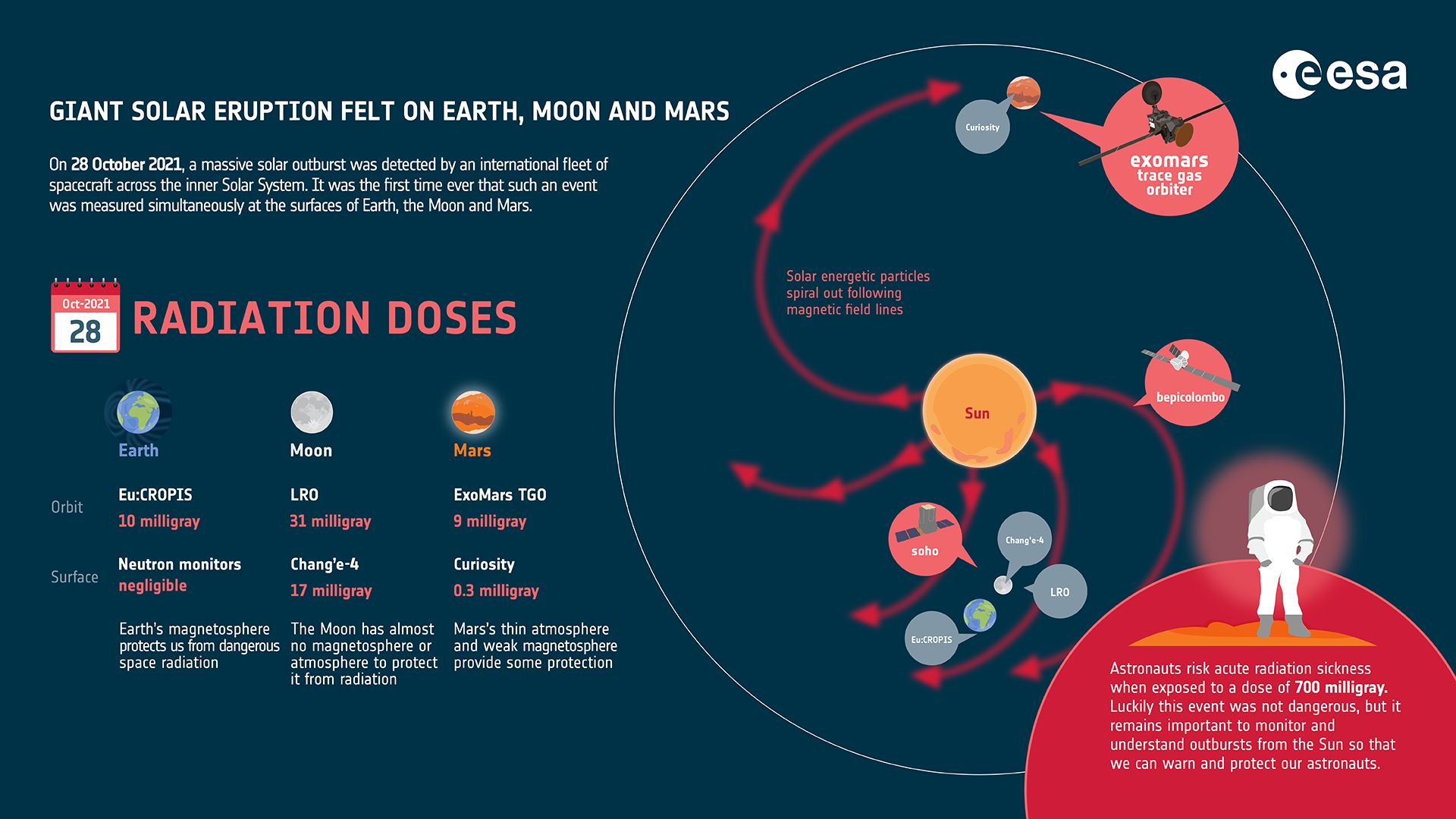
A coronal mass ejection erupted from the Sun on October 28th, 2021, spreading solar energetic particles (SEPs) across a volume of space measuring more than 250 million km (155.34 million mi) wide. This means that the event was felt on Earth, Mars, and the Moon, which was on the opposite side of the Sun at the time. It was also the first time that a solar event was measured simultaneously by robotic probes on Earth, Mars, and the Moon, which included ESA’s ExoMars Trace Gas Orbiter (TGO) and Eu:CROPIS orbiter, NASA’s Curiosityrover and Lunar Reconnaissance Orbiter (LRO), and China’s Chang’e-4 lander.
The ESA’s Solar Orbiter, Solar and Heliospheric Observatory (SOHO), and BepiColombo missions were also caught by the outburst and provided additional measurements of this solar event. The study of Solar Particle Events (SPE) – aka. solar flares – and “space weather” phenomena are vital to missions operating in Low Earth Orbit (LEO) – for example, crews living and working on the International Space Station (ISS). But it is especially vital for missions destined for locations beyond LEO and cislunar space, including Project Artemis and the many proposals for sending astronauts to the Moon and Mars in the coming years.
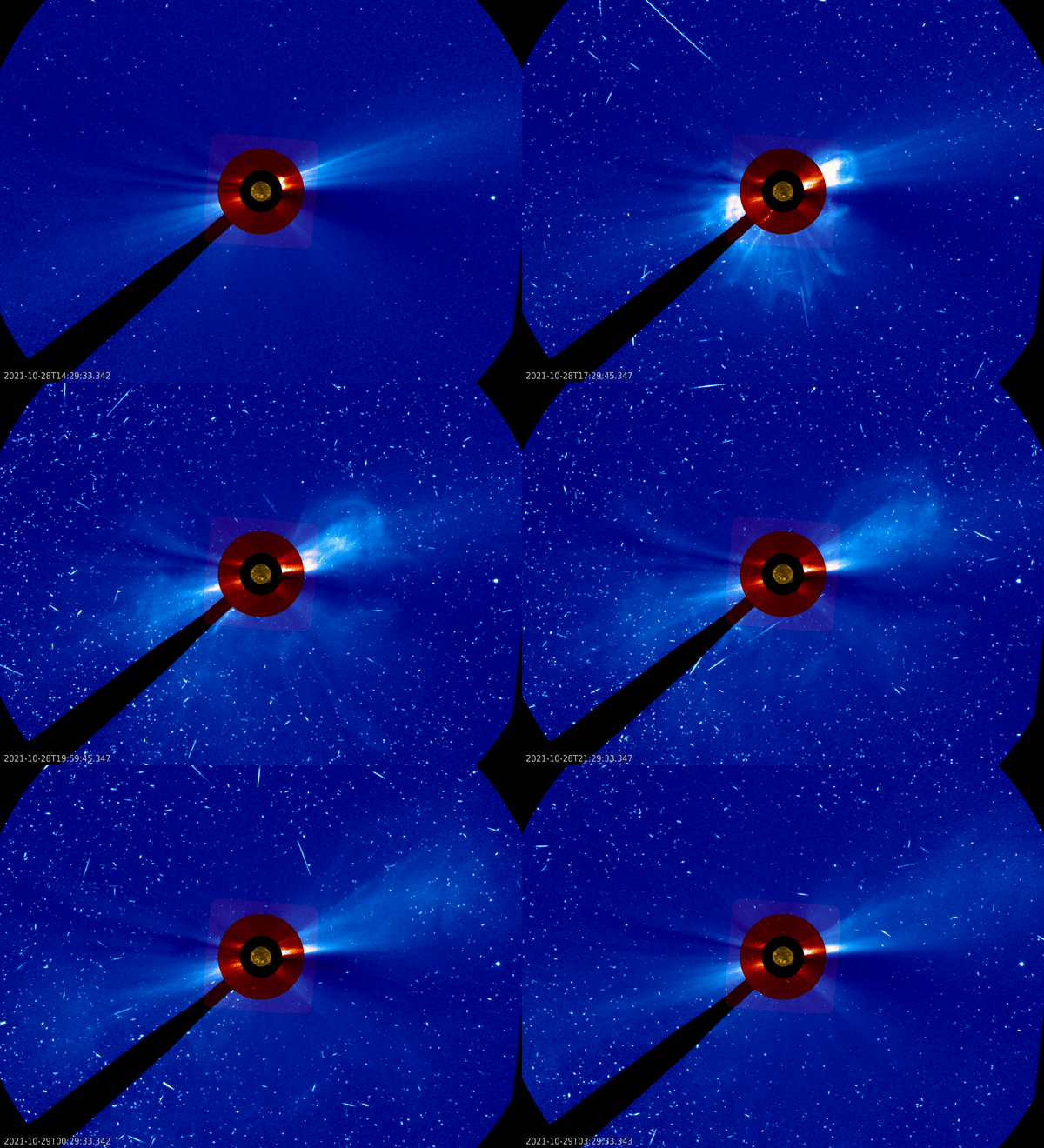
A coronal mass ejection, as seen by the ESA/NASA SOHO mission on October 28th, 2021. Credit: ESA/NASA
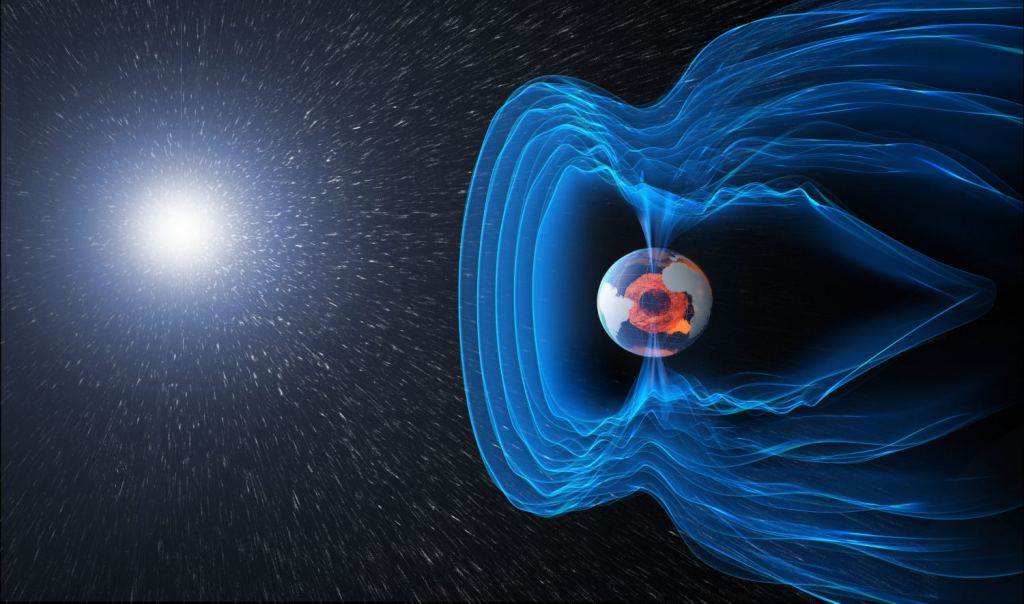
The 2021 solar event was an example of what scientists describe as a “ground level enhancement,” a rare occurrence where solar particles are energetic enough to pass through the Earth’s magnetic field and reach the surface. Only seventy-three ground-level enhancements have been detected since scientists began recording them in the 1940s, and no such events have been detected since. While Mars’ thin atmosphere does filter out the lower energy particles (and slows down the highly energetic ones), neither the Moon nor Mars generates similar magnetic fields.
This means solar particles reach the surface regularly and even produce secondary radiation (through interaction with surface regolith). According to measurements made by NASA’s LRO mission from lunar orbit, the solar event was rather weak, equivalent to an absorbed radiation dose of only 31 milligray (mGy) or 31 millisieverts (mSV). Meanwhile, the Exomars TGO and Curiosity rover, obtaining measurements from orbit and the surface, recorded doses of 9 and 0.3 three mGy (respectively) – a difference of a factor of 30.
Compare this to the solar outburst recorded in August 1972, which fell between the Apollo 16 and 17 missions. The measured outburst of radiation from this event would have delivered a fatal dose to any astronauts operating on the lunar surface. Jingnan Guo, a researcher with the DSEL with the School of Earth and Space Sciences at the University of Science and Technology of China (USTC), explained in an ESA press release:
“Our calculations of the past ground-level enhancement events show that, on average, one event every 5.5 years may have exceeded the safe dose level on the Moon if no radiation protection had been provided. Understanding these events is crucial for future crewed missions to the surface of the Moon.”
Astronauts are exposed to radiation regularly when they go to space, but the hazard of prolonged exposure increases dramatically beyond Low Earth Orbit (LEO). This includes the risk of exposure to solar radiation and cosmic rays, which becomes elevated beyond Earth’s magnetic field. But there is also the risk of huge outbursts of SEPs caused by “coronal mass ejections” (CMEs), also known as “solar flares.”
Artist’s impression of the Lunar Gateway with the Orion spacecraft docked on the left side. Credit: ESA
Impact on Astronaut Health
Given how much of our future planned exploration efforts are centered on the Moon and Mars, it is crucial to understand intense radiation events and their effect on the space radiation environment. According to ESA health guidelines, if astronauts absorb more than 700 milligray (mGy) of radiation during a mission – equivalent to 700 millisieverts (mSv) – they may experience radiation sickness caused by the destruction of bone marrow and damage to their central nervous system. This can lead to serious health problems, including nausea, infection, internal bleeding, and elevated cancer risks.
If an astronaut absorbed as much as 10 gray (10,000 sieverts), they would likely die within two weeks. This is why the ESA, NASA, and other space agencies are dedicated to limiting astronaut exposure to 1,000 mSv, or 3% Risk of Exposure-Induced Death (REID), during the entirety of their career. While radiation shielding is important, dedicated instruments that measure the radiation environment in space are used to predict major events. The advanced warning allows astronauts to seek protection within shielded environments, protective suits, and (in the future) lunar or Martian caves.
On the ISS, astronauts and cosmonauts will retreat to designated areas where the wall shield against incoming energetic particles. This includes the sleeping quarters (located in the Russian Zvezdaand NASA Harmonymodules) or one of the ISS’ galleys in the Nauka and Unity modules. For astronauts bound for the Moon, the Lunar Gateway will serve as the stopover point and a potential fallback position in the event of solar activity. The Gateway will rely on three instrument suites to monitor the radiation environment around the Moon and inside the Gateway. This includes the:
“Currently, we live in a golden age of Solar System physics,” said Marco Pinto, an ESA research fellow working on radiation detectors. “Radiation detectors aboard planetary missions such as BepiColombo, on its way to Mercury, and Juice, cruising to Jupiter, add a much-needed coverage to study the acceleration and propagation of solar energetic particles,”
NASA and the ESA are also developing next-generation space suits to provide improved protection against deep-space radiation, including NASA’s Exploration Extravehicular Mobility Unit (xEMU). The ESA also sent two mannequins developed by the German Aerospace Center (DLR) to space as part of the Artemis I mission, which conducted a circumlunar test flight between November 16th to December 11th, 2022. These mannequins, nicknamed Helga and Zohar, were studded with radiation sensors provided by NASA and the DLR, while one (Zohar) wore a protective radiation vest.
The data obtained during this test flight will help inform future spacesuits developed for ESA crews. Said Colin Wilson, ExoMars TGO project scientist:
“Space radiation can create a real danger to our exploration throughout the Solar System. Measurements of high-level radiation events by robotic missions is critical to prepare for long-duration crewed missions. Thanks to data from missions like ExoMars TGO we can prepare for how best to protect our human explorers.”
EXCLUSIVE: Dramatic videos of UFOs over the Pacific are revealed, as expert pilots describe seeing bright lights moving in 'race track' circles over the summer - but say their employers told them to keep quiet
Pilots claim they saw UFOs while flying on routes from Japan and Hawaii in August and September
Now captains and a former F-18 pilot describe to DailyMail.com seeing bright lights moving in elongated circles or 'race tracks' for hours high in the sky
The series of sightings were seen by dozens of pilots and captured on video and in air traffic control recordings
Witnesses tell DailyMail.com they are now being told by their employers to keep quiet about the sightings
Pilot Chris Van Voorhis said UFO sightings are quite common among pilots, 'Out of my pilot friends, at least 50% have seen some type of an anomaly'
Van Voorhis said his employer told him to 'cease and desist' even mentioning the incident in public, and that he feared his job could be at risk for reporting his sighting
A series of strange UFO incidents over the Pacific Ocean this summer were captured on video and in air traffic control recordings after sightings by dozens of pilots.
Experienced captains and one former F-18 pilot told DailyMail.com they saw bright lights moving in elongated circles or 'race tracks' for hours high in the sky while they flew on routes fromJapanand Hawaii towards the US West Coast in August and September.
The incidents were reported to the FAA, and a researcher obtained dramatic audio of the pilots calling in the strange sightings to Los Angeles Air Route Traffic Control Center (ARTCC).
Pilots also attempted to film from their cockpits the group of between three and five bright objects, which appeared to fly around in the area of the sky where the 'scoop' of the big dipper constellation sits.
Some of the witnesses told DailyMail.com they are now being told by their employers to keep quiet, and are calling for better reporting procedures for encounters with 'unidentified aerial phenomena' (UAPs).
A graphic shows the location and dates of the several reported UFO sightings, mainly in the Pacific Ocean, that occurred in August and September of this year
Pilot Chris Van Voorhis, 63, told DailyMail.com he saw between three and five objects, far brighter than the stars around them, fading in and out with no discernable pattern and moving in a 'race track' circular motion, while he was flying from Honolulu to Los Angeles in August
Two of the pilots can be heard in ARTCC recordings from August 18, obtained under the Freedom of Information Act by Ben Hansen, a former FBI agent and the host of Discovery+ show UFO Witness.
'We've got a few aircraft to our north here and he's going around in circles, much higher altitude than us. Any idea what they are?' Mark Hulsey, a pilot flying a Gulfstream charter jet off the Los Angeles coast radioed in.
'Uh, no, no I do not,' the baffled controller responded. 'You're not entering any [military] airspace or anything. I am not sure.'
Van Voorhis, who has been flying since he was 14 and has 32,000 hours experience, said the objects appeared to be in Earth's orbit or even further out in space
The pilot described seeing 'maybe three aircraft there,' then called ARTCC 23 minutes later, stating, 'there's now like seven of them,' and estimating that they were 'at least 5 or 10,000 feet above us.'
Asked to elaborate by the controller, the rattled Hulsey added: 'They just keep going in circles. I was an F-18 pilot in the Marine Corps, and I'm telling you, I've done many intercepts, I've never seen anything like this.'
At certain times of day satellites can reflect the sun and appear to pilots as bright lights in the sky. But the expert aviators say they believe the circular movement and duration of the sightings – some for hours – ruled out satellites.
Chris Van Voorhis, 63, told DailyMail.com he saw between three and five objects, far brighter than the stars around them, fading in and out with no discernable pattern and moving in a 'race track' circular motion, while he was flying from Honolulu to Los Angeles in August.
Van Voorhis, who has been flying since he was 14 and has 32,000 hours experience, said the objects appeared to be in Earth's orbit or even further out in space, given their continued position near to the big dipper constellation as he flew over the ocean for hours.
'The other airlines were saying, Hey, are you seeing what we're seeing?' the veteran pilot said.
'They were lights that would come on very bright, you would see them move, then they would go out.
'It had to be in a very, very high orbit, or actually even out in space quite a ways away from anything that a satellite would be, because every time we were seeing it, it was in the lower right hand corner of the Big Dipper, no matter where we were in the world.
'It lasted for such a long time that it actually became boring, almost.
'If it was [Elon Musk's satellite system] Starlink, or anything like that, then it's going to be moving in a linear fashion, and all of them will be moving in the same direction. These weren't. They were moving different directions.'
Van Voorhis said his employer, which DailyMail.com has chosen not to name, told him to 'cease and desist' even mentioning the incident in public, and that he feared his job could be at risk for reporting his sighting.
Gulfstream captain and former F-18 pilot Mark Hulsey's saw a UFO sighting on August 18 by Santa Catalina, an island off the LA coast
This image shows the brightness of the UFO compared to the three circled stars, which are much dimmer
Two UFOs (also called UAPS - unidentified aerial phenomena) are seen in this photo, grabbed from a video of the encounter
Hansen has collected accounts of pilots for Southwest Airlines, Hawaiian Airlines and others between August 6 and September 23 who say they saw the same lights in the sky as Van Voorhis.
'Many of these pilots are very confident that the lights were not just going in one direction, but in both directions, which is very unusual for satellites.
'In Mark's case they would go from the north and then actually go above his craft, where he had to crane his neck to see them from the canopy.
'It was seen by upwards of 15 different commercial flights. And at least six pilots are willing to go on record with their names and everything if asked to do so by any investigative agencies.
'In this case, we have a global phenomena from as far west as Japan, to as far east as possibly Miami. Whatever it is, pilots are seeing it from halfway across the world.'
But Hansen said there is currently no proper process for reporting such sightings – even of strange objects that could pose a threat to the safety of commercial airlines.
'Civilian pilots do not have a structured, robust process that is publicly provided to them where they can report UAPs,' he told DailyMail.com.
'The reason the pilots don't report primarily is because they don't think the FAA will follow up, or worse they will be ridiculed.'
An FAA spokesman told DailyMail.com: 'The Federal Aviation Administration documents Unidentified Aerial Phenomenon (UAP) sightings whenever a pilot reports one to an air traffic control facility.
'If the pilot report can be corroborated with supporting information such as radar data, it is shared with the UAP Task Force' – a Defense Department unit that investigates UFOs, now officially called the All-domain Anomaly Resolution Office.
A 2021 Director of National Intelligence report warned that 'UAP threaten flight safety and, possibly, national security,' due to 11 near misses between naval aviators and unknown objects.
Van Voorhis' said UFO sightings are quite common among pilots.
'Out of my pilot friends, at least 50% have seen some type of an anomaly,' he said.
Two of the pilots can be heard in ARTCC recordings from August 18. 'We've got a few aircraft to our north here and he's going around in circles, much higher altitude than us. Any idea what they are?' Mark Hulsey radioed in
'Uh, no, no I do not,' the baffled controller responded. 'You're not entering any [military] airspace or anything. I am not sure'
The incidents were reported to the FAA, and a researcher obtained dramatic audio of the pilots calling in the strange sightings to Los Angeles Air Route Traffic Control Center (ARTCC)
His August sighting was not his first. In February 2004 while flying for Japanese airline Jalways he said he and another plane's crew saw three 'disks' descend from outside the atmosphere, 'stop' mid air, then suddenly pivot 30 degrees while keeping their triangular formation and shoot off beyond the horizon at thousands of miles per hour.
'I was coming back from Japan to Honolulu. We were at 39,000 feet coming across the Pacific Ocean. It was 5:30 in the morning, local time. Something caught my eye off the left hand side of the aircraft. There were three large discs,' he said.
'They were high enough up in the atmosphere to be reflecting the light from the sun which wasn't up yet.
'They came in a triangular formation and stopped. They turned in formation, they didn't bank or anything like that, nothing aerodynamic, they just pivoted. And then they took off over the horizon.
'It wasn't like they accelerated. They were just at speed and gone over the horizon. The whole thing took about 15 seconds.
'The aircraft in front of us saw it too. They said 'are you going to tell anybody?' and we said 'no'.'
Gulfstream captain and former F-18 pilot Hulsey's August 18 UFO sighting was by Santa Catalina, an island off the LA coast.
Famously, US Navy aviators from the aircraft carrier USS Nimitz chased a 'tic tac'-shaped UFO near Santa Catalina Island in 2004.
The tic tac evaded Top Gun ace Commander David Fravor, maneuvering and accelerating in ways which seemed to defy the laws of physics. It then disappeared before astonishingly reappearing 40 miles away in less than one minute, at the aviator's CAP point, a rendezvous location only known by the pilot and his commander.
In July 2019, in the same area, multiple strange objects harassed US naval warships over several days.
The Pentagon claimed they were drones, but could not confirm the origin nor the operators of the craft. A source close to the investigation of the incident told DailyMail.com that a nearby Chinese cargo ship named Bass Strait, thought to be the culprit, was searched with no signs of drones.
“LARGE FLOATING ORB” Congress Demands Answers After Pilots Encounter UFOs
A recent Congressional hearing shed new light on this enigmatic subject, underlining the serious implications it holds for both national security and aviation safety. The examination of these inexplicable occurrences, often reported by highly trained military personnel, is no longer a matter of fringe conspiracy theories but of rigorous scientific investigation.
During the hearing, some riveting accounts were shared, with testimonies that highlighted not only the existence of these UAPs but also their advanced capabilities. One such account detailed a rather peculiar incident at Eglin Air Force Base involving unidentified crafts moving in a precise diamond formation. The eye-witness account describes radar anomalies associated with these crafts and a distinct, unsettling pattern – upon interception by military aircraft, the radar systems began to malfunction mysteriously.
This description of advanced radar jamming capabilities paints a picture of a technology far beyond current human understanding. When approached, these unidentified crafts seemingly have the ability to disrupt or completely disable the tracking systems on our most advanced aircraft. If the recounting is accurate, this speaks volumes about the level of sophistication possessed by these unidentified entities.
Former Navy pilot Ryan Graves shed further light on the topic, corroborating similar experiences of unusual radar interference during encounters with unidentified flying objects. Graves described an incident where pilots witnessed a fleet of objects not visible on the Forward-Looking Infrared Radar (FLIR) system, an observation confirmed by the radar data displayed on the situational awareness page.
The nature of these experiences emphasizes a significant concern for our national security. Not only do these unknown entities demonstrate capabilities beyond our comprehension, but they also seem to have the potential to disable our defense and surveillance systems at will. This highlights the urgent need to better understand these phenomena to safeguard our security.
One significant hurdle to gaining a comprehensive understanding of these UAPs, as emphasized by the hearing, is the existing culture within military and aviation circles. Pilots and other personnel have historically been discouraged from reporting these experiences, for fear of career repercussions or ridicule. This cultural barrier has hampered our collective knowledge and understanding of these phenomena.
Representative Matt Gates, during the hearing, suggested a pressing need for more secure channels to report and analyze these phenomena. He emphasized the need to subpoena radar images of these unidentified crafts and create mechanisms to facilitate more comprehensive reporting and analysis of these incidents. This, he believes, could be a significant step forward in our understanding of these phenomena.
The congressional hearing, thus, underlines a paradigm shift in how we approach the mystery of UAPs. The conversation has moved beyond idle speculation and conspiracy theories to rigorous investigation and genuine concern for national security. As we look to the future, it is clear that the exploration and understanding of these phenomena should be a priority, not just for the U.S, but for the world.
In the light of these revelations, it is crucial that we provide an environment that encourages transparency and facilitates reporting. Protecting whistleblowers and creating a safe space for personnel to share their experiences will significantly contribute to our understanding of these phenomena. We are at the cusp of a new frontier, and every piece of information brings us a step closer to unlocking the mysteries of these unidentified aerial phenomena. Only through such collective efforts can we hope to comprehend and engage with the mysteries that lie beyond our current understanding.
This is indeed an exciting time for both enthusiasts and scientists alike. The real work has just begun, and we are all spectators to this unfolding cosmic mystery. As the saying goes, the truth is out there. And now, more than ever, we are inching closer to uncovering it.
VIDEO:
Chris Lehto – “LARGE FLOATING ORB” Congress Demands Answers After Pilots Encounter UFOs
Een 39 miljoen jaar oud fossiel suggereert dat er in vervlogen tijden een immense reus de wereldzeeën domineerde, die misschien wel 340 ton (!) zou hebben gewogen.
De blauwe vinvis is het grootste dier dat ooit heeft geleefd. Hij is zelfs groter dan de grootste bekende dinosaurus! Het langste exemplaar ooit waargenomen was 30 meter lang en woog een slordige 190 ton. Maar mogelijk moet de blauwe vinvis zijn prestigieuze titel als grootste en zwaarste dier op aarde nu afstaan. Want onderzoekers zijn op een stokoud walvisfossiel gestuit, waardoor ze nu geloven dat er in een ver verleden een nóg zwaarder dier heeft bestaan.
Fossiel Het gaat om een 39 miljoen jaar oud fossiel dat in het zuiden van Peru is opgegraven. Het fossiel omvat 13 wervels, vier ribben en een heupbot van een zogenoemde basilosauridae-walvis. Dit is een familie van uitgestorven walvisachtigen, die leefde in het midden tot het late Eoceen. Ze kwamen over de hele wereld voor, zelfs rondom Antarctica.
De bewaard gebleven botten van Perucetus colossus. Afbeelding: Giovanni Bianucci
Gewicht Aan de hand van de gevonden overblijfselen waren de onderzoekers in staat om het gewicht van de oude walvis, die Perucetus colossus is genoemd, te schatten. En daaruit blijkt dat zijn skeletmassa groter was dan die van enig bekend zoogdier of zeedier. Sterker nog, hij was waarschijnlijk 2 à 3 keer zo groot als een 25 meter lange blauwe vinvis. Vermoedelijk woog Perucetus colossus tussen de 85 en 340 ton. Hiermee wedijvert hij met het gewicht van de blauwe vinvis, waarvan eerder werd gedacht dat hij het zwaarste dier ooit was.
Van de troon gestoten Mogelijk heeft Perucetus colossus de blauwe vinvis dus van de troon gestoten. Niet de blauwe vinvis, maar Perucetus colossus is misschien wel het grootste en zwaarste dier dat (waar wij weet van hebben) ooit heeft bestaan. Deze ontdekking suggereert dat de gang naar gigantisme bij zeezoogdieren mogelijk eerder zijn intrede deed dan gedacht.
3D-model van het skelet van Perucetus colossus (geschatte lichaamslengte: 20 meter), samen met dat van een kleinere, naaste verwant (Cynthiacetus peruvianus) en een blauwe vinvis. Afbeelding: Trustees of the Natural History Museum; Marco Merella
Gigantisme Kijken we naar het gehele dierenrijk, dan zien we dat er maar weinig dieren gigantische proporties hebben bereikt. Het is eigenlijk een vrij zeldzame eigenschap. En dat is ook goed te verklaren. Het is namelijk een hele kostbare functie. Grote dieren hebben meestal minder nakomelingen, hebben meer ruimte nodig om te leven, eten meer en lopen ten slotte eerder het risico op ziektes zoals kanker. Naast de nadelen van gigantisme heeft een grotere omvang ook duidelijke voordelen – anders was het ook niet geëvolueerd. Het belangrijkste voordeel is voedsel. Ondanks het reusachtige lichaam, leven veel walvissen vrijwel uitsluitend van kleine kreeftachtigen die nog geen tien centimeter lang worden. Een groter lichaam is daarbij natuurlijk handig, omdat ze dan veel grotere happen kunnen nemen en zo in één keer meer voedsel naar binnen zuigen.
Evolutionaire geschiedenis Het fossielenbestand van walvisachtigen (een onderorde van zoogdieren waar ook dolfijnen, walvissen en bruinvissen onder geschaard kunnen worden) is heel belangrijk bij het documenteren van de evolutionaire geschiedenis van zeezoogdieren. Veel mensen denken dat de voorouders van walvissen in zee hebben geleefd, maar dat is niet het geval. Walvissen stammen namelijk af van dieren die van het land terug de zee in zijn gegaan. Onderzoekers proberen daar nog altijd meer over te weten te komen. Ondertussen zijn ze al op bepaalde aanpassingen gestuit die hand in hand gingen met die terugkeer naar het water. Denk in dit geval aan gigantisme en de daarmee samenhangende toename van de lichaamsmassa, hoewel wordt aangenomen dat laatstgenoemde een relatief recente diversificatie is geweest.
30 miljoen jaar eerder Maar de nieuwe studie suggereert nu iets anders. De opgegraven fossiele resten van Perucetus colossus zijn namelijk 39 miljoen jaar oud. Bovendien blijkt dat deze gigant al over verschillende kenmerken beschikte die erop wijzen dat hij al volledig was aangepast aan een wateromgeving. Dit betekent dat walvisachtigen zo’n 30 miljoen jaar eerder dan gedacht al hun maximale lichaamsgewicht hadden bereikt. Het drijfvermogen dat gepaard gaat met de toename van botmassa komt overeen met een levensstijl in ondiep water. Dit ondersteunt de heersende theorie dat basilosauridae-walvissen goed aangepast waren aan kustomgevingen.
De studie werpt meer licht op deze orde van oude dieren. Maar dat niet alleen. Het laat vooral zien dat er in vervlogen tijden immense giganten door de zeeën zwierven, die zelfs groter en zwaarder waren dan de befaamde blauwe vinvis. Of er misschien nóg zwaardere dieren dan Perucetus colossus hebben geleefd? Dat valt natuurlijk niet uit te sluiten. We houden de wetenschap in de gaten.
Is het een kosmische spons? Een pokdalige aardappel? Nee, het is de bijzondere maan Hyperion! Dit vreemde object draait om de ringplaneet Saturnus.
Hyperion is in alle opzichten een markante maan. Ten eerste heeft deze maan van Saturnus een dichtheid die ongeveer de helft is van water. Wetenschappers denken daarom dat de maan voornamelijk uit waterijs bestaat.
Op het oppervlak zijn ontelbaar veel kleine kraters te zien. Deze hebben een gemiddelde diameter van twee tot tien kilometer. De kraters zijn gemiddeld 400 meter diep. De allergrootste krater op Hyperion heeft een diameter van 122 kilometer en is ruim tien kilometer diep. Deze krater bedekt bijna de hele maan, die een radius heeft van 135 kilometer.
Aangezien Hyperion heel poreus en licht is, is er nauwelijks zwaartekracht op het oppervlak. Om je een voorbeeld te geven: op aarde is de valversnelling 9,81 meter per seconde. Dit wordt 1 g genoemd. En de maan? Daar is de zwaartekracht met 0,165 g zo’n zes keer lager dan op aarde. Je kunt dus zes keer zo hoog springen als je met dezelfde spierkracht afzet. Op Hyperion is de zwaartekracht 0,002 g: 500 keer lager dan op onze planeet. Toch is het niet makkelijk om ‘weg te springen’ van de maan. De ontsnappingssnelheid is namelijk alsnog 268 kilometer per uur.
Misschien nog wel het meest bijzondere aan Hyperion is zijn baan om Saturnus. De rotatie van Hyperion is chaotisch: het maantje tuimelt op onvoorspelbare wijze door de ruimte. De afstand tot Saturnus bedraagt gemiddeld 1,3 tot 1,6 miljoen kilometer. Ook de snelheid varieert continu. Bekijk dit gifje maar eens. Je wordt er misselijk van!
De ruimtefoto van de week is gemaakt door de Cassini-ruimtesonde. De sonde kiekte het maantje tijdens een scheervlucht in 2005. Cassini vloog toen op een afstand van 514 kilometer langs de natuurlijke satelliet. Dat is nog eens een scheervlucht!
Nagenieten van Cassini’s erfenis Helaas kunnen we niet langer genieten van nieuwe prachtige foto’s van Saturnus en haar manen. In 2017 kwam er een einde aan de Cassini-missie en verbrandde het ruimtevaartuig in de atmosfeer van de ringplaneet. Gelukkig is er nog wel een rijk archief opgebouwd. Zo hebben we op Scientias in 2017 een top 40 gemaakt van de mooiste Cassini-foto’s. Deze foto van Saturnus eindigde op een respectabele derde plek.
De afgelopen decennia hebben ruimtetelescopen en satellieten prachtige foto’s gemaakt van nevels, sterrenstelsels, stellaire kraamkamers en planeten. Ieder weekend halen we één of meerdere indrukwekkende ruimtefoto uit het archief. Genieten van alle foto’s? Bekijk ze op deze pagina.
With both the Pentagon and NASA launching renewed efforts in the study of unidentified aerial phenomena (UAP), a Ukrainian research team says that it has undertaken a study of its own, producing imagery of aerial objects that cannot be easily identified.
According to researchers B.E. Zhilyaev, V.N. Petukhov, and V.M. Reshetnyk, the Main Astronomical Observatory of NAS of Ukraine “conducts an independent study of UAP” which has managed to collect imagery depicting several anomalous aerial events. The team says it employs a pair of meteor stations located in Kyiv and in the Vinarivka village, each fitted with video cameras observing the daytime sky.
In a recent paper announcing their findings, the researchers say they have created “a special observation technique” they use “for detecting and evaluating UAP characteristics.” Based on the events they have observed, they break down their observations of UAP into two primary categories, which they call “Cosmics” and “Phantoms.”
Night sky over Kyiv, Ukraine, 2020.
(Image credit: Getty)
“We note that Cosmics are luminous objects, brighter than the background of the sky,” the authors write, noting three subcategories of Cosmics each named after various birds: swift, falcon, and eagle, whereas “Phantoms are dark objects, with contrast from several to about 50 percent.”
The Ukrainian team says they have detected UAP under a variety of conditions and have observed what they characterize as “a significant number of objects whose nature is not clear.”
“Flights of single, group and squadrons of the ships were detected,” the paper states, with several of the objects exhibiting speeds “from 3 to 15 degrees per second” and varying degrees of brightness that the team gauges within a range of 10 to 20 Hz. The research team also employed synchronized camera systems that in one instance, according to their paper, “allowed the detection of a variable object, at an altitude of 1170 km.”
By employing instrumentation used to measure variations in color, the team also believes they could determine the characteristics of the appearance of some of the objects they observed and estimate their distance.
Composite imagery depicting one of the purported “Phantom” objects, along with what are labeled “bright swifts,” captured by the Ukrainian research team (Credit: B.E. Zhilyaev, V.N. Petukhov, V.M. Reshetnyk/Main Astronomical Observatory, NAS of Ukraine).
According to the researchers, the objects they designate as Phantoms appear to have very low reflectivity, characterizing the objects as “a completely black body that does not emit and absorbs all the radiation falling on it.” The researchers hypothesize that such an object may be visible “because it shields radiation due to Rayleigh scattering,” an effect that describes light particles that become scattered without there being changes in their wavelengths.
“Phantoms are observed in the troposphere at distances up to 10 – 12 km,” the researchers state in the paper, estimating their size as being between 3 and 12 meters and capable of speeds of as much as 15 kilometers per second.
The researchers present a variety of diagrams within their paper that indicate variations in the color and brightness, as well as speed and other characteristics displayed by the objects. However, the authors do not propose any possible explanations or hypotheses regarding the objects and their appearance or whether they could have mundane underlying sources.
“Unidentified anomalous, air, and space objects are deeply concealed phenomena,” the authors conclude, adding that the primary characteristic of the UAP they have observed is “extremely high speed.”
The paper, “Unidentified aerial phenomena I. Observations of events,” by B. Zhilyaev, V. Petukhov, and V. Reshetnyk can be read online.
Hat tip to Brett Tingley of Space.com for bringing this study to our attention.
Micah Hanks is Editor-in-Chief and Co-Founder of The Debrief. Follow his work at micahhanks.com and on Twitter: @MicahHanks.
In 2016, a large number of emails from the account of John Podesta, the chairman of Hillary Clinton’s 2016 presidential campaign, were leaked by WikiLeaks. The tranche of emails thrilled the Internet when reporters associated with the New York Times were working on the groundbreaking story entitled “Glowing Auras and ‘Black Money’: The Pentagon’s Mysterious U.F.O. Program.”
The emails between Podesta and a person named Bob Fish are the main subject that has been widely discussed by UFO enthusiasts. Mr. Fish, who had previously worked as an IT contractor, held the position of Director of Advanced Programs at Network Equipment Technologies from 1984 to 1993. (Source)
During that time, he was responsible for overseeing a top-secret global network for a major intelligence agency within the Department of Defense. In addition, he was involved in various operations that were of national importance, such as the Gulf War and Operation Just Cause.
The leaked emails may provide new insight into UFOs. Mr. Fish sent an email to Podesta on March 5, 2015, in which he stated that blurry photos, crop circles and statements from witnesses alone would not be enough to confirm the existence of UFOs. “What was needed,” he continued, was “hard scientific data collected from instruments that are known to be accurate and reliable.” Which, he added, was available “if one knows ‘where to look’ and ‘what to look for.’
Bob Fish. Image source: Linkedin
He claimed that the federal government had been collecting data on UFOs since the 1970s, using the Defense Support Program (DSP) satellites.
In his next email to Podesta, he shared an incident that happened with him in El Segundo, a city in California. After Project Blue Book was shut down, Fish met with a USAF official who worked on the program. He told Fish that “there were times when they were diverted from these missions to track UFOs off the east coast of Florida.”
Further, the email stated: “His claim was the UFOs had a landing and takeoff spot in the ocean east of Miami, north of Bermuda. He also claimed there was a specific electronic signature (frequency) emanating from them when they were going into or coming out of the water, so they were easy to track. On several occasions, they filmed the UFO as it transitioned from water to air or vice versa.”
Mr. Fish was convinced that the United States Air Force’s Project Blue Book, which was officially closed in 1970, did not end but instead was taken out of public view. The existence of the Advanced Aerospace Threat Identification Program (AATIP) demonstrated that the Pentagon’s interest in UFOs never dissipated.
Based on the observations provided by Lue Elizondo, the former director of the Advanced Aerospace Threat Identification Program (AATIP), the United State government had already been aware that UAPS were vastly outmatched by superior technology. These objects have capabilities that are beyond comprehension.
They can travel at incredibly fast speeds and have the ability to get invisible while accelerating. They are capable of moving through air without wings and can travel through space, atmosphere, and oceans without being affected by gravity, and without any visible means of propulsion.
Such scenarios alarmed the US government, and the officials realized that if this god-like technology were to be obtained and mastered by their adversaries before the United States, it would make democracy vulnerable. Australian investigative reporter Ross Coulthart noted that his sources confirmed “there has been consideration given to offensively trying to bring down these objects.”
In his book “In Plain Sight: An investigation into UFOs and impossible science“, Coulthart describes that the United States government appears to have knowledge of some UAP (Unidentified Aerial Phenomena) entering Earth’s orbit from deep space. Furthermore, the US government can actively track them via RF signals emanated from these craft based on conversations with retired US intelligence officer Bob Fish.
“I wrote to Bob Fish and after a few weeks, he kindly responded, confirming everything he told Podesta, and more. He had never spoken publicly about UAPs before. A previously very highly security-cleared defense communications intelligence insider, Fish has extensive experience working on classified programs, including President Reagan’s ‘Trust but Verify’ nuclear missile disarmament treaty with the Soviets, and he assured me he was happy to be quoted about his strong interest and belief in UAPs.
He clearly knew a lot more than he was prepared to reveal. When I asked him what he knew about the purported US ability to track such mystery craft, he told me, ‘At some point, the information about “alien” stuff and true US national defense information crosses paths.
Patriots with clearances do not want to be traitors to their country or their way of life. For instance, if I told you the exact electromagnetic signature of a high-Mach UFO that US sensors search for, but don’t attack, and you put it in a book, the Soviets/Chinese would manufacture a bomber with SIGINT/ELINT [signals and electronic intelligence] countermeasure equipment that generated that exact signature.
We must find a path forward that brings about greater knowledge of the truth without endangering the civilizations we have evolved into. The intriguing thing about Fish’s comment was the implication there was indeed a ‘truth’ still being concealed.”
Mr. Fish stated that the UAP entered the atmosphere and descended into the Atlantic Ocean, specifically in an area east of Miami, Florida and north of Bermuda. He suggested that this location would be ideal for a telescope with sensor capabilities if one were to be running the Galileo Project.
Former U.S. Navy Lt. Ryan Graves told Lex Fridman on a podcast that his squadron started getting the UAP hits, once they upgraded their APG-73 radar to the APG-79. He mentioned that the upgrade was something like going from analog to digital and that sometimes they would fly F-18s with the old radar in the morning, and the objects would not be there, but when they swapped to the F-18s with the new radar, the UAP hits would be back again. He also noted that perhaps the new radar was not filtering out something that they should have been yet, or perhaps it had not been calibrated. (Source)
“The radar always picks up everything flying, but they go so fast, you don’t recognize them. Your mind says it could have been an 18-wheeler, it could be something low, I don’t know what it was…”
— John Callahan, FAA Retired at the National Press Club, Washington D.C., 2013. (Source)
There is pretty good evidence that the government has been intercepting UFO signals or emissions since at least the 1950s. In one 1957 case investigated by James E. McDonald, a UFO was simultaneously witnessed by military officers, it was seen on radar and ECM gear detected a certain frequency coming from it. (Source)
What They Don’t Want You To Know About the Tunguska UFO Explosion
In the annals of unexplained phenomena, few events have stirred as much intrigue as the mysterious explosion that shook the remote Tunguska region of Siberia in 1908. Long thought to be the result of a meteor, this astronomical puzzle has seen a resurgence of speculation in recent years with a few daring to suggest an extraterrestrial origin.
Historically, most scientists subscribed to the meteor hypothesis, arguing that a meteorite entering the Earth’s atmosphere at a high speed would have caused the massive explosion, a blast believed to be 1,000 times more powerful than the atomic bomb dropped on Hiroshima. However, one of the enduring mysteries of the Tunguska Event is the lack of a discernable crater, which typically accompanies meteor strikes.
In contrast, some researchers have recently proposed an extraordinary hypothesis – suggesting that the Tunguska Event was actually the result of an alien spaceship crashing into the Earth. Proponents of this theory argue that the flight path of the object showed signs of being under intelligent control, citing unverified reports that the object made a turn mid-flight – an ability beyond that of a natural meteor.
Fueling these rumors was none other than Soviet dictator Joseph Stalin. Historical accounts suggest that he believed the Tunguska blast was the result of an alien spacecraft testing an advanced weapon. Stalin, intrigued by this possibility and ever-concerned for Soviet security, assigned some of his top scientists, including Sergey Korolev, to investigate.
Korolev, renowned for his role in developing the Russian space program, found his interest piqued by the peculiarities of the Tunguska event. After organizing an expedition to the area, the team discovered radioactive metallic fragments unlike any found in typical asteroids or meteorites. This discovery led them to a location ominously called the “devil’s graveyard” – an area where no plant life thrived and animals perished, marked by heightened radioactivity levels.
The question remains: if the Tunguska event was indeed an extraterrestrial incident, where did the fragments end up? Some suggest that the remnants were secreted away to Kapustin Yar, a highly classified Russian military base known for its tight security and cutting-edge research.
The suggestion that alien technology was studied and reverse-engineered in the bowels of this secure facility adds an exciting layer to Cold War intrigue. This has led some to draw parallels between Kapustin Yar and the infamous American Area 51, suggesting that these secretive installations were more similar than anyone could have thought.
In the end, the Tunguska event continues to capture our collective imagination. Whether the result of a meteor or a visit from extraterrestrial life, the event serves as a stark reminder of the incredible, sometimes unexplainable, phenomena that exist beyond our everyday perception. As we continue to explore our universe and technology evolves, we may someday unravel the enigmatic mystery of the Tunguska event, be it a tale of a rogue meteor or a testament to an early encounter with otherworldly beings.
VIDEO:
What They Don’t Want You To Know About the Tunguska Explosion (S2) | UFO Files | The UnXplained Zone
The Search for the Hidden City Agartha in the Center of the Earth
Cultures around the world have myths that speak of a mysterious underground kingdom that exists deep within the earth, hidden away from the primitive and violent surface-dwellers: which is us.
Picture a society untouched by time, unscathed by war, and unaffected by natural disasters. A culture much advanced than we are thriving in the vast open spaces inside the Earth.
Throughout history, many have looked for physical evidence of its existence, tempted by stories of a peaceful but powerful subterranean civilization with advanced technology and ancient knowledge long forgotten by modern man.
The existence of the underground Kingdom of Agartha may be true, but it has been hushed up for decades and governments go to great lengths to keep it a secret.
Remember Admiral Richard Byrd who said that there is something strange about the shape of the Earth in both polar areas and explaining that there is a secret land mass the size of the United States that has never been seen by anyone.
Yet the John Kerry 11-7-2016 departure trip to Antarctica by discussing the new agreed upon Nation State Treaty, banning private ships from traveling to Antarctica without advanced authorized permission to do so, for another period of 35 years to cover-up the secrets from the past and what to think of the polar orbit satellites, they don't cross some significant areas.
And it seems that there is also a Secret Antarctic Map that reveals the coordinates how to get to the Hollow Earth
This is the story of the underground Kingdom of Agartha and the explorers who’ve said that - not only is it a real place - but they know where it is.
Big, Red UFO Hovered over Vandenberg in 2003, Congressional Witness Testifies
Former Navy Pilot Says Unidentified Anomalous Phenomenon Was Seen Above Air Force Base in Santa Barbara County
Ryan Graves, a former U.S. Navy fighter jet pilot and founder of a nonprofit focused on unidentified anomalous phenomena sightings, testified during a House Oversight Committee hearing on July 26 about receiving reports of a strange object hovering over Vandenberg Air Force Base in 2003. Credit: C-SPAN
Reports of a huge, hovering red square above Vandenberg Air Force Base in northern Santa Barbara County were shared at a House of Representatives panel’s hearing on unidentified flying objects last Wednesday, July 26.
For the last five years, the United States has been slowly leaking bits of information about UFOs, or unidentified anomalous phenomena (UAP) as they call them. The Indyreported in 2019 that there has been an overall “uptick of interaction with aerial phenomenon” since 2014, according to a spokesperson for naval operations.
“A large group of Boeing contractors were operating near one of the launch facilities at Vandenberg Air Force Base when they observed a very large, 100-yard-sided red square approach the base from the ocean and hover at low altitude over one of the launch facilities,” said Ryan Graves, a former U.S. Navy fighter jet pilot and founder of a nonprofit focused on UAP sightings.
“This object remained for about 45 seconds or so before darting off over the mountains,” he continued.
Graves, the executive director of Americans for Safe Aerospace, said the sighting occurred around 8:45 a.m., followed by a second sighting only hours later. He said witnesses provided him with information about the mysterious incidents, as they had held onto “official documentation and records” from the event over the years.
“Later in the evening, post sunset, there were reports of other sightings on base, including some aggressive behaviors. These objects were approaching some of the security guards at rapid speeds before darting off,” Graves said.
The Vandenberg Air Force Base — renamed the Vandenberg Space Force Base in 2021 — is no stranger to anomalous phenomena. In 1964, a test missile was destroyed shortly after launch at the base. The event was allegedly filmed by Lieutenant Robert Jacobs, who in 1982 came forward saying a space object approached the missile and shot a plasma-type beam at the dummy warhead from four different angles. His superiors had told him to say nothing of the sighting.
Graves, one of three former military members to testify at the July 26 hearing, based his discussion around “three critical issues,” including claims that UAP are in our airspace but are grossly underreported, stigma around UAPs is powerful and “challenges national security,” and “the government knows more about UAP than shared publicly, and excessive classification practices keep crucial information hidden.”
The alleged sighting of a giant, flying red square raises eyebrows. The credibility is questionable — how did others miss it? Nevertheless, reports of odd sightings are becoming more public, and are being treated more seriously by government officials on both sides of the political spectrum.
Last year, the Department of Defense created the All-Domain Anomaly Resolution Office, or AARO, for handling UAP reports.
The U.S. intelligence community said earlier this year that UFO reporting by U.S. military personnel is increasing, but government officials have emphasized that only a small percentage of those reports could be described as “anomalous.”
Many representatives at the hearing acknowledged UAPs as a potential threat, which requires government transparency and better understanding of UAPs. That includes efforts to encourage people to come forward with UAP reports, according to Rep. Robert Garcia (D-Long Beach).
The Independent reached out to Congressmember Salud Carbajal’s office, but they had no comment at this time.
“The more we understand, the safer we will be,” Garcia said.
Whistleblowing is fundamentally American, since 1778
BY STEPHEN M. KOHN, OPINION CONTRIBUTOR
FILE – A flag is waved outside the White House, in Washington, Sept. 4, 2017.
(AP Photo/Carolyn Kaster, File)
For the tenth year in a row, the United States Senate has unanimously passed a resolution urging every executive department of the federal government to honor July 30 as National Whistleblower Appreciation Day. Why? As with so many other great movements where human rights and civil liberties were vindicated, protected whistleblowing began with a small band of people who stood up for justice, made their voices heard, and changed history.
During the winter of 1777, 10 sailors and marines aboard the USS Warren blew the whistle on abuses by the commander of the U.S. Navy despite the lack of any existing legal protection. Their spokesman, without leave, jumped ship in Providence, Rhode Island, and made way for the Continental Congress, where he presented 10 petitions in the interest of the Revolution. On July 30, 1778, the sailors finally had their fate sealed.
For these 10 men, the stakes could not have been higher. Their punishment would not be a slap on the wrist — they were subject to military law and could have been disciplined at the hands of the very commander they were trying to take down.
Their first effort to report the wrongdoing was a letter to Robert Treat Paine, the lawyer who prosecuted the British soldiers tried for killing innocent civilians in the Boston massacre. In early February 1777, the whistleblowers asked Paine, a member of the Continental Congress, for his support. Their letter provides insight, not to how the elite in the Continental Congress were viewing the Revolution, but to how everyday sailors and marines explained what “sacrifices” they were willing to make for their “ravish’d, bleeding, injur’d country’s cause.”
The 10 men did not want corrupt leaders to betray the Revolution and demanded their constitutional liberty to expose wrongdoing. Eight days later, Marine Captain John Grannis jumped ship in the Providence Harbor and, without authorization, traveled to the Continental Congress in Philadelphia to present the signed petitions.
A transcript of Captain Grannis’s testimony to the Marine Committee was preserved in the records of the Continental Congress. When asked by a member of Congress if he had permission to leave the Warren, Grannis said “no,” but he explained that he did so out of his “zeal for the American cause” and “love of country.”
He presented the whistleblowers’ petitions setting forth their reasons why the First Commander of the U.S. Navy, Esek Hopkins, should be removed from his position. The man pointed to serious misconduct including the harsh mistreatment of British prisoners, but perhaps their most significant allegation was the threat to their belief in the Revolutionary cause. They explained how Hopkins had told the men, who were risking their lives to create a republic where all men were created equal, that his governing philosophy was that “all mankind” could be bought with money and for the lust of money they would perform “any action whatsoever.” The whistleblowers fundamentally rejected this view of humanity and feared his leadership would undermine the mission of the Revolution.
What unfolded in the winter of 1777 was a classic whistleblower exposure that would go on to be repeated throughout American history. We still see persons today, in service of the country, report misconduct committed at the highest levels of government. But what followed Grannis’s courageous testimony is even more remarkable because it set a precedent for how our nation would respond to these whistleblower reports going forward.
After reviewing the petitions, Congress initiated a series of actions that should inspire every American committed to the ideals of the Revolution of 1776 to rethink their opinions of whistleblowing. Instead of retaliating against the whistleblowers, Congress suspended Commander Hopkins, gave him the opportunity to rebut the claims, and later terminated his service when no defense was made.
Hopkins then turned around and engaged in the types of retaliation that even today’s whistleblowers all too often face. Of the 10 men, he tracked down two — Third Lieutenant Richard Marven and midshipmen Samuel Shaw — and had them arrested for criminal libel in his home state of Rhode Island, holding the men to high bail. From their Providence jail cell, the two captured whistleblowers wrote a letter to Congress pleading for help. Congress met again to consider the appropriate actions to take in response to the pleas of the jailed men.
On July 30, 1778, without any noted dissent, the Continental Congress sent a message that must resonate in today’s White House, Congress and courts. They passed what could very well be the world’s first explicit whistleblower law, and they did not stop there. They voted to release all of the petitions signed by the whistleblowers, many of which included information that was embarrassing to the U.S.
The American people, through Congress, agreed to pay all legal costs necessary to defend the two whistleblowers fighting for their freedom. A highly respected lawyer was hired, and the whistleblowers won their case — the first recorded legal victory for American whistleblowers. The records of the Congress reflect that even though money was desperately needed for military supplies, they honored the resolution and paid Marven and Shaw $1,418. Founding Father Samuel Adams played a leading role in ensuring the vindication of whistleblower rights.
This is why the United States Senate has continuously passed a resolution recognizing what the Continental Congress did on July 30 at the height of the American Revolution and what the current government must do to honor this tradition and the contributions that whistleblowers have made throughout history. The resolution is a way to recommit our nation to recognize the importance that whistleblower protections played in the birth of our democracy and the crucial role these protections still have in our nation’s continued growth.
Does the Milky Way's Supermassive Black Hole Have a Companion?
At the heart of our galaxy, there is a monster black hole. Known as Sagittarius A*, it has a mass of 4.2 million Suns, and it’s only about 27,000 light-years from Earth. Sag A* is the closest supermassive black hole, and one of only two that we’ve observed directly. It is so close that we can even see stars closely orbiting it. Some of those stars we’ve been observing for more than 20 years, which means we have a very good handle on their orbits. We’ve used those orbits to determine the mass of Sag A*, but a new study looks at a different question: does our galaxy’s black hole have a companion?
Most galaxies contain a supermassive black hole, and some galaxies contain two. This is caused by galactic mergers, where the black hole of one galaxy is captured by another. We know from observations that our galaxy doesn’t have two supermassive black holes. There could be stellar mass black holes orbiting Sag A*, but current observations wouldn’t be sensitive enough to detect them. Another possibility is that there is an intermediate black hole orbiting Sag A*, which is the focus of this work.
An Intermediate Mass Black Hole (IMBH) is one with a mass between hundreds and thousands of Suns. They aren’t formed by the collapse of a massive star, nor are they the gravitational seeds of galaxies. They’ve only recently been discovered through the gravitational waves of black hole mergers, so they aren’t well understood. We don’t even know how common they might be. But if an IMBH orbits Sag A*, its gravitational pull would affect the orbits of nearby stars also orbiting our supermassive black hole.
SO-2 orbits very close to Sag A*. Credit: ESO/M. Kornmesser
In this study, the team looked at the orbit of a star known as S0-2, or S2. It has one of the closest orbits to Sag A*, with an orbital period of just 16 years. It orbits the black hole so closely that you need to take general relativity into account when calculating its orbit, and we have more than two decades of observational data on it. If there is an IMBH orbiting nearby, S0-2 should be affected by it.
The team found that to the limits of observation, there was no evidence of gravitational perturbations on the orbit of S0-2. This doesn’t mean there isn’t an intermediate-mass black hole in the area, but it does put some upper bounds on the mass if it does exist. Based on the data, if a hypothetical IMBH orbits outside the orbit of S0-2, say with an orbital radius between 1,000 AU and 4,000 AU, then it could have a mass no greater than 1,000 to 10,000 Suns. If there is an IMBH orbiting Sag A* closer than S0-2, then it can have a mass no greater than 400 Suns.
Those aren’t tight constraints, but they do confirm that there isn’t a large intermediate black hole orbiting Sagittarius A*. If it has a smaller IMBH companion, it’s currently beyond our ability to detect.
The Tesla Files & the 11973 Brookhaven Particle Accelerator Death Ray - August 2023
Nikola Tesla, a Serbian-American engineer and physicist made numerous advances in the generation, transmission, and use of electric power. He invented the first alternating current motor and pioneered the development of AC generation and transmission technology.
Despite his notoriety and respect, he never succeeded in turning his innumerable inventions into long- term financial success, unlike Thomas Edison, his main rival and former employer. In this video, we’ll tell you about Nikola Tesla’s last message and his prediction to future generations revealed in old documents.
Three former military officials told Congress Wednesday that they believe the government knows much more about UFOs than it is telling the public.
A House Oversight subcommittee held a hearing on UFOs — officially known as unidentified aerial phenomena or UAPs — and heard mystifying testimony about unexplained object sightings and government possession of “nonhuman” biological matter.
Lawmakers on the committee, baffled by some of the testimony, repeatedly noted that UAP sightings are an issue of bipartisan concern and raise national security questions. Separately, some accused the federal government of endeavoring to conceal key UFO-related information from the public, though they did not provide evidence to support those allegations.
“The sheer number of reports, whistleblowers and stories of unidentified anomalous phenomena should raise real questions and warrant investigation and oversight. And that’s why we are here today,” Rep. Robert Garcia, the top Democrat on the subcommittee, said in his opening statement. "UAPs, whatever they may be, may pose a serious threat to our military or civilian aircraft. And that must be understood."
These UAP sightings, experts say, might be attributable to balloons, drones, optical illusions or even the blinking lights of a commercial airliner. The Pentagon has said they have seen no evidence linking UAPs to alien activity, though they have not ruled out that explanation.
Here are five of the witnesses' main claims from the hearing:
Government is ‘absolutely’ in possession of UAPs
David Grusch, a former U.S. intelligence official, told the panel that he is “absolutely” certain that the federal government is in possession of UAPs, citing interviews he said he conducted with 40 witnesses over a four-year period.
The former U.S. intelligence official said he led Defense Department efforts to analyze reported UAP sightings and was informed of a “multidecade” Pentagon program that endeavored to collect and reconstruct crashed UAPs.
Asked by Rep. Jared Moskowitz, D-Fla., how such a program is funded, Grusch claimed that the effort is "above congressional oversight" and bankrolled by a "misappropriation of funds."
"Does that mean that there is money in the budget that is set to go to a program but it doesn't and it goes to something else?," Moskowitz asked.
"Yes. I have specific knowledge of that," Grusch said, though he did not provide more details, claiming the information remains classified.
‘Nonhuman biologics’ were found at a crash site
Grusch, who underscored that he has not personally spotted a UAP, told the panel that he knows of "multiple colleagues" who were injured by UAPs. He also said he has interviewed individuals who have recovered "nonhuman biologics" from crashed UAPs.
Grusch said he prefers to use the term "nonhuman" rather than alien or extraterrestrial.
Asked by Rep. Eric Burlison, R-Mo., to substantiate the crashed UAPs claim, the former intelligence official said he could not divulge specific details, once again claiming the information was too sensitive to share with the public.
He did, however, describe the nature of what he saw: "I have to be very careful here ... [but] what I personally witnessed, myself and my wife, was very disturbing."
A Pentagon spokesperson told NBC News that Grusch's claims are false.
Officials must establish a 'safe and transparent reporting process'
Some lawmakers and witnesses pushed the federal government to establish clear channels to communicate UAP information with both the public and the military, and said the military should establish a comprehensive reporting process for unidentified objects sightings.
Ryan Graves, a former Navy pilot, told the panel that military pilots do not feel adequately briefed on UAPs, which he said leaves them unprepared to respond to UAP encounters.
The former Navy pilot claimed that commercial airline pilots have spotted UAPs too.
"There has to be a safe and transparent reporting process for pilots both on the commercial side and the military side to be able to report UAPs," Garcia said.
Ryan Graves, executive director of Americans for Safe Aerospace, testifies Wednesday.Drew Angerer / Getty Images
Rep. Virginia Foxx, R-N.C., echoed the calls for more transparency. She noted that Dr. Sean Kirkpatrick, the director of the Pentagon's All-Domain Anomaly Resolution Office, had previously told Congress that there was “no credible” evidence of extraterrestrial life.
Grusch objected to Kirkpatrick's claim, prompting Foxx to say that "contradiction is a perfect example of why we need to inject transparency into our government."
Stigma associated with sightings 'silences' possible witnesses
Some witnesses and lawmakersat the hearing argued that the stigma associated with reporting UFO sightings — as well as the alleged harassment of those who work to investigate them — may be hindering efforts to determine their origins.
Graves told the panel that stigma "silences" pilots who fear "professional repercussions," which he said is "compounded by recent government claims questioning the credibility of eyewitness testimony."
The Federal Aviation Administration has no mechanism for pilots to report UAPs, and instead directs them to civilian groups that are often dismissed as the domain of cranks and conspiracy theorists.
Those institutional hurdles led Graves to form a first-of-its-kind group that pushes for policy changes, serves as a hub for pilot whistleblowers and advocates for more disclosure by the military and other government agencies.
Lawmakers said they hoped the hearing could help assuage pilots' fears of speaking out.
"This hearing will not be the end of this discussion, but a new chapter and start. We should encourage more reporting, and more study of UAPs," Garcia said. "The more we understand, the safer we are."
UFO spotted accelerating to 'supersonic speeds'
David Fravor, a former Navy commander, said he and three fellow military pilots spotted a white Tic-Tac-shaped object in 2004, hovering below their jets and just above the Pacific Ocean.
As he descended to inspect the sighting, he claimed the unidentified aircraft — which he said bore no visible rotors, wings or exhaust — began to ascend and approach his fighter jet.
He claimed that the UAP then vanished, only to reappear a few seconds later, but this time it was spotted 60 miles away.
Fravor told the committee that the technology he and his team encountered defies logical explanation.
"The technology that we faced is far superior to anything that we had," Fravor claimed. "And there’s nothing we can do about it, nothing."
Unveiling the Secrets of S4: A CGI Recreation of the Infamous UFO Base
In the never-ending quest to decipher the mysteries of our universe, we often find ourselves drawn to the enigmatic Area 51, a name synonymous with extraterrestrial encounters, top-secret research, and alleged UFO sightings. As the world of technology continues to evolve, we find new ways to visualize and understand these baffling phenomena. Today, we are thrilled to present an incredibly detailed and immersive computer-generated video, recreating the secret S4 UFO base, allegedly situated within the confines of Area 51.
Inspired by the riveting documentary “Bob Lazar and the Flying Saucers,” (Amazon link) the creator of this video sought to amalgamate valuable insights and painstakingly bring to life a digital representation of the secret S4 Base. Harnessing the power of Unreal Engine 5, the result is a vivid and engrossing look at the world’s most enigmatic “extraterrestrial” base.
The animation traces its roots to the contentious story of Bob Lazar, the scientist who sparked worldwide intrigue with his claims of working on reverse-engineering alien technology at a site called S4, near the Area 51 test facility in Nevada. For the many who are unfamiliar with Lazar’s narrative, it revolves around his supposed employment in the late 1980s at a concealed military installation where he alleges to have worked with extraterrestrial technology.
To enhance the credibility and add further depth to this video, the creator has drawn upon the work and blueprints provided by Dan Burisch and Michael Schratt. Burisch, a retired government microbiologist renowned for his work in “The Hidden Hand: Alien Contact and the Government Cover-Up” and the TV series “Ancient Aliens,” lends his intricate understanding of supposed governmental contact with alien beings to this project.
Meanwhile, Schratt, a prominent military aerospace historian featured in several documentaries like “Hangar 1: The UFO Files,” “Ancient Aliens,” “Unacknowledged,” and “Top Secret UFO Projects: Declassified,” provides his extensive knowledge of military aerospace history, adding another layer of authenticity to the project.
The synergy of these dynamic elements results in a stunningly realistic animation of the mysterious S4 base. As viewers, we’re taken on a journey through eerily lifelike corridors and spaces, bringing us as close to the rumored alien technologies as we can possibly get from our computer screens.
This video stands as a testament to the power of technology and its ability to breathe life into stories and narratives that have captivated us for decades. It not only allows us to visualize Lazar’s claims but also stokes the flames of our collective curiosity about what truly lies within Area 51.
Though we must bear in mind that these representations are speculative and the existence of the S4 base remains unconfirmed, it does serve as a fascinating exploration into the world of UFO lore. The video brings us closer to understanding, or at least imagining, the tantalizing mysteries that continue to surround Area 51 and its supposed extraterrestrial affiliations.
In conclusion, this captivating animation bridges the gap between science, speculation, and storytelling, bringing to life the mysteries of Area 51’s S4 base in an unprecedented way. Whether you’re a fervent UFO enthusiast or just an intrigued visitor, prepare to embark on an exciting exploration of one of the most iconic and mysterious locations in UFO history.
A 140-page scientific report, generated by a U.S. intelligence agency, analysed multiple Tic-Tac-shaped objects above 80,000 feet, which were involved in the famous 2004 Unidentified Anomalous Phenomena (UAP) encounter off the coast of California.
The existence of the analysis was confirmed by investigative journalists George Knapp and Jeremy Corbell on their most recent WEAPONIZED podcast episode.
Knapp confirmed on the show that he sought to get the report submitted to the Congressional Record ahead of the UAP Public Hearing held in the House of Representatives on 26 July 2023.
However, due to concerns about hurting sources, Knapp refrained and chose not to proceed.
Corbell said the “detailed” scientific analysis describes "encounters of multiple craft above 80,000 feet” and from “space”.
He also confirmed that the analysis was unknown to naval aviators Commander David Fravor and Commander Chad Underwood, who encountered the unexplained Tic Tac objects of unknown origin during the 2004 incident.
During last Wednesday’s Congressional UAP Hearing Commander Fravor, who testified under oath, described seeing a 40-foot-long "Tic Tac" shaped object close to the ocean surface moving erratically like a "ping pong ball" that travelled more than 60 miles in less than a minute.
This was just one of multiple objects tracked on radar by the cruiser USS Princeton.
Commander Fravor can be seen on the left looking forward towards Congressional members
Speaking to Liberation Times, Jeremy Corbell commented:
‘I can affirm a few things for public record, that I am directly informed about. The TIC TAC UFOs were entering into our atmosphere from space - and showed total situational dominance.
‘We were (and still are) powerless, due to these vehicles advanced aerospace capabilities. These UAP were monitored flying with impunity within our military's restricted airspace - which is now a common occurrence, with an increased frequency.
‘Some of the TIC TAC UFOs were “docking” (for lack of a more informed term), with a structured and maneuverable object underneath the water. This Unidentified Submerged Object (USO) was under intelligent control - and I do hope - was tracked by our classified undersea sensor systems.’
Liberation Times can confirm that the existence of the scientific analysis report has been verified by multiple sources.
The confirmation of multiple Tic Tac objects being tracked above 80,000 feet affirms the presence of other sensor systems that also tracked unexplained objects during the incident.
Previously, the only known systems tracking the objects included naval and air assets such as those on the USS Princeton and E-2 Hawkeye planes.
At the time, the Spy-1 Radar of the USS Princeton detected what operators called "multiple anomalous aerial vehicles", descending from 80,000 feet (the maximum tracking height) down to 20,000 feet in less than a second.
Commenting to Liberation Times, Corbell said:
‘These Advanced Aerospace Vehicles described as TIC TAC UFOs - were entering our airspace from above the scan volume of the SPY-1 Radar - at perceived ICBM trajectories.
‘So you can understand the initial concerns we were facing as a nation when these UAP were picked up by our North American Aerospace Defense Command (NORAD) - and various other reconnaissance platforms.’
The newly uncovered analysis confirms that multiple sensors, possibly satellites, were tracking the objects at the time.
Liberation Times understands that other UAP incidents, up to the present day, are also captured by satellite assets, something confirmed by former Director of National Intelligence, John Ratcliffe.
In 2021, Ratcliffe told Fox News that UAP had been picked up by multiple sensors, including satellite platforms:
“There are sightings all over the world and when we talk sightings the other thing I will tell you is it is not just a pilot or just a satellite or some intelligence collection - usually we have multiple sensors that are picking up these things.”
In the interview, Ratcliffe also explained:
“We're talking about objects that have been seen by Navy or Air Force pilots that have been picked up by satellite imagery that frankly engage in actions that are difficult to explain. [That includes] movements that are hard to replicate because we don't have the technology, [and] that are travelling at speeds that exceed the sound barrier without a sonic boom.”
Data collected from such sensors described by Ratcliffe would provide the public and Congress with more answers regarding the origin (to the extent that some UAP with extraordinary performance characteristics are tracked coming from space or Earth’s upper atmosphere) and, possibly, rule out any prosaic explanations.
So far, Dr Sean Kirkpatrick, who leads the Pentagon’s UAP Office, known as the All-domain Anomaly Resolution Office (AARO) has focussed publicly on producing public analysis through video taken by pilots and naval aviators.
Confirmation from the AARO that some UAP displaying high-performance capabilities originate from space could potentially rule out any other nation on Earth. However, so far the Pentagon refuses to discuss this particular topic.
In 2022 at a UAP press event, Liberation Times asked Dr Kirkpatrick and Under Secretary of Defense for Intelligence and Security Ronald Moultrie, if they had analyzed UAP reports in the space domain that they had not been able to resolve.
In response, Moultrie stated:
“Let me take that one, because I think our ability right now to resolve things in the space domain, and what we have in the space domain, is something that would fall under sensitive sources and methods and means, so would be -- would prefer not to respond to that -- that comment or that question, excuse me, in this forum.”
The presence of satellite and other sensor evidence within the Department of Defense (DoD), capable of providing further insights into UAP, could spark a crucial conversation about the need to confirm this evidence without compromising national security. Such transparency and honesty with both Congress and the public could be beneficial.
NASA is presently conducting an independent study on UAP, utilizing its own resources.
NASA Administrator Bill Nelson has recently expressed the Agency's interest in using space sensors to investigate and understand UAP further.
Acknowledging DoD and intelligence community satellite data, which already exists, to NASA and the public, might lead to savings in taxpayer money, as it would expedite the research process.
At a time of low public trust in the U.S. government’s handling of the UAP issue, only time will tell if the Pentagon will change course and act with transparency and honesty.
And Jeremy Corbell confirmed there is a lot more data which has not been shared:
‘The documents George Knapp has obtained are the tip of the iceberg when it comes to what our collective governments know about the UFO puzzle.
‘In the documentation that I have seen - it is clear that we (the United States or any advanced technological nation on planet Earth) do not have the physical capability yet to build machines like our pilots are engaging - nor are we even project being able to build machines like these for the foreseeable future.
‘To be blunt, our material science and understanding of physics are far from functioning when it comes to duplication of these technologies we have observed.’
Another witness from last week’s hearing was former senior intelligence official, David Grusch, who spoke under oath about a hidden UAP retrieval and reverse engineering program.
Speaking about the current UAP situation as he sees it, and referencing the claims of such hidden programs, Jeremy Corbell commented:
‘I find it disturbing that journalists get better - and higher-quality information on this UAP puzzle than do our official channels of UAP reporting. However, it’s important to qualify why that is; and it boils down to EARNED trust.
‘The ground-zero of truth on the matter is that factions working under the authority of what we would call government - have been controlling this UAP information, materials, hardware, machinery and knowledge - about the UAP presence on planet Earth - for decades.
‘And people are sick and tired of being asked to be part of the coverup. There is no version of reality where this continues as it’s been going. The truth about UFOs will emerge - and it’s going to happen the easy way or the hard way - but it’s happening.
‘I would warn those actively complicit in covering up the UAP presence that they have a duty to the public they represent to get out in front of what’s coming and help the process - not hinder it. Lack of transparency on this issue - it’s corrosive, like an acid; eroding the trust of the American and global public. Immediate UAP transparency - this is the medicine.’
Jeremy Corbell and George Knapp seen on 26 July 2023 with Commander David Fravor, former naval aviator Ryan Graves, former senior intelligence official David Grusch and his legal representative Charles McCullough III
That lack of public trust in regard to showing the true capabilities of some UAP and what is really known may also extend to the AARO.
Liberation Times has learned that dozens of whistleblowers with claimed direct knowledge of hidden UAP programs have come forward to its Director, Dr Kirkpatrick, but are frustrated by the handling of the evidence they gave him.
The coming weeks may be crucial for the AARO. And after Dr Kirkpatrick’s recent public outburst, in which he attacked elements of Congress, his own destiny has now become uncertain.
And with other whistleblowers with direct knowledge regarding UAP retrieval and reverse engineering programs ready to come forward publicly, the AARO’s investigation may soon be overtaken by Congress’ own efforts, which would include more public hearings.
The Voyager 2 spacecraft may be out of touch with NASA until mid-October thanks to a slight mishap, but NASA engineers got some good news this afternoon in the form of a carrier signal from the spacecraft.
NASA recently announced that it had been cut off from the spacecraft since July 21. Voyager 2’s instruments and communications system are working normally, but its radio signals have been missing Earth by about 429 million miles because the spacecraft’s antenna is pointed two degrees in the wrong direction.
“CAN YOU HEAR ME NOW?”
Voyager 2 is the second working spacecraft to fly past the edge of our Solar System.
MPI/ARCHIVE PHOTOS/GETTY IMAGES
While Voyager 2’s operators at NASA’s Jet Propulsion Laboratory were uploading a series of commands to the spacecraft on July 21, something in their programmed commands accidentally tilted its antenna about two degrees. And over 12.3 billion miles of space, a tiny two-degree error turns into an astronomical miss.
“Data being sent by the spacecraft is no longer reaching the [Deep Space Network’s antennas on Earth], and the spacecraft is not receiving commands from ground controllers,” NASA announced recently.
The Deep Space Network picked up a carrier signal — the constant broadcast from a radio transmitter, whose frequency and intensity can be changed, or modulated, to carry an actual signal — from Voyager 2 on Tuesday afternoon. Engineers hope that if the carrier signal is hitting DSN’s antennas, then messages sent from Earth will also reach Voyager 2. If that’s the case, they can send the spacecraft instructions to point its antenna in the right direction again.
If that doesn’t work, Voyager 2 will be cut off from contact with its human operators until October 15, when the spacecraft is scheduled to reset its orientation on its own.
Voyager 2 launched in August 1977, and it entered interstellar space in November 2018. About a year ago, its sister ship, Voyager 1, experienced a different communications issue, which engineers managed to troubleshoot from billions of miles away. NASA engineers have had to find increasingly creative ways to keep the two Voyager spacecraft sending data home to Earth, but if all goes well, both spacecraft will keep calling from interstellar space until sometime in 2035.
If aliens actually crashed here on Earth, what would happen?
Would the debris, and the aliens themselves, vanish behind a massive government cover-up, only to emerge as classified military technology years later? Or would altruistic civilian scientists work together to study the alien artifacts for the good of humanity?
These questions seem like fodder for very trope-y science fiction, but last week, a former U.S. Air Force intelligence officer told Congress last week, with a straight face, that an unnamed source had told him that the U.S. Department of Defense (or possibly its contractors) has debris and “nonhuman biologics” from a crashed UFO.
To answer these suddenly relevant questions, Inverse spoke with Greg Eghigian, a Pennsylvania State University historian and bioethicist who specializes in the study of UFOs.
NASA and the Department of Defense have been paying much more attention to Unidentified Anamolous Phenomena, or UAPs, in recent years.
ANTON PETRUS/MOMENT/GETTY IMAGES
WHO OWNS CRASHED UFOS?
If a flying saucer crashes in Oklahoma tomorrow, just for example, what happens next?
No law or treaty spells out who gets to claim the spaceship or alien remains. The U.S. and several other countries have laws about who owns meteorites (spoiler alert for U.S. readers: if the meteorite falls on private land, it belongs to the landowner; on public land, it depends) and even debris from human-made spacecraft re-entering Earth’s atmosphere (you can’t collect rocket parts in Florida, for example). Other laws even spell out who’s liable if a de-orbiting satellite crashes on someone’s house. At the moment, though, there’s nothing on the books about who technically owns a flying saucer that crashes on U.S. soil.
Senators Chuck Schumer and Mike Rounds are hoping to change that with an amendment to the National Defense Authorization Act. Their amendment, if it passes, would (among other things) give the U.S. federal government “eminent domain over any and all recovered technologies of unknown origin (TUO) and biological evidence of non-human intelligence (NHI) that may be controlled by private persons or entities in the interests of the public good.”
“I think the sense is that the government, particularly the military, would be the key entity that would take on this stuff,” Eghigian tells Inverse. “I don't think civilian scientists would be getting first dibs on this. I think they would be out of the loop.”
The U2, SR-71, A-12, B-2 and F117 were flight tested at the Air Force’s Groom Lake facility in Nevada, better known as Area 51.
ROGER HOLDEN/STOCKBYTE UNRELEASED/GETTY IMAGES
COULD THE GOVERNMENT REALLY KEEP A CRASHED UFO A SECRET?
Does that mean the Department of Defense would whisk the crash debris (and the “nonhuman biologics,” as former Air Force intelligence officer David Grusch recently described it to Congress) away to a top-secret bunker, never to be spoken of again?
“To start with, I think there's no question that the first people on the ground are going to be policing authorities: it’s going to be the police, and it’s going to be the military,” says Eghigian. Once the crash site is secure, the next step would probably be forensic work, involving a mix of technicians, scientists, and engineers from within the military branches or from defense contractors.
It’s likely the military’s interest would be threefold: first, to determine whether the flying saucer and its builders pose a threat to humanity, especially the U.S.; second, to try to reverse engineer the technology for military use; and third, to keep anybody else from doing part two. That would almost certainly involve some secrecy — or at least, an attempt at secrecy.
“Militaries keep secrets all the time, and the intelligence community is built around, not just holding secrets, but also exposing secrets for their benefit,” says Eghigian. “If something remarkable happened, I can believe that that would be a dynamic that would emerge.”
But SETI Institute astronomer Seth Shostak questions how long a veil of secrecy would last on a planet surrounded by high-resolution imaging satellites.
“Actual alien craft in our airspace bigger than an office desk would likely be visible to satellites that — among other things — supply imagery to Google Earth,” he writes in a recent essay for the SETI Institute. And it’s not just satellites; more than one country’s military personnel have managed to share sensitive operational information on social media. “I still strongly maintain that alien visitation is not something that could be kept secret. The size of such a secret is just too big,” writes Shostak.
Eghigian is also skeptical that an alien cover-up could last very long, but he says the fact that so many people expect — or already believe in — a government conspiracy to hide aliens from us is, in itself, very revealing.
“So often this stuff about UFOs isn’t about UFOs at all,” Eghigian says. “It gets to the heart of how a person or an organization or group of people, your image and your idea of how government works, and what modern governments are capable of and what they do."
Definitely not actual footage.
DONALD IAIN SMITH/TETRA IMAGES/GETTY IMAGES
WHAT HAPPENS NEXT?
Once the word gets out — and Shostak and Eghigian seem to agree that it almost certainly will, one way or another — scientists around the world would be clamoring for access to the evidence, and even the Department of Defense might have some good reasons to share.
“That would probably be followed by, you would hope, lots of questions coming from journalists like you,” Eghigian says. “And then I think the civilian scientists and researchers, if we catch wind of this stuff, would then be I think clamoring for an opportunity to have a look.”
With nearly 300 research universities in the U.S. alone, not to mention the private sector, there would be a lot of researchers clamoring for dibs on alien autopsies and analyzing the metals in the flying saucer’s hull. Sorting out who should get access to study which pieces of the evidence would quickly become a sticky, and highly politicized, problem.
“One thing I think you can expect absolutely right away is this would turn political,” says Eghigian.
Of course, this story has focused on what would happen if an alien spaceship crashed somewhere in the U.S., but there’s no reason — other than nationalism — to think the U.S. is any more likely to be a UFO crash site than any other country in the world.
“There is a kind of national hubris operating here: If extraterrestrial beings are going to come to Earth, they’re going to visit us!” writes Shostak.
Dark Matter Experiment Fails to Turn Up the Mysterious Particle, but Narrows its Hiding Places
So much in science is based on constraints. If scientists don’t understand something, they try to constrain it as much as possible so that more precise experiments can finally detect whatever the theorized phenomenon is. Dark matter is notoriously difficult in this regard, as it has evaded detection for over a century at this point, despite even more precise instruments trying to capture a glimpse of it. One of those instruments is the Super Cryogenic Dark Matter Search (SuperCDMS), run by the SLAC National Laboratory and located in northern Minnesota. To help further the cause, researchers looked at the data from the experiment while considering a few new possibilities, and while they didn’t find any evidence of dark matter, they helped tighten the constraints even more.
SuperCDMS, like most dark matter detection experiments, relies on the theory of dark matter that believes it interacts with ordinary matter in some way, shape, or form. Most likely, this interaction will take the form of some sort of interaction with the nuclear of an atom it runs into.
When dark matter collides with an atom, there are two possibilities for what happens. First is an “elastic collision” – simply thought of as when billiard balls bounce into one another, as Noah Kurinsky, a staff member at SLAC and corresponding author on a new paper describing this research, points out. Data from SuperCDMS has already been thoroughly scouted for evidence of those types of interactions. However, there is another option – an “inelastic” collision.
UT video speculating on the nature of dark matter.
In such a collision, the energy isn’t transferred to the atom’s nucleus but its electrons, or even photons, if they happen to be present. And there are two main ways they could potentially have such a collision.
One is called Bremsstrahlung radiation, meaning “braking radiation” in German. In this case, while the dark matter particle would still hit a nucleus, some energy would be transferred directly into a photon. Detectors at the SuperCDMS would then be able to pick up the increased energy of that photon and deduce that an inelastic dark matter collision could have caused it.
Bremsstrahlung radiation has been experimentally observed before, but the other potential inelastic collision method, known as the Migdal effect, has not yet. In this case, the dark matter particle again hits the nucleus, but the nucleus itself shifts ever so slightly, and the cloud of electrons surrounding it must shift as well. This shift should theoretically be detectable by experiments such as SuperCDMS, and indeed other theorists have calculated what that shift might look like in an experiment.
UT video on the existence of dark matter.
Unfortunately, after reanalyzing data previously collected by SuperCDMS, Dr. Kurinsky and his colleagues found no evidence of dark matter. However, they added some additional constraints by showing that a dark matter particle’s total “mass” (equivalent to the energy in high-end physics) is less than one-fifth the mass of a proton.
But they didn’t stop there. Another way the detector might not see the results they expect based on these new interaction theories is if the dark matter particles don’t make it all the way to the detector in the first place and get swallowed up by Earth’s ground or even the atmosphere beforehand. That would help to put an upper bound on the minimum level of mass dark matter to reach the detector.
To do this calculation, the physicists collaborated with another group of scientists not well-known for their interest in particle physics – geologists. That collaboration allows the physicists to calculate how much energy a dark matter particle would lose depending on which direction through the Earth it was passing. Calculations show a dramatic difference in lost energy as it passed the entire way through the Earth and its core to reach the mine in Minnesota where SuperCDMS is located finally, and another dark matter particles that might come from straight overhead and meet the path of least resistance into the detector.
Discussion of why constraints are so important in dark matter research.
Again, these calculations didn’t turn up any smoking gun of dark matter, so the search continued. However, they were able to say that dark matter must be below the energy limit that would allow the particles (if that is indeed what they are) to pass through to the detector, even via the most direct route. They can also confidently say that if it has enough energy to make it to the detector, it must have a mass of less than 1/5th of a proton.
Now the search continues, with more and more scientists joining it every year. And with more and more detectors coming online every year, maybe there is some hint of dark matter’s existence hiding in the data sets of other detectors just waiting to be analyzed using this new framework. But until then, details of this most mysterious of materials will continue to elude us.
Wetenschappers ontdekken gigantische nieuwe walvisvoorouder: “dit was mogelijk het zwaarste dier ooit op aarde”
Wetenschappers hebben een nieuwe voorouder van de walvis ontdekt. Perucetus colossus zwom zo’n 39 miljoen jaar geleden voor de kust van het huidige Peru. Met zijn gewicht van naar schatting 85 à 340 ton steekt hij de blauwe vinvis naar de kroon als zwaarste dier ooit. Die haalt maar 100 à 190 ton. Een van de paleontologen uit het onderzoeksteam is de Belg Olivier Lambert van het Koninklijk Belgisch Instituut voor Natuurwetenschappen (KBIN). Hun unieke ontdekking staat deze week in het toonaangevende tijdschrift Nature.
Paleontoloog Mario Urbina zoekt al decennia naar fossielen in de woestijn langs de zuidelijke kust van Peru. Dertien jaar geleden deed hij een uitzonderlijke ontdekking. Toen de andere teamleden de foto’s zagen, waren ze verbijsterd: de fossielen – die ongeveer 39 miljoen jaar oud zijn – waren immens en hadden een rare vorm. Het team had verschillende opgravingsmissies nodig om het kolossale skelet uit een heuvelflank te graven. Elk van de dertien gefossiliseerde wervels woog over de honderd kilogram en de vier ribben waren zo’n 1,4 meter lang.
Het exemplaar is een nieuwe soort uit de groep van de intussen uitgestorven basilosauriden. Dat zijn de vroegste walvissen die de overgang maakten naar een volledig aquatische levensstijl. Walvissen stammen namelijk af van gehoefde landdieren die terug in zee zijn gaan leven en aanvankelijk nog zowel in het water als op land leefden. Uit de basilosauriden ontstonden later de balein- en tandwalvissen die we vandaag nog kennen.
In de groep van de basilosauriden waren er al soorten bekend met een lichaamslengte tot zo’n 20 meter, maar tot dusver kon geen enkele vroege walvis het zwaarste dier ooit naar de kroon steken: de blauwe vinvis. Die iconische baleinwalvis weegt tot wel 190 ton, zo zwaar als veertig olifanten. Perucetus colossus (‘de kolossale walvis van Peru’), zoals de nieuw beschreven soort werd gedoopt, zou nu de titel van zwaarste dier ooit kunnen overnemen.
Het internationale team van onderzoekers scande het oppervlak van de fossielen om in 3D hun volume te kunnen berekenen. Onderzoekers boorden ook een staal uit verschillende wervels en uit een rib waarmee ze de inwendige structuur van het bot konden analyseren. En ze gebruikten complete skeletten van nauw verwante walvisachtigen om in te schatten hoe zwaar Perucetus woog tijdens zijn leven.
Het 20 meter lange skelet alleen al moet tussen vijf en acht ton hebben gewogen. Dat is twee tot drie keer zwaarder dan het skelet van de 25 meter lange blauwe vinvis die in het Natural History Museum in London hangt. Om het hele lichaamsgewicht van Perucetus te kunnen schatten, gebruikten de onderzoekers de verhouding tussen zacht weefsel en gewicht van het skelet, dat berekend kan worden bij levende zeezoogdieren. Met schattingen tussen 85 ton tot 340 ton valt het gewicht van deze nieuwe soort ofwel binnen het bereik van de blauwe vinvis, ofwel overtreft het dat ruimschoots.
Hoe groter, hoe beter?
Twee aanpassingen van het skelet zijn verantwoordelijk voor het enorme gewicht van Perucetus. Ten eerste de extra aanmaak van bot op het buitenoppervlak van het skelet. Daardoor zien de wervels er opgeblazen uit. En de holtes binnenin blijken opgevuld met bot, wat het skelet extra zwaar maakt.
“Deze aanpassingen zijn geen teken van ziekte”, zegt Olivier Lambert, paleontoloog aan het KBIN en co-auteur van de studie. “We kennen die aanpassingen van veel andere zeezoogdieren – zeekoeien onder meer – en uitgestorven reptielen die in ondiepe kustwateren leven of leefden. Zware botten werken als duikgewichten en helpen de dieren om hun drijfvermogen (hun positie in de waterkolom) en hun trim (de positie van het lijf zelf) te regelen.”
“Een stabiele houding in het water kan handig zijn geweest om boven de zeebodem te zoeken naar schaaldieren, bodemvissen en weekdieren. En zwaar zijn was mogelijk ook een voordeel bij een sterke golfslag aan de kust.” De huidige walvissen, die tot veel grotere dieptes kunnen duiken en ver van de kust leven, hebben een veel lichtere botstructuur.
Tot nu toe zagen paleontologen de evolutionaire verschuiving naar een gigantische omvang, zoals je die vandaag ziet bij baleinwalvissen, als een recent fenomeen, dat zo’n 5 miljoen jaar geleden begon bij filtervoedende walvissen in open zee. “De ontdekking van zo’n reusachtige soort als Perucetus, van wie de zwaarte van de botten enorm was toegenomen, verandert ons begrip van de evolutie van walvissen: al 30 miljoen jaar eerder bereikten ze een gigantisch gewicht in de context van een kustgebied”, aldus Lambert.
Paleontologist Mario Urbina poses for a photo next to the vertebrae of a newly found species named Perucetus colossus, or “the colossal whale from Peru”,during a presentation in Lima, Peru, Wednesday, Aug. 2, 2023.Show less
MARTIN MEJIA, AP
In this 2023 artist illustration by Alberto Gennari, Perucetus colossus is reconstructed in its coastal habitat, with an estimated body length: ~20 meters. Researchers describethe new species named Perucetus colossus, or “the colossal whale from Peru," in the journal Nature on Wednesday, Aug. 2, 2023.Show less
ALBERTO GENNARI, NATURE
In this June 2017, photo provided by Department of Earth Sciences, University of Pisa, a single vertebra collected within a plaster jacked of Perucetus colossusis transported from the site of origin in the Ica desert in Ica Province, southern Peru, to the Museo de Historia Natural, Universidad Nacional Mayor San Marcos, in Lima.Show less
GIOVANNI BIANUCCI/DEPARTMENT OF EARTH SCIENCES, UNIVERSITY OF PISA
In this June 2017, photo provided by Department of Earth Sciences, University of Pisa, disarticulated vertebrae of the skeleton of Perucetus colossus is excavated byEusebio Diaz, from left, Alfredo Martinez and Walter Aguirre, in the Ica Province, southern Peru.Show less
GIOVANNI BIANUCCI/DEPARTMENT OF EARTH SCIENCES, UNIVERSITY OF PISA
The story of Noah’s ark and the flood epic is one of the oldest nursery legends in the world and it has captivated the imaginations of children and adults alike throughout the ages. From childhood memories one may recollect that God sent the deluge to destroy all the evil people upon the earth. It is known that Noah and his family were saved by departing on a titanic ark with every species of animals and birds on board the floating zoo. The ark began its maiden voyage on the 17th day of the second month when the rain began and it lasted for the proverbial 40 days and 40 nights.
Some of the more precise details after that may be a little sketchy but the Book of Genesis tells that the waters started to rise on the earth over a period of 150 days. Few will remember hearing of so many days, but they may recall that the tops of the mountains finally disappeared below the waves. Perhaps children rub their sleepy eyes when they listen to how the ark docked on Mount Ararat and miss out on the fact that it was on the 17th day of the seventh month.
Noah’s ark seemed so real then right up to where the saga ended with a rainbow on the horizon. It was the ultimate image of a colourful finale but never did anyone realize that there was a magical formula of celestial knowledge of the heavens on display in the timing details of the flood saga. Those timing details listed particulars days and specific months together with the length of periods in days. It was very mysterious how the dates and periods were so precise as if they adhered to a deliberately planned timetable.
Noah by Lorenzo Monaco (circa 1370 –circa 1425 ) Metropolitan Museum of Art
The first sign that there was some time amiss in the flood story was with an anomaly with the ages of Noah and his son Shem. It stated in the Book of Genesis that Noah was 500 years old when he became the father of triplets, one of whom was Shem. It also outlined that the flood finished on the end of Noah’s 600th year. However, later in the story it stated that Noah’s son Shem became a father when he was 100 years old, which was listed as two years after the flood. That was fake news for Shem would have been 102 years old when it was two years after the flood. It appeared that the scribes had tempted one with an intellectual challenge where the episode of the flood contained possibly the first numerical riddle in written existence.
Ham sees his father, Noah, naked and drunk; Shem and Japheth. Etching by S. Mulinari after A. Sacchi.
The cockups continued when tracing the dating events in the saga of the flood as outlined in the Book of Genesis. Read the three chapters in order to get a greater appreciation of the timing details. The relevant times given for the events at the beginning of the flood are listed below and to make the presentation more user-friendly, the names of the months used today are utilized. It should be stated that ancient numbers and arithmetic were very different than what is used today. The timing details were as follows:
All went into the Ark on the 17th day of the second month and the rain started – February 17.
It rained for 40 days and 40 nights and the waters rose for 150 days until the Ark was 15 cubits above the mountains. This would date the event forward to the 17th day of the seventh month –July 17.
But it then stated that the Ark rested on Mount Ararat on the 17th day of the seventh month –July 17.
There was a major problem for how could the ark rest on Mount Ararat on the 17th day of the seventh month when the waters were 15 cubits above the mountains on the same day and had not the time to recede?
The ark had come up against a barrier worse than an iceberg and it was amazing to find that this blunder had never featured prominently in previous biblical commentary. It was back to the drawing board to investigate what the story tellers had in mind when they devised the puzzling dating system in the flood saga.
The Deluge towards Its Close by Joshua Shaw (1813) Metropolitan Museum of Art
Biblical academics have established that there were two versions of the flood story standing back to back. One of those versions was in the earthly realm where it simply rained for 40 days and 40 nights. But the other version was in the cosmic realm where it stated that the windows of the heavens were thrown open and the fountains of the deep were broken open. Because the ark sailed up to the heavens and with such a precise dating schedule, one has to take cognizance of how time is measured. It introduces the astronomical terms of the solar year and the sidereal year as follows:
Modern calendar is based on the solar year, which is measured against a fixed point on the landscape such as a sun dial and it is 365.242 days long.
The year is also measured against a fixed star in the heavens and it is 365.256 days long. This is known as a star or sidereal year.
Ancient Greek astronomer Hipparchus with the astrolabe he invented. William Cuningham, "The Cosmographical Glasse", (1559).
Current opinion is that the Greek astronomer Hipparchus discovered the difference between solar and sidereal time and he lived in the second century BC. The sidereal year is longer than the solar year by a little over 20 minutes. In the era before mechanical clocks were invented, the period of 20 minutes would have been almost impossible to measure. However, the biblical astronomers seemingly made theoretical projections where the tiny time period of 20 minutes added up to one day in 72 years and 14 days in 1,000 years. It gave a meaning to the phrase in the second Book of Peter where “with the Lord a day was like a thousand years.” The scribes also used time on land to represent solar time and time at sea to represent sidereal time.
Calculating-Table by Gregor Reisch: Margarita Philosophica, (1503). The woodcut shows Arithmetica instructing an algorist and an abacist.
The biblical astronomers went further where they devised a unique formula to measure sidereal time and solar time. To achieve their objective they projected the tiny period of 20 minutes out over 100, 1,000 and 3,000 years. It was a simple formula where they applied 777 beads on an abacus to represent the days. Then they simply counted out 777 beads over and over again and found that after 47 lots had been counted, they had the total of 36,519 to represent the days in 100 years. There was a shortfall of 5.2 days so they would have added an extra five beads to complete the exercise with 36,524 days precisely. With 100 sidereal years there was a shortfall of 6.6 days and therefore they would have added on six extra leap days to achieve the target of 36,525 days precisely.
They would then have repeated the same exercise many times until the numbers to represent the periods of 1,000 and 3,000 years had been projected. There would have been a shortfall of 157 beads to achieve the target with the number of days in 3,000 solar years. They would have added on those extra 157 beads to the overall total to represent 3,000 solar years precisely. It was simply a matter of conducting the same exercise to project out 3,000 sidereal years except that the maths shows that it would have required adding an extra 197 beads to reach the precise target. The periods involved were thus 3,000 solar years with 157 leap days and 3,000 sidereal years with 197 leap days.
Genesis 7, 11-14: "In the six hundredth year of Noah’s life, in the second month, the seventeenth day of the month, the same day were all the fountains of the great deep broken up, and the windows of heaven were opened. And the rain was upon the earth forty days and forty nights..." Augsburger Wunderzeichenbuch, (c. 1550)
Armed with the knowledge of the 777-day calendar and its indices it was quite obvious that the leap days for solar time were on display in the flood story. The saga outlined that the rain started on the 17th day of the second month and the waters rose for a period of 150 days. After that the waters receded for another 150 days. There were also two periods with Noah waiting for seven days plus seven days when he sent out the dove which returned the second time with an olive leaf in its beak. These collective periods added up to two distinct intervals with 157 days plus 157 days. The two intervals fitted like gloves for they equated exactly to the leap days, which had to be added on to synchronize the 777-day calendar when projected out over 3,000 plus 3,000 solar years.
The period of 197 days to represent 3,000 sidereal years was not openly discernible in the flood saga. But while drawing up a chart to show the complete dating of the flood epic from beginning to the end, a very unusual picture emerged. The mental arithmetic suggested that the timing details of the flood epic also dated back in time to the tune of sidereal time. This seemed surreal until the complete timing details of going forward in time and going back in time were mapped out as shown in the illustration.
The Blue and Yellow Routes of the Ark through Solar and Sidereal Time
(Compiled by Michael Hearns)
In was an amazing spectacle where this illustration formed naturally into the shape of a huge ship with sails. The details may seem overwhelming to digest but approach the diagram as one would use a street map to find one’s way around a foreign city. In simple terms the route the ark took forward in accord with solar time is outlined in blue. The events began on February 17, follow the arrows and it points to two periods of 150 days plus two periods of seven days to when the flood ended on the last day of December of that same year. Thus, there were two combined periods of 157 leap days on the blue route to mirror two periods of 3,000 solar years in the heavens, when measured with the 777-day formula. That was the journey on the blue route and it was in accord with solar time.
The sidereal time route was paradoxically, back in time as shown on the yellow route. The starting day was the same on the yellow route where it began on February 17 when the rain began. Follow the arrows back in time with the 40 days and nights rain together with a seven-day waiting period, as was outlined in the Book of Genesis. That brought the dating schedule back to January 1. Then continue back in time through the previous year starting with January, February, March and April until an extra 150 days had elapsed and that was on May 30. In all it was a total of 40 + 7 + 150 = 197 days, which equated to the same period in leap day for 3,000 sidereal years. On that date of May 30 on the yellow route the ark would have been 15 cubits above the mountains.
Subsiding of the Waters of the Deluge by Thomas Cole (1829) Smithsonian American Art Museum
Tracing the path back in time from May 30 to July 17, the waters would have had 47 days to recede. That was the date in the timing schedule where it stated in the flood story that the ark rested on Mount Ararat on the 17th day of the seventh month. The problem of the ark resting on Mount Ararat was resolved for the waters had those 47 days to recede. Continuing back in time from July 17 for another 150 days it brought the schedule to December 17. That made it an extra period of 197 days with 47 +150 days. Therefore, there were two periods of 197 days back in time from when the flood began on February 17 to the December 17 of the previous year. These equated to two periods of 197 leap days with sidereal time when projected out over 3,000 plus 3,000 sidereal years. This puzzle has to be studied like the moves on a chest board, so it may help to retrace the two routes again as follows:
On the blue route follow the arrows forward in time from February 17 and note the timing in the blue boxes. Notice where the 150 days plus 150 days plus seven days plus seven days are listed for the complete period to the last day in December.
Therefore, there were two combined periods of 157 days plus 157 days on the blue route and they were in accord with solar time. The 40 days and nights of rain ran in parallel with the 150 days that the waters rose.
On the yellow route trace the arrows initially back in time starting on February 17 and it took in the 40 days and nights rain plus seven days that Noah waited. Then the route switched on January 1 back in time through the previous year. Follow the arrows and note the dates in the yellow boxes. The days added up to 47 days plus 150 days (197 days) to when the ark was 15 cubits above the waves on May 30. The schedule showed the ark traveling back anticlockwise in time on the yellow route and the 40 days and night ran in series with the 150 days. Follow the yellow route back in time to July 17 (seventh month) when the ark rested on Mount Ararat. The anomaly was solved for the waters had 47 days to recede to let the ark dock on the mountain. Continue on the yellow route back in time for another 150 days making it a total of 47 + 150 = 197 days to end on December 17 of the previous year.
But now for the real demanding challenge because one has to follow the mind map of the puzzle along both the yellow and blue routes at the same time. It is an exercise that will utilize both sides of the brain.
It was the ‘double speak’ of two separate routes which confused the issue with the ark resting on Mount Ararat on July 17 (seventh month) on the yellow route whereas it would have been 15 cubits above the mountains on that date on the blue route.
There was still one more surprise in store where it seemed so odd how two different dates were listed as to when the flood ended. The schedule stated that the earth was dry on January 1 of the following year. Then the schedule repeated that the earth was dry though it was on February 27 of the same year. There was a very good reason for having those 57 extra superfluous days built into the story from January 1 to February 27 when the earth was dry. When all the periods in the flood saga were added up both forward in time and back in time of the dating schedule, the total came to 360 days plus 360 days plus the 57 extra days. The overall total added up to 777 days. The designers had written in the main indices of the calendar formula with 777 days into the timing details and that was the purpose of the 57 extra days to February 27 of the following year.
What mortal eye could look upon such a majestic display that the scribes prepared of the ark’s dual journeys and not be captivated by its breathtaking numerical logic? Who were those visionaries who could see into the future and demonstrate in a thought-provoking matrix, the difference between solar and sidereal time projected out over the period of 12,000 years? They changed modern perception of history for it is reckoned that the flood saga was rewritten between 722 and 609 BC and that was five centuries before Hipparchus.
All those souvenir hunters who long to go to Mount Ararat to look for the wooden skeleton of Noah’s ark must have been puzzled at how the vessel could dock on the mountain on the same date as when it was 15 cubits above the mountain tops. Now one knows the reason why, for it was 15 cubits above the mountains on that date on the blue route whereas the waters had receded on the yellow route allowing the ark to rest on Mount Ararat. It was also correct to say that Shem became a father when he was 100 years old at the end of the blue route because it was two years after the flood ended on the yellow route.
Those two periods of 157 days and two periods of 197 days mirrored four periods of 3,000 years in the heavens, which added up to 12,000 years. This forged a link to the Zoroastrian period of the long dominion of 12,000 years and it was at the very beginning of the Book of Genesis. It was a dramatic statement about how the biblical writers were influenced by Zoroastrianism and where the religious concept of good and evil originated.
The moral of the flood story was the theme of good and evil. On earth the journey was in solar time and the evil mortals on the ground perished in accord with God’s command. In contrast, the journey back in time was in accord with sidereal time of the heavens and all the good people with Noah and his family on board the ark survived to tell the tale.
Michael Hearns has been involved for many years conducting independent research on some of the cryptic puzzles and unsolved mysteries in the Bible. He is the author of several books including The Mystery of the Tabernacle, The Messiah Immortalized in Time, Mary Magdalene – the First Pope, The Copper Scroll Bible and Noah and the Magic Time Formula.
Top Image:Noah's ark on the Mount Ararat by Simon de Myle (1570) (Public Domain)
The Vatican’s “difficult" position on discussing UFOs: Coulthart | Banfield
Whistleblower David Grusch previously made the claim that the Vatican and pope were part of a massive UFO decadeslong cover-up. The Vatican didn't respond to NewsNation's request for comment on the possible connection. Investigative journalist Ross Coulthart, who interviewed Grusch, tells "Banfield" it may be "difficult" for the Vatican to comment on the connection without the U.S. concurring first.
Vatican and UFOs? What is in the archives? | Banfield
Whistleblower David Grusch previously made the claim that the Vatican and pope were part of a massive UFO decadeslong cover-up. Live from the Vatican, NewsNation's executive producer Susanna Pinto joins "Banfield" to discuss the possible connection in a special report.
MORE of the WORLDS best UFO / UAP Video footage!
MORE of the WORLDS best UFO / UAP Video footage.
Euclid Just Opened Its Eyes, and This Is What It Saw
Euclid is a new space telescope that will explore the dark universe, which is made of dark matter and dark energy. It has just released its first sample pictures from space, and they are amazing. Watch this video to see these pictures and learn more about Euclid and the dark universe.
Dr. Steven Greer Explains How a Human Can Pilot a UFO without Dying (Part 14)
In this clip, Dr. Steven Greer reacted to a viral video of a fighter jet's encounter with a UFO. Dr. Greer spoke about similar encounters and expressed concern about the secrecy surrounding these objects, which could lead to potential national security risks. He highlighted a case in the 1980s where a military officer ordered the shooting down of a UFO without realizing it was manmade, demonstrating the danger of inadequate knowledge. The interview also touched on the physics behind these advanced crafts, explaining how they can defy gravity and avoid sonic booms. Interview by: Shawn Prez
Avi Loeb: "We could find skeletons on Mars" CLIP
UFO Expert EXPLAINS The 40 First-Hand Knowledge Of Non-Human Craft AND Potential Bodies: Interview
Investigative journalist who cover UFO-related matters Leslie Kean weighs in on the historic congressional hearing on unidentified anomalous phenomena, or UAP, that took place this week.
Pentagon FINALLY Breaks Silence on Alien Mothership Entering Our Solar System
From amateur conspiracy theorists to the brains behind reputable research institutions like SETI and the Galileo Project, there are many people on Earth who are dedicated to finding evidence that we are not alone in the cosmos. What if, however, intelligent alien life is already observing us and learning about our civilization, yet we have no idea they exist? A recent report from the Pentagon's UFO investigating branch indicates that this is a distinct possibility.
UFO/UAP Update The July 26, 2023 Congressional Hearings
An exploration of the recent Congressional hearings on UFOs/UAP and what that might mean, and where we go next.
Pentagon Director Calls UFO Whistleblower LIAR | Breaking Points
Krystal and Saagar discuss the Pentagon refuting claims made during a recent UFO hearing in Congress.
Three UFO Witnesses DROPPED OUT Of Hearing Last Minute After Phone Call From PENTAGON: Rep. Burchett
Briahna Joy Gray and Robby Soave react to a report that three witnesses scheduled to testify in last week's House hearing on UAPs dropped out after receiving calls from the Pentagon
UAP Alien Hearings a PLOT to INCREASE Funding for SPACE FORCE?! $30B Requested By Government
Briahna Joy Gray and Robby Soave discuss President Joe Biden's announcement that the United States Space Command Headquarters will not be moved to Alabama
It was 1948, and the Cold War was in full swing. Unbeknownst to most, another war was happening, one not between nations, but between Earth and the unknown. The skies over Russia were set to be the theatre of an otherworldly confrontation that would change the course of history.
Tales of UFO encounters may often be associated with the likes of Roswell, New Mexico, but this story takes us thousands of miles away to the frigid expanse of Russia. This narrative isn’t merely about an encounter; it’s about an incident so profound that it might just redefine your understanding of the UFO phenomena.
In the thick of a hostile atmosphere, a brave Russian pilot was engaged in a fierce dogfight with an unidentified flying object. Unlike a usual encounter, the Soviet pilot was under explicit orders from the Air Force Commander-in-Chief Zagarov, to confront and engage with the mysterious object. The mid-air battle was fierce, intense, and filled with a sense of dread. The pilot struggled to combat the UFO’s powerful rays of light that emanated from it, blinding him.
The valiant pilot, in his final attempt to protect his homeland, launched a missile. Miraculously, it succeeded in bringing the object down. Unlike the Roswell incident, the events of 1948 remained clandestine, never making headlines, but rather, it unfolded in a secret airbase in Russia.
The retrieval teams, ecstatic with the discovery of their first alien spacecraft, rushed to secure the debris. Little did they know that this marked the start of Russia’s secret UFO program. The question hung heavy in the air – what technology did the aliens use? The speculations ranged from particle beam weapons to anti-gravity envelopes that protected the craft.
VIDEO:
Never-Before-Seen Footage from 1948 UFO Crash (Season 2) | UFO Files | The UnXplained Zone
The aftermath of the 1948 UFO crash paved the way for an even more mystifying place than America’s Roswell and Area 51. This site was Kapustin Yar, a covert facility filled with the Soviet Union’s top researchers, scientists, and military specialists. It was here that the recovered alien technology was painstakingly reverse-engineered, leading to significant strides in Cold War technology.
The secretive nature of Kapustin Yar led to many rumors, among which were stories of subterranean UFO research centers and storage points for crashed UFOs. This secrecy wasn’t a new phenomenon; the Soviet skies have been home to numerous well-documented and eerie encounters with UFOs, dating back even before the modern Russian state existed.
Perhaps the most intriguing of these past sightings was the Robozero incident of 1663, where an enormous fiery disc was seen hovering over a northern Russian lake. Eyewitnesses were filled with dread as the disc lingered for over an hour, scalding fishermen and causing fish to fling themselves out of the water.
There were more mysterious sightings reported across the vast Russian landscape, including a pillar of light over Moscow in 1892, and the most massive fireball of all time that devastated the Siberian Forest of Tunguska in 1908.
These events remain wrapped in mystery and intrigue. Though they seem like stories out of a science fiction novel, they are a part of Russia’s intricate history with the unknown. The Russian Roswell stands testament to mankind’s enduring quest to seek out answers about life beyond Earth, a journey fraught with danger, intrigue, and an insatiable curiosity.
In the year since the inception of the All Domain Anomaly Resolution Office (Aero), UFO sightings and whistleblower testimonies have been emerging, pushing the topic of unidentified aerial phenomena (UAP) firmly into the limelight. But the road to disclosure is mired with controversy, skepticism, and a looming question: are we genuinely headed towards a new era of transparency?
The Aero, led by Dr. Sean Kirkpatrick, has been heavily criticized for its lack of open dialogue and seemingly dismissive stance towards key witnesses and whistleblowers. Despite its role to investigate, analyze and report on UAP occurrences, it appears Aero is yet to take full advantage of the troves of firsthand accounts and direct testimonies at its disposal.
One glaring example is the alleged non-communication between Aero and David Fravor, a retired US Navy pilot and the primary witness to the infamous 2004 Nimitz incident. This incident, involving a UAP sighting by multiple Navy personnel, is arguably one of the most credible and well-documented UFO encounters. Yet, Aero appears to have made no attempt to speak with Fravor, despite him being a crucial witness to this unexplained event.
Additionally, former intelligence analyst David Grush, who testified before Congress on UAP-related matters, stated that he fears for his life after blowing the whistle on Aero’s mishandling of UFO-related information. Following this testimony, Kirkpatrick released a letter expressing disappointment over the proceedings, a move that has drawn widespread criticism. This has led to a significant disconnect between the UFO community and Aero, creating an atmosphere of mistrust.
Critics argue that Kirkpatrick’s letter seeks to discredit Grush and downplays the severity of the allegations raised. Yet, there’s a paradox: Aero’s proclaimed mission is to execute a strategy of investigation and oversight, but it seems to show limited interest in engaging with individuals who might have relevant information. Ryan Graves, another military pilot and a proponent of safe aerospace practices, is another key figure who Aero seems to have disregarded.
While Aero maintains that it has found no credible evidence to support allegations of non-human technology or extraterrestrial activities, the continuous emergence of whistleblowers and firsthand testimonies tells a different story. The tug-of-war between the quest for transparency and the shroud of skepticism highlights the complexities that surround the UAP discourse.
VIDEO:
Whistleblower’s Bombshell Allegations Against UFO Office Director!
In conclusion, for Aero to execute its mission effectively, it must prioritize establishing open communication channels with key witnesses, whistleblowers, and other members of the UAP community. Moreover, Aero’s commitment to follow data wherever it leads should be reflected in a genuine openness to all potential sources of information. Only then will the battle for transparency begin to swing in favor of those who yearn for answers about the unknown.
As we continue to grapple with the mystery of UAP, we must remember that, at its core, this is a journey of discovery, a quest for understanding, and an exploration into the very boundaries of human knowledge and potential. The journey ahead may be long and arduous, but the pursuit of truth remains a noble endeavor, one that should always drive our efforts and our inquiry.
Black UFO That Stopped And Changes Course Durning Live Stream On July 2, 2023
In this footage we can see this object enter our view from the left hand side of the screen on a downwards trajectory only to stop and return in the direction it came from. P&K SpaceImaging stated the following:
"The object enters and hangs around very slowly. It Actually switches speeds numerous times throughout the video. Eventually, it does a 180 Degree turn and exits from the same way it came from. All of this was done in less than a half a degree of visibility. A Bug would be completely out of focus and would not stay in the same place when we adjust the telescope. This one truly has us baffled. As much as this would be our "White Buffalo" UFO moment, we have to keep anything that is possible as a possibility until we can confirm that anything known that it can be is proven to be impossible. As of now though... It is a fascinating UFO/UAP"
P&K SpaceImaging Mission is as follows
" We look at the moon and space to try and gather proof scientifically of possible alien life. I would ask that you mention that we are not saying that this is aliens. We are simply posting something weird and at this time are doing our due diligence in investigating all possibilities of what it could be. We do this live as much as possible and we definitely need more eyes watching when we do so it would be great if people would subscribe. So many times we have had hundreds of people watching and ONE person sees something that turns out to be a great catch, so the more eyes the better."
We Are Not Alone: People coming forward about UFOs like ‘drinking from a firehose’ | NewsNation Prim
Ben Hansen, host of “UFO Witness” on Discovery Plus and a former federal agent, said the amount of people sharing their stories about reported UFO sightings has been like “drinking from a firehose” following the congressional hearing on UAPs. Hansen and British journalist Nick Pope join NewsNation senior national correspondent Brian Entin to discuss the latest developments.
The UnXplained: UFO SIGHTINGS CAUSE WIDESPREAD PANIC (Season 5)
Unidentified objects in D.C. cause huge panic in the United States. See more in this scene from Season 5, Episode 8, "UFO Hotspots."
Pentagon Director Calls UFO Whistleblower LIAR | Breaking Points
Krystal and Saagar discuss the Pentagon refuting claims made during a recent UFO hearing in Congress.
Two Clip Of UFO Sightings From El Paso, Texas & Medellín, Colombia.
Clip One:This was captured over El Paso, Texas on July 30, 2023 and the witness stated the following. "So i just caught an Unidentified Object on my Cannon Camera flying close to the moon. The moon looked so beautiful i decided to see how close i could view it with my camera and zoomed all that it had and seen the UFO." Thanks to Nocturnal labs for allowing me the use of his footage and to view the original:
Clip Two:This was sighted over Medellin, Colombia on January 7, 2023 and the witness stated the following: "Taken from an 11th story balcony on my iPhone in Medellin Colombia just before sunset. The building is called El Vergel, and this direction is towards Poblado so it was somewhere over there. The weird noises are from me and my idiot buddy Michael (to be clear, we are both idiots, not that he is an idiot lol)! No audible sounds from it. The object was hovering and moving very slowly for a while, maybe 10 minutes. Only thought to record at the end. It was definitely moving of its own volition and slowly as the wind was going the other way. It was very slow and hard to tell height or size from the distance, but it was way below the clouds. We assumed it was a drone or weather balloon or something."
US Navy Official FINALLY Breaks Silence on UFO & Alien Evidence
For decades, rumors have circulated about encounters with otherworldly beings, and now, an unprecedented moment has dawned. The US Navy Official, finally breaking their silence, is about to unveil the unimaginable—a glimpse into the enigmatic world of UFOs and alien evidence! But what does the US Navy know that they've kept hidden from the public for so long?
Supermassief zwart gat schiet energiestraal richting de Aarde
De NASA heeft een krachtige energiestraal waargenomen die recht op de Aarde is gericht. Volgens het Amerikaanse ruimtevaartagentschap is de straal afkomstig van een supermassief zwart gat genaamd Makarian 421, die vanaf de Aarde gezien in het sterrenstelsel Grote Beer is gelegen. Zorgen hoeven we ons evenwel niet te maken; de kosmische reus ligt op een veilige afstand van zo'n 400 miljoen lichtjaar.
Makarian 421 is een zogeheten ‘blazar’, een supermassief zwart gat dat honderdduizenden tot miljoenen keren zo zwaar is als onze eigen Zon. Een zwart gat is een regio in de ruimte waar de zwaartekracht zó sterk is, dat zelfs het licht niet kan ontsnappen.
Schijf
De onvoorstelbare krachten die zo'n object uitoefent op de hemellichamen en andere materie zijn nabijheid, zorgen voor een gigantische schijf die razendsnel om het zwarte gat draait. Als een zwart gat groot genoeg is, kan een deel van de materie die in het zwarte gat ‘valt’ soms in enorme stralen dodelijke energie worden 'weggeschoten’.
Zulke stralen kunnen soms tot miljoenen lichtjaren als een soort enorme schijnwerpers door het heelal schieten. Een lichtjaar is de afstand die het licht, dat zich met bijna 300.000 kilometer per seconde voortbeweegt, in een jaar aflegt.
The ancient nematode has lain dormant in a fossilized squirrel burrow since the late Pleistocene, revealing that these worms can survive for tens of thousands of years longer than thought.
Researchers isolated the newly described nematode (Panagrolaimus kolymaensis) from permafrost in 2018, but its age and species remained unclear. (Image credit: Shatilovich et al, 2023, PLOS Genetics; (CC-BY 4.0))
A microscopic worm survived in the Siberian permafrost for a record-breaking 46,000 years, scientists have discovered — tens of thousands of years longer than previously resurrected worms.
The ancient roundworm, or nematode, belongs to the newly described species Panagrolaimus kolymaensis. Researchers discovered it nestled inside a fossilized squirrel burrow that was extracted from permafrost near the Kolyma River, in the northeastern Arctic, in 2002. Scientists resuscitated the frozen nematode in 2018, but its age and species remained unclear.
Now, a study published Thursday (July 27) in the journal PLOS Genetics may have found answers to these questions. "Survival in extreme environments for prolonged periods is a challenge that only a few organisms are capable of," researchers wrote in the study. "Here, we show that a soil nematode Panagrolaimus kolymaensis suspended life for 46,000 years in the Siberian permafrost."
Organisms such as nematodes and tardigrades can enter a dormant state — a metabolic process known as "cryptobiosis" — in response to being frozen or extremely dehydrated, intermediary states known as cryobiosis and anhydrobiosis, respectively. In both cases, the critters reduce their oxygen consumption and the amount of heat produced by metabolic processes to undetectable levels.
The newly described nematode entered cryptobiosis in the late Pleistocene (2.6 million to 11,700 years ago), an epoch that included that last ice age. The permafrost that imprisoned the tiny creature had not thawed since then, meaning this is the longest recorded cryptobiosis in nematodes — by tens of thousands of years — according to the study. Until now, the Antarctic nematode species Plectus murrayi and a Tylenchus polyhypnus specimen held this record; the former was frozen in moss for 25.5 years and the latter was desiccated in a herbarium for 39 years.
Researchers discovered P. kolymaensis in a fossilized squirrel burrow near the Kolyma River, in the northeastern Arctic. (Image credit: Shatilovich et al, 2023, PLOS Genetics; (CC-BY 4.0))
The researchers analyzed the newly described nematode's genes and compared them to those of Caenorhabditis elegans roundworms, which were the first multicellular organisms to have their entire genome sequenced. In the absence of established genetic methods to study the recently thawed worm, C. elegans provided a well-studied model organism for comparison. The analysis revealed several shared genes linked to cryptobiosis.
To find out exactly how nematodes can survive for such long periods, the researchers got a new group of P. kolymaensis and C. elegans worms and mildly desiccated them in the lab. As the worms entered anhydrobiosis, the team observed a spike in the production of a sugar called trehalose, which they think could help protect the nematodes' cell membranes from dehydration. They then froze the worms at minus 112 degrees Fahrenheit (minus 80 degrees Celsius) and found that desiccation improved the survival rates of both species. Worms that were frozen at this temperature without being dehydrated beforehand died instantly, according to the study.
Equipped with molecular pathways to cope with Arctic conditions, nematodes have evolved to survive in these hibernating states for many thousands of years, the researchers concluded. "Our findings indicate that by adapting to survive [in a] cryptobiotic state for short time frames in environments like permafrost, some nematode species gained the potential for individual worms to remain in the state for geological timeframes," they wrote in the study.
This means that extinct nematode species could be revived if they escape from the permafrost, the researchers noted. "Drastic changes" to the environment in which they lay dormant, including fluctuations in temperature and natural radioactivity, can wake ancient nematodes from their deep slumber, they added.
The nematode was able to survive in the permafrost for so long by entering a state of suspended animation called cryptobiosis
(Picture: Alexei V. Tchesunov and Anastasia Shatilovich)
The worm was found in the Siberian permafrost.
Shatilovich et al, 2023, PLOS Genetics, CC-BY 4.0
Melting permafrost near the Kolyma River southwest of the town of Chersky in the Russian Far East in 2021.
Credit...Maxim Shemetov/Reuters
C. elegans.(HeitiPaves/Getty Images)
The general morphology of P. Kolymaensis,
(Shatilovich et al., PLOS Genetics, 2023/CC-BY 4.0)
Wereldrecord: Siberische worm ontwaakt na 46.000 jaar uit gesmolten permafrost
Wat je noemt een ‘winterslaap’. Een tot nu toe onbekende soort microscopisch kleine worm blijkt volgens een internationaal team van wetenschappers liefst 46.000 jaar te hebben overleefd in de permafrost van Siberië. De worm, een zogeheten nematode of rondworm, lag al die tijd in de fossiele overblijfselen van een eekhoornnestje. De extreem lange levensduur van de worm is een wereldrecord.
De nieuwe soort heet ‘Panagrolaimus kolymaensis’, zo schrijft het wetenschappelijke tijdschrift ‘Scientific American’. Het beestje werd gevonden bij de Kolymarivier in een stuk permafrost, de permanent bevroren bodem in het ijskoude noordoosten van Rusland, dat in 2002 door wetenschappers werd uitgegraven. In 2018 werd de worm voorzichtig ontdooid, waarna het dier ontwaakte. Het was toen echter nog niet bekend tot welke soort de worm behoorde en hoe oud het was.
Nu blijkt dat het om een tot nu toe onbekende soort gaat, en wel een die langer dan welke andere door mensen waargenomen levensvorm heeft kunnen overleven. De onderzoekers maakten hun vondst vrijdag bekend in het wetenschappelijke tijdschrift ‘PLOS Genetics’.
Overleven in extreme omgevingen gedurende lange periodes is een uitdaging waar slechts een handvol organismen toe in staat is
Wetenschappers in tijdschrift ‘PLOS Genetics’
Cryptobiose
“Overleven in extreme omgevingen gedurende lange periodes is een uitdaging waar slechts een handvol organismen toe in staat is,” schreven de wetenschappers in het blad. “Hier tonen we aan dat een bodemnematode ‘Panagrolaimus kolymaensis’ 46.000 jaar lang het leven heeft opgeschort in de Siberische permafrost.”
De rondworm kon zo extreem lang in zulke barre omstandigheden overleven door een proces dat bekend staat als ‘cryptobiose’ , een overlevingsstrategie van minuscuul kleine diertjes, waarbij ze hun stofwisseling en andere biologische processen weten af te zwakken tot ze niet meer waarneembaar zijn. Op die manier kunnen ze extreme omstandigheden als uitdroging, bevriezing en zelfs radioactieve straling in het vacuüm van de ruimte overleven.
Cryptobiose is vooral bekend geworden dankzij waterbeertjes, veelvuldig voorkomende diertjes van een halve millimeter. In 2007 en 2011 bleken waterbeertjes proeven van de Europese en Amerikaanse ruimtevaartagentschappen, die ze blootstelden aan de extreme temperaturen, straling en het bijna-vacuüm in de ruimte, te hebben overleefd.
KIJK OOK. Wetenschappers ontdekten dat de asteroïde die 66 miljoen jaar geleden de dinosauriërs deed uitsterven, een enorme krater sloeg in het noordelijk halfrond. De inslag veroorzaakte grote golfslagen die vissen levend begroeven.
I found some unusual items in a Mars photo. There was a hollow stone, but the inside looks like it's been cut and shaped to make a unique and spacious interior for something that once lived within it.
I also found a cut out doorway, which reveals a whitish freshly cut out area which is 100% proof that something is currently living on Mars.
I also found a huge claw, which measures about half a meter and looks like it once belonged to some huge alien creature and then got petrified (turned to stone) from the minerals in the Mars soil and through millions of years.
Strongly enough I found a handle sticking up. The handle has two ends that are curved and a large opening for a hand to grab onto. It's about 8 inches across and would easily fit in a human hand.
These objects are significant because they help us think about and explore the possibilities of alien life in our universe. So many mysteries out there, so few answers.
2nd UFO Report From New Jersey today, July 29, 2023, UFO Sighting News.
Date of sighting: July 29, 2023
Location of sighting: New Jersey, USA
Source: MUFON
This is the second UFO video report to come in from New Jersey today. It may actually be the same UFO, but having a different color and glow to it since it was seen during sunset here. The UFO showed up just as a storm was hitting Jersey and UFOs are often seen around unusual weather phenomena like tornados, earthquakes, typhoons and such. I have long believed that the alien craft can create these weather phenomena on purpose to conduct experiments on both nature and humanities reaction to it.
Scott C. Waring
Eyewitness states:
Right before a storm here, my husband noticed a small object moving fast through the sky. I got a quick photo then ran to my front yard and was able to capture it on video. It moved very quickly through the sky. We never see helicopters or planes fly in this direction by us. It disappeared into the clouds.
Dark Craft Over New Jersey, July 29, 2023 UFO Sighting News.
Date of sighting: July 29, 2023
Location of sighitng: New Jersey, USA Source: MUFON
This report just in. The dark craft was seen flying over a neighborhood in New Jersey, USA yesterday. I made a screenshot of the craft and you can see there is a glow around it...or rather an aura of energy. That is a sign of a true UFO. Alien tech causes this aura around it and thus many of the photos of UFOs have been blurry because of this aura. It's not caused on purpose but rather caused by the propulsion system itself.
Mysterious Orb burst into a bright green color before disappearing into space
An orb what looks like some form of energy appears from behind the trees, hits the roof of a house, whereupon the orb then burst into a bright green color before bouncing off of the roof into space at a very high rate of speed.
As MrMBB333 states: I don't think it was any type of a bird, as we see no wings flapping, besides, I don't know how a bird could have burst into a bright green color like it did right there when it made contact with the roof and then it remained illuminated as it took off into the nighttime sky.
What could this mysterious object have been? Something supernatural, a natural phenomenon or could it have been an alien probe under intelligent control? Orbs, spheres, it is a phenomenon that is not yet understood.
Location: Garrison New York - July 26, 2023 at 9.33 pm.
Take a look at the rare orb footage, which starts at about the 8.09 minutes in the video.
UFO Whistleblower: U.S. recovered nonhuman biological pilots from crashed UFOs
During the congressional hearing Wednesday, David Grusch, a former high-ranking intelligence official, who is one of three military whistleblowers testified under oath, asserted that the US government has had possession of UFOs since as early as the 1930s.
He also disclosed that these highly advanced crafts have been subject to covert back-engineering efforts, aiming to unlock their remarkable capabilities. He further claimed that the government has actively engaged in a disinformation campaign to conceal these classified activities and prevent any public leaks of sensitive information.
Grush also stated that several members of Congress possessing top-secret clearances have reportedly been denied access to military bases containing information related to UAP/UFOs and he suggested that people have been harmed and murdered by the US government as part of the conspiracy to keep UFOs a secret.
He goes on to say that certain military industrial complex companies may be inflating costs for government projects and weapons as a means to generate additional funds for secretive black budget projects including the engineering of their own UAPs/UFOs.
And perhaps the most significant statement from Grush is that he had interviewed government officials who had direct knowledge of UAPs/UFOs with "nonhuman" origins, and that these so-called "biologics" (pilots) were recovered from some crashed UAPs/UFOs.
In the video below Grush talks and confirms that U.S. recovered nonhuman biological pilots from crashed UFOs.
Meer van UFO'S of UAP'S, ASTRONOMIE, RUIMTEVAART, ARCHEOLOGIE, OUDHEIDKUNDE, SF-SNUFJES EN ANDERE ESOTERISCHE WETENSCHAPPEN - DE ALLERLAATSTE NIEUWTJES


 Terrified Peruvian villagers report attacks by tall aliens