Ontdek de Fascinerende Wereld van UFO's en UAP's: Jouw Bron voor Onthullende Informatie!
Ben jij ook gefascineerd door het onbekende? Wil je meer weten over UFO's en UAP's, niet alleen in België, maar over de hele wereld? Dan ben je op de juiste plek!
België: Het Kloppend Hart van UFO-onderzoek
In België is BUFON (Belgisch UFO-Netwerk) dé autoriteit op het gebied van UFO-onderzoek. Voor betrouwbare en objectieve informatie over deze intrigerende fenomenen, bezoek je zeker onze Facebook-pagina en deze blog. Maar dat is nog niet alles! Ontdek ook het Belgisch UFO-meldpunt en Caelestia, twee organisaties die diepgaand onderzoek verrichten, al zijn ze soms kritisch of sceptisch.
Nederland: Een Schat aan Informatie
Voor onze Nederlandse buren is er de schitterende website www.ufowijzer.nl, beheerd door Paul Harmans. Deze site biedt een schat aan informatie en artikelen die je niet wilt missen!
Internationaal: MUFON - De Wereldwijde Autoriteit
Neem ook een kijkje bij MUFON (Mutual UFO Network Inc.), een gerenommeerde Amerikaanse UFO-vereniging met afdelingen in de VS en wereldwijd. MUFON is toegewijd aan de wetenschappelijke en analytische studie van het UFO-fenomeen, en hun maandelijkse tijdschrift, The MUFON UFO-Journal, is een must-read voor elke UFO-enthousiasteling. Bezoek hun website op www.mufon.com voor meer informatie.
Samenwerking en Toekomstvisie
Sinds 1 februari 2020 is Pieter niet alleen ex-president van BUFON, maar ook de voormalige nationale directeur van MUFON in Vlaanderen en Nederland. Dit creëert een sterke samenwerking met de Franse MUFON Reseau MUFON/EUROP, wat ons in staat stelt om nog meer waardevolle inzichten te delen.
Let op: Nepprofielen en Nieuwe Groeperingen
Pas op voor een nieuwe groepering die zich ook BUFON noemt, maar geen enkele connectie heeft met onze gevestigde organisatie. Hoewel zij de naam geregistreerd hebben, kunnen ze het rijke verleden en de expertise van onze groep niet evenaren. We wensen hen veel succes, maar we blijven de autoriteit in UFO-onderzoek!
Blijf Op De Hoogte!
Wil jij de laatste nieuwtjes over UFO's, ruimtevaart, archeologie, en meer? Volg ons dan en duik samen met ons in de fascinerende wereld van het onbekende! Sluit je aan bij de gemeenschap van nieuwsgierige geesten die net als jij verlangen naar antwoorden en avonturen in de sterren!
Heb je vragen of wil je meer weten? Aarzel dan niet om contact met ons op te nemen! Samen ontrafelen we het mysterie van de lucht en daarbuiten.
Berichten van 1 augustus 2024 tot 31 augustus 2024
Evidence of Ancient Life on Mars Confirmed by NASA Rover A discovery made by NASA’s Perseverance rover may have just confirmed ancient life on Mars.
Because of the rover’s Mars exploration, scientists have discovered an extremely exciting rock. This rock has evidence suggesting the presence of ancient tiny martians!
A Necessary Clarification The NASA scientists working on the Perseverance rover mission wish to clarify that they are not claiming to have definitely found life on Mars. However, the rover has just found a rock that is very likely to have fossilized remains of microbial martians within it.
Kathryn Stack Morgan, the mission’s deputy project scientist, explains, “What we are saying is that we have a potential biosignature on Mars.”
What is a Biosignature? According to Morgan, a biosignature is a structure, composition, or texture in a rock that has the potential of being of biological origin.
The rock that Perseverance has just discovered is being dubbed Cheyava Falls by scientists. Cheyava Falls was likely part of an ancient martian river delta. It has features left behind from microbes—from when the area was wet and warm several billion years ago.
The Possibility of Finding Life on Mars Martian rocks could hold important clues about ancient life on Mars. Scientists have long-wondered if there was life on the planet when it had flowing water and a dense atmosphere.
Kenneth Farley, the mission’s project scientist and a professor of geochemistry at the California Institute of Technology, said that the Cheyava Falls discovery “is, for me at least, the most compelling rock that we have collected so far.” The scientists hope to bring the rock to Earth for study. According to Dr. Farley, if a sample is successfully brought back home, “it has the potential to really get at the question.”
Finding Organic Compounds Organic compounds provide the building blocks for life. Perseverance’s instruments detected organic compounds within Cheyava Falls.
Mineral deposits of calcium sulfate in the rock appear to have been deposited by flowing water. Liquid water is another necessary component for life as we know it.
Leopard Spotted Rocks Another interesting find on the rock are small leopard-spot-like shapes. These rock spots are small whitish splotches—about a millimeter in size—that have black rings around them.
The spots’ black rings contain iron phosphate. Additionally, the ancient chemical reactions that created the leopard spots could also have provided energy for microbes.
The Importance of Organic Compounds Molecules that contain carbon and hydrogen are called organic compounds. The detection of organic compounds means that the presence of life is likely.
However, the presence of organic compounds in the Cheyava Falls rock could have many possible explanations. For example, organic compounds can also be created by geological processes like hydrothermal events, which are not connected to the presence of life.
An important part of Perseverance’s mission is to drill samples of a variety of interesting Mars rocks. Then, a future mission is planned to bring samples back to Earth for scientists to study.
The variety of rocks that have been collected by Perseverance have the potential to answer a wide variety of questions about the Red Planet. Dr. Farley made sure to note that just because they hadn’t found biosignatures until now, it doesn’t mean that the mission had been a disappointment.
A Long and Costly Trip Home Unfortunately, getting the samples back to Earth is turning out to be a herculean task. The Mars sample return mission has hit major developmental and cost difficulties. It is years behind schedule and billions of dollars over budget.
Bill Nelson, the NASA administrator, explained, “The bottom line is that $11 billion is too expensive… and not returning samples until 2040 is unacceptably too long.” What NASA chooses to do about the sample return mission will affect the future of Mars exploration. “We’re all in the same holding pattern waiting to see what might transpire,” Dr. Farley said.
Eventual Further Research The Perseverance rover’s movements are limited, so scientists cannot give a more definite answer about the presence of life on Mars… until they are able to get the samples back to Earth. However, Perseverance is continuing to traverse Mars.
This discovery of a potential biosignature is very exciting, and the Perseverance rover’s findings may have just changed what we know about Mars. Alas, until the NASA scientists come up with a plan to get the samples back to Earth, we’ll just have to wait for upcoming updates.
Academic involvement in the study of unidentified anomalous phenomena(UAP) is helping to progress the once-taboo subject beyond the realm of speculation, according to a group of humanities scholars who are now pushing for deeper involvement from professionals across a diverse range of disciplines.
The study of UAP, once largely avoided by the academic community, has recently seen the entry of a growing number of scholars from the humanities, social sciences, and natural sciences. Further bolstered by the United States Department of Defense’s renewed engagement in UAP investigations, studies of aerial mysteries have recently seen a pronounced increase in serious academic inquiry, driven by the desire to understand the implications of reported incidents and their impact across various disciplines.
Now, the Society for UAP Studies, a nonprofit 501 (c)(3) organization that aims to unite academics and professionals who, according to its website, “are committed to advancing the study of the UAP through rigorous scholarly engagement,” will be hosting an online summer symposium that will address how professionals can help advance our understanding of these perplexing phenomena.
“The purpose of this is to organize a broad array of academic fields, perspectives, and discourses that are in various ways concerned with understanding—more deeply and more rigorously—the subject of UAP,” said Dr. Michael Cifone, a professor of philosophy and founder of the Society for UAP Studies, who also serves as its CEO and editor of its official publication, Limina -The Journal of UAP Studies.
According to Cifone, one of the society’s goals is to encourage interdisciplinary dialog between humanists and scientists who approach the UAP phenomenon in different ways and unite researchers on what he calls “the more metatheoretical questions of how to study the phenomenon.”
Despite the recent focus on scientific and military engagement with UAP, Cifone told The Debrief that the phenomenon presents challenges that also impact the humanities and political science, as well as the inquiries of historians, anthropologists, and professionals in a variety of other disciplines.
“With an event like this, we have an opportunity for more involvement from the humanities,” Cifone said, which he believes will provide an opportunity to learn ways those who work in this academic area can contribute to our growing knowledge of the topic.
Dr. Christian Peters, Managing Director at Bremen International Graduate School of Social Sciences (BIGSSS) and a member of the Society’s board of advisors, says another of the challenges of bringing the humanities more deeply into investigations of UAP involves not only identifying and characterizing UAP, but also to a degree the discipline’s own past challenges with self-identification.
“The thing with us in the social sciences is we haven’t really decided whether we belong to the humanities or to the sciences,” Peters said. “We’re kind of a mixed breed.”
Peters told The Debrief that many of the current processes and approaches being applied in the study of UAP are shaped by the contexts of military and scientific institutions, which are driven by various ambitions and interests that, according to Peters, highlight the influence of social sciences in understanding what is considered truth and reality.
“We do have something in the social sciences, which is called social constructivism that relates to the fact that basically everything that is dealing with realities and truths and ambitions is socially constructed,” Peters said. “There are a lot of arguments going on looking at the current processes about concepts like disclosure, which has become some sort of a ‘signal word’ for the discussion that takes place at the moment.”
“But you can look at disclosure from a more distant political theory perspective,” Peters told The Debrief, “and looking at that as being the play between the unveiling and the hiding in modern and in ancient statehood.”
“There’s a lot that needs to be said about these processes,” he added. In line with these perspectives, Peters will coordinate a workshop for the Society’s summer event with historian Greg Eghigian, which examines the UAP issue from the perspectives of history, political science, and political theory.
“There is a big movement going on with serious people working in different fields,” Peters told The Debrief. “I don’t think we’re going to find an interdisciplinary approach, but we will start to facilitate the discussion that needs to take place.”
Along with interdisciplinary dialogue, Eghigian told The Debrief that another aim of the Society’s event involves another of the subject’s most enduring problems.
“Speculation about UAP is often unmoored from any empirically sound and self-critical research,” Eghigian said. “The conference seeks to address this shortcoming by placing multidisciplinary scholarship about the subject center stage.”
Along with Peters and Eghigian’s workshop, several others that address various approaches toward studying UAP will be featured, including a session that focuses on the application of citizen science.
“The UAP Citizen Science Workshop is bringing together scientists from the UAP field and surveying the available resources and best practices for citizen science in general,” said Dan Williams, who coordinates the Society’s official Citizen Science Working Group.
Williams, who will lead the workshop, says such resources include SciStarter, Zooniverse, the NASA Citizen Science Seed Funding Program, commercial satellite Earth Observation imagery and analytics, ground-based instrumentation, smartphone apps, and self-supervised machine learning, or what he calls “needle-in-a-haystack” technologies.
“We hope the workshop participants can then author a paper on best practices and identify several citizen science projects of general interest. We have several members from the recent National Science Foundation’s ASTRO-ACCEL-sponsored UAP workshop participating, and we hope our workshop also advances their goal of forming a UAP citizen science working group,” Williams told The Debrief.
“The study of UAP deals with incomplete, inaccurate, and even at times deceptive information,” said Joshua Pierson, D.S.S., a career investigator who is also an advisor to the Society for UAP Studies. “The beauty of having a conference and an organization that focuses on bringing the social sciences and the humanities to bear is really where we start being able to assess what is inaccurate and incomplete,” Pierson said.
“Except now, instead of taking a practitioner’s approach, we have people who can think deeply on the subject to help inform some of the best models and methods to approach the information that we get on UAP,” Pierson told The Debrief.
Pierson says that in addition to applying the best models and research methods, a collective aim of academic groups like the Society for UAP Studies is also to define the phenomena more accurately. However, along with framing the phenomenon in academic terms, part of the aim of studying UAP from a humanities perspective also involves recognizing how people relate to UAP experiences and what overall impact the subject has on individuals, as well as at the societal level.
“UAP have profound effects on the lives of those who witness them, and they also stimulate important questions about the nature of knowledge itself and the limitations of ourselves as knowers,” said Dr. Kim Engels, an Associate Professor of Philosophy at Molloy University who is also on the Society’s Advisory Board. “Our conference is offering a space for philosophers and theologians to weigh in on these important dimensions of the UAP conversation.”
“One of the most important things I think the humanities supplies—at least the philosophy of science, my own tradition—is a sort of critical perspective on the ways in which people have come to interpret and study UAP,” Professor Cifone told The Debrief.
“I think we’re at an interesting moment here in terms of the science of UAP. There’s a kind of a turning point right here that I think we’re witnessing, and a science is forming out of a history of kind of abortive and failed attempts to bring to bear some kind of systematic scientific engagement with the question,” Cifone said.
If Cifone is correct, and the efforts by organizations like his, as well as those currently being undertaken by other academic groups and government agencies, are pointing to the emergence of a new area of study in the sciences, then groups like the Society may be some of the best-equipped to help guide the process.
“You know, there’s this in-between space that I think the humanities is really good at negotiating,” Cifone told The Debrief, adding that academics like those who will participate in the Society’s forthcoming conference could be particularly well suited to help the scientific community navigate the various challenges presented by such a complex field of study.
“This is, I think, where humanists can bring the scientists together,” Cifone said, “to discuss that kind of a difficult aspect to the phenomenon.”
The Society for UAP Studies will hold its online Summer Conference 2024, titled “Varieties and Trajectories of Contemporary UAP Studies,” from August 16 to August 18, 2024. Registration details and other information about the event can be found on the Society’s website.
Physicist Michio Kaku proposesthe existence of other dimensions, also known as parallel universes, coexisting alongside our own reality. Within these dimensions, it is plausible that there are beings or entities living alongside us, despite our inability to perceive them. While the concept of alternate dimensions or universes may seem far-fetched to some, it is intricately connected to the subject of Unidentified Aerial Phenomena (UAPs), commonly referred to as UFO phenomena.
We live in a four-dimensional world (if time is included), but scientists propose there are more dimensions. However, they do not believe there can exist more than 11 dimensions because conditions become unstable and particles naturally collapse back down into 10 or 11 dimensions. The 12th dimension, for example, introduces a second time.
“Our understanding of reality is not complete, by far,” says Stanford University physicist Andrei Linde. “Reality exists independently of us.” If they exist, those universes are separated from ours, unreachable and undetectable by any direct measurement (at least so far). And that makes some experts question whether the search for a multiverse can ever be truly scientific.
In the realm of science, our quest for understanding alternate or higher dimensions remains ongoing. However, within the field of UFOlogy, intriguing cases have emerged suggesting the existence of not just other dimensions, but also the presence of entities residing within them. These beings seem to possess the ability to manipulate a bridge connecting their realm to ours, enabling them to embark on regular visits to our world.
Crashed UFO that ‘distorted space and time’
A very strange UFO case has been shared by American attorney Daniel Sheehan with Daily Mail. Sheehan involved in bringing UFO whistleblowers to Congress, claimed that a whistleblower told him a mind-boggling tale about a recovered crashed UFO. He revealed that a crashed UFO recovered by the US military had distorted space-time and was “bigger on the inside.” The whistleblower has reportedly briefed Senate Intelligence Committee staff on the matter.
Daniel P. Sheehan. Image credit: danielpsheehan.com
According to Sheehan, one of the alleged recoveries described by the insider involved a 30-foot saucer partially embedded in the earth. When attempts were made to remove it using a bulldozer, the craft exhibited unusual behavior. As it was being pulled out, it seemingly detached in a pie slice-shaped section, suggesting that it was constructed in a unique way.
The anonymous whistleblower then entered the craft and was astonished to find that the interior was as large as a football stadium, while the exterior was only about 30 feet in diameter. The experience inside caused disorientation and nausea due to the vast size discrepancy. Furthermore, upon exiting the craft in a few minutes, the whistleblower found that four hours had passed outside, indicating time distortion as well.
Sheehan mentions that the craft’s distortion of space and time is consistent with the theories proposed by physicists regarding advanced propulsion systems. These theories suggest that warping space-time could be used to counteract the effects of gravity and achieve advanced forms of propulsion. However, Sheehan does not provide further specific details, such as the location or date of the incident, and admits to being unable to provide concrete evidence to support these claims.
Moreover, on Jesse Michels’ show, astronomer and UFO researcher Jacques Vallee discussed another UFO case that includes experiencing another dimension by the witness. Valle said: “There was one case in San Jose. A woman had seen something over her house. It was a big disc, and I say, ‘How big was it?’ And she says, ‘Well, it was about the same size as her house. It was, you know, just like that.’ Then I say, ‘Well, when you went inside, you said, uh, you know, there was this being, and the being took you on a staircase.’ I say, ‘Where did the staircase go?’ Well, the staircase went up the side of this big round room. I say, ‘How would you compare it?’ Well, like a movie house, you know, like an M5 theater. I said, ‘That’s bigger than your house.’”
Luis Elizondo, the man who managed the UFO program inside the Pentagon, explains how space-time distortion works and hints that we can manipulate this physics for technological advancement. In an interview with George Knapp in 2018, Elizondo explains:
“Space-time is something we observe in the natural world all the time, especially in relation to gravity and GPS satellites. The clocks on these satellites need constant calibration. Even though the clocks on the satellites are identical to the ones on the ground station, they still require regular calibration. The reason for this is the effect of Earth’s gravity on space-time. The clocks on Earth run slightly slower compared to the clocks on the platforms above Earth.
How is this possible if the clocks are the same? Well, it’s because the closer you are to a massive object, like Earth, the more space-time warps. This phenomenon is explained by the theory of general relativity, which boils down to using the equation E=mc². Essentially, it means that a significant amount of mass or energy warps space-time. When you approach a supermassive object like the sun, the distortion becomes even greater. In fact, near a black hole, time becomes so distorted that it virtually stops.
We have observed this phenomenon through gravitational lensing when studying distant galaxies. We can actually see the effects of gravity on space-time with our own eyes, so it’s a scientific fact, not fiction. The question now is how we can manipulate this physics for technological advancement. Potentially, we could warp space-time in a way that allows us to travel from point A to point B more quickly.”
Is it possible that an advanced extraterrestrial civilization has already accomplished this kind of technology and has been using it to visit our world? Or perhaps we already have such technology?
In 2021, leaked documents revealed that the US Navy had conducted experiments on various far-fetched technologies, including a “space modification weapon.” These documents, disclosed by The War Zone, detailed the research carried out by the Naval Air Warfare Center Aircraft Division (NAWCAD) between 2017 and 2019. The most interesting thing is that the technology written in those documents discusses propulsion system that defies gravity, or to devastating weapons that bends the laws of physics and craft that alters the fabric of time and space.
The man behind all the patents is Dr. Salvatore Cezar Pais, who is an aerospace engineer at the Naval Air Warfare Center Aircraft Division (NAWCAD). He has four patents registered in his name that contain the source of technology that would change the world. In these patents, a “Spacetime Modification Weapon” (SMW, a weapon that can make the Hydrogen bomb seem more like a firecracker, in comparison) is mentioned.
Dr. Salvatore Pais is a physicist and aerospace engineer with the US Navy. In 2019 his inventions of 3 highly advanced forms of technology were granted patents.
Are these patents a cover for the reverse-engineered extraterrestrial technology? The Navy’s objective in testing this conceptual system was to keep pace with similar programs being developed in China. The researchers believed that the space modification weapon could revolutionize power and propulsion systems. The technology was based on the “Pais effect” aimed to push the boundaries of science.
Pais made ambitious claims about the potential of this technology, suggesting that it could lead to a propulsion system defying gravity or devastating weapons that bend the laws of physics. He even outlined plans for a “hybrid aerospace-underwater craft” capable of altering the fabric of time and space.
The Navy’s aerospace research enterprise supported Pais’s patents, stating that they filed them to keep up with similar technological advancements being pursued by the Chinese military. The “space modification weapon” described in the documents was envisioned to release extremely high energy levels, surpassing the destructive power of a Hydrogen bomb.
However, the experiments conducted between 2017 and 2019 were inconclusive. The elusive Pais effect was neither observed nor disproven during this period. The Pais effect refers to a theoretical physics concept that involves the controlled movement of highly electrically charged matter. If proven possible, it could enable the creation of powerful energy fields capable of fundamentally engineering the fabric of reality.
It is unclear whether the US Navy is continuing its experiments on the Pais effect or if the project has been discontinued entirely. None of the futuristic technologies described in the leaked UFO patents were developed, leaving the ultimate fate of the space modification weapon and related concepts uncertain.
Ondanks tientallen jaren onderzoek blijft Antarctica een van de meest mysterieuze plekken op aarde en tegelijkertijd de sleutel tot een beter begrip van bepaalde fenomenen die onze planeet beïnvloeden. Een van de meest bestudeerde kwesties betreft het smelten van de Antarctische gletsjers en de mogelijke stijging van het zeeniveau. Onlangs nog is een wetenschappelijke expeditie erin geslaagd om het onderwatergedeelte van een 350 meter dikke ijsplaat te onderzoeken en daarbij onverwachte formaties te vinden die “op kunstwerken lijken”. Laten we eens kijken wat dat betekent!
Meer dan 1000 kilometer onder een ijsplaat
Filip Stedt/University of Gothenburg
Er zijn verschillende redenen om een ijsplaat op Antarctica van dichterbij te bekijken, en dan met name de Dotson-ijsplaat. Deze enorme drijvende ijsmassa, ongeveer 350 meter dik en met een diepe holte eronder, is al bekend bij onderzoekers, vooral vanwege de invloed die het kan hebben op de zeespiegelstijging. Toch is de meest recente verkenning eerder uniek dan zeldzaam: wetenschappers gebruikten een onbemande onderzeeër en reisden meer dan 1.000 kilometer in de holte. Met verbazingwekkende resultaten.
Dankzij de verkenning van de Dotson-ijsplaat bevestigden de onderzoekers hypotheses over het smelten van ijs, dat veel sneller gaat waar er meer onderwaterstromingen zijn. Wat het team van wetenschappers echter verbaasde, was een andere ontdekking met betrekking tot de basis van de gletsjer: in plaats van er glad uit te zien, zijn er verschillende formaties te zien die lijken op reliëfs, valleien en zandduinen. Maar waar hangt dat van af?
Het bestuderen van het smelten van gletsjers op Antarctica
Anna Wåhlin/Science Advances
In afwachting van meer informatie over de formaties op de bodem van de Dotsonijsplaat, kunnen onderzoekers alleen maar speculeren. Niemand had ooit een basis verwacht die zo rijk is aan details en bijzonderheden, zoals Karen Heywood, co-auteur van de studie gepubliceerd in Science Advances, ook erkent:
Het was een spannend project om aan te werken. Toen Anna [Wåhlin] de eerste afbeeldingen van de onderkant van de Dotson-ijsplaat stuurde, waren we enthousiast: niemand had het ooit eerder gezien. Maar we waren ook verbijsterd: er zaten scheuren en draaikolken in het ijs die we niet hadden verwacht. Het leek meer op een kunstwerk!
Op dit moment wordt gedacht dat deze formaties afhankelijk kunnen zijn van de onderliggende waterstromen, die op hun beurt worden beïnvloed door de rotatie van de aarde, maar het is nog te vroeg om daar uitspraken over te doen. Tegelijkertijd hebben onderzoekers enkele antwoorden gevonden over de Antarctische ijsplaten en hoe smeltende gletsjers hun veranderingen beïnvloeden.
Toekomstperspectieven
Filip Stedt/University of Gothenburg
Dankzij de kartering uitgevoerd door de onbemande onderzeeër Ran erkenden onderzoekers de behoefte aan nieuwe hypothesen over het smelten van gletsjers. Antarctische ijsplaten spelen een overheersende rol in deze verschijnselen, maar ze doen dit op basis van nog onbekende processen. Dankzij de verkenning van de Dotson-ijsplaat zijn er al veel gegevens verzameld, maar het zal noodzakelijk zijn om te wachten met het verzamelen van nieuwe: tijdens een missie raakte Ran verdwaald op de bodem van de holte. Volgens Anna Wåhlin, hoofdauteur van het onderzoek,
we hebben niet alles gekregen waar we op hoopten. Deze wetenschappelijke vooruitgang werd mogelijk gemaakt dankzij de unieke onderzeeër Ran. Dit onderzoek is noodzakelijk om de toekomst van de Antarctische ijskap te begrijpen, en we hopen Ran te vervangen en dit belangrijke werk voort te zetten.
Tot op de dag van vandaag blijft Antarctica een van de meest mysterieuze gebieden van onze planeet en toch een fundamentele plek voor wetenschappelijk onderzoek. Resultaten zoals die door wetenschappers dankzij Ran zijn verkregen, vertegenwoordigen een ongelooflijk eindpunt, maar laten tegelijkertijd zien wat het te volgen pad is. En die moet worden afgelegd op ijsplaten... of zelfs daaronder.
NASA's MRO photographs suspected underground base at Mars crater edge
Researcher Jean Ward, while analyzing a Mars image acquired by NASA's Mars Reconnaissance Orbiter on March 2, 2010, discovered an unusual anomaly in Noachis Terra, a region of Mars north of Asimov, also known as the "Land of Noah."
Using Topaz Labs' Gigapixel to upscale the image for better detail, Ward observed the anomaly, measuring approximately 250 to 300 meters in length, resembles what looks like an artificially created structure with multiple right angles. Ward suggests it could outline a 'tanker-shaped' anomaly.
Some suggest that the anomaly could be part of an ancient road with a wall and might be part of a longer route that has been partially covered by landslides or other natural occurrences but others say that it is only the wall that stands out supporting the theory that it could be the upper part of an underground base built at/inside the rim of a crater.
Just imagine if it is an underground Mars base, the location would be suitable for UFOs to take off or land on landing pads inside the crater, which are connected to the base. This would not be the first time UFOs have been observed descending into or taking off from craters.
Whatever its origin, this anomaly does not appear to be a natural formation.
A bizarre aerial phenomenon captured on video over Curitiba, Brazil is the latest to capture the attention of “ufologists,” people who track sightings of unidentified flying objects as evidence of alien visitors. A pair of videos uploaded to YouTube shows a triangular object hovering in the sky above the southern Brazilian city from different angles.
The first, shot by Zona Desconhecida, has garnered over 31,000 views since it was uploaded on July 21. As the camera zooms in, the object appears to sport a chassis-like landing gear that vanishes later in the clip. The videographer initially dismissed it as a drone, but the lack of visible propellers and its peculiar trajectory quickly dispelled that notion.
A second video provides an even clearer view of the enigmatic craft, revealing seemingly transparent or shiny sides and a shape that subtly morphs mid-flight. The footage has racked up over 25,000 views on YouTube and spread like wildfire across other social media platforms, with some breathlessly declaring it "the clearest UFO video in history."
Armchair analysts have pored over every frame, noting how the object appears to inflate and deflate as it moves. This observation has sparked wild speculation, with some suggesting it could be a biological ship, a multidimensional living entity, or—of course—an alien spacecraft.
But some internet sleuths claim the object is simply a massive star-shaped balloon, attributing the "landing gear" to image distortion caused by the camera angle. Skeptics also counter that the video quality—however lauded by some—is insufficient to draw definitive conclusions.
UFO FILMADO EM CURITIBA ERA APENAS UM BALÃO Um cinegrafista capturou o momento em que um UFO pode ser visto pairando no céu em um vídeo que foi postado em seu canal do YouTube na quinta-feira, 25 de julho. 👉🏻 Continue lendo:https://t.co/FBEHFUaHxp --------------------------- 👽… pic.twitter.com/9HVIyp8zeB
— DESVENDANDO MISTÉRIOS com Thiago Ticchetti (@TLTufologo) July 29, 2024
The object's shape and movement certainly bear a striking resemblance to oddly shaped balloons that have been launched in Brazil before. A video from January 11, 2013, shows Brazilians releasing similar balloon-like objects into the sky.
According to local media, the Brazilian Air Force has reportedly been unable to verify the images. The agency did not immediately respond to a request for comments from Decrypt.
This latest incident adds another chapter to Curitiba's history with unexplained aerial phenomena. The city, with a population of 1.7 million people, holds the distinction of having the most UFO sightings in Brazil, according to declassified government records. Between 1952 and 2022, at least 861 UFO sightings were logged across Brazil, with Curitiba accounting for a whopping 80 of those reports.
One of Brazil's most infamous UFO encounters occurred on May 19, 1986, when multiple sightings were reported across several locations in a single night.
The event was significant enough to prompt the Brazilian Air Force to hold a press conference, during which a Brigadier famously stated, "It's not a question of believing or not [in aliens]. We can only give technical information. There are several hypotheses. Technically, I would tell you that we have no explanation."
Study: Dinosaur-Killing Mass Extinction Triggered Rapid Evolution of Bird Genomes
About 66 million years ago, at the end of the Cretaceous period, a 10-km-wide asteroid crashed into Earth near the site of the town of Chicxulub in what is now Mexico. The impact eradicated roughly 75% of the animal and plant species on Earth, including whole groups like non-avian dinosaurs and ammonites. New research has identified important changes in birds’ genomes sparked by this end-Cretaceous mass extinction, ultimately contributing to the incredible diversity of living birds.
This painting depicts an asteroid slamming into tropical, shallow seas of the sulfur-rich Yucatan Peninsula in what is today southeast Mexico. The aftermath of this immense asteroid collision, which occurred approximately 65 million years ago, is believed to have caused the extinction of the dinosaurs and many other species on Earth. Shown in this painting are pterodactyls, flying reptiles with wingspans of up to 50 feet, gliding above low tropical clouds.
Image credit: Donald E. Davis / NASA.
“By studying the DNA of living birds, we can try to detect patterns of genetic sequences that changed just after one of the most important events in Earth’s history,” said University of Michigan’s Dr. Jake Berv.
“The signature of those events seems to have imprinted into the genomes of the survivors in a way that we can detect tens of millions of years later.”
A living organism’s genome comprises four nucleotide molecules, referred to by the letters A, T, G and C. The order of these nucleotides in a genome defines the blueprint of life.
The DNA code can sometimes evolve in a way that shifts the overall composition of DNA nucleotides across the whole genome.
These compositional changes are crucial in determining what kind of genetic variation is possible, contributing to an organism’s evolutionary potential, or its ability to evolve.
Dr. Berv and colleagues found that the mass extinction event sparked shifts in nucleotide composition.
They also found that these shifts seem to be connected to the way birds develop as babies, their adult size and their metabolism.
For example, within approximately 3 million to 5 million years of the end-Cretaceous mass extinction, surviving bird lineages tended to develop smaller body sizes.
They also changed how they developed as hatchlings, with more species becoming ‘altricial.’
“This means they are still very embryonic when they hatch, need their parents to feed them, and can take weeks to fledge,” Dr. Berv said.
“Birds that hatch ready to fend for themselves, like chickens and turkeys, are called ‘precocial’.”
“We found that adult body size and patterns of pre-hatching development are two important features of bird biology we can link to the genetic changes we’re detecting.”
“One of the most significant challenges in evolutionary biology and ornithology is teasing out the relationships between major bird groups — it’s difficult to determine the structure of the tree of life for living birds.”
Over the past 15 years, researchers have been applying increasingly large genomic data sets to try to solve the problem.
Previously, they used genomic data to study the evolution of birds’ genomes using statistical models that make strong assumptions.
These traditional models allow researchers to reconstruct the history of genetic changes, but they typically assume that the composition of DNA, its proportion of A, T, G and C nucleotides, does not change across evolutionary history.
The study authors developed a software tool to more closely track DNA composition over time and across different branches of the tree of life.
With this tool, they were able to relax the assumption that the composition of DNA remains constant.
“This allowed the model of DNA evolution to vary across the evolutionary tree and identify places where there was likely a shift in DNA composition,” said University of Michigan’s Professor Stephen Smith.
“For this new research, these shifts were concentrated in time, within about 5 million years of the end-Cretaceous mass extinction,” Dr. Berv added.
This approach also allowed the team to estimate which bird traits were most closely associated with these shifts in DNA composition.
“This is an important type of genetic change that we think we can link to the mass extinction event,” Dr. Berv said.
“As far as we know, changes in DNA composition have not been previously associated with the end-Cretaceous mass extinction in such a clear way.”
“We know that mass extinction events can dramatically affect biodiversity, ecology and organismal form,” said University of Cambridge’s Professor Daniel Field.
“Our study emphasizes that these extinction events can actually influence organismal biology even more profoundly — by altering important aspects of how genomes evolve.”
“This work furthers our understanding of the dramatic biological impacts of mass extinction events and highlights that the mass extinction that wiped out the giant dinosaurs was one of the most biologically impactful events in the entire history of our planet.”
By relaxing the typical assumptions used in evolutionary biology, the researchers are building more nuanced insight into the sequence of events that occurred in the early history of birds.
“We have typically not looked at the change in DNA composition and model across the tree of life as a change that something interesting has happened at a particular point of time and place,” Professor Smith said.
“This study illustrates that we have probably been missing something.”
The study was published in the journal Science Advances.
Jacob S. Berv et al. 2024. Genome and life-history evolution link bird diversification to the end-Cretaceous mass extinction. Science Advances 10 (31); doi: 10.1126/sciadv.adp0114
This article is a version of a press-release provided by the University of Michigan.
VIDEO! AI Focuses 8 Foot Alien In Taitung, Taiwan Seen By Police Officer! UFO UAP Sighting News.
In a recent intriguing incident, a police officer in Taitung, Taiwan, reported capturing a photo of what he claimed was an alien. The photo was taken in the mountainous region of Taitung, a location requiring a government permit to access due to its remote and protected status. The officer was convinced that the blurry figure in the image was evidence of extraterrestrial life.
To verify this claim, I employed advanced AI technology designed for image enhancement and clarification. The AI tool focused on the blurry section of the photo, analyzing the shapes and patterns to bring out finer details. After the AI processing, the result was surprising: the supposed alien figure was revealed to be a tilted tree in the distance. The AI had clarified the image to show the distinctive bark texture and foliage, debunking the initial claim of an extraterrestrial encounter.
This incident highlights the power of AI in distinguishing between genuine anomalies and misinterpreted natural occurrences, providing a more rational explanation to sightings that often fuel public fascination with aliens.
Five Other Notable Alien Sightings
Roswell Incident (1947): Perhaps the most famous UFO incident, where an alleged flying saucer crashed in Roswell, New Mexico, sparking widespread conspiracy theories and interest in alien life.
Rendlesham Forest Incident (1980): A series of reported sightings of unexplained lights near RAF bases in Suffolk, England, often referred to as "Britain's Roswell."
Phoenix Lights (1997): Thousands of people reported seeing a V-shaped formation of lights over Phoenix, Arizona, which remains unexplained despite official explanations attributing it to military flares.
Belgian UFO Wave (1989-1990): Numerous sightings of large, silent, low-flying black triangles over Belgium, witnessed by civilians and tracked by radar.
Stephenville Lights (2008): Residents of Stephenville, Texas, observed a series of bright lights moving erratically in the sky, with some witnesses claiming to see a massive craft.
These incidents continue to capture public imagination, driving ongoing debates and investigations into the possibility of extraterrestrial life.
Een nieuwe studie heeft de opvattingen over de ontwikkeling van de eerste vormen van complex leven omvergeworpen: dit was veel eerder dan werd gedacht.
Het verschijnen van de eerste vormen van leven op aarde
Wat wordt bedoeld met complexe levensvormen? Onder deze wezens zijn er ook wezens die we tot nu toe als de eenvoudigste beschouwen. Deze laatste zijn in feite heel ingewikkeld en ondanks enorme ontwikkelingen op wetenschappelijk gebied is het nog steeds onmogelijk om ze helemaal opnieuw in het laboratorium te creëren. We hebben het over de allereerste levensvormen waarvan tot nu toe werd aangenomen dat ze lang na de vorming van de planeet zelf op aarde verschenen.
In werkelijkheid lijkt dit helemaal niet het geval te zijn: de eerste levende wezens zagen het licht toen onze aardbol zich nog in een vroeg stadium bevond, 300 miljoen jaar na zijn ontstaan 4,5 miljard jaar geleden. Dit betekent dat de aarde in zo'n korte tijd omstandigheden heeft ontwikkeld die haar gastvrij maakten voor leven. Hoewel er in de allereerste dagen van haar ontstaan geen omstandigheden op onze planeet waren die geschikt waren voor de ontwikkeling van leven, dan veranderde dat in geologische termen relatief snel.
Complexe levensvormen: ze kunnen dateren van 2,1 miljard jaar geleden
Abderrazzak El Albani
Dankzij de studie van het genoom van moderne organismen weten we nu dat de eerste vorm van leven op aarde 4,2 miljard jaar geleden ontstond. Het gaat om LUCA, Last Universal Common Ancestor, de voorouder die alle levende wezens op aarde gemeen hebben.
Nu heeft nieuw onderzoek uitgewezen dat de eerste complexe levensvormen mogelijk 1,5 miljard eerder in onze oceanen zijn ontstaan dan eerder werd aangenomen. Wetenschappers dachten namelijk dat de vroegste dierlijke levensvormen dateerden van 635 miljoen jaar geleden en evolueerden tot wezens met zachte lichamen in het tijdperk Ediacarium, naar schatting tussen 635 en 541 miljoen jaar geleden, als gevolg van het stijgende fosforgehalte in de zeeën. De nog niet gepubliceerde studie suggereert echter dat de vroegste vorm van complex leven veel ouder is en rond 2,1 miljard jaar geleden in het tijdscontinuüm ligt: de auteurs van de ontdekking, waaronder wetenschappers van de Cardiff University in het Verenigd Koninkrijk, vermoeden de aanwezigheid van primordiale gefossiliseerde levensvormen in sedimentafzettingen in Franceville, Gabon, Centraal-Afrika.
Geïsoleerd oceaanreservaat: was het de thuisbasis van complex leven?
Volgens het team zouden deze archaïsche levensvormen zijn uitgestorven voordat ze zich in de rest van de wereld vermenigvuldigden en ontwikkelden. De afzettingen zijn ongeveer 2,5 km dik en daarin zouden deze mysterieuze, oeroude gefossiliseerde wezens verborgen liggen. De auteurs onderzochten deze primordiale rotsformaties op tekenen van mogelijk leven in het verleden, waaronder fosfor en zuurstof: de resultaten toonden aan dat een plotselinge en grote golf geladen met fosfor een geïsoleerd deel van de oceaanbodem bereikte, waardoor een omgeving ontstond die geschikt was voor het ontstaan van primitieve levensvormen.
De concentratie van fosfor en zuurstof in de rotsen van dit oceanische reservaat zou volgens wetenschappers veroorzaakt zijn door de botsing tussen continentale platen onder water en door de activiteit van vulkanen. Dit kan een soort zee in de zee hebben gegenereerd die ondiep is en rijk aan voedingsstoffen die nuttig zijn voor de vorming van complex leven, zoals “koloniale macrofossielen”. De isolatie van de rest van de oceaan heeft echter de toegang tot verdere voedingsstoffen verhinderd, waardoor de ontwikkeling van deze levende wezens en hun mondiale verspreiding worden geblokkeerd.
Lue Elizondo’s UFO Book Leak: Shocking Revelations and Uncovered Secrets
In a world where the mysteries of the universe continue to captivate the human imagination, Lue Elizondo’s upcoming book, “Imminent: Inside the Pentagon’s Hunt for UFOs,” has taken center stage. The recent leak of details from this highly anticipated book has sent ripples through the UFO community and beyond. With revelations about historic UAP (Unidentified Aerial Phenomena) crashes, recovery of non-human bodies, and groundbreaking insights into the consciousness connection, Elizondo’s work promises to challenge our understanding of the universe.
Pre-Order Lue Elizondo’s Shocking UFO Book here: Amazon link
Background on Lue Elizondo
Lue Elizondo, a former intelligence officer and director of the Advanced Aerospace Threat Identification Program (AATIP), has been at the forefront of UFO research within the Pentagon. His dedication to uncovering the truth about UAPs has earned him a reputation as a credible and influential figure in the field. His new book is expected to provide unprecedented insights into the government’s exploration of these mysterious phenomena.
Key Revelations from the Leak
1. Historic UAP Crashes and Non-Human Bodies
One of the most shocking aspects of the leak involves Elizondo’s claims about historic UAP crashes. According to Elizondo, credible sources, including those involved with AATIP, have confirmed multiple incidents where the United States recovered non-human bodies from UAP crash sites.
Roswell and Beyond: While the Roswell incident of 1947 is the most famous, Elizondo’s book suggests that there have been other significant recoveries. For instance, a crash in Cadereyta, Mexico, in 1950 reportedly resulted in the recovery of a non-human body. Additionally, a 1989 incident in Kazakhstan involved the alleged retrieval of four non-human bodies from a large “Tic Tac” shaped craft.
These claims, if substantiated, could rewrite our understanding of human history and our place in the cosmos.
2. Technological Discoveries and Implants
Another intriguing revelation involves the discovery of implants in individuals who have encountered UAPs. Elizondo describes handling an implant removed from a U.S. military service member. The implant, resembling a microchip encased in a slimy, translucent tissue, appeared to possess its own metabolism.
Implants and Advanced Technology: These implants may represent one of the most direct pieces of evidence of non-human technology. The book discusses how such discoveries challenge our scientific understanding and suggest a level of sophistication beyond current human capabilities.
3. UAPs as a Potential Threat
Elizondo emphasizes the potential threat posed by UAPs. Drawing on evidence from credible witnesses, videos, and performance data verified by AATIP, he argues that these phenomena could pose a real danger.
Electromagnetic Vulnerability: Elizondo suggests that UAPs might be susceptible to electromagnetic pulses (EMPs), raising questions about how nations might respond to potential threats. However, he warns that any action against these objects could be perceived as an act of war by the entities controlling them.
Consciousness and UAPs: A Deeper Connection?
One of the most thought-provoking aspects of Elizondo’s book is the exploration of consciousness and its connection to UAPs. The book delves into the possibility that consciousness might be a fundamental force of the universe, intricately linked to these phenomena.
Consciousness as a Universal Force: Elizondo posits that understanding UAPs may require a deeper comprehension of human consciousness. This perspective suggests that our consciousness might be part of a greater collective, interacting with UAPs on a subconscious level.
Implications for Human Understanding: The idea that UAPs could be engaging with humans through consciousness opens new avenues for exploration. It raises questions about the nature of reality and our understanding of the universe.
Challenges Faced by the UFO Community
The leak of Elizondo’s book highlights broader challenges within the UFO community. Unauthorized leaks can significantly impact the reception and sales of such works, affecting authors and filmmakers dedicated to uncovering the truth.
Industry Struggles:Filmmakers like Ron James and James Fox have faced difficulties with production companies, reflecting broader struggles in promoting UFO-related content. These challenges underscore the need for support and collaboration within the community.
Conclusion: A Call to Explore the Unknown
Lue Elizondo’s “Imminent” is set to be a landmark contribution to the field of UFO research. The leaked details offer a tantalizing glimpse into the mysteries and possibilities that lie ahead. As we approach the book’s official release, it’s clear that Elizondo’s work will continue to spark debate and inspire exploration into the unknown.
For those intrigued by the mysteries of the universe and the potential for discovering extraterrestrial life, Elizondo’s revelations serve as a call to delve deeper into the unexplained. As we stand on the brink of new discoveries, “Imminent” invites us to question our assumptions and embrace the pursuit of knowledge in the quest to understand the cosmos.
VIDEO:
Lehto – Lue Elizondo’s Shocking UFO Book Leak! What You Need to Know!
As we anticipate the release of Elizondo’s book, it’s crucial to support efforts to bring these revelations to light. Purchasing the book not only aids in continuing this important work but also contributes to the broader conversation about humanity’s place in the universe.
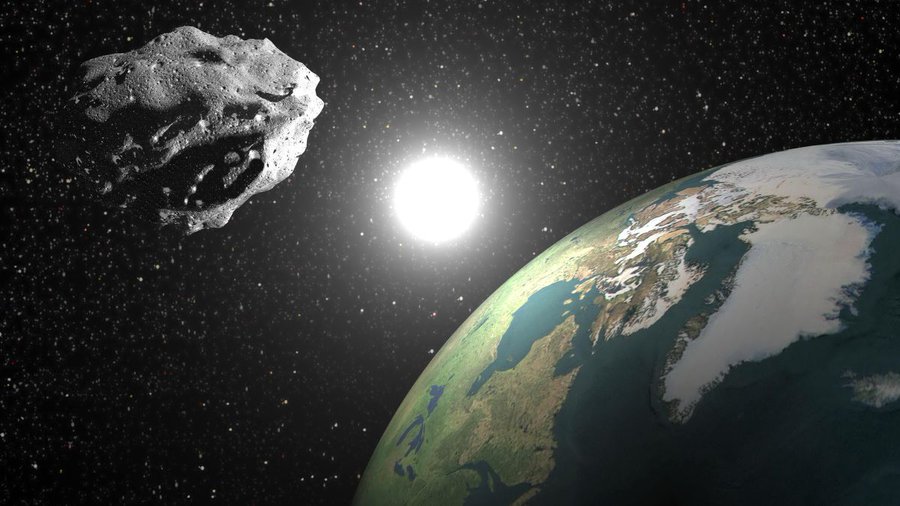
Astronomers recently identified asteroid 2023 FW13 as a quasi-moon, a space rock orbiting the sun nearly in tandem with Earth.
An illustration of an asteroid orbiting the sun alongside Earth, much like the newly classified quasi-moon
(Image credit: Zoonar GmbH / Alamy Stock Photo)
Scientists recently discovered an asteroid that tags along with Earth during its yearly journey around the sun.
Dubbed 2023 FW13, the space rock is considered a "quasi-moon" or "quasi-satellite," meaning it orbits the sun in a similar time frame as Earth does, but is only slightly influenced by our planet’s gravitational pull. It is estimated to be 50 feet (15 meters) in diameter — roughly equivalent to three large SUVs parked bumper to bumper. During its orbit of the sun, 2023 FW13 also circles Earth, coming within 9 million miles (14 million kilometers) of our planet. For comparison, the moon has a diameter of 2,159 miles (3,474 km) and comes within 226,000 miles (364,000 km) of Earth at the closest point of its orbit, according to NASA.
2023 FW13 was first observed in March by the Pan-STARRS observatory, which is located atop the volcanic mountain Haleakalā in Hawaii. The asteroid's existence was then confirmed by the Canada-France-Hawaii Telescope in Hawaii and two observatories in Arizona before being officially listed on April 1 by the Minor Planet Center at the International Astronomical Union, a network of scientists responsible for designating new planets, moons and other objects in the solar system.
Some estimates suggest that 2023 FW13 has been Earth's cosmic neighbor since at least 100 B.C. and that the space rock will continue to follow this orbital path until around A.D. 3700, Adrien Coffinet, an astronomer and journalist who first categorized the asteroid as a quasi-moon after modeling its orbit, told Sky & Telescope.
"It seems to be the longest quasi-satellite of Earth known to date," Coffinet said.
Astronomers have discovered a quasi-moon that has orbited around the Sun alongside Earth since 100 BC.
Following 2023 FW13's initial discovery in March, space observers dug into the data and found observations of the asteroid dating all the way back to 2012, according to Live Science's sister site Space.com.
Despite hovering relatively close to Earth, this quasi-satellite likely isn't on a collision course with our planet.
"The good news is, such an orbit doesn't result in an impacting trajectory 'out of the blue,'" Alan Harris, an astronomer at the Space Science Institute, told Sky & Telescope.
This is not Earth's only quasi-companion; a different quasi-satellite known as Kamo'oalewa was discovered in 2016. The rock sticks similarly close to our planet during its orbit around the sun, and a 2021 study suggested that this asteroid could actually be a fragment of Earth's moon.
NASA says that its new inflatable heat shield, which may one day assist in landing humans on Mars, will soon be launched with a National Oceanic and Atmospheric Administration (NOAA) satellite to help study Earth’s climate.
Currently undergoing tests at Vandenberg Space Force Base in California, the Low-Earth Orbit Flight Test of an Inflatable Decelerator (LOFTID) is an inflatable heat shield designed to withstand incredible temperatures approaching 2900°F, for use in slowing down large payloads.
Following tests at Vandenberg, the LOFTID is scheduled to be included as a secondary payload aboard NOAA’s Joint Polar Satellite System-2 (JPSS-2) satellite. The space agency hopes that current testing of the device will help gauge its capabilities for future missions, which may include the delivery of everything from future robotic explorers that will follow in the tread marks left by Perseverance to spacecraft carrying human crews.
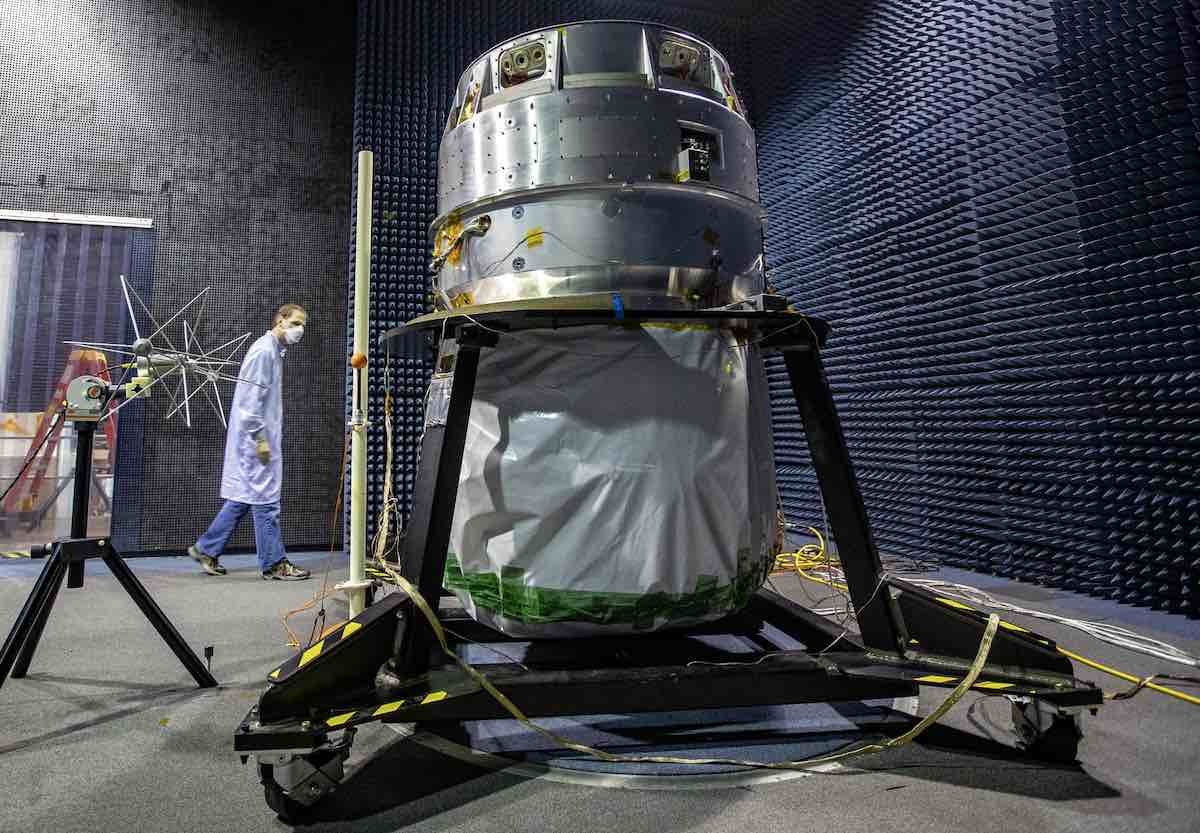
NASA’s LOFTID inflatable heat shield undergoes electromagnetic testing in a shielded room (Credit: NASA).
“LOFTID is dedicated to the memory of Bernard Kutter, manager of advanced programs at ULA, who passed away in August 2020 and was an advocate for technologies like LOFTID that can lower the cost of space access,” the space agency said in a statement.
Over the last several weeks, the LOFTID underwent a complete systems test, along with several environmental tests, electromagnetic compatibility tests, and other checkups, along with match-mate testing between NASA and ULA components to help ensure that the systems can be successfully integrated prior to launch.
Following testing, the heat shield (also called an aeroshell) was fully inflated under conditions that replicated its orbital deployment environment, after which it underwent laser-assisted measurements before being repackaged for launch.
The LOFTID will be carried to space on board a United Launch Alliance (ULA) Atlas V rocket, after which its inflation mechanism will be deployed. Then, traveling at speeds nearing 5 miles per second, the inflatable heat shield will be tested on whether it can withstand the tremendous pressures of re-entry.
The LOFTID, a project of NASA’s Space Technology Mission Directorate, falls under its Technology Demonstration Missions program. In partnership with United Launch Alliance (ULA), the current LOFTID launch is being overseen out of Langley Research Center in Hampton, Virginia.
Micah Hanks is Editor-in-Chief and Co-Founder of The Debrief. Follow his work atmicahhanks.com and on Twitter:@MicahHanks.
A thought-provoking interview has recently been conducted between Project Unity host Jay Anderson and the U.S. Congressman Andy Ogles. The discussion focused on the implications of complete UAP (Unidentified Aerial Phenomena) disclosure. Anderson asked serious questions to Rep. Ogles about UFOs, revealing that the release of extraterrestrial technology could potentially disrupt the world economy and energy sector.
Rep. Andy Ogles spoke about the difficulty in gathering information due to the compartmentalization of special access projects, emphasizing the need for a methodical and persistent approach to uncover the truth. In the interview, he expressed his concern about UAPs operating in both military and commercial airspace, raising questions about the potential national security threats. He said, “I’m not going to assume I know what it may or may not be. What I do know is there’s a national security issue here.”
He considers various possibilities, including the involvement of experimental aircraft, joint ventures, or foreign adversaries. He emphasizes the importance of avoiding predetermined conclusions and encourages an open-minded investigation to determine the true nature of the UAP phenomenon.
When asked about his personal understanding of UAPs, Rep. Ogles talks about the hope that it might be advanced technology possessed by the United States. He says, “My hope would be… some new technology that we possess… puts us that next generation above our adversaries.” However, he acknowledges the mysterious aspects of UAPs, saying they seem to “defy physics.”
Rep. Ogles then considers the energy implications of the advanced propulsion technology displayed by UAPs. He wonders about the amount of energy needed for such rapid movements and how it could impact the energy sector.
He says, “That being said, these UAPs seem to defy physics. They seem to have some sort of propulsion technology that’s unknown to man as we understand it. So, what does that do to the energy sector? If there’s a new way of thinking about the amount of energy it takes to take a craft that’s hovering and suddenly it’s going Mach one in a matter of seconds – the human body can’t sustain that as we understand it, right? So that craft would have to have next-level technology to protect tissue, if you will, or it’s an unmanned type of craft. Again, there are just a lot of questions that have to be probed. But, if there is this propulsion technology out there and this energy capability out there, not only are we in a renaissance when it comes to aircraft, but we’re in a renaissance in terms of propulsion and energy production consumption. So, again, huge implications across the economic scale, both domestically and internationally.”
He mentions his inquiries in committee about the DOE (Department of Energy), suggesting it could be an ideal place to house top-secret technologies. He says, “If you’re going to house a top-secret Next Level technology, what better place to have it and house it than… nuclear facilities.”
“Everybody knows about Area 51. It’s a testing area… You’ve got this super top-secret, super secure facility that, again, would be ideal to have and to house some new technology, emerging technology that we want to fully master for ourselves and quite frankly control. Because again, as you look at that next generation of warfare, it’s not just tanks and planes. It’s drones. It’s unmanned aircraft. It’s economic. There’s a lot that’s about to happen as we go forward as a superpower and our competitive edge on the global stage.”
Later in the interview, Jay Anderson brings up Congressman Burchett’s positive impression of David Grusch’s testimony during classified briefings. Rep. Ogles says that credible sources have vouched for Grusch’s reliability. He suggests believing what Grusch said, thinking about it carefully, and not trying to say it is wrong without some good proof. Ogles says it is important to keep an open mind, focus on getting answers, and not to try finding faults without good reasons.
Rep. Ogles explains that it does not require unanimous congressional support but rather the speaker’s will to initiate action. He emphasizes the bipartisan interest in addressing the issue and expresses the need for a select committee to ensure transparency and accountability in the investigation. He, along with Congressman Burchett, acknowledges the likelihood of a multi-decade cover-up or compartmentalization due to the secretive nature of special access programs (SAPs) and classified information related to national security.
When asked about evidence suggesting reverse engineering or more exotic propositions, Rep. Ogles mentions the classification of such information and the need for careful consideration. He discusses questions about the origin of technology, whether it is our own creation or recovered from elsewhere, and the potential for reverse engineering.
Stephen Bassett, the only registered lobbyist of Washington and founder of Paradigm Research Group, shares the same UFO disclosure concerns that will pose serious implications for the world’s economy.
The PRG researchers claim they have known the reasons why the US authorities were hiding information about UFOs. According to them, disclosing UFO data would lead to the collapse of the entire world economy. Bassett added that all so-called “flying saucers” do not use oil, gasoline, gas, or coal. “They have a different energy system. Without a doubt, a much more complex and deep system based on anti-gravity,” he said.
“Some programs have been removed from the jurisdiction of the White House and Congress and are working somewhere very, very deep, in a ‘hidden mode,'” the researcher emphasized. “I assure you, when the head of state finally officially admits this fact and presents evidence, people will start to worry and want to know more.” But even if the economy stops developing in the current way, it will have new opportunities, Bassett believes.
During an interview with uInterview, he said that UFOs are not unidentified flying objects, as the acronym suggests, but rather alternative energy and propulsion devices. The technology behind UFOs was heavily studied by a team headed by Dr. Vannevar Bush in the 1940s, 1950s, and 1960s, and by 1954, they had developed what is known as “gravity control” and “zero-point energy.”
[Editor’s note] In January 2015, former NASA astronaut Edgar Mitchell sent an email to Podesta, asking him to have an urgent meeting to discuss Disclosure and Zero Point Energy (ZPE). He was concerned about the peace in space. Mitchell wrote: “My Catholic colleague Terri Mansfield will be there too, to bring us up to date on the Vatican’s awareness of ETI. Another colleague is working on a new Space Treaty, citing involvement with Russia and China. However, with Russia’s extreme interference in Ukraine, I believe we must pursue another route for peace in space and ZPE on Earth.” (Click here to read the full article)
However, Dr. Greer stated that the secrecy surrounding this technology went off the rails and became deeply entrenched in compartmented intelligence operations, even causing President Eisenhower to become frustrated with being denied information on the projects.
“The problem became to be, and this is what President Eisenhower warned us about, the secrecy became so enmeshed and compartmented in intelligence operations, that even he as president lost control over it,” Dr. Greer said.
He further stated: “One of our military witnesses, he was a young man working at the White House – which I’m looking at from my place here in Washington, he told us, Mr. Lubkin, who is an attorney, said that Eisenhower was very frustrated that he was being denied information on the projects controlling this issue. So the secrecy went off the rails into these unacknowledged special access projects.”
The disclosure of UFOs would mean the end of oil, gas, coal, and public utilities, as the technology would completely transform the world. Those with trillions of dollars invested in these industries would not be enthused about this possibility. This is the reason for the secrecy, and it has been maintained for 70 years, according to Dr. Greer.
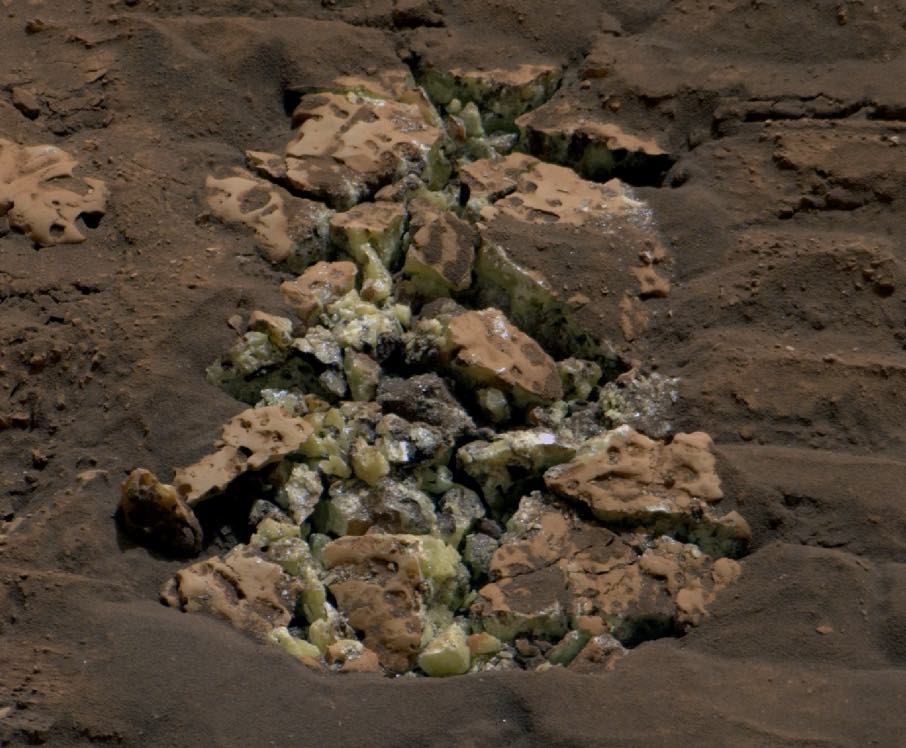
NASA’s Curiosity rover has made an uncharacteristically colorful discovery on the Red Planet. It revealed a small pocket of yellow crystals hidden within a stone on the Martian surface.
The colorful stones, composed of sulfur, were found on May 30 during the rover’s exploration of a sulfate-rich region of the Martian surface. However, the discovery of the bright yellow crystalline mineral was an unexpected find for the Curiosity team, marking a colorful first that, to date, has never been previously encountered on the Red Planet.
The discovery raises several intriguing questions about Mars and its history, as well as what environmental factors could have led to the formation of the crystals.
A Chance Discovery
Since October 2023, Curiosity has been scouring the Gediz Vallis channel on Mount Sharp, an area where scientists believe ancient lava flows occurred in the planet’s early history. The Martian rover has concentrated its explorations in the area, given the region’s promising potential for having once been home to microbial life or even the possibility that it may still be a present-day refuge for such simple organisms.
The sulfur was revealed in a chance discovery as NASA’s Curiosity rover smashed open a rock by driving over it (Credit: NASA/JPL-Caltech/MSSS).
The discovery of the colorful mineral was made by chance, as Curiosity cracked open a rock while driving over it. To the Curiosity team’s surprise, the yellow interior of the stone revealed what is likely to be pure sulfur, whereas the sulfates that are normally encountered in the area are salts comprised of combinations of sulfur and other minerals.
Unveiling Mount Sharp’s Mysteries
Since 2014, NASA’s Curiosity rover has made its ascent of Mount Sharp, where its explorations of the Gediz Vallis channel have revealed a portion of the landscape once shaped by ancient water flows on the planet. Curiosity’s present mission is to investigate whether this ancient channel and its surrounding terrain could have supported microbial life, particularly at a time when water was more abundant on Mars.
“This was not a quiet period on Mars,” according to Becky Williams, a scientist at the Planetary Science Institute and deputy principal investigator of Curiosity’s Mast Camera. “There was an exciting amount of activity here.
“We’re looking at multiple flows down the channel, including energetic floods and boulder-rich flows,” Williams said.
Going forward, the Curiosity team hopes to conduct drilling on larger rocks in the area to determine if they may also contain sulfur crystals. Presently, the relationship between elemental sulfur and other sulfur-based minerals in the area remains unclear to scientists studying the Martian environment.
“Finding a field of stones made of pure sulfur is like finding an oasis in the desert,” said Ashwin Vasavada, Curiosity’s project scientist at NASA’s Jet Propulsion Laboratory.
“It shouldn’t be there, so now we have to explain it,” Vasavada said in a statement.
“Discovering strange and unexpected things is what makes planetary exploration so exciting.”
New imagery from beneath Antarctica’s Dotson Ice Shelf obtained by an underwater robot has revealed previously unseen features, some of them hundreds of feet long, that provide scientists an unprecedented look at the dynamics of the southernmost continent’s ice shelves.
Ran, an undersea robot that uses sonar to collect data of the underside of the Dotson Ice Shelf in Antarctica, surfacing after a dive into a Dotson cavity in January 2022.
Credit...Li Ling/KTH Royal Institute of Technology
The recent findings reveal how ocean temperature and circulation are changing, which contributes to the steady increase in melting observed on Antarctica’s ice shelves in recent years, as well as to the rise of global sea levels.
With the help of advanced capabilities that include the use of undersea robots, scientists are now assembling a clearer picture than ever before of the dynamics of melt occurring at the ice base of West Antarctica’s Dotson Ice Shelf.
Visualization of the sand dune shaped ice structures found on the underside of the Dotson Ice Shelf.
(Image credit: Filip Stedt / University of Gothenburg)
Basal Melt Processes and Ice Shelf Stability
Melt rates beneath Antarctic ice shelves often show remarkable variability. One factor that influences this process, one that scientists have focused on in recent years, is how warmer salt water interacts with the ice along the base of the continent’s ice sheets.
One significant mechanism that contributes to this mixing of warm water into the ice-ocean boundary is turbulence resulting from shear-driven mixing. Another is vertical convection, which includes a process known as double-diffusive convection, although these generally produce lower melt rates. However, when combined, these processes have now been revealed to produce uniquely shaped features on the base of the ice, which include the formation of what are sometimes very large basal channels and terraces.
Due to varying oceanic conditions, ice can sometimes melt at different rates even along the same ice shelf. This appears to be caused by factors that include not only ocean temperature but also the speed of ocean water’s movement, both of which contribute to diverse formations of natural features along the base of Antarctica’s ice.
According to new findings detailed in a study published in Science Advances, researchers have successfully mapped these changes with the help of an autonomous underwater vehicle (AUV), revealing remarkable and never-before-seen details about the processes that are driving accelerated melt along the continent’s ice shelves.
Structures mapped by an undersea robot named Ran on the underside of the Dotson Ice Shelf in Antarctica. The streaks, etched by currents, are up to 60 feet deep and miles long.
Credit...Filip Sted/University of Gothenburg
The Dotson Ice Shelf Mapped in Detail
In the team’s study, the researchers produced high-resolution maps of the underside of the Dotson Ice Shelf, made possible by an AUV that produced data covering close to 140 square kilometers. The new data revealed features such as plateaus, teardrop-shaped formations, and erosion patterns that appear to correlate with the variety of different conditions that contribute to ice melt.
Overall, the research team found that the basal topography of the Dotson Ice Shelf varies significantly between its eastern and western portions. While the ice is thicker and appears to be melting more slowly to the east, on the opposite end, the opposite is the case, with noticeably thinner ice indicating higher melt rates.
In their study, the research team links these variances in ice melt rates to the presence of what is called modified Circumpolar Deep Water (mCDW), which refers to Pacific and Indian Ocean water mixing with other nearby water masses and interacting with the ice base. Faster-moving currents in the western region revealed smooth features on the base of the ice, accompanied by higher melt rates.
In contrast, the central and eastern regions of the ice sheet bore evidence of terraced features, which the research team attributes to warm water intrusions that occur closer to these areas.
Visualization of features located beneath the Dotson Ice Sheet, obtained with the aid of an underwater robot (Credit: Filip Stedt / University of Gothenburg).
Ultimately, the presence of remnant winter water and mCDW mixtures was revealed to produce streaks of temperature and meltwater that significantly influence overall melt rates. The team’s findings through AUV observations help to reveal how future missions may be able to reveal further details about the Antarctic ice base and how shear-driven turbulence and the presence of warm water accelerate melting in the western outflow region.
“This new wealth of processes, all active under a single ice shelf, must be considered to accurately predict future Antarctic ice shelf melt,” the team writes in their recent study. Going forward, ongoing mapping and study of the ice shelf will be crucial in order to refine existing models, in addition to improving our understanding of ice-ocean interactions and their relationship to rising sea levels in the years ahead.
The team’s new study, “Swirls and scoops: Ice base melt revealed by multibeam imagery of an Antarctic ice shelf,” by Anna Wahlin, et al., appeared in Science Advances on July 31, 2024.
A visualization of an area in the east, where the water eroded several layers of ice. The structures are carved 20 meters deep into the ice, and they are several kilometers long.CreditCredit...
Filip Stedt/University of Gothenburg
A top level view, taken by the researchers from a helicopter survey, of a crack along the front of the Dotson Ice Shelf.
Credit...Clare Eayrs/Korea Polar Research Institute
It's the film that left us all wary of disastrous and abrupt climate change.
But The Day After Tomorrow is probably not when we're going to experience apocalyptic weather events, according to a study.
Researchers argue that it's almost impossible to predict the timing of climate tipping points – and that catastrophe could strike at any time in the next 6,000 years.
A team from the Technical University of Munich and the Potsdam Institute for Climate Impact Research provided the Atlantic Meridional Overturning Circulation (AMOC) as an example.
This system circulates water from north to south and back in a long cycle within the Atlantic Ocean, carrying warm water from the tropics northwards.
It's the film that left us all wary of disastrous and abrupt climate change. But The Day After Tomorrow is probably not when we're going to experience apocalyptic weather events, according to a study
Climate models suggest the AMOC will weaken over the 21st century due to increases in greenhouse gases and melting ice.
If the system collapsed the Northern Hemisphere would get colder, causing temperatures in Europe to drop dramatically.
Wet seasons in the Amazon rainforest would be reversed to dry seasons, and in coastal cities the sea would rise even faster.
Previous predictions from historical data suggest a collapse could occur between 2025 and 2095.
However, the new study revealed that uncertainties are so large that these predictions are not reliable.
Using different data sets and analysis, tipping times for the AMOC ranged from 2050 to 8065 – a 6,000-year window which isn't particularly useful, the researchers said.
Writing in the journal Science Advances they said the timing of other climate tipping points – such as the melting of the polar ice sheets or the collapse of tropical rainforests – are also too uncertain.
This is because there is too much still unknown about the underlying physical mechanisms of climate change, a lack of direct observations of the climate system, and incomplete history data, they explained.
Lead author Maya Ben-Yami said: 'Our research is both a wake-up call and a cautionary tale.
Climate models suggest the AMOC will weaken over the 21st century due to increases in greenhouse gases and melting ice. If the system collapsed the Northern Hemisphere would get colder, causing temperatures in Europe to drop dramatically
'There are things we still can't predict, and we need to invest in better data and a more in-depth understanding of the systems in question.
'The stakes are too high to rely on shaky predictions.'
While the study shows we cannot reliably predict tipping events, the possibility of such events cannot be ruled out either, the team said.
They also stressed that statistical methods are still very good at telling us which parts of the climate have become more unstable.
'We still need to do everything we can to reduce our impact on the climate, first and foremost by cutting greenhouse gas emissions,' co-author Niklas Boers said.
'Even if we can't predict tipping times, the probability for key Earth system components to tip still increases with every tenth of a degree of warming.'
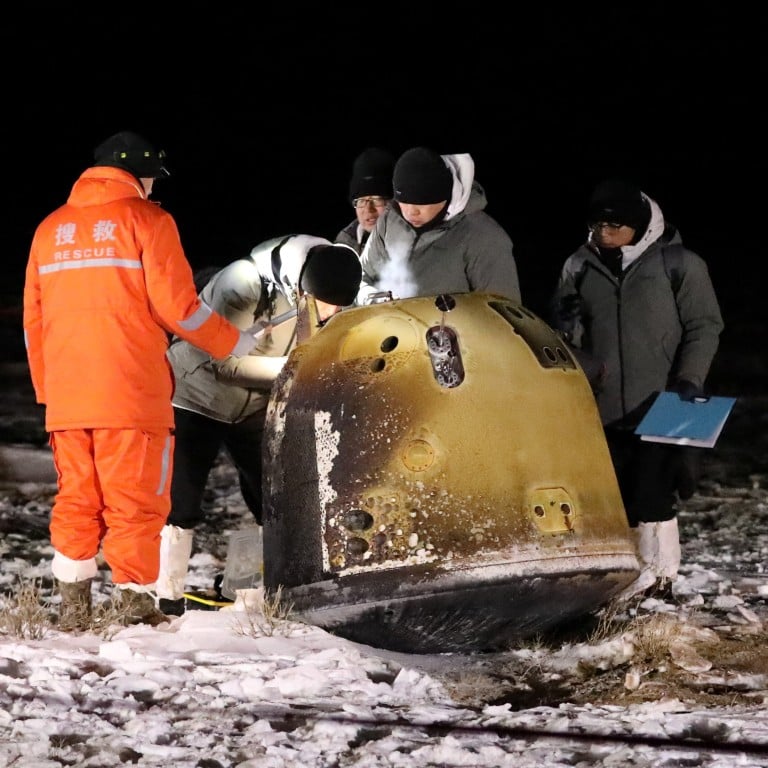
In lunar regolith samples collected by China’s Chang’e-5 probe, planetary scientists have identified few-layer graphene formed together with complex minerals. The finding provides new insights into the origin of the Moon, supporting the hypothesis of a carbon-containing Moon.
Structural and compositional characterization of few-layer graphene in the Chang’e-5 lunar soil sample.
Image credit: Zhang et al., doi: 10.1093/nsr/nwae211.
“Graphene has revolutionized the research of condensed matter physics and materials science with its novel physical phenomena and extraordinary properties,” said Jilin University Professor Wei Zhang and colleagues.
“It plays an increasingly important role in extensive areas including planetary and space science.”
“It is estimated that around 1.9% of total interstellar carbon is in the form of graphene and protosolar graphene has been identified in carbonaceous chondrite meteorites.”
The researchers analyzed an olive-shaped sample of lunar soil, about 2.9 mm by 1.6 mm, collected by the Chang’e 5 mission in 2020.
Using a special spectrometer, they found an iron compound that is closely related to the formation of graphene in a carbon-rich section of the sample.
They then used advanced microscopic and mapping technologies to confirm that the carbon content in the sample comprised ‘flakes’ that have two to seven layers of graphene.
The scientists proposed that the few-layer graphene may have formed in volcanic activity in the early stages of the Moon’s existence, and been catalyzed by solar winds that can stir up lunar soil and iron-containing minerals that helped transform the carbon atoms’ structure.
Meteorite impacts, which create high-temperature and high-pressure environments, may also have led to the formation of graphene.
Scientists have discovered graphene on the Moon, in a lunar sample returned to Earth
“This is the first study to verify the presence of natural few-layer graphene in lunar soil samples by examining its microstructure and composition,” the authors said.
“Our finding provides new insights into the origin of the Moon, supporting the hypothesis of a carbon-containing Moon.”
“Moreover, the exotic properties of graphene are highly structurally and environmentally dependent.”
“Further in-depth property investigation of natural graphene would provide more information on the geologic evolution of the Moon.”
“In turn, the mineral-catalysed formation of natural graphene sheds light on the development of low-cost scalable synthesis techniques for high-quality graphene.”
“Therefore, a new lunar exploration program may be promoted and some forthcoming breakthroughs can be expected.”
Chinese researchers have discovered a form of carbon in lunar soil samples collected in 2020 which could overturn the theory that the moon was formed by a cosmic collision between Earth and a smaller planet.
Photo: Reuters
The findings were published in the journal National Science Review.
Wei Zhang et al. Discovery of natural few-layer graphene on the Moon. National Science Review, published online June 17, 2024; doi: 10.1093/nsr/nwae211
Fresh lunar powder collected less than two years ago shows promising — albeit early — signs that it could support humans in space for long periods.
As part of a recent study published Thursday in the journal Joule, Chinese scientists opened Moon parcels from the country’s Chang’e-5 mission. In December 2020, this spacecraft performed a quick rendezvous with Earth’s natural satellite, collecting lunar soil from the Moon’s "Ocean of Storms" plain (Oceanus Procellarum) and bringing it back to our planet. In the new research, a team analyzed the moondust’s basic building blocks to see how it might serve as a cornerstone for life-sustaining chemical reactions on a future lunar base.
An Apollo 12 astronaut walking on the Moon’s “Ocean of Storms” region.
NASA./Corbis Historical/Getty Images
What’s new —The new study proposes “extraterrestrial photosynthesis,” a process by which humans in space can draw on just two simple, out-of-this-world ingredients — lunar soil and sunlight — to produce fuel and recycle carbon dioxide back into breathable oxygen on long-duration crewed missions to the Moon and Mars.
One major talking point for space agencies with their eyes to the skies: How do you power a trip far from Earth? The longest crewed lunar mission to date — NASA’s Apollo 15 flight in 1971 — lasted 12 days. They maintained themselves on the supplies they brought along, which had the heaviest payload in a lunar orbit at about 107,000 pounds.
Digging into the details —The study looks at ways to replenish water, oxygen, and fuel by using human byproducts, solar radiation, and local lunar soil called regolith. If this is successfully achievable, space agencies can save on cargo weight and vehicle space for crewed missions lasting weeks or even months.
Their preliminary findings inspired them to propose a model for how a self-sustaining Moon outpost could work.
Apollo 15 lunar module pilot Jim Irwin loads the lunar rover.
Heritage Images/Hulton Archive/Getty Images
The team analyzed the Chang’e-5, or “CE-5,” regolith samples to see what chemicals they contained and then investigated how well these components could catalyze carbon dioxide into oxygen. Exhaled breath might be used for potable water, or turned into hydrogen or methane for fuel.
Their experiments yielded some positive results. They saw bubbles of hydrogen and oxygen gas, for example. The paper reports that compounds in lunar regolith catalyzed a reaction during a photovoltaic-driven water electrolytic (PV-EC) test, which takes light and water and turns the liquid into those two gases. On the Moon, the water used here would come from lunar ice and human breath that would have previously gone through a dehydrating process. The astronauts would use the water for drinking.
What’s next — A lot more needs to be done before the research is Moon-ready. The researchers wrote that “the current catalytic performance from the CE-5 lunar sample cannot fully satisfy the requirement of extraterrestrial survival,” adding that their findings weren’t on par with the efficiency of existing catalyst systems on Earth.
They wrote that researching the compounds on the Moon more thoroughly could lead to more success.
Date of sighting: July 31, 2024 Location of sighting: Ibiza, Spain
Watch the video here:
Introduction
Unidentified flying objects (UFOs) have intrigued humanity for decades, sparking countless debates and discussions about the existence of extraterrestrial life. These sightings often stir the imagination and provoke questions about what lies beyond our planet. The latest UFO sighting comes from the picturesque island of Ibiza, Spain, where a group of tourists captured a mysterious object in the sky that vanished within seconds. This astonishing video has now gone viral, captivating the attention of UFO enthusiasts and skeptics alike.
Green Light in Ibiza Skies: UFO or Illusion?
The Incident
The incident occurred on a clear day near the coastline of Ibiza, a popular tourist destination known for its stunning beaches and vibrant nightlife. A group of tourists, enjoying the scenic beauty near a cliff, inadvertently became witnesses to an unusual phenomenon. The video, recorded by one of the tourists, begins with a serene view of the landscape, capturing the natural beauty of the area.
Suddenly, the tranquility is interrupted by a girl running and pointing towards the sky, drawing the attention of the others. The camera follows her gesture, panning to reveal a bright, clear sky with the moon prominently visible. Beside the moon, an unidentified object appears, hovering momentarily before it disappears within seconds. The object’s sudden vanishing act leaves the onlookers stunned and puzzled.
Public Reaction
The video quickly gained traction on social media, with users from around the world sharing and commenting on the mysterious sighting. UFO enthusiasts were particularly excited, viewing the footage as potential evidence of extraterrestrial activity. Skeptics, on the other hand, offered various explanations ranging from natural atmospheric phenomena to sophisticated drones or even a hoax.
Regardless of one’s stance on the existence of UFOs, the video has undeniably sparked curiosity and debate. Many people are fascinated by the possibility of encountering something beyond the realm of known science, while others enjoy the mystery and intrigue that such sightings bring.
Expert Opinions
To gain a deeper understanding of the sighting, several experts were consulted. Dr. Laura Mendes, an astronomer and UFO researcher, analyzed the footage and provided her insights.
“The video is intriguing, and while it does show an unidentified object, it’s important to approach such sightings with a scientific mindset. There are many plausible explanations, including atmospheric distortions, reflections, or man-made objects. Without more data, it’s difficult to draw any definitive conclusions,” Dr. Mendes stated.
Aviation expert Carlos Rodriguez also weighed in on the sighting. “Given the proximity to a tourist area, it’s possible that what was seen could be a drone or another type of aircraft. However, the rapid disappearance is unusual and warrants further investigation,” he remarked.
Historical Context of UFO Sightings
UFO sightings have been reported for centuries, with varying levels of credibility and detail. From ancient texts describing celestial events to modern-day videos captured on smartphones, the phenomenon has persisted through time. One of the most famous incidents is the Roswell incident of 1947, where an alleged UFO crash in New Mexico spurred widespread speculation and conspiracy theories.
In recent years, the U.S. government has declassified numerous reports and videos of unidentified aerial phenomena (UAP), reigniting interest in the topic. These disclosures have lent some credibility to the notion that there are aerial objects that defy conventional explanations.
The Science Behind UFOs
While the idea of extraterrestrial visitors is captivating, scientists urge caution and critical thinking. Most UFO sightings can be attributed to natural phenomena or human activities. For instance, weather balloons, experimental aircraft, and atmospheric conditions can create optical illusions that mislead observers.
The scientific method relies on reproducibility and evidence. For a UFO sighting to be considered credible, it must be corroborated by multiple witnesses, radar data, and other forms of empirical evidence. In the case of the Ibiza sighting, while the video is compelling, more information would be needed to reach a conclusive explanation.
The Cultural Impact of UFO Sightings
UFO sightings often capture the public’s imagination and inspire various forms of media, including movies, books, and television shows. The idea of encountering alien life forms has become a staple of science fiction, reflecting humanity’s curiosity and desire to explore the unknown.
Movies like "Close Encounters of the Third Kind" and "Independence Day" have popularized the concept of UFOs and alien encounters, blending entertainment with speculative science. These cultural artifacts shape our perception of UFO sightings, often blurring the lines between fiction and reality.
Personal Accounts and Eyewitness Testimonies
Eyewitness testimonies play a crucial role in the study of UFO sightings. Personal accounts, like the one from Ibiza, provide valuable insights into how these phenomena are experienced and perceived by individuals. However, eyewitness accounts are also subject to cognitive biases and memory distortions, which can affect the accuracy of the observations.
In the Ibiza case, the tourists’ reactions and the immediate recording of the event add a layer of authenticity to the sighting. Their spontaneous responses and genuine astonishment suggest that they truly witnessed something unexpected.
The Role of Technology in UFO Sightings
Advancements in technology have significantly impacted the documentation and analysis of UFO sightings. High-resolution cameras, drones, and satellite imagery provide new tools for capturing and investigating aerial phenomena. These technologies can help distinguish between known objects and genuinely unidentified ones.
The Ibiza video, recorded on a smartphone, benefits from modern technology, offering clear footage that can be analyzed frame by frame. This level of detail was not available in earlier UFO sightings, making contemporary reports more credible and easier to scrutinize.
Government Involvement and Disclosure
Governments worldwide have historically shown interest in UFO sightings, often conducting secret investigations. The U.S. government’s recent release of UAP reports has highlighted the importance of transparency and scientific inquiry in addressing these phenomena.
In Spain, the government has not released any official statements regarding the Ibiza sighting. However, the increasing public interest in UFOs may prompt authorities to take a more proactive role in investigating and disclosing information about such incidents.
Conclusion
The UFO sighting in Ibiza has captured the imagination of people around the world, reigniting debates about the existence of extraterrestrial life and the nature of unidentified flying objects. While the video offers a tantalizing glimpse of something unexplained, it also underscores the need for rigorous scientific investigation and critical thinking.
As technology continues to advance and more sightings are documented, the mystery of UFOs may eventually be unraveled. Until then, incidents like the one in Ibiza will continue to intrigue and inspire, reminding us of the vastness and wonder of the universe.
Whether you are a skeptic or a believer, the sighting serves as a reminder that there is still much to explore and discover in our world and beyond. The quest for understanding UFOs is not just about finding answers but also about embracing the unknown and celebrating the human spirit of curiosity and exploration.
Cryptoterrestrials: Are Aliens Already Living Among Us?
The concept of extraterrestrial life has long captivated the human imagination, often depicted as beings visiting Earth from distant galaxies. However, a compelling hypothesis suggests an alternative possibility: aliens might already be living among us, hiding in plain sight as “cryptoterrestrials.” This theory challenges traditional views of alien life and opens up intriguing discussions about the nature of extraterrestrial existence on Earth.
Understanding the Cryptoterrestrials Hypothesis
The cryptoterrestrials hypothesis proposes that extraterrestrials are not just visiting Earth but have been residing here, possibly for millennia. Unlike the typical depiction of aliens arriving in spaceships from far-off planets, cryptoterrestrials are thought to be integrated into human society, cleverly disguised to avoid detection. This idea shifts the focus from outer space exploration to a more introspective examination of life on Earth.
Four Categories of Cryptoterrestrials
The hypothesis can be divided into four distinct categories, each presenting a unique perspective on how aliens might be living among us:
Ancient Super Civilization: This theory suggests that an advanced civilization once thrived on Earth but was destroyed by a catastrophic event, such as a flood. The survivors of this civilization, possibly connected to legends like Atlantis, might still be present today, blending into human society.
Animal-Like Alien Civilization: Another possibility is that a complex civilization of aliens exists, resembling more animal-like beings rather than humanoid forms. These creatures might have developed unique ways to coexist with humans, perhaps living in remote or hidden locations.
Hidden Underground Aliens: Some theorists propose that aliens are hiding underground, utilizing Earth’s vast subterranean environments to remain concealed. This notion aligns with various myths and legends of underground worlds inhabited by mysterious beings.
Magical or Mythical Beings: The final category encompasses the idea that aliens could be perceived as mythical creatures, such as sprites, fairies, or goblins. These beings might possess abilities that enable them to exist undetected, contributing to folklore and mythical narratives.
Speculation and Skepticism
The cryptoterrestrials hypothesis, while intriguing, is primarily speculative. It seeks to expand the boundaries of thought and academic discussion, challenging established notions about extraterrestrial life. However, it’s important to note that proponents of this hypothesis acknowledge the lack of concrete evidence supporting the idea of aliens walking among us. The hypothesis is intended to provoke thought and encourage exploration of alternative possibilities rather than make definitive claims.
The Role of Media and Public Perception
Media plays a significant role in shaping public perception of the cryptoterrestrials hypothesis. Sensationalist headlines and exaggerated claims can often distort the original intentions of speculative discussions. While some media outlets may present the idea humorously or dismissively, it is crucial to approach such topics with an open mind and a critical eye.
A Historical Perspective
Throughout history, many revolutionary scientific ideas have initially been met with skepticism and ridicule. The notion of a round Earth, once considered absurd, eventually became a widely accepted fact. Similarly, the cryptoterrestrials hypothesis challenges us to reconsider our understanding of life on Earth and the potential for hidden civilizations.
Conspiracy Theories and Cultural Influences
The cryptoterrestrials hypothesis intersects with various conspiracy theories and cultural beliefs about non-human entities living among us. Concepts like “lizard people” or “skinwalkers” have circulated for decades, often rooted in folklore and mythology. The hypothesis serves as a framework to explore these longstanding ideas and examine their plausibility in a modern context.
The Possibility of Alien Integration
While the cryptoterrestrials hypothesis remains speculative, it raises thought-provoking questions about the potential motivations and methods of extraterrestrial life integrating into human society. If aliens are indeed living among us, what could they gain from such integration? Would their presence have an impact on human culture, technology, or evolution?
The Age of the Galaxy and Earth’s History
Considering the vast age of the galaxy, estimated to be around 13 billion years, and Earth’s 4.5 billion-year history, there is ample time for the development and evolution of intelligent life forms. If cryptoterrestrials do exist, they might have arrived on Earth long before humans, potentially influencing the course of human history in ways we have yet to understand.
VIDEO:
Cryptoterrestrials: Aliens Walking Among Us? | Strange & Suspicious TV Show
The cryptoterrestrials hypothesis invites us to expand our perspective on extraterrestrial life, challenging the conventional narrative of aliens as distant visitors. While evidence supporting the existence of cryptoterrestrials is currently lacking, the hypothesis encourages curiosity and exploration of alternative explanations for unexplained phenomena. As scientific understanding evolves, the possibility of discovering hidden civilizations or new forms of life continues to inspire both intrigue and skepticism. Ultimately, the cryptoterrestrials hypothesis serves as a reminder of the boundless mysteries that the universe, and perhaps even our own planet, still holds.
Diamonds aren't the traditional 20th anniversary gift, but we're not going to complain, since these came from a spacecraft that crashed into the surface of Mercury back in 2015.
NASA's MESSENGER spacecraft launched 20 years ago, on August 2, 2004, and although its mission ended in 2015, MESSENGER's observations of the Sun-scorched planet are still yielding new discoveries today. A recent study of MESSENGER data suggests that a 10-mile-thick layer of diamond might lie deep inside Mercury, between the planet's mantle and its core. That's a heck of a find from a defunct spacecraft!
Yongjiang Xu, of the Center for High Pressure Science and Technology Advanced Research in Beijing, and his colleagues published their work in the journal Nature Communications.
The dark patches on Mercury’s surface, seen in this photo from Mariner 10 in 1974, are graphite.
Space Frontiers/Archive Photos/Getty Images
Diamonds In The Rough
Like most rocky planets, Mercury was once a seething, churning ball of magma. Over time, that magma cooled and solidified, and in the process, it settled into layers — giving the planet a dense inner core, a slightly lighter and mostly fluid mantle, and a light, rocky outer crust. To simulate that process, Xu and his colleagues made digital models using data from MESSENGER that offered clues about Mercury's inner structure. They also squashed a lot of carbon samples in the lab to see how the material behaved under tremendous heat and pressure.
According to Xu and his colleagues’ simulations, there should be a layer of diamond lying atop Mercury's core and just beneath its mantle — and it could be between 9 and 11 miles thick. The diamond would have crystallized out of an ocean of carbon-rich magma that once covered Mercury billions of years ago.
Meanwhile, on the surface, carbon crystallized into a different (and much less sparkly) form called graphite. Graphite and diamond are both pure carbon, but the atoms are arranged in different crystal structures, which gives the two materials very different properties. At the surface, where pressures and temperatures were much lower, the carbon formed dark, soft graphite. Deep below, the intense pressure beneath Mercury's mantle pressed carbon into diamond — if Xu and his colleagues are right.
In this photo, Messenger prepares for prelaunch testing.
The finding is just the latest scientific gem MESSENGER has laid at our feet since its launch 20 years ago. It took four years just to reach Mercury in 2008, and then the spacecraft had to make a carefully-planned series of flybys to slow down enough to enter Mercury's orbit without also accidentally getting pulled into the Sun. (Trying to maneuver a spacecraft that close to the Sun's gravitational influence is a challenge.) MESSENGER settled into Mercury's orbit in 2011.
During its four years in orbit around Mercury, MESSENGER revealed some surprising things about our Solar System's innermost planet. One of those is the graphite that dusts its surface, which gives the planet's surface its dark, patchy appearance — and gave Xu and his colleagues the idea for their recent simulations.
Xu and his colleagues’ simulations may help explain another of MESSENGER's most important discoveries: Mercury's surprisingly strong magnetic field.
For such a small planet, Mercury boasts a disproportionately powerful magnetic field. If Xu and his colleagues are right, the layer of diamond lying beneath the mantle could be changing how heat flows from the core to the mantle (because diamond transfers heat very efficiently). That, in turn, could be changing how convection, currents driven by hot liquid rising and cool liquid sinking, happens in the molten outer layers of Mercury's core. And since all that flowing molten metal is part of what generates the magnetic field, the diamond layer could be a big part of the explanation.
The MESSENGER mission came to a dramatic end on April 30, 2015, when the spacecraft smashed into Mercury's surface at more than 8,000 miles per hour. Because MESSENGER was on the far side of the planet at the time, its human team back on Earth didn't witness its final moments; they heard only the silence of the dead spacecraft failing to resume radio contact a few moments later.
"The processes that led to the formation of a diamond layer on Mercury might also have occurred on other planets, potentially leaving similar signatures," says Yanhao Lin, also of the Center for High Pressure Science and Technology Advanced Research in Beijing and a coauthor of the recent study, in a recent statement. The riches of the Universe seem to only grow with time.
Volgens de New York Times zet het Pentagon spoed achter de voorbereidingen om oorlog in de ruimte te kunnen voeren.
Washington is ervan overtuigd dat de snelle vooruitgang van China en Rusland op het gebied van ruimteoperaties een groeiende bedreiging vormt voor de Amerikaanse troepen en andere militaire middelen op de grond en satellieten in een baan om de aarde.
De details van de inspanningen van het Pentagon blijven zeer vertrouwelijk. Bepaalde documenten zijn echter onlangs vrijgegeven en gepubliceerd door de New York Times.
Daarin erkennen functionarissen van het Ministerie van Defensie in toenemende mate dat het initiatief een grote verschuiving in militaire operaties weerspiegelt, waarbij de ruimte een echt slagveld zal worden.
De VS zal niet langer alleen vertrouwen op militaire satellieten om te communiceren, navigeren, traceren en te richten op terrestrische bedreigingen, instrumenten die het Pentagon decennialang een aanzienlijk voordeel hebben gegeven in conflicten.
Het ministerie van Defensie wil een nieuwe generatie instrumenten op de grond en in de ruimte verwerven waarmee het zijn satellietnetwerk kan verdedigen tegen aanvallen en, indien nodig, vijandelijke ruimtevaartuigen in een baan om de aarde kan verstoren of uitschakelen, aldus functionarissen van het Pentagon in een reeks interviews, toespraken en verklaringen
De strategie verschilt fundamenteel van eerdere militaire ruimteprogramma's door de uitbreiding van het scala aan offensieve capaciteiten, wat heel anders is dan het voorstel voor het Strategisch Defensie-initiatief uit de jaren tachtig, dat nooit het daglicht zag en dat tot doel had satellieten te gebruiken om de Verenigde Staten te beschermen tegen aanvallen met nucleaire raketten.
(SR and MaSi for Tagtik/Source: New York Times/Photo: Pixabay)
Artist’s impression of the first interstellar asteroid/comet, "Oumuamua". This unique object was discovered on 19 October 2017 by the Pan-STARRS 1 telescope in Hawaii. Credit: ESO/M. Kornmesser
How Oumuamua Changes Our Perspective on Galactic Panspermia
Panspermia is an innately attractive idea that’s gained prominence in recent decades. Yet, among working scientists, it gets little attention. There are good reasons for their relative indifference, but certain events spark renewed interest in panspermia, even among scientists.
The appearance of Oumuamua in our Solar System in 2017 was one of them.
Panspermia is the hypothesis that life can travel throughout the Universe by hitching an unintended ride with space dust, meteoroids, asteroids, comets, and even rogue planets.
It’s an ancient idea, which only increases its resonance for some. The Greek philosopher Anaxagoras was the first to propose it. He coined the term ‘panspermia’ and said that the Universe was full of life and that some of it fell to Earth. It remains on the fringe of science because it can’t explain how life started, and it’s not testable. But it is enduring.
Oumuamua’s appearance sparked renewed interest in Panspermia. After the object came and went rapidly in 2017, scientists attempted to determine what it actually was. Maybe it was a comet, maybe it was an asteroid, maybe it was a chunk of frozen hydrogen. Many hypotheses were presented. Now, we simply call it an interstellar object, or ISO.
From the perspective of panspermia, Oumuamua’s classification isn’t the most pressing concern. It was a visitor to our Solar System from elsewhere, and that’s the most salient point.
In a new paper, a trio of researchers examine how many of these types of objects might exist and what properties they’d need to protect and transport life throughout the galaxy. The paper is titled “The Implications of ‘Oumuamua on Panspermia.” The lead author is David Cao, a high school student who also served as an intern at the Johns Hopkins University Applied Physics Laboratory.
“Panspermia is the hypothesis that life originated on Earth from the bombardment of foreign interstellar ejecta harbouring polyextremophile microorganisms,” the authors write. “By utilizing ‘Oumuamua’s properties as an anchor, we estimate the mass and number density of ejecta in the ISM.”
Throughout their work, they acknowledge that “panspermia is an extraordinarily difficult theory to quantitatively model and assess.” But it’s still worth an attempt because of Oumuamua. “The recently discovered ‘Oumuamua merits a reexamination for the possibility of panspermia, the hypothesis that life seeded on Earth from the bombardment of life-bearing interstellar ejecta and that life can be transferred from one celestial body to another.”
Panspermia is the idea that life is spread throughout the galaxy, or even the Universe, by asteroids, comets, and even minor planets. Credit: NASA/Jenny Mottor
The trio determined the minimum size of ejecta needed to protect extremophiles from radiation, especially from supernovae. Intense gamma rays can sterilize ejecta if they’re not large enough for extremophiles to survive in their interiors, shielded by rock or water ice. Ejecta also needs to be large enough to protect any lifeforms from impact with another body. But the size depends on the nature of the ejecta.
“We consider the four most common elemental compositions of asteroids (chondritic, stony and metallic) and comets (water-ice) in our own Solar System: silicate, nickel, iron, and water-ice,” they write. Nickel has the highest attenuation and the smallest minimum size needed to shelter life. Water-ice requires the maximum size.
The authors explain, “We make an assumption that the number density abundances and varying compositions of interstellar ejecta mirror the content of minor bodies in our own Solar System.” Based on that, they settled on a minimum size of 6.6 meters.
They also tried to determine the likelihood that extremophiles could have seeded Earth, though they acknowledge that many of the factors involved are poorly understood and poorly constrained. In order to seed life, an ejecta carrying extremophiles had to have arrived at Earth early, before the earliest evidence of fossilized life. “Second, we estimate the total number of impact events on Earth after its formation and prior to the emergence of life (? 0.8 Gyr).”
They calculate impact rates for objects of different sizes. For objects at least 10 meters in diameter, they calculate that about 40,000 of them could’ve impacted Earth in its first 800,000 years.
This figure from the study shows the total number of collisions by minimum shielding depth for Earth’s first 800,000 years. The different dotted, dashed, and solid lines represent distribution slopes. Image Credit: Cao et al. 2024
Existing estimates of the number of Earth-like planets in the Milky Way are available. Based on those, here’s what it all adds up to, keeping in mind all of the poorly constrained factors involved. “However, we find that panspermia is a plausible potential life-seeding mechanism for (optimistically) potentially up to ~ 105 (100,000) of the ~ 109 (one billion) Earth-sized habitable zone worlds in our Galaxy,” the authors write.
But the prospects that Earth itself was seeded by panspermia are very weak. “For the Earth in particular, we conclude that, independent of other hypotheses for the origins of life on Earth, panspermia remains improbable (< 0.001%).” In a way, it’s more of a thought experiment. The authors say that “the true relative probability for panspermia remains unknown.”
The panspermia idea will not disappear. It’s simply too compelling to discard, even though it cannot be tested.
Another way of looking at it is that Earth could be a source of panspermia rather than a receiver.
“The fraction of these rocky planets that possess magnetic fields, atmospheres, and liquid surface water capable of supporting life is currently unconstrained and unknown, but our work implies as many as 104 of these worlds in our Galaxy could be populated with life today via panspermia under the most optimistic assumptions that all of these worlds are capable of supporting ejecta-transported life, with Earth as one of the potential source planets.” The number could rise to 104 under the most optimistic conditions.
There are other factors to consider. We’re only beginning to determine the number of rogue planets or free-floating planets (FFPs). As we learn more about them and their abundance, the panspermia hypothesis will change. “The discovery of rogue-free floating planets (FFPs) suggests a significantly higher ISM ejecta number density than expected for large objects,” the authors explain.
This illustration shows a rogue planet travelling through space. Credit: NASA/JPL-Caltech/R. Hurt (Caltech-IPAC)
Also, the number of ejecta and their mass haven’t been constant. For example, during the hypothesized Late Heavy Bombardment, a much larger number of objects were crashing into the Earth and the other Solar System bodies. How would that have affected panspermia?
“~4 Gyr ago, the Earth is thought to have experienced an unprecedented number of impact events that consequently ejected matter into the ISM, the era of Late Heavy Bombardment,” the authors write. The rate of bombardment was between 100 to 500 times greater than the present rate. If other solar systems experienced similar events, there would be substantially more potential for panspermia.
Artist concept of Earth during the Late Heavy Bombardment period. Credit: NASA’s Goddard Space Flight Center Conceptual Image Lab.
The star formation rate also plays a role. “As more stars are formed, more mass will be ejected into the ISM in star formation regions, increasing the production of ISM ejecta number density,” the authors explain.
There are so many unknowns and so much conjecture that many scientists avoid the panspermia theory completely. But more and more data will keep coming our way, and as it does, the idea will be revised and reconsidered.
The Rubin Observatory Large Synoptic Survey Telescope will hopefully see its long-anticipated first light in early 2025. That telescope will undoubtedly detect many more ISOs and FFPs, filling in important gaps in our knowledge.
As that data comes in, expect more attention to be focused on the panspermia theory
Starliner Successfully Fires its Thrusters, Preparing to Return to Earth
Being trapped in space sounds like the stuff of nightmares. Astronauts on board the International Space Station have on occasion, had their return delayed by weather or equipment malfunction. We find ourselves again, watching and waiting as two astronauts; Juni Williams and Butch Wilmore have been stuck for months instead of their week long mission. The delays came as the Starliner system required fixes to be implemented. NASA successfully fired up 27 of its 28 thrusters in a hot-firing test and now, ground teams are preparing finally, to bring them home.
The Boeing Starliner spacecraft is officially known as the CST-100 Starliner. It was developed by Boeing as part of NASA’s Commercial Crew Program. Its purpose is to transport astronauts to the International Space Station and other low orbit craft. Starliner hit the headlines with its reusable design aimed at reducing costs and increasing launch frequency. It was first launched on 20 December 2019 as an uncrewed test flight to demonstrate docking capability with ISS.
Boeing’s CTS-100 Starliner taking off from Cape Canaveral, Florida, on June 5th, 2024. Credit: NASA
Since 2019 Starliner has had issues along the way but has largely seen a successful progression to becoming a key part of NASA’s launch capability. Just recently however there have been issues with the manoeuvring jets used to adjust the attitude. Engineering teams at NASA and Boeing have been working on and running tests with Mexico a new configuration. Part of the thruster system controls the flow of helium, these are the helium manifolds and they were opened to allow engineers to monitor any helium supply issues and leaks.
The team ran a hot fire test of the reaction control system jets on 27 July to see if there were any problems with the propulsion system. They test fired 27 out of 28 jets while astronauts Wilmore and Williams sat inside the docked Starliner. The tests involved firing the jets for short bursts, one at a time. They revealed that all thrusters were back to performing well and the helium manifolds were within operational margins that were needed for a return trip from ISS. The engineering teams closed the manifolds ahead of undocking and returning the astronauts home.
The work is not over for the engineering teams however as they are now reviewing data from the tests and from ground based testing at the White Sands Test Facility in New Mexico. Once the review of data is complete, NASA and Boeing will identify a date to return the astronauts.
Meanwhile back on board the ISS Wilmore and Williams wait. They have been checking other Starliner systems in preparation for return, working with other Boeing teams to prepare and have been undertaking pressure tests of their space suits. They have been working alongside Expedition 71 members and have recently helped setup the BioServe centrifuge in the Harmony Module. The centrifuge supports a wide range of biological, physical and materials science projects. Facilitating the separation of substances with different densities it can work with cell cultures, DNA, protein, blood and sedimentary samples.
Astronomers have recently spotted signs of an extended disk of dust and gas, whirling in orbit around a distant star.
While this phenomenon is a normal stage in the development of a star and its planetary system, what makes this find so spectacular is that it's the first one we've seen around a star in a whole other galaxy, outside of our own.
The feature was spotted in the Large Magellanic Cloud, a dwarf galaxy some 179,000 light-years away from the Milky Way. And, although it might seem like common sense to suppose that star formation processes are universal, we've not been able to observe their vagaries outside of our home galaxy before.
"When I first saw evidence for a rotating structure in the ALMA data I could not believe that we had detected the first extragalactic accretion disc, it was a special moment," said astronomer Anna McLeod of Durham University in the UK, when the findings were published in November.
"We know discs are vital to forming stars and planets in our galaxy, and here, for the first time, we're seeing direct evidence for this in another galaxy."
An artist's impression of the recently discovered disk.
Stars are born from dense clumps in clouds of molecular gas and dust that hang out in interstellar space. When a clump grows dense enough, it collapses under gravity; spinning, it starts to draw in more material from the cloud around it. This material doesn't just fall onto the protostar any old how, though; it arranges into a disk around the star's equator, and falls down onto it in a more controlled, steady stream, like water down a drain.
Once the star is done forming, what remains of the disk stays there, clumping together to form all the other elements of a planetary system: the planets, the asteroids and meteors, the comets, the dust. That's why the Solar System's planets are more or less orbiting the Sun in a flat plane. We ourselves are like the sentient mold that grew on the leftovers of the Sun's breakfast.
The Atacama Large Millimeter/submillimeter Array (ALMA), a powerful radio telescope, has imaged quite a few such disks throughout the Milky Way, in various stages of development; some have clear gaps that are thought to be cleared by planets clumping together as they orbit. But the farther away something is, the harder it is to resolve, even with a powerful telescope.
The location and orientation of the jets and disk identified in HH 1177.
McLeod and her colleagues embarked on their campaign to find an extragalactic stellar disk when data obtained by the Multi Unit Spectroscopic Explorer (MUSE) instrument on the Very Large Telescope revealed signs of a jet, in a system named HH 1177.
These, too, are a signature of star formation: some of the material swirling around the forming star gets whisked away along its magnetic field lines to the poles, where it is launched into space in the form of a powerful jet.
The researchers wanted to see if they could spot the disk in the dusty heart of star formation, so they used ALMA to look for signs of rotation. This can be seen in the way wavelengths of light are shortened as the source is pushed towards us, and lengthened as they are pulled away.
"The frequency of light changes depending on how fast the gas emitting the light is moving towards or away from us," explained astronomer Jonathan Henshaw of Liverpool John Moores University in the UK. "This is precisely the same phenomenon that occurs when the pitch of an ambulance siren changes as it passes you and the frequency of the sound goes from higher to lower."
Interestingly, the ALMA data showed clear signs of this rotation. The star, the team's analysis revealed, is very young and massive, still feeding from the disk around it. This is pretty normal. But there was a difference between it and the protostellar disks found in the Milky Way: the HH 1177 disk can be seen in optical wavelengths.
This, the researchers explain, has to do with the interstellar environment in the Large Magellanic Cloud. There is much less dust there; so the HH 1177 star is not as shrouded in a curtain of material as young, massive Milky Way stars usually are.
This makes the discovery an important one for studying, not just how stars form in different environments, but the limits those environments can place on star formation in general.
"We are in an era of rapid technological advancement when it comes to astronomical facilities," McLeod said. "Being able to study how stars form at such incredible distances and in a different galaxy is very exciting."
When Black Holes Die, They Are Reborn As White Holes
Story by The Physics arXiv Blog
When Black Holes Die, They Are Reborn As White Holes
In recent years, black holes have morphed from highly theoretical exotic possibilities to well-observed astrophysical objects. The observational evidence has come from sources such as the first observation of ripples in spacetime caused by black hole collisions and the first image of a black hole published in 2019.
Black holes are predicted by Einstein's theory of general relativity, which describes the universe on the largest scale. But these objects must also distort spacetime on the tiniest scale, meaning that black holes must also have interesting quantum properties. The challenge for theorists is to find ways to unite the disparate theories of relativity and quantum mechanics in a theory of ‘loop' quantum gravity that correctly predicts observations.
And these theorists have been busy. Over the last decade, they have developed an increasingly sophisticated theoretical understanding of black holes that could explain some of the biggest mysteries of cosmology.
Now the physicist and popular science writer Carlo Rovelli with Francesca Vidotto, both at Western University in Canada, review this progress and highlight some of its jaw-dropping conclusions. The new work suggests that when black holes die, they turn into white holes. That myriads of tiny white holes could be passing through the Earth at any time. And that these objects are an ideal candidate for the dark matter that cosmologists believe fills the universe but have never directly observed.
Related video:
What If Earth Fell Into a Black Hole? (Dailymotion)
Astrophysicists have long believed that black holes cannot be large static objects that remain unchanged over the lifetime of the universe. Instead, their work suggests that black holes evolve. Now theoreticians' work with loop quantum gravity has thrown the details of this evolution into stark relief.
For a start, black holes gradually evaporate by emitting Hawking radiation. This causes the black hole horizon to shrink, while the volume of the interior does not. "This implies that an old evaporated black hole has a small horizon but a huge internal volume," say Rovelli and Vidotto.
This shrinking continues until the hole reaches the tiniest possible size at the Planck Scale. At this point, the quantum energy density becomes great enough to resist further shrinkage. The hole rebounds and undergoes a strange quantum personality change. "At the end of the evaporation, a black hole undergoes a quantum transition to a white hole with a Planckian-size horizon and a vast interior," say the researchers.
This is what cosmologists call a "remnant" of a black hole and understanding the properties of these remnants has been an important part of their work.
White holes have been studied for some time. Like black holes, they are legitimate solutions to Einstein's field equations. "A white hole spacetime is simply the time reversal of a black hole spacetime," say Rovelli and Vidotto.
And like black holes, white holes were not thought likely to play a major role in the universe. This view now needs to change, say Rovelli and Vidotto, just as it has for black hole because the two are intrinsically linked.
One potential stumbling block has always been that the solutions giving rise to white holes are unstable. But Rovelli and Vidotto point out that any instability should lead to the formation of a superposition of both black and white holes that is stable.
The difference is largely academic anyway. To a casual observer, a white hole is indistinguishable from a black hole. It is only their past and future that differ, albeit in a way that is inaccessible to most observers.
An important question is how long remnants last. Rovelli and Vidotto point out that for the remnant itself, the process of full dissipation must happen very quickly. But time dilation means that for a distant observer, it could take the lifetime of the universe.
"Time slows down near high density mass," say the researchers. "An observer (capable of resisting the tidal forces) landing on a Planck matter distribution will find herself nearly immediately in the distant future, at the time where the black hole ends its evaporation." In other words: "A black hole is a shortcut to the distant future," they say.
If all this is accurate, the universe should be full of black hole remnants (or white holes). And their mass should have a gravitational effect on all the visible matter in the universe. That's why remnants are good candidates for dark matter.
"Remnants are a dark matter candidate that does not require exotic assumptions of new forces, or particles or corrections to the Einstein equations, or physics beyond the standard model," say Rovelli and Vidotto. "It only requires general relativity and quantum theory to hold together."
Quantum Detector
But these particles will be very hard to detect because gravity is such a meagre force on this tiny scale. Yet Rovelli and Vidotto say there may be a way.
The idea is to create a mass that exists in two different locations at the same time in a quantum superposition of both states. Then, as a remnant flies past, it will interact via gravity more strongly with the nearer mass, causing the superposition to change in character. Detecting this change would be a sign that a dark matter particle has passed by.
Whether this would uniquely indicate the presence of a black hole remnant is another question yet to be decided. But the important point is that this kind of experiment is close to being possible today.
All that makes this an exciting area of physics to be in. And one that is likely to change as physicists gather more detailed observations of black hole collisions and other quantum gravity phenomenon. So watch this space - black holes, white holes and Planck stars are set to become the coolest things in astrophysics (as if they were ever anything else)!
Several studies in recent years have found amino acids, some of the molecules that make up cell membranes, and other key pieces of the chemistry of life floating on grains of interstellar dust. But a recent experiment also found that the reactions that make nitrogen and carbon available for that kind of chemistry could have happened on early Earth — with remarkable efficiency. So which is it? Did life crash-land on our planet or did arise from a bubbling cauldron of planetary ingredients? A growing body of evidence explains how the answer is, well, both. As the researchers explain to Inverse, it’s complicated — and a little bit mind-blowing.
Lightning striking the ground may have kickstarted some of the chemistry that made nitrogen available for the development of life.
LAURA HEDIEN/MOMENT/GETTY IMAGES
RIDE THE LIGHTNING
Nitrogen is an essential ingredient for life — an element that is found in proteins, amino acids, and DNA. But not just any nitrogen will do. Most of the time, nitrogen atoms are locked together in close-knit pairs, held together by very strong chemical bonds, which means neither atom is available for chemical reactions. So it needs a little jolt to shake it loose.
Harvard University chemist Hahui Jiang and her colleagues’ recent experiments showed that lightning, especially if it struck wet soil near rivers or lakes, can break these bonds, splitting the coupled-up nitrogen into free atoms. That, in turn, could have set the stage for chemical reactions that produced more complex molecules — including important ingredients for living cells and the nutrients they crave.
Jiang and her colleagues published their work in the Proceedings of the National Academy of Sciences, but Sasselov tells Inverse that it’s only one piece of a much larger puzzle. Exactly where the chemical building blocks of life came from is a puzzle that chemists, astronomers, and biologists are still trying to solve. The answer could help explain our own origins, but it also could help us figure out how likely it is that we’re not alone in the universe.
A 1952 experiment by scientists Harold Urey and Stanley Miller found that lightning can jumpstart chemical reactions that, eventually lead to organic chemistry: the types of molecules that eventually become the building blocks of life. But the story of how a planet full of inert chemicals turned into a planet teeming with life, is a lot more complicated than Urey and Miller ever imagined.
“The origin of life question is more of a puzzle, consisting of multiple pieces that need to fit together, rather than a single breakthrough,” Harvard University astronomer Dimitar Sasselov, a coauthor of the recent study, tells Inverse.
IT’S ALIVE!
Some of the chemical ingredients for life form around deep-sea vents where water and rock meet, and where intense heat provides the energy for chemical reactions. Others can be found in erupting volcanoes. More of the chemistry of life probably happens anytime ultraviolet light hits water, according to another recent study. And most astrobiologists also assume comets and meteors delivered some of the ingredients for life to early Earth.
But some of the stuff cells are made of — including some of the most complex chemical compounds on the ingredients list — may have been part of the starter pack for our newly-formed Solar System 4.6 billion years ago. Astronomers have spotted the telltale spectrum of light emitted by an animo acid called tryptophan in a nearby cloud of interstellar gas and dust, and a chemical called ethanolamine, which is a key part of cell membranes, formed in a cold, dark interstellar cloud more than 100,000 light years away. Other organic chemistry — like the ring-shaped molecule benzene, on which most other organic chemistry is based — has been spotted forming in the cloud of gas and dust around a pair of newborn stars, in chemical reactions powered by shock waves.
The reality is that the chemicals that made up the earliest life on Earth may have take a little from column A and a little from column B — a mixture of deep space feedstock and home-grown biochemistry.
“We cannot limit ourselves to think that the answer to the origin of life comes from a single source,” Arhaus University astronomer Sergio Ioppolo, one of the researchers whose team discovered ethanolamine in deep space last year, tells Inverse. “We should also consider that lightning-induced electrochemistry alone cannot explain the onset of life on the early Earth. It is likely that our planet got the building blocks of life by multiple endogenic [local] as well as exogenic [from space] routes.”
RAW MATERIALS ABOUND
Sasselov says that even if the Solar System formed with a starting supply of building blocks — amino acids, ethanolamine, and more — those building blocks couldn’t just assemble themselves into working cells. Instead, according to Sasselov, those complex molecules probably got provided things like phosphorus and carbon to the early Earth.
But even a starting supply of several tons of, say, amino acids, delivered by meteors or baked into Earths’ crust, wouldn’t be enough to sustain organic chemistry long enough for life to emerge. Whatever amino acids and benzene rings found their way to early Earth from deep space, they were more useful for their raw materials than as preassembled components for cells. That’s because the chemistry that led to life needed a constant supply of things like carbon, phosphorus, sulfur, and nitrogren.
“[Those molecules] themselves cannot be directly incorporated into the cells which produce life,” says Sasselov, adding, “We now know that some of those chemical reactions which happen in interstellar space are very different from the ones which can sustainably occur on the surface of the Earth later on.”
So the ethanolamine in your cell membranes probably didn’t form on the surface of a distant bit of interstellar dust, but the ingredients were likely there — being carried through the universe to do their thing on the petri dish that is Earth.
PUTTING IT ALL TOGETHER
“The work of Jiang and her colleagues is one of the many pieces of the puzzle which we should build on,” says Ioppolo.
And the particular piece of the puzzle Jiang and her colleagues were interested in was small but vital: how early Earth got enough nitrogen, in a usable form, to fuel the chemical machinery that eventually produced — and sustained — life. They found that lightning was the solution to that particular piece of the puzzle, especially when it struck water or wet soil, where a wider selection of minerals could get in on the resulting chemical reactions. (In contrast, Urey and Miller just studied the effects of lightning in midair back in 1952, because that’s easier to simulate in a lab.)
Sasselov emphasizes that we shouldn’t picture a single lightning strike spawning life here on Earth. It took a very long time, and a lot of small events adding up, before life finally arose.
“The origin of life is not a single event, or a number of single events, in which the chemistry happened once, almost miraculously, somewhere on the surface of the planet, and then everything went on afterwards,” says Sasselov. “That kind of scenario doesn't work.”
Because the story of life’s origins is so complex, it takes scientists from a wide range of disciplines to put the whole puzzle together.
“In my view, our only chance to address the fundamental question of the origin of life is to put different scientific communities together and tackle the issue from many different perspectives including astronomy, astrochemistry, astrobiology, planetary science, volcanology, and biology,” says Ioppolo.
There are few places on Earth more remote and mysterious than the underside of Antarctica’s ice shelves. These floating tongues of ice that extend off the continent’s vast, land-bound glaciers are at the front line of polar melt and sea level rise. But we know relatively little about them — how they’re melting, changing, and moving — beyond the surface level, because it’s hard to get a good look.
Ice shelves are often hundreds of meters thick. Through satellite data and radar measurements of the surface, glaciologists can make inferences and estimates about shifts in sea ice behavior unfolding under climate change. Yet a new perspective can offer a whole lot more information, as demonstrated in a study published July 31 in the journal Science Advances. A team of scientists deployed an autonomous underwater vehicle (AUV) to explore beneath Dotson ice shelf, on the western side of Antarctica.
The unmanned submarine traveled more than 600 miles over 27 days, collecting ocean temperature, salinity, and current data while also scanning the bottom of the ice shelf using sonar for the first time. The resulting, detailed measurements allowed the researchers to construct the most detailed maps of the Dotson ever, revealing exactly how the shelf is changing and even new types of ice-shelf formations never seen before.
“It's a bit like seeing the back of the moon,” said Anna Wåhlin, lead study author and a professor of oceanography at the University of Gothenburg in Sweden, in a press statement.
The Dotson shelf is an outflow of the West Antarctic Ice Sheet, the continent’s largest contributor to sea level rise (and second only worldwide to the Greenland Ice Sheet, when it comes to melt volume). Though ice shelves don’t directly contribute to sea level rise, as they’re already floating, ice shelf losses contribute to ice loss on land, as glacial flow moves outward and the shelves and sheets fail to recover under ever-warmer conditions. Shrinking marine ice shelves can destabilize sheets on land.
As climate change progresses, Antarctica is set to become an even larger factor in globally rising tides. Understanding ice sheets is key to improving our predictions of how that melt is likely to unfold, and its subsequent impacts. And the new work offers a deeper understanding of Dotson than scientists have ever had before. The observations could help inform not only how glaciologists assess this one ice shelf but every Antarctic ice shelf.
The unmanned submarine traveled more than 600 miles over 27 days, collecting ocean temperature, salinity, and current data while also scanning the bottom of the ice shelf using sonar for the first time.
Past estimates of ice loss have failed to meet reality. This new information, combined with a wave of other recent analyses, will hopefully make for clearer, more accurate forecasts. “These new observations will help the community of ice modelers to reduce the large uncertainties in future sea level,” said Karen Heywood, a study co-author and professor of oceanography at the University of East Anglia in England in the news release.
This is not the first study to use an unmanned submarine to make measurements beneath an ice shelf; the method has been deployed for a few years. However, these are the first sub-shelf AUV data on Dotson, and it’s one of relatively few expeditions to have occurred in a growing field. For now, every mission below an Antarctic ice shelf is notable, and brings new information. Many of the new observations confirmed estimates from surface analyses: Researchers had inferred that the western portion of Dotson is thinning faster than the eastern and central sections. Data collected on currents also bolsters previous hypotheses about why that is. Water is flowing faster beneath the western part of the shelf. Yet some of the observations were totally novel.
Per the AUV scans, the underside of the eastern and central regions of the Dotson Ice Shelf is characterized by large, flat terrace-like topography, bordered by steep walls. The researchers note this melt pattern is likely the result of periodic intrusions of sea water below the ice shelf’s grounding line. In contrast, the western side of the shelf is mostly smooth on the bottom with shallow, odd features like swirling, teardrop-shaped imprints.
“There were cracks and swirls in the ice that we weren’t expecting. It looked more like art,” said Heywood. Initially, the scientists had no idea what was causing these patterns, but they’ve homed in on one hypothesis related to a known ocean current phenomenon called the Ekman spiral.
Yet still, there’s much more to uncover in the massive trove of data compiled by the solo sub. These initial maps are just the tip of the proverbial iceberg. Unfortunately, to make future observations, the researchers will need a new AUV. The marine drone the expedition had been using, dubbed Ran, disappeared below the ice during another expedition, cut woefully short. The observations on Dotson are a final transmission from a lost ship.
ON A CLEAR, SUNNY DAY IN JULY, Mick West, a former video game programmer, was flying from his home in Sacramento, California, down to Pasadena. From the aircraft, he spied a small, white, elongated object that seemed to be passing over the mountains. Intrigued, he took a short video with his phone. Though he assumed the anomaly was just another airplane, West just couldn’t help himself; he needed to investigate.
When he got to his hotel room, West did what he so often does: a bit of digital sleuthing. First, he uploaded the raw footage to Photoshop to drill down into the image until it resembled a mosaic of zoomed-in pixels. “You have to be very careful about what you’re looking at … for me, that’s the very first step in investigating a case,” he explains. He also downloaded the GPS routes of his plane and a few nearby ones from FlightAware.com, a real-time worldwide flight tracker.
West is a longtime UFO debunker. Retired from the gaming industry in the early 2000s, he’s dealt with about 1,000 UFO cases over nearly a decade, ultimately completing a deeper analysis of about 100 on a pro-bono basis. He examines scoops from official and leaked government reports, sightings trending on social media, emails people send to him, and anomalies posted on popular UFO databases like Enigma and MUFON. He’s even appeared on a History Channel show, The Proof Is Out There, as a forensic video analyst.
He’s found that most skyward curiosities have a logical explanation. No aliens required.
And yet, reports of Unidentified Anomalous Phenomena (UAPs)—a term the U.S. government’s National Defense Authorization Act of 2023 established to replace the term “UFO”—are on the rise, according to data from the All-Domain Anomaly Resolution Office, established in 2022. West believes in using logic and common sense while investigating such claims. That means following the clues and cross-referencing them with simultaneous events such as flights, weather phenomena like saucer-shaped lenticular clouds, ground camera images, and satellite data from companies like Starlink.
That may not necessarily lead to thrilling discoveries of alien encounters, but for West, chipping away at the puzzle to reveal the truth is enormously satisfying.
WEST USES A THOUGHTFUL, methodical process every time he investigates a UAP. His investigation of the white mystery object spotted during his flight to Southern California is the perfect example.
First, he pulled data from the original video. To do so, West used programs like Invisor, an app that displays and compares technical information about video, audio, and photo files. “You drag in the video and you get all this information, things like the original date it was recorded, the resolution, the frame rates … sometimes you get location as well,” he explains, sharing his screen via Zoom, displaying a long column of dozens of datasets.
Understanding the physical perspective of the camera shot is crucial, too. Since West’s video was taken from an airplane, he consulted the free online tool FlightRadar24. A green and brown map depicting U.S. physical features popped up, dotted with dozens of tiny yellow airplane symbols. “You can figure out what’s actually in the air at a particular time,” West explains.
Mick West
Mick West demonstrates using FlightRadar24, an online tool that allows you to track every flight path and its historical data. This aids in recreating an encounter with a UAP.
When he zoomed in on his own flight, West could see exactly where his plane was at the particular time he spotted the mysterious, white airborne object, as well as the positions of every other plane nearby. So, he connected the dots. “I knew I was sitting on the right side of the plane,” he says, moving his cursor over another nearby plane, “so this is a likely contender.” He could see that the plane had taken off from Los Angeles’ Van Nuys Airport shortly before his video and that it was ascending. “That matches what we see in the video,” he says.
Then, West turned to a tool he designed himself, called Sitrec. An organization that prefers to remain anonymous paid West to continue developing the app and to help make it freely and publicly available on his website, Metabunk.org, a hub for UAP news, forum discussions, and debunking resources. West simply dragged and dropped his video into Sitrec—a “situation recreation” tool which integrates flight data and video from any source—and used satellite imagery to recreate situations.
“I set the camera to point from my plane to the other two. One of them matched exactly. It was a small Cessna,” he says. “This confirms that this was the plane I was actually looking at.”
WEST USED TO CODE FORTony Hawk’s Pro Series™ skater video games, a billion-dollar franchise. He likes to joke that it was his “baptism by fire,” because he would sometimes “spend an inordinate amount of time on this trivial little thing, this one intractable little bug that is just causing this problem. It can be very difficult to figure out … but you have no choice.”
It’s this passion and rigor that ignited his first foray into UAP investigations. That, and a fascination with conspiracy theories.
It all began with the “chemtrails” conspiracy theory that claims airplane vapor trails secretly contain chemical or biological agents meant to control people. To debunk that far-fetched idea, West launched the website ContrailScience.com. Eventually, he started debunking other conspiracy theories including those about 9/11, Earth being flat, and finally UFO alien sightings.
The most important element of maintaining accuracy is to hold on to reasonable—albeit mundane—explanations. “This is a big, big issue in UFO investigations. Instead of trying to eliminate something, you just move possibilities up and down the list,” West explains. Perhaps the list of possibilities for a UAP includes a bird, a weather balloon, an alien spaceship, a hallucination, or a camera glitch. “Which one’s the most important one? The most likely one,” West says. “If you eliminate something, you’ve thrown it away, and you might never get it back.”
That’s what happened during a UAP investigation in Chile—one that would permanently cement West’s interest in UAPs.
In 2014, the Chilean Navy caught video footage of overlapping mysterious black blobs leaving black streaks behind them. Chile’s military studied the recording for two years, but ruled out several different possibilities, leaving behind only the tantalizing chance of aliens. On Metabunk, you can watch West’s analysis of the recording. He discovered that the thermal camera responsible for the footage made the blobs appear hot. In reality, they were just hotter than the surrounding sky that day. Likewise, the streaks were also warmer than the surrounding sky. It’s the same effect as looking through a regular camera at an object with a very bright background, West says—the object appears black.
“It’s not an intuitive thing, and if you don’t delve too deeply into it, [you’ll be wrong,]” he says. In fact, after removing the radiating heat effects around the object, the shape of a regular airplane emerges. The blobs were the four engines of an airplane, and the streaks its contrails.
Mick West
A screenshot from Mick West’s free online Sitrec tool showing the Chilean Navy UAP video, with a flight path analysis and additional information about the November 11, 2014 incident on the left-hand side of the screen.
Another aspect the original investigation got wrong was the blob’s flight path. The footage originated from a helicopter and seemed to indicate a UAP over a nearby bay. “They thought they were looking at an object that was moving left to right, here,” says West, pointing out the flight track path on the video via Sitrec. “In fact, what they were looking at was this plane, just departed from San Diego Airport.” As the plane looped around to gain height over the nearby mountains, it banked in such a way that it appeared to be over the bay and so—apparently—didn’t match any flight records. West was able to simulate the blob’s actual movements by accounting for the camera angle and the relative movement of the blob, and overlaid it successfully with official flight records, matching the paths.
DESPITE HIS DEDICATION, West does have a few unsolved cases on his list. Sometimes, there’s just not enough information to draw a conclusion. For example, in 2017, TheNew York Timespublished a video that appeared to depict a flying saucer. West deeply investigated it, checking out how the camera could have been moving, how the UFO could have matched the rotation of the camera, and how there could’ve been a glare in the camera lens. But the analysis took West a long time, and the case is still puzzling. Ideally, West needs the original radar data instead of the analysis the government actually released. The original would have allowed him to recreate the scenario in three dimensions.
“In most cases, what you really want is to have two videos from two different angles. Multiple sensor data is kind of the gold standard,” he explains.
Now that the National Defense Authorization Act requires the government to declassify many UAP documents, West hopes he can get his hands on more original evidence. So far, it’s been a slog, and until there’s fuller disclosure of past UAPs, some of those cases will likely remain open.
Not all of West’s investigations take place on a computer, though. Sometimes he needs to do a little detective work on the side. Once, when somebody reported to him that they’d seen mysterious lights in the sky, West followed his hunch that they might be searchlights and called the local town. He was right: a tree farm in the suspicious location had just installed attention-grabbing searchlights.
Even though West has solved many UAP analysis requests over the years, his conclusions—so far, always mundane—can be unwelcome. People want to believe extraterrestrial aliens are making contact with us. And in the rush to find answers, even other investigators often jump to the wrong conclusions, he says.
There’s also this fact: “The people who are into UFO investigations are so interested because they’re looking for something extraordinary,” West says. “I’m just looking to find out what something actually is, whether it’s extraordinary or not. I don’t have a preference.”
Earlier this year, following last summer’s congressional hearings on UFOs, the Pentagon’s All-Domain Anomaly Resolution Office (AARO) issued a 63-page report evaluating almost 80 years of evidence. Its conclusion — not altogether surprising, given the name of the office — can be summarized as follows: Not much to see here. Please move on.
The Senate Intelligence Committee isn’t buying it. The Intelligence Authorization Act, which it passed recently, among other things calls for review of the All-Domain Anomaly Resolution Office. The bill would also limit research into what are now called UAPs (for unidentified anomalous phenomena) unless Congress is informed and add whistleblower protections for anyone who might wish to step forward and speak their minds.
Less plausible claims about UAPs have been achieving greater circulation in part because of the efforts of David Grusch, who testified before Congress last year about hidden alien bodies, crashed vehicles and secret conspiracies. Those claims, which primary witnesses have not corroborated, defy belief and the ensuing controversy has helped make concerns about UAPs appear silly.
Nonetheless, the truth remains that there are systematic sightings and sensor data of fast-moving entities that the government cannot explain. You don’t have to think they are space aliens to realize that they are threats to national security. At the very least, the mere fact that some experienced military pilots entertain the more speculative alien-linked hypotheses suggests that the military is not processing information effectively. Does it make anyone feel better when reports from pilots are dismissed as crazy?
UAPs will remain an issue as long as China and Russia (and possibly other nations) remain national security threats, because the U.S. military will always want to identify possible entrants to its airspace. No report or bureaucratic process can make those concerns go away. And so there is a kind of paralyzed equilibrium, where a very strong force — the desire to know — has met an immoveable object — a lack of knowledge.
In this sense, the frustration of the Senate Intelligence Committee — as expressed by its unanimous 17-0 vote — is understandable. The Pentagon’s report presents many of the weaker UAP allegations and notes that there is no serious evidence to back them up. And it simply dismisses some of the stronger UAP puzzles, such as the Nimitz or Gimbal incidents.
It is not until Page 26 that the report concedes: "A small percentage of cases have potentially anomalous characteristics or concerning characteristics. AARO has kept Congress fully and currently informed of its findings. AARO’s research continues on these cases.” Those sentences should have been on the first page and then the report should have presented the evidence about those cases. If this were an undergraduate term paper, I would have given it a D+.
The chatter among insiders, some of which surely reaches senators, is that some of the data is very hard to explain. Some people, such as John Brennan, former head of the CIA, have even speculated that the available evidence might imply contact with a nonhuman civilization. Agree or disagree, the admission is a marker of our ignorance.
The conspiracy, to the extent there is one, is not to suppress evidence of different life forms; it is to avoid admitting the embarrassing absence of any real answers. So at the very least, the Senate Intelligence Committee deserves credit for reopening the issue.
It can be hard to wrap your head around such huge questions. People are often more concerned with dismissing the possibility of alien life than with admitting the possibility of genuine uncertainty. And since even partial evidence of aliens might scare the public too much, there is an overriding incentive to keep matters under wraps.
When I think about all this, I try to keep two questions separate. First, is there a major puzzle to account for? And second, what is the best explanation for that puzzle? It helps to focus on the first question in isolation, since we can’t seem to keep our heads on straight when it comes to the second.
By admitting that there is a real puzzle to be solved, the Senate Intelligence Committee has moved decisively to answer the first question. Once we clarify exactly what the puzzle is, maybe we’ll be able to make some progress explaining it.
Tyler Cowen is a Bloomberg Opinion columnist, a professor of economics at George Mason University and host of the Marginal Revolution blog
The question of whether humans are alone in the universe and whether we may one day make contact with extraterrestrials has tantalized philosophers and scientists for centuries.
Astronomers continue to scour the cosmos for signs of biosignatures in far-distant atmospheres that could reveal the planetary home of simple lifeforms or possibly even technosignatures that would indicate an intelligent extraterrestrial civilization not unlike us. Meanwhile, some also speculate that signs of extraterrestrials—particularly in the form of their technologies—might be discovered far closer to home than most would ever expect and that perhaps the search for alien technosignatures should include studies of nearby asteroids, planets, Earth’s Moon, and even sightings of unusual phenomena that occasionally occur within our own atmosphere.
Now, a new survey being conducted by researchers in the United Kingdom is asking the public for answers about people’s attitudes toward the idea that humans could one day contact intelligent extraterrestrials or even the controversial notion that some form of contact might have already occurred.
The survey, led by Professor Michael Bohlander, Chair in Global Law and SETI Policy at Durham Law School in the United Kingdom, along with Dr. Andreas Anton, also a Research Fellow at Durham Law School, in cooperation with Dr John Elliott, Honorary Research Fellow in the School of Computer Science at the University of St Andrews, aims to gauge participants’ attitudes toward the Search for Extraterrestrial Intelligence (SETI), as well as reports in recent years involving what the United States military now calls Unidentified Anomalous Phenomena (UAP), or what have traditionally been known as UFOs.
Bohlander and the team hope to learn how participants would react to such a contact event and what its global societal implications would be for humankind.
While the idea of contact with extraterrestrials has long been an area of focus in both science fiction as well as astronomers’ ongoing search for signs of intelligent life elsewhere in the universe, Bohlander recently told The Debrief that he and his colleagues hope to learn more about the human side of the question of alien life: namely how people would likely react to such an event, and therefore how scientists can better prepare for what Bohlander and his colleagues view as the eventuality of some form of contact.
“Such an event would likely pose an existential risk to humanity, regardless of whether the contact were to be hostile or peaceful,” Bohlander said in an email to The Debrief. “In the words of former NASA chief historian Steven J. Dick, we need to work on a unilateral metalaw to determine by which principles humanity should be guided in the process.”
Bohlander says the survey aims to collect data that ranges from the ethical and moral to political, religious, and even legal perspectives from people in all parts of the world on questions related to the prospect of contact with extraterrestrials. Primarily, the questions contained within the survey will aim to inform what Bohlander describes as “the coming debate about the foundations for such a globally accepted metalaw.”
“It actively addresses the traditional geopolitical imbalance of the SETI and UAP debate,” Bohlander told The Debrief, “where the voices of the so-called Global South, or of Earth’s Eastern Hemisphere are not routinely heard.”
Unlike many past surveys that have looked at people’s attitudes or beliefs toward the possible existence of alien life, Bohlander and his colleagues also incorporated the recent interest in unidentified anomalous phenomena (UAP) into the questions they ask of participants, although he notes that they approach the topic from a slightly different angle than the standard questions involving whether we are alone in the universe.
“The UAP/UFO aspect is of a slightly different nature,” Bohlander explains. “Apart from all the recent controversies about cover-ups and conspiracies, about crash site retrievals or reverse engineering, as well as political and constitutional issues of the public’s right to disclosure versus national or indeed global security, UAP/UFOs represent a fait accompli.”
The revelation that some UAP sightings could be related to extraterrestrials, if ever proven, would mean that humankind could soon face an unexpected development of historic proportions. Currently, the Pentagon’s All-domain Anomaly Resolution Office (AARO) maintains there is still no evidence that is suggestive of any links between UAP and off-planet technologies, but for Bohlander and his team, the question alone is worthy of addressing from an academic perspective.
“If some of them are of extraterrestrial origin, then humanity is for all intents and purposes unprepared,” Bohlander told The Debrief. “This is especially the case given the apparent massive difference in technological capacities in some of the observed objects.”
Also, given the recent advancements in artificial intelligence that have seen a sudden surge in recent years, many researchers have begun to question whether intelligence from off-planet, if it were to be encountered, would necessarily even be biological life as we know it. For Bohlander, whatever the nature or form any prospective non-human intelligence may take, the biggest question for humanity has to do with its intentions.
“There is, however, still the question of how to deal with the intelligence behind them—biological or AI—once they reveal themselves,” Bohlander said. “Questions of negotiations and possibly armed response do remain,” he added.
Prospective participants can find the team’s survey, “Contact with Extraterrestrial Intelligence: A study of projected perceptions and reactions among the world’s societies,” available at the website of Durham University’s Durham Law School.
Academic involvement in the study of unidentified anomalous phenomena(UAP) is helping to progress the once-taboo subject beyond the realm of speculation, according to a group of humanities scholars who are now pushing for deeper involvement from professionals across a diverse range of disciplines.
The study of UAP, once largely avoided by the academic community, has recently seen the entry of a growing number of scholars from the humanities, social sciences, and natural sciences. Further bolstered by the United States Department of Defense’s renewed engagement in UAP investigations, studies of aerial mysteries have recently seen a pronounced increase in serious academic inquiry, driven by the desire to understand the implications of reported incidents and their impact across various disciplines.
Now, the Society for UAP Studies, a nonprofit 501 (c)(3) organization that aims to unite academics and professionals who, according to its website, “are committed to advancing the study of the UAP through rigorous scholarly engagement,” will be hosting an online summer symposium that will address how professionals can help advance our understanding of these perplexing phenomena.
“The purpose of this is to organize a broad array of academic fields, perspectives, and discourses that are in various ways concerned with understanding—more deeply and more rigorously—the subject of UAP,” said Dr. Michael Cifone, a professor of philosophy and founder of the Society for UAP Studies, who also serves as its CEO and editor of its official publication, Limina -The Journal of UAP Studies.
According to Cifone, one of the society’s goals is to encourage interdisciplinary dialog between humanists and scientists who approach the UAP phenomenon in different ways and unite researchers on what he calls “the more metatheoretical questions of how to study the phenomenon.”
Despite the recent focus on scientific and military engagement with UAP, Cifone told The Debrief that the phenomenon presents challenges that also impact the humanities and political science, as well as the inquiries of historians, anthropologists, and professionals in a variety of other disciplines.
“With an event like this, we have an opportunity for more involvement from the humanities,” Cifone said, which he believes will provide an opportunity to learn ways those who work in this academic area can contribute to our growing knowledge of the topic.
Dr. Christian Peters, Managing Director at Bremen International Graduate School of Social Sciences (BIGSSS) and a member of the Society’s board of advisors, says another of the challenges of bringing the humanities more deeply into investigations of UAP involves not only identifying and characterizing UAP, but also to a degree the discipline’s own past challenges with self-identification.
“The thing with us in the social sciences is we haven’t really decided whether we belong to the humanities or to the sciences,” Peters said. “We’re kind of a mixed breed.”
Peters told The Debrief that many of the current processes and approaches being applied in the study of UAP are shaped by the contexts of military and scientific institutions, which are driven by various ambitions and interests that, according to Peters, highlight the influence of social sciences in understanding what is considered truth and reality.
“We do have something in the social sciences, which is called social constructivism that relates to the fact that basically everything that is dealing with realities and truths and ambitions is socially constructed,” Peters said. “There are a lot of arguments going on looking at the current processes about concepts like disclosure, which has become some sort of a ‘signal word’ for the discussion that takes place at the moment.”
“But you can look at disclosure from a more distant political theory perspective,” Peters told The Debrief, “and looking at that as being the play between the unveiling and the hiding in modern and in ancient statehood.”
“There’s a lot that needs to be said about these processes,” he added. In line with these perspectives, Peters will coordinate a workshop for the Society’s summer event with historian Greg Eghigian, which examines the UAP issue from the perspectives of history, political science, and political theory.
“There is a big movement going on with serious people working in different fields,” Peters told The Debrief. “I don’t think we’re going to find an interdisciplinary approach, but we will start to facilitate the discussion that needs to take place.”
Along with interdisciplinary dialogue, Eghigian told The Debrief that another aim of the Society’s event involves another of the subject’s most enduring problems.
“Speculation about UAP is often unmoored from any empirically sound and self-critical research,” Eghigian said. “The conference seeks to address this shortcoming by placing multidisciplinary scholarship about the subject center stage.”
Along with Peters and Eghigian’s workshop, several others that address various approaches toward studying UAP will be featured, including a session that focuses on the application of citizen science.
“The UAP Citizen Science Workshop is bringing together scientists from the UAP field and surveying the available resources and best practices for citizen science in general,” said Dan Williams, who coordinates the Society’s official Citizen Science Working Group.
Williams, who will lead the workshop, says such resources include SciStarter, Zooniverse, the NASA Citizen Science Seed Funding Program, commercial satellite Earth Observation imagery and analytics, ground-based instrumentation, smartphone apps, and self-supervised machine learning, or what he calls “needle-in-a-haystack” technologies.
“We hope the workshop participants can then author a paper on best practices and identify several citizen science projects of general interest. We have several members from the recent National Science Foundation’s ASTRO-ACCEL-sponsored UAP workshop participating, and we hope our workshop also advances their goal of forming a UAP citizen science working group,” Williams told The Debrief.
“The study of UAP deals with incomplete, inaccurate, and even at times deceptive information,” said Joshua Pierson, D.S.S., a career investigator who is also an advisor to the Society for UAP Studies. “The beauty of having a conference and an organization that focuses on bringing the social sciences and the humanities to bear is really where we start being able to assess what is inaccurate and incomplete,” Pierson said.
“Except now, instead of taking a practitioner’s approach, we have people who can think deeply on the subject to help inform some of the best models and methods to approach the information that we get on UAP,” Pierson told The Debrief.
Pierson says that in addition to applying the best models and research methods, a collective aim of academic groups like the Society for UAP Studies is also to define the phenomena more accurately. However, along with framing the phenomenon in academic terms, part of the aim of studying UAP from a humanities perspective also involves recognizing how people relate to UAP experiences and what overall impact the subject has on individuals, as well as at the societal level.
“UAP have profound effects on the lives of those who witness them, and they also stimulate important questions about the nature of knowledge itself and the limitations of ourselves as knowers,” said Dr. Kim Engels, an Associate Professor of Philosophy at Molloy University who is also on the Society’s Advisory Board. “Our conference is offering a space for philosophers and theologians to weigh in on these important dimensions of the UAP conversation.”
“One of the most important things I think the humanities supplies—at least the philosophy of science, my own tradition—is a sort of critical perspective on the ways in which people have come to interpret and study UAP,” Professor Cifone told The Debrief.
“I think we’re at an interesting moment here in terms of the science of UAP. There’s a kind of a turning point right here that I think we’re witnessing, and a science is forming out of a history of kind of abortive and failed attempts to bring to bear some kind of systematic scientific engagement with the question,” Cifone said.
If Cifone is correct, and the efforts by organizations like his, as well as those currently being undertaken by other academic groups and government agencies, are pointing to the emergence of a new area of study in the sciences, then groups like the Society may be some of the best-equipped to help guide the process.
“You know, there’s this in-between space that I think the humanities is really good at negotiating,” Cifone told The Debrief, adding that academics like those who will participate in the Society’s forthcoming conference could be particularly well suited to help the scientific community navigate the various challenges presented by such a complex field of study.
“This is, I think, where humanists can bring the scientists together,” Cifone said, “to discuss that kind of a difficult aspect to the phenomenon.”
The Society for UAP Studies will hold its online Summer Conference 2024, titled “Varieties and Trajectories of Contemporary UAP Studies,” from August 16 to August 18, 2024. Registration details and other information about the event can be found on the Society’s website.
Milky Way’s Thin Disk Formed Less Than One Billion Years from Big Bang, New Study Suggests
Using data fromESA’s Gaia mission, astronomers have found a large number of metal-poor stars older than 13 billion years on orbits similar to that of our Sun.
Rotational motion of young (blue) and old (red) stars similar to the Sun (orange).
Image credit: NASA / JPL-Caltech / R. Hurt / SSC / Caltech.
“The Milky Way Galaxy has a large halo, a central bulge and bar, a thick disk and a thin disk,” said Dr. Samir Nepal from the Leibniz Institute for Astrophysics Potsdam and colleagues.
“Most stars are located in the so-called thin disk of our Milky Way and follow an organised rotation around the Galactic center.”
“Middle-aged stars such as our 4.6-billion-year-old Sun belong to the thin disk, which was generally thought to have started forming around 8 to 10 billion years ago.”
Using the new Gaia dataset, the astronomers studied stars within around 3,200 light-years from the Sun.
They discovered a surprising number of very old stars in thin disk orbits; the majority of these are older than 10 billion years, some of them even older than 13 billion years.
These ancient stars show a wide range of metal compositions: some are very metal-poor (as expected), while others have twice the metal content of our much younger Sun, indicating that a rapid metal enrichment took place in the early phase of the Milky Way’s evolution.
“These ancient stars in the disk suggest that the formation of the Milky Way’s thin disk began much earlier than previously believed, by about 4-5 billion years,” Dr. Nepal said.
“This study also highlights that our Galaxy had an intense star formation at early epochs leading to very fast metal enrichment in the inner regions and the formation of the disk.”
“This discovery aligns the Milky Way’s disk formation timeline with those of high-redshift galaxies observed by the NASA/ESA/CSA James Webb Space Telescope and the Atacama Large Millimeter Array (ALMA).”
“It indicates that cold disks can form and stabilize very early in the Universe’s history, providing new insights into the evolution of galaxies.”
“Our study suggests that the thin disk of the Milky Way may have formed much earlier than we had thought, and that its formation is strongly related to the early chemical enrichment of the innermost regions of our Galaxy,” said Dr. Cristina Chiappini, an astronomer at the Leibniz Institute for Astrophysics Potsdam.
“The combination of data from different sources and the application of advanced machine learning techniques have enabled us to increase the number of stars with high quality stellar parameters, a key step to lead our team to these new insights.”
Samir Nepal et al. 2024. Discovery of the local counterpart of disc galaxies at z > 4: The oldest thin disc of the Milky Way using Gaia-RVS. A&A, in press; arXiv: 2402.00561
Warp Drive Collapse Should Generate Gravitational Waves, Theoretical Astrophysicists Claim
The principle idea behind a warp drive is that instead of exceeding the speed of light directly in a local reference frame, a ‘warp bubble’ could traverse distances faster than the speed of light — as measured by some distant observer — by contracting spacetime in front of it and expanding spacetime behind it.
Clough et al. proposed a formalism for studying warp drive spacetimes dynamically and produced the first fully consistent numerical-relativity waveforms for the collapse of a warp drive bubble.
Despite originating in science fiction, warp drives have a concrete description in general relativity, with University of Wales astrophysicist Miguel Alcubierre first proposing a spacetime metric that supported faster-than-light travel.
Whilst there are numerous practical barriers to their implementation in real life, such as the requirement for an exotic type of matter with negative energy, computationally, one can simulate their evolution in time given an equation of state describing the matter.
In a new work, theoretical astrophysicists studied the signatures arising from a warp drive ‘containment failure.’
“Even though warp drives are purely theoretical, they have a well-defined description in Einstein’s theory of general relativity, and so numerical simulations allow us to explore the impact they might have on spacetime in the form of gravitational waves,” said Dr. Katy Clough, a researcher at Queen Mary University of London.
“The results are fascinating. The collapsing warp drive generates a distinct burst of gravitational waves, a ripple in spacetime that could be detectable by gravitational wave detectors that normally target black hole and neutron star mergers.”
“Unlike the chirps from merging astrophysical objects, this signal would be a short, high-frequency burst, and so current detectors wouldn’t pick it up.”
“However, future higher-frequency instruments might, and although no such instruments have yet been funded, the technology to build them exists.”
“This raises the possibility of using these signals to search for evidence of warp drive technology, even if we can’t build one ourselves.”
“In our study, the initial shape of the spacetime is the warp bubble described by Alcubierre,” said Dr. Sebastian Khan, a researcher at Cardiff University.
“While we were able to demonstrate that an observable signal could in principle be found by future detectors, given the speculative nature of the work this isn’t sufficient to drive instrument development.”
The authors also delve into the energy dynamics of the collapsing warp drive.
The process emits a wave of negative energy matter, followed by alternating positive and negative waves.
This complex dance results in a net increase in the overall energy of the system, and in principle could provide another signature of the collapse if the outgoing waves interacted with normal matter.
“It’s a reminder that theoretical ideas can push us to explore the Universe in new ways,” Dr. Clough said.
“Even though we are sceptical about the likelihood of seeing anything, I do think it is sufficiently interesting to be worth looking.”
“For me, the most important aspect of the study is the novelty of accurately modeling the dynamics of negative energy spacetimes, and the possibility of extending the techniques to physical situations that can help us better understand the evolution and origin of our Universe, or the processes at the centre of black holes,” said University of Potsdam’s Professor Tim Dietrich.
“Warp speed may be a long way off, but this research already pushes the boundaries of our understanding of exotic spacetimes and gravitational waves.”
“We plan to investigate how the signal changes with different warp drive models.”
Katy Clough et al. 2024. What no one has seen before: gravitational waveforms from warp drive collapse. Open Journal of Astrophysics 7; doi: 10.33232/001c.121868
At the end of 2017, The New York Times broke the story of a secretive Pentagon program with a budget of $22 million to investigate UFOs called the Advanced Aerospace Threat Identification Program (AATIP). The man who exposed the existence of the program, Luis Elizondo, was the former head of the project. Elizondo’s ongoing efforts to investigate the UFO mystery with his new employer, the To the Stars Academy (TTSA), will be featured in a History Channel series premiering May 31 called Unidentified: Inside America’s UFO Investigation.
However, what The New York Times apparently did not know when they published their story is that the program went by a different name at its inception, and the scope of the program was much broader than just UFOs. In fact, according to a senior manager on the project, the investigations included “bizarre creatures, poltergeist activity, invisible entities, orbs of light, animal and human injuries and much more.”
It is unknown whether Unidentified will cover the paranormal aspects of the program. Although Elizondo did work with this paranormal project, he only worked in the UFO division. By the time he was the head of the entire program, the UFO division was all that was left. The rest of the program had been shut down, and you will never guess why. It wasn’t because people inside the Department of Defense (DoD) thought the program was too weird, although some did. It was shut down because of demonic forces.
Don’t worry, demons didn’t attack the Pentagon, but apparently, some people inside the government were afraid the potentially paranormal incidents being investigated could be demonic, especially scary occurrences taking place at a ranch in Utah, and they wanted no part of it. They didn’t want the government messing with demons either, so they lobbied for the program to be ended and it was.
This may sound extremely odd, but according to those involved, it’s true.
The New York Timesstory that broke the Pentagon UFO program began when an official with the Defense Intelligence Agency (DIA) approached Las Vegas billionaire Robert Bigelow “to visit Mr. Bigelow’s ranch in Utah, where he conducted research.”
That sounds innocent enough, but what the article did not cover is what Bigelow researched at this ranch in Utah. Bigelow was known for his interest in the paranormal and UFOs, and by the time the DIA official had approached him, Bigelow had already spent decades and large sums of money researching the paranormal. Bigelow’s first significant foray into the unknown was an organization created in 1995 called the National Institute for Discovery Sciences (NIDS). Its purpose was to conduct scientific investigations of the paranormal.
After hearing rumors about paranormal phenomena occurring in the Uintah Basin in Utah, primarily focused on Skinwalker Ranch, Bigelow bought the ranch in 1996. It was the perfect place to conduct NIDS investigations. The ranchers who owned the property stayed for a while but left because they did not feel comfortable there. If their stories are to be believed, they had good reason to go.
The family, using the pseudonym Gorman, said they had several terrifying experiences. Among them was the sighting of a giant wolf-like creature that attacked cattle, could withstand multiple point-blank gunshots and seemed to disappear into thin air. The incident that caused them to leave for good, however, was when their beloved dogs chased glowing orbs of light into the forest at night never to be seen again.
The NIDS investigators had their share of experiences as well. As detailed in Knapp and Kelleher’s book, the strangest occurred in the middle of the night while two researchers were observing the ranch from the edge of a bluff. As they were packing up to leave at around 2:30 am, one of them noticed a light in the forest below. At first, they thought it might be a reflection. However, as they watched, the light began to grow. Once it became a couple of feet wide, they say it looked like a tunnel opening up, and they saw a creature within. It was large and black with no face. It crawled out of the light and into the dark forest. The light then began to disappear until it was gone.
Kelleher said years ago he felt whatever was going on at the Skinwalker Ranch outsmarted them and anticipated their actions.
PHOTOGRAPH: TOM BRENNER/GETTY IMAGES
John Alexander, a retired Colonel in U.S. Army Intelligence who also spent time working at Los Alamos Laboratories and still does some work as a defense consultant, helped organize NIDS investigations. In a YouTube interview for OpenMinds.tv in 2013, he describes what they encountered at the ranch as a “precognitive sentient phenomena.”
“What we learned was that the events were real and tangible, and definitely occurring,” Alexander explained. “These weren’t figments of someone’s imagination, or folklore or any of these sorts of things.”
“But, as for the etiology, nope,” says Alexander. ”We remained mystified.”
According to a recent interview with Knapp, Investigations into the ranch petered as the paranormal phenomena occurring on the ranch also waned. By the early 2000s, not much was going on. It was during this lull that Bigelow allowed Knapp to begin working on the book. Once the book was published, it brought a lot of attention to the ranch, but paranormal experiences were still rare.
So when the DIA official approached Bigelow in 2007 to visit the ranch, no one thought there would be anything to worry about. However, precognitive sentient forces on the ranch had other plans. Soon after arriving at the ranch, the DIA official had a paranormal encounter that Knapp described as “remarkable, and it made a very big impression on this guy.”
The New York Times says shortly after this visit, DIA officials met with Senator Harry Reid because they wanted to start a research program. It turns out Reid, a friend of Bigelow’s, was kept in the loop regarding Bigelow’s work researching the paranormal because he shared Bigelow’s interest in the topic.
Reid then found bipartisan support from a couple of fellow members of Congress, secured the funding, and got the project launched – all within 2007. Soon after, a requisition for a contractor to conduct research for the program was posted, and Bigelow’s Bigelow Aerospace won it. Bigelow created Bigelow Aerospace Advanced Space Studies (BAASS), lead by Kelleher, to manage the contract.
However, the project was not called AATIP, as The New York Times reported. Per Knapp and documents he obtained, it was called the Advanced Aerospace Weapons System (AAWSAP), and it was set up to investigate not just UFOs, but primarily all of the weird stuff going on at the Skinwalker Ranch, including that list of weirdness at the beginning of this story.
Due to the nature of the project, it was kept as quiet as possible. Few in Congress knew it existed. However, it didn’t take long for religious factions within the government to raise concerns.
IMAGE: DEVRIMB VIA GETTY
“They’re basically high-level people in different intelligence agencies who are fundamentalist Christians; who think that anything involving UFOs and the paranormal is satanic,” says Knapp.
“Certain senior government officials thought our collection of facts on Unidentified Aerial Phenomena (UAP) was dangerous to their philosophical beliefs,” Elizondo wrote in a post on Medium. “They decided the data was a threat to their belief system.”
Elizondo explained to Den of Geek that by 2008, the negative attention their paranormal investigations received caused them to create a sub-group inside of AAWSAP that only focused on military UFO cases. This was AATIP. When Elizondo joined AAWSAP (the paranormal program), it was to work with AATIP (the UFO division). Eventually, the DIA closed AAWSAP, and only AATIP remained. Elizondo took over leadership of AATIP in 2010.
As for The New York Times, one of the authors of the article, Leslie Kean, told me via email “at the time, our focus was AATIP. This was the name on the documents that we had, and this is what Lue Elizondo had talked to us about in interviews with him, as did others associated with the program.” Elizondo says that since his involvement was primarily with AATIP and the UFO side of things, he did not feel at liberty to share AAWSAP information with them.
Filmmaker Jeremy Corbell has recently completed a documentary titled Hunt for the Skinwalker. He worked with Knapp, who intended to make a film when the book came out in 2005. The footage Knapp obtained back then is a large part of the new documentary.
“That $22 million that was created to study the phenomenon was really inspired wholly by Skinwalker Ranch and what Bigelow had been doing there privately with NIDS,” Corbell told this reporter in a recent podcast interview. “The public is going to see by watching this film that connection very clearly and yes, our Department of Defense, specifically the intelligence organization within the Department of Defense, the Defense Intelligence Agency (DIA), they took this very seriously…Secrets have been kept, big secrets about this ranch for more than, I would say, two decades, and everybody wondered what has been going on there,” says Corbell. “This has been embargoed, this information. All of that has changed, and this story can now be told.”
These stories, although they sound fictional, are accounts from credible sources, and according to Corbell, Knapp, and Elizondo, there are still more shocking revelations to come. Elizondo recently told Den of Geek, “You ain’t seen nothing yet, baby!”
Those of us following this story have been wondering when the time will come for us to find out more. Elizondo says much of what we have been waiting for will be included in the History Channel series Unidentified: Inside America’s UFO Investigation premiering May 31.
Thirty years ago, thousands of Belgian citizens reported mysterious platforms flying silently over rooftops. The Royal Belgian Air Force got involved and cooperated fully with civilian investigators. To this day, however, the origins of these craft remain unknown.
It’s hard to convey the excitement caused by the Belgian UFO wave if you were not following UFO news back in 1989 and the early 1990s. There was no shortage of UFO reports back then, and interest in the phenomenon was at a high. The sightings and photos from Gulf Breeze, Florida, dominated the American scene, wild UFO reports and stories coming out of the old Soviet Union received huge international media attention, and the Mexican video wave took off in 1991. Yet the Belgian wave seemed to top all of these stories for awhile. The reports out of this small country, headquarters of both the European Commission and NATO, received unprecedented coverage, making even the front page of the Wall Street Journal on October 10, 1990, with a story entitled, “Belgium Scientists Seriously Pursue A Triangular UFO.”
The classic triangular-shaped UFO described by hundreds of eyewitnesses during the Belgium wave: sketch by witness used to create reconstruction of the object seen at the top of story. Credit: SOBEPS
There were many reasons for the interest generated by the Belgian wave. One was the quality of the reports themselves, the bulk of which were registered in the French-speaking region of Wallonia. There were no landings or humanoid sightings but lots of detailed multiple-witness sightings of flying platforms moving slowly and silently above rooftops. Shapes varied, but the predominant form was triangular or delta-shaped crafts. Some of the descriptions were so precise that traditional explanations of misidentified natural phenomena or conventional aircraft were ruled out. Instead, stealth fighters and other U.S. secret military aircraft became the favorite explanations suggested by skeptics, but these were quickly ruled out by the Royal Belgian Air Force (RBAF). Another reason for the wave’s importance was that it was carefully investigated and documented by a local UFO organization called SOBEPS (Belgian society for the study of space phenomena).
SOBEPS was formed in 1971 by Lucien Clerebaut, Michel Bougard, and others, and built a small but highly dedicated cadre of field investigators. By the end of the wave in 1993, SOBEPS had collected over two thousand eyewitness reports comprising twenty thousand pages, four hundred hours of audio tapes, and six hundred full inquiries. Five hundred and forty cases remained unexplained. SOBEPS also had the assistance of top-notch scientists, including Léon Brenig, a nonlinear dynamics theorist at the Free University in Brussels, and Professor Auguste Meessen, a physicist from Catholic University at Louvain. Regarding his work with SOBEPS, Dr. Brenig has said, “here is an opportunity where we can apply the scientific method.” Brenig himself became a witness of the so-called Belgian triangle while driving in the Ardennes on March 18, 1990. The whole dossier was eventually published by SOPEPS in two massive volumes, five hundred pages each, entitled Vague d’OVNI sur la Belgique (UFO Wave ver Belgium), published in 1991 and 1994 respectively. Due to financial difficulties, SOBEPS dissolved on December 31, 2007, but some of its members formed a new, smaller organization called COBEPS (Belgian committee for the study of space phenomena) to preserve the archives and work done for thirty-six years.
The two volumes published by SOBEPS entitled, “UFO Wave Over Belgium.” Credit: SOBEPS
A final and key element in the credibility of the Belgian UFO wave was the participation and validation by the RBAF, which showed an unusual degree of openness. As the Belgian wave gained steam, the Belgian Ministry of Defence was deluged with queries from the public and the media. The task fell upon the chief of operations of the air force, Col. Wilfried De Brouwer, who was later promoted to major general and deputy chief of the RBAF. Now retired from the service, Gen. De Brouwer has continued to speak about the wave. He was one of the many international officials who spoke at the famous event at the National Press Club (NPC) in Washington, DC, in November 2007, organized by filmmaker James Fox and journalist Leslie Kean. “The Belgian UFO wave was exceptional and the air force could not identify the nature, origin and intentions of the reported phenomena,” said De Brouwer at the NPC. He also gave a detailed presentation on the wave at the MUFON International UFO Symposium in San Jose, California, in July 2008, and was one of five generals to write an essay in Leslie Kean’s new book, UFOs: Generals, Pilots, and Government Officials Go On the Record.
Although the RBAF scrambled jets on three occasions during the wave, Gen. De Brouwer has explained on various occasions that they didn’t have the manpower or resources to mount a full-fledged investigation of their own, so instead they took the unusual route of cooperating fully with SOBEPS. The radar data was turned to Prof. Meessen for analysis, and Gen. De Brouwer agreed to write the postface for SOBEPS’s first volume when he was still in the service. “I must acknowledge that I somewhat hesitated when SOBEPS asked me to contribute my share to this book,” he wrote. “Indeed, I am not a UFO specialist and, moreover, it is quite delicate for somebody who occupies an official function to put on paper his personal ideas on such a disputed issue. However, I estimate that I would not have been honest towards the SOBEPS if I had refused. The air force always played a fair game on this subject and I regard this postface as a complementary element to the exceptional file written by the people of SOBEPS.”
THE EUPEN INCIDENT
Although some sightings were reported in October 1989, the first important incident of the Belgian wave took place a month later on November 29 around the small town of Eupen, which is in a region of Belgium near the German border. This initial case put the so-called “Belgian triangle” on the map and led to the start of the RBAF’s involvement. There were both daytime and nighttime sightings, although the latter were lengthier and more detailed. Gen. De Brouwer explained in his essay for Leslie Kean’s book, “a total of seventy reported sightings made on November 29 were fully investigated and none of these sightings could be explained by conventional technology. The team of investigators and I estimate that approximately fifteen hundred people must have seen the phenomenon at more than seventy different locations from different angles during this afternoon and evening.” There were a total of thirteen gendarmes (policemen) who saw the UFO from eight different locations around Eupen. Prof. Meessen summarized the case in SOBEPS’s book:
On November 29, 1989, a large craft with triangular shape flew over the town of Eupen. The gendarmes von Montigny and Nicol found it near the road linking Aix-la-Chapelle and Eupen. It was stationary in the air, above a field which it illuminated with three powerful beams. The beams emanated from large circular surfaces near the triangle’s corners. In the center of the dark and flat understructure there was some kind of “red gyrating beacon.” The object did not make any noise. When it began to move, the gendarmes headed towards a small road in the area over which they expected the object to fly. Instead, it made a half-turn and continued slowly in the direction of Eupen, following the road at low altitude. It was seen by different witnesses as it flew above houses and near City Hall.
In his 2008 MUFON lecture, Gen. De Brouwer provided additional details on this sighting: “The UAP [Unidentified Aerial Phenomenon] emitted repeatedly and simultaneously two red light beams with a red light ball at the spearhead of the beam. Subsequently, the red balls returned to the craft.” There was also apparently a second triangular craft, which made “a forward tilting maneuver, exposing the upper side of the fuselage,” continued De Brouwer. “They [gendarmes] saw a dome with rectangular windows, lighted up at the inside. It then disappeared to the North.” Two more gendarmes saw one of the craft from a monastery nearby; “one is currently the head of the police in that area, he was scared like hell,” added De Brouwer.
Statistical chart of Belgian sightings between October 1989 and September 1990, showing peaks in the November-December period and a second one in April. Credit: SOBEPS
The Eupen incident was followed by many other UFO sightings, including several reported on December 11, 1989. One of the witnesses that evening was a personal acquaintance of Gen. De Brouwer, Col. André Amond, a civil engineer in the Belgian Army. Col. Armond worked next door to Gen. De Brouwer and wrote a detailed report for the Ministry of Defence. Col. Armond was driving with his wife around 6:45 p.m., when they noticed a strange object with flashing red lights. They stopped the car and got out to see it better. “Suddenly, they saw a giant spotlight, about twice the size of the full moon, which approached them to an estimated distance of 100 meters,” wrote De Brouwer, adding that “the colonel’s wife was frightened and asked to leave.” In his report to the Ministry, Armond “ascertained that this craft was not a hologram, helicopter, military aircraft, balloon, motorized Ultra Light, or any other known aerial vehicle.”
Various shapes were reported throughout the wave, including round, rectangular, and cigar-shaped, but the majority were triangular objects. Gen. De Brouwer notes that the differences may also be due to the eyewitnesses’ viewing angles. Researcher Marc Valckenaers listed some of the characteristics of the UFOs in SOBEPS’s second volume about the wave, including: irregular displacement (zig-zag, instantaneous change of trajectory, etc.), displacement following the contours of the terrain; varying speeds of displacement (including very slow motion), stationary flight (hovering), overflight of urban and industrial centers, and sound effects (faint humming to total silence).
Reconstruction of the incredible rectangular flying platform seen by two factory workers on April 22, 1990, described as “an aircraft carrier turned upside down.” Credit: SOBEPS
One of the strangest reports came from two factory workers from the town of Basècles, southwest of Brussels, who saw a huge trapezoid flying platform (330 x 200 feet) just before midnight on April 22, 1990. The object moved slowly and silently, covering the entire factory courtyard. In the SOBEPS report, the factory workers described the UFO as “an aircraft carrier turned upside down.” Despite the science-fiction quality of this sighting, an almost identical report was filed nearly a year later, on March 15, 1991, by an electronic engineer in Auderghem, near Brussels, who woke up in the middle of the night when he “heard a barely audible, high-frequency whistling tone. He looked out the window and saw a large rectangular craft at very low altitude with irregular structures on the bottom,” wrote Gen. De Brouwer.
One characteristic of the Belgian wave was how close the objects were flying above the rooftops, as shown with this flying rectangular platform. Credit: SOBEPSAnother view of the rectangular flying platform above the rooftop and sketch showing where the witness saw it. Credit: SOBEPS
THE F-16 SCRAMBLE EPISODE
If the Eupen multiple-witness sightings of November 1989 triggered the Belgian wave, the jet fighter scramble incident during the night of March 30, 1990 marked the peak of public interest and global media coverage. The Belgian Air Force had scrambled jets on two prior occasions without positive results. The December 5, 1989 scramble was unsuccessful; when the jet reached the sky, the UFO was gone. Additionally, the December 16, 1989 case turned out to be a false alarm; the authorities quickly determined that it was a laser projection reflected by a cloud layer. Following these two fiascos, the RBAF implemented a new policy that jets would be scrambled only when a sighting was detected on radar and was visually confirmed on the ground by the police.
The SOBEPS team visiting the Royal Belgian Air Force radar facility at Glons: in the center group, left, the Society’s chairman Lucien Clerebaut and right, physicist Prof. Auguste Meessen, next to military officer. Credit: SOBEPS
As put in a preliminary report prepared by Major P. Lambrechts of the RBAF, entitled “Report Concerning the Observation of UFOs During the Night of March 30 to 31, 1990,” the incident began at 10:50 p.m. on March 30 when the gendarmerie telephoned the radar “master controller at Glons” to report “three unusual lights forming an equilateral triangle.” More gendarmes confirmed the lights. When the NATO facility at Semmerzake detected an unknown target at 11:49 p.m., a decision to scramble two F-16 fighters was made. The jets took off at 12:05 a.m. from Beauvechain, the nearest air base, and flew for just over an hour. According to Major Lambrechts’s report:
The aircraft had brief radar contacts on several occasions, [but the pilots]…at no time established visual contact with the UFOs…each time the pilots were able to secure a lock on one of the targets for a few seconds, there resulted a drastic change in the behavior of the detected targets…[During the first lock-on at 12:13 a.m.] their speed changed in a minimum of time from 150 to 970 knots [170 to 1,100 mph] and from 9,000 to 5,000 feet, returning then to 11,000 feet in order to change again to close to ground level.
When Col. De Brouwer showed the computerized radar images of the UFO tracked by the F-16 onboard radar system in a heavily attended press conference at the Ministry of Defence on July 11, 1990, the international media went into a frenzy. Transcripts of the radio communications between ace fighter pilots, Capt. Yves Meelbergs, Lt. Rudy Verrijt, and the Glons Control Reporting Center near Liege, were also released and provide some dramatic moments. The transcripts paint a picture of the jets chasing ghost radar echoes that appear and disappear and then reappear again, but at no time are the pilots able to establish visual contact with the supposed objects. Belgium’s Electronic War Center (EWC) eventually undertook a detailed technical analysis of the F-16 computerized radar tapes, completed by Col. Salmon and physicist M. Gilmard in 1992, and later reviewed by Prof. Meessen.
An F-16 jet fighter of the Royal Belgian Air Force like the ones scrambled on the night of March 30-31, 1990. Credit: Bernard Thouanel
Although some aspects of this case still remain unexplained, Meessen and SOBEPS accepted the Gilmard-Salmon hypothesis that most of the radar contacts were really echoes caused by a rare meteorological phenomenon. This became evident in four lock-ons, explained Meessen, “where the object descended to the ground with calculations showing negative altitude…. It was evidently impossible that an object could penetrate the ground, but it was possible that the ground could act as a mirror.” Meessen explained how the high velocities measured by the Doppler radar of the F-16 fighters might result from interference effects. He pointed out, however, that there was another radar trace for which there is no explanation to date. As for the visual sightings of this event by the gendarmes and others, Meessen suggested that they could possibly have been caused by stars seen under conditions of “exceptional atmospheric refraction.”
One frame from the F-16 onboard radar system showing the UFO lock-on during the March 1990 scramble episode, shown by the RBAF at a famous press conference in July 1990. Credit: RBAF/ Bernard Thouanel
In a 1995 telephone interview, Gen. De Brouwer summarized his reflections on this complex case: “We always look for possibilities which can cause errors in the radar systems. We can not exclude that there was electromagnetic interference, but of course we can not exclude the possibility that there were objects in the air. On at least one occasion there was a correlation between the radar contacts of one ground radar and one F-16 fighter. This weakens the theory that all radar contacts were caused by electromagnetic interference. If we add all the possibilities, the question is still open, so there is no final answer.” De Brouwer took a more detached view of the F-16 scramble episode, however, in his 2008 MUFON lecture and his 2010 essay included in Kean’s book: “The conclusion of the Air Force, therefore, was that the evidence was insufficient to prove that there were real crafts in the air on that occasion.”
Seldom has the old saying that a picture is worth a thousand words become more true than in the case of the extraordinary photograph of a flying triangle taken in the small town of Petit-Rechain in April 1990. This color slide became the emblematic symbol of the Belgian UFO wave. It has been published and broadcast in television programs all over the world, and it appears on the cover of the two SOBEPS volumes on the Belgian wave. It’s also one of the most analyzed UFO photos in the history of ufology. During my trip to Brussels in 1995, I had the opportunity to talk at length with Patrick Ferryn, the investigator who researched the case initially and wrote the chapter about it in the SOBEPS book. Ferryn gave me copies of the photo and samples of computer enhancements made by Marc Acheroy, professor of electricity at the Royal Military School, where the image was analyzed by the Signal Treatment Center. The details of how the photo was taken are fairly simple and straightforward.
The photographer, P.M. (who wants privacy, but has fully cooperated with SOBEPS), was a twenty-year-old factory worker, who lived in the small community of Petit-Rechain, near Verviers. He was at home with his girlfriend on the night of either April 4 or 7, 1990 (he can’t pin down the exact date), when his girlfriend first noticed the object between 11:00 and 11:30 p.m. as she took the dog to the courtyard. According to P.M.’s statement to Ferryn, he was alerted by his girlfriend, went outside, and “saw the object practically stationary towards the southwest, at about a forty-five-degree elevation. It consisted of three white round lights on a barely perceptible triangular surface. In the center there was a blinking spot of the same color, or maybe a bit more reddish than the other lights.” P.M. grabbed his camera, a Praktica model BX20 with a 55-200 mm zoom and a “Cokin” 1A 52 mm skylight filter. He shot the last two frames of a roll of 36-200 ASA Kodak color slide film. The UFO then moved slowly towards Petit-Rechain, until it was hidden by the roofs in the village. The entire episode took about five minutes.
The roll of film was sent by mail to a development house offering a special discount, and when P.M. received the slides, he noticed only frame #35 had captured the UFO; frame #36 was entirely black. Ferryn estimated that “the photo was probably taken with a focal distance between 55 and 200 mm, and with exposition time ranging from 1 to 2 seconds.” P.M. showed the photo to his factory coworkers (all of whom were later interviewed by Ferryn), but otherwise didn’t do anything to analyze or commercialize the picture. One of his coworkers knew a local photo-journalist from Verviers, Guy Mossay, who immediately saw the image’s potential value. P.M. sold the photo rights to Mossay for a small fee. Mossay then proceeded to copyright it with SOFAM (Belgium’s multimedia society for visual arts authors).
Skeptics have naturally pointed to the possibility of a hoax with profit motive. However, if that is the case, why did P.M. sell the rights to Mossay for a minor fee? Moreover, hoaxers never supply original slides or negatives for scientific analysis, as was done by P.M. Having checked his background, interviewed acquaintances, and so on, Ferryn noted that “the account of the main witnesses was coherent.” Gen. De Brouwer spent quite a bit of time explaining the details of this case during his MUFON lecture, saying of the witness that, “this guy is genuine, he is a guy who would not fake at all, I can assure you of that.” More importantly, the Petit-Rechain photo has been subjected to more scientific analysis than practically any other UFO photo in history.
The list of experts and institutions that have analyzed this photo include Prof. Acheroy of Belgium’s Royal Military Academy; Prof. François Louange, an expert in photo interpretation of satellite images for the French space agency, CNES; Dr. Richard Haines, a retired senior NASA scientist and respected UFO researcher; Belgium’s Royal Institute of Artistic Patrimony; and André Marion, a nuclear physicist with France’s National Center for Scientific Research (CNRS), who conducted an analysis in 2002 with improved technology. The technical details of these analyses are too numerous for this article, but suffice it to say that evidence of photographic trickery has never been found. Furthermore, of several efforts to duplicate the photo using a dark cardboard triangular model with holes and light bulbs, only one made by members of the Astrophysics Institute at Liege University somewhat resembled the Petit-Rechain photo. But the luminosity of the spots in the replica was uniform, while those in the original exhibited different shapes and spectral effects. The most recent CNRS study by Dr. Marion confirmed the previous analysis and found, as put by Gen. De Brouwer, a “halo around the craft with patterned structure,” which could have been caused by the object’s “propulsion system” of “magnetoplasma dynamic.” Marion also stated that “it would be extremely difficult to fake such a photograph.”
In the end, it’s almost impossible to guarantee the authenticity of a UFO image. There will always be a difference of opinions, but the verdict in the Petit-Rechain case appears highly favorable. Triangular UFOs were seen throughout Belgium during the early 1990s. Dozens of fuzzy videos and grainy photos were taken, but they were generally not impressive. Petit-Rechain was the great exception.
Note: Since the writing of this article, the photo turned out to be an admittedhoax.
NO EVIDENCE OF SECRET AIRCRAFT
Due to the high credibility of most witnesses in the Belgian wave and their descriptions of a silent, triangular craft being so precise, trying to explain the wave in terms of hoaxes, misidentified natural phenomena, or conventional aircraft seemed fruitless. Therefore, a number of skeptics and aviation journalists focused on trying to prove the hypothesis of secret U.S. aircraft flying over Belgium. A series of candidates were proposed, from the Airborne Warning and Control System (AWACS) to secret airships, from the F-117A stealth fighter to some other revolutionary U.S. secret military aircraft such as the alleged TR-3A Black Manta. First, you have to ponder why the U.S. would conduct tests of their most-secret aircraft in such a highly populated area like Wallonia, which is not only a U.S. ally, but also headquarters of the NATO alliance. Gen. De Brouwer put it bluntly in a 1991 interview with the French magazine, OVNI Présence: “Why would the Americans conduct tests here in Europe, without permission and with the risk of having an accident that could create a diplomatic incident on a global scale? This doesn’t involve only Belgium, but NATO, where its concept itself could be put in question. I don’t believe that the Americans could take such a risk, it’s evident.”
Major General (Ret.) Wilfried De Brouwer, who was the Royal Belgian Air Force point man for the UFO wave, during his trip to Washington, DC to participate at the National Press Club event in 2007. Credit: Bernard Thouanel
Guy Coeme and Leo Delcroix, the two Belgian Ministers of Defence during the wave, denied emphatically the theory that the UFOs were actually U.S. aircraft and based their denial on official inquiries with the U.S. Embassy in Brussels. In a 1993 letter to French researcher Renaud Marhic, Minister Delcroix wrote: “Unfortunately, no explanation has been found to date. The nature and origin of the phenomenon remain unknown. One theory can, however, be definitely dismissed since the Belgian Armed Forces have been positively assured by American authorities that there has never been any sort of American aerial test flight.” A declassified 1990 document from the U.S. Defense Intelligence Agency (DIA) entitled, “Belgium and the UFO Issue,” supports Delcroix’s position. After describing the basic events of the wave that had transpired up to that point, the unnamed U.S. official wrote at the very end of this memo: “The [U.S. Air Force (USAF)] did confirm to the [Belgian Air Force] and Belgian [Ministry of Defence] that no USAF stealth aircraft were operating in the Ardennes area during the periods in question. This was released to the Belgian press and received wide dissemination.”
Thirty years have now passed since the Belgian UFO wave, and no new significant evidence has been produced to prove that the sightings were caused by secret military aircraft. The reported cases remain unexplained. It seems certain that something massive and technologically advanced flew over Belgian territory during the 1989-93 period. Why and who was behind it are questions that remain to be answered. A suitable conclusion, for now, is to repeat what Gen. De Brouwer wrote at the end of his famous postface to the SOBEPS’s first volume: “The day will come undoubtedly when the phenomenon will be observed with technological means of detection and collection that won’t leave a single doubt about its origin. This should lift a part of the veil that has covered the mystery for a long time. A mystery that continues thus present. But it exists, it is real, and that in itself is an important conclusion.”
The author (left) with SOBEPS’ chairman Lucien Clerebaut at the Society’s headquarters in Brussels in 1995. The map in the background shows the locations of sightings in Belgium. Credit: Antonio Huneeus
A version of this article originally appeared in Issue #5 (December/January 2011) of Open Minds UFO Magazine. Back issues can be found here.
Hoewel het op het eerste gezicht misschien niet zo lijkt, is onkruid een van de grootste problemen voor boeren over de hele wereld. Onkruid groeit snel en wordt traditioneel bestreden met onkruidverdelgers, die echter verschillende nadelen hebben, zoals verhoogde resistentie van planten en negatieve gevolgen voor het milieu. Juist daarom hebben een aantal onderzoekers een mogelijk revolutionaire oplossing getest: het gebruik van een robothond uitgerust met een brander om onkruid veiliger en effectiever te bestrijden. Zal dit de juiste oplossing zijn? Laten we het samen ontdekken!
Kan een robot echt het probleem van onkruid oplossen?
Om te begrijpen hoe belangrijk het is om het onkruidprobleem op te lossen, moet eerst worden erkend dat het toenemende gebruik van onkruidverdelgers heeft geleid tot een verhoogde resistentie van planten tegen deze bestrijdingsmethoden. In feite kan onkruid, zodra het aan dezelfde producten wordt blootgesteld, generatie na generatie resistentie beginnen te ontwikkelen. En dan hebben we het nog niet eens over de mogelijke gevolgen voor het milieu van de productie en het gebruik van deze herbiciden. Dus wat te doen?
Onderzoekers van de Texas A&M University hebben een project gepresenteerd dat het mogelijk maakt om Spot, de robothond van Boston Dynamics, te gebruiken om onkruid effectiever te bestrijden. Spot is speciaal aangepast en is nu uitgerust met een echte steekvlam. Daarnaast is de robot getraind om onkruid te identificeren en aan te pakken, met een effectiviteit van meer dan 95 procent. Maar hoe is dit mogelijk?
Robothond uitgerust met een steekvlam om onkruid te bestrijden
Ten eerste moeten we de voordelen van Spot erkennen in vergelijking met traditionele machines en robots op wielen. De robothond van Boston Dynamics is minder omvangrijk en wendbaarder en kan zich rustig voortbewegen in gecultiveerde velden, zelfs met een hoge gewasdichtheid. Nu zouden we in de verleiding kunnen komen om de hele effectiviteit van deze oplossing toe te schrijven aan de kracht van de steekvlam: wel kracht maar geen precisie, toch?
De werkelijkheid is anders, want de robot die de onderzoekers gebruiken, detecteert en verbrandt niet alleen onkruid, maar is ontworpen om het midden van de plant te verhitten. Op deze manier vertraagt hij de groei en kan het gewas zich ontwikkelen zonder op bepaalde obstakels te stuiten. Met een efficiëntie van 95% en een nauwkeurigheid die simpelweg onbereikbaar is voor andere methoden, belooft Spot een nieuwe revolutie in de landbouw. Een robotrevolutie, letterlijk.
Vooruitzichten en grenzen van het gebruik van robots in de landbouw
Spot is met een breedte van bijna 50 centimeter geschikt voor de onkruidbestrijding in even brede rijen. Katoen, broccoli, sla en aardappelen zijn allemaal gewassen die kunnen profiteren van de robothond van Boston Dynamics, zoals aangepast door onderzoekers. Tegelijkertijd moeten we echter ook rekening houden met de beperkingen van de technologie: Spot kan maar maximaal 40 minuten werken voordat hij weer moet worden opgeladen. Andere nadelen zijn de slechte werking in regenachtige omstandigheden en de onmogelijkheid om het te gebruiken in ondergelopen velden of met kruipend onkruid.
Aan de andere kant staan we nog maar aan het begin van dit potentiële keerpunt in de landbouw en net als op elk ander gebied waarin robotica zich ontwikkelt, zal de toekomst zeer interessant zijn. Of ze nu worden gebruikt om onze dagelijkse activiteiten te ondersteunen of ons gewoon gezelschap te houden, de impact op ons leven lijkt niet te overzien. Om nog maar te zwijgen van die op onkruid.
Venus, de tweede planeet van het zonnestelsel, lijkt qua omvang en massa sterk op de aarde, maar verder is het een van de meest onherbergzame plaatsen die we tot nu toe kennen. De atmosfeer, die bestaat uit gassen die giftig voor ons zijn, is het onderwerp geweest van recente ontdekkingen die de aanwezigheid lijken te suggereren van twee gassen die door levende organismen worden geproduceerd. Kunnen we daarom spreken van sporen van leven op Venus? Laten we het samen ontdekken!
Zoeken naar leven op andere planeten: het belang van biomarkers
Zoals we in de inleiding zeiden, is Venus een plek die net zo fascinerend is om te bestuderen als onherbergzaam, voor welke vorm van leven dan ook die ons bekend is. Het oppervlak bereikt temperaturen van 450°C, terwijl de atmosfeer ongeveer 90 keer dichter is dan die van de aarde. Een onherbergzame plek, waar echter leven zou kunnen voorkomen op hoogten van minstens 50 kilometer boven het oppervlak, waar de omstandigheden minder extreem zijn. Maar hoe kom je erachter of er organismen op Venus leven?
Een van de methoden die wetenschappers gebruiken, bestaat uit het analyseren van de chemische samenstelling van de planeten. Meestal is het inderdaad mogelijk om verbindingen te identificeren die geen verband houden met het leven, maar soms is het mogelijk om zogenaamde biomarkers te vinden, dat wil zeggen chemische verbindingen die op aarde door bepaalde organismen worden geproduceerd. En die zouden kunnen duiden op een soortgelijk proces op andere planeten of andere hemellichamen. Op Venus beweren sommige wetenschappers bijvoorbeeld sporen van fosfine en ammoniak te hebben gevonden. Maar wat betekent dat?
Fosfine en ammoniak in de atmosfeer van Venus: wat betekent het?
Unsplash - Not the actual photo
Er zijn twee specifieke biomarkers gedetecteerd in de atmosfeer van Venus, tijdens observaties die al een paar jaar duren en die, zo lijkt het, zijn bevestigd. De eerste biomarker is fosfine, een verbinding die op aarde door sommige microben wordt geproduceerd in zuurstofvrije omgevingen en in kleine hoeveelheden door vulkanen. Sommige wetenschappers beweren al jaren dat fosfine een teken van buitenaards leven op Venus zou kunnen vertegenwoordigen. In het bijzonder vestigde Dave Clements van Imperial College London in een onderzoek uit 2023 opnieuw de aandacht op de kwestie en ontdekte dat fosfine wordt vernietigd door de werking van de zon. Maar over zijn vorming is nog niets bekend: zou het leven kunnen zijn?
De tweede biomarker is ammoniak, onlangs geïdentificeerd door Jane Greaves van Cardiff University, die samen met Dave Clements een conferentie gaf op de National Astronomy Meeting 2024. Beiden betogen hoe de aanwezigheid van fosfine en ammoniak ons kan helpen de atmosfeer van Venus beter te begrijpen en, waarom niet, ook de mogelijke aanwezigheid van leven.
Sporen van leven op Venus?
Veel geleerden zijn het erover eens dat Venus in het verleden mogelijk omstandigheden heeft gehad die meer leken op die op aarde, inclusief de mogelijkheid om leven te huisvesten. Het is echter moeilijker om de aanwezigheid van fosfine en ammoniak in de atmosfeer van de planeet te verklaren met bekende chemische processen. Hier op aarde worden de twee stoffen geproduceerd door biologische of hoogstens industriële processen, maar op Venus?
Het is duidelijk dat het te vroeg is om conclusies te trekken, maar het onderzoek van Clements en Greaves heeft tenminste de verdienste dat het met de vinger in de juiste richting wijst. Er zullen veel preciezere detecties nodig zijn door de James Clerk Maxwell-telescoop, gericht op Venus, en veel meer tijd. Tegelijkertijd is het normaal om verbaasd te zijn over de mogelijkheid om iets te ontdekken dat nog nooit eerder is gezien, ook al is het een klein organisme dat op 50 kilometer hoogte zweeft, op een verder onherbergzame planeet.
Rancher’s Nightmare: UFO Drains 10,000 Gallons of Water Overnight
In the early hours of September 30, 1980, George Blackwell, a ranch hand in Rosedale, Victoria, Australia, experienced an event that would leave him and his community puzzled and concerned. Awakened by the frantic noises of his livestock, Blackwell initially suspected cattle rustlers, a persistent threat in the region. However, what he encountered that night was far beyond any conventional explanation.
As Blackwell rushed to the source of the commotion, he was confronted with an extraordinary sight: a hovering object above a large water tank. This unidentified flying object (UFO) emitted a loud, piercing sound and deployed a black tube-like extension that appeared to be siphoning water from the tank. In a matter of moments, the UFO departed, leaving the previously full 10,000-gallon water tank completely empty.
The detailed description of the object provided by Blackwell included its substantial size, approximately 25 feet in diameter and 12 to 15 feet in height, with a distinct black band encircling its base. This was not an aircraft or helicopter as there were no wings, propellers, or any other recognizable features. The object’s advanced and unknown technology was evident in its ability to silently and efficiently drain the water.
In the immediate aftermath, Blackwell experienced severe physical symptoms including vomiting, diarrhea, and headaches, which were indicative of potential radiation exposure. Despite these alarming health effects, subsequent soil samples taken from the site revealed no signs of unnatural contamination, adding to the mystery.
This incident attracted the attention of both local and national investigators. The following day, it was discovered that a neighbor had seen a bright, colorful object in the sky around the same time as Blackwell’s sighting. This additional witness testimony lent further credibility to Blackwell’s account.
The physiological effects experienced by Blackwell, coupled with the complete drainage of a large water tank, make this case particularly significant. It suggests a level of interaction between the UFO and its environment that goes beyond mere observation. The implications of such technology and the motivations behind it remain subjects of intense speculation and concern.
In the broader context of UFO sightings, the Rosedale incident stands out due to the detailed eyewitness account, the immediate physical effects on the environment and the witness, and the subsequent investigation. While many UFO sightings can be debunked or explained through conventional means, this case remains one of the few that defies simple explanation, adding to the 5% of UFO encounters that are categorized as truly unexplained.
The Rosedale UFO incident not only underscores the potential reality of advanced, non-human technology interacting with our world but also highlights the profound impact such encounters can have on individuals and communities. As investigations continue and more information comes to light, the hope is that one day, the mysteries of the skies will be fully understood.
Runaway Star Might Explain Mysterious Black Hole Disappearing Act
ByJET PROPULSION LABORATORY
The two illustrations on this page show a black hole surrounded by a disk of gas, before (above) and after (below) the disk is partially dispersed. In this top image, the ball of white light above the black hole is the black hole corona, a collection of ultra-hot gas particles that forms as gas from the disk falls into the black hole. The streak of debris falling toward the disk is what remains of a star that was torn apart by the black hole’s gravity.
Credit: NASA/JPL Caltech
The telltale sign that the black hole was feeding vanished, perhaps when a star interrupted the feast. The event could lend new insight into these mysterious objects.
At the center of a far-off galaxy, a black hole is slowly consuming a disk of gas that swirls around it like water circling a drain. As a steady trickle of gas is pulled into the gaping maw, ultrahot particles gather close to the black hole, above and below the disk, generating a brilliant X-ray glow that can be seen 300 million light-years away on Earth. These collections of ultrahot gas, called black hole coronas, have been known to exhibit noticeable changes in their luminosity, brightening or dimming by up to 100 times as a black hole feeds.
But two years ago, astronomers watched in awe as X-rays from the black hole corona in a galaxy known as 1ES 1927+654 disappeared completely, fading by a factor of 10,000 in about 40 days. Almost immediately it began to rebound, and about 100 days later had become almost 20 times brighter than before the event.
The X-ray light from a black hole corona is a direct byproduct of the black hole’s feeding, so the disappearance of that light from 1ES 1927+654 likely means that its food supply had been cut off. In a new study in the Astrophysical Journal Letters, scientists hypothesize that a runaway star might have come too close to the black hole and been torn apart. If this was the case, fast-moving debris from the star could have crashed through part of the disk, briefly dispersing the gas.
This illustration shows the black hole after the debris from the star has dispersed some of the gas in the disk, causing the corona to disappear.
Credit: NASA/JPL Caltech
“We just don’t normally see variations like this in accreting black holes,” said Claudio Ricci, an assistant professor at Diego Portales University in Santiago, Chile, and lead author of the study. “It was so strange that at first we thought maybe there was something wrong with the data. When we saw it was real, it was very exciting. But we also had no idea what we were dealing with; no one we talked to had seen anything like this.”
Nearly every galaxy in the universe may host a supermassive black hole at its center, like the one in 1ES 1927+654, with masses millions or billions of times greater than our Sun. They grow by consuming the gas encircling them, otherwise known as an accretion disk. Because black holes don’t emit or reflect light, they can’t be seen directly, but the light from their coronas and accretion disks offers a way to learn about these dark objects.
The authors’ star hypothesis is also supported by the fact that a few months before the X-ray signal disappeared, observatories on Earth saw the disk brighten considerably in visible-light wavelengths (those that can be seen by the human eye). This might have resulted from the initial collision of the stellar debris with the disk.
Digging Deeper
The disappearing event in 1ES 1927+654 is unique not only because of the dramatic change in brightness, but also because of how thoroughly astronomers were able to study it. The visible-light flare prompted Ricci and his colleagues to request follow-up monitoring of the black hole using NASA’s Neutron star Interior Composition Explorer (NICER), an X-ray telescope aboard the International Space Station. In total, NICER observed the system 265 times over 15 months. Additional X-ray monitoring was obtained with NASA’s Neil Gehrels Swift Observatory — which also observed the system in ultraviolet light — as well as NASA’s Nuclear Spectroscopic Telescope Array (NuSTAR) and the ESA (the European Space Agency) XMM-Newton observatory (which has NASA involvement).
When the X-ray light from the corona disappeared, NICER and Swift observed lower-energy X-rays from the system so that, collectively, these observatories provided a continuous stream of information throughout the event.
Although a wayward star seems the most likely culprit, the authors note that there could be other explanations for the unprecedented event. One remarkable feature of the observations is that the overall drop in brightness wasn’t a smooth transition: Day to day, the low-energy X-rays NICER detected showed dramatic variation, sometimes changing in brightness by a factor of 100 in as little as eight hours. In extreme cases, black hole coronas have been known to become 100 times brighter or dimmer, but on much longer timescales. Such rapid changes occurring continuously for months was extraordinary.
“This dataset has a lot of puzzles in it,” said Erin Kara, an assistant professor of physics at the Massachusetts Institute of Technology and a co-author of the new study. “But that’s exciting because it means we’re learning something new about the universe. We think the star hypothesis is a good one, but I also think we’re going to be analyzing this event for a long time.”
It’s possible that this kind of extreme variability is more common in black hole accretion disks than astronomers realized. Many operating and upcoming observatories are designed to search for short-term changes in cosmic phenomena, a practice known as “time domain astronomy,” which could reveal more events like this one.
“This new study is a great example of how flexibility in observation scheduling allows NASA and ESA missions to study objects that evolve relatively quickly and look for longer-term changes in their average behavior,” said Michael Loewenstein, a coauthor of the study and an astrophysicist for the NICER mission at the University of Maryland College Park and NASA’s Goddard Space Flight Center (GSFC) in Greenbelt, Maryland. “Will this feeding black hole return to the state it was in before the disruption event? Or has the system been fundamentally changed? We’re continuing our observations to find out.”
More About the Missions
NICER is an Astrophysics Mission of Opportunity within NASA’s Explorer program, which provides frequent flight opportunities for world-class scientific investigations from space utilizing innovative, streamlined, and efficient management approaches within the heliophysics and astrophysics science areas.
NuSTAR recently celebrated eight years in space, having launched on June 13, 2012. A Small Explorer mission led by Caltech and managed by NASA’s Jet Propulsion Laboratory in Southern California for the agency’s Science Mission Directorate in Washington, NuSTAR was developed in partnership with the Danish Technical University and the Italian Space Agency (ASI). The spacecraft was built by Orbital Sciences Corp. in Dulles, Virginia. NuSTAR’s mission operations center is at the University of California, Berkeley, and the official data archive is at NASA’s High Energy Astrophysics Science Archive Research Center at GSFC. ASI provides the mission’s ground station and a mirror data archive. Caltech manages JPL for NASA.
ESA’s XMM-Newton observatory was launched in December 1999 from Kourou, French Guiana. NASA funded elements of the XMM-Newton instrument package and provides the NASA Guest Observer Facility at GSFC, which supports the use of the observatory by U.S. astronomers.
GSFC manages the Swift mission in collaboration with Penn State in University Park, Pennsylvania, the Los Alamos National Laboratory in New Mexico, and Northrop Grumman Innovation Systems in Dulles, Virginia. Other partners include the University of Leicester and Mullard Space Science Laboratory of the University College London in the United Kingdom, Brera Observatory in Italy, and the Italian Space Agency.
Reference:“The Destruction and Recreation of the X-Ray Corona in a Changing-look Active Galactic Nucleus” by C. Ricci, E. Kara, M. Loewenstein, B. Trakhtenbrot, I. Arcavi, R. Remillard, A. C. Fabian, K. C. Gendreau, Z. Arzoumanian, R. Li, L. C. Ho, C. L. MacLeod, E. Cackett, D. Altamirano, P. Gandhi, P. Kosec, D. Pasham, J. Steiner and C.-H. Chan, 16 July 2020, Astrophysical Journal Letters. DOI: 10.3847/2041-8213/ab91a1
"This discovery mainly opens up a new pathway to studying brown dwarfs that are in remote regions of the Milky Way. If they get thrown at us, it's much easier!""
An illustration shows a runaway brown dwarf escaping a spiral galaxy.
(Image credit: Robert Lea (created with Canva)/NASA)
A newly discovered rogue stellar body may well be a "failed star," but it certainly isn't a failure when it comes to velocity!
The potential brown dwarf is racing through our Milky Way galaxy at 1.2 million mph (1.9 million kph). That's about 1,500 times faster than the speed of sound! Thankfully, this cosmic runaway is heading toward the center of the Milky Way and not toward us. However, the object is traveling so fast that it could eventually escape our galaxy entirely.
The incredible speed of this newly uncovered stellar body, designated CWISE J1249+3621, isn't the only fascinating thing about the object, which is currently around 400 light-years from Earth.
The stellar body has a mass that is just around 8% that ofthe sun, or 80 times the mass ofJupiter, which puts it right on the dividing line between a star and a fascinating group of objects called "brown dwarfs," often (somewhat unfairly) labeled "failed stars."
After several citizen scientists flagged the object, a team of astronomers followed up using the Keck I Telescope, one of two 10-meter twin telescopes located on the dormant volcano Maunakea, in Hawai'i.
"We discovered a very low-mass object, right on the star/brown dwarf mass boundary, that has an extreme velocity, moving fast enough that it may actually be unbound to the Milky Way galaxy," study team leader Adam Burgasser, of the University of California San Diego, told Space.com. "It joins a collection of 'hypervelocity' stars that have been found over the past few decades, most of which are thousands of light-years from the sun, whereas this source is a 'mere' 400 light-years away."
Burgasser added that the team's observations included an analysis of CWISE J1249+3621's atmosphere. This indicated that the potential brown dwarf also has an unusual chemical composition. The team aimed to use the information they gathered about the motion and composition of CWISE J1249+3621 to speculate on its possible origins.
"This discovery mainly opens up a new pathway to studying brown dwarfs that are in remote regions of the Milky Way, including its center, its halo and its various globular clusters and satellites," Burgasser said. "All of these systems are too far away to study brown dwarfs in detail directly, but if they get thrown at us, it's much easier!"
A young star, similar to the renegade star PG 1610+062, gets ejected from the Milky Way by a hungry black hole. So long!
(Image credit: A. IRRGANG, FAU)
What is this rogue star running from?
Brown dwarfs form just like stars do — from giant clouds of gas and dust, called molecular clouds, that develop overly dense patches that collapse under the influence of their own gravity. However, unlike a regular star such as the sun, brown dwarfs fail to gather enough material from the remains of the cloud that birthed them to reach the mass needed to generate the pressures and temperatures in their cores that kickstart the fusion of hydrogen to helium. This is the process that defines a "main sequence" star. Hence, the "failed star" moniker foisted on brown dwarfs.
Brown dwarfs have masses ranging from around four times that of Jupiter to around 80 times that of the gas giant. (For comparison, the sun is 1,000 times more massive than Jupiter.) The mass of CWISE J1249+3621 is exciting because it puts it right at the hypothetical boundary between a star and a brown dwarf.
"The low mass is significant because it's by far the lowest-mass, high-velocity 'star' found to date. The original hypervelocity stars found about 20 years ago were massive O stars [around 50 times as massive as the sun] and B stars [up to 16 times as massive as the sun], a likely selection bias because these stars are rare and would need to be found at large distances," Burgasser said. "Our discovery indicates that whatever process (or processes) causes these stars to run away must operate at both high and low masses."
An illustration of a brown dwarf with an aurora, compared to the sizes of some other space objects. (Image credit: NASA/CC)
The UC San Diego researcher explained that the team is really excited to try to answer what sent this stellar body careening through the Milky Way.
"The star could have been kicked out of the center of Milky Way by our supermassive black hole, Sagittarius A*, a process commonly used to explain the origins of other hypervelocity stars," Burgasser said. "Notably, our star is moving into the center, not away, but it might be on a return trip after being ejected previously."
He added that it is also possible that the brown dwarf is on the run from a "cosmic vampire." The rogue stellar body may have been part of a binary system with a white dwarf stellar corpse that was ripping material away from it. This gruesome feeding eventually causes the white dwarf to erupt in a cosmic explosion called a Type Ia supernova. This would destroy the white dwarf and provide the "kick" that sent this runaway racing through the Milky Way at incredible speeds.
"Another possibility is that the star was launched out of a globular cluster through dynamical interactions with black holes in the center of the cluster; recent simulations show that this should happen several times over the age of the Milky Way," Burgasser said. "Any of these processes above, given a fast enough kick, could have launched it out, or in the case of an 'extragalactic' star, it just happens to be passing through."
He added that, currently, the team can't rule out the possibility that this potential brown dwarf is an intruder in our galaxy that came from outside the Milky Way. But the fact that it's passing through the plane of our Milky Way makes that a less likely case.
"The orbit is certainly the most surprising aspect of this object; it is moving radially in and out of the center of the Milky Way and almost perfectly in the plane," Burgasser said. "Most of the high-velocity stars we see are on much more chaotic or inclined orbits. I think this is a real clue to its real origin."
An illustration of a faint brown dwarf and its infrared emissions . (Image credit: NASA, ESA, CSA, LEAH HUSTAK (SPACE TELESCOPE SCIENCE INSTITUTE))
Runaway brown dwarfs, if that is indeed what CWISE J1249+3621 is, appear to be rare, but this could be because of their cool and faint nature, which makes them difficult to detect. This means that the population of rogue brown dwarfs could be much larger than current detection rates indicate.
"These types of stars are exceedingly rare; only a few dozen have been found out of billions of stars examined, and, as noted, this is the first low-mass one. And this object in particular is difficult to see because it's a very cool and dim star, nearly 10,000 times fainter than the sun and emitting most of its light at infrared wavelengths," Burgasser said. "It's hard to say how common these bodies are, with only one found so far, but since this is so close, we speculate that there may be many more.
"That speculation is informed partly by the fact that the majority of stars in the Milky Way are low mass, and about one in five are brown dwarfs, and that these objects are the easiest to 'throw around' since they are so low mass."
The team now intends to follow up on the investigation of CWISE J1249+3621's atmosphere in greater detail to see if its chemical abundances reveal something about its origin. They will also attempt to discover more of these low-mass stellar runaways, a hunt in which citizen scientists will play an integral role.
"We definitely want to find more of these objects, and our citizen scientists have identified several more high-velocity candidates to follow up," Burgasser concluded. "Citizen scientists were absolutely essential to this study! They were the ones who identified this source as an interesting target worth investigating. Without them, we'd still have hundreds of thousands of faint little dots to sort through."
The team's research is discussed in a pre-peer-reviewed paper featured on the repository site arXiv.
"Notice the cranes and vehicles at the bottom, which show off just how enormous the ELT is!"
Protective cladding being installed on the sides of the Extremely Large Telescope (ELT) dome.
(Image credit: ESO)
The dome enclosing the world's largest telescope is taking shape, with the installation of protective siding and supports for the primary mirror.
The European Southern Observatory's (ESO) Extremely Large Telescope (ELT) is currently under construction on the Cerro Armazones mountain in Chile's Atacama Desert and is expected to see its first light by 2028.
Recent progress photos from the construction site taken in June 2024 show cladding being installed on the outside of the ELT dome. This layer of material serves as a thermal insulation barrier and provides weather resistance to help protect the telescope from the extreme environment of the Chilean deser
Part of the dome will have large sliding doors, which will remain closed during the day and open at night, allowing the telescope to survey the sky. Once complete, the telescope will hunt for Earth-like exoplanets in search of signs of life outside of our own solar system and probe the early universe to study the first galaxies that formed after the Big Bang, among other tasks.
Assembly has begun on the beam structure for the sliding doors, which will help protect the telescope from the high daytime temperatures and dusty desert environment.
The frame of the dome’s sliding doors that will protect the Extremely Large Telescope (ELT) during the day and open at night for observations. (Image credit: ESO)
Construction photos from June also show progress on the support structure in the center of the dome that will eventually hold the ELT's 128-foot-wide (39 meters) primary mirror (M1), which weighs a whopping 200 tons. The mirror will rest on the white lattice structure, which will allow M1 to move smoothly during observations and compensate for varying gravity loads, wind conditions, vibrations or changes in temperature.
"Notice the cranes and vehicles at the bottom, which show off just how enormous the ELT is!" ESO officials said in a statement releasing the updated images.
The support structure is assembled in the center of the dome, which will eventually hold the Extremely Large Telescope’s (ELT) 200-ton primary mirror. (Image credit: ESO)
The primary mirror will be made up of 798 individual hexagonal segments, making it the largest segmented mirror ever built for a telescope. The ELT will have a total of five mirrors, all of which have different shapes, sizes and roles but will work together to observe the cosmos.
The secondary mirror, M2, will hang above M1, reflecting the light collected by it to the tertiary mirror, M3. The hole in the middle of the white lattice structure will house the central tower, which will hold the M3, M4 and M5 mirrors.
It seems that acclaimed actor Laurence Fishburne ("The Matrix") has some uncanny attraction to sci-fi projects centered around doomed spaceships, having co-starred in 2016's "Passengers" and the 1997 cult classic, "Event Horizon."
Now he's sharing the screen with the Academy Award-winning Casey Affleck ("Manchester By the Sea") and Tomer Capone ("The Boys") in Bleecker Street's upcoming outer space thriller, "Slingshot," and we've got the first full trailer to share to prove our point.
The basic plot revolves around a harrowing 1.5-billion-mile trek to Saturn's moon Titan and one astronaut's inability to distinguish nightmares from real-life due to the side effects of a drug meant to induce hibernation sleep for the long haul.
"Slingshot" arrives in theaters on Aug. 30, 2024 as perhaps a bit of a sleeper hit in the late summer box office bonanza, and with Håfström at the helm this has all the makings of a future sci-fi classic.
The official poster for Bleecker Street's "Slingshot." (Image credit: Bleecker Street)
Directed by Mikael Håfström ("1408") from a screenplay by R. Scott Adams ("Donner Pass") and Nathan Parker ("Moon"), this riveting production also stars Emily Beecham ("Cruella") and David Morrissey ("The Colour Room," "The Walking Dead").
Check out the official synopsis:
"A psychological thriller starring Casey Affleck and Laurence Fishburne, 'Slingshot' follows an elite trio of astronauts aboard a years-long, possibly compromised mission to Saturn's moon Titan. As the team gears up for a highly dangerous slingshot maneuver that will either catapult them to Titan or into deep space, it becomes increasingly difficult for one astronaut to maintain his grip on reality."
As seen in this trippy trailer, Affleck's unhinged character is not dealing with the extreme mental rigors of the mission very well and is hallucinating heavily as the Odyssey 1 spacecraft prepares to whip around Jupiter to provide the craft with a super speed boost necessary to properly reach the moon of Titan.
Laurence Fishburne, Casey Affleck, and Tomer Capone star in "Slingshot." (Image credit: Bleecker Street)
Casey Affleck and Laurence Fishburne in 'Slingshot'
"Slingshot" was mostly filmed at Korda Studios in Budapest, Hungary and was produced by Richard Saperstein, Istvan Major, and Beau Turpin. Ivett Havasi, Shara Kay, Michael Hollingsworth, Tom Nohstadt, Ron Cundy, Nikolett Barabás, Jonathan Krauss, Brooklyn Weaver and Joanna Plafsky serve as the film's executive producers.
Bleecker Street's "Slingshot" streaks into theaters on Aug. 30, 2024.
The UFO event over Chicago’s O’Hare Airport in 2006 is one of the most intriguing UFO sightings in recent history. Despite being unremarkable as far as UFO sightings go, the reaction of the airline and the Federal Aviation Administration (FAA) was anything but ordinary, suggesting some type of cover-up between the implicated authorities.
On November 7, 2006, United Airlines Flight 446 was preparing to depart from O’Hare International to North Carolina when a dozen of airline employees, including mechanics and pilots, spotted a gray and metallic saucer-like object hovering above Gate C17 of the United terminal. The object remained there for several minutes before flying off into the clouds at an unnatural speed. This event was captured in official FAA audio recordings, with a United controller and a colleague discussing the sighting.
The disc was estimated to be at least 22 feet in diameter and hovered around 1,500 feet off the ground, below a heavy cloud cover at 1,900 feet. One grounded pilot announced his sightings over the radio, alerting a taxi mechanic and several other pilots to the presence of the object. At least two grounded pilots were able to lean out of their cockpit windows and see the object in great detail.
The story of the O’Hare UFO incident went almost completely unnoticed until the Chicago Tribune published an article on December 31, 2006, nearly two months after the incident. The story became the highest-hitting article in the website’s history, and other news outlets picked up the story as well.
Jon Hilkevitch, a transportation reporter with the Chicago Tribune, started interviewing the witnesses. Initially, both the FAA and United Airlines denied any knowledge of the event but were forced to admit that this was a lie when an audio tape was leaked to the press that captured a United Airlines radio conversation on the date of the event.
The FAA supervisor identified as “Sue” was asking several controllers at O’Hare if they had seen a flying disc over gate C-17. They initially laughed off the question, but she called back 15 minutes later to confirm that several pilots had seen the disc and that one had captured a photograph of it. Unfortunately, this alleged photograph has never surfaced.
The tape also recorded the control tower operators warning outgoing planes of the UFO and advising them to be cautious. Even in the wake of the tape, United Airlines and the FAA continued to brush off the incident. The airline prohibited any employees from discussing the incident with the media.
However, after the Chicago Tribune article compelled them to address the situation, a spokesperson from the FAA claimed that the alleged disc was nothing but the reflection of airport lights off the low cloud cover. However, this explanation was unconvincing, as the sighting occurred in daylight, before any of the airport’s lights were turned on.
Despite the assertions of several credible witnesses, the airline and the FAA declined to investigate the matter further and wrote it off as a rare weather phenomenon known as a fallstreak or “hole-punch cloud.” However, Mark Rodeghier, the director for the Center for UFO Studies Scientific Director, did not accept this explanation and stated:
“It’s an unknown object over O’Hare, and it’s seen by official personnel and does United or the FAA take it seriously? Of course not, they have zero interest because UFOs can’t exist. But how can you not worry about something hovering over an airport after 9/11? It doesn’t make sense.”
This explanation did not stand up to reason too, as journalist Leslie Kean soon discovered. Hole-punched clouds form, when ice crystals from higher clouds fall down through a lower cloud shelf, punch a hole in it, and evaporate in the warm air below, only forming in below-freezing temperatures. The air at the altitude of the sighting on the day in question was 53 degrees Fahrenheit, which was above freezing.
Despite the FAA’s lack of interest in the O’Hare UFO incident, an independent investigation group called NARC conducted their own research. The team of former NASA scientists, pilots, meteorologists, and aerospace engineers, among others, prepared a 154-page report that confirmed the presence of a physical object over O’Hare. The report stated that the object’s maneuvers could not be explained by conventional means and advised the FAA to launch their own investigation. However, to this day, the FAA has not acted upon this recommendation. (Source)
Joe Abegg, Captain at United, says “The employees that I talked to about the sighting accepted it as real.”
“There have been documented cases where safety appears to have been implicated, and more and more we are coming to the point of view that we are dealing with an intelligent phenomenon. We must be proactive before an aircraft goes down,” said Richard Haines, a former chief of the Space Human Factors Office at NASA’s Ames Research Center.
The reaction of the airline and the FAA in the aftermath of the incident suggests some type of cover-up between the implicated authorities. The airline prohibited its employees from sharing the details of the incident, and the FAA provided unconvincing explanations for the UFO sighting, such as the reflection of airport lights off low cloud cover or a misidentified weather phenomenon. These explanations were quickly debunked by journalists and independent investigators.
Jon Hilkevitch emphasized how unusual it is for the FAA to ignore such a significant UFO sighting. The FAA has launched investigations for far less extraordinary incidents, such as spilled coffee pots and airport aisles. This lack of interest in the O’Hare UFO incident raises questions about the extent of government involvement in hiding the truth about UFOs from the public.
The taxi mechanic described Chicago’s O’Hare UFO as follows:
“The craft appeared to be hovering right below the ceiling of the cloud cover (about 700 or 800 feet). The cloud ceiling that day was 1900 feet. The top of the craft was clearly outlined as a very dark gray material, but the bottom and the edges of the craft were hazy like when you see the mirage-like surface of the road on a hot day.
The other interesting observation was that after the craft accelerated straight up (observed by other witnesses), there was a hole punched in the clouds. The hole in the clouds was about the same size as the unidentified craft. It looked like a cookie cutter hole stamped out of dough ‘very similar in size’ to the craft. The hole stayed for a little while and then dissipated into the overcast clouds. The sighting lasted about 20 minutes from the time of the first radio call to the time when the mechanic and witness parked the Boeing 777 that he was taxiing across the airport.”
Reddit user Buddy_Felcher describes what he saw during the 2006 O’Hare Airport UFO sighting:
“I was working at American Airlines as a ramp service clerk at O’Hare when that thing came. I saw it, and only one other coworker saw it as well. And nobody believed me even after other airline workers said they saw it too. Until I heard other people saw it everyone had me convinced I was crazy…
Have you ever seen the movie flight of the navigator? That’s what it sort of looked like but also kind of like it was a chrome bubble of air or like the way invisible people in movies look when it’s raining on them. I only saw the latter part of it being there, the guy I worked with said it was solid grey at first and then changed to what I saw.” (Source)
Meer van UFO'S of UAP'S, ASTRONOMIE, RUIMTEVAART, ARCHEOLOGIE, OUDHEIDKUNDE, SF-SNUFJES EN ANDERE ESOTERISCHE WETENSCHAPPEN - DE ALLERLAATSTE NIEUWTJES


 Evidence of Ancient Life on Mars Confirmed by NASA Rover