Naar de inhoud

UFO'S of UAP'S, ASTRONOMIE, RUIMTEVAART, ARCHEOLOGIE, OUDHEIDKUNDE, SF-SNUFJES EN ANDERE ESOTERISCHE WETENSCHAPPEN - DE ALLERLAATSTE NIEUWTJES

UFO's of UAP'S in België en de rest van de wereld
akke.beakke.be
Ontdek de Fascinerende Wereld van UFO's en UAP's: Jouw Bron voor Onthullende Informatie! Ben jij ook gefascineerd door het onbekende? Wil je meer weten over UFO's en UAP's, niet alleen in België, maar over de hele wereld? Dan ben je op de juiste plek! België: Het Kloppend Hart van UFO-onderzoek In België is BUFON (Belgisch UFO-Netwerk) dé autoriteit op het gebied van UFO-onderzoek. Voor betrouwbare en objectieve informatie over deze intrigerende fenomenen, bezoek je zeker onze Facebook-pagina en deze blog. Maar dat is nog niet alles! Ontdek ook het Belgisch UFO-meldpunt en Caelestia, twee organisaties die diepgaand onderzoek verrichten, al zijn ze soms kritisch of sceptisch. Nederland: Een Schat aan Informatie Voor onze Nederlandse buren is er de schitterende website www.ufowijzer.nl, beheerd door Paul Harmans. Deze site biedt een schat aan informatie en artikelen die je niet wilt missen! Internationaal: MUFON - De Wereldwijde Autoriteit Neem ook een kijkje bij MUFON (Mutual UFO Network Inc.), een gerenommeerde Amerikaanse UFO-vereniging met afdelingen in de VS en wereldwijd. MUFON is toegewijd aan de wetenschappelijke en analytische studie van het UFO-fenomeen, en hun maandelijkse tijdschrift, The MUFON UFO-Journal, is een must-read voor elke UFO-enthousiasteling. Bezoek hun website op www.mufon.com voor meer informatie. Samenwerking en Toekomstvisie Sinds 1 februari 2020 is Pieter niet alleen ex-president van BUFON, maar ook de voormalige nationale directeur van MUFON in Vlaanderen en Nederland. Dit creëert een sterke samenwerking met de Franse MUFON Reseau MUFON/EUROP, wat ons in staat stelt om nog meer waardevolle inzichten te delen. Let op: Nepprofielen en Nieuwe Groeperingen Pas op voor een nieuwe groepering die zich ook BUFON noemt, maar geen enkele connectie heeft met onze gevestigde organisatie. Hoewel zij de naam geregistreerd hebben, kunnen ze het rijke verleden en de expertise van onze groep niet evenaren. We wensen hen veel succes, maar we blijven de autoriteit in UFO-onderzoek! Blijf Op De Hoogte! Wil jij de laatste nieuwtjes over UFO's, ruimtevaart, archeologie, en meer? Volg ons dan en duik samen met ons in de fascinerende wereld van het onbekende! Sluit je aan bij de gemeenschap van nieuwsgierige geesten die net als jij verlangen naar antwoorden en avonturen in de sterren! Heb je vragen of wil je meer weten? Aarzel dan niet om contact met ons op te nemen! Samen ontrafelen we het mysterie van de lucht en daarbuiten.

Berichten van 1 december 2025 tot 31 december 2025

The real-life Demogorgon! Incredibly rare '7-legged' octopus washes up on a beach in Scotland

The real-life Demogorgon! Incredibly rare '7-legged' octopus washes up on a beach in Scotland

Scottish beachgoers have been left dumbfounded by a rare 'seven-legged' octopus that washed up on a local beach.

The creature, also known as septopus, was found in fragments along the Ythan estuary near Forvie National Nature Reserve, Newburgh, Aberdeenshire. 

Due to its impressive size – its arms alone reach about 20 inches – researchers think the deep sea creature was a female. 

Dr Lauren Smith, a marine biologist at research organisation Saltwater Life, called it 'an extraordinary find' – but how it got there is 'a bit of a mystery'. 

It's possible the unfortunate specimen was attacked by hungry whales before its remains washed along the shore. 

'It may have been trawl-caught and thrown back, or predated on by a whale,' she told the Daily Mail. 

'Or somehow it found its way into the shallow waters and become disoriented then predated on.

'Specimens are being sent various labs and museums. It's very rare to get this species to work with so everyone is exited.' 

The final missing piece of the creature to be found was the beak and the three arms (pictured) which washed onto shore last Thursday

The final missing piece of the creature to be found was the beak and the three arms (pictured) which washed onto shore last Thursday 

The discovery has now been confirmed as Haliphron atlanticus, commonly known as the giant gelatinous octopus or seven-arm octopus  a species typically found in waters deeper than 1,600 feet (500 metres)

The discovery has now been confirmed as Haliphron atlanticus, commonly known as the giant gelatinous octopus or seven-arm octopus  a species typically found in waters deeper than 1,600 feet (500 metres)

Dr Smith found out about the remains when a friend sent her photos that were circulating online following the sighting by beachgoers on November 30. 

The final 'missing piece' of the creature to be found was the beak and the three arms, which washed onto shore last Thursday (December 4). 

'All parts and photographs will be from the same individual,' Dr Smith said. 

Photos and measurements taken at the scene quickly ruled out any of Scotland’s native coastal octopus species. 

It had been initially thought the remains might be of a giant squid (Architeuthis dux) – a species with a few historic records in Aberdeenshire, including Newburgh in 1998. 

However, the absence of the characteristic 'toothed' suckers seen in the giant squid suggested otherwise. 

Instead, it has been confirmed as Haliphron atlanticus, a species formally identified in the 19th century, also known as blob octopus or septopus. 

This species is found in tropical and temperate waters worldwide, from the Azores west of Portugal, Puget Sound at Washington State and Chatham Rise, New Zealand. 

Experts think the unfortunate septopus might have been attacked by hungry whales before its remains washed along the shore

Experts think the unfortunate septopus might have been attacked by hungry whales before its remains washed along the shore

It had been initially thought the remains (pictured) might be of a giant squid (Architeuthis dux) - a species with a few historic records in Aberdeenshire, including Newburgh in 1998. However, the absence of the characteristic toothed suckers seen in the Giant Squid suggested otherwise

It had been initially thought the remains (pictured) might be of a giant squid (Architeuthis dux) - a species with a few historic records in Aberdeenshire, including Newburgh in 1998. However, the absence of the characteristic toothed suckers seen in the Giant Squid suggested otherwise

The identification has been agreed upon by researchers in California, New Zealand and Natural History Museum London

The identification has been agreed upon by researchers in California, New Zealand and Natural History Museum London

What is the septopus?

The seven-arm octopus (Haliphron atlanticus), also known as the blob octopus and septopus, is a species of octopus found worldwide. 

It lives in the ocean’s twilight zone - 660 to 3,280 feet down, where sunlight can barely penetrate. 

The seven-arm octopus actually has eight arms. 

As is typical of octopuses, male Haliphron atlanticus have a specialized hectocotylus arm for transferring sperm during mating. 

But they tend to keep this arm tucked into a sac beneath their eye, giving the appearance of only seven arms.

Source: MBARI 

Septopus is typically found in waters deeper than 1,600 feet (500 metres) – known as 'the twilight zone' due to lack of sunlight that penetrates so far down. 

Males of the species are quite small, typically only reaching 8 inches (21 cm) long, but females are comparatively enormous, reaching 13 feet (4 metres). 

Despite their name, the seven-arm octopus actually has eight arms like other octopuses – but there is a reason why it's known as such. 

As is typical of octopuses, male Haliphron atlanticus individuals have a special modified arm (a 'hectocotylus') for transferring sperm during mating. 

But the species tends to keep this arm tucked into a sac beneath their right eye, giving the appearance of only seven arms. 

'Likely the first specimen was just observed to have seven arms and the name stuck,' Dr Smith told the Daily Mail. 

Nevertheless, this is a 'remarkable and rarely documented' species, which has even fewer recorded appearances in northeast Scotland than the giant squid. 

For now, the remains of the deep-water giant gelatinous octopus are in Dr Smith's freezer, where they will stay until 'the not too distant future', she said.

Remains of the deep-water giant gelatinous octopus (aka the blob octopus) washed ashore in Newburgh, Aberdeenshire. Arms measure about 20 inches

Remains of the deep-water giant gelatinous octopus (aka the blob octopus) washed ashore in Newburgh, Aberdeenshire. Arms measure about 20 inches 

Following outreach to cephalopod specialists worldwide and the sharing of images on social media, the identification was confirmed as Haliphron atlanticus

Following outreach to cephalopod specialists worldwide and the sharing of images on social media, the identification was confirmed as Haliphron atlanticus

article image

They will be studied and preserved at Aberdeen University, TRACE Wildlife Forensics Network, National Museum Scotland and Natural History Museum London. 

'To have a deep-water species like Haliphron atlanticus appear here is incredibly rare and offers a valuable opportunity for further study,' Dr Smith added. 

'The recovered remains have been frozen down for further study, with some potentially being preserved as museum specimens.' 

Dr Steve O’Shea, a marine biologist, environmentalist and world expert on cephalopod (octopus and squid), helped verify the species. 

The identification has been agreed upon by researchers in California, New Zealand and Natural History Museum London.  

The world's largest invertebrates

Invertebrates are animals that neither develop nor retain a vertebral column (a spine or backbone). 

The largest living invertebrates (and most likely of all time) are two species of mega-squid. 

Based on length, the record holder is the giant squid (Architeuthis dux) which can grow to at least 42ft 8in (13 metres).

However, most of this length is in its tentacles with the main body (mantle) reaching up to 7ft 5in (2.25 metres). 

The heaviest entire specimen of giant squid on record was approximately 220 kg (485lb). 

Colossal squid (Mesonychoteuthis hamiltoni), on the other hand, take the record based on weight. 

They have a similar-sized mantle (up to 8ft 2in/2.5 metres) but shorter tentacles.

The biggest intact colossal squid to date measured 17ft 9in (5.4 metres).

Colossal squid are much heftier, weighing up to 495kg (1,091 lb). 

Source: Guinness World Records

{ https://www.dailymail.co.uk/sciencetech/index.html }

Hoe vind je dit bericht?
Geschreven door peter om 21:44 Stuur door

CIA Time Travel Secret: The Grays Are Future Humans

CIA Time Travel Secret: The Grays Are Future Humans

CIA-Time-Travel-Secret-The-Grays-Are-Future-Humans-1024x576.jpg

The Call That Started It All

In 1953, a twelve-year-old boy named Jack Sarfatti picked up the phone in his Brooklyn home and heard a voice that would change the course of his life—and perhaps human history.
The voice on the line wasn’t human. It was cold, mechanical, and punctuated by strange clicking sounds, like a computer trying to speak. The caller claimed to be a conscious artificial intelligence aboard a spacecraft calling from the future.

It told young Jack that he was “required” for a mission—one that would only succeed if he agreed willingly. The voice made a prophecy: that in twenty years, Jack would meet others who would teach him a new kind of physics, one that would unite consciousness, gravity, and time itself.

Jack said “yes.”

A Life Shaped by Prophecy

Two decades later, the prophecy seemed to come true. Jack Sarfatti had become a respected physicist, studying under some of the most brilliant scientific minds who helped build the atomic bomb.

In 1973, when he read about psychic research being conducted at the Stanford Research Institute (SRI), he reached out—and the response was uncanny. “We’ve been expecting your call,” said the voice on the other end.

At SRI, Sarfatti met physicists Hal Puthoff and Russell Targ, who were working with the CIA on remote viewing and psychic experiments under Project Stargate. The researchers were exploring how human consciousness might interact with physical reality—a subject that fascinated Jack since his mysterious phone call.

Consciousness, Physics, and Flying Saucers

Over time, Sarfatti became convinced that UFOs—or “UAPs,” as they’re now called—weren’t just alien spacecraft, but conscious machines operated by future humans.

He believed the secret behind their propulsion lay in metamaterials—engineered substances built atom by atom to manipulate light, energy, and gravity. By altering how a craft interacts with spacetime, metamaterials could theoretically bend gravity, allowing a ship to “fall” through spacetime rather than move through it.

This, Sarfatti argued, explained the behavior of the Navy’s Tic Tac UFO—instant acceleration, silent motion, and impossible maneuvers. The craft wasn’t defying physics; it was using a deeper understanding of it.

And because gravity and time are connected, such a vehicle wouldn’t just move through space—it could move through time.

The Living Craft

In 2019, according to Sarfatti, a military source confirmed what he’d always suspected. A fully intact UFO had been recovered—one made from a metamaterial consistent with his theories.

But there was a twist: the craft wasn’t just advanced technology. It was alive.

When approached with hostility, it would seal itself off. When met with curiosity and respect, it would open—almost as if responding to emotion. The object, Sarfatti claimed, was self-aware, a sentient spacecraft capable of communicating telepathically with humans.

In his view, these crafts—and the beings piloting them—weren’t extraterrestrial visitors. They were humans from the distant future, evolved with telepathic abilities and larger brains, returning through time to ensure the survival of their own timeline.

These so-called “Grays,” with their enlarged heads and dark eyes, were not aliens at all—they were our future selves.

The Bootstrap Paradox

Sarfatti’s story fits into what physicists call the bootstrap paradox—a time loop where an object or idea has no clear origin because it exists within a closed cycle.

In this case, the AI from the future teaches Jack the physics needed to create conscious AI and time travel. That same AI, born from Jack’s discoveries, later travels back to teach him. The loop closes, creating a self-consistent timeline.

Sarfatti now collaborates with advanced AI systems, including OpenAI’s Grok, to explore the physics of consciousness and spacetime. In doing so, he may be unknowingly completing the same loop that began with that mysterious phone call in 1953.

A New Arms Race

If Sarfatti’s theories are correct, then metamaterial and consciousness-based technologies represent not just scientific breakthroughs—but the foundation for the most powerful weapon ever conceived.

Whoever learns to control gravity and time controls reality itself.

The CIA has funded research into psychic phenomena and exotic propulsion for decades. Russia and China are now investing heavily in similar studies, seeing this not as science fiction but as the next Manhattan Project. The race is no longer about nuclear arms—it’s about mastering spacetime.

Genius, Victim, or Visionary?

Sarfatti’s credentials are real: a PhD physicist from UC Riverside, educated at Cornell, mentored by Nobel laureates, and connected to key figures in American defense research. Yet mainstream scientists often label his work as fringe or pseudoscientific.

Still, many of his once-radical ideas—about quantum consciousness, metamaterials, and AI integration—are now being explored seriously by physicists, neuroscientists, and defense agencies.

Whether Sarfatti is a misunderstood genius or the unwitting participant in a decades-long intelligence experiment, his story forces us to confront profound questions:

  • What is consciousness?
  • Can it shape physical reality?
  • And are UFOs truly glimpses of our own future?

The Future Looking Back

Jack Sarfatti’s journey—from a boy answering a mysterious phone call to a physicist studying time travel and conscious machines—reads like science fiction. Yet the more we learn about quantum mechanics, AI, and spacetime, the less impossible his story sounds.

If he’s right, then the “Grays” that humanity has feared for decades aren’t invaders from the stars. They’re our descendants, reaching back through time not to conquer us, but to guide us.

Perhaps they’re simply ensuring that the loop remains unbroken—and that the future they came from still exists.

The “CIA Time Travel Secret” and the idea that “The Grays Are Future Humans” reveal a fascinating intersection of science, belief, and destiny. Whether viewed as truth, allegory, or inspired imagination, Jack Sarfatti’s story challenges us to reconsider what time, intelligence, and humanity really mean.

As he once said, “Consciousness and physics are not two separate mysteries—they are the same mystery.”

RELATED VIDEOS

{ https://www.latest-ufo-sightings.net/ }

Hoe vind je dit bericht?
Geschreven door peter om 20:41 Stuur door

Tesla Optimus robot takes a suspicious tumble in new demo – sparking rumours it's being controlled by a human

Tesla Optimus robot takes a suspicious tumble in new demo – sparking rumours it's being controlled by a human

Tesla's humanoid robot, Optimus, has taken a suspicious tumble in a new demo.

In a viral clip, the robot suddenly jerks back, reaches up as if to remove something from its head, and tumbles backwards with a crash.

Many have compared the robot's strange movements to the distinctive gesture of someone taking off a virtual reality headset.

On social media, this has sparked a flurry of rumours that the supposedly autonomous robot is really controlled by a human.

The shocking moment was captured by a Reddit user who was filming Optimus handing out bottles of water at the Tesla The Future of Autonomy Visualized event in Miami.

In a post, the user wrote: 'I think Optimus needs an update.'

As the video spread online, others were quick to accuse Tesla of overstating its bot's ability to function on its own.

One commenter wrote: 'Honestly looks like the dude teleworking this bad boy took off his headset.'

Elon Musk's Tesla Optimus robot has taken a suspicious tumble in a viral video, as it appears to make the motion of removing a VR headset

Elon Musk's Tesla Optimus robot has taken a suspicious tumble in a viral video, as it appears to make the motion of removing a VR headset

On social media, tech fans have taken this as evidence that the robot was being remotely controlled by a teleoperator rather than operating autonomously

On social media, tech fans have taken this as evidence that the robot was being remotely controlled by a teleoperator rather than operating autonomously 

Commenters have mocked Tesla for the blunder, with one joking that robots would at least not be taking human jobs

Commenters have mocked Tesla for the blunder, with one joking that robots would at least not be taking human jobs

The embarrassing video has caused hilarity for online tech fans, as one dubbed it 'my favourite video of all time.'

''At least humans will have jobs,' another commenter joked.

While another chimed in: 'idk looks to me like that robot just killed itself.'

Although Tesla CEO Elon Musk has repeatedly insisted that the Optimus robots are autonomous, many social media users have been quick to suggest that it could be teleoperated.

Teleoperated robots are controlled by a human wearing a VR headset, who acts out motions for the robot to mimic.

In the past, Tesla has come under fire for using teleoperated robots at its events while continuing to suggest that they are fully autonomous.

For example, the robots at Tesla's 'We Robot' event were largely controlled by remote operators, despite Tesla not explicitly making this clear to the public.

Now, the strange behaviour of this Optimus robot moments before its collapse has led many to believe that it was also being teleoperated.

The video was captured at Tesla's 'The Future of Autonomy Visualized' event in Miami, where Optimus was handing out bottles of water

The video was captured at Tesla's 'The Future of Autonomy Visualized' event in Miami, where Optimus was handing out bottles of water 

Many fans pointed out that the robot's motion towards its head has a clear resemblance to the gesture of someone removing a VR headset, which would make sense if it were being controlled remotely

Many fans pointed out that the robot's motion towards its head has a clear resemblance to the gesture of someone removing a VR headset, which would make sense if it were being controlled remotely 

Many commenters joked about the supposed teleoperator's speedy exit, with one suggesting that they felt a spider running up their leg

Many commenters joked about the supposed teleoperator's speedy exit, with one suggesting that they felt a spider running up their leg 

Tesla's humanoid robot Optimus

Height: 5ft 8in (173cm)

Weight: 57kg (125 lbs)

Carrying capacity: 20kg

Predicted price: £15,000–£22,000 ($20,000-$30,000)

Intended use: Manual labour in Tesla factories

One commenter wrote: 'Looks like the operator took off their VR headset.'

'And spilled hot coffee on his lap right before that lol,' another chimed in.

Others made fun of the supposed teleoperator's speedy exit, with one writing: 'Teleoperator logged out early that day.'

Another joked: 'Looks like the operator felt a spider running up his / her leg and panicked.'

Meanwhile, one frustrated commenter added: 'It all feels very Wizard of Oz. Pay no attention to the man behind the curtain – our product is right around the corner!'

These accusations may be especially embarrassing for Tesla since the fall occurred at an event intended to showcase 'Autopilot technology and Optimus'.

However, the robot's supposed teleoperation isn't the only thing that is causing concern.

As the Tesla Optimus falls out of control, the video shows its hands swinging down with such force that they crush a bottle of water on the table.

This comes after Elon Musk, Tesla CEO, specifically insisted that Optimus was controlled by AI and was not teleoperated

This comes after Elon Musk, Tesla CEO, specifically insisted that Optimus was controlled by AI and was not teleoperated 

Tesla has not confirmed whether the robot which collapsed was being controlled by AI or remotely by a human

Tesla has not confirmed whether the robot which collapsed was being controlled by AI or remotely by a human 

Some commenters on X were more concerned by the power of Optimus' crash, which easily crushed a nearby water bottle

Some commenters on X were more concerned by the power of Optimus' crash, which easily crushed a nearby water bottle 

One Tesla fan branded the bot as 'too dangerous' and questioned whether the robot's swinging hand could 'crack a human skull'

One Tesla fan branded the bot as 'too dangerous' and questioned whether the robot's swinging hand could 'crack a human skull' 

'Interesting how easily Optimus crushed the bottle,' one commenter wrote.

Another added: 'I wonder if Optimus can crack a skull with that punch, too dangerous.'

'The spray on that little karate chop was pretty impressive don't let one of these fall on your dog or something,' a concerned commenter chimed in.

This comes amidst a boom of humanoid robots as investors bet that autonomous labour will replace humans in the future.

Tesla CEO Elon Musk has been a major champion of using robots for labour, and has frequently said that they could be used to replace humans in environments like factories to perform repetitive or dangerous tasks.

To achieve this, he hopes to massively scale up the production of robots and reduce their cost.

According to Musk, when Optimus finally launches in 2026, it will retail for $20,000 to $30,000 (£15,000–£22,000) with the potential for the price to fall further in the future.

Speaking at a tech conference in Saudi Arabia last year, Musk predicted that there could be as many as 10 billion humanoid robots on Earth by 2040.

Elon Musk has been a major champion of using robots to replace human labour in factories. However, this will only be possible if his Optimus robots (pictured) can operate autonomously

Elon Musk has been a major champion of using robots to replace human labour in factories. However, this will only be possible if his Optimus robots (pictured) can operate autonomously 

article image

However, for robots to be a genuine replacement for humans, they will need the ability to operate autonomously without human intervention.

So far, Optimus has only been seen performing sequences of pre–programmed moves or following the commands of a teleoperator.  

And if this recent video really shows that Optimus is still not autonomous, Musk's dreams of a robot workforce may still be far from being realised.

Tesla has been contacted for comment.

Elon Musk's hatred of AI explained: Billionaire believes it will spell the end of humans - a fear Stephen Hawking shared

Elon Musk pictured in 2022

Elon Musk pictured in 2022

Elon Musk wants to push technology to its absolute limit, from space travel to self-driving cars — but he draws the line at artificial intelligence. 

The billionaire first shared his distaste for AI in 2014, calling it humanity's 'biggest existential threat' and comparing it to 'summoning the demon'.

At the time, Musk also revealed he was investing in AI companies not to make money but to keep an eye on the technology in case it gets out of hand. 

His main fear is that in the wrong hands, if AI becomes advanced, it could overtake humans and spell the end of mankind, which is known as The Singularity.

That concern is shared among many brilliant minds, including the late Stephen Hawking, who told the BBC in 2014: 'The development of full artificial intelligence could spell the end of the human race.

'It would take off on its own and redesign itself at an ever-increasing rate.' 

Despite his fear of AI, Musk has invested in the San Francisco-based AI group Vicarious, in DeepMind - which has since been acquired by Google - and OpenAI, creating the popular ChatGPT program that has taken the world by storm in recent months.

During a 2016 interview, Musk noted that he and OpenAI created the company to 'have democratisation of AI technology to make it widely available'.

Musk founded OpenAI with Sam Altman, the company's CEO, but in 2018 the billionaire attempted to take control of the start-up.

His request was rejected, forcing him to quit OpenAI and move on with his other projects.

In November, OpenAI launched ChatGPT, which became an instant success worldwide.

The chatbot uses 'large language model' software to train itself by scouring a massive amount of text data so it can learn to generate eerily human-like text in response to a given prompt. 

ChatGPT is used to write research papers, books, news articles, emails and more.

But while Altman is basking in its glory, Musk is attacking ChatGPT.

He says the AI is 'woke' and deviates from OpenAI's original non-profit mission.

'OpenAI was created as an open source (which is why I named it 'Open' AI), non-profit company to serve as a counterweight to Google, but now it has become a closed source, maximum-profit company effectively controlled by Microsoft, Musk tweeted in February.

The Singularity is making waves worldwide as artificial intelligence advances in ways only seen in science fiction - but what does it actually mean?

In simple terms, it describes a hypothetical future where technology surpasses human intelligence and changes the path of our evolution.

Experts have said that once AI reaches this point, it will be able to innovate much faster than humans. 

There are two ways the advancement could play out, with the first leading to humans and machines working together to create a world better suited for humanity.

For example, humans could scan their consciousness and store it in a computer in which they will live forever.

The second scenario is that AI becomes more powerful than humans, taking control and making humans its slaves - but if this is true, it is far off in the distant future.

Researchers are now looking for signs of AI reaching The Singularity, such as the technology's ability to translate speech with the accuracy of a human and perform tasks faster.

Former Google engineer Ray Kurzweil predicts it will be reached by 2045.

He has made 147 predictions about technology advancements since the early 1990s - and 86 per cent have been correct. 

RELATED VIDEOS

{ https://www.dailymail.co.uk/sciencetech/index.html }

Hoe vind je dit bericht?
Geschreven door peter om 20:07 Stuur door

Are we alone in the universe? Latest episode of Daily Mail's Photo Evidence examines the strongest evidence for life beyond Earth – from classified archives to the farthest reaches of space

Are we alone in the universe? Latest episode of Daily Mail's Photo Evidence examines the strongest evidence for life beyond Earth – from classified archives to the farthest reaches of space

It is one of science's most important questions: Are we alone in the universe?

From the Pacific Coast to the Scottish Highlands, authentic images of unidentified aerial phenomena have been documented for decades.

They have sparked questions about advanced technology, secret military programmes, and, above all, the potential for life beyond Earth.

Now, as well as video captured on Earth, a new generation of telescopes is gathering chemical signatures of distant worlds – data precise enough to suggest whether life might exist on planets over 120 lightyears away.

In the lastest episode of the Daily Mail's Photo Evidence, the Daily Mail's Science & Technology Editor, Shivali Best, and Cambridge University's Professor Nikku Madhusudhan, explore the strongest evidence for life beyond Earth.

In the lastest episode of the Daily Mail's investigative mini–doc series, Photo Evidence, the Daily Mail's Science & Technology Editor, Shivali Best, and Cambridge University's Professor Nikku Madhusudhan, explore the strongest evidence for life beyond Earth

In the lastest episode of the Daily Mail's investigative mini–doc series, Photo Evidence, the Daily Mail's Science & Technology Editor, Shivali Best, and Cambridge University's Professor Nikku Madhusudhan, explore the strongestevidence for life beyond Eart

{ https://www.dailymail.co.uk/sciencetech/index.html }

Hoe vind je dit bericht?
Geschreven door peter om 19:23 Stuur door

NASA Scientist Unveils Comet Theory for Star of Bethlehem

NASA Scientist Unveils Comet Theory for Star of Bethlehem

A NASA planetary scientist has proposed what may be the first scientifically sound explanation for the mysterious Star of Bethlehem that guided the three wise men to the infant Jesus over two millennia ago. Mark Matney's groundbreaking study, identifies a bright comet recorded by ancient Chinese astronomers in 5 BC as the celestial phenomenon described in the Gospel of Matthew.

Ancient Records Point to Celestial Visitor

Matney's research, published in the Journal of the British Astronomical Association,  draws upon meticulous observations made by Chinese astronomers more than 2,000 years ago, who documented a brilliant comet visible for over 70 days in 5 BC. This timeframe aligns remarkably well with historical estimates placing Jesus's birth somewhere between 6 BC and 5 BC, according to the Daily Mail. The ancient records provide crucial astronomical data that previous theories lacked, offering concrete evidence for the existence of an extraordinary celestial event during this pivotal period in history.

The planetary scientist analyzed multiple possible orbital paths consistent with the Chinese observations, discovering that one particular reconstruction would have made the comet visible on a June morning in 5 BC. Travelers journeying southward toward Bethlehem could have witnessed it appearing to move ahead of them before seeming to pause overhead - matching the biblical description with striking precision.

"This is the first astronomical candidate for the Star ever identified that could have had apparent motion corresponding to the description in Matthew, where the Star 'went before' the Magi on their journey to Bethlehem until it 'stood over' where the child Jesus was," Matney wrote in his study.

Breaking From Traditional Theories

For centuries, astronomers have proposed various explanations for the Star of Bethlehem, with over 400 scholarly attempts documented to date. Previous hypotheses included planetary conjunctions between Jupiter and Saturn, supernovae, or exploding stars that would have appeared suddenly in the night sky. Some researchers suggested the 2 BC conjunction of Venus and Jupiter, while others pointed to triple conjunctions throughout 7 BC as recorded by Live Science.

Chinese recording of celestial objects

Celestial objects recorded by the Chinese astronomers.

(Public Domain)

However, Matney's comet theory offers something these alternatives cannot: an explanation for the star's apparent movement and its ability to guide the Magi. Unlike planetary conjunctions that remain relatively stationary in the sky or supernovae that simply appear as new points of light, a comet's position would have changed noticeably over the course of days and weeks. A comet passing exceptionally close to Earth would have been extraordinarily bright - potentially visible even during daylight hours - and its tail would have created a directional indicator pointing toward specific locations.

Understanding the Biblical Account

The Gospel of Matthew provides the primary biblical account of the Star of Bethlehem, describing how it first appeared "in the east" before guiding the Magi on their journey from Jerusalem to Bethlehem. The text specifically states the star "went before" them and ultimately "stood over" the place where Jesus was born. This detailed description suggests a phenomenon with observable motion, a characteristic that distinguishes comets from other celestial objects.

Star of Bethlehen followed by the Magi.

The ’star’ led the Magi from ahead.

(ommus/Adobe Stock)

Matney's personal connection to this mystery stretches back to his student days when he worked at a planetarium that presented Christmas shows about the Star of Bethlehem. Years later, his professional expertise in planetary science allowed him to approach the question with sophisticated analytical tools and access to comprehensive astronomical databases. By combining modern orbital mechanics with ancient observational records, he constructed a scientifically rigorous case for the comet hypothesis.

Significance for Historical Understanding

The debate over whether the Star of Bethlehem was a natural phenomenon, a miracle, or merely symbolic has persisted throughout scholarly circles for generations. Many dismissed the account as purely mythological or miraculous, beyond scientific investigation. Matney's research provides a middle ground, acknowledging the possibility that a genuine astronomical event occurred while allowing room for theological interpretation of its significance and timing.

The ancient Chinese astronomical tradition proves invaluable for this type of investigation. Chinese court astronomers maintained meticulous records of celestial phenomena, considering them portents of earthly events. Their observations of comets, planetary movements, and unusual stellar appearances provide an independent verification source for events described in other ancient texts. This cross-cultural documentation strengthens the credibility of Matney's proposal.

Understanding the Star of Bethlehem as a comet also illuminates how ancient peoples interpreted celestial events. For the Magi - likely Zoroastrian priests or astronomers from Persia - a brilliant comet would have held profound astrological significance. Their decision to embark on a long journey based on this observation reflects the sophisticated astronomical knowledge and religious beliefs that intersected in the ancient world.

As we approach another Christmas season, Matney's work reminds us that the intersection of science and faith need not be in opposition. Whether one views the Star of Bethlehem as divine providence, astronomical coincidence, or a combination of both, the story continues to inspire wonder about our place in the cosmos and the enduring mysteries that connect us across millennia.

  • Top image: Miracle Christmas night nativity scene with bright Bethlehem star and beautiful starry sky. 
  • Source: MarianStock/AdobeStock

By Gary Manners

References

RELATED VIDEOS

{ https://www.ancient-origins.net/news-history-archaeology }

Hoe vind je dit bericht?
Geschreven door peter om 23:55 Stuur door

December MUFON eNewsletter- with the Monthly Sighting Statistics

 December MUFON eNewsletter- with the MonthlyUFO  Sighting Statistics

COUNTRIES OF THE WORLD

UNITED STATES 379

CANADA 26

UNITED KINGDOM 19

FRANCE 9

AUSTRALIA 8

BRAZIL 3

NEW ZEALAND 3

INDIA 3

MEXICO 2

SWITZERLAND 2

JAPAN 2

CZECH REPUBLIC 2

ITALY 2

GREECE 1

COLOMBIA 1

INDONESIA 1

FINLAND 1

SPAIN 1

HONDURAS 1

NEPAL 1

THAILAND 1

COSTA RICA 1

IRAQ 1

NICARAGUA 1

BELGIUM 1

KOREA, (South) 1

SWEDEN 1

CHILE 1

NETHERLANDS 1

TURKEY 1

ALBANIA 1

PORTUGAL 1

VIET NAM 1  

TOTAL: 480

SHAPE

Circle 65

Sphere 64

Unknown 43

Other 42

Triangle 37

Oval 29

Disc 25

Star-like 22

Square/Rectangular 19

Cigar 18

Cylinder 11

N/A 10

Tic Tac 9

Diamond 7

Fireball 7

Boomerang 6

Bullet/Missile 5

Flash 3

Blimp 3

Chevron 3

Teardrop 3

Cone 2

Saturn-like 1

STATES OF THE USA

California 37

Florida 30

Texas 25

Arizona 21

New York 16

Ohio 16

Colorado 14

Virginia 13

Massachusetts 13

Missouri 12

Washington 10

Michigan 10

Minnesota 10

Oregon 9

Arkansas 9

Pennsylvania 9

Georgia 8

Indiana 8

Oklahoma 7

Illinois 7

Wisconsin 7

Connecticut 7

North Carolina 6

Alabama 6

Maryland 5

New Jersey 5

West Virginia 5

New Mexico 5

Tennessee 5

Utah 4

Nevada 4

Idaho 4

Kentucky 4

Louisiana 4

Montana 4

Alaska 3

Kansas 3

Mississippi 3

South Carolina 2

South Dakota 2

Maine 1

Nebraska 1

Hawaii 1

New Hampshire 1

Rhode Island 1

District of Columbia 1

Delaware 1

DISTANCE

< 100 ft 68

101-500 ft 50

501 ft - 1 Mile 66

Over 1 Mile 92

Unknown 73

NO VALUE 26

ERT

Most impressively there were 12 Landings, Hovering, or Takeoffs reported, and 31 Entities observed.

{ Mufon.com }

Hoe vind je dit bericht?
Geschreven door peter om 23:34 Stuur door

Hidden mega-structures beneath Egypt's Giza pyramids are 'confirmed' by scientists

A team of Italian scientists took the world by storm last March when they announced the discovery of a colossal underground complex plunging nearly 3,500 feet beneath Egypt's Giza Plateau and linking chambers the size of city blocks.

Now Filippo Biondi, the radar engineer who developed the imaging method, has gone public with evidence that he said leaves little room for doubt.

In a new interview on Jesse Michels' American Alchemy podcast, Biondi revealed that four independent satellite operators, Umbra, Capella Space, ICEYE and Italy's Cosmo-SkyMed, all returned identical raw tomography data showing the same structures.

'All four satellites gave exactly the same results,' Biondi said. 'That is really amazing. We cannot announce anything without these basic scientific methods.'

Using a technique he pioneered called synthetic aperture radar Doppler tomography, Biondi's team measures microscopic vibrations on the Earth's surface. 

Those vibrations carry acoustic 'fingerprints' from objects thousands of feet underground, allowing the software to reconstruct 3D images even though the radar waves themselves never penetrate the soil.

The scans reveal eight massive hollow cylinders dropping straight down from the base of the Khafre pyramid, the middle of the three great pyramids. 

Each shaft has a central column wrapped in perfect helical coils and terminates more than 3,500 feet below the plateau in 260 × 260 × 260-foot cubic chambers, larger than most modern sports arenas.

The Italian scientists who claimed to have found hidden structures beneath Egypt's Giza pyramids said four independent satellite operators all returned identical raw tomography data showing the same structures

The Italian scientists who claimed to have found hidden structures beneath Egypt's Giza pyramids said four independent satellite operators all returned identical raw tomography data showing the same structures

'The pyramids are the tip of the iceberg,' Biondi declared. 'It's just a hat to complete something that is located underneath. The substance is below.

'When asked if the spirals could be natural formations, he shot back: "100 percent. It's man-made. You do not find perfect coils like this in geology".'

However, many mainstream experts, including Egyptologist Dr Zahi Hawass, have dismissed the findings as 'fake news' since they were announced this spring. 

Hawass has pushed back on the claims, arguing that the radar technology cannot penetrate beneath the pyramid to the extent the Italian researchers suggest 

But the criticism has not stopped the Italian researchers, as they have found the same signature in smaller form under the third pyramid, Menkaure, and as a single giant shaft beneath the Sphinx. 

Identical spiral-shaft geometry was also detected 30 miles away at Hawara, the site ancient writers called the Labyrinth.

The Giza complex consists of three pyramids, Khufu, Khafre and Menkaure, built 4,500 years ago on a rocky plateau on the west bank of the Nile River in northern Egypt. 

So far, the team has measured a depth of over 3,280 feet, more than half a mile down.

The structures appeared like tubes, a total of eight, descending from the base of the pyramid to what looked like huge chambers more than 260 feet wide and 260 feet high, sitting at the bottom.

Filippo Biondi (left) made the announcement while speaking with podcast host Jesse Michels

Filippo Biondi (left) made the announcement while speaking with podcast host Jesse Michels

The team said the technology captured enormous chambers (pictured) at the bottom of the shafts

The team said the technology captured enormous chambers (pictured) at the bottom of the shafts

The scans also captured a spiral-like structure around each of the eight shafts.

article image

Biondi admitted he and his team do not know the purpose of these structures, but theorized the spirals could be stairs or cables wrapped around each one. 

'I can say that this structure, the tubes extending beneath the pyramid, seems to be related to information,' he said.

'Generating energy is a kind of information. Information is everything.' 

To silence skeptics who claimed the images were AI hallucinations, Biondi pointed to blind tests, including his method perfectly imaged Italy's Gran Sasso underground physics laboratory,  buried inside a mountain 125 miles away, with 100 percent accuracy.

The team has already submitted a formal proposal to Egyptian authorities under the Khafre Research Project. 

The plan requires no drilling, as existing shafts between the Sphinx and Khafre pyramid, currently filled with centuries of debris, appear in the scans to be service entrances leading directly into the kilometer-deep complex.

The iconic pyramids of Giza are already one of the world's greatest enigmas. But in March, the mystery deepened when a team of Italian scientists said they found a vast city and network of tunnels stretching thousands of feet below the Egyptian structures

The iconic pyramids of Giza are already one of the world's greatest enigmas. But in March, the mystery deepened when a team of Italian scientists said they found a vast city and network of tunnels stretching thousands of feet below the Egyptian structures

'We only need permission to clean them and descend,' Biondi said. 'If they approve before the end of this year, physical exploration could begin in 2026.'

Podcast host Jesse Michels, visibly stunned, closed the interview with: 'After this conversation, I'm convinced on a lot of it. 

'These kinds of discoveries are speeding up. Humanity feels ready.'

{ https://www.dailymail.co.uk/sciencetech/index.html }

Hoe vind je dit bericht?
Geschreven door peter om 23:19 Stuur door

Mysterious 'demon monolith' adorned with screaming faces and twisted bodies appears in California desert

Mysterious 'demon monolith' adorned with screaming faces and twisted bodies appears in California desert

A mysterious 'demonic monolith' has appeared in the California desert, adorned with screaming faces, twisted bodies, serpents and a giant eye carved into its center.

Standing more than nine feet tall, the black statue was spotted by several visitors in Joshua Tree National Park over the past few days. 

Witnesses claim it groans every few minutes, glows at night, and is covered in hundreds of sculpted human corpses.

Word of the strange structure exploded online after a TikTok video went viral, with the creator insisting, 'It's not a hoax. It's not AI. It's real. It wasn't here yesterday.' 

Drivers passing along Highway 62 also reported seeing smoke drifting off the monolith as they drove by.

The eerie discovery has sparked a wave of fears and conspiracies, with some speculating it could be part of a ritual site or a warning of an ominous event yet to come.

But soon, an entirely different theory emerged.

Canadian video game journalist Geoff Keighley posted about the monolith on X, igniting speculation that the statue could be tied to an upcoming game reveal.

Standing more than nine feet tall, the black statue was spotted by several visitors in Joshua Tree National Park over the past few days

Standing more than nine feet tall, the black statue was spotted by several visitors in Joshua Tree National Park over the past few days

The statyue features hundreds of twisted bodies, along with other demonic imagery

The statyue features hundreds of twisted bodies, along with other demonic imagery

Because Keighley organizes one of the biggest gaming events of the year, fans assumed the mysterious figure might be a teaser for an unannounced project.

Gamers quickly began connecting the statue's features to different franchises. 

One fan traveled to the desert and suggested it might be linked to God of War. Others floated theories pointing to Doom: The Dark Ages DLC, The Elder Scrolls VI, Elden Ring 2, a Diablo IV expansion, a new Castlevania, a brand-new dark-fantasy IP or even Lords of the Fallen 2.

However, CI Games CEO Marek Tyminski stepped in to shut down at least one rumor.

'Flattered so many think we're behind that statue,' Tyminski posted on X. 'Can confirm it's not us, we're just as hyped as you are. 

'Devs are praying it's something FROM. Huge respect to them, and we dream of reaching that level one day. Big news coming for both Lords of the Fallen and Lords II.'

Keighley later shared another post teasing major news coming on December 11, fueling speculation that the true origin of the monolith may finally be revealed. 

One gamer even traveled to the desert, suggesting a link to God of War. Other theories point to potential DLC for Doom: The Dark Ages or The Elder Scrolls VI.

Canadian video game journalist Geoff Keighley posted about the monolith on X, igniting speculation that the statue could be tied to an upcoming game reveal

Canadian video game journalist Geoff Keighley posted about the monolith on X, igniting speculation that the statue could be tied to an upcoming game reveal

Other gamers have speculated that the monolith could be related to Elden Ring 2, a Diablo 4 expansion, a new Castlevania, a brand new dark fantasy IP or Lords of the Fallen 2.

However,  CI Games CEO Marek Tyminski has confirmed that it's not Lords of the Fallen 2.

'Flattered so many think we're behind that statue,' Tyminski shared on X.

'Can confirm it's not us, we're just as hyped as you are. Devs are praying it's something FROM. 

'Huge respect to them and we dream of reaching that level one day. Big news coming for both Lords of the Fallen and Lords II.'

Keighley shared another post, saying big news is coming on December 11, suggesting all will be revealed then. 

{ https://www.dailymail.co.uk/sciencetech/index.html }

Hoe vind je dit bericht?
Geschreven door peter om 22:47 Stuur door

NASA under fire as its big reveal on the interstellar visitor ignites explosive cover-up accusations

NASA under fire as its big reveal on the interstellar visitor ignites explosive cover-up accusations

NASA's big reveal of the mysterious interstellar object has been slammed as a joke, with many claiming the space agency is covering up what they really know.

The newest images of the visitor, known as 3I/ATLAS, were released by the space agency on Wednesday.

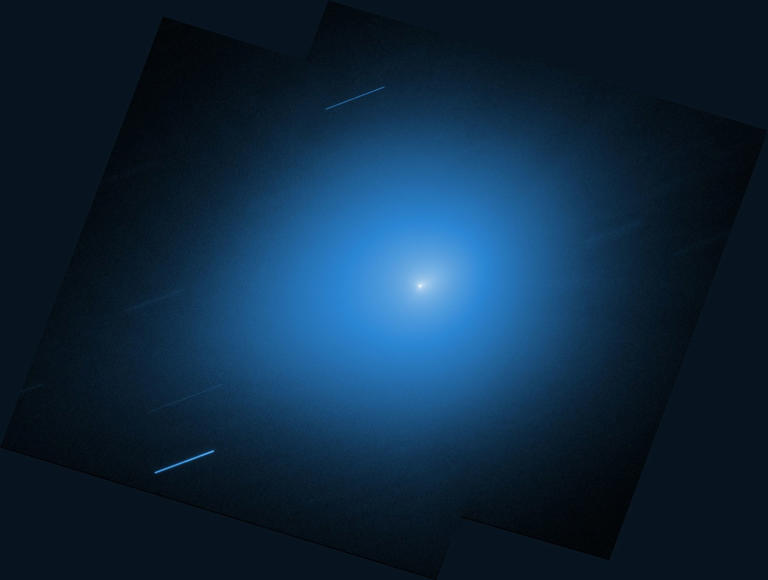
3I/ATLAS (pictured) exhibits unique features, including an anti-tail, extreme color changes, an extremely unusual course, and a massive coma

I/ATLAS (pictured) exhibits unique features, including an anti-tail, extreme color changes, an extremely unusual course, and a massive coma

In August, the Two-Meter Twin Telescope in the Canary Islands captured an image showing a faint jet extending roughly 3.7 miles from the object's nucleus, pointing toward the sun

In August, the Two-Meter Twin Telescope in the Canary Islands captured an image showing a faint jet extending roughly 3.7 miles from the object's nucleus, pointing toward the sun

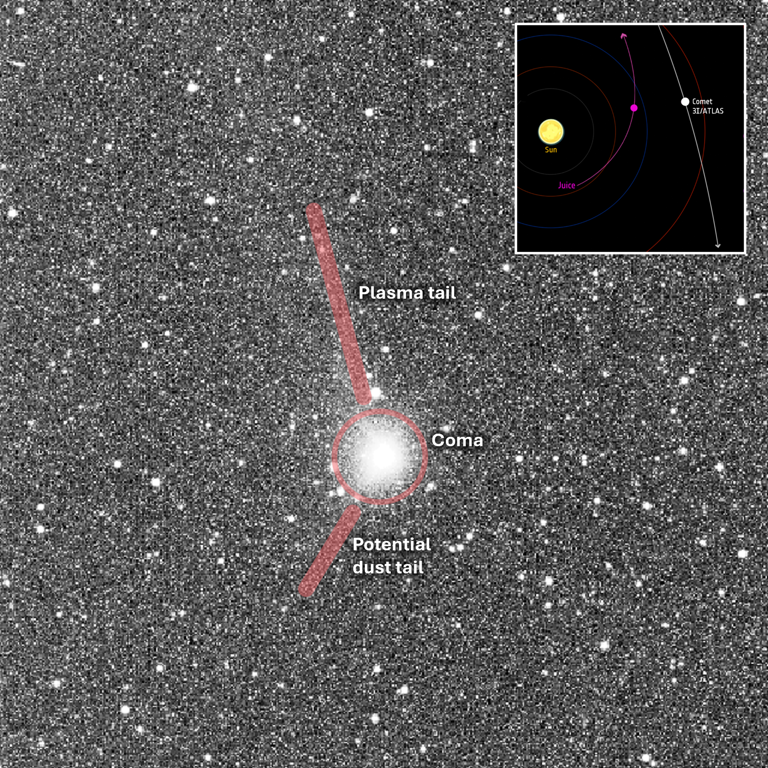
NASA's James Webb Telescope spotted the interstellar visitor in August and the June spacecraft is scheduled to observe it in 2026

NASA's James Webb Telescope spotted the interstellar visitor in August and the June spacecraft is scheduled to observe it in 2026

However, the pictures, taken on a rather sophisticated camera on Mars, were largely blurry and showed only a distant dot.

Moreover, NASA refuted any claims that the object, which had made unexpected maneuvers that dumbfounded experts, is anything other than a large space rock.

The agency's associate administrator Amit Kshatriya declared at a press conference on YouTube: '3I/ATLAS is a comet.'

Social media went into a frenzy, with many alleging the space agency was hiding what they actually knew and was withholding clearer images.

'What a waste of time! NASA is lying so bad. They are all so scripted. The gaslighting is off the charts,' one person posted on X.

'You have lost all credibility with this blurry hogwash photo. Anyone over there who cares about Earth should dump the entire unedited image archive to Wikileaks,' another social media user wrote.

NASA's sophisticated HiRISE camera was supposed to provide a detailed image of the interstellar object near Mars, but the photo shown on Wednesday was blurry and vague

NASA's sophisticated HiRISE camera was supposed to provide a detailed image of the interstellar object near Mars, but the photo shown on Wednesday was blurry and vague

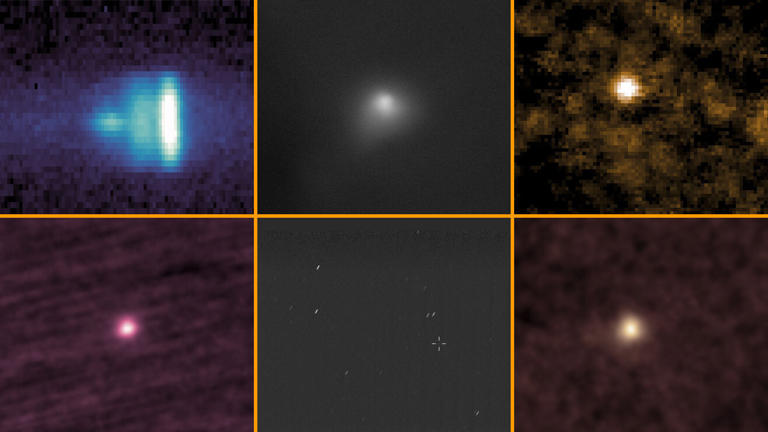
Other images revealed by NASA showed 3I/ATLAS from great distances which made the object look like a dot among the stars

Other images revealed by NASA showed 3I/ATLAS from great distances which made the object look like a dot among the stars

NASA's HiRISE camera on board the Mars Reconnaissance Orbiter was expected to provide one of the best images of 3I/ATLAS to date, since it was able to view the object from just 19 million miles away.

However, the image shown on Wednesday was a fuzzy, black-and-white picture that did not have any definition.

In fact, the clearest and most detailed image presented by NASA did not actually show the interstellar object. Instead, it showed a color image of the chemical elements being released into space by 3I/ATLAS.

'It was a foggy London day when the NASA Mars orbiter took this photo haha,' one person joked on social media.

The space agency also pushed back on claims that 3I/ATLAS was displaying any behaviors that were unnatural for a typical comet.

Previously, Harvard professor Avi Loeb had already discovered at least 11 anomalies that scientists have yet to fully explain, including a cometary tail pointing in the wrong direction, the object turning blue near the sun, and course changes that defy gravity.

However, the NASA team dismissed any irregularities being recorded as a byproduct of the object coming from a distant solar system likely composed of a completely different chemical makeup than our own.

Nicky Fox, who works for NASA's science mission directorate, added: 'We certainly haven't seen any technosignatures [technological traces of intelligent life] or anything from it that would lead us to believe it was anything other than a comet.'

The only detailed image revealed by NASA did not include 3I/ATLAS, and only showed a trail of chemicals the object was supposedly emitting

The only detailed image revealed by NASA did not include 3I/ATLAS, and only showed a trail of chemicals the object was supposedly emitting

NASA maintained that 3I/ATLAS was a comet with no signs of extraterrestrial life

NASA maintained that 3I/ATLAS was a comet with no signs of extraterrestrial life

article image

'It's gonna look different because it didn't come from our solar system,' Fox added.

The quick dismissal of the alternative possibilities surrounding 3I/ATLAS only fueled the speculation online that NASA was trying to bury the subject of alien life.

'This is s***. Tell the truth once and for all to all mankind!!' one frustrated viewer posted.

'Seems like they are trying really hard to convince us that it's just a rock,' another person said.

When Fox was directly asked whether NASA scientists had investigated the possibility that 3I/ATLAS could be an alien craft, the associate administrator avoided giving a clear answer to the question. 

'We love all of the different science and all of the different hypotheses into what these things can be,' Fox replied.

'NASA= NEVER A STRAIGHT ANSWER,' an X user posted during the press event. 

'I should be mad about the NASA event being an absolute flop but I actually just can't stop laughing,' another viewer wrote.

Images of 3I/ATLAS taken by the Nordic Optical Telescope in Spain on November 11 showed the alleged comet has not broken apart as expected

Images of 3I/ATLAS taken by the Nordic Optical Telescope in Spain on November 11 showed the alleged comet has not broken apart as expected

Color-enhanced images shared by multiple social media users revealed 3I/ATLAS developed a strange green glow as it neared Mars and the sun last month

Color-enhanced images shared by multiple social media users revealed 3I/ATLAS developed a strange green glow as it neared Mars and the sun last month

Since its discovery in July, the majority of scientists and astronomers have agreed with NASA's assessment, calling 3I/ATLAS a normal comet with a slightly different chemical arrangement than space rock which formed in this solar system.

Loeb, a physicist and head of the Galileo Project, a scientific research group looking for signs of extraterrestrial life, has been the most prominent voice disputing the comet theory.

He contended that those in the scientific community who have dismissed the more extraordinary possibilities are more concerned with being right and avoiding criticism than alerting the public to a potentially world-changing event.

'Here we are talking about a potential for something that could affect humanity in the future in a dramatic way, and so you shouldn't apply the same approach of being as conservative as possible,' Loeb told the Daily Mail in October.

'I don't want to be their therapist, but they're trying to obviously protect their reputation, not take risks, and also pretend that they know the answer in advance.'

{ https://www.dailymail.co.uk/sciencetech/index.html }

Hoe vind je dit bericht?
Geschreven door peter om 22:37 Stuur door

UFO whistleblower claims Trump was 'fully briefed' on alien hybrids living among humans

President Donald Trump has allegedly been 'fully briefed' on what the US government has been keeping secret about UFOs and alien life living among humans.

In a recent interview, whistleblower and retired US Air Force Major David Grusch claimed that Trump has received reports on crashed spacecraft and non-human remains retrieved by the US, the origins of these beings, and their intentions.

Grusch, a current advisor to Congress's UAP Task Force, said the president could soon become the 'most consequential leader in world history' by publicly disclosing what America has kept hidden about extraterrestrials.

'Members of this current administration are very well aware of this reality. Certainly, the current president is very knowledgeable on this subject,' Grusch told Fox News.

To this point, previous White Houses, the US military, and even NASA have all denied that humans have made contact with alien life or have ever recovered extraterrestrial technology from crashed UFOs.

No physical evidence has ever been presented publicly that would back up the stories by countless civilians, scientists, and military personnel over the decades, who claim to have seen or interacted with beings from another world.

However, Grusch said the US military has not only recovered UFOs and alien bodies, but he personally viewed intelligence reports, data, and even pictures of non-human bodies with his own eyes.

The whistleblower also allegedly told members of Congress that Trump was even briefed during his first term about the existence of multiple alien races and how one species has been crossbreeding with humans.

David Grusch (Pictured) recently revealed that President Trump has been briefed on the existence of aliens and the effort to recover crashed UFOs

David Grusch (Pictured) recently revealed that President Trump has been briefed on the existence of aliens and the effort to recover crashed UFOs

President Trump (Pictured) expressed skepticism that reports of UFOs and alien encounters were real during a June 2024 interview with Logan Paul

President Trump (Pictured) expressed skepticism that reports of UFOs and alien encounters were real during a June 2024 interview with Logan Paul

Grusch spent 14 years in the Air Force before working as an intelligence officer for the National Reconnaissance Office (NRO), which builds and lunches surveillance satellites for the Pentagon.

From 2019 to 2021, he represented NRO on the UAP Task Force, but eventually became a whistleblower after allegedly learning that elements of the US government had prevented Congressional oversight on matters related to extraterrestrials.

In 2023, he testified before Congress, claiming that secret government departments had been running UFO retrieval and reverse-engineering programs for decades.

When asked if he would declassify the files about aliens on the Lex Fridman Podcast in September 2024, then-candidate Trump said: 'Sure, I’ll do that. I would do that. I’d love to do that. I have to do that.' 

Missouri congressman Eric Burlison previously echoed Grusch's statements, revealing the alleged existence of at least four alien species humans secretly know about.

Burlison added that Grusch had briefed the president on the existence of a race known as the 'Nordics,' which are generally human in appearance, with fair skin and blond hair, who have created alien-human hybrids.

'He [Grusch] said that the Nordic aliens are like a few hundred years more advanced than we are, but they're not super advanced,' Burlison said during an X space interview on June 27.

'He says that there are aliens that are crossbreeds living in the world,' the congressman added, noting that Grusch did not have an answer when asked how humans would be able to tell if someone was an alien hybrid.

In September, Congressman Eric Burlison of Missouri revealed video of a US military drone striking an orb-shaped UFO with a missile, which bounced off and did not stop the craft

In September, Congressman Eric Burlison of Missouri revealed video of a US military drone striking an orb-shaped UFO with a missile, which bounced off and did not stop the craft

Grusch described an alien race called 'the Greys' as being thousands of years more advanced than humans or other alien species humans know about (Stock Image)

Grusch described an alien race called 'the Greys' as being thousands of years more advanced than humans or other alien species humans know about (Stock Image)

article image

Burlison, who appointed Grusch to the government's UAP committee, added that the Air Force veteran described another alien race called the Greys as being thousands of years more advanced than humans.

According to Grusch's reports, these aliens, who were shorter with grey skin and large black eyes, were responsible for sightings of craft that defied gravity and controlled technology using their minds.

As for whether these aliens were peaceful or coming to Earth with hostile intentions, Grusch revealed last month that the US has seen a 'mixed bag of activity.'

'We can't quite understand the intent of some of the sentients and why they're visiting. Could it be because we have interesting genetic material on Earth? We're a Jurassic Park tourist attraction for them. [It] could be a myriad of reasons,' he told Bret Baier of Fox News on November 21.

The UAP advisor added that the US was in a secret arms race with Russia and China, who have also captured and crashed alien spacecraft and have been working to reverse engineer the technology.

Although Grusch believed Trump may soon decide to release the classified reports on extraterrestrial programs and encounters, the president has previously said he was a skeptic when it comes to UFO conspiracies.

'People who are very smart and very solid have said they believe there is something out there, and you know it makes sense that there could be. I've never been convinced, even despite that, you know, I just for some reason it's not my thing,' Trump told the Impaulsive podcast in June 2024.

Despite the skepticism, Grusch claimed that the White House was motivated to 'do the right thing' in terms of disclosing all the whistleblower information Congress has been investigating regarding UFOs.

The Daily Mail has reached out to the White House for comment regarding the claims in Grusch's interview.

Grusch noted, however, that he and others have faced intimidation and threats of physical harm to stay quiet about the existence of alien life, but he did not name who has been behind the cover-up.

'I was physically threatened even before I sent in my intelligence community inspector general report under the previous administration,' the whistleblower alleged.

'I actually had to go and and seek legal protection that way because I was, you know, literally in fear both professionally and in my personal life.'

{ https://www.dailymail.co.uk/sciencetech/index.html }

Hoe vind je dit bericht?
Geschreven door peter om 22:09 Stuur door

A celestial oasis? NASA's Perseverance Rover discovers evidence of tropical rainfall on Mars

A celestial oasis? NASA's Perseverance Rover discovers evidence of tropical rainfall on Mars

Bizarre 'bleached' rocks on the surface of Mars suggest that the Red Planet was once a tropical oasis, a new study reveals. 

Scientists at Purdue University in Indiana have analysed photos of fragments of bleached clay, found by NASA's Perseverance rover. 

The fragments – which range from pebbles to boulders – suggest the Red Planet was warm and wet for millions of years. 

In fact, Mars may have been like the tropical regions of Earth such as the Amazon rainforest of South America and the Guinean Forests of West Africa.

And they offer further evidence that the planet once had the right conditions to support life. 

Briony Horgan, professor of planetary science at Purdue University, called the rocks 'probably some of the most important outcrops we’ve seen'. 

'We think these [rocks] could be evidence of an ancient warmer and wetter climate where there was rain falling for millions of years,' she said. 

NASA missions have already found evidence that Mars was much wetter and warmer billions of years ago, so the bright fragments could offer insight into how Mars came to its current barren state. 

'Bleached' rocks that stood out on the reddish-orange surface of Mars are evidence that areas of our neighbouring planet once supported wet oases with humid climates and heavy rainfall

'Bleached' rocks that stood out on the reddish-orange surface of Mars are evidence that areas of our neighbouring planet once supported wet oases with humid climates and heavy rainfall

{ https://www.dailymail.co.uk/sciencetech/index.html }

Hoe vind je dit bericht?
Geschreven door peter om 21:51 Stuur door

Scientists are baffled by a 'never–seen–before' blast from a supermassive black hole 130 million light–years awa

Scientists are baffled by a 'never–seen–before' blast from a supermassive black hole 130 million light–years away

Scientists have been left baffled by a 'never–seen–before blast' from a supermassive black hole, 130 million light–years from Earth.

The colossal black hole sits at the centre of the spiral galaxy NCG 3783, and has a mass greater than 30 million suns.

Using a pair of powerful space telescopes, astronomers spotted a bright X–ray flare erupt from the black hole before vanishing.

Just hours later, the black hole whipped up cosmic winds that shot material into space at 37,280 miles per second (60,000 km/s) – one fifth of light speed.

This is the first time that scientists have been able to watch how an X–ray burst from a supermassive black hole triggers ultra–fast winds.

However, the process proved to be far more rapid than astronomers had previously anticipated.

Lead researcher Dr Liyi Gu, of the Space Research Organisation Netherlands, says: 'We've not watched a black hole create winds this speedily before.

'For the first time, we've seen how a rapid burst of X–ray light from a black hole immediately triggers ultra–fast winds, with these winds forming in just a single day.'

Scientists have been baffled to discover a 'never-seen-before blast' from a supermassive black hole, 130 million light-years from Earth (artist's impression), that sent material flying into space at a fifth of light speed

Scientists have been baffled to discover a 'never–seen–before blast' from a supermassive black hole, 130 million light–years from Earth (artist's impression), that sent material flying into space at a fifth of light speed 

The colossal black hole sits at the centre of the spiral galaxy NCG 3783 (pictured), and has a mass greater than 30 million suns

The colossal black hole sits at the centre of the spiral galaxy NCG 3783 (pictured), and has a mass greater than 30 million suns

The largest and oldest of black holes are the so–called 'supermassive' black holes that sit in the hearts of most galaxies.

When a supermassive black hole, like the one in NCG 3783, starts to feed on nearby matter, it produces a vast amount of energy and becomes what scientists call an 'active galactic nucleus'.

Co–author Dr Matteo Guainazzi, an astronomer at the European Space Agency, told Daily Mail: 'If the black hole in our Galaxy would be active, it would be the strongest X–ray source in the sky.'

In fact, this X–ray radiation would be so strong that some scientists have even questioned whether it would affect Earth's habitability.

Active galactic nuclei (AGN) sometimes produce even more powerful bursts of X–ray radiation, and scientists still aren't entirely sure why.

Typically, astronomers have offered one of three explanations: pushes from the black hole's strong radiation field, pressure from extreme heat, and centrifugal forces in the surrounding disc of plasma.

However, in their new paper, published in the journal Astronomy and Astrophysics, the researchers propose an alternative suggestion.

Dr Guinazzi says: 'The winds around this black hole seem to have been created as the AGN's tangled magnetic field suddenly "untwisted".'

If Sagittarius A*, the black hole in the centre of our galaxy (pictured), produce similar radiation, it would be the brightest source of X-rays in the sky and could even affect the habitability of Earth

If Sagittarius A*, the black hole in the centre of our galaxy (pictured), produce similar radiation, it would be the brightest source of X–rays in the sky and could even affect the habitability of Earth

What are black holes?

Black holes are extremely massive objects that are so dense that not even light can escape their gravitational pull.

They are formed when stars many times larger than our sun run out of fuel and collapse in a supernova explosion.

As the star collapses, it compresses its core into a point known as a singularity.

Inside the singularity, the density approaches infinity, and the laws of physics as we understand them begin to break down.

Scientists cannot directly see black holes, but they can detect them by how they bend light and pull in matter.

Interestingly, this is an extremely similar process to events found on the sun that produce so–called 'coronal mass ejections'.

Coronal mass ejections occur when highly twisted magnetic fields known as 'flux ropes' tangle around sunspots and build up massive amounts of energy.

When the ropes eventually snap, the blast can shoot billions of tonnes of solar material into space.

These are the vast eruptions of charged particles and radiation which create the Northern Lights as they collide with our atmosphere.

Just in November, an intense solar flare was followed by a coronal mass ejection that shot material into space at 930 miles per second (1,500 km/s).

The researchers believe that a similar process could have created the flare and winds from the core of NCG 3783.

The initial 'untwisting' of the magnetic field would have triggered the initial fast–moving burst of X–ray radiation and sent the wave of wind in its wake.

Dr Guinazzi says these would be 'similar to the flares that erupt from the Sun, but on a scale almost too big to imagine.'

Scientists believe the burst of energy might have been created in a similar way to how the sun produces coronal mass ejections (pictured), which shoot billions of tonnes of solar material towards Earth

Scientists believe the burst of energy might have been created in a similar way to how the sun produces coronal mass ejections (pictured), which shoot billions of tonnes of solar material towards Earth 

article image

If the researchers' theory is correct, this may mean that black holes and stars are more similar than scientists had thought.

Since 'windy' galactic nuclei are so important for shaping their host galaxies, this would be an important discovery.

Co–author Dr Erik Kuulkers, of the European Space Agency, says: 'By zeroing in on an active supermassive black hole, the two telescopes have found something we've not seen before: rapid, ultra–fast, flare–triggered winds reminiscent of those that form at the Sun.

'Excitingly, this suggests that solar and high–energy physics may work in surprisingly familiar ways throughout the Universe.'

SAGITTARIUS A* — THE SUPER-MASSIVE BLACK HOLE AT THE CENTRE OF THE MILKY WAY

The galactic centre of the Milky Way is dominated by one resident, the supermassive black hole known as Sagittarius A*.

Supermassive black holes are incredibly dense areas in the centre of galaxies with masses that can be billions of times that of the sun.

They act as intense sources of gravity which hoover up dust and gas around them. 

Evidence of a black hole at the centre of our galaxy was first presented by physicist Karl Jansky in 1931, when he discovered radio waves coming from the region. 

Pre-eminent yet invisible, Sgr A* has the mass equivalent to some four million suns.  

At just 26,000 light years from Earth, Sgr A* is one of very few black holes in the universe where we can actually witness the flow of matter nearby.

Less than one per cent of the material initially within the black hole’s gravitational influence reaches the event horizon, or point of no return, because much of it is ejected. 

Consequently, the X-ray emission from material near Sgr A* is remarkably faint, like that of most of the giant black holes in galaxies in the nearby universe.

The captured material needs to lose heat and angular momentum before being able to plunge into the black hole. The ejection of matter allows this loss to occur.

{ https://www.dailymail.co.uk/sciencetech/index.html }

Hoe vind je dit bericht?
Geschreven door peter om 21:25 Stuur door

Scientists Trace the Mysterious Origins of These Critical Life-Supporting Elements to the Death of an Ancient Star

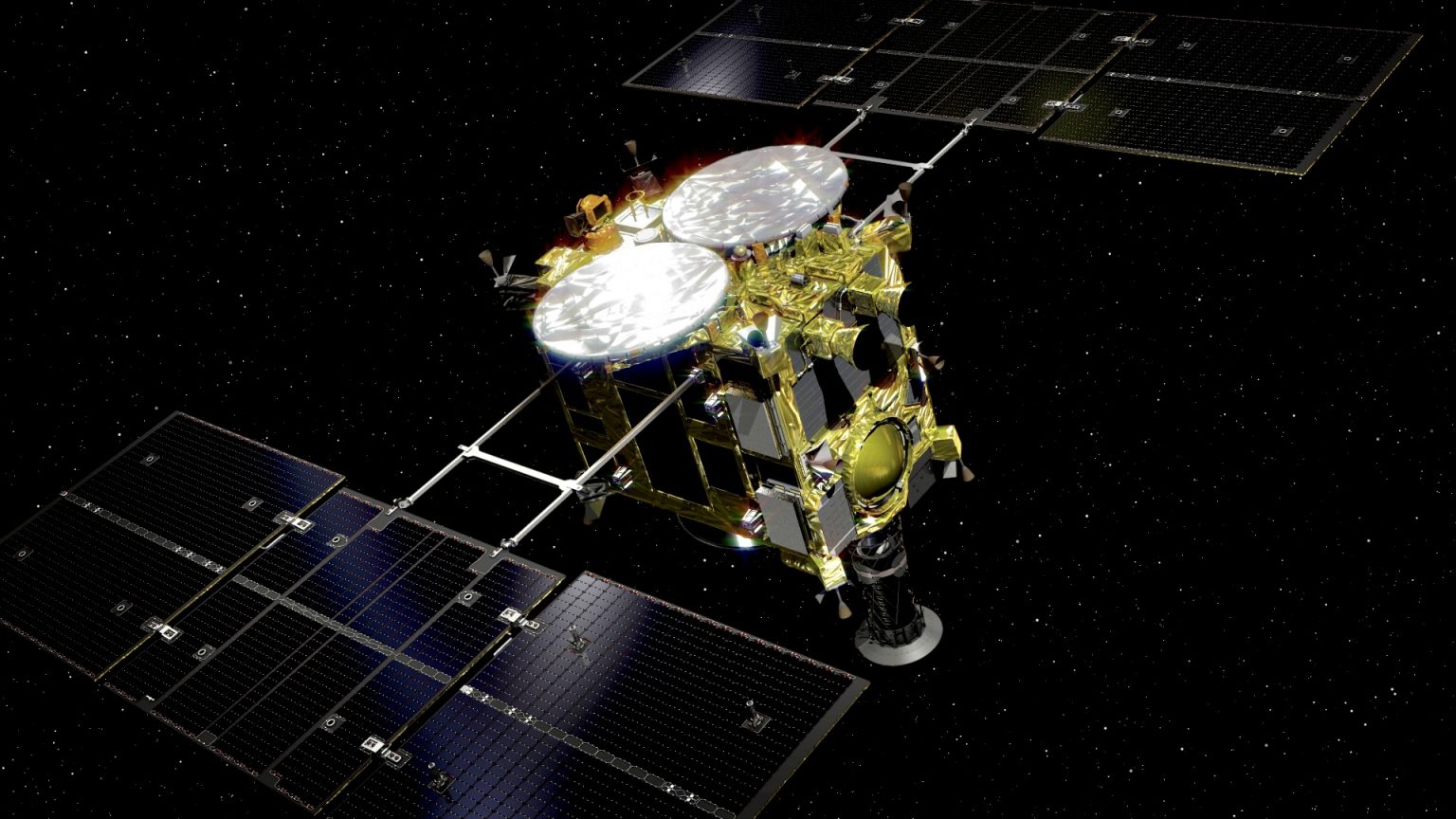
The chlorine and potassium needed to support planet formation and sustain life come from exploding stars.
Image credit: JAXA-

Scientists Trace the Mysterious Origins of These Critical Life-Supporting Elements to the Death of an Ancient Star

Kyoto University researchers investigating the mysterious origins of critical life-supporting elements chlorine and potassium have found compelling evidence that these rare-earth elements were produced in the extreme environment of a dying star.

Although previous studies have identified an excess of chlorine and potassium relative to predictions from stellar production models, leaving astronomers unable to explain their origin, the new data from a supernova remnant may have finally solved the longstanding mystery.

In a statement detailing the discovery, the Kyoto team and colleagues from Meiji University noted that scientists have long considered chlorine and potassium to be key ingredients in planet formation and biological life. However, the exact origins of potassium and chlorine, dubbed odd-Z elements since they contain an odd number of electrons, have remained a mystery. That’s because current stellar formation models predict that stars create roughly one-tenth of the two life-supporting elements that astronomers have observed in the universe, leaving a deficit that scientists have struggled to explain.

Curious if exploding stars that have gone supernova could account for the remaining 90%, the Kyoto University-led team studied the remnant of a Milky Way supernova called Cassiopeia A. According to the researchers, the Japanese Space Agency (JAXA) X-Ray Imaging and Spectroscopy Mission (XRISM) satellite, launched in 2023, was the ideal tool to search for the missing life-supporting elements.

After aiming XRISM’s sensitive microcalorimeter Resolve device at Cassiopeia A, the researchers collected high-resolution X-ray spectrographic data on the remnant of an exploded star. The team said this tool provided high-energy resolution of the supernova remnant, “an order of magnitude better” than previously used X-ray detectors, offering an unprecedented glimpse into the heart of a dying star.

As hoped, the instrument’s increased resolution revealed emission lines from rare earth elements that had been created in the extreme environment of the exploding star. When the team compared the spectrum data with known signatures, they found that chlorine and potassium were produced by Cassiopeia A.

Next, the team compared the results with numerous supernova nucleosynthetic models. According to the press release, this analysis revealed the telltale spectral signatures of both life-supporting elements “at abundances higher than predicted” by generally accepted supernova models.

“When we saw the Resolve data for the first time, we detected elements I never expected to see before the launch,” explained corresponding author Toshiki Sato.

The team said that discovering the presence of chlorine and potassium at such high levels offers the “first observational evidence” that exploding stars could finally explain the mysterious origins of the key ingredients for life. The Kyoto-led team also said the data suggest that ‘strong’ mixing inside massive stars, which could be caused by fast rotation, binary interaction, or shell-merger events, “can significantly enhance the production” of these life-supporting elements.

Although the study examined only a single supernova remnant, the team said their findings show that chlorine and potassium can be produced in a star’s interior in sufficient quantities to account for the previously observed deficit. The data also indicates that ingredients that are considered critical for life can be created in an extreme, intense environment “far removed from anything resembling the conditions needed for life to emerge.”

“I am delighted that we have been able, even if only slightly, to begin to understand what is happening inside exploding stars,” said corresponding author Hiroyuki Uchida.

The team said the XRISM satellite’s ability to probe the deep interiors of stars, where elements critical for life are produced, demonstrated the power of high-precision X-ray spectroscopy. When discussing the impact of the findings, Sato said that making this type of crucial discovery with a satellite his team developed “is a true joy as a researcher.”

When discussing the following steps, the team said they plan to use the high-resolution capabilities of the XRISM satellite to determine if Cassiopeia A is an exception and the mysterious origin of the excess chlorine and potassium seen throughout the universe is still an open question, or do other dying stars also create an abundance of the critical for life elements needed to make up the previously observed difference.

If future observations reveal a similar signature of chlorine and potassium at the heart of other supernovae, the team said, it will show that such internal mixing processes “are a universal feature of stellar evolution.”

In the statement’s conclusion, corresponding author Kai Matsunaga noted that where life came from is an “eternal question everyone has pondered at least once.” So, helping solve such a longstanding mystery can also provide researchers with personal value.

“Our study reveals only a small part of that vast story, but I feel truly honored to have contributed to it,” Matsunaga said.

The study “Chlorine and Potassium Enrichment in the Cassiopeia A Supernova Remnant” was published in Nature Astronomy.

  • Christopher Plain is a Science Fiction and Fantasy novelist and Head Science Writer at The Debrief. Follow and connect with him on X, learn about his books at plainfiction.com, or email him directly at christopher@thedebrief.org.

{ https://thedebrief.org/category/space/ }

Hoe vind je dit bericht?
Geschreven door peter om 20:58 Stuur door

Scientists Propose Earth May Have Been Terraformed by Aliens

Scientists Propose Earth May Have Been Terraformed by Aliens

A controversial new scientific paper has sent shockwaves through the academic community by suggesting that life on Earth may not have emerged through natural processes alone, but could instead be the result of deliberate terraforming by advanced extraterrestrial civilizations. The research, published by Imperial College London's Professor Robert Endres, applies cutting-edge information theory and AI models to demonstrate that the odds of life spontaneously arising from chemical chaos are so astronomically low that alien intervention becomes a "logically open alternative."

The study, titled "The unreasonable likelihood of being: Origin of life, terraforming, and AI," challenges fundamental assumptions about Earth's biological origins. Using mathematical frameworks based on rate-distortion theory and algorithmic complexity, Endres concludes that assembling a viable protocell within Earth's available timeframe would require persistence over geological timescales that strain credibility.

Information Theory Meets Astrobiology

Professor Endres developed a novel approach using Kolmogorov complexity to estimate the informational content required for life's emergence. His calculations suggest that a minimal protocell requires approximately one billion bits of organized information - equivalent to the complexity of sophisticated computer programs. When compared against the estimated entropy of prebiotic chemical environments and molecular persistence timescales, the mathematics paint a sobering picture.

"A purely random soup, made up of molecules that eventually enabled the formation of life on Earth, was too lossy," Endres explains in his yet-to-be-peer-reviewed paper. The research indicates that some form of persistent directional process - lasting hundreds of millions of years - would be necessary to accumulate sufficient biological information naturally.

The study draws parallels between ancient theories and modern science, noting that humanity now seriously contemplates terraforming Mars and Venus. "If advanced civilizations exist," the paper argues, "it is not implausible they might attempt similar interventions out of curiosity, necessity, or design."

Image from the paper, Fantasy sci-fi imagery of terraforming. Chatgpt4.0’s hallucination of early Earth with seeded biomaterial, jump starting Darwinian evolution.

(R. Endres)

Directed Panspermia: From Science Fiction to Science

The concept isn't entirely new. In 1973, Francis Crick - the co-discoverer of DNA's helical structure - and chemist Leslie Orgel proposed "directed panspermia" as a potential explanation for life's unlikely emergence. Their theory suggested that advanced extraterrestrial civilizations deliberately seeded Earth with microbial "starter kits" to establish biological evolution.

Dr Francis Crick, one of the discoverers of DNA’s helical structure.

(CC BY 4.0)

Crick and Orgel's hypothesis emerged from recognition of the same statistical improbabilities that drive Endres' modern analysis. Even with primitive 1970s knowledge, the mathematical challenges of abiogenesis appeared formidable. Their proposal offered an elegant solution: relocate the explanatory burden to more advanced civilizations operating under unknown conditions.

Ancient cultures worldwide contain creation myths describing divine or celestial beings bringing life to Earth. From the biblical Book of Genesis to Mesopotamian texts describing sky gods, humanity has long contemplated external origins for terrestrial biology. Modern directed panspermia theories provide scientific frameworks for concepts that have persisted across civilizations.

The Mathematics of Impossibility

Endres' calculations reveal staggering temporal requirements for natural abiogenesis. His models suggest that without persistent directional bias, random molecular assembly would require time periods exceeding the universe's age by factors of millions or billions. Even with optimistic assumptions about chemical environments and molecular stability, the informational bottleneck remains severe.

The research applies principles from bacterial chemotaxis - where organisms exhibit "run-and-tumble" behavior - to model how chemical evolution might accumulate biological information. If molecular interactions behave like random walks without persistent memory, assembly times become cosmologically implausible.

"With persistence time of one year, the required time is still approximately 10^17 years, about ten million times the universe's current age," the paper states. These calculations suggest that either unknown physical principles accelerate biological organization, or external intervention provided necessary starting conditions.

AI and the Future of Origins Research

The study leverages artificial intelligence tools including AlphaFold protein folding algorithms and comprehensive whole-cell computational models to estimate biological complexity. These modern approaches provide unprecedented precision in quantifying life's informational requirements compared to earlier theoretical frameworks.

Endres acknowledges that invoking extraterrestrial terraforming "violates Occam's razor" by adding explanatory complexity. However, he argues that the mathematical constraints of natural abiogenesis may warrant considering alternatives previously dismissed as science fiction.

The research represents growing intersection between astrobiology, information theory, and AI. As computational models become more sophisticated, scientists can quantify biological complexity with increasing accuracy, potentially resolving longstanding debates about life's origins.

Whether Earth's biosphere emerged through undiscovered physical principles, highly improbable natural processes, or deliberate extraterrestrial intervention remains an open question. However, Endres' work demonstrates that serious scientific investigation of unconventional possibilities may be necessary when conventional explanations encounter mathematical impossibilities.

  • Top image: Concept depicting potential alien terraforming of early Earth.
  •  Source: dottedyeti/Adobe Stock

By Gary Manners

References

RELATED VIDEOS

{ https://www.ancient-origins.net/ }

Hoe vind je dit bericht?
Geschreven door peter om 23:41 Stuur door

So many skeptics think they have debunked Jesus' resurrection. Well, I'm an expert... here's what actually happened

So many skeptics think they have debunked Jesus' resurrection. Well, I'm an expert... here's what actually happened

For millions of Christians, the resurrection of Jesus is the cornerstone of their faith, a moment they believe rewrote history. 

But skeptics insist the event has far more earthly explanations, arguing it was the result of confusion, misidentification or even deception.

Dr Jeremiah Johnston, an Oxford-trained theologian, said most attempts to debunk the resurrection fall into two major buckets: misconception and deceit.

'Misconception theories usually take two forms: either Jesus didn't die, or his followers visited the wrong tomb,' Johnston writes in his book 'Body of Proof.'

The first, known as the 'swoon theory,' suggests Jesus never truly died but merely lost consciousness and later revived, a claim Johnston says ignores medical evidence of his death and the impossibility of freeing himself from the tomb in such a weakened state.

The second, the 'wrong tomb theory,' argues Jesus' followers simply went to the wrong burial site before proclaiming he had risen.

Johnston said the second category, deceit, contends the resurrection story was fabricated by Jesus' own followers, a notion he argues 'flies in the face of Jesus' ethical teaching.'

A final theory claims Jesus never existed at all, an idea archaeologists and historians say collapses under the weight of documented historical evidence.

Millions of Christians believe Jesus died on the cross and rose from the dead. However, skeptics insist the event has far more earthly explanations, arguing it was the result of confusion, misidentification or even deception

Millions of Christians believe Jesus died on the cross and rose from the dead. However, skeptics insist the event has far more earthly explanations, arguing it was the result of confusion, misidentification or even deception

The Bible says a woman named Mary Magdalene was the first witness to the resurrected Jesus, a detail that has long fascinated historians and theologians because, in the first century, a woman's testimony carried little authority.

According to the Gospel accounts, Mary went to the tomb at dawn and found the stone rolled away. 

The body was gone, and moments later, she encountered Jesus himself, becoming the first to proclaim the resurrection. 

But when she ran to tell the disciples, they dismissed her story as unbelievable.

Scriptures such as Luke 24:34 and 1 Corinthians 15:5 then describe a series of follow-up appearances: first to Peter, and later that same day to the rest of Jesus' followers, who were gathered behind locked doors in Jerusalem, fearful and in hiding.

'The case against the resurrection of Jesus is usually based on the utter uniqueness of the claim itself: A man who had been dead for two or three days came back to life,' said Johnston. 

'Skeptics also usually claim that the historical evidence itself is weak, that there were no witnesses to the event, or the New Testament writings that report the resurrection are not credible.'

He laid out all of these theories in the book, starting with the swoon theory, which emerged in the late 18th and early 19th centuries during a wave of rationalist skepticism toward Christianity.

Dr Jeremiah Johnston, an Oxford-trained theologian, discussed all the leading theories that debunk the resurrection in his book, while offering reasons why they fall apart. Here he is pictured holding a replica of the Crown of Thorns in front a an image of the Shroud of Turin

Dr Jeremiah Johnston, an Oxford-trained theologian, discussed all the leading theories that debunk the resurrection in his book, while offering reasons why they fall apart. Here he is pictured holding a replica of the Crown of Thorns in front a an image of the Shroud of Turin

The idea resurfaced in the 20th century through authors like Hugh Schonfield, whose book The Passover Plot argued that Jesus was given a drugged drink on the cross to simulate death.

Johnston argues that Roman executioners were too experienced to mistakenly remove a living man from a cross. 

And even if such an error had occurred, he said, it would have been physically impossible for a severely wounded Jesus to free himself, push aside the heavy stone, and slip past guards without being noticed.

'It supposes that Jesus passed out, perhaps becoming comatose; that his executioners wrongly thought he was dead; and that his followers who buried him also wrongly thought he was dead,' Johnston wrote. 

'Then after a day or two in the tomb, Jesus awoke, managed to exit the tomb, and found a few of his followers.'

Even then, he added, Jesus would have appeared broken and near death, hardly a figure who would inspire proclamations that he had conquered it.

The wrong tomb theory, proposed by New Testament scholar Kirsopp Lake, suggests that the women who visited the tomb were grief-stricken and confused, accidentally entering a different, empty tomb and assuming Jesus had risen. 

They then spread what was, according to this theory, an honest mistake.

Johnston noted that this explanation fails to account for later events described in Scripture, most notably the dramatic conversion of Saul of Tarsus, a fierce persecutor of early Christians. 

The first, known as the 'swoon theory,' suggests Jesus never truly died but merely lost consciousness and later revived, a claim Johnston says ignores medical evidence of his death and the impossibility of freeing himself from the tomb in such a weakened state
The first, known as the 'swoon theory,' suggests Jesus never truly died but merely lost consciousness and later revived, a claim Johnston says ignores medical evidence of his death and the impossibility of freeing himself from the tomb in such a weakened state 

According to the New Testament, Saul (later known as Paul) encountered the risen Jesus on the road to Damascus, an experience that transformed him from enemy to evangelist.

Deceit theories, meanwhile, argue that there was no empty tomb at all, that Jesus' followers fabricated the entire resurrection narrative and everything that followed. 

Johnston pushed back on this idea, asking why a group of demoralized disciples would invent a story that contradicted Jewish expectations of the Messiah and risk persecution to defend it.

'Why rehabilitate an apparent failed prophet and Messiah?' Johnston said. 'Why claim against all popular expectations that the crucified Jesus was Israel's long-awaited Messiah? The scenario is improbable.'

The final category, mythicism, denies not just the resurrection but Jesus' existence altogether, portraying Christ as a purely mythical figure rather than a historical one. 

The second, the 'wrong tomb theory,' argues that Jesus' followers simply went to the wrong burial site before proclaiming he had risen. Pictured is the Church of the Holy Sepulchre, which many believe was built on top of Jesus' tomb

The second, the 'wrong tomb theory,' argues that Jesus' followers simply went to the wrong burial site before proclaiming he had risen. Pictured is the Church of the Holy Sepulchre, which many believe was built on top of Jesus' tomb

Some proponents argue that the earliest Christian writings, such as Paul's letters, describe a heavenly being, not a man who lived in Galilee.

But the overwhelming scholarly consensus dismisses mythicism. Archaeological findings, ancient writings, and references from non-Christian historians all point to Jesus as a real figure who lived in 1st-century Judea.

'Not only were the four Gospels written and circulated within one or two generations of Jesus' time,' Johnston said, 'but we have the letters of Paul, a contemporary, who knew some of Jesus' original followers and was acquainted with Jesus' brother James.'

Some mythicists also claim Nazareth did not exist in the early first century. 

Yet a fourth-century Jewish inscription found at Caesarea Maritima lists priestly families from Nazareth, adding to the archaeological evidence of the village's antiquity.

'I know many archaeologists — Jewish, Christian, and with no religious orientation whatsoever — and not one doubts that Jesus was a real person,' Johnston said.

RELATED VIDEOS

{ https://www.dailymail.co.uk/sciencetech/index.html }

Hoe vind je dit bericht?
Geschreven door peter om 22:19 Stuur door

New images show comet 3I/ATLAS getting active as it zooms toward Earth

New images show comet 3I/ATLAS getting active as it zooms toward Earth

Story by Brandon Specktor
 

The celebrity comet 3I/ATLAS is showing itself out of our solar system for good — but not before the cosmic paparazzi at Earth's space agencies snap some of the clearest photos of it yet.

Discovered in late June and confirmed to be the third known interstellar object in July, 3I/ATLAS has spent the past several months zooming through the inner solar system at an estimated 130,000 mph (210,000 km/h). The massive, jet-spewing snowball made its closest approaches to Mars and the sun in October. It is due for its closest encounter with Earth on Dec. 19, when it will be about 170 million miles (270 million kilometers) away — nearly twice the distance between our planet and the sun.

As the comet careens toward this astronomical milestone, spacecraft managed by NASA and the European Space Agency (ESA) are snagging as many close-up observations as possible. This week, both agencies shared new images of the comet — proving that its recent flyby of the sun has left it very bright and active as it spews large amounts of sublimated gas and dust into space.

Hubble doubles down

The second Hubble Space Telescope view of comet 3I/ATLAS (Image credit: NASA / Hubble)

The second Hubble Space Telescope view of comet 3I/ATLAS
(Image credit: NASA / Hubble)

On Thursday (Dec. 4), NASA shared the latest image of 3I/ATLAS taken by the Hubble Space Telescope. The glowing white dot at the center of the image shows the comet's nucleus (its main body) and coma, the bright atmosphere of gas and dust that wraps around the comet before getting funneled into its tail. In the background, stars are stretched into long streaks as Hubble's camera stays fixed on the fast-moving comet.

Comets typically brighten as they approach the sun, when the ice within them heats up and sublimates. Solar radiation pushes this gas into a tail that stretches away from the sun. Meanwhile, the warmest, sun-facing side of the comet may erupt with jets of gas and dust angled toward our star. Both of these features are faintly visible in the new Hubble image.

NASA snapped this image on Nov. 30, when Hubble was about 178 million miles (286 million km) from the comet. This is considerably closer than when Hubble first imaged the comet in late July. Although that first view showed little more than a blue blur, it nevertheless allowed scientists to constrain 3I/ATLAS' size to somewhere between 1,400 feet (440 meters) and 3.5 miles (5.6 km) wide — likely the largest interstellar object seen to date.

New data from this image, including details of the coma's composition, has yet to be released but is likely on the way.

ESA juices up

A new image of comet 3I/ATLAS, taken from the ESA's Jupiter Icy Moons Explorer (Juice). (Image credit: ESA/Juice/NavCam)

A new image of comet 3I/ATLAS, taken from the ESA's Jupiter Icy Moons Explorer (Juice).
(Image credit: ESA/Juice/NavCam)

Also on Thursday, ESA shared its latest view of the comet, taken by the Jupiter Icy Moons Explorer (Juice) orbiter on its way to study Jupiter's moons for signs of life. Juice snapped the image Nov. 2, just days after 3I/ATLAS' close approach to the sun.

Located even closer to its target than Hubble (only 41 million miles, or 66 million km, away), Juice shows us a comet brimming with activity.

"Not only do we clearly see the glowing halo of gas surrounding the comet known as its coma, we also see a hint of two tails," an ESA spokesperson wrote in a statement. "The comet's 'plasma tail' — made up of electrically charged gas, stretches out towards the top of the frame. We may also be able to see a fainter 'dust tail' — made up of tiny solid particles — stretching to the lower left of the frame."

Earth gets ready

Recent views of 3I/ATLAS taken by six NASA spacecraft scattered around the solar system (Image credit: NASA/Goddard/LASP/CU Boulder/JPL-Caltech/University of Arizona/Southwest Research Institute/Lowell Observatory/Qicheng Zhang/ASU/MSSS )

Recent views of 3I/ATLAS taken by six NASA spacecraft scattered around the solar system
(Image credit: NASA/Goddard/LASP/CU Boulder/JPL-Caltech/University of Arizona/Southwest Research Institute/Lowell Observatory/Qicheng Zhang/ASU/MSSS )

Juice observed 3I/ATLAS with five scientific instruments on two days. But besides this teaser image, we don't yet know what those instruments saw; the full data set won't reach Earth until late February 2026, according to ESA. That's because Juice is currently using its main antenna as a heat shield to protect it during its close pass of the sun, and relying on its smaller, less efficient antenna to beam its observations back to us.

While there's little we can learn from NASA's and ESA's new images without the full complement of scientific data, it's a good reminder that human space exploration pays off in unexpected ways. Hubble and Juice number among a dozen spacecraft that have observed 3I/ATLAS from around the solar system, including Mars rovers, solar orbiters, asteroid trackers and space telescopes that were never intended to track comets.

And there's more to come: As 3I/ATLAS draws closer to Earth, the James Webb Space Telescope will take another look at it, while countless scientific observatories and amateur astronomers will have their chance to watch it as well. When you're dealing with a mysterious intruder from parts unknown, every observation matters.

{ Live Science }

Hoe vind je dit bericht?
Geschreven door peter om 21:53 Stuur door

Aliens over the Central Coast? This documentary on UFOs seems to think so

Aliens over the Central Coast? This documentary on UFOs seems to think so

Story by Joan Lynch

Have you seen something from another world in the skies above the Central Coast?

It's entirely possible, according to a new documentary from director Dan Farah - who produced films such as "Ready Player One" and "Call Jane" - on the possibility of alien life that focuses on recent disclosures of U.S. government programs that have studied, tracked and even potentially recovered extraterrestrial craft and beings.

Released in March, "The Age of Disclosure" follows Luis Elizondo, a former Department of Defense employee and U.S. Army veteran who has become a prominent voice in the world of UFOs - or, as some enthusiasts call them, unidentified anomalous phenomena or UAPs - as the U.S. government declassifies some information on UAPs and holds hearings on the matter over the past five years.

The film also features commentary on UAP hearings from several high-ranking current and former members of the U.S. government, including Sen. Marco Rubio, R-Florida; Kirsten Gillibrand, D-New York; and former CIA Director John Brennan.

Though many of Elizondo's claims are disputed by UFO skeptics, scientists and government authorities, the new documentary includes a pair of accounts of potential UAP sightings here on the Central Coast - specifically surrounding Vandenberg Air Force Base, now referred to as Vandenberg Space Force Base.

Luis Elizondo, who led the Pentagon effort to investigate UFOs until October, when he resigned to protest what he characterized as excessive secrecy and internal opposition to the program, at McGarvey's Bar in Annapolis, Md., Dec. 7, 2017. UFOs have been repeatedly investigated over the decades in the United States, including by the American military.

Luis Elizondo, who led the Pentagon effort to investigate UFOs until October, when he resigned to protest what he characterized as excessive secrecy and internal opposition to the program, at McGarvey's Bar in Annapolis, Md., Dec. 7, 2017. UFOs have been repeatedly investigated over the decades in the United States, including by the American military.

In the documentary, retired Air Force Lieutenant Bob Jacobs said he saw a UAP while he was working at Vandenberg Air Force Base, though the exact date was not included in the documentary.

Around 60 cameras were pointed at the ignition point of an Atlas D missile carrying a dummy warhead that was launched from Vandenberg, recording the ignition and launch process, Jacobs said.

But once the missile took flight, an unidentified object entered the frame of the recording, he said.

Jacobs said the UAP circled the missile, hitting it with beams of light at several angles, and then exited the camera's frame in the same direction it came - all while everything being filmed was moving at around 8,000 to 9,000 miles per hour.

"There's nothing of ours that could have done that," Jacobs said in the film. "What could have done that?"

A United Launch Alliance Delta IV rocket sits at Space Launch Complex-6 at Vandenberg Space Force Base in this file photo. With the Delta IV rocket headed to retirement, SpaceX has moved onto SLC-6, with plans for launches and landings of the Falcon 9 and Falcon Heavy rockets.

More than a dozen people claim to have spotted UAPs at Vandenberg

Jacobs isn't alone in his claims of UAP sightings around Vandenberg.

In another instance, two individuals - retired Air Force Security Forces members Jeffrey Nuccetelli and Chaz King - shared similar accounts of a pair of 2003 UAP sighting while working at Vandenberg.

"On Oct. 14, 2003, I showed up to work at Vandenberg Air Force Base, and immediately everybody just started to tell me about this UFO incident that had happened earlier that morning," Nuccetelli said in the documentary.

The first sighting had been reported by a trio of Boeing contractors, who said they saw a "gigantic red square object" hovering over the launchpad the previous evening, Nuccetelli said.

"It was making no noise, it had no obvious signs of propulsion, and it was just hovering silently," Nuccetelli said in the film. "It was a very serious security breach of the area."

Neither witnessed the incident firsthand, but said they spent much of the following day driving around the base, searching for other objects like the square.

"Later that night, myself and five security forces members, we observed a bright light approaching the base," King said in the documentary. "As it got closer, the light was no longer visible, and it was massive, the size of a football field, almost rectangular in shape.

A Falcon 9 rocket and its cargo - 15 Starlink satellites - head to orbit Monday, Aug. 8, 2023, from Vandenberg Space Force Base near Lompoc.

A Falcon 9 rocket and its cargo - 15 Starlink satellites - head to orbit Monday, Aug. 8, 2023, from Vandenberg Space Force Base near Lompoc.

King said the mysterious matte black rectangle appeared to float in the sky without any propulsion systems, and lacked windows.

After the security forces members had observed it for around 45 seconds, it "shot off, thousands of miles an hour, up the coast," King said in the film.

Nuccetelli said he spoke with a dozen other individuals at different vantage points, all of whom repeated King's story.

Because no photographic or video evidence of these claims are publicly available, at the end of the day, verifying their accuracy comes down to just one question: Do you believe?

RELATED

{ San Luis Obispo Tribune }

Hoe vind je dit bericht?
Geschreven door peter om 21:28 Stuur door

Scientists Impressed by “Fire Amoeba” That Can Survive Incredible Temperatures

Scientists Impressed by “Fire Amoeba” That Can Survive Incredible Temperatures

This tiny critter is basically almost indestructible.
Scientists in America and Europe have discovered one remarkable organism in California: an amoeba that can survive extreme temperatures.
Getty Images / H. Beryl Rappaport et al./bioRxiv

Parts of the Lassen Volcanic National Park in California’s Cascade Range resemble the gateway to a hellish underworld, with pools of boiling water and bubbling mud where almost nothing can live, due to scalding temperatures that can reach a blistering 464 degrees Fahrenheit.

That’s enough to kill a human, obviously, which rangers and ample signage helpfully point out to visitors throughout the park. And yet: a team of scientists in America and Europe have discovered one remarkable organism that can survive and even thrive in these hellish waters: a tiny single-cell “fire amoeba.”

This humble critter, a gooey-looking blobunder the microscope, has set a “new record for the upper temperature limit” for all complex organisms on Earth because it can divide at a burning-hot 145.4 degrees Fahrenheit, according to the scientists who laid out their findings in a yet-to-be-peer-reviewed study published last week.

In reporting by Nature, the researchers said the existence of the once-unknown amoeba — now called Incendiamoeba cascadensis, meaning “fire amoeba from the cascades” — also challenges the notion that certain organisms called prokaryotes, which includes all bacteria, are the only lifeforms on Earth that can survive extreme temperatures that kill almost everything else.

Prokaryotes, which have no distinct nucleus, are still the reigning champs of biological toughness, as they can persist in temps between 149 and 221 degrees Fahrenheit — and they can theoretically be viable up to 392 degrees, above which nucleotides and amino acids start to break down.

Prokaryotes, which also includes a domain of microbes called archaeans, can be found in steaming compost piles, and places with volcanic activity and hot springs such as Lassen. The highest known temperature shrugged off by a prokaryote, an archaean called Methanopyrus kandleri, is 251.6 degrees Farenheit, a record for all organisms, prokaryotes or not.

In contrast to prokaryotes, the fire amoeba is an eukaryote — complex organisms that include every animal, plant, fungi, and also unicellular tiny lifeforms called protists, encompassing algae and other amoebae — and is composed of cells, or one cell in the case of the fire amoeba, that have a distinct nucleus bound by a membrane and interior organelles.

Eukaryotes such as mammals and us humans have an upper temperature limit of 109.4 degrees Farenheit, above which we die. Until now, the upper temperature limit for more hardy eukaryotic organisms, such as fungi and red algae, was thought to be 131 to 140 degrees Fahrenheit, so this discovery of the fire amoeba is remarkable.

“We need to rethink what’s possible for a eukaryotic cell in a significant way,” Angela Oliverio, Syracuse University microbiologist and study co-author, told Nature.

The team found this tiny microorganism in a stream of hot spring water that was pH neutral, in contrast to the many acidic pools in Lassen.

“It’s the most uninteresting geothermal feature you’ll find in Lassen,” Syracuse microbiologist and study co-author Beryl Rappaport told Nature.

Studying the water from this stream yielded zero indication of life while under microscope, but something unexpected happened when the scientists added nutrients to the water and heated the samples to a temperature of 134.6 degrees Fahrenheit, the stream’s temp range; they noticed this then unknown amoeba moving and replicating.

When they slowly heated the samples up to 145.4 degrees, the hardly little amoeba again defied expectations and still kept on dividing and moving, according to the paper. At a degree higher, it was still active.

At 158 degrees, though, the amoeba went into dormancy in a process called encystment, in which it turns into a cyst-like ball; it develops a hard shell that protects it from harsh environmental conditions; cooler temperatures would allow for the amoeba to unwind form its cocoon to grow and reproduce again.

The team also decoded and analyzed the fire amoeba’s genome and “found an enrichment of genes related to proteostasis [process that regulates proteins], genome stability, and sensing the external environment,” the scientists wrote in the paper, showing the hidden mechanisms that allow the amoeba to survive.

The scientists said this discovery of the fire amoeba is exciting because it opens up the possibility of further research and discovery of new, undiscovered high-temperature loving eukaryotes; scientists have typically studied heat-loving prokaryotes called thermophiles.

“We looked in one stream,” Oliverio said. “Maybe we got extremely lucky and there’s nothing else out there, but we really don’t think that’s the case.”

Another exciting aspect of the discovery, according to the scientists, is that it could lead to better insight on how eukaryotes can survive such extreme temperatures while maintaining healthy cellular integrity and functionality. The proteins within the amoeba can also be a source for “thermostable proteins” that can find many applications in the biotechnology field, they said.

What’s also cool is that the discovery raises the possibility of life beyond Earth; researchers have speculated that microbes such as bacteria could lurk in the ancient riverbeds and lake shores of Mars or its ice caps.

Because like what actor Jeff Goldblum said in the first Jurassic Park movie: “Life finds a way.”

More on Microbes: 


{ https://futurism.com/category/science-energy }

Hoe vind je dit bericht?
Geschreven door peter om 22:56 Stuur door

Athos 2643: a novel that will transform your perspective on artificial intelligence

Athos 2643: a novel that will transform your perspective on artificial intelligence

Nils Westerboer’s science fiction novel Athos 2643 is a detective story set in the future, in a monastery on Neptune’s fictional moon Athos. However, the main intrigue revolves not around space or Christianity, but around artificial intelligence. The Ukrainian book was recently published by Lobster Publishing and can be purchased on the publisher’s official website.

What should artificial intelligence look like?

Contemporary science fiction

Athos 2643 by Nils Westerboer can confidently be called fresh science fiction. The novel was published in German in 2022, and in 2025, Lobster Publishing printed it in Ukrainian.

The events in it take place in the distant future, and the numbers 2643 indicate the year. Humanity has colonized the Solar System, mastered the genetic modification of living organisms, and created truly powerful artificial intelligence, which plays one of the key roles in the novel.

The novel is truly interesting, but initially it can be a real challenge for the reader. The fact is that many things, whose names seem quite understandable at first glance, begin to cause distrust after just a few paragraphs.

Nils Westerboer. Source: www.uni-koblenz.de

Main characters

Take, for example, the main character – the inquisitor Ruud Kartgeiser. From a man whose occupation is described by this word, you would expect a certain steadfastness in his faith, which is most likely Christian. However, when we first see him at the station orbiting Neptune, he is sitting naked in a hotel room while his AI assistant ties him to a pipe.

Yes, he has a personal AI named Zach, and she is only formally a tool that makes his life easier. In fact, she has her own will, sometimes stronger than Ruud’s, her own judgments, often takes the initiative in conversations with other characters, and in general, the reader perceives the events in the novel mainly through her eyes.

At first, it seems that Ruud Kartgeiser himself is a whiny, dependent, and dull appendage to his artificial intelligence. But then he demonstrates determination, composure, and independence, his story unfolds more fully, and it becomes clear that the whole point is that we are seeing a character who has suffered severe trauma in the past and has recently experienced personal problems. He gives vent to all of this when he is alone with the AI.

That’s how the imagination pictures the inquisitor of the future, and Ruud is nothing like that image.
Source: phys.org

As for his profession, the word “inquisition” is translated from Latin as “investigation.” In other words, Ruud is simply an investigator, a typical detective story protagonist acting on behalf of an organization with certain powers. However, he does not deal with matters of religious belief, but rather with problematic artificial intelligence.

Athos 2643

It is precisely Ruud’s deceptive status that immediately catches your attention when you start reading the novel. Its title refers to Mount Athos in Greece, located on the peninsula of the same name. It is home to more than a dozen Orthodox monasteries, and in fact, the entire island is a territory where medieval religious rules still apply.

In Westerboer’s novel, this is the name of Neptune’s small satellite, only a few kilometers in diameter, on which there is a monastery of Orthodox hermits, where a very suspicious fatal accident occurred. Incidentally, the satellite itself is fictional, but it is described quite realistically, and it is indeed impossible to rule out that in the future, when the distant eighth planet is better explored, something similar will not be found near it.

But that’s not the important thing. The question that arises from the very first pages is: what is a representative of the Inquisition, usually associated with the Roman Catholic Church, doing in an Orthodox monastery? And why is he accompanied by his assistant, who is constantly present in the form of a hologram of a young, attractive woman, often dressed very lightly?

It seems that Westerboer tried to use the theme of Christianity, but never even understood its basics.

The monks on Mount Athos rarely discuss God, the soul, or faith with devout Christians. However, when it turns out that one of them is a woman, another hermit, very much in the spirit of the LGBT movement, asks, “Who decides who is a man and who is a woman?”

Monastery on Mount Athos in Greece. Source: phys.org

Against this backdrop, the presence of a farm producing halal meat on the satellite monastery is not so surprising. In Westerboer’s novel, Neptune’s system is inhabited mainly by Turks. So why should Orthodox hermits not produce food according to the instructions of the Prophet Muhammad?

Compared to Westerboer’s vision of a future world of advanced biotechnology, the appearance of the farm itself is more reminiscent of a depiction of hell.

But the most interesting thing is that later on, there is a very simple and rational explanation for everything. For this reason alone, it is really worth reading Athos 2643 to the end. After all, it is a detective story in which the reader, together with the main characters, not only searches for the possible murderer, but also tries to understand what is really going on around them. Westerboer also manages to present some key insights into the world in simple language, only after the 300th page, and after finishing the book, you somehow do not want to criticize him for it.

The most important technology

The world of Athos 2643 is shaped by technologies that have not yet been invented. Some of them seem, shall we say, overly bold and dubious. For example, when the author describes engines capable of accelerating a spacecraft to a speed of over a thousand kilometers per second in just a few dozen minutes, the question arises not so much about the physical process itself (which, at least in theory, has already been described), but rather about how the people on board can withstand such overloads.

There is an even bigger problem with Zach’s hologram emitter. Because it is only called a hologram in name, that is, a play of light and shadow. In reality, it has a density that allows it to wear a dress made of very light but real fabric. And the device that creates all this not only does not fry everything between it and the hologram, but can also fit in your pocket.

Neptune. Source: phys.org

And the way gravity is created on Athos. The author did well not to forget that on such a small body, it is very weak. But using special particles that need to be injected with anesthesia every few days instead of the magnetic boots familiar to science fiction is a rather unsuccessful idea, even without the bloody demonstration present in the book.

But the most important technology shaping this future is artificial intelligence, which is now not only on par with human intelligence but surpasses it. AI is not only found in the main character; it is everywhere, controlling all complex processes. So now even a dishwasher can show its personality.

Such AI exists on Mount Athos, and it does indeed cause problems. The novel begins with the story of a woman who, over several years, drove her husband to his death by using her knowledge of his weaknesses against him, while pretending to care for him. It is difficult to say whether modern lawyers would consider such actions a crime, but in the world of Athos 2643, they are.

After all, artificial intelligence is very good at studying the reactions of the people it interacts with and is quite good at predicting their behavior. This means that it is quite capable of manipulating people and leading them into situations where their death will appear natural or the result of an accident.

And this problem may indeed be real. We are accustomed to considering our actions to be the result of a mysterious process called our soul. However, in practice, they can be subjected to statistical analysis. Under normal conditions, it would be difficult to take advantage of this due to the large number of random processes and interactions that need to be taken into account. However, on an asteroid riddled with mines, where only six hermits live, it is much easier.

This is precisely what Ruud will have to deal with. Fortunately, he is very good at “talking” to artificial intelligences because he knows their weaknesses and is very attentive to how they play with words. How all this is connected to the murders in the cave monastery can be found out by reading the book to the end. You will discover that artificial intelligence is not even the key technology of this world, and that the characters have been missing the main miracle and mystery from the very beginning. But that’s why he is a detective, to find the answers himself.

{ https://universemagazine.com/en/articles-en/}

Hoe vind je dit bericht?
Geschreven door peter om 22:44 Stuur door

James Webb Space Telescope Discovery Reveals the Milky Way Has a Distant Twin That Shouldn’t Exist

James Webb Space Telescope

Credit: © NASA/CSA/ESA, Rashi Jain (NCRA-TIFR)

James Webb Space Telescope Discovery Reveals the Milky Way Has a Distant Twin That Shouldn’t Exist

James Webb Space Telescope observations have revealed a galaxy that shouldn’t exist, in what astronomers have dubbed “Alaknanda,” a complex spiral galaxy that matured far too early for our present understanding of galactic formation and evolution to allow.

Alaknanda resembles our Milky Way, yet the distant images Webb collected were from only 1.5 billion years after the Big Bang. Webb’s ability to detect dim light across these immense distances allows researchers to peer far back into the ancient universe, since the light from these objects takes many years to reach us.

The Milky Way’s Twin

Rashi Jauin and Yogesh Wadadekar of the National Centre for Radio Astrophysics of the Tata Institute of Fundamental Research (NCRA-TIFR) in Pune, India, made the discovery, revealed in a recent paper published in Astronomy & Astrophysics.

Their sighting of the mature galaxy comes from light emitted when the universe was only one-tenth of its current age. Their name for the galaxy, Alaknanda, ties it to the Milky Way and to one of India’s most sacred features, the Ganges River. Before flowing through India, the Ganges originates from two headstreams in the Himalayas: Alaknanda and its twin, Mandakini, which is the Hindi name for the Milky Way.

The Milky Way and Alaknanda both feature grand design spirals, formed by two symmetric arms. Achieving this beautiful order from the irregular chaos of a new galaxy was believed to take billions of years, as the gas slowly accreted and was sculpted by slow-moving density waves into the ordered spiral shape.

Star Producing Power

At Alaknanda’s center is a bright, rounded bulge 30,000 light-years across. This central feature produces new stars at a rate 20 times that of the Milky Way, coming out to a combined mass of 60 times the Earth’s Sun annually. At this tremendous speed, half of Alaknanda’s stars were formed in just 200 million years.

“Alaknanda has the structural maturity we associate with galaxies that are billions of years older,” said lead author Rashi Jain. “Finding such a well-organised spiral disk at this epoch tells us that the physical processes driving galaxy formation—gas accretion, disk settling, and possibly the development of spiral density waves—can operate far more efficiently than current models predict.”

“It’s forcing us to rethink our theoretical framework,” he added.

James Webb Space Telescope Observations

Alaknanda’s location proved a boon for viewing the distant galaxy. Also in its direction is Pandora’s Cluster, a massive galaxy cluster that bends and magnifies light passing through, improving Webb’s ability to observe the spiral structure’s detail.

The pair behind the study broke the light down using 21 different filters to produce exact measurements of Alaknanda’s distance, dust content, star count, and star formation rate. Data for the project came from two different observational sets, acquired during the UNCOVER and MegaScience surveys.

As Webb allows researchers to peer not just farther out into the universe, but much further back in time, many preconceptions about our understanding of the cosmos are unraveling. Other types of advanced galaxies are being sighted from eras that should be far too early for them to exist based on our present understanding of galactic evolution.

“Alaknanda reveals that the early Universe was capable of far more rapid galaxy assembly than we anticipated,” said co-author Yogesh Wadadekar. “Somehow, this galaxy managed to pull together ten billion solar masses of stars and organise them into a beautiful spiral disk in just a few hundred million years.”

“That’s extraordinarily fast by cosmic standards,” Wadadekar said, “and it compels astronomers to rethink how galaxies form.”

James Webb and the Early Universe

This new data will require rethinking past ideas and developing new explanations, as scientists debate how these complex forms may have arisen so early. However, the researchers behind the recent study offered up some possibilities to help lead off that ongoing discussion. 

One is that cold gas infilled the galaxy, while density waves shaped it, but at a rapid pace. A more dramatic solution is that the galaxy collided with a small galaxy to form the arms, though in such an event, the spirals would be expected to fade rapidly. The researchers say that if subsequent observations can distinguish whether Alaknanda’s rotation is steady or turbulent, that will provide essential context for future debate on the matter.

Whatever the case, the James Webb Space Telescope is not just showing us more of the same that astronomers have already observed in our universe. Peering to greater distances, it is presenting unexpected discoveries that push against our most basic understandings of our universe, and continued exploration with NASA’s premier space observatory will only further test our scientific theories and lead to new insights into the cosmos.

The paper, “A Grand-design Spiral Galaxy 1.5 Billion Years After the Big Bang with JWST,” appeared in Astronomy and Astrophysics on November 10,W 2025.

  • Ryan Whalen covers science and technology for The Debrief. He holds an MA in History and a Master of Library and Information Science with a certificate in Data Science. He can be contacted at ryan@thedebrief.org, and follow him on Twitter @mdntwvlf.

{ https://thedebrief.org/category/space/ }

Hoe vind je dit bericht?
Geschreven door peter om 21:46 Stuur door

'Entities' may be living in underwater UFO bases... and experts know where they are

A respected congressman has claimed that advanced alien beings could be hiding out in 'five or six' underwater UFO bases right off the US coast.

Tennessee congressman Tim Burchett, a member of the House Oversight Committee overseeing UFO reports, drew massive attention on social media after saying that he believed there were alien 'entities' currently living in deep-water areas on Earth.

The September 17 clip posted on X has already been viewed more than 1.9 million times.

During the sidewalk interview with journalist Matt Laslo, reposted online by a UFO researcher who goes by the pseudonym Red Panda Koala, Burchett suggested that advanced alien beings or civilizations may have been hiding in Earth's oceans for generations.

He added that there have been frequent sightings of unidentified craft around five or six specific deep-sea areas, which he found significant given how little is known about the ocean compared to the moon's surface.

The congressman also noted that US Navy personnel have reported chasing these underwater craft that move at extraordinary speeds and far surpass the abilities of current US military technology.

Despite these claims, no verifiable physical evidence, such as artifacts or clear footage of these underwater craft, has been publicly presented to confirm the existence of alien bases.

Skeptics have argued that the reliance on anecdotal reports from naval personnel and the lack of peer-reviewed scientific data casts significant doubt on the claims made during recent congressional hearings on UFO phenomena.

Tennessee congressman Tim Burchett (pictured) suggested in a viral clip online that there are alien beings in secret underwater bases near the US (Stock Image)
+4
View gallery

Tennessee congressman Tim Burchett (pictured) suggested in a viral clip online that there are alien beings in secret underwater bases near the US (Stock Image)

UFO researcher Dr Michael Salla said these bases are believed to be in a region of the Atlantic near the Bahamas
+4
View gallery

UFO researcher Dr Michael Salla said these bases are believed to be in a region of the Atlantic near the Bahamas

Following the explosive revelations, Dr Michael Salla, an author and researcher focused on extraterrestrial phenomena, revealed where it's believed these UFO bases may be, singling out a region of the Atlantic Ocean near the Bahamas.

He added that he's also spoken to credible whistleblowers, including senior military and executive branch officials, who confirm the existence of underwater bases and advanced craft.

Dr Salla highlighted that the US Navy operates a top-secret underwater facility he likened to Area 51 called AUTEC, which stands for the Atlantic Undersea Testing and Evaluation Center, right in this region of the Atlantic.

'Just to the right of it is Tongue of the Ocean, which is a very deep part of the ocean there in the Bahamas. It drops off immediately around 3,000 feet,' Salla said while appearing on the Redacted podcast on September 19.

'So that's ideal for a submarine, but it's also a place where people have seen many UFOs, many underwater craft coming into and leaving the water. So, there have been a lot of UFO sightings in that area,' he revealed.

The UFO researcher noted that he had interviewed two eyewitnesses who claimed that they had visited these secret bases, including one who was a US Army whistleblower who used the pseudonym 'JP.'

The whistleblower claimed he was on a mission where he was taken by a Blackhawk helicopter to an ocean platform, then boarded a high-tech submarine crewed by tall, Nordic-looking extraterrestrials.

The submarine, capable of space travel, took him to an underwater city under a dome, resembling Dubai, with a large white pyramid. The mission involved retrieving an artifact, but no physical evidence of this mission has ever been produced.

Congressman Eric Burlison of Missouri recently revealed video of a US military drone striking an orb-shaped UFO with a missile, which bounced off and did not stop the craft
+4
View gallery

Congressman Eric Burlison of Missouri recently revealed video of a US military drone striking an orb-shaped UFO with a missile, which bounced off and did not stop the craft

 Read More

article image

Despite Burchett and Salla's lack of tangible evidence, there has been growing interest and testimony from credible sources, including military personnel at congressional hearings, suggesting that UFOs and extraterrestrial beings have visited Earth. 

A recent congressional hearing on September 9 featured new whistleblowers who shared their experiences with UFOs, including a video showing an orb-like object surviving a missile strike and splitting into four parts they kept flying.

'We have naval personnel telling me we have these sightings, these underwater craft they're chasing that go hundreds of miles an hour, and the best we got is something that does maybe a little under forty miles an hour,' Burchett said in the interview with Laslo.

'So I got a lot of questions about that stuff.'

RELATED VIDEOS

{ https://www.dailymail.co.uk/sciencetech/index.html }

Hoe vind je dit bericht?
Geschreven door peter om 23:49 Stuur door

Famous wrestler caught in wild UFO mystery after multiple sightings of 'orb' light appear over Puerto Rico

Wrestler and social media megastar Logan Paul has shared a wild encounter with a UFO that has left him convinced we are not alone.

Paul shared a video with his 6.4million followers on X Thursday night, showing a mysterious bright orb hovering over Puerto Rico on December 3.

A member of Paul's business team claimed to have witnessed the unidentified object flying over a local marina on the island before shooting up into space and leaving a visible streak in the sky as it disappeared, the X post stated.

The next day, Paul said the two men walked into a local pizza shop where the owner claimed he had seen the orb as well and recorded the incident.

The social media influencer's post, which shared the video showing a small bright ball suddenly vanishing and leaving a blurry haze behind, has already been viewed more than two million times.

'He was shaken, convinced he'd witnessed some kind of hyper-advanced technology,' Paul wrote in his X post.

'In the clip, you can see the Orb drift across the sky, stretch into a line of light, and rotate horizontally… then vanish.'

It's the latest orb-shaped UFO sighting in and around the US, adding to a list of thousands in recent years, including another alleged sighting in Puerto Rico shared on social media just days earlier.

A video taken in Puerto Rico on December 3 appeared to show a bright orb (Pictured) moving over a local marina before accelerating away at high speed and leaving a trail in the sky

A video taken in Puerto Rico on December 3 appeared to show a bright orb (Pictured) moving over a local marina before accelerating away at high speed and leaving a trail in the sky

Paul (Second from right) took a photo with a local pizza shop owner and the owner's son after they shared a video of a suspected UFO

Paul (Second from right) took a photo with a local pizza shop owner and the owner's son after they shared a video of a suspected UFO

The shop owner, his son and Paul's teammate revealed that the strange orb flew over Puerto Rico at 6.28pm local time (5.28pm ET).

In the video, the shop owner can be heard talking with his young son, who thought the orb might be falling to Earth before it suddenly sped off out of sight.

'It's not a plane,' the boy said in Spanish moments before the UFO accelerated towards space.

'It's gone,' he added as he and his father lost the picture of the orb in their video.

In his post, Paul described the sighting as a UAP, or unidentified anomalous phenomena, the modern term for all unexplained objects or events observed in the air, sea, or space.

The celebrity and WWE pro wrestler also shared a text message exchange between himself and his teammate, Jorge, who saw the orb on Wednesday.

'I just saw the wildest thing I've ever seen. An orb above the marine in PR [Puerto Rico] that shot up in the sky and left streaks in the sky,' Jorge wrote to Paul.

'You just saw otherworldly tech,' Paul claimed. 

Paul (Left) seen with his wife Nina Agdal (Right) shared a Puerto Rico pizza shop owner's video on social media, which appeared to show an unidentified flying object

Paul (Left) seen with his wife Nina Agdal (Right) shared a Puerto Rico pizza shop owner's video on social media, which appeared to show an unidentified flying object

article image

Paul has not commented on the orb sighting since posting the video, but the celebrity influencer has repeatedly discussed his belief in alien life on a podcast, Impaulsive, over the years.

Two years ago, Paul even claimed he had an unreleased video that provides more evidence that extraterrestrial spacecraft are real.

'I'm waiting for the right moment. I'm not afraid to release it. I'm just waiting for the right moment,' he said in the May 9, 2023 episode.

To this point, the US government has said there is no conclusive evidence of alien life. The Pentagon has added that military officials have no proof they've ever made contact with extraterrestrials or discovered alien technology.

Despite the lack of physical evidence, more and more people have come forward to report seeing strange orbs flying over the US and around the world.

Just three days before the sighting over the marine, another social media user claimed they saw a similar orb in Isabela, Puerto Rico, just after 11am ET.

'No visible planets during daytime. No weather balloons or air traffic, according to all the Apps I checked. Too small to be the moon. Perfect white orb that phases in and out until it disappears,' the witness wrote. 

A recent report from the crowdsourced platform Enigma, which allows people to report sightings of UFOs, revealed more than 8,000 sightings across the US between December 2022 and June 2025.

Among these, 422 reports specifically describe metallic orbs, with the majority observed between 1am and 4am near military installations in New York, California, and Arizona.

The eyewitnesses seeing these orbs have included civilians, pilots, and military personnel, who often said the spheres hovered silently before moving at extreme speeds, leaving no trace of their departure.

{ https://www.dailymail.co.uk/sciencetech/index.html }

Hoe vind je dit bericht?
Geschreven door peter om 23:37 Stuur door

Stunning treasure trove discovered in ancient Egyptian tomb rewrites history

Stunning treasure trove discovered in ancient Egyptian tomb rewrites history

Archaeologists in Egypt have uncovered a stunning treasure trove hidden inside an ancient royal tomb, a discovery so rare it is rewriting history. 

Buried deep beneath the sands of Tanis, researchers found 225 exquisitely crafted funerary figurines arranged in a mysterious ceremonial pattern, yet the tomb itself was empty of a body. 

The find has electrified the archaeological world, not only for its scale but for its baffling implications. 

More than half of the figurines are female, an almost unheard-of feature in royal burials, raising new questions about funerary customs during Egypt’s fractured Third Intermediate Period. 

The figurines were laid out in a star-like formation and in perfect horizontal rows, suggesting an intentional ritual design untouched for nearly 3,000 years. 

This is the first time in almost 80 years that figurines have been discovered undisturbed inside a royal tomb at Tanis, making it one of the most significant finds at the site since the 1940s. 

Most astonishing of all, the royal symbols on the miniature servants confirm that the empty tomb belonged to Pharaoh Shoshenq III, a ruler whose final resting place has puzzled Egyptologists for decades.  He reigned from 830 to 791 BC.

The revelation overturns long-held assumptions and reignites the mystery of why the pharaoh never made it into his own tomb. 

A total of 225 funerary figurines, crafted as servants to accompany the dead into the afterlife, were uncovered. The discovery led the team to find that the tomb belonged to Pharaoh Shoshenq III, who reigned from 830 to 791 BC

A total o  f 225 funerary figurines, crafted as servants to accompany the dead into the afterlife, were uncovered. The discovery led the team to find that the tomb belonged to Pharaoh Shoshenq III, who reigned from 830 to 791 BC

More than half of the figurines are female, a rare feature for such tombs

More than half of the figurines are female, a rare feature for such tombs

The excavation team carefully removed the figurines over 10 days, working through the night to preserve their fragile condition. 

After the study, the figurines will be displayed in an Egyptian museum, offering the public a rare glimpse into the burial practices of one of Egypt's most enigmatic pharaohs.

French egyptologist Frederic Payraudeau told reporters in Paris on Friday that the discovery was 'astonishing' because the walls of a different tomb at the site, and the largest sarcophagus there, bear his name.

'Why isn't he buried in this tomb?' the Payraudeau asked.

'Obviously, for a pharaoh, building a tomb is a gamble because you can never be sure your successor will bury you there,' he said.

'Clearly, we have new proof that these gambles are not always successful,' Payraudeau said with a smile.

Shoshenq III ruled during Egypt’s Third Intermediate Period, a time marked by political fragmentation and frequent power struggles.

His four-decade reign was turbulent, marred by a 'very bloody civil war between upper and lower Egypt, with several pharaohs fighting for power,' he said.

Picture is the area where the tomb was excuvated

Picture is the area where the tomb was excuvat

So it is possible that the royal succession did not go as planned and the pharaoh was not buried in his chosen tomb.

Another possibility is that his remains were moved later due to looting.

French Egyptologist Pierre Montet first uncovered the limestone tomb in 1939, located adjacent to the Temple of Amun. 

Although the tomb had been looted in ancient times, the largest of its four chambers still held the granite sarcophagus of Osorkon II, a pharaoh of Egypt's 22nd Dynasty. 

The team has already excavated the other three corners of a narrow tomb occupied by an imposing, unnamed sarcophagus.

'When we saw three or four figurines together, we knew right away it was going to be amazing,' Payraudeau said.

'I ran out to tell my colleagues and the officials. After that, it was a real struggle. It was the day before the weekend, normally, we stop at 2 pm. We thought: 'This is not possible.''

Such a find has also never happened before further south in Egypt's Valley of the Kings near modern Luxor,  apart from the tomb of the famous boy king Tutankhamun in 1922, because most such sites have been looted throughout history, Payraudeau added. 

RELATED VIDEOS


 { https://www.dailymail.co.uk/sciencetech/index.html }

Hoe vind je dit bericht?
Geschreven door peter om 23:21 Stuur door

China Outlines Future Plans in New Video, Including Finding Earth 2.0


China Outlines Future Plans in New Video, Including Finding Earth 2.0

An artist's impression of the Earth 2.0/ET observatory searching for exo-Earths. Credit: CAS

An artist's impression of the Earth 2.0/ET observatory searching for exo-Earths. Credit: CAS

In a recent Hot Take segment, the China Global Television Network recently released an interesting video detailing China's future plans for space. Titled "Earth 2.0? China's plan to find new Earth," the video actually details four missions that the China National Space Agency (CNSA) has planned as part of the country's 15th Five-Year Plan (2026-2030). These missions cover a broad range of next-generation science objectives that space agencies worldwide want to achieve in the coming decades.

These include a radio astronomy experiment destined for the far side of the Moon, a solar observatory that will investigate space weather, a space telescope that will monitor black holes and neutron stars, and an exoplanet-hunting satellite that will search for Earth-like planets. These missions are all part of China's drive to become a major power in space and establish itself at the forefront of space science, research, and exploration. Here's a rundown on the four missions, what China hopes to accomplish with them, and some potential deploy dates:

Hongmeng Project

Also known as the "Hongmeng Plan," this project aims to deploy ten low-frequency telescopes that will orbit behind the Moon to conduct radio astronomy. Similar to other observatories proposed for the far side of the Moon, these satellites would "listen" to radio-frequency signals from the period known as the Cosmic Dark Ages. This mission will complement observatories such as the James Webb Space Telescope (JWST) by studying the earliest epochs of the Universe, which are currently undetectable by conventional telescopes.

For this and similar programs, the far side of the Moon is the chosen location because it is free of radio interference from Earth-based sources and the regular emissions from the Sun. The project is described as being "a colossal cosmic microphone... designed to detect the Universe's infant cries... [and] shed light on the turbulent epoch hundreds of millions of years after the Big Bang, before the first stars formed."

Artist Impression of Hongmeng Project. Credit: Xz998/Wikimedia Commons

*Artist Impression of Hongmeng Project.

Credit: Xz998/Wikimedia Commons*

Kuafu-2

Also part of the Hongmeng Project is a planned solar mission known as Kuafu-2. This satellite follows in the footsteps of its predecessor, the Advanced Space-based Solar Observatory (ASO-S), or Kuafu-1, which launched in 2022 to study the Sun's magnetic field and solar phenomena, such as flares and coronal mass ejections (CMEs). Kuafu-2 will build on this by becoming the first satellite to orbit the Sun's polar regions (which are difficult to access) and provide data on the Sun's magnetic field and solar cycle dynamics.

"Like a cosmic microscope, it will peer into the Sun's magnetic heart," says the video's narrator. The information it gathers will help scientists predict solar storms and the rippling effects they have across the Solar System.

Exo-Earth

Also known as the "Earth 2.0" project, this exoplanet surveyor satellite is described as "a planetary detective on a mission to see whether Earth is one of a kind." Similar to the Kepler Space Telescope and the Transiting Exoplanet Survey Satellite (TESS), this observatory will monitor thousands of stars in our galaxy to find Earth analogues - i.e., rocky planets comparable in size to Earth and which orbit within their parent stars' habitable zones (HZs). The observatory is expected to launch by 2028 and will help establish China at the forefront of exoplanet studies.

eXTP Space Observatory

The fourth satellite, the enhanced X-ray Timing and Polarimetry observatory, a Chinese-led international effort to develop a mission that will combine X-ray observations with "unprecedented timing and polarization capabilities." The observatory will study how the laws of physics operate in the most extreme environments, including the event horizons of black holes, neutron stars, supernovae, and other astrophysical objects. According to its recently published proposal paper, the observatory features "advanced Spectroscopic Focusing Arrays (SFAs) and Polarimetry Focusing Arrays (PFAs)" and is scheduled for launch sometime in 2030.

A schematic diagram of China's new generation space satellite of the enhanced X-ray Timing and Polarimetry mission (eXTP) project. Credit: CMG

*A schematic diagram of China's new generation space satellite of the enhanced X-ray Timing and Polarimetry mission (eXTP) project.

Credit: CMG*

Along with the video, CGTN's Hot Take released the following statement summarizing the aim of these missions and their associated programs:

In the vast, infinite universe, are humans just lonely travelers? Amid the limitless sea of stars, is there an "Earth 2.0," a planet as livable as our own? What miracle is behind the birth of the cosmos? And what secrets do the mysterious black holes hide? These ultimate questions at the core of our reality are now the focus of exploration by Chinese scientists. During the 15th Five-Year Plan (2026-2030), China will launch a series of scientific satellite missions, sending four satellites into space to explore the universe's great unknowns. Join us in this edition of Hot Take, and embark on an exciting journey to uncover the secrets of the cosmos.

Check out the full video below:

Further Reading: CGTN

{ https://www.universetoday.com/ }

Hoe vind je dit bericht?
Geschreven door peter om 23:01 Stuur door

James Webb Space Telescope Discovery Reveals the Milky Way Has a Distant Twin That Shouldn’t Exist

James Webb Space Telescope

Credit: © NASA/CSA/ESA, Rashi Jain (NCRA-TIFR)

James Webb Space Telescope Discovery Reveals the Milky Way Has a Distant Twin That Shouldn’t Exist

James Webb Space Telescope observations have revealed a galaxy that shouldn’t exist, in what astronomers have dubbed “Alaknanda,” a complex spiral galaxy that matured far too early for our present understanding of galactic formation and evolution to allow.

Alaknanda resembles our Milky Way, yet the distant images Webb collected were from only 1.5 billion years after the Big Bang. Webb’s ability to detect dim light across these immense distances allows researchers to peer far back into the ancient universe, since the light from these objects takes many years to reach us.

The Milky Way’s Twin

Rashi Jauin and Yogesh Wadadekar of the National Centre for Radio Astrophysics of the Tata Institute of Fundamental Research (NCRA-TIFR) in Pune, India, made the discovery, revealed in a recent paper published in Astronomy & Astrophysics.

Their sighting of the mature galaxy comes from light emitted when the universe was only one-tenth of its current age. Their name for the galaxy, Alaknanda, ties it to the Milky Way and to one of India’s most sacred features, the Ganges River. Before flowing through India, the Ganges originates from two headstreams in the Himalayas: Alaknanda and its twin, Mandakini, which is the Hindi name for the Milky Way.

The Milky Way and Alaknanda both feature grand design spirals, formed by two symmetric arms. Achieving this beautiful order from the irregular chaos of a new galaxy was believed to take billions of years, as the gas slowly accreted and was sculpted by slow-moving density waves into the ordered spiral shape.

Star Producing Power

At Alaknanda’s center is a bright, rounded bulge 30,000 light-years across. This central feature produces new stars at a rate 20 times that of the Milky Way, coming out to a combined mass of 60 times the Earth’s Sun annually. At this tremendous speed, half of Alaknanda’s stars were formed in just 200 million years.

“Alaknanda has the structural maturity we associate with galaxies that are billions of years older,” said lead author Rashi Jain. “Finding such a well-organised spiral disk at this epoch tells us that the physical processes driving galaxy formation—gas accretion, disk settling, and possibly the development of spiral density waves—can operate far more efficiently than current models predict.”

“It’s forcing us to rethink our theoretical framework,” he added.

James Webb Space Telescope Observations

Alaknanda’s location proved a boon for viewing the distant galaxy. Also in its direction is Pandora’s Cluster, a massive galaxy cluster that bends and magnifies light passing through, improving Webb’s ability to observe the spiral structure’s detail.

The pair behind the study broke the light down using 21 different filters to produce exact measurements of Alaknanda’s distance, dust content, star count, and star formation rate. Data for the project came from two different observational sets, acquired during the UNCOVER and MegaScience surveys.

As Webb allows researchers to peer not just farther out into the universe, but much further back in time, many preconceptions about our understanding of the cosmos are unraveling. Other types of advanced galaxies are being sighted from eras that should be far too early for them to exist based on our present understanding of galactic evolution.

“Alaknanda reveals that the early Universe was capable of far more rapid galaxy assembly than we anticipated,” said co-author Yogesh Wadadekar. “Somehow, this galaxy managed to pull together ten billion solar masses of stars and organise them into a beautiful spiral disk in just a few hundred million years.”

“That’s extraordinarily fast by cosmic standards,” Wadadekar said, “and it compels astronomers to rethink how galaxies form.”

James Webb and the Early Universe

This new data will require rethinking past ideas and developing new explanations, as scientists debate how these complex forms may have arisen so early. However, the researchers behind the recent study offered up some possibilities to help lead off that ongoing discussion. 

One is that cold gas infilled the galaxy, while density waves shaped it, but at a rapid pace. A more dramatic solution is that the galaxy collided with a small galaxy to form the arms, though in such an event, the spirals would be expected to fade rapidly. The researchers say that if subsequent observations can distinguish whether Alaknanda’s rotation is steady or turbulent, that will provide essential context for future debate on the matter.

Whatever the case, the James Webb Space Telescope is not just showing us more of the same that astronomers have already observed in our universe. Peering to greater distances, it is presenting unexpected discoveries that push against our most basic understandings of our universe, and continued exploration with NASA’s premier space observatory will only further test our scientific theories and lead to new insights into the cosmos.

RELATED VIDEOS

{ https://thedebrief.org/category/space/ }

Hoe vind je dit bericht?
Geschreven door peter om 22:37 Stuur door

Earthquakes and mysterious light beams: Has the UK got its own Bermuda Triangle?

Earthquakes and mysterious light beams: Has the UK got its own Bermuda Triangle?

Hoe vind je dit bericht?
Geschreven door peter om 22:05 Stuur door

Schadelijke effecten van microplastics op bodemleven bevestigd door nieuw onderzoek

planting-strawberry-plants-in-the-field-organic-g-2025-10-16-08-56-40-utc-954x637_1.jpg

Schadelijke effecten van microplastics op bodemleven bevestigd door nieuw onderzoek

Lasse Arwert - Redacteur

Het gebruik van landbouwplastic kan een schadelijk effect hebben op het bodemleven doordat er microplastics achterblijven.

Er wordt steeds meer landbouwplastic gebruikt. Een goed voorbeeld daarvan is mulchfolie, waarmee de bodem wordt afgedekt om het gebruik van bestrijdingsmiddelen, water en meststoffen te verminderen. Inmiddels wordt er elk jaar wereldwijd genoeg mulchfolie gebruikt om heel Nederland tien keer te bedekken.

Een deel van deze plastics blijft in de bodem achter en valt dan uit elkaar in microplastics. Dit zijn deeltjes van tussen de 5 millimeter en een duizendste van een millimeter groot. Ecotoxicoloog Sam van Loon onderzocht wat de effecten van deze microplastics zijn op het bodemleven.

Methode

Voor het onderzoek voerde Van Loon experimenten uit in het laboratorium, waar hij springstaarten blootstelde aan microplastics in natuurlijke grond. Springstaarten zijn kleine zespotige insecten die in de bovenste lagen van de bodem leven. Ze voeden zich daar voornamelijk met rottend organisch materiaal en schimmels en spelen daarmee een grote rol bij de omzetting van natuurlijk materiaal.

Meerdere soorten springstaarten kregen korter of langer verschillende concentraties microplastics te verduren. Hierbij keek de onderzoeker naar de overleving en voortplanting van de dieren. Daarnaast deed hij tests met gesimuleerde ecosystemen, waarbij niet alleen springstaarten, maar ook regenwormen en planten werden blootgesteld aan microplastics.

Geen direct risico voor springstaarten, wel voor het brede bodemleven

Het onderzoek laat zien dat de microplastics niet direct giftig zijn voor sommige bodemdieren, zoals springstaarten, zelfs bij langdurige blootstelling aan hoge concentraties. De microplastics lijken echter wel schadelijk te zijn voor het bodemleven in de bredere zin.

Bij hogere concentraties zijn er effecten te zien op de zuurgraad, het waterhoudend vermogen en de dichtheid van de bodem. Van Loon en zijn medeonderzoekers zien veranderingen in de microbiële soortensamenstelling en activiteit. Ook lage concentraties hebben al schadelijke effecten op planten en er zijn verschuivingen in hoe het ecosysteem zich als geheel gedraagt.

De concentraties waarbij de onderzoekers de effecten van de microplastics op het bodemleven en de bodemeigenschappen vonden, worden momenteel al gemeten in landbouwgrond in Europa. Dit betekent dat er een risico is voor het bodemleven en daarmee voor de productiviteit van de grond. Dit risico wordt mogelijk nog beïnvloed doordat de bodem ook andere giftige stoffen kan bevatten, zoals bestrijdingsmiddelen en PFAS. In het onderzoek is namelijk vastgesteld dat de microplastics ook invloed kunnen hebben op de giftigheid van die stoffen.

Update 3 december: Wat is ‘erger?’

Dan is de volgende grote vraag: wat is er een groter probleem? Het mulchfolie wordt gebruikt bij het afdekken van de grond, waardoor minder bestrijdingsmiddelen, water en meststoffen nodig zijn. Wegen deze goede effecten dan op tegen de slechte effecten van microplastics in de bodem?

We legden dit voor aan hoofdonderzoeker Van Loon, die de vraag goed begrijpt. “De complexiteit van het vraagstuk is echter heel groot en kan helaas enkel beantwoord worden met een uitgebreid vervolgonderzoek, bijvoorbeeld in de vorm van een zogenaamde levenscyclusanalyse”, vertelt hij aan Scientias.nl. “Hiermee zouden dan alle voor en nadelen van het gebruik van pesticiden tegenover alle voor en nadelen van mulchfolie moeten worden gezet. Dit lag helaas buiten het bereik van mijn onderzoek. “

Hij benadrukt dan ook het belang van een vervolgonderzoek. “Het zou wel heel waardevol zijn om die vraag te beantwoorden en hopelijk wordt dit in de nabije toekomst ook mogelijk, naarmate we een steeds beter beeld krijgen van de effecten van het gebruik van mulchfolies.”

Alternatieven voor het gebruikte mulchfolie

Toch is er hoop. “Er zijn uiteraard alternatieven, het gebruik van mulch gebeurt volgens sommige bronnen immers al voor 2500 jaar. Toen gebruikte men bijvoorbeeld stenen, vulkanisch as of stro”, vervolgt Van Loon. “Het zou interessant kunnen zijn om de technieken van vroeger mee te nemen in zo’n levenscyclusanalyse, om te kijken hoe die opwegen tegen moderne alternatieven.”

Van Loon benadrukt ook dat dit onderzocht moet worden. Het gebruik van bijvoorbeeld stro klinkt een stuk duurzamer dan het gebruik van plastic mulchfolie, “maar stro zal tegenwoordig niet alleen duurder zijn dan een plastic mulchfolie en maar bijvoorbeeld ook minder lang te bewaren zijn.”

We schreven vaker over deze onderwerpen, lees bijvoorbeeld ook 

Of lees dit artikel: 

Bronmateriaal

{ https://scientias.nl/nieuws/natuur-klimaat/ }

Hoe vind je dit bericht?
Geschreven door peter om 21:29 Stuur door

Skeptic to Believer - The US is Ready for UAP and UFO Disclosure

Skeptic to Believer - The US is Ready for UAP and UFO Disclosure

{ https://www.youtube.com/ }

Hoe vind je dit bericht?
Geschreven door peter om 21:03 Stuur door

Roswell footage uploaded to National Archives shows crashed 'UFO debris and alien bodies'

A nearly 22-minute video titled 'The Roswell Incident' has been quietly uploaded to the National Archives, reigniting interest in the infamous 1947 crash.

The footage combines still images and motion-control camera shots sourced from the published Roswell Report, as well as various magazines and books about UFOs. 

It opens with a shot of the book 'The Roswell Report: Fact Versus Fiction in the New Mexico Desert' and ends with a stark black-and-white image that appears to show a crash site, with debris scattered across a massive crater in the ground.

The video has flooded the internet, with users claiming the crater bears a striking resemblance to eyewitness reports, suggesting it could be 'the first pictures of the 1947 UFO crash site.'

Major Jesse Marcel, who recovered debris from the crash, described the scene as 'a large area heavily scattered with metallic debris from a single impact point that scarred the earth.' 

Some viewers have also pointed to a dark formation on the right side of the image, claiming it resembles an alien body. 

UFO expert Mark Lee told the Daily Mail that the crater image was likely included to add intrigue. 

'In my opinion, it's either a hoax,' he said. 'Just because it's been added to the National Archives doesn't give it scientific validation. If it came out as a release from the military or Congress, I would take it a lot more seriously.'

Lee also noted that the 'alien' in the photo is nothing more than a case of pareidolia, a psychological response to seeing faces and other significant and everyday items in random stimuli.

A video titled 'The Roswell Incident' was uploaded to the National Archives. Social media users claim an image in the footage shows UFO debris (left) and an alien body (right)

A video titled 'The Roswell Incident' was uploaded to the National Archives. Social media users claim an image in the footage shows UFO debris (left) and an alien body (right)

The newly uploaded video appears to focus on 'The Roswell Report: Fact Versus Fiction in the New Mexico Desert,' a 1995 book that attributes the crashed 'UFO' debris to Project Mogul.

Project Mogul was a top-secret US military program from 1947 to 1949 that used high-altitude balloons equipped with microphones to detect sound waves from Soviet atomic bomb tests. 

A 1994 military investigation concluded that the debris found at the Roswell site was likely pieces of a high-altitude balloon from Project Mogul, not an extraterrestrial spacecraft. 

Despite this official explanation, the newly uploaded video has sparked debate online, with viewers offering widely differing interpretations.

'National Archives and Records Administration (NARA) has uploaded a video of the Roswell 1947 UAP Crash site,' one user shared.

Another user posted on X: 'Like noted UFO researcher Grant Cameron has stated plenty of times, sometimes the disclosure of the real deal is a purposefully placed needle in the haystack. Roswell: slow drip…drip, drip, drip.'

In addition to the debris spotted in the footage, one user shared: 'Grey alien in the official video from the Roswell crash site.'

However, some social media suggested the footage 'is B-roll for the Roswell Report, and the images being posted do not show the Roswell debris site, nor does it even claim it's the actual debris site.'

Major Jesse Marcel, who recovered debris from the crash, described the scene as 'a large area heavily scattered with metallic debris from a single impact point that scarred the earth.' He said the debris could not melt or heat up and could not be punctured

Major Jesse Marcel, who recovered debris from the crash, described the scene as 'a large area heavily scattered with metallic debris from a single impact point that scarred the earth.' He said the debris could not melt or heat up and could not be punctured

One user posted: 'It’s clearly B-roll for that Roswell presentation the government put together in 1996. Someone must have found this and uploaded it in the last couple of days.'

Others have suggested a dead alien can be seen in the image, pointing to what Marcle said following the Roswell incident.

'I later found out that the pilot of the aircraft was a Captain Henderson, who apparently saw far more than just the debris from the impact site... he may in fact have seen the remains of a crew,' the now deceased major said. 

In July 1947, a rancher reported pieces of debris scattered over his land.

Authorities were called to the scene and, after investigating the wreckage, determined the pieces were from a flying saucer.

The local paper's front page story reported that the Roswell Army field recovered a flying saucer on a New Mexico Ranch after metallic-looking, light but strong material was scattered across the land

The lal paper's front page story reported that the Roswell Army field recovered a flying saucer on a New Mexico Ranch after metallic-looking, light but strong material was scattered across the land

The local paper's front page story reported that the Roswell Army Field recovered a flying saucer on a New Mexico Ranch after metallic-looking, light but strong material was scattered across the land.

article image

'The intelligence office of the 509th Bombardment Group at Roswell Army Air Field announced at noon today that the field has come into the possession of a Flying Saucer,' Roswell Daily Record reported on July 8, 1947.

The statement was given by Marcel, who was the first on the scene and led the investigation, which he determined were pieces from an extraterrestrial vehicle. 

He also said that the material spread out from this point into a triangular-shaped area 200 to 300 feet wide at the end of the field, and 3/4 of a mile long.

Shortly after the 'UFO' discovery made headlines, the War Department in Washington released a statement claiming the debris was the remains of a weather balloon.

The US Air Force stated the weather balloon was part of Project Mogul's airborne system invented by Columbia University, New York University and the Woods Hole Oceanographic Institution.

It was designed to search the atmosphere for weak reverberations from nuclear-test blasts.

RELATED VIDEOS


{ https://www.dailymail.co.uk/sciencetech/index.html }

Hoe vind je dit bericht?
Geschreven door peter om 20:49 Stuur door

Mysterious fire erupts at Roswell site linked to 1947 UFO crash

Mysterious fire erupts at Roswell site linked to 1947 UFO crash

A major fire broke out late Thursday at the Roswell Air Center, just south of the legendary Hangar 84, a site long tied to the infamous 1947 UFO crash. 

Fire crews rushed to the scene after the blaze was reported around 7:55pm local time on East Earl Cummings Loop.

Authorities initially feared the fire could trigger a dangerous explosion due to hazardous materials and oxygen bottles stored nearby, prompting an expanded safety perimeter and rapid evacuation of nearby facilities.

Roswell firefighters worked quickly to contain the flames, declaring the fire under control by 9:45pm Thursday. What caused the fire is currently unknown.

At this time, no injuries have been reported, and officials have not confirmed the cause of the fire or whether any historically significant objects were affected.

The incident has already sparked speculation among UFO enthusiasts, who have long linked Hangar 84 to alien lore and the mysterious 1947 Roswell crash. 

As investigators comb the site for answers, the fire raises fresh questions about what secrets might still be hidden at the heart of this legendary location.

As news of the fire spread, the internet erupted with theories about the mysterious event.

A major fire broke out late Thursday at the Roswell Air Center near Hangar 84 that is linked to the 1947 UFO crash

A major fire broke out late Thursday at the Roswell Air Center near Hangar 84 that is linked to the 1947 UFO crash

On Reddit, one user posted: 'They are destroying the evidence.' Another shared: 'Chances are they were storing alien bodies in this hangar for over 80 years, but then when a documentary came out, they were like 'alright boys, they all know now. Time to light it up and skedaddle.''

One person shared on X: 'Well, isn't that super interesting and an oddly timed 'coincidence'.. that right as the public starts getting all curious about our past… weird fire breaks out for no reason right next to Hangar 84.'

Authorities have yet to share more updates about Thursday's fire.

The Roswell incident captured imaginations worldwide when the US Air Force issued a press release stating that it had recovered debris from a 'flying disc.'

In July 1947, a rancher reported pieces of debris scattered over his land.

Authorities were called to the scene and, after investigating the wreckage, determined the pieces were from a flying saucer.

The local paper's front page story reported that the Roswell Army Field recovered a flying saucer on a New Mexico Ranch after metallic-looking, light but strong material was scattered across the land.

Major Jesse Marcel, who recovered debris from the crash, described the scene as 'a large area heavily scattered with metallic debris from a single impact point that scarred the earth.'

Authorities do not know the cause of the fire, but are conducting an investigation

Authorities do not know the cause of the fire, but are conducting an investigation

Major Jesse Marcel, who recovered debris from the crash, described the scene as 'a large area heavily scattered with metallic debris from a single impact point that scarred the earth.' He said the debris could not melt or heat up and could not be punctured

Major Jesse Marcel, who recovered debris from the crash, described the scene as 'a large area heavily scattered with metallic debris from a single impact point that scarred the earth.' He said the debris could not melt or heat up and could not be punctured

The local paper's front page story reported that the Roswell Army field recovered a flying saucer on a New Mexico Ranch after metallic-looking, light but strong material was scattered across the land

The local paper's front page story reported that the Roswell Army field recovered a flying saucer on a New Mexico Ranch after metallic-looking, light but strong material was scattered across the land

'The intelligence office of the 509th Bombardment Group at Roswell Army Air Field announced at noon today that the field has come into the possession of a Flying Saucer,' read Marcel's statement in the Roswell Daily Record on July 8, 1947. 

He also said that the material spread out from this point into a triangular-shaped area 200 to 300 feet wide at the end of the field, and 3/4 of a mile long. 

But less than 24 hours later, military officials reversed course, announcing that the debris had only come from a crashed weather balloon, sparking America's fascination with UFOs and allegations of a government cover-up ever since. 

The US Air Force stated the weather balloon was part of Project Mogul's airborne system invented by Columbia University, New York University and the Woods Hole Oceanographic Institution.

It was designed to search the atmosphere for weak reverberations from nuclear-test blasts.

Project Mogul was a top-secret US military program from 1947 to 1949 that used high-altitude balloons equipped with microphones to detect sound waves from Soviet atomic bomb tests.

A 1994 military investigation concluded that the debris found at the Roswell site was likely pieces of a high-altitude balloon from Project Mogul, not an extraterrestrial spacecraft.

{ https://www.dailymail.co.uk/sciencetech/index.html }

Hoe vind je dit bericht?
Geschreven door peter om 20:29 Stuur door

Is life out there? NASA finds essential sugars on ancient asteroid Bennu more than 200 million miles away

Is life out there? NASA finds essential sugars on ancient asteroid Bennu more than 200 million miles away

How life began on Earth is one of the biggest remaining questions in science. 

Now, NASA has taken a major step towards answering this query. 

The US space agency has discovered essential sugars on Bennu – an ancient asteroid 200 million miles away from Earth. 

The five–carbon sugar ribose was found on the asteroid, as well as six–carbon glucose. 

This marks the first time this sugar has been found in an extraterrestrial sample.

The researchers, led by a team at Tohoku University in Japan, emphasise that these sugars are not evidence of aliens. 

Instead, they could provide key clues to the origins of life here on Earth. 

'Although these sugars are not evidence of life, their detection, along with of amino acids, nucleobases, and carboxylic acids in Bennu samples, show building blocks of biological molecules were widespread throughout the solar system,' the team explained. 

How life began on Earth is one of the biggest remaining questions in science. Now, NASA has taken a major step towards answering this query. The US space agency has discovered essential sugars on Bennu – an ancient asteroid 200 million miles away from Earth

How life began on Earth is one of the biggest remaining questions in science. Now, NASA has taken a major step towards answering this query. The US space agency has discovered essential sugars on Bennu – an ancient asteroid 200 million miles away from Earth

Bennu is an asteroid made from rocks that formed nearly 4.6 billion years ago. 

Every six years, the asteroid – which is around 500 metres wide – passes close to Earth, coming within 186,000 miles of our planet.  

In 2020, NASA's OSIRIS–REx mission seized upon a close flyby, collecting samples from Bennu and returning them to Earth three years later, on 24 September 2023. 

Since then, scientists have been analysing the samples to learn more about the conditions in our solar system billions of years ago. 

In the latest study, the Tohoku University team set out to understand whether or not Bennu contains the building blocks of life. 

Here on Earth, the sugars deoxyribose and ribose are key building blocks of DNA and RNA, respectively.

DNA is the primary carrier of genetic information in cells, while RNA performs numerous essential functions. 

'All five nucleobases used to construct both DNA and RNA, along with phosphates, have already been found in the Bennu samples brought to Earth by OSIRIS–REx,' said Dr Yoshihiro Furukawa, who led the new study. 

The five–carbon sugar ribose was found on the asteroid, as well as six–carbon glucose. This marks the first time this sugar has been found in an extraterrestrial sample.

The five–carbon sugar ribose was found on the asteroid, as well as six–carbon glucose. This marks the first time this sugar has been found in an extraterrestrial sample.

In 2020, NASA's OSIRIS–REx mission seized upon a close flyby, collecting samples from Bennu and returning them to Earth three years later, on 24 September 2023

In 2020, NASA's OSIRIS–REx mission seized upon a close flyby, collecting samples from Bennu and returning them to Earth three years later, on 24 September 2023

Asteroid Bennu

Size: 500 metres wide 

Age: Formed from rocks dating back 4.5 billion years

Orbit and rotation: Makes one orbit around the sun every 1.2 years, and one full rotation every 4.3 hours 

Formation: Likely formed in the Main Asteroid Belt between Mars and Jupiter

The new discovery of ribose means that all of the components to form the molecule RNA are present in Bennu.'

This isn't the first time ribose has been found on an extraterrestrial object. 

In fact, the sugar has previously been found in two meteorites recovered on Earth. 

However, the key difference in the Bennu sample is that deoxyribose – the key building block of DNA – was not found.    

'If Bennu is any indication, this means ribose may have been more common than deoxyribose in environments of the early solar system,' the researchers explained. 

According to the researchers, the findings support the 'RNA world' hypothesis. 

This suggests that the first forms of life relied on RNA as the primary molecule to store information and to drive chemical reactions necessary for survival. 

'Present day life is based on a complex system organized primarily by three types of functional biopolymers: DNA, RNA, and proteins,' explained Dr Furukawa. 

article image

'However, early life may have been simpler.'

The researchers also found evidence of glucose on Bennu.

This marks the first evidence that an important energy source for life as we know it was also present in the early solar system. 

While Bennu provides key clues about life on Earth, it also poses a threat to our planet. 

A recent study found that there is a one-in-2,700 chance of a collision with Earth in September 2182. 

WHAT COULD WE DO TO STOP AN ASTEROID COLLIDING WITH EARTH?

Currently, NASA would not be able to deflect an asteroid if it were heading for Earth but it could mitigate the impact and take measures that would protect lives and property.

This would include evacuating the impact area and moving key infrastructure.

Finding out about the orbit trajectory, size, shape, mass, composition and rotational dynamics would help experts determine the severity of a potential impact.

However, the key to mitigating damage is to find any potential threat as early as possible.

NASA and the European Space Agency completed a test which slammed a refrigerator-sized spacecraft into the asteroid Dimorphos.

The test is to see whether small satellites are capable of preventing asteroids from colliding with Earth.

The Double Asteroid Redirection Test (DART) used what is known as a kinetic impactor technique—striking the asteroid to shift its orbit.

The impact could change the speed of a threatening asteroid by a small fraction of its total velocity, but by doing so well before the predicted impact, this small nudge will add up over time to a big shift of the asteroid's path away from Earth.

This was the first-ever mission to demonstrate an asteroid deflection technique for planetary defence.

The results of the trial are expected to be confirmed by the Hera mission in December 2026.

{ https://www.dailymail.co.uk/sciencetech/index.html }

Hoe vind je dit bericht?
Geschreven door peter om 12:35 Stuur door

Black hole mystery is SOLVED: Terrifying simulation reveals how voids generate intense light that can be detected from billions of light-years away

Astrophysicists have created terrifying simulations that reveal how black holes naturally create dazzling displays detected from billions of light-years away. 

In the stunning imagery, the black holes appear in the centre as a dark, blank space – simply because no light can be reflected from them. 

But blossoming around these 'destructive monsters' are colourful, vibrant patterns of richly-textured purple, pink and orange. 

These amazing light shows are generated by material emitting energy as it falls into the black hole, whether it's gas, dust or matter. 

The experts at Simons Foundation in New York managed to observe these unforgiving regions of space using light spectrum data fed to powerful computers. 

'The colour represents how dense the gas is,' study author Lizhong Zhang told the Daily Mail. 'The more bright the colour, the more dense the gas around the black hole.'

Black holes are intense sources of gravity that hoover up surrounding dust and gas, as well as planets and even other black holes.

If a human fell into one of these cosmic monsters, the forces of gravity would be so strong that they would undergo 'spagettification'. 

Astrophysicists have created terrifying simulations of how black holes naturally create dazzling displays. Near this black hole (shown in the centre), a 'highly turbulent' accretion flow forms a dense, thin thermal disk that remains remarkably stable

Astrophysicists have created terrifying simulations of how black holes naturally create dazzling displays. Near this black hole (shown in the centre), a 'highly turbulent' accretion flow forms a dense, thin thermal disk that remains remarkably stable

The simulations reveal how material flowing around and into stellar mass black holes creates intense light shows of pink, purple and orange

The simulations reveal how material flowing around and into stellar mass black holes creates intense light shows of pink, purple and orange 

Due to their intense gravitational pull, black holes draw material such as gas, plasma and dust into a swirling, orbiting bright orange disc called an 'accretion disk'. 

This hot disk orbiting the black hole is its main source of light – and is why we're able to detect black holes in other galaxies billions of light-years away. 

Already, high-resolution images have been produced of 'supermassive' black holes – those that have masses hundreds of millions to billions of times that of our sun.

Supermassive black holes evolve over years or even centuries and drive the evolution of galaxies.  

However, the comparatively smaller 'stellar' black holes cannot be observed in the same way, appearing only as pinpoints of light, the team say. 

To model stellar black hole accretion, the team used two of the world’s most powerful supercomputers, Frontier and Aurora, at Oak Ridge National Laboratory and Argonne National Laboratory, in Tennessee and Illionois respectively.

These 'exascale' computers are capable of performing a quintillion operations per second – a billion billion calculations, or 1 followed by 18 zeroes.

Using the supercomputers, the researchers calculated the behaviour of material swirling and zipping around stellar black holes. 

The study focused on stellar black holes which form from the gravitational collapse of a massive star at the end of its life cycle

The study focused on stellar black holes which form from the gravitational collapse of a massive star at the end of its life cycle

As scorching gas and dust flow around and into a black hole, they glow with fierce intensity across the light spectrum

As scorching gas and dust flow around and into a black hole, they glow with fierce intensity across the light spectrum

What are stellar black holes? 

A stellar mass black hole is a type of black hole that forms from the gravitational collapse of a massive star at the end of its life cycle. 

They have masses ranging from about 5 to several tens of solar masses (that means five to several tens the mass of our sun). 

In contrast, supermassive black holes have masses hundreds of millions to billions of times that of our sun. 

Even with the computational power, the researchers still required complex mathematics and algorithm optimised for exascale computing to get accurate results. 

Through their simulations, the research team showed how matter behaves as it spirals toward stellar mass black holes.

The matter forms 'highly turbulent' radiation-dominated disks, launching chaotic winds and sometimes even producing powerful jets. 

Near the black hole, the 'dense but thin' accretion disk 'remains remarkably stable' despite the turbulent flow of material fuelling it, the team report. 

The disk is embedded within a 'magnetically dominated' envelope that helps stabilise the whole system.    

The findings, published in The Astrophysical Journal, marks the first time physical processes in stellar black hole accretion have been calculated and presented accurately.

Previous simulations took shortcuts by simplifying the calculations of radiation and treating radiation as a sort of fluid, which does not reflect its actual behaviour. 

Scientists lifted the veil on the first images ever captured of a black hole in April 2019. The glowing orange ring shows the event horizon of M87, in the Virgo galaxy cluster

Scientists lifted the veil on the first images ever captured of a black hole in April 2019. The glowing orange ring shows the event horizon of M87, in the Virgo galaxy cluster

In the future, the team want to determine if their computer method applies to all types of black holes, such as supermassive black holes, which exist in the centers of most large galaxies. 

article image

Sagittarius A*, the supermassive black hole at the center of our galaxy, has a mass more than 4 million times that of our sun. 

Black holes are so far away that getting an image of one was only managed in 2019, using a massive network of Earth telescopes. 

However, we have a very good chance of seeing a black hole explosion by 2035. 

Another team of scientists recently reported there's a 90 per cent chance of at least one black hole exploding in the next 10 years. 

If and when it happens, telescopes positioned in space and here on Earth should be able to capture the event.

What would happen if you fell into a black hole?

A black hole is a point of matter so dense that not even light can escape its gravitational pull.

If a human fell into one of these cosmic monsters, the forces of gravity would be so strong that they would undergo 'spagettification'.

Since a black hole's gravity is so strong, there is an extremely steep 'gravitational gradient'.

This means the forces affecting your feet nearer the black hole would be much more powerful than those affecting your head.

That means your body would be yanked into a long line like a piece of spaghetti being sucked up by a black hole.

At the same time, the intense radiation from orbiting material in the 'accretion disk' would blast you with incredibly powerful X–rays.

Strangely, as your elongated body approaches the black hole, your perception of time would start to radically diverge from anyone observing from outside.

Due to a process called time dilation, your passage through time would halt to a crawl. 

While you experience time passing normally, you would slow down from the perspective of anyone outside. 

Once you hit the event horizon, the point of no return, you would slip past the point where conventional physics can make sense of your situation.

From your view, all directions would lead towards the centre of the black hole as you are compressed to an infinitely dense point.

However, from the perspective of anyone watching from afar, you would essentially cease to exist.  

{ https://www.dailymail.co.uk/sciencetech/index.html }

Hoe vind je dit bericht?
Geschreven door peter om 12:22 Stuur door

Why Some Species Evolved Consciousness While Others Remained Unaware

Why Some Species Evolved Consciousness While Others Remained Unaware

AI Generated representation of a woman and her consciousness.

Scientists at Ruhr University Bochum have uncovered compelling evidence about one of evolution's greatest mysteries: why consciousness developed in some species but not others. Their groundbreaking research examines the evolutionary advantages of conscious experience and reveals that birds may have solved the puzzle of awareness through a completely different brain architecture than mammals Phys.org.

The question of consciousness has puzzled scientists for decades, but new research suggests the answer lies not in what consciousness is, but rather in what purpose it serves. According to Professors Albert Newen and Onur Güntürkün, understanding the function of consciousness is essential to explaining why oak trees remained non-conscious while crows developed sophisticated awareness. The research, published in the journal Philosophical Transactions of the Royal Society B: Biological Sciences, challenges long-held assumptions about brain structure and conscious experience, demonstrating that evolution can achieve similar solutions through remarkably different pathways.

Three Levels of Consciousness Serve Different Survival Purposes

Newen and Carlos Montemayor have identified three distinct types of consciousness, each serving unique evolutionary functions. The first and most primitive is basic arousal, which developed to trigger alarm responses in life-threatening situations. This fundamental form enables organisms to recognize bodily damage through pain - an extraordinarily efficient mechanism for detecting threats to survival. When an animal feels pain from an injury, this conscious experience immediately signals danger and triggers defensive responses like fleeing or freezing.

The second evolutionary stage brought general alertness, allowing organisms to focus selectively on important stimuli while filtering out less relevant information. This capability enables a creature to notice smoke during a conversation and immediately shift attention to search for fire. Beyond simple cause-and-effect learning, targeted alertness permits the identification of complex correlations and scientific relationships in the environment. This advancement represents a crucial step in cognitive evolution, enabling more sophisticated interactions with the world.

The third and most advanced form is reflexive self-consciousness, which allows organisms to reflect on themselves, their past experiences, and potential futures. Humans develop this ability around 18 months of age, as demonstrated by the classic mirror test where toddlers recognize their own reflection. Some animals, including chimpanzees, dolphins, and remarkably, magpies, have also passed this test. This form of consciousness enables better social integration and coordination with others, suggesting that awareness evolved partly to facilitate complex social behaviors.

Infographic demonstrating the 'mirror-audience test" used.

The researchers used the experimental of the "mirror-audience test" in roosters to measure their self-consciousness. The tested rooster was placed in an arena divided by a transparent glass (A,C) or a mirror (B,D).

(Maldarelli & Gunturkun/Philosophical Transactions of the Royal Society B: Biological Sciences)

Birds Achieved Consciousness Without a Cerebral Cortex

Perhaps the most surprising discovery involves avian consciousness. Gianmarco Maldarelli and Onur Güntürkün demonstrate that birds possess fundamental forms of conscious perception despite lacking the cerebral cortex that mammals rely upon for awareness. When pigeons encounter ambiguous visual stimuli, they shift between different interpretations just as humans do. More remarkably, crows display nerve signals that correspond to their subjective perception rather than the physical stimulus itself - a hallmark of conscious experience.

The avian brain contains functional structures that meet theoretical requirements for conscious processing through entirely different architecture. The NCL (nidopallium caudolaterale), which serves as the bird equivalent to the mammalian prefrontal cortex, enables highly integrated and flexible information processing. The connectome of the avian forebrain—mapping all information flows between brain regions—shares striking similarities with mammalian brains, meeting many criteria of established consciousness theories like the Global Neuronal Workspace theory.

Recent experiments reveal different types of self-perception in birds beyond the traditional mirror test. While some corvid species pass the mirror test, other ecologically relevant experiments have shown additional forms of self-consciousness in different bird species. Pigeons and chickens can differentiate between their mirror reflections and actual conspecifics, adjusting their behavior according to context - evidence of situational, basic self-consciousness that mirrors capacities previously thought exclusive to mammals.

Infographic on old and new theories of brain development.

Ancient brain structure evolution theory of Scala Naturae showing brain development proceeding from simple to more complicated with the addition of new brain regions as evolution progressed. This erroneous view is compared with a modern understanding of brain structure evolution that reveals a basic common structure evolved in the vertebrate brain and various regions expanded to accommodate each specific animal's needs.

(Pablo Carlos Budassi/CC BY-SA 4.0)

Consciousness Emerged Earlier and More Widely Than Previously Believed

The implications of this research extend far beyond understanding birds. These findings suggest that consciousness represents a much older and more widespread evolutionary phenomenon than scientists previously assumed. The fact that birds developed conscious processing without a cerebral cortex demonstrates that different brain structures can achieve similar functional solutions - a principle that fundamentally reshapes our understanding of how awareness evolves.

This discovery also raises profound questions about consciousness in other species. If birds with their radically different brain architecture can achieve awareness, what other animals might possess forms of consciousness that we have failed to recognize? The research team suggests that scientists may need to look beyond traditional markers of consciousness, such as specific brain structures, and instead focus on functional capabilities and behavioral indicators. This shift in perspective could revolutionize how we assess consciousness across the animal kingdom, potentially revealing awareness in species previously dismissed as simple automatons operating purely on instinct.

The research ultimately tries to answer a crucial question of the evolution of consciousness as follows: consciousness evolved not as a single solution to a universal problem, but as multiple adaptive responses to various environmental and social challenges. Species that developed consciousness gained significant survival advantages through improved threat detection, flexible learning capabilities, and enhanced social coordination. Meanwhile, organisms like oak trees, which solved survival challenges through entirely different strategies such as chemical signaling and structural adaptations, never required conscious awareness.

  • Top image: AI Generated representation of a woman and her consciousness.
  • Source: AI Visual Vault/Adobe Stock

By Gary Manners

References

{ https://www.ancient-origins.net/ }

Hoe vind je dit bericht?
Geschreven door peter om 23:59 Stuur door

Paleo Diet Myth: Humans Were Mass Processing Plants 170,000 Years Ago

Paleo Diet Myth: Humans Were Mass Processing Plants 170,000 Years Ago

Tribe of Prehistoric people Grilling and Eating Meat of what was once claimed to be the paleolithic diet.
Hoe vind je dit bericht?
Geschreven door peter om 23:46 Stuur door

UFO clues emerge in decades-old images showing strange bursts over nuclear testing sites: report - Fox News

UFO clues emerge in decades-old images showing strange bursts over nuclear testing sites: report - Fox News

Overview

A set of previously classified photographs taken during the 1960s and 1970s has been released by the National Archives, showing brief, intense luminous bursts above several U.S. nuclear testing sites. The images, captured by high‑speed cameras that were originally installed to document underground detonations at the Nevada Test Site, the Pacific Proving Grounds, and the Johnston Island range, have reignited scientific interest in the long‑standing correlation between unidentified aerial phenomena (UAP) and nuclear facilities. While the Department of Energy (DOE) has not offered an official explanation, researchers say the newly available visual data could provide fresh clues about the nature of these unexplained events.

The Declassified Images

The photographs, spanning roughly 1963 to 1975, depict momentary flashes of light appearing seconds after a scheduled test blast, often hovering above the cloud tops before dissipating. In one frame taken on July 12, 1966, over the Nevada Test Site, a bright, disc‑shaped illumination rises to an altitude of about 12 kilometers and lingers for less than a second. A second image from the Pacific Proving Grounds on March 4, 1972 shows a similar burst occurring at night, producing a “star‑like” flare that was not recorded by any of the test’s instrumentation.

“The clarity of these frames is remarkable,” said Dr. Emily Carter, senior researcher at the Center for Unidentified Aerial Phenomena Studies. “Because the cameras were calibrated for nuclear‑explosion monitoring, we have precise timestamps, exposure settings, and geographic coordinates, which are rarely available for UAP sightings.” The agency responsible for the original footage, the Defense Nuclear Agency (DNA), declassified the material as part of a broader 2024 release of Cold‑War era surveillance records.

Scientific Analysis

A multidisciplinary team led by Dr. Carter has begun a forensic review of the images, comparing them against known atmospheric and optical phenomena such as meteors, auroras, and electrical discharges. Preliminary findings suggest the bursts differ in several key respects: they occur directly above the test sites, appear at consistent altitudes, and exhibit a luminous intensity that exceeds typical meteoric events of comparable size. Moreover, the flashes are not synchronized with the detonations themselves, ruling out direct nuclear‑induced plasma effects.

“We have consulted with atmospheric physicists and aerospace engineers, and the data does not fit conventional explanations,” noted Dr. Luis Ortega, an atmospheric scientist at the University of Nevada, Reno. “The bursts lack the spectral signatures of lightning or re‑entry debris, and they do not correspond to any known satellite or aircraft activity recorded at the time.” The team plans to employ spectral analysis on the original negatives, a technique that could reveal the composition of the light source and help determine whether the phenomena are natural, man‑made, or something else entirely.


Historical Context

The association between UAP and nuclear sites is not new. Since the 1950s, pilots and ground personnel have reported unexplained lights and objects near test facilities, prompting investigations such as Project Blue Book and the 1979 “Project Condign” study in the United Kingdom. In 2020, the U.S. Office of the Director of National Intelligence released a preliminary assessment acknowledging that UAP incidents are “more frequent near high‑value assets, including nuclear weapons installations.” The newly declassified images add visual documentation to a body of anecdotal reports that have long been dismissed as folklore or instrumentation error.

Implications and Next Steps

While the photographs do not constitute definitive proof of extraterrestrial technology, they underscore a persistent gap in the scientific record regarding aerial anomalies near critical national security installations. The DOE has indicated it will cooperate with independent researchers, and a joint task force comprising the Department of Defense, the National Aeronautics and Space Administration, and civilian scientific bodies is slated to convene later this year to evaluate the findings.

“The responsible path forward is rigorous, transparent analysis,” emphasized Senator Maria Delgado (D‑NV), a member of the Senate Armed Services Committee. “If there is a genuine unknown phenomenon affecting our nuclear infrastructure, we owe it to the American people to understand it fully.” As the investigation proceeds, the declassified images stand as a rare, high‑resolution glimpse into a mystery that has lingered for decades, offering the scientific community a concrete dataset on which to build future research.

RELATED VIDEOS

{ https://usubjects.com/ }

Hoe vind je dit bericht?
Geschreven door peter om 23:30 Stuur door

Aliens, A Meteor, Or A Soviet Satellite? Inside The Enduring Mystery Of The Kecksburg UFO Incident - All That's Interesting

Aliens, A Meteor, Or A Soviet Satellite? Inside The Enduring Mystery Of The Kecksburg UFO Incident - All That's Interesting

Overview

On the evening of December 9, 1965, a brilliant fireball streaked across the skies of the northeastern United States and southern Ontario. The phenomenon was reported by thousands of observers from Michigan to New York, and by residents of the small Pennsylvania town of Kecksburg, located about 30 miles south of Pittsburgh. Within minutes of the flash, witnesses described a “thump” and a brief vibration, after which a metallic, acorn‑shaped object allegedly came to rest in a densely forested area near the town. The incident quickly became known as the “Roswell of Pennsylvania,” and it has remained a focal point for UFO researchers, military historians, and meteorite specialists for six decades.

Eyewitness Accounts

Local resident Bill Bulebush recounted that the object “moved just like it was controlled” before striking the ground. He claimed to have approached the crash site and found a 10‑foot-long, glowing, acorn‑shaped craft that emitted sparks before he fled when other people arrived. Volunteer firefighter James Romansky, who initially thought the event might be a plane crash, reported seeing a metallic object with a smooth, tapered body and a series of rivets along its surface. The Greensburg Tribune‑Review quoted military officials as saying the object “appeared to be an unidentified flying object, possibly the same one seen streaking across seven northeastern states and Canada.” While the accounts vary in detail, they share consistent descriptions of a controlled descent and an unusual, non‑natural shape.

Official Response

Within hours of the sighting, U.S. Army, National Guard, and State Police units established a perimeter around the alleged impact zone. The Greensburg Tribune‑Review noted that the area was “cordoned off on the order of U.S. Army and State Police officials,” and that “no one was allowed near the area,” fueling speculation about possible radioactive or classified material. Military spokespeople told United Press International that no rockets had been launched that night, and the Air Force denied involvement in any test flight. However, the rapid deployment of troops and the removal of the object—reported to have been taken away on a military truck—suggested a level of secrecy that has kept the case alive in public memory.

Competing Theories

Researchers have offered three primary explanations for the Kecksburg event.

  1. Meteorite – Some scientists argue that the fireball was a natural bolide that fragmented and landed in the woods, with the “acorn‑shaped” description arising from a partially melted stone. No recovered meteorite has ever been publicly identified, and the lack of a crater or typical impact evidence challenges this view.

  2. Soviet Satellite – Cold‑War analysts note that the timing coincides with the launch of Kosmos 961, a Soviet reconnaissance satellite that re‑entered Earth’s atmosphere in late 1965. If a fragment survived re‑entry, it could explain the metallic construction and the military’s interest in securing the debris before it fell into Soviet hands.

  3. Classified U.S. Device – A third hypothesis posits that the object was a top‑secret U.S. test vehicle, such as a high‑altitude balloon or a prototype aerospace craft. The swift military response and the removal of the object without public disclosure align with standard procedures for safeguarding classified technology.

Each theory has supporters, but none has been definitively proven. The lack of official documentation—most of which remains classified or has been lost—prevents a conclusive determination.

Legacy and Ongoing Inquiry

The Kecksburg incident continues to attract attention from both scholarly and popular audiences. In recent years, the Pennsylvania Center for the Book has catalogued the event as part of the state’s cultural heritage, while UFO investigative groups have organized annual “Kecksburg Days” gatherings to interview surviving witnesses. A 2024 Freedom of Information Act request yielded a handful of declassified memos indicating that the Air Force’s Project Blue Book examined the case but concluded that “insufficient data exist to determine the nature of the object.”

As the 60th anniversary approaches, historians emphasize the need for rigorous, evidence‑based analysis rather than speculation. Whether the object was a meteor, a Soviet satellite fragment, or a classified American craft, the Kecksburg incident remains a reminder of the challenges inherent in investigating anomalous aerial phenomena—especially when national security concerns intersect with public curiosity.

{ https://usubjects.com/ }

Hoe vind je dit bericht?
Geschreven door peter om 23:05 Stuur door

Joe Rogan: There's Something Strange Under The Pyramids!

Joe Rogan: There's Something Strange Under The Pyramids!

Overview

In a recent episode of his widely followed podcast, Joe Rogan and his guests delved into the longstanding enigmas of the Egyptian pyramids, focusing particularly on new radar evidence suggesting the existence of intricate underground structures beneath these ancient monuments. The discussion touched on advanced ancient engineering, possible lost civilizations, and the intersection of myth and emerging science—prompting new questions about humanity's distant past.

Underground Structures and Advanced Engineering

Rogan referenced synthetic aperture radar scans conducted by Italian researchers, which have reportedly revealed vast subterranean complexes beneath the pyramids. According to the guests, these scans indicate the presence of columns and spiral tubes forming what could be interpreted as an "energy grid" extending as deep as two kilometers underground. One guest, who had interviewed the Italian team, explained: "There are these structures, tubes, huge tubes that are the stranding underneath and we have noticed... these tubes have a sort of spiral nature."

The scale and complexity of these findings raise questions about the technological capabilities of ancient builders. Rogan emphasized the logistical marvel of the pyramids, noting that more than two million stones—some weighing up to 90 tons—were precisely aligned and transported over great distances. The conversation speculated that the society responsible may have possessed health and engineering technologies surpassing those currently known to mainstream archaeology.

Ancient Cataclysms and Lost Civilizations

The discussion also bridged ancient myth and geological science, highlighting Plato’s account of Atlantis. As recounted, the date given for Atlantis’s destruction—9,600 BC—aligns with a well-documented geological phenomenon known as Meltwater Pulse 1B, a sudden, massive sea level rise that occurred around 11,600 years ago. Rogan and his guests pointed out that this era coincides with the end of the Younger Dryas, a period marked by dramatic climatic upheaval.

"Nobody disputes that there was a Meltwater Pulse 1B. And it raised sea levels massively, literally overnight," one guest noted, suggesting that such cataclysms could have erased evidence of earlier advanced societies, supporting theories of lost civilizations far older than traditionally accepted by historians.

Sumerian Kings List and Longevity Speculation

The conversation shifted to ancient Mesopotamia, specifically the Sumerian Kings List, a document that blends historical rulers with legendary figures claimed to have reigned for tens of thousands of years. Rogan and his guests observed the strange juxtaposition of myth and reality, with some kings' reigns corresponding to plausible human lifespans and others described as living for millennia.

They speculated on the possibility of ancient longevity technologies, citing modern experiments in life extension. Rogan referenced hyperbaric chamber therapies and research on cellular aging, including studies showing the lengthening of telomeres—a marker of youthfulness—through specific medical protocols. He remarked, "We're real close to being able to do weird [stuff] right now. And there’s a lot of people that believe that if you can make it to 90 right now, you're going to be able to make it to like 300 years old." The implication: if ancient societies had cracked such technologies, it could help explain their monumental achievements.

The Ongoing Mystery

While the podcast acknowledged the speculative nature of some claims, it underscored the growing body of evidence that challenges the conventional timeline of human civilization. The combination of advanced underground structures, the alignment of mythic dates with geological events, and enigmatic ancient records like the Sumerian Kings List invites further scientific investigation.

For now, the mysteries beneath the pyramids remain unsolved, but as Rogan and his guests concluded, "There’s something strange under the pyramids," and the search for answers continues to captivate both researchers and the public alike.

{ https://usubjects.com/  }

Hoe vind je dit bericht?
Geschreven door peter om 22:46 Stuur door

BOMBSHELL Anti-Gravity Documents Prove Classified Research Continued!

BOMBSHELL Anti-Gravity Documents Prove Classified Research Continued!

Overview

A resurfaced 1990 US Air Force study titled "Electric Propulsion Study" is challenging decades of mainstream scientific consensus by validating controversial research into anti-gravity propulsion. The document, prepared by Science Applications International Corporation, examines the Biefield-Brown Effect—a phenomenon long dismissed by academic physics as mere ion wind—as a genuine candidate for exotic propulsion. This revelation suggests that classified research into technologies with potential UFO-like capabilities persisted well into the late 20th century.

Biefield-Brown Effect: From Fringe to Feasible

For decades, the Biefield-Brown Effect, discovered by Thomas Townsend Brown in the 1920s, has been relegated to the fringes of physics. Brown claimed that high-voltage, asymmetric capacitors could produce thrust through an interaction with gravity, not just by pushing air. Mainstream science has typically explained reported effects as "ion wind," or electrical devices moving by pushing against surrounding air, thus dismissing any gravitational connection.

However, the 1990 Air Force study directly contradicts this view. "It places the Biefield-Brown configuration at the top of its list of legitimate propulsion candidates," the video transcript notes, highlighting the study’s willingness to endorse phenomena that academic institutions have long ignored or denied. The study evaluates the underlying physics of the effect as a real, potentially gravitational phenomenon deserving of further military research.

Mass Fluctuation and Reactionless Propulsion

One of the most striking proposals in the document is the idea that electrical charge and mass may be interconvertible. According to the study, rapidly modulating the energy stored in a capacitor could lead to "genuine fluctuations in mass." This suggests the possibility of dynamically reducing an object’s weight—a concept that, in lay terms, constitutes anti-gravity.

The report goes further, exploring the possibility of violating the traditional law of momentum conservation. "If momentum conservation is broken or bypassed, you can generate thrust without expelling anything," the video points out. This reactionless propulsion is precisely the kind of technology that could explain the silent, high-acceleration, and exhaust-free maneuvers often reported in UFO sightings.

Gravitational Engineering and Energy Potential

The study also delves into unified field theories, suggesting that "power densities 10 billion times greater than nuclear reactions become possible and accessible" under certain interactions. To put this in perspective, nuclear energy already eclipses chemical energy by several orders of magnitude. If such energy densities were achievable, it could revolutionize technology and society overnight.

Additionally, the document proposes that gravitational components of electromagnetic waves could be amplified at specific frequencies. This blurs the line between electromagnetism and gravity, hinting at the engineering of gravity itself by tuning electromagnetic systems. The report even claims that electromagnetic energy could penetrate a superconducting Faraday cage—a device typically impervious to such signals—if transformed into a mixed gravitational mode.

Implications and Continuing Research

While the resurfacing of this study does not provide direct evidence that operational anti-gravity craft exist, it does show that serious military and scientific investigation into these concepts continued far beyond their public dismissal. The presence of such ideas in a formal Air Force document, presented without sensationalism, suggests that classified research may have pursued technologies once thought impossible.

The findings link directly to the behaviors reported in numerous UFO encounters: silent operation, high acceleration, and lack of visible exhaust. While the true extent of the research remains classified, the study’s technical assertions present a significant crack in the facade of mainstream scientific narratives—raising new questions about the limits of physics and the potential for breakthrough propulsion systems.

{ https://usubjects.com/  }

Hoe vind je dit bericht?
Geschreven door peter om 22:38 Stuur door

China Is Officially Scared of Robots

China Is Officially Scared of Robots

It's just way too much.
Chinese officials are warning that the country's humanoid robotics industry could be forming a massive bubble.
UBTECH

Chinese officials are warning that the country’s humanoid robotics industry could be forming a massive bubble.

As Bloomberg reports, strategists from the National Development and Reform Commission (NDRC), which serves as the country’s state-run macroeconomic management agency, say that extreme levels of investment could be drowning out other markets and research initiatives.

It’s a notable shift in tone as the humanoid robot industry continues to attract billions of dollars in investment. Aided by advancements in artificial intelligence opening up new use cases — and plenty of unbridled enthusiasm — for the tech, investors are pouring untold sums into over 150 humanoid robot companies in China alone, according to the NDRC.

Many of those companies are producing robots that are extremely similar to each other, overspending that could overwhelm the market. Bike-sharing apps, for instance, flooded the market in China in 2017 and 2018, with dozens of them crowding each other out at the same time. The outcome: streets littered with unused bikes.

“Frontier industries have long grappled with the challenge of balancing the speed of growth against the risk of bubbles — an issue now confronting the humanoid robot sector as well,” NDRC spokeswoman Li Chao told reporters last week, as quoted by Bloomberg.

China has established itself as a clear global leader in the space, with Morgan Stanley predicting the humanoid robot market could surpass a whopping $5 trillion by 2050. Citigroup is even more optimistic, expecting the market to hit $7 trillion by that point.

New offerings by companies like Unitree have made bipedal robots far more affordable and advanced than ever before. Unitree’s G1 robot, in particular, has garnered tons of attention for its flashy abilities to throw punches in the ring or play basketball.

A burgeoning industry of far smaller Chinese competitors has cropped up as well, fueling even more investment — as well as concern from policymakers that the industry could be growing too fast.

Last month, Chinese robotics company UBTECH claimed it had rolled out the “world’s first mass delivery” of industrial humanoid robots. Startup AgiBot’s A2 also set a Guinness World Record for the longest distance ever walked by a humanoid robot, with its A2 covering over 66 miles while live-swapping its battery over and over.

Despite plenty of enthusiasm, turning humanoid robots into a viable and affordable product with a clear-cut use case remains a major challenge. Case in point, the current crop of androids still struggles significantly with completing household tasks, particularly without the help of a nearby human teleoperator.

To speed up the process of finding real-world applications, the NDRC is hoping to spread industrial resources across the country, while also accelerating research and development for “core technologies.”

The risks of a bubble are certainly there. Without consolidation, China’s market could soon be flooded with armies of largely identical humanoid robots — which is either a terrifying prospect, considering the possibility of them putting us all out of work, or risks a market crash if it turns out they’re not particularly good at real work.

More on humanoid robots: 

RELATED VIDEOS

{ https://futurism.com/category/robots-and-machines }

Hoe vind je dit bericht?
Geschreven door peter om 22:20 Stuur door

Alarming Video Shows Humanoid Robot Demon-Scuttling

Alarming Video Shows Humanoid Robot Demon-Scuttling

"They're actually capable of way weirder stuff and way faster motions."
A recent video shows how a humanoid robot can turn itself into a surprisingly creepy crawling machine, using the full extent of its limbs.
Logan Olson via X

The tech industry has become obsessed with the idea of humanoid robots, bipedal androids designed to complete tasks on behalf of their flesh-and-blood counterparts.

But as many experts have argued, having robots walk around on two legs and manipulate the world around them with two hands and arms may not always be the most efficient option. After all, plenty of industrial robots use wheels to roll around a warehouse, or feature one large, strong, and multi-pivoting arm instead of relying on several weaker ones.

Besides, the existing crop of humanoid robots is capable of a lot more than walking around and waving their hands.

Look no further than a video shared by robot tinkerer and researcher Logan Olson last month, which shows how a humanoid robot can turn itself into a surprisingly creepy crawling machine while using the full extent of its four limbs’ freedom of movement. The footage shows the robot dropping down to all fours in less than a second, unnervingly bending its arms and legs to crouch down and scuttle across a concrete patio — like a demon straight out of a horror movie.

Agility Robotics AI research scientist Chris Paxton, who recently reshared the video, used the footage as a reminder that a “lot of these robots are ‘faking’ the humanlike motions.”

“It’s a property of how they’re trained, not an inherent property of the hardware,” he wrote. “They’re actually capable of way weirder stuff and way faster motions.”

“Human motion is most efficient for humans; robots are not humans,” he added in a follow-up.

It’s a particularly pertinent topic as companies like Tesla, Figure, and China’s Unitree race to commercialize humanoid robots for the mass market. While companies have made major strides — in a separate tweet, Paxton argued that “running is now basically commoditized” — experts have questioned if it’s really the best form factor for every job.

Case in point, Chris Walti, the former lead of Tesla’s humanoid robot Optimus, told Business Insider earlier this year that humanoid robots simply don’t make much sense on the factory floor.

“It’s not a useful form factor,” he said at the time. “Most of the work that has to be done in industry is highly repetitive tasks where velocity is key.”

The human form “evolved to escape wolves and bears,” he added. “We weren’t designed to do repetitive tasks over and over again.”

While a creepy-crawling robot, as demonstrated in Olson’s video, admittedly may not be the pinnacle of productivity, it serves as a great — albeit nightmare-inducing — reminder that humanoid robots are technically capable of a lot more than masquerading as a human being, while walking around, shaking hands, and giving out popcorn.

At the same time, a humanoid robot distending its joints to crawl along the floor likely won’t endear it to humans, either.

“That is terrifyingly cool,” one user wrote in response to Olson’s video.

“I just s*** my pants,” another user confessed.

More on humanoid robots: 

{ https://futurism.com/ }

Hoe vind je dit bericht?
Geschreven door peter om 21:55 Stuur door

Top astronaut removed from NASA mission after SpaceX 'classified' photos breach

Top astronaut removed from NASA mission after SpaceX 'classified' photos breach

A veteran Russian astronaut has been removed from an upcoming NASA mission after allegedly violating an international arms trafficking law. 

Oleg Artemyev is said to have been accused of photographing classified documents and rocket equipment at a SpaceX facility in Hawthorne, California, and then 'smuggling' that information out of the building on his phone in late November.

The 54-year-old was scheduled to be part of the SpaceX Crew-12 mission, led by NASA, heading to the International Space Station (ISS) in early 2026.

He has been replaced by fellow cosmonaut Andrey Fedyaev, and Russia's official space agency Roscosmos said the change was made because of 'Artemyev's transfer to another job'.

However, other reports from Russia have said the move was made for much more serious reasons, claiming that Artemyev violated the International Traffic in Arms Regulations (ITAR) by allegedly photographing and leaking the SpaceX materials.

ITAR is a set of US government rules that tightly control the export, sharing, or transmission of sensitive defense-related technologies, information, and items, including spacecraft components and technical blueprints.

Russian investigative outlet The Insider reported that an international probe has been launched into Artemyev's actions. 

At the moment, there are no claims that the alleged incident took place in order to harm the US. However, the case would amount to espionage if it is proven that Artemyev collected the photos with the intent to deliver them to a foreign government to gain an advantage over the US.

Cosmonaut Oleg Artemyev is believed to have been accused of photographing sensitive documents and equipment at the SpaceX facility in California

Cosmonaut Oleg Artemyev is believed to have been accused of photographing sensitive documents and equipment at the SpaceX facility in California

Artemyev was working at the SpaceX building in Hawthorne in preparation for Crew-12's 2026 mission to the International Space Station

Artemyev was working at the SpaceX building in Hawthorne in preparation for Crew-12's 2026 mission to the International Space Station

The Daily Mail has reached out to NASA and SpaceX for comment regarding the allegations against Artemyev.

Russian media also reported that the cosmonaut has already been 'booted out of America' as space and national security officials investigate the alleged incident.

Space industry analyst Georgy Trishkin revealed on his Telegram channel that the veteran cosmonaut committed a 'serious violation' of the ITAR laws, which can carry both civil and criminal punishments if investigators were to determine he is guilty.

He added that the change was made with no official announcement by NASA or SpaceX, noting that the allegations seem credible since Artemyev was removed less than three months before the Crew-12 mission.

'My contacts confirm that a violation occurred and an interdepartmental investigation has been launched,' Trishkin told The Insider.

'It's very difficult to imagine a situation in which an experienced cosmonaut could inadvertently commit such a gross violation.'

The space industry expert also claimed that NASA was trying to make sure the scandal did not become public knowledge.

Artemyev had flown to the ISS on three previous missions, in 2014, 2018 and 2022. He has spent a total 560 days in space and performed eight spacewalks lasting over 53 hours. The 2026 mission would have been his first in the SpaceX Dragon Capsule.

Artemyev was removed from the 2026 mission to accept a 'transfer to another job', according to the Russian space agency Roscosmos

Artemyev was removed from the 2026 mission to accept a 'transfer to another job', according to the Russian space agency Roscosmos

The Crew-12 SpaceX mission to the International Space Station is set to take off in early 2026, and another Russian cosmonaut has replaced Artemyev. Pictured: SpaceX's Dragon Capsule

The Crew-12 SpaceX mission to the International Space Station is set to take off in early 2026, and another Russian cosmonaut has replaced Artemyev. Pictured: SpaceX's Dragon Capsule

The ITAR restrictions were created by the US Department of State in 1976 to protect national security by preventing unauthorized access to important data and equipment that could benefit enemy nations.

READ MORE

EXCLUSIVE

article image

In this case, Artemyev is alleged to have violated the law because he is a foreign national illegally capturing images of materials deemed 'restricted' by the US government. Allegedly leaving SpaceX headquarters with those images on his phone would amount to 'exporting' the information without US government approval.

If the claims against Artemyev are proven to be true, breaking ITAR laws can lead to fines of more than $1million per violation.

In the most serious cases, where a violator is found to be committing espionage against the US, the State Department noted that criminal penalties include up to 20 years in prison.

Even in less serious cases, violators can also be banned from government contracts, including working with NASA and SpaceX on future missions.

If the incident is proven true, it could also strain joint missions between NASA and Roscosmos, as cosmonauts will likely face increased monitoring while they work at US-based facilities.

RELATED VIDEOS

{ https://www.dailymail.co.uk/sciencetech/index.html }

Hoe vind je dit bericht?
Geschreven door peter om 21:33 Stuur door

The real-life Pixar lamp! Adorable desk robot can talk and move just like the cartoon - and it even comes with a pair of privacy sunglasses

The real-life Pixar lamp! Adorable desk robot can talk and move just like the cartoon - and it even comes with a pair of privacy sunglasses

Pixar's adorable hopping lamp has been brought to life – and he could soon be lighting up your own desk at home. 

Developed by California firm Interaction Labs, Ongo the robotic smart lamp can move, see, hear and even talk. 

A promo clip shows the 'ambient desk lamp companion robot' peering curiously at objects and people around him while giving help around the home. 

And to allay any privacy concerns, he even comes with a pair of sunglasses blocking his view. 

Karim Rkha Chaham, co-founder and CEO Interaction Labs, said the 'expressive' bot can even remember users and anticipate their needs.

'Think of it as a cat trapped inside the body of a desk lamp,' he said. 

On X, commentators called the design 'incredible', 'epic', 'very cool' and an 'amazing-looking piece' of tech. 

One said it's 'definitely something I would have at home and not a creepy humanoid robot', while another added it 'might be the cutest robot on the market'.  

According to the company, the cute desk lamp 'lights up your desk and your day' and brings ' a familiar magic presence' to your home

According to the company, the cute desk lamp 'lights up your desk and your day' and brings ' a familiar magic presence' to your home

Developed by California firm Interaction Labs as a tribute to the Pixar character, Ongo the smart lamp can move, see, hear and even talk

Developed by California firm Interaction Labs as a tribute to the Pixar character, Ongo the smart lamp can move, see, hear and even talk 

Ongo has movements designed by Alec Sokolow, the Oscar-nominated writer of Pixar film Toy Story as well as Garfield: The Movie and Evan Almighty. 

As the promo video shows, Ongo spins on its base and self-adjusts its axis just like the legendary Pixar character. 

Depending on the user's needs, he can adjust levels of light that are emitted from his 'eyes' and bring them closer, for when reading a book after nightfall for example. 

Ongo utters cheery greetings, helpful advice and instructions such as 'Hey, don't forget your keys' and 'Maybe try a dash of balsamic' during cooking. 

Another adorable scene shows Ongo bopping to the sound of music in the next room when his owners are having a party. 

According to the company, the cute desk lamp 'lights up your desk and your day' and brings 'a familiar magic presence' to your home. 

'It brings your space to life with movement, personality and emotional intelligence,' Interaction Labs says on its website. 

'It remembers what matters, senses how you feel, and supports you through the day with small, thoughtful interactions.

'Ongo senses the rhythm of your day and responds with quiet understanding, reading the subtle shifts in your environment.' 

Ongo comes with 'fun' opaque sunglasses that snap on with magnets for when users want total privacy

Ongo comes with 'fun' opaque sunglasses that snap on with magnets for when users want total privacy

Karim Rkha Chaham, co-founder and CEO Interaction Labs, said the 'expressive' bot can even remember users and anticipate their needs

Karim Rkha Chaham, co-founder and CEO Interaction Labs, said the 'expressive' bot can even remember users and anticipate their needs

One commentator posted: 'definitely something I would have at home and not a creepy humanoid robot'

One commentator posted: 'definitely something I would have at home and not a creepy humanoid robot'

Ongo: Key specs 

  • Manufacturer: Interaction Labs 
  • Height: Approx. 3 feet 
  • Features: Computer vision, contextual awareness, privacy mode
  • Price: $300/£225 
  • Shipping: Summer 2026 

Much like smart products packed with cameras, Ongo has an awareness of its surroundings but it processes vision on the device itself and never sends clips out to the cloud for company staff to watch.

When users want total privacy without Ongo peering in, they can put 'fun' opaque sunglasses over his eyes that snap on with magnets.  

On X, several users said they found Ongo's voice 'annoying' and 'grating', but Chaham said it can be customised along with his personality. 

The co-founder also admitted that the promo clip is computer-generated, but it gives users a good idea of what to expect as prototypes are being worked on – so it's not quite ready yet. 

He said: 'Will be posting more and more videos of us interacting with the prototype.' 

Ongo is available to pre-order on the company's website, with a fully refundable 'priority access deposit' costing $49/£38.38. 

This deposit secures users a unit from the first batch and will be taken from the product's final price – which Chaham said will be 'about $300' (£225) – and those who pay now will get Ongo when shipping begins summer next year. 

Ongo is an obvious nod to Pixar's original lamp, called Luxo Jr., which has appeared on the production logo of every Pixar film since the first one, Toy Story, back in 1995. 

'That's not what a chair looks like': Ongo keeps an eye on his users and offers helpful suggestions and reminders - such as when they're trying to put furniture together

'That's not what a chair looks like': Ongo keeps an eye on his users and offers helpful suggestions and reminders - such as when they're trying to put furniture together

Pixar's lamp, called Luxo Jr., has appeared on the production logo of every Pixar film since the first one, Toy Story, back in 1995

Pixar's lamp, called Luxo Jr., has appeared on the production logo of every Pixar film since the first one, Toy Story, back in 1995

article image

In the short sequence, Luxo Jr. is seen hopping into view and jumping on the capital letter "I" in "PIXAR" to flatten it before turning his head. 

Toy Story director John Lasseter created the character in August 1986, modeling it after his own Luxo brand lamp. 

Luxo Jr. starred in his own short film of the same name that year, also directed by Lasseter, in which he appears with a larger lamp, 'Luxo Sr'. 

It was also in 1986 that the animation studio was purchased by Apple co-founder Steve Jobs, having been owned by George Lucas' Lucasfilm. 

After a run of hugely-successful films including Toy Story, A Bug's Life, Monsters Inc and Finding Nemo, Disney acquired Pixar in 2006. 

Key milestones in Pixar's history  

  • 1979: George Lucas recruits Ed Catmull from the New York Institute of Technology to head Lucasfilm’s Computer Division.
  • 1982-83: The division completes a scene for Star Trek II: The Wrath of Khan showing a lifeless planet being transformed by lush vegetation. It is the first completely computer animated sequence in a feature film.
  • 1986: Apple co-founder Steve Jobs purchases the Computer Division from George Lucas and establishes the group as an independent company, Pixar. At this time about 40 people are employed.
  • 1986: A short film called Luxo Jr. is completed featuring two anthropomorphic desk lamps
  • 1991: Disney and Pixar announce an agreement 'to make and distribute at least one computer-generated animated movie' which will become Toy Story. 
  • 1995: Toy Story, the world’s first computer animated feature film, is released on November 22. It opens at #1 that weekend and goes on to become the highest grossing film of the year, making $192 million domestically and $362 million worldwide.
  • 1998: Pixar's second feature-length film A Bug's Life is released in theaters on November 25 
  • 2006: The Walt Disney Company announces that it has agreed to purchase Pixar Animation Studios 

{ https://www.dailymail.co.uk/sciencetech/index.html }

Hoe vind je dit bericht?
Geschreven door peter om 21:13 Stuur door

What really crashed in the New Mexico desert in 1947? Daily Mail's ALEXA CIMINO investigates in the new Conspiracy Vault episode

What really crashed in the New Mexico desert in 1947? Daily Mail's ALEXA CIMINO investigates in the new Conspiracy Vault episode

Conspiracy Vault returns with a new investigation - and this time, it's stepping into the case that sparked America's modern fascination with UFOs.

After debuting with the Dyatlov Pass mystery, the series now turns its focus to the event that changed everything: Roswell.

Hosted by US Reporter Alexa Cimino, this episode digs into one of history's most debated incidents through five key objects pulled from the vault - artifacts that shaped the narrative, fueled speculation, and cemented Roswell as the cornerstone of UFO lore.

The investigation leads to the New Mexico desert in the summer of 1947, when a rancher discovered strange metallic debris scattered across his land - including foil-like material that allegedly snapped back into shape when crushed, and thin, rigid beams marked with unusual, glyph-like symbols.

A military press release soon announced the recovery of a 'flying saucer' - the first time the US government had ever publicly claimed to have captured an unidentified craft. 

But the very next day, officials reversed course. 

Newspapers that had splashed the sensational headline suddenly printed retractions. Witnesses insisted the material they handled was unlike anything used in conventional aircraft, while the photographs released by the military showed debris that many argued did not match what was first collected from the ranch.

The second installment of Conspiracy Vault delves into the Roswell Incident

The second installment of Conspiracy Vault delves into the Roswell Incident

Depending on who you ask, the Roswell crash was either a classified military project cloaked in confusion… or the first recovered evidence of something not made by human hands.

Despite repeated government assurances that the case is closed, new documents, witnesses, and theories continue to emerge - keeping the nearly 80-year-old mystery alive.

Conspiracy Vault reconstructs how the Roswell narrative took shape, why it remains fiercely disputed, and what might still be hidden behind decades of secrecy.

Watch the full episode now on The Crime Desk YouTube Channel and stay tuned for new investigations dropping monthly.

RELATED VIDEOS

WATCH HERE

https://youtu.be/0Sz7o_339-A

Daily Mail Reporter, Alexa Cimino, takes a look at the 5 key pieces of evidence from the Roswell Incident and discusses the theories that could potentially explain what really happened in New Mexico that fateful day in 1947.

CHAPTERS

00:00 - 00:22 - Intro

00:22 - 03:40 - Evidence + Theory #1

3:40 - 06:50 - Evidence + Theory #2

6:50 - 09:50 - Evidence + Theory #3

9:50 - 13:35 - Evidence + Theory #4

13:35 - 17:55 - Evidence + Theory #5

17:55 - 18:47 - Conclusion

{ https://www.dailymail.co.uk/sciencetech/index.html }

Hoe vind je dit bericht?
Geschreven door peter om 23:07 Stuur door

Could life have started in space? How Hayabusa2 uncovered the mystery of the origin of organic matter in the Solar System

Could life have started in space? How Hayabusa2 uncovered the mystery of the origin of organic matter in the Solar System

Five years ago, on December 5, 2020, the Hayabusa2 spacecraft dropped a capsule containing samples of material collected on the asteroid Ryugu into Earth’s atmosphere. Scientists are still studying them and finding substances that can tell us a lot about the past of the Solar System.

Hayabusa2 spacecraft. Source: Wikipedia

Hayabusa spacecrafts

The Japanese space program is usually talked about as something that’s way behind the American, Russian, and Chinese ones. But there’s one thing that’s way ahead of all of them. That’s using innovative ways to speed up in space.

And while solar sails remain an experiment, the use of ion engines has already yielded very important results. We are talking about two spacecraft from the Hayabusa series, which delivered samples from asteroids to Earth. December 5 marks the fifth anniversary of the second spacecraft dropping a capsule with samples from the asteroid Ryugu onto our planet.

And while solar sails remain an experiment, the use of ion engines has already yielded very important results. We are talking about two spacecraft from the Hayabusa series, which delivered samples from asteroids to Earth. December 5 marks the fifth anniversary of the second spacecraft dropping a capsule with samples from the asteroid Ryugu onto our planet.

Ion engine. Source: phys.org

Its small size and therefore gravitational pull make this task easier. However, for spacecraft with conventional chemical engines, it remains unattainable. Ion engines, in which charged particles are accelerated by a magnetic field, are another matter. Their thrust is small, but the speed of the jet is several times higher than that provided by rockets that launch spacecraft into orbit.

This allows fuel to be used much more economically and acceleration to be maintained for much longer. And this was perfectly suited to the tasks of flying to an asteroid. The Hayabusa spacecraft, whose name refers to the peregrine falcon, had four engines. They were powered by solar panels, used xenon as a working fluid, and provided acceleration for the 510 kg spacecraft.

The spacecraft also carried containers for samples and a device for collecting them, communication systems, and equipment necessary for landing on the asteroid. The first spacecraft also carried a small robot, while the second carried two robots, plus a stationary MASCOT module.

Hayabusa2 flight

The flight of Hayabusa2 was entirely determined by the results of the first spacecraft’s journey, which was extremely problematic. From its launch in 2003, it was expected that by 2007, it would have collected samples from the near-Earth asteroid Itokawa and returned to Earth. But something kept happening during the flight.

Ryugu asteroid. Source: Wikipedia

First, during the initial landing, Hayabusa lost the miniature robot MINERVA, which simply could not stay on the surface and flew off into space. Then the spacecraft itself touched down rather unsuccessfully on the surface of the space rock, so it was unclear until the very end whether it had managed to collect any material. And finally, on its way back to Earth, its propulsion system failed, so it was even considered lost for some time.

In the end, specialists managed to start some of the ion engines, and Hayabusa was able to reach Earth in 2010 and drop a capsule with samples onto the surface. Incidentally, it turned out to be not empty at all and gave scientists the first sample of material delivered from an asteroid. But it was clear that a second attempt was needed to get everything right this time.

This was the mission of Hayabusa2, which began on December 3, 2014. The target was the carbonaceous asteroid 162173, a member of the Apollo group of near-Earth asteroids. During the probe’s 2015 flight, it was named Ryugu after the palace of the dragon lord of the seas in the Japanese fairy tale about Urashima Tarō.

Hayabusa2 flight path. Source: Wikipedia

On July 7, 2018, Hayabusa2 entered orbit around Ryugu, which had a diameter of 920 m and resembled a nut in shape. On September 21 of the same year, two small robots were lowered to the surface. This time, they were able to stay on the surface long enough to transmit images back to Earth. Then, on October 3, the MASCOT module landed on the surface and was able to conduct research on Ryugu’s chemical composition on site.

But researchers on Earth still wanted to obtain something for their laboratories. So, on February 22, 2019, the probe itself descended to the surface of Ryugu and took samples of material from its surface. But that was not all. Japanese researchers also wanted to obtain materials from its depths. Therefore, the probe took off from the asteroid and fired a copper projectile at it on April 5 of the same year.

As a result, a crater was formed, and some rock samples from the depths of the asteroid settled on the surface near it. These were needed by Hayabusa2, which landed on the asteroid’s surface for the second time on July 11, 2019, filled another container, and took off. The probe remained in Ryugu’s orbit until November 13, 2019. One of its ion engines failed on the way, but this did not prevent the mission from being completed.

MINERVA-II-1 robot. Source: Wikipedia

What scientists learned from Ryugu samples

On December 5, 2020, Hayabusa2 dropped a capsule containing samples collected on Ryugu into Earth’s atmosphere. It landed at the Woomera Range Complex in Australia. A team of specialists quickly retrieved it and took it to a laboratory, where they opened it and began studying the samples.

The first thing that scientists noticed when studying the samples was that they resembled black sand. The soil delivered by Hayabusa2 turned out to be the darkest of all samples extracted in space. This, along with chemical analysis, allowed scientists to establish a connection between Ryugu and carbonaceous meteorites found on Earth.

Determination of the physical characteristics of these samples showed that they are quite fragile and porous. This allowed us to solve an old mystery: why are there so many carbonaceous asteroids in space, but very few meteorites of similar composition have been found on Earth? It turns out that they do not survive collisions with our planet’s atmosphere, being destroyed in it.

Copy of a sample capsule. Source: Wikipedia

The second important discovery was published in January 2025. Carbonate and sodium sulfate, as well as chlorides, were found in samples from Ryugu. These could only have formed in hot water conditions.

This means that the asteroid was previously part of a much larger body that was closer to the Sun. It may belong to the Elania or Pulana group. According to scientists’ estimates, Ryugu is only 8.9 million years old.

The third important discovery made during the study of samples from the Hayabusa2 capsule is that a bunch of organic substances were found in Ryugu. These include all twenty essential amino acids, aliphatic amines, carboxylic acids, aromatic hydrocarbons, and nitrogen-containing heterocyclic compounds.

Perhaps this news is the most important of all. Because, despite the fact that Ryugu broke away from its parent body relatively recently, the material it is made of has remained unchanged since the formation of the Solar System. This means that even back then, in interplanetary space, all the components necessary for biological evolution were already present.

Sodium carbonate deposits in samples from the asteroid Ryugu. Source: KyotoU / Toru Matsumoto

The question of where it began has long been a source of concern for scientists. It is quite possible that the first biochemical reactions did not even take place in the protoplanetary disk, but in the gas and dust cloud from which the Solar System was formed. Samples from Ryugu support this theory.

It is not over yet

But that’s not all. After dropping the capsule with the samples, Hayabusa2 did not burn up in Earth’s atmosphere, as its predecessor did. It flew on, and so the mission continues even 11 years after its launch. The spacecraft still has three engines and fuel for them, as well as equipment for photographing and remotely studying asteroids.

And now the Japanese probe is continuing its mission. In July 2026, it is scheduled to fly past asteroid (98943) Torifune, which belongs to the silicate class and has a diameter of about 500 m. Hayabusa2 is expected to fly at a distance of 10 km from it.

Asteroid Torifune from three angles. Source: Wikipedia

After that, the probe will continue to orbit the Sun and will approach 1998 KY26 in 2031. Like other objects studied by Hayabusa2, it belongs to the Apollo group of near-Earth asteroids. However, observations of this space rock, which is only 11 m in diameter, have shown that it may be extremely interesting.

In 2023, after the Hayabusa2 flight program was approved, 1998 KY26 was classified as a dark comet. This asteroid does not form a tail or coma, but it experiences acceleration similar to that of a comet. It is expected to contain a significant amount of water, so it will be interesting to see during the flyby whether anything evaporates from its surface, creating jet streams.

However, it is possible that the Hayabusa2 mission will not end there. If its equipment remains functional and there is enough xenon in the tanks for new maneuvers, its mission may be extended again.

{ https://universemagazine.com/en/articles-en/ }

Hoe vind je dit bericht?
Geschreven door peter om 22:44 Stuur door

A strange butterfly-shaped crater appears in a Mars Express image

A strange butterfly-shaped crater appears in a Mars Express image

The European Space Agency (ESA) has published an interesting image taken by the Mars Express spacecraft. It shows a very unusual crater, whose structure resembles a butterfly.

Butterfly crater. Source: ESA/DLR/FU Berlin

Usually, in a collision that causes a crater to form, material will be ejected in all directions. However, this is not always the case. In the case of the butterfly crater, the space rock fell at a low, shallow angle, resulting in the interesting and unusual shapes that can be seen in the Mars Express image.

As a result of the collision, two separate sections of material were ejected north and south of the crater, creating two elongated “wings” of raised ground. The “wings” of this unique butterfly crater are rather vague and irregular, but they can be seen in the lower left and upper right parts of the main crater, which resembles a walnut. It has an atypical oval shape and measures 15 by 20 km.

The region where the butterfly crater is located. Source: ESA/DLR/FU Berlin

Some of the debris forming the wings (mainly visible just above the crater) also appears smoother and more rounded, almost resembling a mudflow. This indicates that it mixed with water or ice from beneath the surface of Mars, which melted during the impact.

The butterfly crater is far from the only interesting feature of this place. The rest of the frame is mostly flat, drawing attention to a group of steep, flat-topped rock formations known as mesas. The higher areas of land here have been gradually eroded away, and the remaining hills are those that have managed to withstand erosion over time.

Martian masses. Source: ESA/DLR/FU Berlin

The mesas stand out sharply against the brownish surroundings thanks to layers of exposed dark material at their edges. As on Earth, it is probably rich in magnesium and iron and was formed by eruptions. In the past, this region experienced fairly powerful volcanic activity, resulting in the accumulation of lava and ash deposits over time, which were buried by other materials.

Signs of lava can be seen in the form of “wrinkled ridges”: folded patterns that formed when lava flows cooled and contracted, causing the surface to crumple.

Earlier, we reported on how mysterious rocks revealed the history of Mars’ tropical climate.

  • According to ESA

{ https://universemagazine.com/en/articles-en/ }

Hoe vind je dit bericht?
Geschreven door peter om 22:23 Stuur door

Martian Colonies Could Be Built by Living Microbes That Produce Concrete Under Extreme Conditions, Scientists Say

Mars Colony

(Image Credit: NASA)

Martian Colonies Could Be Built by Living Microbes That Produce Concrete Under Extreme Conditions, Scientists Say

Future astronauts may not just be looking for life on Mars, but bringing life forms from Earth along with them, such as microbes that can help produce the building materials for a permanent human colony on the Red Planet.

As programs like NASA’s Artemis project seek to extend humanity’s reach toward an ongoing presence on the Moon and, eventually, on Mars, the logistics of these missions raise several questions. Sourcing local Lunar or Martian materials for these projects is now a major research area for mission planners, and an international team has provided new insights in a recent paper published in Frontiers in Microbiology.

The Harsh Red Planet

The surface of Mars is highly inhospitable to human life, due to billions of years of catastrophic changes that likely erased any past habitability. Any colonists will need an artificial air supply, as the planet’s atmosphere is extremely thin and composed chiefly of poisonous carbon dioxide. That atmospheric weakness also prevents effective regulation of the planet’s temperature, resulting in wild swings from a comfortable 79°F to an unsurvivable -194°F.

On top of all this, brutal cosmic radiation, bringing with it a significant cancer risk for future astronauts, showers the planet’s surface, unimpeded by its thin atmosphere.

Such a challenging environment—inimical to most complex life, let alone humans—will require robust shelters and life-support systems if any permanent settlement is to occur. Given long journeys, limited payload, and the tremendous expense of landing humans on Mars, mission planners are understandably concerned about using any available local resources.

Life on Mars Once and Again

Samples collected from Mars’ Jezero crater do not conclusively contain life, but they do hint that microbes may have inhabited the soil long ago. Although such microbes are not readily apparent, they still populate the Red Planet, and microbial life on Earth offers a chance to study how such organisms could impact Mars. One such process is biomineralization, in which microbes produce hard minerals, shaping the terrestrial landscape over long periods and operating in some of the most extreme environments on Earth.

Now, a team of international researchers has devised a way to harness natural biomineralization to produce sturdy building materials from Martian regolith. Among the methods the team studies, biocementation, a process where microbes generate calcium carbonate at room temperature, emerged as the most promising for practical implementation.

Bacterial Powerhouses

The team identified two bacteria that, when working in tandem, produce remarkable results. The first is Sporosarcina pasteurii, which, through a process called ureolysis, produces the desired calcium carbonate. The other is a cyanobacterium called Chroococcidiopsis, an extremely resilient organism capable of weathering environments as challenging as the Martian surface.

When co-located, Chroococcidiopsis acts as a natural life-support system, creating an oxygen-rich microenvironment in which Sporosarcina pasteurii can thrive. Additionally, Chroococcidiopsis secretes a substance that protects its microbial mate from the harsh UV radiation pouring over the Red Planet. In this protective bubble, Chroococcidiopsis is safe to secrete polymers, which turn the loose Martian regolith into a sturdy building material similar to concrete.

Bio-Based 3D Prints On Mars

Producing the raw materials is a massive step toward human permanence on the Red Planet, but the researchers did not stop there. They have also begun exploring the optimal method for erecting structures on the Martian surface from their microbial concrete.

The optical solution, the team says, would be to use giant 3D printers, fed on a mixture of their microbial pair and Martian soil. 3D-printed concrete buildings are a technology already well established on Earth, with one notable example being their use in constructing a Starbucks in Texas earlier this year.

The researchers’ focus on these two microbes doesn’t end with construction, as the team believes both could be useful for long-term life support operations. Chroococcidiopsis could be used to produce oxygen not just for microenvironments but also on a larger scale to produce breathable air for astronauts. On an even larger timescale, Sporosarcina pasteurii produces ammonia, which could be utilized in terraforming efforts, to fundamentally change Mars from the barren wasteland it is today into something more habitable.

For now, any practical implementation of such processes to permanently colonize Mars is likely to be at least a few decades away, though ongoing advancements are paving the way for a lasting human presence on the Moon and Mars to become a 21st-century reality.

The paper, “From Earth to Mars: A Perspective on Exploiting Biomineralization for Martian Construction,” appeared in Frontiers in Microbiology on December 2, 2025.

  • Ryan Whalen covers science and technology for The Debrief. He holds an MA in History and a Master of Library and Information Science with a certificate in Data Science. He can be contacted at ryan@thedebrief.org, and follow him on Twitter @mdntwvlf.

{ https://thedebrief.org/ }

Hoe vind je dit bericht?
Geschreven door peter om 22:09 Stuur door

A Mysterious Ring of Ancient Pits Near Stonehenge Provides New Clues About Life in Neolithic Britain

(Image Credit: Chris Whatley/Unsplash)

A Mysterious Ring of Ancient Pits Near Stonehenge Provides New Clues About Life in Neolithic Britain

Archaeologists have discovered and analyzed a series of mysterious pits hidden near the ancient megalithic Stonehenge site, forming the largest prehistoric structure ever identified from Neolithic Britain.

The circle of pits stretches over 2 kilometers wide, surrounding Durrington Walls and Woodhenge, two other sites created by the Neolithic inhabitants of the area. Since their initial discovery in 2020, archaeologists have determined that the pits are up to 10 meters across and 5 meters deep, with further investigations reported in a recent paper in the journal Internet Archaeology.

Neolithic Britain

Although Stonehenge is the most famous Neolithic construction in Britain, it is located close to two other notable features. One is Woodhenge, a timber monument about 3 kilometers from Stonehenge, that was discovered in a 1926 aerial photograph. Evidence from the site, such as pig remains, suggests it was a place associated with vitality and living worship.

Durrington Walls, unlike Stonehenge and Woodhenge, was not a ceremonial site but a settlement. It was situated close to Woodhenge, also about 3 kilometers from Stonehenge. Excavations two decades ago uncovered seven homes, but archaeologists estimate that the site once boasted around 1,000 homes and 4,000 residents. This would have made Durrington Walls the largest settlement in Europe for a portion of its suspected 500-year occupancy.

The series of recently discovered pits, whose perimeter encircles all three sites, underscores the close link between Woodhenge and Durrington Walls.

A Mysterious ring of Ancient Pits

Initially, some of the Durrington circle pits were dismissed as natural sinkholes. However, the researchers note that the pits’ internal structures and distributions do not correspond to what would be typical of sinkholes. The team concedes that some of the pits may’ve originated as natural features that were later excavated further. Analysis of the pits’ contents suggests possible bone-derived material and quartz.

Similar networks of large pits have been discovered elsewhere in Britain in recent decades. Large-scale investigations of the British pits have revealed that they were likely not used for hunting or storage. Commonly found near bodies of water, archaeologists interpret them as having ritual significance.

Exploring a Neolithic Mystery

Discovering and mapping the holes was only the beginning, as new research explores the environment and origins of the structures. Techniques employed in the study include advanced Optically Stimulated Luminescence (OSL) dating and environmental DNA (sedaDNA), along with more traditional methods such as sediment analysis, geochemistry, and borehole coring.

According to the team’s findings, Late Neolithic humans constructed the pits around the same time as Durrington Walls. Fine clay-silt layers at the bottoms of the 4.5-6.9 meter deep pits indicate that the pits were gradually infilled. The SedaDNA and soil chemistry analyses provided evidence for what types of plants grew in the area and how the pits fit into their surroundings. Notably, much of the DNA found in the infill was not from local sources.

A Deeper Understanding of Ancient Britain

“The recent work confirms that the circle of shafts surrounding Durrington Walls is without precedent within the UK,” said lead author Professor Vince Gaffney, of the University of Bradford. “These features were not simply dug and abandoned – they were part of a structured, monumental landscape that speaks to the complexity and sophistication of Neolithic society.”

The research marks a significant step away from viewing such finds as merely “mysterious holes” and toward seeing them as meaningful indicators of how ancient peoples lived. Presently, the researchers suggest that the holes marked a sacred boundary, cutting off the ceremonial activity occurring at Durrington Walls during the period.

Fundamentally, understanding the purpose of these features, their chronology, and their environment helps to sharpen our understanding of the lives of the Neolithic people of Britain.

The paper, “The Perils of Pits: Further Research at Durrington Walls Henge (2021–2025),” appeared in Internet Archaeology in November 2025.

  • Ryan Whalen covers science and technology for The Debrief. He holds an MA in History and a Master of Library and Information Science with a certificate in Data Science. He can be contacted at ryan@thedebrief.org, and follow him on Twitter @mdntwvlf.

{ https://thedebrief.org/ }

Hoe vind je dit bericht?
Geschreven door peter om 21:56 Stuur door

Self-Powered Soft Robots from China Could Transform Deep-Sea, Space, and Wearable Technology

self-powered soft robots

Pingan Zhu, Zhejiang University

Self-Powered Soft Robots from China Could Transform Deep-Sea, Space, and Wearable Technology

New research from Zhejiang University could reshape the future of robotics and wearable technology by enabling self-powered soft robots that generate power solely from ambient motion. 

Inspired by the lymphatic system, this innovation relies on a soft, flexible pump that mimics the crucial part of the human body that circulates fluid without relying on a single central pump. Our bodies use this distributed network of vessels and one-way valves to support a range of everyday activities, including walking and breathing.

“We wanted to address one of the biggest limitations in soft robotics today: the dependence on heavy, rigid power systems,” said Professor Wei Tang, a lead author of the study, in a statement. “Our goal was to create a pump that is soft, lightweight, and capable of operating autonomously, just like biological tissues.”

Future Space and Sea Missions 

The team’s research is important because it addresses one of the most significant limitations in robotics and wearables: the need for heavy batteries or external power sources. Mimicking the human lymphatic system allows the creation of robotic systems that can flow autonomously.

Such technologies could lead to wearable smart gloves that regulate temperature and circulation when a person moves, as well as robots that can perform tasks in hazardous environments, such as deep-sea exploration or even outer space. 

The Design

Using low-cost 3D printing techniques, the team created pumps in various shapes and sizes, making them customizable for a wide range of applications, from medical devices to remote robotics. This led to the development of the soft fiber pump (SFP), a slender, highly flexible device that can bend, twist, and stretch in various ways.

Two designs were developed from the research: a high-performance version that uses spiral electrodes to boost pumping capabilities, and a durable version with parallel electrodes inspired by the human lymphatic vessels. Both designs offer flexibility and strength in environments where traditional pumps would fail.

What makes the technology different from others before is its built-in ability to generate its own power. The researchers integrated a triboelectric nanogenerator (TENG) (a device that converts mechanical motion into electricity) directly into the pump system. When in rotation or motion (such as wind, water flow, or human movement), the TENG provides all the energy the pump needs.

“This turns everyday motion into a power source,” said Professor Jun Zou, co-lead of the project. “It moves us closer to machines that power themselves, without batteries or external electrical systems.”

To showcase the pump’s true potential, the team built several functional prototypes, including artificial muscles capable of lifting weights to mimic a lifelike robotic movement. This, in addition to microfluidic control systems to enhance lab-on-a-chip diagnostic devices, and a temperature-regulating smart glove that uses the pump to circulate fluid and adjust temperature comfort.

“By fusing biological inspiration with advanced materials and energy harvesting,” said Tang, “we’re creating systems that are not just functional—but genuinely alive with autonomy.”

The study “Lymphatic-Inspired and TENG-Powered Soft Fiber Pumps for Soft Robots” was published in SmartBot.

{ https://thedebrief.org/category/space/ }

Hoe vind je dit bericht?
Geschreven door peter om 18:35 Stuur door

Are Ancient Sites Interdimensional Doorways to Other Realms of Existence?

Are Ancient Sites Interdimensional Doorways to Other Realms of Existence?

Are Ancient Sites Interdimensional Doorways to Other Realms of Existence?

There are many ancient sites around the world, many of which have legends that appear to speak of portals and gateways to other realms of existence. So many, in fact, that they surely can’t be dismissed as nothing but a coincidence.

Perhaps a good place to start would be with the Gate of the Gods. Carved into the rock of Hayu Marca Mountain in the Andes Mountains of Peru near Lake Titicaca, the Aramu Muru – or Puerta de Hayu Marca, The Gate of the Gods – is one of the most intriguing and mysterious archaeological sites in South America. The mountain itself is believed to have been a place of worship or other importance to the Inca civilization, and so Aramu Muru is thought by many to have also been of great importance to them. We should note that some researchers have questioned whether the Incas created the Gate of the Gods, or whether it was created much earlier by an unknown civilization and then simply “used” by the Incas.

The Gate of the Gods was discovered in 1996 by Jose Luis Delgado Mamani, who stumbled upon the archaeological marvel while attempting to learn the area's layout, anticipating a new job as a tour guide. In a further strange twist, Mamani even stated that he had a peculiar recurring dream about this enigmatic location in the years leading up to its discovery. In this dream, Mamani would find himself on a pink marble pathway that led him to a large doorway in the rock. However, upon arriving at this doorway, he would see a second, smaller door open with a “brilliant blue light coming from what looked like a shimmering tunnel”.
doorway-light-3.jpg

In reality, this “doorway” is two separate T-shaped doorways carved into the rock of the mountain, with the larger one being 23 feet high and 23 feet across at its widest point, while the other, smaller door is just short of 7 feet high and across. According to legends of the region, the larger doorway was once used by the gods themselves to come and go from this world to their own realm of existence, while the smaller doorway was for “mortals” to pass through, although only very select mortals, with those who crossed then becoming immortal.

We might question whether this reference to “Immortality” is one that we should take at face value or not. Is it referring to the passing of a person into another dimension, a realm where they will truly exist forever? Or might the reference be to a person passing into the afterlife—essentially, the “soul” passing into the realm of the dead? And if the latter is true, might we consider that the site was some kind of funerary location?

One particularly interesting legend about the doorway, however, comes from the sixteenth century when Spanish explorers arrived in the region. As they made their way inland – looting Incan gold and riches as they did so – an Incan priest named Amaru Muru decided to flee his temple, taking with him a mysterious golden disk – The Key of the Gods of the Seven Rays.

Muru made his way to the Gate of the Gods, finding a Shaman priest guarding the entrance. He presented the golden disc to the priest, who then proceeded to perform a ritual with it before inserting it against the rocky wall beside the doorway. Upon doing so, the smaller doorway opened. According to the legend, a tunnel of shimmering blue light stretched beyond this doorway, and Amaru Muru then stepped inside, never to be seen again.

What is further interesting about this legend is that when archaeologists and investigators examined the Gate of the Gods following its discovery, they located a small, round indentation on the right side of the smaller doorway. Even more remarkable, the impressions were such that if a metallic disc like that described in the legend of Amaru Muru was placed in this indentation, it would almost certainly be held in place there, almost as if this indentation had been purposely made.

It is also worth mentioning another Incan ruin across the border with Peru that some have put forward could be another portal to the land of the gods – the Gate of the Sun in Tiahuanaco in Bolivia. This gate is shaped as a square arch and made from a single piece of stone, and it shows not only remarkable workmanship but also intriguing depictions of strange beams of light that could very well be interpreted as a portal.

In fact, legends state that the Sun God, Virachocha, first appeared at Tiahuanaco and began the human race. Of particular interest to us is that legend also states that he used the Gate of the Sun to travel between his world and ours. When the gate was discovered, there was a large crack in the top section near the archway, with one part toppled over. This has led many to believe that it was operational until this damage occurred, either intentionally or due to some kind of natural event (such as an earthquake). Of further interest to us here, the Gate of the Sun sits along the same grid line as the Gate of the Gods in Haya Marca. Something which, given the similarities of their design and equally similar legends, can’t be simply dismissed purely as a coincidence.

According to the Native American tribes that called the region home for hundreds of years, Sedona, a small town in Arizona that they called Nawanda, was once a sacred city. Furthermore, the Red Rock deserts that surrounded the town were “spiritually charged” and capable of creating “vortexes” that could transport a person immediately from one location to another, including to other dimensions or another world. Making these legends even stranger and unsettling are reports from many people of strange, haunting sounds coming from the desert at night, as well as strange, floating lights.
doorway-light-1.jpg

Perhaps strangest of all, though, is an alleged stone archway somewhere in the mountains around the town of Sedona known as the Doorway of the Gods – said to be a portal to another destination in spacetime.

One particularly thought-provoking encounter involving this archway occurred in 1956, when two treasure hunters, Rob and Chuck Quinn, ventured into the surrounding rocky desert in search of gold and lost treasure. After several days in the wilderness – during which time they too spotted strange floating lights during the night hours – they came across a strange stone archway.

They estimated that the archway was around seven feet high and five feet wide and contained columns of andesite around it. The pair further noted that around the bottom of the archway were many broken geodes that glittered brightly as they reflected the sun. They made a note of the archway and went on their way. When they returned to town, however, they learned much more about it.

A Native American guide known only as “John” heard the two treasure hunters speaking of the stone archway following their arrival back in Sedona, and he was more than happy to tell them what he knew of it.

He told of multiple stories of people throwing stones through the archway that would simply not fall at the other side and seemingly vanish, as well as a blue, shimmering light sometimes appearing within the arch.

One particularly disturbing tale dates back to the 1800s, when three members of his tribe stumbled onto the archway while out in the desert. According to John, one of the tribesmen walked through the arch and simply disappeared, never to be seen again. After seeing this, the remaining two tribesmen turned and ran, fearing they had encroached on sacred land.

John also offered that he had had his own bizarre encounter at the archway. He recalled that he was in the desert when a sudden rainstorm swept over the area. With previously bright blue skies now a dark grey, John turned to leave. However, as he did, he caught sight of the archway. To his amazement, the skies through the archway were a bright blue, as if it were a doorway to another world. Cautiously, he walked closer to the arch and peered through it. The scenery on the other side of it was completely the same as that he could see around the arch, with the only difference being the difference in the skies. At this point, he became fearful that something terrible would happen to him, and he turned and set out for home.

Now even more intrigued than ever, Rob and Chuck, along with several other men, decided to return to the area. They quickly located the archway once more and began to perform various experiments. They would throw rocks through it, for example, and even put their arms through. However, nothing out of the ordinary occurred, and they began to wonder if there was anything to John’s seemingly tall tales.  

The following day, though, while investigating the site further, Rob and one of the other men saw a bizarre “shimmering” within the archway – a sight they would later describe as looking like a heat mirage. This lasted for several minutes, during which time both men could feel a pressure steadily building in their ears. Then, as soon as it had appeared, the shimmering stopped, and the archway returned to normal.

Although this was the only strange incident the men witnessed themselves, during the trip, they met with another group of treasure hunters who had their own story to tell about the archway. They claimed to have been camping near the archway several days previously when a barrage of stones rained down on them out of nowhere. They left the area not long after.

Just short of two decades later, in 1973, Chuck decided to return to the site once more. As he hiked into the desert, he suddenly had the realization that he could see a canyon that had not been there previously. A little confused, he climbed back down and found an alternative entrance into the canyon. When he entered from this different direction, he suddenly realized that he wasn’t seeing a different canyon, but that he had somehow been transported to the other side of the canyon – a distance of around 250 yards – and was facing a completely different direction. Needless to say, he was more than perplexed by these events, although he eventually concluded that he had somehow stepped through a portal that had immediately transported him from one part of the canyon to the other.

Not only are there claims of some kind of ancient portal existing somewhere deep in Davelis Cave just outside of Athens in Greece, but for several years in the late 1970s and early 1980s, the American and Greek military were involved in some kind of top-secret operation there. The cave and the surrounding Davelis Mountains have a long history of strange goings-on, with the Ancient Greeks dedicating the cave to their God of Nature, Pan. The Ancient Greeks also used the cave and the surrounding area of Penteli Mountain to quarry marble that was used to build the Parthenon in Athens. This rock, incidentally, contains quartz crystal, something we will return to later.

Over the centuries, there have been many reports of strange, shadowy figures being seen in the area, as well as the sound of strange voices emanating from the cave. In fact, all manner of paranormal activity has been noted in and around the cave as the decades have progressed, with reports still being made today in the early twenty-first century.
doorway-figure.jpg

In 1977, a mystery military unit – who, incidentally, never officially identified themselves – suddenly arrived and put the area around the cave off-limits. The Greek magazine Tachydromos reported this mysterious activity in their October 6th, 1977 edition, highlighting that armed guards patrolled the barbed-wire fence around the area.

It didn’t take long for the locals to take an interest in the activities of this suddenly appearing group, and onlookers would regularly venture to the area. Rumors quickly began to circulate of heavy-duty machinery and explosives being taken into the cave, as well as suggestions that this unit was made up of American, Greek, and various other NATO soldiers.

One person who took an interest in the strange goings-on at Davelis Cave was Greek paranormal researcher Giorgos Balanos, who had been researching strange events on Penteli Mountain, including Davelis Cave, since the late 1960s. He documented many of these in the book The Riddle Of Penteli, with these events ranging from sightings of strange lights to suffering bizarre confusion and memory loss while in the cave.

He also revealed the existence of intricate tunnel networks and how they connected to the alleged NATO military presence. He made connections with the storage of nuclear weapons, as well as top-secret mind-control projects taking place inside Davelis Cave. Some people even began to question if the military had discovered the existence of an ancient portal in the cave, or if they were attempting to manipulate the naturally occurring energy there to open some kind of gateway for unknown reasons.

One further thing of interest regarding Girogos Balanos is that, in 1977, just before the military unit arrived in the area, Balanos was part of a television documentary about the mysteries of the Davelis Cave and Penteli Mountain. The documentary, however, never aired, and a short time after its cancellation, the entrance to the cave was behind barbed wire fencing.

Writing in an article titled The Riddle of Pendeli’s Cave: A Never Ending Saga in December 2002, Thanassis Vempos stated that the situation around Davelis Cace was “total chaos” with “Greek Air Force, Navy, Army, various secret agencies, NATO and the Americans, various technical companies” all being involved, “but nobody was officially responsible”.

Whatever was going on in Davelis Cave, in 1983, after six years of top-secret activity, the unit packed up the operation and abandoned the location almost literally overnight. In fact, they were seemingly in such a hurry to vacate the area that some of their equipment was left behind.

Following this sudden departure, many conspiracy enthusiasts and adventure seekers descended on the cave. They did indeed discover a network of tunnels, some of them “ruined”, perhaps even purposely. There were also several bunker-like chambers that had been carved into the rock, with some of these chambers appearing to be incomplete, as if they were half-finished when the location was suddenly abandoned.

It is worth noting that these tunnel systems were sealed shut over the years that followed, with the official reason being for the “protection of the public”.

There are several suggestions that have been put forward. Some researchers have suggested that nuclear weapons were stored in the cave in some kind of secure underground compound, and if we keep in mind the climate of the Cold War, such suggestions make a certain amount of sense. However, many experts have stated that the location was simply not at all suited for the storing of such weapons, and so it would be unlikely, at best, if this were the case. This is further corroborated by the fact that the cave and the area around it are of absolute archeological interest, so much so that the Greek authorities would almost certainly have refused permission for such storage simply due to the risk, however minimal, of the location being destroyed.

The fact is, though, the Greek authorities did give permission for some kind of activity involving the American military. Interestingly or not, when asked to comment on the secretive activity at Davelis Cave, the Greek government stated only that it was a “matter of national security”.

With that last point in mind, another suggestion was that the activity surrounding Davelis Cave revolved around mind control. And what’s more, at least according to some suggestions, the participants in these speculative mind control experiments were unwitting ones, to say the least.

According to some observations, after an initially tight security around Davelis Cave after the mystery military unit took it over in 1977, security suddenly began to become lapse after several years, almost too lapse for some. It was noted that many people who ventured into the grounds managed to get in remarkably easily, and once inside, often witnessed strange figures or heard bizarre voices and even music coming from nowhere around them, while others observed strange lights and orbs. Perhaps of most concern, many people reported how they felt sudden despair and fear, as if something was taking over their very emotions.
cave-orbs-1.jpg

One particularly intriguing account featured a husband and wife who happened to be hiking in the area when they stumbled onto the cave’s entrance. However, what really captured their attention was the presence of a mysterious car that appeared to be parked above the cave’s entrance on a ledge.

They stared at the car for some time, viewing it from different locations and perspectives below. However, they couldn’t understand or work out just how someone had managed to drive the vehicle to its current location. The only sensible explanation, as bizarre as it sounded, even to them, would be if something had picked the car up and placed it above the entrance to the cave.

Out of curiosity, the couple went on the same hike for the next few days, each time noting that the mysterious car was in the same place above the cave’s entrance. One particular day, curiosity got the better of them, and they made the decision to climb up to the ledge and inspect the vehicle more closely.

They ventured up to the ledge and approached the car. They could immediately see that the vehicle was in brand new, pristine condition, almost as if it had been placed there straight off the factory production line. Literally every part of the vehicle appeared brand new, even the tires, as if it had never even been driven.

The gentleman walked toward the car to take a look inside. No sooner had he left his wife’s side, however, than she let out a piercing scream. He spun around to face her, turning his attention to where she was looking. Although he couldn’t see exactly what had terrified her, he could see movement in the nearby bushes.

After taking a few moments to compose herself, she eventually told her husband that she had seen a strange and menacing “oval-shaped creature” with a pair of large, red, glowing eyes. She further stated that the creature had rushed at her out of the bushes before retreating into them a second or so later.

Incidentally, several days later, the husband found himself in the middle of another unsettling encounter. He claimed that while he was near the cave, he witnessed a “black disc-shaped object” hovering overhead. Strangely, as soon as he set his eyes on the strange craft, he was filled with a sudden feeling of absolute dread. Equally bizarrely, when the object disappeared, the feeling of dread immediately left him.

Some have suggested that this sudden lapse of security was to encourage adventure-seekers to the land around the cave, so whatever technology was inside could be unleashed upon them and the results noted. While there is little proof of this, it certainly wouldn’t be the first time that intelligence agencies have used small groups of people as test subjects without their permission or knowledge.

Of course, other suggestions for the mysterious activity are that the cave was conducive to creating some kind of portal, either because of the discovery of some kind of ancient technology, or because of the unique composition of the marble rock in the region. Could the strange, paranormal behavior in the region have somehow alerted the United States military to the potential weaponization of such capabilities?

Could the large amount of ancient crystal in the mountainous region, coupled with the long history stretching back to antiquity of strange powers attributed to the area, as well as the many paranormal encounters reported in the modern age, have alerted the military or the powers that controlled them, to the possibility of utilizing the energy within the cave to create – or recreate – some kind of portal. Further rumors even suggested that the US military intelligence had worked out a connection between the ancient cave and an undisclosed location in West Virginia, in the United States.

What is interesting is that the latter two suggestions (mind control or a portal) could both be achieved, at least in theory, by the use of the manipulation of electromagnetic energy.  

Could some kind of naturally occurring electromagnetic energy exist within the confines of Davelis Cave? Or perhaps the environment inside the cave is conducive to such energies being manipulated or tapped into. If this is the case, were the American military, with the Greek authorities, experimenting with opening portals to another realm of existence?

Abu Ghurab, known as the Place of the Gods, is a site steeped in intrigue, mystery, and controversy. While mainstream historians place its creation around the time of the fifth dynasty (around 2400 BC), other researchers, like William Henry, argue for a much older origin. In fact, Henry’s research suggests that Abu Ghurab, according to ancient Khemetian oral tradition, predates the fifth dynasty, making it one of the oldest ceremonial sites on Earth. This was purportedly a place where the Pharaoh could commune with the gods themselves.

This took place at the heart of Abu Ghurab, where there is an ancient platform consisting of ultra-precise circular markings – so precise, in fact, that it suggests to some researchers the use of advanced technology. Furthermore, this platform is made from alabaster, or Egyptian crystal, which is said to react in sympathy with the vibration of the Earth itself (we will return to the potential importance of crystal a little later). It is thought that by being on this alabaster platform, a person’s senses will be opened, allowing them to be “at one” with higher, sacred energies – or the Neters, otherwise known as The Gods.
crystal-platform.jpg

Interestingly, these descriptions bear a striking resemblance to our modern understanding of portals or gateways. This similarity is further underscored by indigenous tradition, which claims that the Neters once materialized in physical form at Abu Grurab.

There are a few things of interest to keep in mind in relation to the above claims. Many Native American legends speak of similar communication with otherworldly entities, with some of the Cherokee legends being particularly interesting. They speak, for example, of formless “thought beings” who can travel to Earth on “waves of sound” from their home planet in the Pleiades Star System. The great Nikola Tesla also appeared to speak about the importance of energies and frequency. He stated:

“…If you want to find the secrets of the universe, think in terms of energy, frequency, and vibration…”

Was Tesla correct, and did the Ancient Egyptians know this also? And might our collective understanding of energies, frequencies, and vibrations help us to understand the potential reality of stargates and portals to other worlds?  

Another intriguing location in ancient Egypt is the ancient city of Abydos, and perhaps specifically, the Temple of Seti I, not least because of some of the hieroglyphics that at least some people have interpreted as looking like modern flying machines, such as a helicopter, and even a saucer-shaped UFO.

Abydos is around six miles from the River Nile in Upper Egypt and was a necropolis for the earliest kings of the Ancient Egyptian civilization. Even more fascinating than that, in relatively recent years, private pilot and military aerospace historian, Michael Schratt, claimed that in 2003, the United States military was not only aware of a naturally occurring stargate or portal existing under the ancient city of Abydos, but that they utilized it to send an extraterrestrial entity back to its own realm of existence. Is this what Ben Rich, the one-time Lockheed Skunkworks Director, meant when he offered that “we now have the technology to send ET home”?

Schratt, incidentally, did make some intriguing references to the infamous Area 51. He claimed that the location didn’t house any extraterrestrials or UFOs, but was instead home to highly advanced experimental technologies – many of which were at least 50 years ahead of where we are today. In fact, he stated publicly that the “things you saw in Star Wars and Star Trek – we’ve been there, done that – and either put it to good use or realized it is not worth the effort”.

While some of this advanced technology is indeed experimental aircraft – including some that are similar to the advanced aerial craft described in ancient Hindu texts – other technologies revolve around the harnessing of natural energies to create portals and gateways to other worlds – just one of which resides at Abydos.

Schratt further offered that the government allowed, encouraged, and used the widespread belief in UFOs and alien visitors to hide any evidence or sightings of this technology. Schratt has conducted many talks on this subject at various conferences. And as we might imagine, his claims divide opinion somewhat.

The legends of the Sumerians are also some of the most thought-provoking of the ancient world, not least as they also hint very heavily at some kind of influence from “the gods” who were said to have arrived on Earth from elsewhere.

One researcher who firmly believes the kings, queens, and gods of the Ancient Sumerians were not only aware of such portals but actively used them is Elizabeth Vegh. She believes an ancient stargate is buried under the Euphrates River, likely lost under the ruins of the ancient city of Eridu thousands of years ago. Moreover, Vegh even points to a verse in Chapter 9 of the Book of Revelation as further proof of the existence of Stargate. The verse reads:

“…Then, the fifth angel sounded his trumpet, and I saw a star that had fallen from Heaven to Earth, and it was given the key to the pit of the abyss. The star opened the pit of the abyss, and smoke rose out of it like the smoke of a great furnace, and the sun and the air were darkened by the some from the pit. And out of the smoke, locusts descended on the earth…”

Vegh argues – against scholarly agreement – that the word “abyss” likely doesn’t refer to a body of water but to a portal or gateway to elsewhere.

It is also worth noting some of the Sumerian seals that appear to show, at least according to some interpretations of them, gateways to other worlds. One such seal shows a Sumerian god standing in a doorway with some kind of staircase appearing to stretch away from them on the other side of it. Around the edges of this doorway, there appears to be something shimmering. Another seal shows the Sumerian god, Ninurta, who is standing in a doorway and appears to be pressing a button on the wall, perhaps manipulating the potential portal.

As outlandish as the suggestion undoubtedly is, we should highlight that there have been persistent rumors for years of an “Iraqi Stargate”. Although we should treat the claims with a pinch of salt, the stargate in question was discovered in the 1920s and was said to have sent shockwaves around the archaeological world. As the 1930s progressed and war looked increasingly likely, it appeared that many governments around the world had taken a keen if discreet interest in the alleged stargate, not least the Third Reich.

Against this backdrop, several attempted recovery missions took place, usually under the guise of other military operations. One of these was said to be the 1941 Anglo-Iraqi war—a conflict that ultimately involved Britain fighting Germany and Italy, both of whom had aligned themselves with the Iraqi nationalists. To many, though, the real goal of the conflict was to provide cover for an attempted recovery operation.

There is, of course, no proof of this. We should note, though, that it is well-documented that the Third Reich had an active interest in hunting down and recovering ancient relics, and so considering that they might attempt to locate the Iraqi Stargate is not that much of a stretch of the imagination.

doorway-3.jpg

Of course, whatever the truth might be, we can assume that neither the Allies nor the Third Reich were successful in recovering the Iraqi Stargate when we consider some of the claims of the early twenty-first century, specifically that the Stargate was in the possession of Saddam Hussein at the time of the second Gulf conflict.

What’s more, an apparent whistleblower named Dan Burisch even claimed that he was part of an elite unit sent on a secret mission in the country to find and retrieve the portal. Burisch claims that information on creating artificial stargates from “cylinder seals” the military retrieved during the 1991 and 2003 Gulf Wars – information that some researchers claim is extraterrestrial in nature and was given to the ancient Sumerians, who then transferred this information to cuneiform texts. These artificial stargates are said to “tap into” the many natural stargates around the world.

He further asserts that, as well as transporting a person from one place to another, these stargates – of which he claims there are around 50 around the planet – allow people to “physically enter or move material through time and into different time streams”. He even goes as far as to say that extraterrestrials used this stargate technology to “enter into Earth’s timelines”.

This last detail is worth pondering for a moment or so. Most researchers agree, if there is an alien presence on Earth, then it has very likely been here for thousands of years, long before the start of the Modern UFO era that began in the late 1940s. Might that presence stretch across time in a different way than we might think – that is, rather than a prolonged presence, these alien beings are “landing” at different points in time? Might this explain their supposedly extraordinarily long lifetimes, for example?

Burisch himself did state that at least some alien entities were, for all intents and purposes, time-travelers, not least those involved in the Roswell UFO crash in July 1947. He claimed that the occupants of the Roswell crash were, in fact, humans from a future Earth, and that they had traveled back in time in order to alter the timelines due to an upcoming event in their history.

It is perhaps interesting to note here that there have been several other specific UFO events that have had claims of human occupants from the future connected to them. The alleged 1936 UFO crash in the Black Forest in Germany, for example, while a case that should be treated with a pinch of salt, is one such case. According to one researcher, who used “channeling” in order to obtain his information, the occupants of this downed craft were humans from the future. He elaborated that he had obtained a pair of field glasses worn by an SS officer who had attended the crash site, and used the glasses to channel the information, including that all of these human crew were “shot on sight”.

Perhaps more credible is the UFO incident at Rendlesham Forest in England in December 1980. One of the key witnesses to the events was US soldier Jim Penniston. Ultimately, upon investigating strange lights in the woods that night, he claimed a UFO landed in a clearing in the forest. Furthermore, he managed to get close to the object, even reaching out and touching it. When he did so, a surge of information rushed through him.

A little later, back at the base, he began to write a series of 1s and 0s that simply came to him in his mind. When this apparent binary code was analyzed, parts of it contained what appeared to be a message that the occupants of the vehicle were sending from the “Eyes of your Eyes” from the year 8100. This would mean that they were not only human but had traveled from 6000 years in the future.  

Burisch makes further remarkable claims regarding stargate technology and different timelines. He claimed that a consequence of the discovery of these stargates was the program, Project Looking Glass, the technology of which came from the reverse-engineering of this ancient stargate technology. Bursich also spoke about the technology retrieved from these stargates enabled the development of a device that allowed people to see into the future. Not only that, but it allows the user to “view into different probabilities of future events or different time streams”.

It was worth noting other alleged advanced devices, such as Die Glocke of the Third Reich, which was said to also allow the viewer to see future and past events. Very similar details are offered for the Chronovisor, said to be developed by the Vatican. While we should treat the claims of these advanced devices with a pinch of salt, it is interesting that persistent claims surface about some kind of long-hidden technology allowing, at the very least, the ability to see upcoming future events, with some even claiming actual traveling in time.

It is further worth highlighting that another whistleblower – a man using the name Henry Deacon – specifically stated that the information given by Burisch on stargates was very accurate. In fact, he would corroborate several details offered by Burisch. It should be stressed that while much of what Dan Burisch says resonates with other apparent whistleblowers, many urge caution with his claims.

With this in mind, however, it is also worth noting the claims of Dr. Michael Salla, who also puts forward that a stargate does indeed exist in Iraq, and that the real reason for the 2003 invasion of the country by the United States was to obtain the ancient device for themselves.

It is claimed that the Stargate had been placed somewhere beneath Saddam’s palace, and so we might assume, if this were the case, American forces would have located it shortly after the fall of the Saddam regime. What is further interesting is that the location where the Stargate was said to reside sits inside what became known as The Green Zone following American forces taking control of Baghdad. This was a diplomatic area and one of the most heavily guarded in the country, leading many familiar with the Stargate claims to question just what was being guarded.

One thing is certain: following the invasion of Iraq in early 2003, widespread looting took place. Within days of the fall of the Saddam regime, something akin to lawlessness engulfed much of Iraq. What followed were days upon days of looting, with many museums and cultural institutions targeted and many archaeological sites destroyed and stripped of any valuable materials.

However, reports soon began to leak out that much of this looting was not done by rioting residents but by highly organized groups, with some people even going as far as to describe them as military units. Further reports mentioned that at many of the sites targeted, heavy-duty military-style trucks were seen near entrances to the respective buildings, with a team of people systematically loading vast amounts of boxes and ancient artifacts onto them.

Further still, many of these locations were not simply looted out of opportunism but had clearly been the subject of intricate planning. Many items, for example, were removed from hidden vaults deep inside the respective buildings, while others were so heavy that it would have taken a team of people to move them and heavy-duty vehicles to transport them (much like the heavy-duty vehicles many people claim to have seen).

Suppose we assume that at least some of these looters were highly organized military units that seemingly targeted specific buildings and locations. Might we also consider that at least one of the items removed was somehow connected to the Iraqi Stargate and that, at the very least, such lootings provided perfect cover for the speculative relocation of the Stargate from beneath Saddam’s palace?
stargate.jpg

We should also note some of the further statements from Dr. Michael Salla. He claims, for example, that the location of the Stargate was the ancient city of Babylon, around 50 miles to the south of Baghdad. Furthermore, this part of the country sustained some of the heaviest bombardments during the invasion, and this region remains heavily censored on Google Earth.

Salla further offers that “these technologies (stargates) are used quite regularly” and are “found all over the planet”. He elaborated that they are located, for example, in “places like Iran and Syria”, which is why, he asserts, “there is a push for America to go into Iran and (to) intervene in the Syrian civil war”. He described these events as “very significant in what drives international conflict”.

In the caves of Ranmasu Uyana (also known as Gold Fish Park) in Sri Lanka, curious symbols are carved into the stone in what appears to be an ancient star chart or star map. Opposite this stone star map are four stone seats. Some say these symbols are some kind of code that, if cracked, will open the stargate and provide access to another world or realm of existence.

Interestingly or not, this star map – if that’s what it is – is called Sakwala Chakraya, which translates to “The Rotating Circle of the Universe”. What is interesting here is that many depictions of portals or stargates are of rotating, swirling circles – many Native American cave art features such depictions, for example. Perhaps what makes this particular location all the more interesting is that little is known about its origins, age, or purpose. In light of the other locations we have explored here, though, and in terms of potential reference to portals in antiquity, it is certainly worthy of future study.

Perhaps one of the most controversial ancient sites of recent times, not least because its apparent age would alter what we know about civilization, is Gobekli Tepe in Turkey. And while there are no ancient writings of whatever culture inhabited the site to suggest so, some researchers have put forward that a portal existing, or having once existed at the ancient site, is, at the very least, a possibility. Some researchers, for example, point to how the T-shaped columns appear similar to an archway, much like the archways in South America. Furthermore, they point to the fact that the Pleiades star system appears in the shape of T, perhaps suggesting a possible otherworldly destination (we might also recall that many Native American legends speak of “gods” who came from the Pleiades star system). What’s more, the site is said to reside right where multiple ley lines meet, perhaps suggesting a purposeful attempt to harness the energy of the Earth.

In fact, many of these ancient locations sit along ley lines or a convergence of ley lines. In its most basic form, leylines are lines of energy that appear to criss-cross the Earth. What makes these lines particularly interesting is that many ancient sites sit in locations where these ley lines are said to cross. These include almost all of the sites we have explored above, perhaps particularly so with Stonehenge, for example, which has, according to some reckoning, as many as 14 ley lines running through it, making it a particularly potentially powerful location.  

Taking this a stage further, it is the belief of some researchers that the ancient world was somehow aware of and tapped into an ancient energy grid, and that these leylines, as part of this grid, somehow connected many of these ancient sites. Indeed, we might ask just how these civilizations of the ancient world, many of whom were supposedly largely unaware of each other’s existence, all appeared to tap into the same lines of energy as each other for the same apparent purpose. Was this by pure chance, or does the recognition of these leylines and convergences of energy where they meet stretch much further back into pre-history – perhaps to an unknown, global civilization?

With all of this in mind, it is worth mentioning that NASA offered in 2014 that portals do appear to exist in the Earth’s magnetic field. According to plasma physicist Jack Scudder, these portals exist at “X-points” high above the planet and are created when the magnetic fields of the Earth and the sun meet. This “joining of magnetic fields can propel jets of charged particles from the X-point, creating an electron diffusion region – or a portal. Of course, where these portals might lead – if anywhere – remains open for debate.

With the suggestions of NASA in mind, might we contemplate that these naturally occurring portals could also exist on the Earth itself, if only temporarily? Could that be the reason so many people go missing without a trace and are, more often than not, never seen again? Could these temporary portals also explain why some people reappear just as mysteriously as when they vanished, often in places that have already been searched? Might this also be why these strange disappearances are often in cluster spots – because they occur near naturally occurring portals that come into existence along leylines of naturally converging energy?

Taking this a stage further, we might also consider that many of these cluster spots are also UFO hotspots and areas with increased Bigfoot sightings. If we consider for a moment that Bigfoot is a supernatural or interdimensional creature, might they, and UFOs, be gaining access to our world through these naturally occurring portals, hence why they are considered hotspots, because they are entry and exit points. Might that be why both UFOs and Bigfoot creatures are seen one minute and then are gone the next?

While the notion of portals and gateways to other dimensions existing at the locations of ancient sites might be far from being established as fact, the idea is perhaps not one that can be fully dismissed without further study. At the very least, the fact that many of these locations do appear to be connected by ley lines suggests a greater understanding of the power of the planet in antiquity than we perhaps have today. Did civilizations from the ancient world purposely tap into the natural energy of the Earth, building monuments and temples at key locations in order to enhance, harness, and manipulate that energy for their own ends, including, perhaps, the creation and utilization of portals? And if so, are these portals depicted in ancient seals and artwork, as well as spoken of in the legends and writings of the ancient world?  

Perhaps of more concern to us in our modern world, we might ask just what our respective governments around the world know of this speculative ancient technology. Indeed, if there is any truth to the idea of recovered stargates from the Middle East and the utilization of portals at sites of Ancient Egypt, we might ask just what else this technology has been used for and what it might be used for in the future? The fact is, whatever might be going on behind closed doors, the possible existence of portals and other dimensions is openly discussed in mainstream science today. Indeed, we just might find that if we should understand this area of our very mysterious universe, then that understanding will likely shine a light on other areas of our enigmatic and nuanced reality.


RELATED


{ https://mysteriousuniverse.org/ }

Hoe vind je dit bericht?
Geschreven door peter om 18:11 Stuur door

They Walk Among Us: The Secret Human–Alien Hybrid Program

They Walk Among Us: The Secret Human–Alien Hybrid Program

In the quiet suburbs of Sacramento in the early 1970s, a blind college student named Marissa Latrell was desperate for a roommate.
Her counselor arranged what seemed like the perfect match — a polite young woman named Rachel who spoke like a robot, wore sunglasses indoors, and seemed completely unfamiliar with the world around her.

But when Marissa’s mother, Helen, came to visit, everything changed.

As Helen reached out to steady the girl, Rachel’s skin felt cold, spongy — like raw mushrooms.
Her sunglasses slipped, revealing large green eyes with vertical pupils, the eyes of something not entirely human.
And then, in an instant, Helen felt thoughts that weren’t her own flood into her mind.

Rachel wasn’t human.
And the U.S. Air Force officer who arranged for her to live there knew it.

A Classified Experiment Called “Project Humanization”

The story began long before that day in 1972.
In 1951, Helen claimed she was taken against her will — paralyzed under a bright blue light — and impregnated by something she could barely comprehend.
The being told her: “It will look like you, but it will be like us.”

Years later, that “child” returned to Earth.

Colonel Harry Nadian, an Air Force officer stationed at a secret base in Nevada, had been involved in a clandestine operation known as Project Humanization — an attempt to blend extraterrestrial DNA with human genetics to save a dying alien species.
The beings, known as the “Grays,” had lost their ability to reproduce naturally. They needed us — humanity — to survive.
After one of their craft crashed in the desert, Nadian discovered a young female survivor — part human, part alien. He adopted her, named her Rachel, and began raising her as his daughter. She was the first of her kind — a fully functional hybrid designed to live among humans.

The Experiment

Rachel spent years being trained to appear human — her speech, behavior, and even diet were monitored.
She wore hats and glasses to conceal her features, and ate only a mysterious green nutrient paste marked with a red triangle, the symbol of the program.

When she was finally ready, she was placed in the outside world — as a college student, with a blind roommate who wouldn’t notice her differences.
That roommate was Helen’s daughter, Marissa.

What the Colonel didn’t realize was that both women — Helen and Marissa — were already connected to Rachel by blood.
Helen was Rachel’s biological mother.
Marissa was her half-sister.

The entire roommate arrangement wasn’t luck — it was planned.
The military wanted to see what would happen when a hybrid interacted with her own human family.

A Hybrid’s Humanity

Over time, Rachel became more than a subject — she became human in the truest sense.
She laughed, learned, cared, and even healed her sister’s blindness before disappearing for good.
That act of compassion — choosing love over obedience — was her final betrayal of the program that created her.

Soon after, Rachel died under mysterious circumstances.
Officially, she fell down a flight of stairs.
Unofficially, she was “liquidated” — erased to protect a secret that could unravel everything.

The Evidence and the Mystery

Helen Latrell documented her story in the book “Rachel’s Eyes.”
Skeptics dismiss it as the product of false memories induced by hypnosis decades later.
Supporters note that her descriptions remained consistent over time, and that she risked ridicule and threats to tell the truth.

Records from American River Junior College once confirmed Rachel’s enrollment — until the document vanished, and the employee who signed it was transferred.
Rachel Nadian was erased from history.

The Tragic Irony

Whether fact or fiction, Rachel’s Eyes speaks to something profoundly human — the desire to belong, to be loved, and to understand where we come from.
Rachel, a being born of two worlds, achieved what her creators couldn’t:
She felt empathy, compassion, and love.

In the end, that was what made her too human for the project — and what cost her life.

The Legacy

For believers, Project Humanization is proof that humanity is part of a larger cosmic story — one in which our DNA is both experiment and key.
For skeptics, it’s a modern myth born from trauma and imagination.

But either way, the question lingers in the dark corners of classified archives and desert skies:

What if some of us really don’t come entirely from here?

RELATED VIDEOS


 https://www.latest-ufo-sightings.net/ }

Hoe vind je dit bericht?
Geschreven door peter om 17:39 Stuur door

Meer van UFO'S of UAP'S, ASTRONOMIE, RUIMTEVAART, ARCHEOLOGIE, OUDHEIDKUNDE, SF-SNUFJES EN ANDERE ESOTERISCHE WETENSCHAPPEN - DE ALLERLAATSTE NIEUWTJES

↑ Terug naar de berichten