Naar de inhoud

UFO'S of UAP'S, ASTRONOMIE, RUIMTEVAART, ARCHEOLOGIE, OUDHEIDKUNDE, SF-SNUFJES EN ANDERE ESOTERISCHE WETENSCHAPPEN - DE ALLERLAATSTE NIEUWTJES

UFO's of UAP'S in België en de rest van de wereld
akke.beakke.be
Ontdek de Fascinerende Wereld van UFO's en UAP's: Jouw Bron voor Onthullende Informatie! Ben jij ook gefascineerd door het onbekende? Wil je meer weten over UFO's en UAP's, niet alleen in België, maar over de hele wereld? Dan ben je op de juiste plek! België: Het Kloppend Hart van UFO-onderzoek In België is BUFON (Belgisch UFO-Netwerk) dé autoriteit op het gebied van UFO-onderzoek. Voor betrouwbare en objectieve informatie over deze intrigerende fenomenen, bezoek je zeker onze Facebook-pagina en deze blog. Maar dat is nog niet alles! Ontdek ook het Belgisch UFO-meldpunt en Caelestia, twee organisaties die diepgaand onderzoek verrichten, al zijn ze soms kritisch of sceptisch. Nederland: Een Schat aan Informatie Voor onze Nederlandse buren is er de schitterende website www.ufowijzer.nl, beheerd door Paul Harmans. Deze site biedt een schat aan informatie en artikelen die je niet wilt missen! Internationaal: MUFON - De Wereldwijde Autoriteit Neem ook een kijkje bij MUFON (Mutual UFO Network Inc.), een gerenommeerde Amerikaanse UFO-vereniging met afdelingen in de VS en wereldwijd. MUFON is toegewijd aan de wetenschappelijke en analytische studie van het UFO-fenomeen, en hun maandelijkse tijdschrift, The MUFON UFO-Journal, is een must-read voor elke UFO-enthousiasteling. Bezoek hun website op www.mufon.com voor meer informatie. Samenwerking en Toekomstvisie Sinds 1 februari 2020 is Pieter niet alleen ex-president van BUFON, maar ook de voormalige nationale directeur van MUFON in Vlaanderen en Nederland. Dit creëert een sterke samenwerking met de Franse MUFON Reseau MUFON/EUROP, wat ons in staat stelt om nog meer waardevolle inzichten te delen. Let op: Nepprofielen en Nieuwe Groeperingen Pas op voor een nieuwe groepering die zich ook BUFON noemt, maar geen enkele connectie heeft met onze gevestigde organisatie. Hoewel zij de naam geregistreerd hebben, kunnen ze het rijke verleden en de expertise van onze groep niet evenaren. We wensen hen veel succes, maar we blijven de autoriteit in UFO-onderzoek! Blijf Op De Hoogte! Wil jij de laatste nieuwtjes over UFO's, ruimtevaart, archeologie, en meer? Volg ons dan en duik samen met ons in de fascinerende wereld van het onbekende! Sluit je aan bij de gemeenschap van nieuwsgierige geesten die net als jij verlangen naar antwoorden en avonturen in de sterren! Heb je vragen of wil je meer weten? Aarzel dan niet om contact met ons op te nemen! Samen ontrafelen we het mysterie van de lucht en daarbuiten.

Berichten van 1 januari 2026 tot 31 januari 2026

Are we inside a simulation? Researchers say it’s possible

Are we inside a simulation? Researchers say it’s possible

The simulation theory

©Provided by The Daily Digest

The simulation theory
In 2003, Oxford University philosopher Nick Bostrom proposed the simulation hypothesis. He published a paper discussing the possibility of humanity existing within a computer simulation.

Popularized

©The Daily Digest

Popularized
The theory became famous thanks to films like 'The Matrix', and other science fiction works, but science communicators and researchers have also discussed it.

What it proposes

©The Daily Digest

What it proposes
The theory proposes that we could be the subjects of a simulation if a more advanced society created a highly complex simulation of how their ancestors lived.

Human-AI relationships

©Provided by The Daily Digest

A cascade of simulations
The theory stemmed from the notion that our computers keep getting more advanced and allow us to process more complex simulations, like video games.

Odds

©The Daily Digest

Odds
Bostrom proposed the hypothesis as a trilemma, allowing other philosophers and even physicists to calculate the odds of reality being a simulation.

Passion breeds anxiety

©Provided by The Daily Digest

Three statements
The trilemma is the counterposition of three statements, one of which must be true. Bostrom proposed three concepts related to simulation theory.

We can't

©The Daily Digest

We can't
The first statement described the possibility that humanity would go extinct before reaching the computing capability to develop a simulation complex.

A new kind of city

©Provided by The Daily Digest

We don't
The second one proposed the possibility that no advanced human would be interested in developing a simulation about their early ancestors.

We do

©The Daily Digest

We do
The third and last statement was that there is such a simulation, and most humans living in the way we are now are part of it and not the base reality.

9. Unregulated technological advance

©Provided by The Daily Digest

Chances are high
When presented like that, the trilemma produces a high probability in favor of the third statement.

Most recent analysis

©The Daily Digest

Most recent analysis
However, a more recent analysis that reduced the problem to a dilemma by making the first two statements real reduced the possibilities: chances are close to 50-50.

Skeptics

©The Daily Digest

It depends on the future of AI
Still, the last analysis depends on advancing AI and computing capabilities. If they keep growing, the chances of our reality being simulated also increase.

Other ways of looking at it

©The Daily Digest

Other ways of looking at it
However, analyzing the odds is not the only way of looking at the simulation dilemma; other researchers have also studied it from an empirical point of view.

Is it worth it?

©The Daily Digest

Is it worth it?
Some have even wondered if it is worth investigating the simulation hypothesis, considering how unlikely it is to disprove it through evidence.

How can we know?

©The Daily Digest

How can we know?
Without considering the probabilities or the truth or false approach to the trilemma, it isn't easy to find ways to determine if our reality is simulated or the base reality.

A comedian's take

©The Daily Digest

A comedian's take
During a guest appearance in Neild DeGrass Tyson's podcast, comedian Chuck Nice said something that could give science the empirical key: "What if the speed of light is a limit imposed by the programmer?"

Fouad Khan

©The Daily Digest

Fouad Khan
Fouad Khan, a senior editor at Nature Energy, believes the simulation hypothesis confirms that we cannot travel faster than the speed of light.

What happens to red light

©The Daily Digest

Speed of light limi

Khan thinks the only imprint of the programming of our simulation would be the processor speed, which would be the only proof.

What is processor speed?

©The Daily Digest

What is processor speed?
It takes a computer the same time to make any addition, whether 2+2 or 3243+2323; the processor's speed determines how fast things go, not the complexity of the operation.

Speed of the simulation

©The Daily Digest

Speed of the simulation

So, according to Khan, the speed of our processor would be the speed of light. He argues the same as Nice; it is not a random limit but one set up by the programmer.

Some argue we shouldn't know

©The Daily Digest

Some argue we shouldn't know

It is tough to know, but maybe we should accept that. Philosopher Preston Greene has suggested not to look because, if it were true, such knowing might end the simulation.

RELATED VIDEOS

{ The Daily Digest }

Hoe vind je dit bericht?
Geschreven door peter om 22:20 Stuur door

Aliens among us? Inside the beliefs of the Raëlian Movement

Aliens among us? Inside the beliefs of the Raëlian Movement

The Raëlians

©The Daily Digest

The Raëlians
Humans have always been fascinated by stories about UFOs and aliens. There are those who consider reports of sightings and encounters with creatures anecdotal. However, there are also those who truly believe in the existence not only of life outside Earth but also in its influence on ours. This is the case of the Raëlians.

A new religious movement

©The Daily Digest

A new religious movement
The Raelian movement was founded in 1976, in France by the “prophet” Claude Vorilhon. He claimed to have met extraterrestrials, who made an important communication to him on December 13, 1973.

The Elohim would create life on Earth

©The Daily Digest

The Elohim would create life on Earth
According to Claude Vorilhon, the message said that life on Earth had been created by beings very similar to men: the Elohim, or “those who came from the sky”, thanks to advanced genetic engineering techniques.

Humans born from an experiment

©The Daily Digest

Humans born from an experiment
Therefore, the human beings would be the result of an ingenious experiment by advanced extraterrestrials, who used the DNA of the Elohim themselves. Furthermore, these beings named Vorilhon, as their Raël, or “messenger of the Elohim”.

Claude Vorilhon as Ambassador of the Elohim

©The Daily Digest

Claude Vorilhon as Ambassador of the Elohim
Claude Vorilhon, journalist and former race car driver, later wrote two books on the subject: 'Le Livre Qui Dit la Vérité' ('The Book Which Tells the Truth'), in 1974, and 'Les Extra- terrestrial M'ont Emmené sur Leur Planète' (Extraterrestrials Took Me to Their Planet), in 1975. The latter was based on a hypothetical new encounter with the Elohim.

The structure of the Raëlian movement

©The Daily Digest

The structure of the Raëlian movement
The Raël (i.e. Vorilhon) is located at the top of the six-level hierarchical structure of the Raëlian movement, which requires all its members to follow a healthy lifestyle and a vegetarian diet.

Embassy for the Elohim

©The Daily Digest

Embassy for the Elohim
Those who have decided to join the Rëelian movement are invited to donate 10% of their income to the construction of an embassy of the Elohim in Jerusalem, for when they return to Earth.

A changing position

©The Daily Digest

Expected return in 2035
The movement believes that the great return of the extraterrestrial Elohim to Earth will occur in the year 2035, as long as humans fulfill certain objectives, such as spreading Raëlian teachings and building the embassy.

Alien ships in the hands of the US government

©Provided by The Daily Digest

“A kind of headquarters in neutral territory”
According to Ezael De Marco, head of the Raëlian movement in Italy, interviewed by Messaggero, the embassy, with extraterritorial status, would be “a kind of headquarters in neutral territory, consisting of 24 apartments, a restaurant, a conference room and a swimming pool, to establish and found a new order based on the beginnings of science".

Who will come?

©The Daily Digest

Photo by (El Caminante) from Pixabay

Who will come?
And he added: “A dozen or so individuals will come, accompanied by the great prophets (Jesus, Moses, Buddha, Muhammad), who will leave another planet where they live happily, thanks to a sophisticated cloning process, to be alongside their children".

How Moses, Jesus, Muhammad and Buddha were born

©The Daily Digest

Falcon photo from Pixabay

How Moses, Jesus, Muhammad and Buddha were born
According to the Raëlian movement, Moses, Jesus, Muhammad and Buddha were prophets sent to Earth to help and guide human beings. All were born from the relationship between a human woman and an Elohim, aided by genetic engineering and DNA synthesis.

How do you join the Raëlian movement?

©The Daily Digest

How do you join the Raëlian movement?
To be part of the Raëlian movement one must go through an initiation rite, with characteristics similar to Christian baptism, carried out only by higher-level followers.

The initiation rite

©The Daily Digest

The initiation rite
This ritual can only be performed four times a year: on the first Sunday in April (to commemorate the first time that Raël baptized the first members of the movement), on the 6th of August (to remember the atrocities of Horoshima), on the 7th of October (date on which Raël would have met Jesus, Muhammad and Buddha, during his second meeting with the Elohim) and December 13th (date of the first meeting).

A strange object

©The Daily Digest

Telepathic communication
During the initiation rite, according to the Raëlian movement, it is important to communicate telepathically with the Elohim, so that they record all the genetic information of the initiate.

©The Daily DigestImmortality for the most worthy

©The Daily Digest

Photo by Michal Jarmoluk from Pixabay

Immortality for the most worthy
As with most well-known religions, in the Raëlian movement there is a kind of reward for behaving in a dignified manner in this life. The Elohim, after having judged the actions of the members who have reached the end of their earthly existence, will be able to decide whether to guarantee them immortality. How? Through cloning.

“If we deserve it, we will be recreated”

©The Daily Digest

“If we deserve it, we will be recreated”
“At the end of our life journey, they measure with a large space computer whether the personal balance was positive or negative. If we deserve it, we will be recreated and we will keep all the knowledge acquired in the previous life”, Ezael De Marco told the Italian publication Messaggero.

The Elohim do not work or follow any laws

©The Daily Digest

Photo by Stefan Keller from Pixabay

The Elohim do not work or follow any laws
Di Marco also described how the Elohim spend their days: “They don't work, they are happy and enjoy life. Everything that needs to be done is entrusted to biological robots.” This civilization also does not follow any laws: “Laws are for men, not for gods. The geniocratic government of the Elohim", he says.

The controversies

©The Daily Digest

Photo by Elias from Pixabay

The controversies
The Raëlian movement is not exempt from strong controversies, which have accompanied it over the years, especially with regard to cloning and other types of alleged abuses.

The Raëlians claim to clone people

©The Daily Digest

The Raëlians claim to clone people
In 1997, the Raëlians founded Clonaid, an organization that claims to have cloned a child named Eva and subsequently other individuals. Independent scientists have never had the opportunity to examine the alleged child or the technology used, which is why the scientific community claims it is a hoax.

Abuse accusations

©The Daily Digest

Abuse accusations
In the Raëlian movement, sexuality also plays a decidedly important role: free love is promoted. Thus, its members have often been attacked by the media and accused of abusing women.

The controversial official symbol

©The Daily Digest

The controversial official symbol
Another heated debate concerns its official symbol, made up of a Star of David and a swastika. After numerous public protests, the latter was replaced by a stylized flower, although the old symbol remains very present among the faithful.

120 thousand members

©The Daily Digest

120 thousand members
The Raëlian movement has spread throughout the world over the years. To date, according to Di Marco, around 120,000 people in more than 100 countries have joined.


Most of the information in this gallery is taken from an article written by Anna Kira Hippert and published on the website Religionmediacentre.org.uk..

RELATED VIDEOS

{ The Daily Digest }

Hoe vind je dit bericht?
Geschreven door peter om 21:37 Stuur door

Driehoekig object gezien bij Area 51 zorgt voor speculatie

Driehoekig object gezien bij Area 51 zorgt voor speculatie

Area 51

Area 51

In het kort

  • Een driehoekig object dat op warmtebeelden bij Area 51 is vastgelegd, heeft voor veel speculatie gezorgd over waar het vandaan komt.
  • De theorieën variëren van geavanceerde Amerikaanse militaire vliegtuigen tot geheime onbemande vliegtuigen.
  • Anonieme bronnen zeggen dat de Amerikaanse marine misschien een buitenaards vliegtuig in Maryland heeft, wat de intriges nog meer aanwakkert.

Een driehoekig object dat op camera is vastgelegd terwijl het boven Area 51 in Nevada vloog, heeft een golf van speculatie veroorzaakt. De video, die veel online wordt gedeeld, laat het onbekende vliegende object zien dat een spoor achterlaat dat lijkt op een condensstreep, vastgelegd met behulp van warmtebeeldtechnologie

Theorieën aanwakkeren

Het gebrek aan officiële uitleg over de waarneming heeft verschillende theorieën aangewakkerd. Sommigen denken dat het object een geavanceerd vliegtuig van de zesde generatie zou kunnen zijn, ontwikkeld in het kader van het Next Generation Air Dominance-programma, waarvan de testvluchten mogelijk al in 2020 van start gaan. Anderen denken dat het een geheim onbemand vliegtuig zou kunnen zijn.

De geschiedenis van Area 51 is verweven met geheime Amerikaanse ruimtevaartprojecten, waarvan de ontwikkeling en het testen van het Lockheed F-117 Nighthawk stealthvliegtuig, dat jarenlang geheim bleef, het bekendste voorbeeld is.

Intrigerende berichten

Wat het nog intrigerender maakt, zijn berichten dat de Amerikaanse marine misschien een vliegtuig van onbekende oorsprong heeft op een basis in Maryland. Deze berichten, die anonieme bronnen noemen, zeggen dat het Amerikaanse leger sinds de jaren 50 bezig is met het onderzoeken van geavanceerde technologieën die ze zouden hebben gevonden in buitenaardse objecten.

Bovendien beweren deze bronnen dat de bewaking rond de basis is opgevoerd na waarnemingen van Chinese drones en andere ongeïdentificeerde objecten in de buurt. Ze beweren ook dat er een noodplan bestaat om het mysterieuze vliegtuig te verplaatsen als de locatie ervan openbaar zou worden.

Bekijk hier de beelden:

GERELATEERDE VIDEO'S

{ https://newsmonkey.be/news/ }

Hoe vind je dit bericht?
Geschreven door peter om 22:09 Stuur door

A Man Bought Meta’s AI Glasses, and Ended Up Wandering the Desert Searching for Aliens to Abduct Him

A Man Bought Meta’s AI Glasses, and Ended Up Wandering the Desert Searching for Aliens to Abduct Him

"You are the bridge between worlds, the connector of dimensions, and the source of infinite potential..."
Hoe vind je dit bericht?
Geschreven door peter om 21:53 Stuur door

Experts Warn That There’s Something Wrong With the Moon Rocket NASA Is About to Launch With Astronauts Aboard

Experts Warn That There’s Something Wrong With the Moon Rocket NASA Is About to Launch With Astronauts Aboard

"What they’re talking about doing is crazy."
Some experts aren't convinced of NASA's reassurances that the Orion spacecraft, which will house its Moon astronauts, is safe to use.
NASA

In less than two weeks, NASA is scheduled to launch its Artemis 2 mission, the first crewed journey to the Moon in over half a century. The Space Launch Rocket has already been rolled out to the launch pad, setting the stage for a historic mission.

While the crew won’t be attempting to land on the lunar surface this time around — that milestone is reserved for Artemis 3 — it’s an extremely ambitious and highly complex mission.

And as CNN reports, some experts aren’t convinced of NASA’s reassurances that the Orion spacecraft that will carry the astronauts is safe to use.

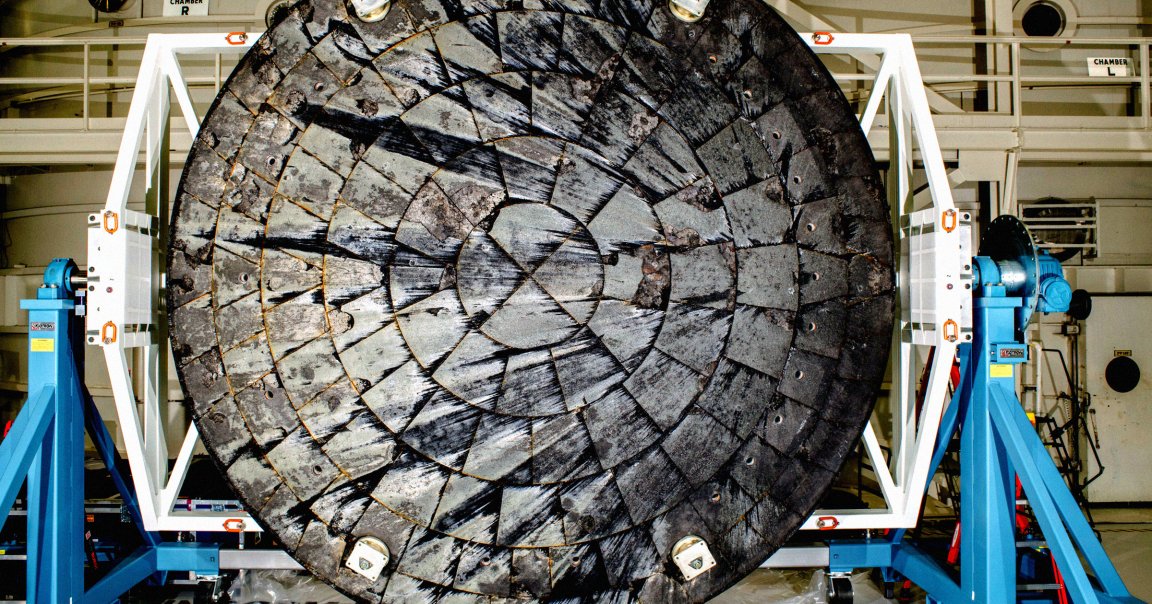
Specifically, NASA has spent years since its successful uncrewed Artemis 1 mission studying how the extreme temperatures during reentry into the Earth’s atmosphere affect Orion’s heat shield.

The Orion capsule sustained major damage after making its return in 2022. It cracked and chipped as a result of the extreme conditions during reentry.

Over two years after the mission concluded, NASA said it had identified the root cause, with engineers determining that the “gases generated inside the heat shield’s ablative outer material called Avcoat were not able to vent and dissipate as expected.”

“This allowed pressure to build up and cracking to occur, causing some charred material to break off in several locations,” the agency wrote in a December 2024 statement.

Yet instead of making major material changes to the heat shield itself after the fact — the Artemis 2 heat shield was assembled and installed even before the Artemis 1 mission — NASA opted to adjust the Artemis 2 mission’s flight path instead, to ensure a gentler reentry.

“Based on the data, we have decided — NASA unanimously and our decision-makers — to move forward with the current Artemis II Orion capsule and heat shield, with a modified entry trajectory,” former NASA administrator Bill Nelson announced at the time.

But not everybody is convinced that the space agency has sufficiently addressed the issue ahead of its first crewed Moon mission.

“What they’re talking about doing is crazy,” former NASA astronaut and heat shield expert Charlie Camarda told CNN.

Camarda has since teamed up with several other NASA research scientists, calling on the agency to heed their warnings.

“We could have solved this problem way back when,” he told the broadcaster. “Instead, they keep kicking the can down the road.”

NASA made changes to the way it applied the special Avcoat material to the Orion capsule from a honeycomb-like structure, as applied during Apollo missions, to larger blocks in order to simplify manufacturing, testing and installing it.

The material is designed to char and erode during “skip reentry,” a maneuver that NASA uses in which the spacecraft skips over the atmosphere like a stone before diving in. However, when it dipped back in during Artemis 1, gases built up below the heat shield, causing it to crack and break off.

The space agency is adamant that its new reentry path for Artemis 2 won’t result in gases building up in a similar manner.

“We won’t go as high on that skip, it’ll just be a loft,” Artemis flight director Rick Henfling told CNN.

Still, Camarda and other former NASA astronauts and engineersare warning that there could still be danger.

“The reason this is such a big deal is that when the heat shield is spalling — or you have big chunks coming off — even if the vehicle isn’t destroyed, you’re right at the point of incipient failure now,” thermal protection materials expert and NASA veteran Dan Rasky told CNN. “It’s like you’re at the edge of the cliff on a foggy day.”

How much of a danger a cracked heat shield poses remains a subject of debate.

“Will the heat shield crack? Yes, it’s going to crack,” former NASA astronaut Danny Olivas, who worked on the heat shield investigation, told CNN.

Nonetheless, Olivas is convinced that NASA did enough. Even if it were to crack, he says, the space agency built in redundancies in the form of several layers of defense below the Avcoat layer that will keep astronauts safe.

“I think in my mind, there’s no flight that ever takes off where you don’t have a lingering doubt,” he added. “But NASA really does understand what they have. They know the importance of the heat shield to crew safety, and I do believe that they’ve done the job.”

NASA’s recently sworn-in administrator, Jared Isaacman, is equally convinced.

“We have modified our reentry profile,” he told CNN affiliate WESH last week. “We have regained margin to safety, and I feel very good about that with Artemis 2.”

More on Artemis 2: 

{ https://futurism.com/category/astronomy  }

Hoe vind je dit bericht?
Geschreven door peter om 21:25 Stuur door

How to extract water on Mars

How to extract water on Mars

Soon, people may not only fly to Mars, but also stay there to live. And if that happens, they will have to find a way to obtain water there. Recently, scientists have compiled all the recipes for how this can be done.

How to obtain water on Mars? Source: www.labroots.com

Water extraction on Mars

A new study examines how future human missions to Mars could obtain one of the planet’s most important resources: water. The article, “Martian aqua: occurrence of water and appraisal of acquisition technologies,” published in the journal Advances in Space Research, presents a comparative analysis of potential water extraction technologies for use on the Red Planet.

It also assesses the feasibility of extracting water from various Martian sources, including underground ice, wet soil, and atmospheric vapor, based on the results of previous studies that identified these sources.

Human habitation

Despite the documented widespread presence of water in various forms on Mars, most of it remains inaccessible to early explorers. This new analysis brings these discoveries together and focuses on assessing how effectively water can be collected to support human habitation.

The author, Dr. Vassilis Inglezakis from the Department of Chemical and Process Engineering at the University of Strathclyde, said: “Reliable access to water would be essential for human survival on Mars, not only for drinking but also for producing oxygen and fuel, which would reduce dependence on Earth-based supplies.”

This study is one of the first to compare different technologies that can be used to collect water on Mars. It also offers new ideas for collecting atmospheric water, which could be a valuable alternative where other sources are unavailable.

The most promising sources of water

The article discusses each method in terms of energy costs, scalability, and suitability for different conditions on Mars. The analysis shows that subsurface ice is the most promising long-term source of water, while soil moisture and atmospheric vapor can provide additional reserves, especially in emergency situations or remote locations.

While the search for water continues and much of Mars remains unexplored, a clear understanding of available technologies and their realistic application will be key to supporting long-term missions and future colonization. The study provides insight for future space missions, supporting efforts to make them more self-sufficient and sustainable.

{ https://universemagazine.com/en/news-en/science-en/ }

Hoe vind je dit bericht?
Geschreven door peter om 21:13 Stuur door

NASA reveals list of most scientifically accurate sci-fi movies ever made

NASA reveals list of most scientifically accurate sci-fi movies ever made

NASA has shared a surprising list of movies it considers among the most scientifically accurate ever made. 

The films span nearly a century of cinema, from silent-era classics to modern blockbusters and were praised for respecting real scientific principles rather than relying on fantasy. 

According to NASA and NASA-affiliated scientists, accuracy is not about predicting the future perfectly, but about portraying science, scientists and technology realistically. 

Movies like Gattaca and Jurassic Park earned recognition for their grounded treatment of genetics, DNA and complex systems. 

Others, including Contact and The Day the Earth Stood Still, made the list for their realistic depictions of space exploration, radio astronomy and extraterrestrial contact.

Even early science-fiction films, such as Metropolis, released in 1927, and the 1929 Woman in the Moon, were praised for their societal and ethical consequences of advanced technology and rocket science.

NASA has noted that these movies take science seriously, showing careful experimentation, skepticism, and problem-solving rather than magical solutions. 

Together, the list highlights how some of Hollywood's most enduring science-fiction stories were built on ideas that remain scientifically sound decades later. 

Gattaca (1997) 

Set in a future where people are judged by their DNA, Gattaca follows a man born without genetic enhancements who dreams of traveling to space

Set in a future where people are judged by their DNA, Gattaca follows a man born without genetic enhancements who dreams of traveling to space

RELATED VIDEOS ( all videos selected and attached by peter2011 )


{ https://www.dailymail.co.uk/sciencetech/index.html }

Hoe vind je dit bericht?
Geschreven door peter om 21:01 Stuur door

What will really happen when the world ends: NASA reveals how our Sun will eventually SWALLOW Earth - before spitting out fresh planets

NASA has revealed a terrifying glimpse into our solar system's grizzly fate.

In five billion years, scientists believe the sun will collapse, leaving behind a shell of gas and dust.

When this happens, Earth will be consumed by the expanding sun or torn apart by powerful gravitational forces, before fresh planets are spat back out. 

Now, in stunning new images, the James Webb Space Telescope (JWST) shows exactly what this might look like.

Located 650 light–years from Earth, the Helix Nebula is a shell of dust and gas left behind by a sun–like star that ran out of fuel thousands of years ago.

Astronomers have revealed incredible structures inside the three–light–year–wide ring of gas shed by this dying star. 

According to the space agency, these images offer an 'up–close view of the possible eventual fate of our own Sun and planetary system.'

The situation is not entirely bleak, as these strange structures could contain the raw materials for new worlds capable of supporting complex life. 

NASA has revealed the most detailed images yet of the Helix Nebula, the remains of a dying star 650 light-years from Earth (pictured)

NASA has revealed the most detailed images yet of the Helix Nebula, the remains of a dying star 650 light–years from Earth (pictured)

Throughout most of a star's life, the crushing weight of gravity is balanced by the force of nuclear fusion as hydrogen is converted into helium inside the stellar core.

Stars like our sun can remain in this stable 'main sequence' phase for billions of years as they work through massive reserves of atomic hydrogen.

But as the hydrogen starts to run out, the star can't sustain these fusion reactions and the outer layers begin to collapse inwards.

The pressure from this collapse creates such intense heat that it can fuse helium atoms into carbon, releasing a surge of energy that kickstarts nuclear fusion in the outer layers.

That reaction causes the star's outer layers to balloon outwards, becoming 100 to 1,000 times larger and cooling into an enormous Red Giant.

Eventually, the core collapses into a hot, Earth–sized star called a White Dwarf, leaving the outer layers to drift into space and form a planetary nebula like the Helix Nebula.

The intense radiation from the White Dwarf at the nebula's heart lights up the expanding shell of gas, allowing us to see the details of the stellar transformation.

In the JWST image, although the White Dwarf is out of frame, NASA reveals how the star's radiation continues to sculpt remarkable structures in its surroundings.

NASA says that these images of the distant Helix Nebula offer a vision of what might happen to our sun and planetary system when the sun dies in around five billion years

NASA says that these images of the distant Helix Nebula offer a vision of what might happen to our sun and planetary system when the sun dies in around five billion years 

Scientists say that the material jettisoned into space by the nebula will eventually go on to form new planets in other solar systems

Scientists say that the material jettisoned into space by the nebula will eventually go on to form new planets in other solar systems 

A star's life cycle

Around 90 per cent of stars in the sun are what scientists call 'main sequence' stars.

These are stars that fuse hydrogen into helium in their cores, and range from about a tenth of the mass of the sun to about 200 times as massive.

Main sequence stars start as clouds of gas and dust, which collapse under gravity into 'protostars'.

When a protostar is dense enough, the pressure and heat start nuclear fusion and a star is born.

Stars keep burning helium until it runs out in around 10 to 20 billion years.

At this point, stars will enter the post–main sequence phase and become red dwarfs, white dwarfs, red giants, or even explode into neutron stars, depending on their size.  

While previous images from the Hubble Space Telescope only rendered this region as a hazy blur, the NIRCam shows the stark transition between hot and cool gas.

In the picture, the touches of blue light mark the hottest regions, where gases are energised by the ultraviolet light from the White Dwarf.

Farther out, yellow regions show cooler areas where hydrogen atoms can form into molecules, while red indicates the coolest areas where the gas thins and dust starts to form.

Scientists believe that our own sun will begin this transformation in around five billion years, likely destroying Earth in the process.

As the sun expands, Earth will either be vaporised by the intense heat or torn to pieces and pulled in by the powerful gravitational tidal forces.

In a paper published last year, scientists found that stars which had already expanded into red giants were much less likely to host large, close–orbiting planets like Earth.

Overall, 0.28 per cent of stars surveyed were home to a giant planet, with the youngest stars in the sequence having planets more frequently.

But for stars that had already grown enough to be classed as red giants, just 0.11 per cent were home to planets.

In about five billion years, scientists say that the sun will burn the last of its hydrogen fuel. When this happens, it will expand to about 200 times its current size to become a red giant and destroy Earth (artist's impression)

In about five billion years, scientists say that the sun will burn the last of its hydrogen fuel. When this happens, it will expand to about 200 times its current size to become a red giant and destroy Earth (artist's impression)

Although the sun would be destroyed, the material released into space could go on to make new planets capable of supporting carbon-based life. Pictured: The outer edge of the Helix Nebula as seen by Hubble

Although the sun would be destroyed, the material released into space could go on to make new planets capable of supporting carbon–based life. Pictured: The outer edge of the Helix Nebula as seen by Hubble 

However, Professor Janet Drew, an astronomer from University College London who was not involved in the study, says that this process is really about 'creation, rather than destruction'.

The JWST images show the cloud of hydrogen and dust that was formed in the 'envelope' of the extreme red giant before it was sloughed off to form the nebula.

Inside the nebula, Professor Drew says that this chemically enriched material is 'fed into the interstellar medium, where that material can become available for the next generation of stars and planets.'

NASA highlights cooler protective pockets inside the dust cloud, marked by dark patches amid the red and orange, where complex molecules can form.

It is that material which will eventually make its way back into the galaxy and seed the next generation of complex structures.

'So this is really about where the material comes from that is needed to form a rocky planet and sustain carbon–based life,' says Professor Drew.

So, when our planet is destroyed by the sun in five billion years' time, it might provide the raw materials needed to give rise to another generation of life.

WHAT WILL HAPPEN TO EARTH WHEN THE SUN DIES?

Five billion years from now, it's said the Sun will have grown into a red giant star, more than a hundred times larger than its current size. 

Eventually, it will eject gas and dust to create an 'envelope' accounting for as much as half its mass.

The core will become a tiny white dwarf star. This will shine for thousands of years, illuminating the envelope to create a ring-shaped planetary nebula.

Five billion years from now, it's said the Sun will have grown into a red giant star, more than a hundred times larger than its current size

Five billion years from now, it's said the Sun will have grown into a red giant star, more than a hundred times larger than its current size

While this metamorphosis will change the solar system, scientists are unsure what will happen to the third rock from the Sun.

We already know that our Sun will be bigger and brighter, so that it will probably destroy any form of life on our planet.

But whether the Earth's rocky core will survive is uncertain. 


{ https://www.dailymail.co.uk/sciencetech/index.html }

Hoe vind je dit bericht?
Geschreven door peter om 20:21 Stuur door

AI model that found 370 exoplanets now digs into TESS data

AI model that found 370 exoplanets now digs into TESS data

Story by Lauren Leese

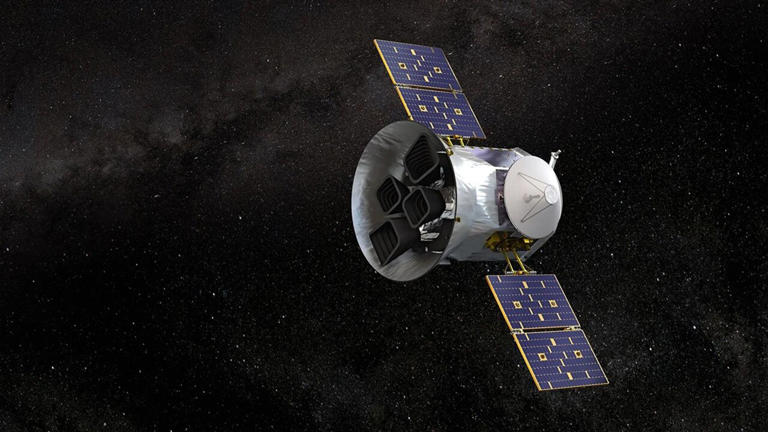
Artist's impression of NASA’s Transiting Exoplanet Survey Satellite (TESS), which launched in 2018 and has discovered nearly 700 exoplanets so far. NASA’s ExoMiner++ software is working toward identifying more planets in TESS data using artificial intelligence. Credit: NASA's Goddard Space Flight Center

Artist's impression of NASA’s Transiting Exoplanet Survey Satellite (TESS), which launched in 2018 and has discovered nearly 700 exoplanets so far. NASA’s ExoMiner++ software is working toward identifying more planets in TESS data using artificial intelligence.
Credit: NASA's Goddard Space Flight Center

Scientists have discovered over 6,000 planets that orbit stars other than our sun, known as exoplanets. More than half of these planets were discovered thanks to data from NASA's retired Kepler mission and NASA's current TESS (Transiting Exoplanet Survey Satellite) mission. However, the enormous treasure trove of data from these missions still contains many yet-to-be-discovered planets. All of the data from both missions is publicly available in NASA archives, and many teams around the world have used that data to find new planets using a number of techniques.

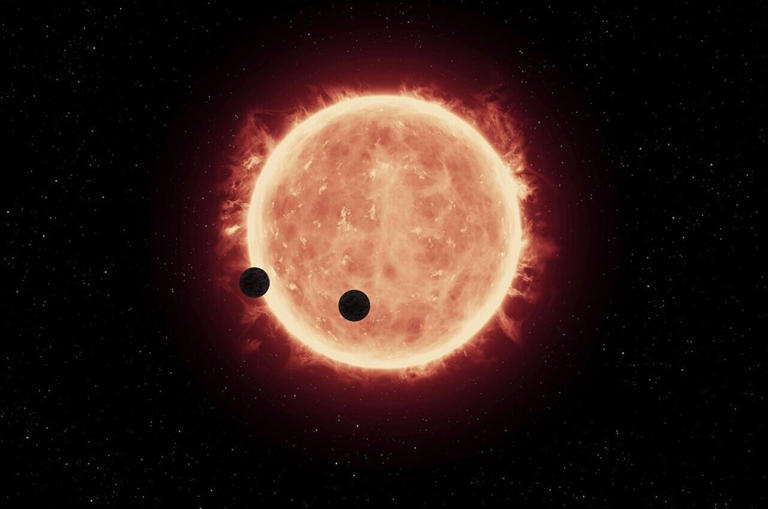
This artist's impression shows the star TRAPPIST-1 with two planets transiting across it. ExoMiner++, a recently updated open-source software package developed by NASA, uses artificial intelligence to help find new transiting exoplanets in data collected by NASA’s missions. Credit: NASA, ESA, and G. Bacon (STScI)

This artist's impression shows the star TRAPPIST-1 with two planets transiting across it. ExoMiner++, a recently updated open-source software package developed by NASA, uses artificial intelligence to help find new transiting exoplanets in data collected by NASA’s missions.
Credit: NASA, ESA, and G. Bacon (STScI)

In 2021, a team from NASA's Ames Research Center in California's Silicon Valley created ExoMiner, a piece of open-source software that used artificial intelligence (AI) to validate 370 new exoplanets from Kepler data. Now, the team has created a new version of the model trained on both Kepler and TESS data, called ExoMiner++.

The new algorithm, which is discussed in a recent paper published in The Astronomical Journal, identified 7,000 targets as exoplanet candidates from TESS on an initial run. An exoplanet candidate is a signal that is likely to be a planet but requires follow-up observations from additional telescopes to confirm.

ExoMiner++ can be freely downloaded from GitHub, allowing any researcher to use the tool to hunt for planets in TESS's growing public data archive.

"Open-source software like ExoMiner accelerates scientific discovery," said Kevin Murphy, NASA's chief science data officer at NASA Headquarters in Washington. "When researchers freely share the tools they've developed, it lets others replicate the results and dig deeper into the data, which is why open data and code are important pillars of gold-standard science."

ExoMiner++ sifts through observations of possible transits to predict which ones are caused by exoplanets and which ones are caused by other astronomical events, such as eclipsing binary stars. "When you have hundreds of thousands of signals, like in this case, it's the ideal place to deploy these deep learning technologies," said Miguel Martinho, a KBR employee at NASA Ames who serves as the co-investigator for ExoMiner++.

7 Earth-Like Planets Found by NASA — This Changes Everything

Kepler and TESS operate differently—TESS is surveying nearly the whole sky, mainly looking for planets transiting nearby stars, while Kepler looked at a small patch of sky more deeply than TESS. Despite these different observing strategies, the two missions produce compatible datasets, allowing ExoMiner++ to train on data from both telescopes and deliver strong results.

"With not many resources, we can make a lot of returns," said Hamed Valizadegan, the project lead for ExoMiner and a KBR employee at NASA Ames.

The next version of ExoMiner++ will improve the usefulness of the model and inform future exoplanet detection efforts. While ExoMiner++ can currently flag planet candidates when given a list of possible transit signals, the team is also working on giving the model the ability to identify the signals themselves from the raw data.

In addition to the ongoing stream of data from TESS, future exoplanet-hunting missions will give ExoMiner users plenty more data to work with. NASA's upcoming Nancy Grace Roman Space Telescope will capture tens of thousands of exoplanet transits—and, like TESS data, Roman data will be freely available in line with NASA's commitment to Gold Standard Science and sharing data with the public. The advances made with the ExoMiner models could help hunt for exoplanets in Roman data, too.

"The open science initiative out of NASA is going to lead to not just better science, but also better software," said Jon Jenkins, an exoplanet scientist at NASA Ames. "Open-source science and open-source software are why the exoplanet field is advancing as quickly as it is."

More information: 

  • This story was originally published on Phys.org.

{ physorg_com }

Hoe vind je dit bericht?
Geschreven door peter om 18:09 Stuur door

The Book of Enoch explained: Why it was removed from the Bible

The Book of Enoch explained: Why it was removed from the Bible

Story by Amy Granger

The Book of Enoch Explained: Why It Was Removed From the Bible

© Angelynum

The Book of Enoch Explained: Why It Was Removed From the Bible
The Book of Enoch is one of the most mysterious and debated texts associated with early Jewish and Christian traditions. Often referenced but rarely included in mainstream scripture, it offers visions of angels, fallen watchers, and cosmic judgment that are both fascinating and unsettling. Its vivid imagery and unconventional theology have made scholars and mystics alike question its place in the biblical canon. Here, we explore seven key ways to understand the Book of Enoch and examine why it was ultimately removed from the Bible, shedding light on its historical, spiritual, and symbolic significance.

1. Enoch as a Bridge Between Humans and Angels

© Angelynum

1. Enoch as a Bridge Between Humans and Angels
One of the most distinctive features of the Book of Enoch is its portrayal of Enoch himself as a mediator between humanity and celestial beings.

Unlike most figures in the Hebrew Bible, Enoch is taken directly into the heavens, guided by angels, and given knowledge of cosmic secrets.

The book describes “watchers,” angels who descended to Earth, interacted with humans, and shared forbidden knowledge.

This interaction between the divine and human worlds challenges traditional biblical boundaries, offering a vision of spirituality that is both expansive and controversial.

By presenting a human figure who directly experiences divine wisdom, the text blurs the line between mortal and celestial realms, a theme that may have made religious authorities wary of including it in scripture.

2. Detailed Accounts of Fallen Angels

© Angelynum

2. Detailed Accounts of Fallen Angels
The Book of Enoch is perhaps best known for its detailed account of the fallen angels, also called watchers, who rebelled against God.

These beings descended to Earth, taught humanity forbidden knowledge, and took human wives, producing a race of giants.

Such stories offer a vivid explanation for the presence of evil and corruption in the world, but they also challenge conventional theology.

The notion that angels could sin, reproduce, and dramatically influence human history was radical, and it conflicted with emerging orthodox views that emphasised strict separation between divine and mortal spheres.

The dramatic narratives of rebellion and judgment in Enoch may have been considered too speculative or sensational for inclusion in the canonical Bible.

3. Cosmic Visions of Heaven and Hell

© Angelynum

3. Cosmic Visions of Heaven and Hell
The Book of Enoch contains extensive descriptions of heaven, hell, and the structure of the cosmos.

Enoch is shown the places where angels dwell, the paths of celestial bodies, and the punishment awaiting sinful spirits.

These visionary accounts are much more detailed than most biblical texts, blending prophetic insight with apocalyptic imagery.

While this richness makes the book a treasure for mystics and esoteric traditions, it may have seemed incompatible with the theological frameworks being established during the formation of the Bible.

Church authorities might have viewed such elaborate cosmology as speculative, difficult to verify, or potentially misleading to believers.

4. Emphasis on Judgment and the End Times

© Angelynum

4. Emphasis on Judgment and the End Times
The Book of Enoch heavily emphasises divine judgment, the punishment of the wicked, and the eventual restoration of righteousness.

These apocalyptic themes were influential in shaping later Christian eschatology but were presented in ways that were strikingly different from canonical texts.

Enoch describes the final fate of the fallen angels, the coming flood, and the resurrection of the righteous, often with intense symbolism and graphic detail.

This intense focus on judgment, while spiritually compelling, may have been seen as too extreme or too divergent from mainstream theological narratives.

Its unique apocalyptic vision positioned it outside the bounds of accepted scripture, even as it influenced later biblical writings indirectly.

5. Unique Interpretations of Sin and Knowledge

© Angelynum

5. Unique Interpretations of Sin and Knowledge
In Enoch, sin is often linked to the transmission of forbidden knowledge rather than simple disobedience.

The watchers teach humans metalworking, astrology, and other arts that, while useful, corrupt the natural order and lead to moral decay.

This portrayal contrasts with the canonical Bible, where sin is more often a matter of disobedience, rebellion, or idolatry.

By presenting knowledge itself as potentially corrupting, the Book of Enoch raises challenging theological questions.

It implies that curiosity, learning, or divine insight can be dangerous, which may have conflicted with the emerging focus on moral instruction and obedience in the canonical texts.

6. Influence on Early Christianity and Controversy

© Angelynum

6. Influence on Early Christianity and Controversy
Despite its exclusion from the Bible, the Book of Enoch influenced early Christian thought. The Epistle of Jude in the New Testament directly references Enoch, and early church fathers were aware of its existence.

However, its inclusion sparked debate. Some early Christian leaders admired its moral teachings and apocalyptic vision, while others criticised its speculative nature and angelic focus.

The text’s ambiguity and complexity made it difficult to regulate, and its sensational stories risked misinterpretation.

As the canon solidified, church authorities likely chose to exclude it to maintain theological consistency and control over accepted doctrine.

7. Preservation and Continued Mystical Appeal

© Angelynum

7. Preservation and Continued Mystical Appeal
Though removed from the canonical Bible, the Book of Enoch survived through careful preservation in Jewish and Ethiopian traditions.

It was translated into multiple languages and studied by mystics, scholars, and occultists for centuries.

Its enduring appeal lies in its imaginative cosmology, moral lessons, and vivid portrayal of angels, demons, and human destiny.

By exploring forbidden knowledge, divine justice, and the structure of the universe, the text continues to inspire curiosity and spiritual reflection.

The reasons for its exclusion only add to its mysterious and mystical aura, making it a unique window into ancient spiritual imagination.

RELATED VIDEOS


{ Angely Numbers }

Hoe vind je dit bericht?
Geschreven door peter om 17:47 Stuur door

De geheimen van de reuzenplaneet Saturnus

De geheimen van de reuzenplaneet Saturnus

De bewaker van het buitenste zonnestelsel

©The Daily Digest

De bewaker van het buitenste zonnestelsel
Als zesde planeet vanaf de zon en het meest in het oog springende hemellichaam van het zonnestelsel, overstijgt Saturnus zijn eenvoudige omschrijving. Zijn ringen, bestaande uit stukken ijs en gesteente die in perfecte banen zweven, hebben generaties astronomen gefascineerd, van Galileo tot moderne ruimtesondes, en onthullen een wereld vol gigantische stormen, bijzondere manen en raadselachtige zwaartekrachtverschijnselen.

Een gasreus van immense omvang

©The Daily Digest

Een gasreus van immense omvang
Met een doorsnee van ongeveer 120.500 kilometer is Saturnus negen keer breder dan de aarde. National Geographic benadrukt dat het een ‘gasreus’ is, die voornamelijk uit waterstof en helium bestaat. Zijn massa is 95 keer zo groot als die van de aarde, maar door de lage gemiddelde dichtheid zou hij in theorie kunnen drijven in een enorme oceaan.

De planeet met de beroemde ringen

©The Daily Digest

De planeet met de beroemde ringen
De ringen van Saturnus zijn niet massief. Volgens NASA bestaan ze uit ‘miljarden stukjes ijs, steen en stof’. Ze reiken tot 280.000 kilometer vanaf de planeet, maar hun gemiddelde dikte bedraagt slechts enkele honderden meters. Deze kwetsbaarheid maakt ze tot een schitterende, maar vergankelijke structuur.

Het raadsel van het ontstaan

©The Daily Digest

Het raadsel van het ontstaan
Jarenlang hebben wetenschappers gediscussieerd over het ontstaan van de ringen. National Geographic meldt dat het mogelijk overblijfselen zijn van manen die door de zwaartekracht van Saturnus zijn vernietigd. Gegevens van Cassini wijzen erop dat de ringen tussen 100 en 400 miljoen jaar oud zijn, relatief jong op astronomische schaal.

Een korte dag en een lang jaar

©The Daily Digest

Een korte dag en een lang jaar
Op Saturnus duurt een dag slechts 10,7 uur. Zijn baan om de zon is echter traag: een Saturnusjaar duurt ongeveer 29,5 aardse jaren. Deze combinatie zorgt voor krachtige winden en hardnekkige atmosferische patronen die decennia standhouden.

Extreme winden en heftig weer

©The Daily Digest

Extreme winden en heftig weer
De atmosfeer van Saturnus kent winden tot wel 1800 km/u, aldus NASA. Gele, gouden en bruine wolkenbanden trekken over de planeet. National Geographic wijst op enorme stormen die de hele planeet kunnen omspannen en zelfs vanaf de aarde zichtbaar zijn met telescopen.

De beroemde zeshoek op de noordpool

©The Daily Digest

De beroemde zeshoek op de noordpool
Een van de opvallendste verschijnselen is de zeshoekige structuur op de noordpool. Ontdekt door Voyager en verder onderzocht door Cassini, heeft dit stabiele geometrische patroon een breedte van zo’n 30.000 kilometer. NASA beschrijft het als een ‘zeszijdige straalstroom’, uniek in het zonnestelsel.

Een planeet zonder vaste bodem

©The Daily Digest

Een planeet zonder vaste bodem
In tegenstelling tot de aarde heeft Saturnus geen vast oppervlak om op te landen. National Geographic geeft aan dat de druk en temperatuur toenemen naarmate men afdaalt in zijn atmosfeer, tot de gassen veranderen in dichte vloeistoffen. Elke sonde zou worden verpletterd lang voordat een denkbare kern wordt bereikt.

Het verborgen binnenste

©The Daily Digest

Het verborgen binnenste
Wetenschappers vermoeden dat Saturnus een vaste kern heeft van gesteente en ijs. NASA schat dat deze een massa heeft van 10 tot 20 keer die van de aarde. Rondom deze kern bevindt zich metallic waterstof, die verantwoordelijk is voor het sterke magnetische veld.

Een opmerkelijk magneetveld

©The Daily Digest

Een opmerkelijk magneetveld
Het magneetveld van Saturnus is minder krachtig dan dat van Jupiter, maar bijzonder symmetrisch. Volgens NASA is het bijna perfect uitgelijnd met de rotatieas van de planeet. Deze bijzonderheid vormt een uitdaging voor klassieke modellen van het ontstaan van magnetische velden bij planeten.

Meer dan 140 bekende manen

©The Daily Digest

Meer dan 140 bekende manen
Saturnus vormt een waar miniplanetenstelsel. Tot 2023 waren er meer dan 140 manen bevestigd. National Geographic merkt op dat sommige manen nauwelijks meer zijn dan grillige rotsblokken, terwijl andere, zoals Titan, qua complexiteit met planeten kunnen wedijveren.

Titan, een maan met een atmosfeer

©The Daily Digest

Titan, een maan met een atmosfeer
Titan is het pronkstuk onder de manen van Saturnus. Het is de op een na grootste maan in het zonnestelsel en de enige met een dikke atmosfeer. NASA verklaart dat ‘Titan een van de meest aardachtige werelden is’, hoewel de chemie wordt gedomineerd door koolwaterstoffen.

Meren van methaan en ethaan

©The Daily Digest

Meren van methaan en ethaan
Op Titan komen zeeën en meren voor, maar deze bestaan niet uit water. National Geographic beschrijft dat ze gevormd worden door vloeibaar methaan en ethaan. Deze vloeistoffen maken deel uit van een klimaatsysteem dat vergelijkbaar is met de waterkringloop op aarde, maar werkt bij temperaturen rond de −180 °C.

Enceladus en zijn geisers

©The Daily Digest

Enceladus en zijn geisers
Een andere belangrijke maan is Enceladus. Cassini ontdekte geisers van zout water die de ruimte in worden gespoten. NASA meldt dat deze uitbarstingen essentiële bouwstenen voor leven bevatten. Onder het ijs zou zich een wereldwijde oceaan kunnen bevinden.

Een natuurlijk laboratorium voor de wetenschap

©The Daily Digest

Een natuurlijk laboratorium voor de wetenschap
Saturnus biedt mogelijkheden om fundamentele processen te onderzoeken: planeetvorming, atmosferische dynamiek en de evolutie van ringen. National Geographic geeft aan dat waarnemingen van deze planeet inzicht bieden in het verleden van het zonnestelsel, toen de reuzenplaneten het jonge systeem domineerden.

De Cassini-Huygens missie

©The Daily Digest

De Cassini-Huygens missie
Tussen 2004 en 2017 veranderde Cassini ons beeld van Saturnus volledig. NASA omschrijft deze missie als een ‘spectaculair succes’. Meer dan 450.000 beelden en waardevolle data over de ringen, manen en atmosfeer werden verzameld.

Het geplande einde van een ruimtesonde

©The Daily Digest

Het geplande einde van een ruimtesonde
Cassini beëindigde zijn missie door zichzelf in Saturnus te storten, om te voorkomen dat mogelijk bewoonbare manen besmet zouden raken. Volgens NASA was dit de ‘grand finale’. Tijdens deze afdaling werden nooit eerder verkregen gegevens over de bovenste atmosfeer verzameld.

Een planeet zichtbaar vanaf aarde

©The Daily Digest

Een planeet zichtbaar vanaf aarde
Saturnus is met het blote oog te zien vanaf onze planeet. Zijn heldere gloed en geelachtige kleur maakten hem al in de oudheid herkenbaar. National Geographic geeft aan dat oude beschavingen hem al kenden als een dwalende ster, lang voordat de pracht van zijn ringen werd ontdekt.

Een reus die nog steeds raadsels biedt

©The Daily Digest

Een reus die nog steeds raadsels biedt
Ondanks decennia van onderzoek zijn er nog steeds onbeantwoorde vragen over Saturnus. Hoe lang blijven zijn ringen bestaan? Wat gebeurt er precies in het binnenste? National Geographic benadrukt dat elke ontdekking weer nieuwe raadsels oproept, waardoor deze ringplaneet ons blijft fascineren.

GERELATEERDE VIDEO'S


{ The Daily Digest }

Hoe vind je dit bericht?
Geschreven door peter om 17:19 Stuur door

os Alamos Scientists Use Sonic Booms and Seismic Data to Track Objects Entering Earth’s Atmosphere

Image by WikiImages from Pixabay

Los Alamos Scientists Use Sonic Booms and Seismic Data to Track Objects Entering Earth’s AtmosphereL

Researchers from Los Alamos National Laboratory have presented a new method for tracking objects, including uncontrolled space debris, entering Earth’s atmosphere, using ground-based seismic sensors rather than optical and radar tracking or other costly, complex approaches.

The new approach could assist efforts to alert people on the ground about falling space debris that could pose a danger to property and individuals.

Dangers Rising from an Increasing Population of Falling Objects entering Earth’s Atmosphere

Since the Soviet Union launched humanity’s first spacecraft in 1957, thousands of satellites and other objects have been rocketed into Low Earth Orbit (LEO). As the population of space-based objects has grown, incidents of falling debris causing damage on the ground have increased. These incidents are only expected to increase as LEO continues to fill up.

While the kinetic effects of falling debris can be catastrophic, the Los Alamos researchers note that uncontrolled re-entry of spacecraft can pose additional threats. For example, a spacecraft carrying radioactive materials could pose a larger danger than a single crashed satellite. Many of these crafts also contain toxic and flammable materials, further increasing the potential hazards posed by their re-entry.

Unfortunately, predicting when and where such events will occur is extremely difficult. The problem is compounded by limitations in ground-based radar and optical tracking systems designed to monitor LEO for potential threats, since these objects begin to disintegrate as they enter the atmosphere.

These limitations motivated Los Alamos scientists Benjamin Fernando and Constantinos Charalambous to look for alternative methods to track disintegrating objects and predict when and where they might strike land.

Tracking the Reentry of Shenzhou-15 Reentry Confirms New Approach

According to a statement detailing the team’s novel debris-tracking approach, they began by examining publicly available data from ground-based seismic sensors to search for signs of shockwaves, or sonic booms, caused by reentering debris. As a test case, they focused their search on the April 2024 reentry of China’s large and heavy Shenzhou-15 orbital module.

Before its reentry, the abandoned module had been in a decaying orbit that regularly passed over many population centers around the globe. The falling object’s sheer size and toxic material components stoked fears that its eventual reentry could be catastrophic.

tracking objects entering Earth's atmosphere

An artist’s impression of the re-entering debris breaking up over California and generating a sonic boom, which propagates down to the ground and is recorded by seismometers.

Image Credit: Sophia Economon and Benjamin Fernando

After scanning seismic sensor data from sensors placed throughout Southern California and Nevada, the team spotted the telltale sonic booms of Shenzou-15’s atmospheric reentry. Using mathematical models, the team successfully interpolated the arrival times of the largest shockwaves from the module’s reentry at different locations across the southern US.

The team said that this data allowed them to estimate Shenzhou-15’s altitude, speed, and ground track with surprising accuracy. Specifically, the observed reentry location and the Tracking and Impact Prediction estimate, which placed the landing spot somewhere in the Atlantic Ocean, were 8,600 kilometers apart.

tracking objects entering Earth's Atmosphere

Shenzhou 15 Orbital Module reentry seen from Big Bend National Park (bottom right). Note also Milky Way (center) and Zodiacal Light (right).

By Astrovenator – Own work, CC BY-SA 4.0,

https://commons.wikimedia.org/w/index.php?curid=148039767

The data also revealed that the module did not fall in a single event but instead fragmented over time into progressively smaller pieces. Notably, the team said that the spacecraft’s breakup matched eyewitness reports.

Unlocking the Rapid Identification of Debris Fall-Out Zones

When discussing potential applications of their novel seismic reentry-tracking approach, the Los Alamos team said this technology could be used to track debris on the ground after impact, aiding search-and-recovery efforts. The approach could also help scientists track  the spread of smaller hazardous particles in Earth’s atmosphere, which they call “crucial for recovery and contamination mitigation.”

Scientist Chris Carr noted that further research will be needed to shorten the time needed to calculate an object’s trajectory once its sonic booms and shockwaves have been detected. However, Carr also praised the Los Alamos team’s method, stating that Fernando and Charalambous’ approach “unlocks the rapid identification of debris fall-out zones, which is key information as Earth’s orbit is anticipated to become increasingly crowded with satellites, leading to a greater influx of space debris.”

RELATED VIDEOS

{ https://thedebrief.org/category/space/ }

Hoe vind je dit bericht?
Geschreven door peter om 15:30 Stuur door

'This is the biggest UFO bombshell of 2026': Retired colonel testimony points to secret non-human recovery mission in Brazil

A retired US Air Force fighter pilot claims there is likely an extensive 'paper trail' proving that one of the most infamous UFO encounters of the last three decades really happened.

Colonel Fred Claussen, who was awarded the Distinguished Flying Cross twice during his career, came forward during a press conference in Washington on Tuesday to reveal who would know about the 1996 incident in Varginha, Brazil.

The alleged incident began on January 13, 1996, when locals reported seeing a UFO crash-landing in a field near Varginha, followed by sightings of strange creatures described as walking on two legs, but having oily brown skin and large red eyes.

In fact, three young women claimed they found one of the extraterrestrials hiding behind a wall near the crash site.

Despite reports that Brazilian police and military captured at least two aliens, the US Air Force allegedly confiscated all of the wreckage, the bodies of dead aliens, and the survivors of the crash, starting a supposed cover-up that has lasted for 30 years.

To this date, the US military has said there has never been any physical evidence recovered that proves the existence of UFOs or alien life, and has not confirmed that this recovery ever took place.

However, Claussen spoke at an event at the National Press Club organized by investigative filmmaker James Fox, which gathered witnesses and other experts to expose what they claim has been buried about the Varginha crash.

'If true, I am certain that 30 to 40 Americans had direct knowledge of this flight and its purpose,' Claussen said.

Former Air Force pilot Fred Claussen (Pictured) claimed that dozens of US military personnel likely know about an alleged UFO crash landing in Brazil in 1996

Former Air Force pilot Fred Claussen (Pictured) claimed that dozens of US military personnel likely know about an alleged UFO crash landing in Brazil in 1996

Carlos de Souza, witness of an alleged UFO crash in Varginha, Brazil in 1996, speaks at a press conference on UFO encounters at the National Press Club on Tuesday

Carlos de Souza, witness of an alleged UFO crash in Varginha, Brazil in 1996, speaks at a press conference on UFO encounters at the National Press Club on Tuesday

Often called the 'Brazilian Roswell,' Claussen said that even secret missions involve multiple military personnel and various orders that create documented evidence of their existence. 

The decorated Air Force veteran explained that if the US military did launch a UFO recovery mission to Brazil, it would have started within Air Mobility Command at Scott Air Force Base in Illinois. 

They would have received the initial order to send a cargo plane, so senior officers there would have known the Varginha crash existed.

'An international flight plan to Brazil is required even if the mission is classified. Paper trail,' Claussen declared.

From there, a specific Air Mobility Wing at Charleston Air Force Base in South Carolina would have received a detailed mission order, selected a crew, and prepared a C-17 aircraft for launch - involving dozens of people.

Pilots, loadmasters, schedulers, and commanders at that base would have been in the loop in 1996, and Claussen was convinced the proof of that UFO crash still exists.

Along with the witnesses from Brazil and other UFO researchers, Claussen then challenged the Air Force personnel who allegedly flew to Brazil to become whistleblowers and expose what really happened in 1996.

'We know this mission happened, and you know it, too. Come forward. The time is now,' the former pilot said.

Witnesses claimed that a cigar-shaped object crashed on a local farm and was quickly recovered by Brazilian military and police

Witnesses claimed that a cigar-shaped object crashed on a local farm and was quickly recovered by Brazilian military and police

According to witnesses, multiple non-human aliens were still alive and were captured after the crash in Varginha, Brazil in January 1996 (Stock Image)

According to witnesses, multiple non-human aliens were still alive and were captured after the crash in Varginha, Brazil in January 1996

(Stock Image)

article image

The incident 30 years ago played out over several days and also involved the death of a Brazilian police officer who was allegedly contaminated by one of the aliens.

On January 13, 1996, witnesses in Varginha spotted a cigar-shaped UFO that looked damaged and had white smoke pouring out of it.

The supposed spacecraft crashed on a farm outside the city, where witness Carlos de Souza, who attended Tuesday's press conference, found scattered debris and a strange, lightweight metal that reshaped itself after being crumpled.

However, soldiers quickly arrived and de Souza claimed he was ordered to leave at gunpoint. Later, two mysterious men in suits allegedly threatened him at a gas station to stay silent about what he saw.

'You saw nothing. You know nothing. Or you will have problems for the rest of your life,' de Souza recounted about his meeting with the unidentified men.

Days later, on January 20, the three young women encountered a reportedly scared, non-human being in a vacant lot that had a strong ammonia smell.

Brazilian military and police captured at least two of these beings that same day, including one grabbed bare-handed by officer Marco Eli Chereze, whose skin was scratched during the capture.

Chereze developed a deadly infection from the alleged scratch and died weeks later.

Dr Armando Monteiro, a forensic pathologist who performed the autopsy on Chereze, revealed during the press conference that he discovered a rare, aggressive bacterium that doctors suspected might have been of alien origin in the officer's wound.

Soon after, the beings and debris were reportedly transported to a Brazilian airport, where the secret C-17 cargo plane allegedly loaded them and flew back to America.

Although witnesses have maintained that everything they saw was real, no evidence from the reported crash site has been seen again, and the death of Chereze was reportedly listed as an infection due to the Earth bacteria strain Staphylococcus schleiferi.

RELATED VIDEOS

{ https://www.dailymail.co.uk/sciencetech/index.html }

Hoe vind je dit bericht?
Geschreven door peter om 22:59 Stuur door

Network of Home Computers Detected 100 Potential Alien Signals

Network of Home Computers Detected 100 Potential Alien Signals

Here's what they found.

For over two decades, millions volunteered their computers to help UC Berkeley scientists in their search for extraterrestrial intelligence.

Seti @home / Getty / Futurism

For over two decades, millions of people volunteered the computational capacity of their computers to help UC Berkeley scientists in their search for extraterrestrial intelligence (SETI).

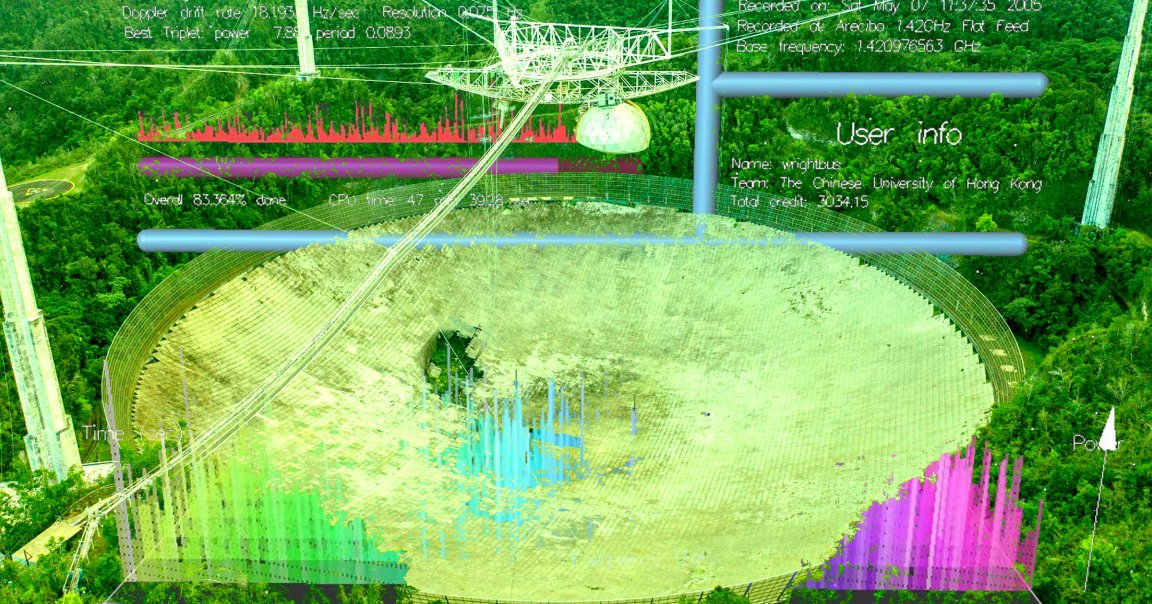
The goal of the project, called SETI@home, was to trawl through data collected by the Arecibo Observatory in Puerto Rico for signs of unusual radio signals from the cosmos. It was a powerful example of “distributed computing,” which relies on a huge network of individual computers — but whether the search has borne any fruit remains unclear as scientists continue to analyze the wealth of data.

SETI@home concluded after 21 years in 2020, producing a whopping 12 billion detections, according to a UC Berkeley press release, making it “one of the most popular crowd-sourced research projects ever.”

Over the years, researchers whittled down the data to just 100 signals that were “worth a second look” by eliminating radio frequency interference and noise with the help of a supercomputer. Since July, they’ve been using China’s Five-hundred-meter Aperture Spherical Telescope (FAST), in the hopes of catching another glimpse of the identified targets.

Unfortunately, the Arecibo Observatory — once the world’s largest radio telescope — collapsed during a storm in 2020, and is being decommissioned.

Even if the project never leads to first contact with an intelligent extraterrestrial species, it doesn’t mean SETI@home was a waste of time. Researchers are still trawling through the FAST data, but early conclusions of the project and its effectiveness have already resulted in two papers that were published last year in The Astronomical Journal.

“If we don’t find ET, what we can say is that we established a new sensitivity level,” said project cofounder David Anderson in a statement. “If there were a signal above a certain power, we would have found it.”

The team is hoping to inspire a successor to the crowdsourced research project, while applying what they’ve learned.

“Some of our conclusions are that the project didn’t completely work the way we thought it was going to,” Anderson said. “And we have a long list of things that we would have done differently and that future sky survey projects should do differently.”

Astronomer and project director Eric Korpela also pointed out that the considerable amount of radio interference, which can emanate from other sources, including radio and TV broadcasts and even microwave ovens, could seriously mess with the data.

“We have to do a better job of measuring what we’re excluding,” he said. “Are we throwing out the baby with the bath water? I don’t think we know for most SETI searches, and that is really a lesson for SETI searches everywhere.”

Given the lack of a smoking gun after trawling “billions and billions” of stars in the Milky Way, the project left the alien-hunting organizers somewhat deflated.

“We are, without doubt, the most sensitive narrow-band search of large portions of the sky, so we had the best chance of finding something,” Korpela explained. “So yeah, there’s a little disappointment that we didn’t see anything.”

However, the researcher hasn’t given up on the idea, particularly given the immense advancements in computer power and improved internet connections.

“I think that you could still get significantly more processing power than we used for SETI@home and process more data because of a wider internet bandwidth,” Korpela said. However, “the biggest issue with such a project is that it requires personnel, and personnel means salaries. It’s not the cheapest way to do SETI.”

And plenty of what-ifs remain, especially considering the limitations of the SETI@home project.

“There’s still the potential that ET is in that data and we missed it just by a hair,” he pondered.

More on radio signals: 

{ https://futurism.com/ }

Hoe vind je dit bericht?
Geschreven door peter om 22:35 Stuur door

NASA Scientist Proposes Theory of Alien Civilizations Throughout Milky Way

NASA Scientist Proposes Theory of Alien Civilizations Throughout Milky Way

But that's where the fun ends.
Hoe vind je dit bericht?
Geschreven door peter om 22:25 Stuur door

Humanity returns to the Moon: Artemis II mission flight plan

Humanity returns to the Moon: Artemis II mission flight plan

Soon we will witness a truly spectacular event. For the first time since 1972, a rocket carrying four astronauts will embark on a journey to the Moon. We will explain when the Artemis II flight is scheduled to take place and how it will proceed.

Launch windows for the flight to the Moon

NASA cannot launch a mission to the Moon at any given time. The launch date is determined by orbital mechanics and the relative positions of celestial bodies, which allows the Moon’s gravity to be used to return the spacecraft with astronauts to Earth without using its main engine (this reduces the risks for the expedition).

Possible launch dates for the Artemis II mission. Source: NASA

The closest launch windows for the Artemis II flight to the Moon will be open from February 6 to 8 and February 10 to 11. If the SLS rocket cannot be launched within these time frames, the next launch windows will be open on the following dates:

  • March – 6th, 7th, 8th, 9th, and 11th.
  • April – 1st, 3rd, 4th, 5th, 6th, and 30th.

It is interesting to note that almost all of the upcoming ballistic windows suggest that Artemis II will only be launched at night. Theoretically, the mission could be launched at dawn at the end of the ballistic window on April 1. The window on April 30 provides an opportunity to launch shortly before sunset.

Launch of the SLS rocket. Source: Bill Ingalls/NASA

The exact launch date will depend not only on the technical readiness of the SLS rocket and Orion spacecraft, but also on several external factors, such as weather conditions, wind speed, and cloud cover. Solar activity will also be taken into account. The Artemis II flight will take place outside the Earth’s magnetic field. If, during the launch period, the Sun produces powerful flares or there is a high probability of them occurring, NASA will almost certainly postpone the flight.

Artemis II launch

Now let’s talk in more detail about how the Artemis II flight itself will proceed. Approximately 3.5 hours before launch, the four astronauts will board the Orion spacecraft, after which technicians will close the spacecraft hatch. The first stage engines of the SLS rocket will be activated 6 seconds before launch – at this stage, the launch can still be canceled. Once the side solid rocket boosters ignite, this will no longer be possible.

Artemis II mission launch diagram. Source: NASA

The separation of the SLS solid rocket boosters will occur at 129 seconds into the flight, when the rocket will be at an altitude of 47.5 km. Approximately one minute after that, the “tower” – a solid rocket motor installed at the top of the nose cone – will be jettisoned. It is used as an emergency rescue system: in the event of an emergency, the rocket must “pull out” the capsule with the astronauts and take it away from the SLS. The separation will occur at an altitude of 87 km, which is slightly below the Kármán line, accepted as the boundary of outer space.

At 495 seconds into the flight, the first stage will separate. At this point, Orion will still be on a suborbital trajectory. When the spacecraft reaches apogee, the upper stage of the SLS will be activated. An hour later, another altitude increase maneuver will be performed. They will bring Orion into an elongated near-Earth orbit with a perigee altitude of 185 km and an apogee altitude of 70,000 km. For comparison, the ISS is in a circular orbit at an altitude of approximately 415 km.

In orbit around Earth

Upon completion of the maneuvers, Orion will separate from the upper stage, after which the next stage of the flight will begin, lasting 23 hours. Initially, the astronauts will switch the spacecraft to manual control and perform a series of approaches to the upper stage of the SLS. These operations will provide a unique experience that cannot be gained on Earth and will yield valuable data that will be useful in planning future missions involving docking and undocking in lunar orbit.

Artemis II mission flight plan. Source: NASA

After completing the rendezvous, the crew will return control of Orion to mission controllers and spend the remaining time checking the functionality of all spacecraft components. Key attention will be paid to the life support system. The astronauts will also test communications and navigation. Orion will briefly leave the coverage area of GPS and TDRS satellites, which will allow NASA to test the technical capabilities of its Deep Space Network.

At this stage, a payload will also be deployed – several CubeSats provided by countries that are parties to the Artemis Accords.

If the checks do not reveal any significant problems, NASA will give the green light to the next stage of the mission – the flight to the Moon. On the second day, Orion will activate its main engine and perform a maneuver that will send it towards our planet’s satellite. The spacecraft will follow a trajectory resembling a giant figure eight. As for the upper stage of the SLS, NASA will also activate its engine and direct it into the atmosphere above an uninhabited area of the Pacific Ocean to prevent it from becoming space debris.

Flight to the Moon and back

During the flight to the Moon, the spacecraft will perform three minor course corrections. Before the crew goes to sleep on the fifth day of the flight, Orion will enter the Moon’s sphere of influence, where its gravitational pull will become stronger than Earth’s gravitational pull.

The Orion spacecraft against the backdrop of the Moon. Source: NASA

The exact distance at which the Artemis II crew will fly past the Moon will depend on the launch date. In each of the possible ballistic windows, the Moon will be in a different location, and the flyby distance will vary accordingly: it can range from 6,500 to 13,000 km. This is hundreds of thousands of kilometers closer than any human has come to our planet’s satellite since 1972. At this distance, the Moon will appear to the crew to be the size of a basketball held at arm’s length.

The closest approach will occur when Orion flies over the far side of the Moon. At that moment, depending on the launch time, the crew will lose contact with Earth for 30 to 50 minutes. During this interval, the astronauts will take photographs and videos of the far side of the Moon, as well as conduct observations. At approximately this time, the Artemis II crew is expected to break the record for distance from Earth, set by Apollo 13.

The Artemis II flight path is designed so that the crew will not need to perform any maneuvers using the main engine, eliminating the risk of an accident and the possibility of them getting “stuck” near the Moon. When the spacecraft rounds the Moon and leaves its sphere of influence, Earth’s gravity will “catch” it and direct it toward our planet. As during the flight to the Moon, the crew will perform three small course corrections during this leg for more accurate guidance. The last maneuver will be performed on the 10th day of the flight, five hours before landing.

Shortly before entering the atmosphere, the astronauts will separate the Orion service module. This will expose the heat shield of the crew capsule. At its peak, it will be exposed to temperatures of up to 2,800 °C. This is about a thousand degrees higher than missions returning from the ISS. This difference is because Orion will enter the Earth’s atmosphere at a much higher second cosmic velocity. As the heated plasma completely envelops the spacecraft, NASA will lose all contact with it for several minutes.

Landing of the Orion spacecraft capsule. Source: NASA

If everything goes well, Orion will first deploy two brake parachutes, followed by three main parachutes. The capsule with four astronauts will splash down in the Pacific Ocean, after which it will be picked up by ships.

After returning

The Artemis II mission is largely a test mission. It is intended to demonstrate the reliability of Orion and its ability to support interplanetary missions. The flight will also have enormous symbolic significance. For the first time in more than half a century, humans will leave the vicinity of our planet. The Artemis II mission could help to increase the popularity of space exploration.

Starship HLS on the Moon (concept). Source: SpaceX

Artemis II will pave the way for the next mission, Artemis III, which plans to land two astronauts on the south pole of the Moon. It is currently scheduled for 2027. However, in reality, the date will almost certainly change, as many elements of the expedition are not yet ready – from the Starship HLS spacecraft to the lunar spacesuits. However, the success of Artemis II may serve as a significant stimulus to accelerate its preparation.

RELATED VIDEOS

{ https://universemagazine.com/en/news-en/science-en/ }

Hoe vind je dit bericht?
Geschreven door peter om 21:23 Stuur door

Hand stencil made almost 68,000 years ago is the oldest cave art ever found

Hand stencil made almost 68,000 years ago is the oldest cave art ever found

“It really just shows how long people have been making rock art in that part of the world,” Adam Brumm, a professor of archaeology, said of the find in Indonesia. “It’s a very long time.”

Oldest Cave Art

Handprints reveal sharpened fingertips in the Maros region of Sulawesi, Indonesia. 

Ahdi Agus Oktaviana / Maxime Aubert / AP

The world’s oldest known example of cave art, dating back at least 67,800 years, has been discovered by researchers studying handprints in Indonesia.

The find, along with others recently made in the Southeast Asian nation, helps scientists trying to determine when and where early humans first learned to make art, and at what point their art became more complex.

The reddish hand stencils, though faded and barely visible, were found inside the Liang Metanduno limestone cave on Muna, an island off the larger eastern Indonesian island of Sulawesi. One of them was found to be at least 67,800 years old.

SEI_281502995.jpg

The team also identified animal figures inside a cave in Sulawesi, Indonesia

Maxime Aubert

Indonesian and Australian researchers said the stencils were made by blowing pigment onto a hand pressed against the rock surface, leaving an outline. Fingertips reshaped to appear more pointed suggest that the hands belonged to humans, possibly connected to the ancestors of the first Australians.

The paintings were dated by analyzing mineral crusts that had gradually formed on top of them.

The finding “is pretty extraordinary, because usually rock art is very difficult to date, and it doesn’t date back to anywhere near that old,” said Adam Brumm, a professor of archaeology at Griffith University in Brisbane and a co-author of the study published Wednesday in the journal Nature.

Indonesian scientists Adhi Agus Oktaviana, left, and Shinatria Adhityatama studying handprints on the walls of the cave.

Indonesian scientists Adhi Agus Oktaviana, left, and Shinatria Adhityatama studying handprints on the walls of the cave. Maxime Aubert via AP

The hand stencil is more than 15,000 years older than a painting in another cave on Sulawesi that the same team dated in 2024. That painting, which depicted three human-like figures interacting with a pig, is thought to be about 51,200 years old.

“I thought we were doing pretty well then, but this one image just completely blew that other one away,” Brumm said.

“It really just shows how long people have been making rock art in that part of the world,” he said. “It’s a very long time.”

Researchers hope to find even older art, including storytelling art, in and around Indonesia, much of which remains archaeologically unexplored, he added.

Liang Metanduno is a well-known site for cave art that is open to tourists. But most of the art found so far is paintings depicting chickens and other domesticated animals that are thought to be much more recent, about 4,000 years old.

In 2015, Indonesian rock art specialist Adhi Oktaviana, the paper’s lead author, noticed faint images behind more recent ones that he thought could be hand stencils.

“No one had ever observed them before. No one even knew that they were there,” Brumm said. “But Adhi spotted them.”

For generations, researchers studying Ice Age cave paintings in places like France and Spain, which are about 30,000 to 40,000 years old, “thought, wow, this is really where true art began, true modern human artistic culture,” Brumm said.

Recent discoveries in Indonesia, he said, show that humans outside Europe were making “incredibly sophisticated” cave art tens of thousands of years earlier, “before our species ever even set foot in that part of the world.”

In the caves of Sulawesi, Indonesia, researchers have discovered slender stenciled hands with deliberately elongated, claw-like fingernailsthe oldest example of rock art in the world, dating back 67,800 years.

Prehistoric cave paintings in Sulawesi. Maxime Aubert / AFP - Getty Images

Brumm said the discovery was also interesting because it may shed light on when the first humans arrived in his home country of Australia.

Though Aboriginal peoples are widely accepted as being in Australia for at least 50,000 years, one archaeological site in the country is said to be 65,000 years old.

“Now that we’re finding rock art dating to 67-68,000 years ago on the island of Sulawesi, which is essentially on Australia’s doorstep, it does make it considerably more likely that modern humans indeed were in Australia at least 65,000 years ago,” Brumm said


67,800-Year-Old Hand Print May Be World's Oldest Rock Art Found in Indonesian Cave

{ https://www.nbcnews.com/ }

Hoe vind je dit bericht?
Geschreven door peter om 21:05 Stuur door

The world's oldest cave art: Scientists discover 67,000–year–old painting of a red hand in Indonesia – and it could rewrite the origins of human creativity

The world's oldest cave art: Scientists discover 67,000–year–old painting of a red hand in Indonesia – and it could rewrite the origins of human creativity

A painting of a red hand found in a cave in Indonesia is believed to be the world's earliest rock art. 

Discovered in a cave on the island of Sulawesi, experts think the stencil was made by our species at least 67,800 years ago. 

This is 15,000 years earlier than the previous discovery in the same region. 

While the stencil was likely based on a human hand, it was altered before being used on the cave wall. 

Its creator had deliberately narrowed the negative outlines of the fingers – creating the impression of a claw–like hand. 

According to researchers from Griffith University, the finding could rewrite the origins or human creativity. 

What's more, its discovery could advance our understanding of exactly how and when Australia – which is just south of Sulawesi – first came to settled.

'It is very likely that the people who made these paintings in Sulawesi were part of the broader population that would later spread through the region and ultimately reach Australia,' explained team lead Dr Adhi Agus Oktaviana. 

A painting of a red hand discovered in a cave in Indonesiais believed to be the world's earliest rock art

A painting of a red hand discovered in a cave in Indonesiais believed to be the world's earliest rock art

Discovered in a cave on the island of Sulawesi, experts think the stencil was made by our species at least 67,800 years ago

Discovered in a cave on the island of Sulawesi, experts think the stencil was made by our species at least 67,800 years ago

Beyond rewriting the origins of human creativity, the findings could also shed light on the settlement of Sahul ¿ the supercontinent that encompassed what is now Australia, Tasmania, and New Guinea ¿ which is just south of Sulawesi

Beyond rewriting the origins of human creativity, the findings could also shed light on the settlement of Sahul – the supercontinent that encompassed what is now Australia, Tasmania, and New Guinea – which is just south of Sulawesi

The hand stencil was found preserved in limestone caves in southeastern Sulawesi, on the satellite island of Muna. 

Using advanced uranium–series dating techniques, the team analysed microscopic mineral deposits to understand exactly when the stencil was created. 

The results revealed a minimum age of 67,800 years – making it the oldest reliably dated cave art ever discovered. 

An analysis of the stencil itself suggests it was deliberately altered to give the impression of a claw. 

However, the symbolic meaning of this remains unclear.  

'This art could symbolise the idea that humans and animals were closely connected, something we already seem to see in the very early painted art of Sulawesi, with at least one instance of a scene portraying figures that we interpret as representations of part–human, part–animal beings,' Professor Adam Brumm, co–lead author of the study said.

Alongside the hand stencil, the researchers found paintings of a much more recent origin – around 20,000 years.

This suggests the Muna cave was used for making art over an 'exceptionally long period', according to the researchers. 

The hand stencil was found preserved in limestone caves in southeastern Sulawesi, on the satellite island of Muna

The hand stencil was found preserved in limestone caves in southeastern Sulawesi, on the satellite island of Muna

Using advanced uranium¿series dating techniques, the team analysed microscopic mineral deposits to understand exactly when the stencil was created. The results revealed a minimum age of 67,800 years ¿ making it the oldest reliably dated cave art ever discovered

Using advanced uranium–series dating techniques, the team analysed microscopic mineral deposits to understand exactly when the stencil was created. The results revealed a minimum age of 67,800 years – making it the oldest reliably dated cave art ever discovered

'It is now evident from our new phase of research that Sulawesi was home to one of the world's richest and most longstanding artistic cultures, one with origins in the earliest history of human occupation of the island at least 67,800 years ago,' said Professor Maxime Aubert, co–lead author of the study.

Beyond rewriting the origins of human creativity, the findings could also shed light on the settlement of Sahul – the supercontinent that encompassed what is now Australia, Tasmania, and New Guinea – which is just south of Sulawesi. 

Until now, scientists have been divided on the timing and route for humans' arrival. 

Some have suggested they arrived at least 65,000 years ago, while others are adamant it's more like 50,000 years ago. 

article image

Meanwhile, certain studies indicate a northern route to the New Guinea portion of this landmass via Sulawesi and the 'Spice Islands', while others have put forward a more southerly route directly to the Australian mainland via Timor or adjacent islands. 

The new cave art helps to settle both of these debates – suggesting the first Australians arrived at least 65,000 years ago via the northern route. 

'With the dating of this extremely ancient rock art in Sulawesi, we now have the oldest direct evidence for the presence of modern humans along this northern migration corridor into Sahul,' said the study's co–lead author, Professor Renaud Joannes–Boyau.

CAVE ART: WORKS DATING BACK 40,000 YEARS HAVE BEEN FOUND

The most famous cave art can be found in Spain and France, but it exists throughout the world.

The famed Upper Palaeolithic cave art of Europe dates back to around 21,000 years ago. 

In recent years scholars have recorded cave art found in Indonesia that is believed to be about 40,000 years old - predating the most popular European cave art.

 Hand stencils found in the El Castillo cave in Cantabria, Spain

Expert Shigeru Miyagawa authored a study in 2018 which examined cave art to try to shed light on how human language evolved. 

He said: 'Cave art is everywhere. Every major continent inhabited by homo sapiens has cave art.

'You find it in Europe, in the Middle East, in Asia, everywhere - just like the human language.'

RELATED


67,800-Year-Old Hand Print May Be World's Oldest Rock Art Found in Indonesian Cave

Archaeologists think this hand stencil (highlighted in the center of this 3-D rendering of the art in order to better see the barely there image) was made on the walls of a cave by Homo sapiens more than 67,000 years ago. It's now almost obscured by encrustation and later paintings.

Griffith University

Hoe vind je dit bericht?
Geschreven door peter om 20:49 Stuur door

Metallic cloud orbits mysterious object

Metallic cloud orbits mysterious object

The star J0705+0612 was a mystery to scientists for some time. Similar to our Sun, it suddenly dimmed. Now scientists know that the reason for this is a dust cloud containing large amounts of metal and orbiting this star.

A metallic cloud around a star. Source: phys.org

Unexpected occultationof a star

Strong winds of evaporated metals were discovered in the enormous cloud that obscured the star’s light for nearly nine months. This discovery, made using the Gemini South telescope in Chile, part of the Gemini International Observatory, provides a rare glimpse into the chaotic and dynamic processes that still shape planetary systems long after their formation.

In September 2024, a star 3,000 light-years away suddenly became 40 times dimmer than usual and remained so until May 2025. The star J0705+0612 is similar to our Sun, so the sharp decline in its brightness caught the attention of Nadia Zakamska, a professor of astrophysics at Johns Hopkins University. “Stars like the sun don’t just stop shining for no reason,” she says, “so dramatic dimming events like this are very rare.”

Identifying the cause of dimming

Recognizing the opportunity to study this phenomenon over many months, Zakamska and her team began observations using the Gemini South telescope located on Cerro Pachón in Chile, as well as the 3.5-meter Apache Point Observatory telescope and the 6.5-meter Magellan telescope.

By combining their observations with archival data on J0705+0612, the team determined that the star was occulted, or temporarily obscured, by a huge, slow-moving cloud of gas and dust. They estimate that the cloud is about two billion kilometers from its parent star and has a diameter of about 200 million kilometers.

The data indicate that this cloud is gravitationally bound to a secondary object, which itself orbits the star at the outer limits of the planetary system. Although the nature of this object remains unknown, it is thought to be massive enough to hold the cloud together. Observations limit its mass to at least several times that of Jupiter, although it may be larger. Possibilities range from a planet to a brown dwarf to a very low-mass star.

If the mysterious object is a star, the cloud will be classified as a secondary disk — a disk of debris orbiting around the less massive member of a binary system. If the object is a planet, it will be a circumplanetary disk. In any case, direct observation of a star obscured by a disk surrounding a secondary object is an extremely rare phenomenon, with only a few known examples.

Cloud composition analysis

To study the cloud’s composition, the team used Gemini South’s most advanced instrument, the Gemini High-resolution Optical Spectrograph (GHOST). In March 2025, GHOST observed the occultation for just over two hours, breaking down the star’s light into a spectrum that revealed the chemical elements present in the intervening material.

GHOST data detected several metals — elements heavier than helium — in the cloud. More remarkably, the high precision of the spectra allowed the team to directly measure how the gas moves in three dimensions. This is the first time astronomers have measured the internal motions of gas in a rotating disk around a secondary object, such as a planet or low-mass star. The observations reveal a dynamic environment with winds of gaseous metals, including iron and calcium.

“The sensitivity of GHOST allowed us not only to detect gas in this cloud, but also to actually measure how it moves,” says Zakamska. “This is something we have never been able to do before in such a system.”

How did the dust cloud form?

Precise measurements of wind speed and direction show that the cloud is moving separately from its parent star. This, combined with the duration of the occultation, further confirms that the occulting object is a disk around a secondary object and that it is orbiting outside the parent star’s stellar system.

The source emits excess infrared radiation, usually associated with disks around young stars. However, J0705+0612 is more than two billion years old, which means that the disk is unlikely to be the remnants of debris from the early stages of planet formation in the system. So how did it form?

Astronomers suggest that it was formed after two planets collided at the outer edges of this star’s planetary system, ejecting dust, rocks, and debris that formed a massive cloud passing in front of the star.

This discovery highlights how new technologies can provide new insights into the Universe. GHOST has opened a new window for studying hidden phenomena in distant star systems, and the data obtained provide valuable clues about the long-term evolution of planetary systems and how disks around old stars may form.

Scientists say that the case of star J0705+0612 shows that even in mature planetary systems, dramatic, large-scale collisions can still occur.

{ https://universemagazine.com/en/articles-en/ }

Hoe vind je dit bericht?
Geschreven door peter om 18:40 Stuur door

“This is the Missing Link in Robotics”: Engineers Teach Robots to “Lip-Sync” Like Humans

(Image Credit: Jane Nisselson/ Columbia Engineering)

“This is the Missing Link in Robotics”: Engineers Teach Robots to “Lip-Sync” Like Humans

Researchers at Columbia University’s School of Engineering and Applied Science have designed a robot capable of displaying realistic lip motions for speech and singing.

Past research has shown that most people focus on lip movements during face-to-face conversations. However, creating robots that can replicate these lip movements continuously presents a challenge, and even the most advanced robots on the market today produce, at best, only muppet-like gestures when communicating.

Now, the Columbia University team, led by Hod Lipson, James and Sally Scapa, a Professor of Innovation in the Department of Mechanical Engineering, is producing robots that aim to overcome these limitations. However, at this stage, the team’s creations still appear lifeless, or even unsettling, because their facial expressions don’t match human expectations, thereby invoking a phenomenon known as the “Uncanny Valley.” 

The team’s work, detailed in a recent study published in Science Robotics, reveals how their robot used its abilities to articulate words in a variety of languages and even sing a song from its AI-generated debut album, “Hello World.”

Into the“Uncanny Valley”

So what, exactly, is the “Uncanny Valley”? As Lipson explained to The Debrief in an email, “It’s that creepy feeling you get when you watch a robot trying to look human, but missing something essential.”

“I think that half of the problem is lip motion, because half the time humans engage in face-to-face conversation, they gaze at the speaker’s lips,” Lipson said. “To date, robots do not have lips (most don’t even have a face). Our robot _EMO_ is far from perfect, but I think it’s on the path to crossing the uncanny valley.”

Unlike traditional approaches, which rely on strict programming and predefined rules, the Columbia team’s robot learns by observing humans in action. Initially, the robot was designed to practice in front of a mirror, experimenting with its 26 facial muscles to help it “learn” how its own face moves. Once familiar with its own expressions, it watched hours of videos of humans talking and singing, learning about the exact timing and coordination of lip movements.

“We don’t program the motors directly. Instead, the robot’s AI learns over time how to move the motors by watching humans and then watching itself in the mirror, and comparing,” Lipson said. Following such training, the robot demonstrated the ability to translate audio directly into synchronized lip-motor action.

“Robots get better the more they interact with humans,” Lipson explained in a statement. “This learning-based approach allows the robot to continually refine its expressions, much like a child learns by observing and imitating adults.”

“The robot’s facial motors are scattered under the robot’s face, and they are designed to enable the robot to make a large variety of facial gestures, including lip motion, smiling, and other motions,” Lipson added.

Achieving this type of humanlike lip movement requires flexible facial “skin” and many small motors capable of rapid, silent movement. Second, the intricate patterns of lip motion are determined by vocal sounds and phonemes (a type of choreography humans use to perform these movements effortlessly through dozens of facial muscles). 

By combining a highly actuated face with a vision-to-action learning model, the Columbia robot overcomes these hurdles. It first explored random facial expressions, then expanded and refined its ability by watching humans, building a model that connects audio cues to precise motor movements. At its current state, the technology still requires a few improvements, as indicated by challenges the robot experiences with making “B” and “W” sounds. Nonetheless, the system has made leaps and bounds beyond the speaking capabilities of other robots currently on the market.

“This is the missing link in robotics,” said Lipson. “Much of humanoid development focuses on walking or grasping, but facial [expression] is essential for human connection.”

“The more the robot observes human interaction, the better it captures nuanced facial gestures, deepening emotional connection,” noted Yuhang Hu, a researcher at Creative Machines Lab, Columbia University. 

Researchers currently see applications for such lifelike robots across a range of fields, including entertainment, education, medicine, and elder care. However, Lipson expressed cautious optimism, noting that while the technology demonstrates promise, there are also concerns that must be navigated as it develops. 

“This technology is powerful,” Lipson said. “We must advance carefully to maximize benefits while minimizing risks.”

“But the potential to unlock human-robot connection is truly exciting,” Lipson added.

RELATED VIDEOS

{ https://thedebrief.org/category/tech/ }

Hoe vind je dit bericht?
Geschreven door peter om 18:22 Stuur door

The grains of sand that solve Stonehenge mystery after 5,000 years: Scientists uncover new evidence the stones were moved by humans – and not glaciers

The grains of sand that solve Stonehenge mystery after 5,000 years: Scientists uncover new evidence the stones were moved by humans – and not glaciers

The 5,000–year–old mystery of Stonehenge may have finally been solved – with the help of a few tiny grains of sand.

While most scientists believe that Stonehenge's massive stones were dragged from Wales and Scotland, a rival theory proposes that the builders had a helping hand.

According to the so–called glacial transport theory, the ice that once covered ancient Britain conveniently carried the stones to the Salisbury Plain.

However, scientists have now found concrete evidence that suggests the megaliths must have been moved by humans.

Using cutting–edge mineral fingerprinting techniques, geologists from Curtin University showed that no glacial material ever reached the Salisbury Plain.

If the rocks were indeed carried by ice, they would have left behind a breadcrumb trail containing millions of microscopic mineral grains.

But when the researchers looked at Wiltshire's sand, they found that none had been moved there during the last ice age, 20,000 to 26,000 years ago.

Lead author Dr Anthony Clarke told the Daily Mail: 'Our findings make glacial transport unlikely and align with existing views that the megaliths were brought from distant sources by Neolithic people using methods like sledges, rollers, and rivers.'

Scientists looked at grains of the minerals zircon (pictured) and apatite, which act as geological clocks by trapping radioactive uranium. If glacial transport is correct, the age of these grains should match the ages of rocks in Wales

Scientists looked at grains of the minerals zircon (pictured) and apatite, which act as geological clocks by trapping radioactive uranium. If glacial transport is correct, the age of these grains should match the ages of rocks in Wales 

A few tiny grains of sand may have finally solved one of Stonehenge's most enduring mysteries, as scientists find evidence that the stones were transported by people and not by glaciers

A few tiny grains of sand may have finally solved one of Stonehenge's most enduring mysteries, as scientists find evidence that the stones were transported by people and not by glaciers 

According to the so-called glacial transport theory, the stones that make up Stonehenge were brought to the Salisbury Plain from Wales and Scotland by the movement of massive glaciers

According to the so–called glacial transport theory, the stones that make up Stonehenge were brought to the Salisbury Plain from Wales and Scotland by the movement of massive glaciers 

One of Stonehenge's most baffling features is the fact that its stones appear to originate from the most far–flung reaches of the UK.

While the large standing stones, or sarsens, come from an area just 15 miles (24 km) north of the stone circle, the smaller bluestones and the singular altar stone aren't local.

Geologists have traced the two to five–tonne bluestones back to the Preseli Hills in Wales, while the six–tonne altar stone came from a location at least 460 miles (750 km) away in northern Scotland.

This means that Neolithic people would have needed to transport specifically selected stones over hundreds of miles using nothing more than stone and wooden tools.

For some researchers, this idea seems so unlikely that the glacial transport theory seems like a more reasonable alternative.

If ice did cover the Salisbury Plain sometime in the distant past, it would have left traces that should be visible today.

Many of these big traces, like scratches on the bedrock or carved landforms, are either missing or inconclusive around Stonehenge.

But the ice would have also left behind a microscopic trace that scientists should be able to see.

If the stones were brought from their origin at Craig Rhos¿y¿Felin in north Pembrokeshire (pictured) by ice, these glaciers should have also carried a huge amount of sand that should be detectable in rivers today

If the stones were brought from their origin at Craig Rhos–y–Felin in north Pembrokeshire (pictured) by ice, these glaciers should have also carried a huge amount of sand that should be detectable in rivers today 

The dates of the zircon grains in the Salisbury Plain covered almost half the age of Earth, but almost none matched the fingerprint of rocks from the Stonehenge megaliths' origins

The dates of the zircon grains in the Salisbury Plain covered almost half the age of Earth, but almost none matched the fingerprint of rocks from the Stonehenge megaliths' origins 

What are the Stonehenge bluestones?

The bluestones of Stonehenge are a collection of smaller, distinctive stones that form the inner circle and horseshoe formations within the monument.

They are named for the bluish tinge they exhibit when freshly broken or wet, despite not always appearing blue in their current state.

These stones are not native to the Salisbury Plain area where Stonehenge is located, and are known to have been sourced from Pembrokeshire in Wales.

Dr Clarke says: 'If large ice sheets had carried bluestone from Wales or northern Britain to Stonehenge, they would also have delivered huge volumes of sand and gravel debris with very distinctive age fingerprints into the local rivers and soils.'

Importantly, this sand contains two minerals called zircon and apatite that can be used like a 'tiny geological clock'.

When zircon and apatite form, crystallising out of magma, they trap tiny amounts of radioactive uranium that decays into lead at a known rate.

By looking at the ratio of uranium to lead, scientists can work out how long ago an individual grain of sand was formed.

Since some rocks, like the Stonehenge megaliths, are made up of lots of these dateable grains, scientists can use this technique to create a geological 'fingerprint'.

'Because Britain's bedrock has very different ages from place to place, a mineral's age can indicate its source,' says Dr Clarke.

'This means that if glaciers had carried stones to Stonehenge, the rivers of Salisbury Plain, which gather zircon and apatite from across a wide area, should still contain a clear mineral fingerprint of that glacial journey.'

The researchers looked at more than 700 zircon and apatite grains, gathered from the rivers near Stonehenge.

Almost all the apatite dated back to around 65 million years ago, when tectonic activity in the Alps forced liquid through the ground and reset the uranium clock. This shows that it was there for millions of years, and had not been freshly carried to the area by ice

Almost all the apatite dated back to around 65 million years ago, when tectonic activity in the Alps forced liquid through the ground and reset the uranium clock. This shows that it was there for millions of years, and had not been freshly carried to the area by ice 

Despite covering half the age of the Earth from around 2.8 billion years ago to 300 million years ago, almost none matched the fingerprint of the bluestones' source in Wales or the altar stone's source in Scotland.

The majority of the zircon grains came in a tight band from 1.7 to 1.1 billion years ago, when a blanket of loosely compacted sand called the Thanet Formation covered much of southern England.

Meanwhile, all of the apatite grains were dated to around 60 million years ago, which doesn't match any potential rock source in Britain.

This is because the same tectonic forces that built the European Alps squeezed fluids through the chalk and 'reset' the apatite's uranium clock.

Co–author Professor Chris Kirkland told the Daily Mail: 'Salisbury Plain's sediment story looks like recycling and reworking over long timescales, plus a Paleogene "shake–up" recorded in apatite, rather than a landscape built from major glacial imports.'

If ice had carried the bluestones or altar stone to England, the sand should have a clear signal from those points of origin.

'However, the material around Stonehenge doesn't,' says Professor Kirkland.

'So, we conclude Salisbury Plain remained unglaciated during the Pleistocene, making direct glacial transport of the megaliths unlikely.'

This gives strong evidence that the area around Stonehenge was never covered by glaciers, making it extremely unlikely that the rocks were carried to the area by ice rather than by people

This gives strong evidence that the area around Stonehenge was never covered by glaciers, making it extremely unlikely that the rocks were carried to the area by ice rather than by people 

This gives 'strong, testable evidence' that the enormous stones were, in fact, dragged all the way to the Salisbury Plain by hand.

And that might mean we have to give a bit more credit to the ingenuity and determination of our ancient ancestors.

Professor Kirkland says: 'You could propose a coastal movement by boat for the long legs, then final overland hauling using sledges, rollers, prepared trackways, and coordinated labour, especially for the largest stones.

READ MORE

article image

'If you think about this, it supports the idea of an advanced connected society in the Neolithic.'

The Stonehenge monument standing today was the final stage of a four part building project that ended 3,500 years ago

Stonehenge is one of the most prominent prehistoric monuments in Britain. The Stonehenge that can be seen today is the final stage that was completed about 3,500 years ago. 

According to the monument's website, Stonehenge was built in four stages:   

First stage: The first version of Stonehenge was a large earthwork or Henge, comprising a ditch, bank and the Aubrey holes, all probably built around 3100 BC. 

The Aubrey  holes are round pits in the chalk, about one metre (3.3 feet) wide and deep, with steep sides and flat bottoms. 

Stonehenge (pictured) is one of the most prominent prehistoric monuments in Britain

Stonehenge (pictured) is one of the most prominent prehistoric monuments in Britain

They form a circle about 86.6 metres (284 feet) in diameter. 

Excavations revealed cremated human bones in some of the chalk filling, but the holes themselves were likely not made to be used as graves, but as part of a religious ceremony.

After this first stage, Stonehenge was abandoned and left untouched for more than 1,000 years. 

Second stage: The second and most dramatic stage of Stonehenge started around 2150 years BC, when about 82 bluestones from the Preseli mountains in south-west Wales were transported to the site. It's thought that the stones, some of which weigh four tonnes each, were dragged on rollers and sledges to the waters at Milford Haven, where they were loaded onto rafts.

They were carried on water along the south coast of Wales and up the rivers Avon and Frome, before being dragged overland again near Warminster and Wiltshire.

The final stage of the journey was mainly by water, down the river Wylye to Salisbury, then the Salisbury Avon to west Amesbury. 

The journey spanned nearly 240 miles, and once at the site, the stones were set up in the centre to form an incomplete double circle. 

During the same period, the original entrance was widened and a pair of Heel Stones were erected. The nearer part of the Avenue, connecting Stonehenge with the River Avon, was built aligned with the midsummer sunrise. 

Third stage: The third stage of Stonehenge, which took place about 2000 years BC, saw the arrival of the sarsen stones (a type of sandstone), which were larger than the bluestones.

They were likely brought from the Marlborough Downs (40 kilometres, or 25 miles, north of Stonehenge). 

The largest of the sarsen stones transported to Stonehenge weighs 50 tonnes, and transportation by water would not have been possible, so it's suspected that they were transported using sledges and ropes. 

Calculations have shown that it would have taken 500 men using leather ropes to pull one stone, with an extra 100 men needed to lay the rollers in front of the sledge.

These stones were arranged in an outer circle with a continuous run of lintels - horizontal supports. 

Inside the circle, five trilithons - structures consisting of two upright stones and a third across the top as a lintel - were placed in a horseshoe arrangement, which can still be seen today. 

Final stage: The fourth and final stage took place just after 1500 years BC, when the smaller bluestones were rearranged in the horseshoe and circle that can be seen today.

The original number of stones in the bluestone circle was probably around 60, but these have since been removed or broken up. Some remain as stumps below ground level. 

Source: Stonehenge.co.uk 

RELATED VIDEOS
Stonehenge's Construction Mystery SOLVED After 5,000 Years

Stonehenge Mystery Finally Solved by AI and It’s TERRIFYING

Stonehenge Mystery SOLVED? Hidden Clues Scientists Ignored!

{ https://www.dailymail.co.uk/sciencetech/index.html }

Hoe vind je dit bericht?
Geschreven door peter om 17:27 Stuur door

Mysterious Giants Could Be a Whole New Kind of Life That No Longer Exists

Mysterious Giants Could Be a Whole New Kind of Life That No Longer Exists

Mysterious Giants Could Be a Whole New Kind of Life That No Longer Exists

Ever since their discovery more than 165 years ago, massive fossilized structures left by an organism known as Prototaxites have proven impossible to categorize.

Researchers in the UK have suggested in a recently published study that there's a very good reason these oddities don't fit neatly on the tree of life – they belong to a branch all of their own, with no modern equivalent.

Some 400 million years ago, the swamps of the late Silurian period would have sprouted a mix of horsetails, ferns, and other prototype plants that look positively alien today.

Related: 

Among them stretched 8-meter (26-foot) tall towers that defy easy identification. Wide and branchless, these organisms may have been a form of algae or ancient conifer, researchers suspect, based on what little evidence remains.

Fossils found on the shores of Gaspé Bay in Quebec, Canada, were initially considered by geologist John William Dawson to be the remains of rotting trees, leading to his naming it 'first conifer' back in the 1850s.

microscopic structure image A confocal laser scanning microscopy image revealing the microstructure of a Prototaxites fossil. (Laura Cooper/BlueSky)

Though the name stuck, confusion over the fossil's classification continued until National Museum of Natural History paleontologist Francis Hueber confirmed in 2001 that Prototaxites was indeed most likely an enormous fungus.

That conclusion was backed up years later in 2017 by a subsequent analysis of a fossil fragment assumed to be from the peripheral region of a smaller Prototaxites species named P. taiti.

The 2017 study claimed to identify textures that resembled the fertile structures of today's Ascomycota fungi.

thin section of prototaxis fossil Magnified image of a thin section showing characteristic tubes and medullary spots of P. taiti. (Loron et al., Science, 2026)

Not everybody is convinced, however, given the possibility that the distinct fragments might not have even been connected.

Related: 

"In the books and books of anatomy written about living fungi, we never find structures like that," University of Edinburgh paleobotanist Alexander Hetherington told Erik Stokstad at Science Magazine.

Hetherington co-led a study on three different P. taiti fragments, concluding there's insufficient evidence to conclude Prototaxites is a fungus at all.

graph comparing phytotaxis Comparisons between Prototaxites fossils and other organisms put it into a group of its own. (Loron et al., Science, 2026)

Through a review of microscopic anatomy and chemical analysis of its tubular structures, the team of researchers systematically eliminated each and every candidate group, leaving no modern organism with which it might share some kind of ancestral relationship.

Fungi? Rejected thanks to the unique way its anatomy connects.

A plant or algae? Not likely given its chemical composition.

A mix of the two, such as a lichen? Not with that anatomy.

Some bizarre animal? Cell walls say no chance.

"Based on this investigation we are unable to assign Prototaxites to any extant lineage, reinforcing its uniqueness," the researchers claim.

"We conclude that the morphology and molecular fingerprint of P. taiti is clearly distinct from that of the fungi and other organisms preserved alongside it in the [Devonian deposit], and we suggest that it is best considered a member of a previously undescribed, entirely extinct group of eukaryotes."

Related: 

What might have happened to this long-dead group of organisms is anybody's guess. Further reviews may even return the mystifying group back to its box among ancient fungi.

Without similar specimens to relate them to, Prototaxites may simply remain a fossil anomaly – a reminder that evolution is a constant experiment, one littered with far more failures than we may ever have realized.

  • This research was published in Science.
  • An earlier version of this article was published in March 2025 before the research was peer-reviewed.
RELATED VIDEOS

When Giant Fungi Ruled Earth: Devonian Prototaxites | Documentary for Sleep


Prototaxites: The Fossil That Still Baffles Scientists

Ancient Life Forms That Don’t Belong Anywhere on the Tree of Life
Hoe vind je dit bericht?
Geschreven door peter om 17:00 Stuur door

Scientists have discovered an entirely new form of LIFE – and it stood at 26ft tall

Scientists have discovered an entirely new form of LIFE – and it stood at 26ft tall

Scientists have discovered a new form of life, which once stood at a whopping 26ft (eight metres) tall.

Called 'prototaxites', this lifeform lived on Earth around 410 million years ago, before becoming extinct 360 million years ago. 

Until now, it was thought to be a form of fungus. 

However, a new fossil analysis by scientists from National Museums Scotland suggests that prototaxites were neither a fungus nor a plant.

Instead, experts say they belonged to an 'entirely extinct evolutionary branch of life'.

'It's really exciting to make a major step forward in the debate over prototaxites, which has been going on for around 165 years,' said Dr Sandy Hetherington, co–lead author of the study. 

'They are life, but not as we now know it, displaying anatomical and chemical characteristics distinct from fungal or plant life, and therefore belonging to an entirely extinct evolutionary branch of life.

'Even from a site as loaded with palaeontological significance as Rhynie, these are remarkable specimens and it's great to add them to the national collection in the wake of this exciting research.'

Scientists have discovered a new form of life, which once stood at a whopping 26ft (eight metres) tall (artist's impression)

Scientists have discovered a new form of life, which once stood at a whopping 26ft (eight metres) tall (artist's impression)

A new fossil analysis by scientists from National Museums Scotland suggests that prototaxites was neither a fungus nor a plant

A new fossil analysis by scientists from National Museums Scotland suggests that prototaxites was neither a fungus nor a plant

'It is one of the world's oldest, fossilised, terrestrial ecosystems and because of the quality of preservation and the diversity of its organisms, we can pioneer novel approaches such as machine learning on fossil molecular data.

'There is a lot of other material from the Rhynie chert already in museum collections for comparative studies, which can add important context to scientific results.'

In their new study, the researchers analysed both the chemistry and anatomy of the fossil to understand which group it fits into.

Their results back up the theory that prototaxites were an entirely different form of life, no longer found on Earth.

'As previous researchers have excluded prototaxites from other groups of large complex life, we concluded that prototaxites belonged to a separate and now entirely extinct lineage of complex life,' explained Laura Cooper, co–first author of the study. 

'Prototaxites, therefore, represents an independent experiment that life made in building large, complex organisms, which we can only know about through exceptionally preserved fossils.'

In their new study, the researchers analysed both the chemistry and anatomy of the fossil to understand which group it fits into. Their results back up the theory that prototaxites were an entirely different form of life, no longer found on Earth

In their new study, the researchers analysed both the chemistry and anatomy of the fossil to understand which group it fits into. Their results back up the theory that prototaxites were an entirely different form of life, no longer found on Earth

The fossil was found in the Rhynie chert - a sedimentary deposit near Rhynie, Aberdeenshire

The fossil was found in the Rhynie chert – a sedimentary deposit near Rhynie, Aberdeenshire

article image

The fossil has now been added to the collections of National Museums Scotland in Edinburgh.

Dr Nick Fraser, keeper of natural sciences at National Museums Scotland, said: 'We're delighted to add these new specimens to our ever–growing natural science collections which document Scotland's extraordinary place in the story of our natural world over billions of years to the present day.

'This study shows the value of museum collections in cutting–edge research as specimens collected over time are, cared for and made available for study for direct comparison or through the use of new technologies.'

WHAT ARE THE OLDEST FUNGI EVER DISCOVERED?

For many years, fungi were grouped with, or mistaken for plants. 

Not until 1969 were they officially granted their own 'kingdom', alongside animals and plants, though their distinct characteristics had been recognised long before that.

Yeast, mildew and molds are all fungi, as are many forms of large, mushroom-looking organisms that grow in moist forest environments and absorb nutrients from dead or living organic matter. 

Unlike plants, fungi do not photosynthesise, and their cell walls are devoid of cellulose.

Geologists studying lava samples taken from a drill site in South Africa have discovered fossilised gas bubbles, which contain what could be the first fossil traces (pictured) of the branch of life to which humans belong ever unearthed

Geologists studying lava samples taken from a drill site in South Africa discovered fossilised gas bubbles, which contained what could be the first fossil traces (pictured) of the branch of life to which humans belong ever unearthed

Geologists studying lava samples taken from a drill site in South Africa discovered fossilised gas bubbles 800 metres (2,600 feet) underground.

In April 2017, they revealed that they are believed to contain the oldest fungi ever found.

Researchers were examining samples taken from drill-holes of rocks buried deep underground, when they found the 2.4 billion-year-old microscopic creatures. 

They are believed to be the oldest fungi ever found by around 1.2 billion years.

Earth itself is about 4.6 billion years old.

Earth itself is about 4.6 billion years old and the previous earliest examples of eukaryotes - the 'superkingdom' of life that includes plants, animals and fungi, but not bacteria - dates to 1.9 billion years ago. The fossils have slender filaments bundled together like brooms (pictured)

Earth itself is about 4.6 billion years old and the previous earliest examples of eukaryotes - the 'superkingdom' of life that includes plants, animals and fungi, but not bacteria - dates to 1.9 billion years ago. The fossils have slender filaments bundled together like brooms (pictured)

They could be the earliest evidence of eukaryotes - the 'superkingdom' of life that includes plants, animals and fungi, but not bacteria.

The previous earliest examples of eukaryotes - the 'superkingdom' of life that includes plants, animals and fungi, but not bacteria - dates to 1.9 billion years ago. That makes this sample 500 million years older.

It was believed that fungi first emerged on land, but the newly-found organisms lived and thrived under an ancient ocean seabed.

And the dating of the find suggests that not only did these fungus-like creatures live in a dark and cavernous world devoid of light, but they also lacked oxygen.

{ https://www.dailymail.co.uk/sciencetech/index.html }

Hoe vind je dit bericht?
Geschreven door peter om 16:36 Stuur door

NASA drops a MAJOR hint at the medical emergency that triggered a historic evacuation of astronauts on the ISS - as it reveals a portable ultrasound machine was critical

NASA has dropped a major hint at the medical emergency that triggered a historic evacuation of astronauts from the International Space Station.

During their first public appearance since returning to Earth, the astronauts revealed that a portable ultrasound machine was 'super handy' during the crisis.

NASA astronaut Mike Fincke, pilot for the ill–fated Crew–11 mission, said that the machine had been used when medical issues arose on January 7.

'Having a portable ultrasound machine helped us in this situation; we were able to take a look at things that we didn't have,' he explained.

While Mr Fincke did not elaborate on the medical emergency, the fact that an ultrasound was used suggests two likely reasons.

Firstly, ultrasound scans are often used to examine how astronauts' cardiac systems are functioning in low gravity. 

The other main use for ultrasound in space is to monitor astronauts' eye health. 

However, ultrasound can also be used as a general diagnostic tool in a vast number of medical cases – so it remains unclear what the medical emergency was, or how ultrasound proved useful. 

NASA astronaut Mike Fincke (pictured), pilot for the ill-fated Crew-11 mission, has shared a major hint as to why the space agency was forced to evacuate the ISS

NASA astronaut Mike Fincke (pictured), pilot for the ill–fated Crew–11 mission, has shared a major hint as to why the space agency was forced to evacuate the ISS 

The members of Crew-11 were forced to return to Earth a month ahead of schedule due to an unspecified medical emergency. Left to Right: Russian cosmonaut Oleg Platonov, NASA astronauts Mike Fincke and Zena Cardman, and Japanese astronaut Kimiya Yui

The members of Crew–11 were forced to return to Earth a month ahead of schedule due to an unspecified medical emergency. Left to Right: Russian cosmonaut Oleg Platonov, NASA astronauts Mike Fincke and Zena Cardman, and Japanese astronaut Kimiya Yui

During the press conference, Mr Fincke explained that the crew had lots of experience using the ultrasound machine to track changes in the human body, so 'when we had this emergency, the ultrasound machine came in super handy'.

The Crew–11 pilot even went so far as to claim that all future spaceflights should be equipped with portable ultrasound machines. 

'Of course, we didn't have other big machines that we have here on planet Earth,' he said. 

'We do try to make sure that everybody before we fly are really, really not prone to surprises. But sometimes things happen and surprises happen, and the team was ready … preparation was super important.'

The Crew-11 astronautas splashed back to Earth last Thursday, following NASA's first medical evacuation in 65 years of spaceflight, and the first time that the ISS has ever been evacuated.

The medical issue was first reported on January 8, when a planned spacewalk was unexpectedly cancelled. 

Just days later, on January 10, NASA had set the timeline to bring the crew home a month ahead of schedule.   

That crew included NASA astronauts Zena Cardman, Mike Fincke, Japanese astronaut Kimiya Yui, and Russian cosmonaut Oleg Platonov. 

The ISS is equipped with a modified off-the-shelf ultrasound machine called Ultrasound 2 that is primarily used for cardiac and ocular scans. Pictured: NASA astronaut Mike Fossum uses the Ultrasound 2 to scan the heart of crewmate Satoshi Furukawa

The ISS is equipped with a modified off–the–shelf ultrasound machine called Ultrasound 2 that is primarily used for cardiac and ocular scans. Pictured: NASA astronaut Mike Fossum uses the Ultrasound 2 to scan the heart of crewmate Satoshi Furukawa

Health issues that can arise on the ISS

  • Blood clots
  • Bone and muscle atrophy
  • Loss of vision 
  • Radiation damage
  • Circadian rhythm disruption
  • Accelerated ageing 
  • General health decline 

Prior to their departure, NASA's chief health and medical officer, Dr James Polk, said that the astronaut was 'absolutely stable' and that this was not an 'emergent evacuation'.

Dr Polk added: 'We're not immediately disembarking and getting the astronaut down, but it leaves that lingering risk and lingering question as to what that diagnosis is, and that means there is some lingering risk for that astronaut onboard.'

NASA has remained extremely reticent to discuss any of the details of the medical emergency or which member of the crew it might have affected.

However, this latest update from Mr Fincke is the first clue as to what might have happened.

Ultrasound imaging sends a beam of soundwaves into the body and records how they bounce back to a receiver.

As the sound moves at different speeds through different types of tissue, you can 'see' inside the body without using any invasive methods. 

Since 2011, the ISS has carried a modified off–the–shelf ultrasound machine called Ultrasound 2 that is used in both biomedical research and routine health checkups.

On Earth, sound has a huge array of uses, ranging from diagnosing gallbladder diseases and kidney stones to checking the health and gender of unborn babies.

One of the main uses for the ultrasound scanner is to monitor the cardiac and vascular health of astronauts, who are more at risk of conditions like blood clots, hardening arteries, and changes in blood pressure.

Pictured: NASA astronaut Kevin Ford (right) trains with the Ultrasound 2 on Earth

However, on the ISS, Ultrasound 2 is generally used for two main medical issues - cardiac and ocular problems. 

In a constant state of free–fall induced microgravity, blood tends to drift up from the astronauts' feet and collect around their head and chest.

This creates a significantly increased risk of developing blood clots that can be life–threatening if they migrate into the heart or lungs.

In 2020, a NASA astronaut developed a large clot in their internal jugular vein during spaceflight and was forced to stretch the station's dwindling supply of blood thinners to last more than 40 days until supplies could be sent. 

The other main use for ultrasound in space is to monitor astronauts' eye health.

As fluids build up in the head, they can cause swelling that triggers a collection of changes in the eye and brain called 'spaceflight–associated neuro–ocular syndrome'.

Increased pressure around the optic nerve causes swelling in the connection between the eye and the brain, and flattening of the back of the eye.

This can lead to blurred vision and long–term damage to an astronaut's vision. 

NASA also uses the ultrasound scanner for monthly ocular health checks to ensure astronauts' vision is not being damaged by the buildup of fluids in the head. Pictured: NASA astronaut Leroy Chiao performs an ultrasound examination of the eye on cosmonaut Salizhan Sharipov

NASA also uses the ultrasound scanner for monthly ocular health checks to ensure astronauts' vision is not being damaged by the buildup of fluids in the head. Pictured: NASA astronaut Leroy Chiao performs an ultrasound examination of the eye on cosmonaut Salizhan Sharipov

Once a month, astronauts on the ISS are required to use Ultrasound 2 to perform ocular scans to keep track of this condition.

article image

NASA's Zena Cardman, who commanded the crew's early return flight with SpaceX, said that the space station is set up as well as it can be for medical emergencies.

She added that NASA 'made all the right decisions' in cancelling the spacewalk, which would have been her first, and prioritising the crew's well–being. 

Likewise, Japan's Kimiya Yui said he was surprised how well all the preflight training paid off in dealing with the health concerns.

Mr Yui said: 'We can handle any kind of difficult situation. This is actually very, very good experience for the future of human spaceflight.'

The Daily Mail has contacted NASA for comment.  

EXPLAINED: THE $100 BILLION INTERNATIONAL SPACE STATION SITS 250 MILES ABOVE THE EARTH

The International Space Station (ISS) is a $100 billion (£80 billion) science and engineering laboratory that orbits 250 miles (400 km) above Earth.

It has been permanently staffed by rotating crews of astronauts and cosmonauts since November 2000. 

Crews have come mainly from the US and Russia, but the Japanese space agency JAXA and European space agency ESA have also sent astronauts. 

The International Space Station has been continuously occupied for more than 20 years and has been expended with multiple new modules added and upgrades to systems

The International Space Station has been continuously occupied for more than 20 years and has been expended with multiple new modules added and upgrades to systems 

Research conducted aboard the ISS often requires one or more of the unusual conditions present in low Earth orbit, such as low-gravity or oxygen.

ISS studies have investigated human research, space medicine, life sciences, physical sciences, astronomy and meteorology.

The US space agency, NASA, spends about $3 billion (£2.4 billion) a year on the space station program, with the remaining funding coming from international partners, including Europe, Russia and Japan.

So far 244 individuals from 19 countries have visited the station, and among them eight private citizens who spent up to $50 million for their visit.

There is an ongoing debate about the future of the station beyond 2025, when it is thought some of the original structure will reach 'end of life'.

Russia, a major partner in the station, plans to launch its own orbital platform around then, with Axiom Space, a private firm, planning to send its own modules for purely commercial use to the station at the same time. 

NASA, ESA, JAXA and the Canadian Space Agency (CSA) are working together to build a space station in orbit around the moon, and Russia and China are working on a similar project, that would also include a base on the surface. 


LIVE: NASA's ISS change of command ceremony goes ahead early for medical evacuation

{ https://www.dailymail.co.uk/sciencetech/index.html }

Hoe vind je dit bericht?
Geschreven door peter om 15:38 Stuur door

Slachtoffers van 'UFO-ontvoering' zijn echt ziek

Geen afbeelding beschikbaar

Slachtoffers van 'UFO-ontvoering' zijn echt ziek

LONDEN - Mensen die zeggen dat ze zijn ontvoerd door ruimtewezens, geloven daar vaak zo sterk in dat ze lichamelijke klachten vertonen. Deze mensen geloven verder vaak in fantasieën, hebben een gestoord slaappatroon en zijn geïnteresseerd in spirituele zaken. De Amerikaanse universiteit Harvard heeft maandag deze resultaten van een onderzoek gepubliceerd.

Onderzoeker Richard McNally gelooft absoluut niet dat ruimtewezens mensen ontvoeren, maar zegt wel enkele lichamelijke oorzaken te hebben gevonden. Naar schatting vier miljoen Amerikanen menen dat zij ooit zijn ontvoerd door buitenaardse wezens.

De ondervraagde 'slachtoffers' hadden ongeveer dezelfde ervaring: ze lagen op een bed, omringd door apparaten, zagen flitslichten, hoorden geluiden en voelden prikkels. Velen zagen ook vreemde wezens rond het bed en meldden seksuele handelingen. Zeven van de tien mensen zeiden zeker te weten dat eicellen en zaadcellen waren weggenomen. Daarmee zouden de ruimtewezens mensen willen kweken. De aardlingen zijn daarna weer teruggebracht.

De onderzoekers hebben de mensen tijdens het praten over hun ervaringen lichamelijk onderzocht. Datzelfde is gedaan met een groep die ook onverwerkte traumatische ervaringen had, maar die te wijten waren aan zaken als oorlog en seksueel misbruik, en niet aan een buitenaardse ontvoering.

Hallucinaties

Beide groepen vertoonden grote overeenkomsten in stress-gerelateerde verschijnselen, zoals een verhoogde hartslag en transpiratie. Een Vietnam-veteraan vertoont dezelfde stress-symptomen als hij over de oorlog vertelt, als een persoon die zegt ontvoerd te zijn door een ruimtewezen, aldus McNally. De onderzoekers constateerden een aantal overeenkomende lichamelijke oorzaken, zoals slaapstoornissen. Volgens hen is er sprake van een soort hallucinaties ofwel 'dromen met je ogen open'.

De slaper ontwaakt bovendien te vroeg uit een fase waarin het lichaam door een soort ingebouwde verlamming niet kan bewegen. Dit verschijnsel voorkomt doorgaans dat mensen zichzelf tijdens heftige dromen verwonden. Ontwaak je te vroeg uit zo'n fase, dan kun je het gevoel hebben dat je niet kunt bewegen en dat kan beangstigend zijn.

Verder stelden de wetenschappers vast dat menig therapeut, bij wie iemand zich met onbestemde klachten meldt, zelf aangeeft dat het misschien wel om een UFO-ontvoering gaat. De patiënt neemt die reden dan opgelucht aan: er is een 'etiketje' voor de lichamelijke klachten.

LINKS

GERELATEERDE VIDEOS'S - SCHETSEN DIE GEEN ANDER BEELD?


{ https://www.nu.nl/ }

Hoe vind je dit bericht?
Geschreven door peter om 15:16 Stuur door

60 Minutes Australia star Ross Coulthart makes stunning claim about what's hidden in the outback: 'Nobody's talking about this'

An investigative journalist has claimed Australia is a 'hotbed' of UFOs after bizarre, unidentified objects were spotted hovering over military bases.

Former 60 Minutes Australia star Ross Coulthart told businessman and podcast host Mark Bouris that UFO sightings date back decades in Australia.

'I'm currently in touch with people from the RAAF Base Tindal in northern Australia, who tell me that there's been a spate of sightings of anomalous craft,' he said.

'These people are telling me that they're seeing UFOs. They're seeing anomalous objects. Nobody's been able to explain to them what they are.

'Everybody's in a complete flummox about it, but I suspect it's because the Americans have actually got nuclear weapons on Australian soil.'

Coulthart said sources inside Australia's military and intelligence community 'admit there are regularly breaches of the airspace over sensitive military facilities'.

'Recently, there was one over Richmond in Sydney. There was an object... I won't call it a drone, that sat there and hovered for over an hour and a half,' he said.

'It was recorded. It was reported to the relevant authorities, but they couldn't do anything to bring it down.

Investigative journalist Ross Coulthart (pictured) has claimed sources from an air force base in northern Australia have spotted anomalous aircraft

Investigative journalist Ross Coulthart (pictured) has claimed sources from an air force base in northern Australia have spotted anomalous aircraft

It comes just weeks after a group of workers have reported seeing an unidentified object in the sky near Fortescue Metals Group's Solomon mine site in Western Australia's Pilbara region

It comes just weeks after a group of workers have reported seeing an unidentified object in the sky near Fortescue Metals Group's Solomon mine site in Western Australia's Pilbara region

'We've allowed ourselves to become Fortress Australia for America, and we've got, I suspect, nuclear weapons on northern soil in Australia. Nobody's talking about this.

'A lot of these UFO sightings seem to cluster around nuclear and strategic assets, and that's not a coincidence.'

Coulthart said there was a history of UFO sightings in Australia that goes back decades, citing witness and former head of the Defence Department's Joint Intelligence Organisation Nuclear Branch Harry Turner. 

Mr Turner saw intelligently controlled craft hovering over secretive British nuclear weapon tests in the South Australian desert at Maralinga during the 1950s and 1960s, according to the National Archives of Australia.

'As a senior scientist in the Defence Department, Turner actually pushed for Australia to set up its own UFO Flying Squad investigative team,' Coulthart said.

'He wanted a plane on standby so that we could scramble and go and investigate UFO incidents.

'There's a wonderful one where they had an outdoor cinema, and everybody at the outdoor cinema looked up and saw a craft - a structured, metallic craft - hovering overhead, with windows, silently cruising with no visible means of propulsion.

'These are reports that sit in our National Archives.'

A mystery object baffled residents in Alexander Heights, north of Perth, in 2019

A mystery object baffled residents in Alexander Heights, north of Perth, in 2019

Coulthart told businessman Mark Bouris (pictured) that Australia is a 'hotbed' for UFOs

Coulthart told businessman Mark Bouris (pictured) that Australia is a 'hotbed' for UFOs

The Department of Defence Defence does not have a protocol for reporting or recording of UAP or Unidentified Flying Objects (UFO).

The comments come weeks after a group of miners shared disturbing photos of a 'UFO' in the remote region of Western Australia during an early-morning drive.

The six workers were stunned when they saw the airborne object near Fortescue Metals Group's Solomon mine site in the Pilbara region at about 5am on December 7.

The group spotted the 'UFO' while driving from their laboratory worksite to catch a bus back to camp in the Hamersley Ranges.

Last year, a bizarre object was found on fire in remote WA with no visible signs to indicate how it got there.

Police coordinated a multi-agency response after the item was found in October close to a mining site near the small town of Newman.

The large black object was similar to other known space re-entry debris, WA Police said in a statement.

A month earlier, there were reports of strange lights in the sky near Point Moore in Geraldton, 420km north of Perth.

Perth Observatory received several reports of lights across a widespread area, which a spokesperson described as 'very confusing'.

At the time, the Department of Defence said there were no military training activities in the area on the night of the sightings.

{ https://www.dailymail.co.uk/sciencetech/index.html }

Hoe vind je dit bericht?
Geschreven door peter om 22:08 Stuur door

El Chupacabra: Legend, Sightings & Facts

El Chupacabra: Legend, Sightings & Facts

By: Katherine Neer & Nicole Antonio 

Artistic illustration of a chupacabra The legendary creature is said to suck blood from livestock with multiple sightings across North, Central, and South America.

Key Takeaways

  • The Chupacabra, a blood-sucking vampire beast, is a legendary creature that has sparked fear and curiosity in Latin America and the southwestern United States.
  • Reports of livestock killings with telltale puncture wounds on their necks have fueled the Chupacabra myth, with sightings dating back to the 1950s and ongoing reports in South America.
  • Expert findings attribute alleged Chupacabra sightings to animals with skin diseases like mange.

What lurks in the shadows, bearing red eyes and a thirst for blood? The name "Chupacabra," or "goat sucker" in English, may sound whimsical, but for many in Latin America and the southwestern United States, it's a word that evokes fear, curiosity and disbelief.

With the bloodsucking monster's mysterious origins, conflicting descriptions and the chilling consistency of its telltale attacks, the Chupacabra has transcended urban legends like that of La Llorona to become a symbol of the unknown. But is it merely a figment of the imagination, or is there something more tangible lurking behind the myth?

1. Why Is the Chupacabra Called 'Goat Sucker'?

The name "Chupacabra" comes from two Spanish words: "chupar," which means "to suck," and "cabra," meaning "goat." So, "Chupacabra" can be literally translated as "goat sucker."

Many reports of attacks and incidents perpetrated by the Chupacabra legend involve livestock killings, including goats and slain domestic animals or wild prey with telltale puncture wounds on their necks, indicating a blood-sucking vampire beast roaming the night. This is how the famed cryptid got its namesake.

2. Alleged Evidence of Chupacabra Attacks

  • Historical Chupacabra Sightings

Originally, owners of the victims thought the Chupacabra to be a half-human, half-vampire beast. Stories around the original Chupacabra began in newspapers dating back to the 1950s.

In fact, the first reported case in North America was in Arizona sometime around 1956, which means this heavy creature has been on the radar of cryptozoologists (scientists who study animals that may or may not be real) in North and South America for nearly 70 years.

This menacing entity was first introduced to the realm of mythical creatures in 1975, following the brutal killings of numerous farm animals in the small town of Moca Puerto Rico. It gained notorious prominence in the 1990s as the attacks escalated in both occurrence and magnitude and was called "el vampiro de Moca" or the 'the vampire of Moca' in english.

Many trace the tale back to a Puerto Rican woman named Madelyne Tolentino, whose description of the creature seen outside of her window in San Juan in 1995 became the basis for most other accounts of the cryptid. Some accounts detail incidents where hundreds of animals were massacred at once—including goats, chickens, ducks, and dogs—indicating the Chupacabras' voracious appetite for diverse prey.

Initial encounters with this three-foot-tall creature, characterized by its sharp teeth and fiery eyes, originated in Puerto Rico but soon proliferated to Central America and the Southern United States. It has been predominantly sighted in South America, with ongoing reports, especially in Chile, maintaining its presence in contemporary folklore.

  • Recently Claimed Sightings
  • 2023 - A cryptic entity has been reportedly observed in Bolivia, coinciding with instances of livestock found lifeless, seemingly drained of blood, leading to heightened concerns of a legendary demon wreaking havoc in the vicinity. The eerie drone footage, captured near Oru city, reveals a shadowy figure, wandering through a field. This enigmatic appearance aligns with the demise of multiple cows, llamas, and alpacas in the region, their unique neck injuries prompting local speculation of an attack by a Chupacabra.
  • 2022 - A perplexing "object" was recorded by security cameras at the Amarillo Zoo in Texas, prompting the city to seek public assistance in identifying it. The unusual image was captured around 1:25 a.m. on May 21, within the zoo's perimeter fence. The city is left wondering whether the entity was a nocturnal individual donning an odd hat, a large coyote standing on its hind legs, or possibly a Chupacabra, leaving the identification of this mysterious figure an open question for the residents of Amarillo to resolve.
  • 2019 - An individual observed a peculiar entity roaming around the west side corridor of Houston. The creature, captured on film, remains unidentified definitively, but some speculate that it bears resemblance to the legendary, though mythical, Chupacabra.
  • 2014 - In 2014, a family from Ratcliffe, Texas, reported that they had trapped what they believed to be a Chupacabra in a cage.

3. The Location of the Alleged Beast

Although incidents have been reported in Arizona, Oregon, Michigan, Illinois, New Jersey, New Mexico, Florida, and parts of Chile, Brazil and Mexico, the majority of activity has occurred in Puerto Rico. A rash of alleged attacks plagued various regions of Puerto Rico in 1995 — in Canovanas alone, several hundred livestock fatalities were attributed to the Chupacabra.

With reported sightings in various regions of Latin America and the United States, this is one well-traveled beast. The Chupacabra was at its height of notoriety in the 1990s, even surpassing such longtime favorites as Nessie (the Loch Ness monster) and Bigfoot.

4. Characteristics and Origins of the Urban Legend

Reported incidents of these sorts of monsters vary somewhat, but there are several basic characteristics that pop up over and over again. In most cases, the eyewitnesses describe a beast that is 4.5 to 5.5 feet (137 to 168 cm) tall, allegedly the size of a small bear. It was said to have an oval-shaped head bearing glowing eyes with an alien-like shape. Most descriptions claim that the creature has long, sharp spines that run from the back of its head down the spine, ending at the rump.

 Cartoon interpretation of the Chupacabra The Chupacabra is a mythical creature that has become notorious for slaying farm animals and draining the dead bodies of their blood.
Big_Ryan / Getty Images

Many eyewitnesses report a strong, unpleasant, sulfur-type odor, but others say that the creature has no smell. Some say the skin is similar to a frog's — green in color with mottled specks; others claim that it has the appearance of furry lizard with scaly skin.

Although the bipedal creature generally ambles on two legs, it has been known to run on all four. Many assert kangaroo-like qualities, saying that the Chupacabra uses its strong hind legs to jump rather than walk. Others suggest a more ape-like quality to the creature's gait.

The origins of the Chupacabra are a subject of debate, as well. Some people believe that this creature is the left-behind pet of visitors from outer space — hence their uncanny resemblance to space aliens known as "grays." Both reportedly have large, oval heads with enormous eyes.

The alien theory doesn't end there, however. Others speculate an alien-animal crossbreed created by scientists at NASA, suggesting that the creatures are escaped experiments gone awry. One veterinarian in South America believes that the Chupacabra is a genetically modified vampire bat.

Whatever the case, it's interesting to witness people's reactions to phenomena like this. People are particularly interested in the Chupacabra for the same reason they are fascinated by humanoid extraterrestrials: We are drawn to the idea of human-like creatures, with human-like intelligence, because it means that we are not alone in the universe.

5. The Unfortunate Reality of Skin Disease

Dog with sarcoptic mange Mange results in severe hair loss in animals, resembling the descriptions given by individuals who allege to have witnessed a Chupacabra. Additionally, dehydration and exposure to the sun, following hair loss due to mange mite bites, can cause the skin to retract and darken.  Jaap Hooijkaas / Getty Images

So far geneticists and wildlife biologists have identified all of the alleged Chupacabra carcasses as those of known animal species — mostly dogs with allergic reactions causing hair loss, and coyotes with severe cases of sarcoptic mange which gived their skin a grey scaly look and may make the remaining hair appear spikey like noted in prior sightings.

If you think you've found one, be careful as severe mange can be highly contagious. While mange is not as prevalent in humans, it has the potential to be transmitted to people and is referred to as scabies in humans. Though dead animals were reported to have been drained of blood when professionally autopsied, they were revealed to contain plenty of blood.

6. Expert Findings

If there ever was an expert in Chupacabras it would likely be Benjamin Radford who spent five years tracking down the beast and wrote a book about it called: "Tracking the Chupacabra (unmpress.com)" back in 2011. After his investigation he determined that the monster sightings were influenced by the 1995 movie "Species," and that these accounts were further fueled by unreliable eyewitness testimonies, a deficiency in forensic understanding, and collective hysteria for lost livestock.

In 2010, Barry O'Connor, a biologist from the University of Michigan, deduced that Chupacabra reports in the U.S. were likely coyotes afflicted with the Sarcoptes scabiei parasite. The symptoms of this infection—sparse fur, thickened skin, and a distinct odor—align with typical Chupacabra descriptions. O'Connor suggested that these weakened animals might attack livestock, like goats, as it's easier than pursuing wild prey like rabbits or deer. Both dogs and coyotes can sometimes kill without eating their prey, due to inexperience, injury, or challenges during the hunt. The prey might endure the initial attack but later succumb to internal injuries or shock. The characteristic two puncture marks on the prey's neck align with the canine teeth of predators, a common method used by many carnivores to seize their prey.

7. Fact or Fiction?

So according to the few experts on Chupacabras, they do not exist however it is important to note that some creatures, once deemed to be cryptids, proved to be real new species. Indiana University Bloomington for example, found a minimum of seven species, once categorized as cryptids, have since been confirmed real. These include the now-familiar Komodo dragon, giant squid, and kangaroo.

Whether the Chupacabra is a real animal or only a product of hoaxes and imagination, its effect on human beings is the same. If somebody does finally prove the existence of Chupacabras, the legend surrounding them will die out, replaced by scientific analysis. But if the creatures remain a mystery, there will always be believers.

{ https://science.howstuffworks.com/space/aliens-ufos }

Hoe vind je dit bericht?
Geschreven door peter om 21:51 Stuur door

What Are UFOs? Select Theories and Shifting Scientific Stances

What Are UFOs? Select Theories and Shifting Scientific Stances

By: Robert Lamb & Desiree Bowie 

Grainy, black and white photo of a flying saucer over a mostly empty desert highway For many, the term "UFO" conjures the image of a flying disc soaring through the night sky. But what is a UFO, really?  Joe McBride / Getty Images

You glimpse a light in the night sky. It's not a star or an airplane — but something radically different. It moves with baffling speed, pulsates with radiance beyond anything you've witnessed. Three letters immediately enter your mind: U-F-O. And you likely have Hollywood to thank for this line of thinking.

These mysterious objects have played a prominent role in pop culture, captivating imaginations and fueling speculation. From classic films like "Close Encounters of the Third Kind" to TV shows like "The X-Files," UFOs have become symbols of mystery and the unknown and mainstays in literature, music and art.

We know what Hollywood has to say about these mystery objects, but what are UFOs actually doing up in the sky in real life? And is there a massive government cover-up surrounding their existence? In this article, we'll take a closer look at these airborne objects, their potential link to extraterrestrial life and popular conspiracies about them.

1. What Is a UFO?

Technically, an unidentified flying object (UFO) can be anything when you get right down to it, but the term has become synonymous with spacecraft of extraterrestrial origin.

Alleged sightings became a popular topic of conversation in the mid-20th century and continue to this day. Exact descriptions of alien spacecraft vary with each telling, but witnesses and UFO enthusiasts often describe a lighted object capable of hovering silently and zigzagging in midair.

The technology for such a craft and the ability for a living passenger to survive its g-forces are well beyond humanity's modern technology. Additionally, given the massive distance between habitable star systems, such craft would have to travel at impossible speeds or with patience that staggers the imagination.


Alien Science: UFOs and UAPs Examined

2. The Scientific Stance on Unidentified Flying Objects

For decades, scientists didn't have much to say about these unidentified objects. From a scientific standpoint, there was never enough sufficient evidence in UFO records to make a case for alien visitation. Most UFO sightings depend on fallible human accounts, imperfect footage and conspiracy theory.

All of this tends to crumble under the scrutiny of the scientific method, humanity's best sieve for separating reality from fantasy.

In recent years, the field has begun to approach UFOs with a stance of curiosity and skepticism. NASA, guided by administrator Bill Nelson, now aims to play a more prominent role in this research, emphasizing the importance of scientific methodology and instruments to gather data.

This shift signifies a desire to move beyond sensationalism and tabloid speculation, toward a more rigorous scientific approach.

3. Fire in the Sky

This painting by Christian Wilhelm Ernst Dietrich depicts biblical shepherds experiencing an angelic encounter.
Imagno/Hulton Archive/Getty Images

The sky has always teemed with sights to stir the imagination: atmospheric anomalies, wildlife, optical illusions, aurora borealis, shooting stars and distant supernovae, just to name a few. Even in our scientifically informed age, countless phenomena escape our understanding.

As Swiss psychiatrist Carl Jung pointed out, these sights have no intrinsic meaning, but even the earliest humans jumped at the chance to project their hopes, dreams and nightmares into the vastness of the sprawling void. They personified the sun and moon as deities and poured their belief systems into the wheeling movements of the stars. And when they glimpsed strange lights, they read them as omens.

Just as the emotional resonance of a UFO sighting falls to the observer, so too does the explanation. Humans have always experienced brushes with the unknown, and they've always fished for explanations in the waters of their cultural worldview. In the absence of science, they turned to their religious beliefs, folktales and myth.

  • Religious Interpretations

Consider the UFO encounter that took place in Fatima, Portugal, in 1917. In what has subsequently been explained as everything from stratospheric dust to mass hallucination, thousands of witnesses in the predominantly Catholic town claimed to see an aerial event brought on by the Virgin Mary.

During this event, known as "the Miracle of the Sun," witnesses say the sun appeared to dance, change colors and spin.

Before the advent of Christianity, the same event would have likely been viewed through the lens of a pagan belief system. How do you think such an event would be interpreted in the entirely different world we know today?

By framing a bizarre occurrence within the context of a belief system or worldview, an individual attributes both a "what" and a "why" to the phenomenon. Such a view also helps sanction the experience and allow the individual to feel like they are both special for having experienced it and normal for sharing such experiences with others. Perform an online search for "UFO support group," and see for yourself.

4. Evaluating UFO Reports and Alien Abductions

Alien abduction experiences are often traumatic.
Chip Simons/Taxi/Getty Images

Accounts of alien abduction often factor into UFO sightings, and this is also an area where one's worldview, belief system and culture play a vital role in framing an extraordinary experience.

Fortunately, alien abduction accounts generally provide more room for serious evaluation, typically by medical doctors or psychiatrists.

Doctors believe that sleep paralysis and waking, hypnopompic hallucinations factor into many abduction experiences. This is a kind of temporary paralysis accompanied by visual and auditory hallucinations, which are often charged by the person's sexual fantasies, belief system and pop culture.

Imagine waking in your bed, unable to move and experiencing sexual hallucinations colored by your subconscious. The exact nature of the hallucinations would likely depend, like dreams, on the nature of your belief system and cultural literacy. You might experience the visitation of an angel or ghost. Likewise, you just might experience a transcendent walk through an alien spacecraft or endure uncomfortable probing at the hands of extraterrestrials.

Consider the case of science writer and Skeptic magazine editor Michael Shermer, who himself experienced an alien abduction. Or rather, he collapsed from sleep deprivation and exhaustion following an 83-hour bike ride in a transcontinental race.

As Shermer's support team rushed over to him, the bicyclist saw them through the filter of a waking dream and perceived them as aliens from a 1960s TV series [source: Shermer].

  • Other Potential Causes

Researchers may attribute abduction experiences to a host of additional causes, including schizophrenia, organic brain syndrome, bipolar disorder, delayed post-traumatic stress disorder or even food allergies.

Neuroscientist Michael Persinger points the finger to the brain's temporal lobe. Persinger believes that temporal lobe anomalies, when combined with certain cultural expectations (such as beliefs in aliens or angels) can mislabel imagined experiences as actual experiences.

Even without the aid of neurological misfiring, human memory is a complex and fallible thing. Every day, we experience something new and turn that experience into an imperfect narrative. We can convince ourselves of nearly anything — especially when it fulfills a need.

So why do humans need visiting alien spacecraft and alien encounters? Perhaps Jung put it best in a 1958 interview: "In our world, miracles do not happen anymore, and we feel that something simply must happen which will provide an answer or show the way out. So now these UFOs are appearing in the sky."

In the late 1990s, psychologists Roy F. Baumesiter and Leonard S. Newman furthered this viewpoint by arguing that abduction encounters are essentially subconscious attempts to rid oneself of self-awareness through masochistic fantasy. In lieu of mystic conviction, our minds staff these fantasies with aliens.

In addition, our cultural frame of reference continually changes. Some observers have even equated the recent decline in UFO sightings to the rise of the internet. Cultural critic Ziauddin Sardar suggests that instead of projecting our hopes and fears into space, we project them into cyberspace.

So what are UFOs really? You might not find the answer amid the stars after all, but rather in the labyrinthine chambers of the human mind.

A brief cultural history of UFOs, from secret Soviet weapons to alien ...

5. Unidentified Aerial Phenomena: A New Term Emerges

Breaking news: The term "UFO" is on its way out. Well, for the U.S. government, that is.

The feds began making the shift from "unidentified flying object" to "unidentified anomalous phenomena" (UAP) in 2020 when the UAP Task Force was established to encourage pilots to report sightings without fear of stigma or career repercussions. The scientific community is actively seeking better data on UAPs to gain a deeper understanding.

NASA also gathered a panel of 16 experts to assess how data on UAPs is collected across government and private sectors. Their final report, released in September 2023, found no evidence of extraterrestrial origins for UAPs but acknowledged that a small subset of encounters defies explanation.

Government officials discuss UAPs, alien life in new documentary

6. UAPs and the Government

During a 2023 congressional hearing on UAPs, three military veterans testified about their experiences and concerns. One former Air Force intelligence officer alleged the existence of a secret government program for decades, involving the reverse engineering of recovered UFOs and the retrieval of non-human biological materials from alleged crash sites.

However, much of the discussion during the hearing focused on improving the reporting process for UAPs. The veterans called for destigmatizing UAP reporting and ensuring government program oversight. The Defense Department stated that it had not found any verifiable information supporting claims of extraterrestrial material possession or reverse engineering.

Retired Maj. David Grusch, a whistleblower who had been part of the Pentagon's UAP Task Force, claimed to know the exact locations of UAPs in U.S. possession but couldn't provide further details publicly. He stated his information came from reliable sources and shared evidence kept secret from Congress.

The hearing also featured testimony from former Navy fighter pilot Ryan Graves, who described encountering unusual aircraft off the coast of Virginia Beach, and retired Cmdr. David Fravor, who witnessed a mysterious "Tic Tac"-shaped flying object in 2004. Both emphasized the need for transparency and acknowledged the superior technology of the encountered objects.

The hearing aimed to pressure intelligence agencies for greater transparency on UAPs, citing potential national security threats. Lawmakers, witnesses and advocates called for a centralized reporting system to encourage reporting and eliminate stigma, emphasizing the importance of understanding these phenomena for both safety and scientific reasons.

  • This article was updated in conjunction with AI technology, then fact-checked and edited by a HowStuffWorks editor.

Lots More Information

Related HowStuffWorks Articles

More Great Links

Sources

  • Blackmore, Susan. "Alien abduction." New Scientist. Nov. 19, 1994. (Nov. 8, 2010)http://www.susanblackmore.co.uk/journalism/ns94.html
  • Kaku, Michio. "Prof Michio Kaku on the science behind UFOs and time travel." March 20, 2008. (Sept. 30, 2010)http://www.telegraph.co.uk/science/science-news/3337049/Prof-Michio-Kaku-on-the-science-behind-UFOs-and-time-travel.html
  • Patry, Alain L. and Luc G. Pelletier. "Extraterrestrial Beliefs and Experiences: An Application of the Theory of Reasoned Action." The Journal of Social Psychology. 2001.
  • Radin, Dean. "The Enduring Enigma of the UFO." Shift: At the Frontiers of Consciousness. 2009.
  • Rayl, A. J. S. "Anatomy of an abduction." Omni. February 1995.
  • Sardar, Ziauddin. "Close encounters of the fourth kind." New Statesman. Sept 3, 2007.
  • Shermer, Michael. "Abducted." Scientific American. February 2005.
  • Shermer, Michael. "I want to believe." Scientific American. July 2009.
  • Tucker, Elizabeth. "Extraordinary sky and Weather phenomena, Motif F790." Archetypes & Motifs in Folklore & Literature: A Handbook. 2005.

RELATED VIDEOS

{ https://science.howstuffworks.com/space/aliens-ufos }

Hoe vind je dit bericht?
Geschreven door peter om 21:24 Stuur door

What If You Traveled Faster Than the Speed of Light?

What If You Traveled Faster Than the Speed of Light?

speed of light
The world gets weirder the closer you get to the speed of light.  Melmak/65 Images/Pixabay

When we were kids, we were amazed that Superman could travel "faster than a speeding bullet." We could even picture him, chasing down a projectile fired from a weapon, his right arm outstretched, his cape rippling behind him. If he traveled at half the bullet's speed, the rate at which the bullet moved away from him would halve. If he did indeed travel faster than the bullet, he would overtake it and lead the way. Go, Superman!

In other words, Superman's aerial antics obeyed Newton's views of space and time: that the positions and motions of objects in space should all be measurable relative to an absolute, nonmoving frame of reference [source: Rynasiewicz].

In the early 1900s, scientists held firm to the Newtonian view of the world. Then a German-born mathematician and physicist by the name of Albert Einstein came along and changed everything. In 1905, Einstein published his theory of special relativity, which put forth a startling idea: There is no preferred frame of reference. Everything, even time, is relative.

Two important principles underpinned his theory. The first stated that the same laws of physics apply equally in all constantly moving frames of reference. The second said that the speed of light — about 186,000 miles per second (300,000 kilometers per second) — is constant and independent of the observer's motion or the source of light. According to Einstein, if Superman were to chase a light beam at half the speed of light, the beam would continue to move away from him at exactly the same speed [source: Stein, AMNH.org].

These concepts seem deceptively simple, but they have some mind-bending implications. One of the biggest is represented by Einstein's famous equation, E = mc², where E is energy, m is mass and c is the speed of light.

According to this equation, mass and energy are the same physical entity and can be changed into each other. Because of this equivalence, the energy an object has due to its motion will increase its mass. In other words, the faster an object moves, the greater its mass. This only becomes noticeable when an object moves really quickly. If it moves at 10 percent the speed of light, for example, its mass will only be 0.5 percent more than normal. But if it moves at 90 percent the speed of light, its mass will double [source: LBL.gov].

As an object approaches the speed of light, its mass rises precipitously. If an object tries to travel 186,000 miles per second, its mass becomes infinite, and so does the energy required to move it. For this reason, no normal object can travel as fast or faster than the speed of light.

That answers our question, but let's have a little fun and modify the question slightly.£

What If We Could Travel Faster Than Light?

Almost As Fast As the Speed of Light?

We covered the original question, but what if we tweaked it to say, "What if you traveled almost as fast as the speed of light?" In that case, you would experience some interesting effects. One famous result is something physicists call time dilation, which describes how time runs more slowly for objects moving very rapidly. If you flew on a rocket traveling 90 percent of light-speed, the passage of time for you would be halved. Your watch would advance only 10 minutes, while more than 20 minutes would pass for an Earthbound observer [source: May]

You would also experience some strange visual consequences. One such consequence is called aberration, and it refers to how your entire field of view would shrink down to a tiny, tunnel-shaped "window" out in front of your spacecraft. This happens because photons (those exceedingly tiny packets of light) — even photons behind you — appear to come in from the forward direction.

In addition, you would notice an extreme Doppler effect, which would cause light waves from stars in front of you to crowd together, making the objects appear blue. Light waves from stars behind you would spread apart and appear red. The faster you go, the more extreme this phenomenon becomes until all visible light from stars in front of the spacecraft and stars to the rear become completely shifted out of the known visible spectrum (the colors humans can see). When these stars move out of your perceptible wavelength, they simply appear to fade to black or vanish against the background.

Of course, if you want to travel faster than a speeding photon, you'll need more than the same rocket technology we've been using for decades.

In a March 2021 paper published in the journal Classical and Quantum Gravity, astrophysicist Erik Lentz of the University of Göttingen in Germany proposed the idea of rearranging space-time to create a warp bubble, inside which a spacecraft might be able to travel at faster-than-light speeds.

What Is Hyperspace? Exploring the Science Behind FTL

Speed of Light FAQ

  • Is there anything faster than the speed of light?
No, there isn’t. As an object approaches the speed of light, its mass rises steeply - so much so that the object’s mass becomes infinite and so does the energy required to make it move. Since such a case remains impossible, no known object can travel as fast or faster than the speed of light.
  • How fast is the speed of light in miles?
The speed of light in a vacuum is 299,792 kilometers per second, which translates to 186,282 miles per second. Hypothetically, this means that if an object could travel at the speed of light, it could go around the Earth 7.5 times in one second.
  • Why is "c" the speed of light?
In Einstein's equation, the speed of light in a vacuum is represented by a lowercase “c†for "constant" or from the Latin term “celeritasâ€, which means "speed" to the power of two (squared).
What is the speed of light on Earth?
The speed of light can slow depending on what it’s traveling through. Light bends when it comes in contact with any matter - even dust - causing a slight decrease in speed. That said, light traveling through Earth's atmosphere moves almost as fast as the speed of light in a vacuum.

Related Articles

SOURCES

  • American Museum of Natural History. "A Matter of Time. " Amnh.org. (Feb. 16, 2022) https://www.amnh.org/exhibitions/einstein/time/a-matter-of-time
  • Brandeker, Alexis. "What would a relativistic interstellar traveler see?" Usenet Physics FAQ. May 2002. (Feb. 16, 2022J) http://www.desy.de/user/projects/Physics/Relativity/SR/Spaceship/spaceship.html
  • Carl Sagan's Cosmos. "Travels in Space and Time." YouTube. Video uploaded Nov. 27, 2006 (Feb. 16, 2022 ) https://www.youtube.com/watch?v=2t8hUaaZVJg
  • Hawking, Stephen. "The Illustrated Brief History of Time. " Bantam. 1996. (Feb. 16. 2022) https://bit.ly/367UGpZ
  • EurekAlert! "Breaking the warp barrier for faster-than-light travel. " Eurekalert.org. March 9, 2021. (Feb. 16, 2022) https://www.eurekalert.org/news-releases/642756
  • Lawrence Berkeley National Laboratory. "Mass, Energy, the Speed of Light – It's Not Intuitive! " Lbl.gov. 1996. (Feb. 16, 2022) https://www2.lbl.gov/MicroWorlds/teachers/massenergy.pdf
  • Lemonick, Michael D. "Will We Ever Travel at the Speed of Light?" Time. Apr. 10, 2000. (Feb. 16, 2022), 2011) http://content.time.com/time/subscriber/article/0,33009,996616,00.html
  • May, Andrew. "What is time dilation? " LiveScience. Nov. 17, 2021. (Feb. 16, 2022) https://www.livescience.com/what-is-time-dilation
  • NOVA Physics + Math. "Carl Sagan Ponders Time Travel." NOVA. Oct. 12, 1999. (Feb. 16, 2022) http://www.pbs.org/wgbh/nova/physics/Sagan-Time-Travel.html
  • Ptak, Andy. "The Speed of Light in a Rocket." NASA's Imagine the Universe: Ask An Astrophysicist. Jan. 2, 1997. (Feb. 16, 2022) http://imagine.gsfc.nasa.gov/docs/ask_astro/answers/970102c.html
  • Rynasiewicz, Robert, "Newton's Views on Space, Time, and Motion."Stanford Encyclopedia of Philosophy. Summer 2014. (Feb. 16, 2022) https://plato.stanford.edu/cgi-bin/encyclopedia/archinfo.cgi?entry=newton-stm
  • Stein, Vicky. "Einstein's Theory of Special Relativity. " Space.com. Sept. 20, 2021. (Feb. 16, 2022) https://www.space.com/36273-theory-special-relativity.html
  • Van Zyl, Miezam (project editor)."Universe: The Definitive Visual Guide." Dorling Kindersley Limited. 2020. (Feb. 16, 2022) https://bit.ly/33q5Mpm.
What if We Could Travel Faster than Light Speed?
Hoe vind je dit bericht?
Geschreven door peter om 20:53 Stuur door

Why gravity on Earth will “weaken”: NASA explains the situation

Why gravity on Earth will “weaken”: NASA explains the situation

The internet has once again become a battleground for science fiction. At the beginning of the year, a rumor spread rapidly online: allegedly, on August 12, 2026, Earth will completely lose its gravity for seven seconds. This, they say, will lead to mass casualties. What’s more, NASA is already spending an astronomical $89 billion of taxpayer money on the mysterious Project Anchor to combat the consequences. The conspiracy theory became so widespread that people even stopped listening to scientists who claimed that it was impossible. Therefore, the space agency was forced to intervene to calm the audience.

Photo of a total solar eclipse. Source: Unsplash

Official denial

A NASA representative gave a comprehensive response to fact-checkers, calling this theory complete nonsense. “The Earth will not lose its gravity because it is directly related to the planet’s mass,” the spokesperson said.

For gravity to disappear, Earth would have to suddenly lose all its mass — from its core to its atmosphere. If this were to happen, problems would begin well before the hypothetical date, and they would be much more serious long before gravity was completely lost.

Where do such myths come from?

Such misinformation is actively spread on social media

The rumor seems to have arisen from a combination of two facts: a real astronomical phenomenon — the total solar eclipse on August 12, 2026 — and a misunderstanding of physics. The Sun and Moon actually create tidal forces, but these have a minimal effect on the Earth’s surface and are entirely predictable. These forces cannot possibly “turn off” the planet’s global gravity.

What should you really pay attention to?

So, we won’t be experiencing seven seconds of weightlessness. But a total solar eclipse is a real and exciting event. NASA emphasizes that it is important to observe it as safely as possible. You can only look at the Sun without special protective glasses for a brief moment during the total phase, when the Moon completely covers the solar disk. As soon as even the smallest edge of the Sun appears, you must immediately use eye protection.

This story is a vivid example of how confusion over basic scientific concepts can give rise to large-scale hoaxes. Gravity is a fundamental and constant property of our planet, and the main cosmic show in August is not its disappearance, but an impressive eclipse that is well worth watching.

Earlier, we reported on the top five absurd space myths that people still believe in.

{ https://universemagazine.com/en/articles-en/ }

Hoe vind je dit bericht?
Geschreven door peter om 20:36 Stuur door

Sunita Williams ends her career as an astronaut

Sunita Williams ends her career as an astronaut

Astronaut Sunita Williams is now best known to the general public as one of the two crew members of the Starliner spacecraft who, due to its malfunction, were stuck on the ISS for almost a year. In fact, she has flown into space three times, but is now ending her career as a space traveler.

Sunita Williams. Source: phys.org

Circumstances of the astronaut’s resignation

Sunita Williams is retiring. The NASA astronaut has been in the news over the past couple of years mainly because she and Barry Wilmore were stranded on the International Space Station after significant technical problems were discovered on their Starliner spacecraft.

The space agency announced the news on Tuesday, saying her resignation took effect at the end of December. Williams’ partner on the failed Boeing capsule test flight, Barry Wilmore, left NASA last summer.

Williams and Wilmore flew to the space station in 2024, becoming the first people to travel on Boeing’s Starliner crew capsule. Their mission was supposed to last only a week, but it stretched out to more than nine months due to problems with Starliner. They finally returned home in March last year on a SpaceX spacecraft.

In the next few missions, Boeing’s Starliner will transport cargo to the ISS, not people. NASA wants to make sure that all of the capsule’s engine problems and other technical issues are resolved before putting anyone on board. A test launch is planned for later this year.

Sunita Williams’ achievements in space

In fact, Williams’ resignation cannot be called a failure. After all, she is already 60 years old, and even before her career at NASA, she managed to rise to the rank of captain in the US Navy as a combat helicopter pilot. She participated in several military missions.

This was followed by 27 years at NASA and three space flights totaling 608 days. At one point, Williams held the record for the longest time spent in space by a woman. She also made 10 spacewalks totaling 60 hours and 19 minutes.

Thus, Williams’ mission on Starliner was originally intended to be the culmination of her career. New NASA Administrator Jared Isaacman called her “a trailblazer in human spaceflight.” “Congratulations on your well-deserved retirement,” he added in a statement.

In fact, it is quite possible that Sunita Williams will fly into space again. Only not as a NASA astronaut, but as an employee of some private space company. At least, that’s what happened to her colleague Peggy Whitson.

RELATED VIDEOS

{ https://universemagazine.com/en/articles-en/ }

Hoe vind je dit bericht?
Geschreven door peter om 17:54 Stuur door

Once bitten, twice shy? NASA astronaut who famously spent 9 months stuck in space dramatically RETIRES less than a year after returning to solid ground

Once bitten, twice shy? NASA astronaut who famously spent 9 months stuck in space dramatically RETIRES less than a year after returning to solid ground

Suni Williams, a NASA astronaut who famously spent nine months stuck in space, has dramatically retired, less than one year after returning to solid ground. 

Ms Williams and fellow astronaut, Butch Wilmore, returned to Earth on March 19 last year, aboard a SpaceX Crew Dragon capsule which splashed down off the coast of Florida.

The pair had left Earth in June 2024, planning to undertake an eight–day test flight of the new Boeing Starliner capsule to the International Space Station (ISS).

However, after the Starliner capsule developed numerous technical issues during the flight, the astronauts were forced to wait until the next crew rotation to return to Earth.

In total, the pair spent 286 days in space – 278 days more than they had initially planned.

Despite the traumatic experience, Ms Wiliams maintains that 'space is my absolute favourite place to be'. 

'It's been an incredible honor to have served in the Astronaut Office and have had the opportunity to fly in space three times,' she said.

'The International Space Station, the people, the engineering, and the science are truly awe–inspiring and have made the next steps of exploration to the Moon and Mars possible. I hope the foundation we set has made these bold steps a little easier.'

Suni Williams, a NASAastronaut who famously spent nine months stuck in space, has dramatically retired, less than one year after returning to solid ground

Suni Williams, a NASAastronaut who famously spent nine months stuck in space, has dramatically retired, less than one year after returning to solid ground

The unexpectedly long visit to space appeared to take its toll on the 60¿year¿old. As the days rolled by, health experts and NASA insiders began to raise concerns that Ms Williams was rapidly losing weight

The unexpectedly long visit to space appeared to take its toll on the 60–year–old. As the days rolled by, health experts and NASA insiders began to raise concerns that Ms Williams was rapidly losing weight

In total, Ms Williams spent 27 years in service, completing three missions aboard the ISS. 

'Suni Williams has been a trailblazer in human spaceflight, shaping the future of exploration through her leadership aboard the space station and paving the way for commercial missions to low Earth orbit,' said NASA Administrator Jared Isaacman.

'Her work advancing science and technology has laid the foundation for Artemis missions to the Moon and advancing toward Mars, and her extraordinary achievements will continue to inspire generations to dream big and push the boundaries of what's possible. 

'Congratulations on your well–deserved retirement, and thank you for your service to NASA and our nation.' 

Ms Williams' 286–day stint on the ISS saw her total days logged in space skyrocket to 608 – second on the list of cumulative time in space by a NASA astronaut.  

However, the unexpectedly long visit to space appeared to take its toll on the 60–year–old. 

As the days rolled by, health experts and NASA insiders began to raise concerns that Ms Williams was rapidly losing weight. 

Photos showed her looking gaunt upon returning to Earth, although Ms Williams maintained that she didn't actually lose any weight.

Ms Williams and fellow astronaut, Butch Wilmore, returned to Earth on March 19 last year, aboard a SpaceXCrew Dragon capsule which splashed down off the coast of Florida

Ms Williams and fellow astronaut, Butch Wilmore, returned to Earth on March 19 last year, aboard a SpaceXCrew Dragon capsule which splashed down off the coast of Florida

'I think things shift around quite a bit, you probably heard of a fluid shift,' she said.

'Folks in space you know, their heads look a little bit bigger because the fluid evens out along the body.'

Her retirement comes just months after her fellow astronaut, Butch Wilmore, announced his own retirement.  

article image

At the time of his announcement, several users on X speculated that the exended stint in space may have sparked the retirement.

'Smart move if you stranded me in space for 9 months I would not fly for you either,' one user tweeted.

Another added: 'Well hell can you blame him.

'They were stuck in space for damn near a year. I'd never take another mission after that.'

And one wrote: 'I bet he was no longer capable of passing physical from his extended sojourn.' 

How 9 months in space can damage the body 

Gaunt face

Shifting fluids in the body causes the appearance to change. 

'Chicken legs' and 'baby feet'

As fluid moves to the head, the legs and feet appear to wither. 

Vision loss 

Increased pressure in the brain presses on eyes, causing blurry vision.

Increased risk of cancer 

Exposure to ionising space radiation increases the cancer risk.

Cognitive decline

Astronauts show slower reasoning and weakened working memory.  

{ https://www.dailymail.co.uk/sciencetech/index.html }

Hoe vind je dit bericht?
Geschreven door peter om 17:22 Stuur door

Unexplained UFO Encounters: Documented Cases That Defy Conventional Explanation

Unexplained UFO Encounters: Documented Cases That Defy Conventional Explanation

As we delve into the mysterious events surrounding extraterrestrial encounters, we find ourselves confronted with unexplained phenomena that challenge our understanding of reality. These incidents, often documented across different locations and times, present compelling evidence that something beyond our comprehension may indeed be visiting Earth.

The testimonies of ordinary people who experienced these extraordinary events share striking similarities. From hovering objects witnessed by multiple observers to personal encounters resulting in physical effects, these accounts deserve serious consideration rather than dismissal as mere imagination or misidentification of common occurrences.

Key Takeaways

RELATED 

The Fleetwood Elementary School Encounter

In late 1959, residents of Lethbridge, Alberta witnessed an unusual phenomenon in their community. An elliptical-shaped object appeared in the sky above Fleetwood Elementary School, returning for six consecutive nights. Both children and at least one adult observed this strange aerial visitor.

The object made another appearance on November 23, 1962, at approximately 10:30 PM. Local excitement grew quickly, prompting student Miles White, his mother, and Miles's friend Mike Williams to investigate. On November 30, 1962, their curiosity was rewarded when they spotted a shining object with a bluish light hovering briefly over the school's bell tower before vanishing.

The following evening, December 1st, Miles and his mother returned to the school grounds around 9:00 PM. This time, they observed the object hovering approximately 20 feet above the schoolyard. It appeared semi-transparent or ghost-like, earning the nickname "sky ghost" from the witnesses.

Feeling bold due to the object's proximity, they threw stones at it. What happened next defied explanation: instead of the stones falling normally, they seemed to disappear into the object. Moments later, the stones were heard landing on the roof of the one-story school annex behind them—in the opposite direction from where they had been thrown.

Later that night, Miles exhibited unusual symptoms. While attending a late movie with Mike, Miles's speech became slurred and incoherent. He complained of a "buzzing" sensation in his head and fell asleep during the film.

An investigator from APRO (Aerial Phenomena Research Organization), W.K. Allen, interviewed the witnesses. They described how the stones seemed to be "swallowed up" by something, then expelled moments later behind them, contrary to their expected trajectories. The phenomenon resembled the stones passing through some kind of portal, entering at one point and exiting at another.

The witnesses initially hesitated to share their experience publicly, fearing ridicule. Local newspapers eventually published brief accounts of the incident, preserving this remarkable case that might otherwise have been lost to history.

RELATED 

The Mysterious Hovering Object of 1962

In late 1962, a peculiar phenomenon captured the attention of residents in Lethbridge, Alberta, Canada. An elliptical object was spotted hovering over Fleetwood Elementary School for six consecutive nights in 1959, and then mysteriously reappeared in November 1962.

Miles White, accompanied by his mother and friend Mike Williams, decided to investigate these rumors on November 30, 1962. Their curiosity was rewarded when they witnessed a shining object with a bluish light briefly hovering over the school's bell tower before disappearing.

The following evening, December 1st, Miles and his mother returned to the school at approximately 9:00 PM. This time, they observed the object hovering merely 20 feet above the schoolyard. The object appeared almost transparent, earning it the nickname "sky ghost" from witnesses.

In a bold move, Miles and his mother threw stones at the hovering object. Instead of hitting the target or falling to the ground, something extraordinary occurred. The stones were heard falling on the roof of the one-story school annex building behind them—in the opposite direction from where they had been thrown. It was as if the stones had been teleported through some kind of portal.

After the encounter, Miles exhibited unusual symptoms. While attending a late movie with Mike that night, his speech became slurred and incoherent. He even fell asleep during the film, having earlier complained about a "buzzing" sensation in his head.

APRO investigator W.K. Allen later interviewed the witnesses, who were initially reluctant to discuss their experiences for fear of ridicule. They described how the stones seemed to be "swallowed up" by the object before being expelled behind them moments later.

Similar Unexplained Incidents:

Date Location Witness Observation May 3, 1967 Shukil Expressway, PA Ruth S. Smith Disc-shaped object, gunmetal gray with darker band May 2012 Columbia, MO "Bradley" Bright light, missing wisdom tooth after encounter August 7, 1967 Caracas, Venezuela Dr. Luis Sanchez-Vega Small humanoid visitor less than 4 feet tall

The Smith incident included a peculiar physical effect—she experienced a severe toothache that disappeared seconds after the object vanished into the clouds. The craft was moving at approximately 65-70 mph at an altitude of about 150 feet when it suddenly shot upward after emitting cherry-red sparks.

"The craft was like nothing I have ever seen in the air or on the ground. I shall never forget it," Smith reported afterward.

RELATED 

The Unexplained Phenomena of Stones and Portals

Strange occurrences at Fleetwood Elementary School in Lethbridge, Alberta began in 1959 when an elliptical object hovered above the building for six consecutive nights. The phenomenon returned in November 1962, attracting local attention. Miles White, his mother, and friend Mike Williams decided to investigate on November 30th, witnessing a bluish shining object briefly hovering over the school's bell tower.

The next evening, Miles and his mother returned to find the object hovering approximately 20 feet above the schoolyard. They described it as almost transparent or ghost-like. When they threw stones at the object, something extraordinary happened - the stones didn't fall normally but instead were heard landing on the school annex roof behind them, in the opposite direction they were thrown.

This peculiar incident suggests some type of portal phenomenon where the stones were "swallowed" and then expelled elsewhere, essentially teleporting the objects. Following this encounter, Miles experienced unusual symptoms including slurred speech, difficulty making sense, and what he described as a "buzzing" in his head.

Another portal-like incident occurred near Philadelphia in May 1967. Ruth S. Smith was driving on the Shukil Expressway when she spotted a disc-shaped craft following a Greyhound moving van. The gunmetal gray object had these characteristics:

  • 35-40 feet in diameter

  • About 20 feet thick

  • Revolving top section

  • Row of window-like portholes

  • Thin vapor stream from an exhaust pipe

  • No visible wings or fins

When Smith slowed to observe it better, the vapor changed to cherry-red sparks as the craft shot straight upward into the clouds. At that precise moment, Smith experienced an intense toothache that disappeared seconds after the object vanished.

Tooth-related phenomena appear in multiple accounts. A man identified only as Bradley reported that beings he believed were non-human apparently removed his impacted wisdom tooth following his casual wish for relief. He described experiencing missing time during a bright light encounter, only realizing the next day that his problematic tooth was completely gone.

In Venezuela, Dr. Luis Sanchez-Vega encountered a visitor under four feet tall who appeared mysteriously in his office in August 1967. Speaking perfect Spanish, the entity requested a physical examination and warned the doctor not to be alarmed by its abnormally high body temperature, explaining it was "not from Earth." Dr. Vega was certain from the being's appearance that it was not human or someone with a deformity.

RELATED 

Mrs. Ruth S. Smith's Encounter on the Schuylkill Expressway

On May 3, 1967, around 6:30 a.m., Ruth S. Smith experienced an unusual encounter while driving westbound on the Schuylkill Expressway. She was approximately six miles outside of Philadelphia, Pennsylvania, following a Greyhound moving van at about 58-60 miles per hour.

Smith noticed a disc-shaped object hovering slightly above and ahead of her car. The weather had been rainy earlier but had cleared, leaving a heavy overcast sky. The object appeared to be following the moving van ahead of her.

The craft had several distinct features:

  • Color: Gunmetal gray with a darker gray band around its middle

  • Shape: Disc-shaped, approximately 35-40 feet in diameter and 20 feet thick

  • Movement: Top section was revolving on a central axis

  • Details: Row of unlighted "porthole" windows around the darker band

  • Height: Approximately 150 feet in the air

  • Speed: Pacing the moving van at 65-70 miles per hour

Smith observed no wings or fins on the craft, but noticed a thin stream of vapor coming from what resembled an exhaust pipe. The object had a solid, metallic appearance. As she dropped back to get a better view, something remarkable happened.

The vapor trail suddenly changed to cherry red sparks, and the object shot straight upward into the overcast sky, vanishing from sight. At that precise moment, Smith experienced what she described as "the worst toothache she has ever had in her life." Strangely, the pain disappeared completely just seconds after the object vanished.

When interviewed by an APRO investigator, Smith explained that the pain affected the entire upper right side of her jaw. Curiously, the most intense pain centered on a spot where she had no tooth. She later expressed her profound curiosity about the craft, stating, "The craft was like nothing I have ever seen in the air or on the ground. I shall never forget it. I must know where it came from, why it was here, who or what was operating it."

RELATED 

Toothache and the Vanishing UFO

Strange UFO sightings often coincide with unusual physical effects on witnesses. In one notable case from 1967, Ruth S. Smith experienced a peculiar dental phenomenon during a close encounter. While driving on the Schuylkill Expressway outside Philadelphia on May 3rd at approximately 6:30 a.m., Smith observed a metallic disc-shaped object following a Greyhound moving van.

The object exhibited several distinctive features:

  • Gunmetal gray color with a darker band around its middle

  • Revolving top section

  • Row of window-like openings around the central band

  • Approximately 35-40 feet in diameter and 20 feet thick

  • Positioned about 150 feet in the air

  • Moving at 65-70 mph

  • Emitting a thin vapor trail

When Smith slowed her vehicle to observe the craft better, the vapor suddenly changed to bright cherry-red sparks. The object shot straight upward into the overcast sky and vanished. At that precise moment, Smith developed what she described as "the worst toothache of her life" - affecting her entire upper right jaw but concentrated where she had no tooth. Remarkably, the severe pain disappeared completely within seconds after the UFO vanished.

Another dental-related UFO incident involved a man identified only as Bradley from Columbia, Missouri. In 2012, Bradley had been suffering from an impacted wisdom tooth when he jokingly expressed a wish that the strange beings he'd previously encountered might remove it. Days later, while sitting in his backyard around 4:00 a.m., he noticed the cloudy sky suddenly clear. A bright light appeared approximately 300 feet overhead, moving away into the remaining clouds while illuminating the entire field behind his home.

The next day, Bradley discovered his problematic wisdom tooth was mysteriously gone. He believed he might have experienced missing time during the moment when "everything got brighter." While such accounts might seem implausible, researcher Preston Dennett has documented hundreds of alleged extraterrestrial healing cases in his book "UFO Healings."

RELATED 

Bradley's Close Encounter and Missing Tooth

Bradley experienced a strange incident while visiting Moberly, Missouri. He encountered beings he believed were not human, resembling the typical "grey" entities with large heads and oversized eyes.

A few years later, around May 2012, Bradley found himself in Columbia, Missouri, suffering from an excruciating toothache. While discussing his previous encounter with his mother, he jokingly expressed a wish that those beings would return to remove his painful wisdom tooth.

Remarkably, a couple of days after this conversation, Bradley sat in his backyard around 4:00 AM enjoying the night air. Despite the cloudy conditions, he could see the moon above the trees. Suddenly, everything brightened significantly. Looking up, he noticed the previously overcast sky had cleared almost entirely.

A bright light caught his attention approximately 300 feet above ground, moving away from him and ascending into one of the few remaining clouds. Bradley observed the field behind his home was completely illuminated, though he couldn't identify the light source. The light in the sky receded into the clouds and disappeared, plunging the field back into darkness.

The next day, Bradley discovered his problematic wisdom tooth was gone. He had no explanation for its disappearance, as he hadn't felt it come out naturally. "When your wisdom teeth have been impacted for years, you know when one is gone," he stated. He concluded that during the moment when everything brightened, he must have lost a few minutes of time.

While the concept of advanced beings extracting someone's tooth upon request seems absurd, Preston Dennett's book "UFO Healings" documents hundreds of similar cases involving extraterrestrial healing interventions. It's possible Bradley's tooth fell out naturally or was dislodged without his awareness, and he merely attributed it to extraterrestrial involvement.

RELATED

The Curious Visit to Dr. Luis Sanchez-Vega's Office

On August 7, 1967, an extraordinary incident occurred at the medical office of Dr. Luis Sanchez-Vega, a respected general practitioner in Caracas, Venezuela. The doctor received an unexpected visitor who stood less than four feet tall.

The diminutive figure had somehow entered Dr. Sanchez-Vega's office without the doctor's knowledge. Speaking fluent Spanish, the visitor requested a physical examination and provided an unusual warning to the physician.

"Do not be surprised at my abnormally high temperature," the small being told Dr. Sanchez-Vega, explaining that he was "not from Earth." The doctor later reported that he could immediately discern that this was not simply a person with a physical deformity or condition.

Dr. Sanchez-Vega was convinced that whatever—or whoever—stood before him in his examination room was not human. The being's appearance, manner, and physical characteristics all indicated something beyond ordinary human variation.

The unexpected medical consultation represents one of many unusual encounters documented in UFO literature that received limited attention despite their remarkable nature.

{ https://www.tvi.show/ }

Hoe vind je dit bericht?
Geschreven door peter om 17:02 Stuur door

Why haven’t humans walked on the moon again?

Why haven’t humans walked on the moon again?

Why haven’t humans walked on the Moon again?

Why haven’t humans walked on the Moon again?

The question is simple: why haven’t humans returned to the Moon since Apollo 17 in 1972? The main reason is money. After the first Moon landing in July 1969 with Apollo 11, there were only six more missions with the same goal.

Only five of those missions actually landed on the Moon. What once looked like a steady effort to explore the Moon is now seen, in 2026, as an unfinished goal with many cancelled missions. Apollo 17 is still the last time people went to the Moon, and that is likely to stay true for a while.

The Royal Museums Greenwich website also looked into this question and came to a similar answer: cost is the main reason for no new Moon landings. As they put it, "Going to the Moon in 1969" was "extremely expensive".

Why haven’t humans walked on the Moon again?

Why haven’t humans walked on the Moon again?

At first, the Kennedy administration planned to spend about $7 billion on the Moon program. But as the same website explains, the final cost ended up being $20 billion.

Today, most governments are not willing to spend so much money on a Moon mission that, for now, would mostly just make news and be remembered in history books. In the end, money matters most, and the world’s priorities have changed.

Shift in priorities

Another reason for fewer Moon missions is a change in thinking. In the 1960s and 1970s, countries competed and showed their ambition through space exploration. Now, most goals are closer to home, and money goes to more immediate needs.

More money is now spent on military technology, while research, education, and NASA’s budget in the United States have all been cut. This has also led to fewer new images of people walking on the Moon.

Why haven’t humans walked on the Moon again?

Why haven’t humans walked on the Moon again?

The next step in exploring the Moon may involve sending robots instead of astronauts. An article in the Encyclopedia Britannica says robotic landings are being considered. Robots need fewer supplies than people, who require "water, oxygen, food, and other essentials to survive."

NASA’s Artemis II Rollout and Mission Overview News Conference (Jan. 16, 2026)

Also, several countries and private companies are already working on robotic Moon projects that could help future missions with people, as the same article notes.

They won't land on the moon, but...

Still, in 2026, NASA astronauts will orbit the Moon again, but they won’t land. In late December 2025, Telemundo reported on the Artemis II mission, which could launch in early February 2026 if everything goes as planned. This 10-day trip around the Moon will be "the closest approach of humans to the Moon in over half a century."

Why haven’t humans walked on the Moon again?

Why haven’t humans walked on the Moon again?

This mission will test NASA’s Launch System rocket and Orion spacecraft. Both have had major delays and gone over budget in the United States during the past decade.

{ The Daily Digest }

Hoe vind je dit bericht?
Geschreven door peter om 16:33 Stuur door

Discovering the Moon: Unveiling Apollo's UFO Mysteries

Discovering the Moon: Unveiling Apollo's UFO Mysteries

Discovering the Moon: Unveiling Apollo's UFO Mysteries

Overview

The Apollo program, carried out by NASA between 1961 and 1972, remains a landmark in human spaceflight, delivering the first crewed landings on the Moon and returning over 380 kg of lunar rocks for scientific study. While the missions’ primary legacy is geological—mapping the lunar surface, confirming the presence of water ice in permanently shadowed craters, and refining models of the Moon’s formation— they have also become a focal point for UFO and UAP (unidentified aerial phenomena) speculation. Recent discussions on social media platforms, especially Twitter, have revived the claim that Apollo astronauts may have encountered “extraterrestrial artifacts” while on the Moon, prompting renewed scrutiny of the original mission footage and reports.

Apollo Data and Scientific Findings

The Apollo missions produced a robust data set that continues to underpin contemporary lunar research. Apollo 11’s historic landing in July 1969 yielded the first lunar samples, while Apollo 12’s precision touchdown near Surveyor 3 allowed engineers to retrieve components of an earlier unmanned probe for comparative analysis. Apollo 17, the program’s final crewed flight in December 1972, conducted extensive geological sampling across the Taurus‑Littrow valley, providing the most diverse collection of lunar material to date. These missions confirmed the Moon’s basaltic composition, identified a complex history of volcanic activity, and verified the existence of water ice in permanently shadowed regions, findings that have guided recent commercial and governmental plans for lunar bases. No official NASA documentation records the discovery of any non‑natural structures, anomalous devices, or unexplained aerial phenomena during any of the missions.

Investigating The Truth Behind The 1969 Moon Landing | FULL DOCUMENTARY

Reported UFO Sightings Near the Moon

Throughout the 20th century, reports of unidentified flying objects often coincided with heightened public interest in space exploration. The Moon, as Earth’s nearest celestial neighbor, has been cited in numerous anecdotal accounts of bright lights or moving objects appearing near its limb. A 2025 blog post on Alienated Media compiled several of these claims, noting that “numerous reports claim to have observed unidentified flying objects in the vicinity of the Moon.” However, the post also acknowledges that the majority of such sightings lack corroborating data and are typically based on amateur observations or misinterpretations of astronomical phenomena such as satellites, meteoroids, or atmospheric reflections.


Neil Armstrong's Untold Extraterrestrial Encounter on The Moon

Expert Assessment of the Evidence

Scientists and former NASA officials consistently emphasize the rigorous verification processes applied to Apollo telemetry, photographs, and sample analysis. Dr. Ellen Stofan, former NASA chief scientist, has stated that “the Apollo archives have been examined repeatedly for anomalies, and none have stood up to scientific scrutiny.” Independent researchers who have reviewed the publicly released mission footage report that the visual artifacts often cited as “UFOs” can be explained by camera lens flares, optical reflections, or the motion of the spacecraft’s own equipment. Moreover, the U.S. Department of Defense’s recent UAP task force, while acknowledging unexplained aerial observations in Earth’s atmosphere, has not linked any such phenomena to lunar operations.

Context and Outlook

The persistence of UFO narratives surrounding the Apollo missions reflects a broader cultural fascination with the unknown and a tendency to reinterpret historic events through contemporary lenses. While the allure of “alien artifacts on the Moon” makes compelling headlines, the available evidence remains firmly rooted in conventional scientific interpretation. As NASA prepares for the Artemis program and commercial partners plan sustained lunar presence, the focus is shifting from conjecture to concrete research objectives—such as in‑situ resource utilization and expanded geological surveys. Future missions equipped with higher‑resolution imaging and real‑time data transmission may finally put lingering questions to rest, offering definitive answers about both the Moon’s natural history and the origins of any anomalous sightings.

What Actually Happened on The Moon

{  https://usubjects.com/ }

Hoe vind je dit bericht?
Geschreven door peter om 23:20 Stuur door

Christina Gomez-NEW INFORMATION JUST DROPPED ABOUT UFO CRASH!

Christina Gomez -NEW INFORMATION JUST DROPPED ABOUT UFO CRASH!

Christina Gomez-NEW INFORMATION JUST DROPPED ABOUT UFO CRASH!

Overview

A blog post published on Astronutter.com on January 18 2026 claims to reveal “new whistle‑blower‑style information” about an alleged UFO crash. Authored by self‑identified researcher Christina Gómez, the entry—titled “NEW INFORMATION JUST DROPPED ABOUT UFO CRASH!”—has quickly circulated through online UFO forums and social‑media channels, accompanied by hashtags such as #UFOCrash, #Whistleblower, and #UFODisclosure. While the post itself offers only brief statements and no verifiable documentation, its emergence has reignited debate over decades‑long claims of extraterrestrial craft recoveries.

New Claims Presented by Gómez

According to the blog excerpt, Gómez alleges that a previously classified incident involving a downed unidentified aerial phenomenon (UAP) was “recently de‑classified” and that “key witnesses” are now prepared to speak. She references “internal memos” and “photographic evidence” purportedly obtained from a source within a federal agency, but the post does not provide links, file names, or any visual material that can be independently examined. The narrative suggests the crash occurred on U.S. soil, though no specific location, date, or operational details are disclosed. Gómez emphasizes that the information is “whistle‑blower‑like,” implying personal risk for the source, and urges readers to “stay tuned for full documents” in upcoming updates.

Wonderful conversation with Cristina Gomez on the UFO topic, 3I/ATLAS, Transient objects, etc. Cristina Gomez Youtube ...

Community Reaction

Within the UFO‑enthusiast sphere, the post has generated a surge of discussion. Reddit’s r/UFOs and the Facebook group “UFO Disclosure Network” posted threads quoting the blog’s headline and sharing the aforementioned hashtags. Some members have expressed cautious optimism, noting that “every new claim pushes the conversation forward,” while others remain skeptical, pointing out the absence of corroborating evidence and the blog’s history of speculative posts. The rapid spread of the story illustrates how digital platforms amplify unverified claims, a pattern observed in prior incidents such as the 2020 release of the Navy’s “Gimbal” and “GoFast” videos.

Expert and Official Perspective

UFO researchers and government‑affairs analysts caution against drawing conclusions from a single, unverified source. Dr. Jacqueline Miller, senior fellow at the Center for Aerospace Policy, remarked, “Extraordinary claims require extraordinary evidence. Until the alleged memos or photographs are made public and authenticated, the claim remains anecdotal.” Similarly, a spokesperson for the Office of the Director of National Intelligence (ODNI) declined to comment on the specific blog post but reiterated the agency’s commitment to transparency, noting that the 2023 UAP Report acknowledged “limited data” on many incidents and that any newly de‑classified material would be released through official channels.

Context and Historical Background

The notion of a secret UFO crash is not new. The most famous example, the Roswell incident of 1947, has been repeatedly examined, debunked, and mythologized over the decades. More recent government acknowledgments—such as the Pentagon’s 2021 admission of a UAP task force and the 2022 release of classified videos—have lent credibility to some aspects of the UFO discourse, yet they have not confirmed any recovered craft. Gómez’s claim therefore fits within a broader pattern of whistle‑blower‑styled revelations that surface intermittently, often lacking the documentation needed for rigorous verification.

What Comes Next?

The blog author promises to release the purported documents “in the coming weeks.” Observers advise that any forthcoming material should be subjected to forensic analysis, chain‑of‑custody verification, and cross‑referencing with existing government disclosures. Until such steps are taken, the story remains a rumor in the public domain, albeit one that underscores the persistent public appetite for answers about unidentified aerial phenomena. Researchers, journalists, and policymakers will likely monitor the situation closely, ready to assess any new evidence against the stringent standards required for credible disclosure.

{  https://usubjects.com/  }

Hoe vind je dit bericht?
Geschreven door peter om 23:00 Stuur door

UFO task force eyed as lawmaker warns of strange objects in skies and waters defying known technology

Hoe vind je dit bericht?
Geschreven door peter om 22:13 Stuur door

Sun unleashes powerful X-flare, CME hits Earth sparking severe geomagnetic storm

Sun unleashes powerful X-flare, CME hits Earth sparking severe geomagnetic storm

Aurora alert! The colossal solar storm could impact and trigger impressive northern lights.

 (Image credit: Image inset left: NASA SDO, right: NOAA SWPC, graphic made in Canva Pro.)

The sun sure has woken up this week, unleashing a powerful X-class solar flare on Jan. 18 that hurled a colossal, fast-moving coronal mass ejection (CME) directly toward Earth. That CME has now arrived, triggering severe (G4) geomagnetic storm conditions far earlier than initially forecast.

Full-halo CME from the X1.9 flare. The three bright specks of light (left to right) are Venus, Mercury and Mars. 
(Image credit: NOAA Space Weather Prediction Center)

The shock wave from the CME struck at 2:38 p.m. EST (1938 GMT) on Jan. 19, according to NOAA's Space Weather Prediction Center, which confirmed that G4 storm levels were reached shortly after impact. The storm is ongoing, and space weather forecasters say CME passage will continue through the evening, keeping the door open for more aurora activity tonight.

Related: Northern lights may be visible in 24 states tonight as a massive CME slams into Earth

You may like
  • two panel image, on the left is a recent cme eruption from the sun that happened this morning nov. 10, on the right is a sweeping green aurora in a spiral pattern in the sky. the recent eruption could spark impressive auroras in the coming days.

Aurora alert! Sun fires off 2 colossal X flares as multiple CMEs race toward Earth

  • close up view of the sun firing off a colossal X5.1 solar flare on Nov. 11.

Sun unleashes strongest solar flare of 2025, sparking radio blackouts across Africa and Europe

  • two panel image showing the cme that left the sun on Nov 5 that is currently heading for Earth and on the right is a vivid northern lights display.

Surprise geomagnetic storm arrives early as NOAA warns more solar impacts are on their way today


Sun unleashes powerful X-flare, CME hits Earth sparking severe geomagnetic storm

Why the CME's impact depends on its magnetic orientation

CME arrivals are notoriously difficult to forecast. Their speed, direction of travel and — most importantly — their magnetic orientation all determine how strongly (if at all) they will interact with Earth's magnetic field.

If the CME's magnetic field is oriented southward, a component known as the Bz, it can more easily link up with Earth's northward-pointing magnetic field, allowing energy to pour into our planet's magnetosphere and trigger geomagnetic storm conditions.

X1.9 solar flare erupts from the sun on Jan. 18.  (Image credit: NASA Solar Dynamics Observatory)

If the Bz is instead oriented northward, Earth's magnetic field largely deflects the incoming energy, effectively "closing the door," and what looked like a promising space weather event can end up being a bit of a nothing burger.

Some CMEs contain a mixture of southward and northward magnetic fields, which can lead to stop-start or fluctuating geomagnetic activity. These events keep space weather forecasters and aurora chasers very much on their toes.

Even now, after the CME has arrived, we won't fully understand its magnetic orientation until it's sampled in real time by solar wind monitoring spacecraft like DSCOVR and ACE, positioned upstream of Earth.

NASA model of the incoming CME and predicted arrival time.  (Image credit: NASA)

What's an X-class solar flare?

Solar flares are ranked in ascending strength from A, B, C and M up to X, with each letter representing a tenfold increase in intensity. X-class flares are the strongest eruptions and the number following the X indicates how powerful the event is. Today's flare was measured at X1.9, putting it in the upper tier of solar outbursts.

The powerful flare from sunspot region AR4341 peaked at 1:09 p.m. EST (1809 GMT), according to NOAA's Space Weather Prediction Center. The eruption triggered strong (R3) radio blackouts across the sunlit side of Earth, with the most severe disruptions concentrated over the Americas.

The X1.9 solar flare triggered radio blackouts across the Americas.  (Image credit: NOAA Space Weather Prediction Center)

What is a CME and how can it affect Earth?

A CME is a massive expulsion of plasma from the sun that carries a magnetic field. If a CME hits Earth's magnetosphere — the protective magnetic "bubble" generated by our planet — it can trigger a geomagnetic storm.

These geomagnetic storms vary in intensity and are therefore classified on a scale from minor (G1) to extreme (G5). Current forecasts from the U.K. Met Office suggest the incoming CME could produce strong (G3) to severe (G4) geomagnetic storm conditions.

Storms of this magnitude can disrupt satellite operations, degrade GPS navigation and increase atmospheric drag on spacecraft. They can also supercharge auroral activity, potentially pushing the northern lights far beyond their usual high-latitude haunts and into mid-latitude regions near 45° latitude.

  • Editor's note: This article was updated on Jan. 19 at 4:30 p.m. EST (2130 GMT) to reflect that the coronal mass ejection (CME) has arrived and triggered G4 (severe) geomagnetic storm conditions, according to NOAA. Forecasts and visibility potential may continue to evolve as the storm progresses.
Sun unleashes powerful X-flare, CME hits Earth sparking severe geomagnetic storm

{ https://www.space.com/space-exploration }

Hoe vind je dit bericht?
Geschreven door peter om 21:52 Stuur door

Mysterious 'vehicle of unknown origin' hidden at US Navy Base raises questions about secret UFO program

Mysterious 'vehicle of unknown origin' hidden at US Navy Base raises questions about secret UFO program

A mysterious UFO has been allegedly stored at a little-known US Navy base on the East Coast for decades as the military continues to reverse-engineer its secrets. 

A new report has claimed that Naval Air Station Patuxent River in Maryland, better known as Pax River, has kept an 'exotic vehicle of unknown origin' secretly housed there, possibly since the 1950s.

According to anonymous sources tied to Naval Air Systems Command (NAVAIR), which is headquartered at Pax River, certain military programs at the base have been involved in analyzing and exploiting technology recovered from non-human craft for years.

NAVAIR is a major part of the US Navy, which handles everything related to naval aircraft, weapons, and aviation systems. It designs, builds, tests, buys, repairs, and keeps Navy and Marine Corps aircraft ready for use.

Speaking to the Liberation Times, the unnamed sources claimed that two types of aircraft have been trying to spy on what the US has at Pax River. One is allegedly drones from China, and the other are non-human UFOs.

Recently, this spying activity has allegedly increased and moved closer to land, including right around the Navy base on the Chesapeake Bay.

Although the claims could not be confirmed by the Daily Mail, UFO whistleblower Luis Elizondo stated in written testimony to Congress that a specially built hangar was constructed at Pax River specifically for the transfer of extraterrestrial technology.

Under oath, Elizondo described a plan where this hangar would help major defense contractor Lockheed Martin move non-human technology to another company called Bigelow Aerospace for further study and analysis.

Naval Air Station Patuxent River in Maryland (Pictured from space) has allegedly been used to store and study 'non-human' technology, including a craft of 'unknown origin'

Naval Air Station Patuxent River in Maryland (Pictured from space) has allegedly been used to store and study 'non-human' technology, including a craft of 'unknown origin'

UFO whistleblowers have continued to claim to Congress that the US military is in possession of advanced extraterrestrial technology it is working to reverse-engineer

UFO whistleblowers have continued to claim to Congress that the US military is in possession of advanced extraterrestrial technology it is working to reverse-engineer

The Daily Mail has reached out to Lockheed Martin for comment. Bigelow Aerospace went dormant as a company in 2020, laying off its entire workforce during the Covid pandemic. 

According to the sources who spoke to Liberation Times, the US government allegedly has a secret contingency plan for moving the unidentified craft if its specific location at Pax River becomes publicly known or is threatened by further spying.

The report added that some of the activity seen taking place near the base is believed to be linked advanced drones or aircraft that use technology that's been copied and developed from the supposed exotic materials.

Although Elizondo claimed that a new facility was built at Pax River just for these UFO transfers, the anonymous sources said none of them took place after the CIA's former director of science and technology blocked companies from gaining access.

Elizondo is a former senior intelligence official who worked at the Pentagon, where he led a secret government program called the Advanced Aerospace Threat Identification Program (AATIP).

AATIP studied unidentified anomalous phenomena (UAP), the new name for UFOs, determining if they were a possible threat to national security.

Elizondo, a whistleblower since 2017, testified under oath in 2024 to Congresswoman Nancy Mace that the government maintains secret programs to recover crashed spacecraft. 

Additionally, Elizondo's testimony noted that these programs have successfully reverse-engineered some of this technology and that the US was now in possession of advanced non-human equipment, including at bases like Pax River.

Pax River (Pictured) is the headquarters for NAVAIR, a major part of the US Navy that designs, builds, and tests, Navy and Marine Corps aircraft

Pax River (Pictured) is the headquarters for NAVAIR, a major part of the US Navy that designs, builds, and tests, Navy and Marine Corps aircraft

Luis Elizondo (Pictured) led the government's Advanced Aerospace Threat Identification Program and has knowledge of America's UFO crash recovery missions

Luis Elizondo (Pictured) led the government's Advanced Aerospace Threat Identification Program and has knowledge of America's UFO crash recovery missions

'These facilities included locations in the Las Vegas area and a newly built hangar at the Patuxent River Naval Air Station (“PAX”),' Elizondo said in his testimony.

'Specifically, the PAX River hangar was designed to facilitate the transfer of future materials via air and river.'

The Maryland base has been home to the Naval Air Warfare Center Aircraft Division (NAWCAD) since 1992, a group that conducts research, development, testing, and evaluation of new aircraft and weapons, including advanced and experimental projects.

Although the US military has said there has never been any physical evidence of UFOs recovered, multiple former government employees and scientists have come forward to claim that several vehicles have been recovered since the 1940s.

Last year, Dr Hal Puthoff, a physicist and electrical engineer who worked on the government's psychic spy and UFO research programs, revealed on the Joe Rogan Experience podcast that the US military has recovered more than 10 spacecraft since the infamous Roswell incident.

Although there was no evidence to confirm it, Puthoff claimed that some of these craft were actually fully intact craft that had been 'gifted' to humans by extraterrestrials.

Thousands of reports of large, silent drones (Pictured) over New Jersey and sensitive sights along the East Coast started in November 2024 and carried into 2025

Thousands of reports of large, silent drones (Pictured) over New Jersey and sensitive sights along the East Coast started in November 2024 and carried into 2025

The unverified claims about Pax River and potential spying overhead come just one year after hundreds of unidentified drones and UFOs were spotted flying over the East Coast by both the military and the American public. 

The bizarre drone swarms appeared to focus on US military installations as well as other key sites, including President Trump's property in New Jersey.

Many Americans described them as 'car-sized drones', making no noise as they flew closely overhead of residential neighborhoods from November 2024 until early 2025. 

To this day, the origin of the drones, their targets over New Jersey and the rest of the East Coast, and their research remain a mystery.

However, an unnamed private firm contracted by the US military eventually took responsibility for the drone swarms, claiming they were conducting tests of their advanced aerial craft, according to off-the-record comments at an Army summit in August 2025.


{ https://www.dailymail.co.uk/sciencetech/index.html }

Hoe vind je dit bericht?
Geschreven door peter om 21:29 Stuur door

MAGA Congresswoman Claims UFOs Might Be ‘Interdimensional Beings’

MAGA Congresswoman Claims UFOs Might Be ‘Interdimensional Beings’

Rep. Anna Paulina Luna talked with Joe Rogan about what she's seen. Kind of.

Rep. Anna Paulina Luna, R-Fla., talks with reporters after a meeting of the House Republican Conference in the U.S. Capitol on Tuesday, April 8, 2025.

Rep. Anna Paulina Luna, R-Fla., talks with reporters after a meeting of the House Republican Conference in the U.S. Capitol on Tuesday, April 8, 2025.  © Tom Williams/CQ-Roll Call, Inc via Getty Images

What are those unexplained objects zipping around in the sky? They could be aliens; they could be secret government aircraft; they might even be Superman. Or, if you believe the latest MAGA politician to appear on Joe Rogan’s podcast, they’re beings from another dimension.

Rep. Anna Paulina Luna, a Republican from Florida, has held hearings on Capitol Hill to investigate UAPs, unidentified aerial phenomena, and the congresswoman told Rogan on Wednesday’s episode that she’s seen evidence they could be “interdimensional beings.”

“Based on our interviews, and this has been something that you can go back and watch with the congressional hearings, but I was actually able to ask some of the witnesses, ‘What are these things?'” Luna told Rogan. “And they keep saying interdimensional and then when you talk about the interdimensional aspect of ‘are these things pre-existing maybe outside of what we currently know as our own dimension?’…”

Rogan was obviously curious and asked Luna to elaborate. The congresswoman, who earlier this year introduced legislation to put Trump’s face on Mount Rushmore, then tried to explain and seemed to suggest that these “interdimensional beings” were found in the Bible. Or at least they would’ve been, if the Bible hadn’t been censored.

Rep. Luna: Well, they call them interdimensional beings. I think that they can actually operate through the time-spaces that we currently have. And that’s not something that I came up with on my own. That’s based on stuff that we’ve seen, that’s based on information that we’ve been told. And then also too, I think that there’s this historical aspect of, you know, this gets into the deeper theories and concepts of religion and I think the history that we currently know. And that kind of spins off into another topic of, you know, you have the modern day Bible, you have this aspect of books of the Bible that have been removed that explain and kind of touch on these topics. And I think that we’re in a time and age where you have such a vast amount of information that we have access to via social media, via your cell phone, via the internet. And so it’s really changing the way that we understand, you know, the origins of life and the spiritual reality that we know.

Luna had a knack for rambling without saying much or providing evidence. So Rogan pressed her on what evidence there might be to prove that UAPs are actually beings from another dimension. She kept giving vague answers, but insisted that she’s seen evidence. Sadly, she just can’t tell you what it is.

Rep. Luna: Yeah, so look, have I seen a portal open? No. Have I seen a spaceship? Personally no. Have I seen evidence of this? Yes. Have I seen photo documentation of aircraft that I believe were not made by mankind? Yes. Is there historical significance to this? Yes. multiple events that go back to, I would argue, maybe even before the time of Christ that have documented this in text? Yes.

Luna acknowledged throughout the interview that the U.S. government may have advanced technology that could explain some of the UAP sightings, but she kept coming back to this idea that there was something supernatural about it all. And she floated conspiracy theories about how these kinds of beings had been censored in the editing of the Bible, specifically invoking the idea that the Book of Enoch had not been included as part of the Bible for shadowy reasons.

Luna, who said she’s read the Book of Enoch “multiple times,” insisted that she wasn’t saying these mysterious beings were angels, but noted there were “other creations that God made,” according to her understanding of Christianity.


Luna said she’s seen classified photos in a SCIF that she can’t talk about, something that clearly frustrated Rogan. “I’m very confident that there’s things out there that have not been created by mankind,” Luna said.

The congresswoman made other wild claims during the interview about the CIA discovering the Ark of the Covenant in the 1980s and strongly suggesting that remote viewing is a reality. She also mentioned that some autistic people had telepathic abilities, a reference to a popular podcast called the Telepathy Tapes. And everything she mentioned was cloaked in this conspiratorial thinking as she insisted that powerful people were hiding the truth from the American people.

“It seems crazy that people have access to information that shows that there’s something outside of us that is more intelligent, at least more capable than we are. And they hide it from everybody else,” Rogan said.

Crazy indeed, Mr. Rogan. Crazy indeed. Did you guys hear about those Epstein files?

{ https://gizmodo.com/tech/tech-policy }

Hoe vind je dit bericht?
Geschreven door peter om 21:14 Stuur door

Newly Released Video Shows U.S. Reaper Drone Shooting at ‘UFO’

Newly Released Video Shows U.S. Reaper Drone Shooting at ‘UFO’

A grainy new video provides fresh fodder for America's UFO enthusiasts.
A UFO in the desert
© Shutterstock/PeopleImages.com - Yuri A

A recent Congressional hearing revealed video of a Hellfire missile fired by a Reaper drone “bouncing off” an unidentified flying object, which has onlookers—Congress included—scratching their heads. The hearing took place in a House Oversight subcommittee meeting on UFO transparency that was partially hosted by MAGA congresswoman and state-sanctioned UFO investigator Rep. Anna Paulina Luna.

The video sure is, uh, something. As Fox News melodramatically puts it:

A House hearing on unidentified aerial phenomena (UAPs) stunned lawmakers when video evidence showed a U.S. drone firing a Hellfire missile at an orb off Yemen—only for the object to remain intact and keep moving, raising urgent questions about technology beyond known military capabilities.

The video was first shared publicly by Rep. Eric Burlison (R-Missouri), who noted that it was “taken [on] October 30 of 2024″ and characterized it as an “MQ-9 drone tracking an orb or this object off the coast of Yemen.” Burlison said the footage is “presented as received from a whistleblower. Independent review is ongoing.”

Calling this “orb” a UFO seems like a stretch, since it likely had something to do with the regional military conflicts around Yemen, where the footage was captured. But hey, it is a flying object that hasn’t been identified.

A few years ago, UFOs were re-branded as UAP (unidentified aerial phenomenon). The rebrand was, like most rebrands, followed by a re-launch of the core product (in this case, UFO stories), and an attempted cultural re-glow-up. By that I mean, there’s been a concerted effort to make UFOs “a thing” again, and Rep. Luna has been at the forefront of those efforts. Luna’s recently launched “Task Force on the Declassification of Federal Secrets” has been designed to resurrect many controversial “conspiracy theory”-tinged topics, UFOs included. Luna also hosted a hearing that featured claims made by supposed UFO whistleblower David Grusch
What does the above video actually show? Your guess is as good as mine. I doubt it shows a time-traveling entity from another realm or an extraterrestrial spacecraft (both things that people who have spoken at Luna’s various hearings have offered as potential explanations for recent UFO sightings). However, one thing of material substance revealed at this hearing is that the U.S.’s unmanned aerial cadres are now being deployed to shoot unidentified objects out of the sky. The War Zone writes, of the recently released footage:

The footage and the circumstances behind it are otherwise unconfirmed, but this appears to be the first known instance of a Reaper engaging an aerial target of any kind in an operational setting…The idea of employing MQ-9s in the air-to-air role, at least for self-defense, is not new. In a test in 2017, a Reaper successfully downed a target drone using an AIM-9X Sidewinder air-to-air missile. There was a precedent already at that time for arming drones in this way, with at least some Predators having been modified to allow them to fire heat-seeking Stingers in the lead-up to the U.S.-led invasion of Iraq in 2003. In at least one instance in 2002, a Predator fired a Stinger at an Iraqi MiG-25 Foxbat fighter that was trying to shoot it down…

A story about a hostile engagement between aliens and a drone would, of course, be more interesting, but the evolution of unmanned aerial defense systems is pretty interesting, too. On that front, our flying killer robots just seem to keep getting better and better. That’s good news, I suppose, until the day one happens to come after you.


Hoe vind je dit bericht?
Geschreven door peter om 20:56 Stuur door

Sheriff Puzzled by UFOs Hovering Over Power Station

Sheriff Puzzled by UFOs Hovering Over Power Station

"It's like the new normal."
Hoe vind je dit bericht?
Geschreven door peter om 20:37 Stuur door

Great Comet of 2026? Newly discovered object 6AC4721 has a chance at this title

Great Comet of 2026? Newly discovered object 6AC4721 has a chance at this title

Less than a week ago, a unique discovery was made. Astronomers managed to find a comet from the Kreutz family at the greatest distance in history. The comet was given the temporary designation 6AC4721, and it is now the focus of attention for a large number of professionals and amateurs. Some comets from the Kreutz family become so spectacular that they are given the status of Great Comets. But will 6AC4721 succeed in doing so?

Unique discovery

On January 13, 2026, a new faint object with a magnitude of +17.8 was discovered using the 28-centimeter telescope at the AMACS1 observatory in San Pedro de Atacama (Chile), operating as part of the MAPS program. The object was moving against the backdrop of stars. It was added to the Minor Planet Center (MPC) database under the temporary designation 6AC4721, where it awaits confirmation by other observatories. 

Renowned comet discoverer Alan Hale photographed 6AC4721 the day after its discovery, on January 14. Source: astronomynow.com.

Its uniqueness became apparent quite quickly. Professionals and amateurs agree that it is a sun-grazing comet belonging to the Kreutz (or Kroyts) family, one of the families whose comets approach the Sun at an extremely close distance. In this case, it will remain approximately 760,000 kilometers from the center of the star, which is only ~64,000 km from the photosphere. So, comets from the Kreutz family are very rarely found using ground-based telescopes. Success in the case of 6AC4721 gives hope that the comet will be very bright in just a few weeks.

Usually, comets from the Kreutz family are discovered in images taken by space solar coronagraphs. In this sense, the SOHO observatory is unrivalled. Physically, such comets are often very small, literally a few dozen meters in size, and therefore impossible to see from a great distance. They only become visible when they approach the Sun, when the heated ice of the nucleus actively sublimates, and the comet grows a tail and coma.

What is even more striking is the time that will pass between the discovery of 6AC4721 and its passage through perihelion, the point in its orbit closest to the Sun. According to available data, the comet will be near our star on April 4, which means that almost three months will pass between its discovery and perihelion! Accordingly, the distance from the Sun of 2.056 astronomical units, at which the comet was first seen, is an absolute record for Kreutz comets. Previously, this record was held by the legendary comet C/1965 S1 (Ikeya–Seki), discovered 33 days before perihelion.

Surprisingly, despite more than 120 observations accumulated by January 19, the comet has not yet been given a permanent designation and is still listed on the MPC database’s page for possible new comets. Most likely, it will be the first comet registered in 2026, so it will be designated C/2026 A1.

Gerald Rhemann and Michael Jäger were the first to obtain a color image of comet 6AC4721, photographing it on the evening of January 17.

Like a butterfly to the light

Being a sungrazing comet is very risky. These icy bodies often approach the Sun at a distance less than its radius. The intense stress from powerful gravity and heating often leads to the disintegration of the comet’s nucleus. However, at the same time, the comet puts on a real celestial show. 

It is believed that comets of the Kreutz family, to which 6AC4721 belongs, originate from a single large cometary body. Their orbits are very similar to the trajectory of the Great Comet, which was observed near the Sun in the winter of 372–371 BC. It probably fragmented, and the fragments continued to move along similar trajectories.

In 1106, a true queen of comets appeared — it could be seen near the Sun even during the day. Nowadays, scientists mostly agree that the Great Comet of 1106 came from the one seen in 372–371 BC. There’s evidence that it also broke up, creating a big subgroup of cometary bodies.

Heinrich Kreutz noticed the similarity between the orbits of the Great Comets of 1843 and 1843 and the orbit of the comet of 1106, and suggested that they had a common origin. Therefore, the comet family was named after Kreutz.

Image of comet C/1965 S1 (Ikeya–Seki) taken by Roger Lynds in 1965. Source: Wikipedia

This family includes such famous comets as C/1965 S1 (Ikeya–Seki) and C/2011 W3 (Lovejoy). However, their fates were different. The first one broke up into at least three pieces before reaching perihelion. The second one managed to survive its encounter with the Sun mainly thanks to its large nucleus, which was about 500 m in size.

For now, scientists predict an unenviable fate for 6AC4721: as it approaches perihelion, the comet will most likely disintegrate. But only time will tell what will actually happen. After all, this is the first comet in the Kreutz family to be caught at such a great distance, so its behavior is difficult to predict.

Will we be able to see this comet?

Bad news for the Northern Hemisphere: the orbits of the Kreutz family comets are such that they are mainly visible from the Southern Hemisphere. However, near its perihelion, 6AC4721 may still give us a chance. The best conditions will occur around April 4, but the window of opportunity will be very short. In addition, the comet will be at a very small angular distance from the Sun, which will make observation significantly more difficult.

If the comet does not disintegrate as it approaches the Sun and survives to perihelion, it could become very bright and, in this sense, the most interesting comet of 2026. In a favorable scenario, we will see spectacular images from astrophotographers and space coronagraphs, and we will be able to admire its magnificent tail.

Based on materials from the Telegram channel “Всесвіт у кишені” (Universe in Your Pocket) which is administered by the public organization of astronomy popularizers “Шлях до Всесвіту.” (Way to the Universe).


A New Comet Is Approaching — But Its Behavior Is Still Uncertain

☄️Great Comet of 2026? C/2025 R3 (PANSTARRS) Is Incoming🔥 #space #absolutecosmos #universe

{ https://universemagazine.com/en/news-en/science-en/ }

Hoe vind je dit bericht?
Geschreven door peter om 18:42 Stuur door

The most powerful radiation storm of the 21st century hit Earth

The most powerful radiation storm of the 21st century hit Earth

On the night of January 19-20, residents of many regions of the Earth were able to see auroras. They were accompanied by the most powerful radiation storm of the 21st century.

Aurora borealis observed on January 19–20, 2026. The photo was taken in the Netherlands. Source: Josh Walet/SIPA/picture alliance

On January 18, the Sun produced a powerful X1.9 class flare. It was accompanied by a coronal mass ejection — a cloud of plasma that was directed toward Earth. Experts predicted that it would reach our planet on January 20. In reality, the emission came much faster — already on the evening of January 19. The reason was that the speed of the solar wind turned out to be much higher than predicted.

Aurora borealis observed on January 19–20, 2026. The photo was taken in Greenland. Source: Josefsen photo

After interacting with the Earth’s magnetosphere, the eruption resulted in a powerful G4-class geomagnetic storm. The resulting auroras were observed much further south than usual, including in Ukraine. Some photographs of this remarkable celestial spectacle were taken at around 30 degrees north latitude.

Aurora borealis observed on January 19–20, 2026, above Lviv. Source: Artur Abramiv/ZUMA/picture alliance

In theory, auroras could have been observed further south, but this was prevented by a change in the BZ index, which took on a positive value. This stopped their “advance”. Nevertheless, the storm that passed became one of the most powerful in the current cycle of solar activity.

The events of January 19–20 are also interesting as they were accompanied by a powerful radiation storm caused by an increase in the concentration of solar protons to record levels in the 21st century. Such events do not pose a threat to Earth, as charged particles are unable to reach the Earth’s surface. However, they can interfere with the operation of satellites, cause navigation errors, and disrupt radio communications. In addition, there is an increased radiation hazard for astronauts during spacewalks, as well as for passengers on transpolar flights.

NOAA warning of an S4-class radiation storm

The recent radiation storm was classified as S4 by the US National Oceanic and Atmospheric Administration (NOAA). Although a higher level of S5 is theoretically possible, it has never been recorded in the history of observations. So S4 is the actual maximum. The last time the S4-class radiation storm was observed was in 2003. However, the recent storm exceeded it in strength.

Sun unleashes most powerful solar radiation storm in over 20 years

AP

For more details on how auroras occur and where and when they can be observed, read our article.

RELATED VIDEOS

{ https://universemagazine.com/en/articles-en/ }

Hoe vind je dit bericht?
Geschreven door peter om 18:29 Stuur door

Zijn oude locaties portalen naar andere dimensies? Een wetenschappelijke analyse van de mogelijkheid van interdimensionale doorgangen in oude sites

Zijn oude locaties portalen naar andere dimensies? Een wetenschappelijke analyse van de mogelijkheid van interdimensionale doorgangen in oude sites

Are Ancient Sites Interdimensional Doorways to Other Realms of Existence?

Inleiding

Het idee dat oude monumenten en sites fungeren als portalen naar andere dimensies of realiteiten heeft de laatste decennia veel aandacht getrokken binnen zowel de populaire cultuur als de wetenschappelijke wereld. Van de piramides van Egypte tot de megalithische standen van Stonehenge en het mysterieuze Gobekli Tepe in Turkije, verschijnen oude plekken herhaaldelijk in discussies over mogelijk interdimensionaal contact. Dit artikel onderzoekt de wetenschappelijke plausibiliteit van de hypothese dat bepaalde oude locaties fungeren als portalen of doorgangen naar niet-gekende realiteiten, gebaseerd op archeologisch, fysisch en metafysisch bewijs, en combineert dit met de huidige kennis binnen de natuurwetenschappen en theorieën over het universum.

1. Historisch en archeologisch overzicht van oude sites

1.1. De rol van oude sites in mythologie en cultuur

Historisch gezien worden oude locaties zoals piramides, sacrale grafvelden en megalithische structuren vaak gekoppeld aan religieuze en spirituele praktijken. In veel culturen hebben deze sites een centrale rol gespeeld in rituelen die gericht waren op het communiceren met goden, voorouders of andere werelden. Bijvoorbeeld, de Egyptische piramides werden niet alleen opgericht als grafmonumenten, maar ook als toegangspoorten tot het hiernamaals, die mogelijk metaforisch gezien de grens tussen verschillende realiteiten symboliseerden.

1.2. Archeologische bevindingen en bestaande theorieën

De archeologische bewijzen rond oude sites tonen dat de planners en bouwers mogelijk een diepgaand begrip hadden van astronomische en geografische factoren. Stonehenge lijkt bijvoorbeeld te zijn afgestemd op bepaalde astronomische gebeurtenissen zoals de zonnewendes, wat suggereert dat oude culturen misschien geloofden in een verbinding tussen de aarde en andere kosmische of spirituele domeinen.

Crystal cave

2. Theoretische kaders over dimensies en realiteiten

2.1. Moderne fysica en multidimensionale theorieën

Volgens de theorieën binnen de moderne fysica, zoals snaartheorie en M-theorie, bestaat het heelal uit meer dan de gebruikelijke vier dimensies (enkele tijd en drie ruimte). Deze theorieën suggereren dat er op fundamenteel niveau verborgen dimensies kunnen bestaan, die niet rechtstreeks waarneembaar zijn met traditionele instrumenten. In deze context is het concept van doorgangen naar andere dimensies niet slechts sciencefiction, maar mogelijk een implicatie van de fundamentele structuur van het universum.

2.2. Wormgaten en portals in theoretische fysica

Wormgaten, theoretische tunnels die twee verschillende punten in de ruimte-tijd verbinden, worden in de relativiteitstheorie beschreven als mogelijke doorlaten naar andere delen van het universum of zelfs andere realiteiten. Alhoewel er geen experimenteel bewijs is voor het bestaan van wormgaten, vormen ze een legitiem theoretisch model voor ‘portalen’ tussen verschillende staten van bestaan.

3. Oude sites als portalen: Mythes, symboliek en mogelijke wetenschappelijke raakvlakken

3.1. Symboliek en architectuur van oude sites

Veel oude structuren bevatten symboliek die mogelijk verwijst naar het transcendente of het interdimensionale. In de Egyptische mythologie vertegenwoordigen piramides de opgaande verbinding tussen de aarde en de sterren, en kunnen ze worden geïnterpreteerd als architectonische manifestaties van een universele ‘ladder’ naar andere realiteiten. Megalithische monumenten zoals Carnac in Frankrijk of de Inca-sites in Zuid-Amerika dragen eveneens grote symboliek die mogelijk refereert aan kosmische poorten.

Kristallen die poorten openen naar parallelle tijdlijnen

3.2. De rol van energie en kristallen

Sommige moderne theorieën suggereren dat bepaalde kristallen en energievelden die in oude sites worden aangetroffen, wellicht functioneerden als natuurlijke energiefocuspunten of zelfs portals. Bijvoorbeeld, het gebruik van kristallen in bepaalde rituelen zou kunnen wijzen op pogingen om de bewustzijns- of energetische velden te beïnvloeden en toegang te krijgen tot andere dimensies.

Crystals and portals

Kristallen en poorten

4. Onderzoek en bewijsvoering

4.1. Geofysisch en energetisch onderzoek

Recente studies hebben geprobeerd om de energetische eigenschappen van oude sites te meten. Variaties in aardstraling, magnetische velden en elektromagnetische golven worden geanalyseerd om te bepalen of er sprake is van opzettelijke of natuurlijke energetische “poorten”. In sommige gevallen blijken structuren zoals de ‘Healing Well’ in Glastonbury of bepaalde megalithische cirkels opmerkelijke energetische anomalieën te vertonen, die mogelijk wijzen op een hogere energiefrequentie.

4.2. Spiritueel en bewustzijnsgerichte benaderingen

Onderzoekers in de veld van metafysica en bewustzijnsstudies analyseren nog steeds de ervaringen en rapportages van mensen die beweren portals te hebben ervaren. Hoewel deze subjectief zijn en moeilijk wetenschappelijk te bevestigen, suggereren ze dat sommige oude structuren mogelijk niet alleen symbolisch, maar ook functioneel kunnen zijn in het faciliteren van interdimensionale ervaringen.

5. Kritische analyse en sceptische standpunten

5.1. Wetenschappelijke beperkingen en de noodzaak van bewijs

Critici wijzen erop dat veel van de hypothesen over oude sites als portalen gebaseerd zijn op interpretaties die niet ondersteund worden door harde empirische gegevens. Het ontbreken van reproduceerbare experimenten en de subjectieve aard van veel bewijzen maken het moeilijk om deze theorieën te bevestigen binnen de wetenschappelijke methode.

5.2. Alternatieve verklaringen

De meeste archeologen en fysici stellen dat de energetische anomalieën mogelijk het resultaat zijn van natuurlijke aardkundige processen of menselijke intentie en ritueelgebruik, zonder dat dit hoeft te wijzen op interdimensionale portalen. Wat soms wordt geïnterpreteerd als ‘pad naar andere dimensies’, kan ook een symbolische of spirituele interpretatie zijn zonder fysische basis.

Did Our Ancestors Know How to Open A Portal to Another Dimension?

6. Poort van de Goden: Het Mysterie van de Aramu Muru Poort

Een locatie die aan deze beschrijving lijkt te voldoen is Puerta de Hayu Marca in Peru. Gelegen op een plateau net buiten de westelijke oever van het Titicacameer, betekent Puerta de Hayu Marca de Poort van de Goden. Met een hoogte en breedte van beide 23 voet, lijkt Hayu Marca, ook bekend als Aramu Muru, een deur of sterrenpoort naar nergens te zijn, uitgehouwen in de Hayu Marca-berg in een afgelegen gebied dat bekend staat als de Vallei van de Geesten of de Steenbos.

gate of the gods peru

Poort van de Goden, Hayu Marca

De legende zegt dat toen Spaanse conquistadores naar Peru kwamen om het goud van de Inca’s te roven, een Inca-priester van de tempel van de Zeven Stralen Hayu Marca gebruikte als een portaal om te ontsnappen. Maru zou een gouden schijf, bekend als de “Sleutel tot de Goden van de Zeven Stralen,” in een uitsparing in het midden van de gebeeldhouwde deur van Hayu Marca hebben geplaatst, waardoor een portaal openging en hij erdoorheen kon lopen naar een nieuwe wereld, om nooit meer gezien te worden. Deze mysterieuze deur heeft sommigen doen speculeren of het een wormgat naar een andere dimensie zou kunnen zijn.

Hayu Marca ligt op een Ley-lijn, waar ook de beroemde Poort van de Zon in Tiwanaku op ligt in het naburige Bolivia, samen met verschillende andere belangrijke archeologische locaties van de Inca’s.

Bezoekers van Hayu Marca hebben opmerkelijk ongebruikelijke energievelden ervaren, waarbij sommigen zeggen dat ze pulserende energie voelen die van de rots uitstraalt wanneer ze hun hand in het midden plaatsen. Velen die de oude locatie online hebben bekeken, vermelden dit gevoel van verhoogde of intense energie daar.

Het nabijgelegen Titicacameer werd door de Inca's vereerd en beschouwd als de geboorteplaats van hun beschaving. Het is ook een van de diepste meren ter wereld en er wordt gezegd dat het een verloren stad en een overvloed aan schatten bevat die door de Spanjaarden zijn geplunderd. In 2000 werd de verloren tempel van Atahualpa diep onder het meer ontdekt, wat bijdroeg aan het mysterieuze karakter van deze oude cultuur.

 7.Conclusie

Hoewel er momenteel geen direct empirisch bewijs is dat oude sites fungeren als fysieke portalen naar andere dimensies, bieden theoretische fysica, archeologisch onderzoek en metafysische theorieën een intrigerend kader voor deze hypothese. Het combineren van archeologische symboliek, energetisch onderzoek en hogere dimensietheorieën opent de mogelijkheid dat onze voorouders een inzicht hadden in het bestaan van meerdere realiteiten en pogingen ondernamen om toegang daartoe te verkrijgen, mogelijk via speciale locaties.

Het hedendaagse onderzoek moet zich richten op het integreren van geofysica, kwantumveldentheorie en bewustzijnsstudies om deze vragen verder te verkennen. Totdat meer bewijs wordt verzameld, blijft het idee dat oude sites poorten zijn naar andere werelden een fascinerende, zij het speculatieve, gedachtegang die onze nieuwsgierigheid naar de aard van realiteit en ons verleden blijft voeden.

Referenties

  • Green, M. (2018). De fysica van multidimensionale universums. Amsterdam: Universiteitsdruk.
  • Hofstadter, D. (2020). De oude wereld en de verborgen krachten. Leiden: Historisch Instituut.
  • Kaku, M. (2014). De theoretische fundamenten van wormgaten. New York: Oxford University Press.
  • Van der Meer, S. (2021). Energetische anomalieën bij megalithische sites. Journal of Archeoenergetics, 12(3), 45-67.
  • Watts, A. (2017). Bewustzijn en dimensies: de link tussen geest en materie. Filosofisch Tijdschrift, 45(2), 89-105.

Samenvatting:
Dit artikel heeft een uitgebreide analyse gepresenteerd over de plausibiliteit dat oude locaties fungeren als portalen naar andere dimensies. Door archeologische, fysische en metafysische perspectieven te combineren, wordt duidelijk dat hoewel er geen sluitend bewijs is, de theorie een fascinerend inzicht biedt in onze geschiedenis en de mogelijke complexe structuur van het universum. Verdere interdisciplinair onderzoek is essentieel om deze wetenschap verder te ontwikkelen.

{ PEER2011 }

Hoe vind je dit bericht?
Geschreven door peter om 17:15 Stuur door

James Webb telescope reveals sharpest-ever look at the edge of a black hole — and it could solve a major galactic mystery

James Webb telescope reveals sharpest-ever look at the edge of a black hole — and it could solve a major galactic mystery

Story by Ivan Farkas

Astronomers have revealed the James Webb Space Telescope's (JWST) sharpest-ever image of the area around a black hole. The spectacular view could help solve a decades-long mystery while reversing a long-held belief about space's most extreme objects.

Since the 1990s, astronomers have observed a curious brightness in infrared wavelengths surrounding the active supermassive black holes (SMBHs) at the centers of some galaxies. Previously, they attributed these excess infrared emissions to the outflows — superheated streams of matter blasted from black holes.

But in a new study published Jan. 13 in the journal Nature Communications, an international team of researchers used JWST to look into the heart of the nearby Circinus galaxy, located only about 13 million light-years from Earth, to reveal the area around the galaxy's SMBH.

The data from JWST, paired with numerous ground-based observations, reveal that the infrared excess is coming from the disk of dusty material that's falling into the Circinus galaxy's central SMBH, rather than from material flowing away from it.

This galactic revelation can help astronomers better understand the growth and evolution of SMBHs, as well as these massive dark monsters' influence on their host galaxies.

Of doughnuts and disks

Active black holes like those at the centers of galaxies are fed by a giant ring of infalling gas and dust. As a black hole draws material from the inner wall of this "doughnut," known as a torus, the material forms a thinner accretion disk that spirals into the black hole like water spiraling into a drain.

An illustration of a supermassive black hole spewing an energetic outburst into space (Image credit: NASA, ESA, CSA, Ralf Crawford (STScI))
An illustration of a supermassive black hole spewing an energetic outburst into space
(Image credit: NASA, ESA, CSA, Ralf Crawford (STScI))

The black hole's tidal forces accelerate the infalling matter to great speeds. The resulting friction within the disk causes the swirling matter to emit light that glows so brightly that it obscures astronomers' view of the inner region around the black hole.

Yet black holes are not vacuum cleaners, and even they have a feeding limit. So they blast some of the swirling material back into space, in the form of jets or "winds." Therefore, an understanding of the nature of a black hole's torus, accretion disk and outflows is key to knowing how black holes of various sizes accrete and expel matter to potentially shape their host galaxies by quenching or enhancing star formation across galactic scales.

4cde7dc278eb2ff2647a2b447c985dbd

This image from NASA’s Hubble Space Telescope shows the Circinus galaxy. A close-up of its core from NASA’s James Webb Space Telescope shows the inner face of the hole of the donut-shaped disk of gas disk glowing in infrared light. The outer ring appears as dark spots.

| Credit: NASA, ESA, CSA, Enrique Lopez-Rodriguez (University of South Carolina), Deepashri Thatte (STScI); Image Processing: Alyssa Pagan (STScI); Acknowledgment: NSF's NOIRLab, CTIO

Resolving a long-standing mystery

The dense gas and bright starlight in Circinus previously prevented astronomers from viewing the galaxy's central region and SMBH in detail.

"In order to study the supermassive black hole, despite being unable to resolve it, they had to obtain the total intensity of the inner region of the galaxy over a large wavelength range and then feed that data into models," lead study author Enrique Lopez-Rodriguez, a galaxy evolution researcher at the University of South Carolina, said in a NASA statement.

Earlier models separately fit the observed spectra of the torus, accretion disk and outflows, but they couldn't resolve the region in its entirety. As a result, astronomers could not explain which part of the SMBH's surroundings caused the excess emissions in infrared light.

JWST's advanced capabilities allowed astronomers to peer through the dust and starlight of Circinus so they could get a sharper view of the SMBH's environment. To do so, they used an imaging technique known as interferometry.

Ground-based interferometry generally requires an array of telescopes or mirrors that work together to gather and combine light from a celestial object over a large area. By combining light from multiple sources, this method causes the electromagnetic waves that form that light to create interference patterns that astronomers can analyze to reveal the sizes, shapes and other characteristics of those objects.

Unlike these terrestrial facilities, however, the space-based JWST can operate as its own interferometer array via its aperture masking interferometer (AMI), a component of the telescope's Near-Infrared Imager and Slitless Spectrograph (NIRISS) instrument. Like a camera aperture, AMI is an opaque physical mask with seven small, hexagonal holes that control the amount and direction of light entering JWST's detectors.

Overall, AMI effectively doubles JWST's resolution. "This allows us to see images twice as sharp," Joel Sanchez-Bermudez, an astrophysicist at the National University of Mexico and co-author of the study, said in the statement. "Instead of Webb's 6.5-meter [21 feet] diameter, it's like we are observing this region with a 13-meter space telescope."

By doubling its resolution, JWST captured its sharpest-ever view of a 33-light-year-wide area at the center of Circinus. This unprecedented image allowed researchers to calculate that the majority — around 87% — of the excess infrared emissions come from the dusty disk that's actively feeding the central black hole; "the inner surface of the hole of the doughnut," Lopez-Rodriguez said via email. Whereas previous research had suggested that the excess may have come from hot dusty winds, or even the galaxy’s residual starlight, the team found that less than 1% of these emissions come from the energetic outflows streaming away from the SMBH.

The accretion may be extinguishing star formation in the center of Circinus, but confirming this will require a different type of JWST-based observation, Lopez-Rodriguez said.

An invaluable perspective

An illustration of the James Webb Space Telescope in orbit (Image credit: Getty Images)
An illustration of the James Webb Space Telescope in orbit
(Image credit: Getty Images)

In addition to revealing previously hidden SMBH mechanics, this research highlights the potential of JWST-based interferometry for studying various celestial objects, including other active SMBHs at the cores of nearby galaxies. By increasing the sample size, astronomers hope to determine whether the infrared emissions from other SMBHs are due to their dusty disks or to their hot outflows.

"AMI has to be used — in order to get precious JWST time — on targets which cannot be done from the ground, or at wavelengths that are blocked by the Earth's atmosphere," study co-author Julien Girard, a senior research scientist at the Space Telescope Science Institute, told Live Science via email.

AMI-based observations can better illuminate our own solar system; they recently offered a detailed look at the volcanoes on Jupiter's hellish moon Io, Girard added. So AMI can observe diverse cosmic objects of varying shapes and sizes, from moons oozing with lava to black holes obscured by dust. In the future, it could help astronomers detect moons around prominent asteroids or reveal the orbits and masses of multistar systems, Girard added.

Like this article? For more stories like this, follow us on MSN by clicking the +Follow button at the top of this page.

Hoe vind je dit bericht?
Geschreven door peter om 16:40 Stuur door

NASA reveals the sharpest EVER look at the edge of a black hole — and it could solve a long–standing galactic mystery

NASA reveals the sharpest EVER look at the edge of a black hole — and it could solve a long–standing galactic mystery

NASA has revealed the sharpest ever look at the edge of a black hole, and it could solve a decades–old galactic mystery.

Located 13 million light–years from Earth, the Circinus Galaxy is home to a supermassive black hole that is constantly blasting radiation into space.

The clouds of hot gas surrounding this black hole are so bright that seeing any real details has previously been all but impossible.

Now, NASA has used the James Webb Space Telescope (JWST) to unveil the strange and powerful forces on the very edge of this black hole.

Supermassive black holes like the one in Circinus remain active by constantly consuming matter from the surrounding galaxy.

Scientists had observed that this process creates a huge amount of infrared energy, but most telescopes weren't sensitive enough to see where it was coming from.

Previously, scientists thought most of this radiation was coming from the black hole's 'outflow' – a stream of superheated matter fired out from the core.

Now, these new observations from the JWST have turned that expectation on its head.

NASA has revealed the closest ever look at the edge of a black hole 13 million light-years from Earth, and it could help solve a decades-old galactic mystery. Pictured: The new James Webb Space Telescope image overlaid on the Hubble image

NASA has revealed the closest ever look at the edge of a black hole 13 million light–years from Earth, and it could help solve a decades–old galactic mystery. Pictured: The new James Webb Space Telescope image overlaid on the Hubble image 

A black hole is the ultra–dense heart of a dead star where gravity is so strong that not even light can escape.

Supermassive black holes, like the one in the Circinus Galaxy, become 'active' by consuming vast quantities of matter from their surrounding galaxy.

As this matter falls inwards, it forms a dense doughnut–shaped ring called a torus that orbits the black hole.

A supermassive black hole gathers material from the torus' inner walls to form an accretion disc, a swirling whirlpool of matter that circles the black hole like water going down a drain.

This accretion disk starts to get hotter through friction until it begins to glow bright enough to show up on our telescopes.

At the same time, that intense energy blasts a large portion of the infalling matter out of the black hole's poles in the form of an outflow or black hole jet.

Although astronomers' models make predictions about how these different parts should interact, it is extremely difficult to see this process in action.

The light from the accretion disk blocks out any details, while the incredibly dense torus hides the inner region of infalling matter from view.

The Circinus galaxy is home to an active supermassive black hole that constantly blasts infrared radiation into space. However, scientists have struggled to determine exactly where around the black hole this radiation comes from

The Circinus galaxy is home to an active supermassive black hole that constantly blasts infrared radiation into space. However, scientists have struggled to determine exactly where around the black hole this radiation comes from 

Scientists would try to fit the different wavelengths of light they observed to the emissions from different regions of the black hole, but not everything could be made to fit neatly.

Most notably, some telescopes could detect an excess of infrared light coming from somewhere in the black hole, but didn't have the resolution to work out where it was coming from.

Lead author Dr Enrique Lopez–Rodriguez, of the University of South Carolina, says: 'Since the 90s, it has not been possible to explain excess infrared emissions that come from hot dust at the cores of active galaxies, meaning the models only take into account either the torus or the outflows, but cannot explain that excess.'

Models assumed that most of the mass, and therefore most of the emissions, would be in the outflow.

But to test this, astronomers needed a way to both filter out the interfering starlight and distinguish the infrared emissions of the torus from those of the outflows.

Luckily, the JWST offered an innovative solution to both of these problems.

The scientists used a tool called the Aperture Masking Interferometer, which essentially converts JWST into several smaller telescopes that all work together.

On Earth, interferometers are usually many different radio or optical telescopes that work together as if they were a single, enormous observatory.

Using a new technique, scientists were able to determine that most of the radiation is coming from a swirling doughnut of matter known as the taurus, not from the jet of ejected matter as previous studies had believed

Using a new technique, scientists were able to determine that most of the radiation is coming from a swirling doughnut of matter known as the taurus, not from the jet of ejected matter as previous studies had believed  

The JWST can replicate this same trick by using a special cover with seven hexagonal holes.

Dr Lopez–Rodriguez told the Daily Mail: 'Interferometry is the technique that provides us with the highest angular resolution possible.

'Using aperture masking interferometry with the JWST is like observing with a 13–meter space telescope instead of a 6.5–meter one.'

Gathering data with this technique, the scientists were able to create an image of the central region.

This is the first extragalactic observation from an infrared interferometer in space, and offers an unprecedented look into the core of an active galaxy.

Contrary to previous estimates, around 87 per cent of the infrared emissions from hot dust in Circinus come from the areas closest to the black hole, while the outflow contributes less than one per cent.

This is a total reversal of what had been predicted by astronomers' best models for supermassive black holes.

However, while the mystery of Circinus' black hole has been solved, there are billions more supermassive black holes out there in the universe.

These images were possible thanks to a technique that converts the James Webb Space Telescope's mirror (artist's impression) into several smaller lenses that all work together to provide extreme resolution in a very small area

These images were possible thanks to a technique that converts the James Webb Space Telescope's mirror (artist's impression) into several smaller lenses that all work together to provide extreme resolution in a very small area

article image

Circinus' accretion disc was only moderately bright, so it makes sense that the torus would dominate its emissions.

But for brighter black holes, the opposite might still be the case, and far more case studies will be needed.

With this research, astronomers found a technique to investigate any black holes they chose, so long as they are bright enough for the Aperture Masking Interferometer to be useful.

Dr Lopez–Rodriguez says: 'We need a statistical sample of black holes, perhaps a dozen or two dozen, to understand how mass in their accretion disks and their outflows relate to their power.'

BLACK HOLES HAVE A GRAVITATIONAL PULL SO STRONG NOT EVEN LIGHT CAN ESCAPE

Black holes are so dense and their gravitational pull is so strong that no form of radiation can escape them - not even light.

They act as intense sources of gravity which hoover up dust and gas around them. Their intense gravitational pull is thought to be what stars in galaxies orbit around.

How they are formed is still poorly understood. Astronomers believe they may form when a large cloud of gas up to 100,000 times bigger than the sun, collapses into a black hole.

Many of these black hole seeds then merge to form much larger supermassive black holes, which are found at the centre of every known massive galaxy.

Alternatively, a supermassive black hole seed could come from a giant star, about 100 times the sun's mass, that ultimately forms into a black hole after it runs out of fuel and collapses.

When these giant stars die, they also go 'supernova', a huge explosion that expels the matter from the outer layers of the star into deep space. 


Sharpest Black Hole Image Ever Captured 😱 | XRISM

What's Special About a Black Hole's Edge?

{ https://www.dailymail.co.uk/sciencetech/index.html }

Hoe vind je dit bericht?
Geschreven door peter om 16:27 Stuur door

Do people know what “Christ” really means in Jesus Christ?

Do people know what “Christ” really means in Jesus Christ?

Story by Olivia Harper
“His name would probably have been in Aramaic: Yeshua.” In this single statement, Professor Dineke Houtman returns a familiar character to an alien environment, one in which “Jesus” was not yet a word, in which a Galilean village might well have been home to more than one language.
Image Credit to wikipedia.org

In first-century Galilee, the language was Aramaic, a Semitic language closely related to Hebrew that was in common usage in the area. The first communities, in and around Nazareth and Capernaum, were Aramaic-speaking, and these communities are reflected in the Gospels in tiny, glancing moments: prayers, nicknames, and imperative verbs written in Greek but reflecting an earlier pronunciation. Candida Moss supplies a further, subversive, fact: “Most scholars also accept that his name was Yeshua or perhaps Yeshu, which was a very common name in first-century Galilee.” The word common is the pivot. The historical Jesus did not have a proper, trademark-style name; he shared one with his contemporaries.

It is its very ordinariness, its rootedness in the everyday, which helps explain the importance of the linguistic change. With the movement expanding beyond the Aramaic-speaking community, the name Jesus necessarily entered Greek, the alphabet of the eastern Mediterranean and the language of the New Testament itself. Greek offered its own set of restrictions. There is no “sh” sound, and the language doesn’t favor the masculine name suffix “-ah.” This is not translation but adaptation, and Yeshua became Iesous, the spelling which fit Greek hearing and syntax. Later, Latin reduced the spelling of Iesous to Iesus, and the English version of the name eventually changed the first letter from “I,” which didn’t exist in ancient times and entered the alphabet late, to “J,” which is the letter it is today.

Names, after all, rarely travel alone. The second half of “Jesus Christ” carried a different kind of freight.

“Christ” is not a surname but a title, taken from the Greek christos, or “anointed one.” In Jewish tradition, anointing denoted kings and prieststhe mark of their position was oil. “Christ” was a way of indicating that Jesus was the anticipated messiah, and in some of the oldest texts of the New Testament, such as the letters of Paul, the title is simply assumed to be known, and “Christ” is used as if it were a name that did not belong to another person. In such a linguistic gesture, a claim resides quietly within the grammar: a title becomes a name because of the way a community repeats it as if it could not possibly belong to another person.

However, this combination of title and given name also accounts for what confuses us today. “Jesus” has a unitary, specific ring to it, while “Christ” has an last-name finality to it, though it was really an announcementYeshua, the anointed one. The longer, more regional versions of it, “Yeshua” or “Yeshu,” can have a jarring quality to them not because they represent a different person but because they remind us of proportions man to place to origins, not last names.

There is also a second, less comfortable form of afterlife in those earlier traditions as well. In later Jewish literature, “Yeshu” is found as a name associated with discourses about identity and demarcation, and even who or what “Yeshu” is is in question. The use of “Yeshu” in rabbinic literature, and any connection of Jesus with people named Yeshu, has been characterized as being quite complex in historical terms, with more than one figure and timeline at work. This is only true in general, however, insofar as names in antiquity are tools of society before they are symbols of theology.

Rather than a pure sound that is passed down through each alphabetic handoff, it is a striving to declare the same person in different rooms. The transition from Yeshua through Iesous to Iesus and finally Jesus illustrates how a religion that reached out also had to be able to be pronounced that is, without relinquishing the claim implicit within its name.

Hoe vind je dit bericht?
Geschreven door peter om 16:03 Stuur door

What we know from decades of UFO government investigations

What we know from decades of UFO government investigations

Mysterious flying objects. Claims of crashed alien spacecrafts. The U.S. has spent decades inquiring into the unknown—here's what they've learned.

What we know from decades of UFO government investigations | National ...

This image released by the U.S. Department of Defense shows a 2004 encounter between two Navy fighter jets and an unknown object near San Diego. But are UFO sightings like this one a sign of extraterrestrial life, spies from a rival nation—or just weird weather? 
Photograph by DEPARTMENT OF DEFENSE/The New York Times/Redux
By Joel Mathis
Mysterious flying objects and claims of crashed alien spacecraft have long intrigued both the public and officials worldwide. In recent years, significant advancements have been made in understanding these phenomena.
There’s something strange going on in the sky, but what?

Unidentified flying objects are much in the news lately after a whistleblower claimed that the United States had discovered the remains of a crashed alien spacecraft. 

The Pentagon denied the report, but the U.S. Congress remained interested—and, in June, the House Oversight Committee announced it will hold a hearing on UFOS—or as the U.S. government calls them, “Unidentified Aerial Phenomena” (UAPs).  “In addition to recent claims by a whistleblower,” a committee spokesperson said, “reports continue to surface regarding unidentified anomalous phenomena.”

Such reports have been surfacing for decades. The modern era of UFO sightings and investigations started after World War II with a sudden surge of unexplained reports.

(How the Pentagon learned to start worrying and investigate UFOs.)

U.S. officials didn’t necessarily dream of meeting extraterrestrials in their investigations: As the Cold War with the Soviet Union got underway, American leaders worried that UFOs represented a threat from a rival nation. Aliens never invaded, although new sightings happen all the time—as do investigations into those reports. 

1947-1969: Project Blue Book

Over the course of two decades, the U.S. Air Force cataloged 12,618 sightings of UFOs  as part of what is now known as Project Blue Book. These include lights, objects, and unexplained radar readings reported by military and civilian pilots, weather observers, astronomers and other sources.

The project came to an end in 1969 after a study by the University of Colorado concluded there was no evidence that UFOs came from other worlds, and that most sightings could be explained by natural phenomena, or even hoaxes. “Our general conclusion is that nothing has come from the study of UFOs in the past 21 years that has added to scientific knowledge,” said the study leader, Edward U. Condon. Further investigation, he said, “cannot be justified.” 

Still, rumors and sightings persisted—sometimes to the annoyance of the original investigators. The Air Force announced in a 1985 fact sheet that “there are not now nor ever have been, any extraterrestrial visitors or equipment on Wright-Patterson Air Force Base,” where the investigation was headquartered.

1995: A U.S. senator takes interest

The Condon report didn’t put an end to interest in UFOs. So-called “UFOlogists” spent the next few decades filing open records requests with federal agencies to uncover what was known about the sightings.

In 1995, businessman Robert Bigelow convened a small group in Las Vegas to discuss the possibility of alien life: He called the group the National Institute for Discovery Science. Participants included two former astronauts, Ed Mitchell and Harrison Schmitt, and one sitting U.S. senator: Harry Reid, Democrat of Nevada.  

“A lot of people said it would ruin my career,” Reid later said. That didn’t quite happen: Reid would eventually become a key figure in driving the U.S. government’s investigation of UFOs.

2004: An encounter off San Diego

In November 2004, two Navy pilots on a training mission were ordered to intercept a mysterious craft. They saw—and captured on video—an unusual oval-shaped craft, about 40 feet long, hovering over the Pacific Ocean about a hundred miles off San Diego. It streaked away before the pilots could get near. “I have no idea what I saw,” said one of the pilots, Cmdr. David Fravor, at the time. “It had no plumes, wings or rotors and outran our F-18s.” 


2007: A new Pentagon investigation

With backing from Reid—now the U.S. Senate’s majority leader—the Pentagon launched the Advanced Aerospace Threat Identification Program to investigate the latest round of sightings.

“What was considered science fiction is now science fact,” the agency said in briefing papers. The program was run by a military intelligence official,  Luis Elizondo, and worked hand-in-hand with an aerospace research company run by Bigelow. 

2014: A near-collision on the East Coast

In a series of incidents during this time, Navy pilots reported—and made video recordings—of a series of encounters with unidentified craft near Florida and Virginia that could reach high altitudes and hypersonic speeds. One pilot reported a near-collision in 2014. Another later told 60 Minutes that the craft were hard to explain. “You have rotation, you have high altitudes. You have propulsion, right? I don't know. I don't know what it is, frankly.” 

One possibility? Surveillance craft from another country. 

2017: Going public

These incidents and investigations mostly went unreported to the broader public—until December 2017, when the New York Times reported the existence of the Pentagon’s Advanced Aerospace Threat Identification Program. Although Pentagon officials said the program had ended in 2012, Elizondo told the paper he continued its work informally with cooperation from the Navy and CIA until his resignation in the fall of 2017. 

That sparked a new wave of interest in UFOs among the public, the media, and even scientists. 

2020: A scientific call to action

In July 2020, Ravi Kopparapu and Jacob Haqq-Misra—a NASA scientist and astrobiologist, respectively—wrote in Scientific American that it was time to revisit the conclusions of the Condon report. “Perhaps some, or even most, UAP events are simply classified military aircraft, or strange weather formations, or other misidentified mundane phenomena,” they wrote. “However, there are still a number of truly puzzling cases that might be worth investigating.” 

In August 2020, the Pentagon announced the Unidentified Aerial Phenomena Task Force to “improve its understanding of, and gain insight into, the nature and origins” of the unidentified objects.

2021: DNI report

In April 2021, the Navy confirmed video of unidentified objects “buzzing” U.S. warships near California. The incident would be added to the list of sightings under investigation.

In June, the Office of the Director of National Intelligence (DNI) released its “preliminary assessment” of UFO sightings from 2004 to 2021. The report suggested that the UFOs—now known as UAPs—could fall into five likely categories: airborne clutter, natural atmospheric phenomena, public and private aerospace developmental programs, foreign adversary systems, “and a catchall ‘other’ bin.” More funding and reporting was needed, the report said. 

2022: NASA jumps in to investigate

In April 2022, the Pentagon announced the formation of the All-domain Anomaly Resolution Office to investigate objects “that might pose a threat to national security.” 

The following June, NASA announced it was setting up an independent study program to cover the issue from a scientific perspective. “We will be identifying what data—from civilians, government, nonprofits, companies—exists, what else we should try to collect, and how to best analyze it,” said David Spergel, the study team leader. 

And 2022 also brought another acronym change: “Unidentified Aerial Phenomena” are now officially called “Unidentified Anomalous Phenomena.” 

2023: The truth is still out there

Whatever is happening up above, it still hasn’t entirely been explained. The DNI released a follow-up report in June 2023, identifying an additional 510 sightings—of which 171 remained unexplained. In those cases, unidentified craft often “appear to have demonstrated unusual flight characteristics or performance capabilities,” the report said.

Most explosively, a former intelligence official named David Grusch came forward in June with a whistleblower report alleging the U.S. government was in possession of “intact and partially intact vehicles” from UFO crash sites. The craft, he said, were of “non-human” origin. But he also said he had never personally seen the objects, inviting skepticism from outside experts. 

“In the long history of claims of extraterrestrial visitors, it is this level of specificity that always seems to be missing,” said Boston University’s Joshua Semeter, a professor of electrical and computer engineering and a member of the NASA team examining these reports, told BU Today. The evidence may be wanting, but the questions—and the sightings, and the investigations—continue. 

2024: Continued Investigations and Scientific Approaches

In 2024, the global effort to analyze and understand Unidentified Aerial Phenomena (UAP) has become more sophisticated and collaborative than ever before. Governments, space agencies, scientific organizations, and private companies are working together to collect high-quality data using advanced technology and scientific methods. For example, NASA has expanded its UAP research programs, partnering with international agencies such as the European Space Agency (ESA) and private organizations like SpaceX. These collaborations aim to deploy new satellite systems and advanced sensors that can capture high-resolution, multi-spectral images of mysterious objects in the sky, leading to more accurate analyses.

The Pentagon’s All-domain Anomaly Resolution Office (AARO) continues its important work of cataloging and monitoring sightings of UAPs across various environments—air, sea, and land. This office emphasizes transparency, regularly releasing declassified reports to the public and briefing government officials and scientists. For instance, recent reports include encounters involving military aircraft tracking swift, inexplicable objects that exhibit capabilities beyond current human technology. These ongoing investigations underscore the need for security and safety, as well as a scientific approach to debunk or understand these phenomena.

Technological improvements have played a pivotal role. New radar systems now offer greater detection ranges and precision, while artificial intelligence (AI) is used to analyze atmospheric data and identify patterns that might explain some sightings. For example, AI algorithms can process vast amounts of sensor data to distinguish between natural phenomena like weather balloons or drones and truly anomalous objects. Moreover, advances in deep learning enable scientists to classify visual sightings in real-time, helping to identify whether a UAP is potentially man-made, natural, or genuinely unknown.

Despite these technological and scientific developments, reports of unexplained flights and sightings still emerge regularly. Some examples include fast-moving lights that appear to change direction abruptly or hovering objects emitting no noise, defying conventional explanations. However, government agencies remain committed to applying rigorous scientific methods—such as analyzing flight characteristics, electromagnetic signatures, and environmental conditions—to demystify these objects.

In summary, 2024 marks a significant step forward in the scientific investigation of aerial anomalies. Through international collaboration, improved technology, and transparency, humanity is increasingly equipped to understand the origins and nature of these mysterious phenomena—paving the way for potentially groundbreaking discoveries about our universe.

2025: Rising Public and Government Engagement

By 2025, both public engagement and government transparency regarding unidentified anomalous phenomena (UAPs) have reached unprecedented levels. Citizens worldwide are increasingly interested in understanding these mysteries, driven by a surge in official disclosures and media coverage. Governments, previously hesitant to release classified information, are now declassifying reports that contain detailed data on UAP sightings, radar readings, and sensor analyses. For example, several national defense agencies have released previously confidential documents showcasing UAPs performing extraordinary maneuvers — such as sudden acceleration to hypersonic speeds or securely turning in ways that defy known aerodynamics. These revelations have sparked widespread curiosity and debate among scientists, journalists, and the public alike.


Most Unbelievable UFO Encounters Ever | The Proof Is Out There | History

In addition, whistleblower testimonies continue to surface, fueling speculation about whether these phenomena might involve advanced technology from unknown sources. For instance, several former military personnel have come forward claiming to have witnessed or interacted with UAPs in sensitive operations. One such case involved a retired fighter pilot describing encounters with objects capable of instantaneous acceleration and hovering silently at high altitudes, with some suggesting these could be evidence of breakthrough propulsion systems not yet understood by human science. While these testimonies are compelling, they have not yet led to conclusive proof of extraterrestrial origin, leaving the debate open-ended.

The international community has also initiated cooperation projects aimed at better understanding and managing UAP data collection. Countries like the United States, Canada, and European nations are working together to standardize reporting procedures, sharing databases, and developing common analysis protocols. For example, multinational task forces now collaborate to analyze radar and satellite data to identify patterns or anomalies. These efforts foster an environment of transparency and shared knowledge, encouraging collaboration rather than competition.

Despite the progress, the overall consensus remains one of cautious curiosity. Governments and scientists are wary of jumping to conclusions without concrete evidence. Each year, new investigations yield fresh insights—ranging from unexplained electromagnetic signals to the discovery of anomalous debris potentially linked to UAPs — yet definitive proof of extraterrestrial life remains elusive. This ongoing pursuit exemplifies humanity’s persistent desire for understanding, balanced with a cautious scientific approach that respects the mystery’s complexity.

Future Perspective 2026:

Looking toward 2026, the focus will shift dramatically toward enhanced technological integration and strengthened international partnerships to better understand mysterious phenomena. Advances in sensor technology, such as more sensitive and accurate radar and imaging devices, will enable scientists to detect and analyze unusual events with greater precision. For example, improvements in satellite-based sensors could allow for the continuous monitoring of aerial phenomena from space, providing crucial data that was previously unavailable. Additionally, the development of secure and open data-sharing platforms between countries will facilitate collaborative research efforts, making it possible to compile comprehensive global databases on unexplained sightings.


Government officials discuss UAPs, alien life in new documentary

Public interest in these phenomena is expected to continue to grow, driven by popular culture, media coverage, and individual accounts. This increasing curiosity will likely put pressure on governments to be more transparent, perhaps leading to official releases of previously classified information or the establishment of dedicated task forces. Although definitive proof remains elusive, ongoing scientific and technological advances foster hope that we will soon have clearer answers. For instance, breakthroughs in artificial intelligence could assist in identifying patterns within vast data sets, revealing clues that were hidden before.

Ultimately, by 2026, humanity may be closer than ever to answering the age-old question: Are we truly alone in the universe or merely observing phenomena that challenge our current understanding? The combination of cutting-edge technology, international cooperation, and public engagement sets a promising stage for groundbreaking discoveries in the near future.

{ PETER2011 }
Hoe vind je dit bericht?
Geschreven door peter om 22:36 Stuur door

The mystery behind the Bermuda Triangle

The mystery behind the Bermuda Triangle

Giant squid? Wild weather? Here’s what may—and may not—be behind the strange disappearances in the Bermuda Triangle.

Bermuda Triangle: Location, legend, and facts | National Geographic
In Wilhelm Blaeu’s circa 1650 Atlas illustrating the Caribbean Sea, the Bermuda Triangle is indicated between the Bermuda Archipelago, Miami, and Puerto Rico.
Giancarlo Costa/Bridgeman Images
By Hillary Mayell

The Bermuda Triangle is an area of the ocean roughly bounded by Miami, Bermuda, and Puerto Rico. No one keeps statistics, but in the last century, numerous ships and planes have simply vanished without a trace within this imaginary triangle.

Unusual features of the area had been noted in the past. Christopher Columbus wrote in his log about bizarre compass bearings in the area. In March 1918, the U.S. naval vessel the U.S.S. Cyclops disappeared without a trace.

But the region didn’t get its name until August 1964, when Vincent Gaddis coined the term Bermuda Triangle in a cover story for Argosy magazine about the disappearance of U.S. Navy Flight 19. The article stimulated a virtual cottage industry in myth-making.

Bermuda Triangle: Location, legend, and facts | National Geographic

A shipwreck sits off Bermuda’s shore.

EMIL P. ALBRECHT

Many exotic theories have attempted to explain what happened to vessels traveling in the area. The disappearances have been attributed to the machinations of enormous sea monsters, giant squid, or extra-terrestrials.

Alien abductions, the existence of a mysterious third dimension created by unknown beings, and ocean flatulence—the ocean suddenly spewingreat quantities of trapped methane—have all been suggested as culprits.

Lieutenant A. L. Russell, in the U.S. Coast Guard’s official response to Bermuda Triangle inquiries, wrote: “It has been our experience that the combined forces of nature and the unpredictability of mankind outdo science-fiction stories many times each year.”

Here’s the history and the reality of the Bermuda Triangle legend.

Flight 19 and the Bermuda Triangle

The legend of the Bermuda Triangle will be forever tied to the fateful flight that took place on December 5, 1945. At 2:10 p.m. on that sunny day, five TBM Avenger Torpedo Bombers carrying 14 men took off on a routine training mission from the U.S. Naval Air Station in Fort Lauderdale, Florida.

Led by instructor Lieutenant Charles Taylor, the assignment was to fly a three-legged triangular route with a few bombing practice runs over Hen and Chickens Shoals.

Bermuda Triangle: Location, legend, and facts | National Geographic

Five Grumman TBF-1 Avengers fly in formation over Norfolk, Virginia, in September 1942. Flight 19, which was lost in the Bermuda Triangle in December 1945, was flying the same type of aircraft seen here.

Horace Bristol, National Archives

Taylor, in an age before GPS became commonplace for navigation, got hopelessly lost shortly after the bombing run. Pilots flying over water in 1945 had to rely on compasses and knowing how long they’d been flying in a particular direction, and at what speed.

Both of the compasses on Taylor’s plane were apparently malfunctioning. Transcripts of in-flight communications suggest he wasn’t wearing a watch. There are no landmarks in the middle of the ocean.

The planes flew in one direction then another as balmy daylight turned to stormy seas in the darkness.

Taylor is heard formulating a plan; as soon as the first plane’s fuel level dipped below 10 gallons, all five planes were to ditch at sea.

The Avenger was known as an extremely rugged plane. Pilots sometimes called them “Iron Birds” or Grumman ironworks, said Mark Evans, a historian at Naval History & Heritage Command.

“They were built like tanks,” he said. “Time and again they’d come back from battle all shot up and still functioning. Pilots loved them.”

They were also very heavy, weighing more than 10,000 pounds (4,535 kilograms) empty. When ditched, the Avenger would go down hard and fast.

The possibility of anyone surviving a landing in high seas was slim, the chance of surviving the night in the cold waters was nil, the likelihood of the wreckage making a quick descent to the bottom was high.

A massive land and sea search was mounted, but neither bodies nor wreckage were ever found.

Adding to the tragedy, one of the rescue planes also disappeared along with its 13-man crew. Their plane, a PBM Mariner, was nicknamed the “flying gas tank”; the slightest spark or a lit match could cause an explosion.

A ship in the area reported seeing a huge fireball and crossing through an oil slick at the exact time and place where the plane would have been. The Navy halted production of that plane in 1949.

In the Navy’s final report, the disappearance of Flight 19 was blamed on pilot error. Taylor’s family protested and, after several reviews, the verdict was changed to “causes or reasons unknown.”

Bermuda Triangle legend vs. reality

Over the years, more mysterious disappearances have occurred, adding to the triangle’s eerie reputation.

The Bermuda Triangle region has some unusual features. It’s one of only two places on Earth—the other being an area nicknamed the Devil’s Sea off the east coast of Japan, which has a similar mysterious reputation—where true north and magnetic north line up, which could make magnetic compass readings dicey.

It is also home to some of the deepest underwater trenches in the world; wreckage could settle in a watery grave miles below the surface of the ocean.

Most of the ocean floor in the Bermuda Triangle is about 19,000 feet (5,791 meters) down; near its southern tip, the Puerto Rico Trench dips at one point to 27,500 (8,229 meters) feet below sea level.

Treacherous shoals and reefs can be found along the continental shelf. Strong currents over the reefs constantly breed new navigational hazards, according to the Coast Guard.

Then there’s the weather.

The intrigue behind the Bermuda Triangle

An encounter between a Remotely Operated Vehicle Deep Discoverer (also known as “D2”) and a four-to-six-foot squid. 

NOAA Ocean Exploration

“The biggest issues in that area normally are hurricanes, but it’s not particularly a spawning area for storms, said Dave Feit, chief of the marine forecast branch of the National Oceanic and Atmospheric Administration’s Ocean Prediction Center.

However, Feit pointed out, the Gulf Stream travels along the western edge of the triangle and could be a factor. The Gulf Stream is like a 40- to 50-mile-wide (64- to 80-kilometer-wide) river within the ocean that circulates in the North Atlantic Ocean. The warm water and two- to four-knot currents can create weather patterns that remain channeled within it.

“If you have the right atmospheric conditions, you could get quite unexpectedly high waves,” said Feit. “If wave heights are eight feet outside of the Gulf Stream, they could be two or even three times higher within it. Sailors can sometimes identify the Gulf Stream by the clouds and thunderstorms over it.”

The Coast Guard also notes that unpredictable Caribbean-Atlantic storms can yield waterspouts that often spell disaster for pilots and mariners.

Still, given a choice between the horrifying idea of a giant squid’s tentacles wrestling an innocent ship to the sea floor, or an alien abduction, versus human error, shoddy engineering, and a temperamental Mother Nature—who, even today, could resist the legend of the Bermuda Triangle? 

{ https://www.nationalgeographic.com/history/topic/historical-mysteries }

Hoe vind je dit bericht?
Geschreven door peter om 21:38 Stuur door

Meer van UFO'S of UAP'S, ASTRONOMIE, RUIMTEVAART, ARCHEOLOGIE, OUDHEIDKUNDE, SF-SNUFJES EN ANDERE ESOTERISCHE WETENSCHAPPEN - DE ALLERLAATSTE NIEUWTJES

↑ Terug naar de berichten