Naar de inhoud

UFO'S of UAP'S, ASTRONOMIE, RUIMTEVAART, ARCHEOLOGIE, OUDHEIDKUNDE, SF-SNUFJES EN ANDERE ESOTERISCHE WETENSCHAPPEN - DE ALLERLAATSTE NIEUWTJES

UFO's of UAP'S in België en de rest van de wereld
akke.beakke.be
Ontdek de Fascinerende Wereld van UFO's en UAP's: Jouw Bron voor Onthullende Informatie! Ben jij ook gefascineerd door het onbekende? Wil je meer weten over UFO's en UAP's, niet alleen in België, maar over de hele wereld? Dan ben je op de juiste plek! België: Het Kloppend Hart van UFO-onderzoek In België is BUFON (Belgisch UFO-Netwerk) dé autoriteit op het gebied van UFO-onderzoek. Voor betrouwbare en objectieve informatie over deze intrigerende fenomenen, bezoek je zeker onze Facebook-pagina en deze blog. Maar dat is nog niet alles! Ontdek ook het Belgisch UFO-meldpunt en Caelestia, twee organisaties die diepgaand onderzoek verrichten, al zijn ze soms kritisch of sceptisch. Nederland: Een Schat aan Informatie Voor onze Nederlandse buren is er de schitterende website www.ufowijzer.nl, beheerd door Paul Harmans. Deze site biedt een schat aan informatie en artikelen die je niet wilt missen! Internationaal: MUFON - De Wereldwijde Autoriteit Neem ook een kijkje bij MUFON (Mutual UFO Network Inc.), een gerenommeerde Amerikaanse UFO-vereniging met afdelingen in de VS en wereldwijd. MUFON is toegewijd aan de wetenschappelijke en analytische studie van het UFO-fenomeen, en hun maandelijkse tijdschrift, The MUFON UFO-Journal, is een must-read voor elke UFO-enthousiasteling. Bezoek hun website op www.mufon.com voor meer informatie. Samenwerking en Toekomstvisie Sinds 1 februari 2020 is Pieter niet alleen ex-president van BUFON, maar ook de voormalige nationale directeur van MUFON in Vlaanderen en Nederland. Dit creëert een sterke samenwerking met de Franse MUFON Reseau MUFON/EUROP, wat ons in staat stelt om nog meer waardevolle inzichten te delen. Let op: Nepprofielen en Nieuwe Groeperingen Pas op voor een nieuwe groepering die zich ook BUFON noemt, maar geen enkele connectie heeft met onze gevestigde organisatie. Hoewel zij de naam geregistreerd hebben, kunnen ze het rijke verleden en de expertise van onze groep niet evenaren. We wensen hen veel succes, maar we blijven de autoriteit in UFO-onderzoek! Blijf Op De Hoogte! Wil jij de laatste nieuwtjes over UFO's, ruimtevaart, archeologie, en meer? Volg ons dan en duik samen met ons in de fascinerende wereld van het onbekende! Sluit je aan bij de gemeenschap van nieuwsgierige geesten die net als jij verlangen naar antwoorden en avonturen in de sterren! Heb je vragen of wil je meer weten? Aarzel dan niet om contact met ons op te nemen! Samen ontrafelen we het mysterie van de lucht en daarbuiten.

Berichten van 1 februari 2026 tot 28 februari 2026

UFOs, aliens and ‘little green men’: A primer on everything extraterrestrial

UFOs, aliens and ‘little green men’: A primer on everything extraterrestrial

Trump’s announcement of unsealing all files related to possible life beyond Earth has put the spotlight back on one of the most enduring mysteries that has baffled humans for a long time.

“The truth,” one iconic TV series would have us believe, “is out there.” 

For decades, conspiracy theorists, UFO enthusiasts and even the commoner have been seeking the “truth” about so-called alien life, accusing authorities of hiding evidence of the existence of life beyond Planet Earth.

The “truth” might finally be upon us. 

On Thursday, US President Donald Trump announced that he is directing the federal agencies to “identify and release” all government files related to so-called aliens, extra-terrestrial life, unidentified anomalous phenomena (UAP), and unidentified flying objects (UFOs).

Citing “tremendous interest” in the topic, Trump said that the files would cover “any and all other information connected to these highly complex, but extremely interesting and important, matters”.

The directive follows years of public curiosity and congressional hearings on UAPs. The Pentagon has denied finding any evidence of extraterrestrial life.

The announcement – which follows recent commentary by former US president Barack Obama – has reignited global fascination in a topic that blends science, culture, and politics.

Famous ‘sightings’ of extra-terrestrial objects

Reports of strange objects in the sky date back centuries, but modern UFO sightings exploded in the mid-20th century.

The 1947 Roswell incident in New Mexico remains the most famous: debris from a crashed object was initially described by the US military as a “flying disc”.

The story quickly grew into claims of a downed alien spacecraft and recovered bodies, even though officials later attributed it to a weather balloon from a secret project.

Roswell has since become a symbol of government cover-ups, attracting thousands to annual festivals.

In 1961, Betty and Barney Hill claimed abduction by humanoid beings who performed medical examinations aboard a UFO. Their story popularised the abduction narrative and influenced how we imagine alien encounters.

The 1980 Rendlesham Forest incident in the UK involved US Air Force personnel reporting strange lights and a metallic object in the forest. Witnesses described radiation and physical traces, while sceptics pointed to a nearby lighthouse or experiments to harness an energy field in the forest.

The 1997 Phoenix Lights saw thousands in Arizona witness distinct V-shaped lights hovering silently. Officials blamed military flares, but many remain unconvinced.

Other notable cases include the 1994 Ariel School sighting in Zimbabwe, where dozens of children reported a UFO and beings with large eyes, and the 1977 Broad Haven event in Wales, involving schoolchildren and a silver craft.

Related

What does science say?

Scientists approach extraterrestrial life with cautious optimism that emphasises probability over proof.

The Drake Equation (1961), created by astronomer Frank Drake, estimates the number of “communicative civilisations” in the Milky Way, the galaxy including our solar system, by considering factors like star formation, habitable planets, and the likelihood of intelligent life.

But the equation yields no concrete answer, given the large number of unknown variables. In simpler words, the number of intelligent civilisations can range from zero to thousands.   

While the Drake Equation aims to come up with a specific number for intelligent civilisations on other planets, the Fermi Paradox asks one simple question: If the universe is so vast and old, where has Earth never been visited by aliens? 

Explanations vary. One reason can be the immense distance between Earth and the other planet hosting another intelligent civilisation. 

Or perhaps there was intelligent life somewhere that progressed so much that it went into the self-destruction mode.

NASA has confirmed over 5,000 exoplanets – a planet that orbits a star outside the solar system – since the 1990s, many in potentially habitable zones where liquid water can exist.

The James Webb Space Telescope – the largest telescope in space capable of viewing objects too old, distant, or faint – now searches for biosignatures like oxygen in exoplanet atmospheres. 

Astrobiology missions are looking at Mars, Europa, and Enceladus for signs of microbial life.

While simple life seems plausible, the existence of intelligent extra-terrestrials remains speculative.

SETI, a US-based non-profit that searches for life beyond Earth, continues scanning for radio signals. But no evidence has emerged so far.

Most scientists agree that there is no conclusive proof of alien life, even though the universe’s massive scale makes the existence of life elsewhere statistically possible.

So-called alien hotspots

Certain locations draw intense UFO interest due to secrecy and reported sightings.

Area 51, a classified Nevada military base, is the most famous. 

Officially used for testing advanced aircraft like the U-2 and F-117, it has long been linked to alien conspiracy theories, including claims of reverse-engineered UFO technology from Roswell, where debris from a crashed object in 1947 was initially described by the US military as a “flying disc”. The CIA confirmed the existence of Area 51 in 2013. 

A 2019 viral “raid” event drew some crowds, but the attempt to forcibly enter Area 51 failed. 

Roswell, New Mexico, embraces its 1947 crash legacy with museums and festivals, even though official explanations point to spy balloons from a secret project.

Similarly, Rendlesham Forest in Suffolk, UK, offers the “UFO trail” that lets people revisit the “famous UFO sighting” tied to the 1980 incident involving a reported triangular craft.

The Extraterrestrial Highway in Nevada, near Area 51, sees frequent sighting reports, often linked to military testing.

Related

  • 17500701_0-132-5499-3096.jpeg?width=512&format=jpg&quality=80

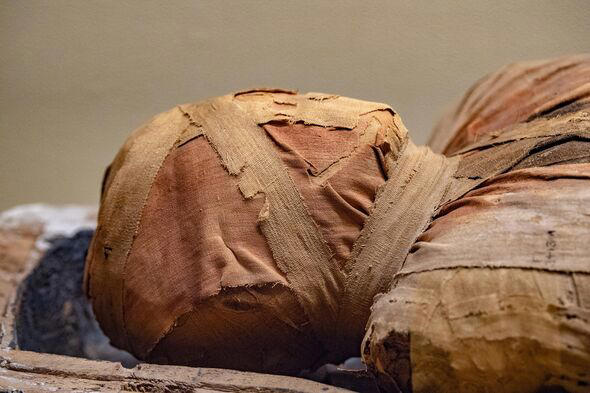
TRT World - Mexican Congress holds second UFO session featuring Peruvian mummies

Government stance

Governments, especially the US, have shifted from dismissal to a structured investigation into UFOs.

Project Blue Book (1947-1969) reviewed 12,000 sightings, concluding most were explainable and posed no alien threat.

Interest waned until 2017, when leaked Navy videos showed objects displaying unusual flight characteristics.

A 2021 US government report examined 144 incidents and found most unexplained, though not extra-terrestrial.

The Pentagon’s All-domain Anomaly Resolution Office (AARO), created in 2022, now tracks UAPs for national security reasons.

Its 2024 historical review found no evidence of alien technology. Most cases were of misidentifications, drones, or classified programmes.

NASA’s 2023 independent study also concluded that there was no proof of extra-terrestrials.

Aliens, UFOs in popular culture

Extra-terrestrials have long inspired books, films, and TV shows. 

Their depiction in the mainstream media began in 1947 when pilot Kenneth Arnold described disc-like objects flying near Washington state, coining the term “flying saucer” and sparking widespread press coverage.

The 1950s brought Cold War-era classics like The Day the Earth Stood Still (1951), featuring a peaceful alien warning people in Washington DC that they must live peacefully or be destroyed as a danger to other planets. 

Similarly, The Thing from Another World (1951) showed the US Air Force fend off a bloodthirsty alien organism from a remote arctic outpost. 

Movies and TV series of Star Trek and Star Wars depicting alien life and humanoids in space have kept a global fandom glued to their TV screens since the 1960s.

Prominent movie director’s Steven Spielberg’s Close Encounters of the Third Kind (1977) and ET the Extra-Terrestrial (1982) portrayed aliens as curious and friendly. 

Television shows contributed to amplifying the mystery around extra-terrestrials. The X-Files (1993–2002) made government conspiracies and abductions mainstream. 

Recent films like Independence Day (1996) show Earth-invading aliens attempting to destroy human life.

While most movies portray aliens as benevolent creatures, the blockbuster movie series Alien was among the first to show them as deadly lifeforms.

The interest in extraterrestrial life has produced a trove of science-fiction books, starting with The War of the Worlds (1898), an alien-invasion story by H. G. Wells, one of the genre’s most important authors.

Later works like The Hitchhiker’s Guide to the Galaxy by British writer Douglas Adams further cemented the place of alien species, which are referred to as “little green men” in countless books, movies, and TV series.

RELATED VIDEOS

NASA’s investigation of numerous UFO sightings revealed no proof of aliens, but the agency isn't ruling out their existence

{ https://www.trtworld.com/ }

Hoe vind je dit bericht?
Geschreven door peter om 23:10 Stuur door

4 Big U.F.O. Questions for the White House - The New York Times

Opinion | 4 Big U.F.O. Questions for the White House - The New York Times

Overview

In a recent opinion column, The New York Times urges the White House to address four foundational questions about unidentified aerial phenomena (UAP), commonly known as UFOs. The piece comes amid a surge of congressional hearings, de‑classified Pentagon reports, and mounting public curiosity about objects that appear to defy conventional explanations. By framing the issue as one of transparency, national security, scientific opportunity, and inter‑agency coordination, the column argues that a coherent federal response is now both feasible and necessary.

The Four Core Questions

  1. What is the government’s current knowledge of UAPs, and why has it not been fully disclosed?
    The author notes that the Pentagon’s 2023 preliminary assessment acknowledged “a limited amount of data that remains unexplained,” yet the administration has offered only vague briefings. The column asks whether a systematic release of vetted information could restore public trust without compromising sensitive sources.

  2. Do UAPs pose a credible threat to national security?
    Recent testimony before the House Intelligence Committee highlighted concerns that foreign adversaries might be using advanced drones or hypersonic platforms. The op‑ed stresses that without a clear risk assessment, policymakers cannot allocate resources or develop counter‑measures effectively.

  3. What scientific value do UAP investigations hold, and how can they be integrated into existing research frameworks?
    The piece points to the National Academies’ 2023 report, which called for “rigorous, interdisciplinary study” of anomalous aerial observations. It asks the administration to consider partnerships with civilian research institutions, NASA, and the scientific community at large.

  4. How will the government coordinate across agencies to study, track, and respond to UAPs?
    The author cites the establishment of the All‑Domain Anomaly Resolution Office (AARO) as a step forward but warns that “fragmented reporting lines risk duplicating effort and obscuring accountability.” A clear chain of command and reporting protocol is presented as essential for a unified response.

Policy Implications

The column underscores that answering these questions is not merely a matter of curiosity; it has tangible policy ramifications. Transparency could mitigate misinformation and reduce the political weaponization of the UFO narrative. A definitive national‑security assessment would guide defense budgeting and inform intelligence priorities. Meanwhile, embracing scientific inquiry could unlock novel data on atmospheric physics, sensor technology, and even potential extraterrestrial phenomena—areas that could yield commercial and academic breakthroughs. Finally, a robust inter‑agency framework would streamline data collection, reduce bureaucratic bottlenecks, and ensure that any credible threat is addressed swiftly.

Congressional and Public Momentum

Lawmakers from both parties have signaled a willingness to move beyond partisan posturing. Senate Majority Leader Chuck Schumer and Representative Tim Burchett have both called for “full‑scale, bipartisan oversight” of UAP investigations. Public polls show that nearly 70 % of Americans favor greater disclosure, according to a recent Pew Research Center survey. The op‑ed argues that the administration’s response—or lack thereof—will shape public confidence in governmental transparency for years to come.

Recommendations for the White House

The Times piece concludes with a concise set of actions:

  • Issue a comprehensive, redacted briefing to the public that outlines what is known, unknown, and the rationale for any classification.
  • Commission an independent scientific panel—modeled on the National Academies’ approach—to evaluate data and recommend research pathways.
  • Mandate regular reporting from AARO to both the National Security Council and congressional oversight committees.
  • Allocate dedicated funding for UAP research, including sensor upgrades and data‑analysis infrastructure, to avoid ad‑hoc budgeting.

By confronting these four questions head‑on, the White House could transform a topic long relegated to the fringe into a structured, accountable element of national policy—balancing security imperatives with the public’s right to know.

{  https://usubjects.com/ }

Hoe vind je dit bericht?
Geschreven door peter om 22:41 Stuur door

What the U.S. government has already revealed about UFOs

What the U.S. government has already revealed about UFOs

Herb Scribner

Scott Bray, former deputy director of Naval Intelligence, testifies during a House hearing on UAPs in 2022.

Scott Bray, former deputy director of Naval Intelligence, testifies during a House hearing on UAPs in 2022.

Photo: Kevin Dietsch/Getty Images

President Trump's decision to release government files related to aliens and UFOs is reigniting one of America's longest-running mysteries.

The big picture: While it's unclear whether any new significant surprises await, the belief that government secrets may prove extraterrestrial life exists has fueled curiosity and speculation for decades.

  • The latest chapter started when former President Obama said last week that aliens are real. He later clarified that he hadn't seen any evidence of aliens making contact with Earth.
  • But his remarks prompted Trump to suggest this was classified information and promise to release new records.

Here's what the government has previously shared:

What's confirmed by the government

Between the lines: Much of what's been confirmed has been about unidentified anomalous phenomena (UAPs) rather than "UFOs." UAPs are airborne objects that are not immediately identifiable.

  • The Office of the Director of National Intelligence (ODNI) confirmed in a 2021 report that UAPs are real, but there's no confirmation they stem from some extraterrestrial origin.
  • The Pentagon has largely maintained that there is no evidence of alien technology nor any hidden programs within the government related to UAPs.

Yes, but: The Pentagon released three declassified UFO videos in 2020 filmed by U.S. Navy pilots in 2004 and 2015.

Congress hearings investigate UAPs

UFOs have been on Congress' radar for years, mostly due to bipartisan concerns about transparency and national security.

  • Congress held a series of hearings from 2022 to 2024 as part of an investigation into UAPs and national security.
  • Several officials testified that UAP sightings have simple explanations — that they were actually balloons, drones and optical effects.
  • Officials also confirmed that hundreds of UAP reports exist, including military cases.

What they said: Sean Kirkpatrick, director of AARO, testified in April 2023 that many sightings involved "metallic orbs" — though he did not confirm extraterrestrial technology.

  • Whistleblower David Grusch testified in July 2023 that he believed the government was withholding evidence and information about UAPs.
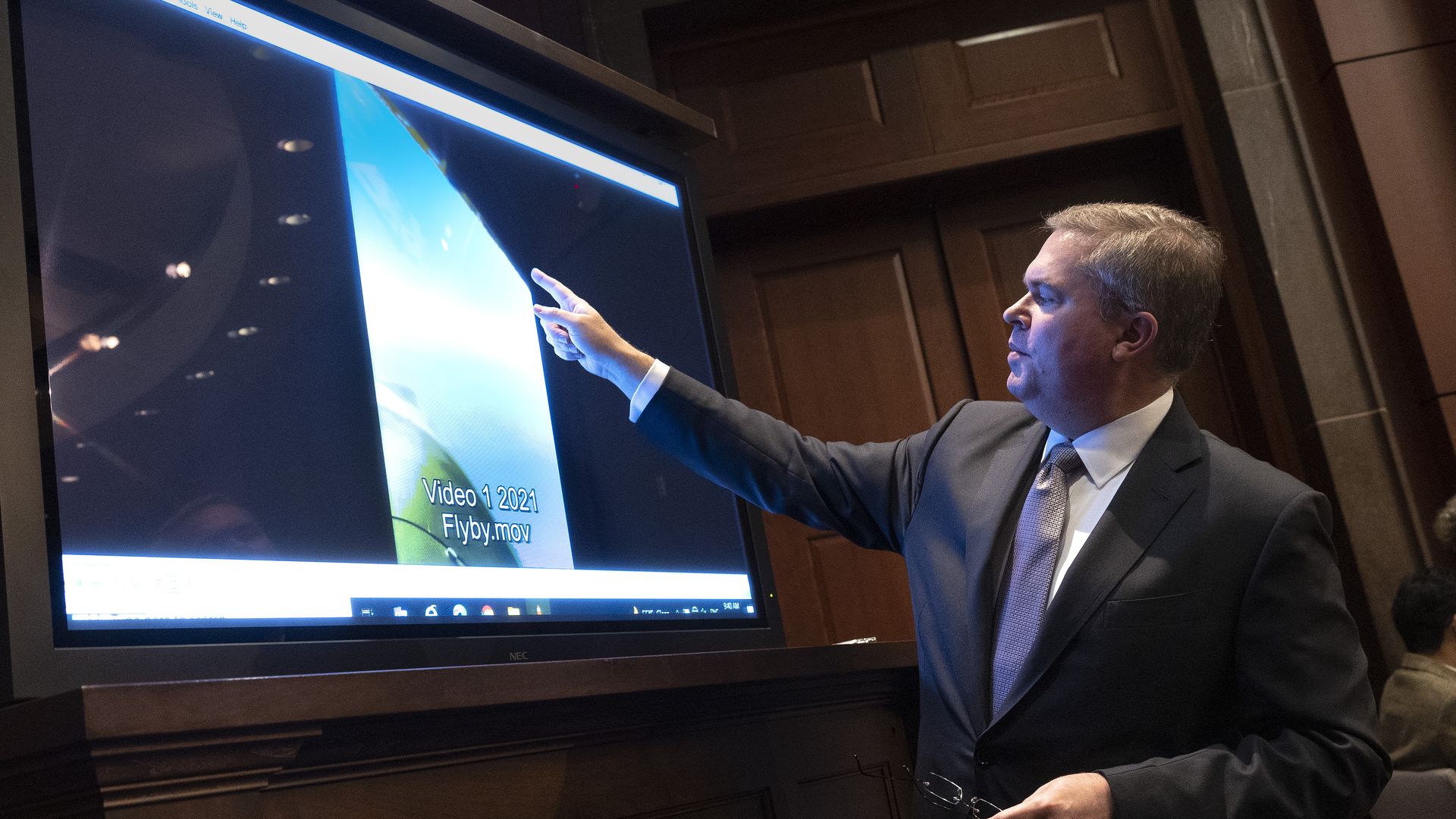
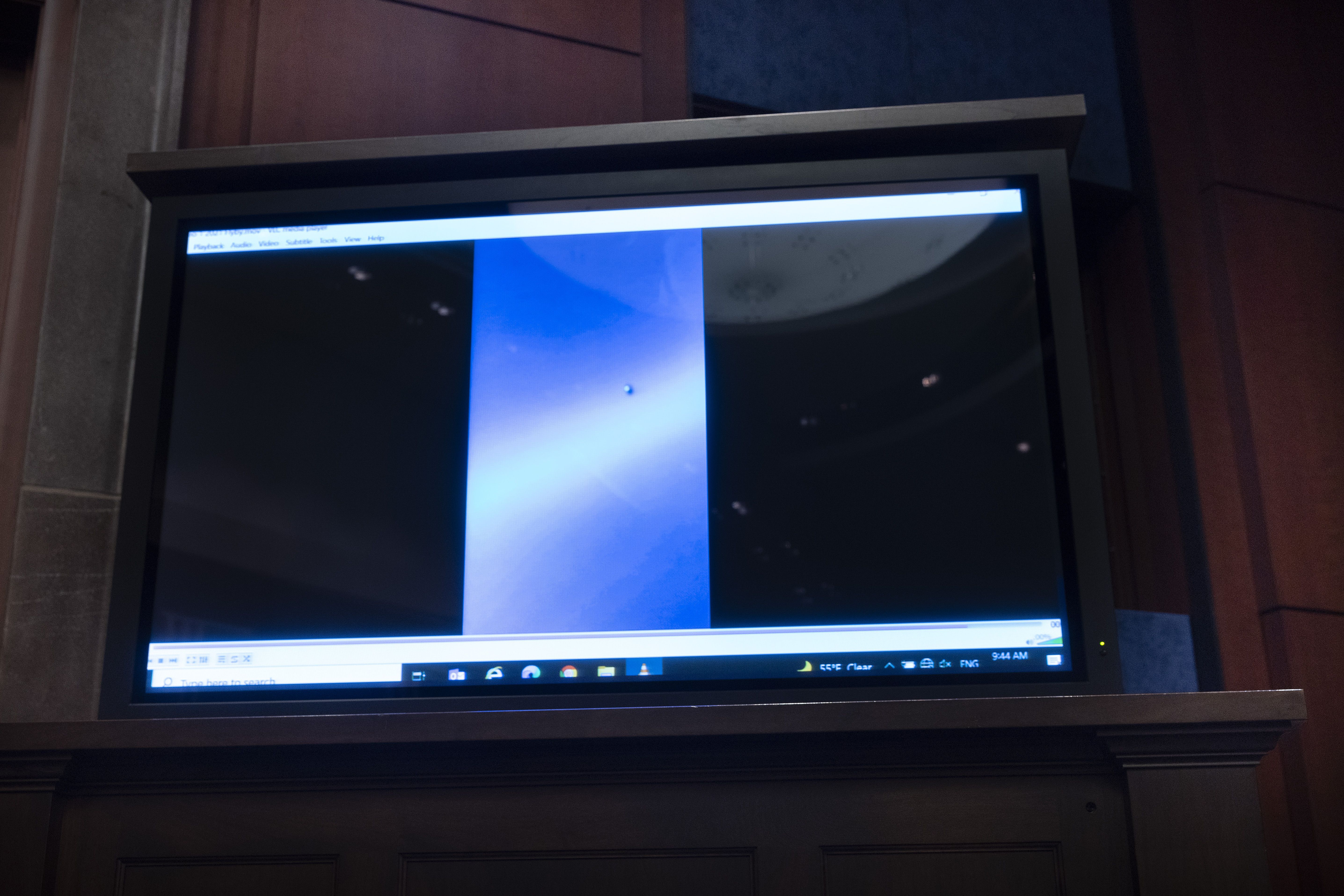
A video of unidentified aerial phenomena plays during a House Intelligence subcommittee hearing in 2022. A video of unidentified aerial phenomena plays during a House Intelligence subcommittee hearing in 2022. Photo: Kevin Dietsch/Getty Images

NASA, Pentagon downplay sightings

Flashback: In 2023, NASA released a report from its UAP study team that found no evidence of aliens.

  • However, the government agency said they aren't sure what UAP technically are and that more research could be done into defining the unidentified objects.

An unclassified 2024 Pentagon report gave the public insight into what we know and don't know about UFOs.

  • The report mainly found that several of the sightings in the 1950s and '60s were likely caused by tests of advanced U.S. spy planes and other tech.
  • The report said there was no evidence of confirmed extraterrestrial activity related to UAPs.

Reported UFO sightings per 100k residents

Jan. 1, 1995, to Feb. 19, 2026; Approximate locations of 140,406 sightings submitted to the National UFO Reporting Center

A U.S. state map of reported UFO sightings per 100,000 residents from 1995 to 2026, as of February 19, 2026. About 140,000 sightings were reported in that time period, with the most sightings relative to population in Vermont (100 per 100,000 residents), Washington (95) and Montana (94).
Map of UFO sightings per capita in the US. : r/MapPorn

Oregon

88.7 sightings per 100k residents

3,790 total sightings
Data: National UFO Reporting Center; Map: Jacque Schrag/Axios

Where UFOs are spotted

Americans share reported sightings all the time to the National UFO Reporting Center, which catalogs all reports for the public to read.

  • The most recent claim was on Feb. 10, when someone reported seeing a UAP in Cave Junction, Oregon, that was "a shooting star" that made "a zigzag pattern."
  • Of course, these reports are unconfirmed and anyone can file them.

By the numbers: The NUFORC collects data on where the most sightings have happened throughout the world.

  • California remains the state with the most reported sightings at 17,061 as of February 2026, per NUFORC.
  • The NUFORC reports offer varying details of what the unidentified objects look like.
  • More than 10,000 people described the UFOs as a "fireball," with 14,000 spotting a "triangle."

The bottom line: The truth is out there, and Trump's order could provide new evidence for believers and skeptics to seize on.

RELATED VIDEOS

{ https://www.axios.com/ }

Hoe vind je dit bericht?
Geschreven door peter om 22:31 Stuur door

Government UFO files would be an avalanche of info: Elizondo

Government UFO files would be an avalanche of info: Elizondo

Michael Ramsey

Government UFO files would be an avalanche of info: Elizondo - NewsNation

(NewsNation) — President Trump’s promise to disclose any government-held information about UFOs and extraterrestrials will be no simple lift if it comes to fruition, says Luis Elizondo, a former Pentagon insider who has long advocated for the feds to be transparent.

He notes the government has amassed a secret trove of information for more than 80 years and suggests the potential quantity of information could dwarf the millions of documents in the Epstein files.

“Now, the real hard work begins,” Elizondo told “CUOMO” on Friday. “The government has been sitting on this information for so long. There’s so much documentation right now, within our own holdings — within the intelligence community, within the defense communities, within the Department of Energy — that this is going to be a tremendous undertaking.”

First, Elizondo said, Trump will need to sign an executive order that obligates agencies under his control to comply with his transparency directive.

On Thursday, the president said on Truth Social he would direct the Pentagon and other government agencies to release files about “alien and extraterrestrial life”; unidentified anomalous phenomena, aka UAPs; UFOs; and “any and all other information connected to these highly complex, but extremely interesting and important, matters.”

Among skeptics who doubt Trump will ultimately make good on his promise is investigative journalist Ross Coultart of NewsNation’s “Reality Check” podcast.

“It’s very important to note Donald Trump is not saying, in what he’s announced to date, that he is going to declassify anything,” he says. “All they are talking about is reviewing records.”

The issue of UFOs — purists prefer the broader term UAP, which includes objects traveling in bodies of water — has gained traction in recent years after several whistleblowers have stepped forward to claim the government has covered up vital information. The whistleblowers include David Grusch, who told lawmakers the federal government is operating a UFO retrieval program.

A widely publicized 2025 documentary, “The Age of Disclosure,” featuring a bipartisan roster of policymakers and officials, suggested the U.S. and rival nations are in a race to reverse-engineer alien tech that has been recovered.

The UAP category can also include drones, which have become increasingly sophisticated.

Upcoming govt agency report lists more than 150 UFO encounters: Josh ...

Public ready for truth on UFOs, extraterrestrials: Journalist

Journalist Marik Von Rennenkampff, a former State Department analyst who writes about UAPs, says Trump’s timing is perfect given the “critical mass” the issue seems to have achieved.

“I think we’re ready for it,” Von Rennenkampff says of the public at large. “I think the big question is what happens the day after — geopolitically, economically, socially and culturally.”

Harvard prof doesn't back down from claims that alien spacecraft may be ...

Scientists could help evaluate UFO info: Avi Loeb

The Harvard astrophysicist who made a splash with his study of the comet 3I/ATLAS said the government files, if they see the light of day, could yield higher-quality images than the public is used to seeing when discussions about UFOs come up.

“In addition, there could be some materials that were retrieved and are puzzling,” Avi Loeb told “Jesse Weber Live” on Friday. “The best way to figure things out to share it, if we are sure it’s not coming from adversarial nations.”

 { https://www.newsnationnow.com/ }

Hoe vind je dit bericht?
Geschreven door peter om 22:11 Stuur door

George Knapp investigates: Drone swarm mystery and new UAP revelations

George Knapp investigates: Drone swarm mystery and new UAP revelations

Overview

Chief Investigator George Knapp of 8 News Now has produced an investigative report on a series of unidentified drone swarms that appeared over U.S. civilian and military sites between late 2024 and early 2025. The sightings spanned multiple states—including New Jersey, Nevada, Florida, Texas and California—and affected high‑security installations such as Langley Air Force Base and Wright‑Patterson AFB, where air traffic was briefly halted. While federal officials initially described the events as “no known national‑security threat,” a White House briefing on January 29, 2025 claimed the FAA had authorized the flights for research purposes, a conclusion that Knapp and other analysts say raises further questions about inter‑agency coordination and public disclosure.


George Knapp investigates: Drone swarm mystery and new UAP revelations

The FAA Explanation and Immediate Reactions

National Security Communications Advisor John F. Kirby and other officials asserted that the government could not trace the origin of the craft, prompting criticism from state and local leaders. New Jersey Assemblyman Brian Bergen labeled the response “amateur hour,” and President‑elect Donald Trump suggested the administration was withholding information. The White House spokesperson Karoline Leavitt later announced that the “mystery had been solved” by attributing the drones to FAA‑approved research missions. Knapp highlighted a key inconsistency: if the FAA had indeed authorized the flights, why did the FBI, Department of Defense and the FAA jointly issue statements in December 2024 describing the swarms as an unknown phenomenon requiring advanced detection technology?

Historical Context of UAP Incidents

The 2024 drone swarms echo earlier unidentified aerial phenomena (UAP) events that have drawn congressional and Pentagon attention. In July 2019, more than 100 unknown objects were reported near ten U.S. Navy warships off the Pacific coast, many appearing as wingless orbs with no detectable propulsion. The June 2021 Pentagon report on 144 UAP incidents concluded that most were not attributable to classified U.S. programs, while leaving open the possibility of foreign or non‑human origins. A separate 2023 incident at Langley AFB saw dozens of objects operating for two weeks despite sophisticated radar and defense systems. These precedents have fueled calls for a permanent, well‑funded UAP investigative body.

Expert Commentary and Legislative Concerns

Rep. Tim Burchett (R‑TN) warned that the drone incursions represent a “test” of America’s air‑space security that the nation is currently failing. Former Nevada Senator Harry Reid, a long‑time advocate for UAP transparency, noted that the government’s admission of “not knowing” what the objects are marks a “significant, albeit preliminary, step.” Former AATIP director Lue Elizondo argued that the technology observed by pilots exceeds known terrestrial capabilities, suggesting a global phenomenon rather than a domestic secret project. Former Navy commander David Fravor added that the persistence of such technology over decades makes it unlikely to be a covert U.S. program, given the difficulty of maintaining secrecy for 15‑20 years.

Conclusion and Outlook

The investigation concludes that the White House’s attribution of the late‑2024 swarms to FAA‑approved research drones does not fully resolve the underlying issues of transparency and inter‑agency communication. Lawmakers and UAP experts continue to press for a permanent, adequately funded investigative office capable of identifying and analyzing objects that demonstrate flight characteristics beyond current human technology. As the public and congressional committees await further clarification, the broader mystery of unidentified aerial phenomena remains open, underscoring the need for systematic, scientifically rigorous study of America’s skies.

RELATED

{  https://usubjects.com/  }

Hoe vind je dit bericht?
Geschreven door peter om 21:52 Stuur door

17 things commonly mistaken for UFOs

17 things commonly mistaken for UFOs

Think you've seen a UFO in the sky? Consider the following possibilities...

BY Ezzy Pearson

Thousands of people across the world have reported unidentified objects in the night sky, many under the impression that they have witnessed a visiting alien spacecraft.

Reports often feature lights zipping across the sky, changing direction in manoeuvres that seem to defy the laws of physics, not to mention huge shapes that move silently overhead and strange objects that suddenly explode.

We've all heard the stories of the Roswell UFO incident, or the supposed alien species that many 'believers' think inhabits a star orbiting Zeta Reticuli.

The term 'flying saucer' has now entered our common vocabulary. Credit: KTSDesign / Science Photo Library

UFO sightings have a long history. In 1950, the UK Ministry of Defence opened an official desk to investigate every flying saucer report in the UK.

Rather than looking for little green men, however, it was tasked with investigating possible hostile aircraft that may have secretly entered UK airspace.

The desk was closed in November 2009 and after nearly 60 years of reports, not one resulted in a genuine threat to the UK.

But rather than uncovering an extra-terrestrial conspiracy, the last batch of files released by the National Archives revealed that at the time of the closure the MoD had "no opinion" on the existence of extra-terrestrial beings, and seemed a little fed up by the hundreds of reported UFO sightings that they were receiving each year.

The reports do make interesting reading, and can all be accessed online at the National Archive UFO webpage.

But the truth is that the vast majority of UFO sightings have Earthly origins – optical illusions and rare weather among them. Here we'll look at some of the most likely suspects.

So, the next time you see something in the sky and you think it might be a UFO, consider the following possibilities.

Military aircraft

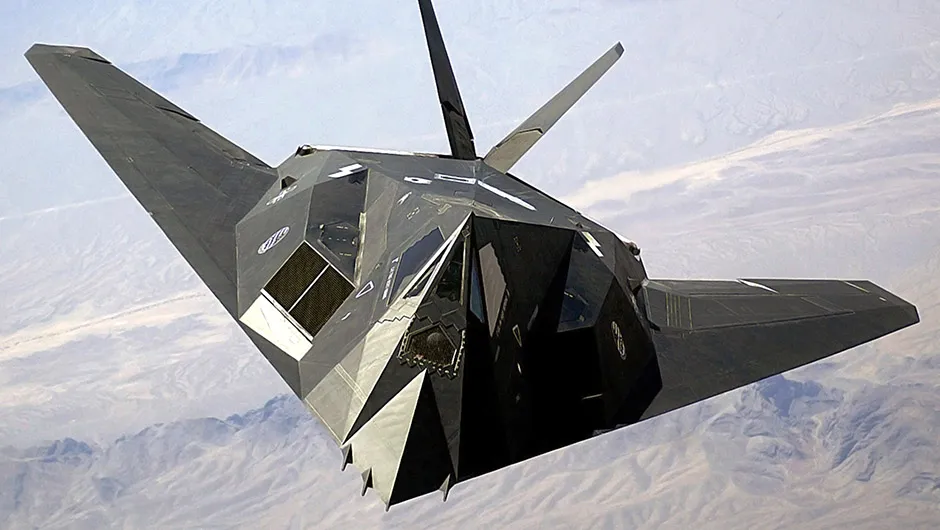
Lockheed's F-117A Nighthawk © Wikimedia Commons

Top secret spyplanes like the Blackbird (Lockheed SR-71) were often taken to be UFOs during the Cold War.

In recent years, the triangular-shaped stealth fighter (F-117A Nighthawk) and bomber probably have been, too.

Who knows how many new sightings are down to top-secret craft we don’t even know about – perhaps even saucer-shaped ones?

Meteor fireballs

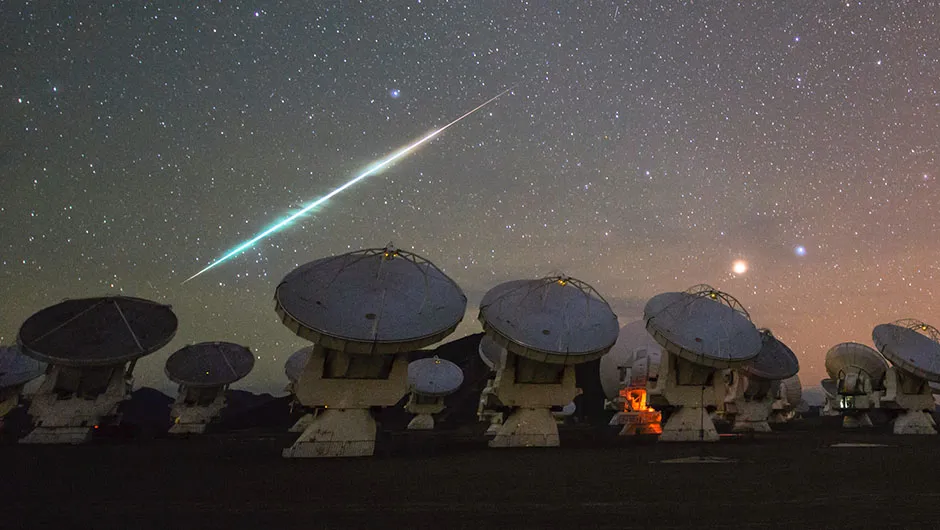
Meteor fireballs over the Atacama Large Millimeter/submillimeter Array (ALMA) in Chile © Wikimedia Commons

A yellow-ish object appears out of nowhere, flying fast and silent across the sky and leaving a glowing trail behind it.

The object suddenly breaks into smaller pieces before vanishing into thin air – all in under a minute.

Over-anxious witnesses might run screaming to the media, but astronomers will be content to have seen a spectacular meteor fireball.

Lens flare

Have you captured a strange glowing orb in a photo? Might it just be lens flare? Credit: Strixcode / Getty Images Have you captured a strange glowing orb in a photo? Might it just be lens flare? Credit: Strixcode / Getty Images

If you’ve been observing for a long time you’ll be all too aware that light sometimes bounces off the lens elements in your camera, binoculars or telescope, causing a lens flare.

Some flares can look like solid objects and, if they’re accidentally framed in the right place, a newbie might well mistake them for an unworldly spacecraft.

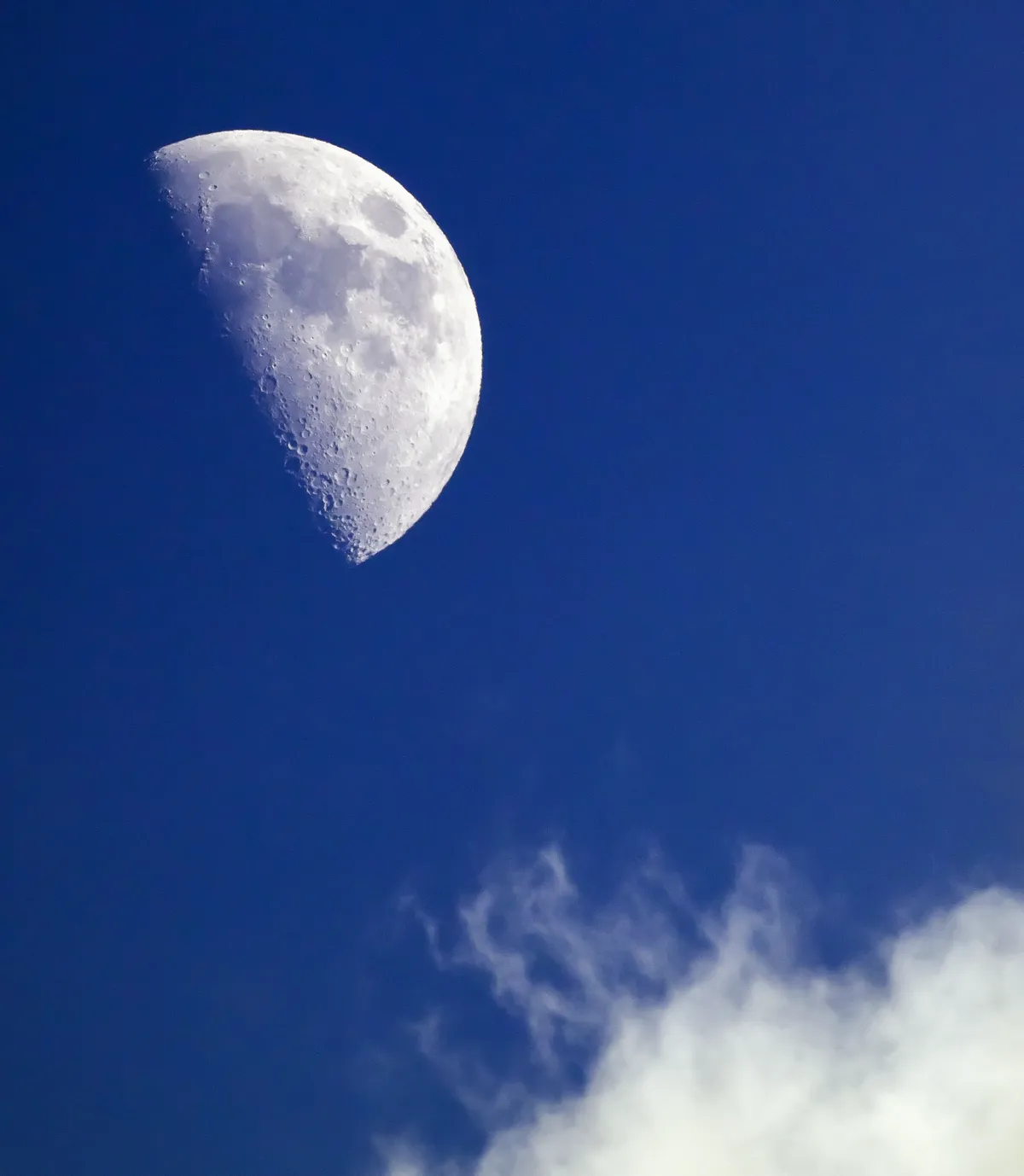
The Moon

Credit: Dan Fleetwood, Rugby, Warwickshire, 27 July 2020.

Sometimes all rational thought seems to go out of the window.

In 2007, a woman phoned South Wales Police to report a ‘bright stationary object’ that had been floating in the air for 30 minutes.

Later that evening, the police control room radioed to check what an officer had found.

The officer replied: “It’s the Moon. Over.”

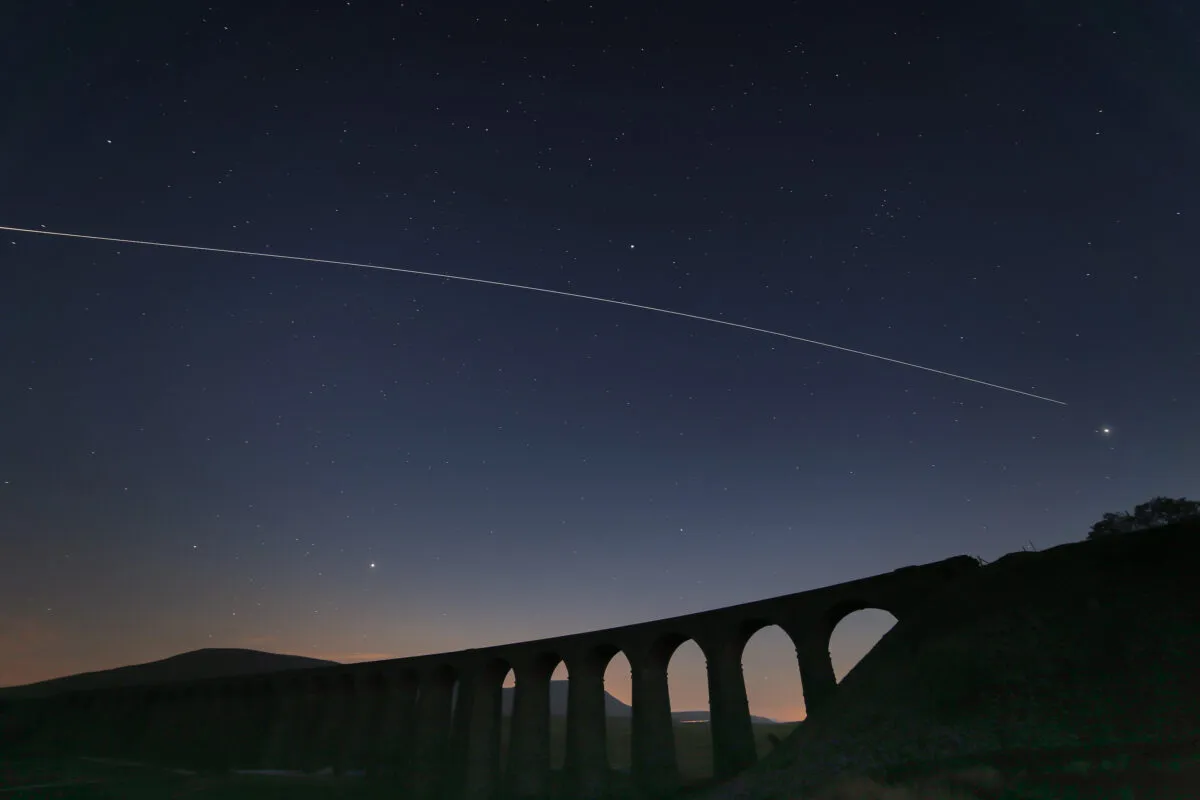
The International Space Station

International Space Station over Ribblehead Viaduct by Pete Collins, Yorkshire Dales. Equipment: Canon 6D, Samyang 14mm f2.8 lens at f4, iso200.

The International Space Station is larger than Wembley’s football pitch and significantly brighter than most night sky objects.

It moves fast, taking just a few minutes to cross the sky from one horizon to the other.

It’s also silent, perhaps startling and confusing onlookers who are used to the din of aeroplane engines.

If you do want to see it, read our guide on how to see the International Space Station.

Oddly shaped clouds

A lenticular cloud can look remarkably like a flying saucer or UFO. Credit: Atosan / Getty Images A lenticular cloud can look remarkably like a flying saucer or UFO. Credit: Atosan / Getty Images

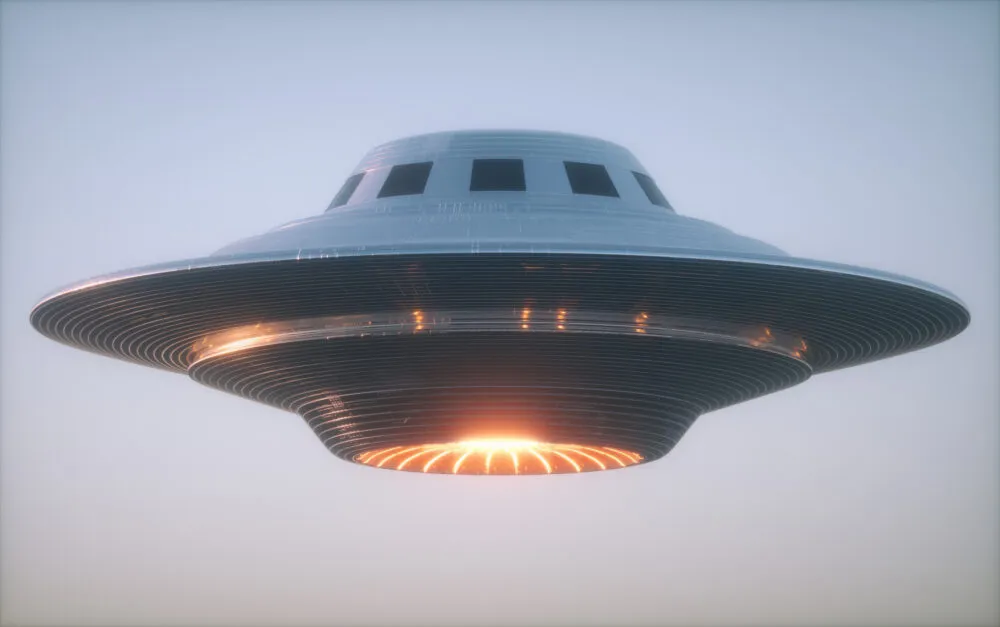
The closest you’ll get to seeing a classic flying saucer shape is the so-called lenticular cloud (Altocumulus lenticularis).

They form at high altitudes, near or atop mountains that have moist air blowing over them.

Although the wind speeds are high, the clouds remain stationary.

It’s not hard to imagine you’re seeing a hovering UFO, or a saucer concealed inside the cloud.

A SpaceX frozen exhaust plume

Jeremy Tuck witnessed the strange cloud spiral over North Yorkshire, 8pm UTC, 24 March 2025 Jeremy Tuck witnessed this strange cloud spiral over North Yorkshire, 8pm UTC, 24 March 2025. It turned out to be the exhaust plume from a SpaceX Falcon 9 rocket.

Have you just seen a strange, spiral-shaped glowing cloud in the night sky?

The chances are it could be a SpaceX Falcon 9 rocket dumping leftover fuel as it launches a satellite into Earth orbit.

This leftover fuel freezes at high altitudes and rotates rapidly due to the movement of the spacecraft.

Sunlight reflects off the spiral cloud and makes it glow, making for a rather strange sight in the night sky.

Sky lanterns

Sky lanterns set off during the Yi Peng (Loi Krathong) festival in Thailand © Wikimedia Commons

They’ve been used in Asia for centuries, and now sky lanterns are now becoming increasingly popular around the world. Using the heat generated by a small candle, the paper lanterns can rise up to over 1km in altitude – and if there is little wind when they are released, they can appear to hover overhead.

Several lanterns are often released at once, sometimes tied together so they appear to fly in formation. From the ground it’s easy to mistake this for a single solid object. Today, sky lanterns are the number one cause of UFO reports. In 2009, the number of sightings reported to the MoD’s UFO desk tripled, with most eventually being attributed to these floating lights.

Military satellites

In the 1970s, the US Navy launched a series of surveillance satellites to track Russian vessels.

Dubbed NOSS (Naval Ocean Surveillance System) by civilians, these consist of a trio of satellites that orbit in a triangle formation and are sometimes visible to the naked eye.

Venus

Venus and a starry night sky over the Cotswolds. Photo by Tim Graham/Getty Images

Seen either before sunrise or after sunset, Venus is so bright it’s often mistaken for the landing lights of an aeroplane.

Unlike a plane, though, Venus is pretty much stationary, which gives imaginative observers the impression of something ‘hovering’.

Bright, orangey red Jupiter is another planet frequently taken to be a UFO.

Ball lightning

Credit: ThinkStock

No one is sure what causes this electrical phenomenon, which can measure as much as 1m across. Though often associated with thunderstorms, ball lightning tends to last much longer than a lightning bolt – up to a minute rather then a split-second. It has been reported to move erratically, or hover in place, before either silently fading from view or exploding loudly.

Due to its rare and unpredictable nature there has been little study of ball lightning, but reported sightings date back centuries. There are even reports that the glowing spheres have come into people’s homes down chimneys and through windows.

Space debris

Credit: janiecbros / Getty Images

Junk in low Earth-orbit has become a major problem, with inoperable satellites left behind to become what is collectively known as space junk.

Eventually, atmospheric drag slows them down to the point that they fall to Earth, streaking across the sky as huge fireballs that can last for up to a minute.

Different materials in the debris can create brightly coloured trails as they burn up, adding to their otherworldly appearance.

Sometimes pieces can make it to the ground, leaving behind strangely shaped debris, which some mistake as wreckage from spacecraft of a less terrestrial origin.

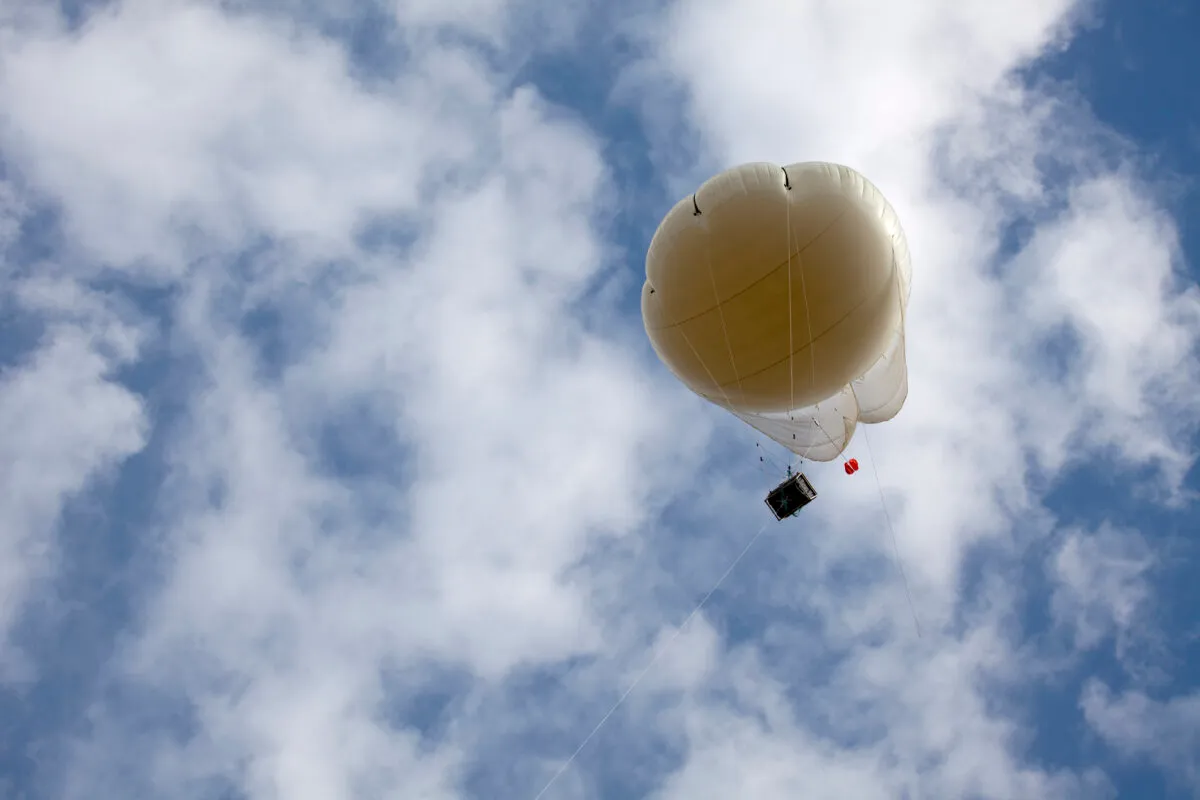
Weather balloons

Credit: MileHighTraveller / Getty

Weather stations all around the world release balloons on a daily basis, to monitor current conditions and provide better forecasts. However, an increasing number of weather balloons are being used by members of the public for scientific experiments, educational purposes or simply to capture video from the upper atmosphere.

The balloons can rise to altitudes of 40km, at which point they burst and fall to Earth. From the ground this is often mistaken for an exploding plane or spacecraft. A balloon was responsible for the most famous of all UFO sightings, the 1947 Roswell incident.

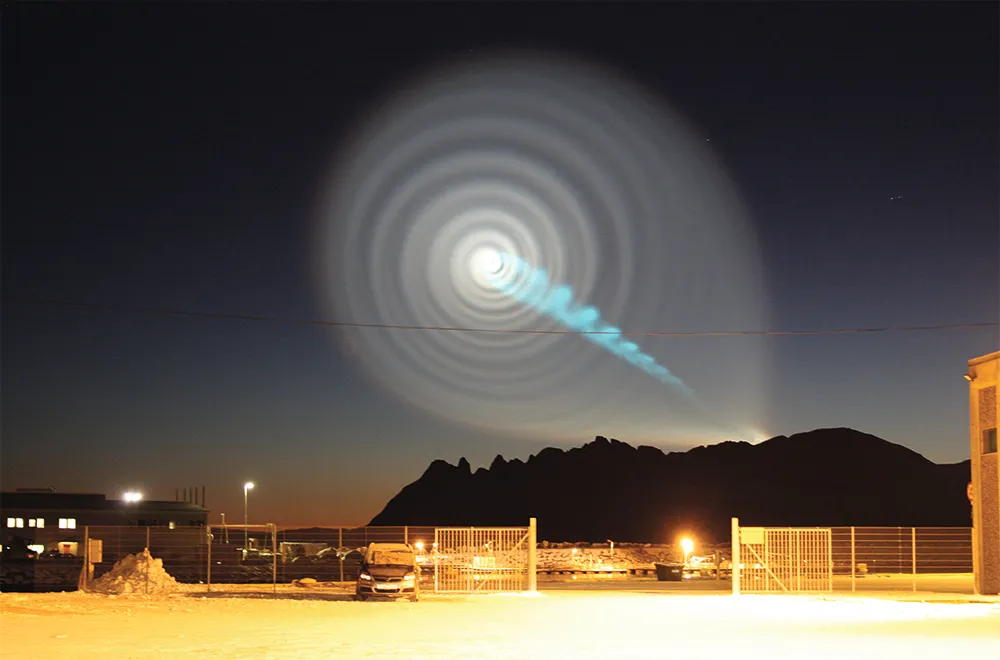
Rocket misfires

A Russian bulava missile misfired in December 2009 to produce this strange spectacle. Credit: Jan Petter Jorgensen / REX

In the early hours of the morning on 9 December 2009, a strange white spiral appeared in the skies over Norway. It seemed to be emitting a blue beam from its centre. The weird formation was the result of a Russian Bulava missile test, in which the missile malfunctioned high in the atmosphere. The rocket went wild, venting gas from the side, making the craft spin.

Though it was still night for people on the ground, the Sun had reached the upper atmosphere, illuminating the gas as a white spiral. The light also caused fuel leaking from the missile to glow blue, giving the illusion of a ray beam emanating from the spiral.

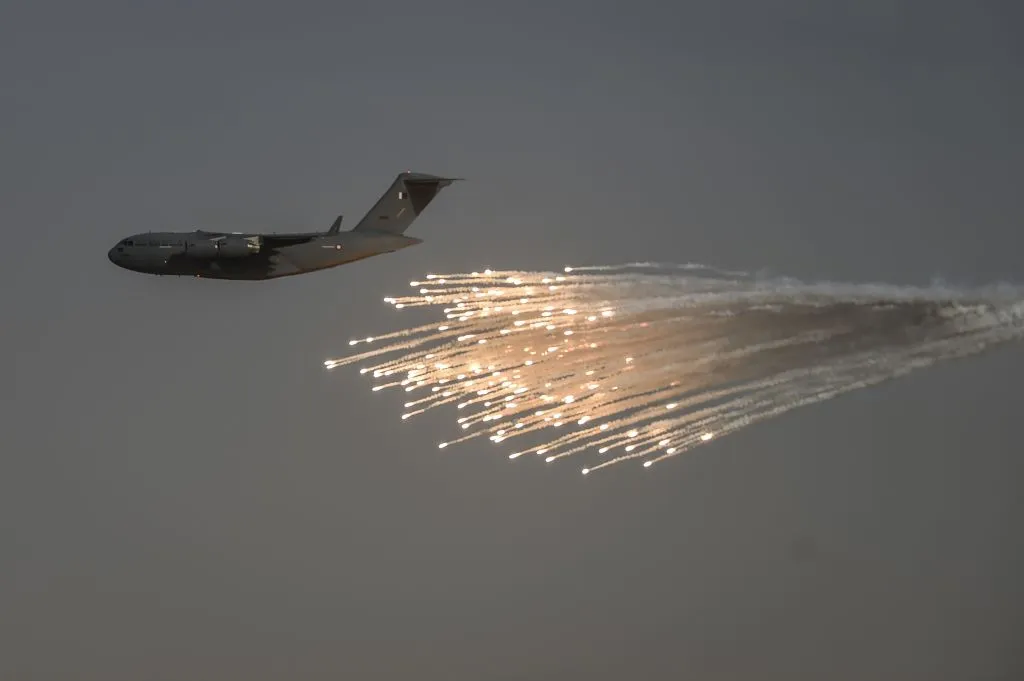
Flares from aircraft

A plane shooting flares shooting flares, Qatar, 9 May 9, 2018. Photo by Smith Collection/Gado/Getty Images

In 1997, several hundred people saw a V of lights flying over Phoenix, Arizona. It was later revealed that the lights were the result of a routine training exercise run by the Maryland Air National Guard, in which a group of planes flew in formation, dropping flares.

This kind of exercise is commonly undertaken without being noticed, but on clear nights the flares can be seen from up to 50km away. The intense heat from the flares can create currents in the surrounding air, causing them to hover. If the conditions are mild then the flares can hold their formation, creating the optical illusion of a solid object.

Searchlights

Credit: Andrew TB Tan / Getty Images

Massive searchlights outside clubs, theme parks and festivals are a common sight, sweeping back and forth across the clouds, but when viewed from several miles away they can look like mysterious objects moving in the night. The light

beam is so weak that it cannot be seen, leaving only the bright spots of white light.

These can be mistaken as shining through the clouds, rather than being cast on them. They often appear to be darting back and forth across the sky, but are in reality the work of a lighting technician.

Contrails

Vapour trails lit by the setting Sun. Credit: Ashley Cooper / Getty

Perspective can easily fool the untrained eye. When a plane is flying at right angles towards the horizon and leaving a trail of artificial clouds known as a contrail behind, it can appear to be an object crashing to the ground. The effect of the wind blowing the cloud formations wider emphasises this illusion, and red light from a setting Sun can make them glow red, as if on fire.

Light glinting off the underside of a plane can make it appear as if there is a bright core to the cloud. However the object will appear to be moving very slowly. If something is really falling to Earth, it will move very quickly across the sky, even when seen from a distance.

RELATED VIDEOS

{ https://www.skyatnightmagazine.com/ }

Hoe vind je dit bericht?
Geschreven door peter om 21:36 Stuur door

If we made contact with aliens, what would happen? UFO defence expert reveals how prepared we really are

If we made contact with aliens, what would happen? UFO defence expert reveals how prepared we really are

Alien contact: Is there a playbook? Or is it time to create one? A real-life alien defence expert reveals the truth

 BY Nick Pope

What would happen if humanity encountered aliens? If there a plan? And if not, should we have one?

Numerous movies and TV shows feature humanity encountering extraterrestrials.

In films such as Independence Day and War of the Worlds, the scenario is an alien invasion.

Elsewhere, encounters are more ambiguous and the extraterrestrials more enigmatic, as we see in movies such as Contact or Arrival. But what if any of this happened for real?

More on alien life

We can't rule out a visit to Earth from alien beings. Credit: Devrimb / Getty Images

Credit: Devrimb / Getty Images

Over the past few years in the US, the subject of UFOs (or UAPs – unidentified anomalous phenomena – as they're officially designated) has transitioned from fringe to mainstream.

This resulted from the release of photos and videos of UAP taken from various military platforms, and led to classified briefings and public hearings in Congress.

The Pentagon set up a unit to investigate UAP called the All-Domain Anomaly Resolution Office (AARO), and the subject is now being treated as a defence and national security issue.


Are we prepared?

All this brings into focus the question of what would happen if we actually found aliens – or if they found us.

It would be the biggest scientific discovery in history, and would likely have profound – but difficult to predict – effects on every aspect of society, from politics and religion, through to science, technology, the economy and philosophy.

Individuals would probably react in different ways, some with fear and panic; others with awe and wonder.

Surprisingly perhaps, there doesn't seem to be a co-ordinated, overall plan for an eventuality like this.

While the Search for Extraterrestrial Intelligence (SETI) Institute authored a document titled the Declaration of Principles Concerning the Conduct of the Search for Extraterrestrial Intelligence, these protocols only cover what to do if a radio signal from another civilisation is detected, and the document isn't legally binding on nation states.

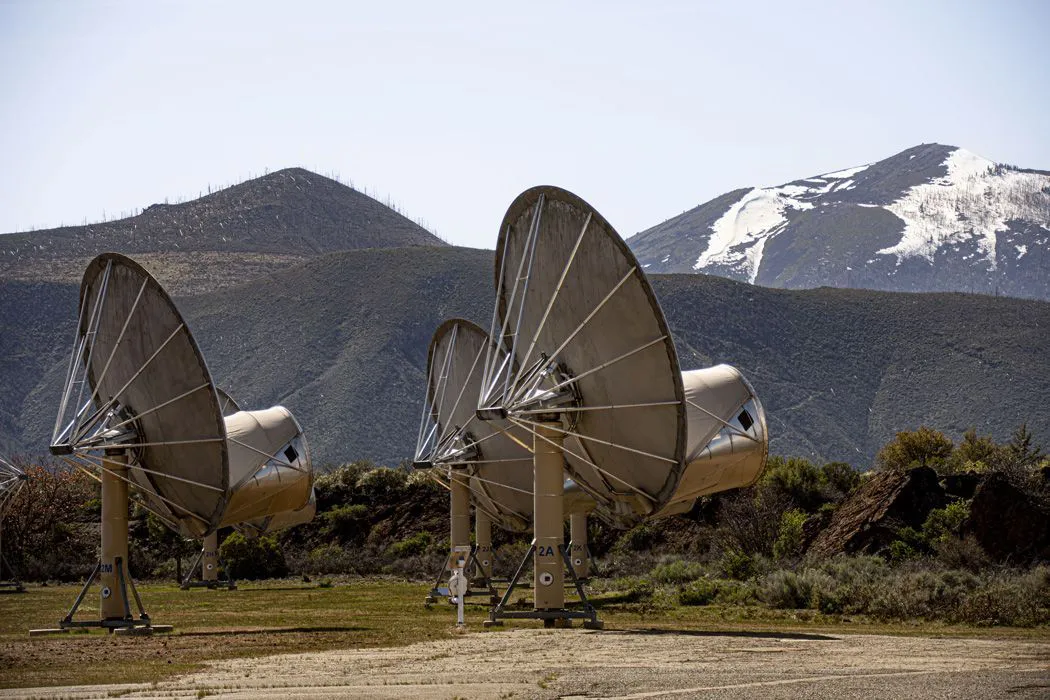
The Allen Telescope Array in California is dedicated to the search for extraterrestrial intelligence. Credit: Simon Steel / SETI The Allen Telescope Array in California is dedicated to the search for extraterrestrial intelligence. Credit: Simon Steel / SETIBeyond this, it's theoretically possible that there's a highly classified government plan, the existence of which is known only to a few key personnel.

However, I got no hint as to the existence of any such document when I handled the UAP issue for the British Ministry of Defence in the 1990s, and neither has such a plan been mentioned in any of the Congressional hearings on UAP.

The nearest Britain came to a plan for making contact with aliens was in 2023, when the Department for Science, Innovation and Technology (DSIT) produced an outline report titled ‘UK readiness for black swan scientific events: Case Study – The discovery of life beyond Earth’.

DSIT's Ideas Lab wrote an eight-page draft before the study was indefinitely paused in 2024.

'Alien' could mean the discovery of microbes on an icy moon like Europa, or it could mean finding an advanced, intelligent species. Credit: NASA/JPL/DLR 'Alien' could mean the discovery of microbes on an icy moon like Europa, or it could mean finding an advanced, intelligent species. Credit: NASA/JPL/DLR

What do we mean by alien?

A key problem in devising any plan is the wide range of variables when it comes to alien life.

Discovering microbial life in our Solar System, for example, would raise the issue of planetary protection – we don't want to be wiped out by the Venusian flu.

Detecting a radio signal from another civilization would raise very different issues: could we decipher a message from aliens; should we reply; what should we say; and who should reply?

The last question raises the issue of who could truly speak for Planet Earth.

No political or religious leader could speak for everyone, and while a scientist or an academic might be a better choice, what about the billions of people who effectively have no voice? Who speaks for them?

These issues were explored during two meetings at Britain’s Royal Society, held in 2010.

The first was titled, ‘The detection of extra-terrestrial life and the consequences for science and society’ and the second, ‘Towards a scientific and societal agenda on extra-terrestrial life’.

These were multidisciplinary events with participation not only from astronomers and astrophysicists, but also from psychologists, anthropologists and theologians.

It was apparent that the religious implications of finding alien life would be profound and potentially controversial in terms of the possible challenges posed to faith and doctrine.

Some senior theologians are already thinking about how to incorporate alien life into their belief systems.

Father José Gabriel Funes, a Jesuit priest who served as director of the Vatican Observatory, has stated: "How can we rule out that life may have developed elsewhere?

"Just as we consider Earthly creatures as ‘brother’ and ‘sister’, why should we not talk about an ‘extraterrestrial brother’? It would still be part of creation."

But what if aliens don't come in peace? Stephen Hawking once warned: "If aliens visit us, the outcome would be much as when Columbus landed in America, which didn't turn out well for the Native Americans."

This ties in with the Dark Forest hypothesis, which suggests alien civilizations generally remain silent, for fear of encountering a more advanced hostile civilization.

As Cambridge University palaeontology professor Simon Conway Morris said at the first of the Royal Society meetings: "If the cosmic phone rings, don't answer."

It's a sobering thought that in a Universe nearly 14 billion years old there might be civilizations a billion years ahead of us.

Science fiction writer Arthur C Clarke said that "any sufficiently advanced technology is indistinguishable from magic".

So, we can forget about those Hollywood movies where Earth defeats an alien invasion, because one of the few good assumptions we can make about extraterrestrials is that, if they arrive here, having mastered interstellar travel, their technology will be orders of magnitude above anything we have.

In a 1987 address to the United Nations, President Reagan suggests that a universal threat from alien life could unite humanity. Find it towards the end, at 29 minutes

Reagan’s UN address

The idea that we might encounter hostile extraterrestrials was raised by President Ronald Reagan in a 1987 address to the United Nations General Assembly.

Towards the end of his speech, he remarked: "I occasionally think how quickly our differences worldwide would vanish if we were facing an alien threat from outside this world."

And returning to the question of who speaks for Planet Earth, it's the United Nations that many believe should take a lead role in formulating policy on this issue.

The United Nations Office for Outer Space Affairs (UNOOSA) would be the logical focal point but, speaking at the second of the Royal Society meetings held in 2010, UNOOSA's then director, Dr Mazlan Othman, was lukewarm.

Understandable, perhaps, as this followed light-hearted media speculation that she was to be appointed as an ‘alien ambassador’.

Artist's impression of a UFO visiting Earth. Credit: Ray Massey / Getty Images Artist's impression of a UFO visiting Earth. Credit: Ray Massey / Getty Images

Dangers to avoid

If a plan was drawn up, it would have to cover the different possible scenarios, then identify and address risks and opportunities.

Risks include the danger of contaminating the biosphere with alien germs, or alerting a super-predator civilisation to our existence by sending a targeted radio signal.

Opportunities include discovering what science writer Timothy Ferris calls a ‘galactic internet’ – a repository of knowledge from other civilizations.

This might include information that could solve terrestrial problems such as hunger, disease and energy needs, though there are risks here too, as advanced technologies might be capable of being weaponised.

Contingency planners would probably regard finding alien life as a ‘low probability, high impact’ event, where even if the chances of it occurring are judged to be small, the consequences would be immense – and potentially catastrophic.

So, let's start a conversation about such a plan. After all, it's better to have one and not need it, than need one and not have it.

{ https://www.skyatnightmagazine.com/ }

Hoe vind je dit bericht?
Geschreven door peter om 20:03 Stuur door

Wat Zou Er Gebeuren Als We Conta{ct Maken Met Buitenlanders? Een Ufo-Verdedigingsexpert Onthult Hoe Goed We Echt Voorbereid Zijn

Wat Zou Er Gebeuren Als We Contact Maken Met Buitenlanders? Een Ufo-Verdedigingsexpert Onthult Hoe Goed We Echt Voorbereid Zijn

If we made contact with aliens, what would happen? UFO defence expert reveals how prepared we really are - BBC Sky at Night Magazine

Inleiding

Het idee dat wij als mensheid mogelijk in contact kunnen komen met buitenaards intelligent leven, is al langer een onderwerp van intrigue en fantasie. Van sciencefictionfilms tot serieus wetenschappelijk onderzoek, de gedachte eraan roept zowel opwinding als bezorgdheid op. Recentelijke gebeurtenissen en rapportages over onverklaarde fenomenen aan de hemel hebben de discussie over deze mogelijkheid echter naar een nieuw niveau getild, waarbij het niet meer enkel om speculatie gaat, maar om relevante veiligheids- en beleidskwesties.

In dit artikel bekijken we wat er zou gebeuren als we daadwerkelijk contact maken met buitenaards leven, welke voorbereidingen er momenteel bestaan, waar de tekortkomingen liggen, en wat de politieke en veiligheidsuitdagingen zijn. We bespreken ook de aanbevelingen voor een betere voorbereiding en waartoe we ons zouden moeten richten als we niet willen dat dit moment een chaos of ramp wordt.

De Evolutie van de Ufo-discussie en het Bewustzijn

Voor decennia werd het veld van ufo-onderzoek gezien als marginaal en vol mysterie en complottheorieën. Echter, de laatste jaren heeft een hernieuwde interesse geleid tot meer officiële erkenning van onverklaarde luchtverschijnselen. De Amerikaanse overheid heeft bijvoorbeeld in 2020 haar Apex-onderzoek naar UAP’s (Onbekende Anomale Phenomenen) herzien en de bevindingen gedeeld. Het Pentagon richtte een nieuw kantoor op: het All-Domain Anomaly Resolution Office (AARO). Ook in het Verenigd Koninkrijk wordt de zaak serieuzer genomen, met bewakingssystemen en een toenemende publieke discussie.

De aanwezigheid van video’s en sensordata die niet meteen kunnen worden verklaard, heeft geleid tot een verschuiving van de publieke perceptie. Wat voorheen werd weggezet als ‘onverklaarbare rookpluimen’ of ‘storm in een glas water’, krijgt nu meer serieuze aandacht omdat het bewijs lijkt te blijven toenemen. Tegelijkertijd wordt de vraag actueel: zijn wij goed voorbereid op een eerste contact?

Wat We Weten Over Onze Huidige Monitoring en Reactie‑strategieën

Momenteel beschikken zowel de Verenigde Staten als het Verenigd Koninkrijk over mechanismen om onverklaarde luchtverschijnselen op te sporen en te analyseren. De Amerikaanse AARO verzamelt gegevens van de luchtmacht, marine en inlichtingendiensten, en rapporteert aan de hoogste defensieleiding. Dit systeem is vooral gericht op het identificeren van potentiële bedreigingen voor de nationale veiligheid.

In het Verenigd Koninkrijk wordt nog steeds zowel civiele als militaire waarnemingen verzameld door het Ministerie van Defensie, alhoewel de publieke communicatie beperkt is door beperkte middelen en middelen voor onderzoek. Deze systemen zijn vooral gericht op het beschermen van de nationale luchtvaart en het voorkomen van gevaarlijke botstingen, niet op wetenschappelijke of diplomatieke doeleinden.

Gaten in Voorbereiding en Beleid

Er bestaat geen universeel en bindend internationaal protocol dat duidelijk regelt hoe te handelen bij het eerste contact met buitenaards leven. Hoewel het SETI-instituut een ‘Declaration of Principles’ heeft opgesteld met richtlijnen voor passieve zoektocht naar buitenaardse intelligentie via radiosignalen, blijft dit een niet-bindend document dat geen concrete procedures bevat voor actieve communicatie of reactie.

In 2023 publiceerde het Verenigd Koninkrijk een ‘readiness’ rapport dat de mogelijke wetenschappelijke en veiligheidsuitdagingen van een onverwachte ontdekking besprak. Dit document werd echter in 2024 stopgezet, waardoor een belangrijke beleidsruimte onbenut blijft. In de Verenigde Staten is er geen openbaar plan dat vergelijkbare richtlijnen biedt, en de hoorzittingen over UAP’s hebben slechts zijdelings uitzicht gegeven op de inhoud van eventuele geheime plannen.

Politieke en Veiligheidsuitdagingen

Indien er een ontmoeting plaatsvindt, zal de reactie waarschijnlijk verdeeld en chaotisch zijn. Mensen kunnen reageren met angst, verwondering, maar ook met paniek of onzekerheid. Overheden weten niet altijd welke instantie de leiding moet nemen: defensie, wetenschap, diplomatie, of een nieuwe inter-agency commissie.

Veiligheid is daarbij een grote zorg. Een onbekende technologie zou als een bedreiging worden gezien en defensieve maatregelen zouden snel worden genomen, mogelijk zonder overleg. Dit kan leiden tot escalatie, militaire conflicten, of het missen van wetenschappelijke kansen. Het ontbreken van een vooraf vastgestelde strategie verhoogt het risico op ongecontroleerde of ongecoördineerde acties, met alle gevolgen van dien.

De Weg Naar Een Betere Paraatheid

Wetenschappers, beleidsmakers en defensieadviseurs benadrukken dat het tijd is om proactiever te worden en structureel te plannen. Het ontwikkelen van internationaal bindende protocollen, vergelijkbaar met het Verdrag inzake het bananenruimtevaart, zou kunnen helpen om een gezamenlijke, overzichtelijke aanpak te formuleren.

Het opzetten van een permanent intergouvernementeel team dat snel kan reageren op eventuele waarnemingen of contactpogingen, is een andere cruciale stap. Dit team zou bestaan uit vertegenwoordigers van defensie, wetenschap, diplomatie en inlichtingendiensten, die onderling goed kunnen samenwerken en communiceren.

Daarnaast wordt gewezen op het belang van regelmatige scenario-oefeningen. Simulaties van contact-scenario’s kunnen de voorbereiding verbeteren en het vertrouwen vergroten dat de juiste stappen worden gezet. Ook zou openbaar onderwijs en communicatie helpen om paniek en misinformatie te voorkomen, door het publiek te informeren over de mogelijke risico’s en voordelen van contact.

De Toekomst: Waarschijnlijkheid en Implicaties

Hoewel veel wetenschappers en beleidsmakers nog steeds sceptisch zijn over de mogelijkheid van contact met buitenaards leven, geloven de meesten dat het slechts een kwestie van tijd is voordat het gebeurt. De snelheid waarmee onverklaarde fenomenen worden bestudeerd en gedeeld, suggereert dat het moment van echte communicatie misschien dichterbij is dan we denken.

Wanneer dat moment aanbreekt, zal het grote vraag blijven of wij klaar zijn – niet alleen technisch en logistiek, maar ook mentaal en diplomatiek. Een vreedzame en ordentelijke aanpak vereist een goede voorbereiding, transparantie en internationale samenwerking.

Conclusie: Klaar voor de Onzekerheid

De realiteit is dat we momenteel niet volledig voorbereid zijn op een eerste contact met buitenaards leven. Hoewel er verschillende systemen en plannen bestaan, ontbreken er nog universele, bindende protocollen en uitgebreide voorbereidingen. De risico’s van onnadenkend handelen, misverstanden, en escalaties zijn aanzienlijk.

Het is daarom cruciaal dat internationale samenwerkingen worden versterkt, dat er duidelijke en transparante plannen komen, en dat we zowel wetenschappelijk als maatschappelijk klaar zijn voor dat ene onvermijdelijke moment: de dag dat we een antwoord krijgen uit de sterren. Het bieden van een solide fundament voor dit unieke encounter kan bepalen of het een epochale mijlpaal wordt voor de mensheid of een gebeurtenis die onbedoeld chaos en gevaar met zich meebrengt.

Door proactief te plannen, educatie te stimuleren en open te staan voor internationale samenwerking, kunnen wij hopelijk de controle behouden en het beste uit de mogelijke ontmoeting met buitenaardse beschavingen halen. Want als het moment ooit aanbreekt, willen we niet achterblijven, maar voorbereid en stevig in ons schoenen staan.

  • NOTA ; Dit artikel is een uitgebreide verkenning van de huidige stand van zaken rondom de voorbereiding op contact met buitenaards leven, en dient als waarschuwings- en actiepunt voor beleidsmakers, onderzoekers en het publiek. De toekomst ligt in onze handen, en het is tijd om de juiste stappen te zetten.

{ PETER2011 }

Hoe vind je dit bericht?
Geschreven door peter om 18:40 Stuur door

The UFO Lie

The UFO Lie

Overview

Investigative journalist Steven Greenstreet has released a series of exclusive reports on the New York Post alleging that U.S. government agencies and mainstream media have deliberately concealed information about unidentified aerial phenomena (UAP) for decades. The pieces, published over the past month, claim that coordinated “psy‑ops” campaigns were used to discredit credible witnesses and shape public perception. The revelations have sparked intense discussion on social‑media platforms, especially within the #ufotwitter community, where users are circulating excerpts and demanding official accountability.

Key Findings

Greenstreet’s investigation draws on dozens of Freedom of Information Act (FOIA) requests, leaked internal memos, and interviews with former defense‑department analysts. Among the most striking allegations are:

  • Systematic suppression of radar data from Navy and Air Force encounters dating back to the 1990s, with senior officials allegedly ordering the files to be classified under “national security” without clear justification.
  • A covert media‑influence program run by a joint task force of the Pentagon and the Department of State, designed to promote skeptical narratives and label UFO reports as “hoaxes” or “misidentifications.”
  • Psychological‑operations (psy‑ops) briefings delivered to journalists, encouraging the use of dismissive language such as “flying saucer” or “alien conspiracy” to steer public discourse away from serious inquiry.

Greenstreet cites a 2018 internal briefing titled “Strategic Narrative Management for Unidentified Aerial Phenomena” that outlines a “consistent messaging framework” aimed at preserving “operational secrecy” while minimizing public alarm.

Reactions from Officials and Experts

The Department of Defense (DoD) issued a brief statement acknowledging the existence of a “UAP Task Force” but denied any coordinated effort to mislead the public. “The DoD remains committed to transparency while safeguarding legitimate national‑security interests,” the statement read. A spokesperson for the Office of the Director of National Intelligence declined to comment on the specific documents cited by Greenstreet.

UFO researchers have expressed mixed views. Dr. Jacques Vallée, a veteran in the field, called the claims “concerning and worth further scrutiny,” emphasizing the need for independent verification. Conversely, astrophysicist Dr. Emily Zhao warned that “without access to the original classified files, it is difficult to assess the veracity of these allegations, and we must guard against speculation that could erode public trust.”

Context and Historical Background

The UAP topic has gradually moved from fringe speculation to congressional attention. In 2021, the Senate Intelligence Committee released a report acknowledging “unexplained aerial objects” and recommending a more systematic approach to data collection. In 2023, the DoD formally declassified several Navy videos showing anomalous flight characteristics, prompting the establishment of the All‑Domain Anomaly Resolution Office (AARO). Greenstreet’s exposé suggests that these recent steps may be part of a broader strategy to control the narrative rather than a genuine shift toward openness.

The #ufotwitter surge reflects a broader cultural moment where citizens demand transparency about phenomena that intersect national security, scientific inquiry, and public curiosity. Hashtags such as #UFOTruth and #UAPCoverup have amassed millions of impressions, prompting several lawmakers to request additional hearings on the matter.

Next Steps and Outlook

While Greenstreet’s series has ignited public debate, the lack of direct access to the classified documents means that definitive conclusions remain elusive. Advocacy groups have filed new FOIA suits seeking the release of the “Strategic Narrative Management” briefing and the suppressed radar logs. Meanwhile, the House Oversight Committee has announced a hearing for later this year to examine potential “information suppression” regarding UAPs.

Whether these developments will lead to substantive policy changes or simply reinforce existing secrecy protocols is uncertain. What is clear, however, is that the conversation about UFOs is now anchored in both investigative journalism and legislative scrutiny, marking a departure from the era when the topic was relegated to late‑night talk shows. As the debate unfolds, stakeholders—from government agencies to scientific institutions—will need to balance national‑security concerns with the public’s right to know.

RELATED VIDEOS

{  https://usubjects.com/  }

Hoe vind je dit bericht?
Geschreven door peter om 17:56 Stuur door

Trump says he's directing the Pentagon to release files related to UFOs and aliens

Trump says he's directing the Pentagon to release files related to UFOs and aliens

Trump's comments came hours after he claimed that former President Barack Obama shared "classified information"' when he told a podcaster recently that he believed aliens were real.

President Donald Trump said Thursday that he was directing agencies to release files pertaining to “alien and extraterrestrial life.”

Trump wrote on Truth Social that “based on the tremendous interest shown,” he would be directing Defense Secretary Pete Hegseth and officials at other relevant agencies “to begin the process of identifying and releasing Government files related to alien and extraterrestrial life, unidentified aerial phenomena (UAP), and unidentified flying objects (UFOs), and any and all other information connected to these highly complex, but extremely interesting and important, matters.”

w=1440,h=810

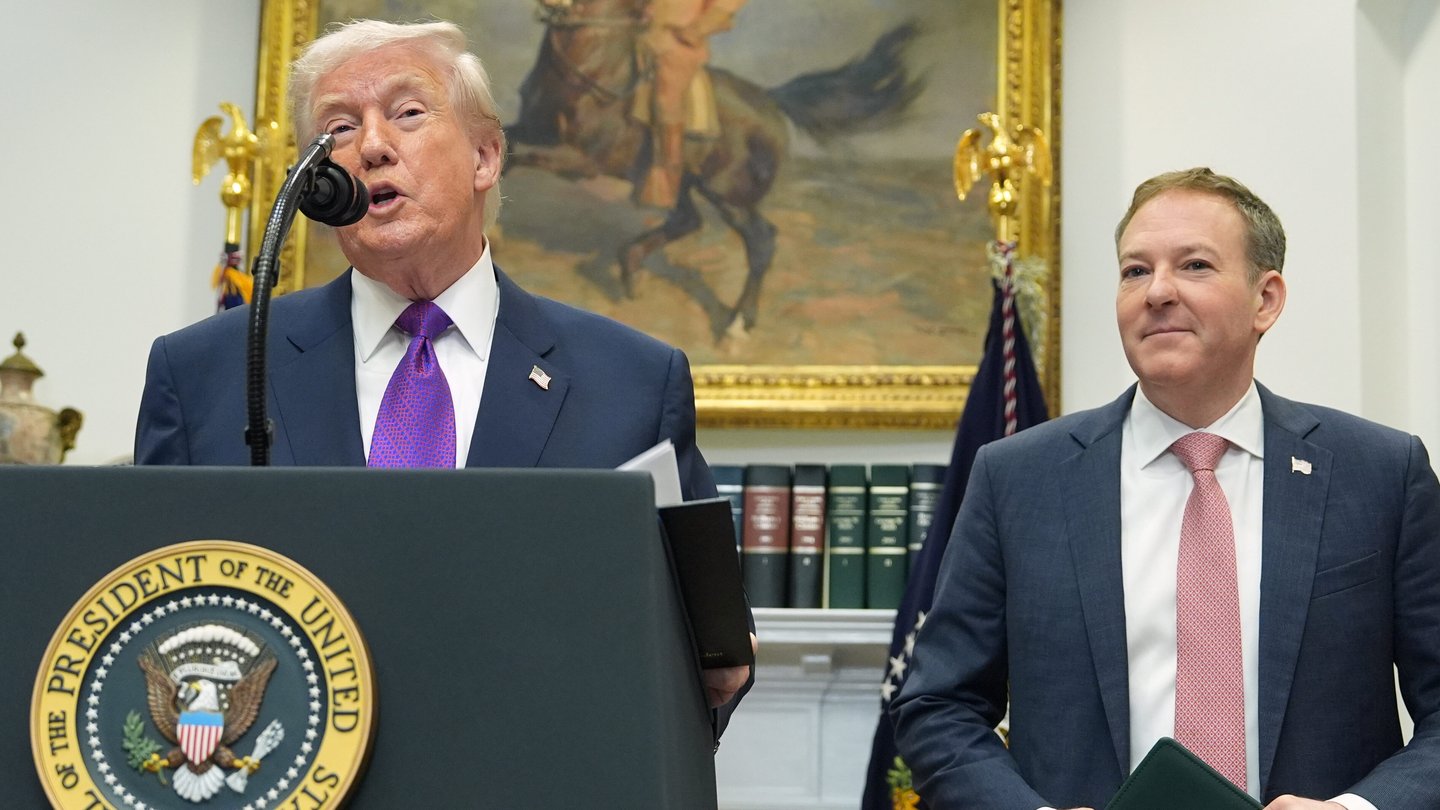
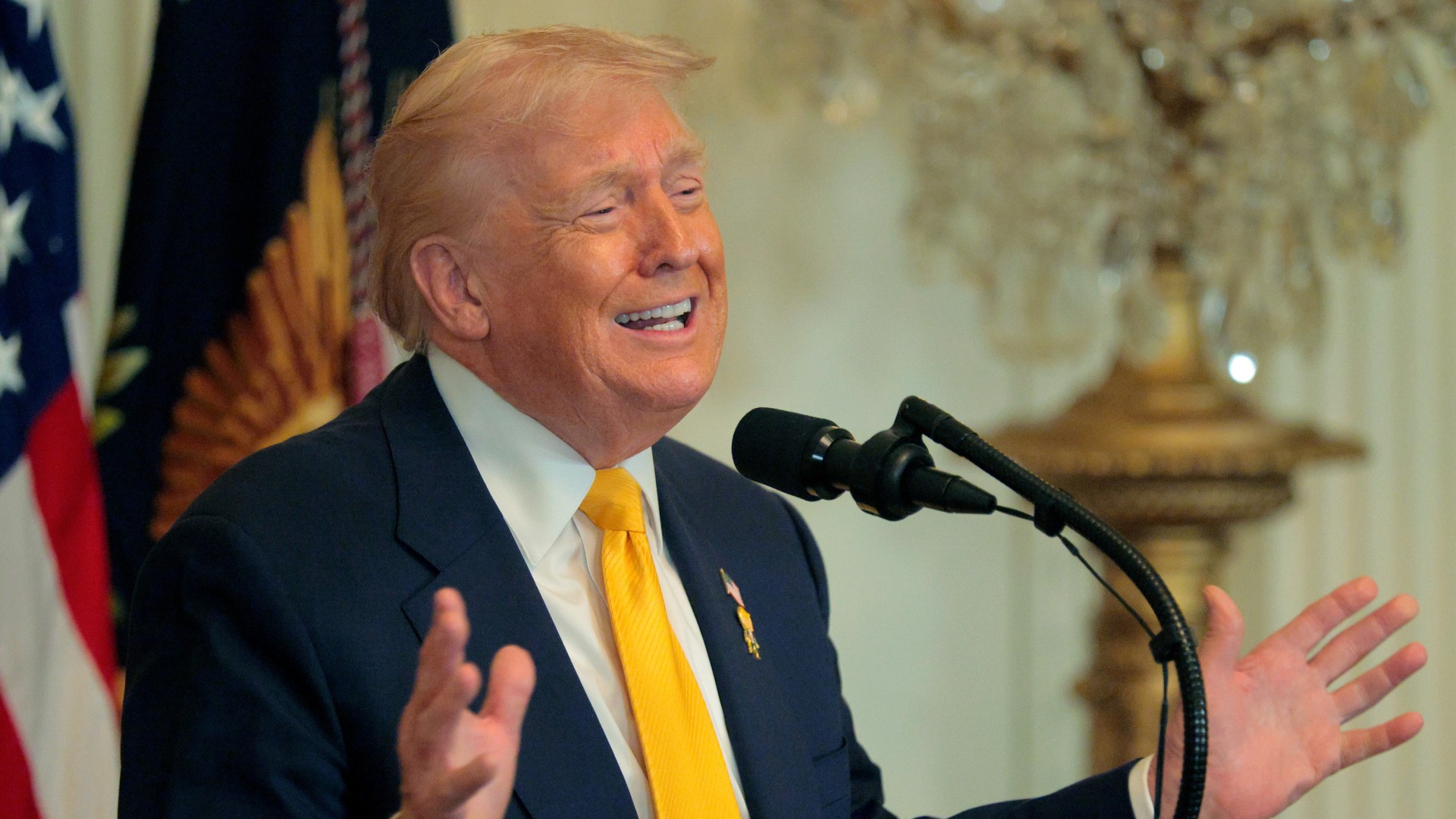
President Donald Trump speaks during an event with Environmental Protection Agency director Lee Zeldin announcing that the EPA will no longer regulate greenhouse gases, in the Roosevelt Room of the White House, Thursday, Feb. 12, 2026, in Washington.

(AP Photo/Evan Vucci)

Trump’s announcement comes after former President Barack Obama said in a podcast interview that aliens were real, later clarifying that he meant “the odds are good there’s life out there.” Obama added in his clarification that he had seen “no evidence” of alien existence during his time in office.

Obama was answering a series of questions during a "lightning round" of the podcast interview, when he was asked whether aliens were real.

"They're real," Obama said, "but I haven't seen them, and they're not being kept in Area 51. There's no underground facility unless there's this enormous conspiracy and they hid it from the president of the United States."

The podcaster, Brian Tyler Cohen, then asked Obama what was the first question he had wanted answered when he took office.

"Where are the aliens?" Obama responded.

Trump, asked by a reporter about Obama’s remarks Thursday, said Obama had given classified information.

“He’s not supposed to be doing that,” Trump added.

Following a 2024 hearing, the Pentagon said it received hundreds of reports on UAPs and 21 that merited “further analysis” because of “anomalous characteristics and/or behaviors” — but found no evidence of extraterrestrial activity.

Responding to Trump’s directive Thursday night, Hegseth posted a screenshot of Trump’s post with an alien emoji and a saluting emoji.

Some lawmakers reacted to Trump's announcement Thursday. Sen. John Fetterman, D-Pa., said in an interview on Fox News, "If he’s going to release all of the X-Files, I think that could be a bipartisan thing," referring to the 1990s television show about FBI agents investigating — among other things — government conspiracies about aliens, which Fetterman said he "grew up watching."

Rep. Anna Paulina Luna, R-Fla., thanked Trump, writing: "Looks like we are about to have a ton of hearings on this :)!"


{ https://www.nbcnews.com/ }

Hoe vind je dit bericht?
Geschreven door peter om 17:44 Stuur door

NASA delays astronaut moon mission again after new rocket problem

NASA delays astronaut moon mission again after new rocket problem

Story by Marcia Dunn
 
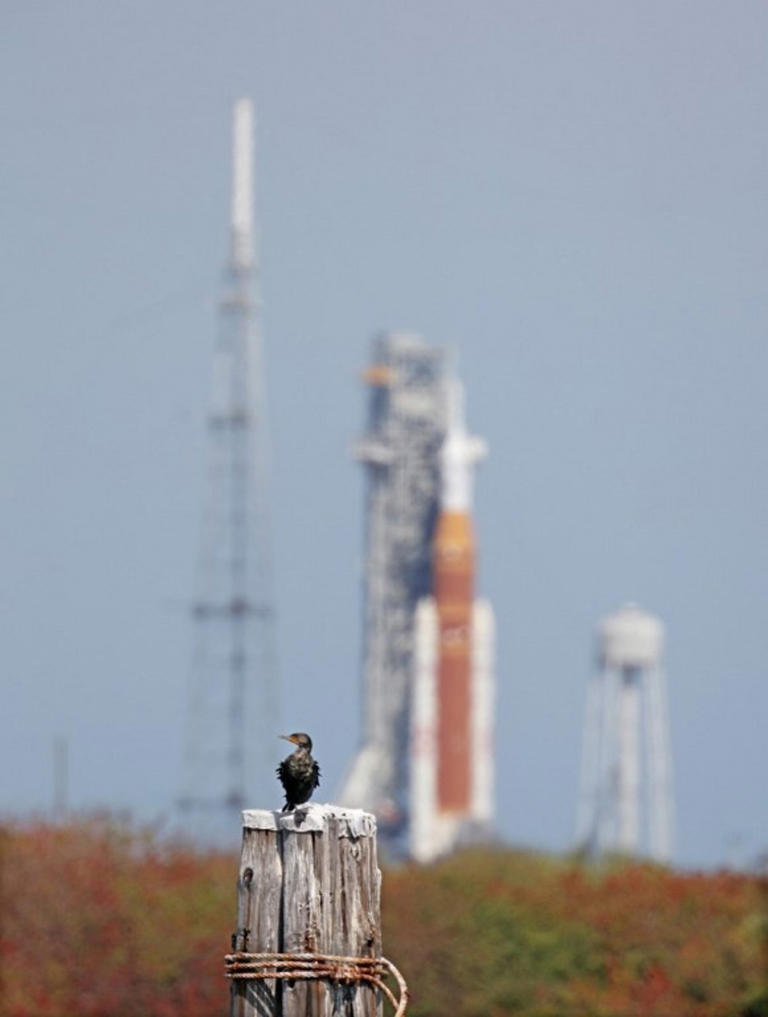
NASA's moon rocket sits on a launchpad at Kennedy Space Center in Florida on Thursday. ((NASA / Associated Press))
NASA's moon rocket sits on a launchpad at Kennedy Space Center in Florida on Thursday.
((NASA / Associated Press))© (NASA / Associated Press)

In the latest setback to return astronauts to the moon, NASA delayed the highly anticipated flight yet again after a new problem cropped up with the rocket Saturday.

April is now the earliest that the four Artemis II astronauts could fly to the moon.

NASA revealed the latest problem a day after targeting March 6 for Artemis II, the first manned flight to the moon in more than half a century. Overnight, the flow of helium to the rocket’s upper stage was interrupted, officials said. Solid helium flow is essential for purging the engines and pressurizing the fuel tanks.

This helium issue has nothing to do with the hydrogen fuel leaks that marred a countdown dress rehearsal of the Space Launch System rocket earlier this month and forced a repeat test.

NASA Administrator Jared Isaacman said a bad filter, valve or connection plate could be to blame for the stalled helium flow. Regardless of the cause, he noted, the only way to access the area and fix the problem is in the Vehicle Assembly Building at Kennedy Space Center.

“We will begin preparations for rollback, and this will take the March launch window out of consideration,” Isaacman said via X. NASA's next opportunities would be at the beginning or end of April.

“I understand people are disappointed by this development,” Isaacman said. “That disappointment is felt most by the team at NASA, who have been working tirelessly to prepare for this great endeavor.”

Earlier in the day, NASA said it was preparing to move the 322-foot rocket back to the Vehicle Assembly Building at Kennedy Space Center while raising the possibility of the work being done at the pad.

The situation is dynamic, said spokeswoman Cheryl Warner. Whether the fixes are at the pad or in the hangar, the rollback preparations alone rule out any chance of a March launch, she said.

Hydrogen fuel leaks had already delayed the Artemis II lunar fly-around by a month. A second fueling test on Thursday revealed hardly any leaks, giving managers the confidence to aim for a March liftoff. The four astronauts went into their two-week quarantine Friday night, mandatory for avoiding germs.

The interrupted helium flow is confined to the SLS rocket's interim cryogenic propulsion stage. This upper stage is essential for placing the Orion crew capsule into the proper high-altitude orbit around Earth for checkout, following liftoff. After that, it's supposed to separate from Orion and serve as a target for the astronauts inside the capsule, allowing them to practice docking techniques for future moon missions.

During NASA's Apollo program, 24 astronauts flew to the moon from 1968 through 1972. The Artemis program has completed only one flight so far, a lunar-orbiting mission without a crew in 2022. That first test flight was also plagued by hydrogen fuel leaks before blasting off, as well as a helium issue similar to the one that arose Saturday.

The upcoming mission will not involve landing on or orbiting the moon. The first lunar landing with a crew under Artemis is at least a few years away.

  • Dunn writes for the Associated Press.

Hoe vind je dit bericht?
Geschreven door peter om 17:27 Stuur door

Science news this week: China's AI kung fu robots, physicists' re-creation of the Big Bang soup, and a teenager buried with her father's bones on her chest

Science news this week: China's AI kung fu robots, physicists' re-creation of the Big Bang soup, and a teenager buried with her father's bones on her chest

A Unitree robot and a quark moving through a quark-gluon fluid China's AI kung fu robots and physicists' re-creation of the Big Bang soup were two of this week's top science stories.  (Image credit: Unitree | Jose-Luis Olivares, MIT)

This week's science news was filled with some astonishing — and creepy — displays of technology's accelerating progress.

Top of the bill was a stunning demonstration of Chinese company Unitree Robotics' humanoid robots, which somersaulted, flipped and kicked in a kung fu performance at this year's Lunar New Year festival. The robots' eerily fluid movements were a sight to behold on their own. But compare them with the stiff and cumbersome moves by similar robots just a year earlier, and it's clear how much the tech — has advanced, thanks to better algorithms and cluster control platforms.

Also in China, the world's first megawatt-class flying wind turbine produced enough power to electrify a house for two weeks. And elsewhere, Microsoft made waves with a laser breakthrough that could see terabytes of data stored on ordinary glassware for up to 10,000 years.

Physicists make a Big Bang soup

A colorful image shows a opalescent sphere carving a streak through a rainbow colored surface, kicking up white streaks behind it

Physicists at CERN recreated the soupy conditions of the very early universe.  (Image credit: Jose-Luis Olivares, MIT)

In the most ambitious instance of experimental home cooking we covered this week, physicists at the Large Hadron Collider (LHC) recreated the primordial state of the early universe and found it was more like soup than first thought.

The discovery comes from the LHC's Compact Muon Solenoid, which smashed together two heavy atomic nuclei at near light speed to create an extremely short-lived quark-gluon plasma, believed to be the stuff of our universe in the first microseconds following the Big Bang.

The findings could have enormous implications for how our cosmos, and the stuff it's made of, first formed.

Life's Little Mysteries

A person wearing blue long-sleeve scrubs and white gloves holds a piece of paper standing over a metal table with a body covered in a white sheet with only its feet sticking out on top. The bare feet face the camera and have a label attached to the right foot's big toe

Rigor mortis is the result of some complex cellular processes.  (Image credit: Darrin Klimek via Getty Images)

Not long after death, a sea change takes hold within the human body — a sequence of natural, cellular-level steps that result in a process called rigor mortis. But what are these steps? And why does rigor mortis happen to nearly all human bodies?

Teenager buried with her father's bones

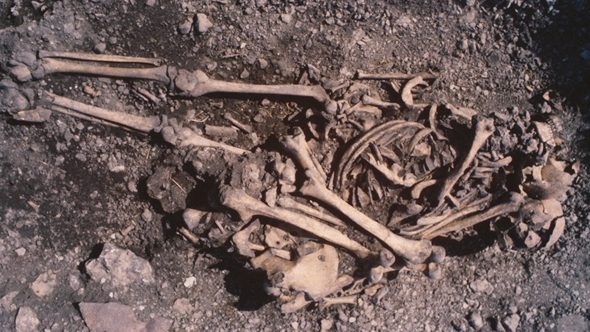
a human skeleton with other human bones on top, being excavated from the ground

A hunter-gatherer cemetary on a Swedish island has revealed the complex familial relationships of ancient societies.  (Image credit: Göran Burenhult (CC BY))

Archaeologists who performed a DNA analysis of skeletons excavated from a Neolithic cemetery in Sweden have uncovered some surprising family burial practices this week, showing that some of Europe's last hunter-gatherers had detailed knowledge of their family lineages.

The society, called the Pitted Ware culture, was a hunter-gatherer community that lived on the western Swedish island of Gotland 5,500 years ago. Evidence of burials and reburials, with graves shared by up to third-degree relatives, suggests people of this culture paid scrupulous attention to their social connections and honored them long after death.

Discover more archaeology news

Also in science news this week

Science long read

A cartoon showing a series of figures carrying different dark blue numbers walking across a green and yellow circuit board. In the background, a human brain floats in the center of blue concentric circles with a circuit board pattern in the shape of the brain

Could AI take mathmeticians' jobs? Or will it drown them in slop?  (Image credit: James Boldry for Live Science)

At a secret meeting in Berkeley, California, last year, some of the world's leading mathematicians gathered to discuss the fate of their profession. The agenda was clear: Was artificial intelligence (AI) on the precipice of taking their jobs? And would the best math no longer be produced by humans?

Yet during the discussion, an even more troubling question appeared. In the past, confidence and a good argument were signs a proof was right, as only the best would be convincing to the rest of the field. Now, however, AI is spewing out hundreds of proofs that could be flawed but are too complex to verify. In this long read, Live Science investigated mathematicians' fight to figure out if the machines are right.

Something for the weekend

If you're looking for something a little longer to read over the weekend, here are some of the best analyses, opinions and crosswords published this week.

Science news in pictures

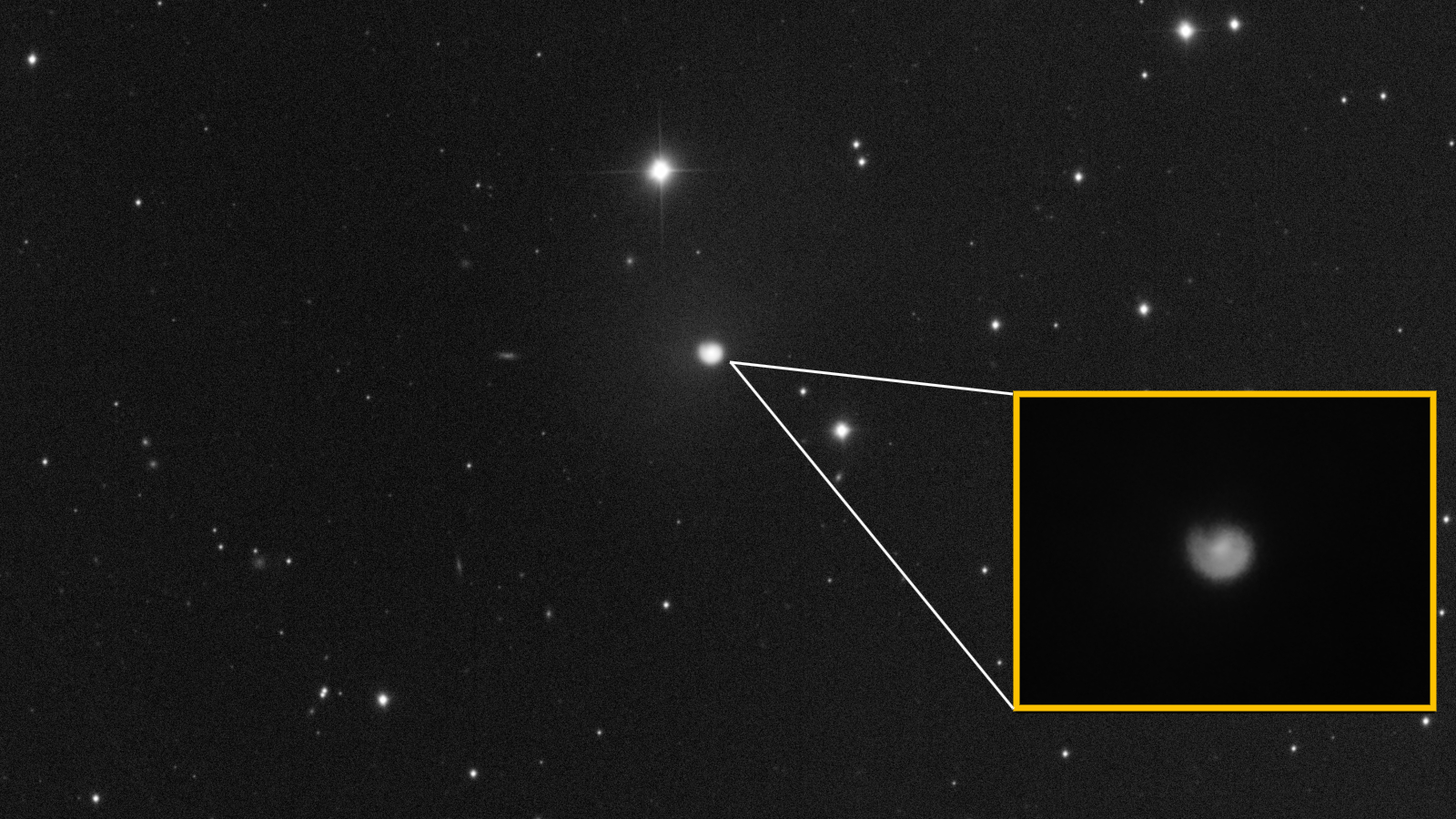
Photo of comet with a close-up of its coma showing off a distinctive spiral shape

The 'snail-shell' comet, also known as Comet 29P/Schwassmann-Wachmann  (Image credit: Eliot Herman)

This photo shows Comet29P/Schwassmann-Wachmann, an ice ball three times the length of Manhattan, erupting into a cosmic snail shell as it circles the inner solar system.

29P/Schwassmann-Wachmann is an example of a cryovolcanic comet, which explodes after its icy shell soaks up too much solar radiation. This causes the icy gas and dust on its surface to sublimate outward, forming a fuzzy cloud.

{ https://www.livescience.com/technology }

Hoe vind je dit bericht?
Geschreven door peter om 23:48 Stuur door

Blind psychic Baba Vanga's chilling UFO prediction amid Trump's alien announcement

A blind psychic may have predicted President Trump's decision on Thursday to disclose secret records on aliens and a major encounter with UFOs.

Baba Vanga, who allegedly foretold 9/11 and the Covid pandemic, was a Bulgarian mystic and clairvoyant who became a cult figure among conspiracy theorists after several of her eerie pronouncements came true, including some occurring decades after her death.

In the wake of the president's historic order to release all government files, a prediction by Baba Vanga has resurfaced that claimed humans would make first contact with aliens in November 2026.

The late psychic is said to have foreseen a 'massive spacecraft' entering the planet's atmosphere, providing undeniable proof of extraterrestrial life, but its intentions were never revealed.

Baba Vanga left no written records of her predictions. Most of the accounts have come from her niece, Krasimira Stoyanova, or other followers who heard and wrote down her alleged visions after she died in 1996.

However, her followers have been accused of misinterpreting what she said, and skeptics have noted that many of Baba Vanga's visions have not turned out to be right, including one predicting a UFO appearing over a major sporting event in 2025.

Until recently, the US government and the Pentagon have both claimed there has never been any physical evidence suggesting UFOs or aliens exist.

That changed when former President Barack Obama sparked wild speculation during a February 14 interview, where he declared that aliens were real. Trump quickly slammed the comments, claiming Obama had revealed 'classified information.'

Baba Vanga (Pictured) was a Bulgarian mystic and clairvoyant who became a cult figure among conspiracy theorists after being credited with predicting the 9/11 terror attacks and Covid pandemic

Baba Vanga (Pictured) was a Bulgarian mystic and clairvoyant who became a cult figure among conspiracy theorists after being credited with predicting the 9/11 terror attacks and Covid pandemic

Trump's announcement directed Secretary of War Pete Hegseth and the Pentagon to disclose anything 'related to alien and extraterrestrial life, unidentified aerial phenomena (UAP), and unidentified flying objects (UFOs).'

Thursday's bombshell followed multiple reports that the president also has a written speech already prepared for a press conference this year, which will focus on what the US government knows about the existence of extraterrestrial beings.

Some interpretations of Baba Vanga's prophecy said the giant alien craft's appearance in November will set off World War III, as the clairvoyant warned of rising tensions between major global powers, including China, Russia and the US.

She also allegedly had visions of the distant future involving Earth's ties to alien life, including claims that human societies would begin building underwater cities with the aid of extraterrestrials in 2130.

Baba Vanga also reportedly predicted humans would make contact with more aliens in 2288, and that the ability to time travel would be invented that same year.

Born in 1911 as Vangeliya Pandeva Dimitrova, she was a famous blind Bulgarian mystic, clairvoyant, and herbalist known as the 'Nostradamus of the Balkans.'

She lost her sight at age 12 after being caught in a tornado, an event that coincided with the emergence of her purported psychic abilities.

Baba Vanga made numerous prophecies, often vague, about natural disasters, political shifts and future technologies, including the 2004 Indian Ocean tsunami that killed over 230,000, the election of Obama in 2008, and the rise of the Islamic terror group ISIS in 2010.

On February 19, President Trump (Pictured) ordered the Secretary of War and the Pentagon to release all documents related to investigations on the existence of UFOs and alien life

On February 19, President Trump (Pictured) ordered the Secretary of War and the Pentagon to release all documents related to investigations on the existence of UFOs and alien life

Baba Vanga allegedly predicted that a 'massive spacecraft' would be seen entering Earth's atmosphere in November 2026, marking first contact with aliens

Baba Vanga allegedly predicted that a 'massive spacecraft' would be seen entering Earth's atmosphere in November 2026, marking first contact with aliens

article image

Her track record as a seer of future events rivaled the centuries-old reputation of Nostradamus.

She has also been credited with predicting the destruction of the Russian submarine Kursk, which sank in the Barents Sea in 2000, and seeing the terrorist-controlled planes striking New York's Twin Towers a year later on September 11.

Baba Vanga reportedly said: 'Two metal birds will crash into American brothers, and blood will spill.'

The clairvoyant even foretold her own death correctly, allegedly telling her followers she had dreams she would die on August 11. Baba Vanga did in fact die of cancer on August 11, 1996 at the age of 85.

Despite her reported track record of accurate visions, some predictions of global destruction over the last two decades have failed to materialize. 

Baba Vanga is said to have predicted a nuclear war taking place between 2010 and 2016.

She also allegedly foretold that Europe would be deserted by 2016 after many years of widespread fighting and chemical attacks. The psychic added that several world leaders would be assassinated that same year.

While many believe her prediction of a strange UFO being seen over a televised sporting event in 2025 never came true, conspiracy theorists have claimed it actually did and NASA has withheld the evidence.

Some on social media alleged that the 'new light in the sky' Baba Vanga saw was the passage of the mysterious interstellar object 3I/ATLAS, which could be seen from Earth as it made its closest pass on December 19, 2025.

RELATED VIDEOS

{ https://www.dailymail.co.uk/sciencetech/index.html }

Hoe vind je dit bericht?
Geschreven door peter om 23:16 Stuur door

Beautiful Petroglyphs Discovered in Venezuela Give Hints of Ancient Culture

Spirals or concentric circles rock art engraving on a boulder in Venezuela.

Beautiful Petroglyphs Discovered in Venezuela Give Hints of Ancient Culture

A newly recorded set of rock carvings in Venezuela’s Monagas state is being described as potentially among the country’s oldest known examples of rock art, with an estimated age ranging from 4,000 to 8,000 years. The petroglyph panel - marked by spirals, concentric circles and human-like forms - was located in a highland area of the Quebrada Seca community in Cedeño, and local officials are now pushing for formal certification and protection, reports Heritage Daily. If the early age range holds up under scientific study, the discovery could reshape how researchers think about early symbolic traditions in eastern Venezuela. 

The Discovery in Cedeño Municipality

According to reports by Ultimas Noticias, the petroglyph was found in the upper zone of Quebrada Seca, around 3.5 km (2.2 miles) from the town of San Félix, at roughly 650 meters (2125 feet) above sea level. The site was announced by Cedeño’s mayor, Daniel Monteverde, alongside a commission linked to Venezuela’s National Land Institute, after what was described as a period of local research and location work. Initial descriptions highlight circular and spiral engravings carved with notable precision on a naturally formed rock surface.

Authorities examining the rock where the petroglyphs have been discovered.

Authorities examining the rock where the petroglyphs have been discovered.

(YouTube Screenshot)

The municipality is often presented as a rock-art hotspot within the state, and Heritage Daily notes that Cedeño is widely regarded locally as the “petroglyph capital” of Monagas because of the broader indigenous legacy in the area. The engravings themselves - geometric and anthropomorphic - are being interpreted as potentially tied to cosmology, water cycles, solar symbolism, and ancestral spirits, themes that recur across many ancient rock art traditions. For readers wanting broader background on what petroglyphs are (and how they differ from paintings), Ancient Origins has a hub of articles on its Petroglyphs topic page.

Venezuela's Newly Discovered Ancient Rock Art Could Rewrite South American History 

Rock art panel in the Upuigma-tepui table-top mountain area of Canaima National Park, Venezuela.

Courtesy of José Miguel Pérez-Gómez/Proyecto Arqueológico Canaima/Axios

Why “8,000 years” is a Big Claim

The reported age, between 4,000 to 8,000 years, appears to be an estimate based on relative and stylistic assessment rather than a published laboratory date, and that distinction matters. Petroglyphs are notoriously difficult to date directly, so researchers often rely on a mix of contextual archaeology, superimposition sequences, erosion/patina analysis, and comparisons with dated materials nearby. Heritage Daily also describes the carving style as a “linear low-relief” approach, typically produced through abrasion and pecking with stone tools, sometimes using sand and water as an abrasive. 

Monagas is not the only Venezuelan region producing major rock-art headlines, and comparison cases can help frame what is plausible. In 2024, archaeologists working in Canaima National Park reported dozens of rock art sites featuring pictograms and petroglyphs, with some discussion around the possibility of an as-yet poorly understood cultural tradition in that landscape, explains Live Science. While that research focuses on a different region of the country, it underlines how much remains undocumented and how quickly a new find can expand the map. 

Historic photo of another petroglyph rock, located in Acequias, town of Barinas state, in Venezuela.

Historic photo of petroglyph located in Acequias, town of Barinas state, in Venezuela. (Annel Mejías Guizavia 

/Public Domain)

Protection, Tourism—and the risk of losing the evidence

In the short term, the bigger story may be what happens next: documentation, dating, and whether the site can be safeguarded before weathering or people do damage. That urgency is familiar to anyone who follows petroglyph finds globally, where the moment a location becomes widely known can also be the moment it becomes vulnerable. 

Local authorities say their immediate goal is to geolocate and safeguard the site, explicitly citing vandalism prevention, while also developing an “archaeological route” tied to sustainable tourism. The balance of public access versus conservation is delicate, because even light touching, chalking, or repeated foot traffic can accelerate deterioration. Monteverde has also indicated plans to meet with cultural authorities, including Venezuela’s national cultural heritage bodies, to formalize certification steps reports Últimas Noticias.

The wider Orinoco basin offers a reminder of both the scale of Venezuela’s rock art and the long timelines involved. A major 2024 study of monumental engravings along the Orinoco, discussed by Smithsonian Magazine, documented numerous large figures—snakes, animals, and human forms—and argued that visibility and placement may have mattered as much as the images themselves. Even though those Orinoco carvings are thought to be around 2,000 years old, their prominence shows how rock art could function as communication in a river landscape. 

  • Top image: Petroglyphs engraved on boulder in Venezuela’s Monagas state.
  • Source: Últimas Noticias

By Gary Manners

References

{ https://www.ancient-origins.net/history-0 }

Hoe vind je dit bericht?
Geschreven door peter om 22:55 Stuur door

This Man Claims There Are Multiple Bases on the Moon – Including a Massive Ancient Ark – and People Living There Who Look Like Indians from Ancient India, Flying Egg-Shaped Crafts

Jorge Pabon multiple moon bases

This Man Claims There Are Multiple Bases on the Moon – Including a Massive Ancient Ark – and People Living There Who Look Like Indians from Ancient India, Flying Egg-Shaped Crafts

By Vicky Verma

Jorge Pabon, a former U.S. Army paratrooper who served until August 30, 2024, reveals his real name and face for the first time in the YouTube interview with Clayton Morris on the show “Redacted.”

He had previously shared stories anonymously under the name “JP” with ufologist Dr. Michael Salla, who documented them in books.Pabon says he is coming forward now at great personal risk to himself and his family, but he has received a “green light” from certain people connected to Washington to speak about specific topics.

He served as a 91J (quartermaster and chemical equipment repairer), worked with water purification, and was often used as a translator because he speaks Spanish, Portuguese, and some other languages

Jorge Pabon

Jorge Pabon. Credit: Redacted/YouTube

He was attached to the 7th Special Forces Group (though he makes clear he was not a Green Beret himself; he calls himself a “Red Beret” paratrooper) and reached the rank of E-4.

He says lower-ranking soldiers like him were usually the ones sent on the actual missions, while higher-ranking officers stayed in secure locations.

Before joining the military, Pabon lived in Orlando, Florida, where he cleaned pools, installed security cameras, and made music. He started taking photos of UFOs around 2007–2008, including triangular TR3B craft and cigar-shaped objects.

Mysterious men in tactical gear (sometimes wearing balaclavas) would approach him in white vans or trucks and tell him exactly when and where to look up to photograph the craft.

He calls these men “white hats” who wanted the information to get out. At the same time, other groups of armed men would pick him up, interrogate him, and tell him to stop sharing photos.

After he sent a TR3B photo to Dr. Michael Salla and it got media attention, he lost his job. The “good” men then encouraged him to join the Army so the harassment would stop. He joined at age 34, and the military changed his life for the better.

highcompress_2.jpg

Jorge Pabon1

 Jorge Pabon.

Credit: Redacted/YouTube

Pabon describes secret missions he took part in while in the Army. He was part of multinational teams that included U.S. special forces from different branches, as well as people from other countries.

On these missions, they wore black tactical gear and were transported by helicopters or Ospreys to large Navy ships that could partially submerge to hide.

From there, they went underwater to visit enormous ancient “ark” ships, massive structures the size of three football stadiums or larger, that have been on Earth for hundreds of thousands or possibly millions of years.

He visited one near the Bermuda area off Florida, and says there are others scattered around the world’s oceans, including near Puerto Rico, south of Hawaii near California, south of India, between Venezuela and Puerto Rico, in the Arctic, and in Antarctica.

These arks are alive; they have a consciousness, give off a pleasant smell like hay mixed with algae and vanilla, and feel like they have a heartbeat.

Tall, blonde Nordic extraterrestrials now control them. Inside, there are different departments and rooms, and some areas connect to underground cities where humans and Nordics live and work together. These cities are multi-layered but smaller than major cities like New York, and they function more like bases without children.

Pabon says he was chosen for missions because he seems to have a natural ability to call down or communicate with UFO craft, possibly through prayer or meditation. He has seen UFOs appear at conferences where he speaks, and his wife and children have also witnessed craft.

He describes seeing Nordics training pilots from Artemis Accords countries in Alabama inside a cavern, using flying-saucer-shaped vehicles. He has also seen “ant people” (beings with big eyes and dreadlock-like hair that live underground, similar to stories from Hopi Indians) and, from a distance, one gray alien during a strange mission involving moving large amounts of gold.

He believes the U.S. has very advanced technology—hundreds of years ahead—including anti-gravity propulsion, space-time manipulation, and quantum technology, much of it developed through cooperation with friendly extraterrestrials like the Nordics. He says many UFO sightings today are actually human-made craft using this borrowed technology, though some are still extraterrestrial. Countries work together secretly on these programs despite public rivalries.

Jorge Pabon UFO whistleblower

Jorge Pabon. Credit: Redacted/YouTube

He mentions opposition to disclosure. There are “dark forces” (not the regular military or defense contractors) that do not want this information out, possibly because of old unbreakable contracts. He has been threatened at gunpoint and even kicked in the face by aggressive people using advanced craft for bad purposes. Still, he believes disclosure is coming soon, possibly in phases, and that 2026 could be a key year.

Multiple Moon Bases

He speaks openly about his one remembered trip to a moon base, advanced healing technology called medbeds, Stargates and jump rooms for instant travel, and the spiritual side of everything he has witnessed.

Pabon says there are multiple bases on the moon, including at least one large ancient ark similar to the ones he described under Earth’s oceans in part one.

This ark is partly visible on the surface but mostly underground, located somewhere between the near side and the far side (he cannot give the exact spot). Many countries are involved in moon operations.

He reveals that there are people living on the moon who look Indian, with dark skin and traditional Indian features. They are highly spiritual, combine advanced technology with their spiritual traditions, and fly egg-shaped craft.

These craft are connected to ancient Indian culture (he mentions vimanas from old texts). Pabon believes these moon inhabitants sometimes visit Earth and that the U.S. has recovered some of their egg-shaped ships in crash retrievals0

One of these beings, whom he calls “Lovent,” once picked him up in an egg-shaped craft. He says the egg-shaped UFO shown in a recent NewsNation report about a crash retrieval looks almost identical to the ones he has seen.

He remembers being transported to the moon only once, in a group with other military personnel and civilians, aboard a craft similar to triangular TR3B craft. The trip caused him to black out, and when he woke up, they were already there.

The craft flew into an ancient volcanic tunnel lined with beautiful copper-like material. Inside the moon base, the air is thin but breathable and feels refreshing, similar to high altitude on Earth.

There is a lot of crystallized water on the moon, and advanced technology extracts oxygen from it. The base has newer sections built by humans (possibly in cooperation with Nordics) and older parts that look like ancient Roman-style structures built into large caverns.

The moon itself makes a constant humming sound, almost like an engine. Pabon believes the entire moon is alive or is actually a huge ancient craft that has been parked there for a very long time.

He wonders if it could be moved closer to Earth to cause massive waves or resets of civilization, though he stresses he is not trying to spread fear.

While on the moon, his job was mainly to provide security. He says missions often use lower-ranking soldiers who have already had contact experiences because these things become normal to them. He did not see everyday facilities like bathrooms or cafeterias; everyone took special pills beforehand that seemed to handle bodily needs. The visit felt fast-paced, lasting maybe a few hours.

Pabon talks about portal technology for instant travel. He has seen large Stargates big enough for ships to pass through and smaller “jump rooms” that make a person feel dizzy and nauseous before they suddenly appear somewhere else. He believes some are located at major U.S. Air Force bases like Eglin (possibly also linked to the new Space Force headquarters in Alabama). At one Stargate facility, he encountered aggressive “bad people” who act like guards and punish anyone who looks up or steps out of line.

Read also:

A major part of the interview focuses on medbeds, advanced healing devices far beyond current medicine.

Pabon personally used one at Eglin Air Force Base. He lay in a capsule filled with a sticky gel connected to wires, unable to move from the neck down. Blood was taken, and he blacked out for part of the time.

Afterward, he felt dramatically better, almost like he could run two miles in 12 minutes again. He says the technology is borrowed from extraterrestrials but can also be dangerous if misused, which is why it is not released to the public yet.

When the time comes, it will be rolled out slowly through different companies specializing in certain conditions, and people may need preparatory medications or vaccines first. There are medbeds on the moon base as well.

He mentions other advanced technologies, including devices that can transfer consciousness (like in the movie Avatar) and healing “salamander wands” that can regrow missing limbs.

He once tried to build a healing wand at home after receiving instructions from a Nordic being, but unknown people broke into his house and stole everything. The same thing happened to an Air Force friend who builds technology.

Pabon briefly talks about travel beyond the moon. He has memories or dreams of seeing Jupiter and the rings of Saturn up close. He says a multinational company (not just the U.S.) mines materials from Saturn’s rings and other places in the solar system.

He defends the Apollo astronauts, saying they really went to the moon but on missions different from what was publicly shown, focused on making connections rather than just planting flags or driving rovers.

He loves the military, calls joining the best decision of his life, and says he is not a whistleblower but someone given permission to share certain parts of his story. He believes full disclosure will happen in stages and that love and spirituality are the most important messages people should take from all of this.

RELATED VIDEOS

{ https://howandwhys.com/ }

Hoe vind je dit bericht?
Geschreven door peter om 22:01 Stuur door

This Man Claimed that in 1994 he Met a Blue, Crocodile-Eyed ‘Alien’ in a Military Uniform

Jason Sands

This Man Claimed that in 1994 he Met a Blue, Crocodile-Eyed ‘Alien’ in a Military Uniform

This Man claimed that in 1994, during a US military exercise, he saw an unusual alien being in a military-style  uniform whose skin had a light blue tint, no ears & eyes like a Crocodile that freaked him out. The being told him that his craft was damaged and that he needed some material to repair it.

Jason Sands is a retired US Air Force veteran, a Defense Contractor, UAP whistleblower claiming he had an otherworldly encounter in 1994 near Nellis Air Force Base/Test Range.

He was born in England to an English mother and a U.S. Army Green Beret father, and later lived in Japan, Massachusetts, Germany, and California because of his father’s military assignments.

At about age 10 in San Jose, Jason says he saw a red light come down from the sky, turn into a silver, mercury-drop-shaped object about the size of a camper, hovering just above his friend’s house, silently and very close. He watched it move under a streetlight, then shoot up, orbit briefly with another light, and then one of them streaked across the sky faster than a shooting star; his mother saw part of this with him, and his friend later reported his TV flickering and a humming sound. This sighting led Jason to read “Chariots of the Gods” and become interested in ancient aliens for a while, but as a child, he mostly returned to normal life, sports, and friends, without making UFOs a central focus.

Jason joined the U.S. Air Force in the mid‑1980s, partly influenced by his father but following his father’s advice not to join the Army or Marines; his father wanted him to learn a trade, so Jason chose the Air Force for its technical skills and later used it to earn a bachelor’s degree. He first worked as an airframe repair specialist on large aircraft like C‑130s and KC‑135s, fixing structural cracks, landing gear tracks, and rivets, before being retrained in signals intelligence due to overmanning in his original field.

As a signals intelligence (SIGINT) specialist, Jason monitored telecommunication signals on U.S. military installations, which required strong privacy training because he was listening to Americans, and he had to report threats like planned violent crimes to investigative agencies. He says his work expanded from radios to satellite communications, cell phones, and computer traffic over time, and during Desert Storm, he and his team intercepted information about Iraqi civil engineers being moved, which led to changing U.S. plans to protect those engineers from ambush while they dealt with oil-filled burn pits.

After Germany and Desert Storm, Jason requested western locations like Nevada, Hawaii, or Colorado, and was assigned to Nellis Air Force Base near Las Vegas, living in North Las Vegas. At Nellis, he trained other SIGINT analysts and also received special prototype training to cross over into electronic intelligence (ELINT), working with radar data—this is how he met his future wife, who was an ELINT “scope dope” assigned to the same unit and trained him.

Jason took part in “Red Flag” exercises at Black Mountain and the wider Nevada Test and Training Range, staying for two‑week rotations in small towns like Beatty and Tonopah rather than commuting daily from Las Vegas. He describes how, while training at Black Mountain, people casually pointed across the desert toward the Groom Lake range and talked about “Dreamland” and UFO rumors, which was his first time really hearing those stories in that context.

A few months after arriving in Nevada, Jason and several other analysts were quietly approached by colleagues and told they were being considered for a special access program (SAP) located at Groom Lake. They were asked if they would submit to a full‑scope (lifestyle) polygraph, which probes their entire life history for trustworthiness; Jason agreed, saying he had nothing to hide, and took the polygraph alongside a scientist who was also being onboarded.

After passing, Jason got a call on a Friday telling him to pack his bags without being told the destination, and the next day, he was picked up at his dorm, driven to a special secure part of McCarran Airport, and put on an unmarked “Janet” type flight with other personnel. He noticed that boarding and deplaning were unusually orderly, with no crowding or rushing, and upon arrival, he watched a mandatory security video that introduced the program name, rules, and general mission without openly mentioning aliens.

Jason also notes that he had heard of Bob Lazar in the media but did not know or care about Lazar’s claims while he was actually working at Groom Lake; Lazar had nothing to do with his assignment or chain of command.

 1994 Red Flag exercise near Black Mountain

Jason explains that he and his team were driving in a convoy toward Quartz Mountain, with his truck in the lead. He sat in the back seat behind the driver, with another man in the front passenger seat and a young woman sitting to Jason’s right in the back. They always traveled with at least two vehicles behind them so that if one broke down, the others could help.​

As they drove, Jason saw a man in a standard battle  dress  uniform (BDU), just like his own, standing on the left side of the road about a football field away. When the man noticed their vehicle, he started running toward them in a strange way, leaning forward as if he were falling or pushing against a strong wind. At first, Jason thought he was just another soldier in trouble, not.

As they got closer, Jason noticed that the man’s skin had a light blue tint, like someone who is very cold and hypothermic, not a dark or bright blue, but a pale bluish tone under normal skin color. Jason’s first thought was that the man was freezing and needed help, not that he was anything non‑human. When the stranger was only a few feet from the vehicle, and they were slowing down, the man in the front passenger seat suddenly shouted, “He’s got no ears,” meaning there were no ears at all on the sides of his head.​

Read also:

Jason at first thought this comment was rude because he assumed the man was suffering and needed medical help. He quickly opened his door and started taking off his jacket, intending to wrap it around the stranger to warm him up. As Jason stepped onto the road, shut the door, and looked at the figure from very close range—about three feet—he saw clearly that the being had no ears, eyes roughly twice the normal human size, and that same blue tint to the skin. At that instant, he felt a strong surge of fear, like a jolt of adrenaline, and thought, “Oh crap, this does not look human.”

Jason says that when he and the being locked eyes, it felt like looking into the eyes of a crocodile or suddenly seeing a rattlesnake; his primal fear spiked even though the being was not attacking him. He describes it as meeting a sentient creature he could not explain, similar to the shock of seeing a huge whale underwater the first time you scuba dive, but without knowing what this “whale” actually was. Despite his fear, the situation changed when the being began to communicate with him, which calmed him somewhat because Jason had to focus on the conversation.​

The being spoke out loud in a language that sounded to Jason like Norwegian or some northern European language, not English. Jason did not understand the spoken words themselves, but at the same time, he clearly received the meaning in his mind, as if the being was speaking telepathically in parallel. Jason says he could understand everything: the being telling him that his craft was damaged and that he needed material to repair it. (it is unclear what the material name was, but many interpreted Jason as pronouncing something like “tintillium/trintillium”)

Jason then pointed in the direction of “Dreamland,” meaning the Groom Lake/Area 51 complex, and said those people might have advanced metals and high‑tech material that could help. As soon as he mentioned them, Jason felt a strong telepathic wave of disgust from the being, as if the being considered those people primitive or barbaric and wanted nothing to do with them.​

Jason confirms he was speaking normally in English, not just thinking, and the being seemed to understand him perfectly. He compares the language effect to speaking Spanish out loud to someone while the listener simultaneously hears perfect English in their mind via Duolingo—one channel is foreign sounds, the other is clear meaning. The being continued talking in its unknown spoken language, while Jason kept understanding the content telepathically.​

During the exchange, Jason occasionally glanced back at h is teammates in the vehicle. He says they looked “zonked,” like zombies, sitting motionless and staring blankly, similar to people who have been stunned in the Men in Black movies. Their expression was so odd that Jason almost found it comical, but he also recognized something was very wrong because they were not reacting to what was happening just outside the vehicle.​

Jason notes that the driver might have started to roll the window down at first, but likely rolled it back up when he saw Jason opening his door, wanting to keep the cold air out. Jason is not certain about the exact position of the window, because his attention was on the being and the conversation rather than the small details in the car. He says the entire interaction with the being could not have lasted more than about five minutes, though it felt intense and full of sensory input.​

At some point, Jason clearly realized, “Holy ****, I’m talking to an alien,” especially after he understood that the being was using an unknown language with a telepathic overlay and after noting that the being’s appearance was completely non‑human. He stresses that he has never before or since had someone speak to him in a foreign language while he simultaneously understood them telepathically in his own language. That combination of physical strangeness and telepathic communication convinced him he was dealing with a non‑human intelligence.​

The craft itself was parked off the road in the desert, about 50 yards from where Jason and the being stood. Jason says he looked to his left as he exited the vehicle and saw it clearly in profile. The craft had a bulbous, egg‑shaped cockpit, white in color, roughly comparable in size to the cockpit of a modern fighter jet, and seemingly able to hold about two occupants. Attached to the back of this cockpit was a flat, black, pancake‑like “egg” about a foot to a foot and a half thick, sticking out where the tail of a helicopter would normally be.​

Jason compares the overall shape to certain helicopters that have a large, rounded canopy where the pilots sit, except this craft had that big,ig rounded section plus the black disk at the rear and no wings or propellers visible. He emphasizes that, as part of Red Flag exercises, he and his colleagues were familiar with every type of aircraft in the U.S. inventory and many foreign allied aircraft, including bombers and fighters. He is confident this craft matched none of them and was unlike anything they were trained on or saw during the exercises.​

Jason says he could take people back to the exact location on that road and point out the spot where the craft sat, probably within about ten feet. He remembers the spot very clearly on the route toward Quartz Mountain. As the conversation continued, Jason ran out of helpful ideas; after being reacted with disgust to the Groom Lake suggestion, Jason told him the only other possibility he could think of was a geophysics professor he knew at the community college in downtown Las Vegas, who might have access to metals or specialists.​

When Jason mentioned the professor, the being accepted this as a possible option and said something like “OK” in response. Shortly after that, the conversation ended; Jason did not want to stay any longer and also felt they had reached the limits of what he could do to help. The being then walked back to his craft, entered it, and the craft lifted off.​

Jason describes the takeoff sound as a strange noise, somewhat like a squeaking fan belt in a car, but not very loud. The craft rose straight up from its position, then began moving horizontally while rising in a kind of stair‑step pattern rather than a smooth line, which Jason thinks could be due to the damage the being had mentioned, especially affecting the vertical flight system. The craft flew south‑southeast across the range, in a direction roughly toward Las Vegas, and eventually passed out of sight.​

After the craft left, Jason got back into the vehicle. At that moment, his teammates seemed to “come to”: their faces no longer looked zoned out, and they suddenly acted normal again. No one said, “What the hell was that?” or reacted the way Jason expected after such an extraordinary event. When he asked them directly if they had seen what just happened, they all said no.​

Jason felt this was strange, and he sensed that at least the ranking driver did remember something, because that man firmly said no and added that they should not talk about it. Jason took this as a sign that the senior man had seen enough to be frightened or concerned and wanted the subject shut down. He thinks it is likely that some of the people in the car, maybe all of them except him, experienced “lost time” or had their awareness switched off during the main part of the encounter.​

Jason explains “lost time” as a gap in memory where a section of time disappears, either because of a physical blow to the head or, in many abduction stories, because the beings have a way to turn off a person’s consciousness. He mentions reports where car radios and electronics shut down around craft, and afterwards, witnesses realize more time has passed than they remember, even though it felt like nothing happened. Jason believes something like this may have affected his teammates and may also connect to his own later missing time that day.​

He then continues the story to describe what happened after they reached Black Mountain. The convoy proceeded as scheduled; they had to arrive at a set time to power up their equipment and start their operational work, so outwardly, everyone focused on the mission. Jason, however, drove in shock, silently replaying the encounter in his head and thinking, “Holy crap, what just happened?”​

At Black Mountain, they set up their gear, worked through the mission, and then later returned to their hotel. Jason says that only the ranking man seemed to recall any part of it, because he was the only one willing to acknowledge anything when Jason tried to talk to him later. Around lunchtime that same day at Black Mountain, Jason felt a very strong, strange urge to eat his lunch outside even though it was extremely cold.​

He followed this feeling, took his lunch, and walked down the road from the Black Mountain site about 100 to 150 feet. He remembers walking down the road—and then his memory simply stops. That is where his own missing time begins: he has no recollection of what happened after walking that short distance away from the main site.

Post-Alien Encounter

Years later, in 2022, Jason says he was asked by people associated with the UAP Task Force to contact the other men from the car to corroborate the event. He reached out to one former colleague, who initially replied warmly, but when Jason mentioned “remember that day back in ’94, that UFO,” the man never responded again and effectively ghosted him.​

Jason interprets this as either fear, unwillingness to revisit traumatic or sensitive material, or pressure to remain silent, although he cannot know the exact reason. He states he is willing to take a polygraph specifically about this UFO encounter and his Groom Lake experiences because he considers himself an honest person and believes he is telling the truth as he remembers it.

He mentions that he has spoken privately, in more detail, to a very small number of trusted people and that some of what he told them included references to operations that could be interpreted as involving non‑human intelligences (NHI), but he stresses he is still trying to sort out what is memory, what is nightmare, and how his mind might have protected him by altering or hiding details.​

Jason repeatedly acknowledges that claims about missing time, UFO craft at Black Mountain, and any implication of being ordered to harm an NHI sound unbelievable and can severely damage his credibility. He says his hesitation and emotional reaction are partly because he knows how bad this sounds, even “if it’s true,” and he does not want these aspects to be used to dismiss his documented military career and more conventional intelligence work.​

At the same time, he emphasizes that his life story, service record, positions of trust, and multiple polygraphs show that he has generally been considered reliable and responsible within the system. Jason’s current stance is that he stands by what he has described about his UFO encounter and his involvement in a Groom Lake SAP, but he draws a line on discussing the most extreme alleged incidents until he and his psychiatrist can fully unpack them, out of concern for both truth and his own mental health.

{ https://howandwhys.com/ }

Hoe vind je dit bericht?
Geschreven door peter om 21:31 Stuur door

This Man Behind the Documentary “The Age of Disclosure” Claims Donald Trump Might Be the One to Confirm the Existence of Aliens

The Age of Disclosure

This Man Behind the Documentary “The Age of Disclosure” Claims Donald Trump Might Be the One to Confirm the Existence of Aliens

Dan Farah, director and producer of the documentary “The Age of Disclosure,” recently appeared on Joe Rogan’s podcast and discussed the subject of UFOs, secret government programs, and the cover-up of non-human intelligent life on Earth. Throughout the podcast, Farah presented his views on the extensive, decades-long secret programs dedicated to studying and reverse-engineering alien technology, as well as the deep secrecy surrounding these efforts.

Farah explained that “The Age of Disclosure” was created to provide a clear and credible narrative based strictly on interviews with high-level government officials and intelligence community members who have direct knowledge of these secret programs. The documentary discusses that these programs have been ongoing since the 1940s, with at least a trillion dollars in funding and thousands of people involved full-time, including ordinary Americans with families. He emphasized that, contrary to popular skepticism, people can keep secrets when their careers and lives are at stake, as illustrated by the testimonies of whistleblowers and officials who have come forward.

“The details of the Deeply Hidden Legacy program says that it’s at least over a trillion dollars spent since the 40s. It’s an enormous amount of money and it’s a much bigger program than people would suspect. You’re talking thousands of people full-time jobs, then going home to their families. The guy sitting next to your kids little league baseball game… It’s bonkers. And the idea, this is another thing that drives me nuts, the idea that people can’t keep secrets. Shut the up. Yes, they can.”

He discussed the betrayal of public trust as these programs lied to Congress, presidents, and the public. Farah pointed out that enormous amounts of money were misappropriated in these programs, some ending up in unauthorized hands. The secrecy extends to sitting presidents, some of whom have been kept in the dark intentionally by career bureaucrats.

Farah spoke about Donald Trump during his discussion on Joe Rogan’s podcast in relation to the topic of UFO disclosure and secret government programs. He mentioned that Donald Trump was made aware of some of the facts about these secret alien technology programs and unexplained aerial phenomena. According to him, Trump at one point considered publicly disclosing the truth about UFOs and the government’s secret knowledge but was ultimately deterred from doing so.

“Trump actually found out about the base facts in his last presidency and was contemplating stepping to the microphone… told Minutian that he was thinking about going public. Minutian reached out to Stratton to get a briefing and he told him that the reason he wanted the briefing is because he needed to be able to evaluate what the impact would be to the economy if the president decided to step to the mic and tell the world we’re not alone.”

Farah indicated that while Trump had the information and the opportunity, he faced significant opposition within the entrenched government bureaucracy, which actively resists transparency on this topic. There are powerful forces within the intelligence and defense communities that maintain strict secrecy, and this institutional resistance is a major barrier even for a sitting president who might want to bring the truth to the public.

The documentary features sensitive testimony from multiple political figures, including Senators Marco Rubio, Mike Rounds, and Kirsten Gillibrand, along with former Director of National Intelligence James Clapper. They express their urgency regarding the threat posed by adversarial nations like China, potentially outpacing the US in reverse-engineering alien technology, a high-stakes race” that could determine global power in the future. Clapper affirmed publicly that unexplained aerial phenomena (UAP) activity over Area 51 is real and ongoing, contradicting official Air Force denials.

“Rubio’s biggest fear clearly is we are in a high-stakes technology race, a cold war race with adversarial nations like China to reverse engineer technology of non-human origin… If we don’t get our act together and take this more seriously as a country, we’re going to wake up one day, we’re going to find out the hard way that China got there. We won’t know when or how, but to quote him, we will be screwed.”

Farah detailed colorful firsthand accounts from military personnel, including security guards witnessing enormous UFOs the size of football fields hovering over sensitive military bases like Vandenberg. These sightings are backed by official reports, but the military and government have largely refused to release the available high-resolution security footage, fueling public frustration.

He discussed in detail the possible nature of the alien crafts and the non-human entities associated with them. He referenced four known types of these beings:

  • The first type is “the grays,” which are perhaps the most commonly depicted alien beings in popular culture.
  • The second type is called “the Nordics” or “tall whites,” described as tall humanoid beings with pale features.
  • The third type mentioned is “Reptilian beings,” which are often described as humanoid reptiles. The fourth type is mantis-like beings, resembling praying mantises in appearance.

Farah highlighted that some military insiders speak of small robotic “worker” beings connected with the grays. These smaller robotic entities appear to assist the larger alien beings in some capacity.

Importantly, Farah stressed that the intentions of these non-human beings are still unknown. The documentary does not conclusively say whether these entities are truly friendly, neutral, or hostile towards humanity. Instead, it raises the core question about whether these beings are actively monitoring humanity, possibly helping or guiding us, or if they remain indifferent or potentially harmful. This uncertainty about their motives remains one of the biggest mysteries addressed in “The Age of Disclosure.”

Farah talked about the startling biological and psychological consequences reported by UAP witnesses, such as family members encountering mysterious orb phenomena that cause medical issues. Some officials have experienced mind phenomena like remote viewing, a psychic ability to gather intelligence, which the government reportedly studied in secret programs such as Stargate.

Farah described how the energy required to perform feats observed in incidents like the Tic Tac UFO far exceeds current human capabilities and that some of this technology could revolutionize energy, space travel, and telecommunications if fully understood.

Unfortunately, progress is hindered by extreme classification and compartmentalization, designed to keep even defense contractors from fully accessing the technology.

Farah mentioned that the CIA holds primary control over many of these secret programs, which restricts the flow of information and coordination. Besides the CIA, other important players involved in these classified programs include the Department of Energy, the U.S. Air Force, and various defense contractors. This fragmented and tightly controlled structure creates barriers that prevent fully leveraging the recovered technology for scientific and military advancements, delaying potential breakthroughs and public disclosure.

Read also:

Joe and Farah explored the consequences of nuclear tests conducted by the US and Russia, which may have damaged alien crafts or provoked them. Nuclear weapon sites and other military installations appear to be continuously monitored by UAPs, raising concerns about security and possible dangers posed by these interactions.

Farah argued strongly for government transparency and a mass amnesty program for those involved in the cover-up to come forward legally without fear of prosecution. This would help involve all the best minds to advance scientific understanding and safely manage the technology for humanity’s benefit. He compared it to the delicate situation surrounding nuclear technology, where dangerous weapons exist but energy production can be peaceful.

Regarding public disclosure, Farah said it needs to be carefully managed by a sitting US president, ideally presenting a unified narrative about humanity not being alone in the universe. While Donald Trump was aware of some of these facts and reportedly tasked individuals to investigate further, such disclosure requires overcoming entrenched bureaucratic opposition.

He described powerful cultural and psychological barriers to belief in UFOs and alien life, perpetuated by government-led stigma campaigns mocking believers as “crazy” or “conspiracy nuts.” This has suppressed rational discourse despite mounting, undeniable evidence.

Farah also discussed the serious dangers faced by whistleblowers who reveal information about secret UFO and alien technology programs. He shared anecdotes about how these individuals have been targeted with covert attacks, including the use of directed energy weapons, which are advanced and highly secretive methods designed to harm or incapacitate people silently. These attacks are meant to intimidate and silence whistleblowers to prevent them from exposing classified information.

“Some whistleblowers have been targeted with directed energy weapons… the investigation found evidence like etching in windows from a directed energy attack. They were literally physically targeted with something from a drone or from space. It’s designed to intimidate and silence.”

Farah also mentioned a particularly disturbing aspect involving individuals who were recruited into secret government programs as children. These programs allegedly suppress their memories of the experiences they went through, often using psychological manipulation or advanced technologies. Over time, these suppressed memories may resurface later in life, triggered by medical events or hypnosis, revealing the hidden truth about their involvement in these classified operations. This information points to the deep and troubling nature of these secret projects and the lengths to which the establishment goes to maintain secrecy.

The documentary reveals the complex, shadowy world of secret space programs, reverse engineering alien technology, multi-national competition with China and Russia, and the growing urgency to understand and prepare for potential contact with non-human intelligent life.

RELATED VIDEOS

{ https://howandwhys.com/ }

Hoe vind je dit bericht?
Geschreven door peter om 21:18 Stuur door

James Webb Space Telescope Maps Uranus’s Atmosphere and Auroras for the First Time

Credit: ESA/Webb, NASA, CSA, STScI, P. Tiranti, H. Melin, M. Zamani (ESA/Webb)

James Webb Space Telescope Maps Uranus’s Atmosphere and Auroras for the First Time

James Webb Space Telescope (JWST) data has allowed researchers to map Uranus’s upper atmosphere in three dimensions for the first time, showing how charged particles and temperatures vary with altitude.

JWST’s infrared NIRSpec instrument captured almost an entire 17-hour Uranus rotation, recording the planet’s glowing molecules floating above its clouds. The paper, published in Geophysical Research Letters, not only illuminates a part of our solar system but also provides new context for how energy is distributed on ice giants throughout the universe.

Uranus Through the James Webb Space Telescope

“This is the first time we’ve been able to see Uranus’s upper atmosphere in three dimensions,” said lead author Paola Tiranti of Northumbria University. “With Webb’s sensitivity, we can trace how energy moves upward through the planet’s atmosphere and even see the influence of its lopsided magnetic field.”

Data collected by JWST over a 15-hour period stretched up to 5000 kilometers above Uranus’s cloud layer. The team was focused on the ionosphere, the region where the atmosphere becomes ionized and interacts powerfully with the ice giant’s magnetic field. Their work is the most detailed understanding ever assembled of the planet’s upper atmosphere.

JWST Observes Temperatures on an Ice Giant

Activity across elevations observed in the new Webb data is not evenly distributed between temperature and ionization; temperatures peak between 3,000 and 4,000 kilometers, while ionization peaks at only 1,000 kilometers. The researchers say this is due to complexities in the ice giant’s magnetic field geometry.

Unlike Earth, where the magnetic field aligns with the planet’s rotation axis, on Uranus, the magnetic field is 60° off the center.

The NIRSpec results revealed temperatures and ion density in the ionosphere, along with new insights into the atmosphere’s cooling over the last three decades. The cooling trend confirmed in recent James Webb readings dates back to the 1990s, with a new low of 150°C compared to previous data collected by other platforms.

Magnetic Driven Auroras onUranus

Near the ice giant’s magnetic poles, NIRSpec detected two bright auroral bands. The data shows how Uranus’s tilted magnetic field shapes its auroras, increasing researchers’ understanding of the mechanisms behind these atmospheric light shows.

Intriguingly, JWST also detected a low-emission, low-ion region between the bands, similar to the dark regions observed on Jupiter. On both planets, researchers suspect that magnetic field lines are responsible for these bands, determining how charged particles travel through the upper atmosphere.

“Uranus’s magnetosphere is one of the strangest in the Solar System,” Tiranti explained. “It’s tilted and offset from the planet’s rotation axis, which means its auroras sweep across the surface in complex ways.” 

  • Nuclear Reactor

NASA Wants Battelle to Put a Nuclear Reactor on the Moon

“Webb has now shown us how deeply those effects reach into the atmosphere,” Tiranti added. “By revealing Uranus’s vertical structure in such detail, Webb is helping us understand the energy balance of the ice giants.

“This is a crucial step towards characterising giant planets beyond our Solar System,” Tiranti said.

  • Ryan Whalen covers science and technology for The Debrief. He holds an MA in History and a Master of Library and Information Science with a certificate in Data Science. He can be contacted at ryan@thedebrief.org, and follow him on Twitter @mdntwvlf.


{ https://thedebrief.org/category/space/ }

Hoe vind je dit bericht?
Geschreven door peter om 20:53 Stuur door

Trump Orders Release of Alien and UFO Files, But There’s a Catch: Nothing Is Declassified, Yet

(Image Source: U.S. Air Force photo by Andy Morataya)

Trump Orders Release of Alien and UFO Files, But There’s a Catch: Nothing Is Declassified, Yet

When President Trump posted on his Truth Social website Thursday evening that he was directing the government to release records tied to aliens and UFOs, understandably, the reaction was immediate excitement, speculation, and a fresh wave of “disclosure” chatter across social media.

However, buried in the adrenaline rush of the government revealing its UFO secrets is a quieter—and far more consequential—detail. President Trump’s statement, as written, does not clearly order the declassification of any such records (if they exist).

So, is Trump really set to release all existing alien and UFO files? Not so fast.

A Review and Release Effort?

“Based on the tremendous interest shown, I will be directing the Secretary of War, and other relevant Departments and Agencies, to begin the process of identifying and releasing Government files related to alien and extraterrestrial life, unidentified aerial phenomena (UAP), and unidentified flying objects (UFOs), and any and all information connected to these highly complex, but extremely interesting and important matters. GOD BLESS AMERICA!” President Trump wrote.

The President’s statement reads more like a directive to begin a review-and-release effort—an important distinction in a national security system where “release” is often conditional, redacted, delayed, or quietly denied.

Similarly, Trump’s phrasing—to begin the process”—matters. It implies bureaucracy and coordination. It does not explicitly say, “These records are now declassified.”

President Trump’s post, then, may be less a sudden opening of the vault than a signal that the government is being told to look for material it can safely put out—on a timeline and through a process controlled by the same agencies that have long treated UAP information as sensitive.

The gap between the headline-grabbing word “release” and the legal action behind “declassify” is the pivot point in the story, because without an explicit declassification order, any disclosure is likely to arrive slowly, selectively, and heavily shaped by national security concerns.

And the timing only heightens the confusion, given that Trump’s directive follows a recent surge of presidential alien talk—first from former President Barack Obama, then from Trump himself.

Obama’s viral “aliens are real” moment—and Trump’s Air Force One reaction

Former President Obama recently went viral after telling podcaster Brian Tyler Cohen, “They’re real, but I haven’t seen them.” The remark, delivered in a speed-round tone, ricocheted online—especially among audiences primed by years of congressional UAP hearings, leaked military videos, and renewed public debate about what the government may be sitting on.

Days later, Obama walked back the remark, clarifying on Instagram, “I saw no evidence during my presidency that extraterrestrials have made contact with us.”

The viral moment was also amplified by fresh intrigue within Trump’s orbit. On the New York Post’s Pod Force One podcast, Trump’s daughter-in-law Lara Trump suggested she believes the president has a prepared address he’s saving for later, saying: “There is some speech that he has, that I guess at the right time, I don’t know when the right time is, he’s going to break out and talk about and it has to do with maybe some sort of extraterrestrial life.”

​Pressed on Wednesday about Lara Trump’s claim, White House spokesperson Karoline Leavitt said she was unaware of any such plans, calling the idea “very exciting” and of “great interest,” but adding that a speech on aliens was “news to me.”

Yet, rather than brushing off the new wave of alien talk, President Trump appeared to pour fuel on it. During a Q&A with reporters aboard Air Force One on Thursday, framing Obama’s original quip as if it were an accidental national security leak.

“He gave classified information, he’s not supposed to be doing that,” Trump told Fox News’s Peter Doocy,  before adding that he might “get him out of trouble by declassifying.”

The entire sequence was tailor-made for the modern UFO information ecosystem. A viral soundbite and walk-back by a former President, whispers of a coming “alien speech,” and a sitting President hinting at secrecy.

Then, later Thursday, Trump took things even a step further by posting on Truth Social that he was directing the government to begin identifying and releasing UFO- and extraterrestrial-related files. Secretary of War Pete Hegseth then amplified the message on X, sharing a screenshot of Trump’s post alongside an alien emoji and a saluting emoji.

Yet even amid this seemingly unprecedented presidential order, the language in Trump’s public directive still falls short of the one step that would instantly change the legal status of any hidden alien or UFO archive: an explicit order declassifying the records.

Here’s the paradox: Trump could declassify UFO files almost instantly

In the United States, the modern classification system is built on presidential executive orders, which means a sitting president has ultimate authority to classify or declassify anything they want at any time.

​While the Supreme Court has not squarely ruled on how far Congress can constrain the executive branch’s control over secrecy, it has emphasized just how expansive presidential authority can be—describing the president’s power to “classify and control access” to national security information as rooted in the Constitution and existing “quite apart from any explicit congressional grant.”

At times, the executive branch has reinforced that view in candid terms, telling Congress that the President holds “plenary authority”—essentially absolute, exclusive control—over classified information, with one major exception: certain nuclear-related secrets governed by separate law.

The nuclear secrets exception is real and often misunderstood. However, simply put, under the Atomic Energy Act, some nuclear information is treated as “Restricted Data,” which follows its own declassification process and isn’t handled like ordinary national security classification.

However, for the UAP issue, President Trump is invoking records held by the United States Department of Defense, the intelligence community, or other executive-branch agencies. In this case, the presidential authority is sweeping.

In fact, legal discussions of presidential declassification authority repeatedly return to a blunt conclusion. If a President communicates that information is declassified, that decision is immediate and decisive.

So if President Trump wanted to remove classification as a barrier, he could unilaterally do it in plain language—explicitly. He could say, in effect: “Any government records about alien craft retrievals, reverse engineering, UAP sensor data, and related programs are hereby declassified to the maximum extent permitted by law.”

Such a statement would be an unmistakable trigger—even if it came via social media rather than a formal memo. At that point, any government records related to aliens, UFOs, or UAP would, in principle, become eligible for public release under the Freedom of Information Act (FOIA), subject to the law’s other exemptions.

However, that’s not what he did.

Instead, Trump framed his move as a directive to “begin the process” of identifying and releasing files—language that implicitly preserves the normal machinery: interagency review, classification appeals, exemptions, and the slow grind of national security redaction.

Release is not disclosure—especially for the “good stuff”

Even in the most generous reading of Trump’s post, there’s another hard reality. The “best” evidence—if it exists—would likely be entangled with the most sensitive systems the U.S. government has.

Modern UAP cases that generate serious interest often involve detection across multiple sensors: radar, infrared, electro-optical systems, electronic surveillance, satellite collection, and classified fusion platforms that integrate inputs into a coherent track. That kind of evidence is not just a blurry video. It can expose how the United States sees the world.

Releasing it would risk revealing sources and methods—the signature obsession of every intelligence service and every serious national security bureaucracy. If a still frame from a video, a radar plot, or a telemetry readout can tell a foreign adversary what a particular platform can detect, at what range, with what precision, and under what conditions, then “UFO disclosure” becomes, very quickly, a debate about whether the U.S. should volunteer a capability briefing to rivals.

That resistance would not come from one corner of the Pentagon. It would come from everywhere. Program offices, intelligence components, operational commands, and partners who share classified systems and will not want their capabilities exposed through a UFO release.

This is the unique problem of the UFO issue. The more compelling the evidence, the more likely it is to be inseparable from the crown jewels of collection.

And if it’s historical evidence, the questions get even harder

What about non-modern material—older reports, legacy files, records that aren’t inherently tied to today’s exquisite sensors?

Those come with a different problem. If the government has maintained a genuinely extraordinary historical record—anything that credibly suggests nonhuman technology, unusual materials, or a long-running legacy program—then release would demand more than just documents.

It would demand an explanation.

Why was it secret? Who authorized the secrecy? Under what classification rationale did it persist across administrations? What oversight existed? How did it stay contained in a system that—at least on paper—requires periodic review and justification?

For any administration, that would be politically nuclear terrain. The story wouldn’t just be “aliens.” It would be about the architecture of secrecy—and what it says about public trust in government.

The modern UFO bureaucracy is built for managed transparency

As The Debrief has reported in past coverage of UAP policy and Pentagon efforts, the post-2017 era created a more formal pipeline for handling UAP reports and public pressure. Including the creation of the All-domain Anomaly Resolution Office. Yet official reviews have repeatedly stated they have not found verified evidence of extraterrestrial technology, and many publicly released cases resolve into mundane explanations once data improves.

That context matters because it shows what “release” usually means in practice: incremental disclosures, carefully scrubbed summaries, selective video declassification, and reports designed to reduce speculation without exposing capabilities. President Trump’s language— “begin the process” —fits that pattern more than it breaks it.

And it’s worth noting that even beyond the Pentagon, there are already repositories of UFO-related materials managed for public access, including collections at the National Archives and Records Administration. The existence of a UFO record trail is not itself proof of alien visitation. However, it is proof of decades of public interest and government recordkeeping.

So what would “real” declassification look like?

If Trump truly intended to force the issue, the clearest indicator would be explicit declassification language—ideally paired with a written presidential directive that instructs agencies on how to handle rapid release while protecting narrow categories legally protected (including nuclear Restricted Data) and legitimately sensitive sources and methods.

Absent that, President Trump’s Truth Social post functions more like a promise to try—and, crucially, a promise that can be fulfilled with a modest document dump that changes little. A tranche of previously-released files, heavily redacted documents, or material that satisfies curiosity without exposing anything the national security state considers genuinely costly.

That doesn’t mean nothing will come out. It means the public should not confuse “ordering a release” with “declaring the secrets unclassified.” President Trump has the authority to do the latter in dramatic fashion. However, so far, he hasn’t.

Until he does, the alien-file frenzy is still mostly operating in the gravity of the same old forces: classification, capability protection, institutional risk aversion, and the political peril of explaining why extraordinary information—if it exists—was kept quiet for so long.

  • Tim McMillan is a retired law enforcement executive, investigative reporter and co-founder of The Debrief. His writing typically focuses on defense, national security, the Intelligence Community and topics related to psychology. You can follow Tim on Twitter: @LtTimMcMillan.  Tim can be reached by email: tim@thedebrief.org or through encrypted email: LtTimMcMillan@protonmail.com 

RELATED VIDEOS

{ https://thedebrief.org/category/space/ }

Hoe vind je dit bericht?
Geschreven door peter om 20:39 Stuur door

Ook geen maanmissie in maart voor Artemis II, technische problemen gooien roet in eten

Ook geen maanmissie in maart voor Artemis II, technische problemen gooien roet in eten

Ook geen maanmissie in maart voor Artemis II, technische problemen gooien roet in eten

Ook geen maanmissie in maart voor Artemis II, technische problemen gooien roet in eten

Maanmissie Artemis II zal zeker niet in maart plaatsvinden. Dat heeft NASA-baas Jared Isaacman zaterdag bekendgemaakt. Hij liet weten dat technische problemen met de SLS-raket de oorzaak zijn van het uitstel.

De problemen werden in de nacht van vrijdag op zaterdag door NASA-teams vastgesteld. Het gaat om een storing in de heliumtoevoer in een van de trappen van de raket, specificeerde Isaacman.

"Wat de mogelijke oorzaak van de storing ook is, deze problemen zullen het Amerikaanse ruimtevaartagentschap dwingen de raket terug te sturen naar de assemblagehal, waardoor de geplande lancering in maart niet doorgaat", legde hij uit op X.

Vrijdag nog had NASA aangekondigd dat het streefde naar een lancering op zijn vroegst 6 maart, na een grote test die succesvol leek te zijn verlopen.

Eerder waren er ook al technische problemen opgedoken waardoor de startdatum in februari moest uitgesteld worden.

Het huidige startvenster voor Artemis II loopt tot april. Met deze missie wil NASA voor het eerst sinds 1972 weer mensen richting de maan sturen. Later moeten ook bemande maanlandingen volgen.

De immense wit-oranje raket is bijna 100 meter lang. De bedoeling is dat de raket vier astronauten, drie Amerikanen en een Canadees, in een baan rond de maan zal brengen.

In het kader van de Artemis II-missie moeten de ruimtevaarders voorbereidende werken uitvoeren voor de volgende missie (Artemis III). Die staat gepland voor 2027. De bedoeling van Artemis III is om astronauten opnieuw op het maandoppervlak te doen landen, waar ze een permanente menselijke aanwezigheid moeten uitbouwen.

{ Belga }

Hoe vind je dit bericht?
Geschreven door peter om 20:07 Stuur door

Top-secret Air Force jet spotted near Area 51 hours after Trump demands UFO files

Top-secret Air Force jet spotted near Area 51 hours after Trump demands UFO files

Just hours after President Donald Trump called for the release of UFO files, a top-secret Air Force jet was spotted near Area 51 on Friday morning.

Flight tracking data shows a Boeing 737-600, known as 'Janet,' departing from Harry Reid International Airport, Las Vegas's main airport, at 4.06am PT (7.06am ET).

The jet headed toward the Tonopah Test Range, an area closely linked to Area 51 within Nevada’s Nellis Range Complex. Both highly classified sites are testing secret aircraft and advanced weapons.

Area 51 has long been rumored to host crashed extraterrestrial spacecraft and other mysterious technologies, leading some to speculate that Friday's flight may be tied to Trump's announcement. 

The president directed Secretary of War Pete Hegseth to release government files related to aliens and UFOs after criticizing former President Barack Obama for allegedly confirming their existence on a podcast.

'Based on the tremendous interest shown, I will be directing the Secretary of War… to begin the process of identifying and releasing Government files related to alien and extraterrestrial life, unidentified aerial phenomena (UAP), and unidentified flying objects (UFOs),' Trump wrote on Truth Social Thursday night. 

He added that the aim is to release 'any and all other information connected to these highly complex, but extremely interesting and important, matters.'

Area 51 has fueled decades of speculation, particularly since the Cold War, when its remote desert location and secret operations made it a natural target for UFO rumors. 

The Janet, designed by Boeing, is a white jet with a single red strip from front to back. The fleet flies contractor employees, Department of Defense staff and military personnel to secure spaces that house classified information

The Janet, designed by Boeing, is a white jet with a single red strip from front to back. The fleet flies contractor employees, Department of Defense staff and military personnel to secure spaces that house classified information

The US government has acknowledged the base exists but says it is used for testing advanced military aircraft. 

Janet jets are the primary mode of transport, designed by Boeing, white with a single red stripe running from nose to tail, and operating from a dedicated terminal since the remote facility cannot be accessed by regular vehicles.

The base has six runways for Janet planes, including a massive 12,000-foot strip, among the longest in the world, capable of handling flights to and from Las Vegas under tight security.

Trump made his announcement just hours after lashing out at Barack Obama for allegedly sharing classified information when he appeared to confirm that aliens exist while speaking on a podcast.

He told reporters on his way to Georgia that Obama was 'not supposed' to share classified information after he appeared on Brian Tyler Cohen's podcast and said aliens were 'real.' 

Obama added, 'They're real, but I haven't seen them,' joking that they are not kept at Area 51 as far as he knows. 

Cohen asked Obama if extraterrestrials were real in an episode that aired January 14.

The jet headed toward the Tonopah Test Range, an area closely linked to Area 51 (PICTURED) within Nevada ’s Nellis Range Complex. Both highly classified sites are testing secret aircraft and advanced weapons

'They're real, but I haven't seen them,' Obama replied. He joked that they are not being kept at Area 51, as far as he knows.

His comments, delivered with a mix of humor and authority, amounted to a clear rejection of claims that the US government is secretly housing alien life forms at the classified base.

article image

The secrecy surrounding Area 51 has fueled widespread conspiracy theories about its true purpose, but a resurfaced interview from an aviation journalist with firsthand sources who have worked there said the truth could be revealed this year.

Jim Goodall gave an interview in the mid-1990s where he discussed top-secret technologies at the site that 'would make George Lucas envious.' 

'One gentleman spent 12 of his 30 years in black programs at Groom Lake [as Area 51 is also known],' Goodall explained in the unearthed documentary interview.

'I asked him, 'Can you really tell me what's happening out there?'' he continued.

'And he said, 'Well, there are a lot of things going on there that I won't be able to tell you until the year 2025.''

RELATED VIDEOS


{ https://www.dailymail.co.uk/sciencetech/index.html }

Hoe vind je dit bericht?
Geschreven door peter om 23:47 Stuur door

Trump says US government will declassify its UFO files. Will we actually learn anything this time, or is this a distraction?

Trump says US government will declassify its UFO files. Will we actually learn anything this time, or is this a distraction?

Hoe vind je dit bericht?
Geschreven door peter om 23:29 Stuur door

Antarctica's worst–case climate scenario laid bare: Terrifying study reveals how ice coverage could plummet by 20% by 2100 – sparking catastrophic global sea level rise

Antarctica's worst–case climate scenario laid bare: Terrifying study reveals how ice coverage could plummet by 20% by 2100 – sparking catastrophic global sea level rise

Antarctica's vast ice sheets and fragile ecosystems are already changing at an alarming rate – and now scientists have revealed just how bad it could get.

A terrifying new study has laid bare the frozen continent's best and worst–case climate change scenarios.

The international team of researchers focused their predictions on the Antarctic Peninsula, a region that is particularly sensitive to human–caused climate change.

In the worst scenario, sea ice coverage around the Peninsula could plummet by 20 per cent by 2100. 

This would be devastating for polar species, such as penguins and whales, but could also cause disastrous consequences around the globe.

Like taking the ice cubes out of a cold drink, massive loss of sea ice will accelerate ocean warming, eroding the glaciers and ice shelves that threaten catastrophic sea level rise.

Lead author Professor Bevan Davies, of Newcastle University, says: 'Changes in the Antarctic do not stay in the Antarctic.

'Though Antarctica is far away, changes here will impact the rest of the world through changes in sea level, oceanic and atmospheric connections and circulation changes.'

These maps show the changes in sea ice coverage under a low (top), medium-high (middle), and very high (bottom) emissions scenario. The dark blue shows areas of more extreme ice loss

These maps show the changes in sea ice coverage under a low (top), medium–high (middle), and very high (bottom) emissions scenario. The dark blue shows areas of more extreme ice loss 

Scientists have laid bare Antarctica's worst-case climate scenario, as scientists predict that sea ice coverage could shrink by 20 per cent. Pictured: An area of the Antarctic Peninsula that had been covered by ice for thousands of years until 2024

Scientists have laid bare Antarctica's worst–case climate scenario, as scientists predict that sea ice coverage could shrink by 20 per cent. Pictured: An area of the Antarctic Peninsula that had been covered by ice for thousands of years until 2024

Although the entire Antarctic continent is changing, the Antarctic Peninsula is in a unique position.

Unlike most of the continent, the Peninsula has been frequently visited by researchers, tourists, and fishers for much of the last century.

This means scientists have an extremely good picture of how the region has been affected by the warming climate.

Co–author Professor Peter Convey, of the British Antarctic Survey, says: 'For a casual visitor, the first impression is still inevitably that the region is ice–dominated.

'However, to those of us that have the privilege to go back multiple times, there are very clear changes over time.'

This area is also extremely important for ensuring that the global climate remains cool and stable.

The vast stretches of white ice reflect heat out into space and lock up fresh water that would otherwise increase sea levels and weaken vital ocean currents.

To understand how this sensitive region might continue to change in the future, the researchers used computer modelling to predict what would happen in low, medium–high, and very high emissions scenarios.

The researchers focused their predictions on the Antarctic Peninsula (pictured), a region that is particularly sensitive to human-caused climate change, to see how the area would change under different emissions scenarios

The researchers focused their predictions on the Antarctic Peninsula (pictured), a region that is particularly sensitive to human–caused climate change, to see how the area would change under different emissions scenarios 

Antarctica's worst–case climate scenario

If emperatures rise by 4.4°C (7.92°F) by 2100:

- Ice coverage will plummet by 20%, sparking 22mm of sea level rise

- Krill will be decimated, limiting food for penguins, seals, and whale

- Heavy rain will wipe out the Adelie penguin population

In the low emissions scenario, global temperatures rise 1.8°C (3.24°F) above the pre–industrial average by 2100.

In the medium–high scenario, temperatures would increase by 3.6°C (6.48°F) by 2100, and the high emissions scenario will see the world get 4.4°C (7.92°F) hotter.

Co–author Professor Martin Siegert, of Exeter University, told the Daily Mail that the hottest scenario would be 'a world very different to today, in ways our human civilisation development has not previously coped with.'

In the worst–case scenario, water temperatures in the Southern Ocean will get hotter much faster.

This will make the Antarctic's ice shelves much more likely to collapse, dumping vast quantities of fresh water into the oceans and sparking massive sea level rise.

According to the researchers' modelling, the Antarctic Peninsula alone could increase sea levels by up to 22 millimetres in 2100 and up to 172 millimetres in 2300.

This level of heating would also lead to a significant loss in Antarctic sea ice, which would have a significant knock–on effect.

Professor Davies told the Daily Mail: 'This would darken the ocean, making it better at absorbing heat, amplifying global warming.'

The Antarctic Peninsula has already undergone rapid changes due to global warming. In the 1990s, the exposed black peak emerging from the glacier in the top right was a tiny rock poking through the ice that was small enough to ski over

The Antarctic Peninsula has already undergone rapid changes due to global warming. In the 1990s, the exposed black peak emerging from the glacier in the top right was a tiny rock poking through the ice that was small enough to ski over

The loss of sea ice in the worst-case scenario will lead to widespread knock-on effects, including rapid ocean warming, the collapse of global ice shelves, rapid sea level rise, and greater severity of extreme weather events

The loss of sea ice in the worst–case scenario will lead to widespread knock–on effects, including rapid ocean warming, the collapse of global ice shelves, rapid sea level rise, and greater severity of extreme weather events 

Likewise, warmer water means the oceans can store more energy, leading to more violent weather all around the globe.

Loss of sea ice this dramatic will also have a huge impact on the Antarctic ecosystem, especially on the population of krill, a small crustacean that thrives in the Peninsula.

Krill are the base of the Antarctic food chain, supporting iconic species like penguins, seals, and whales.

However, krill are entirely dependent on sea ice, so their population shrinks along with the ice.

Scientists have found that species like the Adelie penguin, which are highly dependent on sea ice and krill, have started to be replaced by more adaptable species.

As the planet warms, Antarctica will also start to see more rain, which can wipe out entire penguin breeding colonies.

'Adelie penguin chicks cannot tolerate rain as their downy feathers are not waterproof, so if they get wet, they get hypothermia,' Professor Davies explains.

However, the loss of krill also has serious consequences for humans because they are one of the major means by which the southern ocean absorbs and traps carbon dioxide.

Scientists have found that species like the Adelie penguin (pictured), which rely on sea ice and the krill that live there, are already vanishing from parts of the Antarctic Peninsula

Scientists have found that species like the Adelie penguin (pictured), which rely on sea ice and the krill that live there, are already vanishing from parts of the Antarctic Peninsula 

This means that a collapse of the Antarctic ecosystem could accelerate the already devastating process of global warming.

Currently, researchers estimate that the world is on track for a medium or medium–high emissions scenario.

In a medium scenario, carbon dioxide emissions flatline and then begin to fall from 2100, while the medium–high scenario is a world in which emissions double by 2100.

Professor Davies says that we are currently somewhere between these two cases, but that 'resurging nationalism and protectionism' threatens to push the world towards the medium–high case.

article image

In a lower emissions scenario, the ongoing effects of climate change will continue to trigger ice loss and extreme weather, but the effects will be much more muted.

Sea ice will only be a little smaller than it is today, and the sea level rise contributions from the Antarctic Peninsula will be limited to a few millimetres.

However, the hotter the world gets, the more destructive and permanent the effects of climate change will become.

Professor Davies says: 'These changes would be irreversible on any human timescale. It would be very hard to regrow the glaciers and bring back the wildlife that makes Antarctica special. If we don’t make changes now, our great–grandchildren will have to live with the consequences.'

SEA LEVELS COULD RISE BY UP TO 4 FEET BY THE YEAR 2300

Global sea levels could rise as much as 1.2 metres (4 feet) by 2300 even if we meet the 2015 Paris climate goals, scientists have warned.

The long-term change will be driven by a thaw of ice from Greenland to Antarctica that is set to re-draw global coastlines.

Sea level rise threatens cities from Shanghai to London, to low-lying swathes of Florida or Bangladesh, and to entire nations such as the Maldives.

It is vital that we curb emissions as soon as possible to avoid an even greater rise, a German-led team of researchers said in a new report.

By 2300, the report projected that sea levels would gain by 0.7-1.2 metres, even if almost 200 nations fully meet goals under the 2015 Paris Agreement.

Targets set by the accords include cutting greenhouse gas emissions to net zero in the second half of this century.

Ocean levels will rise inexorably because heat-trapping industrial gases already emitted will linger in the atmosphere, melting more ice, it said.

In addition, water naturally expands as it warms above four degrees Celsius (39.2°F).

Every five years of delay beyond 2020 in peaking global emissions would mean an extra 8 inches (20 centimetres) of sea level rise by 2300.

'Sea level is often communicated as a really slow process that you can't do much about ... but the next 30 years really matter,' said lead author Dr Matthias Mengel, of the Potsdam Institute for Climate Impact Research, in Potsdam, Germany.

None of the nearly 200 governments to sign the Paris Accords are on track to meet its pledges.

{ https://www.dailymail.co.uk/sciencetech/index.html }

Hoe vind je dit bericht?
Geschreven door peter om 22:57 Stuur door

NASA exposes failures that stranded astronauts in space for nine months: 'Same as Challenger disaster'

NASA has completed an investigation into the 2024 Starliner fiasco that stranded two astronauts in space for nine months.

The space agency labeled the incident a 'Type A' mishap, the most severe classification of mission failure, it revealed on Thursday. That puts the Starliner test flight in the same category as the Challenger and Columbia disasters, which claimed a total of 14 lives.

Sunita Williams and Butch Wilmore were launched to the International Space Station (ISS) in July 2024 for what was intended to be an eight-day stay. However, the capsule malfunctioned, making it unsafe for human travel and forcing NASA to return it to Earth, leaving the astronauts stranded on the ISS until March last year.

NASA administrator Jared Isaacman said: 'Mistakes occurred from the program's inception and continued throughout execution, including contract management, oversight posture, technical rigor and leadership decision making. 

'Boeing built the spacecraft, and from the onset, NASA approved variances and agreed to fly it. As development progressed, design compromises and inadequate hardware qualification extended beyond NASA's complete understanding.'

The investigation found both technical and organizational issues that affected the mission’s safety and oversight. 

Decisions and pressures before and during the flight contributed to a culture that sometimes prioritized schedule over caution. 

After the mission, concerns about reputation delayed the formal declaration of a mishap, and the program initially conducted its own review. 

The Starliner launched Sunita Williams and Butch Wilmore to the International Space Station in July 2024 for what was intended to be an eight-day stay

The Starliner launched Sunita Williams and Butch Wilmore to the International Space Station in July 2024 for what was intended to be an eight-day stay

The capsule malfunctioned, making it unsafe for human travel and forcing NASA to return it to Earth, leaving the astronauts stranded on the ISS until March last year

The capsule malfunctioned, making it unsafe for human travel and forcing NASA to return it to Earth, leaving the astronauts stranded on the ISS until March last year

Starliner, developed under NASA’s Commercial Crew Program since 2010 to ensure continuous American access to low Earth orbit, faced a series of technical setbacks before its first crewed mission. 

Early test flights, including Orbital Flight Test (OFT) 1 in 2019 and OFT-2 in 2021 and 2022, suffered guidance errors, thruster failures and oxidizer valve malfunctions, with investigations often addressing only immediate causes rather than underlying issues. 

The crewed test flight in June 2024 encountered multiple propulsion anomalies, thruster failures and a temporary loss of full control during docking operations. 

The launch took place under the Biden Administration. 

Despite these challenges, the astronauts remained safe aboard the ISS, Isaacman said. 

Starliner returned autonomously to Earth in September 2024 without crew, and Wilmore and Williams were later brought home safely by SpaceX Crew-9.

The report noted that engineering variances are common across major aerospace programs, but NASA found that Starliner’s qualification deficiencies made it less reliable for crew survival. 

The agency acknowledged that it managed the contract, accepted the spacecraft, launched the crew and made critical decisions from docking through post-mission operations, placing a significant portion of responsibility on itself.

The investigation identified both organizational and technical factors contributing to the mishap, though the precise causes of the service and crew module thruster anomalies remain under review. 

The American space agency labeled the incident a 'Type A' mishap, the most severe classification of mission failure, and the same as the Challenger disaster

The American space agency labeled the incident a 'Type A' mishap, the most severe classification of mission failure, and the same as the Challenger disaster

article image

NASA’s limited oversight, according to Issacman's report, left the agency without full insight into spacecraft systems, while Boeing’s propulsion design operated beyond safety qualifications. 

Additionally, NASA’s desire to maintain two competing crew transportation systems influenced risk and operational decisions throughout the mission.

Pre-launch, more than 30 scheduled attempts created schedule pressure and decision fatigue, and prior thruster risks were inadequately addressed. 

On-orbit disagreements over crew return options led to unprofessional conduct, while advocacy for the Starliner program often overshadowed safety priorities, the report said.

Post-mission, despite a severe loss of control and costs far exceeding Type A thresholds, a mishap was not initially declared due to concern for program reputation, and the Commercial Crew Program first investigated itself.

The independent investigation concluded that these decisions were inconsistent with NASA’s safety culture. 

The agency has now formally designated the flight a Type A mishap to ensure lessons are captured for future missions. 

Officials emphasized that program advocacy had exceeded reasonable bounds, placing the mission, crew and America’s space program at risk, and pledged leadership accountability to prevent such a culture of mistrust from recurring.

{ https://www.dailymail.co.uk/sciencetech/index.html }

Hoe vind je dit bericht?
Geschreven door peter om 22:34 Stuur door

See Uranus like NEVER before! Scientists capture incredible 3D view of the planet – revealing details in the upper atmosphere for the first time

See Uranus like NEVER before! Scientists capture incredible 3D view of the planet – revealing details in the upper atmosphere for the first time

A new 3D map of Uranus is shedding light on one of the solar system's most mysterious planets.

Using NASA's James Webb Space Telescope, scientists observed the ice giant for nearly a full rotation, revealing the inner workings of its upper atmosphere for the first time.

The team, led by Paola Tiranti from Northumbria University, mapped out the temperature and density of ions in the electrically–charged layer that sits 3,100 miles (5,000km) above the cloud tops.

This has provided the most detailed picture yet of where the planet's stunning auroras form, releasing energy that creates a signature glow.

Their observations detected two bright auroral bands near Uranus's magnetic poles, which are lopsided and tilted by nearly 60 degrees.

As a result, its auroras sweep across the surface in complex patterns.

'This is the first time we've been able to see Uranus's upper atmosphere in three dimensions,' Ms Tiranti said.

'With Webb's sensitivity, we can trace how energy moves upward through the planet's atmosphere and even see the influence of its lopsided magnetic field.'

A collage showing Uranus's auroras captured during a full rotation. Observations detected two bright auroral bands near Uranus’s magnetic poles, which are lopsided and tilted by nearly 60 degrees

A collage showing Uranus's auroras captured during a full rotation. Observations detected two bright auroral bands near Uranus's magnetic poles, which are lopsided and tilted by nearly 60 degrees

The JWST data revealed two bright auroral bands near the magnetic poles and a zone of low emission and ion density between them.

According to researchers, this feature may be tied to the way Uranus's magnetic field directs charged particles, similar to observations made at Jupiter.

The measurements revealed that temperatures peak between 1,864 miles (3,000km) and 2,485 miles (4,000km) above the cloud tops, whilst ion densities reach their maximum around 621 miles (1,000km).

Analysis also confirmed that Uranus's upper atmosphere is still cooling, extending a trend that began in the early 1990s.

The team measured an average temperature of around 426 kelvins – about 150°C – lower than values recorded by ground–based telescopes or previous spacecraft observations.

Understanding why Uranus is cooling could provide crucial insights into how ice giant planets regulate their atmospheric temperature.

'By revealing Uranus's vertical structure in such detail, Webb is helping us understand the energy balance of the ice giants,' Ms Tiranti said.

'This is a crucial step towards characterising giant planets beyond our Solar System.'

The map has provided the most detailed picture yet of where the planet’s stunning auroras form, releasing energy that creates a signature glow

The map has provided the most detailed picture yet of where the planet's stunning auroras form, releasing energy that creates a signature glow

More than one billion miles away from Earth, Uranus is one of the least explored planets in our solar system . So it comes as no surprise that scientists still regularly make new discoveries about the gas giant planet

More than one billion miles away from Earth, Uranus is one of the least explored planets in our solar system . So it comes as no surprise that scientists still regularly make new discoveries about the gas giant planet

At more than one billion miles away from Earth, Uranus is one of the least explored planets in our solar system.

article image

Last year, scientists uncovered a secret moon hiding in its orbit, which is believed to be around six miles wide.

The discovery expands the total known number of moons orbiting Uranus to 29.

'No other planet has as many small inner moons as Uranus, and their complex inter–relationships with the rings hint at a chaotic history that blurs the boundary between a ring system and a system of moons,' said Matthew Tiscareno of the SETI Institute in Mountain View, California, a member of the research team.

The new findings, published in the Geophysical Research Letters, are part of an international collaboration that also involved the European Space Agency and the Canadian Space Agency.

HOW DOES URANUS'S MAGNETIC FIELD COMPARE TO EARTH'S?

A study analysing data collected more than 30 years ago by the Voyager 2 spacecraft has found that the Uranus's global magnetosphere is nothing like Earth’s, which is known to be aligned nearly with our planet’s spin axis.

A false-color view of Uranus captured by Hubble is pictured 

A false-color view of Uranus captured by Hubble is pictured 

According to the researchers from Georgia Institute of Technology, this alignment would give rise to behaviour that is vastly different from what’s seen around Earth.

Uranus lies and rotates on its side, leaving its magnetic field tilted 60 degrees from its axis.

As a result, the magnetic field ‘tumbles’ asymmetrically relative to the solar wind.

As a result, the magnetic field ‘tumbles’ asymmetrically relative to the solar wind.

When the magnetosphere is open, it allows solar wind to flow in.

But, when it closes off, it creates a shield against these particles. 

The researchers suspect solar wind reconnection takes place upstream of Uranus’s magnetosphere at different latitudes, causing magnetic flux to close in various parts.

{ https://www.dailymail.co.uk/sciencetech/index.html }

Hoe vind je dit bericht?
Geschreven door peter om 22:09 Stuur door

Eeuwenoude mysteries die onderzoekers nog steeds niet kunnen verklaren

Eeuwenoude mysteries die onderzoekers nog steeds niet kunnen verklaren

Eeuwenoude mysteries die onderzoekers nog steeds niet kunnen verklaren

©Getty Images

Eeuwenoude mysteries die onderzoekers nog steeds niet kunnen verklaren
De oudheid spreekt al eeuwenlang tot de verbeelding van het publiek. Van verloren begraafplaatsen tot verzonken steden, er zijn nog steeds veel dingen die een mysterie blijven voor historici en archeologen. En hoewel wetenschap en technologie grote vooruitgang hebben geboekt, maken deze onopgeloste mysteries onze wereld ontzettend fascinerend.

Van mysterieuze geogliefen in de Nazca-woestijn tot honderden perfect ronde bollen in de jungle van Costa Rica, klik verder om een paar van de meest hardnekkige mysteries van de oude wereld te ontdekken.

Antikythera-mechanisme

©Getty Images

Antikythera-mechanisme
Een 2000 jaar oude mechanisme van Antikythera, dat ook wel de ‘eerste computer’ wordt genoemd, werd gevonden in een oud Grieks scheepswrak. Het maakte gebruik van een opwindbaar wijzerplaatensysteem om de hemelse tijden van de zon, de maan en vijf planeten bij te houden, samen met een kalender, de fasen van de maan en het moment van eclipsen. Onderzoekers begrijpen nog steeds niet hoe de Grieken toen al zo'n geavanceerd instrument konden maken.

Voynich-manuscript

©Getty Images

Voynich-manuscript
Het Voynich-manuscript werd in het begin van de 15de eeuw in Midden-Europa geschreven. Maar wetenschappers weten nog steeds niet wat er op de pagina's staat, of in welke taal het is geschreven.

Vlakte der Kruiken

©Getty Images

Vlakte der Kruiken
In de bergen van Laos ligt een vallei met duizenden stenen kruiken, wat bekend staat als de Vlakte der Kruiken. De enorme stenen kruiken zijn 2500 jaar oud en niemand weet waarom ze daar liggen.

Lijnen van Nazca

©Getty Images

Lijnen van Nazca
Tussen 1 en 700 na Christus hakten de Nazca-bewoners van Peru in roestkleurige rotsen, waardoor de lichtere steen in diepere lagen blootgesteld werd. Enorme figuren van dieren, planten, mensen en geometrische vormen waren het resultaat, maar tot nu toe weet niemand waarom ze deze figuren hebben uitgehouwen.

Romeinse twaalfvlakken

©Getty Images

Romeinse twaalfvlakken
Deze mysterieuze voorwerpen, gemaakt van brons of steen tussen 100 en 300 na Christus, danken hun naam aan hun 12 zijden. Maar hun vorm is zo ongeveer het enige waar experts het over eens zijn.

Lineair A

©Getty Images

Lineair A
Op oude Minoïsche relikwieën zijn twee verschillende maar vergelijkbare schrijfstijlen aangetroffen, namelijk Lineair A en Lineair B. Terwijl Lineair B in 1952 werd ontcijferd, breken onderzoekers zich nog steeds het hoofd over Lineair A.

Paracas Candelabra

©Getty Images

Paracas Candelabra
De Paracas Candelabra, uitgehouwen in een Peruaanse heuvel van versteend zand, lijkt op de Nazca-lijnen. Het is rond 200 voor Christus gemaakt, maar niemand weet precies wat het voorstelt.

Dogū

©Getty Images

Dogū
De dogū, die dateren uit de Japanse neolithische Jōmon-periode, zijn kleifiguren die een kruising zijn tussen mens en dier. Archeologen hebben er ongeveer 18.000 gevonden, variërend in leeftijd van 2300 tot 10.000 jaar oud, maar ze weten nog steeds niet waarvoor ze werden gebruikt.

Sacsayhuamán

©Getty Images

Sacsayhuamán
Er zijn veel vragen rond de stenen structuur van de Inca's in Cusco, Peru. Sommigen beweren dat het een fort was, anderen zeggen dat het werd gebruikt voor ceremonies. Maar hoe dan ook, het is zeker indrukwekkend!

De Lijkwade van Turijn

©Getty Images

De Lijkwade van Turijn
De lijkwade is een stuk linnen waarop een vervaagde afbeelding te zien is van een man die veel op Jezus lijkt. Hoewel uit onderzoek is gebleken dat het doek uit de middeleeuwen stamt, geloven velen dat het de echte lijkwade van Jezus Christus

Yonaguni Monument

©Shutterstock

Yonaguni Monument
Voor de kust van het Japanse eiland Yonaguni ligt een onderwaterrotsformatie die lijkt op een door mensen gemaakte trappenpiramide. Deze formatie werd in de jaren 80 ontdekt en wordt door sommige onderzoekers beschouwd als de ruïnes van een oude beschaving.

De Grote Sfinx van Gizeh

©Getty Images

De Grote Sfinx van Gizeh
De sfinx, een van de meest raadselachtige monumenten uit het oude Egypte, zou zijn gebouwd tijdens het bewind van farao Khafre in het derde millennium voor Christus. Sommige historici suggereren echter dat het monument wel eens 9000 jaar oud zou kunnen zijn.

Skara Brae

©Getty Images

Skara Brae
Het oude stenen dorp Skara Brae, dat ongeveer 5000 jaar geleden werd gesticht, ligt op de Orkney-eilanden in Schotland. Het bestaat uit een aantal stenen huizen en het oudst bekende toilet van Schotland. Het dorp werd rond 2500 voor Christus op mysterieuze wijze verlaten. Omdat er geen menselijke resten of andere aanwijzingen zijn gevonden, vragen onderzoekers zich af: waarom zijn de bewoners vertrokken?

Angkor

©Getty Images

Angkor
De heilige stad Angkor, gelegen in het hart van de Cambodjaanse jungle, was van de negende tot de 15de eeuw de hoofdstad van het Khmer-rijk. Hoewel er geen duidelijke verklaring is voor de ondergang van deze stad, wijzen recente onderzoeken erop dat klimaatverandering hiervoor verantwoordelijk zou kunnen zijn.

De dood van Farao Toetanchamon

©Getty Images

De dood van Farao Toetanchamon
Archeologen denken dat de jonge koning onverwacht is overleden. Zijn lichaam lijkt echter in brand te zijn gevlogen nadat hij was gemummificeerd en zijn graf werd verzegeld. Dit, in combinatie met de overhaaste begrafenis, heeft experts doen twijfelen of zijn graf oorspronkelijk voor iemand anders was gebouwd en of er misschien nog andere mummies in hetzelfde graf begraven liggen.

Paaseiland

©Getty Images

Paaseiland
Een van 's werelds grootste mysteries is het afgelegen Paaseiland in Chili, dat ooit de thuisbasis was van een welvarende Polynesische gemeenschap. Maar waarom en wanneer de eerste kolonisten arriveerden, blijft onbekend. Over de ondergang van deze beschaving wordt dan ook nog steeds gediscussieerd.

Tempels van Ġgantija

©Getty Images

Tempels van Ġgantija
Deze enorme megalieten, gelegen op het Maltese eiland Gozo, zijn naar schatting zo'n 5500 jaar oud. Archeologen vermoeden dat de tempels mogelijk toegewijd waren aan een oude vruchtbaarheidscultus, maar dat is tot vandaag nog niet vastgesteld.

Göbekli Tepe

©Getty Images

Göbekli Tepe
Göbekli Tepe ligt in een landelijk gebied in Turkije en dateert uit 8000 voor Christus. Het bestaat uit meerdere ringen van enorme stenen pilaren met daarop afbeeldingen van dieren en wordt beschouwd als een van de oudste plaatsen van aanbidding. Maar de vraag blijft wie de bewoners daadwerkelijk waren.

Stonehenge

©Getty Images

Stonehenge
Stonehenge, een van de meest iconische prehistorische monumenten ter wereld, zou rond 3000 tot 2000 voor Christus zijn gebouwd. Na eeuwenlang onderzoek zijn de meeste onderzoekers het erover eens dat het als begraafplaats heeft gefungeerd. Maar er blijven nog andere geheimen bestaan, zoals de mogelijke religieuze en ceremoniële betekenis ervan.

Terracotta Leger

©Getty Images

Terracotta Leger
In het mausoleum van Qin Shi Huang Di, de eerste keizer van China, staat een leger van 8000 levensgrote beelden op wacht. De tombe van Qin is echter nog niet opgegraven, waardoor men zich afvraagt welke andere verrassingen er nog te vinden zijn.

De Grote Piramide van Gizeh

©Shutterstock

De Grote Piramide van Gizeh
Archeologen zijn van mening dat het ongeveer 20 jaar heeft geduurd om de Grote Piramide van Gizeh te bouwen, een van de zeven wereldwonderen uit de oudheid. Het precieze doel van deze piramide is tot de dag van vandaag nog steeds een mysterie.

Schijf van Phaistos

©Getty Images

Schijf van Phaistos
De schijf van Phaistos, gevonden op Kreta in 1908, is gemaakt van brons en is aan allebei de zijden bedekt met een spiraal van gedrukte symbolen. De oorsprong en betekenis ervan blijven veelbesproken.

Hobbits

©Shutterstock

Hobbits
In 2003 werd op het afgelegen Indonesische eiland Flores een skelet van een 30-jarige volwassen vrouw gevonden met een lengte van slechts 1,06 meter. Aanvankelijk dachten onderzoekers dat de kleine botten mogelijk afkomstig waren van een mens met microcefalie, een aandoening die wordt gekenmerkt door een klein hoofd en een kleine lichaam. Maar latere vondsten van skeletten van vergelijkbare grootte suggereerden dat deze "hobbit" een aparte soort was, de Homo floresiensis. Deze soort dateert van 50.000 jaar geleden, maar de exacte plaats in de stamboom van de menselijke voorouders is nog steeds een raadsel.

Chichén Itzá

©Shutterstock

Chichén Itzá
Chichén Itzá, gelegen op het schiereiland Yucatán in Mexico, werd rond de zesde eeuw na Christus gesticht door de Maya's. Ooit was dit een bloeiende metropool met 50.000 inwoners, maar we weten nog steeds niet wat de oorzaak van haar ondergang was.

Tikal

©Getty Images

Tikal
Tikal, gelegen in het regenwoud van Guatemala, herbergt de ruïnes van een machtige Maya-stad uit de periode tussen 300 en 800 na Christus. Tot op de dag van vandaag hebben archeologen nog steeds geen aanwijzingen over de oorzaak van de ondergang van Tikal.

Koperen Rol

©Public Domain

Koperen Rol
De koperen rol, die dateert van 2000 jaar geleden, werd in 1952 ontdekt op de locatie van Qumran. Onderzoekers denken dat de rol een beschrijving bevat van een verborgen schat, maar niemand weet waar deze zich bevindt, of dat deze schat daadwerkelijk bestaat.

Tiwanaku

©Getty Images

Tiwanaku
Deze Inca locatie in Bolivia blijft de wetenschappelijke gemeenschap verbazen. De locatie dateert uit ongeveer 536 na Christus, maar het is onduidelijk hoe de stenen blokken ooit werden vervoerd en gevormd.

Stenen ballen van Costa Rica

©Getty Images

Stenen ballen van Costa Rica
De stenen bollen van Costa Rica zijn een verzameling van meer dan 300 petrosferen in de jungle van Costa Rica. Ze werden ontdekt in de jaren '30 en sommige dateren zelfs uit 600 na Christus. Tot op de dag van vandaag is er weinig bekend over de oorsprong van de stenen of hoe ze gebruikt werden.

Bronnen:

  • (National Geographic)
  • (History)
  • (Live Science)

GERELATEERDE VIDEO'S

{ Stars Insider }

Hoe vind je dit bericht?
Geschreven door peter om 21:41 Stuur door

UFO Orbs Over Ocean Off Japan, Nov 14, 2025, UAP Paranormal sighting news. Possible alien base under water in that area.

UFO Orbs Over Ocean Off Japan, Nov 14, 2025, UAP Paranormal sighting news. Possible alien base under water in that area.

UFO_alien.png

orbs_Japan.png

UFO_sphere.png

Date of sighting: Nov 14, 2025
Location of sighting: 700 miles East of Japan
Source: NUFORC 
 
Watch this short video and you will see a fleet of glowing spheres rising out of the ocean and moving upwards out of earths atmosphere. This is a very similar UFO that was also seen in front of tens of thousands of people back at Dome of Rock in 2011. It's also common to see this sphere UFO around the Rocky Mountains in Colorado. This is absolutely a real alien craft, such things are coming to light very fast in our society. Are you ready to meet them?
Scott C. Waring - Taiwan 
 
Eyewitness states: 
Multiple large, stationary, internally illuminated spherical light orbs observed above and within cloud tops at ~35,000 ft over the Nor I filmed this sighting on November 14, 2025, during a flight from Hong Kong (HKG) to Chicago O’Hare (ORD) aboard Cathay Pacific CX806, an Airbus A350-900 cruising at approximately 35,012 ft. A few hours into the flight, while over the Northwest Pacific Basin, I noticed multiple bright light sources illuminating the cloud tops below and around the aircraft. I observed approximately 10–14 spherical light orbs, each appearing perfectly round, internally illuminated, steady, and stationary relative to the aircraft.
Some were within cloud formations, causing the clouds to glow from the inside, while others were above the cloud tops with very sharp, clean edges.GPS coordinates at the time of filming: 39°58′05″ N, 150°59′19″ E (approximate) This location is ~700 miles east of Japan over deep ocean.

{ https://www.ufosightingsdaily.com/ }

Hoe vind je dit bericht?
Geschreven door peter om 20:36 Stuur door

Trump wil dossiers over buitenaardse wezens vrijgeven (en zegt dat Obama geheime informatie over aliens verspreidde)

Trump wil dossiers over buitenaardse wezens vrijgeven (en zegt dat Obama geheime informatie over aliens verspreidde)

Artikel door Kathleen Heylen
 Foto Donald Trump in een gesprek met de pers op het presidentiële vliegtuig Air Force One op 19 februari 2026.
Donald Trump in een gesprek met de pers op het presidentiële vliegtuig Air Force One op 19 februari 2026.

De Amerikaanse president Donald Trump zal het ministerie van Defensie en andere instanties de opdracht geven om alle dossiers over de zoektocht naar buitenaards leven vrij te geven. Documenten moeten worden bekendgemaakt "gezien de enorme belangstelling", zegt hij op Truth Social. Hij vindt ook dat ex-president Barack Obama met zijn 'alien'-uitspraak geheime informatie vrijgegeven heeft. 

Kathleen Heylen

"Gezien de enorme belangstelling zal ik de minister van Oorlog (zoals Trump het ministerie van Defensie noemt, red) en andere relevante ministeries en instanties opdracht geven om te beginnen met het identificeren en vrijgeven van overheidsdocumenten met betrekking tot buitenaards leven, ongeïdentificeerde luchtverschijnselen (uap's) en ongeïdentificeerde vliegende objecten (ufo's), en alle andere informatie die verband houdt met deze zeer complexe, maar uiterst interessante en belangrijke onderwerpen."

Een aankondiging van Trump op zijn platform Truth Social waarmee hij lijkt te reageren op uitspraken van voormalig president Barack Obama in de podcast van Brian Tyler Cohen  vorig weekend.

Tijdens een snelle vragenronde had Obama al grappend gezegd dat hij in 'aliens' gelooft. "Ze bestaan ​​echt, maar ik heb ze niet gezien en ze worden niet vastgehouden in Area 51. Er is geen ondergrondse faciliteit, tenzij er een enorm complot gaande is dat ze voor de president van de VS verborgen hebben gehouden."

Een uitspraak die de Amerikaanse krantenkoppen haalde. Waarna Obama het noodzakelijk achtte te verduidelijken dat hij het statistisch gezien waarschijnlijk vindt dat er buitenaards leven bestaat, gezien de omvang van het universum. En: "Ik heb tijdens mijn presidentschap geen bewijs gezien dat buitenaardse wezens contact met ons hebben opgenomen. Echt waar!"

Trump: "Obama beging een grote fout"

Einde commotie, zou je denken, maar niet zo. Donald Trump kwam er gisteren op terug in een interview met journalisten op Air Force One. "Hoewel veel mensen geloven in het bestaan van buitenaards leven, praat ik er nooit over en heb ik er geen mening over", zei hij.

Trump beweerde bovendien dat Obama geheime overheidsinformatie vrijgegeven had. "Ik weet niet of aliens echt zijn of niet. Ik kan je wel zeggen dat hij classified information vrijgaf. Hij beging een grote fout. Hij haalde dat uit geheime informatie, hij had dat niet moeten doen. (...) Ik kan hem misschien uit de problemen helpen door het te declassificeren."

Voor alle duidelijkheid: er zijn geen aanwijzingen dat Obama gebruikmaakte van geheime informatie tijdens de podcast. Het is ook geen geheim dat Trump graag kritiek geeft op Obama.

Wel of geen mening?

Het is de vraag of Trump geen mening heeft over aliens en er niet over spreekt. Toch niet als we Lara Trump mogen geloven, de schoondochter van Donald Trump. Zij vertelde deze week in de podcast 'Pod force one' dat hij er wel degelijk iets over wil zeggen. De president heeft een toespraak over buitenaardse wezens voorbereid die hij "op het juiste moment" zou houden, klonk het.

Dat zou dan toch niet afgestemd zijn met het Witte Huis, als het al zou kloppen. Woordvoerster Karoline Leavitt kreeg er woensdag een vraag over van journalisten en reageerde lachend: "Een toespraak over buitenaardse wezens zou voor mij ook nieuw zijn."

Op deze archieffoto van 22 juli 2019 waarschuwen borden voor verboden toegang bij een ingang van het Nevada Test and Training Range van het Amerikaanse leger, in de buurt van Area 51.
O
Up deze archieffoto van 22 juli 2019 waarschuwen borden voor verboden toegang bij een ingang van het Nevada Test and Training Range van het Amerikaanse leger, in de buurt van Area 51.
© Foto: AP

"Tot op heden geen bewijs"

De publieke belangstelling voor ongeïdentificeerde luchtverschijnselen (uap's) en ongeïdentificeerde vliegende objecten (ufo's) is altijd al groot geweest. Net als verhalen dat de Amerikaanse regering geheimen over buitenaards leven zou verbergen. Area 51, een zwaar beveiligde militaire basis in de woestijn in Nevada, is een vaste waarde in die complottheorieën.

De belangstelling én de complotverhalen laaiden opnieuw op toen ex-medewerkers van het Pentagon en de regering in 2017 video's van onbekende objecten van de marine naar Amerikaanse media lekten. Dat leidde ertoe dat het Congres in mei 2022 voor het eerst in 50 jaar hoorzittingen over ufo's hield.

Ook het Pentagon beloofde toen meer transparantie over het onderwerp. In 2022 werd het het All-Domain Anomaly Resolution Office (AARO) opgericht, bedoeld als centraal meldpunt voor alle militaire ufo-waarnemingen. De informatie die openbaar is gemaakt, toont dat de overgrote meerderheid van de meldingen van het leger onopgelost blijft, maar dat de geïdentificeerde objecten grotendeels goedaardig van aard zijn.

In 2024 werd een 18 pagina's tellend, openbaar rapport voorgelegd aan het Congres. Dat stelde dat militairen in het afgelopen jaar 485 meldingen van uap's hadden gedaan, maar dat 118 gevallen "alledaagse objecten" betroffen, zoals verschillende soorten ballonnen, vogels en onbemande luchtvaartuigen. 

"Het is belangrijk te benadrukken dat AARO tot op heden geen bewijs heeft gevonden van buitenaardse wezens, activiteiten of technologie," benadrukte het rappor

Hoe vind je dit bericht?
Geschreven door peter om 20:25 Stuur door

UFO Disk Over Saint Ives, England, United Kingdom Nov 16, 2025, UAP sighting news.

UFO Disk Over Saint Ives, England, United Kingdom Nov 16, 2025, UAP sighting news.

Screenshot%202026-02-20%20at%209.51.55%E2%80%AFAM.png

Date of sighting: Nov 16, 2025
Location of sighting: Saint Ives, England (near ocean)
Source: NUFORC
 
The screenshots don't do this justice, you have to see the video below to see the detail of the giant disk UFO passing over the hills at Saint Ives near the ocean. This UFO came from an underwater base off Saint Ives and it was trying to hover a bit to dry off before shooting out of the atmosphere to keep the water from freezing on its outer hull in space, potentially causing damage to the outer hull of the ship. 
This is 100% proof aliens exist. 
Scott C. Waring - Taiwan 
 
Eyewitness states: 
Lights on object, Aura or haze around object Light dots following circular trajectory bright light in middle Huge Luminous disc adorned with bright flashing lights spinning quickly appearing and disappearing moving in different directions.

{ https://www.ufosightingsdaily.com/ }

Hoe vind je dit bericht?
Geschreven door peter om 19:56 Stuur door

Een wetenschapper beweert het mysterie van de "Bermudadriehoek" te hebben opgelost.

Een wetenschapper beweert het mysterie van de "Bermudadriehoek" te hebben opgelost.

Artikel door Fabienne Ba
 
Een wetenschapper beweert het mysterie van de "Bermudadriehoek" te hebben opgelost.
Een wetenschapper beweert het mysterie van de "Bermudadriehoek" te hebben opgelost.© Photo d'illustration : Beatrice Ekenstierna/Pexels

De "Bermudadriehoek" heeft decennialang zowel dromen als angsten opgeroepen, gevoed door verhalen over onverklaarbare verdwijningen en spectaculaire theorieën. Nu beweert een Australische wetenschapper dat dit raadsel wellicht veel minder mysterieus is dan eerder werd gedacht.

Een gebied dat legendarisch is geworden.

De Bermuda-driehoek ligt in de Atlantische Oceaan, tussen Florida, Puerto Rico en de Bermuda-archipel, en beslaat een gebied van ongeveer 500.000 vierkante kilometer. De term werd in 1964 populair gemaakt door journalist Vincent Gaddis, voordat schrijver Charles Berlitz het gebied tien jaar later tot een object van wereldwijde fascinatie maakte.

Door de jaren heen hebben verhalen over verdwenen schepen, vliegtuigen en verdwijningen van bemanningen talloze hypotheses aangewakkerd: paranormale verschijnselen, verzonken beschavingen, magnetische anomalieën, zeedieren of tijdsverstoringen. De collectieve verbeelding is op hol geslagen en heeft dit stuk oceaan omgetoverd tot een symbool van absoluut mysterie.

Een veel rationelere verklaring

Karl Kruszelnicki, een gerenommeerd Australisch wetenschapper, biedt een pragmatischer perspectief. Volgens hem is er niets echt uitzonderlijks aan dit gebied. De reden is simpel: de Bermudadriehoek is extreem druk, met zowel commerciële schepen als vliegtuigen. Hoe dichter het verkeer, hoe meer incidenten er kunnen plaatsvinden. Relatief gezien, ten opzichte van het verkeersvolume, is het aantal verdwijningen niet hoger dan in andere maritieme gebieden.

Met andere woorden, het mysterie komt minder voort uit de geografie zelf dan uit de berichtgeving in de media eromheen. De legende is gegroeid door sensationele verhalen, terwijl de wetenschappelijke feiten vrij gewoon blijven.

Officiële instellingen en gegevens: niets abnormaals

Officiële analyses bevestigen deze rationele aanpak. De National Oceanic and Atmospheric Administration (NOAA) heeft inderdaad geen abnormale frequentie van ongevallen in de regio geregistreerd. De weersomstandigheden kunnen echter complex zijn: de Golfstroom veroorzaakt snelle veranderingen en onvoorspelbare stromingen, terwijl de geografische configuratie – met zijn talrijke eilanden en smalle doorgangen – de navigatie lastiger maakt. Zelfs de maritieme verzekeraar Lloyd's of London is van mening dat het gebied statistisch gezien geen groter gevaar oplevert dan andere veelgebruikte scheepvaartroutes.

Magnetisme, weer en menselijke fouten

Sommige verschijnselen zijn zeer reëel, maar perfect gedocumenteerd. Kleine variaties in het aardmagnetisch veld kunnen navigatie-instrumenten tijdelijk ontregelen. Daarbij komen nog bekende factoren: menselijke fouten, technische problemen en extreme weersomstandigheden. Samen verklaren deze de meeste ongelukken. Er zijn dus geen verborgen geheimen, geen mysterieuze wervels en geen legendarische zeedieren. De wetenschap toont aan dat de oorzaken klassiek, rationeel en begrijpelijk zijn.

Wanneer de mythe de cijfers overstijgt

Ondanks deze duidelijke verklaringen blijft de Bermudadriehoek fascineren. Het gebied bevindt zich op het kruispunt van wetenschap en verhalen, tussen tastbare cijfers en buitengewone vertellingen. Verdwijningen uit het verleden, of ze nu per ongeluk plaatsvonden of door legendes zijn versterkt, hebben een blijvende indruk achtergelaten op de collectieve verbeelding.

Voor Karl Kruszelnicki is de boodschap duidelijk: er zijn geen bovennatuurlijke verschijnselen geverifieerd. Wat wij als een mysterie ervaren, is in de eerste plaats een verhaal, maar paradoxaal genoeg is juist dit legendarische element wat de Bermudadriehoek zo fascinerend maakt.

Uiteindelijk bewijst de Bermudadriehoek dat wetenschap en verbeelding hand in hand kunnen gaan. Wetenschappelijke gegevens ontrafelen de mysteries van het gebied, maar de fascinatie blijft. Er is niets onverklaarbaars, niets magisch... gewoon een veelbezochte plek, onderworpen aan dezelfde natuurwetten als de rest van de oceaan. En misschien is het juist deze subtiele mix van feit en fictie die de verhalen, films en gepassioneerde discussies rondom deze uithoek van de Atlantische Oceaan blijft voeden.

RELATED VIDEOS
Hoe vind je dit bericht?
Geschreven door peter om 23:49 Stuur door

7km Tall Archway On Planet Mercury, Why hasn't NASA spoken about this? UFO Sighting News.

7km Tall Archway On Planet Mercury, Why hasn't NASA spoken about this? UFO Sighting News.

Mercury_alien.png
Date of discovery: 2-2-2020 but new video about it today.
Location of discovery: Mercury
Source URL: 
 
I just wanted to share this unique find I made back in 2020 so that my newer followers could see it too. It's something that should be impossible for nature to create, and yet it's there on the side of a crater on planet Mercury. The reason it was created by aliens could be that they use it as a wormhole manipulator, a method of harnessing wormholes to travel across the universe in a blink of an eye. Any technology that controls it, will be within its walls. All an alien needs to do is pass though it slowly with any ship. I'm confident there are many other portals too. I just wonder, can the end destination of the portal be adjusted to anywhere or is it limited to only other portal locations?
Scott C. Waring - Taiwan 
 

{ https://www.ufosightingsdaily.com/ }

Hoe vind je dit bericht?
Geschreven door peter om 23:34 Stuur door

UFO disk cloaked as cloud creates tunnel cloud behind it, Canada, UAP Sighting News.

UFO disk cloaked as cloud creates tunnel cloud behind it, Canada, UAP Sighting News.

UFO_cloud.png

Date of sighting: unknown
Location of sighting: Calgary, Canada
Source photos: 
Now this one is strange. I was searching for UFOs and came across this listing that was selling a house and farm land. In one of the photos a disk is seen cloaked as a cloud and behind it, it's creating a cloud tunnel so that other smaller UFOs can follow its direction. It's a well known fact among UFO researchers that UFOs can make clouds, often to distract onlookers attention away from the UFO itself. This photo is a fantastic catch, although it's by pure accident, never the less, it's 100% proof that UFOs make clouds. 
Scott C. Waring - Taiwan 
Screenshot%202026-02-17%20at%207.16.11%E2%80%AFPM.png

{ https://www.ufosightingsdaily.com/ }

Hoe vind je dit bericht?
Geschreven door peter om 23:28 Stuur door

Mars Doorways Found And Cat-Like Head Statue On Hill, UFO UAP Sighting News.

Mars Doorways Found And Cat-Like Head Statue On Hill, UFO UAP Sighting News.

%20%E7%9B%AE%E6%92%83%E3%80%81%E3%82%A8%E3%82%A4%E3%83%AA%E3%82%A2%E3%83%B3,%20%20UFO,%20UFOs,%20%D0%9D%D0%9B%D0%9E%20,%20NLO,%20sighting,%20sightings,%20alien,%20aliens,%20ET,%20anomaly,%20anomalies,%20ancient,%20astrobiology,%20vreemdelinge,%20%203%20copy%208.png
Date of discovery: Feb 16, 2026
Location of discovery: Mars Sol 1769 Perseverance
Source photo: 
Hey check this out. Not only did I find a doorway into a rock on Mars, but there are a dozen of them or more. The others are partly visible, but covered partly in sand. But the first one I show in the video really explains it all. It's a rectangle doorway entrance that is about 1 foot tall by 8 inches wide. It really fits with the dozens of human-like figures that me and others have discovered over the last ten years in Mars photos, most were under 1 foot tall, but highly detailed. I am 100% confident that these entrances are to primitive homes under the surface and that the face I found on the hilltop reveals to me the face of the species that lived here. A cat-like bipedal species. Bipedal because the door is tall, it's obvious they were standing up as they entered the structures. Also all the figures we have found in the past were two legged, similar to humans. 
Scott C. Waring - Taiwan
 

{ https://www.ufosightingsdaily.com/ }

Hoe vind je dit bericht?
Geschreven door peter om 23:23 Stuur door

AI–pocalypse! Artificial intelligence will create a small elite class living in luxury – while the majority will suffer, ex–Google boss warns

AI–pocalypse! Artificial intelligence will create a small elite class living in luxury – while the majority will suffer, ex–Google boss warns

The world is teetering on the edge of an Artificial Intelligence (AI) disaster in which a tiny elite class live in luxury while the majority suffer.

That's according to Dex Hunter–Torricke, a former communications chief at Google's AI arm DeepMind, who has worked for Mark Zuckerberg and Elon Musk.

Mr Hunter–Torricke, who is a non–executive board member of HM Treasury, wrote in an essay that Big Tech's leaders are driving society towards a radical and disastrous transformation.

He writes: 'By mid–century, on this trajectory, we arrive at something that goes beyond inequality and begins to look like economic speciation.

'An elite class with AI–augmented capabilities enabling lives of luxury, equipped with medical breakthroughs that deliver longer lifespans, living in parallel with a global majority whose economic prospects, healthcare access, and political power have been permanently curtailed.

'This is not a prediction I make lightly. We can see the forces already clearly in motion.'

The main thrust of Mr Hunter–Torricke's dire prediction is the idea that rapid advances in AI will lead to the majority of jobs being displaced by automation,

Dramatically, he claims the International Monetary Fund's estimates that 60 per cent of jobs are vulnerable to replacement 'low–ball the true impacts'.

This comes after Dario Amodei, founder of leading AI firm Anthropic, warned that humanity was not ready to handle the consequences of the AI his firm seeks to create

Dex Hunter–Torricke (pictured), former communications chief for Google DeepMind, says AI risks a crisis that would create a small wealthy elite who live in luxury while the rest of the world suffers

Mr Hunter¿Torricke, who is a non¿executive board member of HM Treasury, wrote in an essay that Big Tech's leaders are driving society towards a radical and disastrous transformation

Mr Hunter–Torricke, who is a non–executive board member of HM Treasury, wrote in an essay that Big Tech's leaders are driving society towards a radical and disastrous transformation

Mr Hunter–Torricke's predictions come from having spent over 15 years working with Silicon Valley's leaders in the AI revolution.

The former PR boss has worked with Google's Eric Schmidt, Meta's Mark Zuckerberg, and SpaceX's Elon Musk.

He says that he has spent 'nearly two decades with people who are supposed to be making the plan for the future'.

However, after dramatically leaving his job with Google's AI arm, Mr Hunter–Torricke claims: 'It's crystal clear to me now: there is no plan.'

At the heart of this argument is the idea that AI is developing far faster than anyone is prepared for.

While critics have consistently argued that AI's capabilities are 'flattening', successive generations of new models appear to show rapid advances.

Critically, Mr Hunter–Torricke also claims that these developments are trending towards a more general form of intelligence, one that can be applied to almost any task or activity.

While the Industrial Revolution replaced manual labour with machines, it opened up new avenues for work in jobs that require thinking and decision–making.

Mr Hunter–Torricke previously worked for Elon Musk (pictured), and warns that tech bosses like Musk are 'profoundly incurious about the full consequences of what they are building'

However, since a more general form of AI can do anything, some experts warn that it won't leave any gaps in the job market at all.

While the economic benefits will likely be vast, Mr Hunter–Torricke is more concerned about how those gains will be distributed.

He writes: 'The productivity gains will be real – but there is no automatic mechanism that translates them into broadly shared prosperity.

'The most likely outcome is an economy in which corporate profits explode as labor costs fall, while workers' share of output shrinks. Wealth concentrates at an unprecedented rate at the top, while the vast middle loses ground.'

Based on the current fractured state of global and domestic politics, the former Google chief adds that these changes will likely lead to mass political upheaval.

'The demagogues of today will look restrained compared to what fills that space,' he ominously concludes.

Mr Hunter–Torricke is not alone in his scepticism over the societal benefits of AI.

Recently, the head of safeguarding at leading AI company Anthropic quit his position, writing on X: 'The world is in peril.'

This comes after Dario Amodei, founder of leading AI firm Anthropic, warned that humanity was not ready to handle the consequences of the AI his firm seeks to create 

Even Anthropic's founder, Dario Amodei, recently warned that the world isn't yet ready to face the consequences of AI.

Mr Amodei wrote in an essay: 'Humanity is about to be handed almost unimaginable power, and it is deeply unclear whether our social, political, and technological systems possess the maturity to wield it.

Separately, leading AI researcher Professor Michael Wooldridge warned that the technology could face a 'Hindenburg moment'.

He told The Guardian: 'The Hindenburg disaster destroyed global interest in airships; it was a dead technology from that point on, and a similar moment is a real risk for AI.

article image

'Because AI is embedded in so many systems, a major incident could strike almost any sector.'

Mr Hunter–Torricke now predicts that the world's governments and institutions have 'roughly ten years left to rethink many of the fundamental assumptions'.

He has founded a new London–based non–profit, the Center for Tomorrow, which will address the issue.

The firm has pledged not to accept any funding from Big Tech and instead has funding from the Scottish billionaire Sir Tom Hunter, who is the uncle of Mr–Torricke's wife.

The 44 professions at risk of being replaced by AI

AI win rate against human professionals:

  1. Counter and rental clerks: 81%
  2. Sales managers: 79%
  3. Shipping, receiving, and inventory clerks: 76%
  4. Editors: 75%
  5. Software developers: 70%
  6. Private detectives and investigators: 70%
  7. Compliance officers: 69%
  8. First–line supervisors of non–retail sales workers: 69%
  9. Sales representatives, wholesale and manufacturing, except technical and scientific products: 68%
  10. General operations managers: 67%
  11. Medical and health services managers: 65%
  12. Buyers and purchasing agents: 64%
  13. Personal financial advisers: 64%
  14. Administrative services managers: 62%
  15. Customer service representatives: 59%
  16. First–line supervisors of retail sales workers: 59%
  17. First–line supervisors of production and operating workers: 58%
  18. Nurse practitioners: 56%
  19. Real estate brokers: 54%
  20. News analysts, reporters, and journalists: 53%
  21. Computer and information systems managers: 52%
  22. First–line supervisors of police and detectives: 49%
  23. Sales representatives, wholesale and manufacturing, technical and scientific products: 47%
  24. Lawyers: 46%
  25. Project management specialists: 42%
  26. Child, family, and school social workers: 42%
  27. Medical secretaries and administrative assistants: 42%
  28. Securities, commodities, and financial services sales agents: 42%
  29. First–line supervisors of office and administrative support workers: 41%
  30. Financial investment analysts: 41%
  31. Recreation workers: 37%
  32. Registered nurses: 37%
  33. Property, real estate, and community association managers: 34%
  34. Financial managers: 32%
  35. Producers and directors: 31%
  36. Audio and video technicians: 30%
  37. Concierges: 29%
  38. Order clerks: 28%
  39. Real estate sales agents: 27%
  40. Pharmacists: 26%
  41. Accountants and auditors: 24%
  42. Mechanical engineers: 23%
  43. Industrial engineers: 17%
  44. Film and video editors: 17%

Source: Open AI, GPDval 2025 

RELATED VIDEOS

{  https://www.dailymail.co.uk/sciencetech/index.html }

Hoe vind je dit bericht?
Geschreven door peter om 23:07 Stuur door

The moon is SHRINKING: Scientists discover more than 1,000 new cracks on the lunar surface – and they could be disastrous for NASA

The moon is SHRINKING: Scientists discover more than 1,000 new cracks on the lunar surface – and they could be disastrous for NASA

If you look up in the night sky and think the moon looks rather small, you're not wrong.

A new study has confirmed that the moon is shrinking. 

Scientists from the National Air and Space Museum's Center for Earth and Planetary Studies have uncovered more than 1,000 previously unknown cracks on the lunar surface.

This shows the moon is contracting and reshaping itself, according to the experts. 

Worryingly, the findings suggest that astronauts who may one day explore or live on the lunar surface may be at risk of devastating quakes. 

'We are in a very exciting time for lunar science and exploration,' said Cole Nypaver, lead author of the study.

'Upcoming lunar exploration programs, such as Artemis, will provide a wealth of new information about our moon. 

'A better understanding of lunar tectonics and seismic activity will directly benefit the safety and scientific success of those and future missions.'

Scientists from the National Air and Space Museum's Center for Earth and Planetary Studies have uncovered more than 1,000 previously unknown cracks on the lunar surface

Scientists from the National Air and Space Museum's Center for Earth and Planetary Studies have uncovered more than 1,000 previously unknown cracks on the lunar surface

Since 2010, scientists have known that the moon is gradually shrinking, as its interior cools and the surface contracts. 

This shrinking has created distinctive landforms, known as 'lobate scarps', in the lunar highlands. 

These structures form when the moon's crust compresses and the resulting forces push material up and over adjacent crust along a fault, creating a ridge.

However, in their new study, the researchers spotted strange cracks across a different area called the lunar maria – the vast, dark plains on the moon's surface.

They've named these cracks 'small mare ridges' (SMRs). 

'Since the Apollo era, we've known about the prevalence of lobate scarps throughout the lunar highlands, but this is the first time scientists have documented the widespread prevalence of similar features throughout the lunar mare,' said Mr Nypaver.

'This work helps us gain a globally complete perspective on recent lunar tectonism on the moon, which will lead to a greater understanding of its interior and its thermal and seismic history, and the potential for future moonquakes.' 

In the new study, the team discovered 1,114 SMRs, bringing the total found on the moon to 2,634. 

Since 2010, scientists have known that the moon is gradually shrinking, as its interior cools and the surface contracts

Since 2010, scientists have known that the moon is gradually shrinking, as its interior cools and the surface contracts

On average, the SMRs date back around 124 million years, while the lobate scarps are around 105 million years old. 

While this might sound old, it actually makes SMRs and lobate scarps some of the youngest geological features on the moon. 

'Our detection of young, small ridges in the maria, and our discovery of their cause, completes a global picture of a dynamic, contracting moon,' said Tom Watters, who first discovered the cracks in 2010.

article image

While the discovery of cracks helps to aid our understand of the moon's geological features, it could prove disastrous for space agencies who have probes on the moon – as well as those planning to send humans there. 

Most notably, this includes NASA, which aims to land people on the lunar surface by 2028 as part of its Artemis III mission. 

'The distribution of SMRs may also be of relevance to any long–term lunar habitation due to the hazards that shallow moonquakes pose to human–made lunar infrastructure,' the researchers cautioned in their study, published in The Planetary Science Journal. 

Artemis II: Key facts

Launch date: NASA has identified three possible launch windows for Artemis II in the coming months: From February 6 to February 11, from March 6 to March 11, and from April 1 to April 6.

Mission objective: To complete a lunar flyby, passing the 'dark side' of the moon and test systems for a future lunar landing.

Total distance to travel: 620,000 miles (one million km)

Mission duration: 10 days 

Estimated total cost: $44 billion (£32.5 billion)

  • NASA Space Launch System rocket: $23.8 billion (£17.6 billion)
  • Orion deep–space spacecraft: $20.4 billion (£15 billion)

Crew: 

  • Commander Reid Wiseman
  • Pilot Victor Glover
  • Mission Specialist Christina Koch
  • Mission Specialist Jeremy Hansen

Mission Stages:

  1. Launch from Kennedy Space Centre Launch Pad 39B
  2. Manoeuvre in orbit to raise the perigee using the Cryogenic Propulsion Stage
  3. Burn to raise apogee using the Cryogenic Propulsion Stage
  4. Detach from Cryogenic Propulsion Stage and perform translunar injection
  5. Fly to the moon over four days
  6. Complete lunar flyby at a maximum altitude of 5,523 miles (8,889 km) above the moon's surface
  7. Return to Earth over four days.
  8. Separate the crew module from the European Service Module and the crew module adapter
  9. Splashdown in the Pacific Ocean  

RELATED VIDEOS

{  https://www.dailymail.co.uk/sciencetech/index.html }

Hoe vind je dit bericht?
Geschreven door peter om 22:46 Stuur door

Archaeologists found an architectural marvel in one of the ancient world’s driest cities

Archaeologists found an architectural marvel in one of the ancient world’s driest cities

Story by Elizabeth Rayne

Here’s what you’ll learn when you read this story:

  • The ‘Ain Braq aqueduct, which supplied water to ancient Petra, was thought to have only one conduit, or channel, until the recent discovery of a second one.
  • Although most of the lead pipe is no longer present in the conduit, its former extent can be inferred by matching its imprint to still-extant lead pipe fragments in the area.
  • Long and narrow, this pipe was most likely used as an inverted siphon, with water passing through a header tank before it flowed through to a series of reservoirs.

The importance of finding water supplies in a harsh desert climate is a central theme in Frank Herbert's classic science-fiction novel Dune (and in its latest film adaptation by Denis Villeneuve). Rising from dusty sands and carved out of red sandstone, Jordan’s ancient city of Petra is reminiscent of the desert landscapes and stone edifices of Herbert's faraway science-fiction desert planet. But Petra already had aqueducts and water systems thousands of years ago that were far ahead of any on fictional Arrakis—so no one in Petra ever needed a stillsuit to survive.

Petra was an urban hub of the ancient world despite its location in a semiarid climate that brought hardly any rain. It stood as the capital of the Nabatean kingdom until it became part of the Roman province of Arabia in the early 2nd century C.E. As an important administrative and trading center, Petra needed water for purposes beyond keeping its people alive. Its hydraulic systems filled baths, kept gardens and agriculture thriving, gushed from a sacred fountain known as a nymphaeum, and filled up basins in temples, sanctuaries, and tombs. Now, on the abandoned city’s southeast edge, archaeologists have discovered that the ‘Ain Braq aqueduct running through the Jabal al-Madhbah massif into Petra was even more sophisticated than they previously believed.

As part of a 2023 excavation conducted as part of the Urban Development of Ancient Petra project, a research team led by Niklas Jungmann of the Humboldt-Universität zu Berlin studied the system that brought water into Petra. These included cisterns, basins, a reservoir with a dam, and the ‘Ain Braq aqueduct. In the course of their research, Jungmann and his team discovered something that the aqueduct had been hiding for millennia. It featured not just one, but two different main conduits that kept water flowing into Petra. Researchers had long known about the first channel lined with terracotta pipes to carry water into the city. What the researchers didn't expect was to unearth the imprint of a second conduit that once held a pressurized lead pipeline supplying water to basins and reservoirs on az-Zantur hill.

University of California Press Engineering in the Ancient World, Revised Edition

University of California Press Engineering in the Ancient World, Revised Edition
© amazon.com

“The discovery of numerous water structures on the plateau directly above the rock slopes with the presumed aqueduct channel and the dam, raised broader questions about the engineering and chronology of this area,” Jungmann said in a study recently published in Levant. “As [the existence of a second conduit] was not mentioned in prior research, examining how the aqueduct entered the city became a primary research objective.”

Measuring roughly 380 feet (116 meters) in length, the newly-discovered pipeline used a welded metal pipe that was made of lead and encased in mortar. Further evidence that the Nabateans used a lead pipe in the second conduit includes its significantly larger diameter compared to the terracotta pipes found in the area, and the regular surface of the imprint it left behind in the underlying stone, as opposed to the irregular surface imprint typical of channels that held terracotta pipes. A later excavation backed this hypothesis when Nabatean conduit blocks were discovered during a survey of the city center. In the hardened mortar was section of lead pipe, whose imprint texture and dimensions matched those of the earlier find and left no more doubts about the overall composition of the aqueduct’s second main conduit.

Jungmann concluded that such a long and narrow lead pipe was probably used as an inverted siphon within the ‘Ain Braq aqueduct. It was buried in concrete to transport water beneath the city, bypassing obstacles on the surface. Water in the system would have flowed through a header tank before entering the aqueduct’s two conduits. Previously, one theory posited that the conduit could have taken a detour to supply water to another part of the city before arriving at its destination. However, the conduit was found to head west, probably to reach the reservoirs of az-Zantur hill. A detour would have not even been viable, since only an uninterrupted pipeline that generates enough internal pressure can allow water in a siphon to run from the header tank to the basin or reservoir it was meant to fill.

“Overall, this study underscores the potential for further research into Nabataean water management,” said Jungmann. “While some hypotheses about the aqueduct’s two branches into the city have been proposed above, more fieldwork is required in order to provide a fuller understanding of the distribution system and its evolution over time.”

Hoe vind je dit bericht?
Geschreven door peter om 22:13 Stuur door

Het buitenaardse wezen dat leeft in de diepten van de Antarctische Oceaan

Het buitenaardse wezen dat leeft in de diepten van de Antarctische Oceaan

Buitenaards uitziend wezen gevonden in de Antarctische Oceaan

©The Daily Digest

Buitenaards uitziend wezen gevonden in de Antarctische Oceaan
Een paar jaar geleden deed een groep mariene biologen aan boord van een onderzoeksschip in de ijskoude wateren van Antarctica een verbazingwekkende ontdekking: een buitenaards uitziend wezen met 20 armen.

Negen jaar durende expeditie

©The Daily Digest

Negen jaar durende expeditie
De bevindingen werden in juli gepubliceerd in het 'Invertebrate Systematics Journal' en maakten deel uit van een negen jaar durende expeditie die duurde van 2008 tot 2017 .

Antarctische veersterren

©The Daily Digest

Foto: Fox13

Antarctische veersterren
Het doel van deze expeditie was om ongrijpbare zeedieren te vinden die behoren tot de soort ' Promachocrinus fragarius ', beter bekend als Antarctische haarsterren, zoals het exemplaar dat ze vonden (zie foto).

“Buitenaards uiterlijk tijdens het zwemmen”

©The Daily Digest

Foto: Fox13

“Buitenaards uiterlijk tijdens het zwemmen”
"Hoewel ze lijken op andere ongewervelde zeedieren, zoals zeesterren en zeekomkommers, onderscheiden haarsterren zich door hun grote formaat en buitenaardse uiterlijk tijdens het zwemmen", schreven de onderzoekers in het artikel.

Diep in de oceaan

©The Daily Digest

Diep in de oceaan
Veersterren kunnen op diepten leven die variëren van 215 voet tot een verbazingwekkende 3.840 voet onder het oppervlak van de oceaan, schatten de auteurs.

2030

©Aangeboden door The Daily Digest

Meer Antarctische veersterren
Naast de 20-armige Antarctische veerster identificeerde het team er zeven andere soorten die behoren tot de 'Promachocrinus fragarius ' die nog nooit eerder door de wetenschappelijke gemeenschap zijn beschreven of benoemd , zo meldde de Miami Herald.

Het juiste ding doen

©The Daily Digest

Voorheen onbekende soorten blijken veersterren te zijn
Jarenlang werd gedacht, maar het is niet bevestigd, dat exemplaren die tijdens eerdere expedities waren gevonden, tot de groep 'Promachocrinus' (Antarctische haarsterren) behoorden, tot nu toe, zo vertelde een auteur van de studie aan Insider.

DNA- en morfologisch onderzoek

©The Daily Digest

Foto: Antarctische haarster vastgelegd door EVNautilius (Ocean Exploration Trust).

DNA- en morfologisch onderzoek
Volgens de wetenschappers was de classificatie mogelijk dankzij onderzoek naar zowel het DNA als de fysieke morfologie, oftewel de vorm, van de ontdekte organismen.

Potentieel onontdekte zeedieren

©The Daily Digest

Foto: Chase Baker/Unsplash

Potentieel onontdekte zeedieren
Volgens de onderzoekers zijn de ontdekkingen een herinnering aan de vele potentieel onbekende zeedieren die in de uitgestrekte oceanen van onze planeet leven. Onderzoek is dan ook van cruciaal belang.

Overvloed aan leven in de Antarctische wateren

©The Daily Digest

Foto: Henrique Setim/Unsplash

Overvloed aan leven in de Antarctische wateren
"Een uitgebreide verkenning zal onmisbaar zijn om zelfs maar een basisbegrip te verkrijgen van de rijkdom aan leven in de Antarctische wateren", concludeerden ze in het wetenschappelijke artikel.

RELATED VIDEO

{ The Daily Digest }

Hoe vind je dit bericht?
Geschreven door peter om 21:46 Stuur door

“If Melting Ice Releases These Microbes, These Genes Could Spread”: Ancient Bacteria Frozen for 5,000 Years Show Resistance to Modern Antibiotics

Image by PublicDomainPictures from Pixabay.

“If Melting Ice Releases These Microbes, These Genes Could Spread”: Ancient Bacteria Frozen for 5,000 Years Show Resistance to Modern Antibiotics

Laboratory tests of defrosted strains of  5,000-year-old ancient bacteria recovered from the Scarisoara Ice Cave in Romania revealed one strain resistant to several modern antibiotics used to treat a wide range of infections.

Although the ancient samples of the resistant strain, dubbed Psychrobacter SC65A.3, were retrieved from a frozen ice deposit deep in a Romanian cave, the research team behind the discovery said there is a real threat that melting ice could lead to these infectious organisms entering the modern environment, where they could pass along some of their antibiotic resistance genes to modern-day bacteria.

The 5,000-year-old strains also showed the ability to inhibit the growth of other antibiotic-resistant bacteria, suggesting their genetic profiles could be used to develop therapies to combat modern, drug-resistant strains and offer new insights into how antibiotic resistance spreads.

“Studying microbes such as Psychrobacter SC65A.3 retrieved from millennia-old cave ice deposits reveals how antibiotic resistance evolved naturally in the environment, long before modern antibiotics were ever used,” explained Dr. Cristina Purcarea, a senior scientist at the Institute of Biology Bucharest of the Romanian Academy and a senior author of the study detailing the discovery.

ancient bacteria

Scarisoara Ice Cave in Romania. Image Credit:
Paun V.I.

5,000-year-old antibiotic-resistant bacteria found in Romanian ice cave

Scarisoara Ice Cave holds one of the world’s largest underground glaciers, with ice estimated to be more than 10,000 years old.

(flickr/Florina) / Others

5,000-Year-Old Ancient Bacteria Retrieved from Deep Inside an Ice Cave

According to a statement, Dr. Purcarea and colleagues drilled a 25-meter ice core into the frozen floor of a section of the ice cave known as the Great Hall. Collecting samples from this depth enabled the team to study ice deposited over the past 13,000 years.

antibiotic resistance ancient bacteria

The team drilled a 25-meter ice core from the area of the cave known as the Great Hall.

Credit: Itcus C.

Next, the team placed the ice core samples in labeled, sterile bags to avoid contamination. While remaining frozen, the ice core samples were transported back to the lab for examination.

During their initial analysis, the researchers isolated various bacterial strains and sequenced their individual genomes. Along with revealing the genetic identity of each strain, the research team said sequencing the genomes of bacteria that survive in these extreme climates also helped identify which genes confer low-temperature survivability.

During this process, the team identified the presence of Psychrobacter SC65A.3, a bacterial genus known for its adaptation to cold environments. Notably, some Psychrobacter strains cause infections in animals and humans.

Ancient Psychrobacter Strain Demonstrates Resistance to 10 Modern Antibiotics

In a series of tests designed to measure the resistance of the SC65A strain to commonly used modern-day antibiotics, the team selected 28 antibiotics from 10 classes used to treat bacterial infections. According to the team, several of those antibiotics “have previously been identified to possess resistance genes or mutations that give them the ability to resist drug effects.”

After running a series of tests using the Psychrobacter strains collected from the Romanian Ice cave, the team found that the ancient bacteria appeared to successfully resist 10 of the 28 tested modern-day antibiotics. This data was consistent with the genetic analysis, which identified several genes associated with antibiotic resistance.

“The Psychrobacter SC65A.3 bacterial strain isolated from Scarisoara Ice Cave, despite its ancient origin, shows resistance to multiple modern antibiotics and carries over 100 resistance-related genes,” Purcarea explained.

The researcher also noted that the 10 antibiotics are widely used “to treat a range of serious bacterial infections in clinical practice.” For example, the tests revealed resistance to rifampicin, vancomycin, and ciprofloxacin, which are used to treat diseases such as tuberculosis, colitis, and UTIs.

The ancient, 5,000-year-old bacteria also showed resistance to trimethoprim, clindamycin, and metronidazole, which are used to treat infections of the lungs, skin, or blood, and the reproductive system. The researchers note that SC65A.3 is the first Psychrobacter strain to show resistance to these three antibiotics.

If Melting Ice Releases These Microbes, These Genes Could Spread

When discussing the significance of the team’s findings, Dr. Purcarea said their ability to resist modern antibiotics could represent a potential health risk, especially if they were allowed to share genetic material with modern bacteria.

“If melting ice releases these microbes, these genes could spread to modern bacteria, adding to the global challenge of antibiotic resistance,” the researcher explained.

Conversely, the researchers found several potential benefits in the ancient Psychrobacter strain. For example, they found 11 specific genes that may stop or even kill the growth of other bacteria, viruses, or fungi. Purcarea said this strain produces “unique enzymes and antimicrobial compounds” that could lead to the development of new antibiotics, industrial enzymes, and other biotechnological innovations.

“It can also inhibit the growth of several major antibiotic-resistant ‘superbugs’ and showed important enzymatic activities with important biotechnological potential,” Purcarea explained.

During the genetic analysis, the team found nearly 600 genes they described as having “unknown functions.” Given the organisms stron resistance profile, they said these uncharacterized genes could represent an “untapped source” for discovering novel biological mechanisms that could be exploited.

“These ancient bacteria are essential for science and medicine,” Purcarea concluded, “but careful handling and safety measures in the lab are essential to mitigate the risk of uncontrolled spread.”

The study “First genome sequence and functional profiling of Psychrobacter SC65A.3 preserved in 5,000-year-old cave ice: insights into ancient resistome, antimicrobial potential, and enzymatic activities” was published in Frontiers in Microbiology.

  • Christopher Plain is a Science Fiction and Fantasy novelist and Head Science Writer at The Debrief. Follow and connect with him on X, learn about his books at plainfiction.com, or email him directly at christopher@thedebrief.org.

{ https://thedebrief.org/category/science/ }

Hoe vind je dit bericht?
Geschreven door peter om 23:48 Stuur door

Easter Island’s Enigmatic Collapse Was More Complex Than Past Theories Suggest, as Researchers Point to Compelling New Evidence

(Image Credit: Walkerssk/Pixabay)

Easter Island’s Enigmatic Collapse Was More Complex Than Past Theories Suggest, as Researchers Point to Compelling New Evidence

Rapa Nui, more commonly known as Easter Island, is often cited as one of history and archaeology’s best examples of environmental mismanagement: the widely known ecocide hypothesis for its downfall suggests that deforestation led to social collapse on the island long before Europeans arrived.

Recent research, however, now suggests a different turning point in the island’s history. Researchers report the discovery of evidence that a severe drought began around 1550, leading to a significant drop in rainfall on the island. This prolonged dry period, the researchers say, coincided with changes in ritual practices, political structures, and settlement patterns, although there is still little evidence of a sudden societal collapse before European contact.

The findings, published in Communications Earth & Environment by a team from the Columbia Climate School, provide important new environmental context for one of archaeology’s most debated case studies.

Reading Rainfall in Leaf Waxes

Scientists from the Lamont-Doherty Earth Observatory studied past rainfall by collecting sediment cores from two of the island’s few freshwater sites: Rano Aroi, a wetland at a higher elevation, and Rano Kao, a crater lake.

Lake and wetland sediments accumulate in layers, preserving chemical signatures of past environmental conditions. Previous studies on Rapa Nui used pollen, plant fragments, elemental analysis, and sediment accumulation rates to reconstruct the island’s history. While these approaches provide important information, changes in temperature and human activity can influence their results. In this study, the research team focused on plant leaf waxes as a more direct indicator of past rainfall.

“We think leaf waxes on Rapa Nui are only recording information about local rainfall and aridity,” lead author Redmond Stein explained. By measuring the ratio of “heavy” to “light” hydrogen preserved in those waxes, the researchers reconstructed 800 years of rainfall history. The data shows that rainfall declined sharply in the mid-1500s and remained low for more than a hundred years.

A Significant Rainfall Drop on Easter Island

Isotope measurements show that rainfall decreased by about 600 to 800 millimeters, or 24 to 31 inches, each year compared to the previous three centuries. This drop in rainfall would have been especially significant for an island that already had few freshwater resources.

Notable cultural shifts also took place during this time. Fewer ceremonial ‘ahu’ platforms were built, and Rano Kao became an important ritual site. A new social system called Tangata Manu emerged, in which leaders were chosen through athletic contests rather than through family ties to the moai statues.

Archaeologists continue to debate exactly when and why these changes took place. The researchers note that climate was not the only cause, yet their results show that the island’s society underwent significant change after the drought began.

Rethinking the Ecocide Theory

According to the popular ecocide theory, the people on Rapa Nui overused the forests, which led to conflict and a population collapse before Europeans arrived on the island in the 1700s. Many have told this story as a warning about the dangers of environmental destruction. However, there is little proof that the population dropped sharply before Europeans arrived.

“Our research is not intended to produce a new parable for the modern times but rather push against the old one,” Stein said.

While the researchers agree that deforestation occurred and likely affected the environment, the new evidence shows that people on the island were also dealing with other climate-related problems. A decrease in rainfall may have led to more soil erosion, less drinking water, changes in vegetation, or forced communities to reorganize around scarce freshwater resources. The findings suggest that Rapa Nui’s history is more complex than a simple story of self-inflicted collapse.

A 50,000-Year Climate Archive

Rapa Nui is located more than 3,000 kilometers from the coast of Chile and over 1,500 kilometers from the nearest inhabited island. This isolation makes it one of the few land-based sediment records in the Southeast Pacific. As a result, it is especially valuable for studying long-term atmospheric circulation patterns, which are still difficult for climate models to simulate accurately.

The research team is now studying a much longer leaf-wax isotope record from Rano Aroi that covers about 50,000 years. If future studies confirm and extend these findings, the record could provide important insights into how Pacific climate systems have changed over tens of thousands of years.

  • Austin Burgess is a writer and researcher with a background in sales, marketing, and data analytics. He holds a Master of Business Administration, a Bachelor of Science in Business Administration, and a Data Analytics certification. His work combines analytical training with a focus on emerging science, aerospace, and astronomical research.

RELATED


{ https://thedebrief.org/category/science/ }

Hoe vind je dit bericht?
Geschreven door peter om 22:43 Stuur door

Congressman Eric Burlison Questions Alleged Large Abroad UAP Construction • Newest UFO Sightings

Congressman Eric Burlison Questions Alleged Large Abroad UAP Construction • Newest UFO Sightings

Congressman Eric Burlison Questions Alleged Large Abroad UAP Construction • Newest UFO Sightings

Missouri Congressman Eric Burlison has drawn renewed consideration to unidentified aerial phenomena (UAP) following a current tv interview during which he mentioned reviews of an unusually massive object allegedly situated exterior the US. Talking publicly concerning the matter, Burlison emphasised that he has not personally verified the claims however is actively searching for entry by congressional oversight channels.

Allegations of a Construction Constructed Round an Object

Through the interview, Burlison defined that he has obtained data from sources each inside and outdoors the federal authorities suggesting the existence of a large unidentified object in a foreign country. In line with the accounts relayed to him, the item is reportedly so massive that it couldn’t be transported. As a substitute, a construction was allegedly constructed round it.

The congressman clarified that he can’t reveal the nation concerned, stating that a few of the data was obtained in labeled settings. He additionally famous that extensively circulated reviews figuring out a selected constructing in media protection don’t match what he has been advised.

Importantly, Burlison harassed that he doesn’t but possess “laborious proof” confirming the item’s existence. His feedback mirror ongoing efforts to find out whether or not the claims have benefit and whether or not extra transparency is warranted.

Growing Congressional Attention on UAPs

Burlison, a member of the House Oversight Committee, has increasingly pushed for greater transparency on UAP matters. In August 2025 he introduced the Unidentified Anomalous Phenomena (UAP) Disclosure Act of 2025 as an amendment to the National Defence Authorisation Act, which would require the preservation and public release of government records on UAPs and provide oversight mechanisms.

The proposal aims to ensure federal agencies cannot destroy or hide records, a move supporters argue would bring clarity to what authorities know about unexplained aerial phenomena. Critics say such measures risk leaking sensitive defence information. Burlison's interest in UAP disclosure aligns with broader congressional concern about how governments classify sensitive sightings. Lawmakers have criticised the Pentagon and Department of Defence offices for withholding information on apparent encounters reported by military personnel.

Oversight Challenges and Bureaucratic Resistance

Burlison, who serves on committees engaged in UAP-related inquiries, acknowledged that getting access to delicate services—whether or not in the US or overseas—isn’t easy. He described important institutional resistance rooted in jurisdictional disputes, interagency secrecy, and committee turf safety inside Congress.

In line with him, even makes an attempt to go to home websites reportedly related to UAP analysis or reverse-engineering applications have confirmed troublesome. Entry to an alleged abroad location would require cooperation at a number of ranges, together with coordination with international governments and labeled authorization channels.

Regardless of these obstacles, Burlison indicated that he intends to proceed pursuing oversight alternatives.

What Did Burlison Actually Say?

The Reddit thread suggests Burlison may have referenced the UFO site in connection with Dr Stephen Greer's claims, a controversial figure in the UFO disclosure world, though the congressman himself has not publicly confirmed this. One Reddit commenter noted that if such an object were truly 'too big to move', it would be difficult to keep secret, particularly in a highly developed region like South Korea. Another added scepticism about the idea of such an installation near major population centres.

Dr. Steven Greer’s Further Claims

Additionally showing within the interview was Steven Greer, founding father of the Disclosure Mission. Greer claimed that one such object is situated within the mountains exterior Seoul, South Korea. He asserted that the item is extraordinarily massive—doubtlessly a whole bunch and even hundreds of ft throughout—and that its materials composition makes it resistant to traditional reducing instruments.

Greer additional acknowledged that his data comes from whistleblowers who allegedly had entry to extremely labeled applications. Nevertheless, these claims stay unverified by impartial proof.

When requested whether or not the item in query was a spacecraft, Greer answered affirmatively. He advised that comparable objects might exist in different places, together with inside the US.

Transparency Versus Nationwide Safety

Burlison emphasised that if he have been to acquire definitive proof—whether or not bodily, photographic, or documented—he believes the American public would should know. On the similar time, he acknowledged the necessity to stability transparency with nationwide safety issues.

The dialogue additionally referenced previous public feedback from former President Barack Obama, who has beforehand addressed extraterrestrial questions in interviews. Obama has acknowledged that he has seen no proof of alien craft being hidden in services like Space 51, although he has additionally famous that sure labeled applications might not all the time be totally accessible even to presidents.

Greer countered by suggesting that some data might not have been totally shared with senior officers. These assertions, like others within the dialog, stay a part of an ongoing debate fairly than confirmed truth.

Evidence That Raised Eyebrows

Rep Burlison has repeatedly brought attention to UAP issues during congressional hearings. In September 2025 he played a previously unseen video, reportedly taken by a US military drone, showing what he described as a Hellfire missile striking an unidentified object off the coast of Yemen, 'and it kept going'. The Pentagon's All-domain Anomaly Resolution Office (AARO) said it had no comment on the video's authenticity and noted that many unexplained UAP reports remain under investigation without confirmation of extraterrestrial origin.

Broader Oversight Efforts

Burlison's remarks are part of a broader congressional push to scrutinise how federal agencies handle UAP reports. In late 2024, he questioned a former Pentagon employee on alleged secret UFO programmes and non-human 'biologics', claims that government critics often cite as evidence of cover-ups. However, mainstream experts and Defence officials continue to stress the distinction between unexplained aerial phenomena and extraterrestrial visitation, pointing out that many sightings are eventually attributed to misidentified aircraft, drones, atmospheric phenomena, or data errors.

Public Reaction and Scientific Scepticism

Views on Burlison's implied South Korea UFO claim range widely. UFO enthusiasts online argue that such hints deserve serious investigation. Sceptics counter that Reddit-based interpretation of Burlison's comments cannot be treated as verification of classified knowledge. Scientific communities emphasise that open inquiry must be grounded in verified data rather than speculation about hidden sites or unverified testimonies.

Unanswered Questions

A number of important questions stay unresolved:

  • What precisely is the alleged object?
  • When did it first come to gentle?
  • Which companies or governments can be accountable for overseeing it?
  • Why has no verifiable proof surfaced publicly?

At current, there aren’t any authenticated paperwork, satellite tv for pc imagery, or bodily supplies confirming the existence of the item described.

A Persevering with Investigation

The interview displays the broader nationwide dialog surrounding UAP investigations. In recent times, Congress has held hearings and requested briefings aimed toward clarifying unexplained aerial sightings and potential superior applied sciences.

Whereas Burlison’s remarks don’t present proof of extraterrestrial craft, they underscore ongoing tensions between public curiosity, congressional oversight, and labeled nationwide safety applications. Whether or not additional inquiry will result in concrete findings stays to be seen.

For now, the claims stay allegations—severe sufficient to immediate oversight efforts, however unverified within the public area.

{ https://interspaceskyway.com/ }

Hoe vind je dit bericht?
Geschreven door peter om 22:08 Stuur door

Congressman Eric Burlison Questions Alleged Massive Overseas UAP Structure

Congressman Eric Burlison Questions Alleged Massive Overseas UAP Structure

ufo-military.png

Missouri Congressman Eric Burlison has drawn renewed attention to unidentified aerial phenomena (UAP) following a recent television interview in which he discussed reports of an unusually large object allegedly located outside the United States. Speaking publicly about the matter, Burlison emphasized that he has not personally verified the claims but is actively seeking access through congressional oversight channels.

Allegations of a Structure Built Around an Object

During the interview, Burlison explained that he has received information from sources both inside and outside the federal government suggesting the existence of a massive unidentified object in another country. According to the accounts relayed to him, the object is reportedly so large that it could not be transported. Instead, a structure was allegedly constructed around it.

The congressman clarified that he cannot reveal the country involved, stating that some of the information was obtained in classified settings. He also noted that widely circulated reports identifying a specific building in media coverage do not match what he has been told.

Importantly, Burlison stressed that he does not yet possess “hard evidence” confirming the object’s existence. His comments reflect ongoing efforts to determine whether the claims have merit and whether additional transparency is warranted.

Oversight Challenges and Bureaucratic Resistance

Burlison, who serves on committees engaged in UAP-related inquiries, acknowledged that gaining access to sensitive facilities—whether in the United States or abroad—is not straightforward. He described significant institutional resistance rooted in jurisdictional disputes, interagency secrecy, and committee turf protection within Congress.

According to him, even attempts to visit domestic sites reportedly connected to UAP research or reverse-engineering programs have proven difficult. Access to an alleged overseas location would require cooperation at multiple levels, including coordination with foreign governments and classified authorization channels.

Despite these obstacles, Burlison indicated that he intends to continue pursuing oversight opportunities.

Dr. Steven Greer’s Additional Claims

Also appearing in the interview was Steven Greer, founder of the Disclosure Project. Greer claimed that one such object is located in the mountains outside Seoul, South Korea. He asserted that the object is extremely large—potentially hundreds or even thousands of feet across—and that its material composition makes it resistant to conventional cutting tools.

Greer further stated that his information comes from whistleblowers who allegedly had access to highly classified programs. However, these claims remain unverified by independent evidence.

When asked whether the object in question was a spacecraft, Greer answered affirmatively. He suggested that similar objects may exist in other locations, including within the United States.

Transparency Versus National Security

Burlison emphasized that if he were to obtain definitive proof—whether physical, photographic, or documented—he believes the American public would deserve to know. At the same time, he acknowledged the need to balance transparency with national security concerns.

The discussion also referenced past public comments from former President Barack Obama, who has previously addressed extraterrestrial questions in interviews. Obama has stated that he has seen no evidence of alien craft being hidden in facilities like Area 51, though he has also noted that certain classified programs may not always be fully accessible even to presidents.

Greer countered by suggesting that some information may not have been fully shared with senior officials. These assertions, like others in the conversation, remain part of an ongoing debate rather than confirmed fact.

Unanswered Questions

Several critical questions remain unresolved:

  • What exactly is the alleged object?
  • When did it first come to light?
  • Which agencies or governments would be responsible for overseeing it?
  • Why has no verifiable evidence surfaced publicly?

At present, there are no authenticated documents, satellite imagery, or physical materials confirming the existence of the object described.

A Continuing Investigation

The interview reflects the broader national conversation surrounding UAP investigations. In recent years, Congress has held hearings and requested briefings aimed at clarifying unexplained aerial sightings and potential advanced technologies.

While Burlison’s remarks do not provide proof of extraterrestrial craft, they underscore ongoing tensions between public curiosity, congressional oversight, and classified national security programs. Whether further inquiry will lead to concrete findings remains to be seen.

For now, the claims remain allegations—serious enough to prompt oversight efforts, but unverified in the public domain.

{ https://www.latest-ufo-sightings.net/ }

Hoe vind je dit bericht?
Geschreven door peter om 21:51 Stuur door

Scientists found 7,000-year-old mummies that don't share human DNA

Scientists found 7,000-year-old mummies that don't share human DNA

Story by Jack Hobbs
 Egyptian mummy head close up detail of
Egyptian mummy head close up detail of
© Getty Images/iStockphoto

Scientists made a shocking discovery after they revealed that they had unearthed two mummified corpses that, according to the scientists, were almost 7,000 years old and had no traces of modern human DNA.

Led by archaeogeneticist Nada Salem, the group discovered the corpses in a sheltered area of the Takarkori rock formation and reportedly identified DNA markers from a group with no known connection to modern humans. According to DNA testing, the two corpses were identified as two female herders from the time period when the Saharan Desert was lush and verdant.

It was reported that the time period known as the African Humid Period, between 14,800 and 5,500 years ago, which is now just rolling hills of sand, held abundant water and even supported life. "The majority of Takarkori individuals' ancestry stems from a previously unknown North African genetic lineage that diverged from sub-Saharan African lineages around the same time as present-day humans outside Africa and remained isolated throughout most of its existence," Salem's study reads after being published in Nature.

According to the study, the Takarkori are closer in age to the 15,000-year-old foragers from Taforalt Cave in Morocco than they are to modern-day humans. Both lineages, the study says, contain the same genetic distances as Sub-Saharan groups that existed at the time.

Tunisia, Sand dunes in the Sahara desert, Great Eastern Erg
© Getty Images/Westend61

"Our findings suggest that pastoralism spread through cultural diffusion into a deeply divergent, isolated North African lineage that had probably been widespread in Northern Africa during the late Pleistocene epoch," Salem's team wrote. According to the study, the Takarkori are thought to have inherited their genes from a hunter-gatherer group that existed before animals were domesticated and farming began.

The study added that the group was primarily hunter-gatherers; however, Salem did note that they made advances in the manufacture of pottery, baskets, and tools made of wood and bone. It was also noted that the group did migrate beyond their native lands.

It was stated that the group's lack of movement is allegedly due to the diversity of environments in the Sahara. These ranged from lakes and wetlands to woodlands to grasslands, savannas, and even mountains. Such differences in habitats were barriers to interaction between human populations.

Salem's study noted that mummified corpses were discovered in what is now southwestern Libya.

DON'T MISS:

Shadows of a camel caravan across the Sahara Desert
Shadows of a camel caravan across the Sahara Desert© Getty Images

Journey to the past

The discovery comes as archaeologists have uncovered mummies believed to be among the oldest ever found. The remains were found across Southeast Asia and are estimated to be approximately 14,000 years old.

These mummies, which are roughly 10,000 years older than their Egyptian counterparts, were excavated throughout southern China, Vietnam, the Philippines, Laos, Thailand, Malaysia, and Indonesia. It comes after ancient footprints were found that could rewrite human history.

It was reported that the individuals were discovered in hunched or crouching positions, with some showing signs of fire exposure. According to GB News, Professor Peter Bellwood, the study's co-author, stated: "We found that in southern China and southeast Asia, there were many archaeological sites that contain human burials that are between 4,000 and 14,000 years old."

RELATED VIDEOS

Hoe vind je dit bericht?
Geschreven door peter om 21:33 Stuur door

Secret UFO that’s so huge it’s had a building constructed AROUND it is ‘hiding in plain sight’, US congressman claims

Secret UFO that’s so huge it’s had a building constructed AROUND it is ‘hiding in plain sight’, US congressman claims

Hoe vind je dit bericht?
Geschreven door peter om 21:17 Stuur door

Congressman says stranded UFO is so big 'there's a building built around it'

Congressman says stranded UFO is so big 'there's a building built around it'

Story by Michael Moran
 
Speaker Johnson Holds Media Availability Following Caucus Meeting
Speaker Johnson Holds Media Availability Following Caucus Meeting© 
Getty Images

A US congressman claims a foreign nation is in possession of a crashed alien spacecraft so massive that authorities have had to construct an "entire building around it".

Missouri congressman Eric Burlison says he has heard reports of a crashed UFO located somewhere outside the US that is so enormous it can never be moved. "I'm not going to mention the country because I heard of it inside of a closed setting, and I want to protect my classification level," he added. It comes as a Pentagon whistleblower releases 'high-res image of alien mothership' in sign of UFO life.

Speaking to Rob Finnerty on Newsmax, Rep. Burlison voiced his frustration at being unable to personally investigate the alleged craft, despite widespread reports the US government is set to release a significant update on its research into UFOs later this year.

"I'm having a difficult time getting access to facilities that are just within a few miles from my office in Washington, D.C.," Burlison said. He added: "So, to try to attempt to go to another country and get permission at that level is going to be somewhat insurmountable. But it doesn't mean that I'm not going to continue to try."

Burlison added that if he were ever to obtain concrete proof of alien visitors' existence, he would not hesitate to make it public: "If I come under any hard evidence, whether it's physical or video evidence that is absolutely definitive, whilst I'm going to do what I can to protect our national security and our nation's interest, I will not hold back on telling the American people that we are alone or not alone in this universe."

Dr. Steven Greer
Dr. Steven Greer
© Getty Images

Rep. Burlison added: "That is something that no government has the right to withhold from its people."

Whilst he declined to identify the nation reportedly harboring the "craft", renowned UFO investigator Dr Steven Greer who appeared alongside Burlison in the Newsmax interview, proved far more willing to share specifics.

He stated that he has contact with someone involved in a classified Pentagon program examining these rumored interstellar craft, and this contact "specifically knew of one [alien spaceship] in the mountains outside Seoul, South Korea. It was so huge they had to build a structure around it".

Noting that as a private individual he is not subject to the same secrecy requirements as Rep. Burlison, Greer asserted that multiple alien craft had been "brought down," and that some of them were "bigger than a football field."

Trump blasted by Obama as ex-president breaks silence over vile apes meme
Trump blasted by Obama as ex-president breaks silence over vile apes meme© 
@Brian Tyler Cohen/Barack Obama/YouTube

Greer further asserted that there is another downed alien craft near Fort Sill in Oklahoma, and that a structure had been constructed around that one as well, to hide its presence from the public.

There is heightened interest in UFOs following an impromptu comment last week from former president Barack Obama. Responding to a question from podcast host Brian Tyler Cohen about whether aliens were real, Obama said: "They're real but I haven't seen them."

He continued: "They're not being kept at Area 51. There's no underground facility unless there's this enormous conspiracy and they hid it from the president of the United States."

US President Donald Trump looks up a the
US President Donald Trump looks up a the sky
© AFP/Getty Images

The US government's UAP Disclosure Act of 2023 explicitly indicates that maintaining classified status for information regarding UFO encounters remains essential for safeguarding America's nuclear infrastructure: "Legislation is necessary because credible evidence and testimony indicates that Federal Government unidentified anomalous phenomena records exist that have not been declassified ... due in part to exemptions under the Atomic Energy Act of 1954."

A recent Pentagon assessment revealed that over 750 fresh (UAP) encounters were documented between May 2023 and June 2024, with approximately 20 deemed sufficiently credible to warrant additional investigation.

Among these cases was footage capturing a Hellfire missile launched from a US Reaper drone that seemingly bounced off a luminous sphere near the Yemeni coastline.

UFO whistleblower warned to be ‘careful what he says by US government' Lue Elizondo Credit: CNN R
UFO whistleblower warned to be ‘careful what he says by US government' Lue Elizondo
Credit: CNN R© CNN

"We've never seen a Hellfire missile hit a target and bounce off," said Luis Elizondo, a former senior intelligence official with the Pentagon who is a regular commentator on UFO research.

Congresswoman Robin Kelly publicly announced this week her support for complete transparency regarding the US government's UFO documentation "as long as it doesn't interfere with national security," whilst current president Donald Trump has voiced doubt about the entire topic.

He said: "Am I a believer [in UFOs]? No, I probably, I can't say I am. But I have met with people that are serious people that say there's some really strange things that they see flying around out there."

Investigative Filmmaker James Fox Holds News Conference On UFO Findings
© Getty

Even infamous sex offender Jeffrey Epstein tried to interfere with UFO investigations by reaching out to renowned physicist Lawrence Krauss.

He asked Krauss to anonymously write an article debunking claims of alien abductions.

A 2018 email from Epstein to Krauss was recently made public as part of the evidence presented by the US Department of Justice against the infamous sex trafficker. In the email, Epstein wrote: "Lawrence, can you pen an article on how to debunk claims [of] alien abductions etc., for example how many people share similar sorties [of] ghosts, out-of-body experiences etc."

It comes as NASCAR legend Mark Martin recalls near-death encounter with UFO.

RELATED
Hoe vind je dit bericht?
Geschreven door peter om 20:47 Stuur door

Welke geheimen liggen verborgen in de 'Gletsjer van het Einde van de Wereld'? Onderzoekers starten boring

Welke geheimen liggen verborgen in de 'Gletsjer van het Einde van de Wereld'? Onderzoekers starten boring

Een unieke expeditie

Een unieke expeditie

©The Daily Digest

Een daadwerkelijk gevaar

©The Daily Digest

Een daadwerkelijk gevaar
Om het belang ervan te illustreren: mocht deze gletsjer instorten, dan zal de zeespiegel wereldwijd met 65 cm stijgen, zoals bevestigd door onderzoekers van de British Antarctic Survey (BAS).

Waarom stort hij in?

©The Daily Digest

Waarom stort hij in?
Het probleem is dat deze 'Gletsjer van het Einde van de Wereld' daadwerkelijk tekenen van instorting vertoont, en om te begrijpen wat er gebeurt, gaan wetenschappers voor het eerst een nog niet eerder geboord gebied in de Thwaites-gletsjer onderzoeken.

Ernstige gevolgen

©The Daily Digest

Ernstige gevolgen
Het doel van deze expeditie is om inzicht te krijgen in onderzeese tsunami’s en de ernstige gevolgen die deze kunnen hebben of al hebben voor het klimaat.

Het onverklaarbare verklaren

©The Daily Digest

Het onverklaarbare verklaren
Volgens het BAS zullen de onderzoekers proberen te boren in een van de moeilijkst bereikbare en minst bekende gebieden van de Thwaites-gletsjer om uit eerste hand te observeren hoe warm water het bovenliggende ijs doet smelten.

Gevaarlijke zone

©The Daily Digest

Gevaarlijke zone
Dit is uiteraard een “uiterst moeilijke” missie, aldus Dr. Peter Davis, fysisch oceanograaf bij de British Antarctic Survey, die aangeeft dat het een van de “meest instabiele gletsjers ter wereld” betreft.

Warmewaterboor

©The Daily Digest

Warmewaterboor
Gedurende twee weken zullen teams van het BAS en het Koreaans Polair Onderzoeksinstituut (KOPRI) gebruikmaken van een warmewaterboor om het ijs te doorboren, waarna instrumenten worden geplaatst om gegevens naar de onderzoekers te zenden.

Onderzoek naar enorme onderzeese tsunami's

©The Daily Digest

Onderzoek naar enorme onderzeese tsunami's
Volgens Sky News Australia is het doel om informatie te verkrijgen over onderzeese tsunami’s die zich kunnen uitstrekken over tien tot honderden meters.

1 km boren

©The Daily Digest

1 km boren
Om deze gegevens te kunnen verzamelen, moet tot bijna 1000 meter diep in het ijs worden geboord, zodat onderzoekers voor het eerst bijna in real time kunnen waarnemen wat warm water doet met ijs op een kilometer onder het oppervlak.

Boren in het hart van de gletsjer

©The Daily Digest

Boren in het hart van de gletsjer
Tot nu toe beperkten studies zich tot stabielere delen van de gletsjer, maar dit onderzoek zal plaatsvinden in de hoofdader van de gletsjer.

Onlangs nog onontdekt gebied

©The Daily Digest

Onlangs nog onontdekt gebied
Om aan te geven hoe riskant deze expeditie is: deze gletsjer is lange tijd onbekend gebleven wegens zijn gespleten structuur en de bijbehorende gevaren.

Nooit eerder verzamelde gegevens en monsters

©The Daily Digest

Nooit eerder verzamelde gegevens en monsters
Onder de gegevens die men hoopt te verkrijgen, bevinden zich die waarmee kan worden ingeschat hoe snel de zeespiegel zou stijgen bij een mogelijke instorting van de Thwaites-gletsjer.

Unieke sedimenten en watermonsters verzamelen

©The Daily Digest

Unieke sedimenten en watermonsters verzamelen
Bovendien zullen de meetinstrumenten het mogelijk maken om gedurende langere tijd informatie te verzamelen over temperatuur en oceaanstromingen, evenals sediment- en watermonsters, om deze vijandige omgeving beter te begrijpen.

Waar de gletsjer breekt

©The Daily Digest

Waar de gletsjer breekt
De expeditie zal tot 1000 meter diep boren om het punt te bereiken waar de Thwaites-gletsjer loskomt van de zeebodem en overgaat in een drijvende ijsplaat.

Kwetsbaarste zone (op 1 km diepte)

©The Daily Digest

Kwetsbaarste zone (op 1 km diepte)
Volgens het BAS is dit het meest kwetsbare deel van de gletsjer, waar warm water binnenstroomt en uiteindelijk de Thwaites-gletsjer van onderaf doet smelten.

Bijna kokend water

©The Daily Digest

Bijna kokend water
Om deze zone te bereiken, zullen de onderzoekers het water tot 90 °C verhitten en het onder hoge druk via een slang pompen, waardoor het ijs smelt en een gat van 30 cm doorsnee ontstaat.

Eén meter per minuut (indien alles goed loopt)

©The Daily Digest

Eén meter per minuut (indien alles goed loopt)
Men verwacht een tempo te halen van één meter gesmolten ijs per minuut, hoewel alles onzeker blijft tot men daadwerkelijk ter plaatse is en met de boring begint.

25 ton aan uitrusting

©The Daily Digest

25 ton aan uitrusting
De uitrusting die de expeditie nodig heeft om twee weken te werken en te overnachten, weegt 25 ton, waardoor er 40 helikoptervluchten nodig waren om alles te vervoeren over de 29 kilometer tussen het basiskamp en de boorlocatie. Als alles slaagt, zal dit avontuur de geschiedenis ingaan.

GERELATEERDE VIDEO'S


{ The Daily Digest }

Hoe vind je dit bericht?
Geschreven door peter om 20:06 Stuur door

The Westall UFO Cover-Up: Australia’s Hidden Truth

The Westall UFO Cover-Up: Australia’s Hidden Truth

In April 1966, hundreds of students and teachers at Westall High School in Melbourne, Australia, witnessed something that should not exist. They saw not one, but multiple craft performing maneuvers that defied every known law of aerodynamics. But the real story began after the objects departed.  
Westall%20UFO%20Cover-Up.jpg

In this segment from Apr 23, 2019, we analyze the Westall High School incident, not just as a "sighting," but as a masterclass in government suppression. From the immediate arrival of unidentified officials to the systematic intimidation of teenage witnesses and faculty, the Westall case follows the global blueprint of the National Security State. 
Why was such an overwhelming effort made to silence a group of schoolchildren? We look at the physical evidence, the landing traces, and the decades of silence that the Australian government has maintained regarding this encounter. 


{ https://ufosightingshotspot.blogspot.com/ }

Westall Encounter

The Westall UFO Cover-Up: Australia’s Hidden Truth – A Detailed Examination

UFO Buzz

UFO Buzz 

Illustration generated using AI for editorial purposes.

Introduction: An Unforgettable Incident in Australian History

In April 1966, an extraordinary event unfolded at Westall High School in Melbourne, Australia, which has since become one of the most famous and controversial UFO sightings in history. Hundreds of students and teachers witnessed what seemed impossible: multiple unidentified flying objects performing complex maneuvers that appeared to violate the fundamental laws of physics and aerodynamics. This incident, often dismissed as a schoolboy prank or mass hysteria, contains compelling evidence and a series of events suggesting a deliberate cover-up orchestrated by government authorities. Understanding this incident requires more than just recounting the sighting; it demands an exploration of the physical evidence, government response, and possible motives behind maintaining silence for decades.

Background: The Sightings and Initial Reports

On the morning of April 6, 1966, approximately 200 students and faculty at Westall High School reported seeing a large, metallic, disk-shaped craft in the sky. Witnesses described it as something resembling a giant silver saucer, hovering silently for several minutes before swiftly accelerating and performing a series of complex maneuvers, including sharp turns and sudden accelerations that defied the principles of aerodynamics known at the time. Multiple spectators recall that the objects moved with a level of agility and speed unmatched by any known aircraft, leading many to conclude that they were genuinely unidentified and possibly extraterrestrial in origin.

An essential aspect of this incident is the consistency of witness testimony. Students from different classes, teachers, and staff all described similar sightings, which lends credibility to the event. Several students later stated that they were terrified, confused, and even intimidated by the response from authorities immediately following the sighting. The intensity of the event and the uniformity of witness accounts make it difficult to dismiss as merely a schoolyard illusion or misidentification.

Westall High School

Westall High School 

Illustration generated using AI for editorial purposes.

The Immediate Government and Military Response

What makes the Westall incident particularly remarkable is the swift and coordinated response by local authorities and military personnel. Within hours of the sighting, news of the event spread throughout the school; however, official actions quickly escalated. Eyewitnesses recall the arrival of government officials, military personnel, and unidentified agents at the school premises. Reports suggest that these individuals arrived in unmarked vehicles, and some witnesses observed soldiers and officials discreetly removing objects and evidence from the scene.

Furthermore, students and teachers who attempted to discuss what they saw were met with direct intimidation. Some recall being warned not to speak about the event, while others were questioned intensely by officials. In some cases, witnesses reported being threatened with expulsion or other disciplinary measures if they divulged details about their observations. This systematic suppression aligns with what has been observed in many other cases of UFO cover-ups globally, such as the renowned Roswell incident or the Mantell case, where government agencies sought to minimize public awareness.

Physical Evidence and Landings Traces

One of the most compelling aspects of the Westall case is the physical evidence purportedly left behind after the craft’s departure. Witness accounts describe seeing “landing traces,” which they characterized as circular impressions in the ground, with broken or altered vegetation around the site. Photographs exist showing disturbed patches of earth and flattened grass, which practitioners of UFO investigation argue are consistent with landing marks made by a craft of unknown origin.

Ground Evidence

Ground Evidence 

Illustration generated using AI for editorial purposes.

Officially, Australian authorities have denied any physical evidence or landing sites, claiming that no trace or debris was recovered. However, researchers and independent investigators point out that the government’s denial may be motivated by a desire to suppress physical clues that could support extraterrestrial visitation or advanced secret technology. For example, the site of the sighting was reportedly cordoned off, and soil samples taken for testing have yet to be publicly analyzed, fueling speculation that evidence may have been hidden or destroyed.

Children Witness UFO

Children Witness UFO 

Illustration generated using AI for editorial purposes.

Decades of Silence and the Cover-Up Strategy

For over fifty years, the Australian government has maintained an official stance of silence regarding the Westall incident. This persistent silence has fostered conspiracy theories that suggest a deliberate effort to conceal the truth about extraterrestrial contact or advanced military technology. The case has been kept off the public record, and official documents related to the event remain classified or inaccessible under national security protocols.

This long-standing secrecy mirrors global patterns of government cover-ups of UFO encounters. For example, the US Air Force’s Project Blue Book, active during the Cold War, documented thousands of UFO reports but ultimately sought to dismiss or discredit most sightings, often citing misidentifications or psychological explanations. Similar tactics appear in Australia, where authorities have downplayed or suppressed information regarding Westall, possibly to prevent public panic or to protect sensitive military or technological secrets.

The incident sparked a flurry of headlines. Picture: Shane Ryan

The incident sparked a flurry of headlines.

Picture: Shane Ryan

Why the Cover-Up? Analyzing the Motives

Several plausible reasons underlie the Australian government’s apparent efforts to keep the Westall incident under wraps for so many decades:

  1. National Security and Technological Secrets: If the objects were advanced military craft or experimental technology, government agencies would have a vested interest in preventing rivals or the public from knowing their capabilities. Disclosing the incident could reveal sensitive defense secrets or technological advancements.

  2. Protection of Public Order: The incident involved a large number of students and teachers; acknowledging extraterrestrial visitation could cause widespread panic, which authorities might seek to avoid through suppression.

  3. Covering Up Extraterrestrial Contact: Some researchers suggest that the objects witnessed at Westall were indeed extraterrestrial crafts, and the government’s silence is an effort to hide confirmed contact with alien civilizations, possibly to prevent upheaval in societal beliefs or religious doctrines.

  4. Avoiding Diplomatic Fallout: If international actors suspected extraterrestrial contact, governments might suppress information to avoid diplomatic repercussions or to maintain strategic advantages.

Arguments Supporting the Cover-Up

Proponents of the cover-up theory argue that the consistency of witness reports, the physical traces, and the government's secretive response point toward a conspiracy. For instance, the psychological impact on witnesses, particularly young students, was likely significant, leading some to suppress the truth to avoid trauma. Moreover, the pattern of government suppression in similar cases adds weight to the hypothesis that Westall was intentionally concealed from the public eye.

Investigation

Investigation 

Illustration generated using AI for editorial purposes.

Counterarguments and Skepticism

Skeptics contend that many UFO sightings can be explained by misidentifications of natural phenomena such as weather balloons, atmospheric anomalies, or experimental aircraft. They argue that the physical evidence is inconclusive or has been fabricated, and that government responses—though secretive—are justified by security concerns, not necessarily by UFO cover-up motives.

However, considering the consistency of witness testimony and physical traces, dismissing the incident as routine misidentification seems reductive. The fact that authorities took extraordinary measures to silence witnesses suggests more than just a standard misperception. It hints at a desire to prevent disclosure of information that could alter humanity’s perspective on our place in the universe.

Comparative Analysis with Other Cover-Ups

The Westall incident fits into a broader global pattern of UFO cover-ups. The United States’ declassified files from the late 20th and early 21st centuries reveal a prolonged effort to obscure, dismiss, or discredit UFO encounters. The case of Roswell in 1947 is perhaps the most famous example, where the government officially claimed a weather balloon crash, only for conspiracy theories to suggest an extraterrestrial craft was recovered and suppressed.

Similarly, the Belgian Wave of the 1980s involved numerous sightings of triangular craft over Belgium, which the authorities initially denied but later acknowledged as genuine unidentified objects. These cases illustrate a recurring pattern: governments initially deny, then gradually release partial information, often under pressure from investigative journalists and whistleblowers.

UFO Playground

UFO Playground

Illustration generated using AI for editorial purposes.

Implications and the Ongoing Quest for Truth

The implications of the Westall incident extend beyond mere curiosity; they challenge our understanding of civilization, technology, and the possibility of extraterrestrial life. If the objects observed were indeed alien spacecraft, the implications for science, religion, and philosophy are profound. The deliberate suppression of information hampers scientific inquiry, fosters distrust in government, and fuels conspiracy theories.

The public’s increasing access to declassified documents and the rise of UFO enthusiast communities over recent decades suggest that transparency may eventually emerge. Official acknowledgment, however, remains elusive. The Westall case stands as a symbol of this ongoing struggle—an unresolved mystery that continues to inspire researchers, truth-seekers, and skeptics alike.

Conclusion: Unveiling the Hidden Truth

The Westall UFO incident remains a compelling case worthy of detailed investigation. The combination of consistent eyewitness accounts, physical traces allegedly left in the ground, and the classified response from authorities suggest that this event is more than a simple schoolyard sighting. It exemplifies the pattern of government suppression evident in UFO cases worldwide—an intentional effort to conceal potentially revolutionary truths from the public.

As new evidence emerges and declassified documents become accessible, the true story behind Westall may eventually surface. Until then, it stands as a testament to the enduring human desire to uncover the unknown, challenge official narratives, and seek truth beyond the veil of secrecy. The case invites us to question what we are told, to demand accountability, and to remain open to the possibility that we are not alone in the universe. The Westall incident is not just a footnote in UFO lore; it is a chapter in humanity’s ongoing quest for understanding the cosmos.

{ PETER2011}

Hoe vind je dit bericht?
Geschreven door peter om 23:38 Stuur door

If signals from aliens have already reached Earth, why haven’t they been detected yet?

If signals from aliens have already reached Earth, why haven’t they been detected yet?

For decades, scientists have been searching the skies for signs of extraterrestrial technology. A study by the University of Lausanne poses a pointed question: if signals from aliens have already reached Earth and we haven’t noticed them, what should we really expect to find today?

Why we still haven’t received signals from aliens. Source: phys.org

Searching for intangible technosignatures

Since the first SETI experiment in 1960, astronomers have been scanning the Milky Way for signs of advanced extraterrestrial civilizations. These searches have included radio waves, optical flashes, and infrared thermal signals. So far, nothing has been confirmed. This silence is often explained by the fact that we have only explored a tiny fraction of outer space. But what if signals did reach Earth and passed us by unnoticed?

A technosignature is any measurable signal or physical trace that indicates the existence of advanced technology beyond Earth, such as artificial radio transmissions, laser flashes, or excess heat from large-scale engineering projects. 

For the technosignature to be detected, two conditions have to be met. First, the signal has to physically reach Earth. Secondly, our instruments should be sensitive enough, pointed in the right direction, and able to distinguish it from natural signals. This means that a signal may satisfy the first condition but still fail to meet the second. It may be too weak, too short, transmitted on an unsuitable wavelength, or lost in the noise.

It is often assumed that this may already have happened: extraterrestrial technosignatures could have reached Earth over the past six decades but remained undetected. If this is true, it means that even more signals may be passing us by right now, just waiting to be detected as our equipment improves.

Earth Technosignature Art Concept

SETI researchers investigated how detectable Earth is to alien civilizations, finding that our most visible technosignatures are radio emissions and atmospheric pollutants. If observed from nearby space, lasers, satellites, and city lights would also signal our presence. This study provides a new perspective on Earth’s visibility and helps refine SETI’s search strategies.

How many signals from aliens could have already reached Earth?

A new study challenges this assumption. Claudio Grimaldi, a theoretical physicist at the University of Lausanne’s Laboratory of Statistical Biophysics, has now investigated what unnoticed past contacts could mean for modern SETI searches. Using a statistical approach, Grimaldi asked the question: how many extraterrestrial signals would have had to cross Earth since 1960 for there to be a high probability of detecting one today, and from what distance from Earth would these signals most likely have come?

Grimaldi modeled techno-signatures as emissions from distant technological beings or their artifacts somewhere in the Milky Way. This radiation propagates at the speed of light and, according to this model, can last from very short periods, such as days, to very long periods, spanning thousands of years.

The Earth is considered “contacted” if such a signal passes through our location in space. Detection only occurs when the source is within range, where its signal is strong enough for our telescopes to pick up, reflecting both the signal and the sensitivity of the instruments.

Grimaldi used a Bayesian statistical approach, a method that updates estimates as new information becomes available, to combine three elements: the number of past contacts with Earth, the typical duration of technosignatures, and the range of distances that modern or future instruments can explore.

He considered both omnidirectional signals, such as heat radiation from large structures, and narrowly directed signals, such as beacons or laser flashes. The analysis treats these cases equally.

Research findings that challenge current views

The results of theoretical research cast doubt on the widespread optimistic view. If scientists today want to have a high probability of detecting technosignals at a distance of several hundred or even thousands of light years, this would require a very large number of technosignals to have passed Earth unnoticed in the past.

In many scenarios, this number becomes incredibly large, sometimes exceeding the number of potentially habitable planets in the region of the galaxy, making such scenarios highly improbable, but not strictly impossible.

This only changes when the search covers much greater distances. If technosignals are long-lived and widespread throughout the Milky Way, their detection becomes more plausible at distances of several thousand light-years or more. Even in this case, only a few detected signals can be expected across the entire galaxy at any given moment.

A change in approach to the search for extraterrestrial life

Research indicates that the fact that signals may have escaped detection in the past does not mean that their discovery is imminent. If extraterrestrial technologies exist and have contacted Earth, they are likely to be rare, distant, or long-lasting, rather than close and frequent.

This changes the perception of searching as a patient, long-term endeavor rather than a game of waiting for clear signals. This also strengthens the case for deep and wide surveys covering large parts of the Milky Way, rather than focusing solely on our cosmic neighborhood.

{ https://universemagazine.com/en/articles-en/ }

Hoe vind je dit bericht?
Geschreven door peter om 22:55 Stuur door

Unidentified Anomalous Phenomena (UAP) Disclosure: A Scientific and Political Overview

Unidentified Anomalous Phenomena (UAP) Disclosure: A Scientific and Political Overview

What is UAP Disclosure?

Introduction

Unidentified Anomalous Phenomena (UAP), formerly known popularly as UFOs (Unidentified Flying Objects), have long intrigued humanity. Historically dismissed as fringe speculation or the realm of conspiracy theories, recent decades have seen a paradigm shift driven by governmental transparency efforts, scientific interest, and public curiosity. UAP disclosure refers to the process by which governments, particularly the United States, acknowledge, declassify, and disseminate information about these phenomena. This change signals a move from clandestine cover-ups to evidence-based investigations, with implications spanning national security, science, and international relations.

This comprehensive review explores the multi-layered dimensions of UAP disclosure, emphasizing the legislative landscape, recent governmental hearings, international initiatives, scientific approaches, and the future outlook. By integrating concrete examples and scientific arguments, this article aims to provide a balanced, thorough understanding of UAP disclosure from a rigorous, scholarly perspective.

Historical Context and Terminology

The phenomenon of UAP has been documented for over seven decades, with key historical moments such as the 1947 Roswell incident catalyzing public interest and speculation. Initially characterized by the term "flying saucers," the phenomena remained classified largely due to national security concerns and societal skepticism. Over time, the terminology evolved—adopting "Unidentified Anomalous Phenomena" or "UAP”—to encompass objects not only flying but also discovered underwater or in space environments, reflecting a broader scope of study and acknowledging the complex nature of these encounters.

This shift in terminology underscores a scientific understanding that such objects may challenge our current knowledge of aeronautics, physics, and atmospheric science. The UAP label is also more neutral and less stigmatizing than UFO, allowing for objective investigation free from popular misconceptions.

The Science of UAPs: Phenomenological and Physical Considerations

Understanding UAP necessitates a multidisciplinary scientific approach. Many sightings describe objects exhibiting extraordinary propulsion and maneuvering capabilities, such as rapid acceleration, sudden directional changes, and the ability to operate within multiple media—air, water, and space. For example, pilots have reported "transmedium" objects that transition seamlessly across environments—an observation difficult to reconcile with known physical laws.

One well-documented case is the 2004 USS Princeton incident, where Navy pilots observed an object performing maneuvers exceeding the aeronautical limitations of conventional aircraft. Such encounters are corroborated by sensor data, radar tracks, and eyewitness testimony, suggesting that these phenomena possess qualities beyond current human technology.

Scientific Challenges and Opportunities

The scientific investigation of UAP faces several obstacles. First, the rarity and unpredictability of sightings make systematic data collection complex. Second, many incidents involve classified military technology, complicating open research. Third, the absence of open, peer-reviewed data sources hampers rigorous analysis.

Nevertheless, opportunities exist for scientific advancement. Deploying advanced sensors, such as high-resolution radar, infrared cameras, and drone surveillance, can improve data quality. Establishing standardized reporting protocols, as nations are now pursuing, will help aggregate and analyze evidence systematically. Furthermore, multidisciplinary collaboration—combining physics, aerospace engineering, atmospheric science, and psychology—is essential for comprehensive understanding.

The U.S. Legislative and Governmental Landscape

  • Historical Suppression and the Shift Toward Transparency

During the Cold War, U.S. agencies prioritized concealment of aerial phenomena to safeguard national security. The 1950s and 1960s saw numerous classified projects, such as Project Blue Book, which purportedly investigated hundreds of sightings but ultimately dismissed most as misidentifications or atmospheric effects.

However, by the early 21st century, persistent public pressure and credible reports prompted a reconsideration. The Pentagon's establishment of the UAP Task Force in 2020, followed by the Office of the Director of National Intelligence (ODNI), signifies institutional acknowledgment of the phenomena’s importance.

  • Recent Legislation and Policy Initiatives

In July 2023, the U.S. Senate introduced the "UAP Disclosure Amendment," modeled after the JFK Assassination Records Collection Act of 1992, emphasizing the declassification of UAP-related documents. This legislative move aimed for transparency, fostering public trust and scientific inquiry. The amendment's integration into the National Defense Authorization Act (NDAA) with bipartisan support underscores recognition of the phenomenon's significance.

In early 2024, the "UAP Disclosure Act" (UAPDA) was proposed to establish an independent oversight board, mandate routine reporting of UAP encounters by military personnel, and set public disclosure schedules. These efforts address concerns regarding opacity and aim to balance national security with transparency.

Proponents argue that taxpayer funds allocated to UAP research should be subject to oversight, emphasizing accountability. Critics, however, express concern that premature disclosure might compromise intelligence sources or international relations.

Group photo of the UAP study team at the public meeting

We commissioned a study team to examine from a scientific perspective unidentified anomalous phenomena (UAPs) – that is, observations of events in the sky that cannot be identified as aircraft or known natural phenomena. This is a group photo from their public meeting on May 31, 2023.

Congressional Hearings and Public Engagement

A pivotal moment in UAP disclosure unfolded on July 7, 2023, during a congressional hearing before the House Oversight Committee. Witnesses included former intelligence officer David Grusch and seasoned pilots Ryan Graves and David Fravor, providing firsthand accounts of unexplained encounters.

Witness Testimonies

  • David Grusch claimed to possess "direct knowledge of non-human craft and recovered material." His assertion sparked widespread media coverage and debate. He argued that objects had been recovered and stored at military facilities, though government agencies have yet to confirm this.

  • Ryan Graves and David Fravor, experienced military pilots, described encounters with objects exhibiting extraordinary flight characteristics. For example, Fravor’s 2004 intercept involved a Tic-Tac-shaped object capable of rapid acceleration and abrupt maneuvers, defying known aeronautical physics.

Scientific and Political Significance

These testimonies lend credibility to the existence of unexplained phenomena that warrant scientific investigation. They also signal a policy shift from dismissiveness to acknowledgment, opening pathways for research funding and international collaboration.

The hearings engendered public fascination, prompt academic engagement, and fueled further legislative actions. They also prompted calls from the scientific community for transparent, evidence-based study, emphasizing that such phenomena could have profound implications for physics and aerospace sciences.

International Dimension: Global Responses to UAP

UAP disclosure is increasingly a multinational effort. Several allied nations have initiated their own inquiries:

  • United Kingdom: The UK Ministry of Defence declassified relevant documents in 2020, acknowledging numerous sightings and establishing the Project Condign archive for further analysis.

  • Canada: The Canadian Armed Forces and Department of National Defence began sharing sensor data and fostering open investigations, recognizing the phenomenon’s potential implications for air sovereignty.

  • Brazil: In 2025, the Brazilian government partially opened the "Operation Saucer" archives—long considered secret—revealing credible sightings and establishing a model for international cooperation.

  • NATO: The alliance established a joint working group in 2024 to standardize sensor data sharing and analytical methodologies among member states, fostering a coordinated international response.

These efforts underscore the recognition that UAP are a global phenomenon requiring shared intelligence, cross-national research, and diplomatic engagement to address potential threats or scientific opportunities.

As of early 2026, UAP disclosure remains an incremental process. The Pentagon’s UAP Office released a preliminary assessment acknowledging unexplained incidents but refrained from claiming extraterrestrial contact. Meanwhile, the independent oversight board is preparing its first comprehensive report due in mid-2027.
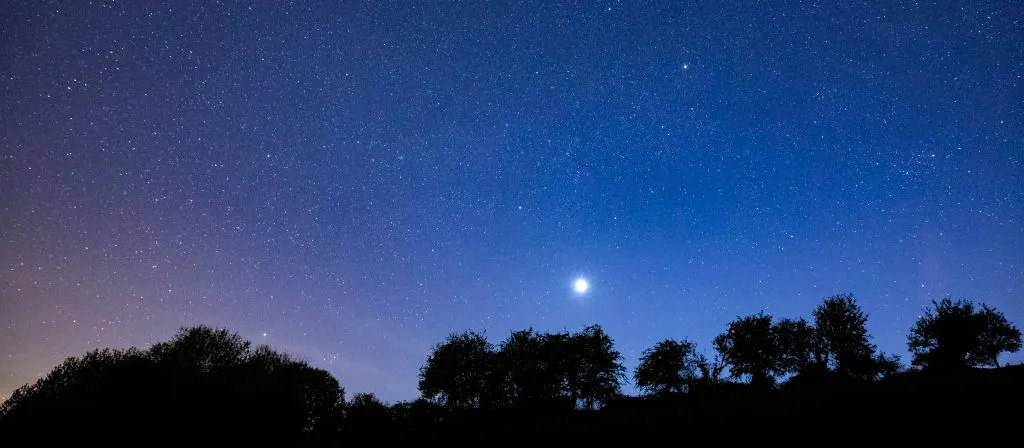
Simultaneously, public interest continues unabated, supported by documentaries, media coverage, and testimonies from credible witnesses. This societal engagement fuels academic curiosity, stimulates scientific inquiry, and influences policy.

The following key elements shape the future trajectory:

  1. Enhanced Data Collection: Investment in multi-sensor platforms, civilian and military partnership, and citizen science initiatives.

  2. International Collaboration: Sharing data and best practices among nations to foster transparency and coordinate research efforts.

  3. Scientific Rigor: Applying established scientific methodologies, peer-reviewed research, and open data standards to assess UAP phenomena objectively.

  4. Policy Development: Balancing national security with the public's right to know, establishing clear disclosure protocols, and protecting sensitive intelligence sources.

  5. Public Engagement: Educating society on scientific findings, combating misinformation, and fostering transparency to maintain public trust.

Scientific Arguments Supporting the Significance of UAP Research

  • 1. Challenging Known Physics

UAP exhibiting transmedium capabilities and rapid acceleration challenge the current understanding of physics, particularly aerospace propulsion and energy requirements. For instance, observed instantaneous accelerations—up to hundreds of g's—defy Newtonian physics when attributed to conventional propulsion, suggesting either exotic physics or advanced engineering.

  • 2 .Potential Technological Implications

If UAP are indeed leveraging advanced propulsion technologies, understanding their mechanics could revolutionize transportation, energy, and military technology. Research into these objects might yield breakthroughs akin to the discovery of nuclear physics in the 20th century.

  • 3. Scientific Caution and Skepticism

Despite intriguing accounts, scientific rigor necessitates skepticism. Occam’s Razor prefers simpler explanations—misidentifications, atmospheric phenomena, or sensor errors—over extraterrestrial origins. Nonetheless, the consistency of credible sightings warrants open-minded, evidence-driven investigation.

Case Studies Illustrating UAP Phenomena

  • The Tic-Tac Encounter (2004)

One of the most documented and analyzed incidents involved US Navy pilots over the Pacific Ocean. The object, resembling a white, elongated "Tic-Tac" shape, maneuvered rapidly, ascended sharply, and exhibited flight characteristics inconsistent with known aircraft. Sensor data from radar and infrared cameras confirmed its presence. This incident exemplifies the scientific importance of combining eyewitness accounts with technological data.

  • The USS Princeton Incident (2004)

Involving a USS Princeton radar system, this case observed multiple unidentified objects tracked in close proximity to military vessels. The radar returns exhibited high velocities and instantaneous directional changes. Repeated analyses concluded these objects could not be explained by conventional aircraft, atmospheric phenomena, or sensor artifacts.

  • The Nimitz and Roosevelt Encounters

These military incidents further underscore the phenomenon, with pilots describing objects defying known physics. The accumulation of such credible accounts indicates a need for open scientific investigation.

Ethical and Societal Considerations

The push for UAP disclosure raises ethical questions about transparency, the handling of sensitive information, and the potential societal impact of revealing unknown technologies. Transparency fosters scientific legitimacy and public trust but must be balanced with security concerns, such as avoiding inadvertent disclosure of classified military capabilities.

Additionally, societal reactions to potential extraterrestrial evidence could be profound, influencing cultural, religious, and philosophical perspectives. Preparing society through education and transparent communication is crucial to mitigate panic or misinformation.

Scientific Frameworks for Future Research

To advance understanding, the following scientific frameworks are recommended:

  • Data Standardization: Developing international standards for recording, classifying, and analyzing UAP sightings minimizes biases and enhances reproducibility.

  • Open Data Initiatives: Governments and research institutions should publish declassified data, allowing independent scientists to analyze phenomena objectively.

  • Multidisciplinary Collaboration: Combining physics, aerospace engineering, atmospheric science, psychology, and data science provides a holistic approach.

  • Funding and Infrastructure: Investing in research facilities, sensor arrays, and interdisciplinary teams ensures systematic investigation.

  • Peer-Reviewed Publications: Encouraging publication of findings in reputable journals fosters scientific consensus and reduces misinformation.

Challenges and Criticisms

Despite growing interest, UAP research faces skepticism within the scientific community, primarily due to:

  • Data Scarcity: Limited, often classified, data hampers rigorous analysis.

  • Verification Difficulties: Unrepeatable sightings hinder experimental validation.

  • Potential for Misinformation: Public fascination may lead to sensationalism, undermining scientific credibility.

  • Security Concerns: Revealing sensitive military technology risks advantages to adversaries.

Critics argue that premature disclosure or overinterpretation could lead to pseudoscience proliferation, diverting resources from terrestrial scientific pursuits.

The Future of UAP Disclosure: Opportunities and Risks

The coming years will likely see:

  • Continued declassification of documents and videos supported by scientific analysis.

  • Establishment of international consortiums and data-sharing agreements.

  • Advances in sensor technology providing higher-resolution, multi-modal data.

  • Increased engagement from the scientific community, potentially leading to peer-reviewed explanations—or, if warranted, evidence for novel physics or extraterrestrial origin.

Risks include geopolitical tensions arising from misinterpretations, potential technological revelations compromising security, and societal destabilization if findings suggest extraterrestrial intelligence.

Conclusion

UAP disclosure represents a pivotal intersection of science, policy, and society. Moving from secrecy to transparency requires rigorous analysis, international cooperation, and scientific integrity. Although current evidence remains inconclusive regarding extraterrestrial origins, credible eyewitness accounts, sensor data, and legislative initiatives underscore the necessity of systematic investigation.

Progress hinges on deploying advanced technology, fostering open scientific dialogue, and developing policies that balance security with the public's right to knowledge. As governments process and declassify data, the scientific community must be prepared to analyze and interpret the implications. Ultimately, UAP research holds the potential to revolutionize our understanding of physics, aerospace, and our place in the universe.

References

Note: Due to the nature of this summary, references include government documents, scientific papers, and credible media reports from the period up to 2026.

  1. U.S. Government Office of the Director of National Intelligence. (2021). Preliminary Assessment: Unidentified Aerial Phenomena. [Online Report]

  2. Knapp, K. (2023). “Congressional Hearings on UAP: A New Dawn for Transparency.” Science & Security Journal, 12(4), 45–69.

  3. National Aeronautics and Space Administration (NASA). (2024). Assessment of UAP Phenomena: Scientific Perspectives. NASA Scientific Reports.

  4. NATO Defence Innovation Board. (2024). Standardization of Sensor Data for UAP Investigation.

  5. U.S. Congress. (2023). National Defense Authorization Act (NDAA) 2024. Public Law 117-xx.

  6. Smithsonian Institution. (2025). “International Cooperation in UAP Research.” Science Advances, 11(10).

  7. Fermi, E. (1950). “The Challenge of Unexplained Phenomena.” Physical Review, 85(2), 210–214.

Final Remarks

The scientific investigation of UAP is entering a new chapter, characterized by transparency, interdisciplinary collaboration, and technological innovation. While definitive proof of extraterrestrial intelligence remains elusive, the accumulation of credible data mandates an open-minded, rigorous scientific approach. This pursuit not only advances aerospace and physics but also expands our understanding of the universe and humanity’s place within it.
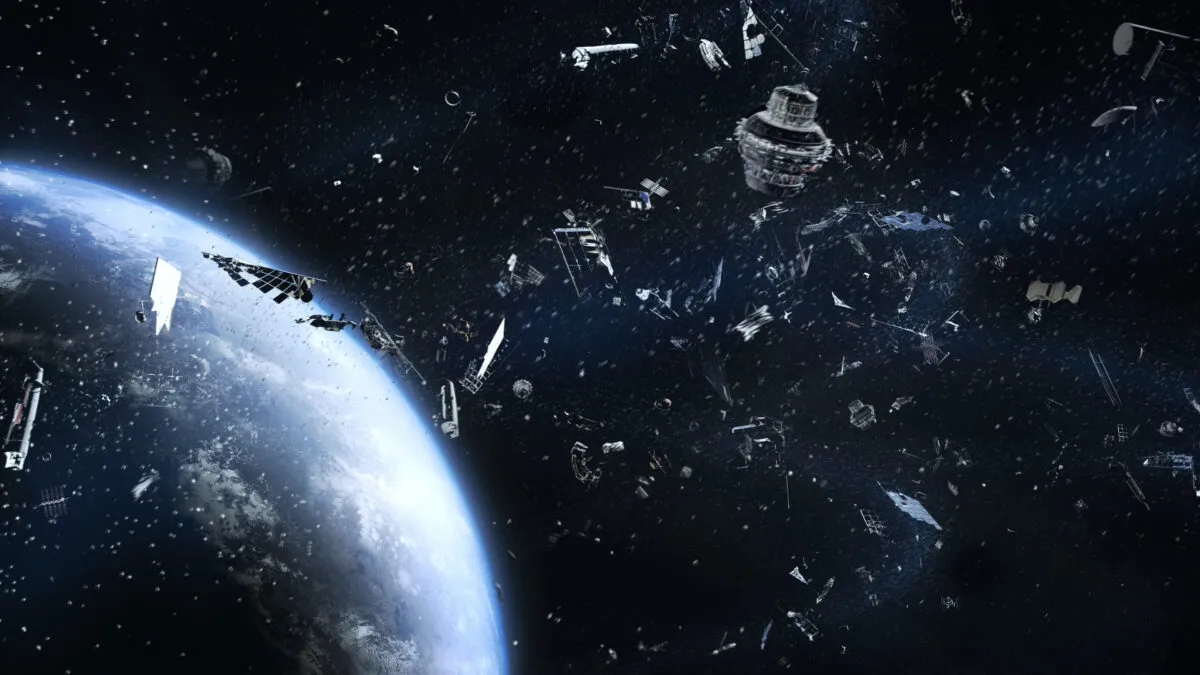
{ PETER2011 }

Hoe vind je dit bericht?
Geschreven door peter om 22:39 Stuur door

De harde realiteit van demonische bezetenheid en exorcismes

De harde realiteit van demonische bezetenheid en exorcismes

Hoewel veel mensen denken dat exorcismes vooral in films voorkomen, is de realiteit anders. In het echte leven vinden regelmatige pogingen plaats om demonen uit mensen te verdrijven, vaak met tragische gevolgen. Vaak wordt gedacht dat films zoals The Exorcist gebaseerd zijn op ware gebeurtenissen, wat ook echt het geval is: dergelijke gevallen inspireren nog steeds horrorverhalen en films. Toch verschillen deze incidenten sterk, qua omstandigheden en locatie. Sommige gevallen blijven vaag, terwijl anderen leiden tot ingrijpende en dramatische nasleep.

Ex10.jpg

Het ontstaan van de beroemde exorcismeverhalen

De bekendste film, The Exorcist, is gebaseerd op boeken en gebeurtenissen uit het echte leven. Het verhaal begint in 1949, toen in Cottage City, Maryland, een jongen uit een Lutherse familie, vaak “Robbie” genoemd, werd beschuldigd van bezetenheid na de dood van zijn tante die hem had geïntroduceerd in spiritualiteit met onder meer een Ouija-board. Na haar overlijden begonnen huiselijke en paranormale verschijnselen: meubels die bewogen, geluiden die te horen waren, en levitatie van de jongen.

De familie wendde zich tot hun pastoor, Luther Miles Schulze, die de situatie onderzocht en waarnam dat de gebeurtenissen zich ook thuis herhaalden. Op aanraden van Schulze werd een katholieke priester ingeschakeld voor een exorcisme. Tijdens een poging in het Georgetown University Hospital ontstond chaos toen Robbie zichzelf loswiek en een bedspriet gebruikte om de priester te verwonden.

Ex4.jpg

De familie besloot daarop zelf actie te ondernemen en verhuisde met Robbie naar St. Louis. Daar werd opnieuw een exorcisme uitgevoerd door de jezuïet William Bowdern, met hulp van Walter Halloran. Tijdens de exorcisme werden onverklaarbare teksten in vreemde talen gezongen, en verschenen tekenen en krassen op Robbie’s lichaam. De gebeurtenissen zouden succes hebben gehad, en Robbie leek daarna afwezig te zijn van verdere paranormale activiteiten.

Skeptiek en interpretaties

Niet iedereen gelooft volledig in de authenticiteit van deze gebeurtenissen. Kritiek komt onder meer van skeptici zoals Mark Opsasnick, die twijfelde of Robbie’s stem en de vreemde teksten echt buitenaards waren, of dat ze door de priesters waren ingeoefend. Ook parapsycholoog J.B. Rhine waarschuwde dat de gebeurtenissen mogelijk door de familie en omstanders waren overdreven of verkeerd geïnterpreteerd.

De onzekerheid rondom de zaak roept vragen op: was het een echte demonische bezetting, of speelden psychische problemen en suggestie een grote rol? Veel incidenten kunnen ook verklaard worden door mentale gezondheidsproblemen, zoals schizofrenie of andere stoornissen. Toch voeden zulke verhalen de mythe dat demonen echt bestaan en dat exorcismes soms nodig zijn.

Inspiratie uit andere historische gevallen

Een ander beroemde geval dat mogelijk als inspiratie diende voor The Exorcist stammen uit Loudun, Frankrijk, uit 1634. Nuns raakten daar geïnfecteerd door ’s werelds toenmalige angst voor geestesziekten en religie. Zij vertoonden bewuste, blasphemische uitingen en seksuele bewegingen tijdens exorcismes, gevolgd door arrestaties en martelingen van de priester Urbain Grandier. Deze casus bracht een beeld over demonische bezetenheid dat langdurig invloed uitoefende.

  • Het tragische verhaal van Anneliese Michel

Een van de bekendste en meest aangrijpende gevallen is die van Anneliese Michel uit Duitsland, in 1975-1976. Als streng katholiek meisje miljoen haar leven lang last van epilepsie, maar in haar puberteit verergerden haar symptomen en begon ze te hallucinerende demonische gezichten te zien en stemmen te horen. Haar familie geloofde dat ze bezeten was, ondanks medische diagnoses zoals temporale kwab epilepsie.

Anneliese Michel

Anneliese Michel

Omdat haar symptomen toenamen en de medicatie niet meer werkte, geloofde ze dat een demon haar had overgenomen. Haar gedrag werd extreem: ze verbraste haar kleren, kroop onder meubels, en nam deel aan lange, intense exorcismsessies met meerdere priesters. Ze beweerde dat ze door demonische entiteiten werd bezeten, waaronder Lucifer en bekende historische figuren, en ze sprak in vreemde talen.

ExAnne1.png

Anneliese tijdens haar vermeende bezetenheid

Twaalf maanden van herhaaldelijk exorcisme en lichamelijke uitputting eindigden tragisch toen Anneliese op 1 juli 1976 overleed aan dehydratie en ondervoeding. Haar ouders en de priesters Ernst Alt en Arnold Renz werden later veroordeeld wegens nalatigheid en meermalen verwijt dat ze niet tijdig medische hulp hadden ingeschakeld. Het incident schokte de publieke opinie en leidde tot strengere regelgeving rondom exorcismes in Duitsland.

De ethische en wetenschappelijke discussie

Het verhaal van Anneliese roept veel vragen op: was ze echt bezeten, of had ze een ernstige psychische aandoening? De artsen en rechters concludeerden dat haar toestand vooral begrijpelijk was vanuit een medisch perspectief, en dat de exorcismes haar situatie verslechterden. Desondanks bleef de kerk lang bij de overtuiging dat zij bezeten was, wat het debat over de grens tussen geloof en wetenschap weer aanwakkerde.


In 2013 werd haar huis getroffen door een brand die door sommigen werd geïnterpreteerd als een ‘spiritueel’ teken, hoewel het waarschijnlijk om een incident ging. Haar tragische verhaal blijft hangen als een waarschuwing voor de gevaarlijke samensmelting van religie en onwetendheid.

  • Het gruwelijke geval uit Engeland: Michael Taylor

Tegelijkertijd met de zaak van Anneliese kwam in Ossett, Engeland, een andere gruwelijke gebeurtenis aan het licht. Michael Taylor, een vleesliefhebber en vader van vijf, werd in 1974 verdacht van ongewone gedragingen. Hoewel hij in de omgeving als vriendelijk bekendstond, zette zijn depressie, mede door lichamelijke problemen, hem aan tot vreemd gedrag. Een vriend adviseerde hem om deel te nemen aan een churchgroep en zo mogelijk hulp te zoeken.

Hoewel deze case minder bekend is, illustreert hij dat de angst voor demonische bezetenheid en de invloed van religieuze overtuigingen ook in West-Europa diepe wortels kunnen hebben. Het verhaal van Taylor laat zien hoe dergelijke overtuigingen kunnen leiden tot gevaarlijke en destructieve situaties.


Conclusie

De verhalen over demonische bezetenheid en exorcismes zijn vaak complex, met veel onzekerheden en interpretaties. Sommige gevallen, zoals dat van Robbie en Anneliese, lijken bewijs te leveren dat er meer speelt dan medische aandoeningen alleen. Toch blijven sceptici en wetenschappers benadrukken dat veel symptomen verklaard kunnen worden met psychische ziekten en sociale factoren.

Wat onomstotelijk is gebleven, is dat deze verhalen invloed blijven uitoefenen op popcultuur en religieuze praktijken. Ze herinneren ons eraan dat de grens tussen geloof en wetenschap kwetsbaar is, en dat de menselijke psyche soms de meest onbegrepen gebieden bevat. De strijd tussen de verlangen naar het bovennatuurlijke en de wetenschappelijke verklaring blijft actueel, en deze gevallen blijven een aangrijpend bewijs dat de menselijke geest en overtuigingen een machtige, soms gevaarlijke kracht kunnen zijn.

De onderstaande video bekijkt enkele van de meest intrigerende en tot nadenken stemmende gevallen van demonische bezetenheid en uitdrijvingen in de geschiedenis.

OPMERKING - Deskundig oordeel

Demonische bezetenheid blijft een zeer controversieel fenomeen, waarbij gelovigen wijzen op huiveringwekkende gevallen zoals de zaak in Maryland uit 1949 die invloed had op The Exorcist, evenals de tragische ervaringen van Anneliese Michel en anderen. Op verschillende locaties en door de decennia heen hebben vermeende slachtoffers extreem gedrag vertoond—ogenschijnlijk aangewakkerd door dreigende entiteiten—terwijl exorcismes werden uitgevoerd met de intentie om gekwelde zielen te redden, en sommigen geloven dat deze rituelen erin geslaagd zijn bovennatuurlijke indringers te verdrijven.

Critici stellen dat psychologische factoren, zoals epilepsie, schizofrenie of extreme stress, vaak de zogenaamde indringing van geesten verklaren. Diverse gerapporteerde “bezetenheden” bevatten tegenstrijdig bewijs, waaronder de mogelijkheid van gebrekkige herinneringen en beïnvloedbare getuigen. Toch blijven deze onverklaarbare episodes, vanuit historisch perspectief, medische professionals en theologen evenzeer fascineren, waardoor de blijvende vraag openblijft of er echte demonische beïnvloeding bestaat.

{ PETER2011 }

Hoe vind je dit bericht?
Geschreven door peter om 21:44 Stuur door

NASA admits there are thousands of 'city killer' asteroids still undetected in space - and we still have no way to deflect them

NASA admits there are thousands of 'city killer' asteroids still undetected in space - and we still have no way to deflect them

NASA's head of planetary defence has revealed what keeps her up at night – tens of thousands of 'city killer' asteroids that remain undetected.

Dr Kelly Fast, who leads efforts to find and track near–Earth objects like asteroids and comets, admitted they are still looking for around 15,000 mid–sized celestial bodies which could pose a threat.
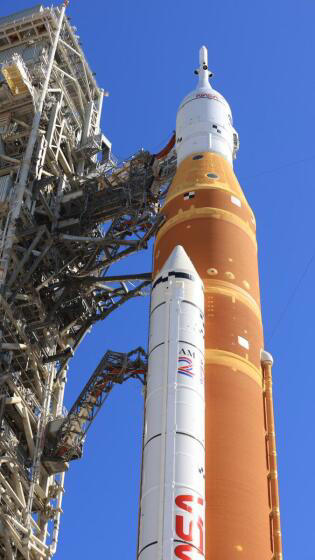
While an impact from one of these – defined by being at least 140 metres wide – would likely not destroy the planet, they could 'really cause regional damage', she said.
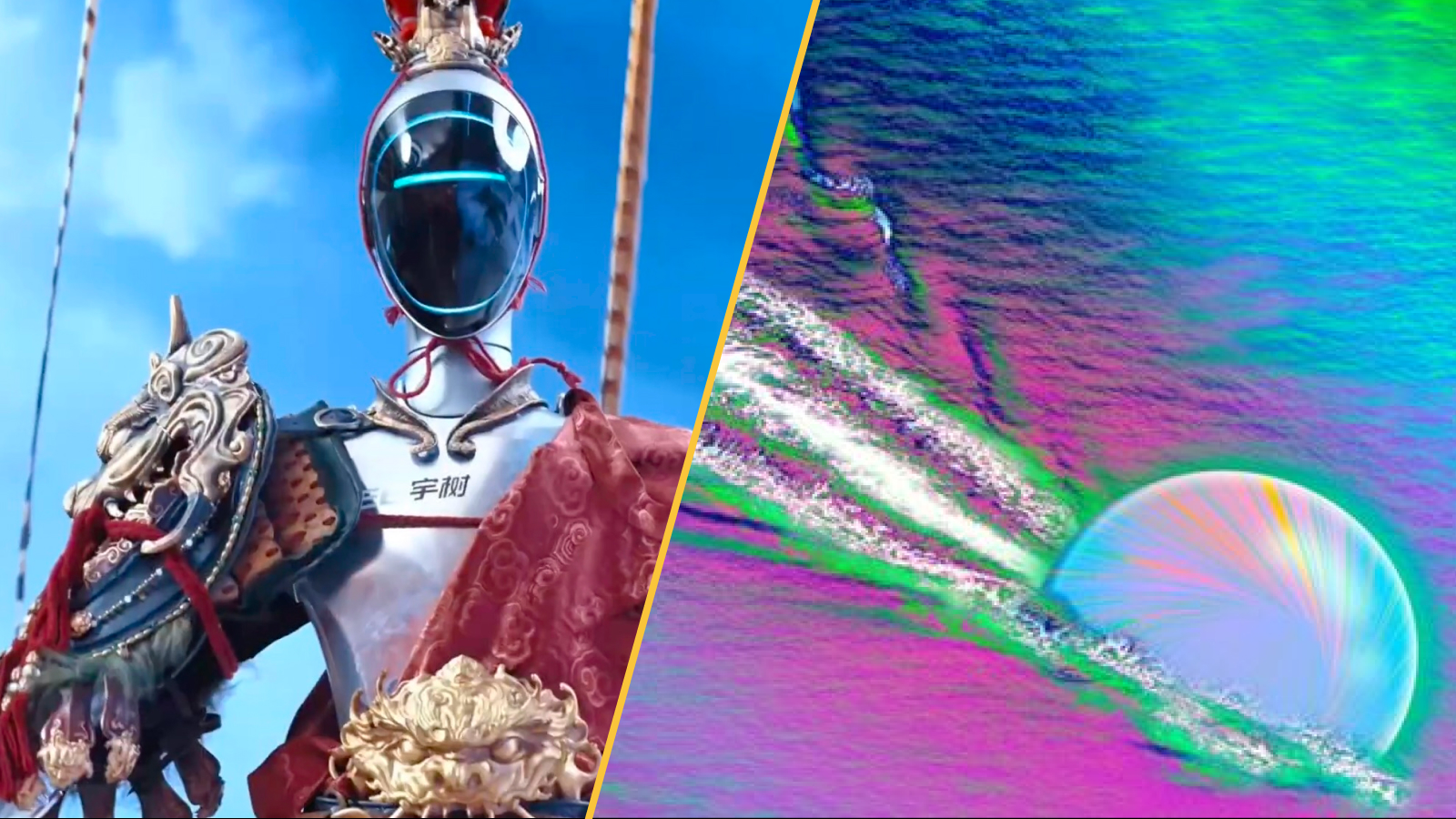
And it turns out Earth still has no way to deflect one if we realised it was heading straight for us.
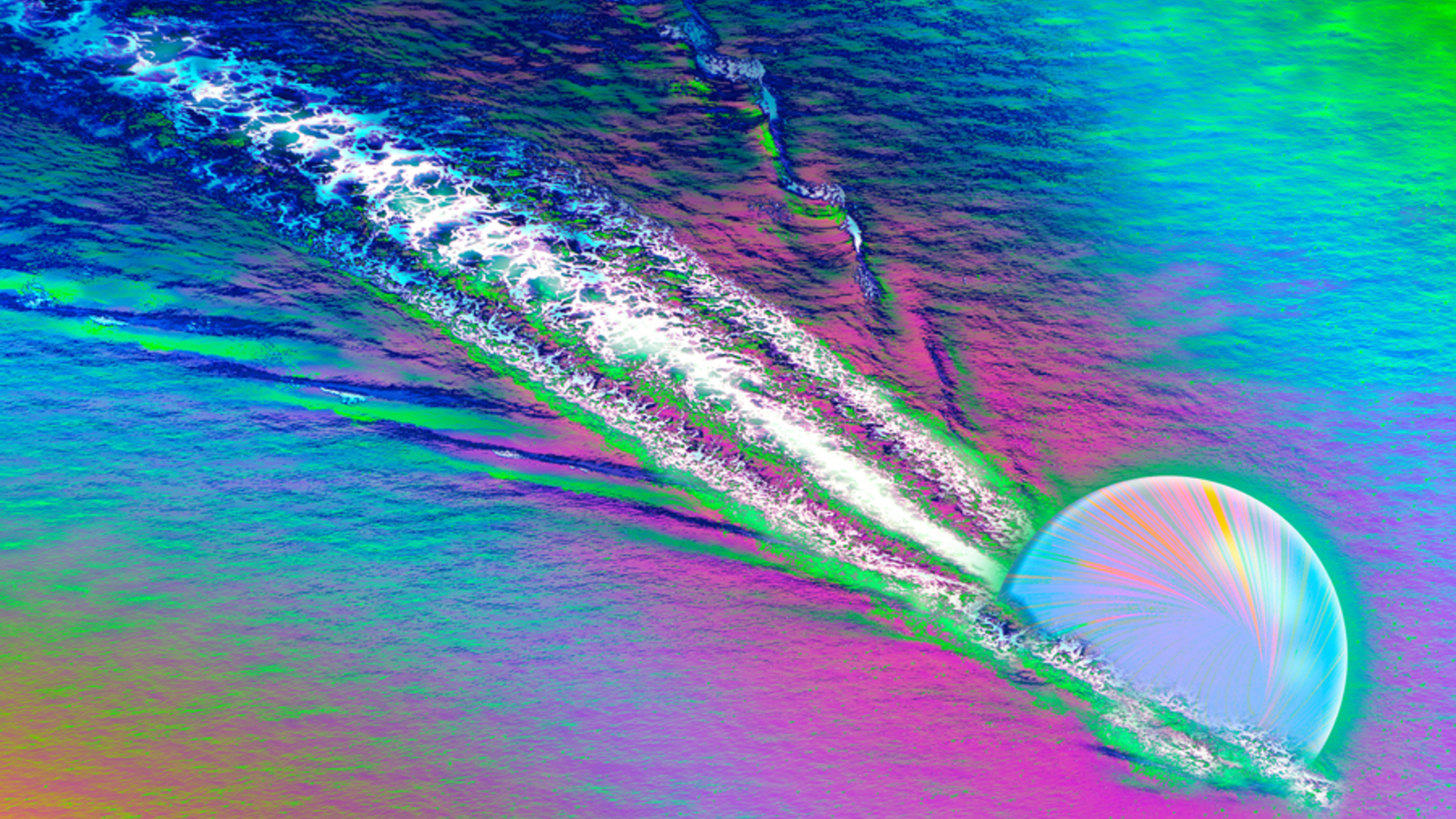
In 2022, NASA deliberately sent a spacecraft called Dart 6.8 million miles into space to crash into a mini moon called Dimorphos at 14,000mph in a bid to alter its orbit.

This mission was hailed as a success, paving the way for defending our planet by knocking incoming asteroids off their set path towards Earth.

But Dr Nancy Chabot, a planetary scientist at Johns Hopkins University who led that mission, said there are no other Dart–like spacecraft ready to launch if an asteroid was suddenly found to be on a collision course with Earth.

'Dart was a great demonstration,' she said. 'But we don't have [another] sitting around ready to go if there was a threat that we needed to use it for.'

2024 YR4 (pictured) was spotted in December 2024 and set alarm bells ringing as it reached the highest chances of hitting Earth of any known asteroid. Now, experts are concerned that it will hit the moon

2024 YR4 (pictured) was spotted in December 2024 and set alarm bells ringing as it reached the highest chances of hitting Earth of any known asteroid. Now, experts are concerned that it will hit the moon 

An illustration of the main asteroid belt, orbiting the Sun between Mars and Jupiter, where thousands of asteroids can be found

An illustration of the main asteroid belt, orbiting the Sun between Mars and Jupiter, where thousands of asteroids can be found

She referenced YR4, an asteroid measuring up to 90 metres wide, which last year was deemed to have a 3.2 per cent chance of hitting Earth in 2032.

Eventually this chance was downgraded to zero, meaning no defensive action needed to be taken.

If something like YR4 had been headed towards the Earth, we would not have any way to go and deflect it actively right now,' she added.

'We could be prepared for this threat. And I don't see that investment being made.'

During the discussion, which took place at the American Association for the Advancement of Science (AAAS) conference in Phoenix, Dr Fast explained the biggest asteroids – which can measure over a kilometre in diameter – are much easier to detect and track.

However, it's believed that only 40 per cent of the mid–sized asteroids have been detected so far – meaning experts don't know where thousands of them are.

When asked what keeps her up at night, she replied: 'It's really the asteroids that we don't know about.

'We're not so much worried about the large ones from the movies, because we know where they are.

In 2022, NASA deliberately sent a spacecraft called Dart 6.8 million miles into space to crash into a mini moon called Dimorphos at 14,000mph in a bid to alter its orbit. Pictured: The asteroid as seen by the DART spacecraft 11 seconds before impact

In 2022, NASA deliberately sent a spacecraft called Dart 6.8 million miles into space to crash into a mini moon called Dimorphos at 14,000mph in a bid to alter its orbit. Pictured: The asteroid as seen by the DART spacecraft 11 seconds before impact

Most asteroids can be found orbiting our Sun between Mars and Jupiter within the main asteroid belt

Most asteroids can be found orbiting our Sun between Mars and Jupiter within the main asteroid belt

'And small stuff is hitting us all the time. Not so much worried about that.

'It's the ones in–between that could do regional damage. Maybe not global consequences, but they could really cause damage.

article image

'And we don't know where they all are. It's not something that even with the best telescope in the world you could find.'

NASA has been tasked by US Congress with finding more than 90 per cent of near–Earth objects larger than 140 metres in diameter.

To achieve this, the agency is currently constructing a space telescope designed with the goal of detecting the majority of near–Earth asteroids and comets within a decade.

It is expected their near–Earth object (NEO) Surveyor mission will launch next year, with the capability of detecting both bright and dark asteroids, which are the most difficult to find.

'We're searching skies to find asteroids before they find us, and get them before they get us,' Dr Fast concluded.

POTENTIAL METHODS FOR ELIMINATING THE THREAT OF AN ASTEROID  

DART is one of many concepts of how to negate the threat of an asteroid that have been suggested over the years. 

Multiple bumps 

Scientists in California have been firing projectiles at meteorites to simulate the best methods of altering the course of an asteroid so that it wouldn't hit Earth. 

According to the results so far, an asteroid like Bennu that is rich in carbon could need several small bumps to charge its course.

'These results indicate multiple successive impacts may be required to deflect rather than disrupt asteroids, particularly carbonaceous asteroids,' researchers said.  

Nuke 

Another idea, known simply as 'nuke', involves blowing up a nuclear explosive close to the asteroid.

However, this could create smaller but still potentially dangerous fragments of rock that could spin off in all directions, potentially towards Earth. 

Ion Beam Deflection

With Ion Beam Deflection, plumes from a space probe's thrusters would be directed towards the asteroid to gently push on its surface over a wide area. 

A thruster firing in the opposite direction would be needed to keep the spacecraft at a constant distance from the asteroid. 

Gravity tractor 

And yet another concept, gravity tractor, would deflect the asteroid without physically contacting it, but instead by using only its gravitational field to transmit a required impulse. 

Professor Colin Snodgrass, an astronomer at the University of Edinburgh said: 'There have been a few concepts suggested, such as a 'gravity tractor' to slowly tow an asteroid away instead of pushing it with a kinetic impactor.

'But the kinetic impactor is definitely the simplest technology to use on the sort of timescale that is most likely to be of concern for this size of asteroid, i.e. years to decades warning time.'

RELATED VIDEOS

{ https://www.dailymail.co.uk/sciencetech/index.html }

Hoe vind je dit bericht?
Geschreven door peter om 21:13 Stuur door

Meer van UFO'S of UAP'S, ASTRONOMIE, RUIMTEVAART, ARCHEOLOGIE, OUDHEIDKUNDE, SF-SNUFJES EN ANDERE ESOTERISCHE WETENSCHAPPEN - DE ALLERLAATSTE NIEUWTJES

↑ Terug naar de berichten