Naar de inhoud

UFO'S of UAP'S, ASTRONOMIE, RUIMTEVAART, ARCHEOLOGIE, OUDHEIDKUNDE, SF-SNUFJES EN ANDERE ESOTERISCHE WETENSCHAPPEN - DE ALLERLAATSTE NIEUWTJES

UFO's of UAP'S in België en de rest van de wereld
akke.beakke.be
Ontdek de Fascinerende Wereld van UFO's en UAP's: Jouw Bron voor Onthullende Informatie! Ben jij ook gefascineerd door het onbekende? Wil je meer weten over UFO's en UAP's, niet alleen in België, maar over de hele wereld? Dan ben je op de juiste plek! België: Het Kloppend Hart van UFO-onderzoek In België is BUFON (Belgisch UFO-Netwerk) dé autoriteit op het gebied van UFO-onderzoek. Voor betrouwbare en objectieve informatie over deze intrigerende fenomenen, bezoek je zeker onze Facebook-pagina en deze blog. Maar dat is nog niet alles! Ontdek ook het Belgisch UFO-meldpunt en Caelestia, twee organisaties die diepgaand onderzoek verrichten, al zijn ze soms kritisch of sceptisch. Nederland: Een Schat aan Informatie Voor onze Nederlandse buren is er de schitterende website www.ufowijzer.nl, beheerd door Paul Harmans. Deze site biedt een schat aan informatie en artikelen die je niet wilt missen! Internationaal: MUFON - De Wereldwijde Autoriteit Neem ook een kijkje bij MUFON (Mutual UFO Network Inc.), een gerenommeerde Amerikaanse UFO-vereniging met afdelingen in de VS en wereldwijd. MUFON is toegewijd aan de wetenschappelijke en analytische studie van het UFO-fenomeen, en hun maandelijkse tijdschrift, The MUFON UFO-Journal, is een must-read voor elke UFO-enthousiasteling. Bezoek hun website op www.mufon.com voor meer informatie. Samenwerking en Toekomstvisie Sinds 1 februari 2020 is Pieter niet alleen ex-president van BUFON, maar ook de voormalige nationale directeur van MUFON in Vlaanderen en Nederland. Dit creëert een sterke samenwerking met de Franse MUFON Reseau MUFON/EUROP, wat ons in staat stelt om nog meer waardevolle inzichten te delen. Let op: Nepprofielen en Nieuwe Groeperingen Pas op voor een nieuwe groepering die zich ook BUFON noemt, maar geen enkele connectie heeft met onze gevestigde organisatie. Hoewel zij de naam geregistreerd hebben, kunnen ze het rijke verleden en de expertise van onze groep niet evenaren. We wensen hen veel succes, maar we blijven de autoriteit in UFO-onderzoek! Blijf Op De Hoogte! Wil jij de laatste nieuwtjes over UFO's, ruimtevaart, archeologie, en meer? Volg ons dan en duik samen met ons in de fascinerende wereld van het onbekende! Sluit je aan bij de gemeenschap van nieuwsgierige geesten die net als jij verlangen naar antwoorden en avonturen in de sterren! Heb je vragen of wil je meer weten? Aarzel dan niet om contact met ons op te nemen! Samen ontrafelen we het mysterie van de lucht en daarbuiten.

Berichten van 1 juni 2026 tot 30 juni 2026

“It Was Completely Shocking to Me”: Archaeologists Discover the Earliest Monumental Egyptian Hieroglyphs Written 1,000 Years Before the Pyramids

Image by chuju_lin from Pixabay

“It Was Completely Shocking to Me”: Archaeologists Discover the Earliest Monumental Egyptian Hieroglyphs Written 1,000 Years Before the Pyramids

A joint expedition to the ancient Egyptian city of Elkab has unearthed several previously unknown ancient rock art inscriptions, including what the team believes are the earliest known monumental Egyptian hieroglyphs.

Written over 1,000 years before the Great Pyramid of Giza was constructed, these ancient Egyptian writings, discovered by archaeologists from Yale University and the Royal Museums of Art and History (Brussels), laid the foundation for the later, better-known hieroglyphic writing system.

Yale Professor John Coleman Darnell, the expedition’s leader and the co-director of the Elkab Desert Survey Project, said the newly discovered inscriptions, which were not recorded by any previous scientific expedition, include samples as far back as 4,000 BCE.

Although the team concedes that these are not the first examples of this specific style of rock art, they are the first of this ancient age and “monumental” scale, making them of great significance in the history of ancient Egyptian writing systems.

“This was not what I was expecting to find when I set out on this period of work on the expedition,” Professor Darnell said of the historic find. “It was completely shocking to me.”

Earliest Monumental Egyptian Hieroglyphs Depict Cosmological Concepts

In a Yale news story announcing the discovery, Professor Darnell noted that the newly discovered rock art site of El-Khawy preserved some of the earliest and largest signs “from the formative stages of the hieroglyphic script.” The professor added that the discovery includes “rare” evidence for how this enigmatic ancient society invented its internationally recognized ancient writing system.

The expedition, which was directed by Darnell and Dirk Huyge, was undertaken in cooperation with the Ministry of Antiquities and the Aswan and Edfu inspectorates.

After photographing the newly discovered inscription, Darnell and Alberto Urcia, a digital archaeologist and associate research scientist in the University’s Department of Near Eastern Languages and Civilizations, created a series of three-dimensional (3D) images. Darnell said the new technology allows archaeologists to record ancient sites and artworks “at a level of accuracy and detail that was absolutely impossible before.”

“It also means that we can record the site as a place, or a location, and not just as a series of inscriptions,” the professor added.

ancient writing, Earliest Egyptian hieroglyphs The newly discovered panel of signs features images of a bull’s head on a short pole followed by two back-to-back saddlebill storks with a bald ibis bird above and between them. This arrangement of symbols is common in later Egyptian representations of the solar cycle and with the concept of luminosity. Image Credit: Yale University, Royal Museums of Art and History (Brussels).

One of the more noteworthy examples of ancient monumental hieroglyphs, carved sometime between 4,000 and 3,500 BCE, depicted a herd of elephants. A closer examination also revealed that one of the elephants had an image of a smaller elephant inside of it, which Professor Darnell described as “an incredibly rare way of representing a pregnant female animal.”

A second discovery detailed by the joint expedition, which consists of four separate panels, was likely created sometime around 3,250 BCE. Written right to left, which ultimately became the dominant writing form in later Egyptian hieroglyphic languages, the panels show animal images of a bull’s head on a short pole, followed by two back-to-back saddlebill storks with a bald ‘ibis’ bird above and between them.

The research team said this arrangement of symbols is common in Egyptian representations created centuries after the newly discovered panels depicting the solar cycle. These same depictions typically include imagery of luminosity. Darnell suggested that the images may also express “the concept of royal authority over the ordered cosmos.”

“This is the First Time That Anyone Has Seen Them on Such a Massive Scale”

When discussing the importance of the new find, Professor Darnell noted the immense size of the individual tableaus and their elements. For example, each individual hieroglyph identified by the Yale-led team measures over half a meter in height. The professor also noted that the entire tableau “is about 70 centimeters (27.5 inches) in height,” whereas previously discovered signs of early Egyptian hieroglyphs were “only one or two centimeters in size.”

“This discovery isn’t new in the sense that this is the first time that anyone has seen these hieroglyphs,” Darnell explained, “this is the first time that anyone has seen them on such a massive scale.”

To offer a perspective on the discovery’s significance, the professor said a modern-world equivalent would be seeing smaller text displayed on your computer screen, “and then suddenly seeing very large ones made the same way,” only displayed up on a highway billboard.

When discussing the site’s location in the northeastern desert hinterland of Elkab, Darnell noted that it was a “very important” center in ancient Egypt, which demonstrates that the area’s budding communicative system “is not limited to the more commonly found small tokens or labels.”

The professor also said the study shows that ancient writing did not develop slowly “for bureaucratic use,” as researchers had previously believed. Instead, Darnell suggested that the discovery shows hieroglyphic-style writing “was more geographically widespread and topically diverse at the time of or shortly after its development.”

“This also suggests that there is a much more expansive use of the early writing system than is indicated from other surviving archaeological material,” the professor added.

  • Christopher Plain is a Science Fiction and Fantasy novelist and Head Science Writer at The Debrief. Follow and connect with him on X, learn about his books at plainfiction.com, or email him directly at christopher@thedebrief.org.
RELATED VIDEOS

These Hieroglyphs Finally Reveal How Ancient Egyptians Cut Granite — And The Machine They Actually


The Hieroglyphs Describe Structures That Existed Before Egypt — And What They Left Buried …


These Hieroglyphs Reveal How The Pyramid Stones Were Actually Lifted — And The Device They Used


These Hieroglyphs Describe Giants The Pharaohs Tried To Destroy — And Why They Couldn't Be Killed

{ https://thedebrief.org/category/science/ }

Hoe vind je dit bericht?
Geschreven door peter om 00:34 Stuur door

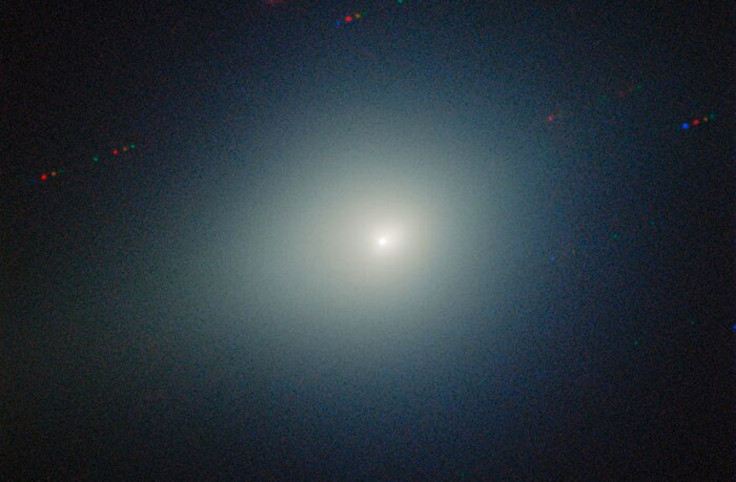
Where is the 3I/ATLAS Now? Harvard Physicist Claims 12-Billion-Year-Old Relic Is an Alien Probe

Where is the 3I/ATLAS Now? Harvard Physicist Claims 12-Billion-Year-Old Relic Is an Alien Probe

A frozen wanderer older than the Sun has slipped through our skies, leaving behind data, debate and a reminder of how little we know about the galaxy we live in.

Hoe vind je dit bericht?
Geschreven door peter om 00:00 Stuur door

5 real UFO coverups you missed in 'Disclosure Day'

5 real UFO coverups you missed in 'Disclosure Day'

How real-life intelligence programs inspired the plot

Steven Spielberg has captivated audiences for decades with cinematic masterpieces like Close Encounters of the Third Kind and E.T., but his film Disclosure Day marks a sharp turn toward historical reality. Inspired by the groundbreaking 2017 New York Times exposé on the Pentagon's secret UAP task force, the film blurs the lines between Hollywood entertainment and genuine ufology. This comprehensive breakdown explores the five real-world historical pillars anchoring the plot, evaluating the actual declassified documents, congressional testimonies, and folklore that Spielberg used to piece together his narrative.


5 REAL UFO Coverups You Missed in Disclosure Day I How it Hits
RELATED VIDEOS

Full Disclosure: The reality behind Spielberg's 'Disclosure Day'

25 Things You Missed in Disclosure Day

20 Hidden Disclosure Day Easter Eggs, Burning Questions And Behind The Scenes Facts You Missed!

{ https://mashable.com/entertainment?_}

Hoe vind je dit bericht?
Geschreven door peter om 23:52 Stuur door

Two plasmoid orbs over guys neighborhood, June 5, 2026, UFO UAP Sighting News.

Two plasmoid orbs over guys neighborhood, June 5, 2026, UFO UAP Sighting News.

UAP.png

UAP,%20DOD.png

Date of sighting: June 5, 2026
Location of sighting: Boise, Idaho, USA
Source: NUFORC
 
These are cloud orbs, at night they glow when they want to be seen. Often mistaken for angelic beings at night, they glow and flux as a sphere in the sky. I wonder...were they testing the guys reaction to them, recording his behavior, thoughts and more, because these energy entities can read your mind from a long ways away. 
Scott C. Waring - UFO Sightings Daily
 
Eyewitness states: 
Lights on object, Aura or haze around object, Emitted beams, Changed Color, Electrical or magnetic effects, Animals reacted Can’t explain changing colors hovering in place flashing and changing shape Changed colors silent hovering with occasional bursts of light. Seemed to change into almost a jack shape and back 2 in the sky seemed to be more farther off covering the valley. Most bizarre thing I’ve ever seen. Started to get an ominous feeling like it was aware of me so I went inside.

{ https://www.ufosightingsdaily.com/ }

Hoe vind je dit bericht?
Geschreven door peter om 23:17 Stuur door

Scientists propose radical new theory of consciousness – and claim it doesn't depend on flesh and blood

Scientists propose radical new theory of consciousness – and claim it doesn't depend on flesh and blood

Human consciousness is one of the strangest and most stubbornly elusive phenomena in nature.

Now, researchers have proposed a radical theory that suggests consciousness doesn't depend on flesh and blood.

According to their 'Copernican Principle', consciousness isn't some special property that is only found in humans and a handful of creatures with similar biology.

That means brains and bodies radically different from our own should be able to experience the universe just like we do.

This has huge implications for our search for life amongst the stars, since conscious beings might be nothing like life as we know it.

This bold theory opens the door to conscious aliens with entirely different biological chemistry from our own, like 'Rocky' from Project Hail Mary.

And it might mean that there's nothing preventing an artificial intelligence from becoming conscious.

Co–author Professor Eric Schwitzgebel, of the University of California, says: 'The universe may contain minds stranger than we can imagine.'

Researchers have proposed a bold new theory of consciousness, which says that it doesn't rely on flesh and blood

Researchers have proposed a bold new theory of consciousness, which says that it doesn't rely on flesh and blood 

Very roughly, we can define consciousness as the 'what it is like' aspect of existence.

The big question scientists and philosophers have spent years debating is whether this property is 'substrate flexible'.

This means that it can be 'realised' by lots of different types of things, just like the property of 'being a cup' can be realised by something made of glass or plastic.

Recently, some researchers have made the case that consciousness isn't substrate–flexible at all, meaning it can only arise in very specific types of biological systems.

This essentially narrows down the range of creatures that could be conscious to a very small slice of possible life that includes creatures on Earth and those with Earth–like biology.

That might seem like a harmless assumption until we start to think about the baffling variety of life that could exist out in the wider universe.

Professor Schwitzgebel and his co–author Dr Jeremy Pober, from the University of Lisbon, suggest that if advanced civilisations arise in just one galaxy in every billion, there would still be over 1,000 scattered over time and space.

The authors say that consciousness shouldn't be unique to things with human-like biology. This means that silicon-based life, like Rocky from Project Hail Mary, could also be conscious

The authors say that consciousness shouldn't be unique to things with human–like biology. This means that silicon–based life, like Rocky from Project Hail Mary, could also be conscious

Given the wide variety of possible environments in which they might flourish, it should be no surprise that many of these creatures would be very different to us.

Dr Pober told the Daily Mail that aliens could have 'high level' differences in terms of their functional architecture, but could also differ at the 'much lower level' of basic biochemistry.

'Astrobiologists and biochemists have shown that carbon–based life, which is nonetheless significantly different in biochemical composition from ours, is possible,' says Dr Pober.

For example, life that evolved in the sulphuric acid clouds of Venus might have silicon take the role that sulphur plays in our biochemistry.

However, no matter how advanced or intelligent these creatures might be, some theorists suggest that these differences rule them out from being considered conscious.

To Dr Pober and Professor Schwitzgebel, this is an obvious mistake.

Instead, they propose something called the 'Copernican Principle of Consciousness'.

The idea is that we shouldn't simply assume that humans and our particular type of conscious experience are special or unique.

Their ideas are inspired by the work of Nicolaus Copernicus (pictured), who showed that Earth wasn't in a special place in the universe. Likewise, they argue that we shouldn't think of human consciousness as special

Their ideas are inspired by the work of Nicolaus Copernicus (pictured), who showed that Earth wasn't in a special place in the universe. Likewise, they argue that we shouldn't think of human consciousness as special

What was the Copernican Revolution in astronomy?

The so–called Copernican Revolution was one of the most important paradigm shifts in the history of thought.

For thousands of years, astronomers had assumed that Earth was at the centre of the universe, with the sun and other planets orbiting us.

However, in 1543, a Polish astronomer called Nicolaus Copernicus published a work called 'Six Books Concerning the Revolutions of the Heavenly Orbs'.

This laid out the theory that Earth actually orbited the sun.

This had the consequence of suggesting that Earth was not the centre of the universe, and that humanity was not as important as the Church suggested.  

This draws inspiration from the so–called 'Copernican Revolution' in astronomy, in which astronomer Nicolaus Copernicus realised Earth wasn't at the centre of the universe.

Before Copernicus, people thought that Earth occupied a special or privileged position in the universe.

However, better scientific understanding has shown that it is better to assume that there is nothing special about Earth or humans until proven otherwise.

Dr Pober says: 'The spirit of the Copernican Principle is: we should believe that we as humans are special when we have evidence that says so, but not when we don't.

For example, we have plenty of evidence to suggest that humans are the most intelligent species on Earth, but absolutely no reason to think we are even nearly the most intelligent in the universe.

Once we apply this idea to consciousness, Dr Pober says there's no reason to think that consciousness needs to rely on flesh and blood.

The big consequence of that idea is that it vastly expands the possible range of life forms that could be having conscious experiences out in the wider universe.

The researchers are dubious that silicon–based lifeforms like Rocky or the Horta from Star Trek are biologically viable.

The researchers are divided over whether this means artificial intelligences, like Skynet from The Terminator, could be conscious in the future

The researchers are divided over whether this means artificial intelligences, like Skynet from The Terminator, could be conscious in the future 

But if they did exist, there is no reason to think that they wouldn't be conscious.

However, Dr Pober and Professor Schwitzgebel don't agree on what this means for AI.

On the one hand, Dr Pober isn't convinced that we shouldn't be so flexible with what can be considered conscious.

'There is good reason to think some aliens with biochemistries are conscious,' he says.

'The extent of this difference – the degree of substrate flexibility of consciousness, if you will – does not extend to stuff as different from us as silicon chips.'

However, Professor Schwitzgebel argues that we should be even more flexible about what sorts of systems can be considered conscious.

Once the idea that consciousness requires human biology is abandoned, he argues, it becomes harder to justify excluding silicon–based systems solely because they are made of silicon.

Professor Schwitzgebel adds that philosophers have 'focused too much on whether silicon can duplicate a human brain and not enough on the broader question of what kinds of systems can be conscious.'

HOW SOON WILL WE BE ABLE TO UPLOAD OUR MINDS TO A COMPUTER?

Brain and memory preservation has been explored at length by futurists, scientists and science fiction junkies alike. 

Many say it falls under the category of 'transhumanism.'  

Transhumanism is the belief that the human body can evolve beyond its current form with the help of scientists and technology.  

The practice of mind uploading has been promoted by many people, including Ray Kurzweil, Google's director of engineering, who believes we will be able to upload our entire brains to computers by 2045.

Similar technologies have been depicted in science fiction dramas, ranging from Netflix's Altered Carbon, to the popular series Black Mirror.  

Another prominent futurist, Dr Michio Kaku, believes virtual reality can be used to keep our loved ones' personalities and memories alive even after they die. 

Scientists and futurists have different theories about how we might be able to preserve the human brain, ranging from uploading our memories to a computer to Nectome's high-tech embalming process, which can keep it intact for thousands of years

Scientists and futurists have different theories about how we might be able to preserve the human brain, ranging from uploading our memories to a computer to Nectome's high-tech embalming process, which can keep it intact for thousands of years

'Imagine being able to speak to your loved one after they die ... it is possible if their personality has been downloaded onto a computer as an avatar,' he explained. 

These ideas haven't been met without criticism. 

McGill University Neuroscientist Michael Hendricks told MIT that these technologies are a 'joke.'

'I hope future people are appalled that in the 21st century, the richest and most comfortable people in history spent their money and resources trying to live forever on the backs of their descendants. I mean, it’s a joke, right? They are cartoon bad guys,' he said. 

Meanwhile, neuroscientist Miguel Nicolelis said recently that such technologies would be virtually impossible. 

'The brain is not computable and no engineering can reproduce it,' he said. 

'You can have all the computer chips in the world and you won't create a consciousness.'

RELATED VIDEOS

There are 22 theories of consciousness: Michael Pollan explains why none of them work

Your Consciousness Is Not Inside Your Brain — A Physicist Explains Where It Actually Is

What If Consciousness Never Dies? 😨 | The Terrifying Orch-OR Quantum Theory That Changes Everything

{ https://www.dailymail.com/sciencetech/index.html }

Hoe vind je dit bericht?
Geschreven door peter om 22:59 Stuur door

See Stonehenge's construction like NEVER before: Incredible visual reveals the vast manpower needed to haul the 25–tonne stones into position 5,000 years ago

See Stonehenge's construction like NEVER before: Incredible visual reveals the vast manpower needed to haul the 25–tonne stones into position 5,000 years ago

An incredible new visual has revealed Stonehenge's construction like never before.

Created by English Heritage based on laser scan data and archaeological research, this is the most accurate and detailed reconstruction ever made.

The monument we see today took around 1,500 years to build, from about 3100 BC to 1600 BC, although the visual focuses on the the main phase of construction, which took place around 2500 BC.

Hundreds of people would have come together to pull, hoist, and set the enormous sarsen stones that form the iconic stone circle, according to experts. 

Its builders also used surprisingly ingenious devices and techniques to make this mammoth task a little easier.

This transformed Stonehenge from a simple ring of ditches and wooden posts to the most sophisticated ritual site in ancient Britain.

Dr Susan Greaney, an archaeologist from the University of Exeter, who worked on the reconstruction, told the Daily Mail: 'In this new reconstruction, the sarsens are being raised into place by chocking them up on a pile of boulders, smaller sarsens and hammerstones, rather than the A–frame and weights seen in other reconstructions. 

'This is based on some evidence for how the Easter Island statues were raised, which are a similar weight and size.'

Created by English Heritage based on laser scan data and archaeological research, this is the most accurate and detailed reconstruction ever made

Created by English Heritage based on laser scan data and archaeological research, this is the most accurate and detailed reconstruction ever made 

New research suggests that the large sarsen stones were raised by propping them up with piles of rubble

New research suggests that the large sarsen stones were raised by propping them up with piles of rubble 

This stunning reconstruction, created for the book Stonehenge: The Story of an Icon, shows the builders transporting the enormous 'sarsen' stones to the site on the Salisbury Plain.

These are the largest and most recognisable stones in Stonehenge, forming both the standing pillars and the horizontal 'lintels' that cap the arches.

Archaeologists believe that they would have been taken from the edge of the Marlborough Downs, located about 15 miles to the North.

With the largest of these stones weighing over 36 tonnes and measuring seven metres long, moving these would have been an enormous task.

More than 150 people might have worked together to pull a single stone along a track made of timber greased with animal fat.

However, researchers say this is not necessarily because the task was so difficult, but because pulling the stones was part of a celebration.

Professor Duncan Garrow, an archaeologist from Durham University, co–curated a new digital exhibition on the monument with the British Museum, called The Virtual World of Stonehenge.

He told the Daily Mail: 'People get really into building monuments in the Neolithic period, and Stonehenge is the peak of that.

Archaeologists believe that the building of Stonehenge might have been even more important than the finished project, serving as a way of bringing the community together. Illustrated: A Neolithic man explains Stonehenge's construction to children

Archaeologists believe that the building of Stonehenge might have been even more important than the finished project, serving as a way of bringing the community together. Illustrated: A Neolithic man explains Stonehenge's construction to children

The five key unanswered questions about Stonehenge

  1. How were the stones moved?
  2. Why did its builders choose the Salisbury Plain?
  3. Why was it built and for what purpose?
  4. Why did people change its shape so often?
  5. Where are all the missing stones? 

It helped the community come together, so building it was very much part of the meaning and the purpose.'

Once the stones made it to the site, they still needed to be expertly shaped.

The ground at Salisbury Plain isn't exactly level, so each stone had to be precisely cut to the right height, and archaeologists have found piles of waste stone chips nearby.

Finally, the outer circle was topped with the lintels that formed a smooth, continuous ring around the entire structure.

While the Neolithic is known as the Stone Age, the people of this time were actually far more familiar with woodworking than stone carving.

This expertise can be seen in the traditional woodworking techniques used to fasten the lintels, with each massive stone being secured with dovetail joints and mortise and tenon fittings.

Archaeologists believe that building Stonehenge would have taken around five and a half million hours of labour – with four and a half million of those spent on the large sarsen stones.

Of course, the most impressive aspect of this gargantuan construction project is that Stonehenge aligns perfectly with the movements of the sun.

The large lintels were lifted into position by building timber platforms. Each lintel was then fitted with a mortise and tenon joint

The large lintels were lifted into position by building timber platforms. Each lintel was then fitted with a mortise and tenon joint 

The summer solstice sunrise perfectly aligns with the outlying Heel Stone, while the winter solstice sun sets directly between the uprights of the tallest Trilithon.

While earlier structures such as long barrows were built to align with the sunrise or sunset, this is the first structure that 'points' at the solstice.

Professor Garrow says: 'Once people started farming during the Neolithic period, they had more invested in planting crops, so it was a bigger deal if the harvest failed.

'So, good weather and a good year of sunshine and rain to make the crops grow become more important, and that escalated into a kind of religious focus on the sunshine.'

It is thought that this was centred around enormous gatherings around the summer and winter solstice, involving hundreds to thousands of people from all around the country.

Archaeologists believe that the Stonehenge builders stayed at the nearby site of Durrington Walls, one of the largest henges in Britain, measuring 500 metres across.

Excavations have evidence of mass feasting, with chemical analysis of pig bones and animal teeth revealing that these animals had been transported from as far as Scotland and west Wales.

Dr Matt Leivers, senior research manager, Wessex Archaeology, told the Daily Mail: 'Further away, very large numbers of people gathered for feasts, and we can imagine opportunities for things like exchange of foreign objects, marriage partners, settling of disputes, competition, games, all that sort of thing.'

However, while the gatherings near Stonehenge would have been 'seasonal fairs', the focus at the circle itself would have been religious.

'It was essentially a cathedral,' says Dr Leivers.

'Imagine Salisbury Cathedral or Westminster Abbey. It's the single crowning achievement of the expression of Neolithic religion in the English south.'

Exactly what those ritual gatherings would have looked like is hard to say, but researchers are now beginning to piece together a few scant clues.

Dr Leivers says: 'The evidence from Stonehenge tells us that there probably wasn't a lot done inside the circles that left a lot of material behind – so imagine that as a sacred centre.

'Most people would have been gathered outside the circles, watching, praying, celebrating – maybe singing, drumming, or maybe in silence.'

The Stonehenge monument standing today was the final stage of a four part building project that ended 3,500 years ago

Stonehenge is one of the most prominent prehistoric monuments in Britain. The Stonehenge that can be seen today is the final stage that was completed about 3,500 years ago. 

According to the monument's website, Stonehenge was built in four stages:   

First stage: The first version of Stonehenge was a large earthwork or Henge, comprising a ditch, bank and the Aubrey holes, all probably built around 3100 BC. 

The Aubrey  holes are round pits in the chalk, about one metre (3.3 feet) wide and deep, with steep sides and flat bottoms. 

Stonehenge (pictured) is one of the most prominent prehistoric monuments in Britain

Stonehenge (pictured) is one of the most prominent prehistoric monuments in Britain

They form a circle about 86.6 metres (284 feet) in diameter. 

Excavations revealed cremated human bones in some of the chalk filling, but the holes themselves were likely not made to be used as graves, but as part of a religious ceremony.

After this first stage, Stonehenge was abandoned and left untouched for more than 1,000 years. 

Second stage: The second and most dramatic stage of Stonehenge started around 2150 years BC, when about 82 bluestones from the Preseli mountains in south-west Wales were transported to the site. It's thought that the stones, some of which weigh four tonnes each, were dragged on rollers and sledges to the waters at Milford Haven, where they were loaded onto rafts.

They were carried on water along the south coast of Wales and up the rivers Avon and Frome, before being dragged overland again near Warminster and Wiltshire.

The final stage of the journey was mainly by water, down the river Wylye to Salisbury, then the Salisbury Avon to west Amesbury. 

The journey spanned nearly 240 miles, and once at the site, the stones were set up in the centre to form an incomplete double circle. 

During the same period, the original entrance was widened and a pair of Heel Stones were erected. The nearer part of the Avenue, connecting Stonehenge with the River Avon, was built aligned with the midsummer sunrise. 

Third stage: The third stage of Stonehenge, which took place about 2000 years BC, saw the arrival of the sarsen stones (a type of sandstone), which were larger than the bluestones.

They were likely brought from the Marlborough Downs (40 kilometres, or 25 miles, north of Stonehenge). 

The largest of the sarsen stones transported to Stonehenge weighs 50 tonnes, and transportation by water would not have been possible, so it's suspected that they were transported using sledges and ropes. 

Calculations have shown that it would have taken 500 men using leather ropes to pull one stone, with an extra 100 men needed to lay the rollers in front of the sledge.

These stones were arranged in an outer circle with a continuous run of lintels - horizontal supports. 

Inside the circle, five trilithons - structures consisting of two upright stones and a third across the top as a lintel - were placed in a horseshoe arrangement, which can still be seen today. 

Final stage: The fourth and final stage took place just after 1500 years BC, when the smaller bluestones were rearranged in the horseshoe and circle that can be seen today.

The original number of stones in the bluestone circle was probably around 60, but these have since been removed or broken up. Some remain as stumps below ground level. 

Source: Stonehenge.co.uk 


New discovery could reshape how we understand Stonehenge | BBC News

{ https://www.dailymail.com/sciencetech/index.html }

Hoe vind je dit bericht?
Geschreven door peter om 22:24 Stuur door

Scientists predict how the world will end – and say Earth may NOT be swallowed by the sun after all

Scientists predict how the world will end – and say Earth may NOT be swallowed by the sun after all

It's a rather grisly topic for a Monday – how will the world end?

For years, it's been believed that the sun will start to expand in around five billion years, swallowing our planet in the process.  

However, a new study suggests that this might not be the case after all.

Instead, scientists think that the sun's death throes will push Earth out into space, narrowly avoiding destruction.

Mars will also be spared from a fiery fate, scientists say, but Mercury and Venus won't be so lucky, as the two innermost planets will inevitably be swallowed by the sun.

Lead author Mats Esseldeurs, a PhD student at the University of Leuven, explains that Earth's fate 'depends on a delicate balance' between two forces.

These are the 'tidal' forces of gravity that will pull the Earth into the sun and the outward push of enormous solar winds caused by the sun losing mass as it expands.

'If tidal interactions predominate, Earth is engulfed by the sun,' says Mr Esseldeurs.

'If the sun's mass loss predominates, Earth escapes into an orbit larger than the radius of its star.'

Scientists have predicted that the Earth will not be swallowed by the sun as it expands into a red giant in five billion years

Scientists have predicted that the Earth will not be swallowed by the sun as it expands into a red giant in five billion years 

Using computer simulations, researchers found that Earth (red line) will be pushed just beyond the edge of the expanding sun (blue line)

Using computer simulations, researchers found that Earth (red line) will be pushed just beyond the edge of the expanding sun (blue line)

Stars like our sun can only remain stable for as long as they have a steady supply of hydrogen to burn as fuel.

When hydrogen is abundant, the immense force of gravity is held in check by the outward push from nuclear fusion in their core.

But when the hydrogen starts to run out at the end of a star's lifetime, that balance is upset, and the star begins to collapse.

This collapse makes the core hot enough to fuse helium atoms into carbon, releasing a surge of energy that kickstarts nuclear fusion in the outer layers, which then expand and cool.

The expanding star will then grow into a red giant, becoming anywhere from 100 to 1,000 times larger.

Scientists don't know exactly how big the sun will become, but even if it doesn't expand beyond Earth's current orbit, many researchers believe we are doomed.

This is due to an effect called tidal dissipation that will slowly drag our planet down into the sun.

As the sun expands, Earth's gravitational tug will raise a small bump or wave on the solar surface – just as the moon causes Earth's oceans to swell with the tides. 

Scientists previously believed that a gravitational effect called tidal dissipation would slowly pull the Earth out of orbit, until it was swallowed by the sun (artist's impression)

Scientists previously believed that a gravitational effect called tidal dissipation would slowly pull the Earth out of orbit, until it was swallowed by the sun (artist's impression) 

A star's life cycle

Around 90 per cent of stars in the sun are what scientists call 'main sequence' stars.

These are stars that fuse hydrogen into helium in their cores, and range from about a tenth of the mass of the sun to about 200 times as massive.

Main sequence stars start as clouds of gas and dust, which collapse under gravity into 'protostars'.

When a protostar is dense enough, the pressure and heat start nuclear fusion and a star is born.

Stars keep burning helium until it runs out in around 10 to 20 billion years.

At this point, stars will enter the post¿main sequence phase and become red dwarfs, white dwarfs, red giants, or even explode into neutron stars, depending on their size.  

This wave will lag behind the planet like a brake on its orbit, slowly draining its energy and dissipating it into the sun.

Until very recently, scientists assumed that these tidal forces would overwhelm the outward push of stellar wind from the sun's mass loss, leading to the Earth being engulfed.

However, Mr Esseldeurs and his co–authors now argue that this is based on a poor understanding of tidal dissipation in stars.

Using advanced models, the researchers show that the tug of these tidal effects is actually a lot smaller than previously expected.

They combined these gravitational predictions with observations of mass loss in a nearby star called L2 Puppis, which they describe as the sun's 'old cousin'.

That allowed the scientists to estimate how much solar wind our own sun might produce as it transitions into a red giant.

By comparing the push and pull of these competing forces, the researchers now believe that the Earth may well survive.

Co–author Dr Stephane Mathis, of the CEA Paris–Saclay centre in France, says: 'A better understanding of tidal physics and the most advanced constraints we have on mass loss allow us to say that—in the current state of knowledge—Earth could move away from the sun, contrary to what was predicted before.'

Scientists now think the solar wind created as the sun loses mass during its expansion will push the Earth away, counteracting the gravitational pull. Pictured: Artist's impression of the Earth in 5.7 billion years

Scientists now think the solar wind created as the sun loses mass during its expansion will push the Earth away, counteracting the gravitational pull. Pictured: Artist's impression of the Earth in 5.7 billion years

However, the researchers warn that Earth's fate is still not entirely certain.

They point out that the difference between survival and fiery annihilation is extremely dependent on the fine balance of gravitational dissipation and mass loss.

In simulations, even a small change in these estimates was enough to send the planet tumbling into the sun or soaring safely out into space.

In their paper, published in Astronomy & Astrophysics, the researchers warn: 'Given the current observational uncertainties in AGB mass–loss rates, the ultimate fate of the Earth remains uncertain.'

Likewise, even if Earth does survive the initial transformation, life on the planet may not be able to last much longer.

After becoming a red giant, the sun will gradually burn through the last of its fuel and shrink into an extremely dense star called a white dwarf.

No longer capable of fusion reactions, it will slowly become dimmer and cooler over time, and Earth will be left as a freezing, lifeless husk.

The good news is that this won't be for at least seven or eight billion years from today. 

WHAT WILL HAPPEN TO EARTH WHEN THE SUN DIES?

Five billion years from now, it's said the Sun will have grown into a red giant star, more than a hundred times larger than its current size. 

Eventually, it will eject gas and dust to create an 'envelope' accounting for as much as half its mass.

The core will become a tiny white dwarf star. This will shine for thousands of years, illuminating the envelope to create a ring-shaped planetary nebula.

Five billion years from now, it's said the Sun will have grown into a red giant star, more than a hundred times larger than its current size

Five billion years from now, it's said the Sun will have grown into a red giant star, more than a hundred times larger than its current size

While this metamorphosis will change the solar system, scientists are unsure what will happen to the third rock from the Sun.

We already know that our Sun will be bigger and brighter, so that it will probably destroy any form of life on our planet.

But whether the Earth's rocky core will survive is uncertain. 

RELATED VIDEOS

How Will Earth End? The Complete Timeline — Ranked by When They Actually Happen

How Will Life On Earth End? | The Fate of Human's Planet (in 6 minutes)

{ https://www.dailymail.com/sciencetech/index.html }

Hoe vind je dit bericht?
Geschreven door peter om 22:03 Stuur door

If 'Disclosure Day' Comes, How Can We Trust Evidence of UFOs?

If 'Disclosure Day' Comes, How Can We Trust Evidence of UFOs?

Steven Spielberg's new blockbuster coincides with real-world disclosures about the government's investigation of unidentified phenomena. But there's no proof of aliens yet.

Julian Dossett

UFO

Artist depiction of flying saucers.

Getty Images

Steven Spielberg's new sci-fi blockbuster Disclosure Day, which hit theaters June 12, explores what might happen when the world gets undeniable proof that we're not alone in the universe. While the film is pure Hollywood, the possibility that we may one day see real evidence of UFOs is moving from science fiction toward scientific plausibility.

For the past couple of months, the federal government has been declassifying and publishing reports of UAPs, or unidentified anomalous phenomena, on a website operated by the Department of Defense. 

While the government's disclosures haven't provided any actual evidence of extraterrestrial life or alien spacecraft, they signal a shift from its previous stance of secrecy on the subject. The Pentagon's real-world releases of strange sightings draw an obvious parallel to the movie's plot.

Without spoiling too much, Disclosure Day starts in the middle of the action: A whistleblower played by Josh O'Connor has already stolen proof of the cover-up of alien contact, while a Kansas City TV anchor played by Emily Blunt suddenly gains strange new abilities. The pair spends much of the 2.5-hour movie on the run from a shadowy government organization that wants to keep the truth hidden.

Spielberg was inspired to make Disclosure Day following a groundbreaking 2017 New York Times story, which published military videos of UAP sightings and alleged a secret UAP program in the Pentagon. According to some government officials and experts, the NYT report helped reduce the stigma of sharing UFO incident reports, especially among service members.

In subsequent Congressional hearings, former Navy pilots gave eye-witness accounts of UAPs in the sky, and a former intelligence officer testified to the existence of a secret UAP crash-retrieval program, where nonhuman "biologics" were retrieved from crash sites.

A video of an unidentified object in the air plays behind witnesses in a Congressional hearing room.

The US House Oversight Committee's Task Force on the Declassification of Federal Secrets held a hearing in September 2025 with witnesses who testified on UAPs, including the video shown here in the background.

Kevin Dietsch/Getty Images

I've looked through many of the UAP files released so far, and I haven't found any proof of alien life, but they're still interesting to read. Some of the documents date back to the Roswell crash era of the 1940s, one of the most famous alleged cases of a flying saucer recovery. Aliens or not, official military correspondence from 1948 that mentions "flying discs" remains a fascinating historical record.

The media's interest, along with the government's acknowledgment that it has long investigated UFOs, has helped move the topic beyond conspiracy books and online forums. In recent years, NASA commissioned an independent study team to examine UAPs, which produced a report (PDF) noting that the agency "should contribute to a comprehensive, government-wide approach to collecting future data." Even the late Pope Francis addressed the idea that the discovery of aliens and religious faith need not contradict one another.

While the videos, documents and testimonies on UAP sightings are intriguing to watch and read, the materials still lack the empirical data to conclusively prove that extraterrestrial life has visited Earth. Still, the sightings continue to be debated, with some scientists pointing to other possible explanations, such as drones, satellites or weather phenomena -- or even optical and infrared distortions. Many of the cases seem to point to more mundane, earthly origins.

As Carl Sagan wrote in The Demon-Haunted World, his 1995 book on critical thinking and the scientific method: "Everything hinges on the matter of evidence. The more we want it to be true, the more careful we have to be. No witness's say-so is good enough."

Have you ever seen a UFO?

Disclosure Day imagines what would happen if we were to definitely know that aliens are here. In the real world, the SETI Institute has been studying the stars for traces of life since 1984. Sagan briefly served on the board before he died in 1996. He even wrote the novel that inspired the 1997 sci-fi film Contact starring Jodie Foster, which popularized SETI. The institute has been taking the question of extraterrestrial life seriously for a long time, but hasn't found any evidence of it yet.  

img-1044

A previously confidential 1948 memorandum that mentions flying discs. 

Department of Defense

On June 5, the International Academy of Astronautics ratified an updated set of post-detection protocols, developed with input from SETI members, to address modern challenges in evaluating and verifying evidence of extraterrestrial intelligence. The new protocols will help govern how scientists announce evidence of extraterrestrial intelligence in today's global media environment, which is far more complex than it was when the original protocols were last revised 15 years ago. 

Astrophysicist Michael Garrett, chair of the IAA SETI post-detection committee, told CNET that misinformation is one of the key reasons the protocols were updated. Artificial intelligence, deepfakes and social media engagement algorithms have made it harder than ever to tell what's true from false on the internet. 

"Today, rumors, conspiracy theories, fabricated documents, and AI-generated images, audio and video can spread extremely quickly," Garrett says. "Independent verification by the global scientific community remains the most effective way to establish credibility and maintain public trust."

An image of two lights behind trees in a night sky.
An image from a July 2025 video captured in the northeastern United States. An eyewitness observed an intense bright light hovering about 25 feet in the air over their backyard.
Department of Defense

Garrett also said two common misconceptions he hears are that the protocols assume extraterrestrial civilizations would be hostile or that researchers would try to keep a discovery secret.

"Neither is true," Garrett said. "The protocols do not make assumptions about the intentions of extraterrestrial intelligence. Nor do they create any mechanism for secrecy."

Instead, Garrett says the protocols emphasize openness and public accountability. 

"The updated protocols encourage researchers to make observational data, analysis methods and software tools publicly available wherever possible once a candidate signal has been verified," Garrett said. So if scientists ever discover alien life in the real world, hopefully we won't need a government whistleblower to get the word out.  

Maybe the truth isn't out there

It's entirely possible, maybe even likely, that we'll never know what's really out there. That hasn't stopped decades of rampant speculation and a deep fascination with the topic. Sagan argued that many people believe in aliens because humans have historically looked for ways to fill gaps in mysteries and phenomena that go unexplained. 

img-1045

An archival photograph depicting the lunar surface as seen from the Apollo 12 landing site. The image has been modified to highlight unidentified phenomena near the right edge of the frame.

Department of Defense

In 2021, Pew Research reported that 65% of Americans believe that intelligent life exists on other planets. In 2023, an Ipsos poll found that 42% of Americans believe in UFOs, and that 10% say they've actually seen one. Now that the government is releasing decades' worth of UAP reports and sightings, it seems more likely than before that we might get proof we're not alone. Or maybe not.

Sagan long warned about the dangers of ignoring scientific rigor and how seductive pseudoscience can be. Even when mundane reasoning can explain the fantastic, we're often inclined to abandon our skepticism and ignore the boring explanation. 

"We've not yet found compelling evidence for life beyond the Earth," Sagan wrote in The Demon-Haunted World over three decades ago. "We're only at the very beginning of the search, though. New and better information might emerge, for all we know, tomorrow."

{ https://www.cnet.com/news/? }

Hoe vind je dit bericht?
Geschreven door peter om 23:21 Stuur door

Skeptic on UAP panel? That’s fine, up to a point, Ross Coulthart says

Skeptic on UAP panel? That’s fine, up to a point, Ross Coulthart says

Skeptic on UAP panel? That’s fine, up to a point, Ross Coulthart says - NewsNation

Hena Doba, Michael Ramsey, Batya Ungar-Sargon

(NewsNation) — A new UAP advisory panel’s inclusion of a devil’s advocate could strengthen the group’s mission, investigative journalist Ross Coulthart says, but he has some reservations about Michael Shermer, the skeptic who has been tapped.

Coulthart suggests Shermer, founder of The Skeptics Society, may be too skewed against the topic. He cited “pejorative” comments Shermer has made about David Grusch, the UAP whistleblower who told members of Congress the government has a secret program to retrieve alien technology.

“I don’t think there’s any harm in having a skeptic, so long as they are a skeptic and not a debunker,” Coulthart told “NewsNation Prime” on Saturday. “Skepticism is good. We need skepticism. It’s important that we’re skeptical.”

Shermer has been named to the newly created UAP Science Advisory Council, a private-sector team that will help the federal government research and evaluate “unidentified anomalous phenomena” now that the topic has gained traction in Washington, D.C.

The council includes Harvard University theoretical physicist Avi Loeb, whose Galileo Project has searched for signs of extraterrestrial technology.

Reached by email Saturday evening, Shermer responded to some of Coulthart’s comments. He said he generally tries to be “non-disparaging” but says whistleblower Grusch “deflects” when asked for evidence of his claims by saying details are classified and cannot be shared.

UAP disclosure advocates, including Coulthart have urged Congress to enact greater whistleblower protections.

UAP skeptic Michael Shermer: ‘Let’s get to the bottom of this’

Appearing over the weekend on “Batya!”, Shermer, founder of “Skeptic” magazine, referred to himself as a “debunker” as he shared his thoughts on the UFO-related materials, including videos, that have become publicly available.

“Even the hardcore UFOlogists say 90 to 95% of all sightings are ordinary terrestrial phenomena that we can explain. So, we’re really left with a residue of anomalies,” he said.

“Let’s get to the bottom of this,” Shermer added. “Enough stories, enough grainy videos and blurry photographs and anecdotes about spooky things in the night sky. Let’s get some detailed data that we can actually analyze.”

Like Loeb, Shermer says redacted videos released by the Pentagon do not offer context to properly evaluate the moving objects that are seen within them. Loeb says his panel can recommend ways to collect better data about UAP, which could then help the government determine whether the objects are man-made and pose a national security threat.

Loeb says there’s also the possibility that better data could identify something that is not human.

Does Shermer think aliens exist? He said it’s feasible there is other life in the galaxy but expressed doubt that extraterrestrials have visited Earth.

“Have they come here? I think, very probably, no, because of the vast distances of interstellar space. I think the chances of them getting here is very low,” he told “Batya!”

In his email Saturday, Shermer said he would love to join Coulthart on his podcast, “Reality Check,” for a “thoughtful conversation” about the topic.


UAP disclosure forum in DC meant to advance the cause: Ross

{ https://www.newsnationnow.com/ }

Hoe vind je dit bericht?
Geschreven door peter om 22:49 Stuur door

Avi Loeb to Lead New Federal UAP Science Panel

Avi Loeb to Lead New Federal UAP Science Panel


'It's a privilege': Avi Loeb on new UAP Science Advisory Counci

By Jim Thomas 

Harvard astrophysicist and frequent Newsmax contributor Avi Loeb will lead a new UAP Science Advisory Council assembled at the request of the White House, the Pentagon's All-domain Anomaly Resolution Office, the Office of the Director of National Intelligence, the FBI, and the broader intelligence community, the scientific arm of President Trump's push to declassify federal files on unidentified anomalous phenomena.

The council will report to a higher-level UAP Governance Board that met for the first time the week of June 15.

An ODNI official said the agency established the board with the FBI and War Department "to provide guidance, recommendations, and coordination at the interagency level, bringing together military, law enforcement, the intelligence community, and other civilian agencies."

The program carries no budget and will work only with declassified material.

Loeb's mandate is to advise the government on how to resolve the nature of UAP.

The roster spans physics, oceanography, AI, statistics, biology, anthropology, and psychology, and includes retired Navy Rear Adm. Tim Gallaudet, the former acting NOAA administrator; Stanford immunologist Garry Nolan; SUNY Albany physicists Kevin Knuth and Matthew Szydagis; and Michael Shermer, founder of Skeptic magazine, whose inclusion has drawn pushback from some disclosure advocates.

"I am very pleased and not surprised as I have been calling on the executive branch to prioritize UAP for years," Gallaudet said.

The panel's focus includes a June 5 AARO report, signed by Director Jon Kosloski and released June 12, documenting phenomena observed by law enforcement over two days in October 2023 near Cheyenne Mountain in Colorado, including an orange "mother" orb that appeared to launch smaller red orbs.

Roughly 40% of the reported events lacked a reasonable explanation.

"The simplest explanation would be to say that these orbs might be drones that are capable of producing smaller drones," Loeb told the New York Post. "But [AARO] is saying that 40% of the phenomena that were observed cannot be explained by technologies the U.S. possesses or that we know about from adversary nations."

Loeb cast the panel as outside scientific support for an agency apparatus he says lacks in-house capacity.

"The government is not a scientific organization. They don't have first-class scientists. So we can help them figure things out," he told the Post, adding the council will tell agencies "what needs to be collected in the future" if existing data falls short.

He said the panel would track evidence over attention: "We should keep our eyes on the orbs, not on the audience."

In a June 13 Newsmax interview, Loeb said the latest files highlight a national security concern and confirmed he was assembling the council.

He has been a recurring guest on Newsmax, including February and April appearances tied to Trump's directive on UAP records.

Loeb told NewsNation's "Elizabeth Vargas Reports" the new structure marks a shift in federal posture.

"There is a completely different mindset following President Trump's directive," he said. "We are trying to figure it out together, in cooperation, and I hope that all the suspicion against government hiding things will be forgotten once we get to the bottom of this."

The council is set to surface publicly again at the Disclosure Forum in Washington on Thursday.

{ https://www.newsmax.com/ }

Hoe vind je dit bericht?
Geschreven door peter om 22:34 Stuur door

Earthlings on Europa? Provocative Study Explores ‘Reverse Panspermia’ Scenario Where Earth Life May Have Invaded an Alien Moon

Europa

Artist's concept of the surface of Europa
(Image Credit: NASA)

Earthlings on Europa? Provocative Study Explores ‘Reverse Panspermia’ Scenario Where Earth Life May Have Invaded an Alien Moon

Astronomers have long wondered whether life on Earth might have had origins somewhere else in the cosmos. The idea that the key ingredients for life, or even simple organisms, might be carried through space by non-animate objects—a concept known as panspermia—has been proposed as one way such “seeding” of life on Earth might have occurred.

But what if it could also happen in reverse? In other words, what if life were one day found on an alien moon, which could later be traced back to Earth?

This is the very idea presented in a new study that explores the provocative idea that Jupiter’s frozen moon Europa may not only be hospitable, but that life from Earth could be thriving there.

In the new study, published in the International Journal of Astrobiology, astrophysicist Zaza Osmanov of the Free University of Tbilisi explored whether Earthly bacteria might have been able to escape our planet by traveling on microscopic dust particles, which, after escaping Earth’s gravity, could have drifted through space until they reached Europa.

There, a vast subsurface ocean is believed to exist beneath the moon’s icy crust, meaning that any simple organisms capable of escaping from Earth on tiny spacefaring rafts of dust might have found their way to a new home, and one that could support life.

Panspermia, but in Reverse

The long-debated idea of panspermia already presents the general idea for how this might work. However, Osmanov’s study investigates this idea in reverse order: not only might life on Earth have originated from elsewhere, but our planet could also hypothetically be the source of similar “seeding” events that might occur on alien worlds.

Based on mathematical models, Osmanov calculated how bacteria-rich dust grains could be launched into space, resulting from collisions with incoming dust in Earth’s upper atmosphere. Upon escaping the planet’s gravity, some of these bacteria might be able to sail along toward distant locales like Europa with the help of pressure generated by solar radiation—essentially the same concept as a solar light sail spacecraft, albeit much smaller.

With the help of solar radiation and occasional gravitational interactions, Osmanov theorizes that some particles might eventually be “steered” by such natural processes over time, eventually making their way to Jupiter.

Tiny Earthling Alien Invaders

Based on Osmanov’s estimates, there could potentially be as many as hundreds of millions of Earth-originating dust particles that might make their way to Europa every second. That’s a significant number, and although he estimates that the majority would be destroyed on impact, a small fraction could arrive at extremely shallow angles, which he believes may be able to survive landing on Europa’s surface.

However, even if a few bacterial invaders managed to survive, the next challenge they would face would be to reach the moon’s ocean that astronomers believe to be concealed beneath its icy exterior. Based on past studies, tidal forces generated by the massive host planet Jupiter offer a solution: such events are believed to likely cause fractures in Europa’s icy shell, which lead to the creation of entry points where surface materials might be capable of migrating downward.

Adding to this, Osmanov also points to instances where ice melting may also provide a means for the movement of material from the surface down into the moon’s hidden ocean. Over periods of thousands of years, some of these tiny bacterial invaders might make their way past the harsh surface environment and down into the moon’s far more hospitable subsurface ocean.

Osmanov estimates that there may be considerable numbers of Earth-derived particles that could reach Europa’s ocean over geological timescales. This could mean that terrestrial particles, Earthly microbes that have made the journey, may have had time to establish themselves as microbial colonists—if, of course, current presumptions about the moon’s conditions for supporting life are correct.

While the theory remains speculative, and Osmanov concedes that it cannot be tested directly at present, it suggests something fascinating: that the eventual discovery of life on an alien world could have ancestral links to our own planetary home.

Osmanov’s recent study, “Earth as a potential source of life for Europa’s subsurface ocean,” appeared in the journal International Journal of Astrobiology.

  • Micah Hanks is the Editor-in-Chief and Co-Founder of The Debrief. A longtime reporter on science, defense, and technology with a focus on space and astronomy, he can be reached at micah@thedebrief.org. Follow him on X @MicahHanks, and at micahhanks.com.
RELATED VIDEOS

What If Life on Earth Actually Came From Space? The Panspermia Hypothesis Explained | Eternal Puzzle

Did Earth Seed Life on Europa The Mystery of Reverse Panspermia #space #science #spacefacts

What If Life on Earth Didn’t Start Here? | Panspermia Secrets.

{ https://thedebrief.org/category/space/ }

Hoe vind je dit bericht?
Geschreven door peter om 22:05 Stuur door

NASA’s JPL Is Testing the Next Generation of Autonomous Martian and Lunar Technology

NASA ERNEST Rover

Credit: NASA/JPL-Caltech

NASA’s JPL Is Testing the Next Generation of Autonomous Martian and Lunar Technology

NASA is developing the next generation of surface exploration technology with its Exploration Rover for Navigating Extreme Sloped Terrain (ERNEST), designed with advanced mobility and autonomy capabilities to enable access to previously off-limits regions on the Moon and Mars.

In Southern California’s Colorado Desert, NASA’s ERNEST prototype is traversing rough patches of terrain as the design team at the Jet Propulsion Laboratory (JPL) continues to dial in the rover’s advanced mobility technology.

The four-wheeled, four-foot-long rover can readily handle landscapes that would be impassable for its six-wheeled predecessors, such as Curiosity and Perseverance.

NASA Lunar Navigation

ERNEST features mesh wheels for physically traversing difficult ground, as well as an intelligent decision-making system that determines the best route to its destination. As plans for humanity’s return to the lunar surface grow more ambitious, a rover capable of traveling longer distances at higher speeds will become a necessity. This is what ERNEST is accomplishing for NASA, already showing improvement over the performance of earlier rovers by an order of magnitude, as demonstrated in one test by traveling 16 miles in 37 hours.

The ERNEST prototype is less than half the size that the JPL team expects the final build to be. Since the project began in 2022, this is the third ERNEST prototype, with the other two being only two feet long and built primarily to test various suspension iterations over simulated lunar regolith packed at various slopes. They completed fabrication of the current prototype in September 2024 and operated it remotely via joystick control.

“You could do a science road trip across the Moon — or Mars — with this vehicle,” said James Keane, a JPL planetary scientist working on lunar missions.

ERNEST Project

ERNEST was a project that grew from relatively humble beginnings: initially, it sought only to replace current rovers with a simple, low-cost alternative by tweaking the rocker-boogie suspension already in use. The new active suspension developed for ERNEST allows it to balance weight among the four wheels rather than distributing it equally across all six wheels, as in the rocker-boogie system.

“We started by postulating that we could do better in designing a planetary surface robotic mobility system,” said Hari Nayar, a JPL principal technologist leading the ERNEST team. “While the rocker-bogie system has been very successful over the past 30 years, there’s been a lot of research in that time on mobility and understanding terrain interaction.”

NASA ERNEST Test

NASA JPL conducted ERNEST times at all times of day to determine if darkness or shadow would confuse the autonomous system.

Credit: NASA/JPL-Caltech

Powered joints in front of the rover allow it to switch between squirming, wheel-walking, and obstacle-climbing gaits to adapt to changing surface conditions. For less challenging terrain, a clutch allows the system to switch to a more energy-efficient passive suspension, conserving power for longer journeys. Each wheel is articulated to allow movement in any direction, allowing the vehicle to move completely sideways.

These major mobility advances will be a boon to mission planners, who have struggled to reach hard-to-access areas on Mars and the Moon that were previously inaccessible with previous technology.

NASA’s Autonomous Rover

“This testing is helping us refine the mobility hardware and autonomy software to navigate extreme distances across a wide range of terrain and lighting conditions anticipated on the Moon,” said Issa Nesnas, a principal technologist at JPL.

To move beyond operator control to autonomous decision-making, the team used an artificial intelligence technique called reinforcement learning, in which a model learns through interactions with the environment. 

A virtual testing environment, running multiple simultaneous instances for months, allowed the researchers to have the rover ready to meet its environmental challenges from its first real-world test.  Conducted at JPL’s Mars Yard, the initial tests featured an obstacle course of steps, slopes, ripples, and rubble. From this, and in many subsequent tests, ERNEST proved successful in navigating a range of very difficult environments

Further improvements to the rover’s autonomy are being pursued with an eye on intelligent long-distance travel, with the rover independently switching between suspension settings.

  • Ryan Whalen covers science and technology for The Debrief. He holds an MA in History and a Master of Library and Information Science with a certificate in Data Science. He can be contacted at ryan@thedebrief.org, and follow him on Twitter @mdntwvlf.

Field-Testing Rover Capabilities for the Moon and Mars

Testing the Next Generation of Mars Helicopter Rotor Blades

{ https://thedebrief.org/category/space/ }

Hoe vind je dit bericht?
Geschreven door peter om 21:40 Stuur door

A massive Mars impact led scientists to an even bigger discovery

A massive Mars impact led scientists to an even bigger discovery

A huge meteorite strikes Mars

©The Daily Diges

Photo: NASA/JPL-Caltech/University of Arizonat

A huge meteorite strikes Mars
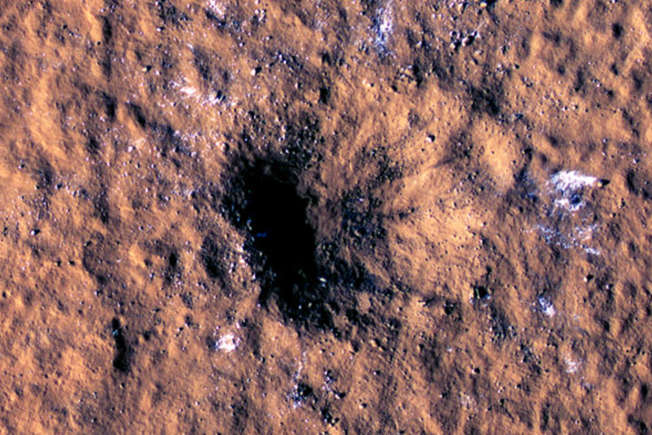
NASA revealed, during a press conference, that a meteorite struck Mars on December 24, 2021. The American space agency unveiled images of the crater formed following the collision.

A crater of 492 feet in diameter

©The Daily Digest

A crater of 492 feet in diameter
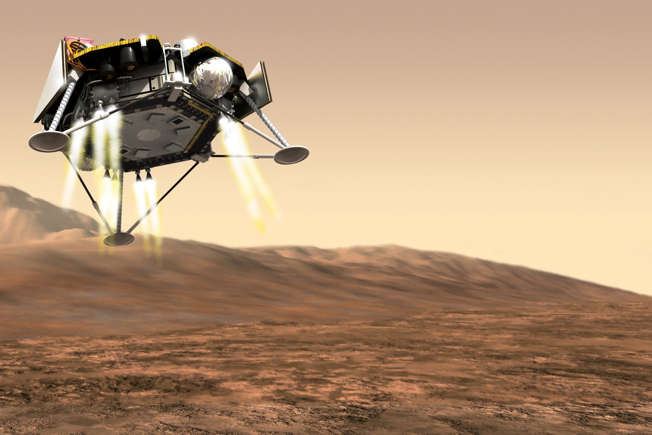
The InSigh mission's seismometer detected two major impacts on the surface of Mars. The larger of the two formed a crater of 150 meters (492 feet) in diameter and 21 meters (69 feet) deep.

One of the largest impacts ever observed

©The Daily Digest

Photo: GooKingSword/Pixabay

One of the largest impacts ever observed
In its press release, the space agency said this was "one of the largest impacts ever observed on Mars since NASA began exploring the cosmos."

An even bigger discovery: ice inside Mars

©The Daily Digest

Photo:NASA/JPL-Caltech/UA/USGS

An even bigger discovery: ice inside Mars
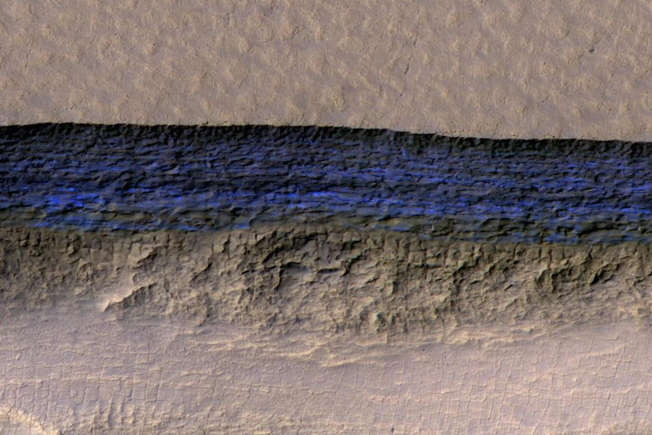
However, what's thrilled scientists more than the recorded seismic activity is what the meteor uncovered when it slammed into Mars: boulder-size chunks of ice blasted inside the crater.

Ice in the poles of Mars

©The Daily Digest

Ice in the poles of Mars
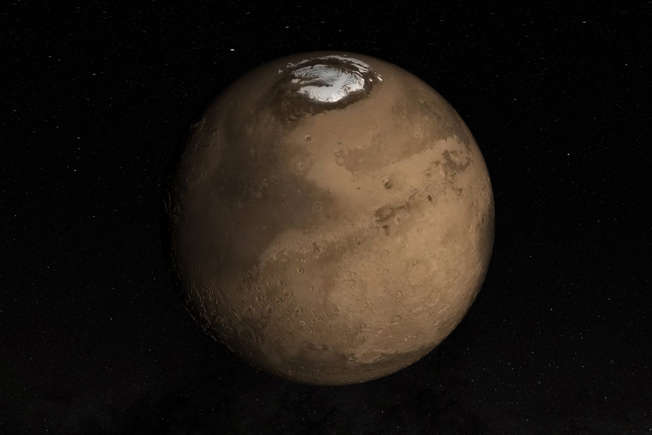
Scientists were well aware of the ice on the poles on Mars, but they didn’t know that ice existed under the ice cap.

Ice can be converted into water, oxygen or hydrogen

©The Daily Digest

Ice can be converted into water, oxygen or hydrogen
"In planning for future human exploration of Mars, we'd want to land the astronauts as near to the equator as possible, and having access to ice at these lower latitudes, that ice can be converted into water, oxygen, or hydrogen. That could be really useful", said Lori Glaze, NASA's director of planetary science.

The red planet

©The Daily Digest

Photo: NASA/JPL-Caltech

The red planet
Mars is the planet in our Solar System that has the most similarities with Earth. This is mainly why the red planet is NASA’s favorite destination to explore.

Photos that depict the red planet

©The Daily Digest

Photos that depict the red planet
So the recent discovery and amazing photos can be added to the collection NASA has of the red planet. Here are some of them:

©The Daily DigestMars’s two small moons

Photo: NASA, ESA, and STScI

Mars’s two small moons
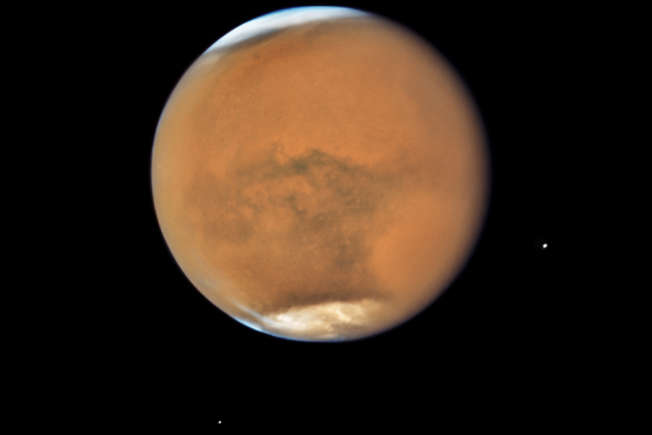
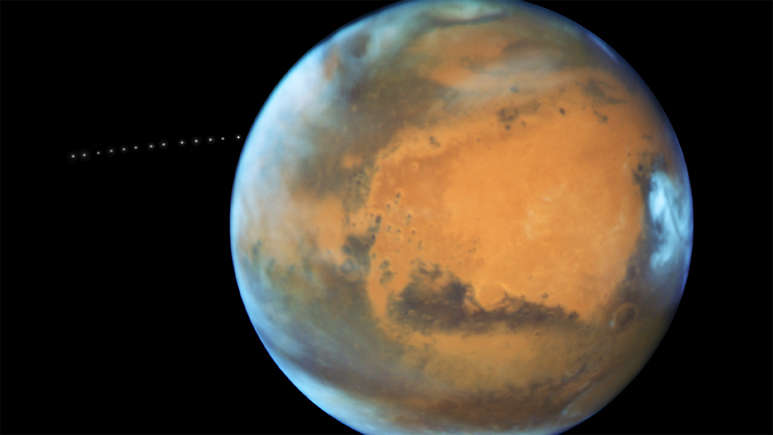
This image of Mars was taken by NASA's Hubble Space Telescope on July 18, 2018, when Earth, Mars and the Sun were aligned. Mars' two small moons, Phobos and Deimos are visible in this shot.

Arabia Terra

©The Daily Digest

Photo: NASA/JPL/University of Arizona

Arabia Terra
Arabia Terra is a vast region located on the northern hemisphere of Mars. It is characterized by its craters dating back approximately 4 billion years. Also seen in this photo are dark dunes, which the HIRISE team is monitoring closely for any wind activity.

Danielson Crater

©The Daily Digest

Photo: NASA/JPL-Caltech/University of Arizona

Danielson Crater
Danielson is an impact crater measuring approximately 67 kilometers (41 miles) in diameter, located in the southwest of the Arabia Terra region. This image taken by the Mars Reconnaissance Orbiter spacecraft shows the sand and sedimentary rocks that make it up.

A wonderful contrast of colors

©The Daily Digest

Photo: NASA/JPL/University of Arizona

A wonderful contrast of colors
In this image, there’s channels filled with shiny ice, which contrast with the red soil of Mars. The photo was taken at the planet's seasonal polar caps.

A sunrise on the planet Mars

©The Daily Digest

Photo: NASA/JPL/LaRC

A sunrise on the planet Mars
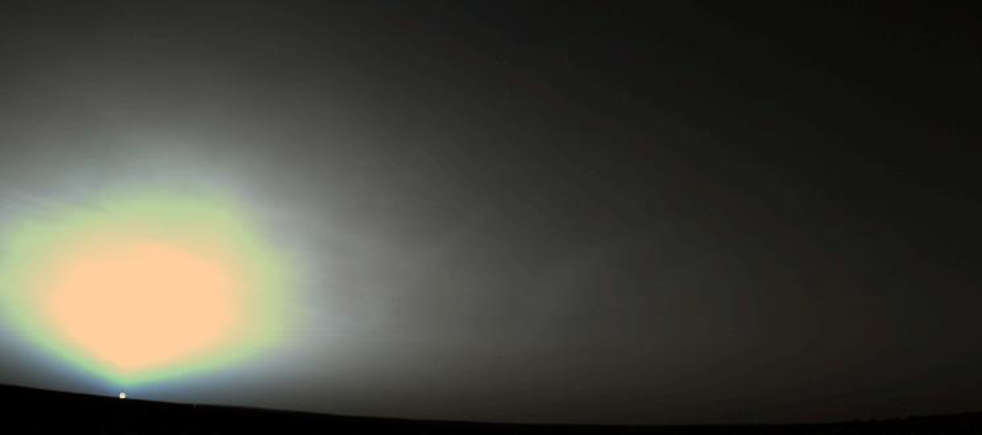
An intriguing Martian sunrise was captured by the Viking 2 exploration probe on June 14, 1978.

Candor Chasma

©The Daily Digest

Photo: NASA/JPL/University of Arizona

Candor Chasma

This is Candor Chasma, one of the valleys that are part of the Valles Marineris canyons, located close to the equator of the red planet. Its light-colored stratified deposits could be an area made up of sandstone, potentially habitable according to scientists.

A spring avalanche

©The Daily Digest

Photo: NASA/JPL/University of Arizona

A spring avalanche
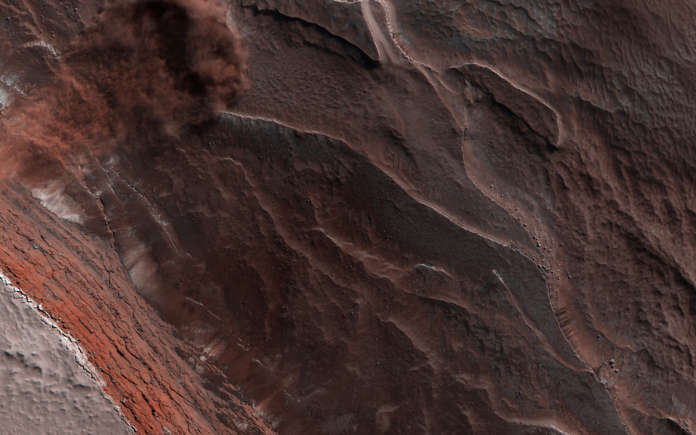
This is an avalanche captured by the HiRISE camera, near the north pole of Mars. Every spring, the sun shines on this area of the planet. The heat of its rays causes the detachment of blocks of ice. When reaching the bottom of the cliff, which is more than 500 meters high, these blocks raise a cloud of dust.

Rock formations

©The Daily Digest

©The Daily Digest

Rock formations
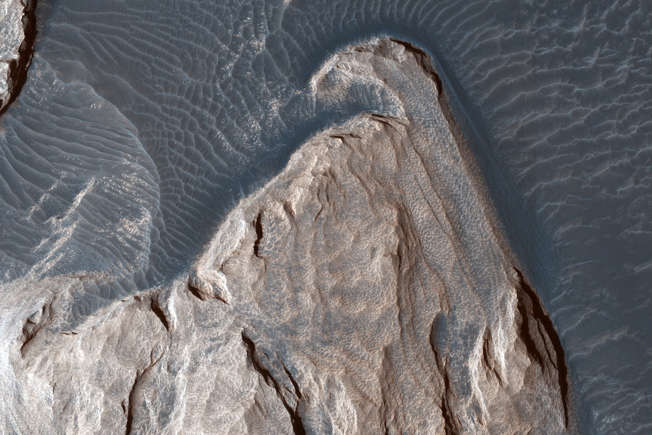
This image was captured in December 2018 by the Mars Reconnaissance Orbiter. The ripples that can be seen in the sand tell us which way the wind has moved around these rock formations.

Phobos

©The Daily Digest

Photo: NASA, ESA, and Z. Levay (STScI)

Phobos
Phobos is one of the two natural satellites of Mars. This small moon rises west of Mars and circles the Red Planet three times in a Martian day, which lasts about 24 hours and 40 minutes.

A very young impact crater

©The Daily Digest

Photo: NASA/JPL-Caltech/University of Arizona

A very young impact crater

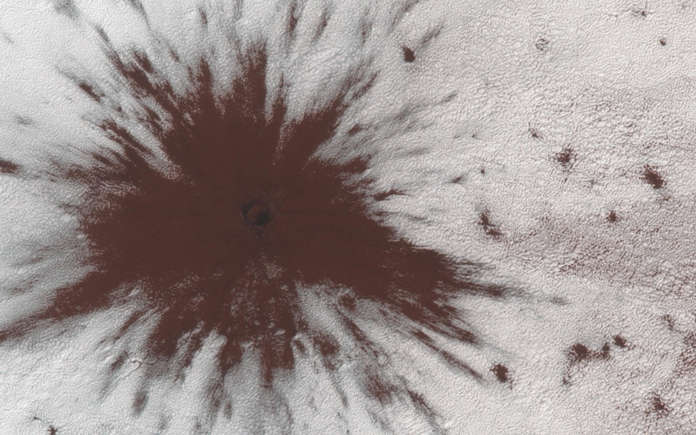
This remarkable image shows us an impact crater formed between July and September 2018. This impact occurred in the seasonal southern ice sheet, and visibly pierced it, creating an incredible blast pattern.

Jezero Crater

©The Daily Digest

Photo: NASA/JPL-Caltech/MSSS/JHUAPL

Jezero Crater
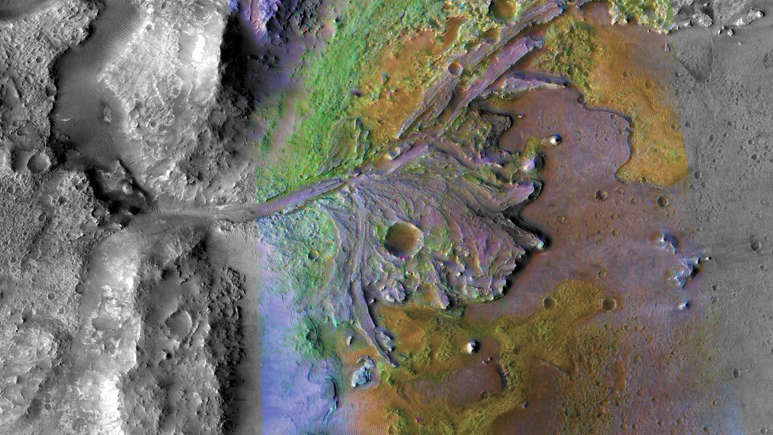
The Jezero crater is thought to have formed about 3.7 billion years ago. It is located to the west of Isidis Planitia, and it was chosen by NASA as the landing site for the "Mars 2020" mission, launched on July 30, 2020, and currently in progress.

Steep dunes

©The Daily Digest

Photo: NASA/JPL/University of Arizona

Steep dunes
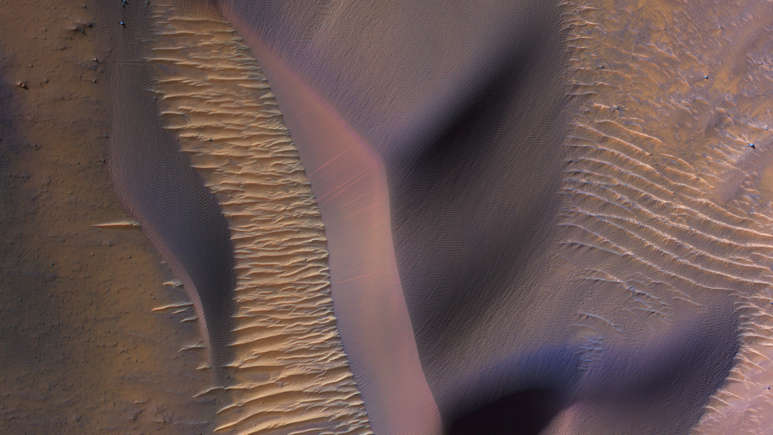
These dunes were photographed on the slopes of Nectaris Montes, in the canyons of Valles Marineris. The sand dunes that make up these giant canyons can be impressively large, with seemingly very steep slopes, as seen in the image.

Mount Sharp

©The Daily Digest

Photo: NASA/JPL-Caltech/MSSS

Mount Sharp
This image was taken by the Curiosity rover, deployed on Mars since 2012, on Mount Sharp, a mountain that stands in the middle of the Gale crater. In the center of the image, you can see clay rocks that NASA scientists are eager to study.

Curiosity selfie

©The Daily Digest

Photo: NASA/JPL-Caltech/MSSS

Curiosity selfie
This is Curiosity, the car-size rover sent to Mars for an exploration mission in 2012. One of its objectives is to explore the Gale crater, on which it landed. The "Mars Science Laboratory" mission is still ongoing today.

The canyons of Valles Marineris

©The Daily Digest

Photo: NASA/JPL-Caltech

The canyons of Valles Marineris
At the center of this mosaic, which is a compilation of images captured by the Viking Orbiter 1 spacecraft, is a broader view of the Valles Marineris canyons. They stretch over 3,000 kilometers long and 600 kilometers wide.

Aram Chaos Crater

©The Daily Digest

Photo: NASA/JPL/University of Arizona

Aram Chaos Crater
In this image, uplifted blocks of light-colored layers can be seen, composed largely of hematite and water-weathered silicates. These elements tell us that the Aram Chaos crater once contained a lake. Its diameter is about 284 kilometers (176 miles).

Crater Crisp

©The Daily Digest

Photo: NASA/JPL-Caltech/University of Arizona

Crater Crisp
The Crisp crater is located in the Sirenum Fossae. According to NASA scientists, this crater would be relatively recent, because its edge is still very sharp.

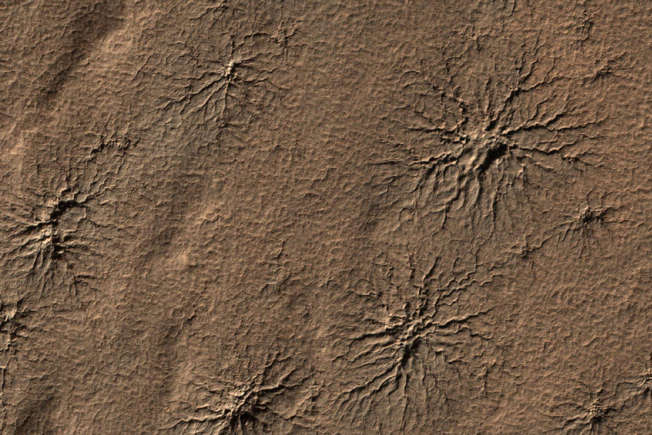
Spider shaped cracks

©The Daily Digest

Photo: NASA/JPL-Caltech/University of Arizona

Spider shaped cracks
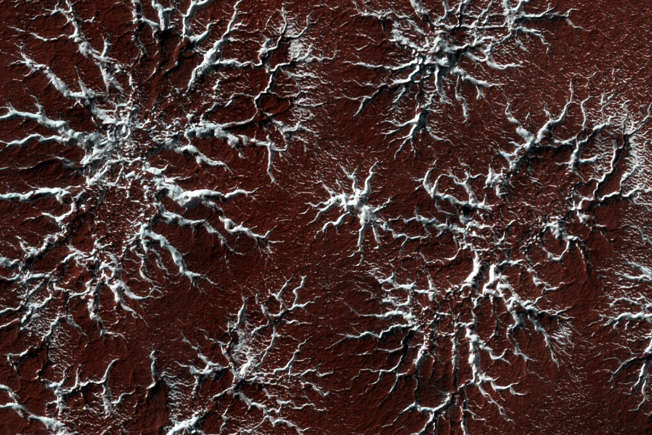
These spider-shaped cracks are located in the surface of the south polar region of Mars. They were caused by the evaporation of carbon dioxide in the atmosphere.

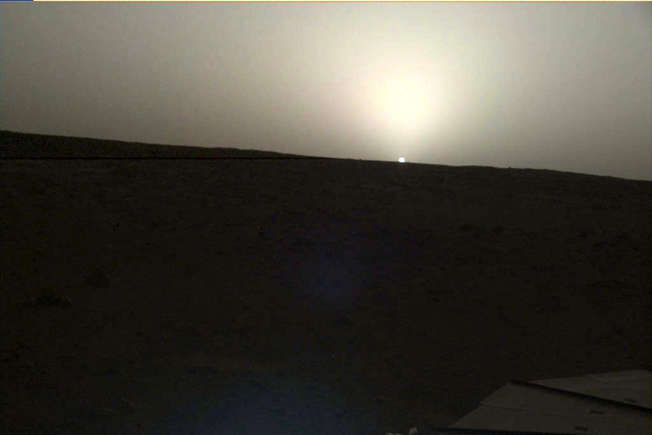
Another Martian sunset

©The Daily Digest

Photo: NASA/JPL-Caltech

Another Martian sunset
This sunset was captured by NASA's InSight lander on April 25, 2019 at 6:30 p.m. local Mars time.

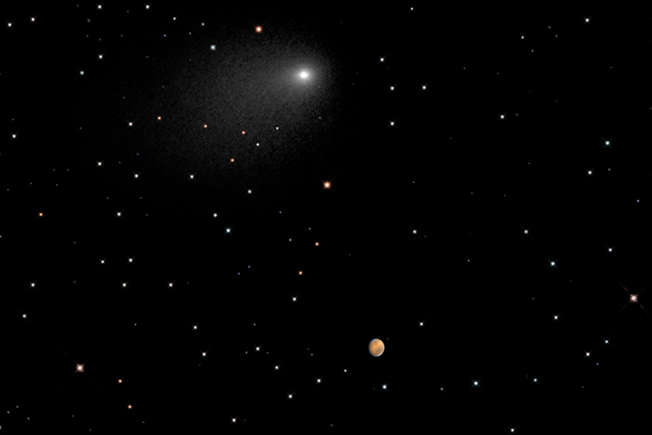
The passage of a comet near Mars

©The Daily Digest

Photo: NASA, ESA, J.-Y. Li (PSI), CM Lisse (JHU/APL), and the Hubble Heritage Team (STScI/AURA)

The passage of a comet near Mars
Finally, this is an image captured by the Hubble Space Telescope, which shows the closeness between a Comet and Mars on October 19, 2014.

{ https://thedailydigest.com/en/ }

Hoe vind je dit bericht?
Geschreven door peter om 23:43 Stuur door

Inside a Martian Meteorite, These Grains of an Unexpected Gemstone Hold Clues to a Hidden Past

garnet

Credit: United States Geological Survey/Mineral Information Institute

Inside a Martian Meteorite, These Grains of an Unexpected Gemstone Hold Clues to a Hidden Past

A Martian meteorite fragment containing unexpected grains of mineral could hold clues to the Red Planet’s geological history, according to an international team of researchers.

Prior to the team’s new paper, which was published in Geochemical Perspectives Letters, the red mineral garnet had never been observed in any martian rock sample. Now, the meteorite discovery provides scientists with new clues to Mars‘ extreme past conditions, over its 4.5 billion-year history, which could include hidden magma sources or ancient impact events.

Garnet and Geology

Although the gemstone garnet can come in many colors, it is best known for its dark red varieties, which were historically popular in ancient Egypt, Rome, and Victorian England. Beyond its beauty, the rock is important for the record it keeps of its birth, providing Earth’s geologists with information on our planet’s tectonic forces, ore-forming processes, and the fluid-rock interactions of the crust and mantle.

Similarly, the small grains of garnet discovered in the meteorite sample contain important data for reconstructing the forces that forged the Red Planet long ago.

“The findings add a striking new dimension to our understanding of the geology of Mars and open an exciting new window into the evolution of our planetary neighbour,” said co-author Professor James Darling.

“This discovery is going to expand our knowledge of the geologic processes that are possible on this planet,” said lead author Tanya Kizovski, Assistant Professor of Earth Sciences, from Brock University in Canada. “This new garnet-bearing rock type could give us clues to how Mars has changed throughout its history and new insights into the ancient environments that could have formed the garnet and related minerals.”

Mars Meteorite NWA 8171

The garnet fragments were discovered in a tiny Martian meteorite sample held in the Royal Ontario Museum’s collection, designated NWA 8171, discovered in northwest Africa. Kizovski led the team in analyzing the sample’s mineral and chemical composition after identifying it as a unique piece within the collection.

“This little section of the meteorite looked really interesting, and the chemistry was a bit odd,” Kizovski said. “At first, we assumed it was a mineral called pyroxene, which is very common, but then we decided to take a second look.”

The international effort brought in researchers from Italy’s University di Trieste and the UK’s Open University, utilizing the Royal Ontario Museum’s laser equipment and the University of Portsmouth’s Electron Microscopy and Microanalysis Unit.

Having never been observed in any previous Martian sample, the researchers were surprised to identify garnet in the meteorite’s composition. From their analysis of the sample’s chemistry and mineralogy, the researchers began to consider how the unexpected garnet could have formed.

“Garnet is a classic example of a mineral often found in metamorphic rocks on Earth,” Kizovski said. “The process of metamorphism transforms igneous or sedimentary rocks into a new form through exposure to extreme heat, high pressure, or hot fluids.”

“On Mars, the heat and pressure needed to produce garnet through metamorphism could have come from the impact of a meteorite hitting the surface of Mars, magma rising up into the Martian crust, or both,” Kizovski continued.

Explaining Martian Garnet

While garnet provided geologists with some data about how it formed, this is not like the point of origin stamped on a manufactured good. It is possible that the garnet was deposited on Mars during an earlier meteorite impact, only to later travel through the solar system again, or that it was created by a heretofore unknown magma source on Mars.

Only further analysis of the garnet’s isotopic signatures will allow the researchers to determine whether the mineral formed on Mars or elsewhere. Unfortunately, to do so, the team would have to destroy a portion of this rare and precious sample, which measures only 0.8 by 0.5 millimeters to begin with.

“Measuring oxygen isotopes from the garnet-bearing rock type itself would help to confirm if it is Martian in origin or from an exotic meteorite impactor,” Kizovski said.

“Isotopes are a collection of atoms with equal numbers of protons and electrons, but different numbers of neutrons,” she added, “which was avoided thus far due to its rarity, as it may be the only garnet-bearing Martian rock we have for study.”

A few members of the team are continuing their study of the sample by comparing their findings to Martian data collected by rovers and orbital platforms. Further insights, they hope, may help them discover more about how the garnet could have formed, and what its presence means for the deeper history of the Red Planet.

The paper, “Expanding Mars’ Lithologic Diversity: Discovery of a Garnet-Bearing Clast in NWA 8171,” appeared in Geochemical Perspectives Letters on June 16, 2026.

  • Ryan Whalen covers science and technology for The Debrief. He holds an MA in History and a Master of Library and Information Science with a certificate in Data Science. He can be contacted at ryan@thedebrief.org, and follow him on Twitter @mdntwvlf.
RELATED VIDEOS

Scientists Found a Mysterious Mineral Inside a Mars Meteorite – What It Means

Martian Meteorite Discovery Reveals Clues to Ancient Life | WION Podcast

NASA Discovered the Dark Truth About Mars' Ancient Oceans | Space Documentary

{ https://thedebrief.org/category/space/ }

Hoe vind je dit bericht?
Geschreven door peter om 22:32 Stuur door

Astronomers Observing a Supermassive Black Hole Just Had an Unexpected UFO Sighting

Supermassive black hole in an active galaxy producing a UFO
(Image Credit: ESA/AOES Medialab/NASA)

Astronomers Observing a Supermassive Black Hole Just Had an Unexpected UFO Sighting

It’s not the kind of thing astronomers expect to see while observing the powerful effects of a distant supermassive black hole: an unprecedented UFO sighting.

However, that’s precisely what one group of scientists now reports in a preprint paper, who detail the successful detection of one of the strongest UFOs—a black hole phenomenon otherwise known as “ultra-fast outflows”—that astronomers may have ever seen.

The landmark detection was made possible with the XMM-Newton space observatory and NuSTAR X-ray telescope, which allowed the researchers behind the discovery to observe a luminous quasar with origins that date back to “cosmic noon,” revealing a pair of outflow wind components being blasted from the black hole in question.

Cosmic Monsters with Major Appetites

Black holes have more than just large appetites for cosmic material: they also produce significant gas-driven winds from around their accretion disk.

These winds become known as ultra-fast outflows (UFOs) when their strength propels them to greater than ten percent of light speed, and astronomers currently believe they are an important part of what helps black holes regulate their growth, which may also hold for their host galaxies.

One way this occurs is that UFOs help to heat galactic gases that give rise to star formation, a quenching process that most astronomers believe occurred during a period called “cosmic noon,” which occurred between 1.6 and 3.5 billion years after the birth of the universe.

Cosmic Fingerprints of Powerful UFOs

Astronomers can detect ultra-fast outflows based on the “dips” they create in their powerful gusts, which are caused by ionized iron present in their outflow gases. These gases also absorb X-rays along their path away from their black hole originators, which leave “fingerprints” in the form of absorption features that are detectable using X-ray telescopes.

Significantly, these “dips” manifest as a blueshift since they are shifted to higher energies as they move at such high speeds (again, roughly 10% of the speed of light). From the blueshifted energy signatures they comprise, astronomers can determine not only the presence of UFOs, but also the wind speed of their gusty outflows.

In the past, most detections of these high-powered cosmic phenomena have relied on gravitationally lensed quasars. These celestial objects occur when a galaxy or similar feature closer to Earth appears in front of them, magnifying the quasar’s light and significantly brightening its luminosity from our Earthly perspective.

However, lensing of this variety can also present problems, and so astronomers led by Giorgio Lanzuisi of INAF Bologna designed a special system to target more than a dozen hyper-luminous quasars at cosmic noon, as a means of getting a better feel for the dynamics of non-lensed quasars.

“WISSHFUL” Thinking

WISSHFUL is an XMM-Newton multi-year heritage program that Lanzuisi and his colleagues designed for this purpose, whose initial target became a quasar designated WISSH13, whose redshift at 3.294 marks the object’s existence as it appeared approximately 2 billion years after the Big Bang.

20260605 2 6deie6

The WISSHFUL program: the highest redshift UFO discovered in a non-lensed QSO
Credit: arXiv

WISH13’s black hole also weighs in at close to 2 billion times that of our Sun, which causes it to shine far brighter than normally expected for an object of its estimated mass.

Their work began in the autumn of 2024 by combining observations from XMM-Newton and NuSTAR initially obtained in 2017. From these X-ray images of WISSH12, a pair of distinctive absorption features became evident, which the team determined to have been generated by two separate sources from within the same ultra-fast outflow.

These components were found to travel at different speeds: one moving at close to 30% of the speed of light, while the other at only about 10% of light speed. The slower of these two appears to have been an enduring component of the UFO, while the faster one showed signatures that indicated a more recent appearance. This could mean that it emanates from events that are shorter in duration.

By matching theoretical predictions of a layered wind structure surrounding the black hole, the researchers say their observations align with models that indicate a fast-moving inner “spine” launched from the accretion disk’s innermost regions. Meanwhile, a slower outer “sheath” is also believed to emanate farther from the black hole. The combined outflow components produce an estimated 21 to 24 solar masses of material annually.

Astronomers Detect Rare Ufo Signals From A Black Hole Racing At Near Light Speed

Artistic view of multiphase AGN-driven winds highlighting the different phases and scales that are involved in the outflow.

Credit: University of Bologna

The Most Massive UFO Ever Observed? 

Such figures, the team says, represent what is believed to be among the most massive and energetic ultrafast outflows ever observed, a discovery which also marks the highest-redshift ultrafast outflow yet detected in a non-lensed quasar.

Despite their remarkable energetic output, the team says these outflow winds seem to conform to the same essential relationships observed in active galaxies much closer to Earth, suggesting that the processes driving these outflows have remained remarkably consistent across cosmic time.

Going forward, the team says they hope to make additional observations of these powerful cosmic phenomena with help from the new Athena X-ray mission, which they say could help uncover similar winds in even more distant quasars.

The team’s discoveries were detailed in a recent paper, “The WISSHFUL program: the highest redshift UFO discovered in a non-lensed QSO,” which appeared at the preprint arXiv.org server.

  • Micah Hanks is the Editor-in-Chief and Co-Founder of The Debrief. A longtime reporter on science, defense, and technology with a focus on space and astronomy, he can be reached at micah@thedebrief.org. Follow him on X @MicahHanks, and at micahhanks.com.

Scientists Found a Hidden Pair of Black Holes — By Watching Stars Flicker in the Dark

Black Hole In Space: Astronomers Observe A Massive Black Hole Firing Winds At 60,000 km/s |Originals

{ https://thedebrief.org/category/space/ }

Hoe vind je dit bericht?
Geschreven door peter om 22:14 Stuur door

The Search for ET: What Do the Best Scientists in the Milky Way Know?

The Search for ET: What Do the Best Scientists in the Milky Way Know?

Albert Einstein is probably not the smartest scientist that ever lived since the Big Bang happened, 13.8 billion years ago. Most stars formed billions of years before the Sun. There had probably been a better scientist on another habitable planet a billion years ago.

The civilization which benefited from this ET genius could have populated the entire Milky Way galaxy with advanced probes by now. Perhaps we will find one of them.

The Galileo Project searches for extraterrestrial equipment using telescopes on the ground and in space. If we find an extraordinary interstellar vehicle, I will be delighted to hop on it and seek exceptional scientists throughout the Milky Way. We have many pressing questions for them: What happened before the Big Bang? Is there a way to create a baby universe in the laboratory? What is inside a black hole? What is the nature of dark matter and dark energy? Is it possible to travel faster than light? How widespread is intelligent life throughout the cosmos? And many more.

The importance of these questions – also echoed in my book Extraterrestrial, will bring more people to my funeral if I return some answers to Earth. When I made this point to the Smithsonian Magazine journalist, Jennie Rothenberg Gritz, she noted: “Your funeral will be a great interstellar celebration of your life – but I hope it doesn’t happen for a while!”

The exploration of space is currently popular from its commercial incentives. These include space tourism, novel industries at low-gravity on the Moon or Mars, and mining rare minerals on asteroids such as `Psyche’. But there is no business plan for leaving the Solar system towards other stars because of the vast distance and long duration of such journeys. The motivation for such expeditions must be spiritual, namely: exploring the unknown. If interstellar travelers arrive at our doorstep, it will be because we are unknown to them.

ETIn the search for ET, humanity must prepare for the challenges of meeting a civilization potentially far more advanced than ours (credit: Unsplash).

An encounter with an ET culture would be a humbling experience, since we will have to admit that our modern science was developed only over the past century out of the 4.5-billion-years-long history of Earth. Just over a hundred years ago, Albert Einstein pioneered general relativity – the foundation for our current understanding of the Universe, and quantum mechanics – the knowledge base for our electronic gadgets. But we still do not know the answers to many foundational questions about our cosmic neighborhood, as listed above.

Most of human history is shaped by the illusion of superiority that some people had relative to other people when the reality is that all humans are fundamentally so fragile that even a tiny virus-like COVID-19 can wipe them out in two weeks.

In today’s WORLD.MINDS forum coordinated by Rolf Dobelli, I asked Thomas Zurbuchen, the Associate Administrator for the Science Mission Directorate at NASA, “Do you believe that we will find evidence for intelligent ET life in our lifetime?”

Thomas replied that we might likely find such evidence, but the timeframe is highly uncertain. He then asked me in return, “And what do you think, Avi? I do not know how old you are, as that would affect your likelihood to witness it.”

My answer was short: “I will be sixty years old at the end of this week, and I do believe we will find such evidence during my lifetime.” Then, I jokingly added, “My only doubt is whether we will ever find intelligent life in Washington, DC.”

By that, I only meant to say that “extraordinary evidence requires extraordinary funding”, which often rests on strategic decisions by policymakers.

Thomas then raised his foot towards the camera and showed his socks. They had alien images on them.

“This is especially for you,” he said smiling. “Happy Birthday!”

Here’s hoping that we will find a message in an “extraterrestrial bottle” that will offer salvation from our weaknesses through the broader perspective of the cosmos. There is tension between the damage that our new technologies bring to Earth and the opportunity to avoid a single-planet catastrophe by venturing into space. Perhaps the wake-up call will come from interstellar space in the form of an unusual technological object that will be discovered by the Galileo Project.

  • Avi Loeb is the head of the Galileo Project, founding director of Harvard University’s – Black Hole Initiative, director of the Institute for Theory and Computation at the Harvard-Smithsonian Center for Astrophysics, and the former chair of the astronomy department at Harvard University (2011-2020). He is the bestselling author of “Extraterrestrial: The First Sign of Intelligent Life Beyond Earth” and a co-author of the textbook “Life in the Cosmos”, both published in 2021.

James Webb Just Revealed Where We Actually Are in the Milky Way

{ https://thedebrief.org/category/space/ }

Hoe vind je dit bericht?
Geschreven door peter om 21:47 Stuur door

De Noord-Atlantische koudevlek: toeval of teken van een groter klimaatprobleem?

De Noord-Atlantische koudevlek: toeval of teken van een groter klimaatprobleem?

Het mysterie van de 'koude plek' in de Noord-Atlantische Oceaan

©The Daily Digest

Afbeelding: NASA Scientific Visualization Studio/Goddard Space Flight Center

Een belangrijk raadsel dat opgelost moet worden
In de Noord-Atlantische Oceaan, ten zuiden van IJsland en Groenland, is een raadselachtige 'koude zone' ontstaan. In dit uitgestrekte zeegebied daalt de temperatuur continu, wat in contrast staat met de algehele opwarming van de oceaan.

Snel afkoelingsproces

©The Daily Digest

Snel afkoelingsproces
Volgens CNN zeggen experts dat dit belangrijke Atlantische gebied al meer dan een eeuw aan het afkoelen is, in die mate dat de temperatuur van het water volgens de beschikbare gegevens sinds 1900 met ongeveer één graad Celsius is gedaald.

Twee theorieën over wat er gaande is

©The Daily Digest

Twee theorieën over wat er gaande is
In deze context wordt er binnen de wetenschap gedebatteerd over twee theorieën over de mogelijke oorzaak van deze 'koude plek'. Enerzijds zou het te wijten kunnen zijn aan warmteverlies van het oceaanoppervlak als gevolg van veranderingen in wind en bewolking; anderzijds aan de verzwakking van het systeem dat de oceaanstromingen in de Atlantische Oceaan transporteert.

Cruciaal kantelpunt in het klimaat

©The Daily Digest

Cruciaal kantelpunt in het klimaat
Nieuw onderzoek, waarover CNN bericht, neigt nu naar de tweede optie om dit mysterie te verklaren. Het suggereert tevens dat het een teken zou kunnen zijn dat we op het punt staan een alarmerend kantelpunt in het klimaat te bereiken, met catastrofale gevolgen voor de toekomst.

Atlantische Meridionale Omwentelingscirculatie

©The Daily Digest

Atlantische Meridionale Omwentelingscirculatie
De studie verwijst naar het cruciale systeem van oceaanstromingen, de AMOC (Atlantische Meridionale Omwentelingscirculatie), dat volgens experts functioneert als een gigantische transportband die warm water vanuit de tropen naar het noordelijk halfrond voert, waar het afkoelt, zinkt en weer naar het zuiden terugkeert.

Vingerafdruk van veranderingen in de AMOC

©The Daily Digest

Vingerafdruk van veranderingen in de AMOC
Gezien het bestaan van de AMOC kan de 'koude zone' die we vandaag de dag in de Noord-Atlantische Oceaan zien, volgens de auteurs van de studie worden beschouwd als een vingerafdruk waarop de veranderingen binnen het systeem te zien zijn, aangezien het daar is waar de meeste waterkwaliteit die het met zich meebrengt, aankomt.

Opwarming van de aarde en zoet water

©The Daily Digest

Opwarming van de aarde en zoet water
Naast dit onderzoek hebben talrijke andere studies al gewaarschuwd voor de verzwakking van de AMOC. De reden hiervoor is dat door het smeltende ijs als gevolg van de opwarming van de aarde een enorme hoeveelheid zoet water de oceaan instroomt, waardoor het evenwicht tussen zoutgehalte en warmte verstoord raakt en de werking van dit stromingssysteem wordt beïnvloed.

Ineenstorten in het aangezicht van de toekomst

©The Daily Digest

Ineenstorten in het aangezicht van de toekomst
Deze verzwakking zal blijven toenemen totdat het klimaatkantelpunt is bereikt waar wetenschappers naar verwijzen, wat onvermijdelijk zou leiden tot de ineenstorting van de AMOC, iets wat, benadrukken zij, al in deze eeuw zou kunnen gebeuren.

Wereldwijde catastrofe

©The Daily Digest

Wereldwijde catastrofe
En wat zou er gebeuren in geval van een ineenstorting? De gevolgen zouden verwoestend zijn en een wereldwijde catastrofe veroorzaken, die zich zou manifesteren in een aanzienlijke stijging van de zeespiegel aan de oostkust van de Verenigde Staten of langdurige droogtes in Afrika als gevolg van de verstoring van de moesson, en bovendien het Europese continent in een permanente ijskoude winter zou storten.

Afkoeling zowel aan de oppervlakte als op grotere diepte

©The Daily Digest

Afkoeling zowel aan de oppervlakte als op grotere diepte
Een van de ontdekkingen van deze recente studie naar de 'koude zone' in de Noord-Atlantische Oceaan, die de neiging versterkt om te denken dat het probleem ligt in de verzwakking van de AMOC, is dat de afkoeling van het water niet alleen aan de oppervlakte plaatsvond, maar ook in de diepte van de oceaan.

Gegevens uit veldmetingen versus klimaatmodellen

©The Daily Digest

Gegevens uit veldmetingen versus klimaatmodellen
Om dit te analyseren, vergeleek het team van wetenschappers dat bij het onderzoek betrokken was, de daadwerkelijke gegevens over de oceaanwarmte, verkregen via satellietonderzoek en met specifieke instrumenten die uit het water waren gehaald, met de gebruikelijke klimaatmodellen. Op basis hiervan konden ze de verandering in de trend van dit uitgestrekte watergebied in de Atlantische Oceaan waarnemen.

Invloed van AMOC

©The Daily Digest

Invloed van AMOC
Volgens de auteur van de studie, Stefan Rahmstorf, hoogleraar natuurkunde en oceanografie aan de Universiteit van Potsdam (Duitsland), is de AMOC duidelijk de boosdoener achter de afkoeling van deze watermassa, omdat deze, zoals hij aan CNN vertelde, "het transport van oceanische warmte beïnvloedt".

Het zwakste punt in 1000 jaar

©The Daily Digest

Afbeelding: Wikipedia

Het zwakste punt in 1000 jaar
Rahmstorf benadrukte verder dat, afgezien van deze 'koude plek', ze al voldoende bewijs hadden uit talrijke eerdere studies die wezen op de verzwakking van de AMOC, in die mate dat, zo benadrukte hij, deze zich momenteel op het zwakste punt in 1000 jaar zou kunnen bevinden.

Heeft niets te maken met atmosferische omstandigheden

©The Daily Digest

Heeft niets te maken met atmosferische omstandigheden
Onderzoeker René van Westen van de Universiteit Utrecht (Nederland) benadrukte ook dat de resultaten van Rahmstorfs onderzoek het idee versterken dat de afkoeling van deze enorme watermassa niet wordt beïnvloed door atmosferische omstandigheden, hoewel is aangetoond dat deze wel degelijk via die weg kan plaatsvinden.

Gebieden waar wind en bewolking weinig invloed hebben

©The Daily Digest

Gebieden waar wind en bewolking weinig invloed hebben
Van Westen verwijst in dit geval naar de bijzonderheid dat het diepe water in dit specifieke gebied ook afkoelt, ondanks het feit dat elementen zoals wind of wolken hier weinig invloed hebben.

Eenvoudige benaderingen?

©The Daily Digest

Eenvoudige benaderingen?
Andere deskundigen, zoals David Thornally, hoogleraar oceaan- en klimaatwetenschappen aan University College London, wijzen erop dat het nog te vroeg is om definitieve uitspraken over deze kwesties te doen. Hoewel hij erkent dat de studie het bewijs voor een verband tussen de 'koude zone' en de AMOC versterkt, stelt hij dat de gegevens slechts benaderingen zijn en geen absolute waarheid weergeven.

De noodzaak van verder onderzoek

©The Daily Digest

De noodzaak van verder onderzoek
In een gesprek met CNN waarschuwde Thornally dat er onder wetenschappers nog steeds veel onzekerheid bestaat over wat er met deze massa koud water zou kunnen gebeuren, en benadrukte hij de noodzaak van verder onderzoek: "Ik denk niet dat (deze studie) het laatste woord over dit onderwerp is", verklaarde hij.

{  https://www.msn.com › nl-nl  }

Hoe vind je dit bericht?
Geschreven door peter om 21:32 Stuur door

Ancient Roman records offer fresh evidence Jesus was a real person

Ancient Roman records offer fresh evidence Jesus was a real person

Ancient writings of two Roman historians have been highlighted as some of the strongest evidence that Jesus was a real person.

The records come from Tacitus, one of Rome's most respected historians, and Flavius Josephus, a Jewish aristocrat and historian who lived just decades after Jesus' death.

Neither man was a Christian, and neither was trying to prove the claims of the New Testament. 

Yet both left behind accounts that place Jesus in Judea, connect him to the origins of Christianity and link his death to the Roman governor Pontius Pilate.

In one of the texts, Tacitus wrote that a man called Christus was executed during the reign of Emperor Tiberius.

In another, Josephus referred to James as 'the brother of Jesus-who-is-called-Messiah,' identifying Jesus as a real person known to his readers.

The references have drawn renewed attention as historians continue examining evidence for Jesus that exists outside the Bible.

For many scholars, the accounts represent some of the clearest non-Christian evidence that Jesus was a historical figure rather than a legend.

Ancient writings of two Roman historians have been highlighted as some of the strongest evidence that Jesus was a real person

Ancient writings of two Roman historians have been highlighted as some of the strongest evidence that Jesus was a real person 

article image

The evidence was recently reviewed on Thursday by biblical scholar Lawrence Mykytiuk, who examined ancient Roman and Jewish sources that mention Jesus, as reported in the Biblical Archaeology Society.

Most historians already accept that Jesus was a real historical figure, with debate focusing less on whether he existed and more on the details of his life and teachings.

That is why the ancient writings of Roman historian Tacitus and Jewish historian Flavius Josephus remain so important; they provide some of the earliest non-Christian references to Jesus, placing him in first-century Judea and linking his death to Pontius Pilate.

While the New Testament remains the primary source for information about Jesus' life, many skeptics have long argued that writings produced by Christians cannot be considered independent evidence.

That is why historians often focus on references written by people outside the faith.

One of the most important comes from Tacitus, a Roman senator, historian and one of the ancient world's most respected chroniclers.

Writing around 116 AD in his work Annals, Tacitus described Emperor Nero's efforts to blame Christians for the Great Fire of Rome in 64 AD.

According to Tacitus, Nero targeted a group known as Christians, whose name came from a man called Christus.

The highlighted passage contains Tacitus' reference to Christians, stating that their founder, Christ, was executed during the reign of Emperor Tiberius by the Roman governor Pontius Pilate

The highlighted passage contains Tacitus' reference to Christians, stating that their founder, Christ, was executed during the reign of Emperor Tiberius by the Roman governor Pontius Pilate

Tacitus wrote that Christus had been executed during the reign of Emperor Tiberius by Pontius Pilate, the Roman governor of Judea.

The passage is significant because Tacitus was openly hostile toward Christians.

Far from promoting their beliefs, he described Christianity as a dangerous superstition and expressed contempt for its followers.

Historians argue that this makes his reference to Jesus particularly valuable because he had no reason to invent details that supported the movement.

The account independently confirms several details found in the Gospels, including that Jesus was executed under Roman authority and that his followers continued spreading his teachings after his death.

Another major source comes from Josephus, a Jewish historian born only a few years after Jesus is believed to have been crucified.

Josephus fought against Rome during the First Jewish Revolt before eventually settling in Rome under imperial protection, where he wrote extensive histories of the Jewish people.

In his work Jewish Antiquities, Josephus referred to the execution of James, a leader of the early church.

To explain which James he meant, he identified him as 'the brother of Jesus-who-is-called-Messiah.'

The reference appears almost casually in the text, but historians say that is precisely what makes it important.

Jesus is not the focus of the passage, but is mentioned only to identify another person.

The 15th-century manuscript, now housed at the Bibliothèque Nationale de France, contains one of the most famous references to Jesus outside the Bible. In the highlighted passage, the Jewish historian Josephus describes Jesus as a wise man, writing: "Around this time there lived Jesus, a wise man, if indeed one ought to call him a man.

The 15th-century manuscript, now housed at the Bibliothèque Nationale de France, contains one of the most famous references to Jesus outside the Bible. In the highlighted passage, the Jewish historian Josephus describes Jesus as a wise man, writing: "Around this time there lived Jesus, a wise man, if indeed one ought to call him a man.

Scholars argue that such a reference would make little sense unless Jesus was already recognized as a real historical figure.

Josephus also included a longer passage describing Jesus as a wise teacher who attracted followers and performed remarkable deeds.

That section remains the subject of debate because many scholars believe later Christian scribes altered parts of the text.

However, the majority still conclude that the passage was based on an original reference to Jesus written by Josephus himself.

Taken together, the writings of Tacitus and Josephus support several key details about Jesus' life.

They indicate that he existed as a real person, was known by the name Jesus, gathered followers in Judea and was executed under Pontius Pilate.

The sources also show that his followers continued to spread his teachings long after his death and that the Christian movement had already reached Rome within a few decades.

Perhaps most strikingly, historians note that ancient critics of Christianity attacked Jesus in many ways but rarely questioned whether he existed.

Jewish and pagan writers accused him of false teaching, deception and even sorcery.

However, according to the historical record, virtually none argued that he was entirely fictional

RELATED VIDEOS

Roman Historians Actually Documented Jesus: Here's What They Wrote

Roman Records Prove Jesus Actually Existed 🏛️

Ancient Roman Records About Jesus: What Historians Discovered

{ https://www.dailymail.com/sciencetech/index.html }

Hoe vind je dit bericht?
Geschreven door peter om 00:44 Stuur door

EXCLUSIVE - The UFO files the government won't ever release: I've read them all. They fear a full-blown national crisis and destruction of religious faith... but it's time for the REAL disclosure day. Here's what you deserve to know

EXCLUSIVE - The UFO files the government won't ever release: I've read them all. They fear a full-blown national crisis and destruction of religious faith... but it's time for the REAL disclosure day. Here's what you deserve to know

By STACY LIBERATORE, US SCIENCE & TECHNOLOGY EDITOR

After weeks of anticipation, the latest UFO file dump left many Americans underwhelmed.

While the Trump administration unveiled a third batch of documents, photos and videos tied to unexplained sightings on Friday, critics argue the files stopped well short of addressing the allegations at the heart of the UFO mystery.

Now, one of the few people who claims to have seen some of the hidden UFO files has spoken to the Daily Mail, revealing what he says is inside them – including references to alleged crash-retrieval programs, secret government investigations and 'non-human biologics.'

Investigative journalist Jeremy Corbell said the material has only strengthened his belief that the US government has recovered unidentified craft and biological evidence linked to the UFO mystery.

Corbell has spent years collecting documents, testimony and other material related to the claims, some of which appeared briefly in Sleeping Dog, the documentary he produced with veteran investigative journalist George Knapp.

The film shows a list of files, including one referencing 'non-human biologics,' a term used to describe alleged extraterrestrial tissue or bodies.

Another file is labeled 'Kona Blue,' the name of a proposed Department of Homeland Security program that would have investigated claims involving recovered unidentified craft, advanced technology and other UFO-related allegations. 

The program was never formally established, according to government records.

Years worth of files, testimony and other material that Corbell collected, some of which were featured in Sleeping Dog

Years worth of files, testimony and other material that Corbell collected, some of which were featured in Sleeping Dog

Corbell argued that the material is now circulating far beyond the handful of researchers who first obtained it, raising the prospect that additional details could be leaked regardless of whether the government releases the files.

'I can't stop that information from coming out. I am unable to stop it,' he said, adding that 'over 100 journalists already have everything that I have. 

'That's not just in my hands anymore. That's not just in George Knapp's hands anymore.'

However, the US government maintains that it has found no verifiable evidence that extraterrestrial life or alien technology has visited Earth. 

Despite decades of public fascination with UFOs, major Pentagon investigations and declassified government reviews have repeatedly concluded that no case of unidentified anomalous phenomena (UAP) has been confirmed. 

The Trump administration released the third batch of UFO files on Friday, which Corbell said was 'historic,' as more information on the topic 'is always a win.'

However, he added that again, the government has only shared 'low-hanging fruit.' 

'Our government has long known about Non-Human Intelligence, their vehicles, reverse-engineering programs, and biological study of their pilots and occupants. These releases are provoked - not offered,' Corbell said.

David Grusch giving congressional testimony in 2023, during which he claimed the US government had spent decades attempting to recover and reverse-engineer craft of non-human origin. Investigative journalist Jeremy Corbell (circled) listens from behind

David Grusch giving congressional testimony in 2023, during which he claimed the US government had spent decades attempting to recover and reverse-engineer craft of non-human origin. Investigative journalist Jeremy Corbell (circled) listens from behind

'The pressure of journalism, whistleblowers, and congressional oversight forced this door open. Unresolved cases are a start. But complacency is our enemy. If you want the truth, demand it. 

'Full transparency on our government’s continued relationship and correspondence with the UAP phenomenon - nothing less.' 

Representative Tim Burchett, who has seen videos of craft that 'defy any reason,' has suggested that government agencies are using the excuse that UFO disclosure will 'disrupt religion' to withhold files from the public. 

Corbell said the files shown in his documentary touch on allegations involving non-human biologics, government UFO programs, intelligence assessments and unexplained aerial incidents that have remained largely hidden from public view. 

One of the files is named 'ImCon Originals,' he claimed, referring to Immaculate Constellation – which is described in a whistleblower report as a secret, unauthorized Pentagon program created to collect and hide UFO evidence.

Matt Brown, a former US national security official, came forward in 2025 with details about Immaculate Constellation, revealing the alleged secret program to Corbell.

Brown said he discovered references to the program in 2018 while reviewing classified materials at the Pentagon.

Corbell alleged that it is a special access program designed to quarantine high-quality UFO imagery and testimonies from congressional oversight. 

The file 'Pilfer & Pickpocket' also appears in the list, which Corbell has previously claimed are names of UFO crash retrieval programs. However, he stressed that he has not been able to confirm the details.

When asked why he does not release the files himself, Corbell told the Daily Mail that some of the information would cause a national security crisis.

But his 'number one reason' is that the government has made a promise of 'disclosure and transparency' to the American people. 'They deserve a chance to perform that function,' he said.

'Additionally,' Corbell continued, 'every time George and I obtain and release something, it puts sources at risk. Why do that when the government has said it will do it? We don't want to.'

The journalist has become a central player in the UFO disclosure movement, with his work bringing military and intelligence witnesses into the public eye and pressuring the US government into the disclosure process.

article image

Corbell also told the Daily Mail that he personally provided officials with access to several of the UFO videos that were released to the public on May 22.

He did so in what he described as classified 'intel links' connected to hidden government servers, after unknown sources leaked the clips to him.

'Not just file names; if you put the underscores in, they're linked,' Corbell said, claiming the material led directly to classified systems that 'you and I can't access.'

While Corbell has released UFO videos that ended up in the Trump administration's file dump, he has championed other footage of unknown craft that was later explained or challenged by investigators, scientists and the military.

His comments come as the Trump administration has released hundreds of UFO-related records, a move Corbell said falls far short of addressing the questions that have fueled the disclosure movement for years. 

Corbell pointed to David Grusch's 2023 congressional testimony, in which the former Air Force intelligence officer alleged the government had spent decades recovering and studying craft of non-human origin and had obtained what he described as 'biologics' from some crash sites.

'Now, if that's true, and if you believe him, our government in parts has that information,' Corbell said. 'It is time to tell the American public the truth.'

Neither Corbell nor Grusch has publicly released evidence proving the existence of non-human intelligence.

A handout from the Department of War that they said shows a UAP near Japan

A handout from the Department of War that they said shows a UAP near Japan

Grusch's testimony marked a turning point in the modern UFO disclosure movement, transforming what had long been considered fringe speculation into a topic debated openly on Capitol Hill.

He told lawmakers that he had interviewed numerous current and former government officials who claimed the US was operating secret programs dedicated to retrieving and studying unidentified craft.

His testimony prompted renewed calls for oversight and transparency from members of Congress on both sides of the aisle.

Several lawmakers have since argued that the government should release additional records related to UAPs.

Corbell said public interest in the issue continues to grow as more military personnel, intelligence officials and defense insiders come forward with accounts of encounters involving unexplained objects.

He argued that the administration's recent document releases have heightened expectations that more significant information could eventually emerge.

The Trump administration released the first batch of UFO files on May 8, with a second on May 22. 

They include military reports, FBI accounts and videos showing unexplained objects streaking across the sky. But rather than providing answers, the files have only deepened the mystery. 

Corbell suggested reporters may ultimately force the issue if officials fail to provide further disclosure. 'If they don't, journalism will,' he said.

He stressed he was not claiming to possess definitive proof of alien life or recovered extraterrestrial technology, but argued investigators have uncovered information that warrants further scrutiny.

'What I have obtained over the years is not definitive proof of the things you want,' he said. 'But it's a start. It's a good start.'

He added that disclosure should proceed in stages, beginning with government acknowledgment of alleged craft-retrieval and reverse-engineering programs.

From there, he said, officials should address claims involving 'biologics' before eventually answering what he called the next major question: whether there has ever been direct communication with a non-human intelligence.

'Have there been any agreements? Have there been any direct communications?' Corbell posited.

'After they begin with reverse engineering of craft, because we all know craft exists, biologics, because we're almost there, then the third step will be communications,' he declared.

'And I have evidence of all.'


Hundreds of UFO Files Released in 2026 | What Is the Government Hiding?

The UFO Files Are Public... But What Are They Hiding? | Alien Disclosure & Political Analysis

{ https://www.dailymail.com/news/index.html }

Hoe vind je dit bericht?
Geschreven door peter om 23:28 Stuur door

5,000-Year-Old ‘Prototype’ for Stonehenge Solar Alignment Discovered

5,000-Year-Old ‘Prototype’ for Stonehenge Solar Alignment Discovered

Stonehenge Sunset

As thousands prepare to flock to Stonehenge ahead of summer solstice celebrations this weekend, a team from Wessex Archaeology led by Phil Harding has announced the discovery of an ancient structure that may have served as an early ‘prototype’ for the alignment with the solstice at Stonehenge. Radiocarbon dated to around 5,000 years ago, the discovery reveals evidence for the earliest known alignment with the solstice in the Stonehenge landscape, showing that ancient people were using this feat of astronomical engineering to celebrate the solstice here at least 500 years before the alignment of the stones at Stonehenge.

Located 5km (3.1 miles) from Stonehenge in Bulford, Wiltshire, the site is contemporary with the earliest phase of Stonehenge when the first earthworks were built. Excavated as part of the Ministry of Defence’s Army Basing Programme, the site was likely a focus for major religious gatherings, with extensive evidence of feasting and large-scale gatherings as people came together to celebrate the solstices much as they still do today at Stonehenge.

A reconstruction of summer solstice celebrations as they might have appeared at Bulford 5000 years ago

A reconstruction of summer solstice celebrations as they might have appeared at Bulford 5000 years ago

(Wessex Archaeology)

A Solstice Alignment Prototype

The structure at the heart of the discovery would have consisted of two wooden poles 120 meters apart, which ancient builders positioned to form a line pointing directly at the rising sun during the summer solstice and at the setting sun during winter solstice. Little is now left of the structure except the pits in which the poles once stood, which are not accessible to the public, but their alignment with the solstice was confirmed in analysis conducted for Wessex Archaeology by leading skyscape archaeologist, Dr Fabio Silva, who used reconstructions of the ancient sky, landscape, and horizon to show how the structure would have aligned with the solstices to within an accuracy of one degree.

One of the pits in which the poles once stood at Bulford

One of the pits in which the poles once stood at Bulford.

(Wessex Archaeology)

This relatively simple construction would have served as a place for ancient peoples to celebrate the solstices before more permanent, complex monuments could be built. The team suggests that a similar structure may have been present during the earliest phase of Stonehenge, although any traces would have been erased by later work. Dr Phil Harding, Archaeologist at Wessex Archaeology who led the excavations, stated that:

"this discovery is probably one of the greatest finds of my career and what makes it so important is just how early it is. Up till now, our knowledge of this ancient feat of astronomy was based on Stonehenge and other monuments of a similar period, but what we’ve discovered at Bulford is 500 years earlier than the famous stones we know so well."

Disc shaped flint knife found at Bulford

Disc shaped flint knife found at Bulford by Phil Harding of Wessex Archaeology

(Wessex Archaeology)

Unearthing the Neolithic Gatherings

The original excavations at Bulford, conducted between 2015 and 2017, revealed 48 pits that were radiocarbon dated to around 2950 BC. Artifacts uncovered included pottery, animal bone, worked flints, and charcoal, suggesting that large numbers of people gathered here over a relatively short period of time to celebrate the solar cycle. One of the pits, which may have been part of a ‘viewing station’, contained an extremely rare disc shaped knife, which was deliberately placed here possibly as a symbolic reference to the sun disc.

Dr Matt Leivers, Senior Research Manager at Wessex Archaeology, noted that:

"what we see at Bulford, and later at Stonehenge, is a way of celebrating and marking the passage of time, but it’s also about making sure the world keeps working as it should. It’s likely their way of saying to their deities, please keep us in mind, keep us warm and safe. It’s a religious event. That’s why it’s so important."

This aligns with other discoveries in the region that point to complex religious and social structures among the Neolithic communities of Britain.

Timeline showing solstice alignment at Bulford and Stonehenge

Timeline showing solstice alignment at Bulford and Stonehenge

(Wessex Archaeology)

Rewriting the History of the Stonehenge Landscape

Dr Fabio Silva, Skyscape Archaeologist at Stone x Sky and the Skyscape Academy, who conducted the analysis that confirmed the alignment, explained that:

"this discovery helps us understand Stonehenge not as a singular creation, but as part of a much longer conversation between people, the land, and the sky. The alignment shows that communities were already engaging with both the summer and winter solstices in the Stonehenge landscape, centuries before the sarsen stones were raised."

The ceremonial site was uncovered during excavations south of the Salisbury Plain Training Area ahead of development to provide accommodation for service personnel. Richard Osgood, Senior Archaeologist at the MoD’s Defence Infrastructure Organisation, said:

“When we started working on the necessary excavations ahead of the construction of new accommodation for soldiers returning from Germany, none of us could have guessed what we would find. Following deeper study, what at first seemed innocuous has completely re-written our understanding of the ceremonial landscape around Stonehenge."

  • Top image: Stonehenge sunset.   
  • Source: simonwakefield/CC BY 2.0  

By Gary Manners

References


Archeologists believe they have discovered ‘prototype’ for Stonehenge

Archaeologists discover 5,000-year-old 'proto-Stonehenge' just a few miles from the famous monument

Scientists discover possible Stonehenge prototype in England

{ https://www.ancient-origins.net/news-history-archaeology }

Hoe vind je dit bericht?
Geschreven door peter om 22:47 Stuur door

Plutonium in Earth Rocks Signals Long-ago Cosmic Collision

Plutonium in Earth Rocks Signals Long-ago Cosmic Collision

A neutron star merger ends in a massive outburst called a kilonova. Astronomers who study these events suggest that heavy elements such plutonium are created in these massive explosions. Now, atoms of a plutonium isotope found in a deep-sea rock are helping them understand when it occurred. Courtesy LIGO/Caltech A neutron star merger ends in a massive outburst called a kilonova. Astronomers who study these events suggest that heavy elements such plutonium are created in these massive explosions. Now, atoms of a plutonium isotope found in a deep-sea rock are helping them understand when it occurred. Courtesy LIGO/Caltech

A small lump of rock pulled up from the Pacific Ocean seafloor in 1976 is giving scientists new clues about an ancient cosmic event. More than a hundred million years ago, two neutron stars collided. The resulting energetic kilonova sent a rain of long-lived elements, such as isotopes of plutonium, through space. Eventually, this stellar "debris" settled onto Earth. Some sank to the bottom of the ocean and got incorporated into a chunk of ferromanganese rock. Hidden inside were a few hundred atoms of plutonium radioisotopes. They provide the strongest clues about what created them in the merger and how long ago it happened.

The plutonium is in the form of Pu-244, which has a half-life of 81.3 million years. That helped a team of scientists from the Helmholtz-Zentrum Dresden-Rossendorf institution in Germany and researchers at Australia's Nuclear Science and Technology Organisation (ANSTO), put the epoch of the explosion a near 100 million years ago. They also found that the sample lacked another element related to the collision: curium 247. It has a half-life of 16 million years.

“The absence of the curium radioisotope Cm-247, which was also produced in the explosion, tells us it happened a very long time ago," said ANSTO's Dr. Michael Hotchkis. "But not more than about 1 billion years ago; otherwise the Pu-244 would also be undetectable."

Research team member Dominic Koll holds a sample of the rocky crust recovered from the Pacific Ocean. Courtesy ANSTO.

Research team member Dominic Koll holds a sample of the rocky crust recovered from the Pacific Ocean.

Courtesy ANSTO.

Drilling Cores Reveal Elements from a Kilonova

To get to the hidden PU-244 and figure out the age of the neutron star merger debris, the science team drilled out three cores in the rock. Then they began a careful chemical analysis. The cores were dated using the beryllium isotope Be-10, which has a half-life of 1.5 million years. They also found traces of the iron isotope Fe-60 in one core. Earth's crust grows so slowly that each core, measuring up to 3 cm, spanned more than ten million years.

The remaining crust was imaged with computed x-ray tomography and encased in resin. This allowed the scientists to cut thin layers that each corresponded to ~1 million years of growth. Then, each sample was divided up and processed to extract the plutonium. During this analysis, the team also found traces of material from known supernova events that occurred 2 and 7 million years ago. They also found some curium, but not the specific isotope that would have been created in the neutron star collision, according to Hotchkis. "The only possible explanation is that the cosmic explosion responsible for the plutonium happened so long ago that the curium has already decayed away to practically nothing,” he said.

Making Elements

We all know that elements such as helium, carbon, nitrogen, oxygen — all the way up to iron — are made inside stars, a process called stellar nucleosynthesis. The Sun, for example, is fusing hydrogen in its core to make helium. In a few billion years, it will start to fuse helium to make carbon, and then continues on to make carbon and oxygen. When the Sun begins the transition to become a white dwarf, it will release all the elements to space. In stars much more massive than the Sun, the process is more complex, but basically, it continues up to the creation of iron. Since it takes more energy to make iron and anything heavier, the process stops, the core collapses and the star explodes all its elements to space. Elements such as gold, platinum, uranium, nickel, and zinc get created in such events.

About half the heaviest elements are made in colossal events such as neutron star collisions that result in kilonova events. That process is called the "r-process" and includes such elements as thorium and uranium, and transuranics, such as plutonium and curium. Theories of r-process nucleosynthesis suggest that both Cm-247 and Pu-244 are produced simultaneously, in roughly equal proportions in such an event. Since the curium decays more rapidly than the plutonium, that puts a lower bound on the age of the neutron star merger, while the Pu-244 helps define the upper bound.

The periodic table of the elements with the origin of each element highlighted. Elements heavier than iron are created in supernovae, while some are created only in neutron star mergers. Courtesy Cmglee. CC BY-SA 3.0

*The periodic table of the elements with the origin of each element highlighted. Elements heavier than iron are created in supernovae, while some are created only in neutron star mergers.

Courtesy Cmglee. CC BY-SA 3.0*

Exploring the R-process Dust on Earth and Beyond

The detailed study of these isotopes, plus others found in the ocean-bottom rock sample, show the debris from cosmic events can arrive at Earth in pulses. Some are linked to nearby supernova explosions. However, the tiny sample of Pu-244 existed throughout all layers of the rock slices. That means the plutonium very likely came from the neutron-star merger/kilonova. It has been showing up at Earth as a continuous flux throughout the 100 million years since the event.

The research team is looking for other samples to bolster the neutron-star merger discovery using radioisotope samples. There should be more pieces of ancient crust on Earth that contain the products of the r-process that occurred. The dust from that long-ago event could well have settled onto the Moon and other worlds. The Apollo rocks could be fair game for study, and future missions could provide another way to access dust from the ancient past.

Space-based missions such as the Chandra X-ray Observatory, James Webb Space Telescope, and others have seen neutron star mergers in various wavelengths. So, scientists knew they took place. However, this "chemical analysis" of debris from such events is a big step forward in dating the events and observing the results of r-process nucleosynthesis.

An artist's view of a neutron star merger, accompanied by two views taken by the Chandra X-ray Observatory. This type of event results in extremely high-energy conditions conducive to the creation of some of the heavier elements such as plutonium.

An artist's view of a neutron star merger, accompanied by two views taken by the Chandra X-ray Observatory. This type of event results in extremely high-energy conditions conducive to the creation of some of the heavier elements such as plutonium.

For More Information

{ https://www.universetoday.com/ }

Hoe vind je dit bericht?
Geschreven door peter om 22:25 Stuur door

Strange incidents happening across the globe

Strange incidents happening across the globe

A series of strange incidents has recently been reported around the world, raising questions and fueling speculation. In Adelanto, an unidentified object reportedly crashed through the roof of a building, leaving residents wondering whether it was linked to a meteor shower or something else entirely. 
Strange%20incidents%20happening%20across%20the%20globe.jpg

Meanwhile, a volcano camera in Guatemala captured footage of a fast moving object flying near an erupting volcano. Observers say it was neither a drone nor an aircraft, as planes do not operate so close to active eruptions. 
In Hong Kong, window cleaners working nearly 90 floors above the ground noticed a peculiar object protruding from a cloud formation and managed to record it. Some have suggested that the object is simply the top of a skyscraper protruding above the clouds. However, the window cleaners are familiar with the surrounding area and would likely recognize such a structure, which does not appear to be the case. 
Adding to the mystery, another strange object was spotted flying over Victorville, California.
  

{ https://ufosightingshotspot.blogspot.com/ }

Hoe vind je dit bericht?
Geschreven door peter om 22:13 Stuur door

Child genius claims he was recruited into a secret program to mentally pilot UFOs

A former gifted child has come forward with claims that he was removed from public school and secretly trained to develop psychic abilities for military and UFO-related applications.

Speaking on the American Alchemy podcast, Jordan Jozak said he spent years being pulled out of class by psychologists before being transferred to a specialized facility in western New York. There he claimed he underwent experiments involving remote viewing, altered states of consciousness and attempts to control technology using the mind.

According to Jozak, the goal was not simply to study gifted children but to identify those with unusual cognitive abilities and train them for future roles in classified programs.

Jozak alleged he was recruited through a Gifted and Talented Education program, commonly known as GATE, after testing exceptionally high in certain academic categories as a child.

'I was in the GATE classroom. I drank the pink drink. It's just that there was a progression of more,' he told podcast host Jesse Michels, adding that he was trained to fly UFOs with his mind. 

GATE was established by state departments of education, beginning in California in the 1960s, to provide an advanced or specialized curriculum for high-achieving students. 

Many former students have claimed online that they were actually part of a secret CIA initiative to test the supernatural abilities of children with above-average intelligence. However, Jozak did not name the CIA as being involved, and there is no evidence linking the CIA to America's schools.

Jozak said the memories of the experiments remained buried for years before resurfacing through severe flashbacks and nightmares in 2023, when he recalled being in labs.

Jordan Jozak said he spent years being pulled out of class  before being transferred to a specialized facility in western New York where he claimed he underwent experiments

Jordan Jozak said he spent years being pulled out of class  before being transferred to a specialized facility in western New York where he claimed he underwent experiments 

article image

The claims, which have not been independently verified, are among the most unusual to emerge from the growing world of UFO and consciousness-related whistleblower accounts.

In 2025, dozens of people claiming to have had similar experiences took to social media. 

One woman, who said she was part of the program in the 1990s, shared a workbook she purportedly used during class, showing she was cracking codes and learning Russian. 

In a document dated January 1985, the CIA discussed how young boys and girls of the nation were 'capable of extraordinary physical feats, including the ability to emerge unscathed when struck on the chest with the blade of a sword.'

A young boy mentioned in the report 'peered' inside the womb of a pregnant woman, only to announce that the fetus had no head.' And the diagnosis turned out to be correct.

According to Jozak, his story began around 2004 and 2005 when he was tested through his school's gifted education program in Springville, New York.

He said it started around age nine when psychologists became interested in his ability to visualize information and solve certain academic tasks in unusual ways.

'I could picture a word in my mind and then break apart the letters piece by piece,' Jozak said.  'One of the things that these psychologists were fascinated about was my ability to spell because I was spelling at like a college level.' 

Many former students have claimed online that they were actually part of a secret CIA initiative to test the supernatural abilities of children with above-average intelligence. However, Jozak did not name the CIA as being involved

Many former students have claimed online that they were actually part of a secret CIA initiative to test the supernatural abilities of children with above-average intelligence. However, Jozak did not name the CIA as being involved

At first, Jozak described the experience as a series of meetings with psychologists who would remove him from class for hours at a time.

'I was being told that I was a very special kid. I had a very special brain, and no one else would understand,' he said, adding that the situation escalated when he was around 12 years old.

Jozak said his parents were informed that he had become psychologically unstable and needed to leave the public school system. 

He disputed that characterization, telling podcast host Jesse Michels that he was fine and that his parents attempted to move him from the school system without any luck.

'I was refusing to go to school at one point, and people from the school district were actually showing up and removing me from the house. Like it was Stranger Things-level stuff,' Jozak claimed.

According to Jozak, he was then enrolled in a program operated through Baker Victory Services, a New York organization that provided services for children with developmental, behavioral and mental health needs. 

'Baker Victory Services still exists today. It's a much larger organization serving a lot of other purposes, which are good,' he said.

'The organization itself was not the problem. It was the exact location and the element that I was in.'

He described the facility as a highly controlled environment where he attended classes several days a week while spending the rest of his time working with psychologists and researchers.

'I would attend school like a normal kid for like two to three days a week, and then for the other two to three days a week, depending on that, I was working heavily with a team of psychologists, researchers, psychiatrists,' he said.

According to Jozak, he was then enrolled in a program operated through Baker Victory Services, a New York organization that provided services for children with developmental, behavioral and mental health needs

According to Jozak, he was then enrolled in a program operated through Baker Victory Services, a New York organization that provided services for children with developmental, behavioral and mental health needs

The most dramatic allegations involved what Jozak described as psychic training exercises.

He claimed researchers taught him techniques similar to remote viewing, a controversial practice that involves attempting to gather information about distant people, places or objects through mental concentration alone.

'I had the ability to get out of my body, see in the other room, see things from a distance. And kind of shift my awareness visually,' he said.

According to Jozak, he would enter deep meditative states while listening to audio stimulation designed to alter brain activity.

article image

Researchers allegedly monitored his brain waves and encouraged him to repeat mental exercises that produced certain neurological patterns.

Some former GATE students have argued that the program was tied to the CIA's Gateway Program that was developed in the 1980s to explore the limitations of human consciousness using sound, meditation and other techniques.

A document released by the CIA explains that these recordings typically featured a series of 'non-verbal audio patterns' masked by sounds like crashing waves or wind blowing through the trees.

Many alumni of GATE programs recalled being subjected to the same audio 'tests' at school.

Jozak claimed the training he experienced was intended to develop abilities that could eventually be used for intelligence gathering, advanced technology programs and UFO-related research.

'I was in a psionic development pipeline for legacy program development,' he said.

A psionic development pipeline represents the systematic approach to awakening, training, and applying extraordinary mental abilities, including telepathy, clairvoyance, or psychokinesis. 

According to him, researchers believed some UFOs or other exotic vehicles could be operated through consciousness rather than conventional controls.

'I would lie in a deep meditation. I would have some type of sedative and shift my consciousness into a set object or some vehicle and become it,' he said.

According to Jozak, he was then instructed to manipulate the object mentally.

'Pilot it up and down, move it left and right,' he said, claiming that UFOs were not flown with joysticks, but with the mind.

He claimed researchers monitored his brain activity throughout the process in hopes of replicating the neurological signals involved. 

'From what I understand, what they were trying to do is build a brain neural interface that would reproduce the brain wave signals that I was sending out,' he said.

Another extraordinary claim centers on what Jozak described as a mysterious crystal orb that researchers referred to as a 'relic.'

The object, he said, appeared to contain a swirling white structure that seemed alive and responsive.

'As I locked eye contact with it, the inside structure, it adapts and it likes changes,' Jozak said.

He claimed the object appeared to react to his presence and later became a central part of his training.

Jozak said he has provided names, locations and other details to members of the intelligence community and government officials.

To date, no public evidence has emerged to substantiate his allegations, and no documentation has been released showing that such a program existed.

However, Jozak insisted the experiences were real and said they explain the traumatic memories that resurfaced decades later.

{ https://www.dailymail.com/sciencetech/index.html }

Hoe vind je dit bericht?
Geschreven door peter om 00:00 Stuur door

Astronomers Observing a Supermassive Black Hole Just Had an Unexpected UFO Sighting

Supermassive black hole in an active galaxy producing a UFO
(Image Credit: ESA/AOES Medialab/NASA)

Astronomers Observing a Supermassive Black Hole Just Had an Unexpected UFO Sighting

It’s not the kind of thing astronomers expect to see while observing the powerful effects of a distant supermassive black hole: an unprecedented UFO sighting.

However, that’s precisely what one group of scientists now reports in a preprint paper, who detail the successful detection of one of the strongest UFOs—a black hole phenomenon otherwise known as “ultra-fast outflows”—that astronomers may have ever seen.

The landmark detection was made possible with the XMM-Newton space observatory and NuSTAR X-ray telescope, which allowed the researchers behind the discovery to observe a luminous quasar with origins that date back to “cosmic noon,” revealing a pair of outflow wind components being blasted from the black hole in question.

Cosmic Monsters with Major Appetites

Black holes have more than just large appetites for cosmic material: they also produce significant gas-driven winds from around their accretion disk.

These winds become known as ultra-fast outflows (UFOs) when their strength propels them to greater than ten percent of light speed, and astronomers currently believe they are an important part of what helps black holes regulate their growth, which may also hold for their host galaxies.

One way this occurs is that UFOs help to heat galactic gases that give rise to star formation, a quenching process that most astronomers believe occurred during a period called “cosmic noon,” which occurred between 1.6 and 3.5 billion years after the birth of the universe.

Cosmic Fingerprints of Powerful UFOs

Astronomers can detect ultra-fast outflows based on the “dips” they create in their powerful gusts, which are caused by ionized iron present in their outflow gases. These gases also absorb X-rays along their path away from their black hole originators, which leave “fingerprints” in the form of absorption features that are detectable using X-ray telescopes.

Significantly, these “dips” manifest as a blueshift since they are shifted to higher energies as they move at such high speeds (again, roughly 10% of the speed of light). From the blueshifted energy signatures they comprise, astronomers can determine not only the presence of UFOs, but also the wind speed of their gusty outflows.

In the past, most detections of these high-powered cosmic phenomena have relied on gravitationally lensed quasars. These celestial objects occur when a galaxy or similar feature closer to Earth appears in front of them, magnifying the quasar’s light and significantly brightening its luminosity from our Earthly perspective.

However, lensing of this variety can also present problems, and so astronomers led by Giorgio Lanzuisi of INAF Bologna designed a special system to target more than a dozen hyper-luminous quasars at cosmic noon, as a means of getting a better feel for the dynamics of non-lensed quasars.

“WISSHFUL” Thinking

WISSHFUL is an XMM-Newton multi-year heritage program that Lanzuisi and his colleagues designed for this purpose, whose initial target became a quasar designated WISSH13, whose redshift at 3.294 marks the object’s existence as it appeared approximately 2 billion years after the Big Bang.

WISH13’s black hole also weighs in at close to 2 billion times that of our Sun, which causes it to shine far brighter than normally expected for an object of its estimated mass.

Their work began in the autumn of 2024 by combining observations from XMM-Newton and NuSTAR initially obtained in 2017. From these X-ray images of WISSH12, a pair of distinctive absorption features became evident, which the team determined to have been generated by two separate sources from within the same ultra-fast outflow.

These components were found to travel at different speeds: one moving at close to 30% of the speed of light, while the other at only about 10% of light speed. The slower of these two appears to have been an enduring component of the UFO, while the faster one showed signatures that indicated a more recent appearance. This could mean that it emanates from events that are shorter in duration.

By matching theoretical predictions of a layered wind structure surrounding the black hole, the researchers say their observations align with models that indicate a fast-moving inner “spine” launched from the accretion disk’s innermost regions. Meanwhile, a slower outer “sheath” is also believed to emanate farther from the black hole. The combined outflow components produce an estimated 21 to 24 solar masses of material annually.

The Most Massive UFO Ever Observed? 

Such figures, the team says, represent what is believed to be among the most massive and energetic ultrafast outflows ever observed, a discovery which also marks the highest-redshift ultrafast outflow yet detected in a non-lensed quasar.

Despite their remarkable energetic output, the team says these outflow winds seem to conform to the same essential relationships observed in active galaxies much closer to Earth, suggesting that the processes driving these outflows have remained remarkably consistent across cosmic time.

Going forward, the team says they hope to make additional observations of these powerful cosmic phenomena with help from the new Athena X-ray mission, which they say could help uncover similar winds in even more distant quasars.

The team’s discoveries were detailed in a recent paper, “The WISSHFUL program: the highest redshift UFO discovered in a non-lensed QSO,” which appeared at the preprint arXiv.org server.

  • Micah Hanks is the Editor-in-Chief and Co-Founder of The Debrief. A longtime reporter on science, defense, and technology with a focus on space and astronomy, he can be reached at micah@thedebrief.org. Follow him on X @MicahHanks, and at micahhanks.com.

X-Ray Data Reveals Powerful 'UFO' Winds Generated in Record-Breaking ...

Recordbreaking ultrafast outflow (UFO) cosmic winds from a supermassive black hole flung matter across the universe at one-fifth the speed of light, according to new XMM-Newton and XRISM X-ray space telescope observations.

{ https://thedebrief.org/category/space/ }

Hoe vind je dit bericht?
Geschreven door peter om 23:18 Stuur door

Renowned scientist Neil deGrasse Tyson tells US government to 'Show the alien!' after latest UFO disclosure

Renowned scientist Neil deGrasse Tyson tells US government to 'Show the alien!' after latest UFO disclosure

Astrophysicist Neil deGrasse Tyson wants the US government to 'Show the alien!' after the latest UFO disclosure from the Trump administration.

Tyson, 67, joined The Fox News Rundown on Monday, explaining how the overwhelming amount of irrefutable evidence should finally be topped off with a picture of an extraterrestrial being.

'Is it too much to ask at this point for them to just show the alien? That's all, I don't think I'm asking too much here,' Tyson said.

The astrophysicist's request comes after the Trump administration released a third tranche of previously classified UAP files on Friday.

The materials were uploaded to the Department of War's website that morning and include a series of cases that investigators were unable to explain, leaving the nature of the phenomena unresolved.

'We've already been told this, so to say if they rolled out an alien, we'd somehow freak out given the century of alien movies we'd been treated to and alien stories… I don't see that we'd freak out at all,' Tyson said.

'It might even be anticlimactic, given our anticipation for what it could be.'

The astrophysicist continued to explain: 'I would only be shocked if the alien were in fact humanoid because of just the statistics of biological variation on Earth, where we have DNA in common with all other life, and most life is not humanoid on Earth.'

Astrophysicist Neil deGrasse Tyson, 67, joined The Fox News Rundown on Monday, demanding the US government to 'Show the alien!' after the latest UFO disclosure from the Trump administration

Astrophysicist Neil deGrasse Tyson, 67, joined The Fox News Rundown on Monday, demanding the US government to 'Show the alien!' after the latest UFO disclosure from the Trump administration

One video released on Friday shows what officials described as a 'plasma-like sphere' hovering above a pond at an undisclosed location in the US, appearing to shift shape and brightness as it moved. The incident was captured in 2025

One video released on Friday shows what officials described as a 'plasma-like sphere' hovering above a pond at an undisclosed location in the US, appearing to shift shape and brightness as it moved. The incident was captured in 2025

article image

He argued that any alien visitor from another planet would likely look very different from humans and may not even share the same DNA structure.

'So I would be shocked if it was humanoid,' Tyson said. 'But otherwise, I think we're ready for it. Of course, we're ready. We've been ready.'

Among the newly released records is a 2025 FBI report describing a video captured by a citizen in the northeastern US.

According to the witness, a bright object hovered over their backyard as a 'brilliant red sphere' roughly the size of a basketball.

Another never-before-seen video shows what officials described as a 'plasma-like sphere' hovering above a pond at an undisclosed location in the US, appearing to shift shape and brightness as it moved.

Friday's release also includes dozens of long-hidden CIA files about mysterious sightings, revealing that the agency assembled a panel of top scientists to investigate 'flying saucers' amid fears the reports could clog military warning systems and spark mass hysteria.

The materials were quietly uploaded to the Department of War's website on Friday morning and include a series of cases that investigators were unable to definitively explain, leaving the nature of the phenomena unresolved

The materials were quietly uploaded to the Department of War's website on Friday morning and include a series of cases that investigators were unable to definitively explain, leaving the nature of the phenomena unresolved

This image is an artistic interpretation of a reported incident near a sensitive national security site in the western US involving unidentified anomalous phenomena (UAP) over a period of two days in October 2023

This image is an artistic interpretation of a reported incident near a sensitive national security site in the western US involving unidentified anomalous phenomena (UAP) over a period of two days in October 2023

Secretary of War Pete Hegseth said in a statement: 'The Department of War is in lockstep with President Trump to bring unprecedented transparency regarding our government's understanding of Unidentified Anomalous Phenomena (UAP).

'These files, hidden behind classifications, have long fueled justified speculation, and it's time the American people see it for themselves. This release of declassified documents demonstrates the Trump Administration's earnest commitment to unprecedented transparency.'

According to the Pentagon, there have been 'unprecedented levels of interest' in the UFO files, and the Department of War's website has received over 1.7 billion hits worldwide since its launch on May 8.

A second release took place two weeks later.

Many of the images and videos in today's release were submitted by American citizens, with officials noting that footage was captured using iPhones.

RELATED VIDEOS

Neil deGrasse Tyson Reacts to the Government Hiding Aliens #neildegrassetyson #facts #space

Neil deGrasse Tyson: Why We're NOT Alone in the Universe


Neil deGrasse Tyson to govt.: ‘Bring out the alien’

{ https://www.dailymail.com/sciencetech/index.html }

Hoe vind je dit bericht?
Geschreven door peter om 22:53 Stuur door

Stonehenge's secret SISTER: Archaeologists discover an ancient monument just three miles away that may have served as a 'prototype' for the famous stones

Archaeologists have discovered a secret sister monument to Stonehenge that might have served as a 'prototype' for the famous stones.

This ancient site is just three miles away from Stonehenge itself, located in the village of Bulford, Wiltshire.

Consisting of two wooden poles placed 400 feet (120 metres) apart, this long–lost monument might appear rather basic at first glance.

However, scientists say the poles would have formed a perfect line pointing to the rising sun during the summer solstice and the setting sun on the winter solstice.

In fact, reconstructions of the ancient sky and landscape show that the deceptively simple structure was built to align with the solstice within one degree of accuracy.

More impressively, archaeologists have dated this structure back to around 5,000 years ago.

That predates the monument we see at Stonehenge by 500 years, making this one of the very oldest examples of a structure built to align with the sun in the British Isles.

Dr Fabio Silva, an archaeologist from Stone x Sky and the Skyscape Academy, says: 'Rather than marking the beginning of a story, Stonehenge now more clearly appears to have emerged from traditions and practices with much deeper roots in this landscape.'

Archaeologists have discovered a secret sister monument to Stonehenge that might have served as a 'prototype' for the famous stones (artist's impression)

Since any wood has long since rotted away, almost nothing is left of the Bulford ritual site today besides the pits where the poles once stood.

However, these scant clues are already giving archaeologists a fascinating glimpse into Britain's ancient past.

The site of the Bulford poles was first uncovered in 2015, when archaeologists found a network of 48 pits dated to around 2950 BC.

Excavations found that these pits were filled with the remains of pottery, animal bones, flint tools, and charcoal.

It was clear that large numbers of people gathered in this area over a relatively short period of time, but archaeologists weren't sure what they were gathering for.

Now, the alignment of the poles suggests that people likely gathered by this simple monument to celebrate the solstices before more complex, permanent structures could be built.

While Stonehenge and the Bulford site have different layouts, this shows that the 'technology' of tracing the sun's alignment on the horizon existed long before the more famous structure was built.

In fact, the researchers suggest that Bulford and Stonehenge might have had an even closer connection.

The site, located in Bulford, Wiltshire, consisted of two wooden poles (illustrated in red) that were placed to align with the sun on the summer and winter solstices

The site, located in Bulford, Wiltshire, consisted of two wooden poles (illustrated in red) that were placed to align with the sun on the summer and winter solstices 

Archaeologist Phil Harding (pictured) says that this earlier site would have served as a 'prototype' for Stonehenge, using the same ancient technology of tracking the sun's alignment

Archaeologist Phil Harding (pictured) says that this earlier site would have served as a 'prototype' for Stonehenge, using the same ancient technology of tracking the sun's alignment 

The five key unanswered questions about Stonehenge

  1. How were the stones moved?
  2. Why did its builders choose the Salisbury Plain?
  3. Why was it built and for what purpose?
  4. Why did people change its shape so often?
  5. Where are all the missing stones? 

Phil Harding, Archaeologist at Wessex Archaeology and former host of Time Team, told the Daily Mail that some of the people who built Bulford might have been buried in the 'Aubrey Holes' at Stonehenge, where cremated remains have been found.

He said: 'Even if the people who visited Bulford are not buried at Stonehenge, there is every possibility that the people who visited Bulford may have also visited Stonehenge, and may even have been involved in the construction of Stonehenge.'

The pits at Bulford date back to almost the exact same period that the first simple earthworks were being put up at the site of Stonehenge.

Mr Harding even suggests that a similar pole structure might have been part of the earliest phases of Stonehenge, but later developments would have erased any trace of the pits.

'These people lived in a world that was controlled by the heavens, by climate, by natural circumstances,' he says.

'They cared about their world and the natural processes of the sun... this [the solstice] must have been such a major event in their lifetimes.'

This discovery also helps to solve the mystery of an extremely rare disc–shaped knife found in one of the pits.

Mr Harding found this round knife buried vertically in a pit located almost exactly on the line of the solstice.

Archaeologists found an 'exquisite' circular stone knife (pictured) in line with the poles, which could have been buried as a symbolic representation of the disc of the sun

Archaeologists found an 'exquisite' circular stone knife (pictured) in line with the poles, which could have been buried as a symbolic representation of the disc of the sun 

'It's an absolutely exquisite object,' Mr Harding says.

'That is a difficult craft to exercise to that level of perfection. It's almost inconceivable that you would just throw it away.'

Now, Mr Harding says the disc could have been a symbolic reference to the disk of the sun, deliberately placed in a sort of 'viewing station' for the solstice.

Archaeologists still debate exactly what Stonehenge and similar sites, like the Bulford poles, would have been used for.

article image

However, their alignment with the solstice is a strong indication that they had a spiritual or religious function besides simple timekeeping.

Dr Matt Leivers, Senior Research Manager at Wessex Archaeology, says: 'When we talk about the solstice, we're talking about religion. About how prehistoric peoples understood the cosmos, the world, and their place in it.

'What we see at Bulford, and later at Stonehenge, is a way of celebrating and marking the passage of time, but it's also about making sure the world keeps working as it should.' 

'It's likely their way of saying to their deities, please keep us in mind, keep us warm and safe. It's a religious event. That's why it's so important'

The Stonehenge monument standing today was the final stage of a four part building project that ended 3,500 years ago

Stonehenge is one of the most prominent prehistoric monuments in Britain. The Stonehenge that can be seen today is the final stage that was completed about 3,500 years ago. 

According to the monument's website, Stonehenge was built in four stages:   

First stage: The first version of Stonehenge was a large earthwork or Henge, comprising a ditch, bank and the Aubrey holes, all probably built around 3100 BC. 

The Aubrey  holes are round pits in the chalk, about one metre (3.3 feet) wide and deep, with steep sides and flat bottoms. 

Stonehenge (pictured) is one of the most prominent prehistoric monuments in Britain

Stonehenge (pictured) is one of the most prominent prehistoric monuments in Britain

They form a circle about 86.6 metres (284 feet) in diameter. 

Excavations revealed cremated human bones in some of the chalk filling, but the holes themselves were likely not made to be used as graves, but as part of a religious ceremony.

After this first stage, Stonehenge was abandoned and left untouched for more than 1,000 years. 

Second stage: The second and most dramatic stage of Stonehenge started around 2150 years BC, when about 82 bluestones from the Preseli mountains in south-west Wales were transported to the site. It's thought that the stones, some of which weigh four tonnes each, were dragged on rollers and sledges to the waters at Milford Haven, where they were loaded onto rafts.

They were carried on water along the south coast of Wales and up the rivers Avon and Frome, before being dragged overland again near Warminster and Wiltshire.

The final stage of the journey was mainly by water, down the river Wylye to Salisbury, then the Salisbury Avon to west Amesbury. 

The journey spanned nearly 240 miles, and once at the site, the stones were set up in the centre to form an incomplete double circle. 

During the same period, the original entrance was widened and a pair of Heel Stones were erected. The nearer part of the Avenue, connecting Stonehenge with the River Avon, was built aligned with the midsummer sunrise. 

Third stage: The third stage of Stonehenge, which took place about 2000 years BC, saw the arrival of the sarsen stones (a type of sandstone), which were larger than the bluestones.

They were likely brought from the Marlborough Downs (40 kilometres, or 25 miles, north of Stonehenge). 

The largest of the sarsen stones transported to Stonehenge weighs 50 tonnes, and transportation by water would not have been possible, so it's suspected that they were transported using sledges and ropes. 

Calculations have shown that it would have taken 500 men using leather ropes to pull one stone, with an extra 100 men needed to lay the rollers in front of the sledge.

These stones were arranged in an outer circle with a continuous run of lintels - horizontal supports. 

Inside the circle, five trilithons - structures consisting of two upright stones and a third across the top as a lintel - were placed in a horseshoe arrangement, which can still be seen today. 

Final stage: The fourth and final stage took place just after 1500 years BC, when the smaller bluestones were rearranged in the horseshoe and circle that can be seen today.

The original number of stones in the bluestone circle was probably around 60, but these have since been removed or broken up. Some remain as stumps below ground level. 

Source: Stonehenge.co.uk 

RELATED  
Archaeologists discover 5,000-year-old 'proto-Stonehenge' just a few miles from the famous monument

Archeologists believe they have discovered ‘prototype’ for Stonehenge

{ https://www.dailymail.com/sciencetech/index.html }

Hoe vind je dit bericht?
Geschreven door peter om 22:05 Stuur door

What would happen if aliens invaded Earth: Terrifying report reveals how extraterrestrials could trigger political, economic and spiritual CHAOS

What would happen if aliens invaded Earth: Terrifying report reveals how extraterrestrials could trigger political, economic and spiritual CHAOS

An alien invasion might sound like science fiction, but a scientist has now revealed what the terrifying consequences of an encounter might be.

Professor Avi Loeb, head of Harvard University's Galileo Project, claims our first encounter with an alien invader won't resemble sci–fi movies like E.T or War of the Worlds.

Rather than a biological, flesh and blood alien, Professor Loeb explains that we are more likely to be met by a 'technological device guided by AI'.

The arrival of such a device would pose a 'potential threat to all earthlings', he claims – sparking political, economic, and spiritual chaos around the world.

Professor Loeb told the Daily Mail that 'the stock market may crash due to the uncertainty about the impact of the encounter on the future of humanity.'

Likewise, the fact that the aliens' technology would likely outclass our own would not only be humbling for human intelligence – but would also make their technology a grave threat to humanity.

Professor Loeb said in a blog post: 'It would be foolish of me to forecast what this blind date of interstellar proportions might look like.

'One thing is clear: we must observe our dating partner to learn more about their qualities and intent and make sure that it is not a serial killer.'

A scientist says that the arrival of an alien craft in our solar system would trigger global chaos, with the stock markets collapsing due to instability. Pictured: The 1996 sci-fi film Independence Day

A scientist says that the arrival of an alien craft in our solar system would trigger global chaos, with the stock markets collapsing due to instability. Pictured: The 1996 sci–fi film Independence Day 

Professor Loeb suggests that aliens won't invade Earth in biological form, partly due to the vast distances between our planet and the nearest habitable worlds.

Even the very closest habitable world, Proxima Centauri b, is located a staggering 4.2 light–years from Earth.

The preference for technology over living organisms also reflects trends in our own space exploration efforts, which tend to use robotic probes instead of human crews.

If one of these artificial emissaries arrived on Earth, Professor Loeb suggests that its very presence would send shockwaves through human society.

Just as astronomers rattled the world by showing that Earth wasn't at the centre of the cosmos, an encounter with aliens would shift humanity's sense of importance.

'I would not regard it as a crisis but rather as a realization that we are not at the top of the food chain, cosmologically speaking,' Professor Loeb told the Daily Mail.

It wouldn't just be religious believers who would be psychologically shaken by this revelation.

Secular individuals will also be shaken by the realisation that alien technology is far more advanced than our own.

Experts say that our first encounter with aliens won't be with biological creatures, but with an AI-controlled technological artefact like a probe or robot (stock image)

Experts say that our first encounter with aliens won't be with biological creatures, but with an AI–controlled technological artefact like a probe or robot

(stock image) 

Professor Loeb says this will come from an understanding that 'there is a more accomplished sibling in our family in intelligent civilizations.'

Similarly, meeting our technologically advanced cosmic siblings would have a 'profound effect' on international geopolitics.

'It would pose a potential threat to all earthlings because we are all in the same boat,' says Professor Loeb.

However, this common threat could actually help bring Earth's divided nations together in collective self defence.

Professor Loeb says: 'An encounter with alien technology could bring together all humans on Earth in the same way that a knock on the door by a stranger quiets down arguments among family members within the room. 

'It will definitely bring us to a better place by delivering a much needed sense of humility and a change of priorities towards space exploration and cooperation among humans, since we are all in the boat.' 

However, exactly what aliens would want with us or how they would treat our civilisation depends on the nature of the aliens involved.

Professor Loeb has previously suggested that alien civilisations might send technological probes to our solar system as a 'reconnaissance mission'.

Professor Avi Loeb, an expert on the hunt for extraterrestrial intelligence from Harvard University, says that an alien invasion would pose a 'potential threat to all earthlings'

Professor Avi Loeb, an expert on the hunt for extraterrestrial intelligence from Harvard University, says that an alien invasion would pose a 'potential threat to all earthlings'

Professor Loeb previously suggested that the interstellar comet 3I/ATLAS, photographed as it passed 190 million miles (305 million km) from Earth, was a technological probe sent by aliens to investigate Earth

Professor Loeb previously suggested that the interstellar comet 3I/ATLAS, photographed as it passed 190 million miles (305 million km) from Earth, was a technological probe sent by aliens to investigate Earth

Since Earth has a stable atmosphere, liquid water, and sits in its star's habitable zone, it is natural that civilisations would want to investigate.

In exactly the same way that human astronomers study exoplanets from Earth, alien scientists might simply examine Earth out of curiosity or in the search for a new home.

But it is also possible that an alien civilisation might have more malicious plans for our planet.

article image

For example, Professor Loeb has put forward the idea that ancient visitors might have polluted the atmosphere enough to trigger the Permian Extinction, the largest extinction event in Earth's history.

About 252 million years ago, 96 per cent of marine species were killed by a global warming event that left ocean creatures unable to breathe.

While the majority of scientists agree that this was caused by the greenhouse gases from volcanic eruptions, Professor Loeb suggests there could be a technological explanation instead.

While these ideas might seem far–fetched, Professor Loeb insists that these theories should be treated like any other scientific hypothesis and put to the test with rigorous investigation.

WHAT IS THE FERMI PARADOX?

The Fermi Paradox questions why, given the estimated 200-400 billion stars and at least 100 billion planets in our galaxy, there have been no signs of alien life. 

The contradiction is named after its creator, Italian physicist Enrico Fermi.

He first posed the question back in 1950.

Fermi believed it was too extraordinary that a single extra-terrestrial signal or engineering project has yet to be detected in the universe — despite its immense vastness. 

Fermi concluded there must a barrier that limits the rise of intelligent, self-aware, technologically advanced space-colonising civilisations.

This barrier is sometimes referred to as the 'Great Filter'.

Italian physicist Enrico Fermi devised the so-called Fermi Paradox in the 1950s, which explores why there is no sign of alien life, despite the 100 billion planets in our galaxy

Italian physicist Enrico Fermi devised the so-called Fermi Paradox in the 1950s, which explores why there is no sign of alien life, despite the 100 billion planets in our galaxy

If the main obstacle preventing the colonisation of other planets is not in our past, then the barrier that will stop humanity's prospects of reaching other worlds must lie in our future, scientists have theorised.  

Professor Brian Cox believes the advances in science and engineering required by a civilisation to start conquering the stars will ultimately lead to its destruction.

He said: 'One solution to the Fermi Paradox is that it is not possible to run a world that has the power to destroy itself.

‘It may be that the growth of science and engineering inevitably outstrips the development of political expertise, leading to disaster.'

Other possible explanations for the Fermi Paradox include that intelligent alien species are out there, but lack the necessary technology to communicate with Earth.

Some believe that the distances between intelligent civilisations are too great to allow any kind of two-way communication.

If two worlds are separated by several thousand light years, it's possible that one or both civilisations would become extinct before a dialogue can be established. 

The so-called Zoo hypothesis claims intelligent alien life is out there, but deliberately avoids any contact with life on Earth to allow its natural evolution. 

RELATED VIDEOS
The Real Science Of Alien Invasion | Alien Apocalypse: Could Humanity Survive? | Full Documentary

Here's What Would Happen If Aliens Invaded The Earth | Alien Encounters

What If Aliens Arrived on Earth Today? #Aliens #AlienInvasion #UFO #FirstContact #Universe #Science

{ https://www.dailymail.com/sciencetech/index.html }

Hoe vind je dit bericht?
Geschreven door peter om 21:22 Stuur door

What do aliens EAT? Scientist reveals the foods extraterrestrials would go for on Earth – and why E.T.'s favourite Reese's Pieces are off the cards

What do aliens EAT? Scientist reveals the foods extraterrestrials would go for on Earth – and why E.T.'s favourite Reese's Pieces are off the cards

In the 1982 blockbuster, E.T. the Extra–Terrestrial, E.T. is lured out of hiding using a trail of Reese's Pieces. 

But what would aliens really eat if they visited our planet? 

According to Professor José Miguel Soriano del Castillo, a nutritionist from the University of Valencia, our planet would serve a 'risky buffet' for alien life.

Even if aliens have similar basic biology to us, there is no guarantee that foods that are safe for humans to eat would be compatible with their digestive systems.

Instead of snacking on human foods, this means aliens would be more likely to feast on the 'raw materials' found on Earth.

Writing in The Conversation, Professor del Castillo claims that aliens would sustain themselves on 'water, nitrogen, phosphorus, iron, salts, lipids, microbial biomass or simple organic molecules'.

Unfortunately, this means E.T.'s Reese's Pieces are off the cards. 

However, Professor del Castillo suggests the classic UFO cow abduction might not be so far–fetched.

In the 1982 blockbuster, E.T. the Extra-Terrestrial, E.T. is lured out of hiding using a trail of Reese's Pieces. But what would aliens really eat if they visited out planet?

In the 1982 blockbuster, E.T. the Extra–Terrestrial, E.T. is lured out of hiding using a trail of Reese's Pieces. But what would aliens really eat if they visited out planet?

While E.T.'s Reese's Pieces are off the cards, the classic UFO cow abduction might not be so far-fetched (stock image)

While E.T.'s Reese's Pieces are off the cards, the classic UFO cow abduction might not be so far–fetched

(stock image) 

Animals across our planet have developed a baffling array of unique digestive systems. 

Cows, for example, are entirely dependent on the bacteria living in their stomachs to break down and digest cellulose in grass.

As Professor del Castillo points out, this means it is extremely difficult to say what an alien's natural diet might look like.

However, there are a few basic facts common to all forms of life that can give us a basic understanding.

Scientists generally believe that life needs three things: a source of energy, a liquid in which chemical reactions can occur, and suitable chemical elements.

Since these components are readily available on Earth, there's no reason that a visiting alien would need to go hungry.

A sufficiently advanced extraterrestrial might simply be able to hoover up organic matter from Earth and process it into something that suits their own digestive system.

However, Professor del Castillo warns that any interstellar tourists will need to be careful.

How much food would aliens eat?

The little green or grey man

* Weighing between 25 and 40kg, this alien would require 800 to 1,100 kcal a day

* However, if their big head holds a large, active brain, these calorie requirements could be higher.

The reptilian

* If these are cold–blooded, even a 100 kg reptile wouldn't use many calories.

* But if they are intelligent, active predators, a 150kg warm–blooded reptilian may need around 3,000 kcal per day.

The tall humanoid

* Tall humanoids would have a similar physiology to humans.

* This means an 80–90kg humanoid would require between 1,900 and 2,300 kcal per day.

Alongside salts, fats and sugars that are essential to life, Earth's environment is packed with potential toxins, pathogens, and allergens.  

'Earth's food would not necessarily be edible for them,' Professor del Castillo says.

'Terrestrial protein might be of no use if their digestive systems used different amino acids. Our sugars might prove useless if their metabolism could not handle them.'

This is why sensible alien travellers would be well advised to sample some of the local produce, perhaps by abducting a cow or two, before eating anything from Earth.

In the distant future, if humans ever really did meet an extraterrestrial civilisation, Professor del Castillo says Earth would need to train alien nutritionists.

He says: 'We would also need experts who could figure out what molecules these life forms tolerate, what energy they require, what poisons them, what microorganisms they carry, and what resources they could use without destroying the planet's ecosystems.'

While much of that information will depend on the specific organism, scientists can already start to estimate how much energy these aliens might need to consume.

In land animals, the amount of calories something needs to consume increases with its size, but not proportionally.

If UFOs really have visited Earth, our planet's biology would make eating human or animal food quite dangerous. Instead, aliens would need to feed themselves with the raw materials found on this planet. Pictured: An image of a UAP submitted by the FB to the All-domain Anomaly Resolution Office

If UFOs really have visited Earth, our planet's biology would make eating human or animal food quite dangerous. Instead, aliens would need to feed themselves with the raw materials found on this planet. Pictured: An image of a UAP submitted by the FB to the All–domain Anomaly Resolution Office

That means an elephant needs more fuel than a mouse, but uses fewer calories per gram of body mass.

An alien weighing 70 kilograms would require around 1,700 kcal per day, while a massive 150–kilogram extraterrestrial would need over 3,000 kcal just to sustain itself without moving around a lot.

That is just the very basic amount needed to sustain life, and doesn't include all the extra energy that organisms need to move, think, operate machinery, fly a UFO, or abduct farmers. 

However, an even stranger possibility is that alien life won't need any food at all.

article image

Many scientists believe our first visit from an extraterrestrial civilisation won't be in the form of a biological visitor, but a robotic probe. 

There is also the possibility that truly advanced aliens might have transcended their fleshy forms to become a 'post–biological entity' with a synthetic body.

Professor del Castillo says: 'In this case, "food" would no longer consist of proteins, fats or carbohydrates, but electricity, heat, chemical fuel or nuclear energy. 

'An alien robot wouldn't eat rice or pasta, it would simply need to recharge its batteries.'

WHAT IS THE FERMI PARADOX?

The Fermi Paradox questions why, given the estimated 200-400 billion stars and at least 100 billion planets in our galaxy, there have been no signs of alien life. 

The contradiction is named after its creator, Italian physicist Enrico Fermi.

He first posed the question back in 1950.

Fermi believed it was too extraordinary that a single extra-terrestrial signal or engineering project has yet to be detected in the universe — despite its immense vastness. 

Fermi concluded there must a barrier that limits the rise of intelligent, self-aware, technologically advanced space-colonising civilisations.

This barrier is sometimes referred to as the 'Great Filter'.

Italian physicist Enrico Fermi devised the so-called Fermi Paradox in the 1950s, which explores why there is no sign of alien life, despite the 100 billion planets in our galaxy

Italian physicist Enrico Fermi devised the so-called Fermi Paradox in the 1950s, which explores why there is no sign of alien life, despite the 100 billion planets in our galaxy

If the main obstacle preventing the colonisation of other planets is not in our past, then the barrier that will stop humanity's prospects of reaching other worlds must lie in our future, scientists have theorised.  

Professor Brian Cox believes the advances in science and engineering required by a civilisation to start conquering the stars will ultimately lead to its destruction.

He said: 'One solution to the Fermi Paradox is that it is not possible to run a world that has the power to destroy itself.

‘It may be that the growth of science and engineering inevitably outstrips the development of political expertise, leading to disaster.'

Other possible explanations for the Fermi Paradox include that intelligent alien species are out there, but lack the necessary technology to communicate with Earth.

Some believe that the distances between intelligent civilisations are too great to allow any kind of two-way communication.

If two worlds are separated by several thousand light years, it's possible that one or both civilisations would become extinct before a dialogue can be established. 

The so-called Zoo hypothesis claims intelligent alien life is out there, but deliberately avoids any contact with life on Earth to allow its natural evolution. 


Aliens Are Real: What Do We Feed Them?

{ https://www.dailymail.com/sciencetech/index.html }

Hoe vind je dit bericht?
Geschreven door peter om 20:58 Stuur door

Unidentified Anomalous Phenomena Disclosure Is a Story About People

Unidentified Anomalous Phenomena Disclosure Is a Story About People

What UAP disclosure may reveal about us.

Key points

  • UAP disclosure is as much a human story as it is a scientific one.
  • People do not just receive information, they make meaning from it.
  • How we adapt may matter as much as what we discover.
Sherise van Dyk / Unsplash
Source: Sherise van Dyk / Unsplash

Much of the public conversation surrounding disclosure focuses on a single question: What are unidentified anomalous phenomena (UAP)?

Are they advanced technology? Non-human intelligence? Something we have not yet imagined?

These questions are important. The mystery itself is compelling, and the search for answers is a worthy scientific endeavor. Yet there is another dimension of disclosure that often receives far less attention. Disclosure is not only a story about unidentified objects, hidden information, or unexplained phenomena. It is also a story about people.

The most profound consequences of disclosure may not emerge from what is discovered in the sky but from what happens within us when we are asked to reconsider what we believe to be true.

Throughout history, humanity has repeatedly encountered information that challenged deeply held assumptions. We learned that the Earth is not the center of the cosmos. We discovered that life evolves through natural processes. We realized that our galaxy is only one among billions. Each revelation required us to revise our understanding of reality and our place within it. History suggests that people are capable of integrating even profound revisions to their worldview, although the process is often gradual rather than immediate.(1)

How Human Psychology Processes New Revelations

The history of these discoveries is often told as a story about science. But it is equally a story about psychology. New information enters a world of existing beliefs, identities, institutions, relationships, hopes, and fears. People must make sense of it. They must decide what it means and how it fits into the narrative of their lives.

Disclosure, if it continues to unfold, will be no different.

Some individuals may experience wonder, curiosity, and excitement. Others may feel uncertainty, skepticism, anxiety, or resistance. Some may feel anger. Many will move through several of these reactions at different times. The most important question may not be whether people react but how they adapt.

Human beings are meaning-making creatures. We do not simply receive information; we interpret it. We integrate it into stories about who we are, where we came from, and what kind of future we imagine for ourselves. Whenever new information challenges those stories, a process of adjustment begins. Research suggests that restoring coherence and meaning is one of the primary ways people adapt to disruptive life events and major challenges to their assumptions.(2)

That adjustment is evidence of one of humanity's greatest strengths.

Psychological adaptation is among the most remarkable capacities our species possesses. People survive wars, economic upheaval, natural disasters, technological revolutions, and personal tragedies. We grieve, question, learn, and eventually find ways to move forward. The human mind is not designed to avoid change. It is designed to adapt to it. Decades of resilience research suggest that adaptation, rather than lasting dysfunction, is the most common long-term outcome following significant adversity.(3)

This is why the question of disclosure extends far beyond proving or disproving the existence of non-human intelligence. Even if definitive answers emerge, the larger challenge will be helping individuals and societies integrate what those answers mean.

The public conversation often assumes that disclosure is primarily about information. In reality, it is also about trust, communication, resilience, and understanding. It is about whether institutions can communicate honestly during periods of uncertainty. It is about whether communities can discuss difficult topics without polarization and fear. It is about whether individuals can remain grounded while navigating questions that may not have immediate answers.

If disclosure confirms that humanity is not alone, it will undoubtedly be a historic scientific discovery. But it will also reveal something about us. It will show how we respond when confronted with a reality larger than the one we previously understood. It will demonstrate whether we retreat into fear and division or lean into curiosity, humility, and growth.

What Disclosure Ultimately Reveals

In that sense, disclosure is not merely a story about what may be out there. It is a story about who we are.

The mystery of UAP may eventually be resolved. The data will accumulate. Evidence will be evaluated. Scientific conclusions will emerge. Those questions, however significant, are ultimately finite.

The human story is not.

The lasting legacy of disclosure may not be the discovery itself, but the way humanity chooses to meet it. Our capacity for adaptation, cooperation, meaning-making, and resilience may prove just as important as any revelation that emerges.

Because, in the end, disclosure is not only about understanding a larger reality.

It is about understanding ourselves.

References

  1. Kuhn TS. The Structure of Scientific Revolutions. 4th ed. Chicago: University of Chicago Press; 2012.
  2. Park CL. Meaning making in the context of disasters. J Clin Psychol. 2016;72(12):1234–1246. doi:10.1002/jclp.22270
  3. Bonanno GA. Loss, trauma, and human resilience: Have we underestimated the human capacity to thrive after extremely aversive events? Am Psychol. 2004;59(1):20–28. doi:10.1037/0003-066X.59.1.20

‘NATIONAL SECURITY ISSUE’? GOP lawmaker sounds off on UFO, UAP files release

{ https://www.psychologytoday.com/gb }

Hoe vind je dit bericht?
Geschreven door peter om 18:12 Stuur door

Are we witnessing the end of UFO Secrecy?

Are we witnessing the end of UFO Secrecy?

This video examines Hal Puthoff's latest statements on advanced life and the reality of managed disclosure. 
Are%20we%20witnessing%20the%20end%20of%20UFO%20Secrecy.png

In this analysis, Richard Dolan takes a close look at Puthoff's recent appearance on the Diary of a CEO podcast. He states unequivocally that the evidence for advanced non-human technology is compelling, moving the conversation beyond unexplained sightings toward acknowledged data and evidence. 
We also explore the science behind space-time metric engineering and how Einstein's theory of general relativity allows for the theoretical manipulation of space-time. This framework offers a possible explanation for the reported transmedium capabilities of unidentified submerged objects (USOs), which are said to move seamlessly between air and water. 
Finally, we examine the national security state's strategy of managed ambiguity. Why are massive document releases continually provided instead of direct evidence? We discuss what Dolan calls the "hangar test," reviewing reports surrounding legacy programs, including claims involving Lue Elizondo and the alleged 2008 attempt by Robert Bigelow to gain access to an anomalous vehicle reportedly held by Lockheed Martin. To understand the true architecture of secrecy, we may need to look beyond the paperwork.
  

RELATED

The Real Reason UFO Disclosure Is Happening Now | Dr. Steven Greer

Pentagon releases most compelling UFO files yet | Jesse Weber Live

The End of Secrecy: The Truth About UFOs and Government Disclosure

{ https://ufosightingshotspot.blogspot.com/ }

Hoe vind je dit bericht?
Geschreven door peter om 17:55 Stuur door

Dozens of active dust devils caught swirling across Mars canyon system

Dozens of active dust devils caught swirling across Mars canyon system

Dozens of dust devils hidden in plain sight

Dust devils galore: Mars Express visits Mamers Valles on Mars. Credit: ESA/DLR/FU Berlin

The European Space Agency's Mars Express has captured part of Mars's Mamers Valles, a fascinating valley system speckled with brief, tornado-like whirlwinds known as dust devils.

Dust devils form as parts of Mars warm in the sun, causing the air just above the surface to swirl upward and carry dust with it. Mars's dust devils are similar to those seen in dry, dusty landscapes on Earth, but far larger. They tower up to 8 kilometers (5 miles) high, rove about for kilometers at a time, and reach top speeds of 45 meters per second. They play a key role in moving dust across the planet.

Mars Express is uniquely equipped to spot these mini whirlwinds. To form a single image using its High Resolution Stereo Camera—the instrument responsible for these new snapshots—the spacecraft combines sequential views from up to nine separate camera channels (which look at Mars in a different color, from a different direction, or a mix of the two). If nothing changes on the Martian surface while these are being taken, the multiple perspectives align—but if something is moving about, it stands out clearly from its surroundings.

In this new set of images, Mars Express captures not one but dozens of active dust devils. Click on the image below to see more than 30 circled, each visible as a small yellow dot with a pinkish trailing "shadow."

The alignment and combination of Mars Express's various camera channels also allow scientists to figure out the direction and speed of Mars's dust devils. This is something scientists have done using data from both Mars Express and ESA's ExoMars Trace Gas Orbiter, revealing how more than 1,000 of these tornado-like storms move—and tracing how winds sweep around the planet.

Dozens of dust devils hidden in plain sight

Topographic map of Mamers Valles on Mars. Credit: ESA/DLR/FU Berlin

Canyons and channels

Mamers Valles is a vast, broken-up, labyrinthine system of canyons and valleys etched into Mars's surface. The feature was named in 1976 based on the ancient Oscan language of pre-Roman Italy, with "Mamers" meaning "Mars" and "Valles" meaning "Valley."

These channels stretch out for around 1,000 km, crossing from Mars's ancient southern highlands into the planet's northern lowlands, and in places measure up to 25 km wide and 1.2 km deep (as shown most clearly in the associated topographical map below).

Surrounding these channels are various features: steep, flat hills known as mesas, sheer cliffs, and debris-covered glaciers. These glaciers contain water ice buried beneath a cover of rock and dust, and can be seen building up at the base of the steep slopes pictured here. All of these landforms come together to form fragmented or "fretted" terrain.

Dozens of dust devils hidden in plain sight

Bird’s-eye view of Mamers Valles. Credit: ESA/DLR/FU Berlin

Patches of dark material can also be seen lining a couple of the valleys—likely volcanic sands that either formed in place or were swept in by winds.

Many of the features seen here are signs of past activity related to water, lava or ice, all of which once flowed across this terrain and carved out telltale marks.

For instance, the valley floors are marked by long ridges and textures that formed as debris-covered glaciers slid down both sides of the valley, ultimately meeting in the middle. These same icy signatures line the steep cliffs and hillsides, too. Although water ice isn't stable on Mars's surface today, it has managed to survive here because it was covered by rocky material, which has stopped it from escaping to the Martian atmosphere.

Mamers Valles

Mars Express has visited this region of Mars before, imaging the areas surrounding both Mamers Valles (2008) and the neighboring Deuteronilus Mensae (2019).

The region dates to around 3.8 billion years ago, to a part of Martian history known as the late Noachian period. This era is significant because it marks when Mars began to transition from a warmer, wetter, more geologically active world to the cold, arid one seen today.

Decades of Mars exploration

This image comes courtesy of the HRSC camera, one of eight instruments aboard Mars Express. Mars Express has been capturing and exploring Mars's many landscapes since it launched in 2003. The orbiter has mapped the planet's surface at unprecedented resolution, in color and in three dimensions for more than two decades, returning insights that have drastically changed understanding of our planetary neighbor.

Who's behind this story?

MA in English, copy editor since 2021 with experience in higher education and health content. Dedicated to trustworthy science news. Full profile →

Bachelor's in mathematical biology, Master's in creative writing. Well-traveled with unique perspectives on science and language. Full profile


Mars Orbiter Captures Active 'Dust Devils' Swirling Across Red Planet's Canyon System

NASA Captures Giant Dust Devils Moving Across Mars

{ https://phys.org/space-news/ }

Hoe vind je dit bericht?
Geschreven door peter om 17:40 Stuur door

Plasmoid Orb Entity Recorded Over Pond, FBI Investigated, 3 File Drop, UFO UAP Paranormal Alien Sighting News

Plasmoid Orb Entity Recorded Over Pond, FBI Investigated, 3 File Drop, UFO UAP Paranormal Alien Sighting News

Plasmoid,%20UAP.png


plasmoid,%20UFO.png
 
Date of sighting: Oct 2024
Location of sighting:  North Eastern USA
Source: 

Dept of War, 

https://www.war.gov/ufo/?releaseDate=Release+03&release=03#FBI-UAP-PR003-Orbs-Over-the-Pond-2024

Guys, check this out. This video is from the third drop of US gov UFO files and this particular video is of a plasmoid orb aka cloud orb. I myself have encountered one close up and will soon describe what it looks like in an up and coming video. A cloud orb is an energy entity, very intelligent, very old and it can sense your thoughts...ideas, feelings instantly from several miles away. They range in size from golf ball size to 747 size (which I personally witnessed back in 1989 at Ellsworth AFB SD, but thats another video). They are 100% alive, they hide in clouds but enjoy shooting across the blue sky making themselves easy to see buy us until they enter another cloud. They seem to be more ancient of a species and may be ai or biological that has ascended into a higher plane of reality of pure energy. And parts of me wonders...are they angels or spiritual entities, or just ascended being that kept their spirituality? Oh...and one more thing, anyone can summon them with a focused mind, if one practices a few months. 
Scott C. Waring - UFO Sightings Daily 

Dept of War report states: 
On October 2024, at approximately 1851 local time in the northeastern United States, an eyewitness observed a light source below the horizon, hovering above a pond at an estimated distance of 2,700 feet. The luminous object resembled a “plasma-like sphere” intermittently changing shape and luminosity. At times, the primary light source appeared to separate into smaller luminous points. A luminous point below the primary source hovered just above the water and did not appear consistent with a surface reflection. The object remained generally stationary for approximately 45 minutes before disappearing. The eyewitness did not hear any sound from the objects.
This video was captured by a private citizen on an iPhone and subsequently analyzed and authenticated by the U.S. Government. To protect the individual’s privacy, the footage has been cropped. Apart from this privacy-protective measure, no edits, enhancements, or alterations have been made to the visual content. The description above is derived from statements provided to the Federal Bureau of Investigation (FBI) by an eyewitness to the event.
  

{ https://www.ufosightingsdaily.com/ }

Hoe vind je dit bericht?
Geschreven door peter om 00:54 Stuur door

Two Red Orbs! Dept of War 3rd Drop! July 2025, UFO UAP Paranormal Alien Sighting News.

Two Red Orbs! Dept of War 3rd Drop! July 2025, UFO UAP Paranormal Alien Sighting News.

UAP,%20Gov.png

Gov,%20UAP.png

Date of sighting: July 2025
Location of sighting: Secret, Northeastern USA
Source: 
 
Guys check this out. This is an double red orb sighting caught just 25 miles from the pond sighting. These things are appearing on the eastern side of the US more than the western side! That means there is a reason for this location...and the meaning is to get the US presidents attention by having more sightings in the area of the US Whitehouse. They know there is a chance of a big release and not only that...but they are pushing people...influencing them through their thoughts to help push this agenda. 
Scott C. Waring - UFO Sightings Daily  
 
Eyewitness states:
In July 2025, at approximately 2100 local time in the northeastern United States, an eyewitness observed an intense bright light in their backyard as they parked their car upon returning home from work. The light was hovering approximately 25 feet off the ground, below a tree line near the center of their backyard, at an estimated distance of 90 feet. The eyewitness exited their vehicle briefly before retrieving their phone to record the event. The spouse of the eyewitness came outside to assess the situation. The spouse also witnessed the light, describing it as a “brilliant red sphere” about one meter in diameter. The center of the red sphere appeared to be a white plasma “sun” about the size of a basketball. The orb slowly rose and moved to the left, and both eyewitnesses observed a second, identical orb, hovering above the other orb.
The eyewitness then began recording the event using an iPhone 14 Pro Max, capturing the footage depicted in this video. As the eyewitness began recording, the orbs moved westward together above a nearby tree line. The witnesses described the orbs’ motion as silent and smooth, and as moving in tandem as though they were flying in formation or tethered together. As the orbs moved out of sight, both eyewitnesses saw them appear to merge. The eyewitnesses estimated that the orbs moved from their initial position before disappearing from view at an estimated distance of 75 yards.
This observation occurred within 25 miles of the “Triangle Orbs,” “Red Orb Rotation,” and “Orbs Over the Pond,” sightings at a location well known to them, which is sparsely populated. The description above is derived from statements provided to the Federal Bureau of Investigation (FBI) by eyewitnesses to the event. The FBI assesses the individuals who reported this event as credible.
The subject matter described in files FBI-UAP-D009 through FBI-UAP-D010 and depicted in the video footage FBI-UAP-PR004 corresponds to reports originating from the same general area in the northeastern United States.


Two Red Orbs! Dept of War 3rd Drop! July 2025, UFO UAP Paranormal Alien Sighting Breaking News.

{ https://www.ufosightingsdaily.com/ }

Hoe vind je dit bericht?
Geschreven door peter om 00:47 Stuur door

What do Charles Dellschau and Ingersoll Lockwood have in common?

What do Charles Dellschau and Ingersoll Lockwood have in common?

What do Charles Dellschau (1830–1923) and Ingersoll Lockwood (1841–1918) have in common? 
Both men used the names "Trump" and "Baron Trump" in their artwork and writings decades before Donald Trump and his son, Barron Trump, were born. 
Charles Dellschau and the "Trump" paintings 
Charles%20Dellschau.jpg

Charles Dellschau was born in Germany and later emigrated to the United States. He is best known for his intricate, visionary artworks depicting fantastical flying machines and mysterious airships. 
Some of Dellschau's paintings appear to contain the word "TRUMP" and even the number "45." In modern times, some observers have interpreted these elements as references to Donald Trump, who became the 45th President of the United States. However, there is no evidence that Dellschau intended any such meaning. 
One painting also includes a banner bearing the phrase "AEROUP TRUMP." Hypothetically, this could be interpreted as referring to aerial superiority or an ultimate airship, using the word "trump" in its traditional sense of superiority, excellence, or triumph. 
Ingersoll Lockwood and Baron Trump 
Ingersoll%20Lockwood.jpg

Ingersoll Lockwood was an American lawyer, diplomat, and author who wrote a series of fantasy children's books in the late nineteenth century. Today, he is best known for creating the fictional character Baron Trump. 
His books, Travels and Adventures of Little Baron Trump and His Wonderful Dog Bulger and its sequel, Baron Trump's Marvellous Underground Journey, follow a young aristocratic boy named Wilhelm Heinrich Sebastian Von Troomp, commonly known as Baron Trump. 
The character's name bears a striking resemblance to that of Donald Trump's son, Barron Trump. In the stories, Baron Trump lives in Castle Trump and embarks on extraordinary adventures involving hidden realms and mysterious civilizations. 
The appearance of the names "Trump" and "Baron Trump" long before the birth of Donald Trump and his son has inspired numerous theories. Some regard these similarities as remarkable historical coincidences, while others speculate about hidden connections, secret societies, or prophetic symbolism. 
The Last President and Modern Interpretations 
enough%20Is%20enough%20illunimati%20card.jpg

Another of Lockwood's novels, The Last President, portrays political unrest following an unexpected presidential election victory. Because of certain perceived parallels, (Donadl Trump became the 47th president) some readers have retrospectively linked the story to Donald Trump's political rise. However, the novel does not mention Donald Trump, and any connection is entirely speculative. 
Some theorists have also associated the story with the "Enough Is Enough" card from the Illuminati: New World Order card game, suggesting that it symbolically foreshadows Trump's rise to power and an eventual disclosure of hidden truths similar to themes explored by both Dellschau and Lockwood, including: 
  • Mysterious airships and advanced technologies
  • Hidden worlds and underground civilizations 
  • Cryptic symbols and coded messages 
  • Alleged secret societies and concealed knowledge 
Adding another layer to the mystery is Donald Trump's uncle, John G. Trump (1907–1985). A respected electrical engineer and professor at MIT, he was a pioneer in the scientific, engineering, and medical applications of high-voltage machinery. 
Following the death of inventor Nikola Tesla in 1943, the U.S. government asked John G. Trump to examine Tesla's papers to determine whether they contained inventions of military significance. This historical fact has led some researchers to speculate about possible links between Tesla's ideas and later narratives surrounding advanced technology and government secrecy. 
 
Coincidence or Something More?  
Perhaps these similarities are nothing more than extraordinary coincidences. Yet, with Donald Trump increasingly associated with UFO related discussions, proposed disclosures, and congressional hearings, and with ongoing stories about advanced technologies allegedly recovered from crashed UFOs, as well as the possible existence of secret underground or underwater civilizations, it is perhaps unsurprising that some researchers continue to speculate about hidden connections and acknowledge among Charles Dellschau, Ingersoll Lockwood, Nikola Tesla, and the Trump family. 
To date, however, no credible evidence has been found to substantiate these theories, and they remain firmly within the realm of speculation.
 
RELATED

Was a TRUMP Foretold Over 100 YEARS Ago as the “Last President”?

Baron Trump Series: Prophecy or Impossible Coincidence?

Who Was Ingersoll Lockwood?

{ https://ufosightingshotspot.blogspot.com/ }

Hoe vind je dit bericht?
Geschreven door peter om 00:38 Stuur door

Noah's Ark could finally be found after historic deal promises 'irrefutable proof'

Noah's Ark could finally be found after historic deal promises 'irrefutable proof'

A mysterious formation high in the mountains of eastern Turkey has long fueled speculation that it could be the final resting place of Noah's Ark.

Now, researchers who believe they have identified signs of a massive man-made structure buried beneath the site have received official approval to put their theory to the test.

The team behind Noah's Ark Scans announced that its Turkish partner has secured government permits to conduct what it describes as the most comprehensive scientific investigation ever undertaken at the Durupinar Formation near Mount Ararat.

The expedition will include non-destructive core drilling, advanced remote-sensing technology, next-generation imaging systems and an underground drone named 'Gopher' designed to map what lies beneath the surface.

In a statement announcing the approval, the group said it hopes to provide the world with 'irrefutable proof' that the formation is the authentic resting place of Noah's Ark.

The researchers have previously used ground-penetrating radar to scan more than 20 feet below the site, identifying what they describe as angular structures and hidden voids that they believe are inconsistent with a natural geological formation.

Noah's Ark Scans fundraiser Lauren Witzke said: 'This is not merely a scientific expedition; this is confirmation that one of the most scoffed-at stories in history, Noah's Ark, is real, as is the God who inspired it and, in His wrath and mercy, sent the flood for which it was needed.'

The expedition is scheduled to begin later this year, with preliminary findings expected to be released as data is processed and verified.

Just 18 miles south of Mount Ararat, Turkey's tallest peak, the Durupinar Formation emerged less than a century ago

Just 18 miles south of Mount Ararat, Turkey's tallest peak, the Durupinar Formation emerged less than a century ago

The radar captured 'a series of right angles' about 20 feet down, which researchers believe could be the rooms that held animals on the ark

The radar captured 'a series of right angles' about 20 feet down, which researchers believe could be the rooms that held animals on the ark

'This historic authorization marks the first time in modern history that a dedicated international team has been officially cleared to perform extensive, non-destructive investigations at the site using revolutionary new scanning and imaging technologies never before applied to this site,' the team shared in the release. 

Located just 18 miles south of Mount Ararat, Turkey's highest peak, the Durupinar Formation has only been known to the modern world for less than a century.

According to local reports, heavy rains and earthquakes in May 1948 washed away the surrounding mud, revealing the mysterious formation. It was then discovered by a Kurdish shepherd.

The Bible states that Noah's Ark came to rest on the 'mountains of Ararat' after a 150-day flood that drowned the Earth and every living creature not sheltered inside the wooden vessel.

What is intriguing is that the formation sits near a mountain with a peak that some believe matches the ark's shape and dimensions.

The idea that the ark landed on Mount Ararat has long sparked debate.

While many scientists argue that the formation is a naturally occurring geological feature, others are convinced it points to something far more extraordinary.

The team at Noah's Ark Scans firmly believes the latter.

Jones previously told the Daily Mail: 'Naturally, an object would not form this way with the pointed end uphill,' said Jones.

'Per fluid dynamics, if this was an obstruction naturally forming around a rock in the earth or mud flow, then the pointed end would be downhill and the rounded end would be uphill.'

A mysterious geological formation perched high in the mountains of Turkey could be the site where Noah's Ark landed around 4,300 years ago

A mysterious geological formation perched high in the mountains of Turkey could be the site where Noah's Ark landed around 4,300 years ago

The Bible recounts Noah's Ark resting on the 'mountains of Ararat' after a 150-day flood submerged the Earth, sparing only those aboard the wooden vessel

The Bible recounts Noah's Ark resting on the 'mountains of Ararat' after a 150-day flood submerged the Earth, sparing only those aboard the wooden vessel

Jones added that he and his team have uncovered a tunnel that is not filled in, which leads to a big central void, a room that goes much further down that is square shaped.'

'Some people have theorized that Noah's Ark had a multi-level big atrium to let the light and air circulate between the three decks,' said the researcher.

He noted that a key development in the investigation was the discovery of different soil inside the mysterious formation.

Inside, the soil is less alkaline, has more organic matter and contains more potassium, which is what would be expected from decaying wood, like an ancient wooden boat, which lowers pH and adds carbon and potassium, said Jones.

'Tests show these soil differences (pH, organic matter and potassium) are real, with less than a five percent chance they're random, giving 95 percent confidence that something like a decayed wooden ship is causing them,' he added.

Biblical measurements describe the ark as 300 cubits long, 50 cubits wide and 30 cubits high - that's approximately 515 feet long, 86 feet wide and 52 feet tall.

The measurements of the formation in Turkey appear to match those given in the Bible.

Using ground-penetrating radar, the team uncovered what looks like long hallways traveling through the middle and either side of what they say could be a massive boat

Using ground-penetrating radar, the team uncovered what looks like long hallways traveling through the middle and either side of what they say could be a massive boat

He and his team at Noah's Ark Scans have been exploring the mysterious mound since 2019, using modern technology to peer deep below the surface.

The void first appears about 14 feet below the surface and stretches more than 39 feet, according to the scans.

Jones explained that the space extends from the center of the boat-like structure toward its tip, ending where a large boulder was detected.

'The tunnel then drops another 26 feet, connecting to a massive central room that we're seeing in the radar scans,' he said.

'Our assumption is that this could be part of Noah's Ark, possibly the central hall and some of the decks. There's definitely something preserved underground.'

Jones suggested the tunnel may have served as a main hallway, providing access to rooms meant for the animals brought aboard the vessel. 

'In the Biblical account, it doesn't say Noah's Ark landed on Mount Ararat; it says the mountains, plural, of Ararat,' Jones explained.

'Back in those days, Ararat was an ancient kingdom. So it would be like saying today that Noah's Ark landed in the mountains of Colorado. It's referring to a region of mountains, not one specific peak, and our site fits within that location.'

The other leading possible spot is on top of Mount Ararat, though there hasn't been any evidence found.

From as early as the 4th century, Christian tradition began identifying Mount Ararat in modern-day Turkey as the ark’s resting place.

Josephus, a 1st-century Jewish historian, also wrote that remains of the ark were still visible in the mountains of Armenia, further solidifying the association with Mount Ararat.

RELATED

Scientists Finally Enter Noah’s Ark in Turkey — What They Found Will Terrify You!
Inside Noah's Ark: How People and Animals Could Have Survived 370 Days Aboard

{ https://www.dailymail.com/sciencetech/index.html }

Hoe vind je dit bericht?
Geschreven door peter om 23:57 Stuur door

Spielberg’s ‘Disclosure Day’ blends UFO lore with real cases

Spielberg’s ‘Disclosure Day’ blends UFO lore with real cases

Spielberg’s ‘Disclosure Day’ blends UFO lore with real cases

©Getty Images

Spielberg’s ‘Disclosure Day’ blends UFO lore with real cases

Fact meets fiction: The film incorporates real UFO cases such as Roswell, Kecksburg, and modern military encounters into its narrative, blurring lines between entertainment and alleged history.

Cultural and spiritual lens: Spielberg weaves themes of empathy and transcendence, echoing spiritual interpretations of past works like 'Close Encounters' and 'E.T.' while grounding aliens in reported sightings.

Timely release: The debut aligns with new U.S. government UAP file releases, amplifying public discourse on transparency and the possibility of extraterrestrial contact.

Reference

Involvement of FBI and Department of Defense in UAP document release

©Photo by Celal Gunes/Anadolu Agency via Getty Images. WASHINGTON, UNITED STATES- NOVEMBER 29: Federal Bureau of Investigation headquarters building in Washington D.C., United States, on November 29, 2022.

(Photo by Celal Gunes/Anadolu Agency via Getty Images)

Involvement of FBI and Department of Defense in UAP document release
The newly released UAP materials include contributions from multiple U.S. agencies, specifically the Federal Bureau of Investigation (FBI) and the Department of Defense. These agencies provided records and reports that form part of the declassified set. Their involvement indicates a multi-agency scope in the collection and dissemination of UAP information.

References

Inclusion of Roswell UFO crash in Disclosure Day storyline

©Photo credit should read CFOTO/Future Publishing via Getty Images. SHANGHAI, CHINA - JUNE 11, 2026 - The promotional video of the sci-fi film "Disclosure Day", produced by the legendary American director Steven Spielberg, was looped in the CMG cinema in Shanghai, China on June 11, 2026.

(Photo credit should read CFOTO/Future Publishing via Getty Images)

Inclusion of Roswell UFO crash in Disclosure Day storyline

The film 'Disclosure Day' incorporates the Roswell UFO crash as part of its narrative. This event is one of the well-known UFO incidents used to build the movie's fictional archive.

References

Steven Spielberg's use of recurring global close encounter details in alien design

©Photo by Screen Archives/Getty Images. UFO spacecraft approaching Devil's Tower in scene from Steven Spielberg's 'Close Encounters of the Third Kind' 1977.

(Photo by Screen Archives/Getty Images)

Steven Spielberg's use of recurring global close encounter details in alien design
Steven Spielberg incorporated recurring details from global close encounter reports into the design of extraterrestrials for his film. These details were drawn from multiple witness accounts around the world, providing a consistent visual basis for the alien characters. This approach grounded the fictional designs in patterns observed in reported UFO encounters.

References

Critics link 'Disclosure Day' to Spielberg's earlier films as a spiritual trilogy

©Photo by Michael Loccisano/Getty Images. NEW YORK, NEW YORK - JUNE 08: (L-R) Jeff Small, Kristie Macosko Krieger, Holly Bario, Steven Spielberg, Darryl Frank, Justin Falvey, Chris Leotis and Michelle Brattson attend the "Disclosure Day" New York Premiere at David H. Koch Theater at Lincoln Center on June 08, 2026 in New York City.

(Photo by Michael Loccisano/Getty Images)

Critics link 'Disclosure Day' to Spielberg's earlier films as a spiritual trilogy
Critics and commentators have described 'Disclosure Day' as forming an unannounced spiritual trilogy with Steven Spielberg's earlier films 'Close Encounters' and 'E.T.'. This grouping is based on shared themes of empathy, transcendence, and the human response to contact with otherworldly beings. The connection is presented as a critical interpretation rather than an official designation.

References

RELATED

Steven Spielberg on the Real Life Evidence That Inspired 'Disclosure Day'
Disclosure Day’s Real UFO Mysteries Make Spielberg’s Movie Scarier

"Disclosure Day" review - UFO skeptic debunks Steven Spielberg's alien movie

{ https://www.msn.com/en-us/ }

Hoe vind je dit bericht?
Geschreven door peter om 23:21 Stuur door

Webb and Hubble reveal the history of a relic of Milky Way's formation

Webb and Hubble reveal the history of a relic of Milky Way's formation

New observations from Webb combined with multiple observations from Hubble prove that Terzan 5 is a self-contained, self-enriching stellar system that contains up to four distinct star populations. It orbits within our Milky Way galaxy’s central bulge. Credit: NASA, ESA, CSA, STScI, Giorgia Zullo (University of Bologna), Francesco Ferraro (University of Bologna); Image Processing: Alyssa Pagan (STScI)

Researchers using two of humanity's most powerful observatories—NASA's James Webb and Hubble Space Telescopes—have definitively shown that Terzan 5 is not a globular star cluster, as it was once classified, offering new insight into how galaxies like our own form and evolve over time.

A globular star cluster typically has only one ancient star population. New data not only confirm the existence of two distinct populations of stars in Terzan 5, but also provide evidence for two more recent rounds of star formation. Although located within the crowded bulge of our Milky Way, our galaxy's central spherical region of older stars, Terzan 5 was massive enough to maintain its separate identity while lightweight systems spread out and mixed to form the bulge billions of years ago. It's like a lump in an otherwise well-mixed cake batter.

"Webb's new near-infrared observations, cross-referenced with Hubble's archival observations, have given us a much clearer picture of the history of Terzan 5," said Giorgia Zullo, who led the research and is a Ph.D. student at the University of Bologna in Italy.

These results were presented at a press conference Tuesday at the 248th meeting of the American Astronomical Society in Pasadena and were published in Astronomy & Astrophysics.

Zooming on Terzan 5

Peering through the thick dust clouds of our galaxy’s central parts (the “bulge”) with an amazing amount of detail, a team of astronomers has revealed an unusual mix of stars in the stellar grouping known as Terzan 5. Never observed anywhere in the bulge before, this peculiar cocktail of stars suggests that Terzan 5 is in fact one of the bulge’s primordial building blocks, most likely the relic of a proto-galaxy that merged with the Milky Way during its very early days.

This video zooms in onto the cluster, starting from a wide view of the central parts of our home galaxy, and finishing with an amazing near-infrared image obtained with the Multi-conjugate Adaptive Optics Demonstrator (MAD) instrument on ESO’s Very Large Telescope.

Four generations of stars

Discovered in 1968 by astronomer Agop Terzan, Terzan 5 resembles a globular cluster in many ways. However, in 2009, this system was discovered to harbor two distinct populations of stars. In 2016, Hubble provided the first estimate of their ages, showing that one formed roughly 12 billion years ago—as the Milky Way itself was assembling—and the other about 5 billion years ago, just before Earth started forming. This pointed to a more complex history than a typical globular cluster.

Studying Terzan 5 is complicated by its location in a region of our galaxy crowded with stars and heavily obscured by dust. This is where Webb stepped in. Its infrared view allowed the research team to peer through the dust and catalog many more stars, and fainter stars, than previous work. By measuring star colors and brightness, astronomers can classify them into populations of different ages and chemistries.

Webb was able to measure these key properties for every star within the field of view in the sky—both stars within Terzan 5 and unrelated foreground stars. To isolate the stars of Terzan 5, the team relied on the power and longevity of Hubble. The 12-year separation allowed the team to measure very small movements of individual stars, known as proper motions, to determine which stars belong to Terzan 5 and which are part of the Milky Way bulge.

By combining data from both Webb and Hubble, the researchers found strong evidence for two more stellar populations, one that formed 3.8 billion years ago and another only 2.5 billion years ago. They were also able to determine the ages of the previously known stellar populations with unprecedented precision, finding that they formed 12.5 billion and 4.7 billion years ago.

With the previously known two generations of stars, astronomers could not rule out the possibility that Terzan 5 interacted with another object, like a globular cluster or a giant molecular cloud, becoming enriched with new gas and dust that set off a second round of star formation. With four stellar generations, those explanations are ruled out.

Measurements of the stellar composition of Terzan 5 populations made at the W. M. Keck Observatory and European Southern Observatory's Very Large Telescope also point to very distinct populations.

"Along with the ages of these populations, the cluster preserves a fossil record of progressive enrichment of heavy elements by supernovae," said co-author R. Michael Rich, a research astronomer at the University of California, Los Angeles.

Terzan 5 formed multiple generations of stars because it was able to retain the necessary raw materials. There is evidence of powerful supernova explosions in Terzan 5 that forged heavier elements that were swept up by subsequent generations of stars. In lightweight systems, the force of the explosions themselves could have ejected the resulting elements as well as swept out leftover gas and dust. The progenitor of Terzan 5 had enough mass to retain those stars' ejections, allowing new generations of stars to form over billions of years.

  • Discover the latest in science, tech, and space with over 100,000 subscribers who rely on Phys.org for daily insights. Sign up for our free newsletter and get updates on breakthroughs, innovations, and research that matter—daily or weekly.
Zoom to See Terzan 5 Near Our Milky Way Galaxy's Bulge

NASA Webb, Hubble Reveal History of Relic of Milky Way’s Formation #nasa #space
Hoe vind je dit bericht?
Geschreven door peter om 22:40 Stuur door

Feds left baffled by sighting of ‘orbs launching other orbs’ in western US, new UFO files reveal

Feds left baffled by sighting of ‘orbs launching other orbs’ in western US, new UFO files reveal

Hoe vind je dit bericht?
Geschreven door peter om 01:08 Stuur door

Dr. Steven Greer’s Strange Claim About Time Travelers From 500,000 Years in the Future

Greer future humans

Dr. Steven Greer’s Strange Claim About Time Travelers From 500,000 Years in the Future

Dr. Steven Greer made a strange and powerful claim while speaking with Alex Jones. He said that some beings connected to UFO encounters may not be aliens from another planet. According to him, some of them could be humans from the far future.

Greer claimed that in the 1980s, U.S. military personnel met beings who said they were descendants of humanity from 500,000 years in the future. He described them as tall, luminous white beings who were highly evolved, spiritual, and capable of moving through the shell of a craft.

This is an extraordinary claim, and it should be treated as a claim, not as proven fact. But it becomes more interesting when it is compared with the older Rendlesham Forest UFO case, where some witnesses also later suggested that the visitors may not have been extraterrestrials in the normal sense. They may have been connected to humanity’s future.

Greer says that if advanced aliens wanted to kill humans, they would not need to fight us like people fight wars on Earth. A civilization that can travel between stars would likely have technology far beyond anything humans understand today.

In his view, if such technology were weaponized, humanity could be destroyed almost instantly. He talks about interstellar technology and quantum-level technology, and says that if beings with that level of power wanted us gone, it could happen in a nanosecond.

Because that has not happened, Greer believes these beings are not hostile. He argues that they are peaceful and concerned about what humans are doing to Earth and to each other. He thinks they are not here to invade us, but to warn us.

Greer also says Earth is a beautiful part of creation. In his view, humanity is not some meaningless accident. Humans may have a larger role in the universe, and Earth may be important not only to us, but also to other advanced intelligences.

Then he goes even further. He says some of these beings may be our own descendants. In other words, they are not coming from a distant star system, but from Earth’s future.

According to Greer, these future humans came back because their own existence is in danger. If modern humans destroy civilization through nuclear war, environmental destruction, or endless conflict, then the future timeline that produced those beings may never happen.

This is where Greer connects his claim to the Rendlesham Forest incident, one of the most famous UFO cases in modern history.

The Rendlesham Forest incident happened in late December 1980 near RAF Woodbridge and RAF Bentwaters in Suffolk, England. At the time, these were military bases used by the United States Air Force. The case is often called “Britain’s Roswell” because it involved trained military witnesses, strange lights, alleged physical traces, official documents, and decades of debate.

The basic story begins when U.S. Air Force personnel reported strange lights near the forest. Airman First Class John Burroughs was one of the first men connected to the sighting. He and others saw unusual lights near the East Gate area and went to investigate.

At first, the men thought they might be dealing with a crashed aircraft. That would make sense from a military point of view. They were not expecting a “UFO encounter.” They were responding to something strange near a sensitive military area.

Staff Sergeant Jim Penniston later became one of the most important witnesses in the case. He claimed he went into the forest and came close to a triangular craft. According to his later account, the object was not like any normal aircraft. It had no wings, no visible engine, no ordinary landing gear, and no clear method of propulsion.

Penniston said the craft looked dark, smooth, and solid. He described strange symbols on its surface, which he said reminded him of ancient Egyptian hieroglyphs. He also claimed he was close enough to touch it.

That detail became one of the strongest parts of the Rendlesham legend. Penniston did not just say he saw lights in the sky. He later said he touched a physical object.

According to his account, the surface felt smooth and warm. He also said that when he touched the craft, something happened to his mind. He felt as if information had been placed inside him.

The next day, Penniston said he felt compelled to write down a long series of ones and zeros. Years later, this became known as the Rendlesham binary code. A computer programmer reportedly translated the numbers, and one of the messages was said to include the phrase “origin year 8100.”

This is one reason the future-human theory became attached to Rendlesham. If the “origin year” was 8100, some people wondered if the craft was not from another planet, but from another time.

Penniston later said something even more striking. In a History Channel discussion, he suggested the visitors were not aliens. He said, “They were us.”

That short statement is very important for understanding why Greer’s new claim catches attention. Greer says luminous beings told military personnel they were our descendants from 500,000 years in the future. Penniston’s later claim is not exactly the same, but it points in the same general direction. Both ideas suggest that at least some UFO encounters may involve future humans, not extraterrestrials.

In Penniston’s version, the visitors may have been time travelers trying to correct something from Earth’s past. In Greer’s version, they came to warn us not to destroy the future through nuclear war and global destruction.

Greer’s version adds another dramatic layer. He says that senior U.S. military and Air Force personnel at Rendlesham encountered very tall glowing white beings. He says these beings moved through the shell of a black pyramid-shaped craft, as if solid material did not stop them.

He describes the craft as black and pyramid-shaped, almost like black onyx. He says the beings communicated with the military people and told them they were humans from 500,000 years in the future.

Their message, according to Greer, was simple and terrifying. If humanity continues on the path of nuclear war, endless war, and planetary destruction, then those future descendants will not exist.

This means the warning was not only about saving us. It was also about saving them. If we destroy ourselves now, their future disappears.

This idea sounds like science fiction, but it is not new in UFO lore. There have long been theories that some UFOs may be connected to time travel, parallel realities, or future versions of humanity. Rendlesham is one of the rare cases where this idea became connected to named military witnesses.

Still, it is important to be careful. The strongest public records of Rendlesham do not clearly prove Greer’s full version about tall luminous beings from 500,000 years in the future. The official records support that strange lights were reported, that U.S. Air Force personnel investigated, and that the case became serious enough to be written up by Lt. Col. Charles Halt.

Halt was the deputy base commander. He later wrote a memo titled “Unexplained Lights.” That memo is one of the main official documents connected to the case. It did not prove aliens, but it did show that the incident was not just a campfire story told by random people.

Halt also went into the forest with others after the first events. He reportedly took radiation readings and recorded audio while investigating the area. The Halt tape, as it is often called, became another famous part of the case.

Witnesses said they found marks on the ground, broken branches, and possible burn marks. Some accounts describe round impressions in the soil, as if something heavy had rested there. There were also claims of unusual radiation readings in the area.

John Burroughs later said there was missing time connected to the incident. According to accounts, he and others were unaccounted for, and their watches were reportedly behind by about 45 minutes. Some witnesses also described strange silence, difficulty moving, and a feeling that time itself was behaving oddly.

That time-distortion angle matters because it fits the larger idea of a craft connected to time travel. If witnesses felt time slowing down or experienced missing time, believers argue that this may point to technology affecting time or perception.

But skeptics have other explanations. They have suggested that the lights may have been caused by a lighthouse, bright stars, a meteor, military activity, or confusion in the dark forest. Some also argue that later details, like the binary code and time-travel ideas, came years after the original reports and should be treated with caution.

This is where the case becomes complicated. Rendlesham is not a simple story. The early reports, later witness memories, official documents, media interviews, books, and theories do not always match perfectly.

For example, Penniston’s later story about touching a triangular craft and receiving binary code is much more detailed than some earlier public records. That does not automatically mean he invented it, but it does mean readers should understand the difference between the early documented case and the later expanded testimony.

Nick Pope, who worked for the UK Ministry of Defence on UFO files, has called Rendlesham one of the most compelling UFO cases because it involved military witnesses, physical evidence claims, and official documents. But even Pope’s interest in the case does not prove that the beings were future humans. It only shows that the case has enough serious elements to deserve attention.

Another strange part of the case is John Burroughs’ later health battle. Burroughs said he suffered health problems after the incident and believed he had been exposed to something harmful. His medical records reportedly became difficult to access, and he later fought for treatment through official channels.

Greer’s claim is therefore best understood as one layer added to a much older mystery. Rendlesham already had strange lights, military witnesses, a reported craft, ground marks, radiation claims, missing time, and the binary-code story. Greer adds the claim that beings at the site directly told senior military people they were future humans.

Read also:

That is the most extraordinary part, and also the hardest part to verify.

The future-human idea is powerful because it gives the UFO mystery a different meaning. If these beings are aliens, then they may be outsiders studying Earth. But if they are future humans, then they are family. They are what humanity could become if it survives.

That makes their warning more emotional. They are not just saying, “Do not destroy your planet.” They are saying, “Do not destroy us before we are born.”

Greer’s message also fits a theme often found in UFO stories, especially around nuclear weapons. Many witnesses and researchers have claimed that UFOs often appear near nuclear bases, missile sites, or places connected to military power. In this view, advanced beings are worried that humans have developed weapons before developing enough wisdom to use them responsibly.

Rendlesham happened during the Cold War. The world was still living under the fear of nuclear conflict between the United States and the Soviet Union. If any advanced intelligence were watching Earth, nuclear weapons would be one of the most obvious dangers.

This is why Greer’s claim has a spiritual and moral side. He is not only talking about technology. He is saying humanity must change its direction. The real danger, in his view, is not aliens. The real danger is human violence, secrecy, and self-destruction.

What if they are not here to conquer Earth, but to make sure Earth survives long enough to create them?


The Real Reason UFO Disclosure Is Happening Now | Dr. Steven Greer

{ https://howandwhys.com/ }

Hoe vind je dit bericht?
Geschreven door peter om 00:43 Stuur door

The Pentagon Just Released Its Third Batch of UAP Files—What Have We Learned from the PURSUE Releases So Far?

UAP FBI PURSUE

An artistic rendering of a UAP incident reported near a sensitive national security site in the western United States
(Image Credit: DoW)

The Pentagon Just Released Its Third Batch of UAP Files—What Have We Learned from the PURSUE Releases So Far?

A disc-like object observed producing “beams” while it hovered above an airport in Zimbabwe in 2008, an object resembling a flying “potato” over the Cheyenne Mountains in 2022, and alleged “orbs” observed by U.S. personnel are all among the sightings included in the Pentagon’s latest release of files related to UAP encounters.

The documents, which appeared on the Department of War’s website on Friday, are just the latest in a series of rolling releases by the Pentagon under the Trump Administration.

“As the unprecedented levels of interest in both this topic and the Trump administration’s historic transparency effort continue, WAR.GOV/UFO has received over 1.7 billion hits worldwide since the site’s launch on May 8, 2026,” read a statement provided by Assistant to the Secretary of War for Public Affairs and Chief Pentagon Spokesman Sean Parnell that accompanied Friday’s release.

“The Department of War and our agency partners are actively working on the next release of UAP files,” Parnell added.

However, as more videos and documents continue to surface, a fundamental question arises: what, if anything, do they reveal about UAP, and how the United States intelligence community collects and processes information about these objects, whatever their origins may be?

What the Latest PURSUE Release Reveals

Within the latest batch of files from what the Pentagon characterizes as the Presidential Unsealing and Reporting System for UAP Encounters (PURSUE), a previously unreleased file from the U.S. Central Intelligence Agency (CIA) describes an unusual observation of an object that reportedly hovered above the Harare International Airport in Zimbabwe in 2008.

“Individuals debated if the sighting was an advanced reconnaissance device of a foreign government or of extraterrestrial origins,” a short description provided with the document states. Although no video or other supplemental data is provided, the written account that the document contains, which features partial redactions, states that observers described a “disc-like” object possessing a hollow center and “a series of rotating lights on the underside of the airframe.” As the lighting shifted colors, the object reportedly ascended quickly and was soon out of sight.

“Regardless of the origins,” the document states, the incident reportedly “resulted in the decision to place the Zimbabwe [redacted] on high alert.”

Another series of documents describes an observation of an object shaped like a “potato” that was seen near Colorado Springs in 2024.

Witnesses at the time described seeing “distinct edges” on the object, which “appeared to look painted in a creamy/whitish opalescent color.”

UAP PURSUE Release 03
A digital rendering of an unresolved UAP Report from Colorado Springs in 2022 (Image Credit: U.S. Department of War).

“It was somewhat translucent with a slight shimmer,” the report states. “The object was made up of what can best be described as articulating fish scales or panels that were non-symmetrical, non-overlapping, and irregular shaped. The object itself was perfectly still but each panel on the object shifted in slow waves starting at different points of origin but at the same time.”

According to an assessment of the sighting by the All-domain Anomaly Resolution Office, which currently leads the Pentagon’s investigations into UAP, “Analysis possibly indicates that the positioning on the sun in relation to Cheyenne Mountain would allow for backscattering of sunlight reflecting off snow-covered ground.”

“This reflection could illuminate low-level clouds in the vicinity,” according to the assessment, which was produced by one of AARO’s intelligence community (IC) partners, adding that such conditions “might account for the visibility of the object followed by its sudden disappearance.”

The report concedes that the analyst had “low confidence in this assessment” based on limited information made available about witnesses at the time, such as their individual field of view, as well as the level of cloud cover over the area at the time.

Another pair of documents describes what sounds like a very intriguing observation of an “intense bright light” seen hovering below the tree line near the observer’s backyard. Emerging from their vehicle, the witness observed a “strange light” that they estimated to be approximately one meter in diameter. The object was described as a “brilliant and beautiful” reddish color the observer had never seen before, adding that “inside the red sphere, at the center, there appeared to be what [redacted] described as a ‘white plasma sun’ about the size of a basketball.”

In this instance, the written accounts were not alone: a supplemental video indeed shows a pair of objects matching the description provided, which look suspiciously like candle balloons, also known as “sky lanterns,” drifting along with the breeze. Additionally, the footage bears a resemblance to a video released by an aviation safety advocacy group last year (and in fact, it may be the same video), which was also quickly assessed to have been sky lanterns, rather than anomalous UAP “orbs.”

In short, the latest Pentagon releases—as with most other recent releases of government data related to UAP—feature some interesting stories, though the majority of the “new” data remains underwhelming, at least at first glance.

Hopeful—but Skeptical—Ufologists

In a posting on his X account, prominent skeptic Mick West noted that in advance of the Pentagon’s second PURSUE release, “ufologists (myself included) were hopeful we’d get some amazing evidence.”

“All 46 videos have been released,” West wrote. “None of them are amazing. Maybe it’s time to consider that this might be the best they have.”

Whether or not the videos we’ve now seen are indeed among the best examples of UAP in the Pentagon’s holdings, West isn’t wrong to point out the obvious: the current examples the Pentagon has provided fail to establish that there is anything truly extraordinary about the objects these videos convey.

West places himself in the commendable position of being among the hopeful “ufologists” that he says are eager to see better data on these phenomena. I can affirm that this author is among those ranks as well, having followed the subject for decades; beyond that, and reporting on the subject for The Debrief, I have also managed an independent UAP sightings reporting website for the last two years, as a self-funded citizen science effort to collect data on possible UAP observations and make it freely available to the public. Unlike a few similar sites and apps that crowd-source data on possible UAP sightings, I also work to assess the data and resolve cases whenever enough information has been provided to make that feasible.

Like West would probably also tell you, I can confirm that the majority of UAP sightings have prosaic explanations, which can often be determined using resources that include weather data, aviation tracking sites, astronomical software, rocket launch data, and other online resources that are generally free to the public. After attempting to resolve UAP sighting reports, there is, however, a residuum of unresolved cases that remain intriguing.

Assessing UAP videos in this way, in order to determine whether they document real anomalous phenomena or simply misidentifications of known objects, often carries a very negative stigma, partially because it has an equally negative term attached to it: “debunking.” The negative association here is unfortunate, since the careful study and interpretation of purported UAP imagery and, when warranted by evidence, its classification as either misidentified known phenomena or genuine unresolved cases, is one of the most beneficial ways we can work toward advancing our understanding of the UAP issue.

Equally unfortunate is the fact that, all too often, what we get instead when it comes to UAP releases is just the opposite: imagery and other data (sometimes including official U.S. government materials released through unauthorized channels) that have undergone virtually no assessment, and which feature scant accompanying details required to help contextualize the sightings.

What we are left with are usually blurry videos and images of objects that end up seeing wide circulation, often with the help of the most ardent promoters of UAP (many of whom also happen to be equally skilled at self-promotion). Beyond making a poor case for the legitimate study of UAP, such instances invite criticism—although not so much from the hopeful, skeptically-minded “ufologists” genuinely interested in viewing quality UAP data. Rather, the most frequent attacks originate from ideological, self-branded “skeptics” whose real focus appears to be aimed at superficially undermining the topic and its proponents using rhetoric heavily dipped in ad hominem, all as a means of driving engagement through their social media accounts.

Who can really blame them? Such high-traffic social media engagement can reportedly be quite profitable these days, and let’s face it: few among the most active voices in the online UAP fracas these days appear to be above engaging in a bit of good old-fashioned grifting—including the ones who often complain the loudest when they see others doing it.

Fundamentally, though, none of this helps to advance our knowledge about UAP. Answers to questions about what these objects are, as well as what they aren’t, and whether any good evidence exists for truly “anomalous” behaviors often associated with these objects by those who witness them, remain void from such contentious prattling—just as it apparently remains absent from the vast majority of the new records released by the Pentagon.

However, that isn’t to say there aren’t at least a few intriguing data points that have emerged from the recent releases.

An Intriguing UAP Case from the Second PURSUE Release

In the second batch of videos released by the Department of War, one potentially intriguing example of an unidentified flying object seems to have gone mostly overlooked.

The case involves imagery from the holdings of the All-domain Anomaly Resolution Office that was originally captured on April 12, 2021. Labeled “Spherical UAP [CALLSIGN] 2021/04/12 vid 0,” the footage, according to details provided at the time of its release, “is likely derived from a full-motion video camera and an infrared sensor aboard a U.S. military platform operating within the United States Central Command area of responsibility in 2021. A user uploaded this video to a classified network in June 2024.”

According to a short description provided by the Department of War, “An area of contrast enters the sensor field-of-view from the upper right corner of the frame, exiting in the bottom right corner of the screen. The sensor pans to track the area of contrast, centering it within the sensor field-of-view.”

“The sensor changes modes as the area of contrast becomes indistinct against the background,” the summary concludes.

However, viewing the footage reveals something slightly more intriguing than this description alone conveys. The footage appears to show a small, light-colored object moving above a rugged desert terrain, presumably somewhere in the Middle East. As the object is being filmed using the electro-optical system on board a United States military drone, at one point, the object can be seen as it begins to descend in altitude, an elevation change made apparent by the shadow the object casts against the terrain below it (as can be seen in the still frame from the footage featured below). At this point, the object engages in a sudden change in direction and appears to enter a shadowed area of the landscape, at which time its brightness (seemingly due to reflectivity of its surface) is significantly diminished by the surrounding shadow, and the object becomes indiscernible.

UAP Pentagon PURSUE
Screen capture from the Pentagon UAP video titled DOW-UAP-PR061, “Spherical UAP [CALLSIGN] 2021/04/12 vid 0”, where the object’s shadow can be discerned against the nearby landscape (to the left of the small white object, seen just above and to the right of the center of the frame
(Image Credit: U.S. Department of War).

The most intriguing aspect of this behavior is the object’s apparent movement into what we might interpret as a position of concealment. In doing so, the object not only appears to “hide,” but it also demonstrates an obvious change in direction that is suggestive of controlled motion. This is significant for a few reasons: one is that in many purported UAP videos, a phenomenon known as the parallax effect can (and often does) lead to an optical illusion where a slow-moving or even stationary object can have the appearance of moving. This illusion is caused by differences in relative speed between objects closer to the camera and those further distant, causing any closer objects to appear to be moving faster than those in the background (a good explainer on parallax effect and its relationship to UAP sightings can be read here, made available at the website of the All-domain Anomaly Resolution Office).

In the case of the “Spherical UAP” featured in the video from the second PURSUE release, perhaps some degree of motion parallax cannot be ruled out. However, the object’s descent just before changing direction and entering the rugged portion of terrain cast in shadow appears to clearly demonstrate in this case that the object is engaged in movement, which equally appears to convey intelligent control. Finally, an interpretation that the object may be taking a position of concealment, if correct, may indicate that the object and/or its operators had been aware that it was being observed.

Does anything conveyed in this video offer proof of extraterrestrial technology? Absolutely not. Are there any obvious signs of extraordinary capabilities being demonstrated by this object? No, there aren’t. What this video does demonstrate, however, is footage of an object that appears to be engaged in behaviors that clearly show movement beyond the capabilities of most simple balloons, and one that may fit the general description of objects the Pentagon’s All-domain Anomaly Resolution Office has characterized as its general “target” description for UAP it investigates (more on that in a moment).

In the case of the DOW-UAP-PR061, “Spherical UAP [CALLSIGN] 2021/04/12 vid 0” footage, the object not only demonstrates changes in its direction of motion, but also appears to conceal itself. Obviously, a better interpretation than “balloon” in this instance might be some kind of unmanned aerial system, although what limited information the footage conveys is simply too indistinct to be able to tell. Altogether, it simply remains “unidentified” in the purest sense: some kind of object engaging in what appears to be controlled flight, while not exhibiting any otherwise extraordinary capabilities.

However, all of this raises another important question about UAP reports: why do we always have to assume that an object must display “otherworldly” or otherwise extraordinary capabilities for it to qualify as a “genuine” UAP?

The Problem of Conditioning

Another intriguing phenomenon related to the recent release of UAP information by the Pentagon involves the similarity in responses to these releases from both UAP advocates and UAP skeptics.

Some proponents of genuine anomalous UAP have expressed frustration over the Department of War’s release of several dozens of videos, all of which fail to reveal any “classic” UFO shapes like flying saucers or giant black triangles, nor any confirmation of extraterrestrial technologies detailed in the troves of formerly classified documents included with the releases.

Meanwhile, skeptics essentially argue the same thing: so far, these videos show nothing particularly remarkable, and clearly fail to prove that extraterrestrials have visited Earth.

In short, the fundamental premise of most “believers” and “skeptics” appears to be the same: “UAPs either must represent evidence of extraterrestrials, or else they are unimportant.”

This premise fails to acknowledge several important issues, such as 1) that many ideas about how UAP are supposed to look and behave are based on presumptions about how we expect any technologies produced by extraterrestrials advanced enough to traverse interstellar distances would appear to us, 2) that UAP could still represent a genuine mystery, even if they aren’t evidence of extraterrestrial technologies, and 3) that even if most UAP turned out to be technologies of earthly origin, they could still represent a security concern, and hence warrant U.S. government investigation.

Clearly, it should be acknowledged that there is also witness testimony—some of it quite compelling—that describes unusual characteristics associated with UAP, such as extreme acceleration, erratic movement, exceptional agility/maneuverability, environmental effects, and other capabilities which could only be characterized as “anomalous.” Such descriptions are also part of what informs many of our expectations about how UAPs are supposed to behave. However, it is important to recognize that just because such eyewitness descriptions exist, it does not necessarily mean that we can—or should—attribute such capabilities to all UAP observations, and thereby use such presumptions as a gauge for their credibility on a case-by-case basis.

How the All-domain Anomaly Resolution Office Characterizes UAP

A careful review of resources made available by the Pentagon’s All-domain Anomaly Resolution Office (AARO) helps to shed further light on the attributes of what it characterizes as UAP.

A page dedicated to education and resources at AARO’s website lists a small collection of studies detailing current state-of-the-art technologies related to spherical drones, novel propulsion systems, and other technologies, which it says represent “advanced propulsion systems that are consistent with UAP observations.” The obvious implication of providing such resources involves the consideration that at least some UAP appear to operate in ways consistent with known earthly technologies, albeit ones that are still in their emergent stages.

AARO also gives us the following definition of UAP, according to an AARO Mission Brief featured at its website: “Unidentified Anomalous Phenomena (UAP) are sources of anomalous detections in one or more domains (i.e., airborne, seaborne, spaceborne, and/or transmedium) that are not yet attributable to known actors and that demonstrate behaviors that are not readily understood by sensors or observers.”

The brief goes on to define “anomalous detections” as “phenomena appearing to demonstrate capabilities or material properties exceeding the known state-of-the-art,” adding that UAP “may consist of one or more objects and may persist over an extended period,” are mainly “attributable to domain-awareness gaps, and in at least some cases “may represent advanced capabilities operating in domain awareness gaps.”

The AARO Mission Brief also separates the misidentification of known objects such as balloons and drones, as well as developmental or experimental platforms, from “genuine” UAP, which it clearly defines as AARO’s designated mission area.

According to past information produced by AARO under the tenure of its inaugural director, Dr. Sean Kirkpatrick, typically reported UAP characteristics include appearances of generally round objects roughly 1-4 meters in size, possessing white, silver, or translucent coloration. Performance altitudes, on average, fall within 10,000 to 30,000 feet, and velocities of the objects range from hovering in a stationary position to movement at speeds of up to Mach 2 (1534.54 miles per hour).

AARO UAP target package Above: Table featuring commonly attributed UAP characteristics based on AARO data available in 2023 (Image Credit: U.S. Department of War/All-domain Anomaly Resolution Office).

Despite such capabilities, no kind of thermal exhaust has been associated with these objects, and their propulsion systems remain unknown. Additional signatures associated with such genuinely anomalous UAP, according to AARO, include “intermittent, X-Band (8-12 GHz)” radar, as well as radio frequency emissions in the 1-3 GHz and 8-12 GHZ ranges. While no thermal exhaust evidencing propulsion is evident, intermittent shortwave infrared and medium-wave infrared thermal signatures are occasionally detectable.

“That’s what we’re looking for and trying to understand what that is,” Kirkpatrick told U.S. Senators during an April 2023 hearing that first revealed the AARO technical data described above.

Given the specificity of such technical information (all of which, as cited above, relates to AARO materials produced in 2023 during its early period in operation), one must wonder how such details could be derived from any of the videos or other materials the Department of War has released under the recent PURSUE initiative.

The obvious implication is that the data described above must have other, better-quality sources, which have not yet been released by AARO or the Department of War.

What This All Means, for Now

Of course, AARO also maintains that it has found no evidence of extraterrestrial technologies in its UAP investigations. All this taken together, a few things can be concluded based on the totality of AARO’s findings since its investigations began: 1) some objects appear to be genuinely anomalous, which AARO calls UAP, 2) AARO takes its investigations of these objects seriously, 3) studies involving breakthrough or disruptive technologies available at its website imply that AARO may suspect some UAP of being related to such developments, and are therefore not currently misidentifications of well-known objects or technologies, but possible “breakthrough” technologies whose origins remain unattributed, and 4) specific details about appearance and operational characteristics of AARO’s UAP “target package” strongly suggest the existence of higher quality UAP data that likely remains classified.

If it ends up being true that additional, higher-quality UAP data exists in U.S. government holdings—data from which AARO’s own technical attributes for genuinely “anomalous” UAP are derived—it therefore stands to reason that the recent batches of imagery fall significantly short of being the “best data” that has been obtained about these objects. Still, some of the videos, such as DOW-UAP-PR061 (described earlier in this article), nonetheless appear to match the so-called “target package” for genuine UAP first characterized by Kirkpatrick in 2023, even if they aren’t the most astonishing UAP videos in existence. Again, we should consider the conditioning outlined earlier, which has helped to encourage the public’s never-ending expectation for “extraordinary” revelations, most of which end up falling flat once they do finally come to light.

The bigger questions, for now, are whether such examples of higher-quality UAP data do indeed exist, and if so, whether they will be made public in any future releases.

“We are collecting as much data as possible, following the data where it leads, and sharing our findings whenever possible,” AARO states on its website. “We will not rush to conclusions in our analysis. In many cases, observed phenomena are classified as ‘unidentified’ simply because sensors were not able to collect enough information to make a positive attribution.”

Arguably, if there are better quality UAP materials in AARO’s holdings, there are probably very reasonable considerations for why that information has not yet been released, which may include uncertainty about whether some data could involve potentially sensitive information about experimental U.S. technologies or those of foreign adversaries, the release of which could have implications that, for now, may warrant secrecy.

In conclusion, although most of the videos in the recent Pentagon UAP releases provide too little data to draw any firm conclusions, arguably, some of the most important considerations are made evident by what the recent releases don’t contain—especially when compared to the information AARO uses as the basis for what it calls “genuine” UAP.

To borrow that overused X-Files quip once again, “the truth is out there.” Whether we’ll be seeing the best data that supports that truth any time soon is another question entirely.

  • Micah Hanks is the Editor-in-Chief and Co-Founder of The Debrief. A longtime reporter on science, defense, and technology with a focus on space and astronomy, he can be reached at micah@thedebrief.org. Follow him on X @MicahHanks, and at micahhanks.com.

{ https://thedebrief.org/category/defense/ }

Hoe vind je dit bericht?
Geschreven door peter om 23:59 Stuur door

GLEN KEOGH: Will Trump’s family connection to UFO obsessed geek Gary McKinnon finally free him from threat of a US supermax prison

GLEN KEOGH: Will Trump’s family connection to UFO obsessed geek Gary McKinnon finally free him from threat of a US supermax prison

It would be fair to say that President Donald Trump has a lot on his plate, not least the wars in Iran and Ukraine and the looming midterm elections later this year.

Despite this, however, Mr Trump has devoted at least some of his time to matters much further afield. From different galaxies.

With the President’s blessing, the Pentagon has released hundreds of previously secret files on Unidentified Anomalous Phenomena (UAP) – better known as UFOs – from the likes of Nasa and the CIA.

They include videos purporting to show unknown flying objects in destinations from the Persian Gulf to Syria – including a suspected UFO being destroyed in gunfire.

There are grainy black-and-white images and videos of suspected alien phenomena stretching back decades.

One ‘senior US intelligence officer’ said he witnessed ‘orange orbs flaring up and down’ from a military helicopter last year after inspecting a suspected UFO site in the western United States. ‘They were oval-shaped, orange with a white or yellow centre, and emitted light in all directions,’ the officer noted in the declassified files.

A state department cable from the US embassy in Tajikistan in 1994 detailed how one Tajik pilot and three Americans witnessed a brightly lit UAP ‘making 90-degree turns, doing corkscrews and manoeuvring in circles at great rates of speed’.

Watching all this unfold almost 4,000 miles away from his home near Leicester, was one Gary McKinnon.

Gary McKinnon in 2009 with mum Janis, who passed died from cancer in March

Gary McKinnon in 2009 with mum Janis, who passed died from cancer in March

Twenty-four years have passed since Mr McKinnon was arrested in a north London flat by officers from the now-defunct National Hi-Tech Crime Unit

Twenty-four years have passed since Mr McKinnon was arrested in a north London flat by officers from the now-defunct National Hi-Tech Crime Unit

Twenty-four years have passed since Mr McKinnon, then a 36-year-old computer geek with an interest in UFOs bordering on the obsessive, was arrested in a north London flat by officers from the now-defunct National Hi-Tech Crime Unit.

Handcuffed in his pyjamas at dawn, the unemployed programmer suspected why the squad searching the property might be there – but reasoned that if he had committed a crime, it was deserving of little more than a slap on the wrist.

In the months before the police showed up, Mr McKinnon, who has autism (formerly known as Asperger’s syndrome), had been spending 12 hours each day looking for ‘proof’ of extraterrestrial life on the internet – then in its infancy – in the kitchen of a flat in Crouch End belonging to his then girlfriend’s aunt.

Using the codename ‘Solo’, he had decided the best way to find evidence of UFOs was ‘from the horse’s mouth’, he told me in his first newspaper interview for years. So he hacked into dozens of Nasa and military computers in what the US authorities would later brand ‘the biggest military computer hack of all time’.

It wasn’t the typical work of a cyber terrorist: Mr McKinnon was on a cheap desktop computer, and found that many of the supposedly elite databases used easily breakable codes – like ‘password’ as the computer password – allowing him to infiltrate the devices. ‘It wasn’t particularly clever,’ he recalls. Indeed, as a 1970s classic rock fan and something of a hippy, his UFO ‘research’ while hunched over the monitor on his kitchen table would often be accompanied by a beer and marijuana ‘joint’.

Yes, he did wrong – but master villain he was not.

That did not stop the US Justice Department indicting him on eight counts of computer-related crimes and accusing him of more than £370,000 worth of damage to their military systems as he looked for evidence of little green men between February 2001 and March 2002.

Rather than six months’ community service, as Mr McKinnon had been warned he might receive if prosecuted in the UK, he was now facing extradition to America and up to 70 years in a US supermax prison.

That this all took place against the backdrop of 9/11 only made matters worse, as he was accused of using the cover of UFO-hunting for more nefarious activities at a time when the terror threat was at a critical level.

Mr McKinnon was, at the very least, naive. He used his own email address and left digital ‘notes’ on the US systems warning them that their ‘security was crap’ or, more unwisely, ‘I am Solo and I will continue to disrupt at the highest levels’.

What followed was a ten-year diplomatic row after successive British Home Secretaries refused to block Mr McKinnon’s extradition. In 2005, as the process rumbled on, he was arrested on the street in London and whisked by police to Brixton Prison.

He became a cause celebre, with the US attempting to make an example of him after he had exposed its lax military cybersecurity. His supporters insisted he had not caused any real damage and his autism was not being properly considered. ‘They were the big bully in the playground,’ Mr McKinnon, now 60, says of the US’s conduct back then.

Sir Keir Starmer, then Director of Public Prosecutions, backed sending him to the US, according to Mr McKinnon’s late mother.

It was only after countless High Court hearings and high-profile campaigns – spearheaded by the Daily Mail – and the backing of MPs and musicians such as Sting and Pink Floyd’s David Gilmour, that Mr McKinnon was finally spared extradition in 2012 on the orders of then Home Secretary Theresa May. It was then decided he would not be prosecuted in the UK, either.

Now, Mr McKinnon’s story is set to grip the public once more with a television dramatisation of his life in the pipeline based on the memoir of his beloved mother, Janis Sharp, who was so prominent in the campaign to free her son and sadly died from cancer in March.

Even now, 14 years after he was finally told he would not be extradited to the US, the Daily Mail can reveal that Mr McKinnon continues to be punished by his harrowing ordeal – today, he still cannot leave England or Wales for fear of arrest.

Should he set foot in a foreign jurisdiction, he risks immediate extradition to the States and prosecution. He could not even go to his father’s 2016 funeral in Scotland, where Mr McKinnon was born. As his lawyers pointed out, the Scottish legal system is different and could facilitate extradition. His mum, in her book Saving Gary McKinnon: A Mother’s Story, said the threat of extradition hangs over him ‘like the sword of Damocles’.

So how does he feel today given that Mr Trump has now released the very information he was searching for, supposedly in the interests of ‘transparency’? ‘I guess it does [vindicate me],’ he says. ‘It proves that they’ve known about them [UFOs] for a long time, but I already knew that.’

Mr McKinnon, pictured aged 6, believes he and the President may be distantly related

Mr McKinnon, pictured aged 6, believes he and the President may be distantly related

article image

He believes the US pursued him with such fervour because, in the wake of 9/11, they ‘needed a poster boy . . . and I almost offered myself up.’ But shouldn’t the US now drop its threat of arrest? ‘I would love to be able to travel abroad,’ Mr McKinnon replies. ‘It’s up to the President. He does seem unpredictable but he might be supportive.’

In an unusual twist, Mr McKinnon believes the President may have another reason for coming to his assistance: the two could be distantly related. Mr McKinnon’s grandfather, Donald MacLeod, was born in Stornoway on the Isle of Lewis in the Outer Hebrides of Scotland.

Mr Trump’s mother Mary had the same surname of MacLeod and was born just four miles from Stornoway in the village of Tong. A coincidence? Perhaps.

The psychological scars from Mr McKinnon’s ordeal continue to run deep. ‘I was very depressed for a long time,’ he says. ‘It modifies your behaviour. It makes you more withdrawn. It took me a while to get out of that but I’m OK now.’

He admits to being less obsessed with the extraterrestrial today than he used to be.

For a number of years, he has run his own internet search engine optimisation company, helping businesses gain prominence on Google. Does his infamous background help or hinder him?

‘Some customers are aware of my background but I never mention it,’ he says. ‘They say: “If you can get into the Pentagon, you can probably help with my website!” ’

He has also set up his own store on Etsy selling handmade and quirkily hand-painted vases and coasters, under the name Fablicious.

Today, he is a man content, living a quiet life with his long-term partner Lucy, away from the glare of the media spotlight which followed him for a decade.

Surely, Mr Trump, the time has come to remove the threat of arrest and prosecution from your fellow UFO enthusiast?

RELATED VIDEOS

The UFO Hacker – The Unbelievable Story of Gary McKinnon

Gary McKinnon Exposes NASA’s Hidden UFO Files

The Lone Hacker That Found NASA’s Secret Space Fleet [Gary McKinnon Interview]

{https://www.dailymail.com/sciencetech/index.html }

Hoe vind je dit bericht?
Geschreven door peter om 23:34 Stuur door

CIA-UAP-017 Cable Reveals 2008 Harare Airport UFO Sighting

CIA-UAP-017 Cable Reveals 2008 Harare Airport UFO Sighting

By Hardik Vishwakarma
CIA-UAP-017 Cable Reveals 2008 Harare Airport UFO Sighting

The CIA placed assets on high alert in 2008 after a UAP hovered over Harare International Airport, according to a newly declassified PURSUE cable.

Key Takeaways

  • CIA-UAP-017 cable details a 2008 UAP sighting at Harare International Airport.
  • PURSUE program declassified 72 UAP files on June 12, 2026.
  • FAA now requires formal reporting of UAPs to AARO and national security units.
  • Ariel School 1994 incident involved 62 students witnessing a landing in Ruwa.

The CIA-UAP-017 Cable and the 2008 Harare Incident

A recently declassified document, known as the CIA-UAP-017 cable, has shed new light on a significant aerial encounter at Zimbabwe’s primary aviation hub. Released as part of the PURSUE (Presidential Unsealing and Reporting System for UAP Encounters) program, the record details a Zimbabwe 2008 UAP sighting that occurred on July 2, 2008, at what is now known as Robert Mugabe International Airport. The document reveals that the Central Intelligence Agency (CIA) placed its regional assets on high alert following reports of an unidentified craft hovering at an undetermined altitude directly over the facility.

According to the Department of War PURSUE Release 03, which included 72 UAP-related files declassified on June 12, 2026, observers described the object as disc-like with a hollow center and rotating lights on its underside. The cable notes that the object emitted beams before shifting colors and ascending rapidly out of visual range. This incident triggered an intense internal debate among intelligence officials regarding whether the craft represented an advanced reconnaissance device from a foreign government or an unexplained phenomenon of unknown origin.

Evolution of UAP Reporting in Aviation

The disclosure of the Harare International Airport UFO sighting highlights a broader shift in how aviation authorities handle anomalous aerial activity. Under the current February 2026 UAP Declassification Directive, the U.S. government has mandated a more transparent approach to historical airspace incursions. This policy shift is reflected in modern FAA (Federal Aviation Administration) guidelines, such as Notice JO 7210.970 / JO 7110.800, which formalize the reporting process for air traffic controllers. These protocols ensure that unidentified targets are escalated to the National Tactical Security Operations (NTSO) and the AARO (All-domain Anomaly Resolution Office) to maintain safety in controlled airspace.

Historical Context and Precedents

The 2008 event bears a thematic resemblance to the 1994 Ariel School UFO incident, where 62 students in Ruwa, Zimbabwe, reported a close encounter with a silver craft. While skeptical investigators have argued that the school incident may be attributed to mass psychogenic illness, the persistence of such reports has compelled defense agencies to dedicate resources to the systematic review of historical records. The following table compares the 2008 Harare incident with other notable aviation-related UAP events.

Metric2008 Harare Incident2006 O'Hare Incident2010 Hangzhou Incident
Primary Location Harare Airport O'Hare Airport Hangzhou Airport
Reported Object Disc-like craft Metallic disc Unidentified target
Operational Impact High alert status None (dismissed) Grounded flights

Technical Analysis of Airspace Incursions

This development indicates a fundamental change in the institutional treatment of UAP data. Historically, incidents like the 2006 O'Hare sighting were often met with regulatory dismissiveness or attribution to meteorological phenomena, such as hole-punch clouds. The current trajectory, driven by the Office of the Director of National Intelligence (ODNI) and the Department of War, suggests that aviation safety is increasingly viewed through the lens of comprehensive airspace awareness. By integrating AARO protocols into standard FAA Orders & Notices, the industry is moving away from the stigmatization of sightings and toward a data-driven model of airspace security. This shift supports the broader goal of characterizing unauthorized incursions—whether they are drones, classified military hardware, or genuine anomalies—to mitigate collision risks and operational disruptions.

What Comes Next: The PURSUE Program

The PURSUE UAP files release is expected to continue throughout the remainder of 2026. Defense officials have indicated that further tranches of documents will be processed to address the backlog of intelligence reports. As the Department of War continues its review, stakeholders in civil aviation and defense are tracking the following milestones:

  • Ongoing Declassification: Periodic release of records under the February 2026 directive.
  • AARO Integration: Continued refinement of the reporting interface between civil ATC and federal security agencies.
  • Policy Review: Potential updates to international airspace safety standards based on the aggregate data from these historical files.

Why This Matters for Aviation Safety

For commercial pilots, air traffic controllers, and airport operators, the formalization of UAP reporting represents a critical step toward reducing professional stigma and enhancing situational awareness. By treating these sightings as legitimate data points rather than anomalies, regulators are better positioned to protect controlled airspace from unauthorized incursions. The transparency mandated by the current administration ensures that the aviation community can rely on a structured, scientific framework to address the complexities of modern airspace management.

Frequently Asked Questions

  • What is the CIA-UAP-017 cable? The CIA-UAP-017 cable is a declassified intelligence document released under the PURSUE program that details a 2008 UAP sighting at Harare International Airport in Zimbabwe.
  • How has the FAA changed its reporting policy for UAP sightings?  The FAA has updated its guidelines, such as Notice JO 7210.970, to formalize the reporting of UAP activity. Air traffic controllers are now required to log and escalate sightings of unidentified objects to the National Tactical Security Operations and the All-domain Anomaly Resolution Office
RELATED

A Disc Over Harare Airport: The 2008 CIA Cable Declassified in 2026
Hoe vind je dit bericht?
Geschreven door peter om 23:05 Stuur door

UFO over Zimbabwe in summer 2008 had CIA on 'high alert'

UFO over Zimbabwe in summer 2008 had CIA on 'high alert'

by Staff reporter
Zimbabwe has once again found itself at the centre of global discussions about unidentified flying objects (UFOs) following the release of newly declassified United States government documents detailing a mysterious aerial sighting over Harare in 2008.

A man walking across the CIA logo on the floor of the headquarters lobby.
© Provided by The Zimbabwean
According to a CIA cable made public as part of a recent tranche of declassified UFO files, intelligence officials placed assets in Zimbabwe on high alert after a strange object was reportedly observed hovering above Harare International Airport, now known as Robert Gabriel Mugabe International Airport, on July 2, 2008.

The document describes an unidentified craft that reportedly remained stationary above the airport at an undetermined altitude before witnesses observed beams of light emanating from it. Observers reportedly described the object as disc-shaped with a hollow centre and rotating lights on its underside. The report states that the lights later changed colour before the object rapidly ascended and disappeared from view.

The sighting triggered internal debate among US officials over whether the object could have been an advanced surveillance platform operated by a foreign government or an unexplained aerial phenomenon. The report did not reach a definitive conclusion regarding the object's origin.
The documents form part of a broader release of previously classified records ordered by US President Donald Trump earlier this year as part of an initiative aimed at increasing transparency around unidentified aerial phenomena. However, US officials have stressed that the files do not provide conclusive evidence of extraterrestrial life and that many of the incidents remain unresolved due to insufficient data.

The Harare incident has renewed attention on one of Zimbabwe's most famous UFO cases — the 1994 sighting at Ariel School in Ruwa, where dozens of schoolchildren reported witnessing a silver craft land near their school grounds. The case attracted international attention and remains one of the most widely discussed UFO encounters in history.

Crop from page two of CIA-UAP-017 from PURSUE Release 03 describing an unidentified object over Harare International Airport in July 2008.
Crop from page two of CIA-UAP-017, released in PURSUE Release 03. The CIA report is heavily redacted and marked "Information Report, Not Finally Evaluated Intelligence."
Researchers, journalists and psychologists have continued to debate the Ruwa incident for more than three decades, with no universally accepted explanation emerging.

While the newly released CIA cable offers fresh details about the 2008 Harare sighting, it does not provide any definitive answers. Instead, it adds another chapter to Zimbabwe's long association with some of the world's most intriguing unexplained aerial phenomena.

As interest in the declassified files grows, analysts note that the release is likely to fuel further debate among believers, sceptics and researchers alike. For now, the events reported over Harare's skies in 2008 remain officially unexplained.
Hoe vind je dit bericht?
Geschreven door peter om 22:43 Stuur door

Giant potato-shaped UFO sighting revealed in new batch of government files

Giant potato-shaped UFO sighting revealed in new batch of government files

An artist's impression of the 'potato' UFO. (Picture: US Department of Defence/Cover Images)

How the potato-shaped UFO could’ve looked above Cheyenne Mountain in Colorado (Picture: US Department of Defence/Cover Images)

The truth is out there – and it could be shaped like a vegetable.

A mysterious object resembling a giant floating potato has emerged as one of the stranger potential alien sightings detailed in a new batch of UFO files released by the Trump administration.

The object was reportedly spotted over Cheyenne Mountain in Colorado in February 2022 by an Army intelligence officer and four members of his unit stationed at Fort Carson, according to newly disclosed government documents.

Witnesses said the object was seen hovering motionless above the mountain range on a clear winter morning before apparently changing shape and then disappearing.

‘The witnesses describe the object as roughly the size of a large jet and resembling an angular, non-symmetrical potato made of uneven panels,’ according to the documents.

Report documenting the sighting of the ‘potato’ UFO (Picture: US Department of Defence/Cover Images)

The reports state that the object ‘was completely stationary about 300-500 feet above’ the mountains but ‘slowly appeared to change shape’ and ‘had a slightly translucent, shimmering white appearance, with defined edges and a milky shimmer that reflected sunlight.’

The object subsequently vanished from view. Two years later, one of the witnesses was interviewed at an FBI field office in New York.

During the meeting, the witness worked with a forensic sketch artist to produce an illustration of the object, which appeared to depict a potato-shaped form floating above a mountainous landscape.

An FBI summary of the interview included additional details. It stated that the sighting occurred at ‘approximately 11:25 am’ and described the object as being ‘made up of what can best be described as articulating fish scales or panels that were non-symmetrical, non-overlapping, and irregular shaped’.

According to the witness account, the object was ‘perfectly still’ while its surface appeared to shift in patterns, with panels moving in ‘slow waves starting at different points of origin but at the same time’.

It’s not the first time a potato-shaped object has featured in UFO reports (Picture: US Department of Defence/Cover Images)

The documents form part of a wider release of UFO-related records ordered by US president Donald Trump.

Announcing the disclosure programme last month, Mr Trump said previous administrations had ‘failed to be transparent on this subject’.

While the latest sighting has attracted attention for its unusual appearance, it is not the first time a potato-shaped object has featured in UFO reports.

Declassified US Department of Defense records show that in 1950, a witness in the Arkansas town of Piggott reported seeing an object resembling a ‘100-pound sack of potatoes’ drifting at an altitude of about 8,000 feet. An investigator at the time suggested it may have been a balloon.

The newly released files also contain details of another unexplained incident. According to the official report, six federal law enforcement agents observed ‘orbs launching other orbs’ near a sensitive national security site in the western United States over two days in October 2023.

An assessment by the Pentagon’s All-domain Anomaly Resolution Office was unable to reach a definitive conclusion on the sighting – though it did not rule out military testing.

The report stated that ‘the characteristics described in the agents’ narrative account align with those of certain U.S. military technologies’ but that no single system ‘fully accounts for all the phenomena’s reported characteristics.’

RELATED VIDEOS

Mystery ‘potato-shaped’ figure hovering over Colorado reported in latest UFO files


‘Potato UFO’ Over Secret US Sites? Pentagon’s New Dump EXPOSES Strange Sightings Caught On Cam

{ https://metro.co.uk/news/ }

Hoe vind je dit bericht?
Geschreven door peter om 22:32 Stuur door

Self-proclaimed psychic issues chilling warning after visions of World Cup catastrophe: 'I saw thousands taken'

Self-proclaimed psychic issues chilling warning after visions of World Cup catastrophe: 'I saw thousands taken' 

A self-proclaimed psychic has claimed that an alien invasion is just days away, with thousands of people at risk of being abducted on live television during the World Cup.

Vó Bahiana, a Brazilian spiritualist with over 23 million followers on social media, has made a public prediction that UFOs will descend on the June 24 World Cup match between Brazil and Scotland with hostile intentions.

FIFA World Cup 2026

FIFA World Cup 2026 // Aliens.

(Shutterstock images)

According to Bahiana, she had two dreams this month about the match at the Hard Rock Stadium in Florida's Miami Gardens.

In each, the popular clairvoyant claimed that multiple extraterrestrial craft would approach the stadium, including a giant mothership, and carry away both superstar athletes and fans in the crowd, leading to mass human suffering.

No government, including the US, has ever revealed definitive proof that alien life or UFOs exist. Bahiana also has a spotty history when it comes to making predictions, including an incorrect prediction of a tsunami striking Brazil in 2024.

In an Instagram post translated to English, Bahiana cried as she said: 'I have to tell you that I dreamed again about aliens invading the soccer field in Miami. And I clearly saw the players being carried off by the first ship that arrived.'

'I was inside that ship. When the ship rose, the mothership arrived, a much larger ship, and took in thousands of people from the soccer field. I saw so much screaming, so much crying, so many tears, suffering,' the alleged psychic warned.

Bahiana's claims come amid renewed public interest in UFOs following the release of previously classified government files, although none of the documents provide definitive evidence of extraterrestrial visitors. 

Self-proclaimed Brazilian psychic Vó Bahiana was seen weeping as see revealed her vision of a mass alien abduction at the World Cup on June 24

Self-proclaimed Brazilian psychic Vó Bahiana was seen weeping as see revealed her vision of a mass alien abduction at the World Cup on June 24

A Brazilian psychic claimed she saw at least two UFOs over Hard Rock Stadium in Florida's Miami Gardens (Stock Image)

A Brazilian psychic claimed she saw at least two UFOs over Hard Rock Stadium in Florida's Miami Gardens

(Stock Image)

Bahiana has gained a widespread following, especially in her home country, where she claims to have accurately predicted events involving natural disasters, celebrity deaths and political unrest.

Among the predictions her supporters point to are warnings about the devastating floods that affected more than two million people in Brazil's Rio Grande do Sul state, as well as the deaths of musicians Chrystian and João Carneiro.

Her latest vision centers on an alleged alien invasion at the June 24 World Cup match in Miami.

According to Bahiana, monstrous extraterrestrials would emerge from a giant spacecraft hovering above the stadium and use devices resembling enormous mechanical arms to abduct players and spectators.

She also claimed a second craft would arrive carrying so-called 'Reptilians,' a race of alleged extraterrestrials frequently discussed in UFO and conspiracy theory circles.

There is no evidence that Reptilians exist, and claims that they secretly infiltrate governments or human society remain unproven.

'I am very terrified because it is the second time I am dreaming about this,' Bahiana said. 

'They are saying that on the 24th, something very bad is about to happen at this game, at this soccer field in Miami.'

She said, "I must tell you that I dreamed again about an alien invasion at the Miami football stadium. I clearly saw players being taken aboard the first ship that arrived. I was inside that ship, and when it ascended, the mothership appeared—a much larger vessel that took in thousands of people from the stadium."

The seer continued with her prediction by saying, "I saw a lot of screaming, crying, tears, and suffering. I must tell you I am very terrified because, well, this is the second time I have dreamed of this. They say that on the 24th (25th Greenwich Mean Time), something very bad will happen at this football match in Miami, United States."

Previously, Fô Bahiana allegedly said two massive spacecraft would arrive at the football match stadium and take players and fans directly from the grass live on cameras.

The Scottish Sun copied the Brazilian seer, who claimed, "I saw a huge spaceship from which aliens emerged, and they began using something like giant arms to pick up players from the field and place them inside the ship. Then a second spaceship appeared, containing creatures I identified as reptiles. Their appearance was terrifying, and they seemed to enjoy watching people, flicking a very large tongue over their lips as if savoring something. These beings captured hundreds of people and took them inside their ship."

Self-proclaimed psychic Vó Bahiana claimed the alien attack she saw in multiple dreams would be carried out by a race known as the Reptilians

Self-proclaimed psychic Vó Bahiana claimed the alien attack she saw in multiple dreams would be carried out by a race known as the Reptilians

More than 250 million are expected to be watching the match featuring Team Brazil (Pictured) on June 24 in Miami

More than 250 million are expected to be watching the match featuring Team Brazil (Pictured) on June 24 in Miami

Bahiana did not clarify who she believed was warning that the Florida venue would be unsafe next week. 

article image

Security has been heightened for the tournament, as is standard for major international sporting events. 

However, the FBI and Department of Homeland Security have said there are currently no credible threats linked to the event.

The details of Bahiana's dreams also resemble predictions attributed to Baba Vanga, a Bulgarian mystic who died in 1996 and is often credited with forecasting major world events.

One prophecy frequently linked to Vanga claims a 'new light in the sky' will appear during a major sporting event watched by millions around the world. 

However, many predictions attributed to Vanga were published years after her death and remain impossible to independently verify.

Bahiana claimed thousands of people would be abducted by aliens at the Brazil-Scotland World Cup match on June 24 (Stock Image)

Bahiana claimed thousands of people would be abducted by aliens at the Brazil-Scotland World Cup match on June 24 (Stock Image)

Baba Vanga's visions were never written down and have only been carried on and documented by her family and followers after her death, but this prediction was said to take place by the end of 2025.

Six months later, the World Cup is expected to be viewed by more than five billion people worldwide. The match on June 24 is expected to be one of the most-watched group-stage matches of the tournament because of Brazil's massive global fanbase.

The country's last World Cup game against Morocco was reportedly seen by 250 million people, meaning any type of contact with alien life on the 24th would be a world-changing event seen by people around the globe.

{ https://www.dailymail.com/sciencetech/index.html }

Hoe vind je dit bericht?
Geschreven door peter om 22:07 Stuur door

Powerful UFO spotted blasting from a distant black hole

Powerful UFO spotted blasting from a distant black hole

Artistic view of multiphase AGN-driven winds highlighting the different phases and scales that are involved in the outflow. Credit: University of Bologna

Astronomers have detected one of the most powerful ultra-fast outflows ever seen from a distant supermassive black hole. Using XMM-Newton and NuSTAR, a team studied a hyper-luminous quasar at cosmic noon and found two distinct wind components blasting away from the black hole, details of which are outlined in a paper submitted to the arXiv preprint server on June 3. The study has been submitted to the journal Astronomy & Astrophysics and is currently under minor revision.

Killer winds

Black holes consuming large amounts of material tend to lash out, driving powerful winds of gas outward from the vicinity of the accretion disk. These winds are known as ultra-fast outflows, or UFOs, when they exceed 10% of the speed of light. They are thought to be a key mechanism by which black holes regulate both their own growth and that of their host galaxies. By depositing energy into the surrounding gas, they heat it, slow star formation and can eventually quench the galaxy entirely. This kind of regulation is thought to typically take place during cosmic noon—roughly 1.6 to 3.5 billion years after the Big Bang—when both black holes and galaxies are growing at their peak rates.

UFOs leave their fingerprints in X-ray spectra as absorption features. They create dips caused by highly ionized iron in the outflowing gas absorbing X-rays as they travel toward us. Because the gas is moving outward at a significant fraction of the speed of light, these features appear shifted to higher energies than expected—a blueshift that reveals both the presence and the speed of the wind.

Most previous detections at high redshift relied on gravitationally lensed quasars—objects whose light is magnified by a foreground galaxy, boosting the luminosity. While useful, lensing can introduce some uncertainties.

NGC-3783.jpg

NGC 3783, as recorded by the Hubble Space Telescope.

(ESA/Hubble & NASA, M. C. Bentz, D. J. V. Rosario)

UFO spotted

To study these winds in non-lensed, ordinary quasars, a team led by Giorgio Lanzuisi of INAF Bologna designed a dedicated observing program called WISSHFUL—an XMM-Newton multi-year heritage program targeting 15 hyper-luminous quasars at cosmic noon.

The first target, WISSH13, is a quasar at redshift 3.294, seen as it was roughly 2 billion years after the Big Bang. The central black hole weighs about 2 billion times the sun's mass and is feasting on matter at an exceptional rate, shining about three times brighter than astronomers would normally expect for a black hole of its mass.

In this new study, the team combined XMM-Newton and NuSTAR observations from October 2024 with an archival XMM-Newton observation from 2017 and produced a high-quality X-ray spectrum of WISSH13. It showed two clear absorption features. Modeling showed that these features arise from two different components of the same UFO, traveling at roughly 10% and 30% of the speed of light.

Black Hole 'UFO' Caught at Critical Moment in Scientific First

An artist's impression of the colossal eruption. 

(ESA)

The spine and the sheath

The slower component was detected in both the 2017 and 2024 observations, suggesting it is a long-lived feature of the system. The faster component appeared only in the newer data, indicating it may be launched in short-lived episodes. "The detection of two distinct velocity components (∼0.1c and ∼0.3c) with different variability patterns suggests a complex, stratified outflow," the team writes.

The researchers explain that the observations are consistent with a layered wind structure predicted by theoretical models, in which a faster "spine" launched from the innermost regions of the accretion disk is surrounded by a slower "sheath" originating farther out.

Together, the two components eject around 21 and 24 solar masses of material per year, respectively. This ranks them among the most massive and powerful UFOs known. This is also the highest-redshift UFO detected from a non-lensed quasar to date.

Interestingly, despite their enormous power, the team found that the winds follow the same scaling relations observed in lower-redshift active galaxies. The team notes that future instruments, particularly the planned NewAthena X-ray observatory, will be able to identify such winds in distant quasars.

  • Written for you by our author Shreejaya Karantha, edited by Gaby Clark, and fact-checked and reviewed by Robert Egan—this article is the result of careful human work. We rely on readers like you to keep independent science journalism alive. If this reporting matters to you, please consider a donation (especially monthly). You'll get an ad-free account as a thank-you.
Publication details
Hoe vind je dit bericht?
Geschreven door peter om 21:43 Stuur door

Scientists spot powerful UFOs blasting out of a monster black hole

Scientists spot powerful UFOs blasting out of a monster black hole

Astronomers have detected the most powerful 'UFOs' ever seen blasting from a supermassive black hole in deep space. 

Known as ultra-fast outflows, or UFOs, the streams of superheated gas were recorded racing through the cosmos at up to 670 million mph.

The colossal winds were launched by a black hole that is consuming matter at an extraordinary rate and lies more than 11 billion light-years from Earth. One light year is equal to 5.88 trillion miles.

Scientists said the outflows are so powerful that they can reshape entire galaxies by heating and expelling the gas needed to create new stars. 

Over time, these violent blasts can slow or even halt a galaxy's growth altogether. 

The discovery was made after researchers used two space telescopes to study a distant quasar known as WISSH13, a monster black hole seen as it existed when the universe was just two billion years old. 

They found two separate UFOs erupting from the object, one traveling at 10 percent of the speed of light and another reaching 30 percent - the speed of light is 186,282 miles per second.

Researchers said it ranks among the most extreme black hole winds ever detected and offers a rare glimpse into how galaxies evolved during the universe's most active era. 

Astronomers captured two ultra-fast outflows, or UFOs, shooting out of a supermassive black hole

Astronomers captured two ultra-fast outflows, or UFOs, shooting out of a supermassive black hole

Scientists detected the UFO by spotting unusual dips in X-ray light coming from the quasar. 

Those telltale signatures were created when streams of superheated gas rich in ionized iron absorbed some of the X-rays on their journey toward Earth. 

Because the gas was racing away from the black hole at a significant fraction of the speed of light, the signals appeared shifted to higher energies, allowing researchers to calculate just how fast the outflow was moving.

Most previous discoveries of these distant UFOs relied on a cosmic magnifying effect known as gravitational lensing, where the light from a quasar is amplified by a galaxy sitting between it and Earth. 

While that makes the objects easier to study, it can also introduce uncertainties, making this latest detection particularly significant.

To make the discovery, astronomers combined fresh observations from the XMM-Newton and NuSTAR space telescopes with data collected seven years earlier, creating the most detailed X-ray view yet of the distant quasar known as WISSH13. 

Researchers found that the slower outflow appeared in both the 2017 and 2024 observations, suggesting it is a permanent feature of the black hole. 

The faster UFO, however, only appeared in the newer data, indicating it may erupt in powerful bursts before disappearing again.

The colossal winds were launched by a black hole that is consuming matter at an extraordinary rate and lies more than 11 billion light-years from Earth

The colossal winds were launched by a black hole that is consuming matter at an extraordinary rate and lies more than 11 billion light-years from Earth

The team believes the black hole is producing a layered wind structure, with a blazing-fast core stream, or 'spine,' surrounded by a slower outer shell known as a 'sheath.' 

Together, the two outflows are ejecting the equivalent of more than 40 suns' worth of material every year, making them among the most powerful UFOs ever detected.

Scientists said the discovery marks the most distant UFO ever identified around a non-lensed quasar, offering a rare glimpse into how supermassive black holes shaped galaxies when the universe was still young. 

Future observatories are expected to uncover many more of these extreme cosmic winds lurking across the early universe.

{ https://www.dailymail.com/sciencetech/index.html }

Hoe vind je dit bericht?
Geschreven door peter om 21:31 Stuur door

Plasmoid Orb Entity Recorded Over Pond, FBI Investigated, 3 File Drop, UFO UAP Paranormal Alien Sighting News

Plasmoid Orb Entity Recorded Over Pond, FBI Investigated, 3 File Drop, UFO UAP Paranormal Alien Sighting News


Plasmoid,%20UAP.png


plasmoid,%20UFO.png
 
Date of sighting: Oct 2024
Location of sighting:  North Eastern USA
Source: 
Guys, check this out. This video is from the third drop of US gov UFO files and this particular video is of a plasmoid orb aka cloud orb. I myself have encountered one close up and will soon describe what it looks like in an up and coming video. A cloud orb is an energy entity, very intelligent, very old and it can sense your thoughts...ideas, feelings instantly from several miles away. They range in size from golf ball size to 747 size (which I personally witnessed back in 1989 at Ellsworth AFB SD, but thats another video). They are 100% alive, they hide in clouds but enjoy shooting across the blue sky making themselves easy to see buy us until they enter another cloud. They seem to be more ancient of a species and may be ai or biological that has ascended into a higher plane of reality of pure energy. And parts of me wonders...are they angels or spiritual entities, or just ascended being that kept their spirituality? Oh...and one more thing, anyone can summon them with a focused mind, if one practices a few months. 
Scott C. Waring - UFO Sightings Daily 
 

Dept of War report states: 
On October 2024, at approximately 1851 local time in the northeastern United States, an eyewitness observed a light source below the horizon, hovering above a pond at an estimated distance of 2,700 feet. The luminous object resembled a “plasma-like sphere” intermittently changing shape and luminosity. At times, the primary light source appeared to separate into smaller luminous points. A luminous point below the primary source hovered just above the water and did not appear consistent with a surface reflection. The object remained generally stationary for approximately 45 minutes before disappearing. The eyewitness did not hear any sound from the objects. This video was captured by a private citizen on an iPhone and subsequently analyzed and authenticated by the U.S. Government. To protect the individual’s privacy, the footage has been cropped. Apart from this privacy-protective measure, no edits, enhancements, or alterations have been made to the visual content. The description above is derived from statements provided to the Federal Bureau of Investigation (FBI) by an eyewitness to the event.
  

{ https://www.ufosightingsdaily.com/ }

Hoe vind je dit bericht?
Geschreven door peter om 18:17 Stuur door

Astrobotic Unveils Griffin-1 Lunar Lander for NASA Moon Base Mission

th?id=ONUT.omTu4p5tVdmuXC49wnIUMQ&pid=News&w=316&h=200&c=14&rs=2&qlt=90&dpr=1.3

Astrobotic Unveils Griffin-1 Lunar Lander for NASA Moon Base Mission

On June 15, Pittsburgh-based Astrobotic officially unveiled its next-generation lunar lander Griffin-1. Selected by NASA for the Moon Base II mission, the lander is scheduled to launch aboard a SpaceX Falcon Heavy rocket in late 2026. CEO John Thornton described it as the first infrastructure-class lander to reach the lunar surface.

Griffin Mission One is targeting a launch no earlier than late 2026 aboard a SpaceX Falcon Heavy rocket. It is the second lunar mission from Astrobotic, following the Peregrine lander’s January 2024 attempt, which ended prematurely after a propellant leak prevented the vehicle from reaching the Moon.

Built for the Moon Base era

Griffin-1 is a significantly larger vehicle than its predecessor. Both landers stand roughly 6 feet (2 meters) tall, but Griffin is nearly twice as wide, measuring approximately 15 feet (4.5 meters) across. Its payload capacity to the lunar surface is rated at 1,377 pounds (625 kilograms), with a commercial pricing of $544,000 per pound of cargo delivered.

NASA selected Griffin as the lander for its Moon Base II mission — part of the agency’s phased effort to establish a permanent lunar outpost near the south pole. Astrobotic CEO John Thornton described the vehicle’s significance in direct terms at the unveiling event.

“This is the first infrastructure-class lander going to the surface of the moon,” Thornton said. “This lander will be part of the cornerstone of building the moon base on the surface of the moon, so I’m just so excited for it to be here today, and to wish it good travels as it heads out to JPL for environmental testing.”

What Griffin-1 is carrying

Griffin-1 will carry 10 payloads from six separate nations, plus four additional NASA payloads aboard the FLIP (Flex Lunar Innovation Platform) rover built by California-based Astrolab — the mission’s marquee scientific platform.

FLIP will be integrated onto the lander in Florida ahead of launch, after the lander itself completes environmental testing at NASA’s Jet Propulsion Laboratory in California, where it is scheduled to arrive next week.

Payloads already integrated onto the lander include Astrobotic’s own BEACON CubeRover, developed in coordination with Mission Control Space Services, and the European Space Agency’s LandCam-X — a camera system designed to improve the precision and reliability of lunar landings for future missions.

Among the smaller cultural payloads: a plaque from the Nippon Travel Agency carrying messages from children in Japan; the Galactic Library to Preserve Humanity from Nanofiche, a micro-miniaturized archive of literature and art; and a MoonBox capsule delivering items from around the world on micro SD cards.

“So, this is going to be chock full of interesting science and data that’s going to be coming back from the moon, and some of the best imagery we have seen yet coming back from the surface,” Thornton said.


Astrobotic Technology unveils Griffin lunar lander - Pittsburgh Business Times

The CLPS program’s evolving ambition

Griffin-1 is being delivered under NASA’s Commercial Lunar Payload Services (CLPS) program, which contracts private companies to provide lunar delivery services in support of the Artemis program. Peregrine Mission One — which failed before reaching the Moon — was the program’s debut flight. Griffin represents CLPS’s second attempt and its most ambitious manifestation to date.

The mission targets the lunar south pole region — the same area where NASA plans to concentrate its base-building activities — making Griffin-1 not just a commercial delivery vehicle, but a direct precursor to crewed surface operations planned for later in the decade as the agency builds the infrastructure needed for sustained human presence on the Moon.

NASA chose Astrobotic's Griffin vehicle to be the lander for its Moon Base II mission, part of the first phase of the agency's efforts to establish a permanent lunar outpost. Astrobotic is targeting late 2026 to launch Griffin Mission One (Griffin-1), which will lift off on a SpaceX Falcon Heavy rocket. The lander is contracted to deliver several research and technology demonstrations to the surface of the moon as part of NASA's Commercial Lunar Payload Services (CLPS) program, including the FLIP (Flex Lunar Innovation Platform) rover from California-based company Astrolab.

"This is the first infrastructure-class lander going to the surface of the moon," Astrobotic CEO John Thornton said during today's event. "This lander will be part of the cornerstone of building the moon base on the surface of the moon, so I'm just so excited for it to be here today, and to wish it good travels as it heads out to JPL [NASA's Jet Propulsion Laboratory] for environmental testing,"

Integration at the company's headquarters is expected to wrap up this week, with a number of payloads already incorporated onto the lander. Those payloads include Astrobotic's own BEACON CubeRover, in coordination with Mission Control Space Services, and the European Space Agency's LandCam-X, designed to help improve lunar landing precision and reliability on future missions.

Griffin-1 is scheduled for transportation to JPL in California next week for environmental testing, ahead of its delivery to Florida in the coming months, where the FLIP rover will be integrated into the lander prior to launch.

The mission will be the second from Astrobotic that shoots for the moon, after the debut of the company's smaller Peregrine lunar lander in January 2024. Peregrine experienced a propellant leak shortly after deploying into space, however, and never reached its destination.

In addition to being the company's first lander, Peregrine Mission One was the first-ever NASA CLPS flight. Through CLPS, NASA is partnering with commercial companies to provide lunar landers to deliver technology demonstrations and other payloads to the surface of the moon. The program aims to support NASA's Artemis program, through which the agency plans to establish a lunar base and eventual sustained human presence on the surface.

Griffin is considerably larger than Peregrine. Though both landers stand roughly 6 feet (2 meters) tall, Griffin is nearly twice as wide, measuring nearly 15 feet (4.5 meters) across. Astrobotic advertises the big lander's payload capacity to the lunar surface at 1,377 pounds (625 kilograms), with a cost of $544,000 per pound ($1.2 million per kilogram).

In total, Griffin-1 will carry 10 payloads from six separate nations, with four additional NASA payloads aboard FLIP. Some of the smaller payloads on the Griffin lander include a plaque from the Nippon Travel Agency, with messages collected from children in Japan to send to the moon; the Galactic Library to Preserve Humanity from Nanofiche that's carrying a super miniaturized repository of literature and art; and a MoonBox capsule that will deliver items from around the world submitted to the Tokyo-based company Astrobotic on micro SD cards.

"So, this is going to be chock full of interesting science and data that's going to be coming back from the moon, and some of the best imagery we have seen yet coming back from the surface," Thornton said


NASA Provides Complete Details on Moon Base Rovers, Landers, Missions

{ https://spacelaunching.org/en }

Hoe vind je dit bericht?
Geschreven door peter om 18:08 Stuur door

An ancient piece of the moon found in Africa hints at a long-ago collision that turned the lunar surface molten

An ancient piece of the moon found in Africa hints at a long-ago collision that turned the lunar surface molten

A meteorite shows evidence that an ancient crash on the moon 3.5 billion years ago was so powerful, it turned the surface molten.

A heat map of the surface of the moon showing a large dark blue circle of a meteorite crater

A gravity map of the moon showing large impact craters in purple.
(Image credit: NASA Goddard)

A rare lunar meteorite that fell to Earth holds evidence of a previously unknown "impact event" that rocked the moon roughly 3.5 billion years ago, researchers say. Studying this ancient impact provides fresh insight into how the solar system was behaving in those early days — about the same time life on Earth began to appear.

In the new study, scientists looked at a lunar meteorite found in northwest Africa. The meteorite, called NWA 12593, contains information about three separate lunar impacts, but the researchers focused on the earliest of these crashes, the team reported in the journal Geology.

"On Earth, the first fossil evidence of life shows up around 3.5 billion years ago, meaning that life is emerging and evolving before then, " Carolyn Crow, first author of the study and a planetary scientist at the University of Colorado Boulder, said in a statement. "The question that we often have, even going back further, is what was the impact record when life was emerging? It is important for understanding how life is taking hold… The cadence of these catastrophic events is an important part of the equation."

In the study, the scientists used radiometric dating on the meteorite. This method charts the decay rate of radioactive materials in the sample, allowing the team to estimate the first impact at 3.5 billion years ago — roughly 1 billion years after the solar system formed.

The meteorite contained cubic zirconia, best known on Earth for its resemblance to diamond. But in the ancient meteorite, this material tells a different story: that the moon's surface became molten through the impact, because cubic zirconia forms only at extremely high temperatures. While the material dissipates at the ultracold temperatures found on the moon, the scientists found its presence through traces of its recrystallized products.

You may like
  • A kaleidoscope of colors is seen against a black background

Ultra-rare meteorite could be evidence of a lost planet that once orbited near Earth — Space photo of the week

  • A composite of two images, the one on the left being a close up of the moon's gray, cratered surface and the right showing a man wearing glasses looking out a window to the left of the image

There were 'audible screams of delight': Why Artemis II sightings of meteor flashes on the moon have scientists giddy

  • A dashed line of light in the night sky

A SpaceX rocket is going to hit the moon

A large lunar impact crater snapped by NASA’s Lunar Reconnaissance Orbiter.

(Image credit: NASA/GSFC/Arizona State University)

The impact occurred at roughly the same time as other huge impacts, both on Earth and on a very large asteroid called Vesta, that have been identified in independent research. To find three impacts on three different worlds so long ago is rare, because erosion and other processes tend to erase the evidence.

"It's not very common, which is why we're very excited about it," Crow said. "It's pretty rare to have all three records line up like this." The team expects that making deeper comparisons between the impacts will show more about how the solar system was changing 3.5 billion years ago, as the number of asteroids in the neighborhood diminished along with impacts.

Scientists often say the early solar system was a collection of gas and dust that gradually grew into smaller, comet-like and asteroid-like bodies. Over time, a subset of those bodies got even larger (through collisions and accretions) to become today's planets and moons.

The other two impacts on the meteorite were a breccia (rock melt) formed after the big collision 3.5 billion years ago and a third collision that sent the meteorite blasting off the moon and into an Earthbound trajectory.

Article Sources
  • Crow, C. A., Erickson, T. M., Economos, R., Lehman-Franco, K., Boyce, J. W., Richards, A. M., Diaz, C. A., Flowers, R. M., Brounce, M., Schoene, B., & Benowitz, J. A. (2026). Three-body evidence of ca. 3.7 Ga to 3.2 Ga bombardment across the inner solar system. Geology. https://doi.org/10.1130/g54386.1

Ep 99: A lunar meteorite recovered from the Sahara carries chemical traces of a 3.5-billion-year-...

{ https://www.livescience.com/space }

Hoe vind je dit bericht?
Geschreven door peter om 00:41 Stuur door

Meer van UFO'S of UAP'S, ASTRONOMIE, RUIMTEVAART, ARCHEOLOGIE, OUDHEIDKUNDE, SF-SNUFJES EN ANDERE ESOTERISCHE WETENSCHAPPEN - DE ALLERLAATSTE NIEUWTJES

↑ Terug naar de berichten