Ontdek de Fascinerende Wereld van UFO's en UAP's: Jouw Bron voor Onthullende Informatie!
Ben jij ook gefascineerd door het onbekende? Wil je meer weten over UFO's en UAP's, niet alleen in België, maar over de hele wereld? Dan ben je op de juiste plek!
België: Het Kloppend Hart van UFO-onderzoek
In België is BUFON (Belgisch UFO-Netwerk) dé autoriteit op het gebied van UFO-onderzoek. Voor betrouwbare en objectieve informatie over deze intrigerende fenomenen, bezoek je zeker onze Facebook-pagina en deze blog. Maar dat is nog niet alles! Ontdek ook het Belgisch UFO-meldpunt en Caelestia, twee organisaties die diepgaand onderzoek verrichten, al zijn ze soms kritisch of sceptisch.
Nederland: Een Schat aan Informatie
Voor onze Nederlandse buren is er de schitterende website www.ufowijzer.nl, beheerd door Paul Harmans. Deze site biedt een schat aan informatie en artikelen die je niet wilt missen!
Internationaal: MUFON - De Wereldwijde Autoriteit
Neem ook een kijkje bij MUFON (Mutual UFO Network Inc.), een gerenommeerde Amerikaanse UFO-vereniging met afdelingen in de VS en wereldwijd. MUFON is toegewijd aan de wetenschappelijke en analytische studie van het UFO-fenomeen, en hun maandelijkse tijdschrift, The MUFON UFO-Journal, is een must-read voor elke UFO-enthousiasteling. Bezoek hun website op www.mufon.com voor meer informatie.
Samenwerking en Toekomstvisie
Sinds 1 februari 2020 is Pieter niet alleen ex-president van BUFON, maar ook de voormalige nationale directeur van MUFON in Vlaanderen en Nederland. Dit creëert een sterke samenwerking met de Franse MUFON Reseau MUFON/EUROP, wat ons in staat stelt om nog meer waardevolle inzichten te delen.
Let op: Nepprofielen en Nieuwe Groeperingen
Pas op voor een nieuwe groepering die zich ook BUFON noemt, maar geen enkele connectie heeft met onze gevestigde organisatie. Hoewel zij de naam geregistreerd hebben, kunnen ze het rijke verleden en de expertise van onze groep niet evenaren. We wensen hen veel succes, maar we blijven de autoriteit in UFO-onderzoek!
Blijf Op De Hoogte!
Wil jij de laatste nieuwtjes over UFO's, ruimtevaart, archeologie, en meer? Volg ons dan en duik samen met ons in de fascinerende wereld van het onbekende! Sluit je aan bij de gemeenschap van nieuwsgierige geesten die net als jij verlangen naar antwoorden en avonturen in de sterren!
Heb je vragen of wil je meer weten? Aarzel dan niet om contact met ons op te nemen! Samen ontrafelen we het mysterie van de lucht en daarbuiten.
GOOGLE SAYS IT'S CLOSING IN ON HUMAN-LEVEL ARTIFICIAL INTELLIGENCE
"THE GAME IS OVER!"
Too Smart
Artificial intelligence researchers are doubling down on the concept that we will see artificial general intelligence (AGI) — that's AI that can accomplish anything humans can, and probably many we can't — within our lifetimes.
Greene's original column made the relatively mainstream case that, in spite of impressive advances in machine learning over the past few decades, there's no way we're gonna see human-level artificial intelligence within our lifetimes.
"Solving these scaling challenges is what will deliver AGI," the DeepMind researcher tweeted, later adding that Sutskever "is right" to claim, quite controversially, that some neural networks may already by "slightly conscious."
DeepMind itself hasn't gone so far as to declare its new Gato multi-modal AI system capable of AGI, but given what one of its lead researchers is saying, it seems only a matter of time before Google declares that it's going to be the first to achieve it.
How many intelligent civilizations should there be in our galaxy right now? In 1961, the US astrophysicist Frank Drake, who passed away on Sept. 2 at the age of 92, came up with an equation to estimate this.
The spiral galaxy M74 imaged by NASA's James Webb Space Telescope. (Image credit: ESA/Webb, NASA & CSA, J. Lee and the PHANGS-JWST Team., CC BY-NC-ND)
How many intelligent civilizations should there be in our galaxy right now? In 1961, the US astrophysicist Frank Drake, who passed away on Sept. 2 at the age of 92, came up with an equation to estimate this(opens in new tab). The Drake equation, dating from a stage in his career when he was "too naive to be nervous" (as he later put it), has become famous and bears his name.
This places Drake in the company of towering physicists with equations named after them including James Clerk Maxwell and Erwin Schrödinger. Unlike those, Drake's equation does not encapsulate a law of nature. Instead it combines some poorly known probabilities into an informed estimate.
Whatever reasonable values you feed into the equation (see image below), it is hard to avoid the conclusion that we shouldn't be alone in the galaxy. Drake remained a proponent and a supporter of the search for extraterrestrial life throughout his days, but has his equation really taught us anything?
The expanded Drake equation. (Image credit: Author Provided)
Drake's equation may look complicated, but its principles are really rather simple. It states that, in a galaxy as old as ours, the number of civilizations that are detectable by virtue of them broadcasting their presence must equate to the rate at which they arise, multiplied by their average lifetime.
Putting a value on the rate at which civilizations occur might seem to be guesswork, but Drake realized that it can be broken down into more tractable components.
He stated that the total rate is equal to the rate at which suitable stars are formed, multiplied by the fraction of those stars that have planets. This is then multiplied by the number of planets that are capable of bearing life per system, times the fraction of those planets where life gets started, multiplied by the fraction of those where life becomes intelligent, times the fraction of those that broadcast their presence.
Tricky values
Frank Drake. (Image credit: wikipedia, CC BY-SA)
When Drake first formulated his equation, the only term that was known with any confidence was the rate of star formation — about 30 per year.
As for the next term, back in the 1960s, we had no evidence that any other stars have planets, and one in 10 may have seemed like an optimistic guess. However, observational discoveries of exoplanets (planets orbiting other stars) that began in the 1990s and have blossomed this century(opens in new tab) now make us confident that most stars have planets.
Common sense suggests that most systems of multiple planets would include one at the right distance from its star to be capable of supporting life. Earth is that planet in our solar system. In addition, Mars may have been suitable for abundant life in the past — and it could still be clinging on(opens in new tab).
Today we also realize that planets don't need to be warm enough for liquid water to exist at the surface to support life. It can occur in the internal ocean of an ice-covered body(opens in new tab), supported by heat generated either by radioactivity or tides rather than sunlight.
There are several likely candidates among the moons of Jupiter and Saturn, for example. In fact, when we add moons as being capable of hosting life, the average number of habitable bodies per planetary system could easily exceed one.
The values of the terms towards the right hand side of the equation, however, remain more open to challenge. Some would hold that, given a few million years to play with, life will get started anywhere that is suitable.
That would be mean that the fraction of suitable bodies where life actually gets going is pretty much equal to one. Others say that we have as yet no proof of life starting anywhere other than Earth, and that the origin of life(opens in new tab) could actually be an exceedingly rare event.
Will life, once started, eventually evolve intelligence? It probably has to get past the microbial stage and become multicellular first.
There is evidence that multicellular life started more than once(opens in new tab) on Earth, so becoming multicellular may not be a barrier. Others, however, point out that on Earth the "right kind" of multicellular life, which continued to evolve, appeared only once and could be rare on the galactic scale.
Intelligence may confer a competitive advantage over other species, meaning its evolution could be rather likely. But we don't know for sure.
And will intelligent life develop technology to the stage where it (accidentally or deliberately) broadcasts its existence across space? Perhaps for surface-dwellers such as ourselves, but it might be rare for inhabitants of internal oceans of frozen worlds with no atmosphere.
What about the average lifetime of a detectable civilization, L? Our TV transmissions began to make Earth detectable from afar in the 1950s, giving a minimum value for L of about 70 years in our own case.
In general though, L may be limited by the collapse of civilization (what are the odds of our own lasting a further 100 years?) or by the near total demise of radio broadcasting in favor of the internet, or by a deliberate choice to "go quiet" for fear of hostile galactic inhabitants.
Play with the numbers yourself — it's fun! You’ll find that if L is more than 1,000 years, N (the number of detectable civilizations) is likely to be greater than a hundred. In an interview recorded in 2010(opens in new tab), Drake said his best guess at N was about 10,000.
We are learning more about exoplanets every year, and are entering an era when measuring their atmospheric composition(opens in new tab) to reveal evidence of life is becoming increasingly feasible. Within the next decade or two, we can hope for a much more soundly based estimate of the fraction of Earth-like planets where life gets started.
This won’t tell us about life in the internal oceans, but we can hope for insights into that from missions to the icy moons of Jupiter(opens in new tab), Saturn(opens in new tab) and Uranus(opens in new tab). And we could, of course, detect actual signals from extraterrestrial intelligence.
Either way, Frank Drake's equation, which has stimulated so many lines of research, will continue to give us a thought-provoking sense of perspective. For that we should be grateful.
This article is republished from The Conversation(opens in new tab) under a Creative Commons license. Read the original article(opens in new tab).
Follow all of the Expert Voices issues and debates — and become part of the discussion — on Facebook and Twitter. The views expressed are those of the author and do not necessarily reflect the views of the publisher.
Cyclones circling Jupiter's poles still baffling space scientists
by Bob Yirka , Phys.org
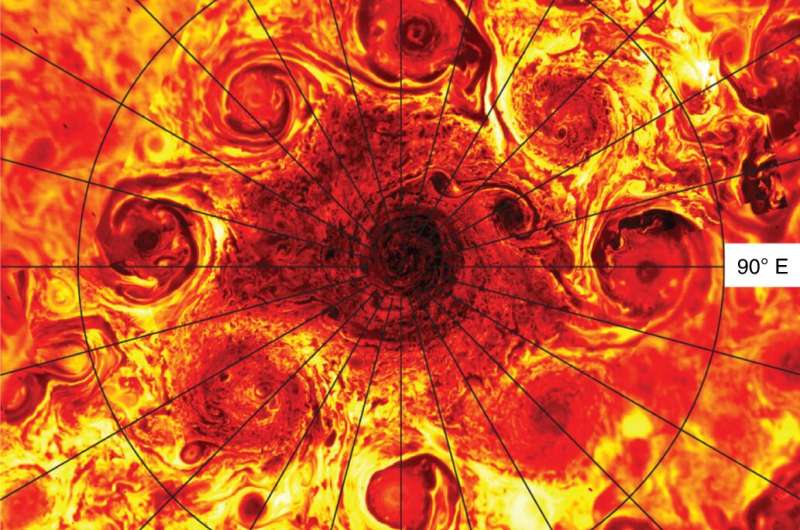
Infrared image of the northern hemisphere of Jupiter as seen by JIRAM. Credit: Nature Astronomy (2022). DOI: 10.1038/s41550-022-01774-0
A team of space scientists affiliated with multiple institutions in the U.S., working with a colleague from Italy and another from France has used modeling to partially explain the resilience of cyclones circling Jupiter's poles. In their paper published in the journal Nature Astronomy, the group describes how they analyzed images captured by the Juno space probe and used what they learned to create shallow water models that might at least partly explain how the cyclones last so long.
In 2016, NASA's Juno space probe entered an orbit around Jupiter. Unlike other such probes it has been circling the planet from pole to pole, rather than around its equator. As the probe began sending back pictures of the planet from this new perspective, researchers looking at them found a surprise. Not only was there a single cyclone sitting atop each of the poles, but both were surrounded by more cyclones. As time has passed, more pictures of the poles have arrived and the researchers studying them continue to be surprised by the stability of the cyclones—the original ones are still there today and have not even changed shape. Such behavior is of course unheard of here on Earth—cyclones take shape, travel around for awhile and then dissipate. Such behavior has left researchers scrambling to come up with a reasonable explanation for what they have observed.
Photos of the planet's north pole show that there are eight cyclones surrounding the central cyclone directly over the pole. All eight are in close proximity and all are nearly equidistant from the central cyclone—and are arranged in an octagonal pattern. At this time, it is not clear if the cyclones rotate around the center. There is a similar arrangement at the southern pole, only there are just five cyclones, shaped as a pentagon. In this new effort, the researchers have tried a new approach to explaining how it is that the cyclones hold in place for so long, and how they do it without changing their position or shape.
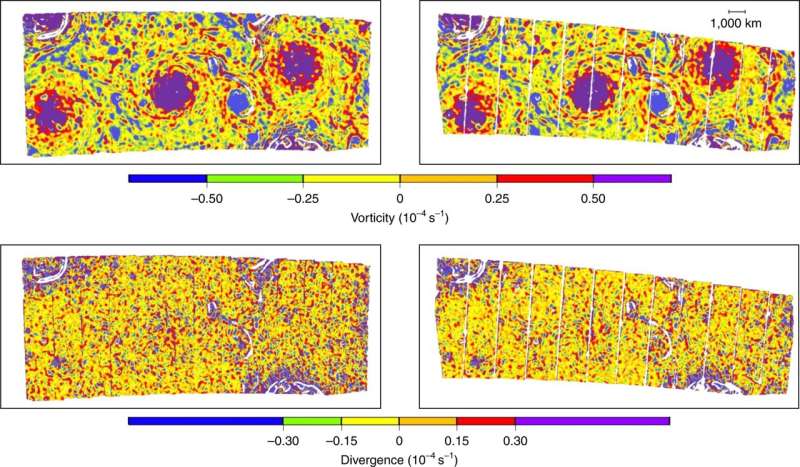
Vorticity and divergence derived from two independent determinations of the wind. Credit: Nature Astronomy (2022). DOI: 10.1038/s41550-022-01774-0
The work by the team involved analyzing pictures and other data from the Juno probe, looking specifically at wind speeds and direction. They then took what they learned and used it to create shallow water models and that led them to suggest that there is an "anticyclonic ring" of winds that move in the opposite direction of the cyclones, which is what keeps them in place. And while that may hold true, the team was unable to find signatures of convection, which would have helped to explain how heat was being used to fuel the cyclones. They acknowledge that much more work will need to be done to fully explain the behavior of Jupiter's cyclones.
The luminous band of the Milky Way, from Cassiopeia to Scorpius, stretches across the sky over Panamint Valley in Death Valley National Park.
To understand the nature of our galaxy, astronomers had to look to distant island universes.
Turn your eyes toward the night sky and you will see a bright, hazy band of light cutting across the sky.
For millennia, observers speculated about the Milky Way’s true nature. The Greeks said the streak of haze in the sky was milk spurting from the breast of the goddess, Hera, Egyptians thought it was cows’ milk, and some Aboriginal Australians thought it was a river flowing through the sky.
Today, we know that we are looking along the plane of our spiral galaxy, consisting of at least 100 billion stars. But understanding the shape of the Milky Way proved elusive up until the 20th century. The problem is we can’t get a bird’s eye view of our galaxy because our solar system is buried within the galaxy. But with the invention of the telescope, photography, spectroscopy, and radio astronomy, we have uncovered the shape and size of our home galaxy — and our place among the billions of stars that make up our island universe.
The telescope revolution
Before the telescope, there was no clear understanding of the extent of our galaxy. Nearly 25 centuries ago, the Greek philosopher Democritus proposed that the Milky Way was filled with stars that appeared to blend together because of their great distance. However, 100 years later, Aristotle suggested that the hazy river of light was an atmospheric phenomenon. Aristotle’s authority was accepted for nearly 2,000 years, until two small pieces of glass finally unseated him.
When Galileo turned his telescope to the sky in 1609, he made astounding discoveries. He published his observations in a little book, Sidereus Nuncius, in March 1610. The Moon was rugged and imperfect, he declared, and Jupiter had four companions. Galileo also scanned the Milky Way and reported, “This spyglass has allowed me to discover a multitude of fixed stars never before seen, of which there are more than ten times as many as are naturally visible.”
Observing targets like the Orion Nebula (M42) and the Beehive Cluster (M44) in the constellation Cancer, Galileo found myriad stars unobservable to the naked eye. He thought all the fuzzy objects in the sky would be resolved into stars; the astronomer could not know that each would play a role in giving us a picture of our galaxy.
This artist’s conception of the Milky Way is based on data from NASA’s Spitzer Space Telescope. Infrared images revealed that the Milky Way’s spiral structure is dominated by two of its four primary arms: the Perseus Arm and the Scutum-Centaurus Arm. The Norma and Sagittarius arms are located between them. The newly discovered Cattail structure, reported August 2021 by astronomers at Nanjing University in China, may also be a spiral arm or a very long filament of hydrogen gas.
Astronomy: Roen Kelly, after NASA/JPL-Caltech
Spiral nebulae
After achieving overnight fame in 1781 when he discovered Uranus, William Herschel was swiftly appointed as King George III’s court astronomer. The king gave him money to build telescopes, including his 40-foot-long (12 meters) telescope with a 48-inch mirror.
With it, Herschel produced perhaps the first systematic map of the Milky Way. He started by observing a dense area of the Milky Way and counting the number of stars in his field of view. As he moved away from the plane of the Milky Way, the number of stars dropped.
Herschel assumed that the number of stars in each area was a direct indication of the stellar population in that direction. Unaware of any relationship between faintness and distance, or that millions of faint stars were obscured from his view, he produced a diagram of the Milky Way that looks like a gigantic amoeba!
By the 1840s, Herschel’s equipment was dwarfed by the Leviathan of Parsonstown in Ireland. Built for William Parsons, Earl of Rosse, this monstrous telescope’s 72-inch mirror allowed Rosse to produce amazingly detailed drawings of what he saw. In particular, his observations of the Whirlpool Galaxy (M51), the Triangulum Galaxy (M33), and M99 (NGC 4254) showed distinct spiral structures. Without a proper way to measure distances, astronomers could only question whether these nebulae, like stars and clusters, were within the Milky Way. After all, if they were distant structures beyond the Milky Way, what did that mean for our place in the universe?
William Herschel constructed his map of the Milky Way with measurements he called “star-gages,” which he took by pointing his telescope at patches of sky and counting the number of stars he saw. The result is a cross section of the Milky Way from Earth’s vantage point.
Caroline Herschel
Cosmic yardsticks
The debate about the physical nature of the Milky Way continued into the early 20th century. Two new technologies helped charge the discussion: spectroscopy and photography. The ability to analyze starlight gave astronomers a powerful new way of understanding the chemistry of stars, while photography augmented the limited light-gathering ability of the human eye.
Armed with these tools, astronomers Henrietta Leavitt, Edward C. Pickering, and Ejnar Hertzsprung discovered and defined a relationship between the period of dimming and brightening of a class of stars called Cepheid variables. In 1908, Leavitt was studying variable stars in photographs of the Large and Small Magellanic Clouds sent to the Harvard College Observatory, where she worked, from Harvard’s observatory in Peru. She noticed a rhythmic and predictable variation in brightness of these stars in the Large and Small Magellanic Clouds, which might last from a single day to more than a month before repeating.
Furthermore, she discovered, the longer the period of variation, the brighter the star appeared to be. Since all the stars in the Small Magellanic Cloud are at roughly the same distance, she reasoned that the period of a Cepheid variable was related to its true, intrinsic brightness.
Pickering, the observatory director, suggested this period-luminosity relation could be useful to determine the distribution of star clusters and nebulae. And Hertzsprung was able to calibrate this technique by making independent distance measurements to Cepheids using the parallax method, seeing how much they shifted against background stars as Earth orbited the Sun.
Thus, by measuring the period of a Cepheid, astronomers could know its true brightness — and by comparing that to its apparent brightness, calculate how far away it was. Astronomers finally had a reliable cosmic yardstick.
Around the same time, the young astronomer Harlow Shapley began measuring the distribution of globular clusters — compact and dense spheres of stars. By 1918, he had found that the clusters centered around the constellation Sagittarius, forming a halo around the Milky Way. He also made improved parallax measurements of Cepheid variables, which in turn improved the calibration of Leavitt’s relation.
Using this data, Shapley not only located the center of our galaxy — in Sagittarius — but also showed that the Milky Way was 10 times the size of previous estimates. His observations also placed our solar system far from the center of the galaxy. Given the size of our galaxy, Shapley was convinced that spiral nebulae, like globular clusters, were all part of the Milky Way.
Cepheid variable stars remain important to understanding the shape of the Milky Way. Each dot in this image is a Cepheid whose distance was measured by a team using the Optical Gravitational Lensing Experiment telescope (OGLE), at center, at Las Campagnas Observatory in Chile.
K. Ulaczyk/J. Skowron/OGLE
The Great Debate
By the early 20th century, speculation about spiral nebulae and the nature of the Milky Way had reached a fever pitch. Photography clearly showed these nebulae had well-defined spiral structure composed of countless stars, but there were no good measurements of their distance to verify whether they were within the Milky Way or not.
In April 1920, Harlow Shapley faced off with Heber Curtis at the National Museum of Natural History in Washington, D.C., in a discussion called the Great Debate. Shapley maintained that spiral and all other nebulae were part of the Milky Way, just like globular clusters. But Curtis provided convincing evidence that they were independent star systems — “island universes,” as he called them, a term coined by the German philosopher Immanuel Kant.
Cepheid variables ultimately settled the debate. A few years later, while using the 100-inch Hooker telescope at Mount Wilson Observatory in California, Edwin Hubble found Cepheid variables in the Andromeda spiral nebula. Using Shapley’s calibration of Leavitt’s period-luminosity relation, Hubble showed this object was 900,000 light-years away, far beyond the outskirts of Milky Way. (This figure has since been refined to 2.5 million light-years.) In a single measurement, he proved that the Milky Way was not the entire universe, but part of a vast sea of island universes.
In 2019, the OGLE team released a three-dimensional map of the Milky Way, as traced by over 2,400 Cepheids. The map shows how the outer portion of the galaxy’s disk is warped. This warping had been previously detected, but this was the first time it had been mapped with direct distance measurements to stars.
Jan Skowron/OGLE/Astronomical Observatory, University of Warsaw
Radio astronomy rises
In the 19th century, astronomers were puzzled by large areas along the Milky Way almost devoid of stars. These so-called coal sacks appeared as dark holes against a starry background. At least one astronomer speculated they might be openings into heaven!
Because at that time the exploration of the Milky Way was still restricted to visible light, astronomers were unaware that the coal sacks were huge clouds of gas and dust blocking the light of distant stars. New technology would need to be developed before astronomers could explore and understand these cold, dark clouds running throughout the plane of the Milky Way.
The birth of radio astronomy provided this new tool and led to the discovery that the galaxy is filled not only with dust, but also with tremendous amounts of cold, neutral hydrogen gas. Most of the time, a hydrogen atom’s proton and electron spin in the same direction. But sometimes, electrons flip and spin in the other direction. For any given hydrogen atom, this only happens about once every 100 million years. When it does, energy is emitted with a wavelength of 21 centimeters. These waves pass right through the clouds of dust that hide visible light, which has a much shorter wavelength.
When astronomers first detected 21 cm radiation in 1951, they began using it to finally peer through these clouds to build a fuller picture of our Milky Way. By noting the distribution of neutral hydrogen, astronomers could map unseen portions of the galaxy, tracing its spiral arms, where hydrogen is concentrated.
The shape of our galaxy
Over the past 70 years, a picture has emerged of a massive galaxy with four primary spiral arms. The Sun is located 27,000 light-years from the galactic center along the Orion Spur, a smaller arm located between the Perseus and Sagittarius arms. In recent years, astronomers have discovered our galaxy’s central bulge has a bar structure. And its disk of gas and stars is slightly warped and twisted, perhaps by gravitational interaction with nearby dwarf galaxies.
There are deeper mysteries yet to be resolved. For instance, Newton’s law of gravity holds that stars and gas at a galaxy’s outer fringes should orbit slower than objects closer to its center — but instead, we observe that outer objects move faster. This is true in our galaxy, as well as others. The only explanation — without modifying the law of gravity — is the unseen existence of a great deal more mass, probably in the form of dark matter. But this dark matter has never been directly observed.
To stand out under a dome of shining stars and understand their true nature is an amazing feat of human ingenuity. To fathom the immensity of our galaxy and our place in it is a striking act of human imagination. Democritus envisioned vast numbers of stars beyond his power to see. And thanks to countless astronomers who came after him, we have found our true place in the galaxy we call home.
Foo Fighter Over National Park Forest Fire On Wake UP America Show! Video, UFO Sighting News.
Date of sighting:July 28, 2022 but reported today.
Location of sighting: Yosemite National Park, California, USA
Source: Email Report scwaring@yahoo.com
Hey I appreciate the UFO reports coming in today. Keep it up.
This UFO was caught on TV during the California forest fire and I can clearly see that its a foo fighter. A glowing white sphere often seen during WWI and WWII seen by pilots as the UFO flew along side them for sometimes hours. This UFO is seen shooting above and then through the fire chemical red stream being dropped by the plane. Why? Aliens clearly want to know the chemical make up of it in order to access how much damage it does to our environment and how dangerous it is and will be in the future. Data...its more important than money or gold to aliens.
Scott C. Waring - Taiwan
Eyewitness states:
On July 28th, 2022 I was watching WAKE UP AMERICA on Newsmax channel at 6:40 AM watching a plane dropping flame retardant on an Oak fire in California and noticed a ball UFO following the plane, tracking the retardant drop. It got very close to the rear of the plane. It entered the retardant then disappeared as the sun panned up from the bottom in the camera video as the camera man followed the plane's flight path. I don't believe it was a lens flare of the sun because in one frame it is half visible and half behind the retardant. It then disappeared into the retardant. I sent Newsmax a message about the video but got no response. So sent it into you Scott hoping you can take a look and tell me your thoughts.
UFO At High School Football Game, Wentzville, Missouri 9-23-2022, UFO Sighting News.
Date of sighting:9-23-2022 Location of sighting: Wetzville, Missouri, USA Source: Email report
Guys this just in, someone was at a high school football game when they noticed a strange light in the sky. The light appeared to be a glowing rainbow disk seen from its side. The eyewitness recorded it briefly just seconds before the object speed up and shot away. Great catch, 100% proof that UFOs visit highly populated events. Probably trying little by little to allow themselves to be seen in order to desensitize people making them less and less scared of the idea of alien life, until the final big reveal takes place.
Scott C. Waring - Taiwan
Eyewitness states:
UFO At High School Football Game, Wentzville, Missouri 9-23-2022, UFO Sighting News
Bob Lazar and the truth about a secret UFO base at Papoose Lake
Is our government working on crashed UFOs? Bob Lazar said he worked on reverse engineering alien spacecraft at a military facility in 1989 called SITE 4 (within the Area 51 designation). He described a unique and highly camouflaged building, built into the mountains and located at Papoose Lake... which is about 17 miles south of Groom Lake.
People have argued for 33 years if Lazar was telling the truth about a secret operational UFO facility at Papoose Lake.
The thing is... there was a civilian who snuck onto the Area 51 base - and took a look at Papoose Lake for himself. Did you know that?
In the spring 1997, an archeologist named Jerry Freeman snuck into the forbidden zone of Area 51 (and Papoose Lake). He is the only civilian known to have gained access to where Bob Lazar said was a hidden military installation. Lazar reported a unique and highly camouflaged building the military used to storehouse and reverse-engineer extraterrestrial flying saucers.
However, many people like to claim that Jerry Freeman never reported seeing anything unusual at Papoose Lake... that his excursion was uneventful, and that somehow his account throws shade on what Bob Lazar told us but that is nonsense.
Now, hear the REAL story from George Knapp… and also hear directly from Jerry.
This clip contains an audio interview Jerry did with radio host Art Bell. He gives a first-hand description of what he saw at Papoose Lake. Even the Los Angeles Times reported on Jerry’s forbidden excursion, and that he “discovered what seemed to be a lighted doorway that appeared and disappeared in the darkness of distant Papoose Lake”.
I think people have just forgotten their history, so it’s time to resurrect the truth... it’s time to listen up. You can now judge for yourself, and there’s more to come.
Is this just another confirmation that what Bob Lazar told us is true?
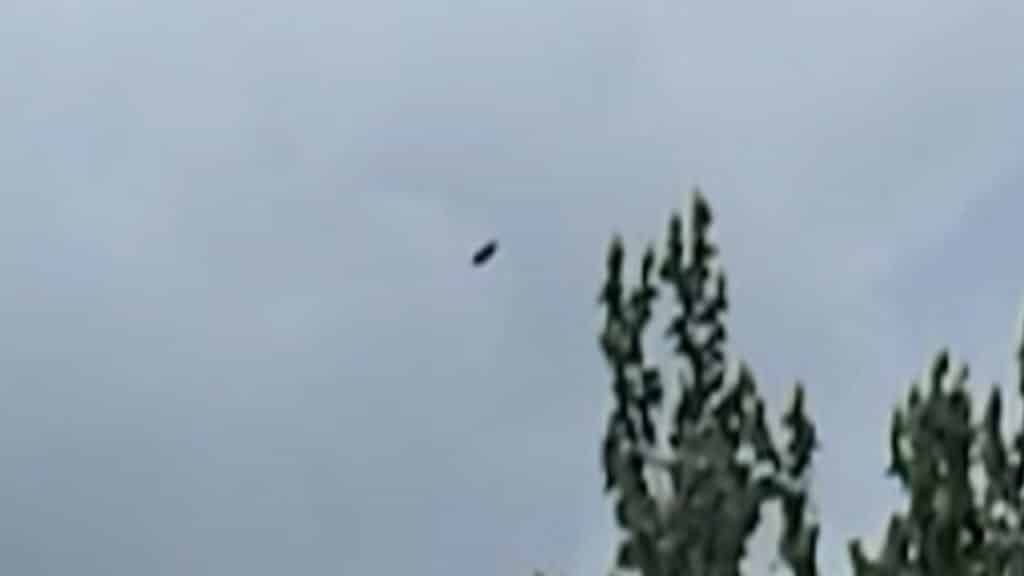
This really fast unidentified flying object was filmed over Groningen, a city in the northern Netherlands on 25th June 2022.
What do you think about it?
Witness report:
I hope somebody with a pro video edit can watch it and then say what it is.. because i don’t know yet what it is, in my video. maybe somebody from Mufon ? can anybody help me ? very strange, if it was space debri it would hit the ground i think and in the news, its going to fast for a drone, its 40 times 24 fps. my video is a slomo from samsung 20fe i was trying to make slomo videos from lightning but got this on video. 960fps in 1 sec video, it’s going way to fast for a drone, and to big for a bird or bug in the storm going true the clouds in almost straight line, in thunder weather. very fast. maybe it bends off a tiny bit. its just going too fast, and a bug is not going true a cloud in stormy weather. i have no idea what it is but looks the same as in U.K video very strange! my video is made on 25-06-2022. 14:08 and did not edit the video.
Ook dat nog: gasplaneet Jupiter gaat gebukt onder hittegolf
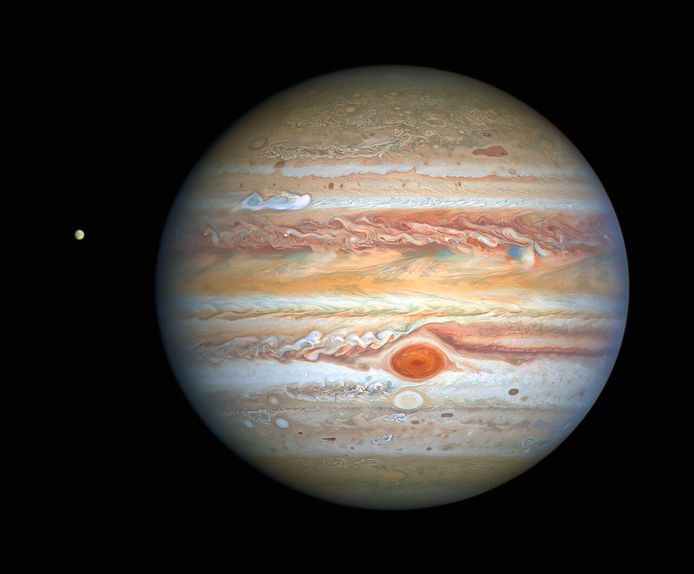
Op de planeet Jupiter is een extreem grote hittegolf ontdekt. Het getroffen gebied is ongeveer 10 keer zo groot als de aarde, heeft een internationale groep wetenschappers vrijdag naar buiten gebracht.
Jupiter, de grootste planeet in ons zonnestelsel, bestaat vrijwel helemaal uit dichte wolken van gas. De planeet weegt ongeveer 2,5 keer zo veel als de zeven andere planeten bij elkaar, en de aarde zou er ongeveer 1300 keer in passen. Vanaf Jupiter gezien is de zon niet meer dan een heldere ster in de verte, de planeet ontvangt ongeveer 4 procent van het licht dat de aarde krijgt.
Door de grote afstand en het weinige licht zou de temperatuur op Jupiter in theorie 70 graden onder nul moeten zijn, maar in de gaswolken stijgt het kwik makkelijk tot boven de 400 graden. De onderzoekers denken dat het komt door het permanente poollicht op Jupiter. Geladen deeltjes van de zon botsen tegen het sterke magnetische veld van Jupiter, en dat zorgt niet alleen voor het spectaculaire verschijnsel in de lucht, maar ook voor heel veel hitte.
300 graden warmer dan normaal
Net onder de noordpool van Jupiter zagen de onderzoekers een gebied waar de temperatuur is opgelopen tot boven de 700 graden, dus 300 graden warmer dan normaal. De wind blaast de hitte richting de evenaar van Jupiter. Dat zorgt voor een sliert hete lucht van 130.000 kilometer lang, ongeveer tien keer de doorsnee van de aarde.
De extreme temperatuur komt waarschijnlijk door een zonnevlam, denken de wetenschappers. Daardoor zouden extra veel deeltjes tegen het magnetische veld van Jupiter zijn gebotst, en daarbij zou de hitte zijn vrijgekomen.
Tests met kankerdodend virus lijken veelbelovend: “Ik kreeg al palliatieve zorg, maar nu ben ik genezen”
Er is een nieuwe vorm van kankertherapie gestart in Groot-Brittannië waarbij men gebruik maakt van een virus om schadelijke kankercellen te infecteren en te vernietigen. Volgens de Britse wetenschappers zijn de eerste proeven op mensen veelbelovend.
Bij één patiënt verdween de kanker, terwijl anderen hun tumoren zagen krimpen. Het geneesmiddel is een verzwakte vorm van het koortslipvirus dat is aangepast om tumoren te doden. Grotere en langere studies zijn eerst nog nodig, maar deskundigen zeggen dat de injectie uiteindelijk een reddingslijn kan bieden aan mensen met vergevorderde kanker.
Krzysztof Wojkowski, een 39-jarige bouwvakker uit het westen van Londen, is een van de patiënten die deelnam aan de lopende veiligheidsstudie van fase één. Bij hem werd in 2017 kanker van de speekselklieren, nabij de mond, vastgesteld. Ondanks een operatie en andere behandelingen bleef zijn kanker groeien.
“Ik kreeg te horen dat er voor mij geen opties meer waren en ik kreeg al palliatieve zorg. Het was verschrikkelijk, dus het was ongelooflijk dat ik de kans kreeg om aan de proef deel te nemen”, zegt Wojkowski. Een korte behandeling met het virus lijkt zijn kanker nu te hebben genezen. “Ik kreeg vijf weken lang om de twee weken injecties die mijn kanker volledig uitroeiden. Ik ben nu al twee jaar kankervrij.”
De injecties, die rechtstreeks in de tumor worden gegeven, vallen de kanker op twee manieren aan: door de kankercellen binnen te dringen en ze te laten barsten, en door het immuunsysteem te activeren. Ongeveer 40 patiënten hebben de behandeling in het kader van het onderzoek uitgeprobeerd. Sommigen kregen enkel de virusinjectie, RP2 genaamd. Anderen kregen ook een ander kankergeneesmiddel met de naam nivolumab.
“Indrukwekkend”
Hoofdonderzoeker professor Kevin Harrington vertelde de BBC dat de behandelingsresultaten “werkelijk indrukwekkend” waren voor een reeks gevorderde kankers, waaronder slokdarmkanker en een zeldzame vorm van oogkanker. “Het is zeldzaam om zulke goede responspercentages te zien in klinische proeven in een vroeg stadium, aangezien deze in de eerste plaats bedoeld zijn om de veiligheid van de behandeling te testen, en het gaat om patiënten met zeer gevorderde kankers waarvoor de huidige behandelingen niet meer werken”, zei hij. “Ik ben benieuwd of we voordelen blijven zien naarmate we meer patiënten behandelen.”
Het is niet de eerste keer dat wetenschappers een virus gebruiken om kanker te bestrijden. De Britse Nationale Gezondheidsdienst keurde enkele jaren geleden een soortgelijke therapie goed, maar dan met een verkoudheidsvirus. Deze therapie heet T-Vec en wordt nu gebruikt voor gevorderde huidkanker. Professor Harrington noemt RP2 een opgevoerde versie van T-Vec. “Het heeft andere modificaties aan het virus, zodat het meteen de kankercellen vernietigd van zodra ze in contact komen met elkaar.”
Doctor Marianne Baker, van Cancer Research UK, zei dat de bemoedigende bevindingen het verloop van de kankerbehandeling zouden kunnen veranderen. “Wetenschappers hebben 100 jaar geleden ontdekt dat virussen kunnen helpen bij de behandeling van kanker, maar het is een uitdaging geweest om ze veilig en effectief in te zetten. Deze nieuwe virale therapie is veelbelovend in een kleinschalige eerste proef. Nu hebben we meer studies nodig om na te gaan hoe goed het werkt”, besluit Baker.
Meer van UFO'S of UAP'S, ASTRONOMIE, RUIMTEVAART, ARCHEOLOGIE, OUDHEIDKUNDE, SF-SNUFJES EN ANDERE ESOTERISCHE WETENSCHAPPEN - DE ALLERLAATSTE NIEUWTJES


 GOOGLE SAYS IT'S CLOSING IN ON HUMAN-LEVEL ARTIFICIAL INTELLIGENCE