Ontdek de Fascinerende Wereld van UFO's en UAP's: Jouw Bron voor Onthullende Informatie!
Ben jij ook gefascineerd door het onbekende? Wil je meer weten over UFO's en UAP's, niet alleen in België, maar over de hele wereld? Dan ben je op de juiste plek!
België: Het Kloppend Hart van UFO-onderzoek
In België is BUFON (Belgisch UFO-Netwerk) dé autoriteit op het gebied van UFO-onderzoek. Voor betrouwbare en objectieve informatie over deze intrigerende fenomenen, bezoek je zeker onze Facebook-pagina en deze blog. Maar dat is nog niet alles! Ontdek ook het Belgisch UFO-meldpunt en Caelestia, twee organisaties die diepgaand onderzoek verrichten, al zijn ze soms kritisch of sceptisch.
Nederland: Een Schat aan Informatie
Voor onze Nederlandse buren is er de schitterende website www.ufowijzer.nl, beheerd door Paul Harmans. Deze site biedt een schat aan informatie en artikelen die je niet wilt missen!
Internationaal: MUFON - De Wereldwijde Autoriteit
Neem ook een kijkje bij MUFON (Mutual UFO Network Inc.), een gerenommeerde Amerikaanse UFO-vereniging met afdelingen in de VS en wereldwijd. MUFON is toegewijd aan de wetenschappelijke en analytische studie van het UFO-fenomeen, en hun maandelijkse tijdschrift, The MUFON UFO-Journal, is een must-read voor elke UFO-enthousiasteling. Bezoek hun website op www.mufon.com voor meer informatie.
Samenwerking en Toekomstvisie
Sinds 1 februari 2020 is Pieter niet alleen ex-president van BUFON, maar ook de voormalige nationale directeur van MUFON in Vlaanderen en Nederland. Dit creëert een sterke samenwerking met de Franse MUFON Reseau MUFON/EUROP, wat ons in staat stelt om nog meer waardevolle inzichten te delen.
Let op: Nepprofielen en Nieuwe Groeperingen
Pas op voor een nieuwe groepering die zich ook BUFON noemt, maar geen enkele connectie heeft met onze gevestigde organisatie. Hoewel zij de naam geregistreerd hebben, kunnen ze het rijke verleden en de expertise van onze groep niet evenaren. We wensen hen veel succes, maar we blijven de autoriteit in UFO-onderzoek!
Blijf Op De Hoogte!
Wil jij de laatste nieuwtjes over UFO's, ruimtevaart, archeologie, en meer? Volg ons dan en duik samen met ons in de fascinerende wereld van het onbekende! Sluit je aan bij de gemeenschap van nieuwsgierige geesten die net als jij verlangen naar antwoorden en avonturen in de sterren!
Heb je vragen of wil je meer weten? Aarzel dan niet om contact met ons op te nemen! Samen ontrafelen we het mysterie van de lucht en daarbuiten.
Vrijdag 27 november 2026
Pentagon Files Show a Contractor Designed an Underground Vault for “Exotic Material”
Pentagon Files Show a Contractor Designed an Underground Vault for “Exotic Material”
A 2009 Bigelow report in the Pentagon's eighth UAP release describes a buried, camouflaged vault for "exotic material or tissue". There is no record it was ever built.
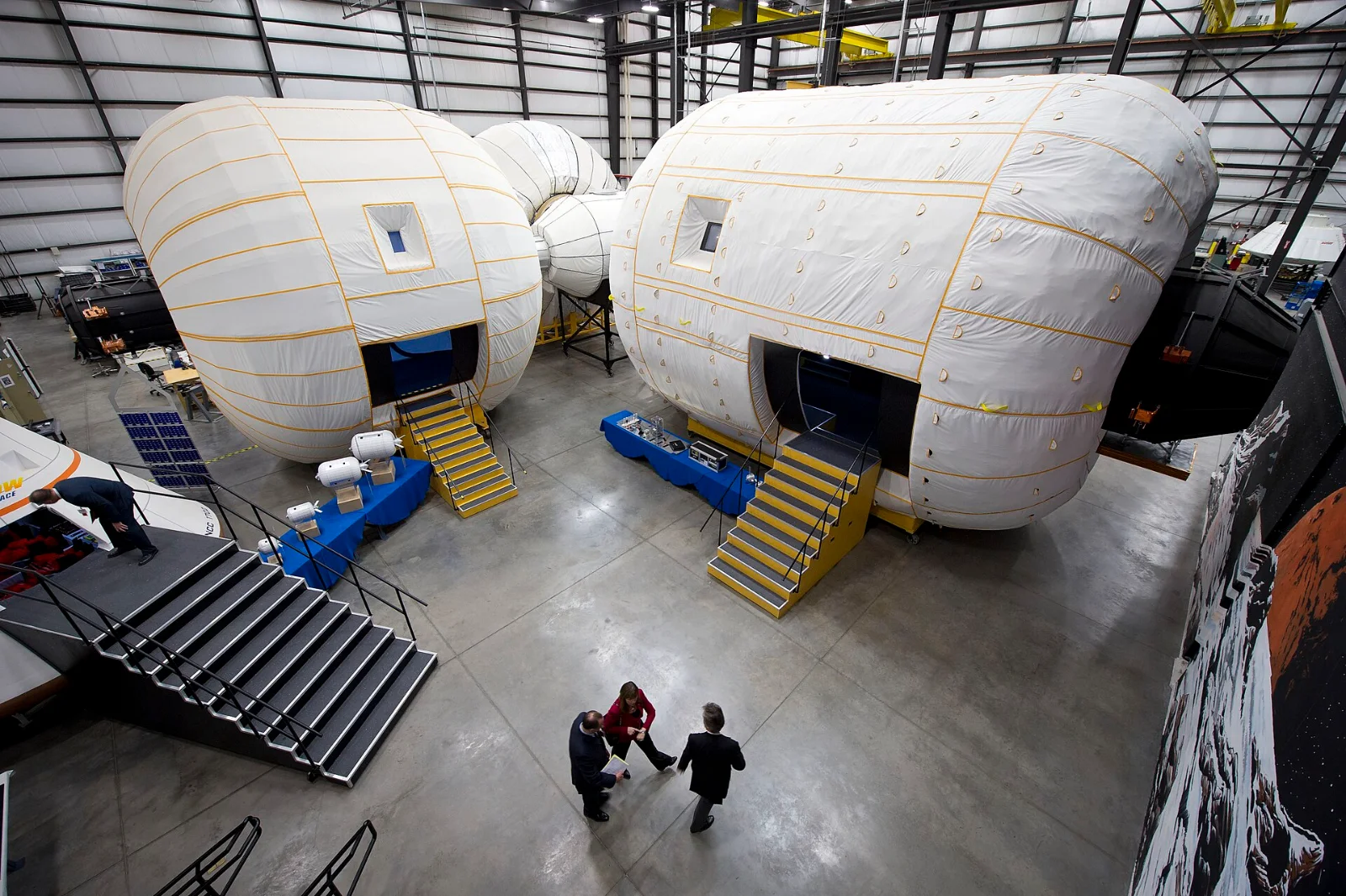
Among the files in the Pentagon’s eighth UAP release is a 2009 contractor report describing plans for “a highly secure underground vault” in North Las Vegas, built to hold “exotic material or tissue” and recovered “hardware”. The 538-page document was produced by Bigelow Aerospace Advanced Space Studies (BAASS) for a Defense Intelligence Agency programme, and it is the first time the Pentagon has published it.
What: a July 2009 BAASS report with a design for an underground storage vault for “exotic material”, biological samples and hardware.
Where:planned for the Bigelow Aerospace site in North Las Vegas, Nevada.
Specs: a 5,000-square-foot vault under 15 to 20 feet of earth, with 3-foot-thick walls and a thick steel door.
Caveat: no evidence the vault was built, and later BAASS reports released by the Pentagon do not mention it.
What the report says
BAASS was the contractor behind a DIA study of potential future aerospace threats, funded by Congress at the urging of then-Senate Majority Leader Harry Reid. The programme is widely known as AAWSAP, the Advanced Aerospace Weapon System Applications Program.
According to the report, as quoted by CBS News, “It was recognized by the BAASS administrator that there was no highly secure facility at BAASS to store exotic material or tissue that the organization could obtain.” It continues: “Accordingly, the BAASS administrator designed an underground facility to be located in North Las Vegas at the Bigelow Aerospace facility.”
The vault was meant to store “hardware and biological samples from the corporate world and/or from private individuals and groups located elsewhere, including Brazil”. It would have been buried under 15 to 20 feet of dirt, and the report adds that “any surface structures protruding from the ground will be extensively camouflaged.”
What happened next
The vault appears to have stayed on paper. Subsequent BAASS reports the Pentagon has released make no mention of it. Several months after the report, a DIA official judged the company’s reports to be of “limited value”, and the Pentagon’s research project ended in 2012. Bigelow Aerospace, BAASS’s parent company, laid off its entire workforce in 2020. A copy of the report circulated online last year, but this is its first official release.
Our take: what the vault does and does not prove
The document is significant because it shows that a Pentagon-funded contractor took the idea of acquiring physical material seriously enough to design secure storage for it. It reads as a plan for something BAASS hoped to obtain, not an inventory of something it already held. The wording “could obtain” is the key phrase.
That matters because claims of recovered craft and biological remains sit at the centre of today’s UAP debate, from the testimony of David Grusch to accounts by former BAASS insiders such as Colm Kelleher. On the other side, the Pentagon’s All-domain Anomaly Resolution Office said in its 2024 historical report that it found no verifiable evidence that any US government investigation had confirmed extraterrestrial technology. The vault plan does not settle that dispute. What it does show is that the people running the programme planned for the possibility that such material would come in.
UFO and UAP Disclosure Timeline: Every Official Release, 1947–2026
A running record of every major official UFO and UAP disclosure since 1947, from Project Blue Book to the Pentagon’s 2026 file releases, with dates and links to the original documents.
For almost 80 years, governments have investigated, denied, studied, buried and occasionally released what they know about unidentified flying objects. Since 2017 that has turned into something new: official admissions, congressional hearings, a dedicated Pentagon office and, in 2026, a rolling public release of military and intelligence files.
This page is a running record of every major official UFO and UAP disclosure: what was released, when, by whom, and where you can read the original documents yourself. It sticks to what governments actually published or said on the record. Claims made by witnesses are labeled as claims. We update it after each new release.
At a glance
Covers: Official US disclosures from 1947 to today, plus key releases by the UK and France.
Latest entry: The Pentagon’s eighth UAP file release, 20 November 2026.
The terms:UFO (unidentified flying object) was the official term until about 2020. UAP now means “unidentified anomalous phenomena.”
The bottom line so far:Many cases remain unexplained. No government has published evidence of alien technology.
1947–1969: The Air Force investigates
The modern UFO era began with a pilot’s report in the summer of 1947. Within months the US Air Force was formally investigating, and it kept doing so for 22 years.
1.24 June 1947
Kenneth Arnold’s “flying saucers”
Private pilot Kenneth Arnold reported nine fast, shining objects near Mount Rainier, Washington. Newspapers turned his description into “flying saucers,” and a wave of sightings followed across the United States.
2. 8 July 1947
Roswell: a “flying disc,” then a weather balloon
Roswell Army Air Field in New Mexico announced it had recovered a “flying disc.” A day later, the Army said the debris came from a weather balloon. That reversal became the most famous UFO story in history. The FBI’s files from that summer include a handwritten note by J. Edgar Hoover about access to recovered discs. Read more in the Hoover note story.
3. 23 September 1947
The Twining memo
Lieutenant General Nathan Twining of Air Materiel Command wrote that “the phenomenon reported is something real and not visionary or fictitious,” and recommended a formal investigation. The memo led directly to Project Sign.
4. January 1948 – March 1952
Projects Sign and Grudge
The Air Force’s first official investigation, Project Sign, began in early 1948. It was replaced by Project Grudge in 1949, which took a far more dismissive approach.
5. March 1952
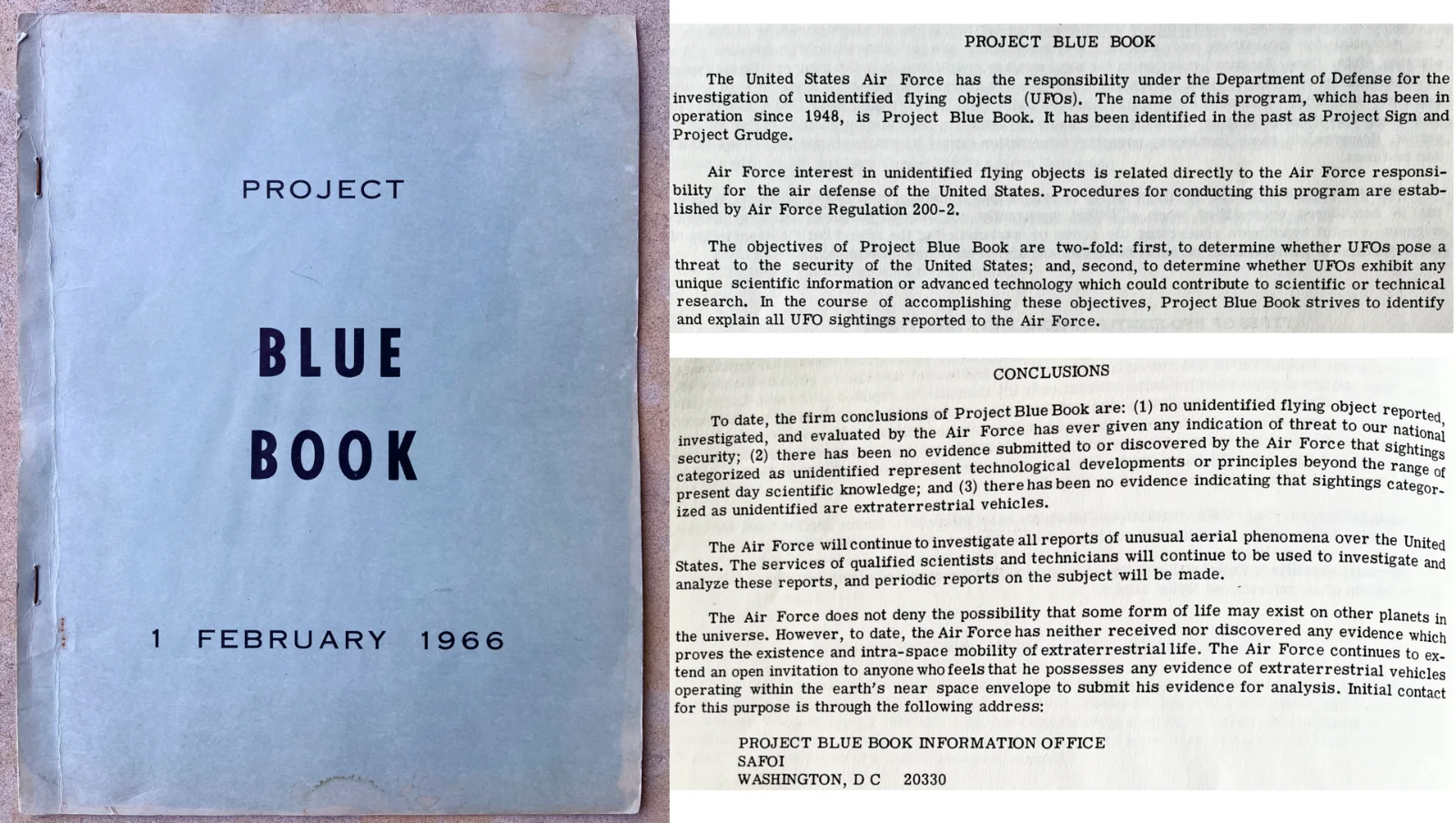
Project Blue Book begins
The Air Force reorganized its UFO investigation as Project Blue Book. In July 1952, radar contacts and sightings over Washington, D.C., made front-page news and pushed the issue to the White House.
6. January 1953
The CIA’s Robertson Panel
A CIA-sponsored panel of scientists concluded that UFOs posed no direct threat. It recommended a public education campaign to reduce interest in the subject. Its role in shaping official secrecy is still debated.
A University of Colorado study, led by physicist Edward Condon and funded by the Air Force, concluded that further UFO research was unlikely to produce scientific discoveries. Critics noted that about 30% of the cases it studied remained unexplained.
8. 17 December 1969
Blue Book shuts down
The Air Force announced the end of Project Blue Book. Over its lifetime the program logged 12,618 sightings, and 701 were never explained. The Air Force said none showed signs of a threat or of technology beyond known science. Its files are now at the US National Archives. Two years earlier, in 1967, ten nuclear missiles had gone offline at Malmstrom Air Force Base. Read what happened at Malmstrom.
1970–2016: Freedom of Information and the archives
With Blue Book closed, almost every disclosure for the next five decades came from Freedom of Information lawsuits, leaks or foreign governments.
1978–1979
CIA UFO documents released after a lawsuit
A Freedom of Information Act lawsuit forced the CIA to release several hundred pages of UFO-related documents. They showed the agency had monitored the subject for decades, while saying publicly that it had no interest.
13 January 1981 (released 1983)
The Rendlesham Forest memo
US Air Force Lieutenant Colonel Charles Halt sent a memo to the UK Ministry of Defence describing lights and a “strange glowing object” in Rendlesham Forest, England, over several nights in December 1980. The memo was released in 1983 under the US FOIA. Rendlesham is still called “Britain’s Roswell.”
1997
The CIA publishes its own UFO history
CIA historian Gerald Haines published “CIA’s Role in the Study of UFOs, 1947–90.” It said many 1950s and 1960s sightings were of the CIA’s own U-2 and later SR-71 reconnaissance planes, and that the Air Force had sometimes misled the public to protect them.
After a congressional request and a General Accounting Office inquiry, the Air Force published two reports. The 1994 report said the 1947 debris came from Project Mogul, a classified program using high-altitude balloons to detect Soviet nuclear tests. The 1997 report, “The Roswell Report: Case Closed,” said accounts of “alien bodies” likely came from memories of crash-test dummies dropped in the 1950s.
2007–2012
The secret Pentagon program
The Defense Intelligence Agency ran the Advanced Aerospace Weapon System Applications Program (AAWSAP), which later became known as AATIP. It cost about $22 million and was not public at the time. Its existence was revealed in 2017.
March 2007
France opens its files
France’s space agency CNES opened the archives of GEIPAN, its official UAP investigation unit, online. It became one of the first governments to publish its case files in full.
The UK National Archives released the Ministry of Defence UFO files in tranches. The last big batch was published in June 2013, after the MoD closed its UFO desk in 2009.
In five years, the subject went from a fringe topic to an official national security issue.
16 December 2017
The New York Times reveals AATIP
The New York Times reported on the Pentagon’s secret UFO program and published two Navy infrared videos, including the 2004 “Tic Tac” encounter. Former official Luis Elizondo said he had resigned in protest at the secrecy. For the full story of that case, read our Tic-Tac UFO guide.
The Pentagon officially releases three Navy videos
The Department of Defense formally released the “FLIR1,” “Gimbal” and “GoFast” videos. It said it was doing so to clear up any misconceptions about whether the footage was real, and that the objects remained “unidentified.”
The deputy secretary of defense approved the Unidentified Aerial Phenomena Task Force, led by the Navy, to detect and analyze sightings that could threaten national security.
25 June 2021
The first official UAP report
The Office of the Director of National Intelligence published its Preliminary Assessment. Of 144 reports from US government sources since 2004, only one could be explained with high confidence: a deflating balloon. Eighteen incidents showed unusual movement patterns or flight characteristics.
The first public congressional UFO hearing in over 50 years
Senior defense intelligence officials Ronald Moultrie and Scott Bray testified before a House Intelligence subcommittee and showed new videos. It was the first public hearing on the subject since the Blue Book era.
June 2022 – September 2023
NASA studies UAP
NASA formed an independent study team in 2022. Its report, published in September 2023, found no evidence that UAP are extraterrestrial. It called for better data and an end to the stigma around reporting.
The Pentagon established the All-domain Anomaly Resolution Office (AARO) to investigate UAP across air, sea, space and underwater. It is still the government’s main UAP office today.
Congress moved from asking questions to writing laws, and former officials began testifying under oath.
12 January 2023
510 reports and counting
The intelligence community’s annual report raised the total number of UAP reports to 510. Most of the newly analyzed cases were attributed to balloons, drones and clutter.
26 July 2023
The Grusch hearing
Former intelligence officer David Grusch told a House Oversight subcommittee that he had been informed of a decades-long program to retrieve and reverse-engineer “non-human” craft. Navy pilots David Fravor and Ryan Graves also testified. The Pentagon has denied Grusch’s claims, and he has not publicly provided evidence for them. See also what Grusch later told Joe Rogan.
Congress passed parts of the proposed UAP Disclosure Act in the 2024 defense bill (NDAA). It requires federal agencies to send their UAP records to the National Archives, which created a dedicated collection, Record Group 615.
AARO published the first volume of its historical review. It concluded that there was no evidence any US government program had confirmed alien technology, and that many claims came from misidentified secret programs.
Luis Elizondo, retired Rear Admiral Tim Gallaudet, journalist Michael Shellenberger and former NASA official Michael Gold testified before the House Oversight Committee. Elizondo said the US has secret crash-retrieval programs. Read our report on the hearing.
AARO reported 757 new UAP reports for May 2023 to June 2024, including a backlog of FAA reports. Twenty-one cases merited further analysis. It again found no evidence of alien technology.
June 2025
Pentagon disinformation reported
The Wall Street Journal reported that US officials had for decades encouraged UFO stories to hide classified weapons programs. That included claims that the 1967 Malmstrom missile shutdown was linked to a secret electromagnetic pulse test.
9 September 2025
The Hellfire video hearing
The House Oversight task force on declassification, chaired by Representative Anna Paulina Luna, heard from military witnesses. Representative Eric Burlison showed a video of an MQ-9 drone firing a Hellfire missile at an orb off Yemen in October 2024. The missile appeared to hit the object without destroying it.
In 2026 the US government began publishing UAP files directly, with new batches every few weeks at war.gov/UFO, under a program called PURSUE (Presidential Unsealing and Reporting System for UAP Encounters).
19 February 2026
Trump orders the files released
President Trump directed the Pentagon and other agencies to identify and release government files on UAP and extraterrestrial life, citing “tremendous interest.”
Representative Luna asked the Department of War to release 46 military UAP videos identified by whistleblowers, including radar, satellite and underwater encounters.
8 May 2026
Release 1
The first files went online, from the Pentagon, intelligence agencies, NASA and the FBI. They included federal agents’ reports of orbs over the western US in 2023, an FBI composite sketch of a bronze ellipsoid object and Apollo mission transcripts.
Fifty-one videos, seven audio files and six documents. The batch included the 2023 shootdown of an object over Lake Huron and a 2022 video of spherical objects near a submarine.
AARO received 319 new reports and resolved 370 cases in total, all with conventional explanations. Nine cases were flagged for further analysis. AARO again said it found no evidence of recovered alien material.
The batch included an AC-130J gunship crew’s report of about 25 UAP during a 2021 live-fire exercise in the Gulf of Oman, which AARO could not resolve. Read what the fifth release shows.
Three things stand out from almost 80 years of disclosures. First, governments have taken the subject far more seriously than they said in public, from the 1947 Twining memo to the secret program of 2007–2012. Second, a meaningful share of reports has never been explained, from Blue Book’s 701 unidentified cases to the cases AARO still flags every year. Third, no official release has yet produced evidence of alien technology or non-human beings. The extraordinary claims come from witnesses, not from the documents.
Pentagon Files Describe “Alien Chip Implant” Removed From a Brazilian Military Officer’s Neck
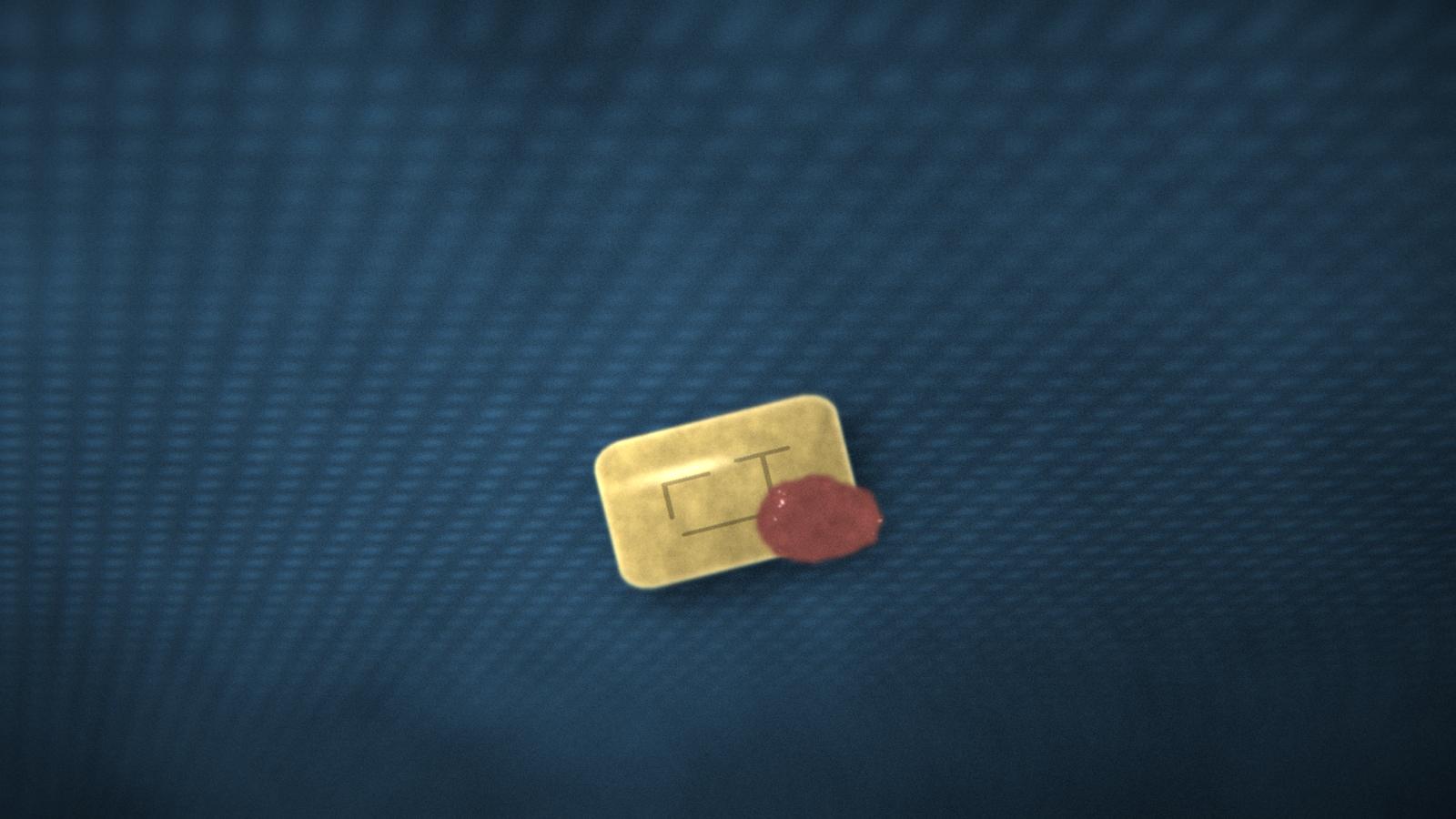
It sounds like a scene from a science fiction film: a military officer has a mysterious object surgically removed from his neck – and under the microscope it looks like a piece of technology wrapped in living tissue. Yet this account now sits inside an official document released by the Pentagon.
A small tablet with markings
The story comes from a 538-page report prepared in July 2009 by Bigelow Aerospace Advanced Space Studies (BAASS), a Pentagon contractor, and published on November 20 as part of the eighth release of declassified UAP files. Most of the report deals with Utah’s Skinwalker Ranch, but it also contains accounts of UFO sightings in Brazil.
One of those accounts describes an object reportedly removed from the neck of a Brazilian military officer while he was in the United States. The report calls it an “alien chip implant” and describes:
a “small tablet size object, approximately 1 centimeter in size”
a yellowish color with visible markings on its surface
a fleshy substance still attached to it
a circumference of 3.14 cm (about 1.24 inches)
microscope photographs included in the report
What the document does not contain is just as important: there is no medical report and no laboratory analysis establishing what the object is, who made it, what it was for, or whether it was technological at all. The label “alien chip implant” reflects the allegation, not a confirmed identification.
Elizondo: “That’s not normal”
Former Pentagon insider Luis “Lue” Elizondo, who says he led the Advanced Aerospace Threat Identification Program, appeared on NewsNation’s CUOMO to put the file into context. According to Elizondo, the Brazilian case is not unique. He said there were individuals in the U.S. government, the military and the intelligence community who reported a UAP experience and later had a foreign object removed by a trained surgeon.
His description of those objects was startling:
under a microscope, each piece looked like a “technical device” covered in a coating of biological tissue
he claimed the tissue-like layer may prevent the human immune system from attacking the object
he said the objects had “perplexing properties” and seemed to have their own metabolism and energy source
most dramatically, he said some objects appeared to move and migrate under the skin when surgeons tried to grab them – “That’s not normal,” he said
Elizondo did not directly link those cases to the Brazilian officer, and he did not explain how the movement was documented or whether independent medical examinations support it.
An old mystery in a new file
“Alien implants” have been part of UFO lore for decades, especially in abduction cases, where experiencers often describe waking up with a sore spot or a lump under the skin. Skeptics have long argued that such objects usually turn out to be ordinary foreign bodies or tissue reactions such as granulomas. What makes this case different is not the story itself, but where it appears: in a document released by the U.S. Department of War.
The Pentagon has not confirmed that any of these objects are extraterrestrial technology, and publication of the report does not make its claims true. But for the first time, an official U.S. government release puts the words “alien chip implant” on the record – and many people will want to know who still has that tiny yellow tablet today.
RELATED
⭐The Pentagon Just Released an 'Alien Chip Implant' File in the Eighth TRANCHE⭐
Glowing UFO Over Slovakia, 4 Minutes of Video! Nov 1, 2026, UAP Sighting News.
Date of sighting:Nov 1, 2026
Location of sighting: Dobšiná, Košický kraj, Slovakia
Source: NUFORC.org
Watch how this UFO moves from place to place...and its big...it hid behind the dark clouds at the three minute mark. This is a four minute and 29 second video guys...this is rare and it really shows how fast and how big and how amazing a sighting it is. She noticed the object was a black triangle with three glowing lights, but on video it looks to be a single light...video sometimes changes details from a distance. Also she said it stopped on a dime, meaning it just stopped, which means its not propeller or jet propelled. This is silent and 100% alien technology at its best.
Scott C. Waring - UFO Sightings Daily
Eyewitness states:
An object of triangular shape, dark in color. It had three lights at the bottom. The lights were primarily white, but they also flashed red. The lights went out for a few seconds, but then they appeared. The object was located at a height on the clouds, it was large enough to be visible to the naked eye. The movement of the object was irregular. It stood still for a while, then moved to another place at a fast speed. The object had no braking distance, it stopped immediately. The sky was dark blue, the sun had set, but the stars were not visible. This was the only luminous object in the sky.
Orb Fleet Over Airport, May Explain Pilots Telling Passangers To Shut Windows. UFO Sighting News.
Below close up has added contrast to help focus craft.
Date of sighting: Nov 10, 2026 16:06
Location of sighting: McKees Rocks, Borough, Pennsylvania, USA
Source: NUFORC #202346
Now this sighting reminds me of an incident of where the pilots of airliners would ask the passengers to shut the windows...because something was flying past the plane. These white orbs are what people around the world are reporting when looking out the windows. Even a single pilot had been recorded on the radio talking about seeing these shiny orbs flying near the plane one night about the same day as this Nov 10th event. So...just because an orb is white, red, or orange, don't assume its Venus, gas or a balloon until you see all the facts. Fact...these orbs move position...balloons can't! These are intelligently controlled and exiting an airport area...that says UFO all over it.
Scott C. Waring - UFO Sightings Daily
Eyewitness states:
Closest Distance was above flight path of commercial aircraft Estimated Speed of about 500 mph Group of eight bright silent objects in east/south east direction, odd formation of closely grouped objects While installing gutters on a shed we noticed a group of bright circular objects moving in the clear blue sky. Observed them for manny minutes, video taken as they were exiting area.
Pilot Told Passengers to CLOSE WINDOWS After UFO Sighting?! 👀 #UFO #UAP #AlienSightings
Captain Tells Passengers to Close Windows? Glowing Orbs Filmed From a Plane | Real or Fake?
2km kangaroo carved into Australia desert, made by aliens? 👽 UFO UAP sighting news.
Date of discovery: Nov 25, 2026
Location of discovery: South Australia
Source: Google Earth Map
I was using Google map and found this unique outline of a 2km long kangaroo...and it just so happens to be in...yes you know it...Australia outback. I was on the go, had no time for recording coordinates but its easy enough to watch my video and find it for yourselves. Its there, and seems to have been created not with a raised dirt area and bushes that grew upon it. Someone actually took the seeds of these bushes and put them all over the raised dirt areas to make the kangaroo stand out...knowing these bushes will grow for thousands of years because they grow so slowly. Its just amazing, but does take a trained eye to notice the true details. The head turned away, its two ears perked upward alert, its long neck, puffed out chest, almrs to its side ready for action, its lower long legs and feed as well as its long tail that extends far away from the body.
People often say, "if aliens were here long ago, why didn't they leave us signs?" And I always respond..."but they did, thousands of them, but humans refuse to see them, calling them coincidences."
Scott C. Waring - UFO Sightings Daily
2km kangaroo carved into Australia desert, made by aliens? 👽 UFO UAP sighting news. 📰
New Pentagon UFO Files: Skunk Works Legend Kelly Johnson Saw a Dark Elliptical Object Over California
The Pentagon has opened another drawer of its UFO archive. On November 20, the Department of War published the eighth release of declassified UAP files under the Presidential Unsealing and Reporting System for UAP Encounters (PURSUE) – 40 documents and three military videos, with more files promised on a rolling basis. Among them is a story that aviation enthusiasts will find hard to ignore: a 1953 sighting reported by one of the most famous aircraft designers who ever lived.
A Skunk Works legend sees something strange
A report dated January 20, 1954 describes an object seen by Lockheed personnel near Agoura and Point Mugu, California, on December 16, 1953. One of the witnesses was Clarence L. Johnson – better known as Kelly Johnson, the engineer behind the U-2 spy plane and the SR-71 Blackbird and the founder of Lockheed’s legendary Skunk Works. The document itself notes his “unmatched familiarity with high-performance aircraft.”
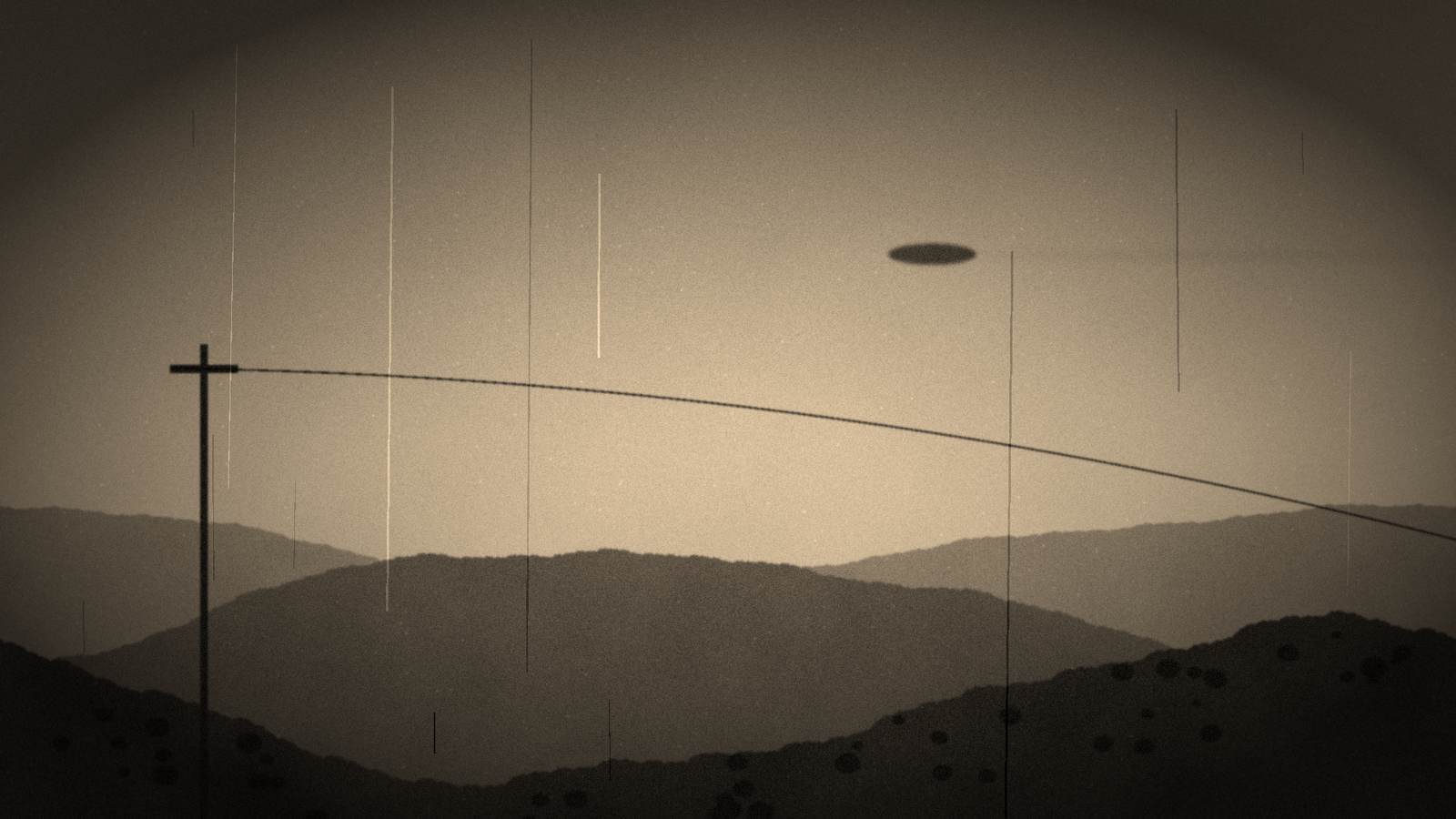
At around 5:00 p.m., Johnson was at his ranch west of Agoura when he noticed a dark, elliptical object in the sky. At first he took it for a cloud or a smoke trail. But the object appeared to stay motionless for several minutes, then moved off to the west and vanished.
He was not the only one watching. At about the same time, a Lockheed test flight crew flying off the southern California coast near Point Mugu reported a similar object: dark, elongated or wing-like, apparently stationary – and then gone to the west. A drawing attached to the report shows the object with light blue flames at the back.
The CIA’s 1952 “flying saucer” briefing
The release also includes an August 14, 1952 briefing by the CIA’s Office of Scientific Intelligence. It evaluated the U.S. Air Force’s investigation of flying saucer reports and asked a simple question: did these sightings have intelligence implications?
the briefing references about 1,500 flying saucer reports in the United States
250 of them came in July 1952 alone – the month of the famous Washington, D.C. UFO flap
the Air Technical Intelligence Center classified roughly 20 percent of the reports as unexplained
it also cites the June 1947 sighting in Washington State, when a pilot reported nine discs flying in formation past Mount Rainier at an estimated 1,000 mph – the case that gave the world the term “flying saucer”
Three new military videos from the Middle East
Pentagon UFO Videos: 3 Military Clips Released, Objects Remain Unidentified
The three videos were submitted by U.S. Central Command to the All-domain Anomaly Resolution Office (AARO) and were recorded aboard U.S. military platforms in the Middle East:
2020: a 20-second infrared clip in which a contrast enters from the right edge of the frame and crosses from right to left
2023: a 13-second recording from an electro-optical and infrared system showing a single area of contrast
2026: the longest clip at 54 seconds – the sensor pans to track multiple objects moving right to left, changes magnification several times, zooms in on two of them and repeatedly loses lock
Officials say the incidents remain unresolved because there is not enough data to identify the objects.
Regarding these three specific videos, the report lists the location and year of each recording, but it does not provide detailed descriptions of the footage or clarify whether any explanations for the incidents have been provided.
Recovered materials and a massive Skinwalker Ranch report
Other documents in the batch describe unusual government proposals for the storage and study of potentially recovered materials, and a report of more than 500 pages about Utah’s Skinwalker Ranch, prepared by a Pentagon contractor. That report also contains accounts from Brazil, including the claim of an “alien chip implant” removed from a military officer.
The Pentagon says the redactions in the files only protect eyewitness identities, the locations of government facilities and sensitive non-UAP military information, and that nothing was redacted about the nature or existence of any UAP encounter. At the same time, officials stress that the records do not provide evidence of extraterrestrial craft or alien life.
Still, when the man who built the fastest jet in history says he watched something hang in the sky and then disappear, it is hard not to wonder what he really saw. More files are already on the way.
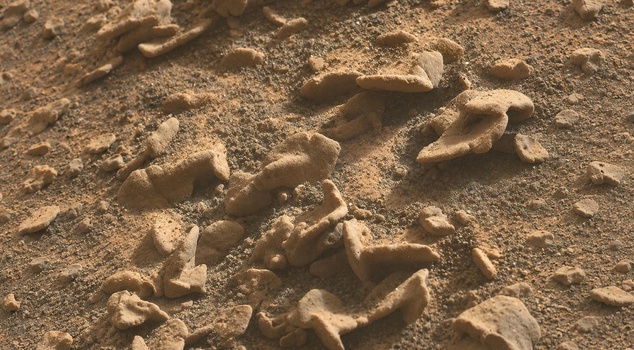
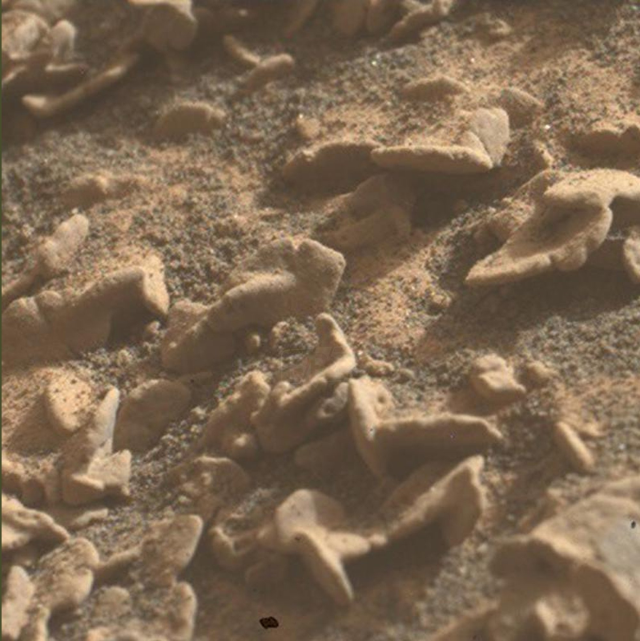
A stunning discovery on Mars! Mysterious structures resembling potato chips have been found
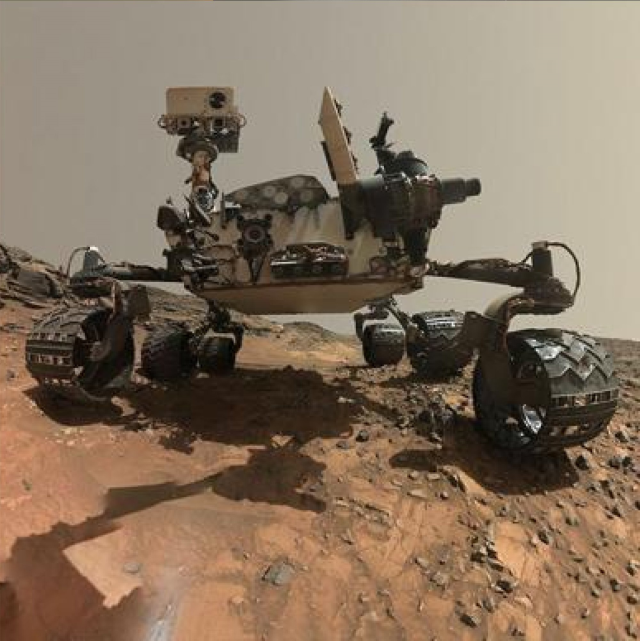
NASA's Curiosity rover has discovered mysterious crystal structures resembling potato chips on the surface of Mars. How the thin, curled, disk-shaped formations detected in the Nazca region of the Red Planet formed has not yet been determined. As scientists analyze rock samples to investigate the chemical composition and formation process of the structures, it is assessed that the discovery could provide new information about Mars' geological history.
The US National Aeronautics and Space Administration (NASA) has discovered unusual crystal formations resembling potato chips on the surface of Mars. How the thin, curled, disk-shaped structures imaged by the Curiosity rover formed has not yet been determined. Scientists who have begun examining rock samples taken from the Red Planet are trying to reveal the chemical composition and formation process of the mysterious shapes. The discovery announced by NASA was also widely covered by international media outlets such as the New York Post and Fox News.
SHAPES RESEMBLING POTATO CHIPS FOUND ON MARS
The Curiosity rover, which has been conducting research on Mars since 2012, detected striking structures during drilling work in the area named "Nazca." The thin and curled crystal formations found in the main rock layer in the region were likened to potato chips because of their appearance. In the research note published by NASA on November 11, it was stated that the disk-shaped crystal structures were examined in detail and that efforts were being made to understand their formation mechanisms.
NASA SHARED PHOTOGRAPHS OF THE MYSTERIOUS STRUCTURES
The Mars Hand Lens Imager (MAHLI) camera on Curiosity's robotic arm recorded close-up images of these formations on November 7. In the photographs, light-colored, irregular, and in places curled structures located among the Martian rocks drew attention. Scientists stated that the images are important for understanding the physical characteristics of the crystal formations. However, the resemblance of the shapes to potato chips is regarded only as a visual comparison.
ROCK SAMPLES ARE BEING EXAMINED IN THE LABORATORY
NASA carried out drilling in the Nazca region to determine the structure of the mysterious formations. The obtained rock samples were transferred to the analysis system called Sample Analysis at Mars (SAM) aboard Curiosity. Thanks to the system, which examines the chemical composition of materials on the Martian surface, the aim is to understand which substances the crystals are made of. Researchers will use the data obtained to evaluate how these structures are connected to the geological processes in Mars's past.
CHEMICAL ANALYSIS IS BEING PERFORMED WITH A LASER
In addition to examining rock samples, scientists are also using Curiosity's laser-assisted analysis instrument called ChemCam. The device sends a laser to designated points on the rocks, analyzes the resulting light, and collects information about the chemical structure of the materials. Within the scope of the research, measurements were planned at targets named "Ahi Veremos," "Colca," and "Bermejo." In this way, it is being investigated whether different crystal structures have similar chemical properties.
ALSO PHOTOGRAPHED IN THE DARKNESS OF NIGHT
NASA's research plan also included imaging the crystal formations at night using different light sources. It was planned to take photographs with the help of the camera on Curiosity's robotic arm under white light and ultraviolet LED illumination. Researchers aim for different lighting conditions to help examine the surface properties of the structures in greater detail.
HOW DID THE MYSTERIOUS SHAPES FORM?
The most important question scientists are seeking to answer is under what conditions these unusual crystal structures inside Martian rocks formed. The relationship between the shape of the crystals, their chemical composition, and the surrounding rock layers may shed light on the geological history of the region. Researchers will examine whether past chemical processes or environmental conditions that caused changes in minerals were effective in the formation of the structures. NASA has not yet reached a definitive conclusion regarding the exact formation mechanism of the crystals.
NASA’s Mars Global Surveyor MOC wide-angle cameras captured this image of Mars in 2000.
USA TODAY Network via Reuters Connect
IT COULD SHED LIGHT ON MARS'S PAST
Curiosity's missions also include investigating whether Mars had suitable conditions for life in the past. For this reason, examining the rocks and minerals on the planet is important for understanding past water presence and environmental changes. The crystal formations discovered in the Nazca region may also provide new information about Mars's geological past. However, there is no evidence that these structures are of biological origin or bear traces of life.
SCIENTISTS ARE WAITING FOR THE RESULTS
While Curiosity is planned to continue its exploration route southward after its work in the Nazca region, the analyses of the samples taken constitute the most important stage of the research. Scientists aim to reach more detailed conclusions about the processes occurring on Mars's surface by evaluating data on the chemical composition and formation conditions of the crystals. The mystery of the structures, which draw attention with their potato-chip-like appearance, has not yet been solved.
RELATED
NASA Found 'Potato Chip' Shapes on Mars — Nobody Knows What They Are
NASA Found POTATO CHIP-SHAPED Rocks on Mars?! 🪐😱 What Is Hiding Inside Them? #nasa #space #mars
The images document the Martian landscape, but UFO researcher Scott C Waring believes they contain ‘proof’ of an ancient alien civilization.
Posting on his website UFO Sightings Daily last week, Waring pointed to what he described as a seven-foot-tall doorway leading into an ‘adobe-like house’ atop a hill.
Nearby, Waring claimed to have spotted a fallen green-blue statue resembling an ‘alien god,’ whose unusual coloring stood out from the surrounding terrain.
He also identified what he believed were tools, bones and sculptures scattered across the landscape.
‘If it were just one object, it might be an unusual coincidence,’ Waring wrote, arguing that finding ‘a dozen signs of intelligent life is something else entirely.’
NASA's Perseverance rover captured the panorama in 2022, showing a rocky outcrop called Alagnak in the ancient river delta inside Jezero Crater
The images document the Martian landscape, but UFO researcher Scott C Waring believes they contain ‘proof’ of an ancient alien civilization. Posting on his website UFO Sightings Daily last week, Waring pointed to what he described as a seven-foot-tall doorway leading into an ‘adobe-like house’ atop a hill.
Regardless, Waring posted: 'Proof of ancient alien civilization on Mars in NASA rover photo.'
Waring also pointed to the supposed statue’s coloring as another reason he believed the formation deserved attention.
‘The statue has a unique color that appears nowhere else in this photo,’ he wrote. ‘Nothing around it matches its unique coloration.’
He ended by encouraging readers to inspect the panorama themselves, asking: ‘Why doesn’t NASA report finding these things?’
Waring has been sharing bizarrely shaped rocks on the Red Planet for about a decade, with another discovery in October.
A Mars photo captured by NASA's Curiosity shows what he believes was another doorway, specifically an ancient gateway left by a lost civilization.
Sharing a close-up of the site, he circled the feature resembling a tall, narrow doorway in the face of a jagged rock, with a dark center, tapered top and uneven stone edges giving it the appearance of a ‘portal' - as he wrote on the image.
He also identified what he believed were tools, bones and sculptures scattered across the landscape
'I found some ancient runes in a Mars photo today,' Waring shared on his website UFO Sightings Daily.
He also claimed to have found another formation supporting his claim about a lost civilization on the Red Planet.
'A tiny doorway that measures about 7 inches high and 5 inches wide and enters a pyramid-shaped object,' Waring wrote.
The mosaic shows boulders inside Jezero Crater, where NASA’s Perseverance rover was exploring in June 2021 using its Mastcam-Z cameras.
It is labeled Sol 107, referring to the 107th Martian day of the mission. Jezero once held a lake billions of years ago, making it a key location in the search for signs of ancient microbial life.
UFO researcher Scott Waring shared the photo online, showing a stunning view of the Mars landscape littered with large boulders, and pointed to what he said was a portal
He also included a shot of what he believes is a doorway among the rocks
In August, Waring posted another photo snapped by NASA's Curiosity rover on Mars in May 2022, which he and many others were sure contained a doorway.
The photograph appears to show a dark, rectangular opening cut into a rocky hill, which some observers have compared to the doorway of a primitive dwelling.
‘The entrance is approximately 6.6 feet tall and 3.3 feet wide, about the size of a doorway in an Earth home,’ Waring said.
He questioned why the rover did not approach the feature and speculated that NASA may have already investigated it without releasing the results publicly.
Waring did not explain how he calculated the alleged doorway’s dimensions or provide evidence that the space agency conducted a secret investigation.
Its actual size cannot be reliably determined from the panorama alone without knowing its precise distance from Curiosity or identifying a nearby object that could provide scale.
In August, Waring posted a photo snapped by NASA's Curiosity rover on Mars in May 2022, which Waring and many others were sure contained a doorway
The apparent entrance could therefore be significantly smaller, or larger, than Waring’s estimate.
NASA has not commented on the latest claims, but the agency addressed remarkably similar speculation after Curiosity photographed another door-shaped feature on Mars in May 2022.
That opening initially appeared large enough for a person to walk through, fueling theories that it was evidence of an artificial structure hidden within Mount Sharp.
Closer analysis revealed that it measured only approximately 12 inches tall and 16 inches wide, roughly the size of a dog door.
‘The mound, on Mount Sharp, has a number of naturally occurring open fractures,’ NASA explained at the time. ‘These kinds of open fractures are common in bedrock, both on Earth and on Mars.’
Scientists determined that the earlier ‘doorway’ was a small opening created where intersecting fractures caused pieces of rock to break away.
One giant nudge for mankind! Spacecraft beams back results from the 'Armageddon'-style mission to alter an asteroid's orbit - revealing a stadium-sized crater in the space rock
A European spacecraft has discovered a stadium-sized crater on an asteroid following an Armageddon-style Nasamission to knock it out of its orbit.
The American space agency smashed a half-ton ship called Dart (Double Asteroid Redirection Test) into the Dimorphos space rock in September 2022.
Echoing the 1998 sci-fi blockbuster, the goal was to see if humanity could save itself from deadly asteroid impacts by nudging a space rock off its collision course.
Now, a European Space Agency (Esa) craft called Hera has arrived at the scene and begun a six-month mission investigating the aftermath.
Stunning images and videos reveal that the impact flattened an entire face of the 496-foot-wide (151m) asteroid, producing a crater the size of a football stadium.
And for the scientists working to protect Earth from the threat of 'city killer' asteroids, this new data brings some extremely welcome news.
Hera mission manager Ian Carnelli: 'Sixty-six million years ago, an asteroid impact changed the course of life on Earth.
'Today, for the first time in history, humanity is validating how to prevent such an event from happening again.'
A European Space Agency (Esa) spacecraft has beamed back the results from the Armageddon-style mission to knock the asteroid Dimorphos, top, out of its orbit
Nasa's Dart mission targeted a pair of asteroids 120.2million miles (193.5million km) from Earth: the smaller moonlet Dimorphos and the 2,395ft-wide (730m) asteroid Didymos.
Dimorphos was chosen because changes in its orbit around Didymos would reveal how effective Nasa's battering ram space defence really was.
The vending-machine-sized spacecraft hit the smaller space rock at 14,000mph (23,000km/h), packing enough punch to knock the asteroid tumbling.
While the rock, which is about the size of the Pyramid of Giza, normally orbits its partner in 11 hours and 55 minutes, telescope observations showed that Dart had shortened that by 33 minutes.
However, scientists still needed to see exactly what had happened to Dimorphos, which is where Hera comes in.
Patrick Michel, principal investigator of Esa's Hera mission, says: 'Hera is a sort of Inspector Columbo going back to the crash scene to investigate what is the outcome of this impact.'
These observations reveal that the collision was far more destructive than researchers had initially suspected, creating a crater spanning almost the entire asteroid.
Although Dimorphos's overall structure hasn't changed, researchers discovered that the asteroid is now tumbling wildly in its orbit.
Dimorphos before, left, and after, right, Nasa smashed a half-ton spaceship into the asteroid - producing a stadium-sized crater
The last image produced by Dart before hitting Dimorphos
Sabina Raducan, of the International Space Science Institute, said in an Esa press briefing this morning: 'Before, Dimorphos was more like our own Moon, always showing the same face [to Didymos].
'Now it is very chaotic, tumbling, rolling like a barrel around Didymos.'
But the biggest surprise was the discovery that Dart seems to have knocked hundreds of boulders into a swirling blizzard of debris.
Scientists aren't quite sure where the boulders came from, but this could be a serious problem for Hera as it tries to continue its crash-scene investigation.
Esa scientists said that the spacecraft will now only approach to a distance of eight miles (13km) rather than five miles (8km) as originally intended.
But the real problems will start in January when Hera releases two tiny 'cubesat' spacecraft, Juventas and Milani, which will venture much closer.
Juventas plans to use radar to see whether Dimorphos is a loose pile of rubble or a solid chunk of rock.
Milani, meanwhile, will look at the rock's mineral composition and help work out the asteroid's mass.
Hera has travelled to the asteroid to act like a 'crash scene investigator', working out exactly what effect the Dart mission had
In an unexpected discovery, astronomers found that the crash had released hundreds of boulders ranging from the size of footballs to the size of washing machines
These craft have no means of knowing when a flying boulder is coming or getting out of the way in time, meaning they could easily be smashed apart by the debris field.
Margherita Cardi, a space engineer and executive at Tyvak International who oversees Milani, told reporters that the boulder field was a 'nightmare' challenge for her team.
However, the data Hera and its tiny companions will send back is critical for understanding how effective the Dart mission really was and whether we could deflect a serious threat to Earth in the future.
For example, in 2013, a 65ft (20m) asteroid exploded over the Russian city of Chelyabinsk, injuring around 1,600 people and damaging thousands of buildings.
If scientists want to be able to bat these asteroids out of the way before they hit Earth, it's crucial that they know what effect their mass and composition have.
Given enough warning, almost any asteroid might be safely nudged out of Earth's path, provided that it's hit in the correct manner.
And with the data now being beamed back by Hera, that could soon be possible.
Currently, Nasa would not be able to deflect an asteroid if it was heading for Earth but it could mitigate the impact and take measures that would protect lives and property.
This would include evacuating the impact area and moving key infrastructure.
Finding out about the orbit trajectory, size, shape, mass, composition and rotational dynamics would help experts determine the severity of a potential impact.
However, the key to mitigating damage is to find any potential threat as early as possible.
Nasa and the European Space Agency completed a test which slammed a refrigerator-sized spacecraft into the asteroid Dimorphos.
The test is to see whether small satellites are capable of preventing asteroids from colliding with Earth.
The Double Asteroid Redirection Test (DART) used what is known as a kinetic impactor technique – striking the asteroid to shift its orbit.
The impact could change the speed of a threatening asteroid by a small fraction of its total velocity, but by doing so well before the predicted impact this small nudge will add up over time to a big shift of the asteroid's path away from Earth.
This was the first mission to demonstrate an asteroid deflection technique for planetary defence.
The results of the trial are expected to be confirmed by the Hera mission in December 2026.
Armageddon Was Wrong — Here’s How NASA Actually Stopped an Asteroid
Pastor Colin Samul suggests UFO encounters could involve demonic entities, while NASA's findings offer a scientific perspective on unexplained sightings
PHOTO Unsplash/Alex Antony
Christian pastor Colin Samul suggested during a US podcast released on Friday, 20 November 2026, that some UFO encounters could involvedemonic entities rather than extraterrestrial visitors.
Speaking on The Steve Deace Show, Samul and BlazeTV host Steve Deace questioned conventional explanations for alleged alien encounters. Both offered a spiritual interpretation, though neither presented independently verifiable evidence of supernatural involvement.
Their discussion follows the US government's 2026 release of previously undisclosed UFO records, providing the public with greater access to documentation of unexplained encounters.
Steve Deace Questions Physical Evidence Behind UFO Encounters
During their conversation on BlazeTV, Deace questioned why widespread access to high-definition smartphone cameras has not produced any independently verified images of extraterrestrial visitors.
The broadcaster argued that technologically advanced beings travelling enormous distances would presumably make occasional mistakes. He questioned why such encounters had not yielded confirmed physical remains or conclusive photographic evidence.
Samul, the creator of the Alien Illuminations and Alien Revelations series on the Cultish podcast, agreed with Deace's assessment.
Both men acknowledged that classified military aircraft could explain some UFO sightings. However, US government investigators have identified other conventional explanations for previously unexplained aerial encounters.
The Pentagon's All-domain Anomaly Resolution Office (AARO) has published case resolutions for objects later identified as balloons or birds, including separate incidents reported by military personnel in Europe.
On 8 May 2026, the Pentagon announced the declassification of UFO records as part of a broader government transparency initiative. Additional batches of records have since been published.
NASA, meanwhile, maintains that the available evidence does not establish an extraterrestrial origin for unidentified anomalous phenomena (UAP).
The space agency's official guidance explains that insufficient high-quality observational data makes it difficult to determine the nature of such encounters.
That distinction is important. The absence of evidence for extraterrestrial visitation does not establish supernatural involvement.
Pastor Colin Samul Offers Spiritual Explanation for UFO Encounters
Samul approached the subject from a theological perspective, suggesting that humanity's fascination with extraterrestrial intelligence reflects a longing for something beyond ordinary existence.
He referenced Steven Spielberg's science-fiction film Disclosure Day, which had its theatrical release on 12 June 2026.
The pastor questioned whether discovering intelligent life elsewhere in the universe could bring about the transformation that some advocates of UFO disclosure anticipate.
'Our hope as human beings,' he said, 'is not going to be in contact with a superior intelligence coming from another planet.'
Samul, instead, pointed to Christian teachings on Jesus Christ's incarnation, resurrection and eventual return. He argued that these beliefs offer the hope humanity seeks through extraterrestrial contact.
His interpretation extended to alleged encounters with non-human entities. Samul suggested that beings understood by some UFO enthusiasts to be extraterrestrial could instead be demonic.
This reflects his theological interpretation rather than an established scientific finding.
The wider discussion also addressed claims made by David Grusch, a former US intelligence official who testified before a congressional subcommittee on 26 July 2023.
For Samul, however, the most meaningful disclosure would be the fulfilment of Christian teachings about Christ's return rather than contact with extraterrestrial civilisation.
'That's where the disclosure is,' he said.
While government transparency may provide additional information on unexplained encounters, releasing previously undisclosed records does not necessarily establish their origins.
Neither extraterrestrial visitation nor Samul's proposed supernatural explanation has been established by independently verifiable scientific evidence. An unresolved UFO encounter remains an open question, not confirmation of either interpretation.
A former Pentagon contractor claims the 1994 UFO encounter involving 62 Zimbabwean pupils was a warning about environmental destruction (for illustration purposes only)
PHOTO by Gianluca Carenza on Unsplash
Former Pentagon contractorGary Moshier has renewed attention on one of the world's most mysterious reported UFO encounters, claiming that an incident involving 62 schoolchildren in Zimbabwe more than three decades ago points to an extraterrestrial warning about Earth's future.
Moshier, who spent approximately 30 years working as a US defence engineer, believes the alleged encounter was part of a broader effort by extraterrestrial beings to discourage humanity from destroying the planet.
His claims, which resurfaced in November 2026, remain unsupported by independently verified evidence of alien activity.
What Happened to 62 Schoolchildren in Zimbabwe?
On 16 September 1994, pupils at Ariel School in Ruwa, near Zimbabwe's capital Harare, reported seeing mysterious objects and unfamiliar humanoid figures near their playground during a morning break.
Approximately 62 children were reported to have witnessed the unusual incident, although their individual descriptions varied.
Some described a silver object accompanied by figures with unusually large eyes. Others later recalled experiencing what they interpreted as communication without spoken words.
The incident attracted the attention of UFO investigator Cynthia Hind, who collected testimony and drawings from pupils describing what they believed they had witnessed.
Harvard psychiatrist John E. Mack subsequently travelled to Zimbabwe and interviewed several of the children about their experiences.
During recorded interviews, some pupils described apparent warnings concerning environmental destruction, pollution and humanity's increasing dependence on technology.
One child recalled imagining trees disappearing, breathable air becoming scarce and people dying.
These accounts became central to the environmental interpretation of the encounter, although they did not establish the existence of extraterrestrial visitors.
Why Gary Moshier Believes Aliens Are Warning Humanity
Moshier interprets the Ariel School incident as evidence of a much larger extraterrestrial agenda.
The former defence engineer believes that beings visiting Earth have a vested interest in preventing environmental destruction because they intend to inhabit the planet themselves.
He has additionally suggested that alleged UFO encounters involving US military personnel represent deliberate demonstrations of technological superiority.
Rather than interpreting the reported environmental warnings as purely benevolent, Moshier believes they could reflect an extraterrestrial interest in preserving Earth's suitability for future occupation.
His theory also includes claims about alien-human hybrids, although he has not presented independently testable biological evidence supporting their existence.
Does the Ariel School Encounter Prove Aliens Exist?
Despite the enduring fascination surrounding the Zimbabwe incident, witness testimony alone cannot establish that the reported objects or figures originated beyond Earth.
The environmental messages became particularly prominent during interviews conducted weeks after the original encounter, raising questions about how the children's accounts developed over time.
Furthermore, no independently verified physical evidence has established an extraterrestrial explanation for what the pupils reported.
The Pentagon's All-domain Anomaly Resolution Office published a historical review in March 2024, finding no confirmed evidence that US government investigations had identified technology originating beyond Earth.
That conclusion does not establish precisely what happened at Ariel School, but it underscores the distinction between unexplained testimony and scientifically verified discoveries.
More than 32 years later, the children's accounts continue to attract attention from UFO researchers and documentary filmmakers. Moshier's interpretation adds another dimension to the mystery, but whether the reported encounter represented an extraterrestrial warning remains unproven.
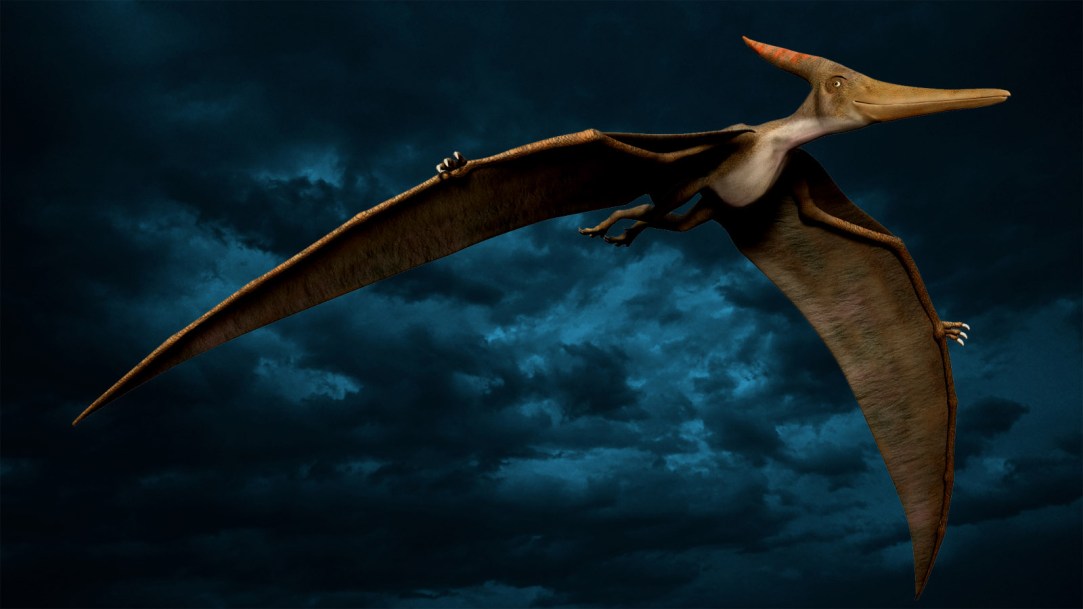
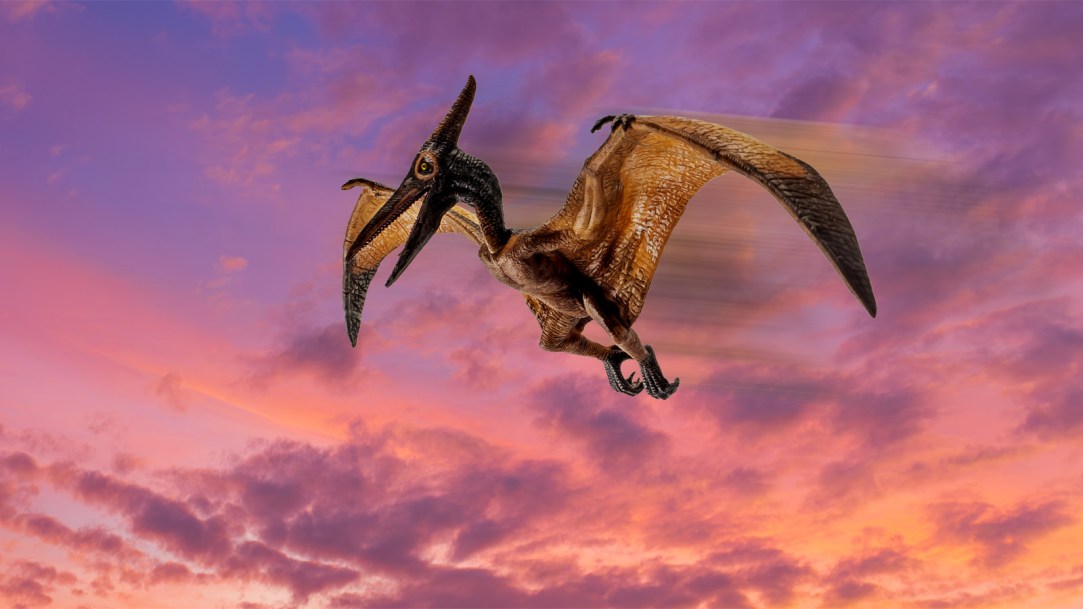
Just when we thought the recent reports of a prehistoric flying creature being spotted near the U.S.-Mexico border couldn’t get any stranger, newly released Pentagon UFO files have added another wrinkle to the mystery.
Apparently, people in Utah reported something similar to a pterodactyl almost 20 years ago. And now there are even theories that these creatures might be traveling between dimensions.
Pentagon UFO Files Detail Encounter With Giant ‘Pterodactyl’
The witnesses told investigators in 2010 that they encountered the pterodactyl-like creature sometime around 2006 or 2007 after returning home from playing basketball.
They described it as black, approximately four feet tall, with a 12-foot wingspan and a head and beak measuring two to three feet long. They also said they heard its wings flapping and watched branches move as it descended into nearby trees.
The witnesses were apparently so frightened by the creature’s size that they ran inside, fearing it could pick them up and carry them away. (Maybe it was a prehistoric eagle?)
Investigators never identified whatever they saw.
Could These Supposed Pterodactyls Be Traveling Between Dimensions?
One recording, reportedly filmed November 7, supposedly shows a pterodactyl taking flight after attacking a dog and attempting to carry it away. That account has not been independently verified.
Controversial UFO researcher Jaime Maussan, who has promoted the footage, now believes the creature might actually be a Pteranodon. He also floated another possibility.
iStockphoto composite
“Is the creature recently filmed in the Juárez Valley evidence that a dimensional portal is located there?” he asked on X.
As ridiculous as that might sound, Maussan isn’t the first person to suggest creatures could be traveling between universes.
“Scientists have suggested there could be other universes. And somehow our world interacts with these other worlds through portals,” Halliday explained. “With the Loch Ness monster, people could be seeing a dinosaur that existed in the past. They may see something that looks solid, but isn’t actually in our world.”
Halliday also suggested the theory could explain UFO sightings.
Are The Pterodactyl Sightings Real Or Just Another Hoax?
Of course, there’s no scientific evidence that prehistoric creatures are using interdimensional portals.
There’s the small matter of pterosaurs having gone extinct around 66 million years ago. Experts have also suggested the Mexico videos could be AI-generated or CGI.
All that said, if someone actually finds a portal filled with prehistoric flying reptiles, it would certainly explain a lot.
I Checked the Viral Pterodactyl in Mexico Video So You Don't Have To
Mexico's Flying Dinosaur: Did a Pterodactyl Return? 😨🦖
Verstoppen buitenaardse wezens zich voor ons? Het universum is 14 miljard jaar oud. Wat al die eeuwen geleden begon als een enorme explosie, is sindsdien veranderd in een woeste leegte gevuld met sterren, planeten, zwarte gaten en de donkere materie daartussenin. Maar als de kosmos zo ontzettend oud en groot is, dan kunnen wij toch niet de enige wezens zijn?
Veel wetenschappers en experts hebben redenen voorgesteld waarom we nog nooit ander leven in het universum zijn tegengekomen. Een van de meest hardnekkige is de Fermi-paradox. Wat is dat? En hoe verklaart het het ontbreken van buitenaards leven? Klik verder om erachter te komen.
Fermi's lunchvraag In 1950 stelde de Italiaans-Amerikaanse natuurkundige Enrico Fermi naar verluidt tijdens een lunchgesprek in het Los Alamos National Laboratory in New Mexico de vraag 'Waar is iedereen?' aan zijn collega's. Het universum lijkt immers oud en groot genoeg om buitenaards leven te herbergen, dus waarom zien of horen we daar dan niets van?
Een drukbevolkt sterrenstelsel Onze Melkweg bevat honderden miljarden sterren, en moderne onderzoeken tonen aan dat planeten veel voorkomen, waaronder veel planeten die ongeveer even groot zijn als de aarde en zich in een 'precies goede' baan bevinden waar vloeibaar water zou kunnen bestaan en mogelijk leven zou kunnen ontstaan.
Tijd voor galactische omzwervingen Zelfs met trage ruimteschepen zou een beschaving die zich blijft uitbreiden zich in principe in enkele tientallen miljoenen jaren over de hele melkweg kunnen verspreiden. Dit is minuscuul vergeleken met de leeftijd van de Melkweg, die meer dan 10 miljard jaar oud is.
Verwachting versus stilte Dit is de Fermi-paradox: statistieken en tijdschalen lijken het bestaan van geavanceerde beschavingen te ondersteunen, maar onze telescopen en radioantennes tonen een hemel die hardnekkig leeg lijkt..
Planeten buiten ons zonnestelsel Sinds de jaren negentig hebben mensen duizenden exoplaneten in het universum ontdekt, waaronder rotsachtige werelden in gematigde zones. Die ontdekking versterkte het idee dat 'leven misschien wel heel gewoon is', aangezien potentieel bewoonbare plekken eigenlijk niet zo zeldzaam zijn.
Luisteren naar technosignaturen Aan de andere kant is er al tientallen jaren naar buitenaardse intelligentie gezocht door de hemel af te speuren naar kunstmatige radio- of lasersignalen (ook wel technosignaturen genoemd), maar geen enkel signaal heeft tot nu toe de tests doorstaan die nodig zijn om als definitief bewijs van buitenaardse technologie te worden beschouwd.
Het Grote Filter Sommige deskundigen suggereren dat er een 'Groot Filter' bestaat, een brute bottleneck die de meeste bewoonbare werelden nooit passeren. Misschien ontstaat er zelden leven, verschijnen complexe cellen bijna nooit, is intelligentie uiterst onwaarschijnlijk, of vernietigt geavanceerde technologie zichzelf snel.
Zeldzame aarde Een ander perspectief is de 'zeldzame aarde'-visie, die stelt dat onze specifieke combinatie van factoren (waaronder een langlevende ster, een stabiel klimaat, platentektoniek, een beschermend magnetisch veld, een grote maan en een relatief rustige galactische omgeving) ongebruikelijk is, en dat complex leven dus eigenlijk ongelooflijk zeldzaam zou kunnen zijn.
Korte technologische vensters Een andere mogelijkheid is dat beschavingen flikkeren. Misschien gebruiken geavanceerde samenlevingen slechts korte tijd luidruchtige technologieën zoals radio of grootschalige industrie, waarna ze ofwel veranderen in iets stillers ofwel helemaal verdwijnen voordat iemand het merkt.
Beschavingen die zichzelf vernietigen Een bijzonder somber idee is dat veel technologische soorten zichzelf uitroeien (door oorlog, ecologische ineenstorting, pandemieën of op hol geslagen kunstmatige intelligentie) voordat ze veilige interstellaire reizen kunnen maken. Hierdoor zou de melkweg vol ruïnes zijn in plaats van rijken.
Afstand en slechte timing Meer hoopvolle verklaringen stellen dat beschavingen simpelweg te ver uit elkaar liggen en slecht gesynchroniseerd zijn in de tijd. Tegen de tijd dat een soort begint uit te zenden, zijn potentiële luisteraars mogelijk al uitgestorven of overgestapt op andere technologieën.
Bezoekers die we misschien niet herkennen Het is ook denkbaar dat buitenaardse wezens al bestaan en door de melkweg reizen met behulp van methoden die wij mensen niet herkennen. Misschien gebruiken ze vormen van communicatie die we nog niet kunnen detecteren, of reizen ze door de kosmos vermomd als gewone astrofysische verschijnselen.
Beschavingen die zich naar binnen keren Sommige hypothesen stellen dat geavanceerde samenlevingen bewust hun interesse in expansie zouden kunnen verliezen. Zodra hun fysieke behoeften zijn vervuld, zouden ze zich kunnen richten op virtuele realiteiten of lokale projecten in plaats van enorme middelen te besteden aan risicovolle interstellaire kolonisatiecampagnes.
Bewust kiezen voor stilte Dit heeft veel wetenschappers tot een huiveringwekkende gedachte gebracht: misschien is stilte wel een bewuste overlevingsstrategie. Als het kenbaar maken van je aanwezigheid iets gevaarlijks zou kunnen aantrekken, dan is het veiligst om je te verstoppen en te luisteren.
De Dark Forest-hypothese Dit wordt de Dark Forest-hypothese genoemd. Stel je voor dat het universum een donker bos is waar elke beschaving een jager is, die zich tussen de bomen verstopt en stalkt.
Kennis en angst Op deze afbeelding weet elke beschaving vrijwel niets over de intenties of betrouwbaarheid van andere beschavingen. Technologie kan snel veranderen, dus een soort die vandaag de dag onschuldig lijkt, kan de macht krijgen om je te vernietigen lang voordat je het doorhebt.
Communicatie onder de lichtsnelheidslimiet Omdat communicatiesignalen niet sneller kunnen gaan dan de lichtsnelheid, duren gesprekken over duizenden lichtjaren heen eeuwenlang. Je kunt niet in realtime onderhandelen, beloften controleren of misverstanden snel rechtzetten. Dit maakt diep vertrouwen tussen vreemden uiterst moeilijk.
Preventieve overlevingsstrategieën Onder die omstandigheden is volgens de logica van het Donkere Woud de veiligste zet meedogenloos: geef nooit je positie prijs en als je de locatie van een andere beschaving ontdekt, overweeg dan om als eerste toe te slaan voordat zij jou kunnen bedreigen.
Kosmische stilte verklaren met angst Als de meeste geavanceerde samenlevingen zo denken, dan zou het universum er precies zo uitzien als wij het nu zien: donker en stil. Dit komt omdat iedereen zich verstopt en elke beschaving die 'het licht aandoet' wordt uitgeroeid.
METI en berserkers Dit perspectief voedt debatten in de echte wereld over METI, het idee om opzettelijk krachtige boodschappen naar andere sterren te sturen. Het sluit ook aan bij oudere concepten zoals 'berserker probes', die zogenaamd door buitenaardse wezens worden gestuurd en zijn ontworpen om de melkweg te doorzoeken en opkomende rivalen te vernietigen.
Waarom het verhaal overtuigend overkomt Het idee van het Donkere Woud zit diep geworteld in het menselijk geheugen. De aarde heeft immers een opmerkelijke geschiedenis van vijandige eerste contacten, en dus is het waarschijnlijk logisch dat we ons zorgen maken over bewaking en wapens die tegen ons worden gebruikt.
Metaforen versus fysieke realiteit Maar de Dark Forest-hypothese is nog steeds slechts een metafoor, en metaforen kunnen misleidend zijn. Een melkwegstelsel dat onderhevig is aan de beperkingen van de natuurkunde gedraagt zich niet precies zoals een bos vol jagers die met geladen geweren tussen de bomen sluipen.
Beschavingen zijn geen enkele geest Een belangrijk punt van kritiek op deze hypothese is dat elke beschaving wordt behandeld als een enkele, rationele actor met één strategie: vernietigen. Maar hierbij wordt voorbijgegaan aan interne diversiteit, politieke conflicten en culturele veranderingen gedurende duizenden of miljoenen jaren.
Op zoek naar luidruchtige rijken Vanuit observationeel oogpunt zouden echt expansionistische 'killer'-beschavingen die megastructuren bouwen, heldere, vreemd uitziende sporen achterlaten in onze telescopen. Maar uitgebreide onderzoeken hebben nog geen overtuigend bewijs gevonden voor het bestaan van dergelijke enorme rijken.
Projecteren we de menselijke geschiedenis? Critici merken ook op dat de Dark Forest-hypothese sterk leunt op menselijke oorlogsverhalen en worst-case-denken. Ze gaat ervan uit dat concurrentie en geweld universele eigenschappen zijn, in plaats van bijproducten van ons specifieke evolutionaire en culturele pad.
De eerstgeborenehypothese Dan is er nog de eerstgeborenenhypothese, die stelt dat de reden waarom mensen nog geen buitenaards leven zijn tegengekomen, is omdat wij tot de eerste beschavingen behoren die in het universum bestaan. We zijn er nog te vroeg bij.
De paradox in twijfel trekken Sommige wetenschappers beweren dat er nauwelijks sprake is van een paradox. Gezien de enorme onbekende factoren in de biologie, sociologie en technologie, zou het feit dat we nog geen buitenaardse wezens hebben ontdekt, simpelweg kunnen betekenen dat we hebben onderschat hoe moeilijk het eigenlijk is om ze te detecteren.
Voorzichtig, maar niet bang In de praktijk pleiten veel wetenschappers voor een middenweg: we moeten goed blijven luisteren, voorzichtig zijn met zeer krachtige transmissies, maar voorkomen dat een speculatief, fictief worstcasescenario onze nieuwsgierigheid bevriest of al onze beslissingen dicteert.
Leven met een open vraag Voorlopig blijft de Fermi-paradox onopgelost. Het universum kan wemelen van het leven, grotendeels leeg zijn, of nog vreemder dan beide opties. Maar totdat we echt bewijs verzamelen, blijven al onze bossen (donker of anderszins) niets meer dan verhalen die we onszelf vertellen.
Bronnen:
(Britannica)
(ResearchGate)
(Universe Today)
(Medium)
(NASA)
(National Geographic)
(SETI)
'Als je dit vindt, heb je zeker te maken met aliens'
In the glossary of my next book Space Age Folklore – published in 2027 – I make ‘no apology for using UFO in preference to the new-fangled UAP (pronounced “U-APP”) except when necessary’.
But I accept that UAP is now part of United States aviation and defence parlance, having been first written into statute as ‘unidentified aerial phenomena’ in 2020-21. Then in December 2022, lawmakers altered its meaning to ‘Unidentified Anomalous Phenomena’ to capture a range of anomalies that appear not only in Earth’s atmosphere but also in space and in the sea. Both NASA and AARO, the All-Domain Anomaly Resolution Office (or the Pentagon’s UFO desk in plain English) routinely use UAP rather than UFO.
Why does any of this matter?
Well, use of language is central to how we understand and describe the world around us. Language and dialect are a genre of folklore and how we communicate and categorise accounts of aerial mysteries is important.
So, earlier this week I submitted UAP to the Oxford English Dictionary’s ‘watch-list’ for consideration as a noun to be added to its ever-evolving list of new words, phrases and acronyms. I believe this is timely as next year marks the 80th anniversary of the modern UFO phenomenon. Currently OED recognises flying saucer (1947) and UFO (1953), but search for UAP on the database and all that turns up is the United Australia Party (1909) and the United States Pharmacopoeia (?).
Meanwhile the media, both in the USA and worldwide, continues to use U-F-O in preference to the highfalutin jargon of UAP. Ironically UFO was itself coined, circa 1951, by Captain Edward Ruppelt of the USAF’s Project Blue Book, to replace flying saucer. This phrase was invented a mere four years earlier by a sub-editor in the Midwest to describe disc-shaped objects piloted by creatures from outer space, a definition the USAF were understandably not keen to adopt.
The immediate impact of UFO usage across the world can be seen in its adoption by the UK Ministry of Defence, whose Flying Saucer Working Party used ‘Unidentified Flying Objects’ as the title of its final report delivered in 1951. This was later used to brief Winston Churchill who famousy asked ‘What’s all this stuff about flying saucers?’
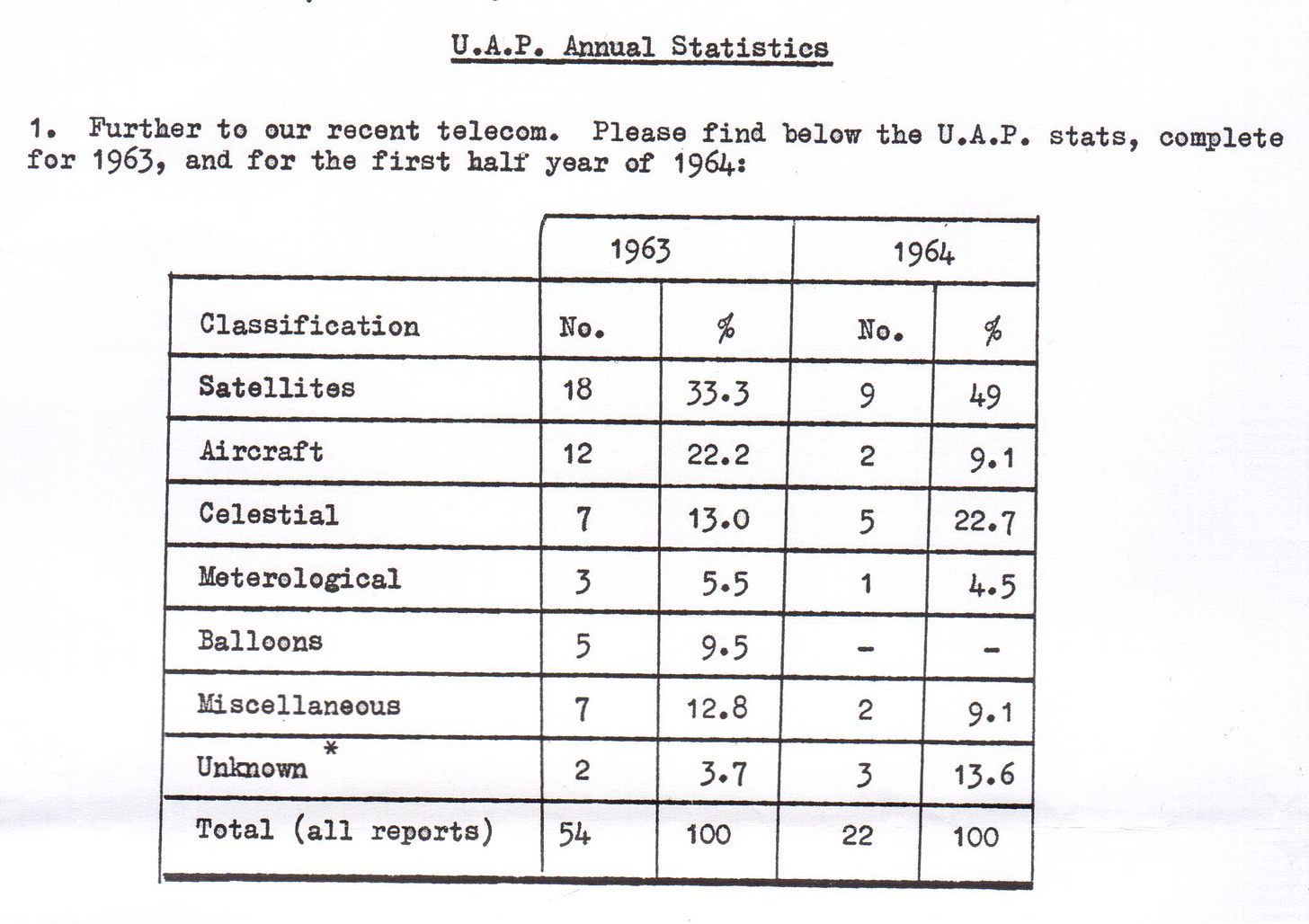
Later, the Air Ministry and Ministry of Defence began using UAP – with the meaning ‘unidentified aerial phenomena’ - to categorise reports of strange lights and objects they received from at least 1962, as the following extract from a monthly statistical breakdown illustrates:
Extract from a British Air Ministry memorandum on UFOs produced in 1963
(Credit: UK National Archives AIR 2/17526)
By the 1980s at least three separate departments within MoD were receiving UFO reports and each had its own definitions and descriptors for filing purposes. The so-called ‘UFO desk’, Secretariat (Air Staff) or Sec(AS), staffed by civilians, naturally preferred UFO as it was the phrase used by most of its persistent public correspondents. But the secret squirrel Defence Intelligence branch DI55, that was copied into and investigated the more interesting reports, preferred UAP.
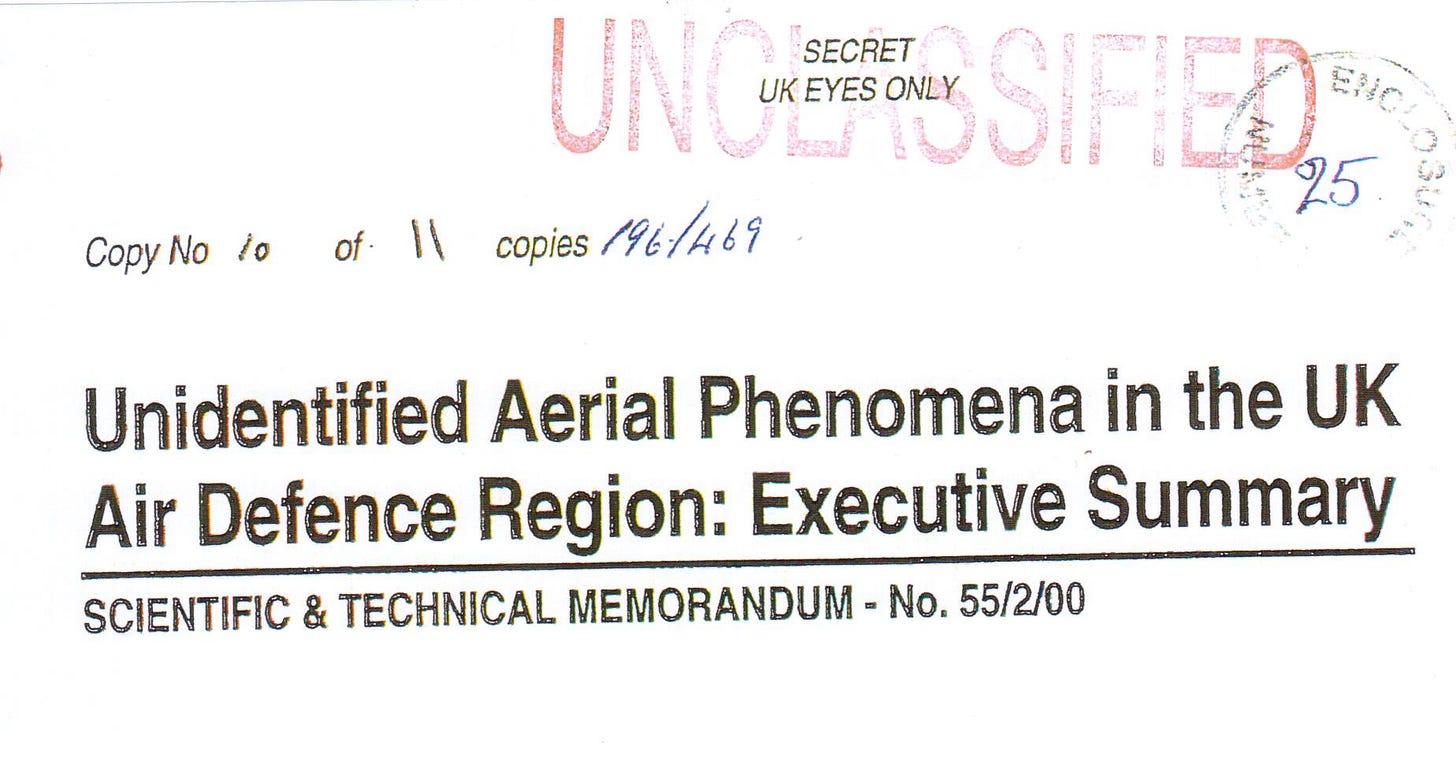
Indeed when the head of Defence Intelligence signed off a £50K contract for a detailed study of DI55’s database in 1996, their report was called Unidentified Aerial Phenomena (UAP) in the UK Air Defence Region, often referred to by its code-name Condign. In his book Encounter in Rendlesham Forest (2014) the late former UFO desk officer Nick Pope claimed that it was he, working with his DI55 opposite number, who first created and used the acronym UAP within the UK MoD in 1993-94. UAP was later adopted by Ron Haddow, the author of the report, completed in 2000. ‘Language was a key part of this “selling job”,’ Pope wrote, ‘and my DIS colleague and I agreed to drop the term “UFO”…replacing it with the more scientific sounding tern “UAP”.
Former MoD UFO desk officer Nick Pope, who died in April 2026.
(credit: Chris Fowler)
Pope occupied the UFO desk from 1991-94 and as UAP occurs frequently in Air Ministry and MoD documents between 1962 and 1987 that claim cannot be accurate. I can demonstrate without any shadow of doubt that Pope, Haddow and others in MoD were well aware that UAP was being used extensively in the UFO literature long before their internal debate during the mid-1990s. Indeed one of the best-known American UFOlogists, the astronomer Dr J Allen Hynek, who had been a consultant to Project Blue Book, was using UAP two decades earlier, in collaboration with British UFO investigator and writer Jenny Randles.
Jenny visited Hynek during a tour of the USA and felt his system of classification, that divided stories into lights in the sky, daylight discs, radar-visuals and close encounters, needed to be updated in order to attract more scientific interest in what was still a fringe subject. In her 1979 book UFOs: A British Viewpoint Jenny opines that ‘we ought to redefine our terms and speak of a UAP (unidentifiable atmospheric phenomena)’. In her follow-up UFO Study (1981) UAP appears in her ‘glossary of terms’, alongside an attempt to justify use of the word unidentifiable because it ‘implies it is not presently explicable to any observer and atmospheric phenomena covers all possibilities for origin (both natural and artificial) and thus implies nothing’.
Recognising this argument was confusing, two years later in the book UFO Reality Jenny admits she dislikes UFO as the word object implies something of artificial origin (as in flying saucer?). Nevertheless, she accepted that ‘UFOs it is, to almost everybody, and convention dictates that I follow suit’. A similar argument was made when the UFO desk clashed with DI55 in 1997 over the latter’s use of UAP in Ministry of Defence documents.
British UFO writer and investigator Jenny Randles, pictured in 1995
(credit: Chris Fowler)
In her 1985 book Science and the UFOs, co-written with Peter Warrington, an entire chapter is devoted to UAP, an acronym that Jenny once pronounced, in my presence, as ‘whap’. In their book, Jenny and Peter go on to explain that ‘in our opinion there is an as yet unexplained type of transient atmospheric phenomena which we have termed UAP’. They go on to separate what they regard as True UAP – meaning an unknown natural phenomenon – from the more subjective accounts of close encounter experiences.
A close reading of the ‘Working Papers’ in volume 2 of Ron Haddow’s Condign report reveals that he used maps and graphics from both Jenny’s 1992 book UFOs and How to See Them and Pau Devereux’s 1996 book Earthlights Revelation. Elsewhere he claims that he was making a conscious effort to avoid being influenced by the literature of UFOlogy. But not only did he use UAP in the title of his 3-volume report but his conclusions, that True UAP are manifestations of ‘dusty plasmas’, a hitherto unknown type of atmospheric plasma unrecognised by physicists, reflect the contents of the very same books that he claimed not to have consulted.
Just to make matters worse, despite the use of UAP within the Ministry of Defence during the period in which the Condign report was produced, it seems these debates have long been forgotten. The DIS branch DI55 that produced the Condign report was itself disbanded in 2002-3 during the Strategic Defence Review. The UFO desk itself was shut down in 2009, the victim of cost-cutting under Prime Minister Gordon Brown. Most of its UFO archive, that dated back to 1967, had either been destroyed or transferred to The National Archives by that stage. More recently, according to a source who works there, ‘the leadership truly appear to have washed its hands of the UFO/UAP issue’.
Within many large organisations the loss of institutional memory has been worsened by the migration from paper archives to a reliance upon internet search engines to locate documents. If it’s not immediately findable on a computer then it doesn’t exist, or has been ‘lost’, which is the default response to most Freedom of Information requests. As an experiment I submitted a question that asked ‘has the MoD followed the example of the US armed forces by adopting UAP as a substitute for UFO when referring to aerial phenomena? If not, why not?’
UFO or UAP material?
The answer, dated 1 May 2024, was no surprise:
‘While the MoD is aware of differing approaches currently being undertaken by other countries and allies in the investigation of UAP this is a term that the MoD does not recognise. However regarding UFO and UAP the Department’s position remains unchanged which is, that in over 50 years, no sighting reported…has indicated the existence of any military threat to the UK’.
Hoe satellieten de oude wereld onder onze voeten onthullen De mens is altijd al gefascineerd geweest door wat er vóór hem bestond. En inderdaad: duizenden jaren geschiedenis liggen verborgen onder onze voeten – onder woestijnen, landbouwgrond en zelfs steden. Maar archeologen brengen nu oude nederzettingen en mysterieuze bouwwerken van duizenden jaren geleden aan het licht met behulp van satellieten die in een baan om de aarde draaien. Deze opmerkelijke ontdekkingen veranderen wat we weten over beschavingen uit het verleden.
Nieuwsgierig geworden? Lees verder om te ontdekken wat de technologie onder ons aan het licht brengt.
Een vergeten rivier naast de piramides van Egypte In 2024 hebben onderzoekers met behulp van satellietradarbeelden en veldonderzoek een lang verloren gewaande zijtak van de Nijl ontdekt. Deze oude waterweg, die de naam ‘Ahramat-zijtak’ kreeg, strekte zich uit over een afstand van ongeveer 64 km langs een reeks Egyptische piramides.
Een eeuwenoud mysterie oplossen De voormalige rivier stroomde langs 31 piramides, waaronder die rond Gizeh. Onderzoekers denken dat dit de arbeiders wellicht heeft geholpen bij het vervoeren van zware bouwmaterialen, wat nieuwe aanwijzingen biedt over de manier waarop de oude Egyptenaren hun monumentale bouwwerken hebben opgetrokken.
Een verborgen bouwwerk in Egypte In 2026 hebben onderzoekers met behulp van satellietradar en ondergrondse metingen de begraven overblijfselen in Buto, een oude Egyptische stad, onderzocht. Ze hebben een omvangrijk bouwwerk van lemen bakstenen geïdentificeerd dat ongeveer 2.600 jaar oud is.
Een vergeten Egyptische stad in kaart brengen Satellietarcheologe Sarah Parcak (foto links) maakte gebruik van infraroodbeelden om Tanis, een oude Egyptische stad (foto rechts), te onderzoeken. Verschillen in de bodem brachten sporen van straten en gebouwen aan het licht die al duizenden jaren verborgen waren gebleven.
Satellieten kijken niet per se rechtstreeks door de grond heen. In plaats daarvan detecteren ze subtiele verschillen in bodem, vegetatie, vochtgehalte en oppervlaktekenmerken. Deze veranderingen kunnen de contouren van structuren onthullen die anders onzichtbaar zouden blijven.
Planten kunnen verborgen geschiedenis aan het licht brengen Ondergrondse muren kunnen invloed hebben op de manier waarop water zich door de bodem verplaatst, waardoor de groei van planten erboven verandert. Vanuit de ruimte kunnen deze verschillen zichtbaar zijn als ongebruikelijke lijnen of vormen, waardoor mogelijk oude gebouwen onder landbouwgrond aan het licht komen.
Aanwijzingen onder de Maya-jungle In Guatemala ontdekten onderzoekers dat vegetatie die over oude Maya-ruïnes groeit, er op satellietbeelden anders uit kan zien. Kalksteen van vervallen gebouwen veranderde de omliggende bodem, waardoor wetenschappers archeologische vindplaatsen konden identificeren die verborgen lagen onder dichtbegroeid bos.
De enorme woestijntekeningen van Peru De beroemde Nazca-lijnen zijn vanaf de grond moeilijk te overzien, maar satellietbeelden laten hun buitengewone omvang zien. Deze enorme figuren en geometrische patronen werden tussen 400 v.Chr. en 500 n.Chr. in de woestijn van Peru uitgehouwen.
Een verloren tempel in Bolivia In 2025 maakten onderzoekers de ontdekking bekend van een tot dan toe onbekend tempelcomplex dat in verband wordt gebracht met de Tiwanaku-beschaving. De vindplaats, gelegen in Palaspata in Bolivia, werd onderzocht aan de hand van satellietbeelden, dronefoto’s en veldonderzoek.
Een stad uit de bronstijd in Kazachstan Met behulp van satellietbeelden konden onderzoekers Semiyarka onderzoeken, een nederzetting die ongeveer 3.500 jaar oud is. Uit een onderzoek uit 2025 bleek dat het om een uitgestrekte, geplande nederzetting ging, waarbij aanwijzingen erop wijzen dat het een belangrijk centrum voor de bronzenproductie was.
De oude Romeinse wegen die niemand in kaart heeft gebracht In 2025 presenteerden onderzoekers een gedetailleerde kaart van het wegennet van het Romeinse Rijk, waarbij ze satellietbeelden combineerden met historisch en archeologisch bewijsmateriaal. De daaruit voortvloeiende atlas bevatte bijna 299.000 km aan routes.
Romeinse forten, verborgen op spionagefoto’s Dankzij spionagesatellietbeelden uit de Koude Oorlog konden onderzoekers 396 tot dan toe niet-gedocumenteerde Romeinse forten of fortachtige bouwwerken in Syrië en Irak identificeren. Deze ontdekking, die in 2023 werd gepubliceerd, zette eerdere opvattingen over de oostelijke grens van het rijk op losse schroeven.
Een nieuwe kijk op het Romeinse Rijk In plaats van een rechtlijnige verdedigingslinie te vormen, lagen de forten verspreid over een veel groter gebied. Hun ligging wijst erop dat ze mogelijk een ondersteunende rol hebben gespeeld bij het reisverkeer, de handel en militaire verplaatsingen in de hele regio.
Duizenden oude nederzettingen in Syrië In 2012 analyseerden onderzoekers satellietbeelden van Noordoost-Syrië en brachten ze ongeveer 14.000 mogelijke nederzettingslocaties in kaart. Uit de bevindingen bleek dat er sporen van menselijke activiteit waren die duizenden jaren teruggaan.
Oude bodem levert aanwijzingen op Nederzettingen kunnen kenmerkende bodems achterlaten die door eeuwenlange menselijke activiteit zijn gevormd. Wetenschappers kunnen deze verschillen op satellietbeelden herkennen, waardoor ze plaatsen kunnen lokaliseren waar ooit mensen hebben gewoond, zelfs als de gebouwen inmiddels verdwenen zijn.
Oude kanalen in Irak In 2026 combineerden onderzoekers satellietbeelden met kunstmatige intelligentie om oude irrigatiestructuren in centraal Irak in kaart te brengen. Subtiele sporen van vroegere waterlopen en verhoogde oevers onthulden hoe mensen het landschap vroeger in stand hielden.
Reusachtige rechthoeken in de Saoedische woestijn Dankzij satellietonderzoek hebben archeologen meer dan 1.000 enorme stenen bouwwerken in het noordwesten van Saoedi-Arabië in kaart kunnen brengen. Deze rechthoekige monumenten, die ‘mustatils’ worden genoemd, dateren van ongeveer 7.000 jaar geleden.
Waar dienden die rechthoeken voor? Uit opgravingen blijkt dat sommige mustatils werden gebruikt voor rituelen waarbij runderen betrokken waren. Hun omvang en wijdverspreide aanwezigheid wijzen erop dat deze monumenten voor prehistorische gemeenschappen van aanzienlijk cultureel of religieus belang waren.
Oude wegen, omzoomd met graven Ook in Saoedi-Arabië hebben satellietbeelden geholpen bij het blootleggen van oude routes die worden omzoomd door grafmonumenten. Deze paden, die bekendstaan als ‘grafwegen’, verbonden ongeveer 4.500 jaar geleden oases en weidegronden met elkaar.
Prehistorische vulkanische kuilen die vanuit de ruimte zichtbaar zijn Met behulp van satellietbeelden hebben archeologen onderzoek gedaan naar stenen bouwwerken die in het zuidoosten van Turkije bekendstaan als ‘desert kites’. Hun lange, trechtervormige muren hebben duizenden jaren geleden mogelijk wilde dieren naar afgeschermde jachtgebieden geleid.
Een vergeten muur rondom een oase In Khaybar, in Saoedi-Arabië, hebben teledetectie en archeologisch onderzoek bijgedragen aan de reconstructie van een verdedigingsmuur uit de bronstijd. Onderzoekers schatten dat de oorspronkelijke vestingwerken zich over een afstand van bijna negen 15 km rond een oase-nederzetting uitstrekten.
Verborgen structuren onder een eiland In 2026 hebben onderzoekers met behulp van satellietradar, kunstmatige intelligentie en veldonderzoek het eiland Siniyah in de Verenigde Arabische Emiraten onderzocht. Ze hebben daar voorheen niet-gedocumenteerde archeologische vondsten ontdekt, waaronder mogelijk begraven muren en gebouwen in de buurt van een oud klooster.
Een ander satellietonderzoek uit 2026 richtte zich op prehistorische steencirkels rondom Rujm el-Hiri, een oud monument in de Golanhoogten in Syrië. Onderzoekers brachten 28 cirkelvormige bouwwerken in kaart, waarvan de meeste nog niet eerder waren geregistreerd.
Verdwenen nederzettingen in de Sahara Met behulp van satellietbeelden konden onderzoekers meer dan 100 versterkte boerderijen en dorpen, evenals verschillende steden, identificeren die verband houden met de oude Garamantes-beschaving in het huidige Libië. De ontdekkingen brachten een verrassend geavanceerde woestijnsamenleving aan het licht.
Een hoogontwikkelde beschaving in de woestijn Onderzoekers hebben ook uitgebreide irrigatiesystemen, waterputten en landbouwvelden ontdekt. Deze bevindingen wijzen erop dat de Garamantes bloeiende nederzettingen in stand hielden in een regio die vandaag de dag grotendeels onherbergzaam lijk
In 2026 werden 260 tot dan toe onbekende monumentale begraafplaatsen in Noordoost-Afrika geïdentificeerd, met name in Soedan. Sommige dateren uit het 4e en 3e millennium v.Chr. en brengen een tot nu toe over het hoofd geziene prehistorische traditie aan het licht.
Kunstmatige intelligentie wordt ingezet bij het zoeken Wetenschappers trainen kunstmatige intelligentie om archeologische patronen in satellietbeelden te herkennen. Uit recent onderzoek blijkt dat deze systemen mogelijke vindplaatsen in uitgestrekte gebieden zouden kunnen identificeren, waardoor archeologen hun onderzoek beter kunnen richten.
Satellieten kunnen ook de geschiedenis beschermen Satellieten zijn niet alleen nuttig voor het opsporen van oude vindplaatsen. Door beelden die op verschillende tijdstippen zijn gemaakt met elkaar te vergelijken, kan schade als gevolg van plundering of bebouwing aan het licht komen, waardoor onderzoekers kwetsbare archeologische landschappen beter in de gaten kunnen houden.
Satellieten helpen archeologen om bekende landschappen opnieuw te bekijken en plekken te onderzoeken die voorheen moeilijk te verkennen waren. Hoewel ontdekkingen nog steeds ter plaatse moeten worden bevestigd, zou de volgende buitengewone archeologische vondst wel eens verborgen kunnen liggen in een satellietbeeld.
The rehearsal was supposed to help a dead king find peace. In a natural amphitheatre among the tombs of Egypt, a small group of amateur performers attempted something more ambitious than an evening’s entertainment: a play interceding for Akhenaten, the pharaoh whose name his successors had tried to erase. According to the account later associated with the production, a storm interrupted the performance. That night, two of the women dreamed of a statue of Amun coming to life and striking them. Both subsequently became seriously ill.
It is an unsettling opening for In Search Of… The Mummy’s Curse, the Leonard Nimoy programme available in the video linked below. Although the upload’s title gives 1976, the episode is catalogued as part of the series’ 1977 first season. Its twenty-two minutes bring together tomb discoveries, family recollections and the possibility that old religious prohibitions retained a force their modern intruders had underestimated. The Akhenaten story is its less familiar thread, running behind the much more famous death of Lord Carnarvon.
Screenshots: In Search Of… The Mummy’s Curse, Alan Landsburg Productions (1977).
The attraction of returning to the programme lies partly in the people it allows us to hear. Carnarvon’s son recalls his father’s final illness, while Henry Lincoln introduces the strange theatrical enterprise. The film moves between interviews, antiquities and dramatised scenes, giving the stories a physical setting without making every image a record of the original event. The women raising their arms beneath the night sky are part of the programme’s reconstruction. Their gestures make a memorable entrance to a story in which a performance was believed to have reached beyond its intended audience.
A play for a restless king
The artist behind the production was Joseph Lindon Smith. The Smithsonian’s account of his career describes a painter captivated by Egypt after his first visit in 1898. He specialised in carefully reproducing tomb sculpture and wall painting for museums and other institutions. He was also a prolific maker of plays, pageants and theatrical entertainments. The proposed Egyptian performance brought together two substantial parts of his life rather than an interest briefly adopted for a holiday.
A later account drawing on his posthumous Tombs, Temples, and Ancient Art places the enterprise in 1909, well before Tutankhamun’s discovery. Smith and the archaeologist Arthur Weigall devised the play. Their wives, Corinna and Hortense, took the roles of Akhenaten’s mother and the king himself. Its purpose was to release the pharaoh from an alleged condemnation to wander without rest. The dress rehearsal was reportedly held on 23 January, ahead of the intended performance three days later.
The weather grew violent as the invocation proceeded. In the story, Corinna attempted to continue her recitation despite wind, rain and hail. Afterwards came the dreams: each woman saw the god’s statue become animate and deliver a blow. Corinna’s was directed at her eyes, Hortense’s at her abdomen. The subsequent illnesses seemed to follow those injuries. One suffered severe trachoma; the other required an abdominal operation. The later retelling says both recovered, but the planned performance was cancelled.
Dramatised play sequence, approximately 16:10. In Search Of… The Mummy’s Curse,
Alan Landsburg Productions (1977).
What makes the account so unusual is the intention behind it. Nobody was supposedly breaking into a burial chamber in search of treasure. The performers were trying to do something compassionate for a king imagined to remain trapped after death. Their attempt to help apparently brought them into conflict with the powers they were addressing. Within the story’s own logic, good intentions had not made the invocation harmless.
There is also a historical reason why Akhenaten’s name could carry such dramatic weight. His promotion of the Aten displaced the established religious order, especially the cult of Amun. After his reign, the new arrangements were reversed. The Metropolitan Museum describes the destruction of sculptured faces of Akhenaten and Nefertiti at Amarna; one surviving head has been assembled from three fragments. A modern viewer can encounter the damaged images themselves, quite apart from the later claim of a wandering spirit. The play gave that destruction an intensely personal consequence: a dead man whose exclusion might still be undone by speaking for him.
A name that kept returning
The story subsequently reached another writer who described strange experiences around the same pharaoh. In the introduction to The Ghost of Akhenaten, Moyra Caldecott explained that dreams and experiences involving mediums had influenced her belief in the alleged curse while she was writing an earlier novel. After publication, she encountered someone who claimed to have seen Akhenaten’s ghost in the Egyptian desert. A friend then lent her the Smiths’ account of their attempt to free him.
Caldecott also reported receiving letters from people claiming to be reincarnations of Akhenaten or members of his family, along with accounts of channelled messages. These are her statements in the introduction, distinct from the fictional events of the novel that follows. They extend the theme in an unexpected direction. Instead of remaining silent, the allegedly forgotten king continued to acquire voices, correspondents and people who felt personally involved in his unfinished story.
That connection makes the old television sequence worth revisiting. The rehearsal was not simply another item in a list of unlucky visitors to Egypt. It belonged to a continuing tradition in which people tried to approach the ancient dead directly, through performance, dreams or purported communication. Akhenaten’s fate became something in which a living person might intervene, and perhaps something that could answer.
The room at the end of the passage
Tutankhamun’s discovery supplied the more public drama. Howard Carter’s journal for 26 November 1922 preserves the moment before the objects became familiar museum treasures. He peered through an opening by candlelight, waited for his eyes to adjust, then widened the breach so that Carnarvon could look. A torch and another candle brought out the crowded chamber’s contents.
The inventory has the bewildering quality of a place only gradually becoming visible: black royal figures with gold sandals, strange gilded couches, painted boxes, shrines, vessels, chairs and the scattered parts of chariots. Carter compared the first impression with a theatrical property room belonging to a vanished civilisation. Even then, there was another sealed doorway beyond the sentinel figures. What they could see was an entrance to something still concealed.
The journal gives us the excitement without requiring any later supernatural addition. It also restores the pause between discovery and explanation. Carter and his companions had to understand the space, its objects and its sequence of doors. They closed the opening and went home contemplating the scene. The objects were real; their arrangement was unfamiliar; the king remained further within. It is easy to understand why that threshold became so important to subsequent tellings.
The earl’s last night
Carnarvon died in Cairo on 5 April 1923. The film’s interview with his son brings the familiar legend back to the experience of a family losing someone. He recalls being summoned to his father and needing a flashlight because the lights were out. The alleged correspondence between the death and the blackout became one of the curse story’s most persistent details. He also relates what he was told about a dog howling and dying back at Highclere.
Those memories have travelled alongside a documented final illness. The earl had suffered an infected mosquito bite and developed a fatal illness involving pneumonia. Highclere’s own account of the discovery describes the extraordinary publicity surrounding the excavation and the death that followed. The speed with which private grief became a worldwide story is part of what the programme preserves: a son remembering a sickroom while an audience already knows the death as the opening chapter of a curse.
The interview is more affecting than a procession of names labelled as victims. It lets a recollection remain a recollection. A failure of the lights can be a practical difficulty for the person trying to reach a bedside and, later, an event around which a much larger meaning gathers. The film’s strength is that the voice belongs to someone whose connection to the night was personal.
The sixth Earl of Carnarvon, approximately 3:10. In Search Of… The Mummy’s Curse,
Alan Landsburg Productions (1977).
A pharaoh arrives in Paris
Near its end, the episode turns to a remarkable contemporary event: the transfer of Ramesses II’s mummy to France in 1976 because its condition was deteriorating. At the time of the production, the ancient body’s examination could still be presented as an unfolding mystery. Seen today, the sequence has an additional value. It captures a moment before a conservation operation had acquired the settled outline of a historical achievement.
There is now a clear later chapter. In October 2026, the French research organisation CEA revisited the undertaking for its fiftieth anniversary. The mummy’s condition had prompted teams to find a treatment that would eliminate damaging microorganisms without destroying the remains they were trying to preserve. Following tests, the Nucléart team used gamma irradiation at Saclay. The operation united expertise in the ancient body with technology that its embalmers could never have imagined.
An International Atomic Energy Agency account adds that investigators found numerous fungi but no pathogenic bacteria. Extensive testing on samples from other mummies preceded the treatment. This was a real preservation problem, with a documented response. It should not be turned retrospectively into evidence of a lethal substance planted by ancient priests. What remains extraordinary is the effort required to keep a pharaoh’s body intact more than three millennia after his death.
Returning to Nimoy’s programme
The Mummy’s Curse works best as an invitation to follow its stories outward. Its archive of voices matters, as does the difference between an interview and a staged scene. Some of its unanswered questions have acquired later information; others lead back to the reported experiences of people who thought an ancient presence had entered their lives. The film remains atmospheric without needing every dramatic suggestion to become a historical conclusion.
The story of Smith’s play is the one that lingers. There is no stolen jewel at its centre, only a performance intended to grant a dead king peace. The storm, the dreams and the illnesses are remembered as the reply. Decades later, other people would again describe hearing from Akhenaten or meeting his wandering spirit. His name, once attacked in stone, continued to be spoken in circumstances its speakers found difficult to forget.
BRADLEY WALSH believes extra-terrestrial life is no alien concept – having been convinced of its truth in his new docu-series.
The Chase quiz host Bradley was gobsmacked when a former US Air Force commander pulled a mystery object from a bag and claimed it was the footprint of a UFO that landed in a Suffolk forest.
Bradley Walsh at Kitt Peak Observatory in Arizona
Source: Studio Crook/Sky HISTORY
Bradley interviews former US Navy pilot Lieutenant Commander Alex Dietrich who witnessed the infamous 'Tic Tac' incident in 2004
Source: Studio Crook/Sky HISTORY
The extraordinary encounter with retired Lieutenant Colonel Charles “Chuck” Halt can be seen on his SkyHistory series Bradley Walsh: Out Of This World, which will drop on November 3.
The military chief investigated a mysterious incident in Suffolk’s Rendlesham Forest in 1980, when US servicemen reported spotting a strange alien spaceship.
Talking about seeing the evidence, Bradley says: “He unwraps the bag, and he unravels what is inside it to reveal a disc — a plaster of Paris dome shape.
“He says, ‘That’s the footprint from one of the tripods of the craft’.
“You believe 100 per cent that he’s telling you the truth, that he saw what he saw.”
In his four-part series, Bradley also meets former US Navy pilot Lieutenant Commander Alex Dietrich, who witnessed the “Tic Tac” UFO encounter of 2004.
And he hears from former US Air Force security officer Jeffrey Nuccetelli, whose team reported a glowing red object hovering over a military base before it then shot skyward at an estimated 2,000mph.
Bradley said: “I’ve spoken to some extraordinary people on both sides of the Atlantic — civilians, scientists, eyewitnesses, military — and I believe them when they tell me they’ve seen stuff.
Bradley next to the VLBA radio telescope at Kitt Peak Observatory, Arizona
Source: Studio Crook/Sky HISTORY
Bradley reviewing explorer Michael Donnellan's data
Source: Studio Crook/Sky HISTORY
“They’re earnest and you see the whites of their eyes. They mean it.”
Since ITV confirmed in May that filming of The Chase is on hold, Bradley has been busier than ever before.
As well as filming for Sky History and popping up as a guest judge on Britain’s Got Talent, he has a new Channel 4 quiz show airing from November 1.
Bradley Walsh’s Million Pound Shot will see three contestants try to win up to £1million, in front of a live audience.
RELATED
Bradley Walsh Out Of This World - Trailer
Military Personnel Describe Their UFO Encounters | Bradley Walsh: Out of this World
Bradley Walsh: Out of This World (Season 1) Episode 1 - UFOs
Bradley Walsh is Out of this World: What we learned from episode one
How credible are UFO sightings? Do aliens really exist? In the first episode of Sky HISTORY’s Out of This World, Bradley Walsh did his best to find out.
In his lengthy showbiz career, Bradley Walsh has been here, there and everywhere. He’s hosted popular game shows like The Chase and Wheel of Fortune, starred in Doctor Who, and even struck it lucky in football and music. One thing he hasn’t done, though, is catch sight of a UFO…
Not that he isn’t fascinated by those who do claim to have seen extraordinary airborne things they are at a loss to adequately explain. Bradley met more than a few of those people in the first episode of Out of This World. What exactly did they report seeing, and does trusty science have the answers? Here’s a look back at what ‘Bradders’ has already unearthed in the new Sky HISTORY series…
It’s not hard to reel off a list of famous UFO sightings, from strange lights to supposed abductions. While Bradley is open-minded about these cases, he also can’t help noticing a curious trend.
‘Every alien craft we’ve ever heard of or imagined lands in the United States,’ Bradley points out in the series. ‘They never land in Epping, you ever noticed that? Or Clacton.’ However, the late UFO expert Nick Pope implied that Britain might be a bigger draw for extraterrestrial visitors than we have been led to think.
Nick, who manned the Ministry of Defence’s UFO desk in the early 1990s, spoke to Bradley about his time there. ‘We got 200 or 300 reports each year,’ Nick recollected. Of these, as many as 20% could not be fully explained. In the interview, his last television interview before his death in April 2026, Nick remarked: ‘We are definitely not alone in the universe.’
Revisiting the Rendlesham Forest incident
It’s hard to think of a more famous British UFO sighting than what happened at Rendlesham Forest in December 1980. That month, American servicemen stationed at RAF Woodbridge allegedly watched eerie lights hovering in the adjacent woods.
Much of what we’ve heard about the Rendlesham Forest UFO incident comes from the now-retired Lieutenant Colonel Charles I Halt. At the time, Halt was RAF Woodbridge’s deputy base commander. Bradley met up with the man himself at his Virginia home to discuss what he saw.
Halt remembers seeing ‘a glowing object, about the size of a beach ball or a big basketball, and it’s shedding particles, like sparks.’ He later saw ‘two very bright, white lights’ flying overhead, with one even shooting a ‘laser-like beam’ towards the ground. ‘I’m absolutely gobsmacked at this conversation we’ve had,’ Bradley admits.
In the same episode, Bradley meets another UFO witness, physician Dr Lynne Kitei. On 13th March 1997, the Arizona local was stunned to see peculiar lights gliding above the city of Phoenix. She shows Bradley her own footage of what would become known as the ‘Phoenix Lights’.
On camera, the lights can be seen moving in a V-like formation ‘over a mile wide’, according to Dr Kitei. ‘I can’t believe I’m seeing it,’ Bradley says of the footage, adding: ‘I can’t believe I’m seeing the person who shot it.’
Bradley is similarly dumbfounded by the staggeringly high number of people said to have witnessed the Phoenix Lights. ‘I’d like to be able to get those 10,000 to 20,000 people together and find out what this stuff is,’ he enthuses. ‘Keep looking up,’ Dr Kitei smiles. ‘Yeah, I will. I have to, I’m very short,’ Bradley quips in his usual winning style.
We’ve heard plenty of UFO reports over the decades, but there’s still a big, niggling question playing on Bradley’s mind. ‘Why have we never, ever had hard evidence of extraterrestrial life? Why haven’t we picked them up on our own telescopes?’ In the search for answers, he has a chinwag with the British-born astrophysicist Sarah Cruddas.
Sarah tells Bradley that, often, ‘science fiction becomes science prediction’, meaning we could be surprisingly close to coming into contact with aliens. ‘Can we send signals out to them, or are we just waiting for stuff to come back?’ Bradley asks.
‘Since the birth of television, those signals have been going into space,’ Sarah replies. So, almost a century from now, she suggests, an alien could be watching Bradley’s stint on Coronation Street. Hey, why shouldn’t they enjoy some of our human entertainment?
There are plenty of fun theories about the possibility of otherworldly life. You can find out about the most intriguing by signing up for the Sky HISTORY newsletter.
The website’s online UFO reporting map shows that 13 sightings have been recorded in Warrington.
These date back as far as 1998, but some are as recent as 2026.
The reports are grouped together and include summaries of the sightings.
The latest report was made this month, in November, and it reads: "Two white lights, kept equal distance between each other and moved together in perfect synchronisation.
Another report from 2015 reads: "Unusual noise… static feeling in the air, something going in and out of vision."
One from 2008 states that the person saw a "dumbbell-shaped object with bright light and roaring noise."
An intriguing sighting from 2003 reads: "The speed and colour of the objects witnessed lead us to believe this was a genuine sighting."
So what do you think? Could aliens have flown over Warrington.
Meer van UFO'S of UAP'S, ASTRONOMIE, RUIMTEVAART, ARCHEOLOGIE, OUDHEIDKUNDE, SF-SNUFJES EN ANDERE ESOTERISCHE WETENSCHAPPEN - DE ALLERLAATSTE NIEUWTJES


 Pentagon Files Show a Contractor Designed an Underground Vault for “Exotic Material”