Woensdag 25 november 2026
 UFO or UAP?
UFO or UAP?
The etymology of anomalous acronyms
In the glossary of my next book Space Age Folklore – published in 2027 – I make ‘no apology for using UFO in preference to the new-fangled UAP (pronounced “U-APP”) except when necessary’.
But I accept that UAP is now part of United States aviation and defence parlance, having been first written into statute as ‘unidentified aerial phenomena’ in 2020-21. Then in December 2022, lawmakers altered its meaning to ‘Unidentified Anomalous Phenomena’ to capture a range of anomalies that appear not only in Earth’s atmosphere but also in space and in the sea. Both NASA and AARO, the All-Domain Anomaly Resolution Office (or the Pentagon’s UFO desk in plain English) routinely use UAP rather than UFO.
Why does any of this matter?
Well, use of language is central to how we understand and describe the world around us. Language and dialect are a genre of folklore and how we communicate and categorise accounts of aerial mysteries is important.
So, earlier this week I submitted UAP to the Oxford English Dictionary’s ‘watch-list’ for consideration as a noun to be added to its ever-evolving list of new words, phrases and acronyms. I believe this is timely as next year marks the 80th anniversary of the modern UFO phenomenon. Currently OED recognises flying saucer (1947) and UFO (1953), but search for UAP on the database and all that turns up is the United Australia Party (1909) and the United States Pharmacopoeia (?).
Meanwhile the media, both in the USA and worldwide, continues to use U-F-O in preference to the highfalutin jargon of UAP. Ironically UFO was itself coined, circa 1951, by Captain Edward Ruppelt of the USAF’s Project Blue Book, to replace flying saucer. This phrase was invented a mere four years earlier by a sub-editor in the Midwest to describe disc-shaped objects piloted by creatures from outer space, a definition the USAF were understandably not keen to adopt.
The immediate impact of UFO usage across the world can be seen in its adoption by the UK Ministry of Defence, whose Flying Saucer Working Party used ‘Unidentified Flying Objects’ as the title of its final report delivered in 1951. This was later used to brief Winston Churchill who famousy asked ‘What’s all this stuff about flying saucers?’
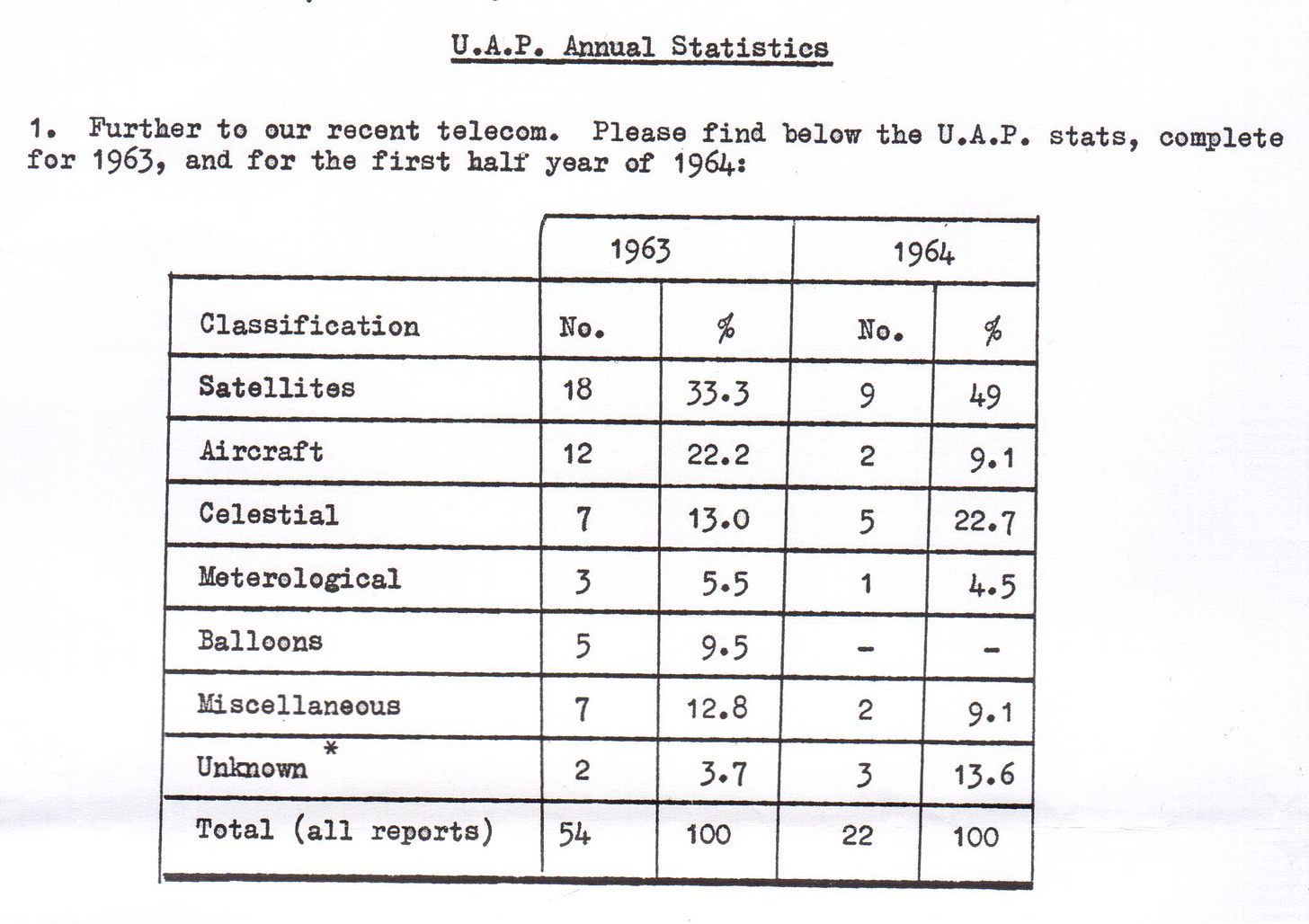
Later, the Air Ministry and Ministry of Defence began using UAP – with the meaning ‘unidentified aerial phenomena’ - to categorise reports of strange lights and objects they received from at least 1962, as the following extract from a monthly statistical breakdown illustrates:
Extract from a British Air Ministry memorandum on UFOs produced in 1963
(Credit: UK National Archives AIR 2/17526)
By the 1980s at least three separate departments within MoD were receiving UFO reports and each had its own definitions and descriptors for filing purposes. The so-called ‘UFO desk’, Secretariat (Air Staff) or Sec(AS), staffed by civilians, naturally preferred UFO as it was the phrase used by most of its persistent public correspondents. But the secret squirrel Defence Intelligence branch DI55, that was copied into and investigated the more interesting reports, preferred UAP.
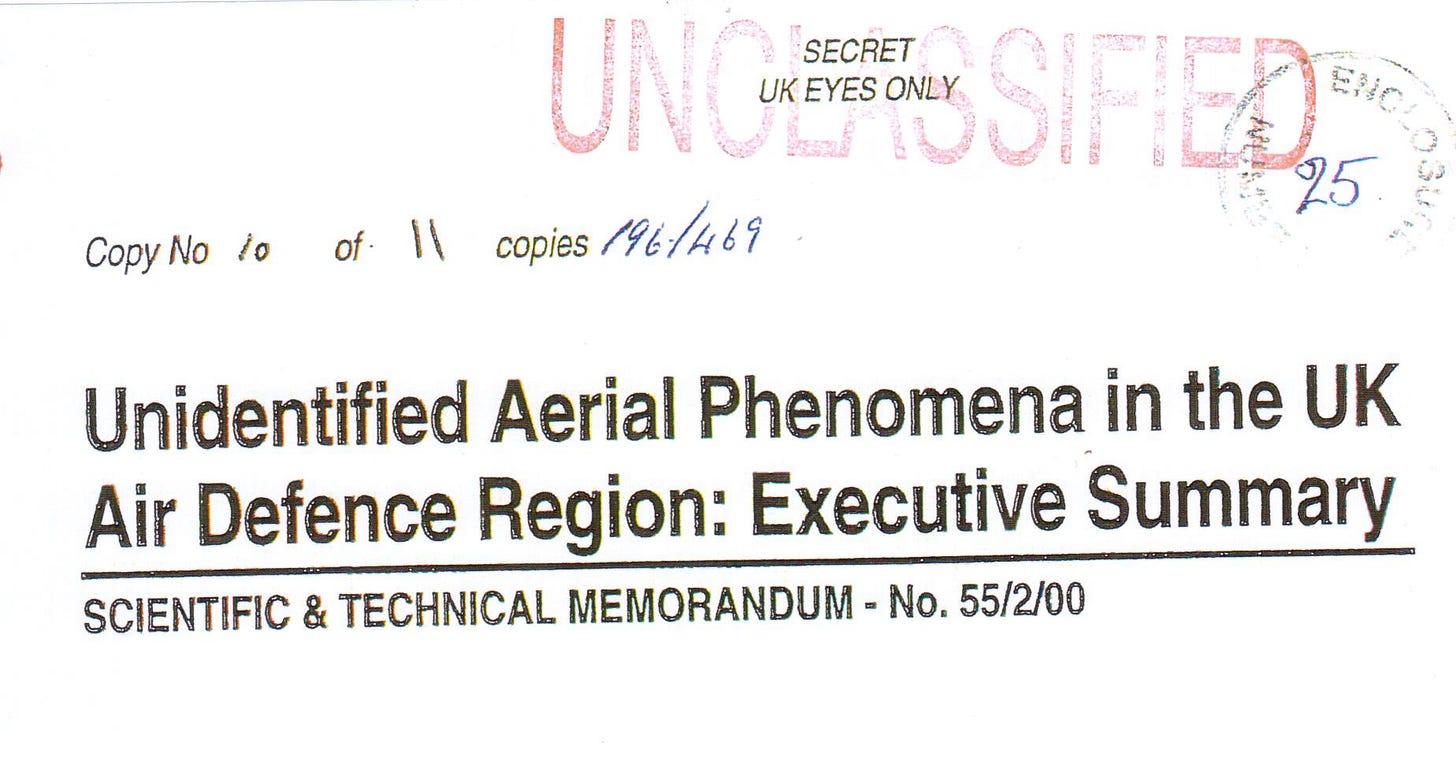
Indeed when the head of Defence Intelligence signed off a £50K contract for a detailed study of DI55’s database in 1996, their report was called Unidentified Aerial Phenomena (UAP) in the UK Air Defence Region, often referred to by its code-name Condign. In his book Encounter in Rendlesham Forest (2014) the late former UFO desk officer Nick Pope claimed that it was he, working with his DI55 opposite number, who first created and used the acronym UAP within the UK MoD in 1993-94. UAP was later adopted by Ron Haddow, the author of the report, completed in 2000. ‘Language was a key part of this “selling job”,’ Pope wrote, ‘and my DIS colleague and I agreed to drop the term “UFO”…replacing it with the more scientific sounding tern “UAP”.

Former MoD UFO desk officer Nick Pope, who died in April 2026.
(credit: Chris Fowler)
Pope occupied the UFO desk from 1991-94 and as UAP occurs frequently in Air Ministry and MoD documents between 1962 and 1987 that claim cannot be accurate. I can demonstrate without any shadow of doubt that Pope, Haddow and others in MoD were well aware that UAP was being used extensively in the UFO literature long before their internal debate during the mid-1990s. Indeed one of the best-known American UFOlogists, the astronomer Dr J Allen Hynek, who had been a consultant to Project Blue Book, was using UAP two decades earlier, in collaboration with British UFO investigator and writer Jenny Randles.
Jenny visited Hynek during a tour of the USA and felt his system of classification, that divided stories into lights in the sky, daylight discs, radar-visuals and close encounters, needed to be updated in order to attract more scientific interest in what was still a fringe subject. In her 1979 book UFOs: A British Viewpoint Jenny opines that ‘we ought to redefine our terms and speak of a UAP (unidentifiable atmospheric phenomena)’. In her follow-up UFO Study (1981) UAP appears in her ‘glossary of terms’, alongside an attempt to justify use of the word unidentifiable because it ‘implies it is not presently explicable to any observer and atmospheric phenomena covers all possibilities for origin (both natural and artificial) and thus implies nothing’.
Recognising this argument was confusing, two years later in the book UFO Reality Jenny admits she dislikes UFO as the word object implies something of artificial origin (as in flying saucer?). Nevertheless, she accepted that ‘UFOs it is, to almost everybody, and convention dictates that I follow suit’. A similar argument was made when the UFO desk clashed with DI55 in 1997 over the latter’s use of UAP in Ministry of Defence documents.

British UFO writer and investigator Jenny Randles, pictured in 1995
(credit: Chris Fowler)
In her 1985 book Science and the UFOs, co-written with Peter Warrington, an entire chapter is devoted to UAP, an acronym that Jenny once pronounced, in my presence, as ‘whap’. In their book, Jenny and Peter go on to explain that ‘in our opinion there is an as yet unexplained type of transient atmospheric phenomena which we have termed UAP’. They go on to separate what they regard as True UAP – meaning an unknown natural phenomenon – from the more subjective accounts of close encounter experiences.
A close reading of the ‘Working Papers’ in volume 2 of Ron Haddow’s Condign report reveals that he used maps and graphics from both Jenny’s 1992 book UFOs and How to See Them and Pau Devereux’s 1996 book Earthlights Revelation. Elsewhere he claims that he was making a conscious effort to avoid being influenced by the literature of UFOlogy. But not only did he use UAP in the title of his 3-volume report but his conclusions, that True UAP are manifestations of ‘dusty plasmas’, a hitherto unknown type of atmospheric plasma unrecognised by physicists, reflect the contents of the very same books that he claimed not to have consulted.
Just to make matters worse, despite the use of UAP within the Ministry of Defence during the period in which the Condign report was produced, it seems these debates have long been forgotten. The DIS branch DI55 that produced the Condign report was itself disbanded in 2002-3 during the Strategic Defence Review. The UFO desk itself was shut down in 2009, the victim of cost-cutting under Prime Minister Gordon Brown. Most of its UFO archive, that dated back to 1967, had either been destroyed or transferred to The National Archives by that stage. More recently, according to a source who works there, ‘the leadership truly appear to have washed its hands of the UFO/UAP issue’.
Within many large organisations the loss of institutional memory has been worsened by the migration from paper archives to a reliance upon internet search engines to locate documents. If it’s not immediately findable on a computer then it doesn’t exist, or has been ‘lost’, which is the default response to most Freedom of Information requests. As an experiment I submitted a question that asked ‘has the MoD followed the example of the US armed forces by adopting UAP as a substitute for UFO when referring to aerial phenomena? If not, why not?’
The answer, dated 1 May 2024, was no surprise:
‘While the MoD is aware of differing approaches currently being undertaken by other countries and allies in the investigation of UAP this is a term that the MoD does not recognise. However regarding UFO and UAP the Department’s position remains unchanged which is, that in over 50 years, no sighting reported…has indicated the existence of any military threat to the UK’.
Geschreven door peter om 20:36
Stuur door