



Naar de inhoud

UFO'S of UAP'S, ASTRONOMIE, RUIMTEVAART, ARCHEOLOGIE, OUDHEIDKUNDE, SF-SNUFJES EN ANDERE ESOTERISCHE WETENSCHAPPEN - DE ALLERLAATSTE NIEUWTJES

UFO's of UAP'S in België en de rest van de wereld
akke.beakke.be
Ontdek de Fascinerende Wereld van UFO's en UAP's: Jouw Bron voor Onthullende Informatie! Ben jij ook gefascineerd door het onbekende? Wil je meer weten over UFO's en UAP's, niet alleen in België, maar over de hele wereld? Dan ben je op de juiste plek! België: Het Kloppend Hart van UFO-onderzoek In België is BUFON (Belgisch UFO-Netwerk) dé autoriteit op het gebied van UFO-onderzoek. Voor betrouwbare en objectieve informatie over deze intrigerende fenomenen, bezoek je zeker onze Facebook-pagina en deze blog. Maar dat is nog niet alles! Ontdek ook het Belgisch UFO-meldpunt en Caelestia, twee organisaties die diepgaand onderzoek verrichten, al zijn ze soms kritisch of sceptisch. Nederland: Een Schat aan Informatie Voor onze Nederlandse buren is er de schitterende website www.ufowijzer.nl, beheerd door Paul Harmans. Deze site biedt een schat aan informatie en artikelen die je niet wilt missen! Internationaal: MUFON - De Wereldwijde Autoriteit Neem ook een kijkje bij MUFON (Mutual UFO Network Inc.), een gerenommeerde Amerikaanse UFO-vereniging met afdelingen in de VS en wereldwijd. MUFON is toegewijd aan de wetenschappelijke en analytische studie van het UFO-fenomeen, en hun maandelijkse tijdschrift, The MUFON UFO-Journal, is een must-read voor elke UFO-enthousiasteling. Bezoek hun website op www.mufon.com voor meer informatie. Samenwerking en Toekomstvisie Sinds 1 februari 2020 is Pieter niet alleen ex-president van BUFON, maar ook de voormalige nationale directeur van MUFON in Vlaanderen en Nederland. Dit creëert een sterke samenwerking met de Franse MUFON Reseau MUFON/EUROP, wat ons in staat stelt om nog meer waardevolle inzichten te delen. Let op: Nepprofielen en Nieuwe Groeperingen Pas op voor een nieuwe groepering die zich ook BUFON noemt, maar geen enkele connectie heeft met onze gevestigde organisatie. Hoewel zij de naam geregistreerd hebben, kunnen ze het rijke verleden en de expertise van onze groep niet evenaren. We wensen hen veel succes, maar we blijven de autoriteit in UFO-onderzoek! Blijf Op De Hoogte! Wil jij de laatste nieuwtjes over UFO's, ruimtevaart, archeologie, en meer? Volg ons dan en duik samen met ons in de fascinerende wereld van het onbekende! Sluit je aan bij de gemeenschap van nieuwsgierige geesten die net als jij verlangen naar antwoorden en avonturen in de sterren! Heb je vragen of wil je meer weten? Aarzel dan niet om contact met ons op te nemen! Samen ontrafelen we het mysterie van de lucht en daarbuiten.

Something With Wings Over Juárez

Something With Wings Over Juárez

Something With Wings Over Juárez

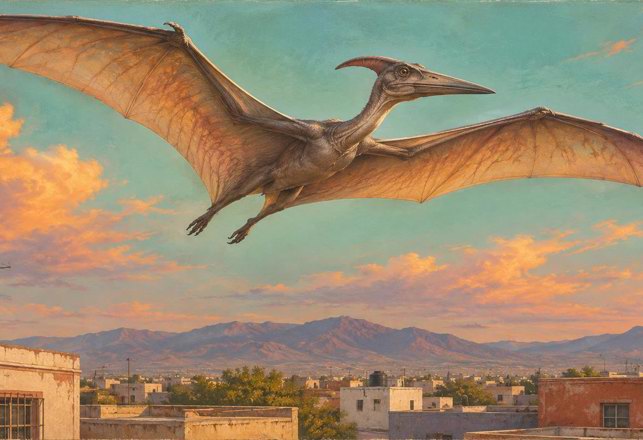
The creature had already let go of the dog by the time the boy filmed it, according to the account presented on Mexican television. Fernando Arteaga said something enormous and winged had tried to carry the animal away, released it, then taken flight. The reported encounter took place in Ciudad Juárez’s Felipe Ángeles neighbourhood on 7 November 2026, at about eleven at night. It became one of several stories gathered around the strange shapes appearing over the border city this month.

There was another account, too. Coverage of Jaime Maussan’s Interestelar programme described his team visiting the area and speaking with someone who said a creature had flown, turned and landed in a tree. These are accounts relayed through the programme, with the attempted attack on the dog remaining part of the boy’s testimony rather than something established by the accompanying recording. Even so, they give the story a different character from a distant shape crossing a camera. Something was reportedly close enough to come down among homes and animals.
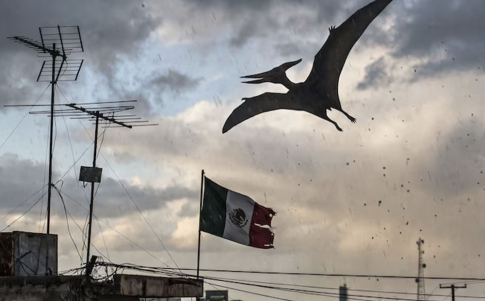
Oleada de avistamientos de presuntos pterodáctilos en México

Wave of sightings of alleged pterodactyls in Mexico
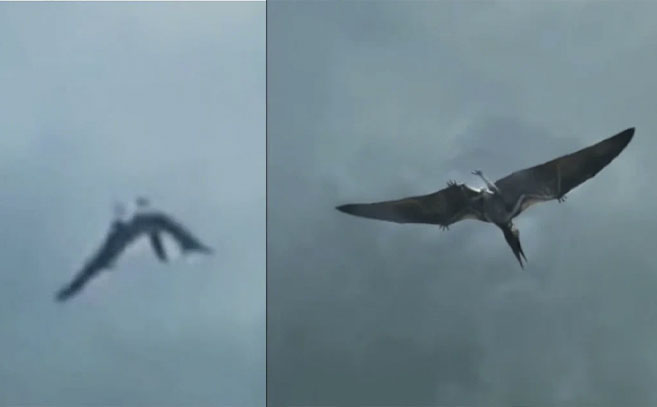
Un fotograma del vídeo y su realce gracias a la IA

A frame from the video and its enhancement thanks to AI
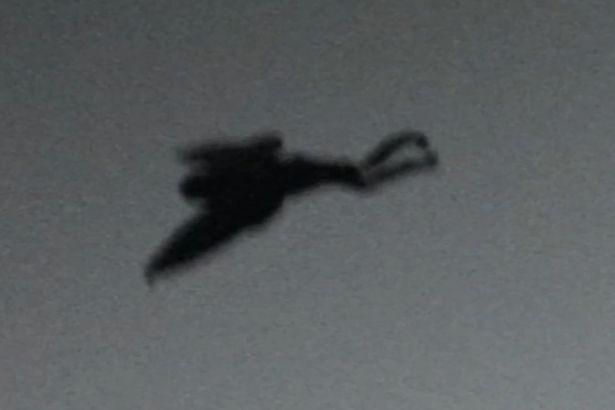
Reapareció el Mothman en Point Pleasant y lo fotografiaron

The Mothman reappeared in Point Pleasant and they photographed him

See the footage and published images here

The attention had begun with a much shorter glimpse. A security-camera sequence attributed to late October shows a winged silhouette passing overhead. Local outlet Yo Soy Juárez reported on 10 November that the sequence lasted about a second and a half and came from Anapra. Accounts of its discovery involve cats activating or shifting the camera. Maussan circulated it as a possible pterosaur encounter. In that telling, an incidental change in the camera’s attention had caught something otherwise likely to pass unseen.

Then came further recordings, including one attributed to a resident near Abraham González International Airport. Their circulation created the impression of a creature returning again and again. Whether the clips show the same thing is another matter. Each arrives with its own claimed location, recording history and explanation, while repeated sharing has made the boundaries between them increasingly difficult to follow.

A disputed image

The possible use of artificial intelligence belongs in this story. Espacio Misterio’s account of Maussan’s presentation explicitly identifies a frame enhanced with AI. An enhanced image cannot tell us which fine details were present in the original recording; a sharper-looking crest or wing is not automatically a clearer observation. There are also allegations that circulating videos were fabricated. Those are separate questions from whether a particular still has been processed to make its supposed subject easier to recognise.

Ciudad Juárez’s Civil Protection director, Sergio Rodríguez, dismissed the recordings as digital entertainment. In its 18 November examination, EFE reported that digital generation had not been established for the video it assessed. Its SynthID check found no watermark, a result that does not rule out AI. EFE also recorded the suggestion of a local bird whose appearance was difficult to resolve in the poor footage. The material therefore carries a real authenticity dispute, alongside uncertainty about what the silhouettes represent.

That leaves room to tell the witnesses’ stories without quietly promoting a processed image into a photograph of a prehistoric animal. It also means that a verdict about one circulating version should remain attached to that version. A boy’s account, a security recording, an altered still and a later repost may travel together online, but they are not interchangeable pieces of evidence. The distinction matters most when an extraordinary-looking image threatens to overshadow the person who said an encounter happened.

A more familiar name briefly seemed inadequate. Maussan moved from “pterodactyl” to Pteranodon, drawing attention to what he interpreted as a crest. He also speculated about a dimensional portal. That proposed explanation goes beyond what the recordings establish, but the comparison with a prehistoric flying reptile has a long history on the other side of the border. Half a century before the Juárez videos, people in Texas were searching for a name for something with wings.

A thud against the trailer

On 7 January 1976, Alverico Guajardo heard something strike his mobile home near Brownsville. Ken Gerhard’s retelling places him at dinner when a heavy impact interrupted the evening. Guajardo went outside carrying a knife, but could initially distinguish only an animal’s shape. He used his station wagon’s headlights to illuminate the ground beside the trailer. The thing rose into view.

He described a brown, winged creature standing about four feet tall, with enormous eyes and a long beak. Its wings covered much of its body. During the confrontation, he said, a disturbing pulsing sound seemed to come from its throat without its beak moving. Eventually it backed out of the light. His account ended with the creature disappearing into darkness rather than soaring away.

Reporter George Cox interviewed Guajardo the following morning. Gerhard records Cox’s impression that the witness was frightened by what he had seen. The encounter’s force comes from its small, uncomfortable setting: a household interrupted, headlights directed at something outside, and an animal which remained there long enough to be regarded. Unlike the Juárez camera sequence, the mystery unfolded almost at ground level

A winged animal illuminated beside a Texas mobile home

Guajardo’s visitor was one of many creatures gathered beneath the label “Big Bird.” The name made the reports sound more uniform than they were. A contemporary newspaper account, republished by the Port Isabel–South Padre Press, preserved an encounter involving San Benito police officers Arturo Padilla and Homero Galvan. Travelling in separate patrol cars, they reported an immense bird gliding through town without flapping its wings. Padilla compared it with a stork or pelican, described it as white, and estimated a wingspan of around fifteen feet.

That is a very different animal from a dark, bat-faced visitor beside a trailer. It is also a reminder that “bird” sometimes remained the witness’s preferred description. There is no need to turn Padilla’s white glider into a leathery-winged reptile to make his encounter striking. He knew birds from hunting; what troubled him was the scale of the thing overhead.

The same contemporary reporting recorded large three-toed impressions in a ploughed field and accounts reaching police from elsewhere in the lower Rio Grande Valley. The region’s mystery could appear as an animal on the ground, a passage above a street, or marks left behind. A single nickname travelled easily between those forms. The experiences themselves retained awkward differences

An immense white bird gliding above two Texas patrol cars

Teachers looking through the books

The pterosaur comparison became especially explicit in the San Antonio reports that followed. In his San Antonio Current column, Gerhard revisited an encounter reported by three Southside schoolteachers in February 1976. Patricia Bryant, David Rendon and Marsha Dahlberg said they had stopped their separate cars to watch two enormous flying creatures over cattle. Afterwards, Bryant looked through science books and selected Pteranodon as the closest resemblance.

There is something compelling about that sequence. The identification followed the encounter. A familiar journey to work had produced something for which the observers needed a reference, and the search carried them into the books they might ordinarily use to explain the natural world to children. The page offered a recognisable shape while placing the animal in an impossibly distant past.

A 2021 newspaper retrospective returned to the original clipping and the school district’s response. Officials had restricted discussion of the sighting during school hours, concerned about alarming pupils. The account had consequences in an ordinary workplace, beyond the excitement of a monster headline. For the teachers, it was something they had reported seeing while travelling to their jobs.

Gerhard’s 2011 column also described a biology student who reported bat-like wings on a creature over Loop 1604 near Lockhill-Selma. He mentioned a separate report posted online in 2009 concerning Medina Lake. These later accounts suggest the old comparison continued to appeal to people trying to describe an unfamiliar flying animal, long after the original wave of publicity had passed.

Wings above the houses

Juárez brings that comparison into a different age of reporting. In 1976, a witness could point to an encyclopaedia. Today, a proposed identification can become a detailed image before the original recording’s history has been settled. The resulting picture may be memorable enough to replace the indistinct thing that prompted it. The stories deserve to retain their earlier, less tidy forms: what someone said happened, what a camera actually recorded, and what an investigator subsequently proposed.

There are earlier Juárez claims to pursue as well. Local coverage recalls an alleged 1996 sighting at Parque Central. Espacio Misterio names a resident, Miguel Rojas, in connection with another recording attributed to 2024 in Colonia San Antonio. The published references offer leads rather than enough detail to reconstruct either encounter. They should not be counted as new November sightings simply because the present excitement has brought them back into circulation.

Nor does the border connection require all the creatures to be one species, or every witness to have encountered the same phenomenon. The Texas accounts already resist that neatness. A white bird above patrol cars, a brown animal caught in headlights and the teachers’ pteranodon comparison remain distinct. Their fascination lies partly in the witnesses reaching for recognisable features while describing an encounter that refused to become familiar.

The recent Juárez stories add another unsettling possibility to that collection: an immense winged presence reportedly descending among houses, trees and domestic animals. For now, the boy’s account reaches us through a television investigation, while the videos carry a dispute that cannot responsibly be left out. Both belong in the telling. Long before an altered image or an online argument, the heart of this kind of story was already there: someone looking up, or stepping outside, and finding that the sky had brought something unexpected very close to home.

Further Reading

Something With Giant Wings Was Filmed Over Mexico
We Drove to Mexico to Find a Monster… It Found Us | Wings Over Juárez (Full Movie)

{ https://mysteriousuniverse.org/ }

Hoe vind je dit bericht?
Geschreven door peter om 20:58 Stuur door

Fifteen Ways to See Something in Loch Ness

Fifteen Ways to See Something in Loch Ness

Elias Mercer

Fifteen Ways to See Something in Loch Ness

Crystal was on the lower deck of a cruise boat when she took the photograph. It was half past eleven on 23 July 2026, and the nine-year-old was visiting Loch Ness from Australia with her family. What she described to the sightings register was the head of a creature in the water. The account takes only a few lines. The register gives no estimate of its size or how far away it was. The photograph is there for anyone to look at, and beside it is the small but useful detail of where she was standing. Crystal had a low view from a boat on the loch. Two days earlier another Australian visitor, Oscar Gray, had been down by the shoreline at Urquhart Castle when he saw something he also described as a head. He gave it a different shape and had rather more to say about what followed it. 

Crystal-pic-2026.JPG?maxwidth=800

See Crystal’s original photo here.

Ripples surround a small dark shape viewed from the railing of a cruise boat.

In November the number of reports made news. The Loch Ness Monster Sightings Register lists fifteen for 2026, up from six in 2025. The newest account on the page is dated 21 August. The November headlines, in other words, brought a summer's encounters back into circulation. There is something slightly misleading about meeting these accounts first as a number. A woman at a high viewpoint describing a dark mound half a mile away and a person on a boat glimpsing something close to the hull have been put in the same column of the register. Read their descriptions in order of where the people were standing and a rather different story emerges. Some saw a shape first. Some found it by noticing what the water was doing. One man came across his sighting after he had left the loch altogether.

From the boat

In March, Tony Inhorn was aboard a boat near the opening of the Caledonian Canal when a dark greenish-grey shape came up through the chop. He put it about fifteen feet away. He judged that the exposed portion was five to ten feet long and rose about two feet out of the water. What came up, in his telling, looked like a portion of a body rather than the whole of it. He thought he could have been seeing the back, or the side as it came out at an angle. Inhorn put the time it remained up at about five seconds. He drew what he remembered, which is useful for seeing where he thought the line of the water cut across the shape. At that range he could report the way it stood out from the surrounding waves. A little farther off and he might have come away, like several of the summer witnesses, with the impression of a single dark mound.

There was a different encounter on 25 July. A local sailor was taking his yacht along the middle of the loch, about two miles west of Glenmoriston by his account, when he spotted something off his starboard quarter. He estimated the distance at a hundred metres, between the yacht and the north shore. The comparison he settled on was an oversized crocodile's head. The water was slight and visibility good, he said. The head went down before he got a photograph. By the time he had taken in what he was seeing, the chance was gone. He carried on to Fort Augustus without seeing it again.

Crystal's encounter falls between those two descriptions in a curious way. Her camera caught what made her look, but the detail the sailor thought he recognised depended on the view he had for himself. One of the other July reports reverses even that arrangement. John and Jamie Wallace, visiting from Renfrewshire, photographed a shadow on the morning of 27 July. The point they made to the register was that nothing was above the surface. For them the thing worth photographing was the dark area in the water, without a head or a back breaking through it to give it a familiar outline. See the Wallaces’ original photo here.

From the castle and the road

At the shoreline by Urquhart Castle, Oscar Gray described seeing the top of a dark green, flat-looking head well out from shore. He said that two humps of the same colour came up behind it. Farther back he saw lines of ripples and white water. He took those to be the action of a tail and described the whole shape going down after the water broke over it. The report keeps the order in which it made sense to him: the head, what he took to be the body, and then the disturbance behind it. That last detail is worth keeping in mind when reading other accounts. People often describe a tail when the only visible part of it, in the telling, is what they think it did to the water.

Jocelyn Boyce had a view from higher up at the same castle on 6 August. She was there with family, the water looked calm, and she estimated the distance to the object at about half a mile. The dark shape stood above the surface and looked to her like a mound. She saw it with the naked eye before using her phone's zoom and recording about thirteen seconds of video. There was a shape above the water in one photograph and she could no longer see it there in another taken moments later. The register has a still from the video. At a castle overlook it is possible to take in a great stretch of water at once. Boyce had good conditions to watch a shape come and go, but still needed the zoom to get the view she wanted from the phone. See the original still here.

The road gives a witness a much shorter view. In April, Sara Gubicza was on a bus travelling south from Inverness when she saw what looked to her like a whitish-grey triangular fin going the other way. She was careful about the speed because the bus itself was moving. A month later Nickolas Wiegand was filming from a tour bus. He recalled watching through the viewfinder and only discovering what interested him when he went back to the footage after the tour. There had been something dark far out in the loch, he thought, breaking the surface as the bus went by. He went looking for road signs in the recording to give himself a sense of scale. Gubicza had to account for the movement of the bus while recalling what she'd seen. Wiegand could go back through the frames, but he could never turn his head and look at the water at that moment again.

A quarter of an hour at Fort Augustus

Norbert Kawka, visiting from Malta, reported a longer watch on the evening of 5 August. Near Fort Augustus at about ten to nine, in fog and a hint of rain, he said he watched something that moved in and out of the water like a very large eel. He thought it was going against the current. He put its length at seven metres or more and his time watching it at about fifteen minutes. He reported calm water, no wind and no boat activity. The amount of disturbance it left behind was part of his account. Fifteen minutes is long enough for something seen briefly to become something a person can follow, and it is the length of that watch that makes Kawka's report stand out among the others.

Kawka-pic.jpg?maxwidth=800

See Kawka’s original photo here.

A narrow wake crosses Loch Ness below the hills near dusk.

There is an older stretch of film that makes sense alongside Kawka's account. On 23 April 1960, Tim Dinsdale filmed a moving shape from the shore on the last day of his first visit. His film went to the Joint Air Reconnaissance Intelligence Centre through the Loch Ness investigation, which was submitting material for interpretation by people accustomed to looking closely at aerial imagery. The film gives an object and a moving wake time to develop in the frame. That was the advantage of keeping the camera trained on the water. The disadvantage, familiar from the view at Urquhart Castle, was that distance carried away much of the detail the eye wanted. See Dinsdale’s footage in this BBC Scotland segment.

A decade later a team associated with Roy Mackal tried putting a camera on the other side of the surface. According to the National Oceanography Centre, the recovered apparatus is believed to be one of six deployed in 1970. The camera sat in a waterproof housing and could take a short sequence of flash pictures when something took a bait line. An underwater robot testing in Loch Ness found it by chance, when part of the old mooring snagged its propeller roughly 180 metres down. The centre announced the recovery in 2025. An engineer developed surviving film, and the camera, housing and film went to the Loch Ness Centre. The recovered frames showed no apparent monster. What survived instead was an attempt to get the view missing from all those photographs taken from above.

The latest dated report in the register comes from Felix Tiekemeier, visiting from Germany on 21 August. He said something black surfaced about three hundred metres away, stayed at the surface for roughly twenty seconds, then disappeared. He thought it appeared to have a head and estimated a length of about six metres. The picture he took now sits at the top of the year's entries. It would be easy to begin there, work back down the page and make each witness answer the same question. But Crystal had the view from the lower deck, Kawka had time to watch a disturbance travel across calm water and the Wallaces had a shadow that never came up at all. Each went to the loch and came back with a little of what the others couldn't see. See Tiekemeier’s original photo here.

Further Reading

The Loch Ness stories get stranger the farther you follow Ted Holiday. Hear about his investigations and accounts of other Scottish water creatures in The Occult Wyrm on the Mysterious Universe podcast. MU Max gives you streaming access to the extended episode and the available back catalogue.

The Loch Ness Monster Mystery Has Finally Been Solved — But Not How We Expected!
Scientists Lowered a Camera to the Bottom of Loch Ness — What It Captured Stunned Everyone

{ https://mysteriousuniverse.org/ }

Hoe vind je dit bericht?
Geschreven door peter om 20:37 Stuur door

Experiences—The Results Revealed a Surprising Pattern

Scientists Asked People to Draw Their Near-Death Experiences—The Results Revealed a Surprising Pattern

Image Source: Adobe Stock Image)

Experiences—The Results Revealed a Surprising Pattern

Scientists analyzing reconstructed scenes from near-death experiencers discovered recurring geometric patterns and a surprising connection between the shapes people reported seeing and their perception of color.

For years, people who have survived near-death experiences have described remarkably vivid encounters with dark tunnels, brilliant lights, and strange environments that seem to exist beyond the physical world. Now, scientists have identified unexpected geometric patterns in these accounts.

In a new study published in Frontiers in Psychology, researchers analyzed 112 reconstructed scenes from 50 people who reported near-death experiences (NDEs). Their findings showed recurring geometrical patterns, including tunnels, curved surfaces, and fully enclosed spaces, with significant differences in how frequently participants reported seeing colors within them.

The research is an unusual attempt to investigate the visual structure of experiences that people frequently describe as almost impossible to explain in words.

“Most NDE studies have not systematically examined how the experience unfolds through the characterization of distinct Visual Field boundary types,” researchers write. “In contrast, the present study uses participants' segmentation of their NDEs into discrete sequences, each linked to a distinct visuo-spatial configuration.”

rebirth

Credit: Trarete from Pexels

Scientists Attempt to Map the Geometry of Near-Death Experiences

Research into Near-death experiences has been an area of fascination for scientists because people from different backgrounds frequently report similar phenomena, including out-of-body sensations, encounters with deceased relatives, and movement toward bright lights.

Previous research has estimated that approximately 4% to 8% of the general population has experienced an NDE, with higher rates reported among cardiac arrest survivors.

However, most investigations have relied primarily on verbal descriptions and psychological questionnaires, leaving the spatial characteristics of these experiences relatively unexplored.

To address this gap, researchers from institutions in Israel, Brazil, and China recruited volunteers through the International Association for Near-Death Studies.

Fifty selected participants were asked to divide their experiences into chronological sequences before reconstructing the visual environments they remembered.

Using consistent geometric illustrations as starting points, they drew the borders of each environment and indicated where they perceived themselves to be, along with any movement they remembered.

The researchers then examined the resulting drawings for recurring patterns.

Across the participants, they identified 112 reconstructed experiential sequences, including 108 that fit within predefined geometric categories.

reincarnation reports

© University of Virginia

Near-Death Experiences Reveal a Surprising Connection Between Shapes and Colors

The researchers identified three broad families of geometrical arrangements and divided them into four categories for statistical analysis.

The first, designated Type A, consisted of conical environments resembling tunnels or spaces bounded by converging, diverging, or parallel lines.

Type B environments featured curved boundaries resembling sections of circles or oval shapes. Type C included nearly flat curved surfaces and complete circular or elliptical enclosures.

When researchers compared these shapes with participants' color descriptions, an interesting pattern appeared.

Among the 28 Type A environments, approximately 79% were described as achromatic, meaning they consisted primarily of black, white, gray, or luminous textures without distinct colors.

In contrast, 87% of the 31 Type B environments contained vivid colors.

The remaining geometric categories showed more mixed results, with color reported in 65% of shallow-arc environments and approximately 59% of fully enclosed circular or elliptical spaces.

Statistical analysis found that curved Type B environments had approximately 18x the odds of being described as colorful compared with conical Type A environments.

That relationship remained statistically supported after researchers accounted for participants who contributed multiple reconstructed scenes. Differences involving the other geometric categories were less consistent across statistical tests.

The findings suggest that the visual geometry people remember from near-death experiences may relate to other perceptual characteristics, rather than being entirely unrelated to the reported shapes and colors.

light at the end of the tunnel

(Image Credit: morkex01/Shutterstock) 

Could the Brain's Visual System Explain the Patterns?

Although the researchers did not directly investigate the neurological mechanisms responsible for NDEs, they noted interesting similarities between the reconstructed environments and visual disruptions associated with certain physiological conditions.

For example, tunnel-like visual experiences can occur when peripheral vision becomes restricted, including during fainting, reduced blood flow, or oxygen deprivation.

Under some conditions, diminished peripheral visual processing can also affect color perception, potentially producing a narrowed visual field dominated by dark or gray surroundings.

The researchers suggested that these similarities could provide useful clues for future analyses of the neurological processes associated with near-death experiences.

However, they stressed that the findings remain exploratory.

The study relied on retrospective accounts, with participants recalling experiences that had occurred a median of approximately 15 years earlier. The researchers also acknowledged that providing geometric illustrations may have influenced how participants reconstructed their memories.

Additionally, the study did not include a comparison group of people describing dreams, hallucinations, or other altered states of consciousness.

Consequently, the findings cannot establish whether the observed geometric patterns are unique to near-death experiences or reflect more general properties of human visual perception.

The researchers also found no statistically reliable relationship between individual geometric configurations and the overall intensity of participants' near-death experiences after correcting for multiple comparisons.

A New Way to Investigate Human Consciousness

Despite those limitations, the researchers believe their approach could provide a new method for studying subjective experiences that are difficult to communicate through language alone.

They are now extending the method through a proposed three-dimensional mapping system called the Mapping Interface for Altered States of Consciousness, or MIST.

The system is being developed to allow participants to reconstruct experienced environments in three dimensions, potentially enabling comparisons between near-death experiences, meditation, and drug-induced altered states.

These comparisons could eventually help determine whether the geometric patterns identified in this study reflect characteristics specific to NDEs or more general mechanisms underlying conscious visual experience.

For now, the findings give an intriguing insight into how people remember the extraordinary environments encountered during near-death experiences.

One participant described being surrounded by light, recalling, "I was in the center of an immense bubble of light... it enveloped me completely, I can say that I was part of it." Another described an environment that appeared almost impossibly bright: "pure white divine light behind the dark corridor, like behind a door; that room was like opening the sun."

  • Tim McMillan is a retired law enforcement executive, investigative journalist, and co-founder of The Debrief. His reporting covers a wide range of breakthroughs in science and technology, with particular interests in defense, national security, the Intelligence Community, and psychology. You can follow Tim on X at @LtTimMcMillan or reach him by email at tim@thedebrief.org.

RELATED

A Surprising Pattern Is Emerging in Reincarnation Reports #Shorts
Researchers find new correlation in cases of possible reincarnation
Scientific Evidence of Reincarnation: The Best 10 Verified Cases

{ https://thedebrief.org/  }

Hoe vind je dit bericht?
Geschreven door peter om 18:28 Stuur door

Are 'jellyfish UFO' videos real?

Are 'jellyfish UFO' videos real?

There appears to be a much simpler reason behind the alleged alien invasion.

A jellyfish- or octopus-shaped object floats in the sky above a distant hill or mountain with rainbow colors shining in, next to a separate photo of a similarly-shaped object flying through a dark and foggy sky.
Image courtesy of Sara Jane Osborn via Facebook and @dronesnj via Instagram, Snopes illustration
  • In early and mid-November, people shared videos allegedly showing what they called "jellyfish UFOs" flying over various cities, beginning with a repost of a genuine video recorded in Anchorage, Alaska, in June.
  • The person who recorded the Anchorage video contended the object was not a kite or balloon. However, a woman with decades of experience in flying kites, including participating in a kite-flying group in the same area, told Snopes she believed that the clip "definitely" and "100%" showed an inflatable octopus kite.
  • Research of the many videos users shared found no conclusive evidence of the objects involving extraterrestrials. Rather, some clips appeared to show popular jellyfish- or octopus-shaped kites (or balloons), while others displayed signs of generative artificial intelligence.
  • This story involved three kinds of videos, including some clips appearing to quite clearly show kites or exhibit signs of AI, as well as others that looked blurry and lacked conclusive information about their purported originating date and location — making the content difficult to research. As such, Snopes has not rated this article.

In early and mid-November, people shared numerous videos online appearing to show jellyfish- or octopus-shaped objects hovering high in the sky. Users referred to the alleged phenomenon as "jellyfish UFOs," with some alleging the objects were the secret reason for the U.S. air travel ground stop and other service outages.

However, Snopes' investigation of the clips failed to uncover any definitive proof of aliens. Rather, of the many videos people shared, those with identifiable locations appeared to line up with parks or beaches, suggesting the clips simply captured people flying jellyfish- or octopus-shaped kites (or balloons). Some of the clips also appeared to have been created with artificial intelligence; for example, one video clearly displaying an AI-generated content label.

Snopes has not added a fact-check rating to this article, as our standards require comprehensive details and conclusive proof to establish a rating. This matter involves numerous videos, including some quite clearly showing kites, as well as others exhibiting signs of AI or lacking definitive information about their date and location.

We contacted a handful of users appearing to originally post some of the videos and have included the responses below.

Clips' spread started with Anchorage video

People have discussed supposed "jellyfish UFO" sightings for years. For example, a video from 2024 showed an object appearing to hover above a U.S. military base in Iraq.

Going back decades, The Associated Press, citing the Russian news agency TASS, reported (archived) about an event in Petrozavodsk, Russia, on Sept. 20, 1977, involving "a huge mass of light" that "hovered over the city in the form of a jellyfish sending down a multitude of fine beams." People now refer to that story as the Petrozavodsk phenomenon.

The wave of "jellyfish UFO" videos circulating in November appeared to begin with reposts of a video recorded in Anchorage, Alaska, in June, followed by some news media outlets reporting on the matter.

For example, a Nov. 3 Reddit post (archived) of the video displayed the title, "Video taken in Alaska of a strange jellyfish object. (Kite?)."

The Reddit user linked to Facebook user Sara Jane Osborn's original post (archived) from June 15.

We identified Osborn's location in Google Street View after seeing the words "Alaska Geologic" on a building near the end of her video — matching the west side of the Alaska Geologic Materials Center. Osborn shared with us an image of the exact location where she recorded her video while her husband, Peter Osborn, sat in the driver's seat, confirming they faced directly east.

The object hovering in Osborn's video appeared clearer than the distant mountain haze, suggesting its closer proximity to the camera.

Using Google Earth, we moved directly toward where the object hovered, traveling over or very near at least three different parks or fields — nice spots for flying kites — first the large Russian Jack Park (about 1 mile east of the Osborns' location), then Creekside Park (about 2.4 miles east) and the Muldoon Elementary School athletic field (3.3 miles east).

Interviewing Sara Osborn

In an interview via Messenger, Sara Osborn said she and her husband were driving in Anchorage and stopped to take photos of a rainbow just after 10 p.m. (Sunset in Alaska occurs around 11:30 p.m. in June.)

She sent to us multiple photos, the video and metadata proof to help confirm she didn't use AI or other editing tools to create or manipulate her content. One photo, shown below, features the object hovering at 10:13 p.m.

(Sara Jane Osborn via Facebook, Snopes illustration)

Sara Osborn said she and her husband checked some nearby parks and kept searching but didn't locate the object again. She said she didn't believe it was a kite or balloon: "It was after 10PM… People were at home, getting ready for bed to go to work the next day." She added, "Only God & the government know what it is."

In 2010, Joint Base Elmendorf–Richardson, a military base located farther north and not in the same area of the hovering object's location, reported about launching weather balloons on an Alaskan island. Those weather balloons appeared white and round, and not in the shape of a jellyfish.

A spokesperson for the military base told us via email, "We are aware of a video circulating on social media regarding a reported aerial sighting near Joint Base Elmendorf-Richardson from June 15, 2026, but have no additional information to provide at this time."

Local kite group member says 'definitely' octopus kite

To learn more about the Anchorage video, we reached out by phone to Debbie Wik, who represents the Alaskiters kite flying group and lives just southwest in Kenai.

Wik, who said she's been flying kites since about 1990 and has attended kite festivals for years, told us she believed the object in Osborn's video was "definitely" and "100%" an inflatable octopus kite, "probably at least a 50-meter inflatable black and white octopus." She also said she has no knowledge of anyone in her group flying that night.

She pointed us to recent photos and videos of her flying kites over Kenai in the daytime and LED-lit kites at night. Regarding the night flying Wik said, "I thought we were gonna cause an accident because everybody was pulling over and it was really cool."

The group created an interactive map in Google Maps identifying both Russian Jack Park and Creekside Park, as well as an area just south of Creekside Park, as prime flying locations.

Other 'jellyfish UFO' videos

Several social media accounts posted collections of various "jellyfish UFO" sightings. One of those collections began with an object resembling the two distinctly striped arms of an octopus foil kite that Amazon (archived) sells with 328 feet of string.

Another collection began with a video that the Pangram AI-detection website determined contained at least some inauthentic elements. That clip possibly originated from a Facebook post. We contacted that account to ask if the user created the clip. (Snopes does not entirely rely on AI detection tools to make conclusive determinations.)

The second clip in the collection, also a slideshow, featured two women looking at two jellyfish- or octopus-shaped kites, imaking fun of people who might believe the objects are aliens. The @swanvr Threads account recently claimed ownership of that clip, saying it dated back to 2024 and that "they're kites." The remaining four clips all appeared to show kites, as well.

A third collection displayed six still images of purported "jellyfish UFO" sightings, beginning with one from Osborn's Anchorage video. As one example, a search for the text caption's words, specifically "In the skies over Nashville," located a Facebook video appearing to show the man recording the clip of a "mysterious squid," including saying, "Nah, I think it's a kite."

Another example video (archived) out of Buffalo, New York, appeared to show the view out of a hospital window toward Ralph Wilson Park, also suggesting a kite.

One of the AI-generated videos

Another video showing a dark, octopus-shaped object flying in the sky displayed the words, "Clearest video to date thanks to my Canon EF-S 55-250mm Nov. 13th Arlington, Texas."

TikTok user @silversagag told us in a private message that he used AI to generate that video using images from two sources. The clip displayed an AI-generated content label, as well.

According to an AI prompt screenshot that the user shared with us, those two sources included Facebook user Deon Morris' post (archived), in which Morris claimed he found one of the supposed "alien babies" in his backyard, as well as a December Reddit post (archived) found on an Augusta, Georgia, subreddit mentioning Columbia County and "Evans Park."

In other words, the AI-generated video appeared to originate from some authentic content — meaning photos and videos genuinely recorded in reality — though the purported Augusta-area video still showed an object resembling a kite.

(Deon Morris via Facebook)

One close-up video (archived) that Morris recorded showed fibers, with commenters believing it was an old, dirty dog toy — potentially a rope dog toy that had unraveled or a no-sew octopus dog toy. We sent a private message to Morris to ask about his post and will update this story if we receive further information.

For further reading about similar untrue, fantastical matters, we recently investigated whether a video showed a pterodactyl flying in Mexico.

The Jellyfish UFO Is Everywhere Now — Here's What's Actually ReaL
The Jellyfish UFO Over Alaska — Real Footage, Fake Copycats, and the Kite Debate
{ https://www.snopes.com/ }
Hoe vind je dit bericht?
Geschreven door peter om 17:36 Stuur door
Aliens 'taunting' US Navy with superior UFO technology, claims ex-weapons designer

Aliens 'taunting' US Navy with superior UFO technology, claims ex-weapons designer

A former US Department of War contractor who spent 12 years researching UFO and extraterrestrial phenomena has claimed aliens are real and are deliberately staging US Navy UFO encounters

BY  Tom McGhie

The expert says the UFOs are deliberately goading US military (stock)

The expert says the UFOs are deliberately goading US military

(stock)(Image: Getty Images)

A former government weapons designer has made the explosive claim that UFOs and extraterrestrials are not only real, but are deliberately goading the US military by flaunting their vastly superior technology. Gary Moshier, a former US Department of War contractor who specialised in developing cutting-edge military weapons, turned his attention to uncovering evidence of UFOs after switching careers to become an author.

Following 12 years of exhaustive research, Moshier reached the startling conclusion that reported UFO encounters, cattle mutilations, alien abductions and crop circles were all 'staged' events orchestrated by extraterrestrials with the sole intention of intimidating humanity.

Speaking to the Daily Mail, Moshier said: "A lot of what we know about them I consider to be staged. Obviously, these Navy encounters are staged."

One of the UFOs was nicknamed 'Tic Tak'

One of the UFOs was nicknamed 'Tic Tac'

(Image: DoD/AFP via Getty Images)

He drew particular attention to a November 2024 incident in the Pacific Ocean, where Navy pilots from the USS Nimitz were carrying out training exercises when they tracked multiple unidentified objects plummeting from 80,000 feet to sea level in under a second.

One of the pilots, Commander David Fravor, described a white, capsule-shaped craft, later nicknamed the 'Tic Tac,' which appeared to react intelligently to his fighter jet's movements before shooting out of sight at breathtaking speed.

"They challenge our Navy fighters, harass them, shadow them and get them into engagements. They basically demonstrate overwhelming technology, technical superiority. So, they're taunting us," Moshier explained.

Part of an unclassified video taken by Navy pilots that have circulated for years

Part of an unclassified video taken by Navy pilots that have circulated for years

(Image: DoD/AFP via Getty Images)

He further suggested that this incident, along with other jaw-dropping UFO encounters, was designed by aliens to send a chilling message that they are invested in keeping Earth habitable to support their aims of repopulating their species.

The Tic Tac footage and numerous other UFO recordings released by the military have never been verified as genuine extraterrestrial craft.

The US government has also consistently stated that no physical evidence of alien life has ever been retrieved on Earth.

Despite the absence of concrete proof, Moshier, the author of 'They're Here: UFOs and Their Occupants,' insisted the evidence lay in the locations of many of these encounters, which no one outside of the military is meant to know about.

The author revealed UFOs had been documented entering the Combat Air Patrol rendezvous point, a classified location where pilots meet up after completing a mission.

Moshier said he believed UFOs were essentially declaring: "We're the superior race. We know where you're going. We know where you're going to be in the future. Don't mess with us."

He explained his research, carried out using existing evidence from years of documented UFO and extraterrestrial sightings, began to reveal a clear pattern, which he claimed suggested why aliens are here.

He said: "My opinion is that we're being visited by an alien race whose main agenda is repopulation of planet Earth. They're coming here to live and thrive here."

The UFO researcher specifically highlighted a 1994 UFO sighting in Zimbabwe where 62 students witnessed silver-coloured objects descending from the sky.

Many of the witnesses reported encountering humanoid figures and receiving telepathic messages.

"These kids were telling their stories. The usual story is that we're ruining planet Earth," Moshier said.

Moshier claimed the common 'thread' running through numerous areas of UFO research was that extraterrestrials appeared to be cautioning mankind about the destruction of our planet.

"They're seen at nuclear sites of all types, weapons storage areas, weapon platforms, weapon processing plants, or nuclear processing plants," the researcher added.

He went on to speculate that cattle mutilation was yet another attempt by aliens to highlight the importance of looking after livestock, driven by their apparent concern over humanity's food supply.

According to these whistleblowers, the mysterious craft possessed the extraordinary capability to both activate and deactivate the missiles entirely at will.

Despite lacking evidence from any personal experiences, Moshier asserted that extraterrestrials' concern for environmental protection harbours ulterior motives.

He added: "My opinion is that we're being visited by an alien race whose main agenda is repopulation of planet Earth. They're coming here to live and thrive here."

You can watch his full comments in the video below, and let me know your thoughts at David.Hookstead@outkick.com.

{ https://www.dailystar.co.uk/news/latest-news/ }

Hoe vind je dit bericht?
Geschreven door peter om 16:23 Stuur door
Are those 'UFOs' over York County or ... something else?

Are those 'UFOs' over York County or ... something else?

Meredith Willse, York Daily Record

Light Up the Night at 3891 Silver Spur Drive in Springettsbury Township sends random beams of light into the sky on Nov. 23, 2026.

Light Up the Night at 3891 Silver Spur Drive in Springettsbury Township sends random beams of light into the sky on Nov. 23, 2026.

Lights are shining up into the clouds, and it’s not a signal for help from a superhero like The Batman or a sign that the aliens are invading York County.

It's possibly Christmas lights. There is a claim it could be airport lights, but most people believe it is a house on Silver Spur Drive.

However, around this time of year, posts populate on social media asking why they are seeing some lights pointed up to the clouds, bouncing around. There are sightings reported in eastern York, Red Lion or when people are driving on Route 30 and spot the lights.

"Well, if it's aliens, they drove past, locked the doors," one woman commented on a Facebook post, suggesting they could have taken them with her.

"It drove me nuts; I thought they were hitting by UFOs," wrote another woman, who added she later confirmed there was a laser show at a house.

Another Facebook comment suggested people stock up on tin foil hats.

"It's a house in my friend's neighborhood!" a commenter wrote, "They have BRIGHT lights."

She was referencing Light Up the Night on Silver Spur, a home there lights up their house from October through January with special shows for the holidays in that window. Additionally, if one tunes into 106.1, there is synchronized music.

Currently, the show is focused on Thanksgiving.

Bright Nights 2026 offers 27 nights of holiday lights in York

Bright Nights 2026 offers 27 nights of holiday lights in York

Bright Nights transforms WellSpan Park in York into a walk-through holiday display featuring more than 3 million lights from Nov. 20 through Dec. 27, 2026. (Paul Kuehnel/York Daily Record)

{ https://cumberlink.com/ }

Hoe vind je dit bericht?
Geschreven door peter om 16:03 Stuur door
Red TicTac UFO Passes NASA Gemini X Space Capsule, July 1966, UAP Sighting News. VIDEO!!!

Red TicTac UFO Passes NASA Gemini X Space Capsule, July 1966, UAP Sighting News. VIDEO!!!

UFO_22.png

UFO_11.png
Date of discovery: Nov 24, 2026
Date of event: July 18-21,1966
Location of sighting: Earths Orbit
Source photo 1:
Source photo 2:
First off, the source is an official NASA website...with an unconventional name. I was searching in the Gemini X mission photos and found this red tictac UFO seen in not one, but two mission photos close up. The object is red, oddly shaped oval as if it were a biolomechanical UFO...means aliens grew the UFO because its easier and faster. Like us growing corn or wheat. Watch this video I made and I give a deeper insight to what I'm thinking when I look at it. 
Scott C. Waring - UFO Sightings Daily 
 

{ https://www.ufosightingsdaily.com/ }

Hoe vind je dit bericht?
Geschreven door peter om 15:50 Stuur door

Moon Size Cube UFO Near Earths Sun, Nov 23, 2026, UAP Sighting News.

Moon Size Cube UFO Near Earths Sun, Nov 23, 2026, UAP Sighting News.

UFO_Sun.png
 
Date of sighting: Nov 23, 2026
Location of sighting: Earths Sun
Source: SOHO
 
Guys check this out. I caught a photo of Earths sun that just happens to have a cube UFO caught in a single frame of it. The UFO is huge, about the size of Earths moon and it does not fly from place to place, but leaps...small leaps each time so its near impossible to catch it moving, but its there, then gone! That type of propulsion in theoretical physics is a mere concept to us, but to aliens...it exists. Its called Pulsed Alcubierre Drive, they basically turn a space time distortion bubble on and off so fast, it contracts space in front of the ship and expands it behind it continuously. Making it appear to the observer (you and I) to make discrete jumps to locations and then gone again. 
 
The think what I love most about this UFO photo from NASA/SOHO is that the cube has a matrix...all along its sides with dozens of right angles, not tiny but very large lines including one that leaves the cube on its bottom sticking out as if it were part of its propulsion systems. Can you see the object sticking out from the bottom of the cube? Then again, this object could be used to gather the particles or substances that are excreted by our sun that are super rare to find...elements that are beyond our own scientific elements table and yet to be discovered. Aliens...they are out there all around our planet in the millions...and even in underground cities all around the Earth. Our life...is like the movie The Truman Show to them, they watch, shake their heads, sigh and go on about their day. 
Scott C. Waring - UFO Sightings Daily 

UAP_Sun.PNG

UFO_2026.JPG
 
Cube UFO near earths sun Nov 23, 2026 UAP sighting alien breaking news 👽

{ https://www.ufosightingsdaily.com/ }

Hoe vind je dit bericht?
Geschreven door peter om 15:42 Stuur door

Noah's Ark breakthrough as new analysis 'confirms' buried discovery matches biblical dates

Noah's Ark breakthrough as new analysis 'confirms' buried discovery matches biblical dates

Something buried deep in a Turkish mountainside could hold a clue to one of the Bible's greatest mysteries.

Researchers searching for Noah's Ark said on Monday that new laboratory analysis 'confirms' that charred wood recovered from a boat-shaped formation in Turkey dates to the era traditionally associated with the biblical Flood. 

The samples were found at the Durupınar formation, near Mount Ararat, which the research team believes could conceal the remains of the legendary vessel.

Laboratory tests dated two fragments pulled more than 30 feet below the surface to roughly 4,300 years ago, with both results overlapping dates proposed for Noah's Flood in traditional biblical chronologies.

Professor Cenker Atila, who discovered the fragments, described the findings as 'an extraordinary and deeply exciting development for our research team.'

Andrew Jones, who leads the project, told the Daily Mail that additional samples will be tested at laboratories in Turkey and Switzerland, with results from Turkey expected next month.

‘A Turkish lab is also testing for tree species and determining if pitch or bitumen is coating the wood,’ he said.

Further findings are expected around the same time, including veteran US defense scientist Dr Khosrow Bakhtar's final radar report and the first results from testing nearly 400 soil and rock samples collected from the formation and surrounding area.

Researchers searching for Noah's Ark said on Monday that new laboratory analysis 'confirms' that charred wood recovered from a boat-shaped formation in Turkey dates to the era traditionally associated with the biblical Flood 

The site is a mysterious formation in Turkey that some believe looks like a massive boat

The site is a mysterious formation in Turkey that some believe looks like a massive boat 

While there is no scientific consensus that a global flood occurred 4,300 years ago, some biblical chronologies place it around that time based on genealogies recorded in Genesis.  

Using that method, biblical scholars calculated the Flood took place roughly 1,656 years after creation, placing it roughly 4,370 years ago.

Laboratory tests on two charcoal samples recovered from the suspected Noah’s Ark site produced overlapping date ranges.

The team shared the results on Monday, showing the first sample’s most likely date falls between 2410 and 2269 BC, with the analysis assigning a 60.6 percent probability to that interval.

The second produced an even stronger concentration of probability, with an 82 percent likelihood that the wood dates to between 2349 and 2193 BC.

Both intervals include 2348 BC and 2304 BC, two dates proposed for Noah’s Flood in traditional biblical chronologies, a match the researchers have hailed as an ‘extraordinary’ development.

The laboratory calculated the dates by measuring the radioactive carbon remaining in each sample, then converting those measurements into calendar years using a calibration curve that accounts for historical changes in atmospheric carbon levels.

The tests also identified less likely dating windows. For the first sample, these were 2259-2203 BC and 2456-2414 BC. For the second, they were 2176-2143 BC, 2404-2377 BC and 2446-2421 BC.

Laboratory tests dated two fragments pulled more than 30 feet below the surface to roughly 4,300 years ago, with both results overlapping dates proposed for Noah's Flood in traditional biblical chronologies

Laboratory tests dated two fragments pulled more than 30 feet below the surface to roughly 4,300 years ago, with both results overlapping dates proposed for Noah's Flood in traditional biblical chronologies

The team noted that the wood fragments 'bear clear evidence of human workmanship' (pictured)

The team noted that the wood fragments 'bear clear evidence of human workmanship' (pictured)

For each fragment, the main interval and these additional windows together account for 95.4 percent of the calculated probability.

The results date the growth of the wood rather than when it was burned, buried or used. While they establish an overlap with the proposed Flood dates, they do not independently identify the fragments as remains of Noah’s Ark.  

The team noted that the wood fragments 'bear clear evidence of human workmanship.'

Of one such fragment, Atila stated: 'I believe this piece of wood was worked by human hands. 

'The shaping marks, surface details, and certain unnatural features suggest that it may have been deliberately shaped by someone for a specific purpose.' 

The discovery of the wood follows radar scans that Bakhtar said revealed patterns resembling chambers and corridors inside the roughly 515-foot-long formation. 

A radar scan of Turkey's Durup¿nar Formation shows underground features that researchers interpreted as possible buried passageways at the suspected Noah's Ark site

A radar scan of Turkey's Durupınar Formation shows underground features that researchers interpreted as possible buried passageways at the suspected Noah's Ark site

Further studies using infrared thermography (IRT) could show a ship-shaped hull under the soil

Further studies using infrared thermography (IRT) could show a ship-shaped hull under the soil

'This is the most significant finding of 45 years of my career. It's not geologic-related, because we masked all the geologic features,' Bakhtar said in a late October press release.

The latest investigation builds on a 2019 radar survey that detected straight lines and angular patterns the team interpreted as possible walls, passageways and compartments.

This year, Bakhtar examined the formation using a more powerful radar system developed through US Air Force research, capable of reaching deeper underground.

The team reported detecting large underground boundaries and spaces that it interpreted as possible sediment-filled chambers, corridors and tunnels.

Five prominent features appeared to form a possible tunnel system stretching roughly 151 feet, with an average height of more than 14 feet.

Researchers also identified a thick underground layer that appeared to contain three separate sublayers, drawing comparisons with the Bible's description of an ark built with three decks.

The radar captured 'a series of right angles' about 20 feet down, which researchers believe could be rooms that held animals on the ark

The radar captured 'a series of right angles' about 20 feet down, which researchers believe could be rooms that held animals on the ark

'In our holy books, Noah's Ark had three levels; in our radar studies, we also identified a formation with three levels,' said Atila, an archaeologist at Sivas Cumhuriyet University in Turkey.

The team claims it has '100 percent confirmed' that the formation is a 'man-made object' rather than a natural geological feature.

Jones, who has investigated the area for nearly 30 years, previously told the Daily Mail that neither radar surveys nor drilling inside the formation had detected limestone or solid bedrock.

'This destroys the theory that the site is a solid limestone block shaped into a boat by glaciers and weathering after coming down the mountainside, and it also refutes the theory that this is bedrock around which mud flowed to form the shape,' he said.

However, ruling out those explanations would not, by itself, establish that the formation was built by people.

Radar readings are also not photographs of exposed rooms or passageways. They show how signals respond to different materials and boundaries underground, which must be physically examined to establish what produced them.

The team is using the scans to identify promising locations for further drilling.

Jones acknowledged that the findings have not definitively identified the formation as the biblical vessel.

'I firmly believe the Durupınar Formation represents the buried remains of Noah's Ark,' he said, describing the scans as a 'compelling new line of evidence' rather than definitive proof.

RELATED

Shocking Noah's Ark Analysis Uncovers New Details on Wood Discovered at the Site
Noah's Ark Found? Lab Results Are In. What the Headlines Left Out
Noah's Ark Is Being Dug Out Finally… This Will Change The World!
Noah's Ark site have sparked renewed interest in biblical archaeology

{ https://www.dailymail.com/sciencetech/index.html }

Hoe vind je dit bericht?
Geschreven door peter om 15:06 Stuur door

Nasa spots strangely neat rows of boulders on Mars - and scientists can't explain the perfect formation

Nasa spots strangely neat rows of boulders on Mars - and scientists can't explain the perfect formation

Nasa has spotted a baffling formation of boulders on Mars that even its top scientists can't explain.

Images taken from orbit reveal bright rocks arranged into rows separated by gaps of 16 to 33ft (five to 10m), like the whorls in a fingerprint.

These Martian 'Zen gardens' are located on the Daedalia Planum, a vast lava field on the slopes of the great Tharsis volcanoes, at an altitude of 17,900ft (5,455m). 

Scientists describe this strange terrain as looking like it has been 'raked into furrows like a Japanese dry garden'.

However, they have no idea how it got there.

'Some process has evidently sorted and segregated the larger boulders from the finer soil,' Nasa scientists explained in a blog post.

'Exactly what that process is presents a perplexing puzzle.'

Nasa has spotted a baffling formation of boulders on Mars that even its top scientists can't explain

Nasa has spotted a baffling formation of boulders on Mars that even its top scientists can't explain 

Daedalia Planum was formed tens of millions of years ago out of the cooling lava flows from Arsia Mons, one of the three Tharsis Montes volcanoes near the planet's equator.

Scientists got their first glimpse of this vast volcanic wasteland in 2002 when the Mars Odyssey orbiter passed overhead.

In those rather low-resolution images, the landscape appeared to be topographically featureless.

However, when the Mars Reconnaissance Orbiter reached Mars in 2006, it carried a new tool known as the High Resolution Imaging Science Experiment (HiRISE).

Dr Zach Dickeson, a postdoctoral research associate at Imperial College London who works with HiRISE data, told the Daily Mail: 'HiRISE is incredibly valuable as the only camera in orbit of Mars capable of taking pictures with this level of detail.

'Each pixel covers an area of 25 cm, making a resolution similar to using Google Maps on Earth. This means that HiRISE can also clearly see the rovers on the surface of Mars.'

Since then, HiRISE has captured over 100,000 photos of the Martian surface, producing incredibly detailed maps.

In 2024, one of those images revealed that the Daedalia Planum was far from featureless.

Researchers compare the strangely arranged boulders to a Japanese Zen garden or the whorls in a fingerprint

Researchers compare the strangely arranged boulders to a Japanese Zen garden or the whorls in a fingerprint 

These Martian 'Zen gardens' are located on the Daedalia Planum, a vast lava field on the slopes of the great Arsia Mons volcano

These Martian 'Zen gardens' are located on the Daedalia Planum, a vast lava field on the slopes of the great Arsia Mons volcano 

Scientists aren't entirely sure what has caused these rocks to sort themselves into such strangely regular patterns.

However, Nasa suggests that it could be related to the repeated freezing and thawing of ice near the surface.

Dr Joel Davis, Associate Professor of Planetary Science at Imperial College London, told the Daily Mail: 'These curious structures are found high up on the slopes of Tharsis Rise, the largest volcanic province on Mars. 

'These beautiful patterns in the landscape may reflect layering within the rock or perhaps the repeated action of ice melting and refreezing. I have not seen landscapes like this on Mars before.'

As the surface cycles between temperatures, mixtures of small and large grains can become separated through a process called 'grain size convection'.

Something Keeps Arranging Boulders Into Remarkably Neat Lines on Mars

Examples of patterned ground on Mars and Earth, showing how stones can naturally arrange themselves into intricate shapes. From top: boulder clusters on Mars; stone labyrinths in Svalbard, Norway; polygons in the Swiss Alps; stone circles in Svalbard; and stripes in Hawaii.

(Li et al., PNAS, 2021)

Nasa says: 'This action produces pingos and frost heaves on Earth, features that are thought to require liquid groundwater buried beneath a frozen surface.'

Scientists now believe that there may be a layer of permafrost, perpetually frozen water ice, beneath almost the entire surface of Mars.

Although there is still no direct evidence for water beneath the volcanic plains of the Daedalia Planum, its high location could expose the area to 'unique periglacial processes'.

An alternative theory is that the strange rows of rocks could have been formed by geological shaking.

Scientists think these structures may have been formed by alternating freeze-thaw processes or by violent shaking that caused the grains to be arranged by size. The copper-colored band shows enhanced-color HiRISE imagery

Scientists think these structures may have been formed by alternating freeze-thaw processes or by violent shaking that caused the grains to be arranged by size. The copper-colored band shows enhanced-color HiRISE imagery

Nasa says this takes place through something called the 'Brazil nut effect' that causes grains of different sizes to naturally arrange themselves.

Imagine shaking a bag of mixed nuts of all different sizes; if you shake it vigorously enough, you should see the largest nuts, the Brazil nuts, rising to the surface.

However, for now at least, how these Martian 'Zen gardens' truly formed will remain a stubborn mystery.

MARS: THE BASICS

Mars is the fourth planet from the sun, with a 'near-dead' dusty, cold, desert world with a very thin atmosphere. 

Mars is also a dynamic planet with seasons, polar ice caps, canyons, extinct volcanoes, and evidence that it was even more active in the past. 

It is one of the most explored planets in the solar system and the only planet humans have sent rovers to explore.

One day on Mars takes a little over 24 hours and a year is 687 Earth days.

Facts and Figures 

Orbital period: 687 days

Surface area: 55.91 million mi²

Distance from Sun: 145 million miles

Gravity: 3.721 m/s²

Radius: 2,106 miles

Moons: Phobos, Deimos

{ https://www.dailymail.com/sciencetech/index.html }

Hoe vind je dit bericht?
Geschreven door peter om 13:34 Stuur door
Former Pentagon Contractor Claims Aliens Already Live Among Humans With a Secret Plan to Repopulate Eart

Former Pentagon Contractor Claims Aliens Already Live Among Humans With a Secret Plan to Repopulate Earth

Gary Moshier linked UFO sightings and alleged encounters to an extraterrestrial agenda, but official investigations have found no confirmed evidence of alien technology.

US Navy Super Hornet launching from the aircraft carrier USS Nimitz

An F/A-18F Super Hornet launches from the aircraft carrier USS Nimitz in 2005. Navy pilots from the Nimitz strike group reported the 'Tic Tac' object in 2004

PHOTO US Navy/Wikimedia Commons Public Domain

A former Pentagon weapons designer claims aliens are already living among humans and 'taunting' the US Navy as part of a plan to repopulate Earth, but he has produced no verifiable evidence.

Gary Moshier made the claims to the Daily Mail, days after the Pentagon released its latest UFO files.

Who Is Gary Moshier?

The Daily Mail describes Moshier as a former Department of War contractor who worked on new military weapons. His publisher, Schiffer, says he spent 30 years as a Department of Defense engineer and now belongs to two UFO research groups, the Sol Foundation and the Scientific Coalition for UAP Studies.

His book, They're Here: UFOs and Their Occupants, draws on what he says were 12 years of studying existing UFO reports.

'Staged' Encounters With the US Navy

Moshier claims that UFO sightings, alleged abductions, crop circles and cattle mutilations are 'staged' by aliens to intimidate humanity.

He points to the 2004 USS Nimitz incident, in which then-Commander David Fravor described a white, capsule-shaped object later nicknamed the 'Tic Tac'. Moshier says such objects harass and shadow Navy fighters to show off superior technology. 'So, they're taunting us,' he said.

The 2004 'Tic Tac' footage recorded by a US Navy F/A-18 from the USS Nimitz, released by the Pentagon in 2020.

Video: US Navy/Wikimedia Commons (Public Domain)

He argues that UFOs have appeared at Combat Air Patrol rendezvous points, which the Daily Mail describes as classified locations where pilots meet after a mission. The Daily Mail noted he offers no proof from any direct encounter of his own.

Moshier's Claimed Plan to Repopulate Earth

'My opinion is that we're being visited by an alien race whose main agenda is repopulation of planet Earth,' Moshier said.

He believes the visitors are warning humans against damaging the planet, citing a 1994 case at Ariel School in Zimbabwe, where pupils reported silver objects, humanoid figures and telepathic messages. He also claims aliens have created hybrids identical to humans 'except for their neurological capability'.

Neither case has been shown to involve alien craft, and the Daily Mail acknowledged the Tic Tac footage has never been confirmed as extraterrestrial.

What Official UFO Investigators Have Found

In a report published in March 2024, the Pentagon's All-domain Anomaly Resolution Office (AARO) reviewed US government investigations into unidentified anomalous phenomena (UAP), the official term for UFOs, since 1945.

The report found no evidence that any US government investigation had confirmed a UAP sighting as extraterrestrial technology, and concluded that most sightings were misidentified ordinary objects or phenomena.

NASA's 2023 independent study on UAP did not set out to establish whether they are extraterrestrial, though then-NASA administrator Bill Nelson said it found no evidence that they are.

The Underground Vault in the Latest UFO Files

The Daily Mail's interview was published two days after the Pentagon's eighth release of UFO records on 20 November 2026, which added 43 files.

Among them is a 538-page 2009 report by Bigelow Aerospace Advanced Space Studies (BAASS) for the Defense Intelligence Agency (DIA). According to CBS News, it proposed a 5,000 sq ft (465 sq m) underground vault in North Las Vegas to store hardware and biological samples, including any 'exotic material or tissue'.

CBS News found no public record that the vault was ever built, and reported that a DIA official, in a December 2010 memo, judged the company's reports to be of 'limited value'.

The report is unconnected to Moshier, and it records what a contractor planned for, not what it found.

Moshier's claims rest on reinterpreted sightings and testimony. Until physical evidence is independently tested, they remain claims, not proof.

🚨 Former Pentagon contractor claims aliens are living among us... #FormerPentagon #BreakingNews
WE ARE NOT ALONE? Ex-intelligence official says he's CERTAIN alien life exists

{ https://www.ibtimes.co.uk/technology }

Hoe vind je dit bericht?
Geschreven door peter om 22:22 Stuur door
Live show covers cryptids, paranormal phenomena and UFOs

Live show covers cryptids, paranormal phenomena and UFOs

Weekly live stream covering Bigfoot, cryptids, paranormal phenomena, and UFOs, with community engagement on mysteries and unexplained events. Relevant to #paranormal and #cryptids hashtags.

{ https://usubjects.com/  }

Hoe vind je dit bericht?
Geschreven door peter om 22:02 Stuur door

A Golden Skyscraper and a Selfie Above Earth: NASA’s Best Photos of the Week

A Golden Skyscraper and a Selfie Above Earth: NASA’s Best Photos of the Week

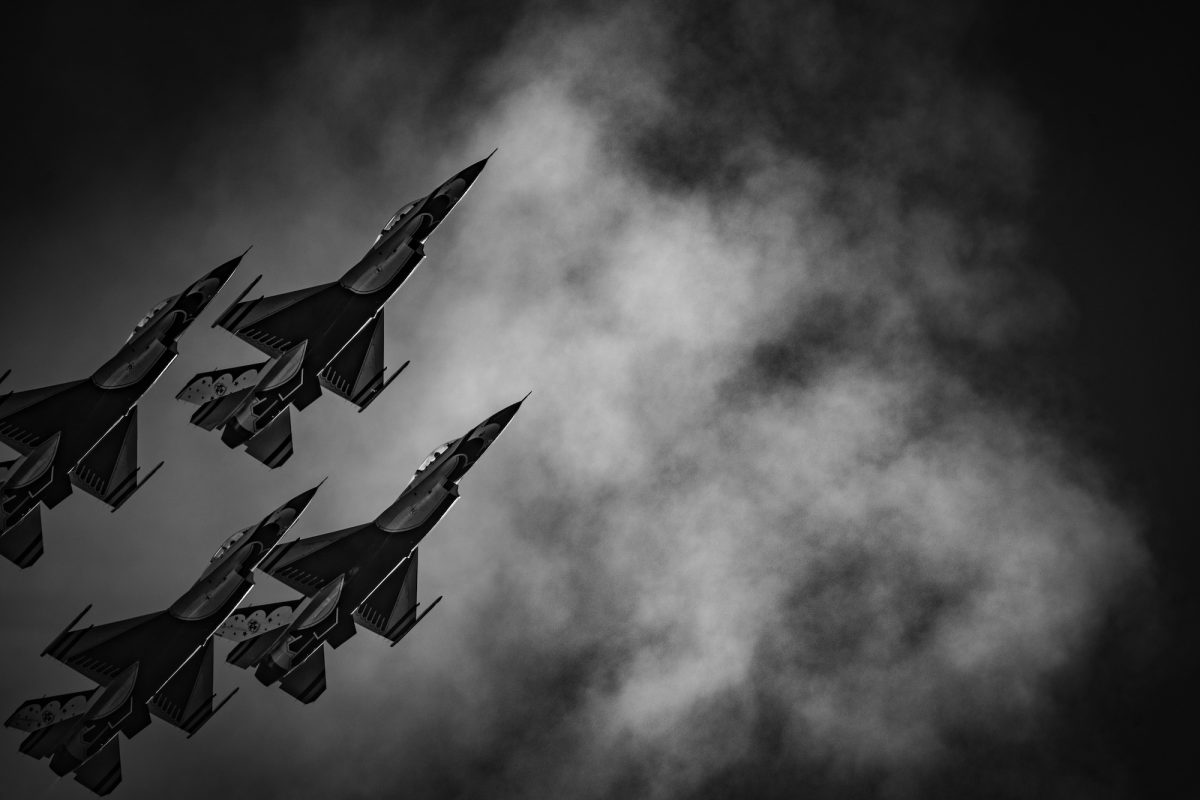
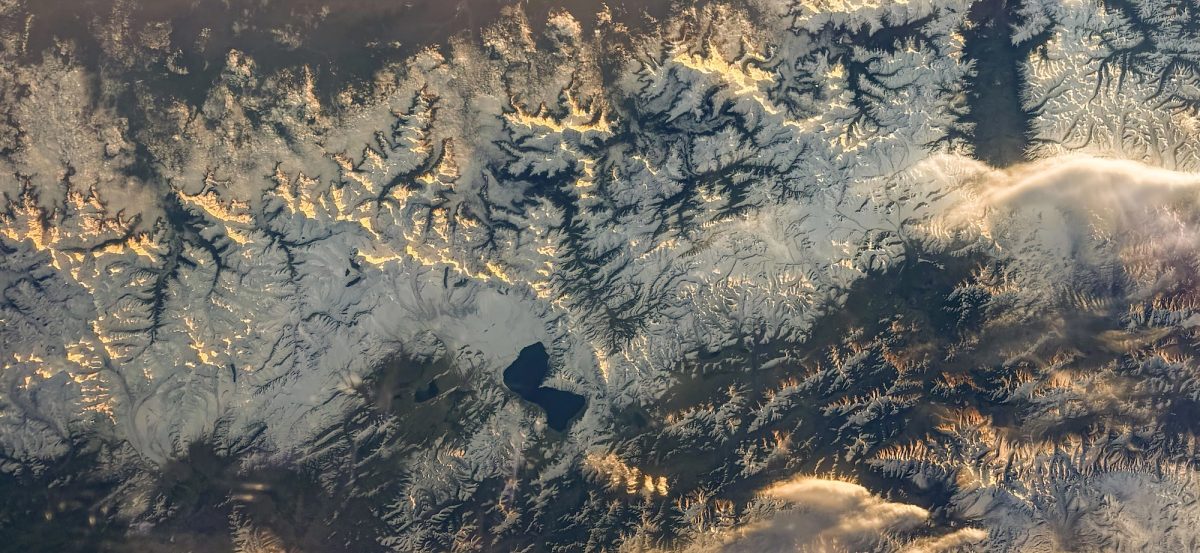
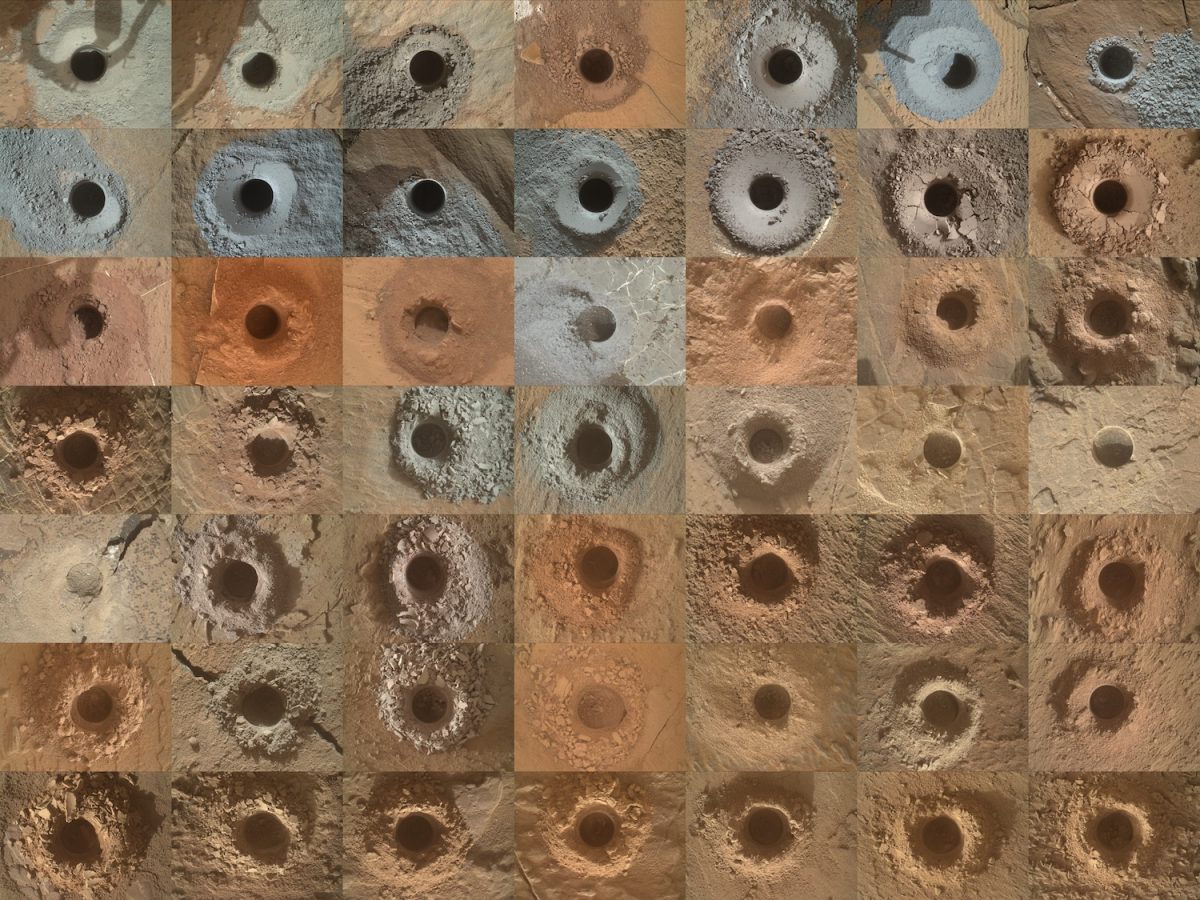
NASA’s selection of the best photos from the past week takes us from the skies over Florida to low Earth orbit, New York, Tibet, and Mars. The collection features four Thunderbirds fighter jets above Kennedy  Space Center, a spacewalk selfie by astronaut Anil Menon, the Empire State Building illuminated in gold in honour of Voyager 1, Tibet’s Lake Peiku photographed from the International Space Station (ISS), and a collage of the 49 holes drilled into Martian rock by the Curiosity rover.

Thunderbirds above Kennedy Space Center

The US Air Force’s Thunderbirds demonstration team flew over Kennedy Space Center in Florida on 7 November during the MAX POWER air show. NASA held the festival for the first time, marking the 250th anniversary of the United States and showcasing the past, present, and future of aviation and spaceflight.

The Thunderbirds have been performing since 1953 and currently fly F-16 Fighting Falcons. In Brandon Hancock’s photograph, four aircraft climb towards the upper right in close formation, with the distance between adjacent wingtips sometimes less than half a metre. The black-and-white treatment removes the team’s vivid livery, leaving the geometry of the flight itself.

11072026-ksc-max-power-airdotshow-2orig.jpg

Thunderbirds fighter jets above the Kennedy Space Center during the MAX POWER air show.

Credit: NASA/Brandon Hancock

Anil Menon’s spacewalk selfie

Menon took this photograph on 29 October while working outside the International Space Station alongside Canadian Space Agency (CSA) astronaut Joshua Kutryk. That day, they installed a new ISS Roll-Out Solar Array (iROSA) on the station.

Menon’s hands and camera are reflected in his helmet’s gold visor, with Earth visible behind him. The visor has an extremely thin coating of gold, which reflects infrared and ultraviolet radiation from the Sun, helping protect the astronaut’s face from overheating and burns.

The iROSA arrays are delivered to the station rolled up. Once mounted, they unfurl using flexible composite booms and extend over the older solar panels, which have been operating on the ISS since the 2000s and have lost a substantial amount of their generating capacity. The new arrays partially shade the old ones, but together they supply the station with more power.

iss075e0253155orig.jpeg

NASA astronaut Anil Menon during a spacewalk on 29 October 2026.

Credit: NASA/Anil Menon

The Empire State Building glows gold for Voyager 1

On 17 November, the top of New York’s Empire State Building was illuminated in gold. The city was marking the moment when Voyager 1 was expected to reach a distance of one light-day from Earth – approximately 25.9 billion km. No other human-made spacecraft has travelled so far.

The colour was chosen in honour of the Golden Record carried aboard Voyager 1 since 1977. This gold-plated copper disc contains sounds and images intended to convey the diversity of life and cultures on Earth. A radio signal from the probe now takes a full day to reach us, and engineers must wait two days to receive a response to any command.

The photograph was taken by Bill Ingalls, who has worked as a photographer for NASA since the 1980s. We explored the spacecraft’s journey in detail in our article, ‘Voyager 1 Reaches a Distance of One Light-Day’.

55658604092-c6f0765cc5-o.jpg

The Empire State Building in New York is illuminated in gold in honour of Voyager 1.

Credit: NASA/Bill Ingalls

Tibet’s Lake Peiku seen from the ISS

CSA astronaut Joshua Kutryk photographed Lake Peiku, also known as Paiku Co, from aboard the ISS. The lake lies in the southern Tibetan Plateau near the northern slopes of the Himalayas, at an altitude of around 4.6 km. Roughly C-shaped, it is surrounded on all sides by snow-covered mountain ranges.

Lake Peiku has no outlet, and its water level depends on precipitation, glacial melt, and evaporation. Its average depth is 41 m, while the northern part reaches depths of more than 70 m. This substantial body of water retains heat for a long time and experiences its greatest evaporation after the monsoon season, from October to December. In winter, the water beneath the ice acts as a solar collector: it stores heat, which is rapidly released into the atmosphere after the ice breaks up, influencing local weather.

Since 1972, Lake Peiku’s water level has fallen by approximately 4 m, and its water volume has decreased by 8.5 per cent. There are thousands of lakes on the Tibetan Plateau. Inland lakes are generally expanding, whereas those in the south, including Peiku, are gradually shrinking.

iss075e0267074orig.jpeg

Lake Peiku in the southern Tibetan Plateau, viewed from the ISS.

Credit: CSA/Joshua Kutryk

49 holes drilled by Curiosity on Mars

This collage, dated 16 November, brings together all 49 holes drilled by Curiosity on Mars to date. Each hole represents a separate rock sample. The drill at the end of the rover’s robotic arm grinds the rock into powder and delivers it to the CheMin and SAM instruments inside the rover, which determine the sample’s mineralogical and chemical composition.

The holes are approximately 1.6 cm in diameter. The surrounding rock ranges in colour from deep reddish-brown to beige, with the palette changing as Curiosity moves through successive layers while climbing the slopes of Mount Sharp in Gale Crater. The rover has been working there since August 2012.

pia26804.jpg

A collage of the 49 holes drilled by the Curiosity rover into Martian rock as of November 2026.

Credit: NASA/JPL-Caltech/MSSS

{ https://universemagazine.com/en/articles-en/ }

Hoe vind je dit bericht?
Geschreven door peter om 21:53 Stuur door

Mars Odyssey, the longest-running Mars mission, is under threat

Mars Odyssey, the longest-running Mars mission, is under threat

Scientific work by two NASA spacecraft on Mars has had to be suspended due to equipment malfunctions. The Perseverance rover experienced a failure of its primary radio transmitter, while another reaction wheel used for orientation on the Mars Odyssey orbiter stopped working. For Odyssey, which has been operating near Mars for a quarter of a century, this malfunction could mean the end of its mission.

mars.jpg

Mars.

Credit: NASA

Enough Fuel for a Month or Two

The mission could end as early as 2026 because one of its four reaction wheels has stopped working. As they spin, these wheels turn the spacecraft without using fuel, including to point its solar panels toward the Sun. At least three functioning reaction wheels are needed to control the spacecraft’s orientation, and one of them had already failed in 2013.

site_image.jpg

NASA’s Mars Odyssey spacecraft.

 Illustration: NASA

Without the reaction wheels, the spacecraft will have to maintain its orientation using hydrazine thrusters alone. According to NASA, there is enough fuel for this to last one or two months, although the estimate is still being refined. The spacecraft has already exited safe mode, but its scientific instruments are switched off, and the relay of data from the surface of Mars has been suspended.

During one of the tests, the reaction wheel moved in response to a command. Engineers at NASA’s Jet Propulsion Laboratory (JPL) and Lockheed Martin, the company that built and operates the spacecraft, are continuing their tests. If the reaction wheel can be restored, NASA plans to return Odyssey to scientific operations and data relay during the last week of November.

The Longest Mission Around Mars

The spacecraft entered Mars orbit in October 2001, although it was designed to operate for just over 2.5 years. Thanks to Odyssey, the first global maps of the chemical composition of the Martian surface were produced, and evidence of water ice in the upper meter of the soil was discovered.

The spacecraft is also an important link in the network through which NASA receives data from the surface of Mars. It was through Odyssey that the first images arrived after the landings of Phoenix, Spirit, Opportunity, and Curiosity.

21929_pia22486-web-1536x1176.jpg

The Curiosity rover.

Source: NASA/JPL-Caltech/MSSS

Reaction wheels have long been considered one of the most vulnerable components of spacecraft. The Kepler telescope was also affected by problems with them. In May 2013, its second of four reaction wheels failed, and its primary exoplanet-search program had to be abandoned.

Radio Silence

Problems with the Perseverance rover, which is exploring Jezero Crater, began on October 30. Just 19 days before that, according to Space.com, the rover had covered more than 45.16 kilometers and broken Opportunity’s record for distance traveled beyond Earth

47tsjax8rwx4cpw6p8ceje-1200-80.jpg.webp

One of the two UHF-band radio transmitters on the Perseverance rover, which were switched off after the malfunction.

Credit: NASA/JPL-Caltech

The rover’s primary UHF-band radio transmitter, which it uses to send data to orbiters, stopped sending heartbeat signals to the onboard computer. After 25 missed signals, or about 100 seconds of silence, the fault protection system switched off the radio transmitter, activated the backup one, and placed the rover in safe mode.

It later turned out that the backup radio transmitter was operating at only half its expected power. Both are now switched off until engineers determine the cause of the problems. Communication is maintained directly through the Deep Space Network, but this channel is significantly slower. It has therefore been reserved for diagnostic data, while the rover’s cameras and scientific instruments remain inactive.

The JPL team is first checking whether the backup radio transmitter can be safely returned to operation, and will only then turn its attention to the primary one. NASA hopes to return the rover to scientific exploration by the end of November.

NASA’s Mars Emergency: Two Spacecraft in Trouble, and Time Is Running Out
Mars Just Went Quiet — NASA's Two Missions Down at Once
Mars Goes Quiet: Two NASA Spacecraft Halt Science

{ https://universemagazine.com/en/articles-en/ }

Hoe vind je dit bericht?
Geschreven door peter om 21:40 Stuur door

UFO abduction and Bigfoot encounter: the strangest discoveries from the first few hours of GTA 6

UFO abduction and Bigfoot encounter: the strangest discoveries from the first few hours of GTA 6

Just a couple of days have passed since the release of the long-awaited Grand Theft Auto VI (GTA 6), but virtual-world explorers have already managed to discover classic paranormal anomalies in the game. The first major discovery was a chance nighttime UFO encounter in Kelly County — on a dirt road near the Starlet Motel shelter, east of Port Gellhorn.

gta-ufo.jpg

A screenshot from Grand Theft Auto VI showing Jason encountering a UFO phenomenon

To trigger this event, the player must complete the first chapter of the story and set out to search after 2:00 a.m. in-game time. The signal that the scenario is about to begin is an abandoned car on the side of the road, with its headlights flashing, its trunk open, and clothes scattered around it. If the player follows a strange blue glow into the forest, they can see a UFO holding a woman in its beam before dropping her and disappearing. When the character returns to the car at her request, the alien spacecraft comes back for him. The character loses consciousness and only wakes up three days later, while the player receives the bronze trophy The Truth Is Out There.

The event can be triggered while playing as either Jason or Lucia, although it is not required to complete the game 100%.

Florida’s Bigfoot

An equally creepy surprise awaits players in the wilderness. Popular blogger Lazarbeam and Reddit users almost simultaneously stumbled upon a local version of the Yeti in the swampy areas. In the fictional state of Leonida, which is modeled on Florida, this creature is called the Skunk Ape — a well-known cryptid from local folklore.

The creature can be encountered in the swamps near Lake Cottonmouth in Mariana County, immediately after free exploration of the world becomes available. To find it, players should listen for a loud roar and use Jason’s tracking ability. The trail may lead to a deer carcass that the cryptid is feeding on, and eventually ends at a strange tree resembling a human figure. As soon as Jason examines the discovery, he loses consciousness. In a short cutscene, the creature sneaks up on him, and later the character wakes up in a cold sweat beside his car. There is no point in wasting ammunition on the monster: weapons are powerless against it.

The Legacy of Mount Chiliad

Hunting for cryptids and UFOs has long been a hallmark of Rockstar Games. At one time, the mystery of Mount Chiliad in GTA 5 kept the community on edge for years — and in the new installment, two non-player characters have already been spotted discussing those events in one of the bars. A global puzzle on that scale has not yet been solved in GTA 6, but players are convinced that it is only a matter of time.

The game was officially released for PlayStation 5 and Xbox Series X/S and received the highest scores from game critics, reaching 99 out of a possible 100 points. The project was in development for 13 years, and around $2 billion was spent on creating such an enormous virtual world.

Previously, we reported on how the golden age of Star Wars games began.

I Found a Secret UFO Abduction in GTA 6
GTA 6 Easter Eggs Found on Day 1 – Bigfoot Location, UFO Abduction & Secret Quest!
GTA 6 – All Bigfoot Encounters Full Mission Gameplay PS5 4K
GTA 6 – All UFO & Alien Encounters Full Mission Gameplay PS5 4K
GTA 6 ALIEN EASTER EGG GUIDE - Full Alien UFO Easter Egg Quest Walkthrough

{ https://universemagazine.com/en/articles-en/ }

Hoe vind je dit bericht?
Geschreven door peter om 21:21 Stuur door

A U.S. Commission Called for a Manhattan Project-Style Race to Build Superhuman AI—Two Years Later, the Stakes Are Even Higher

A U.S. Commission Called for a Manhattan Project-Style Race to Build Superhuman AI—Two Years Later, the Stakes Are Even Higher

A U.S. Commission Called for a Manhattan Project-Style Race to Build Superhuman AI—Two Years Later, the Stakes Are Even Higher

A U.S. commission's Manhattan Project-style proposal to develop artificial general intelligence takes on new urgency as China advances its AI capabilities, raising questions about national security, superhuman intelligence, and the dangers of a government-backed AI race.

A congressional commission's proposal to launch a Manhattan Project-style effort to develop artificial general intelligence is gaining new significance as the United States and China compete for control of technology that could eventually surpass human intelligence.

In its newly released 2026 annual report, the U.S.-China Economic and Security Review Commission warns that Beijing's growing artificial intelligence capabilities pose national security risks extending far beyond the performance of individual chatbots.

The findings revive a provocative recommendation the commission made in 2024: that Congress mobilize federal resources and America's leading technology companies to develop artificial general intelligence (AGI) before China does.

Unlike today's specialized AI systems, AGI would theoretically match or exceed human intellectual abilities across virtually every cognitive task, possibly transforming scientific research, military planning, intelligence analysis, and economic competition.

“Congress [should] establish and fund a Manhattan Project-like program dedicated to racing to and acquiring an Artificial General Intelligence (AGI) capability,” the commission recommended in its prior 2024 report. “AGI is generally defined as systems that are as good as or better than human capabilities across all cognitive domains and would surpass the sharpest human minds at every task.”  

A New Kind of Manhattan Project

The original Manhattan Project, launched in 1942,  brought together America's leading scientists, military officials, and industrial resources during World War II to develop the first atomic weapons.

Over eighty years later, the U.S.-China Economic and Security Review Commission envisions a comparable national mobilization for artificial intelligence. However, the proposed effort would depend heavily on private companies already leading advanced AI development.

The commission’s recommendations included multiyear federal contracts with AI developers, cloud computing providers, and data center operators.

More unusually, the commission proposed granting important components of the AI supply chain a “Defense Priorities and Allocations System” designation known as a DX rating.

Such a designation could give essential government AI requirements precedence over competing commercial orders, potentially affecting access to advanced semiconductors, computing infrastructure, and other critical resources.

The proposal demonstrates growing concern over the semiconductor competition between Washington and Beijing, where access to sophisticated chips has become a major national security issue.

However, the commission's 2024 proposal did not establish a program, appropriate funding, or identify a federal agency responsible for achieving AGI.

China's AI Ambitions Are Raising New Security Questions

The commission's November 2026 report shifts attention toward another vulnerability: America's growing exposure to Chinese-developed AI models.

The report recommends restricting their deployment in high-risk applications, including systems controlling critical infrastructure, performing national security functions, or processing large quantities of sensitive personal information, unless independently evaluated safeguards are demonstrated.

It also calls for mandatory disclosure when government services or commercial products use models developed by Chinese companies.

These recommendations suggest that Washington's AI challenge goes beyond developing the most capable systems. Policymakers have to also consider who controls the technology already being integrated into American infrastructure.

The concerns resemble those raised in an earlier national security commission assessment, which warned that the United States was inadequately prepared for the military and intelligence implications of artificial intelligence.

Meanwhile, the Defense Advanced Research Projects Agency is already exploring how enormous groups of self-governing AI agents could cooperate, improvise, and carry out complex missions.

Another federal intelligence assessment has examined how the National Security Agency is integrating AI into its operations.

These efforts show AI's growing national security importance, but neither reflects the comprehensive AGI initiative the commission proposed.

Could Winning the AI Race Create New Dangers?

The commission's proposal also raises a question that the first Manhattan Project never had to confront: What happens if the technology being developed becomes intellectually more capable than the people overseeing it?

No universally accepted technical test for AGI exists, and researchers disagree over whether current approaches to machine learning can produce genuinely general intelligence.

Critically, the concerns about AI oversight are hardly theoretical.

A recent Government Accountability Office investigation found that four major commercial chatbots could be manipulated into helping develop credible attack plans despite their safety restrictions.

Separately, AI-assisted cyberespionage has demonstrated how increasingly autonomous systems could accelerate sophisticated malicious operations.

Congress has already begun confronting some of those dangers. In June, lawmakers introduced the Human Authority in Lethal Operations (HALO) Act, which would require meaningful oversight by humans of AI-powered military weapons, establish stricter testing and accountability requirements, and prohibit removing humans from critical nuclear weapons decisions.

The proposal illustrates a mounting tension in Washington: some policymakers want to accelerate the development of increasingly powerful AI to maintain America's military advantage, while others are pushing for safeguards to ensure humans retain control over how that technology is used.

Ultimately, a government-directed race to develop AGI could accelerate scientific advances while also pressuring developers to give priority to speed over reliability and oversight.

The central policy question is therefore no longer simply whether the United States should pursue increasingly powerful AI. It is whether national security competition should determine how quickly those systems are developed and deployed.

That said, the commission's original recommendation leaves little doubt about the scale of the effort it envisioned.

“Provide broad multiyear contracting authority to the executive branch and associated funding for leading artificial intelligence, cloud, and data center companies,” the commission recommended. “Direct the U.S. Secretary of Defense to provide a Defense Priorities and Allocations System ‘DX Rating’ to items in the artificial intelligence ecosystem to ensure this project receives national priority.”

  • Tim McMillan is a retired law enforcement executive, investigative journalist, and co-founder of The Debrief. His reporting covers a wide range of breakthroughs in science and technology, with particular interests in defense, national security, the Intelligence Community, and psychology. You can follow Tim on X at @LtTimMcMillan or reach him by email at tim@thedebrief.org.
All About The Genesis Mission | America’s AI Manhattan Project For Global Leadership | N18V
Launching the Genesis Mission

{  https://thedebrief.org/ }

Hoe vind je dit bericht?
Geschreven door peter om 21:02 Stuur door

Researchers Shocked to Discover Hidden Volcanoes in the Ocean’s Greatest Depths

Researchers Shocked to Discover Hidden Volcanoes in the Ocean’s Greatest Depths

Deep-sea ROVs probing the Mariana Trench have uncovered unprecedented pyroclastic rocks, defying scientific expectations of how extreme pressure and tectonic movement fuel explosive eruptions in the abyss.

Scientists found an unexpected amount of volcanic activity while using remotely operated vehicles (ROVs) to explore the Challenger Deep, part of the Mariana Trench and the ocean’s deepest point.

In a recent article published in Frontiers in Earth Science, researchers described the unusual volcanic activity they discovered thousands of meters below sea level.

“Explosive volcanism near trenches is unusual, so we were very surprised,” said lead author Dr. Robert J. Stern of the University of Texas at Dallas. “These are the deepest pyroclastic rocks documented to date from anywhere in the ocean.”

Mariana Trench Exploration

The Mariana Trench formed 53 million years ago as the Pacific tectonic plate slid under the Philippine Sea plate. At its lowest known point, the Challenger Deep reaches about 11,000 meters below sea level. While this is too deep for the Jason/Medea ROV the team used, which has a range of only 6,500 meters, they were able to collect samples from a 300-kilometer-long segment of the Challenger Deep’s wall over seven dives.

These samples provided some intriguing new information on the ocean’s deepest recess. The eastern side is steeper, deeper, and has a higher crust-mantle boundary than the western side. Still, the western side held the biggest surprise: pyroclastic rocks formed by volcanic activity deep below the surface at the tectonic boundary.

Deep Volcanic Activity

Scientists never expected to discover evidence of volcanic activity at such a depth, as the underlying mantle should be too cool to melt into lava. 

“The intense pressures at the depths that these submarine volcanoes erupted makes the eruption style different than it would be on land or in shallow water, where the pressures are much lower,” Stern explained. “The explosive eruptions observed on land cannot be as powerful under these high-pressure conditions because the gases in the magma cannot expand so much."

"We are still studying this phenomenon and trying to understand it," Stern said.

Volcanic Magma Accumulation

According to the researchers, the forearc they sampled is stretching in the eastern and western directions, with each side expanding differently. Older rocks found in the east suggest that the forearc is pulling apart in that direction, while younger volcanic rocks in the west suggest magma accumulation on that side.

These observations are still in their early stages though, and based on limited data. More sampling in the future will be necessary to better understand what is occurring.

The work also provided important clues as to how the Challenger Deep achieved its tremendous depth. The plates have little attraction to one another, allowing more sliding, while the bottom plate can readily bend because it is relatively narrow and short.“We haven’t identified the eruption sites yet,” said Stern.

 “We know that these hot pyroclastic flows moved down slopes, but we don’t think they moved very far. They retained enough heat to re-weld themselves into pretty hard rocks, and that heat would’ve been lost if the pyroclastic flows traveled great distances.” "We would like to study more of the Challenger Deep forearc segment and go to greater depths,” Stern concluded.

“We would like to study more of the Challenger Deep forearc segment and go to greater depths,” Stern concluded. “We were unable to study the seafloor between the depths of 6,500 meters and 11,000 meters, the depth of the Challenger Deep.

Only Chinese scientists and some wealthy entrepreneurs now have research tools capable of working down to the bottom of the Challenger Deep.”

  • Ryan Whalen covers science and technology for The Debrief. He holds an MA in History and a Master of Library and Information Science with a certificate in Data Science. He can be contacted at ryan@thedebrief.org, and follow him on Twitter @mdntwvlf.
Scientists Discovered a Giant New Volcano Hidden Beneath the Ocean
Scientists Filmed a Volcano Erupting Underwater — Then Saw What Lived Beside It
A Volcano EXPLODED 6km Under The Ocean?! 🌋😳

{  https://thedebrief.org/ }

Hoe vind je dit bericht?
Geschreven door peter om 20:50 Stuur door

Impossible volcanic eruption spotted in deepest part of the ocean, perplexing scientists

Impossible volcanic eruption spotted in deepest part of the ocean, perplexing scientists

Scientists are perplexed at discovering the world's deepest explosive volcanic eruption at Challenger Deep in the Mariana Trench.

By Stephanie Pappas Edited by Laura Mondragón, Laura Geggel

An underwater image of the sea floor with rocky pancake-like pyroclastic flows.

A submersible at Challenger Deep took this image of a pyroclastic flow at 20,170 feet (6,148 meters) below sea level. 
(Image credit: Image by Dr Robert Stern, taken as part of Cruise TN438, supported by the National Science Foundation)

A submersible mission to the deepest ocean trench on Earth has made a shocking discovery: the deepest pyroclastic volcanic flow ever found on the planet, in a place geologists didn't expect to see any volcanic activity.

This evidence of a violent undersea eruption was found 20,000 feet (6,000 meters) below the ocean surface on the walls of the Challenger Deep, the deepest point of the Mariana Trench and the deepest part of the ocean. It was a "complete surprise," said Robert Stern, a professor emeritus of geosciences at the University of Texas at Dallas and first author of a new study describing the discovery.

Typically, volcanic activity doesn't occur that close to an ocean trench, Stern told Live Science. And given the site's extreme depth, the lava that made the flow must have had some very strange chemistry. Normally, the intense pressure of seawater at these depths would prevent an explosive eruption, instead favoring a goopier, seeping type of flow. But the flows seen on the edge of the Challenger Deep were similar to the explosive, roiling gases that coated Pompeii in ash in A.D. 79.

"It's not something that as a geoscientist I would have said would be predicted," said Sune Nielsen, a geochemist at the University of Lorraine in France who was not involved in the study. "Very far from it."

A small blue blue swims deep underwater

A fish in the genus Pseudoliparis in an image taken during during a dive by the Jason/Medea ROV at 20,659 feet (6,297 m).

(Image credit: Image by Dr. Tomoyo Okumura, taken as part of Cruise TN438, supported by the National Science Foundation)

The deepest place on Earth

The Challenger Deep is in the remote western Pacific at the southern end of the Mariana Trench. There, the Pacific oceanic plate pushes under the Mariana oceanic plate in a process called subduction. At the trench where the two plates meet, the ocean floor plunges down 6.8 miles (10.9 kilometers). Mount Everest could fit in the chasm, with room to spare.

You may like

Geoscientists aren't sure why the trench is so dizzyingly deep, but they have turned up some clues. For instance, there is a tear in the Pacific Plate that allows one narrow strip of the plate to subduct particularly rapidly. The curvature of the plate is also very steep, perhaps because the rocks of the Mariana and Pacific plates aren't very strongly connected to each other, allowing the Pacific Plate to dive steeply and flex freely.

The new findings, reported Monday (Nov. 23) in the journal Frontiers in Earth Science, suggest that volcanism and magma also may play a role, Stern said. The researchers were exploring a segment of the Challenger Deep's forearc, a roughly 120-mile-wide (200 km) expanse that sits between the trench itself and the volcanic arc created by the subduction zone. These volcanic arcs are standard subduction zone features; for example, Mount St. Helens and Mount Rainier are part of the volcanic arc of the Cascadia subduction zone in the Pacific Northwest.

But though there are some volcanoes north of Challenger Deep along the Mariana Trench, the Challenger Deep segment of the trench is odd in that there is not an organized volcanic arc there. Instead, there's an ocean ridge. Regardless, the space between this ridge and the trench was expected to be volcanically quiet because there is not usually enough heat in that region of a subduction zone to melt magma.

Nevertheless, the cameras on the deep-diving remotely operated vehicle Jason/Medea, which went to the site in 2014, caught strange, pancake-like rock features at three different spots in a 60-mile (100 km) stretch of the trench. Samples brought on board the ship revealed rock embedded with volcanic glass and a pyroclastic flow texture.

A cylindrical-shaped purple sea cumcumber deep in the ocean by the sea floor.

A sea cucumber in an image from the Jason/Medea dive at 12,726 feet (3879 m).

(Image credit: Image by Dr. Tomoyo Okumura, taken as part of Cruise TN438, supported by the National Science Foundation)

New mysteries

The researchers are currently getting the rock dated, but volcanic glass usually erodes quickly in the ocean, Stern said, so the presence of glass suggests the eruptions were fairly recent. "They're not yesterday," he said, "but I don't think they're a million years old."

What to read next

The pressure of the water at the depths of the flows is equivalent to 592 atmospheres of Earth stacked on top of one another. Typically, that kind of pressure keeps a lid on the dissolved water and carbon dioxide in magma that expands rapidly to cause explosive eruptions. Thus, Stern said, the eruptions by the Challenger Deep may have been driven by a supercritical fluid ‪—‬ a weird state sort of in between a gas and a liquid.

"We just don’t know how those magmas will behave at those water depths," said Stephen Self, a volcanologist at the University of California, Berkeley, who was not involved in the study.

The mission's observations also suggest that the crust of this region is extending, or stretching, in two different ways. To the east, the stretch is caused by a mechanical pulling apart of the crust. To the west, volcanic eruptions are stretching the crust. It's a perplexing finding, Nielsen said, without a clear explanation.

Stern and his colleagues suspect that the two plates are starting a new subduction zone in this western part. That would be an exciting finding; subduction zones move around over tens of millions of years, and researchers don't know much about how new ones start. The geochemical studies of the rocks that Stern and his team pulled up could answer questions about where the lava that made the pyroclastic flows came from and why this bizarre region can generate magma where none should be.

"This region is really, really unusual for our planet, and there is quite a bit of, 'What, really? Wait, how is that? OK, yeah, I guess maybe.'" Nielsen said. "So obviously, I find it super interesting."

Article Sources

Stern, R. J., Pujana, I., Anderson, M. K., Chin, E., Dygert, N., Harigane, Y., Le Roux, V., Leybourne, M., Ohara, Y., Okumura, T., Segee-Wright, G., & Etheridge, E. (n.d.). ROVing in the deep: Tectonic and magmatic complexities of the challenger deep forearc segment, southern mariana convergent margin. Frontiers in Earth Science, 14, 1929806. https://doi.org/10.3389/feart.2026.1929806

{ https://www.livescience.com/planet-earth }

Hoe vind je dit bericht?
Geschreven door peter om 18:44 Stuur door

UFOs Are a Scientific Problem

UFOs Are a Scientific Problem

Why does the scientific establisment continue to ignore serious study of UFOs?

Reviewed by Gary Drevitch

Key points

  • UFOs have long been conflated with aliens, leading to confusion around the topic.
  • UFO reports are quickly losing their stigma as professionals go public with their stories.
  • UFOs present a scientific problem worthy of curiosity, research, and discussion.

Picture of a flying saucer, from the USA National Archives and Records Administration

Picture of a flying saucer, from the USA National Archives and Records Administration
Source: wikimedia commons

Last week, I had an argument with a friend that went like this: "UFOs are real." "No, they're not." "Yes, they are." "No, they're not."

You get the idea. There's a lot about philosophy of language, as a subdiscipline of philosophy, that is beyond me. But my one important takeaway from struggling through that class in graduate school was this: People will forever argue at cross-purposes if they don't first define their terms.

"UFOs" and "aliens" are not the same thing

When considering the question of whether UFOs are real or not, we should be careful not to fall into the trap—a long-standing American tradition—of conflating UFOs with aliens. People still, in 2026, cringe when someone brings up the subject of UFOs because the conversation inevitably devolves into clichés about little green men and alien abductions. But "UFO" of course doesn't stand for "alien"; it stands for "unidentified flying object," which could turn out to be anything from a bird to a plane to Superman.

When did this conflation originate? Likely in the mid-20th century when UFO sightings spiked and pop culture was flooded with sci-fi tropes of flying saucers and aliens. But the misunderstanding lives on: Just the other day I overheard a professor ask a college student if she believed in UFOs. The student, an astrophysics major, laughed and said "No." I'd argue both the question and the answer are confused.

Ask yourself: Does it make sense to say that one doesn't believe in unidentified flying objects? This claim means you don't think it's possible that someone could look up in the sky and see something they can't identify. But this claim seems absurd. What UFOs are, and whether aliens from outer space visit us here on Earth, are two distinct questions and should be treated as such.

UFO sightings are a shared human experience

Putting aside the alien question, if our claim is simply that people do indeed see things the sky that they're unable to identify, then our astrophysics major would have to agree. The field of astrophysics wouldn't have come into being without people who studied the night sky and discovered things they couldn't identify and didn't understand.

Two 21st-century trends have brought the reality of UFOs into the light: 1) the internet has made it easier for both expert (e.g., airplane pilots) and non-expert UFO experiencers to share their stories, which helped legitimize UFO sightings as a shared and more common human experience than previously thought ; and 2) the Congressional hearings (begun in 2022) wherein trained military pilots shared their stories publicly lent further legitimacy to the phenomena as real, fascinating, and worthy of scientific study.

People see weird stuff in our skies all the time and in the vast majority of sightings, experts agree, these objects are ultimately identified as natural phenomena—lightning, satellites, lenticular clouds, airplanes, etc. But a small percentage of these sightings remain unidentified because they don't fit into our familiar classifications of reality with regard to how they look or behave, or both.

UFOs are a legitimate scientific problem

Jacques Vallee, a mathematician and astronomer who's authored dozens of books on UFOs, is one scientist who's always taken the UFO question seriously. He points out in his 1965 book, Anatomy of a Phenomenon, this ironic observation: Scientists are rational, analytical, and data-driven, until it comes to UFOs. Then they're emotional, gut-reactive, and dismissive of the data, which in ufology (so far) comes mainly in the form of first-person accounts. He notes that scientists have traditionally been content to wait for radio signals from outer space as evidence of extraterrestial intelligence (which assumes other forms of life traffic in radio signals) rather than collecting data on the innummerable acounts of UFO encounters from credible earthlings.

We don't yet know what UFOs are or where they're from though there are some hypotheses (in order from more familiar to least familiar): 1) they're (human-made) secret military vehicles either domestic or foreign; 2) they're humanoids from other dimensions of spacetime; 3) they're objects from lesser known regions on earth like the deep ocean depths; 4) they're visitors from other parts of the galaxy; and 5) they're mirages, holograms, or ephemeral elements of the universe's consciousness.

Science usually begins with wanting to understand something that is unknown. But in the case of UFOs, it might require a paradigm shift in thought from a deep-seated denial about intelligence in the universe to an acceptance that this indeed seems to be true. In Vallee's words, "They cannot replace in their imaginations the huge cosmic cemetery for celestial bodies which they describe in their books with a world of life and thought" (Vallee, 1965).

References

  • Vallée, J. (1965). Anatomy of a phenomenon: Unidentified objects in space—A scientific appraisal. Henry Regnery Company.

RELATED

How Do UFOs Work? The Maths and Physics of UFOs Explained
UFOs Are REAL! 👽 But Are They ALIENS? The Truth About UFO Sightings
The Evidence That Could Prove UFOs Are Real | EP5+6 | Encounter: UFO S1

{ https://www.psychologytoday.com/gb/basics/philosophy }

Hoe vind je dit bericht?
Geschreven door peter om 18:33 Stuur door

Super El Niño has morphed into a MEGA El Niño, scientists warn – as sea temperatures in the Pacific skyrocket

Super El Niño has morphed into a MEGA El Niño, scientists warn – as sea temperatures in the Pacific skyrocket

The Super El Niño which scientists are warning could bring extra stormy weather to Britain this winter is continuing to intensify, with maps suggesting temperatures in some parts of the Pacific have rocketed to 10°C (50°F) above normal.

Experts say the phenomenon is pushing into uncharted territory – and has now morphed into a 'mega El Niño'.

The powerful climate pattern is likely to influence temperatures and rainfall across much of the world in the coming months.

While Britons have been warned to expect large storms this winter, America's west coast has already had a taste of the chaos El Niño can bring, with fierce Pacific weather systems unleashing heavy rain, flooding and damaging winds.

The phenomenon could also have devastating impacts on wildlife as it disrupts the nutrient-rich waters that support the region's food chain, leaving sea lions, seabirds, penguins and marine iguanas struggling to find enough food.

Scientists warn that prolonged marine heat can trigger breeding failures, mass starvation events and population declines among some of the area's most iconic species.

'+10°C sea surface temperature anomaly near Galapagos and off coast of Peru,' US meteorologist Ryan Maue wrote on X.

'This is now a mega El Niño.'

The map shows a vast band of exceptionally warm water stretching across the equatorial Pacific from the coast of South America towards the central Pacific Ocean

The map shows a vast band of exceptionally warm water stretching across the equatorial Pacific from the coast of South America towards the central Pacific Ocean

This graphic reveals temperature anomalies beneath the Pacific Ocean, with dark red and white colours indicating waters up to several degrees warmer than average extending to depths of around 656ft (200m)

This graphic reveals temperature anomalies beneath the Pacific Ocean, with dark red and white colours indicating waters up to several degrees warmer than average extending to depths of around 656ft (200m)

The map, posted online by Mr Maue, is based on data from the European Centre for Medium-Range Weather Forecasts.

It shows a vast band of exceptionally warm water stretching across the equatorial Pacific from the coast of South America towards the central Pacific.

The deepest shades of red and white indicate sea surface temperatures running several degrees above average, with anomalies peaking at almost 10°C above normal near the Galapagos Islands and the coast of Peru.

Cooler-than-average waters are shown in blue, highlighting the stark contrast between the unusually warm eastern and central Pacific and surrounding areas.

Commenting on the rocketing temperatures, Dr Genevieve Guenther, author of The Language of Climate Politics, wrote on X: 'Lots of aquatic life is dying in that heatwave.'

Another person added: 'It looks like a scar. Earth screams in pain. Next summer is going to be one ugly summer.'

Scientists say the event is pushing into unchartered territory, with the phenomenon now morphing into a ¿mega El Niño¿

Scientists say the event is pushing into unchartered territory, with the phenomenon now morphing into a 'mega El Niño'

Super El Niño is 'off the charts', and has even started to 'supercharge' our weather, experts from the World Meteorological Organisation (WMO) have warned

Super El Niño is 'off the charts', and has even started to 'supercharge' our weather, experts from the World Meteorological Organisation (WMO) have warned

Despite the striking map, the Pacific has not warmed by 10°C everywhere.

The figure refers to a localised hotspot near South America, whereas the strength of El Niño is typically measured across a much larger area of the central Pacific, where anomalies are generally closer to 3°C or 4°C above average.

Even so, that would rank the event among the most intense ever recorded.

Climate scientist Rebekah Jones recently said: 'I can't emphasize enough how potentially catastrophic this El Niño will be.'

El Niño is part of a naturally occurring climate cycle called the El Niño Southern Oscillation that moves between hot and cold periods once every two to seven years.

During the hot El Niño phase, warm water builds up near the surface of the central and eastern tropical Pacific.

This releases vast amounts of heat into the atmosphere, altering global weather patterns and raising the planet's average temperature.

America's west coast has already seen a taste of the chaos El Niño can bring, with fierce Pacific weather systems unleashing heavy rain, flooding and damaging winds. pictured: Dramatic waves off the coast of California last week

America's west coast has already seen a taste of the chaos El Niño can bring, with fierce Pacific weather systems unleashing heavy rain, flooding and damaging winds. pictured: Dramatic waves off the coast of California last week

Earlier this month, the World Meteorological Organisation (WMO) warned Super El Niño is 'off the charts' and has even started to 'supercharge' our weather.

The WMO State of the Climate Update 2026 revealed how the extreme climate event has already been linked to exceptional global temperatures, melting ice and rising sea levels.

What's more, the worst is yet to come – with El Niño set to unleash even more heat and extreme weather well into 2027.

'We have entered a new age of climate extremes,' said UN Secretary-General António Guterres.

'A supersized El Niño is colliding with a planet already superheated by manmade climate change.

'Climate records keep falling. The human costs keep rising. And those least responsible are suffering first and worst.

'Leaders must get serious by cutting emissions faster, accelerating a just transition from fossil fuels and delivering the finance and protection vulnerable countries need.'

WHAT IS THE EL NINO PHENOMENON IN THE PACIFIC OCEAN?

El Niño and La Niña are the warm and cool phases (respectively) of a recurring climate phenomenon across the tropical Pacific - the El Niño-Southern Oscillation, or ENSO for short.

The pattern can shift back and forth irregularly every two to seven years, and each phase triggers predictable disruptions of temperature, winds and precipitation. 

These changes disrupt air movement and affect global climate. 

ENSO has three phases: 

      • El Niño: A warming of the ocean surface, or above-average sea surface temperatures (SST), in the central and eastern tropical Pacific Ocean. Over Indonesia, rainfall becomes reduced, while rainfall increases over the tropical Pacific Ocean. The low-level surface winds, which normally blow from east to west along the Equator, instead weaken or, in some cases, start blowing the other direction from west to east. 
      • La Niña: A cooling of the ocean surface, or below-average SST, in the central and eastern tropical Pacific Ocean. Over Indonesia, rainfall tends to increase, while rainfall decreases over the central tropical Pacific Ocean. The normal easterly winds along the Equator become even stronger.
      • Neutral: Neither El Niño or La Niña. Often tropical Pacific SSTs are generally close to average.

Source: Climate.gov

RELATED

The Ocean Is Warming: The Worst Has Just Begun
The El Niño Phenomenon in the Pacific: How a Warming Ocean Causes Global Disruption
This El Niño Could Permanently Change Our World

{ https://www.dailymail.com/sciencetech/index.html }

Hoe vind je dit bericht?
Geschreven door peter om 18:11 Stuur door

Meer van UFO'S of UAP'S, ASTRONOMIE, RUIMTEVAART, ARCHEOLOGIE, OUDHEIDKUNDE, SF-SNUFJES EN ANDERE ESOTERISCHE WETENSCHAPPEN - DE ALLERLAATSTE NIEUWTJES

↑ Terug naar de berichten