Ontdek de Fascinerende Wereld van UFO's en UAP's: Jouw Bron voor Onthullende Informatie!
Ben jij ook gefascineerd door het onbekende? Wil je meer weten over UFO's en UAP's, niet alleen in België, maar over de hele wereld? Dan ben je op de juiste plek!
België: Het Kloppend Hart van UFO-onderzoek
In België is BUFON (Belgisch UFO-Netwerk) dé autoriteit op het gebied van UFO-onderzoek. Voor betrouwbare en objectieve informatie over deze intrigerende fenomenen, bezoek je zeker onze Facebook-pagina en deze blog. Maar dat is nog niet alles! Ontdek ook het Belgisch UFO-meldpunt en Caelestia, twee organisaties die diepgaand onderzoek verrichten, al zijn ze soms kritisch of sceptisch.
Nederland: Een Schat aan Informatie
Voor onze Nederlandse buren is er de schitterende website www.ufowijzer.nl, beheerd door Paul Harmans. Deze site biedt een schat aan informatie en artikelen die je niet wilt missen!
Internationaal: MUFON - De Wereldwijde Autoriteit
Neem ook een kijkje bij MUFON (Mutual UFO Network Inc.), een gerenommeerde Amerikaanse UFO-vereniging met afdelingen in de VS en wereldwijd. MUFON is toegewijd aan de wetenschappelijke en analytische studie van het UFO-fenomeen, en hun maandelijkse tijdschrift, The MUFON UFO-Journal, is een must-read voor elke UFO-enthousiasteling. Bezoek hun website op www.mufon.com voor meer informatie.
Samenwerking en Toekomstvisie
Sinds 1 februari 2020 is Pieter niet alleen ex-president van BUFON, maar ook de voormalige nationale directeur van MUFON in Vlaanderen en Nederland. Dit creëert een sterke samenwerking met de Franse MUFON Reseau MUFON/EUROP, wat ons in staat stelt om nog meer waardevolle inzichten te delen.
Let op: Nepprofielen en Nieuwe Groeperingen
Pas op voor een nieuwe groepering die zich ook BUFON noemt, maar geen enkele connectie heeft met onze gevestigde organisatie. Hoewel zij de naam geregistreerd hebben, kunnen ze het rijke verleden en de expertise van onze groep niet evenaren. We wensen hen veel succes, maar we blijven de autoriteit in UFO-onderzoek!
Blijf Op De Hoogte!
Wil jij de laatste nieuwtjes over UFO's, ruimtevaart, archeologie, en meer? Volg ons dan en duik samen met ons in de fascinerende wereld van het onbekende! Sluit je aan bij de gemeenschap van nieuwsgierige geesten die net als jij verlangen naar antwoorden en avonturen in de sterren!
Heb je vragen of wil je meer weten? Aarzel dan niet om contact met ons op te nemen! Samen ontrafelen we het mysterie van de lucht en daarbuiten.
In space, nobody can hear you scream, but with the right equipment, it is possible to detect a roar. That's what scientists discovered back in 2006when they began to look for distant signals in the universe using a complex instrument fixed to a huge balloon that was sent to space. The instrument was able to pick up radio waves from the heat of distant stars, but what came through that year was nothing short of astounding.
As the instrument listened from a height of about 23 miles (37 kilometers), it picked up a signal that was six times louder than expected by cosmologists. Because it was too loud to be early stars and far greater than the predicted combined radio emission from distant galaxies, the powerful signal caused great puzzlement. And scientists still don't know what is causing it, even today. What's more, it could hamper efforts to search for signals from the first stars that formed after the Big Bang.
The mission's science goals — as ARCADE floated high above Earth's atmosphere, free of interference from our planet — were to find heat from the first generation of stars, search for particle physics relics from the Big Bang and observe the formation of the first stars and galaxies. It accomplished these goals by scanning 7% of the night sky for radio signals since distant light becomes radio waves as it loses energy over distance.
A SURPRISINGLY STRONG SIGNAL
ARCADE was able to make "absolutely calibrated zero-level" measurements, which means it was measuring the actual brightness of something in real physical terms rather than relative terms. This was different from typical radio telescopes, which observe and contrast two points in the sky. By looking at all of the "light" and comparing it to a blackbody source, ARCADE was able to see the combination of many dim sources. It was then that the intensity of one particular signal became apparent, albeit over many months.
"While it might make a good movie to see us surprised when we see the light meter pop over to a value six times what was expected, we actually spent years getting ready for our balloon flight and a very busy night taking data," said NASA scientist Dale J. Fixsen. "It then took months of data analysis to first separate instrumental effects from the signal and then to separate galactic radiation from the signal. So the surprise was gradually revealed over months." That said, the impact was still huge.
Since then, scientists have looked to see where the radiation is coming from while looking to describe the properties of the signal. The latter became apparent rather quickly.
"It's a diffuse signal coming from all directions, so it is not caused by any one single object," said Al Kogut, who headed the ARCADE team at NASA's Goddard Space Flight Center in Greenbelt, Maryland. "The signal also has a frequency spectrum, or 'color,' that is similar to radio emission from our own Milky Way galaxy."
Scientists call the signal "radio synchrotron background" — background being an emission from many individual sources and blending together into a diffuse glow. But because the "space roar" is caused by synchrotron radiation, a type of emission from high-energy charged particles in magnetic fields, and because every source has the same characteristic spectrum, pinpointing the origin of this intense signal is difficult.
"It has been known since the late 1960s that the combined radio emission from distant galaxies should form a diffuse radio background coming from all directions," Kogut told All About Space in an email. "The space roar is similar to this expected signal, but there doesn't seem to be six times more galaxies in the distant universe to make up the difference, which could point to something new and exciting as the source."
The Absolute Radiometer for Cosmology, Astrophysics, and Diffuse Emission (ARCADE) mission's balloon is inflated prior to launch (Image credit: NASA)
(opens in new tab)
IS THE SPACE ROAR COMING FROM INSIDE THE MILKY WAY?
Whether or not this source is inside or outside the Milky Way is under debate.
"There are good arguments why it cannot be coming from within the Milky Way, and good arguments for why it cannot be coming from outside the galaxy," Kogut said.
One reason it probably isn't coming from within our galaxy is because the roar doesn't seem to follow the spatial distribution of Milky Way radio emission. But nobody is saying for certain that the signal isn't from a source closer to home — only that the smart money is on it coming from elsewhere.
ALL ABOUT SPACE
(Image credit: Future)
This article is brought to you by All About Space(opens in new tab).
All About Space(opens in new tab) magazine takes you on an awe-inspiring journey through our solar system and beyond, from the amazing technology and spacecraft that enables humanity to venture into orbit, to the complexities of space science.
"I wouldn't quite say that scientists have largely ruled out the possibility of the radio synchrotron background originating from our galaxy," said Jack Singal, an assistant professor of physics at the University of Richmond in Virginia, who recently led a workshop on the matter. "However, I would say that this explanation does seem to be less likely.
"The primary reason is that it would make our galaxy completely unlike any similar spiral galaxy(opens in new tab), which as far as we can tell do not exhibit the sort of giant, spherical, radio-emitting halo extending far beyond the galactic disk that would be required. There are other issues as well, such as that it would require a complete rethinking of our models of the galactic magnetic field."
Fixsen agrees wholeheartedly. "In other spiral galaxies there is a close relation between the infrared and radio emission, even in small sections of these others," he said. "So, if it is from a halo around our galaxy, it would make the Milky Way a weird galaxy, while in most other respects it seems like a 'normal' spiral galaxy."
EXTRAGALACTIC ORIGIN?
Experts think the signal is primarily extragalactic in origin. "It would make it the most interesting photon background in the sky at the moment because the source population is completely unknown," Singal said. But since the universe is so vast this doesn't exactly narrow things down that much, which is why scientists have been working hard to come up with multiple theories for the signal's source.
American physicist David Brown, for example, said the space roar could be "the first great empirical success of M-theory," a broad mathematical framework encompassing string theory. "There might be a Fredkin-Wolfram automaton spread across multitudes of alternate universes, yielding recurrent physical time with endless repetitions of all possible physical events," Brown wrote on the FQXi Community blog(opens in new tab). What this supposes is that the early universe had much more real matter than today, accounting for the powerful radio signal.
The space roar could be "the first great empirical success of M-theory," a broad mathematical framework encompassing string theory.
- Physicist David Brown
But if that is too far out, there are other theories to get your teeth into. "Radio astronomers have looked at the sky and have identified a couple of types of synchrotron sources," Fixsen said.
Synchrotron radiation is easy to make, he said. "All you need is energetic particles and a magnetic field, and there are energetic particles everywhere, produced by supernovas, stellar winds, black holes, even OB stars," which are hot, massive stars of spectral type O or early-type B. "Intergalactic space seems to be filled with very hot gas, so if intergalactic magnetic fields were strong enough [stronger than predicted], they could generate smooth synchrotron radiation," he said.
It is also known that synchrotron radiation is associated with star production. "This also generates infrared radiation, hence the close correlation," Fixsen said. "But perhaps the first stars generated synchrotron radiation yet, before metals were produced, they did not generate very much infrared radiation. Or perhaps there is some process that we haven't thought of yet."
So what does this leave us with? "Possible sources include either diffuse large-scale mechanisms such as turbulently merging clusters of galaxies, or an entirely new class of heretofore unknown incredibly numerous individual sources of radio emission in the universe," Singal said. "But anything in that regard is highly speculative at the moment, and some suggestions that have been raised include annihilating dark matter, supernovas of the first generations of stars and many others."
Some scientists have suggested gases in large clusters of galaxies could be the source, although it's unlikely ARCADE's instruments would have been able to detect radiation from any of them. Similarly, there is a chance that the signal was detected from the earliest stars or that it is originating from lots of otherwise dim radio galaxies, the accumulative effect of which is being picked up. But if this was the case then they'd have to be packed incredibly tightly, to the point that there is no gap between them, which appears unlikely.
Could gases from large clusters of galaxies be the source of the space roar? (Image credit: ESA/Hubble & NASA, RELICS)
(opens in new tab)
HOW THE 13-YEAR-OLD MYSTERY COULD BE SOLVED
"Of course, there is also the possibility that there has been a coincidence of errors among ARCADE and the other measurements to date that have mismeasured the level of the radio synchrotron background," Singal said. "This does seem unlikely, given that these are very different instruments measuring in quite different frequency bands."
Whatever the signal is, it's also causing issues when it comes to detecting other space objects. As NASA has pointed out in the past, the earliest stars are hidden behind the space roar, and that is making them more difficult to detect. It's as if the universe is giving with one hand and taking with another, but to have uncovered something so unusual is immensely exciting. When you're ruling out an origin from primordial stars and known radio sources such as gas in the outermost halo of our galaxy, it's a mystery any scientist would savour with relish.
"Beyond that, I think we may need some brilliant new origin hypothesis that nobody has thought of yet."
- Astrophysicist Jack Singal
In order for scientists to finally resolve this 13-year conundrum, more research and evidence is sorely needed. As it stands, there is a debate over sending ARCADE back up given the advent of new technology, and given its precise set of instruments, immersed in more than 500 gallons of ultra-cold liquid helium to make them even more sensitive, there would certainly be no harm in doing so.
But there are also new projects emerging which could help. "One of them will use the 300-foot [91 meter] radio telescope at Green Bank, West Virginia, to map the radio sky to higher precision than before," Kogut said. "Perhaps this will shed some light on the mystery."
Singal certainly hopes so. He is working on the Green Bank Telescope project, making use of the largest clear-aperture radio telescope in the world to measure the level of the background as a primary, rather than ancillary goal. It will do this using a definitive, purpose-built, absolutely calibrated zero-level measurement taken at the megahertz (MHz) frequencies where the radio sky is brightest. (A megahertz is equal to a million hertz.)
"This measurement is currently being developed by a team which I am on, utilizing custom instrumentation which will be mounted on the telescope," Singal explained. There is also going to be another measurement attempt, this one looking to measure or further limit the so-called "anisotropy," or variation of the radio synchrotron background, again at the MHz frequencies where it dominates.
"That is not its absolute level, but rather the small differences from place to place in the sky," Singal said. "With some collaborators, I am trying a first attempt at that using the Low-Frequency Array [LOFAR] in The Netherlands. Both of these measurements in concert can help nail down whether the radio synchrotron background is primarily galactic or extragalactic in origin. Beyond that, I think we may need some brilliant new origin hypothesis that nobody has thought of yet."
This article was adapted from a previous version published in All About Space magazine, a Future Ltd. publication.
Becker, K. (2017, August 28). Galaxy clusters offer clues to dark matter and Dark Energy. Phys.org. Retrieved September 20, 2022, from https://phys.org/news/2017-08-galaxy-clusters-clues-dark-energy.html
Brown, D. Is Milgrom's modified Newtonian Dynamics (MOND) fundamental for philosophy, science, and the physical interpretation of string theory? Retrieved September 20, 2022, from https://fqxi.org/community/forum/topic/2985
NASA. Arcade - absolute radiometer for cosmology, astrophysics, diffuse emission. NASA. Retrieved September 20, 2022, from https://asd.gsfc.nasa.gov/archive/arcade/
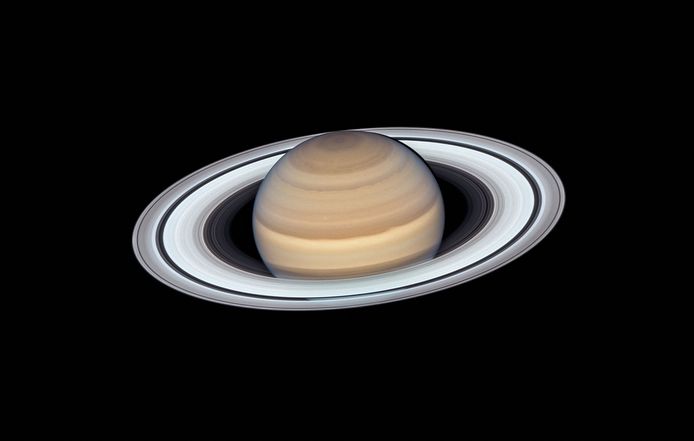
The mystery of Saturn's rings and the terrible truth behind
Unlike the thin rings of dust and rock that hover around Jupiter, Uranus, and Neptune, the ring system around Saturn is extremely impressive, and is considered a symbol when about this planet.
Saturn has a very distinct and distinctive ring.
However, the truth behind this belt is something that not everyone expected. It even scares some people, because it could happen to the Earth.
According to new research from the Massachusetts Institute of Technology, USA, this beautiful appearance may be the result of an extremely powerful collision between Saturn and Chrysalis - its hypothetical Moon.
This conclusion comes after the team conducted hundreds of simulations, with each simulation having different starting conditions.
According to the proposed scenario, about 160 million years ago, Chrysalis's orbit became unstable, causing its rotation to shift closer to the host planet.
Here, Saturn's gravity pulled its natural satellite back, and eventually led to a massive collision.
However, everything from Chrysalis is not lost. Scientists think that most of its matter is still hanging around the orbit, and has long formed the rings of the planet.
Everything from Chrysalis is not lost, but its matter has long formed the rings of the planet.
This violent encounter may also have pushed Saturn out of resonance, reducing the tilt of the axis, leading to existing resonances with Neptune.
According to Jack Wisdom, an astronomer at the Massachusetts Institute of Technology who led the study, this scenario is suggested because it explains in detail all of Saturn's unusual properties, such as: axial tilt, orbital rotation, and even the rings of "giant planets".
"We suggest that Saturn once had a satellite, temporarily called Chrysalis. This system used to be stable for a long time. But over time, its moon escaped from the stellar resonance. Earth, and there was a strong impact, causing it to shatter, creating the belts like today," Wisdom summed up.
"It's a hypothesis we believe in," Wisdom said, "but like any other outcome, it will need to be considered for feasibility."
This proposed assumption can make many people feel "shaky", when thinking about the Earth and the Moon. However, in reality, the Moon is moving away from the Earth at an average rate of 4 cm per year.
The study by Jack Wisdom and colleagues is published in the journal Science.
Waar komen ringen van Saturnus vandaan? Misschien wel het resultaat van een vermiste maan
Saturnus, de zesde planeet in ons zonnestelsel, staat vooral bekend om zijn opvallende ringen. Waar deze ringen precies vandaan komen, is echter lange tijd een mysterie geweest. Nu denken wetenschappers het mysterie opgelost te hebben. In het vaktijdschrift Science schrijven ze over een ijsmaan waarvan de overblijfselen tot ringen zijn herleid.
Saturnus heeft een uitgebreid assortiment aan manen, maar liefst 83. Er is Enceladus, een maan met een ijzige oppervlakte. Lapetus, een maantje dat aan de ene kant helder en blinkend is, aan de andere kant stoffig en donker. Dan zijn er nog Hyperion, Pan en Titan - de grootste maan van Saturnus. Tot slot is er één maan vermist: Chrysalis.
Onderzoekers denken (een deel van) het maantje nu teruggevonden te hebben. In de vorm van de (twee) ringen van Saturnus. Deze ringen bestaan, net zoals Chrysalis, voornamelijk uit ijs en meteorietstofdeeltjes. Ze zijn zo’n 20 meter dik en daarmee een pak indrukwekkender dan de ringen van Uranus en Neptunus.
Crash
Ongeveer 160 miljoen jaar geleden zou Chrysalis zich iets te dicht bij Saturnus hebben begeven en gecrasht zijn. Na de crash bleef er volgens de onderzoekers niet veel meer over dan enkele ijsresten. Naar schatting is zo'n 99 procent van de maan verdwenen in de atmosfeer van Saturnus. De overige 1 procent zou getransformeerd zijn tot de ringen.
“Het verlies van Chrysalis zou niet alleen de ringen van Saturnus verklaren, maar ook waarom de planeet lichtjes gekanteld is (27 graden om precies te zijn, red.)” Een combinatie van verschillende factoren, waaronder het plotseling wegvallen van een maan, zou de kanteling veroorzaakt kunnen hebben.
“Het is een interessant scenario dat verklaart waarom twee niet gerelateerde zaken zijn ontstaan”, aldus Jack Wisdom, professor en onderzoeker aan het Massachusetts Institute of Technology (MIT) en hoofdauteur van de studie. “Het geeft veel voldoening een geloofwaardige verklaring te hebben gevonden voor het ontstaan van de ringen van Saturnus.”
Hypothese
De onderzoekers, alsook andere wetenschappers die niet hebben meegewerkt aan het onderzoek, benadrukken evenwel dat het slechts om een hypothese gaat. Of Chrysalis - genoemd naar de pop van een insect - heeft bestaan is helemaal niet zeker.
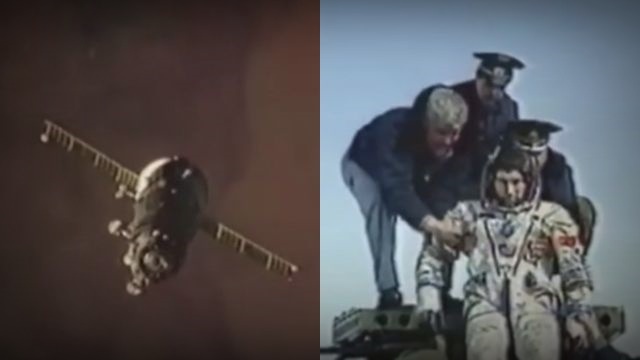
What happened to the Astronaut who was lost in space for 311 days?
Sergei Krikalyov; born 27 August 1958) is a Russian mechanical engineer and former cosmonaut. As a prominent rocket scientist, he is a veteran of six space flights and ranks third to Gennady Padalka and Yuri Malenchenko for the most time spent in space: a total of 803 days, 9 hours, and 39 minutes.
Krikalev was stranded on board the Mir station during the dissolution of the Soviet Union on December 26, 1991. As the country that had sent him into space no longer existed and his return was delayed.
As a result he stayed in space for 311 consecutive days, twice as long as the mission had originally called for, before he could return to Earth again.
Because Krikalev spent so much time in space away from Earth’s center of gravity, time dilation (or the slowing down of clocks) caused him to be 0.02 seconds older than other people born at the same time as him.
For over half a century, there have been rumours of secretive facilities and bases, hidden deep below the surface of the sprawling North American landscape. This week, we examine the most infamous of these alleged sites. An underground base believed to be situated near the town of Dulce, in New Mexico. A modern-day mystery, which lies deep beneath the mesa.
For over half a century, there have been rumours of secretive facilities and bases, hidden deep below the surface of the sprawling North American landscape. This week, we examine the most infamous of these alleged sites. An underground base believed to be situated near the town of Dulce, in New Mexico. A modern-day mystery, which lies deep beneath the mesa.
In our previous episode, we examined reports from various individuals who stated that there is a secret facility buried deep beneath the New Mexico town of Dulce. But we deliberately avoided the testimony of one man, who is arguably the most controversial figure in the allegations surrounding the possible existence of Dulce Base. A man who claimed he was the survivor of a war beneath the mesa.
The Great White Pyramid of Xian: Why China keeps its pyramids a secret?
The White Pyramid myth began during World War II, when eyewitness accounts, especially from pilot James Gaussman, mentioned the appearance of a massive “White Pyramid” near the Chinese city of Xi’an, during a flight between China and India in 1945, he is believed to have seen a white jewel-topped pyramid.
Not only was this amazing structure supposed to be the biggest pyramid in the world, but it was also said to be surrounded by dozens of smaller pyramids, some rising to almost the same height.
Walter Hain, an author, and scientific writer describe Gaussman’s initial view of the pyramid in his homepages. James Gaussman was returning to Assam, India, after flying the ‘Burma Hump,’ which transported supplies from India to Chungking, China, when engine difficulties caused him to momentarily descend to a low altitude above China.
“I banked in order to avoid a mountain, and we emerged into a flat valley. A gigantic white pyramid stood directly below. It appeared to be something from a fairy tale. It was enclosed in a gleaming white shell. This might have been made of metal or a type of stone. On both sides, it was pure white.
The capstone was amazing; it was a massive chunk of jewel-like material that may have been crystal. We could not have landed, no matter how badly we wanted to. We were taken aback by the enormity of the thing.”
The New York Times picked up the story and published an article on the pyramid on March 28, 1947. Colonel Maurice Sheahan, director of Trans World Airlines’ Far Eastern division, stated in an interview that he had seen a massive pyramid 40 miles southwest of Xian. The same newspaper published a photo two days following the report, which was eventually credited to Gaussman.
Photographs of the massive pyramid he had shot would not be released for another 45 years. Even his report would remain buried in the Secret Service archives of the United States military until then. Numerous researchers and explorers have attempted to locate the White Pyramid of Xi’an, but none have been successful.
Some claim that the White Pyramid may be hidden amidst the high mountains and deep gorges of the Qin Ling Mountains.
Chinese government designated about 400 pyramids north of Xi’an in 2000, however, the White Pyramid was not included. Many of the other sites were excavated, revealing mausoleums shaped more like Mesoamerican pyramids, which vary from Egyptian pyramids in that they are flat-topped and covered with flora.
Ancient members of China’s royal class were buried in these burial mounds, where they planned to lie in peace for eternity. The majority of the pyramids are exceedingly difficult to spot, as they are hidden by lush hillsides and hills, as well as long grass and trees. Only a few of the structures have been made available to tourists.
Photograph published in New York Times, May 30 1947, supposedly taken by James Gaussman
The Chinese government has provided easy justifications for why no one is permitted to enter, notably that enthusiastic archaeologists and visitors may do damage to the relics.
Officials believe they are waiting for technology to improve sufficiently to fully dig the pyramids and their valuable contents. After all, some of the pyramids are thought to be as old as 8,000 years.
Westerners have speculated endlessly about the pyramids’ purpose and energy, as well as their astrological significance. According Noopept stock to scholars, “the cardinal points of North, South, East, and West were all significant to certain kings.” Lining up your tomb with the axis of the world was proof that you were still number one.”
One of the rarest pictures of pyramids in the Xi’an Valley
The most common conspiracy theory includes extraterrestrials, who are said to be the original architects. Is it feasible that Erich von Däniken’s and others’ ancient astronaut theories might also apply to the Chinese pyramids? Wherever there is concealment, conspiracy theories automatically emerge.
Time is “elastic”: Why time passes faster atop a mountain than at sea level
Since Einstein presented his general theory of relativity, we’ve known that gravity has the ability to warp space and time. Even at low levels, this “time dilation” effect occurs. We experience distortions in how we see time outside of physics, sometimes to startling extents.
Place one clock on top of a mountain. Put another one on the seashore. You’ll notice that each clock displays a different time. Why? Time slows down as you come closer to Earth because, as Einstein proposed in his general theory of relativity, the gravity of a big mass, such as the Earth, warps space and time around it.
This “time dilation” effect was first observed on a cosmic scale, such as when a star passes close to a black hole. The same effect was discovered on a much smaller scale in 2010, when researchers used two incredibly precise atomic clocks, one 33 cm higher than the other. Time went slower as the clock got closer to Earth.
The differences were minor, but the implications were meaningful: absolute time does not exist. Time moves slightly differently for each clock in the world and for everyone of us. But, even if time moves at varying speeds around the cosmos, time still moves in some objective sense, right? Maybe not.
Carlo Rovelli, an Italian theoretical physicist, suggests in his book “The Order of Time” that our perception of time — our sensation that time is always moving ahead — could be a highly subjective illusion. After all, when you examine reality on the smallest scale (at least using quantum gravity equations), time vanishes.
“If I observe the microscopic state of things,” writes Rovelli, “then the difference between the past and future vanishes … in the elementary grammar of things, there is no distinction between ’cause’ and ‘effect.’”
So, what causes us to perceive time as moving forward? Rovelli observes that, whereas time disappears on extremely small scale, we clearly see events occurring sequentially in reality. To put it another way, we see entropy: as order changing into disorder; an egg cracking and getting scrambled.
According to Rovelli, the second law of thermodynamics, which stipulates that heat always moves from hot to cold, describes important features of time. This is only one method. For example, an ice cube never melts into a hot cup of tea. A comparable process, according to Rovelli, could explain why we can only perceive the past and not the future.
“Any time the future is definitely distinguishable from the past, there is something like heat involved,” Rovelli wrote for the Financial Times. “Thermodynamics traces the direction of time to something called the ‘low entropy of the past’, a still mysterious phenomenon on which discussions rage.”
He continues: “Entropy growth orients time and permits the existence of traces of the past, and these permit the possibility of memories, which hold together our sense of identity. I suspect that what we call the “flowing” of time has to be understood by studying the structure of our brain rather than by studying physics: evolution has shaped our brain into a machine that feeds off memory in order to anticipate the future. This is what we are listening to when we listen to the passing of time. Understanding the “flowing” of time is therefore something that may pertain to neuroscience more than to fundamental physics. Searching for the explanation of the feeling of flow in physics might be a mistake.”
Scientists are still learning a lot about how we perceive time and why it behaves differently depending on the scale. However, outside of the realm of physics, our individual perspective of time is surprisingly elastic.
On a mountain, time moves differently than on a beach. However, you do not need to travel far to encounter strange distortions in your perspective of time. For example, at moments of life-or-death fear, your brain would release massive amounts of adrenaline, which would speed up your internal clock, causing you to view the outer world as moving slowly.
Another common distortion occurs when we direct our attention in specific directions.
“If you’re thinking about how time is currently passing by, the biggest factor influencing your time perception is attention,” Aaron Sackett, associate professor of marketing at the University of St. Thomas, told Gizmodo. “The more attention you give to the passage of time, the slower it tends to go. As you become distracted from time’s passing—perhaps by something interesting happening nearby, or a good daydreaming session—you’re more likely to lose track of time, giving you the feeling that it’s slipping by more quickly than before. “Time flies when you’re having fun,” they say, but really, it’s more like “time flies when you’re thinking about other things.” That’s why time will also often fly by when you’re definitely not having fun—like when you’re having a heated argument or are terrified about an upcoming presentation.”
Psychedelic drugs are one of the most mysterious ways for humans to experience time-perception distortions. Rovelli detailed an LSD experiment in an interview with The Guardian.
“It was an extraordinarily strong experience that touched me also intellectually,” he said. “Among the strange phenomena was the sense of time stopping. Things were happening in my mind but the clock was not going ahead; the flow of time was not passing any more. It was a total subversion of the structure of reality.”
Few scientists or philosophers appear to believe that time is a complete illusion.
“What we call time is a rich, stratified concept; it has many layers,” Rovelli told Physics Today. “Some of time’s layers apply only at limited scales within limited domains. This does not make them illusions.”
The belief that time moves at an absolute rate is an illusion. The river of time may run forever, yet it moves at various rates between people and even within your own mind.
Searching for extraterrestrial life is an important goal not only for NASA, but for many of us in the scientific community to address the ancient question of whether we are alone in the Universe. But what if we actually discover alien life? We can just as easily imagine a friendly encounter (E.T., The Day the Earth Stood Still) as a fight to the death (War of the Worlds, Independence Day). Either way, we expect the extraterrestrials to be very different from us. It is implicit in the word we use to describe them: aliens.
Examining these conflicting views is one of the goals of a new initiative called Exploring Otherness on Earth and Beyond, funded by the Einstein Foundation in Germany, which held its first workshop earlier this month at the German Aerospace Center in Berlin. By including perspectives from the natural sciences, social sciences, and humanities, the initiative hopes to build on ideas discussed during a symposium on Astrobiology and Society held in 2015 at the Library of Congress in Washington, D.C. The fact that this can even be a topic of serious discussion suggests that contact with extraterrestrials is no longer considered an unlikely pipe dream.
While most scientists would welcome the discovery of alien life and the chance to learn more about it, such a discovery is often perceived as strange or frightening by the public at large. Some would welcome aliens with open arms and expect them to solve our problems, from climate change to cancer. Some might even treat them as gods. Others would be afraid the aliens would take over Earth and have us at their mercy. Which attitude prevails likely will depend on what type of behavior we recognize in the extraterrestrials as being like our own.
“Otherness”
Historians, philosophers, and social scientists have long grappled with the idea of “otherness.” Human history is a long parade of cultures colonizing and subjugating each other, and racial and tribal politics are still very much with us today. Although many in our society are becoming more tolerant of otherness in areas like sexuality and neurodiversity, the separation of “us” and “them” is alive and well.
And that’s just among humans. If we consider our fellow creatures on Earth, “otherness” is even more of a problem. Why do some animals repel us, while others we want to cuddle? A bear is far more dangerous to humans than a tarantula — a child’s teddy bear conveniently leaves out the teeth and claws — yet we feel more at ease around our fellow mammal. Since bears are more closely related to humans than tarantulas, it is easier for us to read a bear’s emotions. And most of us are creeped out by a tarantula’s otherworldly appearance and behavior — the multiple eyes and the scuttling movements. In fact, spiders in general tend to rank highly among the most feared/disgusting animals, with bunnies residing at the other end of the scale. This may explain the preponderance of movie aliens that resemble arthropods. (The movie District 9 — a powerful indictment of societal “otherness” — comes to mind.)
Science is only beginning to understand the staggering variety of “alien” behaviors on our own planet, from sea turtles that sense magnetic fields to plants that communicate with each other via airborne chemicals. If we venture into an inhabited universe, we are likely to run into beings that evolved under entirely different physical circumstances. Will we meet them as curious, friendly, fellow explorers? Predators and prey? Will we be delighted or disgusted by their strangeness?
This dynamic may depend on whether “they” are more technologically advanced than us. If they are, they are likely to call the shots, not us. But let’s assume for a moment that we are the more advanced species. Would we afford more protection to an extraterrestrial microbe than to our own microbes, which we kill by the billions in our lab experiments without giving it a second thought? What if the alien is a more complex life form — say, similar to one of our fellow terrestrial animals? Shouldn’t we treat it ethically? What would that even mean to a society like our own that still eats fellow animals, even those we are closely related to?
The psychology of alien contact
How we deal with alien life, if it should ever come to that, will be one of the major challenges for humanity. We certainly want to avoid miscommunications and misunderstandings that could have dire, and possibly fatal, consequences. And we need to consider the possibility of encountering intelligent life forms that we simply cannot understand, as in the Stanisław Lem novel Solaris. We might be so confused by their otherness that we don’t even recognize them as living beings.
There might be a way around this dilemma: Artificial robots may be more successful emissaries between interplanetary civilizations, since they could take on a more neutral form. Another solution would be mimicry. Many science fiction aliens, from The Man Who Fell to Earth to Invasion of the Body Snatchers, take human form when they come visiting.
Religious questions also come into play when discussing the otherness of aliens. How would the major religions on our planet deal with the discovery of intelligent aliens? At the 2015 Library of Congress meeting, Brother Guy Consolmagno from the Vatican Observatory said he was once asked whether he would baptize an alien. I thought his answer was very smart. He said yes, but only if the alien wants to.
Of course, some Eastern traditions like Buddhism would do away with notions of “self” and “other” altogether. Perhaps that is the key insight that will allow us, and perhaps other civilizations hoping to travel among the stars, to meet each other with open arms, rather than with weapons drawn — even if some of us (or them) might still have a deep nagging feeling inside of being repelled by alien otherness.
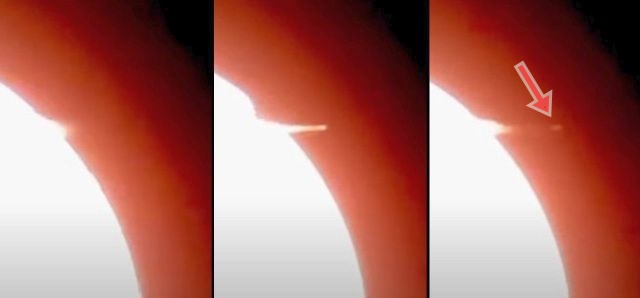
Real images 0f Moon Bases and Ufo's. BruceSeesAll shows us two images that are from a space association and the rest of the video is all his personal research in ufology and astronomy on the moon.
One of the most remarkable recordings of Bruce is a UFO leaving the moon and while NASA still insists that there is no extraterrestrial activity on the moon, it is only a matter of time before they can no longer deny it.
279-year-old file discovered on “first of its type” sight over Westminster in the London UFO mystery
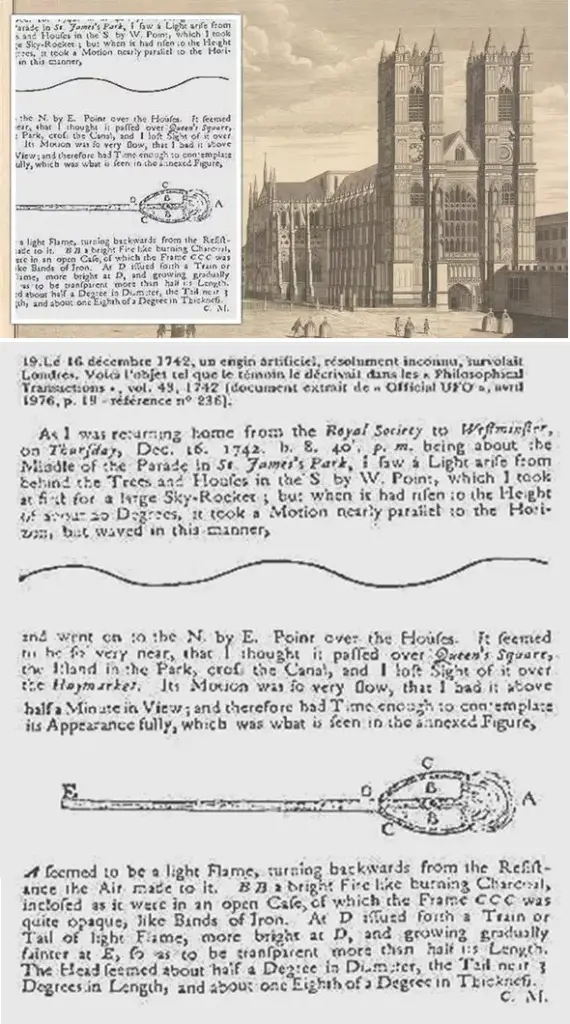
Doctor Cromwell Mortimer saw an unexplained flying object soaring above downtown London on December 16, 1742, and he reported it to authorities. Mr. Mortimer, who was the secretary of the Royal Society at the time, observed the enigmatic object as it moved “slowly” above St. James’s Park around 8:40 p.m. while on his way home to Westminster. He noted that the object was moving quite slowly, which gave him about 30 seconds to acquire a good view of it.
Despite being short, 30 seconds is a lot longer than most sightings of meteors and other such phenomena.
He was even able to draw a schematic of the item, which he described in his 1746 report, which was recently discovered in the journal Philosophical Transactions, vol. XLIII.
In the south by west point, he claimed, “I saw a light appear hidden behind the woods and homes.”
After reaching a height of around 20 degrees, it moved in a direction that was almost aligned to the horizon and passed above the residences.
As he continued to observe the object, he thought that its route had taken it precisely over Bloomsbury, over Queen’s Square, and toward the nearby canal.
He also wrote that he had lost sight of it over the Haymarket.
Its action was so slow, he said, that I was able to see it for more than a minute and spend enough time studying it.
His illustration showed a thing with a blazing head that was “contained as it were in an open box” and bound by “bands of iron.”
Like contemporary airplanes, the extraterrestrial had a lengthy tail of light that was progressively becoming fainter.
The British UFO investigator Steve Mera was quoted by The Sun as saying, “It is the very first of its sort.”
People watching it from a balcony, he continued. They had good financial standing, which promoted thorough investigation.
The military has reported 400 sightings of UFOs and had 11 near experiences with them over the years, according to a top Pentagon officer who testified before the US Congress.
Due to a considerable increase in statements from military personnel concerning prior encounters, the stigma associated with reporting UFO sightings has decreased over the last several years, and this number has more than doubled.
These days, an “unidentified flying object” (UFO) may not always indicate alien sightings; it might even be highly developed drones.
Meer van UFO'S of UAP'S, ASTRONOMIE, RUIMTEVAART, ARCHEOLOGIE, OUDHEIDKUNDE, SF-SNUFJES EN ANDERE ESOTERISCHE WETENSCHAPPEN - DE ALLERLAATSTE NIEUWTJES


 Space roar: The mystery of the loudest sound in the universe