Naar de inhoud

UFO'S of UAP'S, ASTRONOMIE, RUIMTEVAART, ARCHEOLOGIE, OUDHEIDKUNDE, SF-SNUFJES EN ANDERE ESOTERISCHE WETENSCHAPPEN - DE ALLERLAATSTE NIEUWTJES

UFO's of UAP'S in België en de rest van de wereld
akke.beakke.be
Ontdek de Fascinerende Wereld van UFO's en UAP's: Jouw Bron voor Onthullende Informatie! Ben jij ook gefascineerd door het onbekende? Wil je meer weten over UFO's en UAP's, niet alleen in België, maar over de hele wereld? Dan ben je op de juiste plek! België: Het Kloppend Hart van UFO-onderzoek In België is BUFON (Belgisch UFO-Netwerk) dé autoriteit op het gebied van UFO-onderzoek. Voor betrouwbare en objectieve informatie over deze intrigerende fenomenen, bezoek je zeker onze Facebook-pagina en deze blog. Maar dat is nog niet alles! Ontdek ook het Belgisch UFO-meldpunt en Caelestia, twee organisaties die diepgaand onderzoek verrichten, al zijn ze soms kritisch of sceptisch. Nederland: Een Schat aan Informatie Voor onze Nederlandse buren is er de schitterende website www.ufowijzer.nl, beheerd door Paul Harmans. Deze site biedt een schat aan informatie en artikelen die je niet wilt missen! Internationaal: MUFON - De Wereldwijde Autoriteit Neem ook een kijkje bij MUFON (Mutual UFO Network Inc.), een gerenommeerde Amerikaanse UFO-vereniging met afdelingen in de VS en wereldwijd. MUFON is toegewijd aan de wetenschappelijke en analytische studie van het UFO-fenomeen, en hun maandelijkse tijdschrift, The MUFON UFO-Journal, is een must-read voor elke UFO-enthousiasteling. Bezoek hun website op www.mufon.com voor meer informatie. Samenwerking en Toekomstvisie Sinds 1 februari 2020 is Pieter niet alleen ex-president van BUFON, maar ook de voormalige nationale directeur van MUFON in Vlaanderen en Nederland. Dit creëert een sterke samenwerking met de Franse MUFON Reseau MUFON/EUROP, wat ons in staat stelt om nog meer waardevolle inzichten te delen. Let op: Nepprofielen en Nieuwe Groeperingen Pas op voor een nieuwe groepering die zich ook BUFON noemt, maar geen enkele connectie heeft met onze gevestigde organisatie. Hoewel zij de naam geregistreerd hebben, kunnen ze het rijke verleden en de expertise van onze groep niet evenaren. We wensen hen veel succes, maar we blijven de autoriteit in UFO-onderzoek! Blijf Op De Hoogte! Wil jij de laatste nieuwtjes over UFO's, ruimtevaart, archeologie, en meer? Volg ons dan en duik samen met ons in de fascinerende wereld van het onbekende! Sluit je aan bij de gemeenschap van nieuwsgierige geesten die net als jij verlangen naar antwoorden en avonturen in de sterren! Heb je vragen of wil je meer weten? Aarzel dan niet om contact met ons op te nemen! Samen ontrafelen we het mysterie van de lucht en daarbuiten.

Archief

Indonesia’s 31,000-year-old Amputee Shatters the History of Surgery
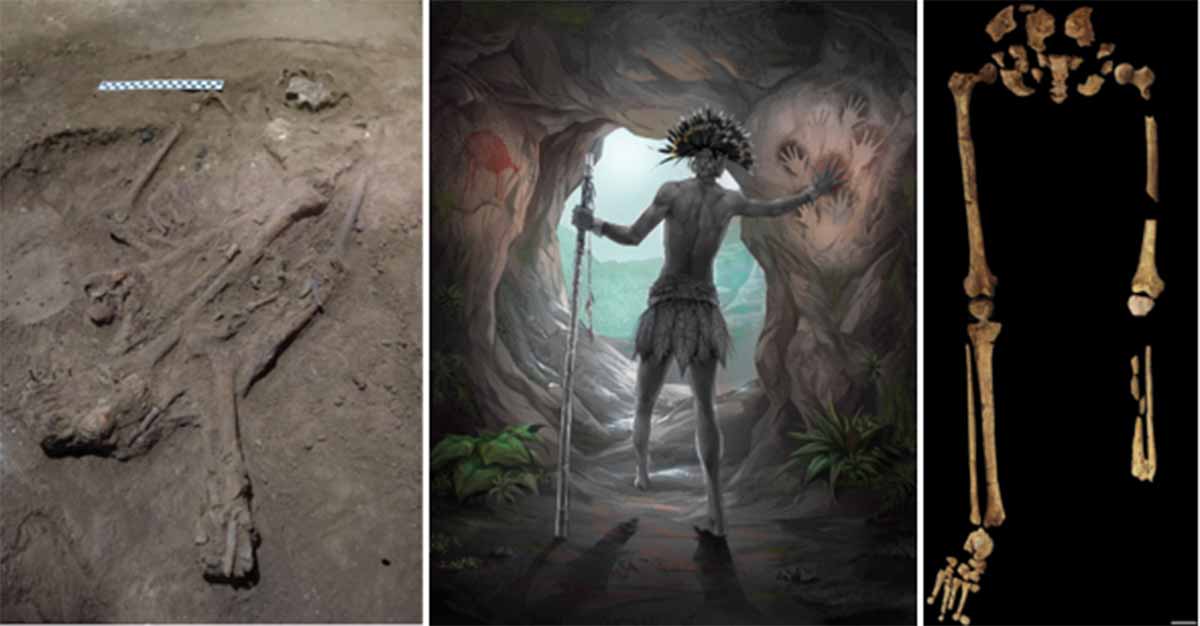
Left: Liang Tebo burial features of the 29000-BC amputee of Borneo, Indonesia: a) A single adult inhumation (TB1); the skull is to the right of the scale bar; Middle: Artist ‘s impression of Tebo1, the oldest amputee on record; Right: Surgically amputated site of the left tibia and fibula showing the evidence of amputation.             Source: Maloney, et al. / Nature; Jose Garcia (Garciartist) and Griffith University / Nature; Maloney, et al. / Nature

Indonesia’s 31,000-year-old Amputee Shatters the History of Surgery

Archaeologists in Borneo, Indonesia have unearthed the skeleton of a man who was an amputee, and he underwent his complicated medical procedure some 31,000 years ago!

Until now, all archaeological evidence has suggested the first medical procedures began when humans started inhabiting agricultural settlements during the so-called Neolithic Revolution, which began around 10,000 years ago. Historians of human physiological development generally agree that having bodies designed to walk over 20 miles (32.2 kilometers) a day, for foraging, hunting and fishing, would have been subjected to multiple medical issues when farming began.

Archaeologists in China and Egypt have discovered ancient remains with signs of amputated toes and fingers, with one prosthetic toe dating back 3,000 years . And in 2016 StatNews reported on the discovery of a 6th-century-AD skeleton found in a Frankish Empire-era cemetery in Austria. With an “iron-and-wood prosthetic foot,” this amputee represented the oldest skeleton found in Europe with a prosthetic limb.

Now, according to a new paper published in the journal Nature, a team of researchers has identified the oldest evidence of an amputee surgery, in Borneo, dating way back to 29000 BC.

Liang Tebo burial features of the 29000 BC amputee of Borneo, Indonesia: a) A single adult inhumation (TB1); the skull is to the right of the scale bar; b) in situ nodule of red ochre (a natural earth pigment) next to the mandible; c) Maxilla and mandible. Scale bar, 5 centimeters or 2 inches. (Maloney, et al. / Nature)

Liang Tebo burial features of the 29000 BC amputee of Borneo, Indonesia: a) A single adult inhumation (TB1); the skull is to the right of the scale bar; b) in situ nodule of red ochre (a natural earth pigment) next to the mandible; c) Maxilla and mandible. Scale bar, 5 centimeters or 2 inches.

(Maloney, et al. / Nature)

The Assumption That Farming Led to Amputee Tech is False

When humans first turned to agriculture around 10,000 years ago, no matter where on the globe or what type of crops were being grown, the height, strength and general health of the people rapidly declined. This demonstrable fact has led to the widely-accepted assumption that the onset of farming also brought about the necessity of more advanced surgical procedures.

In this new study, however, lead researcher and author, Professor Tim Ryan Maloney of Griffith University, Australia demonstrates that the “assumption” couldn’t have been further from the truth. His new study on the discovery of a 31,000-year-old amputee in Borneo demonstrates the origins of surgery began in prehistoric times, way before farming.

Legacy of Borneo’s 31,000-year-old Amputee Surgeons

The new paper focuses on a discovery made in 2020 on the Sangkulirang–Mangkalihat Peninsula of East Kalimantan (Indonesian Borneo). Approximately 2.5 kilometers (15.53 miles) from the Marang River, a matrix of caves and rock shelters are peppered across the karst terrain. Excavations in the vast three-chambered Liang Tebo limestone cave revealed evidence of prehistoric human occupation, including rock art that was painted at least 40,000 years ago, representing some of the earliest rock art ever created.

In 2020, archaeologists dug a trench in which they discovered an adult skeleton (TB1) who had “the distal third of their left lower leg surgically amputated.” The scientists write in their paper that the amputation most probably occurred when the person was a child and that they lived for another 6–9 years after the operation. And dating to “at least 31,000 years ago” this find changes everything that was previously assumed about the origins of surgical procedures.

Surgically amputated site of the left tibia and fibula showing the evidence of amputation. (Maloney, et al. / Nature)

Surgically amputated site of the left tibia and fibula showing the evidence of amputation.

(Maloney, et al. / Nature)

Gauging Prehistoric Surgical Knowledge

The Liang Tebo cave skeleton’s limb amputation suggests groups of modern humans foraging in Asia “had developed sophisticated medical knowledge and skills long before the Neolithic farming transition,” according to the new Nature study. The paper says the surgical amputation of TB1’s left lower leg 31,000 years ago “has important implications for our understanding of the evolution of pre-Holocene (the last 11,700 years) human medico-socio-cultural practices.” Until now, scientists generally assumed that complex surgical procedures like this were way beyond the capabilities of foraging cultures .

What is perhaps most interesting about this discovery is that until about 100 years ago in Western medicine, successful surgical amputations without antibiotics generally resulted in blood infections and often death. But in the 31,000-year-old case of TB1, the new study implies that “the Late Pleistocene ‘surgeon(s)’ who amputated this individual’s lower left leg must have possessed detailed knowledge “of limb anatomy and muscular and vascular systems to have prevented fatal blood loss and infection.”

Artist ‘s impression of Tebo1, the oldest amputee on record. The individual had their lower left leg amputated as a child and survived into early adulthood in an artistic community 31,000 years ago in Borneo, Indonesia. (Jose Garcia (Garciartist) and Griffith University / Nature)

Artist ‘s impression of Tebo1, the oldest amputee on record. The individual had their lower left leg amputated as a child and survived into early adulthood in an artistic community 31,000 years ago in Borneo, Indonesia.

(Jose Garcia ( Garciartist) and Griffith University / Nature)

Living And Dying In Mother Nature’s Embrace

Now that the “great assumption” about Neolithic tech has been shattered, some new assertions are being made based on the discovery of the 31,000-year-old amputee.

The ancient surgeons must have used plants (and perhaps maggots) to clean, dress and disinfect the man’s severed leg wound. They must also have administered some kind of pain relief while controlling their patient’s temperature, diet and recovery movements, to have prevented post-op infection.

Furthermore, the fact that the man recovered after the amputation in what is a very challenging karst stone terrain suggests a very caring community of people looked after him after the operation, and for the rest of his life.

The scientists concluded their paper by suggesting early human colonists in what are today the rainforests of Borneo were challenged by the warmer and much more humid climate. Experiencing an increase in wound infections the people responded by making rapid advances “in medical technology.” Thus, they must have developed new pharmaceuticals from the bountiful and biodiverse environment in which they lived as hunter-gatherers.

  • Top image: Left: Liang Tebo burial features of the 29000-BC amputee of Borneo, Indonesia: a) A single adult inhumation (TB1); the skull is to the right of the scale bar; Middle: Artist ‘s impression of Tebo1, the oldest amputee on record; Right: Surgically amputated site of the left tibia and fibula showing the evidence of amputation.           
  • Source: Maloney, et al. / Nature; Jose Garcia ( Garciartist) and Griffith University / Nature; Maloney, et al. / Nature

By Ashley Cowie

{https://www.ancient-origins.net/ }

Hoe vind je dit bericht?
Geschreven door peter om 01:36 Stuur door

MYTHISCH VERZONKEN EILANDENRIJK BIJ WALES BESTOND WELLICHT ECHT: OUDE LANDKAART KOMT OVEREEN MET BODEMVONDSTEN

Bronmateriaal:

{ https://www.scientias.nl/ }

Hoe vind je dit bericht?
Geschreven door peter om 01:20 Stuur door

HET REGENT DIAMANTEN OP NEPTUNUS WAARDOOR NIEUWE IJSSOORT ONTSTAAT: HET BIZARRE SUPERHETE ZWARTE IJS

Bronmateriaal:

{ https://www.scientias.nl/ }

Hoe vind je dit bericht?
Geschreven door peter om 01:10 Stuur door

Did this gene give modern human brains their edge?

Did this gene give modern human brains their edge?

Hoe vind je dit bericht?
Geschreven door peter om 00:57 Stuur door

Repair Work Underway, Preparations Continue for Next Launch Opportunity

Repair Work Underway, Preparations Continue for Next Launch Opportunity 

DSC_1605-1024x680.jpg

NASA’s Space Launch System (SLS) rocket is seen at Launch Pad 39B Thursday, Sept. 8, 2022, at NASA’s Kennedy Space Center in Florida as teams work to replace the seal on an interface, called the quick disconnect, between the liquid hydrogen fuel feed line on the mobile launcher and the rocket.

Photo Credit: (NASA/Chad Siwik)

Engineers are making progress repairing the area where a liquid hydrogen leak was detected during the Artemis I launch attempt Sept. 3, and NASA is preserving options for the next launch opportunity as early as Friday, Sept. 23. 

Technicians constructed a tent-like enclosure around the work area to protect the hardware and teams from weather and other environmental conditions at Launch Pad 39B. They have disconnected the ground- and rocket-side plates on the interface, called a quick disconnect, for the liquid hydrogen fuel feed line, performed initial inspections, and began replacing two seals – one surrounding the 8-inch line used to fill and drain liquid hydrogen from the core stage, and another surrounding the 4-inch bleed line used to redirect some of the propellant during tanking operations. The SLS rocket and Orion spacecraft are in good condition while remaining at the launch pad. 

Once the work is complete, engineers will reconnect the plates and perform initial tests to evaluate the new seals. Teams will check the new seals under cryogenic, or supercold, conditions no earlier than Sept. 17 in which the rocket’s core stage and interim cryogenic propulsion stage will be loaded with liquid oxygen and liquid hydrogen to validate the repair under the conditions it would experience on launch day. Engineers are in the process of developing a full plan for the checkouts. 

NASA has submitted a request to the Eastern Range for an extension of the current testing requirement for the flight termination system. NASA is respecting the range’s processes for review of the request, and the agency continues to provide detailed information to support a range decision.  

In the meantime, NASA is instructing the Artemis team to move forward with all preparations required for testing, followed by launch, including preparations to ensure adequate supplies of propellants and gases used in tanking operations, as well as flight operations planning for the mission. NASA has requested the following launch opportunities: 

  • Sept 23: Two-hour launch window opens at 6:47 a.m. EDT; landing on Oct. 18 
  • Sept. 27: 70-minute launch window opens at 11:37 a.m.; landing on Nov. 5 

NASA’s teams internally are preparing to support additional dates in the event flexibility is required. The agency will evaluate and adjust launch opportunities and alternate dates based on progress at the pad and to align with other planned activities, including DART’s planned impact with an asteroid, the west coast launch of a government payload, and the launch of Crew-5 to the International Space Station. 

Listen to a replay of today’s media teleconference on the status of the Artemis I mission. Artemis I is an uncrewed flight test to provide a foundation for human exploration in deep space and demonstrate our commitment and capability to extend human existence to the Moon and beyond.  

{ https://www.nasa.gov/ }

Hoe vind je dit bericht?
Geschreven door peter om 00:40 Stuur door

LATEST UFO SIGHTINGS AND VIDEOS

LATEST UFO SIGHTINGS AND VIDEOS

Disk Shaped UFO Sighted Over Freeway In Los Angeles, California. September 3, 2022

This footage was captured while the witness was driving along the freeway and he took three quick videos and upload them to Instagram. In the footage we can see what looks like a disk shaped UFO just cruising along to the shock of the witness. This was sighted over Los Angeles, California on September 3, 2022 around 9:30am

Thanks to 19th Galaxy for allowing me the use of this footage and to view the original:

UFOs Sighted From The ISS, SpaceX & Bogotá, Colombia. As Seen On The Live Show. September 7, 2022

Guys, This video i did without me talking as these are some of the footages i've showed on my live show so if you would like to hear my opinions on the footages please check out the show:

Clip 1. This was sighted durning the Russian cosmonauts spacewalk on September 2, 2022 and in the footage this object comes into view with the camera operater asking "What is that object?" and following the UFO with the camera until it's out of view. Go to the 7.22.55 to 7.27.55 mark in the video to see and hear.

SOURCE: Reuters:

Clip 2. This object was spotted durning the SpaceX launch of 51 Starlink satellites Sunday, September 4, 2022 at 10:09 p.m. This UFO flies past the rocket but could this be more ice? Go to 22:44 mark in the video and have a look.

Source: SpaceX:

Clip 3. This footage was captured by Carlos Franco, Sometime in early August of 2022 Over Bogotá, Colombia.

Source:

UFO Over Cuba From Only Real UFOs

Strange UFO Seen in Shakopee, Minnesota, Sept 2022 👽

Video shared on Reddit by Smencil and filmed on September 3, 2022 at 5:46PM in Shakopee, Minnesota. There’s more to say, more to explore together and we invite you now to join this new journey with us on Section 51 ! Subscribe now !

New UFO Video allegedly declassified by the Pentagon

"The Pentagon has declassified a new video from 4/24/19 involving the USS Zumwalt, detecting six unidentified objects on it, including one crossed the deck according to the report. Spokeswoman Susan Gough announced that they have no information about its origin."

UFO Lights in Austria, Feb 2015

Video shared on Instagram and filmed in Gesause National Park in Austria in February 2015. No further information...

Strange Lights in the Sky, USA, July 2021

Video shared on Reddit by Shibby_Laterr187 and filmed in USA, uploaded on Odysee in July 2021. No further information...

The UFO Lie: Shocking truth of Pentagon AAWSAP program | The Basement Office

Everything you were told is wrong. In 2017, the New York Times released a bombshell story revealing AATIP, the Pentagon's "UFO program" and Lue Elizondo, the director of that program.

It proclaimed a shocking truth:

UFOs are real. Since then, that story has been reprinted hundreds and thousands of times across the world and Mr. Elizondo has reached the status of cultural icon. But we've since learned that the whole story... was wrong. In this episode, we reveal the real story of the Pentagon's AAWSAP program - led by scientist James Lacatski - and it's even crazier than you could possibly imagine: $22 million in taxpayer money spent on werewolves, ghosts, goblins, and "dinobeavers" at the infamous Skinwalker Ranch in Utah. But UFO advocates, who are currently lobbying Congress to spend money on UFO investigations, hope you never find out about that. | Season 3, Episode 1

Watch more of The Basement Office:

UFO In Austria, Itally, Mexico - Mysterious Desert Lights - Alien Found In Cave - Blue Haired Dogs

UFO Seen In Austria.

UFO Seen In Italy.

UFO Seen In Mexico.

5 Mysterious Desert Phenomena.

Grave robbers discover an Underground Citadel at Nazca.

Universe Size Comparison 3D.

Blue Haired Dogs Appear in Russia and Concerns Russian Authorities.

How to Escape the Confines of Time and Space According to the CIA.

Hi folks, I work hard to put these videos together everyday and all I ask is that you take a moment to "like", "share" and or "subscribe" to the channel. Thank you so much, UFO Video Addicts

{ https://www.youtube.com/ }

Hoe vind je dit bericht?
Geschreven door peter om 17:29 Stuur door

US Navy fighter pilot Clarence Clem talks about a UFO hovering over the Hanford nuclear site in 1945

US Navy fighter pilot Clarence Clem talks about a UFO hovering over the Hanford nuclear site in 1945

In July 2014, UFO historian Jan Aldrich revealed that his research group, Project 1947, had secured World War II-era documents from Headquarters Fourth Air Force, which referred to overflights of the Hanford site by “unidentified aircraft”.

One of them, dated January 23, 1945, and directed to the Commanding General of the Army Air Forces and the Assistant Chief of Air Staff, Training, states:

Resulting from an unidentified aircraft flying over the Hanford Engineering Company Plant at Pasco, Wash. on at least three nights in the past month (this Company is engaged in undisclosed projects for the War and Navy Departments) this HQ was requested by [Western Defense Command], about ten days ago, to move one [battery] of searchlights from Seattle to the Pasco plant. The Thirteenth Naval District has made arrangements for Naval Air Station, Pasco, to employ both radar and fighter aircraft in attempting interception of these unidentified aircraft. The airspace over the Hanford Company is both a Danger area and a Restricted area. Our battery of searchlights has been in place since 15 January; one incident has occurred since that date in which a brief radar contact was made—attempted night interception again failed.

So here we have an official document referring an unidentified aircraft flying over the Top Secret Hanford atomic materials production plant on three occasions in January 1945. At least one of those “aircraft” was tracked on radar and successfully eluded the U.S. Navy fighter sent up to intercept it. In conclusion, declassified military documents confirm the events described by former USN fighter pilot Bud Clem. Unfortunately, when Robert Hastings attempted to notify Clem of the discovery of those documents by Jan Aldrich, in July 2014, he learned that Clem had died the previous month. UFO incursions at U.S. atomic/thermonuclear weapons sites, from the 1940s onward, are detailed in thousands of declassified Army, Air Force, Navy, FBI, and CIA documents.

Moreover, hundreds of U.S. military veterans have now discussed their involvement in one or more of those incidents in video interviews. One of them, former U.S. Navy Lieutenant Junior Grade Clarence R. “Bud” Clem, says that a UFO monitored one of our fissile materials facilities—the Hanford plutonium-production plant in Washington State—on three different nights in January 1945, some seven months before Hiroshima and Nagasaki were bombed. Clem says that members of his Navy Hellcat F6F fighter squadron chased them away.

UFOs and Nukes researcher Robert Hastings first learned of the incidents when Clem wrote to him in 2009, but it was not until December 2013 that funds became available to capture the former fighter pilot on video.

RELATED VIDEOS, selected and posted by peter2011

{ https://www.latest-ufo-sightings.net/ }

Hoe vind je dit bericht?
Geschreven door peter om 15:47 Stuur door

Breaking: NASA Just Released First-Ever Images Of Venus’ Surface Taken With Visible Light

Breaking: NASA Just Released First-Ever Images Of Venus’ Surface Taken With Visible Light

Breaking: NASA Just Released First-Ever Images Of Venus’ Surface Taken With Visible Light

The Parker Solar Probe has taken the first visible-light photographs of Venus’s surface. Normally, the planet’s surface is shrouded by dense cloud cover, but the probe was recently able to picture the nightside of Venus using its Wide-Field Imager (WISPR) in wavelengths that the human eye can observe.

84498_01_parker-solar-probe-captures-its-first-images-of-venus-surface-in-visi.jpg

The Parker Solar Probe took images of the night side of Venus, revealing surface features in dark and light markings.

Image via NASA.

Brian Wood, lead author on the new study and physicist at the Naval Research Laboratory in Washington, DC, said: “Venus is the third brightest thing in the sky, but until recently we have not had much information on what the surface looked like because our view of it is blocked by a thick atmosphere. Now, we finally are seeing the surface in visible wavelengths for the first time from space,”

Unexpected Capabilities

The first WISPR images of Venus were taken in July 2020 as Parker embarked on its third flyby, which the spacecraft uses to bend its orbit closer to the Sun. WISPR was designed to see faint features in the solar atmosphere and wind, and some scientists thought they might be able to use WISPR to image the cloud tops veiling Venus as Parker passed the planet.

“The objective was to measure the speed of the clouds,” said WISPR project scientist Angelos Vourlidas, co-author on the new paper and researcher at Johns Hopkins University Applied Physics Laboratory.

But instead of just seeing clouds, WISPR also saw through to the surface of the planet. The images were so striking that the scientists turned on the cameras again during the fourth pass in February 2021. During the 2021 flyby, the spacecraft’s orbit lined up perfectly for WISPR to image Venus’ nightside in entirety.

“The images and video just blew me away,” Wood said.

Glowing like an Iron from the Forge

Clouds obstruct most of the visible light coming from Venus’ surface, but the very longest visible wavelengths, which border the near-infrared wavelengths, make it through. On the dayside, this red light gets lost amid the bright sunshine reflected off Venus’ cloud tops, but in the darkness of night, the WISPR cameras were able to pick up this faint glow caused by the incredible heat emanating from the surface.

“The surface of Venus, even on the nightside, is about 860 degrees,” Wood said. “It's so hot that the rocky surface of Venus is visibly glowing, like a piece of iron pulled from a forge.”

As it passed by Venus, WISPR picked up a range of wavelengths from 470 nanometers to 800 nanometers. Some of that light is the near-infrared – wavelengths that we cannot see, but sense as heat – and some is in the visible range, between 380 nanometers and about 750 nanometers.  

Venus in a New Light

In 1975, the Venera 9 lander sent the first tantalizing glimpses of the surface after landing on Venus. Since then, Venus’ surface has been revealed further with radar and infrared instruments, which can peer through the thick clouds by using wavelengths of light invisible to the human eye. NASA’s Magellan mission created the first maps in the 1990s using radar and JAXA’s Akatsuki spacecraft gathered infrared images after reaching orbit around Venus in 2016. The new images from Parker add to these findings by extending the observations to red wavelengths at the edge of what we can see.

The WISPR images show features on the Venusian surface, such as the continental region Aphrodite Terra, the Tellus Regio plateau, and the Aino Planitia plains. Since higher altitude regions are about 85 degrees Fahrenheit cooler than lower areas, they show up as dark patches amidst the brighter lowlands. These features can also be seen in previous radar images, such as those taken by Magellan.

grayscale animated images of Venus from space showing dark and light variations/

As Parker Solar Probe flew by Venus on its fourth flyby, its WISPR instrument captured these images, strung into a video, showing the nightside surface of the planet.

Credits: NASA/APL/NRL

The first of these photographs were captured by the Parker Solar Probe in July 2020, during its third flyby of Venus to tilt its orbit closer to the Sun. Scientists opted to analyze the Venusian clouds with the capacity to resolve fine detail in the solar atmosphere but were shocked to discover the planet’s complete nightside as well. The camera captured a faint glow emanating from the planet since WISPR also records certain infrared wavelengths that the planet emits owing to its extraordinarily hot surface, which is roughly 860 degrees Fahrenheit even at night.

NASA’s New Views of Venus’ Surface From Space

before

Show only Left                                                             Show only Right
Surface features seen in the WISPR images (left) match ones seen in those from the Magellan mission (right).
Credits: NASA/APL/NRL (left), Magellan Team/JPL/USGS (right)
Nicola Fox, division director for the Heliophysics Division at NASA Headquarters, explained: “We’re thrilled with the science insights Parker Solar Probe has provided thus far. Parker continues to outperform our expectations, and we are excited that these novel observations taken during our gravity assist maneuver can help advance Venus research in unexpected ways,”

Beyond looking at surface features, the new WISPR images will help scientists better understand the geology and mineral make-up of Venus. When heated, materials glow at unique wavelengths. By combining the new images with previous ones, scientists now have a wider range of wavelengths to study, which can help identify what minerals are on the surface of the planet. Such techniques have previously been used to study the surface of the Moon. Future missions will continue to expand this range of wavelengths, which will contribute to our understanding of habitable planets. 

This information could also help scientists understand the planet’s evolution. While Venus, Earth, and Mars all formed around the same time, they are very different today. The atmosphere on Mars is a fraction of Earth’s while Venus has a much thicker atmosphere. Scientists suspect volcanism played a role in creating the dense Venusian atmosphere, but more data are needed to know how. The new WISPR images might provide clues about how volcanos may have affected the planet’s atmosphere.

In addition to the surface glow, the new images show a bright ring around the edge of the planet caused by oxygen atoms emitting light in the atmosphere. Called airglow, this type of light is also present in Earth’s atmosphere, where it’s visible from space and sometimes from the ground at night.

Flyby Science

While Parker Solar Probe’s primary goal is solar science, the Venusian flybys are providing exciting opportunities for bonus data that wasn’t expected at the mission’s launch.

WISPR has also imaged Venus’ orbital dust ring – a doughnut-shaped track of microscopic particles strewn in the wake of Venus’ orbit around the Sun – and the FIELDS instrument made direct measurements of radio waves in the Venusian atmosphere, helping scientists understand how the upper atmosphere changes during the Sun’s 11-year cycle of activity.    

In December 2021, researchers published new findings about the rediscovery of the comet-like tail of plasma streaming out behind Venus, called a “tail ray”. The new results showed this tail of particles extending nearly 5,000 miles out from the Venusian atmosphere. This tail could be how Venus’ water escaped from the planet, contributing to its current dry and inhospitable environment.

While the geometry of the next two flybys likely won’t allow Parker to image the nightside, scientists will continue to use Parker’s other instruments to study Venus’ space environment. In November 2024, the spacecraft will have a final chance to image the surface on its seventh and final flyby.

The Future of Venus Research

Parker Solar Probe, which is built and operated by the Johns Hopkins Applied Physics Laboratory in Laurel, Maryland, isn’t the first mission to gather bonus data on flybys, but its recent successes have inspired other missions to turn on their instruments as they pass Venus. In addition to Parker, the ESA (European Space Agency) BepiColombo mission and the ESA and NASA Solar Orbiter mission have decided to gather data during their flybys in the coming years.

More spacecraft are headed to Venus around the end of this decade with NASA’s DAVINCI and VERITAS missions and ESA’s EnVision mission. These missions will help image and sample Venus’ atmosphere, as well as remap the surface at higher resolution with infrared wavelengths. This information will help scientists determine the surface mineral make-up and better understand the planet’s geologic history. 

“By studying the surface and atmosphere of Venus, we hope the upcoming missions will help scientists understand the evolution of Venus and what was responsible for making Venus inhospitable today,” said Lori Glaze, director of the Planetary Science Division at NASA Headquarters. “While both DAVINCI and VERITAS will use primarily near-infrared imaging, Parker’s results have shown the value of imaging a wide range of wavelengths.”

RELATED VIDEOS, selected and posted by peter2011


Related Links

{ https://blog.sci-nature.com/ }

Hoe vind je dit bericht?
Geschreven door peter om 01:14 Stuur door

Pentagon Hides 23-Minute UFO Video & UFO Photo 50 Feet From Cockpit, Elizondo Claimed

Pentagon Hides 23-Minute UFO Video & UFO Photo 50 Feet From Cockpit, Elizondo Claimed

Pentagon Hides 23-Minute UFO Video & UFO Photo 50 Feet From Cockpit, Elizondo Claimed

The congressional document reveals that some UFOs are not man-made and pose a national security threat to the United States. Finally, the subject of unidentified aerial phenomena (UAP) is considered serious due to the lack of information about them and increasing military encounters. Meanwhile, UFO enthusiasts are waiting for the Pentagon to release a 23-minute video that will reportedly leave viewers “rattled.” Luis Elizondo claimed that it shows UFOs moving in a strange pattern.

It is more than 4 years since the New York Times article revealed the existence of the secret program (AATI) funded by the United States Army to investigate UFOs. Luis Elizondo ran the Advanced Aerospace Threat Identification Program (AATI) from 2007 to 2012. Since then, he has spoken about various incidents that happened to the US pilots and possibilities of alien existence.

Elizondo, who resigned from the Pentagon in 2017, has made several bold statements since then. His claims literally change the US government’s perspective on viewing UFOs. Moreover, he refused to talk more as he is afraid of being arrested.

In 2021, he stated to have seen the UFO footage, describing it as showing unidentified floating objects for 23 minutes. He made this revelation while talking to the YouTube channels Fade to Black and Witness Citizen UAP. During the talk, Elizondo revealed that the UFO video was extremely compelling.
According to Elizondo, the video is said to show multiple UFOs which are moving in ways and strange “patterns” that humans do not conventionally understand – with data recorded using US military systems.
Luis Elizondo 23-minute UFO video
Lue Elizondo was a former US Army intelligence officer who helped trace terrorists after 9/11. credit: The Sun

He also mentioned this video in his interview with GQ. He stated: “It was the overwhelming weight of evidence and data. I was talking to pilots routinely. There’s videos out there [in government, that the public haven’t seen] – there’s one that’s 23 minutes long. There’s another one where this thing is 50 feet away from the cockpit. I mean, it ain’t ours. We know that. Sometimes you just couldn’t believe it – you’d have seven or eight incidents in a single day. I’d get these emails from an admiral or a ship’s captain saying, ‘Lue, what do you want me to do? I can’t keep people below deck forever. These things are swarming my ship, they’re all over the place.’ That’s tough. I kept promising the cavalry was coming and I’d have answers for them and the cavalry never came. Senior leadership didn’t want to deal with it.”

Read also:

While discussing the 23-minute UFO video, Elizondo mentioned that it is a very compelling footage. “I did not say what it was. I sent it out to some highly trained experts in the ISR (Intelligence, surveillance, and reconnaissance) community. And when they came back to me, the title of the email was quote unquote ‘that UFO video’.”

He added: “It is definitive and its perplexing, every time you think you are like ‘thats what I am looking at’ – bang, it changes.”

When quizzed by host Jimmy Church on the way the object moved, its speed and if it was “beyond our capabilities,” Elizondo said it was enough to make officials “raise our eyebrows and say woah.”

Here is the transcript of Luis Elizondo’s interview with Sean of Witness Citizen, where he talked about the 23-minute video and 50-foot photo:

Elizondo: You know, the problem is that this battle isn’t over. We won a major battle with the report coming out of the UAP report, it was historic like you said, in the very first sentence of the very first paragraph. It says this is a preliminary report which means there are other reports, you know, congratulations, you won, you got it, right? And then it said that there were 144 incidents and only one they were able to identify. By the way, that was only in the last year and a half, it was from November 2019 and forward. By the way, it only involved the navy, right, so yeah, so people say, well there was one from the Nimitz, okay.

Sean: That equipment sucks or…

Elizondo: This is… well, so, you’ve got a lot of stuff happening, right? So, you know, we’re just now starting this journey together.

Sean: Yeah, you know, it is kind of overwhelming for a lot of people but I’ll tell you, the message is getting out there in the right way and the way that I kind of… uh… evaluate, that is talking to my wife because she’s not very into this stuff, so not that, she’s not against it, we did see something together but she’s not like me, she doesn’t have a podcast. But the news comes on, they talk about the report, I come home later, ask her about it, what was your takeaway? And she says, well, I guess they only identified one out of what a hundred something, and I’m like, yes…

Elizondo: Right.

Sean: …That’s exactly right, honey.

Elizondo: Exactly, by the way, some of these things were really, really close, so you know, you tell me.

Sean: Wow, that’s crazy, yeah… Oh, when are we going to see that 50-foot away pic?

Elizondo: Oh, man, that’s not up to me, but yeah, there’s a couple there that will rattle you pretty good, um… Yeah, there’s one I won’t go into detail, but the video is about 23 minutes long, it’s pretty good, man, gotta get that popcorn and some 3D glasses and maybe some coca-cola or something…

In order to have a glimpse of what the Navy and Air Force might capture in their camera, see the video below by the U.S. Navy that has been recently released, showing the support ship Shahid Baziar, from Iran’s Islamic Revolutionary Guard Corps Navy, unlawfully towing the Saildrone Explorer. From this video, one may wonder how many high-quality UFO videos are in possession of the US Navy.

Elizondo clarifies that his job was never intended to study UFOs. It was to hunt terrorists and spies – and then use those same skills to hunt UFOs. “It’s the same thing,” he said. He further noted: “I didn’t care if it was supernatural technology, bottom line is there is something over controlled US airspace performing in ways we can’t – we’ve got to figure it out.” (Source)

He compared the growing push for disclosure on what the US knows about the mysterious craft to when mankind first came out of caves to look at the stars, or when man-made fire. He said the world may see a “paradigm shift” in our thinking – just like when the astronomer Galileo established the Earth was not the center of the Solar System.

“They tried to persecute him, to put him to the death – but at the end [the revelation] didn’t disrupt society and it benefited the species,” Elizondo said.

Hoe vind je dit bericht?
Geschreven door peter om 00:32 Stuur door

Most Mysterious Recent Archaeological Finds Scientists Still Can't Explain

Most Mysterious Recent Archaeological Finds Scientists Still Can't Explain

Archaeologists put in relentless efforts to discover new historically significant sites and artifacts every single day. The discovery of such sites is always a remarkable achievement but the next job for archaeologists commences here onward as they have to explain its purpose, importance and history. It is not an easy job for them as well as other experts working with them in related fields. At times they get stuck in pursuing an answer to certain questions and they may not be successful for quite a long time. Resultant, certain archaeological sites and artifacts remain unexplained. This means there are several recent discoveries which are still without any logical explanation

RELATED VIDEOS ( peter2011 )

{ https://beforeitsnews.com/ }

Hoe vind je dit bericht?
Geschreven door peter om 22:05 Stuur door

Meer van UFO'S of UAP'S, ASTRONOMIE, RUIMTEVAART, ARCHEOLOGIE, OUDHEIDKUNDE, SF-SNUFJES EN ANDERE ESOTERISCHE WETENSCHAPPEN - DE ALLERLAATSTE NIEUWTJES

↑ Terug naar de berichten