- The research has been published in The Astronomical Journal.
RELATED VIDEOS, selected and posted by peter2011


 Scientists: The Human Brain Has Odd Similarities to the Entire Universe

An astrophysicist and a neurosurgeon walked into a room.
It may sound like the start of a horrible joke, but what a group of Italian academics came up with is a truly galaxy brain take: the structures of the observable universe, they claim, are startlingly similar to the neural networks of the human brain.
In a recent research published in the journal Frontiers in Physics, University of Bologna astronomer Franco Vazza and University of Verona neurosurgeon Alberto Feletti reveal the unexpected similarities between the cosmic network of galaxies and the complex web of neurons in the human brain. According to the researchers, despite being nearly 27 orders of magnitude distant in scale, the human brain and the makeup of the cosmic web exhibit similar levels of complexity and self-organization.
The brain contains an estimated 69 billion neurons, while the observable universe is composed of at least 100 billion galaxies, strung together loosely like a web. Both actual galaxies and neurons only account for about 30 percent of the total masses of the universe and brain, respectively. And both galaxies and neurons arrange themselves like beads on long strings or filaments.
In the case of galaxies, the remaining 70 percent of mass is dark energy. The equivalent in the human brain, the duo said: water.
“We calculated the spectral density of both systems,” Vazza said in a statement about the work. “This is a technique often employed in cosmology for studying the spatial distribution of galaxies.”
“Our analysis showed that the distribution of the fluctuation within the cerebellum neuronal network on a scale from 1 micrometer to 0.1 millimeters follows the same progression of the distribution of matter in the cosmic web,” he added, “but, of course, on a larger scale that goes from 5 million to 500 million light-years.”
The clustering and number of connections emanating from each node also were oddly similar.
“Once again, structural parameters have identified unexpected agreement levels,” Feletti said in the statement. “Probably, the connectivity within the two networks evolves following similar physical principles, despite the striking and obvious difference between the physical powers regulating galaxies and neurons.”
The team is hoping that their preliminary study could lead to new analysis techniques in both cosmology and neurosurgery, allowing scientists to better understand how these structures have evolved over time.
READ MORE:
RELATED VIDEOS, selected and posted by peter2011
We Just Found a 'Super-Earth' That Could Be an Ocean-Covered Water World
An exoplanet just 100 light-years from Earth appears to be the best candidate yet for a sloshy, water-covered ocean world.
It's called TOI-1452b, and measurements of its size and mass suggest a density profile consistent with a global liquid ocean. Scientists believe that worlds like this are possible, but they haven't yet conclusively found one.
We'll need to follow up with observations from the James Webb Space Telescope to study the exoplanet's atmosphere and make a more confident ruling on the nature of TOI-1452b, but the initial results are very intriguing.
"This paper reports the discovery and characterization of the transiting temperate exoplanet TOI-1452b," writes a team of researchers led by astronomer Charles Cadieux of the University of Montreal in Canada in a paper published in The Astronomical Journal.
"The results of our interior modeling and the fact that the planet receives modest irradiation make TOI-1452b a good candidate water world."
It's easy to see why TOI-1452b evaded detection until now, in spite of its relative closeness to the Solar System.
The exoplanet was found orbiting one of a close binary pair of small, dim red dwarfs, separated by a distance of just 97 astronomical units. That's so close together that the two stars appear to be one.
However, the TESS exoplanet-hunting telescope is sensitive enough to have detected regular, faint dips in starlight that indicate an object regularly passing between us and its host star; those passages across the star are known as transits. The researchers followed up with their own highly sensitive instrument also designed to detect exoplanet transits at Mont Mégantic Observatory in Canada.
The observations from both telescopes revealed that there is indeed an exoplanet orbiting one of the stars in the TOI-1452 binary.
By looking at how much light the star emits and how much it dims when the exoplanet passes in front, the researchers were able to ascertain that the exoplanet is relatively small, coming in at 1.672 times the size of Earth – what we call a super-Earth.
It's on an 11-day orbit with its star, which seems insanely close to us, with our comparatively leisurely 365-day orbit. However, because the star is so cool and dim compared to the Sun, this places the exoplanet bang in the middle of the star's temperate zone. This is not so far from the star, out in the cold, that any liquid water on its surface would freeze, nor so close that the water would evaporate under the star's heat.
Next, the researchers took a closer look at the star. Specifically, they studied its radial velocity – the way it moves about due to the gravitational influence of the exoplanet. That's because any two bodies in a system orbit a mutual center of gravity – meaning that the star moves about, just a little, in its orbital arrangement with TOI-1452b.
Changes in the star's light reveal this motion and, even better, allow astronomers to calculate the orbiting body's mass by determining the strength of that movement. So, they were able to derive a mass of 4.82 times that of Earth for TOI-1452b.
And this is where it starts to get really interesting.
Once you have the size and mass of an object, you can infer its average density. For TOI-1452b, that density is 5.6 grams per cubic centimeter, and that's very close to Earth's density of 5.5 grams per cubic centimeter. But a density similar to that of Earth, for an object that has more mass, indicates that the object is composed of a lighter material, the researchers said.
"TOI-1452b is one of the best candidates for an ocean planet that we have found to date," Cadieux says. "Its radius and mass suggest a much lower density than what one would expect for a planet that is basically made up of metal and rock, like Earth."
They modeled the exoplanet's interior composition and determined that as much as 30 percent of its mass could be water.
That's a huge amount of the wet stuff. For comparison, water makes up less than 1 percent of Earth's mass; TOI-1452b's composition seems closer to that of water moons Europa in orbit with Jupiter and Enceladus in orbit with Saturn.
However, with just the measurements we have, it is impossible to say exactly what TOI-1452b is made of. This is where Webb comes in.
You remember how the exoplanet passes between us and its star? Some of the star's light will pass through the exoplanet's atmosphere, if it has one. Webb is sensitive enough to detect the difference in that light in enough detail that scientists can work out what's in the exoplanet's atmosphere.
If TOI-1452b is a water world, Webb is our best shot at discovering it.
"Our observations with the Webb Telescope will be essential to better understanding TOI-1452b," says astronomer René Doyon of the University of Montreal. "As soon as we can, we will book time on Webb to observe this strange and wonderful world."
RELATED VIDEOS, selected and posted by peter2011
Mars Biosignature of Life Found? PostAuthorIcon
Mars Biosignature of Life Found?
By Leonard David
Credit: NASA/JPL-Caltech
Has NASA’s Perseverance Mars rover uncovered a “biosignature” of life on Mars?
The wheeled robot investigator of Jezero Crater is gathering detailed data on desert varnish – a potential biosignature.
But is this coating enriched in manganese? If so, then that elevates the case that it is desert varnish…and may well be a potential biosignature, or does it?
“Yes, there are definitely features that look ‘desert varnish-y’ in Jezero right now,” said Amy Williams, a Mars specialist on the Curiosity and Perseverance rover missions at the University of Florida in Gainesville, Florida.

Signs of ancient life on Mars could be preserved in layered rocks like those shown in this illustration of NASA’s Perseverance rover in Jezero crater.
Credit: NASA/JPL-Caltech
“On Earth, desert varnish is certainly intimately tied with microbial interactions. But we do know of some unique instances wherein these types of rock coatings can be generated abiotically [absence of life or living organisms]. The question then remains whether microbes ever played a role in the formation of similar rock coatings on Mars,” Williams said.
Sample return
“My take on the biogenicity part [produced by living organisms] is that on Earth we see microbiology associated with desert varnish because Earth is widely inhabited,” Williams told Inside Outer Space. “Based on our findings in terrestrial analog environments, we’re therefore interested in the biogenicity of desert varnish on Mars.”
Williams said, however, that Mars researchers don’t have the ability to determine biogenic character in these Mars varnishes. To do so will take back-on-Earth, lab-based techniques, she said. “But that’s the beauty of Mars Sample Return…we could send these samples back to Earth to address that profound question!”

Depiction shows Jezero Crater — the landing locale of the Mars 2020 Perseverance rover — as it might have appeared billions of years ago when it was perhaps a life-sustaining lake. An inlet and outlet are also visible on either side of the lake.
Image Credit: NASA/JPL-Caltech
Controversial, complicated question
So what Perseverance is snooping out at present is looking for an answer to a complicated question.
On Earth, microbes appear to be involved in at least some, if not all, desert varnishes that we find. But that appraisal is still controversial in some people’s minds, notes astrobiologist Penelope Boston, Associate Director for Science Business Development at NASA Ames Research Center in the heart of Silicon Valley in California.
“There is a huge range of compositions in desert varnish, and indeed varnishes even in wetter environments, e.g. protruding boulders in some streams or rivers,” Boston told Inside Outer Space. “The diversity in the varnish makes it hard to make generalities about the phenomenon.”

Newly revised Mars Sample Return campaign makes use of a set of machines, including use of helicopters, to collect Martian soil, rock and atmospheric specimens for return to Earth.
Image Credit: NASA/JPL-Caltech
Manganese components
Boston said that under Earth’s surface and near-surface conditions, the iron components of varnish don’t need the presence of microbes to drive the oxidation processes because it so easily oxidizes by itself, albeit microbes are usually present in samples that researchers have examined.
“The situation with the manganese components is much more indicative of microbial interaction because chemically reduced forms of manganese do not oxidize anywhere near as easily as the iron,” Boston said. “However, a number of organisms have been shown to greatly facilitate the oxidation of manganese compounds, thus, Mn [manganese] could be a more indicative potential biosignature.”
Varnish compositions range from all iron to all manganese or somewhere in between, Boston advised. In addition, usually some sort of clays are present which could be either blown in materials deposited on the rock, or clay weathering products of the rock itself. Then varnishes vary a great deal in terms of whether an amorphous glassy layer of silica is or is not present, she said.
Credit: NASA
“Lastly, many varnishes have lots of trace metals or other elements also present. The presence of microorganisms on and partially within varnishes is tantalizing, and I believe them to be intimately involved with the geological processes that produce varnish, but of course, it is hard to definitively demonstrate that…and there are other nuances too,” Boston noted.
Look and see
Definitely, the varnish is an important feature on Mars, Boston added, one that Mars researchers have known to be present for a long time.
“Perseverance is giving us a close-up look at such materials. Studying it in detail could yield a lot of information about surface climate to which these rocks have been exposed, either with or without biological influences,” Boston said.
Can we tell whether the varnish is bio or abio?
“I don’t know. Would the biosignatures that we see in Earthly varnish be preserved after the much greater periods of time that the Martian varnish has endured? I don’t know. We can only look and see,” Boston concluded.

Credit: NASA/JPL-Caltech
Adds planetary scientist at Ames, Carol Stoker, desert varnish on Earth is high in manganese. It is Mn that makes the coating dark.
In another Mars location, NASA’s Curiosity rover has seen a lot of rocks with high Mn which were thought to be coatings, Stoker explains.
“Since Mn coatings are potentially biologically mediated, this should be a high priority rock for sample return,” Stoker said.
Bottom line: Thin dark coatings known as desert varnish are common on rocks in arid regions on Earth and they’re thought to form in part from microbial activity. Now, on Mars, the Perseverance rover has found similar coatings.
For a short course on this issue, go to this episode of Mars Guy [aka Steve Ruff at ASU] at:
NASA Detects CO2 in Alien World’s Atmosphere for the First Time
Hot gas giants like WASP 39-b don’t have well-defined surfaces, and so they aren't ideal for hosting life compared to rocky worlds similar to Earth. Its detection on that world tells us more about how it formed than what might live there. But the landmark CO2 detection does pave the way for analyzing alien worlds that might be habitable. After all, one of the main goals of the JWST program is to answer the question of if we're alone in the universe.
“Detecting such a clear signal of carbon dioxide on WASP 39-b bodes well for the detection of atmospheres on smaller, terrestrial-sized planets,” team lead Natalie Batalha of the University of California at Santa Cruz said in a statement.
Carbon dioxide on Earth is a heat-trapping gas that can be thrown into our atmosphere via abiotic processes like a volcanic eruption, or by living things that produce it naturally. It can also be produced through human activity like burning fossil fuels; it's a driver of climate change, and humans have increased the amount of the gas in our own atmosphere by a staggering figure. As pointed out by science publication New Scientist, researchers have theorized that carbon dioxide—in combination with other gases like methane—could be a valuable "biosignature" that points toward the existence of life on another world.
“Down the road, it may be an interesting biosignature when found in combination with other molecules like methane,” Jessie Christiansen from the NASA Exoplanet Science Institute told the outlet.
JWST was launched into space in December of last year, and the telescope's dazzling first images were revealed just last month. The telescope is really just warming up, and we have years of mind-blowing discoveries to look forward to.
Congressional Bill Says Threats to National Security From UFOs ‘Expanding Exponentially’
A UFO captured in declassified military footage.
(Department of Defense/Screenshot via The Epoch Times)
U.S. lawmakers have made references in an appropriations bill and accompanying Senate Intelligence Committee report that Congress believes some unidentified aerial phenomena (UAP), commonly referred to as UFOs, might not be “man-made.”
Further, Congress notes that threats against the national security of the United States from these “cross-domain transmedium” objects have been exponentially increasing.
The noteworthy admissions are found in a bill (pdf), and a report included as an addendum, to authorize the 2023 fiscal year budget related to America’s Intelligence Community.
The bill seeks to modify Section 1683 of the National Defense Authorization Act for fiscal year 2022 to establish an organization nestled inside the Department of Defense (DoD) tasked with an expanded scope of UFO investigation.
The legislation states that the DoD would have to establish the new office within 120 days after the bill is enacted into law.
The new office would replace the Pentagon’s Airborne Object Identification and Management Synchronization Group, which was established in November 2021 and replaced the U.S. Navy’s UAP Task Force formed in June 2020.
To prompt the DoD into action, Congress has renamed the UAP Task Force to be the Unidentified Aerospace-Undersea Phenomena Joint Program Office.
“At a time when cross-domain transmedium threats to United States national security are expanding exponentially, the Committee is disappointed with the slow pace of DoD-led efforts to establish the office to address those threats and to replace the former Unidentified Aerial Phenomena Task Force,” lawmakers said in the report (pdf).
The new UFO joint program office will continue the work of the existing UAP Task Force and have an expanded cross-domain scope that now includes “space, atmospheric, and water domains.”
According to the bill, the Unidentified Aerospace-Undersea Phenomena Joint Program Office will also be tasked with duties pertaining to “transmedium objects or devices and unidentified aerospace-undersea phenomena” and “currently unknown technology and other domains.”
“That change reflects the broader scope of the effort directed by the Congress,” lawmakers said in the report. “Identification, classification, and scientific study of unidentified aerospace-undersea phenomena is an inherently challenging cross-agency, cross-domain problem requiring an integrated or joint Intelligence Community and DoD approach.
In April last year, the Pentagon confirmed that a leaked video depicting a U.S. naval stealth ship tracking a UFO was taken by U.S. Navy personnel. The short night-vision video shows a “pyramid-shaped” flying object moving at a constant speed above and beneath the water.
Lawmakers noted that the scope of the new DoD office specifically relates to UFOs that are not later found to be man-made.
“The formal DoD and Intelligence Community definition of the terms used by the Office shall be updated to include space and undersea, and the scope of the Office shall be inclusive of those additional domains with focus on addressing technology surprise and ‘unknown unknowns,'” lawmakers said in the report.
“Temporary nonattributed objects,” the report continues, “or those that are positively identified as man-made after analysis, will be passed to appropriate offices and should not be considered under the definition as unidentified aerospace-undersea phenomena.”
These notable admissions in official government documents comes “at a time when cross-domain transmedium threats to United States national security are expanding exponentially,” according to the report.
Pentagon officials are treating UAP sightings with increased seriousness for their potential risks to U.S. national security.
The Office of the Director of National Intelligence released a report (pdf) last year on the subject—commonly known as the Pentagon UAP report—in which the Pentagon identified 144 UAP sightings from 2004 to 2021, but was only able to explain one.
Since that report was published in June 2021, Scott W. Bray, deputy director of naval intelligence involved in the UAP Task Force, has said that the “UAP Task Force database has now grown to contain approximately 400 reports.”
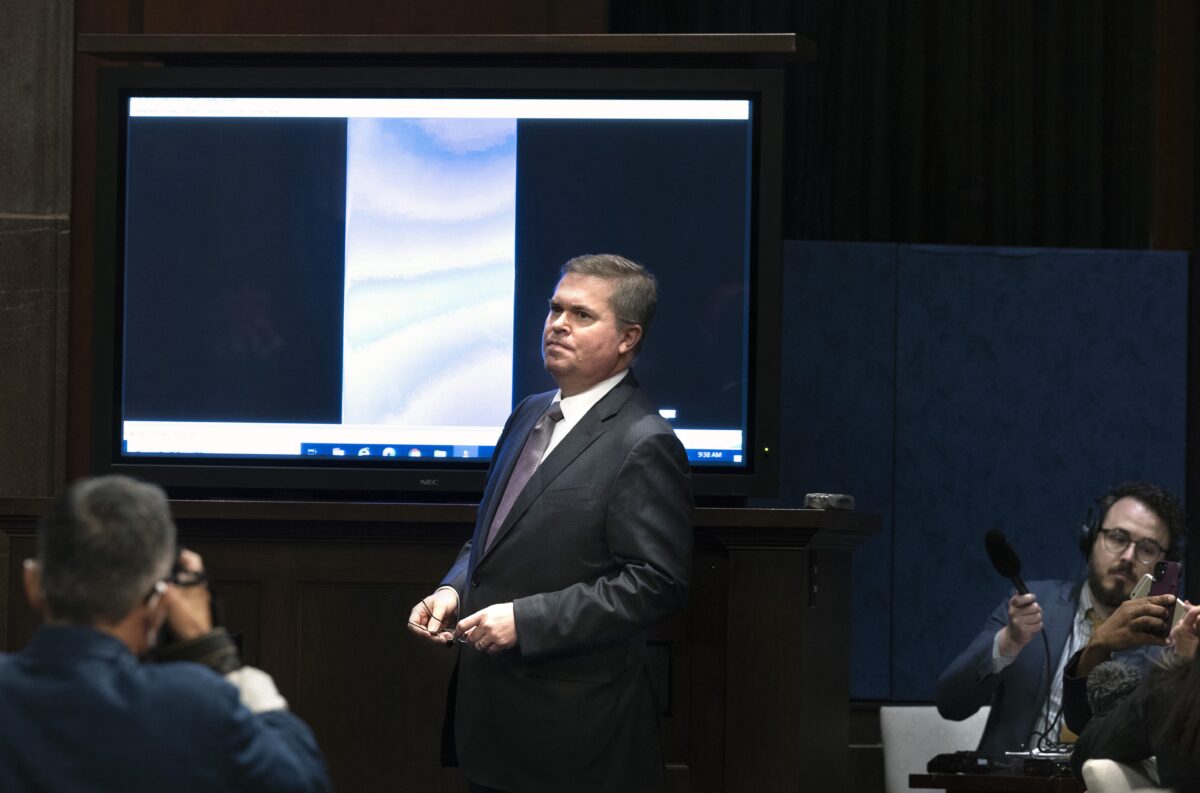
In May, Pentagon officials showed lawmakers two videos of UAPs in the first open congressional hearing on the subject since 1966.
Among the incidents shared with lawmakers were stories of nuclear ICBMs rendered inoperable during a UFO sighting and footage of flying objects violating the laws of physics.
Pentagon officials told lawmakers that sighting incidents are “frequent” and “increasing,” yet they cannot offer “firm conclusions” on their nature or intent.
The sighting incidents that interest the Pentagon the most are those that exhibit “flight characteristics or signature management that we can’t explain with the data we have available,” Bray told lawmakers when asked about his knowledge of flying objects that seem to move without visible means of propulsion and violate existing principles of physics.
“I would say that we’re not aware of any adversary that can move an object without discernible means of propulsion,” he added.
IT’S JUST A BEGINNING! Voyager 2’s Legacy that CHANGED EVERYTHING in The Entire Space Industry By nasaspacenews -
The most distant emissary of humanity delivers a message that will survive billions of years in the vastness of interstellar space.
In August 1977, 45 years ago, an incredible spacecraft set out on a trip unlike any other. Voyager 2 was intended to show us, for the first time, what the planets in the outer solar system looked like up close. And It was like sending a fly to New York City and requesting a report.
On September 5, Voyager 1 followed Voyager 2. A Golden Record bearing greetings, sounds, sights, and music from Earth was attached to the flank of each Voyager.
The spacecrafts were nearly identical, but their paths and scientific instrumentation differed. After passing through Jupiter and Saturn, Voyager 1 accelerated into interstellar space.
Voyager 2 stayed behind to undertake the first-ever visit to the ice giants Uranus and Neptune.
When Voyager 2 arrived at Uranus in 1986, it saw delicate blue-green clouds and a potential “black spot,” which was subsequently verified by the Hubble Space Telescope. A strange magnetic field pulled a corkscrew trail of particles behind the planet as it rolled in its orbit. Ten new moons, including the grey, cratered Puck and two new coal-black rings, were identified.
Three years later, Voyager 2 arrived at Neptune and returned photographs of turquoise and cobalt clouds whirled by winds of up to 18,000 km/h. A storm the size of Earth was represented by a slate-colored “huge black patch.” Triton, the biggest moon, was pink from methane ice and emitted geysers of frozen nitrogen.
Since then, no spacecraft has returned.
Even more than these images of distant ice worlds, what fascinates people about the Voyager mission is the famous Golden Records. For nearly a year, a group led by visionary astronomer Carl Sagan assembled objects to portray planet Earth. The music gets the most attention as the “universe’s mix tape,” but it’s not the only standout.

Messages were recorded in 55 different languages. Some are ancient languages that have not been heard on Earth for thousands of years, such as Akkadian and Hittite. “Greetings,” “peace,” and “friend” are the most frequently used words. Janet Sternberg’s Portuguese greeting is simple: “Peace and happiness to everybody.”
Finally, in 2018, Voyager 2 joined Voyager 1 beyond the heliopause, where solar wind is repelled by interstellar winds. Our galaxy spans 100,000 light-years, and Voyager 2 is presently just around 18 light-hours from Earth.

Both spacecraft broadcast reedy signals between the planets to the three antennae that are still listening: Tidbinbilla, Goldstone, and Madrid.
Before they can fully go, the Voyagers will have to journey for another 20,000 years through the Oort Cloud, a massive, black disc of frozen particles that surrounds the solar system.

Slowly, Voyager 2’s systems are being turned off in order to preserve as much power as possible. However, by the 2030s, there will be none remaining.
Even when Voyager 2 ceases transmission, it will not be entirely decommissioned. The half-life of the plutonium-238 in its nuclear power source is 87.7 years, whereas the Golden Record’s little patch of uranium-238 coating is 4.5 billion years. Both components are gradually transforming into lead.
On a cosmic scale, the radioactive transformation of elements is a type of reverse alchemy. This transformation will continue until there is nothing left aboard Voyager 2 to be changed.
Because it is travelling through diverse areas of interstellar space, constant bombardment by dust particles will progressively degrade the surfaces of Voyager 2. However, after 5 billion years, its Golden Record should be largely readable.
Even 100 years from now, the Earth shown on the Golden Records will most likely be unrecognisable. The spacecraft and its archives will be preserved as an incomplete archaeological record in the unforeseeable future.
While the Golden Records are endlessly intriguing, the Voyagers’ actual cultural value rests in their position. The spacecraft serve as physical marks of humanity’s interaction with the universe.
It will be like losing a sensation if the Voyagers stop transmitting. There is no replacement for being there: telescopes can only show us so much.
Who will follow in their footsteps?
RELATED VIDEOS, selected and posted by peter2011
Nick Pope Said US Govt. Trying To Prepare World For Soon-To-Come Alien Disclosure
Nick Pope is a widely known personality in the field of UFO study, who has contributed valuable information to evaluate the UAP phenomenon. In his recent interview, Mr. Pope expressed concern that the first contact with an alien civilization could cause fear and global chaos. He speculated that the world governments that once considered alien life as a fringe belief now may be on the verge of finding out the truth about whether we are alone in the universe.
Nick Pope worked for the British Ministry of Defence (MoD) for 21 years. From 1991 to 1994, he was the head of the MoD’s UFO project. He said that during his time in the MoD, he came across several credible UFO cases. One such case involves the photograph from Calvine Incident.
In an interview with British independent newspaper The Sun, published on March 31, 2022, Mr. Pope explained that mankind making contact with extraterrestrial civilization would be the most “amazing, paradigm busting moment in human history.” At the same time, he said that the first interaction would bring fear and panic that would make world nations giant each other. (Source)
He warned: “Just as we have seen with the way the world reacted to the pandemic, with no unified response and instead of a disparate mix of strategies, a first contact could be global chaos. If that is the response to something relatively known, we’ve had pandemics before, what would be the response to something truly new and different?”

According to him, for some people, alien contact would be disastrous as they would not handle the new reality of humans in the universe. He further added: “Many people would be saying ‘fear the evil aliens’, while others would be encouraging us to reach out to new space brothers and sisters. And perhaps one of the biggest hammer blows to mankind should we make contact with aliens would be to all the world’s religions.” He thinks that either way, this would be the biggest shock for religions of all time.
Read also:
He explained other consequences of alien contact. He said that “first contact would see a ‘dogfight’ and ‘desperate scramble’ between nation-states over how to exploit alien technology in a “new space race.” He believes that the first contact for Earth would be a supreme danger but also a great opportunity for humans.
Additionally, fighting off alien invasion would not be a good idea as Mr. Pope thinks that humans are still primitive in terms of technology. “I just hope if we encounter aliens we can get beyond that, it would be the greatest opportunity in human history,” he said.
The US Senate Select Committee on Intelligence has taken a UFO matter extremely seriously. They rebrand UFOs as “unidentified aerospace-undersea phenomena.” As military aircrews increasingly encounter unidentified flying objects (UFOs), lawmakers recently made several striking revisions to the definition of a “UFO.” The key among them: The explosive implication that some UFOs have non-human origins.
Mr. Pope told The Sun: “It’s completely gone from fringe to mainstream. Like an iceberg, a lot of it is visible – but a lot of what is going on is done behind closed doors, highly classified, and deeply compartmentalized.”
He suggested this flurry of activity in the US is “almost as if its building up to something”. “The point in which government can’t keep a secret anymore is when they say they can’t keep the lid on it, they better get this out there before the lid blows off. It’s best to get ahead of the narrative.”
According to a 2009 UFO report, around 1000s of strange aerial phenomena had been recorded in the UK. Apart from it, Mr. Pope, who ran a secret program to track UFOs and study them under MoD in the 1990s, shared top-secret places of the UK where the government might have been monitoring UFOs and alien abductions. (Click here to read the full article)
In the conspiracies, the aliens have already contacted Earth as there are bizarre stories to back it up. However, proving it scientifically is still challenging for the finest-minded people. But the controversy occurred when a couple of years ago, a retired chief scientist for NASA James L. Green spoke about Mars and the alleged extraterrestrial life on it. (Click here to read the detailed article)
Dr. Green believed that it is most likely that the European Space Agency had already discovered evidence of extraterrestrial life on Mars. Dr. Green is convinced that humanity, as we know it today, is not ready for such information.

In the summer of 2020, two rovers from Nasa and the European Space Agency (ESA) traveled to Mars to drill horizontally into rocks and deep into the surface, in the hope of finding evidence of living organisms. He assured that the evidence of the extraterrestrial existence on Mars was obtained, at the latest, in the middle of 2021. However, it will take much longer for humanity to come to terms with the fact that life does exist outside of Earth after all.
Before the launch of Mars 2020 Perseverance Rover, Dr. Green said: “The missions are the best chance humanity has ever had of answering the question: ‘Are we alone in the universe?’” Dr. Green had been instrumental in both missions. He added: “There is a real possibility that one or both will be successful.” Yet it would have far-reaching implications, and he believes Earth is not ready.
“It will be revolutionary. It’s like when Copernicus stated ‘no we go around the Sun’. Completely revolutionary. It will start a whole new line of thinking. I don’t think we’re prepared for the results. We’re not.”
Mr. Pope said: “If we do find extraterrestrial life, and it’s more than picking up a signal or finding alien microbes, will they be friendly like the lovable alien in ET, or will they be something like the aliens in Independence Day – coming here to exterminate us? Views at the Royal Society were split.”
Quoting another professor, Mr. Pope continued to warn “if the cosmic phone rings… don’t answer,” adding he fears it is already “too late” as humans have been a “detectable civilization for decades as our television and radio signals have leaked out into space – any civilization capable of threatening us is already aware of us.” (Source)
𝐒𝐚𝐭𝐮𝐫𝐧'𝐬 𝐍𝐨𝐫𝐭𝐡𝐞𝐫𝐧 𝐇𝐞𝐱𝐚𝐠𝐨𝐧 The boulder that's baffling the internet: Huge rock in Saudi Arabia looks like it was cut in two with a laser beam (so was it aliens?)

Did aliens visit Saudi Arabia thousands of years ago?
It's a question that's been thrown up by a mysterious gigantic rock there - that looks like it's been cut in half by a laser beam.
One geologist says that the split could have been caused by ‘freeze thaw’ weathering, but others say the split is too precise and smooth to have natural causes.
The Al Naslaa rock formation, pictured, has become a popular tourist attraction thanks to its unusual split
The baffling sandstone boulder - the Al Naslaa rock formation - sits in Saudi Arabia's arid Tayma oasis and has, not surprisingly, become a popular photo opportunity, along with being a hot topic of debate on the internet.
It is approximately 30ft (9m) tall and 25ft (7.6m) wide, and it has been embellished with a petroglyph - a rock carving made using a chisel and a hammerstone - of what appears to be a man and a horse.
However, it was the rock formation's defining feature - its split - that has sparked fierce debate.
On Reddit, one user, 'El_Hombre_Siniestro', said: 'I'm not saying it was aliens, but it was aliens.'
'Definitely aliens', agreed another, named Mrkim420.
One user speculated that the divide was created when an alien messed 'with a super laser pointer on some random planet their species found and accidentally cut a rock in half'.
A second theory suggests ancient civilisations were more advanced than previously thought. One YouTube video speculates that the formation is evidence of early 'high technology'.
 Revealed: Japan and Singapore still have the most powerful...
 Asturias in northern Spain is home to the world's most...
 The world's 10 best skyscrapers of 2021 revealed, from a...
 British Airways to resume A380 services, with passengers...
 We've got a ticket to ride! Discover the world in a whole...
 Welcome to the land of the rising snow: Inside Japan's...
In the same vein, user Ricopantalones wrote in the online forum: 'Why do we attribute aliens? There are mountains of evidence that state ancient technology was at a level significantly advanced from where we think it was. We are not on the first upward curve of technology in society. We are more likely on the second.'
Another compared the formation to the pyramids of ancient Egypt, which were constructed some 4,500 years ago. User NicholasPileggi claimed the split was carved in 'the same way they cut the blocks for the pyramids - a rope and sand'.
User Borg2 theorised that the slit was crafted by someone with 'a saw and lots of patience'. A few Star Wars references were also thrown into the mix, with one Reddit user wondering whether the rock was chopped in two by 'someone testing a lightsaber'.
Bringing these theories back down to earth, geologist Cherry Lewis tells MailOnline Travel the split may simply be the work of Mother Nature.

Geologist Cherry Lewis says the smooth front surface of the rock formation may have been created by a 'sandblasting effect'
Lewis, who is an honorary research fellow at the University of Bristol, describes the unusual formation as a 'remarkable sight'. She says: 'It [the split] could have formed due to a process called "freeze-thaw" weathering, which occurs when water gets into a small crack in the rock. As temperatures drop, the water freezes and expands which causes the crack to widen and lengthen.
'As the ice melts, water makes its way deeper and deeper into the crack. The process repeats itself over thousands, or even millions, of years until the rock eventually splits. This process, coupled with wind erosion - which, in a desert environment, is like sandblasting - could also explain why the boulder is standing on its own like that.'
Lewis says the 'sandblasting effect could also have created the smooth front surface if that faces the prevailing wind'.
While weathering and erosion could be to blame, Lewis agrees there may be truth to the theory the rock was painstakingly sliced by humans. She says: 'Given that past civilisations created Stone Henge and the sculptures on Easter Island with the most basic of tools, it doesn't seem out of the question that it could be man-made.'
Her verdict? 'On first appearance, the crack looks man-made, as does the very smooth front surface, but I see a photo that shows a parallel crack on the back, so it is possibly natural.'
Geologist and geophysicist Professor Tim Reston of the University of Birmingham also shared his thoughts on the strange formation.
He tells MailOnline Travel the split is 'probably a joint, which is a natural fracture in the rock typically caused by pressure release and expansion, formed when the rock layer was more continuous, and now left exposed by erosion of the surroundings'.
Reston adds: 'If [it is] a joint it might have beautiful "plumose" structures on both sides of the crack - they look like feathers - unless these have been widened by wind erosion.'
The rock formation is an eight-hour drive from Riyadh, and it can be accessed by car. Archaeological digs in the area have uncovered flint that dates back to the 4th millennium BCE. Rich in history, Tayma was the residence of the Babylonian king Nabonidus in the mid-6th century BCE. The oasis, which featured on the trade route from modern-day Medina to al-Jawf, subsequently became a popular spot for traders.
The stretch of desert was mapped by Charles M Doughty in 1877 - he described his visit to the Tayma oasis in his 1888 book Travels In Arabia Deserta. The area later attracted French explorer Charles Huber, who visited the site in 1883.
Cherry Lewis is the author of The Enlightened Mr Parkinson and The Dating Game: One Man’s Search for the Age of the Earth.
RELATED VIDEOS, selected and posted by peter2011
The “Al-Naslaa” rock in Tayma oasis of Saudi Arabia looks like it’s been cut in half perfectly with a laser technology. The rock is over 4,000 years old, and no one knows how it happened.
This Video About The Scale of Black Holes Will Crush Your Poor, Tiny Brain
Black holes are vast, matter-annihilating objects that seem to defy physics by their very existence. They're so weird, that when Albert Einstein's equations first predicted the existence of these beasts, he didn't believe they could actually be real.
And you can't really blame him, because the idea that we have these singularities of space-time intent on sucking up all the matter around them scattered all around our cosmic backyard is pretty hard to wrap your head around.
But as people who write about black holes a lot, we figured we were past being shocked by how strange and massive they are.
That is, until we saw this video from YouTuber morn1415, famous for their size comparisons of the Universe.
The starts out a little overly dramatic, but when you get down to the visual comparisons, holy crap, our poor, tiny brains. We were so unprepared.-
The first thing you need to know is that any matter can become a black hole if it's crushed past its Schwarzchild radius.
For our Sun, that means it would need to be crushed down to the size of a small town in order to become a black hole.
And Earth would have to be squashed to roughly the size of a peanut.
That's pretty incredible to think about. But then consider how massive that makes the other black holes that we know about, like XTE J1650-500, which is around the size of Manhattan, but contains the mass of three or four of our Suns.
Impressive, but that's one of the smallest 'destroyer of worlds' that we know of.
There are even more mid-sized black holes out there, like M82 X-1, which is crushed down to the size of Mars, and contains the mass of 1,000 Suns.
And we haven't even got started on supermassive black holes yet, which are found in the center of pretty much every massive galaxy that we know of.
One of these black holes have a mass of 20 billion Suns. We won't even try to put that into perspective for you, because it really hurts to think about it too much.
Check out the video below to see just how big and massive black holes can really get.
Even if you think you know, you don't. Trust us.