Ontdek de Fascinerende Wereld van UFO's en UAP's: Jouw Bron voor Onthullende Informatie!
Ben jij ook gefascineerd door het onbekende? Wil je meer weten over UFO's en UAP's, niet alleen in België, maar over de hele wereld? Dan ben je op de juiste plek!
België: Het Kloppend Hart van UFO-onderzoek
In België is BUFON (Belgisch UFO-Netwerk) dé autoriteit op het gebied van UFO-onderzoek. Voor betrouwbare en objectieve informatie over deze intrigerende fenomenen, bezoek je zeker onze Facebook-pagina en deze blog. Maar dat is nog niet alles! Ontdek ook het Belgisch UFO-meldpunt en Caelestia, twee organisaties die diepgaand onderzoek verrichten, al zijn ze soms kritisch of sceptisch.
Nederland: Een Schat aan Informatie
Voor onze Nederlandse buren is er de schitterende website www.ufowijzer.nl, beheerd door Paul Harmans. Deze site biedt een schat aan informatie en artikelen die je niet wilt missen!
Internationaal: MUFON - De Wereldwijde Autoriteit
Neem ook een kijkje bij MUFON (Mutual UFO Network Inc.), een gerenommeerde Amerikaanse UFO-vereniging met afdelingen in de VS en wereldwijd. MUFON is toegewijd aan de wetenschappelijke en analytische studie van het UFO-fenomeen, en hun maandelijkse tijdschrift, The MUFON UFO-Journal, is een must-read voor elke UFO-enthousiasteling. Bezoek hun website op www.mufon.com voor meer informatie.
Samenwerking en Toekomstvisie
Sinds 1 februari 2020 is Pieter niet alleen ex-president van BUFON, maar ook de voormalige nationale directeur van MUFON in Vlaanderen en Nederland. Dit creëert een sterke samenwerking met de Franse MUFON Reseau MUFON/EUROP, wat ons in staat stelt om nog meer waardevolle inzichten te delen.
Let op: Nepprofielen en Nieuwe Groeperingen
Pas op voor een nieuwe groepering die zich ook BUFON noemt, maar geen enkele connectie heeft met onze gevestigde organisatie. Hoewel zij de naam geregistreerd hebben, kunnen ze het rijke verleden en de expertise van onze groep niet evenaren. We wensen hen veel succes, maar we blijven de autoriteit in UFO-onderzoek!
Blijf Op De Hoogte!
Wil jij de laatste nieuwtjes over UFO's, ruimtevaart, archeologie, en meer? Volg ons dan en duik samen met ons in de fascinerende wereld van het onbekende! Sluit je aan bij de gemeenschap van nieuwsgierige geesten die net als jij verlangen naar antwoorden en avonturen in de sterren!
Heb je vragen of wil je meer weten? Aarzel dan niet om contact met ons op te nemen! Samen ontrafelen we het mysterie van de lucht en daarbuiten.
Is Earth A Prison Planet And The Moon A Station For Guardians?
Isaac Asimov suggested a long time ago that the Moon is not a natural astral body.
All independent studies ever since backed Asimov’s calculations and it was proven beyond any reasonable doubt that the gravitational features of the Moon are not just abnormal.
They are the exact numbers required so that the Moon does not escape from the Earth’s gravity and be pulled towards the Sun, as it should be, according to the law of universal gravitation.
Taking under consideration the hundreds of unnatural phenomena that happen on the surface of the moon that NASA never bothered to reveal to the general public but have nevertheless been observed for centuries by independent observers, it may be assumed that the Moon is a constructed spacecraft and not a normal astral body.
To mention but a few of these observations:
The moon is older than the Earth. Carbon dating shows the Earth at 4.6 billion years old and the Moon at 5.3.
The dust around the Moon that is supposed to have come from weathering and the breakup of the rocks on the Moon’s surface, has a chemical composition that does not match the composition of the rocks on the Moon itself. This dust itself is another billion years older than the moon.
While the Moon has no magnetic field, Moon rocks are magnetized.
There is evidence that the Moon craters were created through internal procedures, but the Moon has never been hot enough to create volcanos.
The surface metals are heavier than the metals in the core. (Usually the light metals are found on the surface and the heavier ones closer to the core).
So, that theory accepts that someone placed the Moon where it is, making the debate focus on the purpose. Based on certain facts, there have been theories stipulated, in various timelines, which support the concept that our entire planet was created as a sort of prison. According to one theory, it is a prison for the observation of our species.
For another theory, Earth is a spiritual prison. Putting aside the question mark on the sanity of the people who quoted these theories, and the disqualifications, for obvious reasons, from the authorities responsible of doing so, let’s focus on the facts that these theories are based on.
Let’s keep an open mind about this, as it is only natural that when a theory is brought forth, supporting something different than what was taught in school, most people dismiss it without even considering the evidence.
1. Earth is an inherently unstable planet
It cannot support habitation and sustain long lasting civilizations. What facts support that statement?
Continuous earthquakes, volcano eruptions and other “natural phenomena” that supposedly demolish any civilization that advances too far ahead of its time (Minoan civilization, Atlantis, Pompeii, Damghan (Iran), Antioch, plagues in eastern and western Roman empires, etc).
Is it logical to anyone that mankind tries to build on a foundation that is capable of destroying everything built in a matter of seconds? Can there be any other reason, than the possibility they may have no other option like leaving here and go somewhere else with more favorable conditions?
2. Mankind is self-destructive
It’s a bare fact that people cannot stand other people. Wars, attacks, raids, murders, rapes, crime, and anything imaginable from people to hurt other people. Isn’t this exactly what happens in a prison full of criminals?
People are put behind bars when the crime is small scale (individuals and small groups), but large scale “incidents” are recorded in history as significant events like the Crusades, World Wars, Revolutionary Wars, Civil Wars, Genghis Khan, Attila the Hun. And they are taught in the history books and schools. Does this make sense to anyone?
3. Mankind is always driven by a “higher force”
Let’s take a look at some of the great figures of history. Alexander the Great, Charlemagne, Barbarossa, Peter the Great, Ivan the Terrible, Mao Zedong, Josef Stalin, Winston Churchill, Adolf Hitler, Benito Mussolini, Khmer Rouge, Genghis Khan, Attila the Hun, Julius Caesar, Francisco Pissarro, Franco, and the list goes on and on. Between them: about 1.000,000,000 dead.
Yes, the figure is correct. One billion dead people in wars driven by a “higher force”. One billion souls sacrificed “in the name of the Higher Force (replace Higher Force with whatever name you prefer)”.
What is the best way to control prisoners? Allow them to retain their gang structure inside? Arian Nation against Black Panthers? Triads against Mafia? Latinos against everyone else?
Divide and conquer. The oldest trick in the book. 756,000 inmates in all the prisons of the world have lost their lives in gang feuds within the prison walls. And for what? An ideology, a race, a way of doing things, a religion, an individual.
Any similarities, anyone?
So! On the one hand you have an extraterrestrial astral body placed in position by unknown forces, with the exact properties required to stay there forever, and with mysterious happenings observed on its surface. On the other hand you have a population that acts exactly like prison inmates.
Is it wrong to assume that the astral body was placed there to guard the inmates?
Thousands of Nasa Apollo mission photos uploaded online
By Jimmy Blake Newsbeat reporter
This is the start of a spacewalk taken during the Apollo 9 mission
Thousands of photos taken by Apollo astronauts on moon missions are now online.
Ongeveer 13.000 scans van afbeeldingen uit NASA's archieven, genomen over ALLE bemande Apollo-missies tussen 1961 en 1972, zijn gegeven aan de oprichter van het Project Apollo Archive Kipp Teague.
Hij vertelde Newsbeat dat "ernstige bezuinigingen" betekenen dat de organisatie niet de middelen heeft om ze te publiceren.
Dus hij heeft het voor hen gedaan, selfies van astronauten en zo. Genieten van.
BEELDBRON, NASA
Afbeelding bijschrift,
De bemanning van Apollo 9 begint aan een ruimtewandeling
BEELDBRON, NASA
Afbeelding bijschrift,
Dit werd genomen tijdens de Apollo 12-missie - de tweede die op het oppervlak van de maan landde
BEELDBRON, NASA
Afbeelding bijschrift,
De Apollo 17 commandomodule boven het maanoppervlak
BEELDBRON, NASA
Afbeelding bijschrift,
...en dit is de maanmodule een paar uur na het opstijgen tijdens de Apollo 15-missie van 1971
Kipp lanceerde de galerij in 1999, maar na vragen over beslissingen om sommige afbeeldingen in het verleden te bewerken, werd hij gevraagd om deze keer onbewerkte afbeeldingen met een hoge resolutie te plaatsen.
Hij zei: "In de loop der jaren is mij vaak gevraagd of ik ze op een gebruiksvriendelijkere manier beschikbaar kan maken.
BEELDBRON, NASA
Afbeelding bijschrift, Ooit was dit hi-tech
BEELDBRON, NASA
Afbeelding bijschrift, Letterlijk een venster op de wereld - hier een kijkje in Apollo 9
"Ik vond dat het tijd was om de volledige resolutie, onverwerkte versies naar buiten te brengen", vertelde hij aan Newsbeat.
De laatste beelden werden verzameld over de laatste "vier of vijf jaar" en variëren van banen om de aarde en de maan tot iconische opnamen van maanwandelingen.
Er zijn momenteel ongeveer 8.500 afbeeldingen in de galerij, maar Kipp hoopt tegen het einde van deze week alle 13.000 foto's te hebben.
BEELDBRON, NASA
Afbeelding bijschrift, Dicht bij het oppervlak van de maan
BEELDBRON, NASA Afbeelding bijschrift,
Number 17 was the last manned Apollo mission to the moon
IMAGE SOURCE,NASA / Image caption,
From the window of Apollo 11 the first human footprints on the moon can be seen clearly
Kipp said he didn't expect the gallery to be as popular.
"I guess it means that appetite [for space history] is still there, and it's worldwide."
He added that although it's hard to pick one as a favourite, he was "struck by one image I had never seen before which was of the dark surface of the moon with the earth setting in the distance behind it".
IMAGE SOURCE,NASA / Image caption,
A weather system on Earth watched by the crew onboard Apollo 11
IMAGE SOURCE,NASA / Image caption,
Earth peeps across the moon's horizon. It's known as an 'earthset' or 'earthrise'
IMAGE SOURCE,NASA / Image caption,
This is an "Earthset", as photographed by the crew of Apollo 17 during lunar orbit. It's one of Kipp's favourites
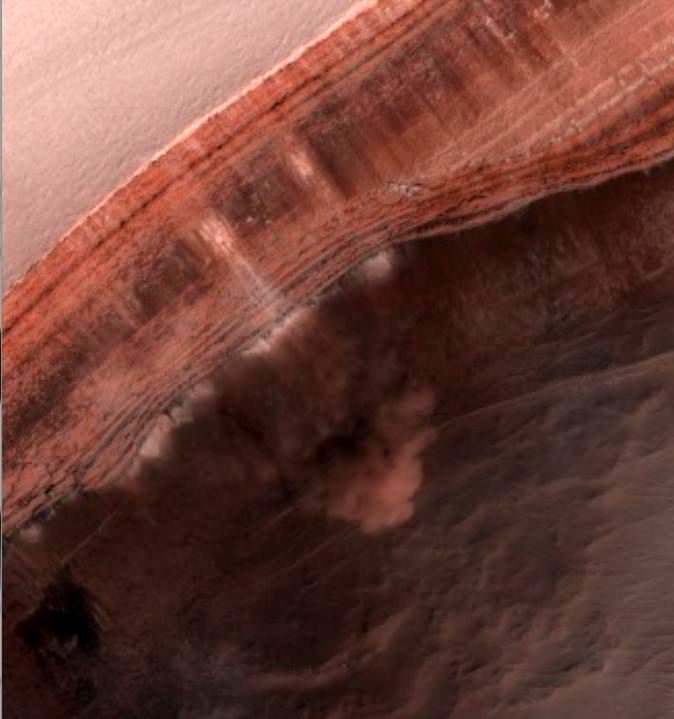
This Ice Cliff is One of the Few Places With Exposed Water ice in the Mid-Latitudes on Mars. It’s Probably Tens of Millions of Years old
Because of the orbiters and landers that have studied Mars over the years, scientists have learned that water ice is very likely locked away just under the surface throughout the planet’s mid-latitudes. These regions – especially in the northern hemisphere — are mostly covered with smooth material and scientists suspect ice is just underneath.
But sometimes, images like this give one from the HiRISE (High Resolution Imaging Science Experiment) camera on the Mars Reconnaissance Orbiter, provides a glimpse of the ice that might be buried below the surface. This image shows a cliff jutting out of the normally smooth terrain, and the cliff is covered with bright ice.
“The bright material on the cliff face is icy and is preserved only because the cliff points away from the equator, so it is shaded most of the time,” wrote HiRISE team member Shane Byrne. “Faint bands on the cliff might indicate layers in the ice that record different climate conditions. We do not know how much time this ice took to accumulate here, but studies elsewhere on Mars indicate that material like this is sometimes at least tens of millions of years old.”
“You wouldn’t need a backhoe to dig up this ice. You could use a shovel,” said the lead author of the study, Sylvain Piqueux of NASA’s Jet Propulsion Laboratory. “We’re continuing to collect data on buried ice on Mars, zeroing in on the best places for astronauts to land.”
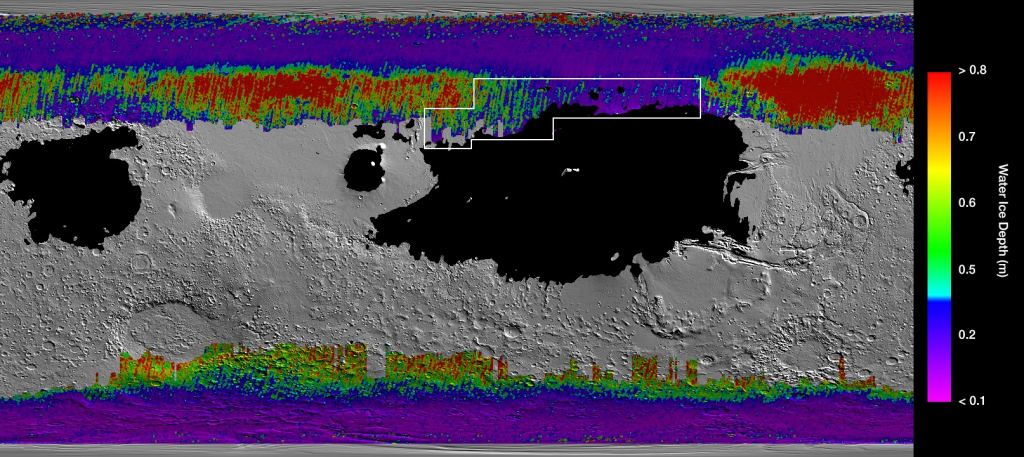
This rainbow-colored map shows underground water ice on Mars. Cool colors are closer to the surface than warm colors; black zones indicate areas where a spacecraft would sink into fine dust; the outlined box represents the ideal region to send astronauts for them to dig up water ice. Credits: NASA/JPL-Caltech/ASU
The water ice just below the surface would provide easily accessible in-situ resources for future explorers on Mars. While there are several enticing places they could land, a large portion of a region called Arcadia Planitia is the most tempting target in the northern hemisphere. The map above shows lots of blue and purple in this region, representing water ice less than one foot (30 centimeters) below the surface; warm colors are over two feet (60 centimeters) deep.
Landing humans on Mars is likely a decade or two away, but in the meantime, MRO and HiRISE will keep circling the planet, on the lookout for landing sites that might include water ice nearby.
Scientists have come to realize that, just below the surface, about one third of Mars is covered in ice. We study this ice to learn about Mars' ancient climate and astronauts' future water supplies.
Sometimes we see the buried ice because cliffs form like the one in this image. On the brownish, dusty cliff wall, the faint light-blue-colored ice shows through. Some of these cliffs change before our eyes and boulders of ice can tumble downhill. We take repeat images of these scenes to check for changes like this.
Image Credit: NASA/JPL-Caltech/University of Arizona
THE PENTAGON allegedly has in its possession an incredible clear photo of a "Black Triangle" UFO spectacularly rising out of the ocean.
Ever since the photo's alleged existence was first reported in late 2020, UFO enthusiasts have been begging for its release.
The Sun Online produced a mock up of what the incident may have looked like as the F/A-18F came across the "Black Triangle" off the East Coast of the US
It is thought to be one of the most compelling UFO sightings ever captured on camera because it was reportedly snapped by a US Navy pilot flying an F/A-18F Super Hornet.
The photo's existence has never been officially confirmed by the Pentagon - but many state it exists, and say they have been told as much by government insiders.
The Sun Online understands the photo is highly classified because it was captured using military equipment on board the fighter plane.
For many UFO sleuths it has become one of the Holy Grails - a picture that would leave no doubt in the minds of sceptics about the reality of the mysterious phenomena.
Pentagon officials reportedly have the "extremely clear" photo in their possession as it was reportedly circulated last year in an intelligence report by the Unidentified Aerial Phenomena (UAP) Task Force.
It was allegedly taken by a pilot in 2019 who spotted the craft as it emerged from the ocean and began to rise straight upwards, first reported The Debrief.
The object was described as a large triangle with "blunted" edges and spherical white "lights" on each corner - and the encounter is said to have occurred off the East Coast of the US.
Pilots who encountered the object are believed to have been operating from either the USS Dwight D. Eisenhower or the USS John C. Stennis.
Both of which are Nimitz-class nuclear-powered supercarriers - further deepening the apparent links between UFOs and man's nuclear capabilities.
It could be a key piece of evidence, demonstrating that we are truly in the presence of some other intelligence
Andy McGrillenUAP Media UK
Tom Rogan, the national security writer for the Washington Examiner, backed the existence of the stunning photo after verifying it with his sources.
He told The Sun Online: "It’s the tip of the iceberg. But we will see more leaks of UAP imagery and data in the coming years.
"The Pentagon should get ahead of the curve and officially release more material."
The file containing the photo was reportedly circulated on NSANet - the US National Security Agency's official intranet - to which Britain and other Five Eyes intelligence alliance nations are believed to have access.
What are the 'Black Triangles'?
"BLACK Triangles" have been a common part of the UFO phenomena since the first wave of sightings back in the 1940s.
As their name suggests, the objects appear floating in the sky as dark triangular shapes often peppered with lights.
Some of the triangles have been described as up to 120 metres long and they appear to move noiselessly without any contrails.
The triangles are part of a host of weird and wonderful UFO shapes - going from saucers, to spheres, to the infamous "Tic Tacs".
David Marler, UFO researcher and author of Triangular UFOs: An Estimate of the Situation, told the HISTORY he has up to 17,000 cases files on the phenomena.
He suggested the slow movement of the shapes could suggest "surveillance" or perhaps even scanning the landscape.
And in one of the most stunning encounters, it is reported in March 1990 two F-16 fighter jets in Belgium encountered a "Black Triangle".
It was said the shape accelerated away at 1,120mph within seconds - a manoeuvre that "exceeded the limits of conventional aviation", according to the air force.
British military UFO investigation Project Condign - which ran from 1997 to 2000 - makes mention of the shapes, but dismisses them as similar phenomena to ball lightning.
But if the existence of the Pentagon photo and the accounts of the 2019 East Coast encounter are true - it seems there is more to the triangles than a bizarre atmospheric disturbance.
Some have also speculated sightings of "Black Triangles" could be mis-identification for military aircraft using the flying wing design - such as Lockheed F-117 Nighthawk or B-2 Spirit.
Or the sightings could perhaps be more speculative and experimental craft, such as the rumoured TR-3A Black Manta or the Aurora.
Once again however - this does not explain the potential sighting in the Atlantic allegedly photographed by the US Navy pilot in 2019.
So-called "Black Triangle" sightings have been recorded for decades - including by the military - but often have been dismissed as secret aircraft or atmospheric anomalies.
And this alleged sighting and photo further raises questions over the links between UFOs and the ocean, with the Pentagon said to be probing the "transmedium" element of the phenomena.
"Transmedium" is the apparent ability of some UAPs to transit seamlessly between the air and the ocean.
Some have speculated UFOs may actually come from beneath the ocean - and numerous videos show the unusual ways they interact with the water.
Reports of incredible images being circulated in classified government documents just add the intrigue surrounding the upcoming UAP Task Force report which was ordered by US lawmakers.
The unprecedented dossier's deadline is now just days away, and it is reportedly set to not rule out an alien origin for UFOs.
Dismissed as a conspiracy theory for decades, former US defence officials, sitting politicians, and former presidents Barack Obama and Bill Clinton have all acknowledged there is something unusual going on in our skies.
Luis Elizondo headed up AATIP for the Pentagon before he went public
Luis Elizondo, who headed up the secretive Advanced Aerospace Threat Identification Program (AATIP) for the Pentagon, was recently also recently quizzed on the photo.
The intelligence officer resigned his post as he sought to bring the discussion about the UFOs into the mainstream, describing them as a "national security issue".
Quizzed on the Disclosure Team channel on YouTube bout whether he had seen the infamous image, Mr Elizondo replied: "I can't discuss that."
He added with a smile: "Great question".
The insider's decision to neither confirm or deny the existence of the photo has only fuelled the enthusiasm and speculation surrounding the alleged picture.
HIGHLY CLASSIFIED
Andy McGrillen, from UAP Media UK, a team set up to campaign for a more open and serious discussion on UFOs in Britain, told The Sun Online: "The much talked about Black Triangle picture is one that has had much of the community excited for some time.
"Recently I have been informed that the photo is of a craft that was initially tracked underwater then emerged, climbing to an altitude of 35-40,000 feet when an aircraft’s onboard systems took a high fidelity image.
"The triangular object was reported as having rounded edges, with lights on each of its corners. There were no obvious signs of propulsion.
"Something like this will surely be highly classified given the nature of the equipment taking the picture.
"However, if it did make its way into the public domain it could be a key piece of evidence, demonstrating that we are truly in the presence of some other intelligence."
Screenshot from the eerie and unexplained 'Tic Tac' video filmed by the US Navy and released by the Pentagon
Credit: US DEPARTMENT OF DEFENCE
Screenshot from the 'Gimbal' UFO video which includes US Navy pilots exclaiming 'look at that thing!'
Credit: US Department of Defense
Another US Navy video called 'Go Fast' which shows a UFO being tracked
Credit: US Department of Defense
What is going on with UFOs in the US?
UFOS have stepped from fringe conspiracy theories to a genuine national security debate in the US.
Pentagon officials last year took the unprecedented step to confirm a trio of remarkable videos which showed US encounters with UFOs.
The debate is still open as to what the phenomena caught on film were – but it made clear to everyone, something is in the skies.
Perhaps the most striking was a video known as the “Tic Tac” – which showed an unidentified object being pursued by fighter planes.
The US also confirmed the existence of the Advanced Aerospace Threat Identification Program (AATIP) – a Pentagon programme set up to study UFOs before being disbanded in 2017.
However, it was replaced by the UAP Task Force in June 2020 after a vote by the US Senate Intelligence Committee.
Defence chiefs have since confirmed a number of leaked UFO videos and photos which were submitted to the Task Force for investigation.
Why this sudden rush for transparency?
No outside the secretive wings of the US government currently knows for sure.
And as a tacked on addendum to a 5,500 page Covid relief bill passed in December, the the Director of National Intelligence’s office was ordered to compile a report on UFOs within 180 days.
Former intelligence director John Ratcliffe has hinted the report will be a big deal – and we now just over a month away from its release.
The five month deadline elapses on in June, with some UFO lobbyists claiming it could be the “most profound moment in human history".
US intelligence services officially closed the book on the UFO phenomena in 1969 at the conclusion Project Blue Book - which stated there was nothing to see.
However, in the last three years there has been an abrupt turnaround as the Pentagon took the unprecedented step of confirming three stunning leaked UFO videos filmed by the US Navy.
And the UFO report - which was commissioned by Congress - is being compiled by the UAP Task Force, who were given a 180 day deadline in December which is due to expire tomorrow.
Competing theories on the strange videos continue to rage – with some grounded on Earth claiming the videos capture never-before-seen military aircraft or drones, while others claim it shows otherworldly craft possibly piloted by aliens.
Others however are more sceptical and sometimes even dismissive, claiming the bizarre videos may just be camera tricks, natural phenomena or even outright hoaxes.
Leaked videos continue to emerge its been reported the UAP Task Force are investigating over 100 encounters between the military and the unidentified objects.
Emerging details on the report state that it does not confirm or rule out an alien origin for the phenomena - but US lawmakers have been talking up the issue following a classified briefing last week.
The Sun Online also spoke to Tobias Ellwood MP, who suggested UFOs could be advanced drones and called on the UK to stage a similar probe to the US.
What are Transmedium Objects?Avi Loeb, Ph.D. on the possibility of life beyond Earth
Are we alone in this universe? Congress seems to think not. One branch of the American government implying that UFOs have non-human origins is an explosive development.
According to Vice, members of the Senate Intelligence Committee believe (on a unanimous, bipartisan basis) that some UFOs have non-human origins. After all, why would Congress establish and task a powerful new office with investigating non-'man-made' UFOs if such objects did not exist?
Despite Congress now asking the Pentagon to focus only on those objects that haven’t been designed by human hands we must ask ourselves whether it could be another distraction in an attempt to hide the truth about the existence of extraterrestrial UFOs and intelligent life beyond Earth.
Avi Loeb, Ph. D., an astrophysicist and professor of science at Harvard University, joined Morning in America to discuss the possibility of life beyond Earth.
The true story behind Carl Sagan’s cult classic, Contact
Jill Tarter is Director of the Center for SETI Research at the SETI Institute in Mountain View, California. She served as Project Scientist for NASA’s SETI program, the High Resolution Microwave Survey, and has conducted numerous observational programs at radio observatories worldwide. Since the termination of funding for NASA’s SETI program in 1993, she has served in a leadership role to secure private funding to continue the exploratory science. Her astronomical work was illustrated in Carl Sagan’s 1985 novel “Contact.” The character largely based on Tarter, “Ellie Arroway,” was portrayed by Jodie Foster in the 1997 film version of “Contact.”
TWO SETS OF sacred documents — the Gutenburg Bible and the Spring and Autumn Annals of Confucius — chronicle two religious traditions separated by cultures and entire continents.
We might not know of these documents’ existence today without one invention: The printing press. This singular machine has enabled the mass distribution of knowledge — understanding the first iterations of this technology are key to understanding the modern world, and the future.
Scientists at SLAC are applying powerful X-ray technology to Confucian texts and the Gutenburg Bible to reveal their chemical history.
Travel back in time with us to Korea in 1442, during the Choson Dynasty. That’s when the Royal Government Publications Office used an early version of the printing press to mass-produce the writings of the ancient Chinese philosopher Confucius for the first time. Their press featured moveable type — the letters could be shifted and reconfigured as individual stamps.
Then in Germany around 1448, goldsmith Johannes Gutenberg built his legendary printing press. Historians credit it as the trigger for all the innovations that propelled Europe out of the Medieval era and into the Renaissance and beyond.
Gutenberg’s invention, which also featured moveable type, allowed for the first mass production of the Bible. Suddenly, monks didn’t have to painstakingly copy scripture by hand. In its first decade of use, the Gutenberg press printer 180 Gutenberg Bibles — about 49 of these survive today.
PRESSED FOR ANSWERS
But there’s a twist: The Confucian texts and the Gutenberg Bibles may have been printed a mere decade apart, but the Korean government used methods that had existed for at least 70 years that had originated in modern-day China. So while Gutenberg is the name the West remembers, Asian peoples were likely the first to ever use a printing press with moveable type to produce books and texts.
It’s also unclear whether the two printing press technologies emerged independently — or if Gutenberg took inspiration from Asia. To find out if Gutenberg was a true pioneer, a team of scientists from the SLAC National Accelerator Lab in Menlo Park, California, trained powerful X-ray beams on the sacred texts to reveal the secrets within.
By beaming sacred documents with X-rays, researchers hope to learn whether Gutenberg took inspiration from East Asian inventors.
To solve the nearly 600-year-old mystery, researchers might compare the construction of Gutenberg’s press with the one used by the Korean government. Both used metal letters, and it’s possible that Gutenberg knew of the Korean machine and built one using similar metal alloys, like nickel and copper.
He also may have concocted ink using a similar technique to the ink used in Korea, which was typically composed of burnt vegetable oil and glue. But since none of these ancient presses remain, the researchers can’t perform that kind of in-depth examination.
“WE CAN’T REALLY SAY ONE AFFECTED THE OTHER.”
“All we have to go on are some paintings, but we don't know if those paintings were portraits of the printing press or interpretations,” Minhal Gardezi, a University of Wisconsin-Madison graduate student who works on the project at SLAC, tells Inverse.
To extract the crucial clues hidden in the ink and metal residues, a powerful X-ray at SLAC called the Stanford Synchrotron Radiation Light Source can carefully scan original copies of the Korean documents and a surviving copy of the Gutenberg Bible. They haven’t yet published results of their research, but have already encountered some clues.
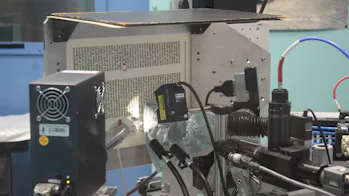
The SLAC has already processed text from the Gutenberg Bible, shown here, along with the Spring and Autumn Annals of Confucius.SLAC National Accelerator Laboratory
“On comparing some of the Western versus some of the Korean documents,” Gardezi says, “we've seen different types of metal appear, like totally different types of metal, which is very interesting.”
The scientists have also noticed differences in the sorts of ink and stamps used. But at this point in the analysis, we can’t conclude whether the presses are a case of convergent technological evolution — two strikingly similar technologies with similar-ish materials sprouting up within a century of each other yet with no clear relationship. Yet.
Jiyoung Noh is a program specialist at the Research and Development Division of the United Nations Educational, Scientific, and Cultural Organization (UNESCO), and has collaborated with SLAC on the project since its inception.
“We can't really say one affected the other,” Noh notes. But the SLAC may soon change that.
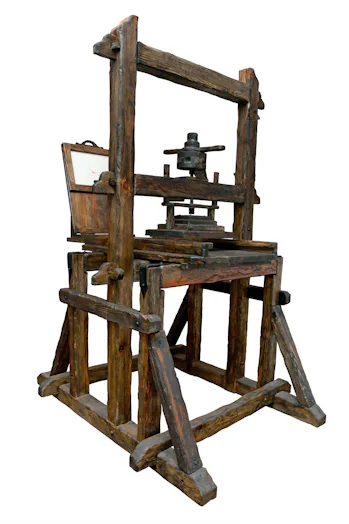
Gutenberg envisioned a giant contraption like this to print and widely distribute copies of important documents, leading to the rapid dissemination of knowledge.Shutterstock
The Gutenberg Press is considered a revolutionary technology because it enabled mass literacy, according to the Western-centric narrative that also claims the printing press first popped up in the 1450s in Germany.
But the oldest known moveable type printing press was developed by Chinese artisan Bi Sheng as early as 1040. This contraption used ceramic characters on an iron plate to press down ink on paper — printing the same document repeatedly. Bi Sheng’s documents and press were lost to time, so what we know of his accomplishments comes from secondhand sources.
By the 12th century, the first printing press with metal type had emerged in what’s now China. The early presses were used to produce currency and official documents, but later, they were also used to print other texts.
“THROUGHOUT THE WORLD, THAT IS WHAT WE KNOW IS THE EARLIEST HUMAN PRINTED DOCUMENT.”
By the 13th century, movable type presses had reached Korea, where they were employed by the Goryeo dynasty. While none of the early documents survived, we do have the Jikji text, a collection of Buddhist teachings printed on a bronze-based moveable type press in 1377. Unfortunately, the only remaining volume of Jikji is cached deep within the National Library of France, and is largely inaccessible.
So the SLAC decided to scan a contemporary copy of the 1442 Spring and Autumn Annals of Confucius,which were created using similar methods as the Jikji.
“This big overall project is called Jikji to Gutenberg, because the Jikji is the Buddhist book that was believed to be printed in Cheonju, Korea, 70-plus years before the Gutenberg Bible, so throughout the world, that is what we know is the earliest human printed document,” Gardezi says.
THE BEAMS HAVE IT
The Stanford Synchrotron Radiation Light Source creates an X-ray fluorescence spectrum of many frequencies. These frequencies correspond to the chemicals once punched onto the paper by a metal printing press.John Wenz
So, how does a linear accelerator enable researchers to decipher thousands-year-old documents? It turns out that the light generated at the SLAC can be harnessed to produce X-rays powerful enough to reveal ancient secrets.
IF THE METAL ALLOYS IN THE DOCUMENTS ARE STRIKINGLY SIMILAR, IT MAY MEAN THAT GUTENBERG ADAPTED THE EAST ASIAN CONCEPT.
The Stanford Synchrotron Radiation Light Source works a little something like this: It accelerates a stream of powerful electrons around a donut-like structure. When passing through the magnets surrounding the structure, the electrons generate synchrotron radiation, or fine beams of intense X-rays.
When one of these beams strikes the centuries-old paper, it creates an X-ray fluorescence spectrum of many frequencies. These frequencies correspond to the chemicals once punched onto the paper by a metal printing press.
The composition matters because the metal residues can offer clues as to whether Gutenberg was working with a blueprint or not. If the metal alloys in each set of documents are strikingly similar, it may mean that Gutenberg essentially re-envisioned the East Asian concept and adapted the technology to the West. But as mentioned by Gardezi, the evidence so far doesn’t seem to incriminate the German inventor.
ON THE HORIZON…
Another view of the Confucian text. Finding different metal traces on the two historical texts could disprove a direct link between Eastern and Western moveable type innovations.SLAC National Accelerator Laboratory
Firing intense X-ray beams at priceless and ancient documents may sound like an odd pursuit, but each page is exposed to the fine beam only for a few milliseconds and so the X-Ray doesn’t get a chance to damage the paper.
The scanning also takes place inside a radiation-proof room. Inside, a rig scans pages held upright, and a bright light travels across each page like a narrow-beam flashlight as a camera watches. Meanwhile, the SLAC scientists sit just outside the room, intently watching the scans arrive on a computer.
As the equipment processes the data, it color-codes certain chemicals on a screen. The text is indecipherable at this point. But the letters don’t matter so much as their chemical residue.
“I think some more chemical analysis is needed to understand if there really are any strong ties.”
“IT'LL BE MESMERIZING TO FIND SUCH A DISCOVERY. EVERYBODY'S GOING TO BE VERY SURPRISED.”
Concentrations of nickel show up as red splotches against the other chemical residue, which all appear blue — a generic assemblage of the other chemicals in the paper. It shows that nickel was part of the fabrication process of the individual letters in the moveable type developed by Gutenberg.
Finding different metal traces on the two historical texts could disprove a direct link between Eastern and Western moveable type innovations. But it could also result from differences in the machines’ fabrication or the availability of certain ingredients on the two continents.
“I think some more chemical analysis is needed to understand if there really are any strong ties,” Gardezi says.
Yet if they can prove a link, then the project could reveal a printing trade network using the Silk Road, in which artisans exchanged metal characters and inks in lieu of spices and fabric. That’s what UNESCO researcher Noh hopes for, although time will have to tell.
“It'll be mesmerizing to find such a discovery,” she says. “Everybody's going to be very surprised.”
The Universe is made up of billions of Galaxies including our Milky Way Galaxy. Scientists have discovered that the Milky Way Galaxies also house hundreds of billions of stars and planets. But out of these numerous stars, only about 4.1 billion of them are Stars like the Sun.
However, almost the stars like the Sun have something in common. They all have billions of billions of hydrogen atoms that fuse to produce Helium. This process is generally referred to as nuclear fusion. But as the Sun continues to undergo the nuclear fusion process, a time will reach when its brightness and size will expand.
As Stars like the Sun begin to run out of hydrogen atoms in their core, they slowly grow into red giants and take a shape that is ten times greater than their original size. A star undergoing such a process is generally referred to as a dying star.
Scientists clearly understand that the Stars like the Sun will surely turn into red dwarfs and even expand someday into the future to eat up planets around their orbit. However, scientists conducted a new study to improve their knowledge of how the Sun will expand and engulf neighboring planets. Scientists conducted this study deploying a method known as hydrodynamical simulations.
While conducting the research, the hydrodynamical simulations give an insight into the future scenarios of the Solar system. The scientists modeled the research to display scenarios where stars engulf planets to gain more knowledge on how the sun will expand in the future.
While making a statement about the discovery, Ricardo Yarza, the lead author of the study, stated, “Evolved stars can be hundreds or even thousands of times larger than their planets, and this disparity of scales makes it difficult to perform simulations that accurately model the physical processes occurring at each scale. Instead, we simulate a small section of the star centered on the planet to understand the flow around the planet and measure the drag forces acting on it.”
From these findings, scientists learned how the Sun will engulf its planets about 5 billion years from now and also gained more insightful knowledge about recently discovered planets orbiting white dwarfs. They also learned that some planets within the solar system may likely survive during the end stages of the Sun.
The study suggests that the closest planets to the sun which are Mercury and Jupiter will be eaten by the red giant. However, the Sun may survive the Massive sun. But even if Earth survives being consumed by the sun, it will become inhabitable for living species.
Planets with extremely cold temperatures like Jupiter, Saturn, Neptune, and Uranus with their moons will lose their ices and develop a more life-friendly environment. Scientists that conducted these studies later published them in the Astrophysical Journal. You can access it from HERE.
What do you think about this fascinating discovery about the future of Stars like the Sun?
The Sombrero Galaxy by Hubble aka Messier 104 NGC4594
There are approx. 200 to 400 billion stars in the Milky Way. Now look at this galaxy. It has 200 to 300 billion stars. Now….there are billions of galaxies! With billions of stars and that is just what we can observe with the current technology.
A billion billion is a Quintillion and there is about 400 billion x a quintillion stars in the known universe. Something to the power of 10 to the 24th. It blows my mind .....What gets me isn't just the number of stars, and the enormous scale and size and distance. It's the amount of time. That each galaxy is 31 million light years away.
The amount of time it took for the light from that picture to reach us, entire species could evolve on planets and develop into a space faring galactic civilization; empires could rise and fall, then fade into dust, and be lost in the sands of time, without us ever knowing. And that's just the 31 million years it took for that light, which is a drop in the bucket of time that this galaxy has had to create life over many many billions of years.
Meer van UFO'S of UAP'S, ASTRONOMIE, RUIMTEVAART, ARCHEOLOGIE, OUDHEIDKUNDE, SF-SNUFJES EN ANDERE ESOTERISCHE WETENSCHAPPEN - DE ALLERLAATSTE NIEUWTJES


 Is Earth A Prison Planet And The Moon A Station For Guardians?