Ontdek de Fascinerende Wereld van UFO's en UAP's: Jouw Bron voor Onthullende Informatie!
Ben jij ook gefascineerd door het onbekende? Wil je meer weten over UFO's en UAP's, niet alleen in België, maar over de hele wereld? Dan ben je op de juiste plek!
België: Het Kloppend Hart van UFO-onderzoek
In België is BUFON (Belgisch UFO-Netwerk) dé autoriteit op het gebied van UFO-onderzoek. Voor betrouwbare en objectieve informatie over deze intrigerende fenomenen, bezoek je zeker onze Facebook-pagina en deze blog. Maar dat is nog niet alles! Ontdek ook het Belgisch UFO-meldpunt en Caelestia, twee organisaties die diepgaand onderzoek verrichten, al zijn ze soms kritisch of sceptisch.
Nederland: Een Schat aan Informatie
Voor onze Nederlandse buren is er de schitterende website www.ufowijzer.nl, beheerd door Paul Harmans. Deze site biedt een schat aan informatie en artikelen die je niet wilt missen!
Internationaal: MUFON - De Wereldwijde Autoriteit
Neem ook een kijkje bij MUFON (Mutual UFO Network Inc.), een gerenommeerde Amerikaanse UFO-vereniging met afdelingen in de VS en wereldwijd. MUFON is toegewijd aan de wetenschappelijke en analytische studie van het UFO-fenomeen, en hun maandelijkse tijdschrift, The MUFON UFO-Journal, is een must-read voor elke UFO-enthousiasteling. Bezoek hun website op www.mufon.com voor meer informatie.
Samenwerking en Toekomstvisie
Sinds 1 februari 2020 is Pieter niet alleen ex-president van BUFON, maar ook de voormalige nationale directeur van MUFON in Vlaanderen en Nederland. Dit creëert een sterke samenwerking met de Franse MUFON Reseau MUFON/EUROP, wat ons in staat stelt om nog meer waardevolle inzichten te delen.
Let op: Nepprofielen en Nieuwe Groeperingen
Pas op voor een nieuwe groepering die zich ook BUFON noemt, maar geen enkele connectie heeft met onze gevestigde organisatie. Hoewel zij de naam geregistreerd hebben, kunnen ze het rijke verleden en de expertise van onze groep niet evenaren. We wensen hen veel succes, maar we blijven de autoriteit in UFO-onderzoek!
Blijf Op De Hoogte!
Wil jij de laatste nieuwtjes over UFO's, ruimtevaart, archeologie, en meer? Volg ons dan en duik samen met ons in de fascinerende wereld van het onbekende! Sluit je aan bij de gemeenschap van nieuwsgierige geesten die net als jij verlangen naar antwoorden en avonturen in de sterren!
Heb je vragen of wil je meer weten? Aarzel dan niet om contact met ons op te nemen! Samen ontrafelen we het mysterie van de lucht en daarbuiten.
“Observed several UFOs in the sky” – Bremerton, Washington 21-Aug-2022
These unidentified flying bright objects were caught in the sky above Bremerton, a city in Kitsap County, Washington. This happened on 21st August 2022.
Witness report:
While walking my dog this evening, I noticed a number of lights in the sky. I started recording about a minute after i saw them. Not sure what these are. Are you able to identify them? Captured Sunday evening August 21, 2022. At approximately 8:20 pm. Video recorded from an iPhone 8 at full digital zoom. Recorded from a neighborhood near southwestern Bremerton. Looking south, southeast across Sinclair inlet. The hill side, in the foreground, is located in Port Orchard. I have a total of 6:50 (m:s) of video, but Twitter requires me to only send a trimmed portion.
Were Phobos and Deimos Once a Single Martian Moon That Split up? Not Likely, says New Study
The origin of Phobos and Deimos, the two Martian moons, has been a mystery to astronomers. These two bodies are a fraction of the size and mass of the Moon, measuring just 22.7 km (14 mi) and 12.6 km (7.83 mi) in diameter. Both have a rapid orbital period, taking just 7 hours, 39 minutes, and 12 seconds (Phobos) and 30 hours, 18 minutes, and 43 seconds (Deimos) to complete an orbit around Mars. Both are also irregular in shape, leading many to speculate that they were once asteroids that got kicked out of the Main Belt and were captured by Mars’ gravity.
There’s also the theory that Phobos and Deimos were once a single moon hit by a massive object, causing it to split up (aka. the “splitting hypothesis”). In a recent paper, an international team of scientists led by the Institute of Space and Astronautical Science (ISAS) revisited this hypothesis. They determined that a single moon in a synchronous orbit would not have produced two satellites as we see there today. Instead, they argue, the two moons would have collided before long, producing a debris ring that would have created an entirely new moon system.
The paper that describes their findings recently appeared online and will be published in The Planetary Science Journal. The research was led by Dr. Ryuki Hyodo, a researcher with the Department of Solar System Sciences at ISAS, a part of the Japan Aerospace Exploration Agency (JAXA). He was joined by researchers from the Earth-Life Science Institute at the Tokyo Institute of Technology, the Paris Globe Institute of Physics at the Universite de Paris, and the Orbital Dynamics and Planetary Group at Sao Paulo State University.
As noted, the subject of where Mars’ moons came from has become a hot topic of date for astronomers in recent years. Historically, astronomers have leaned towards the Capture Hypothesis, which states that Phobos and Deimos were once D-type asteroids. These are asteroids composed of organic-rich silicates, carbon, and silicates that contain no water (anhydrous) that may have water ice in their interiors. This hypothesis is largely motivated by observations that revealed similarities in spectra between D-type asteroids and these moons.
Alternately, the Giant Impact Hypothesis states that an impactor struck Mars, creating a debris ring around the planet that accreted to form two rubble-pile objects. This is similar to the most widely-accepted theory of how the Earth-Moon system formed billions of years ago due to an impact with a Mars-sized object named Theia (also called the Giant Impact Hypothesis). More recently, it has been proposed that Phobos and Deimos may not be primordial objects that resulted from capture or an impact but are the remains of a primordial moon that broke apart.
This theory has been dubbed the “Ring-Moon Recycling Hypothesis,” which was put forth in a 2021 paper by Amirhossein Bagheri et al. According to this hypothesis, this progenitor moon was ripped apart 1 to 2.8 billion years ago, either by tidal forces or an impact. The resulting debris would have formed a ring around Mars that was eventually recycled to form Phobos and Deimos. As astronomers have noted, this model presents some issues, which include the fact that Mars would still have a ring system. As Dr. Hyodo explained to Universe Today via email, he and his team noted that there are other issues:
“Studying the tidal evolution of the moons back in time, Bagheri et al. (2021) found a solution that Phobos and Deimos could once have orbits that would cross each other. This is their evidence: saying that Phobos and Deimos were once a single moon that was split to form Phobos and Deimos. Note that if you change parameters that control the tidal evolution, the orbits of Phobos and Deimos in the past do not cross each other. The idea of Bagheri et al. is based on their parameters that have resulted in orbital crossing in the past.“
To test this hypothesis, Dr. Hyodo and his colleagues began with the assumption that Phobos and Deimos were once a single body. They then conducted numerical simulations that combined geophysical and tidal-evolution models of a Mars–satellite system. From this, said Dr. Hyodo, they determined that it was highly unlikely that Phobos and Deimos originated from a single object:
“We then calculated successive orbital evolutions of the moons in the direct 3-body approach (Mars-Phobos-Deimos), which can precisely calculate close encounters, gravitational interactions, and collisions between moons. We found that the two moons would most likely (more than >90% by chance) collide with each other within a very short timescale after the splitting (<10^4 years). This impact is very destructive (i.e., high-velocity impact), and thus the two moons (Phobos and Deimos) are catastrophically destroyed.”
In short, if Phobos and Deimos were split from a single progenitor Moon (1 to 2.7 billion years ago), they would have collided within 100,000 years. This would have left Mars with another debris ring that would still be there today, rather than its two irregularly-shaped satellites that happen to be asteroid-like in composition. These findings have renewed the debate about where Mars’ moons came from and also suggest that it may not be resolved until sample-return missions are sent to explore the Martian satellites.
Several mission concepts are currently on the table. In 2008, NASA’s Glenn Research Center began studying a possible sample-return mission known as the “Hall” concept. This New Frontiers-class concept would perform a sample-return from Phobos and Deimos. In January 2013, scientists from Standford University, the Massachusetts Institute of Technology (MIT), and NASA’s Jet Propulsion Laboratory began collaborating on a new Phobos Surveyor mission. The mission is currently in the testing phases with a potential launch window of 2023 and 2033.
Artist’s concept of Japan’s Mars Moons eXploration (MMX) spacecraft, carrying a NASA instrument to study the Martian moons Phobos and Deimos. Credits: JAXA/NASA
In March 2014, NASA proposed a Discovery-class mission called Phobos And Deimos & Mars Environment (PADME), which would place an orbiter in Mars orbit by 2021 to study Phobos and Deimos. A heritage concept called OSIRIS-REx 2 is being considered that would use parts from the first OSIRIS-REx mission (a sample-return mission to the asteroid Bennu) and conduct a sample-return mission from Phobos and Deimos. Beyond NASA, other space agencies also hope to send robotic spacecraft to explore the Martain satellites.
In 2015, the Japanese Aerospace Exploration (JAXA) unveiled their concept for a sample-return mission to Phobos known as the Martian Moons Exploration (MMX). This mission would conduct a Deimos flyby before landing on Phobos multiple times to obtain samples – similar to what the Hayabusa2 mission did on asteroid Ryugu. This mission is international in scope, with NASA and the ESA contributing, and is currently scheduled to launch in 2024 and return samples to Earth five years later.
Russia plans to repeat its previous attempt to send a sample-return mission to Phobos named Fobos-Grunt (Russian for “Phobos Ground”) in the late 2020s. In 2015, the ESA began assessing a sample-return mission to Phobos called Phootprint, which was planned for launch by 2024. This mission was originally conceived as a collaborative effort between the ESA and Roscosmos, which have since terminated their cooperation agreements due to Russia’s invasion of Ukraine.
From all these proposals, it is clear that multiple space agencies intend to explore the Moons of Mars in the near future. The origin and subsequent evolution of these moons are considered part of a wider effort to explore and characterize Mars. In the meantime, the debate continues!
How Weak Will Astronauts Feel When They First set Foot on Mars After Months in Space?
In the coming decade, in 2033, NASA and China intend to send astronauts to Mars for the first time in history. This presents numerous challenges, ranging from logistical and technical issues to ensuring that astronauts can deal with waste and have enoughfood and waterfor the months-long transit to and from Mars. But of course, there’s also the health and safety of the astronauts, who will be spending months traveling through space where they’ll be exposed to cosmic radiation and microgravity. There are even concerns that after months of exposure to microgravity, astronauts will have trouble adapting to Martian gravity.
To determine if these fears have merit, a team of space medicine experts from the Australian National University (ANU) developed a mathematical model to predict whether astronauts can safely travel to Mars and perform their duties once they arrive on the Red Planet. This model could be immensely valuable alongside all the other preparations that need to happen before astronauts set foot on Mars. It could also be used to assess the impact of short- and long-duration missions that take astronauts far beyond Low Earth Orbit (LEO) and the Earth-Moon system in the future.
The paper that describes their mathematical model and conclusions recently appeared in npj Microgravity, a scientific journal published by Nature. The research team was led by Dr. Lex van Loon, a Research Fellow from the ANU College of Health and Medicine (CHM). As he and his colleagues note in their study, the potential hazards for missions bound for Mars are numerous, but the greatest threat is arguably the time the astronauts will spend in microgravity. Combined with damaging radiation from the Sun and cosmic sources, the experience will cause fundamental changes to their bodies.
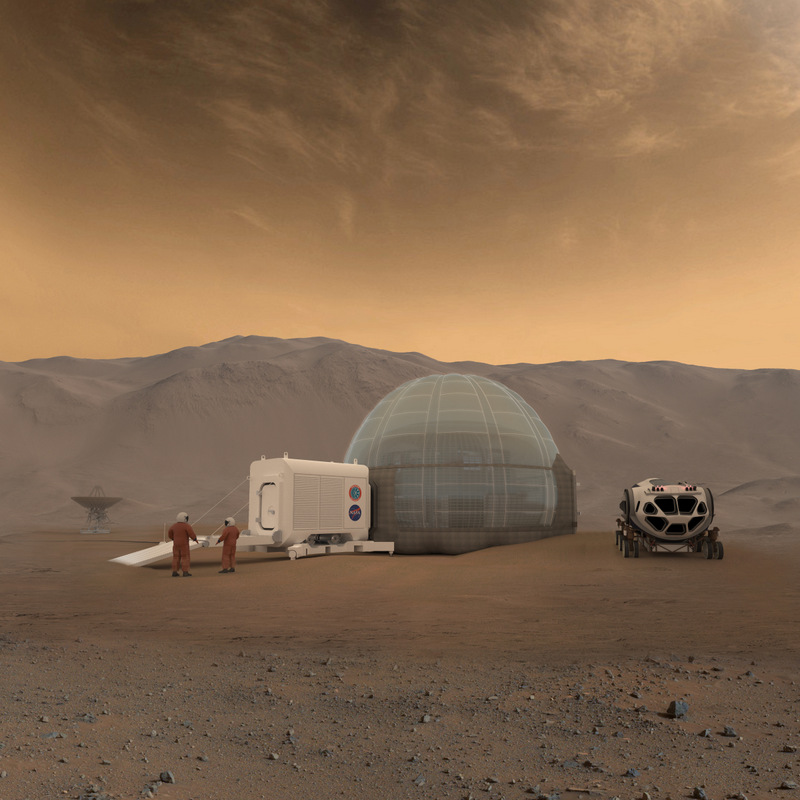
Artist concept of the Mars Ice Home. Credit: NASA.
Based on extensive research conducted aboard the International Space Station (ISS), microgravity is known to cause muscle and bone density loss and affect organ function, eyesight, and the cardiopulmonary system – the heart and its ability to pump blood through the body’s system of arteries and veins. As Van Loon described in an ANU news release, their research is not only essential because of proposed missions to Mars, but for the burgeoning commercial space sector as well:
“We know it takes about six to seven months to travel to Mars and this could cause the structure of your blood vessels or the strength of your heart to change due to the weightlessness experienced as a result of zero gravity space travel. With the rise of commercial space flight agencies like Space X and Blue Origin, there’s more room for rich but not necessarily healthy people to go into space, so we want to use mathematical models to predict whether someone is fit to fly to Mars.”
Co-author Dr. Emma Tucker, an astrophysicist and emergency medicine registrar, added that prolonged exposure to zero gravity could cause the heart to become lazy because it doesn’t have to work as hard to overcome gravity and pump blood throughout the body.
“When you’re on Earth, gravity is pulling fluid to the bottom half of our body, which is why some people find their legs begin to swell up toward the end of the day. But when you go into space that gravitational pull disappears, which means the fluid shifts to the top half of your body and that triggers a response that fools the body into thinking there’s too much fluid. As a result, you start going to the toilet a lot, you start getting rid of extra fluid, you don’t feel thirsty and you don’t drink as much, which means you become dehydrated in space.
The Crew Transfer Vehicle (CTV) using its nuclear-thermal rocket engines to slow down and establish orbit around Mars.
Credit: NASA
This, says Tucker, is why astronauts returning from the ISS are seen fainting when they set foot on Earth again or need to be transported using wheelchairs. The longer they stay in space, the more likely they will collapse when they return to Earth, and the more difficult the process of readjusting to Earth’s gravity. In the case of the NASA Twins Study, Mark Kelly spent over a year in orbit and experienced terrible pain, swelling, and other symptoms upon his return (as he described in his book Endurance: A Year in Space, a Lifetime of Discovery).
When it comes to missions bound for Mars, there’s the added complication imposed by the communications delay between Earth and Mars. Depending on the alignment of the Sun, Earth, and Mars, these delays can last as long as 20 minutes, which means astronauts must be able to perform their duties without immediate assistance from mission controllers or support crews (which includes medical emergencies). As Van Loon explained:
“If an astronaut faints when they first step out of the spacecraft or if there’s a medical emergency, they’ll be nobody on Mars to help them. This is why we must be absolutely certain the astronaut is fit to fly and can adapt to Mars’ gravitational field. They must be able to operate effectively and efficiently with minimal support during those crucial first few minutes.”
Their model relies on a machine learning algorithm based on astronaut data collected from past Expeditions aboard the ISS and the Apollo missions to simulate the risks associated with traveling to Mars. Testing showed that it could simulate key cardiovascular hemodynamic changes after prolonged spaceflight and under different gravitational and fluid loading conditions. And the results are encouraging, as they indicate that astronauts can function after months spent in microgravity.
Artist’s impression of a Mars habitat in conjunction with other surface elements on Mars. Credit: NASA
While the current model is informed by data derived from middle-aged and well-trained astronauts, the researchers hope to expand its capabilities to include commercial spaceflight data. Ultimately, their goal is to create a model that can simulate the impact of prolonged space travel on relatively unhealthy individuals with pre-existing heart conditions (in other words, untrained civilians). They hope this model will provide a more holistic picture of what would happen if an “everyday” person were to travel to space.
Further refinements could be made to incorporate age-related health issues, which would make sense given the number of celebrities that have flown to space recently (Wally Funk, William Shatner, Laura Shepard, Richard Branson, etc.). Who knows? Perhaps it will be possible to simulate the effects of long-term exposure to microgravity on children and fetal development. This research is crucial if we ever want to send humans to the Moon, Mars, and other destinations to live someday.
Mars and Moon Dust can be Turned Into Geopolymer Cement. Good Enough for Landing Pads and Other Structures
Materials science has long taken the lead in space exploration research, and it seems to have been getting even more attention than usual lately. That is especially true for building materials. NASA has funded several new research programs to develop new building materials that can do everything from providing structure to future human habs to landing pads for future reusable rocket missions. Now that second goal is one step closer, thanks to researchers at the University of Delaware.
Their recent paper in Advances in Space Research describes a method for making a type of geopolymer out of Martian and lunar regolith simulants. Geopolymers are an advanced form of concrete that has enhanced physical properties such as compressive strength and thermal tolerance – precisely the type of properties you want to be stronger if you’re trying to build a retro rocket landing pad.
Landing a rocket on another planet (or moon, for that matter) is risky. Dust and rocks blown skyward by the downdraft of the column of flame the rocket emits could damage the rocket itself or anything that it might be carrying, such as humans. The best way to stop that potential hazard would be to build a landing pad. However, one made with regular concrete can’t withstand a rocket blast without breaking itself into the kind of chunks most dangerous to rockets. That is where geopolymers come in.
SEM image of the simulated lunar regolith geopolymer. Credit – University of Delaware
With their extreme physical and thermal properties, they are ideally suited to serve as the landing pad material for rockets. The only problem is – how do you make them off of Earth? That was the focus of the team in Delaware.
They used Martian and lunar regolith simulates as a basis for making the geopolymer, which was created using a combination of clay and a solvent with a high pH – in this case, sodium silicate. After mixing the two materials, the researchers let the resulting mixture cure for seven days before testing the new material’s properties.
Under Earth-like conditions, the materials they created had the kind of properties they were looking for. However, Maritan conditions were not as congenial. At -80 C, the reaction to form the geopolymer hardly happened at all. Additionally, in a vacuum, which is also the natural state of the moon or Mars, the formation didn’t happen as well as it did under ambient Earth conditions.
UT Report on mixing concrete in space.
Two solutions present themselves – either future space explorers could use a system that heats up and pressurizes the extraterrestrial clay so that the reaction would happen as expected. Or further material advances could point to potential solutions that could be done at ambient temperatures on the Moon and Mars. Either way would require more research.
But there’s not only work on the material science side – sodium silicate isn’t particularly common on Mars. It would require hundreds to thousands of kilograms of the stuff to make enough geopolymer for even a single landing pad, which is expensive if launching it from Earth, though it could be done with a single rocket payload. In addition, more recent research just reported that clays might not be as common as initially thought on Mars, making the other material component of the geopolymer harder to find as well.
Either way, explorers will eventually need a landing pad to ensure their descending (or ascending) rocket isn’t blasted into shrapnel by fast-moving rocks. And geopolymers seem as good a solution as any offered so far. Material science keeps marching forward, and someone someday will find a long-term solution.
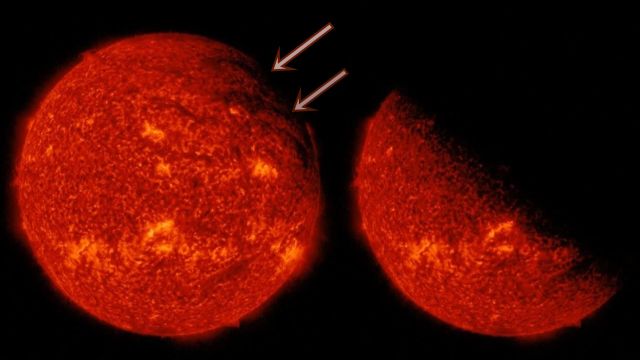
Something huge appears in front of a solar satellite
On August 20, 2022 the solar satellite SDO AIA 304 captured something huge that arrives between the solar satellite and the sun, partially obscures the sun, it slowly going down and back up.
It doesn't look like a partial solar eclipse, it's something moving between the camera and the sun.
Directly after the massive black object disappears, an anomaly passing the sun.
Elizabeth April | Astral Projection, Alien Abduction, Hybrid Species, Reincarnation
Elizabeth is a past life regression. She is an author, a truth seeker, and a clairvoyant. Elizabeth explains how she channels and communicates with the Galactic Federation in another dimension. She speaks to the federation about our planet, interaction with entities. It all goes back to her dad giving her a past life regression, which lead to her heightened awareness, clairvoyance, and even being abducted by aliens. Elizabeth tells us of her astro projecting journeys. Her communication with many different types of aliens. She explain how the aliens have taught her about human origins, and how Earth is headed for a new vibration.
BIZARRE ONDERWATERSNEEUW OP EUROPA VALT MOGELIJK OMHOOG: MINDER ZOUT WATER, MEER KANS OP LEVEN?
Jeannette Kras
Jupiters kleinste Galileïsche maan Europa herbergt nog vele geheimen, mogelijk in de vorm van leven. Een nieuwe studie licht weer een tipje van de sluier op: er schuilt niet alleen een oceaan met vloeibaar water onder de dikke ijskorst, maar er is ook sneeuw, die omhoog valt.
De sneeuw drijft naar boven vanaf omgekeerde ijspieken en ondergedompelde ravijnen. De bizarre onderwatersneeuw kennen we ook onder ijsplaten op Aarde. Volgens het nieuwe onderzoek gebeurt dus hetzelfde op de maan van Jupiter. Daar zou de sneeuw een rol spelen bij de vorming van de ijskorst.
Onderwaterleven De onderwatersneeuw is veel puurder dan andere vormen van ijs, wat betekent dat Europa’s ijslaag mogelijk veel minder zout is dan tot nu toe werd gedacht. Dat is belangrijk voor de wetenschappers die de NASA-missie Clipper naar Europa voorbereiden. Het ruimtevaartuig gebruikt radar om onder de ijskap te gluren of er in Europa’s oceaan mogelijk leven huist. Zout dat vastzit in het ijs kan effect hebben op hoeveel en hoe diep de radar onder het ijs kan kijken. Dus als de onderzoekers beter weten waar het ijs van is gemaakt, kunnen ze de data van de missie beter begrijpen. Ze kunnen dan ook beter het zoutgehalte bepalen en de levensvatbaarheid van de oceaan.
“Als we Europa verkennen zijn we geïnteresseerd in het zoutgehalte en de samenstelling van de oceaan, omdat dit mede bepaalt in hoeverre de oceaan leven kan bevatten en zelfs waar dit leven uit bestaat”, legt onderzoeker Natalie Wolfenbarger uit van de University of Texas, wier studie in vakblad Astrobiology verscheen. De Texaanse universiteit leidt ook de ontwikkeling van het radarinstrument waarmee ruimtevaartuig Clipper onder het ijs op Europa gaat kijken.
Vergelijkbaar met Antarctica Europa is ongeveer net zo groot als onze eigen maan en is omhuld met een kilometers dikke ijslaag. Daaronder zit vermoedelijk een vloeibare oceaan. Eerdere studies wijzen uit dat de temperatuur, druk en het zoutgehalte van het gedeelte dat zich dicht tegen het ijs bevindt, vergelijkbaar is met wat je onder een ijskap op Antarctica aantreft.
Gewapend met deze kennis, is in deze nieuwe studie gekeken naar twee verschillende manieren waarop water onder ijsplaten bevriest: het ijs groeit direct onder het ijs vast of er vormen zich ijsschotsen in het ijskoude zeewater die naar boven komen drijven en zich dan vastzetten aan de onderkant van de ijsplaat. In beide gevallen ontstaat er ijs dat minder zout is dan zeewater. Als je dit uitvergroot naar Europa’s ijskorst zou het zelfs nóg minder zout ijs zijn, volgens Wolfenbarger. Haar berekeningen stellen ook vast dat de gebroken stukken ijs, die maar een fractie van het zout van zeewater bevatten, veel voorkomen op Europa. Dat betekent dat de ijskap mogelijk vele malen puurder is dan eerdere schattingen uitwezen. Dat heeft effect op alles: van de sterkte van het ijs tot hoe warmte erdoorheen beweegt en krachten werken, die de ijsplaten stuwen.
Ophopingen van ijsfragmenten onder de Antarctische ijsplaat. Volgens het Texaanse onderzoek is het ijs op Europa mogelijk van hetzelfde spul gemaakt.
De Aarde als voorbeeld “Deze studie opent een vat vol mogelijkheden voor hoe we over de oceaanwerelden denken en hoe ze werken”, zegt NASA-onderzoeker Steve Vance, die niet betrokken is bij de studie. “Het zet de toon voor hoe we ons voorbereiden op de Clipper-analyse van het ijs van Europa.”
Volgens hoofdonderzoeker van het radarinstrument van de Clipper, Donald Blankenship bevestigt het onderzoek dat de Aarde een geschikt model is om te achterhalen of Europa geschikt is voor leven. “We kunnen de Aarde gebruiken om Europa’s levensvatbaarheid te evalueren door de uitwisseling van onzuiverheden te meten tussen het ijs en de oceaan en erachter te komen waar water zich bevindt in het ijs”, zegt hij.
Europa Europa is de kleinste maan van Jupiter, maar nog altijd ongeveer even groot als de maan van de Aarde. Het is qua grootte de vijfde maan van ons zonnestelsel. Omdat de ijskorst van Europa in beweging is (tektoniek) bevindt zich onder het ijs wellicht vloeibaar water en dus mogelijk leven. Hoe dik de ijslaag is, blijft gissen. Ramingen lopen uiteen van 1 tot 30 kilometer. Hoe dunner de ijslaag, hoe groter de kans op leven.
In 2023 vertrekt de JUICE-missie van ESA naar Jupiter om daar onderzoek naar te doen en in 2024 volgt de Clipper-missie van NASA. Ze blijven in een baan rond Jupiter en bestuderen Europa van een afstand. Europa draait in 3,5 dag rond de planeet op een afstand van 665.533 kilometer. De maan heeft een ijle atmosfeer met zuurstof. De luchtdruk is er 100 miljard keer minder dan op Aarde.
By Bob Spearing, Director of International Investigations
32 Years ago, in a remote hilly area of Scotland in 1990 called Calvine, two witnesses saw and photographed a large diamond shaped object with a military plane in the lower right corner. They took 6,photos. The photos were sent to a British newspaper but they were never published as the British Ministry of Defense confiscated the photos. Photostatted facsimiles of one photo have made the rounds for decades while the MOD denied all of the photos’ existence. Why? Here is the facsimile going around UFO circles for 3 decades followed by the actual photo released this past week.
This week one actual photo has been released due to a concerted effort by Dr. David Clarke, a scientist and UFO researcher in Britain. The photo released says it is the property of Sheffield Hallam University.
The photo has gone viral and is currently making its rounds about the internet. The other 5 photos have yet to surface and it is doubtful the MOD will ever release them.
The one released is an extraordinary photo but exactly what it shows is inconclusive. It is an impressive diamond and seems to dwarf the plane in the photograph. It is believed to be a military plane that is either escorting the object or chasing it.
Additionally, a concerted effort has now been mounted by the British media to identify the two
anonymous hikers that took the half dozen series of analog photos.
The object has been estimated to be as long as 100 feet in diameter. The object has also been theorized to be the American military stealth aircraft built by Boeing and known as the Bird of Prey. Only one was built in 1996 and it is on display today in a museum. Could it have been a top-secret project 6 years prior in 1990 undergoing testing? Possible yes but likely? Here are two photos of Boeing’s Bird of Prey. What do you think?
The most important questions to ask are why find and release the photo now after 32 years of silence?
Is it military? Is it Extraterrestrial? Is it real? Was it planned? Is it legitimate?
It is, nonetheless, the most famous and intriguing photo ever to come out of the United Kingdom.
Sci-fi films and TV shows have routinely depicted a brutal race of aliens visiting Earth in their spaceships and enslaving unfortunate Earthlings.
But according to one expert, extraterrestrial life may actually be too scared of 'dangerous' and 'violent' humans to want to come here.
Dr Gordon Gallup, a biopsychologist at the University of Albany, argues that humans are 'dangerous, violent and ceaselessly engage in endless bloody conflicts and war'.
For this reason, aliens with the technological capability of making a visit to Earth – if they exist – are likely inclined to stay away for fear of death and genocide, according to Dr Gallup.
No life beyond Earth has ever been found and there is no evidence that alien life has ever visited our planet. But this may be due to extraterrestrial life being too scared of 'dangerous' and 'violent' humans
(artist's impression)
Dr Gordon Gallup (pictured) is a biopsychologist at the University at Albany
Dr Gallup has presented his argument in an open access paper published in the Journal of Astrobiology this month.
'If [alien life] exists it may have found us by now and discovered that humans are dangerous, violent and ceaselessly engage in endless bloody conflicts and war, and continually develop even more powerful weapons of mass destruction,' Dr Gallup says.
'It would also be obvious, that as a byproduct of increasing pollution, habitat destruction, coupled with endless wars, pillage, death, destruction and the desire for conquest, that humans pose an unparalleled and unprecedented risk not only to other life forms on Earth but to life on other planets.'
As an example, Dr Gallup cites 'the total destruction of the highly advanced Aztec and Inca civilizations' and the subsequent genocide of the native people, their temples and buildings destroyed and their wealth and natural resources stolen.
'If the humans of Earth became aware of advanced civilizations and desirable resources on other worlds, might these native extraterrestrial populations eventually suffer the same fate as befell the natives of Mexico and Peru?,' he writes.
'If there is intelligent life elsewhere, they may view humans as extremely dangerous. Maybe this is why there is no proof or compelling evidence of extraterrestrial intelligence: we pose too great a risk, and they do not want to be discovered.'
During his lifetime, the famous British astrophysicist Professor Stephen Hawking (pictured) raised concerns about the dangers posed by intelligent and hostile extraterrestrials
DOES ALIEN LIFE EXIST?
No life beyond Earth has ever been found; there is no evidence that alien life has ever visited our planet.
However, this does not mean that the universe is lifeless other than on Earth, according to NASA.
The space agency says: 'While no clear signs of life have ever been detected, the possibility of extraterrestrial biology - the scientific logic that supports it - has grown increasingly plausible.'
One popular school of thought is that our own existence is evidence that there is certainly life on other planets, as the likelihood of Earth being a 'one-off' is almost zero.
However, one argument against this is - if there is extraterrestrial life, why have we not found any evidence for it?
During his lifetime, the famous British astrophysicist Professor Stephen Hawking raised concerns about the dangers posed by intelligent and hostile extraterrestrials, Dr Gallup points out.
These aliens might arrive to conquer, enslave, destroy, and colonise humans to exploit the resources of our planet having exhausted those of their own.
This has long been perpetuated by TV and film – for example, 'Battlefield Earth', a 2000 film based on a novel written by Scientology founder L. Ron Hubbard, depicts a brutal race of giant aliens called 'The Psychlos' subjecting humans to slave labour.
According to Professor Hawking, the outcome might be analogous to when Columbus came to America, which did not turn out well for Native Americans, Dr Gallup says.
But the truth could be completely the opposite – it might also be possible that aliens live in fear of being found.
Overall, humans are unique because 'they have developed the technological capability to cause their own extinction'.
'Humans appear to be poised at the brink of reaching the tipping point when it comes to our dependence on fossil fuels and the resulting effects on climate change,' Dr Gallup says.
'The trajectory suggests that for the first time in the history of Earth, we are headed for a mass extinction that is occurring as a result of the actions of a single species; i.e., human.'
In 'Battlefield Earth (2000) a brutal race of giant aliens called 'The Psychlos' that have subjected humans to slave labour for 1,000 years
So far, astronomers have discovered more than 4,000 of exoplanets confirmed to be orbiting other stars in our galaxy. Pictured is an artist's rendering of an exoplanet and its moon
The paper draws on the Fermi paradox, which is the apparent contradiction between the lack of evidence for extraterrestrial civilizations and various high estimates for their probability.
In other words, if there is extraterrestrial life, why have we not found any evidence for it?
According to estimates from Erik Zackrisson, an astrophysicist at Uppsala University in Sweden, there are 70 quintillion planets in the universe – that's 7 followed by 20 zeroes.
In the Milky Way galaxy alone, there many as many as six billion Earth-like planets, according to a 2020 study by University of British Columbia astronomers.
According to NASA, some 4.933 exoplanets – planets outside our own solar system – have been confirmed in 3,704 systems.
The majority of these exoplanets are gaseous, like Jupiter or Neptune, rather than terrestrial, according to NASA's online database.
As for whether intelligent life exists other than on Earth, Dr Gallup says: 'The history of biology on Earth makes it clear that intelligent, technologically sophisticated life is the exception rather than the rule.
'Despite billions of different lifeforms, the track record of intelligent life with complex tool-making capabilities and the cognitive ability to achieve self-consciousness, indicate that it has only appeared once, which makes the prospect of finding technologically sophisticated intelligent life elsewhere exponentially remote.'
WHAT IS THE FERMI PARADOX?
The Fermi Paradox questions why, given the estimated 200bn-400bn stars and at least 100bn planets in our galaxy, there have been no signs of alien life.
The contradiction is named after its creator, Italian physicist Enrico Fermi.
He first posed the question back in 1950.
Fermi believed it was too extraordinary that a single extraterrestrial signal or engineering project has yet to be detected in the universe — despite its immense vastness.
Fermi concluded there must a barrier that limits the rise of intelligent, self-aware, technologically advanced space-colonising civilisations.
This barrier is sometimes referred to as the 'Great Filter'.
Italian physicist Enrico Fermi devised the so-called Fermi Paradox in the 1950s. It explores why there is no sign of alien life, despite the 100 billions planets in our galaxy
If the main obstacle preventing the colonisation of other planets is not in our past, then the barrier that will stop humanity's prospects of reaching other worlds must lie in our future, scientists have theorised.
Professor Brian Cox believes the advances in science and engineering required by a civilisation to start conquering the stars ultimately lead to its destruction.
He said: 'One solution to the Fermi paradox is that it is not possible to run a world that has the power to destroy itself and that needs global collaborative solutions to prevent that.
‘It may be that the growth of science and engineering inevitably outstrips the development of political expertise, leading to disaster.'
Other possible explanations for the Fermi Paradox include that no other intelligent species have arisen in the universe, intelligent alien species are out there — but lack the necessary technology to communicate with Earth.
Some believe that the distances between intelligent civilsations are too great to allow any kind of two-way communication.
If two worlds are separated by several thousand light-years, it's possible that one or both civilisation will be extinct before a dialogue can be established.
The so-called Zoo hypothesis claims intelligent alien life is out there, but deliberately avoids any contact with life on Earth to allow its natural evolution.
Meer van UFO'S of UAP'S, ASTRONOMIE, RUIMTEVAART, ARCHEOLOGIE, OUDHEIDKUNDE, SF-SNUFJES EN ANDERE ESOTERISCHE WETENSCHAPPEN - DE ALLERLAATSTE NIEUWTJES


 “Observed several UFOs in the sky” – Bremerton, Washington 21-Aug-2022






 Astronomers find NO technological signs of alien life in a..
 NASA's James Webb Space Telescope may be able to spot alien...
 Can an alien hunting formula help you find love? Physicist...
 There's nobody home! Australian astronomers point the..